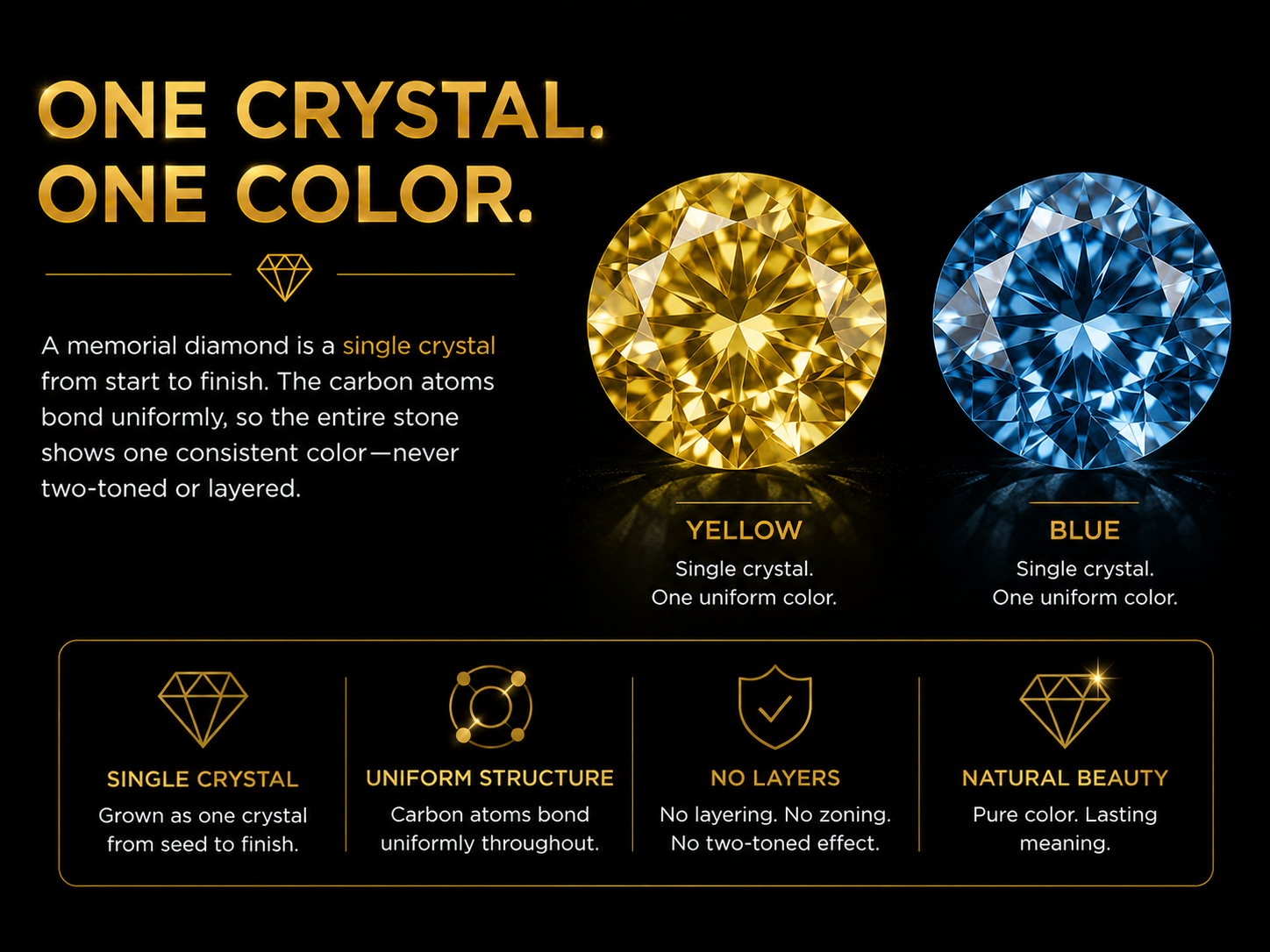
broter dimond

Brother Memorial Diamond Ideas: Rings, Pendants, and Keepsakes

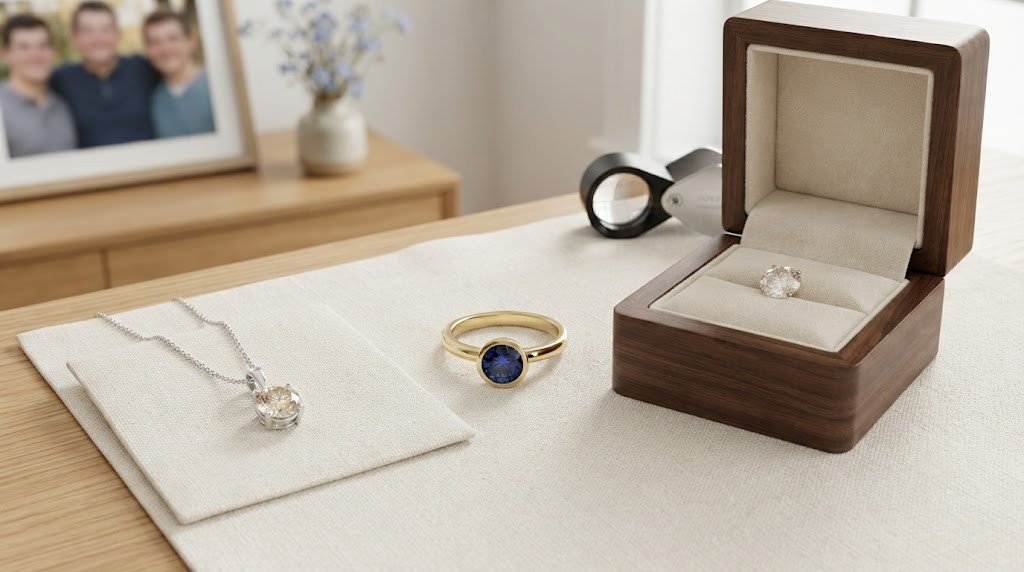
Somewhere between deciding on a diamond and seeing it finished, a quieter question tends to surface: what should this stone actually become? Brother memorial diamond ideas range from pendants, rings, and earrings to cufflinks, lapel pins, bracelets, and a loose stone resting in a keepsake box. The right piece is the one that fits how its wearer moves through an ordinary day, not any rule about what a brother, or a sibling, is supposed to wear.
brother memorial diamond ideas

What Are the Most Meaningful Brother Memorial Diamond Ideas?

A memorial diamond grown in part from your brother’s ashes or hair is a real, lab grown diamond, so a jeweler can set it in nearly anything they would set any other diamond in. That freedom is useful and a little overwhelming, so it helps to start from a shortlist of brother memorial diamond ideas and narrow it by the person who will wear the piece.

The table gathers eight brother memorial diamond ideas that jewelers commonly work with. None of them belongs to one gender, age, or personality. A bold pendant and a fine, delicate ring are equally valid ways to carry him.

IdeaSuits a wearer who…Worth weighing
Pendant or necklaceWants the stone close but clear of their handsChain length, and whether it sits under clothing
RingWants to see the stone many times a dayHands take the most knocks; a protective setting helps
EarringsAlready wears earrings dailyA pair usually means two stones
CufflinksDresses formally for work or occasionsAlso a pair; the stones rest between uses
Lapel or tie pinPrefers a piece reserved for specific daysA secure clutch back matters
Bracelet or bangleLikes jewelry visible at the wristLow settings fare better against desks and doorframes
CharmAlready wears a chain or bracelet they loveJoins something with its own history
Loose stone in a keepsake boxDoesn’t wear jewelry, or isn’t ready to chooseCan be set later

Brother memorial diamond ideas can also be combined across a family: one relative might wear a pendant daily while another keeps a loose stone from the same material. For how the stone itself comes to exist, the brother ashes and hair diamond complete guide walks through each stage.

How Do You Match Brother Memorial Diamond Ideas to the Wearer’s Life?

The useful question isn’t “what would he have chosen?” It’s “what will the person wearing this do while it’s on?” Someone who repairs engines, someone who grades papers late into the evening, and someone who climbs on weekends will each put a stone through very different days.

Before browsing settings, answer a few plain questions about the wearer:

  • Hands: Do they work with tools, lift heavy things, or garden? A pendant or earrings may outlast a ring.
  • Habits: Do they wear jewelry daily, occasionally, or almost never? A piece that fits an existing habit gets worn.
  • Metal: Do they prefer yellow gold, white gold, platinum, or something else?
  • Visibility: Do they want people to notice and ask, or would they rather keep it under a collar or cuff?
  • Travel and sport: Will they remove it often, and is there a safe spot for it?

Answering honestly can rule out half the brother memorial diamond ideas in minutes and lifts the pressure of choosing “correctly.” A stone kept in a drawer out of worry is still meaningful, but it may not be the experience the wearer hoped for.

Why Are Pendants Such Versatile Brother Memorial Diamond Ideas?

A pendant keeps the diamond near the chest and away from the hands, which is why it appears so often among brother memorial diamond ideas. It can sit at the collarbone, rest under a shirt on a longer chain, or hang from a leather or silk cord.

Pendants adapt well over time. A solitaire on a simple bail can move to a heavier chain or a new cord without anyone touching the setting. Bezel pendants, where a rim of metal wraps the stone’s edge, shield it from side knocks; prong pendants leave more of the stone exposed, so ask the jeweler how each style would show off its color.

A small stone of roughly 0.10 to 0.25 carats on a fine chain reads quietly. A larger stone in a geometric or vintage style frame makes a visible centerpiece. Neither choice says more about the bond than the other, and the same pendant design can be made in several metals so each relative’s version feels like their own.

What Should You Know Before Setting His Diamond in a Ring?

A ring keeps the stone in view, which puts it high among brother memorial diamond ideas for wearers who take comfort in glancing down at it. It’s also the setting that takes the most punishment, since hands meet car doors, countertops, and tools in ways that rarely register.

Low profile settings, where the stone sits close to the band, catch less on fabric and gloves. Bezel or half bezel settings wrap metal around the girdle, the stone’s thin outer edge, to shield it from knocks. A flush setting sinks the diamond into the band itself. Signet rings, plain bands with a single small stone, and stacking rings give someone a ring without a tall solitaire.

Which hand it goes on is a personal call; some wearers choose the right hand to keep the left free for a wedding band. If the wearer’s fingers change size seasonally, ask the jeweler whether the band can be resized later without disturbing the stone. Of all the brother memorial diamond ideas, rings reward the most planning.

Which Brother Memorial Diamond Ideas Work Beyond Rings and Pendants?

Earrings, cufflinks, lapel pins, bracelets, and charms deserve a fair look, especially for wearers who don’t connect with rings or necklaces. Several of these brother memorial diamond ideas suit smaller stones, which can help keep costs within reach.

Earrings come as studs, small hoops, or drops. A matched pair generally means two stones, typically grown from the same source material, so plan for two diamonds in the quote and schedule. A single stud suits anyone who wears one earring.

Cufflinks suit wearers who dress formally for work or ceremonies. They also come in pairs, and because they’re worn occasionally, the stones spend more time protected than a ring’s would.

Lapel and tie pins come out for weddings, graduations, or his birthday, then return to their box.

Bracelets and bangles put the stone at the wrist, where a low, bezel set stone holds up better than a tall prong.

Charms can join a chain or bracelet the wearer already owns, which matters when that piece has its own history.

Is a Loose Stone in a Keepsake Box a Real Option?

Yes, and it deserves to be treated as a choice rather than a placeholder. Some people don’t wear jewelry at all; others want to wait until the family has talked things over. A loose diamond in a small display box or a glass topped case can sit on a shelf until it feels right to do more.

A loose stone keeps every path open. It can become a pendant in a year, a ring in five, or stay in its box for good. Store it on its own, since diamond scratches nearly every other gem and metal it rubs against, and keep its origin certificate and any grading report with it.

Some families display the stone beside a photograph of him. Among brother memorial diamond ideas, this one asks the least of the wearer and leaves the most room to decide later.

Can a Memorial Diamond Go Into a Watch, Keychain, or Other Object?

Possibly, but explore it with a jeweler rather than assume. A watch case, keychain, money clip, or belt buckle involves different materials and stresses than traditional jewelry, and not every workshop takes that work on.

If one of these brother memorial diamond ideas fits the wearer, bring questions to the conversation:

  1. Can the stone be set securely in this material, and with what style of setting?
  2. Will daily handling put the diamond at more risk than a pendant would?
  3. Can the stone be removed and reset into jewelry if the object wears out?
  4. Would the work affect the object’s own warranty?

A jeweler may answer yes, no, or “only with changes.” Treat that answer as your starting point before committing.

What Engraving Ideas Fit a Piece Made for Him?
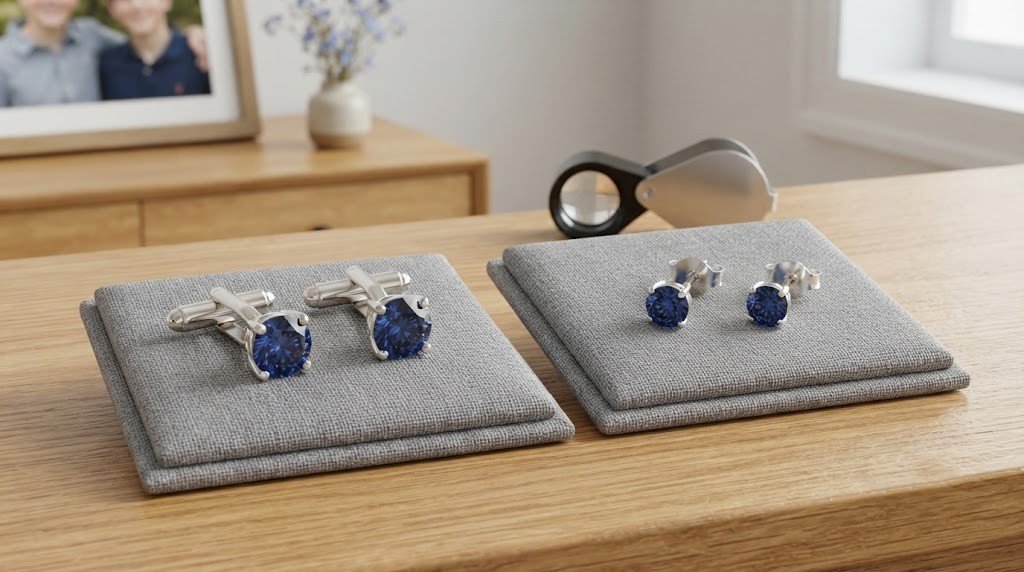
Engraving makes a setting unmistakably his. It usually goes on the metal: inside a ring band, on the back of a pendant, on a cufflink face. You can also ask your provider whether a tiny inscription on the diamond’s girdle is offered.

Engraving ideas worth considering:

  • His full name, a family nickname, or his initials
  • His birthday or a date tied to a shared memory
  • A short phrase he said often, spelled the way he said it
  • Map coordinates of a place connected to him
  • A message from the sibling wearing it, such as “always my brother”
  • A sample of his handwriting, if the jeweler offers that

Space is the practical limit, so ask how many characters the piece can hold at a legible size. When several relatives each choose from these brother memorial diamond ideas, engraving can make matching designs individual, or link different designs through one shared word.

Should Siblings Share Brother Memorial Diamond Ideas or Choose Individually?

With brother memorial diamond ideas for several relatives, there’s no correct answer, only the one that reflects your family. Matching pieces are a visible sign that you belong to each other and to him; individual pieces let each person choose something they’ll wear. A middle path works too:

  • Same stone, different settings: each diamond is ordered in the same target color and size, but one sibling wears a pendant and another a ring.
  • Same setting, different stones: identical pendants, knowing the exact shade can vary even between stones from one source.
  • One shared thread: different pieces linked by a common engraving, metal, or cut.

The conversation needn’t include only siblings. If he had a spouse, a partner, children, or parents who are part of this, they may want a say or a piece of their own. The page on how more than one relative can get a diamond from his ashes explains coordinating several stones from one source.

How Durable Is a Memorial Diamond for Everyday Wear?

Very durable, with one caveat. Diamond sits at 10 on the Mohs scale of mineral hardness, so very little in ordinary life can scratch it, and a memorial diamond has the same hardness as any other diamond because it is one.

Hardness isn’t toughness, though. A sharp blow at the wrong angle can chip a diamond, especially at its edge or at pointed corners on princess, marquise, or pear shapes. That’s why setting choice matters for brother memorial diamond ideas meant for daily wear:

  • Choose bezel or low settings for rings and bracelets that see hard use.
  • Take rings off for heavy lifting, yard work, or the gym.
  • Have a jeweler check prongs and clasps periodically.
  • Store each piece separately.

Before settling on brother memorial diamond ideas for daily wear, ask your insurer how a memorial diamond would be valued and covered, since replacing a stone grown in part from someone’s remains isn’t like replacing an ordinary one.

How Do Color, Size, and Budget Shape Brother Memorial Diamond Ideas?

Memorial diamonds lean toward yellow, blue, and champagne because of trace elements during growth: nitrogen pushes toward yellow, boron toward blue, and colorless requires excluding both, which takes extra processing and typically costs more. Where a provider offers it, irradiation after growth can push a stone toward red, pink, green, or black. No one can forecast the final tone from his ashes or hair, so a setting that flatters a range of tones is a sensible choice. The post on what color a diamond made from his ashes may be explains why. Metal color can change how a tone reads, so ask the jeweler to show the stone against yellow gold, white gold, and platinum before deciding.

Size runs from about 0.10 carats to 5 or more across the industry, and price climbs steeply with it. As a rough 2026 picture, a tenth to a quarter carat often costs $1,500 to $3,500; half a carat to one carat spans roughly $5,000 to $15,000, colorless near the top; and two carats and up runs from about $20,000 to $75,000 or more. Settings, grading, engraving, and fancy cuts are usually extra, which affects brother memorial diamond ideas built around pairs. The brother memorial diamond cost breakdown goes tier by tier.

Grading uses the same 4Cs as any diamond, which GIA outlines in its guide to diamond quality factors; memorial stones typically grade SI2 to VVS in clarity. Turnaround typically runs 6 to 10 months, up to about 12 for larger or specialty color stones, and carat size depends on growth time, not material quantity. The brother memorial diamond timeline helps if you’re aiming for a date.
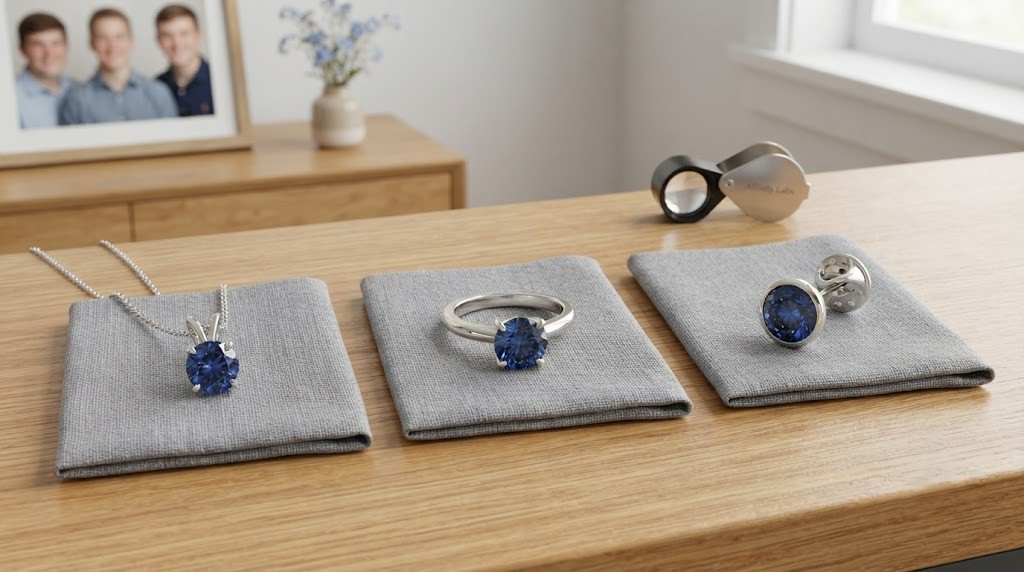
Where Does the Material for Each Piece Come From?

Every one of these brother memorial diamond ideas begins with a portion of his ashes, his hair, or both: typically a few tablespoons to about 4 ounces (roughly 100 grams) of ashes, or a small lock of hair weighing a few grams. Since each stone uses only part of what’s available, several stones can often come from one source, though minimums vary by provider. The guide to how much hair a brother memorial diamond needs covers hair in detail.

Ashes hold only about 0.5 to 4 percent carbon by weight, so ash carbon is typically blended with supplemental lab carbon and usually ends up around 10 to 15 percent of the finished stone’s mass (some providers cite about 3 percent). Hair is roughly half carbon, but no published figure exists for hair’s or a blend’s share of a finished stone.

A sibling often isn’t the person who decides what happens to his remains. Each state sets its own sequence, which may place a husband, wife, or registered partner, any grown children, or his parents ahead of brothers and sisters, and arrangements he documented in his lifetime can alter it. A respectful request for a small portion is usually the gentlest route.

A lock you find tucked away in a drawer or with his possessions could be considered part of what he left behind, and states differ on how that is handled; a lock cut by funeral home staff normally passes through the person with decision making power. The questions to ask before turning his ashes into a diamond cover chain of custody, unused material, and failed growth.

Frequently Asked Questions

Which brother memorial diamond ideas suit someone who rarely wears jewelry?

A loose stone in a keepsake box, a lapel pin, or cufflinks saved for chosen days all suit someone who doesn’t wear jewelry daily. A simple pendant on a long chain, tucked under clothing, is another quiet option that stays private.

Pairs are usually made from two separate stones rather than by dividing one. Both are typically grown from the same portion of his ashes or hair. Ask your provider how they handle pairs, since an exact color match between two stones isn’t always possible.

Can a memorial diamond be moved to a new setting later?

Yes. A qualified jeweler can remove a memorial diamond from one setting and reset it in another, just as with any diamond, so brother memorial diamond ideas can change over time. A loose stone can be set years from now.

Is a memorial diamond tough enough for a ring worn every day?

It rates 10 on the Mohs hardness scale, so everyday contact is unlikely to scratch it, but a hard knock can still chip it. A bezel or low profile setting protects the edges, and taking the ring off for heavy work helps it last.

Can each sibling pick different brother memorial diamond ideas from one source?

Often, yes. Because each stone uses only part of his ashes or hair, several stones can typically be grown from one source, and each can go into its own setting. Whoever holds authority over his remains needs to agree first.

What can be engraved on a piece made for a brother?

His name, initials, a nickname, meaningful dates, coordinates, or a phrase he used often can all go on the metal of the setting. Ask whether a tiny inscription on the diamond’s edge is offered, and how many characters your piece can hold.

Final Thoughts on Brother Memorial Diamond Ideas

Whatever you choose, the stone exists because a real part of him went into it. A ring, a pin, or a small box on a shelf all carry that same carbon and the same story. There’s no deadline: the setting can follow the stone, and it can change later if the person wearing it changes too.

Learn More About Choosing How to Wear It

Talk With Memorial Diamond

If you’d like to talk through brother memorial diamond ideas for your family, from a single pendant to a set of pieces for several relatives, reach out to Memorial Diamond at memorialdiamond.us. There’s no rush, and no question is too small to ask.

Word count: 3,075 words · Reading time: about 15 minutes
Memorial Diamond Settings and Jewelry Ideas for a Daughter

Memorial Diamond Settings and Jewelry Ideas for a Daughter

A loose memorial stone resting in its box can feel like a sentence left unfinished. Daughter memorial diamond settings finish it, and the choice is mostly mechanical: bezel and flush settings guard the stone’s edge best for daily wear, prongs let in more light but leave more exposed, platinum and 14k gold hold up longest, and almost any piece can be reset later for another relative.

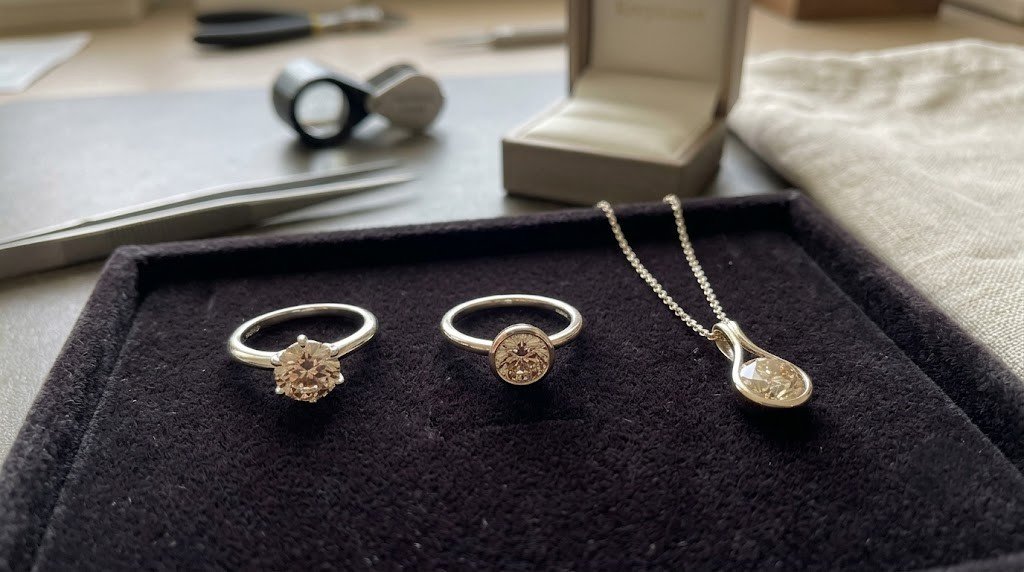
Daughter memorial diamond settings laid out on a jeweler's tray: a bezel ring, a six-prong ring and a pendant, each holding a champagne-toned stone

Why Do Daughter Memorial Diamond Settings Matter More Than Style?

A jeweler can replace a chipped stone in an ordinary engagement ring with one phone call. Nobody can do that here. The carbon recovered from her ashes or hair went into one particular crystal, and any replacement would be a different stone. That is why daughter memorial diamond settings deserve more thought than appearance alone.

Style still matters; it simply comes later. Security and edge protection come first, then whether the piece can change with its wearer.

Once the mechanics are settled, the rest, shape, metal color, chain or finger, becomes something a family can enjoy deciding rather than dread. The broader menu, from rings to keepsake boxes, lives in a separate guide to rings, pendants and keepsakes. This page stays with how daughter memorial diamond settings actually hold, protect and age.

Nothing here assumes anything about who she was or what she liked to wear. Good daughter memorial diamond settings are chosen for the person who will wear the piece, whether that is her mother, her father, her partner, a sibling or her own adult child.

Bezel or Prong: Which Protects a Memorial Stone Better?

A bezel protects better; prongs show more of the stone. For anyone weighing daughter memorial diamond settings, that short answer may settle the question on its own.

Diamond is rated 10 on the Mohs scale of mineral hardness, so very little will scratch it. Hardness is not toughness, though: diamond can split along cleavage planes if struck sharply at the wrong angle, and chips usually start at the girdle, the thin outer rim of a cut stone. A doorframe or countertop is the classic culprit.

A full bezel wraps a continuous band of metal around that girdle, so a blow lands on metal instead of crystal and the stone sits lower. A half bezel covers two sides and leaves the other two open, trading a little protection for a little more light.

Prongs grip the stone at four or six points, letting in more light so it looks larger and livelier. The cost is exposure: the girdle is open between the claws, which can bend or thin over years of ring wear. Six prongs spread the load and keep the stone seated if one fails; four show more diamond but leave less margin.

The wearer decides this more than the stone does. Among daughter memorial diamond settings, a bezel or flush mount usually suits someone who works with their hands, lifts weights, gardens or simply wants to forget the ring is there. Where daughter memorial diamond settings use prongs, they make more sense for a pendant worn under a collar, or a ring kept mostly for occasions.

How Do Seven Common Setting Styles Compare?

Seven styles cover nearly everything a jeweler will suggest for a single memorial stone. Use the table to narrow daughter memorial diamond settings to two or three candidates before you start looking at finished designs.

Setting styleHow it holds the stoneEdge protectionLight and visibilityResizing or resetting laterOften suits
Four prongFour metal claws over the girdleLowHighestStone releases easily; worn claws can be retippedPendants, occasional wear rings
Six prongSix claws spreading the loadLow to moderateHighReleases easily; more claws to inspectRings worn often, larger stones
Full bezelContinuous metal rim around the girdleHighestModerate; stone sits lowerResetting takes more bench workDaily wear rings, active wearers
Half bezelMetal on two sides, open on twoModerate to highGoodModerate effortRings and bracelets needing balance
Flush or gypsyStone sunk into a drilled seat, level with the surfaceHighestLower; mainly the top showsHarder; surrounding metal must be reworkedBands, signet rings, cufflinks
TensionStone held by spring pressure between two metal endsModerateVery highUsually cannot be resizedContemporary designs, careful wearers
HaloCenter stone ringed by small accent stonesModerateVery high; stone reads largerModerate; accents need checkingSmaller stones wanting more presence

Edge protection means the memorial stone itself; halo accents can be replaced without the same weight. Resetting is always possible in principle. What differs between daughter memorial diamond settings is bench time and cost. Ask about both before you commit to any of the daughter memorial diamond settings that would be hard to undo.

Which Metals Hold Up Best in Daughter Memorial Diamond Settings?

The metal carries the stone, absorbs every knock and decides how often the piece needs a jeweler’s attention. Here is how the usual options behave in daughter memorial diamond settings:

  • Platinum dense, naturally white and very durable; scratched metal is displaced rather than lost, so prongs keep their mass. Heavier and generally pricier.
  • 14k gold a harder wearing alloy than higher karat gold and a frequent choice for rings worn every day, in yellow, white or rose.
  • 18k gold richer color and higher gold content, but softer, so claws and thin bands wear faster.
  • White gold usually plated with rhodium for brightness; the plating wears through and is typically redone every year or two.
  • Palladium a lighter member of the platinum family, white all the way through, though fewer jewelers work with it routinely.
  • Sterling silver affordable and handsome for pendants, but soft and prone to tarnish, with prongs that bend readily.

A practical rule for daughter memorial diamond settings is to put the strongest metal where the wear is. A ring takes far more punishment than a pendant, so platinum or 14k gold earns its price there, while a pendant worn under clothing can sit comfortably in 18k gold, or even silver, inside a sturdy bezel.

Chains matter too: a thin one is an easy way to lose a pendant, so ask for a cable or wheat chain with a lobster clasp and have it checked with the setting.

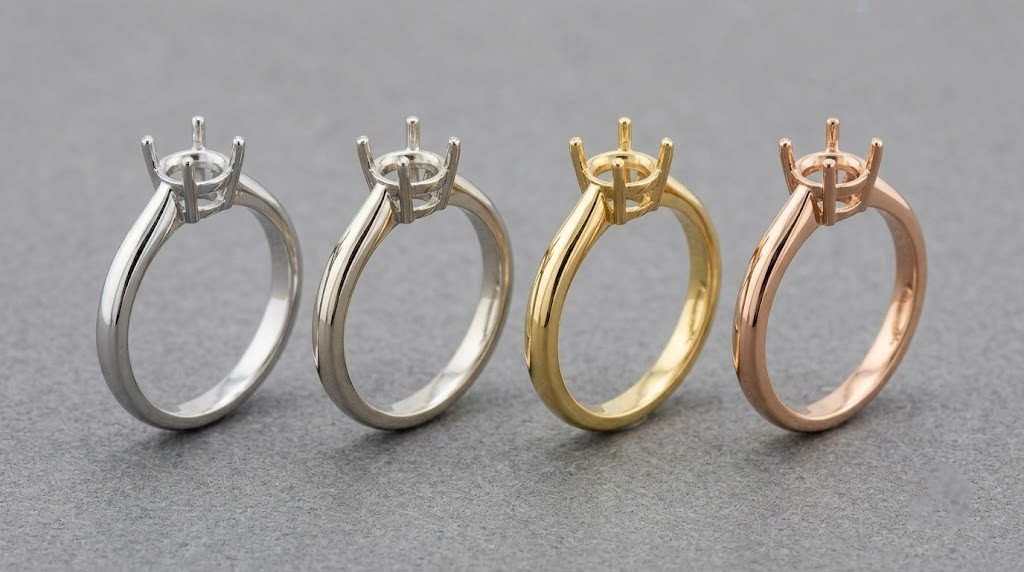
Four plain ring mounts in platinum, white gold, yellow gold and rose gold lined up side by side | Stock acceptabl

How Do Stone Size and Color Shape the Choice?

Size and color are the two things a family cannot fully control in advance, and both affect which daughter memorial diamond settings will flatter the finished stone.

Size. Memorial diamonds are generally offered from about 0.10 carats to 5 carats and beyond, and growth time in the press, not the quantity of ash or hair, determines carat weight. A round stone of 0.10 to 0.25 carats measures roughly 3 to 4 millimeters across, and it often looks best in daughter memorial diamond settings that add presence, such as a bezel or a halo. Half carat to one carat stones suit prongs, a bezel or a flush band equally well. Larger stones sit higher and catch on fabric, so a lower profile helps. Price climbs steeply with size, and how carat, color and grading move the total is worth understanding before a setting is added on top.

Color. Trace elements present during growth set the tone: nitrogen leans yellow, boron leans blue, and a colorless stone needs both absent plus extra processing. Memorial stones tend toward yellow, blue and champagne, and nobody can tell from the source material which one will come back. That is the strongest argument for choosing the metal after the stone exists.

Once you can see it, a few general pairings hold. White metals tend to keep a blue stone cool and a near colorless stone bright; yellow gold warms whatever it holds, deepening yellow or champagne; rose gold sits in between. A closed back bezel can darken a stone slightly by blocking light from beneath.

None of this is about her; it is about the actual stone and the person who will wear it. What range of color to expect has its own guide. When you finally compare daughter memorial diamond settings against the finished diamond, ask the jeweler to hold it against each metal in daylight.

Which Daughter Memorial Diamond Settings Work for Everyday Wear?

Most can, provided the setting is chosen with daily life in mind and the piece is looked after. These seven habits keep a set memorial stone safe for the long run:

  1. Choose a protective mount for rings. Of the daughter memorial diamond settings available, bezel, half bezel and flush mounts shrug off knocks far better than tall prongs.
  2. Take rings off for heavy work. Weights, gardening and moving furniture are classic ways to chip a stone or bend a claw.
  3. Keep it away from chlorine. Pool and hot tub water, and household bleach, can weaken gold alloys over time.
  4. Have the setting checked at least once a year. A jeweler can test prongs and inspect a bezel in minutes; every six months suits a ring worn constantly.
  5. Clean it gently. Warm water, mild soap and a soft brush are enough; ask before using an ultrasonic cleaner, since vibration can loosen a worn mount.
  6. Store it on its own. Diamond scratches other jewelry, so a soft pouch or lined compartment keeps everything intact.
  7. Keep the paperwork with the piece. The origin certificate, any grading report and the jeweler’s receipt belong together, where another family member could find them.

None of this should make the piece too precious to wear. Some families describe the daily contact, a thumb turning a ring, as the part they value most, and well chosen daughter memorial diamond settings let that continue for decades.

Should the Finished Piece Be Appraised and Insured?

Usually it is worth doing, though for a different reason than ordinary jewelry. Insurance can pay money or fund a comparable stone; it cannot return her carbon. A policy on daughter memorial diamond settings and the stones they hold can cover the financial value; whether it would also fund a new stone from retained material is for the agent and provider to answer. Ask the provider, in writing, whether anything you sent is retained and on what terms.

Two options worth asking about are a scheduled item on a homeowner’s or renter’s policy and a standalone jewelry policy. Insurers usually want a recent appraisal and, ideally, an independent grading report; how gemologists describe cut, color, clarity and carat is the vocabulary an appraiser will use. An in house origin certificate records where the carbon came from and says nothing about quality.

Questions to put to an insurance agent rather than a jeweler:

  • Does the policy pay replacement cost or actual cash value?
  • Is there a deductible on jewelry claims?
  • Is unexplained loss, often called mysterious disappearance, covered?
  • How often should the appraisal be updated?

Terms vary by insurer and state. Photograph the piece and keep copies of the paperwork outside the house.

Can a Ring Be Resized or the Stone Reset Later?

Usually, yes, and that flexibility is a good reason to treat daughter memorial diamond settings as something that can change. The stone will outlast any one mount, and quite possibly any one wearer.

Resizing. Most plain gold and platinum bands can be taken up or down a size or two. Eternity bands with stones all the way around, tension designs that depend on the band’s spring, and some patterned shanks resist it. If the ring may be handed on someday, a plain or partly set band keeps the door open.

Resetting. A memorial stone can move from a pendant into a ring, or from a parent’s ring into a younger relative’s pendant decades later. Among daughter memorial diamond settings, prong styles release a stone most easily; bezels and flush mounts take more bench work, because metal has to be opened, but a skilled jeweler can manage both.

A note about heat. Jewelers often use a torch for sizing and repair. If the stone’s color was produced by post growth irradiation, which some providers offer for colors such as red, green or black, strong heat can alter some treated colors. Tell the jeweler what the stone is and how its color came about, and ask that it be removed before any torch work.

Whatever daughter memorial diamond settings the stone passes through over the years, keep the provider’s documentation with it, and ask each jeweler to note on the receipt that a memorial diamond was handled.

Which Daughter Memorial Diamond Settings Suit Each Family Member?

When more than one stone is grown, it is often possible to divide one source of ashes or hair between several relatives. Each person may want something different. Daughter memorial diamond settings chosen for each wearer’s real life get worn; ones chosen only so everything matches can end up in a drawer.

WearerPieces worth consideringSetting points to weigh
A parent who wears a ring dailySolitaire or bandBezel or flush; platinum or 14k gold
A parent who prefers not to wear ringsPendant, lapel pin or keepsake charmBezel pendant on a sturdy chain
Her spouse or partner, if she had oneRing worn beside or instead of a wedding band, or a pendantLow profile that sits next to an existing band
A siblingPendant, cufflinks, signet ring or braceletFlush or bezel for daily wear
Her adult child, if she had childrenPendant now, ring laterProng mount that resets easily
A grandparentPendant or broochLightweight metal, secure clasp

Families sorting out daughter memorial diamond settings for several people sometimes settle on one shared detail, the same metal, or an engraved date inside each band, and let everything else differ.

A pair of earrings needs two stones, and two stones grown separately may not match in tone, since color cannot be predicted from the source; a jeweler can design around a slight difference. Stones for several relatives may also finish at different times, so how long each one is likely to take is worth knowing before anyone plans to hand them out together.

What Should You Ask a Jeweler Before the Stone Is Set?

Memorial Diamond Settings and Jewelry Ideas for a Daughter

Some providers set the stone themselves; other families take the loose diamond to a local jeweler they already trust. Either works if whoever handles it knows it cannot be replaced.

Before any of the daughter memorial diamond settings you are considering is made, ask whether the work happens on the premises, who handles the diamond and whether it is insured while there. Ask them to measure the stone in front of you, and what warranty covers their workmanship.

If you are still comparing providers, a guide on where to start covers that decision first. Choosing daughter memorial diamond settings goes more smoothly once the stone itself is real and in your hands.

Frequently Asked Questions

What is the most protective setting for a memorial diamond?

Among daughter memorial diamond settings, a full bezel or a flush mount gives the most protection, because metal covers the girdle where chips usually begin. Both suit rings worn every day. Prongs show more of the stone but leave its edge exposed, so they suit pendants better.

Should the metal be chosen before the diamond is finished?

It is safer to wait. Color cannot be predicted from her ashes or hair, and a yellow, blue or champagne stone can look quite different against white or yellow metal. Decide on the setting style early if you like, then confirm the metal once the stone exists.

Can a memorial diamond chip or crack?

Yes, although it is uncommon. Diamond resists scratching better than any natural material, but a sharp blow at the wrong angle can chip it, usually along the girdle. Picking daughter memorial diamond settings with protection in mind, such as a bezel or flush mount, reduces that risk.

Is sterling silver strong enough for a memorial ring?

Silver is soft and tarnishes, and silver prongs bend more readily than gold or platinum ones. It works well for a pendant inside a sturdy bezel. For a ring worn daily and holding an irreplaceable stone, platinum or 14k gold is the more durable choice.

Can her stone be moved into a different piece later?

Usually, yes. Prong mounts release a stone easily, while bezels and flush settings take more bench work. Tell the jeweler it is a memorial diamond, mention whether its color was produced by irradiation, and ask that it be removed before any torch work begins.

Does a memorial diamond need its own insurance?

It is worth discussing with an insurance agent. A scheduled item on a homeowner’s or renter’s policy, or a standalone jewelry policy, is common. Insurers usually want an appraisal and ideally a grading report. Coverage terms vary by insurer and state, so confirm the details directly.

Can two stones from the same source become matching earrings?

They can be set as a pair, but they may not match exactly. Each stone’s color is set by trace elements during its own growth, so two stones from the same source can differ in tone. A thoughtful jeweler can design the pair so any difference looks intentional.

Final Thoughts on Choosing a Setting for Her Stone

It can feel strange to think about claws and karats when what you are holding is part of someone you love. The mechanical questions turn out to be a kindness: once the stone is protected and the mount can change with its wearer, you are free to choose the rest with your heart.

The best daughter memorial diamond settings are rarely the most elaborate. They are the ones that let the stone be worn, checked, cleaned and eventually passed on without anyone holding their breath. If the family is still at the beginning, the complete guide to a daughter ashes diamond covers the steps that come before choosing daughter memorial diamond settings at all.

Learn More About Daughter Memorial Diamond Jewelry

Talk With Memorial Diamond

If you would like to talk through daughter memorial diamond settings with someone before deciding, Memorial Diamond is glad to help at memorialdiamond.us. A conversation about metals, mounts and what might suit each person in your family is simply that: a conversation, with nothing expected afterward.

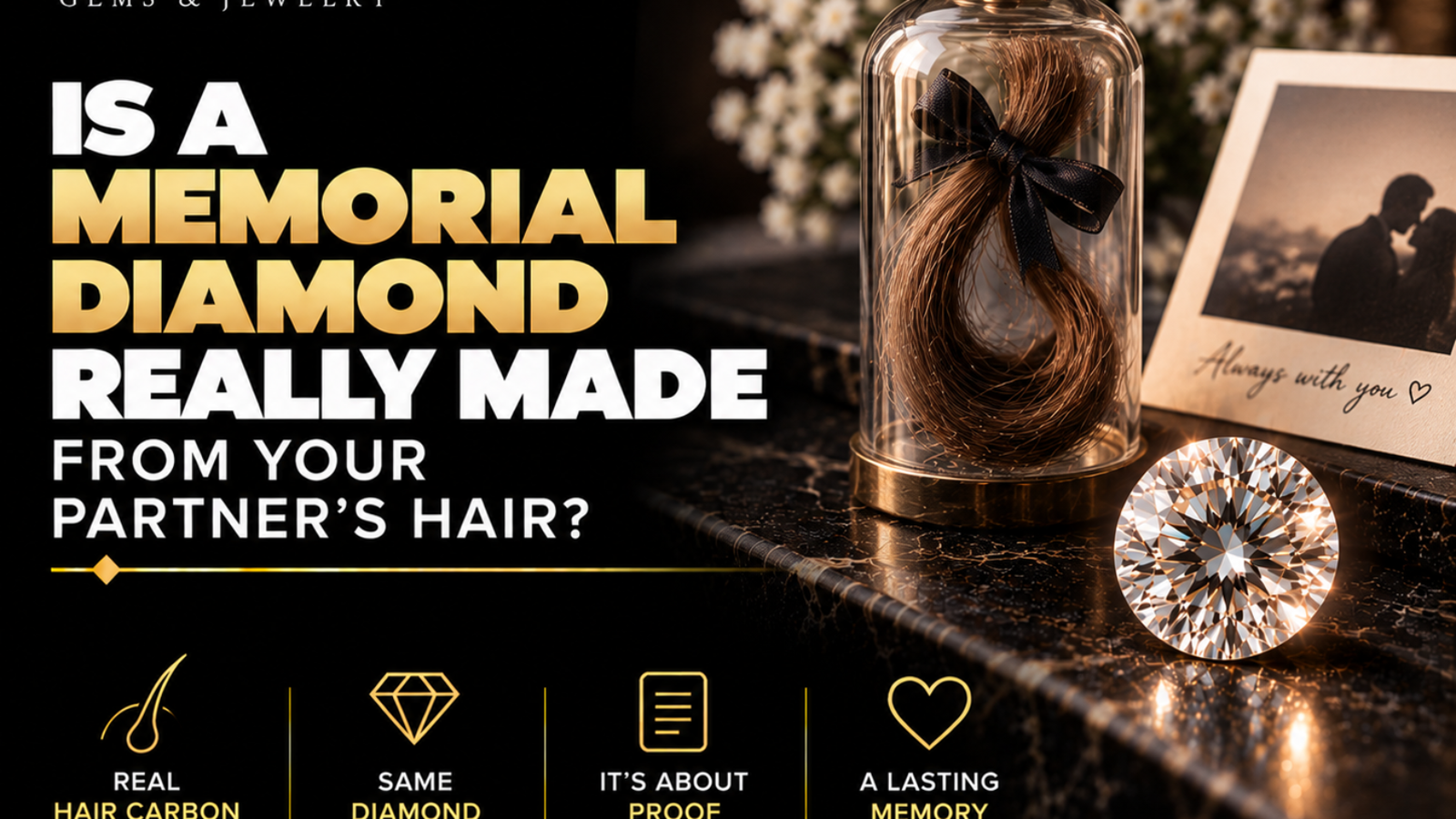
Memorial diamond made from a partner’s hair, shown with a preserved lock of hair, sparkling diamond, keepsake photo, and flowers on a luxury black jewelry setting.

Is a Memorial Diamond Really Made From Your Partner’s Hair?

A lock of hair is usually the thing nobody thought to plan for and somebody kept anyway.

A memorial diamond made from partner hair is grown from keratin, which is roughly 50% carbon by weight. A small lock is purified to around 99.9% carbon, converted to graphite at about 2,500 to 2,700°C, and grown into a real diamond crystal at roughly 6 to 8 GPa and 1,400 to 2,500°C. No cremation is involved at any point. Six stages, typically six to ten months.

Because hair carries so much carbon, the difficult question in a memorial diamond made from partner hair is not whether there is enough of it. It is whether anyone can show that this particular lock was your partner’s, and that question has to be answered before the furnace, never after.

Why Hair Solves One Problem and Creates a Different One

Hair is built from keratin, a protein that is roughly 50% carbon by weight. Cremated remains, by comparison, are mostly calcium phosphate and yield usable carbon at somewhere around 0.5% to 4% of ash by weight. The gap between those two numbers is not marginal, it is more than an order of magnitude.

Three consequences follow. A diamond made from partner hair needs only a small lock rather than a measured portion of remains. Extraction is shorter and less lossy, because far less of the starting material is discarded as non carbon mineral. And no cremation is required at any point, so this route stays open whether your partner was cremated, buried, or is still living.

That last point is why hair matters so much in a partner’s situation specifically. No federal rule governs control of a person’s remains; each state writes its own, and whatever your partner set down in writing can redraw the picture over the top of it. So a partner is not guaranteed to be the one with standing, and the gap opens most often where the relationship was never legally recognized, or was not something everyone involved knew about. A lock of hair in an envelope, or caught in a brush at the back of a drawer, is often the material you actually have.

For plenty of people in that position, a diamond made from partner hair is less the preferred option than the available one.

But the same chemistry that removes the yield problem introduces a sharper one. Hair from any two people is chemically indistinguishable once it has been reduced to purified carbon. Nothing about a finished stone reveals whose hair went into it. So the entire question of whether a memorial diamond made from partner hair is genuinely theirs moves upstream, to handling and records, and away from the laboratory bench.

made from partner hair

The Six Stages of a Memorial Diamond Made From Partner Hair

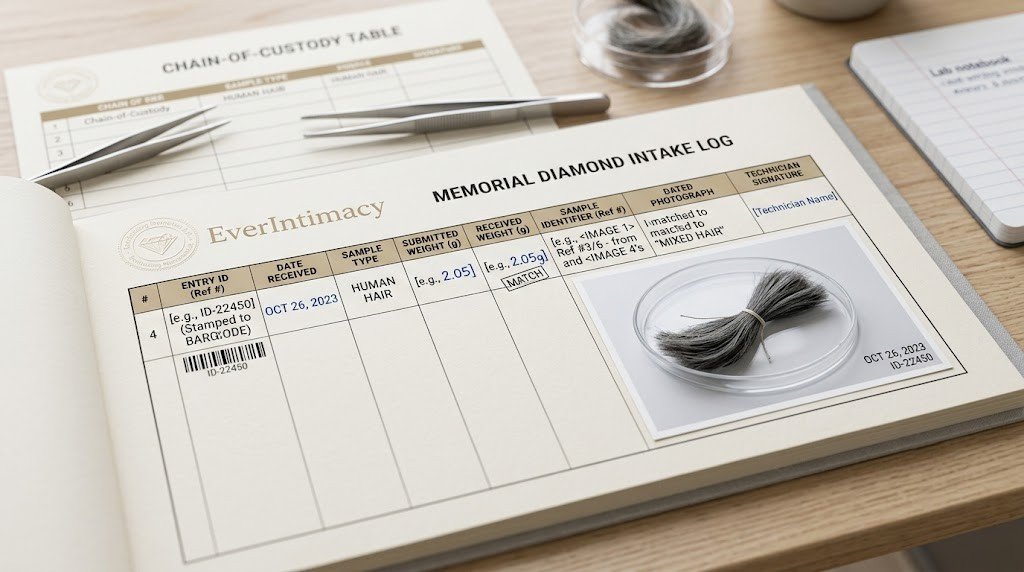
1. Intake, weighing, and identification. The lock arrives and is logged. Ask for a unique identifier assigned at this moment, a recorded weight, and, this is worth asking for specifically, a photograph of the material as received. Everything that can ever be said about whose hair this is gets fixed here, which makes intake the most consequential stage in a diamond made from partner hair.

2. Cleaning and preparation. Hair arrives with whatever was on it: product residue, dust, dye, oils from a brush. That is removed before extraction so it does not carry into the crystal.

3. Carbon extraction and purification. The hair is heated in a controlled, oxygen free environment that strips away the non carbon components of keratin, nitrogen, oxygen, sulfur, hydrogen, until what remains is roughly 99.9% or higher carbon. Because the starting material is already about half carbon, a diamond made from partner hair loses far less of its submitted mass here than an ash based stone does.

4. Graphitization. The purified carbon is heated further, to roughly 2,500 to 2,700°C, and converted into graphite, the crystalline form a diamond press can use as feedstock.

5. Growth. The graphite, combined with supplemental lab grown carbon, goes into an HPHT growth cell around a tiny diamond seed at roughly 6 to 8 GPa and 1,400 to 2,500°C, for weeks to months. Carat size is a function of how long that cell runs.

6. Cutting, polishing, and grading. The rough crystal is cut and polished, then assessed against the same cut, color, clarity, and carat standards applied to any diamond, ideally by an independent third party laboratory. A diamond made from partner hair is graded on exactly the same scale as any other stone, with no separate standard. Some providers also offer post growth irradiation to shift color; ask whether it is being used and whether it will appear on the paperwork.

If Yield Is Not the Question, What Is?

For an ash based stone, the anxious question is quantity: is there really enough carbon in there to matter? For a diamond made from partner hair, that question essentially answers itself. Keratin is carbon rich, a small lock is enough, and nobody in the industry disputes it.

What replaces it, for a diamond made from partner hair, is a question about identity, and that one is harder.

Here is the part that is rarely said plainly. The purification stage destroys everything that is not carbon. That includes DNA, which is an organic molecule that cannot survive being heated toward graphitization temperatures. Once a lock of hair has been purified, there is no genetic material left in it, and therefore no test that can be run on the resulting carbon, or on the finished diamond, to confirm whose hair it was.

This is not a gap in one company’s process. It is a property of the physics. A memorial diamond made from partner hair cannot be retroactively verified by analysis, because the thing that would carry the evidence is precisely what purification removes.

What that means in practice is simple, and it is the single most useful thing to understand before starting. Identity is established by custody and documentation, in a window that opens when you cut or collect the lock and closes when the extraction furnace is sealed. Everything after that is a record, not a measurement. The question worth asking a provider is therefore not “can you prove it afterward”, nobody can, but “what exactly do you record, and when.”

How Do You Prove a Lock of Hair Was Your Partner’s?

The provenance of a diamond made from partner hair is established the way any chain of custody is established: by making each handover leave a trace, so no point in the chain rests on trust alone. The table below sets out where the handovers in a diamond made from partner hair are, and what is worth having written down at each.

Handover pointWho holds the materialWhat should be recordedWhat a weak answer sounds like
CollectionYou, or whoever cut or gathered the lockWho collected it, when, and from where, a note in your own handwriting is enough“It doesn’t really matter, just send it in”
Packaging and shippingYou, then the carrierSealed and labeled container, tracked shipping, a photograph before sealing“Ordinary mail is fine”
Intake at the facilityThe providerUnique identifier, recorded weight, dated photograph of the lock as received“We’ll let you know when it arrives”
Cleaning and preparationThe providerConfirmation the identifier travels with the material, not with the paperwork alone“It’s all tracked in our system” with no detail
Extraction and purificationThe providerBatch record tying the identifier to a specific run“Everything is processed together”
Growth, cutting, gradingThe provider, then the grading labIdentifier carried through to the finished stone and its certificate of originA grading report with no origin document alongside it

Two clarifying questions are worth asking directly, without apology. First: is material from more than one client ever combined in a single growth run, and if so, what separates them? Second: what is returned to you at the end besides the stone, an origin or authenticity document is a different thing from a grading report, and a diamond made from partner hair should come with both.

These are ordinary logistics questions about a diamond made from partner hair, not accusations. A provider that answers them plainly is telling you something real. A provider that treats the questions as rude is telling you something too.

What Condition Does the Hair Need to Be In?

Hair is durable in a way that surprises people. It does not decompose on a shelf, and a lock kept in an envelope since 2009 is, chemically, very close to the hair that was cut that day. Age alone rarely disqualifies material for a memorial diamond made from partner hair.

What matters more is quantity and cleanliness:

  • Amount. Industry guidance generally describes a small lock, a few grams, or a “palm sized” wisp, far less than most people expect a diamond made from partner hair to require. Confirm the actual requirement before cutting, so you are not left having taken more than was needed.
  • Loose hair from a brush. Frequently usable, but it is also the material most likely to be mixed with someone else’s. If the brush was shared, say so at intake rather than hoping it does not matter.
  • Storage. Dry, sealed, and out of direct light is ideal. Hair stored somewhere damp can grow mold, which is a contamination question rather than a carbon question.
  • Root or no root. No root is needed. A diamond made from partner hair is built from the carbon in the shaft, and cut hair works exactly as well as pulled hair.
  • Very short hair. Short does not mean unusable; total weight matters more than length. Clippings from a final haircut, or from a shave during illness, are workable material.
  • Hair collected from someone still living. The same process applies with no change. The only real difference is that you can ask the person which lock they would want used.
Intake log showing a unique identifier, recorded weight, and dated photograph of a hair sample

If all you have is a single strand, say so at intake rather than sending it and hoping. Better to be told it is not enough than to find out in month five.

Intake log showing a unique identifier, recorded weight, and dated photograph of a hair sample 

Does Dyed or Gray Hair Change a Diamond Made From Partner Hair?

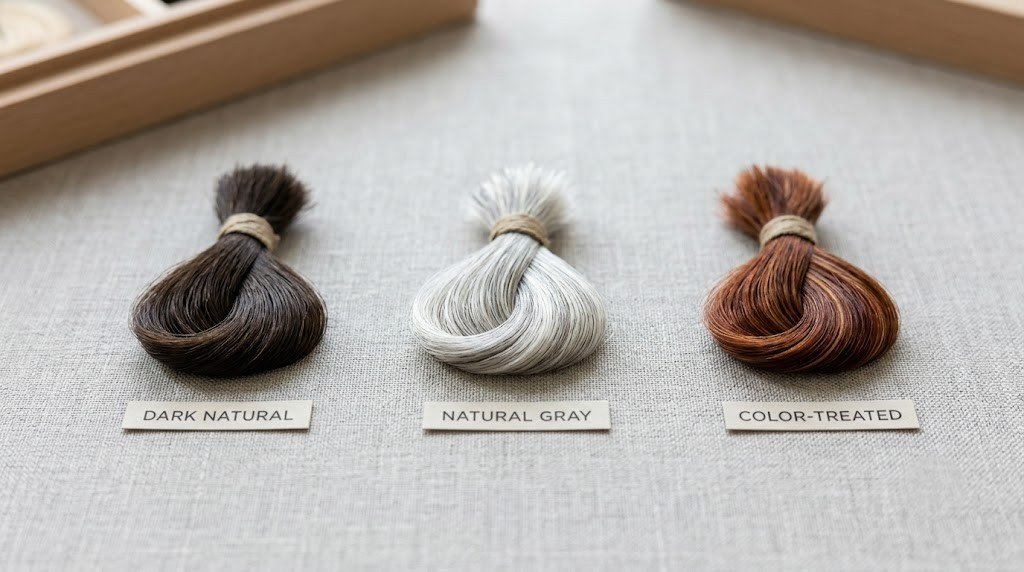
Dye, bleach, and permanent color are surface and cortex treatments applied to keratin. They do not change the fact that the shaft is carbon rich, and purification to 99.9%+ carbon removes them along with everything else that is not carbon. Treated hair generally works for a diamond made from partner hair, but mention it at intake, it is the kind of detail that belongs in the record.

Gray and white hair is the same material minus melanin, a pigment, not a structural difference. A stone grown from silver hair is not automatically paler than one grown from dark hair, and nobody can promise the reverse either.

The honest position on color is that it cannot be forecast precisely from any starting material. Nitrogen produces yellow tones, boron produces blue, and colorless requires the absence of both, and organic carbon sources bring trace elements with them. A memorial diamond made from partner hair will usually land somewhere in the yellow, blue, or champagne range, with colorless achievable but requiring additional process control and typically costing more. Choose a range you would be happy with rather than a shade you are expecting.

Three hair samples side by side — dark, gray, and color-treated — on a neutral surface | Stock acceptable. |

What Documentation Should Come Back With the Stone?

Two different documents can arrive at the end of a memorial diamond made from partner hair, and they answer two different questions. Confusing them is the most common way people end up feeling less certain than they should.

A grading report describes the diamond: cut, color, clarity, carat. Issued by an independent laboratory, it is a strong, verifiable statement about quality, and it says nothing whatsoever about origin. A grading lab assesses the stone in front of it, not the history behind it.

An origin or authenticity document describes the history: the identifier assigned at intake, the recorded weight, the batch the material was processed in, and a statement tying the finished stone to the lock you sent. This is the document that actually addresses whether a diamond made from partner hair is your partner’s, and it is usually issued in house rather than by a third party.

Ask for both, and ask what the origin document specifically asserts. A line that says “grown from submitted material” is weaker than one that names your identifier, the intake date, and the weight received. Neither document can prove identity after the fact, nothing can, once purification has run, but a specific, dated record made at the time is the strongest evidence a diamond made from partner hair can carry.

Certificate of origin laid beside an independent grading report and a polished memorial diamond

What a Diamond Made From Partner Hair Shares With Every Other Memorial Diamond

Three things are true of a diamond made from partner hair exactly as they are true of an ash grown one, and it is worth saying them plainly rather than letting hair sound like a shortcut.

It is not grown from your partner’s carbon alone. Hair gives up far more carbon than ash does, but a small lock still does not give up enough to fill a growth cell. The purified keratin carbon is combined with lab grown carbon until the charge reaches the volume a crystal of your chosen size requires. The personal carbon is real, verifiable, and genuinely part of the diamond’s lattice, it is not the whole of it, and any description that says otherwise is describing something that does not exist.

Size is bought as time, not as material. Sending a bigger lock does not produce a bigger stone. Carat is determined by how long the growth run lasts, which is why a larger diamond made from partner hair costs more and takes longer rather than simply consuming more hair.

The wait is the same. Industry wide, the full sequence typically runs six to ten months, sometimes twelve for larger stones. Hair’s easier extraction saves time at the front, not in the press, and the press is where almost all the months are.

Frequently Asked Questions About a Memorial Diamond Made From Partner Hair

How much hair is actually needed?

Typically a small lock or a few grams, often described as palm sized or a few wisps. Because hair is roughly 50% carbon by weight, far less material is required than for an ash based stone. Confirm the exact requirement before cutting anything.

Can a diamond be made from hair if my partner was buried?

Yes. A diamond made from partner hair involves no cremation at any stage, so a lock kept before or after the funeral works regardless of how your partner was laid to rest. This is often the only route available when the remains were interred.

Can anyone test the finished stone to confirm whose hair it was?

No. Purification destroys DNA along with everything else that is not carbon, so no post growth test can identify the source. Identity rests entirely on chain of custody documentation created before extraction begins.

Does hair that was dyed or permed still work?

Generally yes. Color treatments sit on and within the keratin shaft and are removed during purification along with other non carbon material. Mention the treatment at intake so it is recorded rather than discovered later.

Is hair from a brush usable?

Often, though it carries a higher chance of being mixed with someone else’s hair. Say so at intake if the brush was shared. A deliberately cut lock is cleaner evidence and a simpler custody record.

Will a hair grown stone look different from an ash grown one?

Not in any way a grader could identify. A diamond made from partner hair and an ash grown stone are chemically genuine diamonds assessed on the same 4Cs, and neither material produces a reliably lighter or better color. Color depends on trace elements, not on which material you started from.

Final Thoughts on a Memorial Diamond Made From Partner Hair

The chemistry behind a memorial diamond made from partner hair is generous. Hair is roughly half carbon, a small lock is enough, and nothing about the process requires a cremation to have happened. That is a genuinely lower barrier than most people assume when they first look into this.

What the chemistry cannot do is answer the question that actually keeps people up: is this really them. That answer lives in a paper trail created in the days before anything is heated, who cut it, when, what was written down, what was photographed, what identifier followed it through the building. Ask for those things while asking is still possible. After the furnace, there is nothing left to ask.

Learn More About Partner Memorial Diamonds

Talk With Memorial Diamond

If you have a lock of your partner’s hair and want to know what a memorial diamond made from partner hair would involve, reach out to Memorial Diamond at memorialdiamond.us and ask what gets recorded at intake before sending anything. Those questions are easiest to ask early.

Father memorial diamond ideas featuring rings, pendants, cufflinks, a watch, and meaningful keepsakes

Father Memorial Diamond Ideas: Rings, Pendants, and Keepsakes

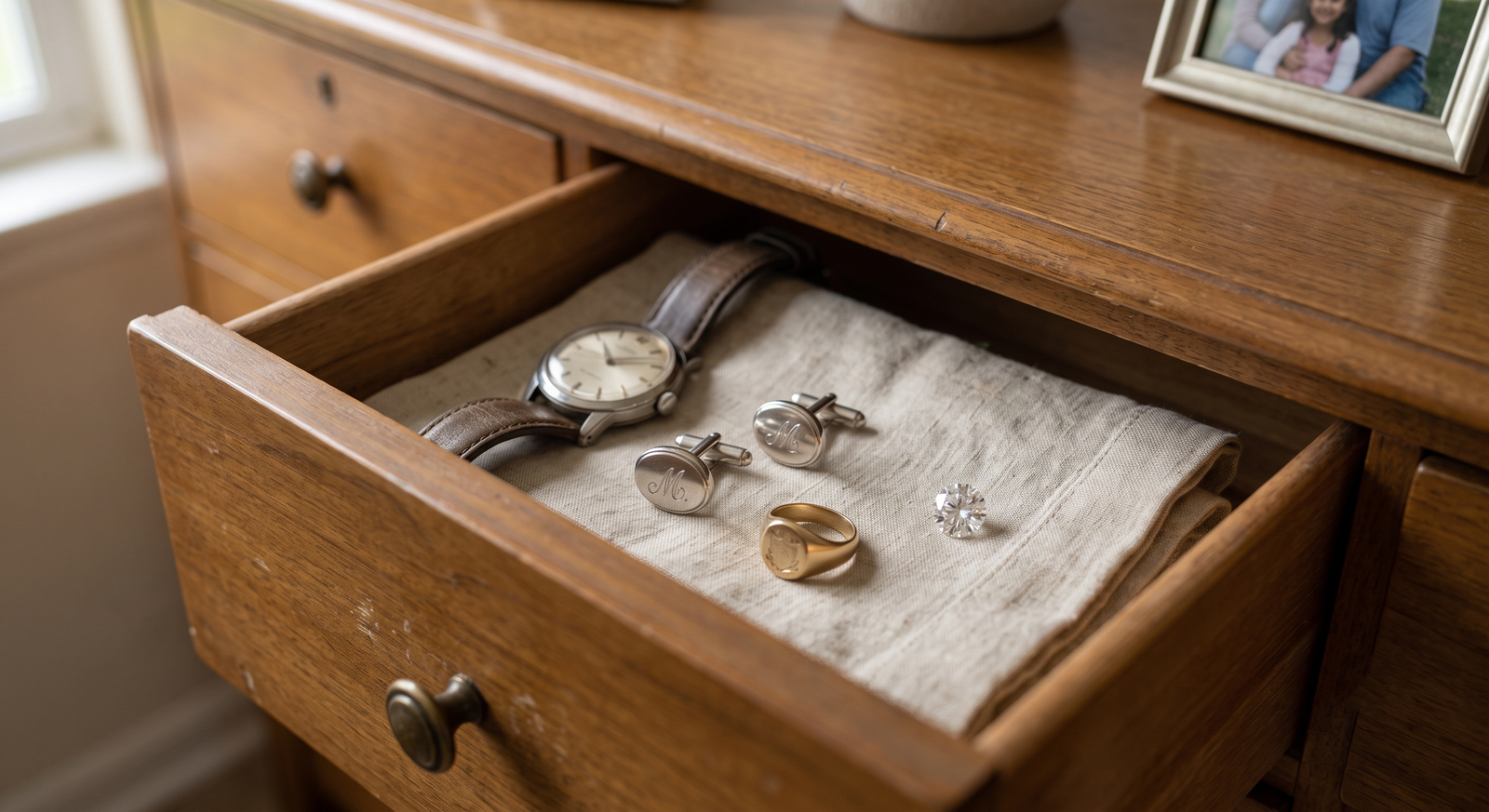
Somewhere in the house there is a drawer with his watch in it, a pair of cufflinks he wore twice, and a signet ring that fits nobody. Nobody wears any of it; nobody can throw it out either. The most useful father memorial diamond ideas start from that drawer, not from a catalog. A stone grown from his ashes or his hair can become a ring, a pendant, cufflinks, a tie bar, a stone set into something he used, several small stones, or nothing yet. The question that sorts that list is who it is for, not what it is. This page walks the five answers to that question, in order.

Where this comes from: Memorial Diamond grows memorial diamonds for a living, so read what follows as a maker’s list rather than an impartial survey of the field.

ather memorial diamond ideas: an open drawer holding a man's wristwatch, cufflinks and a signet ring, with a small loose lab-grown diamond beside them

Who Is the Stone Actually For?

Start there, because ordering a father’s stone and wearing it can easily fall to two different people, an adult child arranging one for a mother who would never have arranged it herself, or two siblings paying for a piece only one of them can wear. A piece chosen for somebody else has to survive their taste and their feelings about being handed something they did not ask for. Every one of the memorial diamond ideas here belongs to one row of the table below.

Who it is forFather memorial diamond ideas that suit themWhat to settle before ordering
YouA pendant, a plain ring, or a stone in something you already ownYour honest answer about whether you will wear it
His widow or partnerA pendant, or a stone added to a ring she wears dailyAsk her first, including whether she wants one. Altering her ring is her decision, not a surprise
Another adult childA small stone in a simple mount they can wear or shelve without commentWho it belongs to afterwards, and whether they want the obligation
The family jointlySeveral small stones, or one stone documented as an heirloomWhere it lives, who holds it, what happens at the next generation
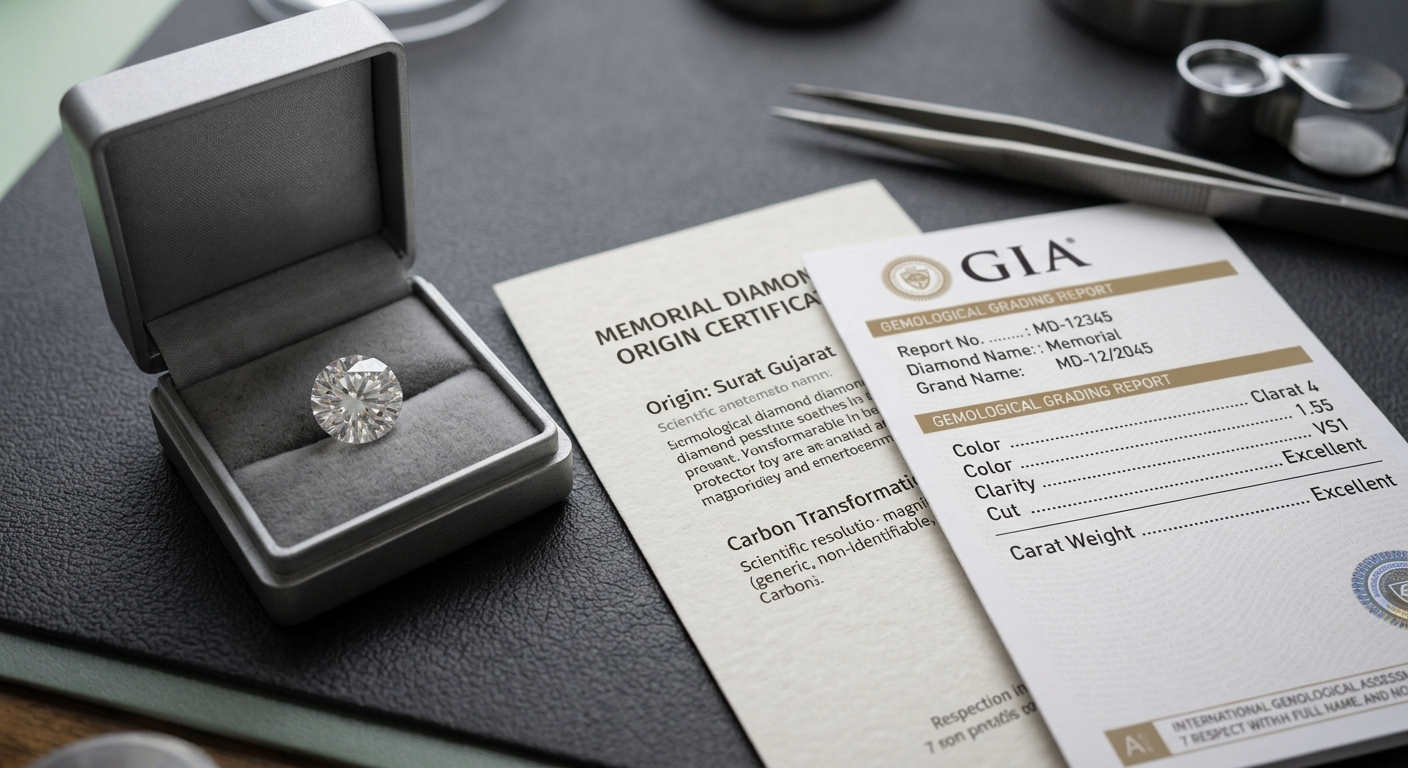
Nobody yetThe stone loose in its case with its paperworkWhere it is kept, and who else knows it exists
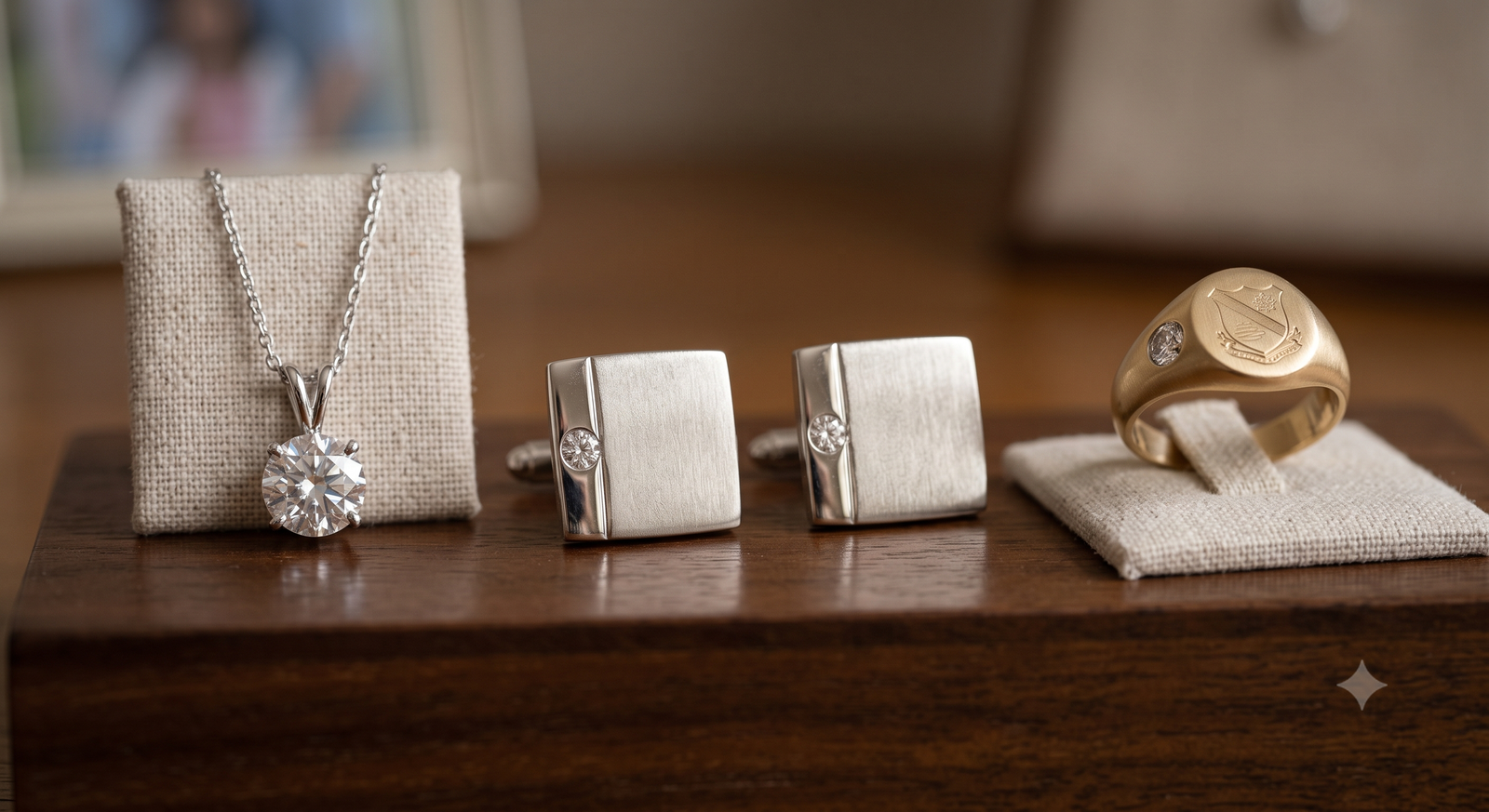
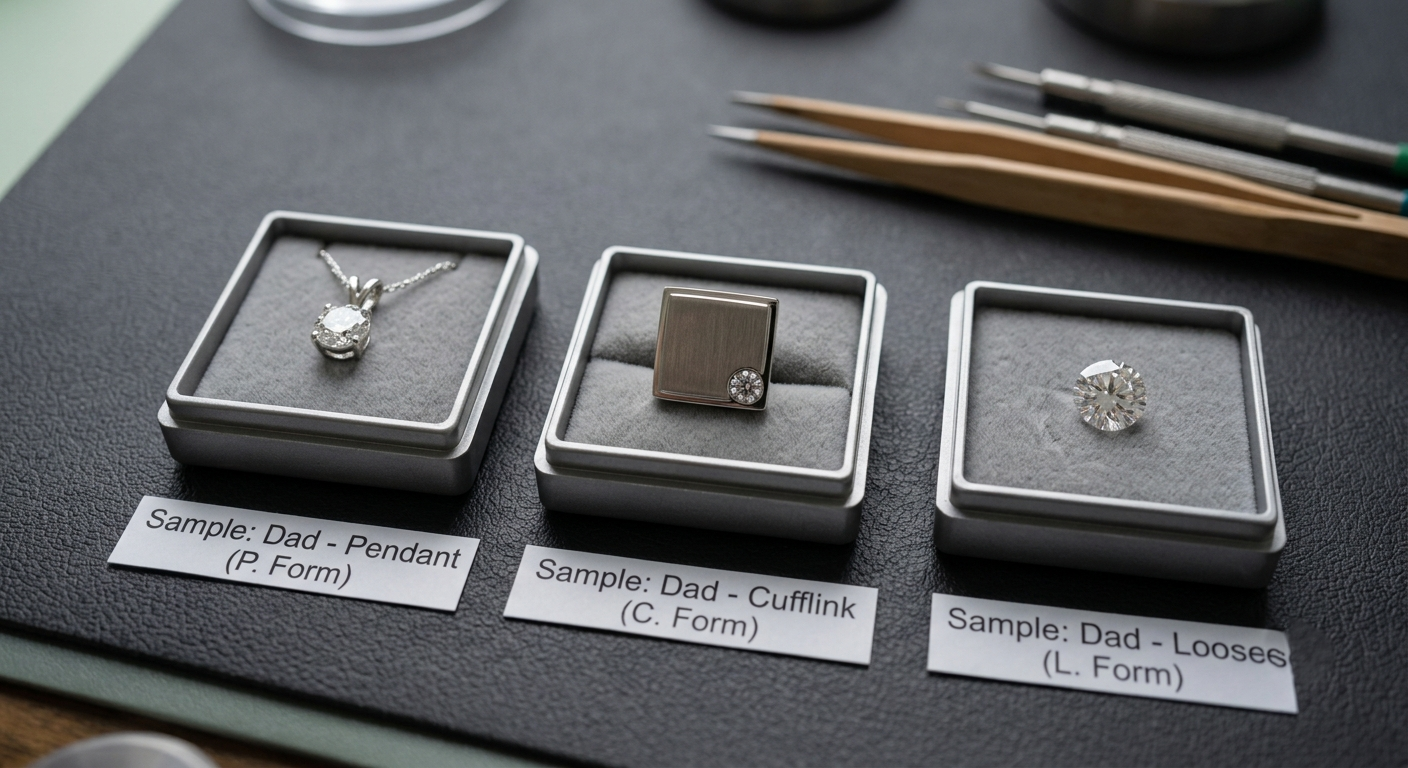
Memorial diamond shown three ways as a pendant, as a pair of cufflinks and set into a signet ring shoulder

One fact sits underneath every row. The stone in each of these pieces is grown from carbon drawn out of his ashes or hair, purified to about 99.9% and then brought up to a workable volume with lab sourced carbon, because a growth run needs more feedstock than a submitted portion supplies on its own. Industry figures put his own share at roughly 10–15% of the finished stone’s mass. A stone offered to you as entirely him is described wrongly. It is still a real diamond, the hardest known natural mineral, graded like any other, which is what makes every idea below workable.

The rule this page is built on: if the piece is for someone else, ask them before the order goes in, not when it arrives. How to raise it with a surviving parent is worked through in how to talk to family about a father memorial diamond.

Father Memorial Diamond Ideas for Something You Keep Yourself

The easiest category, because nobody else has to agree with you.

  • A pendant you put on and forget. It stays under a collar and needs no explaining.
  • A ring worn on a named day, his birthday, the anniversary, and kept in a box between.
  • Cufflinks or a tie bar, if the occasions that put you in a suit are the ones where he comes up.
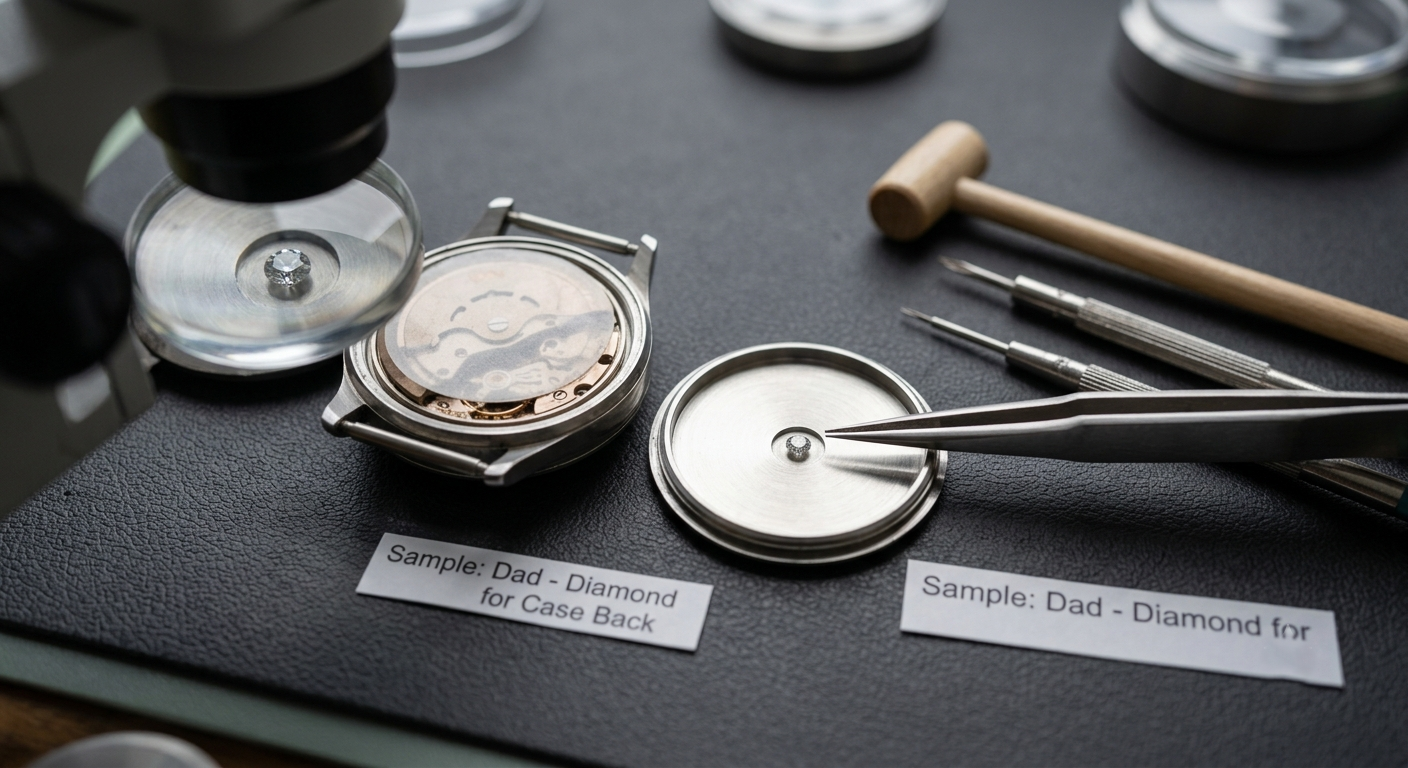
  • The stone in the watch you wear, so the object you check all day is his too.
  • The stone loose, in a desk drawer. Wanting the stone and wanting to wear it are two different wants.

Which of those memorial diamond ideas actually keeps hold of a stone is a separate, mechanical question, and it belongs to memorial diamond settings and jewelry ideas for a father. This page is what to make; that one is how a piece holds it.

Ideas for a Piece Made for His Widow

Here the person ordering and the person receiving are two different people, which makes sequence matter more than design. The father memorial diamond ideas that work for a widow are the ones that leave her the most room.

  • A pendant. Of all the memorial diamond ideas for a widow, the least demanding thing to be given: worn daily, worn on his birthday, or kept in a drawer without anyone auditing which of the three.
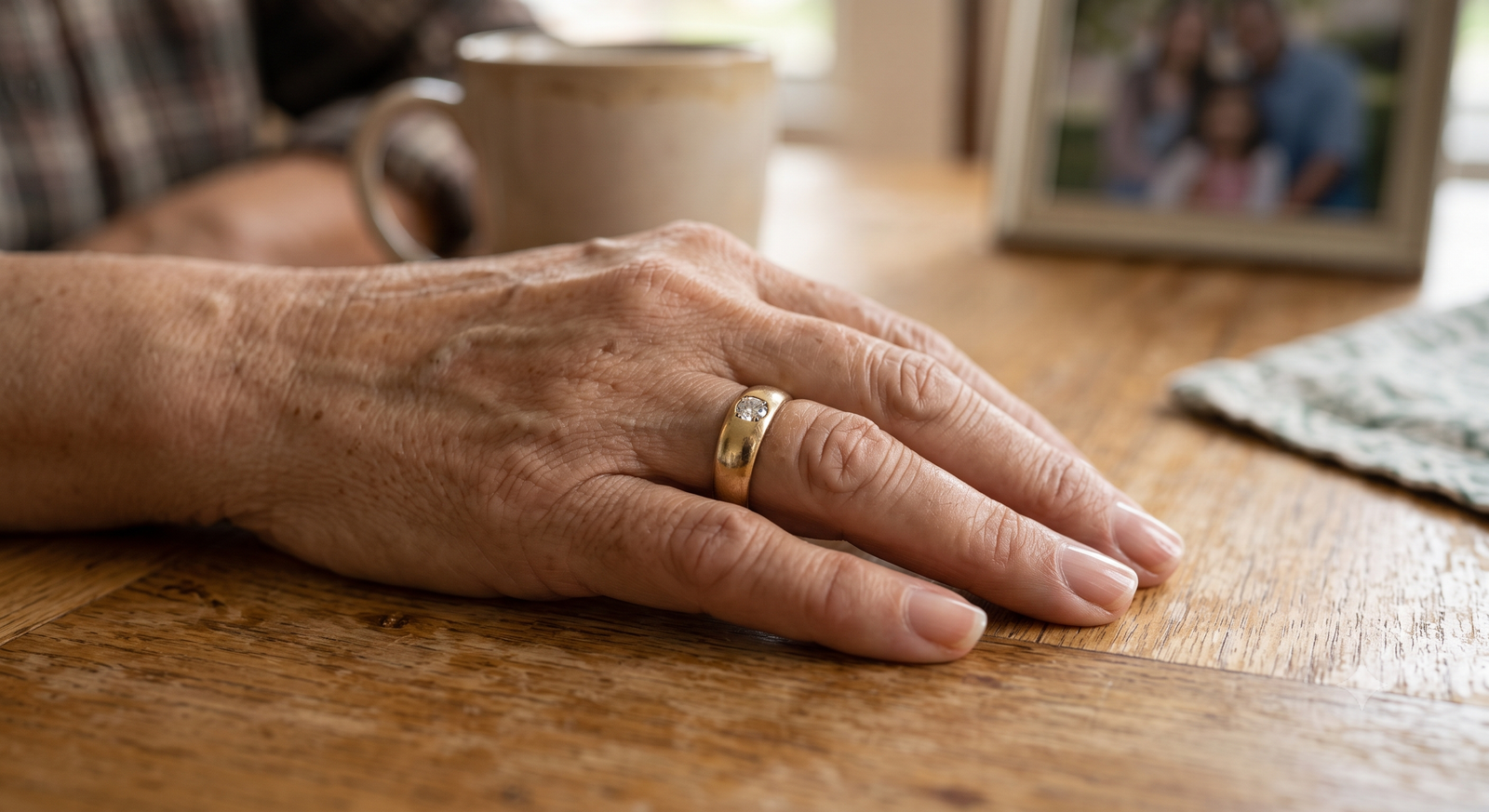
  • A stone added to a ring she already wears, an engagement ring, an eternity band, a dress ring she has had for decades. The metal is already hers; the stone is new.
  • A stone kept loose, handed over with its case and certificate, so the decision about a setting stays hers.

Two cautions on these memorial diamond ideas. Reworking a ring she wears every day is irreversible and is her call alone. And “she would like it” is a guess until she has been asked.

Putting the stone into a band he wore is a different idea, worked out in the father ashes diamond complete guide.

 Older woman's hand wearing a gold band with a small additional stone set beside the original

What If Neither of You Is a Jewelry Person?

Then the non jewelry options are the answer, not the consolation prize. Some of the people who want a father’s stone do not wear rings and never have, and a list of father memorial diamond ideas that runs pendant, ring, earrings, repeat is written for someone else.

Things that hold a stone without being jewelry:

  • A watch, case back, dial, or crown.
  • A signet ring, if he had one, the face keeps his initials, and the stone goes into the band beside it.
  • A pen, in the cap or the barrel end.
  • The handle of a knife, a fishing rod, a plane or a chisel he used.
  • The lid of the box his things are kept in, so the stone lives with the rest of him.

Non jewelry memorial diamond ideas need a second opinion, though. Whether a particular object can take a stone safely, whether there is depth behind a dial, whether opening a watch case ruins its seal, whether a handle can be drilled without splitting, is a jeweler’s or watchmaker’s assessment, not a design preference.

Watch case back opened on a bench mat with a small diamond positioned for mounting

Memorial Diamond Ideas the Family Shares

Because only a portion of the material is used, one submission can yield more than one stone, which changes what is worth making. The memorial diamond ideas below assume more than one person wants something.

  • One piece each, in whatever form that person uses, a pendant for one, cufflinks for another, a loose stone for the brother who wears nothing.
  • One piece, held by one person, with the occasion it passes on written down rather than left to be worked out (memorial diamonds as a family heirloom).
  • Several stones set into one object of his, a box lid or a clock case, so it stays in one house.

Whether several stones are possible, who has to agree, and whose name the order goes in are worked through in whether more than one family member can get a diamond from the same father’s ashes. They will not match closely, because color comes from trace elements present as each crystal grows (memorial diamond colors for a father).

Three memorial diamonds of slightly different tones, one hung as a pendant, one set in a cufflink and one loose in its case

What Does “For Nobody Yet” Honestly Mean?

A finished stone in its case, with its grading report and origin certificate, and no decision made about a setting. It is a legitimate outcome, not an unfinished one, and it is on every honest list of father memorial diamond ideas because a lot of families land there. It does require three things.

  1. A place it lives that is not a drawer somebody else will clear out.
  2. The paperwork with it. The origin certificate is the only thing that ties the stone to him. Nothing about the stone itself records where it came from.
  3. Somebody who knows it exists, and a line in a will if it is meant for a particular person eventually.

Among memorial diamond ideas, this is the only one with no design step at all, which is exactly its appeal. A stone in its case is not the part that degrades. What decays is other people’s knowledge of what it is.

oose memorial diamond in a presentation case beside a folded grading report and origin certificate

Settle It Before You Order, Not After

Four things to say out loud before the order goes in, whichever of the father memorial diamond ideas above you land on.

  • Who the piece belongs to once it exists, rather than assumed.
  • Whether the recipient has agreed to receive it, and to keep it.
  • Whether an existing piece is being altered, and who else has an interest in it.
  • Whether anything is engraved, since words go on the metal rather than the stone (engraving and personalizing the setting).

To browse memorial diamond ideas by form rather than by recipient, the memorial diamond settings pillar lists what a stone can be put into.

Frequently Asked Questions

Can I order a father memorial diamond for my mother as a surprise?

Better offered than sprung. She may have her own intentions for his ashes, and a finished piece arriving unannounced asks her to react in front of the person who arranged it. Ask before the order goes in, not after.

What are the best father memorial diamond ideas for someone who never wears jewelry?

A watch with the stone set into the case back or dial, a signet ring, a pen, a money clip, a knife or tool handle, or a box lid. Whether a particular object can take a stone safely is a jeweler’s assessment, not a design preference.

Can his stone be set into the watch he wore?

Sometimes. It depends on the watch, whether there is depth behind the dial or case back, and whether opening it compromises water resistance or the movement. Price it with a watchmaker rather than assuming.

Who should the finished piece belong to if several of us paid for it?

Whoever you agree on before ordering, said plainly. Shared payment does not settle ownership by itself, and a piece that arrives with the question still open leaves it to be answered in front of everybody.

How long can a stone stay unset before it becomes a problem?

Indefinitely, as an object. The risk is the record rather than the stone: keep the origin certificate and grading report with it, and make sure one other person knows what it is and where.

Are there memorial diamond ideas that let two of us have pieces that match?

Not closely, if the stones come from separate growth runs, color varies with the trace elements present as each crystal grows. Ask whether two stones can be grown together, and design around the difference if they cannot.

Final Thoughts on Father Memorial Diamond Ideas

Decide who the stone is for, ask them if it is not you, and only then start on pendants and cufflinks and whether his watch could take it. If the honest answer is “I don’t know yet,” that is a real answer, and a stone in its case is where it waits. The father memorial diamond ideas that go wrong are almost never the wrong object. They are the right object handed to someone who was never asked.

Learn More About Father Memorial Diamonds

Talk With Memorial Diamond

If you have a person in mind and an object in the drawer, that is enough to start a conversation. Reach out to Memorial Diamond at memorialdiamond.us to talk through what is possible with his ashes or his hair, including the memorial diamond ideas on this page that need a jeweler’s judgment before they become a plan.

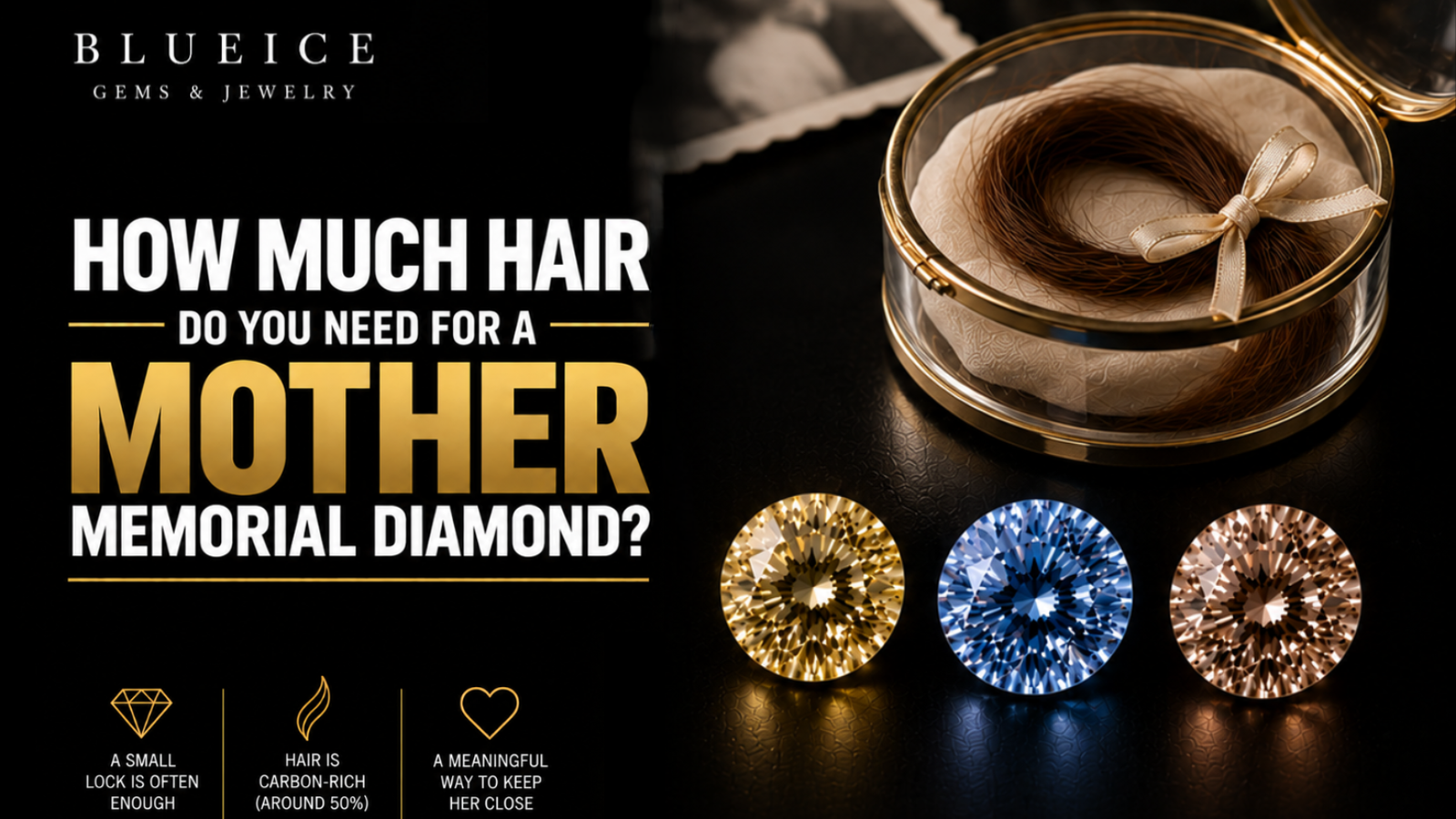
how much hair you need

How Much Hair Do You Need for a Mother Memorial Diamond?

Most people reading this are holding something finite. An envelope from a bedside drawer. A braid tied with ribbon since 1974. A few strands a hospice nurse thought to save. There is no more of it, so the number matters in a way it doesn’t for a family with an urn.

Industry-wide, a memorial diamond grown from hair takes a small lock or a few grams often described as palm-sized, or a few wisps.

That is genuinely all. Hair is roughly 50% carbon by weight, and no cremation is involved at any point, which is why the requirement is measured in grams.

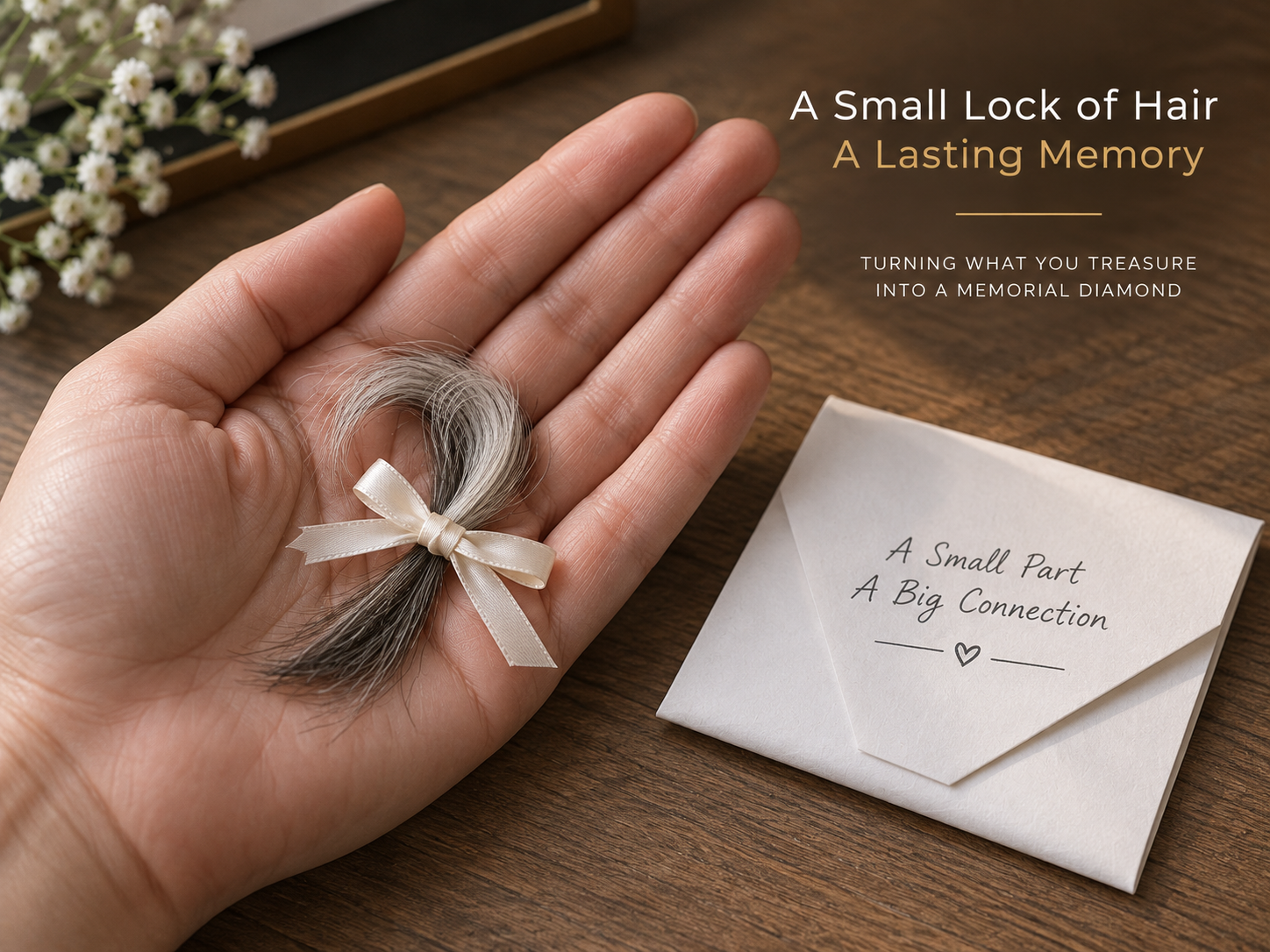
Small lock of grey hair tied with a ribbon resting in an open palm beside a folded paper envelope

On This Page

How Little Hair Is Genuinely Enough?

A small lock. A few grams. Something you could close your hand around without effort.

Requirements vary between providers inside that band, so the figure that governs your decision is the one your provider gives you for your specific lock. But the band is small enough that most people who arrive here worried are, in fact, holding enough.

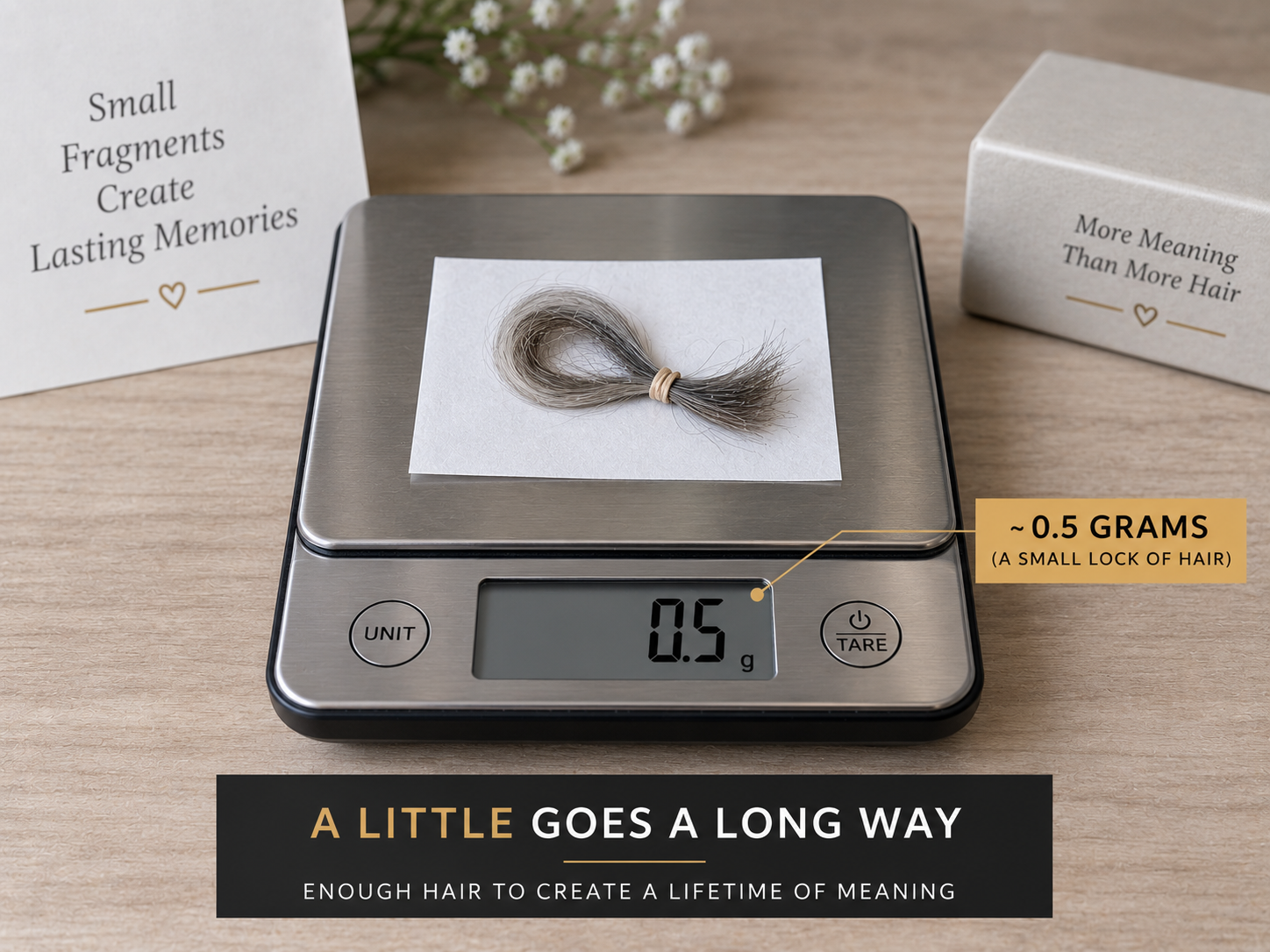
A small lock of hair on a square of paper being weighed on a digital kitchen scale reading in grams
What’s Being MeasuredIndustry-Typical FigureWhat It Means for the Lock in Your Hand
Hair a provider asks forA small lock or a few grams, often described as palm-sizedGrams, not ounces — no urn required, and none exists in most of these cases
Carbon content of hair~50% by weightKeratin is a carbon-rich protein, which is why so little goes so far
Cremation requiredNoneWorks for a mother who was buried, and for someone still living
Purity after extraction~99.9%+ carbonThe non-carbon components of keratin are stripped away
Carat sizes generally offered~0.10 ct to 5+ ctChosen when you order, not limited by the size of your lock
Growth time to reach that size~6–10 months, up to ~12 for large or specialty stonesThe only real lever on carat

One row deserves saying plainly rather than leaving in a table: more hair does not produce a larger diamond. Carat size is a function of weeks spent growing under pressure, and once the cell has enough feedstock to run, additional material changes nothing. A braid does not outrank a lock.

Her carbon is also blended with lab-sourced carbon to reach the volume a growth cell requires. No memorial diamond is 100% the person. If you are considering this process, it is worth understanding whether a memorial diamond is really made from your mother’s hair before you commit to any provider.

Why Does Hair Need Far Less Than Ashes?

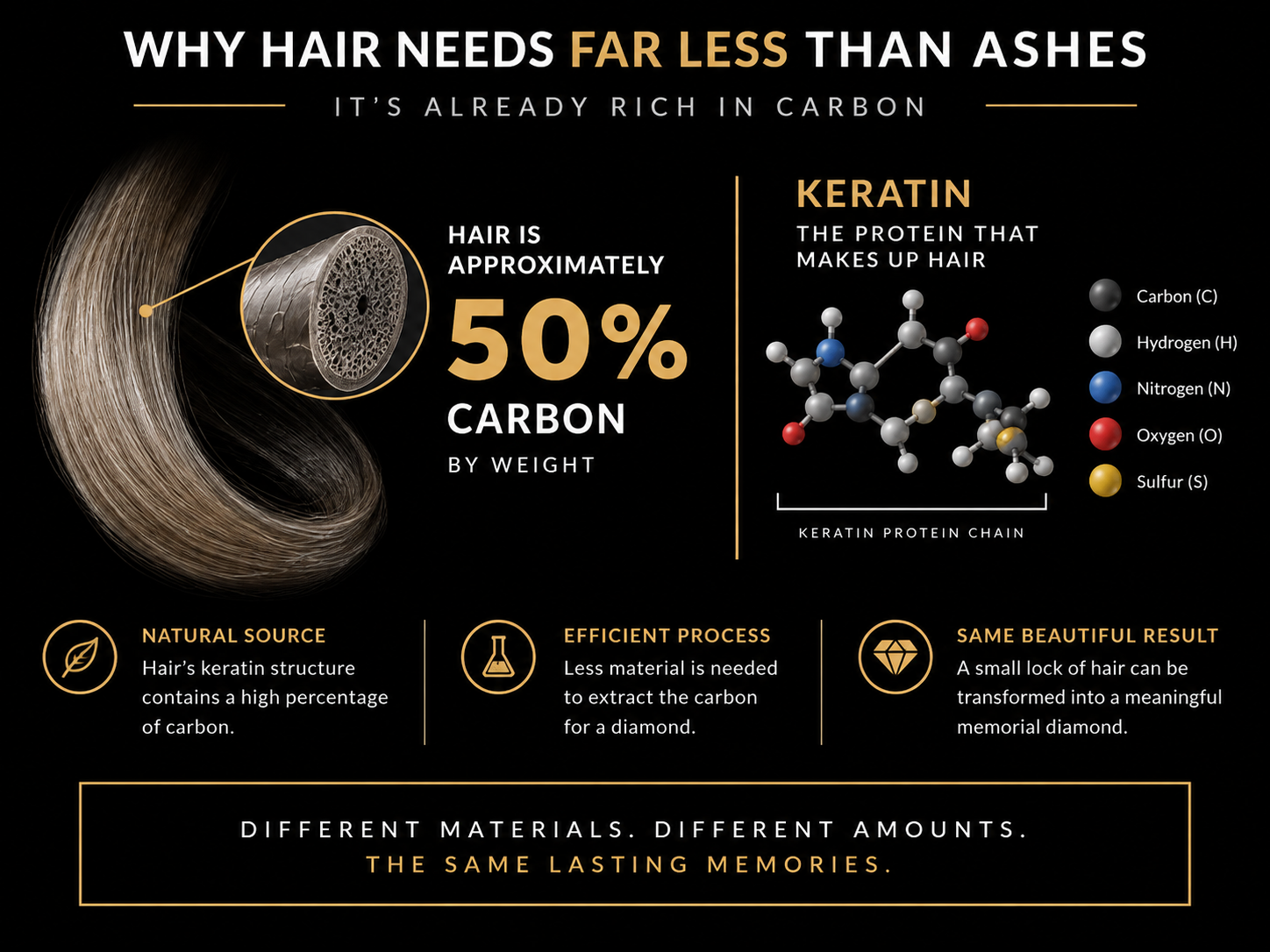
Simple diagram showing hair at roughly fifty percent carbon by weight beside its keratin protein structure

Because of what hair is made of. Hair is built from keratin, a carbon-rich protein, and comes out at roughly 50% carbon by weight. Cremated remains are a small fraction of that, which is why hair is measured in grams and ash in ounces.

It also means hair is the route that stays open when cremation never happened. A mother who was buried, a mother whose ashes were scattered years ago in a place nobody wrote down, or a mother whose remains a family is unwilling to divide for religious reasons — all may still have a hair-based option if a lock exists.

Hair-based options for a loved one who wasn’t cremated covers that ground, while ashes to diamond versus hair to diamond compares the two for anyone who has both.

How Do You Know if the Lock You Have Is Enough?

You ask, and you ask before you do anything to it. Judging a few grams by eye is unreliable in both directions.

Weigh it if you can. A digital kitchen scale reading to the gram costs very little and turns an anxious guess into a number a provider can answer against. Put the hair on a square of paper, tare the scale, and you have something concrete to put in an email.

Then photograph it beside something ordinary for scale a coin, a pen, or your own hand. A provider looking at a photograph can tell you far more than one reading the phrase “a small amount.”

And then the part that matters most:

  • Send it intact. Don’t divide it yourself. Cut the lock into what you think is the right portion and you may end up with two amounts that are each individually short. Let the provider take what they need from the whole.
  • Don’t trim, wash or tidy it. Hair needs no preparation, and handling it only risks losing strands.
  • Ask before you cut anything new. If more is genuinely needed and a source exists — a hairbrush, a second keepsake, or a hat you want to know before you go looking, not after.
  • Ask what happens to hair they don’t use. Confirm the provider’s policy on returning unused material before sending the lock.
  • Ask about treated hair specifically. Dyed, bleached, permed, or chemically straightened hair should be discussed with the provider rather than assumed to be accepted or rejected.

If the answer is that you don’t have enough, that is something you can act on and it arrives while the lock is still whole.

Does the Length of the Lock Matter, or the Weight?

Weight is what the process consumes. Length is what you can see, which is why a short lock causes far more worry than it should.

A dense lock of thick hair can weigh more than a long, fine wisp. Someone holding a short piece cut during chemotherapy, or a soft curl from a mother whose hair had thinned in her last year, can easily focus on the wrong dimension. Weighing the material, or simply asking the provider, beats estimating every time.

Carat size has nothing to do with either measurement. Choosing a carat size is a decision about budget, setting, and how you plan to wear it — a 0.25 ct stone and a 2 ct stone can start from the same small lock and differ primarily in how long they grow.

What About Hair That’s Been in a Drawer for Decades?

It is usually fine, and that surprises people.

Hair is stable, structural material. Kept dry and out of direct light, a lock from a childhood haircut in the 1960s, a strand saved from a wedding day, or hair collected during a final illness can remain as a keepsake for many years.

For an old keepsake, preserve its provenance carefully. Keep any ribbon, tag, or note that came with it, because that history may be more meaningful to your family than anything else surrounding the material. If the lock has been glued into a memory book or set into mourning jewelry, tell the provider rather than freeing it yourself.

For a mother who is still living, the same general quantity concept applies, and hair can simply be collected with her knowledge. Read what to ask before turning your mother’s hair into a diamond before making arrangements.

Frequently Asked Questions

Is one small lock really enough for a full-carat diamond?

Usually. A provider’s requirement is a threshold rather than a ration once the growth process has what it needs, additional growth time is what allows a larger stone to develop. A 0.25 ct and a 2 ct order can start from the same envelope.

Is there enough usable hair on a hairbrush?

Sometimes, but weigh it before you rely on it. A brush can be a possible source when no cut lock exists, although the amount recoverable varies significantly and providers differ on whether they accept it. Send a photograph and a weight when asking.

Will dyed, bleached or permed hair be accepted?

Ask the provider specifically rather than assuming. Hair treatments can affect how a provider handles submitted material, so getting the provider’s position in writing beforehand is better than discovering the answer at intake.

My mother was buried, not cremated. Can hair still work?

Yes. One of the advantages of a hair-based memorial diamond is that the process does not depend on cremated remains. A lock kept before or after a burial can provide starting material without requiring a family to disturb or exhume remains.

Should I split the lock and keep half?

Send it whole and ask the provider what material they require and what happens to anything unused. Dividing it yourself can create unnecessary uncertainty about whether either portion meets the provider’s requirement.

Does more hair make a bigger or faster diamond?

Neither. Sending a whole braid where a lock would do does not automatically create a larger or faster-grown diamond. Once sufficient material is available for the process, stone size is primarily associated with the selected growth schedule rather than simply sending more hair.

Before You Cut or Divide Anything

The lock in the envelope may be enough, and finding out costs nothing while it is still whole.

Before sending it, weigh the hair if possible, photograph it beside an ordinary object for scale, and ask the provider what quantity is required, what happens to unused material, whether treated hair is accepted, and what documentation or handling process applies.

For a broader overview, read The complete guide to a mother hair diamond or learn how a memorial diamond is made from her hair.

asses to dimond

How a Memorial Diamond Is Made From Your Mother’s Ashes

You measure out a portion of your mother’s ashes, hand it over, and months later a finished diamond comes back. What happens in between is where most families’ understanding stops.

Her cremated remains go through a process designed to recover usable carbon. The carbon is purified, prepared for diamond growth, combined with supplemental laboratory carbon when required, and grown into a genuine diamond crystal under extremely high pressure and heat.

Industrial chemistry, not alchemy and every stage is part of the journey from ashes to a finished memorial diamond.

 Rough diamond crystal grown from ash-derived carbon resting beside a finished champagne-toned cut stone

In This Article

What Are Your Mother’s Ashes Actually Made Of?

Understanding what cremated remains contain explains why creating a memorial diamond involves several different stages.

Cremated remains are not ash in the same sense as the material left behind by an ordinary fire. They consist largely of mineral material associated with bone, including calcium phosphate. Carbon is only a relatively small portion of the material.

That means the first challenge is not immediately growing a diamond. The laboratory must first recover usable carbon from the cremated remains and prepare it for the later stages of the process.

Because the amount of recoverable carbon can vary, the amount of ashes submitted is not directly equal to the final size of the diamond.

Learn more about how much ash may be needed for a mother memorial diamond.

What Are the Stages From Ash to Finished Diamond?

StageWhat Happens
1. Material IntakeThe cremated remains enter the preparation and processing stage.
2. Carbon Extraction and PurificationThe material is processed to separate usable carbon from minerals and other non-carbon material.
3. GraphitizationThe recovered carbon is prepared in a form suitable for diamond growth.
4. Carbon PreparationPersonal carbon may be combined with supplemental laboratory carbon when additional feedstock is required.
5. Diamond GrowthThe prepared carbon is placed into a controlled high-pressure and high-temperature growth environment.
6. Cutting and PolishingThe rough crystal is shaped and polished into the selected diamond cut.
7. Grading and DocumentationThe finished diamond can be evaluated according to cut, color, clarity and carat.

How Is Her Carbon Separated From the Rest of the Ash?

The purpose of the purification stage is to recover carbon while separating it from the much larger amount of mineral material contained in cremated remains.

The material goes through controlled processing designed to remove non-carbon components and leave behind purified carbon suitable for the next stages.

After purification, the laboratory can further prepare the carbon through graphitization. This process converts the purified carbon into graphite, another form of the same element.

The laboratory can then use this graphite as part of the carbon feedstock for the diamond-growing process.

Graphite and diamond are both forms of carbon. The difference is how the carbon atoms are arranged. The diamond growth process creates the crystal structure that gives diamond its distinctive physical and optical properties.

Why Is Laboratory Carbon Added to Your Mother’s Carbon?

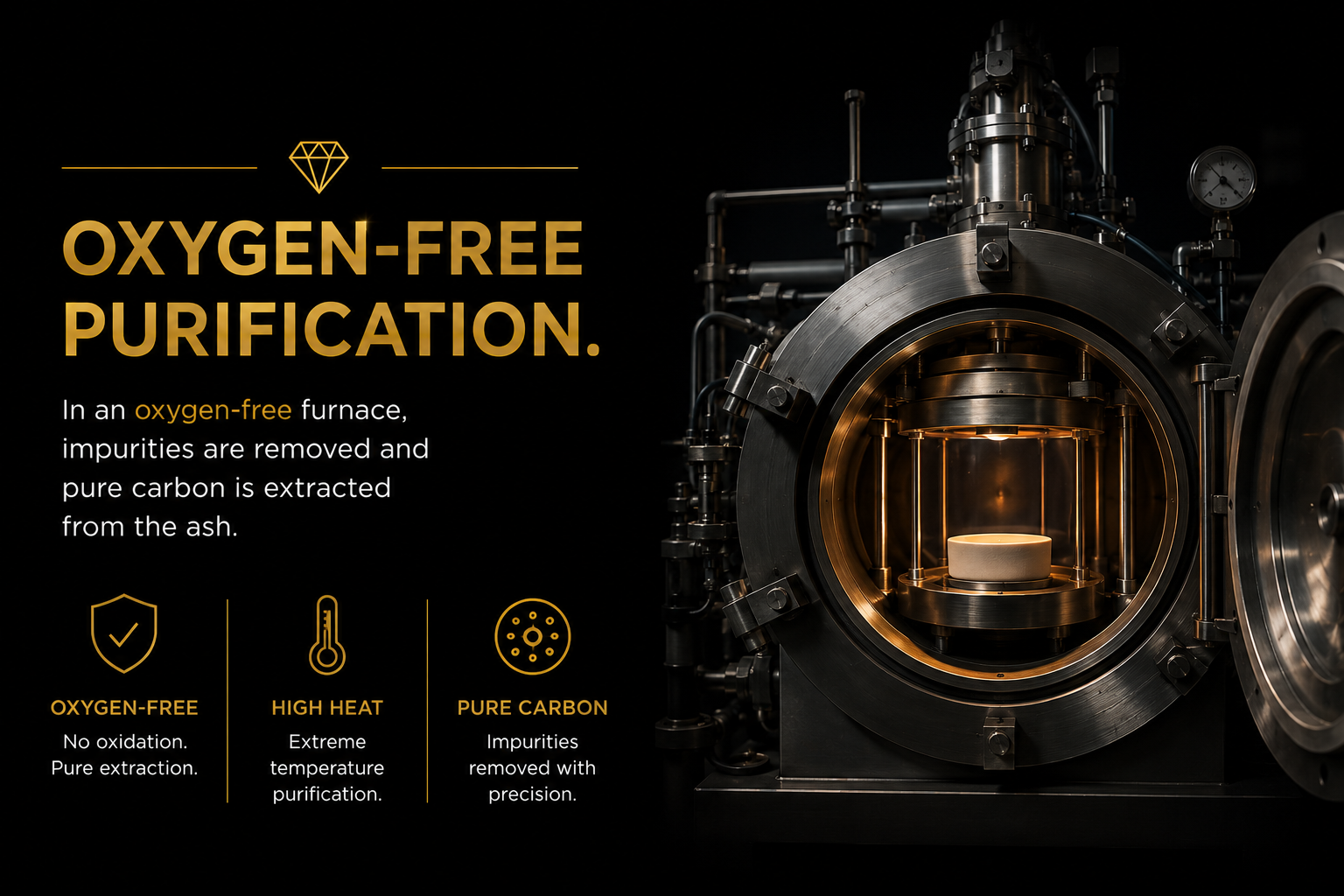
 Sealed high-temperature furnace used to purify carbon extracted from cremated remains in an oxygen-free process

This is one of the most important parts of understanding how a memorial diamond is made.

Cremated remains contain only a limited amount of recoverable carbon. Depending on the selected diamond and the requirements of the growth process, the personal carbon may not provide all the feedstock needed to grow the finished crystal.

Therefore, the laboratory may combine supplemental carbon with the carbon recovered from your mother’s ashes.

However, that does not mean the personal carbon disappears. Carbon recovered from your mother’s remains can still become part of the diamond’s crystal structure. The laboratory creates the finished stone using both the recovered personal carbon and additional laboratory carbon when necessary.

For this reason, no provider should claim that a memorial diamond contains only personal carbon when the process also uses supplemental carbon.

Read the direct answer to whether a memorial diamond is really made from your mother’s ashes.

What Happens Inside the Growth Process?

High pressure high temperature press with the growth cell that holds a diamond seed during crystal growth

After the carbon has been prepared, the next stage is diamond growth.

One common method used in the laboratory-grown diamond industry is HPHT, meaning high pressure and high temperature. The process recreates conditions capable of allowing carbon to form a diamond crystal.

A small diamond seed can act as the starting point for crystal growth. Under controlled conditions, carbon becomes part of the growing crystal structure over time.

The growth process can take weeks or months depending on the characteristics and size of the diamond being created.

Another laboratory diamond-growing method is CVD, or chemical vapor deposition. Both HPHT and CVD can produce genuine diamonds, although the processes are different.

Learn more about how memorial diamonds are made using HPHT versus CVD.

Why Does Growth Time, Not the Amount of Ash, Decide the Carat?

One common misconception is that sending more ashes automatically creates a larger diamond.

That is not how the process works.

  • More ashes do not automatically create a bigger diamond.
  • More ashes do not automatically make the process faster.
  • The desired diamond size is determined before the growth process.
  • Larger diamonds generally require more time for crystal growth.

Only a portion of cremated remains may be required for the memorial diamond process, allowing the rest of the ashes to remain with the family or be used according to their wishes.

Learn why a mother memorial diamond can take months to create.

Why Is the Finished Diamond Usually Not Colorless?

 Three memorial diamonds in blue, yellow, and champagne tones arranged on a pale gray surface to show typical color range

Diamond color can be influenced by trace elements and conditions present during crystal growth.

For example, certain trace elements can contribute to blue or yellow coloration. The specific characteristics of the carbon source and the growth environment can influence the final appearance of the diamond.

Memorial diamonds may appear in colors including yellow, blue, champagne or brown tones. Each diamond can have its own appearance, and an exact color cannot always be predicted in advance.

The color is part of the character of the finished stone and can make each memorial diamond feel unique.

Discover what color a diamond made from your mother’s ashes may be.

How Is the Finished Stone Cut, Graded and Certified?

Gemologist examining a polished memorial diamond with a loupe beside a printed grading report

What leaves the growth process is a rough diamond crystal, not a finished piece of jewelry.

The rough crystal must be carefully cut and polished into the selected shape. Depending on the available options, this may include shapes such as round, cushion or emerald.

After cutting and polishing, the finished diamond can be evaluated according to the traditional diamond characteristics known as the 4Cs:

  • Cut
  • Color
  • Clarity
  • Carat

It is also important to understand the difference between origin documentation and a diamond grading report.

An origin or authenticity document relates to the memorial process and the submitted material. A grading report evaluates the physical characteristics and quality of the finished diamond.

These documents answer different questions, and families should understand what documentation is provided for their specific memorial diamond.

Learn more about how memorial diamonds are graded and certified.

What Does Any of This Ask of You?

Your role in the process is much shorter than the laboratory side.

You choose the memorial diamond you want, arrange the required material, and submit a portion of your mother’s ashes for processing. The laboratory then handles the carbon recovery, preparation, diamond growth, cutting and finishing stages.

The decision itself is often the most important part for families. Understanding what happens inside the laboratory can help make that decision more informed.

Learn how to turn your mother’s ashes into a diamond step by step.

Frequently Asked Questions

Does anything of my mother physically remain after the process?

The memorial process is based on recovering carbon from the submitted material. Molecular structures change during purification and diamond growth, while recovered carbon can become incorporated into the structure of the finished diamond.

Why can’t the laboratory use only her carbon?

Cremated remains contain a limited amount of recoverable carbon. Depending on the diamond being created, supplemental laboratory carbon may be required to provide enough feedstock for the growth process.

Is a memorial diamond a real diamond?

Yes. A properly grown laboratory diamond has the crystal structure and physical characteristics of diamond. It is not a simulant, resin or imitation stone.

Will there be visible ashes inside the diamond?

No. The purpose of the purification process is to recover and prepare carbon rather than place visible ash particles inside the finished diamond.

Can the Exact Diamond Color Be Predicted in Advance?

Not always. Trace elements and growth conditions can influence the final diamond color. Therefore, the laboratory may not be able to predict the exact shade before the growth process begins.

What Clarity Should I Expect?

The clarity of a finished memorial diamond can vary. Like other diamonds, laboratories evaluate clarity by examining the internal and external characteristics of the finished stone.. It is the result of multiple stages, beginning with the recovery of usable carbon from cremated remains and ending with a carefully finished diamond.

The journey includes carbon purification, preparation for growth, crystal formation, cutting, polishing and evaluation.

Understanding the science behind the process does not make the emotional decision for a family, but it can make the process easier to understand and the right questions easier to ask.

A memorial diamond can become a lasting physical connection to someone deeply loved created through a process that transforms carbon recovered from their remains into part of a genuine diamond crystal.

Talk About Creating a Memorial Diamond

If you are considering creating a memorial diamond from your mother’s ashes, take time to understand the process, the available options and the documentation provided.

Knowing what happens at every stage can help you make a decision with greater confidence and understanding.

memorial-diamond-made-mothers-ashes-hair

How a Memorial Diamond Is Made From Your Mother’s Ashes and Hair

Families who send both usually picture the two going into the same vessel. That isn’t what happens.

A memorial diamond made from your mother’s ashes and hair is grown from carbon purified from each material separately. Ash nd hair carry entirely different non-carbon contaminants, so each requires its own purification process before the recovered carbon is combined into a single feedstock.

The result is one diamond crystal containing carbon from both sources not a stone divided into halves.

In This Post

Why Can’t Her Ashes and Her Hair Be Purified Together?

Because they arrive at the laboratory with very different challenges.

Cremated remains are primarily made of calcium phosphate, the mineral structure associated with bone. Carbon is only a small component of cremated remains, so recovering usable carbon requires separating it from a large amount of mineral material.

Hair is very different. It is primarily made of keratin, a carbon-rich protein containing a much higher proportion of carbon. The purification process must instead remove non-carbon elements such as nitrogen, oxygen, hydrogen and sulfur.

Different source materials require different purification targets. For that reason, ashes and hair are processed separately before the recovered carbon is prepared for diamond growth.

Cremated ash and a cut lock of hair shown side by side in separate labeled laboratory dishes

Where Do the Two Tracks Converge?

The two materials converge once usable carbon has been recovered and purified.

After purification, carbon recovered from hair and carbon recovered from cremated remains are both elemental carbon. The two purified carbon sources can then be combined into a single feedstock before the diamond-growing process begins.

StageHer AshesHer Hair
What it mostly containsCalcium phosphate and bone mineralKeratin, a carbon-rich protein
Approximate carbon contentLower carbon contentHigher carbon content
Purification removesMineral materialNon-carbon protein components
After purificationRecovered carbon can be combined into one feedstock
GraphitizationShared conversion into graphite
Diamond growthOne growth environment and one crystal
Final diamondOne finished stone
Oxygen-free purification furnace used to strip non-carbon material from ash and hair before diamond growth


Using both materials follows the same basic principle as creating a diamond from ashes alone or a diamond from hair alone.

How Much of the Finished Stone Is Genuinely Her?

A real and measurable portion of the diamond can originate from the carbon recovered from the materials you provide. However, the exact percentage can depend on the amount and quality of the available carbon, the size of the diamond, and the requirements of the growth process.

Hair generally contains significantly more carbon by weight than cremated remains. Because of this, hair can contribute a substantial amount of the personal carbon recovered when both materials are submitted together.

The important point is that a memorial diamond is not honestly described as being made entirely from personal carbon alone. Supplemental laboratory carbon may be required during the growth process.

That does not change the meaning of the memorial diamond. Carbon originating from your mother’s ashes and hair can become part of the crystal lattice of the diamond created in her memory.

For more information about this question, read whether a memorial diamond is really made from her ashes and hair.

What Happens Once the Two Carbons Are Combined?

 HPHT growth cell holding a diamond seed crystal surrounded by graphite feedstock | Stock acceptable |

Once the carbon sources are combined, the process becomes the same type of diamond-growing process used for other memorial diamonds.

The carbon feedstock is prepared for diamond growth and may be converted into graphite. The graphite can then be placed into a high-pressure, high-temperature environment with a small diamond seed.

Under controlled laboratory conditions, carbon atoms gradually form around the seed and develop into a diamond crystal. Crystal growth can take weeks or months depending on the process and the desired result.

One important point is that submitting more material does not automatically produce a larger diamond. The final size depends on the selected diamond and the growth process rather than simply on the amount of ashes or hair submitted.

After growth, the rough diamond is cut, polished and evaluated according to characteristics such as cut, color, clarity and carat.

Learn more about the difference between HPHT and CVD diamond growth.

Will a Stone Made From Two Materials Be Two-Toned?

Two memorial diamonds, one yellow and one blue, each an evenly colored single crystal

No. The finished memorial diamond grows as one crystal.

It is understandable to imagine that using two different materials could create separate areas or layers inside the diamond. However, after the carbon has been purified and prepared for growth, the finished crystal does not divide itself according to whether individual carbon atoms originally came from ashes or hair.

The color of a diamond is influenced by conditions and trace elements involved during crystal growth rather than by visible separation between the original source materials.

This means a memorial diamond made using both ashes and hair is still one crystal with one overall appearance.

You can learn more about possible colors in what color a diamond made from your mother’s ashes and hair may be.

Where Does Your Part of This End?

Your part of the process begins with deciding what materials you would like to use and ends once they have been safely submitted for processing.

You may need to consider how much ash and hair you have available, discuss the decision with family members, and choose the memorial diamond that feels right for you.

After the materials enter the laboratory process, the purification and diamond-growing stages are handled over the following months.

For the complete process, read how to turn your mother’s ashes and hair into a diamond.

You can also explore the complete guide to a mother ashes and hair diamond and learn how much ash and hair may be needed for a memorial diamond.

Frequently Asked Questions

Are her ashes and her hair processed at the same time?

Because cremated remains and hair contain different materials, they may require different purification approaches. The goal is to recover usable carbon before preparing the material for the diamond-growing process.

Can a lab tell which carbon in the finished stone came from her hair?

Once carbon has been purified and incorporated into a growing diamond crystal, individual carbon atoms are chemically the same element. The finished diamond does not visibly identify the original source of each carbon atom.

Does adding hair to an ashes submission mean more of her is in the stone?

Hair generally contains more carbon by weight than cremated remains, so including hair can increase the amount of personal carbon available for recovery. The exact contribution to a finished diamond can vary.

Will the finished diamond have visible layers, streaks or two colors?

No. The diamond grows as a single crystal. Using two source materials does not mean the finished stone will be divided into visible sections based on ashes and hair.

Does using two materials make the process take longer?

The overall timeline is generally driven more by diamond growth, cutting and finishing than by the number of source materials used. Processing requirements can vary depending on the individual order.

Thinking About Creating a Memorial Diamond?

Understanding how ashes and hair can be prepared for diamond creation can make an emotional decision easier to understand.

Using both materials creates a way to include different physical connections to the person you love in one memorial piece. Her ashes and her hair maHow a Memorial Diamond Is Made From Your Mother’s Ashes and Hair.