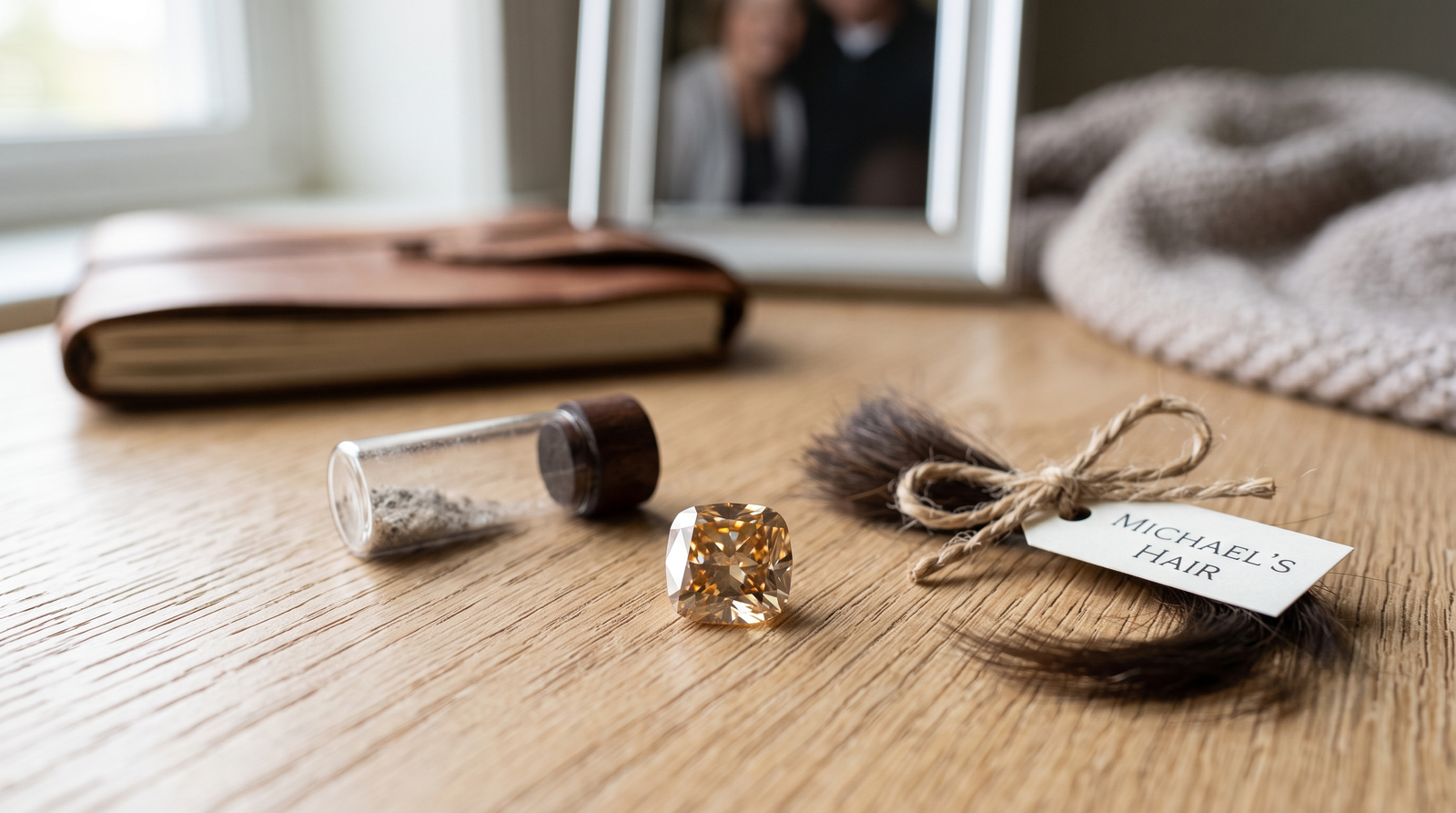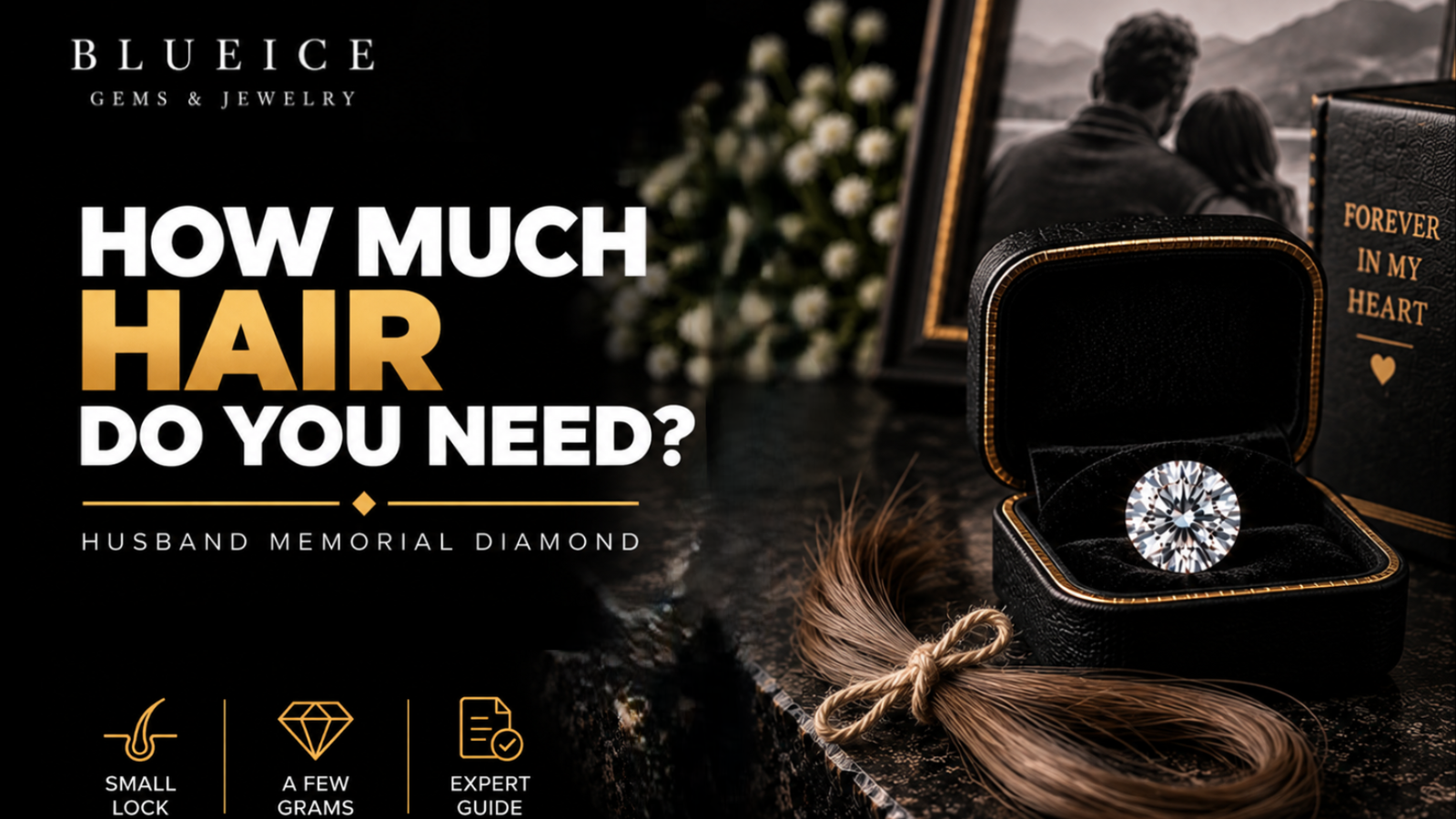
Hair for a husband memorial diamond showing a small lock of hair beside a sparkling memorial diamond in a luxury black setting

How Much Hair Do You Need for a Husband Memorial Diamond?

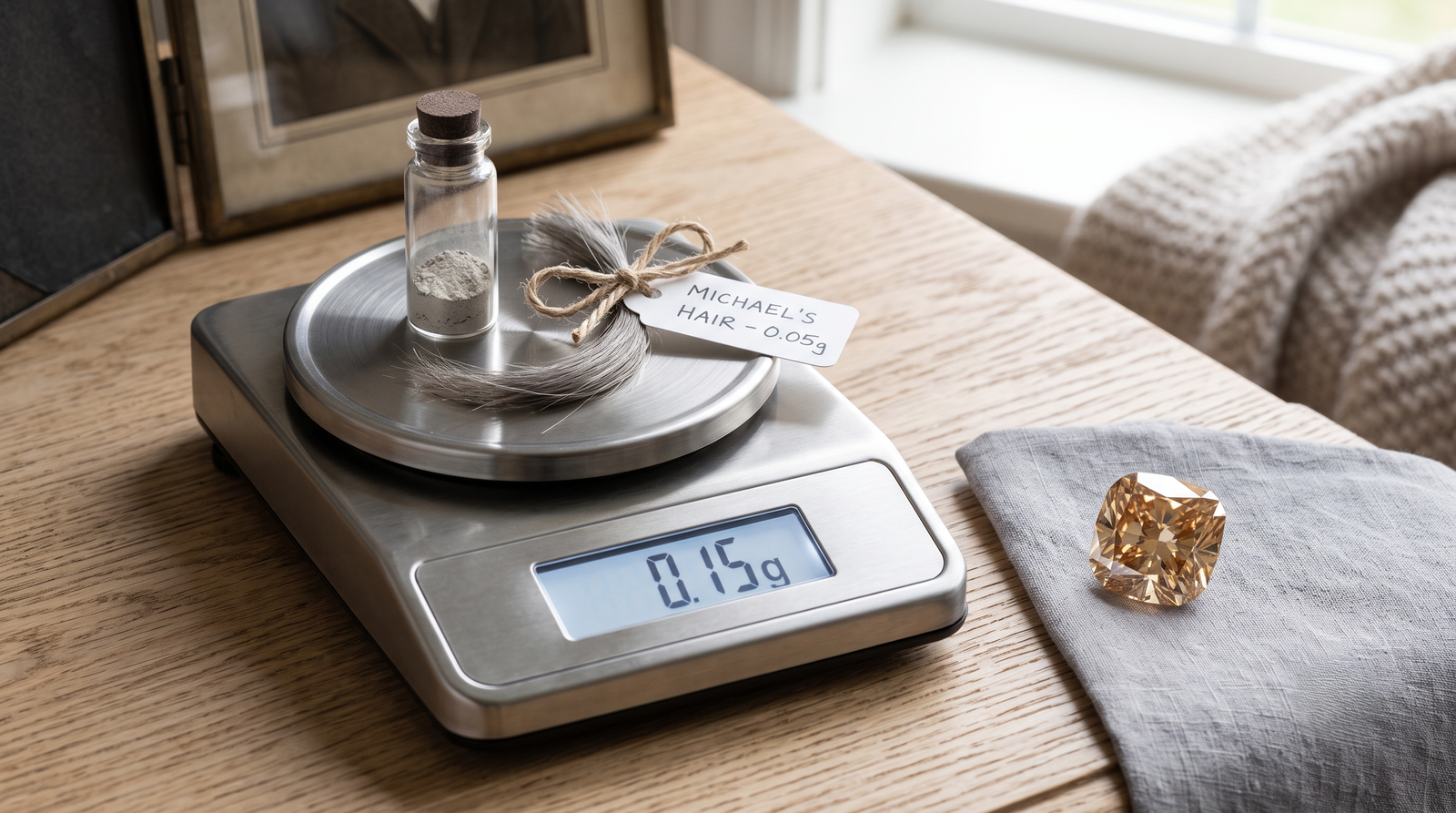
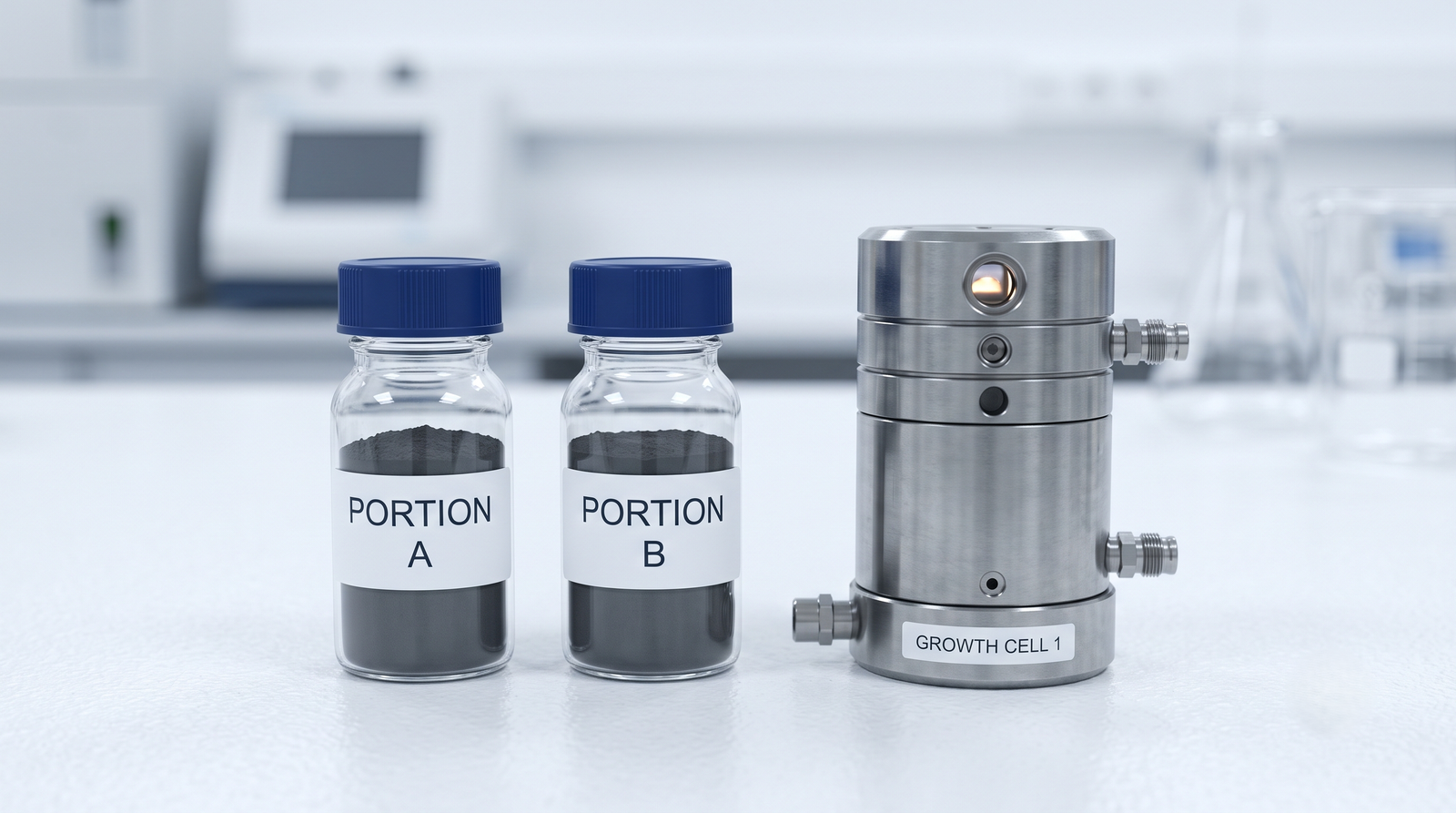
The lock in your hand is the whole supply. You cannot go back for more of it, and the people who might one day want a stone of their own have not asked yet. The hair for a husband memorial diamond is a small amount per stone industry typical minimums are a small lock, often described as palm sized or a few grams and because hair is roughly 50% carbon, that is genuinely enough. The harder question is not whether you have enough for one diamond. It is how to size a finite sample for a family that has not finished forming its view.
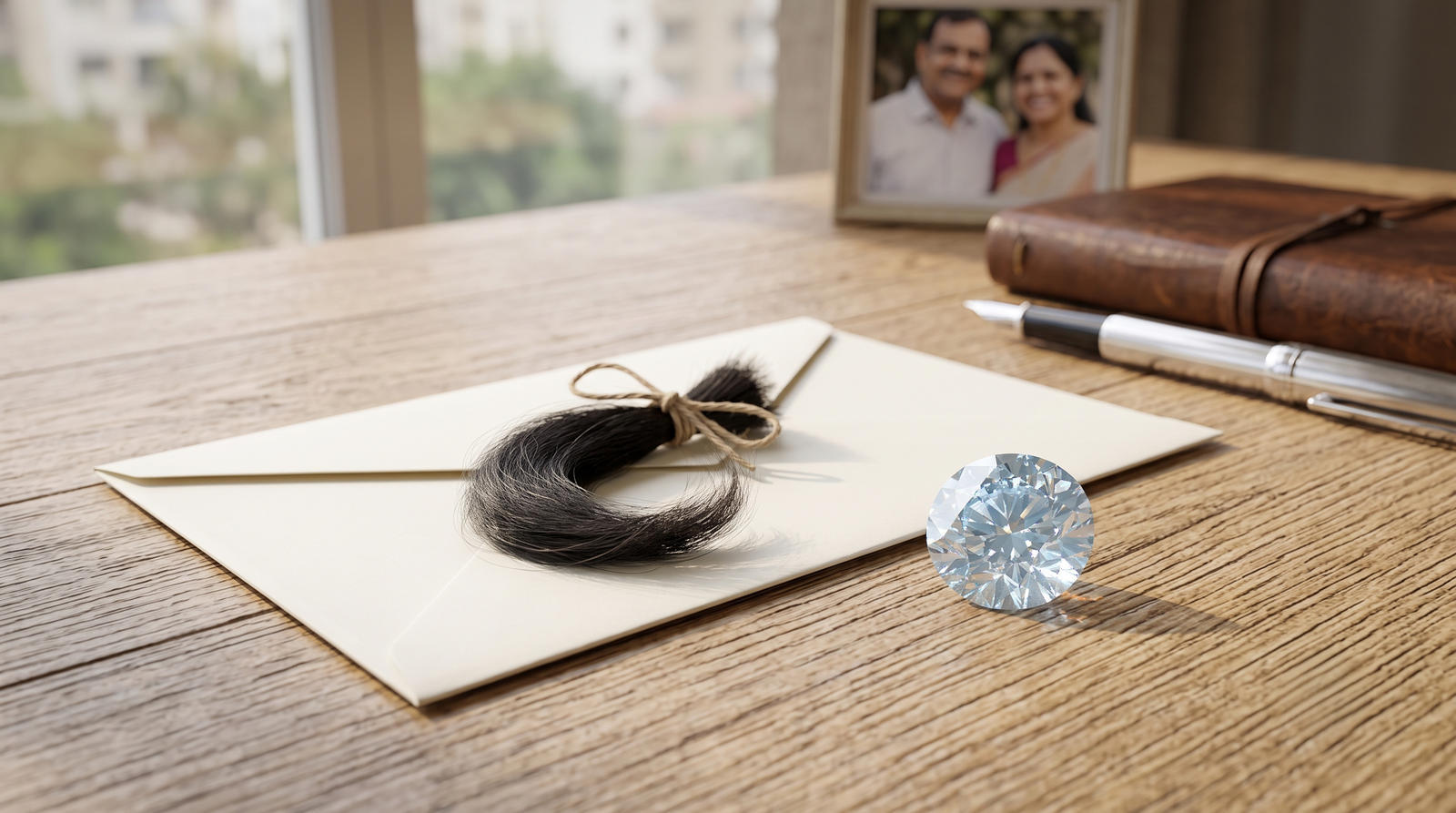
Hair for a husband memorial diamond: a small lock of dark hair on a folded paper envelope beside a pale blue lab-grown

How Much Hair for a Husband Memorial Diamond Is Typical?

Providers describe the minimum hair for a husband memorial diamond in different ways a small lock, a palm sized amount, a few grams, sometimes a stated weight. All of them are small. A single home haircut’s clippings usually exceed it; a few strands from a brush may or may not, which is why a sample that small should be assessed before you commit it.

A published minimum for the hair for a husband memorial diamond marks where the laboratory can begin work, not the amount that ends up in the stone. Because hair is carbon rich, the personal share of the finished crystal is limited by the stone’s size, not by how much hair you sent typically around 10 to 15% of the stone’s mass, with laboratory carbon supplying the rest. The stage by stage process is in how a memorial diamond is made from your husband’s hair.
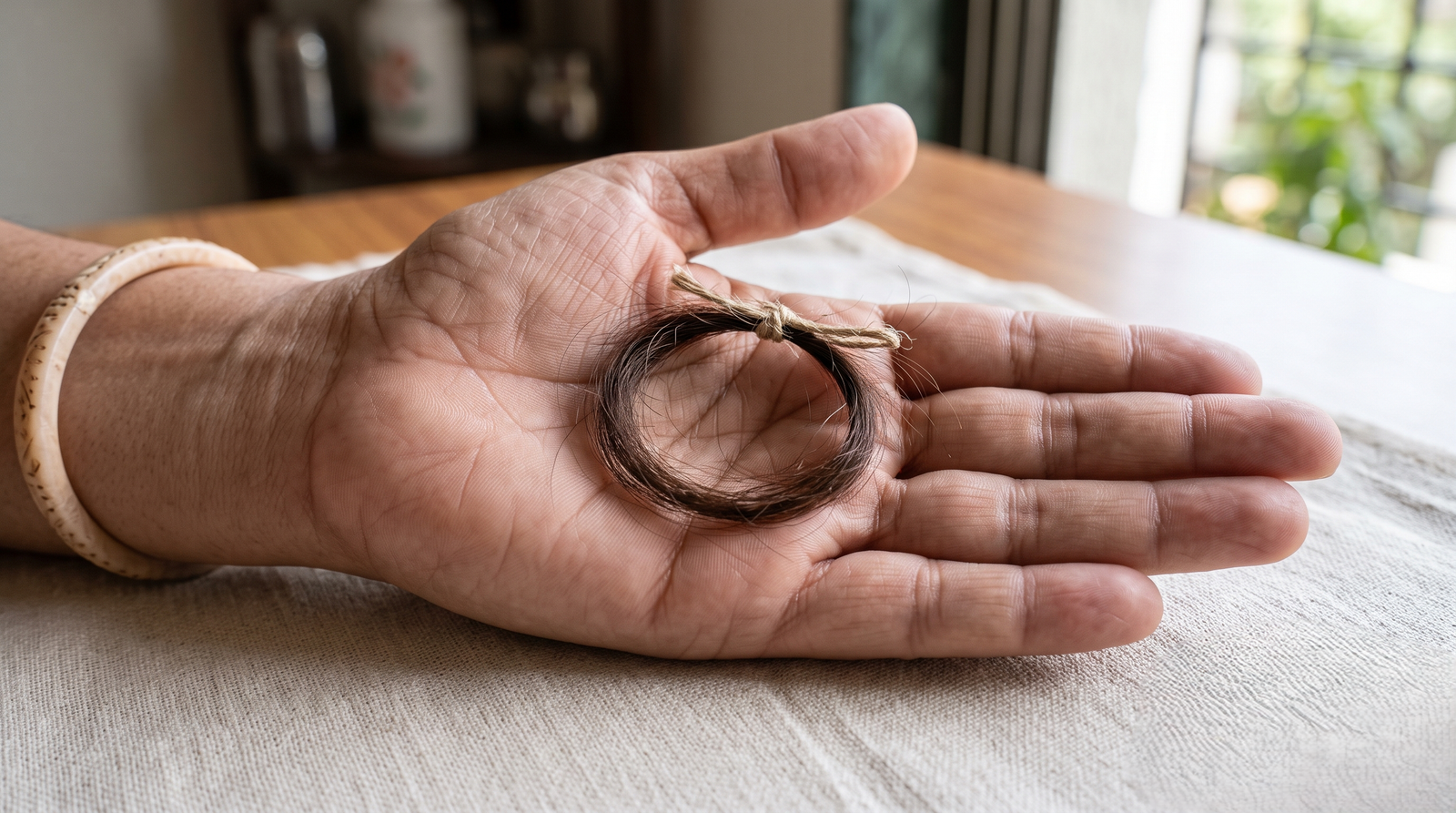
A small lock of hair resting in an open palm | Stock acceptable; shows the minimum at true scale

Why Is a Lock Enough When Ashes Need Ounces?

The hair for a husband memorial diamond is keratin, a protein that is roughly half carbon by weight. Cremated remains are mostly calcium phosphate, with usable carbon at only about 0.5% to 4%. So a few grams of hair yield more usable carbon than the same weight of ashes many times over, and the laboratory reaches a growable volume from a lock rather than from ounces. Purification strips the strand to carbon at roughly 99.9%, graphitization converts it to feedstock, and the crystal grows by HPHT or CVD diamond growth exactly as any lab grown diamond does.

That same fact is why the hair for a husband memorial diamond needs no cremation at all, and why the option exists for families who chose burial. The ashes side figure, for comparison, is in how much ash you need for a husband memorial diamond.

Is the Figure Per Stone or Per Family?

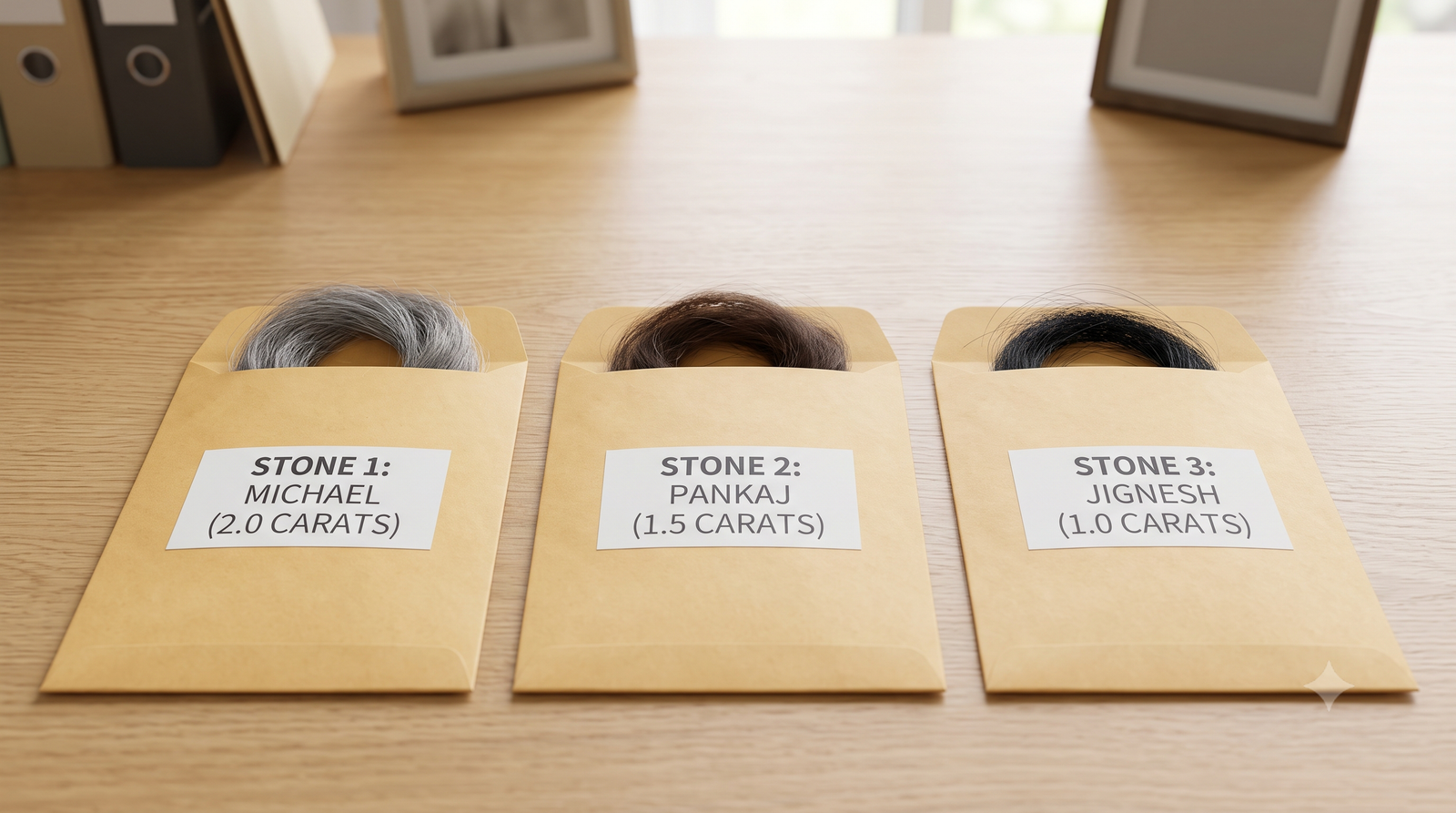
Per stone. The hair for a husband memorial diamond is a per stone figure: each diamond needs its own minimum, and a lock that comfortably covers one may or may not cover two. Whether a single submitted sample can be divided at the laboratory to support more than one stone, rather than divided by you at home before sending, is a provider question some will, some will not, and it should be asked before the sample leaves you. The reason it matters is that hair, unlike ashes, cannot be added to later if the household’s supply is gone.

Sizing for the People Who Have Not Asked Yet

His children, his parents, a sibling, a close friend: any of them might want a stone in a year, and none of them may have said so. The table sizes the hair for a husband memorial diamond against a family whose view is still forming, using the industry typical minimum as the unit.

What you holdRoughly how many stones it could supportWhat to do nowWhat it forecloses
A few strands from a brush or collarPossibly one, after assessmentAsk the provider to assess a photograph and a weight before anything is sentA second stone, unless more hair is found
A single small lock (a few grams)OneSend it for one stone, or hold it until the family’s view settlesA second stone from the same lock
Clippings from a home haircutOne to severalDivide by weight at home into labelled envelopes, one per possible stoneLittle, if divided before sending
More than one lock from different timesOne per lock, at leastKeep each in its own envelope; decide which lock goes to which stone by meaningNothing, if each lock meets the minimum on its own
A lock plus a portion of his ashesOne combined stone, or one of eachDecide whether the hair is for the record or for a stone of its ownSee the combined order post below

Two rules run through the table. First, divide before sending, not after; a sample that has been sent and processed cannot be reapportioned. Second, if the family’s view is genuinely unsettled, holding a lock costs nothing hair keeps indefinitely once dry while sending the whole supply for one stone forecloses every later request. The combined route is covered in how much ash and hair you need for a husband memorial diamond.
A small lock of hair resting in an open palm | Stock acceptable; shows the minimum at true scale

What Can Be Added Before Sending, and What Cannot After

The hair for a husband memorial diamond can be added to before it goes. If you find more hair a hat, a razor, the car headrest it can join the envelope, or better, a second envelope with its own label, and the provider can be told what came from where. After it has been sent and processed, nothing can be added to that stone; a later find becomes a second order, not a top up.

  • Before sending: pool or separate as you choose; label each source; ask whether pooling from several sources is acceptable.
  • At intake: ask what weight was recorded, and whether hair not consumed by extraction is returned.
  • After processing: the sample is committed. More hair means another stone, not more of him in this one.

If you are choosing which lock to send when several exist, color is not a reason pigment is removed at purification and does not reach the stone; see what color a diamond made from your husband’s hair will be. Confidence that the hair for a husband memorial diamond is his, and what each lock means, are the reasons. How to collect it in the first place is in how to turn your husband’s hair into a diamond.
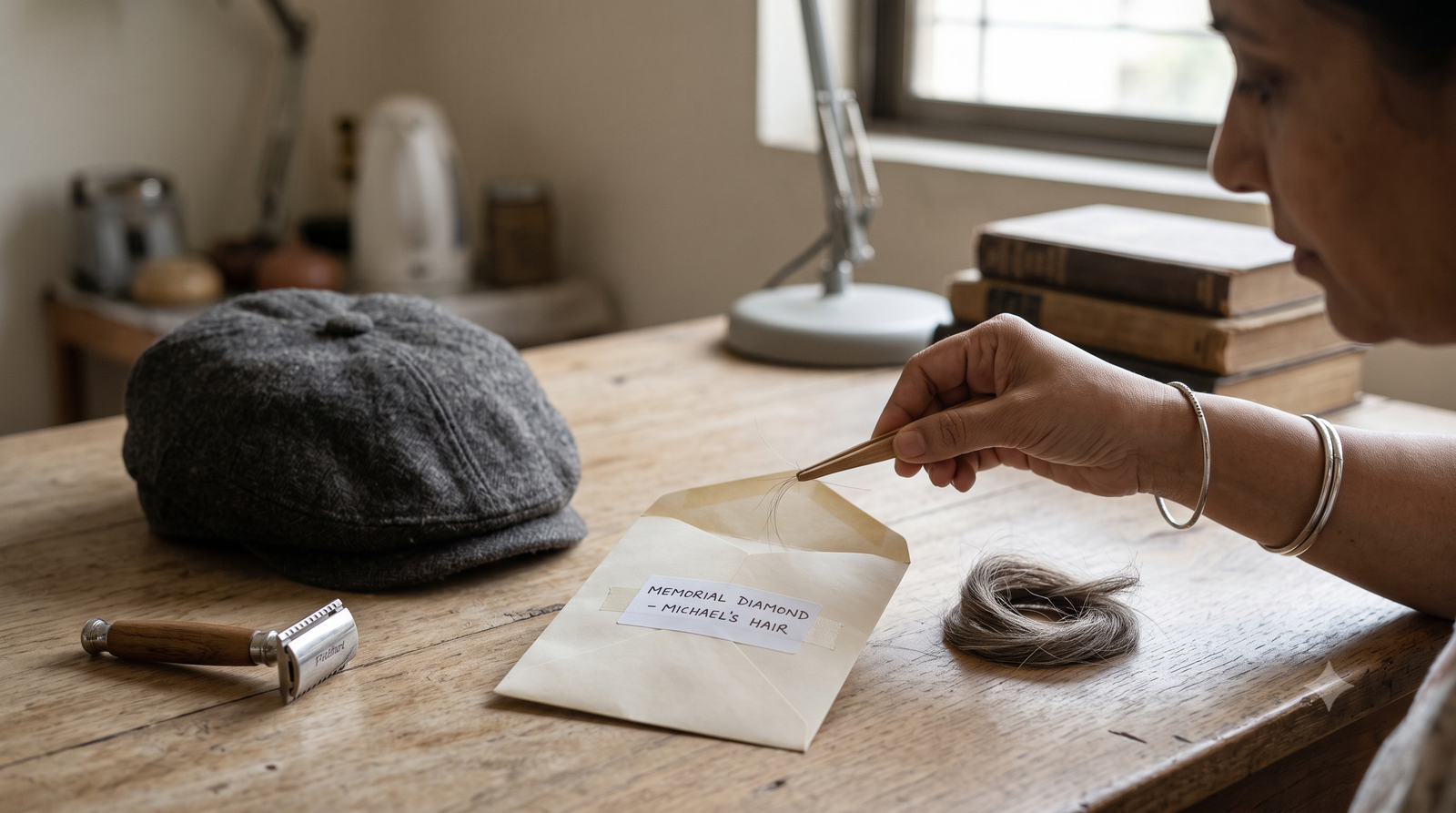
A razor and a cap beside a labelled envelope, with a few strands being added

Frequently Asked Questions

How much hair for a husband memorial diamond is the minimum?

Industry typical minimums are a small lock, often described as palm sized or a few grams, per stone. Providers state it differently, so ask for their exact figure. Because hair is roughly 50% carbon, a lock is genuinely enough; a few strands may be, after assessment.

Can one lock make more than one diamond?

Sometimes. The hair for a husband memorial diamond is a per stone minimum, so a generous lock may support two while a small one supports one. Ask whether the provider will divide a sample at the laboratory; if not, divide it yourself by weight into labelled envelopes before sending.

Does sending more hair make the diamond bigger or more him?

No. Carat size is set by growth time in the press, and the personal carbon share is typically around 10 to 15% of the stone regardless of sample size. Extra hair beyond the minimum does not change either; it is better kept for a possible second stone.

What if I only have a few strands from his brush?

Ask the provider to assess a photograph and, if you can measure it, a weight before committing the sample. Some accept very small samples; some do not. Keep strands from different places in separate labelled envelopes so the provider knows the source of each.

Can I add more hair after I have sent the sample?

Not to that stone. Once the hair for a husband memorial diamond has been processed it cannot be reapportioned or topped up; hair found later becomes a second order. Add to the envelope, or start a second labelled envelope, before anything leaves the house.

Should I keep some hair back in case someone asks later?

If the family’s view is unsettled and the lock is small, yes. Hair keeps indefinitely once dry, so holding part of it costs nothing, while sending the whole supply for one stone forecloses every later request. Decide who might ask before you decide how much to send.

Final Thoughts on How Much Hair for a Husband Memorial Diamond

One conversation now costs less than a second sample later, because there may not be a second sample. Weigh the hair for a husband memorial diamond you hold against the people who might ask, divide it before it leaves the house if it can be divided, and let the provider tell you what the smallest envelope can actually support. The hair for a husband memorial diamond is enough for the stone you are planning. Whether it is enough for the ones you are not planning yet is the question worth asking today.

Learn More About Husband Memorial Diamonds

Talk With Memorial Diamond

If what you have is a few strands and you are not sure it is enough, or a lock you are not sure how to divide, reach out to Memorial Diamond to talk through what’s possible with the hair for a husband memorial diamond you kept.
How much ash is needed for a husband memorial diamond, with cremated ashes beside a memorial diamond in a luxury black setting

How Much Ash Do You Need for a Husband Memorial Diamond?

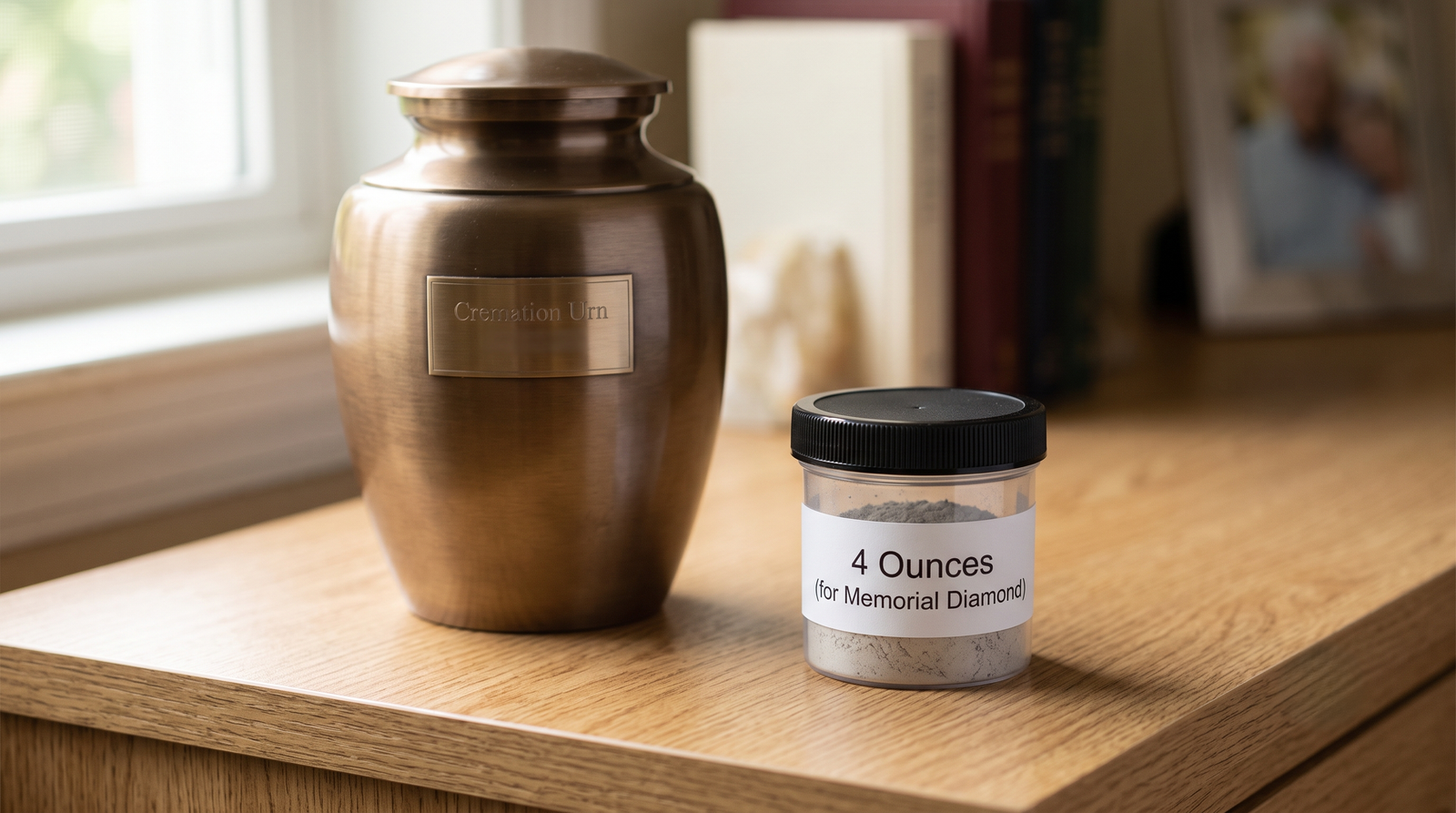
Whatever the two of you decided about his ashes the plot, the niche, the place you said you would scatter them, the plan to be together that decision was probably made before anyone mentioned a diamond. So the first question is not how much ash is needed but whether the plan survives it. The amount of ash for a husband memorial diamond is small: industry typical requests run from a few tablespoons to about four ounces, roughly 100 grams, which is a fraction of a full cremation. In most arrangements the plan does survive. The work is knowing which part of it to check, and with whom.

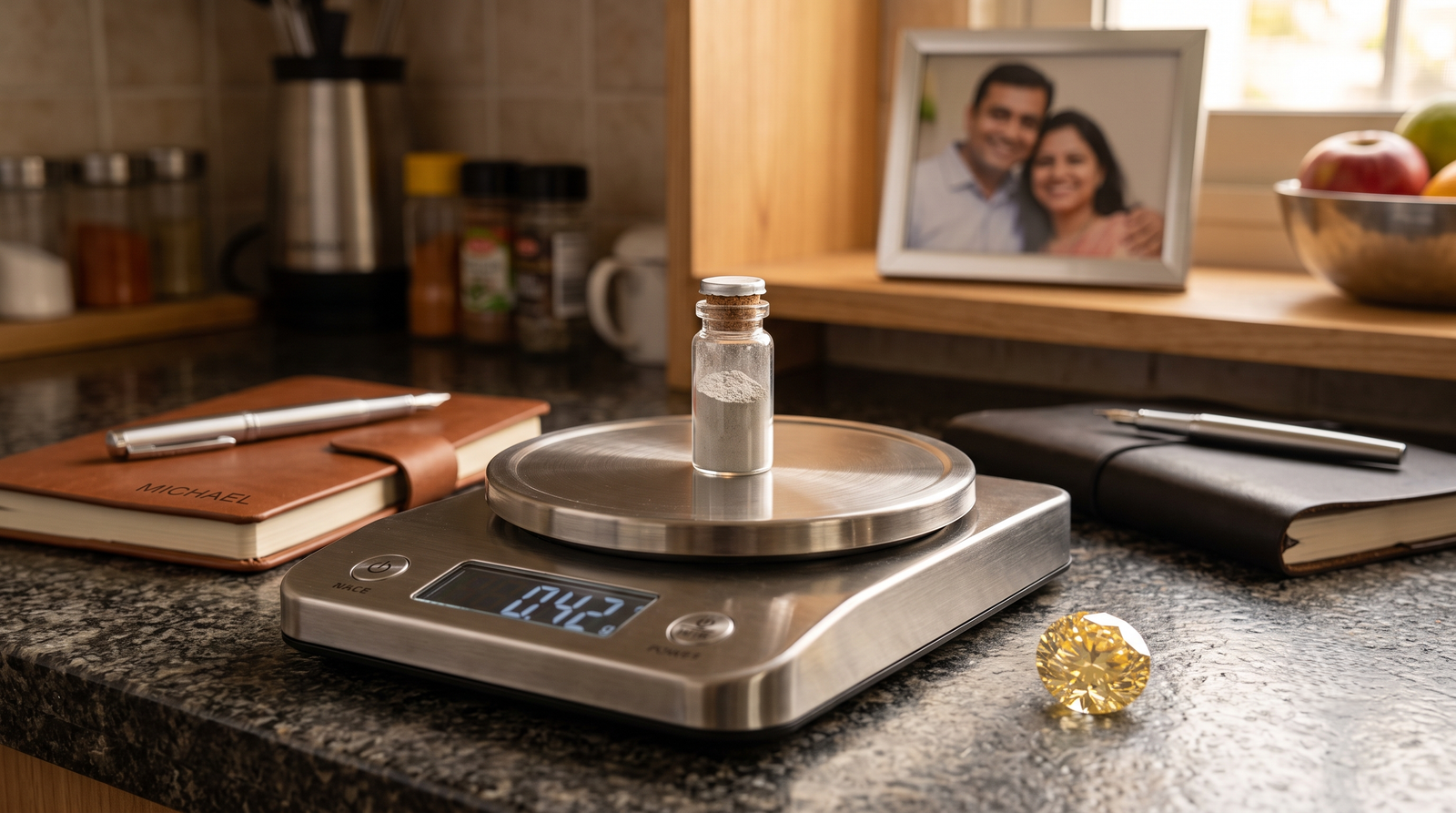
 Ash for a husband memorial diamond: a small sealed portion of cremated remains on a kitchen scale beside a yellow-toned lab-grown diamond

How Much Ash for a Husband Memorial Diamond Is Typical?

Across the industry, the ash for a husband memorial diamond comes to somewhere between a few tablespoons and roughly four ounces of cremated remains per stone. Some publish a minimum in grams; some describe it by volume; some ask for more than the minimum to allow for variation in yield. A full adult cremation typically produces several pounds of remains, so even the upper end of that range leaves the large majority untouched. With the US cremation rate projected at 63.4% for 2025, this is now the question most families face rather than a rare one.

That figure for ash for a husband memorial diamond is per stone, not per family. If two or three people may each want a diamond, the request multiplies, though it still stays small against the whole. Whether the same ashes can support several stones, and how to decide who gets one, is covered in whether more than one family member can get a diamond from the same husband’s ashes.

Why Is the Amount So Small?

Cremated remains are mostly calcium phosphate, the mineral of bone. Carbon the only part of the ash for a husband memorial diamond the process can use is roughly 0.5% to 4% by weight. So four ounces of ash yields a few grams of carbon at most, and that carbon is purified to about 99.9%, converted to graphite, and blended with laboratory carbon to reach the volume a growable crystal needs under HPHT or CVD diamond growth. The personal share of the finished stone is typically around 10 to 15% of its mass.

Two things follow. The ash for a husband memorial diamond is measured in tablespoons because that is all the process can use, not because a provider is being sparing. And sending more than they ask for does not put more of him in the stone; the proportion is set by the growth process, not by the portion. The stage by stage account is in how a memorial diamond is made from your husband’s ashes.

 A small labelled container of cremated remains next to a full-size urn, showing the difference in scale

Does the Plan You Made Together Survive It?

This is the question the ash for a husband memorial diamond actually raises. Because the amount is small, the plan usually does survive but which part of it needs checking depends on what the plan was, and each arrangement has a different person to ask.

The arrangement you madeDoes a small portion usually fit?What to checkWho to ask
His ashes are at home, in an urnYesNothing outside the household; decide together with anyone else who shares the urnNobody, or the people closest to him
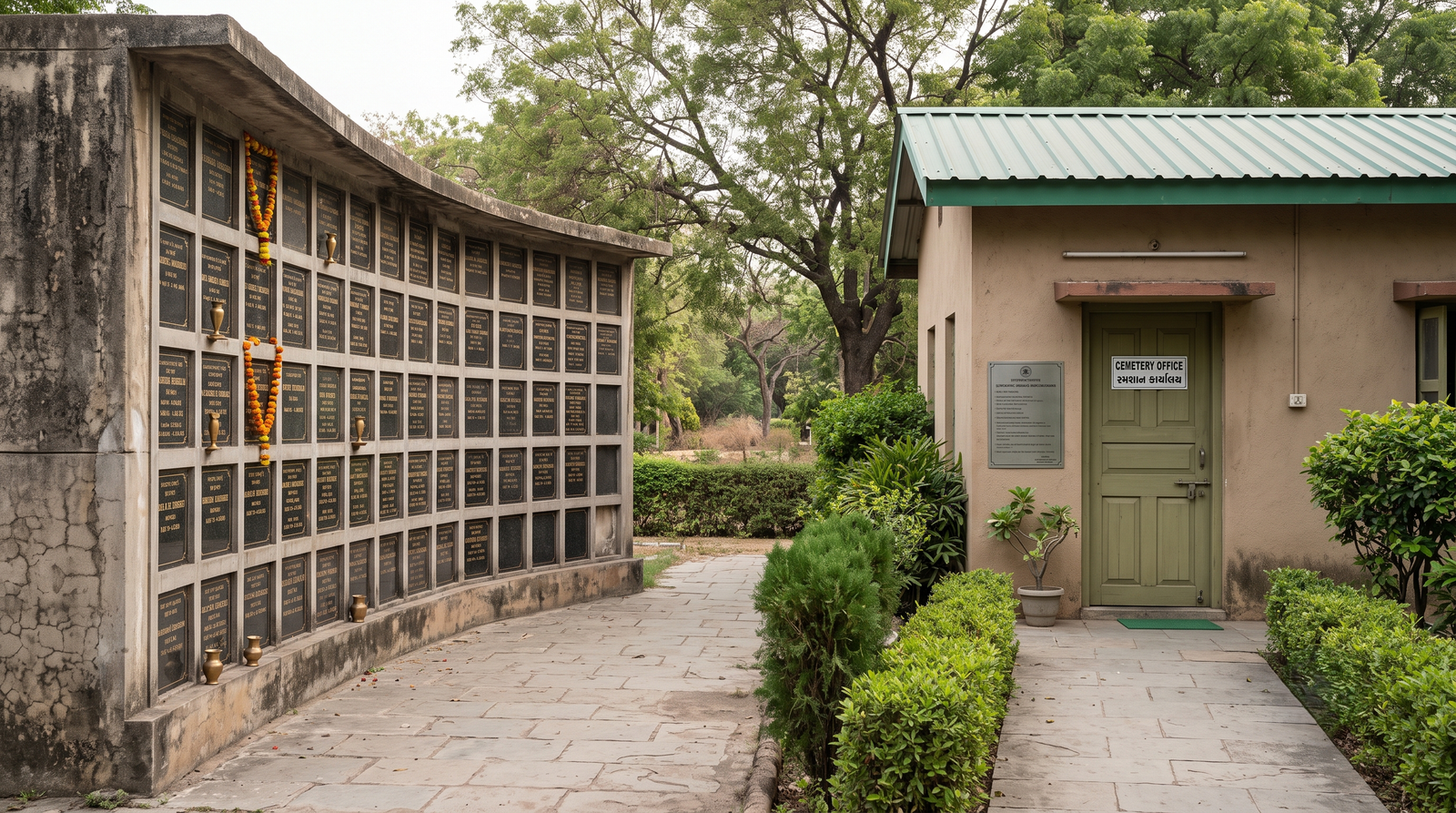
Interment in a plot or a columbarium nicheUsually, if a portion is set aside before intermentWhether a portion can be held back, and whether the facility permits retrieval afterwardThe funeral director before interment; the cemetery office after
A scattering you planned togetherYes, if the portion is set aside firstWhether the scattering has already happened, and what remains if it hasWhoever holds the ashes now
An agreement that your remains will be combined or interred together laterUsuallyWhether any document, contract, or family understanding restricts dividing his portion nowThe funeral home or cemetery that holds the arrangement; a family attorney if anything is in writing
A pre paid plan with instructionsDepends on the wordingWhether the instructions address division, and who has authority to vary themThe funeral home holding the plan

None of these rows is a rule. Cemetery policy, state law, and what was written down vary, and the table’s job is to point you to the right question and the right office rather than to settle anything. What it does establish is that in every row the ash for a husband memorial diamond is small enough that the arrangement itself is rarely the obstacle; the obstacle, when there is one, is timing a portion has to be set aside before interment or scattering, not after. How to physically divide it once you have the answer is in how to turn your husband’s ashes into a diamond.

A columbarium wall and a cemetery office entrance, photographed quietly

Why Doesn’t a Bigger Stone Need More of Him?

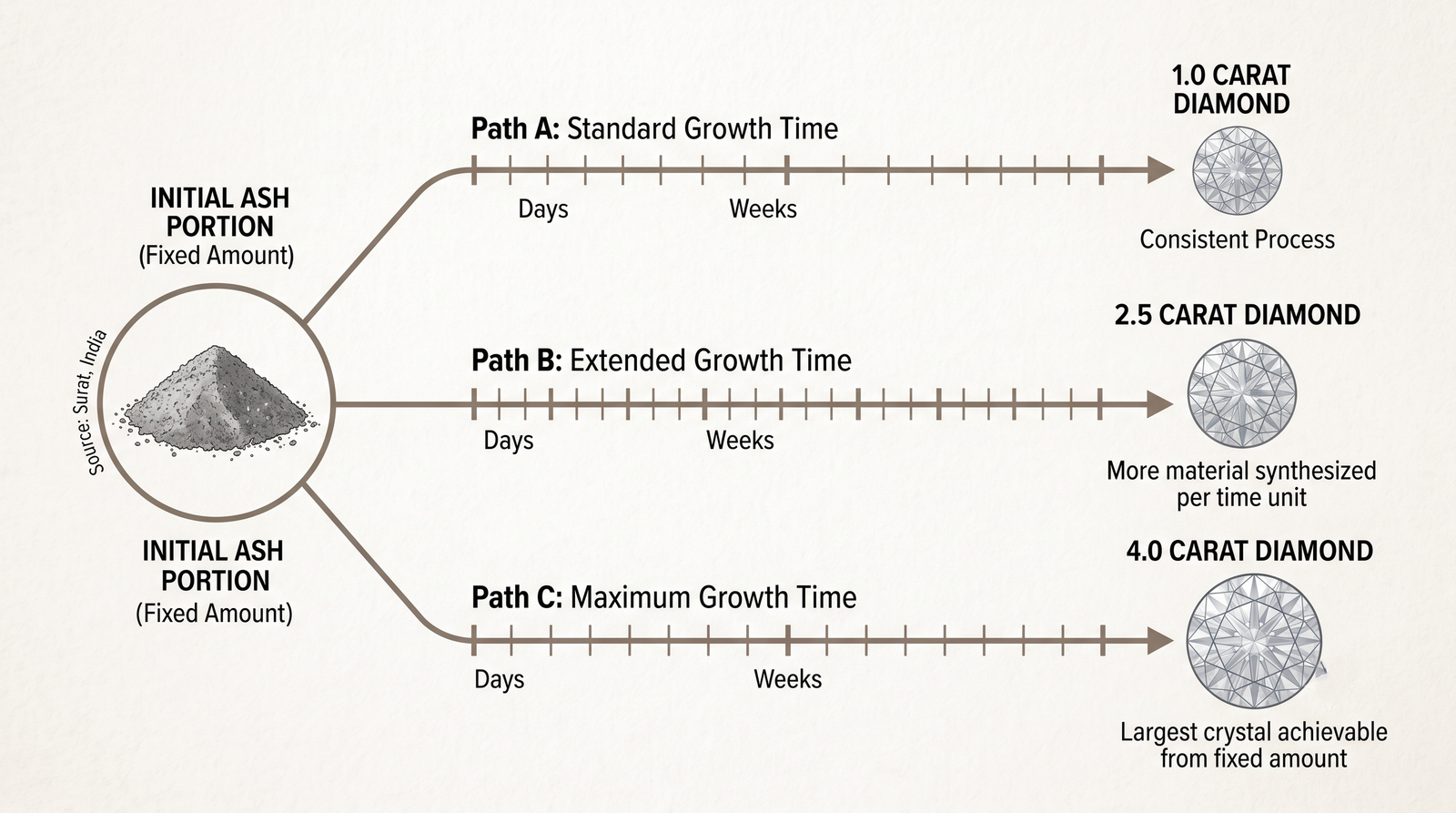
Because carat size is set by time in the growth press, not by the ash for a husband memorial diamond you supply. A 1 carat stone spends longer growing than a 0.25 carat stone; both start from a similar ash portion. The laboratory carbon that makes up the balance of the crystal is added to reach a growable volume, and the size you choose sets the timeline, typically six to ten months and sometimes twelve for larger stones.

  • Choosing a larger carat does not mean setting aside more ash for a husband memorial diamond.
  • Choosing a second stone does each one needs its own portion.
  • Choosing colorless does not change the quantity; it changes the processing and the price.

The size to timeline relationship is set out in how long it takes to make a husband memorial diamond.

A diagram showing three carat sizes growing from the same small ash portion over increasing growth times |

What Happens to the Portion That Is Not Carbon?

Most of the ash for a husband memorial diamond the calcium phosphate and other minerals is left behind during extraction. What a provider does with that residue is a policy, not a chemistry, and it varies: some return it, some do not, and some do not say on their website. If you would want it back, ask before sending anything, and ask what form it comes back in. Whether a published minimum is the weight they need to receive or the weight the process actually uses is a fair question to put alongside it. Both belong on the list of questions about ash for a husband memorial diamond in questions to ask before turning your husband’s ashes into a diamond.

Frequently Asked Questions

How much ash for a husband memorial diamond do providers actually ask for?

Industry typical requests run from a few tablespoons to about four ounces, roughly 100 grams, per stone. Some providers ask for a little more than their minimum to allow for variation in carbon yield. Confirm the exact figure with your provider before dividing anything.

Is that amount a large part of his ashes?

No. A full adult cremation produces several pounds of remains, so the ash for a husband memorial diamond is a small fraction even at four ounces. The rest can be interred, scattered, or kept exactly as you planned, which is why most arrangements made in advance still have room for a diamond.

Can I take a portion after his ashes have been interred?

Sometimes, but it depends on the cemetery or columbarium’s policy and on state rules, and retrieval may need consent from whoever holds the plot. It is far simpler to set a portion aside before interment. Ask the cemetery office directly rather than assuming either way.

Do I need more ash for a larger diamond?

No. Carat size is set by how long the crystal grows in the press, not by how much ash is supplied. A larger stone takes longer and costs more, but it starts from a similar portion. Each additional stone, however, needs its own portion.

Does sending more ash put more of him in the stone?

No. Cremated remains are only about 0.5% to 4% carbon, and the personal carbon typically makes up around 10 to 15% of the finished stone regardless of the portion size. Sending extra does not raise that share; the growth process sets it.

What if we agreed our ashes would be together one day?

A small portion set aside now usually does not conflict with that, but if anything was written into a funeral contract, pre paid plan, or cemetery agreement, check the wording and who has authority to vary it. Ask the funeral home or cemetery holding the arrangement, and a family attorney if it is in writing.

Final Thoughts on How Much Ash for a Husband Memorial Diamond

Start with the agreement, not with the container. The ash for a husband memorial diamond is a small enough amount that the plan the two of you made almost always has room for it the only thing it cannot survive is being decided after the interment or the scattering rather than before. Find the right office, ask the one question in your row, and the quantity looks after itself.

Learn More About Husband Memorial Diamonds

Talk With Memorial Diamond

If you are unsure whether the arrangement you made leaves room for the ash for a husband memorial diamond, or how much to set aside for the stones your family may want, reach out to Memorial Diamond to talk through what’s possible.

Word count: 1,643 · Reading time: about 8 minutes

Husband memorial diamond with cremated ashes and a lock of hair beside a diamond in a luxury black velvet box

How Much Ash and Hair Do You Need for a Husband Memorial Diamond?

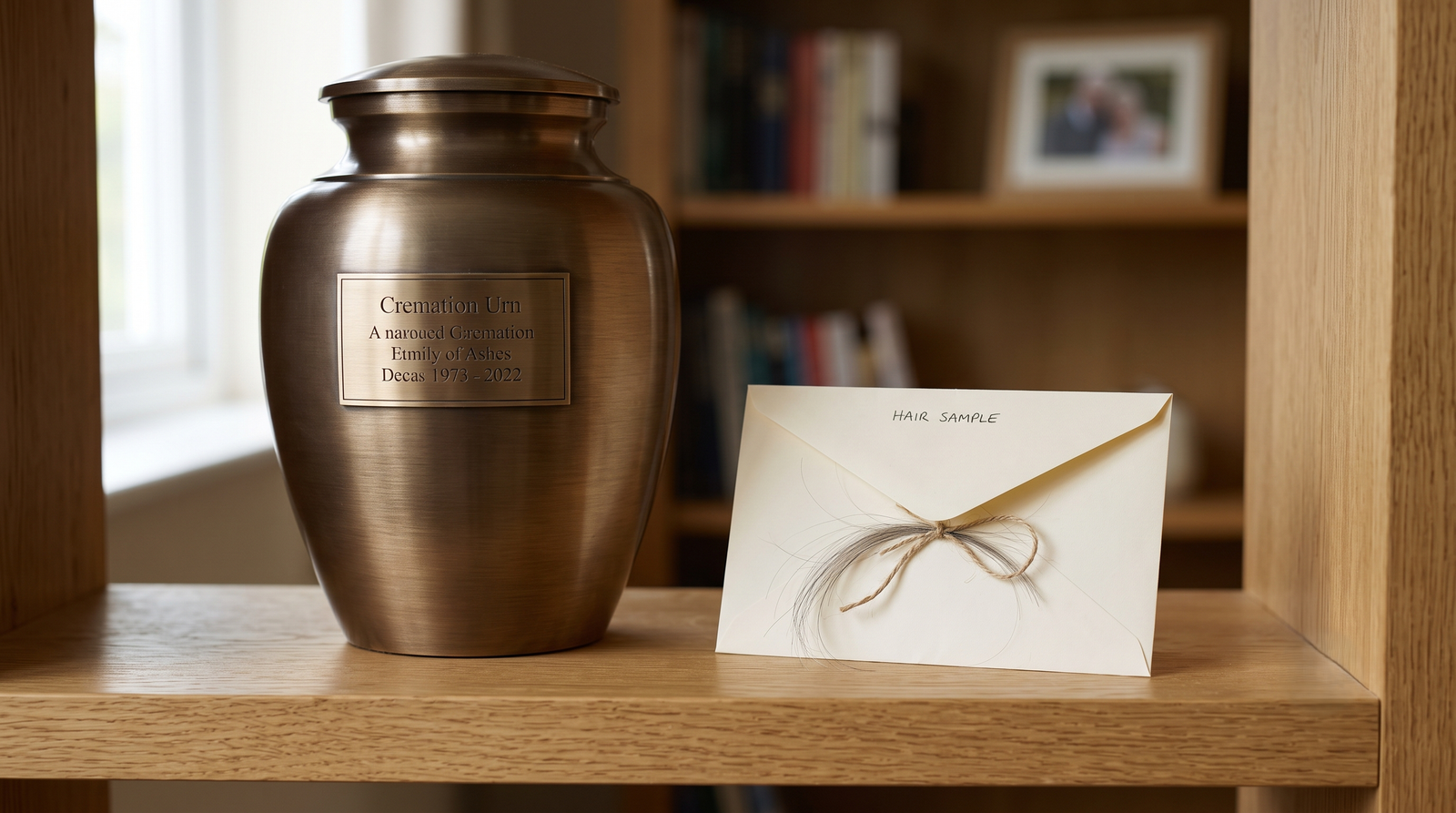
You may have far more of one material than the other: an urn’s worth of ashes and a few strands from a comb, or a generous lock and a portion that was scattered before anyone mentioned this. A husband memorial diamond grown from both his ashes and his hair needs each material to meet its own minimum industry typical figures are a few tablespoons to about four ounces of ashes and a small lock, a few grams, of hair and abundance in one does not transfer to the other. So a combined order is decided by whichever material you have less of, and the real question is whether the order should depend on the smaller one at all.

 Husband memorial diamond: a small sealed portion of cremated remains and a small labelled lock of hair on a scale, beside a champagne-toned lab-grown diamond

What Does a Combined Husband Memorial Diamond Require?

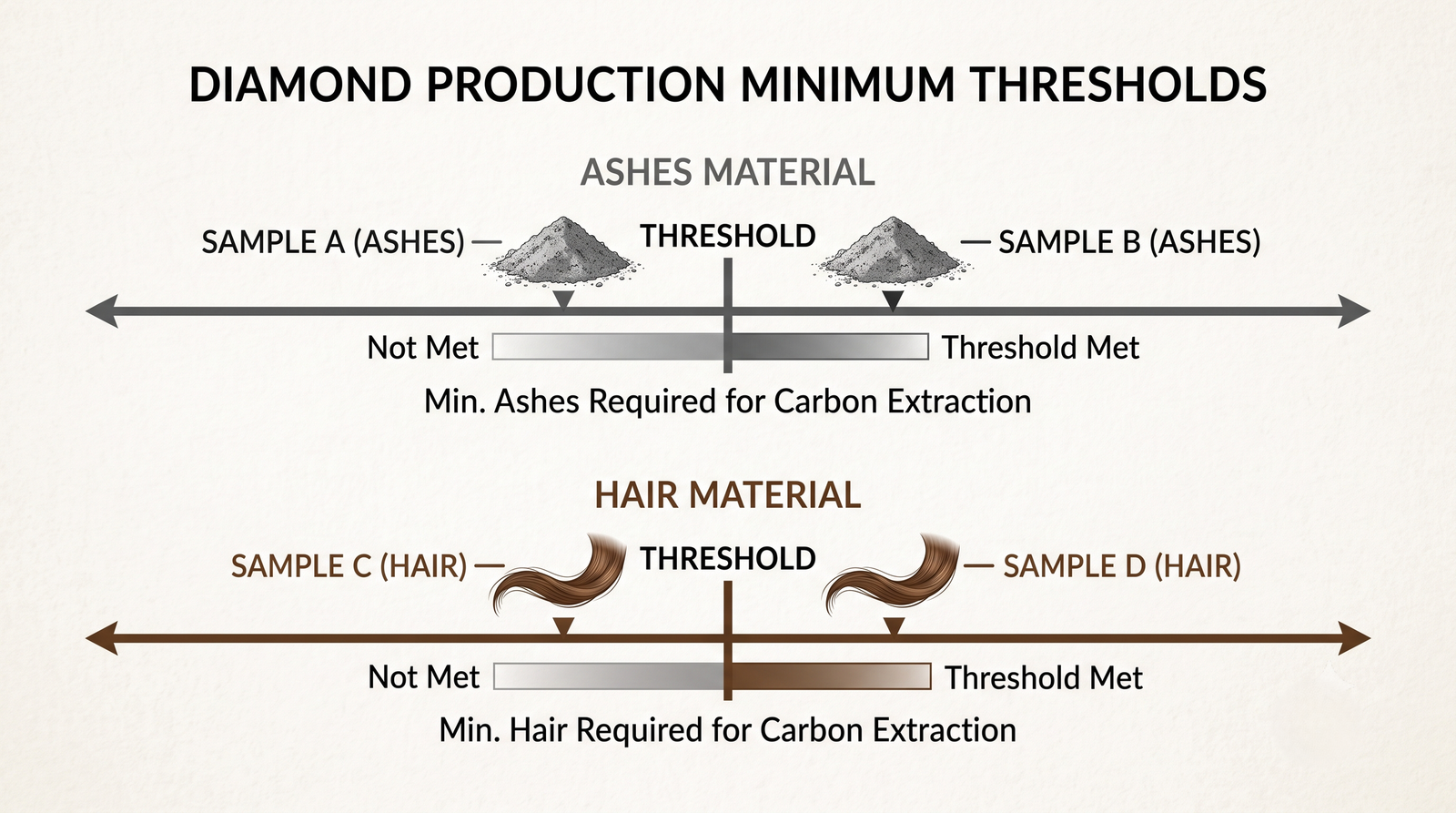
Two minimums, not one. Providers who accept combined submissions typically ask for the standard ash portion and the standard hair sample, though some reduce the ash requirement when hair is included and some do not. The two materials are purified on separate tracks the ashes to strip calcium phosphate, the hair to strip the non carbon parts of keratin and only meet as graphite, before growth by HPHT or CVD diamond growth. Each track has its own threshold below which the laboratory cannot start.

Ask three things before dividing anything for a husband memorial diamond: the exact minimum for each material, whether including hair lowers the ash figure, and whether a stated minimum refers to what must arrive or to what the process actually consumes. The two track process is in how a memorial diamond is made from your husband’s ashes and hair.

Why Doesn’t Having Plenty of One Help With the Other?

Because the two minimums for a husband memorial diamond exist for different reasons. Ashes are roughly 0.5% to 4% carbon, so the ash minimum is about recovering enough carbon to be worth purifying. Hair is roughly 50% carbon, so the hair minimum is about having enough strand material to handle and process at all. A surplus of ashes yields more carbon, but it cannot make a two strand sample into a lock; a surplus of hair cannot make a scattered portion reappear.

There is a second reason. What a combined husband memorial diamond promises and what its origin document should record is that both materials are genuinely present. A provider who accepts a sub minimum sample of one and grows the stone mostly from the other is not delivering that promise, and a good one will say so rather than quietly cover the shortfall with laboratory carbon. The share of the stone that is him is typically around 10 to 15% either way; what the second material changes is the record, not the proportion.

A full urn next to a paper envelope holding only a few strands of hair

Which Material Is Your Order Really Resting On?

Whichever you have less of, measured against its own minimum for a husband memorial diamond. The table shows what that means for the decision.

What you holdThe smaller materialWhat the combined order depends onThe honest next step
Plenty of ashes, a few strands of hairHairWhether the strands meet the hair minimum after assessmentAsk the provider to assess the hair before you set aside any ashes
A generous lock, a small portion of ashesAshesWhether the portion meets the ash minimumWeigh the portion; if short, ask whether hair lowers the ash figure
Plenty of bothNeitherNothing both thresholds are metDecide what the second material is for
A lock, and ashes still with a funeral homeAshes, on a deadlineWhether a portion can be held back before releaseAsk the funeral director for the date in writing
A portion of ashes, and hair not yet foundHairWhether hair can be found before the ashes order is placedSearch first; a combined order cannot be amended freely once processed

In every row, the smaller material sets the terms, and the abundance of the other one is beside the point. The ashes only and hair only figures, each with its own considerations, are in how much ash you need for a husband memorial diamond and how much hair you need for a husband memorial diamond.

 A diagram of two separate threshold lines, one labelled ashes and one hair, with a sample marked against each

Including a Marginal Material Is a Choice Made With a Number

When one material for a husband memorial diamond is close to its minimum, the decision is not “should we include it” in the abstract. It is “this sample weighs this much; does that meet the threshold, and if it falls just short, what happens?” Three outcomes are possible, and they should be settled before the sample leaves you:

  1. It meets the minimum. The combined order proceeds, with two intake records and, ideally, an origin document naming both materials.
  2. It falls just short, and the provider will still include it. Ask what “include” means: is the material genuinely present in the grown carbon, or recorded and then set aside? Ask whether you will be told before blending if it under yields.
  3. It falls short, and the provider will not accept it. The material can be kept hair indefinitely once dry, a set aside ash portion without expiry for a possible future stone, or a future assessment by a different provider.

The point of putting a number on it is that “a little of his hair went in” is meaningful only if the little was enough to be there. Ask for the weight recorded at intake, and keep it with your own note.

The Single Material Stone Stays Available

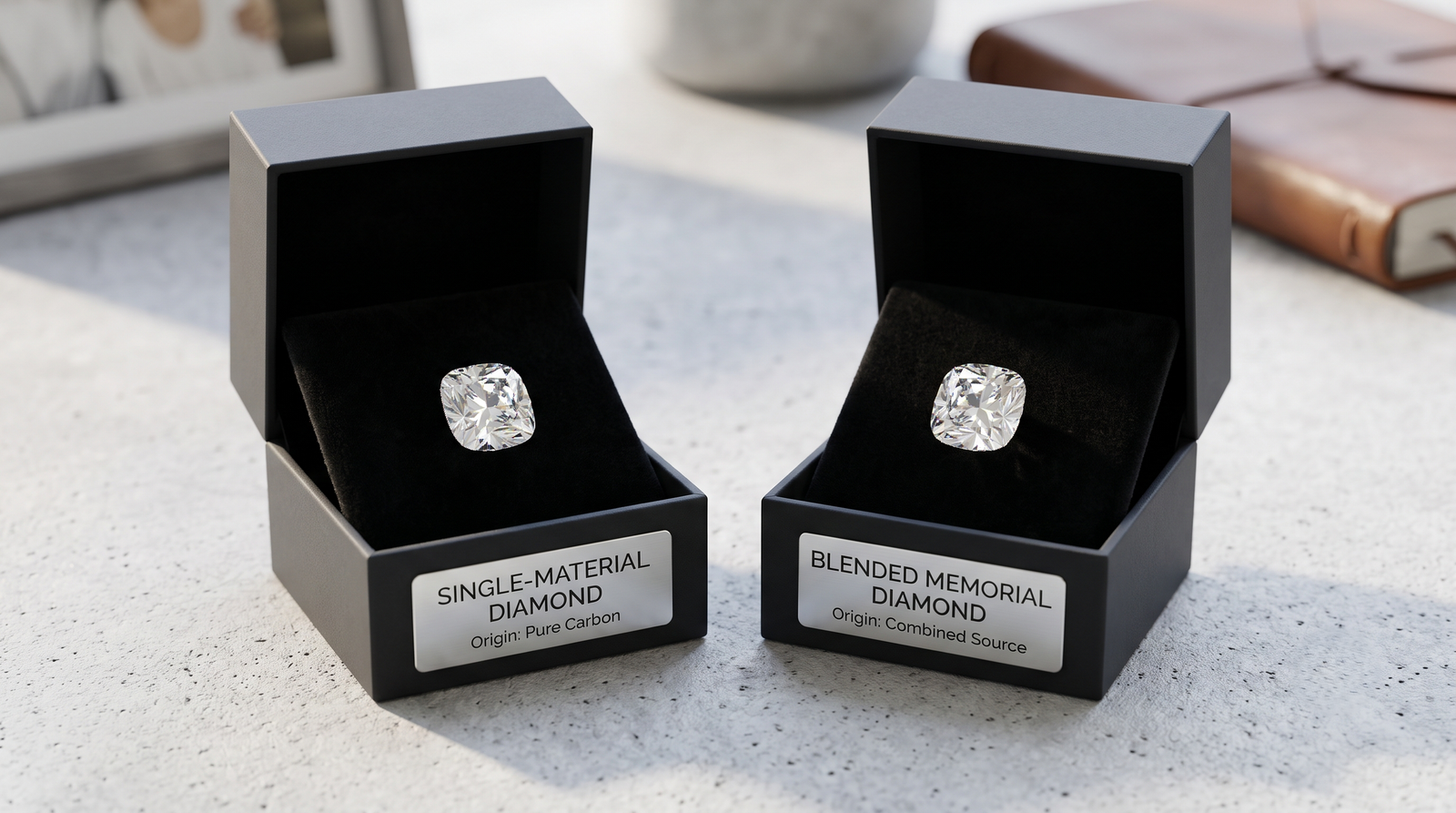
Nothing about holding both materials obliges you to combine them in one husband memorial diamond. A husband memorial diamond grown from ashes alone, or from hair alone, is the same object: the same lab grown crystal, the same grading on the 4Cs, the same personal carbon share. If the smaller material is marginal, the single material version of the same stone is not a lesser choice; it is the version whose record is clean.

  • Combine when both materials meet their minimums and the second one is there for the record or for meaning.
  • Go single material when one is marginal, or when you would rather keep the smaller material for a stone of its own later.
  • Do both when you hold enough: one blended stone and one single material stone, which some families choose so that the hair from a particular year stands on its own.

What the second material changes and does not change about the color is in what color a diamond made from your husband’s ashes and hair will be; the full combined route, in order, is in how to turn your husband’s ashes and hair into a diamond.

Two loose memorial diamonds in separate labelled boxes, one marked as a blended stone

Frequently Asked Questions

How much ash and hair does a combined husband memorial diamond need?

Each material for a husband memorial diamond must meet its own minimum: industry typical figures are a few tablespoons to about four ounces of ashes and a small lock, a few grams, of hair. Some providers lower the ash figure when hair is included; ask for both exact minimums before dividing anything.

If I have a lot of ashes, do I need less hair?

No. The two minimums exist for different reasons and one cannot substitute for the other. A surplus of ashes yields more carbon but cannot turn a few strands into a lock. If the hair is marginal, have it assessed before setting aside any ashes.

Does adding hair reduce how much ash I need?

At some providers, yes, because hair contributes carbon efficiently; at others the standard ash portion is still requested. Ask directly, since the answer determines how much of his ashes you set aside and whether the combined order is realistic.

What if one material is just under the minimum?

Ask what happens in that case: whether the provider still includes it and, if so, whether it is genuinely present in the grown carbon or only recorded. If they will not accept it, keep it hair keeps indefinitely once dry for a possible future stone.

Does a combined stone contain more of him than a single material one?

No. The personal carbon share is typically around 10 to 15% of any memorial diamond, whether it comes from one source or two. What a combined order adds is a record that both materials were there, provided both met their minimums and the origin document names both.

Can I make one stone from both and another from hair alone?

Yes, if you hold enough of each. Some families grow one blended stone and one hair only stone so that a lock from a particular time stands on its own. Each stone needs its own minimums, so divide the hair before sending and label each envelope.

Final Thoughts on Ash and Hair for a Husband Memorial Diamond

Decide what the second material is for before you decide whether you have enough of it. If it is there for the record, it has to be there in fact, which means meeting its own minimum. If it is marginal, the clean answer is often the single material stone now and the smaller material kept for later. A husband memorial diamond from both is a good choice when both are genuinely present, and a worse one when one of them is only nominally there.

Learn More About Husband Memorial Diamonds

Talk With Memorial Diamond

If you hold plenty of one material and very little of the other, reach out to Memorial Diamond to talk through whether a combined husband memorial diamond is realistic with what you have, or whether a single material stone is the better fit.

Husband hair memorial diamond color guide showing a lock of hair beside a brilliant diamond in a luxury black velvet box

What Color Will a Diamond Made From Your Husband’s Hair Be?

If his hair was gray, it will not make a gray diamond. If it was dark, it will not make a dark one. A husband hair diamond color is decided by trace elements in the growth cell, not by pigment, so a diamond made from your husband’s hair will most often come out yellow, champagne, or blue, with colorless available at extra cost. What hair does change is the width of the range you are guessing within a keratin source carries fewer variables into the process than cremated remains do and a narrower range is still not a dial.

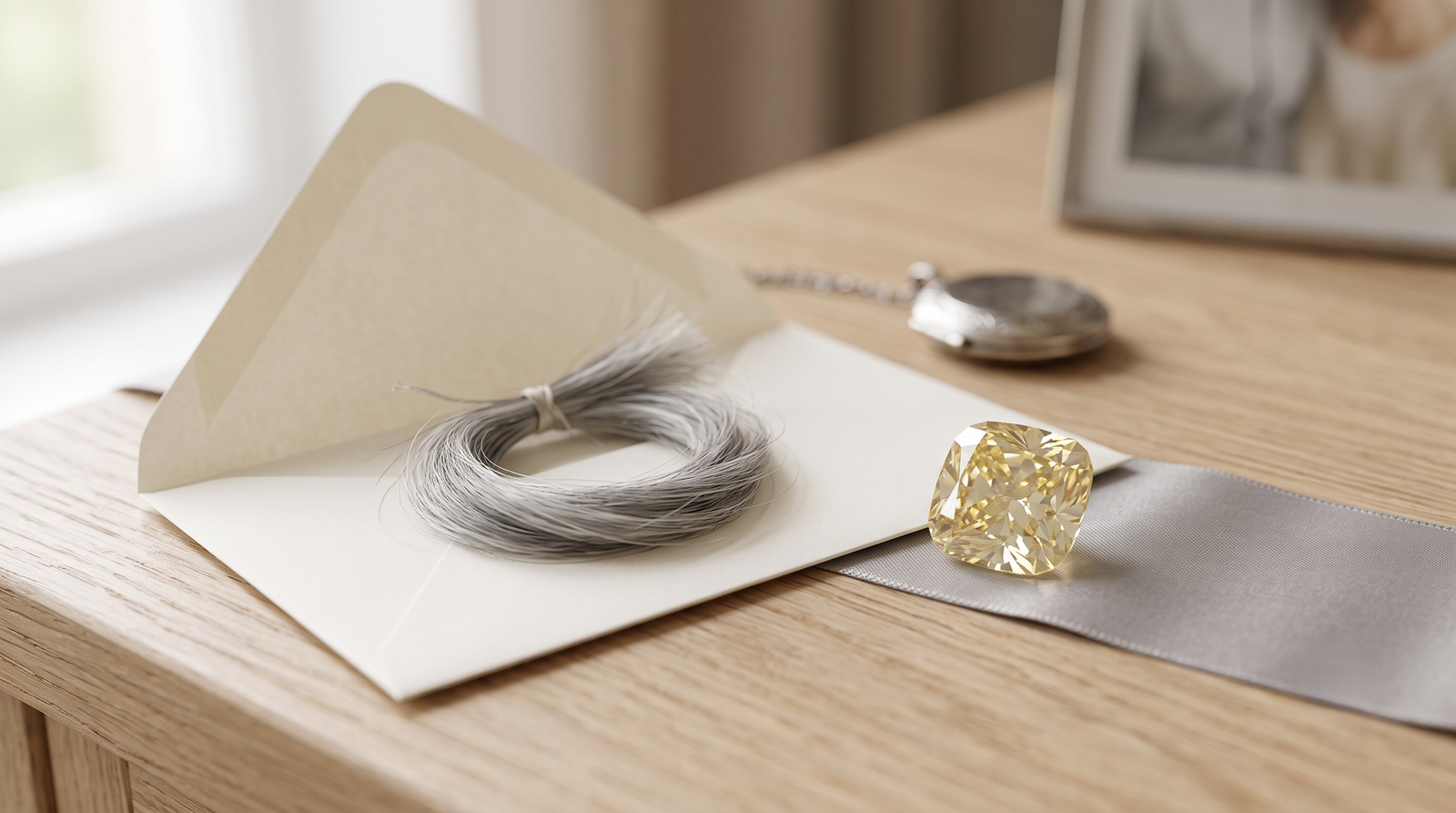
Husband hair diamond color: a pale yellow lab-grown memorial diamond beside a small lock of gray hair in a paper envelope

Will the Diamond Be the Color of His Hair?

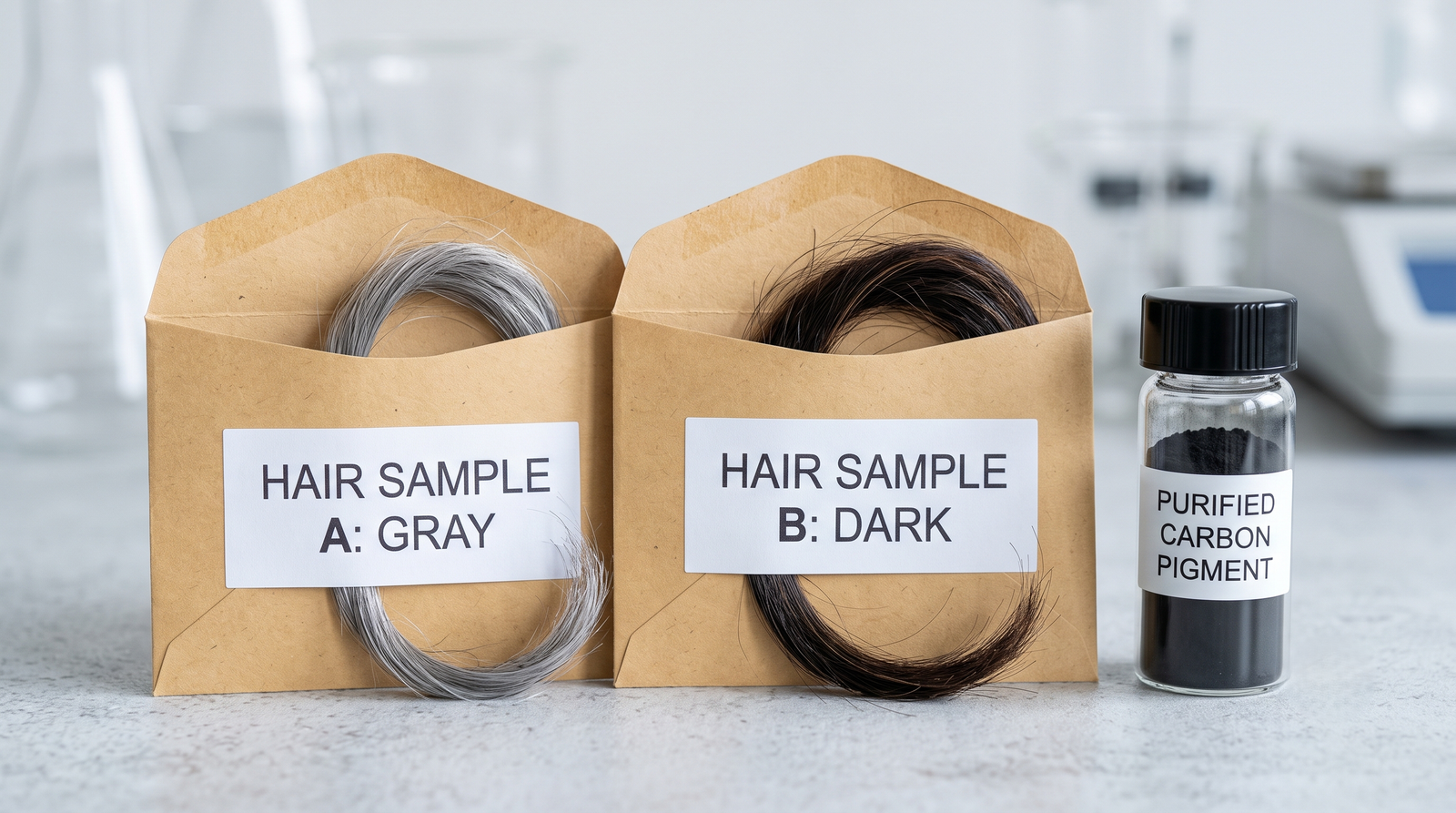
No, and it is worth being plain about why. Hair color comes from melanin, a pigment held inside the strand. Carbon extraction heats the hair in an oxygen free process that drives off everything that is not carbon the nitrogen and sulfur of keratin, and the melanin with them leaving carbon at roughly 99.9% purity. By the time the material reaches the press it has no color of its own. Gray, white, brown, and black hair all yield the same carbon, and the same possible husband hair diamond color outcomes.

So the shade of his hair is one input among several, and it is the one that contributes nothing. The stage by stage account is in how a memorial diamond is made from your husband’s hair.

 Two labelled envelopes, one holding gray hair and one dark hair, beside a small vial of black purified carbon

What Decides a Husband Hair Diamond Color?

Six things can influence a husband hair diamond color. The table sorts them by whether each enters through the hair itself or is set in the growth cell and his hair’s own shade is the one row that reads “no” on both sides.

MechanismEffect on toneEnters through the hair?Set in the growth cell?
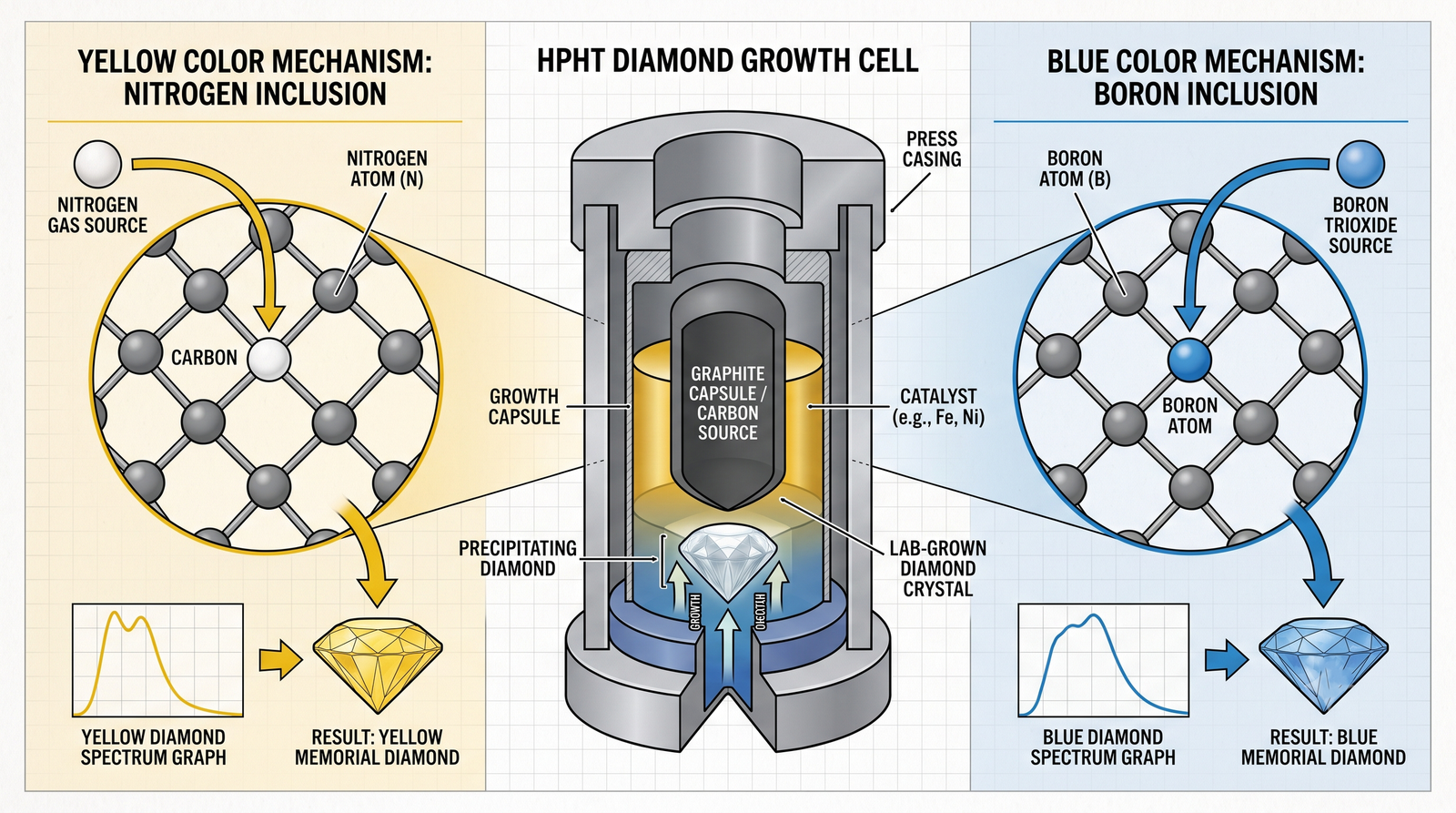
Nitrogen present during growthYellow to champagnePossibly, in trace amounts after purificationYes most providers control it here
Boron present during growthBlueRarelyYes usually added deliberately
Exclusion of both elementsColorlessNoYes extra processing and time
Growth temperature and pressure profileShifts saturation within a familyNoYes
Post growth irradiationRed, pink, green, blackNoYes, at some providers
The pigment of his hairNoneNo removed at purificationNo

Every row that actually moves the color is something the laboratory controls or steers. That is why a provider can offer a husband hair diamond color family, and why the exact saturation within it still arrives rather than being chosen. Growth itself is the standard HPHT or CVD diamond growth used across the lab grown industry.

A diagram of a diamond growth cell with nitrogen and boron labelled as the sources of yellow and blue

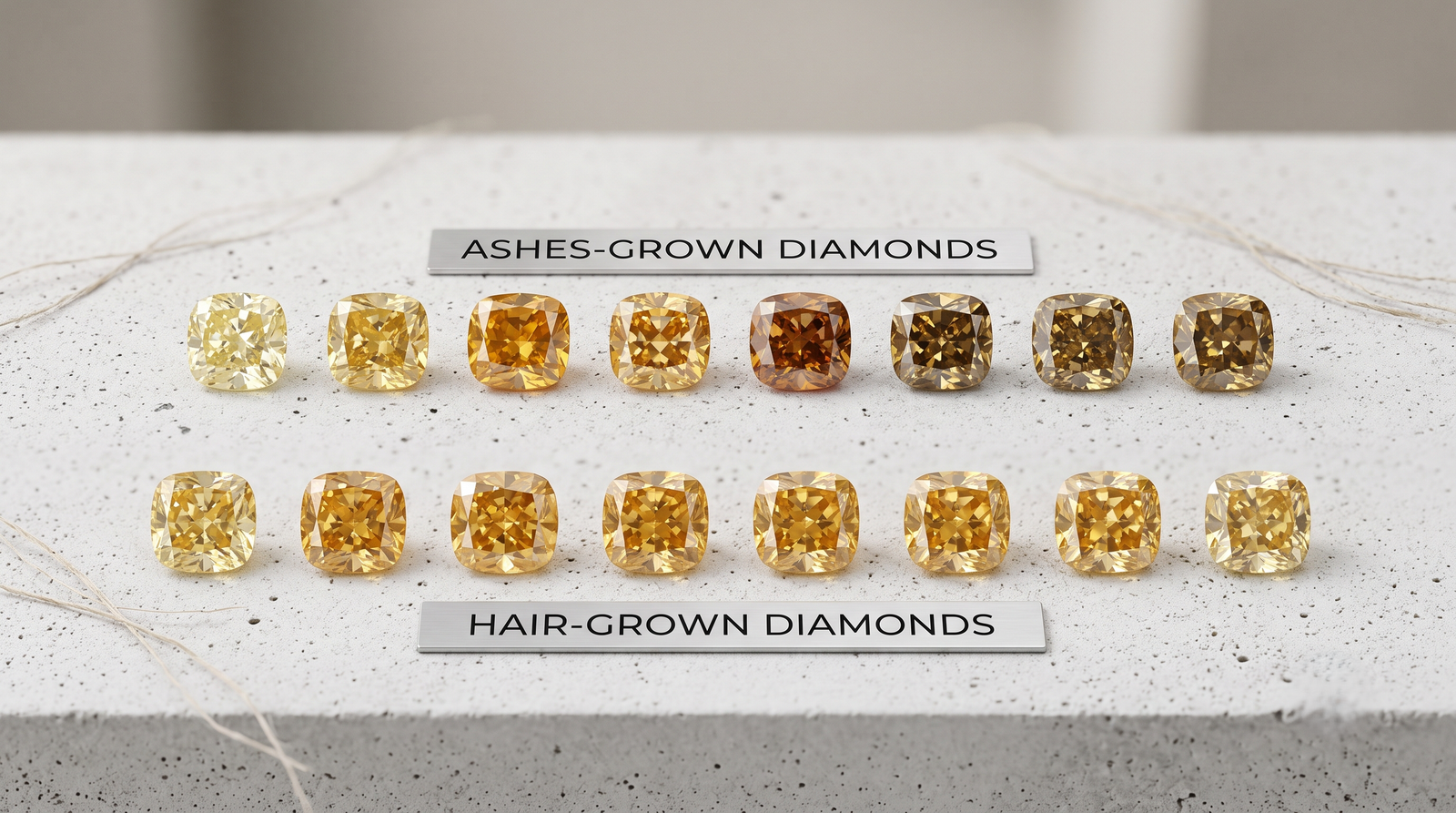
Why Does a Keratin Source Vary Less Than an Ash Source?

This is reasoning from the chemistry rather than a published finding, and it is stated as reasoning. Cremated remains are largely calcium phosphate, with carbon somewhere between 0.5% and 4% by weight, and whatever else is present differs with the person and the cremation the trace load that reaches purification differs from one portion to the next. Hair, the source of a husband hair diamond color, is roughly 50% carbon and is a single, consistent protein, keratin, whoever it came from. There is simply less in it that could ride along.

The consequence for a husband hair diamond color is a narrower band of expected outcomes, not a predictable one. Yellow to champagne still dominates; blue and colorless are still deliberate choices. But the surprises at the edges of the range an unexpectedly deep cognac, an unplanned tint on a stone ordered as colorless are less likely from hair. If you also hold a portion of his ashes and are weighing whether to add it, that is exactly the trade off set out in what color a diamond made from your husband’s ashes and hair will be.

What Does a Narrower Range Buy You?

Three practical things, and one thing it does not.

  • A more confident colorless order. Asking for a colorless husband hair diamond color from a hair sample is a more reliable request than the same order from ashes, because there is less to exclude. Ask whether the provider offers it at the carat you want, and what it adds to the price.
  • Less variance between stones grown at different times. If his children may want a stone later, two husband hair diamond color outcomes from the same lock are more likely to sit close together than two ash grown stones would. Closer, not identical different runs still differ.
  • A tighter written specification. A provider can commit to a husband hair diamond color of “yellow, light to medium” with more confidence from hair than from ashes.
  • What it does not buy: a shade. No provider can promise lemon rather than honey, or pale rather than steel blue, before the run.

How an ash grown stone’s range is wider, and why nobody characterizes the input, is the subject of what color a diamond made from your husband’s ashes will be.

Two rows of memorial diamonds, the hair-grown row showing a tighter spread of yellow tones than the ash-grown row

Which Lock Should You Send, If You Have More Than One?

Some families hold hair from more than one point in his life a lock from the hospital, clippings from a home haircut, strands from a brush. Since pigment does not survive purification, the husband hair diamond color will not differ between a gray lock and a dark one. Choose by meaning and by confidence that the sample is his, not by the husband hair diamond color you hope for.

Two things do matter for color, and a third matters for the record the questions to ask before turning your husband’s hair into a diamond cover what a provider should write down about the sample. First, a lock large enough to meet the provider’s minimum on its own typically a few grams avoids any need to blend in another source. Second, keep separate locks in separate labelled envelopes rather than pooling them, so the provider knows what they are working from. Quantity is covered in how much hair you need for a husband memorial diamond.

Frequently Asked Questions

Will a diamond made from my husband’s hair be the color of his hair?

No. Hair color comes from melanin, which is removed with everything else that is not carbon during purification. Gray, white, dark, or dyed hair all yield the same carbon, and the diamond’s tone is set by trace elements and growth conditions in the laboratory.

What is the most common husband hair diamond color?

Yellow to champagne, driven by nitrogen present during growth; the husband hair diamond color range is the same as any memorial diamond’s. Blue is available at most providers by introducing boron. Colorless is possible with extra processing and typically costs more at the same carat.

Is colorless easier to get from hair than from ashes?

Generally, yes, as a matter of chemistry. Hair is a consistent protein with fewer trace elements to exclude, so a colorless order from a hair sample is a more reliable request. It still requires deliberate processing and still costs more than a tinted stone.

Does dyed or chemically treated hair change the color?

Not in the finished stone. Dyes and treatments sit in or on the strand and are removed at purification along with the pigment. Tell the provider about treatments anyway, since some ask about it for acceptance rather than for color reasons.

Can I get a specific shade, like pale blue rather than deep blue?

You can choose the family blue and a provider may commit to a range within it. Exact saturation is decided during the growth run and cannot be promised in advance. Ask what happens if the finished stone falls outside the range you agreed.

Will two diamonds from the same lock of hair be the same color?

They will usually sit close, but not identical. Each growth run has its own conditions, so depth of color varies between stones even from one source. A keratin source narrows that variation compared with ashes; it does not remove it.

Final Thoughts on a Husband Hair Diamond Color

Send the lock that means the most, not the one you think will color best; the process cannot tell them apart. Then choose a husband hair diamond color family in writing, expect the range to be narrower than an ash grown stone’s but still a range, and let the one thing you were never able to choose the exact shade be the part that arrives.

Learn More About Husband Memorial Diamonds

Talk With Memorial Diamond

If you are choosing between locks, or wondering whether colorless is realistic from what you have, reach out to Memorial Diamond to talk through what a husband hair diamond color could be from your sample.

Word count: 1,530 · Reading time: about 8 minutes

Memorial diamonds in yellow, champagne, and blue displayed beside cremation ashes and hair on a black luxury surface

What Color Will a Diamond Made From Your Husband’s Ashes and Hair Be?

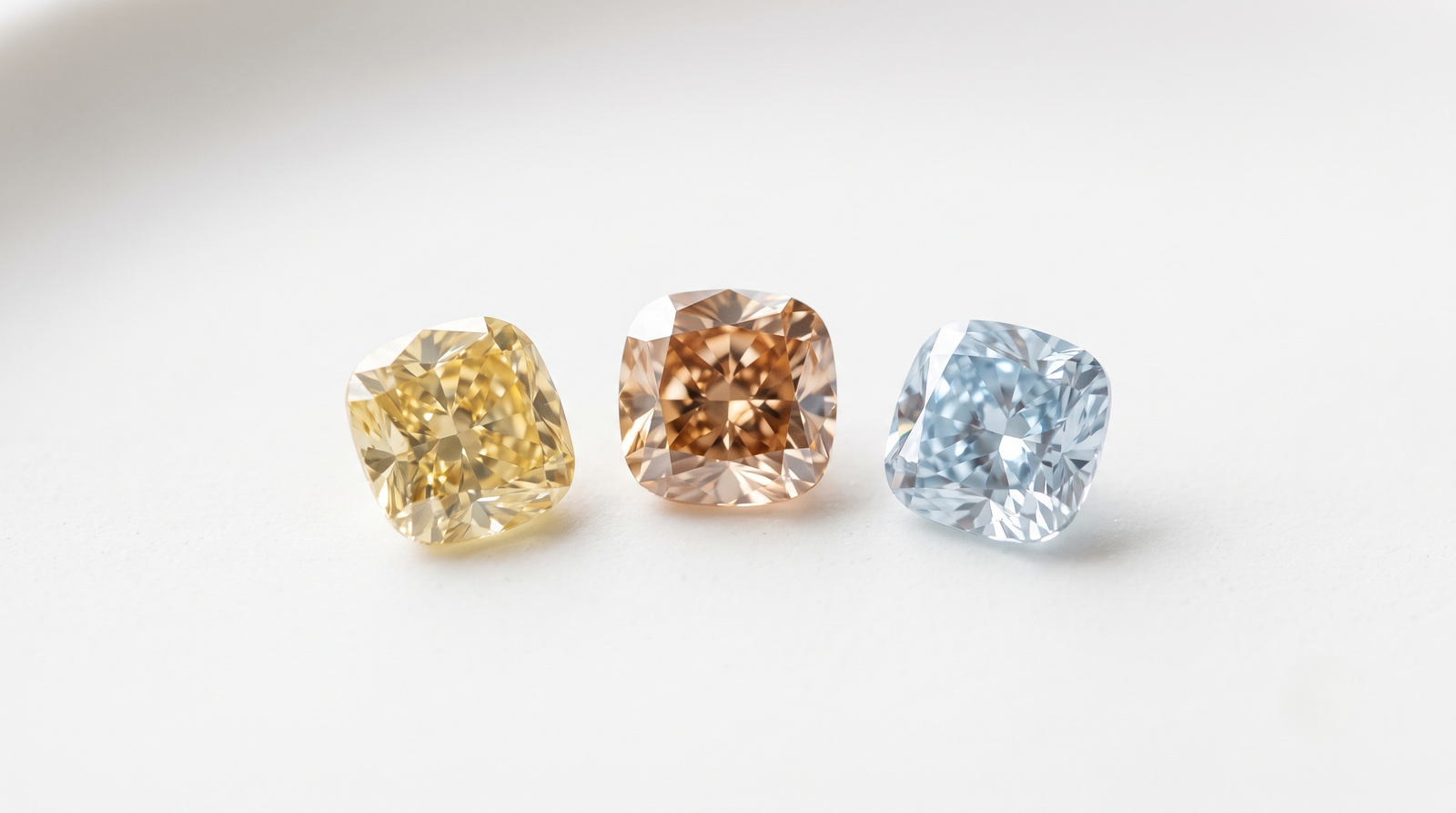
You can choose the carat, the cut, and the setting. The one thing you cannot choose outright is the shade. What color diamond made from your husband’s ashes you receive is set during growth, not before it: most memorial diamonds come out yellow, champagne, or blue, colorless is possible with extra processing at a higher price, and no provider can honestly promise the exact tone in advance. The reason is not secrecy. It is that nobody characterizes what is actually in a portion of ashes before it goes into the press.

Color diamond made from a husband's ashes: three loose lab-grown memorial diamonds in yellow, champagne, and pale blue on a white background |

Where Does the Color of a Memorial Diamond Come From?

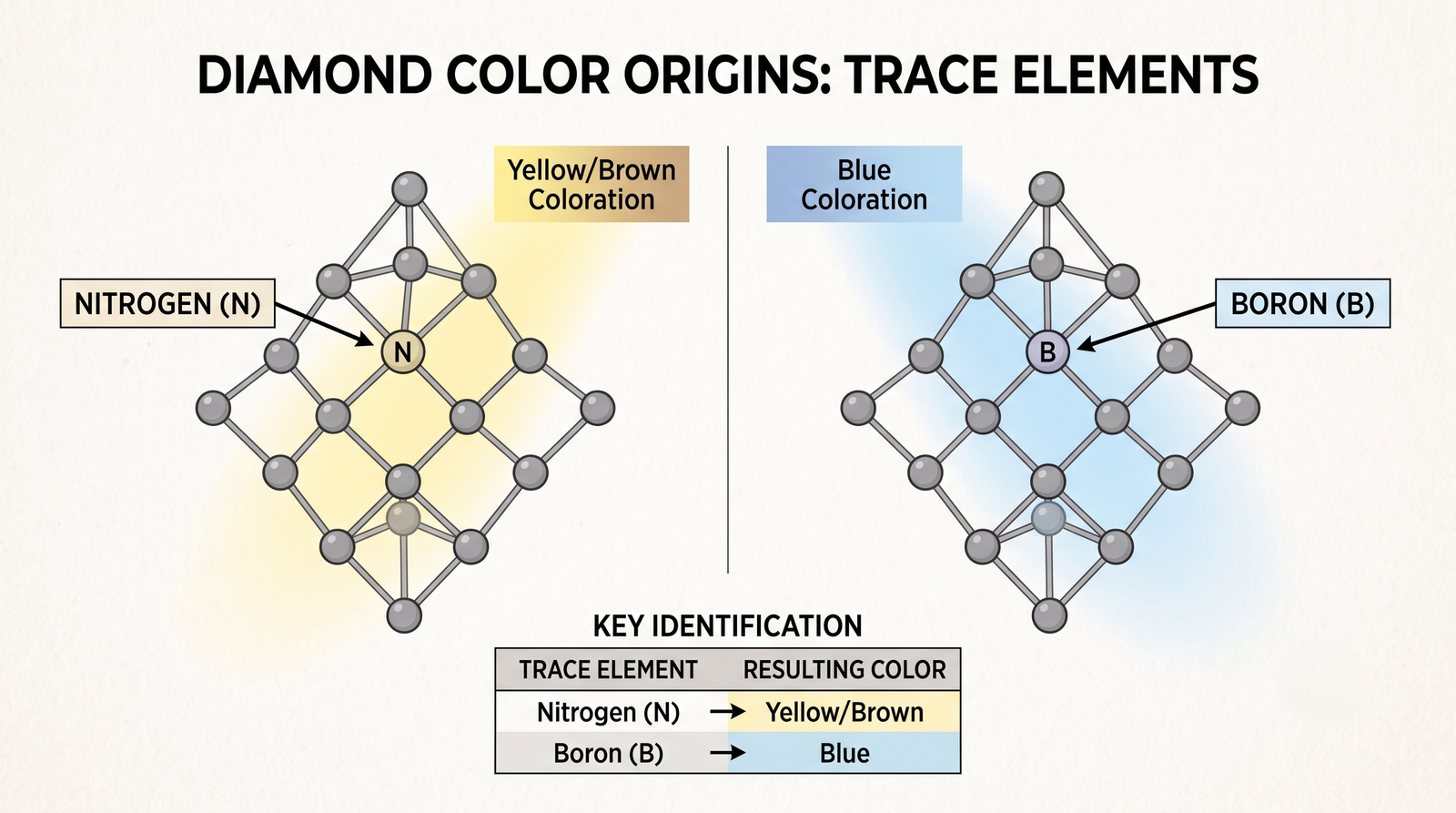
Diamond color is decided by trace elements present in the growth cell. Nitrogen produces yellow tones. Boron produces blue. Which color diamond made from ashes you receive is decided by how much of each rode along with the carbon. A colorless stone needs both to be excluded, which takes extra processing and time. Cremated remains are an organic, personal source rather than a controlled feedstock, so trace elements are common and that is why a diamond grown from them tends toward a tint rather than toward white.

The carbon itself is neutral, and it is the same carbon whatever color diamond made from it eventually arrives. Purified to roughly 99.9%, converted to graphite, and grown by HPHT or CVD diamond growth, it would make a colorless crystal on its own. The tint comes from what travels with it, in quantities nobody measures. The full sequence is in how a memorial diamond is made from your husband’s ashes.

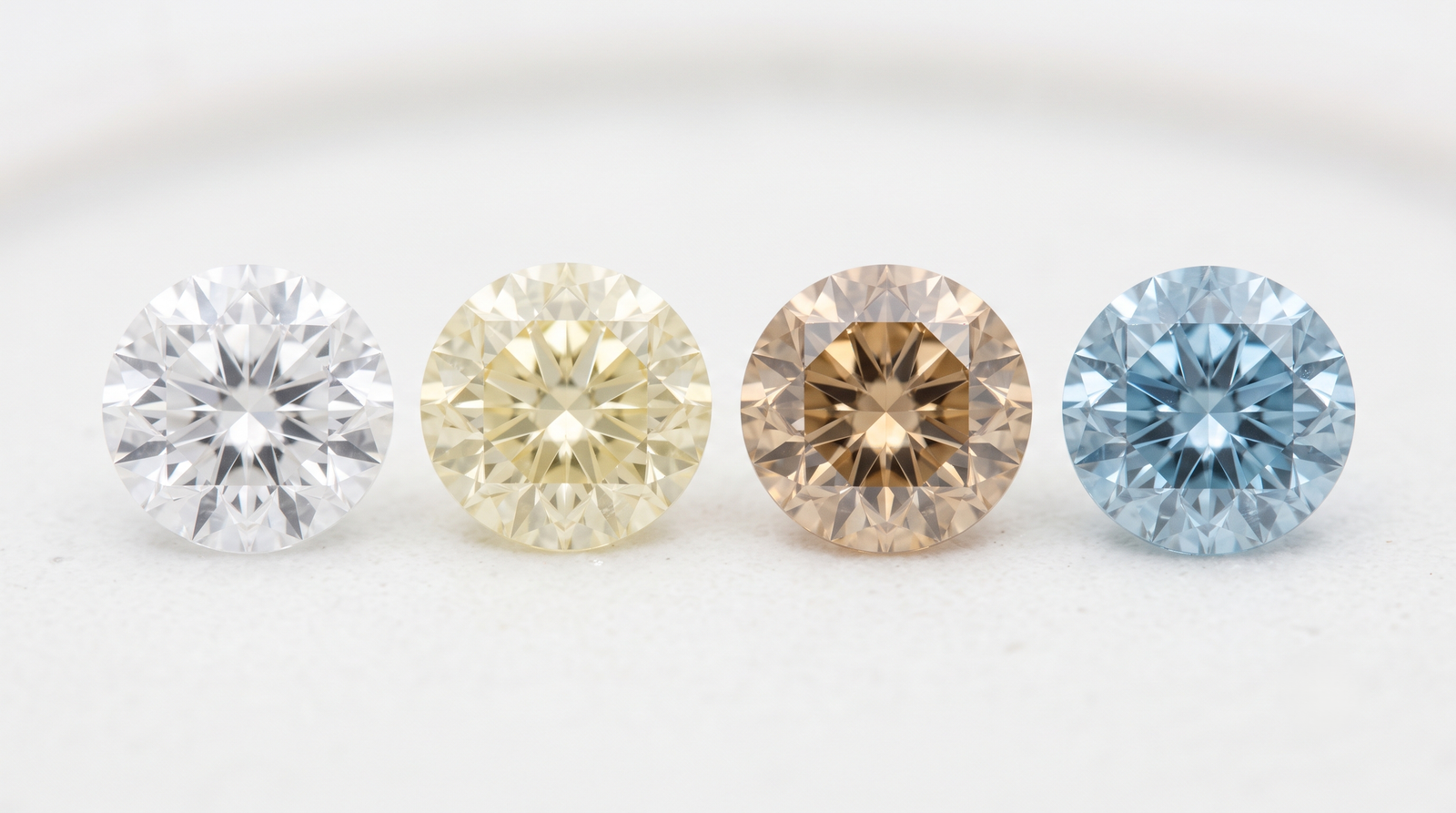
What Color Diamond Made From Ashes Is Typical?

Industry wide, the answer clusters into a short list. Which color diamond made from his ashes you receive depends on the growth run, but the range is narrow enough to plan around.

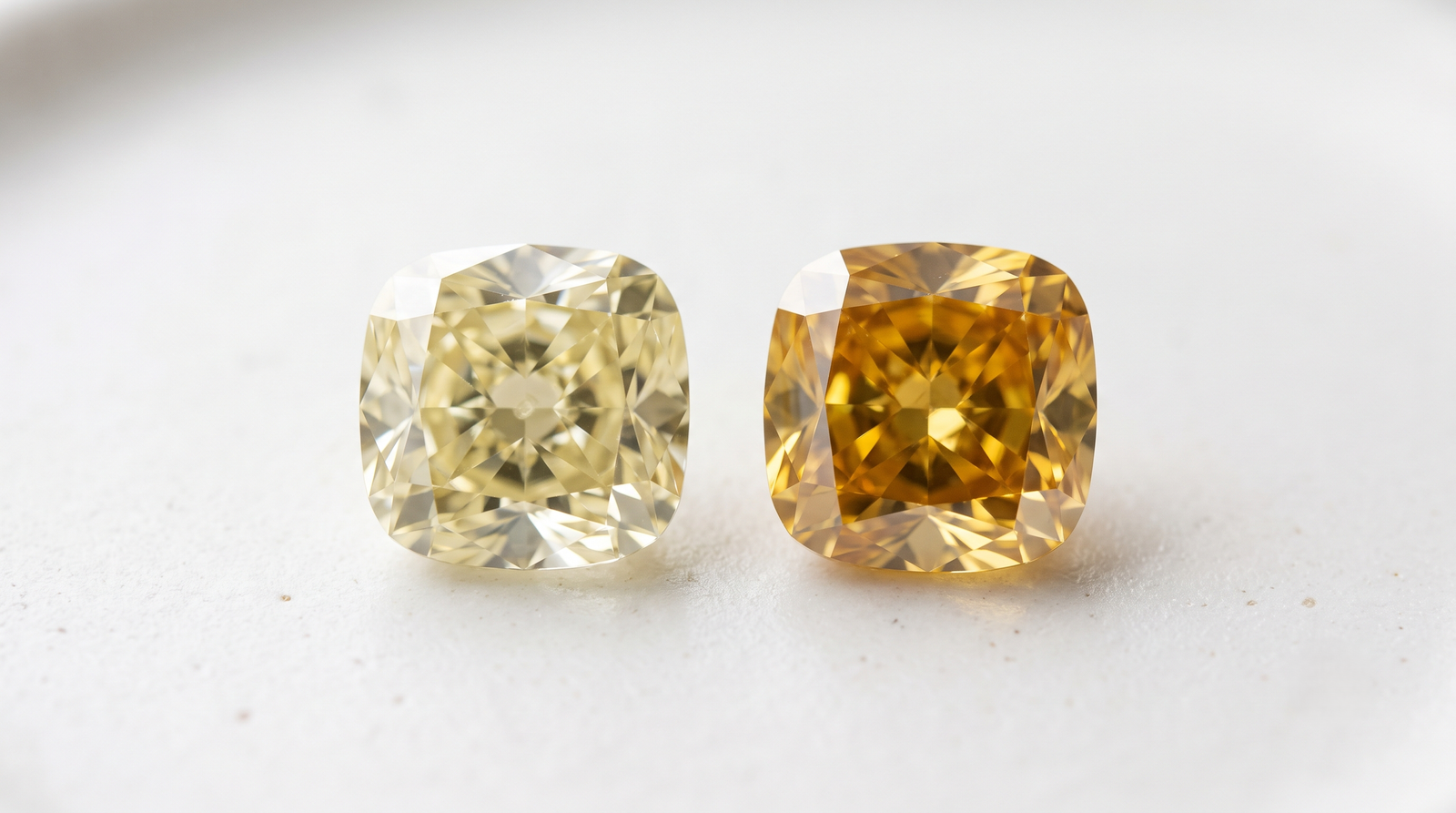
  • Yellow to champagne the most common color diamond made from ashes, driven by nitrogen; often described by providers as amber, honey, or cognac at the darker end.
  • Blue from boron; pale to steel blue, and usually offered as a named option rather than left to chance.
  • Colorless / white achievable, but it requires excluding both nitrogen and boron, so it costs meaningfully more at the same carat.
  • Red, pink, green, black produced by post growth irradiation at some providers, not by anything in the ashes.

A colorless diamond made at the mid tier, roughly 0.5 to 1 carat, typically prices above a yellow, blue, or champagne stone of the same size. The tier ranges are in how much a husband memorial diamond costs.

Four memorial diamonds arranged left to right from colorless through pale yellow, champagne, and blue

Why Can Nobody Forecast the Shade?

Because the question “what color diamond made from this ash?” has an input nobody characterizes. To predict a tone before growth, several things would have to be known, and the table shows who could know each one and when.

What would have to be knownWho could know itWhenIs it known in practice?
Nitrogen content of the purified carbonThe laboratory, by assayAfter purification, before growthRarely measured; ask
Boron content of the purified carbonThe laboratoryAfter purificationRarely measured
Ratio of personal carbon to laboratory carbonThe laboratoryAt blendingKnown, but not always disclosed
Growth conditions chosen for this runThe laboratoryAt the start of growthKnown; some providers steer color here
How the cut will present the tintThe gemologistAfter growthKnown only once the rough exists

Four of the five rows sit after the point where you place the order. The one that could be measured earliest, the trace element content of the purified carbon, is not something most providers assay for a single family’s portion. So the honest answer is a range, not a shade and a provider who names an exact tone before growth is describing their steering process, not your husband’s ashes.

 A simple diagram showing nitrogen producing yellow and boron producing blue in a diamond lattice

What Can You Specify, and What Just Arrives?

There is more control over what color diamond made from ashes you receive than the previous section might suggest, as long as it is aimed at the right things.

You can specify: the color family (yellow, blue, colorless), the carat, the cut, and whether a color is intensified after growth by irradiation. Providers who offer named colors do so by controlling the growth environment, not by reading the ashes.

You cannot specify: the exact saturation within a family, whether a yellow leans lemon or cognac, or whether a blue arrives pale or deep. That is what arrives.

Worth asking before ordering: what the provider means by each color name, whether they will show stones photographed under stated lighting, what recourse exists if the stone lands outside the agreed range, and whether the color diamond made from a small portion can be steered toward colorless at all. Those questions are set out in questions to ask before turning your husband’s ashes into a diamond; how the answer changes when hair is added is in what color a diamond made from your husband’s ashes and hair will be.

One Stone, or the First of a Set?

This is the decision the color question quietly forces, and it is easy to miss. If his children may want stones of their own later, a second diamond grown from the same ashes in a different run will not match the first. Different run, different trace load, different tint and a different color diamond made from the same ashes. The color diamond made this year and the one made in three years’ time are siblings, not twins.

So decide now whether matching matters. If it does, the options are to grow the set in one order, or to agree a written color specification the provider will hold against a future order and to ask plainly whether they can. If matching does not matter, a family of stones each a slightly different color diamond made from one source in the same color family but different depths has its own logic, and many families prefer it. Whether the ashes can stretch to several stones is covered in how much ash you need for a husband memorial diamond and whether more than one family member can get a diamond from the same husband’s ashes.

Two yellow memorial diamonds side by side, one noticeably deeper in tone than the other |

Frequently Asked Questions

What color diamond made from ashes is most common?

Yellow to champagne is the most common color diamond made from ashes industry wide, because nitrogen carried through from an organic carbon source produces yellow tones. Blue, from boron, is the next most common. Colorless is achievable but requires extra processing to exclude both elements and costs more.

Can I choose colorless for a diamond made from my husband’s ashes?

Usually, yes, as a named option. Colorless requires the laboratory to exclude nitrogen and boron during growth, which adds time and cost compared with a yellow, blue, or champagne stone of the same carat. Ask whether it is available at the size you want.

Does the amount of ash I send affect the color?

No. Color is set by trace elements and growth conditions, not by how much ash is submitted. Sending more ash does not shift the tint, and it does not make the stone larger either; carat size is set by growth time in the press.

Why can’t the provider tell me the exact shade in advance?

Because the trace element content of the purified carbon is rarely measured for a single family’s portion, and most of what decides the tint happens after the order is placed. Providers can commit to a color family and a range, not to an exact saturation.

Will a second diamond from the same ashes match the first?

Not automatically. A second growth run carries its own trace load and conditions, so two stones from the same ashes grown at different times usually differ in depth of color. If matching matters, grow the set in one order or agree a written color specification.

Does his cremation or health affect the diamond’s color?

There is no reliable link a provider can point to. Trace elements in cremated remains vary from person to person and from cremation to cremation, but nobody characterizes them before growth, so no honest prediction can be made from anything about him.

Final Thoughts on What Color Diamond Made From His Ashes Will Be

The shade is the one part of this you hand over. Everything else about what color diamond made from his ashes you end up holding the family of color, the size, the cut, whether there is one stone or several is yours to decide, and deciding it in writing before growth begins is what turns “what color will it be” from a worry into a range you agreed to. Choose the range, then let the run decide the rest.

Learn More About Husband Memorial Diamonds

Talk With Memorial Diamond

If you would like to understand which color diamond made from the portion you hold is realistic, and what a written color range would look like, reach out to Memorial Diamond to talk through what’s possible with your husband’s ashes.

Word count: 1,585 · Reading time: about 8 minutes

Memorial diamond made from a husband's ashes and hair displayed with a diamond, cremation ashes, hair and memorial urn on a black luxury background

What Color Will a Diamond Made From Your Husband’s Ashes and Hair Be?

Two materials do not make two colors. A husband ashes hair diamond color is a single tone, decided by trace elements and growth conditions in the laboratory, and it will most often be yellow, champagne, or blue, with colorless possible at extra cost exactly as it would be from either material alone. What changes when both go in is not the palette but the width of the range you are guessing within, and the useful rule is this: the wider ranging input governs. So whether adding the second material changes anything depends entirely on which material you started with.

Husband ashes hair diamond color: a single champagne-toned lab-grown memorial diamond between a small sealed portion of ashes and a labelled lock of hair

Does Combining Ashes and Hair Blend Two Colors?

No. By the time either material reaches the growth cell it is purified carbon at roughly 99.9%, converted to graphite, and the two are physically identical. There is no “ash color” and “hair color” to mix. What the crystal picks up is whatever trace nitrogen or boron is present during growth nitrogen giving yellow, boron giving blue plus whatever the laboratory adds or excludes deliberately, under standard HPHT or CVD diamond growth.

So the same short list applies to a husband ashes hair diamond color as to any memorial diamond: yellow to champagne most often, blue as a named option, colorless with extra processing, and red, pink, green, or black by post growth irradiation at some providers. The two track process that ends in one crystal is laid out in how a memorial diamond is made from your husband’s ashes and hair.

Two small labelled portions of graphite beside a single diamond growth cell

Which Material Sets the Range of a Husband Ashes Hair Diamond Color?

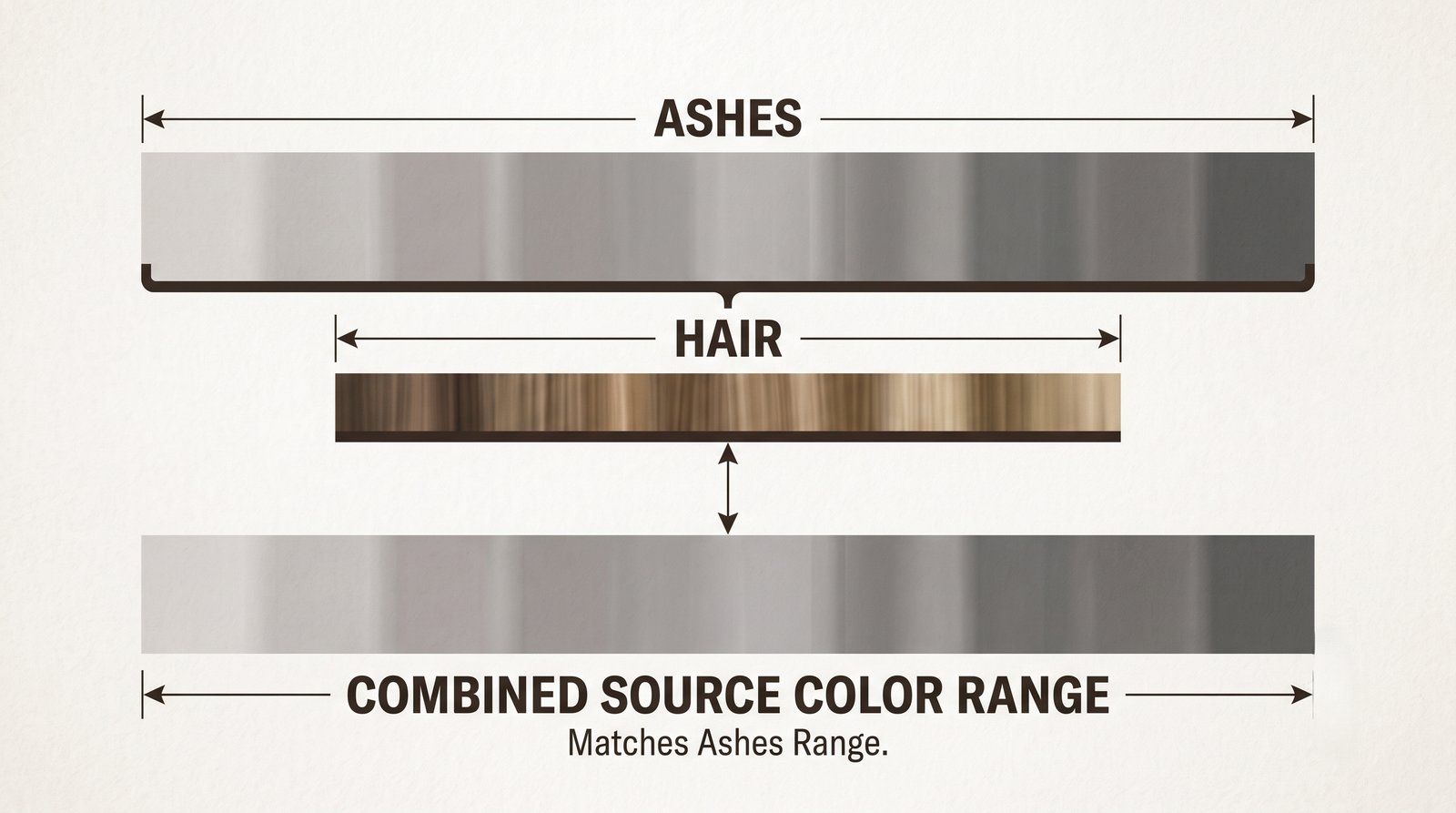
The one with more variables in it and for a husband ashes hair diamond color, that is the ashes. Cremated remains are largely mineral calcium phosphate carrying somewhere between 0.5% and 4% carbon, and whatever rides along with that carbon differs from one portion to the next; nobody characterizes it before growth. Hair is about half carbon by weight, and it is one consistent protein whoever it came from. Reasoning from that chemistry and it is reasoning, not a published finding an ash derived carbon carries a wider band of possible outcomes than a hair derived one.

When both are in one order, the ash portion’s wider band is what the laboratory has to plan around. The hair does not narrow a husband ashes hair diamond color range. That single point is the whole answer to “will the color be different if we add hair,” and it cuts in only one direction.

Why Does the Direction of the Addition Matter?

Because a husband ashes hair diamond color is governed by the wider input, adding the narrower material changes little, and adding the wider material changes more.

You started with…You are thinking of adding…Effect on the color rangeEffect on the color family you can choose
His ashesA lock of his hairLittle the range was already set by the ashesNone; the same families are available
A lock of his hairA portion of his ashesWidens it the ashes now governNone, but colorless becomes a less certain request
Both, decided togetherThe ashes govern from the startSame as an ashes only stone
Neither yetDecide by meaning first; range is a secondary questionSame families either way

Read the table by row, not by column; a husband ashes hair diamond color follows the row you are actually in. If the ashes are already the plan and you have found a lock of his hair, the color question is essentially unchanged and the decision is about meaning and record keeping, not tone.

If the hair was the plan perhaps because he was buried, or because the lock is the thing that carries a date and a portion of ashes is now available, adding it is the change that costs you the narrower range. The single material ranges are set out in what color a diamond made from your husband’s ashes will be and what color a diamond made from your husband’s hair will be.

A diagram showing a wide band labelled ashes and a narrow band labelled hair, with the combined band matching the wide one

Does Sending Both Give You More Say Over the Color?

No. This is the misreading about a husband ashes hair diamond color worth heading off, because it sounds plausible: two materials, twice the influence. What you can specify is the same either way the color family, the carat, the cut, and whether irradiation is used afterward. What arrives is the same either way the exact saturation. Sending both does not add a lever.

What sending both does add to a husband ashes hair diamond color order is a record: two intake weights and an origin document that names both sources, if the provider keeps one. That is a good reason to combine. Color is not.

  • Ask what the provider means by each color name, and whether they will show stones under stated lighting.
  • Ask whether a colorless request is honored from a combined order, and at what carat.
  • Ask what the provider will do if the stone arrives outside the range you agreed to.
  • Ask whether the origin document names both materials, so the hair you added is acknowledged somewhere even though it did not touch the color.

The full list of combined order questions is in questions to ask before turning your husband’s ashes and hair into a diamond.

What If the Second Material Turns Up Late?

This happens more than the guides admit. A lock of hair surfaces in a coat pocket after an ashes order is placed; a portion of ashes is released by a funeral home after a hair order has started. Whether a provider will amend an open husband ashes hair diamond color order to add a second material is a policy question, and it should be asked before assuming either answer.

If they will, the direction rule still applies. Adding hair to an ash order in progress changes nothing about the husband ashes hair diamond color you were already expecting. Adding ashes to a hair order that was placed with a colorless request may change what the laboratory can commit to, and that is a conversation to have before anything is blended, since the carbons cannot be separated afterward. If they will not amend, the late material can still become a second stone; hair keeps indefinitely once dry, and a set aside portion of ashes does not expire. The quantity each route needs is in how much ash and hair you need for a husband memorial diamond.

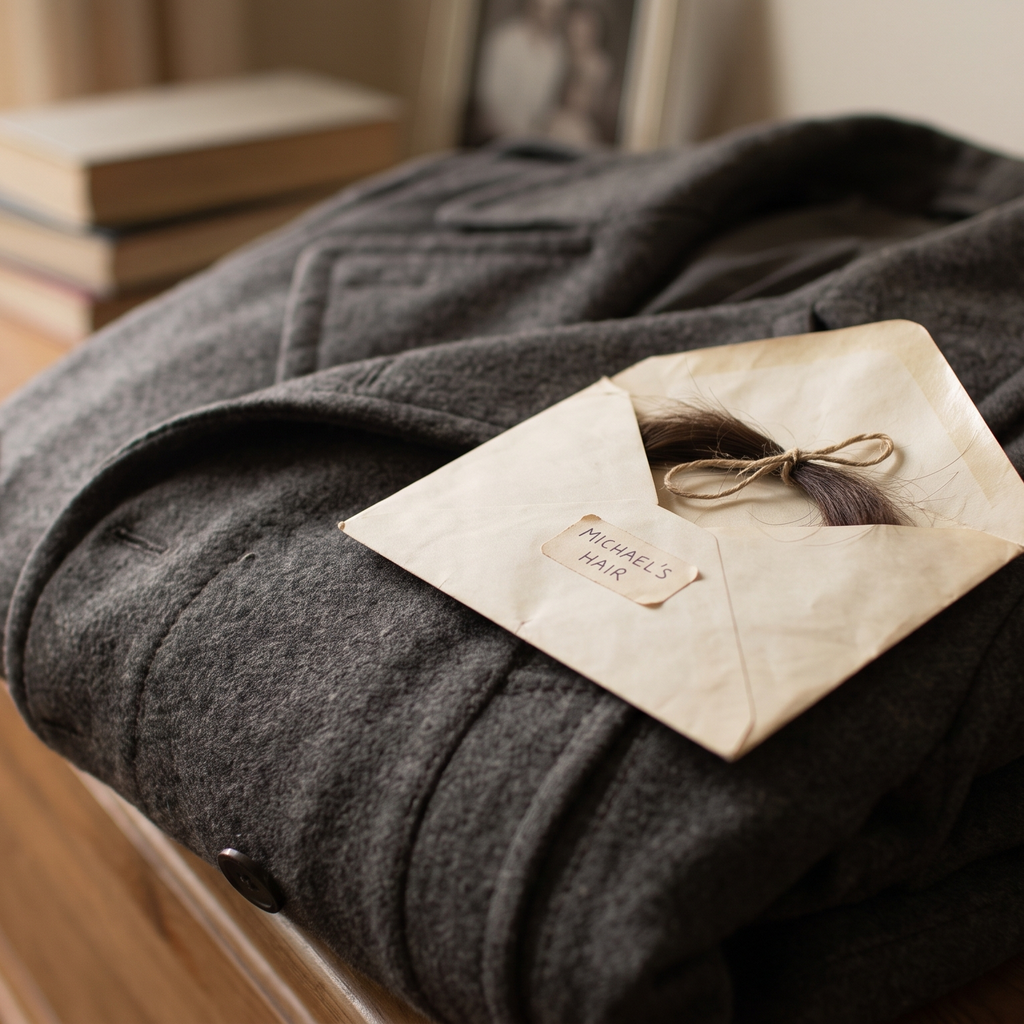
A lock of hair in a paper envelope resting on a folded coat

Frequently Asked Questions

Will a diamond made from both ashes and hair be two colors?

No. Both materials are purified to identical carbon before growth, so the crystal has one tone, set by trace elements and growth conditions. There is no ash color and hair color to blend; the same yellow, champagne, blue, or colorless families apply as for any memorial diamond.

Does adding hair to his ashes change the color?

Very little. In a husband ashes hair diamond color, the ash portion carries the wider band of possible outcomes, so it governs the range whether or not hair is included. Adding a lock of hair to an ashes order is a decision about meaning and record keeping rather than about tone.

Does adding ashes to a hair order change the color?

It can widen the expected husband ashes hair diamond color range. A hair only stone has a narrower band of outcomes because hair is a consistent, carbon rich protein; adding a portion of ashes introduces the more variable material. A colorless request from a combined order is a less certain one.

Can I ask for colorless from a husband ashes hair diamond?

Usually, as a named option, but expect the provider to treat it as they would an ashes only colorless request, since the ashes govern the range. It requires excluding nitrogen and boron during growth, adds time, and costs more than a tinted stone at the same carat.

Which material should I decide on first?

The one you already have, or the one that carries the most meaning. A husband ashes hair diamond color is a secondary question in a combined order; the range is set by the ashes if they are included at all. Settle what each material is for, then ask the color question of the combination.

Can I add the second material after the order has started?

Sometimes. Whether a provider will amend an open order is a policy question to ask directly. If they will, adding hair changes nothing about the expected color; adding ashes may. If they will not, the late material can still become a second stone later.

Final Thoughts on a Husband Ashes Hair Diamond Color

Start from the material you already have, and let that decide how much the second one matters. If the ashes are the plan, add the hair for the record and expect no change in color. If the hair is the plan, know that adding ashes trades a narrower range for a fuller record, and decide which of those you want. Either way, a husband ashes hair diamond color is one color, and the stone is his.

Learn More About Husband Memorial Diamonds

Talk With Memorial Diamond

If you hold both materials and are unsure whether combining them changes what you can ask for, reach out to Memorial Diamond to talk through what a husband ashes hair diamond color could be from what you have.

How to talk to family about a father memorial diamond: an adult son and his mother at a kitchen table, one listening, an urn out of focus on a shelf behind

How to Talk to Family About a Father Memorial Diamond

You have had the sentence ready for a week and not said it. Not because you expect a refusal, but because you cannot tell whether you are asking permission or handing over a decision. Here is how to talk to family about a father memorial diamond: treat it as one conversation, not a family meeting. Where his widow is living, the decision turns on her agreement; everyone else is being told. The move that does real work is a question, not a case: ask what she wants to do with his ashes before saying what you want.

Disclosure, plainly: Memorial Diamond sells the thing this page helps you ask about, a reason to check what follows against other sources, not a reason to skip it.

One Conversation Is a Request; the Rest Are Announcements

There is a difference between the people who need to know and the person who needs to agree. Both matter; only one can end it. When you talk to family, keep that distinction in front of you.

Where his widow is living, his remains will ordinarily have been released to her, they sit in her house, and the decision commonly runs through her. Commonly rather than always: authority over disposition varies by jurisdiction and by whatever he set down in writing. That conversation is a genuine request: she can say no, and in practice that ends it. Everything else is an announcement, siblings, step siblings, adult grandchildren, the daughter who lives abroad, owed the information, not asked to approve it.

Confusing the two fails in both directions. Run an announcement as a request and you have convened a vote nobody needed: opinions on a decision that was never theirs, and his widow reduced to one voice among six. Run a request as an announcement and it is worse: telling her what you have decided about something in her house is not information sharing but a fait accompli.

What Are You Actually Asking Her For?

Three things get said in the same breath when people talk to family about this, and they are not the same ask.

Asking permission means you have decided and would like her not to object. Asking her to decide hands her a choice she did not raise. Asking whether she is open to it leaves room: it invites a reaction rather than a ruling. That distinction lives in the sentence you use when you talk to family.

The sentence you were going to sayWhat it actually asks forSay this instead
“I want to have Dad made into a diamond.”His remains, for a decision already taken“Have you thought about what you want to do with Dad’s ashes?”
“It’s only a small amount; you’d hardly notice.”Agreement that the loss is negligible, hers to judge“It uses a portion rather than all of it. How would you feel about that?”
“Dad would have loved it.”That she contradict him in order to say no“I don’t know what he’d have made of it. What do you think?”
“You don’t have to decide now.”Sounds like a concession; lands as a deadline she carries“There’s no date on this. If you’d rather not talk about it, that’s an answer.”

Two things are worth having ready before you talk to family.

The first is what happens to the material. Carbon recovered from the ashes is purified, then combined with lab grown carbon until there is enough for a growth run; on industry figures his own share of the finished stone comes to roughly 10% to 15%, ash being about 0.5% to 4% carbon to begin with. What comes out is a real diamond, grown by HPHT or CVD, not a keepsake with ash sealed inside. Say it yourself rather than let somebody else look it up; how a memorial diamond is made from your father’s ashes has the rest.

The second is what you will do with a no. A refusal is an answer, not a stage in a negotiation, and where she holds his remains it is in practice the answer. Going around it is not available: not a portion she did not agree to, not silence read as consent. Hair, if any was kept, is a separate route rather than a workaround, with its own yes, turning your father’s hair into a diamond covers it. A no can also be a no for now.

A short handwritten list of first names beside a phone | Stock acceptable; names illegible

Ask What She Wants to Do With His Ashes First

This is the highest leverage move on the page, and it is a listening one.

Before you say what you want, ask what she wants, not as a technique but as the actual first question, with room for her to answer at length or not at all. Three things happen when you talk to family in that order.

You find out whether the route is open. An interment already booked or a scattering planned changes what is possible, and you learn it beforehand.

You find out what she has been carrying. She may have a plan she never said out loud because nobody asked, or no plan and no wish to be asked for one.

You change the shape of your own request. Asked afterwards it is a proposal inside a plan she is already making, not a claim on his remains.

If she asks how much would be used, have the figure: a small portion of a cremation rather than the whole, with ranges in how much ash you need for a father memorial diamond. Do not open with it; a quantity answers a question she has not asked.

calendar-with-one-date-circ

When Should You Talk to Family About It?

Not against the funeral, and not against the fortnight after it, that is the wrong time to talk to family about anything that can wait. The clock that matters belongs to the estate and to any disposition already arranged.

There is one genuine deadline here and it is not the diamond. It is whatever has been booked for his remains: an interment date, a service cemetery’s calendar, a scattering. A portion has to be separated before that happens; afterwards the ash route is closed. If an executor is administering the estate, find out whether he left written instructions about his remains; that may have settled it. Choosing a memorial diamond for your father: where to start sets out what to establish before you talk to family at all.

Everything else waits at no cost. Production runs to about 6 to 10 months from the point a laboratory receives material, and that clock does not start until material is sent, a month spent not raising it costs a month, not an outcome. How long a father memorial diamond takes sets out where the time goes.

Telling Everyone Else

One rule governs the moment you talk to family beyond her: nobody hears it before she does. If it reaches her second hand she is no longer being asked, whatever words follow.

After that, when you talk to family more widely, order matters less than completeness. Tell the people who would be hurt to find out late. Say it as information: “This is what we’re doing, and I wanted you to hear it from me” is a complete sentence; adding “what do you think?” turns it back into a request.

phone-call-list-of-family-names

Then there is the sibling who neither agrees nor objects. Silence is genuinely ambiguous: disagreement, distance, or nothing at all. Reading it as consent is how people end up excluded from something they cared about. Name it once, without accusation, and accept the answer.

Whether other relatives can each have a stone is a separate question, whether more than one family member can get a diamond from the same father’s ashes handles how the stones and the money work.

What If You Are the One Being Asked?

If you are his widow and a child of his has raised this, the advice about how to talk to family is addressed to the asker, not to you.

You are not obliged to talk to family on their timetable: “I need to think about it” is a complete response, not a soft no. Two questions inside the request can be separated: whether a portion of him being used is something you are comfortable with at all, and who it would be for. Answering the first while leaving the second open stops a yes being heard as a yes to everything. And wanting his ashes to stay where they are for another year is an answer with a date in it, not a refusal.

Frequently Asked Questions

My mother is his ex wife, not his widow. Do I need to talk to family that includes her?

Usually not as a request. Control of disposition ordinarily rests with a surviving spouse or an executor rather than a former one, though that varies by jurisdiction and by any written instruction he left. Whether she is told is a separate, purely relational question.

Should I talk to family, my siblings, before or after I speak to her?

After. If she hears it from a sibling first she is no longer being asked, and nothing said afterwards fully repairs that. Speak to her, then tell everyone else within days rather than weeks.

She said yes when I first tried to talk to family, then went quiet. What do I do with that?

Check before acting rather than proceeding on the original yes. A short message naming what would happen next, and when, gives her an easy opportunity to revise it. Quiet agreement is worth confirming once.

What if two of us want to talk to family and we disagree about how?

Settle it between you first. Two versions of this request reaching her separately reads as pressure regardless of intent. One person raises it, the other is named as also involved, and neither follows up until she answers.

She asked what it costs and I do not want money to become the subject. How do I answer?

Answer plainly and move on, because evasion makes the figure larger than it is. Industry ranges start around $1,500 to $3,500 for the smallest stones. Who pays is a separate matter from whose agreement is needed.

Is there a wrong time to talk to family about this?

The week of the funeral, and the fortnight after it. The only real deadline is a booked interment or scattering; everything else waits at no cost, so there is no reason to raise it while everyone is still standing in the aftermath.

Final Thoughts on How to Talk to Family About a Father Memorial Diamond

This comes down to sequence. Ask what she wants to do with his ashes. Listen properly, including the parts that make your request harder. Then say what you would like, once, in a sentence that leaves her somewhere to stand. Everyone else is told afterwards, not asked. That is the whole of how to talk to family about it, one request, several announcements, in that order.

Learn More About Father Memorial Diamonds

Talk With Memorial Diamond

Once the conversation has happened, whichever way it went, Memorial Diamond can talk through what a provider would need and when. Reach out at memorialdiamond.us. If you are still working out how to talk to family first, that is the harder part, and there is no hurry on our side.