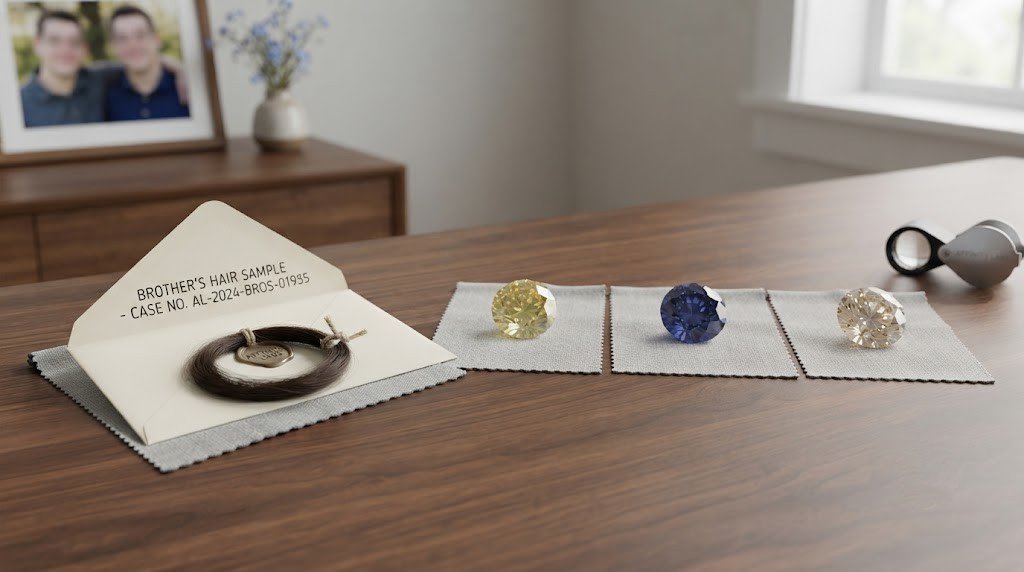
Memorial Diamond Colors for a Brother What to Expect

Memorial Diamond Colors for a Brother: What to Expect

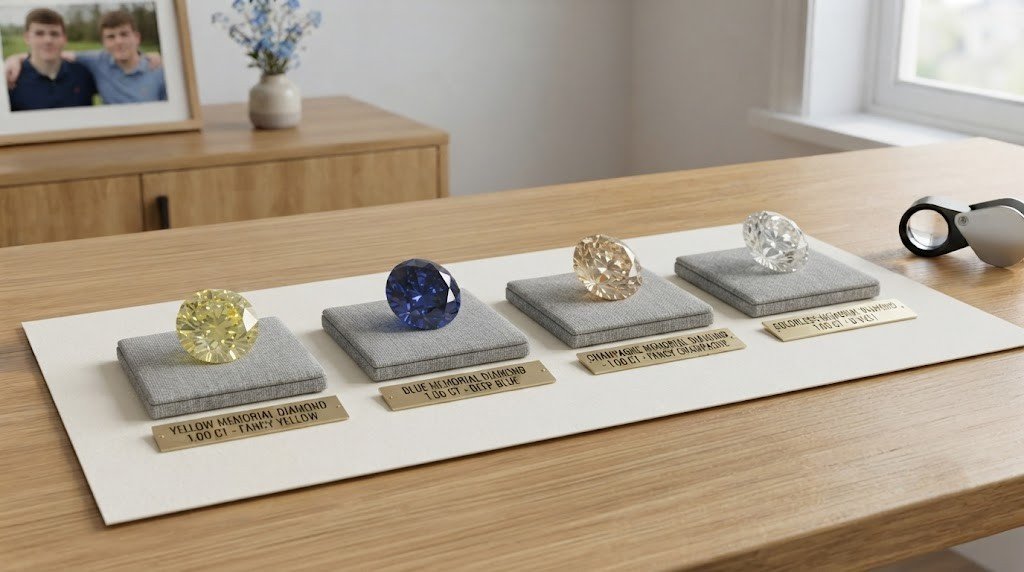
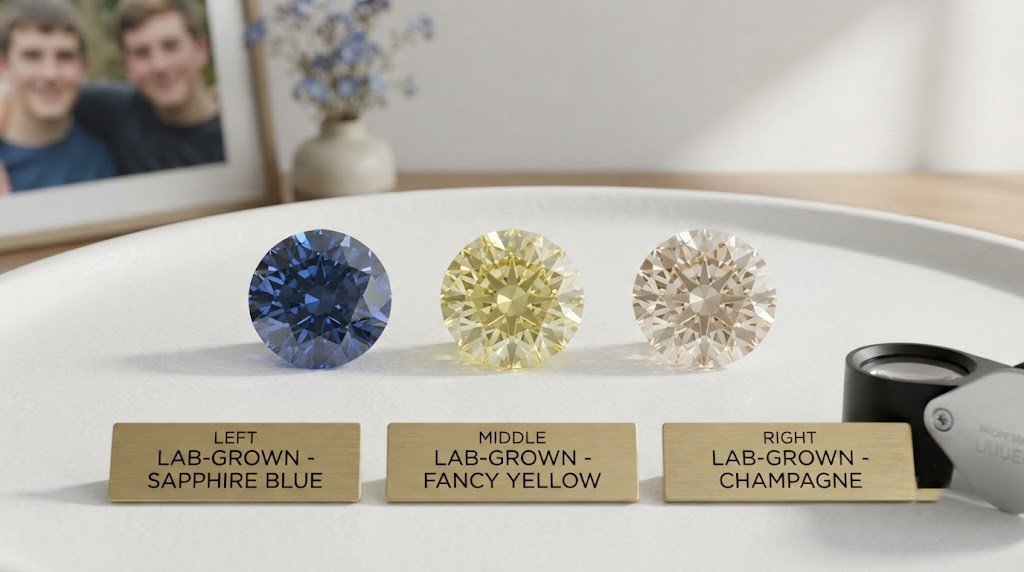
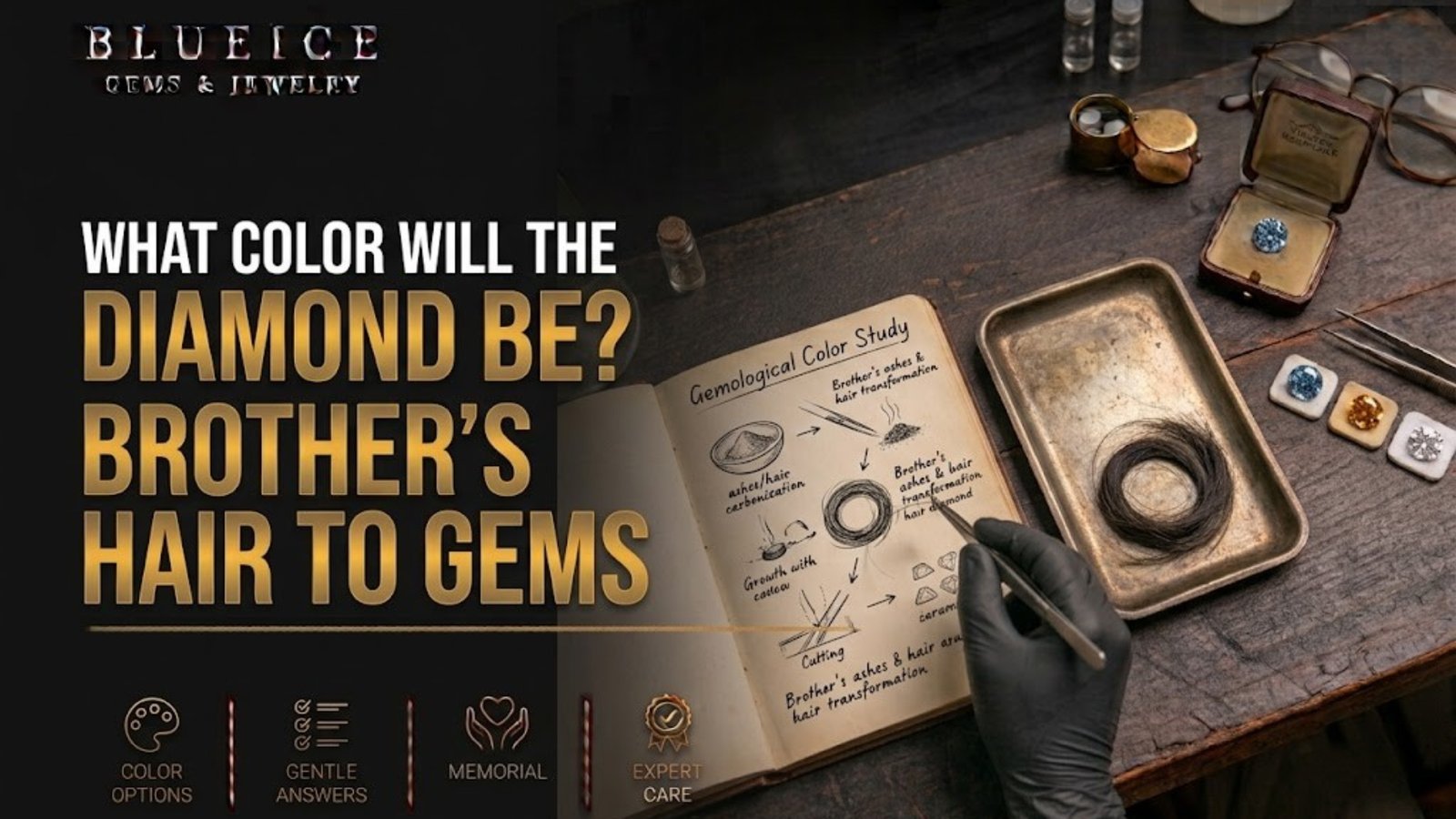
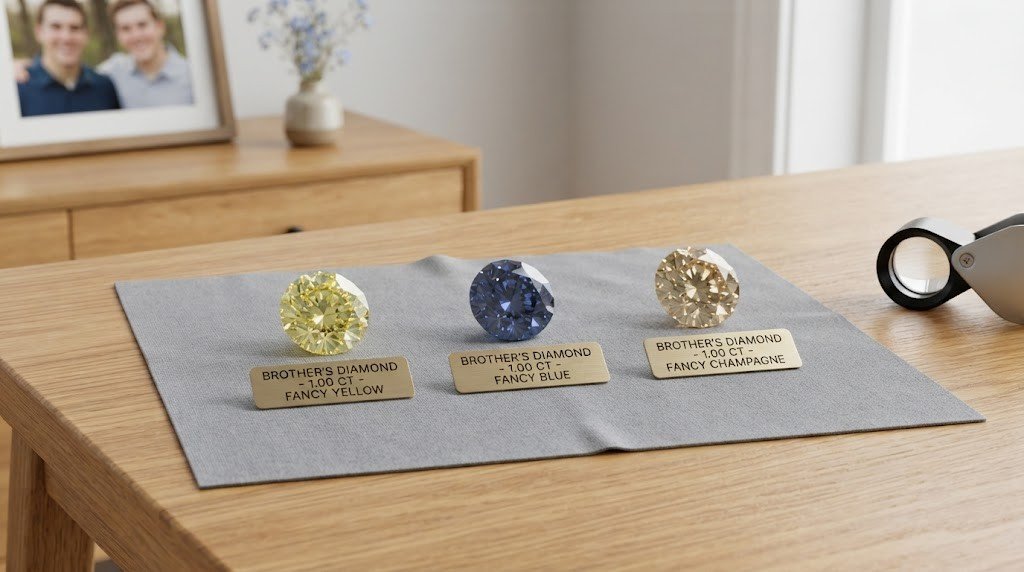
You may already have a picture in your head of how his stone should look, and it can feel strange to learn that the final color is not entirely yours to set. Memorial diamond colors for a brother follow the same chemistry as any memorial stone: most grow in yellow, blue or champagne-to-brown tones because trace nitrogen and boron tint the crystal. Colorless is achievable with extra processing and typically costs more, and some providers irradiate stones afterward for red, pink, green or black. You pick a color route; the exact shade is settled during growth.

Below, you will find where memorial diamond colors for a brother come from, how a grading report records them, and how to weigh color against who he was and who will wear the stone.
memorial diamond colors for a brother

What Memorial Diamond Colors for a Brother Should You Expect?

The honest answer is a range rather than a single result. Memorial diamond colors for a brother are the same colors available for anyone, because color is set by chemistry and by the provider’s process, not by the relationship or by anything about his personality.

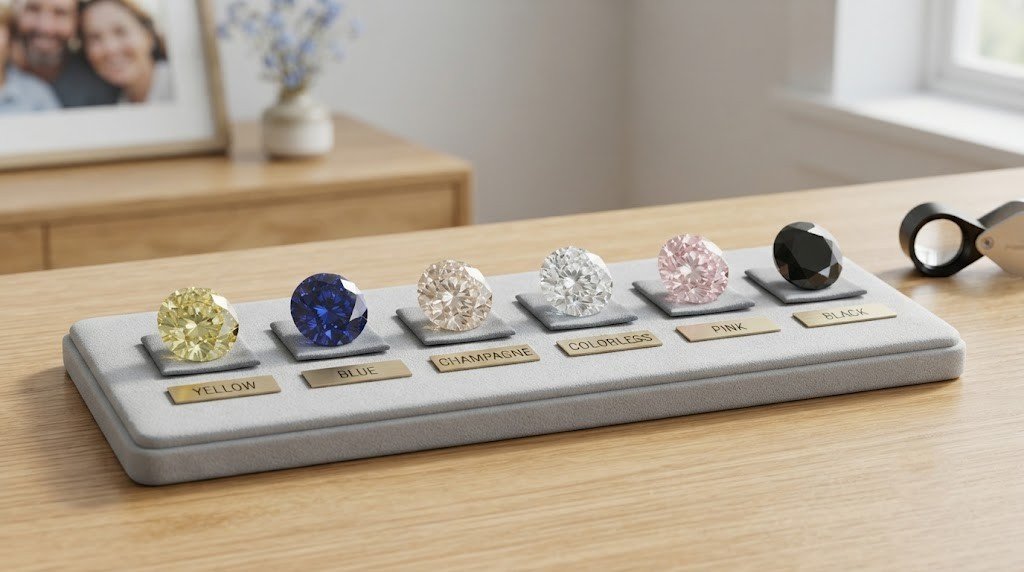
Stones grown in part from a person’s own carbon tend to settle into a handful of color families:

  • Yellow, from nitrogen caught in the crystal as it grows
  • Blue, from boron caught in the same way
  • Champagne to brown, warm tones linked to the trace elements an organic, personal source tends to carry
  • Colorless, reached only when nitrogen and boron are deliberately kept out
  • Red, pink, green or black, offered by some providers through irradiation once the stone has grown

Within each family, depth and tone vary, and two stones grown along the same route can look slightly different side by side. That is normal, not a fault. If you are still deciding whether a stone suits your family at all, the complete guide to a diamond made from your brother’s ashes covers the whole picture.

Why Do Memorial Diamond Colors for a Brother Lean Yellow, Blue or Champagne?

Diamond is carbon locked into a tight crystal lattice. When even tiny amounts of another element slip into that lattice during growth, the stone absorbs part of the light passing through it and shows color. Nitrogen produces yellow, boron produces blue, and a stone needs the near-absence of both to look colorless.

Lab diamonds for the general jewelry trade usually start from a tightly controlled feedstock. A memorial stone starts with carbon recovered from a person, purified to roughly 99.9 percent or better and converted to graphite at around 2,500–2,700°C. Its organic origin still means trace elements are common, which is why memorial diamond colors for a brother so often land in warm or blue tones instead of icy white.

What happens inside the press

Most providers grow memorial stones by HPHT, recreating roughly 6–8 GPa of pressure and 1,400–2,500°C of heat over weeks to months; a minority use CVD, where carbon is deposited layer by layer from a gas. This overview of how synthetic diamonds are grown explains both methods in more depth. The practical point for a family is that the provider’s growth conditions, and not only the material, help decide where memorial diamond colors for a brother end up.

Can His Memorial Diamond Be Colorless, and What Does It Cost?

A colorless stone is achievable, but it is not the default. Getting there means keeping nitrogen and boron out during growth, which takes additional processing. Across the industry in 2026, a stone of 0.5 to 1 carat typically runs roughly $5,000 to $15,000, and colorless sits meaningfully above blue, yellow or champagne at the same size.

Small stones of about 0.10 to 0.25 carats generally run roughly $1,500 to $3,500, and stones of 2 to 5 carats or more roughly $20,000 to $75,000 and up. These are industry ranges, not Memorial Diamond’s prices; grading, engraving, fancy cuts and settings are usually extra. Pricing two or three memorial diamond colors for a brother at one carat size shows the real gap. A fuller breakdown of what a brother memorial diamond can cost walks through each factor.

Is colorless the right choice?

Some families lean toward colorless because it looks like a classic diamond and sits easily with any metal. Others feel a tinted stone is a truer record of where the carbon came from. Both are reasonable. If colorless matters to you, ask what happens when a stone grown on a colorless route still shows a faint tint, because policies on that point vary.

How Do Providers Create Red, Pink, Green or Black Stones?
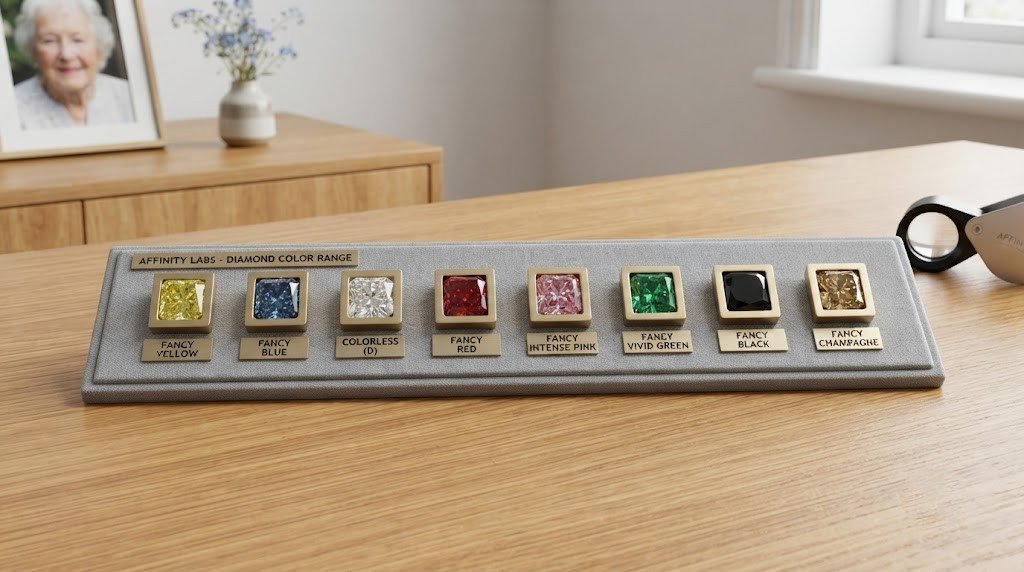
Irradiation widens memorial diamond colors for a brother beyond the natural tones. Some providers offer this treatment after growth and cutting to shift or deepen a stone’s color, typically toward red, pink, green or black, though any one provider’s list may be shorter. Specialty colors can stretch the schedule: most memorial stones take about 6 to 10 months from the day material arrives, while specialty colors such as black, and stones over roughly 2 carats, can take up to about 12 months.

Questions worth asking a provider that offers treated colors:

  1. Which treated colors do you offer, and at what carat sizes?
  2. Will the treatment be stated on the grading report?
  3. How much does the step add to cost and to the schedule?

For some families, treated memorial diamond colors for a brother feel more personal, such as a deep green tied to the woods he hiked or a black stone that suits how a sibling dresses. They are a choice, not an upgrade; a natural-tone stone is just as real a diamond.

Do His Ashes, His Hair or Both Change Memorial Diamond Colors for a Brother?

Many people hope one source will give a lighter or more predictable result, but ashes, hair and a combination all draw on the same memorial diamond colors for a brother. There is no published basis for saying hair produces a cleaner color than ashes, or the reverse, and the same holds for stones that combine the two. The trace content of the recovered carbon and the provider’s purification and growth process shape the outcome, so the useful question is how a particular provider handles your material.

The material does change other things:

  • Ashes are mostly calcium phosphate, with around 0.5 to 4 percent of their weight usable carbon. That carbon is purified and typically blended with supplemental lab carbon, and in ash-based stones his own carbon usually makes up somewhere around 10 to 15 percent of the finished mass, with some providers citing as little as 3 percent and others more.
  • Hair is roughly half carbon by weight, which means a modest lock or a few grams usually suffices and cremation plays no part. No comparable finished-stone percentage is published for hair.
  • Ashes and hair together have no published finished-stone figure either, so ask each provider to state in writing how much of the stone would come from his material.

By source, read about what color to expect from a stone made with his ashes, how color works when his hair is the source, and color in a stone that combines his ashes and hair.

Why Can’t You Pick an Exact Shade?

When families talk through memorial diamond colors for a brother, matching something specific often comes up: his eyes, a jacket he wore everywhere, the paint on a room he decorated, a lake he went back to each summer. A provider can steer toward a color family, but no one can promise a precise natural shade or match a sample you send in.

The final tone depends on how much nitrogen or boron the crystal actually takes up, which varies with the material and from one run to the next. In general gemology, size and cut also change how a color reads, because light travels a different path through a larger or differently shaped stone.

What you can usually choose

  • The color route: natural tone, colorless, or a treated color where offered
  • The carat size, from about 0.10 to 5+ carats across the industry
  • The cut and shape, which affects how the color shows

The exact hue is the one thing left open. Some families come to see that as part of the stone’s character, the tone his carbon and the process produced together, and setting expectations early keeps the arrival from feeling like a letdown.

What Causes Each of the Memorial Diamond Colors for a Brother?

This table sets out memorial diamond colors for a brother side by side, with the cause of each and how it is typically reached.

ColorWhat causes itHow it is typically reachedCost and timing notes
YellowNitrogen in the crystalNatural growth; a common outcomeStandard industry range for its size
BlueBoron in the crystalNatural growth; a common outcomeStandard industry range for its size
Champagne to brownTrace elements from an organic sourceNatural growth; a common outcomeStandard industry range for its size
ColorlessNitrogen and boron kept outExtra processing during growthTypically costs meaningfully more
RedPost-growth treatmentIrradiation, offered by some providersAsk about added cost and time
PinkPost-growth treatmentIrradiation, offered by some providersAsk about added cost and time
GreenPost-growth treatmentIrradiation, offered by some providersAsk about added cost and time
BlackPost-growth treatmentIrradiation, offered by some providersSpecialty colors can take up to about 12 months

Read it as a map of possibilities rather than a menu with fixed results. Depth and warmth vary within any row, and a provider should say which of these memorial diamond colors for a brother they actually offer.

How Is Color Recorded on a Grading Report?

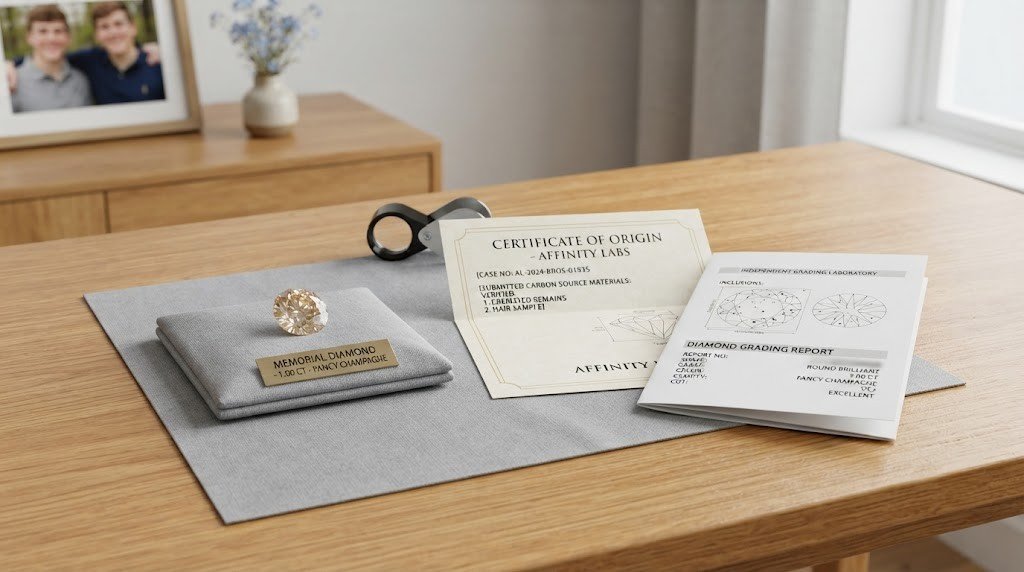
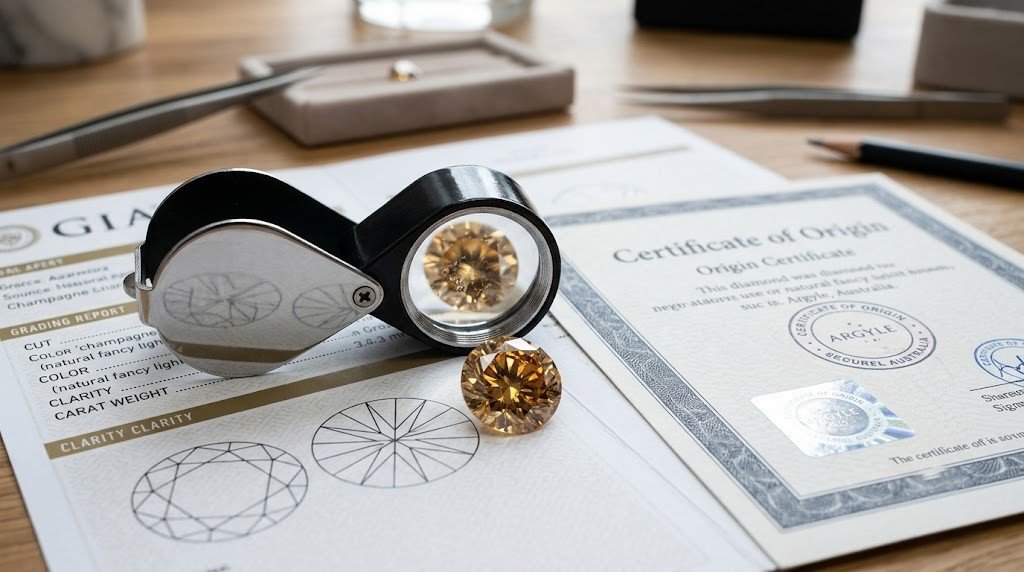
Once a stone is finished, where it sits among the memorial diamond colors for a brother is written down on a grading report, one of two documents that often arrive with it. They do different jobs. The provider’s own authenticity or origin certificate is a chain-of-custody document: it ties this particular stone to the material your family sent. A grading report records the diamond’s own qualities: color, cut, clarity and carat.

An independent third-party lab gives the more neutral view. Most reference standards set by the Gemological Institute of America, and some use IGI; GIA’s guide to the four diamond quality factors is a clear primer. Independent grading is typically an optional add-on priced separately, so check whether a quote includes it.

Two ways color gets described

In general gemology, colorless and near-colorless stones are graded on a letter scale from D toward Z, while distinctly colored diamonds are described in fancy-color terms covering hue and strength. Ask which description his stone would get and whether any treatment would be noted. Clarity for memorial stones typically falls between SI2 and VVS. A report puts memorial diamond colors for a brother into neutral, standard language, which makes quotes much easier to compare.

How Can Color Reflect Who He Was and Who Will Wear It?
Memorial diamond colors for a brother work best when they start from the person, not from assumptions about what a man is supposed to like. A brother who wore bright colors, one who only wore black, one who painted, fished or cooked for everyone: none of that dictates a color, but it gives your family something real to talk about. Some choose blue because it was his favorite; others prefer whatever natural tone emerges.

Thinking about the wearer

Whoever will wear the stone deserves as much say in memorial diamond colors for a brother as the memory of him does. The stone might be worn by a sibling, by a partner or children if he had them, by a parent, or by a friend who was family to him. Consider:

  • Who will wear it, and how often
  • Whether they favor warm metals, cool metals or little jewelry at all
  • Whether they want something noticeable or quietly understated
  • Whether several people want stones, and whether those should match

When more than one person wants a stone

Several stones can often be grown from shared material, and each may follow its own color route; whether that works, and how it affects price, is a provider question. Decisions about his ashes rest with whoever holds authority under your state’s law or his written wishes, which may be a spouse or partner, adult children or parents before a sibling. If that is not you, a gentle request to them for a small portion is a respectful start. His hair kept at home can be simpler, though his belongings may be part of his estate, so check with whoever is settling it. The post on several family members sharing one brother’s ashes covers the practical steps.

How Do Stone Color and Setting Metal Work Together?

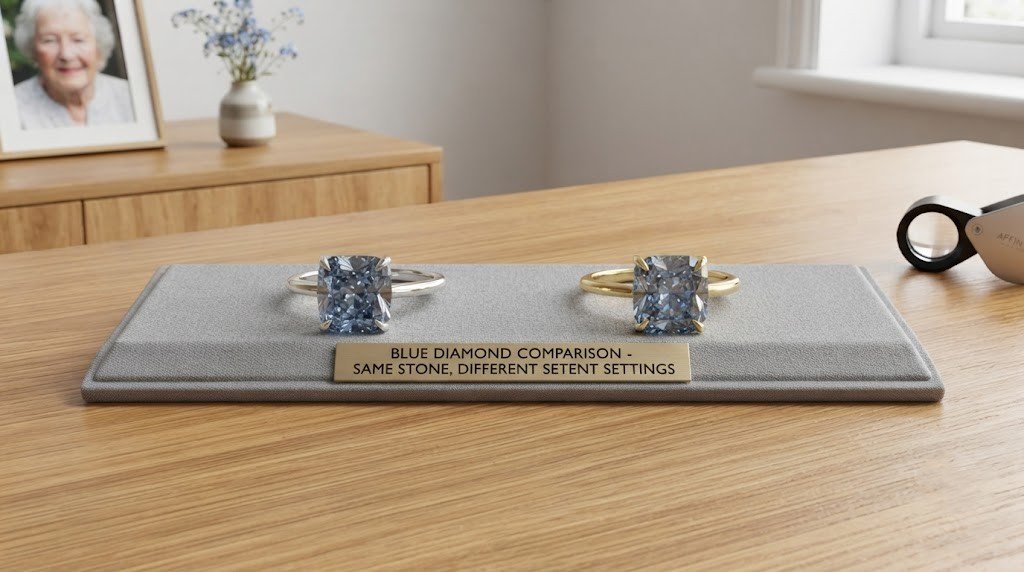
Metal changes how memorial diamond colors for a brother read once a stone is set. In broad terms, white metals such as platinum or white gold keep a stone looking cooler and can make a faint tint more visible, while yellow or rose gold warms the look and can soften a yellow or champagne tone. These are tendencies, not rules, and a jeweler can show the same stone against different metals before anything is made.

Treat color and metal as one conversation. A blue stone may look one way in a white bezel and quite another in yellow gold, so bring the grading report or the provider’s color description and ask to see examples in more than one metal. For protective settings and daily-wear trade-offs, the post on choosing a setting for his memorial diamond explains the options.

What Should You Ask a Provider About Memorial Diamond Colors for a Brother?

A short written list keeps conversations about memorial diamond colors for a brother focused:

  1. Which color routes do you offer, and which is your default?
  2. Can you show the range of tones your memorial stones have come out in?
  3. Is colorless available, and how much more does it cost at our carat size?
  4. Do you offer irradiation, and is it noted on the report?
  5. Does your process differ for ashes, hair or both?
  6. What happens if the color is far from what we expected, or if a growth run fails?
  7. Is independent grading included, and which lab grades your stones?
  8. How do you track his material from arrival to finished stone?

Ask for answers in writing and compare them side by side. A fuller checklist covering custody, unused material and refunds is in the post on questions to ask before his ashes become a diamond.

Frequently Asked Questions

Are memorial diamond colors for a brother different from colors for anyone else?

No. Memorial diamond colors for a brother depend on chemistry and each provider’s process, not on the relationship. A stone made for him draws on the same yellow, blue, champagne, colorless and treated options as one made for anyone else, with the same natural variation.

Can we ask for blue because it was his favorite color?

You can ask whether a provider offers a route toward blue, since boron produces blue tones in diamond. What no provider can promise is a particular shade of blue, so expect some variation in depth and tone, and get their description of likely results in writing first.

Will a stone grown from his hair be lighter than one grown from his ashes?

There is no published basis for that claim. Neither hair nor ashes is known to give a lighter or more predictable color than the other. The trace content of the recovered carbon and the provider’s process shape the result, so ask each provider how they handle your material.

Does a colorless memorial diamond cost more than a blue or yellow one?

Typically, yes. Excluding nitrogen and boron requires extra processing, so colorless usually costs more than the other untreated memorial diamond colors for a brother at the same carat size. Ask each provider for quotes on several color routes at one size to see the real difference.

Will an irradiated color be listed on the grading report?

Ask before you commit. Find out whether the stone will be graded independently, which lab will grade it, and whether any post-growth treatment such as irradiation will be stated on the report. Clear disclosure helps if the stone is later appraised, insured or passed down.

Can each sibling choose a different color from the same material?

Often several stones can be grown from shared material, each following its own route among the memorial diamond colors for a brother, but that depends on the provider. Whoever holds authority over his ashes under state law or his written wishes should be part of dividing them.

Final Thoughts on Choosing a Color for Your Brother’s Diamond

Color is one of the few parts of a memorial stone that stays a little uncertain until the end. You can choose a route, set a budget and ask good questions, and then the stone arrives in the tone his carbon and the process produced. For some families that small surprise becomes part of what makes it feel like his.

Whatever memorial diamond colors for a brother you lean toward, start with the person who will wear the stone and the brother you are remembering.

Learn More About Color and Design Choices for a Brother’s Diamond

Talk With Memorial Diamond

If you would like to think out loud about memorial diamond colors for a brother, or about whether a stone suits your family at all, you are welcome to reach out to Memorial Diamond at memorialdiamond.us. There is no need to have decided anything first.

Bring whatever you have: a color he loved, a question about his ashes or hair, or simply the wish to understand the options before you talk with anyone else in the family.
Brother Memorial Diamond FAQ Everything Families Ask

Brother Memorial Diamond FAQ: Everything Families Ask

After a brother dies, the questions rarely come one at a time; they come from a parent, a sister, a cousin, sometimes a partner, often in the same week. A brother memorial diamond is a real lab-grown diamond grown partly from carbon recovered from his cremated ashes or a lock of his hair, with industry prices running from roughly $1,500 for a small stone to $20,000 or more for a large one, and a typical wait of 6 to 10 months.

Everything below is arranged as the questions relatives put to each other about a brother memorial diamond, with a short answer first and the detail after. Read the sections that matter to you now and leave the rest for later.

brother memorial diamond

Is a brother memorial diamond a real diamond, and is it really made from him?

Yes to the first, and yes, in part, to the second. A brother memorial diamond is a genuine lab-grown diamond with the same crystal structure, optical properties and grading scale as a mined one, scoring 10 on the Mohs hardness scale. It is not glass, resin or a simulant.

The “made from him” part deserves a precise answer, because overstated claims circulate in this industry. Cremated ashes are mostly calcium phosphate, the mineral left from bone, and only about 0.5 to 4% of ash by weight is usable carbon. That carbon is extracted, purified to roughly 99.9% or better, and typically blended with supplemental lab carbon so there is enough feedstock to grow a stone of a useful size.

What share of an ash-based stone is his carbon?

For a stone grown from ashes, his own carbon commonly makes up around 10 to 15% of the finished mass. Some providers quote figures as low as 3%, and some quote higher ones, depending on the size of the stone and how much ash was sent. Any seller who describes an ash-based brother memorial diamond as being entirely his remains is describing something the chemistry does not allow.

And for hair, or a blend of the two?

Hair is around 50% carbon, so far less of it is needed. Even so, nobody publishes an equivalent finished-stone percentage for hair, or for a stone grown from ashes and hair together. If that number matters to your family, ask each provider to put its own figure in writing before you commit.

Should the stone come from his ashes, his hair, or both?

The source for a brother memorial diamond usually follows what you actually have. Ashes are only an option if he was cremated and someone can release a portion; hair works whether he was cremated or buried, and needs no cremation at all.

SourceWhen it fitsWhat to know
AshesHe was cremated and a small portion can be set asidePersonal carbon commonly around 10–15% of the finished stone; whoever holds the ashes is part of the decision
HairA lock was saved, or hair remains on a brush, cap or comb (acceptance varies by provider)About 50% carbon, so a small amount goes far; no published finished-stone share
Ashes and hair togetherBoth are available and the family wants both in one stoneNot every provider offers it; no published finished-stone share for the blend

Each route has its own practical path, and the complete guide to a diamond from a brother’s ashes walks through the ash route from start to finish. If what you have is a saved lock or hair from his belongings, the full walkthrough for a brother hair diamond covers collection and packing. Families who want both sources in one stone can find the combined route in the guide to growing one stone from his ashes and hair.

No source makes a brother memorial diamond more “him” than another. The right one is simply the one your family can arrange without strain.

How much of his ashes or hair does a provider need?

Usually far less than people fear. Industry-wide, ash requests for a brother memorial diamond typically range from a few tablespoons up to roughly 4 oz (about 100 g), which is usually a small fraction of the total remains. Hair requests are commonly a small lock or a few grams.

That leaves most of his ashes free for the urn, a burial plot, a scattering, or whatever was planned. Sending more than a provider asks for does not produce a bigger or faster stone, because growth time in the press sets the carat size, not the volume of material.

Exact minimums vary from one company to the next, so treat any figure here as a general guide. Before you portion anything out, ask the provider for its own requirement and what it does with any material that is not used.

How is a brother memorial diamond actually made?

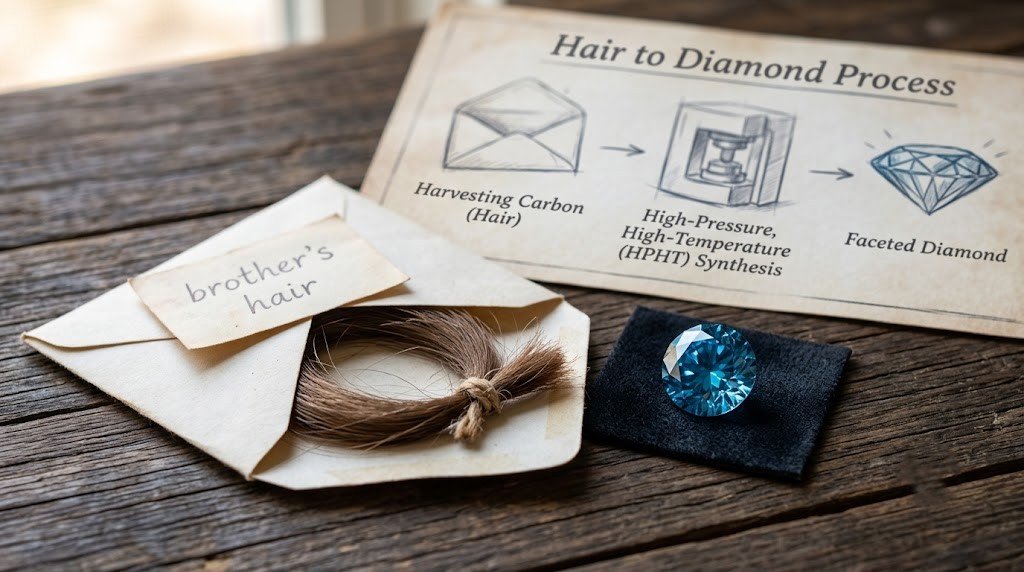
In short: his carbon is recovered, purified, turned into graphite, grown into a crystal under extreme pressure and heat, then cut and graded. Most providers grow memorial stones by HPHT (high pressure, high temperature); a minority use CVD, a vapor-deposition method. Both are standard routes for lab-grown diamonds generally.

The sequence across the industry looks like this:

  1. Collection, with chain-of-custody tracking from the moment his material arrives.
  2. Extraction and purification of the carbon, to roughly 99.9% or better.
  3. Graphitization at around 2,500 to 2,700°C.
  4. Growth around a small diamond seed, under roughly 6 to 8 GPa and 1,400 to 2,500°C, over weeks to months.
  5. Cutting and polishing into the chosen shape.
  6. Optional irradiation, offered by some providers to shift color.
  7. Grading, ideally by an independent laboratory.

The tracking in step one is the part to press hardest on. Ask how his material is labeled, who handles it, and what record you will receive showing that the finished stone traces back to what you sent.

What color will the finished stone be?

A brother memorial diamond, like most memorial stones, tends to come out in yellow, blue or champagne-to-brown tones rather than colorless. Trace elements present during growth set the color: boron pushes a stone toward blue, and nitrogen toward yellow.

A colorless stone is possible, but it requires shutting both elements out, which takes extra processing and typically raises the price. Some providers also offer post-growth irradiation for red, pink, green or black. What no honest provider can promise is an exact natural shade, or that his ashes will give a different tone from his hair.

Color is often where personal meaning shows up. Some relatives lean toward a color family that recalls something he loved, knowing the exact tone will still vary; others go with whatever the person wearing it likes to look at every day. The page on what to expect from brother memorial diamond colors goes through each option and its effect on cost and timing.

How much does a brother memorial diamond cost?

Across the industry in 2026, a brother memorial diamond typically costs between about $1,500 and $75,000 or more, with carat size doing most of the work. Color matters next: at the same size, colorless usually costs meaningfully more than blue, yellow or champagne.

Size tierTypical caratGeneral 2026 industry range
Entry0.10–0.25 ctRoughly 1,500–3,500
Mid0.5–1 ctRoughly 5,000–15,000 (colorless meaningfully more)
Large2–5+ ctRoughly 20,000–75,000+

These are broad industry figures, not Memorial Diamond’s prices, which have not been published. Several costs usually sit on top of the loose stone: an independent grading report, engraving, a fancy cut, and the ring, pendant or other setting.

When several relatives are each paying for their own stone, it helps to compare like with like. A detailed breakdown of what a brother memorial diamond costs at each size can help a family line up quotes on equal terms.

How long does the whole process take?

Plan on about 6 to 10 months for a brother memorial diamond, counted from the day a provider receives his ashes or hair. Stones larger than roughly 2 carats, or specialty colors such as black, can take up to about 12 months.

The length comes mainly from growth time in the press, which is also what determines carat size. Choosing a smaller stone is the most reliable way to keep the wait shorter, while sending extra material changes nothing.

If there is a date the family has in mind, such as an anniversary or a wedding, raise it at the very first conversation and ask the provider whether it can be met. A closer look at how long a brother memorial diamond takes explains where the months go and how to plan around them.

Who has the right to decide about his ashes?

Before anyone orders a brother memorial diamond from his ashes, it helps to know who holds them, and that depends on the state where he died and on anything he put in writing. Each state sets its own order of priority, and the sequences are not identical. Depending on where he died, a spouse or partner, his adult children or his parents could each have a stronger claim than a sibling, and a written directive from him can rearrange that list entirely.

The funeral home or crematory can usually tell you who signed the cremation authorization, which is often a good guide to who holds the ashes and the say over them. For anything contested, a local estate or probate attorney is the right person to ask.

A respectful route for a sister or brother

If someone else holds that authority, the gentlest route is to ask them for a small portion, explaining what you have in mind and how little a provider typically needs. Hair is often the simpler practical question, since a saved lock or hairbrush may already be with a sibling. Even so, his belongings can form part of his estate and the rules vary by state, so a word with the executor, or whoever is settling his affairs, is wise before anything is sent.

Families do not always agree, and parents may be divided, estranged or no longer living. Some ideas for opening the subject kindly are in this guide to raising a memorial diamond with the rest of the family.

Can several relatives each have a stone made from him?

Often, yes. Because each brother memorial diamond needs only a portion of the ashes or hair, a provider can frequently grow several diamonds from the same shared material, perhaps one for a parent, one for each sibling, one for a partner if he had one, or whatever combination fits your family.

Where stones are ordered and priced separately, one person might choose a small blue stone for a pendant while another chooses a larger, colorless stone for a ring. How the release of the shared material is agreed still runs through whoever holds authority over it.

Whether a provider can split one submission across several orders, and how much material that takes, is a question to ask directly. The practical side of sharing a brother memorial diamond across the family covers how relatives can coordinate orders without anyone feeling rushed.

What are the ways to wear or keep a brother memorial diamond?

Almost any way you would wear or keep a mined diamond. A brother memorial diamond can go into a ring, pendant, earrings, bracelet, tie bar or cufflinks, or stay loose in a small case on a shelf.

The best setting for a brother memorial diamond follows the person who will wear it and who he was, not any idea of what suits a brother. Someone who works with their hands might want a low-profile setting that sits close to the finger, while someone who rarely wears jewelry might prefer a pendant kept for particular days. A diamond’s hardness makes it durable, but a hard knock can still chip one, so the setting does some protective work too.

Settings, metals and engraving are usually priced apart from the stone. If the stone is not yet grown, you can still choose the setting later, once you have seen the finished color.

Is a memorial diamond acceptable in your faith?

No religious tradition has issued an official position on a brother memorial diamond, or on memorial diamonds of any kind. What traditions do address is cremation and the handling of ashes, and that is where the answer for your family will come from. A brief outline:

  • Catholic: Cremation is permitted, but Church guidance asks that ashes be kept whole in a sacred place, with only a narrow allowance for a small portion. That bears directly on dividing his ashes for a stone.
  • Jewish: Orthodox and Conservative Judaism generally prohibit cremation, while Reform Judaism is more permissive and leaves more to rabbi and family.
  • Muslim: Cremation is considered impermissible across the major schools of Islamic thought, so an ash-based stone does not arise. A hair-based stone involves no cremation at all.
  • Hindu: Cremation followed by immersing the ashes is traditional; keeping a small portion is described as increasingly common, though practice differs by family, region and community.
  • Buddhist: Views on keeping physical remains depend on the teacher and community; some see it as mindful remembrance, others as sitting uneasily with non-attachment.
  • Protestant: Most clergy have no objection, though some congregations raise concerns about dividing or scattering ashes.
  • Secular: The decision rests on personal meaning and what the family wants.

Because practice varies within every tradition, the most reliable answer comes from your own priest, rabbi, imam, pandit, teacher or pastor. If a relative has a religious concern, it deserves a real hearing rather than an argument.

What if he was buried, or died many years ago?

A burial does not rule out a brother memorial diamond. Hair needs no cremation, so a lock that was saved, or hair kept from a brush or cap, may be usable, though each provider decides what kind of sample it can work with. Burial remains common in the United States; the NFDA’s 2025 report projected a national cremation rate of 63.4% against 31.6% for burial.

If he died years ago and was cremated, a brother memorial diamond may still be possible, since his ashes may have been kept in an urn, a niche or a cupboard ever since. Whether ashes stored for a long time are workable is a question for each provider, as is whether older hair, or hair that was dyed or chemically treated, can be accepted.

Time also changes who holds what. The ashes may now be with a parent, his partner or one of his children, and the hair may be in a box nobody has opened. Finding out quietly what exists, and who has it, is a sensible first step before anyone contacts a provider.

How do you choose a provider for a brother memorial diamond?

Choose on transparency first and price second. A provider worth trusting with a brother memorial diamond will answer specific questions in writing and will not rush you.

Questions worth putting to every company you consider:

  • What share of the finished stone will be his own carbon, for the material we are sending?
  • How is his material labeled and tracked, and what record do we receive?
  • What happens to any ashes or hair that are not used, and can they be returned?
  • What happens if a growth run fails?
  • Is independent grading included, or is it a separate charge?
  • What are the refund and cancellation terms?

Two documents are worth telling apart. An authenticity or origin certificate, usually issued in-house, records that the stone came from your submitted material. A grading report, ideally from an independent laboratory working to the GIA’s 4Cs standards, describes the stone’s cut, color, clarity and carat. Independent grading is typically an optional, separately priced add-on, and typical memorial-diamond clarity falls between SI2 and VVS.

Frequently Asked Questions

Can his name or a date be engraved on the diamond?

Some providers offer a tiny laser inscription on the girdle, the thin outer edge of a brother memorial diamond, and the setting can carry an inscription too. Engraving is usually priced separately, and character limits vary, so ask what is possible before you order.

Does a diamond grown from his ashes need special care?

A brother memorial diamond needs the same care as any diamond. It resists scratching, but a sharp knock against a hard surface can still chip an edge. Clean it with warm water and mild soap, and have the setting checked by a jeweler from time to time.

Should the stone be insured once it arrives?

One option is adding it to a homeowner’s or renter’s policy; another is a separate jewelry policy. Coverage, valuation and premiums depend on your insurer and your state, so speak to an insurance agent about how a stone with personal value is assessed.

Can his ashes be posted to a provider, or carried abroad?

Rules on shipping cremated remains, and on carrying them across borders or through airports, vary by carrier and country. Ask the provider exactly how it wants material sent, and check current carrier and airline requirements before packing anything.

Can I keep a small amount of his ashes as well as the stone?

Usually, yes. A diamond needs only a portion, so the rest can go to an urn, keepsake or burial as planned. Whether a provider returns unused ashes after extraction is its own policy, so ask about that in writing.

Is a brother memorial diamond a suitable gift for another relative?

It can be, whether the recipient is a parent, a sibling, or his partner or child if he had one, provided the gift is offered gently and wanted. Asking quietly first helps, because a stone carries strong feelings. A loose stone leaves them free to choose a setting later.

Final Thoughts on Brother Memorial Diamond Questions

There is no deadline on a brother memorial diamond. Ashes and hair can usually be kept while the family talks, and a year spent reaching agreement is time well used; just ask any provider you are considering how it views long-stored material.

When you are ready, the questions on this page are a good place to start a conversation, whether it is with a parent, his partner, a sibling, or a provider you are still weighing up.

Learn More About Planning a Brother Memorial Diamond

Talk With Memorial Diamond

If you are weighing a brother memorial diamond and would like to talk it through, whether your question is about his ashes, his hair, or how to include the rest of the family, Memorial Diamond is glad to listen. There is no obligation and no rush.

You can reach us at memorialdiamond.us whenever the time feels right.

How to Turn Your Brothers Hair Into a Diamond

How to Turn Your Brother’s Hair Into a Diamond

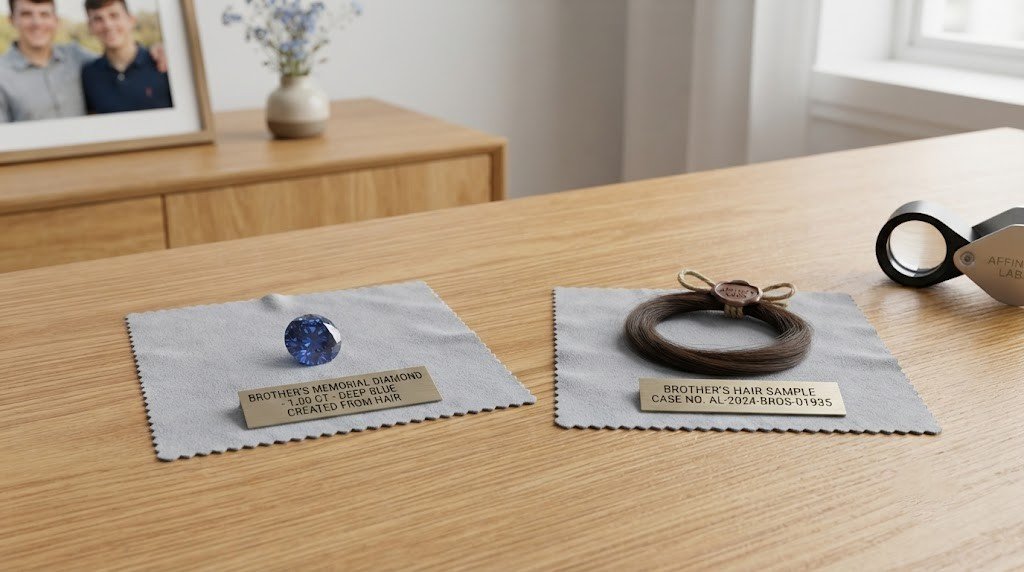
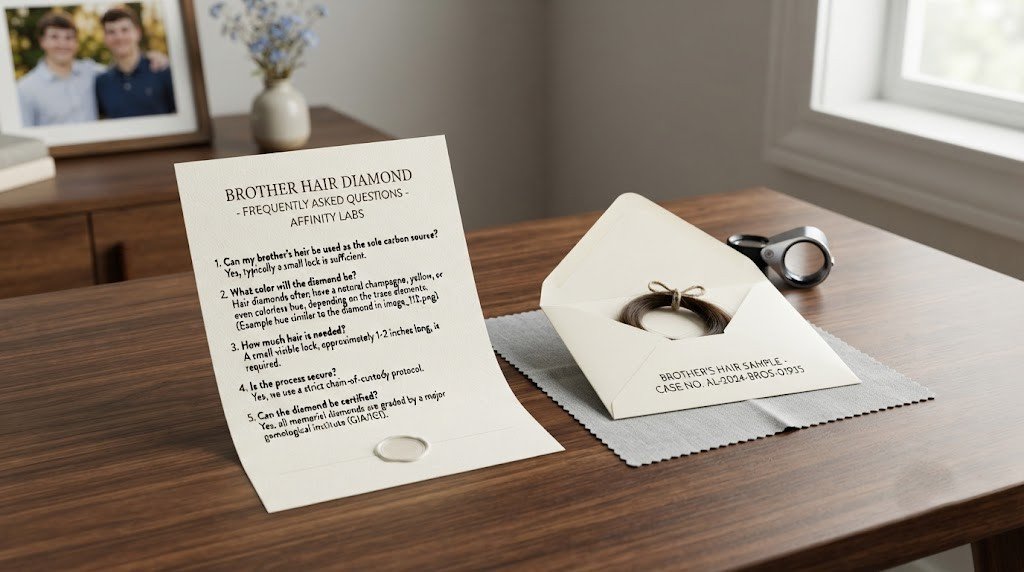
A lock of his hair might already be tucked in an envelope somewhere, or you may only now be realizing that hair is an option at all. You can turn brother hair into a diamond without any cremation: find a small lock (saved earlier, trimmed by the funeral home, or kept among his things), confirm who has the right to release it, send a few grams to a provider, choose carat and color, and receive a real lab-grown diamond in roughly 6–10 months.

turn brother hair

How Do You Turn Brother Hair Into a Diamond, Step by Step?

Hair makes for a shorter, simpler route than ashes in one important way: there is no urn to divide and no cremation to wait on. The steps still matter, though, because a little care at the start protects the hair and avoids misunderstandings within the family later.

This is the sequence a sibling generally follows to turn brother hair into a diamond. Providers may label the stages differently, but the order holds.

StepYour actionThings to have ready
1. Locate the hairFind a saved lock, ask about funeral-home trimming, or identify hair among his belongingsA clean envelope or small container
2. Confirm who can release itCheck who holds authority over his remains or his estate, and ask themNames and contact details of close relatives, the funeral home
3. Choose a providerCompare honesty about carbon, grading, and policiesA short list of questions
4. Pack and sendFollow the provider’s kit instructions and use tracked shippingThe labeled hair, signed forms
5. Make your selectionsDecide carat, color, cut, and any settingA budget range and an idea of how it will be worn
6. Wait, then receive and checkFollow updates, then match the stone to its paperworkYour order details and both certificates

Each step can happen at its own pace. There is no need to rush from one step to the next. If the hair has been stored for a long time, describe its age and condition to the provider and ask whether older samples are accepted.

For a broader orientation before you begin, the complete guide to a brother hair diamond covers the background in more depth. What follows here is the hands-on version: what you actually do when you decide to turn brother hair into a stone.

Where Can the Hair Come From When You Turn Brother Hair Into a Diamond?

Before you can turn brother hair into a diamond, you need the hair itself, and it often comes from one of three places.

  1. A lock saved earlier. A childhood curl in a baby book, or a clipping someone kept after a haircut. If it exists, a relative may already know where it is.
  2. A trimming taken by the funeral home. If his funeral has not yet happened, or his body is still in the funeral home’s care, staff can often cut a small lock discreetly before burial or cremation. That hair is generally released through whoever holds authority over his remains, so the request usually goes through that person.
  3. Hair at home. Strands caught in a hairbrush, a comb, or a cap may be usable. Ask the provider whether loose strands like these are accepted and what condition they need to be in.

Hair found at home or among his belongings deserves a moment of thought. Personal possessions may form part of his estate, and how that applies to something like a hairbrush depends on the state. If someone else is handling his estate, it is worth mentioning your plan to them before you take anything.

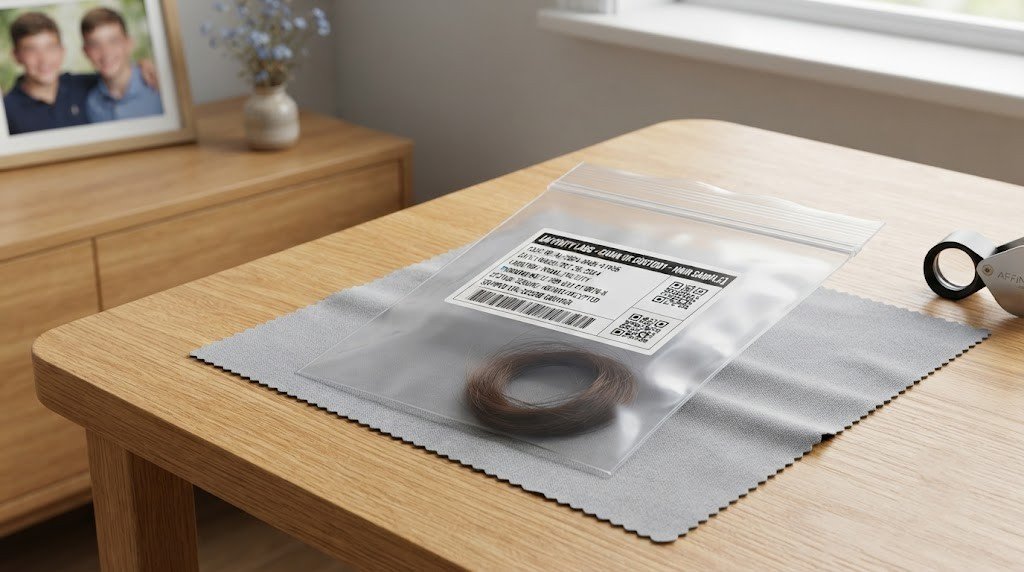
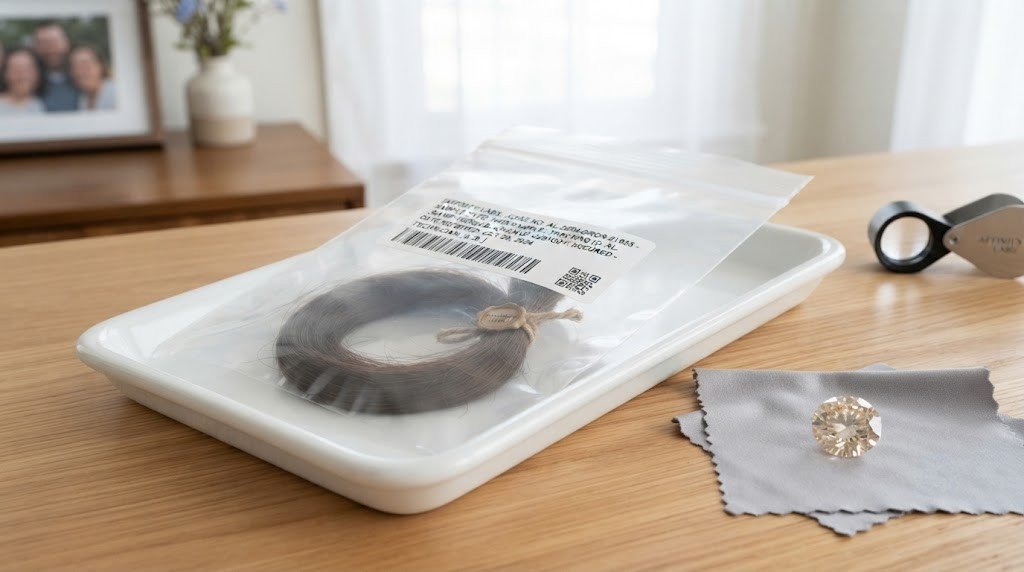
Whatever the source, keep the hair dry, in a clean envelope or small container, labeled with his full name. Ask your chosen provider whether it prefers a particular kind of packaging, so you can turn brother hair into a diamond without the sample being turned away.

Whose Permission Do You Need Before You Turn Brother Hair Into a Diamond?

Hair can feel more personal and less formal than ashes, but permission still matters. A provider will typically ask who authorized the request, and the answer depends on where the hair came from.

If the funeral home is taking a trimming, staff generally act on the instructions of the person who holds authority over his remains. That person is not always a sibling. A common pattern in state rules gives priority to a surviving spouse or registered partner, then adult children, then parents, with siblings later in the line, though the exact order differs by state. If he put his own instructions in writing, for instance by naming a particular person to make these calls or by arranging his funeral ahead of time, that document can hand the decision to someone else entirely.

If the hair was saved years ago, or is among his things at home, it may count as part of his estate, and estate rules vary by state. Whoever is administering the estate, or the relatives closest to the decision, deserve a conversation before you send anything.

The respectful route is usually simple: tell the people involved what you hope to do, explain that only a small lock is needed, and invite them in. If you want to turn brother hair into a diamond as a shared tribute, offering updates or a stone of their own can make agreement easier. If you are unsure whose consent applies, the funeral home or a local estate attorney can help clarify it.

Why Doesn’t a Hair Diamond Need Cremation?

Ashes contain very little carbon, which is why ash-based diamonds need cremation and a measured portion of the remains. Hair is different. It is built from keratin, a carbon-rich protein, and is roughly 50% carbon by weight, so a small lock supplies the material a provider needs to work from.

That means you can turn brother hair into a diamond whether he was buried, cremated, or his family has not yet decided. Burial plans stay exactly as they are. Nothing about the funeral has to change.

This can matter for faith reasons. No religious tradition has an official position on memorial diamonds specifically; the guidance that exists concerns cremation and the handling of ashes. Some traditions object to cremation itself, and a hair-based diamond sits outside that particular concern. Practices vary widely within every faith, so if this question applies to your family, confirm with your own faith leader.

If his ashes are also available and the family agrees, you are not limited to one material. Our guide on how to turn brother ashes into a diamond explains the ash-only path, and siblings who want both can read about how to turn brother ashes and hair into a diamond together.

How Much Is Enough to Turn Brother Hair Into a Diamond?

Industry guidance typically calls for a small lock or a few grams of hair, sometimes described as palm-sized or a few wisps. Because hair carries so much more carbon than ash, the quantity needed is small. Exact minimums vary by provider, so confirm the figure before you send anything.

The amount of hair does not decide the carat. A diamond’s size comes from how long it grows in the press, so sending more hair will not make the stone larger. If you hope to turn brother hair into more than one diamond, for yourself and another relative perhaps, ask whether one lock can supply several stones or whether each needs a separate sample.

Questions to ask about the sample itself:

  • Do you accept loose strands from a brush, or only cut locks?
  • Does hair that was dyed, treated, or stored for many years work?
  • How should the hair be packed, and does it need to be sealed?
  • Will any unused hair be returned to me?

The detailed breakdown of how much hair a brother memorial diamond needs goes further into quantities and edge cases.

How Do You Pick a Provider and Send the Hair?

A provider worth trusting to turn brother hair into a diamond explains plainly where the carbon in your stone comes from, including the supplemental lab carbon that is typically blended in. Read how each company you consider describes this. One that sidesteps the question entirely, or implies the stone is made from nothing but your brother, is telling you something about how it treats facts.

Before you turn brother hair into a diamond with any company, ask how it tracks each sample from arrival to finished stone, whether it offers an independent grading report alongside its own certificate, and what happens if a growth attempt does not succeed. Our list of questions to ask before turning your brother’s hair into a diamond gathers these in one place.

For shipping, follow the provider’s instructions exactly, and ask whether it supplies a sample kit, what packaging it expects, and whether any carrier rules apply to mailing hair. Use tracking and signature confirmation where offered, photograph the package before sending it, and keep every receipt. A small sample of hair is easy to post, but it is also irreplaceable, so treat the handoff with the same care you would give anything you could not get back.

What Happens to His Hair Inside the Lab?

Once a provider agrees to turn brother hair into a diamond for you, the sample goes through a controlled, oxygen-free heating process in several stages. This strips away the non-carbon parts of the keratin and leaves carbon at roughly 99.9% purity or higher.

Next comes graphitization: a second, hotter firing in the region of 2,500–2,700°C turns the purified carbon into graphite, the form a growth press can work with. Blended with supplemental lab carbon as is typical, the graphite is placed around a small diamond seed. HPHT, the method most memorial providers rely on, presses the cell at roughly 6–8 GPa while holding it between 1,400 and 2,500°C; fewer providers use CVD instead. Growth lasts weeks to months depending on the carat you chose.

The rough crystal is then cut and polished by a gemologist, optionally irradiated to adjust color, and graded. The page on how a memorial diamond is made from brother hair describes each stage in more detail. Understanding these stages helps when you turn brother hair into a diamond, because the updates you receive will make sense as they arrive.

How Much of a Hair Diamond Comes From Him?

Here is the honest picture for anyone who wants to turn brother hair into a diamond. Hair is about 50% carbon by weight, far richer than ash. But there is no published industry figure for what share of a finished hair diamond’s mass comes from the hair itself. Providers typically add supplemental lab carbon to reach the volume a stone needs, and how much depends on the provider, the sample, and the size of the diamond.

So when you turn brother hair into a diamond, the stone is not made of him alone, and a company that claims it is has stepped past what the chemistry supports. Ask your provider directly how it describes the personal share of the carbon in its stones, and whether it documents that share.

What is certain is still meaningful. Carbon from his own hair is extracted, purified, and built into the crystal lattice of a diamond that exists because of him. It is physically, verifiably connected to him, not a representation chosen to look like him.

What Size, Color, and Setting Can You Choose?

When you turn brother hair into a diamond, sizes generally range from about 0.10 carats up to 5 carats or more. Smaller stones suit everyday wear and a lower budget; larger ones take longer to grow and cost considerably more.

Color comes from trace elements during growth. Nitrogen produces yellow tones, boron produces blue, and colorless requires both to be excluded, which takes extra processing and typically costs more. Memorial stones commonly land in yellow, blue, or champagne shades; a post-growth irradiation step, where offered, can push a stone toward red, pink, green, or black. Nobody can tell you the exact shade in advance just by looking at his hair. The guide to what color a diamond from your brother’s hair might be explains why.

For settings, think about how the piece will live with you. A pendant, ring, earrings, a bracelet, cufflinks, a lapel pin, or a loose stone in a keepsake box are all common choices, and none is more fitting than another. When siblings turn brother hair into several stones, each person can choose a different shape and setting.

What Does It Cost to Turn Brother Hair Into a Diamond, and How Long Does It Take?

Across the industry, the decision to turn brother hair into a diamond typically means a wait of 6 to 10 months from the time the provider receives the material, and up to about 12 months for stones larger than roughly 2 carats or for specialty colors. The wait comes mostly from growth time, so a larger stone means a longer timeline.

Size (approx.)Typical 2026 industry price range
0.10–0.25 carat1,500–3,500
0.5–1 carat5,000–15,000 (colorless toward the upper end)
2–5+ carats20,000–75,000+

These are industry-wide ranges for the loose stone, not a quote. Independent grading reports, engraving, fancy cuts, and settings are usually added separately. If several relatives turn brother hair into stones from one sample, each diamond is typically priced individually. The fuller explanation of what a brother memorial diamond costs walks through the add-ons.

How Do You Check the Finished Diamond?

When the diamond arrives, give yourself whatever time you need before opening it. Once you are ready, two documents and a quick inspection confirm everything is right.

The first document is usually an origin or authenticity certificate, issued by the provider, recording that the stone was grown from the hair you sent. The second, ideally from an independent lab, is a grading report describing the stone’s cut, color, clarity, and carat, using standards like those explained in the GIA’s guide to diamond quality factors. Check that the details on both match each other and your order.

Then look at the stone itself. Memorial diamond clarity usually lands somewhere from SI2 to VVS, meaning a loupe may reveal small inclusions. Diamond sits at 10 on the Mohs scale of mineral hardness, yet a sharp knock can still chip an edge, so ask about care and insurance if you plan to wear it daily. If you turn brother hair into a diamond, keep the certificates, the report, and shipping receipts together, so the full record stays with the stone.

Frequently Asked Questions

Can you turn brother hair into a diamond if he was buried?

Yes. Hair does not depend on cremation, so a lock saved beforehand, or one trimmed by the funeral home before burial, can be used. Burial plans do not need to change. Whoever holds authority over his remains or estate should still agree.

Can the funeral home cut a lock of his hair for me?

Often, yes, if his body is still in their care, and that is one practical way to turn brother hair into a diamond. Funeral homes generally act on instructions from the person holding authority over his remains, so that person usually needs to make or approve the request.

Does hair from a hairbrush work?

Sometimes. Providers differ on whether you can turn brother hair into a diamond using loose strands from a brush or comb, and how much is needed. Ask before sending. Hair kept at home may form part of his estate, and rules vary by state, so check with relatives.

How old can the hair be?

There is no single industry cutoff. Whether a lock saved years or decades ago will let you turn brother hair into a diamond depends on each provider’s acceptance standards, so describe the sample’s age and how it was stored, and ask what they recommend.

Will a diamond made from hair look different from one made from ashes?

Not in any predictable way. Color comes from trace elements such as nitrogen and boron during growth, and the exact shade cannot be forecast from either source. Both produce real lab-grown diamonds graded on the same cut, color, clarity, and carat scale.

Can more than one sibling get a diamond from the same lock?

Often, yes, because each stone typically uses only part of the recovered carbon. Relatives who turn brother hair into several diamonds may share one sample. Ask the provider how many stones it can grow from the amount of hair you have available.

Final Thoughts on Turning Your Brother’s Hair Into a Diamond

Hair asks very little of a family. A small lock, gathered with permission and handled carefully, can become a stone grown in part from him, without any change to how he was laid to rest. If you choose to turn brother hair into a diamond, take each step when you are ready, ask every question that occurs to you, and keep the people closest to him in the conversation.

Learn More About Turning His Hair Into a Diamond

Talk With Memorial Diamond

If you have a lock of his hair, or think you might be able to find one, Memorial Diamond is glad to talk through what is possible. We can help you understand how much is needed, what to ask about permission, and what each step looks like, with no pressure on timing. Begin whenever you are ready at memorialdiamond.us.

Word count: 3,102 words · Reading time: about 16 minutes

Is a Memorial Diamond Really Made From Your Brother Hair

Is a Memorial Diamond Really Made From Your Brother’s Hair?

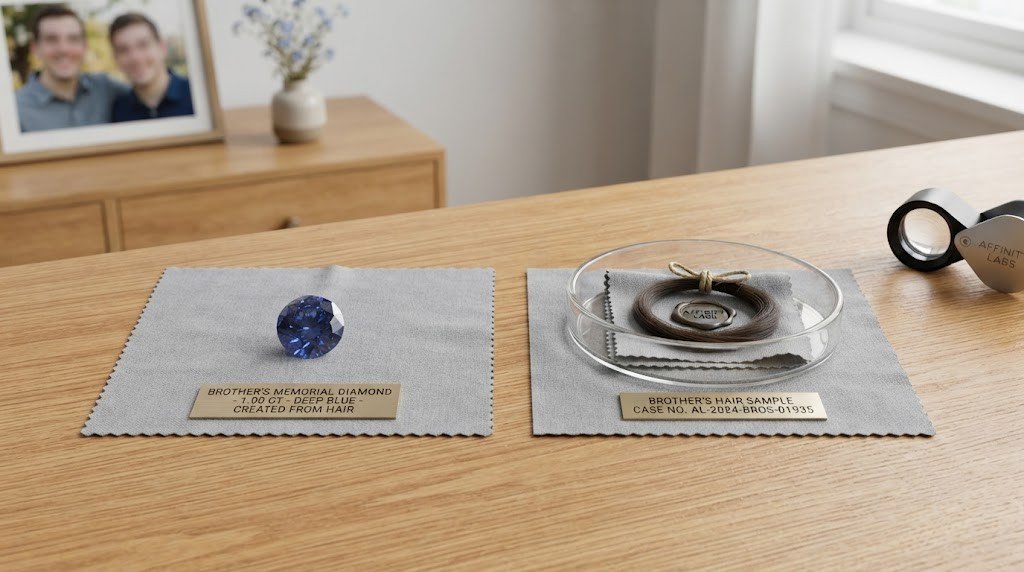
A lock of your brother’s hair, tucked in an envelope or handed over by the funeral home, can seem far too slight to carry a promise as large as “this diamond is him.” It can carry it, within honest limits. A diamond really made from brother hair is a genuine lab-grown diamond grown partly from carbon extracted from his hair, which is roughly 50% carbon by weight. Supplemental lab carbon is typically blended in, and no industry figure is published for how much of a finished hair-based stone is his.

really made from brother hair

Is a Diamond Really Made From Brother Hair an Actual Diamond?

Yes. Of all the doubts about whether a gem is really made from brother hair, this one has the firmest answer. The stone is crystalline carbon arranged in the same lattice as a mined diamond, so it shares the same hardness, sparkle, and durability. It is grown in a laboratory, which describes where it formed rather than what it is. Nothing about it is a coating, an imitation, or a capsule holding strands of hair.

The memorial part comes from the feedstock. A provider takes the carbon locked inside his hair, cleans away everything else, and feeds that carbon into the growth process alongside a controlled lab supply. A stone really made from brother hair therefore holds carbon that was once part of him, bonded into the crystal itself.

What it does not hold is every atom from him. That distinction is the heart of the honest answer, and it is worth understanding before you speak with any company. If you want the wider picture first, our complete guide to a brother hair diamond lays out the whole option from start to finish.

Why Is Hair Such a Rich Source of Carbon?

Hair is built mostly from keratin, a protein whose structure leans heavily on carbon. By weight, hair is roughly half carbon, which is a striking figure next to cremated remains, where usable carbon runs at only about 0.5% to 4% because bone mineral makes up the bulk.

That difference shapes what ordering a diamond really made from brother hair involves. Where an ash stone calls for tablespoons of remains, a hair stone usually starts from a single modest lock weighing just a few grams. Hair also does not depend on cremation at all, which matters if your brother was buried or if his ashes are held by someone else.

FeatureHis hairHis cremated ashes
Carbon by weightAbout 50%About 0.5%–4%
Amount usually asked forOne small lock, or a few gramsSeveral tablespoons up to roughly 4 oz (\~100 g)
Requires cremationNoYes
Published share of finished stoneNone publishedAround 10–15% for ash (some cite \~3%)
Lab carbon typically blended inYesYes

Higher carbon content does not make a stone really made from brother hair more of a diamond than an ash stone. It simply means less starting material is needed to recover a meaningful amount of his carbon.

How Much of a Stone Really Made From Brother Hair Is Him?

This is where honesty matters more than reassurance. For ashes, the industry cites a rough figure: ash-derived carbon typically makes up around 10–15% of the finished stone. For hair, no comparable finished-stone percentage has been published, so anyone quoting a precise industry-wide number for hair is going beyond the available data.

What you can do is ask any provider of a stone really made from brother hair directly. A credible company should be able to tell you, in writing, how much of his hair they will process, roughly how much purified carbon they expect it to yield, and how that carbon relates to the total feedstock for the carat you have chosen. A specific, modest, explained figure is a better sign than a confident number with no reasoning behind it.

Keep the frame in mind: the crystal being only partly his carbon does not make a diamond really made from brother hair any less his. The carbon that came from him is recorded, purified, and grown in, and that is a physical fact rather than a sentiment.

Why Is Lab Carbon Added to a Diamond Really Made From Brother Hair?

It is a fair challenge. If half of his hair is carbon, why would a provider need anything else? The answer lies in what diamond growth demands. A growth cell needs a steady, sufficient volume of extremely pure carbon to form a stable crystal of a wearable size, and the carbon from a small lock, once purified, is still a modest quantity.

Supplemental lab carbon is typically blended in to reach that working volume. Think of it as the bulk that allows his carbon to be part of a crystal large enough to cut and set. It is the ordinary practice across the category rather than a shortcut.

Size works the same way regardless of how much hair you send. Carat is governed mainly by how long the crystal stays in the press, not by the quantity of material supplied, so mailing an extra lock does not produce a larger stone really made from brother hair. You choose the carat at the outset, and the growth time follows from that choice.

What Happens to His Hair on the Way to Becoming a Diamond?

Every stage of producing a diamond really made from brother hair is a chance for a provider to show its record-keeping, so it helps to know the sequence. The broad steps are shared across the industry:

  1. Intake. His hair is received, weighed, photographed where offered, and assigned an identifier that should follow it through every later step.
  2. Carbon extraction and purification. Controlled heating without oxygen, in several stages, removes the non-carbon parts of keratin and leaves carbon at roughly 99.9%+ purity.
  3. Graphitization. The purified carbon is heated to around 2,500–2,700°C and becomes graphite, the form diamond presses use as feedstock.
  4. Growth. The graphite, typically blended with lab carbon, is placed beside a tiny seed crystal and grown under HPHT pressure of about 6–8 GPa at temperatures of 1,400–2,500°C, a stage lasting weeks to months. A minority of providers use chemical vapor deposition instead.
  5. Cutting and polishing. A gemologist turns the rough crystal into the shape you picked.
  6. Optional irradiation. Some providers offer this to shift or deepen color.
  7. Grading and documentation. The finished stone is assessed, ideally by an independent lab, and paired with an origin certificate.

For the full narrative of each stage, read how a memorial diamond is made from brother hair. If you are still at the planning stage, our walk-through on how to turn your brother’s hair into a diamond starts from the first conversation.

Where Can His Hair Come From, and Who Has to Agree?

Where the hair came from is part of proving a stone is really made from brother hair, and it is also a question of consent. A lock trimmed at the funeral home is generally handed on only with the say-so of the person entitled to decide about his remains. If you are his sibling, that person may not be you. Priority commonly rests with a spouse or registered partner, adult children, or parents before a sibling, though the exact ranking is decided state by state. Instructions he recorded himself, whether he chose a decision-maker in advance or settled his own arrangements before his death, can also move the decision to someone else.

Hair you already have at home, or hair found among his belongings, raises a different point. It may form part of his estate, and the rules vary by state, so it is wise to talk with whoever is handling his affairs before sending it anywhere. Nobody wants a meaningful gesture to become a source of family friction.

If someone else holds authority, a gentle request usually works better than a workaround. Explaining that a stone really made from brother hair typically needs only a small lock often makes the conversation easier. Our guide to how much hair a brother memorial diamond needs covers quantities in more detail, so you know exactly what you are asking for when you ask.

What Proof Shows a Diamond Is Really Made From Brother Hair?

The finished diamond cannot speak for itself. Purification leaves almost nothing but carbon, so there is no standard test that links a finished stone to one particular person’s hair. A lab can confirm it is a lab-grown diamond and measure its quality, yet the question of origin is answered by records, not by testing. That makes paperwork the real evidence that a stone is really made from brother hair.

Two documents do two separate jobs:

  • The origin certificate is usually issued by the provider and states that the diamond was grown from the material submitted under your order. Its strength depends entirely on the chain of custody behind it.
  • The independent grading report comes from a third-party lab and describes the stone’s cut, color, clarity, and carat. The GIA explanation of the diamond quality factors shows what those terms mean. This report confirms quality, not origin.

Questions worth asking before you order a diamond really made from brother hair:

  • How is his hair tracked from the moment it arrives, and may I see a sample tracking record?
  • Is each family’s material processed separately, and how is that confirmed?
  • How much of his hair will you use, and what happens to any you do not use?
  • What share of the finished stone do you expect to come from his hair at the carat I want?
  • Is an independent grading report included, or priced separately?

For a longer checklist, see the brother hair diamond questions worth raising before you choose. Clear, documented answers are what turn a diamond really made from brother hair from a claim into something you can confirm.

Which Promises About a Stone Really Made From Brother Hair Deserve Doubt?

Some marketing language leans on grief rather than facts. None of the promises below proves wrongdoing by itself, but each deserves a polite follow-up.

  • “100% him.” Supplemental lab carbon is typically part of the blend, even with carbon-rich hair, so total purity is not how the process usually works.
  • A precise percentage for hair presented as an industry standard. No such figure is published; a provider can give its own estimate, with reasoning.
  • “Hair gives a lighter or more predictable color.” The exact shade cannot be predicted from the source, whether hair or ashes.
  • “Send more hair for a bigger diamond.” Carat depends mainly on growth time.
  • A certificate with no lab named. Origin paperwork is useful, but quality claims should rest on an independent report.
  • A deadline that feels invented. Choosing what happens to his hair deserves unhurried attention.

A provider selling a stone really made from brother hair should welcome these questions, because honest answers are its strongest selling point.

What Should You Expect to Pay and to Wait?

Cost and time are part of judging any claim about a diamond really made from brother hair, since a real growth process involves specialized equipment and months of work. These are general 2026 industry ranges, not memorialdiamond.us’s published prices:

SizeIndustry price rangeWorth knowing
Roughly 0.10–0.25 ctAbout 1,500–3,500A small, wearable size for everyday pieces
0.5–1 ctAbout 5,000–15,000Colorless stones land near the upper end
2–5+ ctAbout 20,000–75,000+Requires longer growth and tighter control

Grading reports, engraving, fancy cuts, and settings usually add to the loose-stone price. On timing, the industry typically quotes 6 to 10 months from receipt of the hair, with stones over roughly 2 carats, or in specialty colors, sometimes needing up to about 12 months. Any quote far below these ranges for a stone really made from brother hair deserves a careful question about what is being sold. Our breakdowns of brother memorial diamond cost and the brother memorial diamond timeline go deeper.

Can You Predict the Color of a Stone Really Made From Brother Hair?

Not precisely. Color in any diamond comes from trace elements present while it grows. Nitrogen pushes a stone toward yellow, boron toward blue, and a colorless result requires keeping both out, which adds processing and usually adds cost. Memorial stones from personal carbon tend toward yellow, blue, and champagne shades, and some providers offer irradiation to produce red, pink, green, or black.

Hair does not make the color of a diamond really made from brother hair more predictable than ashes do, and no provider can tell you the exact shade in advance. What you can choose is the color direction a provider aims for. Our guide to brother hair diamond color explains those choices in depth.

Whatever the shade, the stone ranks 10 on the Mohs scale of mineral hardness, so it suits daily wear, though a sharp knock can still chip it. Clarity for memorial diamonds usually falls in the SI2 to VVS range.

Hair, Ashes, or Both: How Do the Options Compare?

Hair, ashes, and a combination of the two all yield a genuine diamond, and each relies on the same documentation for proof of origin. The differences are practical. Hair needs very little material and no cremation; ashes depend on cremation and use a small portion of the remains; a combination brings both into one project, if the provider offers it.

A diamond is also one choice among several, not a replacement for anything your family has already done. An urn, a burial, or a scattering honors him fully, and a hair-based stone can sit alongside any of them without taking anything away. For readers whose faith shapes these decisions, no tradition has an official position on memorial diamonds specifically, so a word with your own faith leader is worthwhile.

If you have both his hair and access to some of his ashes, it may help to read the matching ash question too. Either way, a stone really made from brother hair is real in the way that matters: a documented portion of his carbon, grown into a crystal you can hold.

Frequently Asked Questions

Is a diamond really made from brother hair a real diamond?

Yes. Grown in a laboratory, it shares the crystal lattice, hardness, and brilliance of any mined stone. Carbon recovered from his hair is purified and built into that crystal, typically alongside supplemental lab carbon so the stone can reach a wearable size.

How much of a stone really made from brother hair comes from him?

No industry figure has been published for hair, unlike ashes, where roughly 10–15% is commonly cited. Ask your provider for its own written estimate based on how much hair it processes and the carat you choose, along with the reasoning behind it.

Why is so little hair needed?

Hair is roughly 50% carbon by weight because it is made mostly of keratin. That concentration means a small lock or a few grams usually supplies enough of his carbon, compared with the larger quantity of cremated remains an ash stone typically requires.

Can a lab test a diamond really made from brother hair to prove its source?

Not in the way you might hope. Purification strips away nearly everything except carbon, and no standard test ties a finished stone to one person. A lab can confirm it is lab-grown and grade it; origin rests on chain-of-custody records and the origin certificate.

Do I need anyone’s agreement to use his hair?

Often, yes. Funeral-home hair is generally released through whoever holds authority over his remains, and who that is depends on the state and on any wishes he put in writing. Hair kept at home or among his things may form part of his estate, again under state rules.

Does hair produce a lighter or more predictable color?

No. Color comes from trace elements, chiefly nitrogen and boron, present while the crystal grows, so neither hair nor ashes lets anyone forecast the exact shade. Providers can aim for a color direction, and colorless stones typically require extra processing.

How long does a hair diamond take to make?

Across the industry, the process typically takes 6 to 10 months from the moment the provider receives his hair. Larger stones, above about 2 carats, or specialty colors can take up to around 12 months, because carat size depends on growth time.

Final Thoughts on Whether a Hair Diamond Is Truly His

It is reasonable to want certainty before trusting anyone with something as small and irreplaceable as a lock of your brother’s hair. The truthful answer is a careful yes: a diamond really made from brother hair is real, his carbon is genuinely part of it, and lab carbon typically fills out the rest. That is not a lesser version of the promise. It is the version you can verify, and the records are what make it trustworthy.

Learn More About Verifying a Hair Diamond

Talk With Memorial Diamond

When you are ready to ask your own questions about a stone really made from brother hair, Memorial Diamond is glad to talk through what is possible for his hair. Visit memorialdiamond.us to start the conversation, at whatever pace feels right for you and your family.

Word count: 3,075 words · Reading time: about 15 minutes

How a Memorial Diamond Is Made From Your Brothers Hair

How a Memorial Diamond Is Made From Your Brother’s Hair

A lock of his hair, tucked in an envelope or saved in a keepsake box, can feel like the smallest thing he left behind. A memorial diamond made from brother hair moves through seven lab stages: intake, carbon extraction, graphitization, HPHT or CVD growth, cutting, optional irradiation, and grading. No cremation is involved at any point, only a small lock is needed, and the industrytypical span is 6 to 10 months.

made from brother hair

Why Does a Diamond Made From Brother Hair Never Involve Cremation?

Hair is a carbon source in its own right. Each strand is mostly keratin, a protein dense with carbon, so around half of a lock’s weight is carbon. That means a lab can recover carbon for a diamond made from brother hair directly from the hair itself, with no need for the body to be cremated first and no need for any cremated remains at all.

This matters in practical ways. A diamond made from brother hair is possible whether he was buried, cremated, or laid to rest some other way, and whether or not his ashes are within your reach. If he was buried before anyone thought of a diamond, a lock kept from an earlier haircut, or one the funeral home trimmed before the burial, can still be enough, provided the people responsible for his remains or estate agree.

It can matter for faith reasons too. No tradition has an official position on memorial diamonds specifically, and practices vary widely. Where a family’s concern is with cremation itself, a stone made from brother hair does not involve it, but your own faith leader remains the right person to ask. For a wider view of hair as a starting point, see our complete guide to a brother hair diamond.

What Are the Seven Lab Stages for a Diamond Made From Brother Hair?

The sequence is the same one labs follow for any memorial stone, but several stages look different when the starting material is hair. This table tracks a memorial diamond made from brother hair through each stage, with what changes because it is hair and one question you might raise at that point.

StageWhat is different because it is hairA question worth asking
1. Intake and chain of custodyA small lock or a few grams arrives, often in an envelope or small bag, and is logged under his orderHow will his hair be labeled and stored?
2. Extraction and purificationOxygenfree heating drives off the noncarbon parts of keratin; there is no bone mineral to removeHow much of what I send will you actually use?
3. GraphitizationHis refined carbon, at roughly 99.9%+ purity, is heated to about 2,5002,700°C and becomes graphiteIs his carbon kept separate at every handling step?
4. Diamond growthThe graphite, typically blended with supplemental lab carbon, grows on a diamond seed in an HPHT press (CVD at a minority of labs) over weeks to monthsWhich growth method do you use?
5. Cutting and polishingThe rough crystal is faceted into the shape you chose; nothing here differs from an ashbased stoneWhich cuts do you offer, and which cost extra?
6. Optional irradiationAvailable on request to shift or deepen colorWhich colors can irradiation produce?
7. Grading and certificatesAn origin certificate and, ideally, an independent grading reportIs independent grading included in the price?

The order never changes, though the time spent in each stage does, and providers generally publish only the overall timeline. If you would like to compare this path with the ash route, our post on how a memorial diamond is made from your brother’s ashes follows the same seven stages from cremated remains.

Where Can the Hair Come From, and Who Should Agree?

Hair for a diamond made from brother hair usually comes from one of a few places:

  • A lock saved by a funeral home before burial or cremation, usually released through whoever holds authority over his remains
  • Hair kept from an earlier haircut, sometimes years old
  • Strands gathered from his brush, comb, or a hat he wore often
  • A keepsake lock already held by a family member

Where the hair comes from shapes whose agreement you need. A sibling often does not hold authority over his remains: commonly a spouse or registered partner, adult children, and parents come first, though each state sets its own order. Paperwork he signed while alive, whether it appointed someone to decide or laid out his funeral arrangements, may shift that responsibility to a specific person. A funeral home will generally release a trimmed lock through that person.

A lock found in his home, or among his things, may be treated as part of his estate, and state rules differ, so speak with whoever is handling his estate before sending it. If you are not the person with authority, a gentle conversation asking for a few strands for a stone made from brother hair can open the door. Our guide to how much hair a brother memorial diamond needs can help you explain how little you are asking for.

What Happens to His Hair on the Day It Arrives?

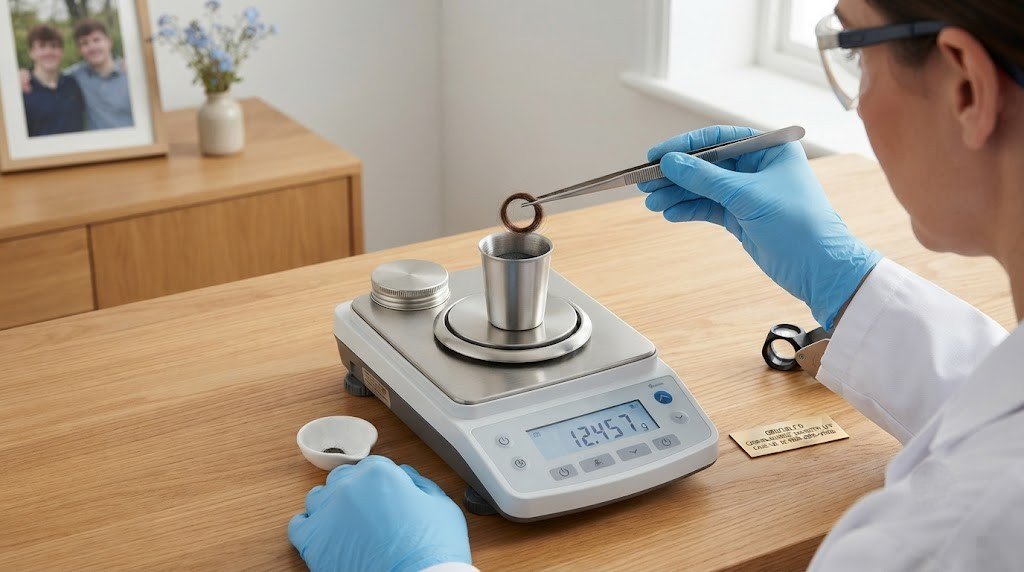
Intake is where the lab’s care begins, and for hair it is a quieter, smaller moment than you might picture. A careful provider will typically open the package, check the paperwork, weigh the hair, and record it under a unique reference tied to his order. Ask how his hair is stored after that, and whether it is kept sealed and apart from other families’ material.

For a stone made from brother hair, that logged reference is the first link in the chain of custody, the documented record that follows his material through every later step. It is what allows a lab to say, at the end, that a specific diamond made from brother hair was grown from what you sent. Ask how that record works before shipping, and whether you will be told when his hair moves from one stage to the next.

Because only a small amount is needed, you may have hair left over. Policies on leftover material are set by each provider, so ask whether unused hair can be sent back, held for a later stone, or handled another way, and make your wishes known before you ship.

How Does Hair’s Carbon Content Change Extraction?

Extraction is where hair and ashes part ways most clearly. Cremated ashes are mostly calcium phosphate, the mineral of bone, with carbon making up only around 0.5% to 4% of their weight. Hair, at roughly 50% carbon, is close to the opposite: half of what you send is already carbon, bound up in protein rather than locked inside mineral.

That shift changes the job. With ash, the lab is separating a little carbon from a lot of bone mineral, which is why a few tablespoons or more are typically requested. With hair, the task is driving off the other half of the keratin, so a far smaller quantity yields usable carbon. That is why a diamond made from brother hair typically starts from just a few grams, roughly what fits in the palm of a hand, though each provider sets its own minimum.

The method itself is similar in spirit. The hair is heated in a controlled, oxygenfree, multistage process, so the carbon does not simply burn away, and the noncarbon parts of the protein are stripped out. Successive stages refine the result until it reaches roughly 99.9% carbon purity or higher. At the end, the material for a diamond made from brother hair is a small, dark portion of refined carbon, still logged under his reference.

What Turns His Carbon Into Graphite?

Refined carbon on its own is not the ideal feedstock for a growth press. The press works best with graphite, the stable, layered crystal form of carbon. So the lab heats his carbon a second time, to around 2,5002,700°C, and the atoms settle into flat, stacked sheets.

It can help to know that graphite and diamond are the same element in two arrangements. In graphite, the carbon atoms sit in sheets; in diamond, they lock into a rigid threedimensional lattice. Graphitization prepares the carbon for that second rearrangement.

At this point, the carbon meant for a diamond made from brother hair is graphite, sealed and tracked, and ready to be loaded into a growth cell. This stage works the same way for hair as it does for ashes.

How Does a Stone Made From Brother Hair Grow in the Press?

Most memorial providers use HPHT, high pressure and high temperature. His graphite, typically blended with supplemental labsourced carbon to reach the volume growth requires, is packed into a cell with a tiny diamond seed. The press holds the cell at roughly 68 GPa and 1,4002,500°C, and carbon gradually crystallizes onto the seed, building a rough diamond.

A minority of labs use CVD, chemical vapor deposition, where his carbon is turned into a gas that settles, layer by layer, on a seed plate held in a vacuum chamber. Either method creates a genuine diamond; Wikipedia’s article on how synthetic diamonds are grown describes both in detail.

Growth lasts weeks to months, and this is where carat size is chosen. Size depends on how long the crystal grows, not on how much hair you supplied, so a thicker lock does not make a stone made from brother hair larger or faster. Memorial stones are generally offered from around 0.10 carats to 5 carats or more.

Color takes shape here as well. Nitrogen during growth tends to give yellow, boron gives blue, and colorless needs both excluded, which adds processing and usually cost. Memorial stones commonly trend yellow, blue, or champagne, and the exact shade of a diamond made from brother hair cannot be predicted from the hair beforehand. Our post on the color of a brother hair diamond explains the chemistry more fully.

How Much of the Finished Diamond Is His Carbon?

This deserves a straight answer. A diamond made from brother hair is not made entirely of his carbon. Even with hair’s high carbon content, the recovered carbon is typically blended with supplemental lab carbon so the crystal can grow to the size you select.

No finishedstone percentage is published for hair. The figure you may see quoted, ashderived carbon making up roughly 1015% of a finished stone’s mass, applies to cremated ashes only, and it should not be borrowed for hair. The honest position is that a real portion of his carbon becomes part of the crystal lattice, and the share depends on the provider and the stone.

So ask directly what share of a stone made from brother hair the lab expects for your chosen carat, and how they document it. A provider that answers clearly, without claiming the stone is entirely him, is showing the kind of candor you want throughout. If that question is on your mind, our post asking whether a memorial diamond is really made from your brother’s hair looks at it closely.

What Happens Between the Rough Crystal and the Finished Stone?

A rough crystal made from brother hair, fresh from the press, has an uneven, slightly frosted surface and a shape set by growth rather than design. A cutter maps it, plans the facets, and then cuts and polishes it into your chosen shape, perhaps round, oval, cushion, or princess. Fancy cuts are commonly an added cost.

Next comes an optional step: postgrowth irradiation, which some labs offer to shift or intensify color. It is the route to red, pink, green, or black memorial stones. If you prefer the tone that formed naturally, you simply skip it.

What emerges is a finished diamond made from brother hair, rated 10 on the Mohs hardness scale. That makes it very durable for daily wear, although a sharp blow at the wrong angle can still chip any diamond.

Which Documents Come Back With a Diamond Made From Brother Hair?

Two kinds of paperwork typically accompany the stone. The first is an origin or authenticity certificate, usually issued by the lab itself, confirming the diamond was grown from the material your family submitted. It closes the chain of custody that began when his hair was logged.

The second is a grading report covering the diamond’s cut, color, clarity, and carat, the same quality factors GIA uses for every diamond. The strongest version is prepared by an independent gemological lab that follows GIA or IGI standards. Clarity for a memorial stone made from brother hair typically falls between SI2 and VVS.

One document speaks to whose carbon is in the stone; the other speaks to the stone’s quality. For a diamond made from brother hair, it is worth asking whether both are included or whether independent grading is billed separately.

How Long Does It Take, and What Shapes the Price?

Industrywide, a memorial diamond made from brother hair typically takes 6 to 10 months from receipt of his hair to the finished stone, and larger stones of around 2 carats or more, or specialty colors, can take up to about 12 months. Labs seldom publish how long any one stage lasts, so plan around the overall range.

Price is driven mainly by carat, color, and cut. As general 2026 industry ranges, not this brand’s published prices, stones of roughly 0.100.25 ct run about 1,5003,500, and stones of 0.51 ct about 5,00015,000, with colorless near the upper end. Large stones of 25+ ct can reach 20,00075,000 or more. Grading, engraving, fancy cuts, and settings are usually extra. Our post on what a brother memorial diamond costs breaks this down further.

Because size comes from growth time, the carat you pick for a stone made from brother hair shapes both the wait and the cost far more than the amount of hair you send.

What Should You Ask Before His Hair Leaves Your Hands?

A clear picture of how a stone is made from brother hair makes your questions sharper. Before sending anything for a diamond made from brother hair, consider asking:

  • How should the hair be packaged, and do you have shipping instructions or a preferred carrier?
  • How much hair do you need, and what happens to any you do not use?
  • Is his hair processed on its own, separate from all other orders?
  • Will I receive an update as his material enters each stage?
  • What happens if a growth run does not produce a usable crystal?
  • Is an independent grading report included, or is it an added cost?

Our fuller list of questions to ask before turning your brother’s hair into a diamond covers settings, engraving, and insurance as well. A good provider will answer each one patiently and in plain language.

Frequently Asked Questions

Can a diamond be made from brother hair if he was buried?

Yes. Hair is roughly 50% carbon and needs no cremation, so a lock saved before burial, from a past haircut, or from his brush can be used. Hair from his home may belong to his estate, depending on state rules.

How much hair does the lab typically need?

Industry guidance typically points to a modest lock, a few grams in all. Because hair is so much richer in carbon than ashes, far less material is required. Exact amounts vary by provider, so confirm the figure before sending anything.

Does old hair still work for a memorial diamond?

Hair saved years ago may still be usable, since the lab is recovering its carbon, but condition, quantity, and how it was stored can matter. Describe the hair to the provider and ask whether it suits their process before sending it.

Is a diamond made from brother hair entirely his carbon?

No. His recovered carbon is typically blended with supplemental lab carbon so the crystal can reach the size you choose. No finishedstone percentage is published for hair, so ask the provider what share they expect and how they document it.

Will hair give a lighter or more predictable color than ashes?

No. Color comes from trace elements such as nitrogen and boron present during growth, and the exact shade cannot be predicted from the source. Memorial stones commonly trend yellow, blue, or champagne, while colorless needs extra processing and costs more.

Who can authorize sending his hair to a lab?

It depends on where the hair comes from. A funeral home generally releases hair through whoever holds authority over his remains, and hair among his belongings may belong to his estate. State rules vary, so check with the authority holder or executor.

Final Thoughts on a Diamond Grown From His Hair

Sending something as personal as his hair to a lab is easier when the work inside it is no longer a mystery. A memorial diamond made from brother hair asks for very little of what he left, leaves his resting place untouched, and returns a stone whose origins you can trace and question at every turn. Whether you go ahead now, later, or not at all, knowing the process means the choice stays yours.

Learn More About the HairtoDiamond Process

Talk With Memorial Diamond

If you are holding onto a lock of his hair and wondering what it could become, Memorial Diamond is glad to talk through a diamond made from brother hair with you, from what to send to what each lab stage would involve. Reach out at memorialdiamond.us whenever the time feels right.

Word count: 3,115 words · Reading time: about 16 minutes

How Much Hair Do You Need for a Brother Memorial Diamond

 How Much Hair Do You Need for a Brother Memorial Diamond

Maybe it is a curl saved in a baby book, or a lock tucked into an envelope after a haircut years ago. Whatever you have kept, the industrytypical amount of hair for a brother memorial diamond is modest: a small lock or a few grams, often described as palmsized or a few wisps. Hair is roughly half carbon by weight, which is why so little goes so far, and the stone’s size depends on growth time rather than on how much hair you send.

hair for a brother memorial diamond

How Much Hair for a Brother Memorial Diamond Do Providers Usually Request?

Providers across the industry generally ask for a small lock or a few grams of hair for a brother memorial diamond. Some describe the amount as roughly palmsized; others talk about a few wisps. Those descriptions are approximate on purpose, because each lab sets its own requirement, and the figure can shift with the stone you have in mind.

Memorial Diamond does not present any of these industry figures as its own fixed policy. The useful habit is to ask any provider for its current requirement in writing, along with how it prefers the amount measured, whether by weight, by length, or simply by a description of the lock.

It can come as a surprise how little that really is. A single envelope of hair for a brother memorial diamond can hold more than enough carbon, which means a keepsake lock does not have to be used up entirely. You may be able to send part of it and keep the rest exactly as it is.

For the bigger picture of how hairbased stones are planned and made, the complete guide to a brother hair diamond walks through every stage.

Why Is a Small Lock of Hair for a Brother Memorial Diamond Enough?

Hair is built mostly from keratin, a protein rich in carbon. By weight it is roughly 50% carbon, which is dramatically more than cremated remains, where usable carbon runs at only about 0.5% to 4%. That difference is the whole reason hair needs so little starting material.

It also means hair does not require cremation at all. A lock can come from a brother who was buried rather than cremated, or simply from something your family saved long ago. For some families, that makes hair for a brother memorial diamond the more practical, or the only, option available.

One honest caveat belongs here. Labs typically blend the purified carbon from hair with supplemental labsourced carbon to reach a workable volume, and unlike ashes, there is no published industry figure for what share of a finished hairbased stone comes from the hair itself. A provider who claims the diamond is pure hair, with nothing else in it, is overstating what the process involves.

Even so, real carbon that was once part of your brother becomes part of the crystal. The explainer on whether a memorial diamond is really made from brother hair looks closely at what that means and what to ask a provider to show you.

Will Extra Hair for a Brother Memorial Diamond Make the Stone Larger?

No. The size of the finished diamond is set by growth time, not by the quantity of hair. Once his carbon has been extracted in an oxygenfree process and purified to roughly 99.9% or above, it is converted into graphite at around 2,5002,700°C and placed in a growth cell with a tiny diamond seed.

Inside a highpressure, hightemperature press, conditions sit at roughly 68 GPa and 1,4002,500°C, and the crystal grows over weeks to months. A minority of providers use chemical vapor deposition instead. In either method, longer growth produces a larger stone; a bigger bundle of hair for a brother memorial diamond does not.

That gives you freedom. Carat sizes typically range from about 0.10 to 5 carats or more, and the size you pick shapes the growth time, the cost, and the overall wait. You never have to send more of his hair than the provider needs in order to have the stone you want.

After growth, a gemologist cuts and polishes the rough crystal, some providers offer optional irradiation to shift color, and the stone is graded. Independent grading follows the diamond quality factors GIA uses for cut, color, clarity, and carat, the same standards applied to any diamond.

Where Can Hair for a Brother Memorial Diamond Come From?

The source matters less than you might think, though every provider has its own preferences. Common places to find hair for a brother memorial diamond include:

  • a keepsake lock saved after a haircut or kept in a baby book
  • a hairbrush or comb he used
  • hair trimmed by the funeral home before burial or cremation
  • an electric razor or clippers, if he kept his hair short

Each of these raises its own questions. Ask the provider whether hair from a brush or razor is acceptable, whether the lock needs to be clean and dry, and whether strands that have been dyed or treated cause any difficulty. Their answers, not general advice, should decide what you send.

Where the hair comes from also affects who should be consulted. Hair kept at home or among his belongings may form part of his estate, and the rules vary by state. Hair trimmed by a funeral home is generally released through whoever holds authority over his remains. Either way, hair for a brother memorial diamond is best gathered with the knowledge of the people handling his affairs.

Whose Agreement Do You Need Before Sending Hair for a Brother Memorial Diamond?

A sibling is not always the person with authority over a brother’s remains. Each state writes its own ranking, and in many of them a husband, wife, or registered partner is asked first, followed by any grown children and then his parents, with brothers and sisters further down. If he signed papers naming someone to decide, or made his own funeral arrangements in advance, those instructions can put a different person in charge.

If someone else holds that role, the kindest approach is usually a simple, honest conversation. Explain that the amount of hair for a brother memorial diamond is tiny, that much of a keepsake lock can stay untouched, and that you are glad to handle the provider, the forms, and the shipping. Offering to share updates, or a stone of their own, can turn a request into a shared plan.

Hair from his belongings deserves the same care. Because it may form part of his estate and practices differ by state, check with whoever is administering his affairs before taking a brush or a saved lock. That small step protects relationships at a time when they matter a great deal.

If faith shapes your family’s choices, no tradition has an official position on memorial diamonds specifically, and practices vary. Your own faith leader is the best person to ask.

How Should Hair for a Brother Memorial Diamond Be Collected and Sent?

Start by asking the provider for its collection kit or written instructions. A kit, if offered, usually spells out the container and paperwork, and its guidance should come before anything you read elsewhere. The questions below cover the details that make the biggest difference.

TopicWhat to ask the providerWhy it matters
AmountHow much hair for a brother memorial diamond do you need for our chosen size?Confirms you are sending enough without using more than necessary
MeasuringShould we weigh the hair, measure its length, or describe the lock?Different labs use different methods
ConditionDoes the hair need to be clean, dry, or free of dye or product?Avoids delays once it arrives
PackagingDo you send a kit, and how should the hair be sealed and labeled?Keeps identification clear from the first step
ShippingWhich carriers and services do you accept, and is tracking included?Lets you follow the package until it arrives
ReceiptHow will you confirm arrival and record chain of custody?Starts the paper trail behind the origin certificate

Preparing hair for a brother memorial diamond can catch you off guard. A brush or an envelope may carry more feeling than you expected, so give yourself time, and consider asking another relative to sit with you while you prepare it.

Keep a photo of the sealed package and copies of every form. Those records, alongside the provider’s origin certificate, document that the finished stone came from your family’s submission. An origin certificate is usually issued inhouse, while an independent grading report records the diamond’s own quality.

What If You Have Only a Few Strands of Hair for a Brother Memorial Diamond?

Sometimes all that remains is a handful of strands caught in a brush or a small curl in a locket. Before deciding it is not enough, describe exactly what you have to the provider, ideally with a photo, and ask whether that quantity of hair for a brother memorial diamond is workable for them.

Because carat size comes from growth time, a small amount of hair does not automatically mean a small stone. The real question is whether the lab can recover enough carbon to begin. If it cannot, a few gentle alternatives remain open:

  1. Look for other saved hair, such as a second brush, an old keepsake, or something another relative kept.
  2. Ask whether the funeral home trimmed any hair, and whether the authority holder can request it.
  3. Ask whether the provider can combine a small amount of hair with a portion of his ashes.
  4. Keep the strands as they are and choose another way to remember him.

None of these choices is lesser. If a little hair and a little ash together feel right, the companion piece on how much ash and hair a combined brother memorial diamond needs explains what to ask a provider.

Can One Lock of Hair for a Brother Memorial Diamond Supply Several Stones?

Frequently, yes. Because each stone needs only a portion, a single lock can sometimes supply several diamonds for different relatives or friends who were close to him. Whether that works depends on how much hair you have and on the provider’s own requirements.

Ask early whether each stone needs its own measured amount of hair for a brother memorial diamond, or whether one submission can be divided across several orders. Ask, too, whether stones grown from the same lock can be different sizes, colors, and settings, and whether each comes with its own origin certificate.

Planning together can ease the practical side for everyone. The guide to sharing a brother memorial diamond among family members covers coordinating orders, dividing material fairly, and keeping each relative informed along the way.

How Does Hair Compare With Ashes as a Source?

Both can carry your brother’s carbon into a diamond, but they behave differently in the lab. The comparison below sets the two side by side using industrytypical figures.

FactorHairCremated ashes
Typical amount requestedA small lock or a few gramsA few tablespoons to about 4 oz (about 100 g)
Carbon content by weightRoughly 50%Roughly 0.5% to 4%
Cremation neededNoYes
Published share of finished stoneNone publishedAbout 1015% of stone mass for ashderived carbon, some cite about 3%
Supplemental lab carbonTypically blended inTypically blended in
What sets carat sizeGrowth timeGrowth time

The practical takeaway is that hair for a brother memorial diamond is often the lighter request: less material, no cremation, and something that may already be in a drawer at home, though hair among his belongings may be part of his estate depending on the state. Ashes, meanwhile, connect the stone to his cremated remains, which may matter deeply to your family.

If ashes are part of your plans, the parallel guide on ash for a brother memorial diamond explains how much is usually needed and what happens to the rest. Neither source is better; they simply suit different situations.

Does the Amount of Hair for a Brother Memorial Diamond Affect Cost, Timeline, or Color?

Cost depends on the finished diamond, not on the weight of hair you provide. Industry ranges for 2026 put stones of about 0.100.25 carats at roughly 1,5003,500, stones of 0.51 carat at about 5,00015,000 with colorless toward the higher end, and stones of 2 to 5 carats or more at around 20,00075,000 and up. Grading reports, engraving, fancy cuts, and settings typically cost extra. The guide to brother memorial diamond cost explains each tier.

Timing is similar. From receipt of material to finished stone, the process typically takes 6 to 10 months, with stones over about 2 carats or specialty colors sometimes taking up to around 12 months. Sending extra hair for a brother memorial diamond does not shorten that.

Color cannot be predicted from his hair. Trace nitrogen tends to produce yellow, trace boron tends to produce blue, and colorless stones need both excluded, which takes extra processing and generally costs more. Memorial diamonds commonly trend toward yellow, blue, and champagne, with irradiation offering red, pink, green, or black. The post on brother hair diamond color covers the choices in detail.

Clarity typically falls between SI2 and VVS, and the finished stone rates 10 on the Mohs scale of mineral hardness, though a sharp blow can still chip any diamond. For a fuller list of points to raise, the checklist of brother hair diamond questions is a helpful companion.

Frequently Asked Questions

Is hair from his hairbrush enough for a memorial diamond?

It can be. Requests for hair for a brother memorial diamond are usually a small lock or a few grams, and whether brush hair qualifies is the provider’s call, so send a photo first. A brush among his belongings may form part of his estate, depending on state rules.

Does the hair need to include the root?

Ask the provider, since requirements differ. Carbon comes from the whole strand, which is roughly half carbon by weight, but each lab sets its own guidance on cut hair, brushed hair, and any preparation it prefers before the material arrives.

Can hair from a brother who was buried be used?

Yes, if hair was kept or trimmed beforehand. Hair needs no cremation, so a saved lock or funeral home trimming may be usable, with agreement from whoever holds authority and attention to estate rules, which vary by state.

Will a longer lock of hair make a bigger diamond?

No. Carat size depends on how long the crystal grows in the press, not on the amount of hair supplied. A longer or thicker lock will not enlarge the stone, so you can keep whatever the provider does not need.

Can dyed or gray hair be used for a memorial diamond?

Possibly, though providers differ on treated hair. Gray hair is still keratin and still roughly half carbon. Mention any dye, bleach, or styling product when you ask, and follow the provider’s preparation instructions exactly.

Is unused hair returned after the diamond is made?

That depends on the provider’s policy. Hair processed for carbon is consumed during extraction, but any extra may or may not come back. Ask before shipping, and if the lock is precious, send only the amount they actually request.

Final Thoughts on Hair for a Brother Memorial Diamond

A few strands can feel like almost nothing until you realize what they might become. Whether you send a brush, a saved curl, or a lock from the funeral home, the amount of hair for a brother memorial diamond is small, and much of what you have kept can stay right where it is. Take the time you need, ask the questions that matter to you, and let the decision belong to your family.

Learn More About Gathering and Sending His Hair

Talk With Memorial Diamond

If you are holding a lock of your brother’s hair and wondering whether it is enough hair for a brother memorial diamond, reach out to Memorial Diamond whenever you are ready. Visit memorialdiamond.us to talk through what is possible with his hair, without pressure and at your own pace.

Word count: 2,898 words · Reading time: about 14 minutes

step by step brother hair to dimonnd

Step by Step: Turning Your Brother’s Hair Into a Diamond

Maybe it’s a lock tucked inside an envelope, or a small curl the funeral home trimmed and handed over in a velvet pouch. However it reached you, the brother hair diamond steps are simpler than you might expect: confirm who can release the hair, agree on a family plan, choose a provider, send a small lock, and let a lab grow and grade a real diamond, typically over 6 to 10 months.

brother hair diamond steps

What Are the Brother Hair Diamond Steps, Row by Row?

Laid out as a checklist, the brother hair diamond steps come to nine rows. Each row names who takes part, what has to be on hand, and the document you should be holding once it’s finished. Print the table and keep it with the hair itself, so the plan and the material never get separated.

StepWhat happensWho is involvedWhat you needDocument that results
1Locate the hair and note where it came fromYou and anyone who kept his belongingsThe lock, left as it isA dated note of the hair’s source
2Confirm who can release the hairYou, his estate representative or next of kin, sometimes the funeral homeKnowing where it was keptWritten consent or acknowledgment
3Agree on a family planYou and the people closest to himNames of anyone hoping for a stoneA shared written summary
4Compare providers and ask hair specific questionsYou and a few providersYour question sheetInformation packs and quotes
5Pick size, color, and shape; sign the orderYou and your selected providerA budget range and preferencesSigned order with the stone specification
6Seal and ship the hairYou, then the courierPacking guidance from the providerCourier receipt, tracking code, custody log
7Lab logs the hair, then extracts, purifies, and graphitizes its carbonIntake staff and lab techniciansNo action neededReceipt confirmation, plus updates if offered
8Crystal grows, then is cut and polishedGrowth technicians and a gemologistNo action neededOptional progress photos
9Finished stone is graded and sent homeProvider, optional independent lab, your jewelerWhere it goes and how it will be wornOrigin certificate, grading report, proof of delivery

Notice how front loaded the work is. The first six brother hair diamond steps are yours; the last three belong to the lab. Notice, too, that a piece of paper closes every row. Keep each one, because together they prove the finished stone began with your brother’s hair.

If you want the broader story first, including why hair works so well as a carbon source, the complete guide to a brother hair diamond is the place to start.

What Belongs on Your Have It Ready List?

Gathering a few things early keeps the brother hair diamond steps moving without backtracking. Print this list, tick items off as you find them, and keep everything in one envelope or digital folder.

  • The hair itself, kept dry and left as it is until the provider tells you how they’d like it stored and packed.
  • A few lines on its origin: who cut it, when, and where it has been kept since.
  • The name of whoever administers his estate or holds authority over his remains.
  • Anything he set down in writing about who should make decisions after his death.
  • The funeral home’s contact details, if staff there trimmed the lock.
  • A budget range to guide carat and color choices.
  • A printed question sheet for providers, covering accepted hair types and what happens to unused hair.
  • Time set aside for a family conversation before anything is signed.

Hair is small and easy to misplace in a busy house, and losing it would halt the brother hair diamond steps before they begin. Once it’s found, give it one safe spot and leave it there until Step 6.

Steps 1 3: Which Brother Hair Diamond Steps Happen at Home?

The opening brother hair diamond steps need no lab at all. They’re about finding the hair, making sure it’s yours to send, and getting the family on the same page.

Step 1: Locate the Hair and Record Its Source

Hair for a memorial diamond can come from several places: a lock saved from a haircut years ago, a curl someone kept in a card, or a sample trimmed by the funeral home before burial or cremation. Because hair doesn’t require cremation, this path stays open whatever choice the family made about his body.

Of the nine brother hair diamond steps, this first one asks the least of you, yet it shapes every later record. Handle the hair as little as possible, keep it somewhere dry, and ask your provider whether they have storage or packing preferences before you move it into anything new. Then write down what you know about it while the details are fresh.

Document to file: a dated note recording where the hair came from and who has held it since.

Step 2: Confirm Who Can Release the Hair

Hair often feels more personal and less formal than ashes, but it isn’t automatically free to send. A lock saved in a drawer or a keepsake box could count as part of his estate, and states handle that question in different ways. When funeral home staff did the trimming, they would normally hand the lock to the person with decision making power over his body, who may not be you. Depending on the state, a husband, wife, or registered partner, any grown children, or his parents can outrank a sibling, and arrangements he documented himself can shift that order.

So among the brother hair diamond steps, this is the one not to skip. Speak with the estate representative or authority holder, explain your plan, and ask for their blessing in writing.

Document to file: written consent or a signed acknowledgment from whoever can release the hair.

Step 3: Agree on a Family Plan

Next, bring in the wider family. Would anyone else close to him like a stone too? Because each diamond typically needs only a small lock, one sample can sometimes stretch to more than one stone; that depends on the provider, so ask.

Put the outcome in writing, even if it’s a short group message. Clear notes at this point in the brother hair diamond steps prevent awkward questions later, when the stone arrives.

Document to file: a shared summary of who receives a stone and who holds the remaining hair.

Steps 4 6: How Does the Hair Travel From Order to Lab?

These middle brother hair diamond steps turn a family decision into a signed order and a tracked package. Each ends with something to slip into your folder.

Step 4: Compare Providers and Ask Hair Specific Questions

Contact a few providers and ask each the same things. Which kinds of hair sample do they accept: a cut lock, loose strands, both? How much do they need? What happens to hair they don’t use? What if a growth attempt fails? Policies differ, so ask for the answers in writing and store them with the other papers the brother hair diamond steps produce. The full list of brother hair diamond questions is worth printing before your first call.

Document to file: each provider’s information pack and quote.

Step 5: Choose the Stone’s Details and Sign

You’ll decide on carat, color direction, and cut. Carat drives both cost and timing, because a diamond’s size comes from how long it grows, not from how much hair you send. Color depends on trace elements present during growth: nitrogen leans yellow, boron leans blue, and colorless requires excluding both. The exact shade can’t be predicted from the hair, and the guide to brother hair diamond color explains why.

This is where the brother hair diamond steps become a firm commitment. Before signing, check that the agreement lists the specification you chose and spells out shipping, unused hair, and failed growth terms.

Document to file: the signed order agreement with the stone specification.

Step 6: Seal and Ship the Hair

Industry typical needs are modest: a small lock or a few grams of hair. Exact amounts vary by provider, and the guide to how much hair for a brother memorial diamond covers the details. Pack it exactly as the provider instructs, use a tracked service, and take a photo of the sealed package before handing it over. Of all the brother hair diamond steps, this is the moment the hair leaves your care, so the paperwork here matters.

Document to file: the shipping receipt, the tracking number, and a chain of custody form logging each handover.

Steps 7 9: Which Brother Hair Diamond Steps Happen Inside the Lab?

From here on, the brother hair diamond steps are carried out by specialists. You wait; they work through extraction, growth, cutting, and grading.

Step 7: The Lab Logs the Hair and Extracts Its Carbon

Step 7 is where the brother hair diamond steps shift from paperwork to chemistry. On arrival, the provider should confirm receipt and assign a reference number that follows the hair through every stage. That reference is what keeps your brother’s sample tied to your order alone.

Hair is roughly 50% carbon by weight, because it’s built from keratin, a carbon rich protein. That’s why a small lock is enough. The lab heats the hair in a controlled, oxygen free, multi stage process that removes everything that isn’t carbon, reaching roughly 99.9% purity or higher. The purified carbon is then heated to around 2,500 2,700°C and turned into graphite, the feedstock used for growth.

Document to file: the receipt confirmation, plus any progress update the provider offers.

Step 8: The Diamond Is Grown, Cut, and Polished

The graphite is typically blended with supplemental lab carbon and placed in a growth cell around a tiny diamond seed. HPHT, the industry standard method, applies roughly 6 8 GPa of pressure at 1,400 2,500°C; a minority of providers use CVD instead. Growth takes weeks to months. For a plain account of both methods, see Wikipedia’s article on synthetic diamond.

A gemologist then cuts and polishes the rough crystal. Some providers also offer optional irradiation to shift color toward red, pink, green, or black.

How much of the finished stone is his carbon? For hair, no published finished stone percentage exists; the commonly cited 10 15% figure describes ash derived carbon, not hair. What is certain is that real carbon from his hair is purified and grown into the crystal. The process explanation of a memorial diamond made from brother hair goes into more depth.

Document to file: any progress notes or photos the provider shares.

Step 9: Grading, Certification, and Delivery

The final of the brother hair diamond steps is the one that puts two kinds of paper in your hands:

  • An origin certificate, usually issued in house, confirming the diamond was grown from the hair you sent. It closes the chain of custody.
  • An independent grading report, if ordered, recording cut, color, clarity, and carat against standards such as GIA’s or IGI’s. GIA’s explanation of diamond quality factors shows what each grade means.

Memorial diamonds typically grade between SI2 and VVS for clarity. Grading is often an extra, so confirm it at Step 5.

Once the brother hair diamond steps are complete, the stone can be set as a ring, pendant, earrings, bracelet, or kept loose in a case, whichever suits the person who’ll carry it. Diamonds sit at 10 on the Mohs hardness scale, but a hard knock can still chip one, so a protective setting helps for everyday wear.

Document to file: origin certificate, any grading report, and proof of delivery.

How Long Do the Brother Hair Diamond Steps Take, and What Might They Cost?

Across the industry, the full set of brother hair diamond steps typically takes 6 to 10 months from the lab’s receipt of the hair to the finished stone. Stones over roughly 2 carats, and specialty colors, can take up to about 12 months. This checklist uses that single overall window rather than timing each step separately, because the carat you pick sets the growth time.

Cost tracks size and color. As general 2026 industry ranges, not this brand’s pricing:

Carat rangeGeneral industry priceWorth knowing
Around 0.10 0.25 ct1,500 3,500Smallest, quickest growth
0.5 1 ct5,000 15,000Colorless near the upper end
2 5+ ct20,000 75,000+Longest growth period

Grading reports, engraving, fancy cuts, and settings are commonly priced on top. The price breakdown for a brother memorial diamond goes further, and if you’d prefer the journey told as a narrative, the companion piece explains how to turn brother hair into a diamond.

Which Documents Should Your Hair Diamond File Contain?

When the stone arrives, the paper trail from the brother hair diamond steps is worth keeping in one place. It supports insurance, makes passing the diamond on simpler, and preserves its story. Organize the file to match the nine steps:

  1. Your dated note on the hair’s source
  2. Written consent from the estate representative or authority holder
  3. The family’s shared summary
  4. Provider information packs and the accepted quote
  5. The signed order and stone specification
  6. Courier receipt, tracking code, and custody log
  7. Lab intake confirmation and extraction updates
  8. Growth and cutting notes or photos
  9. Origin certificate, grading report, and delivery confirmation

Make a digital copy of everything. If relatives receive stones from the same lock, give each of them copies of the records for their own diamond.

What Can Hold Up the Brother Hair Diamond Steps?

The points below are where the brother hair diamond steps can stall if a question goes unasked early on:

  • Uncertain ownership of the hair. Hair found at home may be part of his estate, so get written consent at Step 2.
  • A sample the provider can’t use. Ask at Step 4 which forms of hair they accept.
  • Unclear policies. Return of unused hair and what happens after failed growth vary, so get both in writing.
  • Grading left out. Independent grading is often extra; confirm it before signing.
  • Expecting a particular shade. Color can’t be predicted from hair, and colorless stones need extra processing.
  • Expecting a bigger stone from more hair. Carat is set by growth time, not by sample size.

Each of these is easy to settle with one early question and a written answer, which keeps the brother hair diamond steps moving.

Frequently Asked Questions

How many brother hair diamond steps are there?

This checklist uses nine: locating the hair, confirming who can release it, agreeing on a family plan, comparing providers, signing the order, shipping, lab intake and carbon extraction, growth and cutting, then grading and delivery. Some providers combine or rename stages, but the sequence stays the same.

Does my brother need to have been cremated?

No. Hair based diamonds need no cremation, so this route works whether he was cremated or buried. The hair simply has to have been kept, for example a saved lock or a sample trimmed by the funeral home beforehand.

Can I send hair I found among his belongings?

Possibly, but check first. A lock found with his possessions may be treated as part of his estate, and each state handles that differently. Speak with the person settling his affairs or holding decision making power over his remains, and get their agreement on paper.

How much hair does a memorial diamond need?

Typically a small lock or a few grams, because hair is roughly half carbon by weight. Each provider sets its own minimum, so confirm the exact amount and the accepted forms of hair before you seal anything.

Will the diamond be lighter in color because it came from hair?

Not necessarily. Color depends on trace elements present during growth, with nitrogen giving yellow and boron giving blue. The exact shade cannot be predicted from the source, whether hair or ashes, and colorless stones require extra processing.

What paperwork proves the diamond came from his hair?

An origin certificate, usually issued in house, documents that the stone was grown from your submitted sample. Together with the chain of custody form and receipt confirmation gathered during the brother hair diamond steps, it forms a complete record of the diamond’s beginnings.

Final Thoughts on Turning Your Brother’s Hair Into a Diamond

A lock of hair is a small thing to hold, and it can carry a great deal. Working through the brother hair diamond steps one row at a time keeps the practical side manageable, so you can give your attention to the person the stone is for. Take each step when it feels right, file the paper it leaves behind, and let the rest wait.

Learn More About Each Stage of the Hair Route

Talk With Memorial Diamond

Whether you’re still deciding if the brother hair diamond steps are right for your family or you’re ready to begin, Memorial Diamond is happy to answer questions. Reach out at memorialdiamond.us to talk through what’s possible with your brother’s hair.

Word count: 2,973 words · Reading time: about 15 minutes

What Color Will a Diamond Made From Your

Questions to Ask Before Turning Your Brother’s Hair Into a Diamond


A small lock of his hair can carry a surprising amount of weight, and deciding what to do with it is rarely simple. The brother hair diamond questions worth asking come in three layers: questions for your own heart, questions about where the hair came from and who must agree, and questions every provider should answer in writing, from tracking and carbon to cost, failed growth, timing, and color. Here are 19, each paired with what a strong reply includes.

brother hair diamond questions

Table of Contents


Why Ask Brother Hair Diamond Questions Before Anything Is Sent?

Sometimes a lock of hair is the only physical piece of him the family has kept, and there may be very little of it. Once a provider extracts carbon from that lock, the strands themselves are gone. That alone is reason enough to ask brother hair diamond questions slowly and thoroughly before a single strand leaves your hands.

A memorial diamond grown from hair is a real lab grown diamond, made in part from carbon recovered from his hair and typically blended with lab sourced carbon. Hair is roughly 50 percent carbon by weight, far richer than cremated ashes, which is why only a small amount is usually needed and why no cremation is required at all.

Each company writes its own rules on tracking, refunds, returned material, and what happens if growth fails. This guide does not describe any provider’s terms, ours included. It gives you the brother hair diamond questions themselves, why each matters, and what a reassuring answer tends to contain. For a full overview first, the brother hair diamond complete guide covers the whole process.


Which Brother Hair Diamond Questions Should You Settle Privately First?

Nobody else needs to hear your answers to these. They simply make every later conversation clearer.

1. What role do you want this stone to play in your everyday life?

What’s at stake: A ring or pendant worn daily calls for a different size, cut, and setting than a loose stone kept somewhere safe. Diamond sits at 10 on the Mohs scale of mineral hardness, so it resists scratches well, but a hard knock can still chip it, which matters if you work with your hands.

What a strong reply includes: A picture in your mind of where the stone lives, whether that is on a chain, on a finger, or in a drawer you open on certain days. Our page of brother memorial diamond ideas shows the full range of settings.

2. Who else might want a stone from the same hair?

What’s at stake: Hair carries enough carbon that one small lock can sometimes supply more than one stone, depending on the provider and the amount available. Parents, other siblings, and anyone else who was close to him, such as a partner or children if he had them, might each hope for a piece.

What a strong reply includes: A conversation, before ordering, about who would like a stone, so the available hair is planned around everyone rather than used up by the first request. It is one of the brother hair diamond questions best answered together.

3. What budget and what wait can you genuinely live with?

What’s at stake: In 2026, industry prices run roughly $1,500 to $3,500 for stones of about 0.10 to 0.25 carat, about $5,000 to $15,000 between 0.5 and 1 carat, and $20,000 to $75,000 or more from 2 carats upward, with settings, grading, engraving, and fancy cuts usually extra. The wait is typically 6 to 10 months.

What a strong reply includes: A spending ceiling that already allows for a setting and a grading report, and an honest sense that the months of waiting feel bearable. The guide to what a brother memorial diamond costs breaks the tiers down further.


Which Brother Hair Diamond Questions Settle Whose Agreement You Need?

This group of brother hair diamond questions is the most delicate, because the answers depend on people and on state rules rather than on any provider.

4. Where is the hair now, and who considers it theirs?

What’s at stake: Hair kept at home or among his belongings, such as in a brush or a saved keepsake, may be treated as part of his estate. How that works varies by state. Even when a lock is sitting in your own drawer, the person handling his estate or holding authority over his remains may have a say.

What a strong reply includes: A clear understanding of who holds that hair today and whether the person administering his affairs is comfortable with it being used.

5. If a funeral home trimmed his hair, who authorizes its release?

What’s at stake: When the funeral home did the trimming, the lock normally goes out only with the say so of the person who has authority over his body and remains. For a sibling, that is often not you: a spouse or registered partner, adult children, and parents commonly rank ahead of siblings, though each state sets its own order, and anything he put in writing about who should decide can change it.

What a strong reply includes: The name of the decision maker, a respectful request from you for a small lock, and their agreement, ideally confirmed in a short written note.

6. Does using his hair sit comfortably with family wishes and faith?

What’s at stake: No religious tradition has an official position on memorial diamonds specifically, and practices vary by faith, community, and family. Because hair requires no cremation, a hair based stone may sit outside some cremation specific concerns, but only your own faith leader can say how your tradition views it.

What a strong reply includes: Quiet agreement among the people closest to him, and a word with clergy if faith is part of the picture.


Which Brother Hair Diamond Questions Check the Hair Itself?

Before any paperwork, two practical brother hair diamond questions tell you whether the hair you have is likely to be enough.

7. How much hair does the provider need?

What’s at stake: Industry guidance generally describes a small lock or a few grams, sometimes called a palm sized amount, but each provider sets its own minimum. If you only have a few strands, you need to know early. The guide to how much hair a brother memorial diamond needs explains the typical range.

What a strong reply includes: A specific stated minimum, a way to check whether your sample meets it before you commit, and a plain answer about what happens if it falls short.

8. Does the age, color treatment, or storage of the hair affect anything?

What’s at stake: Hair may have been saved for years, colored, styled with products, or kept loose in a brush. You deserve to know whether any of that changes how the provider handles it.

What a strong reply includes: A direct explanation from the provider of how it prepares hair in your situation, rather than a vague “it’ll be fine.” As with all brother hair diamond questions about the sample, ask for the answer in writing.


Which Brother Hair Diamond Questions Keep His Hair Traceable?

Tracking is what lets you trust that the carbon in your stone came from his hair, so these questions follow that trail from your hands to the finished stone.

9. How is his hair logged, shipped, and tracked through every stage?

What’s at stake: Between arrival, carbon extraction, purification to around 99.9 percent carbon, graphitization at roughly 2,500 to 2,700°C, growth, cutting, and grading, his sample changes form several times. Each step is a handoff where records matter, and getting the hair there safely is its own question.

What a strong reply includes: Written packing and shipping instructions, a statement of who insures the package, and specifics about labeling on arrival, whether samples are processed one family at a time, and which tracking records you receive.

10. What happens to any hair the provider does not use?

What’s at stake: If you send more than needed, the remainder may be precious to someone else in the family. Return policies differ from company to company.
What a strong reply includes: A written commitment explaining whether unused hair comes back, how it is packaged, and roughly when.


How Much of the Stone Will Actually Come From His Hair?

Of all the brother hair diamond questions, the ones about carbon share most often get fuzzy answers, so ask them precisely.

11. What portion of the finished stone will be carbon from his hair?

What’s at stake: No finished stone percentage has been published for hair based memorial diamonds across the industry. The commonly quoted figure of roughly 10 to 15 percent applies to stones grown from ashes, not hair, so it should not be borrowed for a hair stone.

What a strong reply includes: An honest explanation of how the provider estimates the share for your order, an admission of uncertainty where it exists, and no claim that the stone is purely or entirely him. The article on whether a memorial diamond is really made from your brother’s hair explores this further.

12. Is lab carbon blended in, and how is the stone grown?

What’s at stake: Personal carbon is typically combined with lab sourced carbon to give the crystal enough material to grow. Most providers use high pressure, high temperature growth at about 6 to 8 GPa and 1,400 to 2,500°C, while a minority use chemical vapor deposition.

What a strong reply includes: A clear statement on blending, the growth method named, and patience in explaining both without sales language.


Which Brother Hair Diamond Questions Clarify the Paperwork?

Two documents usually come with a memorial stone, and they prove different things. Good brother hair diamond questions keep them apart.

13. What will the origin certificate actually record?

What’s at stake: An origin or authenticity certificate is usually created in house. It ties the finished diamond to the sample your family submitted and closes the chain of custody.

What a strong reply includes: A sample certificate shown in advance, with the identifiers it carries and how it links back to the tracking records from question 9.

14. Will an independent laboratory grade the diamond?

What’s at stake: A grading report describes the stone’s own quality, its cut, color, clarity, and carat, regardless of where the carbon came from. Reputable providers commonly use an independent lab working to GIA standards, and the GIA explanation of diamond quality factors shows what each grade means. Clarity for memorial stones typically falls between SI2 and VVS.

What a strong reply includes: The lab’s name, whether the report is part of the price, and the extra cost if not.


Which Brother Hair Diamond Questions Cover Cost, Failed Growth, and Refunds?

Talking about money and risk can feel out of step with grief. These brother hair diamond questions let you handle that part once and then put it down.

15. What does the complete price include?

What’s at stake: An advertised figure may cover only the loose stone. A colorless result typically costs more than blue, yellow, or champagne at the same carat.

What a strong reply includes: An itemized written quote showing the stone, color option, cut, grading report, setting, engraving, shipping, and tax, ending in one total.

16. If growth fails, would more of his hair be needed?

What’s at stake: Diamond growth is a demanding process, and each provider sets its own terms for a run that does not produce a usable stone. With hair, the supply may be small and impossible to replace, so this is one of the most important brother hair diamond questions you can ask.

What a strong reply includes: A written policy stating whether the provider retries, whether a retry draws on remaining hair or extracted carbon already held, and what, if anything, you pay.

17. What can be refunded if you change your mind?

What’s at stake: Months pass between ordering and delivery, and feelings shift. After carbon has been drawn from the hair, that step cannot be undone.

What a strong reply includes: A stage by stage refund explanation and a clear account of what happens to his hair or its carbon if the order stops partway.


When Will It Arrive, and What Color Might It Be?

The final two brother hair diamond questions are the ones people tend to imagine first.

18. How long will it take, and how will progress be shared?

What’s at stake: Across the industry, 6 to 10 months is typical, with stones above about 2 carats or in specialty colors taking up to around 12. Carat comes from growth time, not from how much hair you send. See the brother memorial diamond timeline for more on why.

What a strong reply includes: An estimate for the size and color you want, plus a description of how often you will hear from them and in what form.

19. What color should you expect from a hair based stone?

What’s at stake: Trace nitrogen tends to turn a diamond yellow and boron turns it blue; colorless needs both excluded, which adds processing and cost. Memorial diamonds commonly come out yellow, blue, or champagne, and irradiation can create red, pink, green, or black. Hair does not make the color lighter or easier to predict. The guide to brother hair diamond color explains the chemistry.

What a strong reply includes: A description of the likely tones for the option you pick, with no promise of an exact shade.


Where Can You Log Brother Hair Diamond Questions and Each Provider’s Reply?

After two or three calls, details start to run together. Use the table below as a working log for your brother hair diamond questions, one column per company, so replies sit side by side with what to listen for.

Question topicListen forCompany 1Company 2Company 3
Minimum hair neededA stated amount and a way to check your sample
Hair conditionHow they prepare older, colored, or loose hair
TrackingLabeling, single family processing, records given to you
ShippingWritten instructions and who insures the parcel
Unused hairWhether it returns, how, and when
Carbon shareAn honest estimate, with uncertainty admitted
Lab carbon and methodBlending stated, growth method named
Origin certificateSample shown before ordering
Independent gradingLab named, included or extra
Full priceItemized quote with one total
Failed growthRetry policy and whether more hair is needed
RefundsWhat returns at each stage
Timeline and colorRange for your choice, likely tones

Some ways to get more from the log:

  1. Ask each company the same brother hair diamond questions in the same order.
  2. Write “in writing” or “verbal” beside every reply.
  3. Circle anything unclear and raise it again by email.
  4. Show the completed log to whoever administers his estate or holds authority before you decide.

Working through brother hair diamond questions this carefully can feel slow, but slowness is appropriate when the material in question is a lock of his hair.


Frequently Asked Questions

Which brother hair diamond questions matter most if I only have a little hair?

Start with the provider’s minimum, whether your sample can be checked before you commit, and what happens if growth fails. Those three answers tell you whether a scarce lock is likely to be enough and whether it could be lost without a stone.

Can I use hair I kept myself without asking anyone?

Ask first. Hair kept at home or among his things may be considered part of his estate, and rules vary by state. Talking with whoever handles his affairs, or holds authority over his remains, protects family relationships and avoids later misunderstandings.

Is a hair diamond less real than one made from ashes?

No. Both are genuine lab grown diamonds grown partly from his own carbon. Hair simply holds far more carbon by weight than ash, so less material is needed. Neither is made only from him, since lab carbon is typically blended in.

Will a provider tell me exactly how much of the stone is his hair?

Ask, but expect honesty about uncertainty. No industry wide percentage has been published for hair based stones, and the ash figure does not apply. A trustworthy provider explains how it estimates the share and avoids words like pure or entirely.

Should I ask brother hair diamond questions by phone or by email?

Both work, but email leaves a record. Use a call to understand the process and an email to confirm anything about refunds, failed growth, returned hair, or timing, so the answers you rely on later are written down.

Can one lock of his hair make stones for several relatives?

Sometimes. Because hair is carbon rich, a small lock may supply more than one stone, depending on how much there is and the provider’s requirements. Agree as a family on who wants one before ordering, then ask the provider directly.

Final Thoughts on Asking Before His Hair Leaves Your Care

A lock of hair is small enough to fit in an envelope and large enough to hold years of memory. Asking careful brother hair diamond questions is a way of honoring that. Take your time with the answers, share them with the people who loved him too, and move forward only when the replies feel clear and kind.

Learn More Before You Send His Hair

Talk With Memorial Diamond

If it would help to talk through any of these brother hair diamond questions, we are happy to explain what is possible with your brother’s hair and answer at whatever pace feels right. You can reach us at memorialdiamond.us whenever you are ready.

What Color Will a Diamond Made From Your Brothers Hair Be

What Color Will a Diamond Made From Your Brother’s Hair Be?


A lock of his hair may be the one thing you kept without quite knowing why, folded into an envelope or tucked between the pages of a book. Now you are wondering what it could become. Brother hair diamond color cannot be read from the hair itself: stones grown from hair usually land in yellow, blue, or champagne tones shaped by traces of nitrogen and boron, while colorless is possible with extra processing at a higher price, and some providers offer irradiated shades.

brother hair diamond color

Why Can’t His Hair Tell You What Color the Diamond Will Be?

It is natural to look at the hair in your hand, whether it is sandy, black, auburn, silver, or somewhere in between, and imagine the brother hair diamond color taking on that shade. It does not work that way. Before any growing begins, the hair goes through a controlled, oxygen-free heating process that strips away everything except carbon, bringing the material to roughly 99.9% carbon purity or higher.

Everything in the strand that is not carbon is removed at that stage. Carbon atoms carry no memory of whether they sat in a dark strand or a fair one, and a second, hotter firing in the region of 2,500 2,700°C rearranges the purified carbon into graphite before it ever reaches a growth cell. So the shade of his hair is not carried forward into the brother hair diamond color in any predictable way.

The brother hair diamond color of the finished stone is decided later, inside the press, by whichever trace elements end up in the crystal as it grows. That is the honest starting point for every other question about color, and it is also a relief of sorts: nothing about his hair being light or dark, fine or coarse, makes it a better or worse source for a beautiful stone.


Which Trace Elements Shape Brother Hair Diamond Color?

Two elements matter most. Nitrogen trapped in a growing diamond tints it yellow, and boron tints it blue. When both are absent, the crystal can grow colorless. Every brother hair diamond color you might be offered traces back to one of these three situations, or to a treatment applied once growth is finished.

Keratin, the protein that makes up most of each strand, is so rich in carbon that roughly half the weight of his hair is carbon. Cremated ashes hold far less, which is why a small lock is usually enough. The purified carbon from his hair is then typically blended with supplemental lab-sourced carbon and grown under high-pressure, high-temperature conditions of about 6 8 GPa and 1,400 2,500°C, the HPHT method most memorial providers use, with CVD used by a minority.

Because the starting material is organic and personal rather than a controlled industrial feedstock, trace elements are common, and memorial diamonds across the industry tend toward yellow, blue, and champagne or brown. That tendency is part of what makes each brother hair diamond color individual. Growth itself takes weeks to months, and the full journey from receipt to finished stone typically runs 6 to 10 months.


Does Hair Give a Lighter Brother Hair Diamond Color Than Ashes?

It is an understandable assumption, but there is no published evidence to support it. Hair carries more carbon by weight than ash, so less of it is needed, but carbon content and color are different questions. A higher carbon share does not translate into a paler, clearer, or more predictable brother hair diamond color.

The same color tendencies apply whether the carbon came from hair or from ashes. A stone grown from his hair can come out yellow, blue, champagne, or, with extra processing, colorless, exactly as a stone from ashes can. Anyone telling you hair reliably produces a whiter diamond is going beyond what the industry actually knows.

It also helps to know what is not published. Providers cite a share of ash-derived carbon in finished stones, but no comparable percentage is published for hair. What you can say with confidence is that a real, purified portion of his own carbon is grown into the crystal, typically alongside supplemental lab carbon. If you are comparing sources, the companion piece on what color a diamond from your brother’s ashes will be covers the ash side of the same question.


What Color Families Can a Hair-Grown Memorial Diamond Fall Into?

Think of the possibilities in two groups: tones that come from growth itself, and tones added afterward by treatment. This table sets out what each family usually means, so you can talk about brother hair diamond color with a provider using the same vocabulary.

Color familyWhat usually causes itHow it is arrived at
YellowNitrogen in the crystal latticeArises during growth; depth varies stone to stone
BlueBoron in the crystal latticeArises during growth; depth varies stone to stone
Champagne or brownTrace elements in an organic sourceA frequent natural outcome for memorial stones
ColorlessNear-total absence of nitrogen and boronRequires additional processing; typically costs more
Red or pinkPost-growth irradiationOffered by some providers only
Green or blackPost-growth irradiationOffered by some providers; black may take longer

None of the growth colors is a defect, and none is a sign that something went wrong with his hair. A canary yellow, a pale sky blue, and a warm champagne are all simply records of the conditions inside that particular crystal. The table cannot tell you which family the brother hair diamond color will land in, only what each one means once it does.


What Does a Colorless Brother Hair Diamond Color Involve?

A colorless memorial diamond is achievable, but it asks more of the process. The provider has to keep nitrogen and boron out of the growing crystal, which means additional processing and tighter control. That is why a colorless brother hair diamond color typically costs more than a yellow, blue, or champagne stone of the same carat weight.

In the 0.5 to 1 carat range, industry-wide prices typically fall around $5,000 to $15,000, and colorless sits toward the upper end. If a white stone is what you picture, raise it early, ask how the provider prices colorless at the size you want, and ask whether it changes the schedule.

It is worth asking yourself, gently, where the wish for colorless comes from. If it feels like him, or matches the way you want to wear the stone, it is a fine reason. If it comes from a sense that only a white diamond counts as the real thing, it may help to know that a stone with a tinted brother hair diamond color has the same hardness, the same optical behavior, and the same 4Cs grading as any other diamond.


Which Brother Hair Diamond Color Options Come From Irradiation?

Some providers offer an optional irradiation step once the diamond has been grown. It can shift or deepen color to produce red, pink, green, or black, shades that do not usually emerge from growth on its own. The treatment alters the brother hair diamond color, yet the stone still contains the same purified carbon from his hair that went into the press.

Availability varies from one provider to the next, and some shades may not be offered at all. Timing can stretch too: stones in specialty colors such as black, along with stones above roughly 2 carats, can take up to about 12 months rather than the more typical 6 to 10.

If a treated brother hair diamond color appeals to you, ask three things: which shades are available, how the treatment is disclosed on the grading paperwork, and how it affects price. A deep green, a soft pink, or a near-black stone can each feel exactly right for reasons that are entirely personal, and there is no right or wrong reason to want one.


How Do Brother Hair Diamond Color and Carat Shape the Budget?

Carat weight comes mainly from how long the crystal grows, not from how much hair you send. A larger stone needs longer growth and more careful control, which is why price climbs steeply with size. Brother hair diamond color then sits on top: colorless typically carries a meaningful premium over natural tones at the same weight, and irradiated shades may be priced separately.

General 2026 industry ranges, offered as typical figures rather than any one provider’s prices, look like this:

  • Entry tier, about 0.10 0.25 ct: roughly 1,500 3,500 for the loose stone.
  • Mid tier, 0.5 1 ct: roughly 5,000 15,000; choosing colorless pushes a stone in this band toward its upper limit.
  • Large or rare, 2 5+ ct: roughly 20,000 75,000+, with longer growth and, for specialty colors, a timeline that can approach 12 months.
  • Add-ons: an independent grading report, engraving, fancy cuts, and settings are typically priced separately.

One useful approach is to rank what matters most. If a colorless brother hair diamond color is the priority, a smaller stone may keep the total comfortable; if a larger carat matters more, a natural tone frees room in the budget. The full breakdown of what a brother memorial diamond typically costs goes deeper into each tier and add-on.


Where Can the Hair Come From, and Whose Say Matters?

Hair is often the most accessible source for a sibling. It does not require cremation, so it can come from a brother who was buried, and only a small lock or a few grams is typically needed, though each provider sets its own requirements. The guide to how much hair a brother memorial diamond needs explains amounts and collection in more detail.

Ownership still deserves care. A lock saved in his home, or tucked among his possessions, can count as part of his estate, and how that is handled differs from state to state, so it is worth talking with whoever is handling his affairs before you send any. If the funeral home trimmed a lock, it generally goes out through the person who holds authority over his remains, which is often a spouse or registered partner, adult children, or parents rather than a sibling, with the order set state by state and open to change by his written wishes.

If asking feels awkward, it can help to explain that only a small amount is needed and that the rest stays with the family. The complete brother hair diamond guide walks through these conversations, and the list of questions to ask before turning his hair into a diamond can help you prepare.


Should the Metal or Setting Influence Your Choice?

Settings and metals come down to personal taste. Platinum, white gold, yellow gold, rose gold, and other metals each have people who love them, and the best choice is simply the one you will want to wear. A memorial diamond can live in a solitaire ring, a bezel pendant, a pair of studs, a cuff, a band with a flush-set stone, or a keepsake box, whatever the brother hair diamond color turns out to be.

If you have heard that one metal flatters a particular brother hair diamond color more than another, treat it as a question for a jeweler rather than a rule. Ask to see a stone of similar color held against a few metals, and trust what your own eyes tell you.

Durability is worth raising in the same conversation. Diamond rates 10 on the Mohs scale of mineral hardness, the top of the scale, but a hard knock at an unlucky angle can still chip one, so ask which settings suit daily wear. For format inspiration, see these brother memorial diamond ideas for rings, pendants, and keepsakes.


How Can You Match a Brother Hair Diamond Color to Everyday Wear?

Begin with how you live, not with assumptions about which colors belong to men or women. A blue stone is no more fitting for a brother than a pink one, and the person wearing it can be anyone in the family. The right brother hair diamond color is the one that makes you think of him, or the one you will reach for without hesitation in the morning.
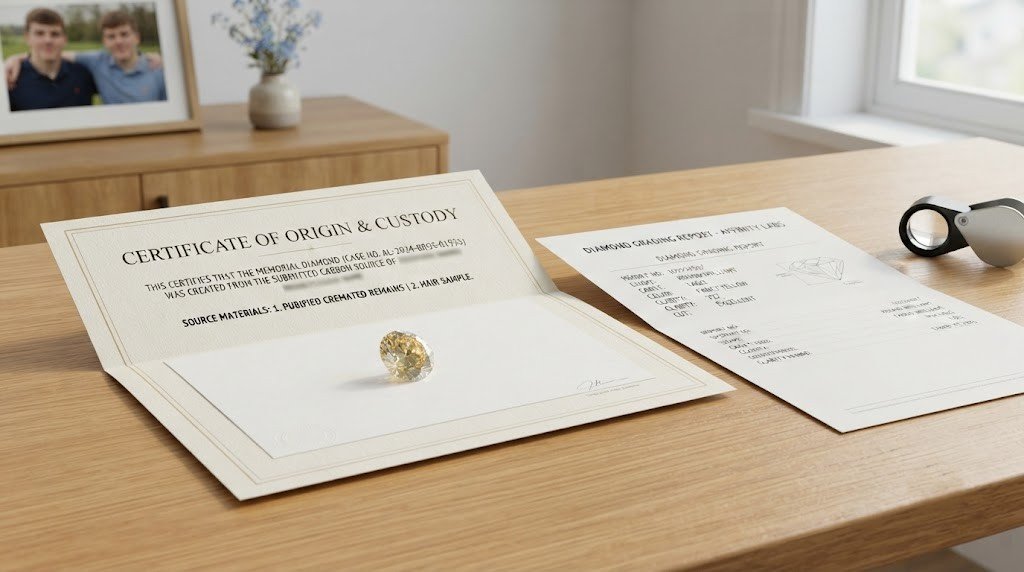
Some questions to turn over:

  • Will you wear it daily, on special occasions, or keep it close in a drawer or box?
  • Do you want a tone people notice, or one that reads quietly against your skin and clothes?
  • Is there a color that already belongs to your memories of him, from a jacket, a car, a coastline, or a favorite season?
  • Would you prefer to accept whatever natural tone emerges and let that be part of the stone’s story?

When more than one relative wants a stone, each can choose a different brother hair diamond color. A sibling might keep a natural blue in a pendant while a parent chooses colorless for a ring. A provider can tell you whether several stones from one lock of hair are possible and how the pricing and grading would work for each.

When you speak with a provider, ask whether the finished stone comes with an independent grading report, ideally referencing standards such as GIA’s diamond quality factors, and how that differs from the in-house origin certificate that documents chain of custody. Clarity for memorial diamonds typically falls between SI2 and VVS, and the grading report is where the brother hair diamond color is formally recorded. If you are also considering a blend, the post on color for a stone made from his ashes and hair together covers that combination.


Frequently Asked Questions

Will blond or dark hair change the color of the diamond?

No. Purification removes everything in the hair that is not carbon, leaving carbon of roughly 99.9% purity or higher. The finished stone’s tint comes from trace elements such as nitrogen and boron present during growth, not from the shade of his hair.

Does hair produce a more predictable brother hair diamond color than ashes?

There is no published evidence that it does. Hair holds more carbon by weight, so less is needed, but stones from hair still typically come out yellow, blue, or champagne, and no provider can predict the exact shade in advance.

How much more does a colorless diamond from hair cost?

Colorless typically carries a meaningful premium over yellow, blue, or champagne at the same carat weight, because nitrogen and boron must be excluded. In the 0.5 to 1 carat range, industry prices run about $5,000 to $15,000, with colorless near the top.

Can a hair diamond be made in red, pink, green, or black?

Yes, if the provider offers irradiation, a treatment applied after growth that can create red, pink, green, or black tones. Not every provider offers every shade, a black stone can stretch the process to about 12 months, and the paperwork should note the treatment.

Does the amount of hair I send affect the brother hair diamond color?

No. Color depends on trace elements present during growth, and carat size depends mainly on growth time. Providers typically ask for a small lock or a few grams, and requirements vary, so confirm the amount before collecting or sending anything.

Should the color match what he would have worn?

It can, but it does not have to. Some people choose a shade linked to a memory of him, others choose what suits their own wardrobe. Any color, from blue to pink to colorless, can honor him equally well.

Final Thoughts on Brother Hair Diamond Color

A small lock of hair can feel almost too fragile to hold so much meaning, and yet it carries enough carbon to become a genuine diamond. The brother hair diamond color that emerges will be shaped by chemistry no one can fully script, whether that is a soft yellow, a cool blue, a warm champagne, or a colorless stone you chose on purpose. Whatever the result, it will have grown, in real part, from him.

Learn More About Color in Hair Diamonds

Talk With Memorial Diamond

Whenever you feel ready, Memorial Diamond is here to talk through what his hair could become, including the color options worth considering and the questions to settle first. Visit memorialdiamond.us to start the conversation, with no pressure to decide anything today.