
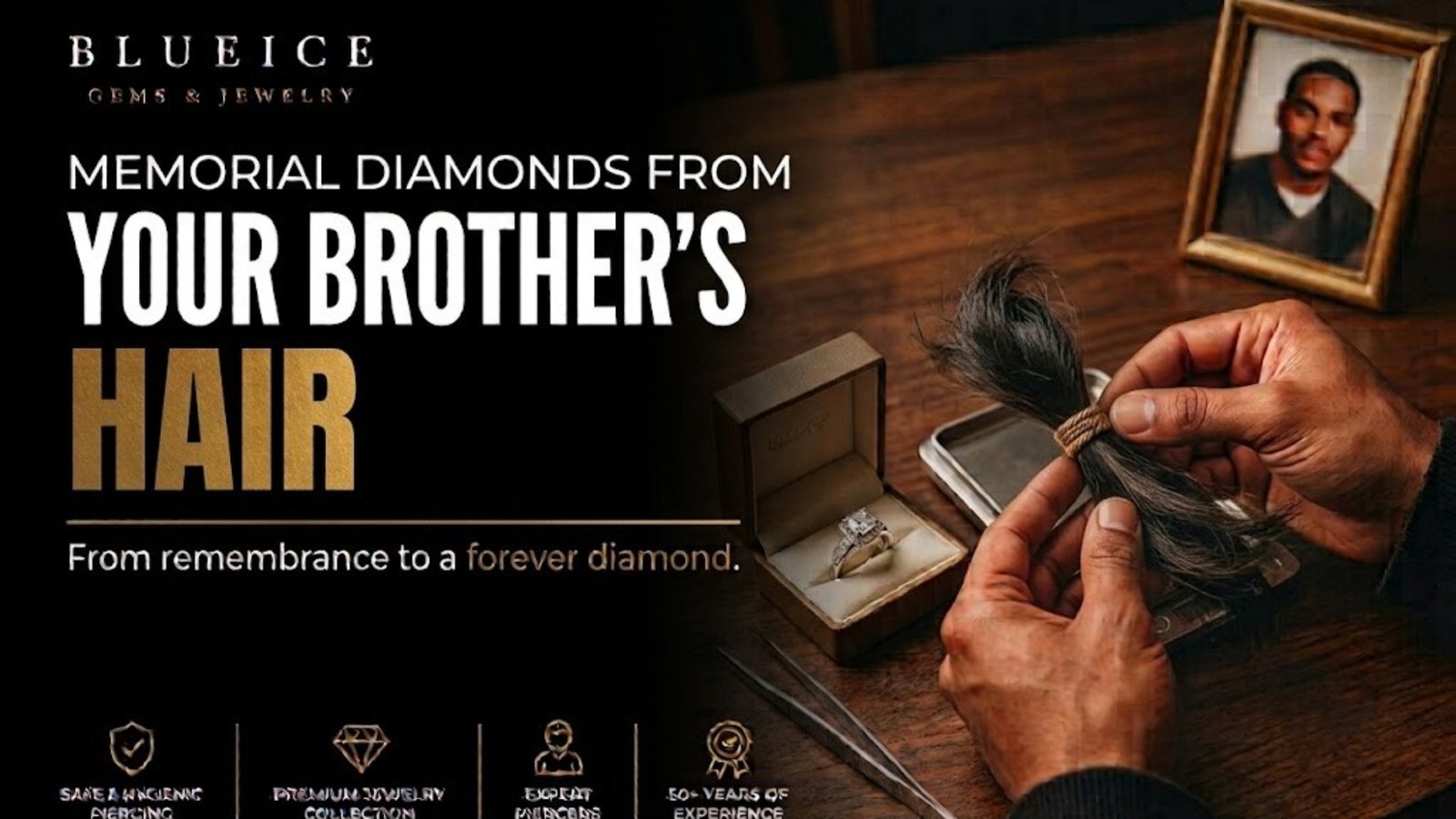
A lock of his hair, tucked in an envelope or saved in a keepsake box, can feel like the smallest thing he left behind. A memorial diamond made from brother hair moves through seven lab stages: intake, carbon extraction, graphitization, HPHT or CVD growth, cutting, optional irradiation, and grading. No cremation is involved at any point, only a small lock is needed, and the industrytypical span is 6 to 10 months.
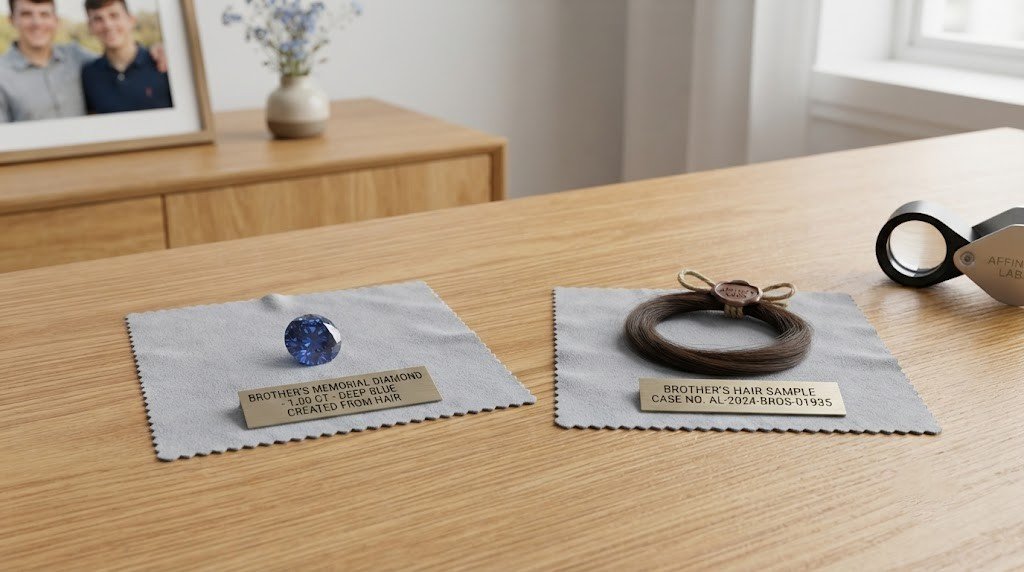
Table of Contents
Why Does a Diamond Made From Brother Hair Never Involve Cremation?
Hair is a carbon source in its own right. Each strand is mostly keratin, a protein dense with carbon, so around half of a lock’s weight is carbon. That means a lab can recover carbon for a diamond made from brother hair directly from the hair itself, with no need for the body to be cremated first and no need for any cremated remains at all.
This matters in practical ways. A diamond made from brother hair is possible whether he was buried, cremated, or laid to rest some other way, and whether or not his ashes are within your reach. If he was buried before anyone thought of a diamond, a lock kept from an earlier haircut, or one the funeral home trimmed before the burial, can still be enough, provided the people responsible for his remains or estate agree.
It can matter for faith reasons too. No tradition has an official position on memorial diamonds specifically, and practices vary widely. Where a family’s concern is with cremation itself, a stone made from brother hair does not involve it, but your own faith leader remains the right person to ask. For a wider view of hair as a starting point, see our complete guide to a brother hair diamond.
What Are the Seven Lab Stages for a Diamond Made From Brother Hair?
The sequence is the same one labs follow for any memorial stone, but several stages look different when the starting material is hair. This table tracks a memorial diamond made from brother hair through each stage, with what changes because it is hair and one question you might raise at that point.
| Stage | What is different because it is hair | A question worth asking |
|---|---|---|
| 1. Intake and chain of custody | A small lock or a few grams arrives, often in an envelope or small bag, and is logged under his order | How will his hair be labeled and stored? |
| 2. Extraction and purification | Oxygenfree heating drives off the noncarbon parts of keratin; there is no bone mineral to remove | How much of what I send will you actually use? |
| 3. Graphitization | His refined carbon, at roughly 99.9%+ purity, is heated to about 2,5002,700°C and becomes graphite | Is his carbon kept separate at every handling step? |
| 4. Diamond growth | The graphite, typically blended with supplemental lab carbon, grows on a diamond seed in an HPHT press (CVD at a minority of labs) over weeks to months | Which growth method do you use? |
| 5. Cutting and polishing | The rough crystal is faceted into the shape you chose; nothing here differs from an ashbased stone | Which cuts do you offer, and which cost extra? |
| 6. Optional irradiation | Available on request to shift or deepen color | Which colors can irradiation produce? |
| 7. Grading and certificates | An origin certificate and, ideally, an independent grading report | Is independent grading included in the price? |
The order never changes, though the time spent in each stage does, and providers generally publish only the overall timeline. If you would like to compare this path with the ash route, our post on how a memorial diamond is made from your brother’s ashes follows the same seven stages from cremated remains.
Where Can the Hair Come From, and Who Should Agree?
Hair for a diamond made from brother hair usually comes from one of a few places:
- A lock saved by a funeral home before burial or cremation, usually released through whoever holds authority over his remains
- Hair kept from an earlier haircut, sometimes years old
- Strands gathered from his brush, comb, or a hat he wore often
- A keepsake lock already held by a family member
Where the hair comes from shapes whose agreement you need. A sibling often does not hold authority over his remains: commonly a spouse or registered partner, adult children, and parents come first, though each state sets its own order. Paperwork he signed while alive, whether it appointed someone to decide or laid out his funeral arrangements, may shift that responsibility to a specific person. A funeral home will generally release a trimmed lock through that person.
A lock found in his home, or among his things, may be treated as part of his estate, and state rules differ, so speak with whoever is handling his estate before sending it. If you are not the person with authority, a gentle conversation asking for a few strands for a stone made from brother hair can open the door. Our guide to how much hair a brother memorial diamond needs can help you explain how little you are asking for.
What Happens to His Hair on the Day It Arrives?
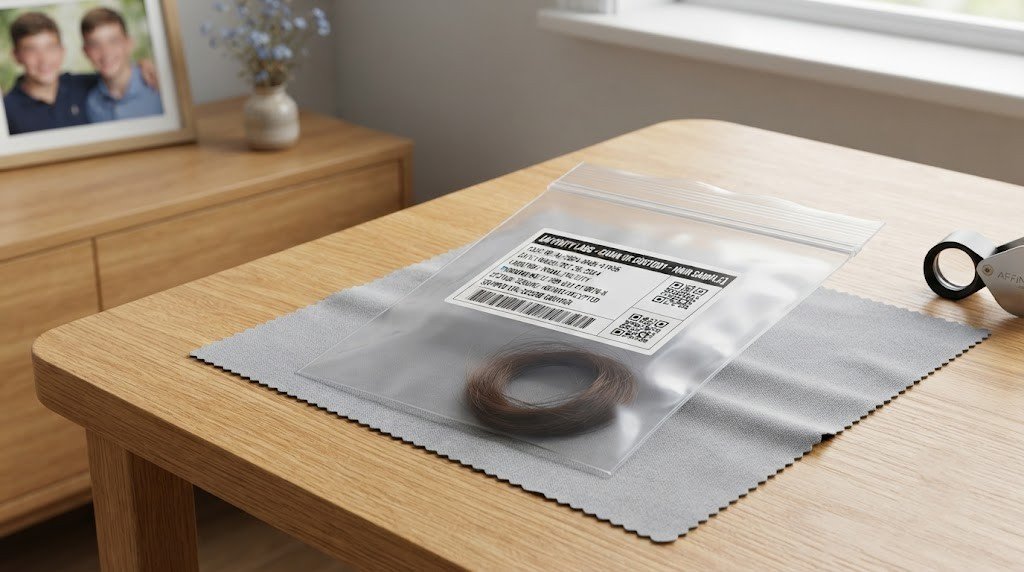
Intake is where the lab’s care begins, and for hair it is a quieter, smaller moment than you might picture. A careful provider will typically open the package, check the paperwork, weigh the hair, and record it under a unique reference tied to his order. Ask how his hair is stored after that, and whether it is kept sealed and apart from other families’ material.
For a stone made from brother hair, that logged reference is the first link in the chain of custody, the documented record that follows his material through every later step. It is what allows a lab to say, at the end, that a specific diamond made from brother hair was grown from what you sent. Ask how that record works before shipping, and whether you will be told when his hair moves from one stage to the next.
Because only a small amount is needed, you may have hair left over. Policies on leftover material are set by each provider, so ask whether unused hair can be sent back, held for a later stone, or handled another way, and make your wishes known before you ship.
How Does Hair’s Carbon Content Change Extraction?
Extraction is where hair and ashes part ways most clearly. Cremated ashes are mostly calcium phosphate, the mineral of bone, with carbon making up only around 0.5% to 4% of their weight. Hair, at roughly 50% carbon, is close to the opposite: half of what you send is already carbon, bound up in protein rather than locked inside mineral.
That shift changes the job. With ash, the lab is separating a little carbon from a lot of bone mineral, which is why a few tablespoons or more are typically requested. With hair, the task is driving off the other half of the keratin, so a far smaller quantity yields usable carbon. That is why a diamond made from brother hair typically starts from just a few grams, roughly what fits in the palm of a hand, though each provider sets its own minimum.
The method itself is similar in spirit. The hair is heated in a controlled, oxygenfree, multistage process, so the carbon does not simply burn away, and the noncarbon parts of the protein are stripped out. Successive stages refine the result until it reaches roughly 99.9% carbon purity or higher. At the end, the material for a diamond made from brother hair is a small, dark portion of refined carbon, still logged under his reference.
What Turns His Carbon Into Graphite?
Refined carbon on its own is not the ideal feedstock for a growth press. The press works best with graphite, the stable, layered crystal form of carbon. So the lab heats his carbon a second time, to around 2,5002,700°C, and the atoms settle into flat, stacked sheets.
It can help to know that graphite and diamond are the same element in two arrangements. In graphite, the carbon atoms sit in sheets; in diamond, they lock into a rigid threedimensional lattice. Graphitization prepares the carbon for that second rearrangement.
At this point, the carbon meant for a diamond made from brother hair is graphite, sealed and tracked, and ready to be loaded into a growth cell. This stage works the same way for hair as it does for ashes.
How Does a Stone Made From Brother Hair Grow in the Press?
Most memorial providers use HPHT, high pressure and high temperature. His graphite, typically blended with supplemental labsourced carbon to reach the volume growth requires, is packed into a cell with a tiny diamond seed. The press holds the cell at roughly 68 GPa and 1,4002,500°C, and carbon gradually crystallizes onto the seed, building a rough diamond.
A minority of labs use CVD, chemical vapor deposition, where his carbon is turned into a gas that settles, layer by layer, on a seed plate held in a vacuum chamber. Either method creates a genuine diamond; Wikipedia’s article on how synthetic diamonds are grown describes both in detail.
Growth lasts weeks to months, and this is where carat size is chosen. Size depends on how long the crystal grows, not on how much hair you supplied, so a thicker lock does not make a stone made from brother hair larger or faster. Memorial stones are generally offered from around 0.10 carats to 5 carats or more.
Color takes shape here as well. Nitrogen during growth tends to give yellow, boron gives blue, and colorless needs both excluded, which adds processing and usually cost. Memorial stones commonly trend yellow, blue, or champagne, and the exact shade of a diamond made from brother hair cannot be predicted from the hair beforehand. Our post on the color of a brother hair diamond explains the chemistry more fully.
How Much of the Finished Diamond Is His Carbon?
This deserves a straight answer. A diamond made from brother hair is not made entirely of his carbon. Even with hair’s high carbon content, the recovered carbon is typically blended with supplemental lab carbon so the crystal can grow to the size you select.
No finishedstone percentage is published for hair. The figure you may see quoted, ashderived carbon making up roughly 1015% of a finished stone’s mass, applies to cremated ashes only, and it should not be borrowed for hair. The honest position is that a real portion of his carbon becomes part of the crystal lattice, and the share depends on the provider and the stone.
So ask directly what share of a stone made from brother hair the lab expects for your chosen carat, and how they document it. A provider that answers clearly, without claiming the stone is entirely him, is showing the kind of candor you want throughout. If that question is on your mind, our post asking whether a memorial diamond is really made from your brother’s hair looks at it closely.
What Happens Between the Rough Crystal and the Finished Stone?
A rough crystal made from brother hair, fresh from the press, has an uneven, slightly frosted surface and a shape set by growth rather than design. A cutter maps it, plans the facets, and then cuts and polishes it into your chosen shape, perhaps round, oval, cushion, or princess. Fancy cuts are commonly an added cost.
Next comes an optional step: postgrowth irradiation, which some labs offer to shift or intensify color. It is the route to red, pink, green, or black memorial stones. If you prefer the tone that formed naturally, you simply skip it.
What emerges is a finished diamond made from brother hair, rated 10 on the Mohs hardness scale. That makes it very durable for daily wear, although a sharp blow at the wrong angle can still chip any diamond.
Which Documents Come Back With a Diamond Made From Brother Hair?
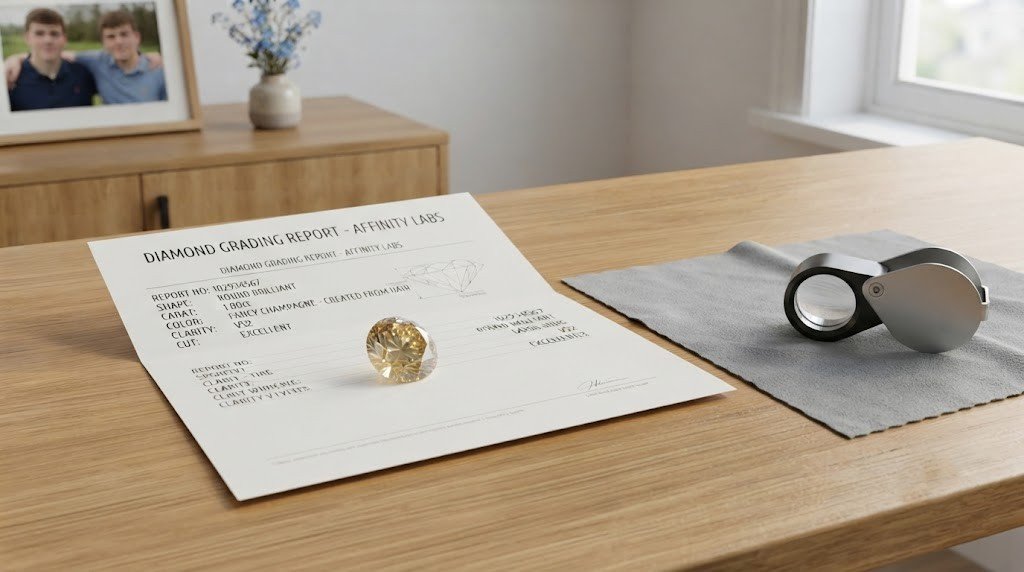
Two kinds of paperwork typically accompany the stone. The first is an origin or authenticity certificate, usually issued by the lab itself, confirming the diamond was grown from the material your family submitted. It closes the chain of custody that began when his hair was logged.
The second is a grading report covering the diamond’s cut, color, clarity, and carat, the same quality factors GIA uses for every diamond. The strongest version is prepared by an independent gemological lab that follows GIA or IGI standards. Clarity for a memorial stone made from brother hair typically falls between SI2 and VVS.
One document speaks to whose carbon is in the stone; the other speaks to the stone’s quality. For a diamond made from brother hair, it is worth asking whether both are included or whether independent grading is billed separately.
How Long Does It Take, and What Shapes the Price?
Industrywide, a memorial diamond made from brother hair typically takes 6 to 10 months from receipt of his hair to the finished stone, and larger stones of around 2 carats or more, or specialty colors, can take up to about 12 months. Labs seldom publish how long any one stage lasts, so plan around the overall range.
Price is driven mainly by carat, color, and cut. As general 2026 industry ranges, not this brand’s published prices, stones of roughly 0.100.25 ct run about 1,5003,500, and stones of 0.51 ct about 5,00015,000, with colorless near the upper end. Large stones of 25+ ct can reach 20,00075,000 or more. Grading, engraving, fancy cuts, and settings are usually extra. Our post on what a brother memorial diamond costs breaks this down further.
Because size comes from growth time, the carat you pick for a stone made from brother hair shapes both the wait and the cost far more than the amount of hair you send.
What Should You Ask Before His Hair Leaves Your Hands?
A clear picture of how a stone is made from brother hair makes your questions sharper. Before sending anything for a diamond made from brother hair, consider asking:
- How should the hair be packaged, and do you have shipping instructions or a preferred carrier?
- How much hair do you need, and what happens to any you do not use?
- Is his hair processed on its own, separate from all other orders?
- Will I receive an update as his material enters each stage?
- What happens if a growth run does not produce a usable crystal?
- Is an independent grading report included, or is it an added cost?
Our fuller list of questions to ask before turning your brother’s hair into a diamond covers settings, engraving, and insurance as well. A good provider will answer each one patiently and in plain language.
Frequently Asked Questions
Can a diamond be made from brother hair if he was buried?
Yes. Hair is roughly 50% carbon and needs no cremation, so a lock saved before burial, from a past haircut, or from his brush can be used. Hair from his home may belong to his estate, depending on state rules.
How much hair does the lab typically need?
Industry guidance typically points to a modest lock, a few grams in all. Because hair is so much richer in carbon than ashes, far less material is required. Exact amounts vary by provider, so confirm the figure before sending anything.
Does old hair still work for a memorial diamond?
Hair saved years ago may still be usable, since the lab is recovering its carbon, but condition, quantity, and how it was stored can matter. Describe the hair to the provider and ask whether it suits their process before sending it.
Is a diamond made from brother hair entirely his carbon?
No. His recovered carbon is typically blended with supplemental lab carbon so the crystal can reach the size you choose. No finishedstone percentage is published for hair, so ask the provider what share they expect and how they document it.
Will hair give a lighter or more predictable color than ashes?
No. Color comes from trace elements such as nitrogen and boron present during growth, and the exact shade cannot be predicted from the source. Memorial stones commonly trend yellow, blue, or champagne, while colorless needs extra processing and costs more.
Who can authorize sending his hair to a lab?
It depends on where the hair comes from. A funeral home generally releases hair through whoever holds authority over his remains, and hair among his belongings may belong to his estate. State rules vary, so check with the authority holder or executor.
Final Thoughts on a Diamond Grown From His Hair
Sending something as personal as his hair to a lab is easier when the work inside it is no longer a mystery. A memorial diamond made from brother hair asks for very little of what he left, leaves his resting place untouched, and returns a stone whose origins you can trace and question at every turn. Whether you go ahead now, later, or not at all, knowing the process means the choice stays yours.
Learn More About the HairtoDiamond Process
- Brother Hair Diamond: The Complete Guide every hairrelated question in one overview
- How Much Hair Do You Need for a Brother Memorial Diamond? quantities and where to find them
- How a Memorial Diamond Is Made From Your Brother’s Ashes and Hair when both materials go into one stone
- Is a Memorial Diamond Really Made From Your Brother’s Hair? the honest answer on carbon share
Talk With Memorial Diamond
If you are holding onto a lock of his hair and wondering what it could become, Memorial Diamond is glad to talk through a diamond made from brother hair with you, from what to send to what each lab stage would involve. Reach out at memorialdiamond.us whenever the time feels right.
Word count: 3,115 words · Reading time: about 16 minutes
Leave A Comment