
A lock of your brother’s hair, tucked in an envelope or handed over by the funeral home, can seem far too slight to carry a promise as large as “this diamond is him.” It can carry it, within honest limits. A diamond really made from brother hair is a genuine lab-grown diamond grown partly from carbon extracted from his hair, which is roughly 50% carbon by weight. Supplemental lab carbon is typically blended in, and no industry figure is published for how much of a finished hair-based stone is his.
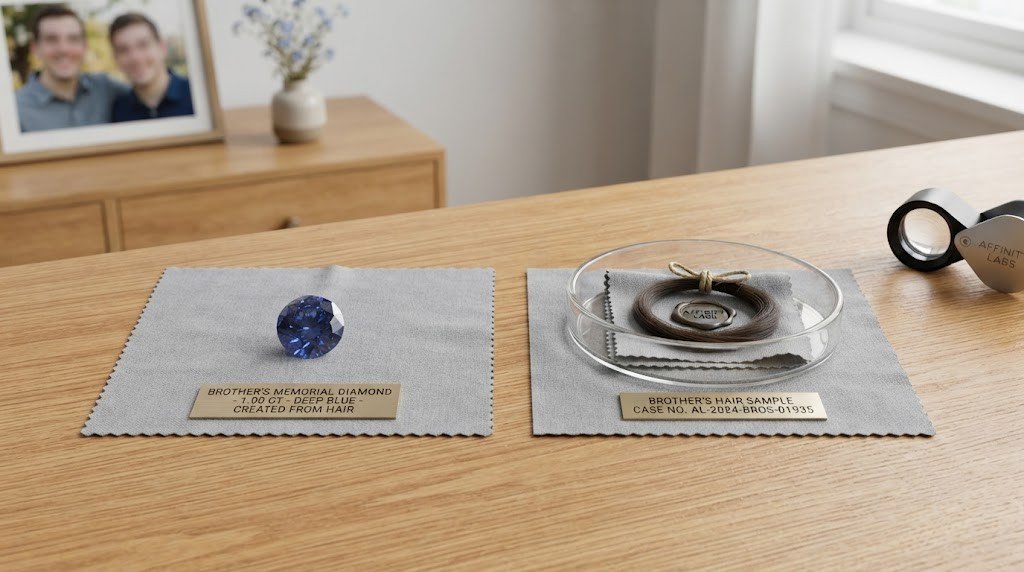
Table of Contents
Is a Diamond Really Made From Brother Hair an Actual Diamond?
Yes. Of all the doubts about whether a gem is really made from brother hair, this one has the firmest answer. The stone is crystalline carbon arranged in the same lattice as a mined diamond, so it shares the same hardness, sparkle, and durability. It is grown in a laboratory, which describes where it formed rather than what it is. Nothing about it is a coating, an imitation, or a capsule holding strands of hair.
The memorial part comes from the feedstock. A provider takes the carbon locked inside his hair, cleans away everything else, and feeds that carbon into the growth process alongside a controlled lab supply. A stone really made from brother hair therefore holds carbon that was once part of him, bonded into the crystal itself.
What it does not hold is every atom from him. That distinction is the heart of the honest answer, and it is worth understanding before you speak with any company. If you want the wider picture first, our complete guide to a brother hair diamond lays out the whole option from start to finish.
Why Is Hair Such a Rich Source of Carbon?
Hair is built mostly from keratin, a protein whose structure leans heavily on carbon. By weight, hair is roughly half carbon, which is a striking figure next to cremated remains, where usable carbon runs at only about 0.5% to 4% because bone mineral makes up the bulk.
That difference shapes what ordering a diamond really made from brother hair involves. Where an ash stone calls for tablespoons of remains, a hair stone usually starts from a single modest lock weighing just a few grams. Hair also does not depend on cremation at all, which matters if your brother was buried or if his ashes are held by someone else.
| Feature | His hair | His cremated ashes |
|---|---|---|
| Carbon by weight | About 50% | About 0.5%–4% |
| Amount usually asked for | One small lock, or a few grams | Several tablespoons up to roughly 4 oz (\~100 g) |
| Requires cremation | No | Yes |
| Published share of finished stone | None published | Around 10–15% for ash (some cite \~3%) |
| Lab carbon typically blended in | Yes | Yes |
Higher carbon content does not make a stone really made from brother hair more of a diamond than an ash stone. It simply means less starting material is needed to recover a meaningful amount of his carbon.
How Much of a Stone Really Made From Brother Hair Is Him?
This is where honesty matters more than reassurance. For ashes, the industry cites a rough figure: ash-derived carbon typically makes up around 10–15% of the finished stone. For hair, no comparable finished-stone percentage has been published, so anyone quoting a precise industry-wide number for hair is going beyond the available data.
What you can do is ask any provider of a stone really made from brother hair directly. A credible company should be able to tell you, in writing, how much of his hair they will process, roughly how much purified carbon they expect it to yield, and how that carbon relates to the total feedstock for the carat you have chosen. A specific, modest, explained figure is a better sign than a confident number with no reasoning behind it.
Keep the frame in mind: the crystal being only partly his carbon does not make a diamond really made from brother hair any less his. The carbon that came from him is recorded, purified, and grown in, and that is a physical fact rather than a sentiment.
Why Is Lab Carbon Added to a Diamond Really Made From Brother Hair?
It is a fair challenge. If half of his hair is carbon, why would a provider need anything else? The answer lies in what diamond growth demands. A growth cell needs a steady, sufficient volume of extremely pure carbon to form a stable crystal of a wearable size, and the carbon from a small lock, once purified, is still a modest quantity.
Supplemental lab carbon is typically blended in to reach that working volume. Think of it as the bulk that allows his carbon to be part of a crystal large enough to cut and set. It is the ordinary practice across the category rather than a shortcut.
Size works the same way regardless of how much hair you send. Carat is governed mainly by how long the crystal stays in the press, not by the quantity of material supplied, so mailing an extra lock does not produce a larger stone really made from brother hair. You choose the carat at the outset, and the growth time follows from that choice.
What Happens to His Hair on the Way to Becoming a Diamond?
Every stage of producing a diamond really made from brother hair is a chance for a provider to show its record-keeping, so it helps to know the sequence. The broad steps are shared across the industry:
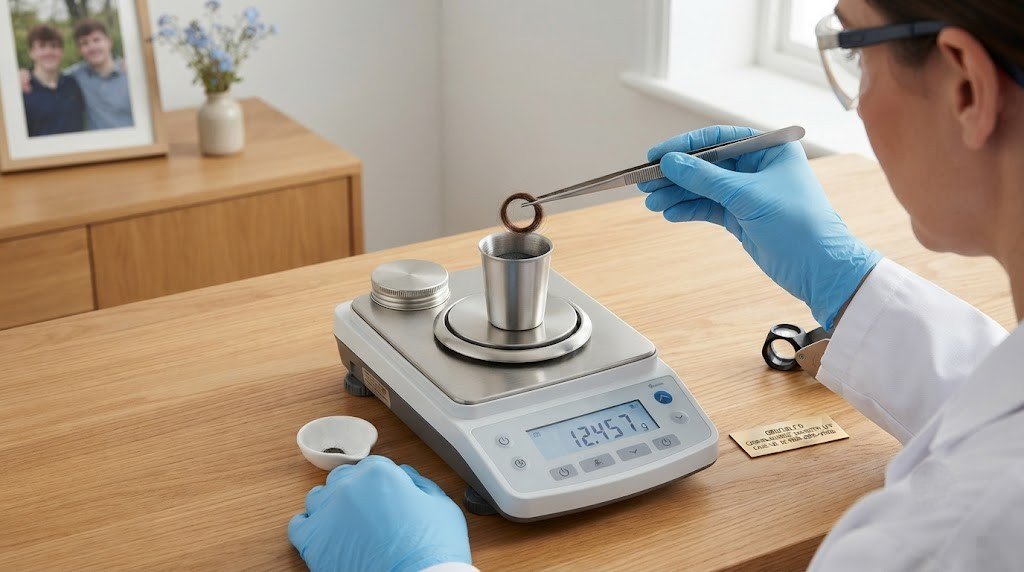
- Intake. His hair is received, weighed, photographed where offered, and assigned an identifier that should follow it through every later step.
- Carbon extraction and purification. Controlled heating without oxygen, in several stages, removes the non-carbon parts of keratin and leaves carbon at roughly 99.9%+ purity.
- Graphitization. The purified carbon is heated to around 2,500–2,700°C and becomes graphite, the form diamond presses use as feedstock.
- Growth. The graphite, typically blended with lab carbon, is placed beside a tiny seed crystal and grown under HPHT pressure of about 6–8 GPa at temperatures of 1,400–2,500°C, a stage lasting weeks to months. A minority of providers use chemical vapor deposition instead.
- Cutting and polishing. A gemologist turns the rough crystal into the shape you picked.
- Optional irradiation. Some providers offer this to shift or deepen color.
- Grading and documentation. The finished stone is assessed, ideally by an independent lab, and paired with an origin certificate.
For the full narrative of each stage, read how a memorial diamond is made from brother hair. If you are still at the planning stage, our walk-through on how to turn your brother’s hair into a diamond starts from the first conversation.
Where Can His Hair Come From, and Who Has to Agree?
Where the hair came from is part of proving a stone is really made from brother hair, and it is also a question of consent. A lock trimmed at the funeral home is generally handed on only with the say-so of the person entitled to decide about his remains. If you are his sibling, that person may not be you. Priority commonly rests with a spouse or registered partner, adult children, or parents before a sibling, though the exact ranking is decided state by state. Instructions he recorded himself, whether he chose a decision-maker in advance or settled his own arrangements before his death, can also move the decision to someone else.
Hair you already have at home, or hair found among his belongings, raises a different point. It may form part of his estate, and the rules vary by state, so it is wise to talk with whoever is handling his affairs before sending it anywhere. Nobody wants a meaningful gesture to become a source of family friction.
If someone else holds authority, a gentle request usually works better than a workaround. Explaining that a stone really made from brother hair typically needs only a small lock often makes the conversation easier. Our guide to how much hair a brother memorial diamond needs covers quantities in more detail, so you know exactly what you are asking for when you ask.
What Proof Shows a Diamond Is Really Made From Brother Hair?
The finished diamond cannot speak for itself. Purification leaves almost nothing but carbon, so there is no standard test that links a finished stone to one particular person’s hair. A lab can confirm it is a lab-grown diamond and measure its quality, yet the question of origin is answered by records, not by testing. That makes paperwork the real evidence that a stone is really made from brother hair.
Two documents do two separate jobs:
- The origin certificate is usually issued by the provider and states that the diamond was grown from the material submitted under your order. Its strength depends entirely on the chain of custody behind it.
- The independent grading report comes from a third-party lab and describes the stone’s cut, color, clarity, and carat. The GIA explanation of the diamond quality factors shows what those terms mean. This report confirms quality, not origin.
Questions worth asking before you order a diamond really made from brother hair:
- How is his hair tracked from the moment it arrives, and may I see a sample tracking record?
- Is each family’s material processed separately, and how is that confirmed?
- How much of his hair will you use, and what happens to any you do not use?
- What share of the finished stone do you expect to come from his hair at the carat I want?
- Is an independent grading report included, or priced separately?
For a longer checklist, see the brother hair diamond questions worth raising before you choose. Clear, documented answers are what turn a diamond really made from brother hair from a claim into something you can confirm.
Which Promises About a Stone Really Made From Brother Hair Deserve Doubt?
Some marketing language leans on grief rather than facts. None of the promises below proves wrongdoing by itself, but each deserves a polite follow-up.
- “100% him.” Supplemental lab carbon is typically part of the blend, even with carbon-rich hair, so total purity is not how the process usually works.
- A precise percentage for hair presented as an industry standard. No such figure is published; a provider can give its own estimate, with reasoning.
- “Hair gives a lighter or more predictable color.” The exact shade cannot be predicted from the source, whether hair or ashes.
- “Send more hair for a bigger diamond.” Carat depends mainly on growth time.
- A certificate with no lab named. Origin paperwork is useful, but quality claims should rest on an independent report.
- A deadline that feels invented. Choosing what happens to his hair deserves unhurried attention.
A provider selling a stone really made from brother hair should welcome these questions, because honest answers are its strongest selling point.
What Should You Expect to Pay and to Wait?
Cost and time are part of judging any claim about a diamond really made from brother hair, since a real growth process involves specialized equipment and months of work. These are general 2026 industry ranges, not memorialdiamond.us’s published prices:
| Size | Industry price range | Worth knowing |
|---|---|---|
| Roughly 0.10–0.25 ct | About 1,500–3,500 | A small, wearable size for everyday pieces |
| 0.5–1 ct | About 5,000–15,000 | Colorless stones land near the upper end |
| 2–5+ ct | About 20,000–75,000+ | Requires longer growth and tighter control |
Grading reports, engraving, fancy cuts, and settings usually add to the loose-stone price. On timing, the industry typically quotes 6 to 10 months from receipt of the hair, with stones over roughly 2 carats, or in specialty colors, sometimes needing up to about 12 months. Any quote far below these ranges for a stone really made from brother hair deserves a careful question about what is being sold. Our breakdowns of brother memorial diamond cost and the brother memorial diamond timeline go deeper.
Can You Predict the Color of a Stone Really Made From Brother Hair?
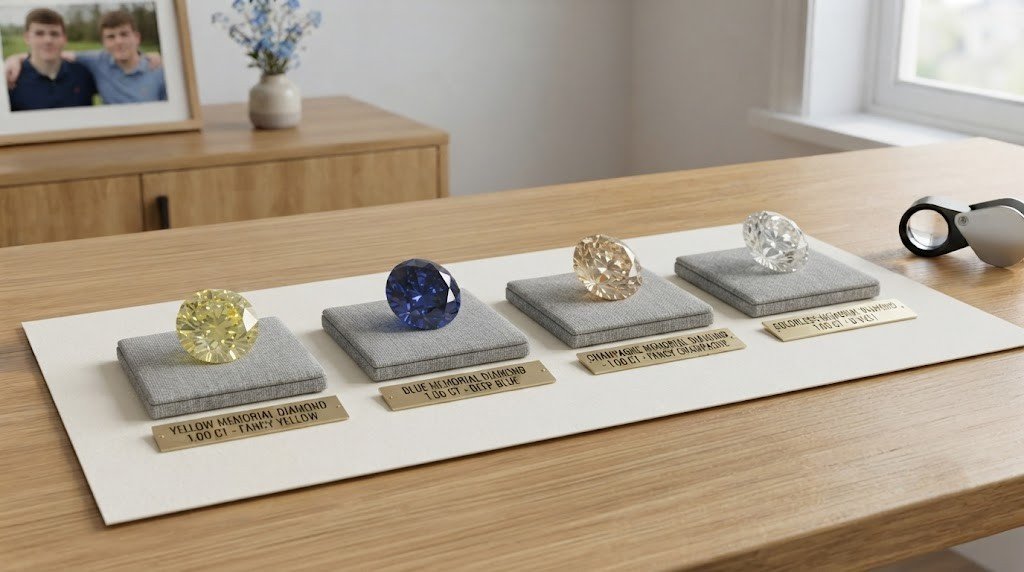
Not precisely. Color in any diamond comes from trace elements present while it grows. Nitrogen pushes a stone toward yellow, boron toward blue, and a colorless result requires keeping both out, which adds processing and usually adds cost. Memorial stones from personal carbon tend toward yellow, blue, and champagne shades, and some providers offer irradiation to produce red, pink, green, or black.
Hair does not make the color of a diamond really made from brother hair more predictable than ashes do, and no provider can tell you the exact shade in advance. What you can choose is the color direction a provider aims for. Our guide to brother hair diamond color explains those choices in depth.
Whatever the shade, the stone ranks 10 on the Mohs scale of mineral hardness, so it suits daily wear, though a sharp knock can still chip it. Clarity for memorial diamonds usually falls in the SI2 to VVS range.
Hair, Ashes, or Both: How Do the Options Compare?
Hair, ashes, and a combination of the two all yield a genuine diamond, and each relies on the same documentation for proof of origin. The differences are practical. Hair needs very little material and no cremation; ashes depend on cremation and use a small portion of the remains; a combination brings both into one project, if the provider offers it.
A diamond is also one choice among several, not a replacement for anything your family has already done. An urn, a burial, or a scattering honors him fully, and a hair-based stone can sit alongside any of them without taking anything away. For readers whose faith shapes these decisions, no tradition has an official position on memorial diamonds specifically, so a word with your own faith leader is worthwhile.
If you have both his hair and access to some of his ashes, it may help to read the matching ash question too. Either way, a stone really made from brother hair is real in the way that matters: a documented portion of his carbon, grown into a crystal you can hold.
Frequently Asked Questions
Is a diamond really made from brother hair a real diamond?
Yes. Grown in a laboratory, it shares the crystal lattice, hardness, and brilliance of any mined stone. Carbon recovered from his hair is purified and built into that crystal, typically alongside supplemental lab carbon so the stone can reach a wearable size.
How much of a stone really made from brother hair comes from him?
No industry figure has been published for hair, unlike ashes, where roughly 10–15% is commonly cited. Ask your provider for its own written estimate based on how much hair it processes and the carat you choose, along with the reasoning behind it.
Why is so little hair needed?
Hair is roughly 50% carbon by weight because it is made mostly of keratin. That concentration means a small lock or a few grams usually supplies enough of his carbon, compared with the larger quantity of cremated remains an ash stone typically requires.
Can a lab test a diamond really made from brother hair to prove its source?
Not in the way you might hope. Purification strips away nearly everything except carbon, and no standard test ties a finished stone to one person. A lab can confirm it is lab-grown and grade it; origin rests on chain-of-custody records and the origin certificate.
Do I need anyone’s agreement to use his hair?
Often, yes. Funeral-home hair is generally released through whoever holds authority over his remains, and who that is depends on the state and on any wishes he put in writing. Hair kept at home or among his things may form part of his estate, again under state rules.
Does hair produce a lighter or more predictable color?
No. Color comes from trace elements, chiefly nitrogen and boron, present while the crystal grows, so neither hair nor ashes lets anyone forecast the exact shade. Providers can aim for a color direction, and colorless stones typically require extra processing.
How long does a hair diamond take to make?
Across the industry, the process typically takes 6 to 10 months from the moment the provider receives his hair. Larger stones, above about 2 carats, or specialty colors can take up to around 12 months, because carat size depends on growth time.
Final Thoughts on Whether a Hair Diamond Is Truly His
It is reasonable to want certainty before trusting anyone with something as small and irreplaceable as a lock of your brother’s hair. The truthful answer is a careful yes: a diamond really made from brother hair is real, his carbon is genuinely part of it, and lab carbon typically fills out the rest. That is not a lesser version of the promise. It is the version you can verify, and the records are what make it trustworthy.
Learn More About Verifying a Hair Diamond
- Step-by-step: turning your brother’s hair into a diamond each stage laid out in order
- Is a memorial diamond really made from your brother’s ashes? the same honesty check for ashes
- Is a memorial diamond really made from your brother’s ashes and hair? what changes when both are combined
- Brother memorial diamond ideas: rings, pendants, and keepsakes settings in every style
Talk With Memorial Diamond
When you are ready to ask your own questions about a stone really made from brother hair, Memorial Diamond is glad to talk through what is possible for his hair. Visit memorialdiamond.us to start the conversation, at whatever pace feels right for you and your family.
Word count: 3,075 words · Reading time: about 15 minutes
Leave A Comment