Is a Memorial Diamond Really Made From Your Brother Hair

Is a Memorial Diamond Really Made From Your Brother’s Hair?

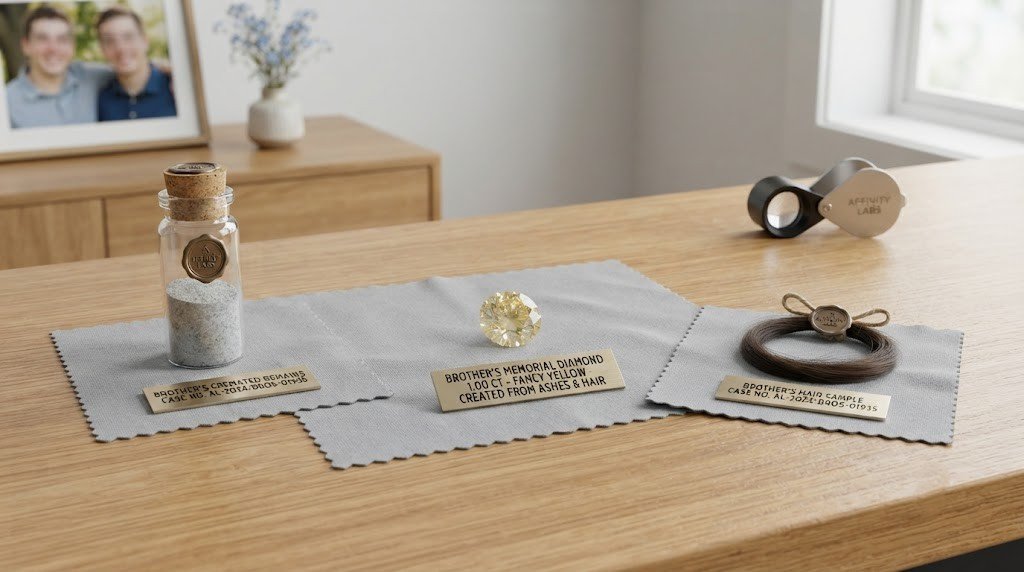
A lock of your brother’s hair, tucked in an envelope or handed over by the funeral home, can seem far too slight to carry a promise as large as “this diamond is him.” It can carry it, within honest limits. A diamond really made from brother hair is a genuine lab-grown diamond grown partly from carbon extracted from his hair, which is roughly 50% carbon by weight. Supplemental lab carbon is typically blended in, and no industry figure is published for how much of a finished hair-based stone is his.
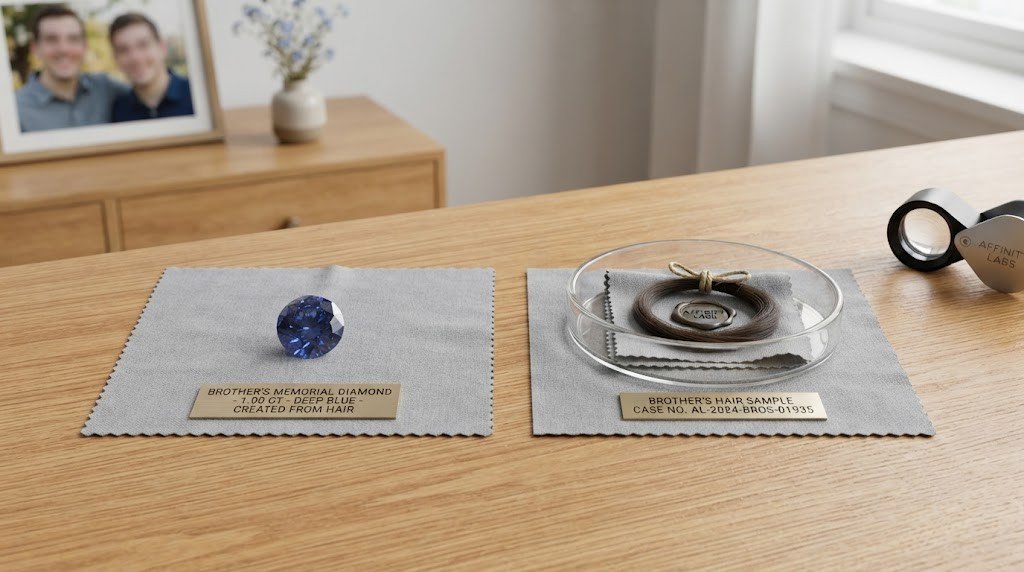
really made from brother hair

Is a Diamond Really Made From Brother Hair an Actual Diamond?

Yes. Of all the doubts about whether a gem is really made from brother hair, this one has the firmest answer. The stone is crystalline carbon arranged in the same lattice as a mined diamond, so it shares the same hardness, sparkle, and durability. It is grown in a laboratory, which describes where it formed rather than what it is. Nothing about it is a coating, an imitation, or a capsule holding strands of hair.

The memorial part comes from the feedstock. A provider takes the carbon locked inside his hair, cleans away everything else, and feeds that carbon into the growth process alongside a controlled lab supply. A stone really made from brother hair therefore holds carbon that was once part of him, bonded into the crystal itself.

What it does not hold is every atom from him. That distinction is the heart of the honest answer, and it is worth understanding before you speak with any company. If you want the wider picture first, our complete guide to a brother hair diamond lays out the whole option from start to finish.

Why Is Hair Such a Rich Source of Carbon?

Hair is built mostly from keratin, a protein whose structure leans heavily on carbon. By weight, hair is roughly half carbon, which is a striking figure next to cremated remains, where usable carbon runs at only about 0.5% to 4% because bone mineral makes up the bulk.

That difference shapes what ordering a diamond really made from brother hair involves. Where an ash stone calls for tablespoons of remains, a hair stone usually starts from a single modest lock weighing just a few grams. Hair also does not depend on cremation at all, which matters if your brother was buried or if his ashes are held by someone else.

FeatureHis hairHis cremated ashes
Carbon by weightAbout 50%About 0.5%–4%
Amount usually asked forOne small lock, or a few gramsSeveral tablespoons up to roughly 4 oz (\~100 g)
Requires cremationNoYes
Published share of finished stoneNone publishedAround 10–15% for ash (some cite \~3%)
Lab carbon typically blended inYesYes

Higher carbon content does not make a stone really made from brother hair more of a diamond than an ash stone. It simply means less starting material is needed to recover a meaningful amount of his carbon.

How Much of a Stone Really Made From Brother Hair Is Him?

This is where honesty matters more than reassurance. For ashes, the industry cites a rough figure: ash-derived carbon typically makes up around 10–15% of the finished stone. For hair, no comparable finished-stone percentage has been published, so anyone quoting a precise industry-wide number for hair is going beyond the available data.

What you can do is ask any provider of a stone really made from brother hair directly. A credible company should be able to tell you, in writing, how much of his hair they will process, roughly how much purified carbon they expect it to yield, and how that carbon relates to the total feedstock for the carat you have chosen. A specific, modest, explained figure is a better sign than a confident number with no reasoning behind it.

Keep the frame in mind: the crystal being only partly his carbon does not make a diamond really made from brother hair any less his. The carbon that came from him is recorded, purified, and grown in, and that is a physical fact rather than a sentiment.

Why Is Lab Carbon Added to a Diamond Really Made From Brother Hair?

It is a fair challenge. If half of his hair is carbon, why would a provider need anything else? The answer lies in what diamond growth demands. A growth cell needs a steady, sufficient volume of extremely pure carbon to form a stable crystal of a wearable size, and the carbon from a small lock, once purified, is still a modest quantity.

Supplemental lab carbon is typically blended in to reach that working volume. Think of it as the bulk that allows his carbon to be part of a crystal large enough to cut and set. It is the ordinary practice across the category rather than a shortcut.

Size works the same way regardless of how much hair you send. Carat is governed mainly by how long the crystal stays in the press, not by the quantity of material supplied, so mailing an extra lock does not produce a larger stone really made from brother hair. You choose the carat at the outset, and the growth time follows from that choice.

What Happens to His Hair on the Way to Becoming a Diamond?

Every stage of producing a diamond really made from brother hair is a chance for a provider to show its record-keeping, so it helps to know the sequence. The broad steps are shared across the industry:

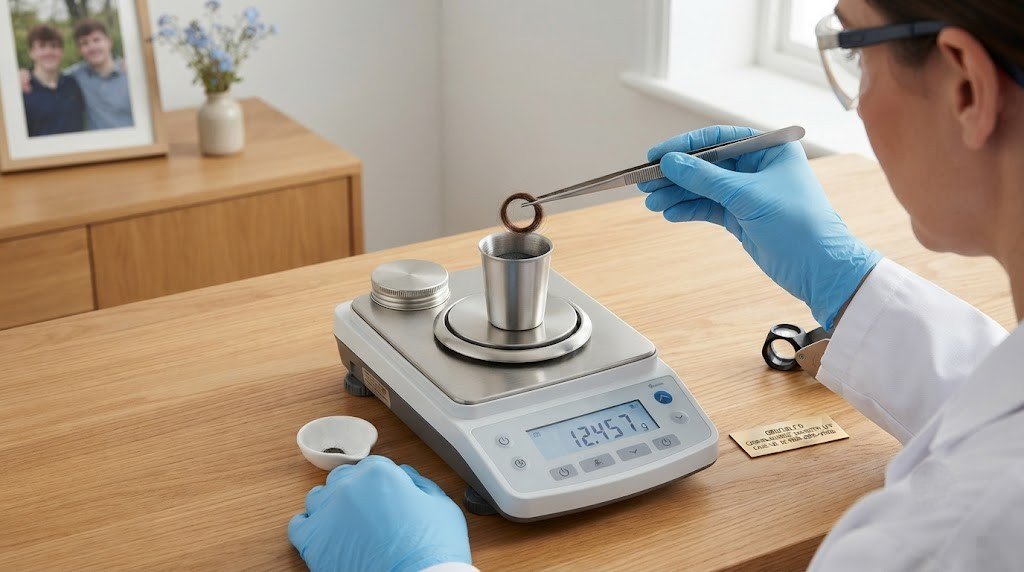
  1. Intake. His hair is received, weighed, photographed where offered, and assigned an identifier that should follow it through every later step.
  2. Carbon extraction and purification. Controlled heating without oxygen, in several stages, removes the non-carbon parts of keratin and leaves carbon at roughly 99.9%+ purity.
  3. Graphitization. The purified carbon is heated to around 2,500–2,700°C and becomes graphite, the form diamond presses use as feedstock.
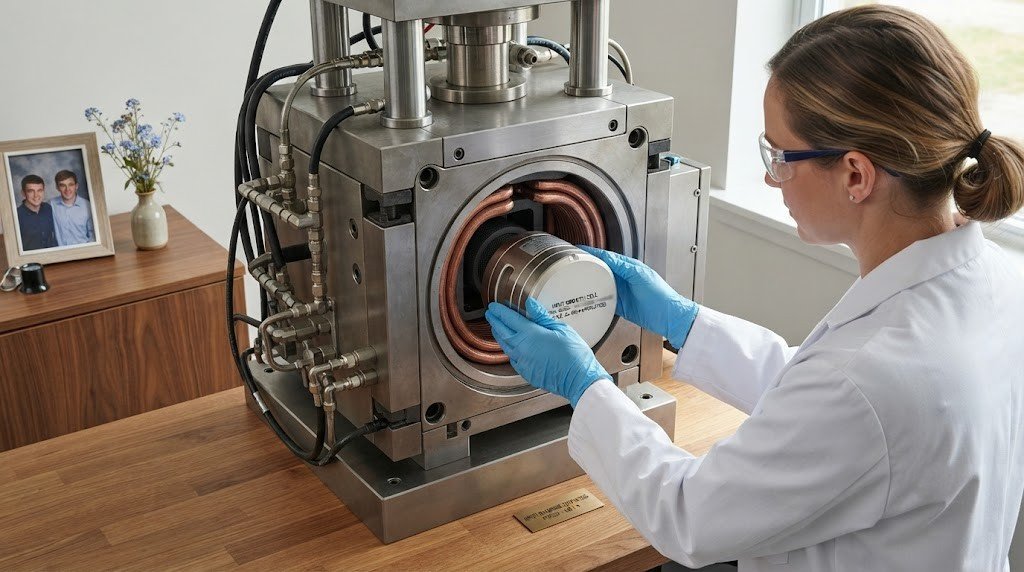
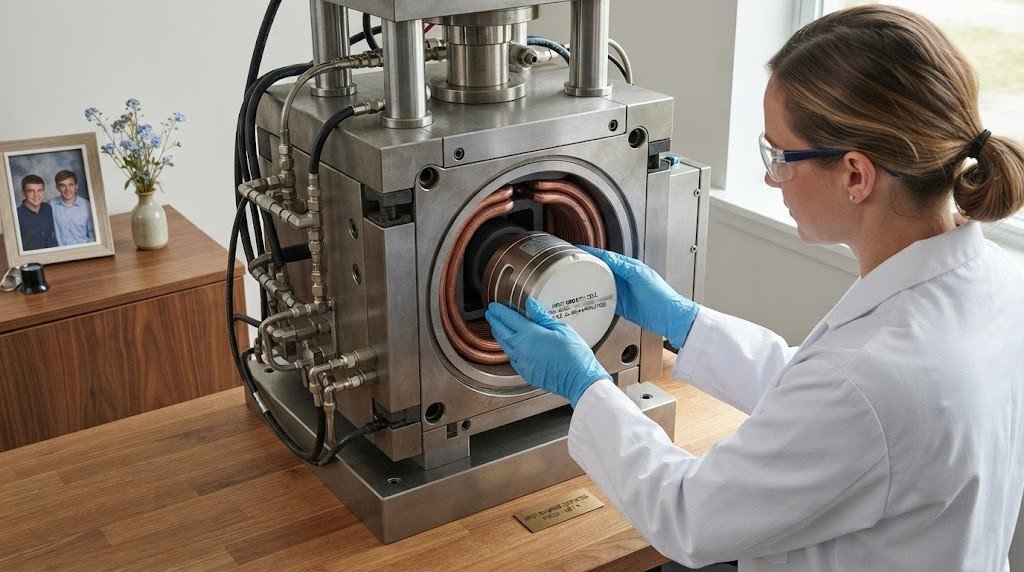
  4. Growth. The graphite, typically blended with lab carbon, is placed beside a tiny seed crystal and grown under HPHT pressure of about 6–8 GPa at temperatures of 1,400–2,500°C, a stage lasting weeks to months. A minority of providers use chemical vapor deposition instead.
  5. Cutting and polishing. A gemologist turns the rough crystal into the shape you picked.
  6. Optional irradiation. Some providers offer this to shift or deepen color.
  7. Grading and documentation. The finished stone is assessed, ideally by an independent lab, and paired with an origin certificate.

For the full narrative of each stage, read how a memorial diamond is made from brother hair. If you are still at the planning stage, our walk-through on how to turn your brother’s hair into a diamond starts from the first conversation.

Where Can His Hair Come From, and Who Has to Agree?
Where the hair came from is part of proving a stone is really made from brother hair, and it is also a question of consent. A lock trimmed at the funeral home is generally handed on only with the say-so of the person entitled to decide about his remains. If you are his sibling, that person may not be you. Priority commonly rests with a spouse or registered partner, adult children, or parents before a sibling, though the exact ranking is decided state by state. Instructions he recorded himself, whether he chose a decision-maker in advance or settled his own arrangements before his death, can also move the decision to someone else.

Hair you already have at home, or hair found among his belongings, raises a different point. It may form part of his estate, and the rules vary by state, so it is wise to talk with whoever is handling his affairs before sending it anywhere. Nobody wants a meaningful gesture to become a source of family friction.

If someone else holds authority, a gentle request usually works better than a workaround. Explaining that a stone really made from brother hair typically needs only a small lock often makes the conversation easier. Our guide to how much hair a brother memorial diamond needs covers quantities in more detail, so you know exactly what you are asking for when you ask.

What Proof Shows a Diamond Is Really Made From Brother Hair?

The finished diamond cannot speak for itself. Purification leaves almost nothing but carbon, so there is no standard test that links a finished stone to one particular person’s hair. A lab can confirm it is a lab-grown diamond and measure its quality, yet the question of origin is answered by records, not by testing. That makes paperwork the real evidence that a stone is really made from brother hair.

Two documents do two separate jobs:

  • The origin certificate is usually issued by the provider and states that the diamond was grown from the material submitted under your order. Its strength depends entirely on the chain of custody behind it.
  • The independent grading report comes from a third-party lab and describes the stone’s cut, color, clarity, and carat. The GIA explanation of the diamond quality factors shows what those terms mean. This report confirms quality, not origin.

Questions worth asking before you order a diamond really made from brother hair:

  • How is his hair tracked from the moment it arrives, and may I see a sample tracking record?
  • Is each family’s material processed separately, and how is that confirmed?
  • How much of his hair will you use, and what happens to any you do not use?
  • What share of the finished stone do you expect to come from his hair at the carat I want?
  • Is an independent grading report included, or priced separately?

For a longer checklist, see the brother hair diamond questions worth raising before you choose. Clear, documented answers are what turn a diamond really made from brother hair from a claim into something you can confirm.

Which Promises About a Stone Really Made From Brother Hair Deserve Doubt?

Some marketing language leans on grief rather than facts. None of the promises below proves wrongdoing by itself, but each deserves a polite follow-up.

  • “100% him.” Supplemental lab carbon is typically part of the blend, even with carbon-rich hair, so total purity is not how the process usually works.
  • A precise percentage for hair presented as an industry standard. No such figure is published; a provider can give its own estimate, with reasoning.
  • “Hair gives a lighter or more predictable color.” The exact shade cannot be predicted from the source, whether hair or ashes.
  • “Send more hair for a bigger diamond.” Carat depends mainly on growth time.
  • A certificate with no lab named. Origin paperwork is useful, but quality claims should rest on an independent report.
  • A deadline that feels invented. Choosing what happens to his hair deserves unhurried attention.

A provider selling a stone really made from brother hair should welcome these questions, because honest answers are its strongest selling point.

What Should You Expect to Pay and to Wait?

Cost and time are part of judging any claim about a diamond really made from brother hair, since a real growth process involves specialized equipment and months of work. These are general 2026 industry ranges, not memorialdiamond.us’s published prices:

SizeIndustry price rangeWorth knowing
Roughly 0.10–0.25 ctAbout 1,500–3,500A small, wearable size for everyday pieces
0.5–1 ctAbout 5,000–15,000Colorless stones land near the upper end
2–5+ ctAbout 20,000–75,000+Requires longer growth and tighter control

Grading reports, engraving, fancy cuts, and settings usually add to the loose-stone price. On timing, the industry typically quotes 6 to 10 months from receipt of the hair, with stones over roughly 2 carats, or in specialty colors, sometimes needing up to about 12 months. Any quote far below these ranges for a stone really made from brother hair deserves a careful question about what is being sold. Our breakdowns of brother memorial diamond cost and the brother memorial diamond timeline go deeper.

Can You Predict the Color of a Stone Really Made From Brother Hair?
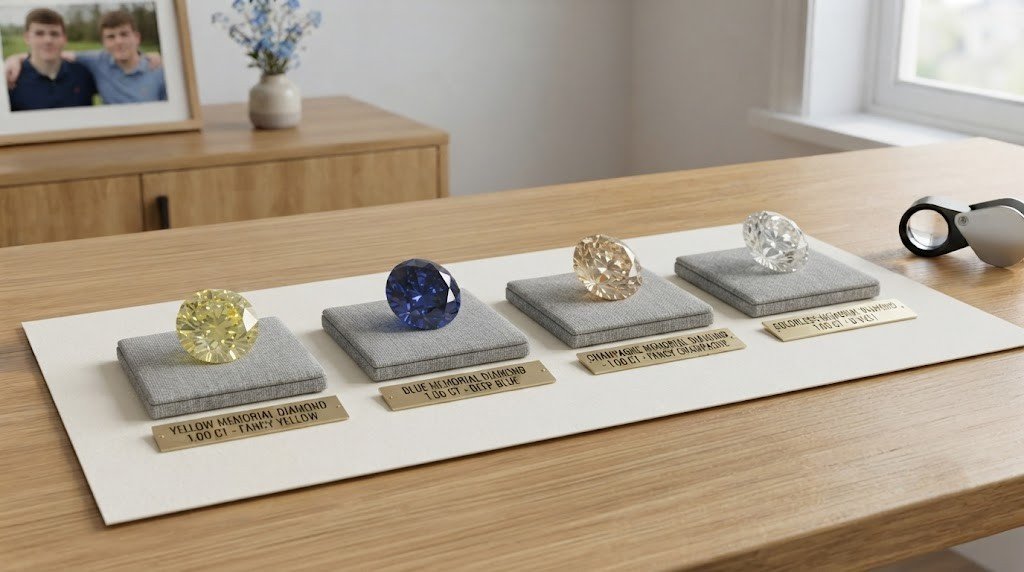
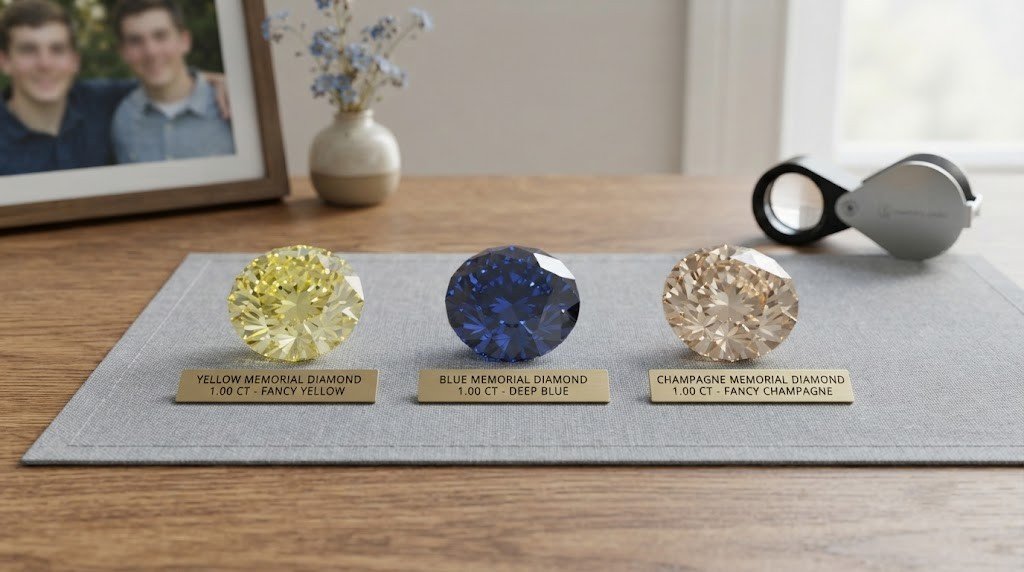
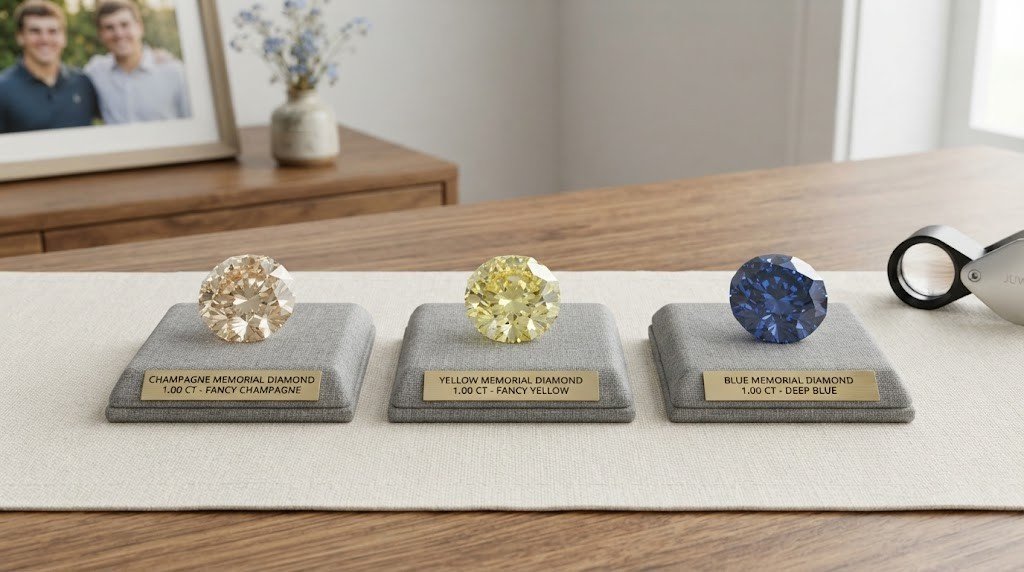
Not precisely. Color in any diamond comes from trace elements present while it grows. Nitrogen pushes a stone toward yellow, boron toward blue, and a colorless result requires keeping both out, which adds processing and usually adds cost. Memorial stones from personal carbon tend toward yellow, blue, and champagne shades, and some providers offer irradiation to produce red, pink, green, or black.

Hair does not make the color of a diamond really made from brother hair more predictable than ashes do, and no provider can tell you the exact shade in advance. What you can choose is the color direction a provider aims for. Our guide to brother hair diamond color explains those choices in depth.

Whatever the shade, the stone ranks 10 on the Mohs scale of mineral hardness, so it suits daily wear, though a sharp knock can still chip it. Clarity for memorial diamonds usually falls in the SI2 to VVS range.

Hair, Ashes, or Both: How Do the Options Compare?

Hair, ashes, and a combination of the two all yield a genuine diamond, and each relies on the same documentation for proof of origin. The differences are practical. Hair needs very little material and no cremation; ashes depend on cremation and use a small portion of the remains; a combination brings both into one project, if the provider offers it.

A diamond is also one choice among several, not a replacement for anything your family has already done. An urn, a burial, or a scattering honors him fully, and a hair-based stone can sit alongside any of them without taking anything away. For readers whose faith shapes these decisions, no tradition has an official position on memorial diamonds specifically, so a word with your own faith leader is worthwhile.

If you have both his hair and access to some of his ashes, it may help to read the matching ash question too. Either way, a stone really made from brother hair is real in the way that matters: a documented portion of his carbon, grown into a crystal you can hold.

Frequently Asked Questions

Is a diamond really made from brother hair a real diamond?

Yes. Grown in a laboratory, it shares the crystal lattice, hardness, and brilliance of any mined stone. Carbon recovered from his hair is purified and built into that crystal, typically alongside supplemental lab carbon so the stone can reach a wearable size.

How much of a stone really made from brother hair comes from him?

No industry figure has been published for hair, unlike ashes, where roughly 10–15% is commonly cited. Ask your provider for its own written estimate based on how much hair it processes and the carat you choose, along with the reasoning behind it.

Why is so little hair needed?

Hair is roughly 50% carbon by weight because it is made mostly of keratin. That concentration means a small lock or a few grams usually supplies enough of his carbon, compared with the larger quantity of cremated remains an ash stone typically requires.

Can a lab test a diamond really made from brother hair to prove its source?

Not in the way you might hope. Purification strips away nearly everything except carbon, and no standard test ties a finished stone to one person. A lab can confirm it is lab-grown and grade it; origin rests on chain-of-custody records and the origin certificate.

Do I need anyone’s agreement to use his hair?

Often, yes. Funeral-home hair is generally released through whoever holds authority over his remains, and who that is depends on the state and on any wishes he put in writing. Hair kept at home or among his things may form part of his estate, again under state rules.

Does hair produce a lighter or more predictable color?

No. Color comes from trace elements, chiefly nitrogen and boron, present while the crystal grows, so neither hair nor ashes lets anyone forecast the exact shade. Providers can aim for a color direction, and colorless stones typically require extra processing.

How long does a hair diamond take to make?

Across the industry, the process typically takes 6 to 10 months from the moment the provider receives his hair. Larger stones, above about 2 carats, or specialty colors can take up to around 12 months, because carat size depends on growth time.

Final Thoughts on Whether a Hair Diamond Is Truly His

It is reasonable to want certainty before trusting anyone with something as small and irreplaceable as a lock of your brother’s hair. The truthful answer is a careful yes: a diamond really made from brother hair is real, his carbon is genuinely part of it, and lab carbon typically fills out the rest. That is not a lesser version of the promise. It is the version you can verify, and the records are what make it trustworthy.

Learn More About Verifying a Hair Diamond

Talk With Memorial Diamond

When you are ready to ask your own questions about a stone really made from brother hair, Memorial Diamond is glad to talk through what is possible for his hair. Visit memorialdiamond.us to start the conversation, at whatever pace feels right for you and your family.

Word count: 3,075 words · Reading time: about 15 minutes
Is a Memorial Diamond Really Made From Your Brother Ashes

Is a Memorial Diamond Really Made From Your Brother’s Ashes?

Hope and suspicion often arrive together when you first hear that part of your brother could become a diamond, and wanting proof is not disloyal to him. The honest answer is yes: a memorial diamond really made from brother ashes is a genuine lab-grown diamond holding a real portion of carbon recovered from his cremated remains. That carbon is typically blended with supplemental lab carbon, and industry figures put the ash-derived share at roughly 10–15% of the finished stone.

really made from brother ashes

What Is Physically True When a Diamond Is Really Made From Brother Ashes?

Hearing that a stone is really made from brother ashes can sound like marketing, so it helps to pin down what is physically true. A memorial diamond is a chemically real diamond, with the same crystal structure, hardness, and optical behavior as any other diamond, grown in a laboratory rather than mined. It is not glass, resin, or a cubic zirconia with ashes sealed behind it.

What makes it a memorial stone is where part of its carbon came from. Cremated remains are mostly calcium phosphate, the mineral framework of bone, but a small fraction is carbon. A provider recovers that carbon, purifies it, and uses it as part of the feedstock that grows the crystal. So a stone really made from brother ashes is not a symbol placed beside his remains; atoms that were once part of him sit inside its lattice.

That is the yes. The qualifier is that his carbon is usually one ingredient among others rather than the only one. For a neutral outside reference on how the category developed, the Wikipedia overview of memorial diamonds is a reasonable starting point, and our complete guide to a brother ashes diamond covers every stage beyond this single question.

How Much of a Diamond Really Made From Brother Ashes Is Actually Him?

This is the number a careful reader wants, and it deserves a straight answer. Industry figures suggest usable carbon makes up only about 0.5% to 4% of cremated remains by weight, depending on the person and the cremation itself. After extraction and purification, the ash-derived portion typically ends up around 10–15% of the finished diamond’s mass. Some providers cite ash figures as low as 3%, and others cite higher, depending on stone size and how much ash was submitted.

Put simply, when you hold a diamond really made from brother ashes, a minority share of its carbon came from him and the rest came from a controlled lab source. That share is real and recorded at the extraction stage, but it is not the whole stone.

MeasureTypical industry figureWhat it tells you
Carbon in cremated remainsAbout 0.5%–4% by weightAsh is mostly mineral, not carbon
Purity after extractionRoughly 99.9%+ carbonHis carbon is cleaned before use
Ash-derived share of finished stoneAround 10–15% (some cite \~3%)His carbon is a real minority of the crystal
Ashes typically requestedA few tablespoons to about 4 oz (\~100 g)The rest of his ashes can stay as planned

Two practical points follow. Ask any provider for their own percentage, in writing, for the carat size you are considering, since it depends on their process. And treat a company that will not discuss the share at all with more caution than one that gives you a modest, specific figure for a stone really made from brother ashes.

Why Is Lab Carbon Blended Into a Stone Really Made From Brother Ashes?

Growing a wearable diamond takes a dependable volume of very pure carbon, and the amount recovered from a portion of ashes is small. Supplemental lab carbon is typically added so the growth cell has enough feedstock to form a stable crystal. It does not replace his carbon; it is the scaffold that lets his carbon become part of a stone you can set and wear.

This also explains why sending more ashes does not automatically produce a bigger diamond. The weight of the finished gem tracks the length of the growth run, while the volume of ash in the box plays no real part in it. A family who sends a full urn does not receive a faster or larger stone than one who sends a few tablespoons. The carat is a choice made at the start, and the timeline follows from it.

Providers may describe their blend in their own terms, and the proportion can shift with the carat you choose. Asking how theirs works is fair, as long as the answer arrives with specifics rather than slogans. A diamond really made from brother ashes is still genuinely his when lab carbon is part of the recipe; the blend is simply how the physics of crystal growth works.

How Does Carbon Travel From His Ashes Into a Diamond?

Knowing the route makes a diamond really made from brother ashes easier to trust, because each stage is a point where a record should exist. The broad sequence is consistent across the industry, even though each provider runs it with its own equipment.

StageWhat happensRecord to expect
1. ReceiptHis ashes arrive and are logged under a unique identifierIntake record with his name and your order number
2. Extraction and purificationAn oxygen-free, multi-stage heating process removes non-carbon minerals, reaching roughly 99.9%+ carbonLab record linking the purified carbon to his file
3. GraphitizationThe cleaned carbon goes back into a furnace at roughly 2,500–2,700°C and reorganizes into graphiteBatch log tied to the same identifier
4. GrowthGraphite, typically blended with lab carbon, grows on a tiny diamond seed under HPHT conditions of about 6–8 GPa and 1,400–2,500°C, over weeks to monthsGrowth record, with photos where offered
5. Cutting and polishingA gemologist shapes the rough crystal into your chosen cutWorkshop record
6. Optional color treatmentSome providers offer irradiation to shift colorWritten disclosure of any treatment
7. GradingThe finished stone’s qualities are assessed, ideally by an independent labGrading report plus an origin certificate stating the stone is really made from brother ashes

A minority of providers grow memorial stones by chemical vapor deposition instead, turning the carbon into a gas that deposits layer by layer on a seed plate. Both growth methods are described in the Wikipedia article on synthetic diamond. If you would like the same journey told as a narrative, read how a memorial diamond is made from brother ashes.

How Can You Verify a Diamond Is Really Made From Brother Ashes?

Here is the fact that matters most for a skeptic: once carbon is purified to a near-pure state, nothing left in the finished crystal identifies whose carbon it was. A gemologist can confirm a stone is a lab-grown diamond and grade its color and clarity, but no grading test reads his identity out of it. Proof that a gem is really made from brother ashes therefore lives in the paperwork trail rather than in the stone.

That trail rests on two different documents, and it pays to know which is which.

  • Origin certificate. Usually issued in-house by the provider, it states that the diamond was grown from carbon recovered from the remains submitted under your order. It is a chain-of-custody document, and its worth depends on the provider’s record-keeping.
  • Independent grading report. Issued by a third-party lab, it describes the stone itself: cut, color, clarity, and carat, measured against standards such as those GIA sets out for the four quality factors. It says nothing about whose carbon is inside.

Ask for both whenever you order a stone really made from brother ashes, then put these questions to any provider and notice whether the answers come easily:

  1. How is his material labeled from intake to finished stone, and can I see a sample record?
  2. Are different families’ materials ever processed in the same batch, and how are they kept apart?
  3. What share of the finished stone do you expect to come from his ashes at my chosen carat?
  4. Will an independent lab grade the stone, and is that report included in the price?
  5. What happens to any of his ashes you do not use, and how are they returned?
  6. If a growth attempt fails, what is your written policy?

A company comfortable with every one of those questions is offering the kind of transparency that makes a stone really made from brother ashes something you can verify rather than simply believe. Our list of questions to ask before turning your brother’s ashes into a diamond goes further if you are comparing providers side by side.

Which Sales Claims Should Make You Pause?

Grief makes reassurance attractive, and a few marketing lines about stones really made from brother ashes lean on that. None of the claims below proves bad faith by itself, but each one deserves a follow-up question before you hand over anything of his.

  • “100% him” or “pure ashes, nothing added.” Ash yields too little carbon for that to be how the process typically works; supplemental lab carbon is usually part of the blend.
  • A precise percentage with no explanation. A credible figure comes with its basis: carat size, ash quantity, and method.
  • “Certified” with no named lab. An in-house certificate speaks to origin, while a quality claim should point to an independent grading report.
  • A promise that more ashes mean a bigger stone. Size depends mainly on growth time, not on the quantity submitted.
  • A promised exact color. The precise shade cannot be predicted from the source material.
  • Pressure to decide quickly. A decision about his remains deserves whatever time you need to compare providers calmly.

When a provider answers those follow-ups patiently and backs each answer with a document, you are seeing what a diamond really made from brother ashes should come with: evidence, not adjectives.

Who Decides Whether His Ashes Can Be Used?

Before anyone orders a diamond really made from brother ashes, there is a quieter question about permission. As a sibling, you may not be the person who holds authority over your brother’s remains. Those who usually rank first include a spouse or registered partner, adult children, and parents, yet each state writes its own sequence, and anything he put in writing, whether naming an agent, arranging a pre-need plan, or leaving a will, may reorder it.

When the decision rests with someone else, a conversation tends to be the kindest approach: asking whether a small portion of his ashes could be set aside, since only a few tablespoons to about 4 oz is typically requested. Ask the provider what authorization paperwork they need, and bring the authority holder in early so nobody feels bypassed.

Hair can be another path. Funeral-home staff who trim a lock generally hand it over through the person with authority. Hair you kept yourself, or that turns up among his things, can count as part of his estate, with rules that differ between states. If ashes are not available to you, reading about what a brother hair diamond involves may help. And if several relatives each hope for a stone really made from brother ashes, our piece on sharing a brother memorial diamond explains how one portion can often supply more than one.

What Does It Cost, and How Long Does It Take?

Price and timing belong in the honesty conversation, because a diamond really made from brother ashes involves months of specialized lab work. The ranges below are general 2026 industry figures, not memorialdiamond.us’s published pricing.

Carat rangeTypical industry priceNotes
About 0.10–0.25 ctRoughly 1,500–3,500Smallest common tier; suits a pendant, ring, or any other setting
0.5–1 ctRoughly 5,000–15,000A colorless stone of this size costs noticeably more than yellow, blue, or champagne
2–5+ ctRoughly 20,000–75,000+Longer growth and closer process control

Independent grading, engraving, fancy cuts, and settings are typically priced separately from the loose stone. Across the industry, the process typically runs 6 to 10 months from receipt of his ashes, while specialty colors, or stones larger than roughly 2 carats, may need closer to 12 months. A price far below these ranges for a stone really made from brother ashes is worth a pointed question about what is actually being made. For more detail, see what a brother memorial diamond costs and the typical brother memorial diamond timeline.

Will a Stone Really Made From Brother Ashes Look Different?

To the eye, no. A stone really made from brother ashes looks like a diamond because it is one. It rates 10 on the Mohs hardness scale like every diamond, which means it resists scratches well but can still chip if struck hard against something, and clarity for memorial stones typically falls between SI2 and VVS.

Color is where the source can show. Trace nitrogen during growth tends to produce yellow, boron produces blue, and a colorless stone requires excluding both, which takes extra processing and usually costs more. That is why memorial diamonds trend toward yellow, blue, or champagne tones; where a provider offers post-growth irradiation, red, pink, green, or black become possible too.

The exact shade a diamond really made from brother ashes will take cannot be predicted from his ashes in advance, so be wary of anyone who promises one. Our guide to brother ashes diamond color explains the choices in more depth.

What Do People Commonly Get Wrong About Ash Diamonds?

A handful of misunderstandings come up again and again, and each one changes how you judge whether a gem is really made from brother ashes.

“The ashes are squeezed into a diamond.” They are not. Carbon is extracted and purified first, and the calcium phosphate that makes up the bulk of the ashes is removed.

“His ashes are sealed inside the gem.” That describes ash-infused glass or resin keepsakes, which are a different product. A stone really made from brother ashes contains his carbon as part of the crystal itself.

“A lab test can confirm it is him.” Purified carbon carries no personal marker, so origin is established through chain-of-custody records, not testing.

“Lab-grown means fake.” A lab-grown diamond is a real diamond; only its birthplace differs from a mined one.

“Choosing a diamond means giving up the rest of his ashes.” Typically only a small portion is used, so the remainder can still be kept, scattered, or interred as the family planned.

What If You Would Rather Not Use His Ashes?

A diamond is one meaningful choice among several, and none of them is the wrong one. Keeping his ashes in an urn, scattering them somewhere he loved, or interring them all honor him fully, and a diamond really made from brother ashes can sit alongside any of those because it uses so little.

If questions about authority or verification feel unresolved, hair offers a different route with a very different carbon profile: roughly half of hair’s weight is carbon, against a few percent at most for ash. Some families combine the two. Neither choice makes the result more or less genuine than a diamond really made from brother ashes; each produces a real diamond, and each depends on the same documentation for proof.

If faith matters in your family, it helps to know that no religious tradition has an official position on memorial diamonds specifically. Practices around cremation and dividing ashes vary, so your own faith leader is the right person to ask.

Frequently Asked Questions

Is a diamond really made from brother ashes a real diamond?

Yes. Grown in a lab, it shares the crystal structure, hardness, and optical properties of a mined diamond. Part of its carbon was recovered from his cremated remains, purified, and grown into the crystal, typically alongside supplemental lab carbon.

What percentage of a diamond really made from brother ashes comes from him?

Across the industry, carbon from ash typically accounts for roughly 10–15% of a finished stone’s mass; some providers cite about 3%, others more. The exact share depends on stone size, process, and how much ash was submitted, so ask for a written figure.

Can a gemologist test a stone really made from brother ashes to prove it is his?

No. Purification leaves near-pure carbon, so the finished crystal carries no marker of whose carbon it was. A gemologist can confirm it is a lab-grown diamond and grade it, but proof of origin rests on chain-of-custody records and the origin certificate.

What is the difference between an origin certificate and a grading report?

An origin certificate, usually issued by the provider, documents that the stone was grown from the remains you submitted. A grading report, ideally from an independent lab, describes cut, color, clarity, and carat. They answer different questions, so ask for both before you commit.

Do I need permission to use my brother’s ashes?

Often, yes. A spouse or registered partner, adult children, or parents commonly hold authority before siblings, though each state sets its own order and his written wishes can change it. Asking that person for a small portion is the respectful route.

Will I get a bigger diamond if I send more of his ashes?

Not usually. The stone’s size comes from how many weeks it is left to grow, and a heavier package of ash does not change that. Providers typically request a few tablespoons to about 4 oz, so the remainder of his ashes can stay as planned.

Final Thoughts on Whether the Diamond Is Really Him

Asking for proof is a way of looking after him. A diamond really made from brother ashes is not every atom of your brother, and an honest provider will never pretend it is. It is a real diamond holding a real, documented share of his carbon, which means it is something you can check rather than take on faith. Take the time you need, ask for the paperwork, and choose the company whose answers you could repeat to the rest of the family with confidence.

Learn More About Verifying an Ashes Diamond

Talk With Memorial Diamond

If you are weighing whether a stone really made from brother ashes is right for your family, Memorial Diamond would be glad to hear from you at memorialdiamond.us and explain what could be done with his ashes. Bring every question on this page with you; clear answers should come before any decision.

Word count: 3,257 words · Reading time: about 16 minutes

Is a Memorial Diamond Really Made From Your Brother Ashes and Hair

Is a Memorial Diamond Really Made From Your Brother’s Ashes and Hair?

Some siblings find themselves holding two keepsakes at once, a share of their brother’s ashes and a lock of his hair, and joining both in one diamond can feel right while sounding almost too neat to be true. It can be true. A diamond really made from brother ashes and hair is a genuine lab-grown diamond grown partly from carbon extracted from both materials, typically blended with supplemental lab carbon. No industry figure has been published for how much of a combined stone is his.

really made from brother ashes and hair

What Does It Mean for a Diamond to Be Really Made From Brother Ashes and Hair?

Strip away the marketing and the claim that a stone is really made from brother ashes and hair comes down to chemistry. Both cremated remains and hair contain carbon. A provider extracts that carbon from each material, purifies it, and uses it as part of the feedstock from which a diamond crystal grows. The finished gem is a lab-grown diamond in every physical sense, with the hardness, optics, and structure of any diamond.

So a gem really made from brother ashes and hair contains carbon atoms that came from two parts of him, joined inside a single crystal lattice. It is not a capsule with ashes and strands sealed behind glass, and it is not a symbolic stone placed next to his remains.

The honest qualifier is that his carbon typically shares the crystal with lab carbon. That does not dilute the meaning; it is how diamond growth works at wearable sizes. For a broader introduction before going deeper, our complete guide to a brother ashes and hair diamond covers the option as a whole.

What Are the Six Core Facts in Plain Terms?

If you only have a minute, these six points summarize what is true about a stone really made from brother ashes and hair, using general industry figures.

#FactWhat it means for you
1A diamond really made from brother ashes and hair is a real lab-grown diamondSame hardness and brilliance as a mined diamond
2Ash is about 0.5%4% carbon; hair is roughly 50%The two materials contribute very different carbon yields
3Lab carbon is typically blended inHis carbon is a genuine part, not the entire crystal
4Ash-derived carbon is typically around 1015% of an ash-only stone (some cite ~3%); no figure is published for hair or for blendsAsk your provider for its own written estimate
5The stone cannot be tested to reveal whose carbon it holdsProof of origin comes from chain-of-custody records
6Carat depends on growth time, not material quantityAdding hair to ashes does not by itself enlarge the stone

Do Both Materials Actually Go Into the Same Stone?

This is the first question to put to any provider, because “ashes and hair” can describe more than one arrangement. In a true combined stone, carbon purified from his ashes and carbon purified from his hair are joined in the feedstock for a single crystal. Another arrangement is two separate stones, one from each material, which some families prefer for a pair of earrings or for two relatives.

Not every provider offers a combined stone, and those that do may handle the blending at different stages. Ask plainly: will carbon from both materials go into one growth run, and will the paperwork say so? A clear yes, explained step by step, is what you are looking for before ordering a diamond really made from brother ashes and hair.

It is also fair to ask why a provider recommends combining in your case. A good answer might be about meaning, such as wanting both parts of him represented, rather than a suggestion that one material alone is somehow insufficient for a real diamond.

How Much of a Diamond Really Made From Brother Ashes and Hair Is Him?

The most widely cited figure applies to ashes alone: in an ash-only stone, ash-derived carbon typically makes up around 1015% of the finished mass, and some providers cite roughly 3%. That figure does not transfer neatly to a combined stone, because hair brings a very different carbon yield.

Hair is roughly half carbon by weight, while ashes yield only about 0.5% to 4%. Even so, no industry figure has been published for the share of a finished hair stone, and none has been published for a blend of ashes and hair. Anyone presenting an industry-standard percentage for a diamond really made from brother ashes and hair is offering more precision than the public data supports.

What a provider can share is its own estimate for your order: how much of each material it will process, the approximate purified carbon it expects from each, and how that relates to the total feedstock at your chosen carat. Ask for that in writing. A careful, explained estimate earns more trust than a round number delivered with confidence.

Why Is Lab Carbon Still Added to a Stone Really Made From Brother Ashes and Hair?

Combining two materials can sound as if it should remove the need for lab carbon. In practice, the purified carbon from a portion of ashes plus a small lock of hair is still a modest amount next to what a growth cell needs to form a stable, gem-sized crystal. Supplemental lab carbon is typically blended in to reach that working volume.

Inside a diamond really made from brother ashes and hair, the lab carbon acts like a framework, allowing the carbon from both materials to become part of a crystal that can be cut, polished, and set. It is the ordinary method throughout the category, not a sign that something is being hidden.

Carat follows the same rule as any memorial diamond. Size is determined mainly by how long the crystal grows under pressure, not by how much ash or hair is supplied. Pairing hair with ashes adds a carbon-rich personal source, but it does not make a stone really made from brother ashes and hair grow bigger or faster on its own.

How Do Two Sources Become One Crystal?

A stone really made from brother ashes and hair follows the standard memorial-diamond sequence, with one important difference: two materials have to be tracked rather than one.

  1. Two intakes. His ashes and his hair each arrive, are weighed, and are logged, ideally under linked identifiers on the same order.
  2. Purification of each. Oxygen-free, multi-stage heating removes the bone minerals from the ashes and the non-carbon parts of keratin from the hair, bringing each to roughly 99.9%+ carbon.
  3. Graphitization. The purified carbon is heated to approximately 2,5002,700°C and converted to graphite.
  4. Blending and growth. Graphite from both sources, typically with lab carbon, goes into an HPHT cell around a small diamond seed. The press squeezes it at something like 68 GPa while holding it hot, in a band of about 1,4002,500°C, and the crystal builds over weeks to months. A minority of providers grow by chemical vapor deposition, described in the Wikipedia entry on synthetic diamond.
  5. Cutting and polishing. A gemologist shapes the rough crystal.
  6. Optional irradiation. Some providers offer it to alter color.
  7. Grading and paperwork. The stone is assessed, ideally by an independent lab, and documented.

The stages are told in narrative form in how a memorial diamond is made from brother ashes and hair, and the planning side is covered in how to turn your brother’s ashes and hair into a diamond.

How Can You Confirm a Stone Is Really Made From Brother Ashes and Hair?

No laboratory can examine a finished diamond and identify whose carbon formed it, because purification leaves carbon with no personal signature. That is equally true for ashes, hair, or both. Confirmation that a gem is really made from brother ashes and hair comes from documentation, and with two materials, the documentation needs to cover both.

Look for two kinds of paper:

  • An origin certificate from the provider, which should name both materials and tie them to your order. It is a chain-of-custody record, and it is only as reliable as the tracking behind it.
  • An independent grading report from a third-party lab, describing cut, color, clarity, and carat by standards like those in GIA’s guide to diamond quality factors. It confirms the stone’s quality, not where its carbon came from.

Questions to ask before sending either material:

  1. Will his ashes and hair each have their own intake record, and how are the two linked?
  2. Does the carbon from both go into one growth run, and will the certificate state that?
  3. Are other families’ materials ever in the same batch, and how is separation confirmed?
  4. What share of the finished stone do you estimate will come from his carbon?
  5. What happens to unused ashes or hair, and how are they returned?
  6. Is an independent grading report included or extra?

Our list of questions to ask before turning your brother’s ashes and hair into a diamond expands on these. Patient, documented answers are what make a diamond really made from brother ashes and hair verifiable rather than simply asserted.

Which Claims About Combined Stones Deserve a Second Look?

A combined stone invites a few specific overstatements. Each of these deserves a follow-up question rather than automatic trust.

  • “100% him, ashes and hair together.” Lab carbon is typically part of the blend, even when two personal sources are used.
  • “Adding hair doubles the amount of him in the stone.” No published figure supports a specific multiplier; ask for the provider’s own estimate and its reasoning.
  • “Combining gives you a bigger diamond.” Carat depends on growth time.
  • “Hair will lighten the color.” The exact shade cannot be predicted from either source.
  • A single certificate that mentions only one material. If both went in, both should be recorded.
  • Urgency. Decisions about his remains merit as much time as you need.

A provider offering a stone really made from brother ashes and hair should be comfortable correcting any of these myths, even when correcting them makes its pitch less dramatic.

Who Must Agree Before His Ashes and Hair Are Combined?

Before ordering a diamond really made from brother ashes and hair, expect two permission questions rather than one. Control of his ashes generally rests with the person who has authority over his remains, and siblings are often further down that list. That person is commonly a spouse or registered partner, an adult child, or a parent, though the order differs from state to state. Anything he put in writing beforehand, such as naming someone to make these decisions or setting out funeral arrangements, can alter who decides.

Hair trimmed by the funeral home is generally released through that same person. Hair already in your keeping, or found with his possessions, may count toward his estate under rules that vary by state, so check with whoever is settling his affairs before including it.

If the authority holder is someone else, a respectful request for a small portion of ashes, along with a lock of hair, is usually the kindest route, and if ashes cannot be shared, a stone from his hair alone is still a complete option. Our guide to how much ash and hair a brother memorial diamond needs helps you explain exactly what you are asking for. And if more than one relative would like a stone, see sharing a brother memorial diamond.

What Do Cost and Timing Look Like?

Price ranges for a diamond really made from brother ashes and hair follow the same size-driven pattern as other memorial diamonds. These general 2026 industry figures are not memorialdiamond.us’s published pricing:

  • Around 0.100.25 ct: roughly 1,5003,500
  • 0.51 ct: roughly 5,00015,000, with colorless toward the higher end
  • 25+ ct: roughly 20,00075,000+

Grading, engraving, fancy cuts, and settings are typically added on top of the loose stone. Whether processing a second material changes the price is provider-dependent, so ask for an itemized quote. The industry typically quotes 6 to 10 months from receipt of materials, and a specialty color or a stone beyond roughly 2 carats can stretch that toward 12 months. If a quote lands well below these ranges for a stone really made from brother ashes and hair, ask directly what is being made. Our post on brother memorial diamond cost has more detail.

What Will a Diamond Really Made From Brother Ashes and Hair Look Like?

It will look like a diamond, because it is one. It ranks 10 on the Mohs hardness scale, though a hard knock can still chip it, and memorial diamond clarity typically sits between SI2 and VVS.

Color is set by trace elements during growth: nitrogen leads toward yellow, boron toward blue, and colorless requires excluding both, which means extra processing and usually a higher price. Memorial stones lean toward yellow, blue, and champagne; red, pink, green, or black usually involve optional irradiation after growth, where a provider offers it.

Combining hair with ashes does not make the shade of a diamond really made from brother ashes and hair more predictable, and nobody can name the exact color in advance. Our guide to brother ashes and hair diamond color walks through the options.

Is a Stone Really Made From Brother Ashes and Hair Worth Choosing Over One Material?

Combining is a question of meaning more than of authenticity. An ash-only stone and a hair-only stone are each real diamonds holding his carbon. Choosing both can feel right if each material carries its own significance for you, or if the share of ashes available is very small and hair adds personal carbon.

It is equally reasonable to choose one material, or none. An urn, a burial, or a scattering honors him fully, and a diamond can sit alongside any of them. If faith is part of your family’s thinking, no tradition has an official position on memorial diamonds specifically, so it is worth asking your own faith leader.

Whatever you decide, a diamond really made from brother ashes and hair is as genuine as the records behind it, which is why the paperwork deserves as much attention as the stone.

Frequently Asked Questions

Is a diamond really made from brother ashes and hair a real diamond?

Yes. It is a lab-grown diamond with the same structure, hardness, and brilliance as a mined one. Carbon purified from his ashes and his hair is grown into the crystal, typically together with supplemental lab carbon so the stone reaches a wearable size.

What share of a stone really made from brother ashes and hair comes from him?

No industry figure is published for blends of ashes and hair. For ash-only stones, roughly 1015% of the finished mass is commonly cited. Ask your provider for a written estimate based on the amounts it will process and your chosen carat.

Does adding hair make the diamond bigger?

No. Carat size is governed mainly by the length of the growth run, not by the volume of material supplied. Hair adds carbon-rich personal material to the feedstock, but the size of the finished stone is a choice you make at the start.

How can I confirm a diamond is really made from brother ashes and hair?

Ask for separate intake records for his ashes and hair, linked to one order, and an origin certificate naming both. An independent grading report confirms quality, not origin, so the chain-of-custody records are the real evidence that both went in.

Who needs to approve using his ashes and hair?

Often the person holding authority over his remains, commonly a spouse or partner, adult child, or parent ahead of a sibling, though each state sets its order and his written wishes can change it. Hair kept at home may belong to his estate, depending on the state.

Can I get two separate stones instead of one combined stone?

Often, yes. Because only a portion of the ashes and a small lock of hair are typically used, providers may be able to grow separate stones from each material or several stones for relatives. Ask what your chosen provider offers and what each option costs.

Final Thoughts on Whether a Combined Diamond Is Truly His

Wanting proof is not doubting him; it is protecting him. A diamond really made from brother ashes and hair holds real carbon from two parts of your brother, shared with lab carbon that lets it grow into something you can wear. Ask how both materials will be tracked, insist on paperwork that names each one, and give yourself the time this choice deserves. The right provider will make that easy.

Learn More About Verifying a Combined Stone

Talk With Memorial Diamond

If you are considering a stone really made from brother ashes and hair, Memorial Diamond can talk through what is possible with the materials you have. Visit memorialdiamond.us to start that conversation whenever you feel ready, and bring every question you have.

Word count: 3,046 words · Reading time: about 15 minutes
Really Made From Daughter Ashes and Hair 7 Proven Truths

Is a Memorial Diamond Really Made From Your Daughter’s Ashes and Hair?

Doubt is reasonable here, and it deserves a straight reply rather than a soothing one. Yes: a stone described as really made from daughter ashes and hair does contain carbon recovered from both of those materials, purified and grown into a genuine laboratory diamond. It also contains supplemental laboratory carbon, no published figure states what share of a blended stone is hers, and nothing about a gem really made from daughter ashes and hair can prove its origin on its own. The proof sits in the chain of custody record for each material.

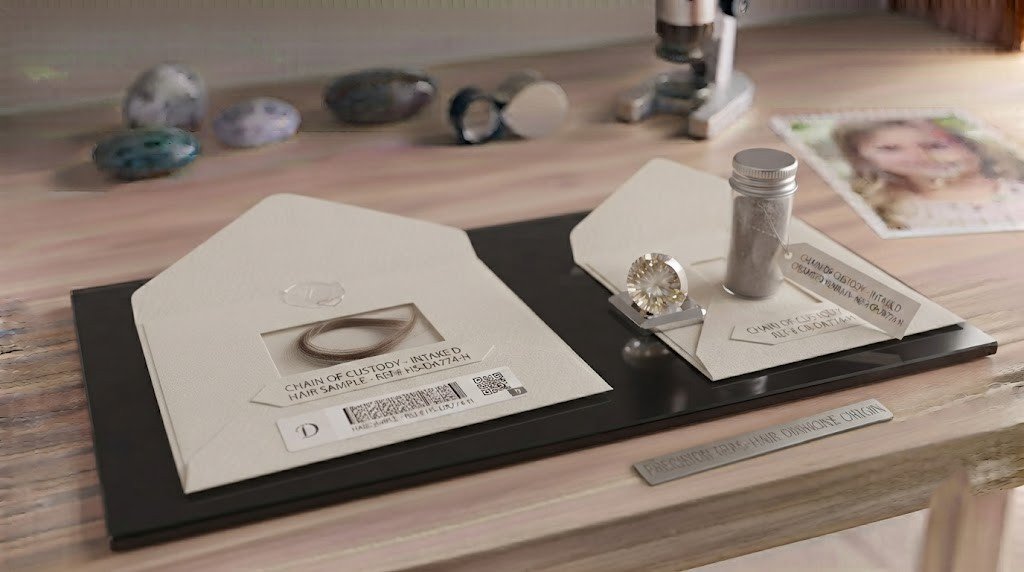
 A loose memorial diamond really made from daughter ashes and hair resting beside two labeled sample envelopes

Is a Stone Really Made From Daughter Ashes and Hair, or Mostly Lab Carbon?

Both, and an honest provider will say so unprompted. Her carbon is physically inside the crystal; laboratory carbon is too.

The skeptic’s worry runs like this: if much of the stone is supplemental carbon, is calling it really made from daughter ashes and hair anything more than marketing? “Made from” describes a genuine, traceable contribution, not a total. Carbon from her remains and her hair is purified, graphitized and grown into the lattice alongside the added material. It is structural, not a coating.

What a truthful description of a gem really made from daughter ashes and hair cannot promise is purity. No memorial diamond is grown only from personal carbon.

That leaves three things to check before trusting any stone really made from daughter ashes and hair: how much of it is hers, whether the two sources can be told apart, and what paperwork links the crystal to what you sent. The complete guide to a daughter ashes and hair diamond covers the broader choice if you are still deciding.

How Do Two Such Different Materials Feed One Crystal?

Each is purified separately, and the purified carbon is combined into a single charge for the growth press, where it is the same substance whichever source it came from.

The starting points could hardly be less alike, which is why families wonder whether a stone really made from daughter ashes and hair is, in practice, mostly one or the other.

Cremated remainsHair
What it is mostly made ofCalcium phosphate, the mineral of boneKeratin, a protein rich in carbon
Carbon in the starting materialAround 0.5% to 4% by weightAround 50% by weight
Amount providers usually ask forA few tablespoons up to about 4 oz, roughly 100 gA small lock, or a few grams
Needs a cremation?YesNo
Published finished stone shareAround 10% to 15% on the ash route, some citing as low as 3%None published

Weight for weight, hair holds far more carbon than ash, so a modest lock is not a token gesture. That still does not tell you the proportion inside a diamond really made from daughter ashes and hair, because it depends on the quantities sent and on how a particular laboratory works.

After purification to roughly 99.9% carbon or better, both materials go through graphitization at about 2,500 to 2,700°C, and that graphite is what enters the press. How a memorial diamond is made from her ashes and hair follows each stage in more detail.

Why Is Laboratory Carbon Still Added When You Send Both?

Because the carbon recovered from a family’s submission is rarely enough, by itself, to fill a growth cell for a stone of useful size. Adding hair raises the personal carbon available; it does not usually remove the need for supplement.

It feels logical that two materials should mean a purer stone. Across the industry, though, the published process still describes blending recovered carbon with laboratory carbon, and nothing published says a stone really made from daughter ashes and hair escapes that step.

A diamond really made from daughter ashes and hair is therefore a blend in two senses: two personal sources, plus the supplement. None of that makes her contribution less real. The accurate sentence is “made in part from her,” which is also the sentence any reputable provider will put in writing.

Growth usually happens under high pressure and high temperature, roughly 6 to 8 GPa and 1,400 to 2,500°C, the same methods used to make any lab grown synthetic diamond. A minority of providers use chemical vapor deposition instead. Either way, the result is a real diamond, not a simulant.

What Share of a Diamond Really Made From Daughter Ashes and Hair Is Hers?

Nobody has published that number, and anyone quoting one without seeing your submission is estimating.

For ash on its own, industry descriptions put personal carbon at around 10% to 15% of the finished stone’s mass, some providers citing as low as 3%. That figure belongs to the ash route only. No equivalent finished stone percentage has been published for hair alone, and none at all for a blended charge. Hair’s roughly 50% carbon content describes the raw material, not the finished diamond.

So resist borrowing the ash figure for a gem really made from daughter ashes and hair. The blend may behave differently, and no public work settles how.

Instead, turn the gap into a written request. Ask the provider, at the carat size you are considering:

  • What percentage of the finished stone they expect to be her carbon.
  • How including hair changes that estimate compared with ash alone.
  • Whether they will state it in writing before you send anything.

Keep whatever reply comes back. It is the only figure that will ever apply to your own stone really made from daughter ashes and hair.

Can You Learn How Much Came From the Ash and How Much From the Hair?

Ask, but expect the answer to be “not precisely.” Most providers do not itemize the finished stone by source, and once the two carbons are pooled there is no way to separate them again.

A laboratory can often tell you what went in: how much ash and hair arrived, and roughly what each yielded. Some share those intake and yield figures on request; others treat them as internal. Either response is worth knowing before you commit to anything really made from daughter ashes and hair.

Families sometimes want the split for reasons unrelated to suspicion. Wanting to know both are present in a stone really made from daughter ashes and hair is completely understandable. If both were logged, purified and pooled, both are there, even if nobody can state the proportion.

If one material matters enough that you want it in a stone by itself, raise that before anything ships. Growing one diamond from each is sometimes possible and removes the question. How much ash and hair a daughter memorial diamond needs explains how quantities affect that choice.

Can a Lab Test Show a Stone Is Really Made From Daughter Ashes and Hair?

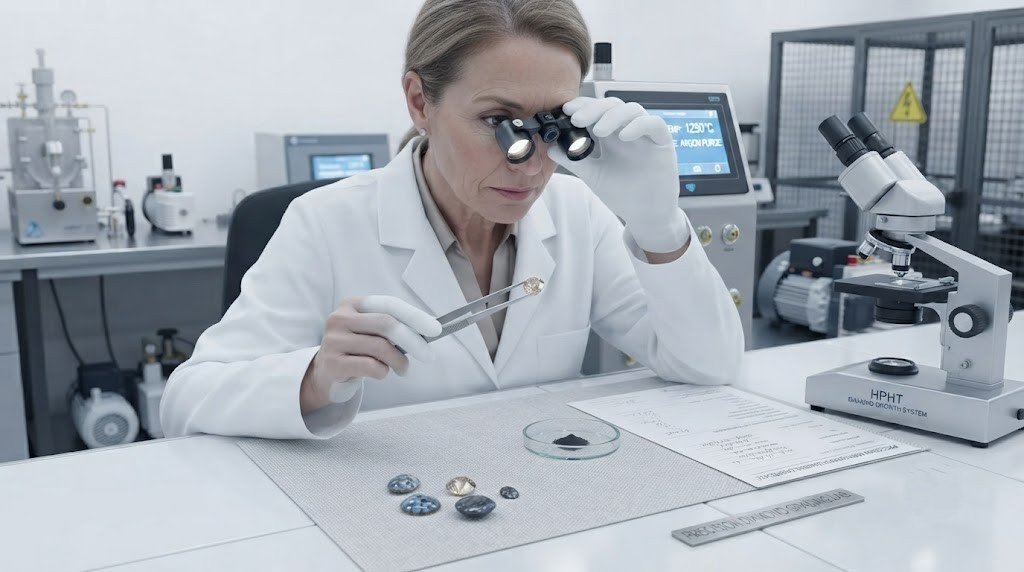
A gemologist examining a finished lab-grown diamond through a loupe at a grading bench

No. No test on a finished diamond can confirm its carbon came from a particular person, from ash, or from hair. Carbon atoms in the lattice carry no personal signature.

A gemological laboratory can establish that the stone is a real diamond, that it was grown rather than mined, and how it grades. None of that speaks to origin.

This is the uncomfortable center of the question. A stone really made from daughter ashes and hair and one grown purely from laboratory carbon would look identical under any available instrument. That is true across the category.

So trust has to rest on a documented, unbroken record of what happened to each of your two samples from arrival onward. Anyone implying that a gem really made from daughter ashes and hair “proves” its own origin is overstating what is possible.

What Documents Show a Diamond Is Really Made From Daughter Ashes and Hair?

A chain of custody record following both materials from arrival to the growth run is the core evidence. Everything else supports it.

When a family is told a stone is really made from daughter ashes and hair, reasonable documentation behind that claim looks like this:

  • Two intake confirmations: one per material, each with its own reference number and date.
  • A custody log for each material: through purification and graphitization.
  • A record of the pooling step: or confirmation that the two were grown separately.
  • The provider’s written carbon estimate: since no published figure covers a blend.
  • An origin or authenticity certificate: usually in house, naming both materials.
  • An optional independent grading report: if you choose to have one.

The last two do different jobs. An in house origin certificate is the provider’s own statement that the stone came from your submission. An independent report judges it against the standard cut, color, clarity and carat measures; it is optional across the industry and cannot say whether a stone is really made from daughter ashes and hair.

Ask to see a redacted sample of each document before you commit. The step by step route for her ashes and hair shows where each record is created.

Which Warning Signs Should Make You Slow Down?

A few answers should give you pause, not because they prove anything is wrong but because they make it hard to verify that a stone is really made from daughter ashes and hair.

  • A claim that the stone is 100% her, with nothing added.
  • A precise percentage for a blended stone offered before anyone knows what you are sending.
  • The ash route percentage presented as if it also covers hair or a blend.
  • Reluctance to describe the custody process, or to put it in writing.
  • A suggestion that testing the finished diamond confirms whose carbon it holds.
  • No separate intake record for the hair once it arrives alongside the ash.
  • Pressure to decide quickly, or discounts tied to deciding by a date.

Any of these may have an innocent explanation; what matters is whether it comes back clearly and in writing. How to turn her ashes and hair into a diamond sets out the fuller decision in order.

Who Can Authorize Sending Her Ashes and Her Hair?

It may not be one person, and it is not automatically her parents. Before a stone can be really made from daughter ashes and hair, both materials need someone’s go ahead, and the two can fall under different considerations.

For cremated remains, priority is a matter of state law, and no one national rule covers every family. At whatever age she died, a spouse or partner may hold authority ahead of her parents, as may her own adult children. Anything she left in writing, such as a directive, a will provision or a pre arranged plan, can override the default order.

Hair is often simpler in practice, particularly a lock already in your keeping, though that does not place it automatically beyond any rules. Belongings can form part of an estate, rules vary by state, and if someone else holds the sample or has a stronger claim, talk with them first.

Parents may disagree, or one may be arranging alone; neither is unusual. A funeral director or local attorney can usually settle who signs.

What Happens to Whatever Ash and Hair Is Not Used?

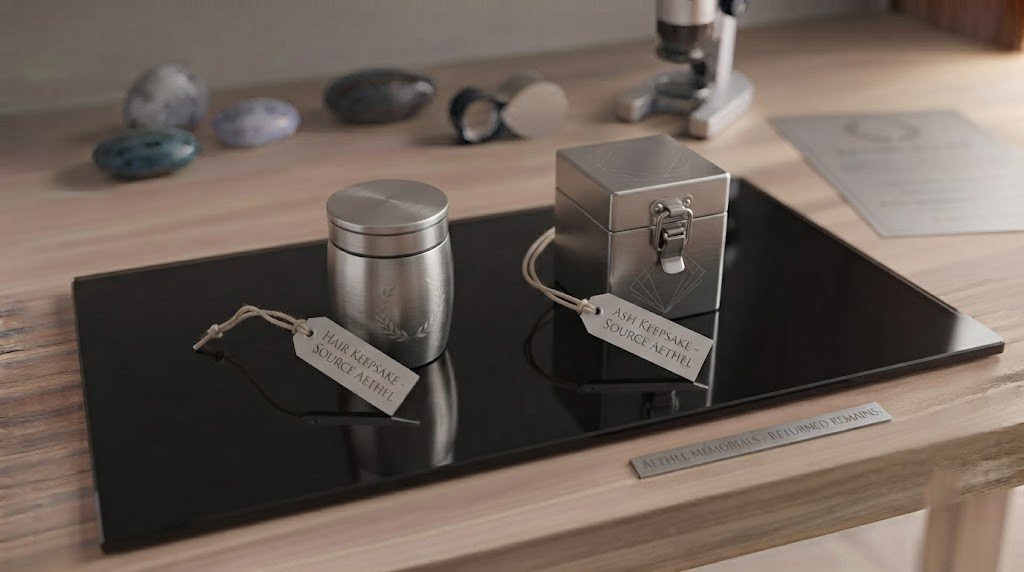
Two small sealed keepsake containers returned to a family after processing

It depends on the provider, so ask before anything is sent, and ask about each material separately.

Only part of either sample becomes purified carbon. Some providers return what remains, some dispose of it respectfully, and some offer a choice.

A clear written policy covering both is part of what makes a claim that a stone is really made from daughter ashes and hair trustworthy. Most of her ashes stay with the family regardless, so burial, scattering, an urn at home or sharing among relatives all remain open.

Does Sending Both Change the Cost, the Wait or the Color?

Not in the way people expect. Price and timing follow the stone you choose, and color cannot be promised either way.

In general 2026 industry terms, not any one company’s prices, roughly 0.10 to 0.25 carat runs about $1,500 to $3,500; half a carat to one carat about $5,000 to $15,000; and two to five carats or more from around $20,000 to $75,000 and beyond. Settings and an optional grading report are usually priced separately.

Most stones take six to ten months from receipt, with larger or specialty color stones sometimes stretching toward twelve. Size is set by time in the press, not by how much you send, so a stone really made from daughter ashes and hair is neither faster nor larger for including hair.

Color comes from trace elements during growth: nitrogen pushes toward yellow, boron toward blue, and colorless requires neither, which generally costs more. Including hair does not make the result predictable, and hair grown stones are not automatically lighter. Optional irradiation can produce red, pink, green or black. Choose what feels right to the people who will keep it. What color a diamond from her ashes and hair will be goes further.

Frequently Asked Questions

Is any memorial diamond grown only from her carbon?

No. Across the industry, carbon recovered from ash and hair is typically blended with supplemental laboratory carbon so that a stone of useful size can grow. Her carbon is genuinely part of the crystal, but a claim of total purity overstates what the process delivers.

Does adding hair make the stone more hers than ash alone?

It may raise the personal carbon available, because hair holds around half its weight in carbon. No published figure says how much it changes a stone really made from daughter ashes and hair, though, so ask the provider for an estimate in writing for your specific submission and carat size.

Can we ask for the ash and hair percentages separately?

You can ask, and you should. Most providers do not itemize the finished diamond by source, because pooled carbon cannot be separated again. Many can tell you what quantities were received and roughly what each yielded, which is often the closest honest answer available.

Will an independent grading report confirm the stone came from her?

No. A grading report assesses cut, color, clarity and carat, and can confirm the stone is a genuine lab grown diamond. It cannot identify whose carbon is inside. Origin rests on the provider’s chain of custody records and certificate, which is why those documents deserve close attention.

Could we have two stones, one from her ashes and one from her hair?

Often, yes. Because only a portion of each material is needed, many providers can grow separate stones instead of one diamond really made from daughter ashes and hair. Each stone carries its own growth time and price, so ask for quotes on both arrangements before deciding which suits your family.

What if her hair sample turns out to be too small or damaged?

Ask before sending. A very small or poorly stored lock may not yield enough usable carbon, and then the stone is no longer really made from daughter ashes and hair. A good provider contacts you before continuing with ash alone, and a written policy should say whether you are consulted first and whether the price changes.

How long after her death can we still send both materials?

There is generally no fixed deadline, whether months or many years have passed. Cremated remains are chemically stable, and hair keeps well when stored dry. Tell the provider how and where each has been kept, since storage conditions can matter more than the time that has passed.

Final Thoughts on Whether It Is Really Made From Her

The skeptical question has an answer more modest, and more solid, than marketing tends to offer. A stone really made from daughter ashes and hair holds genuine carbon from both materials, blended with laboratory carbon; the share for a combined stone has not been published, and no instrument can confirm origin afterward.

What you can verify is the record. If each material was logged on arrival, tracked through processing and documented at pooling, you have as much certainty as this category offers anyone.

Before you accept any gem as really made from daughter ashes and hair, get the important answers in writing, take the time you need, and let the decision belong to the people who will live with it. The same question for ash alone is worth reading alongside this one.

Learn More About Daughter Memorial Diamonds

Talk With Memorial Diamond

If you want these questions answered for your own submission, Memorial Diamond can be reached at memorialdiamond.us to explain how each material would be logged and documented. There is no obligation in asking.

Really made from your wife's ashes: a small champagne-toned lab-grown memorial diamond resting on its reference-numbered origin certificate

Is a Memorial Diamond Really Made From Your Wife’s Ashes?

You are allowed to be skeptical. Somebody is asking you to hand over a portion of your wife’s ashes, wait most of a year, and accept a stone on their word that she is in it. A memorial diamond is really made from your wife’s ashes in part: carbon is extracted from a small amount of her cremated remains, purified, blended with lab sourced carbon to reach a workable volume, and grown into a genuine diamond in which her carbon typically makes up around 10 to 15% of the stone.

The Short Answer, and Why “In Part” Is the Honest Version

Ask whether a memorial diamond is really made from your wife’s ashes and you are asking two questions at once. The first is chemical: can a diamond be grown from cremated remains at all? The second is procedural: how do I know this stone came from her and not from a jar of industrial graphite?

The chemistry is settled and public. The procedure is where the trust lives. The table below is the whole argument, one claim per row.

Claim you will hearVerdictWhat the evidence is
“A diamond can be grown from cremated ashes.”TrueAshes hold roughly 0.5 to 4% usable carbon. The process is public for the whole memorial diamond category.
“The diamond is 100% her.”FalseHer carbon is blended with lab carbon; her share is typically around 10 to 15%. Anyone claiming total purity is wrong.
“It is really made from your wife’s ashes.”Partly true and that is the right claimA real, purified portion of her carbon is in the crystal lattice. “In part” is accurate; “entirely” is not.
“A lab test can prove it is her.”FalseNo test can identify whose carbon a diamond contains. The proof is procedural, not chemical.
“The custody record proves it.”True, if the record is real and specificA logged, traceable record from arrival to finished stone is the actual evidence.
“The grading report proves it came from her.”FalseA grading report proves quality: cut, color, clarity, carat. It says nothing about origin.

Six claims; the rest of this page takes them one at a time.

Fact 1 Is There Really Carbon in Her Ashes to Work With?

Yes, though less than most people assume, and that is the first thing a doubter gets right about a stone really made from your wife’s ashes.

Cremated remains are almost entirely calcium phosphate, the mineral structure of bone. Carbon, the only element a diamond is made of, survives as a small fraction: industry figures put usable carbon at roughly 0.5% to 4% of ash by weight, varying by person and by cremation.

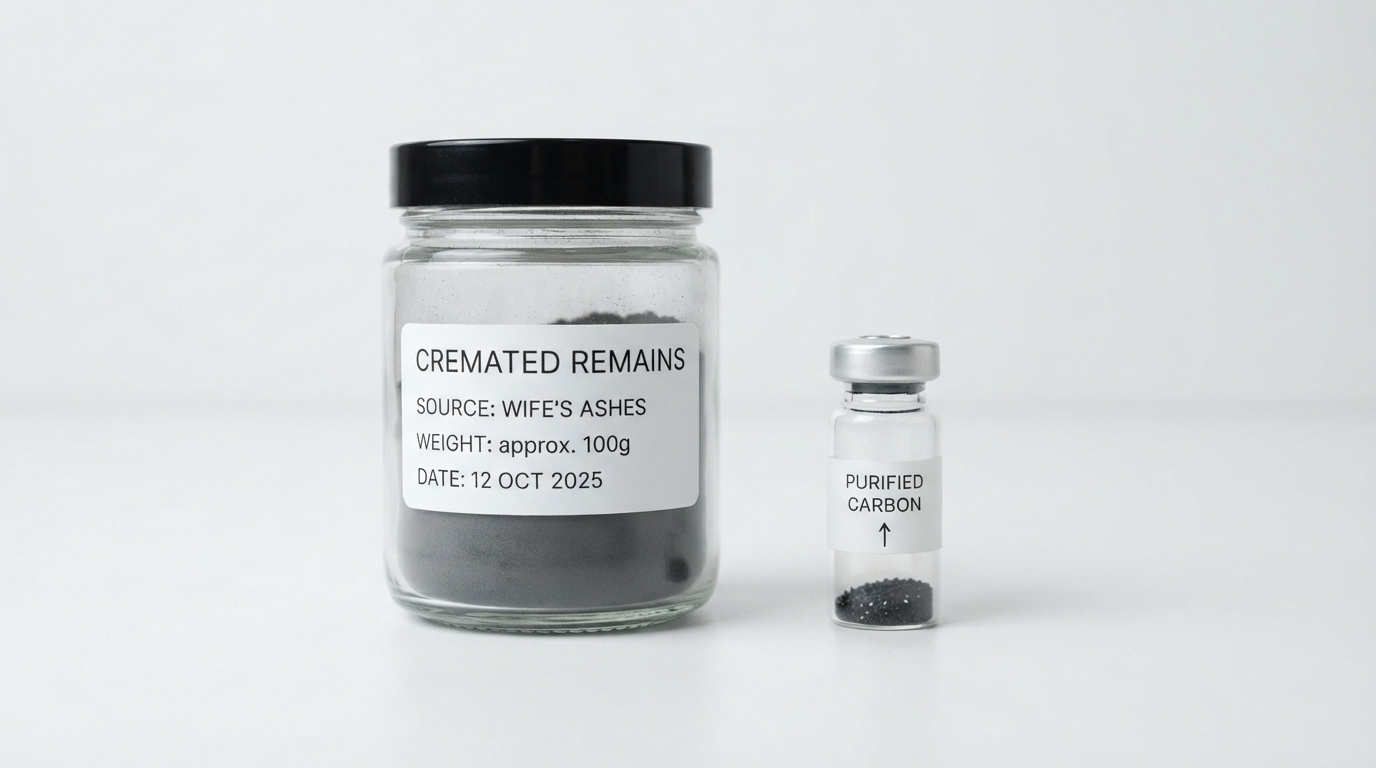
A labeled laboratory sample container of cremated ash beside a much smaller vial of purified carbon

That fraction is enough. A provider heats a portion of her ashes, typically a few tablespoons to around 4 oz, about 100 g, in a controlled, oxygen free, multi stage process that strips away the minerals and leaves carbon at 99.9%+ purity. That carbon is heated to roughly 2,500 to 2,700°C and converted into graphite, the feedstock a diamond press uses.

So the chemical premise behind a diamond really made from your wife’s ashes is not exotic: a small quantity of a common element, recovered from a material that is mostly something else. How a memorial diamond is made from your wife’s ashes walks through every stage in order; this page stays on the question of proof.

Fact 2 How Much of the Diamond Is Really Her?

This is the fact that makes the skeptic right to ask, and the one a good provider volunteers before you do.

The carbon recovered from a few tablespoons of ash is not enough, on its own, to grow a diamond of meaningful size, so the purified graphite is blended with lab sourced carbon. In the finished stone, the personal carbon from her ashes typically makes up around 10 to 15% of the mass. Some providers cite figures as low as 3%, others higher, depending on carat and how much ash was submitted. Three consequences follow for whether the stone is really made from your wife’s ashes in the sense you mean:

  • “100% her” is false wherever you read it. It describes physics that does not exist.
  • “In part” is not a loophole; it is the accurate description. A real, measurable portion of the carbon that was in her body is now locked in a crystal lattice. The diamond is really made from your wife’s ashes; it is not made only from them.
  • Sending more ash does not raise her share meaningfully. Carat is set by growth time in the press, not by material quantity. A provider who suggests a full urn will make the stone “more her” is wrong on two counts.

Ask the percentage question. A specific range with a reason means the provider understands what they are selling. “It’s all her” tells you something more useful than the percentage.

Fact 3 What Does a Chain of Custody Record Actually Prove?

Because no test can identify the carbon, the evidence that a stone is really made from your wife’s ashes is a paper trail.

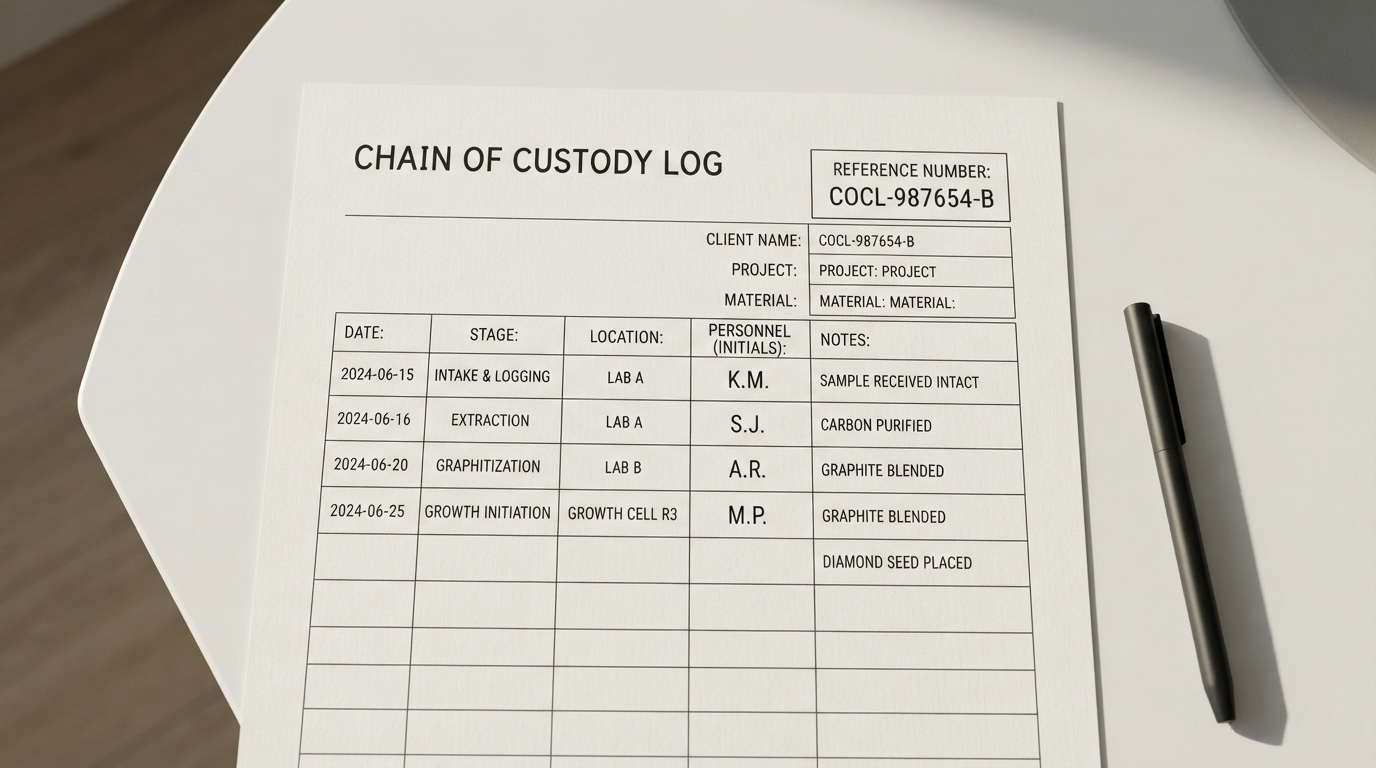
A chain of custody record is a logged, traceable account of your submission from arrival to shipped diamond. In a reputable operation it looks like this:

A printed chain-of-custody log with a reference number, dated stage entries, and initials down the page
  1. Intake. Your submission is weighed, photographed, and assigned a unique reference the moment it is opened.
  2. Sealed transfer. The ash portion moves to extraction in a labeled, sealed container under that reference. Nothing is pooled with another family’s material.
  3. Extraction and purification. The carbon recovered is weighed and logged against the same reference.
  4. Graphitization and growth. The purified carbon and the growth cell it enters are logged under the reference, with dates.
  5. Cutting, grading, and return. Rough crystal and finished stone are tracked against the reference through to shipping.

What this proves: that an identified sample entered the process and an identified stone left it, with a documented link at every stage. What it does not prove: anything about the atoms themselves. A record is only as good as the provider keeping it, which is why you ask to see one. If a diamond is really made from your wife’s ashes, this record is the only place that fact is written down. Questions to ask before turning your wife’s ashes into a diamond turns it into a list you can read down the phone.

Fact 4 What Does an Origin Certificate Prove That a Grading Report Does Not?

Two documents arrive with a finished stone, and people routinely treat them as one. They prove different things, and only one speaks to whether the diamond is really made from your wife’s ashes.

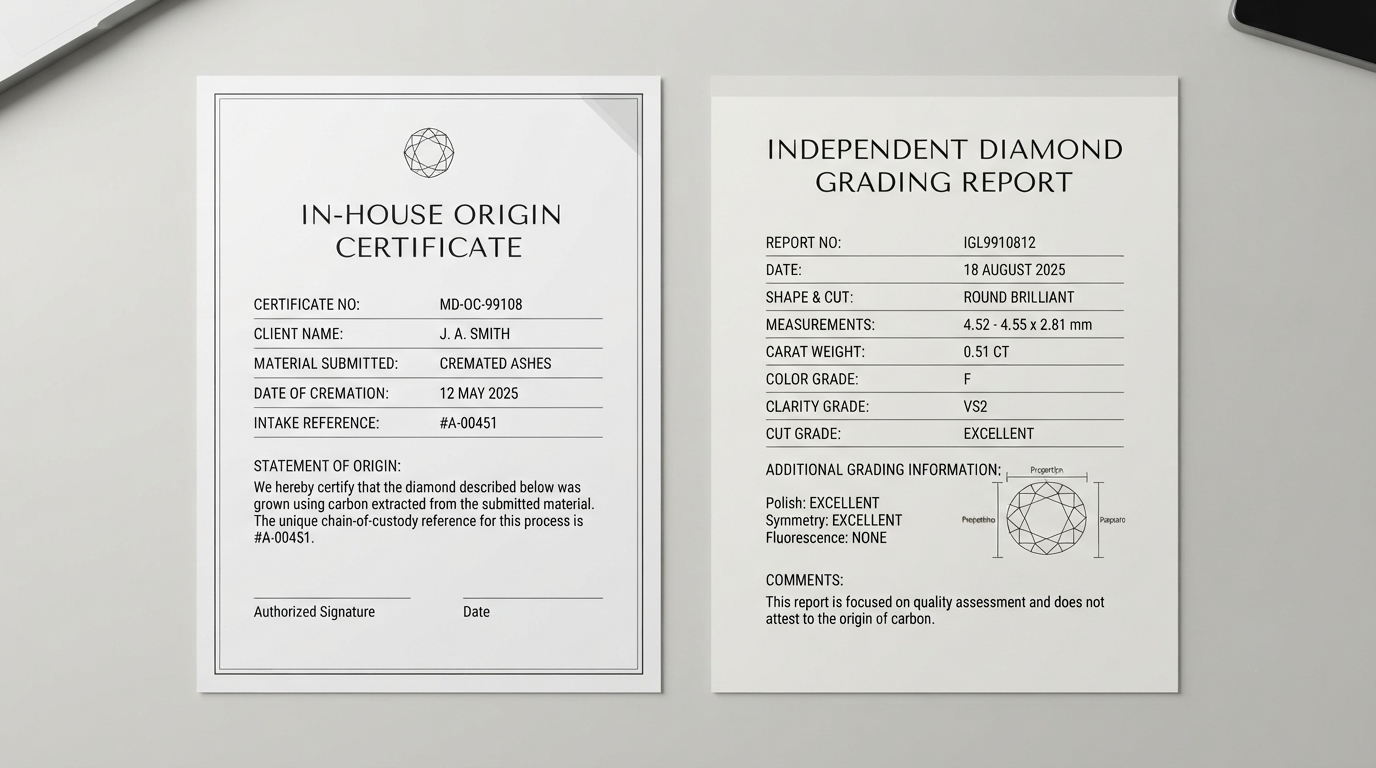
DocumentWho issues itWhat it provesWhat it does not prove
Origin or authenticity certificateThe provider, in houseThat this specific stone was grown from this specific submission, the summary of the custody recordThe stone’s quality
Grading reportIdeally an independent gemological labThat the stone is a genuine diamond of a stated cut, color, clarity, and caratWhere the carbon came from, a grading lab has no way to know
An in-house origin certificate and an independent grading report laid side by side on a desk

The origin certificate is the provider’s attestation: this stone, this submission, this reference. It should carry your intake reference number, the material submitted, and the date. A certificate that only says “genuine memorial diamond” is a souvenir, not evidence that anything is really made from your wife’s ashes.

The grading report is about the diamond as a diamond. An independent lab applies the same cut, color, clarity, and carat standards to a memorial stone as to any other; typical memorial clarity lands between SI2 and VVS. It is silent on origin by design, and a provider who points to the grading report when you ask whether the diamond is really made from your wife’s ashes is answering a question you did not ask.

Fact 5 What Can You Verify Yourself, and What Can Nobody Verify?

Here is the line most articles blur, stated plainly.

What you can verify about a diamond really made from your wife’s ashes: that it is a real diamond. Any jeweler with a thermal or electrical tester can confirm it is diamond rather than a simulant. An independent lab can grade it and identify it as lab grown by the HPHT or CVD method described on the synthetic diamond page. You can also check that the documents match each other and your intake paperwork.

What nobody can verify: whose carbon is in it. A carbon atom from your wife’s ashes is identical to a carbon atom from a lab feedstock. There is no isotope test, DNA test, or spectroscopic signature that says “this carbon came from this person.” A diamond grown entirely from lab carbon and a diamond really made from your wife’s ashes would be indistinguishable to every instrument in existence.

That is no reason to distrust the category. It is a reason to be precise about where the proof lives: in procedure, the custody record, the reference numbered certificate, the provider’s willingness to show you both, not in chemistry. Anyone who says a test can settle whether a stone is really made from your wife’s ashes is mistaken or selling the test.

So the question to carry into every conversation is “show me the record.” A provider who has one will be relieved you asked. How to turn your wife’s ashes into a diamond puts the paperwork check at the receiving end of the process, where it belongs.

Fact 6 Which Red Flags Suggest a Provider Is Overstating?

A provider does not have to be dishonest to overstate; some repeat marketing they inherited. Either way, these signals mean the answer to “is it really made from your wife’s ashes” is being stretched:

  • “100% made from your loved one.” The most reliable red flag. It is chemically false, and a provider who leads with it will not be careful about the percentage that is true.
  • No specific percentage, or one that changes when you ask twice. A good answer is a range with a reason.
  • “Send as much as you can.” More ash does not make the stone bigger or more her.
  • Custody described but never shown. A brochure sentence instead of a sample record means the record may not be what the sentence implies.
  • An origin certificate with no reference number. A generic certificate proves nothing about your specific stone.
  • The grading report offered as proof of origin. It is proof of quality. Conflating the two is a misunderstanding or a redirection.
  • A guarantee that a test will confirm it is really made from your wife’s ashes. No such test exists.

None of the first six is disqualifying alone; two or three together are a pattern. The seventh is a plain falsehood, do not send anything irreplaceable to a provider who states it, whatever else they say about a stone really made from your wife’s ashes.

Why Does This Question Matter More for Ashes Than for Hair?

If you also hold a lock of her hair, the “is it really her” doubt is weaker on that side, and it is worth knowing why.

Hair is roughly 50% carbon by weight, built from keratin. Ashes are under 4% carbon. A hair submission supplies far more personal carbon per gram, so the question of whether there was enough of her barely arises. With ashes, the small carbon fraction is what makes the honesty point necessary: lab carbon has to do most of the volume, so the percentage has to be answered squarely before you can say a stone is really made from your wife’s ashes.

That does not make an ashes stone less real. It makes the proof more dependent on procedure. A diamond really made from your wife’s ashes is one whose provider will tell you, unprompted, how small her share is, because the alternative is a provider who will not.

The hair version of the same doubt, different chemistry, worries about dye and gray, the same procedural proof, is in whether a memorial diamond is really made from your wife’s hair. Both routes end at a stone that is genuinely, partly, provably her, with the proof on paper rather than in the atoms. Wife Ashes Diamond: The Complete Guide covers everything downstream, quantity, color, carat, cost, and timeline, once you are satisfied that the stone is really made from your wife’s ashes.

Frequently Asked Questions

Is a memorial diamond really made from your wife’s ashes, or is that marketing?

It is really made from your wife’s ashes in part. Carbon is extracted from a small portion of her cremated remains, purified, and grown into a genuine diamond. Her carbon typically makes up around 10 to 15% of the stone; the rest is lab sourced carbon added to reach a workable volume.

Can a lab test prove the diamond is really made from your wife’s ashes?

No. Carbon atoms carry no personal signature, so no chemical, isotopic, or gemological test can identify whose carbon a diamond contains. A jeweler can confirm it is a real diamond and a lab can grade it; proof of origin is procedural, the custody record and origin certificate.

What does “chain of custody” actually mean for her ashes?

A logged, traceable record following your submission under one reference number from intake through extraction, growth, cutting, and return, with no pooling with other families’ material. Ask to see a sample record; it is the only written evidence the stone is really made from your wife’s ashes.

Is the origin certificate the same as the grading report?

No. The origin certificate is issued by the provider and attests that this stone was grown from your specific submission. The grading report, ideally from an independent lab, documents cut, color, clarity, and carat and says nothing about origin. You want both.

Why is the personal carbon only 10 to 15% of the stone?

Because ashes are almost entirely calcium phosphate, with only about 0.5 to 4% usable carbon. The carbon recovered from a few tablespoons of ash is not enough to grow a meaningful stone alone, so it is blended with lab carbon. Some providers cite figures as low as 3% depending on carat.

Would sending more of her ashes make the diamond more her?

Not meaningfully. Carat is determined by growth time in the press, not by material quantity, and the blend ratio is set by the growth cell’s volume. Sending a full urn loses ashes you could have kept without making the stone any more really made from your wife’s ashes than it already is.

Is the doubt any different if I use her hair instead?

Yes, in one respect. Hair is roughly 50% carbon compared with under 4% for ashes, so far more personal carbon is available per gram and the “was there enough of her” question barely arises. The procedural proof, custody record and origin certificate, is the same for both.

Final Thoughts on Whether It Is Really Made From Your Wife’s Ashes

The skeptic in you is doing its job. A memorial diamond is really made from your wife’s ashes in the only sense physics allows, a small, purified, real portion of her carbon inside a genuine diamond, and no honest provider will tell you otherwise. You cannot prove it with an instrument. You can insist on a provider who states the percentage plainly, shows you the custody record, and issues a certificate tied to your reference number. Choose on those three things, and the stone you receive will be what it claims: really made from your wife’s ashes, entirely real, and honestly described.

Learn More About Wife Memorial Diamonds

Talk With Memorial Diamond

If you want to ask the three questions on this page, the percentage, the custody record, and the certificate wording, before any of her ashes leave the house, reach out to Memorial Diamond. Asking whether a stone is really made from your wife’s ashes before you send them is what a careful person does. There is no deadline.