
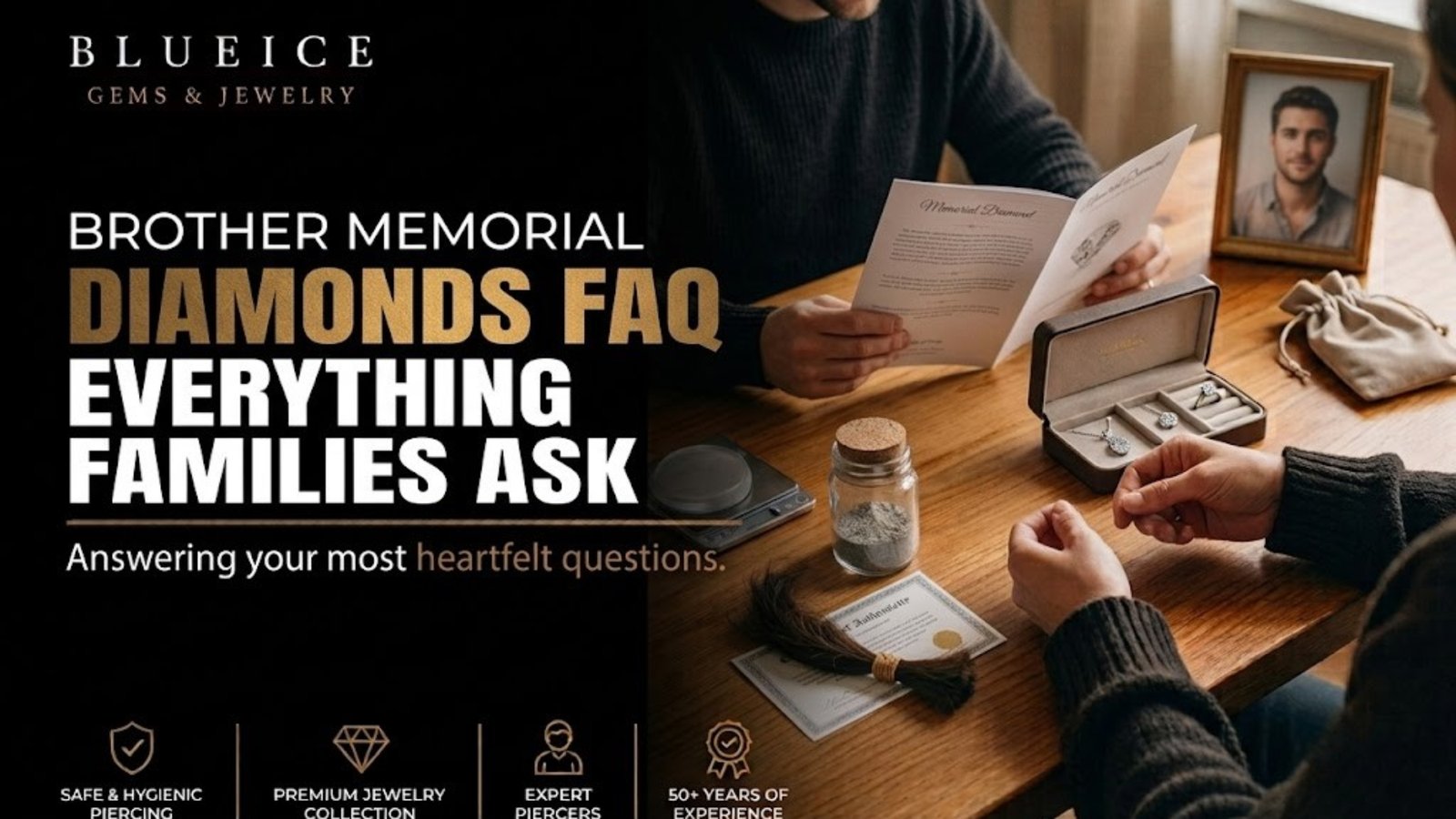
After a brother dies, the questions rarely come one at a time; they come from a parent, a sister, a cousin, sometimes a partner, often in the same week. A brother memorial diamond is a real lab-grown diamond grown partly from carbon recovered from his cremated ashes or a lock of his hair, with industry prices running from roughly $1,500 for a small stone to $20,000 or more for a large one, and a typical wait of 6 to 10 months.
Everything below is arranged as the questions relatives put to each other about a brother memorial diamond, with a short answer first and the detail after. Read the sections that matter to you now and leave the rest for later.
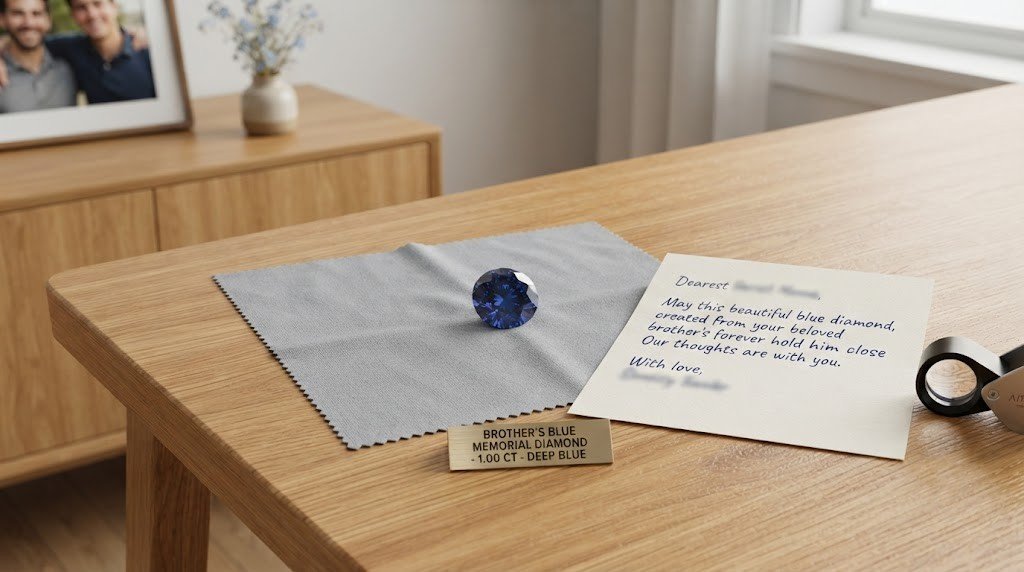
Table of Contents
Is a brother memorial diamond a real diamond, and is it really made from him?
Yes to the first, and yes, in part, to the second. A brother memorial diamond is a genuine lab-grown diamond with the same crystal structure, optical properties and grading scale as a mined one, scoring 10 on the Mohs hardness scale. It is not glass, resin or a simulant.
The “made from him” part deserves a precise answer, because overstated claims circulate in this industry. Cremated ashes are mostly calcium phosphate, the mineral left from bone, and only about 0.5 to 4% of ash by weight is usable carbon. That carbon is extracted, purified to roughly 99.9% or better, and typically blended with supplemental lab carbon so there is enough feedstock to grow a stone of a useful size.
What share of an ash-based stone is his carbon?
For a stone grown from ashes, his own carbon commonly makes up around 10 to 15% of the finished mass. Some providers quote figures as low as 3%, and some quote higher ones, depending on the size of the stone and how much ash was sent. Any seller who describes an ash-based brother memorial diamond as being entirely his remains is describing something the chemistry does not allow.
And for hair, or a blend of the two?
Hair is around 50% carbon, so far less of it is needed. Even so, nobody publishes an equivalent finished-stone percentage for hair, or for a stone grown from ashes and hair together. If that number matters to your family, ask each provider to put its own figure in writing before you commit.
Should the stone come from his ashes, his hair, or both?
The source for a brother memorial diamond usually follows what you actually have. Ashes are only an option if he was cremated and someone can release a portion; hair works whether he was cremated or buried, and needs no cremation at all.
| Source | When it fits | What to know |
|---|---|---|
| Ashes | He was cremated and a small portion can be set aside | Personal carbon commonly around 10–15% of the finished stone; whoever holds the ashes is part of the decision |
| Hair | A lock was saved, or hair remains on a brush, cap or comb (acceptance varies by provider) | About 50% carbon, so a small amount goes far; no published finished-stone share |
| Ashes and hair together | Both are available and the family wants both in one stone | Not every provider offers it; no published finished-stone share for the blend |
Each route has its own practical path, and the complete guide to a diamond from a brother’s ashes walks through the ash route from start to finish. If what you have is a saved lock or hair from his belongings, the full walkthrough for a brother hair diamond covers collection and packing. Families who want both sources in one stone can find the combined route in the guide to growing one stone from his ashes and hair.
No source makes a brother memorial diamond more “him” than another. The right one is simply the one your family can arrange without strain.
How much of his ashes or hair does a provider need?

Usually far less than people fear. Industry-wide, ash requests for a brother memorial diamond typically range from a few tablespoons up to roughly 4 oz (about 100 g), which is usually a small fraction of the total remains. Hair requests are commonly a small lock or a few grams.
That leaves most of his ashes free for the urn, a burial plot, a scattering, or whatever was planned. Sending more than a provider asks for does not produce a bigger or faster stone, because growth time in the press sets the carat size, not the volume of material.
Exact minimums vary from one company to the next, so treat any figure here as a general guide. Before you portion anything out, ask the provider for its own requirement and what it does with any material that is not used.
How is a brother memorial diamond actually made?
In short: his carbon is recovered, purified, turned into graphite, grown into a crystal under extreme pressure and heat, then cut and graded. Most providers grow memorial stones by HPHT (high pressure, high temperature); a minority use CVD, a vapor-deposition method. Both are standard routes for lab-grown diamonds generally.
The sequence across the industry looks like this:
- Collection, with chain-of-custody tracking from the moment his material arrives.
- Extraction and purification of the carbon, to roughly 99.9% or better.
- Graphitization at around 2,500 to 2,700°C.
- Growth around a small diamond seed, under roughly 6 to 8 GPa and 1,400 to 2,500°C, over weeks to months.
- Cutting and polishing into the chosen shape.
- Optional irradiation, offered by some providers to shift color.
- Grading, ideally by an independent laboratory.
The tracking in step one is the part to press hardest on. Ask how his material is labeled, who handles it, and what record you will receive showing that the finished stone traces back to what you sent.
What color will the finished stone be?
A brother memorial diamond, like most memorial stones, tends to come out in yellow, blue or champagne-to-brown tones rather than colorless. Trace elements present during growth set the color: boron pushes a stone toward blue, and nitrogen toward yellow.
A colorless stone is possible, but it requires shutting both elements out, which takes extra processing and typically raises the price. Some providers also offer post-growth irradiation for red, pink, green or black. What no honest provider can promise is an exact natural shade, or that his ashes will give a different tone from his hair.
Color is often where personal meaning shows up. Some relatives lean toward a color family that recalls something he loved, knowing the exact tone will still vary; others go with whatever the person wearing it likes to look at every day. The page on what to expect from brother memorial diamond colors goes through each option and its effect on cost and timing.
How much does a brother memorial diamond cost?
Across the industry in 2026, a brother memorial diamond typically costs between about $1,500 and $75,000 or more, with carat size doing most of the work. Color matters next: at the same size, colorless usually costs meaningfully more than blue, yellow or champagne.
| Size tier | Typical carat | General 2026 industry range |
|---|---|---|
| Entry | 0.10–0.25 ct | Roughly 1,500–3,500 |
| Mid | 0.5–1 ct | Roughly 5,000–15,000 (colorless meaningfully more) |
| Large | 2–5+ ct | Roughly 20,000–75,000+ |
These are broad industry figures, not Memorial Diamond’s prices, which have not been published. Several costs usually sit on top of the loose stone: an independent grading report, engraving, a fancy cut, and the ring, pendant or other setting.
When several relatives are each paying for their own stone, it helps to compare like with like. A detailed breakdown of what a brother memorial diamond costs at each size can help a family line up quotes on equal terms.
How long does the whole process take?
Plan on about 6 to 10 months for a brother memorial diamond, counted from the day a provider receives his ashes or hair. Stones larger than roughly 2 carats, or specialty colors such as black, can take up to about 12 months.
The length comes mainly from growth time in the press, which is also what determines carat size. Choosing a smaller stone is the most reliable way to keep the wait shorter, while sending extra material changes nothing.
If there is a date the family has in mind, such as an anniversary or a wedding, raise it at the very first conversation and ask the provider whether it can be met. A closer look at how long a brother memorial diamond takes explains where the months go and how to plan around them.
Who has the right to decide about his ashes?
Before anyone orders a brother memorial diamond from his ashes, it helps to know who holds them, and that depends on the state where he died and on anything he put in writing. Each state sets its own order of priority, and the sequences are not identical. Depending on where he died, a spouse or partner, his adult children or his parents could each have a stronger claim than a sibling, and a written directive from him can rearrange that list entirely.
The funeral home or crematory can usually tell you who signed the cremation authorization, which is often a good guide to who holds the ashes and the say over them. For anything contested, a local estate or probate attorney is the right person to ask.
A respectful route for a sister or brother
If someone else holds that authority, the gentlest route is to ask them for a small portion, explaining what you have in mind and how little a provider typically needs. Hair is often the simpler practical question, since a saved lock or hairbrush may already be with a sibling. Even so, his belongings can form part of his estate and the rules vary by state, so a word with the executor, or whoever is settling his affairs, is wise before anything is sent.
Families do not always agree, and parents may be divided, estranged or no longer living. Some ideas for opening the subject kindly are in this guide to raising a memorial diamond with the rest of the family.
Can several relatives each have a stone made from him?
Often, yes. Because each brother memorial diamond needs only a portion of the ashes or hair, a provider can frequently grow several diamonds from the same shared material, perhaps one for a parent, one for each sibling, one for a partner if he had one, or whatever combination fits your family.
Where stones are ordered and priced separately, one person might choose a small blue stone for a pendant while another chooses a larger, colorless stone for a ring. How the release of the shared material is agreed still runs through whoever holds authority over it.
Whether a provider can split one submission across several orders, and how much material that takes, is a question to ask directly. The practical side of sharing a brother memorial diamond across the family covers how relatives can coordinate orders without anyone feeling rushed.
What are the ways to wear or keep a brother memorial diamond?
Almost any way you would wear or keep a mined diamond. A brother memorial diamond can go into a ring, pendant, earrings, bracelet, tie bar or cufflinks, or stay loose in a small case on a shelf.
The best setting for a brother memorial diamond follows the person who will wear it and who he was, not any idea of what suits a brother. Someone who works with their hands might want a low-profile setting that sits close to the finger, while someone who rarely wears jewelry might prefer a pendant kept for particular days. A diamond’s hardness makes it durable, but a hard knock can still chip one, so the setting does some protective work too.
Settings, metals and engraving are usually priced apart from the stone. If the stone is not yet grown, you can still choose the setting later, once you have seen the finished color.
Is a memorial diamond acceptable in your faith?
No religious tradition has issued an official position on a brother memorial diamond, or on memorial diamonds of any kind. What traditions do address is cremation and the handling of ashes, and that is where the answer for your family will come from. A brief outline:
- Catholic: Cremation is permitted, but Church guidance asks that ashes be kept whole in a sacred place, with only a narrow allowance for a small portion. That bears directly on dividing his ashes for a stone.
- Jewish: Orthodox and Conservative Judaism generally prohibit cremation, while Reform Judaism is more permissive and leaves more to rabbi and family.
- Muslim: Cremation is considered impermissible across the major schools of Islamic thought, so an ash-based stone does not arise. A hair-based stone involves no cremation at all.
- Hindu: Cremation followed by immersing the ashes is traditional; keeping a small portion is described as increasingly common, though practice differs by family, region and community.
- Buddhist: Views on keeping physical remains depend on the teacher and community; some see it as mindful remembrance, others as sitting uneasily with non-attachment.
- Protestant: Most clergy have no objection, though some congregations raise concerns about dividing or scattering ashes.
- Secular: The decision rests on personal meaning and what the family wants.
Because practice varies within every tradition, the most reliable answer comes from your own priest, rabbi, imam, pandit, teacher or pastor. If a relative has a religious concern, it deserves a real hearing rather than an argument.
What if he was buried, or died many years ago?
A burial does not rule out a brother memorial diamond. Hair needs no cremation, so a lock that was saved, or hair kept from a brush or cap, may be usable, though each provider decides what kind of sample it can work with. Burial remains common in the United States; the NFDA’s 2025 report projected a national cremation rate of 63.4% against 31.6% for burial.
If he died years ago and was cremated, a brother memorial diamond may still be possible, since his ashes may have been kept in an urn, a niche or a cupboard ever since. Whether ashes stored for a long time are workable is a question for each provider, as is whether older hair, or hair that was dyed or chemically treated, can be accepted.
Time also changes who holds what. The ashes may now be with a parent, his partner or one of his children, and the hair may be in a box nobody has opened. Finding out quietly what exists, and who has it, is a sensible first step before anyone contacts a provider.
How do you choose a provider for a brother memorial diamond?
Choose on transparency first and price second. A provider worth trusting with a brother memorial diamond will answer specific questions in writing and will not rush you.
Questions worth putting to every company you consider:
- What share of the finished stone will be his own carbon, for the material we are sending?
- How is his material labeled and tracked, and what record do we receive?
- What happens to any ashes or hair that are not used, and can they be returned?
- What happens if a growth run fails?
- Is independent grading included, or is it a separate charge?
- What are the refund and cancellation terms?
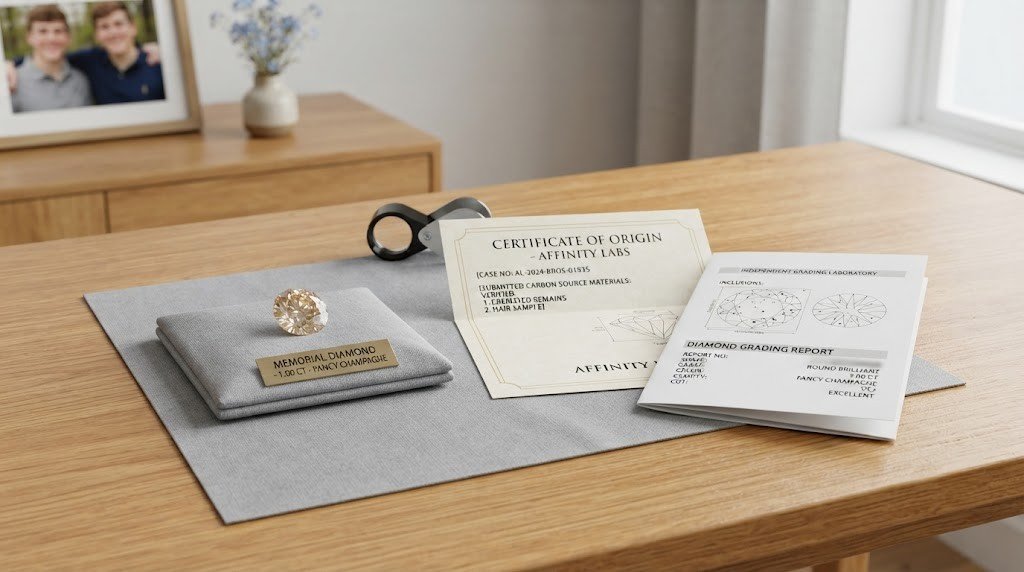
Two documents are worth telling apart. An authenticity or origin certificate, usually issued in-house, records that the stone came from your submitted material. A grading report, ideally from an independent laboratory working to the GIA’s 4Cs standards, describes the stone’s cut, color, clarity and carat. Independent grading is typically an optional, separately priced add-on, and typical memorial-diamond clarity falls between SI2 and VVS.
Frequently Asked Questions
Can his name or a date be engraved on the diamond?
Some providers offer a tiny laser inscription on the girdle, the thin outer edge of a brother memorial diamond, and the setting can carry an inscription too. Engraving is usually priced separately, and character limits vary, so ask what is possible before you order.
Does a diamond grown from his ashes need special care?
A brother memorial diamond needs the same care as any diamond. It resists scratching, but a sharp knock against a hard surface can still chip an edge. Clean it with warm water and mild soap, and have the setting checked by a jeweler from time to time.
Should the stone be insured once it arrives?
One option is adding it to a homeowner’s or renter’s policy; another is a separate jewelry policy. Coverage, valuation and premiums depend on your insurer and your state, so speak to an insurance agent about how a stone with personal value is assessed.
Can his ashes be posted to a provider, or carried abroad?
Rules on shipping cremated remains, and on carrying them across borders or through airports, vary by carrier and country. Ask the provider exactly how it wants material sent, and check current carrier and airline requirements before packing anything.
Can I keep a small amount of his ashes as well as the stone?
Usually, yes. A diamond needs only a portion, so the rest can go to an urn, keepsake or burial as planned. Whether a provider returns unused ashes after extraction is its own policy, so ask about that in writing.
Is a brother memorial diamond a suitable gift for another relative?
It can be, whether the recipient is a parent, a sibling, or his partner or child if he had one, provided the gift is offered gently and wanted. Asking quietly first helps, because a stone carries strong feelings. A loose stone leaves them free to choose a setting later.
Final Thoughts on Brother Memorial Diamond Questions
There is no deadline on a brother memorial diamond. Ashes and hair can usually be kept while the family talks, and a year spent reaching agreement is time well used; just ask any provider you are considering how it views long-stored material.
When you are ready, the questions on this page are a good place to start a conversation, whether it is with a parent, his partner, a sibling, or a provider you are still weighing up.
Learn More About Planning a Brother Memorial Diamond
- Is a memorial diamond really made from his ashes? the carbon question in full detail
- How a diamond is made from a brother’s ashes each production stage explained
- A memorial diamond or a traditional urn for your brother how the two compare and sit together
- Settings and jewelry ideas for a brother’s stone rings, pendants and more
- Where to start when choosing a diamond for your brother a first-steps overview
Talk With Memorial Diamond
If you are weighing a brother memorial diamond and would like to talk it through, whether your question is about his ashes, his hair, or how to include the rest of the family, Memorial Diamond is glad to listen. There is no obligation and no rush.
You can reach us at memorialdiamond.us whenever the time feels right.
Leave A Comment