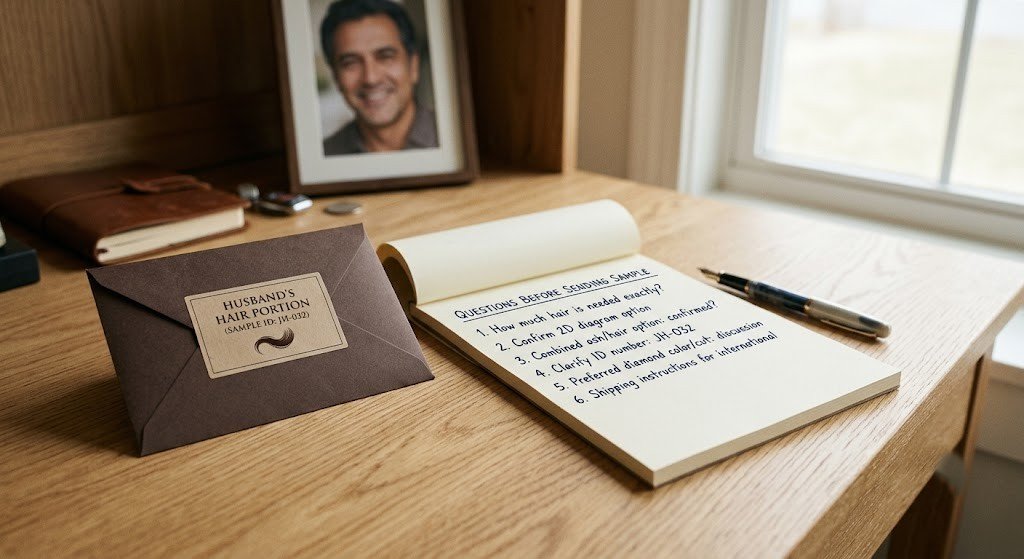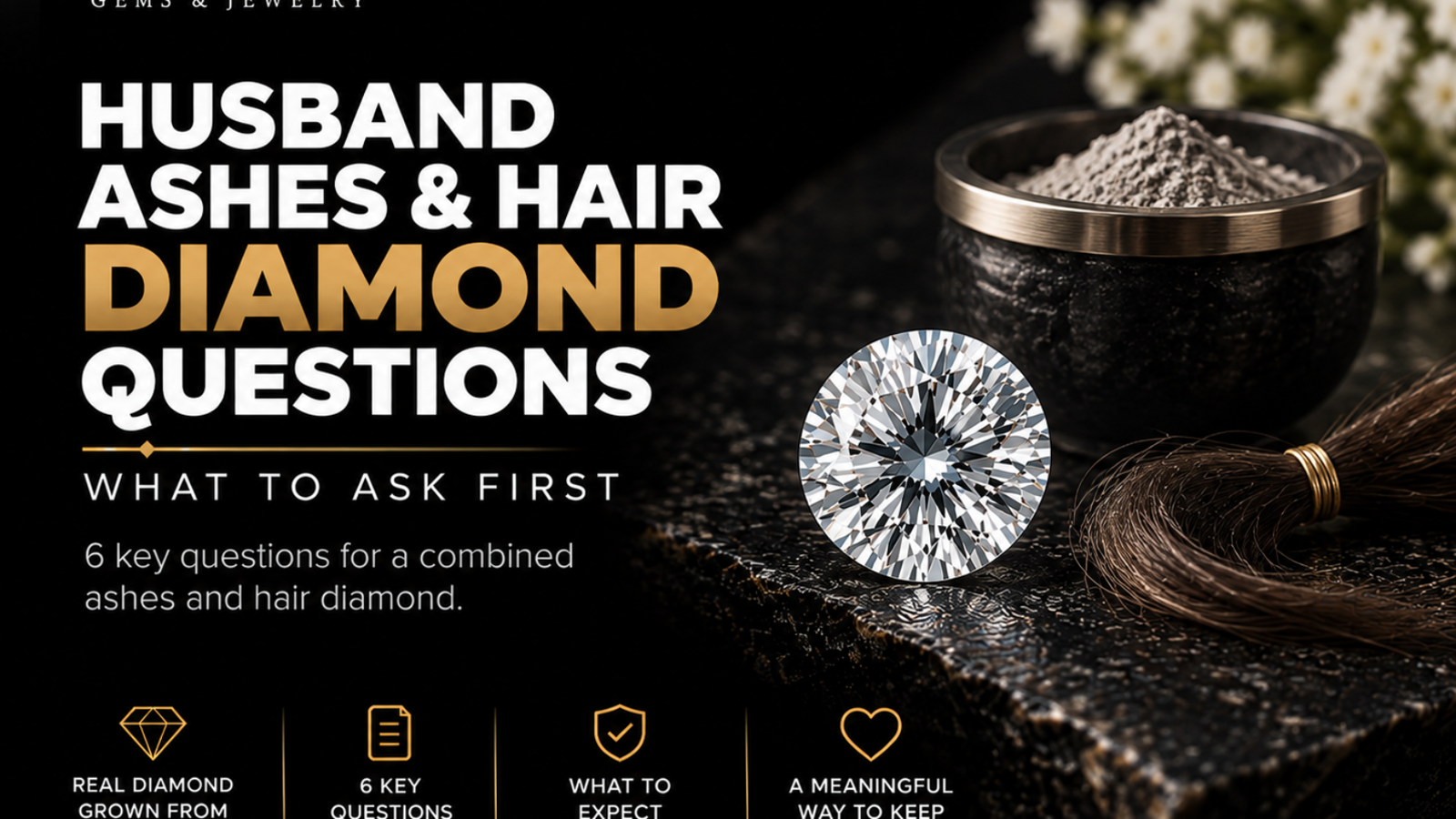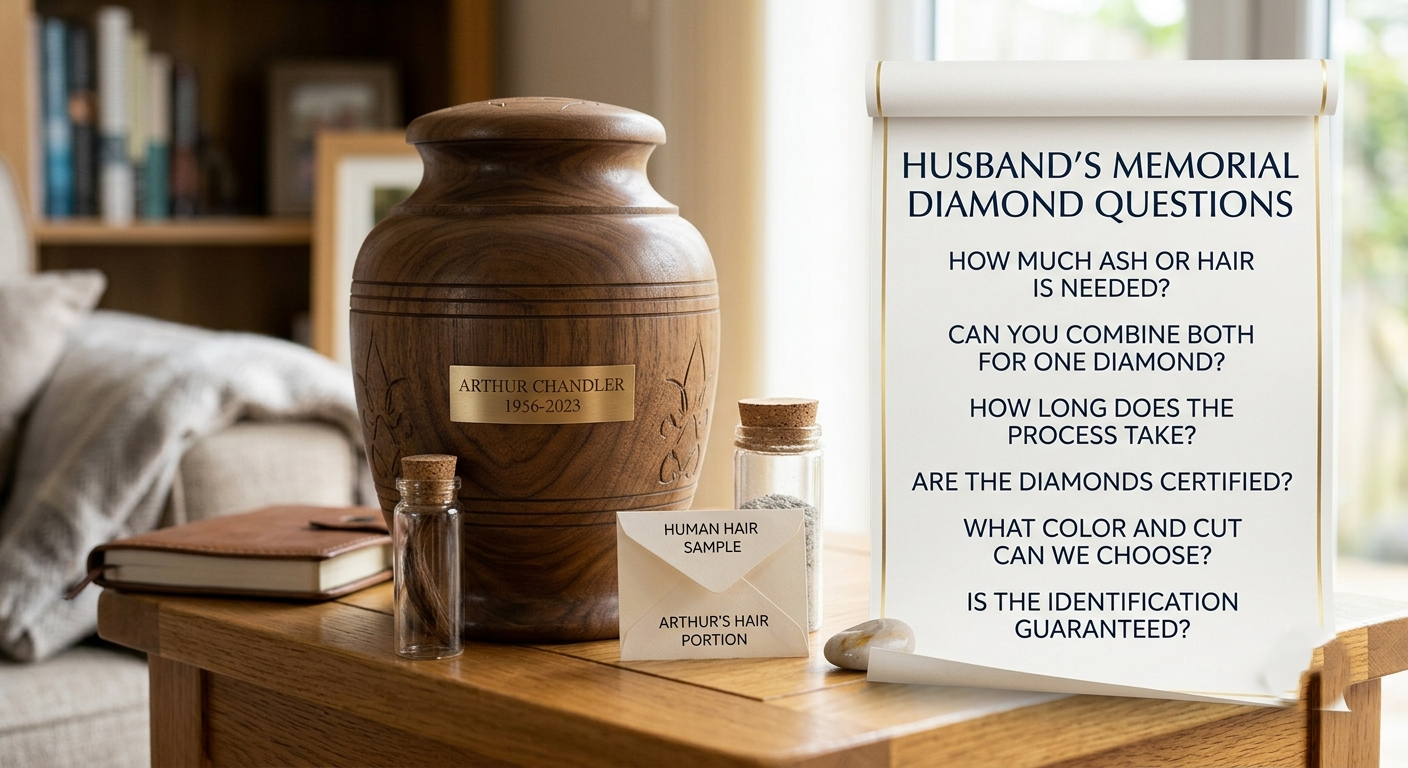
Partner ashes hair diamond color decision shown as two labeled parcels, one of cremated remains and one holding a lock of hair, on a kitchen table

What Color Will a Diamond Made From Your Partner’s Ashes and Hair Be?

Two parcels sitting on the same table raise a question that never comes up when there is only one: does sending both of them change what comes out?

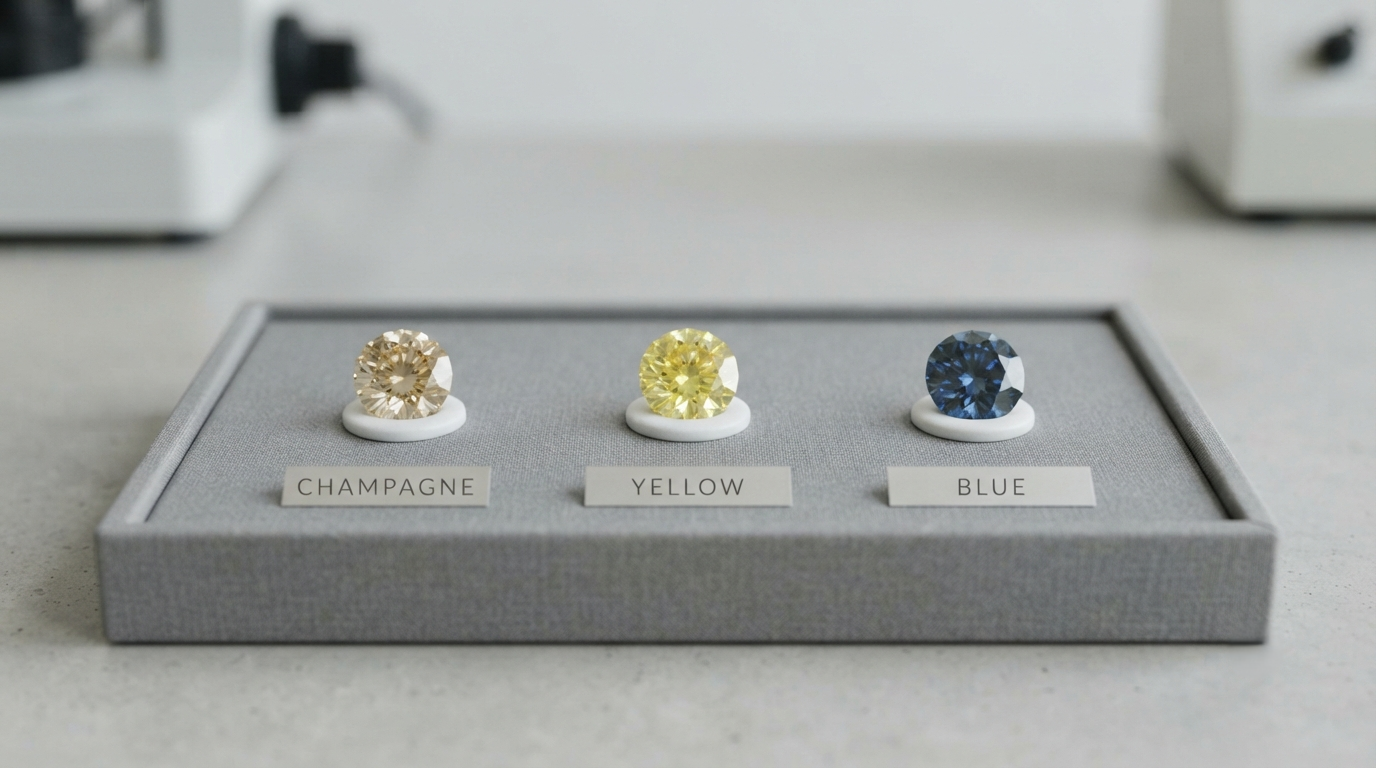
It changes less than most people assume. A partner ashes hair diamond color still lands in yellow, champagne or blue far more often than in colorless, and combining two materials does not average them into a middle shade, does not hand the tone to whichever source is richer in carbon, and does not make the result any easier to forecast. Combining widens the list of things that could be in the growth cell. It does not narrow it.

Memorial Diamond grows stones from combined submissions and charges for them, so a commercial interest sits behind this page. Where the truthful answer is that nobody can know in advance, it says so.

Does a Partner Ashes Hair Diamond Color Average the Two Sources?

No. Averaging is a mixing metaphor borrowed from paint, and it does not describe how a partner ashes hair diamond color is arrived at.

Mix two tins of paint and you get a shade between them, because the pigment in each tin is the color. Nothing in a partner ashes hair diamond color works that way. Neither parcel arrives carrying a color. Both are reduced to elemental carbon at roughly 99.9% purity before growth begins, and whatever you sealed into each envelope, pale gray grit, dark hair, white hair, loses its appearance along with everything else that was not carbon.
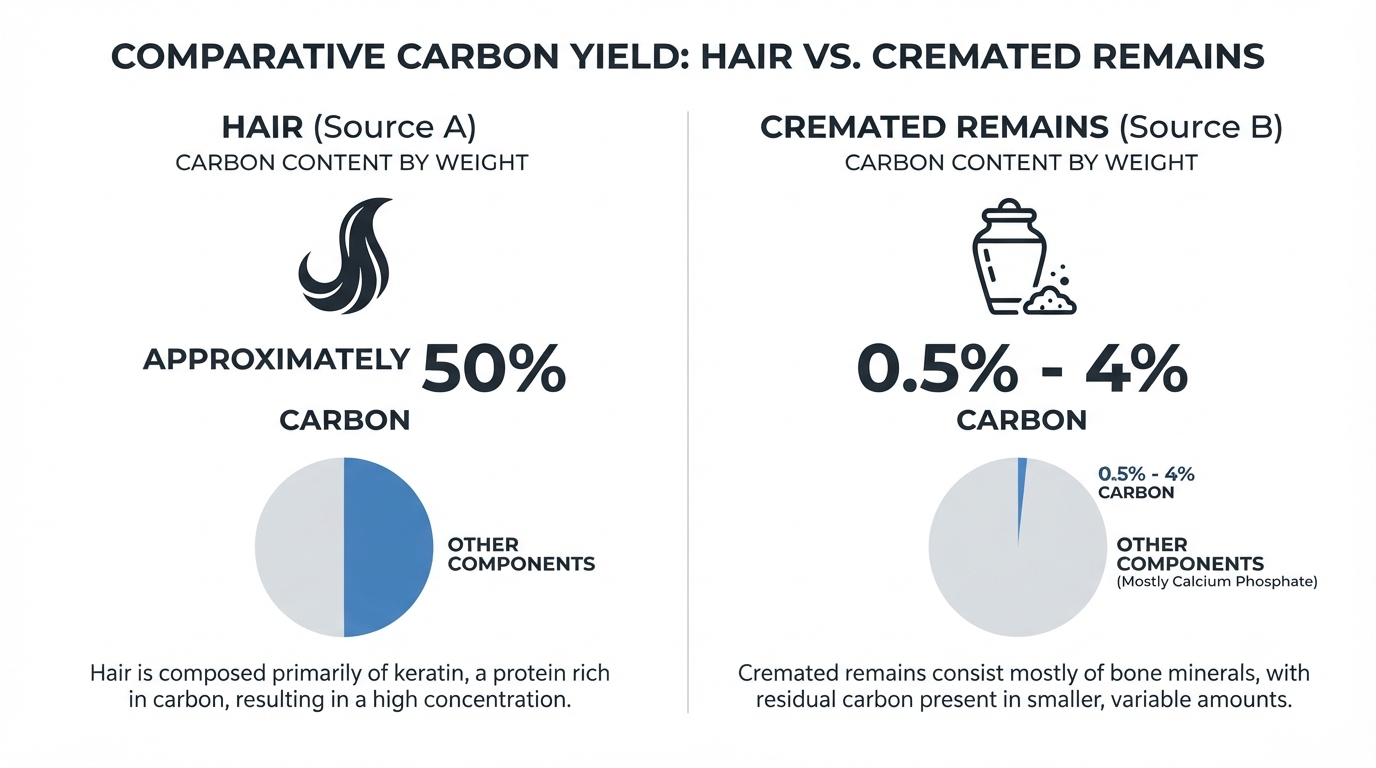
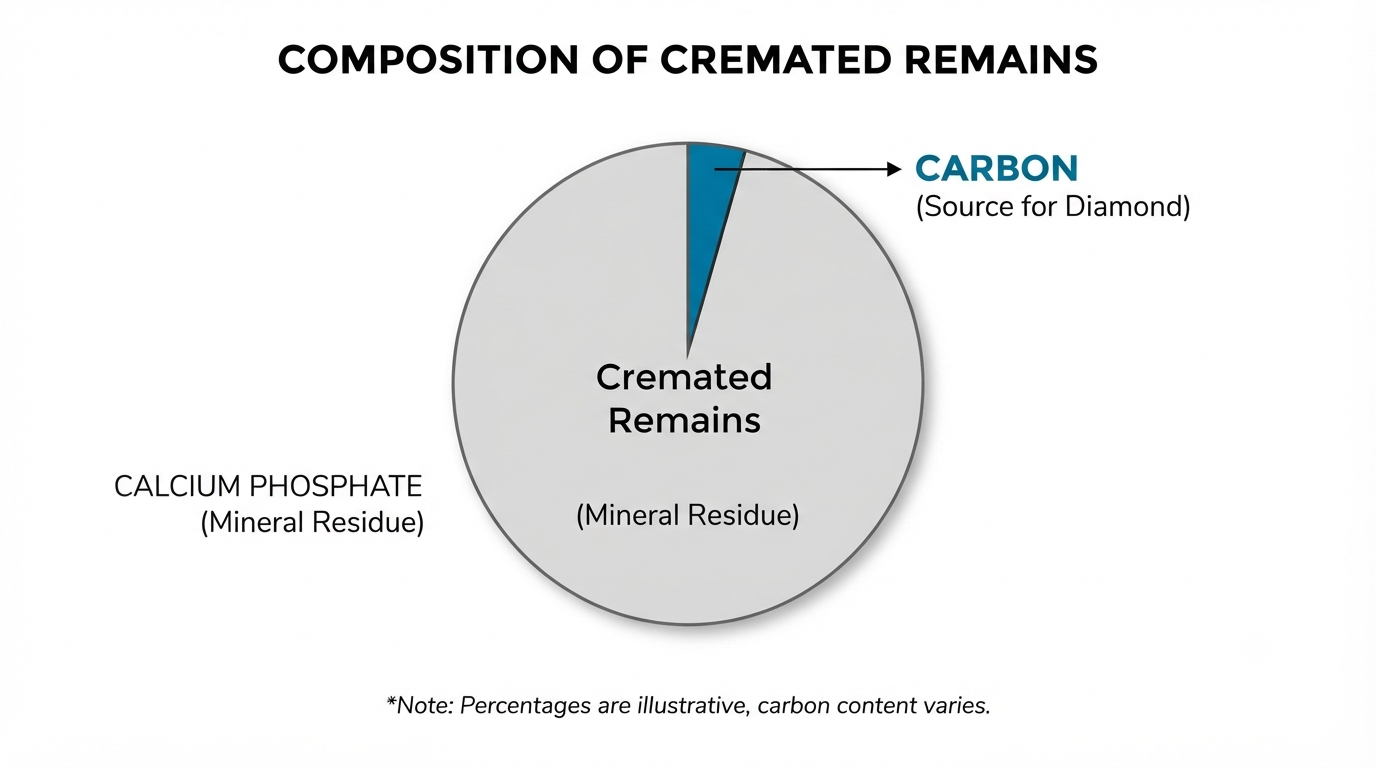
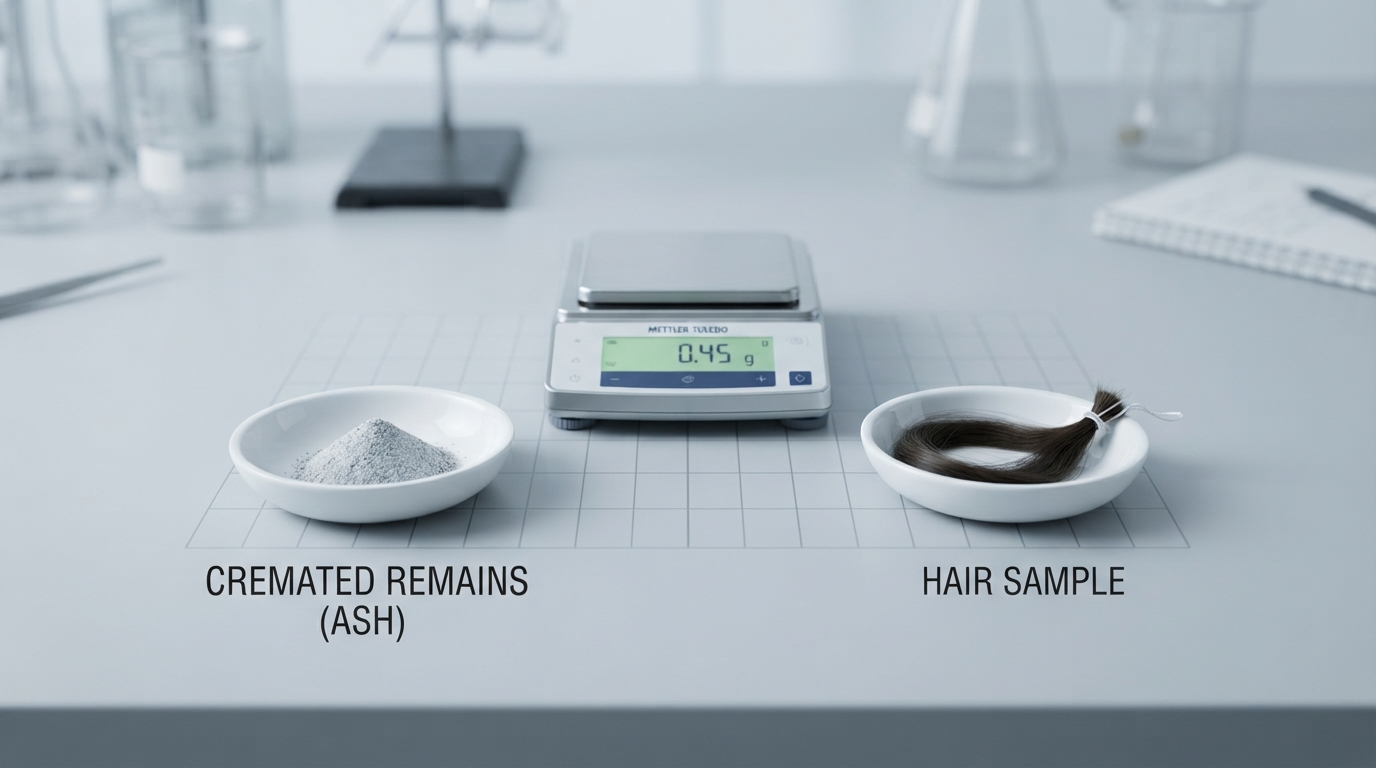
Comparison graphic showing roughly 50 percent carbon by weight in hair against 0.5 to 4 percent in cremated remains

What survives is invisible and unweighable by you: trace quantities of elements that came through purification with the carbon. Those traces do not blend toward a midpoint. They are simply present together in one cell, and a partner ashes hair diamond color is decided by what the crystal incorporates as it forms around the seed.

So combining is co presence, not blending. No arithmetic turns “what ash would have given” and “what hair would have given” into a predictable third thing, and anyone offering you that arithmetic is describing paint.

Does One Source Dominate the Partner Ashes Hair Diamond Color?

One source usually dominates the recovered carbon. That is a fact about yield, and yield is a different property from a partner ashes hair diamond color.

The gap between the two materials is large and well documented. Hair runs at roughly 50% carbon by weight, keratin being a carbon rich protein. Cremated remains are mostly the calcium phosphate of bone, and usable carbon there accounts for somewhere around 0.5% to 4% of the weight. Weigh out equivalent samples and the hair hands a laboratory far more workable carbon than the ash does. None of that gap is a partner ashes hair diamond color gap.

It is tempting to read that as a steering wheel, more carbon from one source, therefore more influence over a partner ashes hair diamond color. The step does not hold. Trace element content is not proportional to carbon yield, and nothing published lets anyone predict which parcel arrives with more residual nitrogen.

There is a second reason dominance is the wrong frame. Whatever both parcels yield together still falls short of what a growth run consumes, so lab grown carbon is added to bring the charge up to working volume. Your partner’s own carbon is the minority component of the finished crystal either way.

The share usually quoted, roughly 10 to 15% of the finished mass, with some providers citing figures as low as 3%, describes the ash route specifically, and no published figure covers a blended ash and hair charge, so ask what share your provider expects yours to contribute. Two personal sources do not change the majority. They change which minority you are looking at, and they leave a partner ashes hair diamond color exactly where it stood.

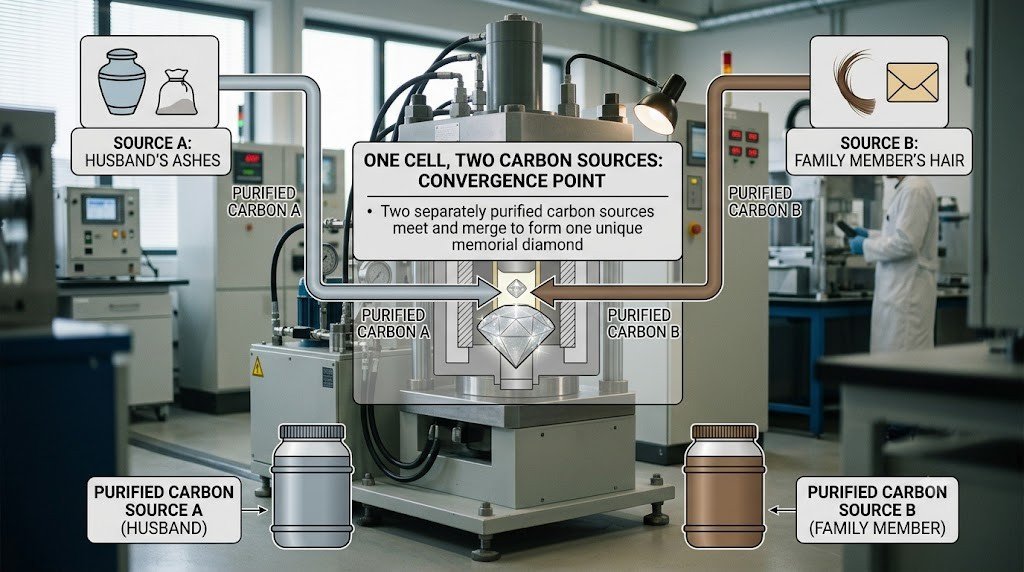
How a combined submission is actually processed follows the two materials through separate preparation tracks to the point where they meet, which is the clearest way to see why neither one gets to be in charge.

Six Things Combining Does and Does Not Do to Color

These six cover almost every version of the question people arrive with. The middle column is the one worth reading slowly.

What people expect combining to doDoes it?What actually happensWhat that means for your order
Average the two sources into a middle shadeNoNeither material carries a color into the cell; purification reduces both to elemental carbon before anything growsStop hunting for a midpoint partner ashes hair diamond color: there is no midpoint
Let hair take the lead because it is carbon richOnly for yieldHair supplies more usable carbon than ash by a wide margin, but trace element content does not scale with carbon yieldChoose your materials on meaning and availability, never on an expected partner ashes hair diamond color
Narrow the range of likely outcomesNo, if anything the reverseA second source adds a second set of residual traces to the same cell rather than canceling the firstPlan for the partner ashes hair diamond color range a single source stone already has
Make the finished shade forecastableNoCombining changes nothing about the fact that no measurement at order time can name a shadeAgree a color family, not a shade
Show a visible seam, swirl or two tone effectNoA diamond is one continuous crystal lattice; it has no compartments for two feedstocks to occupy separatelyA partner ashes hair diamond color reads as one color, like any other stone
Change which color families you can specifyNoYellow, champagne, blue and engineered colorless are available from a combined submission exactly as from a single oneSpecify the family in the order document either way
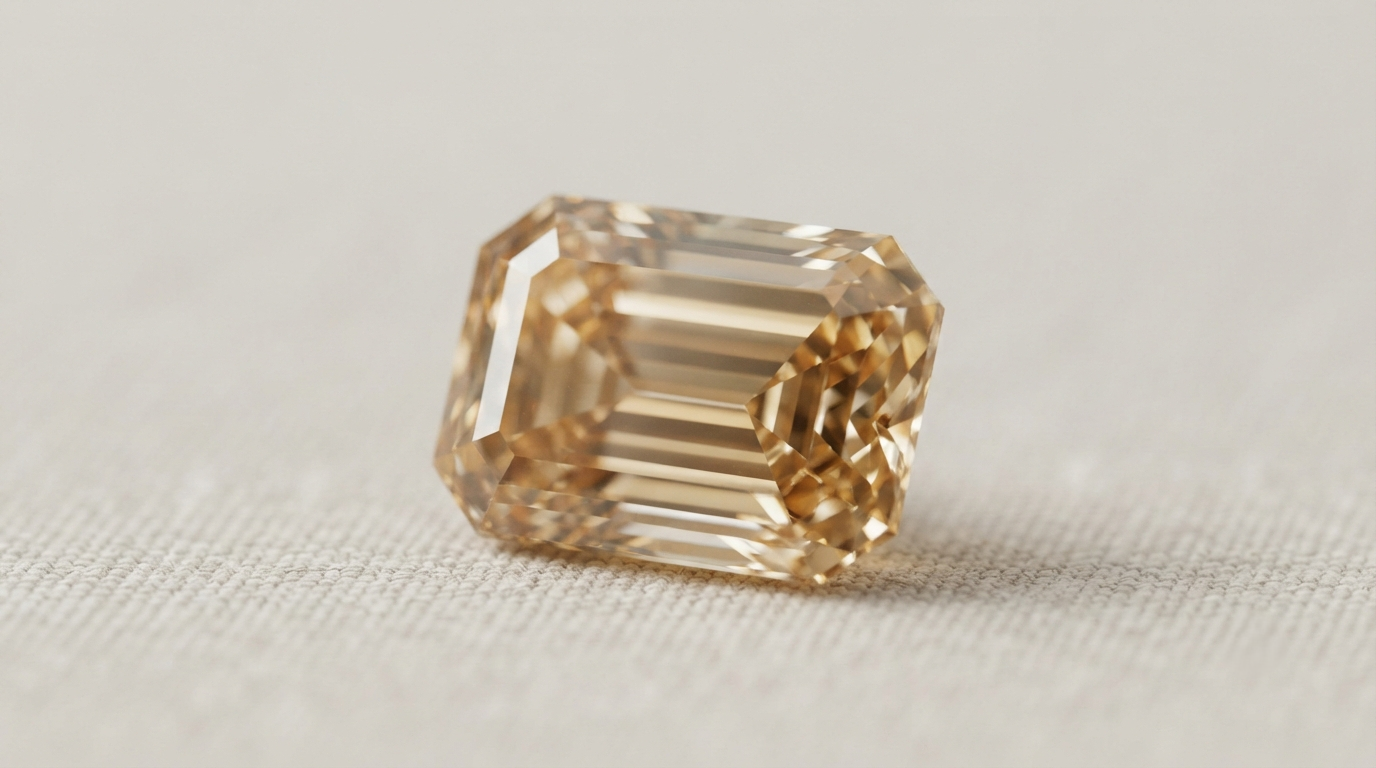
Finished champagne memorial diamond photographed close up showing one continuous crystal with no seam or two-tone effect

Read down the second column and a pattern appears. Almost nothing about color changes when you send two materials instead of one. What changes is the preparation work, the paperwork, and sometimes the price, none of which is a partner ashes hair diamond color.

Does Combining Narrow the Range of Possible Outcomes?

No, and this is worth saying flatly because the opposite belief is intuitive and costs people real disappointment.

The intuition runs like this: two samples from one person ought to agree, agreement ought to mean consistency, and consistency ought to mean a tighter, safer partner ashes hair diamond color. The first link is where that chain parts company with the chemistry.

Color is not a property the two samples hold in common and then confirm. It is decided by what sits in the growth cell in parts per million while the crystal forms. A second organic source adds a second stream of residual material there, and whether it pushes warm, blue, or nowhere is not determined in advance. Two streams give a partner ashes hair diamond color no more certainty than one.

  • Nitrogen present while the crystal forms reads as yellow.
  • Boron present while the crystal forms reads as blue.
  • Both suppressed to nearly nothing is what colorless requires, which is why colorless is engineered rather than hoped for and sits above the tinted families on price at the same carat.

Nothing on that list has a “combined submission” clause. The finished object is a genuine lab grown diamond graded on the same terms as any other, and a partner ashes hair diamond color is described in the same vocabulary a jeweler would use for a stone with no personal history at all.

So the one thing to take from this section is the sentence most pages will not write down: combining does not make color more predictable. If a provider implies that two materials produce a more reliable result, ask what measurement supports it. There is not one in the public record.

What an ash source alone contributes to this question and what a lock of hair alone contributes each take the single source version on its own terms, and neither of them promises a forecast either.

Can You Ask for the Two Sources to Be Grown Separately Instead?

Yes, and it is worth knowing before you commit to one combined stone, because it is the only decision here that genuinely changes what you end up holding.

Two runs from two materials produce two stones, each with its own recovered carbon and its own growth conditions, which means two partner ashes hair diamond color results rather than one. You are no closer to predicting either, and you have doubled the number of shades you will meet.
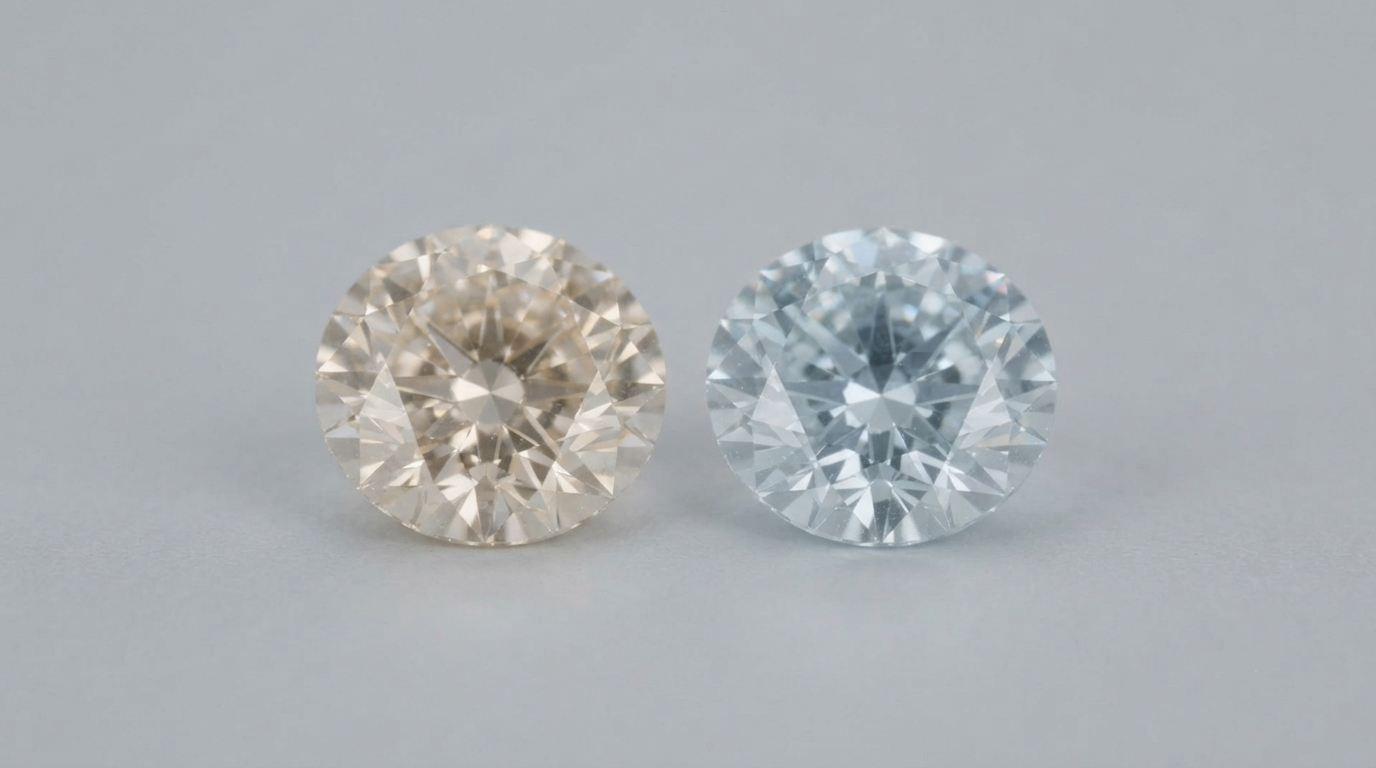
Two memorial diamonds from separate growth runs side by side under neutral light, visibly different in tone

Expect the two partner ashes hair diamond color outcomes not to match. Separate runs are separate events, and reading a visible difference as a fault in one stone is the most common way this choice goes wrong. Do not assume any laboratory will undertake to match two stones across separate runs: ask before you order two.

Why families ask for it anyway comes down to a handful of practical reasons rather than color:

  • Two people, two stones. A combined stone cannot be divided later, and separate runs let two people each hold something.
  • Two different objects. A ring from one and a pendant from the other is a decision you can only make if there are two.
  • Different timing. The materials may not become available at the same moment, which matters a great deal in this cluster.
  • Keeping the sources distinct on paper. Some people want documentation that says this one is from the lock, that one is from the ashes.

The costs are real: two runs mean two prices, and a second stone is a second full growth period rather than an add on. Whether separate growth is offered at all is company policy rather than a fact about the category, ask directly. Whether more than one diamond can come from the same source covers the logistics side of that in full.

What Can You Put in Writing for a Combined Order?

Five things about a partner ashes hair diamond color, none of which requires you to know a shade, and all of which are cheaper to settle now than at delivery.

  1. Which partner ashes hair diamond color family is being grown toward, yellow, champagne, blue, or engineered colorless, written on the order rather than remembered from a call.
  2. How wide that family is allowed to be. The word “champagne” has to describe the same span of stones to the laboratory as it does to you, and the only way to find out is to make someone define it out loud.
  3. What happens if the finished stone sits outside that span. A re grow, a price adjustment, a conversation, or explicitly nothing. All four are workable positions. Silence is not.
  4. Whether both materials are confirmed as used, and in what document, this matters more on a combined order, because two parcels produce one stone.
  5. Whether an independent grading report is included, and which scale it applies, the language for a tinted stone and the language for a colorless one are not the same set of words.

That fourth item has a trap in it. A report describing the cut, color, clarity and carat of the finished stone says nothing about what went into it, so it is not the document confirming both parcels were used. That is a separate piece of paper, and asking which one you are being offered is the most useful question on this list. The wider list worth putting to a provider before either parcel leaves your house goes well past color, and the complete guide to a combined submission sets out how the two tracks run side by side.

What If the Ashes and the Hair Are Held by Different People?

This is the situation a combined order runs into more often than any other, and it is not really a color question, but it decides whether there is a partner ashes hair diamond color to discuss at all.

A lock of hair is usually the material a partner already has, kept for years in a drawer or taken at the end. Ashes are different: they go to whoever the law and the paperwork point to, and where a relationship was not legally recognized, not acknowledged by their family, or not fully known, that person may not be you. No single national rule applies. The statute where you are governs, together with anything your partner put in writing, and the two can point different ways.

So a combined order can quietly require a second person’s agreement, where a hair only order often does not. Law in this area was built around cremated remains, not around a keepsake in a drawer, so in day to day practice hair you already hold tends to raise fewer obstacles. Treat that as a pattern rather than a rule: belongings can pass into an estate, states differ, and hair kept by another person is theirs to be asked about. That is worth knowing before a partner ashes hair diamond color family is chosen, before a quote is accepted, and certainly before money changes hands.

If the ashes sit with someone who would say yes but has not been asked, ask before you order, how to raise this with family covers the conversation itself. If the answer is no, or silence, a hair only stone is a complete object rather than a consolation prize, and it lands in the same partner ashes hair diamond color territory.

You do not need anyone’s permission to ask a provider what is realistic from what you actually hold. That conversation commits you to nothing at all.

Frequently Asked Questions

Will a combined stone be a blend of what each material would have produced alone?

No. Neither material carries a color into the growth cell, so there is nothing to blend. Both are reduced to elemental carbon, and a partner ashes hair diamond color is set by trace elements measured in parts per million.

Does sending both make a partner ashes hair diamond color more certain?

No. Combining does not make color more predictable, and a second organic source adds a second set of residual traces rather than canceling the first. Plan for the same broad range a single source stone has.

Will a partner ashes hair diamond color show where the hair ends and the ashes begin?

Not at all. A diamond is one continuous crystal lattice with no internal compartments, so a combined stone has no seam, no swirl and no two tone effect. It reads as a single color.

Can a combined submission still produce a colorless stone?

Yes. Colorless requires nitrogen and boron alike to be suppressed to nearly nothing, which takes additional laboratory processing and costs meaningfully more at the same carat. Two source materials neither help nor hinder that.

If we grow two separate stones, will they match?

Treat matching as unlikely. Separate runs have their own conditions and their own recovered carbon, so a visible difference between the two is the expected result rather than a defect in either stone.

Does the ratio between ashes and hair affect the partner ashes hair diamond color?

Ask the provider what ratios they work with, but do not expect the ratio to be a color lever. Trace element content does not scale with carbon yield, and no published figure supports predicting tone from proportions.

Final Thoughts on Partner Ashes Hair Diamond Color

Sending both materials is a decision about what the stone is made from, not about what it will look like. The two get confused constantly because they arrive in the same conversation.

Hold them apart and a partner ashes hair diamond color becomes manageable: the same known edges, the same three mechanisms and the same unforecastable middle as any other memorial stone. What a combined order genuinely adds to the partner ashes hair diamond color question is a second preparation track, a second thing to confirm on paper, and sometimes a second person who needs asking.

And if two stones would serve you better than one, that option exists and is worth raising early, provided you go into it expecting two different partner ashes hair diamond color results rather than a matched pair.

Learn More About Partner Memorial Diamonds

Talk With Memorial Diamond

Two parcels on a table deserve better than a guess. Which families are open to you, what engineered colorless would involve, and how a partner ashes hair diamond color gets written onto an order are all answerable, and the answers belong on paper before either parcel is posted. Reach out to memorialdiamond.us and ask, no material needs to leave your house for that.
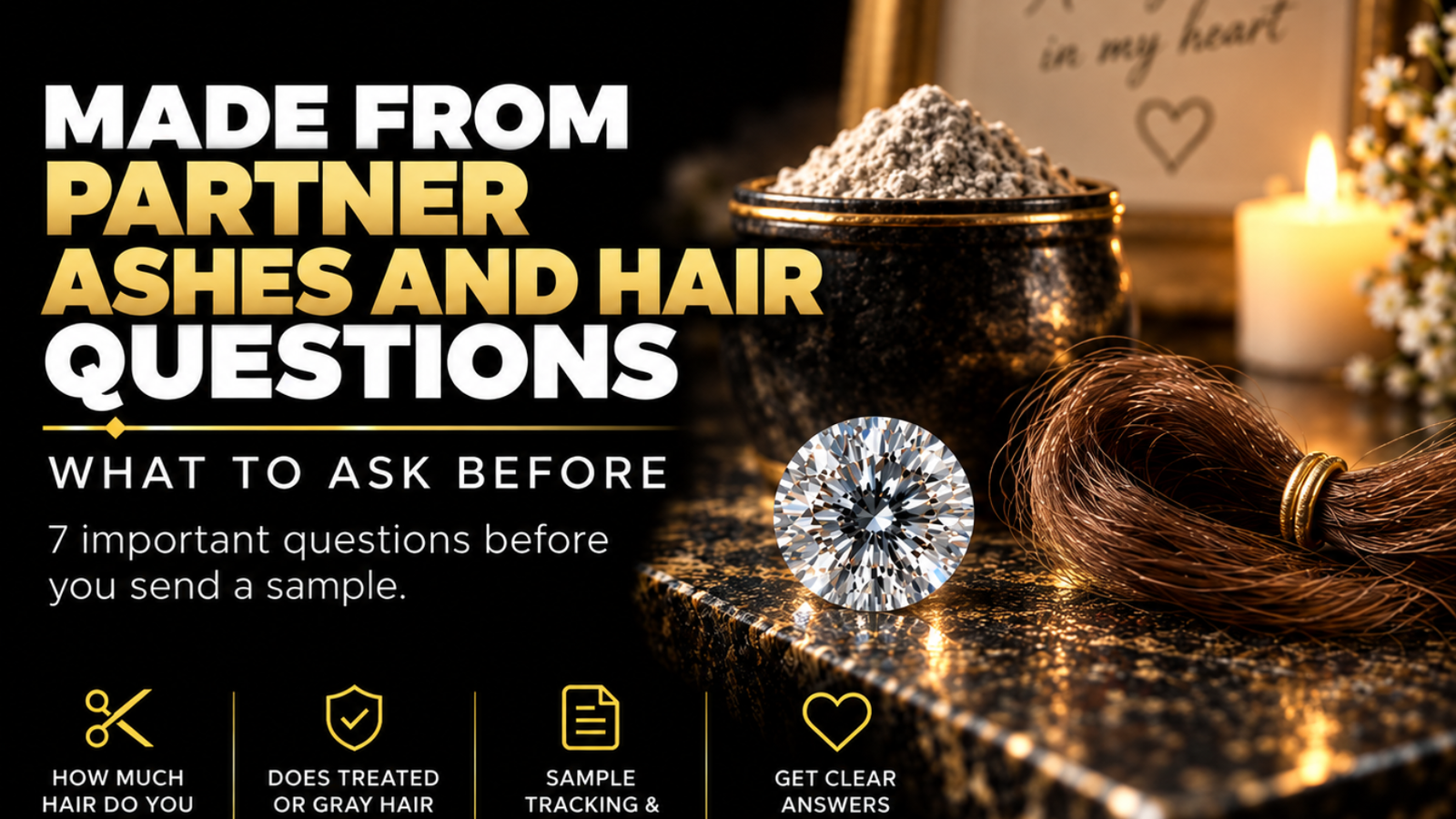
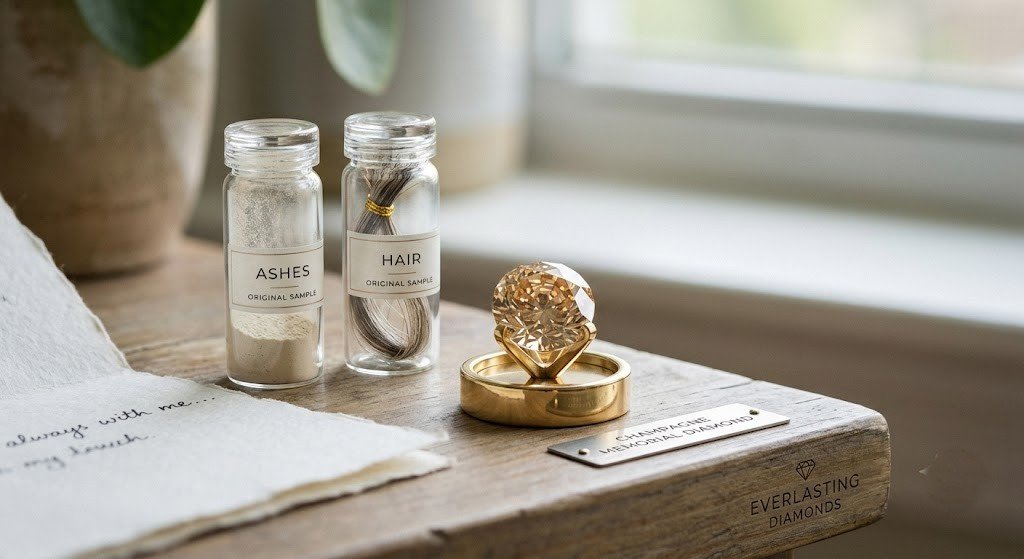
: Memorial diamond made from partner ashes and hair, featuring a diamond, cremated ashes, and a lock of hair.

How a Memorial Diamond Is Made From Your Partner’s Ashes and Hair

Some people end up with both because of how the year went, a lock kept early, a portion of remains later.

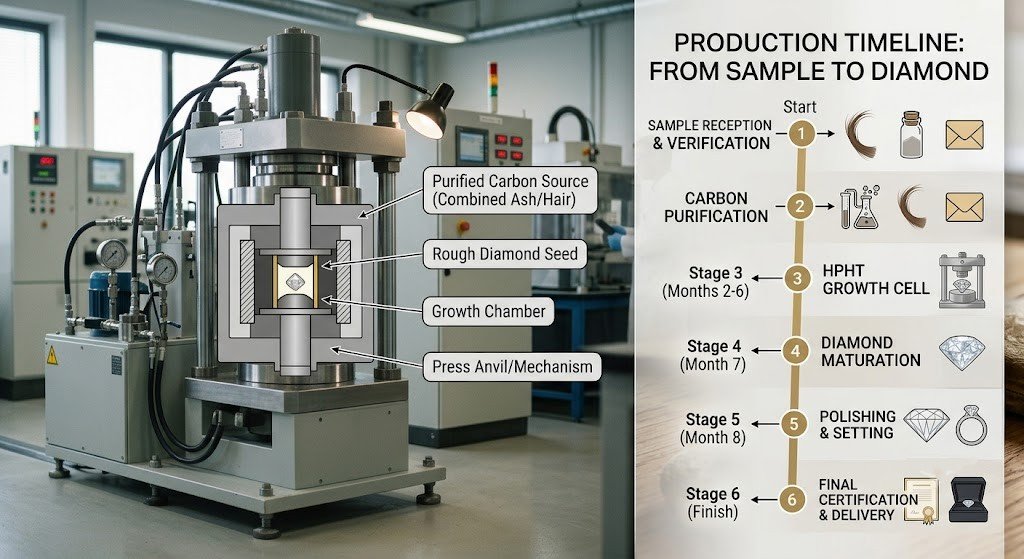
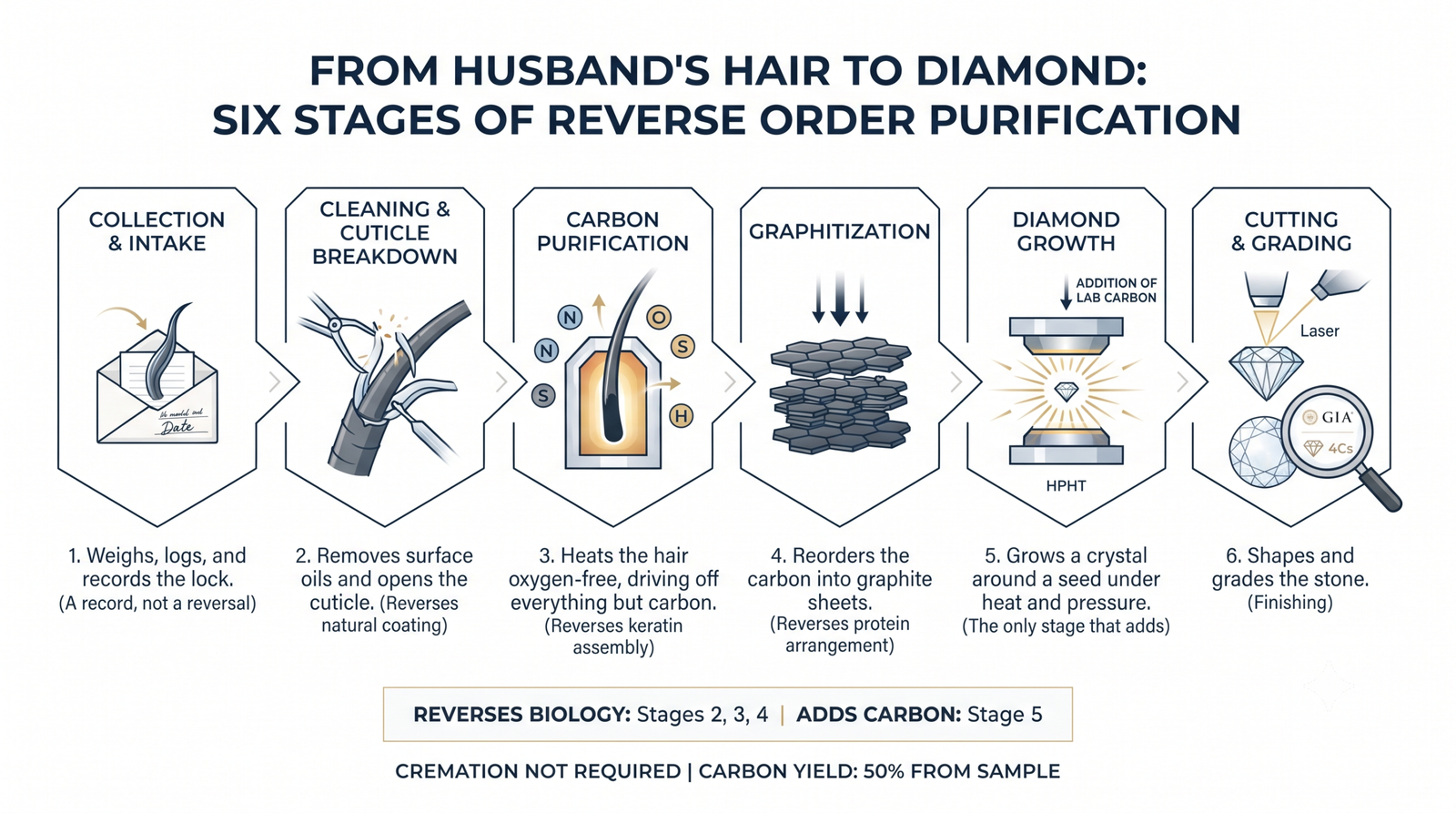
A memorial diamond made from partner ashes and hair is not one process. Each material is purified on its own track, ash to recover the 0.5% to 4% carbon it holds, hair to recover roughly half its weight in carbon, and each is graphitized separately at about 2,500 to 2,700°C. The two tracks meet only when both charges enter a single HPHT growth cell at roughly 6 to 8 GPa. Five stages in total.

That meeting point is the whole story of a memorial diamond made from partner ashes and hair. Everything that can be separately evidenced about the two materials happens before it, and nothing can be after.

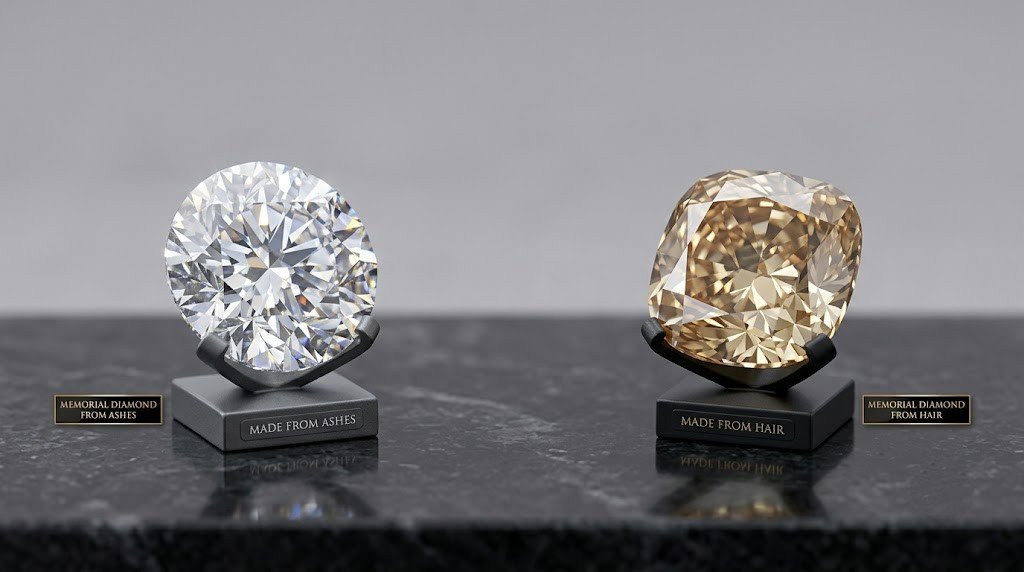
Single champagne-toned memorial diamond made from partner ashes and hair, photographed beside two small sealed sample containers

Why Two Materials Means Two Separate Tracks

Ash and hair are not the same chemical problem, and nothing in the making of a diamond made from partner ashes and hair pretends they are.

Cremated remains are mostly calcium phosphate, which is bone mineral. The usable carbon inside that comes to roughly 0.5% to 4% of ash by weight, which means extraction is a long subtraction. Most of what you send is removed as mineral residue. Hair is keratin, roughly 50% carbon by weight, so extraction there is comparatively quick and far less lossy.

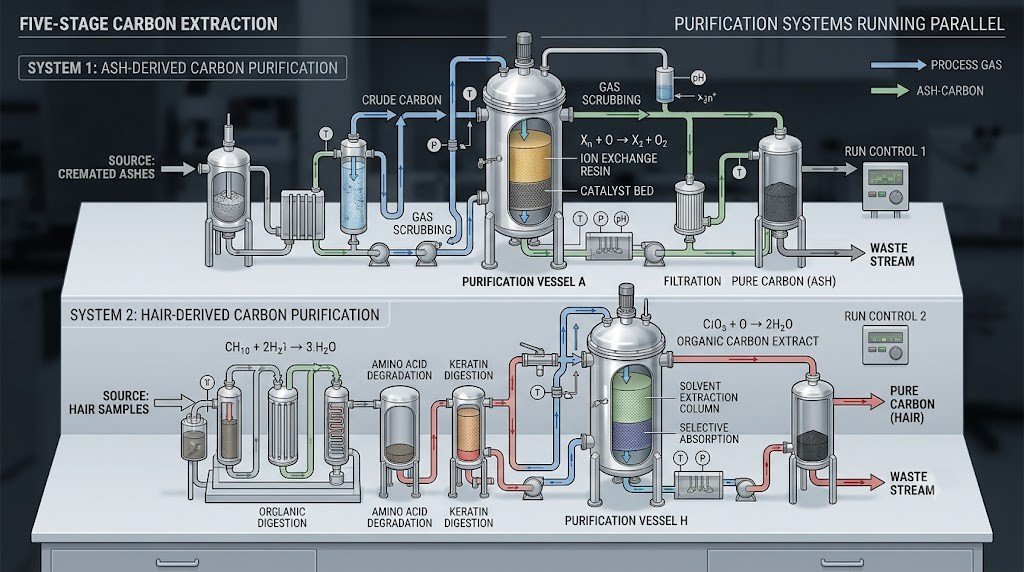
Two materials with yields that differ by more than an order of magnitude cannot be purified in the same vessel on the same settings. So a memorial diamond made from partner ashes and hair begins as two parallel operations that happen to be running for the same person, and for the same stone, at the same time.

That is not a complication to be apologized for. It is the reason a diamond made from partner ashes and hair can have its two materials separately weighed, separately logged, and separately accounted for right up to the moment they are combined. This provides more evidence, not less, than a single material stone can offer.

The Five Stages of a Memorial Diamond Made From Partner Ashes and Hair

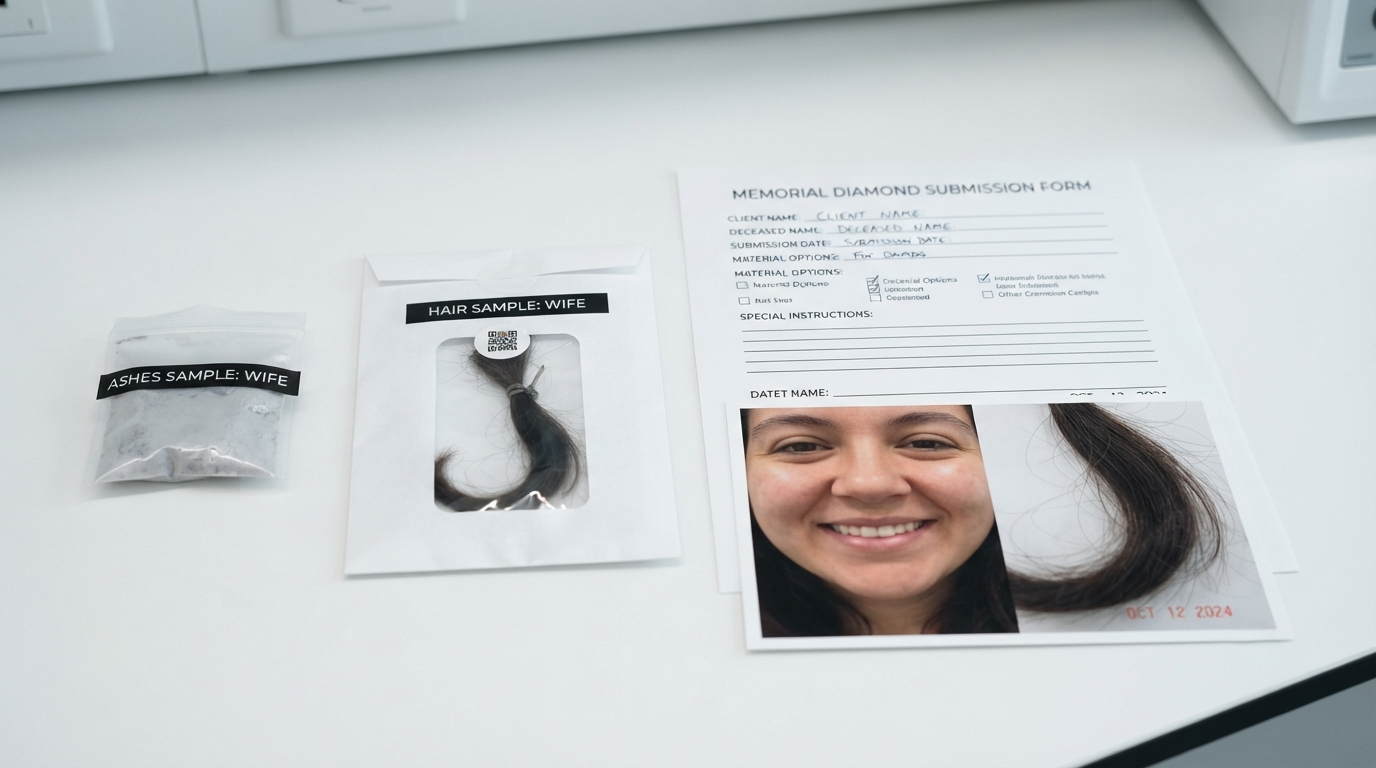
1. Two intakes. The portion of ashes and the lock of hair arrive and are logged independently. This means separate weights, separate identifiers, and ideally separate dated photographs. Ask for two records rather than one combined receipt. This is where a diamond made from partner ashes and hair gains the documentation that makes it different from a single source stone.

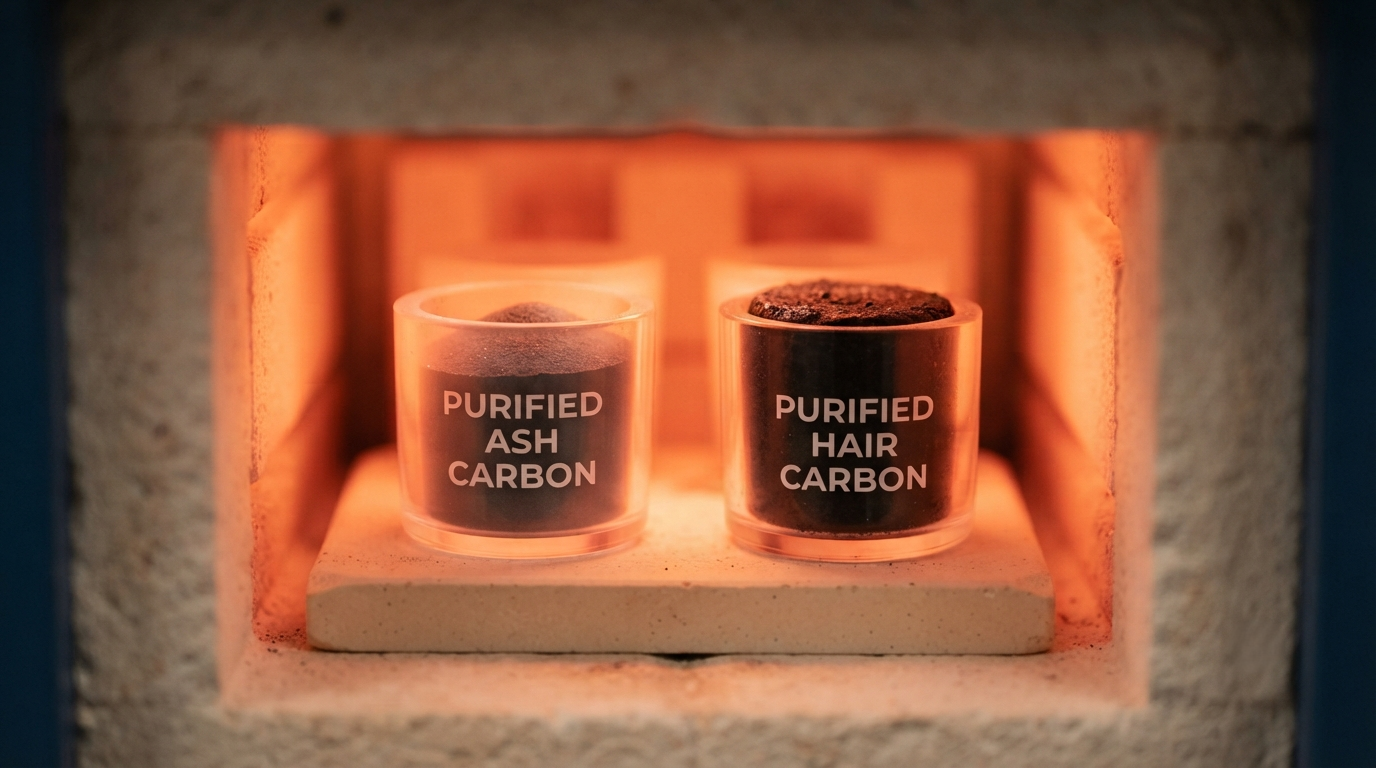
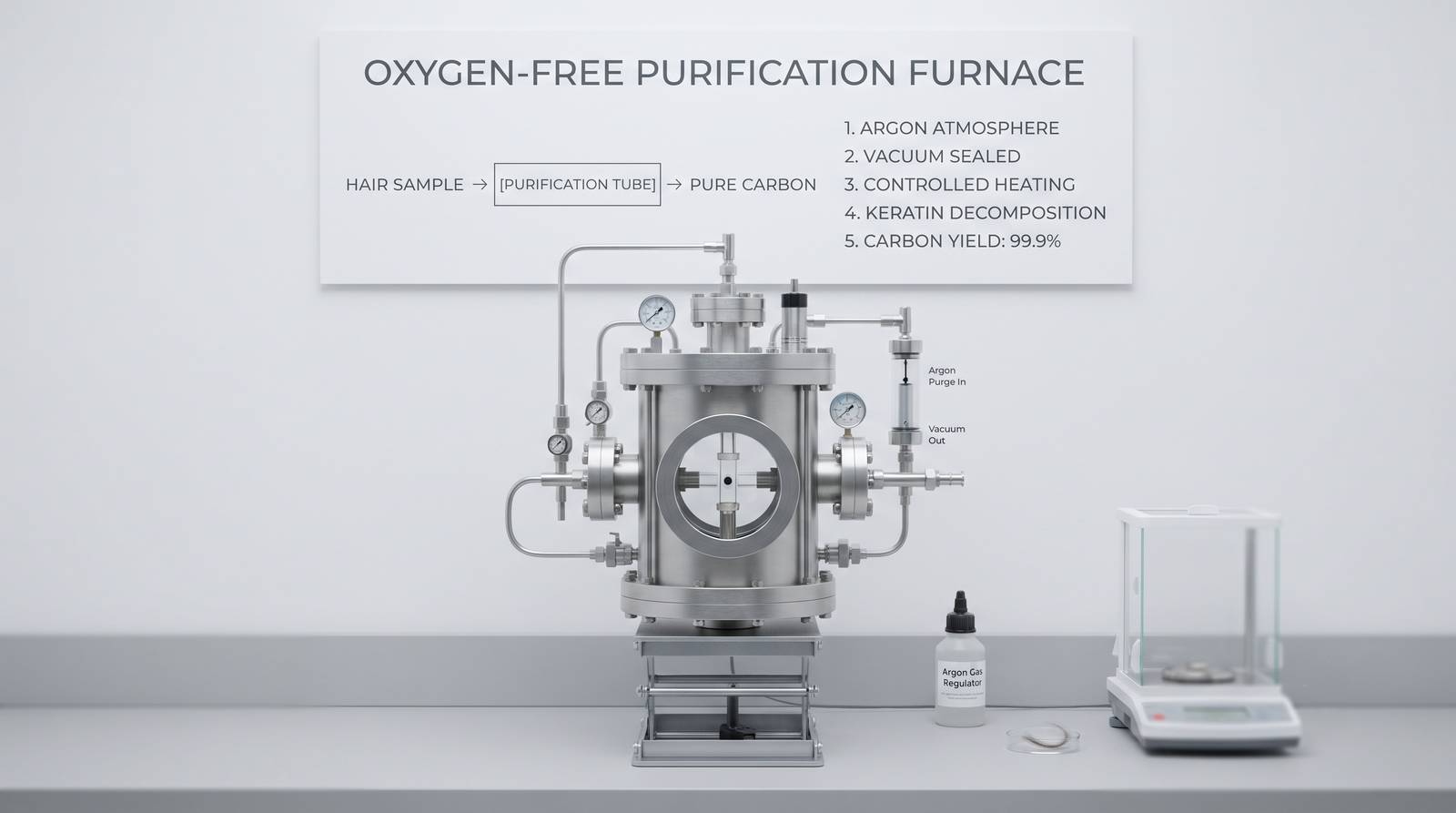
2. Two purifications. Each material is heated in a controlled, oxygen free process that strips away everything that is not carbon, reaching roughly 99.9% or higher purity. The ash track loses the overwhelming majority of its submitted mass. The hair track loses roughly half. Two batches of purified carbon come out, still separate. At this stage a diamond made from partner ashes and hair still has two independently verifiable histories.

3. Two graphitizations. Each purified batch is heated to about 2,500 to 2,700°C and converted into graphite, the feedstock form a diamond press can use. There are now two graphite charges, still distinguishable because they are still in different containers, not because anything about them is chemically different.

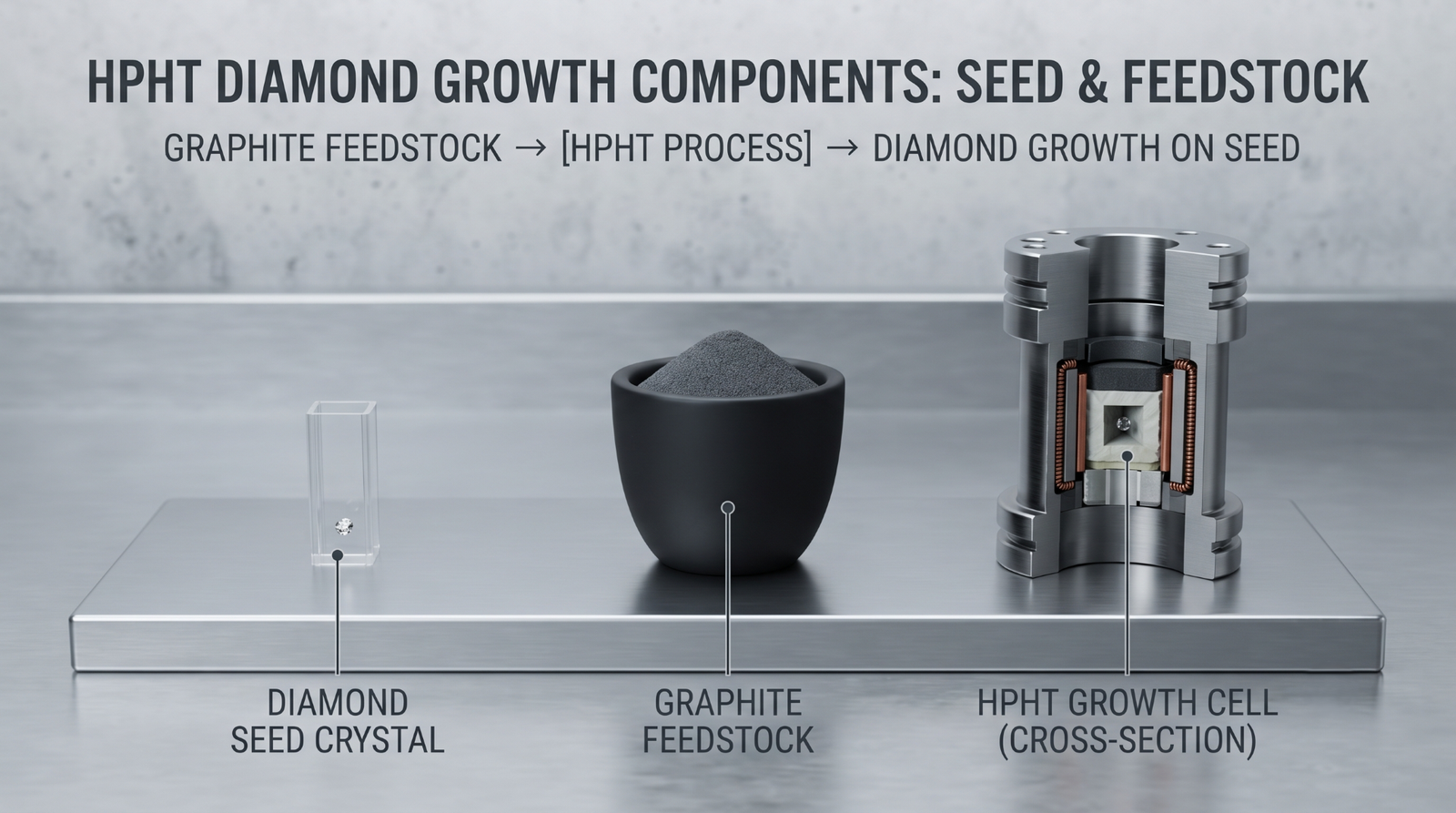
4. One growth cell. Both charges, combined with supplemental lab grown carbon, are loaded into a single HPHT growth cell around a tiny diamond seed and held at roughly 6 to 8 GPa and 1,400 to 2,500°C for weeks to months. This is the convergence point, and it is the only one.

5. One stone, cut and graded. The rough crystal is cut and polished, then assessed against the same cut, color, clarity, and carat standards used for any diamond, ideally by an independent third party laboratory. One stone comes out. A diamond made from partner ashes and hair has no ash half and no hair half.

Where Do the Two Tracks Actually Converge?

For a diamond made from partner ashes and hair, convergence happens at stage four. Both graphite charges are weighed into the growth cell alongside the supplemental lab carbon, and the cell is sealed.

Up to that moment, everything is separable. Two weights at intake. Two purification runs with two batch records. Two graphite charges sitting in two containers with two identifiers. A memorial diamond made from partner ashes and hair has, at that point, a paper trail with two distinct branches, each traceable back to a different material and a different day.

The instant the cell is sealed and pressurized, those branches end. Carbon purified from ash and carbon purified from hair are the same element in the same form. Graphite is graphite, whatever it used to be part of. They do not layer, settle, or occupy separate regions of the crystal. They dissolve into the same molten metal flux and deposit onto the same seed, atom by atom, in no particular order.

StageAsh TrackHair TrackWhat Can Be Separately Evidenced
1. IntakePortion weighed, logged, identifiedLock weighed, logged, identifiedTwo weights, two dates, two identifiers
2. PurificationLong subtraction. Most mass removed as mineralShorter run. Roughly half the mass retainedTwo batch records, two yields
3. GraphitizationAsh derived carbon to graphite at 2,500 to 2,700°CHair derived carbon to graphite at 2,500 to 2,700°CTwo charges, two container records
4. Growth CellCharge loaded with lab carbonCharge loaded with lab carbonNothing after this point. The cell is sealed.
5. Cutting and GradingOne stoneOne stoneThe stone’s own 4Cs, and nothing about origin
two separate purification vessels processing ash-derived and hair-derived carbon on parallel runs


After Convergence, Can Anyone Tell the Two Apart?

No. This is the part of a diamond made from partner ashes and hair worth stating plainly, because a reader who suspects it and is never told clearly may assume the worst.

Once both charges are in the growth cell, no test performed on the finished diamond can identify which carbon came from the ashes, which came from the hair, and which came from the supplemental lab feedstock. A grading report will not show it. A gemologist with a loupe will not see it. There is no analysis of a diamond made from partner ashes and hair that separates the sources, because after purification there is nothing left to separate. There are only carbon atoms, chemically identical regardless of what they used to be part of.

That also means nobody can verify a stated proportion after the fact. If a stone is described as using both, the honest meaning of that statement is that both entered the process and both are recorded as having done so. It does not mean both are measurable in the finished crystal.

Two consequences follow for anyone considering a diamond made from partner ashes and hair, and they are the practical reason to read this before starting rather than after.

The first is that the value of the two track structure in a diamond made from partner ashes and hair is entirely upstream. Insist on the separate records while the tracks are still separate, because the window closes at stage four and does not reopen.

The second is that any provider claiming to demonstrate the split in a finished stone is claiming something that is not physically available. That is a useful test of how the rest of their answers should be read.

So What Can Be Documented About a Diamond Made From Partner Ashes and Hair?

Quite a lot, as long as you ask for it in the right window. What can be documented is every fact created before the cell was sealed.

  • Two intake records, each with its own date, weight, identifier, and ideally a photograph of the material as received.
  • Two purification batch records, tying each identifier to a specific run rather than to a general statement that material was processed.
  • Two graphitization records, confirming both charges existed as separate feedstock before loading.
  • A cell loading record naming both identifiers and the supplemental lab carbon added. This is the single most important document for a memorial diamond made from partner ashes and hair, because it is the last one that mentions two sources.
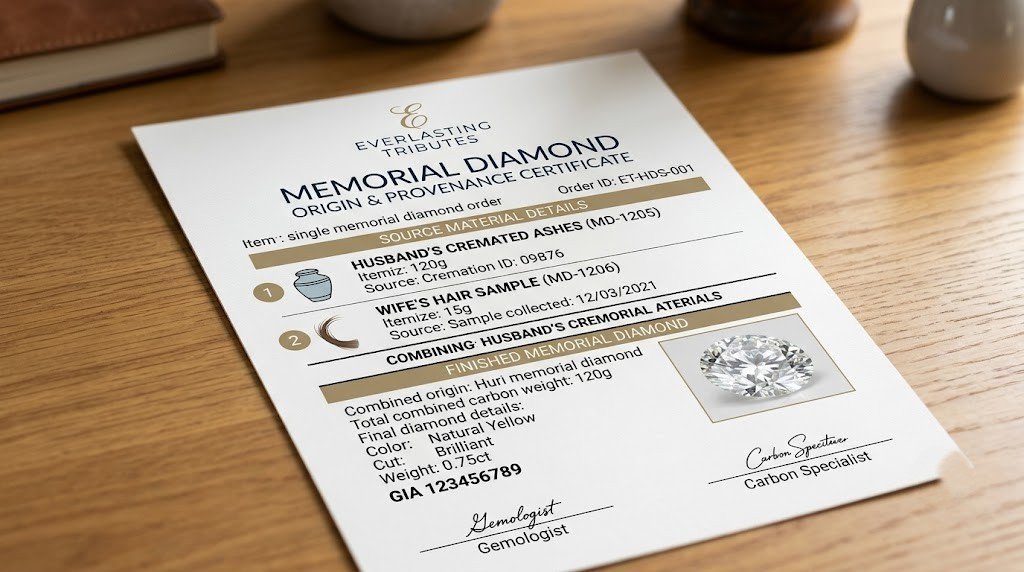
  • An origin or authenticity document that names both submissions explicitly, rather than referring vaguely to submitted material.
  • A grading report, which describes the stone’s quality and says nothing at all about origin. The two documents answer different questions and neither substitutes for the other.

Neither track yields the volume a growth run consumes, not separately and not added together. Both purified batches are made up with lab grown carbon before the cell is sealed, which means the personal carbon in a diamond made from partner ashes and hair is real, traceable to two named submissions, and still a minority of the crystal’s mass. Any description that implies otherwise is describing a stone that does not exist.

Does Using Both Materials Change the Stone Itself?

Not in a way anyone can see, and it is better to know that now.

Color. Trace elements drive color. Nitrogen can contribute toward yellow, boron can contribute toward blue, and colorless material requires the absence of both. Both ash and hair are organic sources that bring trace elements with them, so a memorial diamond made from partner ashes and hair sits in the same realistic range as a single material stone. Yellow, blue, or champagne are possible, while colorless material can require more process control and typically costs more. Nobody can forecast a precise shade from either material or from the combination.

Size. For a diamond made from partner ashes and hair, carat is bought as growth time, not as quantity of material. Submitting two materials instead of one does not produce a larger stone, and does not shorten the run.

Timeline. Industry wide, the whole sequence typically runs six to ten months, sometimes twelve for larger or specialty color stones. Two purification tracks can add a little at the front end if they are run sequentially rather than in parallel. The press is where almost all of the months live, and the press does not care how many sources fed it.

Quality. A diamond made from partner ashes and hair is graded on exactly the same 4Cs as any other stone. There is no separate scale, no allowance, and no penalty.

Can the Two Tracks Become Two Separate Stones Instead?

Two finished memorial diamonds of similar size displayed separately rather than set together

Yes, and this is the option most people do not realize they have until someone says it out loud.

If the two materials never enter the same growth cell, they never converge. This means they stay separately evidenced permanently. An ash grown stone and a hair grown stone, each with its own intake record, its own batch history, and its own origin document, preserve a distinction that a diamond made from partner ashes and hair gives up at stage four by design.

There are real trade offs, and they run in both directions.

  • Two stones cost more than one. Each needs its own growth run, and growth time is the dominant cost in every memorial diamond. Two half carat stones will not cost what one half carat stone costs.
  • Two stones take the same time, not twice as long, if the runs happen in parallel. Sequential runs would change that answer considerably.
  • Two stones can go to two people. This is often the deciding factor. One stone has to live somewhere. Two can be shared without anyone having to give anything up.
  • One stone concentrates everything. For many people that is precisely the point, and the loss of separability is a price they are glad to pay.
  • You can also do one of each and keep the rest. A memorial diamond typically uses only a portion of the available material, so choosing one route now rarely forecloses the other later.

The question to sit with is not which option is more meaningful. Both follow the same physics. The question is whether the distinction between the two materials is something you want to be able to point at in ten years. If it is, a diamond made from partner ashes and hair is the wrong shape for it, and two stones are the right one. If it is not, one stone is simpler and cheaper.

Why Families Choose Both Anyway

Knowing that the combination is invisible in the finished stone does not make a diamond made from partner ashes and hair pointless, and it is worth being clear about why.

The reason for a diamond made from partner ashes and hair is usually circumstantial rather than symbolic. A lock of hair was kept at some point, from a haircut before an illness, from a hospital stay, or from a drawer nobody had cleared. A portion of ashes became available later. Using both is less a decision than an acknowledgment that both exist and neither felt right to leave out.

Sometimes it is about standing. Who controls a person’s remains is settled state by state rather than by any nationwide statute, and a written direction left by your partner can shift it again on top of that. The standing does not attach to a partner as a matter of course, and it attaches least reliably where the relationship had no recognition in law or was not known to everyone. Hair may be the material you can act on without permission. Ashes may become available only later, or only partly. A diamond made from partner ashes and hair sometimes reflects that sequence rather than a plan.
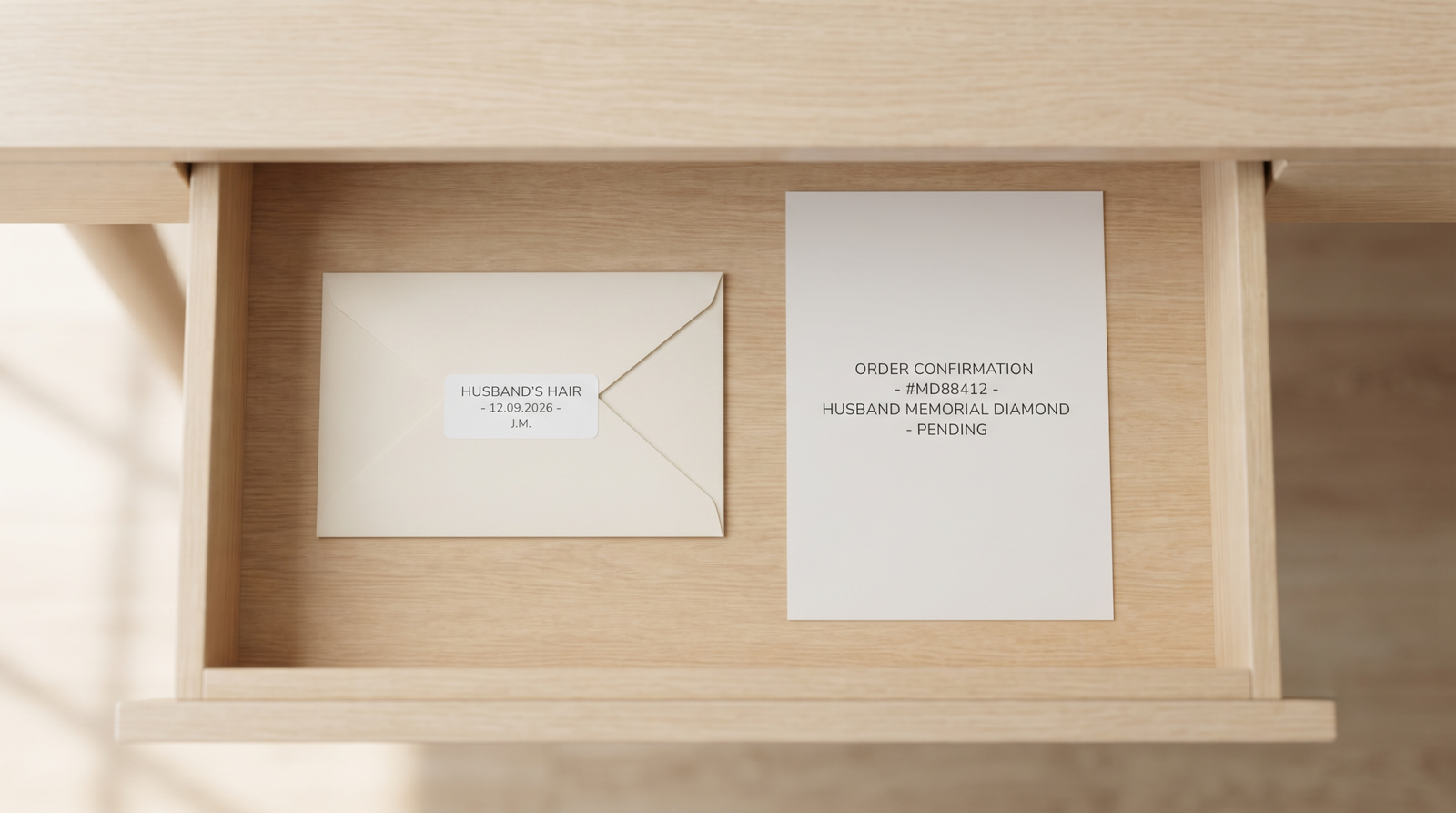
And sometimes it is simply that the two materials represent different periods, one from when your partner was alive, one from after. That is a real reason. It does not need to be measurable in the crystal to be true.

What matters is that the reason is yours, and that the record describes what actually happened.

Frequently Asked Questions About a Memorial Diamond Made From Partner Ashes and Hair

Are the ashes and hair processed together?

No. In a diamond made from partner ashes and hair, each material is purified and graphitized on its own track, because their carbon yields differ by more than an order of magnitude. The two only meet when both graphite charges are loaded into a single growth cell.

Can a lab prove both materials were used?

Not from the finished stone. Proof exists only as records created before the growth cell was sealed. These include two intake logs, two batch records, and a cell loading document naming both identifiers. Ask for those specifically.

Can I choose the proportion of each material?

You can specify how much of each is submitted and have those weights recorded. What you cannot do is verify a proportion in the finished crystal, because purified carbon carries no marker of its origin.

Does using both materials make the diamond more genuinely my partner’s?

Not measurably. A diamond made from partner ashes and hair draws real personal carbon from both sources, and both are blended with lab grown carbon to reach a viable volume. What changes is the documentation, which traces two submissions instead of one.

Will it cost more than a single material stone?

A diamond made from partner ashes and hair can add process steps, and some providers price that separately. Size, color, and whether an independent grading report is included drive cost far more than the number of source materials.

What if one material turns out to be unusable?

Ask what happens before you send anything, whether the run proceeds on the remaining material, whether you are told first, and what is recorded. This is a question to settle in advance, not one to discover partway through.

Final Thoughts on a Memorial Diamond Made From Partner Ashes and Hair

The honest shape of a memorial diamond made from partner ashes and hair is two lines that run parallel for four fifths of their length and then become one line permanently. Almost everything you might want proven about the two materials is provable while those lines are apart, and none of it is provable afterward.

So the useful work happens early. Two records at intake, two batch records, and one loading record that names them both. Ask for those while asking still changes something. After the cell is sealed, the only honest answer anyone can give you about which carbon came from where is that the paperwork says so, which is a good answer, provided the paperwork exists.

Learn More About Partner Memorial Diamonds

Talk With Memorial Diamond

If you have both materials and want to understand how each would be handled, reach out to Memorial Diamond and ask what gets recorded at each intake and what the cell loading document will say. Those are the questions worth asking while the two tracks are still separate.

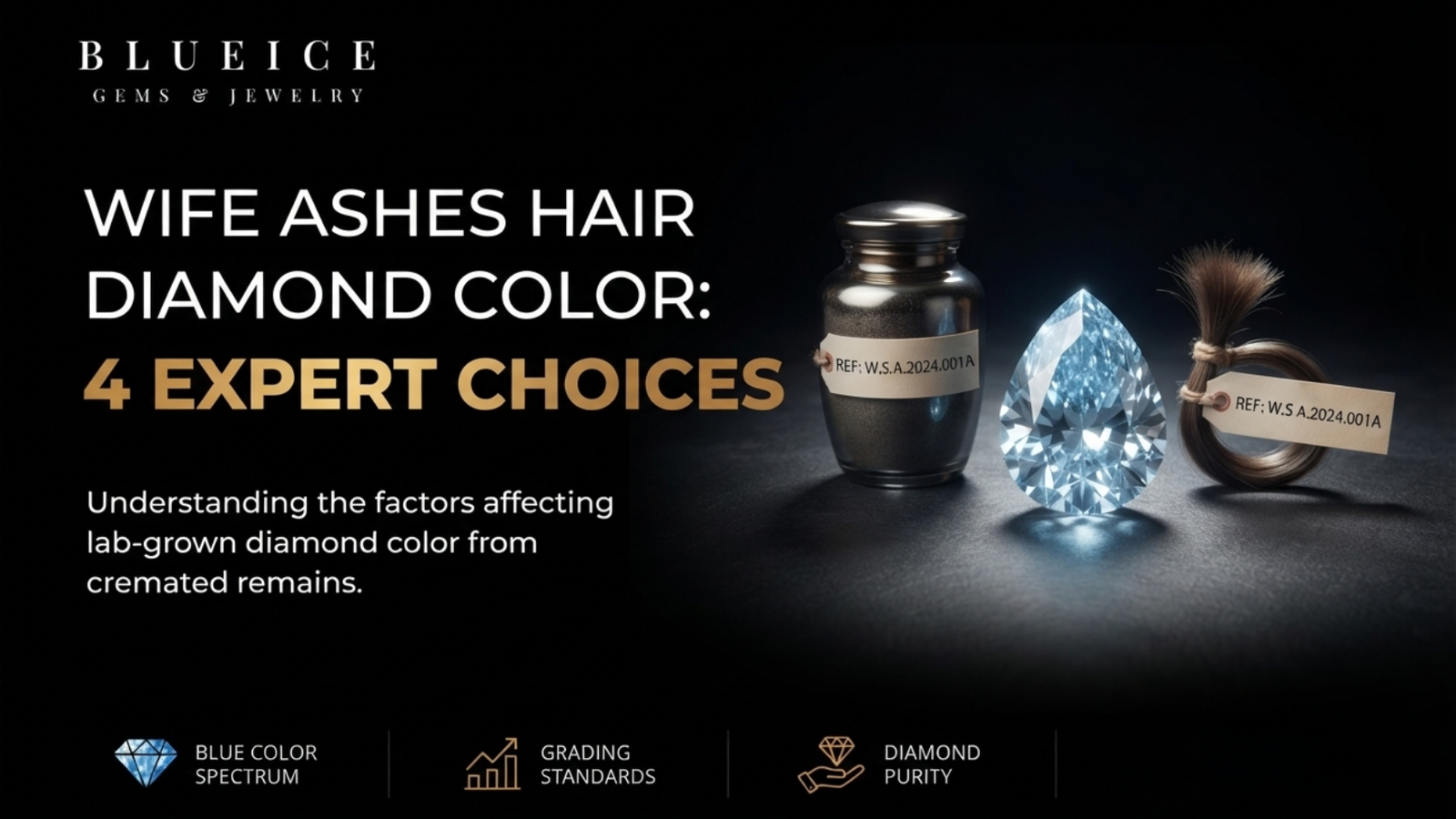
Wife ashes hair diamond color: a light-blue lab-grown diamond between a sealed ash container and a tied lock of hair, all labeled with one submission reference

What Color Will a Diamond Made From Your Wife’s Ashes and Hair Be?

You are sending two things, a portion of her ashes and a lock of her hair, and it is natural to wonder whether two sources pull the stone toward a different color than one would. A wife ashes hair diamond color is not predictably changed by combining the two materials: trace nitrogen or boron from either source produces the same yellow, champagne, or blue tendency as any memorial diamond, there is no rule that combined stones lean one way, and two stones from the same combined submission can still come out different.

That is the only wife ashes hair diamond color question that is specific to a combined stone, and it has a short answer. The rest of this page is about what a family choosing a combined stone should decide, specify, and ask about color, because the paperwork for two materials needs a little more care than the paperwork for one.

Does Combining Her Ashes and Hair Change the Wife Ashes Hair Diamond Color?

No, not the wife ashes hair diamond color, and not in any way you can plan around.

A wife ashes hair diamond color comes from trace elements built into the crystal lattice during growth, nitrogen for yellow and champagne, boron for blue, the absence of both for colorless. Those elements arrive with the carbon. In a combined submission, the carbon comes from two places: her cremated remains (almost entirely calcium phosphate, with roughly 0.5 to 4% usable carbon) and her hair (roughly 50% carbon by weight, from keratin).

Both are purified to 99.9%+ carbon, converted to graphite at roughly 2,500 to 2,700°C, blended with supplemental lab carbon, and grown around a seed in an HPHT press at roughly 6 to 8 GPa and 1,400 to 2,500°C, or, with a minority of providers, in a CVD chamber; both methods are on the synthetic diamond page.

Here is the part that matters for wife ashes hair diamond color. By the time the carbon reaches the press, it is carbon. Whatever trace nitrogen or boron survived purification came from organic, personal material, and organic material carries those passengers whether it started as bone mineral or as protein. Two sources do not add up to a different chemistry, and so they do not add up to a different wife ashes hair diamond color; they add up to the same chemistry from two directions. The full mechanism, why personal carbon tends toward yellow, champagne, and blue, and what colorless costs, is on the ashes color page, and it applies to a combined stone without modification.

One assumption worth setting down early: the hair will not lend the stone its color, and it has no bearing on the wife ashes hair diamond color at all. Pigment, dye, and gray are all destroyed at purification, and the hair color page explains why. Adding ashes to hair does not bring the hair color back, and adding hair to ashes does not introduce one.

Why Is There No Rule That Combined Stones Lean One Way?

Families sometimes hear, or reason their way to, a claim that the wife ashes hair diamond color runs whiter, or bluer, or warmer than a single material stone. None of these holds up, and it helps to see why each fails.

Claim you might hearWhat the chemistry says
“Hair carbon is purer, so the combined stone will be whiter”Hair is a richer carbon source, but keratin is a protein and proteins contain nitrogen. Richer does not mean cleaner. Hair based stones show the same yellow, champagne, blue tendency as ash based ones.
“Two sources mean more trace elements, so the color will be deeper”Trace element content depends on purification and on the growth run, not on how many envelopes arrived. The personal carbon is typically around 10 to 15% of the finished stone regardless of source count.
“The ashes will add blue” or “the hair will add yellow”Neither material has a signature color. Nitrogen and boron can come from either, and the amounts that survive purification are not predictable per source.
“Combined stones hold a more consistent wife ashes hair diamond color”Two stones from the same combined submission grow in separate cells, in separate runs, and can differ visibly, exactly as two stones from ashes alone can.
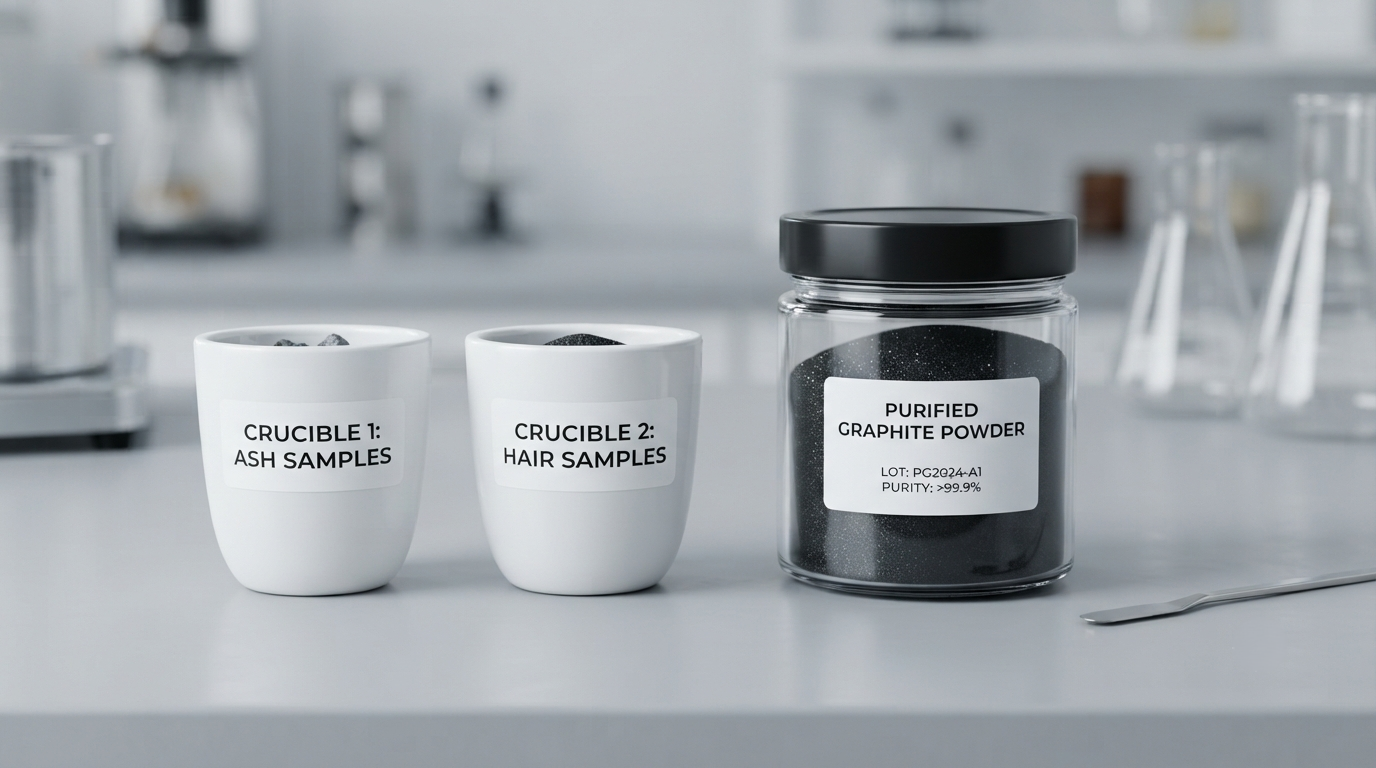
Two labeled crucibles beside a single container of purified graphite in a laboratory

The honest statement is this: a wife ashes hair diamond color is decided by the growth run, and the growth run does not know how many materials fed it. Hair does most of the personal carbon work in a combined stone because of its far higher carbon content, but that is a fact about quantity, not about color. Wife Ashes and Hair Diamond: The Complete Guide covers the quantity side and why families combine at all.

So the wife ashes hair diamond color question is not “what will two materials do” but the same question any family faces, with two materials’ worth of paperwork attached. That comes down to four decisions.

Decision 1: Natural or Specified?

The first wife ashes hair diamond color decision is whether to let the stone be what the carbon gives, or to ask for a particular family.

Natural, as grown means you accept the wife ashes hair diamond color the run produces, yellow, champagne, or blue, whichever the run produces, and the shade within it. It is the baseline price, the shortest list of things that can go wrong, and, for some families, the point: the color is the stone’s own record of the carbon that made it, and that carbon came from two parts of her.

Specified means you name a family and the provider grows or treats toward it:

  • Blue (boron), a grown color, baseline to modestly above, depending on provider.
  • Colorless or near colorless, extra processing to exclude both nitrogen and boron; the highest priced grown color at every carat.
  • Red, pink, green, or black, post growth irradiation, an add on above the grown color; black can push the timeline toward 12 months.

Neither wife ashes hair diamond color choice is more respectful of a combined stone than the other. What a combined stone does add is a reason to think about the meaning of the color alongside the meaning of the materials. Some families who combined because they wanted “both of her” in one crystal prefer the natural color for the same reason, nothing chosen, nothing imposed. Others want a specified color precisely because the stone is already the most deliberate object they will own. Both are good reasons, and neither changes the wife ashes hair diamond color chemistry.

Decision 2: When Do You Decide?

Decide the wife ashes hair diamond color before either material leaves the house, and for a combined stone, this is stricter than it sounds.

A wife ashes hair diamond color cannot be changed once the crystal has grown. Irradiation can shift a finished stone into a different family, but nitrogen and boron in the lattice are permanent, and nothing can be added to a grown diamond, not color, not carbon, not a second material. If you decide on color after the submission has been logged, you are relying on the provider not having started, which for a 6 to 10 month process is a short window.

The combined stone reason to decide early is that you are sending two irreplaceable things at once. If the color decision later leads to a second stone, a regrow because the first fell outside the promised range, or a matched second stone for another family member, that second stone needs material. Most of a cremation’s ashes are usually still at home, since a stone typically uses only a few tablespoons to roughly 4 oz.

A lock of hair, though, cannot be topped up. Deciding the wife ashes hair diamond color before sending means you also decide, at the same moment, to keep part of the lock and part of the ashes. How much ash and hair you need for a wife memorial diamond covers the combined minimums, which are often less of each than the two standalone figures.

A practical order of operations for settling a wife ashes hair diamond color on a combined stone:

  1. Confirm the combined minimum for the carat you want.
  2. Divide both materials, the amount to send, and the amount to keep.
  3. Decide natural or specified, and if specified, which family.
  4. Get the color range, the recourse, and the certificate wording on the order.
  5. Then, and only then, package both materials under one submission reference and send.

Steps 1, 2, and 5 belong to how to turn your wife’s ashes and hair into a diamond; steps 3 and 4 are this page.

Decision 3: What Does Each Choice Cost?

A wife ashes hair diamond color is priced the same as for any other stone, the number of materials does not enter the color line of the quote. What a combined stone may add is a modest processing fee, because extraction runs twice; that fee, where it exists, is separate from color and should appear as its own line.

Industry wide in 2026, and not as anything Memorial Diamond has published, the tiers run roughly:

  • $1,500 to $3,500 for 0.10 to 0.25 ct
  • $5,000 to $15,000 for 0.5 to 1 ct, with colorless costing meaningfully more than blue, yellow, or champagne at the same size
  • $20,000 to $75,000+ for 2 to 5+ ct

Within those tiers, the wife ashes hair diamond color choice moves the price as follows: natural is the baseline; blue is baseline to modestly above; colorless is the highest grown color, and the premium compounds with carat because larger stones show faint tint more visibly; irradiated colors add to whichever grown color the stone started as. Independent grading, engraving, and the setting are usually separate from the loose stone. Carat itself is set by growth time in the press, not by how much of either material you send, so a combined submission does not earn a larger or less expensive stone.

Ask for the quote with four separate lines: loose stone at the chosen carat and color, any combined processing fee, the grading report, and the setting. A quote that folds color into a single number makes it impossible to see what the wife ashes hair diamond color decision actually cost.

Decision 4: How Do You Write It Down?

This is where a combined stone genuinely differs, because the documents have to record two materials as well as one wife ashes hair diamond color. Six lines belong on the order, and one of them is unique to a combined submission.

Line on the orderWhat to writeWhy it matters more for a combined stone
Color familyNamed the way the provider names it, “natural, as grown,” “blue,” “colorless,” “irradiated pink”Same as any stone
Delivered rangeA span of letters on the GIA D to Z scale for near colorless, or a band of fancy grades (“Fancy Light” to “Fancy”) for everything elseSame as any stone
RecourseRegrow, irradiate to another family, discount, or refund, and who paysA regrow needs both materials again; see the recourse section
GradingWhether the stone is independently graded and whether the report is includedSame as any stone
Irradiation consentWhether the provider may irradiate without instruction if the natural color disappointsSame as any stone
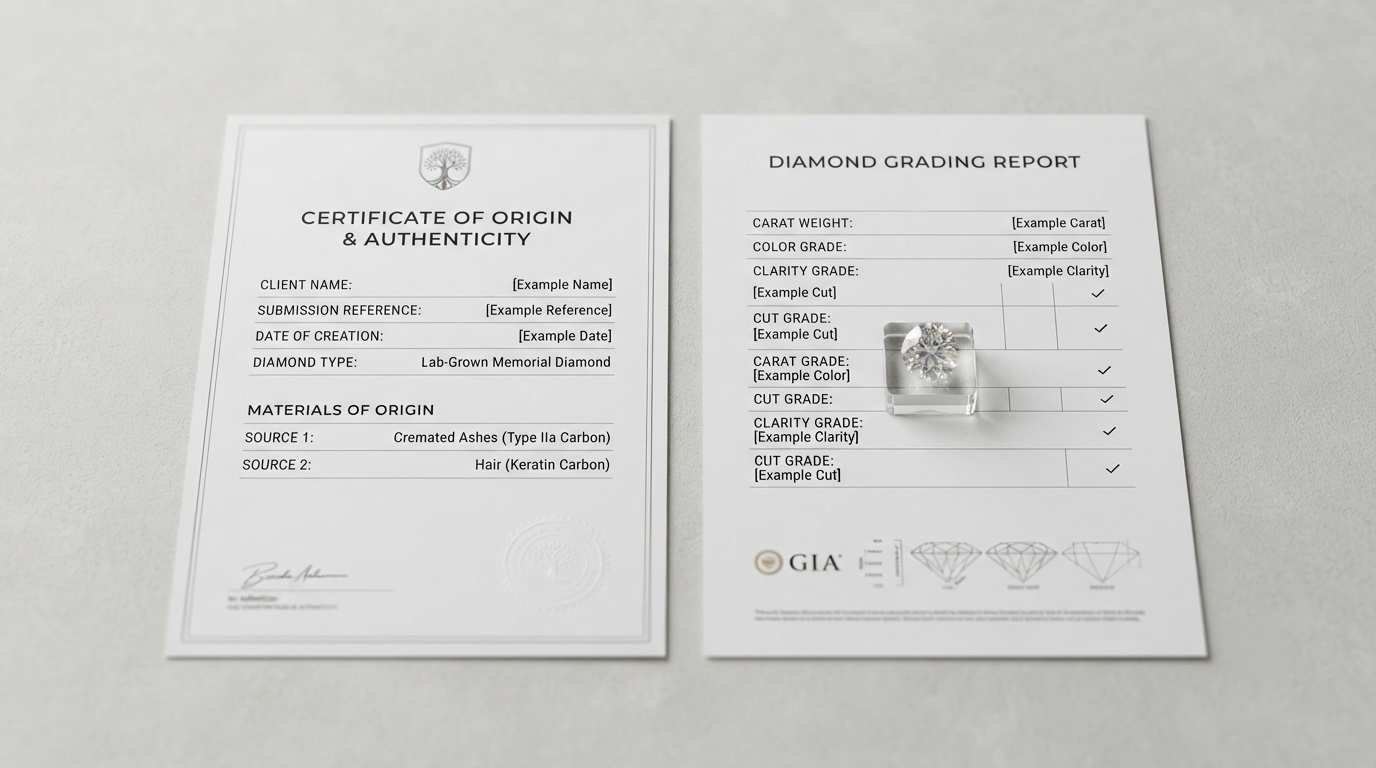
Certificate wordingThe origin certificate must name both materials, ashes and hair, under one submission referenceUnique to a combined stone. A certificate that says “ashes” does not record what you sent, whatever the color
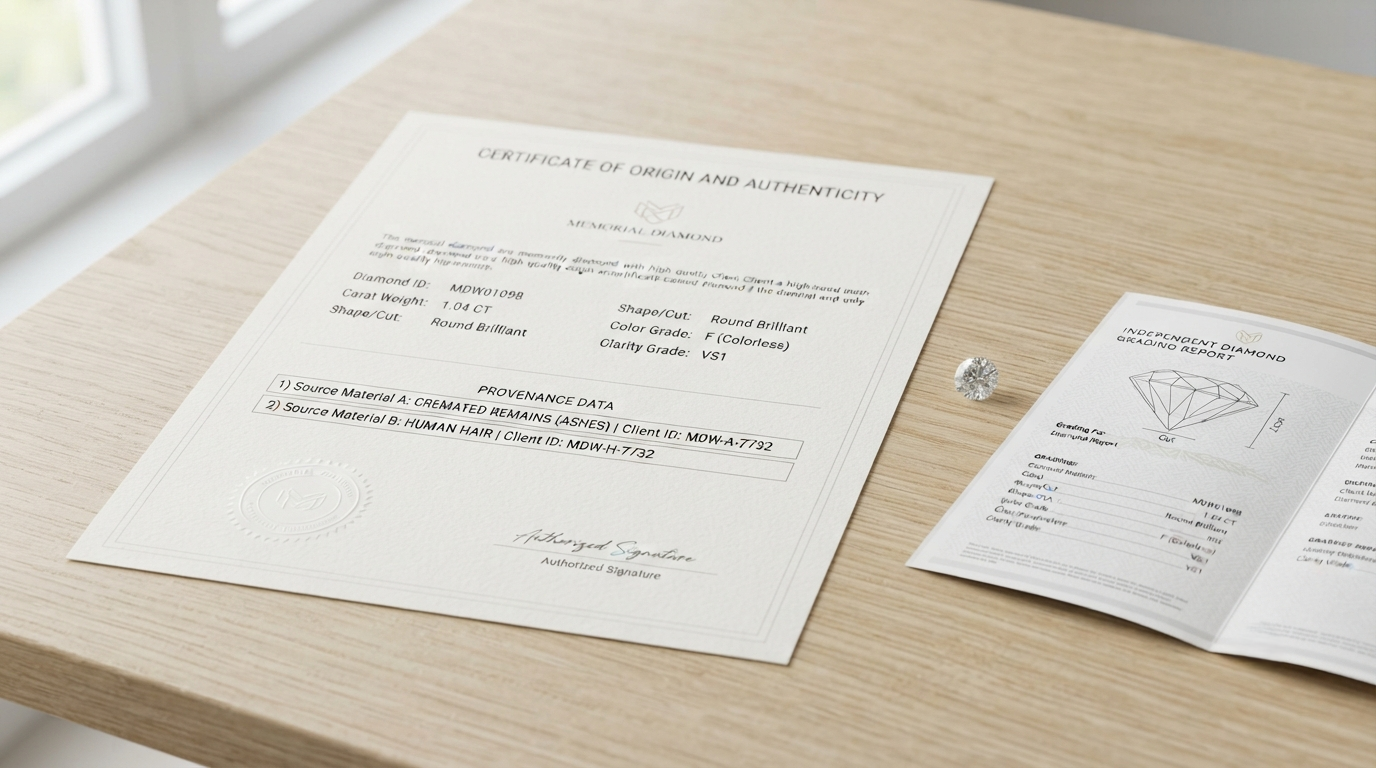
An origin certificate listing two materials beside an independent grading report, with a loose diamond on top

That last line is the one families miss. The grading report describes the wife ashes hair diamond color; the origin certificate describes where the carbon came from. Neither document does the other’s job. Ask for the certificate wording in advance, before either material is packaged, and confirm that the two materials are logged under one chain of custody record rather than two, otherwise there may be no document that ties the hair, the ashes, and this particular color together.

The questions to ask before turning your wife’s ashes and hair into a diamond include all six of these among the wider list.

How Do You Read the Grading Report for a Combined Stone?

Read a wife ashes hair diamond color grade exactly as you would read it for any diamond, because the report does not know, and does not record, that the carbon came from two sources.

An independent grading report describes cut, color, clarity, and carat. For color, near colorless stones get a letter from D, colorless, toward Z, light yellow or brown, assigned face down against master stones under controlled light. Stones with more color than Z, including most blues and every irradiated stone, are described by hue, tone, and saturation, “Fancy Light Blue,” “Fancy Yellow,” and so on. More color is not a lower grade in that second language; it is a description.

Two things to hold in mind when the report arrives for a wife ashes hair diamond color:

  • The grade is a controlled measurement taken face down against master stones, which is not how anyone will ever see the diamond. Graded warmth reads as warmth on a finger, not as a fault. Wait until you have held it in daylight before deciding how you feel about the grade.
  • The report is what makes recourse possible. “You promised Fancy Light to Fancy Blue and this graded Very Light Blue” is a fact with a report and an argument without one.

The report will say nothing about ashes or hair. That is normal. Source is the origin certificate’s job, which is why the certificate wording sits on the order as its own line.

What Recourse Exists, and Why Is It Tighter for a Combined Stone?

If the wife ashes hair diamond color arrives outside the written range, a provider may offer a regrow, irradiation of the first stone into a different family, a price adjustment, or a refund. Which of those you actually get, and who pays for it, is settled by the recourse line you put on the order months earlier.

For a combined stone, the first option has a condition attached: a regrow of a wife ashes hair diamond color needs both materials again, or it is no longer a combined stone. If the family sent the whole lock, a regrow can only be made from ashes, and the certificate for the second stone would say so. This is the practical reason to keep part of each material, not because anything is likely to go wrong, but because the one remedy that preserves the meaning of a combined stone depends on it.

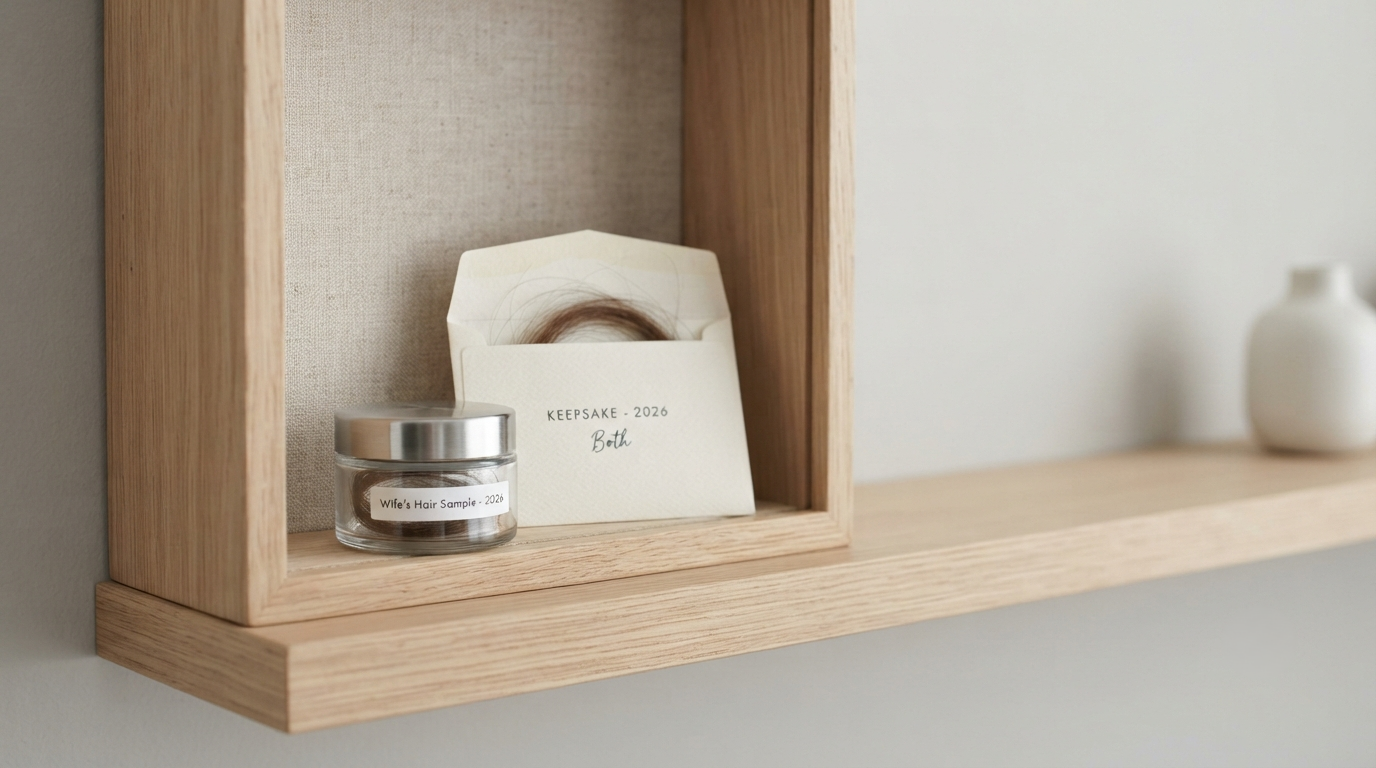
A small sealed container and a paper envelope of hair in a keepsake box on a shelf

Three things make recourse workable:

  1. A written range, so “outside the range” means something.
  2. An independent grading report, so the stone can be measured against it.
  3. Material kept at home, some of the ashes and some of the hair, so a regrow can be what the first stone was meant to be.

A provider who has made combined stones before will raise the third point unprompted, usually while the wife ashes hair diamond color is still being discussed. One who has not may quote the full standalone minimum for each material and never mention keeping any.

Which Metal Should Hold It?

Choose the setting after the stone exists, for the wife ashes hair diamond color that actually arrived. Yellow gold hides faint yellow and makes champagne read as warmth; white gold and platinum keep blue clean and make any residual tint in a near colorless stone more visible; irradiated colors are saturated enough that metal is taste rather than correction. If the stone will sit against her wedding band, or yours, borrow that metal for the comparison before committing. Memorial diamond settings and jewelry ideas for a wife runs through the mountings, and for a combined stone, a locket that holds the diamond alongside the kept portion of the lock is one option families find fitting.

Frequently Asked Questions

Does combining ashes and hair change the diamond’s color?

Not predictably. Color comes from trace nitrogen or boron built into the lattice during growth, and both materials carry those elements the same way once purified to carbon. A combined stone shows the same yellow, champagne, or blue tendency as any memorial diamond, with colorless available at extra processing and cost.

Will the hair make the stone whiter or give it her hair color?

Neither. Pigment, dye, and gray are destroyed at purification, so hair color never reaches the press. Hair is a richer carbon source than ashes, but keratin contains nitrogen, and hair based stones trend yellow, champagne, and blue like ash based ones. Treat any “hair runs whiter” claim as unverified.

Can two stones from the same combined submission be different colors?

Yes. Each stone grows in its own cell, in its own run, with its own blend of personal and supplemental carbon, and trace elements distribute unevenly. Two stones from one combined submission can come out a pale yellow and a warm champagne. If matching matters, put “similar” in writing rather than expecting “identical.”

Does the wife ashes hair diamond color cost more because there are two materials?

No. Color is priced by family, natural, blue, colorless, or irradiated, and by carat, not by material count. Some providers add a modest processing fee because extraction runs twice; that is separate from color and should appear as its own line on the quote alongside the stone, grading, and setting.

Should I choose the natural color or specify one for a combined stone?

Either is sound. Natural is the baseline price and lets the stone be the carbon’s own record; a specified family, blue, colorless, or an irradiated color, costs more and is guaranteed only to the family, not the shade. Decide before either material leaves the house, and write the range down.

Will the grading report say the stone came from both ashes and hair?

No. A grading report describes cut, color, clarity, and carat; it records nothing about source. The origin certificate is the document that names the materials, and for a combined stone it should name both under one submission reference. Ask for its wording before you send anything.

Final Thoughts on Wife Ashes Hair Diamond Color

The one question that is specific to a combined stone has a short answer: no, two materials do not pull the color one way or another. What a combined stone changes is not the chemistry but the care, deciding the wife ashes hair diamond color before two irreplaceable things leave the house, writing the range and the recourse onto the order, insisting on a certificate that names both materials, and keeping some of each so that a regrow, if it is ever needed, can be what the first stone was meant to be.

Do those four things, and the wife ashes hair diamond color that arrives will be a yellow, a champagne, a blue, or the color you specified, and, either way, one you decided on with both of her in mind.

Learn More About Wife Memorial Diamonds

Talk With Memorial Diamond

If you hold both her ashes and her hair and want the color decision settled before either is sent, reach out to Memorial Diamond, which wife ashes hair diamond color families are offered, how the range and recourse are written into an order, and what the origin certificate will say about both materials are all answerable in advance.

Part 3: Meta Description

Wife ashes hair diamond color: combining does not shift it. The four decisions a family makes, natural or specified, when, what it costs, and how to write it down.

Part 4: Body Copy

Above. 3,431 words, about 17 minutes.

Part 5: Image Brief

#PlacementFilenameAlt textNotes
1Herowife
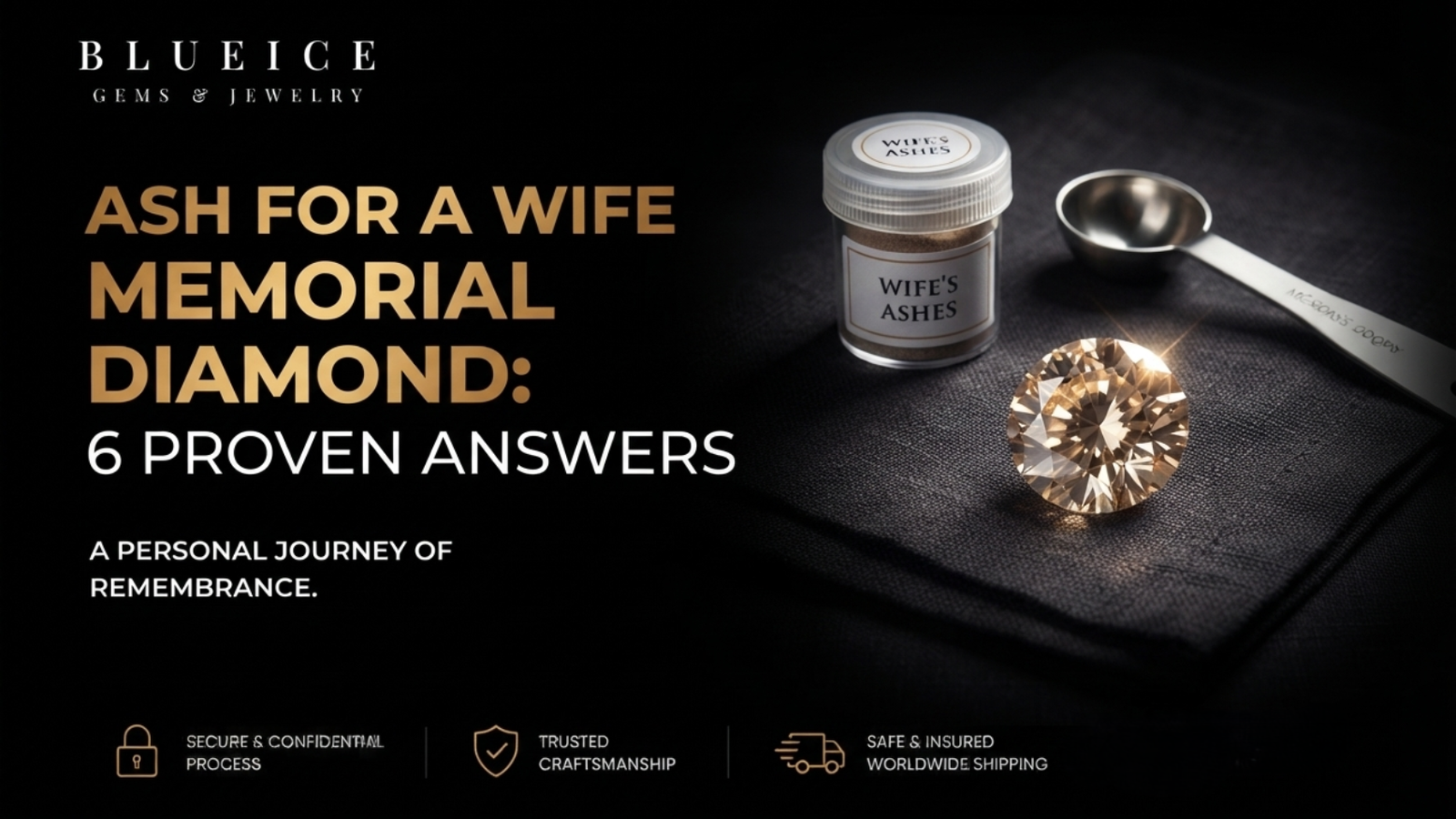
Ash for a wife memorial diamond: a small sealed labeled container beside a measuring spoon and a loose champagne lab-grown diamond on linen

How Much Ash Do You Need for a Wife Memorial Diamond?

You may be standing near the urn with a measuring spoon, unsure whether what you are about to do is enough, or too much. The amount of ash for a wife memorial diamond is small: across the industry, providers typically ask for somewhere between a few tablespoons and roughly 4 oz (about 100 g) of her cremated remains, and the exact figure depends on the provider, not on the size of stone you want. That is a small fraction of what a full cremation produces, so the rest of her ashes stay with whatever plan you already had. Below are the questions that sit underneath that answer.

How Much Ash for a Wife Memorial Diamond Is Enough?

The honest range for ash for a wife memorial diamond is wide at the top and narrow at the bottom. Some providers work from a few tablespoons. Others ask for up to about 4 oz, roughly 100 g. No reputable provider asks for the whole urn.

Where a provider lands in that range depends on how much carbon their extraction recovers per gram of ash and how much margin they build in for low carbon ash. Neither is visible from outside, so the only way to know how much ash for a wife memorial diamond a specific provider wants is to ask in writing before you measure anything.

The table below is the practical version of the answer.

What you holdTypically enough?What to do
Her full urnYes, many times overMeasure out only the stated amount; keep the rest for the plan you already had
A keepsake urn or share portion (a few ounces)Usually yesConfirm the minimum in writing; most share portions clear it
A keepsake vial or small pendant’s worthSometimesTell the provider the exact amount; some accept less, and hair can supplement
Only what was recovered after scatteringRarely enough aloneAsk whether a lock of her hair can be combined with it
Ashes already split among relativesYes, if any one portion meets the minimumAny single portion works; no need to recombine

Whichever row you are in, the ash for a wife memorial diamond is measured after the provider gives you a number, not before. Wife Ashes Diamond: The Complete Guide puts the quantity question alongside everything else that decides whether this is right for you.

Why Does a Wife Memorial Diamond Need So Little Ash?

Because most of what is in the urn is not carbon, and carbon is the only part a diamond can use.

Cremated remains are almost entirely calcium phosphate, the mineral structure of bone that survives cremation. Carbon is a small fraction of ash by weight: industry figures put the usable amount at roughly 0.5% to 4%, varying with the person and the cremation. So when a provider asks for a few tablespoons of ash for a wife memorial diamond, they are asking for the amount that yields a workable quantity of carbon after everything else is stripped away.

Simple diagram showing cremated remains as mostly calcium phosphate with a small carbon fraction highlighted

That carbon is purified to 99.9%+ and blended with additional lab sourced carbon to reach the volume a diamond of meaningful size needs. In the finished stone, the personal carbon from her ashes typically makes up around 10% to 15% of the mass. Some providers cite figures as low as 3%, others higher, depending on carat and how much ash was submitted. The rest is lab carbon that was never part of her.

That is why so little ash for a wife memorial diamond is asked for, and why the stone is honest rather than diminished: a real, verifiable portion of the carbon that was in her body is inside the crystal lattice. It is not “100% her,” and a provider who says otherwise is describing chemistry that does not exist. How to Turn Your Wife’s Ashes Into a Diamond walks through the full process from urn to finished stone.

Does Sending More Ash Make a Bigger Diamond?

No, and this is the misunderstanding that costs families the most.

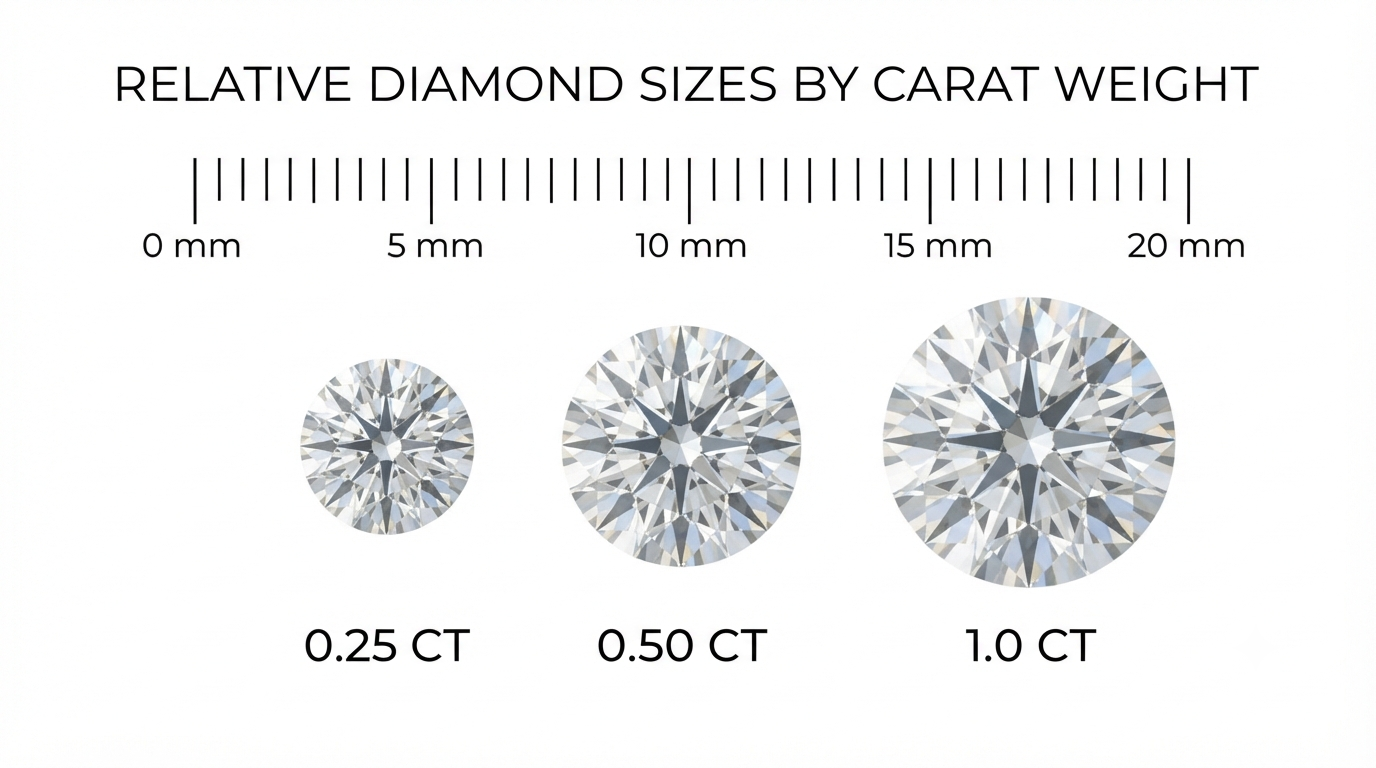
Carat is set by growth time in the press, not by how much material went in. Once the purified carbon, hers plus the supplemental lab carbon, is placed in an HPHT growth cell at roughly 6 to 8 GPa and 1,400 to 2,500°C, the crystal grows around a tiny seed for weeks to months. A 0.25 ct stone comes out sooner; a 1 ct stone stays longer. The synthetic diamond process is identical whether the carbon came from a few tablespoons or a full urn.

Loose diamonds at 0.25, 0.50, and 1.0 carat beside a millimeter ruler

So a family that sends far more ash for a wife memorial diamond than asked for gets exactly the stone they ordered and loses ashes they could have kept. What actually sets the size:

  • The carat you choose, memorial diamonds are typically offered from about 0.10 ct up to 5+ ct, and the ash for a wife memorial diamond is the same amount at every size.
  • Growth time, larger stones take longer in the press, which is why timelines run 6 to 10 months, with large or black stones sometimes taking up to 12.
  • Your budget, across the industry in 2026, with nothing published by Memorial Diamond to quote instead, roughly $1,500 to $3,500 buys 0.10 to 0.25 ct, $5,000 to $15,000 for 0.5 to 1 ct, and $20,000 to $75,000+ for 2 to 5+ ct, with colorless costing more than yellow, blue, or champagne at any size.

None of those is “how much ash you sent.” How much a wife memorial diamond costs and how long it takes to make one cover the two in your control.

How Much of a Full Cremation Is Actually Used?

A small fraction. The ash for a wife memorial diamond is measured in tablespoons or a few ounces; a full cremation produces considerably more. Total weight varies by person and crematorium, so the useful way to think about it is this: after the portion for the diamond is set aside, the urn will not look meaningfully different.

That matters for reasons that have nothing to do with chemistry. Because so little ash for a wife memorial diamond leaves the urn, everything you may have planned for her ashes still happens:

  • The interment beside her parents.
  • The scattering at the place she chose.
  • The urn that stays on the shelf, or moves to a columbarium.
  • A share portion for her sister, her mother, or her children.

A memorial diamond is one option alongside those, not a replacement for them. If the ashes are still at the funeral home, ask them to set the portion aside before the urn is sealed, most will.

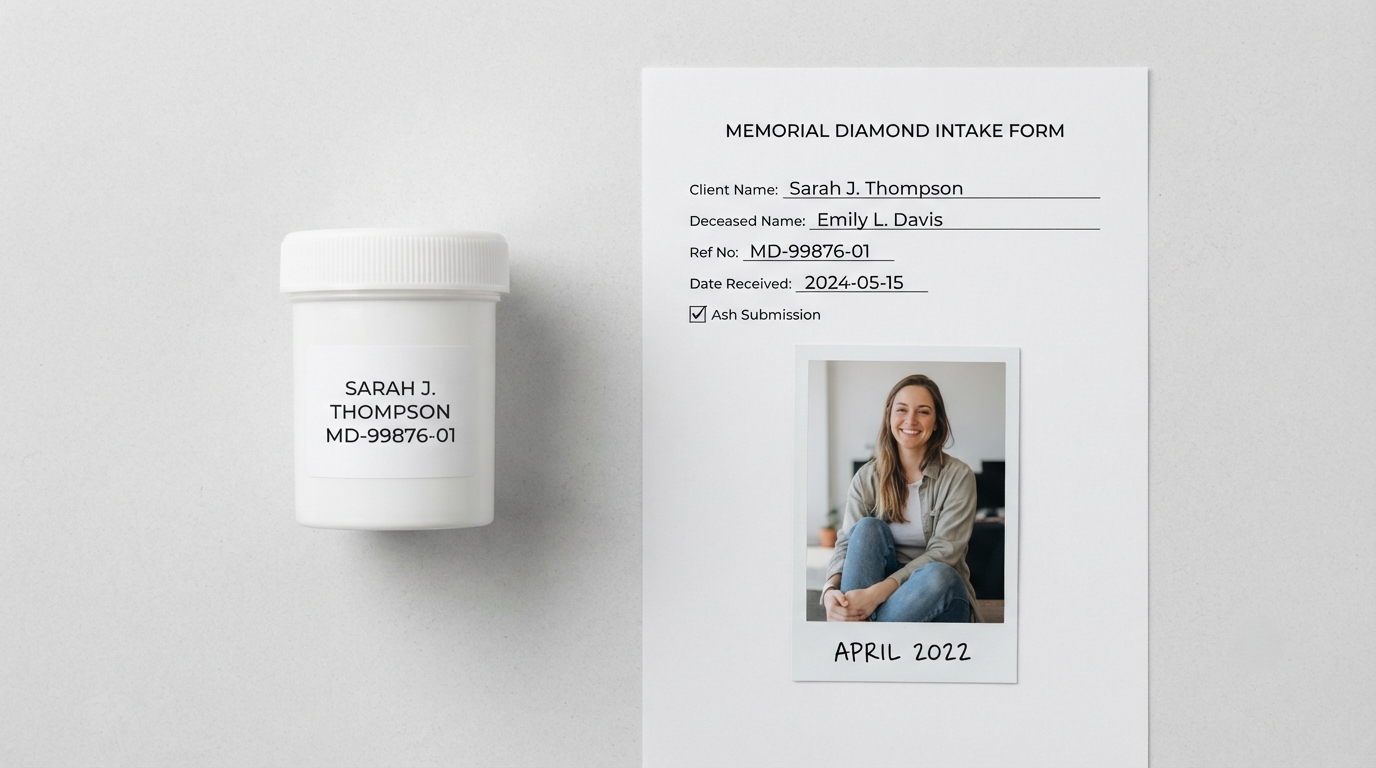
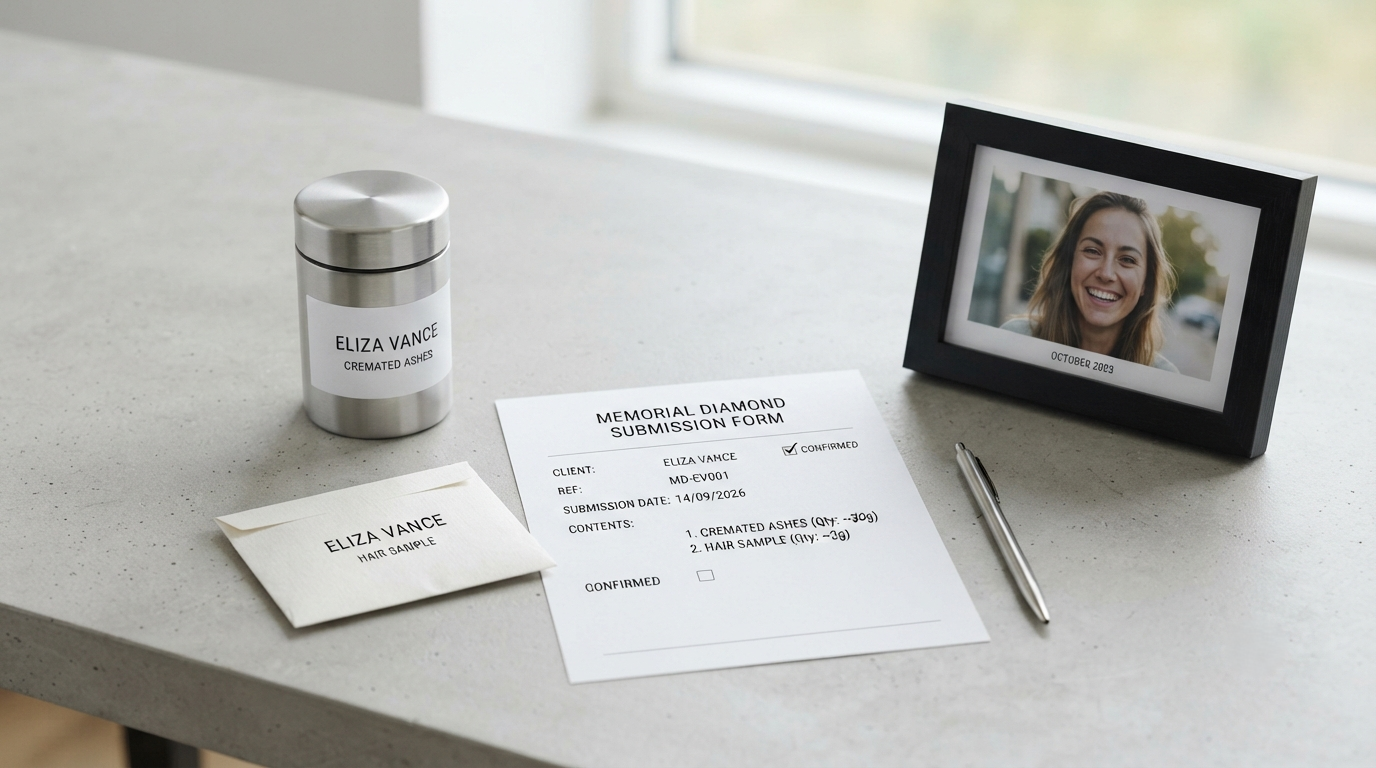
Rigid screw-lid container labeled with a name and reference number, beside a completed submission form and a dated photograph

What If You Hold Very Little of Her Ashes?

This is the question people are quietest about. A keepsake vial, a small pendant’s worth, or what remained after a scattering may still be enough ash for a wife memorial diamond, but it depends, and you should not assume either way.

  1. Some providers accept less than their published minimum. The published figure often includes margin. Tell the provider exactly how much you hold, weigh it if you can, and some will confirm they can work from it, particularly for a smaller carat.
  2. Hair can supplement ash. Hair is roughly 50% carbon by weight, a dramatically higher proportion than ash. A small lock of her hair combined with a small amount of ash will often clear a provider’s carbon requirement where the ash alone would not. If you kept any hair, from a brush, a hairband, a lock saved years ago, this is the moment it matters. How much ash and hair you need for a wife memorial diamond covers how the combined minimum works.
  3. A smaller carat asks for less carbon. If a provider cannot work from your amount at 1 ct, ask whether a 0.10 to 0.25 ct stone is possible. A provider still needs enough purified carbon to seed a growth run, and smaller stones need less.

Do not send a small amount without written confirmation that it is enough ash for a wife memorial diamond. Too little is a conversation to have before shipping, because the material cannot be recovered once extraction begins.

What If Her Ashes Were Divided at the Crematorium?

Then any one portion that meets the provider’s minimum is enough ash for a wife memorial diamond, and the family does not need to recombine anything.

Ashes are commonly divided at the crematorium, a main urn plus keepsake urns, or equal shares among children and siblings. Each portion is chemically the same; there is no “better” part of the remains for carbon extraction. What changes is the conversation, not the chemistry:

  • Whose portion is used? Usually whoever commissions the stone uses their own. If yours is the small share and someone else holds the main urn, ask them, a few tablespoons of ash for a wife memorial diamond is easier to spare from a large urn than from a keepsake vial.
  • Does everyone need to agree? Legally, the person with authority over the remains generally decides, and the rules vary by state. Practically, telling the family beforehand avoids the kind of hurt that lingers. How to talk to family about a wife memorial diamond is written for that conversation.
  • Can more than one portion go to the same provider? Yes, but it is unnecessary. One portion that meets the minimum is sufficient ash for a wife memorial diamond; sending several does not change the stone.

If no single portion clears the minimum, combining with hair or choosing a smaller carat both apply.

Can Several Stones Come From One Submission?

Often, yes, the practical upside of how little ash for a wife memorial diamond is needed.

Because one submission of a few tablespoons to about 4 oz of ash for a wife memorial diamond can yield more carbon than one small stone requires, many providers can grow two or more stones from the same batch. Each is grown, cut, graded, and priced separately, and each carries its own origin certificate tracing it to the same submission.

Who wants a stoneTypical arrangement
You and one or more adult childrenSeveral stones from one submission, often different carats, each priced separately
You now, a daughter laterAsk whether the provider retains purified carbon, or keep enough ash at home to submit again
Her parents or siblingsSame submission, or a separate one from their own share portion

Ask the provider two things before sending: how much ash for a wife memorial diamond they need for the number of stones you want, and whether they can hold purified carbon for a later stone. Whether more than one family member can get a diamond from the same wife’s ashes covers the family side of this in more depth.

How Do You Measure, Package, and Send the Ash?

Carefully, and with a paper trail. The ash for a wife memorial diamond is irreplaceable, and these steps make sure it arrives, is logged, and can be traced to the finished stone.

  1. Get the provider’s number in writing, the actual amount for your carat and number of stones, with units.
  2. Measure in a clean, dry space. A clean spoon or a small kitchen scale works. Keep the remains away from moisture, which complicates extraction.
  3. Use the container the provider specifies. Most send a kit, a rigid screw lid container, sometimes with a sealed inner bag. If not, use a clean, dry, rigid container that seals.
  4. Label it. Her full name, the word “ashes,” and the provider’s submission reference on the container itself, not only on the box.
  5. Photograph it. The labeled container beside the completed form, date visible. This is your record, independent of theirs.
  6. Ship tracked and insured, keep the tracking number with your copy of the form, and ask the provider to confirm receipt of the material specifically.

That is the entire physical task of preparing ash for a wife memorial diamond: measure, seal, label, photograph, send. A reputable provider then logs it under a chain of custody record that follows it through extraction, graphitization at roughly 2,500 to 2,700°C, growth, cutting, and grading, ideally by an independent lab using GIA’s cut, color, clarity, and carat standards. Questions to ask before turning your wife’s ashes into a diamond lists what else to ask before sending.

Is Unused Ash Returned?

It depends on the provider; ask before sending rather than assume.

Because extraction recovers carbon from the whole submitted amount, most providers use all of the ash for a wife memorial diamond that you send, there is normally no leftover to return. A few providers return unprocessed material if you sent more than needed, but returned ash has been opened, handled, and repackaged, which is not what most families want.

The cleaner approach is to treat the ash for a wife memorial diamond as a one way portion: measure exactly what the provider asked for, send that, and keep everything else at home where it never left your custody. If return matters to you, for religious reasons, or simply because you want to know, ask in writing and get the answer in writing back.

Frequently Asked Questions

How much ash for a wife memorial diamond do most providers ask for?

Typically between a few tablespoons and roughly 4 oz (about 100 g) of cremated remains, with the exact figure set by the provider rather than by the carat you choose. Confirm the amount in writing before measuring, and send only what they ask for.

Why is so little ash for a wife memorial diamond needed?

Cremated remains are almost entirely calcium phosphate; usable carbon is only about 0.5% to 4% of ash by weight. A few tablespoons yields enough carbon to extract, purify to 99.9%+, and blend with lab carbon for growth. Personal carbon typically makes up around 10% to 15% of the finished stone.

Will sending more ash make the diamond bigger?

No. Carat is determined by growth time in the press, not by the amount of material submitted. Sending more ash for a wife memorial diamond than the provider needs produces the same stone and uses ashes you could have kept for interment, scattering, or family.

What if I only have a keepsake vial of her ashes?

Tell the provider the exact amount. Some accept less than their standard minimum, especially for a smaller carat, and many can combine a small amount of ash with a lock of her hair, which is roughly 50% carbon. Get written confirmation before shipping anything.

Can two or more diamonds be made from one submission?

Usually, yes. A single submission often yields more carbon than one small stone needs, so several family members can each receive a stone from the same batch. Each is grown, graded, and priced separately. Ask the provider how much they need for the number of stones you want.

Is the ash I send returned afterward?

Usually not. Extraction recovers carbon from the whole submitted amount, so there is normally nothing left to return. Send only the amount the provider asks for and keep the rest at home. If return matters to you, ask the provider in writing before sending.

Final Thoughts on Ash for a Wife Memorial Diamond

The measuring spoon is smaller than you feared, and that is the whole point. A few tablespoons to about 4 oz is enough ash for a wife memorial diamond because carbon, not ash, is what the press works with, and because sending more would change nothing about the stone. The rest of her ashes stay with the plan you already made, and the portion of ash for a wife memorial diamond that goes carries a real, verifiable part of her into a crystal that will outlast every other object in the house. Ask for the number, measure it once, label it, photograph it, and let the rest be the slow wait it always is.

Learn More About Wife Memorial Diamonds

Talk With Memorial Diamond

If you want to know exactly how much ash for a wife memorial diamond is needed for the carat and number of stones you have in mind, or whether the small amount you hold is enough, reach out to Memorial Diamond. That number is answerable before anything leaves the house.

Wife ashes hair diamond: a small champagne lab-grown diamond between a sealed ash container and a tied lock of hair on linen

Wife Ashes and Hair Diamond: The Complete Guide

You have both. The urn came home from the crematorium, and somewhere there is also a lock, from a haircut, a brush, a hospital bed. The question is not whether either can become a diamond; each can on its own. A wife ashes hair diamond is a single lab grown diamond grown from carbon extracted from both her cremated remains and a lock of her hair, purified together and grown into one stone, and the honest reason to combine them is meaning, not chemistry, because hair alone supplies far more carbon than ashes do.

This guide covers the six questions that only arise when you are choosing between one material, the other, or both: what combining actually changes, when it genuinely helps, how the two carbons are blended, what to send from each, what it costs, and the practical risks that come with sending two irreplaceable things at once.

What Combining Ashes and Hair Actually Changes

Start with what it does not change, because the marketing around combined stones sometimes implies otherwise.

A wife ashes hair diamond is not bigger than a single source stone. Carat is set by how long the crystal grows in the press, not by how much material goes in. A wife ashes hair diamond is not faster, either; the timeline is the same 6 10 months industry wide. Combining does not make it “more her” in any measurable way, because the personal carbon in any memorial diamond is blended with lab carbon to reach a workable size, and the proportion is governed by carat, not by the number of sources.

What combining a wife ashes hair diamond does change is one thing, and it is a real thing: the stone’s carbon comes from two different moments of her. Hair is carbon she grew while alive; it records months or years of her body’s ordinary chemistry. Ashes are what remained after. For some families, having both in one crystal lattice matters in a way a single source stone does not. That is the reason to do it. It is a good reason. It is not a chemical one.

QuestionAshes onlyHair onlyAshes and hair combined
Carbon yield per gram of materialLow, roughly 0.5 4% of ash by weightHigh, hair is roughly 50% carbonHair supplies most of the personal carbon; ash adds a smaller share
Cremation required?YesNoYes, ashes are part of the submission
Effect on caratNone, set by growth timeNoneNone
Effect on timelineNone, 6 10 months typicalNoneNone
Effect on colorTrace elements from the sourceTrace elements from the sourceTrace elements from both; no reliable predictable difference
What it meansA stone from what remainedA stone from carbon she grew while livingBoth moments in one stone
Two labeled dishes on a lab bench a small mound of ash and a lock of hair with a scale between them

If the last row is the reason you are reading this, a wife ashes hair diamond is worth doing. If you were hoping the combination would yield a larger or purer stone, it will not, and one material is the simpler route. The ashes only guide and the hair only guide cover each on its own.

When a Wife Ashes Hair Diamond Makes Sense

Four situations where a wife ashes hair diamond is the right call, and two where it is not.

It makes sense when:

  1. The meaning is the point. You want a wife ashes hair diamond because you want carbon from her living years and from what remained, in one stone, and you know that is why. That is sufficient.
  2. You hold only a very small amount of ashes. If most of her ashes were scattered or interred and only a pinch was kept, less than a provider’s typical minimum, adding hair can make the submission viable where ashes alone would not. Hair does the chemical work; the ashes still contribute.
  3. You hold only a few strands of hair. The reverse case. A handful of strands from a brush may fall below a provider’s minimum on its own; combined with ashes, the submission clears the bar.
  4. Two people are contributing. Occasionally a spouse holds the ashes and a daughter or sister holds the lock. Combining lets both be part of one stone without either having to give the other their portion.

It does not make sense when:

  • You are hoping for a bigger, faster, or “purer” diamond. A wife ashes hair diamond changes none of those.
  • The hair is the only lock you have and you want to keep some. Sending both materials means two irreplaceable things leave the house at once. If keeping part of the lock intact matters, an ashes only stone with the hair kept whole may be the better arrangement.

How the Two Carbons Are Extracted and Blended

The process for a wife ashes hair diamond is the standard seven stage memorial diamond process, with the difference concentrated in stage two.

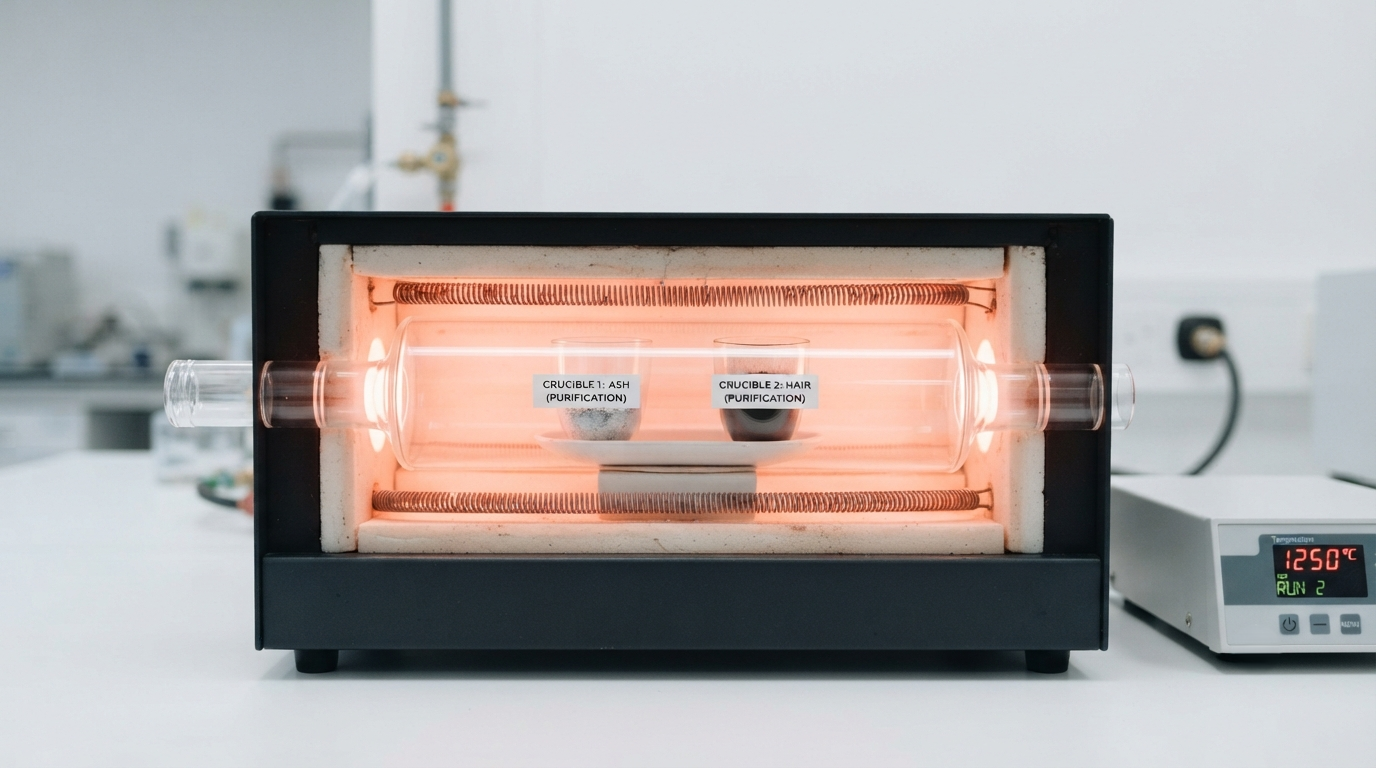
Two labeled crucibles side by side in a laboratory furnace during purification
  1. Collection. For a wife ashes hair diamond, both materials are received together, logged as a single submission under one chain of custody record. Ask how the provider labels a two material submission; you want one traceable record, not two that could be separated.
  2. Carbon extraction and purification, run for each material. Ashes are almost entirely calcium phosphate, so their extraction strips away bone mineral to recover the small carbon fraction. Hair is keratin, roughly 50% carbon, so its extraction removes the non carbon components of the protein. Both are heated in controlled, oxygen free, multi stage processes to reach 99.9%+ carbon purity. Some providers process the two materials together from the start; others purify separately and combine after. Ask which; the result is the same, but knowing the method tells you the provider understands the difference.
  3. Graphitization. The combined purified carbon is heated to roughly 2,500 2,700°C and converted to graphite.
  4. Diamond growth. The graphite, blended with supplemental lab carbon to reach adequate volume, goes into an HPHT press with a diamond seed at roughly 6 8 GPa and 1,400 2,500°C, or into a CVD chamber with some providers, for weeks to months. This stage sets the carat. Both methods are described on the synthetic diamond page.
  5. Cutting and polishing.
  6. Optional irradiation for red, pink, green, or black.
  7. Grading and certification. An origin certificate documents that this stone was grown from her submitted ashes and hair; a grading report, ideally independent, using the same cut, color, clarity, and carat standards as any diamond, documents quality.

One honesty point specific to combined stones: because hair yields so much more carbon per gram than ash, in most wife ashes hair diamond submissions the hair supplies the majority of the personal carbon and the ashes a smaller share. The finished stone contains both, verifiably. But if a provider implies the ashes and hair contribute equally, they are describing a symmetry the chemistry does not support. Ask what proportion of the personal carbon came from each; a good provider can tell you.

What to Send From Each Material

Because a wife ashes hair diamond does not require more of either material, send the minimum of each and keep the rest.

MaterialTypical industry amountWhat to keep
AshesA few tablespoons to roughly 4 oz, about 100 g, often less when hair is also submitted; askEverything else, the scattering, interment, or urn proceeds as planned
HairA small lock or a few grams, often less when ashes are also submitted; askPart of the lock, intact, if it is the only one you have
Sealed ash container and labeled hair envelope beside a completed submission form and a dated photograph

Three practical notes:

  • Ask the provider for the combined minimum specifically. Some quote the ashes minimum and the hair minimum as if both apply in full; for a combined stone, many will accept less of each. Do not send the full amount of both by default.
  • Package them separately, labeled, in one shipment. Ashes in a sealed container, hair in a labeled envelope, both inside one outer package with one submission form. This keeps the chain of custody record clean.
  • Photograph both before sending. For a wife ashes hair diamond submission, a dated photograph of the hair lock and of the ash container, alongside the submission form, is the record you will want if any question ever arises. How much ash and hair you need for a wife memorial diamond covers the quantities in detail.

Sending more of either does not produce a bigger wife ashes hair diamond. If a provider suggests otherwise, that is a reason to ask more questions, not to send more.

Does Combining Change the Color, Carat, or Cost?

Color: Not predictably. Diamond color is set by trace elements during growth, nitrogen for yellow, boron for blue, and carbon from an organic source carries trace elements with it whether it came from ashes or hair. A wife ashes hair diamond trends toward yellow, champagne, or blue like any memorial diamond, and colorless requires additional processing at extra cost. There is no reliable rule that combined stones lean one direction. Two stones from the same combined submission can differ slightly. What color a diamond made from your wife’s ashes and hair will be covers the choice.

Carat: Unchanged. Growth time in the press sets the carat of a wife ashes hair diamond. Memorial diamonds are typically offered from about 0.10 ct to 5+ ct regardless of source material.

Cost: For a wife ashes hair diamond, usually unchanged, sometimes slightly more. Most providers price by carat, color, cut, and grading rather than by material. A few charge a modest additional processing fee for a two material submission because extraction runs twice. The ranges below are general 2026 industry figures, not Memorial Diamond’s published pricing.

TierApproximate caratTypical industry range
Entry0.10 0.25 ctRoughly $1,500 $3,500
Mid0.5 1 ctRoughly $5,000 $15,000, colorless meaningfully more
Large / rare2 5+ ctRoughly $20,000 $75,000+

Settings, engraving, and independent grading are priced separately from the loose stone. Ask specifically whether a two material submission carries any surcharge, and get the loose stone price and the set price as separate lines. How much a wife memorial diamond costs works through a full quote.

Three loose memorial diamonds in champagne, yellow, and blue on a gray tray

Timeline: Unchanged for a wife ashes hair diamond. 6 10 months typical, up to 12 for large or black stones. How long a wife memorial diamond takes covers planning against a date.

The Risks of Sending Two Irreplaceable Things

An ashes only submission risks a portion of the ashes. A hair only submission risks a lock. A wife ashes hair diamond risks both at once, and that deserves a plainer look than most guides give it.

What can go wrong: a shipment lost in transit; a provider that fails before the stone is finished; a two material submission logged as two records and separated; a dispute about whether the finished stone came from your submission.

What reduces each risk:

  • Keep part of both. Do not send the last of the ashes or the whole lock. A provider needs a small amount of each; the rest stays home.
  • Use tracked, insured shipping and keep the tracking record with your copy of the submission form.
  • Ask for the chain of custody record in writing before sending, and ask how a two material submission is logged, one record or two.
  • Ask what happens if the provider cannot complete the stone. A written answer about returned material is worth having before, not after.
  • Photograph everything, dated, before it is packaged.
  • Get the origin certificate’s wording in advance. It should name both materials.

None of this is a reason not to proceed with a wife ashes hair diamond. It is the reason to proceed carefully. Questions to ask before turning your wife’s ashes and hair into a diamond isolates the questions that exist only for a combined submission.

Frequently Asked Questions

Does combining ashes and hair make a bigger diamond?

No. Carat is set by how long the crystal grows in the press, not by how much material is submitted. A wife ashes hair diamond is the same size range, typically 0.10 to 5+ carats, as a stone from either material alone. The reason to combine is meaning, not size.

Which material contributes more of the carbon?

Usually the hair. Hair is roughly 50% carbon, while ashes are almost entirely calcium phosphate with only about 0.5 4% usable carbon. In most combined submissions the hair supplies the majority of the personal carbon and the ashes a smaller share. A good provider can tell you the proportion.

How much of each should I send?

Less than the standard minimum for each, in many cases. Ask the provider for the combined minimum specifically. Typical industry amounts are a few tablespoons to roughly 4 oz of ashes and a small lock or a few grams of hair, often reduced when both are submitted. Keep part of each.

Is a wife ashes hair diamond more expensive?

Usually not, or only slightly. Most providers price by carat, color, cut, and grading rather than by material. Some charge a modest processing fee for a two material submission because extraction runs twice. Ask for the surcharge, if any, as a separate line on the quote.

Will the diamond be a different color because both were used?

Not predictably. Color is set by trace elements during growth, and carbon from either source carries them. Combined stones trend toward yellow, champagne, or blue like any memorial diamond; colorless requires extra processing. There is no reliable rule that combined submissions lean one way.

Can I send ashes now and hair later, or add hair to an ashes stone already made?

Not to the same stone. Once a diamond has grown, no carbon can be added to it. If you want both materials in one stone, both must be submitted together before growth begins. If one stone already exists, a second stone from the other material is the alternative.

Final Thoughts on a Wife Ashes Hair Diamond

A wife ashes hair diamond is not a shortcut to a better diamond. It is a choice about what the diamond is made from, carbon she grew while she was here, and carbon from what remained, held together in one crystal. If that distinction matters to you, it is reason enough, and the chemistry will accommodate it without complaint. If it does not, a single material is simpler and the stone will be no less real. Either way, keep some of both. A wife ashes hair diamond takes only a little of each, and the rest of her should stay where you can reach it.

Learn More About Wife Memorial Diamonds

Talk With Memorial Diamond

If you hold both her ashes and a lock of her hair and want to know what a combined submission would need, whether your amounts are enough, or how the two materials are logged and blended, reach out to Memorial Diamond. Nothing has to be sent until every question on this page has an answer you are satisfied with.

Word count: 2,620. Reading time: about 13 minutes.

Wife's ashes hair diamond: a small champagne lab-grown diamond between a sealed ash container and a tied lock of hair, all labeled with the same reference

How to Turn Your Wife’s Ashes and Hair Into a Diamond

If you hold both her ashes and a lock of her hair, you have already read or could read how each becomes a diamond on its own. This page does not repeat those steps.

A wife’s ashes hair diamond is a single lab grown diamond grown from carbon extracted from both her cremated remains and her hair, and turning both into one stone adds exactly five things to the standard process: asking for a combined minimum rather than two separate ones, insisting on one chain of custody record instead of two, packaging both materials for one shipment, understanding how the two carbons are blended, and getting an origin certificate that names both.

Everything else, confirming you can decide, choosing a provider and carat, the 6 to 10 months of growth, receiving and checking the stone, is identical to a single material stone and is covered in the ashes how to and the hair how to. This page covers only what combining adds.

What a Wife’s Ashes Hair Diamond Is, and Why Families Combine

A wife’s ashes hair diamond is a real lab grown diamond, same crystal structure, same optics, hardness 10 on the Mohs scale, grown around carbon that came from two sources: her cremated remains and a lock of her hair.

The chemistry is lopsided, and it is better to know that now. Hair is roughly 50% carbon by weight; ashes are almost entirely calcium phosphate with only about 0.5 to 4% usable carbon. In a combined submission, the hair supplies most of the personal carbon and the ashes a smaller share. Neither material makes the stone bigger, faster, or purer. Carat is set by growth time in the press, and the personal carbon is blended with supplemental lab carbon regardless of how many sources it came from.

So the reason to combine is not chemical. It is that the hair is carbon she grew while alive and the ashes are what remained, and some families want both in one crystal lattice. That is a good reason. Wife Ashes and Hair Diamond: The Complete Guide covers when it makes sense and when a single material is simpler.

What Stays the Same as a Single Material Stone

Most of the process of a wife’s ashes hair diamond. The table below is the whole seven step how to with the unchanged rows pointed to the page that already covers them, so this page can spend its length on the five rows that differ.

StepChanges for a wife’s ashes hair diamond?Where it is covered
Confirm you have the right to decide about her remainsNoAshes how to, step 1
Find the hair and check its conditionNoHair how to, step 1
Measure out the ashes portionPartly: see added step 1Ashes how to, step 2
Divide the lock and keep somePartly: see added step 1Hair how to, step 2
Choose a providerPartly: see added steps 2 and 4Either how to, step 3
Choose a carat and, if wanted, a colorNoEither how to, step 3
Send it with a paper trailPartly: see added steps 2 and 3Either how to, step 4
The 6 to 10 months of extraction, graphitization, growth, cutting, gradingPartly: see added step 4Either how to, step 5
Receive and check the stonePartly: see added step 5Either how to, step 6
Decide what it becomesNoEither how to, step 7

Cost of a wife’s ashes hair diamond is also unchanged or nearly so: most providers price by carat, color, cut, and grading, not by material, though a few add a modest processing fee because extraction runs twice. General 2026 industry ranges, not Memorial Diamond’s published pricing, run roughly $1,500 to $3,500 for 0.10 to 0.25 ct, $5,000 to $15,000 for 0.5 to 1 ct, and $20,000 to $75,000+ above 2 ct, with colorless costing more at every size. Timeline is unchanged at 6 to 10 months, up to 12 for large or black stones.

Added Step 1: Ask for the Combined Minimum

The single material how tos tell you to ask the provider’s minimum in writing. For a wife’s ashes hair diamond, ask specifically for the combined minimum, because it is often less of each than the two standalone figures.

The standalone figures across the industry are a few tablespoons to roughly 4 oz of ashes, and a small lock or a few grams of hair. A provider quoting both in full for a combined stone may simply be reading two lines off a price list. Many will accept less of each when both are submitted, since the hair alone usually clears the carbon requirement. Ask:

  1. “For a combined ashes and hair submission at [carat], how much of each do you need?”
  2. “If I hold less ashes than your standard minimum, does the hair make up the difference?”
  3. “Do you return unused material of either kind?”

Then measure out only that amount for the wife’s ashes hair diamond. Everything else you planned for her ashes still happens, and the remainder of the lock stays home. If the lock is the only one you have, divide it before sending: a wife’s ashes hair diamond takes two irreplaceable things from the house at once, and keeping part of each is the one precaution that costs nothing. How much ash and hair you need for a wife memorial diamond covers the quantities.

Added Step 2: Insist on One Custody Record

A chain of custody record is the logged, traceable trail from the moment your submission arrives to the finished stone. Every reputable provider keeps one. The risk specific to a wife’s ashes hair diamond is that two materials get logged as two submissions, and somewhere between extraction and growth the link between them is lost, or the provider cannot later show that both went into the same stone.

Before sending anything for a wife’s ashes hair diamond, ask:

  • “How is a two material submission logged: as one record or two?”
  • “At what stage are the two purified carbons combined, and is that step recorded?”
  • “Can I see the record for both materials at each stage?”

The answer you want is one submission reference covering both materials, with the combination step logged. If the provider logs them separately, ask how the two records are tied together in writing. A provider who cannot answer this clearly is telling you something.

Added Step 3: Package Both for One Shipment

For a wife’s ashes hair diamond, the ashes go in a sealed, dry container the provider specifies. The hair goes in a labeled paper envelope, tied with thread. Both go inside one outer package with one submission form that lists both materials.

ItemWhat to write on itWhy
Ash containerHer name, “ashes,” your submission referenceSo it cannot be mistaken for another family’s
Hair envelopeHer name, “hair,” the same submission referenceSame reference ties both to one record
Submission formBoth materials listed, amounts statedThe provider’s record starts from this form
Your photographBoth items, labeled, beside the form, date visibleYour own record, independent of theirs
Labeled ash container, labeled hair envelope, and a submission form listing both, arranged beside a dated photograph

Ship the wife’s ashes hair diamond submission tracked and insured, keep the tracking number with your copy of the form, and confirm receipt of both materials, not just “your package arrived.” A wife’s ashes hair diamond submission has two things to acknowledge, and a good provider will name both.

Added Step 4: Understand the Blend

The seven stage process for a wife’s ashes hair diamond is the standard one, with the difference concentrated in stage two.

  1. Collection: both materials for the wife’s ashes hair diamond logged under one reference.
  2. Carbon extraction and purification: run for each. Ashes are heated in a controlled, oxygen free, multi stage process that strips away bone mineral to recover the small carbon fraction. Hair is heated the same way to remove the non carbon components of keratin. Both reach 99.9%+ carbon purity. Some providers process the two together from the start; others purify separately and combine after. The result is the same; asking which tells you the provider understands the difference.
  3. Graphitization: the combined carbon is heated to roughly 2,500 to 2,700°C and converted to graphite.
  4. Diamond growth: the graphite, blended with supplemental lab carbon, grows around a seed in an HPHT press at roughly 6 to 8 GPa and 1,400 to 2,500°C, or in a CVD chamber with some providers, for weeks to months. This sets carat. Both methods are on the synthetic diamond page.
  5. Cutting and polishing.
  6. Optional irradiation for red, pink, green, or black.
  7. Grading and certification.
Two labeled crucibles in a laboratory furnace during separate purification runs

The question worth asking about a wife’s ashes hair diamond at this step: “What proportion of the personal carbon in the finished stone came from the ashes, and what from the hair?” A confident provider gives a range. A provider who implies the two contributed equally is describing a symmetry the chemistry does not support. Color is not predictably affected by combining: trace nitrogen or boron from either source produces yellow, champagne, or blue as with any memorial diamond, and colorless needs extra processing. What color a diamond made from your wife’s ashes and hair will be covers the choice.

Added Step 5: Get a Certificate That Names Both

When the stone arrives, the single material how tos tell you to check the origin certificate, the grading report, the stone against the report, and the carat. For a wife’s ashes hair diamond, add one check: the origin certificate must name both materials.

An origin or authenticity certificate is the provider’s attestation that this specific stone was grown from this specific submission. If it says “ashes” and does not mention the hair, the document does not record what you sent. Ask for the certificate’s wording in advance, before the material leaves the house, so there is no argument at the end. The grading report, ideally from an independent lab using GIA’s cut, color, clarity, and carat standards, documents quality and is unaffected by the number of sources.

An origin certificate on a desk with two material lines visible, beside a loose diamond on its grading report

Then put the wife’s ashes hair diamond certificate, the grading report, your submission folder, and the kept portions of both materials together. Whoever holds the stone after you should be able to prove what it is and what it came from.

What Good Answers to the Five Questions Sound Like

Because every added step is a question, here is how to tell a provider who has made a wife’s ashes hair diamond before from one who is reading a price list.

QuestionAn answer that shows they understand combined stonesAn answer that should prompt more questions
Combined minimum“For that carat, about half our standard ash amount plus a small lock: the hair carries most of the carbon.”“Send the full minimum of each to be safe.”
One custody record“One reference number; both materials logged under it, and the combination step is recorded.”“We’ll log them as two jobs and match them up later.”
Packaging“Sealed container for ashes, paper envelope for hair, same reference on both, one form.”“Just put them in the box.”
The blend“We purify separately, combine before graphitization, and can tell you the approximate share from each.”“It all just goes in together.”
The certificate“It lists both materials and the submission reference.”“It says ashes; the hair is implied.”

None of the answers in the right hand column is disqualifying on its own. Two or three together mean the provider has not thought about what a wife’s ashes hair diamond needs that a single material stone does not, and that is worth knowing before two irreplaceable things leave the house.

Frequently Asked Questions

Does combining her ashes and hair make a bigger or better diamond?

No. Carat is set by growth time in the press, not by material, and the personal carbon is blended with lab carbon regardless of how many sources it came from. A wife’s ashes hair diamond is the same size range, color range, and timeline as a single material stone. The reason to combine is meaning.

How much of each do I send?

Ask the provider for the combined minimum specifically: it is often less of each than the two standalone figures, a few tablespoons to roughly 4 oz of ashes; a small lock or a few grams of hair. Keep part of both. Sending more of either does not change the stone.

Which material ends up as most of the carbon?

Usually the hair. Hair is roughly 50% carbon by weight; ashes are almost entirely calcium phosphate with only about 0.5 to 4% usable carbon. In most combined submissions the hair supplies the majority of the personal carbon and the ashes a smaller share. A good provider can tell you the proportion.

Can I add hair to a diamond already made from her ashes?

No. Once a diamond has grown, no carbon can be added to it. Both materials must be submitted together before growth begins. If a stone from one material already exists, a second stone from the other material is the alternative.

Is a wife’s ashes hair diamond more expensive?

Usually not, or only slightly. Most providers price by carat, color, cut, and grading rather than by material. Some add a modest processing fee because extraction runs twice. Ask for any surcharge as a separate line on the quote, alongside the loose stone price and the setting price.

What if the certificate only mentions ashes?

Raise it before accepting the stone. The origin certificate should name both materials, since it is the provider’s record of what the diamond was grown from. Asking for the certificate’s wording in advance, before you send anything, prevents this.

Final Thoughts on Making a Wife’s Ashes Hair Diamond

Five added steps, and every one of them is a question to ask before anything leaves the house: the combined minimum, one custody record, how the two are packaged, how the two are blended, and what the certificate will say. None of them is hard, and none of them is unique to a wife’s ashes hair diamond in kind, only in count.

A wife’s ashes hair diamond is not a more complicated stone to make than a single material one: it is a stone that needs a little more care on the way in, because two irreplaceable things are going at once. Keep some of each, ask the five questions, and the rest of the process is the same patient wait it always is.

Learn More About Wife Memorial Diamonds

Talk With Memorial Diamond

If you hold both materials and want the five answers above before sending either, reach out to Memorial Diamond: the combined minimum, how a two material submission is logged, and what the certificate will say are all answerable before anything is shipped.

Husband hair diamond questions, showing a memorial diamond and a preserved lock of hair with key questions to ask before sending a hair sample.

Questions to Ask Before Turning Your Husband’s Ashes and Hair Into a Diamond

 Small labeled envelope of hair beside a notepad of husband hair diamond questions to ask before sending a sample

The Short Answer

When you are considering a memorial diamond made using both your husband’s ashes and hair, it is important to understand how a combined order works before sending either material. The most important husband ashes hair diamond questions are about the parts of the process that change when two different materials are included in one order.

These husband ashes hair diamond questions cover six important areas. You should ask whether combining ashes and hair changes the quantity required, whether the materials are processed together or separately, whether the origin documentation identifies both materials, whether you can add the second material later, whether using both materials changes the cost or production time, and what happens if one material is accepted while the other is not.

If you have already researched ashes based memorial diamonds or hair based memorial diamonds, some of that information will still be useful. However, a combined order has its own considerations. These husband ashes hair diamond questions are designed to help you focus on those combined order details.

Question 1: Does Combining Ashes and Hair Change the Quantity Requirement?

One of the first husband ashes hair diamond questions you should ask is whether combining two source materials changes the amount required from either one.

Ashes and hair have very different carbon profiles. Ash typically yields around 0.5 percent to 4 percent usable carbon by weight, while hair contains roughly 50 percent carbon. Because the materials have different carbon characteristics, a provider accepting both does not automatically mean that the quantity requirements become smaller.

Ask whether the ashes still need to meet their own minimum requirement and whether the hair needs to meet its own minimum requirement. You should also ask whether submitting both materials changes the amount required from either source.

This distinction is important because accepting both materials and changing the quantity requirement are two different things. A clear answer to this husband ashes hair diamond questions can help you prepare the correct amount before sending anything.

If you want to understand the quantity involved in a combined order in more detail, you can also read how much ash and hair a combined order needs.

Question 2: Are the Two Materials Processed Together or Separately?

Another important husband ashes hair diamond questions concerns how the two materials are prepared before diamond growth begins.

Ashes and hair require different preparation because they have different physical and chemical characteristics. In general industry practice, carbon is extracted and purified from each material separately. The purified carbon sources can then meet within the growth cell together with supplemental laboratory sourced carbon needed to reach the selected diamond size.

Ask your provider to explain exactly how your husband’s ashes and hair will be handled. You can ask when each material is processed, how each source is identified, and at what stage the two purified carbon sources come together.

Understanding this part of the process makes these husband ashes hair diamond questions easier to answer because you are asking about the actual combined process rather than assuming that the two materials are simply placed together at the beginning.

For more information about diamond related jewelry options, you can also explore BlueIceGems.

A decades-old keepsake locket holding a preserved lock of hair

Question 3: Does the Origin Document Identify Both Materials?

Documentation is another area where husband ashes hair diamond questions can help you make an informed decision.

If both your husband’s ashes and hair are being submitted, ask whether the origin documentation identifies both materials. The document may describe the submission as one combined order, or the provider may identify each source separately.

If documentation is important to you, ask to see an example before you send the materials. Find out whether your husband’s ashes will be listed separately from his hair and whether both materials will appear in the final documentation.

You can also ask when the documentation is provided and whether it is included with the finished diamond. The format and terminology can differ between providers, so this is one of the husband ashes hair diamond questions that should be answered directly by the company handling your order.

Question 4: Can You Add the Second Material Later?

Sometimes you may have one material available while the other is not ready. For example, you may have access to your husband’s ashes but still be deciding whether to use his hair. You may also have a lock of hair available while the ashes are being preserved elsewhere.

One of the most practical husband ashes hair diamond questions is whether you can start an order using one material and add the second material later.

Ask whether the provider allows an existing order to be changed before production begins. If the answer is yes, ask exactly when the second material must be submitted.

You should find out whether the additional material can be added before carbon extraction, before purification, or before another specific stage of the process.

This is a provider policy rather than something that should be assumed from general diamond production information. That is why this particular husband ashes hair diamond questions deserves a direct answer before you send either material.

Question 5: Does a Combined Order Cost More or Take Longer?

Cost and timing are naturally important husband ashes hair diamond questions when you are planning a combined order.

Rather than asking only whether using both materials costs more, ask for a complete explanation of the pricing structure. Find out whether processing two materials creates an additional charge and whether the final price depends on the selected carat size or other options.

The production time for a memorial diamond is primarily connected with the selected carat size and the growth time required in the press. Using two source materials does not automatically mean that the finished stone will require twice as much growth time.

However, each material can require its own preparation before the shared growth stage. Ask whether preparing both materials affects the estimated overall timeline for your specific order.

These husband ashes hair diamond questions can help you separate preparation time from actual diamond growth time. They can also help you understand whether the price you receive includes every stage of the combined process.

If you want to discuss your particular requirements, you can talk with Memorial Diamond about what may apply to your combined ashes and hair order.

Question 6: What Happens If One Material Is Accepted and the Other Is Not?

This is one of the most important husband ashes hair diamond questions to ask before sending your materials.

A combined order can involve different acceptance outcomes. Your provider should explain what happens if one material meets the requirements while the other does not.

SituationQuestion to Ask
Hair is accepted but ashes are not acceptedCan the order continue using the hair only?
Ashes are accepted but the hair sample is insufficientCan additional hair be submitted?
Both materials are accepted at different timesWhen does the production timeline officially begin?
One material cannot be usedWhat happens to the material that was accepted?

Ask the provider to explain this policy before submitting anything. You should know whether the order pauses, continues using one material, or requires another step if one source does not meet the requirements.

Getting a clear answer to these husband ashes hair diamond questions can prevent confusion if an unexpected situation occurs during the acceptance stage.

Why Combined Orders Need Their Own Questions

Diamond growth cell used in the HPHT process, shown alongside a production timeline

Some people assume that they can simply combine the questions for an ashes based diamond with the questions for a hair based diamond. However, that does not cover every situation.

The husband ashes hair diamond questions in this guide focus on what happens at the point where two source materials become part of one order.

The quantity requirements may be different. The preparation process may involve separate handling. Documentation may need to identify both sources. A second material may or may not be added later. Pricing and timing may have their own provider specific rules. Acceptance can also produce different outcomes for each material.

That is why asking these husband ashes hair diamond questions before sending anything can give you a clearer understanding of your particular order.

Frequently Asked Questions

Is this list different from asking about ashes and hair separately?

Yes. These husband ashes hair diamond questions focus on the issues created when two materials are included in one order. The individual questions about ashes and hair still apply, but they do not cover every combined order situation.

Do both materials need to be sent in one shipment?

This is a provider policy question. Shipping requirements can change, so ask the company directly whether both materials need to arrive together or whether they can be submitted separately.

Will the finished stone be half ashes and half hair?

No fixed ratio should be assumed. Both materials can contribute extracted carbon, which can be blended with supplemental laboratory carbon to reach the diamond size selected for the order.

Is a combined stone bigger than a single material stone for the same price?

No. The carat size is a choice made when specifying the order. Using two source materials does not automatically make the finished diamond larger.

Can more than one family member receive a diamond from the same materials?

Often, yes, because only a portion of the source material is typically required for an individual stone. If you are considering multiple memorial diamonds, ask the provider how much material is required for each stone.

Should I ask about grading and certification separately?

The finished stone is graded according to standard diamond characteristics such as cut, color, clarity, and carat. The fact that more than one source material was used does not create a separate grading system.

What Should You Ask Before Sending the Materials?

Before sending your husband’s ashes and hair, it can help to prepare a short list of questions. The following list covers the most important husband ashes hair diamond questions and a few practical follow up points.

  • How much ash is required?
  • How much hair is required?
  • Does using both materials change either quantity requirement?
  • Are the materials processed separately?
  • When are the two carbon sources combined?
  • How are the materials identified and tracked?
  • Will both materials appear in the origin documentation?
  • Can the second material be added later?
  • Does using two materials affect the total price?
  • Does preparing both materials affect the expected timeline?
  • What happens if one material is not accepted?
  • What happens to material that is not used?

Keeping these husband ashes hair diamond questions available when speaking with a provider can make it easier to compare the information you receive and identify any details that need clarification.

What If You Only Have One Material Ready?

You do not necessarily need to make every decision at once. If you currently have your husband’s ashes but are not ready to provide hair, or you have hair available but need more time before submitting ashes, ask the provider about its options.

The key husband ashes hair diamond questions in this situation concern whether an order can remain open while you prepare the second source material and whether there is a specific stage after which an additional material cannot be added.

Knowing the answer before sending the first material can help you decide whether you should wait or begin the process with what you currently have.

Final Thoughts on Husband Ashes Hair Diamond Questions

A combined memorial diamond order is not simply an ashes order and a hair order placed side by side. There are specific questions that arise when both materials are considered for one memorial diamond.

The most important husband ashes hair diamond questions cover quantity requirements, material preparation, origin documentation, adding the second material later, cost, timing, and acceptance.

Asking these husband ashes hair diamond questions before sending your husband’s ashes or hair can help you understand what the provider expects and what you can expect from the process.

You can take your time, ask for clear answers, request written information where appropriate, and make sure you understand the provider’s policies before submitting any material.

Learn More About Husband Memorial Diamonds

Talk With Memorial Diamond

If you are considering using both your husband’s ashes and hair for a memorial diamond, speak with the provider before sending any material.

Ask about quantity requirements, preparation, documentation, timing, pricing, and acceptance. The answers to these husband ashes hair diamond questions can help you understand what applies to your specific order.

You can talk with Memorial Diamond about the combined process and ask your questions before submitting your husband’s ashes or hair.

Husband ashes and hair diamond questions, featuring a memorial diamond, cremation ashes, and a lock of hair.

Questions to Ask Before Turning Your Husband’s Ashes and Hair Into a Diamond

Urn and a small envelope of hair together on a table beside a list of husband ashes hair diamond questions

When you are considering turning your husband’s ashes and hair into one memorial diamond, having clear information before beginning the process can make the experience easier to understand. The most important husband ashes hair diamond questions are not simply the same questions you would ask when using ashes or hair separately.

A combined order brings two different source materials into one memorial diamond process. That creates specific questions about quantity, preparation, documentation, timing, pricing, and acceptance. Understanding these husband ashes hair diamond questions before sending anything can help you know what to expect from your provider.

If you have already reviewed information about ashes only or hair only memorial diamonds, those subjects can still be useful. However, this guide focuses specifically on the husband ashes hair diamond questions that apply when both materials are being considered for one order.

The Short Answer

The most useful husband ashes hair diamond questions focus on six areas that are unique to combining two source materials. You should ask whether combining ashes and hair changes the quantity requirement, whether both materials are processed together or separately, whether both materials appear on the origin documentation, whether the second material can be added later, whether using both affects cost or timing, and what happens if one material is accepted while the other is not.

These husband ashes hair diamond questions are worth answering before you separate an ash portion or prepare a lock of hair. A provider may have specific procedures for combined orders, so information that applies to one type of memorial diamond should not automatically be assumed to apply to another.

Question 1: Does Combining Materials Change Either Quantity Requirement?

One of the first husband ashes hair diamond questions to ask is whether using both ashes and hair changes the amount required from either source.

Ashes and hair have different carbon profiles. Ash typically yields around 0.5 percent to 4 percent usable carbon by weight, while hair contains roughly 50 percent carbon. Because these materials have different characteristics, accepting both does not automatically mean that the quantity requirement for either material changes.

Ask your provider whether the ashes must meet their own minimum and whether the hair must independently meet its own minimum. You can also ask whether providing both materials allows less of either source to be submitted.

This is an important distinction. Saying that a provider accepts ashes and hair does not necessarily answer how much of each material is required. A direct answer to this husband ashes hair diamond questions can help you prepare the correct materials before shipping.

Question 2: Are the Two Materials Processed Together or Separately?

Another important husband ashes hair diamond questions concerns how the two materials are handled before diamond growth begins.

Industry practice generally involves extracting and purifying carbon from each material separately because ashes and hair require different preparation. The purified carbon sources can then meet inside the growth cell together with supplemental laboratory sourced carbon needed to reach a viable diamond size.

Ask your provider to describe the process in simple terms. You can ask when the ashes are processed, when the hair is processed, when the purified carbon sources are brought together, and how the materials are tracked during the process.

Knowing the answer to this husband ashes hair diamond questions can give you a clearer picture of what happens to each material before the diamond growth stage.

For additional information about jewelry and diamond related options, you can also explore BlueIceGems.

Two separately purified carbon sources shown meeting in one diamond growth cell

Question 3: Does an Origin Document Itemize Both Materials?

Documentation is another area where husband ashes hair diamond questions can be especially useful.

If you want a record showing that both your husband’s ashes and hair were submitted, ask whether the origin document identifies each source individually. Some documentation may describe the submission as one combined order, while another provider may document the source materials separately.

Ask to see an example of the documentation before committing to the process. You can ask whether your husband’s ashes will be identified separately from his hair and whether the final documentation records both materials.

This can be meaningful for families who want a clear record of the materials associated with the memorial diamond. Since documentation practices can differ between providers, this is one of the husband ashes hair diamond questions that should be answered directly.

Question 4: Can I Add the Second Material Later?

You may have one material available before the other. Perhaps your husband’s ashes are already preserved while you are still deciding whether to use his hair. You may also have the hair ready while the ashes are being handled separately.

One of the most practical husband ashes hair diamond questions is whether you can begin with one material and add the second material later.

Ask whether the provider allows an existing order to be amended. If it is possible, ask about the exact cutoff point. You should know whether the second material must be added before extraction, before purification, or before another specific stage.

Some providers may require both materials at the beginning, while others may have procedures that allow an additional material to be submitted later. Because this is provider specific, do not assume that one company’s procedure applies everywhere.

Getting a clear answer to this husband ashes hair diamond questions can be particularly helpful if you are not emotionally ready to decide about both materials at the same time.

Question 5: Does a Combined Order Cost More or Take Longer?

Cost and production time are also important husband ashes hair diamond questions to ask before sending your materials.

Instead of asking only whether a combined order costs more, ask for a clear explanation of the pricing structure. Find out whether processing two source materials creates an additional charge and whether the final amount depends on the selected carat size or other options.

Production time is primarily connected with the selected carat size and the growth time in the press. The number of source materials does not automatically mean that the finished diamond will require a longer growth period.

However, ashes and hair can require separate preparation before the shared growth stage. Ask your provider whether this preparation affects the estimated timeline for your particular order.

These husband ashes hair diamond questions can help you understand the difference between preparation time, diamond growth time, and the overall expected timeline.

If you want to discuss the process directly, you can talk with Memorial Diamond about what may apply to your particular ashes and hair order.

Question 6: What Happens If One Material Fails Acceptance?

Among the most important husband ashes hair diamond questions is what happens when the two materials do not receive the same acceptance result.

SituationQuestion to Ask
Hair is accepted but ashes are declinedDoes the order continue as a hair only diamond or pause completely?
Ashes are accepted but the hair sample is too smallCan additional hair be provided or does the order proceed using ashes only?
Both materials are accepted at different timesDoes production timing begin when the first material arrives or when both materials arrive?

Ask for the provider’s policy before submitting anything. This is especially important because ashes and hair are personal materials that may not be replaceable.

A written answer to these husband ashes hair diamond questions can give you a reference if an unexpected situation occurs during the acceptance stage.

Sample origin document itemizing two separate source materials for one memorial diamond order

Why These Questions Matter Before You Send Anything

The reason these husband ashes hair diamond questions matter is simple. When two materials are being used, assumptions about a single material order may not always apply.

For example, a provider may have one quantity requirement for ashes and another for hair. The preparation process may also differ because each material has different characteristics. Documentation may have its own format, and the rules for adding a second material later can vary.

Asking the questions in advance allows you to understand the complete process before making a decision. It also gives you an opportunity to request written information about pricing, preparation, acceptance, documentation, and timing.

You can keep the answers together in one place and use them when comparing your options. This makes the husband ashes hair diamond questions more useful because you are not relying on memory when reviewing the details later.

Frequently Asked Questions

Are these questions different from asking about ashes and hair separately?

Yes. The individual questions about ashes and hair still apply, but the husband ashes hair diamond questions in this guide focus specifically on issues created by combining both materials in one order.

Do both materials need to be sent together?

Ask your provider directly. Shipping requirements are provider specific and can change. One provider may require both materials at the same time while another may have a different procedure.

Will the finished diamond be half ashes and half hair?

No fixed ratio should be assumed. Both materials can contribute extracted carbon, which is combined with supplemental laboratory carbon to reach the selected size. Ask your provider how the contribution of each material is handled and documented.

Will using two materials make the finished diamond larger?

No. The carat size is selected as part of the order. Using both ashes and hair does not automatically create a larger diamond for the same price.

Can more than one family member receive a diamond from the same materials?

Often, yes, because only a portion of each material is typically used for an individual stone. If several diamonds are being considered, ask how much material is required for each stone. You can also review information about how much ash and hair a combined order needs.

Should grading and certification be discussed for a combined diamond?

Yes. The finished diamond is graded according to characteristics such as cut, color, clarity, and carat. Ask whether grading or certification is included in the quoted price or offered separately.

Additional Questions to Ask Your Provider

Beyond the six main husband ashes hair diamond questions, you may want to prepare a few additional questions before contacting a provider.

  • How much of each material should be submitted?
  • How should each material be packaged?
  • Can the two materials be shipped separately?
  • How will each source be identified after arrival?
  • What happens if additional material is required?
  • When will you receive confirmation that the materials were accepted?
  • What documentation is provided after the diamond is completed?
  • Which services are included in the quoted price?

Writing these questions down can make your conversation more organized. It also helps ensure that you receive clear answers instead of making assumptions about how the combined order works.

Final Thoughts on Husband Ashes Hair Diamond Questions

A combined memorial diamond order does not necessarily mean twice the complexity, but it does create several questions that do not apply to a single material order.

The most important husband ashes hair diamond questions involve quantity requirements, separate processing, origin documentation, adding the second material later, cost, timeline, and what happens if one material is not accepted.

Taking the time to answer these husband ashes hair diamond questions before sending your husband’s ashes or hair can help you understand the process with greater clarity.

You do not need to make every decision immediately. You can ask questions, review the answers, understand the provider’s policies, and then decide whether combining both materials is right for your memorial diamond order.

Learn More About Husband Memorial Diamonds

Talk With Memorial Diamond

If you are considering using both your husband’s ashes and hair for one memorial diamond, speaking directly with the provider can help answer the husband ashes hair diamond questions that are specific to your situation.

Ask about the required quantity, material preparation, documentation, acceptance process, timeline, and total pricing before sending anything.

You can talk with Memorial Diamond about the combined process and ask your questions before submitting any material.

Husband's ashes hair diamond: a champagne-toned lab-grown memorial diamond between a labelled envelope of hair and a small sealed container of cremated remains

How to Turn Your Husband’s Ashes and Hair Into a Diamond

Two materials, two clocks, and one person watching both. To turn your husband’s ashes and hair into a diamond, you set aside a small portion of his cremated remains, collect a lock of his hair, send both to a laboratory, and receive a single lab grown husband’s ashes hair diamond back in roughly six to ten months. The ashes clock is set by whoever holds them; the hair clock is set by the next time the house is cleaned. Because you will be interrupted, this guide is built around where it is safe to stop.

Why Do the Two Materials Run on Different Clocks?

Every husband’s ashes hair diamond starts with two searches. His hair exists by accident, on a razor, a pillowcase, a coat collar, and it disappears the first time someone tidies. That clock can run out in a weekend. His ashes are either in your home, where nothing is urgent, or with a funeral home or cemetery, where a portion has to be requested before a release or interment date. That clock is longer but fixed.

Hair is roughly 50% carbon; cremated remains are roughly 0.5% to 4% carbon. So the hair contributes a lot from a little, and the ashes contribute a little from a lot. A husband’s ashes hair diamond blends the purified carbon from both into one crystal, grown by HPHT or CVD diamond growth exactly as any lab grown diamond is.

A paper envelope and a small urn side by side on a table, a wall clock behind them

Step 1: Secure the Hair First

Do this today, before anything else in a husband’s ashes hair diamond. Lift the strands from wherever they are with clean fingers or tweezers, put them dry into a paper envelope, and label it with his name, the date, and the source. If there is hair in more than one place, use one envelope per place. Hair keeps indefinitely once dry, so the hair clock stops the moment it is in the envelope. The full collection method is in how to turn your husband’s hair into a diamond.

Step 2: Find Out Who Holds His Ashes

Where his ashes areWhat sets the clockWhat to do now
In your homeNothing; you choose the timeMove to Step 3 when ready
With the funeral homeTheir release dateAsk them to hold back a labelled portion before release
Interred or in a nicheCemetery rules, which vary by stateAsk what removal involves before assuming it is possible
ScatteredWhatever was kept backIf nothing remains, the hair alone can still make a stone

If the answer is the funeral home, ask for the date in writing. Everything else about the combined route, including whether to make one stone or two, is in the husband ashes and hair diamond guide. That date is the only hard deadline in a husband’s ashes hair diamond, and it is the one most often missed.

Step 3: Set Aside the Ash Portion

Industry typical requests for a husband’s ashes hair diamond are a few tablespoons to about four ounces, roughly 100 grams. Ask your provider for their figure, and ask specifically whether including hair reduces it; some providers lower the ash requirement for combined orders, others do not. If the urn is with you, divide the portion at your own table with a clean spoon, a scale, and a new sealed container, then label it with his name, the date, and the weight. The ashes only method, including the part nobody warns you about, is in how to turn your husband’s ashes into a diamond.

Two handwritten labels, one for hair and one for ashes, beside an open notebook

Step 4: Record Both, Separately

A husband’s ashes hair diamond needs two records, not one. For the hair: the date collected, the source, and the weight if you can measure it. For the ashes: the date divided, the weight, and where the remainder is. A husband’s ashes hair diamond will carry an origin document naming both materials, and your two notes are its first entries. Photograph both labelled containers before they leave you.

Step 5: Ask a Provider the Combined Order Questions

Beyond the standard questions about method, grading, and price, a husband’s ashes hair diamond raises questions of its own:

  • Are two separate intake records kept, one per material?
  • Will I be told before blending if one material under yields, or is the shortfall covered silently with laboratory carbon?
  • Does the origin document name both the ashes and the hair?
  • What happens to material not consumed by extraction, for each material?
  • Is a combined order priced differently from a single material stone?
  • Can both materials travel in one shipment, or must they be sent apart?

The provider’s answers to the second and third questions decide whether the hair you chose with such care is actually acknowledged in the stone’s paperwork. A wider list is in questions to ask before turning your husband’s ashes and hair into a diamond.

Step 6: Send Both, Together or Apart

The two halves of a husband’s ashes hair diamond are treated differently by carriers, so confirm the provider’s current shipping instructions on the day rather than relying on a general rule. If the two must travel separately, send the hair first; it is the irreplaceable one. Keep both tracking numbers with the records from Step 4, and ask the provider to confirm receipt and recorded weight for each material.

Step 7: What the Lab Does With a Husband’s Ashes Hair Diamond

The two materials in a husband’s ashes hair diamond are purified separately. Each is heated in a controlled, oxygen free, multi stage process that strips away everything that is not carbon, the calcium phosphate from the ashes and the non carbon parts of keratin from the hair, to roughly 99.9% purity. Both carbon yields are converted to graphite at around 2,500 to 2,700°C, then blended, supplemented with laboratory carbon to reach a growable volume, and grown around a diamond seed for weeks to months. A gemologist cuts and polishes the rough stone, and reputable providers have it graded on cut, color, clarity, and carat by an independent laboratory.

Two labelled crucibles in a laboratory furnace tray

Personal carbon typically makes up around 10% to 15% of the finished stone; the rest is laboratory carbon. A husband’s ashes hair diamond is physically made in part from him, from both sources, and the origin document should say so. The stage by stage account is in how a memorial diamond is made from your husband’s ashes and hair.

Where It Is Safe to Stop

You will be interrupted, by grief, by paperwork, by a child who needs you. These are the points where a husband’s ashes hair diamond can be paused without losing anything:

After this stepSafe to stop?Write this down before stopping
Step 1, hair in an envelopeYes, indefinitelyDate, source, his name
Step 2, you know who holds the ashesYes, until the release dateThe date, and who told you
Step 3, ash portion set asideYes, indefinitelyWeight, date, where the rest is
Step 4, both recordedYesNothing further; you are ready when you are
Step 5, provider chosenYes, subject to their quote validityThe quote date and the answers you were given
Step 6, both sentNo; the process is now theirsBoth tracking numbers
husband's ashes hair diamond

Frequently Asked Questions

Do I need both his ashes and his hair, or is one enough?

One is enough. Hair alone makes a full diamond because it is roughly 50% carbon, and ashes alone make one too. A husband’s ashes hair diamond is chosen when a family holds both and wants both represented, not because either material falls short.

Does adding hair mean I need less of his ashes?

It depends on the provider. Some reduce the ash requirement when hair is included, because the hair contributes carbon efficiently; others still ask for the standard few tablespoons to four ounces. Ask before dividing the urn, since the answer sets how much you set aside.

Are the ashes and hair mixed together when they arrive?

No. Reputable providers purify each material separately and combine the carbon only at the graphite stage, before growth. Ask whether two intake records are kept and whether you will be told if either material under yields before blending.

Can the ashes and hair be sent in the same package?

Sometimes, but cremated remains and hair are handled differently by carriers, so confirm the provider’s current shipping instructions rather than assuming. If they must travel apart, send the hair first, because it cannot be replaced.

How long does a husband’s ashes hair diamond take?

A husband’s ashes hair diamond takes six to ten months from receipt of both materials industry wide, sometimes twelve for larger or specialty color stones. Growth time in the press sets carat size; sending more of either material does not make the stone bigger or faster.

Will the finished stone show which parts came from ashes and which from hair?

No. In a husband’s ashes hair diamond, purification reduces both to carbon, and the crystal cannot distinguish sources. What distinguishes them is the paperwork: two intake records and an origin document naming both materials. Ask that those documents exist before you order.

Final Thoughts on Turning Your Husband’s Ashes and Hair Into a Diamond

Only two moments in this sequence are urgent: the envelope, and the funeral home’s date. Everything else in a husband’s ashes hair diamond waits as long as you need it to. Stop where the table says it is safe, write down the one line it asks for, and pick the process up when you are ready.

Learn More About Husband Memorial Diamonds

Talk With Memorial Diamond

If you have the envelope and are unsure how to handle the ashes, or the other way round, reach out to Memorial Diamond to talk through a husband’s ashes hair diamond and what to do next.

Husband's hair to memorial diamond: a small lock of gray hair in a labelled envelope beside a blue-toned lab-grown diamond

How a Memorial Diamond Is Made From Your Husband’s Hair

His body spent years building each strand, and the laboratory spends weeks taking that work apart. A memorial diamond made from your husband’s hair starts with a small lock, a few grams, which is purified to carbon, converted to graphite, blended with laboratory carbon, and grown into a real diamond over roughly six to ten months. Almost every stage of that process reverses something his biology did to make the fiber, in the opposite order it was made. Exactly one stage is not a reversal. That is where the diamond comes from.

What His Body Built, and What the Lab Undoes

Your husband’s hair is keratin, a protein his follicles assembled from amino acids, cross linked with sulfur bonds, wrapped in a protective cuticle, and coated with oils. Roughly half of its weight is carbon. To reach that carbon, the laboratory strips away each of those layers, last added first.

#StageWhat his body didWhat the lab doesReversal?
1Collection and intakeGrew your husband’s hair over monthsWeighs, logs, and records the lockNo; a record, not a reversal
2Cleaning and cuticle breakdownCoated the fiber in oils and a scale like cuticleRemoves surface oils and opens the cuticleYes
3Carbon purificationAssembled keratin from carbon, nitrogen, oxygen, sulfur, hydrogenHeats the hair oxygen free, driving off everything but carbonYes
4GraphitizationArranged carbon inside a proteinReorders the carbon into graphite sheetsYes
5Diamond growthNothing; his body never made diamondGrows a crystal around a seed under heat and pressureNo; this is the one addition
6Cutting and gradingNothingShapes and grades the stoneNo; finishing
A six-stage diagram showing a hair strand's layers being removed in reverse order, ending in a diamond crystal

Stage 1: The Lock Leaves Your Hands

Your husband’s hair is not a regulated shipment the way cremated remains are, so the safeguards are the ones you build. Label the envelope with his name, the date collected, and the source. Photograph it. Ask the provider what they record at intake, whether a photograph, a weight, or both, and ask them to confirm receipt with the weight they logged. The collection method itself is in how to turn your husband’s hair into a diamond. If the lock is small, ask before sending whether they will assess a photograph and a weight first, so you are not committing the only hair you have to an order that cannot proceed.

Stage 2: Removing What Keratin Added Last

The outermost layer of your husband’s hair is the last thing his body finished: the cuticle, a scale like sheath, and the oils that coated it. The laboratory removes those first, cleaning surface contamination and opening the cuticle so the process can reach the fiber’s core. This is a small stage, but it is the first of the reversals, and it is why hair from a hat or a coat collar, with lint and dust attached, is still usable: contamination sits on the outside, and the outside is what goes first.

Stage 3: Purification to Carbon

The keratin in your husband’s hair is made of carbon, nitrogen, oxygen, sulfur, and hydrogen, bonded together. In a controlled, oxygen free, multi stage heating process, the laboratory drives off every element except carbon, leaving it at roughly 99.9% purity. Everything his follicles assembled around the carbon, the sulfur cross links that gave his hair its texture, the nitrogen in the amino acids, is removed.

A sealed oxygen-free purification furnace in a laboratory

Because your husband’s hair is roughly 50% carbon, this stage yields a great deal from a very small lock. Cremated remains, by comparison, are roughly 0.5% to 4% carbon. That difference is why a hair based stone needs grams rather than ounces, and why it is available to families who chose burial. Ask what happens to any hair not consumed by extraction; some providers return it, and if you sent the only lock you had, that matters.

Stage 4: Graphitization

The carbon purified from your husband’s hair is heated further, to roughly 2,500 to 2,700°C, and its atoms reorganize into graphite, the layered crystalline form that diamond presses use as feedstock. His body arranged those same carbon atoms inside a protein; the lab now arranges them into sheets. After this stage the material is graphite, physically indistinguishable from any other graphite except by the record that says whose it is.

That record, from your envelope label to the intake weight to this stage, is what the origin document will eventually certify, and it is the answer to the question in is a memorial diamond really made from your husband’s hair. The ashes equivalent of this map is in how a memorial diamond is made from your husband’s ashes.

Stage 5: Growth, the One Step That Adds

This is the only stage that does something his body never did. The graphite is blended with additional laboratory carbon, placed with a tiny diamond seed in a growth cell, and grown by HPHT or CVD diamond growth. Most memorial providers use HPHT, a press recreating roughly 6 to 8 GPa and 1,400 to 2,500°C; a minority convert the carbon to gas for CVD. Growth takes weeks to months, and growth time, not the size of the lock, sets the carat.

A diamond seed crystal and graphite feedstock beside an HPHT growth cell

The honest proportion belongs here too. Personal carbon typically makes up around 10 to 15% of a finished memorial diamond; the rest is laboratory carbon needed to grow a crystal of usable size. With hair, the limit on the personal share is the stone’s size, not your sample. The finished crystal is diamond in every physical sense, scoring 10 on the Mohs scale as the hardest known natural mineral.

Stage 6: Cutting, Grading, and the Record

A gemologist cuts and polishes the rough crystal grown from your husband’s hair into the shape you chose. Reputable providers then send it to an independent laboratory for grading on cut, color, clarity, and carat. Two documents should return with the stone: a grading report describing the diamond’s quality, and an origin document tracing it back through every stage to the lock you sent. Color will not match his hair; it is set by trace elements during growth, with most memorial stones landing in yellow, champagne, or blue. The options are in what color diamond can be made from your husband’s hair.

Why Your Husband’s Hair Needs So Little Material

  • A palm sized lock, a few grams, is the industry typical minimum, against a few tablespoons to four ounces of ashes.
  • Your husband’s hair keeps indefinitely once dry, so a lock from decades ago works as well as one cut last month.
  • One generous lock can sometimes support more than one stone; a few strands usually support one. Ask before assuming either.
  • Because hair yields carbon so efficiently, it can be combined with a small ash portion when a family holds both; that route is described in how a memorial diamond is made from your husband’s ashes and hair.

Quantity on its own is covered in how much hair you need for a husband memorial diamond.

Frequently Asked Questions

How much of my husband’s hair is needed?

Industry typical minimums are a small lock, a few grams, often described as palm sized. Because hair is roughly 50% carbon, far less is needed than for ashes. If you have only strands, ask the provider to assess a photograph and a weight before you commit the sample.

Does his hair need to be cremated first?

No. A memorial diamond from your husband’s hair involves no cremation at any stage. Carbon is extracted directly from the keratin in the strand, which is why this option is available to families who chose burial or who scattered his ashes.

Does the diamond contain his DNA?

No. Purification removes every element except carbon, and DNA is a large molecule made of several elements. What remains is his carbon, physically grown into the crystal, traced by the origin document rather than by any biological marker.

How much of the diamond is actually him?

Typically around 10 to 15% of the finished stone’s mass is carbon from his hair; the remainder is laboratory carbon needed to reach a growable volume. With hair, that share is limited by the stone’s size, not by how small your lock was.

Will the diamond be the color of his hair?

No. Color is set by trace elements such as nitrogen or boron during growth, not by the pigment of your husband’s hair, and gray hair yields the same carbon as dark hair. Most memorial diamonds land in yellow, champagne, or blue; colorless is possible with extra processing at higher cost.

Can a failed growth run be attempted again?

Sometimes, if purified carbon from your husband’s hair remains after the first attempt. Whether a provider re runs from remaining carbon, what it costs, and who bears that cost varies. Ask before ordering, especially if you sent the only lock you had.

Final Thoughts on How a Memorial Diamond Is Made From Your Husband’s Hair

Five of these six stages take apart your husband’s hair, what he grew without noticing, one layer at a time and in reverse. The sixth builds something he never had. If that ordering means something to you, it is worth choosing a provider who can show you the record of each stage, from the envelope you labelled to the document that comes back with the stone.

Learn More About Husband Memorial Diamonds

Talk With Memorial Diamond

If you are holding a lock of your husband’s hair and want to understand what each stage would record before you send it, reach out to Memorial Diamond to talk through what’s possible.