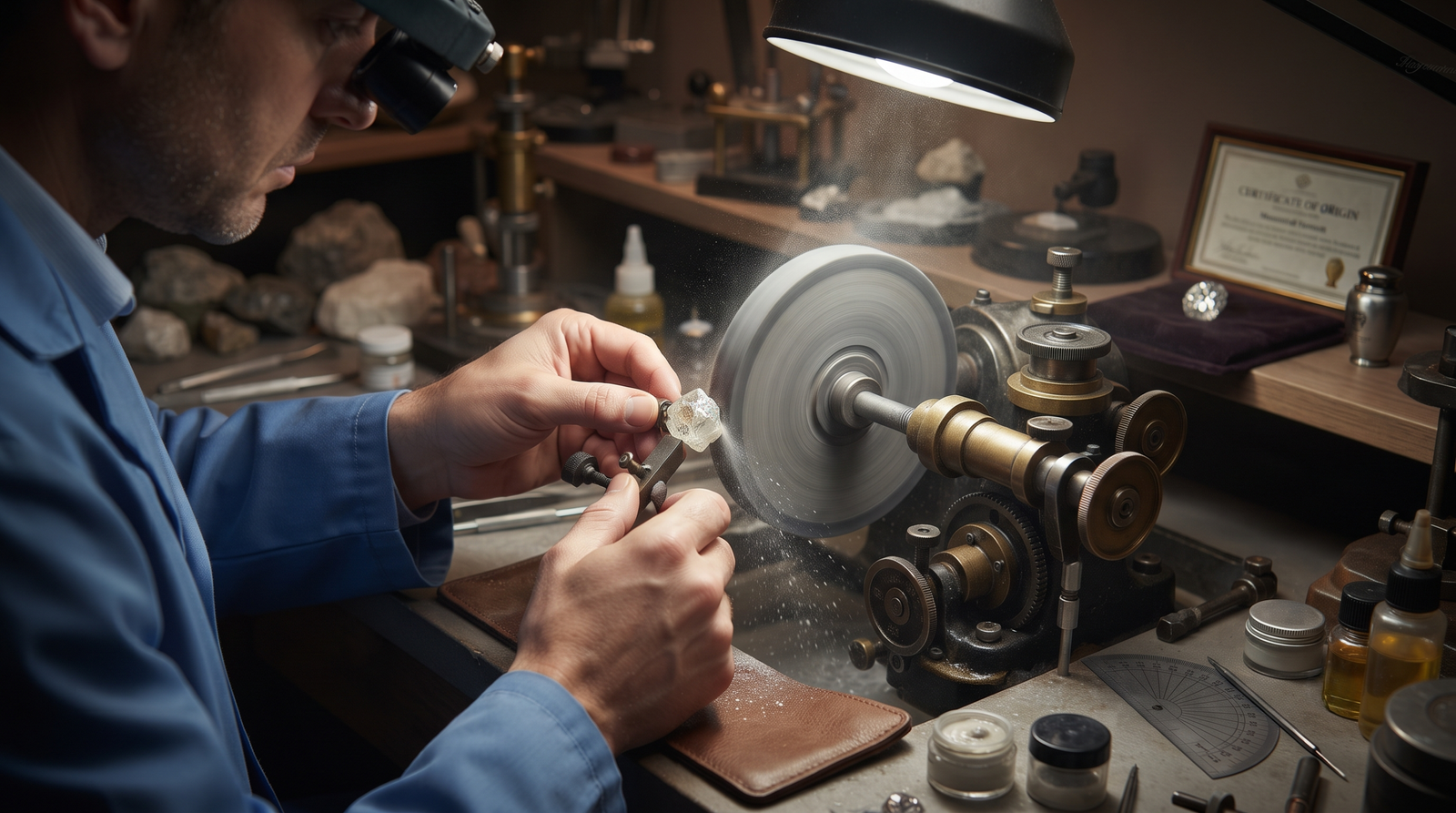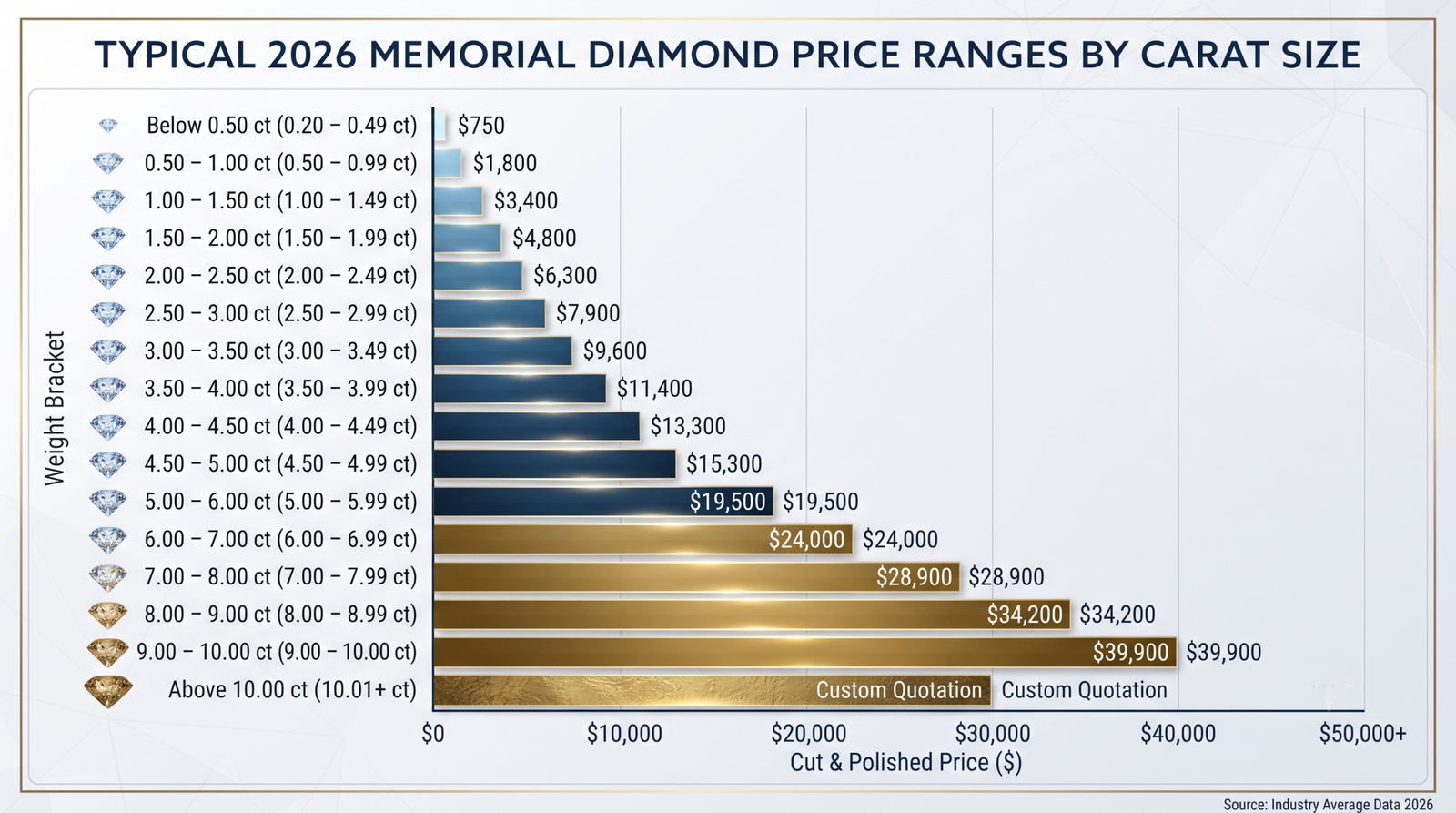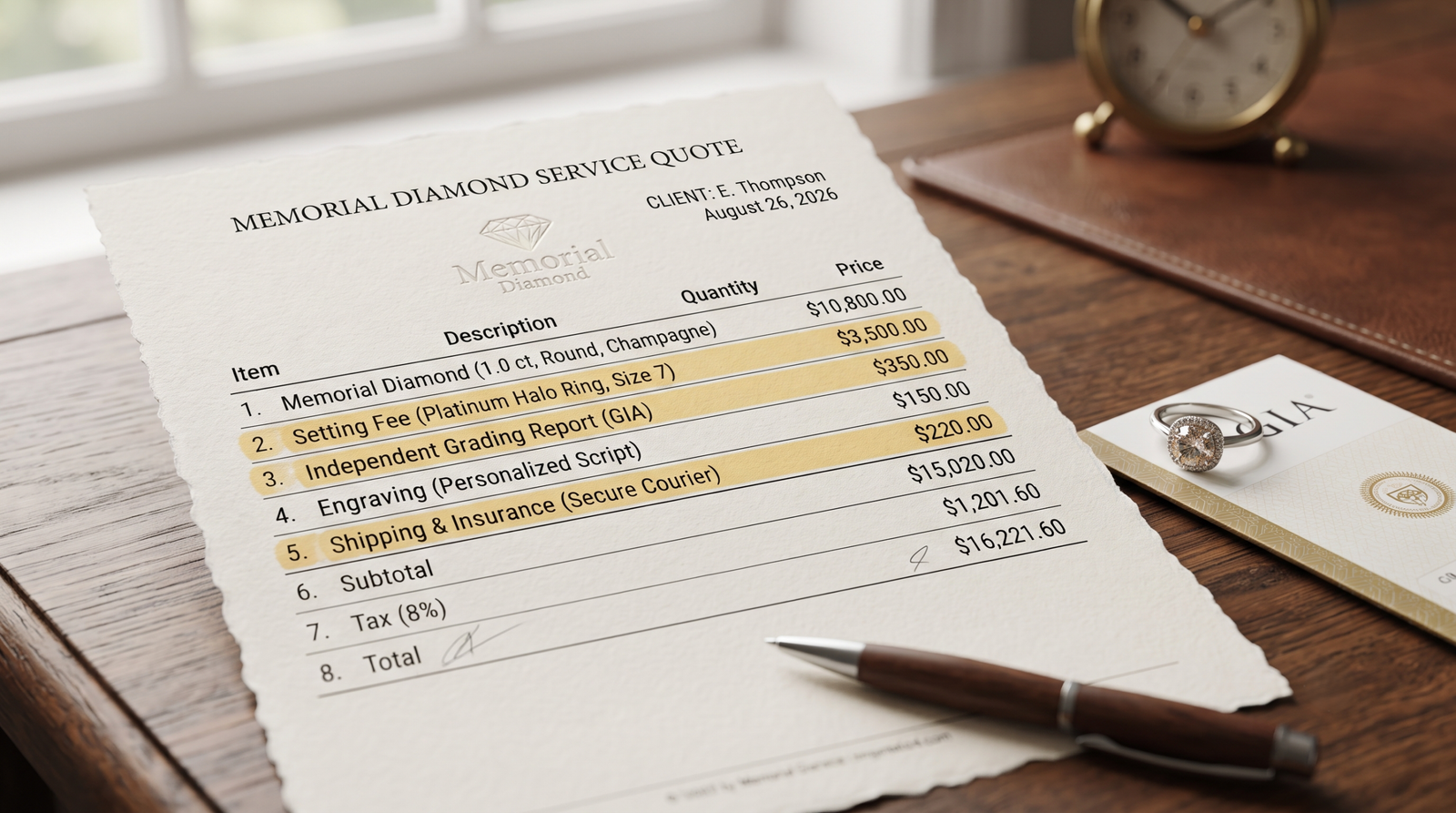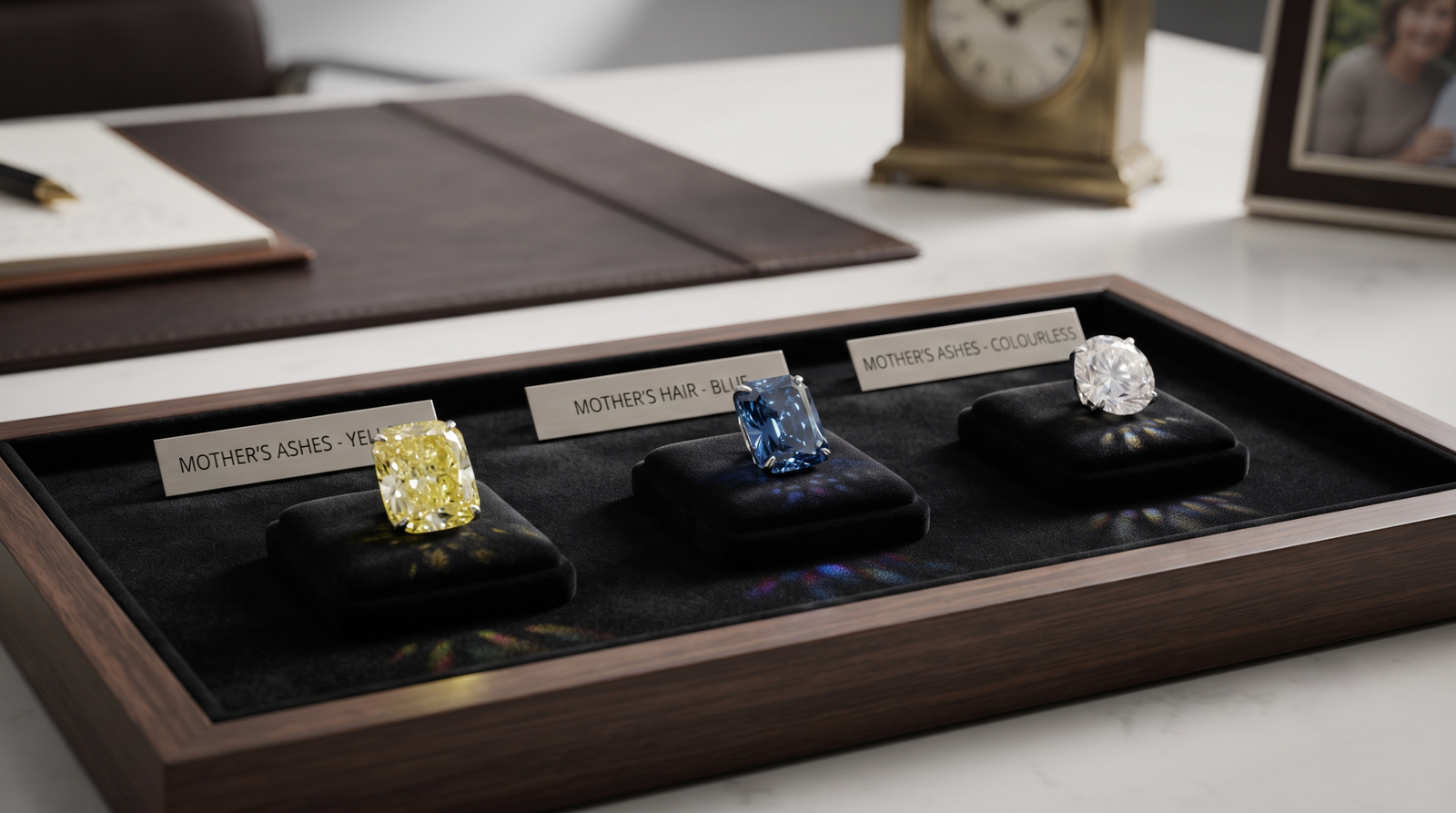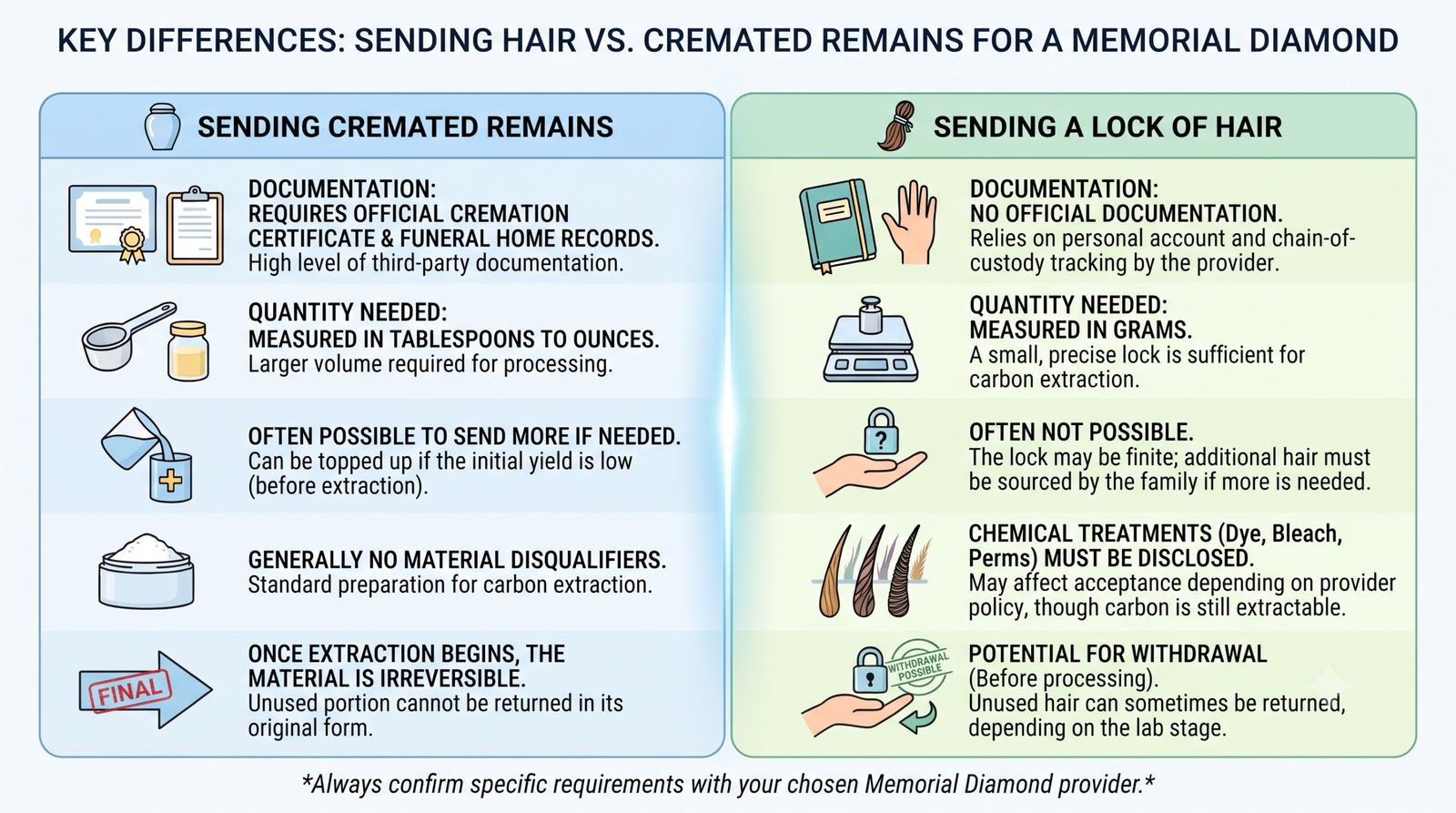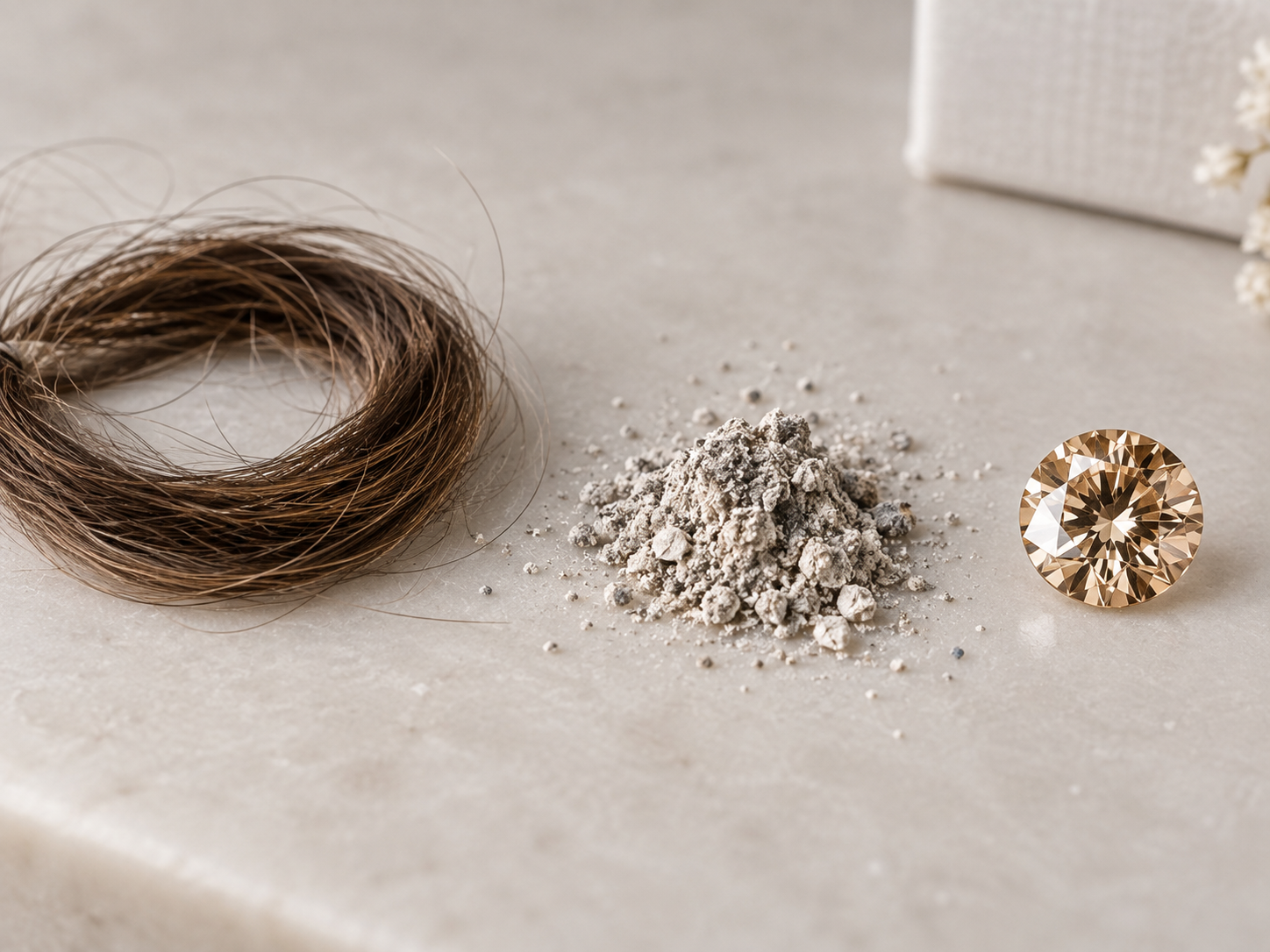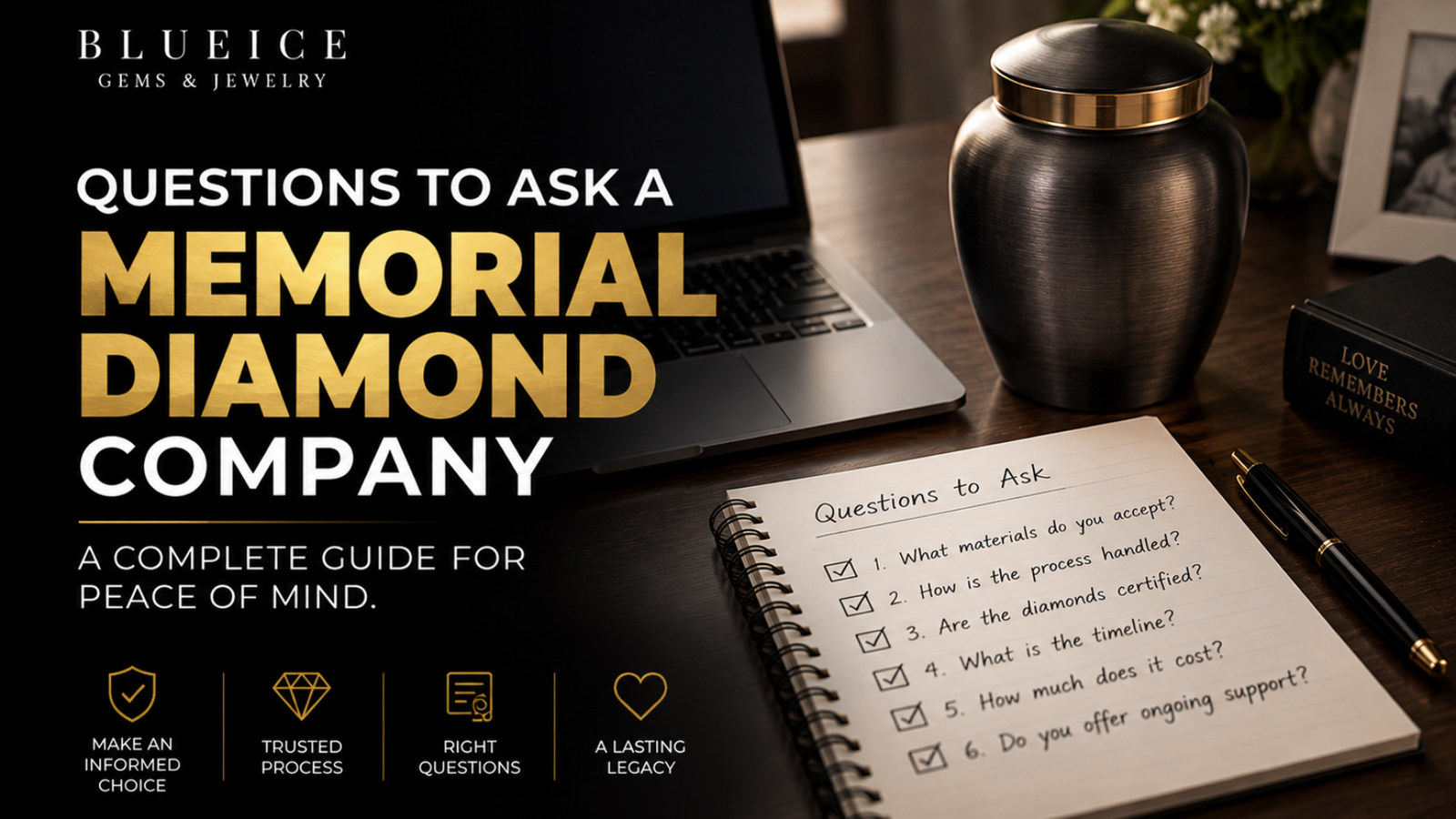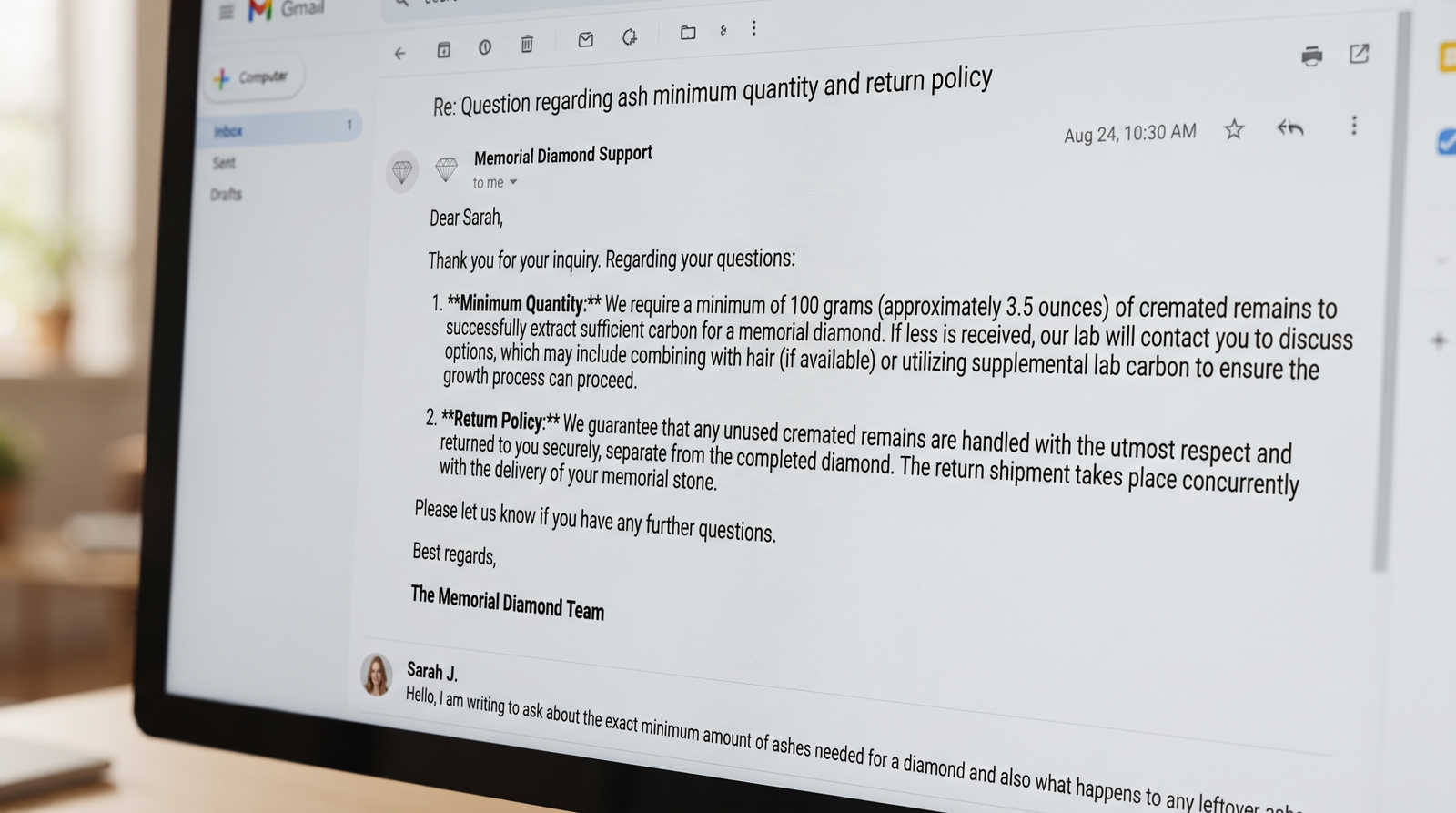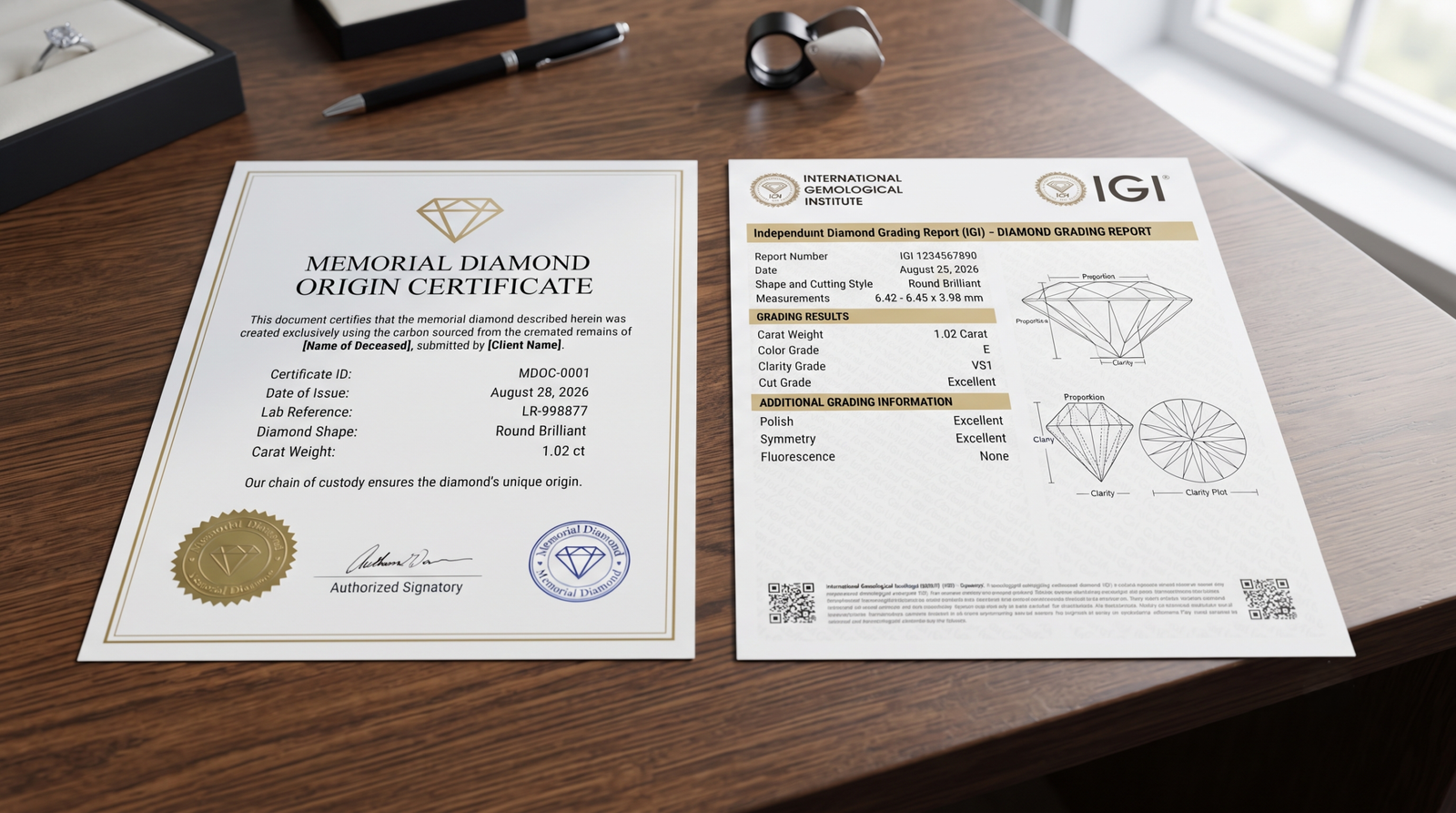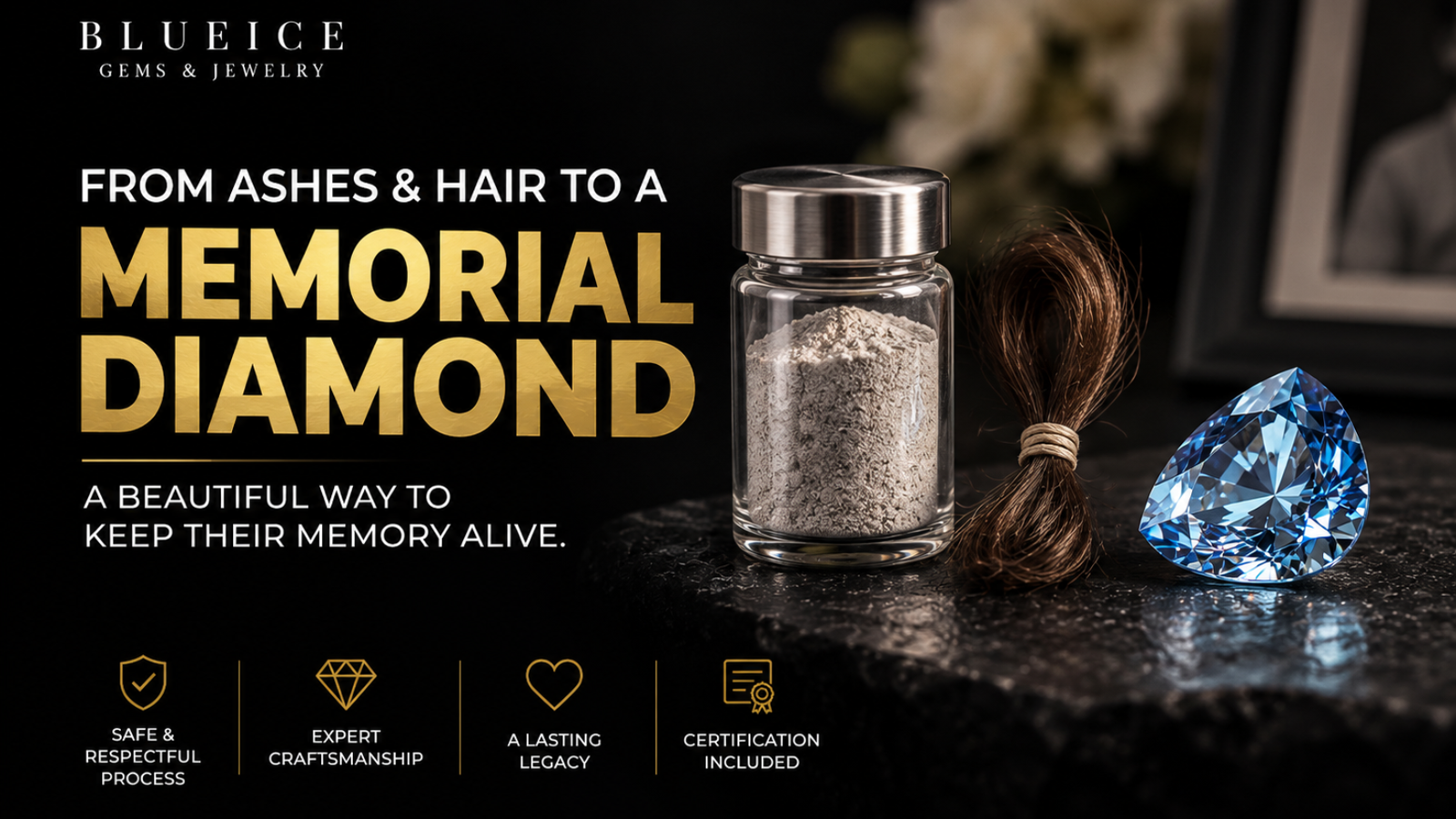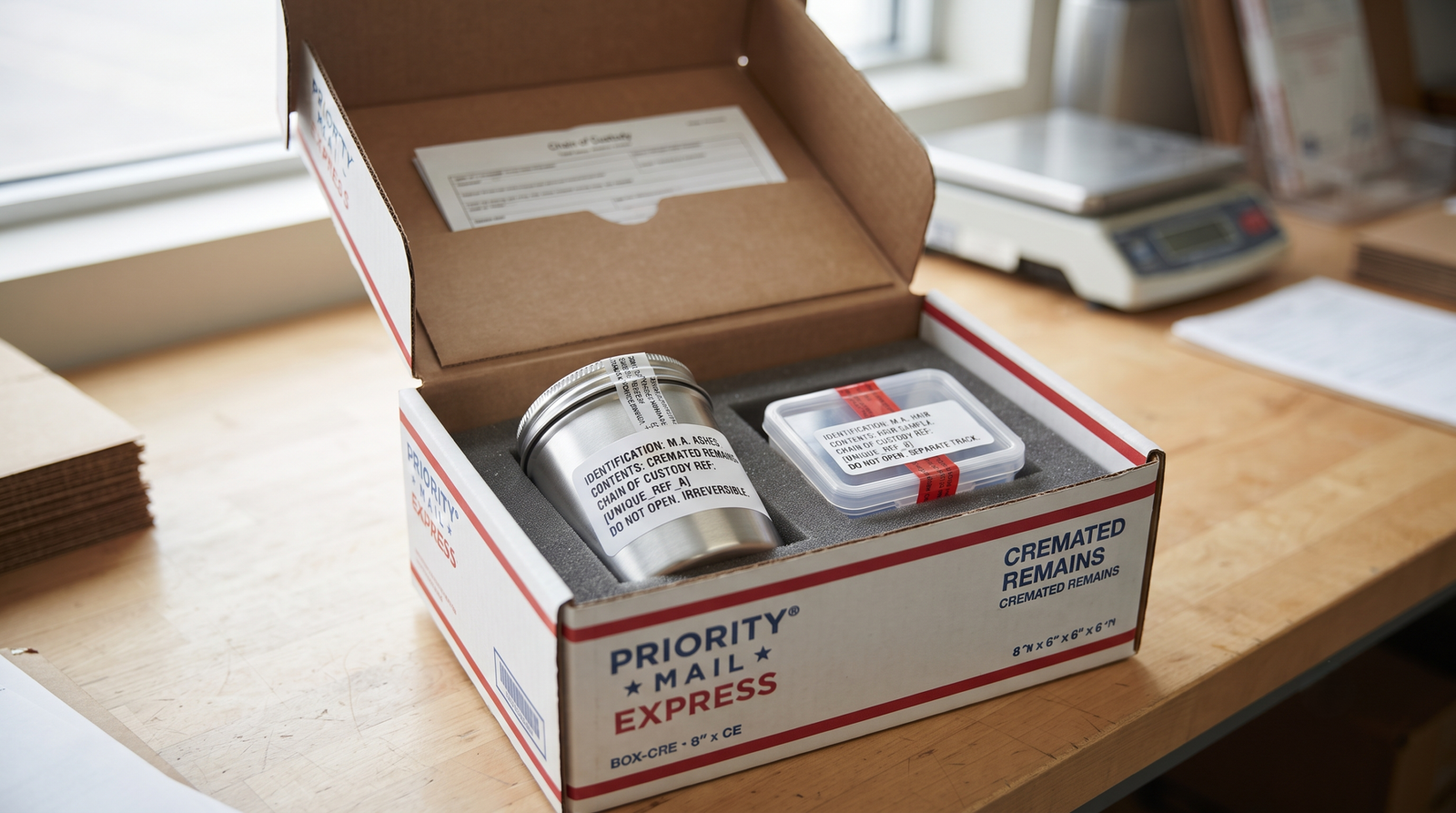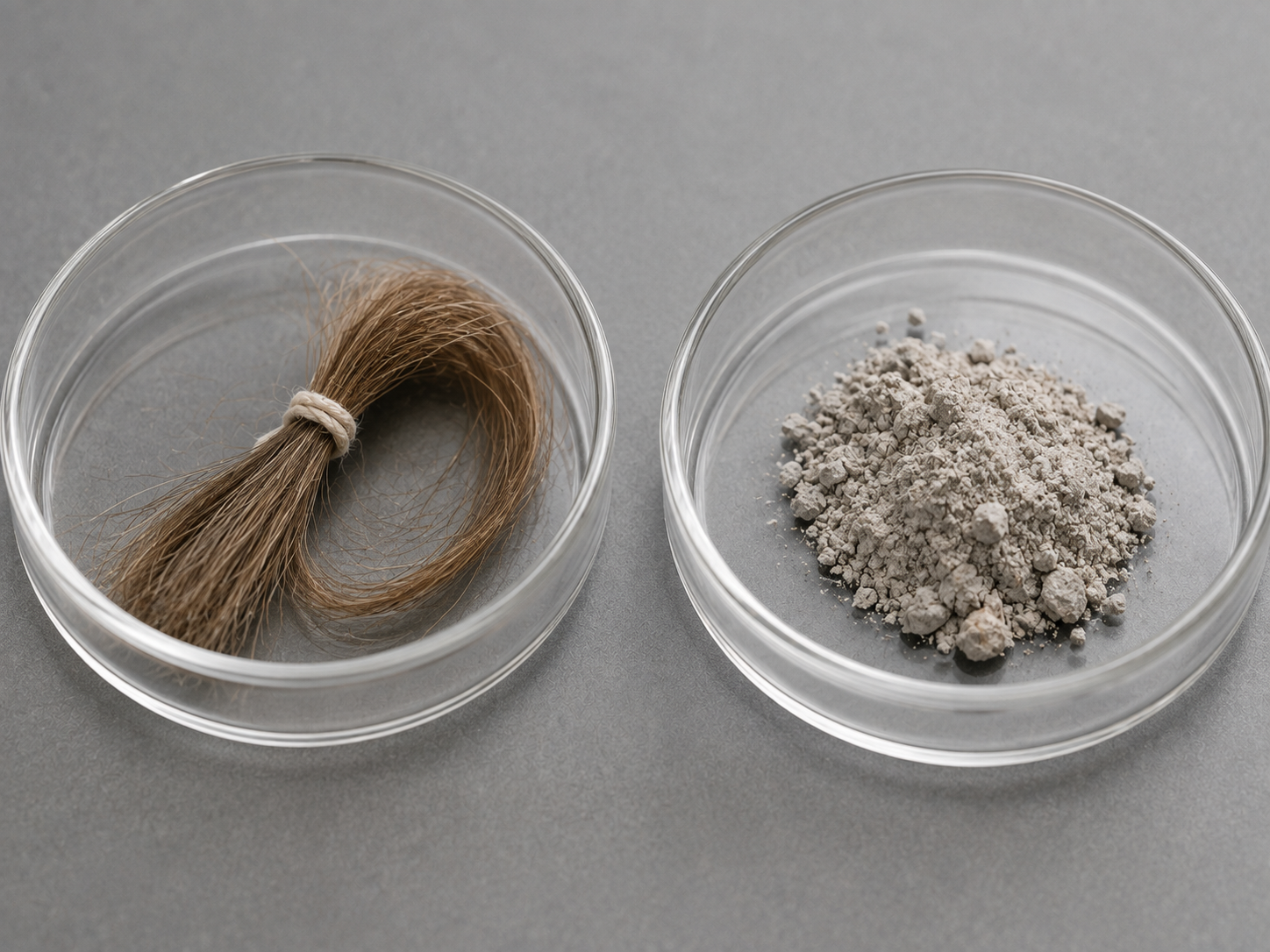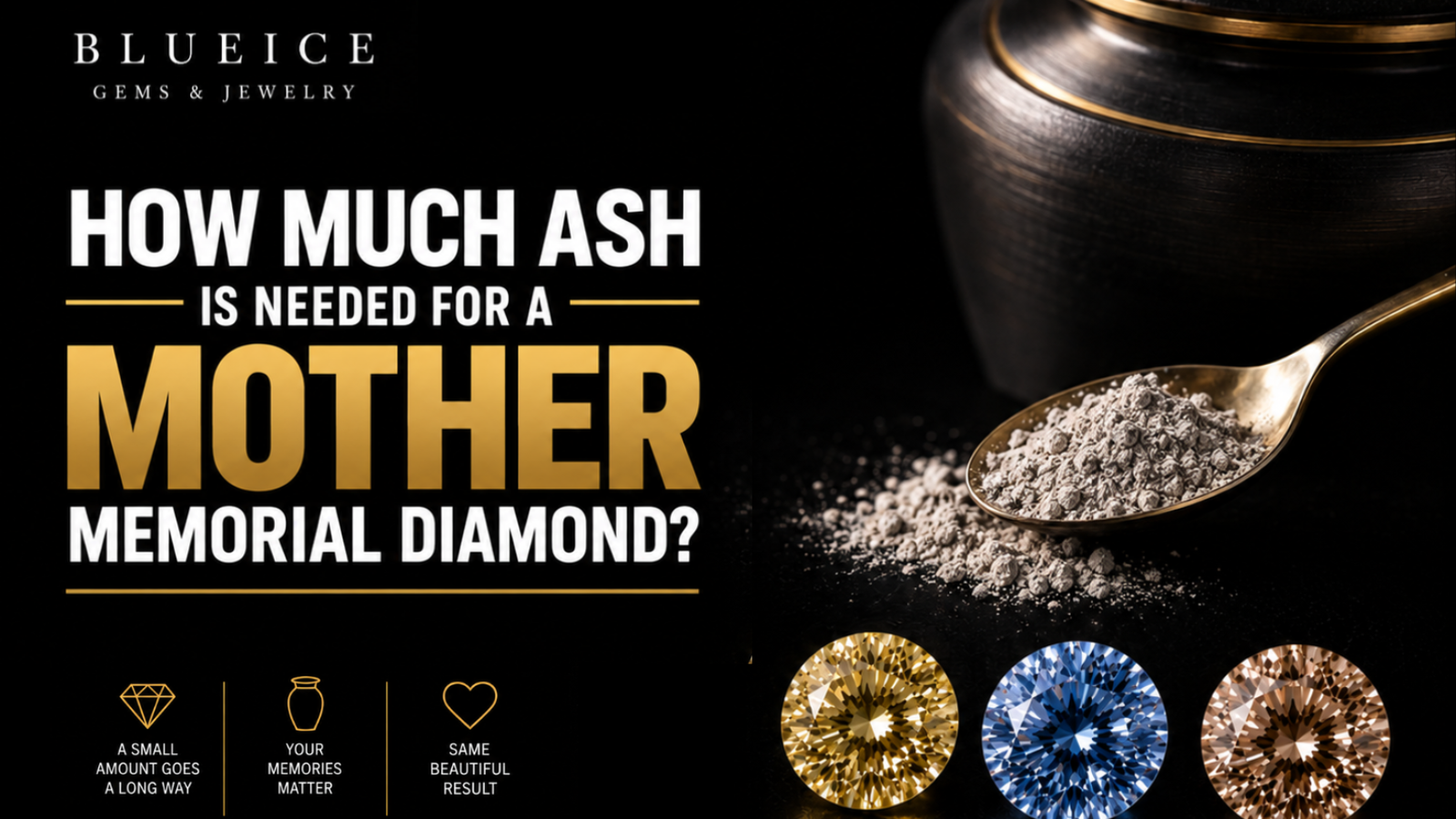
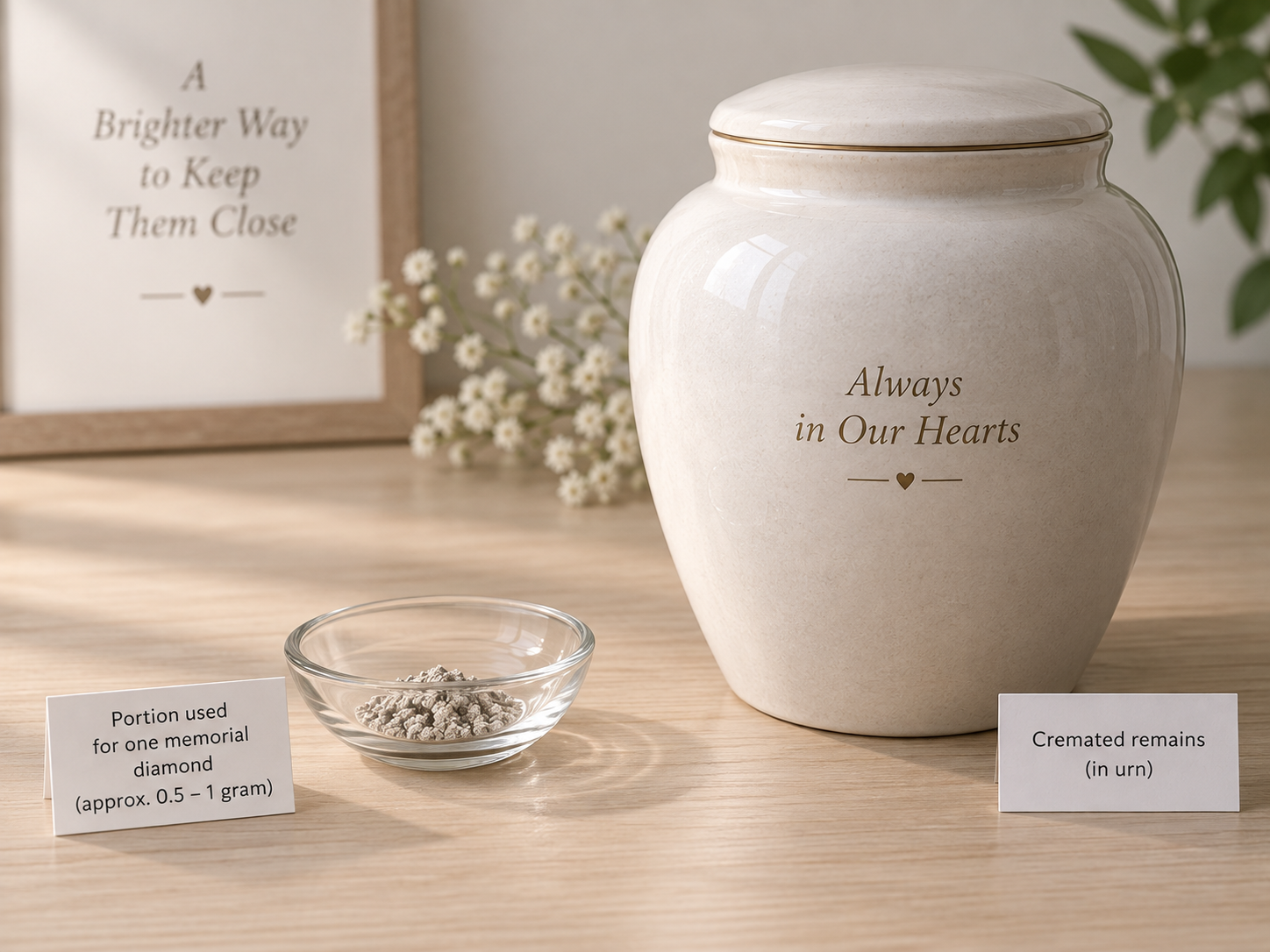
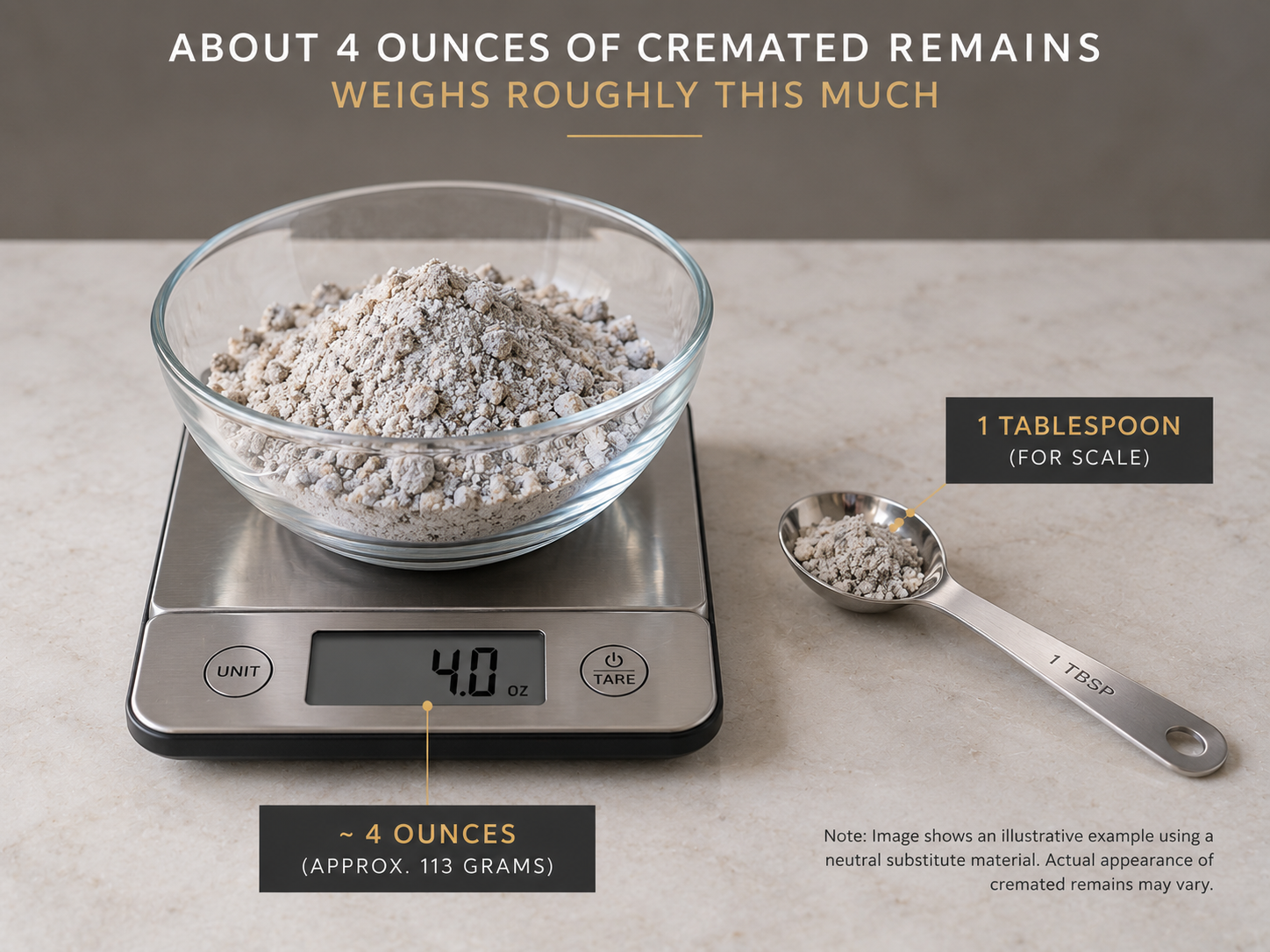
A few tablespoons, measured out of the urn with a clean dry spoon. That is where the industry range starts, and it runs up to roughly 4 oz about 100g of cremated remains for one memorial diamond. Either way it is a small fraction of what a cremation produces: the rest stays with you, for whatever you had already planned. Handing over more would not make the finished stone any bigger.
Carat size is bought with time in the growth press, not with volume of ash.
On This Page
- How Much of Her Ashes Does the Process Actually Use?
- Why More Ash Doesn’t Mean a Bigger Stone
- What Happens to the Rest
- Measuring It Out From an Urn
- Enough for Several Siblings?
- Frequently Asked Questions
How Much of Her Ashes Does the Process Actually Use?
The industry figure runs from a few tablespoons at the low end to about 4 oz (100g) at the high end. Providers set their own requirement inside that band, so the number that matters is the one your provider publishes.
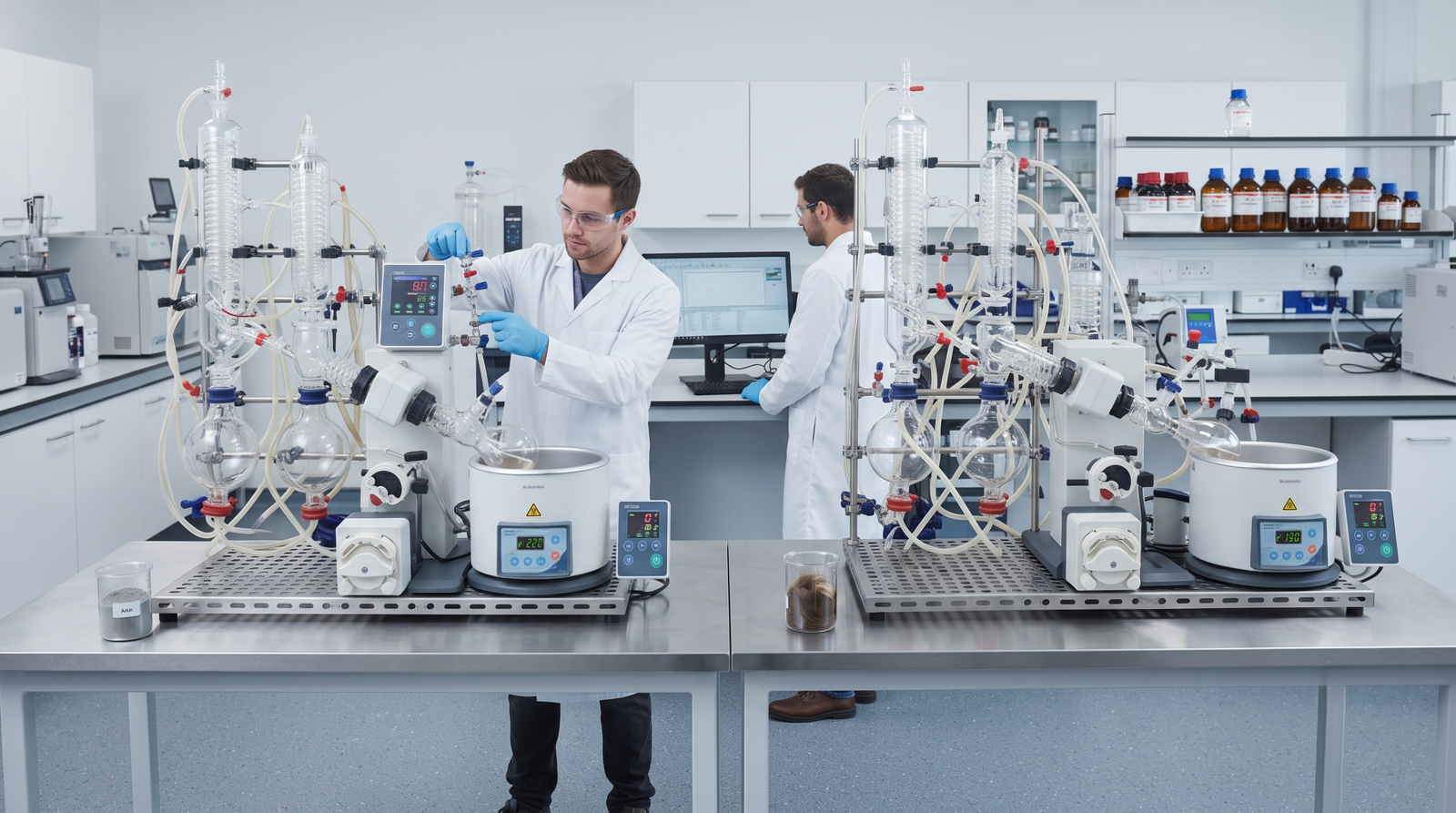
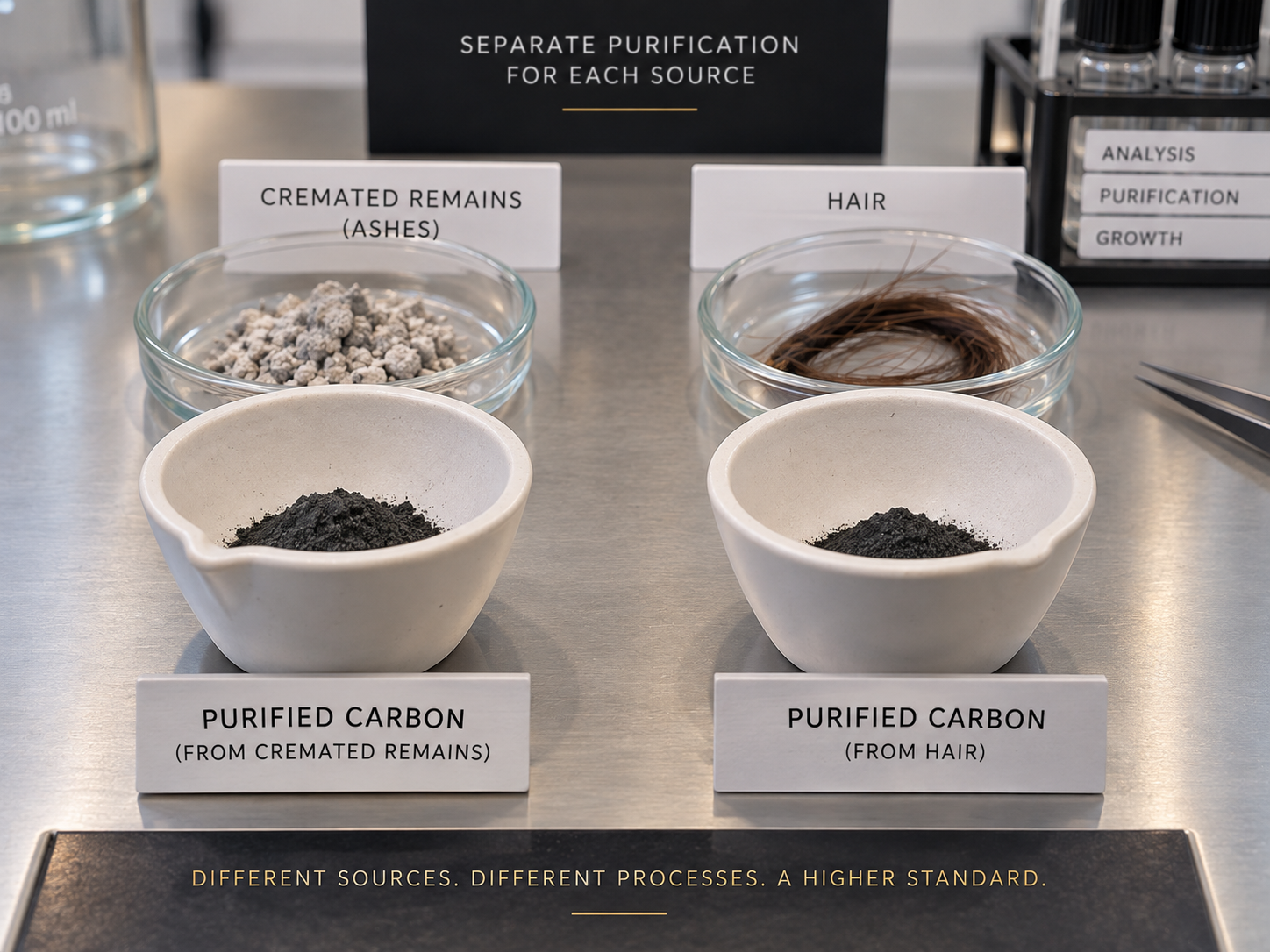
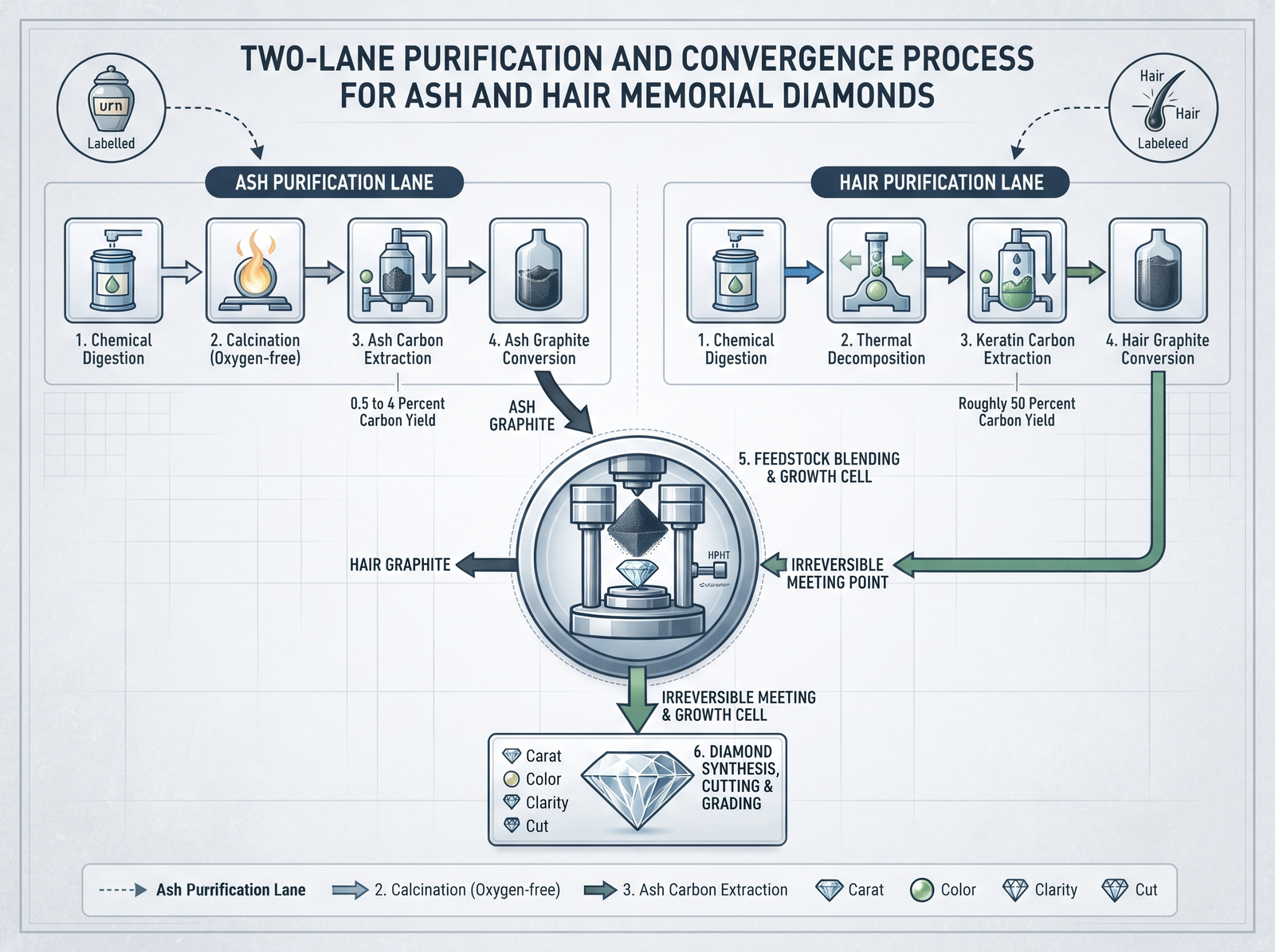
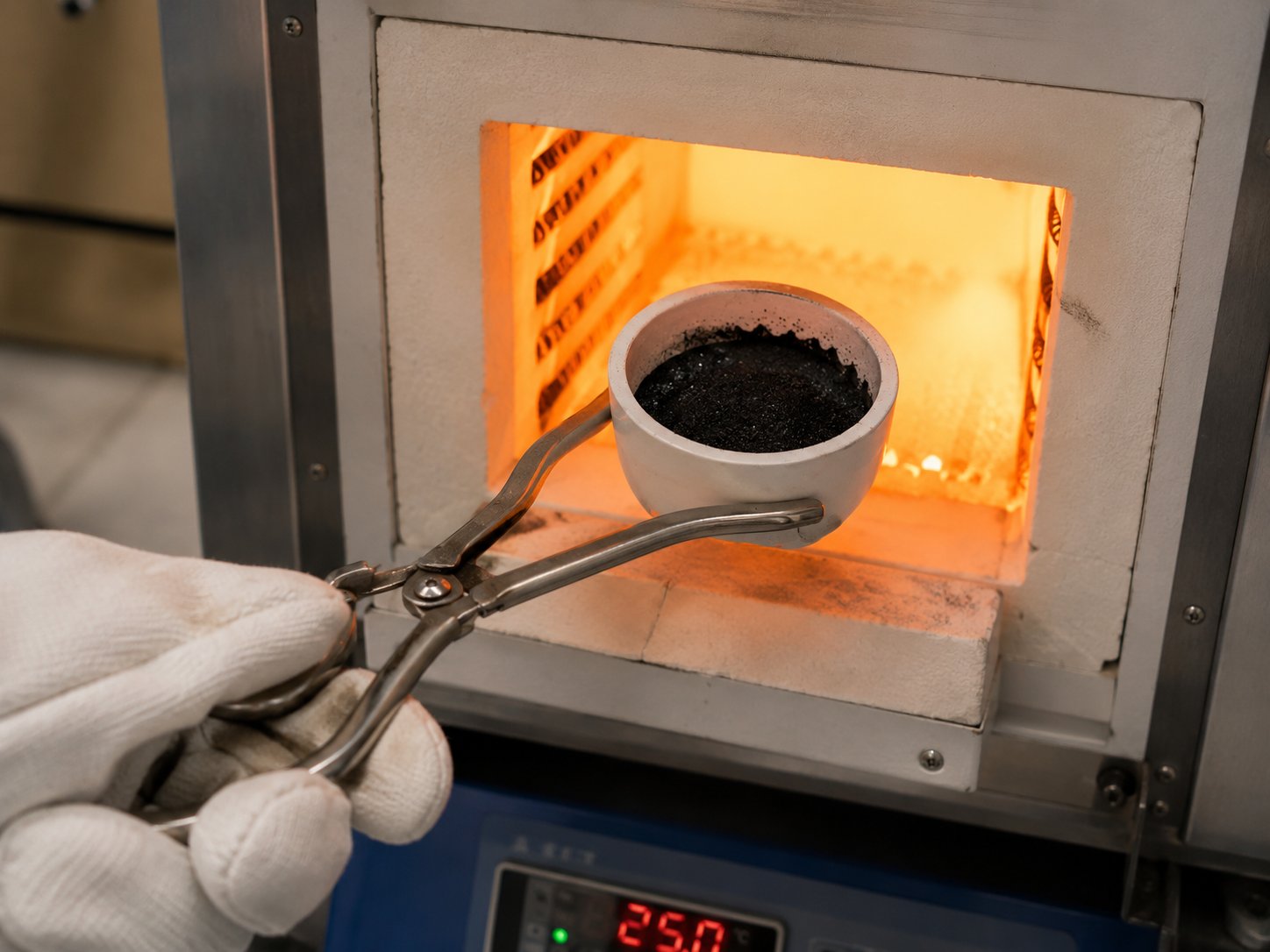
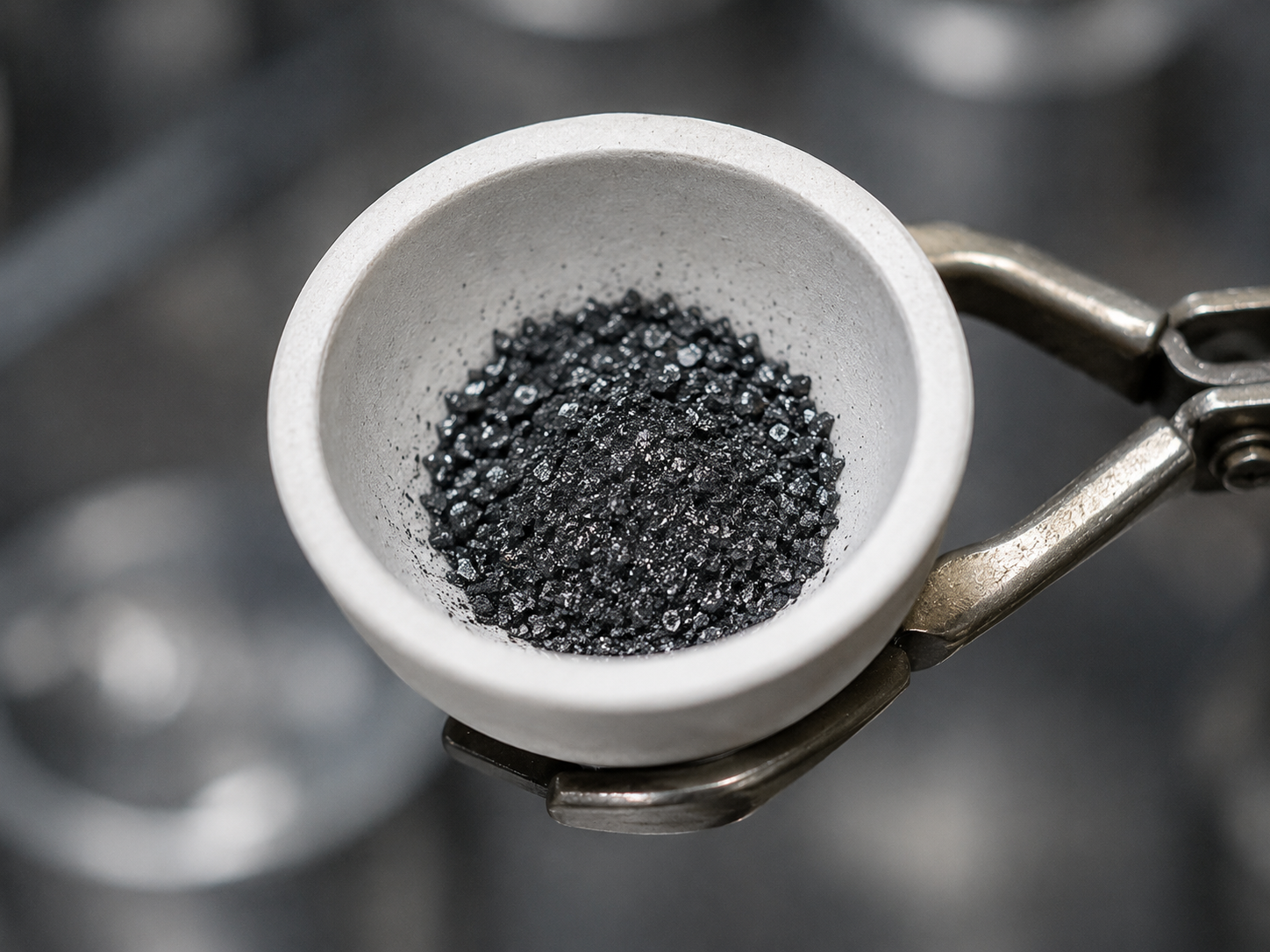
Ash is a demanding starting material, which is why the requirement isn’t smaller still. Cremated remains are mostly calcium phosphate, the mineral structure of bone; usable carbon is only about 0.5% to 4% of ash by weight. Recovering a workable quantity means starting with a spoonable amount, not a pinch.
| What’s Being Measured | Industry-Typical Figure | What It Means for Your Urn |
|---|---|---|
| Ash a provider asks for | A few tablespoons to ~4 oz (~100g) | A small fraction of a full cremation’s remains |
| Usable carbon in that ash | ~0.5–4% by weight | Ash is mostly bone mineral, not carbon |
| Purity after extraction | ~99.9%+ carbon | Everything non-carbon is stripped away |
| Her carbon in the finished stone | Typically ~10–15% of its mass | Blended with lab carbon — never 100% ash |
| Carat sizes generally offered | ~0.10 ct to 5+ ct | Chosen by you, then grown to that size |
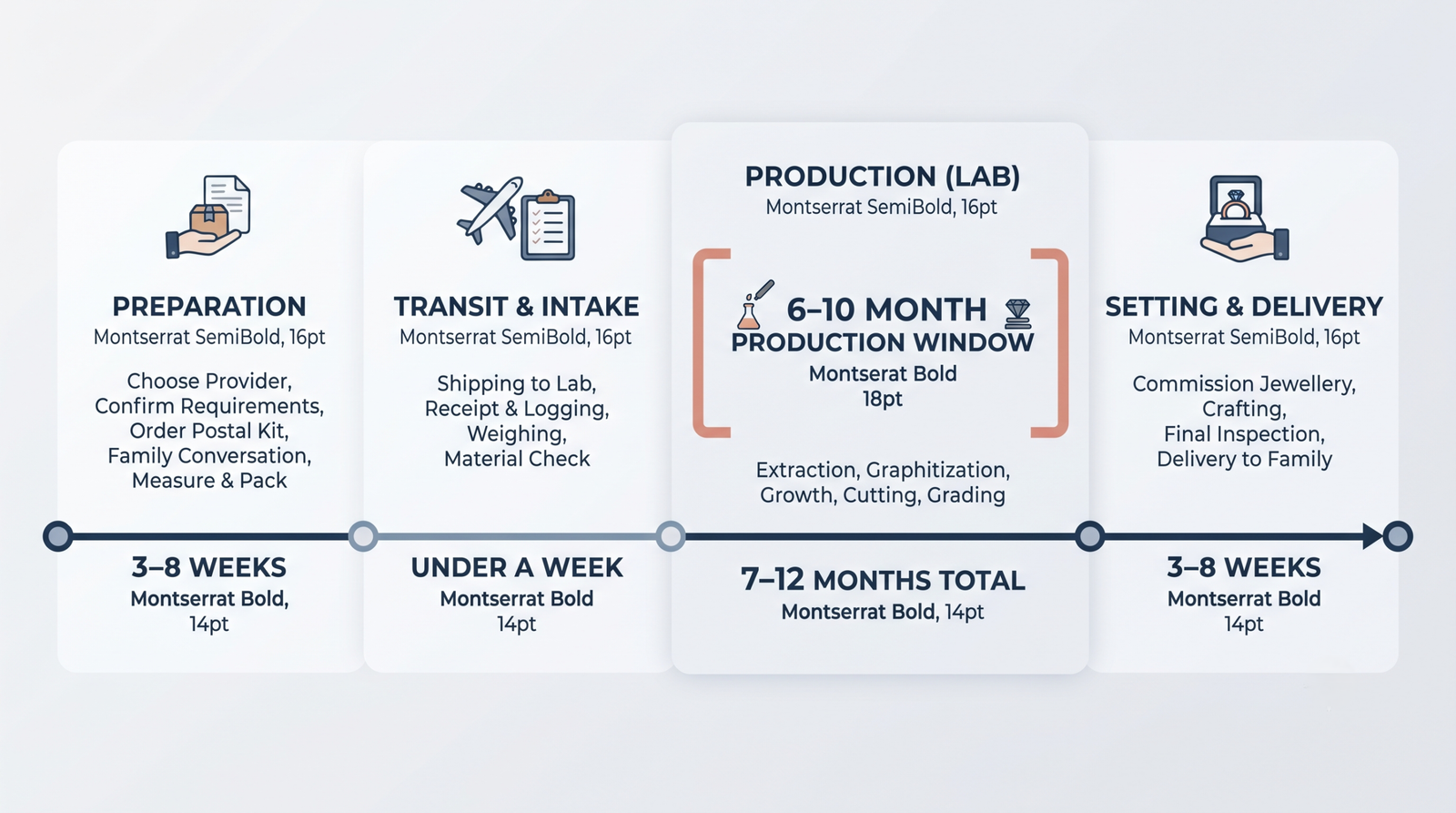
| Growth time to get there | ~6–10 months, up to ~12 for large or specialty stones | The actual lever on size |
The important point is that her carbon is genuinely in the crystal, but it is not the only carbon in it. Any provider claiming a stone is 100% her ashes is describing something the physics does not allow. Read the honest version of that claim before you commit to anyone.
Does Sending More Ash Make a Bigger Diamond?
No, and this is the piece most competitor content quietly gets wrong.
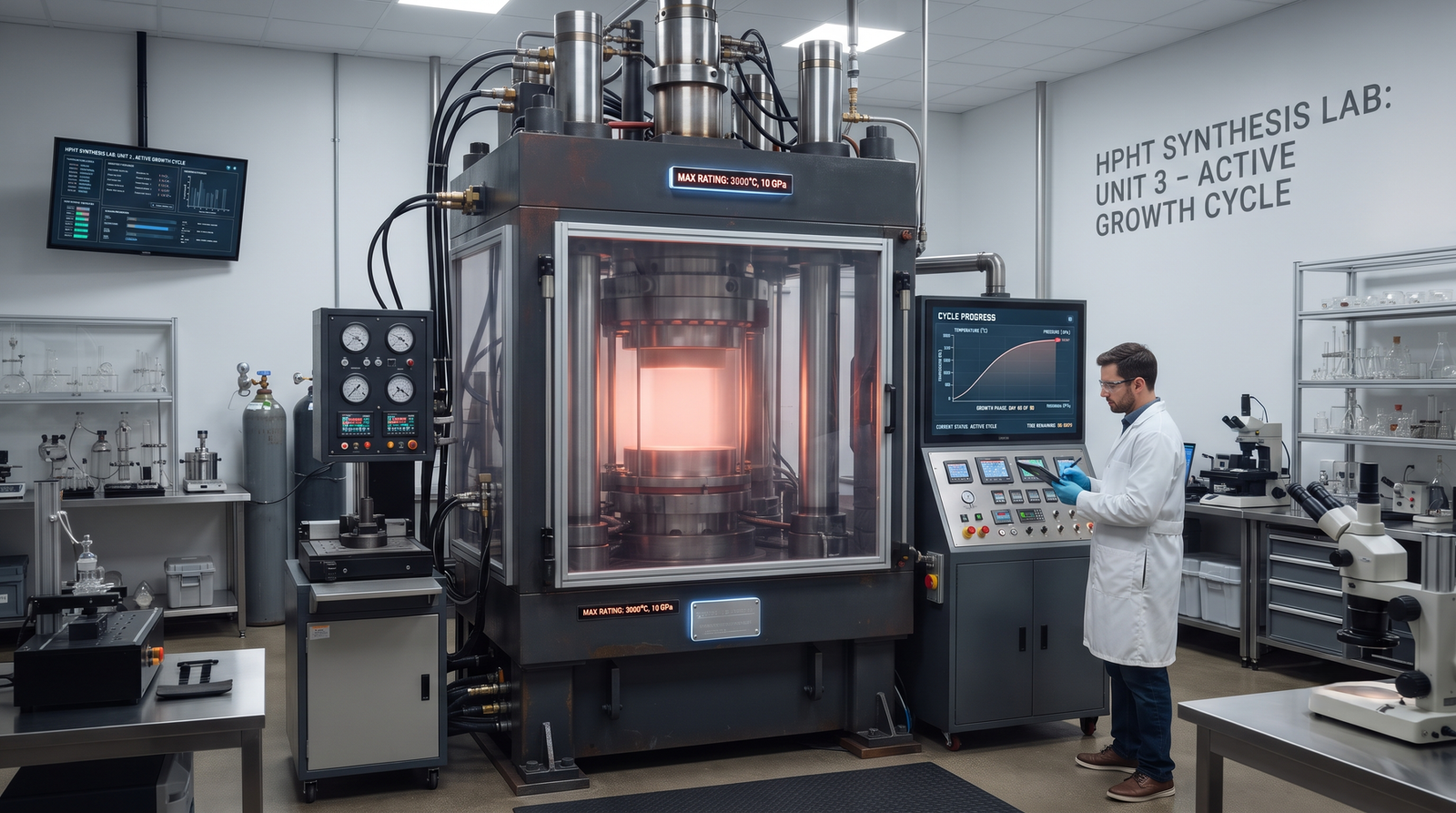
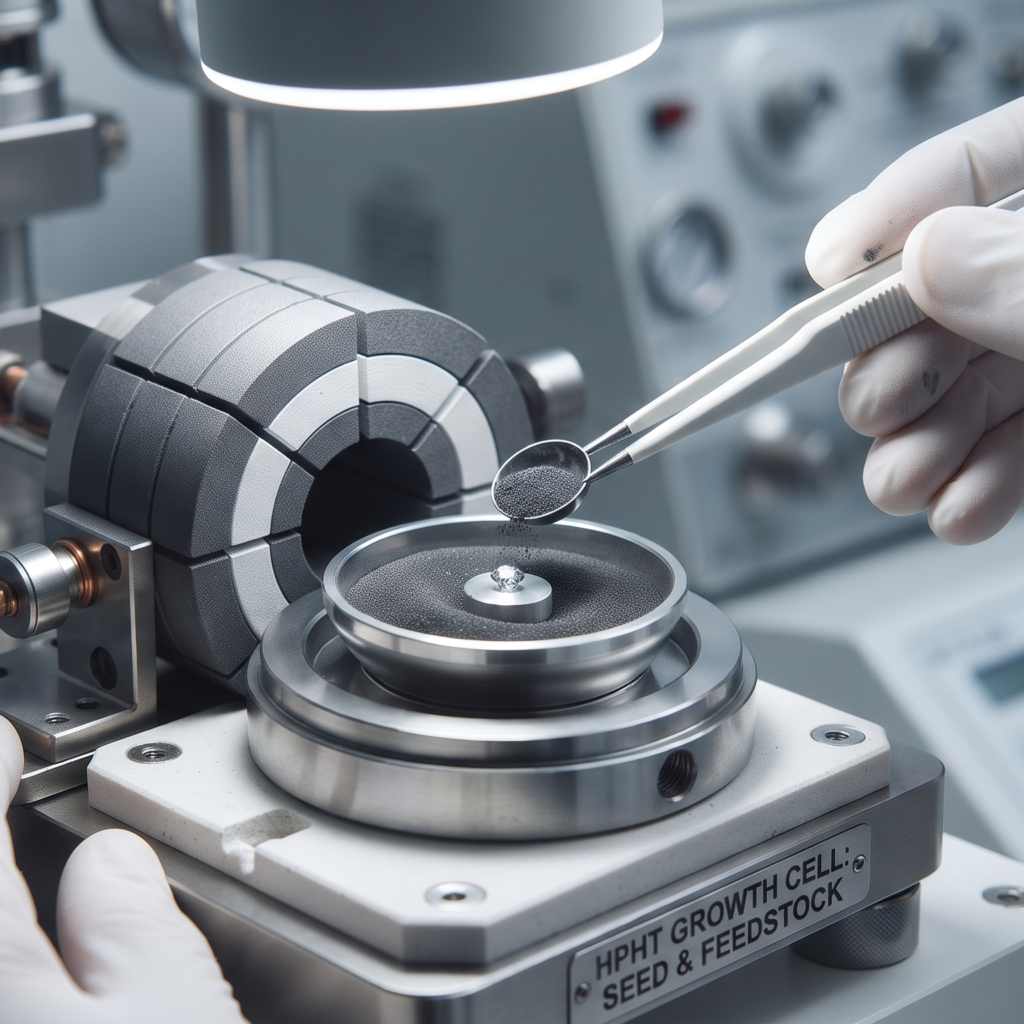
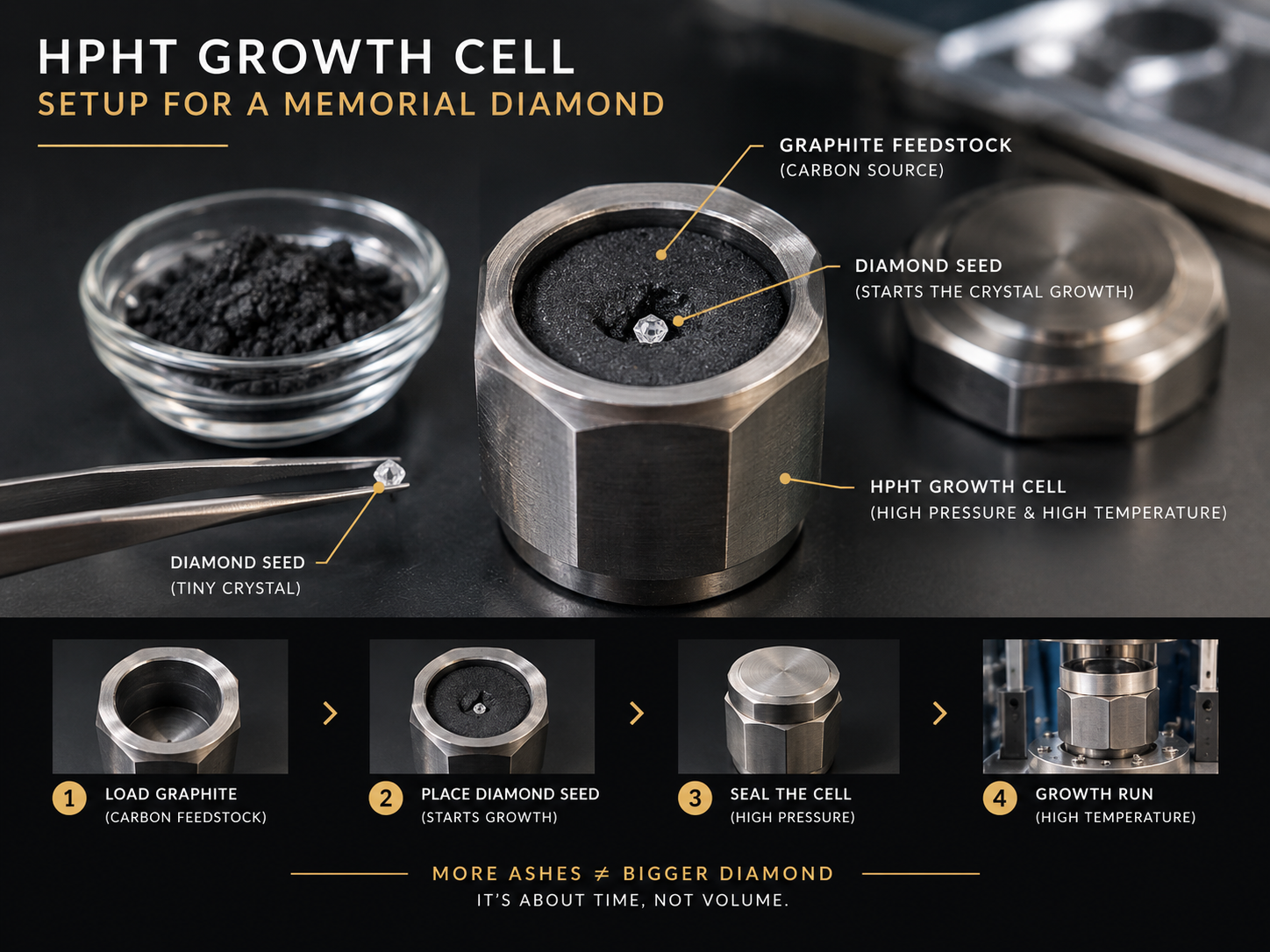
A growth cell needs enough graphite feedstock to run, and once it has that, the size of the crystal is a function of how many weeks it stays under pressure. Ash volume buys nothing in carat terms. A family submitting a full urn and one submitting four ounces are on the same schedule for the same stone.
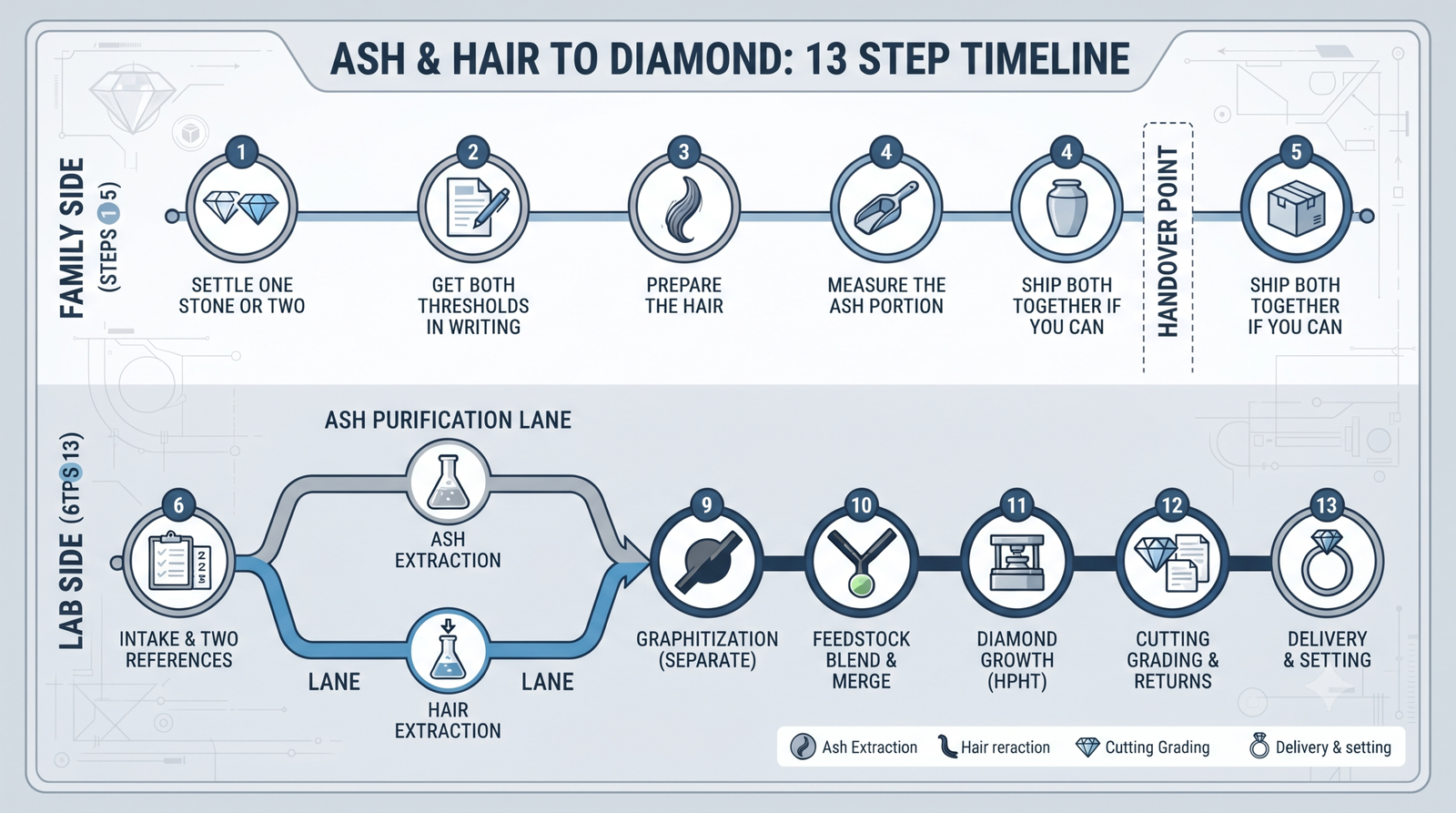
It works the other way too, which reassures anyone who kept only a little: a small submission does not mean a small diamond. The carat is chosen at ordering, and that choice sets the timeline roughly 6 to 10 months, sometimes up to 12 for larger stones. Choosing a carat size is a decision about budget and how you plan to wear it, not about how much of her you are willing to part with.
Sending extra has one real effect: more of her leaves your house than had to.
What Happens to the Ashes You Don’t Send?
They stay yours, and available for whatever you had already planned.
A burial plot, a niche in a columbarium, a scattering at a place she loved, or the urn staying exactly where it is none of that has to change to make room for a diamond. The requirement is small enough that the two sit alongside each other. A family who has already interred most of her ashes and kept a small portion back is often still well inside the workable range.
An urn on a shelf is not a lesser choice than a stone on your hand. They are different objects doing different jobs, and plenty of families end up with both.
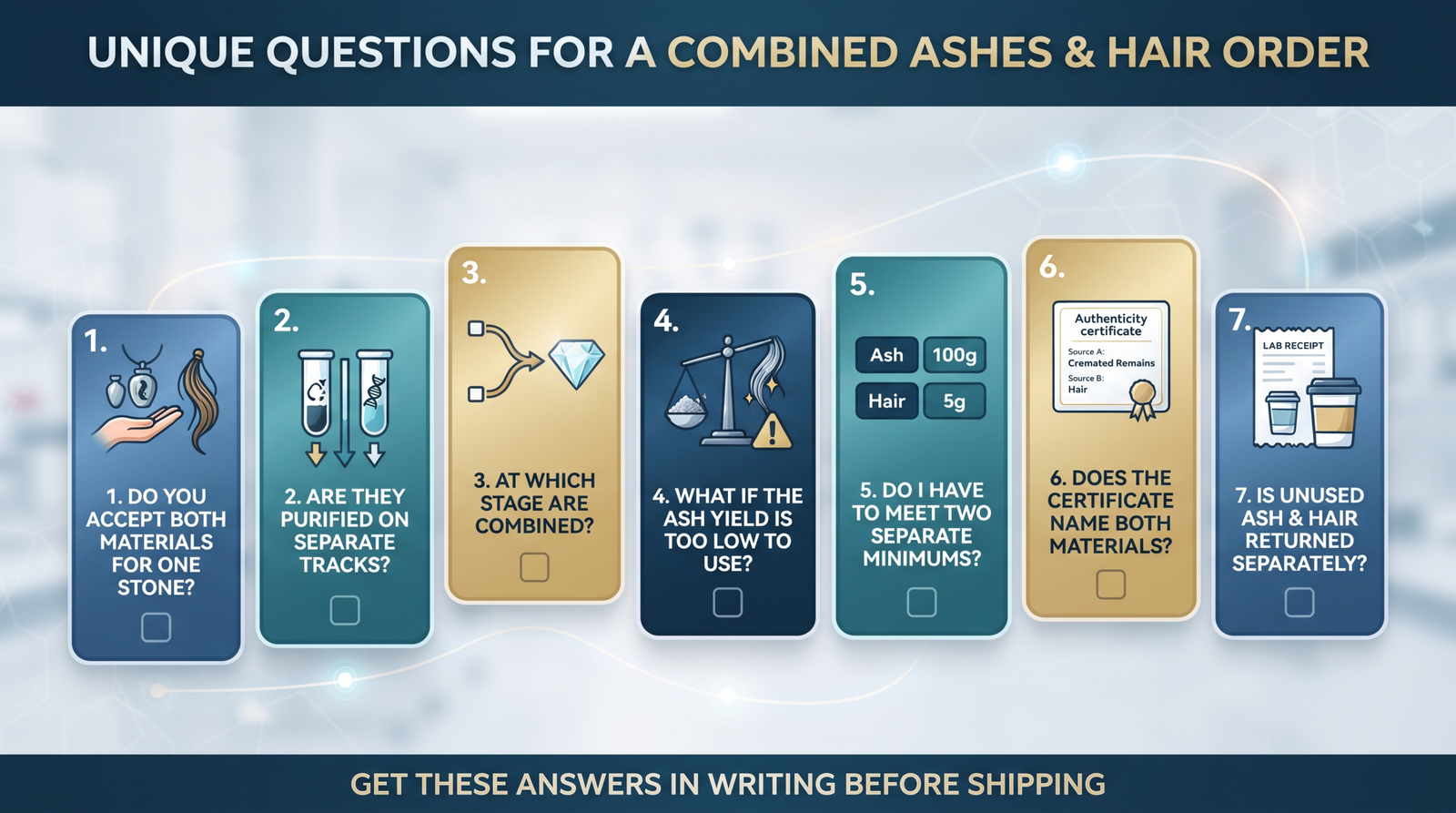
Get two things in writing before anything is posted: the quantity actually needed, and whether unused material comes back by default rather than on request.
What the lab does with the ash once it arrives and how providers track it through the process are both worth reading first.
How Do You Measure Out a Few Tablespoons From an Urn?
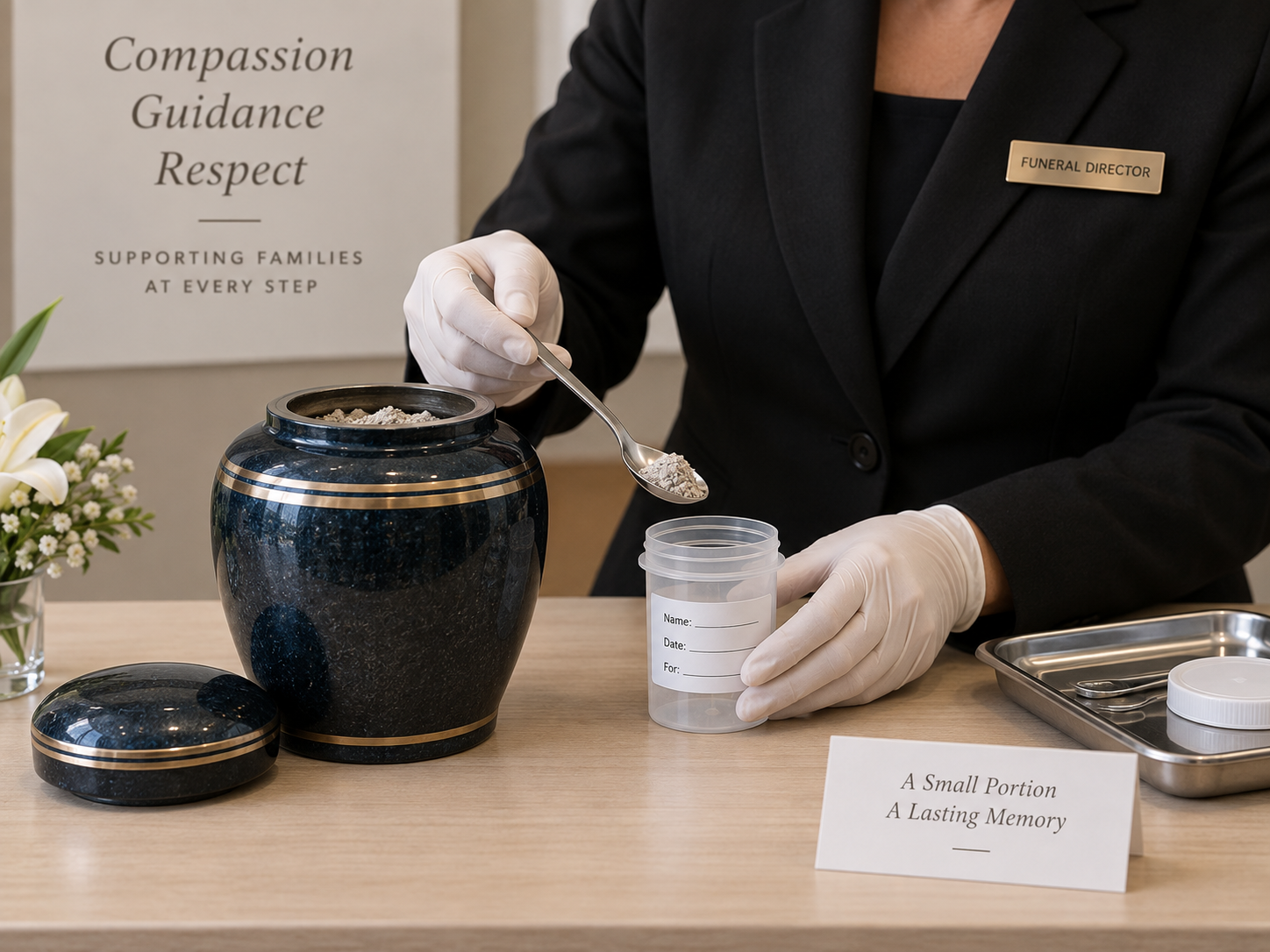
Nobody warns you about this part, and it is often harder than the paperwork. Some people find it steadying. Some cannot do it at all. Both are ordinary.
- Ask first, open second. Get the required quantity and the preferred container in writing before the urn is touched. Doing this once, correctly, beats doing it twice.
- Set up somewhere calm and flat. Good light, a clear table, paper or a tray underneath spilled ash lifts off paper and never off carpet.
- Check how the urn is closed. Some are simply lidded; others are secured with adhesive or a threaded ring, and some are meant never to be reopened. If yours is sealed, ask rather than pry.
- Expect an inner bag. Remains are frequently supplied in a sealed bag inside the urn, usually with an identification tag. Keep that tag with the remainder.
- Use a clean, dry spoon. Use a dedicated spoon, dried thoroughly and kept for this purpose. Moisture makes ash clump.
- Take from more than one spot. Cremated remains aren’t uniform in texture, so a representative scoop beats digging one hole.
- Reseal, relabel, note the date. Whoever handles the urn in twenty years should be able to tell what was taken and when.
- Ask for help if this isn’t something you can do. A funeral director, or the crematorium that carried out the cremation, can usually portion and package a small amount for you. So can a sibling. Asking is not a failure of nerve.
If the funeral home sealed the urn, go back to them they closed it, they can reopen and reclose it properly.
Can One Portion of Ash Supply Diamonds for More Than One Sibling?
Often, yes. Because the requirement is a fraction of the whole, several family members can each receive their own stone from the same starting material and because each is grown separately, the color, the cut and the setting can differ from sibling to sibling.
Raise it early. Agreeing on three stones before the first order is placed is far simpler than returning to an urn a second and third time, and it turns who gets her into what do we each want.
Whether more than one family member can get a diamond from the same ashes covers how families split the cost and the decision. Ask how a provider handles multi-stone orders one submission split at intake, or a separate submission per stone before assuming either.
Frequently Asked Questions
Is a few tablespoons genuinely enough for a one-carat stone?
Yes. A press turns weeks into carats, not spoonfuls. Once there is enough feedstock to run a growth cell, the quantity of ash requested stays the same at 0.25 ct as at 2 ct the larger stone simply spends longer growing.
What if most of her ashes have already been scattered or buried?
A small kept portion is frequently still workable, since requirements start at a few tablespoons. Send the provider an honest description of how much you have before ordering, and let them tell you rather than guessing.
Do the ashes I don’t use come back to me?
Ask before sending, and get the answer in writing. Returning unused remains by default is the standard families should expect, but it is a provider policy rather than a legal guarantee treat any vagueness on this point as a warning.
Does more ash make the diamond a deeper color?
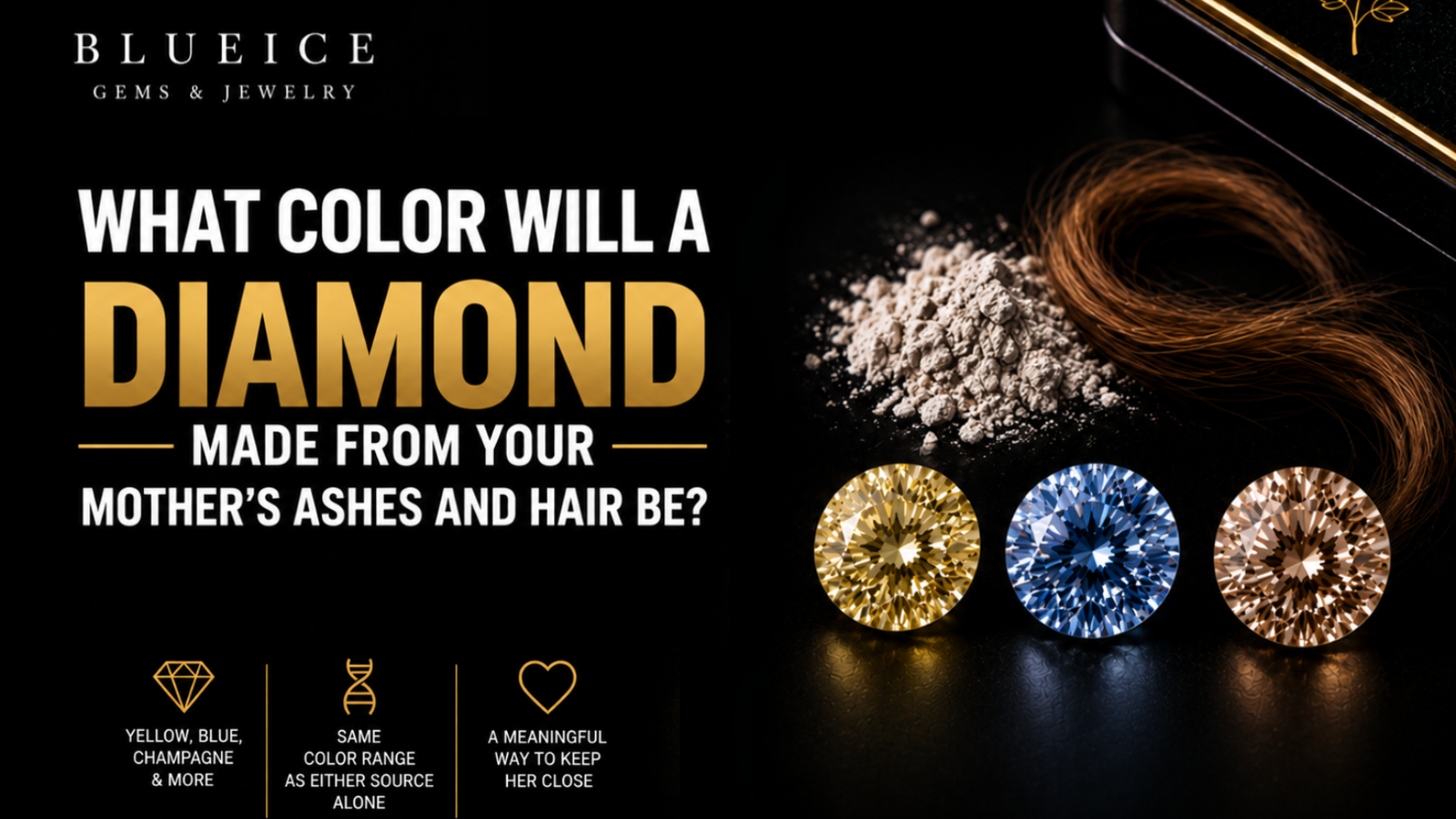
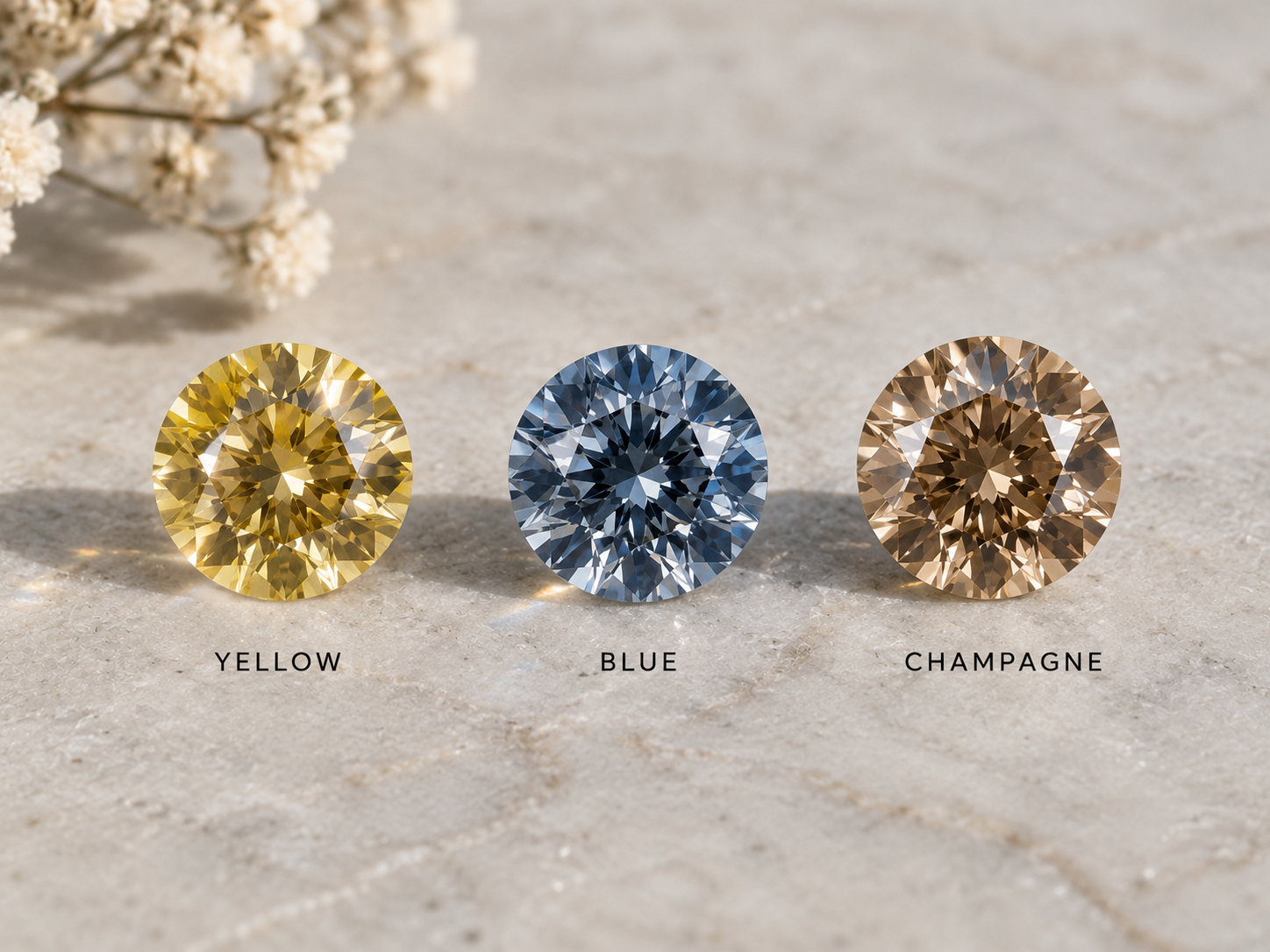
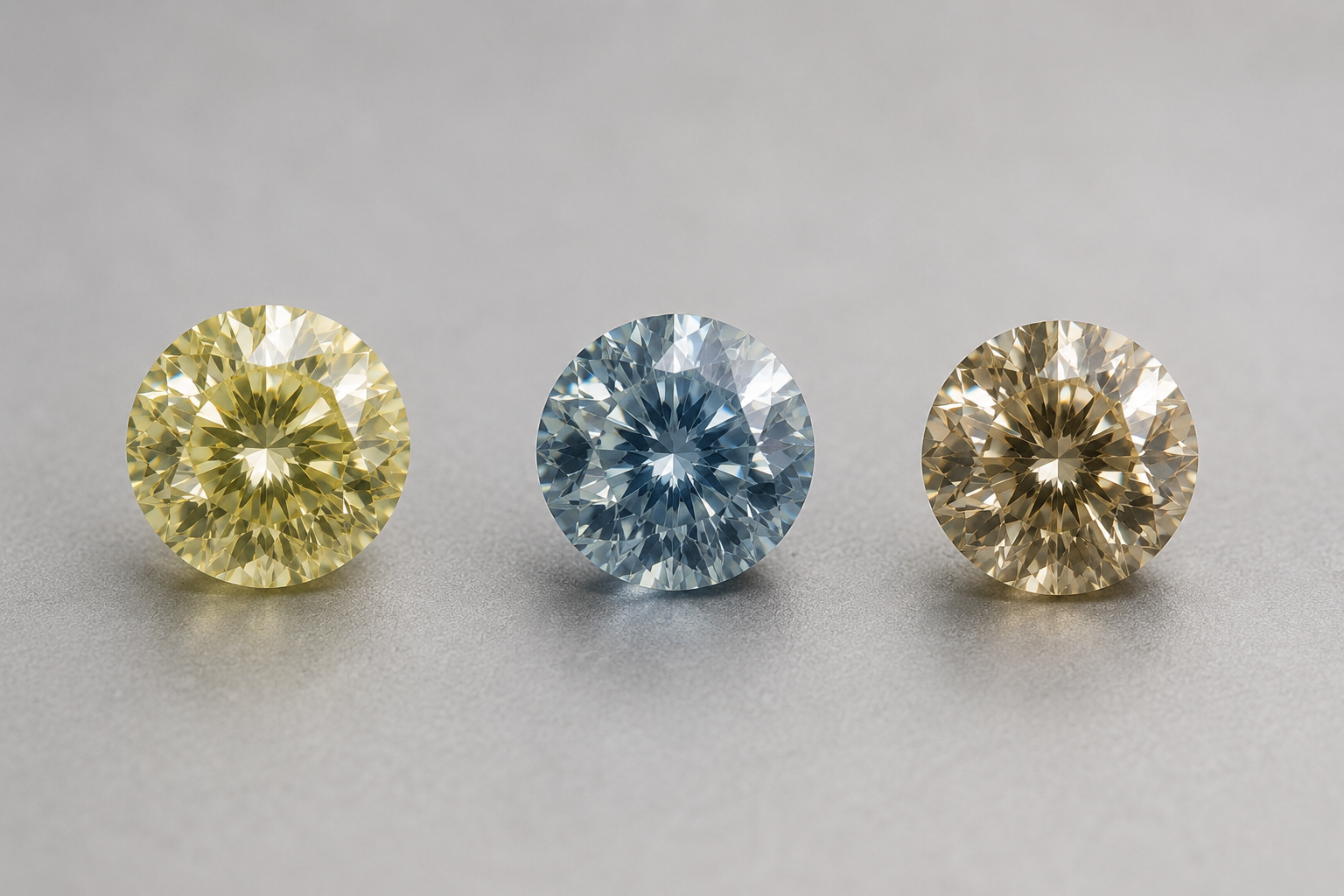
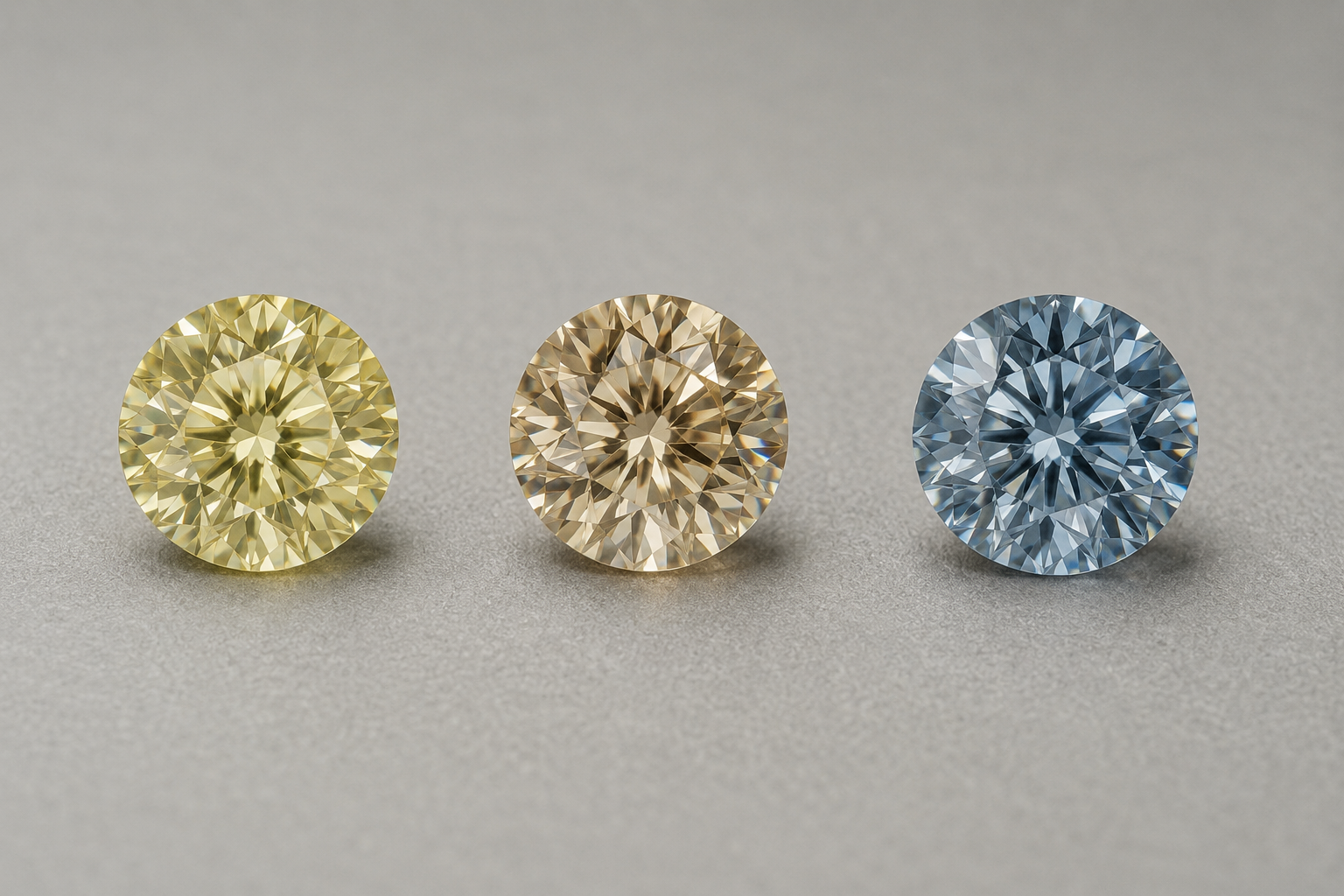
No. Color comes from trace elements present during growth boron gives blue tones, nitrogen gives yellow not from volume. What color a diamond from her ashes will be explains why memorial stones rarely come out colorless.
Can I send ash from a cremation that happened years ago?
Yes. Cremated remains are chemically stable mineral material and do not degrade on a shelf, so a cremation from decades ago is no different at intake than a recent one. Time changes nothing about the carbon.
Would her hair need a different amount?
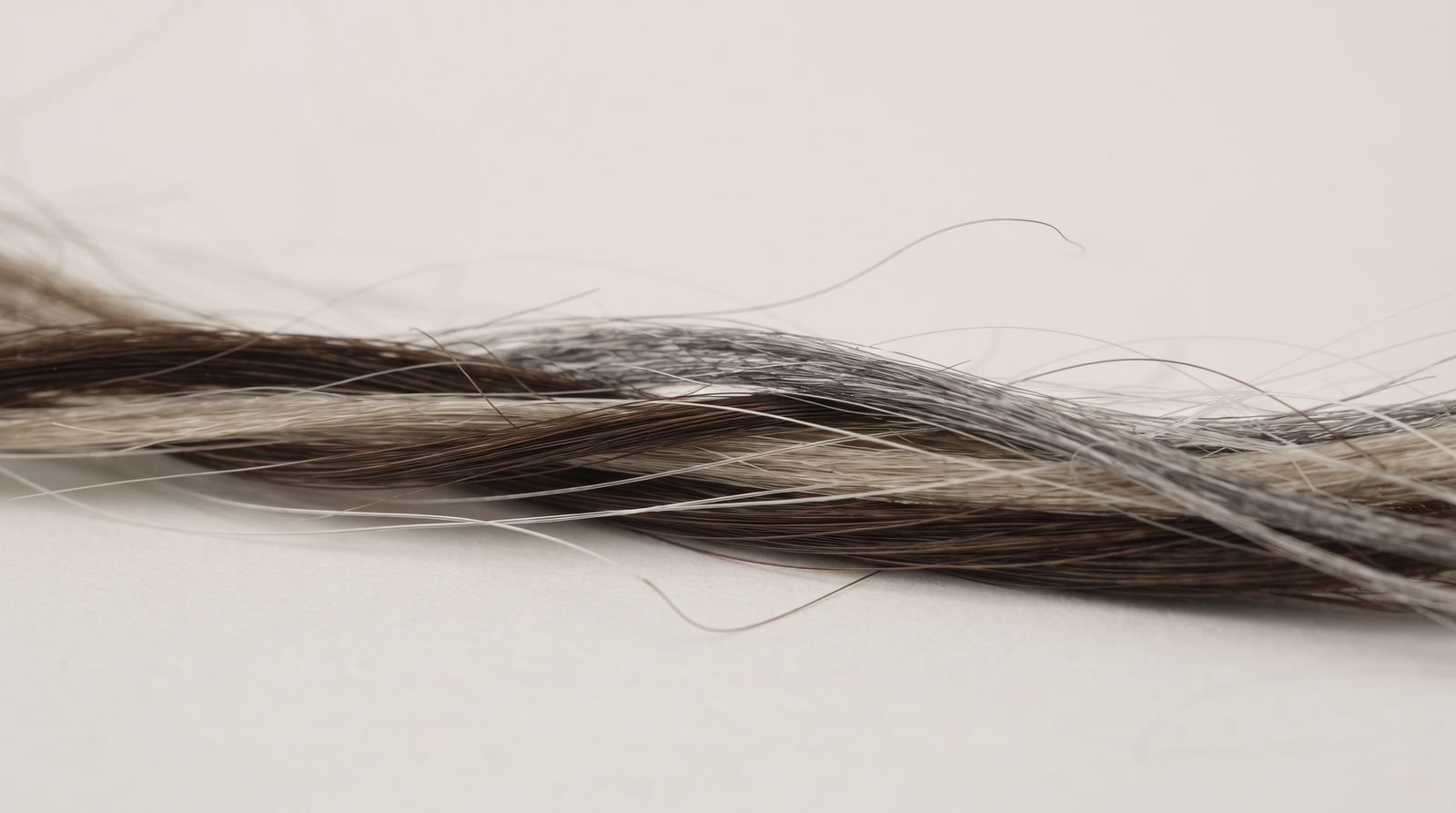
Considerably less hair is roughly 50% carbon by weight, so a small lock goes a long way. How much hair a mother memorial diamond needs covers that path, including for a mother who was buried rather than cremated.
Before You Open Anything
The order of operations matters more than the timing: ask first, open the urn second. A year from now the same few tablespoons will do exactly the same work, but a portion measured out against the wrong figure has to be measured out twice.
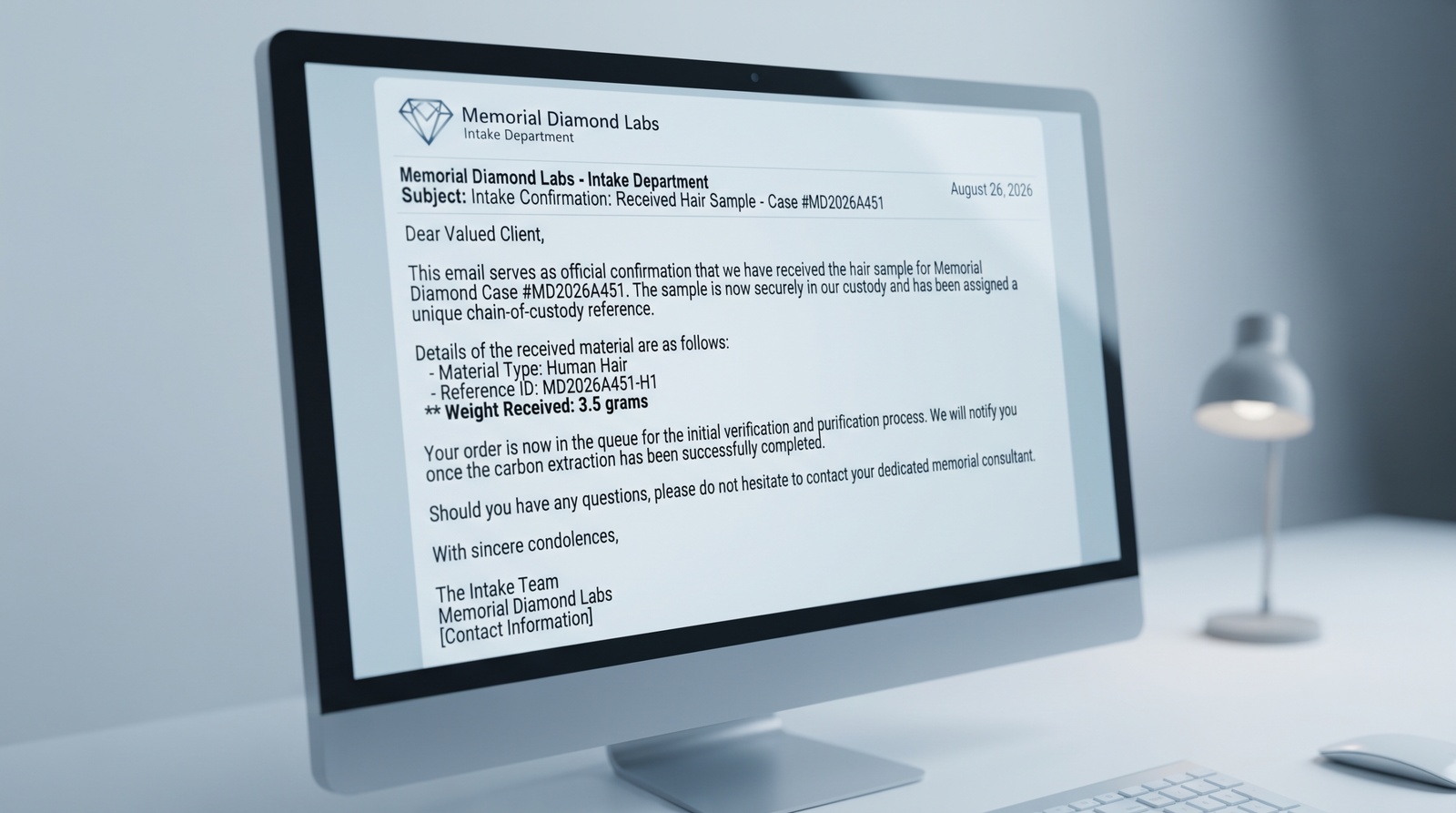
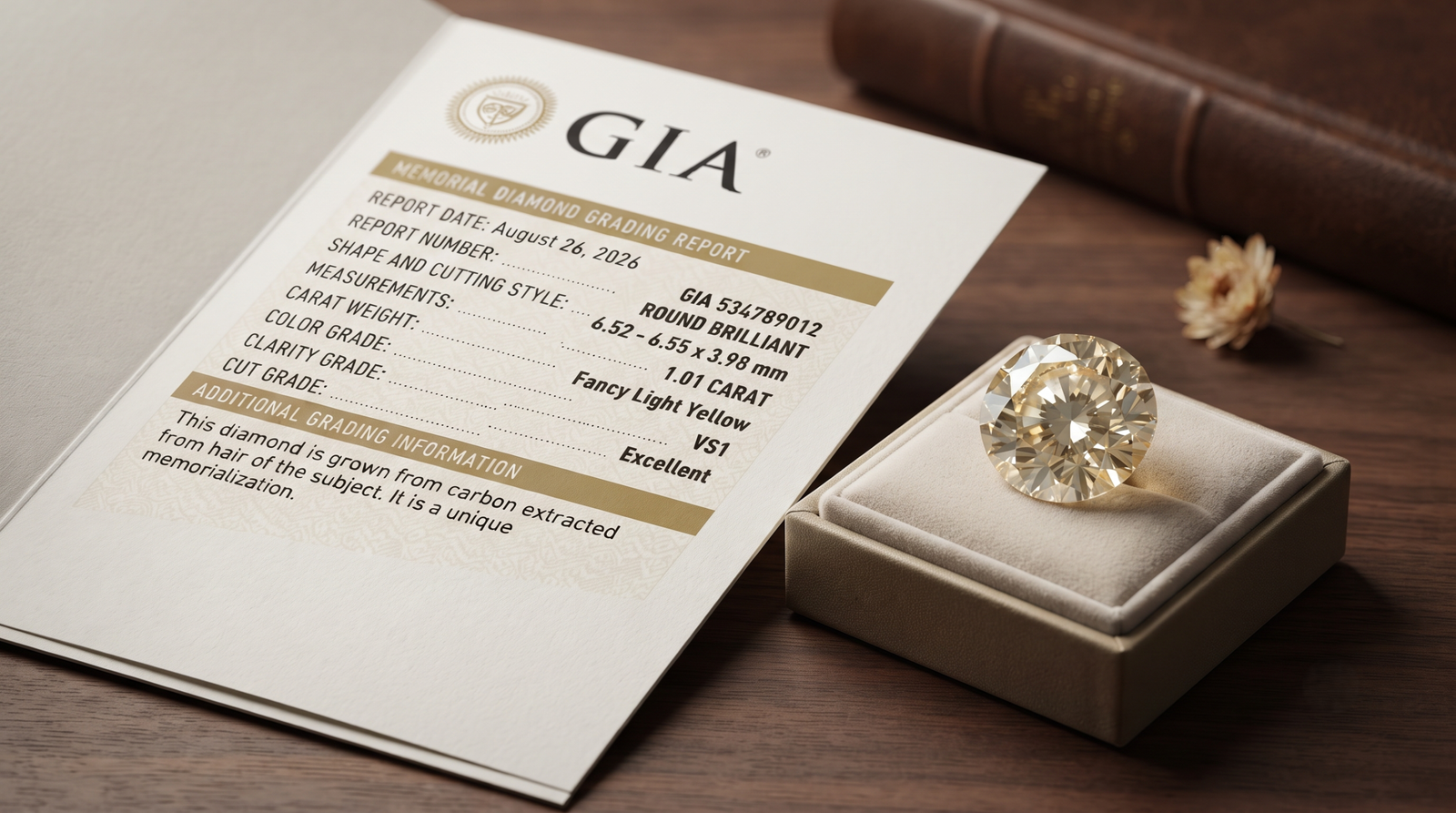
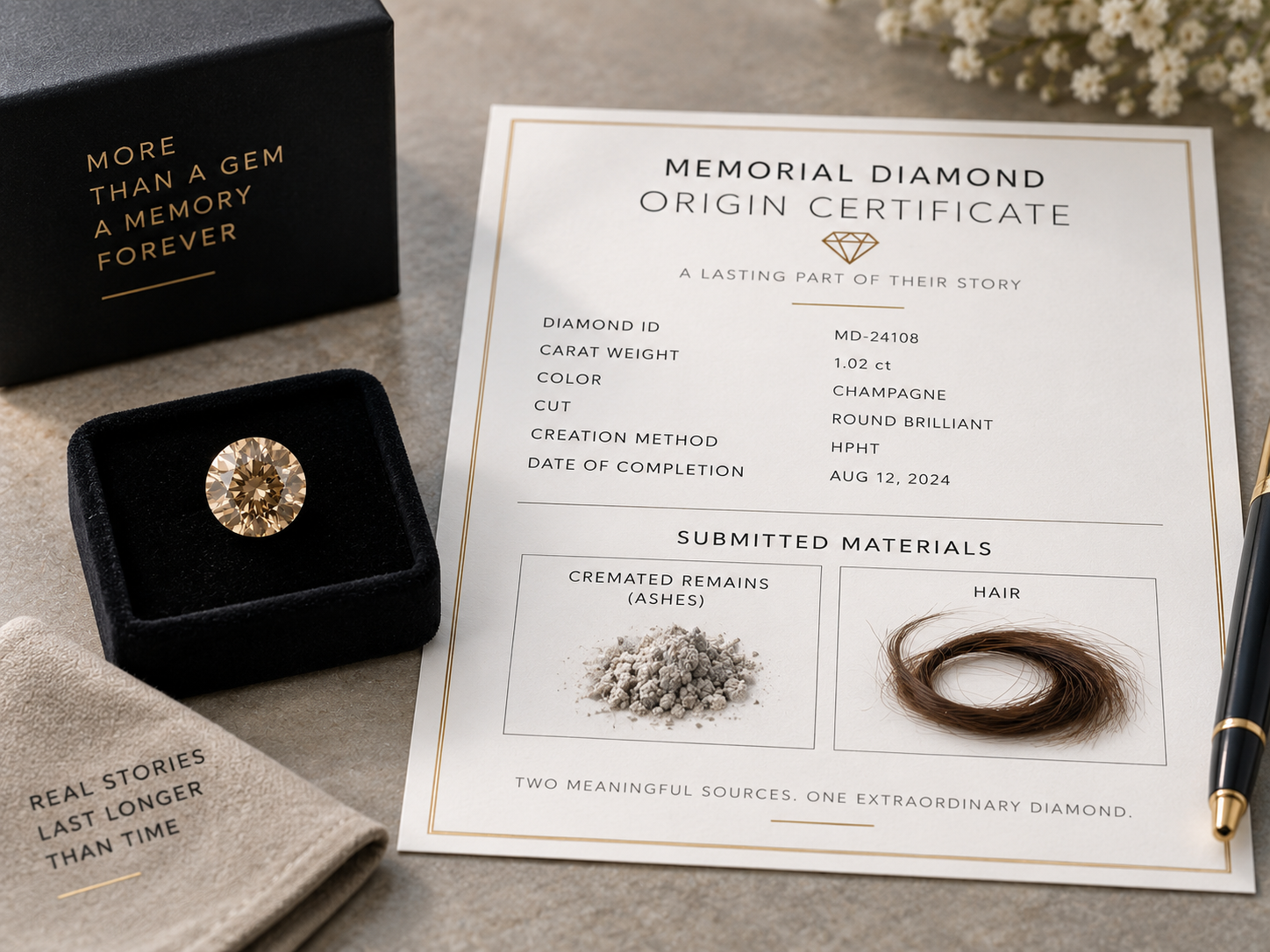
When you are ready, reach out to your memorial diamond provider and ask what quantity is needed, what comes back to you, and what documentation arrives with the finished stone.
The complete guide to a mother ashes diamond covers timeline, color and cost in one place if you would rather read further first.