Wife memorial diamond ideas featuring a memorial ring, diamond pendant, and meaningful keepsakes

Memorial Diamond Settings and Jewelry Ideas for a Wife

Most people choose a mount by looking at it. That is understandable, and it is the wrong first question.

Wife memorial diamond settings should be chosen for what the stone has to survive, not for how the drawing looks. A hand is the harshest environment a small stone ever lives in; a chain almost always fails at the bail rather than the clasp; and an earring is far more likely to be lost than broken. Decide where the piece will live, then pick the mount that answers it.
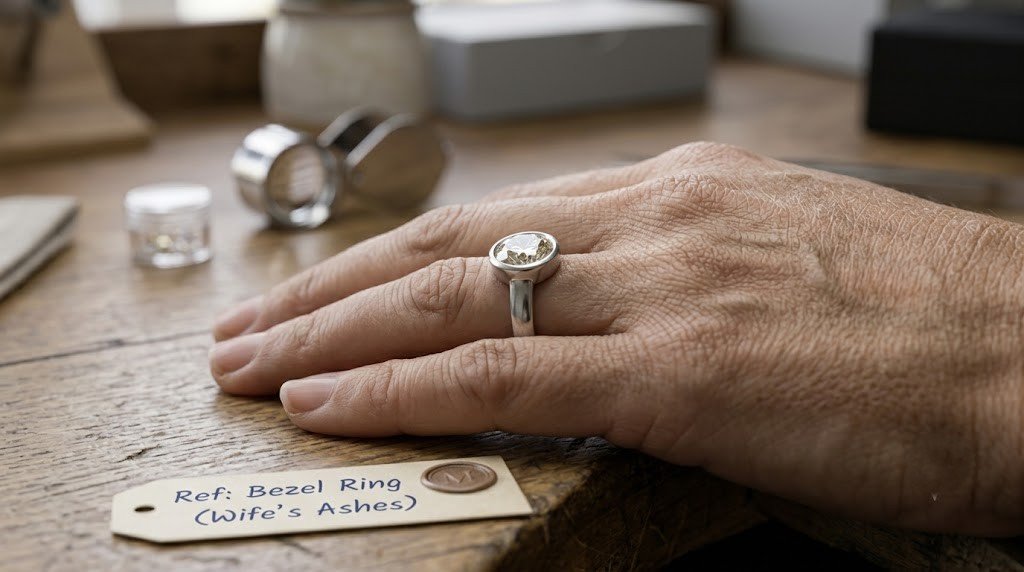
Wife memorial diamond settings shown as a low bezel-set ring worn on a hand resting on a work surface

What Do Wife Memorial Diamond Settings Actually Have to Survive?

Four things, and only one of them is about the stone itself. Wife memorial diamond settings fail for reasons the diamond has almost nothing to do with.

The stone is the easy part. Diamond sits at 10 on the Mohs scale of mineral hardness, the hardest known natural mineral, and nothing in ordinary daily life will scratch it. Hardness is not the same as toughness, a sharp strike at the girdle can still chip any diamond, but scratching is not what wife memorial diamond settings are designed against.

What wife memorial diamond settings actually have to survive is everything around the stone. Metal fatigue, as claws thin from years of contact. Loss of the whole piece, which is the only outcome with no remedy at all. Deformation, when a band is squeezed or a bail is pulled out of round. And the bench, years later, when someone has to work on the piece without endangering what it holds.

Worth being plain about what a mount is holding. This is not a capsule of ashes behind glass: carbon drawn from what she left is purified to near pure and then grown into the crystal alongside lab made carbon, because one person’s carbon will not fill a growth cell on its own. That fraction is exactly why wife memorial diamond settings are judged on retention rather than repair, the stone is replaceable only in the sense that another stone exists, which is not a sense that helps.

The fuller menu of forms sits in the memorial diamond settings pillar; what to make and for whom belongs to wife memorial diamond ideas. This page is the survival question that wife memorial diamond settings actually answer.

The Hand Is the Hardest Place a Small Stone Can Live

A ring is the default answer and the most demanding one. Rings get the highest share of wife memorial diamond settings and the highest share of the abuse.

Hands are used against hard surfaces all day. Door frames, steering wheels, gym equipment, the side of a sink. A raised stone finds every one of them, and each contact takes a little metal off the claw tips from the outside in. That is the failure that matters, because a claw thinned by a thousand small contacts lets go quietly. It is the least dramatic way a wife memorial diamond setting can fail and the most final.

Three consequences follow, and they shape most decisions about wife memorial diamond settings for a hand.

  • Among wife memorial diamond settings, height governs snagging more than metal choice does. A stone that sits low clears door frames; a raised head finds them. Ask to see the profile from the side, not just from above.
  • Claw tips need looking at on a schedule. Most jewelers will check a wife memorial diamond setting while cleaning it. The point is to ask for it deliberately rather than to notice a loose stone by feel.
  • The band deforms before the head does. Thin shanks flatten under grip, changing the geometry the head sits on.

None of this argues against a ring. It argues for low wife memorial diamond settings on a ring, or for a pendant if hands are the problem.

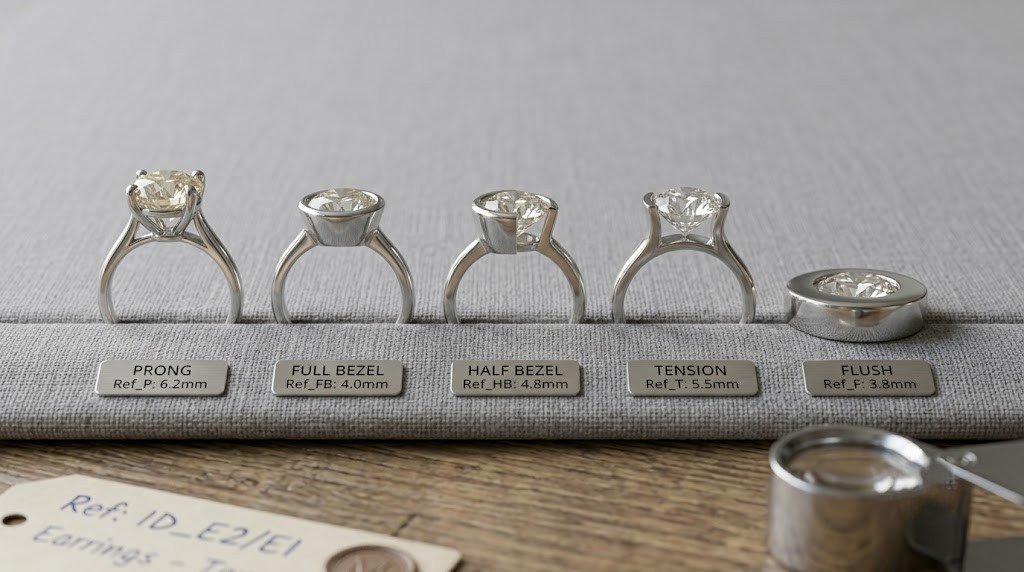
Prong, Bezel, Tension: What Does Each Setting Trade Away?

Every one of the wife memorial diamond settings below protects against something and exposes something else. None does only the first.

SettingWhat it protects againstWhat it exposesWho it suits
Prong or claw, 4 or 6Little; it is the least protective, but holds the stone high where most light reaches itGirdle and claw tips, to every knock and every pocket; six claws lose one more gracefully than fourSomeone who wants the stone to read brightly and is willing to have the claws checked
Full bezel, rub overThe girdle completely; a continuous rim takes the knocks instead of the stone, and there is nothing to snagThe face only. Less light enters from the side, so a warm stone reads warmer inside a yellow rimHands that work, healthcare and childcare, anyone who cannot be careful and should not have to be
Half bezelThe two sides most likely to strike something, while leaving the stone open front and backThe open edges, which is a real trade rather than a free compromiseSomeone who wants more light than a full bezel allows and more protection than claws give
TensionVery little; the stone is held by the spring pressure of the band itselfThe stone on nearly every side, and the whole piece to resizing, the tension is the settingCareful wearers who want the look, and who accept that the design cannot easily be altered later
Flush or gypsyAlmost everything; the stone is sunk into the metal with its table level with the surfaceAlmost nothing mechanically, it is the most secure of the five, and it shows the least lightManual work, a signet or a broad band, and a piece that must never catch on anything
Five diamond settings photographed in profile  prong, full bezel, half bezel, tension, and flush  at the same scale |

First, the strongest wife memorial diamond settings are also the dimmest, light enters a diamond from the sides as well as the top, so every millimeter of metal you add for protection is a millimeter of light you take away. Second, tension mounts are the one family of wife memorial diamond settings where “can this be resized?” has to be asked before ordering rather than afterward, because for many tension designs the honest answer is no.

How much metal touches the stone also changes what you see, because a colored mount reflects back through a transparent stone, which is why memorial diamond colors for a wife is not a separate decision from this one.

Why Do Chains Fail at the Bail Rather Than the Clasp?

Because the clasp is the part everyone inspects and the bail is the part nobody does.

A pendant hangs from a small loop, the bail, which is either soldered closed or simply bent closed as a jump ring. An open jump ring can be pulled straight by a snagged collar, a seatbelt, or the weight of the pendant swinging against a hard edge for years. It opens a fraction of a millimeter at a time and then one day the pendant is not there.

So when pendants come up among wife memorial diamond settings, three questions do most of the work.

  1. Is the bail soldered closed, or is it an open jump ring? A soldered bail is a different object from a bent one, and the difference is invisible at arm’s length.
  2. Is the chain rated for the weight it is carrying? A fine chain looks elegant under a heavy pendant and is the wrong chain for it.
  3. Does the clasp suit the hands that will open it? A spring ring is small and fiddly; a lobster clasp is easier; a magnetic clasp is easiest and the least secure of the three.

A pendant sidesteps almost every problem the ring shaped wife memorial diamond settings have. It never meets a door frame, needs no sizing, and passes between people without bench work.

Earrings Are Lost Far More Often Than They Are Damaged

This is the one place where wife memorial diamond settings fail for reasons that are not mechanical at all.

Earrings are rarely broken. They are taken out at a sink, put down on a hotel dresser, dropped into a coat pocket, or lost from an ear without the wearer noticing for hours. That single fact should drive every decision about earrings among wife memorial diamond settings, and it is a good reason to be cautious about splitting one stone’s worth of meaning across two objects that go out into the world separately.

  • A screw back or locking back is materially more secure than a friction back, and the difference is largest exactly when it matters: an active day, a coat going on and off.
  • A single earring is a legitimate design, not a compromise. One stud in a chosen ear is a complete piece, and it halves the loss surface.
  • If two pieces are wanted, ask about two stones rather than splitting one. Whether more than one stone can be grown from the same source is answered in whether more than one family member can get a diamond from her ashes.
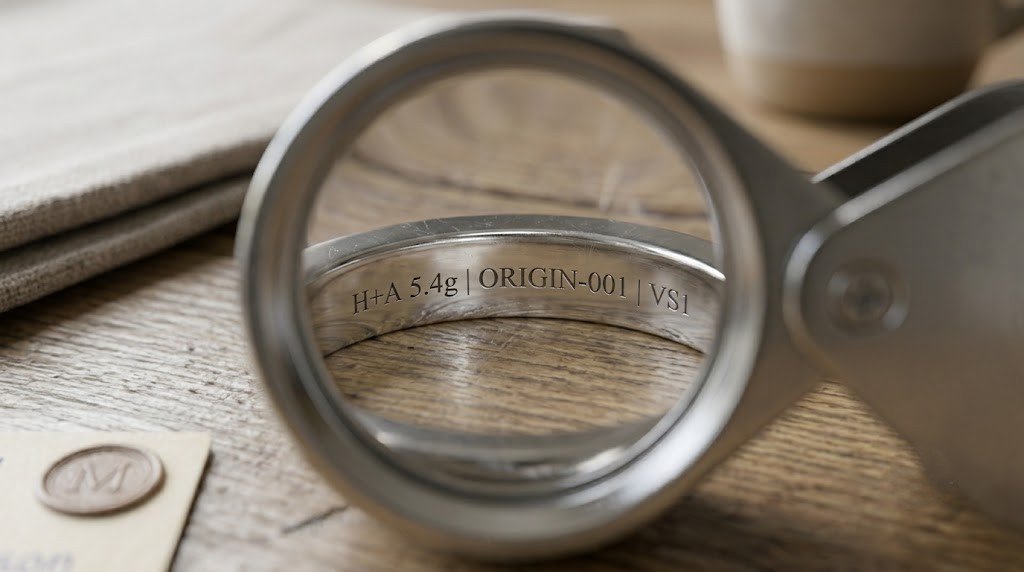
Inside surface of a ring band showing a short engraved inscription, photographed under a loupe

What Happens If You Want It Resized or Re Set Years Later?

Almost everything about wife memorial diamond settings can be changed later. The question is what the change costs in risk, and that varies enormously between them.

Resizing. Among wife memorial diamond settings, a plain band with a head on it resizes easily within a few sizes. Beyond that, the geometry under the head starts to change. Eternity style bands set all the way around cannot be sized in the ordinary way at all, because there is no plain metal to cut. Tension mounts are the hard case, since the pressure holding the stone is the band’s own spring.

Heat. Sizing and most repairs involve a torch. A responsible bench will usually remove the stone, or heat sink and shield it, rather than working around it in place, and it is entirely reasonable to ask which of those will happen before handing the piece over. Removing and resetting is itself a small, controlled risk.

Re setting into something else. A stone can move from a ring to a pendant, or out of a worn out mount into a fresh one decades later. That is a genuine strength of a stone over a sealed keepsake, and a reason to treat wife memorial diamond settings as housing rather than as final form. What matters is that the stone leaves one mount and enters another under a jeweler’s control.

The band she already wore. Setting her stone into a ring she owned is possible, and is a different job from building new wife memorial diamond settings from scratch, the bench is working with metal that has been worn thin in places and may have been sized before. Ask for an assessment before the design is settled, not after. Cleaning and long term care of a finished piece belongs to memorial diamond aftercare.

Insurance and Appraisal: What to Ask Before It Ships

This section is short on purpose, because it is entirely questions rather than answers. Insurance sits alongside wife memorial diamond settings rather than inside them, terms vary by insurer and by where you live, and no jewelry brand is positioned to tell you what yours will do.

Start from one honest fact: the stone cannot be replaced like for like. Another diamond can be bought; another grown from the same person cannot be assumed available. That makes the insurance conversation about the setting, the labor and the documentation rather than about restoring what was lost.

Questions worth asking, in roughly this order.

  • What documentation comes with the finished stone, and what does it actually say? An origin or chain of custody document and an independent grading report are different things doing different jobs. What each one records is set out in how gemologists assess cut, color, clarity and carat and in how memorial diamonds are graded and certified.
  • Will an appraisal be needed separately, and who writes it? A grading report describes the stone; an appraisal states a value for insurance purposes. They are not interchangeable.
  • Ask your own insurer whether a lab grown memorial stone can be scheduled, what valuation evidence they want, and what they would do about a loss they cannot replace, before the piece is made, so the answer can shape the design.
  • Ask what a claim would actually restore. That answer often changes how a family feels about a daily wear piece versus a kept one, and it is better heard early.

The broader treatment sits in memorial diamonds and insurance. What wife memorial diamond settings add to the overall figure belongs to what a wife memorial diamond costs, since mounts are typically quoted separately from the stone across the industry.

What to Have Engraved, and Where

Engraving is the cheapest part of any of the wife memorial diamond settings above, and the part people most often wish they had thought about.

Three surfaces are available on most wife memorial diamond settings, and they behave differently.

  • The inside of a band. Private, protected and the most durable position, rubbed by nothing but a finger. It is also the surface that suffers if the ring is ever sized down, so keep text short and centered.
  • The outside of a shank or the back of a pendant. Visible, and exposed to wear. Deep engraving lasts; shallow laser marking on an exposed surface will soften over the years.
  • The gallery or the underside of a head. Almost invisible, almost indestructible, and only large enough for a date or two initials.

Two practical notes hold generally. Keep it short, because a long inscription at small size is unreadable within a decade of wear. And record what the stone is somewhere outside the piece, since engraving is not a document and whoever inherits it will need telling. The detail of typefaces, depths and methods sits in memorial diamond engraving.

Frequently Asked Questions

Which of the wife memorial diamond settings is the most secure?

A flush or gypsy setting, where the stone is sunk into the metal with its table level with the surface. It has nothing to snag and almost no exposed girdle. The trade is that it shows the least light of any common mount.

Can a memorial diamond be set into a ring she already wore?

Usually, but it is a different job from making a new piece, because the bench is working with metal already thinned by wear and possibly sized before. Ask for an assessment of the existing ring before the design is settled rather than afterward.

Is a bezel setting better than prongs for everyday wear?

For protection, yes, a continuous rim takes knocks instead of the stone and cannot snag. The cost is light: less enters from the side, so the stone reads slightly darker, and a colored rim shifts how its tone appears.

Why do pendants fail at the bail rather than the clasp?

Because the clasp is inspected and the bail is not. An open jump ring can be pulled gradually out of round by collars, seatbelts and the pendant’s own swing, opening a fraction at a time until the pendant is gone. Ask whether it is soldered closed.

Should a memorial diamond be insured?

That is a question for your own insurer rather than a jeweler, since terms vary by policy and location. Ask specifically whether a lab grown memorial stone can be scheduled, what valuation evidence is required, and what a claim would restore when like for like replacement is not possible.

What is the safest setting choice for hands that work?

Of the wife memorial diamond settings in common use, either a flush mount on a broad band, or no ring at all. A pendant meets none of the surfaces a hand meets all day, needs no sizing, and passes between people without bench work.

Final Thoughts on Wife Memorial Diamond Settings

Wife memorial diamond settings read as an aesthetic decision and are really an environmental one. Choose the mount for the life the piece will have, the hands, the collars, the sinks, the coat pockets, and the look tends to follow rather than fight it.

Then do the three things that are easy now and awkward later: ask how the bail is closed, ask whether the design can be resized, and ask your insurer what they want before the piece is made rather than after.

Learn More About Wife Memorial Diamonds

Talk With Memorial Diamond

If a stone is already in production and no decision has been made among the wife memorial diamond settings, that is the right moment for this conversation rather than the week the box arrives. Memorial Diamond is one place to have it, memorialdiamond.us.
wife memorial diamond ideas

Wife Memorial Diamond Ideas: Rings, Pendants, and Keepsakes

The question people ask is ring or pendant. The question underneath most wife memorial diamond ideas is how often you want to be holding this.

The most useful way to sort wife memorial diamond ideas is by frequency of contact rather than by form. There are four honest bands: daily and unnoticed, daily and visible, occasional, and kept rather than worn. Every ring, pendant, bracelet, watch, box and loose stone falls into one of them, and once you know which band you are in, the form mostly chooses itself.

A disclosure that belongs at the top of a page full of suggestions: Memorial Diamond grows the stones these ideas are built around, so weigh each idea against your own week rather than against who is offering it.

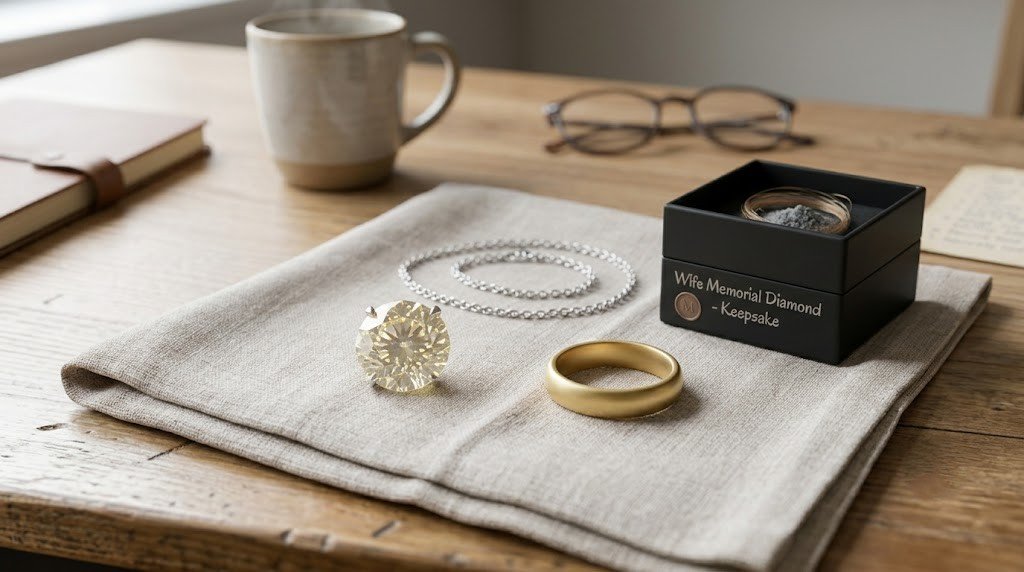
Wife memorial diamond ideas laid out together: a loose memorial diamond, a fine chain, a plain band and a small keepsake box on a folded cloth

How Should You Sort Wife Memorial Diamond Ideas?

By how often you want it within reach, because that single answer decides more than the shape does.

Most lists of wife memorial diamond ideas are catalogs of forms: ring, pendant, earrings, bracelet, cufflink, keepsake. That is a list of objects, not a decision. A ring worn every day of your life and a ring worn twice a year are different purchases with different consequences, while a pendant worn daily and a ring worn daily have far more in common than either has with its own occasional version.

Whichever band you land in, the stone going into it is the same object: a real, chemically genuine diamond grown around a seed from carbon recovered from her. It is worth knowing the honest composition before choosing what to build around it, the carbon extracted from her ashes or her hair is purified and then combined with lab grown carbon, because a growth cell needs more feedstock than any realistic sample can supply on its own.

How often it is in reachForms that fit the bandWhat that frequency asks of the settingWhat you do not have to decide yet
Daily, and you stop seeing itA plain pendant under a collar, a low profile band, a stone set flush or inside a shankProtection over display. Low profile, secure seat, metal that tolerates knocks without catchingNothing about color. A stone you stop noticing is not chosen for its shade
Daily, and visibly soA ring on the hand, a statement pendant, a stone in a piece you already wearBoth protection and presentation, which pull against each other, and an answer ready for the question it invitesWhether you will always want to be asked. This band is easiest to move out of later
OccasionalEarrings, a bracelet, a dress ring, a brooch or lapel piece, a watch you wear on certain daysFar less. A piece that lives in a drawer between outings is exposed to very littleAlmost everything. Occasional pieces are the most forgiving of a change of mind
Kept rather than wornThe loose stone in its case, a stone set into a box or an object of hers, a stone in the urnNothing of a setting; everything of an object. Whether it can be opened, and whether it can be opened twiceWhether it stays kept. A stone that is not worn now can be set at any point

The fourth column is the one to read first. Several of these wife memorial diamond ideas ask you to settle nothing at all today, which matters when you are choosing in a year when very little feels decidable. If you want the forms themselves laid out across the whole category rather than sorted by frequency, the guide to memorial diamond settings, rings, pendants, earrings and cufflinks is the catalog version.

Daily and Unnoticed: Wife Memorial Diamond Ideas You Stop Seeing

This is the quietest of the four bands, and these wife memorial diamond ideas are the ones people most often settle on in the end.

The aim here is not to be reminded. It is to have it on you. A small pendant that sits under a shirt, a narrow band worn on any finger, a stone set low into a piece you already own, something you notice putting on in the morning and then do not think about again until you touch it in a meeting.

What this band asks for is a setting that protects rather than displays, which usually means a low profile and a secure seat. What it does not ask for is size: a small stone suits this band better than a large one, because height is what catches on things.

It also asks nothing of color. If the stone comes back a warm champagne rather than the pale one in your head, a piece worn under a collar is indifferent to it. What color to expect from a memorial diamond for a wife explains why the range is genuinely unpredictable and why choosing a band that does not depend on shade is a real strategy.

Of all the wife memorial diamond ideas here, this band is also the cheapest to enter, because it rewards a smaller stone, and carat is the main driver of price. What a wife memorial diamond costs sets out the steps.

Daily and Visible: Wife Memorial Diamond Ideas That Invite a Question

These wife memorial diamond ideas come with something the other bands do not: conversation.

A stone on your hand will eventually be noticed, and at some point someone will ask about it. That is not a reason to avoid this band, for many people it is exactly the reason to choose it, because it makes her present in ordinary rooms rather than only in private ones. But it is worth deciding in advance what you want to say, and to whom, because the question arrives when you are not braced for it. “It was my wife’s” is a complete sentence. So is a change of subject.

Practically, this band is the most demanding. A piece worn on the hand all day meets doors, steering wheels, dishwater, keyboards, gym equipment and cold weather. It needs a setting chosen for that reality rather than for a photograph. How a mount actually holds a stone through years of that, and how a piece is resized or reset later, belongs to settings and jewelry ideas for a wife rather than here.

One further note that is not about jewelry. If her rings are in the house, they are objects with their own future, and setting a new stone is not the only thing that can happen to them. Nothing about a memorial diamond requires altering anything she wore. A stone can go into new metal entirely and leave her rings exactly as they are, for you, or for someone else later.

Occasional: Wife Memorial Diamond Ideas for Days That Already Mean Something

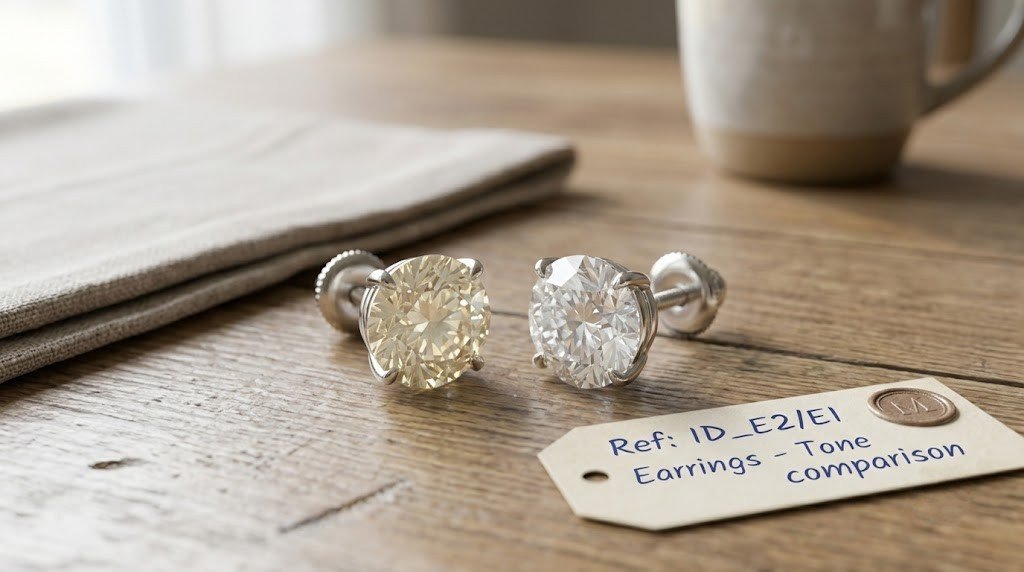
A pair of memorial diamond stud earrings of slightly different tone photographed side by side

Some wife memorial diamond ideas are better for being rare.

An occasional piece is one you take out for her birthday, an anniversary, a family gathering, a wedding, the day of the year that is hardest. The rest of the time it is in a drawer. That is not a lesser relationship with an object, it is a different one, and for some people it is easier to carry than a daily reminder.

This band is the most forgiving, and it opens the widest range of forms.

  • Earrings, which need two stones. Because only a portion of the material is used, more than one stone can often be grown from the same starting material, though two grown separately will not match closely, whether several people can have a diamond from the same source covers how that works.
  • A bracelet or bangle, which suits hands that are wrong for rings, trades, gardening, healthcare, anything involving gloves.
  • A dress ring worn on a different finger from any wedding band, which separates the two objects deliberately.
  • A brooch or lapel piece, if the occasions that put you in a jacket are the occasions she comes up.
  • A watch, hers or yours, with a stone set where the maker allows it.

Occasional pieces also survive a change of mind better than anything else. They can be larger without being impractical, more unusual without being a daily statement, and they do not have to answer to a working week.

Kept Rather Than Worn: Wife Memorial Diamond Ideas That Never Go on a Body

These wife memorial diamond ideas are not consolation prizes. They read as second best only because pages like this one habitually list them last.

Wanting the stone and wanting to wear the stone are two separate wants, and plenty of people only have the first. Among the wife memorial diamond ideas that never touch a body:

  • The loose stone in its case, kept with its paperwork in a drawer you open when you want to. This is a complete answer, not a delay.
  • A box, a case, or a lid, a stone set into something that already sits where you look every day.
  • Whatever object in the house is most hers. No list can name it and you already can. Whether it can hold a stone safely is a bench question about depth, material, and whether it can be opened twice.
  • The urn, if the rest of her is in one. A stone in a lid or a base keeps everything in one place, and it is worth saying plainly that an urn is a whole choice in itself rather than a runner up, a wife memorial diamond and a traditional urn side by side treats them as answers to different questions.

Two honest caveats. Not every object can take a stone, and that is settled at a bench rather than by preference. And a kept stone needs its paperwork kept with it: the origin or authenticity document that records what it was grown from, and the grading report if one was commissioned, which describes the stone’s own cut, color, clarity and carat. One other person should know what the stone is, because an unlabeled diamond in a drawer is a problem for whoever finds it in thirty years.

Are Daily Wear Wife Memorial Diamond Ideas Safe for the Stone?

Yes, but the reassurance people reach for when weighing daily wife memorial diamond ideas is aimed at the wrong object.

Diamond is a 10 on the Mohs scale, the hardest known natural mineral, and a memorial diamond is chemically the same material as any other diamond, with the same hardness and the same optical properties. Nothing you do in an ordinary day scratches it.

That is the whole of what hardness tells you, and it is less than it sounds. Hardness is resistance to scratching. It is not resistance to being knocked out of a setting, and it is not a property of anything around the stone. The metal is softer. The prongs are thinner. The seat wears. The chain is the weakest part of any pendant, and bails fail more often than clasps do. Earrings are lost far more often than they are damaged.

So the honest version is this: daily wear is a question about everything except the stone. When you are weighing wife memorial diamond ideas in the first two bands, what you are really assessing is the metal, the mount and your own week, not whether a diamond can survive a dishwasher.

Two practical consequences follow. Have any daily worn piece checked periodically the way you would any ring with a stone in it, because a loose seat is discovered by touch long before it is discovered by loss. And treat insurance and appraisal as questions to raise with people who do that for a living rather than with a jewelry company.

What If You Are Not Ready to Choose Among These Wife Memorial Diamond Ideas?

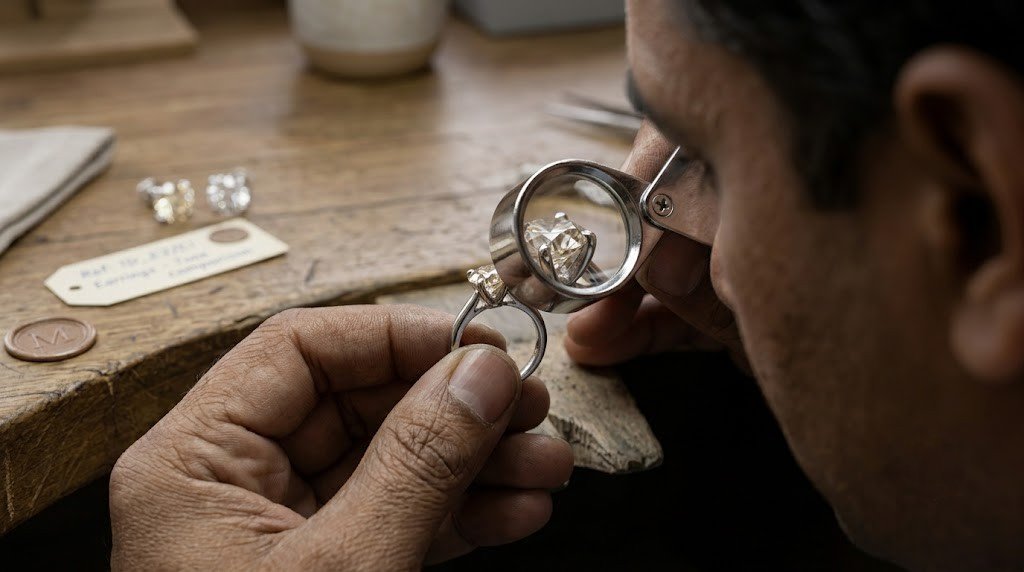
Jeweler examining the prongs and seat of a diamond ring under a loupe on a benc

Then do not choose. None of these wife memorial diamond ideas has a deadline attached, and the stone does not deteriorate while you think.

A finished diamond sits in its case indefinitely. It does not need a setting to exist, to be complete, or to be hers. Choosing a band and a form is a decision you can make in your own time, with the stone in your hand rather than from a description, which is a genuinely better position to decide from, because a stone in a photograph and a stone between your fingers are different sizes and different colors.

There is also a sequencing point worth knowing. Carat and color have to be settled before anything is sent, because they determine the growth run; the setting does not, and can be decided months later. How long a wife memorial diamond takes sets out which decisions belong to which stage.

The one thing worth doing now, whichever of these wife memorial diamond ideas you are drawn to, is keeping the paperwork with the stone and telling one other person what it is.

Frequently Asked Questions

What are the best wife memorial diamond ideas for daily wear?

Whichever band you actually live in. For daily wear without drawing attention, a low profile pendant or narrow band suits best. For daily and visible, a ring, but expect the question it invites, and choose the setting for a working week rather than a photograph.

Do wife memorial diamond ideas have to use jewelry she already owned?

Often, though it depends on the piece’s width, metal and condition, and the change is permanent. Nothing requires it, either, a stone can go into entirely new metal and leave everything she wore exactly as it is.

Is a memorial diamond hard enough to wear every day?

Yes. Diamond is a 10 on the Mohs scale and the stone is chemically genuine. The vulnerable parts are the metal, the prongs, the seat and the chain, so daily wear is really a question about the setting rather than the stone.

What are the wife memorial diamond ideas for someone who does not wear jewelry?

Keep it. A loose stone in its case with its paperwork is a complete answer. Or set it into an object, a box lid, a watch, the urn, whatever in the house is most hers, subject to a jeweler’s view on whether it can hold a stone.

Do I have to choose a setting before the diamond is made?

No. Carat and color must be settled before anything is sent, because they govern the growth run. A setting can wait until the stone exists, which is a better moment to judge size and shade anyway.

Can I change my mind about the setting later?

Usually, since a stone can generally be unset and reset by a jeweler. What does not come back is metal, a band that has been cut, resized or melted stays that way, so the reversible decision is the stone’s home, not the piece it came from.

Final Thoughts on Wife Memorial Diamond Ideas

Sorting wife memorial diamond ideas by frequency rather than by form is not a trick for narrowing a catalog. It is a way of asking the only question that actually has an answer right now: how often do you want this within reach?

You do not need to know what you will want in five years. Three of the four bands can be entered and left again, the stone itself is indifferent to how long you take, and the only decisions with a real deadline, carat and color, were made long before a setting was ever on the table.

Learn More About Wife Memorial Diamonds

Talk With Memorial Diamond

If one of these bands has started to feel like yours, Memorial Diamond is one of the companies to ask what it would take, memorialdiamond.us. The useful thing to bring is not a form but a frequency: tell them how often you want it in reach, and the rest of the conversation gets much shorter.
And if none of the bands feels right yet, that is a position rather than a gap. The stone keeps.

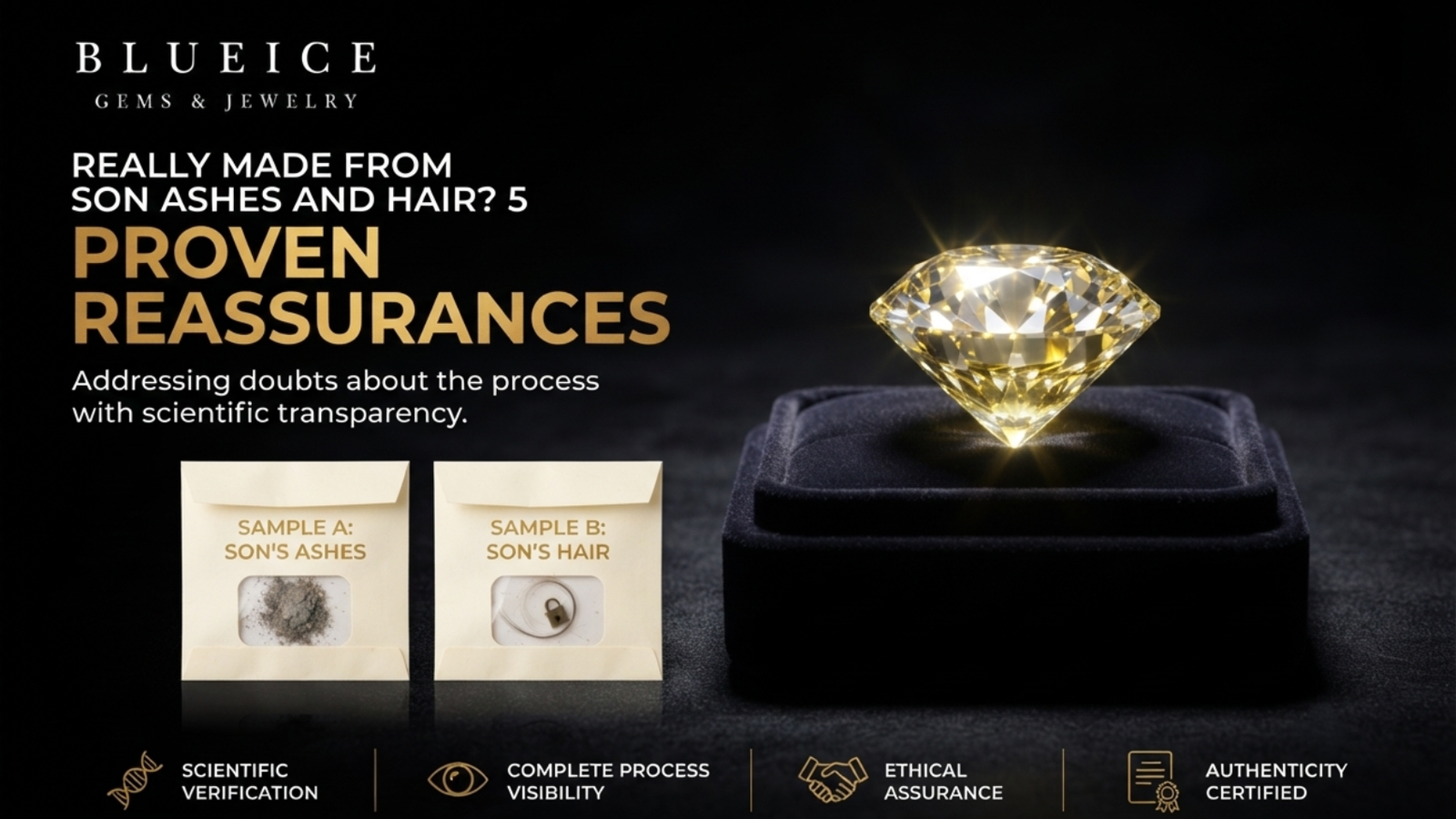
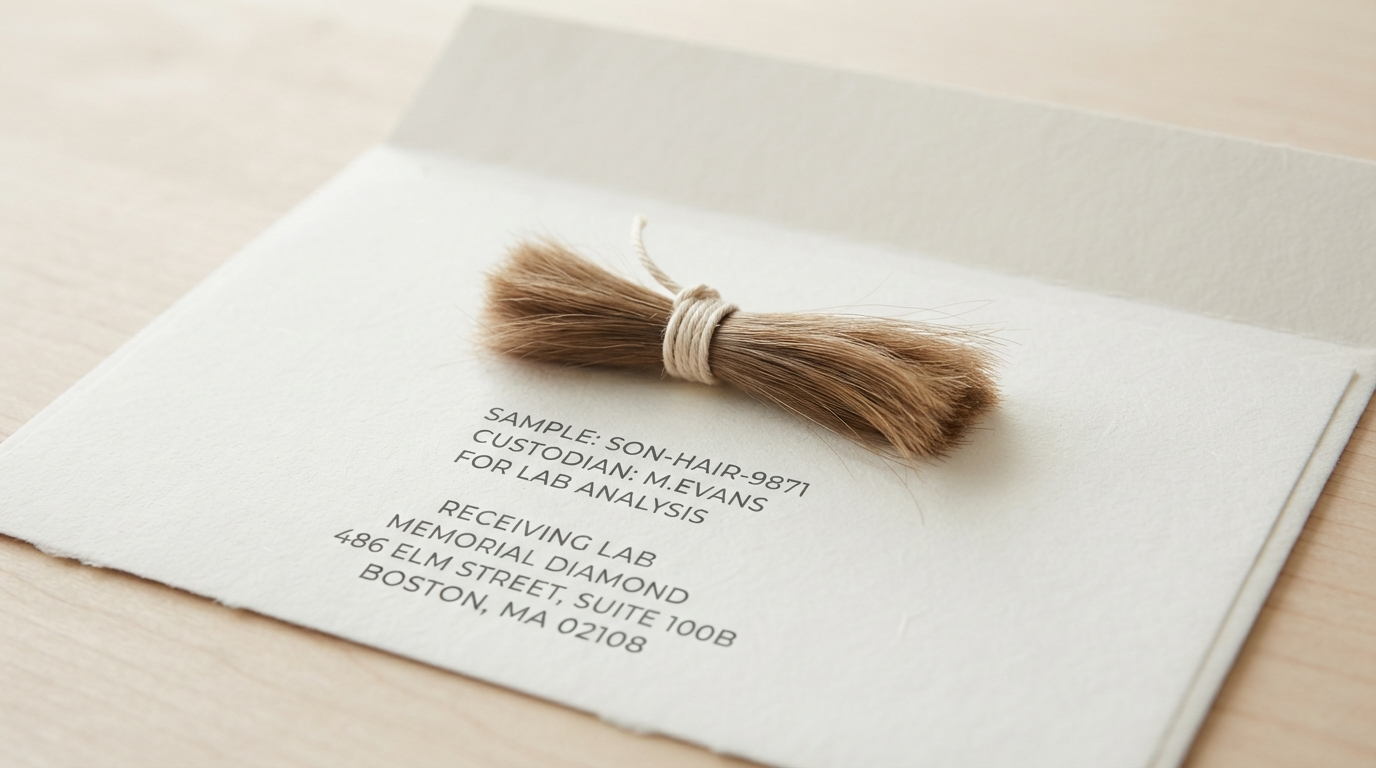
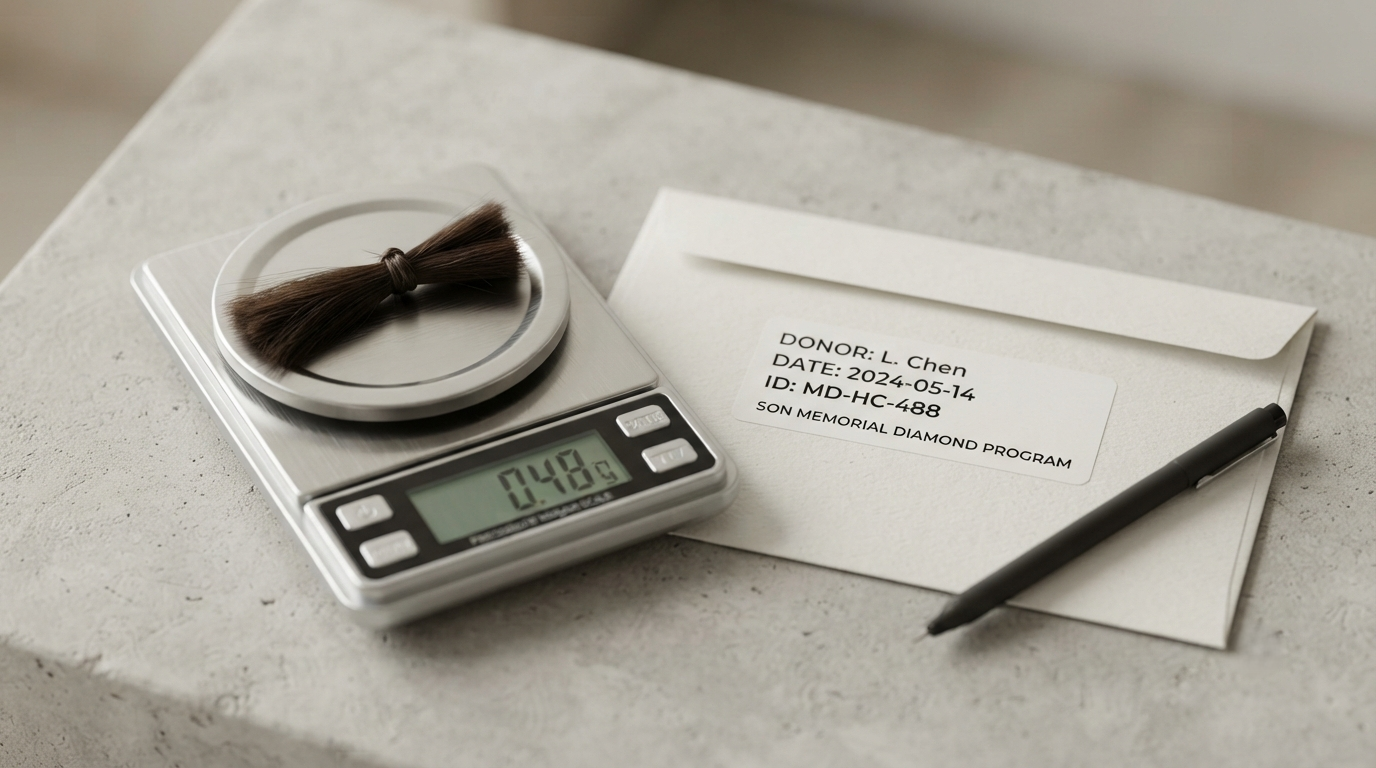
A memorial diamond really made from son ashes and hair displayed beside two labeled sample envelopes

Is a Memorial Diamond Really Made From Your Son’s Ashes and Hair?

Families who kept a lock from before the cremation often want both to go, and then wonder whether that changes anything. It does not change the honest answer: a stone really made from son ashes and hair genuinely contains carbon extracted from both materials, purified and grown into a chemically real laboratory diamond, blended with supplemental laboratory carbon to reach a usable volume. Sending both does not make a diamond really made from son ashes and hair purer, it changes what the paperwork has to account for.

What Does Submitting Both Materials Actually Mean?

At the simplest level, a commission really made from son ashes and hair means two envelopes instead of one, logged separately at intake and tracked separately until the point where they meet.

Most families reach this point for a reason rather than by accident. A lock cut at a hospital, a first haircut kept in a drawer since childhood, a few strands from a hairbrush nobody could bring themselves to clean, and then, later, cremated remains. Both feel like him, and choosing one over the other feels like ranking them.

You do not have to. Providers across this industry accept mixed submissions, and there is no chemical reason two carbon sources cannot feed one growth run.

What matters is that you understand what happens after they arrive, because a gem really made from son ashes and hair is not two stones fused together or a stone with layers. It is one crystal grown from a combined feedstock. The complete guide to a son ashes and hair diamond sets out the wider decision.

Are the Two Combined, or Grown Separately?

This is the question to put to a provider first, because the answer is not standardized and it changes what you are buying.

Two arrangements are common. In the first, carbon recovered from both samples is pooled into a single charge, and one crystal is grown from the mixture, a single diamond really made from son ashes and hair, with both materials present throughout. In the second, each sample is processed separately and each grows its own stone.

Ask which one a company does by default, and whether the alternative is available. Ask it in writing. A provider that has genuinely thought about work really made from son ashes and hair will have a settled answer and be able to describe how the two intake records stay linked through processing.

Neither arrangement is better for a stone really made from son ashes and hair, there is only the one that suits your family. A single pooled stone keeps everything in one object; separate stones let two people each hold something. How to turn his ashes and hair into a diamond walks through the practical choice.

Does the Hair Disappear Beside the Ash?

Parents preparing a gem really made from son ashes and hair worry about this specifically, and the underlying chemistry is worth knowing, because the two materials are nothing alike as starting points.

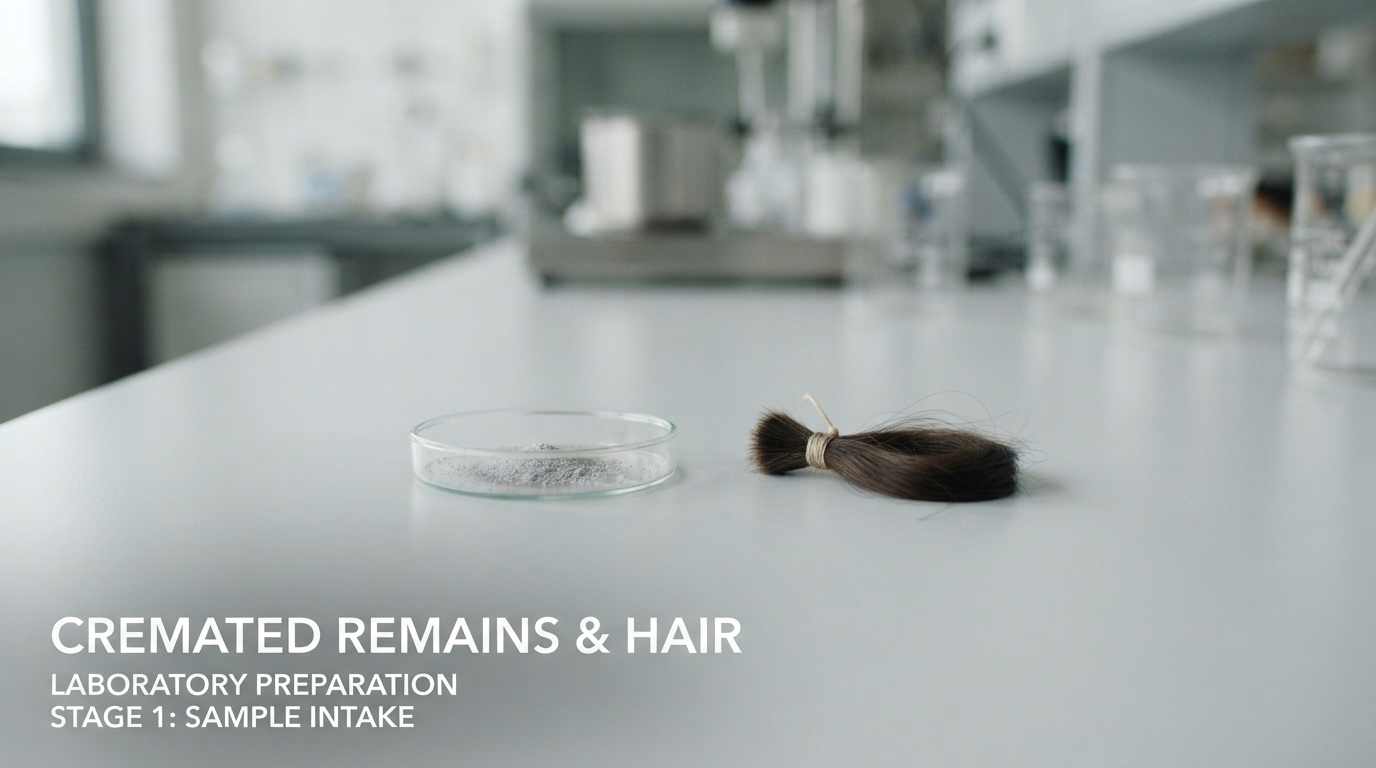
Cremated remainsHair
Main compositionCalcium phosphate, bone mineralKeratin, a carbon rich protein
Carbon as starting materialRoughly 0.5 to 4% of ash by weightRoughly 50% carbon by weight
Typical quantity requestedA few tablespoons up to about 4 ozA small lock, or a few grams
Requires cremation?Yes, by definitionNo
Recovery after purificationA small fraction of what you sendA much higher proportion of what you send
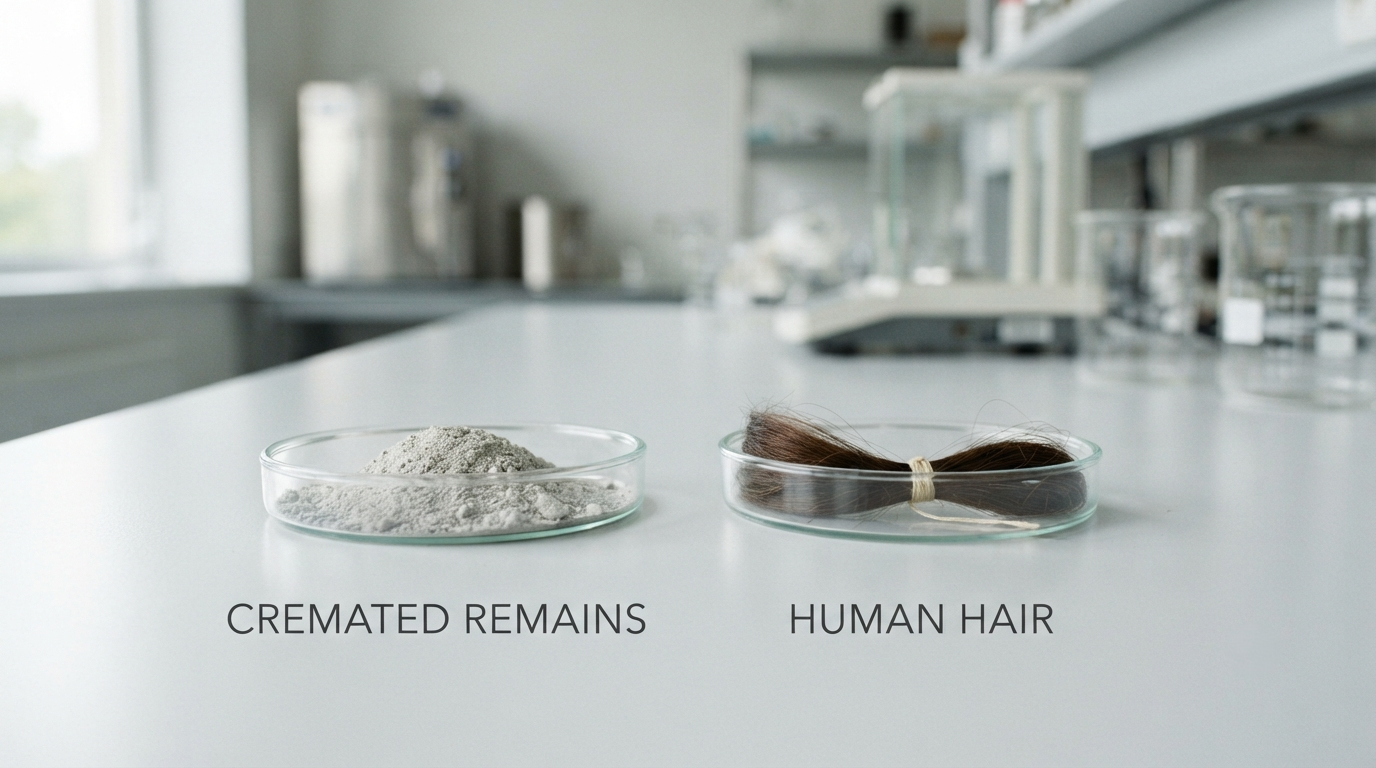
Side-by-side sample of cremated remains and a small lock of hair on a laboratory bench

Read the second row carefully, because it explains the whole question. Gram for gram, hair is a far richer carbon source, so a modest lock can contribute a meaningful share of the personal carbon in something really made from son ashes and hair, it is not a token addition swamped by the ash.

What the table cannot tell you is the resulting ratio inside your specific stone, since that depends on quantities submitted and on how a particular laboratory runs its process. Anyone quoting you a precise split for a jewel really made from son ashes and hair without asking what you are sending is guessing.

What Share Is Really Made From Son Ashes and Hair?

Here the honest answer involves naming a gap rather than filling it. No published industry figure describes the personal carbon share of a blended ash and hair charge. A figure exists for the ash route on its own. Nothing equivalent has been published for hair alone, and nothing at all has been published for the two combined.

So be skeptical of any page that applies an ash route percentage to a stone really made from son ashes and hair as though the blend behaved identically. It may not, and nobody has published the work that would settle it.

What holds regardless of route is the structure of the answer. Personal carbon from both of your submissions is genuinely inside the crystal lattice, and supplemental laboratory carbon is added because the recovered quantity alone cannot fill a growth cell. Every diamond really made from son ashes and hair is a blend of personal and laboratory carbon, and a company telling you otherwise is overclaiming.

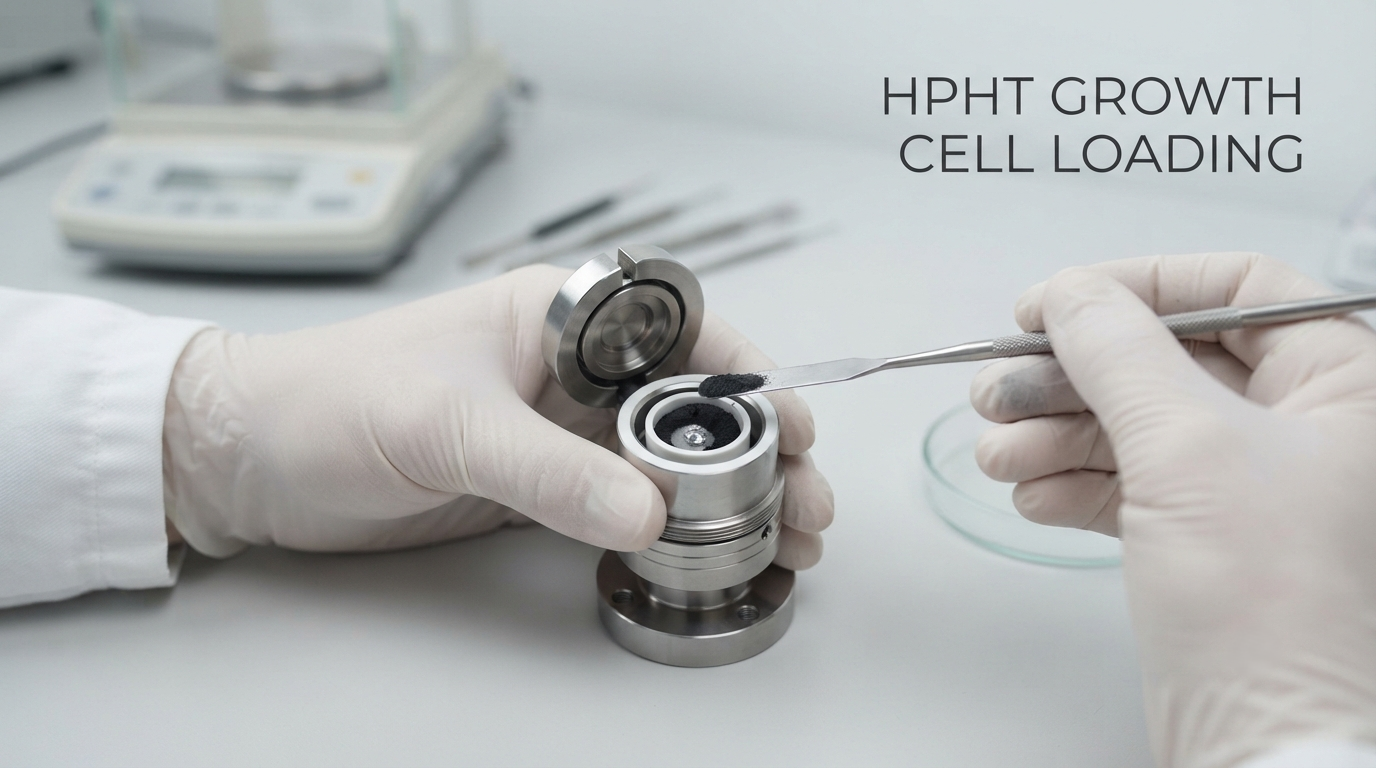
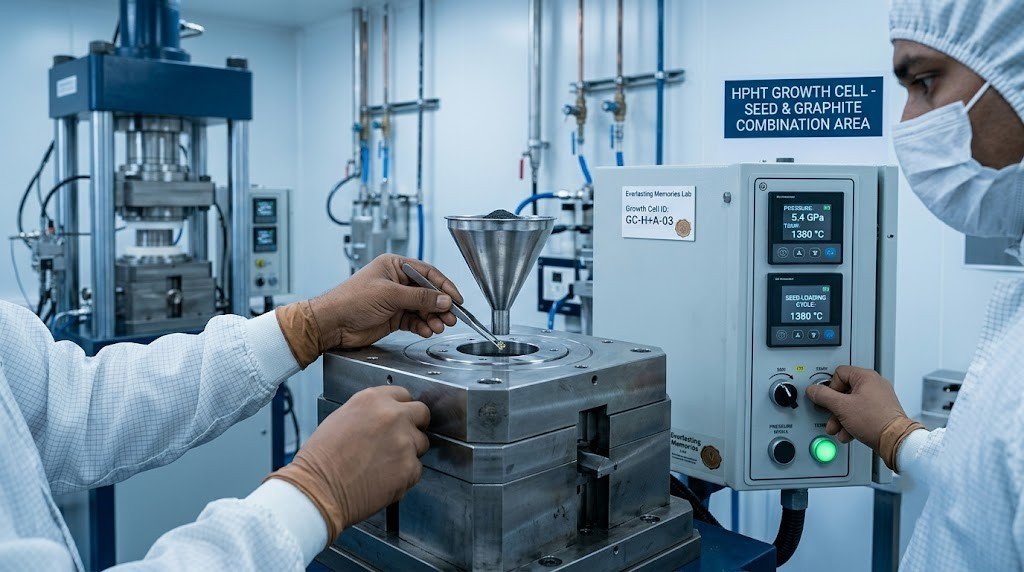
Purified carbon feedstock being loaded into an HPHT growth cell around a diamond seed

Turn that gap into a request before commissioning anything really made from son ashes and hair. Ask what percentage of the finished stone the provider expects to be his carbon at your chosen carat, ask how a mixed submission changes that estimate, and ask for both answers in writing. Keep the reply, it is the only figure that will ever apply specifically to your stone.

Is the Finished Stone a Real Diamond?

Yes, in the full technical sense. A piece really made from son ashes and hair is carbon in diamond structure, graded on the same terms as any other diamond, and it is neither a simulant nor ash suspended in something clear.

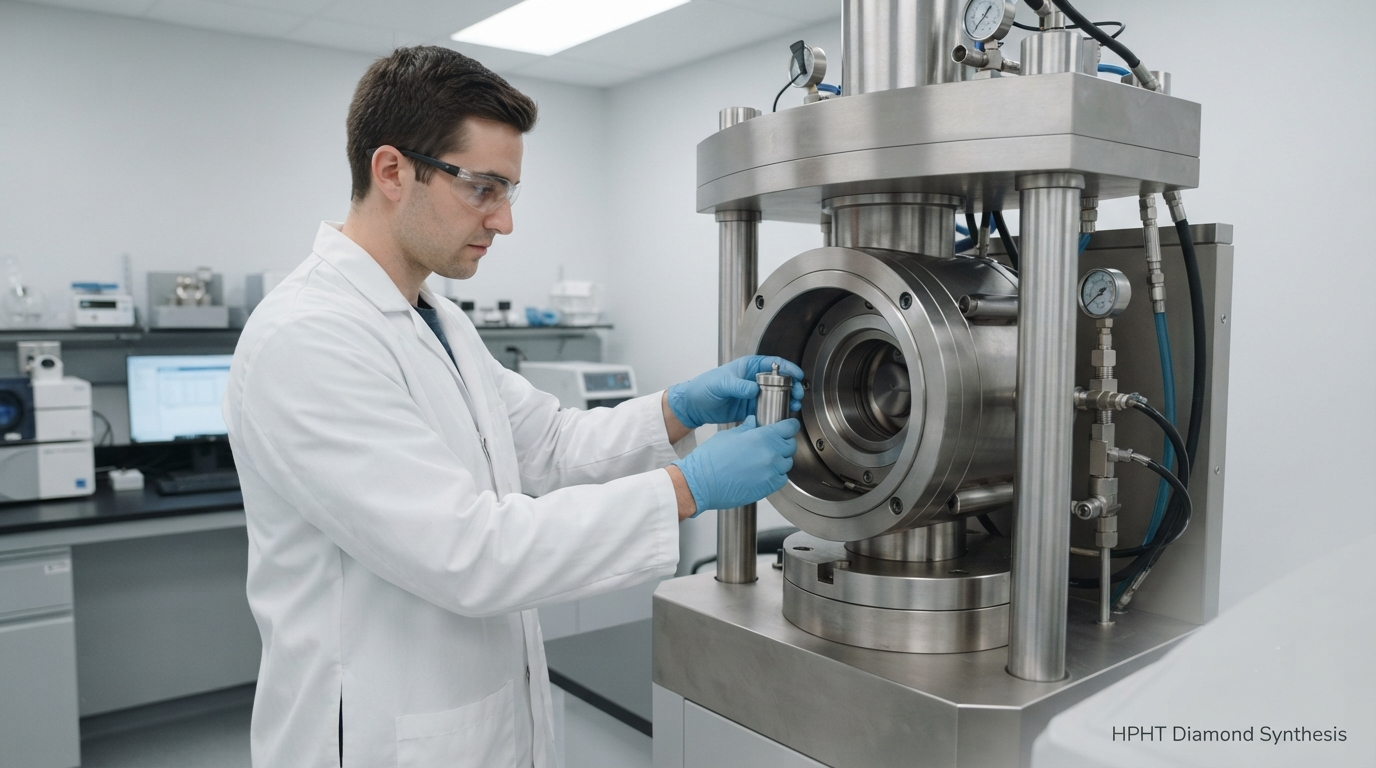
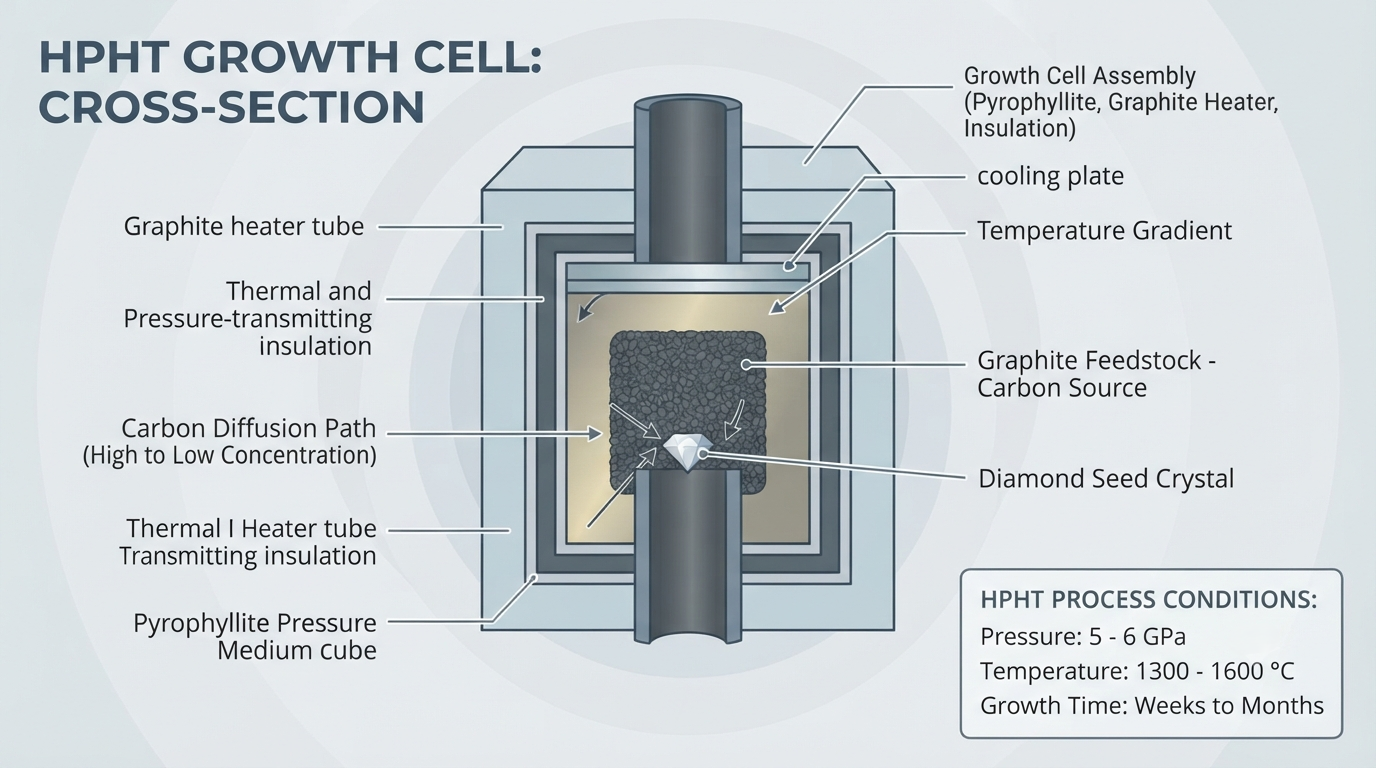
Growth uses the methods the whole lab grown memorial diamond category relies on. HPHT is the common route: a press squeezes the growth cell to roughly 6 to 8 gigapascals while the temperature is held between about 1,400 and 2,500 degrees Celsius. CVD, used by a minority of providers, deposits carbon from a gas onto a seed plate in a vacuum instead.

Hardness comes out at 10 on the standard mineral hardness scale, meaning a gem really made from son ashes and hair can be worn daily, set in a ring, and treated as ordinary jewelry rather than something fragile.

Laboratory testing will correctly report a stone really made from son ashes and hair as grown rather than mined. That is a statement about method, not about legitimacy, and it applies equally to every laboratory diamond on the market.

What Should the Paperwork Itemise for Two Materials?

More than a single material submission would, and this is where a mixed commission is genuinely different. Documentation for something really made from son ashes and hair has to account for two arrivals, not one.

  • Two intake records, each with its own unique identifier, dated and described separately.
  • A custody trail for each, tracking both samples through processing up to the point they are pooled.
  • A written statement of the pooling step, when the two were combined, or confirmation that they were not.
  • The provider’s own percentage estimate, given in writing, since no published figure covers a blended charge.
  • An authenticity or origin certificate, normally an in house document naming both materials.
  • An optional independent grading report, which assesses the stone itself rather than its origin.
  • A stated policy on leftovers, covering unused ash and unused hair separately, since a submission really made from son ashes and hair generates two kinds of surplus.
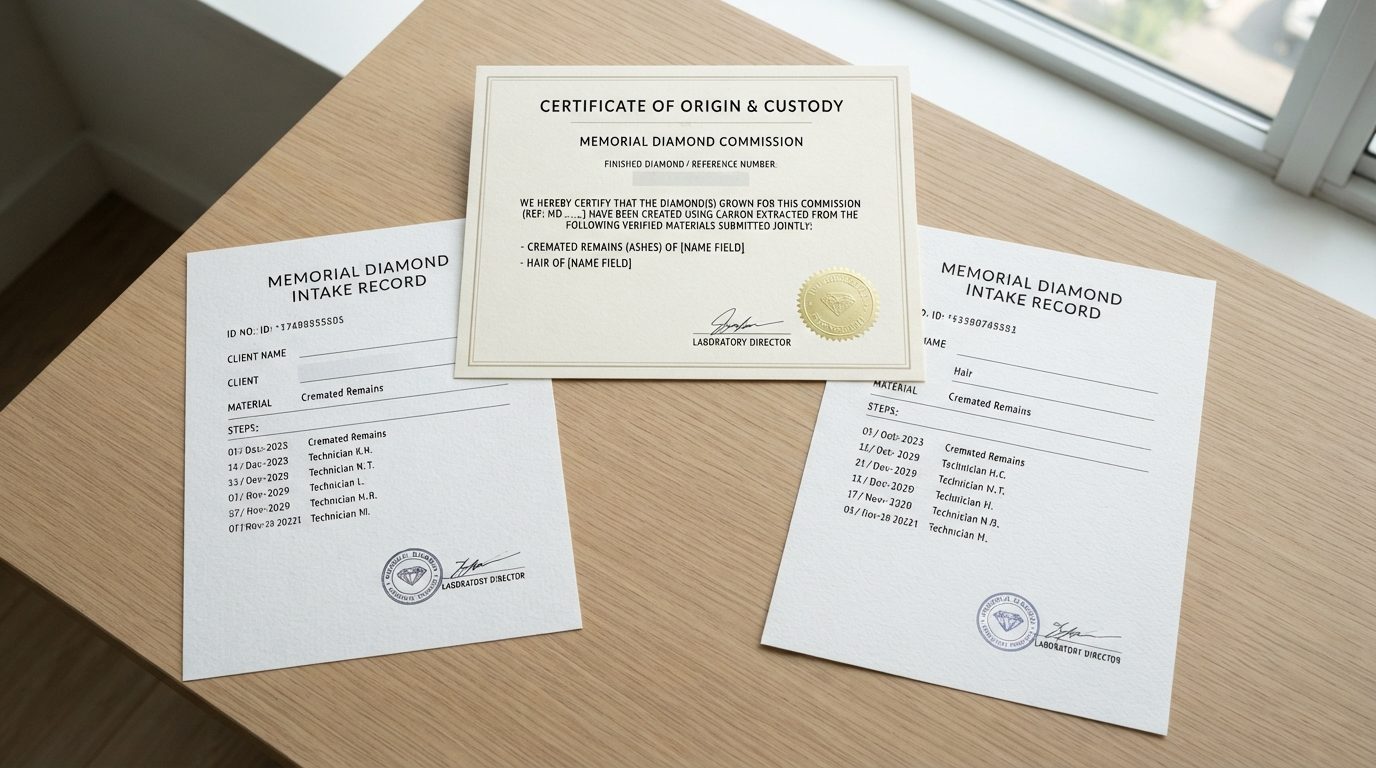
Two separate intake records and a shared origin certificate laid out on a desk

That sixth point is the one families most often misread. An independent grading report judges the stone’s cut, color, clarity and carat against the standards applied to any diamond, it cannot confirm that a stone is really made from son ashes and hair, because no third party laboratory witnessed the growth cell being loaded. Only the custody documentation speaks to origin. Questions to ask before you commit puts these on a single checklist.

Could You Have One Stone From Each Instead?

Often, yes. Splitting a commission really made from son ashes and hair resolves a disagreement that a single pooled stone would not.

Because only a portion of a cremation is ever used, and because hair needs so little to begin with, a submission of both materials can frequently support more than one diamond. That opens options a single commission really made from son ashes and hair does not: one stone for each parent, or a stone from the ash for one person and a stone from the hair for another.

It also matters when parents are separated, or when a family is quietly divided about the whole idea. Two smaller stones can be easier to agree on than one larger one that must eventually live in a single house.

Ask three things before deciding: whether your quantities support multiple stones, whether they would be grown in the same run or separate ones, and how each is documented. Growing two of anything really made from son ashes and hair costs more than growing one, so ask for pricing on both shapes of the plan. Whether siblings can each have a stone covers the family side of that question.

What If Only One of the Two Is Usable?

It happens, and it is better to know the policy in advance than to discover it mid process. A sample can arrive too small, too contaminated, or too degraded to yield workable carbon.

Hair is the more common casualty. A lock stored somewhere damp for years, or a few strands so fine they barely register on a scale, may not survive purification in a usable quantity. Ash is more forgiving, since remains are chemically stable in storage, though a very small portion submitted for a piece really made from son ashes and hair can still fall below what a growth run needs.

Ask three things before you post anything. What happens if one sample proves unusable, does the run continue on the other material alone, with your agreement? Are you told before that decision is made, or afterwards? And is any part of the fee adjusted?

The answers matter emotionally as well as practically. A parent who sent both materials because both mattered should not learn after the fact that only one made it into the crystal. Good providers stop and telephone; the arrangement for something really made from son ashes and hair should say so in writing.

Get that in the same email as the percentage estimate, so everything you were promised about a stone really made from son ashes and hair sits in one place you can find again.

Is Either Sample Identity Checked?

Parents reasonably assume somebody verifies that both samples came from the same person. In honesty, no public account of how this sector operates settles whether identity or genetic verification is performed on what families send, so treat a confident claim either way, a flat denial included, with care.

That makes it something to ask rather than something to look up. Ask whether any verification step exists in their process for a commission really made from son ashes and hair, at which stage it happens, and what record of it you receive.

With two materials there is a second, more practical version of the question. For anything really made from son ashes and hair, does the laboratory confirm that both envelopes belong to the same commission before pooling them? That is a workflow question a competent provider can answer immediately.

Who Signs Off, and Is It the Same Person for Both?

Not necessarily, and families arranging something really made from son ashes and hair are often surprised by it. The two materials can sit under different considerations.

For cremated remains, most states set a statutory order of priority over the disposition of a decedent’s remains. A surviving spouse or partner is commonly at or near the front of that order, and your son’s own adult children may rank ahead of his parents. Anything he put in writing can rearrange that order, and the rules differ from one state to another, so authority over the ash portion of anything really made from son ashes and hair is worth confirming rather than assuming.

Hair is a different conversation. Those statutory rules are aimed at the remains themselves, so a lock already in your possession is usually the simpler question in practice, though belongings can fall within an estate, the position varies by state, and a sample held by someone else is something to discuss with them rather than decide for them.

Where the two answers point to different people, that is worth knowing before anything ships rather than afterwards. A funeral director or a local attorney will settle it quickly. How a memorial diamond is made from both covers what happens once the material is on its way.

What Does a Diamond Really Made From Son Ashes and Hair Cost?

Submitting two materials rather than one does not itself change the price. What drives cost is carat weight, color and any extras, and using general 2026 industry ranges rather than a specific company’s rates, a stone of about 0.10 to 0.25 ct sits near $1,500 to $3,500, a half carat to one carat stone near $5,000 to $15,000, and anything from two carats upward from $20,000 to $75,000 or beyond.

Colorless commands a premium over yellow, blue or champagne at the same weight, because keeping trace elements out takes more process control. Settings, engraving, fancy cuts and an independent grading report are normally quoted on top of the stone.

On timing, the usual industry span is six to ten months from receipt, reaching about twelve for large stones or specialty colors such as black. Growth time sets the size, so a commission really made from son ashes and hair takes no longer simply because two materials were submitted. What a son memorial diamond costs goes tier by tier.

Frequently Asked Questions

Do we have to send both at the same time?

Usually not, but ask first. Some providers prefer both samples in hand before processing begins so they can be logged against one commission; others accept a second material later. Confirm the sequence before you post anything, since it affects the documentation.

Does adding hair mean less ash is needed?

Possibly, and it is worth asking directly. Because hair carries a far higher proportion of carbon than cremated remains do, some laboratories may adjust the ash quantity requested when hair is included. Requirements vary between providers, so get your own answer confirmed.

Can the two materials be identified separately in the finished stone?

No. Once the carbon from both is purified and pooled, nothing distinguishes one source from the other inside the crystal, carbon atoms carry no origin marker. What identifies the submission is the paperwork trail, not anything visible or testable in the stone.

Will using two materials change the color?

No color can be predicted or promised for a stone really made from son ashes and hair. Trace elements decide the outcome, and a cleaner or mixed starting material does not make the result controllable. Discuss color preferences early and ask what the provider can genuinely influence.

What if we only have a very small amount of each?

Say so when you inquire rather than sending everything and hoping. A laboratory can tell you in advance whether your combined quantities support the stone size you want, or whether a smaller carat would be the realistic option instead.

Can the rest of his ashes still be buried or scattered?

Yes. Only a portion is used, so interment, scattering, keeping an urn at home, or dividing the remainder among relatives all stay open to you. Choosing a diamond does not close off or diminish any other plan the family has made.

Final Thoughts on Sending Both Ashes and Hair

Families who send both are usually trying to leave nothing of him behind, and that instinct deserves a truthful reply rather than a comforting one. Both materials genuinely contribute carbon to a stone really made from son ashes and hair. Both are genuinely inside it. Neither makes it pure, and no published figure yet describes what the combined share works out to be.

So the work in front of you is narrow: get the provider’s own percentage estimate in writing, find out whether they pool or grow separately, and check that the documentation accounts for two arrivals rather than one.

If you go ahead with a diamond really made from son ashes and hair, settle the authority question for the ash and the conversation about the lock before anything ships, and take as long over the decision as you need. Nothing in the material degrades while you think.

Learn More About Son Memorial Diamonds

Talk With Memorial Diamond

Two materials raise questions one material does not. Memorial Diamond is at memorialdiamond.us if you would like to hear how each of yours would be logged, processed and documented. The reply should describe your own submission, not a general case.

Word count: 2,915 words
Reading time: about 15 minutes

Wife memorial diamond FAQ featuring a memorial diamond, keepsake box, family questions, and memorial jewelry

Wife Memorial Diamond FAQ: Everything Families Ask

You have probably opened six tabs by now, and none of them answers the thing you actually want to know.

This wife memorial diamond FAQ answers the whole question in one line first: a memorial diamond for a wife is a real lab grown diamond containing a purified portion of her own carbon, grown over roughly six to ten months from either her ashes or a lock of her hair. Everything below is sorted into six subject bands, so you can read the one you need and leave the rest.

Said plainly, because a page like this reads as neutral and is not: Memorial Diamond wrote this wife memorial diamond FAQ and grows memorial diamonds for a living. Several answers below deliberately point you at questions to put to a company, including this one, rather than at an answer we could simply assert.

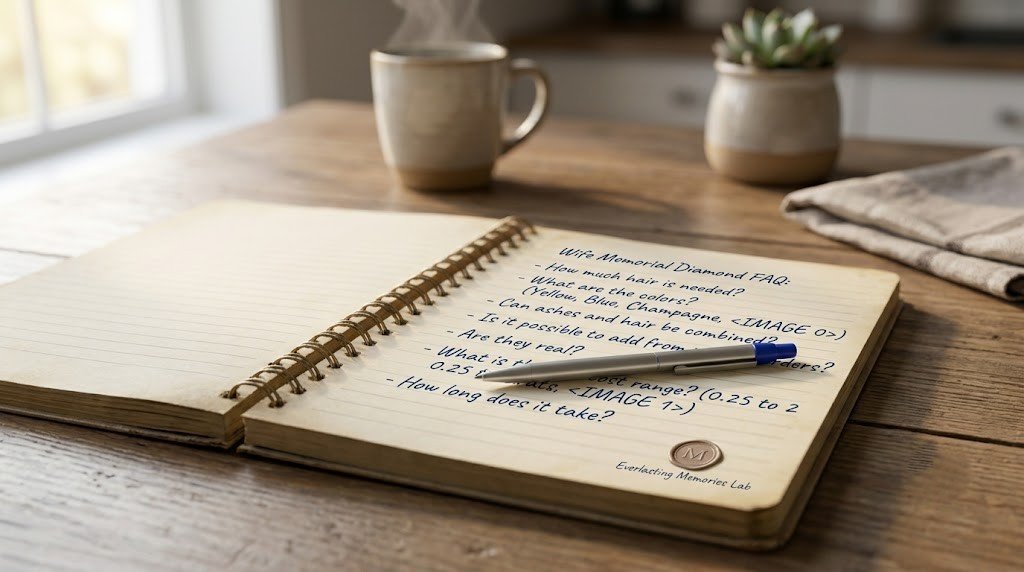
 Wife memorial diamond FAQ: an open notebook of handwritten questions on a kitchen table in morning light, a pen resting across it |

Table of Contents

How This Wife Memorial Diamond FAQ Is Organized

Six bands, three questions each, plus the seven asked most often gathered at the end. Twenty five short answers in total, each pointing at the page that covers it at length.

The bands are subjects rather than stages, because questions about a wife memorial diamond do not arrive in a tidy order. Someone can be certain about color and completely unsure whether the decision is theirs to make. Read whichever band matches the sentence you would have typed into a search box, and ignore the other five until they become relevant.

BandWhat it settlesWhere the long answer lives
1. Before you decideWhether this is a real thing to want, and whether it is yours to decideWhere to start
2. Material and quantityAshes or hair, how much, and what happens to the restHow much ash a stone needs
3. The process and the waitWhat physically happens, and how long it takesHow long it takes
4. The stone itselfWhether it is real, what color it will be, how it is gradedWhat color to expect
5. MoneyWhat it costs, what is extra, and how to think about insuring itWhat it costs
6. After it arrivesPaperwork, family, and what happens to the stone laterUrn and diamond compared

One fact underpins nearly every answer below about a wife memorial diamond, so it goes here rather than being repeated six times. A memorial diamond does not consist entirely of her. A growth cell needs far more carbon than ashes or hair can supply on their own. What comes out of her sample is refined to near pure carbon and then made up to working volume with lab grown carbon, which is the only way a run of that size happens at all. What is hers is genuinely present and genuinely traceable; it is not the whole stone, and any page that tells you otherwise is selling something.

Band 1: Before You Decide, Where Does This Even Start?

Nothing in this band costs anything, and none of it needs settling this week. These are the questions people ask before a wife memorial diamond is a plan rather than an idea.

Is it strange to want a diamond made from her?

No. The question underneath it is usually sharper: whether a wife memorial diamond would really contain her or only stand in for her. That has a chemical answer rather than a social one. A genuine, purified portion of her carbon is grown into the crystal lattice, which makes it an object that exists because she did, not a symbol chosen to represent her. That distinction is usually what the question is really about, and it is the part that survives being explained to a skeptical relative.

Is this mine to decide?

Probably, but it is worth establishing rather than assuming before a wife memorial diamond is ordered in anyone’s name. Two things govern it and neither one is national. The first is your own state’s statute, which ranks the people entitled to direct what happens to cremated remains. The second is anything she committed to paper, a will, a cremation form she signed, or an agent she named, which can reorder that ranking. A surviving spouse commonly sits near the top, but treat that as background rather than an answer and confirm it with the funeral home or an estate attorney where you live.

Does this cancel what we already planned for her ashes?

No. A wife memorial diamond uses a portion, not the whole, so an urn on a shelf, a burial, a niche or a scattering somewhere she chose can all still happen exactly as arranged. None of those is a lesser option, and a stone replaces none of them. The only thing that closes the route is a scattering or interment that goes ahead with nothing held back, which is why asking for a small portion to be set aside beforehand is worth doing even when you have decided nothing.

Band 2: Material and Quantity, Ashes or Hair, and How Much?

Every figure in this band is industry wide rather than any one company’s stated terms, and every one of them applies to a wife memorial diamond grown from either material.

Ashes or hair, which do I actually need?

Either material makes a genuine wife memorial diamond. What separates them is how much carbon each one actually holds. Ash is dominated by calcium phosphate, and only about 0.5% to 4% of it by weight is carbon you can use. A lock of hair is around 50% carbon, keratin being a carbon rich protein. That gap is why a hair order needs so much less material, and why it needs no cremation to have happened at all, which matters if she was buried rather than cremated.

How much of her ashes does one stone use?

A small share. Industry wide, a single wife memorial diamond order works from somewhere between a few tablespoons and roughly four ounces, about 100 grams, against the several pounds a full adult cremation produces. A hair order typically needs only a small lock or a few grams. How much ash a stone needs gives the ranges and what remains afterward.

Can I still do this if her ashes were scattered, or if she was buried?

Often, yes, through hair rather than ashes. Hair requires no cremation to have happened, so a lock kept in a box, an envelope from years ago, or hair still on a brush can all be the starting point for a wife memorial diamond. If she was cremated and scattered, it is still worth one call to check whether a portion was held back at the time. Funeral homes sometimes retain a small amount without anyone registering it in the week it happened, and a keepsake container given to a relative counts too.

Band 3: The Process and the Wait, What Happens While You Wait?

This band is the part of a wife memorial diamond FAQ people skim on the first visit and come back to in month four, when the silence has gone on longer than expected.

What physically happens to the material?

Five stages, and they are the same five for every wife memorial diamond regardless of material. The material is received under chain of custody tracking; carbon is extracted and purified to around 99.9%; that carbon is graphitized at roughly 2,500 to 2,700°C; the graphite is grown into a diamond in an HPHT press at roughly 6 to 8 GPa and 1,400 to 2,500°C around a seed; and the rough stone is then cut, polished and graded.

How long does a wife memorial diamond take?

Industry wide, a wife memorial diamond takes roughly six to ten months of production from the point a laboratory receives the material, sometimes stretching toward twelve for larger or specialty color stones. Carat is the main driver, because size is bought as growth time in the press. Anything before the material is sent sits outside that window. How long it takes covers planning around it.

Is there anything I am supposed to do while I wait?

Nothing at all. Growing a wife memorial diamond asks nothing of you between sending and arrival, and there is no stage you can hurry by asking. If you want a task, the useful ones are administrative: writing down where the remainder of her ashes is, and making sure the people who should know what has been arranged actually do. Some people find it helps to note the date the material was sent and who confirmed receiving it, simply because that page is the only record you will hold during the months when nothing visible is happening.

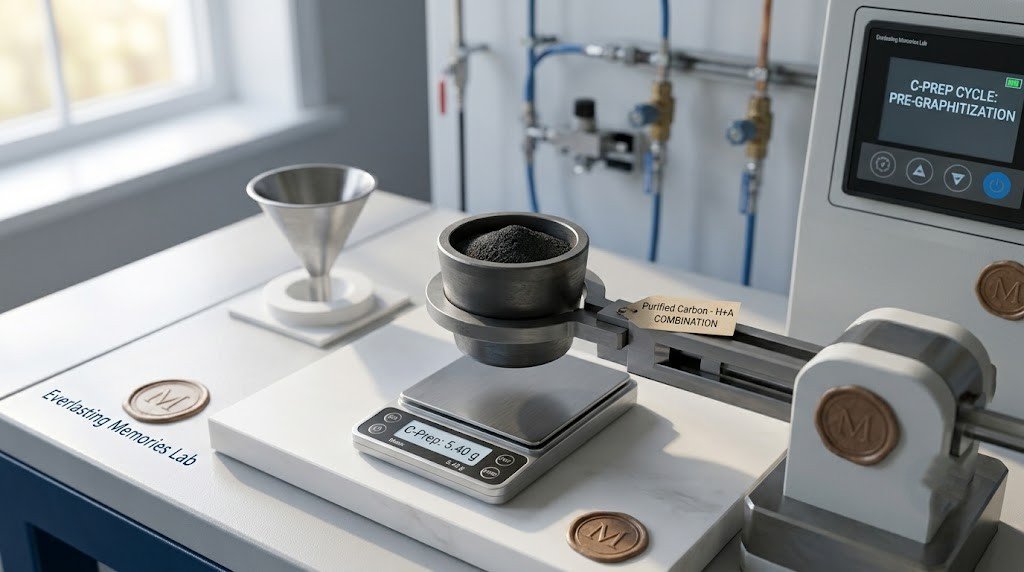
Purified carbon prepared for graphitization in a laboratory crucible ahead of a diamond growth ru

Band 4: The Stone Itself

The band where expectations about a wife memorial diamond most often need adjusting before the box is opened.

Is it a real diamond?

Yes. A wife memorial diamond is a lab grown diamond, which is a real diamond rather than a simulant. Same carbon lattice, same optical behavior, and a 10 on the Mohs scale of mineral hardness, the hardest known natural mineral. Nothing is suspended, embedded or encased inside it; the carbon is part of the crystal structure itself.

What color will it be?

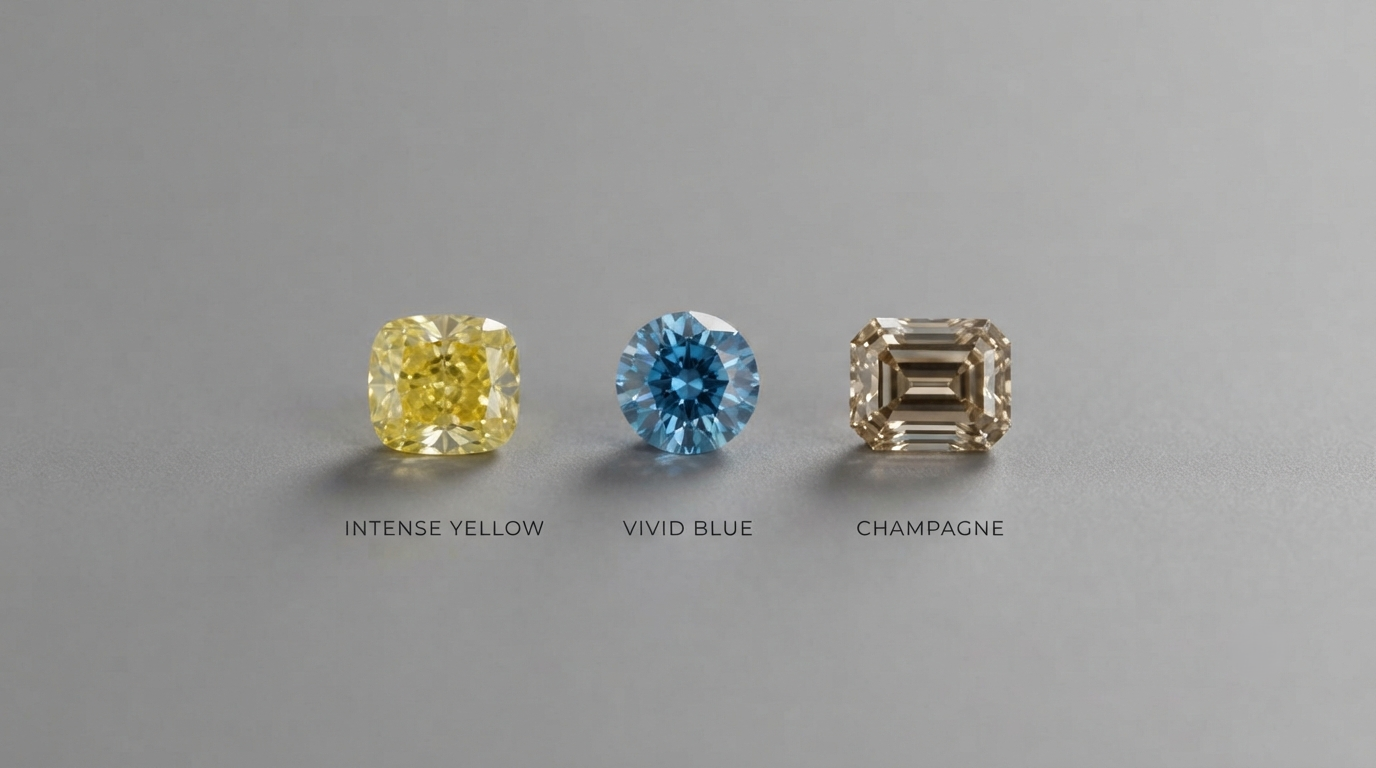
Not something anyone can promise in advance, and a wife memorial diamond is no more predictable than any other stone grown from an organic source. What sets the tint is the company the carbon keeps while the crystal builds: nitrogen in the lattice yields yellow, boron yields blue, and a colorless stone is one where neither has been allowed to register. Organic carbon rarely arrives that empty handed, which is why yellow, blue and champagne are the tones this category actually produces. What color to expect explains the range.

Is it graded and certified like any other diamond?

Reputable providers have a finished wife memorial diamond graded on the same four Cs as any other diamond, cut, color, clarity and carat, and typical clarity for memorial stones lands in the SI2 to VVS range. Ask whether grading is in house or from an independent third party laboratory, and ask for the origin record separately; the two documents do different jobs. A grading report describes the stone the way it would describe any diamond. An origin record describes where the carbon came from. Neither substitutes for the other, and a company that offers only one should be asked plainly why.

Band 5: Money

Costs here are the general industry picture for a wife memorial diamond, not any one company’s published pricing.

What does a wife memorial diamond cost?

Industry wide, an entry tier wife memorial diamond of roughly 0.10 to 0.25 carats runs around $1,500 to $3,500; half carat to one carat stones roughly $5,000 to $15,000; and larger or rarer stones climb from there. Colorless costs meaningfully more than yellow, blue or champagne at the same size. What it costs breaks the tiers apart properly.

What is priced separately from the stone?

Usually more than people expect. An independent grading report, engraving, a fancy cut and any jewelry setting, ring, pendant, earrings, are typically quoted on top of the loose wife memorial diamond rather than included in its price. Ask for a written breakdown of what a quoted figure does and does not cover before comparing two companies’ numbers. Two quotes that look a thousand dollars apart can be identical once a grading report and a setting are added to the cheaper one, and the only way to see that is to have both itemized in the same terms.

Should I insure it, and can it be financed?

A wife memorial diamond is a graded gemstone, so in principle it can be scheduled like any other diamond. But coverage, valuation and what a claim would even mean for an irreplaceable stone are questions for an insurance professional, and financing terms are questions for whoever is offering them. Both sit outside what a jewelry company is positioned to answer for your situation.

Band 6: After It Arrives

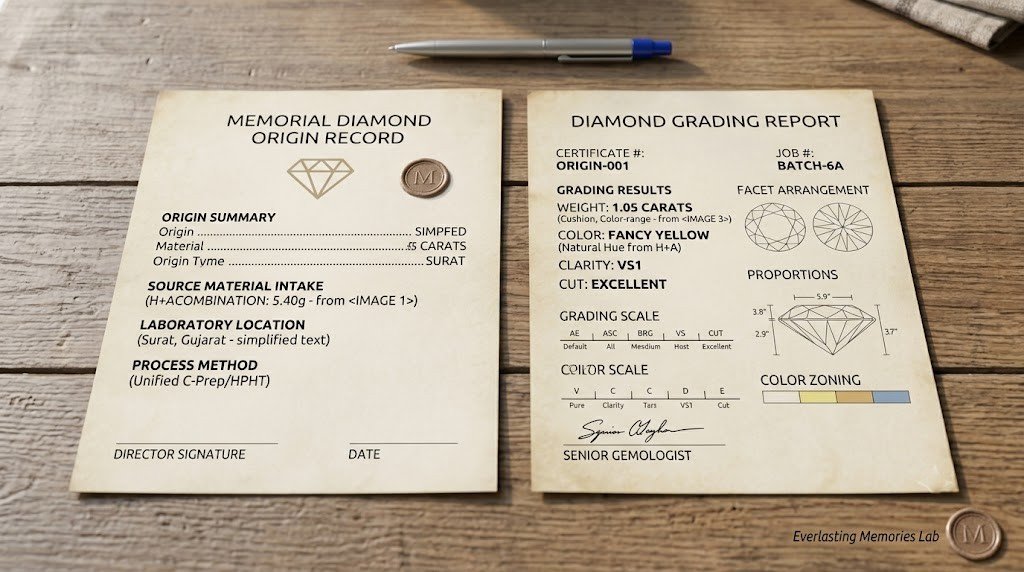
Two documents side by side on a desk, one an origin record and one a diamond grading report, no laboratory name legible

The band nobody rehearses, because a wife memorial diamond does not feel real until the box is open.

What should arrive with the stone?

Two separate documents should accompany a wife memorial diamond, and both are worth asking for by name before you order. One is an origin or authenticity record tying the stone to the material you submitted. The other is a grading report covering the diamond’s own cut, color, clarity and carat, ideally from an independent laboratory. Ask what each one contains, who issues it, and whether it arrives with the stone or separately. It is also worth asking what happens if a document is lost years later, since an origin record is what connects the object to the material you sent and nothing about the stone itself carries that information.

Can more than one person have a stone from the same ashes?

Usually, yes, because one wife memorial diamond uses only a portion of the remains. How many depends on the quantity you hold, the sizes chosen and each company’s stated minimum, and each stone is a separate order at a separate price. What to settle before more than one person orders covers the family side.

Where does the stone go after me?

Wherever you name, in writing, somewhere findable. Unlike an urn, a wife memorial diamond has no default custodian; it looks like any other stone to anyone who has not been told what it is. How that is handled varies by state, so it is worth raising with an estate professional rather than assuming your existing documents already cover it.

Two documents side by side on a desk, one an origin record and one a diamond grading report, no laboratory name legible

Frequently Asked Questions

Seven questions cut across every band above. These are the ones asked most often about a wife memorial diamond, regardless of where in the process someone is standing.

Is a memorial diamond made from a wife’s ashes a real diamond?

Yes, a lab grown one, which is a real diamond and not a simulant. Same carbon lattice, same 10 on the Mohs scale, graded on the same cut, color, clarity and carat as any other stone. Nothing is suspended inside it.

How much of my wife’s ashes does a memorial diamond use?

Only a portion. Industry wide the requirement runs from a few tablespoons up to roughly four ounces, about 100 grams, a small share of what a cremation produces, so the rest stays with you. Each provider sets its own minimum.

How long does a wife memorial diamond take to make?

Industry wide, roughly six to ten months of production from the point the material is received, sometimes reaching twelve for larger or specialty color stones. Carat drives the timeline, because size is bought as growth time rather than as material.

Can I make a memorial diamond years after my wife died?

Yes. Ashes are stable mineral matter that does not degrade on a shelf, and a dry, labeled hair sample stays usable indefinitely. What cannot be recovered is what was never kept, hair never collected, or ashes already scattered with nothing held back.

Is the diamond made entirely from my wife?

No, and no honest provider will claim otherwise. A genuine, purified portion of her carbon is grown into the crystal, then combined with lab grown carbon to reach the volume a growth run requires. The personal carbon is really there; it is not the whole stone.

What color will a diamond made from my wife’s ashes be?

Nobody can forecast it precisely. Yellow means nitrogen found its way into the lattice, blue means boron did, and colorless means neither did in any amount that shows, which is why organic sources so often land on yellow, blue or champagne instead.

Do I have to give up her urn to have a diamond made?

No. A diamond uses only a fraction of the ashes, so the urn keeps the rest and can stay exactly where it is. Keeping an urn whole is a complete answer in its own right and needs no justification.

Final Thoughts on This Wife Memorial Diamond FAQ

If you came here for one answer and found twenty five, the useful takeaway is narrower than it looks. Most of the twenty five exist because one question leads to another, not because the decision is complicated in itself. Almost nothing in this wife memorial diamond FAQ carries a deadline. Ashes do not deteriorate, hair kept dry and labeled does not expire, and a quote is a figure to reconfirm rather than a countdown.

Two things do close: hair that is never collected, and a scattering or interment that goes ahead with nothing set aside. Neither of those is about a wife memorial diamond specifically. Both are about keeping a route open, which costs almost nothing and can be done long before anybody decides anything. Everything else on this page will wait as long as you need it to, including the decision not to do any of it.

Learn More About Wife Memorial Diamonds

Talk With Memorial Diamond

Most of the answers above about a wife memorial diamond stop at the point where the honest response is “ask the company”, what they accept, in what quantity, what documentation is issued, and when each decision stops being changeable. That is not evasion; it is where general information genuinely runs out.

Memorial Diamond is one of the companies you can put those questions to, at memorialdiamond.us. Ask the same list of everyone you are considering, and ask for the answers in writing. If the outcome is that you decide against it, or decide to wait a year, nothing has been lost, which is more than can be said for most decisions that have landed on you recently.
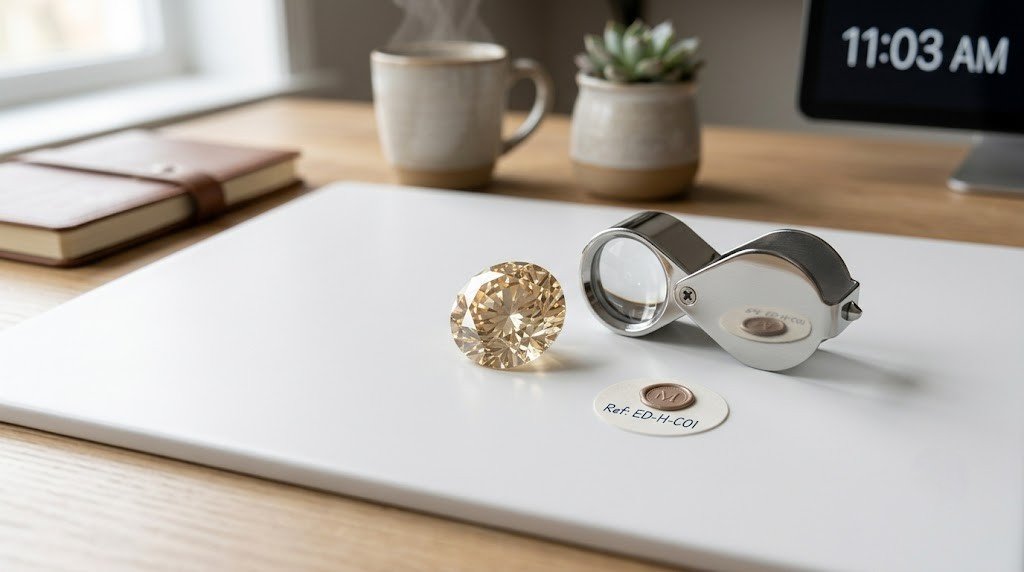
Memorial diamond made from son hair: a small blue-toned lab-grown stone beside a bound lock of hair

How a Memorial Diamond Is Made From Your Son’s Hair

Almost every parent asks the same thing first, and it is not a question about chemistry: what will I actually be told, and when? A memorial diamond made from son hair is produced by extracting carbon from a small lock of his hair, purifying it, converting it to graphite and growing it into a real diamond over roughly six to ten months, and across that span there are about six moments when a laboratory genuinely communicates with you. This page is organized around those six moments rather than around the machinery.

What Do You Send, and How Should You Prepare It?

The first point of contact is the one you control entirely. A diamond made from son hair typically begins with a small lock, often described across the industry as a few grams, or a palm sized amount, rather than anything approaching a full head of hair.

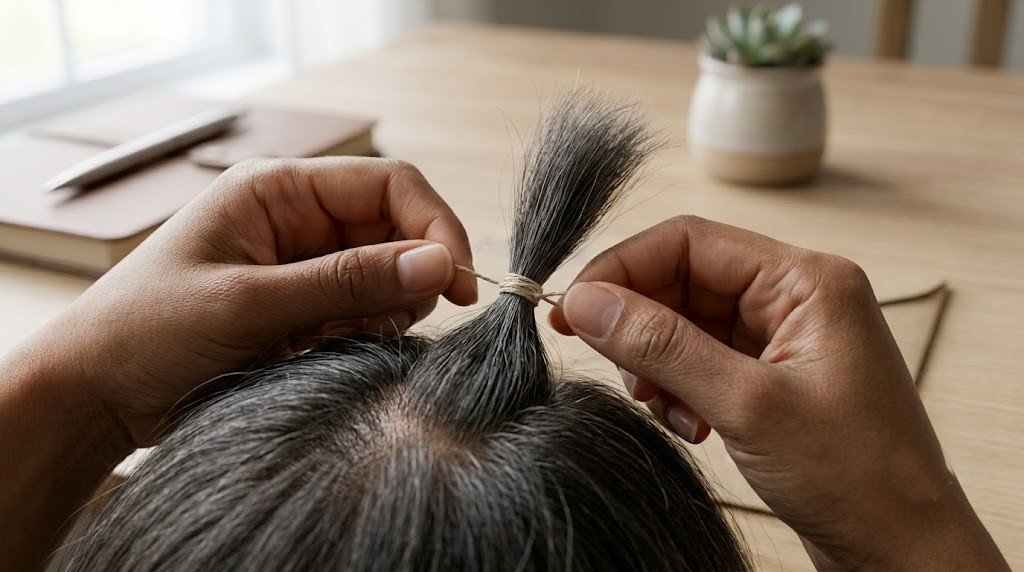
Most providers ask for hair in a clean, sealed paper envelope rather than plastic, since paper lets residual moisture escape. Bind it with thread so it does not scatter in transit. Write nothing on the hair itself. Labels belong on the envelope, and a stone made from son hair should never be delayed because a marker pen was used on the sample.

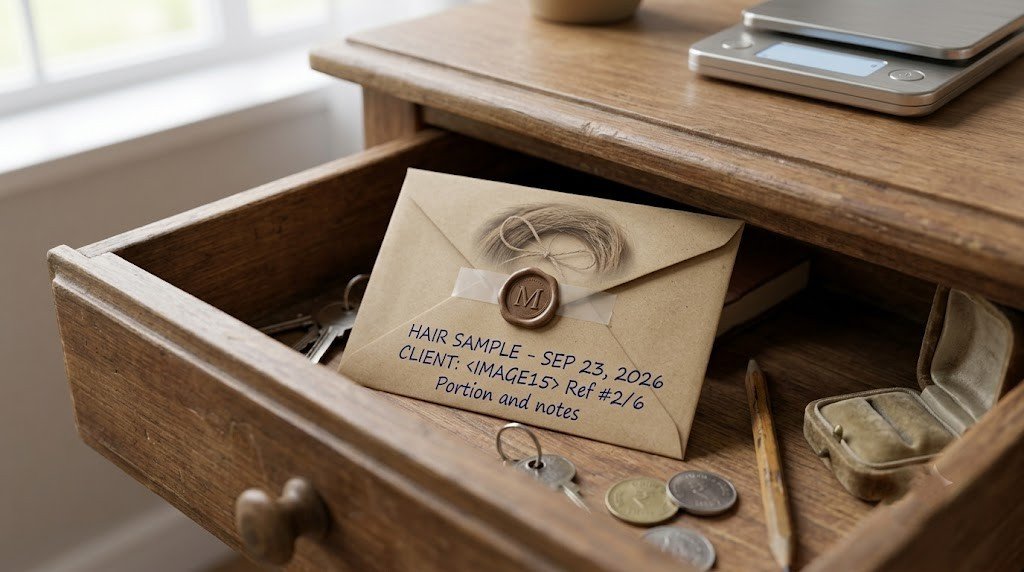
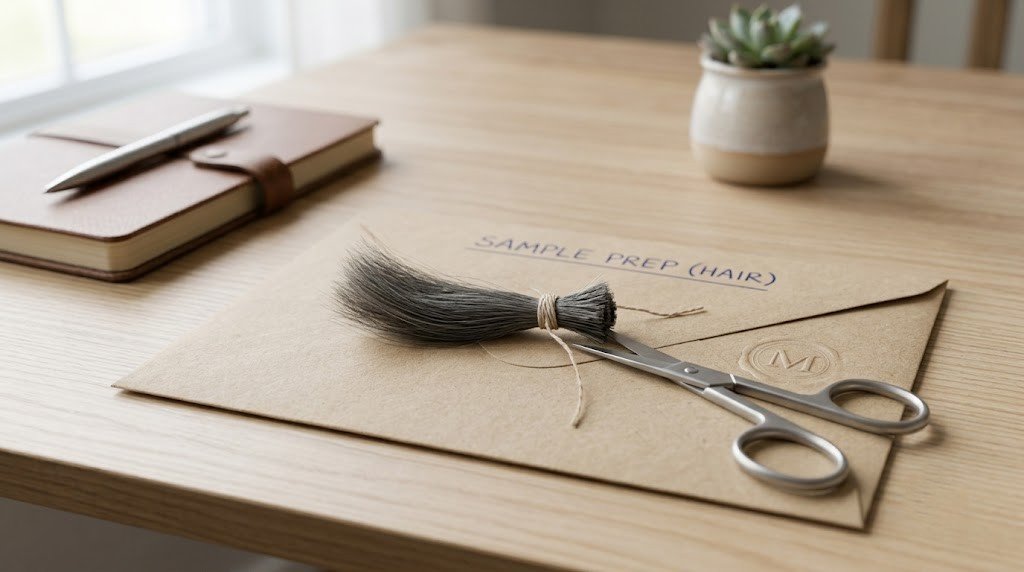
Lock of hair bound with thread, resting on an open paper envelope ready for posting

Where the hair came from matters far less than parents expect. A childhood lock kept in a book, an envelope from a barber, hair from a brush nobody emptied, a sample taken at a hospital or by a funeral director, any of these can become a diamond made from son hair, whether your son was six or sixty when he died.

Two things do matter, and both are worth mentioning at intake: whether the hair was bleached, dyed or chemically treated, and whether it is very fine or very short. Neither rules out a stone made from son hair, but both can change how much a laboratory asks you to send. How much hair a lab needs goes into the quantities properly.

Who Should You Speak To Before You Post His Hair?

This is the conversation parents most often skip, and the one most likely to matter later.

The rules governing what may be done with a person’s remains are written about the remains themselves. A lock of hair you have kept at home for years is therefore usually the simpler question in practice, but it is not a question with no answer at all. A decedent’s personal belongings can form part of his estate, the treatment varies from state to state, and where the sample sits in somebody else’s keeping, asking for it is a conversation rather than something you settle alone.

The people with standing are worth naming plainly. If your son was married, his surviving spouse may hold authority over his remains ahead of you, and in many states so may his own adult children. Anything he set down in writing can change that ordering. If any of his ashes are also involved, that authority question applies squarely and should be settled first.

None of this is a reason not to proceed. Parents commission a diamond made from son hair every week without difficulty, and a single parent arranging it alone, separated, widowed, or simply the one who can face the logistics, is entirely ordinary. How to turn his hair into a diamond walks through the same decision from the family’s side. Raise it early with whoever else loved him, and where the sample is not yours to begin with, ask rather than assume.

What Do You Hear Back in the First Fortnight?

The second point of contact comes shortly after the package arrives. You should expect confirmation of receipt, an identifier assigned to the sample, and whatever intake paperwork that provider uses.

That identifier is the thread you can actually pull on later. Everything made from son hair in a given batch should be traceable against it from receipt to return, and you are entitled to ask to see that record at any stage rather than only at the end.

This is also when a laboratory will tell you if the sample is insufficient. It usually resolves with a second envelope. Hair from a brush, from an older keepsake, or from more than one collection point can generally be combined, and a diamond made from son hair grown from two envelopes is no different from one grown from a single lock.

Ask three things while you have someone’s attention: what the identifier is, what happens to hair not consumed, and whether the estimate quoted for a diamond made from son hair has changed now the material is weighed.

What Are You Told While a Diamond Made From Son Hair Grows?

Honestly: not very much, and that is the hardest part of the whole arrangement.

Between intake and cutting, a diamond made from son hair passes through stages that produce no photographs and no milestones a family can meaningfully witness. The hair is heated in a controlled, oxygen free, multi stage process that strips away everything that is not carbon, reaching roughly 99.9% plus purity. That purified carbon is then heated to somewhere around 2,500 to 2,700°C and converted into graphite. The graphite, combined with supplemental lab sourced carbon to reach a workable volume, goes into a growth cell around a tiny diamond seed.

Then a press holds that cell at pressures in the region of 6 to 8 gigapascals and temperatures between 1,400 and 2,500°C for weeks to months. A minority of providers grow by CVD instead, depositing carbon from gas onto a seed plate in a vacuum. Either way, the chemistry is the same as any other laboratory grown diamond, the origin of the carbon is what differs.

Here is what you should realistically expect to receive, and when:

Point of contactWhat you getTypical timing
1. You send the sampleShipping instructions and an intake formWeek 0
2. Receipt confirmedIdentifier, chain of custody record, any request for more hairWeeks 1 to 2
3. Extraction completeConfirmation that carbon was successfully recoveredWeeks 3 to 10, varies widely
4. Growth underwayUsually a start date and an estimated completion windowVaries
5. Cutting and optional gradingCut confirmation, a grading report if you ordered oneNear the end
6. DeliveryThe finished stone, its documentation, any returned hairMonth 6 to 10 typically
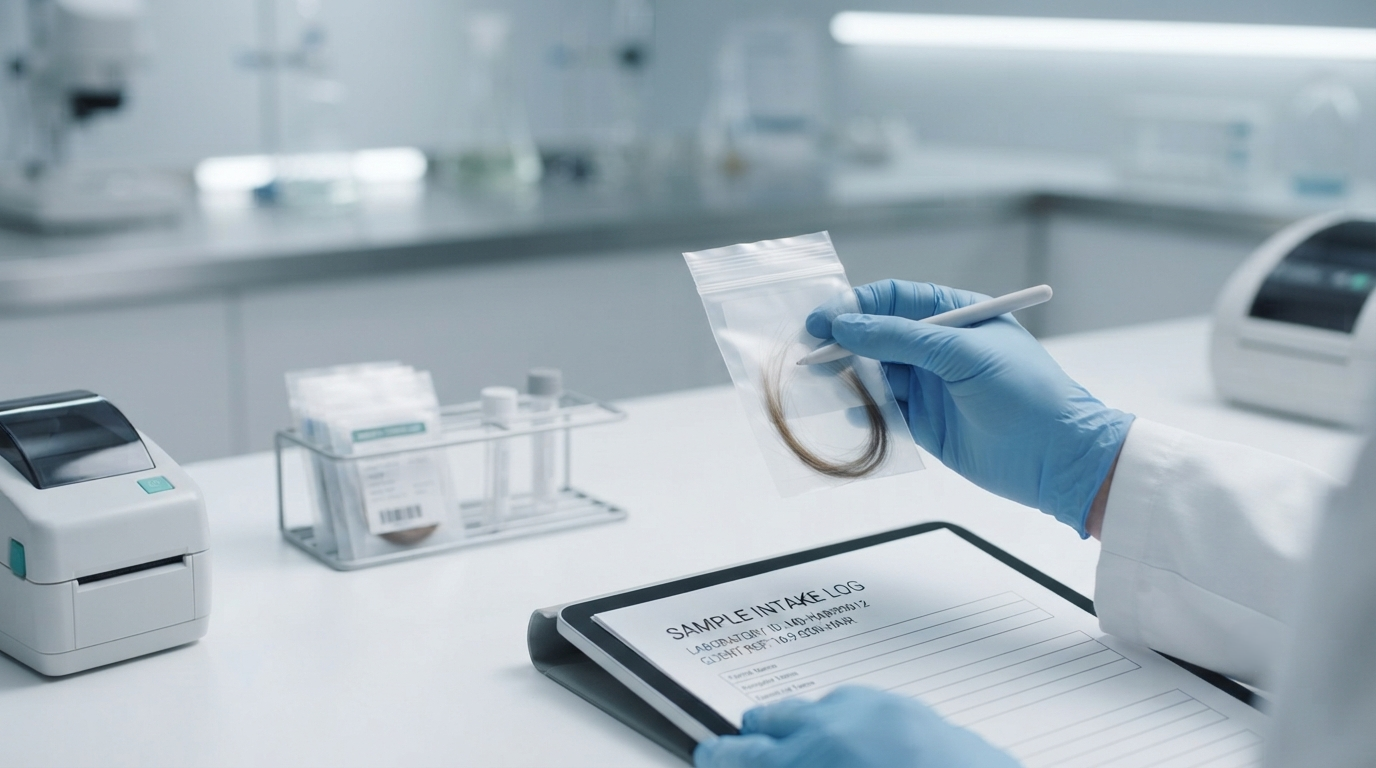
Laboratory technician logging a sealed hair sample against an intake identifier

Ask at the outset which of these six you will actually be contacted at, because providers differ enormously, and a diamond made from son hair grown in near silence for eight months is a very different experience from one with a check in at every stage.

What Should You Ask at Each of the Six Points?

These are the questions parents most often wish they had asked earlier. Put them in an email, so the answers survive a change of staff.

  1. Before you send: how much hair do you need for the size I want, and does treated or fine hair change that figure?
  2. Before you send: what is your contingency if the sample turns out to be insufficient once weighed?
  3. At intake: what identifier have you assigned, and may I see the custody record for anything made from son hair in this batch?
  4. After extraction: did the recovery go as expected, and has anything about my quote changed?
  5. Before growth: what proportion of this diamond made from son hair do you estimate will be carbon recovered from him, and on what basis?
  6. Before growth: what color range are you expecting, and what happens if the stone falls outside it?
  7. Before delivery: is the grading report independent or in house, and is it inside my quoted price?
  8. Before delivery: what unused hair comes back, and in what packaging?

A provider who answers all eight plainly is telling you something useful about how a stone made from son hair will be handled for the next eight months. Questions to ask first expands each of these.

What Happens If Something Goes Wrong Midway?

Growth runs fail sometimes, and so do extractions. A provider who never mentions that possibility is not being straight with you.

The likeliest early problem is yield: not enough usable carbon recovered from the sample supplied. That is normally solved with a second envelope, which is one reason many parents keep some hair back rather than sending everything they have.

Later, a crystal can grow heavily included, grow off axis or fracture. A diamond made from son hair is no more prone to that than any other laboratory grown stone, but it hurts more, because the starting material is not replaceable in the ordinary sense.

Ask, before you commit, what a second attempt involves: whether it is included, whether it requires more hair, and how long it adds. Ask too what happens to material already consumed if you decide to stop. This is ordinary diligence, and a laboratory that grows stones made from son hair regularly will have answered it many times. The step by step version sets the sequence out in order.

How Much of a Diamond Made From Son Hair Is Actually His?

Here is where you should be told the truth rather than a percentage that sounds reassuring.

Hair is rich in carbon to begin with, keratin, the protein it is built from, puts hair at roughly 50% carbon by weight. That is a fact about what goes in, the reason hair based stones need so little material and no cremation at all. It is not a statement about what comes out.

There is no published, industry wide figure for what proportion of a finished stone made from son hair is personal carbon. Percentages you may have read elsewhere, the 10 to 15% band, for instance, are published for the ash route and do not transfer to hair. Anyone quoting you a confident figure for a diamond made from son hair should be asked exactly where that number came from, and from which route.

So ask your provider directly, and ask for the answer in writing: what proportion of this specific stone do you estimate will be carbon recovered from his hair, and how did you calculate it? A laboratory that grows stones made from son hair routinely can answer that. One that cannot, or will not, has told you something useful in itself.

What is true regardless is that supplemental lab sourced carbon is always part of the charge, because the recovered material alone is not enough volume to grow a gem of meaningful size. No diamond made from son hair is 100% him, and none needs to be for a real, verifiable part of him to be inside the crystal. Whether the stone is genuinely his examines that claim in detail.

What Will You Be Told About Color?

Usually a range, and rightly so, no responsible laboratory will commit to a precise shade in advance.

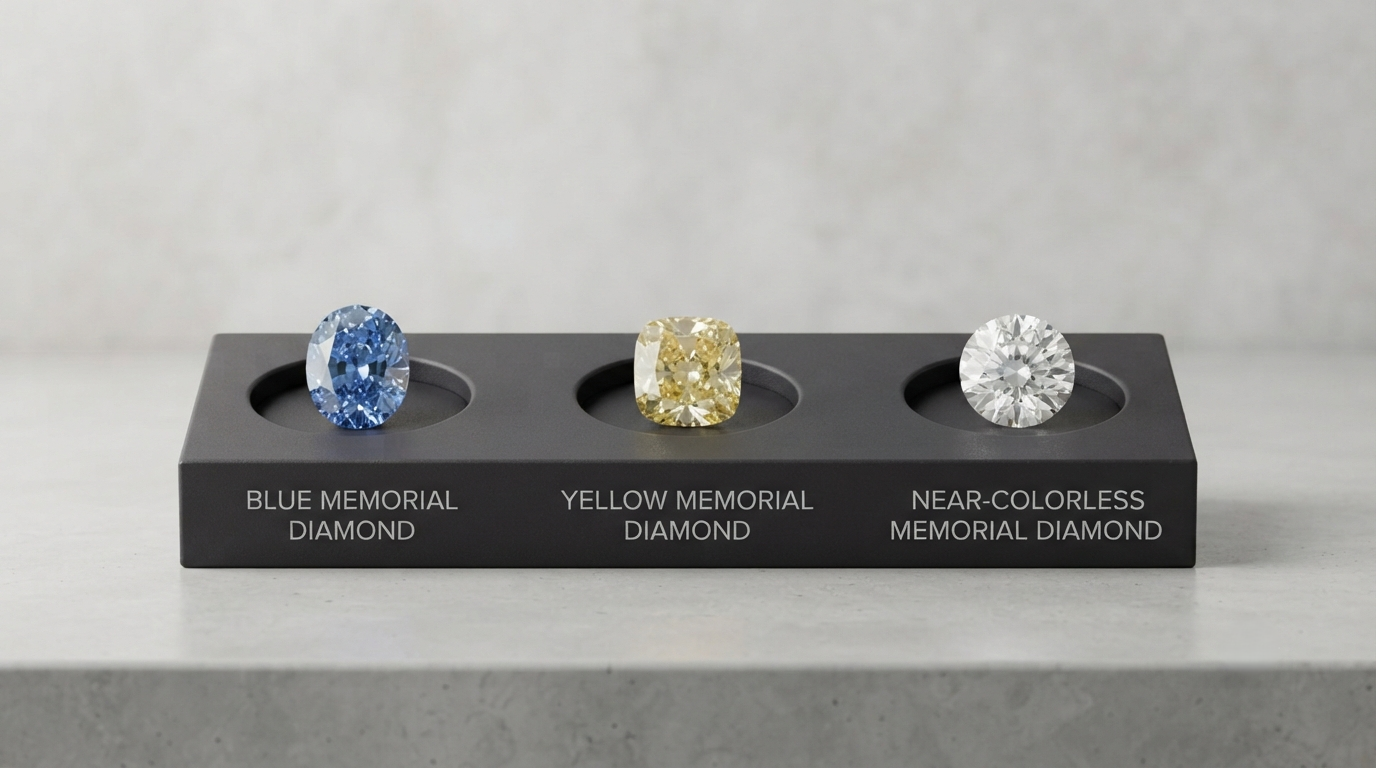
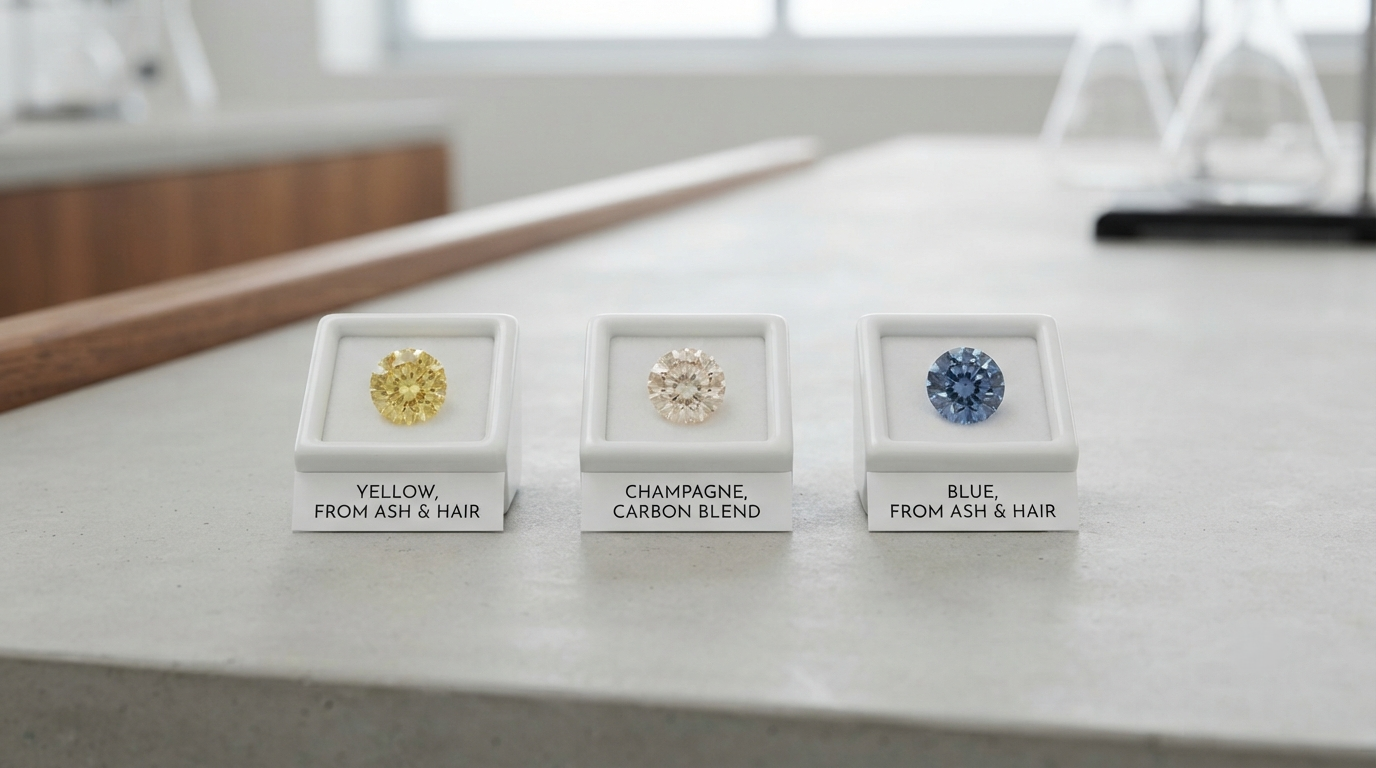
Trace nitrogen present during growth tints a crystal yellow. Trace boron tints it blue. A white stone requires that effectively neither element got in, which is difficult when the carbon originated in a living body rather than an industrial feedstock. That is why a diamond made from son hair tends toward yellow, blue, champagne or brown tones rather than colorless.

Three memorial diamonds shown side by side in blue, yellow and near-colorless tones

Colorless is achievable with additional processing and generally costs more. Some providers also offer post growth irradiation to produce red, pink, green or black, and if you order it, a grading report should disclose it.

What a good provider will tell you is which range is likely for a diamond made from son hair and why, and what they will do if the result falls outside it. What no provider can honestly tell you is the exact color of a stone made from son hair before it has been grown. What color to expect covers the likely range in more depth.

What Arrives at the End, and What Should Be in the Box?

The sixth point of contact is the one parents rehearse in their heads for months. It is worth knowing in advance what should arrive with a diamond made from son hair.

  • The stone itself, loose or already set, depending on what you ordered.
  • An origin or authenticity document, issued by the provider, recording that this diamond was grown from your family’s submitted material. This is a chain of custody record, not a quality assessment.
  • A grading report, if you asked for one, ideally from an independent third party laboratory, documenting the cut, color, clarity and carat weight. Independent grading is optional across this industry, not standard.
  • Any unused hair, if the provider returns it and you asked them to.
  • Care and setting information, if the stone is loose.

Every one of those items should be checked against the identifier you were given at intake before the box is closed and shelved. If a diamond made from son hair arrives with paperwork that does not reference the original record, ask about it before you put the box away.

A finished stone made from son hair is a genuine diamond in every testable respect, the same hardness, the same optical behavior, the same grading criteria. It can be set in a ring and worn daily without special handling.

What Does the Waiting Cost, in Time and Money?

The industry band runs from roughly six months to roughly ten, measured from receipt of material rather than from the day you first inquire. Larger stones, beyond about two carats, and specialty colors such as black can extend that toward twelve.

Size is a function of growth time, not of how much hair you sent, and this surprises almost everyone. A diamond made from son hair grown to two carats simply spent longer in the press than one grown to half a carat. Posting a larger lock does not shorten the wait or enlarge the stone, and a diamond made from son hair is quoted by finished carat rather than by input weight.

General industry pricing for 2026, not any single company’s published rates:

Finished sizeTypical rangeWhat moves the number
0.10 to 0.25 ctAbout $1,500 to $3,500The usual starting tier
0.5 to 1.0 ctAbout $5,000 to $15,000Colorless costs notably more than yellow or champagne
2 to 5+ ctAbout $20,000 to $75,000+Growth time rises steeply

Settings, engraving, unusual cuts and independent grading reports are normally priced separately. Ask which sit inside your quote, that single question resolves most of the reported sticker shock. How long the process takes sets out the calendar in more detail.

Frequently Asked Questions

If he was buried rather than cremated, is a diamond made from son hair still an option?

Yes, and this is one of the clearest advantages of the hair route. No cremation is required at any point, so a lock kept from before his burial, from a childhood haircut, or from a hairbrush works exactly the same way chemically as any other sample.

Does hair from a hairbrush work as well as a cut lock?

It generally does. Brush hair is often mixed with other people’s and carries product residue, so a laboratory may ask for more of it, but the keratin itself is identical. Say at intake where the sample came from so the quantity can be judged properly.

Does gray, bleached or dyed hair change anything?

Possibly the quantity requested, rather than the outcome. Bleaching and dyeing alter hair’s surface chemistry and can reduce usable yield, so some laboratories ask for a larger sample. Mention any treatment at intake rather than after the material has already been processed.

How long can hair be kept before it is used?

Indefinitely, if it stays dry. Keratin is stable and does not decay in the way soft tissue does, so hair kept in an envelope or a locket for decades remains perfectly usable. Store it somewhere dry and dark until you are ready.

Can more than one stone come from a single lock?

Sometimes, depending on the weight you send and the sizes chosen. Because a portion may remain after extraction, several family members can occasionally each receive a stone from one collection. Confirm feasibility and per stone pricing before ordering rather than afterwards.

Will the finished diamond look different from a mined one?

Not to the eye. It has the same hardness, brilliance and grading criteria as any other diamond, and its color sits in the same range as other fancy colored stones. Gemological testing identifies it as laboratory grown, which is accurate and expected.

Final Thoughts on a Diamond Made From Your Son’s Hair

The part nobody prepares you for is the middle. The envelope goes, the confirmation arrives, and then there are months in which nothing visible happens at all, and for a parent, months of nothing can be considerably harder than months of activity.

Knowing in advance which six moments will actually involve you makes that stretch easier to sit with, and it is the main practical reason to read about how a diamond made from son hair is produced before commissioning one rather than after. So does knowing what you will be told at each one, and what you are entitled to ask for rather than wait to be offered.

A diamond made from son hair is a small, concrete thing: carbon that was part of him, in a form you can wear. It does not finish anything or replace anything, and it sits perfectly well alongside a grave, an urn, a scattering, or a shelf you have not touched. Nothing about commissioning a stone made from son hair rules out a single one of those.

Learn More About Son Memorial Diamonds

Talk With Memorial Diamond

If you want to understand what you would actually be told and when, rather than read another process diagram, reach out to Memorial Diamond at memorialdiamond.us and ask about the hair you have. There is no form to complete first, and no timeline you are behind on.

Word count: 3,042 words
Reading time: about 15 minutes

Memorial diamond made from son ashes: a pale yellow lab-grown stone held in a gloved hand

How a Memorial Diamond Is Made From Your Son’s Ashes

Most parents want to know where the ash physically goes, not just what the brochure says. A memorial diamond made from son ashes is produced by extracting the carbon out of a small portion of his cremated remains, purifying that carbon past 99.9%, turning it into graphite, and growing it into a real diamond under enormous pressure and heat, a journey of roughly six to ten months. This page follows the material itself, container by container, from the day it leaves your house to the day a cut stone comes back.

What Actually Leaves Your House?

Far less than most parents assume. The starting portion for a stone made from son ashes is typically somewhere between a few tablespoons and around 4 oz, roughly 100 grams, of cremated remains, which is a small fraction of what a full cremation produces.

Everything else stays exactly where you had planned to keep it. Burial, interment in a family plot, scattering somewhere he liked, or simply leaving the urn on the shelf all remain completely open to you afterwards. Nothing about commissioning a gem made from son ashes requires giving up any of those.

The portion that travels is sealed, labeled, and logged against an identifier at intake. From that moment it is tracked through every vessel and every process step. That documentation trail is the thing to ask about first, because it is the only part of the whole chain you can genuinely audit as a customer. A laboratory handling material made from son ashes should be able to show you that log on request.

One practical note: ask what happens to any surplus. Some providers return unused remains with the finished piece, while others hold them for a future stone. How much ash a lab needs goes further into the quantities.

Who Has to Authorize the Ash Before It Travels?

Before a single gram moves, it is worth establishing who is legally entitled to say yes. Parents very often assume that right is theirs by default, and depending on your son’s circumstances it may not be.

State statutes generally set a priority order for who may direct the disposition of a decedent’s remains. A surviving spouse commonly sits at or near the top of that order, and a son’s own adult children can sit above his parents as well. Anything he left in writing, a will, an advance funeral directive, a named agent, can reorder that list, and the specifics differ meaningfully from one state to the next.

None of this prevents a diamond made from son ashes being commissioned. It determines who is entitled to sign for it. That makes this a question for the funeral director who handled the cremation, or a local attorney, rather than something to resolve by reading. It is a short conversation, and it removes the commonest cause of a family dispute surfacing months later, halfway through a growth run. How to turn his ashes into a diamond covers the decision side of the same ground.

Parents also do not always agree with each other. One parent arranging a diamond made from son ashes alone, after a separation, or simply because one of you can manage the logistics and the other cannot, is ordinary, and no provider will find it unusual. The legal question is about authority, not about unanimity.

What Strips Away Everything That Is Not Carbon?

Cremated remains are overwhelmingly calcium phosphate, the mineral structure of bone. Carbon is a minority component, and the first real laboratory stage of anything made from son ashes is separating the two.

The sample is heated in a controlled, oxygen free, multi stage process. Without oxygen present, the carbon cannot simply burn away. Instead, the non carbon fractions are driven off or chemically removed across successive stages until what remains reaches roughly 99.9%+ carbon purity.

Sealed sample of cremated remains beside a high-temperature carbon extraction furnace

This is the step that determines whether the run is viable at all. Industry figures put usable carbon at somewhere around 0.5% to 4% of ash by weight, so a generous looking jar reduces to a startlingly small quantity of recovered material. That yield, rather than the volume of the jar, is what every later stage of a diamond made from son ashes has to work with.

It is also the step most worth questioning, because it is invisible to you. Ask how purity is verified, whether it is measured or assumed, and what happens if a sample yields less than expected. A laboratory producing stones made from son ashes routinely should be able to answer all three without hesitation.

Why Is the Carbon Turned Into Graphite First?

Because a growth press cannot use loose purified carbon. It needs a specific crystalline form as feedstock, and that form is graphite.

So the purified carbon is heated much further, to somewhere in the region of 2,500 to 2,700°C, and converted into graphite. Chemically nothing is added and nothing personal is lost at this stage: graphite and diamond are both pure carbon, arranged differently. Anything made from son ashes passes through this conversion before it can be grown, and the graphitization step itself is identical whether the feedstock came from a person or from an industrial source. Only the origin differs.

Picture the sequence as one substance changing address rather than identity: bone mineral and carbon go in, carbon comes out, carbon becomes graphite, graphite becomes diamond. The same atoms carry through, which is the point the complete guide to a son ashes diamond returns to repeatedly.

That is also the honest core of why a gem made from son ashes is not a symbol or a representation. It is not that the diamond stands for him. It is that a measurable quantity of carbon that was structurally part of him is inside the crystal.

What Happens Inside the Growth Cell?

The graphite, blended with supplemental lab sourced carbon to reach a workable volume, is loaded into a growth cell around a tiny diamond seed. Then the press closes.

In the HPHT method most of this industry uses, that cell is taken to something in the range of 6 to 8 gigapascals while being held at 1,400 to 2,500°C, conditions built to mimic the deep mantle. A minority of providers use CVD instead, converting the carbon to a gas and depositing it layer by layer onto a seed plate inside a vacuum chamber. Either route produces a chemically genuine diamond.

Here is the full journey in one view:

StageWhat the ash is at this pointTypical duration
1. Intake and loggingSealed, identified cremated remainsDays
2. Carbon extractionAsh being separated from its carbonDays to weeks
3. PurificationCarbon at 99.9%+ purityDays to weeks
4. GraphitizationGraphite feedstockDays
5. Cell loadingGraphite plus supplemental carbon and a seedHours
6. GrowthA rough diamond crystalWeeks to months
7. Cutting and polishingA finished gemWeeks
8. Optional grading and returnA documented stone in your handWeeks
Cutaway view of an HPHT growth cell showing graphite feedstock packed around a diamond seed

Every diamond made from son ashes travels those eight stages in the same order, though the durations vary widely between providers and between stone sizes.

Growth time, not the amount of ash supplied, is what sets carat size. Sending more remains does not produce a bigger diamond made from son ashes, and no honest provider will tell you otherwise.

Where Does the Process Most Often Go Wrong?

Nothing in this sequence is guaranteed, and a provider who presents it as guaranteed is worth a second look.

The commonest problem is yield. If the recoverable carbon from a submitted sample lands at the low end of that 0.5% to 4% range, the laboratory may come back asking for more remains before a diamond made from son ashes can be grown at the size you selected. That request is arithmetic rather than a sales tactic.

The second is growth failure. Crystals can come out heavily included, grow off axis, or fracture during the run. A batch made from son ashes is no more prone to this than any other laboratory grown diamond, but it is considerably more painful when it happens, because the starting material cannot be replaced.

The third is cutting loss: rough weight and polished weight are different figures, so ask which number your quote actually refers to.

The fourth is expectation. Families sometimes picture something colorless and receive a champagne stone. Nothing has gone wrong in that case. It is simply what the material produced.

Ask any provider what their contingency is for each of these four before you send anything. A laboratory that has grown many stones made from son ashes will answer all four without hesitating, because it has met all four.

How Much of a Diamond Made From Son Ashes Is Really His?

This is the question that decides whether a family trusts the category at all, so here is the published answer rather than a comfortable one.

The personal carbon recovered from cremated remains usually makes up somewhere around 10% to 15% of the finished stone’s mass. Some providers cite figures as low as 3%, others higher, depending on the size of stone requested and how much ash was submitted. The remainder is supplemental lab sourced carbon, which is what makes the volume sufficient to grow a gem of meaningful size at all. Treat any claim well above that published band for a stone made from son ashes as something to question rather than something to celebrate.

No diamond made from son ashes is 100% his carbon, from any provider, at any price. That is physics rather than corner cutting. The recoverable carbon in ash is simply not enough on its own. Anyone claiming total purity is describing something that does not happen.

What remains true, and is not a consolation prize, is that a real and verifiable proportion of his own carbon is locked into the crystal lattice. Ask your provider for their own percentage estimate in writing, and ask how they arrived at it. If you want this examined at greater length, whether the stone is genuinely his takes the question apart in detail.

Why Is a Diamond Made From Son Ashes Rarely Colorless?

Because his carbon came from a body rather than a purpose built industrial feedstock, and bodies carry trace elements.

Two elements do most of the work. Nitrogen present during growth produces yellow tones. Boron produces blue ones. Colorless requires both to be effectively absent, which an organic source rarely delivers without extra processing. That is precisely why stones made from son ashes trend toward yellow, blue, champagne and brown rather than white.

Three memorial diamonds in yellow, blue and champagne tones arranged on a gray surface

Colorless is achievable. It takes additional purification steps and typically costs more. Post growth irradiation is also offered by some providers to produce red, pink, green or black, and an independent grading report will normally disclose that a treatment was applied. None of this makes a diamond made from son ashes any less genuine. Color is a grading attribute, not a measure of authenticity.

Most parents, once the mechanism is explained, stop treating the color as a decision to control and start treating it as information. The shade of a diamond made from son ashes is a readout of the material, not a flaw in it. What color to expect covers the range in more depth.

What Happens to the Rough Crystal Afterwards?

What emerges from the press is a rough crystal, not a gem. A cutter then does exactly what a cutter does with any other diamond rough: plans the cut, saws or lasers it, shapes it, and polishes the facets.

Cutters do not handle a rough crystal made from son ashes any differently from other rough. The skill and the risks are identical. Round brilliant, princess, cushion, emerald, pear, the available cuts are the standard ones, and the choice is yours.

Two further steps are optional rather than automatic, and both are worth asking about before you commit. The first is post growth irradiation for color. The second is independent third party grading, which documents the stone’s own quality against the usual cut, color, clarity and carat standards.

That grading report is a different document from an authenticity or origin certificate. The origin certificate records that this stone was grown from your family’s submitted material; the grading report describes the gem’s quality. A diamond made from son ashes ideally arrives with both, but only the first is something a provider issues about itself, so ask which one you are actually being promised.

What Should You Ask Before the Ash Leaves Your House?

There is one window in which asking questions is easy, and it closes the moment a courier collects the package.

  • What identifier is assigned to his remains, and can I see the custody log at any point?
  • What share of the finished gem do you expect to be his own carbon, and how was that worked out?
  • What comes back to me, unused remains, the original container, both, neither?
  • If the first run fails, what happens next, and at whose cost?
  • Is the grading report you are quoting independent, or issued in house?
  • Will any part of this stone made from son ashes be irradiated, and will the paperwork say so?
  • Can a second diamond made from son ashes be grown later from material you still hold?

Get the answers in writing rather than over the phone. Staff change across a project this long, and a written answer outlives a change of account manager.

If a provider will not put a percentage estimate for a diamond made from son ashes in writing at all, that is itself the answer to a rather more important question. Questions worth asking first expands this list considerably.

What Comes Home, and What Does It Cost?

What comes home is a finished diamond made from son ashes, its documentation, and whatever unused remains the provider returns. It is a genuine diamond in every measurable respect, including the hardness that puts it at the top of the mineral hardness scale, so it can be set and worn daily without special handling.

Across the industry the whole sequence typically runs six to ten months from receipt of material, stretching toward twelve for larger stones or specialty colors such as black. Pricing, using general 2026 industry ranges rather than any single company’s published rates:

  • 0.10 to 0.25 ct: approximately $1,500 to $3,500
  • 0.5 to 1.0 ct: approximately $5,000 to $15,000, with colorless costing appreciably more than yellow, blue or champagne at the same weight
  • 2 to 5+ ct: approximately $20,000 to $75,000 and upward
  • Commonly separate: settings, engraving, fancy cuts and independent grading reports

Because only a portion of the remains is consumed, more than one stone made from son ashes can often be produced from the same submission, relevant if siblings or a surviving spouse also want one. Sharing a stone between family members covers how that is usually arranged.

Frequently Asked Questions

Can a diamond be made from son ashes years after the cremation?

Yes. Cremated remains are chemically stable and do not degrade in storage, so the carbon recoverable from ashes kept for five or twenty five years is no different from ashes received last month. Many parents come to a diamond made from son ashes long after the funeral.

Does the crematorium need to be involved again?

Usually not, if the remains are already in your possession. The provider works from what you send. The crematorium or funeral home is worth contacting only for paperwork questions, such as confirming who holds authority over the remains in your state.

Will the finished stone test as a real diamond?

Yes. It is chemically and physically a genuine diamond, with the same hardness, refractive behavior and grading criteria as any other. Standard gemological testing identifies it as laboratory grown rather than mined, which is accurate, but it is not a simulant.

What if the first growth run fails?

Growth runs can fail, and a reputable provider will tell you that plainly. Ask before you commit what happens next: whether a second attempt is included, whether additional material would be required, and whether any part of the fee is refunded.

Can we keep the rest of his ashes at home?

Yes, and most families do. Only a small portion is used, so an urn, a burial plot, a scattering, or a division among relatives all remain possible afterwards. Choosing a diamond does not replace or invalidate any other way you have chosen to honor him.

Does an independent grading report cost extra?

Usually, yes. Independent third party grading is typically an optional add on rather than something included by default, and pricing varies by provider and by stone size. Ask explicitly whether the report quoted is independent or issued in house before you agree to it.

Final Thoughts on a Diamond Made From Your Son’s Ashes

There is no right interval before doing this, and nobody should tell you that you have waited too long or acted too soon. Some parents begin within weeks of the cremation. Others open the question a decade later, when the urn has stopped being a temporary arrangement and started being a permanent one nobody chose.

The offer of a diamond made from son ashes is narrow and concrete: a portion of the carbon that was his, brought into a form you can wear rather than store. It does not stand in for anything, and it is not a step in any process anyone should be prescribing for you.

If you do go ahead with a diamond made from son ashes, go slowly, get the percentage estimate and the chain of custody answers in writing, and settle the authority question with whoever else has standing before anything ships.

Learn More About Son Memorial Diamonds

Talk With Memorial Diamond

If you would like to walk through any stage of this in more detail, especially the chain of custody and percentage questions, reach out to Memorial Diamond at memorialdiamond.us to talk about the ashes you have. Asking costs nothing and commits you to nothing.

Word count: 3,052 words · Reading time: about 15 minutes

Questions to ask before turning a wife's ashes and hair into a memorial diamond

Questions to Ask Before Turning Your Wife’s Ashes and Hair Into a Diamond

Somewhere in the house there is a portion of her ashes, and somewhere else, a drawer, an envelope you have not opened, there is hair.

Nearly every published list of wife ashes hair diamond questions assumes one thing is being sent. Two are. Her ashes and her hair travel on two separate chains of custody, and a question that is sharp about one is often meaningless about the other. Sort by the material each question is actually about, and a fourth group appears: the questions the combination raises on its own.

Said plainly at the top of a page of questions: Memorial Diamond grows the stones these wife ashes hair diamond questions are about, so treat the list as one you should be able to put to us as bluntly as to anyone else, and judge the answers rather than the source.

Wife ashes hair diamond questions written by hand on a notepad beside a sealed envelope of hair and a small labeled portion of cremated ashes

Why Do Wife Ashes Hair Diamond Questions Split Into Two Custody Chains?

Because the two materials do not come from the same place, do not leave the house at the same moment, and are not handled alike once they arrive. That is the fault line under every list of wife ashes hair diamond questions.

Her ashes carry a chain that started before you were involved in it. A crematory produced them, a funeral director received them, someone signed something, and the portion you are considering may still sit with any of those people. Ashes questions ask about a link in a chain you did not build.

Her hair has no such chain. It has whatever chain you make for it. A lock cut at a bedside, hair kept from a brush, something saved decades ago and forgotten, none of it arrived with paperwork, a reference number, or anyone who can confirm what it is. Hair questions ask about a chain that begins with you and has one witness.

That split runs through everything. The ashes half of any list of wife ashes hair diamond questions is about quantity and yield: how little carbon is in there, what survives extraction, what happens to the rest. The hair half is about identity and condition: whether this is certainly hers, whether it survived years in a drawer, whether a salon visit matters.

Both materials end in the same place. Cremated remains are dominated by calcium phosphate, with usable carbon commonly put at roughly 0.5% to 4% of ash by weight; hair is roughly half carbon by weight, because keratin is a carbon rich protein. Each is purified to around 99.9% carbon on its own track, and neither track, nor both together, yields enough to fill a growth cell, so lab grown carbon is added to bring the charge up to a workable volume before growth starts. Several of the wife ashes hair diamond questions below are, underneath, questions about that blend.

The sixteen wife ashes hair diamond questions here are grouped by subject, not by the order you would ask them. Five belong to her ashes, five to her hair, two to whoever holds both, and four exist only because the two share one order.

Group One: Wife Ashes Hair Diamond Questions About Her Ashes Alone

These are yield questions, the wife ashes hair diamond questions that exist because ash is a poor carbon source you happen to have a lot of.

  1. How much of the portion I send is actually consumed, and what happens to anything left over?
  2. Is the quantity you ask for a received weight or a usable weight after purification?
  3. What happens if the portion I send falls short once it has been measured?
  4. How is her portion identified and tracked from the moment it arrives until it goes into the growth cell?
  5. If a funeral home or crematory still holds her ashes, what do you need from them rather than from me?

A good answer to the first two is a number with a unit and a statement of which end of the process it describes. Industry guidance commonly puts a typical requirement between a few tablespoons and around 4 oz of cremated remains, a small fraction of what a cremation produces. But “what we need” and “what we need to end up with” are different requests, and the gap is the part you cannot see. How much ash and hair a wife memorial diamond needs covers quantities.

The fifth is the one people skip. If her ashes are still with a funeral home, the first of these wife ashes hair diamond questions belongs to the funeral home, not to a diamond company: what it can release, to whom, and on what notice. The fourth is the only one here about trust rather than chemistry, and it is worth asking in writing.

Group Two: Wife Ashes Hair Diamond Questions About Her Hair Alone

| Small paper envelope holding a cut lock of hair, sealed, hand-dated and labeled, resting in an open drawer

These wife ashes hair diamond questions are identity and condition questions, and they exist because hair is an excellent carbon source that arrives with no history attached.

  1. How old can the hair be, and does it matter that it has sat in a drawer for years?
  2. Does it matter that her hair was colored, permed, straightened, or bleached?
  3. Is hair from a brush acceptable, or does it have to be a cut lock?
  4. How much hair do you need, by weight rather than by appearance?
  5. How is a hair sample documented as hers, when it arrives with nothing to prove it?

The third and fourth matter more than they look. “A small lock” and “a few grams” describe one requirement in two units, and only one can be checked on a kitchen scale. Brush hair is often a genuine option, and sometimes the only hair a family has, but it is mixed, and how a mixed sample is handled is a different question from whether one is accepted.

The fifth is the hard one, and it has no satisfying chemical answer. Nothing in a finished stone traces back to a particular head. What can exist is a record: what you sent, how you described it, when it was logged, who handled it. Ask what that record looks like and whether you get a copy. The questions to ask before turning her hair into a diamond takes that list alone.

If the hair has not been collected yet, collect it first. Among all the wife ashes hair diamond questions here, it is the only subject that can stop being available.

Group Three: Wife Ashes Hair Diamond Questions for Whoever Holds Both

Two of the sixteen wife ashes hair diamond questions are about neither material. They are about one organization now holding two things from two different places, which is the only point where the two chains touch before the growth cell.

  1. Who signs for, opens, and records each package, and are the two logged as separate items?
  2. What written documentation names each material, and at what stage is each document issued?

The second is where the confusion lives, because “certificate” covers two unrelated documents. An origin or authenticity document records that a stone was grown from the carbon you submitted; it is chain of custody paperwork. A grading report describes the finished diamond against the same cut, color, clarity and carat standards used for any diamond, and says nothing about where the carbon came from. “Certification” can get you either.

For a combined order, ask whether the origin document names both materials or only the order, and whether that is one document or two. A record written at intake and one written at the end describe different things.

| Technician loading a diamond seed and graphite charge into an HPHT growth cel

Group Four: Which Wife Ashes Hair Diamond Questions Does the Combination Raise?

Four questions have no meaning unless two materials share one order. This is the group most lists leave out, and the reason wife ashes hair diamond questions are not simply two enquiries stapled together.

  1. Are the two blended, and at what point, before graphitization, or only at the growth cell?
  2. Does each material have to satisfy its own minimum, or do the two count together?
  3. If one material fails purification, is damaged, or is lost, does the order continue on the other, and who decides?
  4. What is recorded about how much each material contributed?

The first has a physical answer that sets limits on the rest. Ash and hair are not purified together, because what must be stripped out differs: mineral in one case, the non carbon components of a protein in the other. The two purified outputs, plus the supplemental lab grown carbon, meet in the growth cell and nowhere earlier. How a memorial diamond is made from her ashes and hair walks the stages in order, and growth uses the high pressure, high temperature method used across the lab grown industry.

The consequence is blunt: after that point, no test separates them. So the fourth of these wife ashes hair diamond questions is not chemistry but record keeping, what was weighed, when, and whether it was written down anywhere you can see. A company that keeps that record can show it to you. One that does not is not hiding anything; it simply did not measure. Either answer is usable. Not knowing which you have is not.

The second changes what you do today. If each material must meet its own threshold, you need enough of each. If they count together, a scarce lock may be fine alongside a generous portion of ashes. Ask before you divide anything.

All Sixteen Wife Ashes Hair Diamond Questions, and What a Vague Answer Sounds Like

The middle column is the point of the table: it sorts the wife ashes hair diamond questions by which chain each one belongs to, which tells you who can answer it.

The right hand column is written, not reported. Every sentence in it was invented for this page as an illustration of a reply that is accurate and still leaves the question open. None is a quotation, and none describes any company.

#The questionWhich material it concernsWhat a vague answer sounds like
1How much of the portion is consumed, and what happens to the rest?Ashes“We only need a small amount.” True, and silent on the remainder
2Is the quantity a received weight or a usable weight?Ashes“Around four ounces is standard.” A figure with no end of the process attached
3What happens if the portion falls short once measured?Ashes“That is rarely an issue.” A frequency, not a procedure
4How is her portion tracked from arrival to growth cell?Ashes“Everything is fully tracked.” The claim, not the method
5What do you need from the funeral home rather than from me?Ashes“Send it whenever you’re ready.” Scheduling, not requirements
6How old can the hair be?Hair“Age is usually fine.” Usually is doing all the work
7Does coloring, perming, or bleaching matter?Hair“Treated hair is common.” Common, and not yet accepted or refused
8Is brush hair acceptable, or must it be a cut lock?Hair“Most hair works.” About hair in general, not about a brush
9How much hair by weight?Hair“A small lock is plenty.” A description, not a measurement
10How is a hair sample documented as hers?Hair“It’s recorded on the order.” Recorded is not evidenced
11Who receives, opens and logs each package?Both, one holder“Our lab handles intake.” The department, not the step
12What document names each material, and when?Both, one holder“You’ll receive full certification.” One word, two documents
13Are the two blended, and at what stage?Combination only“They’re both used.” Used, and possibly never combined
14Own minimum each, or counted together?Combination only“There’s plenty there.” About your sample, not about the rule
15If one material fails, does the order continue?Combination only“We’d be in touch.” Contact, not a decision right
16What is recorded about each material’s contribution?Combination only“Roughly equal.” A proportion with no measurement behind it

Read that column gently. A reply that leaves your question open is not evidence of anything about whoever gave it, usually it is an accurate answer to a question standing next to yours. Ask the original again, in writing, until the answer contains the thing you asked for. How many of these wife ashes hair diamond questions come back specific is informative; so is which ones a company says it does not know yet.

Which Wife Ashes Hair Diamond Questions Must Be Settled Before Anything Leaves the House?

Most of the sixteen can be asked at any point. Five change what you physically do, so they belong before the packing tape.

  • Question 2, because received weight and usable weight decide how much of her ashes you set aside.
  • Question 9, because a weight you can check on a scale decides whether the lock you have is enough.
  • Question 14, because if the two count together, you may need less of one than you thought.
  • Question 5, because a funeral home’s notice period sits in front of everything else.
  • Question 3, because the answer may be a reason to hold material back rather than send all of it.

The remaining wife ashes hair diamond questions, documentation, blending stage, records, what happens if a run fails, can be asked after an order exists. Whether an order already placed for one material can later have a second added is a policy question this page cannot answer in either direction; put it to the company holding your order.

Two notes that are not wife ashes hair diamond questions. Packaging and shipping requirements vary by provider and are worth confirming directly. And a combined order lets nobody forecast color, what color a diamond made from her ashes and hair will be explains why the honest answer is a range.

Frequently Asked Questions

Are wife ashes hair diamond questions different from the ashes only list?

Mostly they overlap. Every ashes question still applies, every hair question still applies, and four more appear that exist only because two materials share one order: blending stage, whether each meets its own minimum, what happens if one fails, and what is recorded about each.

Can I send my wife’s ashes and hair at different times?

Ask, because it varies. The real question is what happens to the first material while the second is located, where it is stored, how it is logged, whether an order can sit open. Nothing in the chemistry requires the two to travel together.

How do I know the hair I have is really my wife’s?

Nothing in a finished diamond can prove it, so the answer lives in records rather than testing. Ask what is written down at intake, how your own description of the sample is stored, and whether you receive a copy of that documentation.

Does using both ashes and hair make the diamond more truly hers?

No, and it is worth saying plainly. Both materials are reduced to purified carbon and combined with lab grown carbon in the growth cell, so a second source changes what went in rather than how much of the stone is her. Choose it for meaning, not percentage.

What should I ask about price when two materials are involved?

Ask how the price is structured, not only what it is, whether preparing a second material is charged separately or absorbed into one processing fee. Across the industry, price is driven mainly by carat size rather than by source material.

Which of these wife ashes hair diamond questions should I ask first?

Whichever one decides what you do today. In practice that is the quantity question for ashes and the weight question for hair, because both change how much you set aside before anything is sealed, labeled, or sent anywhere.

Final Thoughts on Wife Ashes Hair Diamond Questions

Grouping wife ashes hair diamond questions by material is not tidiness. It tells you who to ask. A funeral home can answer a custody question about her ashes and nothing about a growth cell. A diamond company can answer a blending question and nothing about what a crematory released in March. A question aimed at the wrong party comes back vague through nobody’s fault.

You do not need all sixteen wife ashes hair diamond questions answered to begin, only the five that change what you do this week, and the patience to ask the rest slowly, in writing.

Learn More About Wife Memorial Diamonds

Talk With Memorial Diamond

If you want somewhere to put all sixteen wife ashes hair diamond questions and see how many come back specific, Memorial Diamond is one of the places they can go, memorialdiamond.us. Bring the list rather than a summary; these wife ashes hair diamond questions are hard to answer loosely, which is their use.
And if it is too early for questions, that is a complete position. Her ashes are stable mineral matter and a dry, sealed, labeled lock does not expire, so nothing here is on a clock except hair not yet collected.

Memorial diamond made from son ashes and hair: a champagne-toned lab-grown stone beside a sealed sample envelope

How a Memorial Diamond Is Made From Your Son’s Ashes and Hair

When a parent holds both a jar and an envelope, the question underneath everything else is usually chemical: are these really the same substance in the end? A memorial diamond made from son ashes and hair works because both samples contain carbon, bone ash holds a little, hair holds a great deal, and that carbon can be separated, purified, restructured and grown into a genuine diamond. This page explains what happens at the level of the atoms rather than at the level of the paperwork, because that is where the honest answers live. Everything below applies specifically to a stone made from son ashes and hair rather than to either material on its own.

What Are You Actually Holding, Chemically?

Two very different substances, which is the first thing to understand about anything made from son ashes and hair.

Cremated remains are overwhelmingly calcium phosphate, the mineral scaffolding of bone, left behind once everything organic has burned away at cremation temperatures. Carbon survives in that residue only as a minority component. Industry figures put the usable carbon in ash at roughly 0.5% to 4% by weight.

Hair is the opposite case. It is built from keratin, a fibrous protein, and comes in at roughly 50% carbon by weight. A few grams of hair therefore carry far more recoverable carbon than the same weight of ash.

Cremated remainsHair
Dominant compoundCalcium phosphate, bone mineralKeratin, fibrous protein
Carbon by weightRoughly 0.5% to 4% usableRoughly 50%
Cremation requiredYesNo
Typical amount requestedA few tablespoons to about 4 ozA small lock, a few grams
Small portion of cremated remains beside a bound lock of hair on a laboratory bench

Both go into one commission when a diamond is made from son ashes and hair, and a laboratory must treat each differently. That contrast is the entire reason a stone made from son ashes and hair is worth discussing as its own thing rather than as a variant of either route. You are handing a laboratory one carbon poor mineral sample and one carbon rich organic one, and asking for a single crystal.

Who Is Entitled to Authorize a Combined Submission?

A combined submission raises two separate permission questions at once, and they do not have the same answer.

A submission made from son ashes and hair therefore needs two answers rather than one. The ash half is governed by the rules that apply to remains. Most states set a statutory order for who may direct the disposition of a decedent’s remains, and a surviving spouse commonly sits at the top of it, with the deceased’s own adult children often ranking above his parents. Whatever your son put in writing, a will, a funeral directive, a designated agent, can reorder that list, and the details genuinely differ state to state. Settle that with the funeral director who handled the cremation, or with a local attorney, before any ash is shipped.

The hair half sits elsewhere. Those disposition rules are written about the remains themselves, so a lock you already keep at home is usually the simpler question in practice, though a decedent’s belongings can still form part of his estate, treatment varies by state, and a sample in somebody else’s keeping is a conversation rather than a decision.

In practice parents commission diamonds made from son ashes and hair without difficulty all the time, and one parent arranging it alone is normal. Ask early rather than discover a disagreement in month seven. Questions worth settling first lists the rest of them.

What Happens Chemically During Purification?

Both samples are heated in a controlled, oxygen free environment, and the absence of oxygen is the whole trick.

With oxygen present, heating organic material simply burns the carbon off as carbon dioxide, exactly what happened to most of your son’s carbon during the cremation itself. Remove the oxygen, and heat instead drives off volatile non carbon fractions while the carbon stays behind. For the hair, that means breaking keratin down and releasing its nitrogen, sulfur, oxygen and hydrogen. For the ash, it means separating carbon from a large excess of calcium phosphate and other minerals.

Multiple stages later, the recovered material reaches roughly 99.9%+ carbon purity. Everything made from son ashes and hair passes through this, and it is where the yield difference between the two samples shows up most starkly: the hair gives up a lot, the ash gives up very little.

Ask a provider whether the two samples are purified together or separately, and whether purity is measured or assumed. A laboratory that grows stones made from son ashes and hair regularly will answer both without hesitating. Ask too which material is processed first, it changes nothing chemically, but it tells you how a diamond made from son ashes and hair is actually scheduled inside the lab.

Why Must the Carbon Become Graphite First?

Because carbon has more than one crystalline form, and a growth press needs a specific one.

Pure carbon can be arranged as graphite, loosely stacked flat sheets, each atom bonded to three neighbors, or as diamond, where every atom bonds to four in a rigid framework. Same element, wholly different properties. The purified carbon from a submission made from son ashes and hair is heated to somewhere around 2,500 to 2,700°C and converted into graphite, which is the feedstock a press can actually work with.

Nothing is added and nothing personal is lost in that conversion. A carbon atom that came out of keratin and a carbon atom that came out of bone residue are chemically indistinguishable once purified, carbon is carbon, with no memory of its source. That is a genuinely important point for a stone made from son ashes and hair, because it means the two samples are not competing or layered; they become one feedstock.

It also means nobody can later point at a facet and say which part came from which sample, which is worth knowing before you commission a diamond made from son ashes and hair expecting some visible division inside it. That is not a limitation of the process. It is what “same element” means.

What Happens in the Lattice During Growth?

The graphite, blended with supplemental lab sourced carbon to reach workable volume, goes into a growth cell around a tiny diamond seed. Then the structure is forced to change. Nothing about a charge made from son ashes and hair alters how the press itself is operated.

In the HPHT process used for most memorial stones, the cell is taken to roughly 6 to 8 gigapascals with temperatures held between 1,400°C and 2,500°C. Under those conditions graphite’s flat, three bond arrangement becomes thermodynamically unstable, carbon dissolves into a molten metal flux, and atoms reprecipitate onto the seed in diamond’s four bond geometry. A minority of providers use CVD instead, cracking a carbon bearing gas in a vacuum chamber so atoms deposit layer by layer.

Diagram comparing graphite's layered carbon sheets with diamond's four-bond lattice

Either way, a diamond made from son ashes and hair is built atom by atom over weeks to months. Growth time governs the final carat weight, not how much ash or hair you supplied, which is the single most persistent misunderstanding in this category.

Everything made from son ashes and hair moves through the same five chemical states, whichever provider and whichever growth method is used:

StageChemical stateWhat it is
1Calcium phosphate and keratinThe samples as you send them
2Carbon at 99.9%+ purityAfter oxygen free multi stage purification
3GraphitePurified carbon restructured at about 2,500 to 2,700°C
4Diamond latticeCarbon rebonded under pressure and heat around a seed
5Cut gemstoneThe crystal shaped and polished by a cutter

How Much of a Diamond Made From Son Ashes and Hair Comes From Him?

This is where most pages get vague, so here is the position stated exactly.

For the ash route on its own, the industry publishes a figure: personal carbon recovered from cremated remains typically makes up around 10% to 15% of the finished stone’s mass. Figures as low as 3% are cited by some providers, varying with the size of stone requested and the quantity of remains supplied. That number belongs to ash and should be quoted as such.

For hair on its own, no equivalent finished stone percentage is published at all. And for a blended charge, a diamond made from son ashes and hair grown together, there is no published figure either. No industry wide number exists for what proportion of such a stone is personal carbon, because the answer depends on how much of each sample was supplied, what each yielded, and what the target size required.

So do not accept a confident percentage for a stone made from son ashes and hair from anyone who cannot show their working. Ask your provider, in writing, for their own estimate for your specific commission and the basis they calculated it on.

What is true without qualification: supplemental lab sourced carbon is always part of the charge, no memorial diamond from any material is 100% personal carbon, and a real, verifiable quantity of carbon that was structurally part of him ends up inside the lattice. Treat a precise sounding number for a diamond made from son ashes and hair as a prompt for a follow up question rather than as a settled fact. Whether the stone is genuinely his takes that apart at greater length.

Why Is a Diamond Made From Son Ashes and Hair Rarely Colorless?

Because trace elements ride along with the carbon, and a diamond’s color is a direct readout of what was in the growth cell.

Nitrogen atoms that substitute into the carbon lattice absorb light at the blue end of the spectrum, leaving the stone looking yellow. Boron does the reverse and produces blue. A colorless diamond requires that effectively neither element is present, straightforward with an industrial feedstock, difficult when the carbon came out of a body.

Memorial diamonds in yellow, champagne and blue tones shown side by side

A combined submission gives the cell two organic sources rather than one. Keratin is markedly nitrogen rich, which is one plausible reason stones made from son ashes and hair often finish in the yellow to champagne range, though no provider can predict a specific shade before growth. Colorless is achievable with additional processing and generally costs more, and post growth irradiation can produce red, pink, green or black.

Think of the color of a diamond made from son ashes and hair as data rather than decoration. It records what the material contained. What color to expect sets out the likely range in detail.

Are the Two Samples Blended or Grown Separately?

This is the question that genuinely distinguishes a combined commission, and providers handle it differently, so ask rather than assume.

There are three arrangements in circulation across the industry:

  • One blended charge. Carbon from both samples is purified, combined, and grown as a single feedstock into one stone. This is what most people picture when they imagine something made from son ashes and hair.
  • Separate growth, matched pair. Each sample is processed and grown independently, producing two stones, often set together in one piece. Chemically this is two single source diamonds, not a blend.
  • One sample as primary, the other held. The laboratory grows from one material and retains the second for a future stone, which can suit families who want a second piece later.

Each of the three is legitimate, and each produces something materially different from a commission made from son ashes and hair. They are not equivalent, and only the first produces a single diamond made from son ashes and hair in the literal sense. If a single blended stone is what you want, say so explicitly at intake and get it confirmed in writing, because assumptions here are expensive to discover late. The complete guide to combining both covers the trade offs between the three.

What Does the Chemistry Not Let Anyone Promise?

Several claims in this category are not exaggerations so much as physical impossibilities, and telling those apart makes a provider much easier to read.

  • A guaranteed color. Trace element content is not known precisely in advance, so nobody can commit to a shade before a diamond made from son ashes and hair has actually been grown.
  • A traceable split between the samples. Purified carbon carries no marker of origin, so nothing made from son ashes and hair can be shown afterwards to be sixty per cent one material and forty per cent the other.
  • A published blend percentage. An industry figure exists for the ash route alone. None exists for a combined charge.
  • A larger stone from more material. Carat weight follows growth time, so supplying a fuller jar does not enlarge a stone made from son ashes and hair.
  • A guaranteed first run. Crystals can grow heavily included or fracture during growth. Ask what a second attempt involves before you commit, not after.
  • DNA in the finished gem. Purification is designed to strip out everything that is not carbon, so genetic material does not survive it. Any provider describing a diamond made from son ashes and hair as carrying his DNA is describing something this process does not do.

None of that undercuts the thing itself, a real, measurable quantity of his carbon genuinely ends up in the lattice. It simply marks the line between what the chemistry supports and what marketing occasionally adds on top. The step by step version keeps to the same boundary.

What Does the Chemistry Mean for Time and Cost?

Mostly it means that time, not material, is the variable you are paying for. The chemistry of a diamond made from son ashes and hair does not make it inherently dearer than a single source stone; the finished size you choose does that.

Because carat weight is set by how long the crystal spends growing, count on six to ten months from receipt of material across the industry, extending toward twelve for stones beyond roughly two carats or for specialty colors such as black. Sending a fuller jar or a longer lock changes none of that for a stone made from son ashes and hair, and how to turn his ashes and hair into a diamond covers the practical side of that decision.

General 2026 industry ranges, not any single company’s published prices:

Finished weightTypical industry range
0.10 to 0.25 ctAbout $1,500 to $3,500
0.5 to 1.0 ctAbout $5,000 to $15,000
2 to 5+ ctAbout $20,000 to $75,000+

Colorless costs meaningfully more than yellow, blue or champagne at the same weight, and settings, engraving, fancy cuts and independent third party grading are usually quoted separately. Independent grading remains optional across the industry rather than standard, and it documents the stone against the usual cut, color, clarity and carat criteria, a different document from the origin certificate that records whose material was used. Ask which you are being offered. How much of each sample is needed covers quantities.

Frequently Asked Questions

Is a diamond made from son ashes and hair possible when the samples were gathered years apart?

Yes. Neither material degrades in a way that matters chemically, ash is mineral and stable, and dry hair keeps its keratin indefinitely. A lock cut in childhood and remains from a cremation decades later purify into the same element with no difference in the result.

Does adding hair increase how much of him is in the stone?

Very likely, since hair is far richer in carbon than ash by weight, but no provider can put a published industry figure on the increase because none exists for blended charges. Ask for their own estimate, in writing, for your specific commission.

Can the lab tell the two sources apart in the finished diamond?

No, and no laboratory should claim otherwise. Once purified, carbon atoms from keratin and from bone residue are chemically identical, so they cannot be distinguished within the lattice. The origin documentation records what was submitted, not which atom came from where.

Is a blended stone harder to grow than a single source one?

Not inherently. Once both samples have been purified to carbon, the growth process is the same as for any other memorial diamond. The extra work sits earlier, in processing two different starting materials, which is worth confirming is included in your quote.

What if there is not enough usable carbon in the ash?

Hair usually compensates, because its carbon content is so much higher by weight. If yield still falls short, a laboratory will normally ask for more of one material or the other before growth begins rather than after, ask what their process is for that conversation.

Can we still bury or scatter the remaining ashes?

Yes. Only a small portion of a cremation is used, so interment, scattering, keeping an urn, or dividing the rest among relatives all remain fully available. A diamond sits alongside those choices rather than replacing any of them.

Final Thoughts on a Diamond Made From Your Son’s Ashes and Hair

The chemistry is oddly consoling once it is laid out. Carbon does not remember where it came from, which sounds cold until you follow it through: it means the carbon from a lock cut when he was small and the carbon from what was left after the cremation become genuinely the same material, in the same crystal, with no seam between them.

What a diamond made from son ashes and hair is, exactly, is that: one substance, drawn from two things you kept, restructured into a form you can wear. It is not a metaphor and it is not a stand in.

Take the percentage question seriously, get the blending arrangement confirmed in writing, and settle who has standing before anything is posted. Everything else about a stone made from son ashes and hair is chemistry, and chemistry is the part that behaves predictably.

Learn More About Son Memorial Diamonds

Talk With Memorial Diamond

If you want to talk through what your particular samples could realistically produce, including whether a single blended stone is possible with what you hold, reach out to Memorial Diamond at memorialdiamond.us. No form to fill in first, and nothing decided by asking.
Word count: 3,065 words · Reading time: about 15 minutes

Hair for a son memorial diamond shown as a small tied lock resting on a paper envelope beside a finished memorial stone

How Much Hair Do You Need for a Son Memorial Diamond?

Many parents come to this question holding one small envelope and nothing else, afraid the answer will be more than they have. The hair for a son memorial diamond is typically a small lock or a few grams, often described as roughly palm sized, because hair runs to about 50% carbon by weight and yields far more usable material than cremated remains do. Requirements differ between laboratories, so the hair for a son memorial diamond yours asks for is worth confirming in writing before anything is posted.

How Much Hair for a Son Memorial Diamond Is Usually Asked For?

The figure quoted across the industry is a small lock or a few grams, sometimes described as a few wisps, sometimes as something that would sit in the palm of your hand. That is a general picture rather than any single company’s rule, and the hair for a son memorial diamond one laboratory requires may not match what another asks for.

It is a genuinely small quantity. A lock the thickness of a pencil, a few inches long, is in the region of what most published guidance describes, though the honest position is that only your provider’s own stated requirement governs your commission.

Ask for that requirement in grams rather than in adjectives. “A small lock” means different things to different people, and the hair for a son memorial diamond you have may be finer or coarser than whatever the laboratory was picturing when it wrote its website copy. The complete guide to a son hair diamond sets the rest of the process around that figure.

Why Does Hair Need So Much Less Than Ash?

Because of what hair is made of, and it is the reason the hair for a son memorial diamond is such a small quantity. Hair is keratin, a carbon rich protein, and runs to roughly 50% carbon by weight, an enormously higher proportion than cremated remains, where the usable carbon is a small percentage of a material that is mostly bone mineral.

That single fact is why the hair for a son memorial diamond is measured in grams while the ash equivalent is measured in ounces. A few grams of hair carries a useful quantity of carbon; a few grams of ash carries very little.

A pencil-thick lock of hair weighed on a small gram scale next to a labeled collection envelope

It is also why hair for a son memorial diamond is an option at all for families who did not cremate. Hair can be taken from someone who was buried, and it can be taken from someone still living, neither of which is true of the ash route. How much ash the same process needs instead sets the comparison out properly.

One caution belongs here. That 50% figure describes the starting material, not the finished stone. It is a statement about what a gram of hair contains, and it should never be read as the proportion of a diamond that is him.

Does a Longer Lock Make a Bigger Diamond?

No, and this is the misunderstanding most worth clearing up before a parent starts worrying about whether their sample is generous enough.

Carat size is set by how long the crystal is grown inside the press, not by the volume of hair for a son memorial diamond submitted. Sending twice the hair for a son memorial diamond that was requested does not produce a larger stone, does not shorten the wait, and does not improve the clarity or the shade. It simply means more material sitting unused.

The size of the finished diamond is a choice made at the ordering stage rather than a consequence of the hair for a son memorial diamond you provide, and that choice then determines the schedule. The growth run itself is where carat weight comes from. A bigger stone is bought with months, not with grams.

So if you have exactly the hair for a son memorial diamond that was asked for and not a strand more, you are not at any disadvantage. The threshold is a threshold, not a scale.

What Kinds of Sample Do Parents Actually Have?

Rarely the tidy lock the instructions imagine. Real hair for a son memorial diamond turns up in all sorts of conditions. Here is the range of what families are usually working with, and the question each situation raises:

What you haveWhy parents have itThe question to put to a provider
A lock cut at the funeral home or hospitalOffered or requested at the timeIs the quantity sufficient as it stands?
A trimming kept from a haircutSaved years ago, often casuallyDoes age or storage affect usability?
Strands recovered from a hairbrush or razorThe only thing left, found laterAre loose strands acceptable, and how many?
A baby curl kept for decadesKept in a book, envelope or locketDoes very fine infant hair change the requirement?
Hair held by someone else in the familyAn ex partner, grandparent or sibling has itWho needs to consent before it is sent?
A baby curl in a paper envelope, a locket and a keepsake box arranged on a wooden surface

None of those rows has a universal answer, which is precisely why each is phrased as a question. What one laboratory will work with is not what every laboratory will work with, and the hair for a son memorial diamond that suits one process may not suit another.

Describe honestly what hair for a son memorial diamond you actually have when you first make contact. A provider who understands the real condition of the sample can tell you whether it is workable far better than a form field can.

What If You Only Have One Small Lock?

Then say so at the very start of the conversation about hair for a son memorial diamond, before any paperwork begins, and ask two specific things: whether that quantity is enough, and what happens if it turns out not to be.

The second question matters more than parents expect. Extraction consumes the material. This is not a process where an unsuitable sample is handed back unchanged. A single irreplaceable lock deserves a clear answer about risk before it goes anywhere. Ask directly what the laboratory does if the hair for a son memorial diamond they receive proves insufficient partway through, and ask for that answer in an email.

It is also worth asking whether they would advise splitting it. Some parents keep part of the lock and send the rest as the hair for a son memorial diamond, so that something physical of his stays in the house regardless of the outcome. Whether a split sample still meets the requirement is a question for the provider, not an assumption to make.

If the lock is genuinely small, ask too whether a portion of ash could supplement it where any remains were kept. A combined submission of both materials carries its own quantity guidance.

Can Strands From a Hairbrush Be Used?

This comes up constantly, usually from a parent who found the brush months later and has been holding onto it since. The honest answer is that whether brush strands count as usable hair for a son memorial diamond depends entirely on the laboratory, and no general rule in this industry settles it.

What can be said is what to ask. Put these to the provider directly rather than guessing: are loose shed strands acceptable at all, or is cut hair required? Roughly how many strands make up the weight of hair for a son memorial diamond they require? Does it matter that strands from a brush may be mixed with other people’s hair, or with dust and product residue?

That third question is the one parents least expect and providers most need to answer. A brush is rarely a clean single source, and whether that matters is a process question only the laboratory can settle.

Collect what you have carefully in the meantime. Seal it in a paper envelope rather than plastic, label it, and leave it undisturbed until you have an answer, because the hair for a son memorial diamond you are hoping to use cannot be regathered if it is lost while you are deciding.

Is a Baby Curl Kept for Decades Still Usable?

Possibly. Whether decades old hair for a son memorial diamond still works is a question worth asking rather than assuming the answer to in either direction.

Keratin is a durable protein, which is why hair survives in keepsake boxes and lockets for generations where most organic material would not. That durability is the reason the question is worth asking at all. What it does not tell you is whether a specific laboratory’s process will accept a fifty year old curl, or whether decades in an adhesive mounted baby book have introduced something that complicates extraction.

So ask, and ask specifically. Does age itself matter to their process? Does it matter that the curl is very fine infant hair rather than adult hair, and does that change the weight of hair for a son memorial diamond they would need? Has it been mounted, glued, laminated or stored against acidic paper?

Whatever the answer, do not discard or disturb a sample on the assumption it is too old. A curl kept for thirty years has survived worse than a wait for an email, and the hair for a son memorial diamond in an old envelope may be perfectly workable. How a memorial diamond is made from his hair describes what the material goes through once it arrives.

How Much of the Finished Stone Is His Hair?

Here the honest answer is that no published figure exists for hair for a son memorial diamond, and it is worth knowing that before anyone quotes one at you.

The percentages circulating in this category, describing how much of a finished memorial diamond came from the personal source, were derived from cremated remains. They are ash figures. There is no equivalent published figure for hair, and a provider who quotes an ash percentage to a hair customer is either being careless or is not distinguishing between two different processes.

Ask instead for their own number, specific to hair for a son memorial diamond, and ask for it in writing rather than over a phone call. A company that has done this work will have a figure. A company that has not will produce something vague, and that is information too.

What is safe to state is the structure of it. The carbon recovered from the hair for a son memorial diamond is purified, then combined with supplemental lab sourced carbon to reach the volume a growth run requires, so the stone is part him and part supplementary feedstock. No diamond in this category is wholly one person, whatever the marketing says. Whether the stone is really made from his hair goes into how that is documented.

Who Decides Whether His Hair Is Used?

Two different questions live inside any decision about hair for a son memorial diamond, and separating them saves a great deal of confusion.

The rules most states set down on this subject are written about a decedent’s remains, a statutory order of priority naming who decides, with a surviving spouse or registered partner commonly high on that list and his own adult children capable of ranking above his parents, all of it subject to whatever he recorded in writing and all of it varying from one state to another. That machinery is aimed at remains, which is why a lock already in your keeping is usually the more straightforward half of the picture in practice.

Usually is not the same as always, though. Personal effects can form part of an estate, how that plays out is not uniform, and if the hair for a son memorial diamond sits in someone else’s possession, a former partner, a grandparent, a sibling who cleared the flat, then it is a conversation before it is a plan.

It is also worth saying that parents do not always agree on this, and that one parent arranging everything without the other is common rather than unusual. Where anything is genuinely unclear, a short call to a local attorney will settle it more cheaply than a family argument will.

What Do Cost and Waiting Time Depend On?

Neither depends on how much hair for a son memorial diamond you send. Both depend on the size of stone you choose.

Working from 2026 figures across the category rather than one company’s price list: roughly $1,500 to $3,500 covers stones between 0.10 and 0.25 carats, roughly $5,000 to $15,000 covers half a carat through a full carat, and beyond two carats the range begins near $20,000 and can pass $75,000. Colorless stones cost more than warm or blue ones at equal weight, and settings, engraving, fancy cuts and optional independent grading are priced separately.

A technician loading a sealed growth cell into an HPHT diamond press in a laboratory

The industry typical wait runs from about six months to ten from the day the hair for a son memorial diamond is received, extending toward twelve months for larger stones or specialty colors. What you get at the end is a genuine diamond, as hard as any stone at the top of the mineral scale, not a simulant or a composite.

What a son memorial diamond costs breaks those tiers down in detail, and what shade to expect explains why a colorless result carries a premium.

What Should You Ask Before Sending Hair for a Son Memorial Diamond?

Get these settled by email before a single strand leaves the house. None of them is a difficult question, and a provider’s willingness to answer plainly tells you most of what you need to know:

  1. How many grams of hair for a son memorial diamond do you require, stated as a number?
  2. Will you assess a photograph or a description of my sample before I send it?
  3. What happens if the sample turns out to be insufficient once work has begun?
  4. Is any unused material returned, and how is it packaged and tracked?
  5. Do you accept loose shed strands, or does the hair need to have been cut?
  6. What documentation will link the finished stone to the sample I sent?

Keep the replies. Chain of custody paperwork is the thread connecting an envelope you sealed at a kitchen table to a stone that arrives most of a year later, and that thread is worth more than any reassurance given verbally. The step by step version of the process follows the same sequence in order.

Frequently Asked Questions

Is a single small lock really enough?

Across the industry the quoted hair for a son memorial diamond is a small lock or a few grams, so very possibly yes. Only your laboratory’s stated figure governs your commission, though, so ask for it in grams and get the answer in writing first.

Does the hair have to have a root attached?

There is no universal industry rule on this, so treat it as a question rather than a requirement. Ask your provider directly whether cut hair without roots is acceptable to their extraction process, and whether shed strands are treated differently.

Can hair from a buried son still be used?

Hair does not require cremation, which is exactly why this route exists for families who chose burial. If a lock was taken before the funeral, it can generally be used. Ask the provider how they want it described and documented.

Will fine or thinning hair change the amount needed?

Possibly, since hair for a son memorial diamond is usually specified by weight rather than by length or thickness. Fine hair simply means more strands to reach the same weight. Describe the sample honestly when you first make contact and ask what they advise.

Can I keep part of the lock back?

Ask before assuming. Extraction consumes the material, so many parents want something physical kept at home regardless of outcome. Whether a divided sample still meets the stated weight is a question only your provider can answer for their process.

Should hair be stored in plastic or paper?

A sealed paper envelope is generally preferred to a plastic bag, since paper does not trap moisture against the sample. Label it, keep it somewhere dry and stable, and leave it undisturbed until a provider tells you how to send it.

Final Thoughts on How Much Hair a Memorial Diamond Needs

Most parents who ask this are quietly braced to be told they do not have enough of him left. Far more often, what they are holding is already within the range this process works with.

That is worth saying plainly, because the fear of not having enough can stop a family from even making the call. A lock in an envelope, a curl in a baby book, the trimming nobody quite knew why they kept, these are the samples this route was built around.

Ask for the requirement as a number, describe what you actually have rather than what you wish you had, and find out what happens if it falls short. The hair for a son memorial diamond in your drawer is not something to guess about, and a straight answer costs you nothing but an email.

Learn More About Son Memorial Diamonds

Talk With Memorial Diamond

If you are holding an envelope and wondering whether what is inside it is enough, that is a reasonable thing to ask before committing to anything. Memorial Diamond can be reached at memorialdiamond.us to talk through quantities, sample condition and what happens to anything unused. There is no obligation attached to the question.

How to turn a partner's hair into a diamond featuring preserved hair, a memorial diamond, and keepsake box

How to Turn Your Partner’s Hair Into a Diamond

Cutting a lock of someone’s hair is a small, strange, physical act, and almost nobody has done it before.

To turn partner hair into a diamond you take a small lock, industry typically a few grams, seal it dry, send it to a laboratory, and receive a real lab grown diamond back in roughly six to ten months. Hair is about 50% carbon by weight, so no cremation is involved at any point. Unlike ashes, which are portioned out of something you already hold, the material has to be collected, and that collection is an act somebody performs with scissors in their hand.

This page is about that act, the collection half of how you turn partner hair into a diamond. Memorial Diamond grows memorial stones, which is worth knowing while you read a page telling you how to prepare a sample for one.

Turn partner hair into a diamond: a small lock of hair tied at the root end with thread, lying flat on a paper envelope beside small scissors

What Does It Take to Turn Partner Hair Into a Diamond?

Seven steps turn partner hair into a diamond, and only three of them involve touching the hair.

  1. Decide where the sample will come from, a fresh cut, or hair that already exists in a brush, a box, or a sealed envelope.
  2. Collect it, tied before it is cut, or lifted strand by strand with tweezers.
  3. Weigh it, because providers work in grams rather than inches.
  4. Seal and label it, dry, with the date and the source written on the container.
  5. Confirm the minimum with a provider before you divide anything.
  6. Settle carat and color, which set the price and the schedule.
  7. Post it, and wait roughly six to ten months.

Steps 4 through 7 are the same for everyone, whatever route you took to turn partner hair into a diamond. Steps 1 through 3 are where people get stuck, because nothing in ordinary life prepares you to cut a lock of hair properly, and because a sample that looks generous can weigh almost nothing.

If you are still deciding whether to turn partner hair into a diamond at all, rather than how, the complete guide to a partner hair diamond covers the decision instead of the technique. If you are earlier still and not yet sure what a memorial diamond actually is, start there and come back to this page with scissors later.

Where on the Head Should You Cut From?

From underneath, and from more than one place. That is the short answer for anyone about to turn partner hair into a diamond and holding scissors for the first time.

The layer at the nape of the neck, and the layer directly beneath the crown, are covered by the hair above them. A lock taken from either is invisible within minutes, which matters a great deal if your partner is still here and will see themselves in a mirror tomorrow, and matters more than people expect afterward too, when someone else may see them again.

Three practical points about placement:

  • Take small amounts from two or three spots rather than one large section from a single spot. Spreading the cut is what keeps it invisible; a single deep cut shows.
  • Cut close to the scalp rather than mid length. You are paid in weight when you turn partner hair into a diamond, and the length left behind is weight you did not take.
  • Avoid the front hairline, the part, and the temples entirely. Those are the places a cut is noticed, and there is never a reason to use them.

For hair that is very short, a close cropped head, a shaved head, a beard, the same logic applies with a trimmer instead of scissors, and the clippings are collected onto a sheet of paper rather than held. Short hair is not a barrier to any plan to turn partner hair into a diamond, because nothing about the process cares how long the strands are.

How Much Hair Should You Take, and How Do You Measure It?

By weight, always. Every quantity question about how to turn partner hair into a diamond is a weight question, and length is a poor proxy, and it is the single most common reason someone decides they do not have enough.

Across the industry the requirement to turn partner hair into a diamond is usually described as a small lock or a few grams, sometimes as a pinch between finger and thumb, sometimes as a palmful of clippings. Fine hair and coarse hair of identical length weigh very differently, so a lock that looks substantial can be light, and a small handful of trimmer clippings can be plenty.

Three rules that cover almost every situation:

  • Weigh before you cut if you are taking from something longer, using a kitchen scale that reads in grams.
  • Take more than the stated minimum, because a shortfall discovered after collection is often uncorrectable, while a surplus costs nothing.
  • Do not split a small sample into “some to send, some to keep” before a provider has confirmed the minimum. That is how a workable submission stops being one.

And the fact that makes all of this less fraught: collecting more does not give you more of them in the stone. Even hair, at roughly 50% carbon against 0.5% to 4% for cremated ashes, does not fill a growth cell. After purification to around 99.9% carbon, the recovered material is topped up with lab sourced carbon to reach the volume a run consumes, which is why the personal share of a finished memorial diamond lands industry wide at roughly 10% to 15% of its mass.

A larger lock does not raise that share, does not grow a larger stone, and does not shorten the wait, however much hair you collect to turn partner hair into a diamond. How much hair a partner memorial diamond needs covers the quantities properly.

How to Cut and Bundle a Lock So It Stays a Lock

The difference between a sample and a handful of loose hair is one piece of thread, tied before the scissors touch anything. Most of how you turn partner hair into a diamond is forgiving; this part is not.

StepWhat to doWhy it matters
1Work on dry, unwashed hairDamp hair goes into storage damp, and damp is the one condition that genuinely causes problems
2Separate the section you are taking and lift the hair above it out of the wayKeeps the cut confined to the layer you chose
3Tie the section tightly with thread or a small band, close to the scalp, before cuttingThis is the whole technique. An untied section becomes loose strands the moment it is cut, and loose strands are the fiddliest way to turn partner hair into a diamond
4Cut below the tie, with small sharp scissors, in one passSawing at it scatters the section and loses weight
5Keep the tied end as the root end, and note which end that isSome providers ask; it costs nothing to preserve and cannot be recovered later
6Lay the bundle flat into a paper envelope or a small sealed bag, without folding itFolding breaks strands and makes weighing awkward

If someone else is doing the cutting, a funeral director, a hospice nurse, a family member, a barber, hand them the thread and ask for it tied first. It is a small request and it is the one that determines whether what comes back is a lock or a scatter. A scatter will still turn partner hair into a diamond, but it is harder to weigh and easier to lose.

Retrieving Hair You Did Not Cut: Brushes, Boxes, and Old Envelopes

Plenty of people trying to turn partner hair into a diamond never get to hold scissors, because the only hair that exists was shed rather than cut. That works. You can turn partner hair into a diamond from shed strands exactly as you can from a cut lock; it is simply a different job, done with tweezers rather than a blade.

From a brush or comb. Do not empty it into a bag. Work under a bright light, lifting strands out individually with tweezers onto a sheet of white paper, and keep only what you are confident belongs to your partner. Selecting takes longer than emptying and produces a sample you can describe honestly, which is worth more than volume.

From a box or drawer of loose hair kept years ago. Age is no obstacle, you can still turn partner hair into a diamond from a lock that has been kept dry for decades. Check first that it is dry and has not sat anywhere damp. Then gather it onto paper, remove anything that is obviously dust or fiber, and weigh it before assuming it is too little, loose hair compacts badly and looks like less than it is.

From an envelope somebody sealed long ago. Leave it sealed if you can. Weigh the envelope, weigh an identical empty one, and take the difference, then write on the outside whatever you know about where it came from before that knowledge goes.

From a garment, a pillowcase, or a hat. Bag the whole object rather than picking at it in the moment. It can be worked through later, on a table, with better light and no time pressure.

One rule across all four routes to turn partner hair into a diamond: keep different sources in different bags. Pooling them is a decision you can still make afterward; separating them again is not.

 Hands tying a small section of hair tightly with thread close to the scalp before it is cut

Collecting From Someone Living Versus After a Death

Collecting to turn partner hair into a diamond is not the same act in these two situations, and the difference is not squeamishness, it is who is involved and what the constraints are.

If your partner is still livingIf your partner has died
Who takes the sampleUsually them, or you togetherYou, a family member, or a professional you ask
The main constraintThe conversation, not the cuttingTiming, and who has access
What to ask forTheir agreement, plainly, rather than taking from a brush without telling themWhether a funeral director or hospice nurse is willing to take a lock, and when that has to happen
What can go wrongAsking badly, or making it feel like a diagnosis conversation when it is notAssuming there will be another chance after the service
What is easyEverything physical. It takes five minutes and can be repeatedThe chemistry, which is identical either way

If your partner is living, the honest framing is that this is not a memorial. It is an object made while both of you are here, and it belongs to a conversation rather than a surprise, the living memorial version of this covers how people approach that.

If your partner has died and you are reading this before a funeral, the one time sensitive line on this page is that the lock you need to turn partner hair into a diamond is straightforward to take beforehand and considerably harder afterward. Ask; do not assume. Whether a funeral home or hospice will do it, and on what notice, is a question for them rather than something any article can answer.

And if there was no opportunity at all, hair already around the house is complete starting material and enough on its own to turn partner hair into a diamond, which is also the ground covered by hair based options when there was no cremation. Nothing about a shed strand is inferior to a cut one.

Storing and Labeling a Sample Until You Decide

Keratin kept dry is stable for decades, so once a sample is safely put away there is no rush to turn partner hair into a diamond at all. What degrades is not the hair; it is your memory of where it came from.

  • Dry and sealed. A zip bag inside a rigid envelope beats a soft envelope, which can split.
  • Do not wash it. Washing removes nothing a laboratory cannot remove, and fine hairs go down drains.
  • Label the container itself, not a note tucked in beside it. Write your partner’s full name, the date, and the precise source, cut from the nape, 4 March or lifted from their brush, 11 June.
  • Photograph the label once it is written, so the record survives the envelope.
  • Weigh it and write the weight down, so you can answer the first question anyone asks when you go to turn partner hair into a diamond without opening anything.

That label is the only provenance the sample will ever carry. Purification reduces hair to almost pure carbon, and nothing afterward can tell one person’s from another’s, so what you write is what will be known.

Sending It, and What It Costs to Turn Partner Hair Into a Diamond

Hair travels as ordinary mail. Nothing you do to turn partner hair into a diamond needs special handling, permission over anyone’s remains, or a cremation anywhere in the story, which is why this route stays open when turning a partner’s ashes into a diamond is not available to you.

Before you post anything, confirm with whoever will turn partner hair into a diamond for you: the exact minimum weight, what container they want it in, whether they will assess a photograph and a weight first, what documentation comes back when the sample is logged in, what happens to hair not consumed, and whether separately collected samples may be pooled into one submission.

Then price. The cost to turn partner hair into a diamond follows carat, and carat follows growth time in the press. A stone in the 0.10 to 0.25 ct range is quoted at roughly $1,500 to $3,500 across the industry in 2026; step up to somewhere between half a carat and a full carat and the band runs about $5,000 to $15,000; anything from 2 ct on up toward 5 ct and beyond commonly starts near $20,000 and climbs past $75,000. None of those are Memorial Diamond prices, which are not published, they are simply where the category sits.

An independent grading report, engraving, a fancy cut, and the setting are usually quoted separately. Worth knowing while you choose a setting: diamond is 10 on the Mohs scale, the hardest known natural mineral, so the metal around it will wear long before the stone does. What a partner memorial diamond costs breaks a quote apart.

A loose lab-grown memorial diamond on a white surface beside a jeweler's loupe

Frequently Asked Questions

Where is the best place to cut from if I want to turn partner hair into a diamond?

From the layer at the nape of the neck or directly beneath the crown, in small amounts from two or three spots. Both layers are covered by the hair above them, so the cut is invisible within minutes.

How do I know whether I have enough hair to turn partner hair into a diamond?

Weigh it in grams rather than judging by length, then check that weight against the provider’s stated minimum before dividing anything. Fine and coarse hair of the same length weigh very differently, so appearance is unreliable.

Can I turn partner hair into a diamond using hair from a brush?

Yes. Lift strands out individually with tweezers under a bright light rather than emptying the brush, keep only what you are confident is theirs, and note on the container exactly where it came from.

Does the hair need to be cut, or does shed hair work?

Shed hair works identically. There is no chemical difference between a cut lock and hair from a brush or a pillow, and shed hair will turn a partner’s hair into a diamond the same way. A provider may still have a view on quantity, so confirm the minimum first.

Does dyed, gray, or thinning hair still work?

Yes to all three. Dye and product are removed during pre cleaning, gray hair is the same feedstock as any other, and thinning hair changes only how much you need to gather rather than whether it can be used.

My partner is still living. How do I raise this?

Directly, and as something you would like rather than something you have decided. Taking hair from their brush without telling them is possible and is a worse start than a straightforward conversation about an object you would both know exists.

How long can a sample sit before I decide?

Indefinitely. Keratin kept dry and sealed is the same starting material in ten years as today, so collecting carefully now and deciding to turn a partner’s hair into a diamond much later is a perfectly ordinary order to work in.

Final Thoughts on What It Takes to Turn Partner Hair Into a Diamond

The technical part of what it takes to turn partner hair into a diamond is genuinely small: tie it, cut it, weigh it, seal it, write on it. Twenty minutes, most of which is finding thread and a scale.

What makes it feel larger is that somebody has to do it, in a room, with their hands. That is worth taking slowly and doing once, carefully, and then everything after it can wait as long as you need.

Learn More About Partner Memorial Diamonds

Talk With Memorial Diamond

If you are unsure whether what you have is enough to turn partner hair into a diamond, a weight and a photograph usually settle it in one conversation.

Reach out to memorialdiamond.us before you cut, divide, or post anything. Finding out that a sample is enough, or that it is not, costs nothing and changes what you do next.