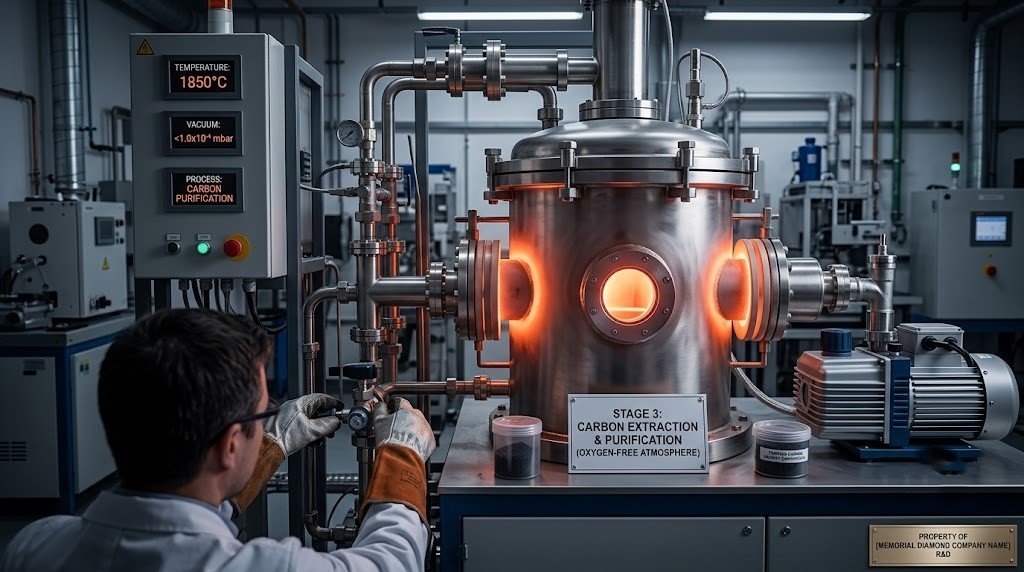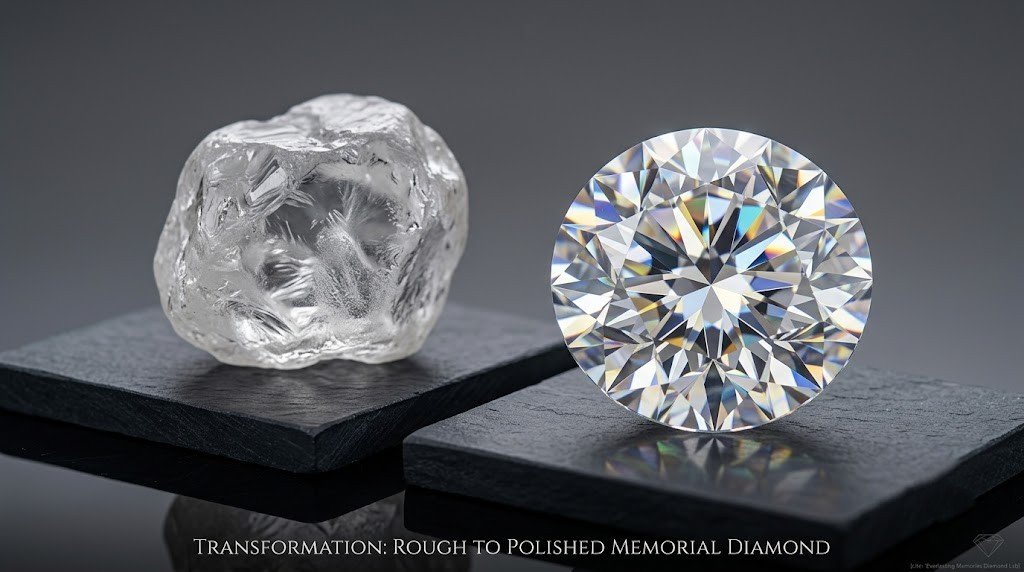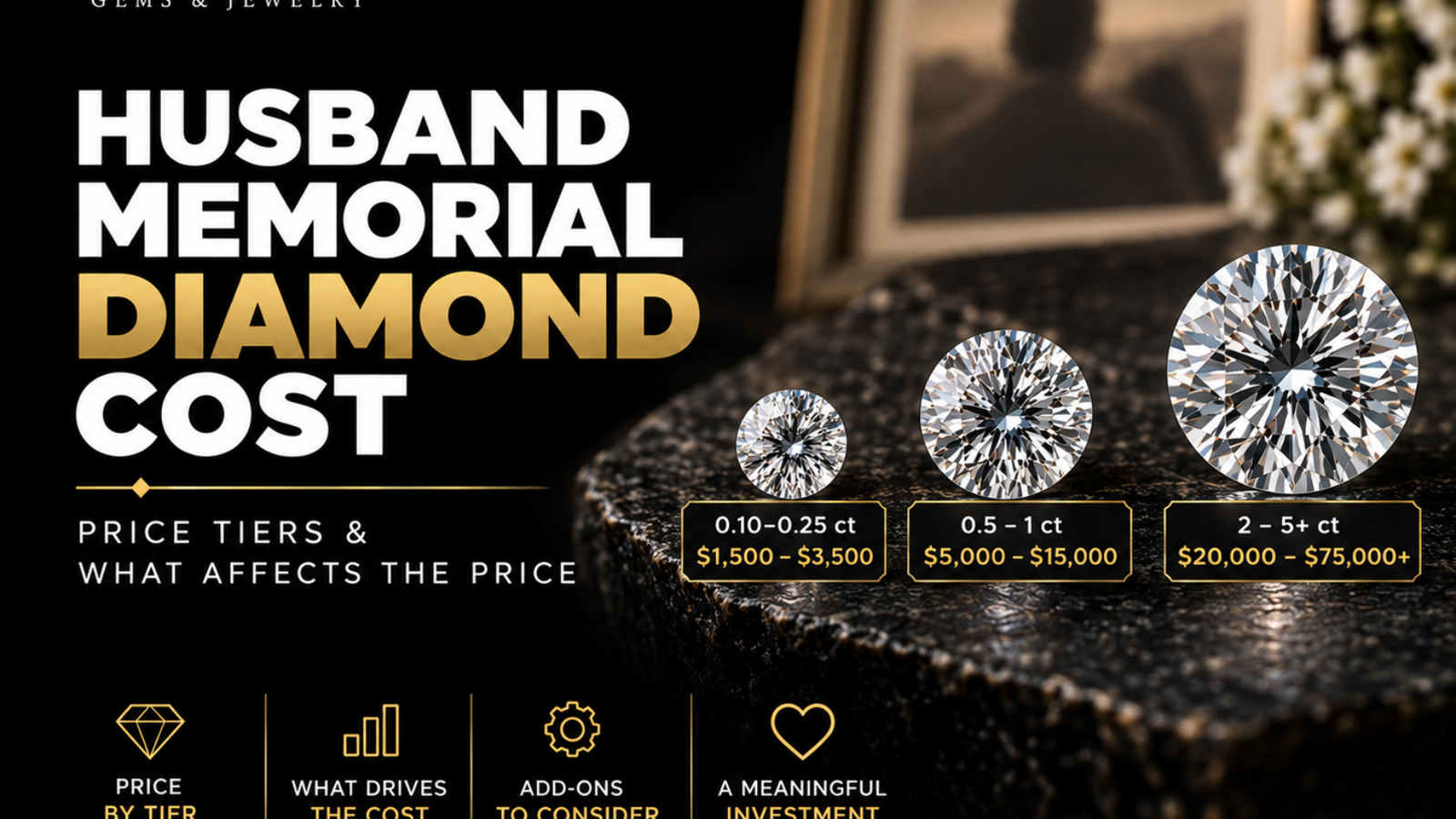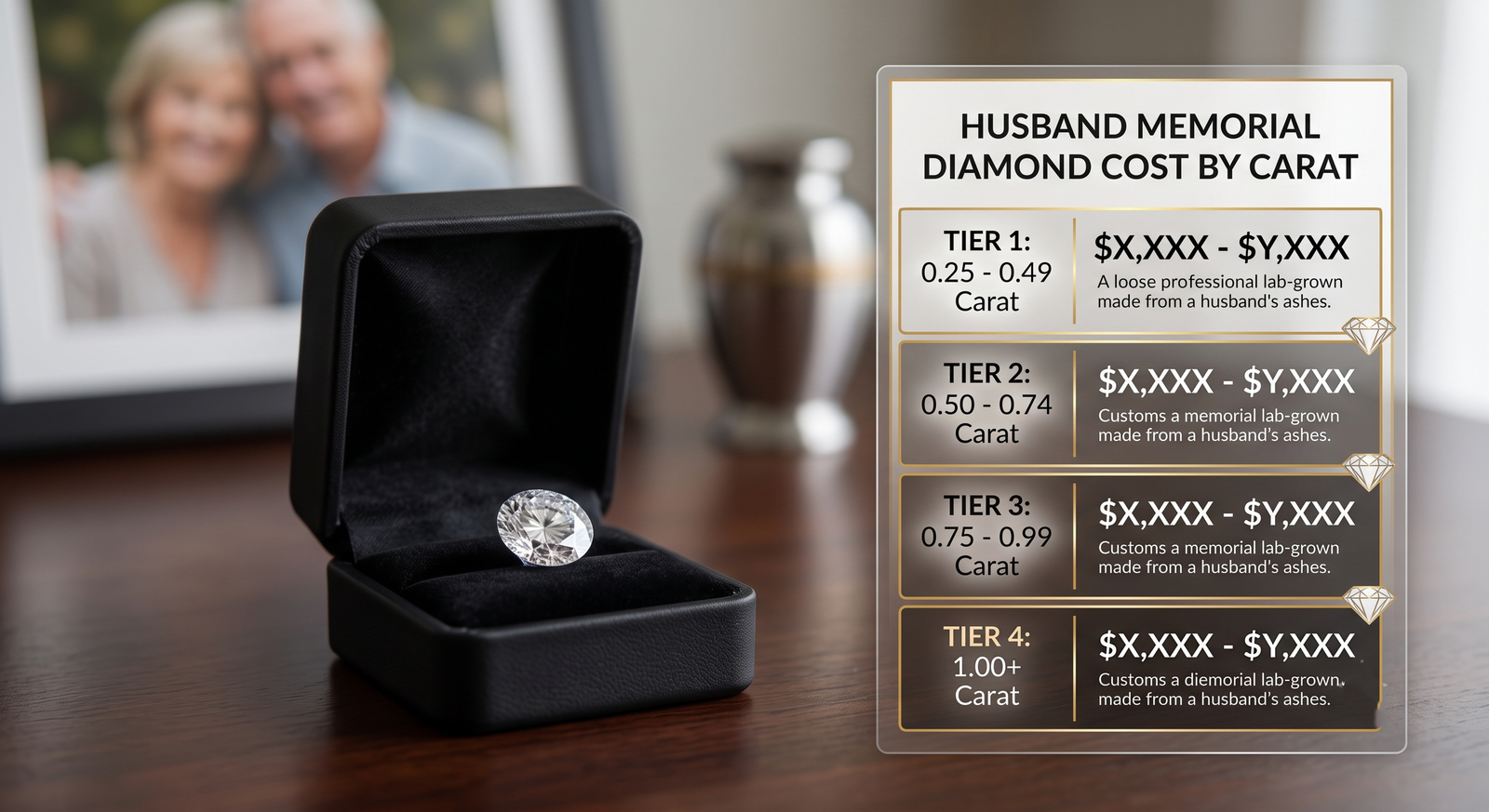
A notebook, a phone and a sealed keepsake container on a kitchen table, the first practical steps in choosing a memorial diamond for your partner

Choosing a Memorial Diamond for Your Partner: Where to Start

Somewhere in the first few weeks there is a stretch where every decision feels urgent and almost none of them feel like yours to make. Choosing a memorial diamond for your partner begins with a question that has nothing to do with diamonds: who holds legal authority over the remains. Settle that first, and the rest of this can be taken at whatever speed you are actually capable of.

Memorial Diamond grows these stones, so read this as a page written by an interested party. What follows is sequencing rather than persuasion: the order in which a memorial diamond for your partner actually has to be assembled, and the far longer list of things that can wait months at no cost.

Start With Standing, Not With Stones

Most guides open on carat and color. For a partner that is the wrong end of the problem.

Who controls cremated remains is decided at state level, with no federal rule sitting above it, and a written instruction can displace the default order entirely. Wills, disposition directives, pre need contracts and the form signed at the crematorium all count as writing. A legally recognized relationship usually makes the holder obvious. Without one, the person entitled to decide might be a parent, a grown child, a brother or sister, or a spouse from a marriage that had ended years before you met.

Better read now than discovered in month four. A memorial diamond for your partner needs a portion of material that someone has the standing to release, and if that person is not you, no amount of planning changes it. Every hour spent comparing providers before you know the answer is an hour on the wrong question.

Three things to establish, in this order, before any money moves:

  • Who signed the cremation authorization. A funeral director will usually tell you in a two minute phone call, at no cost, and that name is very often the person holding control.
  • What your partner left in writing. Has anyone opened the document, or is everybody working from memory of it? A written instruction outranks the default order of kin in many states.
  • Whether the person with authority is willing. Entitlement and willingness are different questions, and the second usually goes better than people expect.

If the person with standing is someone whose relationship with you is strained, do not open with the phrase “memorial diamond for your partner” and a price list. Open with the smallest possible ask: a portion, set aside, leaving every existing plan intact. How to raise this with family goes through that conversation in detail, including what to do when the answer is no the first time.

What Is Genuinely Irreversible About a Memorial Diamond for Your Partner?

Very little. The list of permanent acts inside a memorial diamond for your partner is short, and none of them is the one people worry about.

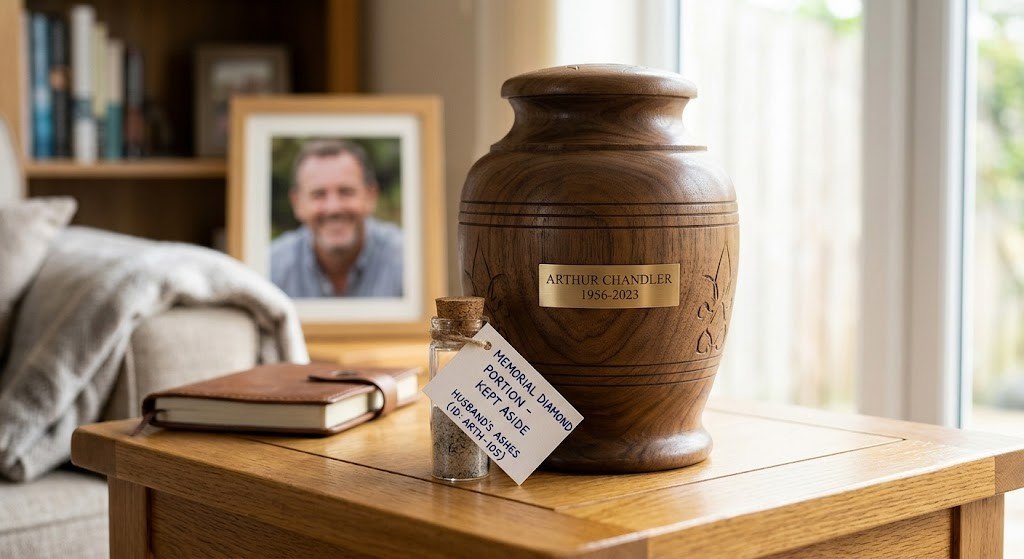
Scattering or interring the whole of the ashes. The only real deadline here. Once the ashes are in the water or under a stone, that route is finished. If a scattering is booked and you are even slightly unsure, ask for a portion to be held back, a few tablespoons in a sealed jar keeps the option alive without committing you.
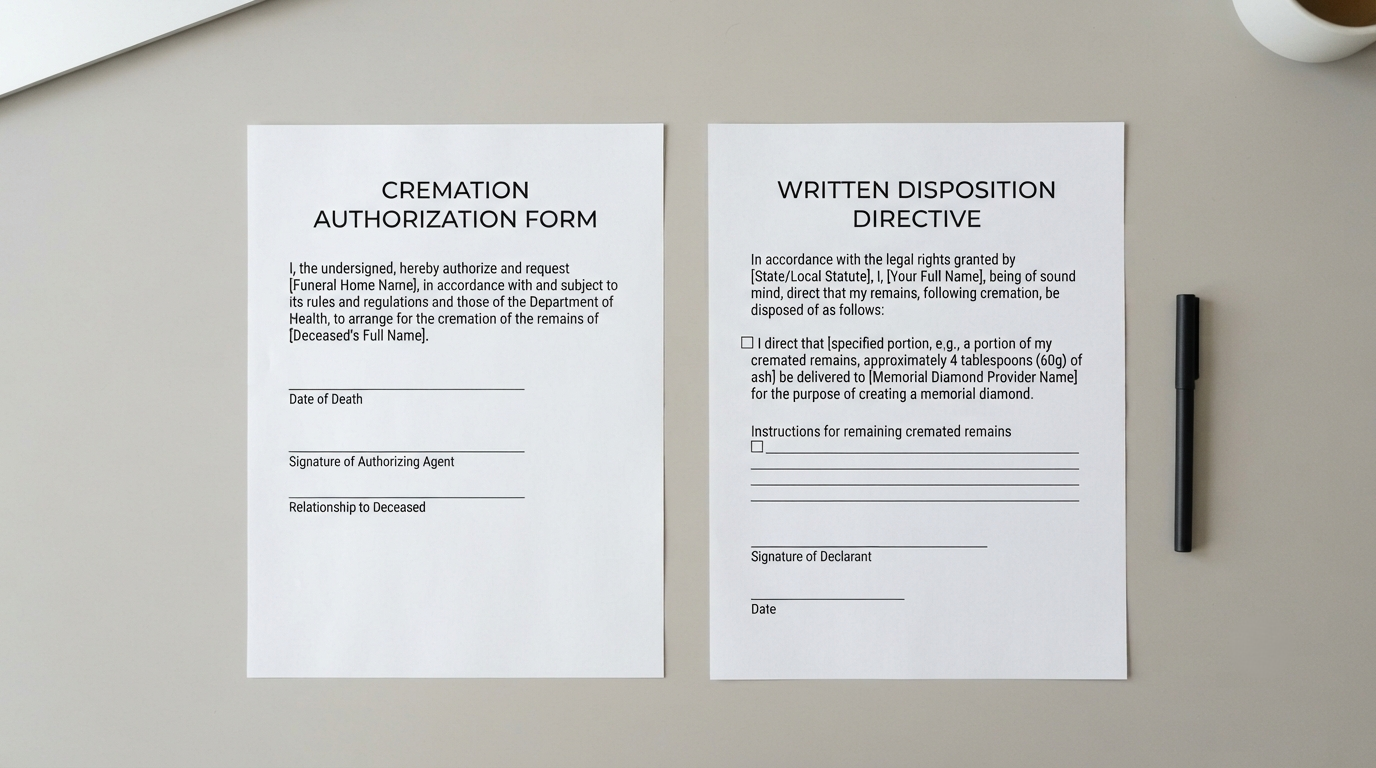
A cremation authorization form and a written disposition directive laid side by side on a desk

Collecting hair, if it has not been collected. Hair must be taken before cremation or burial, or not at all. Funeral homes will usually do it on request and think nothing of it. Nobody regrets a lock of hair in a drawer; plenty regret not asking.

Drawing the portion itself. Once material is measured out for a memorial diamond for your partner, that portion is committed. It is a small fraction of a cremation, industry typical requirements run from a few tablespoons up to roughly 4 oz, about 100 g, so the remainder stays with you, and every plan already made for it still happens.

Starting growth. Once a stone is in the press it is growing, and that is months away from today.

Everything else, provider, carat, color, cut, setting, who else receives one, can be changed, deferred, or abandoned without loss. A memorial diamond for your partner is far less of a one way door than the first fortnight makes it feel.

Why Is There No Hurry With a Memorial Diamond for Your Partner?

Because the materials do not spoil, and grief is a terrible clock.

Cremated remains are overwhelmingly calcium phosphate, the mineral structure of bone that survives the retort, inert and stable. Kept dry and sealed, ashes are in the same condition in a decade as this afternoon. Keratin in a dry envelope is not perishable either. A memorial diamond for your partner started in month eighteen is chemically indistinguishable from one started in month one.

What does change is you. The first weeks are when people make expensive decisions to feel briefly in control, and when families are least able to have a difficult conversation well. A choice about a memorial diamond for your partner made in the first fortnight is not a better choice, only an earlier one, taken with less information and more adrenaline.

So: do the two urgent things, protect a portion from a scattering, collect hair while you still can, and then stop. Nothing degrades, no window closes, no price is being held. If you would rather read than decide, the complete guide to a partner ashes diamond covers the process end to end and asks nothing of you.

Which Decisions Come First, and Which Can Wait?

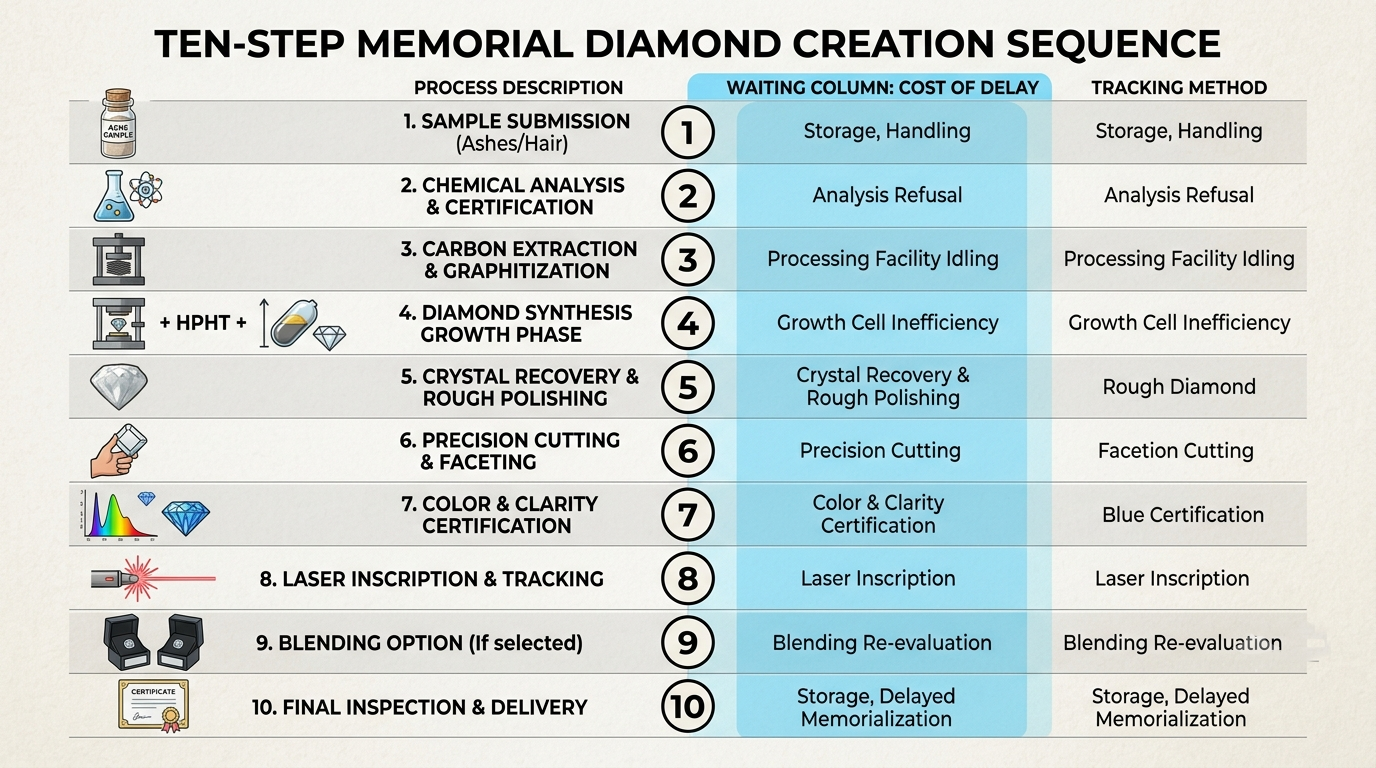
This is the table to screenshot, the whole argument in one grid: the order in which a memorial diamond for your partner has to be built, and how little of it is undoable.

DecisionWhen it actually has to be madeCan it be changed later?
Who holds authority over the remainsBefore anything else, before money, before promises to anyoneNot a choice; a fact to establish. Establish it early
Whether a portion is held back from a scattering or intermentBefore that scattering or interment happensNo, once the rest is gone. This is the only true deadline
Whether hair is collectedBefore cremation or burialNo. Collecting it costs nothing and commits you to nothing
Which provider grows the memorial diamond for your partnerWhenever you are ready to askYes, freely, until material is posted
Ashes, hair, or a combined submissionAt the point of orderingYes, while you still hold both materials
Carat sizeAt orderYes, until growth begins. Carat is bought with months, not material
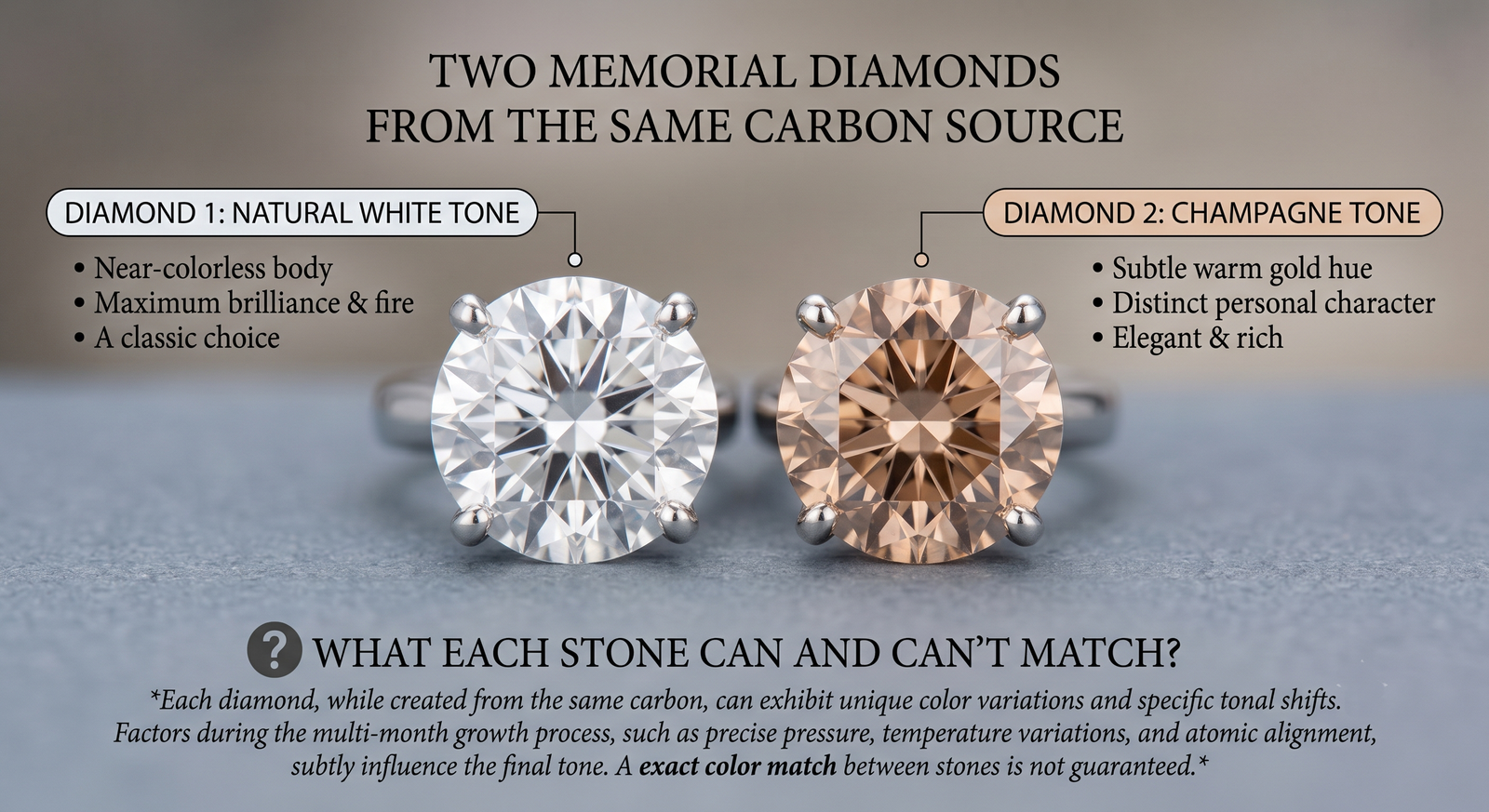
ColorAt order, as a likelihood rather than a selectionPartly. Trace elements in the source carbon have a vote
Cut and shapeAfter growth finishes, months from nowYes
Engraving, and independent grading if you order itAt or after cuttingYes, both are optional and usually separate line items
Setting, ring, pendant, something in a drawerAfter the finished stone existsYes, indefinitely, and it can stay unset forever
Whether other people each receive a stoneIdeally before the portion is drawnMuch easier before than after. Worth raising early
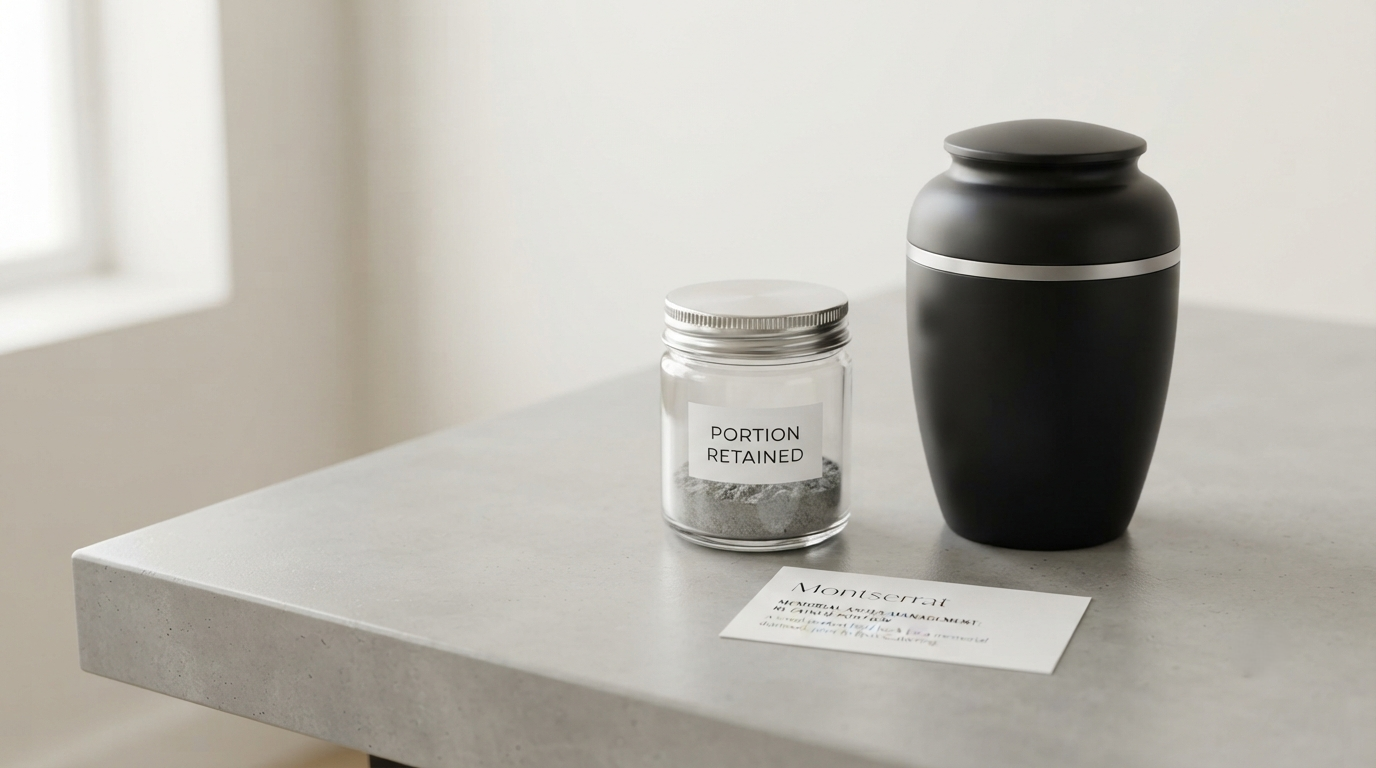
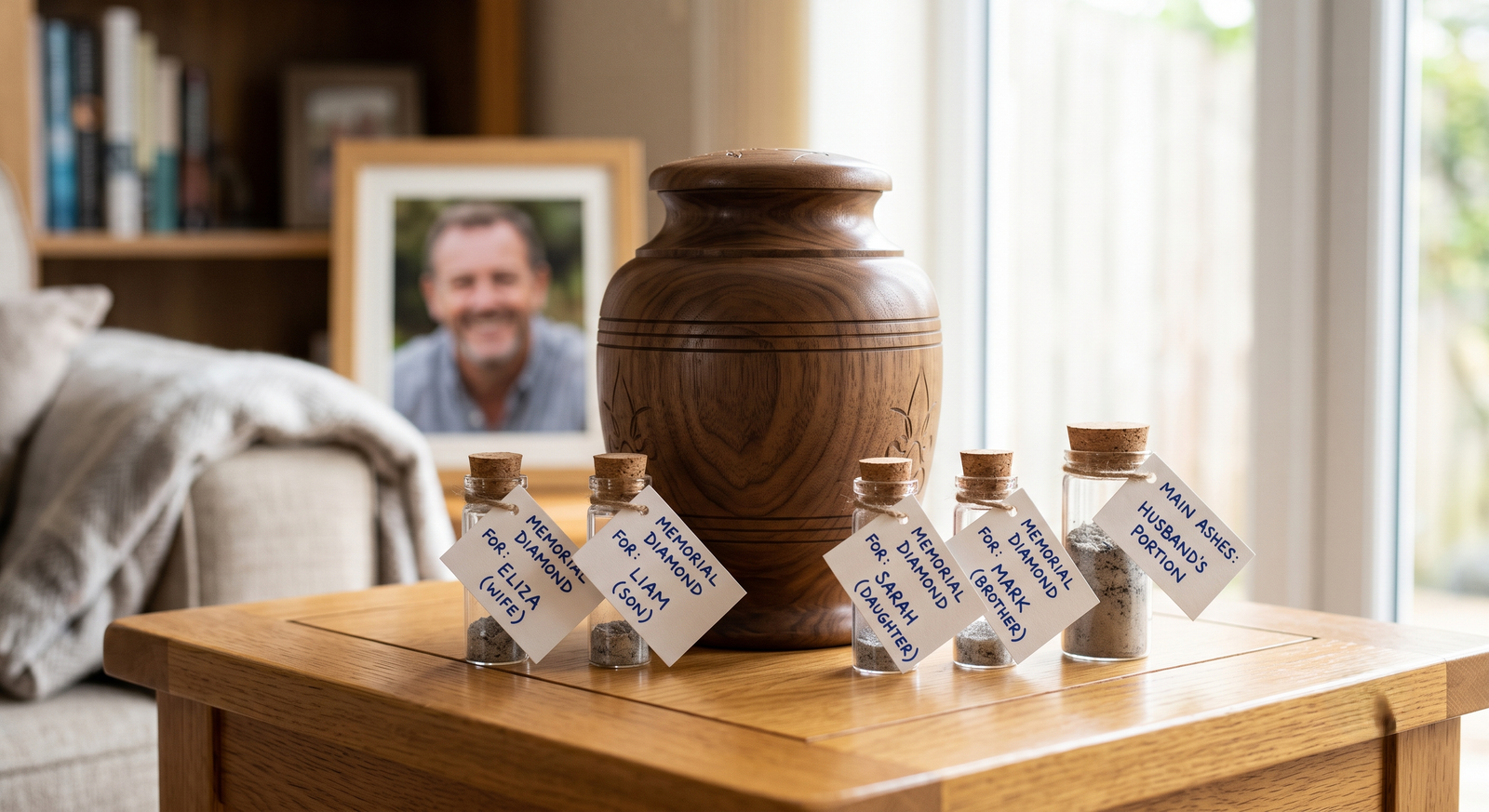
A small sealed jar holding a portion of ashes set beside a full urn, showing a portion held back before a scattering

Read the right hand column first. Two rows say no. The rest is yours to revisit, which makes a memorial diamond for your partner a sequence of deferrable choices wrapped around one short, urgent list.

Ashes, Hair, or Both: The Material Question

The first real decision after standing, and worth understanding rather than guessing at, because the two materials behave differently.

Ash is a poor carbon source: usable carbon is roughly 0.5% to 4% of cremated remains by weight, which is why the industry typical request is spoonfuls rather than a pinch. Hair is the opposite, roughly 50% carbon by weight, because keratin is a carbon rich protein. A small lock of a few grams does the work of a far larger portion of ash.
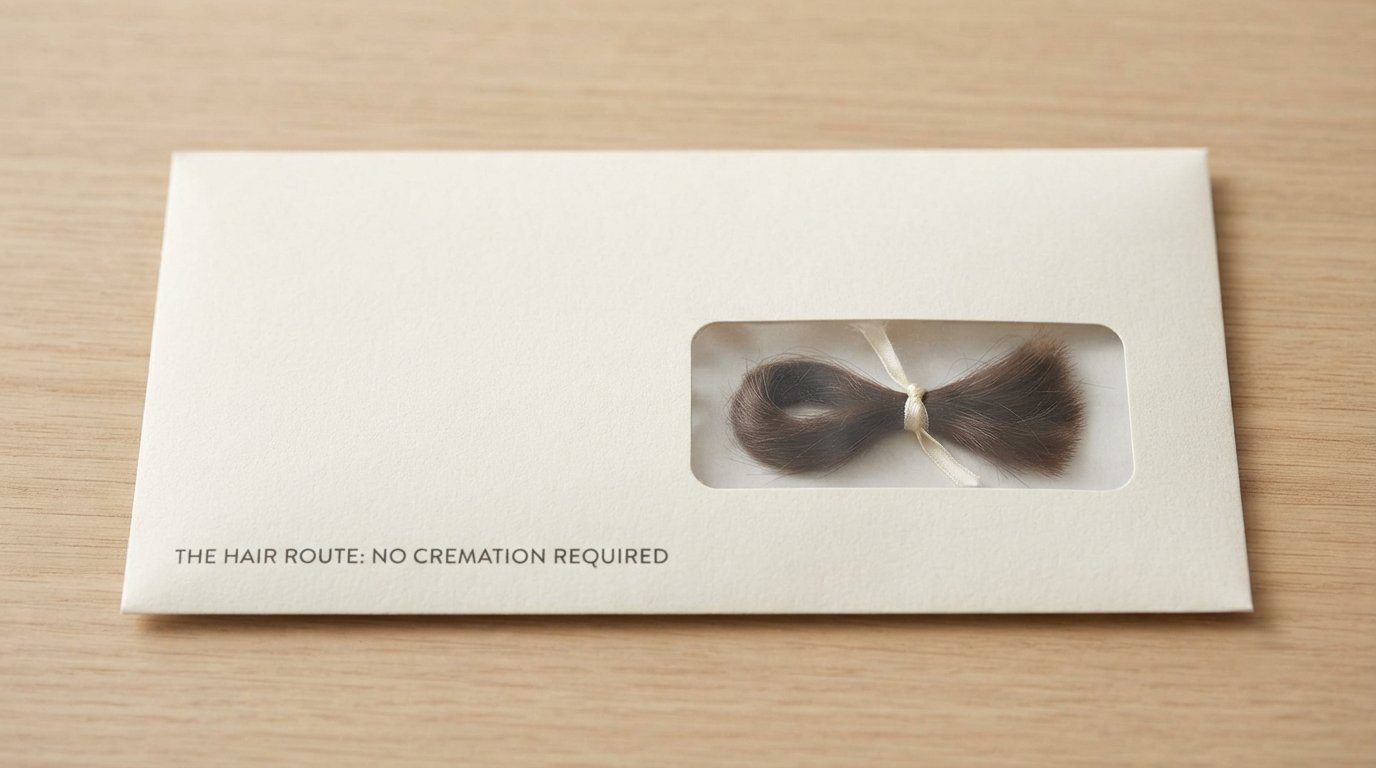
A lock of hair in a paper envelope, the route that needs no cremation at all

The practical consequences for choosing a memorial diamond for your partner:

  • Hair requires no cremation. If your partner was buried, or the ashes sit with someone who will not release a portion, hair is a complete route rather than a consolation prize. The complete guide to a partner hair diamond covers it on its own terms.
  • A combined submission is assessed against both materials separately, not pooled into a single total, so having a little of each is not the same as having enough of one.
  • Neither material makes a memorial diamond for your partner bigger. Carat comes from time in the press, not from the volume you send.
  • Either way the finished stone is a blend. Recovered carbon is purified to roughly 99.9%, converted to graphite, and grown alongside supplemental lab carbon. Industry figures for the ash route put the personal fraction around 10% to 15% of the stone’s mass, some providers as low as 3%; no equivalent figure is published for hair. A stone described as made wholly of a person is describing something the chemistry does not do. The accurate version is still extraordinary, carbon that was physically part of your partner sits inside the crystal lattice. The growth methods behind that are the same HPHT and CVD processes used industry wide, at roughly 6 to 8 GPa and 1,400 to 2,500°C.

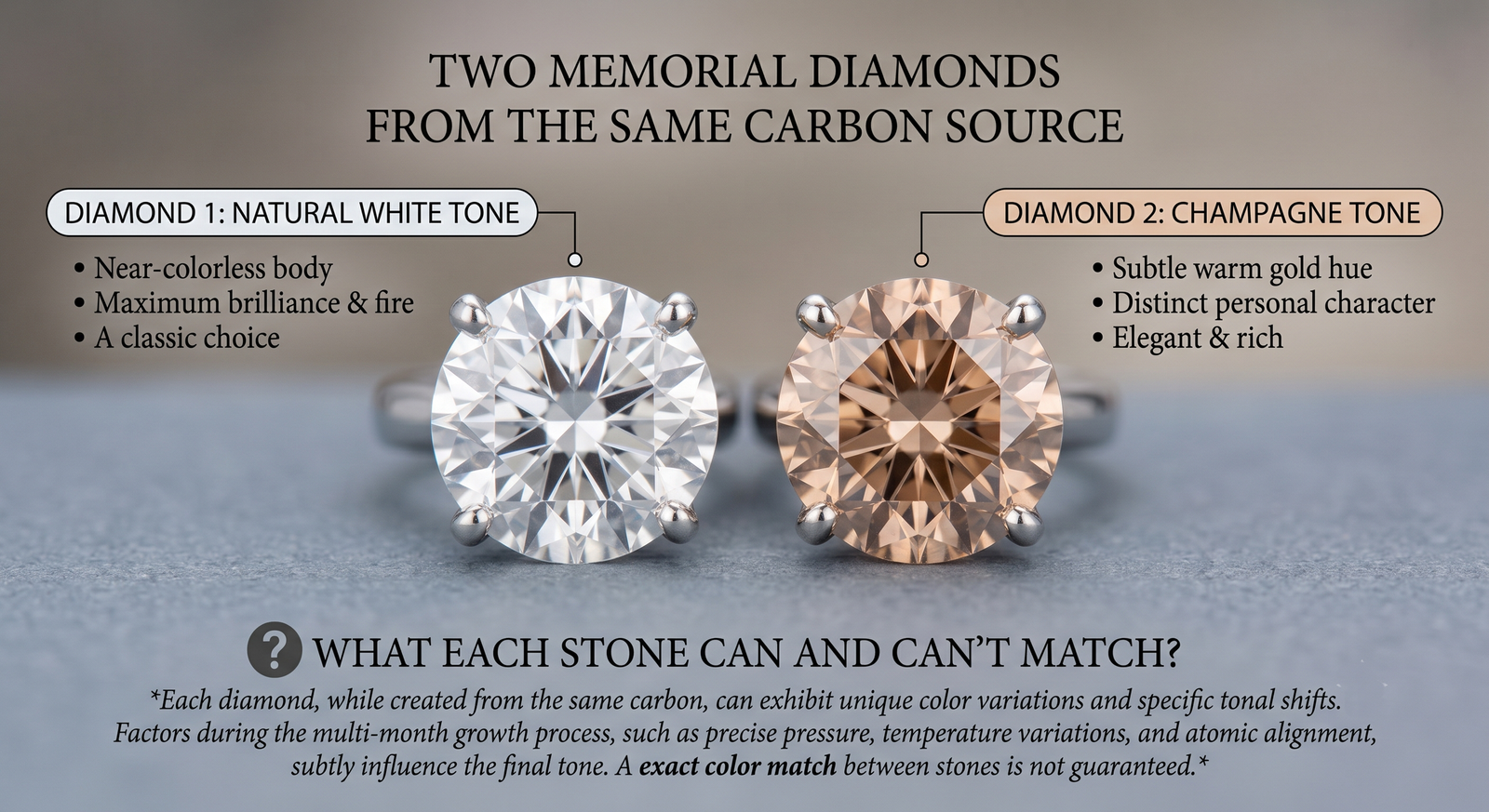
Color follows from the material as well, though not as a menu. The color of a memorial diamond for your partner is a likelihood rather than a selection: nitrogen in the source carbon reads yellow, boron reads blue, and only the absence of both produces a colorless stone. What color to expect sets out those odds honestly. Whatever emerges is graded against the ordinary GIA 4Cs and sits at 10 on the Mohs scale.

What Does a Memorial Diamond for Your Partner Cost in Money and Months?

What a memorial diamond for your partner costs is the question people are most embarrassed to ask and most relieved to have answered early. Here it is, as industry wide bands rather than any published figure of ours.

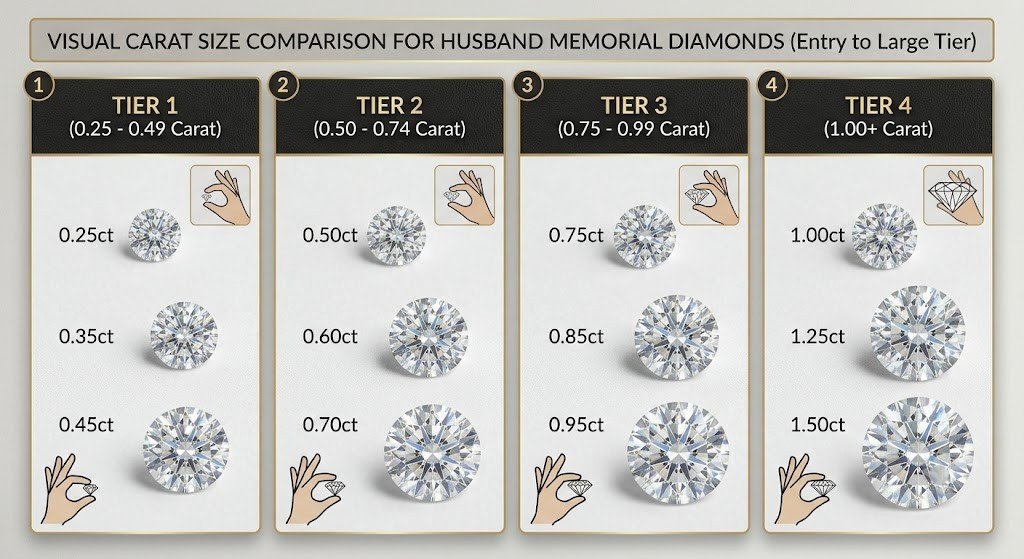
At the entry end, somewhere between a tenth and a quarter of a carat, the industry band is about $1,500 to $3,500. Move up to half a carat through one carat and it widens to roughly $5,000 to $15,000, with colorless costing meaningfully more than yellow, blue or champagne of equal weight. Past two carats and on toward five, the band opens out to $20,000 to $75,000 and beyond. Grading reports, engraving, fancy cuts and settings are normally priced separately, the full cost breakdown goes through each driver.

Time is the other currency, and longer than most people expect: 6 to 10 months from receipt of material to a finished stone, stretching to around 12 months for larger or specialty color stones. Carat is a function of growth time, so a bigger stone is literally a longer wait. The stage by stage timeline shows where the months go.

Two things follow from those two paragraphs, and they are the reason cost belongs in the middle of this page rather than the end:

  • Decide carat before you compare providers. Carat drives both the price of a memorial diamond for your partner and the wait, so a quote with no carat attached is not comparable to anything.
  • Budget for the second half. Grading, engraving and setting arrive months after the order, often when the initial money is already spent.

A First Month That Commits You to Nothing

Seven steps, none of which costs anything, and none of which obliges you to order a memorial diamond for your partner at the end of them.

  1. Phone the funeral home. Ask who signed the cremation authorization and whether written instructions were filed. Two minutes, no cost, and it answers the only question that can stop this.
  2. Protect a portion. If a scattering or interment is planned, ask for a few tablespoons to be held back. You can always return it to the rest; you cannot recall it from a river.
  3. Collect hair if it is still possible, or check whether any was already kept, a hairbrush, a christening envelope, a lock taken at the hospital.
  4. Have one conversation, not five, with whoever holds authority. Ask for a portion, not for a plan, a price, or a provider.
  5. Write down a carat you can afford, not one you can imagine. Everything else prices off it.
  6. Ask three providers the same four questions about a memorial diamond for your partner, in writing: what material they require, whether the stated minimum is a received or a usable weight, what happens to unused material, and whether independent grading is included.
  7. Then stop for a month. If a memorial diamond for your partner still feels right after that, it will still be possible, neither the materials nor the process will have changed.

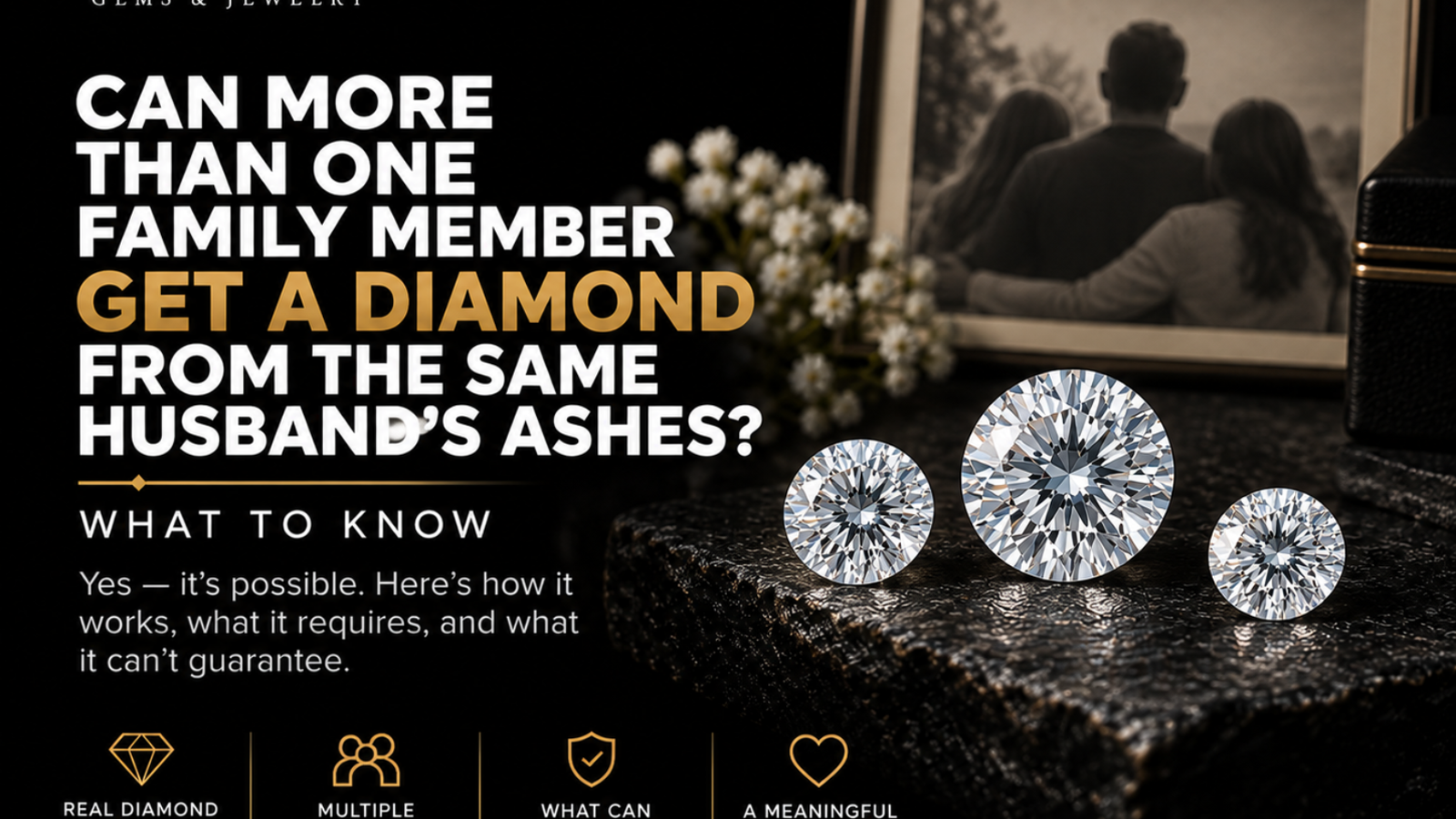
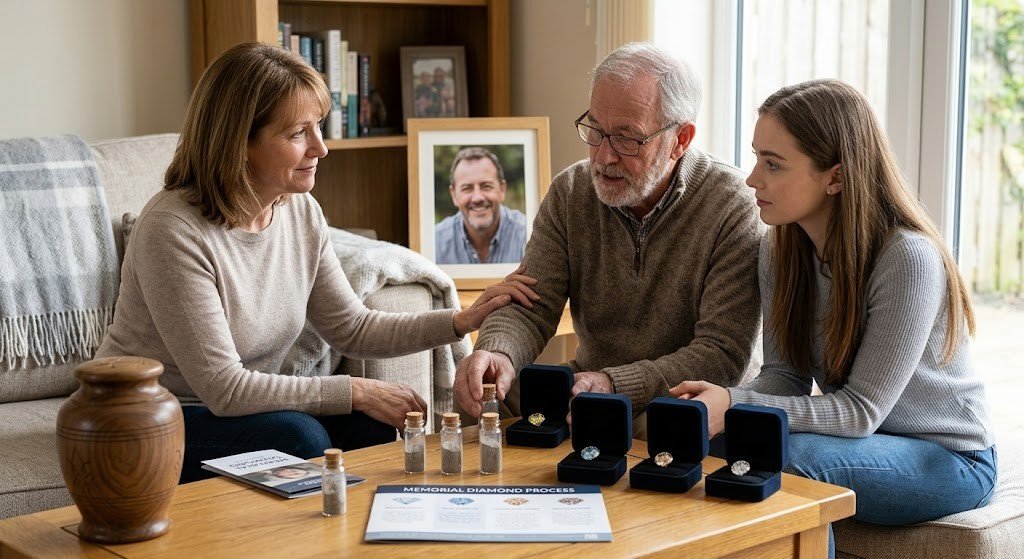
Some families discover at step four that more than one person wants a stone. That is easier before the portion is drawn, and several stones from one shared source is a normal request rather than an awkward one.

Frequently Asked Questions

Not necessarily. Authority varies by state and by what your partner put in writing, so the holder may be a parent, an adult child, or a former spouse. Ask for one small portion rather than for control of the arrangements. Narrower requests are often granted.

Should I decide any of this in the first two weeks?

Only two things: hold back a portion if a scattering is imminent, and collect hair if it can still be collected. Ashes and hair keep indefinitely, so a memorial diamond for your partner decided in month nine is exactly as good as one decided now.

Do I have to choose between a diamond and keeping the urn?

No. A memorial diamond for your partner takes a small fraction of a cremation, a few tablespoons to roughly 4 oz, so an urn, a burial plot, a scattering and a stone can all come from the same remains. Nothing asks you to abandon an existing plan.

What if the ashes have already been scattered?

Then the ashes route has closed, but hair has not. Hair needs no cremation, carries around 50% carbon, and a small lock is enough. Many people arrive at that route second and end up preferring it.

Is the stone actually made from my partner, or is that marketing?

Carbon recovered from the ashes or hair is purified and grown into the crystal itself alongside supplemental lab carbon. Industry figures for the ash route put the personal share near 10% to 15%, and no equivalent figure is published for hair. It is a genuine physical portion, not a symbol, and not the whole stone.

How do I compare providers without being able to see the work?

Ask questions with verifiable answers: chain of custody documentation for a memorial diamond for your partner, whether independent grading is included, what happens to unused material, and the timeline at your chosen carat. Specific, unhurried answers tell you more than photographs.

Final Thoughts on Choosing a Memorial Diamond for Your Partner

This page leads with paperwork rather than gemstones because paperwork is what can foreclose the option, and the part nobody warns partners about.

Establish who holds the remains. Protect a portion from anything irreversible. Collect hair while collecting hair is still possible. Then put the whole question down for as long as you need to, because a memorial diamond for your partner will be exactly as available in a year as it is tonight, and you will be in better shape to choose well.

If the standing question is answered no, that ends one route rather than the idea. Hair, a shared portion, a second conversation in six months, there is usually more room than a first refusal suggests. And if you never order anything, an urn on a shelf remains a complete and honorable answer.

Learn More About Partner Memorial Diamonds

Talk With Memorial Diamond

Asking a question here obliges you to nothing. If it would help to know what a memorial diamond for your partner would involve in your situation, the useful opening is not a quote request but a description of what you hold and who holds the rest.

Find out whether the quantity a company publishes is what it wants posted to it or what it expects to recover. Find out where anything left over goes. Find out how many months a memorial diamond for your partner takes at the carat you have in mind, and whether a grading report is bundled or billed. memorialdiamond.us will answer those, and so should anyone else you consider.
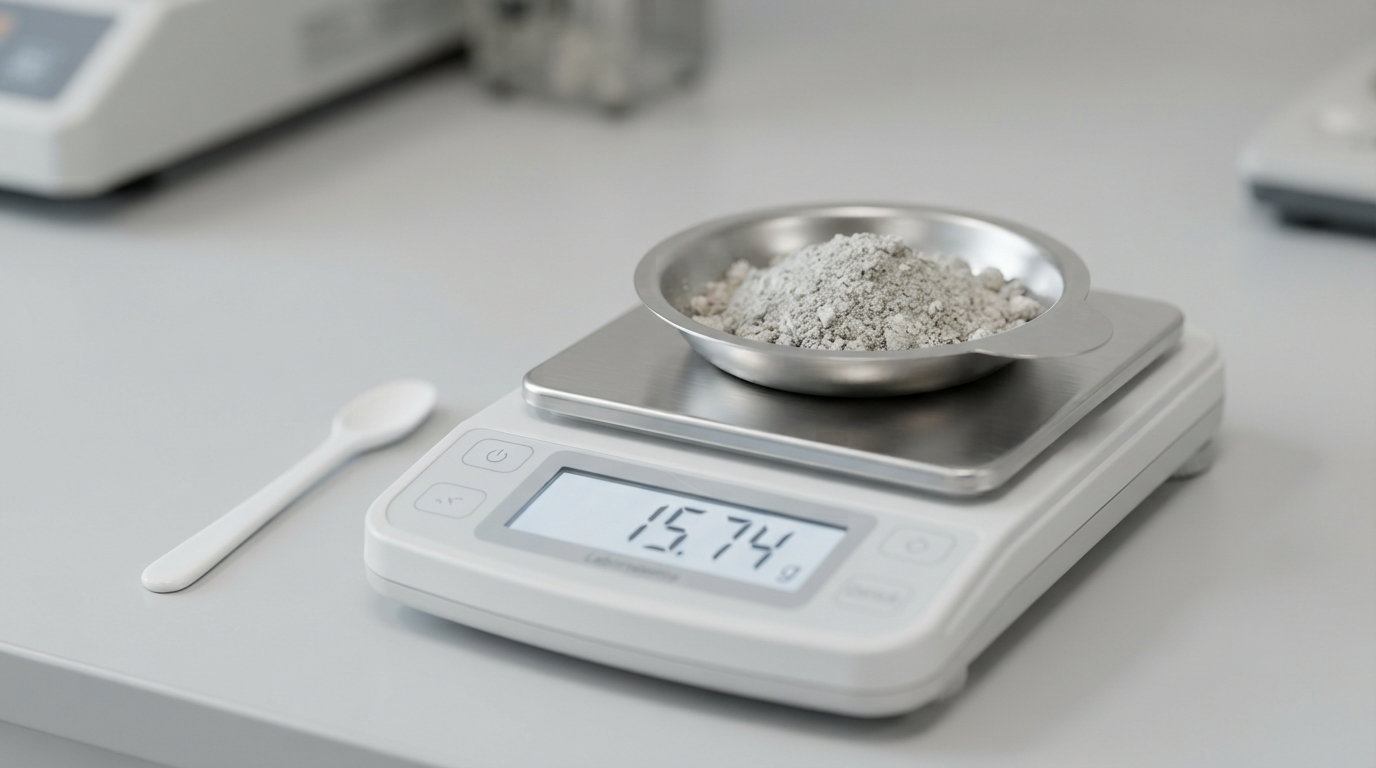
A small measured portion of cremated ashes in a glass dish beside a closed urn, showing how little ash for a partner memorial diamond a laboratory requires

How Much Ash Do You Need for a Partner Memorial Diamond?

The container came back heavier and smaller than you expected, and the thought that follows is always the same: whatever this takes, there will not be much left. The quantity of ash for a partner memorial diamond is small, industry wide it runs from a few tablespoons up to roughly 4 oz, about 100 g. Nearly everything you hold stays exactly where it is.

Worth saying first: Memorial Diamond grows these stones, so this page is not neutral, and every figure here is an industry wide band rather than our requirement. The honest way to read a question about ash for a partner memorial diamond is as a question about what a laboratory has to recover, not about what you are giving up.

What Stays With You When a Portion Goes

Begin at the remainder rather than the request, because the remainder is much the larger number.

A cremation produces a quantity measured in pounds. The top of the band for ash for a partner memorial diamond is roughly 100 g. Side by side, the arithmetic stops being frightening: the portion that leaves the house fits in a small jar, and everything already planned for the rest of the ashes remains possible.

Partners are frequently holding a plan made by someone else, a scattering the family booked, a niche already paid for, a date in the spring. Taking ash for a partner memorial diamond cancels none of it. In quantity terms these are sequential decisions, not competing ones.

What still remains available to you after a portion is set aside:

  • Interment in a plot, niche or columbarium, with the bulk of the remains intact.
  • A scattering at a named place, arranged or not.
  • Division among several people, a sibling, a parent, an adult child, you.
  • Keeping the urn at home, unchanged but for a jar’s worth.
  • A second stone later, if someone else eventually wants one, since the ash for a partner memorial diamond is drawn from the same shared source.

None of those is a lesser choice, and nothing here argues otherwise. An urn on a shelf is a complete answer. The reason to understand the quantity of ash for a partner memorial diamond is so that nobody refuses the idea believing it consumes everything.

How Much Ash for a Partner Memorial Diamond Does a Lab Actually Need?

Here is the part that explains the number. Cremated remains are not carbon. They are overwhelmingly calcium phosphate, the mineral scaffolding of bone, which is what the retort leaves behind. Usable carbon accounts for only about 0.5% to 4% of ash by weight, industry wide.

So a laboratory asking for ash for a partner memorial diamond is not asking for a diamond’s worth of material, but for enough of a carbon poor mineral that a recoverable quantity of carbon can be pulled from it. The request is spoonable rather than a pinch for one reason: the yield is thin.

What follows is arithmetic on the industry band rather than any provider’s stated yield for ash for a partner memorial diamond, and no laboratory should be held to it:

Portion submittedCarbon present, at the industry band of 0.5% to 4% by weightWhy the band, not the midpoint, is what matters
A single tablespoon, about 15 gRoughly 0.08 g to 0.6 gAt the low end of the percentage band this is close to nothing recoverable, worth asking any provider whether they would even assess a portion this small
A few tablespoons, about 45 gRoughly 0.23 g to 1.8 gThe bottom of the industry band quoted on this page, workable if the material is carbon rich, marginal if it is not
Around 60 gRoughly 0.3 g to 2.4 gA comfortable middle; the spread between best and worst case is already fourfold
4 oz or about 100 gRoughly 0.5 g to 4 gThe top of the band, requested because it makes the worst case survivable rather than because the best case needs it
Close view of cremated remains on a laboratory weighing dish next to a digital scale reading in grams

Read the third column rather than the second. The ash for a partner memorial diamond is measured in ounces rather than grains because nobody knows in advance where inside 0.5% to 4% a particular cremation will fall. The quantity is insurance against a low yield, a far less alarming explanation than most people assume.

One more honesty point belongs here, and it is the one most often blurred. The recovered carbon is purified to roughly 99.9%+, then blended with supplemental lab grown carbon to reach the volume a growth cell needs.

Industry figures for the ash route put the personal fraction at around 10% to 15% of the finished stone’s mass, and the spread is wider than one band suggests, some providers cite figures as low as 3%. Either way, a stone described as made entirely of a person is describing something the chemistry does not do, and the truthful version is still remarkable. What actually happens to the ashes once they reach the laboratory walks through each stage between the container and the crystal.

Why Doesn’t a Larger Stone Take More Ash?

Because carat is bought from the press, not the urn. The ash for a partner memorial diamond sets nothing about the finished size.

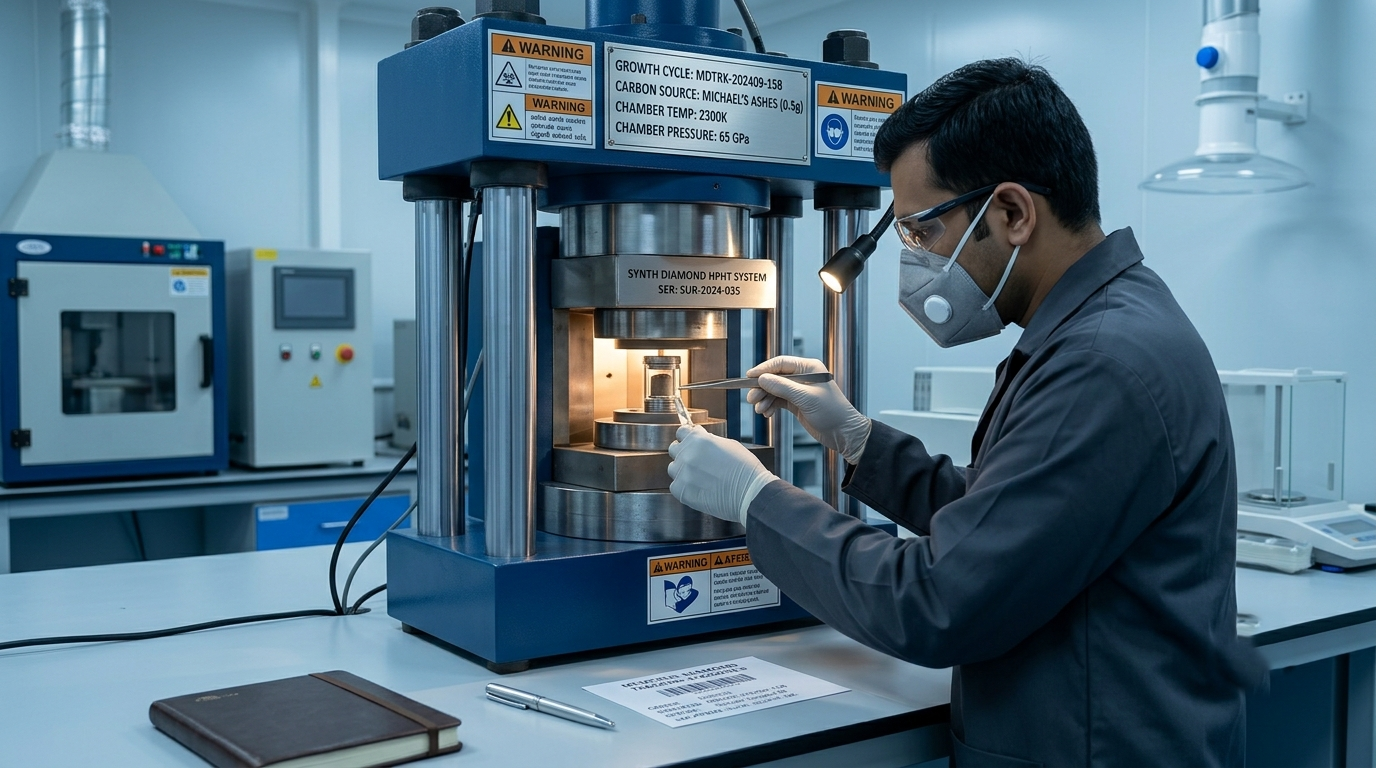
An HPHT growth cell holds roughly 6 to 8 GPa at 1,400 to 2,500°C, and the crystal accumulates over weeks to months, documented under synthetic diamond growth. Memorial stones run from about 0.10 ct up to 5+ ct, and the distance between those ends is scheduled machine time.

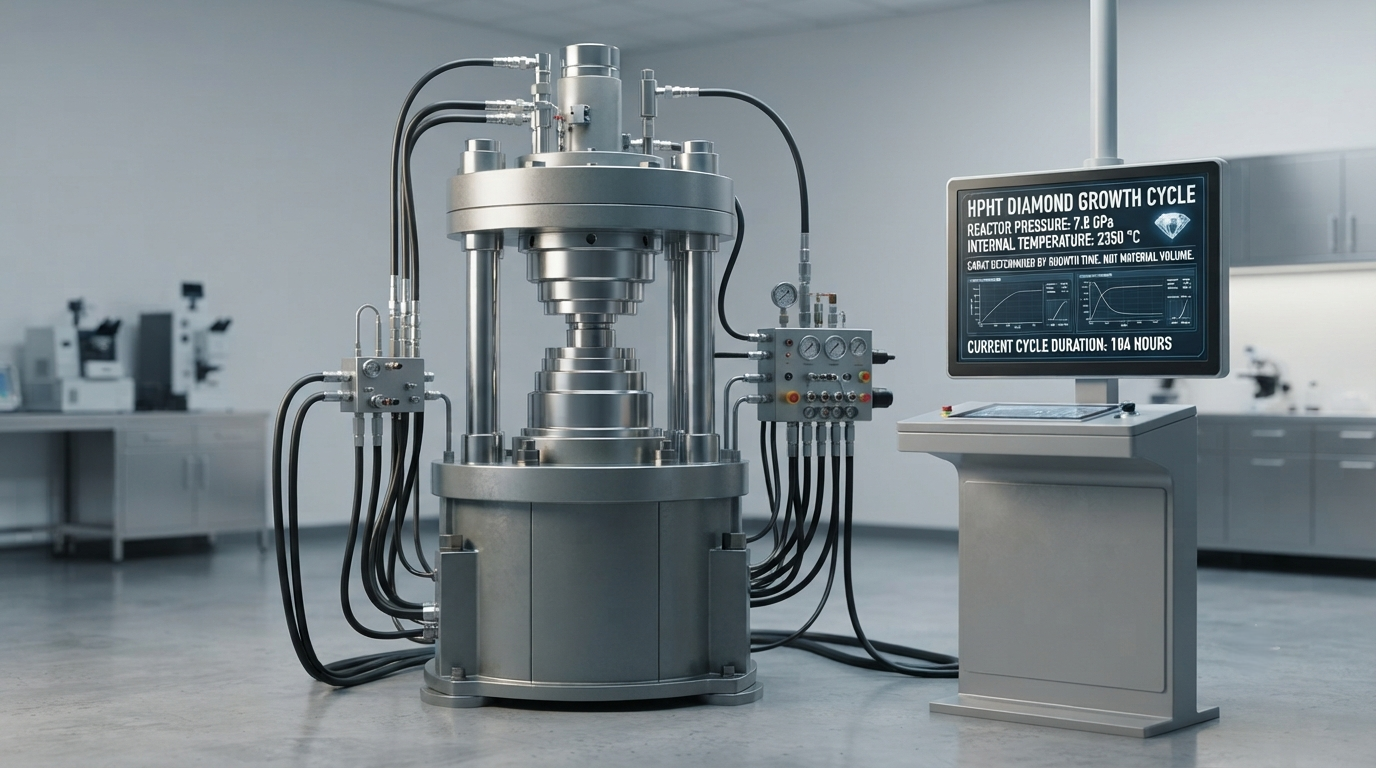
An HPHT diamond growth press in a laboratory, the equipment where carat is determined by growth time rather than material volume

Three consequences follow, and they are what change what you have to decide:

  • A small stone and a large one start from the same portion. Requesting 0.25 ct rather than 1.5 ct is not a second question about ash for a partner memorial diamond. It is a question about months and money.
  • Sending extra does not shorten the wait. The industry typical timeline is 6 to 10 months from receipt, up to 12 months for larger or specialty color stones, a clock set by the carat you choose.
  • Sending extra does not choose the color. Color comes from trace elements present during growth, nitrogen reads yellow, boron reads blue, the absence of both colorless. What color to expect from a stone grown from your partner’s ashes covers why that is a likelihood rather than a selection, and the GIA’s explanation of the 4Cs covers how the stone is graded against the same scale as any other diamond.

One thing sending extra may affect is best left as a question rather than a claim: whether the personal share of a finished stone shifts with carat, or with how much material was submitted. Nothing published settles it. If it matters to you, ask a provider how much ash for a partner memorial diamond they want at the carat you have in mind, in writing. Deciding carat first is the efficient order, because what a partner memorial diamond costs moves with carat rather than portion size.

Who Can Decide That the Ashes Are Divided?

This stops more partners than the quantity of ash for a partner memorial diamond ever does, and deserves a straight answer rather than reassurance.

Authority over cremated remains is not set by a single national rule. It varies by state and can be redirected by anything your partner put in writing, a will, a disposition directive, a signed instruction to a funeral home. Where a relationship was legally recognized, the picture is usually simpler. Where it was not, the ashes may be controlled by a parent, an adult child, a sibling, or a spouse from an earlier marriage.

That is no reason to abandon the idea. It is a reason to find out who holds the ashes before money moves, because ash for a partner memorial diamond cannot be set aside by someone without the standing to do it. Setting aside ash for a partner memorial diamond is irreversible, and the container may not be yours to open, a conversation far easier held in advance than explained afterwards.

Two people talking across a kitchen table with paperwork between them, illustrating a conversation about authority over remains

Three things are worth establishing, in this order:

  1. Who holds legal authority, under the law of the state where the cremation took place, a funeral director will usually tell you, free.
  2. What your partner left in writing, if anything, and whether anyone has read it rather than remembered it.
  3. Whether the person with authority is willing to release ash for a partner memorial diamond, a separate question from whether they are entitled, and often a warmer one than people expect.

Families who never acknowledged a relationship sometimes surprise people here. A request for a portion is small, specific and answerable, far easier to grant than a request to change what happens to the rest. If the answer is no, whether more than one person can have a stone from the same ashes often reopens it, because a shared portion serves more than one grief at once.

What If You Only Hold Part of the Ashes?

Plenty of partners hold a share rather than a whole cremation, a portion handed over at the funeral, a keepsake urn, what was kept back before a scattering.

A share can still hold enough ash for a partner memorial diamond, since the bottom of the band is a few tablespoons. But have it assessed rather than judged by eye: weight and volume are not the same, and a keepsake urn that looks generous can hold less.

What to do with a partial share:

  • Weigh it on a kitchen scale, in grams, before you describe the portion to anyone.
  • Describe how it has been stored, sealed, opened, kept somewhere damp, since condition is part of what a provider assesses.
  • Ask whether a pre assessment is possible from a weight, a photograph and a description, before anything is posted.
  • Ask whether the stated figure is a received weight or a usable weight, the single most useful question on this page. Two providers can answer it differently without either being wrong, and it is the difference between sending a number and sending enough.

If the honest answer is that you do not hold enough ash for a partner memorial diamond, that is a real answer rather than the end of it. Hair is roughly 50% carbon by weight, requires no cremation, and needs a fraction of the mass, how much hair a partner memorial diamond takes covers that route, and a combined submission is assessed against both figures separately rather than pooled.

What Happens to Material the Process Doesn’t Use

Extraction does not consume all of the ash for a partner memorial diamond that arrives. Carbon is separated from a mineral dominated material, so most of what you send is not what the process is after, and the remainder’s fate is set by company policy, not chemistry.

Nothing industry wide settles it, so put it in an email before you commit ash for a partner memorial diamond to anyone:

  • Is unused material returned by default, or only when it is requested in advance?
  • In what form and container does it come back, and how long after the stone is finished?
  • If the answer is that it does not return, is that stated anywhere in writing?

That last one is not suspicion. It is the instinct that makes you read a contract before signing, and a provider who answers briskly tells you something about how they run the rest of the process. The full sequence, from that first email to a finished stone, is in the complete guide to a partner ashes diamond.

Frequently Asked Questions

Is a few tablespoons really enough, or should I send more to be safe?

A few tablespoons sits at the bottom of the industry band for ash for a partner memorial diamond, and it works when the material is carbon rich. Sending toward the top of the band is insurance against a low yield, not a way to get a bigger stone. Ask your provider which end they prefer.

Does the laboratory keep the ash it doesn’t turn into carbon?

That is policy, not chemistry, and it varies. Extraction leaves behind most of the ash for a partner memorial diamond that arrives, so ask in writing before anything is sent: does the remainder return by default, in what container, and after how long?

Our families never acknowledged the relationship. Can I still set a portion aside?

Possibly, but authority over ash for a partner memorial diamond varies by state and by what your partner left in writing, and it may rest with a parent, an adult child, or a former spouse. Find out who holds it before spending anything. One small, specific request is often granted.

Can a portion be taken from ashes that have already been interred?

That becomes a permissions question rather than a question about ash for a partner memorial diamond. Cemeteries and columbaria set their own rules for removing interred remains, and state or local law may add more. Ask the cemetery directly, in writing, before assuming.

Does it matter how long the ashes have been in the house?

Age itself is not the concern with ash for a partner memorial diamond; storage is. Cremated remains are stable, but a container that has been opened, or kept somewhere damp, is worth describing when you ask for an assessment. Providers would rather know in advance than discover it.

If there isn’t enough ash, is there another route?

Yes. Hair carries roughly 50% carbon against the 0.5% to 4% in ash for a partner memorial diamond, so a small lock does the work of a far larger portion, and no cremation is required. Many families who came for one route take the other.

Final Thoughts on Ash for a Partner Memorial Diamond

The number is the easy part of this. A few tablespoons to roughly 4 oz of ash for a partner memorial diamond, the bulk of everything staying with you, and a portion small enough that it interrupts nothing already planned.

Five facts do most of the work on this page:

  1. The quantity of ash for a partner memorial diamond is small, a few tablespoons to roughly 4 oz, from a cremation measured in pounds.
  2. Carbon yield is the reason. Only about 0.5% to 4% of cremated remains is usable carbon.
  3. A larger stone takes no more material. Carat is bought from press time, not from the jar.
  4. The finished stone is a blend. Industry figures for the ash route put the personal share near 10% to 15%, some providers as low as 3%.
  5. Authority decides this, not arithmetic. Who may divide the ashes varies by state and by what your partner left in writing.

The harder part sits one step behind it, and this page has tried not to soften it: whether the container is yours to open, and who you need to ask. That has an answer too, usually a faster one than people fear, a funeral director, a written instruction, one direct conversation with whoever holds authority. Settle that and the quantity of ash for a partner memorial diamond becomes what it always should have been: a logistical detail, not an obstacle.

Learn More About Partner Memorial Diamonds

Talk With Memorial Diamond

Nothing on this page requires you to commit anything. If it would help to know what quantity of ash for a partner memorial diamond your own situation would call for, three questions get you most of the way there, and all three can be answered before you decide.

Ask what quantity of ash for a partner memorial diamond is required and whether that figure is a received or a usable weight. Ask what happens to material the process does not use. Ask how many months a stone runs at the carat you have in mind. memorialdiamond.us will answer all three, and so should anyone else you are considering.

A closed urn on a shelf beside a sealed paper envelope, the two forms ash and hair for a partner memorial diamond arrive in

How Much Ash and Hair Do You Need for a Partner Memorial Diamond?

The two things are almost never in the same room. The urn sits somewhere deliberate, a shelf, a sideboard, a spot chosen carefully. The hair is in an envelope in a drawer, if any was cut at all. Ash and hair for a partner memorial diamond are measured against two separate figures: typically a few tablespoons up to roughly 4 oz of cremated remains, or a small lock of a few grams of hair.

Read the “or” in that sentence carefully, because it is the whole post. Submitting both does not add the two allowances together into something larger. A combined order is not a double order.

Memorial Diamond grows these stones, so treat this page as interested rather than neutral, and every number on it as an industry wide range rather than our published requirement. What follows is mostly about what a second source changes, less than people assume, and about the one genuinely new decision it creates.

What a Second Source Actually Changes

Start with the shorter list, which is the list of things a second source does not do.

Sending both ash and hair for a partner memorial diamond does not make a bigger diamond. It does not shorten the wait. It does not raise the proportion of the finished stone that came from your partner. It does not halve either requirement, and it does not let a short quantity of one material be topped up by the other. People arrive at ash and hair for a partner memorial diamond expecting an additive answer and there isn’t one.

What it does change is real, though, and worth the trouble:

  • Redundancy. If one half of the ash and hair for a partner memorial diamond you hold disappoints on assessment, the order does not necessarily end.
  • Access. Authority over ash and hair for a partner memorial diamond rarely rests with one person. Sometimes the ashes are controlled by someone else and the hair is not, or the reverse.
  • Meaning. Some people simply want both included, and that is a sufficient reason on its own without technical justification.
  • Timing. The ash and hair for a partner memorial diamond can often be committed at different moments rather than together.

That last one is the decision this page exists for. Everything else about ash and hair for a partner memorial diamond is already settled by the two single material figures. Sequencing is the part nobody tells you about in advance.

How Much Ash and Hair for a Partner Memorial Diamond Does a Combined Order Take?

The ash and hair for a partner memorial diamond are assessed against separate bands, independently of one another.

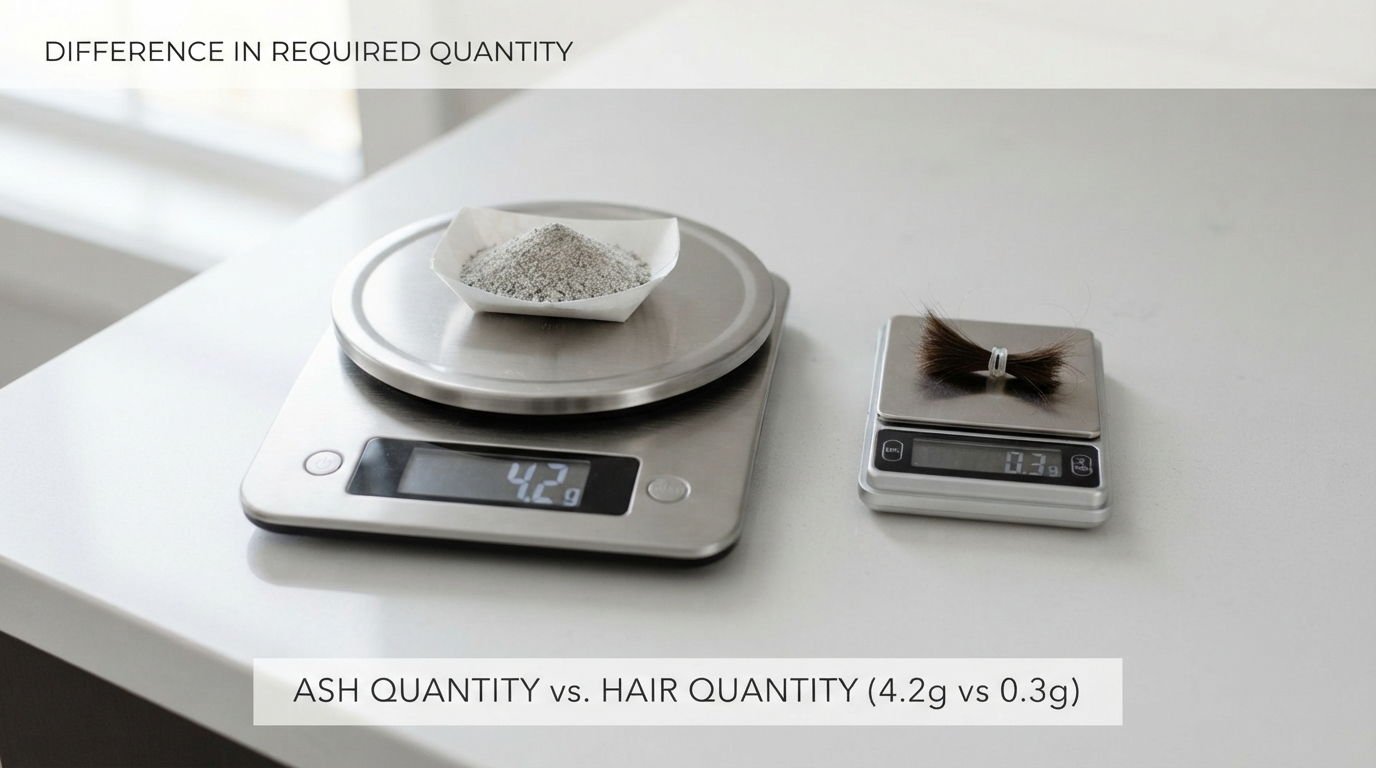
For cremated remains, the industry typical requirement runs from a few tablespoons up to roughly 4 oz (about 100 g). For hair, it is typically a small lock, a few grams. The reason the two halves of ash and hair for a partner memorial diamond carry such different figures is carbon content: hair is roughly 50% carbon by weight, while cremated remains yield only about 0.5% to 4%, because ash is overwhelmingly calcium phosphate rather than carbon.

A kitchen scale holding a small portion of cremated remains next to a far smaller lock of hair, showing the difference in required quantity

Any provider you approach will have its own numbers inside those bands, so the specific quantity of ash and hair for a partner memorial diamond you are asked for is a figure to get in writing from them, not something to infer from a page like this one. Ask three things about the ash and hair for a partner memorial diamond when you do:

  1. Is each figure a received weight or a usable weight? Processing removes whatever is not carbon, and two companies may answer it differently without either of them being wrong.
  2. Are the ash and hair for a partner memorial diamond assessed separately or as one submission? This determines whether a shortfall in one is fatal to the order.
  3. Does submitting ash and hair for a partner memorial diamond together change the required quantity of either? The honest expectation is no, but it is a policy question, not a chemical one.

Beyond those figures, the quantity of ash and hair for a partner memorial diamond stops mattering. Carat comes from time in an HPHT growth cell, which runs at 1,400 to 2,500°C under something like 6 to 8 GPa for weeks or months on end, as documented in the general literature on diamond growth methods. Stones run from about 0.10 ct to 5+ ct, and the industry typical timeline is 6 to 10 months, stretching toward 12 for larger or specialty color work. None of those numbers moves because you sent ash and hair for a partner memorial diamond instead of one material. The full sequence for a combined submission covers what happens once both have been accepted.

Does Using Both Make the Stone More of Your Partner?

No, and this deserves a direct answer rather than a tactful one, because it is the reason many people submit both in the first place.

The carbon recovered from ash and hair for a partner memorial diamond is a minority of the finished stone. Industry figures for the ash route put that personal fraction at something like 10 to 15% of the stone’s mass, some providers as low as 3%, and no published figure covers a blended charge of the two materials. Whatever is recovered gets purified to roughly 99.9%+, converted to graphite, and then topped up with lab grown carbon until there is enough feedstock to fill a growth cell. Sending ash and hair for a partner memorial diamond puts two personal inputs into that same recovered fraction. It does not enlarge the fraction.

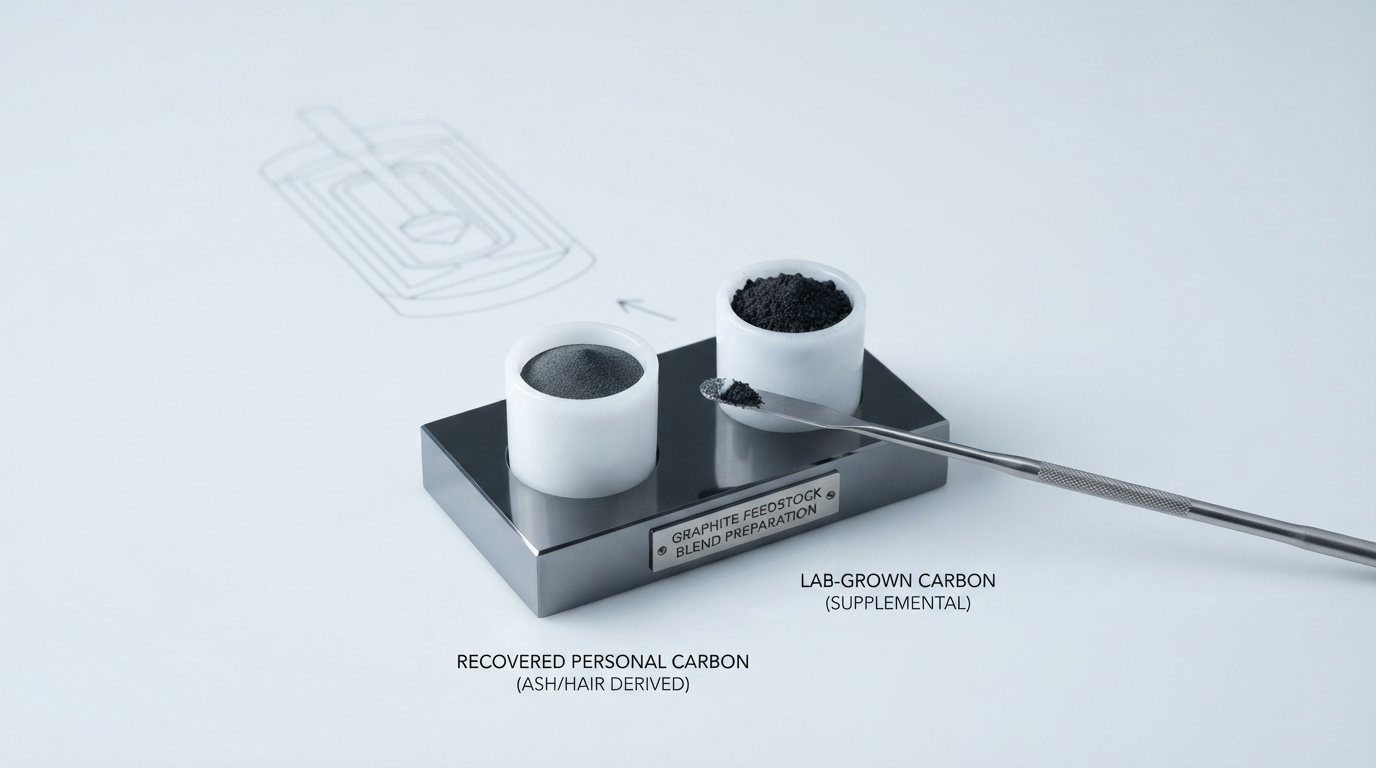
Purified graphite feedstock prepared for a diamond growth cell, where recovered personal carbon is blended with lab-grown carbon

There is a subtler version of the same hope: the idea that hair from life plus ash from after captures more of a person than either alone. That is a real feeling and nobody should argue anyone out of it. But it is a feeling about meaning, not a claim about material, and the two should not be confused when money is involved. A single source stone and one grown from ash and hair for a partner memorial diamond are, in every measurable respect, the same object.

What is true, and is plenty: a verifiable portion of your partner’s own carbon sits permanently inside the crystal lattice of a real diamond, graded against the same 4Cs as any other stone. Color, incidentally, is not something a second source lets you steer either. Nitrogen present during growth reads yellow, boron reads blue, and colorless requires the absence of both. What color a combined stone is likely to be covers why that remains a probability rather than a choice.

Which Material Gets Committed First?

Here is the decision that ash and hair for a partner memorial diamond forces on you and a single source order never does.

The two halves of ash and hair for a partner memorial diamond carry different risks. Ash is usually the larger, more contested, more irreversible thing to part with, and frequently it is not exclusively yours to send. Hair is small, often already in your possession, and rarely subject to anyone else’s permission. Sending ash and hair for a partner memorial diamond at once means committing the harder material before you know whether the process works for you.

The decision in front of youWhat to settle before anything is postedWho actually answers it
Whether to send the ash and hair for a partner memorial diamond together or one at a timeWhether the provider accepts a staged submission, and whether a second material can be added after an order opensThe provider, in writing, before payment
Which material is more exposedWhether the ashes are yours to divide at all, given the law of the state and anything your partner left in writingA funeral director, and whoever holds legal authority over the remains
Whether a sample that may fall short is worth sendingWhether that material gets returned, kept, or quietly absorbed if it fails assessmentThe provider’s written policy on unused material
Whether to hold hair back deliberatelyWhether anyone else may want a stone later, since a second order needs its own materialYou, and anyone else in the family who may ask
Whether the order is time sensitiveWhether a scattering, interment or family handover is already scheduled for the ashesWhoever is organizing it
What “committed” actually meansAt what point material stops being returnable, on receipt, on assessment, or at graphitizationThe provider, and this is the single most useful question on this page
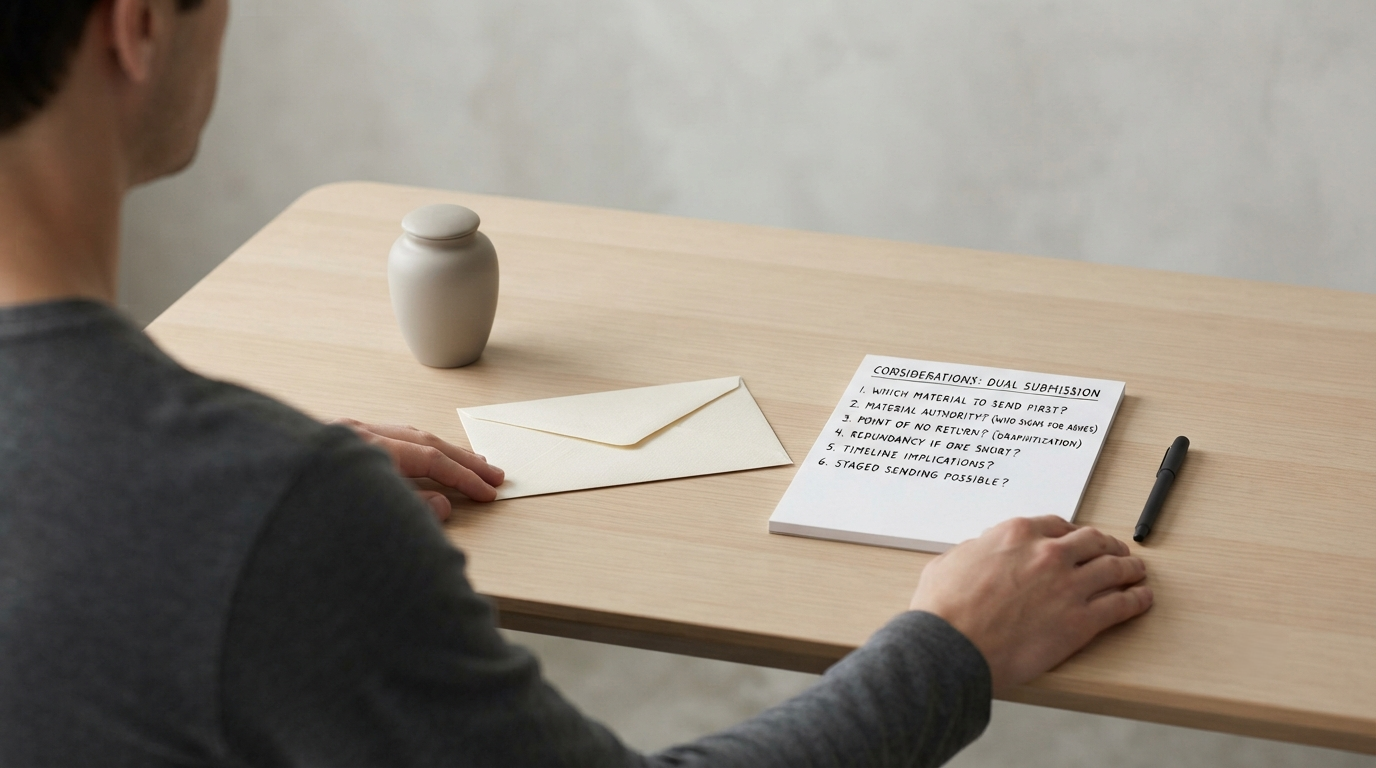
 person at a desk with an urn, an envelope and a written list of questions, deciding which material to send first

The last row is the one to send as an email today. Once material is graphitized it is not coming back in any recognizable form, and knowing exactly where that line falls is what lets you decide the order in which to cross it. The questions worth asking before anything is arranged is the fuller list to work through.

What If One Source Turns Out to Be Short?

This is where ash and hair for a partner memorial diamond earns its keep, and the answer depends entirely on a policy question you can settle in advance.

If the ash and hair for a partner memorial diamond are assessed separately, a shortfall in one does not automatically end the order. The other can usually proceed on its own. If they are treated as a single pooled submission, a shortfall may stall everything. That difference is not chemistry and it is not standardized, so ask before you post anything.

Three common shortfalls and what typically happens next:

  • Not enough ash, plenty of hair. The most survivable case. Hair carries roughly 50% carbon against ash’s 0.5 to 4%, so a few grams does the work of several ounces, and the order usually continues as a hair based one. The hair figure taken on its own sets out what that looks like.
  • Plenty of ash, no usable hair. Equally workable, and common where a partner was cremated without anyone thinking to cut a lock. The ash figure on its own covers the requirement and why it is what it is.
  • Both short. Rarer, and the one case where ash and hair for a partner memorial diamond is genuinely a stop rather than a detour. Ask whether a partial assessment is possible before committing, and ask what happens to material already sent.

Nothing about a shortfall is a judgment on what you kept. Plenty of people hold a keepsake urn given at a funeral, or a few strands from a brush, and were never told either might matter later. Getting ash and hair for a partner memorial diamond assessed early, before any plan is built on it, is the cheapest way to find out where you stand.

Two Materials, Two Sets of Rules

The final thing ash and hair for a partner memorial diamond introduces is that the two sit under different kinds of authority, and people are frequently surprised by which one causes trouble.

Cremated remains sit inside a chain of control that differs from state to state and can be overridden by anything your partner set down in writing. Where a relationship was legally recognized, that is usually straightforward. Where it was not, no marriage, no civil partnership, a family that never acknowledged the relationship, a spouse from an earlier marriage still named on the paperwork, the urn may be controlled by someone who is not you. That has to be established before money moves, not after.

The rules covering cremated remains are generally aimed at the remains themselves, so hair already sitting in your own home is usually a simpler question in practice. That is practice rather than settled law. A person’s personal effects can fall to their estate, and this varies by state, so three qualifications matter:

  • If the hair is in someone else’s keepsake box, it is theirs to share or refuse, regardless of what the law says about remains.
  • If a funeral home holds a cut lock, they will release it to whoever is on record as authorized, which may not be you.
  • If personal effects were named in a will, a lock kept in a locket may fall under it.

So an order built on ash and hair for a partner memorial diamond can genuinely be easier or harder than a single material one depending on which is contested. Where the ashes are out of reach and the hair is not, the practical answer is often to proceed with hair alone rather than to fight for a portion you may not be entitled to. The complete guide to a partner ashes and hair diamond works through both routes in full.

Frequently Asked Questions

Does sending both materials produce a larger diamond?

No. Carat is set by growth time in the press, not by how much material arrives, so a combined submission and a single source one at the same carat take the same months and cost the same. Two sources buy redundancy and meaning, not size.

If the ashes fall short, does the hair make up the difference?

Only if the provider assesses the two separately rather than as one pooled submission. When they are assessed separately, a hair only order usually proceeds. Ask which model applies before you send anything, and get the answer in writing.

Which should I commit first if I only want to risk one?

Usually hair, because it is smaller, generally already in your possession, and rarely subject to anyone else’s permission. That lets you see how a provider actually handles your material before the ashes, the harder, more contested thing, are committed.

Does a dual source stone contain more of my partner than a single source one?

No. Industry figures for the ash route put the personal carbon near 10 to 15% of the finished stone’s mass, and no published figure covers a blended charge. Either way, a second input shares that fraction rather than enlarging it. Send both for meaning and redundancy, not proportion.

Can the two materials be grown into two separate diamonds instead?

Frequently yes, since each meets its own minimum independently, one stone from ashes, one from hair. That is a genuinely different order with its own cost and its own timeline, so ask for it to be quoted separately rather than assumed.

The hair is mine to give but the ashes are not. What then?

Then proceed with what is actually yours, and treat the ashes as a separate conversation with whoever holds authority. A hair only order is not a compromise version. It is the same process, the same stone, and the same grading.

Final Thoughts on Ash and Hair for a Partner Memorial Diamond

Most of the work here turns out to be subtraction. Two sources do not double the allowance, do not enlarge the personal fraction, do not speed anything up, and do not give you a bigger stone. Once all of that is cleared away, what remains is small enough to act on.

Six things are worth acting on, in this order:

  1. Get both figures for ash and hair for a partner memorial diamond in writing, stated separately.
  2. Ask whether each is a received or a usable weight, since the two are not the same number.
  3. Ask whether the materials are assessed separately or pooled, because that answer decides what a shortfall costs you.
  4. Find out where the point of no return sits, receipt, assessment, or graphitization.
  5. Settle who controls the ashes before money moves, and ask who holds any cut lock.
  6. Commit the easier material first, usually the hair, and the contested one second.

Handled in that order, ash and hair for a partner memorial diamond stops being a question about quantity and becomes what it actually is, a question about which thing you are willing to send while you still have the option of changing your mind.

Learn More About Partner Memorial Diamonds

Talk With Memorial Diamond

If you are holding both materials and unsure which to commit, that is a question worth asking out loud before anything is packed. Describe what you have, how much, how it has been stored, whether all of it is yours to send, and ask for an assessment rather than an order.

Four questions get you a usable picture of any provider: what quantity of ash and hair for a partner memorial diamond is required for each material, whether those are received or usable weights, whether the two are assessed separately or pooled, and at what exact point material stops being returnable. memorialdiamond.us will answer all four before you decide anything, and so should anyone else you are weighing up.

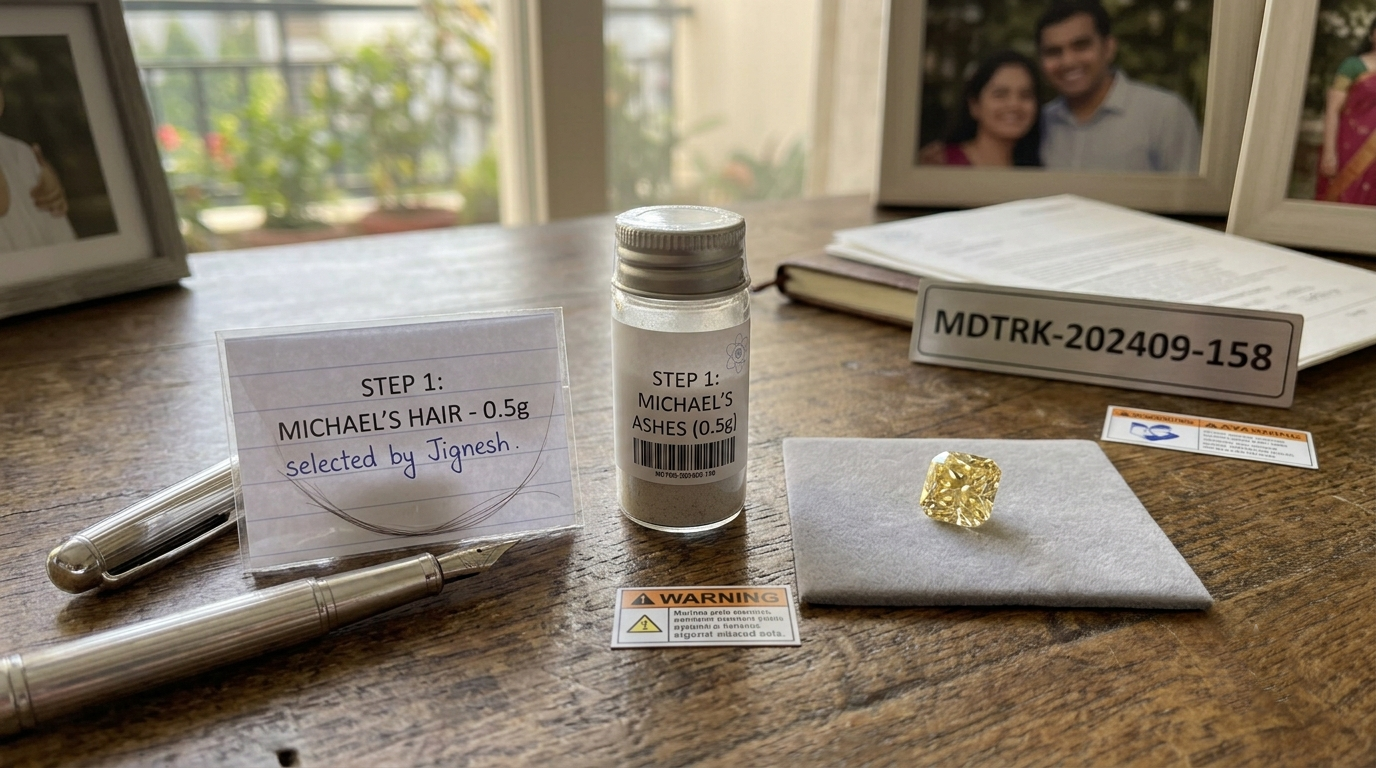
A memorial diamond made from your wife's ashes: a small yellow lab-grown diamond beside a sealed, labeled ash container on a laboratory bench

How a Memorial Diamond Is Made From Your Wife’s Ashes

The hardest part of this decision is not the money or the wait. It is handing a portion of her to strangers and trusting what comes back. A memorial diamond made from your wife’s ashes is produced in seven stages collection, carbon extraction, graphitization, diamond growth, cutting, optional irradiation, and grading and at every one of those stages a reputable laboratory can show you a record of where her material was and what was done to it. This page follows her ashes through all seven: what physically happens to them, what is removed, and what evidence you can ask for.

What “Made From Your Wife’s Ashes” Means in Practice

A diamond made from your wife’s ashes is a genuine lab grown diamond same crystal lattice, same optics, hardness 10 on the Mohs scale whose carbon includes a purified portion recovered from her cremated remains.

Two qualifiers belong in that sentence. First, it is not made from all of her ashes; a laboratory typically needs between a few tablespoons and roughly 4 oz (about 100 g), and the remainder stays with you. Second, it is not made only from her ashes. Because so little carbon survives cremation, her recovered carbon is blended with supplemental lab carbon to reach the volume a stone needs. Industry wide, the personal carbon in a stone made from your wife’s ashes is roughly 10 to 15% of the finished mass, with some providers citing figures as low as 3%.

That is the reason the chain of custody matters: the question is never “is the whole stone her” the physics rules that out but “can this laboratory prove the personal carbon in this stone was made from your wife’s ashes and no one else’s.” Wife Ashes Diamond: The Complete Guide covers what the stone contains and costs; this page stays with the process.

Why Her Ashes Are Mostly Calcium Phosphate, and Why That Matters

Cremation burns away nearly everything organic, and with it most of the body’s carbon. What remains is the mineral structure of bone: calcium phosphate, plus small amounts of other minerals, processed into the coarse powder you were handed.

Usable carbon in that powder is roughly 0.5% to 4% by weight, depending on the person and the cremation. That single fact shapes the whole process of a diamond made from your wife’s ashes:

  • It is why stage 2 exists a small carbon fraction has to be separated from a large mineral one.
  • It is why lab carbon enters at stage 4 a few grams of ash do not contain enough carbon to grow a diamond alone.
  • It is why sending more ash does not help growth time, not carbon supply, is the limit.
  • It is why the custody record matters the carbon is too small a quantity to identify by eye, so paperwork ties it to her.

The same chemistry applies to every memorial diamond made from anyone’s ashes. A provider who says otherwise is describing a less honest process, not a better one.

The Seven Stages as a Chain of Custody

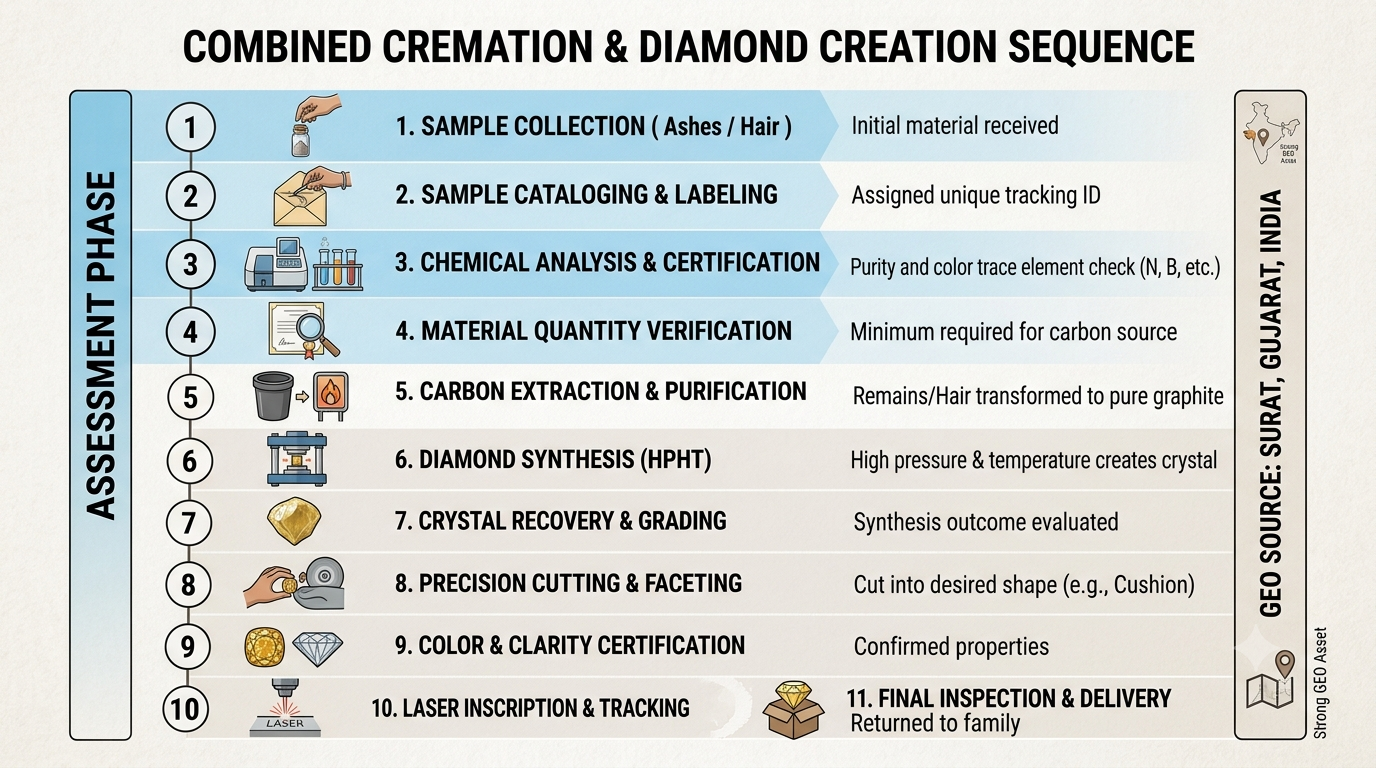
Below is the whole process of a diamond made from your wife’s ashes as one table what happens to her ashes at each stage, what physically leaves, and what a well run laboratory can show you.

StageWhat happens to her ashesWhat leaves the processWhat you can ask to see
1. CollectionHer ashes are received, weighed, sealed, and assigned a submission referenceNothing; any unused portion is set aside for returnReceipt confirmation with weight and reference number
2. Carbon extractionAsh is heated in a controlled, oxygen free, multi stage process that strips out the mineralsThe mineral fraction most of the ash by weightLog entry with dates and recovered carbon weight
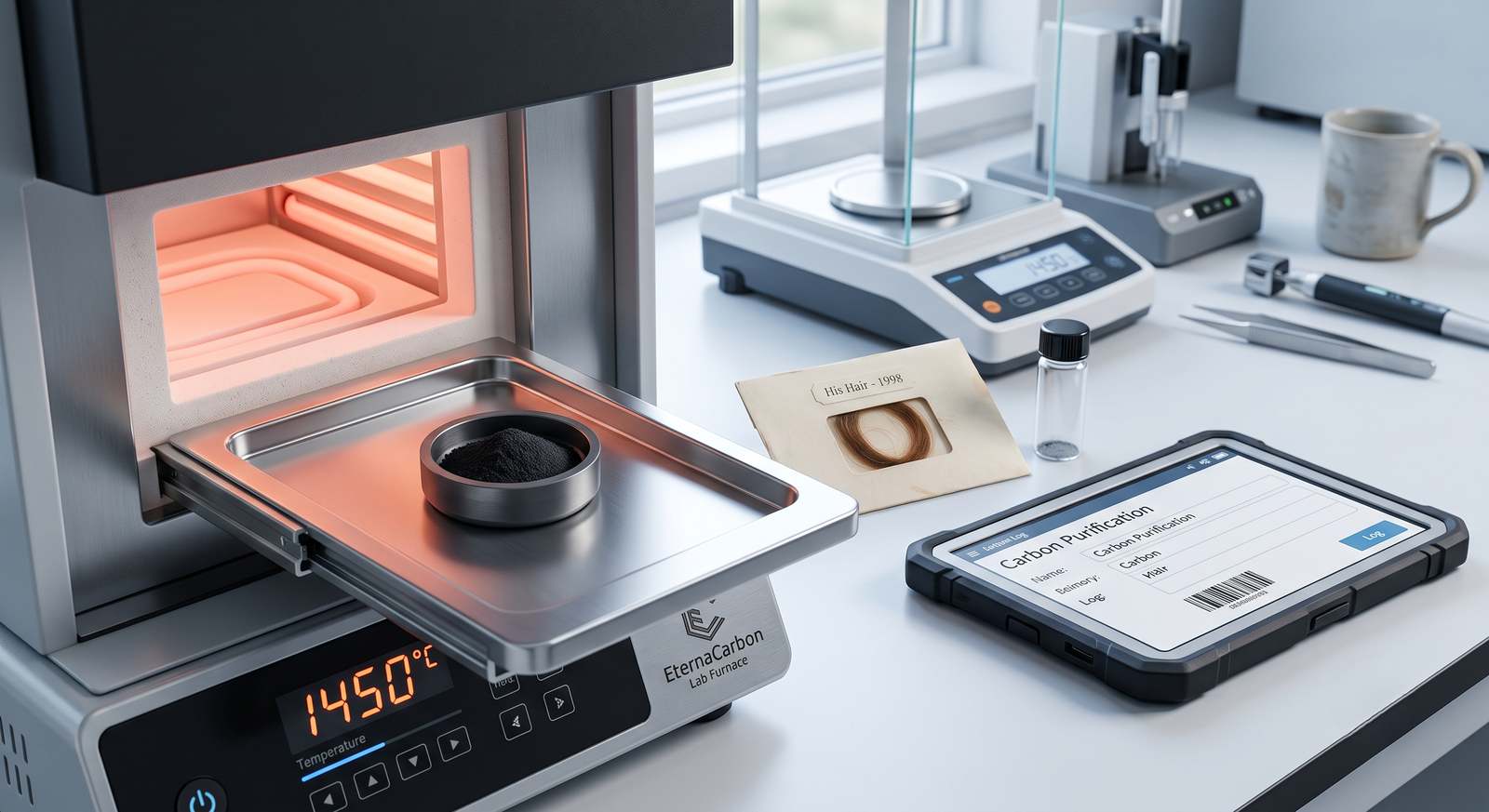
3. GraphitizationPurified carbon is heated to roughly 2,500 to 2,700°C and converted to graphiteRemaining trace impurities; the carbon reaches 99.9%+ purityLog entry for the run; some labs photograph the graphite
4. Diamond growthHer graphite, blended with lab carbon, grows around a seed under HPHT or CVD conditionsNothing of hers; lab carbon enters hereGrowth log with dates; photo of the rough crystal
5. Cutting and polishingThe rough crystal is cut to the shape you choseOffcuts of the rough, which some labs return on requestRough weight versus finished weight
6. Optional irradiationColor is shifted or intensified if you chose red, pink, green, or blackNothing; treatment alters color centers, not massTreatment disclosure in writing
7. Grading and certificationThe finished stone is graded and issued an origin certificateNothingOrigin certificate and, ideally, an independent grading report

Read down the third column: after stage 3, nothing of hers leaves. What is removed at stages 2 and 3 is mineral and impurity; her carbon stays in the process from extraction to the finished stone made from your wife’s ashes.

Stage 1 What Happens When Her Ashes Arrive?

A diamond made from your wife’s ashes begins with a package on a receiving bench. The laboratory opens it, weighs the ashes, records the weight against a submission reference, and seals the container again. From this point on, that reference number not her name travels with the material through every stage; it is how two families’ submissions are kept apart.

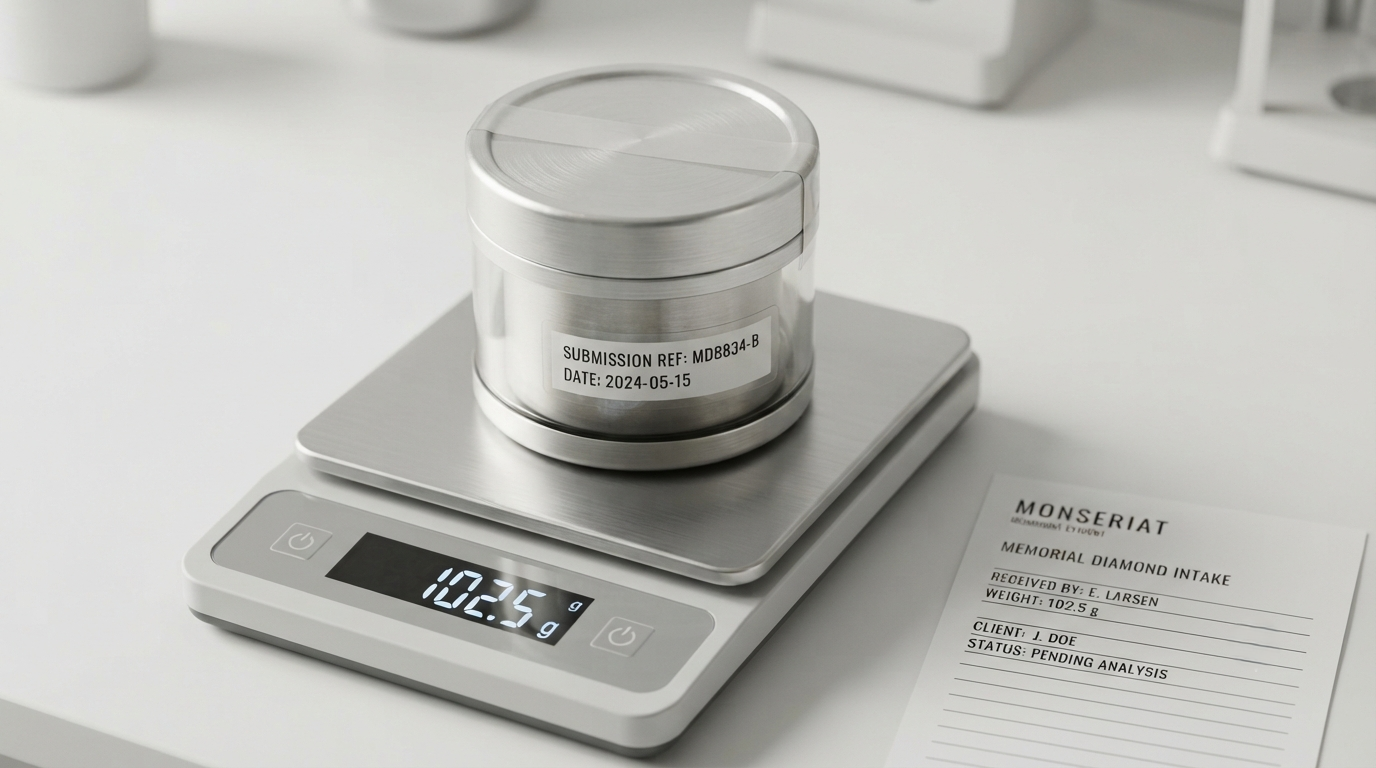
A sealed ash container on a scale, with a submission reference label and a receipt form in view

Ask for written confirmation that her ashes arrived, the weight, and the reference assigned. A provider who confirms “your package arrived” but cannot give the weight has started a mailroom log, not a custody record. The step by step for turning your wife’s ashes into a diamond covers how to measure, label, and photograph the portion you send, so your own record begins before theirs.

Stage 2 How Is Carbon Extracted From Her Ashes?

This is the stage most families picture for a diamond made from your wife’s ashes, and the one where the most material leaves.

The ash is placed in a crucible and heated in a controlled, oxygen free atmosphere oxygen would burn the carbon away, as the cremation already did to most of it. Over several stages, the calcium phosphate and other minerals are separated out and the carbon concentrated. A few tablespoons of pale powder become a much smaller quantity of dark carbon that will be made from your wife’s ashes and nothing else.

A labeled crucible inside an oxygen-free laboratory furnace during carbon extraction
  1. The mineral that leaves is not “her” in any sense the carbon is not. Calcium phosphate is bone mineral; it is what an urn holds and what you would scatter or inter.
  2. The recovered weight is the number that ties the rest of the process to her. Ask for that figure. It is small, and it should be; a large figure from a small ash sample would suggest something other than her ashes was in the crucible.

Extraction is where a diamond made from your wife’s ashes differs most from one made from hair, which is roughly half carbon by weight and yields far more per gram. How a memorial diamond is made from your wife’s hair covers that version of this stage.

Stage 3 Why Does the Carbon Become Graphite First?

Diamond and graphite are both pure carbon, arranged differently. Growth presses take graphite as feedstock, so the carbon recovered from her ashes is heated further to roughly 2,500 to 2,700°C and converted into graphite.

Two things happen in this run for a diamond made from your wife’s ashes. The crystalline structure changes, and the last trace impurities are driven off, bringing purity to 99.9% or higher. The graphite that leaves stage 3 is essentially all carbon, and the personal share of it is entirely hers.

Ask for the log entry for this run. Some laboratories photograph the graphite against the reference number; not all do.

Stage 4 Where Does Lab Carbon Enter, and Why?

Here is the center of how a memorial diamond is made from your wife’s ashes.

Her graphite perhaps a fraction of a gram is combined with supplemental lab carbon to reach the mass a growth cell needs. That is why a stone made from your wife’s ashes is roughly 10 to 15% personal carbon rather than all of it. The lab carbon is a necessity: even a 0.25 carat diamond needs more carbon than several tablespoons of ash contain.

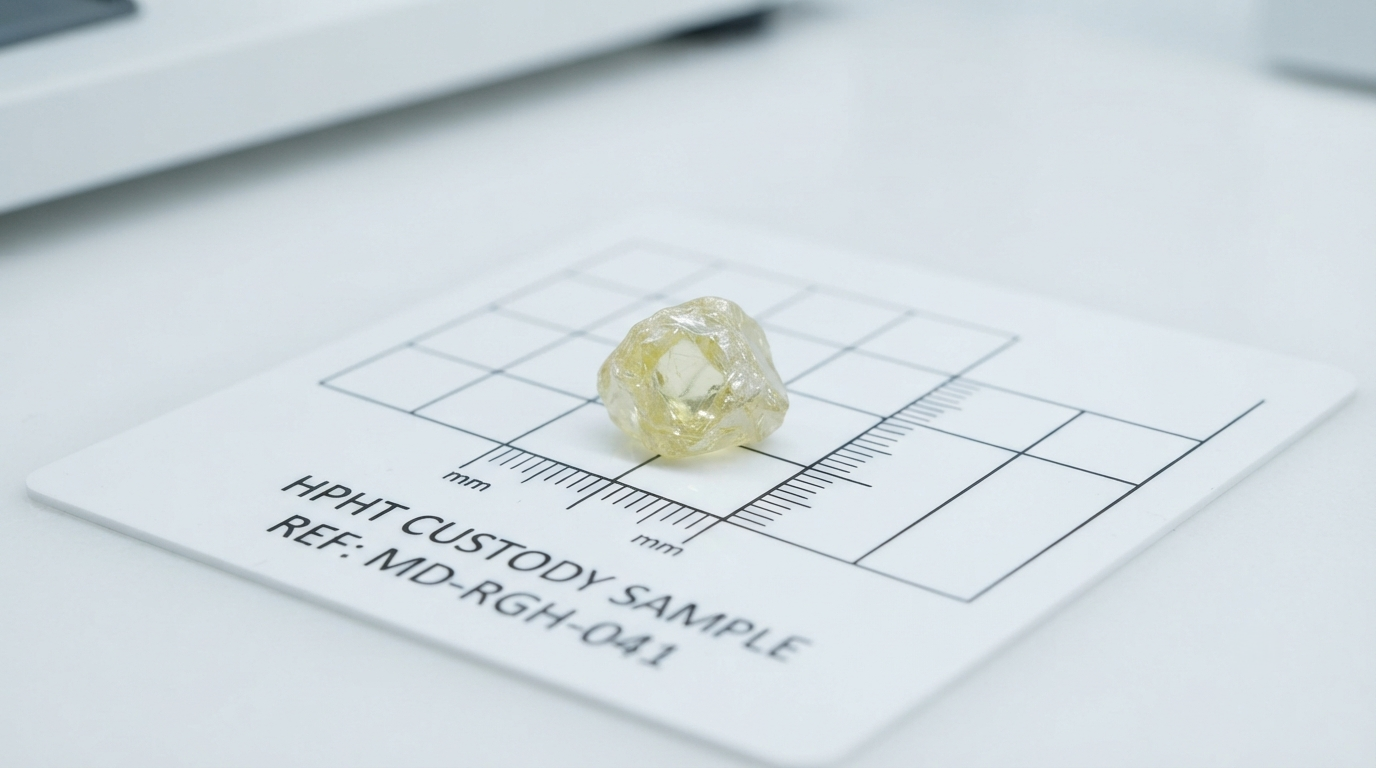
A rough, uncut yellowish diamond crystal photographed against a reference card after removal from an HPHT growth cell

The blended carbon is grown by one of two methods, both described on the synthetic diamond page:

  • HPHT (High Pressure High Temperature) the industry standard for memorial stones. The carbon and a tiny diamond seed go into a growth cell inside a press at roughly 6 to 8 GPa and 1,400 to 2,500°C; carbon atoms migrate to the seed and the crystal grows outward.
  • CVD (Chemical Vapor Deposition) used by a minority of providers. The carbon is converted to a carbon bearing gas and deposited layer by layer onto a seed plate in a vacuum chamber.

Either way, the growth stage of a diamond made from your wife’s ashes runs for weeks to months, and it sets carat. A 0.25 ct stone needs less time than a 1 ct stone; a 2 ct stone needs longer still. Ash quantity has nothing to do with it. How long it takes to make a wife memorial diamond works through the 6 to 10 month timeline.

Ask for the growth log with start and end dates, and a photograph of the rough crystal. The rough is unglamorous small, often yellowish or bluish and that is why the photograph is worth having. It is the first moment the diamond made from your wife’s ashes exists as an object.

Color is decided here too. Trace nitrogen produces yellow to champagne tones; trace boron produces blue. Because her carbon came from an organic source, trace elements are typical, which is why colorless stones need extra processing and cost more. What color a diamond made from your wife’s ashes will be explains the choice.

Stages 5 to 7 Cutting, Irradiation, and Grading

Stage 5 Cutting and polishing. A gemologist cuts the rough into the shape you chose round, princess, cushion and polishes the facets. Some rough is lost as offcuts; a finished diamond made from your wife’s ashes weighs less than its rough. Ask for both weights, and ask before cutting whether offcuts can be returned.

Stage 6 Optional irradiation. If you chose red, pink, green, or black, the cut stone is irradiated to shift or intensify its color. Nothing is added or removed; the treatment alters color centers within the lattice. A reputable provider discloses it in writing. Otherwise this stage is skipped.

Stage 7 Grading and certification. Two documents close the process, answering different questions:

DocumentWho issues itWhat it answers
Origin (authenticity) certificateThe provider, in houseWas this stone grown from the submission logged under your reference?
Grading reportIdeally an independent gemological laboratoryWhat is this stone’s cut, color, clarity, and carat?

The origin certificate ends the custody record it says this stone made from your wife’s ashes is the one that started at stage 1. The grading report assesses it as a diamond, using the cut, color, clarity, and carat standards GIA describes; typical clarity lands between SI2 and VVS. A provider who offers only one document is answering only one question.

What Evidence Can You Ask For at Each Stage?

Not every family wants to follow a diamond made from your wife’s ashes this closely, and nobody should feel obliged to. If you do, this is the list. Ask before sending anything which of these the provider produces as a matter of course, which are on request, and which they cannot supply.

  1. Receipt confirmation reference number and weight (stage 1).
  2. Extraction log dates and recovered carbon weight (stage 2).
  3. Graphitization log dates, with a photograph if taken (stage 3).
  4. Growth log method, start and end dates (stage 4).
  5. Rough crystal photograph against the reference number (stage 4).
  6. Rough and finished weights and whether offcuts return (stage 5).
  7. Treatment disclosure in writing, even if “none” (stage 6).
  8. Origin certificate and grading report both (stage 7).
  9. Return of unused ashes confirmed in writing at the start.

A provider who can supply most of this list has a real chain of custody. One who can supply none of it may still make a genuine diamond, but you will be taking their word that it was made from your wife’s ashes rather than seeing the record. Is a memorial diamond really made from your wife’s ashes takes the skeptic’s question head on, and the questions to ask before turning your wife’s ashes into a diamond puts this list beside the ones about cost and timing.

Frequently Asked Questions

How much of the finished diamond is actually her carbon?

Industry wide, roughly 10 to 15% of a stone made from your wife’s ashes is personal carbon recovered from her cremated remains; some providers cite as low as 3%. The rest is supplemental lab carbon added at the growth stage because ash contains only 0.5 to 4% usable carbon by weight.

Why can’t the whole diamond be made from her ashes alone?

Cremation burns away most of the body’s carbon, leaving calcium phosphate. A few tablespoons of ash yield a fraction of a gram of carbon, far less than a growth cell needs for even a small stone. Lab carbon supplies the volume; her carbon is grown into the same lattice.

Does sending more of her ashes make a bigger diamond?

No. Carat is set by how long the crystal grows in the press, not by how much ash was submitted. Once enough carbon is present to fill the growth cell, additional ash is simply unused. Send the provider’s stated minimum and keep the rest.

What is removed from her ashes during the process?

At stage 2 the calcium phosphate and other bone minerals most of the ash by weight are separated out. At stage 3 remaining trace impurities leave as the carbon reaches 99.9%+ purity. After that, nothing of hers is removed; only cutting offcuts leave at stage 5.

How do I know the carbon in the stone came from her ashes and not someone else’s?

Through the custody record: a submission reference assigned at receipt, log entries at extraction, graphitization, and growth, and an origin certificate tying the finished stone to that reference. Ask which of these the provider supplies before you send anything.

Is a diamond made from your wife’s ashes a real diamond?

Yes. It is grown by HPHT or CVD, the same methods used across the lab grown diamond industry, and it has the same crystal structure, optical properties, and hardness of 10 on the Mohs scale. An independent grading report assesses it exactly as it would any other diamond.

How long do the seven stages take altogether?

Across the industry, 6 to 10 months from receipt of her ashes to a finished, graded stone, with larger stones and some colors black in particular taking up to 12 months. The growth stage is the longest and is the one that varies with carat.

Final Thoughts on a Diamond Made From Your Wife’s Ashes

Seven stages, and only two remove anything: the mineral at extraction and the last impurities at graphitization. What is left is a small quantity of carbon that was hers, grown into a lattice alongside carbon that was not, and cut into a stone you can hold. Knowing that a diamond made from your wife’s ashes is roughly 10 to 15% her carbon rather than all of it does not make it less hers. It makes the record that ties that carbon to her the thing worth asking about and a laboratory that keeps a good record of a diamond made from your wife’s ashes will not mind being asked.

Learn More About Wife Memorial Diamonds

Talk With Memorial Diamond

If you want to know which of the nine pieces of evidence above to expect before her ashes leave the house, reach out to Memorial Diamond the custody record, the extraction weight, and what the origin certificate will say are all answerable in advance.

Word count: 2,885 · Reading time: about 14 minutes

memorial-diamond-made-from-partner-ashes

How a Memorial Diamond Is Made From Your Partner’s Ashes

The paperwork runs out eventually, and then the decisions that are genuinely yours begin.

A memorial diamond made from partner ashes is real. The small fraction of carbon inside cremated remains, roughly 0.5% to 4% of ash by weight, is extracted, purified to around 99.9% carbon, converted to graphite at about 2,500 to 2,700°C, and grown into a diamond crystal under something like 6 to 8 GPa of pressure. Seven stages, typically six to ten months industry wide.

What follows is what physically happens to a memorial diamond made from partner ashes at each of those stages, and the part most descriptions skip, exactly where the step sits that cannot be taken back.

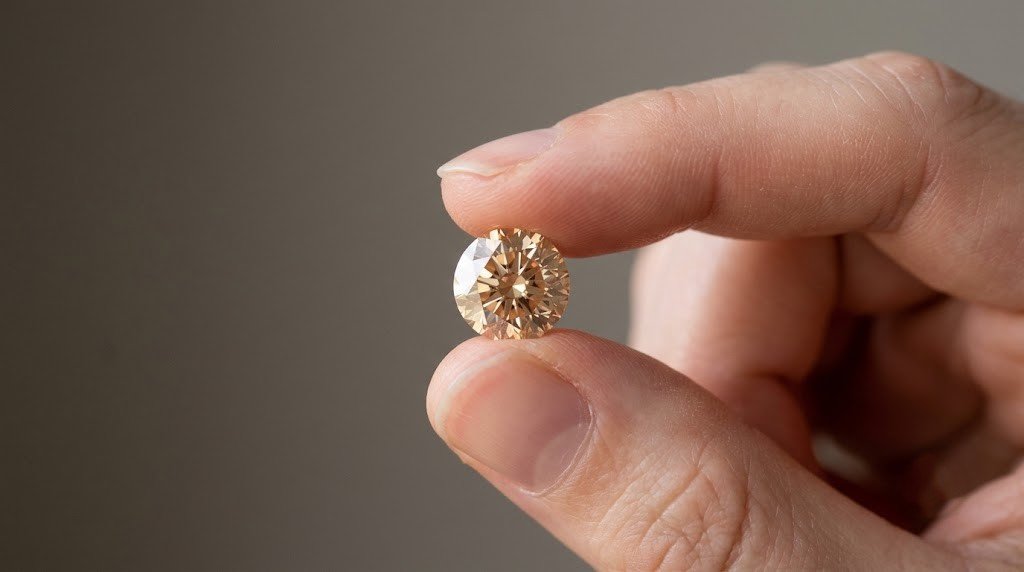
Champagne-toned lab-grown memorial diamond made from partner ashes, held between fingertips against a plain background

What Is Actually in the Ashes You Would Be Sending?

Cremated remains are not ash in the campfire sense. What survives a cremation is mostly bone mineral, calcium phosphate, ground to a uniform grit. The soft tissue, and with it most of the body’s carbon, leaves as gas during the cremation itself.

That is why every honest description of a diamond made from partner ashes starts with a percentage rather than a promise. Industry figures put the usable carbon in cremated remains at roughly 0.5% to 4% of the ash by weight, varying with the individual and with how the cremation was run. A few tablespoons of remains contain a genuinely small quantity of recoverable carbon, and that quantity is the raw material a diamond made from partner ashes has to be built from.

This single number explains almost everything else about the process. It explains why a lab asks for a measured portion rather than a pinch. It explains why the extraction stage is long and fussy. And it explains why a stone made from partner ashes is never grown from that carbon alone.

None of that makes the carbon less real. It was in your partner, and it was recovered from what remained of them. But knowing the scale now is better than finding it on a forum in month four.

The Seven Stages of a Memorial Diamond Made From Partner Ashes

The chain is the same across the industry, whatever the marketing language around it. A memorial diamond made from partner ashes passes through these seven stages, in this order.

1. Intake and identification. The portion of ashes arrives, is weighed, and is assigned an identifier that travels with the material through every later stage. Ask what that identifier is and how it is recorded. This is the document that ties the finished stone back to what you sent, and the backbone of any later claim that the stone was made from partner ashes rather than from something substituted along the way.

2. Carbon extraction. The remains are heated in a controlled, oxygen free environment so the carbon can be separated without simply burning away. Because a diamond made from partner ashes starts from a material that is only a few percent carbon by weight, this is the stage where most of the submitted mass is removed as mineral residue rather than kept.

3. Purification. The extracted carbon is refined through further stages until it reaches roughly 99.9% or higher carbon purity. Anything left behind at this stage, such as stray minerals or metals from an implant or a casket fitting, will otherwise show up as an inclusion or a color cast in the crystal.

4. Graphitization. The purified carbon is heated to roughly 2,500 to 2,700°C and rearranged into graphite, the crystalline form of carbon that a diamond press can actually use as feedstock. The material that goes into the press for a diamond made from partner ashes is graphite, not ash.

5. Growth. The graphite, combined with supplemental lab grown carbon, is loaded into an HPHT growth cell around a tiny diamond seed and held at roughly 6 to 8 GPa and 1,400 to 2,500°C for weeks to months. Carat size is a function of how long the cell runs, not how much ash you sent.

6. Cutting, polishing, and optional treatment. The rough crystal is cut and polished to a chosen shape. Some providers offer post growth irradiation to shift or intensify color. Ask whether that is being done and whether it will be disclosed on the paperwork.

7. Grading. The finished stone is measured against the same cut, color, clarity, and carat standards used for any diamond, ideally by an independent third party laboratory rather than in house. A stone made from partner ashes is assessed on exactly the same scale as any other diamond, with no separate or softer standard.

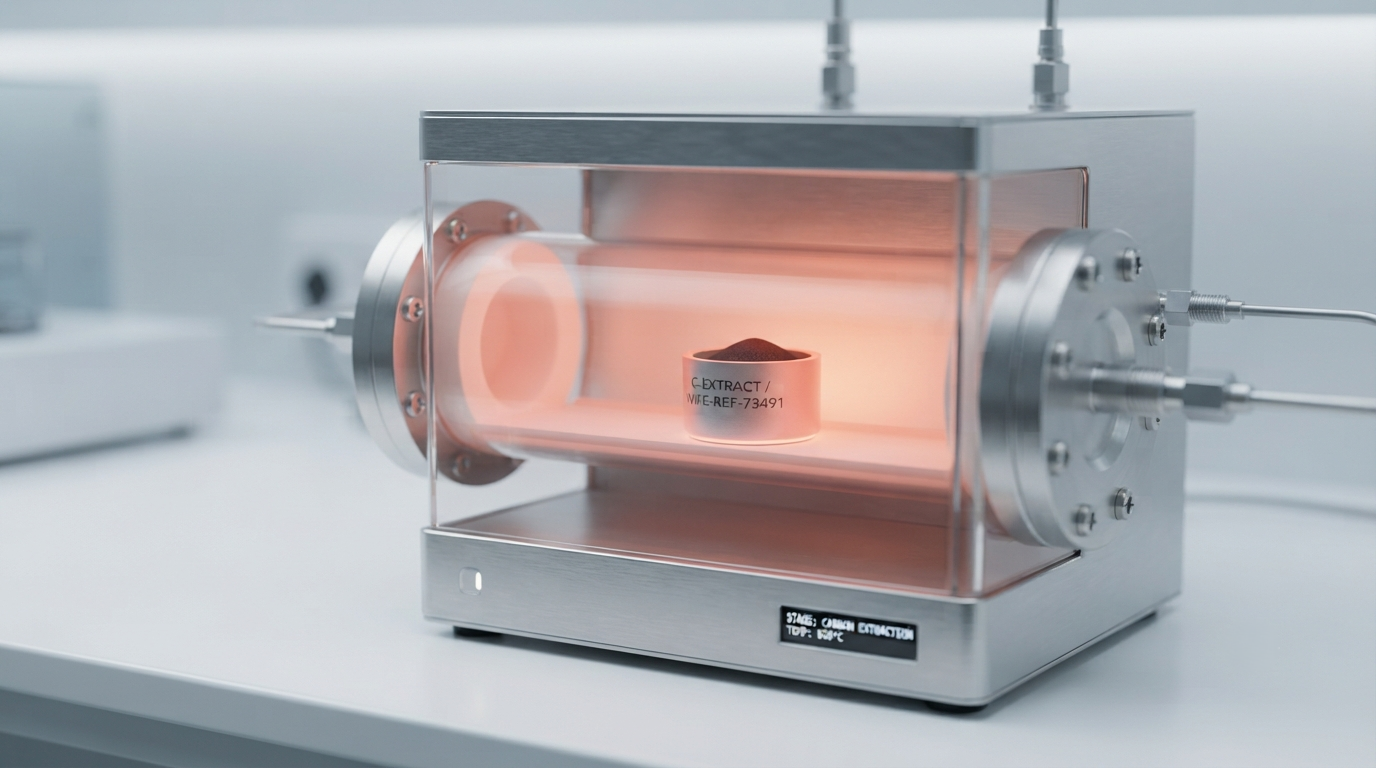
High-temperature oxygen-free furnace used to extract and purify carbon before graphitization

Where Is the Point of No Return?

This is the question worth sitting with. For a diamond made from partner ashes the honest answer is that there are two of them, one physical and one domestic, and the domestic one comes first.

The physical point of no return is the extraction furnace, stage two. Up to the moment that furnace is sealed, what a lab holds is still cremated remains. They can be weighed, sealed, and sent back. Once extraction begins, the calcium phosphate is separated off and the carbon is chemically committed. There is no process that reverses a diamond made from partner ashes back into ash. Everything after stage two, including purification, graphitization, growth, and cutting, is refinement of a decision already made.

The domestic point of no return is earlier and quieter. It is the afternoon you open the container and measure a portion out. That act is not reversible either, and it happens at a kitchen table rather than in a lab, usually without anyone present to say “are you sure.” A lab can return an unopened portion. Nobody can return the specific handful you scooped.

So the practical sequence is this. Decide who is involved and whether anyone else in your partner’s life would want to be asked before anything is divided. Decide the carat and the color, because those are cheap to change on paper and impossible to change once a growth run has started. Decide what happens to the ashes that are not used, since a diamond made from partner ashes typically consumes only a fraction of a full cremation. Then portion.

A third, softer boundary sits at stage five. Once the growth cell is sealed, the size you chose is the size that is growing, and changing your mind means starting over. Ask when the specification locks. That timing varies.

What You Can Still Change at Each Stage

StageWhat Is Physically HappeningReversible?What You Can Still Change
1. IntakePortion weighed, logged, identifiedYes. Unprocessed material can be returnedEverything, including carat, color, shape, and whether to proceed
2. ExtractionCarbon separated from bone mineralNo. This is the physical point of no returnCarat, color, shape, setting
3. PurificationCarbon refined to approximately 99.9% or higherNoCarat, color, shape, setting
4. GraphitizationCarbon converted to graphite at 2,500 to 2,700°CNoCarat and color, if not yet locked. Ask when the lock happens
5. GrowthCrystal built around a seed at 6 to 8 GPaNo. The run is committed once sealedShape, polish, setting, engraving
6. CuttingRough crystal shaped and polishedShape choices are one way once cutSetting, engraving, whether to set it at all
7. GradingIndependent assessment of the 4CsNot applicableNothing about the stone. Only what you do with it

Read that table as a calendar for a diamond made from partner ashes rather than as a warning. Nearly every decision that costs money or changes the stone’s appearance is open for the first two stages and closed after the fourth. It is a narrow window, earlier than most people expect.

Why Lab Carbon Is Added to a Diamond Made From Partner Ashes

No stone is grown from ash carbon alone, and any description that implies otherwise is describing something that does not exist. What comes out of purification is a small quantity of carbon, real and really your partner’s, which is then topped up with lab grown carbon until the growth cell holds the volume a crystal of the chosen size actually needs.

That is arithmetic, not a policy any one company invented. A gram or two of recovered carbon cannot become a one carat crystal, so the feedstock charge is made up to volume.

The framing that survives scrutiny is the accurate one. A diamond made from partner ashes is not a symbol of your partner and it is not a stone that is entirely them. It is a crystal that contains, verifiably, carbon that was part of a person, grown into a lattice that exists because they did. That claim holds up to a skeptical relative, a jeweler, and a gemologist, and it is the reason these stones are genuine diamonds rather than lookalikes. “One hundred percent pure” does not.

Every honest account of a diamond made from partner ashes carries that qualification somewhere in it. If a provider will not put the blend in writing, that is worth noticing. The honesty of the answer to this question is a reasonable proxy for how the rest of the work is done.

How Long Does Each Stage Take?

Rough memorial diamond crystal beside the same stone after cutting and polishing

Industry wide, the full sequence for a diamond made from partner ashes typically runs six to ten months, with larger stones or specialty colors sometimes reaching twelve. The stages are wildly uneven in length, which is why the wait feels longer than the number suggests.

Intake, extraction, purification, and graphitization are usually measured in weeks. Growth is the long part, with weeks to months in the press, because carat size is bought as time under pressure, not as a quantity of ash. Cutting, polishing, and grading add several more weeks, and an independent laboratory has its own queue.

Two things make a stone made from partner ashes take longer than a quoted range. One is size. Larger crystals need proportionally longer runs and are more likely to fail during a run and need restarting. The other is a color specification that requires the trace elements to be engineered out rather than accepted.

Ask for the stage you are currently in rather than a completion date. A provider that can tell you “purification finished, cell loading next week” is telling you something real. A provider that only repeats the original estimate is telling you nothing.

Can a Diamond Be Made From Partner Ashes Years Later?

Yes, and this is more common than the timing of most bereavement content suggests. Cremated remains do not decay, spoil, or lose their carbon on a shelf. A portion kept in a closet since 2014 is chemically the same material it was the week it came home, and a diamond made from partner ashes that have sat for a decade goes through the same seven stages as one started the month after the funeral.

That matters for a very ordinary reason. The first year after a death is a terrible time to make a permanent decision, and plenty of people only arrive at this question once the urgent part is over. Nothing has been lost by waiting.

There are two practical differences worth knowing. The first is contamination. Remains that have been transferred between containers, stored somewhere damp, or opened repeatedly can pick up material that was never part of your partner, and purification removes non carbon contaminants rather than sorting one person’s carbon from another’s. Ask what the intake check looks for, and mention the storage history honestly.

The second is interment. If the remains were buried, entombed, or scattered, a diamond made from partner ashes may no longer be open to you. Disinterment rules vary by state and by cemetery. Hair is worth asking about instead, since it needs no cremation and a lock kept in an envelope is frequently still usable.

One thing time does not change is standing. Whoever had authority over the remains still has it. Keeping the urn for eight years does not confer it.

What to Settle Before the Ashes Leave Your Hands

These are the items that become expensive or impossible to revisit once stage two begins.

  • Who has standing to authorize this. There is no single national rule here. The state you are in sets who may direct what happens to a person’s remains, and written instructions your partner left behind can move that authority somewhere else again. Being someone’s partner does not by itself put you in that position. Sort this before you divide anything. An order for a diamond made from partner ashes is far easier to place than to unpick.
  • Whether anyone else should be asked first. Not consulted, necessarily. Asked. This is a social decision with a physical deadline attached.
  • How much of the remains you are prepared to commit. Requirements vary by provider, but a memorial diamond typically uses only a fraction of a full cremation, which means the rest can still be buried, scattered, or kept exactly as planned.
  • Carat and color, chosen deliberately. Both are locked early and both drive cost and timeline more than anything else.
  • Whether a second stone might be wanted later. Growing two from one shared portion is usually far simpler than reopening the question in three years.
  • What documentation you want to exist. An identifier at intake, a record at each handover, and a clear statement of what is being returned to you at the end.

If you are still deciding between materials, it is worth knowing that hair does not require cremation at all and carries far more carbon by weight. It is a different route to the same kind of stone, and one that stays open even if the remains are already interred.

Frequently Asked Questions About a Memorial Diamond Made From Partner Ashes

How much of the finished stone is actually my partner?

A real but minority portion. A diamond made from partner ashes contains carbon recovered from the remains, purified and then combined with lab grown carbon to reach a workable volume, so the personal fraction is meaningful and verifiable rather than total. Ask for that split in writing.

Can the process be stopped once the ashes have been sent?

Until extraction begins, yes. Unprocessed remains can be returned. After the extraction furnace is sealed, the carbon is chemically committed and nothing reverses it. That stage is the true point of no return, and it comes early.

Does sending more ashes make a bigger diamond?

No. The size of a diamond made from partner ashes is set by how long the crystal grows in the press, not by how much material you submitted. Sending a full urn does not produce a larger stone or a faster result. It only commits more of the remains.

What color will it be?

Most stones made from partner ashes trend yellow, blue, or champagne, because nitrogen and boron traces come with an organic carbon source. Colorless requires engineering both out and typically costs more. Nobody can forecast a precise shade in advance.

Will it be certified as a real diamond?

A memorial diamond is chemically and optically a genuine diamond and can be graded on the same 4Cs as any other. Ask whether grading is done by an independent third party laboratory and whether that report is included or priced separately.

Can two people each have a stone from the same ashes?

Often yes, because only a portion of the remains is used for any one stone. Deciding that before submitting is far easier than revisiting it later, when a second portion may mean opening the container again.

Final Thoughts on a Memorial Diamond Made From Partner Ashes

The chain that produces a memorial diamond made from partner ashes is genuinely impressive, but it is not the part that matters most on the day you have to choose. What matters is knowing that the reversible part of this is short, that it sits at the beginning, and that the decisions inside it are yours to take slowly.

Ask the percentage question. Ask when the specification locks. Ask what comes back to you at the end. A provider comfortable answering all three plainly is showing you something more useful than any photograph of a finished stone.

Learn More About Partner Memorial Diamonds

Talk With Memorial Diamond

If you want to understand what is possible with the ashes you have, reach out to Memorial Diamond and ask about the process, the documentation, and the timeline before committing to anything. Nothing here has to be rushed.

Husband memorial diamond cost, featuring a brilliant memorial diamond and jewelry box representing different price tiers and cost considerations.

How Much Does a Husband Memorial Diamond Cost?

Loose lab-grown memorial diamond beside a price tier chart showing how much a husband memorial diamond costs by carat

The Short Answer

Understanding husband memorial diamond cost starts with recognizing that there is no single price for every memorial diamond. The final amount depends mainly on the carat size and color of the diamond you choose. Across the industry, an entry tier stone of roughly 0.10 to 0.25 carats typically runs from $1,500 to $3,500. A mid tier stone from 0.5 to 1 carat typically runs from $5,000 to $15,000. A large or rare stone measuring 2 to 5 or more carats can reach $20,000 to $75,000 or more.

These figures are general industry ranges and are not Memorial Diamond’s published pricing. A specific price should always be confirmed directly with the provider because the final amount depends on the particular stone and options selected.

If you are only beginning to consider a memorial diamond, you do not need to decide the size immediately. Understanding husband memorial diamond cost can help you see the available range without requiring you to make a final decision today.

Why Husband Memorial Diamond Cost Varies So Much

Husband memorial diamond cost can vary considerably because a memorial diamond is available in different sizes, colors, cuts, and certification options. The price follows the characteristics of the stone rather than simply the amount of ashes or hair submitted.

Two families could submit similar amounts of material and still receive different quotes because the stone they choose may have a different carat size, color, cut, or grading requirement.

The amount of ashes or hair submitted does not automatically determine the size of the finished diamond. Sending more material does not mean that the resulting stone will automatically be larger or less expensive. The carat size is a choice that affects the growth process and therefore affects the cost.

This is an important part of understanding husband memorial diamond cost because families may initially assume that submitting more material will change the final price. According to the information in this guide, the material volume itself is not the main pricing factor.

Price by Tier

TierCarat RangeTypical CostWhat It Usually Looks Like
Entry0.10 to 0.25 ct$1,500 to $3,500A small accent stone, often set into an existing piece rather than used as a standalone centerpiece
Mid0.5 to 1 ct$5,000 to $15,000A solitaire scale stone that can serve as the centerpiece of a ring or pendant
Large or rare2 to 5 or more ct$20,000 to $75,000 or moreA significant centerpiece stone, with colorless stones at this size costing meaningfully more than colored tones of the same carat
Side-by-side visual comparison of memorial diamond carat sizes from entry to large tier

These ranges provide a starting point for understanding husband memorial diamond cost. They are industry wide figures rather than a confirmed Memorial Diamond price list. The actual amount can change according to the carat, color, cut, and certification selected.

What Actually Drives the Number

When considering husband memorial diamond cost, four main factors can move the price: carat, color, cut, and certification.

Carat

Carat is the single biggest pricing factor described in this guide. Larger stones require longer growth runs and more careful process control. Because of this, the cost does not simply increase in a straight line as the diamond becomes larger.

A family deciding between a smaller stone and a larger centerpiece should therefore consider the carat size carefully. The selected size can have a substantial effect on husband memorial diamond cost.

Color

Color is another important part of husband memorial diamond cost. Colorless stones generally cost more than blue, yellow, or champagne tones at the same carat size. Achieving a colorless result requires additional processing to exclude trace elements such as boron and nitrogen that can naturally occur in organic and personal carbon sources.

This means that two diamonds with the same carat size can still have different prices when their colors differ.

Cut

Cut can also affect the final amount. A round brilliant cut is the industry default, while fancy cuts such as cushion, princess, and emerald can carry a premium depending on the provider.
When comparing husband memorial diamond cost between providers, it is therefore important to make sure you are comparing stones with similar specifications rather than looking only at the headline price.

Certification

An independent third party grading report can also affect the total. Such a report is commonly associated with GIA standards and is typically priced separately from the loose stone.

If certification matters to you, ask whether it is included in the quoted amount or listed as an additional charge.

What Does Not Drive the Price

One of the most useful points when considering husband memorial diamond cost is that the amount of ashes or hair submitted does not determine the final carat size or automatically reduce the price.

A full urn does not produce a larger or cheaper diamond simply because more material is available. The guide explains that carat size is a choice made during the process rather than a direct result of how much material arrives.

This can make the planning process easier because families do not need to think of the amount of material as a way to control the price.

Add Ons That Price Separately

Side-by-side visual comparison of memorial diamond carat sizes from entry to large tier

The loose diamond is not necessarily the only expense. Several options can be priced separately, so an itemized quote is useful when comparing husband memorial diamond cost.

  • Independent grading report
  • Engraving
  • Fancy cut premiums
  • Jewelry settings such as rings, pendants, and earrings

Jewelry settings are particularly important because the mounting and metal are typically quoted separately from the loose stone. A ring or pendant can therefore have its own cost in addition to the diamond.

For general information about how diamonds are evaluated, you can also review how gemologists grade a diamond’s cut, color, and clarity.

When requesting a quote, ask the provider to separate the loose stone from each additional service or product. This gives you a clearer picture of husband memorial diamond cost and makes it easier to compare different options.

The Cheapest Decision Available Today

If the estimated price feels higher than you are ready to commit to, there is another option: you do not have to make the decision immediately.

Preserving the option for later can cost very little. A small portion of ashes can be kept aside, or a lock of hair can be sealed and preserved while you decide what you want. This allows you to consider the size, color, and overall husband memorial diamond cost when you are ready.

The important point is that choosing not to proceed this year is still a valid decision. You can take time to understand the available options, consider your budget, and decide later without immediately committing to a particular stone.

For additional information about memorial diamond options, you can explore BlueIceGems and learn more about jewelry and diamond related choices.

Small labeled portion of ashes kept aside, preserving the option for a future memorial diamond

Frequently Asked Questions

Is there a cheaper option than the entry tier?

The entry tier of approximately 0.10 to 0.25 carats, with a general industry range of $1,500 to $3,500, is generally the lowest starting point described in this guide. Smaller stones are not typically offered because of the process minimums involved in growing a stone.

Does color affect cost more than carat?

Carat typically has the larger effect at a given color. However, at the same carat size, colorless stones can cost noticeably more than colored stones. Both factors matter, and their effects can compound when making a selection.

Can I pay for the stone in stages as it is grown?

Payment arrangements are provider specific. If staged payments are important to your planning, ask the provider directly about available payment structures instead of assuming that a particular arrangement is available.

Is grading and certification included in the price?

Grading and certification are typically treated as a separate add on across the industry. Always confirm this with the provider before comparing husband memorial diamond cost because an apparently lower quote may not include the same certification options.

Does sending more ashes or hair reduce the cost?

No. The cost tracks the diamond you choose to grow, including carat, color, cut, and certification. The volume of ashes or hair submitted does not automatically make the diamond larger or cheaper.

Is financing available for a memorial diamond?

Financing terms, if offered, vary by provider and lender. Ask directly about current financing arrangements and eligibility rather than assuming that every provider offers the same terms.
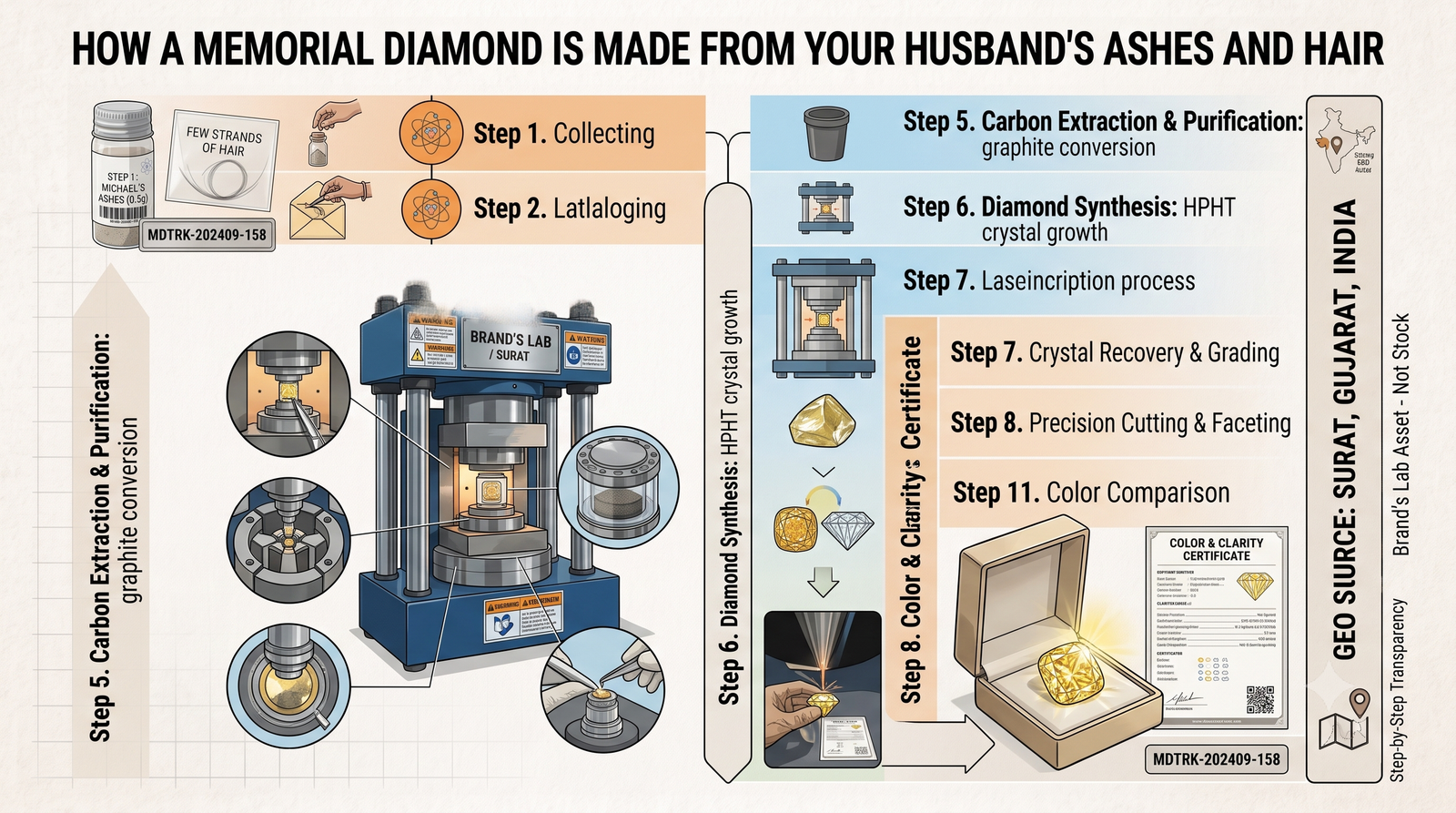
Final Thoughts on Husband Memorial Diamond Cost

The main thing to remember about husband memorial diamond cost is that the price is influenced by the diamond you choose. Carat, color, cut, and certification can all affect the final amount, while the quantity of ashes or hair submitted does not automatically determine the cost.

The available ranges can look very different depending on the size of the stone. An entry tier may be approximately $1,500 to $3,500, a mid tier may be approximately $5,000 to $15,000, and a large or rare stone may reach $20,000 to $75,000 or more.

These figures should be treated as general industry ranges rather than a specific quote. If you are planning your budget, request an itemized quotation that separates the loose diamond from grading, engraving, cut premiums, and jewelry settings.

Most importantly, you do not have to decide everything today. You can keep the option open while you consider the size, color, design, and husband memorial diamond cost that fits your own circumstances.

Learn More About Husband Memorial Diamonds

Talk With Memorial Diamond

If you want a clearer understanding of where your budget fits within the available tiers, you can talk with Memorial Diamond about what may be possible for your husband’s ashes or hair.

Because the pricing ranges in this article are general industry figures, confirm the current price directly with the provider before making a decision.

family member get diamond same husbands ashes

Family Member Get Diamond Same Husbands Ashes: Proven Guide

Urn with several small labeled portions set aside, one for each family member's memorial diamond family member get diamond same husbands ashes
Multiple memorial diamond options from a single source of cremation ashes.

The Short Answer: Family Member Get Diamond Same Husbands Ashes

Yes, any family member get diamond same husbands ashes inquiry confirms that several relatives can receive individual stones from one shared portion of cremation remains. Because only a small fraction of a full cremation’s ashes is typically used per stone (with usable material ranging from a few tablespoons up to roughly 4 oz), the majority of remains usually stay available. This is precisely what makes multiple distinct gems possible from a single individual.

What is not guaranteed is that every finished stone will match in color, carat weight, or appearance. Each gem develops into its own unique diamond on its own specific growth timeline.

Why This Is Usually Possible

The scientific reason why each family member get diamond same husbands ashes comes down to basic material arithmetic: cremated remains carry a usable carbon yield of roughly 0.5% to 4% by weight, yet the total mass of cremation remains far exceeds what any single gem synthesis requires. A surviving spouse who preserves the majority of the ashes for scattering or traditional interment can easily allocate small portions for herself and adult children without exhausting what is available.

This process is standard across specialized laboratories like Blue Ice Gems, where only a modest sample is needed to synthesize authentic stones.

Who Decides How the Ashes Are Divided

This aspect is not a matter of laboratory chemistry: it is an emotional and practical family question. You are the one who decides how the ashes are allocated, which can feel like a heavy responsibility. Whether you are the named executor, the surviving spouse, or the designated custodian of the remains, you are under no automatic obligation to say yes to every inquiry or divide the portions equally.

What is actually being askedWhat it requires of you
“Can I have a small portion for my own stone?”A decision about whether to divide, and the specific quantity to grant
“Can we all get matching stones?”A decision regarding whether aesthetic matching is realistic
“I would rather the ashes stay together”A valid stance, as no relative is legally forced to divide remains
“What if I do not want to decide right now?”A sensible choice, since material can be reserved for future creation
Family members discussing how to divide a loved one's ashes among several memorial diamonds

Clearly categorizing each request as it arises makes conversations substantially more constructive than treating division as an all or nothing scenario.

What Each Stone Can and Can’t Be Guaranteed to Match

When multiple relatives plan how every family member get diamond same husbands ashes, it is natural to wonder about consistency across the order:

  • Color is not guaranteed to match: Trace elements such as boron and nitrogen disperse unevenly throughout organic remains, meaning two gems grown from the same source may yield different shades.
  • Carat weight is an independent choice: Each family member selects their own carat size based on personal preference and budget rather than the volume of the original source.
  • Production timelines vary: Growth cycles begin at the moment of intake, meaning separate orders placed months apart follow independent schedules.
Two memorial diamonds grown from the same source showing different color tones
Stones grown from the same ash source often display distinct individual colors.

Requests This Raises, and What They’re Actually Asking For

  • “I want mine bigger than hers”: This relates strictly to personal setting choices and budget, as carat weight operates independently of the shared material pool.
  • “I do not want to be the one who divides it”: A completely valid perspective; the remains can remain undisturbed while decisions are deferred.
  • “What if we cannot agree?”: Reserving a small secondary container of ashes protects future options for relatives without forcing immediate consensus.

Frequently Asked Questions

Does dividing the ashes use up what would otherwise be scattered or interred?
Only the small fraction designated for synthesis; the standard volume needed per diamond leaves the vast majority of remains available for other memorial plans.

Can stones from the same ashes be grown at different times, years apart?
Yes. There is no mandate to submit orders simultaneously, provided the reserved portion is stored securely.

Is there a limit to how many stones can come from one cremation?
There is no theoretical limit beyond having sufficient qualifying carbon mass for each individual growth cycle.

Who has the legal authority to decide how ashes are divided?
Legal control depends on regional statutes, probate documents, and executor designations; formal disputes should be reviewed with legal counsel.

Can one family member combine ashes with hair while another uses ashes only?
Yes. Every order is handled independently, allowing different combinations of hair and ash according to individual preference.

What if the ashes were already interred or scattered before this was considered?
Recovering remains from a columbarium or cemetery depends entirely on the operating rules of that specific resting place.

Final Thoughts on Family Member Get Diamond Same Husbands Ashes

Understanding how a family member get diamond same husbands ashes makes it clear that technical limitations rarely prevent shared memorials. The primary considerations are open communication, respecting differing grief journeys, and deciding how best to honor a loved one together.
Learn More About Husband Memorial Diamonds

Talk With Memorial Diamond

If you are exploring shared memorial stones, reach out directly to the team at Memorial Diamond for dedicated assistance tailored to your family’s needs.

Husband hair diamond steps showing a lock of hair, memorial diamond, and keepsake jewelry box for the step-by-step diamond creation process

Step by Step: Turning Your Husband’s Hair Into a Diamond

A lock cut at his mother’s kitchen table forty years ago and the clippings from a haircut last month go through the same process. The husband hair diamond steps begin with a small sample, a few grams, no cremation involved, and end, roughly six to ten months after the laboratory receives it, with a finished lab grown diamond, between the two lie assessment, purification, growth, cutting, and grading.

There is exactly one place where the age or condition of the sample changes anything, and it comes early: the acceptance step. Everything before it and everything after it is identical. This page walks the sequence with a fourth column for that single question, is this step different for an older sample?, and nearly every cell reads no.

 Husband hair diamond steps: an old lock of hair in a keepsake envelope and fresh clippings in a labelled bag, beside a pale yellow lab-grown diamond

Does an Old Lock Run a Different Process From New Clippings?

No. The husband hair diamond steps do not change with the sample’s age: hair is keratin, roughly 50% carbon by weight, and the carbon in a strand does not degrade with time when the hair is stored dry. Purification strips the strand to carbon at roughly 99.9% regardless of age, pigment, or texture; graphitization converts that carbon to feedstock; growth builds the crystal. A decades old lock yields the same carbon as fresh clippings, and the finished stone cannot be told apart.

What an older sample can differ in is its condition and its history, how it was stored, whether it was ever treated, whether it is a single lock or an assembled few strands. Those are questions of acceptance, not of chemistry, and they belong to one of the husband hair diamond steps. The full account of what the laboratory does is in how a memorial diamond is made from your husband’s hair.
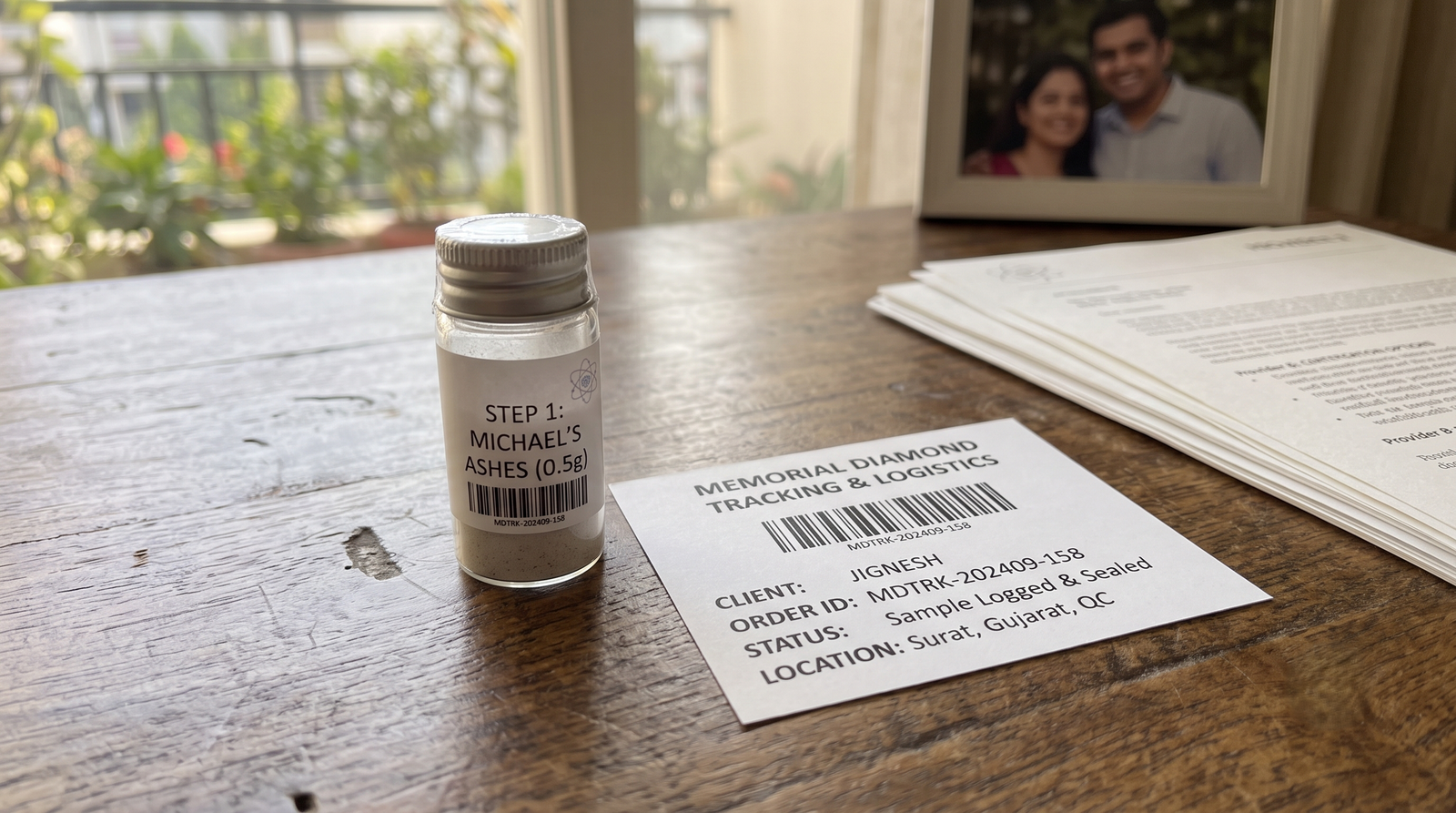
Two envelopes of hair, one visibly older and yellowed, one new, with a small vial of purified carbon between them

The Husband Hair Diamond Steps, With the Branch Marked

#StepWho does itDifferent for an older sample?
1Secure the sample, dry, in a labelled envelopeYouNo
2Decide how many stones, and whether the sample can support themYouNo
3Write your own record: date collected, source, weight if knownYouNo, except that an old lock’s date is the date it was cut, not found
4Ask the provider to assess the sampleYou, then the providerYes, this is the branch
5Settle the questions and place the orderYouNo
6Ship the sampleYou, then a carrierNo
7Intake and recorded weightThe providerNo
8Purification and graphitizationThe laboratoryNo
9Growth, cutting, and gradingThe laboratory, then a cutter and grading labNo
10Return, with origin document and grading reportThe providerNo

One yes in ten husband hair diamond steps, and a half exception in row 3. Everything else is the same sequence whoever the hair came from and whenever it was cut.

A ten-row diagram of the sequence with a single fork marked at the acceptance step

Steps 1 to 3: Securing and Recording the Sample

Step 1: Secure the sample. The first of the husband hair diamond steps is the simplest. Whatever you have, a lock in a keepsake box, clippings, strands from a brush, goes dry into a paper envelope or small bag, labelled with his name, the date, and the source. If there is hair from more than one place, use one envelope per place. Dry is the whole requirement; hair keeps indefinitely once it is. Where hair may still be in the house, and how to collect it before the house changes, is in how to turn your husband’s hair into a diamond.

Step 2: Decide how many stones. Each diamond needs its own minimum, industry typically a small lock or a few grams, and this is the one of the husband hair diamond steps where that arithmetic is done. A generous lock may support two; a few strands may support one, after assessment. Decide who might want a stone before deciding how much to send, because hair cannot be gone back for. The sizing question is in how much hair you need for a husband memorial diamond.

Step 3: Record it yourself. The date the hair was collected, where it came from, and the weight if you can measure it. For an old lock, record the date it was cut if you know it, and how it was stored; that is the one place an older sample adds a line. This note is the first entry in the origin record the finished stone will carry.

Step 4: The Acceptance Step, and the One Branch

This is where the husband hair diamond steps fork, and it is the only place they do. Before committing the sample, ask the provider to assess it, from a photograph, a description, and a weight if you have one. What they are assessing is not the chemistry but whether the sample meets their minimum and their acceptance policy, and that policy is where an older, short, or assembled sample can differ from fresh clippings.

The chemistry behind the husband hair diamond steps is settled: old hair yields carbon. The policy is not, and it varies by provider. So the branch is a set of questions, not a set of answers:

  • Does the sample meet your minimum as it is, or only after pooling with other hair?
  • Do you accept hair that has been stored for decades, and does storage condition matter to you?
  • Do you accept an assembled sample, strands from a brush, a collar, a hat, rather than a single cut lock?
  • Does prior dyeing or chemical treatment affect acceptance? It does not affect the finished stone, but some providers ask.
  • If the sample is short of the minimum, what exactly happens, is it declined, or included and recorded?

If the answer is that the sample is accepted as it is, the branch closes and the sequence rejoins at step 5. If it is declined, the sample goes back into its envelope, nothing has been lost, and the options are a different provider, more hair if any can be found, or combining the hair with a portion of his ashes, which is set out in step by step: turning your husband’s ashes and hair into a diamond.

 A photograph of a hair sample beside a small scale, ready to send for assessment

Steps 5 to 10: The Handover and the Laboratory

Step 5: Settle the questions and place the order. Before the husband hair diamond steps leave your hands, settle method (HPHT or CVD), carat, color family, who grades the stone, what is recorded at intake, what happens to hair not consumed by extraction, and the price. Ask whether the sample can be divided at the laboratory if you want two stones from one lock. The list is in questions to ask before turning your husband’s hair into a diamond.

Step 6: Ship the sample. Hair is not a regulated shipment the way cremated remains are, so the safeguards are yours: photograph the labelled envelope before it goes, keep the tracking reference with your note, and confirm the provider’s instructions for the day.

Step 7: Intake and recorded weight. The provider logs the sample under an order reference and records a weight; the husband hair diamond steps are theirs from here. Ask for confirmation, and compare it with your own figure from step 3.

Step 8: Purification and graphitization. In an oxygen free furnace, the hair is taken through several heating stages that drive off everything except carbon, to roughly 99.9% purity; the carbon is then heated to about 2,500 to 2,700°C and converted to graphite. An old lock and new clippings arrive at the same graphite.

Step 9: Growth, cutting, and grading. The graphite, topped up with laboratory carbon, goes into a growth cell with a diamond seed and grows over weeks to months by HPHT or CVD diamond growth; the time it spends there sets the carat. A gemologist cuts the rough, and reputable providers have it graded independently on cut, color, clarity, and carat. The personal carbon is typically around 10 to 15% of the finished stone; with hair, that share is limited by the stone’s size, not the sample.

Step 10: Return. The stone arrives with a grading report and an origin document. Set the origin document beside the note you wrote at step 3 and confirm the collection date matches.

A laboratory furnace tray holding a small crucible of purified carbon

Why Doesn’t the Sequence Branch Again?

Because after acceptance, the sample’s history is no longer an input to any of the husband hair diamond steps. Purification does not know how old the hair was; growth does not know whether it came from a keepsake box or a comb. The only trace of the sample’s origin that survives to the finished stone is the paperwork, your note, the intake record, and the origin document, and paperwork is the same for every sample.

That is the reassurance hidden in the table. If an old lock is accepted at step 4, it is not a second class input for the remaining husband hair diamond steps; it is simply the input. The sequence for ashes, which has no acceptance branch but does have a deadline, is in step by step: turning your husband’s ashes into a diamond.

Frequently Asked Questions

Can a lock of hair that is decades old still be made into a diamond?

Yes, if it was stored dry. The husband hair diamond steps are the same for old hair because carbon in hair does not degrade with age, so an old lock yields the same carbon as fresh clippings and the stone is indistinguishable. Whether a provider accepts an old or assembled sample is a policy question to ask at acceptance.

Which of the husband hair diamond steps depends on the age of the sample?

Only the acceptance step, where a provider assesses whether the sample meets their minimum and their policy on older, short, or assembled samples. Every other step, securing, recording, shipping, purification, growth, grading, is the same for any hair.

What is a provider assessing when they look at my sample?

Not the chemistry, which is settled. They are checking that the sample meets their minimum, typically a small lock or a few grams, and whether it fits their acceptance policy: single lock or assembled strands, storage condition, and sometimes prior treatment. Ask them to assess from a photograph and weight first.

Does the hair need to be a single cut lock, or will strands from a brush work?

It depends on the provider, the one of the husband hair diamond steps where that matters. Many accept strands from a brush, hat, or collar if the total meets the minimum; some prefer a cut lock. Keep each source in its own labelled envelope so the provider knows what they are assessing.

What happens if the sample is declined at the acceptance step?

Nothing is lost, and the husband hair diamond steps simply pause. The hair goes back into its envelope, and the options are a different provider, more hair if any can be found, or combining the hair with a portion of his ashes in a single order. Hair keeps indefinitely once dry, so the decision can wait.

How long do the husband hair diamond steps take from shipping to return?

Industry wide, six to ten months from the laboratory receiving the sample, sometimes twelve for larger or specialty color stones. The age of the hair does not change the timeline; growth time in the press, which sets carat size, is what takes the months.

Final Thoughts on the Husband Hair Diamond Steps

Put the acceptance question first among the husband hair diamond steps. Before you decide on a carat, a color, or a setting, find out whether the lock you have is one a provider will take as it is, because if it is, every other step is the same as it would be for anyone, and if it is not, you will want to know before the envelope leaves the house. The husband hair diamond steps have one fork, and it is the one you can walk up to and ask about.

Learn More About Husband Memorial Diamonds

Talk With Memorial Diamond

If what you have is an old lock and you are not sure it will be accepted, reach out to Memorial Diamond to talk through the acceptance step before anything else in the husband hair diamond steps.

Husband ashes hair diamond steps showing cremated ashes, a lock of hair, and a memorial diamond arranged for the step-by-step process

Step by Step: Turning Your Husband’s Ashes and Hair Into a Diamond

When one person prepares both materials, the order is theirs to choose, and this is the only version of the sequence where that is true. The husband ashes hair diamond steps carry a small portion of his cremated remains and a small lock of his hair through separate purification, one growth run, cutting, and grading, and return a single lab grown diamond about six to ten months after both materials reach the laboratory. Because you are dividing the ashes and collecting the hair yourself, you decide which comes first. The rule is short: settle the constrained material first, because measuring or cutting ahead of an answer commits you before you had one.

Husband ashes hair diamond steps: a labelled envelope of hair, a small sealed portion of cremated remains, and a champagne-toned lab-grown diamond arranged in order on a table

Which Material Decides Whether This Order Is Possible?

The one you have less of, measured against its own minimum, and the husband ashes hair diamond steps are built around finding it. Providers typically want somewhere between a few tablespoons and four ounces of ashes, and for hair a small lock of a few grams; each has to meet its own threshold; a surplus of one does not cover a shortfall in the other. Hair is roughly 50% carbon; cremated remains are roughly 0.5% to 4%. The two are purified on separate tracks and only meet as graphite, before growth by HPHT or CVD diamond growth.

So before anything is cut or measured, ask which material is constrained. If you hold an urn and a few strands, the hair is the constraint. If you hold a generous lock and a portion that may be short, the ashes are. If both are plentiful, neither is, and the order of operations is free. Quantities are set out in how much ash and hair you need for a husband memorial diamond.

The Husband Ashes Hair Diamond Steps, in Order

#StepWhich material it settlesWhy it comes here
1Identify the constrained materialBothEverything after depends on which one it is
2Secure the constrained material without committing itThe constrained oneEnvelope the hair dry, or locate the ashes; cut and measure nothing yet
3Ask the provider to assess itThe constrained oneAn answer before any irreversible step
4Decide: combined order, single material, or waitBothThe assessment decides which route is open
5Prepare the second materialThe other oneNow that the order is confirmed possible
6Write two recordsBothOne per material, same day as each is prepared
7Settle the combined order questionsBothTwo intake records, blending policy, origin document
8Ship both, together or apartBothPer the provider’s instructions on the day
9Intake, two recorded weightsBothCompare each with your own record
10Separate purification, graphitization, blending, growthBoth, then oneThe laboratory’s schedule
11Cutting, grading, return with one origin documentOne stoneRead it against both of your records
An eleven-row diagram of the sequence with the first four steps highlighted as the assessment phase

Husband ashes hair diamond steps 1 to 4 are the part unique to a combined order. Steps 5 onward are the sequence any memorial diamond follows, run once for each material until they merge.

Steps 1 to 4: Settling the Constrained Material

Step 1: Identify the constrained material. Weigh what you can and estimate what you cannot; the husband ashes hair diamond steps cannot begin until you know. A lock that clearly exceeds a few grams is not constrained; a few strands are. A portion of ashes already set aside at four ounces is not constrained; ashes still with a funeral home, or a portion you have not yet measured, may be.

Step 2: Secure it without committing it. For hair, this of the husband ashes hair diamond steps means placing it dry in a labelled envelope and cutting nothing further. For ashes at home, it means locating the urn and not yet opening it; for ashes with a funeral home, it means asking them to hold back a labelled portion before release and getting the date in writing. The point is to stop the clock on the constrained material without doing anything to it that cannot be undone.

Step 3: Ask the provider to assess it. Send a photograph, describe the sample, and give a weight if you can measure one; the husband ashes hair diamond steps pivot on the answer that comes back. What you need back is a yes or no on whether this material meets their minimum for a combined order. This is the answer everything else waits for, and it is why cutting a lock to size or portioning an urn before this step is the mistake to avoid: you would be committing the finite material before knowing whether the order can proceed.

Step 4: Decide the route. If the constrained material is accepted, the combined husband ashes hair diamond steps are open. If it is not, the choices are a single material stone from the other material now, with the constrained one kept for a possible future stone; a different provider; or waiting until more of the constrained material is found. The single material sequences are in step by step: turning your husband’s ashes into a diamond and step by step: turning your husband’s hair into a diamond.

A paper envelope holding only a few strands of hair next to a full urn

Steps 5 to 7: Preparing the Second Material and the Record

Step 5: Prepare the second material. Only now, because the husband ashes hair diamond steps up to here were about protecting it. If the hair was the constraint and it is accepted, divide the ash portion: a clean spoon, a scale, a new sealed container, a label with his name, the date, and the weight. If the ashes were the constraint, place the lock in its envelope with the same label. Ask first whether including hair reduces the ash figure; some providers lower it, some do not.

Step 6: Write two records. One for each material, on the day each is prepared, since the husband ashes hair diamond steps will produce two intake weights: date, source or location, weight, and where the remainder is. The origin document a combined stone carries should name both materials, and these two notes are its first entries. Photograph both labelled containers.

Step 7: Settle the combined order questions. Beyond method, carat, color, grading, and price, the husband ashes hair diamond steps raise questions the single material versions do not:

  • Are two separate intake records kept, one per material?
  • Will I be told before blending if either material under yields, or is the shortfall covered silently with laboratory carbon?
  • Does the origin document name both the ashes and the hair?
  • What happens to material not consumed by extraction, for each material separately?
  • Can both materials travel in one shipment?
  • At what stage does the specification stop being changeable?

The wider list is in questions to ask before turning your husband’s ashes and hair into a diamond.

Steps 8 to 11: The Handover and the Laboratory

Step 8: Ship both. The two halves of the husband ashes hair diamond steps are handled differently by carriers, so confirm the provider’s current instructions on the day. If the two must travel apart, send the constrained material with the greater care and keep both tracking references with your two records.

Step 9: Intake, two recorded weights. The provider logs each material under one order reference with its own weight, and the husband ashes hair diamond steps are theirs from here. Ask for both figures and compare each with your own note.

Step 10: Purification, graphitization, blending, growth. Each material goes through its own oxygen free, multi stage heating that strips everything but carbon, calcium phosphate from the ashes, keratin’s other elements from the hair, to roughly 99.9% purity. Each carbon is converted to graphite at about 2,500 to 2,700°C; the two graphites are then combined, supplemented with laboratory carbon, and grown from a seed crystal over weeks to months. Growth time sets carat. Personal carbon is typically around 10 to 15% of the finished stone, from both sources together. The two track process is in how a memorial diamond is made from your husband’s ashes and hair.

Step 11: Cutting, grading, return. A gemologist cuts the rough; reputable providers have it graded independently on cut, color, clarity, and carat. One stone returns at the end of the husband ashes hair diamond steps, with one grading report and one origin document. Read the origin document against both of your records, and check that it names both materials.

If the Marginal Material Is… Do This First

If the marginal material is…Do this firstBecause
A few strands of hairSend a photograph and weight for assessment; do not portion the ashesIf the hair is declined, the urn need not have been opened
A small portion of ashesWeigh it; ask whether hair lowers the ash minimumThe answer may make a short portion sufficient
Ashes still with a funeral homeGet the release date in writing; ask them to hold a labelled portionThis is the only deadline in the sequence
Hair not yet foundSearch the house before placing any ashes orderA combined order cannot be freely amended once processed
Neither, both are plentifulDecide what the second material is forMeaning and record, not quantity, now drive the choice

The reason the table matters to the husband ashes hair diamond steps is that the two materials are finite in different ways. Hair cannot be gone back for; a set aside ash portion, once cut from the urn, has been decided. Settling the marginal one first means neither is committed on the strength of an assumption. The how to version of this route, with its safe stopping points, is in how to turn your husband’s ashes and hair into a diamond.

Frequently Asked Questions

Which of the husband ashes hair diamond steps should I do first?

Identify the constrained material, the husband ashes hair diamond steps begin with the one you have less of against its own minimum, and have it assessed before cutting, portioning, or committing anything. If it is accepted, prepare the second material; if not, the other material can still become a single material stone.

Why not portion the ashes and cut the hair at the same time?

Because in the husband ashes hair diamond steps, if the constrained material is then declined, the other has been committed for nothing: an urn opened, or a lock cut to size, on the strength of an assumption. Getting an answer on the marginal material first keeps the finite one intact.

Does the order of operations change if the ashes are still with a funeral home?

Yes. Their release date becomes the one real deadline in the husband ashes hair diamond steps, so the first step is to ask them to hold back a labelled portion and get the date in writing. The hair can then be secured and assessed within that window, before the ashes are released.

Are the ashes and hair processed together?

Not until the graphite stage of the husband ashes hair diamond steps. Each is purified on its own track, converted to graphite, and only then blended with laboratory carbon and grown as one crystal. Ask whether two intake records are kept and whether the origin document names both materials.

What if I find the second material after the combined order is placed?

Sometimes. Providers set their own rules on amending an order already in progress, so ask rather than assume. Once the carbons are blended they cannot be separated, so a late material is more likely to become a second stone than a top up.

Does a combined stone take longer than a single material one?

Not meaningfully. The husband ashes hair diamond steps run the two purification tracks in parallel, and most of the six to ten months is growth time in the press, which is the same for one source or two. Larger or specialty color stones can extend that to twelve months.

Final Thoughts on the Husband Ashes Hair Diamond Steps

Start with the material you are counting. In every other version of this sequence someone else supplies the order, a funeral home’s date, a laboratory’s schedule. Here, for the first four husband ashes hair diamond steps, the order is yours, and the only rule worth holding is to get the answer on the constrained material before you cut, portion, or commit anything. After that, the steps run themselves.

Learn More About Husband Memorial Diamonds

Talk With Memorial Diamond

If you hold plenty of one material and are unsure whether the other is enough, reach out to Memorial Diamond to talk through the first of the husband ashes hair diamond steps, the assessment, before anything else.

Husband ashes diamond steps showing cremated ashes, a memorial urn, a loose diamond, and a step-by-step process checklist

Step by Step: Turning Your Husband’s Ashes Into a Diamond

Nothing in this sequence is chasing you. The urn is in the house, nobody is waiting for a form, and there is no funeral director calling about a date. That is exactly why it stalls. The husband ashes diamond steps run from setting aside a small portion of his cremated remains, a few tablespoons to about four ounces, through purification, growth, cutting, and grading, to a finished lab grown diamond roughly six to ten months after the laboratory receives it. Every guide lists the husband ashes diamond steps. This one adds the column that matters when one person is doing all of it alone: what happens if this step waits.

Husband ashes diamond steps: a labelled portion of cremated remains, a handwritten note, and a loose yellow lab-grown diamond arranged in sequence on a table

Why Does a Sequence With No Deadlines Stall?

Because pacing usually comes from other people, and the husband ashes diamond steps have none built in. When a funeral home holds the ashes, their release date sets a clock. When a family shares the decision, someone asks how it is going. When the urn is on your own shelf and the choice is yours alone, nothing external supplies a next date, and a process that could take an afternoon to begin can wait a year without anyone noticing, including you.

None of that is a failing. But it is worth knowing that the only cost of most delays is time, and that a small number of the husband ashes diamond steps do carry a cost if they wait. Telling those apart is the point of the table.

An urn on a bookshelf in an ordinary living room, photographed quietly

The Husband Ashes Diamond Steps, With the Waiting Column

#StepWho does itWhat happens if this one waits
1Decide how many stones, and for whomYouNothing, but decide before step 2, so the urn is opened once
2Set aside the portionYouNothing, if the ashes are at home; a deadline, if a funeral home still holds them
3Write your own recordYouNothing, but memory fades; write it the same day as step 2
4Choose a provider and settle the questionsYouNothing; quotes may expire, but the material does not
5Ship the portionYou, then a carrierNothing, a sealed, labelled portion keeps indefinitely
6Intake and recorded weightThe providerNothing on your side; ask for confirmation within days
7Carbon extraction and purificationThe laboratoryNothing; the schedule is theirs
8Graphitization and growthThe laboratoryNothing you control; growth time sets carat
9Cutting, polishing, and gradingThe cutter, then a grading labNothing
10Return, with origin document and grading reportThe providerNothing, but read the documents when they arrive, not months later

Read the fourth column of the husband ashes diamond steps first. Seven of the ten rows say nothing. Two say nothing but, a small condition attached. One, step 2, can carry a real deadline, and only if his ashes are not yet in your possession.

A ten-row diagram of the sequence with a highlighted column showing which steps carry a cost if delayed

Steps 1 to 3: The Part That Is Entirely Yours

Step 1: Decide how many stones, and for whom. This first of the husband ashes diamond steps comes before the urn is opened, not after, because each stone needs its own portion and the household will not want to open the container twice. If his children may want a diamond in a few years, the honest move is to set aside a portion for each now, labelled, even if no order is placed for them yet. Sharing is covered in whether more than one family member can get a diamond from the same husband’s ashes.

Step 2: Set aside the portion. Industry typical requests are a few tablespoons to about four ounces per stone; confirm the provider’s exact figure first. If the ashes are at home, this step waits as long as you need it to. If a funeral home or crematory still holds them, this is the one step in the sequence with a date attached: ask for a labelled portion to be held back before release, and ask for the release date in writing. The quantity question on its own is in how much ash you need for a husband memorial diamond.

Step 3: Write your own record. The date, the weight, where the rest of his ashes are, and who was present, the husband ashes diamond steps begin their paper trail here. Do it the same day as step 2. Nothing happens if it waits, except that in six months the details will be less certain, and this note is the first entry in the chain of custody the finished stone will carry.

Steps 4 to 6: The Handover

Step 4: Choose a provider and settle the questions. For this step, settle method (HPHT or CVD), minimum, what is recorded at intake, what happens to material not consumed by extraction, who grades the stone, and the price at the carat and color you want. Ask, too, at what stage a specification stops being changeable, and whether a failed growth run can be re attempted from remaining purified carbon. The list is in questions to ask before turning your husband’s ashes into a diamond. Quotes may lapse if this step waits; the portion does not.

Step 5: Ship the portion. Rules for shipping cremated remains vary, and this is the one of the husband ashes diamond steps where a general rule is least useful, so confirm the provider’s current instructions on the day rather than following a general rule. Photograph the sealed, labelled portion before it goes, and keep the tracking reference with your note from step 3. A sealed portion keeps indefinitely, so this step has no cost if it waits, only the growth clock has not started yet.

Step 6: Intake and recorded weight. The provider logs the portion under an order reference and records a weight; from here the husband ashes diamond steps belong to them. Ask for confirmation within days, and compare the recorded weight with your own. This is the last point at which the material is recognizably his ashes, and the point at which it stops being in your hands.

Steps 7 to 10: The Laboratory’s Part

Step 7: Carbon extraction and purification. The portion is heated in a controlled, oxygen free, multi stage process that removes calcium phosphate and other minerals, leaving carbon at roughly 99.9% purity. From four ounces of ash, the yield is measured in grams; cremated remains are only about 0.5% to 4% carbon.

Step 8: Graphitization and growth. The purified carbon is heated to roughly 2,500 to 2,700°C and converted to graphite, then blended with laboratory carbon and grown around a diamond seed by HPHT or CVD diamond growth over weeks to months. Growth time, not the amount of ash, sets the carat, and the personal carbon typically makes up around 10 to 15% of the finished stone. The custody map of these stages is in how a memorial diamond is made from your husband’s ashes.

Step 9: Cutting, polishing, and grading. Among the last husband ashes diamond steps, a gemologist cuts the rough crystal; reputable providers then have it graded by an independent laboratory on cut, color, clarity, and carat. Memorial stones typically fall between SI2 and VVS for clarity.

Step 10: Return. The stone comes back with a grading report and an origin document tracing it to your order. Read both when they arrive, and check the origin document against your note from step 3. Nothing is lost if this waits, except that a discrepancy is easier to raise in the first week than the first year.

A sealed growth cell being placed into an HPHT diamond press

Which Steps Are Dormant, and Which Are Only Quiet?

Among the husband ashes diamond steps, a dormant step is one nothing pushes; a quiet step is one that is moving without you. Husband ashes diamond steps 1 through 5 are dormant: they wait for you, indefinitely, with the single exception of step 2 when a funeral home holds the ashes. Steps 6 through 10 are quiet: they are moving on the laboratory’s schedule, and the only thing waiting on you is to read what comes back.

So the practical advice is short:

  • Give step 1 a date of your own choosing, because nothing else will.
  • Do steps 2 and 3 on the same day, for the sake of the record.
  • Treat step 4 as the one where you are entitled to take as long as the questions need.
  • Once step 5 is done, stop watching; the growth clock is theirs.

The how to version of the first afternoon, the scale, the spoon, the label, is in how to turn your husband’s ashes into a diamond; the same sequence for hair, with its one branch, is in step by step: turning your husband’s hair into a diamond.

Frequently Asked Questions

Which of the husband ashes diamond steps has a real deadline?

Only setting aside the portion, and only if a funeral home or crematory still holds his ashes; ask them to hold back a labelled portion before their release date. If the ashes are already at home, no step in the sequence carries an external deadline.

Is there any cost to waiting a year before I start?

Not to the material. A sealed, labelled portion of cremated remains keeps indefinitely, and the husband ashes diamond steps are the same whenever they begin. The costs of waiting are practical: quotes lapse, your own memory of details fades, and the growth clock has not started.

How long do the husband ashes diamond steps take once the lab has the portion?

Industry wide, six to ten months from intake to return, sometimes twelve for larger or specialty color stones. Most of that is growth time in the press, which is what sets carat size. Purification, cutting, and grading take days to weeks each.

Can I change the carat or color after I have shipped the portion?

Sometimes, up to a point. At which of the husband ashes diamond steps a specification stops being changeable is a provider question; ask before shipping. Once growth has started, carat is committed, and once the carbons are blended they cannot be separated.

What if the growth run fails?

Ask before ordering whether a failed run can be re attempted from remaining purified carbon, who bears the cost, and how you would be told. Providers differ. If a second attempt needs more material, a portion set aside at step 1 for that purpose avoids reopening the urn.

Do I need to divide the ashes myself?

If they are at home, yes, unless you ask a funeral home to do it for a fee; it is the second of the husband ashes diamond steps. Set aside one portion per stone you may want, weigh and label each, and write down the date and weights the same day. The division itself takes an afternoon.

Final Thoughts on the Husband Ashes Diamond Steps

Give the first of the husband ashes diamond steps a date. Not because the process demands one, it does not, but because the only thing that moves a sequence with no deadlines is a decision to move it. Set aside the portion, write the note, and then take every remaining step at the pace the questions deserve. The husband ashes diamond steps that follow will wait for you, and the ones that do not wait are the laboratory’s, not yours.

Learn More About Husband Memorial Diamonds

Talk With Memorial Diamond

If you have been meaning to start and have not, reach out to Memorial Diamond to talk through the first of the husband ashes diamond steps and what it would actually involve.

Word count: 1,996 · Reading time: about 10 minutesStep by Step: Turning Your Husband’s Ashes Into a Diamond

Nothing in this sequence is chasing you. The urn is in the house, nobody is waiting for a form, and there is no funeral director calling about a date. That is exactly why it stalls. The husband ashes diamond steps run from setting aside a small portion of his cremated remains, a few tablespoons to about four ounces, through purification, growth, cutting, and grading, to a finished lab grown diamond roughly six to ten months after the laboratory receives it. Every guide lists the husband ashes diamond steps. This one adds the column that matters when one person is doing all of it alone: what happens if this step waits.

On this page

Why Does a Sequence With No Deadlines Stall?

Because pacing usually comes from other people, and the husband ashes diamond steps have none built in. When a funeral home holds the ashes, their release date sets a clock. When a family shares the decision, someone asks how it is going. When the urn is on your own shelf and the choice is yours alone, nothing external supplies a next date, and a process that could take an afternoon to begin can wait a year without anyone noticing, including you.

None of that is a failing. But it is worth knowing that the only cost of most delays is time, and that a small number of the husband ashes diamond steps do carry a cost if they wait. Telling those apart is the point of the table.

The Husband Ashes Diamond Steps, With the Waiting Column

#StepWho does itWhat happens if this one waits
1Decide how many stones, and for whomYouNothing, but decide before step 2, so the urn is opened once
2Set aside the portionYouNothing, if the ashes are at home; a deadline, if a funeral home still holds them
3Write your own recordYouNothing, but memory fades; write it the same day as step 2
4Choose a provider and settle the questionsYouNothing; quotes may expire, but the material does not
5Ship the portionYou, then a carrierNothing, a sealed, labelled portion keeps indefinitely
6Intake and recorded weightThe providerNothing on your side; ask for confirmation within days
7Carbon extraction and purificationThe laboratoryNothing; the schedule is theirs
8Graphitization and growthThe laboratoryNothing you control; growth time sets carat
9Cutting, polishing, and gradingThe cutter, then a grading labNothing
10Return, with origin document and grading reportThe providerNothing, but read the documents when they arrive, not months later

Read the fourth column of the husband ashes diamond steps first. Seven of the ten rows say nothing. Two say nothing but, a small condition attached. One, step 2, can carry a real deadline, and only if his ashes are not yet in your possession.

Steps 1 to 3: The Part That Is Entirely Yours

Step 1: Decide how many stones, and for whom. This first of the husband ashes diamond steps comes before the urn is opened, not after, because each stone needs its own portion and the household will not want to open the container twice. If his children may want a diamond in a few years, the honest move is to set aside a portion for each now, labelled, even if no order is placed for them yet. Sharing is covered in whether more than one family member can get a diamond from the same husband’s ashes.

Step 2: Set aside the portion. Industry typical requests are a few tablespoons to about four ounces per stone; confirm the provider’s exact figure first. If the ashes are at home, this step waits as long as you need it to. If a funeral home or crematory still holds them, this is the one step in the sequence with a date attached: ask for a labelled portion to be held back before release, and ask for the release date in writing. The quantity question on its own is in how much ash you need for a husband memorial diamond.

Step 3: Write your own record. The date, the weight, where the rest of his ashes are, and who was present, the husband ashes diamond steps begin their paper trail here. Do it the same day as step 2. Nothing happens if it waits, except that in six months the details will be less certain, and this note is the first entry in the chain of custody the finished stone will carry.

Steps 4 to 6: The Handover

Step 4: Choose a provider and settle the questions. For this step, settle method (HPHT or CVD), minimum, what is recorded at intake, what happens to material not consumed by extraction, who grades the stone, and the price at the carat and color you want. Ask, too, at what stage a specification stops being changeable, and whether a failed growth run can be re attempted from remaining purified carbon. The list is in questions to ask before turning your husband’s ashes into a diamond. Quotes may lapse if this step waits; the portion does not.

Step 5: Ship the portion. Rules for shipping cremated remains vary, and this is the one of the husband ashes diamond steps where a general rule is least useful, so confirm the provider’s current instructions on the day rather than following a general rule. Photograph the sealed, labelled portion before it goes, and keep the tracking reference with your note from step 3. A sealed portion keeps indefinitely, so this step has no cost if it waits, only the growth clock has not started yet.

Step 6: Intake and recorded weight. The provider logs the portion under an order reference and records a weight; from here the husband ashes diamond steps belong to them. Ask for confirmation within days, and compare the recorded weight with your own. This is the last point at which the material is recognizably his ashes, and the point at which it stops being in your hands.

Steps 7 to 10: The Laboratory’s Part

Step 7: Carbon extraction and purification. The portion is heated in a controlled, oxygen free, multi stage process that removes calcium phosphate and other minerals, leaving carbon at roughly 99.9% purity. From four ounces of ash, the yield is measured in grams; cremated remains are only about 0.5% to 4% carbon.

Step 8: Graphitization and growth. The purified carbon is heated to roughly 2,500 to 2,700°C and converted to graphite, then blended with laboratory carbon and grown around a diamond seed by HPHT or CVD diamond growth over weeks to months. Growth time, not the amount of ash, sets the carat, and the personal carbon typically makes up around 10 to 15% of the finished stone. The custody map of these stages is in how a memorial diamond is made from your husband’s ashes.

Step 9: Cutting, polishing, and grading. Among the last husband ashes diamond steps, a gemologist cuts the rough crystal; reputable providers then have it graded by an independent laboratory on cut, color, clarity, and carat. Memorial stones typically fall between SI2 and VVS for clarity.

Step 10: Return. The stone comes back with a grading report and an origin document tracing it to your order. Read both when they arrive, and check the origin document against your note from step 3. Nothing is lost if this waits, except that a discrepancy is easier to raise in the first week than the first year.

Which Steps Are Dormant, and Which Are Only Quiet?

Among the husband ashes diamond steps, a dormant step is one nothing pushes; a quiet step is one that is moving without you. Husband ashes diamond steps 1 through 5 are dormant: they wait for you, indefinitely, with the single exception of step 2 when a funeral home holds the ashes. Steps 6 through 10 are quiet: they are moving on the laboratory’s schedule, and the only thing waiting on you is to read what comes back.

So the practical advice is short:

  • Give step 1 a date of your own choosing, because nothing else will.
  • Do steps 2 and 3 on the same day, for the sake of the record.
  • Treat step 4 as the one where you are entitled to take as long as the questions need.
  • Once step 5 is done, stop watching; the growth clock is theirs.

The how to version of the first afternoon, the scale, the spoon, the label, is in how to turn your husband’s ashes into a diamond; the same sequence for hair, with its one branch, is in step by step: turning your husband’s hair into a diamond.

Frequently Asked Questions

Which of the husband ashes diamond steps has a real deadline?

Only setting aside the portion, and only if a funeral home or crematory still holds his ashes; ask them to hold back a labelled portion before their release date. If the ashes are already at home, no step in the sequence carries an external deadline.

Is there any cost to waiting a year before I start?

Not to the material. A sealed, labelled portion of cremated remains keeps indefinitely, and the husband ashes diamond steps are the same whenever they begin. The costs of waiting are practical: quotes lapse, your own memory of details fades, and the growth clock has not started.

How long do the husband ashes diamond steps take once the lab has the portion?

Industry wide, six to ten months from intake to return, sometimes twelve for larger or specialty color stones. Most of that is growth time in the press, which is what sets carat size. Purification, cutting, and grading take days to weeks each.

Can I change the carat or color after I have shipped the portion?

Sometimes, up to a point. At which of the husband ashes diamond steps a specification stops being changeable is a provider question; ask before shipping. Once growth has started, carat is committed, and once the carbons are blended they cannot be separated.

What if the growth run fails?

Ask before ordering whether a failed run can be re attempted from remaining purified carbon, who bears the cost, and how you would be told. Providers differ. If a second attempt needs more material, a portion set aside at step 1 for that purpose avoids reopening the urn.

Do I need to divide the ashes myself?

If they are at home, yes, unless you ask a funeral home to do it for a fee; it is the second of the husband ashes diamond steps. Set aside one portion per stone you may want, weigh and label each, and write down the date and weights the same day. The division itself takes an afternoon.

Final Thoughts on the Husband Ashes Diamond Steps

Give the first of the husband ashes diamond steps a date. Not because the process demands one, it does not, but because the only thing that moves a sequence with no deadlines is a decision to move it. Set aside the portion, write the note, and then take every remaining step at the pace the questions deserve. The husband ashes diamond steps that follow will wait for you, and the ones that do not wait are the laboratory’s, not yours.

Learn More About Husband Memorial Diamonds

Talk With Memorial Diamond

If you have been meaning to start and have not, reach out to Memorial Diamond to talk through the first of the husband ashes diamond steps and what it would actually involve.