An unlabeled lock of hair in a paper envelope on a bedroom drawer, the household starting point of the partner hair diamond steps

Step by Step: Turning Your Partner’s Hair Into a Diamond

The first stage of this does not happen in a laboratory. It happens in a bedroom, a bathroom drawer, or a box a funeral director handed over in a paper bag. The partner hair diamond steps begin with a search and a verification, not a shipment, you have to locate a sample, establish it is genuinely your partner’s, and confirm it is in usable condition before a single laboratory stage becomes relevant. After that the technical route is shorter than most people expect, because hair is roughly 50% carbon by weight.

Memorial Diamond grows these stones, so this page has an interest in your reading it. Every number below is an industry wide band, not a requirement we publish.

The Household Half of the Partner Hair Diamond Steps

Almost every published account of the partner hair diamond steps opens where an envelope arrives at a facility. That is stage four of a real set of partner hair diamond steps.

Stages one through three of the partner hair diamond steps happen in a house, usually alone, usually on a weekday evening, and they are where things go wrong, not because they are difficult, but because nobody prepared you for them. A lock of hair is almost never collected with a label, a date, or a witness. It is cut quickly, by someone not thinking about provenance.

Which means the partner hair diamond steps open with three domestic questions: does a sample exist, is it definitely your partner’s, and has it survived in a condition a laboratory can work with. No provider’s brochure answers those.

The household half matters for a second reason. Hair requires no cremation, so this route stays open to partners whose partner was buried, or whose ashes someone else holds. That widens who can do this, and puts the burden of the early partner hair diamond steps on your ability to find and vouch for a sample.

Where an Unlabeled Sample Usually Turns Up

Before you conclude that nothing exists, work through the places hair survives without anyone intending it to, because the partner hair diamond steps cannot begin without one. The table below is a starting order, not a ranking of sentiment.

Where it turns upTypical conditionWhat to check firstRealistic usability
A cut lock in an envelope or keepsake boxDry, intact, usually one person’sWhether anything on the envelope records a date or who cut itHigh, this is the ideal case and the one the early partner hair diamond steps assume
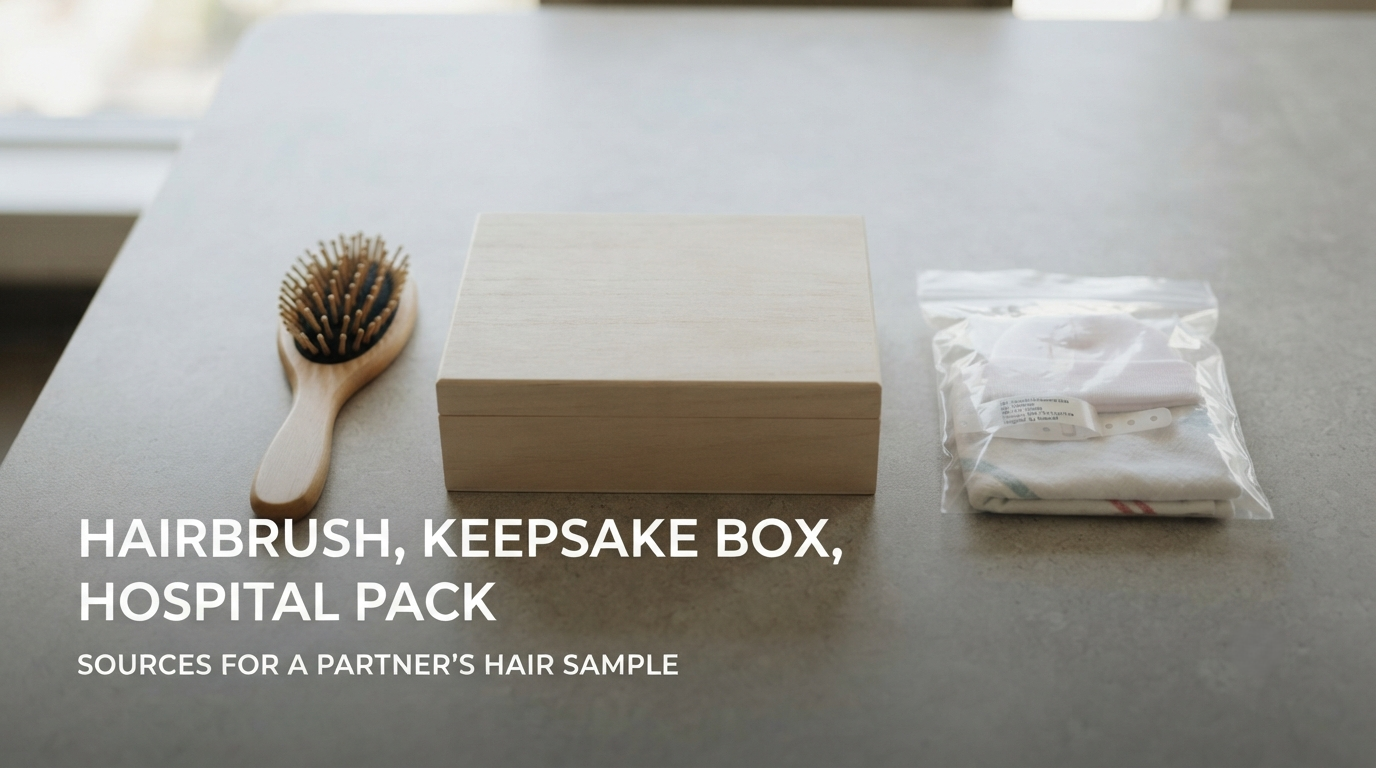
A hairbrush or combLoose, tangled, shed rather than cutWhether anyone else used the brush; shed hair has no root sheathModerate, quantity is often adequate, provenance often is not
A hat, a pillow, a coat collarVery small quantity, loose fibersWhether you can gather enough in one place to weighLow to moderate, usually a supplement, not a sample
A hospital or hospice keepsake packCut, bagged, sometimes labeled with a name and dateThe label, immediately, this is the only common source that documents itselfHigh, and often overlooked because the bag was never opened
A locket, ring or mourning pieceSealed, possibly decades old, possibly not your partner’sWhether a jeweler can open it without destroying the settingVariable, worth a conversation first
A funeral director’s fileCut at the time of care, retained by policy in some placesWhether they still hold anything, most families never askWorth one call before you give up
A hairbrush, a keepsake box and a hospital keepsake pack laid out together on a table

Two notes on that table. A small lock of a few grams is the industry typical requirement, so quantity fails less often than provenance. And the last row is the one people skip: funeral homes sometimes retain a sample, and one call can end the search.

If the sample is in someone else’s house, that is a request rather than an obstacle. Asking for a few strands out of a keepsake box is a smaller ask than asking for a portion of ashes, and it is often granted by people who would refuse the larger one. How to raise this with a family who may not have acknowledged the relationship covers that conversation.

How Do You Verify Hair Nobody Labeled at the Time?

This is the stage the partner hair diamond steps are usually missing, and it is the one that keeps people awake.

Start with what is honest. You usually cannot prove a sample’s identity in a laboratory sense, and it is fair to ask any company directly whether they claim they can. What you can build is a defensible chain of reasoning before you commit anything, which is what verification means here.

  • Reconstruct the collection. Who cut it, where, and roughly when. A date you can place within a month beats a certainty you cannot explain.
  • Check for anyone else in the household with similar hair. This is the single most common source of doubt and the easiest one to rule in or out.
  • Look at the physical evidence. Cut ends suggest deliberate collection; irregular lengths suggest a brush.
  • Ask whoever else was present. A sibling, an adult child, a hospice nurse, somebody often remembers it better than you do.
  • Write down what you conclude, and why, before it is posted. If doubt surfaces in eight months, that note is what you will want.
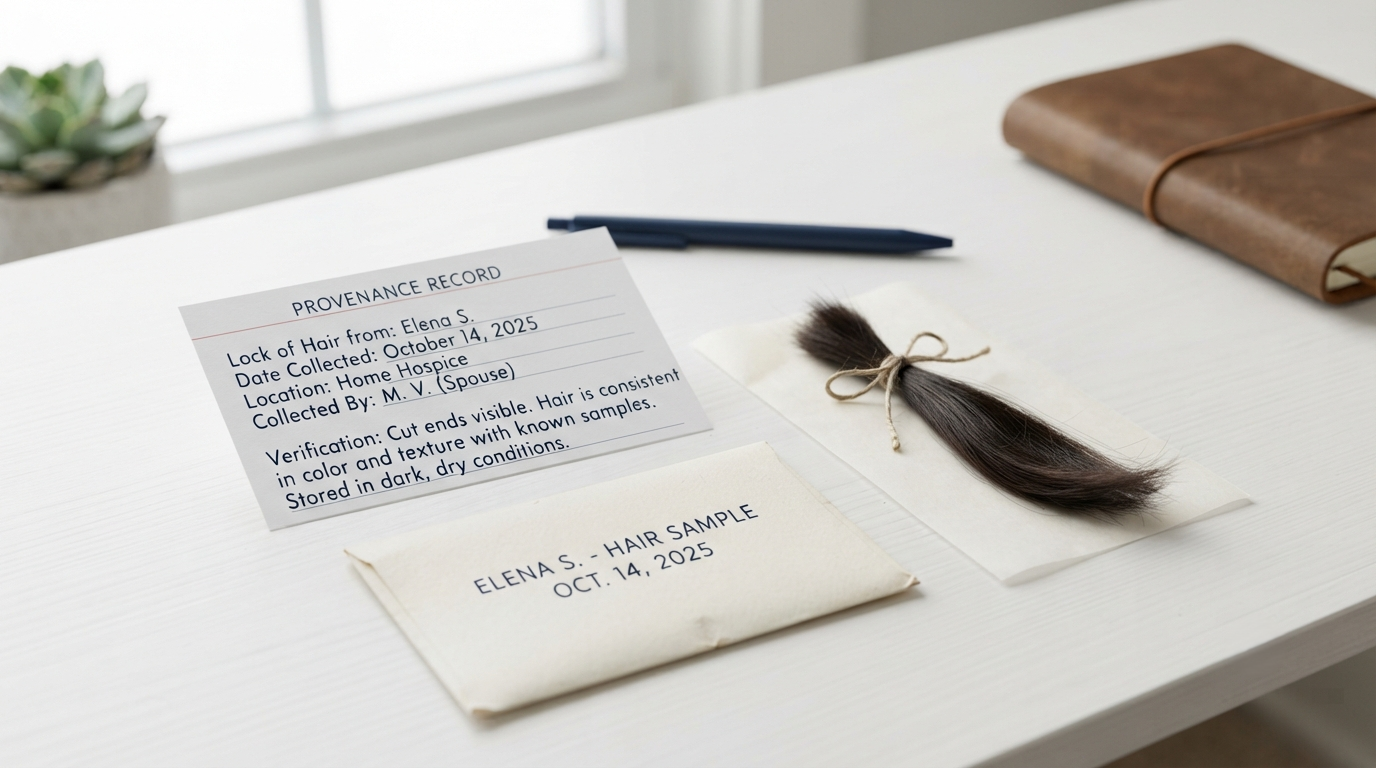
A written note and a dated envelope beside a lock of hair, illustrating how provenance is documented at home

Providers can assess condition, quantity and suitability. Identity is a different question, and DNA verification is not generally offered on this route, so ask rather than assume: can you confirm whose hair this is, and if not, what does your documentation record instead? Until that answer exists in writing, verification is your own job inside the partner hair diamond steps, done before transfer, and documented the way you would document anything you get one chance at.

What Are the Partner Hair Diamond Steps Once a Sample Is Confirmed?

Seven partner hair diamond steps, and the last four are the same physics every memorial stone goes through.

  1. Locating a sample. The household search above, often the longest stage by elapsed time, and the only one with no fixed duration.
  2. Verifying provenance. Establishing, to your own satisfaction and in writing, that the sample is your partner’s.
  3. Assessing condition and quantity. Industry typically a small lock, a few grams, is enough; condition matters more than mass.
  4. Documented transfer. The sample is sealed, labeled with an identifier, logged on arrival and weighed. Chain of custody paperwork begins here.
  5. Cleaning and purification. Product residue, dust and non carbon components of keratin are removed in a controlled, oxygen free process reaching roughly 99.9%+ carbon purity.
  6. Graphitization and growth. The purified carbon is taken to roughly 2,500 to 2,700°C to become graphite, blended with supplemental lab carbon, and held under roughly 6 to 8 GPa of pressure at 1,400 to 2,500°C inside an HPHT cell for weeks or months while a crystal accumulates.
  7. Cutting and polishing, then optional independent grading. The rough is shaped and assessed, typically landing in the SI2 to VVS clarity range, at Mohs 10 like any other diamond. Grading is ordered, not automatic.

One honesty point belongs inside that list rather than after it. The carbon recovered from a lock of hair does not fill a growth cell by itself; laboratory carbon makes up the balance. The roughly 10 to 15% figure you will see quoted for the personal share is an ash figure, industry sources put that band on carbon recovered from cremated remains, and no equivalent number is published for hair. What holds on either route is that the personal carbon is real, traceable through the chain of custody record, and a minority of the finished mass.

Ask what share your own sample is expected to contribute, in writing. What the partner hair diamond steps produce is a diamond a verifiable part of which is your partner, not a diamond that is only your partner. The longer account of how a stone is grown from a partner’s hair goes further into the chemistry.

A note on color, since the partner hair diamond steps settle it rather than let you choose it. Trace elements riding along with organic carbon set the tone: nitrogen leans yellow, boron leans blue, and only the absence of both produces something colorless. What color a stone grown from your partner’s hair tends to be treats that as a likelihood. The general physics behind HPHT and CVD growth sits under synthetic diamond.

What If the Sample Turns Out to Be Mixed?

Mixed samples are common and rarely fatal. They are also the reason stage three of the partner hair diamond steps exists as a separate stage.

A brush is the usual culprit: two people share a bathroom for years, one hairbrush lives on the shelf, and what you are holding is a blend. A keepsake envelope can be mixed too.
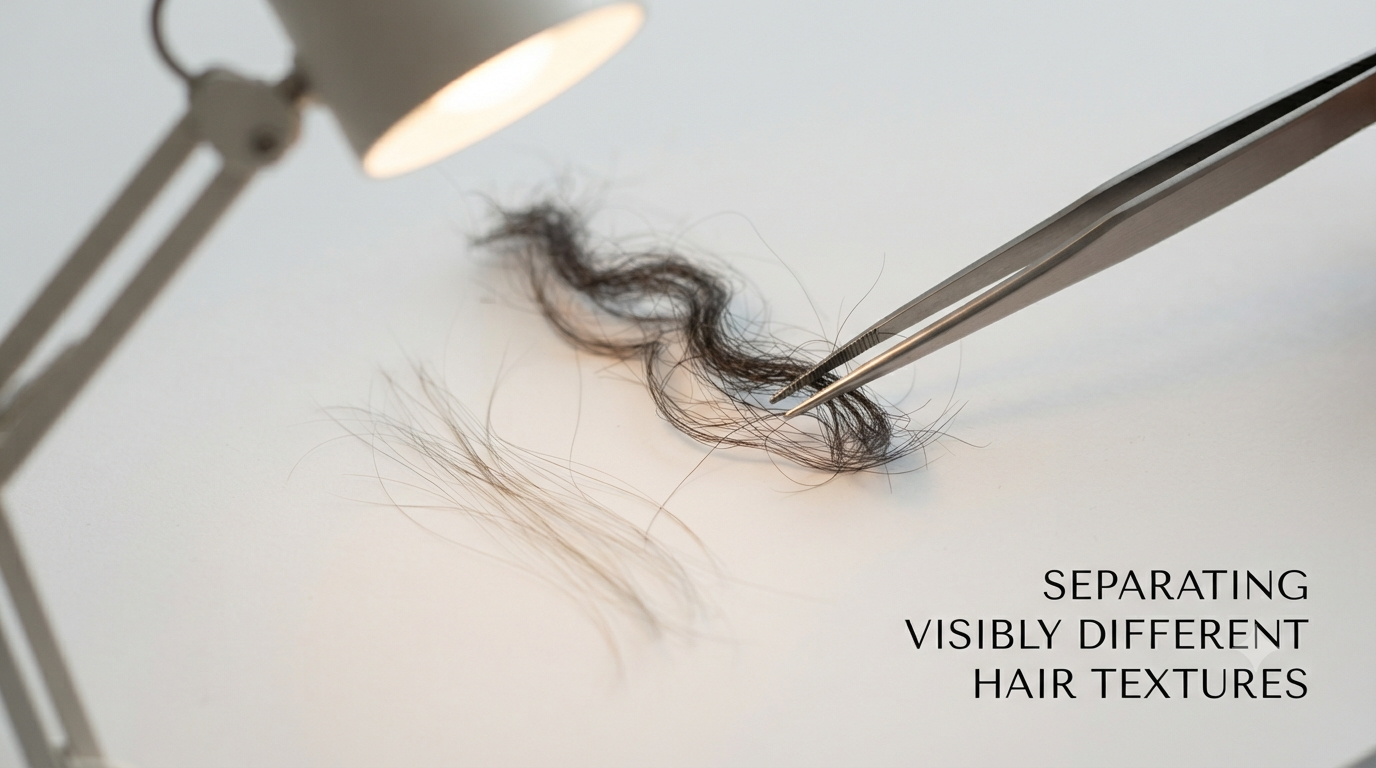
Two visibly different hair textures being separated with tweezers under a lamp

What the partner hair diamond steps do next depends on how mixed it is:

  • Visibly different hair, color, texture or length, can sometimes be separated by hand under good light, with patience and tweezers. Tedious, but it works.
  • Indistinguishable hair cannot be separated, and no laboratory process sorts it. The carbon is processed as one mass.
  • A mixed sample you send anyway is a decision, not an accident, and should be recorded as one. Some families are at peace with a stone grown partly from their own hair alongside their partner’s; others are not. Both are reasonable.
  • A small certain sample beats a larger uncertain one every time, given how little mass the partner hair diamond steps actually require.

Tell the provider what you know. A described mixed sample is a normal intake; an undisclosed one becomes a doubt you carry privately for years. This is also the point where the combined route using ashes as well as hair becomes worth reading, since it changes what the intake record has to account for.

When a Sample Is Too Degraded to Use

Degradation is less common than people fear, because hair is durable, but it happens, and it is better understood before a sample is posted than after.

What actually stalls the partner hair diamond steps: prolonged damp, visible mold, oily or chemical contamination, and years of caked product residue. What generally does not: age, dye, bleach, perming, or a lock that has sat in a drawer since 2009. Keratin is stable, and a dry dark drawer is close to ideal storage.

If a provider assesses a sample as unusable, the partner hair diamond steps have not ended. Three routes remain open:

  • A second sample from elsewhere, the triage table above exists precisely because most households hold more than one possible source.
  • A larger quantity of a marginal sample, if the issue is thin recovery rather than contamination.
  • The ashes route instead, if cremation took place and you have standing to ask for a portion.

That last option is worth a plain sentence about permissions, because it is not symmetrical with hair. Statutes in this area address cremated remains; they were not written about a lock in a drawer. In practice that makes hair you already keep the less obstructed of the two routes, without making it a closed question, belongings can pass into an estate, states take different positions, and hair kept in another household is something you raise with the person who keeps it.

Control over cremated remains varies by state too, and by whatever your partner set down in writing; where a relationship carried no legal recognition, a parent, an adult child or a former spouse may hold it. Where it matters, check rather than assume. That asymmetry is why the step by step for the ashes route starts with authority rather than with a search.

Why the Laboratory Half Is the Shorter Half

Here is the payoff for all that domestic work. Once a verified sample reaches a facility, the technical portion of the partner hair diamond steps is simpler than the ashes equivalent.

Keratin is a carbon rich protein, putting hair at roughly 50% carbon by weight. Ash is dominated by calcium phosphate instead, yielding only about 0.5% to 4%. So a few grams of hair carries what a few ounces of ash carries, and extraction has far less to strip away.

What it changes inside the partner hair diamond steps:

  • Less material moves. An envelope rather than a sealed jar, simplifying transfer and identification.
  • Purification is more direct. No mineral matrix dominates the mass; the process removes the non carbon fraction of a protein.
  • Nothing has to be divided. No urn is opened, and no arrangement anyone else made is touched.

What it does not change: the calendar. Growth time sets carat, not carbon supply, so the industry typical span of 6 to 10 months, up to around 12 for larger or specialty color stones, applies exactly as it does to ash. Sending more hair buys nothing on that clock. The finished stone is graded against the ordinary 4Cs any diamond is assessed on, and the full guide to a partner hair diamond sets the whole route out end to end.

Frequently Asked Questions

How can I be sure the lock in that envelope is my partner’s?

Usually you cannot prove it; the early partner hair diamond steps ask you to reason it out. Reconstruct who cut it and when, rule out anyone else in the household with similar hair, check whether the ends are cut or shed, and write your conclusion down.

Can a laboratory confirm whose hair it is before growing anything?

Ask rather than assume, because DNA verification is not generally offered on this route. Facilities assess condition, quantity and suitability for processing. In the partner hair diamond steps, identity rests on your own record and on chain of custody from intake onward, not on a test.

Two people’s hair ended up in the same envelope. Is that a problem?

Not necessarily, and mixed samples are routine in the partner hair diamond steps. Visibly different hair can often be separated by hand; indistinguishable hair cannot, and would be processed as one mass. Tell the provider either way, and have it recorded at intake.

What does “too degraded” actually mean for a hair sample?

Prolonged damp, mold, oily or chemical contamination, or heavy product residue will stall the partner hair diamond steps. Age alone is not degradation, and neither is dye, bleach or perming. A dry drawer preserves keratin extremely well, which is why decades old locks routinely pass assessment.

Who checks the sample first, me, or the provider?

Both, in that order, and the partner hair diamond steps assume it. You establish provenance, because only you can. The provider then assesses whether there is enough usable material and whether its condition suits processing. Ask whether that can happen from a photograph and a weight first.

If no sample survives verification, what comes next?

Search the other household sources before you abandon the partner hair diamond steps, including a call to the funeral home. If nothing usable exists, the ashes route remains open where cremation took place and you have standing to ask, a different sequence with a different first stage.

Final Thoughts on the Partner Hair Diamond Steps

The technical partner hair diamond steps are well understood and largely out of your hands. Purification, graphitization, growth, cutting: these happen on a schedule, competently, without you.

The stages that need you are the first three, and they happen at home with no instructions. Find a sample. Satisfy yourself about where it came from. Describe it honestly to whoever will process it. Those are the partner hair diamond steps that determine whether the rest is worth beginning, and they cost nothing but attention.

A last, practical point. Because the partner hair diamond steps need no cremation and very little mass, this route stays available long after other options have closed, after a burial, after a scattering, after a family took the urn.

Learn More About Partner Memorial Diamonds

Talk With Memorial Diamond

You can complete the hardest part of the partner hair diamond steps this weekend, without spending anything and without telling anyone: open the drawers, call the funeral home, and see what exists.

If something does, three written questions will tell you where you stand. Ask whether a sample can be pre assessed from a photograph and a weight before it is posted. Ask what happens to material the process does not consume. Ask how it is identified from intake to finished stone. memorialdiamond.us answers all three, and so should anyone else you approach.

Nothing in the partner hair diamond steps has to be decided quickly. A lock of hair in a dry drawer is in no hurry at all.
A small lock of hair beside an open paper envelope on a table, the irreplaceable sample behind most partner hair diamond questions

Questions to Ask Before Turning Your Partner’s Hair Into a Diamond

There is one envelope. Whatever is inside it, a lock cut at a hospital, a curl saved years ago, the strands still caught in a brush nobody could bring themselves to clean, there will never be a second one. The partner hair diamond questions that matter most are about provenance and irreplaceability: how a laboratory handles a sample nobody can independently identify, whether the condition of yours still works, and what “enough” means when running short is not survivable.

Memorial Diamond grows diamonds from hair, so treat this page as interested rather than neutral. Every figure here is an industry wide range, not a published requirement of ours. And the most important of the partner hair diamond questions has an answer you may not expect.

The Sample That Cannot Be Replaced

Hair is a far better carbon source than ash. Roughly half of a strand’s weight is carbon, built into keratin, against the 0.5% to 4% that cremated remains yield. That is why this route needs a small lock rather than a scoop, and why it works for someone who was buried.

But chemistry is not the constraint behind the partner hair diamond questions here. Scarcity is. Ashes exist in quantity and can usually be re portioned if a first attempt goes badly. A lock of hair is a fixed object with a fixed weight, sitting in a drawer, and once it is gone it is gone. That single asymmetry is what should reshape every conversation you have with a provider.

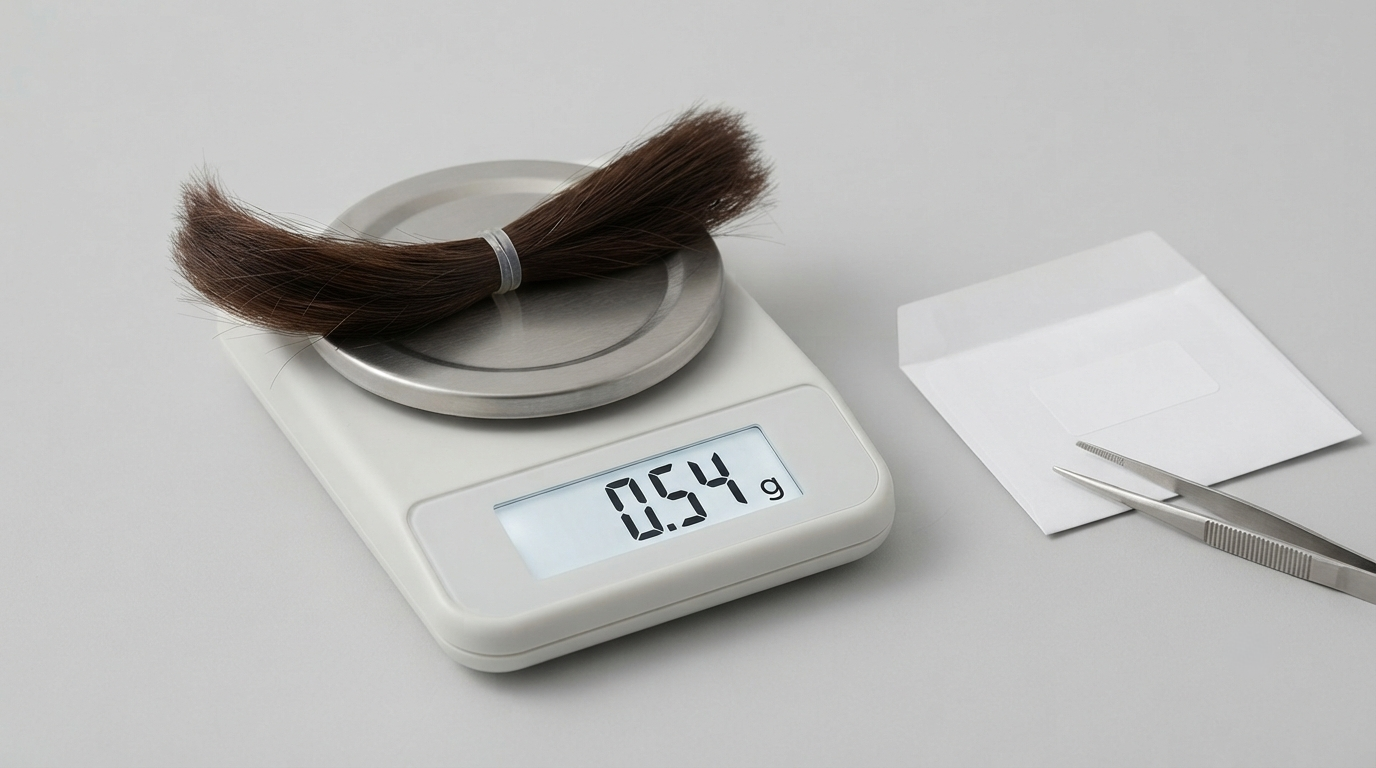
A lock of hair on a small digital scale reading in grams, showing how a sample is weighed before it is sent

It changes which partner hair diamond questions matter, and when you ask them. With hair, the assessment conversation has to happen before anything is posted, because a sample declared marginal after arrival is a sample already out of your hands. That is the practical spine of the partner hair diamond questions below: front load everything that could disqualify your sample, and accept no answer that begins with “send it and we’ll see.”

  • Weigh it first. A kitchen scale that reads to 0.1 g costs very little and tells you where you stand before anyone else knows.
  • Photograph it in the container it has lived in, including any tape, card, ribbon or plastic attached to it.
  • Write down what you know, roughly when it was cut, by whom, and how it has been stored since.
  • Ask for the provider’s minimum in grams, not in adjectives like “a small lock.”

How Would a Laboratory Know Whose Hair This Is?

This is the first of the partner hair diamond questions, and the honest answer surprises most people.

1. Can a provider verify that this sample is my partner’s?

Ask, and expect the answer to be no. Hair carries DNA in its root bulbs, but genetic testing is not something providers generally offer on this route, there would be nothing to test it against unless a reference sample exists, and the growth process itself, graphitization at roughly 2,500 to 2,700°C, then a press at 6 to 8 GPa, destroys every trace of biological material long before a crystal forms. A finished diamond cannot be tested afterwards to name anyone. Put it to the company in those words and see what comes back.

What a serious provider documents instead is a chain of custody beginning at receipt: this sample, logged under this reference, entered purification, and this carbon came out. That is a real and verifiable record. It simply starts at their door, not at your drawer.

So the truthful framing of one of the central partner hair diamond questions is this: the identity of the sample rests on your word, and the provider’s job is to make sure that whatever you sent is what they grew. A company that claims more than that is claiming something the physics does not allow.

2. What happens if the lock turns out to be mixed, or not theirs?

Expect nothing to flag it. Keratin from two people is chemically indistinguishable once purified to the 99.9% plus carbon the process requires, and separating or identifying sources is not what a purification and growth sequence is built to do, worth confirming with your provider rather than taking on trust. A brush sample that also holds a few of your own strands, or a child’s, will simply be carbon.

Whether that matters is one of the partner hair diamond questions only you can answer, and plenty of families conclude it does not, a brush two people shared is arguably a truer object than a clinical cut. But decide it now rather than discovering the ambiguity afterwards. If it does matter, a single clean lock with a known history beats a larger, vaguer sample.

This is also the point at which the partner hair diamond questions stop being technical. If nobody else can confirm what this is, your own record becomes the provenance. A dated note and a photograph taken today, kept with the paperwork, is worth more in twenty years than a memory.

Which Partner Hair Diamond Questions Are About the Sample’s Condition?

Two of the nine, and they are the partner hair diamond questions most often answered wrongly by well meaning guesswork.

3. The hair is old. Is it still usable?

Almost certainly, and this sits among the partner hair diamond questions where instinct misleads. Keratin is remarkably stable, hair survives for centuries in archaeological contexts, and a lock kept in a drawer for fifteen years has not lost its carbon. Age alone is not a disqualifier.

Storage is the real variable. Damp gives mold a foothold; adhesive tape, laminated cards and glued memorial books bond the hair to something that now has to be removed; loose strands may have picked up fibers. None of these is automatically fatal, and purification strips non carbon material anyway, but all are worth disclosing rather than hoping nobody notices.

4. Does dye, bleach or a treatment change anything?

Less than people fear, which makes this one of the partner hair diamond questions worth asking rather than assuming. Bleaching and permanent color alter the keratin cuticle, but they do not remove the carbon, and extraction strips out everything that is not carbon regardless. Heavily processed hair is generally still workable.

Hair thinned by illness or chemotherapy raises a volume issue rather than a viability one, fine, sparse strands weigh very little, so a visually generous lock may come in well under the gram figure a provider needs. Weigh it. The same goes for very short hair, where what looks like plenty on a card can be under a gram.

What you haveEffect on carbonEffect on viabilityDisclose when you ask
Lock kept loose in an envelope for yearsNone, keratin is stableGenerally fineHow long, and where it was stored
Hair taped to a card or laminatedNone to the hair itselfAdhesive must be removed firstThat tape or lamination is involved
Dyed, bleached or permedNone, purification removes the restGenerally fineThe treatment, so nothing is a surprise
Fine or chemotherapy thinnedNone per gramVolume is the risk, not chemistryThe actual weight in grams
Strands from a shared hairbrushNoneWorks, but sources cannot be separatedThat the sample may be mixed
Hair showing mold or damp damageReduced usable massAssessment needed before commitmentImmediately, with a photograph
A lock of hair taped to a keepsake memorial card, the kind of mounting that has to be removed before processing

The pattern across that table answers several of the partner hair diamond questions at once: chemistry is rarely the obstacle, and mass almost always is. If your sample fails, it will fail on a scale, not in a beaker. To see how the numbers work out, how much hair a partner memorial diamond actually needs sets out the typical bands.

What Does “Enough” Mean With No Second Sample?

A provider quoting “a small lock” is describing a comfortable case, not a threshold. Weight sits at the dead center of the partner hair diamond questions. For an irreplaceable sample, comfortable is not the number you need.

5. What is your minimum, in grams, and what is your preferred amount?

Ask for both, because they are not the same and the gap between them is where your risk lives. Industry wide, hair submissions typically run to a few grams, which sounds trivial until you weigh a thin lock of fine hair and find it at 0.6 g.

If you sit between the minimum and the preferred amount, you are not disqualified, you are in the band where the provider’s honesty matters most. Among the partner hair diamond questions this is the one to ask in writing, so the answer exists as text rather than as an encouraging phone call.

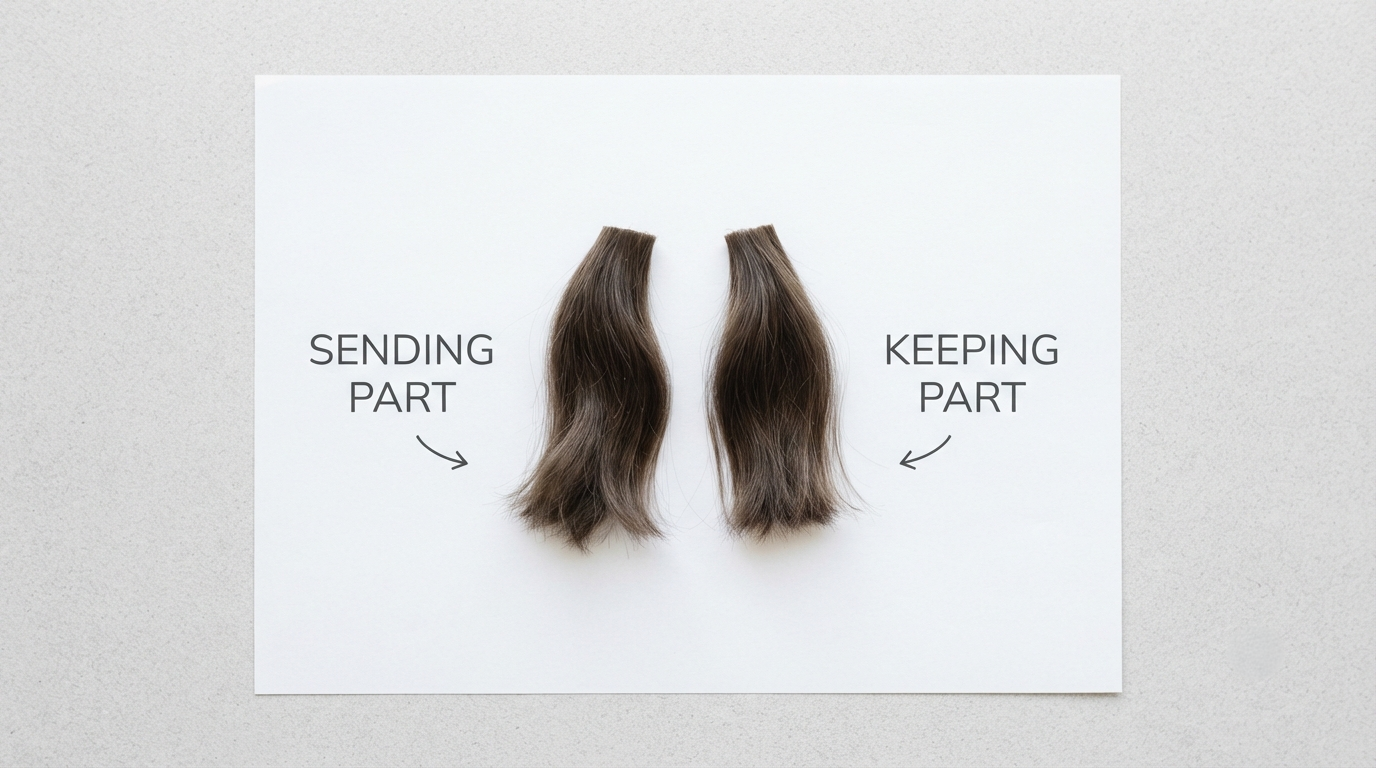
One lock of hair divided into two portions on a sheet of paper, illustrating sending part and keeping part

6. Will you assess the sample before I commit, and will you tell me plainly if it is marginal?

The answer you want is yes to both, with specifics. Some providers will look at a photograph and a stated weight and give a view. Some accept a few strands as a test portion. Some assess only on arrival, which for an irreplaceable sample is a materially worse offer.

Then ask the follow up that separates careful companies from confident ones: if it is marginal, will you say so and pause, or proceed and hope? Of all the partner hair diamond questions, this one most reliably reveals how a company behaves when things are not going well. The rest of the sequence from posting a lock to receiving a finished stone is comparatively predictable.

What Survives If the Run Fails?

Growth runs fail occasionally, and the partner hair diamond questions here are the least pleasant to ask. Crystals fracture, cells misbehave, and a stone can be lost in cutting. With ashes there is usually more material. With hair there is usually not.

7. If the sample is consumed and the run fails, what exists afterwards?

Ask this in the bluntest form you can manage, because the answer defines your actual exposure. Is the purified carbon recovered and re grown, or is it lost with the crystal? Is a second attempt made without further material? Is money returned when material cannot be?

There is no industry standard answer to these partner hair diamond questions, and different policies are all legitimate. What is not acceptable is vagueness. Of the nine partner hair diamond questions on this page, this is the one most often left unanswered: if a provider cannot describe what happens in the bad case, you are being asked to carry a risk nobody has quantified for you.

8. Can the sample be split, so that part of it stays with me?

Often, and it is the single most effective protection available to you. Sending half a lock and keeping half means a failure costs you a stone rather than the object itself. It also leaves a second family member able to commission their own stone later from the same source.

Ask whether the provider will work from a reduced portion and whether doing so changes the likely outcome. If your sample is large enough to split, splitting it converts the worst case from irreversible to merely disappointing, which is why it belongs among the partner hair diamond questions asked before the envelope is sealed, not after. Where more than one person wants a stone, the practicalities of sharing a single source are worth reading first.

The Partner Hair Diamond Questions About What a Certificate Asserts

Documents outlast the people who commissioned them, which is why the partner hair diamond questions end here. Read yours before it exists.

9. What, exactly, does the certificate claim about origin?

There are two documents and they do different work. A grading report, ideally from an independent laboratory, describes the finished stone, cut, color, clarity, carat, the same category of assessment any diamond receives. An origin or authenticity certificate describes the submission: that this diamond was grown from carbon extracted from material received under this reference on this date.

Notice what the second document can and cannot say, because this is one of the partner hair diamond questions a certificate answers on your behalf for the rest of its life. It can say material was received and tracked. It cannot say whose hair it was, because nobody at the laboratory was in your house when the lock was cut. Good wording reflects that honestly. Wording that implies genetic verification is overreaching, and it is fair to ask for a sample certificate before you commit.

Ask too about the proportion, and be careful with the number you have probably already read. The often quoted 10 to 15% band describes carbon recovered from cremated ashes; no equivalent share is published for hair, so no honest document can put a hair figure on it. What is true on either route is that laboratory carbon makes up the bulk of the charge so the crystal reaches a viable size, and that the personal carbon is a real, verifiable, permanent minority of the lattice rather than the whole of it.

So make it one of your partner hair diamond questions: what share is my sample expected to contribute, and how is that recorded? Any document or salesperson claiming the stone is wholly your partner is overstating what a grown diamond actually is, and a company comfortable overstating that will be comfortable overstating other things. That honesty test sits underneath all nine partner hair diamond questions on this page.

Frequently Asked Questions

Can a finished diamond be tested to prove whose hair it came from?

No. The growth process runs far above the temperature at which biological material survives, so nothing identifiable remains in the crystal. Treat any claim that a finished stone can be genetically matched to a person as a reason to ask a great many more questions.

Is hair from a hairbrush usable?

Physically, yes, brush strands are the same keratin as a cut lock. The caveat is that a shared brush may hold more than one person’s hair, and nothing in the process distinguishes them. Decide in advance whether that ambiguity sits comfortably with you.

Does the hair need roots attached?

No. The carbon is in the shaft, and roots add almost nothing to the mass. Root bulbs would matter for DNA testing, which providers do not generally offer on this route, so cut ends are perfectly workable.

My partner’s hair was gray. Does that change the stone?

No. Pigment is present in trace quantities and is removed during purification like everything else that is not carbon. A diamond’s color comes from trace elements at growth, nitrogen tending yellow, boron tending blue, neither present giving colorless.

Can I send more hair later if the first sample falls short?

Ask, because it depends entirely on where the run has reached. Once material is purified and committed to a growth cell, adding to it is usually not possible. Before that stage, some providers will accept a top up. Get the deadline in writing.

My partner was buried rather than cremated. Does hair still work?

Yes, and that is the point of this route. Hair needs no cremation at all, which is why it also suits families whose faith or wishes ruled cremation out, and why a lock saved during life is enough on its own.

Final Thoughts on Partner Hair Diamond Questions

Everything on this page comes back to one sentence: there is no second envelope. The chemistry is forgiving, the timeline is ordinary at six to ten months, and the finished stone is a real diamond by every measure. The only unrecoverable thing is the sample you start with, and that is what shapes the partner hair diamond questions.

Which is why the partner hair diamond questions worth asking are the ones that happen before postage, weight, condition, assessment, splitting, and what a provider does on a bad day. Asked in that order, they cost you an afternoon. Asked afterwards, some of them have no useful answer at all.

If a company answers all nine partner hair diamond questions plainly, you have learned something. If one of them produces a shrug, you have learned something more useful still, and you have learned it while the envelope is still in your drawer.

Learn More About Partner Hair Diamonds

Talk With Memorial Diamond

If you want the partner hair diamond questions above answered against your actual sample rather than in general, reach out to Memorial Diamond at memorialdiamond.us. Bring a weight in grams, a photograph of the lock as it currently sits, and an honest description of how it has been stored, including the parts you would rather not mention.

Nothing about the partner hair diamond questions needs deciding in a first conversation, and nothing should be posted before one. Ask what your sample would need to weigh, whether it can be split, and what happens on the day a run goes wrong.

A closed urn on a shelf beside a sealed paper envelope, the two forms ash and hair for a partner memorial diamond arrive in

How Much Ash and Hair Do You Need for a Partner Memorial Diamond?

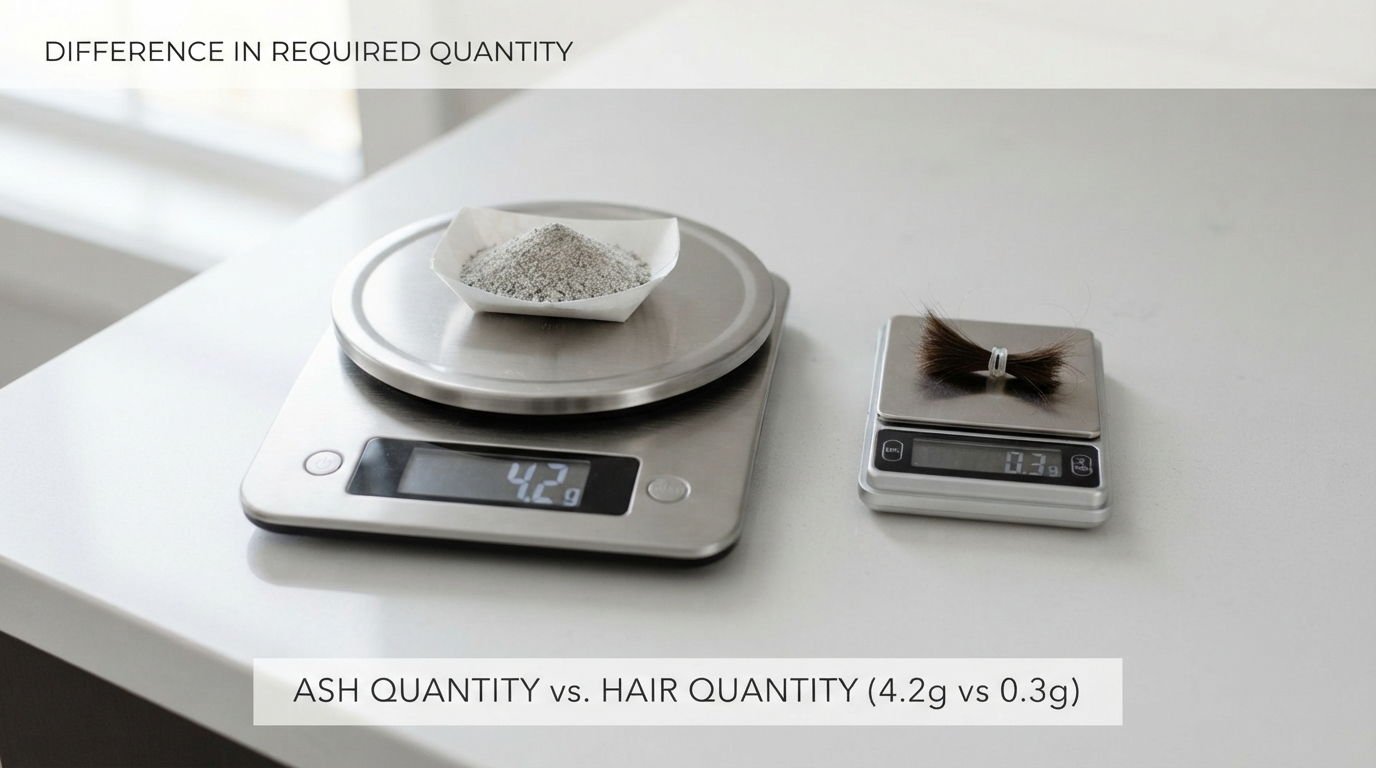
The two things are almost never in the same room. The urn sits somewhere deliberate, a shelf, a sideboard, a spot chosen carefully. The hair is in an envelope in a drawer, if any was cut at all. Ash and hair for a partner memorial diamond are measured against two separate figures: typically a few tablespoons up to roughly 4 oz of cremated remains, or a small lock of a few grams of hair.

Read the “or” in that sentence carefully, because it is the whole post. Submitting both does not add the two allowances together into something larger. A combined order is not a double order.

Memorial Diamond grows these stones, so treat this page as interested rather than neutral, and every number on it as an industry wide range rather than our published requirement. What follows is mostly about what a second source changes, less than people assume, and about the one genuinely new decision it creates.

What a Second Source Actually Changes

Start with the shorter list, which is the list of things a second source does not do.

Sending both ash and hair for a partner memorial diamond does not make a bigger diamond. It does not shorten the wait. It does not raise the proportion of the finished stone that came from your partner. It does not halve either requirement, and it does not let a short quantity of one material be topped up by the other. People arrive at ash and hair for a partner memorial diamond expecting an additive answer and there isn’t one.

What it does change is real, though, and worth the trouble:

  • Redundancy. If one half of the ash and hair for a partner memorial diamond you hold disappoints on assessment, the order does not necessarily end.
  • Access. Authority over ash and hair for a partner memorial diamond rarely rests with one person. Sometimes the ashes are controlled by someone else and the hair is not, or the reverse.
  • Meaning. Some people simply want both included, and that is a sufficient reason on its own without technical justification.
  • Timing. The ash and hair for a partner memorial diamond can often be committed at different moments rather than together.

That last one is the decision this page exists for. Everything else about ash and hair for a partner memorial diamond is already settled by the two single material figures. Sequencing is the part nobody tells you about in advance.

How Much Ash and Hair for a Partner Memorial Diamond Does a Combined Order Take?

The ash and hair for a partner memorial diamond are assessed against separate bands, independently of one another.

For cremated remains, the industry typical requirement runs from a few tablespoons up to roughly 4 oz (about 100 g). For hair, it is typically a small lock, a few grams. The reason the two halves of ash and hair for a partner memorial diamond carry such different figures is carbon content: hair is roughly 50% carbon by weight, while cremated remains yield only about 0.5% to 4%, because ash is overwhelmingly calcium phosphate rather than carbon.

A kitchen scale holding a small portion of cremated remains next to a far smaller lock of hair, showing the difference in required quantity

Any provider you approach will have its own numbers inside those bands, so the specific quantity of ash and hair for a partner memorial diamond you are asked for is a figure to get in writing from them, not something to infer from a page like this one. Ask three things about the ash and hair for a partner memorial diamond when you do:

  1. Is each figure a received weight or a usable weight? Processing removes whatever is not carbon, and two companies may answer it differently without either of them being wrong.
  2. Are the ash and hair for a partner memorial diamond assessed separately or as one submission? This determines whether a shortfall in one is fatal to the order.
  3. Does submitting ash and hair for a partner memorial diamond together change the required quantity of either? The honest expectation is no, but it is a policy question, not a chemical one.

Beyond those figures, the quantity of ash and hair for a partner memorial diamond stops mattering. Carat comes from time in an HPHT growth cell, which runs at 1,400 to 2,500°C under something like 6 to 8 GPa for weeks or months on end, as documented in the general literature on diamond growth methods. Stones run from about 0.10 ct to 5+ ct, and the industry typical timeline is 6 to 10 months, stretching toward 12 for larger or specialty color work. None of those numbers moves because you sent ash and hair for a partner memorial diamond instead of one material. The full sequence for a combined submission covers what happens once both have been accepted.

Does Using Both Make the Stone More of Your Partner?

No, and this deserves a direct answer rather than a tactful one, because it is the reason many people submit both in the first place.

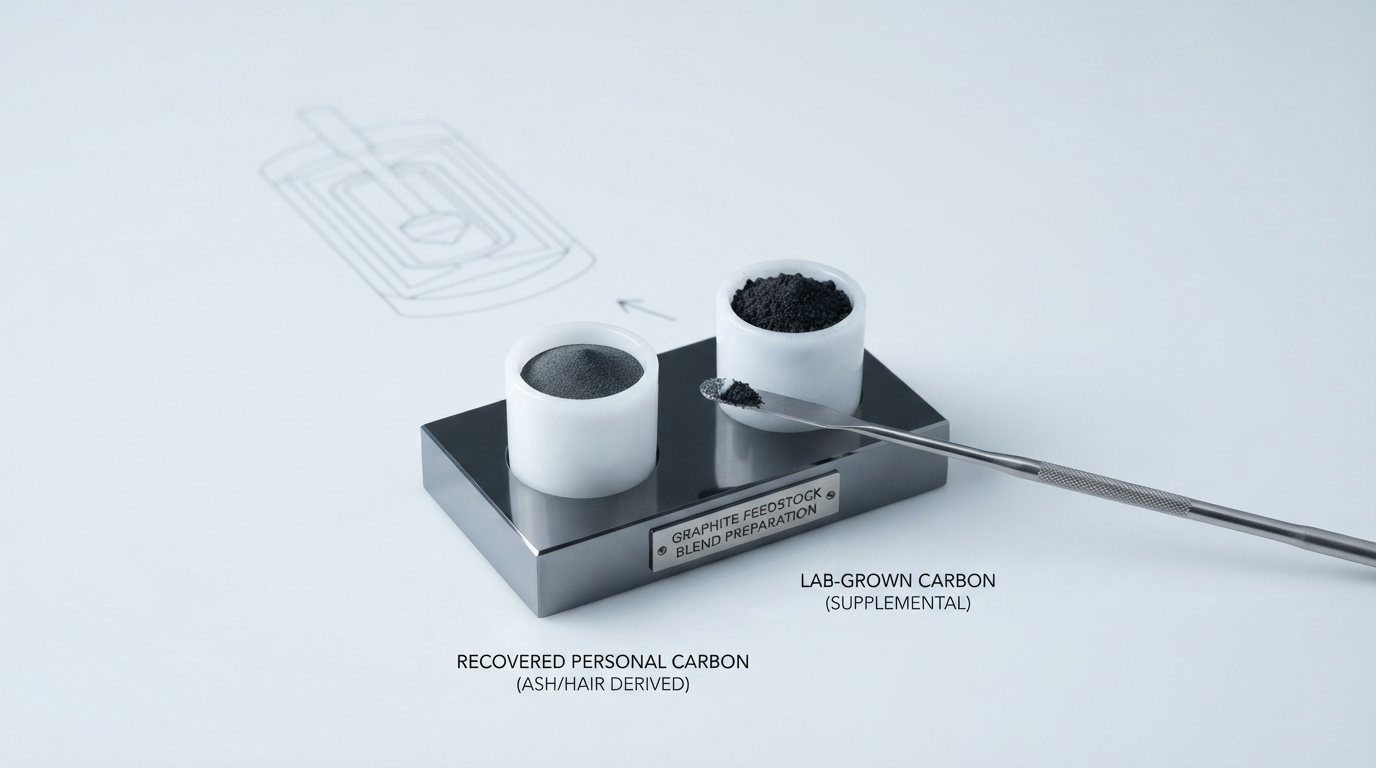
The carbon recovered from ash and hair for a partner memorial diamond is a minority of the finished stone. Industry figures for the ash route put that personal fraction at something like 10 to 15% of the stone’s mass, some providers as low as 3%, and no published figure covers a blended charge of the two materials. Whatever is recovered gets purified to roughly 99.9%+, converted to graphite, and then topped up with lab grown carbon until there is enough feedstock to fill a growth cell. Sending ash and hair for a partner memorial diamond puts two personal inputs into that same recovered fraction. It does not enlarge the fraction.

Purified graphite feedstock prepared for a diamond growth cell, where recovered personal carbon is blended with lab-grown carbon

There is a subtler version of the same hope: the idea that hair from life plus ash from after captures more of a person than either alone. That is a real feeling and nobody should argue anyone out of it. But it is a feeling about meaning, not a claim about material, and the two should not be confused when money is involved. A single source stone and one grown from ash and hair for a partner memorial diamond are, in every measurable respect, the same object.

What is true, and is plenty: a verifiable portion of your partner’s own carbon sits permanently inside the crystal lattice of a real diamond, graded against the same 4Cs as any other stone. Color, incidentally, is not something a second source lets you steer either. Nitrogen present during growth reads yellow, boron reads blue, and colorless requires the absence of both. What color a combined stone is likely to be covers why that remains a probability rather than a choice.

Which Material Gets Committed First?

Here is the decision that ash and hair for a partner memorial diamond forces on you and a single source order never does.

The two halves of ash and hair for a partner memorial diamond carry different risks. Ash is usually the larger, more contested, more irreversible thing to part with, and frequently it is not exclusively yours to send. Hair is small, often already in your possession, and rarely subject to anyone else’s permission. Sending ash and hair for a partner memorial diamond at once means committing the harder material before you know whether the process works for you.

The decision in front of youWhat to settle before anything is postedWho actually answers it
Whether to send the ash and hair for a partner memorial diamond together or one at a timeWhether the provider accepts a staged submission, and whether a second material can be added after an order opensThe provider, in writing, before payment
Which material is more exposedWhether the ashes are yours to divide at all, given the law of the state and anything your partner left in writingA funeral director, and whoever holds legal authority over the remains
Whether a sample that may fall short is worth sendingWhether that material gets returned, kept, or quietly absorbed if it fails assessmentThe provider’s written policy on unused material
Whether to hold hair back deliberatelyWhether anyone else may want a stone later, since a second order needs its own materialYou, and anyone else in the family who may ask
Whether the order is time sensitiveWhether a scattering, interment or family handover is already scheduled for the ashesWhoever is organizing it
What “committed” actually meansAt what point material stops being returnable, on receipt, on assessment, or at graphitizationThe provider, and this is the single most useful question on this page
 person at a desk with an urn, an envelope and a written list of questions, deciding which material to send first

The last row is the one to send as an email today. Once material is graphitized it is not coming back in any recognizable form, and knowing exactly where that line falls is what lets you decide the order in which to cross it. The questions worth asking before anything is arranged is the fuller list to work through.

What If One Source Turns Out to Be Short?

This is where ash and hair for a partner memorial diamond earns its keep, and the answer depends entirely on a policy question you can settle in advance.

If the ash and hair for a partner memorial diamond are assessed separately, a shortfall in one does not automatically end the order. The other can usually proceed on its own. If they are treated as a single pooled submission, a shortfall may stall everything. That difference is not chemistry and it is not standardized, so ask before you post anything.

Three common shortfalls and what typically happens next:

  • Not enough ash, plenty of hair. The most survivable case. Hair carries roughly 50% carbon against ash’s 0.5 to 4%, so a few grams does the work of several ounces, and the order usually continues as a hair based one. The hair figure taken on its own sets out what that looks like.
  • Plenty of ash, no usable hair. Equally workable, and common where a partner was cremated without anyone thinking to cut a lock. The ash figure on its own covers the requirement and why it is what it is.
  • Both short. Rarer, and the one case where ash and hair for a partner memorial diamond is genuinely a stop rather than a detour. Ask whether a partial assessment is possible before committing, and ask what happens to material already sent.

Nothing about a shortfall is a judgment on what you kept. Plenty of people hold a keepsake urn given at a funeral, or a few strands from a brush, and were never told either might matter later. Getting ash and hair for a partner memorial diamond assessed early, before any plan is built on it, is the cheapest way to find out where you stand.

Two Materials, Two Sets of Rules

The final thing ash and hair for a partner memorial diamond introduces is that the two sit under different kinds of authority, and people are frequently surprised by which one causes trouble.

Cremated remains sit inside a chain of control that differs from state to state and can be overridden by anything your partner set down in writing. Where a relationship was legally recognized, that is usually straightforward. Where it was not, no marriage, no civil partnership, a family that never acknowledged the relationship, a spouse from an earlier marriage still named on the paperwork, the urn may be controlled by someone who is not you. That has to be established before money moves, not after.

The rules covering cremated remains are generally aimed at the remains themselves, so hair already sitting in your own home is usually a simpler question in practice. That is practice rather than settled law. A person’s personal effects can fall to their estate, and this varies by state, so three qualifications matter:

  • If the hair is in someone else’s keepsake box, it is theirs to share or refuse, regardless of what the law says about remains.
  • If a funeral home holds a cut lock, they will release it to whoever is on record as authorized, which may not be you.
  • If personal effects were named in a will, a lock kept in a locket may fall under it.

So an order built on ash and hair for a partner memorial diamond can genuinely be easier or harder than a single material one depending on which is contested. Where the ashes are out of reach and the hair is not, the practical answer is often to proceed with hair alone rather than to fight for a portion you may not be entitled to. The complete guide to a partner ashes and hair diamond works through both routes in full.

Frequently Asked Questions

Does sending both materials produce a larger diamond?

No. Carat is set by growth time in the press, not by how much material arrives, so a combined submission and a single source one at the same carat take the same months and cost the same. Two sources buy redundancy and meaning, not size.

If the ashes fall short, does the hair make up the difference?

Only if the provider assesses the two separately rather than as one pooled submission. When they are assessed separately, a hair only order usually proceeds. Ask which model applies before you send anything, and get the answer in writing.

Which should I commit first if I only want to risk one?

Usually hair, because it is smaller, generally already in your possession, and rarely subject to anyone else’s permission. That lets you see how a provider actually handles your material before the ashes, the harder, more contested thing, are committed.

Does a dual source stone contain more of my partner than a single source one?

No. Industry figures for the ash route put the personal carbon near 10 to 15% of the finished stone’s mass, and no published figure covers a blended charge. Either way, a second input shares that fraction rather than enlarging it. Send both for meaning and redundancy, not proportion.

Can the two materials be grown into two separate diamonds instead?

Frequently yes, since each meets its own minimum independently, one stone from ashes, one from hair. That is a genuinely different order with its own cost and its own timeline, so ask for it to be quoted separately rather than assumed.

The hair is mine to give but the ashes are not. What then?

Then proceed with what is actually yours, and treat the ashes as a separate conversation with whoever holds authority. A hair only order is not a compromise version. It is the same process, the same stone, and the same grading.

Final Thoughts on Ash and Hair for a Partner Memorial Diamond

Most of the work here turns out to be subtraction. Two sources do not double the allowance, do not enlarge the personal fraction, do not speed anything up, and do not give you a bigger stone. Once all of that is cleared away, what remains is small enough to act on.

Six things are worth acting on, in this order:

  1. Get both figures for ash and hair for a partner memorial diamond in writing, stated separately.
  2. Ask whether each is a received or a usable weight, since the two are not the same number.
  3. Ask whether the materials are assessed separately or pooled, because that answer decides what a shortfall costs you.
  4. Find out where the point of no return sits, receipt, assessment, or graphitization.
  5. Settle who controls the ashes before money moves, and ask who holds any cut lock.
  6. Commit the easier material first, usually the hair, and the contested one second.

Handled in that order, ash and hair for a partner memorial diamond stops being a question about quantity and becomes what it actually is, a question about which thing you are willing to send while you still have the option of changing your mind.

Learn More About Partner Memorial Diamonds

Talk With Memorial Diamond

If you are holding both materials and unsure which to commit, that is a question worth asking out loud before anything is packed. Describe what you have, how much, how it has been stored, whether all of it is yours to send, and ask for an assessment rather than an order.

Four questions get you a usable picture of any provider: what quantity of ash and hair for a partner memorial diamond is required for each material, whether those are received or usable weights, whether the two are assessed separately or pooled, and at what exact point material stops being returnable. memorialdiamond.us will answer all four before you decide anything, and so should anyone else you are weighing up.