main

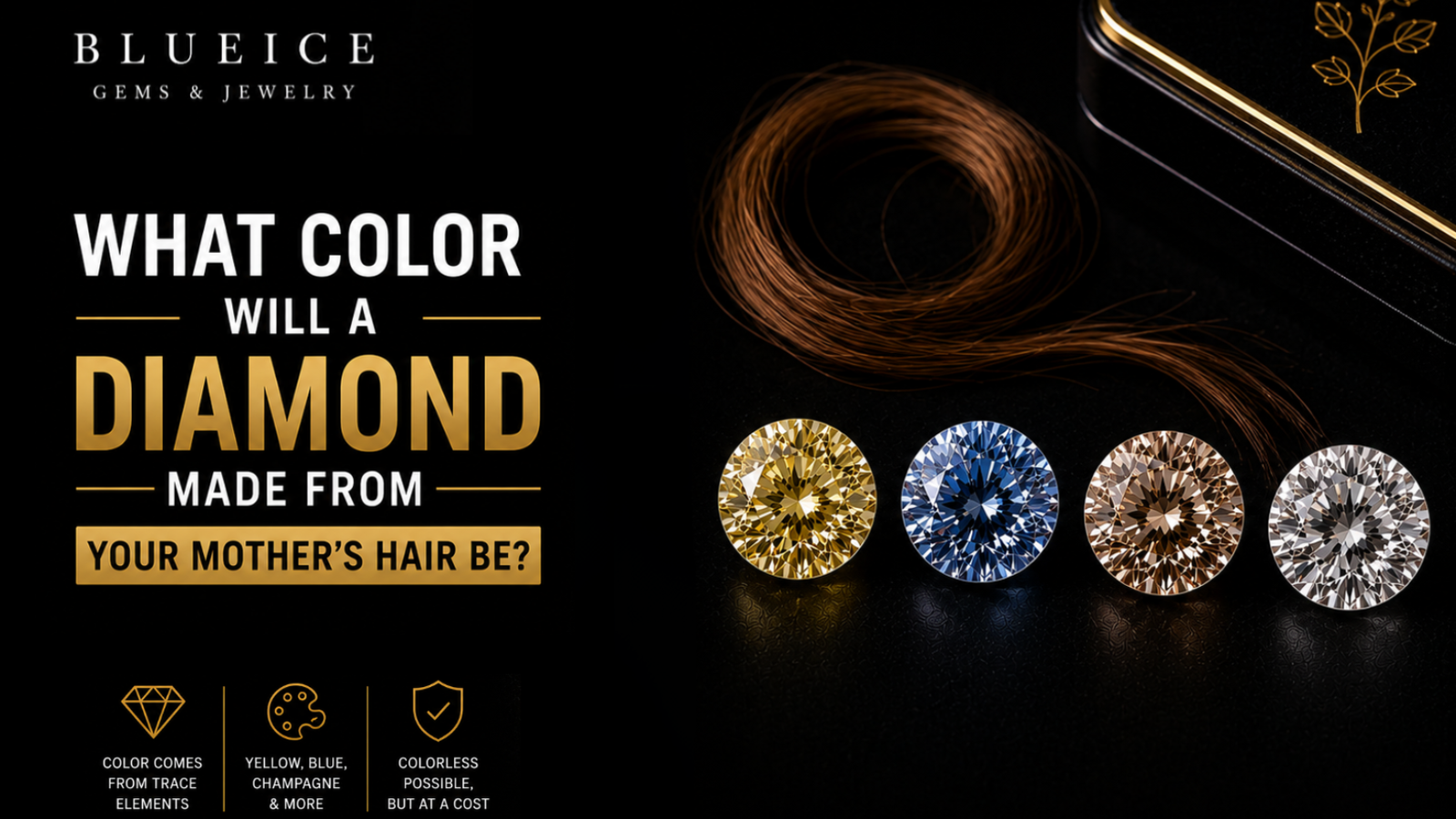
What Color Will a Diamond Made From Your Mother’s Hair Be?

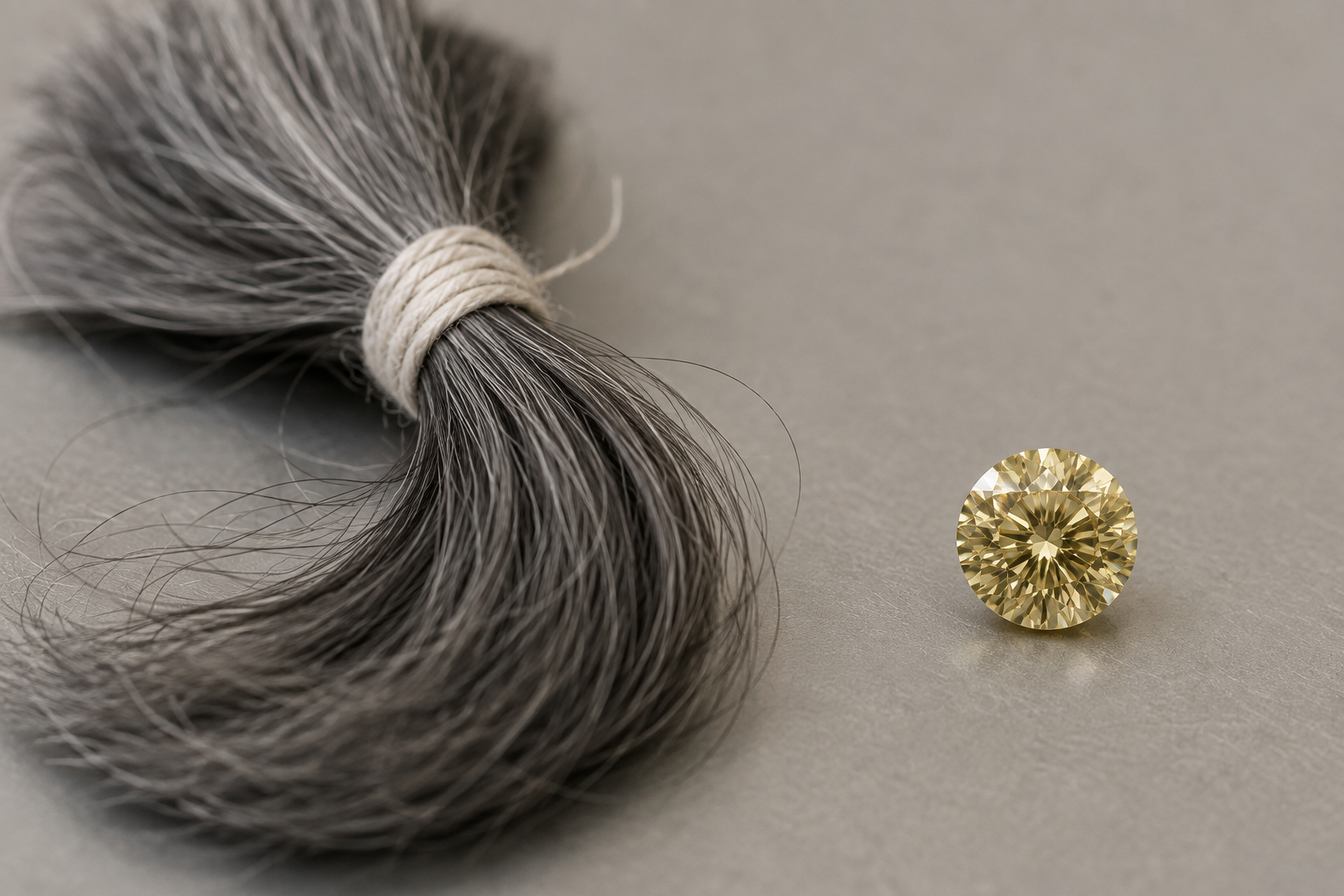
A lock of grey hair tied with thread beside a yellow-toned lab-grown memorial diamond on a neutral surface

If you kept a lock of your mother’s hair, you may have wondered whether the finished diamond will look like her hair. It won’t. Grey hair does not produce a grey diamond, red hair does not produce a red diamond, and dyed hair does not carry its visible pigment into the finished stone.

A diamond grown from your mother’s hair can be yellow, blue, champagne, or another available color depending on the growth conditions and trace elements present during the process. Colorless is also possible, but it requires additional processing and usually costs more.

Does Your Mother’s Hair Color Decide the Diamond’s Color?
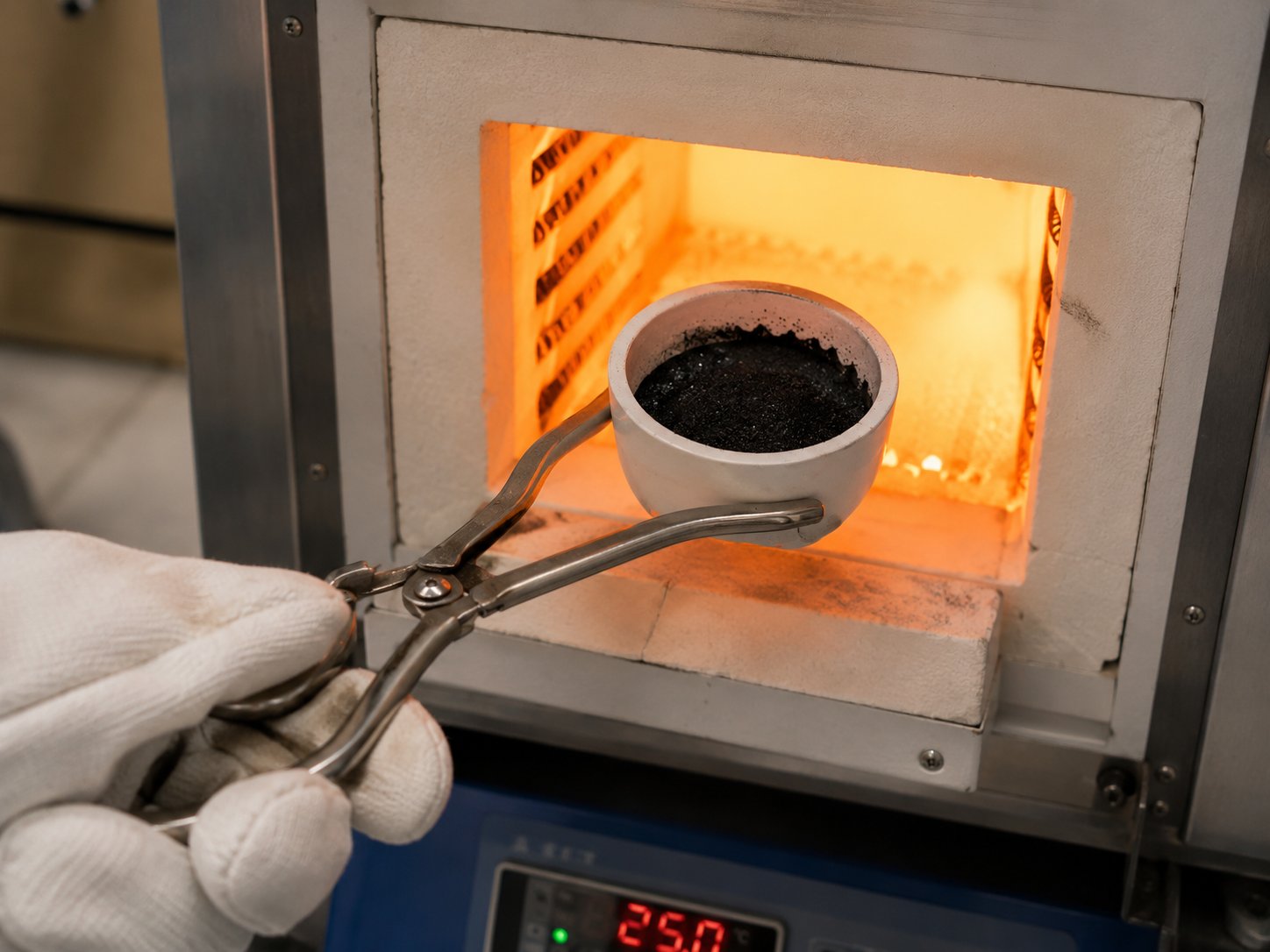
Purified carbon from hair being converted to graphite in a laboratory furnace before diamond growth

No. The color of your mother’s hair is not what determines the color of the finished diamond.

Hair is keratin, a protein that is roughly 50% carbon by weight. During processing, the hair goes through controlled extraction that removes the non-carbon components and produces highly purified carbon. That carbon is then converted into graphite before it enters the diamond-growth process.

The pigment responsible for hair color does not simply travel into the finished diamond. What ultimately matters for diamond color is what is present during crystal growth.

That means:

  • Grey hair does not produce a grey diamond.
  • Red hair does not produce a red diamond.
  • Dark hair does not produce a dark diamond.
  • Blonde hair does not produce a blonde diamond.
  • Hair dye does not determine the finished diamond’s color.

A few grams of hair also cannot fill an entire growth cell. The purified carbon from the hair is therefore combined with supplemental lab-sourced carbon before growth.

For the full production process, see how a memorial diamond is made from your mother’s hair.

So Where Does the Color Come From Instead?

Diamond color comes from trace elements present while the crystal is growing, rather than from the original appearance of the material that supplied the carbon.

Nitrogen can produce yellow tones, while boron can produce blue tones. A colorless diamond requires the near-absence of both.

This is why two pieces of hair that look completely different can potentially contribute to diamonds with similar colors. The visible pigment of the hair is not what the diamond-growth process is reproducing.

Memorial diamonds can therefore appear in yellow, blue, champagne, or other colors depending on the growth conditions and available processing options.

For a broader explanation, read why memorial diamonds are rarely colorless.

What Color Is a Hair Diamond Most Likely to Be?
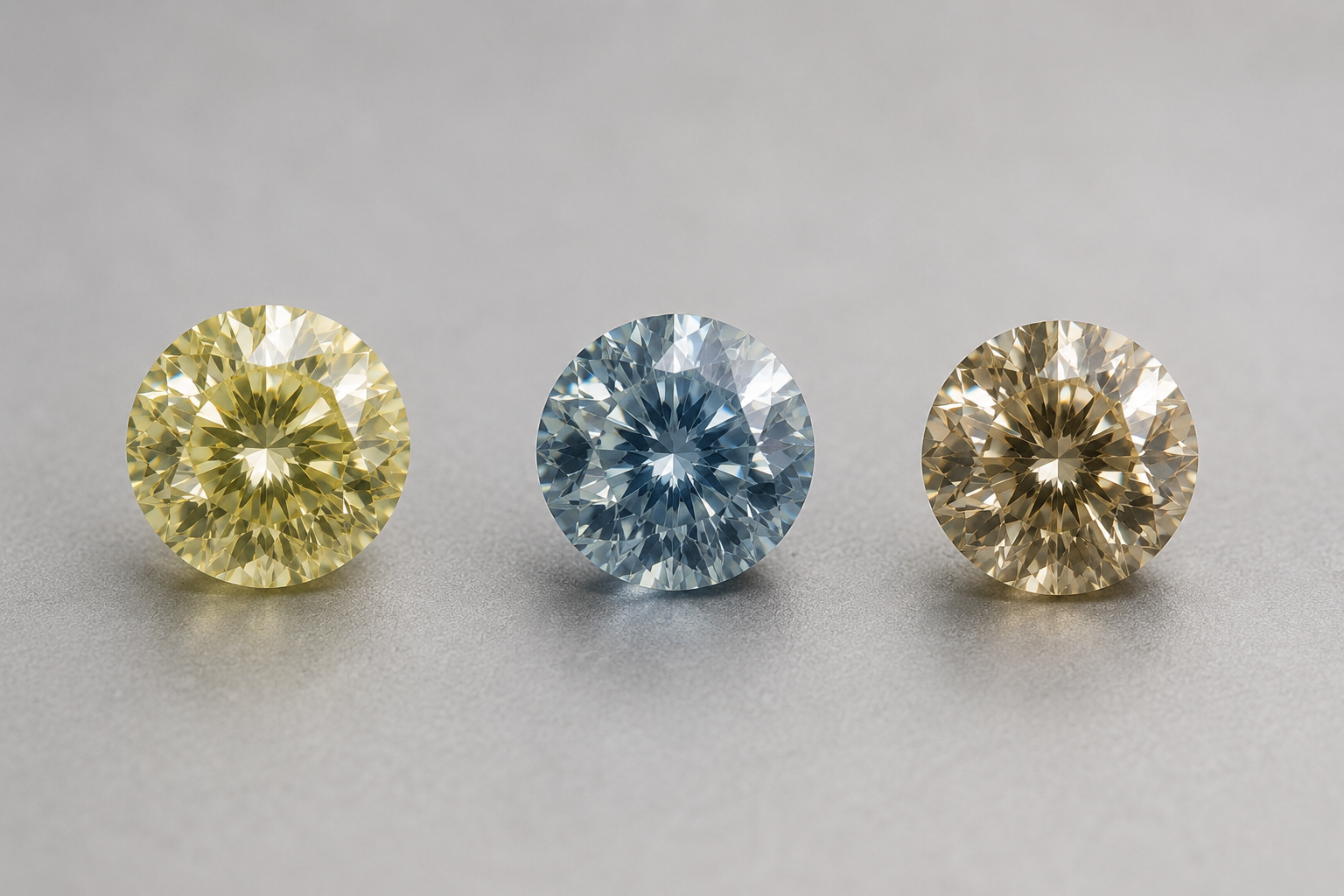
Three loose memorial diamonds grown from hair in yellow, blue, and champagne tones side by side

The following describes industry-typical color relationships rather than a guarantee for any individual stone.

ColorWhat Causes ItWhat a Hair Source MeansCost Note
YellowNitrogen present during growthHair is a carbon-rich organic material; the final color depends on the growth environment rather than the hair’s visible colorGenerally one of the lower-cost growth-stage colors at a given carat
BlueBoron present during growthBlue is associated with boron during diamond growth rather than the original color of the hairGenerally below colorless at matching carat
Champagne / BrownMultiple trace elements and growth conditionsThe stone is not champagne or brown because the mother’s hair was that colorGenerally comparable with yellow at the same carat
Colorless / WhiteNear-complete absence of color-producing impuritiesPossible, but additional processing is required to achieve the desired resultUsually carries a meaningful premium
Red, Pink, Green, BlackPost-growth treatment such as irradiationThese colors are introduced after the crystal has grown rather than coming from the hair’s visible colorAvailability and pricing vary by provider

The important point is simple: the color column never starts with the color of your mother’s hair.

Does Hair Behave Differently From Ashes?
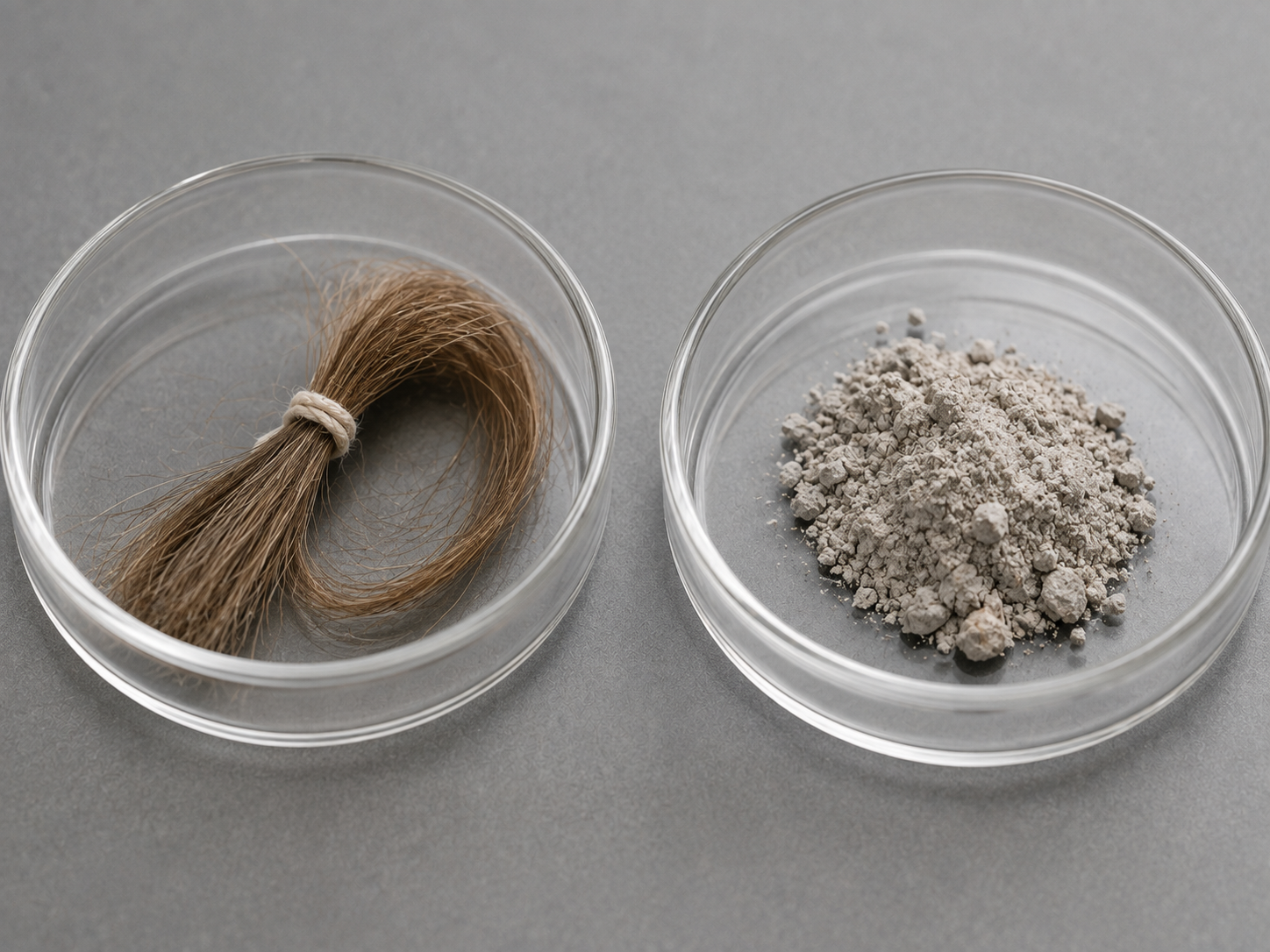
A small lock of hair and a sample of cremated remains shown side by side as diamond carbon sources

Yes, hair and cremated remains are very different starting materials.

Hair is roughly 50% carbon by weight, while cremated remains contain only about 0.5% to 4% usable carbon by weight. Ashes are largely made up of the mineral structure of bone, while hair is a carbon-rich protein material.

HairCremated Remains
Approximate carbon content~50%~0.5–4%
Cremation required?NoYes
Typical material requirementA small lock / a few gramsA few tablespoons to roughly 4 oz
Main starting materialKeratinMineral structure of bone

Hair can therefore be used for a memorial diamond even when a loved one was buried rather than cremated. See hair-based options for non-cremated loved ones.

However, the difference in starting material does not mean you can predict the exact final color simply by looking at the hair.

The ashes version of this question is covered in what color a diamond made from your mother’s ashes will be.

What Actually Changes the Color, and What Doesn’t?

It helps to separate the things that do not determine color from the things that can influence it.

Things That Do Not Determine the Finished Color

  • Your mother’s natural hair color.
  • Whether her hair was dark, blonde, red, or grey.
  • The visible color of hair dye or highlights.
  • How long the lock of hair is.
  • How much hair you send beyond the required amount.
  • Whether the hair was collected while she was alive or after her death.
  • How long you have kept the lock.

Things That Can Affect the Color

  • The color selected or requested during the ordering process.
  • Trace elements present during diamond growth.
  • The growth conditions used by the laboratory.
  • Whether a post-growth treatment such as irradiation is used.
  • Whether you choose a colorless result requiring additional processing.

If you’re discussing your order with a provider, ask these four questions before sending the hair:

  1. Am I choosing a specific color or a color family?
  2. What amount of color variation is considered normal?
  3. Is the color created during growth or through treatment afterward?
  4. What does choosing colorless add to the cost and timeline?

For information about documenting the finished diamond’s characteristics, see how memorial diamonds are graded and certified.

Frequently Asked Questions

My mother’s hair was dyed. Does that ruin it or change the diamond’s color?

The visible dye color does not determine the finished diamond’s color because hair pigment and non-carbon components are removed during processing. However, whether a particular provider accepts dyed, bleached, permed, or chemically treated hair is a separate provider-policy question. Ask before sending the hair and describe the treatment accurately.

She had grey hair. Will the diamond come out grey or dull?

No. Grey hair does not mean the finished diamond will be grey. Hair color comes from pigment, while diamond color is associated with trace elements and conditions during crystal growth. The original visible color of the hair does not simply transfer into the diamond.

Can I get a truly colorless diamond from her hair?

Yes, a colorless result can be requested, but it is generally the more demanding option. Colorless growth requires the near-absence of the impurities associated with yellow or blue coloration, so additional processing may be required and the price can increase.

Does sending more hair give a better or deeper color?

No. Sending more hair does not automatically create a deeper color. The quantity of hair primarily relates to providing enough carbon for processing. Diamond size is determined by the growth process rather than simply by sending a larger amount of hair.

Will a diamond from living hair look different from one made after she died?

No specific color difference should be assumed simply because of when the hair was collected. The finished color is associated with the diamond-growth conditions rather than whether the lock was collected while she was living or afterward.

Can I ask for pink or red specifically?

Some providers may offer colors such as red, pink, green, or black through post-growth treatment. Availability varies, so confirm that the color is actually offered by your chosen provider before making it part of your design expectations.

Before You Choose a Color

You are not choosing a color that literally matches your mother. Her hair stays the shade it was when you kept it. The diamond’s color comes from what happens to its carbon during the growth process.

That gives you a different choice: not “What color was she?”, but “What color do I want to carry with me?”

If you have a lock of your mother’s hair and want to understand what color options may be realistic, reach out to Memorial Diamond at memorialdiamond.us and ask specifically about your preferred color and any treatment the hair has received.

If you also have her ashes, see what happens when her ashes and hair are used together. You can also read the complete guide to a mother hair diamond for the wider process, timeline, and cost discussion.
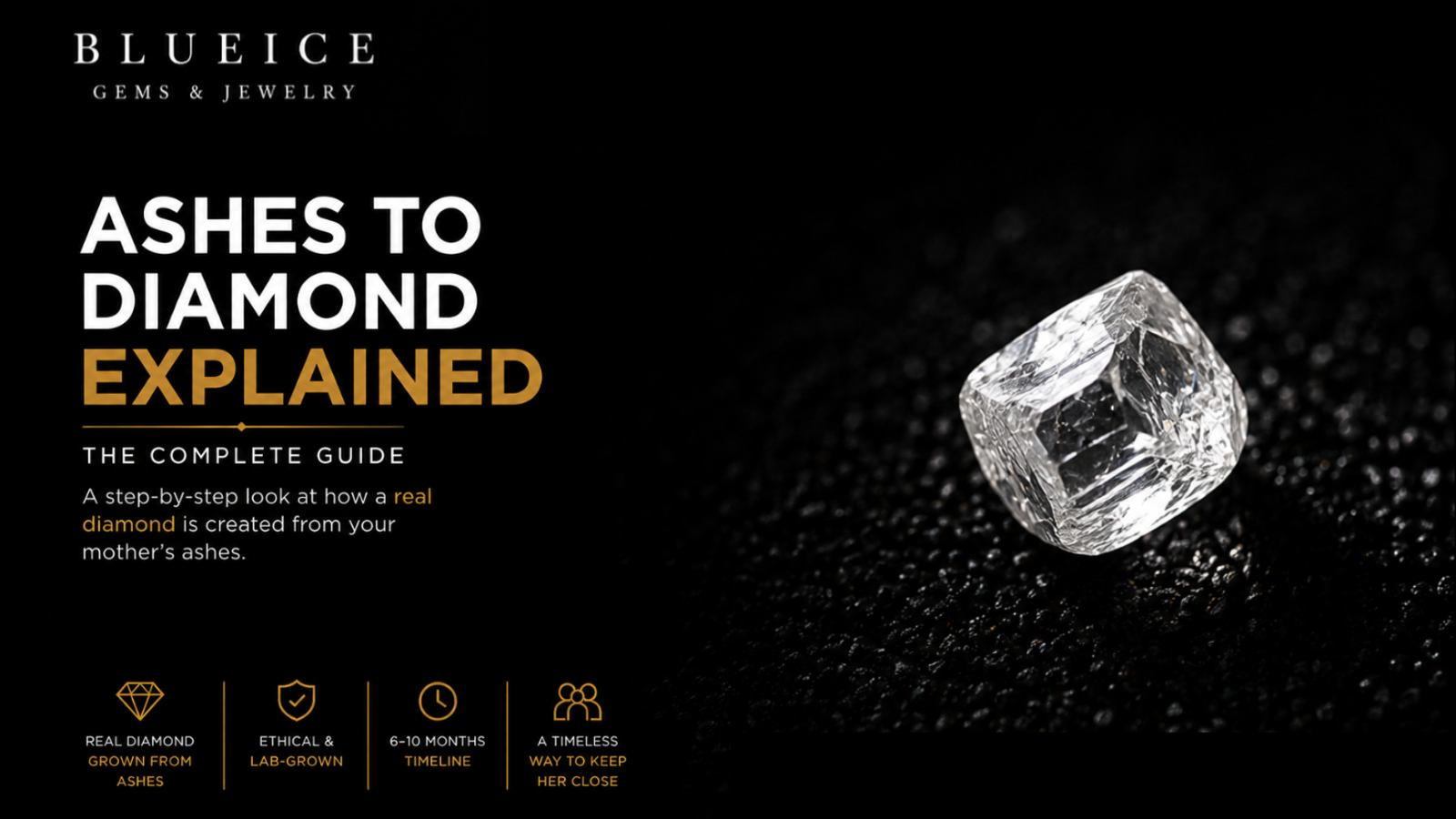
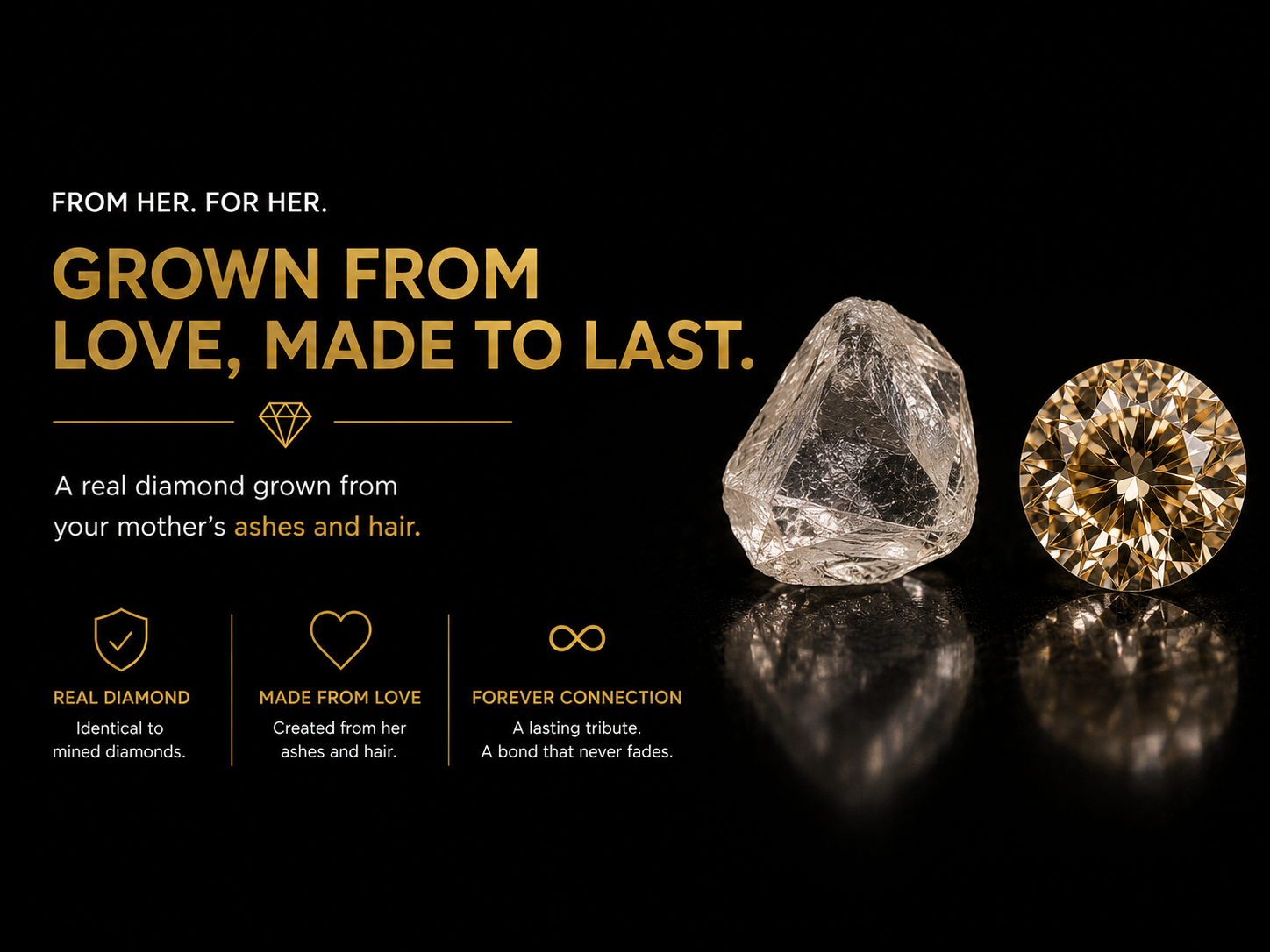
asses to dimond

How a Memorial Diamond Is Made From Your Mother’s Ashes

You measure out a portion of your mother’s ashes, hand it over, and months later a finished diamond comes back. What happens in between is where most families’ understanding stops.

Her cremated remains go through a process designed to recover usable carbon. The carbon is purified, prepared for diamond growth, combined with supplemental laboratory carbon when required, and grown into a genuine diamond crystal under extremely high pressure and heat.

Industrial chemistry, not alchemy and every stage is part of the journey from ashes to a finished memorial diamond.

 Rough diamond crystal grown from ash-derived carbon resting beside a finished champagne-toned cut stone

In This Article

What Are Your Mother’s Ashes Actually Made Of?

Understanding what cremated remains contain explains why creating a memorial diamond involves several different stages.

Cremated remains are not ash in the same sense as the material left behind by an ordinary fire. They consist largely of mineral material associated with bone, including calcium phosphate. Carbon is only a relatively small portion of the material.

That means the first challenge is not immediately growing a diamond. The laboratory must first recover usable carbon from the cremated remains and prepare it for the later stages of the process.

Because the amount of recoverable carbon can vary, the amount of ashes submitted is not directly equal to the final size of the diamond.

Learn more about how much ash may be needed for a mother memorial diamond.

What Are the Stages From Ash to Finished Diamond?

StageWhat Happens
1. Material IntakeThe cremated remains enter the preparation and processing stage.
2. Carbon Extraction and PurificationThe material is processed to separate usable carbon from minerals and other non-carbon material.
3. GraphitizationThe recovered carbon is prepared in a form suitable for diamond growth.
4. Carbon PreparationPersonal carbon may be combined with supplemental laboratory carbon when additional feedstock is required.
5. Diamond GrowthThe prepared carbon is placed into a controlled high-pressure and high-temperature growth environment.
6. Cutting and PolishingThe rough crystal is shaped and polished into the selected diamond cut.
7. Grading and DocumentationThe finished diamond can be evaluated according to cut, color, clarity and carat.

How Is Her Carbon Separated From the Rest of the Ash?

The purpose of the purification stage is to recover carbon while separating it from the much larger amount of mineral material contained in cremated remains.

The material goes through controlled processing designed to remove non-carbon components and leave behind purified carbon suitable for the next stages.

After purification, the laboratory can further prepare the carbon through graphitization. This process converts the purified carbon into graphite, another form of the same element.

The laboratory can then use this graphite as part of the carbon feedstock for the diamond-growing process.

Graphite and diamond are both forms of carbon. The difference is how the carbon atoms are arranged. The diamond growth process creates the crystal structure that gives diamond its distinctive physical and optical properties.

Why Is Laboratory Carbon Added to Your Mother’s Carbon?

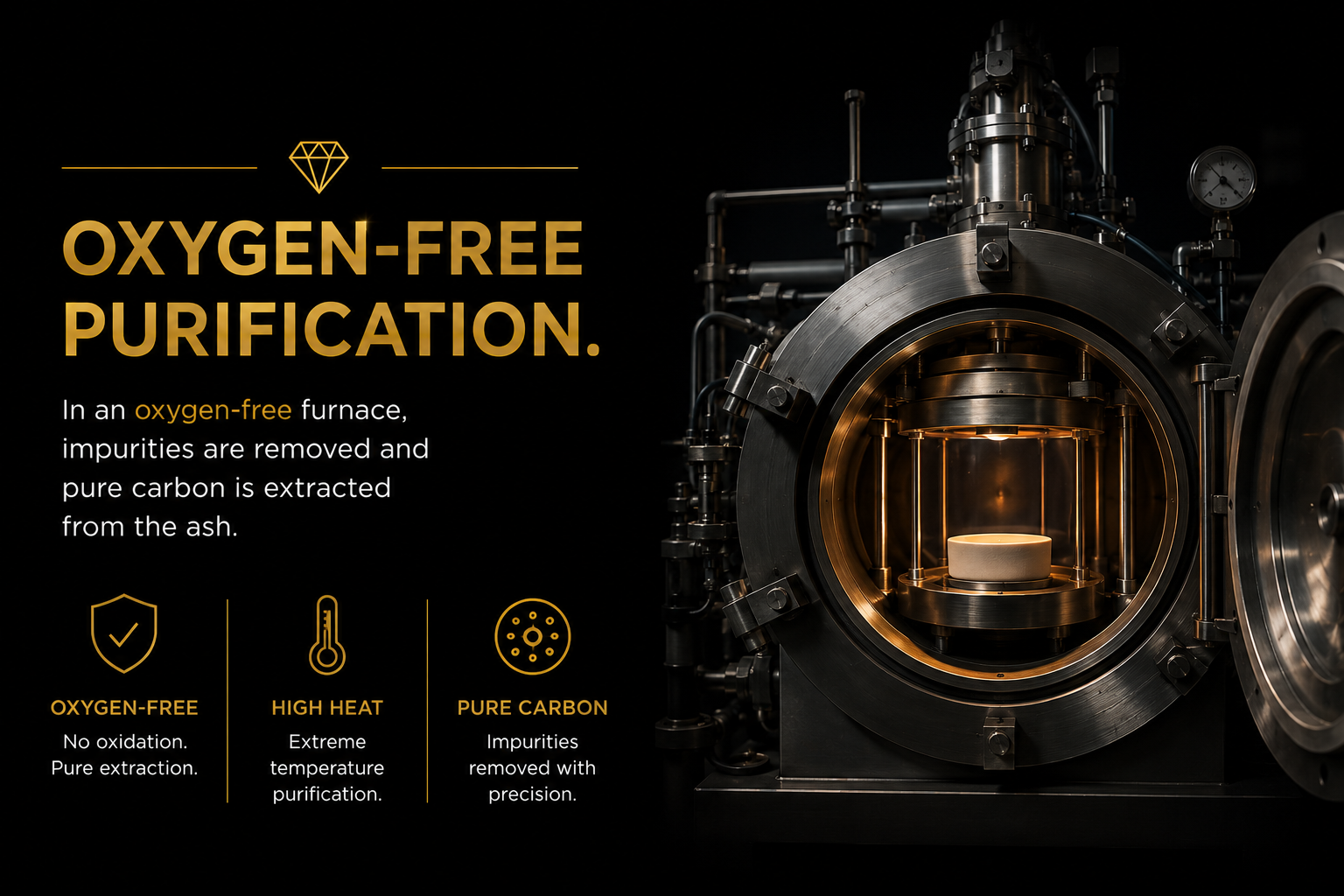
 Sealed high-temperature furnace used to purify carbon extracted from cremated remains in an oxygen-free process

This is one of the most important parts of understanding how a memorial diamond is made.

Cremated remains contain only a limited amount of recoverable carbon. Depending on the selected diamond and the requirements of the growth process, the personal carbon may not provide all the feedstock needed to grow the finished crystal.

Therefore, the laboratory may combine supplemental carbon with the carbon recovered from your mother’s ashes.

However, that does not mean the personal carbon disappears. Carbon recovered from your mother’s remains can still become part of the diamond’s crystal structure. The laboratory creates the finished stone using both the recovered personal carbon and additional laboratory carbon when necessary.

For this reason, no provider should claim that a memorial diamond contains only personal carbon when the process also uses supplemental carbon.

Read the direct answer to whether a memorial diamond is really made from your mother’s ashes.

What Happens Inside the Growth Process?

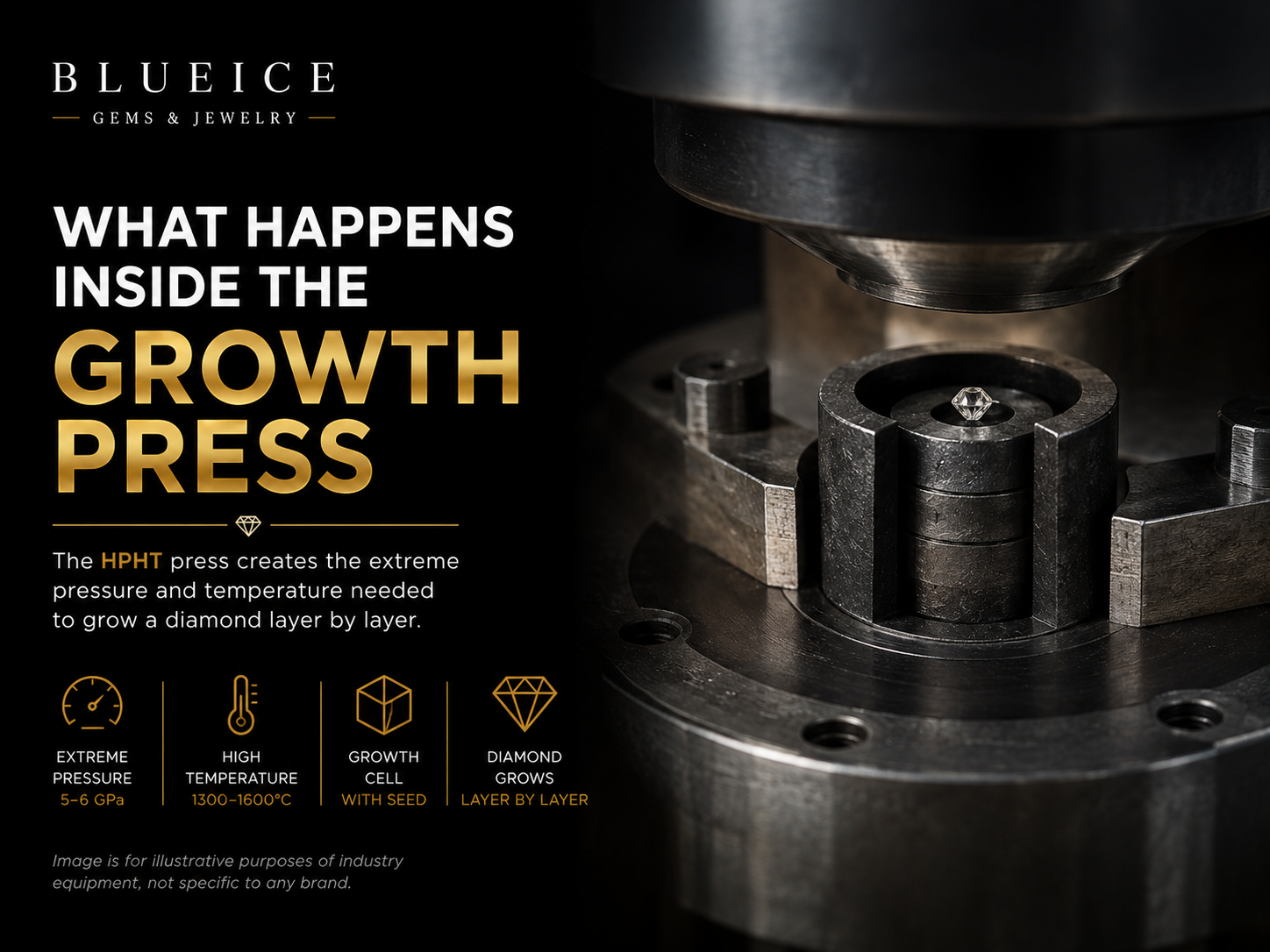
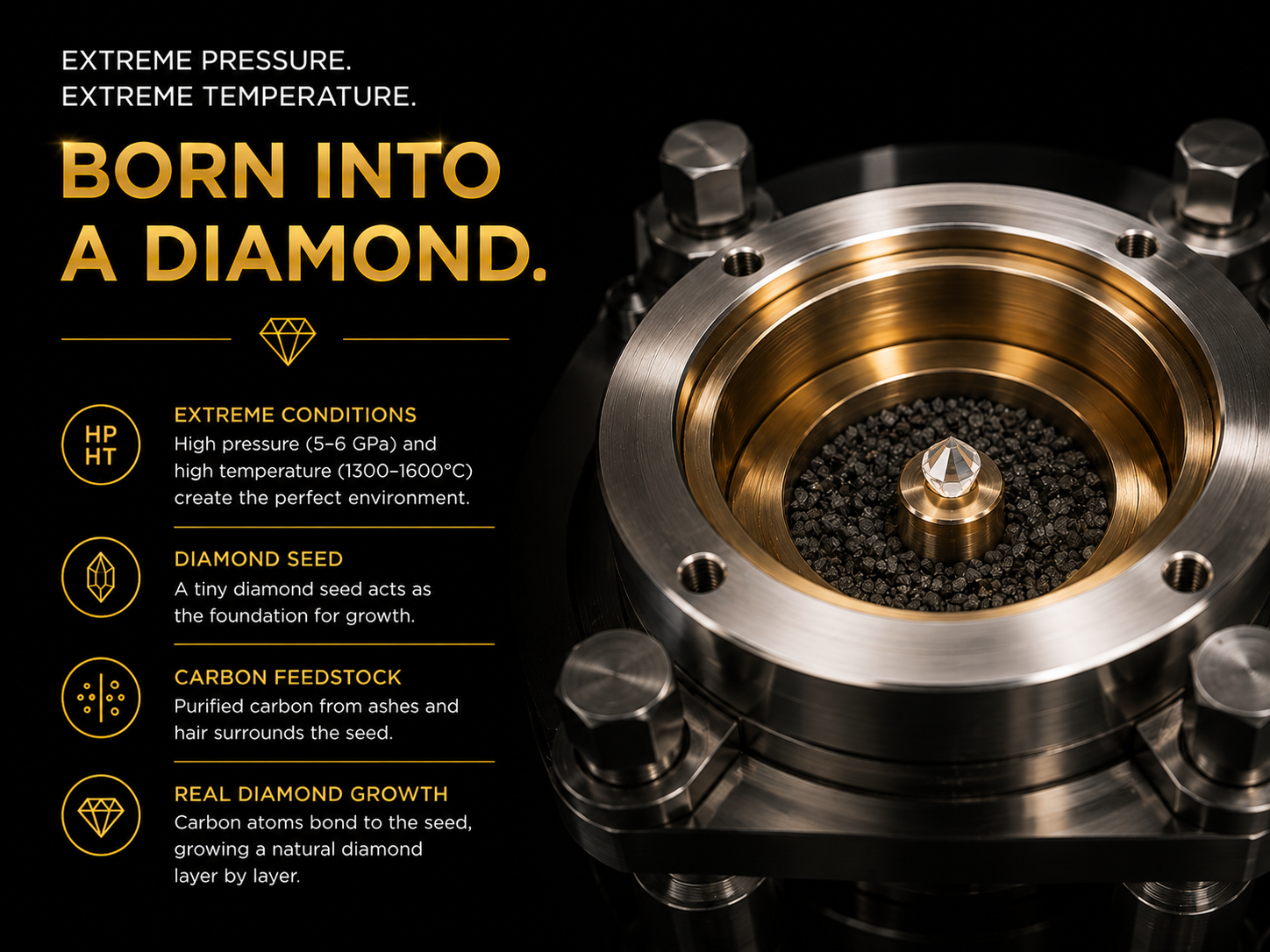
High pressure high temperature press with the growth cell that holds a diamond seed during crystal growth

After the carbon has been prepared, the next stage is diamond growth.

One common method used in the laboratory-grown diamond industry is HPHT, meaning high pressure and high temperature. The process recreates conditions capable of allowing carbon to form a diamond crystal.

A small diamond seed can act as the starting point for crystal growth. Under controlled conditions, carbon becomes part of the growing crystal structure over time.

The growth process can take weeks or months depending on the characteristics and size of the diamond being created.

Another laboratory diamond-growing method is CVD, or chemical vapor deposition. Both HPHT and CVD can produce genuine diamonds, although the processes are different.

Learn more about how memorial diamonds are made using HPHT versus CVD.

Why Does Growth Time, Not the Amount of Ash, Decide the Carat?

One common misconception is that sending more ashes automatically creates a larger diamond.

That is not how the process works.

  • More ashes do not automatically create a bigger diamond.
  • More ashes do not automatically make the process faster.
  • The desired diamond size is determined before the growth process.
  • Larger diamonds generally require more time for crystal growth.

Only a portion of cremated remains may be required for the memorial diamond process, allowing the rest of the ashes to remain with the family or be used according to their wishes.

Learn why a mother memorial diamond can take months to create.

Why Is the Finished Diamond Usually Not Colorless?

 Three memorial diamonds in blue, yellow, and champagne tones arranged on a pale gray surface to show typical color range

Diamond color can be influenced by trace elements and conditions present during crystal growth.

For example, certain trace elements can contribute to blue or yellow coloration. The specific characteristics of the carbon source and the growth environment can influence the final appearance of the diamond.

Memorial diamonds may appear in colors including yellow, blue, champagne or brown tones. Each diamond can have its own appearance, and an exact color cannot always be predicted in advance.

The color is part of the character of the finished stone and can make each memorial diamond feel unique.

Discover what color a diamond made from your mother’s ashes may be.

How Is the Finished Stone Cut, Graded and Certified?

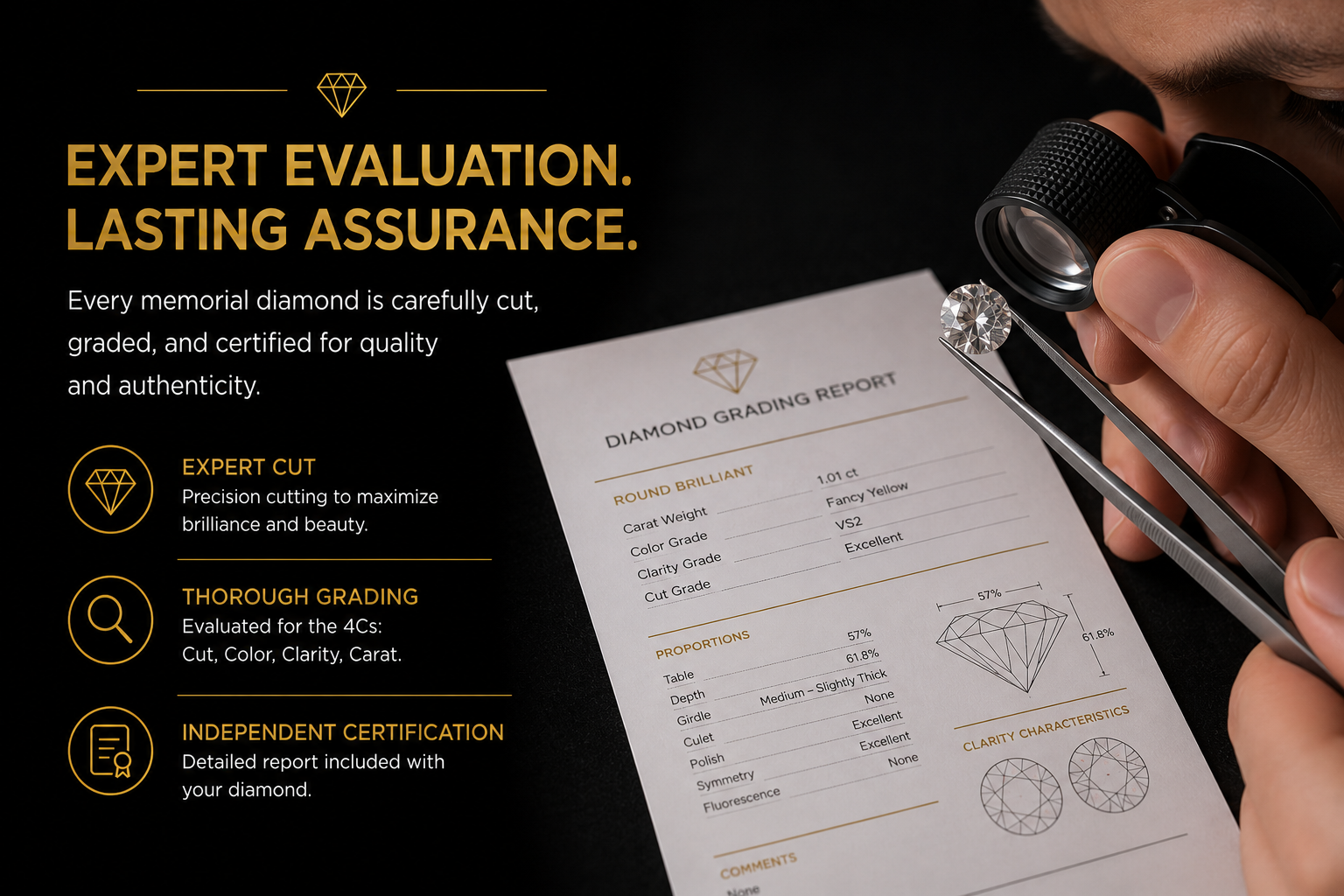
Gemologist examining a polished memorial diamond with a loupe beside a printed grading report

What leaves the growth process is a rough diamond crystal, not a finished piece of jewelry.

The rough crystal must be carefully cut and polished into the selected shape. Depending on the available options, this may include shapes such as round, cushion or emerald.

After cutting and polishing, the finished diamond can be evaluated according to the traditional diamond characteristics known as the 4Cs:

  • Cut
  • Color
  • Clarity
  • Carat

It is also important to understand the difference between origin documentation and a diamond grading report.

An origin or authenticity document relates to the memorial process and the submitted material. A grading report evaluates the physical characteristics and quality of the finished diamond.

These documents answer different questions, and families should understand what documentation is provided for their specific memorial diamond.

Learn more about how memorial diamonds are graded and certified.

What Does Any of This Ask of You?

Your role in the process is much shorter than the laboratory side.

You choose the memorial diamond you want, arrange the required material, and submit a portion of your mother’s ashes for processing. The laboratory then handles the carbon recovery, preparation, diamond growth, cutting and finishing stages.

The decision itself is often the most important part for families. Understanding what happens inside the laboratory can help make that decision more informed.

Learn how to turn your mother’s ashes into a diamond step by step.

Frequently Asked Questions

Does anything of my mother physically remain after the process?

The memorial process is based on recovering carbon from the submitted material. Molecular structures change during purification and diamond growth, while recovered carbon can become incorporated into the structure of the finished diamond.

Why can’t the laboratory use only her carbon?

Cremated remains contain a limited amount of recoverable carbon. Depending on the diamond being created, supplemental laboratory carbon may be required to provide enough feedstock for the growth process.

Is a memorial diamond a real diamond?

Yes. A properly grown laboratory diamond has the crystal structure and physical characteristics of diamond. It is not a simulant, resin or imitation stone.

Will there be visible ashes inside the diamond?

No. The purpose of the purification process is to recover and prepare carbon rather than place visible ash particles inside the finished diamond.

Can the Exact Diamond Color Be Predicted in Advance?

Not always. Trace elements and growth conditions can influence the final diamond color. Therefore, the laboratory may not be able to predict the exact shade before the growth process begins.

What Clarity Should I Expect?

The clarity of a finished memorial diamond can vary. Like other diamonds, laboratories evaluate clarity by examining the internal and external characteristics of the finished stone.. It is the result of multiple stages, beginning with the recovery of usable carbon from cremated remains and ending with a carefully finished diamond.

The journey includes carbon purification, preparation for growth, crystal formation, cutting, polishing and evaluation.

Understanding the science behind the process does not make the emotional decision for a family, but it can make the process easier to understand and the right questions easier to ask.

A memorial diamond can become a lasting physical connection to someone deeply loved created through a process that transforms carbon recovered from their remains into part of a genuine diamond crystal.

Talk About Creating a Memorial Diamond

If you are considering creating a memorial diamond from your mother’s ashes, take time to understand the process, the available options and the documentation provided.

Knowing what happens at every stage can help you make a decision with greater confidence and understanding.

memorial-diamond-made-mothers-ashes-hair

How a Memorial Diamond Is Made From Your Mother’s Ashes and Hair

Families who send both usually picture the two going into the same vessel. That isn’t what happens.

A memorial diamond made from your mother’s ashes and hair is grown from carbon purified from each material separately. Ash nd hair carry entirely different non-carbon contaminants, so each requires its own purification process before the recovered carbon is combined into a single feedstock.

The result is one diamond crystal containing carbon from both sources not a stone divided into halves.

In This Post

Why Can’t Her Ashes and Her Hair Be Purified Together?

Because they arrive at the laboratory with very different challenges.

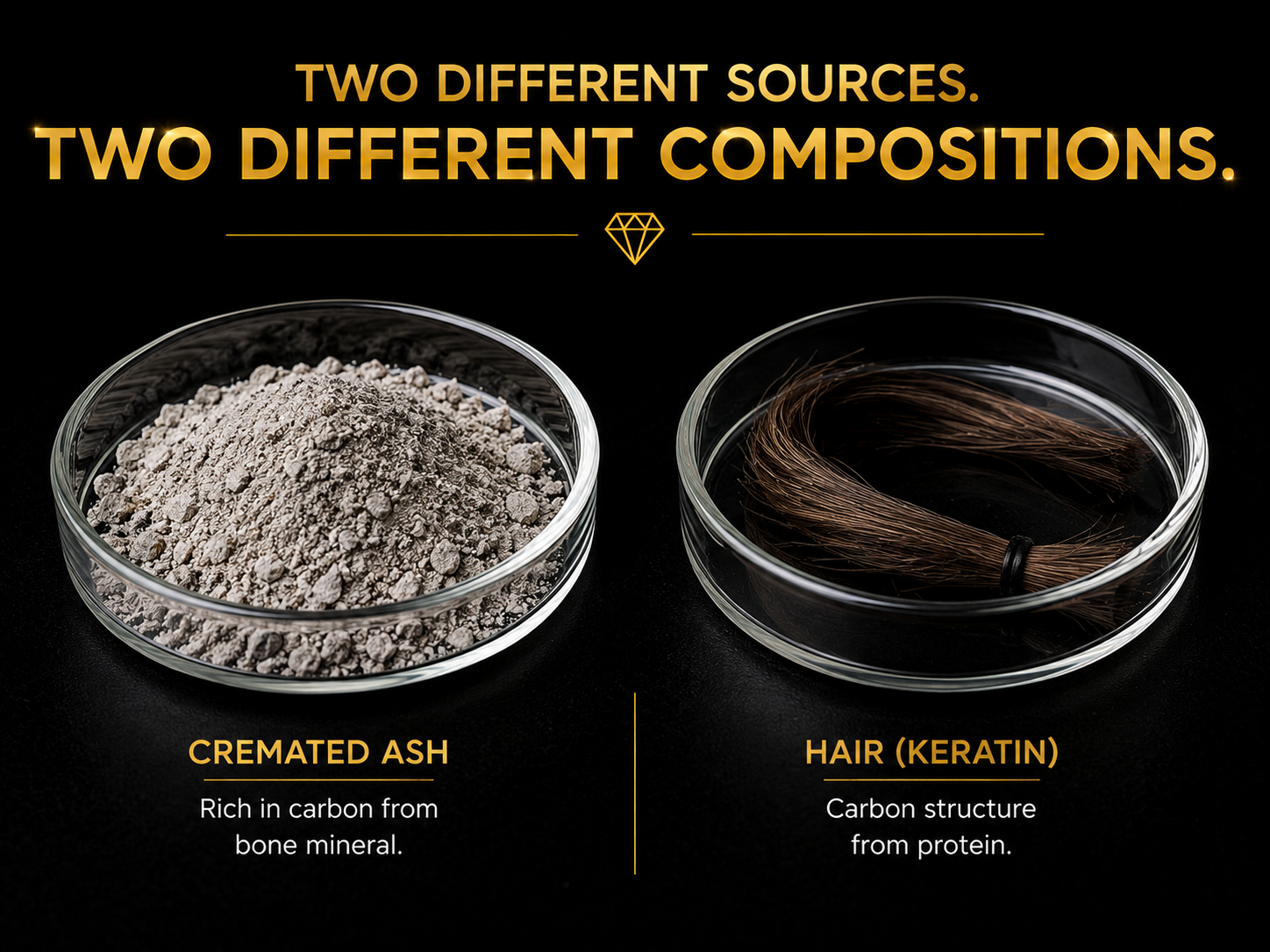
Cremated remains are primarily made of calcium phosphate, the mineral structure associated with bone. Carbon is only a small component of cremated remains, so recovering usable carbon requires separating it from a large amount of mineral material.

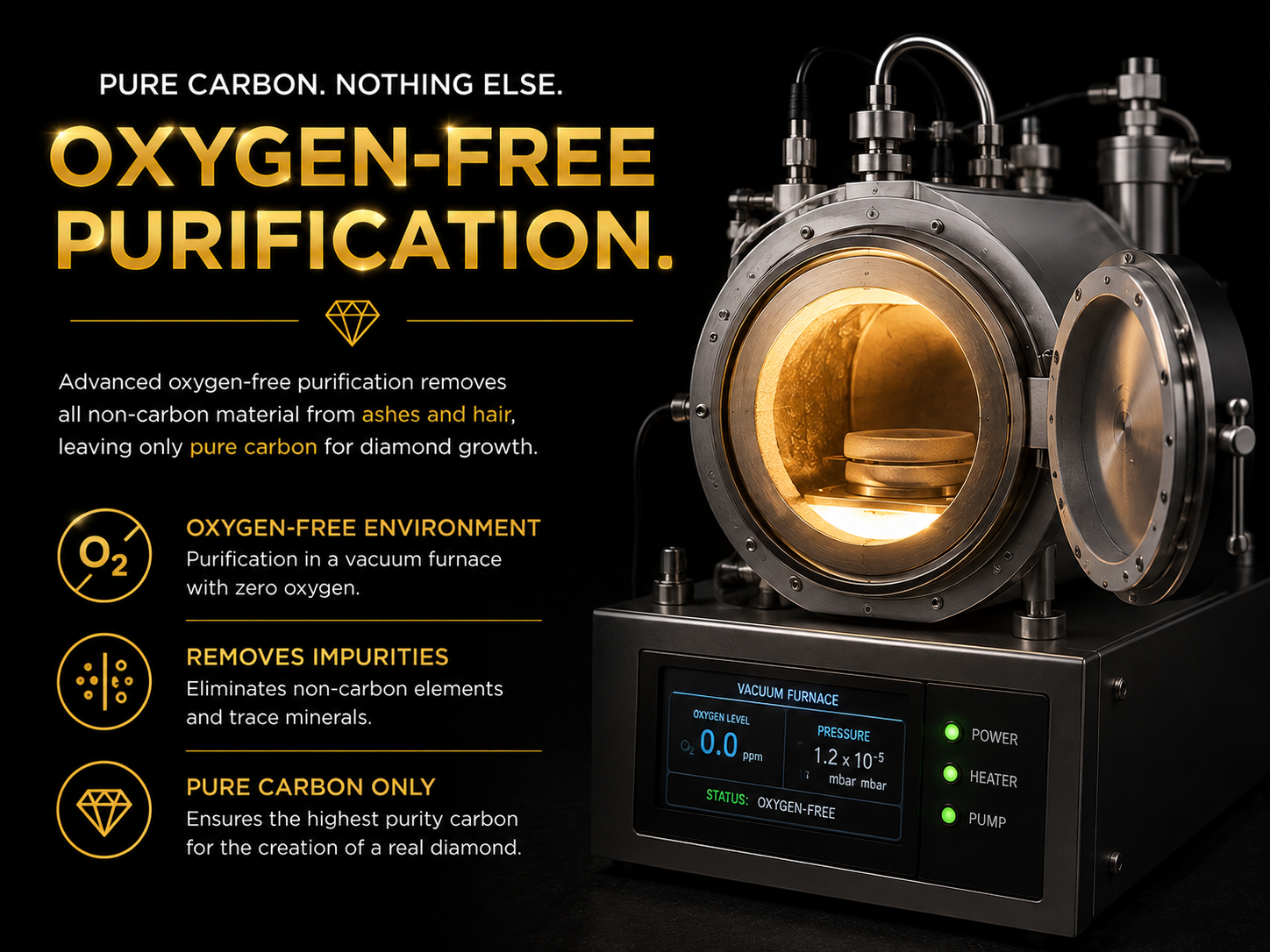
Hair is very different. It is primarily made of keratin, a carbon-rich protein containing a much higher proportion of carbon. The purification process must instead remove non-carbon elements such as nitrogen, oxygen, hydrogen and sulfur.

Different source materials require different purification targets. For that reason, ashes and hair are processed separately before the recovered carbon is prepared for diamond growth.

Cremated ash and a cut lock of hair shown side by side in separate labeled laboratory dishes

Where Do the Two Tracks Converge?

The two materials converge once usable carbon has been recovered and purified.

After purification, carbon recovered from hair and carbon recovered from cremated remains are both elemental carbon. The two purified carbon sources can then be combined into a single feedstock before the diamond-growing process begins.

StageHer AshesHer Hair
What it mostly containsCalcium phosphate and bone mineralKeratin, a carbon-rich protein
Approximate carbon contentLower carbon contentHigher carbon content
Purification removesMineral materialNon-carbon protein components
After purificationRecovered carbon can be combined into one feedstock
GraphitizationShared conversion into graphite
Diamond growthOne growth environment and one crystal
Final diamondOne finished stone
Oxygen-free purification furnace used to strip non-carbon material from ash and hair before diamond growth


Using both materials follows the same basic principle as creating a diamond from ashes alone or a diamond from hair alone.

How Much of the Finished Stone Is Genuinely Her?

A real and measurable portion of the diamond can originate from the carbon recovered from the materials you provide. However, the exact percentage can depend on the amount and quality of the available carbon, the size of the diamond, and the requirements of the growth process.

Hair generally contains significantly more carbon by weight than cremated remains. Because of this, hair can contribute a substantial amount of the personal carbon recovered when both materials are submitted together.

The important point is that a memorial diamond is not honestly described as being made entirely from personal carbon alone. Supplemental laboratory carbon may be required during the growth process.

That does not change the meaning of the memorial diamond. Carbon originating from your mother’s ashes and hair can become part of the crystal lattice of the diamond created in her memory.

For more information about this question, read whether a memorial diamond is really made from her ashes and hair.

What Happens Once the Two Carbons Are Combined?

 HPHT growth cell holding a diamond seed crystal surrounded by graphite feedstock | Stock acceptable |

Once the carbon sources are combined, the process becomes the same type of diamond-growing process used for other memorial diamonds.

The carbon feedstock is prepared for diamond growth and may be converted into graphite. The graphite can then be placed into a high-pressure, high-temperature environment with a small diamond seed.

Under controlled laboratory conditions, carbon atoms gradually form around the seed and develop into a diamond crystal. Crystal growth can take weeks or months depending on the process and the desired result.

One important point is that submitting more material does not automatically produce a larger diamond. The final size depends on the selected diamond and the growth process rather than simply on the amount of ashes or hair submitted.

After growth, the rough diamond is cut, polished and evaluated according to characteristics such as cut, color, clarity and carat.

Learn more about the difference between HPHT and CVD diamond growth.

Will a Stone Made From Two Materials Be Two-Toned?

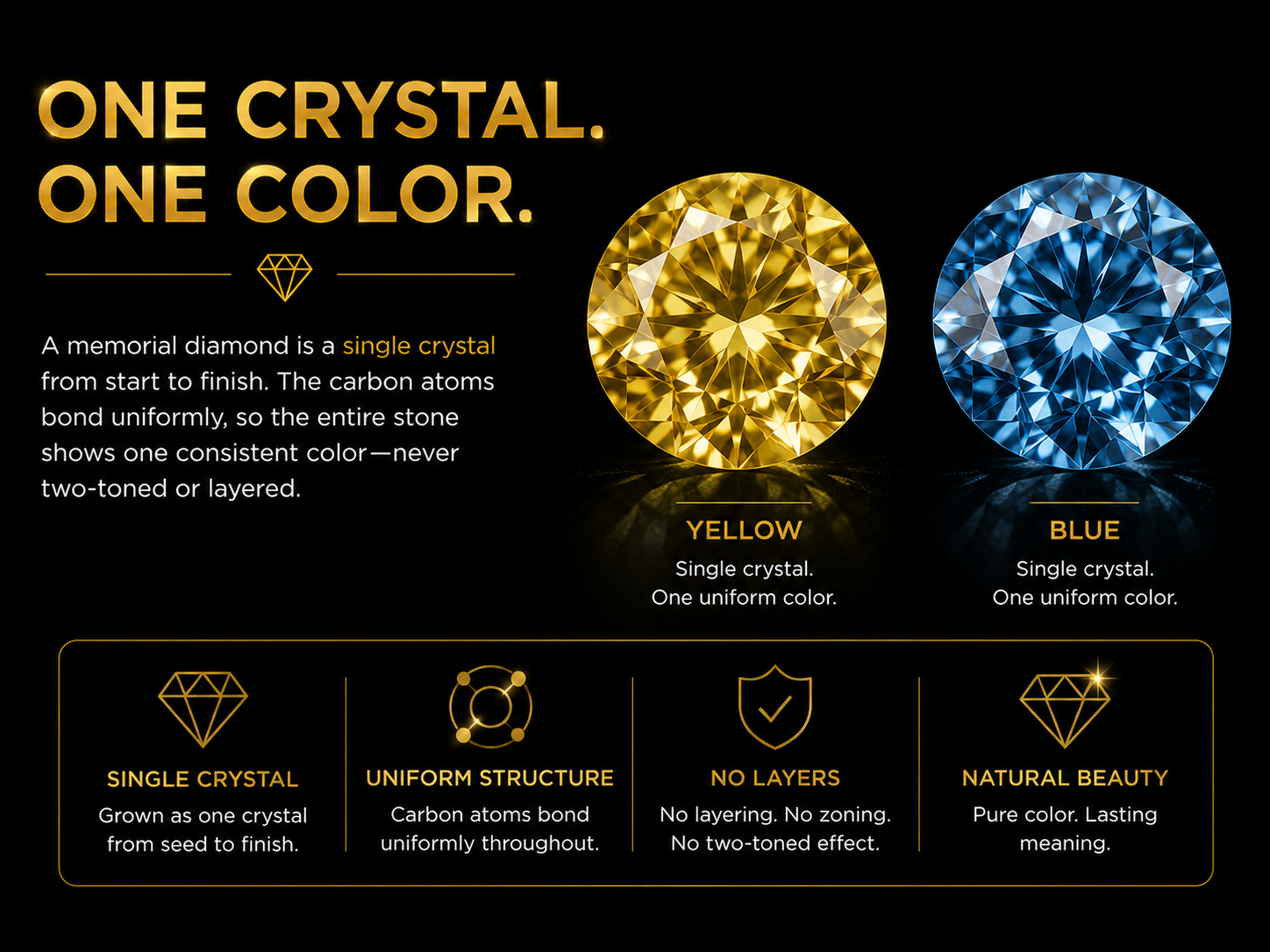
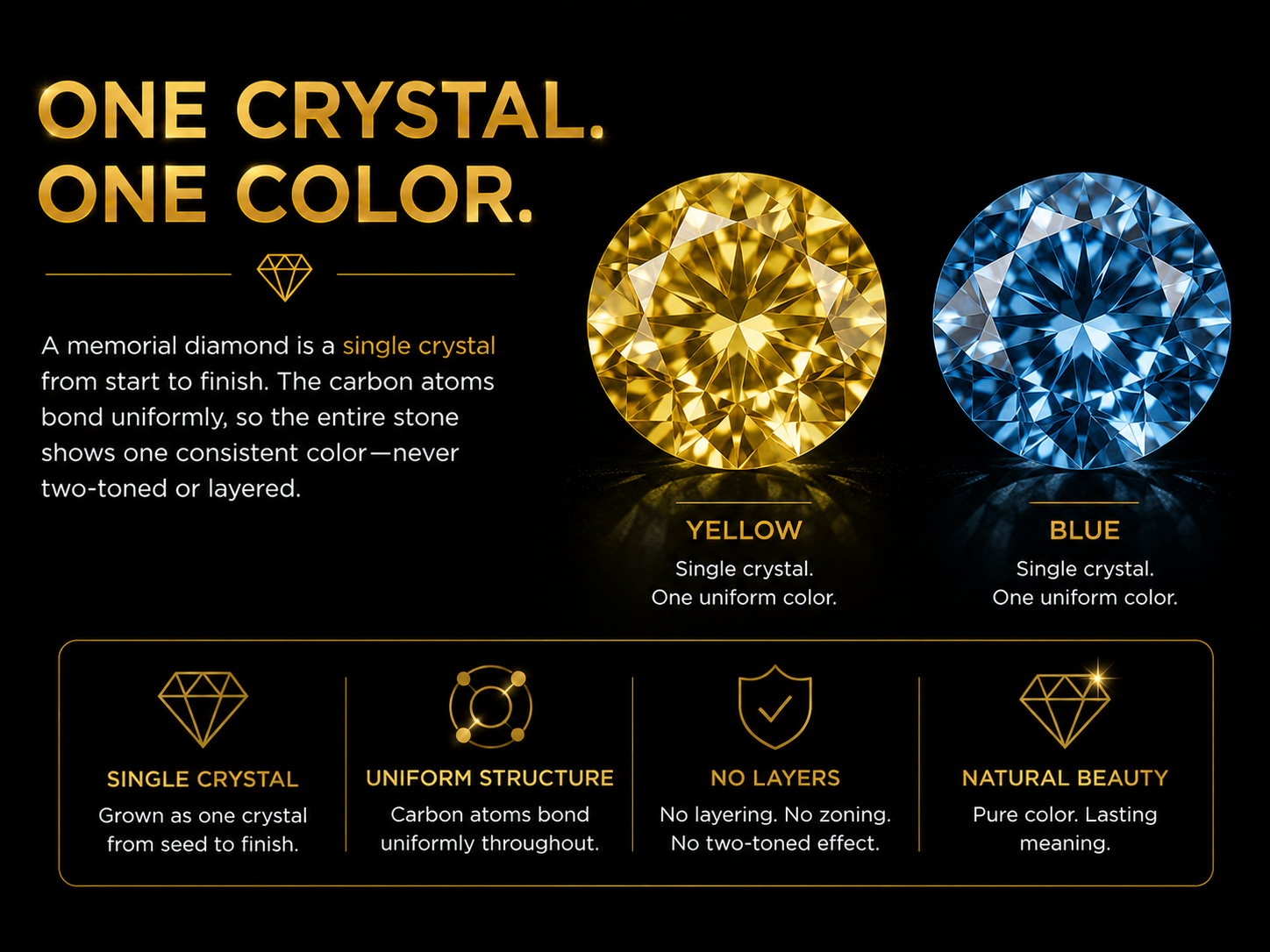
Two memorial diamonds, one yellow and one blue, each an evenly colored single crystal

No. The finished memorial diamond grows as one crystal.

It is understandable to imagine that using two different materials could create separate areas or layers inside the diamond. However, after the carbon has been purified and prepared for growth, the finished crystal does not divide itself according to whether individual carbon atoms originally came from ashes or hair.

The color of a diamond is influenced by conditions and trace elements involved during crystal growth rather than by visible separation between the original source materials.

This means a memorial diamond made using both ashes and hair is still one crystal with one overall appearance.

You can learn more about possible colors in what color a diamond made from your mother’s ashes and hair may be.

Where Does Your Part of This End?

Your part of the process begins with deciding what materials you would like to use and ends once they have been safely submitted for processing.

You may need to consider how much ash and hair you have available, discuss the decision with family members, and choose the memorial diamond that feels right for you.

After the materials enter the laboratory process, the purification and diamond-growing stages are handled over the following months.

For the complete process, read how to turn your mother’s ashes and hair into a diamond.

You can also explore the complete guide to a mother ashes and hair diamond and learn how much ash and hair may be needed for a memorial diamond.

Frequently Asked Questions

Are her ashes and her hair processed at the same time?

Because cremated remains and hair contain different materials, they may require different purification approaches. The goal is to recover usable carbon before preparing the material for the diamond-growing process.

Can a lab tell which carbon in the finished stone came from her hair?

Once carbon has been purified and incorporated into a growing diamond crystal, individual carbon atoms are chemically the same element. The finished diamond does not visibly identify the original source of each carbon atom.

Does adding hair to an ashes submission mean more of her is in the stone?

Hair generally contains more carbon by weight than cremated remains, so including hair can increase the amount of personal carbon available for recovery. The exact contribution to a finished diamond can vary.

Will the finished diamond have visible layers, streaks or two colors?

No. The diamond grows as a single crystal. Using two source materials does not mean the finished stone will be divided into visible sections based on ashes and hair.

Does using two materials make the process take longer?

The overall timeline is generally driven more by diamond growth, cutting and finishing than by the number of source materials used. Processing requirements can vary depending on the individual order.

Thinking About Creating a Memorial Diamond?

Understanding how ashes and hair can be prepared for diamond creation can make an emotional decision easier to understand.

Using both materials creates a way to include different physical connections to the person you love in one memorial piece. Her ashes and her hair maHow a Memorial Diamond Is Made From Your Mother’s Ashes and Hair.