daughter-ashes-hair-diamond-colo

What Color Will a Diamond Made From Your Daughter’s Ashes and Hair Be?

Some parents picture the finished stone before they have made a single phone call, and the picture often has a color in it. The honest daughter ashes hair diamond color answer is that nobody can promise one: putting her ashes and her hair into one stone does not mix two shades, because purified carbon keeps no trace of its source, and trace elements present during growth decide the result. Yellow, blue, champagne and near colorless are all realistic, and colorless typically costs more.
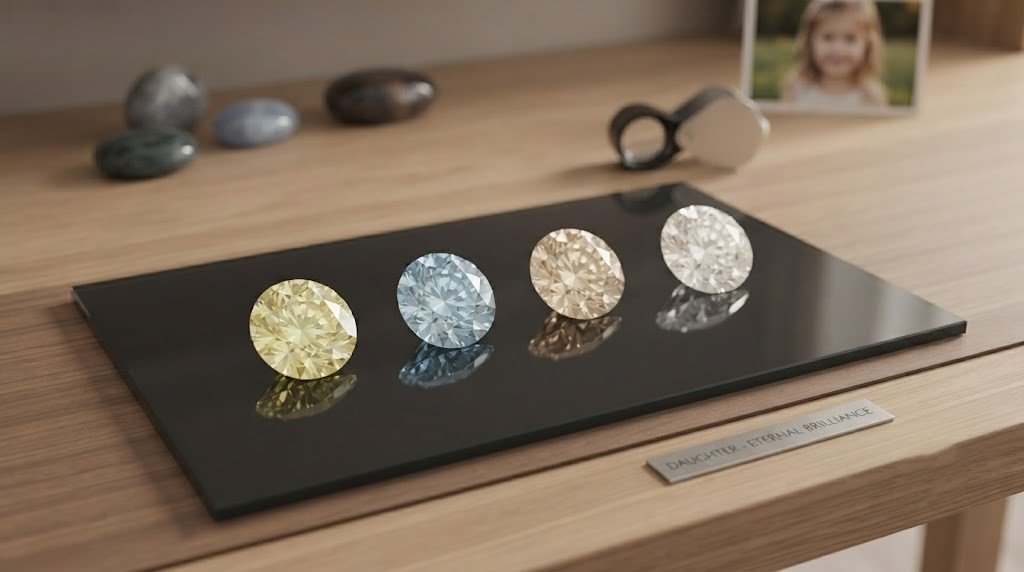
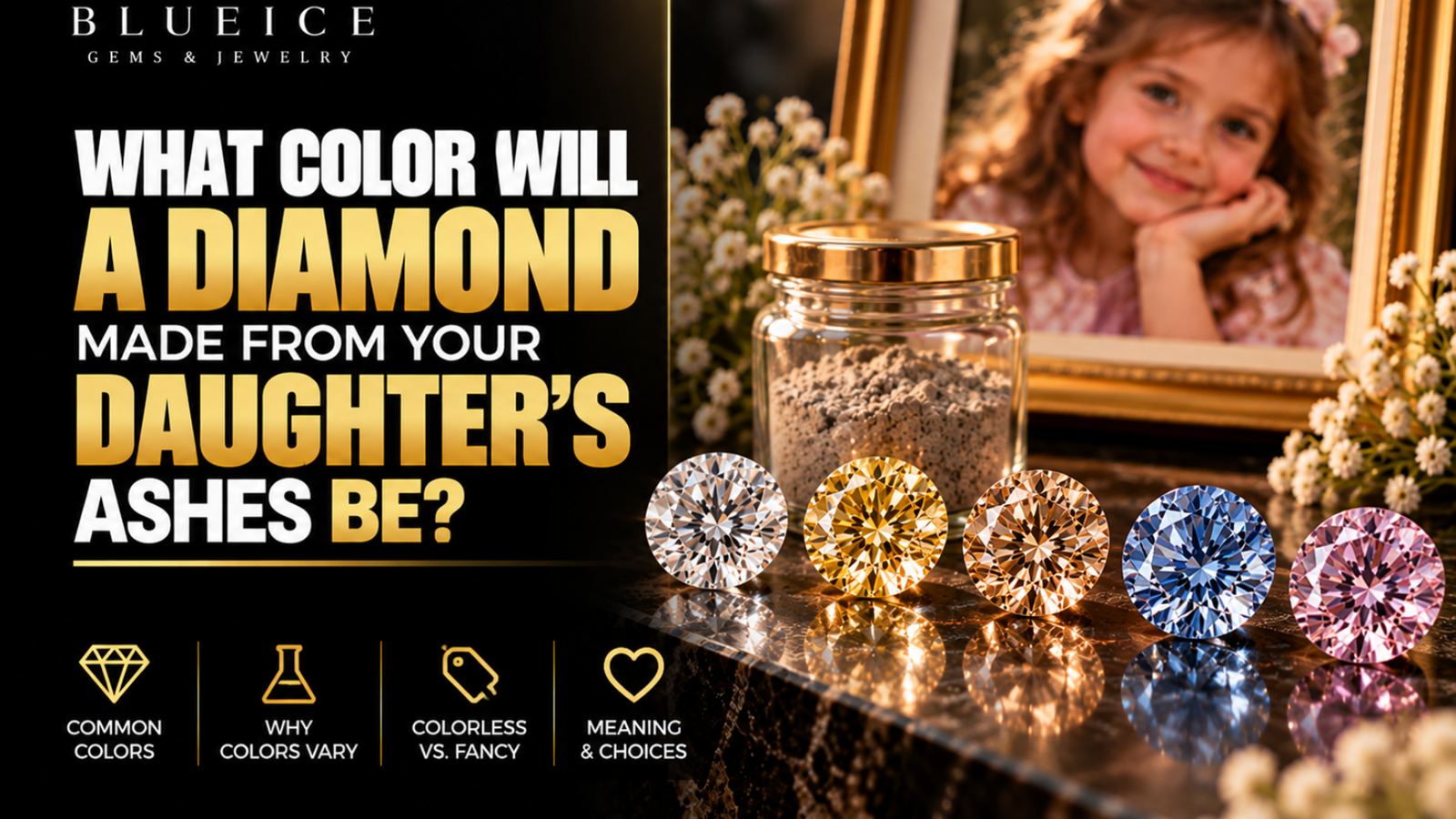
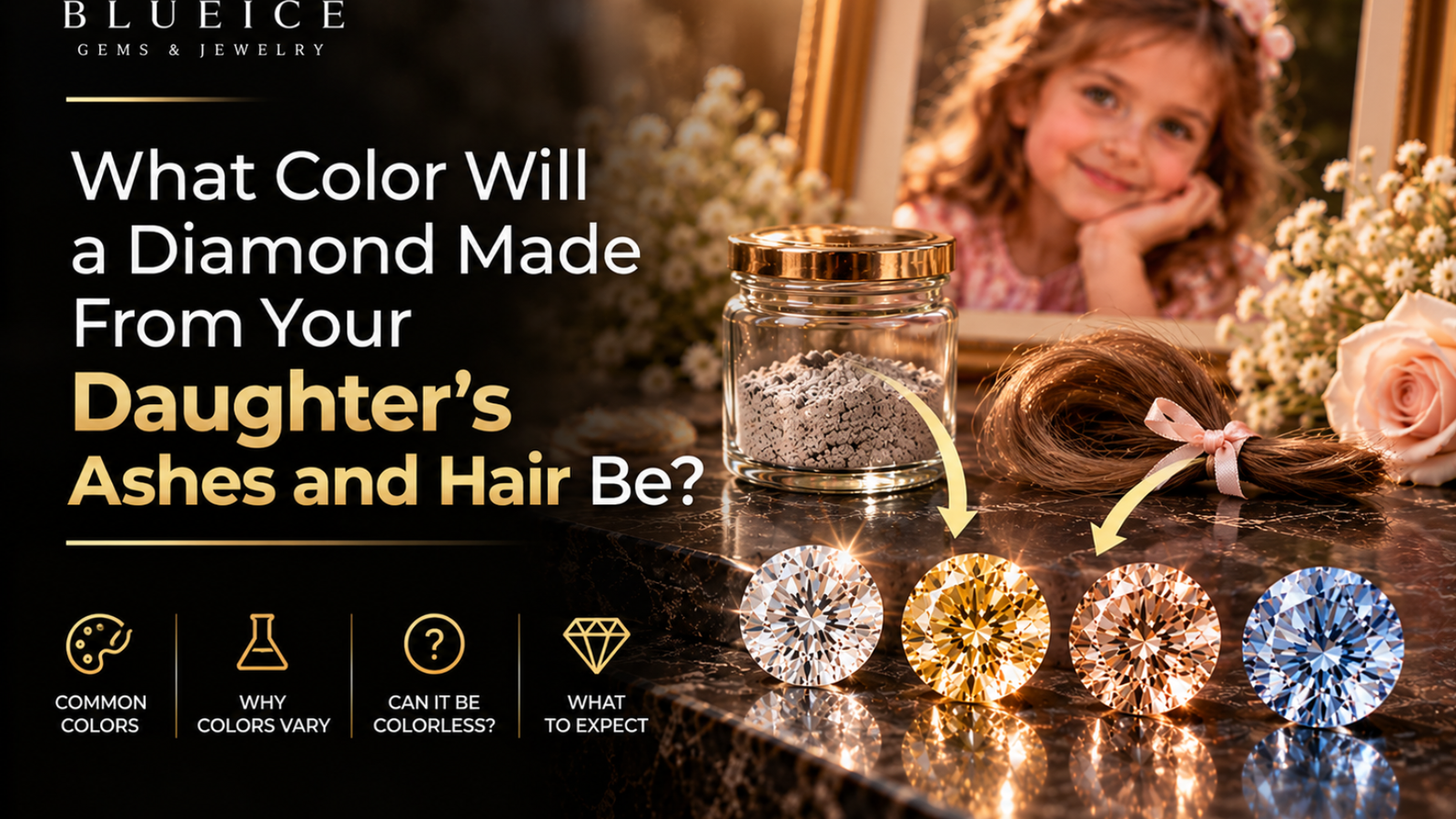
A row of lab-grown memorial diamonds graded from deep yellow through champagne to pale blue on a white tray daughter ashes hair diamond color

What Actually Decides the Daughter Ashes Hair Diamond Color?

Trace elements in the growth cell decide it, chiefly nitrogen and boron. Everything a family might imagine playing a part, from her hair shade to the pale look of cremated remains, is stripped away before the crystal forms.

Diamond is carbon locked in a rigid lattice. Nitrogen caught in that lattice during growth reads as yellow, boron reads as blue, and a colorless stone is one where neither got in to any meaningful degree.

That is the whole mechanism behind the daughter ashes hair diamond color outcome, and it is the same one that governs every diamond, mined or lab grown. If you choose optional independent grading, gemologists assess the result on the same cut, color, clarity and carat scale used throughout the jewelry trade.

The difference with memorial stones is the starting point. Carbon drawn from a person, rather than from a controlled industrial feedstock, tends to bring more of those trace passengers along. That is why memorial diamonds lean toward yellow, blue and champagne, and why the daughter ashes hair diamond color question is really about chemistry during growth rather than about her.

Does Combining Her Ashes and Hair Blend Two Colors?

No. There are not two colors to blend, because neither ashes nor hair contributes a color in the first place. Both are reduced to purified carbon, and that carbon is colorless.

This is the most common misunderstanding in any daughter ashes hair diamond color conversation. Families expect something like paint, a little of one shade and a little of another averaging out in the middle. By the time growth begins, both sources have become the same substance, carbon at roughly 99.9% purity or better, and there is nothing left to average.

So a combined daughter ashes hair diamond color is not the midpoint between an ash stone and a hair stone; it is whatever that growth run produces.

Two ideas are worth holding apart:

  • What goes in, her ashes and her hair, determines where the carbon came from. That is the meaning families care about.
  • What comes out, the daughter ashes hair diamond color itself, is set by trace elements during growth. That is chemistry the source material does not control on its own.

Including both materials is a decision about meaning, not a color decision.

Why Doesn’t Her Hair Shade or the Ash Tone Show Up in the Stone?

Because the pigments and minerals behind those appearances are removed during purification, and carbon has no memory of its source.

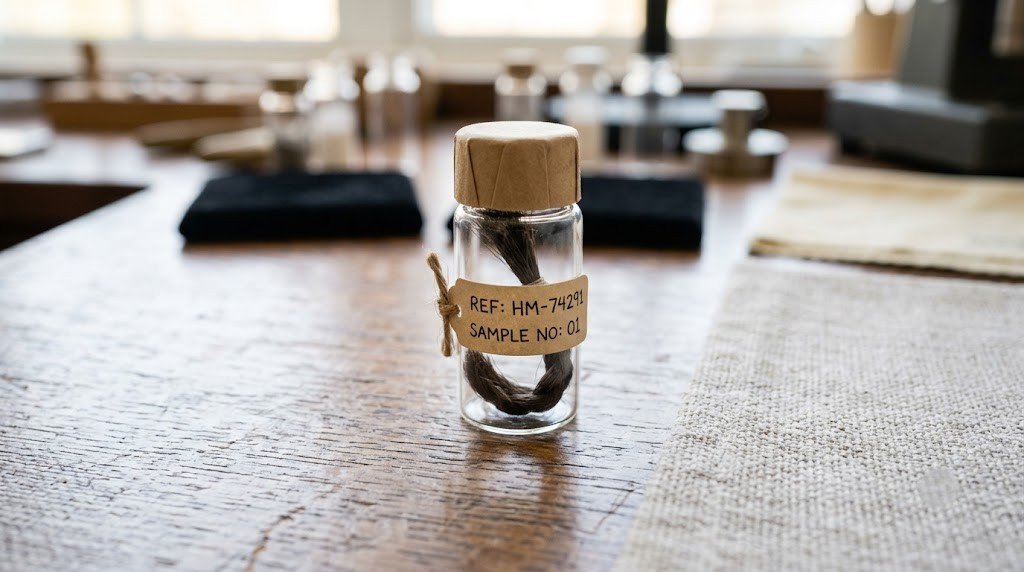
Hair takes its shade from melanin, a pigment held within keratin. Carbon accounts for roughly half of hair’s weight, which is why a small lock or a few grams usually suffices, but the pigment does not survive. Extraction uses controlled, oxygen free heating to strip out everything that is not carbon, so black, auburn, blonde or silver hair all leave behind the same thing.

Cremated remains behave the same way: their pale gray look comes mostly from calcium phosphate, the bone mineral that extraction removes, so the ash tone has no bearing on the daughter ashes hair diamond color. Usable carbon makes up only around 0.5% to 4% of ash by weight.

The purified carbon is then heated again, to roughly 2,500 to 2,700°C, and turned into graphite for a high pressure growth press. By then no test could tell which portion began as hair and which as ash, which is also why the daughter ashes hair diamond color cannot be read from her appearance in life. How a combined stone is actually made follows each stage in more depth.

Which Colors Can a Combined Stone Realistically Come Out?

Any daughter ashes hair diamond color falls within the same range as other memorial diamonds:

ColorWhat causes itHow common in memorial stonesRelative cost
Yellow, light to deepNitrogen in the latticeCommonLower end for its size
Blue, pale to vividBoron in the latticeCommonLower end for its size
Champagne or warm brownTrace elements and growth conditionsCommonLower end for its size
Colorless or near colorlessNear absence of nitrogen and boronAchievable, less typicalTypically higher at the same carat
Red, pink, green, blackOptional post growth irradiationOnly on requestAdded cost on top of the stone

No row belongs to one source material; ash only, hair only and combined stones can land in any of the first four, and intensity varies from stone to stone.

It is also worth saying plainly that no color suits a daughter better than another. A stone does not need to be pink because she was a girl, and a blue or yellow result is not a mismatch. The daughter ashes hair diamond color belongs to one crystal; it is not a statement about who she was. If you hope for a shade because of something specific to her, tell the provider why.

For the single source versions of this question, see the ashes only color guide and the hair only color guide.

Can the Daughter Ashes Hair Diamond Color Be Known Before Growth?
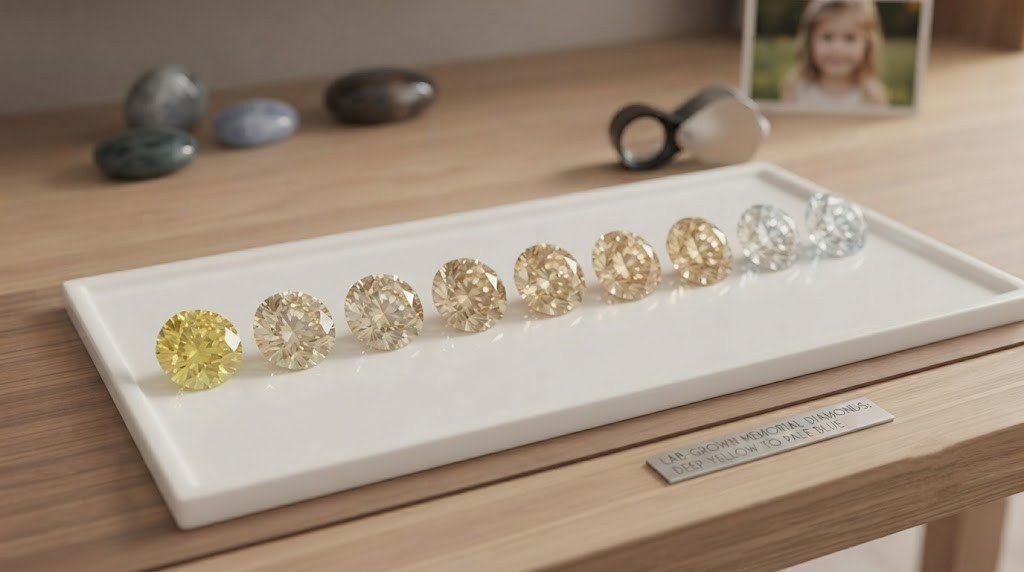
A row of lab-grown memorial diamonds graded from deep yellow through champagne to pale blue on a white tray

Not with certainty. A provider can describe typical outcomes and work toward a goal, but no one can guarantee the daughter ashes hair diamond color before the crystal exists.

A common assumption in the daughter ashes hair diamond color discussion is that hair, being far richer in carbon than ash, gives a cleaner starting point and therefore a lighter or more predictable stone. That is not how it works. A cleaner starting material does not make color predictable, and a stone grown partly or wholly from hair is not automatically lighter. What counts is which trace elements reach the lattice during growth.

Adding hair to ashes does not tilt the odds toward colorless, and adding ashes to hair does not push a stone toward yellow. A provider implying a specific result from the materials alone is oversimplifying.

A reasonable answer describes a typical range and what aiming for colorless would involve. Treat a firm promise about an exact daughter ashes hair diamond color with caution, and ask what happens if the stone grows differently.

Is a Colorless Combined Stone Possible, and Why Does It Cost More?

Yes, colorless is achievable, but it takes extra work and typically costs more than yellow, blue or champagne at the same size.

That extra work is about exclusion. Nitrogen and boron have to be kept almost entirely out of the lattice, which can mean additional purification, tighter control of the growth environment and sometimes more than one attempt. Combining hair with ashes changes none of this; carbon from both sources goes through the same effort.

In the half carat to one carat band, colorless tends to sit meaningfully higher than a warm or blue stone of the same weight. The gap reflects process, not meaning.

Before paying it, consider what a colorless result would add to your daughter ashes hair diamond color decision. Some families want a neutral stone that suits any setting. Others decide that whatever the daughter ashes hair diamond color turns out to be is the version they would rather keep, because it came from her carbon as it grew. Either reasoning holds up.

What Does Optional Irradiation Change?

Irradiation is an optional post growth treatment some providers offer to shift or deepen color, and it is the route to red, pink, green or black. It is never a required step in a daughter ashes hair diamond color plan.

Because it happens after growth, it works on the daughter ashes hair diamond color the crystal already has, so ask what is realistic for your stone. It adds cost, it does not change where the carbon came from, and specialty colors such as black can push the timeline toward the upper end of the industry range of up to 12 months.

Many families decline it and keep the color the stone grew with; others choose a treated color because it recalls something specific to her. Nothing about her being a daughter makes either path more fitting.

Does Adding Hair Change the Price or the Wait?

Sometimes, but not because of the daughter ashes hair diamond color. Where combining the two materials affects cost or timing, it is down to extra handling, not a different finished shade.

Some providers extract ash and hair separately before merging the purified carbon, which can carry a fee or add a little time; others fold both in at no extra charge, so ask.

The industry timeline typically runs six to ten months from receipt of material, and up to twelve for larger or specialty color stones. Size depends on growth time in the press, not on how much ash or hair is sent, and neither size nor schedule is tied to the daughter ashes hair diamond color unless you request a specialty treatment.

As general 2026 industry ranges, not any one company’s pricing:

  • About 0.10 to 0.25 ct: roughly $1,500 to $3,500
  • About 0.5 to 1 ct: roughly $5,000 to $15,000, colorless typically at the higher end
  • About 2 to 5+ ct: roughly $20,000 to $75,000 or more
  • Priced separately: settings, engraving, fancy cuts, optional irradiation and optional independent grading

On composition: for ash only stones, industry figures put personal carbon at around 10% to 15% of the finished stone’s mass, with some providers citing as low as 3%. No equivalent finished stone percentage is published for hair or for a combined charge, so ask the provider in writing how much of her carbon your stone will hold. Whether a combined stone is really made from her examines that closely. How much ash and hair a combined stone usually needs covers the quantities.

How Do You Raise the Daughter Ashes Hair Diamond Color Question With a Provider?

Plainly, early and in writing. Bring the daughter ashes hair diamond color question to the first conversation rather than after material has been sent.

Questions worth asking:

  1. What color range do your combined ashes and hair stones usually fall into?
  2. What does aiming for colorless involve, and what does it add to the price?
  3. If the stone grows a different color from the one discussed, is there any remedy?
  4. Is irradiation offered, and what could it realistically do for our stone?
  5. Is independent grading available as an option, and how does it differ from your origin certificate?
  6. What happens to any of her ashes or hair that is not used?

Policies on leftover material vary, so that last answer is worth having before anything is sent.

Keep two documents distinct. An in house origin certificate records that the stone was grown from your submission. An optional independent grading report describes the stone’s own cut, color, clarity and carat, and it is the document that formally records the daughter ashes hair diamond color. The step by step guide for a combined stone shows where this conversation fits in the wider sequence.
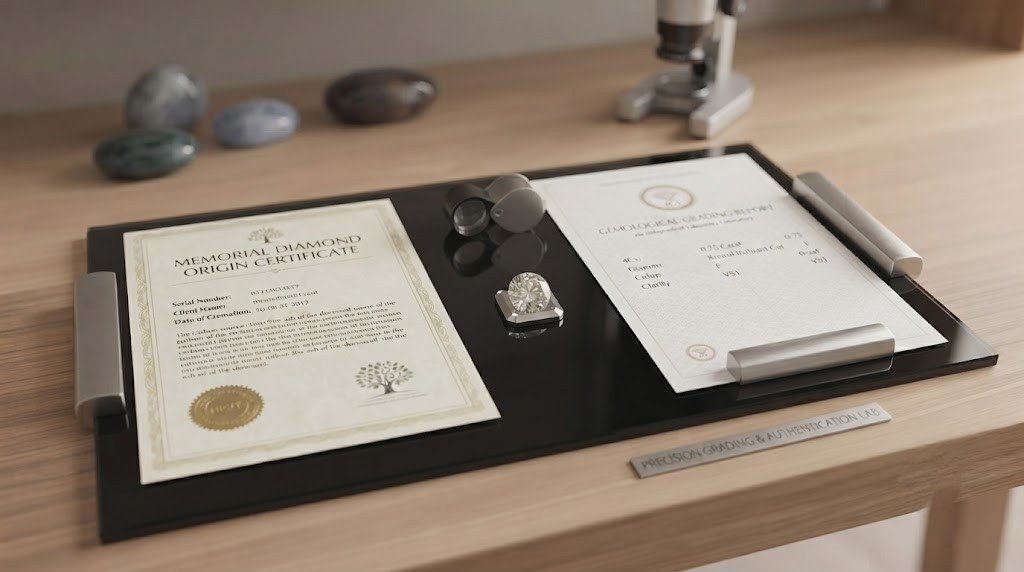
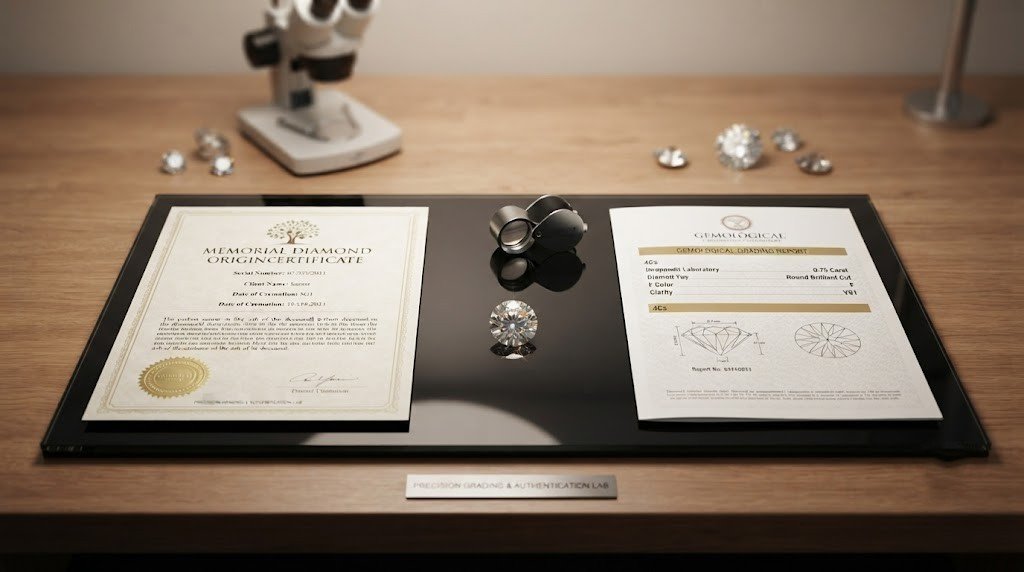
 An origin certificate beside a separate independent grading report on a desk next to a loose diamond

Who Gets a Say When the Family Disagrees?

Usually whoever holds legal authority over her remains, though most families try to agree together. The daughter ashes hair diamond color can become charged, because it is one of the few visible choices.

Authority over remains varies by state, with no single national rule. A spouse or partner may rank ahead of her parents, and so may her own adult children. Anything she left in writing, such as a directive, a will provision or a pre arranged plan, can override the usual order. A parent does not automatically hold that authority, at whatever age she died.

Hair raises its own question. A lock kept at home can feel yours to use, yet personal possessions may count as part of an estate, and the rules differ from one state to the next, so confirm whose permission is appropriate before you mail it.

Parents do not always agree, and one parent arranging alone is not unusual. If the disagreement is about the daughter ashes hair diamond color itself, more than one stone may help: only a portion of the material is used, so several relatives can often each have a diamond from the same source. The complete guide to a combined ashes and hair stone covers shared stones in more detail.

Frequently Asked Questions

Will combining her ashes and hair make the diamond a mix of two colors?

No. Neither material contributes a color of its own. Both are reduced to purified carbon at roughly 99.9% purity, and that carbon is identical whichever source it came from. The daughter ashes hair diamond color comes from trace elements such as nitrogen and boron present during growth, not from blending what went in.

Will her hair color affect the color of the stone?

No. Hair color comes from melanin, a pigment removed completely during carbon extraction. Whether her hair was dark, light, red or gray, the purified carbon left behind is the same. The stone’s color is set during growth by trace elements, so her hair shade offers no clue to the final result.

Is a diamond grown partly from hair more likely to be colorless?

Not automatically. Hair is richer in carbon than ash, but a cleaner starting material does not make color predictable. What matters is whether nitrogen or boron enters the crystal during growth. A stone made from hair and ashes together can come out yellow, blue, champagne or colorless, like any memorial stone.

Can I choose the daughter ashes hair diamond color in advance?

You can state a goal, but nobody can guarantee the exact result. A provider can explain its typical range, take extra steps toward colorless for an added cost, or offer optional irradiation for specialty colors. Ask in writing what happens if the stone grows a different color from the one you discussed.

Why does a colorless memorial diamond cost more?

Colorless requires keeping nitrogen and boron almost entirely out of the crystal lattice, which usually means extra purification and tighter growth control. Across the industry, that additional work typically makes colorless stones cost meaningfully more than yellow, blue or champagne stones of the same carat weight. The difference reflects process, not meaning.

Does irradiation change where the carbon came from?

No. Irradiation is an optional post growth treatment some providers offer to produce red, pink, green or black stones. It acts on the finished crystal and does not replace any carbon, so the stone is still grown in part from her ashes and hair. Ask what results are realistic and what it adds in cost and time.

How much of the finished combined stone is her own carbon?

For stones grown from ashes alone, industry figures put personal carbon at roughly 10% to 15% of the stone’s mass, sometimes as low as 3%. No comparable finished stone figure is published for hair or for a combined ashes and hair charge, so ask the provider to state in writing how much of her carbon your stone will contain.

Final Thoughts on the Color of a Stone Made From Her Ashes and Hair

Wanting to know what you will receive is natural. The daughter ashes hair diamond color is one more thing that cannot be settled in advance, and that can be hard to sit with.

What can be said with confidence is that the daughter ashes hair diamond color will not be a verdict on your choices, and it will not describe who she was. It will be the result of one crystal forming from carbon that was, in part, hers.

If a particular shade matters, say so early and get the answers in writing. If it does not, that is a reasonable place to stand too.

Learn More About Daughter Memorial Diamonds

Talk With Memorial Diamond

If you would like to talk through which daughter ashes hair diamond color outcomes are realistic, what a colorless goal involves, or how her ashes and hair can come together in one stone, Memorial Diamond is glad to help at memorialdiamond.us. Asking carries no obligation, and nothing needs to be decided before you reach out.
daughter-ashes-diamond-steps

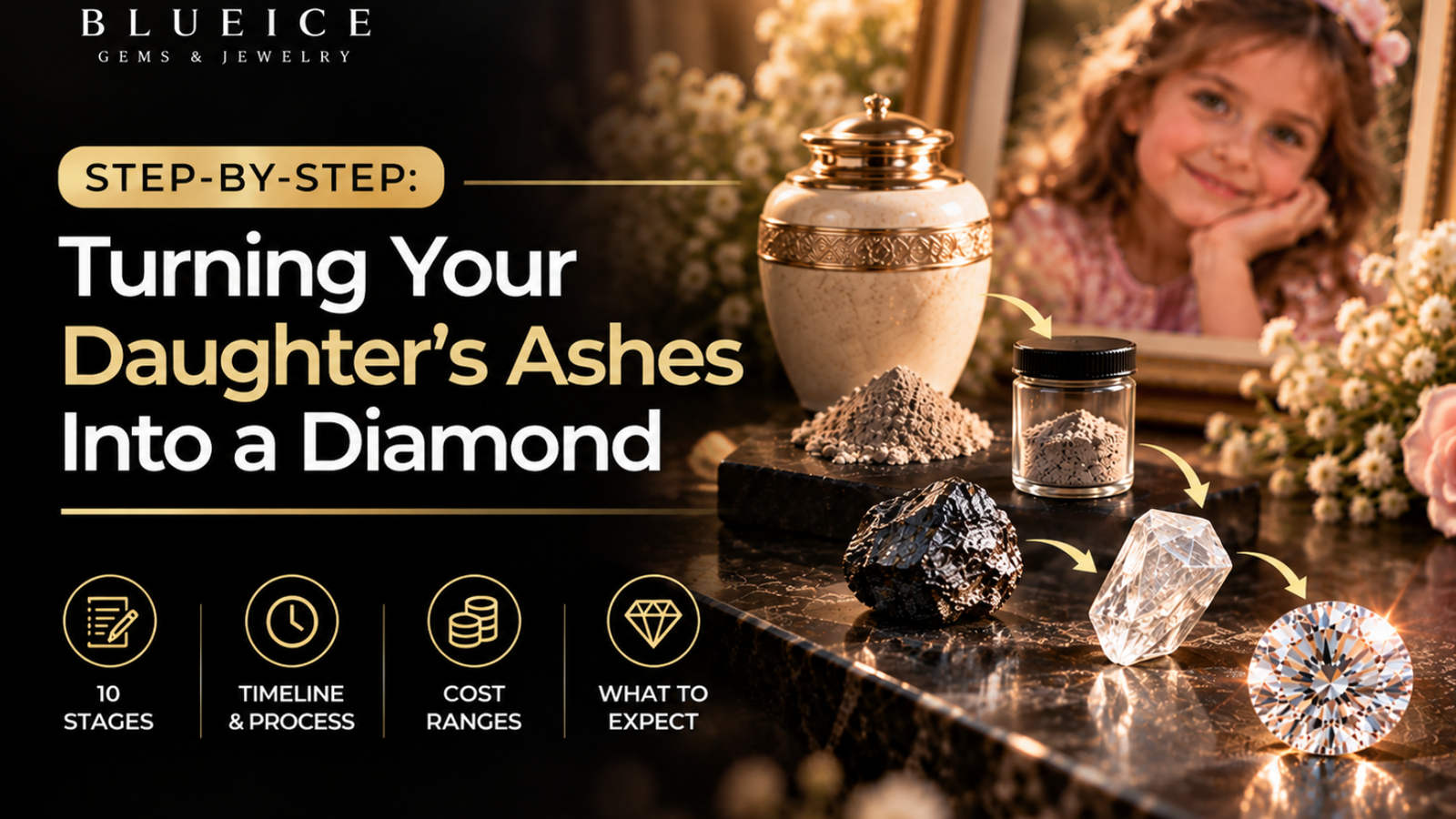
Step by Step: Turning Your Daughter’s Ashes Into a Diamond

If you already know you want this and simply need the order of things, this page is for you. The daughter ashes diamond steps come to ten, and each one below is set out the same way: what you actually do, roughly how long it takes, and the thing most likely to go wrong. Across the industry the whole journey usually runs six to ten months, and only the first few weeks ask much of you.

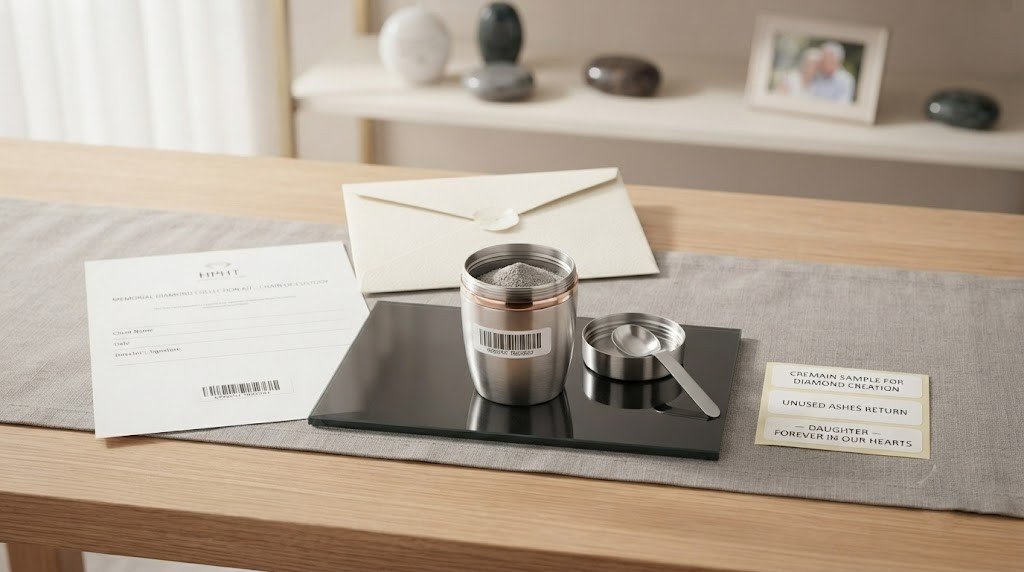
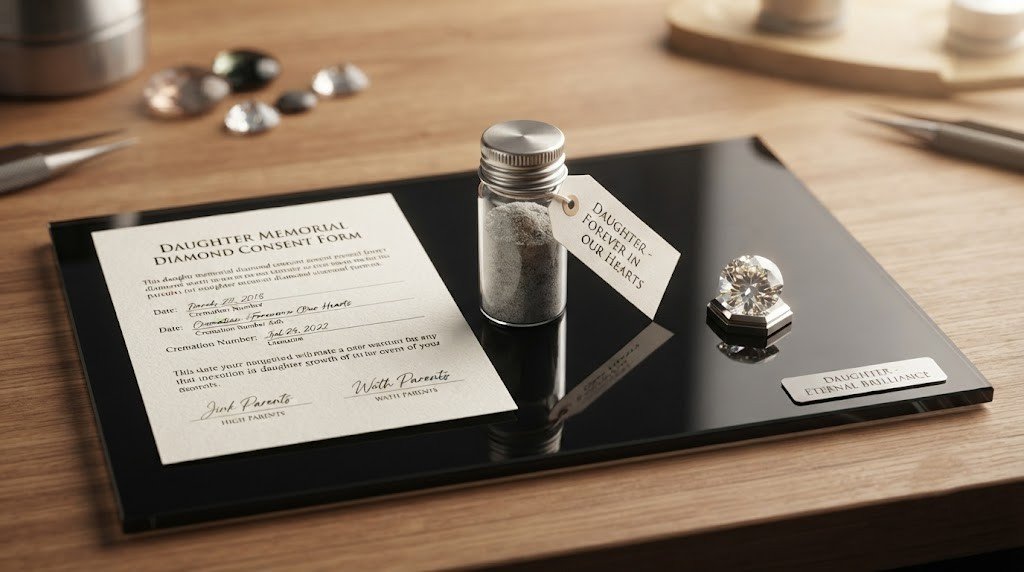
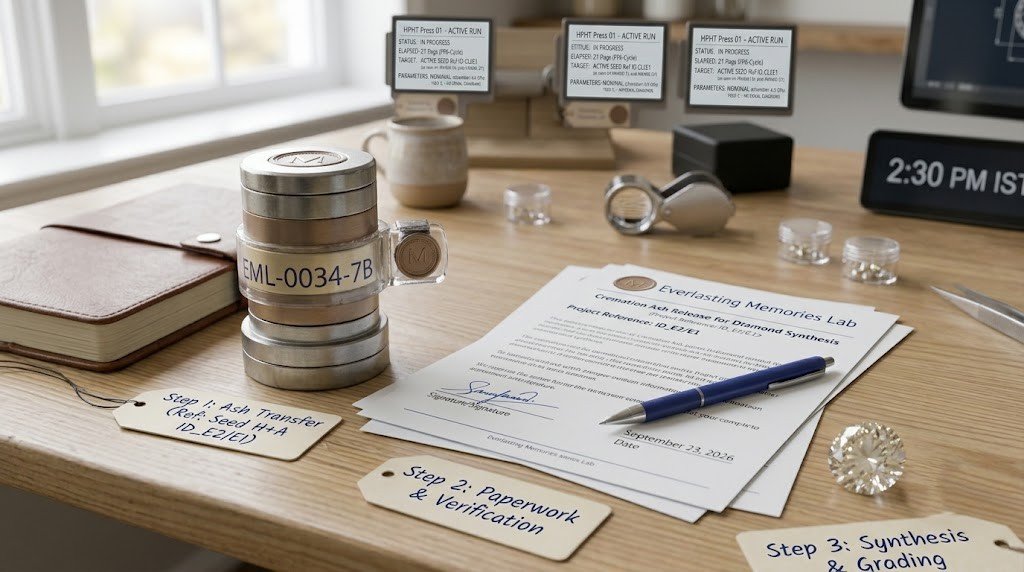
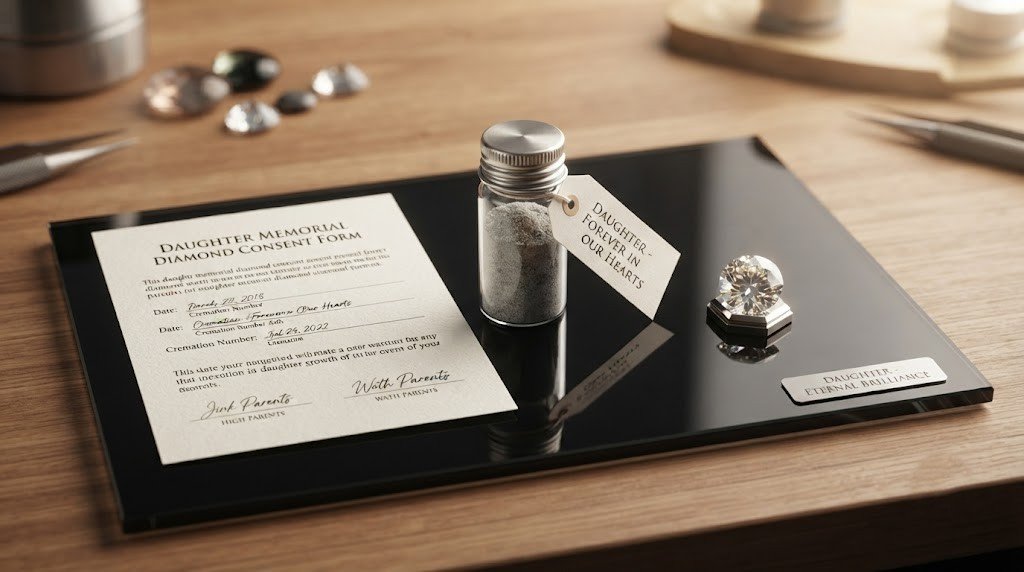
The daughter ashes diamond steps in one scene: a signed consent form, a sealed collection container and a finished memorial diamond on a desk

What Are the Daughter Ashes Diamond Steps, in Order?

The daughter ashes diamond steps number ten, counted from the family’s side of the table. Laboratory descriptions usually list extraction, graphitization and growth, which is accurate but tells you nothing about your own part. This list does the opposite: it names only what lands on your desk.

  • Steps 1 to 2 settle purpose and permission.
  • Steps 3 to 5 settle who makes it, what size it is and what it looks like.
  • Steps 6 to 8 move a small portion of her ashes safely to a laboratory.
  • Steps 9 to 10 cover the wait and the handful of final approvals.

Whether she was a small girl or a grown woman, the daughter ashes diamond steps follow this same sequence; what changes is mainly who holds authority at step two. If you are still weighing whether to do this at all, the decision by decision guide to turning her ashes into a diamond is the better starting point.

Step 1: Agree What the Diamond Is For

What to do: Before contacting anyone, write down in a sentence or two what the stone is meant to be and who it is for. One stone for one parent? A stone for each sibling? Something to be worn, or something kept in a drawer and taken out on anniversaries?

How long: An evening, or a few conversations spread over a couple of weeks.

What can go wrong: Skipping it. The answer quietly shapes every later decision among the daughter ashes diamond steps, how many stones to order, what size, what budget, and families who leave it vague tend to revisit choices after money has already changed hands. A second parent, a partner or an adult grandchild may hold a different picture of what she would have wanted, and hearing that now costs nothing.

It is also fine to decide the purpose is simply “something of her that I can hold.” Nothing about the daughter ashes diamond steps requires a grander reason than that.

What to do: Find out whose signature a provider will need before any portion of her remains can be sent. Rules are set state by state rather than nationally. Where she was married or partnered, that person commonly comes first, and her own grown children can outrank her parents too; and a directive, will provision or prepaid arrangement she left in writing can override the usual order.

How long: A phone call to the funeral home that handled the cremation often settles it within days. Unclear situations can take a few weeks, and a short consultation with an attorney is sometimes worth the fee.

What can go wrong: Assuming a parent holds the authority because a parent is making the arrangements. That is often not so where she was married or partnered, and discovering it at step six stalls everything. Parents who disagree, or one parent handling this alone, are situations this process can accommodate; the daughter ashes diamond steps work either way, provided the correct person signs.

Step 3: Compare Providers on Paper

What to do: At this point in the daughter ashes diamond steps, contact two or three companies and ask each the same written questions. How much ash do they need? What documentation will link the finished stone to her specific submission? Is growth done in house or by a partner lab? What happens to any unused material, is it returned, and how? What are the cancellation terms once growth has begun?

How long: One to two weeks, mostly waiting for replies.

What can go wrong: Choosing on tone instead of substance. Warm websites are easy; plain written answers are the real signal. A provider that is vague about the unused ash, or about how it tracks one family’s material through its lab, is showing you how the later daughter ashes diamond steps are likely to go. Whether a stone is genuinely made from her ashes explains which chain of custody answers deserve the closest reading.

Step 4: Set a Budget and a Carat Size

What to do: Choose a size, and let it set the budget rather than the other way around. Memorial stones are generally offered from around a tenth of a carat up past five carats, and price climbs steeply with weight.

How long: Your own pace; nothing in the daughter ashes diamond steps rushes this choice.

What can go wrong: Believing that sending more ash buys a bigger or faster diamond. It does not. Carat is decided by how long the crystal grows in the press, not by the quantity of remains you provide, so an extra scoop changes neither the size nor the schedule. A second common snag is forgetting that settings, engraving, unusual cuts and an optional grading report are usually quoted apart from the loose stone.

This is also where it helps to know that, on the ash route, her own carbon typically forms around 10% to 15% of the finished stone, with some providers citing as little as 3%; supplemental lab carbon makes up the rest. That proportion is worth asking about in writing before the later daughter ashes diamond steps commit you.

Step 5: Choose a Color Path and a Shape

What to do: Decide which color outcomes you would welcome, then pick a cut, round, oval, cushion, princess, emerald and the rest are all available, exactly as with any diamond.

How long: A few days to a few weeks.

What can go wrong: Expecting precise control over color. Trace elements present during growth decide much of it: nitrogen leans a crystal yellow, boron leans it blue, and a colorless result needs almost none of either, which is why colorless usually costs more. A carefully purified starting material still does not make the final shade predictable. Optional post growth irradiation, offered by some providers, can turn a stone red, pink, green or black; you can take it or leave it.

Choose from what she liked, or from what you like, rather than from any assumption about daughters. Among all the daughter ashes diamond steps, this is the one most personal to her, and it deserves her own tastes. What color a diamond made from her ashes is likely to be covers the chemistry in full.

Step 6: Sign the Order and Receive the Kit

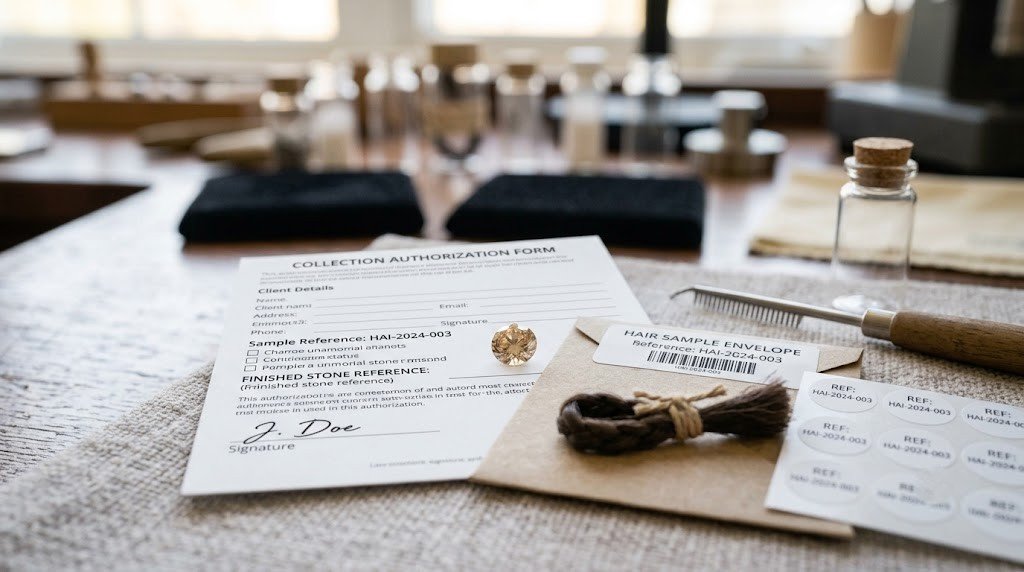
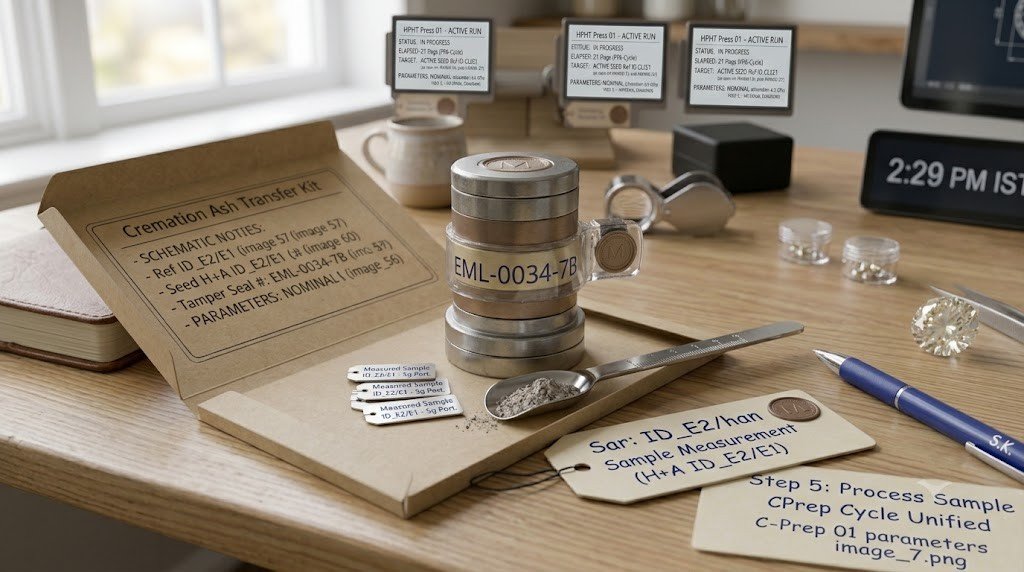
What to do: Return the provider’s authorization form signed by the person identified at step two, along with whatever supporting documents it asks for, usually a death or cremation certificate and the signer’s ID. Most companies then post a collection kit: a sealable container, a scoop, labels and custody forms.

How long: A few days if the signer is you; longer if the form must travel to another household first.

What can go wrong: A signature that sits unsent. Of all the daughter ashes diamond steps, this is the quietest place for a month to disappear. Agree a date with the signer when you send the form, and check the kit on arrival: make sure the labels carry the correct name and the order reference matches your paperwork before anything goes inside it.

An open collection kit with a sealable container, scoop, custody forms and printed labels

Step 7: Portion and Seal a Small Share of Her Ashes

What to do: Transfer the quantity the provider confirmed in writing. Industry wide that usually falls between a few tablespoons and about 4 oz, roughly 100 grams, which is a small part of a full cremation. The rest of her ashes remain for the urn, a burial, scattering or dividing among family as already planned.

How long: Under an hour. Allow a quiet afternoon anyway.

What can go wrong: Forcing a sealed urn open at home, or spilling while pouring. If the urn is sealed, a funeral home can open it, measure the portion and reseal it, and some will do the whole transfer for you. If you do it yourself, work on a tray in good light; cremated remains are mostly bone mineral and feel more like coarse sand than powder.

No part of the daughter ashes diamond steps says this must be your own hands. Asking a sibling, a friend or the funeral director is sensible, not a failure. The quantities families are usually asked for are set out in more detail separately.

Step 8: Send the Parcel and Confirm It Was Logged

What to do: Pack the sealed container with the custody forms inside the box, not in a separate envelope. Use the tracked, insured shipping method the provider recommends, often a prepaid courier label. Photograph the sealed container and the labeled box before handing it over.

How long: Two to five days in transit, typically, making this the shortest of the daughter ashes diamond steps.

What can go wrong: Silence at the far end. Ask the provider when you ship to confirm receipt in writing, and chase it if two working days pass after delivery without one. That confirmation is the handover point in the daughter ashes diamond steps: before it, the material is in your care; after it, the laboratory’s records take over. Keep the tracking number and the confirmation email together.

Step 9: Stay Informed Through the Growth Months

What to do: Very little, which makes this the hardest of the daughter ashes diamond steps for many families. Ask how often the provider sends updates and whether you can call between them.

How long: This is where the calendar goes: usually six to ten months industry wide, occasionally twelve for large or specialty color stones.

What happens in the lab: Her ashes are heated in an oxygen free, multi stage process that removes calcium phosphate and other minerals, leaving carbon purified to around 99.9% or better. Only about 0.5% to 4% of ash by weight is usable carbon, so the yield is small. That carbon is heated again, to roughly 2,500 to 2,700°C, and converted into graphite. The graphite, brought up to a workable volume with supplemental lab carbon, goes into a growth press beside a tiny seed crystal at roughly 6 to 8 GPa and 1,400 to 2,500°C. Most providers use this high pressure, high temperature method; a minority use chemical vapor deposition instead.

What can go wrong: Mostly the waiting itself. Delays do happen, and a good provider explains them promptly. For the lab side of the daughter ashes diamond steps in depth, the laboratory’s side of the process follows each stage of the chemistry.

Step 10: Approve the Finishing and Bring the Stone Home

What to do: Respond to up to three final questions once the rough crystal exists. First, confirm the cut, since the rough sometimes suits a different shape better. Second, confirm or decline any optional irradiation. Third, decide whether to have the finished stone independently graded against the recognized cut, color, clarity and carat standards. Grading is optional, and it is a separate document from the origin certificate that ties the stone to her submission.

How long: A few weeks for cutting and polishing, then shipping.

What can go wrong: Being surprised by a clarity grade or shade. Memorial stones commonly land between SI2 and VVS clarity, and color follows the chemistry described at step five. Also confirm, if you have not already, what will happen to any leftover ash.

The stone usually arrives loose, with its origin certificate and any grading report. There is no deadline for a setting. The last of the daughter ashes diamond steps can take as long as you need.

A loose memorial diamond beside its origin certificate and an optional grading report

How Long Do the Daughter Ashes Diamond Steps Take, End to End?

Plan on seven to eleven months for the daughter ashes diamond steps, from first phone call to holding the stone, most of it spent at step nine. The table below splits the daughter ashes diamond steps into your time and the laboratory’s.

StepStageTypical durationWhose time it is
1Agree the purposeDays to two weeksYours
2Confirm consentDays to a few weeksYours, plus the signer
3Compare providers1 to 2 weeksYours
4 to 5Size, budget, color, shapeDays to a monthYours
6Order and kitA few days to two weeksYours, plus the signer
7Portion and sealOne afternoonYours or a funeral home’s
8Ship and confirm receipt2 to 5 daysCourier’s
9Extraction and growthUsually 6 to 10 months, up to 12The laboratory’s
10Cutting, finishing, deliveryA few weeksThe laboratory’s

Two things lengthen the daughter ashes diamond steps more than anything else: an unresolved signature at step two and a larger or specialty color stone at step four.

What Do the Daughter Ashes Diamond Steps Cost?

The daughter ashes diamond steps are priced almost entirely by the size and color chosen at steps four and five. Typical 2026 ranges across the industry, not any single company’s price list, look like this:

  • About 0.10 to 0.25 carat: roughly $1,500 to $3,500
  • About 0.5 to 1 carat: roughly $5,000 to $15,000, with colorless costing noticeably more than yellow, blue or champagne tones at the same weight
  • Two to five carats and beyond: roughly $20,000 to $75,000 or more
  • Extras quoted separately: an optional grading report, engraving, fancy cuts and a ring, pendant or other setting

None of the daughter ashes diamond steps adds much cost on its own beyond these line items. Ask for a single itemized quote at step three so nothing new appears at step ten. For the wider picture of what this choice involves, our full guide for families considering her ashes as a diamond brings the pieces together.

Frequently Asked Questions

Which of the daughter ashes diamond steps can someone else handle?

Most of them. A sibling or friend can compare providers, a funeral home can open the urn and portion the ashes, and a courier handles shipping. The steps that need you, or the legally authorized person, are the consent signature and the final choices about size, color and finishing. Delegating the practical tasks is a reasonable choice, not a lesser one.

Can the daughter ashes diamond steps be paused if the family is not ready?

Before the ashes are shipped, yes, entirely at your own pace; nothing expires. Once growth has begun, pausing or canceling depends on the provider’s contract, and terms vary widely across the industry. Ask about cancellation and refund terms in writing at the comparison stage, before any part of her remains leaves your care.

What happens to the ashes the laboratory does not use?

Policies differ between providers. Some return unused material, some retain it for a set period, and some dispose of it respectfully by default. Because only a portion is ever needed, this is a genuine question for every family. Ask for the answer in writing before shipping, and state clearly what you would like done with anything left over.

How much of the finished diamond actually comes from her?

On the ash route, her own carbon typically makes up around 10% to 15% of the finished stone, and a few providers publish figures as low as 3 percent. The remainder is supplemental lab carbon needed to grow a stone of workable size. Her carbon is genuinely present in the crystal, but the diamond is not made from her carbon alone.

Can each of her siblings receive a stone through the same process?

Often, yes. Only a small portion of the ashes is used for each diamond, so several stones can usually come from one cremation. Each stone goes through its own growth stage within the daughter ashes diamond steps, with its own timeline and price. Ask whether one submission can cover several orders, or whether each needs its own portion and paperwork.

Does it matter how long ago her cremation took place?

Rarely. Ashes are chemically stable bone mineral, and a gap of months or many years seldom rules them out. Tell the provider how and where they have been stored, since the container and storage conditions matter more than the time elapsed. Families sometimes begin the daughter ashes diamond steps a decade or more after a cremation.
Final Thoughts on Turning Her Ashes Into a Diamond

Set out on a page, the daughter ashes diamond steps can look like a long list. In practice the parts that need your attention cluster at the start: agreeing what the stone is for, confirming who signs, and getting a provider’s answers in writing.

Everything in the daughter ashes diamond steps after the parcel is logged belongs to the laboratory and to time. If you take one thing from this page, let it be the order: purpose, consent, written terms, then everything else.

What eventually arrives is a real diamond carrying a documented share of her carbon. Take the daughter ashes diamond steps at whatever pace your family needs.

Learn More About Daughter Memorial Diamonds

Talk With Memorial Diamond

If you would find it easier to talk the sequence through with someone, Memorial Diamond is available at memorialdiamond.us. Bring whichever of the daughter ashes diamond steps you are on, and whatever questions come with it. Asking commits you to nothing.

daughter-ashes-diamond-color

Daughter Ashes Diamond: The Complete Guide

Losing a daughter, at whatever age, rearranges every question about what comes next, including the quiet one about what to do with her ashes. A daughter ashes diamond is a genuine lab grown diamond grown partly from carbon recovered out of a small portion of her cremated remains. Industry wide it usually takes six to ten months, starts at roughly $1,500 for the smallest stones, and uses only a fraction of her ashes, so the rest stays with your family.

That short answer leaves a great deal unsaid, and this guide is meant to fill it in. It covers what the stone physically is, how much of it truly comes from her, who has the right to sign, what the months of waiting involve, and how to judge a provider before you trust one with anything.

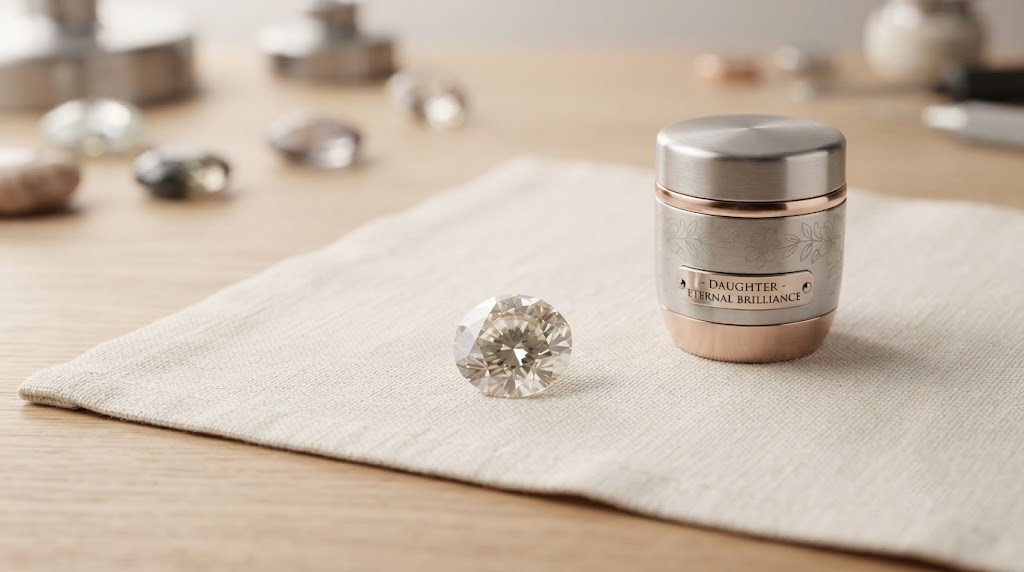
A daughter ashes diamond: a loose champagne-toned memorial stone resting beside a small keepsake urn on linen

What Exactly Is a Daughter Ashes Diamond?

A daughter ashes diamond is a real diamond, not a glass keepsake, a resin bead or a stone with ash sealed behind it. Chemically, optically and physically it matches any other lab grown diamond, and it rates a 10 on the scale gemologists use to rank mineral hardness, which is why it holds up well to everyday wear, though a hard knock can still chip any diamond.

What sets a daughter ashes diamond apart from an ordinary lab grown stone is where part of its carbon came from. A laboratory recovers carbon from a portion of her cremated remains, purifies it and grows it into a crystal. The result carries a documented link back to her.

Families come to this for very different reasons. Some want something they can wear rather than something that sits on a shelf. Some are dividing ashes between households and want each person to hold a share. Some simply cannot picture scattering all of her. None of those reasons needs defending, and a daughter ashes diamond can sit alongside an urn, a burial plot or a scattering rather than replacing any of them.

How Much of a Daughter Ashes Diamond Is Actually Her?

A real portion, but not the whole stone. For a daughter ashes diamond, as for any ash grown stone, her personal carbon usually makes up somewhere around 10% to 15% of the finished diamond’s mass, with a few providers citing a floor near 3%. Supplemental carbon from the laboratory accounts for the remainder.

The reason is simple chemistry. Cremated remains consist mostly of calcium phosphate, the mineral framework of bone, and usable carbon amounts to only about 0.5% to 4% of ash by weight. That small yield is purified and then blended with lab carbon so there is enough feedstock to grow a stone of meaningful size.

Any provider claiming its daughter ashes diamond is 100% her carbon is claiming something the physics does not support. The honest version is still remarkable: carbon that was part of her is locked into the crystal lattice of a stone that exists because of her. It is not a symbol standing in for her; it is partly made of her.

If that percentage matters to you, ask each provider to state its own figure in writing for the size you are considering. A closer look at whether the stone is really made from her ashes goes through the evidence and the questions worth pressing on.

Who Has the Right to Authorize a Daughter Ashes Diamond?

Not automatically her parents. Priority over a person’s remains is decided state by state, and nothing at the national level settles it for every family. Where your daughter had a husband, wife or registered partner, that person commonly comes first, and any grown children of her own can outrank you too.

Anything she put in writing can change the picture again. A directive, a provision in a will or a pre arranged funeral plan may name a specific person or state a specific wish, and that can override the default order entirely.

Families are not always of one mind about a daughter ashes diamond, and that is ordinary. Parents who are separated may disagree, or one parent may be arranging everything alone. A partner may want something different from what her family wants. The funeral home that handled her cremation usually knows how the local rule works in practice, and a brief consultation with an attorney can settle any real doubt before a container is opened.

Sort this out before anything else about the daughter ashes diamond is decided. Every later step depends on it, and it is much gentler to learn whose signature is needed now than halfway through.

How Much of Her Ashes Does a Laboratory Need?

 High-pressure diamond growth press in a laboratory with a sealed growth cell being prepared

Far less than most families expect for a daughter ashes diamond. Requirements vary by provider, but industry typical requests start at a few tablespoons and top out near 4 oz (around 100 grams). That is usually a small share of what a cremation returns, so most of her ashes remain for an urn, a burial or a scattering.

The amount you send does not decide the size of the stone. Carat is set by how long the crystal grows in the press, so sending a larger portion does not buy a bigger or faster daughter ashes diamond. It mainly gives the laboratory a margin for extraction.

Before you measure anything, get the provider’s exact requirement in writing, and ask one more question: what happens to any ash that is not used? Some return it, some do not, and knowing in advance saves a painful surprise later. How much ash a daughter memorial diamond needs covers measuring, sealed urns and portioning in more detail.

How Is a Daughter Ashes Diamond Made, Stage by Stage?

Through a sequence of controlled heat and pressure stages that turn a small amount of recovered carbon into a crystal. The core method, high pressure high temperature growth, is the same one used across the wider lab grown diamond industry.

StageWhat happensKey conditions
ReceiptAshes logged under chain of custody recordsTracked from arrival
ExtractionOxygen free heating removes non carbon materialCarbon purified to ~99.9%+
GraphitizationPurified carbon converted to graphiteRoughly 2,500 to 2,700°C
GrowthGraphite, plus lab carbon, grown on a tiny diamond seedRoughly 6 to 8 GPa, 1,400 to 2,500°C
CuttingRough crystal shaped and polishedRound, cushion, princess and more
FinishingOptional color treatment and optional gradingYour choice

Most providers grow a daughter ashes diamond by HPHT; a minority use chemical vapor deposition instead, where carbon bearing gas builds a crystal layer by layer. Either way the outcome is a genuine diamond.

From the family side, the process is simpler than the table suggests: confirm authority, choose a provider, portion and ship her ashes, then wait. How a memorial diamond is made from your daughter’s ashes explains the science more fully, and a step by step walkthrough of the family’s side lists what you do at each point.

How Long Should You Expect to Wait?

A daughter ashes diamond usually takes six to ten months from the day the laboratory receives her ashes, with larger stones or specialty colors sometimes stretching to twelve. Almost all of that time is growth; the parts you personally handle rarely add up to more than a few weeks.

Size is the biggest driver. A tenth of a carat grows far faster than two carats, and a specialty color such as black can add time too. Sending more ash changes none of this.

Waiting is hard in a particular way, because nothing is asked of you. Some parents find it helps to know roughly when to expect updates, so ask each provider how often it communicates during growth and whether it shares photographs of the rough crystal before cutting.

There is also no deadline on your side. Cremated remains are chemically stable, so a daughter ashes diamond can be started months or years after the cremation, whenever your family is ready rather than when a calendar says you should be.

What Does a Daughter Ashes Diamond Cost?

As general 2026 industry ranges, not any single company’s published price:

  • About 0.10 to 0.25 carat: roughly $1,500 to $3,500
  • About 0.5 to 1 carat: roughly $5,000 to $15,000
  • About 2 to 5+ carats: roughly $20,000 to $75,000 and beyond
  • Colorless versus tinted: colorless generally costs noticeably more than yellow, blue or champagne at the same size
  • Priced separately: settings, engraving, fancy cuts and any independent grading report

Carat drives the price of a daughter ashes diamond far more than anything else, because larger stones take longer in the press and need closer process control. The quantity of ash you send does not set the carat, so it is not what moves the price.

When comparing quotes for a daughter ashes diamond, compare like with like: the same carat, the same color, and whether grading and a setting are included. A lower headline figure that excludes those can end up costing more.

What Color Is the Finished Stone Likely to Be?

A daughter ashes diamond is often a warm yellow, champagne or blue tone rather than colorless, though no one can promise the exact shade in advance. Color comes from trace elements present during growth: nitrogen pulls a stone toward yellow, boron toward blue, and a colorless result requires the near total absence of both.

Carbon recovered from a person is organic and personal rather than a pristine synthetic feedstock, so trace elements are common. A cleaner starting material does not make the outcome predictable. Colorless is achievable but takes extra processing and usually costs more.

Some providers also offer irradiation after growth, producing red, pink, green or black stones. It is entirely optional, and plenty of families say no, preferring whatever shade the stone developed naturally.

Choose based on what feels right to you, or on what she herself loved, not on assumptions about what a daughter should wear. What color a diamond from your daughter’s ashes will be explains the range in more depth.

Is the Diamond Graded, and What Certificate Comes With It?

A daughter ashes diamond may come with two different documents, and they do different jobs. An origin or authenticity certificate, usually issued in house, records that your daughter ashes diamond was grown from the specific material you sent. It is essentially a chain of custody record.

A grading report is separate and, across this industry, optional. An independent gemological laboratory assesses the stone against the standard measures of cut, color, clarity and carat, most often referencing GIA standards, sometimes IGI. Memorial diamonds typically fall in the SI2 to VVS clarity range.

Whether to add independent grading is your call. It adds cost, and it matters most if the stone will be insured, valued or passed down. It says nothing about origin, which is what the in house certificate covers.

An origin certificate and a separate gemological grading report laid side by side with a loose diamond

Can Several People Each Have a Stone From Her Ashes?

Often, yes. Because only a portion of her ashes goes into each stone, one set of remains can frequently support more than one diamond, which suits families where parents, siblings, a partner or her own children would each like a piece of her.

Each additional daughter ashes diamond is its own growth cycle, with its own timeline and its own price. Ask whether one submission can cover several stones or whether each needs a separate portion.

Sharing also brings the authority question back into focus. Whoever holds the legal right over her remains should agree to the plan, and it helps to decide early who is paying, who chooses size and color for each stone, and what happens to any leftover ash. Talking this through before anything is shipped usually spares everyone a harder conversation later.

Ring, Pendant or Loose Stone: How Will It Be Kept?

However the person keeping it prefers. Most finished stones arrive loose unless a setting was ordered at the same time, and a loose diamond can wait indefinitely while you decide.

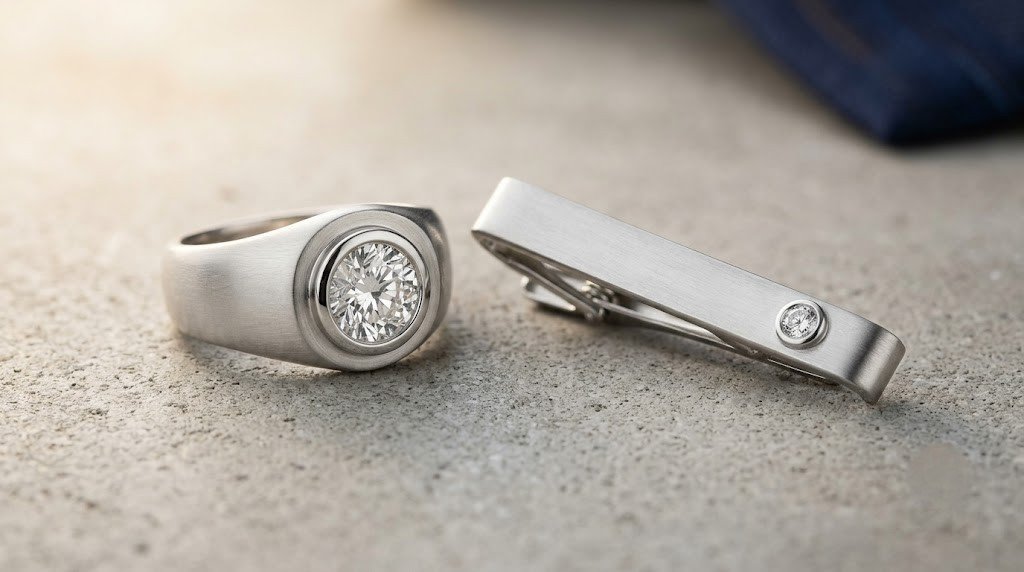
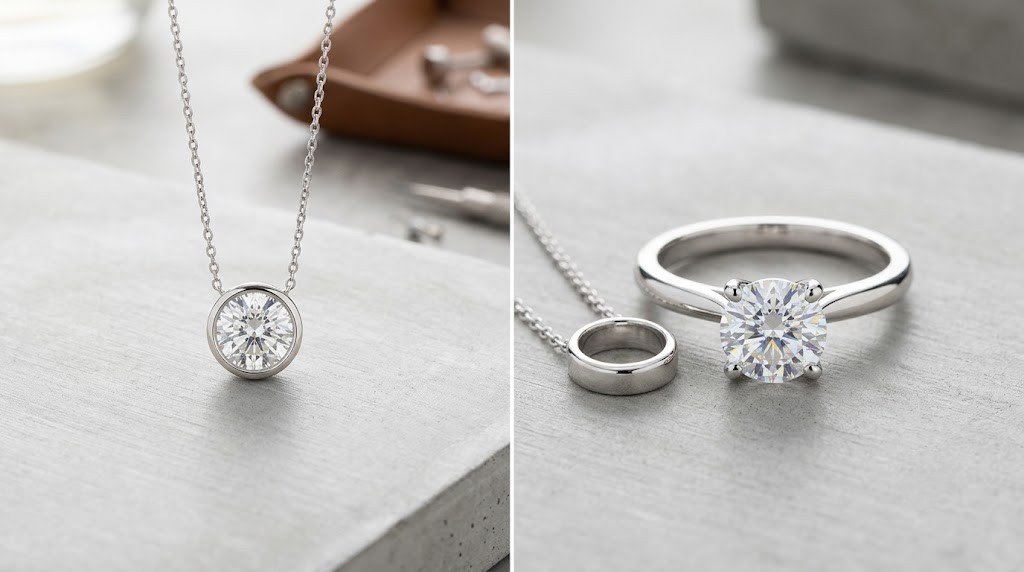
Common choices include a pendant worn close, a ring, a pair of earrings split from two stones, a cufflink or tie bar, or a small keepsake box that never leaves a drawer. A diamond’s hardness makes everyday wear practical.

Let the choice follow the wearer and, if it helps, what your daughter herself was like. A parent who never wears jewelry might prefer a stone set into a watch case or kept loose. Her brother might want something entirely different from her mother. There is no correct form for a daughter ashes diamond, and settings can always be changed later without affecting the stone.

How Should You Choose a Provider?

Judge any company offering a daughter ashes diamond by what it will commit to in writing, not by how its website feels. Before sending any of her ashes, ask each company for clear written answers to these:

  • The exact quantity of ash it needs, and what happens to any unused material
  • Its stated personal carbon percentage for the size you want
  • Whether growth happens in house or at a partner laboratory
  • What chain of custody documents you receive, and when
  • Whether independent grading is included or optional, and at what cost
  • How often you will hear from it during growth
  • Its cancellation and refund terms at each stage

A provider that answers every point plainly, by email, is showing you how it will behave for the next ten months. Vague answers now rarely become clearer later.

If your family is still weighing whether hair might be an option instead, the complete guide to a daughter hair diamond covers that route, and the guide to combining her ashes and hair explains the blended approach. For the practical sequence with ashes, how to turn your daughter’s ashes into a diamond sets out each decision in order.

Frequently Asked Questions

Is a daughter ashes diamond a real diamond?

Yes. It is a genuine lab grown diamond with the same crystal structure, hardness and optical properties as any other diamond, grown by high pressure high temperature methods or, less often, chemical vapor deposition. What makes it different is that part of its carbon was recovered from her cremated remains.

Can a diamond be made from her ashes years after the cremation?

Yes. Cremated remains are mineral and chemically stable, so the years between the cremation and your decision are not an obstacle in themselves. Tell the provider how the ashes have been stored, since conditions can matter more than time, and confirm its quantity requirement before you portion anything.

Do I need permission from her spouse or partner?

Possibly. Rules differ by state, and a spouse, registered partner or her own adult children may hold authority over her remains ahead of her parents. Anything she left in writing can also override the default order. Her funeral home or an attorney can confirm who needs to sign.

Will the stone look like her, or reflect her personality?

No stone can capture a person, and color is set by trace elements during growth rather than by character. What a daughter ashes diamond does carry is a documented physical link to her, recorded on an origin certificate. Many families find meaning in choosing its cut and setting themselves.

Can her siblings each receive a diamond?

Often, yes. Because only a portion of ash goes into each daughter ashes diamond, several diamonds can frequently come from one set of remains. Each is grown separately, with its own schedule and cost, and whoever holds authority over her remains should agree to the plan before anything is sent.

What happens to the ashes the laboratory does not use?

It depends on the provider. Some return unused ash with the finished stone, some retain it under a stated policy, and some consume what they receive during extraction. Ask for the answer in writing before you ship anything, so the outcome matches what your family intends.

Is independent grading required for a daughter ashes diamond?

No. Independent grading by a third party gemological laboratory is optional across the industry and priced separately. It records cut, color, clarity and carat, which helps with insurance and valuation. It is distinct from the in house origin certificate, which documents that the stone was grown from her ashes.

Final Thoughts on a Daughter Ashes Diamond

There is no timetable here and no right answer that every family should reach. Some parents know within weeks that they want a stone; others keep her ashes for years before deciding, and some never choose this at all.

If a daughter ashes diamond does feel right, the practical path is shorter than it looks: settle who can authorize it, get the quantity, carbon figure and terms in writing, then let the months pass. What comes back is a real diamond with a real, recorded line to her, and what you do with it from there belongs entirely to your family.

Learn More About Daughter Memorial Diamonds

Talk With Memorial Diamond

If you would like to talk it through with a person rather than read further, Memorial Diamond is reachable at memorialdiamond.us. Ask about a daughter ashes diamond, the paperwork, the quantities involved, or anything in this guide that raised a question. Asking carries no obligation.

Word count: 2,987 words · Reading time: about 14 minutes

turn-son-ashes-and-hair-into-a-diamond

How to Turn Your Son’s Ashes and Hair Into a Diamond

There is often a box on a shelf and an envelope in a drawer, and no obvious instruction for what to do with either. If you want to turn son ashes and hair into a diamond, the plain version is this: a laboratory pulls carbon out of both samples, purifies it past 99.9%, converts that carbon to graphite, and grows the graphite into a genuine lab grown diamond over roughly six to ten months. Parents who turn son ashes and hair into one stone are not buying a symbol of him. They are commissioning a gem that physically contains carbon that was his.

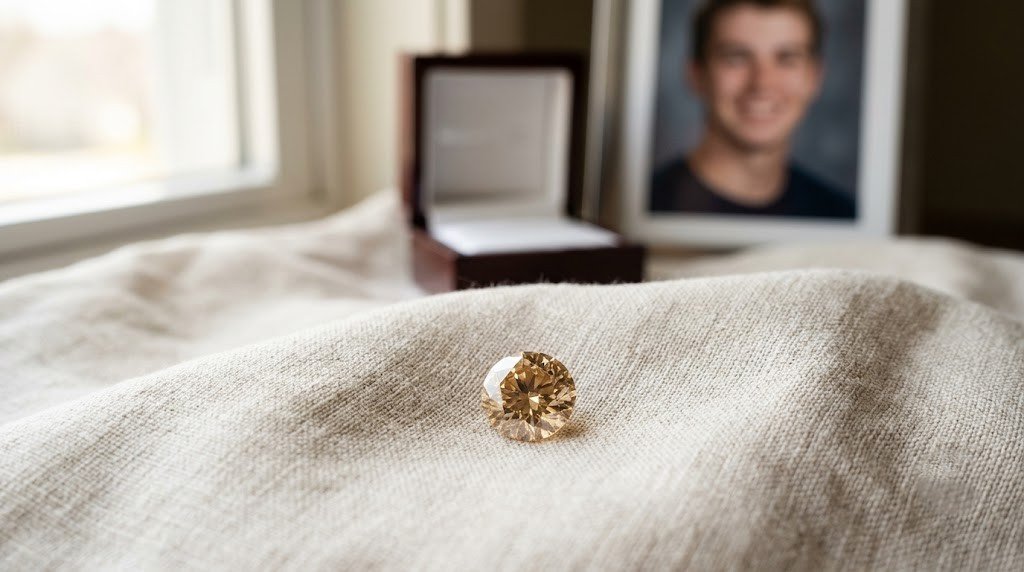
 Parents turn son ashes and hair into a diamond: a champagne-toned lab-grown memorial stone resting on pale linen

Why Would You Turn Son Ashes and Hair Into One Diamond?

Most parents who turn son ashes and hair into a single diamond do it because they happen to hold both, and neither one feels like something to set aside. The hair may have come from a hairbrush nobody emptied, a barber’s envelope, a hospital bag, or a lock cut before the funeral. The ash came later.

The reason to turn son ashes and hair into one gem rather than two is usually not sentimental arithmetic. It is that a single object can be worn, carried, and eventually passed on, while two half portions tend to sit in two boxes. If you are still weighing that, the ash only version of this process and working from hair alone each cover the single source route in full.

There is also a quieter reason parents mention. Hair is frequently the older of the two samples it may predate an illness, an accident, or a long decline and combining it with ash lets both versions of him contribute to the same crystal, whether your son was six or sixty when he died.

Deciding to turn son ashes and hair into a single piece also settles a practical question early: you are commissioning one stone, on one timeline, at one price, rather than managing two parallel orders. And because labs work from a small portion of what you send, you can turn son ashes and hair into one stone and still keep the great majority of both exactly where they are now.

Who Can Legally Decide to Turn Son Ashes and Hair Into a Memorial Stone?

This is the part parents are most often surprised by, and it is worth settling before you turn son ashes and hair into anything. If your son was married, his surviving spouse may hold the legal right to direct what happens to his remains ahead of you. If he had adult children of his own, they may sit ahead of you as well.

Most states set out a statutory order of priority for who may authorize the disposition of a decedent’s remains, and parents typically appear on that list after a spouse and after adult children. Anything your son left in writing a will, a funeral directive, a pre need contract, a designated agent form can rearrange that order entirely. The details genuinely vary from state to state, so this is a question for the funeral home that handled the cremation, or for a local attorney, rather than something to settle from a blog post.

Hair sits in a slightly different place. Rules about disposition are written about the remains themselves, so a lock you already have in your own home is usually the simpler question in practice but a decedent’s personal belongings can still fall to his estate, the treatment varies by state, and if the hair is in someone else’s keeping, retrieving it is a conversation rather than a decision.

The honest summary: a parent arranging this alone may well be able to turn son ashes and hair into a diamond without difficulty, and many do. But parents who press ahead without first speaking to whoever else has standing sometimes discover the problem painfully late. Ask early, in writing where you can.

Parents are not always of one mind about this, and one parent quite often arranges the whole thing alone after a separation, after a disagreement about cremation itself, or simply because one of you can face the phone calls and the other cannot. Providers encounter that constantly and it is not an obstacle. What governs the outcome is who holds authority, not whether the household agrees.

What Do You Need to Gather Before You Begin?

What you need in hand before you turn son ashes and hair into a diamond is less than most parents expect. Providers differ, so treat the figures below as industry typical rather than any single company’s published rule, and see how much of each sample a lab needs for the quantities in more depth.

What you sendIndustry typical amountPractical notes
Cremated remainsA few tablespoons up to roughly 4 oz (about 100 g)A small fraction of a full cremation; the rest stays with you
HairA small lock, often described as a few grams or a palm sized amountCut hair is fine; length matters less than total weight
Identification of the materialWhatever the provider’s intake form asks forPart of chain of custody documentation
Written authorisationVaries by provider and stateTies back to the authority question above

Labs that turn son ashes and hair into one crystal usually ask for hair in a clean, sealed paper envelope rather than plastic, and for ash in whatever sealed container the crematorium supplied or one the provider sends you. You do not need a full urn to end up with a wearable gem, and you should be cautious of anyone who implies otherwise.

If the hair is short, thin, chemically treated, or came from a very young child, say so at intake rather than hoping. It is a normal question, and the answer affects how much the lab asks for.

What Are the Seven Steps to Turn Son Ashes and Hair Into a Diamond?

Stripped of marketing language, the seven steps below are what it actually takes to turn son ashes and hair into a finished diamond.

  1. Collection and chain of custody. Step one in any attempt to turn son ashes and hair into a diamond is intake: both samples are logged, assigned an identifier, and tracked from that point forward. Every laboratory that will turn son ashes and hair into a gem should be able to describe this process to you in concrete terms.
  2. Carbon extraction and purification. Each sample is heated in a controlled, oxygen free, multi stage process that strips out everything that is not carbon the calcium phosphate that dominates ash, the non carbon components of keratin in hair until the recovered material reaches roughly 99.9%+ carbon purity.
  3. Graphitization. The purified carbon is heated further, to somewhere around 2,500 to 2,700°C, and converted into graphite: the crystalline form of carbon a growth press can actually use as feedstock.
  4. Loading the growth cell. The graphite, blended with supplemental lab sourced carbon to reach workable volume, is placed in a growth cell with a tiny diamond seed. This is the growth cell where the decision to turn son ashes and hair into one crystal finally becomes physical.
  5. Growth. In the HPHT method that dominates this category, the cell is held at roughly 6 to 8 gigapascals of pressure and temperatures in the 1,400 to 2,500°C band for weeks to months. A minority of providers use CVD instead, depositing carbon from gas onto a seed plate in a vacuum chamber. Nothing about the finished size depends on the volume you send growth time sets carat size, not sample size.
  6. Cutting and polishing. Once you turn son ashes and hair into rough crystal, a gem cutter takes over and shapes it into a round, cushion, princess, or other finished cut, exactly as with any other diamond.
  7. Optional irradiation and optional independent grading. Some providers offer post growth irradiation to shift or intensify color. Many families also request a grading report from an independent third party laboratory, documenting the usual cut, color, clarity and carat measures. Both are optional, and both are worth asking about before you commit rather than after.

How Much of the Finished Gem Is Actually His?

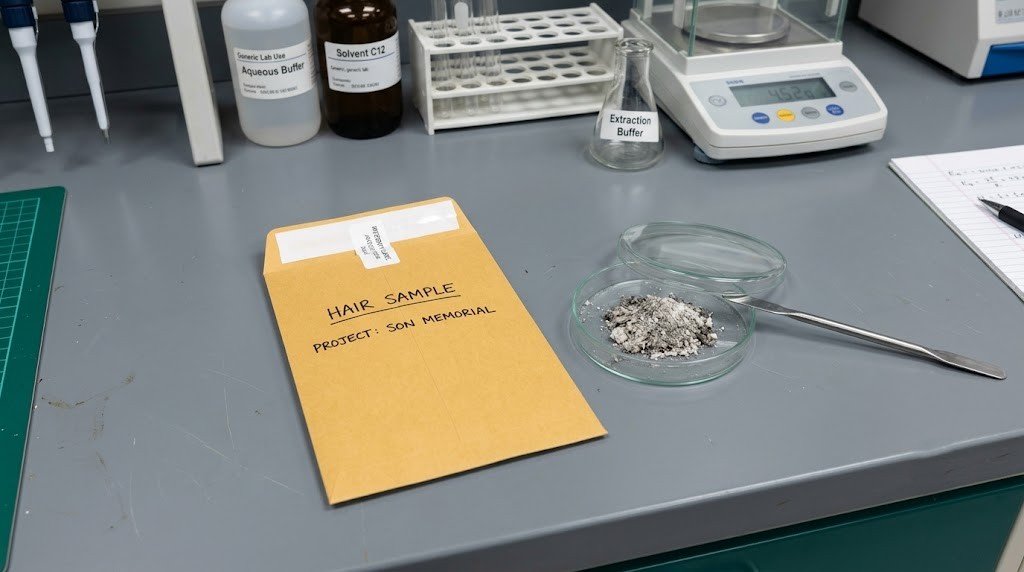
Sealed sample envelope of hair beside a small portion of cremated remains on a laboratory bench

Parents ask how much of the finished gem is really his when they turn son ashes and hair into one stone, and they deserve a straight answer rather than a comforting one.

For the ash route specifically, industry figures put usable carbon at roughly 0.5% to 4% of cremated remains by weight. Of the finished stone’s mass, roughly 10 to 15% typically traces back to carbon drawn from ashes a share some providers put as low as 3%, since it moves with stone size and the volume of ash submitted. Hair is a much richer starting material roughly 50% carbon by weight, because keratin is a carbon rich protein but that is a fact about the input, not about the finished stone.

Published figures for the ash route exist. For a charge where you turn son ashes and hair into a blended feedstock, no equivalent published percentage exists at all, and nobody should quote you one as though it were settled. Ask any provider who offers to turn son ashes and hair into a diamond to put their own figure, and their method for arriving at it, in writing.

What is honest to say is this: when you turn son ashes and hair into one crystal, a real, verifiable portion of his own carbon is inside the lattice, blended with supplemental lab carbon to reach a growable volume. No memorial diamond from any source material is 100% personal carbon, and a provider claiming otherwise is describing something physics does not do.

What Color Will the Stone Come Out?

Color is the part of the plan to turn son ashes and hair into a diamond that families least expect to be surprised by, and it is where the individuality of the source material shows up most visibly.

Nitrogen left in the feedstock pushes a crystal toward yellow. Boron pushes it toward blue. A colorless diamond requires the near total absence of both, which is why memorial stones trend toward yellow, blue, and champagne or brown tones rather than white organic source material carries trace elements that a purely synthetic feedstock would not.

When you turn son ashes and hair into a blended charge, both samples bring their own trace elements to the same growth run, which is one more reason no reputable lab will promise you a precise shade before a growth run has actually happened. Colorless is achievable with extra processing and typically costs more; irradiation after growth can produce red, pink, green, or black.

One further point worth knowing: irradiation is a post growth treatment rather than a dye, and an independent grading report will normally disclose that it was applied. If it matters to you whether the color arose from the material itself or was introduced afterwards, say so before growth begins rather than after the stone is cut.

It helps to decide in advance whether you want a specific color or whether you would rather accept whatever the material gives you. Many parents find they prefer the second once it is framed honestly the shade is a consequence of him, not a defect. There is more on what color a combined stone tends to come out if that is the deciding factor for you.

How Long Does It Take and What Does It Cost?

The time it takes to turn son ashes and hair into a finished stone is governed by growth, not by paperwork. Across the industry, six to ten months from receipt of material to finished diamond is the typical span, with larger stones beyond roughly two carats or specialty colors such as black sometimes running to twelve.

Cost, when you turn son ashes and hair into a diamond, tracks carat, color, cut, and whether an independent grading report is included. These are general industry ranges for 2026, not any single provider’s published price list:

Size tierTypical industry rangeNotes
0.10 to 0.25 ctAbout $1,500 to $3,500The usual entry point
0.5 to 1.0 ctAbout $5,000 to $15,000Colorless costs meaningfully more than yellow, blue or champagne at the same size
2 to 5+ ctAbout $20,000 to $75,000+Longest growth times

Nothing about choosing to turn son ashes and hair into one gem rather than two changes which tier you land in the tier is set by the size you choose. Budget for the extras too when you turn son ashes and hair into something wearable: settings, engraving, fancy cuts and grading reports are usually priced separately from the loose stone. If cost is the deciding factor, what a son memorial diamond costs goes into the tiers in more detail, and how long the whole thing takes covers the calendar.

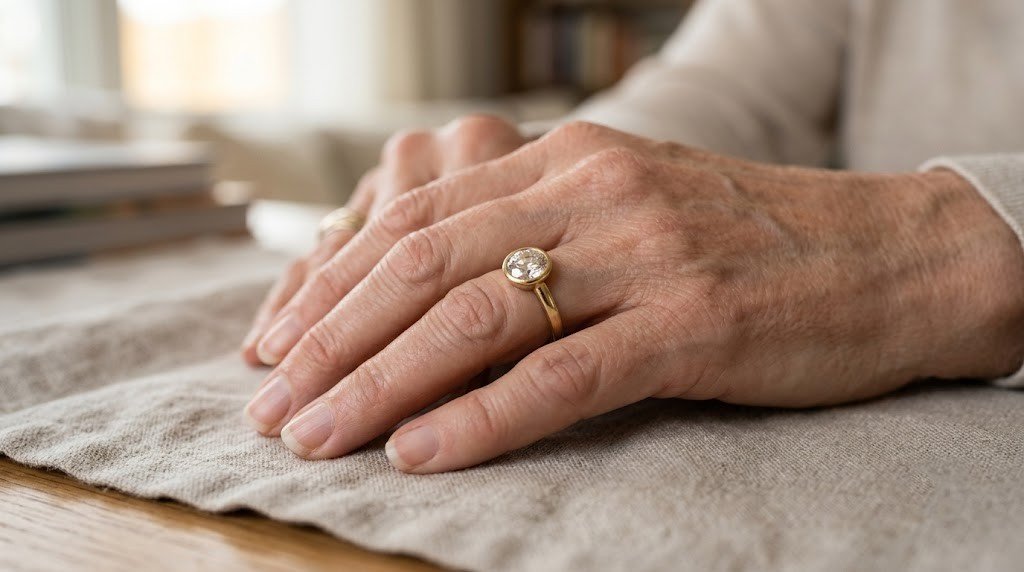
Memorial diamond set in a simple gold band worn on an older woman's hand

What Should You Ask Before You Send Anything?

Ask these before you agree to turn son ashes and hair into a diamond, and ask for answers you can keep:

  • How will you turn son ashes and hair into a documented, traceable batch what identifier is used, and can I see the log?
  • What happens if a lab cannot turn son ashes and hair into a viable crystal on the first run? Is there a second attempt, and does it cost more?
  • What percentage of the finished stone do you estimate will be his carbon, and how did you arrive at that estimate?
  • Do you return any unused ash or hair, and in what form?
  • Is independent third party grading available, and is it included or extra?
  • What exactly does your authenticity or origin documentation state?
  • Can a second stone be grown later from the material I still hold?

Written answers matter more than reassuring phone calls here, for the same reason chain of custody matters: this is a months long process involving something irreplaceable. If you want a longer version of this list, questions worth asking before you commit expands each one.

Frequently Asked Questions

Can a lab turn son ashes and hair into more than one diamond?

Often yes, because only a portion of what you send is used. Several stones can frequently be grown from one shared submission, either in the same run or from reserved material later. Confirm the specific provider’s policy, and the cost of each additional stone, in writing first.

Does hair have to be from before he died?

No. Hair collected at any point works the same way chemically, whether it was cut years earlier, kept from a childhood haircut, taken by a barber, or collected after death. Keratin’s carbon content does not change with time, and properly stored hair keeps indefinitely.

Does it cost more to turn son ashes and hair into one diamond than ash alone?

Providers price by carat, color, cut and optional extras rather than by how many source materials you submit, so a combined submission does not usually carry its own surcharge. Ask directly, though pricing structures differ, and you want that answer before intake, not after.

What if my son’s spouse and I disagree about doing this?

Then it is a legal question before it is a family one, because a surviving spouse may hold authority over his remains ahead of his parents in your state. Talk to the funeral home or a local attorney about who may authorize disposition before any material is shipped.

Will anyone be able to tell the diamond was made this way?

Not by looking. A memorial diamond is chemically and optically a genuine diamond, with the same hardness and the same cut, color, clarity and carat grading as any other. Laboratory grown origin is identifiable through gemological testing, but not to the eye.

Can we still bury or scatter the rest of him?

Yes, and many families do exactly that. A typical submission is a small fraction of a full cremation, so burial, interment, scattering, or keeping an urn all remain entirely available alongside the diamond. None of those choices is diminished by this one.

Final Thoughts on Turning Your Son’s Ashes and Hair Into a Diamond

Choosing to turn son ashes and hair into a diamond is not a way of finishing anything, and it should not be sold to you as one. It is a way of taking material you already have and making it into an object you can keep on your hand instead of on a shelf.

Some parents do this within a year. Some do it after five, or ten, or after a second loss makes the shelf feel heavier. Neither timing is late, and neither is wrong.

Whatever else is true, the decision to turn son ashes and hair into one stone belongs to whoever has the standing to make it, and it should be made slowly, with written answers from the lab, and with the people who also loved him in the room.

Learn More About Son Memorial Diamonds

Talk With Memorial Diamond

If you are weighing this and want to talk it through rather than fill in a form, reach out to Memorial Diamond at memorialdiamond.us to discuss what is possible with the ash and hair you have. There is no obligation in asking, and no schedule you are behind on.

Word count: 2,934 words · Reading time: about 15 minutes

son-memorial-diamond-vs-urn

Son Memorial Diamond vs. Traditional Urn: What to Know

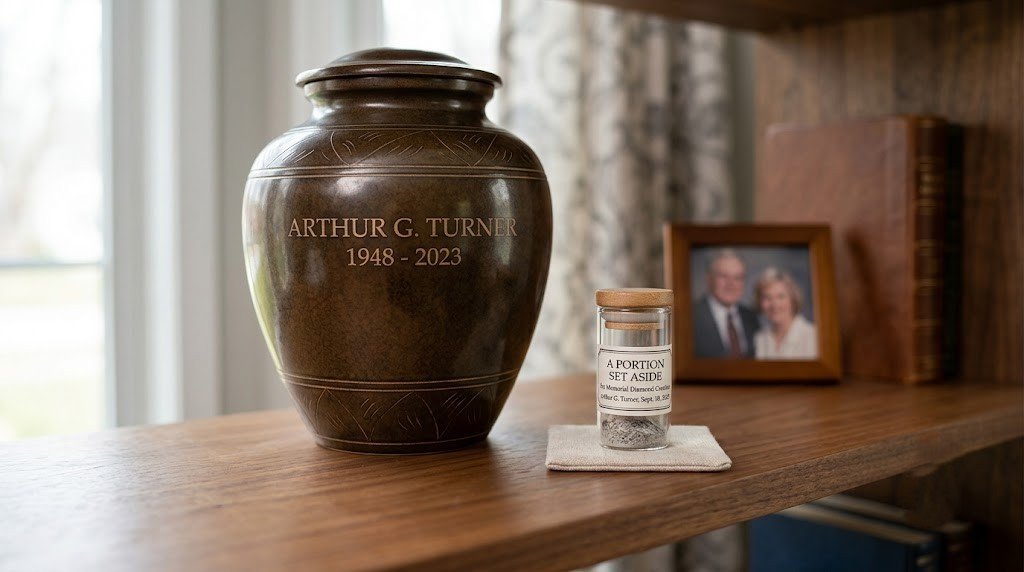
Most parents come to this question already holding an urn, which is why it feels like a decision about replacing something. It is not. Son memorial diamond vs urn is rarely an either/or, because a stone typically uses only a few tablespoons up to roughly 4 oz of ashes, and everything else stays exactly where you meant it to stay. An urn keeps all of him in one place for a fraction of the cost and no waiting; a diamond makes a small part of him wearable after months of work. Both are complete answers.

A disclosure, since this page compares formats rather than companies: Memorial Diamond grows stones, so we have a stake in one side of this. Every figure below is an industry wide band rather than our own published pricing.

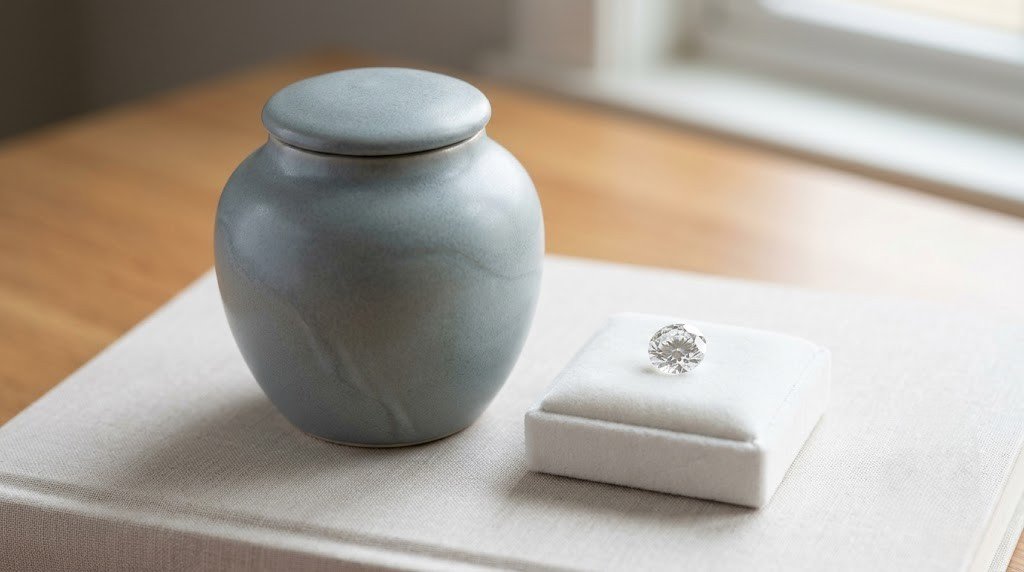
Son memorial diamond vs urn shown side by side: a closed ceramic urn beside a single polished memorial diamond on a pale surface

What Each One Actually Is

An urn is a container. It holds the whole of what a cremation produces, several pounds of it, in one place you choose, whether that is a shelf at home, a niche in a columbarium, or a grave. It needs no laboratory, no chain of custody, no processing, and nothing is altered. That simplicity is a genuine strength, and in any son memorial diamond vs urn comparison it is why an urn remains the most common thing families do.

A memorial diamond is a real, chemically genuine lab grown diamond that includes carbon recovered from a portion of those same ashes. The portion is heated in an oxygen free process until only carbon remains, purified to roughly 99.9%, converted to graphite, and grown under pressure and heat comparable to the deep mantle, on the order of 6–8 GPa at 1,400–2,500°C, into a crystal that is then cut and polished.

So the son memorial diamond vs urn comparison is not really two versions of the same thing. One preserves everything, untouched. The other transforms a fraction of it, permanently, into an object you can wear. Setting them beside each other is useful precisely because they are not alternatives in the ordinary sense.

Son Memorial Diamond vs Urn: The Seven Dimensions

Seven things separate them in practice. Everything else in the son memorial diamond vs urn decision tends to follow from one of these.

DimensionTraditional urnMemorial diamond
What happens to his remainsAll of them stay together, unchanged, in one containerA portion is consumed; the rest stays with you
CostTypically tens to a few hundred dollars for the urn itselfIndustry typical $1,500–$3,500 entry tier; $5,000–$15,000 at 0.5–1 ct
Time to receiveImmediate, usually the same week as the cremationIndustry typical 6–10 months, up to 12 for larger or specialty color stones
WearabilityNot worn; kept, displayed, or interredWorn daily if you want; diamond is 10 on the Mohs scale
Permanence and reversibilityFully reversible: ashes can later be buried, scattered, or dividedIrreversible once the portion is processed
Divisibility among familyRequires dividing the ashes themselvesSeveral stones can be grown from one urn, each bought separately
What it asks of the familyAlmost nothing beyond choosing and placing itAuthorization, paperwork, shipping material, a long wait, a real cost

Read the son memorial diamond vs urn table without a thumb on the scale. Nothing in the son memorial diamond vs urn comparison makes an urn a lesser choice. It wins outright on cost, on speed, on simplicity, and on keeping him whole.

What Happens to His Remains in Each Case?

This is the part most parents actually care about in son memorial diamond vs urn, and the numbers are reassuring in both directions.

An urn holds everything a cremation produces, which for an adult is typically several pounds. Nothing is removed, nothing is altered, and the decision stays open indefinitely. Ashes are chemically stable and keep for as long as you need them to.

A memorial diamond needs, industry wide, somewhere between a few tablespoons and roughly 4 oz, about 100 g. Against several pounds, that is a small fraction, which is the single most misunderstood point in the whole son memorial diamond vs urn conversation. How much ash a stone actually takes sets out the weights.

Be clear about what that portion becomes, though, since it is where son memorial diamond vs urn differs in kind rather than in degree. Cremated remains are mostly calcium phosphate, and usable carbon is only about 0.5% to 4% of ash by weight. That recovered carbon is blended with supplemental lab carbon to reach a workable volume, and on the ash route the personal carbon typically accounts for around 10–15% of the finished stone’s mass, with some providers publishing figures as low as 3%. For hair grown stones no equivalent published figure exists at all, so ask any provider for theirs in writing rather than assuming the ash number carries across.

What Does Each One Cost?

Here the son memorial diamond vs urn gap is wide, and pretending otherwise would be dishonest.

On the son memorial diamond vs urn ledger, an urn is ordinarily the least expensive part of a funeral. Simple containers cost very little; handsome wood, ceramic or metal urns run into the low hundreds. Many families spend nothing extra at all, keeping the ashes in the container the crematory provided.

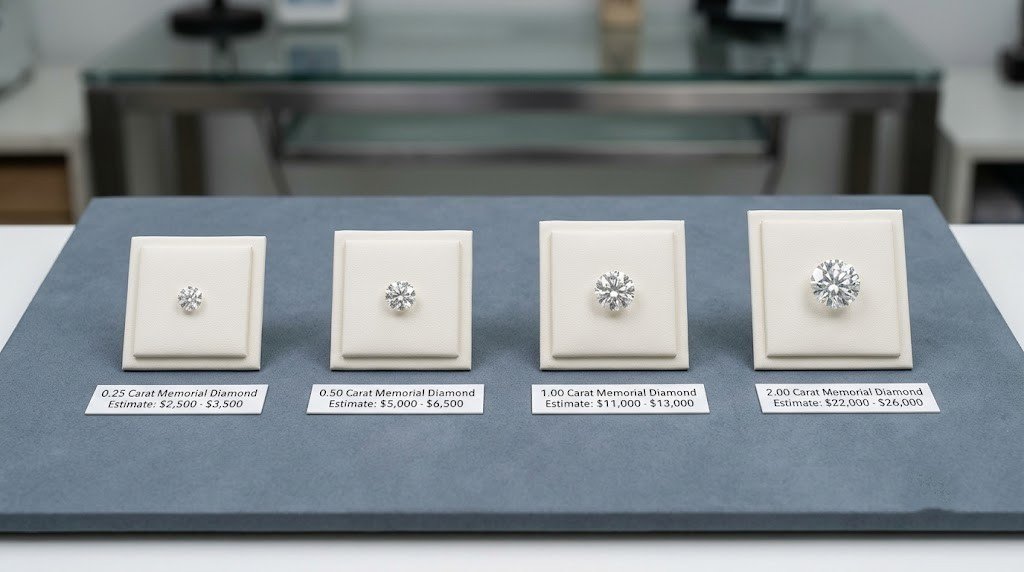
A memorial diamond is priced like fine jewelry, because that is what it becomes. Industry typical bands run roughly $1,500–$3,500 for an entry tier stone of about 0.10–0.25 ct, $5,000–$15,000 in the 0.5–1 ct range, and $20,000–$75,000 or more for stones of 2–5+ ct. Colorless stones cost meaningfully more than yellow, blue or champagne tones at the same size, and settings, engraving and an independent grading report, which is optional rather than a standard stage, are usually quoted separately. What drives the price of a single stone works through each variable.

Two honest notes on the money side of son memorial diamond vs urn:

  • A diamond is an addition, not a substitute. You will still have an urn, because most of the ashes remain in it.
  • Carat is bought from growth time, not from ash. A larger stone costs more because it sat in the press longer, not because more of him was used.
 Four loose memorial diamonds of increasing carat weight arranged in a row to illustrate how price scales with size

How Long Before You Have It?

An urn is immediate, and on this dimension son memorial diamond vs urn is not close. It is usually handed over within days of the cremation.

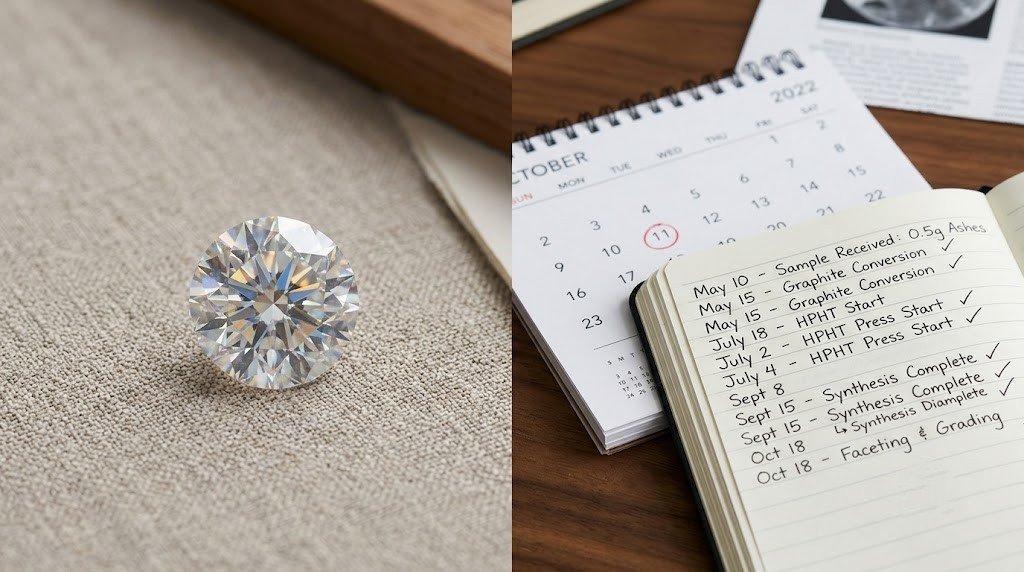
A memorial diamond takes, industry wide, 6 to 10 months from the laboratory receiving material to a finished stone, stretching toward 12 months for larger carats or specialty colors. That span covers extraction, purification, graphitization, growth, cutting and grading, and none of those stages can be usefully hurried. How the months break down stage by stage covers what happens when.

For some parents that wait is the deciding factor in son memorial diamond vs urn, and it is a fair one. The first year after losing a son is not a year most people want to spend tracking an order.

For others the wait is the opposite of a problem. A package arriving in the eighth or ninth month, long after the casseroles and the phone calls have stopped, lands in a quieter stretch of grief than anything else does. Neither reaction is the correct one, and neither settles son memorial diamond vs urn by itself.

Which One Can You Carry?

This is the dimension that sends most families looking at son memorial diamond vs urn in the first place, and it is where the two genuinely diverge.

An urn stays put. That is its purpose, a fixed place, deliberately chosen, that you visit rather than carry. Keepsake urns and small pendants holding a pinch of ash exist for families who want something portable without a laboratory involved, and they cost a fraction of a diamond.

In son memorial diamond vs urn, a diamond is built for daily wear in a way almost nothing else in this category is. Diamond sits at 10 on the Mohs scale, making it the hardest known natural mineral. It does not scratch, dull or wear away with handling. What needs occasional attention is the setting around it, not the stone. Rings, pendants and other pieces a stone can become covers the options, including keeping it unset.

Worth saying plainly: wearing something is not a truer form of remembrance than visiting a shelf. Some parents want him with them at work; some want a place to go and sit. The son memorial diamond vs urn answer often turns on which of those describes you.

Which Choice Can Be Undone?

One of them can, and that asymmetry deserves more weight in son memorial diamond vs urn than it usually gets.

Ashes in an urn keep every option open. They can be buried later, scattered later, divided later, moved from the house to a columbarium, or left alone for twenty years while nobody feels ready. Nothing degrades, and no decision made this year forecloses a different one.

A memorial diamond is final in a specific sense: once a portion has been processed, that portion does not come back as ashes. The stone itself can be reset, resized in its mounting, passed on or sold, but the material change is permanent. That is the strongest argument in son memorial diamond vs urn for waiting rather than deciding in the first raw months.

There is no deadline on son memorial diamond vs urn. Ashes do not expire, and a parent who is not ready to decide anything this year is not losing an option by waiting. Where to begin when the time does feel right sets out the order the decisions come in.

Can Several People Each Have Something?

Both sides of son memorial diamond vs urn handle this, differently.

Dividing ashes between an urn and several keepsake containers is straightforward, immediate and costs almost nothing. Many families do exactly that, a main urn plus small portions for siblings, grandparents, or a partner.

Growing several stones is also possible, since each needs only its small portion, but each one is an independent growth run with its own price and its own finish date. Three stones is three purchases, not one split three ways, and they will not match each other, because color in any diamond comes from trace elements present as the crystal forms, nitrogen toward yellow, boron toward blue, and neither present at all for colorless. Whether several relatives can each have a stone goes through the practicalities.

So on divisibility, son memorial diamond vs urn is less a contest than a question of budget and patience.

Does Son Memorial Diamond vs Urn Have to Be a Choice?

No, and that is the most useful sentence on this page about son memorial diamond vs urn.

Because a stone consumes only a small portion, the common arrangement is both: a portion goes to the laboratory, and the remainder stays in the urn on the shelf, or goes into the ground beside a grandparent, or is scattered at the lake exactly as planned. Nothing about commissioning a diamond obliges a family to abandon what it already decided.

Ways families actually combine them:

  • Urn kept whole, small portion drawn. The urn stays as it is; the diamond is grown from what would never have been noticed missing.
  • Burial or scattering proceeds as planned, with a portion set aside beforehand.
  • A lock of hair instead of ash. Hair is roughly 50% carbon by weight, so a stone can be grown without touching the urn at all, useful if he was buried rather than cremated, or if the ashes were already scattered.
  • Nothing now, a decision later. Ashes keep. So does a lock of hair kept in an envelope.

Framed that way, son memorial diamond vs urn stops being a fork in the road and becomes a question of whether you want one more thing in addition to what you already have.

An urn returned to its shelf with a small labeled container beside it, illustrating a portion set aside while the rest stays in place

Who Has the Say Over His Ashes?

Worth settling before anything else in son memorial diamond vs urn, because families sometimes plan for months around a decision that was never theirs.

Whoever is recognized as having control of a person’s remains is set by state law, and parents are not automatically first in line for an adult son. If he was married, his spouse commonly holds that right; if he had adult children of his own, they may rank ahead of you too. Anything he put in writing, a will, a form signed at the funeral home, a disposition directive, can rearrange the default. A funeral director in the state where he died will usually tell you the order at no charge, and an attorney licensed there can confirm it.

An urn rarely brings this to a head, since it changes nothing. Commissioning a diamond does, because a portion is removed and altered. That difference is the quiet reason the son memorial diamond vs urn decision can turn into a family conversation when the urn alone never did.

What Most Families Actually Do

Context helps when son memorial diamond vs urn starts to feel like a decision that must be extraordinary.

Cremation is now the majority choice in the United States. The National Funeral Directors Association’s 2025 cremation and burial report puts the projected cremation rate at 63.4% against 31.6% for burial. Of those families, the overwhelming majority keep, inter or scatter the ashes, and do nothing else at all.

That is the honest backdrop to son memorial diamond vs urn: a memorial diamond is an uncommon choice, not a superior one, and choosing the ordinary thing is not a smaller act of love. The complete route for a son ashes diamond exists for families who want it, not as a standard anyone is failing to meet.

If you are somewhere in the middle, drawn to the idea but unwilling to alter anything yet, set aside a portion, keep it sealed and labeled, and decide nothing. That single step preserves both options for as long as you want them preserved.

Frequently Asked Questions

Can we have both a diamond and an urn?

Yes, and most families who commission a stone do exactly that. A diamond typically uses a few tablespoons up to roughly 4 oz, so the urn stays on the shelf with nearly all of its contents, or is buried or scattered as originally planned.

Will the urn look emptier afterward?

Almost never. Against the several pounds an adult cremation produces, the portion drawn for a stone is small enough that most families cannot tell by looking. If that matters to you, weigh or photograph the contents beforehand.

Is an urn cheaper than a memorial diamond?

Considerably. Urns commonly run from very little to a few hundred dollars, while industry typical diamond pricing starts around $1,500–$3,500 for an entry tier stone and climbs steeply with carat. Cost is the clearest difference in son memorial diamond vs urn.

Can a diamond be turned back into ashes?

No. Once a portion has been processed into carbon and grown into a crystal, that change is permanent. The finished stone can be reset, passed on or sold, but the material cannot be returned to its previous form.

He was buried, not cremated. Is this off the table?

Not necessarily. A lock of hair kept from a haircut, a hairbrush or the funeral home is a workable carbon source and requires no cremation, so a stone remains possible long after burial. Ask a provider what quantity they need.

Who decides if the family disagrees?

The person state law recognizes as controlling his remains, subject to anything he left in writing. For an adult son that is often a spouse or his own adult children rather than his parents. A funeral director can usually confirm the order locally.

Final Thoughts on Son Memorial Diamond vs Urn

If there is one thing to carry away from son memorial diamond vs urn, it is that the comparison is mostly a false frame. You are not choosing between honoring him well and honoring him badly. You are choosing whether to add one object to an arrangement that is already complete.

An urn asks nothing of you, and it answers son memorial diamond vs urn on its own. It costs little, arrives immediately, keeps all of him together in one place, and leaves every future decision open. For most families that is enough, and there is nothing thin about it.

A diamond asks for authorization, a portion, several thousand dollars and most of a year, and gives back something you can wear to work, to a wedding, to the ordinary Tuesdays that turn out to be the hard ones. Whether he was six or sixty, neither choice measures anything about him or about you.

Take the time. Nothing about ashes runs out, and the version of this decision you make in month eighteen will almost certainly sit better than the one made in week three.

Learn More About Son Memorial Diamonds

Talk With Memorial Diamond

If you are weighing son memorial diamond vs urn and want a straight answer about what a portion of what you hold could actually become, reach out to Memorial Diamond at memorialdiamond.us. Asking costs nothing and commits you to nothing, and keeping the urn exactly as it is remains a perfectly good ending to the conversation.

son-memorial-diamond-timeline

How Long Does It Take to Make a Son Memorial Diamond?

Parents almost always ask this before they ask anything about price, and the reason is not impatience: it is that the waiting has to be planned for. A son memorial diamond timeline generally runs about six to ten months from the day a laboratory receives your material to the day a finished stone is ready. Stones above roughly two carats, and specialty colors such as black, can stretch that toward twelve.

Son memorial diamond timeline shown as a finished memorial diamond resting beside a calendar and a dated laboratory log

How Long Is the Son Memorial Diamond Timeline?

Six to ten months is the honest industry answer for a son memorial diamond timeline, measured from receipt of material to finished stone. That is the band most providers work inside, and it is wide because it has to cover very different commissions.

A small stone in a standard shade sits near the short end of the son memorial diamond timeline. A large stone, an unusual color, or an order with several optional steps attached sits nearer the long end, and can pass twelve months without anything having gone wrong.

None of that band is memorialdiamond.us’s published turnaround, because no turnaround has been published. Treat it as the shape of the category, then ask whoever you commission for their own figure and get it in writing.

The range is not a queue you are stuck in, either. Most of it is a physical process at a fixed pace, and chasing does not shorten the part that takes the time.

Why Does It Take Six to Ten Months?

Because a diamond is not assembled, it is grown. Carbon has to be recovered, purified, converted, crystallized, cut and, in most cases, checked by somebody independent.

Growth itself is the part people underestimate. Inside a high pressure press the cell is held at roughly 6 to 8 GPa and somewhere between 1,400°C and 2,500°C, conditions that imitate the deep mantle, and the crystal builds up slowly under them. A minority of providers grow by chemical vapor deposition instead, layering carbon onto a seed plate in a vacuum chamber.

Either method takes weeks to months of continuous, monitored running, which is the bulk of any son memorial diamond timeline. You can read more about how the two growth methods work if the physics interests you.

Everything either side of growth, the extraction before it, the cutting and grading after, adds meaningfully to the total, but none of it is where the months of a son memorial diamond timeline mostly go.

What Are the Eight Steps in a Son Memorial Diamond Timeline?

Laid out in order, the sequence is easier to hold in your head than a single span of months. Two of the eight are optional, and whether you choose them changes the son memorial diamond timeline total.

#StepWhat happensOptional?
1Intake and documentationMaterial is received, logged and tracked under chain of custody proceduresNo
2Carbon extraction and purificationEverything that is not carbon is stripped away, reaching roughly 99.9%+ purityNo
3GraphitizationThe purified carbon is heated to roughly 2,500 to 2,700°C and converted to graphiteNo
4GrowthHPHT at roughly 6 to 8 GPa and 1,400 to 2,500°C, or CVD for a minority of providersNo
5Cutting and polishingA gemologist shapes the rough crystal into the finished stoneNo
6IrradiationPost growth treatment to shift or intensify color, where offeredYes
7Independent gradingA third party laboratory reports cut, color, clarity and caratYes
8SettingThe stone is mounted as a ring, pendant or earrings, or returned looseYes

What a finished stone can be set into covers that last step, which begins only once a stone exists.

What the library does not publish is how many weeks each individual step takes, and it would be dishonest to invent the breakdown. The documented figure is the overall span; how it divides internally varies by provider and by commission.

So use this list to ask better questions rather than to build a calendar. A provider who can say where your son memorial diamond timeline currently sits, step by step, is telling you something useful about how they work.

When Does the Clock Actually Start?

Not when you decide, and not when you pay. It starts when a laboratory has your material in hand and logged, so every son memorial diamond timeline has a private prologue that belongs entirely to you, and it is worth organizing early.

There is a practical obstacle parents are rarely warned about. Where his remains are concerned, a surviving spouse or registered partner, or, if he had them, his own adult children, can sit above a parent in the order the law recognizes. It turns on your state’s statute and on whatever he put in writing beforehand, so the answer is genuinely local rather than universal.
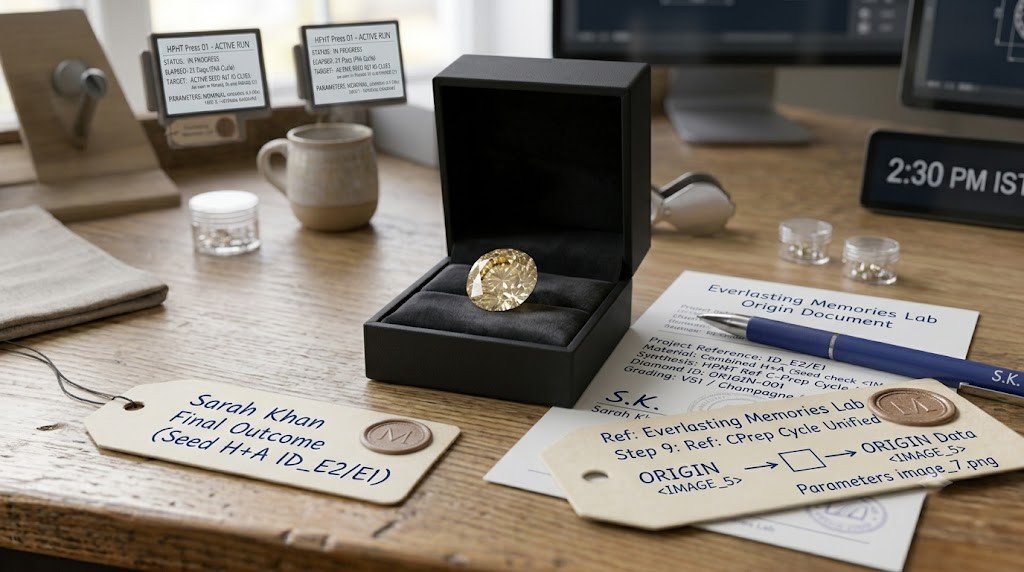
Sorting that out is often the slowest part of the whole project, and it happens before the son memorial diamond timeline begins. A funeral director can usually tell you quickly who holds that authority; an attorney licensed in your state can resolve anything disputed.

Hair you already keep at home tends to be simpler in practice, though a person’s belongings can still form part of an estate, and a lock somebody else is holding is a conversation to have rather than a decision to make alone.

 A high-pressure high-temperature growth press with a sealed cell being loaded by a technician

Which Step Takes the Longest in a Son Memorial Diamond Timeline?

Growth, by a wide margin. Every other step is measured against it, and it is the one step whose length is chosen rather than fixed.

The reason is simple: carat comes from time under pressure. A crystal is built atom by atom, so a stone twice the weight needs considerably more than twice the patience, and the press is occupied throughout, which is why growth dominates any son memorial diamond timeline.

Extraction and graphitization are real work, stripping cremated remains or hair down to almost pure carbon, then converting it to a feedstock, but they are preparation for the long run rather than the long run itself. Cutting and polishing is skilled, careful and comparatively quick.

Because the reference library publishes the overall span and not the stage by stage split, ask each provider how they divide it. Any honest answer will put most of your son memorial diamond timeline inside the growth cell. How the whole sequence runs from intake to finished stone walks through the same order in more detail.

Does Carat Size Change the Son Memorial Diamond Timeline?

Yes, more than any other single choice you make. Size is bought with time in the press rather than with material, so the larger stone is always the longer one.

That has a consequence worth sitting with before you order. A half carat commission and a two carat commission are the same process, the same person’s carbon and the same laboratory, the difference between them is months. Choosing size is therefore choosing a date as much as a price.

It also means sending more of him does not speed anything up or scale anything up. Providers work from a modest portion either way, and a fuller submission neither shortens the son memorial diamond timeline nor produces a bigger crystal. How much ash a memorial stone actually needs covers the usual quantities.

If the wait is the thing you are struggling with most, a smaller stone is a legitimate answer rather than a compromise. What a stone at each size typically costs sets the size question alongside the money one.

Does Color Change the Son Memorial Diamond Timeline?

It can, and specialty shades are the clearest example. Black stones and other treated colors sometimes push a commission toward the twelve month end of the range.

The mechanism differs depending on what you want. A colorless result requires excluding trace elements during growth, which means tighter process control rather than an extra step bolted on. Nitrogen caught in the crystal produces yellow; boron produces blue; only the absence of both reads as colorless.

Treated colors work the other way. Red, pink, green and black are typically produced by irradiating the finished stone after growth, where a provider offers it, and that is an additional stage added to the son memorial diamond timeline rather than a change inside the press.

If a particular shade matters to you, raise it at the quoting stage rather than later, and ask what it adds to the son memorial diamond timeline in weeks. What color to expect from his ashes explains why warm tones are the usual outcome.

Is the Son Memorial Diamond Timeline Different for Ashes and Hair?

The published son memorial diamond timeline covers both routes, and the growth stage, the long one, is essentially the same either way. Where they differ is in what has to happen before growth can begin.

Cremated remains are mostly calcium phosphate, and the carbon worth recovering is between about 0.5% and 4% of their weight. Once purified and topped up with lab carbon so there is enough volume to grow with, that personal carbon usually represents on the order of 10% to 15% of the finished crystal’s mass, with some providers publishing figures as low as 3%.

Hair works from the opposite position: keratin is around 50% carbon by weight, so a modest lock carries enough to work with, and no cremation is involved. That is a fact about what you send, not about what you receive: no comparable published finished stone figure exists for hair, and none for a submission combining both. Ask whoever you commission to put their own number in writing.

None of that reliably lengthens or shortens a son memorial diamond timeline, so choose the material for what it means to you. How much of his hair a stone needs sets out the usual amounts, and whether more than one family member can each have a stone covers splitting a single submission.

Why Is So Much of the Son Memorial Diamond Timeline Silent?

Because for long stretches there is genuinely nothing new to report. A crystal growing under pressure does not produce weekly news, and a laboratory that contacted you every seven days would mostly be telling you that the press is still running.

That silence is normal, and it is also hard. Parents describe the middle months as the strangest part, the decision made, the material gone, the house quiet, and no obvious sign that anything is happening on his behalf.

The practical response is to establish expectations at the start rather than to chase later. Ask, before you commit, what you will be told and when: confirmation of arrival, confirmation that growth has begun, and notice when the stone comes out of the press.

A provider who sets that out plainly is easier to wait alongside. The son memorial diamond timeline is long enough that how a company communicates matters nearly as much as how it grows.

What Updates Should You Ask For, and When?

Ask before you commission, not afterwards, and ask for specifics rather than reassurance. These are the points worth pinning down:

  1. Confirmation of receipt written notice that the material arrived and has been logged.
  2. Confirmation of extraction that carbon was successfully recovered and purified.
  3. Start of growth the date the cell actually went into the press.
  4. End of growth when the rough crystal came out.
  5. Cutting complete the finished shape and final carat weight.
  6. Grading, if ordered when the report is issued and how you receive it.
  7. Dispatch how the stone travels back, insured and tracked.

Seven notifications across the better part of a son memorial diamond timeline is not intrusive, and most providers can accommodate it. What you are really buying with that list is the ability to stop wondering between messages.

Put the agreed points in writing alongside the quote. A son memorial diamond timeline with named checkpoints is far easier to live with than one long unexplained silence.

What Can Extend a Son Memorial Diamond Timeline?

Several things, most of them ordinary rather than alarming. Knowing them in advance takes the fear out of a delay if one arrives.

  • A growth run that does not produce a usable crystal and has to be repeated.
  • A larger carat or a specialty color added after the original quote.
  • Optional independent grading, which adds a third party laboratory’s own schedule to yours.
  • A setting commissioned separately, which begins only once the stone exists.
  • Paperwork over authority that was not settled before material was sent.

Ask what each of these would mean for your own son memorial diamond timeline specifically, in weeks and in money. A provider who has clearly thought about failure is generally a safer one than a provider who implies it never happens.

And if a delay does come, ask what stage it is at. A son memorial diamond timeline that slips during growth is a very different situation from one that slips because nobody chased a grading report.

How Do You Plan Around a Date That Matters?

Work backwards, generously. If you want the stone in hand for a birthday, an anniversary of his death, or a family gathering, count back from that day using the long end of the range rather than the short one.

Ten months back from the date is a sensible planning anchor, and twelve if you are considering a large stone or a treated color. A son memorial diamond timeline built on the long end leaves room you may not need but will be glad of. Commissioning with only six months of margin means hoping for the fastest version of a process that does not reliably deliver it.

Tell the provider the date explicitly. Some can sequence work around a deadline; none can compress the growth stage, and a company that promises to is telling you something you should not want to hear.

If the date cannot be met, there is no harm in letting it pass. A stone that arrives in the spring instead of the winter is the same stone, and nothing about the son memorial diamond timeline makes one month more fitting than another.

Chain-of-custody paperwork and dated status updates laid out beside a sealed material container

What Does the Son Memorial Diamond Timeline Feel Like for a Parent?

Different in each third, from what parents describe. The first stretch is busy, paperwork, decisions, packaging, questions. There is something to do, and doing it helps.

The middle is the long one. His material is somewhere else, the decisions are behind you, and the son memorial diamond timeline becomes an abstraction rather than a task. Some parents find they think about it constantly; others are surprised by how completely it recedes, and then feel guilty about that.

The last stretch changes again. Once a stone leaves the press and takes a shape, it stops being a process and becomes an object with a delivery date, which can land harder than people expect.

Whatever version you get, none of it is wrong, and whether your son was six or sixty does not make the months pass differently. Deciding whether this is the right choice at all is a fair thing to revisit while you wait.

Frequently Asked Questions

Can I pay more to have it finished faster?

Generally no, because the limiting factor is physical rather than administrative. Growth under pressure takes the time it takes, and no fee shortens it. A provider may be able to sequence the steps either side more tightly, but the press cannot be hurried.

Does the material expire if I wait before ordering?

No. Cremated remains and hair keep indefinitely when stored dry and undisturbed, so there is no deadline pressing on you. Families commission stones years after a death, and waiting until the decision feels settled costs nothing in terms of what is possible.

How long after he died can I still do this?

There is no cutoff. What matters is that suitable material exists and that whoever holds authority over it agrees, not how recently the death occurred. Ashes kept in an urn for a decade and a lock of hair kept longer are both workable starting points.

What if I change the size partway through?

Ask immediately, because the answer depends entirely on which step has been reached. Before growth begins a change is usually straightforward; once a crystal is forming in the press, changing the target size generally means starting that stage again.

Will I be told if something goes wrong?

You should be, and it is worth confirming in writing that you will. Ask specifically what happens if a growth run fails: whether the laboratory repeats it, how long a repeat adds, and whether any additional charge falls to you.

Can two stones be grown at the same time?

Often yes, since only a portion of the material is used and several stones can come from one submission. Whether they grow simultaneously or in sequence varies by provider, and the difference matters for when each family member receives theirs.

Final Thoughts on the Son Memorial Diamond Timeline

Most of the months in a son memorial diamond timeline are physics, and physics does not negotiate. What is genuinely in your control is the front end, settling authority early, choosing a size with the calendar in mind, and agreeing what you will be told and when.

The rest is waiting, and waiting for something on behalf of your son is its own particular experience. It helps to know in advance that the quiet stretch is normal, expected, and not a sign that anybody has forgotten him.

When the stone arrives, the son memorial diamond timeline stops mattering almost immediately. Nobody looks at a finished diamond and thinks about the week it was in the press.

Learn More About Son Memorial Diamonds

Talk With Memorial Diamond

If you want to understand what the months would actually look like for your family, you are welcome to ask before deciding anything. Reach out to Memorial Diamond at memorialdiamond.us and talk it through, including the question of when, which is often the hardest one to settle.

son-memorial-diamond-ideas-rings-pendants-keepsakes

Son Memorial Diamond Ideas: Rings, Pendants, and Keepsakes

At some point the question stops being scientific and becomes personal: once the stone exists, what do you actually do with it? The honest answer is that the good son memorial diamond ideas are the ones that match how you want him near you, a ring, a pendant, earrings, a piece a father would wear, or the stone kept loose in a box and never set at all. None of those is the correct choice, and any of them can be changed later.

Son memorial diamond ideas shown as a pendant, a ring and a loose memorial stone arranged together on linen

What Are the Main Son Memorial Diamond Ideas?

Seven formats cover almost everything families actually choose. They differ less in cost than in how present the stone is in an ordinary day.

#FormatWhy parents choose itWorth knowing
1Pendant or necklaceClose, private, easy to wear under anythingSuits every stone size; the most forgiving choice if you are undecided
2RingConstantly visible and constantly feltTakes the most knocks of any setting; sizing and resizing matter
3EarringsTwo stones from one submission, worn as a pairNeeds matched or deliberately mismatched stones
4BraceletVisible to you rather than to othersMore exposure to bumps than a pendant, less than a ring
5Men’s pieceA signet, tie bar, cufflink or lapel pinOften the format a father will actually wear
6Loose stoneKept in a box, held rather than wornNo setting cost; can be set at any point in the future
7Shared setSeveral smaller stones from one submissionLets siblings, both parents and grandparents each hold one

Read across the table and the pattern behind most son memorial diamond ideas becomes clear: you are really choosing between visibility and protection, and between something for yourself and something for the family.

No ranking is implied among these son memorial diamond ideas. A loose stone in a drawer is not a lesser tribute than a ring worn every day, and parents often move between the two over years.

Should It Be Worn Daily or Kept Safe?

Answer this first, because the rest of the son memorial diamond ideas follow from it. A stone meant for daily wear points toward a pendant or a ring; a stone meant to be kept points toward a case or a box.

Daily wear has an obvious appeal: he is with you at work, in the supermarket, at three in the morning. It also makes the piece ordinary, which some parents find comforting and others find unbearable.

Keeping the stone safe has its own logic. A piece taken out on his birthday, or when you simply want it, carries a different weight than one you stop noticing. Neither approach is more devoted.

If you genuinely do not know, the practical move is to choose a format that leaves the door open. That is why so many son memorial diamond ideas start with a simple pendant and change later, rather than starting with something elaborate.

Which Son Memorial Diamond Ideas Work as a Ring?

Of all the son memorial diamond ideas a ring is the most present, and for some parents that is exactly right. It is in your eyeline all day, and you feel it against everything you touch.

It is also the hardest working piece of jewelry a person owns. Rings take knocks a pendant never sees, so setting style matters: a bezel or low profile setting protects a stone far better than high prongs.

Size matters too. A small stone reads beautifully in a slender band and can look lost in a wide one, so see a similar carat weight set before committing. Among son memorial diamond ideas, the ring is where setting design does the most work.

One detail parents often like: a ring can be worn on any finger, and many choose one not tied to marriage, the right hand, or whichever finger feels like his. What a stone at each size typically costs helps set the size question against a budget.

Why Do Pendants Lead Most Son Memorial Diamond Ideas?

 A bezel-set memorial diamond in a men's signet ring beside a tie bar carrying a smaller stone

Because a pendant is the least demanding choice in every sense. It works at any carat weight, sits against you without being on display, and can be tucked away when you do not want to explain it.

That privacy matters more than people expect. A memorial piece invites questions, and some days answering them is impossible. Among the son memorial diamond ideas here, a pendant is the one that lets you decide each morning whether today is a day for that conversation.

It is also the gentlest setting for the stone. A pendant hangs clear of most impacts, so the worries that attach to a ring fall away.

For parents who want him near without wanting a statement, a simple pendant remains the most quietly useful of the son memorial diamond ideas, and the easiest to reset into something else years from now if your feelings change.

What About Earrings, Bracelets and Smaller Pieces?

Earrings are among the son memorial diamond ideas that need two stones, which is workable because only a portion of the material is used and several diamonds can often come from one submission.

Matching matters here in a way it does not elsewhere. Two stones grown in separate runs can differ noticeably in shade even from the same source, so if a matched pair is the goal, say so before anything is commissioned. Some parents deliberately choose two different tones and find that more honest.

Bracelets sit between a ring and a pendant. You see the stone constantly because it is in your own field of view, and it takes fewer knocks than a ring.

Smaller pieces belong on the list too. A charm added to an existing bracelet, a stone set into a watch, a pin on a coat lapel: son memorial diamond ideas do not have to be built from scratch when something you already wear can carry him. Whether more than one family member can each have a stone covers splitting one submission, and what shade to expect and how metal changes it matters once you choose a metal.

Which Son Memorial Diamond Ideas Suit a Father?

This deserves a straight answer, because many fathers quietly want something and assume nothing is made for them.

A signet ring carries a stone well, particularly bezel set and flush with the metal. A tie bar, cufflinks or a lapel pin suit someone who dresses formally. A plain band with a small flush set stone is the most discreet of the son memorial diamond ideas here, and reads as an ordinary ring to anyone who does not know.

There is also the pocket option, which is not jewelry at all: a loose stone in a small case, carried and handled rather than worn. Some fathers find that far more natural than anything worn around the neck.

The point is simply that son memorial diamond ideas are not automatically feminine, and nobody should end up with nothing because the obvious suggestions did not suit them. Where to begin if you are still deciding is a useful starting point for a parent who has not made up their mind.

Is Keeping the Stone Loose One of the Son Memorial Diamond Ideas?

Yes, and it is more common than the jewelry led framing of this topic suggests. A finished diamond kept in a case, a drawer or on a shelf is a complete answer in itself.

There are good reasons for it. Some parents cannot face wearing him. Some want the decision to be someone else’s one day. Some find holding a stone in a palm better than seeing it on a hand.

Practically it is also the cheapest and most flexible of the son memorial diamond ideas, since no setting is commissioned and nothing is committed to. The stone can be set in five years, or twenty, or never.

If you go this way, ask about a proper case and keep any grading paperwork with it. Among all son memorial diamond ideas the loose stone is the one most likely to be handed on, so make it easy for whoever receives it to know what it is.

Will Daily Wear Damage the Stone?

Not in any way you need to worry about. Diamond sits at 10 on the Mohs scale: it is the hardest known natural mineral, and a memorial diamond is chemically genuine, with the same properties as any other.

That hardness is what makes daily wear practical. The stone will not scratch against ordinary surfaces, will not dull, and will not need replacing. Dishes, gardening, a handbag full of keys: none of it touches the stone.

The setting is the part that wears, not the diamond. Prongs loosen, gold thins and chains weaken, and any jeweler will check and tighten those. Booking that once a year is the whole of the maintenance.

So durability should not narrow your son memorial diamond ideas at all. Choose the format you want for emotional reasons and let a good jeweler solve the practical ones.

Do Settings Add to the Cost of Son Memorial Diamond Ideas?

Yes: across the industry a quoted price generally covers a finished loose stone, and jewelry settings are typically priced separately. That is normal rather than a hidden charge, but confirm it before assuming a quote includes the mounting.

Metal choice moves the number as much as design does, so two son memorial diamond ideas built around identical stones can differ substantially. Platinum costs more than gold, and a heavier, more sculptural piece uses more of it.

The sequence matters too. A setting can only be commissioned once the stone exists and its final carat weight is known, so setting work sits after the growing. How long the whole process takes, stage by stage explains where that falls.

Nothing here is memorialdiamond.us’s published pricing, because none has been set. Treat these as category norms, ask whoever you commission to itemize the stone and the setting separately, and ask separately about how a finished stone is graded, which is optional and priced on its own.

Can a Son Memorial Diamond Be Engraved?

Usually, and it is one of the quietly meaningful options available: though engraving is almost always an add on rather than something included, so ask about it specifically.

Two different things get engraved. The setting can carry a name, a date or initials inside a band or on the back of a pendant, which is straightforward jewelry work. The stone itself can sometimes take a microscopic laser inscription on the girdle, readable only under magnification.

The second is more specialized, and availability varies. It is also permanent in a way worth thinking about: a phrase that feels right in the first year may feel different in the tenth.

If engraving matters to you, raise it early rather than after a piece is finished. It is often simpler to build into the original commission, and it is one of the few son memorial diamond ideas that costs very little and adds a great deal.

Can the Setting Be Changed Later?

The same memorial diamond shown first as a pendant and then remounted in a ring to illustrate resetting

Yes, and this is the single most freeing fact on this page. A diamond can be removed from one setting and mounted in another, the same way any family stone gets reworked across generations.

That means the choice you make now is not permanent. A pendant can become a ring. A ring can be reset into something a grandchild wears. A loose stone can stay loose for a decade and then be set.

It matters because grief changes what you want. Parents describe wanting something private in the first year and something visible later, or the reverse, and resetting means neither instinct has to be right forever.

So treat the first setting as a decision for now rather than for good. Most son memorial diamond ideas are reversible, and knowing that takes much of the pressure out of choosing.

What If Two Parents Want Different Son Memorial Diamond Ideas?

It is common, and not a sign that either of you is grieving wrongly. One parent wants to wear him constantly; the other cannot bear the idea and wants the stone kept safe.

The most practical answer is often two stones rather than one. Because only a portion of the material is used, more than one diamond can frequently be grown from a single submission, and two smaller stones can total less than one larger one.

That lets each parent pick from the son memorial diamond ideas independently: a pendant for one, a loose stone in a case for the other, without either arguing the other out of what they need. It also works where parents are divorced, estranged, or no longer in the same house.

And if you are arranging this alone, none of the negotiating applies. Choose the son memorial diamond ideas that suit you, and leave the question of anyone else’s piece for a day when it comes up. Whether the stone is genuinely made from him is a separate question worth reading if anyone in the family is unsure.

Who Actually Has the Say Over His Remains?

Before any of the son memorial diamond ideas becomes a design decision, there is a legal one, and parents are often surprised by it. A mother or father is not automatically the person whose signature releases a son’s remains.

Depending on the state he lived in, and on anything he set down while he was alive, a widow, a widower, a civil partner or a grown child of his own may be asked ahead of you. Written instructions, a funeral prearrangement or a named agent for disposition can all shift that order, and the rules are not the same everywhere.

The quickest way to find out is to ask the funeral director who handled the cremation; an attorney licensed in his state can resolve anything disputed. Have that conversation early, before anyone is attached to a particular piece.

Hair already in your keeping is usually a simpler matter in practice, though belongings can still form part of an estate, and a lock held by someone else is something to discuss rather than decide. How the whole thing works from material to finished stone covers what the process asks of you either way.

How Do You Choose Among Son Memorial Diamond Ideas Without Rushing?

Slowly, and later than you think you have to. The stone takes months to grow, so there is no need to settle the setting at the same time you settle everything else.

A useful sequence is to weigh the son memorial diamond ideas last. Commission the stone, live with the idea of it while it grows, and only then choose what it goes into, by which point you will know far better whether you want him visible or kept.

It helps to try things on. Any jeweler will let you handle similar stones in different settings, and imagining a piece is nothing like holding one.

And keep it in proportion. A memorial diamond is one option among several valid ones, and burial, scattering or an urn at home are not lesser choices. How a diamond and a traditional urn compare is worth reading if you are unsure.

Frequently Asked Questions

Can my own local jeweler set the stone?

Usually yes, and many families prefer it. Confirm with both the provider and the jeweler first, ask about insurance while the stone is out of your hands, and check the jeweler is comfortable working with a stone that cannot be replaced.

What metal suits a warm toned stone best?

Yellow gold tends to deepen a champagne or yellow stone, while white gold and platinum make the same shade read cooler and brighter. Neither is correct: ask to see your stone against both before deciding, since photographs rarely show the difference honestly.

Can a small stone still be set as a ring?

Absolutely. A quarter carat stone set flush or bezel set in a slender band looks deliberate rather than sparse, and it is more practical for everyday wear than a larger raised stone. Ask your jeweler to show you a comparable weight already mounted.

Is it safe to wear every day?

Yes. Diamond is the hardest known natural mineral, so the stone itself is effectively immune to ordinary wear. What needs occasional attention is the setting: prongs, chains and clasps loosen over years, so have any worn piece checked annually.

Can two stones be set as a matching pair?

Often, but raise it before anything is commissioned. Separate growth runs can produce visibly different shades even from one submission, so a truly matched pair has to be planned rather than assumed. Some families choose deliberately differing stones instead.

What if I do not want to wear it at all?

That is a complete answer, and a common one. A finished stone kept loose in a case costs less, commits to nothing, and can be set at any point in the future, or passed on unset to someone who will decide for themselves.

Final Thoughts on Son Memorial Diamond Ideas

No arrangement of metal and stone measures how much he was loved, and no format is the one a grieving parent is supposed to choose. Whether he was six or sixty, the right piece is the one you will actually live with.

If it helps to have a default: of all the son memorial diamond ideas, a simple pendant suits more people than anything else, costs less than most alternatives, and can be reset into something entirely different whenever you want.

And if none of the son memorial diamond ideas here feel right yet, that is fine too. The stone will keep, unset, for as long as you need to think about it.

Learn More About Son Memorial Diamonds

Talk With Memorial Diamond

If you would like to talk through what a finished stone could become, without deciding anything today, you are welcome to. Reach out to Memorial Diamond at memorialdiamond.us and ask about formats, metals, or what tends to work.

son-hair-diamond-steps

Step by Step: Turning Your Son’s Hair Into a Diamond

It usually starts with an envelope you already own, a curl from a first haircut, a lock cut in a hospital room, something kept without a plan for it. The son hair diamond steps come to seven: look at the sample, settle whose decision it is, pick a provider, choose the stone, post the lock, wait out the growth, then receive and set it. Six to ten months is the usual industry span.

 The son hair diamond steps beginning with a tied lock of hair in a paper envelope beside a finished memorial stone

How Do the Son Hair Diamond Steps Differ From the Ashes Route?

In three ways that matter, and they change the shape of the whole thing rather than just the wording.

The first is that no cremation is involved at any point. A son who was buried, or who died decades ago, or whose remains were never yours to direct, can still be represented in a stone if a lock of his hair exists somewhere. That single fact is why the son hair diamond steps exist as a separate route at all.

The second is quantity. Hair is roughly 50% carbon by weight as a starting material, against the small carbon fraction recoverable from cremated remains, which is why the request is measured in grams rather than ounces.

The third is that the material is usually already in your possession, which means the son hair diamond steps can begin on the afternoon you decide to begin them. Nobody has to open an urn.

Hair routeAshes route
Cremation requiredNoYes
Typical amount requestedA small lock, a few gramsA few tablespoons to roughly 4 oz
Where the sample usually sitsA keepsake box, a locket, a baby bookAn urn or a funeral home’s keeping
Published finished stone carbon shareNone publishedRoughly 10 to 15%, some providers as low as 3%
Typical wait6 to 10 months6 to 10 months

The complete guide to a son hair diamond covers the background that sits behind these seven stages.

Step 1: What Do You Actually Have in That Envelope?

Open it, in your own time, and look properly. The son hair diamond steps begin with an honest assessment of the sample, because everything afterwards is sized against it.

Note three things. Roughly how much is there, a pinch, a lock, a full braid? Is it loose strands or a tied bundle, since a tied lock is easier to weigh and handle? And is there anything on it: dye, bleach, styling product, or the residue of a mounting adhesive if it came out of a locket or a memory frame?

Age is rarely the problem parents fear it is, and it delays none of the son hair diamond steps. Hair is chemically stable and keeps for decades in a drawer, which is exactly why baby curls kept in the 1970s are still workable material today.

Loose strands from a brush are a genuine question mark rather than an automatic no. They tend to be fewer and lighter than a cut lock, and whether they meet a given laboratory’s threshold is a question for that laboratory. How much hair is actually needed sets out the quantities in detail.

Step 2: Whose Decision Is It?

Worth thinking through before you commit to any of the son hair diamond steps, even where the answer turns out to be straightforward.

The rules most states write on this subject are aimed at a person’s remains, a statutory order of priority naming who may direct them, with a surviving spouse or registered partner usually high on that list, adult children of his own able to outrank his parents, and everything subject to whatever he set down in writing and to which state you are in. Because that machinery is pointed at the remains themselves, a lock already sitting in your own keeping is usually the more straightforward question in practice.

Usually is doing real work in that sentence. A decedent’s belongings can form part of an estate, how that plays out differs by state, and if the sample is in someone else’s house, a former partner, a grandparent, whoever packed up his apartment, then the first of the son hair diamond steps is a conversation rather than a decision.

Parents also do not always agree about the son hair diamond steps, and one parent arranging this alone is common rather than unusual. Where anything feels unclear, a short call to a local attorney costs less than a family rift.

Step 3: How Do You Pick a Provider and Confirm What It Needs?

By making a company write things down. The son hair diamond steps are only as dependable as the specification behind them, and warmth on a phone call is not a specification.

Four things to get in an email before you begin the later son hair diamond steps: the minimum weight or length of hair required, whether treated or dyed hair is accepted, what documentation will link the finished stone to your sample, and whether any unused hair is returned.

That second one catches people out. Dye, bleach and heavy styling product are worth disclosing rather than hoping nobody notices, and a laboratory’s answer will tell you whether it needs a larger sample to compensate.

Paperwork is lighter here than on the ashes route, since no cremation certificate exists to supply. Expect a signed authorization form, identification for whoever signs it, and the provider’s own intake sheet. Ask what it wants before you assemble anything, because requirements differ and a wasted trip to a notary helps nobody.

It is also fair to ask where growth physically happens, since some companies run their own presses while others work through a partner facility. Neither is automatically better, but you are entitled to know. Questions worth asking before you commit works through a fuller list.

Step 4: How Do You Choose the Stone Itself?

Before anything is posted, because these decisions set both the price and the length of the wait. In the son hair diamond steps this stage comes early for a practical reason: a provider cannot quote you properly until it knows what you want.

Carat first. Sizes on offer typically run from about a tenth of a carat to five carats or more, and size is a function of how long the crystal is grown rather than how much hair you sent. A bigger stone means more months, not a bigger envelope.

Color next, and it is partly chosen and partly inherited from the material. Nitrogen present during growth pushes a crystal toward yellow, boron toward blue, and a colorless result depends on the near absence of both. Because the carbon here comes from something organic and personal rather than a sterile feedstock, warm tones turn up often. What color a diamond grown from his hair will be covers that honestly, including what nobody can promise.

Cut last. Round, cushion, princess, emerald, the same shapes offered for any diamond, and the one decision in the son hair diamond steps that can sensibly wait until the rough crystal exists.

Step 5: How Do You Send a Lock of Hair Safely?

More simply than families imagine, which is one of the quiet advantages the son hair diamond steps hold over the alternative. There is no urn to open and nothing heavy to package.

Most providers send a small kit: a paper envelope or sachet, a label and a form. Paper is preferred over plastic for anything that might hold moisture. If the lock is loose, tie it at one end with thread before it goes in, so it arrives as a bundle rather than a scatter.

  1. Tie the lock at one end if it is not already bound.
  2. Seal it in the paper envelope provided and label it clearly.
  3. Include the signed authorization form in the same parcel.
  4. Photograph the sealed envelope before you close the package.
  5. Send it tracked, and keep the tracking number somewhere findable.

Do not send your only sample into the son hair diamond steps if you can avoid it. Where there is enough hair to divide, keeping a portion back is sensible insurance, and it costs nothing. An acknowledgement of receipt is the formal handover point in the son hair diamond steps, everything before it is yours to manage, everything after belongs to the laboratory.

A provider's collection kit with a paper sachet, label and authorization form laid out on a table

Step 6: What Is Happening While You Wait?

A sequence of four processes, none of which needs anything from you. This is the longest of the son hair diamond steps by a wide margin and the one families find hardest, because there is genuinely nothing to do.

Purification comes first. The hair is heated in a controlled, oxygen free environment that drives off everything in the keratin that is not carbon, leaving purified carbon at roughly 99.9% or better.

Graphitization follows, and it is the hottest part of the son hair diamond steps: that carbon is taken to somewhere around 2,500 to 2,700°C and converted into graphite, the form a growth press can actually use.

Then growth. That purified graphite, topped up with lab sourced carbon until the charge is large enough, sits in a press with a tiny diamond seed under conditions equivalent to the deep mantle, roughly 6 to 8 GPa at somewhere between 1,400 and 2,500°C. Weeks to months later, a rough crystal exists, and it is as hard as any diamond on earth. How his hair becomes a diamond follows that chemistry in more depth.

Step 7: What Arrives, and What Do You Do With It?

The stone, loose, unless you ordered a setting alongside it, plus an origin document, and a grading report if you asked for one. Independent grading against the four quality factors used for any diamond is offered as an extra across this category rather than included by default.

Two finishing decisions come back to you near the end of the son hair diamond steps, usually shortly before delivery. One is the cut, confirmed against what the rough crystal can actually yield. The other is irradiation, an optional post growth treatment some providers offer to shift or deepen color; plenty of families decline it precisely because the stone’s own color came from him.

Expect the arrival to be a strange hour. Parents respond to it very differently, some want the house empty, some want everyone there, some leave the box closed for a week. There is no correct version of this.

Setting can wait indefinitely. A loose stone does not deteriorate, and the last of the son hair diamond steps has no deadline attached to it. Ideas for rings, pendants and keepsakes is worth reading without any obligation to decide.

 A loose memorial diamond in an open presentation box next to its origin document

What Should You Not Assume About Hair?

One thing above all: that the widely quoted personal carbon percentage applies here. It does not, and this is where the son hair diamond steps are most often misdescribed online.

That figure, personal carbon making up roughly 10 to 15% of a finished stone’s mass, is published for carbon recovered from cremated ashes, and it has no documented bearing on the son hair diamond steps. It is an ash figure. No equivalent published percentage exists for a diamond grown from hair, and nobody should be quoting you one as though it were settled.

Hair being roughly 50% carbon by weight is a separate fact entirely. It describes what enters the son hair diamond steps rather than what leaves them, the raw material before processing, not the composition of the finished crystal, and treating it as a share of the stone is simply wrong.

So if that proportion matters to you, and for many parents it does, ask your provider directly for its own figure for hair grown stones, and ask for the answer in writing. A company that works with this material routinely should be able to tell you. Whether the diamond is genuinely made from his hair examines how that link is documented and verified.

What Do the Son Hair Diamond Steps Cost and How Long Do They Take?

Between six and ten months, typically, is how long the son hair diamond steps run once the laboratory logs your envelope in, stretching toward twelve for larger stones or unusual colors. Nearly all of that is growth time, since the stages you personally handle are measured in hours.

On price, given as general 2026 industry ranges rather than any single company’s published rate:

SizeTypical industry range
Around a tenth to a quarter of a carat$1,500 to $3,500
Half a carat up to one carat$5,000 to $15,000
From two carats upward$20,000 to $75,000 plus

Colorless costs more than a warm or blue tone at matching weight. Settings, engraving, unusual shapes and optional grading are each quoted apart from the stone.

Nothing in that list changes because you sent a longer lock. Across the son hair diamond steps, the carat you chose at stage four drives both figures. What a son memorial diamond costs breaks the tiers apart in more detail.

Where Do the Son Hair Diamond Steps Go Wrong?

Rarely in the laboratory, and fairly often in the two weeks before anything is sent.

The commonest issue is an undersized sample. A parent sends what they have, it falls below the threshold, and there is no second lock to fall back on. Weighing the sample against a written requirement first removes that risk almost entirely.

The second is undisclosed treatment, which can stall the son hair diamond steps at intake. Dye and bleach are not automatically disqualifying, but a laboratory that learns about them after the fact is in a worse position than one told up front.

The third is a mismatch of expectation rather than process, assuming a colorless stone, or assuming more hair produces more carats. Neither is how the son hair diamond steps behave, and the time to hear it is now rather than in month eight.

Frequently Asked Questions

What share of the finished stone is genuinely his hair?

No published figure exists for hair grown stones, the commonly quoted 10 to 15% applies to carbon recovered from cremated ashes. Ask your provider for its own figure for hair specifically, in writing, rather than accepting a number borrowed from the ash route.

Does it matter that he was buried rather than cremated?

Not at all. The son hair diamond steps require no cremation at any point, which is exactly why this route exists for families who buried their son, or who made that decision long before a diamond was ever considered.

Can hair from a hairbrush be used?

Possibly, though it depends on how much there is and on the individual laboratory’s threshold. Brush strands are usually fewer and lighter than a cut lock. Weigh what you have and ask before sending, rather than posting it hopefully.

Is dyed or bleached hair a problem?

It is not automatically disqualifying, but disclose it at the outset. A laboratory may want a larger sample to compensate, and finding out afterwards is worse for everyone. Mention styling product and adhesive residue from lockets in the same conversation.

Can more than one stone come from one lock?

Sometimes, depending on the weight available and each provider’s threshold. Each stone needs a growth run of its own within the son hair diamond steps, so expect two waits and two invoices. Ask before committing to the first.

Who needs to agree before I send his hair?

Rules on directing remains are aimed at the remains themselves, so a lock you already keep is usually the simpler question in practice. Belongings can fall to an estate and that varies by state, so confirm locally.

Final Thoughts on the Steps of Turning His Hair Into a Diamond

Seven stages, and five of the son hair diamond steps are things you could finish in an afternoon. What makes this feel large is not the process; it is opening the envelope.

The route has one real advantage worth naming plainly. Because no cremation sits anywhere in it, the decision is open to families it would otherwise be closed to, a son who was buried, a son who died long before this was possible, a son whose remains someone else directs.

Get the sample weighed, get the requirement in writing, and the remaining son hair diamond steps are mostly patience. What comes back at the end is a real object with a documented line running straight back to something of his that you kept without quite knowing why.

Learn More About Son Memorial Diamonds

Talk With Memorial Diamond

If you are holding an envelope and would rather ask a person than read another page, that is a fair instinct. Memorial Diamond can be reached at memorialdiamond.us to talk through the son hair diamond steps, what a sample needs to weigh, and what happens at each stage. Asking commits you to nothing.

son-hair-diamond-questions

Questions to Ask Before Turning Your Son’s Hair Into a Diamond

Whatever you have of his hair is probably small, and there is probably no more of it. The son hair diamond questions that genuinely protect a family are about that fragility: how a sample that size is tracked, what a laboratory does if it is too little or too degraded to work with, what the provider will actually put a number on, and what the paperwork proves at the end. Ask them in writing, before anything is posted.

Son hair diamond questions listed on paper beside a small labeled envelope holding a lock of hair

Why Are the Son Hair Diamond Questions Different?

No cremation stands behind this one. That removes a whole category of worry and introduces a different one, which is why the son hair diamond questions do not simply copy the ashes version with a word swapped.

The son hair diamond questions start from one physical fact: the sample is usually tiny, frequently old, and almost always the only one in existence. It may have come from a first haircut, a lock taken in a hospital room, or a brush nobody could bring themselves to clean out. None of those arrive with documentation.

That changes what the son hair diamond questions need to establish. Quantity becomes a live issue rather than a formality. Condition matters, hair that has been dyed, bleached, or stored loose in a drawer for twenty years is not the same starting material as a lock cut yesterday.

Provenance becomes a question you may quietly be asking yourself. The son hair diamond questions here are built around those three pressure points, and each is easier to raise before a padded envelope leaves your hands.

Which Son Hair Diamond Questions Belong on Your List?

Eleven, covering the sample, its handling, what comes back, and the commercial terms. Send the son hair diamond questions below as a numbered email and ask for numbered replies.

#AreaThe question to put in writing
1SampleHow much hair do you need, by weight or by visible length, and what is your minimum?
2SampleDoes age, dye, bleach or heat damage affect whether you can use it?
3SampleDo you need roots attached, or are cut ends sufficient?
4SampleIf what I send is too little, do you stop and ask me before proceeding?
5HandlingWhat identifier is assigned on arrival, and is any of it returned unused?
6HandlingIs his hair ever processed alongside another family’s material?
7ContentWhat percentage of the finished stone will be carbon from his hair?
8DocumentsWhich certificate records where this carbon came from, and who issues it?
9DocumentsIs independent grading included, offered at extra cost, or unavailable?
10TermsWhat is billed separately from the stone itself?
11TermsIf the growth cycle fails and no hair remains, what happens then?

Of the son hair diamond questions above, number eleven is the one families skip, and it matters most when a sample cannot be replaced.

What Should You Ask About the Sample Itself?

A small sealed glass vial holding a hair sample with a numbered reference label attached

Start the son hair diamond questions with quantity, because it is the only one with a hard floor. Industry wide a hair based stone typically needs a small lock or a few grams, palm sized, or a few wisps, far less than ash based work requires. What a laboratory actually asks for varies by provider, so get their figure rather than a general one.

Condition is the next of the son hair diamond questions. Hair is roughly 50% carbon by weight as a starting material, which is why so little of it is needed. But permanent dye, bleach, relaxers and years of heat styling all alter what is there, and providers differ on what they will accept.

Ask about age directly. A lock cut in 1994 and one cut last month are chemically closer than most people expect, but storage matters, damp, mold or adhesives all cause problems.

And ask what happens if you send less than they need. The son hair diamond questions that prevent the worst outcomes are the ones about stopping: does the laboratory pause and telephone you, or proceed with what arrived?

What If You Are Not Certain the Hair Is His?

Of the son hair diamond questions, this is the one almost nobody says out loud, and it deserves a plain answer rather than an embarrassed one.

Hair kept for years sometimes loses its label. An envelope in a memory box may carry a date and no name. A brush may have held more than one person’s hair. Something collected in a hospital or funeral home means trusting a chain you were not present for.

So put two of the son hair diamond questions to the provider. What do you ask me to declare about the origin of this sample, and in what form? And is there any verification step on your side, or does the certificate rest entirely on what I tell you?

Take the written answer at face value and do not assume either way, nothing standard across this industry settles whether verification of that kind happens at all. Of all the son hair diamond questions here, this is the one most worth asking in your own words rather than borrowing theirs.

How Is Something This Small Kept Track Of?

A few grams of hair is easy to misplace in a way that a sealed ash container is not, so the son hair diamond questions about custody are worth pressing harder than politeness suggests.

Begin the son hair diamond questions about handling with arrival. Is the sample transferred to a labeled, sealed vessel, weighed, photographed? Is there a reference number you can be told, and is it attached to the container or only to a database record?

Ask how many handovers occur between arrival and the growth cell. Purification, graphitization and growth are distinct stages with distinct staff, and what happens at each one is worth understanding first.

Ask whether his hair ever shares a batch or a growth cell with another family’s carbon. Some laboratories are built for batch work and some are not. Neither arrangement is automatically wrong, but you should know which you are buying before the envelope is sealed.

How Much of the Finished Stone Will Be Him?

Ask for a figure. Of all the son hair diamond questions, this is the one where an honest answer is provider specific rather than an industry constant.

Here is what can be said cleanly. Hair is roughly 50% carbon by weight, a fact about the starting material, about what enters the purification stage, not a statement about the finished diamond. Purified carbon from any personal source is blended with supplemental lab carbon to reach the volume a growth cell needs.

What cannot be said cleanly is the finished stone percentage. No equivalent published figure exists for hair the way one does for the ash route, and any number you are quoted is that company’s own. So put it among your son hair diamond questions in writing: what proportion of the finished stone’s mass will be carbon recovered from his hair, and where does the rest come from?

If you are told the stone is 100% your son, that is not how the chemistry works, and it is a reason to look elsewhere. A real, traceable portion of his own carbon inside the crystal is the accurate claim, and it is not a lesser one.

Who Should Be Asked Before the Lock Is Sent?

Begin the son hair diamond questions about consent by asking what declaration the provider requires, then think about your own household before you answer.

The rules families run into around authority are aimed at remains themselves, burial, cremation, what happens to ashes. A lock of hair already sitting in your keeping is usually the simpler question in practice. That is not the same as saying nobody else has an interest in it.

A decedent’s belongings can fall to an estate, and this varies by state. If your son was married or had adult children of his own, they may hold authority over decisions about him that a parent does not, and anything he set down in writing while living can shape that further. If the hair is held by someone else, his widow, a sibling, an aunt who kept a curl, that is a conversation to have rather than a decision to make alone.

Say plainly where the sample came from and who holds it when you first make contact. The son hair diamond questions about consent are much easier asked at the beginning than unpicked at month seven. Whether more than one stone can come from one family’s material often belongs in the same conversation.

What Documents Come Back With the Diamond?

Two separate documents exist and they answer two different questions, so the son hair diamond questions here begin with which one you are actually being offered.

An origin or authenticity certificate is usually issued in house and records provenance: that this stone was grown from the material your family submitted. It is a custody document. It does not assess quality, and it does not come from an outside body.

A grading report from an independent gemological laboratory describes the stone itself against the standard measures of cut, color, clarity and carat. It is optional across this industry, usually costs extra, and says nothing about where the carbon came from. Finished memorial stones are chemically genuine diamonds, the hardest known natural mineral, graded on the same scales as any other.

Ask which is included, who issues it, and whether you can see a specimen with another family’s details removed. Ask too whether the certificate names him and whether you approve the wording before it is printed. The son hair diamond questions about paperwork should never need chasing.

Which Son Hair Diamond Questions Cover Time and Money?

The son hair diamond questions here are two: what the schedule is measured from, and what the quote excludes. Those two questions catch most unpleasant surprises.

On timing, six to ten months from receipt of material to finished stone is the industry norm, with larger stones and specialty colors running toward twelve. Ask for the provider’s own range, whether it begins at payment or arrival, and what contact you will have during the long middle stretch when nothing photographable is happening. Where those months actually go is worth having explained before you commit.

On price, industry figures run roughly $1,500 to $3,500 for entry tier stones around 0.10 to 0.25 carats, roughly $5,000 to $15,000 between half a carat and one carat, and from about $20,000 upward past $75,000 for two carats and above. Colorless costs more than yellow or champagne at equal weight. What actually moves that number is worth understanding too.

Then work through the son hair diamond questions about extras, what is quoted separately: grading, engraving, fancy cuts, settings, insured return shipping. And ask for the payment schedule and what happens to money already paid if you stop.

What Can and Cannot Be Said About Color?

Ask what range is realistic for hair derived carbon, and treat a confident single shade promise as a warning rather than a reassurance.

The mechanism is not mysterious. Trace elements present while the crystal grows set its tone: nitrogen lends yellow, boron lends blue, and a colorless result requires the near absence of both. Carbon drawn from a person carries trace elements a synthetic feedstock would not, so memorial stones lean toward yellow, blue and champagne. What shade to realistically expect is its own subject.

So ask three things. Is colorless available, what extra processing does it require, and what does that add? Is irradiation offered for red, pink, green or black stones, and is it recorded on the paperwork? And what is the provider’s position if the finished tone differs from the sample you were shown?

Among the son hair diamond questions, this is where guarantees should make you cautious. Nobody controls trace chemistry closely enough to promise an exact shade from organic material.

Three memorial diamonds in yellow, blue and champagne tones arranged on a pale gray surface

What Happens If the Growth Fails and the Hair Is Gone?

Ask this one of the son hair diamond questions before anything is posted, because it is the scenario a hair based project cannot recover from and the one families almost never raise.

Growth cycles occasionally fail. Crystals fracture in the cutting room. A parcel can be delayed or, rarely, lost. With ashes there is often more in an urn. With a single childhood lock there may be nothing left at all.

So ask directly: if the cycle fails, do you rerun from remaining material, and at whose cost? If none remains, what is your obligation, refund, partial refund, nothing? What insurance covers the parcel each way, and for what value? Is any portion of the sample held back against this possibility, and can I request it?

That last one is worth asking even if the answer is no. The son hair diamond questions about failure are the least comfortable to write and the most useful to have answered. The sequence from first call to finished stone will tell you where each risk sits.

How Do You Read the Answers You Get Back?

Compare replies to the son hair diamond questions, not impressions. Two companies can both sound kind; only one of them may be telling you anything you could hold them to.

What you askedA useful replyA reply that dodges
How much hair do you need?“A lock of about this weight, here is our stated minimum.”“Just send what you have.”
Does dye or bleach matter?“Yes, here is what we can and cannot work with.”“We handle all kinds of hair.”
What percentage of the stone is his?“Ours is X%, no industry figure is published for hair.”“It’s entirely made from him.”
Is there any verification of origin?“Here is exactly what we check and what we rely on you for.”“We treat every sample with respect.”
If the growth fails and nothing remains?“Clause four, I’ll paste it below.”“We’ve never had that happen.”

Notice the shape of a dodge rather than its tone. An adjective standing in for a number. A reassurance standing in for a clause. A question about process answered with a sentence about feeling. None of those is proof of anything, and all of them mean the son hair diamond questions need asking again.

Frequently Asked Questions

Can a diamond be made from hair kept for twenty years?

Usually yes. Hair is stable and does not decay the way soft tissue does, so age alone is rarely the obstacle. Tell the provider how it has been stored, since damp, mold or adhesive residue matter considerably more than the number of years.

Does hair from a hairbrush work?

Ask the provider, because practice varies. Brush hair raises two separate issues worth naming: whether there is enough of it by weight, and whether it is certainly all his. Both are better raised in your first email than later.

How much of the diamond will actually be his hair?

Ask for that company’s own figure in writing. Hair is around 50% carbon as a starting material, but no published industry figure exists for what proportion of a finished hair grown stone is personal carbon, so any percentage you are given is theirs.

Is anyone’s permission needed to use his hair?

Ask the provider what declaration they require. Rules about authority are aimed at remains themselves, so a lock you already hold is usually simpler in practice, but belongings can fall to an estate, this varies by state, and a sample someone else keeps is a conversation first.

Can I get some of the hair back?

Ask before sending. Some providers return unused material, some do not, and with samples this small there may be nothing left to return. Ask whether any portion can be deliberately reserved and sent back to you.

Should I ask two companies the same questions?

Yes, and send both the identical son hair diamond questions. Comparing replies side by side reveals differences in specificity that no amount of reading marketing pages will. The company that answers in numbers and clauses is telling you how it operates.

Final Thoughts on Asking Before You Send His Hair

A lock of hair is a strange kind of valuable. It cost nothing, it cannot be bought again, and for months it will be somewhere you are not. That is the whole reason to ask carefully rather than politely.

If you get through only four of the son hair diamond questions on this page, make them these: how much do you need and what happens if I send less, what percentage of the stone will be his carbon, who is authorized to make this decision in my family, and what happens if the growth fails with nothing left. Between them they cover nearly all of the real exposure.

Then stop researching and decide. Careful is good; endlessly careful becomes its own weight. The wider picture is here whenever you want it.

Learn More About Son Memorial Diamonds

Talk With Memorial Diamond

If putting the son hair diamond questions to a person suits you better than another page of reading, that is a fair way to start. Memorial Diamond can be reached at memorialdiamond.us to talk through samples, handling, documentation and what a realistic schedule looks like. No obligation attaches to a first conversation.

son-ashes-diamond-steps

Step by Step: Turning Your Son’s Ashes Into a Diamond

Nobody hands you an instruction sheet for this, and the not knowing is often the heaviest part. The son ashes diamond steps break into nine: confirm who can authorize the release, choose a provider, gather documents, choose the stone, measure the ashes, ship them, wait out the growth, make the finishing decisions, and receive it. Roughly six to ten months, industry wide, most of which you spend doing nothing at all.

The son ashes diamond steps laid out: a sealed transfer container, release paperwork and a finished memorial stone

What Are the Son Ashes Diamond Steps, Start to Finish?

Nine, if you count them the way a family experiences them rather than the way a laboratory logs them. Most published process descriptions are written from the lab’s side, extraction, graphitization, growth. That is useful, but it is not a list of anything you actually do.

Laid out from your side of it, the son ashes diamond steps look like this:

#What you doRoughly how long
1Establish who can authorize releasing his ashesDays to weeks
2Choose a provider and get its terms in writingA week or two
3Gather the paperwork it asks forDays
4Choose carat, color and cutYour own pace
5Measure and seal the ash portionAn afternoon
6Ship it, tracked, with the chain of custody formsDays
7Wait while the stone is grownMonths, typically 6 to 10
8Confirm cutting, any irradiation, any gradingA few weeks
9Receive the stone and decide on a settingYour own pace

The first six son ashes diamond steps are the active part, and together they often take only a few weeks. Step seven is where almost the whole calendar sits. The complete guide to a son ashes diamond fills in the background behind each one.

Step 1: Who Is Authorized to Release His Ashes?

Settle this before anything else, because every later stage depends on it and it is the point at which the son ashes diamond steps most often surprise a parent.

Each state writes its own order of priority for who controls a person’s remains. A surviving spouse or registered partner frequently comes first. Where a son had children of his own who are adults, they may rank above his parents. Anything he left in writing, a directive, a will provision, a prepaid arrangement, can override the default sequence entirely.

So the person who signs the release is not automatically the person doing the arranging. A parent may organize every detail of the son ashes diamond steps and still need someone else’s signature on the form, and it is far kinder to discover that now than after an urn has been opened.

Two more realities worth naming before the later son ashes diamond steps begin. Parents do not always agree about this, and one parent handling it alone is ordinary rather than exceptional. Where the position is murky, the funeral director who carried out the cremation usually knows how the rule works locally, and an attorney can confirm it for the cost of a short call.

Step 2: How Do You Choose a Provider?

By what a company will put in writing, rather than by how its website feels. Of all the son ashes diamond steps, this is the one where a slow, skeptical hour pays for itself, because the difference between providers shows up in specifics rather than in atmosphere.

Ask for four things before you commit to any of the son ashes diamond steps that follow: the exact quantity of ash required, what documentation you will receive linking the finished stone to your submission, whether unused material comes back, and what happens if something goes wrong during growth.

A company that answers all four plainly, by email, is telling you something useful about how it operates. Vagueness at this stage tends not to improve later.

It is also fair to ask where the growth actually happens, since some providers grow stones in house while others work through a partner laboratory. Neither arrangement is inherently better, but you are entitled to know which one applies. Questions worth asking before you commit sets out a fuller list to work from.

Step 3: What Paperwork Has to Be Gathered?

Less than families brace for, though it varies. Most providers want a copy of the death certificate or the cremation certificate, identification for the person signing the release, and a signed authorization form of their own.

Where the son ashes diamond steps involve someone other than you signing, a spouse, a partner, his adult child, build in time for that document to travel. A form waiting for a signature in another household is the commonest cause of a stalled first month.

Keep everything in one folder, physical or digital, including the provider’s written quote and its confirmed quantity requirement. Months from now, when you are checking a detail, you will not want to be searching an inbox for it.

Chain of custody paperwork sits alongside all of this. It is the document trail that lets a laboratory evidence afterwards that the stone grew from what you specifically sent, which is the whole basis on which the son ashes diamond steps can be trusted at all.

Step 4: How Do You Decide Carat, Color and Cut?

Earlier than you might expect. These three choices sit near the front of the son ashes diamond steps because they set both the price and the length of the wait before anything is sent.

Carat is the big lever. The sizes on offer generally begin near a tenth of a carat and extend past five, and size is governed by time in the press rather than by how much ash you provide. A larger stone is a longer commitment, not a larger parcel.

Color is partly a choice and partly chemistry. Trace elements present during growth shape the outcome, nitrogen pulls a stone toward yellow, boron toward blue, and a colorless result requires the near total absence of both. Because the carbon here comes from an organic, personal source rather than a clean synthetic feedstock, warm and blue tones are common. What color a diamond grown from his ashes will be goes into that properly.

Cut comes last of the three and feels the most reversible, though in practice the son ashes diamond steps fix it permanently once polishing begins. Round, princess, cushion, emerald, the same shapes available for any diamond.

Step 5: How Do You Measure Out the Ashes?

Carefully, in good light, and ideally not alone. Across the industry a laboratory typically wants between a few tablespoons and about 4 oz, which is roughly 100 grams and a small fraction of what a full adult cremation produces.

Most providers send a kit containing a sealed container, a scoop and labels, which makes this far less daunting than improvising with kitchen equipment. It is the point in the son ashes diamond steps where a good provider’s preparation shows most plainly. If the urn is sealed, do not work at the lid yourself; a funeral home will open, portion and reseal it as a routine service, and many will do the measuring for you.

Work over a tray so nothing is lost. Cremated remains are largely bone mineral and closer to coarse sand than to soot, so they behave more predictably than most parents expect.

There is no rule saying this particular one of the son ashes diamond steps has to be done by you. Asking a sibling, a friend or the funeral director to handle it is entirely reasonable. How much ash is actually needed covers the quantities in detail.

 A collection kit open on a table with a sealed container, scoop and labels beside a portion of cremated remains

Step 6: How Do You Ship a Portion of His Remains?

Tracked, labeled, and with the paperwork inside the parcel rather than following separately. This is the shortest of the son ashes diamond steps and the one with least room for improvisation.

Photograph the sealed container before it goes. Write the tracking number somewhere you will find it without searching. If the provider offers a prepaid, insured courier label, take it. This is not the moment to economize on postage.

Cremation has become the majority choice in the United States, with the national rate now above sixty percent, so funeral homes and couriers handle this sort of shipment far more routinely than you would guess. Ask the provider directly what it recommends for your country and carrier rather than deciding alone.

Expect an acknowledgement when the parcel is logged in. That receipt is the formal handover point in the son ashes diamond steps: everything before it is yours to manage, and everything after it belongs to the laboratory until the stone comes back.

Step 7: What Happens in the Months You Are Waiting?

Four things, none of which need anything from you. This is the longest stretch of the son ashes diamond steps and the one families find hardest, precisely because there is nothing to do.

First, extraction. The ash is heated in a controlled, oxygen free process that strips away calcium phosphate and everything else that is not carbon, leaving purified carbon at roughly 99.9% or better. Usable carbon in cremated remains is only about 0.5% to 4% of ash by weight, so a good deal of material yields a small amount of what the son ashes diamond steps actually need.

Second, graphitization: a further heat stage at roughly 2,500 to 2,700°C restructures that carbon into graphite, the form a growth press takes as feedstock.

Third, growth. That graphite, made up to a workable volume with supplemental lab carbon, enters a press alongside a tiny diamond seed and is held at roughly 6 to 8 GPa and between 1,400 and 2,500°C. A minority of providers use chemical vapor deposition instead. Fourth, the rough crystal is assessed before cutting begins. How his ashes actually become a diamond follows that chemistry further.

Step 8: What Decisions Come Back to You Near the End?

Usually three, and they arrive together once the rough crystal exists, the only point in the son ashes diamond steps that asks anything of you mid process.

The first is the cut. A gemologist shapes and polishes the rough into a finished stone, and the shape you chose earlier is confirmed against what the crystal can actually yield. Occasionally the rough suggests a different shape would work better, and a good provider will say so rather than proceeding silently.

The second is irradiation. Some providers offer post growth treatment to shift or deepen color, reds, pinks, greens and blacks are produced this way. It is optional, it costs extra, and plenty of families decline it because the stone’s own color came from him.

The third is independent grading. Having the finished diamond assessed by a third party gemological laboratory against the standard cut, color, clarity and carat measures is optional across this industry rather than automatic. It is a separate document from the certificate of origin that traces the son ashes diamond steps back to your submission, and the two do different jobs.

Step 9: What Happens When the Diamond Arrives?

It comes loose, in most cases, unless you commissioned a setting at the same time. Expect the stone itself, an origin or authenticity document, and a grading report if you asked for one.

Give yourself permission for the last of the son ashes diamond steps to be a strange afternoon. Parents describe the arrival very differently from one another. Some want to open it alone, some want family present, some leave the package unopened for days. None of those is the wrong response.

Setting can wait as long as you like. A loose stone keeps indefinitely, and there is no deadline attached to deciding between a ring, a pendant, a pair of earrings or something that simply stays in its box. Ideas for rings, pendants and keepsakes is worth browsing without committing.

One practical note to close the son ashes diamond steps out: ask what happens to any unused material once extraction is finished. Policies genuinely differ, and knowing beforehand is better than wondering afterwards.

A loose memorial diamond resting in an open presentation box beside its origin document

How Long Do the Son Ashes Diamond Steps Take, and What Do They Cost?

Six to ten months is the usual industry span from the day material is received, with larger stones or specialty colors sometimes running to twelve. Almost all of it is growth time; the son ashes diamond steps you personally handle rarely add up to more than a few weeks.

On cost, as general 2026 industry ranges rather than any one company’s published price:

  • Entry tier, about a tenth to a quarter of a carat: $1,500 to $3,500
  • Mid tier, half a carat through a full one: $5,000 to $15,000
  • Two carats and larger: $20,000 upward, sometimes well beyond $75,000
  • Add ons: settings, engraving, fancy cuts and an optional grading report are each quoted apart from the stone
  • Color: colorless generally costs more than a warm or blue tone at matching weight

Neither the price nor the schedule moves because you sent more ash. Across the son ashes diamond steps, both follow from the stone you chose at step four and nothing else. How long a son memorial diamond takes and what one costs break each of those down further.

Where Do the Son Ashes Diamond Steps Most Often Stall?

Almost always at the paperwork, almost never at the science. Knowing the pinch points in advance is the cheapest insurance available.

The signature is the classic one, and it halts the son ashes diamond steps more often than anything else does. A release form sitting unsigned in another household can add weeks, and the fix is to identify the right signatory at step one rather than at step six.

The second is a quantity mismatch. A parcel arrives holding less than the laboratory needs, and everything pauses while a second portion is arranged. Confirming the figure in writing beforehand removes that risk entirely.

The third is expectation rather than logistics. Families sometimes assume a stone will be colorless, or will arrive sooner because more ash was sent. Neither is how the son ashes diamond steps work, and hearing it early is far better than discovering it at month eight.

Frequently Asked Questions

How much of the finished stone is genuinely his carbon?

On the ash route, roughly 10% to 15% of a finished stone’s mass is usually described as personal carbon, and a few providers publish figures as low as 3%. The remainder is supplemental lab carbon added to reach a workable growth volume.

Can I start the process years after the cremation?

Yes. Cremated remains are mineral and chemically stable, so a long gap is not an obstacle in itself. Mention how and where the ashes have been stored when you first make contact, since storage conditions can matter more than elapsed time.

Do I have to send all of his ashes?

No. The requested portion is typically a few tablespoons up to roughly 4 oz, a small fraction of a full cremation. Everything else stays available for burial, scattering, an urn at home, or dividing between family exactly as planned.

Can two diamonds be grown from one submission?

Often, yes, since only a portion of the remains is used. Each stone repeats the growth stage of the son ashes diamond steps on its own schedule, so two means two timelines and two prices. Ask whether one submission covers both.

Will I be able to see the stone before it is cut?

Some providers share photographs of the rough crystal; others do not. Ask at step two rather than assuming, and ask what updates you will receive during the growth months, since communication habits vary considerably across this industry.

What if I change my mind partway through?

Ask about this before you send anything. Cancellation terms differ sharply between providers, particularly once the son ashes diamond steps have reached growth, and this is exactly the sort of clause worth having in writing rather than discovering under pressure.

Final Thoughts on the Steps of Turning His Ashes Into a Diamond

Written out, the son ashes diamond steps look like a great deal. Lived through, most of it is waiting, and the parts that genuinely ask something of you are concentrated into a handful of weeks near the beginning.

Of the nine son ashes diamond steps, the one worth real attention is the first. Get the authorization question settled, get the quantity and the terms in writing, and the remaining eight stages tend to proceed without drama.

After that it becomes a matter of patience, which is not a skill anyone wants to be practicing for this reason. But the months do pass, and what arrives at the end of them is a real object with a real, documented line back to him.

Learn More About Son Memorial Diamonds

Talk With Memorial Diamond

If you would rather ask a person than read another page, that is a reasonable instinct. Memorial Diamond can be reached at memorialdiamond.us to walk through the son ashes diamond steps, the documents involved and what happens at each stage. No obligation comes with asking.