daughter-ashes-diamond-steps

Step by Step: Turning Your Daughter’s Ashes Into a Diamond

If you already know you want this and simply need the order of things, this page is for you. The daughter ashes diamond steps come to ten, and each one below is set out the same way: what you actually do, roughly how long it takes, and the thing most likely to go wrong. Across the industry the whole journey usually runs six to ten months, and only the first few weeks ask much of you.
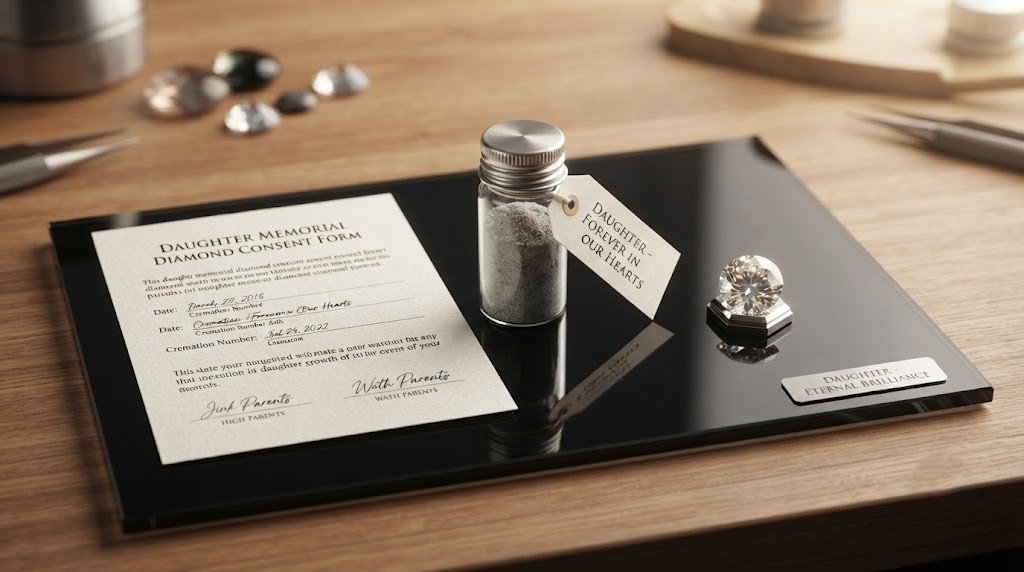
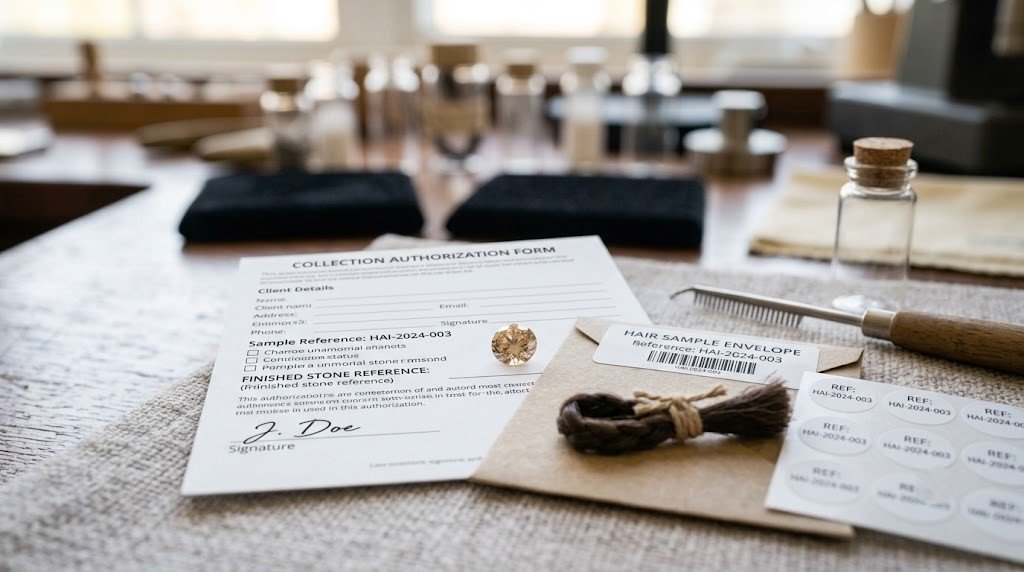
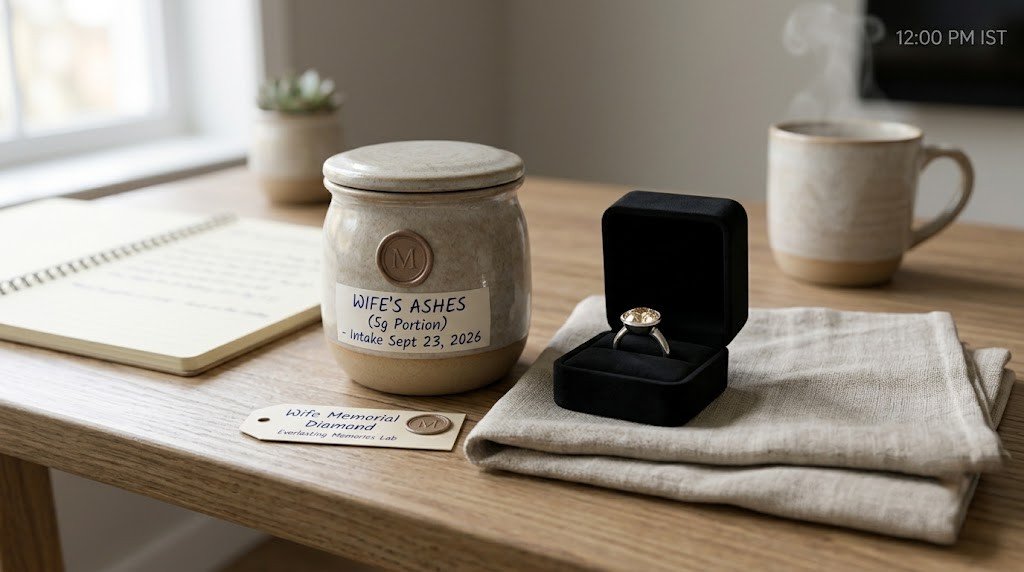
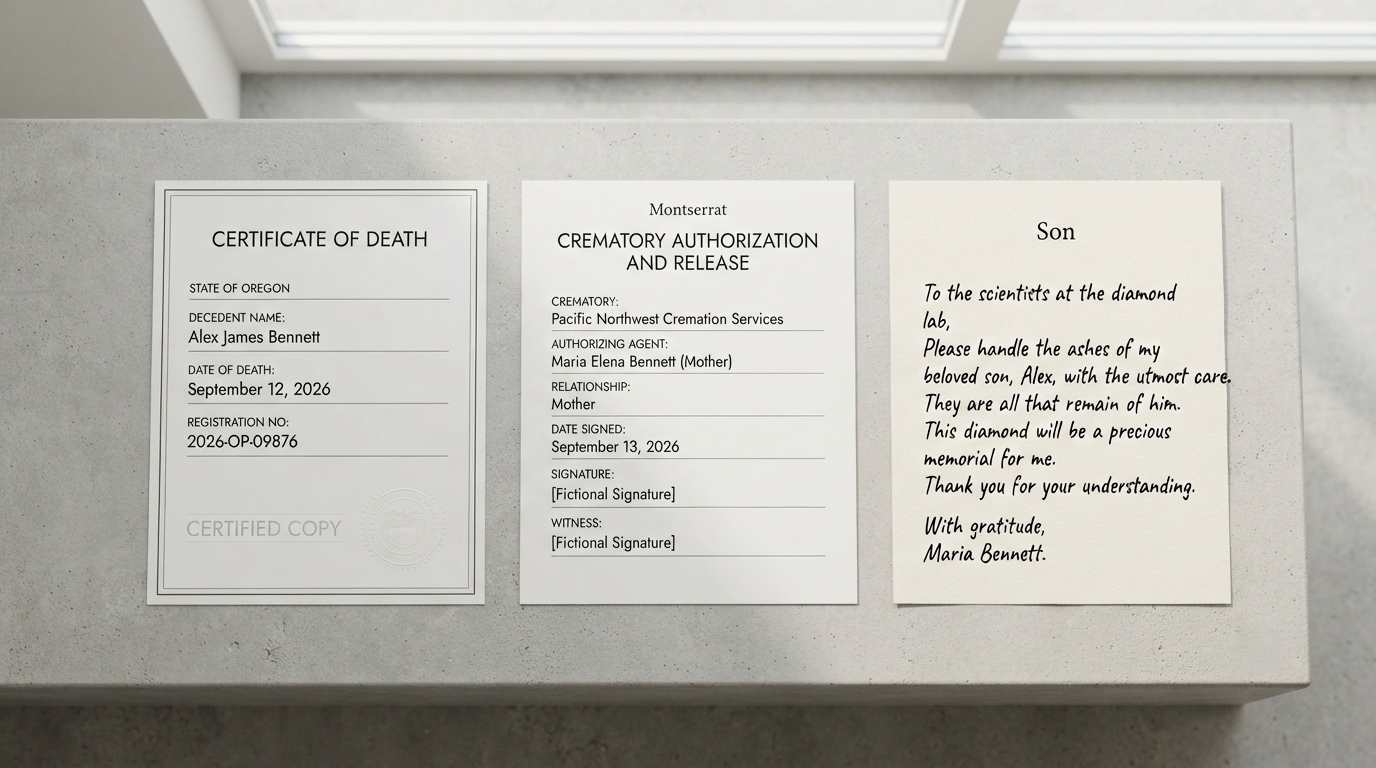
The daughter ashes diamond steps in one scene: a signed consent form, a sealed collection container and a finished memorial diamond on a desk

What Are the Daughter Ashes Diamond Steps, in Order?

The daughter ashes diamond steps number ten, counted from the family’s side of the table. Laboratory descriptions usually list extraction, graphitization and growth, which is accurate but tells you nothing about your own part. This list does the opposite: it names only what lands on your desk.

  • Steps 1 to 2 settle purpose and permission.
  • Steps 3 to 5 settle who makes it, what size it is and what it looks like.
  • Steps 6 to 8 move a small portion of her ashes safely to a laboratory.
  • Steps 9 to 10 cover the wait and the handful of final approvals.

Whether she was a small girl or a grown woman, the daughter ashes diamond steps follow this same sequence; what changes is mainly who holds authority at step two. If you are still weighing whether to do this at all, the decision by decision guide to turning her ashes into a diamond is the better starting point.

Step 1: Agree What the Diamond Is For

What to do: Before contacting anyone, write down in a sentence or two what the stone is meant to be and who it is for. One stone for one parent? A stone for each sibling? Something to be worn, or something kept in a drawer and taken out on anniversaries?

How long: An evening, or a few conversations spread over a couple of weeks.

What can go wrong: Skipping it. The answer quietly shapes every later decision among the daughter ashes diamond steps, how many stones to order, what size, what budget, and families who leave it vague tend to revisit choices after money has already changed hands. A second parent, a partner or an adult grandchild may hold a different picture of what she would have wanted, and hearing that now costs nothing.

It is also fine to decide the purpose is simply “something of her that I can hold.” Nothing about the daughter ashes diamond steps requires a grander reason than that.

What to do: Find out whose signature a provider will need before any portion of her remains can be sent. Rules are set state by state rather than nationally. Where she was married or partnered, that person commonly comes first, and her own grown children can outrank her parents too; and a directive, will provision or prepaid arrangement she left in writing can override the usual order.

How long: A phone call to the funeral home that handled the cremation often settles it within days. Unclear situations can take a few weeks, and a short consultation with an attorney is sometimes worth the fee.

What can go wrong: Assuming a parent holds the authority because a parent is making the arrangements. That is often not so where she was married or partnered, and discovering it at step six stalls everything. Parents who disagree, or one parent handling this alone, are situations this process can accommodate; the daughter ashes diamond steps work either way, provided the correct person signs.

Step 3: Compare Providers on Paper

What to do: At this point in the daughter ashes diamond steps, contact two or three companies and ask each the same written questions. How much ash do they need? What documentation will link the finished stone to her specific submission? Is growth done in house or by a partner lab? What happens to any unused material, is it returned, and how? What are the cancellation terms once growth has begun?

How long: One to two weeks, mostly waiting for replies.

What can go wrong: Choosing on tone instead of substance. Warm websites are easy; plain written answers are the real signal. A provider that is vague about the unused ash, or about how it tracks one family’s material through its lab, is showing you how the later daughter ashes diamond steps are likely to go. Whether a stone is genuinely made from her ashes explains which chain of custody answers deserve the closest reading.

Step 4: Set a Budget and a Carat Size

What to do: Choose a size, and let it set the budget rather than the other way around. Memorial stones are generally offered from around a tenth of a carat up past five carats, and price climbs steeply with weight.

How long: Your own pace; nothing in the daughter ashes diamond steps rushes this choice.

What can go wrong: Believing that sending more ash buys a bigger or faster diamond. It does not. Carat is decided by how long the crystal grows in the press, not by the quantity of remains you provide, so an extra scoop changes neither the size nor the schedule. A second common snag is forgetting that settings, engraving, unusual cuts and an optional grading report are usually quoted apart from the loose stone.

This is also where it helps to know that, on the ash route, her own carbon typically forms around 10% to 15% of the finished stone, with some providers citing as little as 3%; supplemental lab carbon makes up the rest. That proportion is worth asking about in writing before the later daughter ashes diamond steps commit you.

Step 5: Choose a Color Path and a Shape

What to do: Decide which color outcomes you would welcome, then pick a cut, round, oval, cushion, princess, emerald and the rest are all available, exactly as with any diamond.

How long: A few days to a few weeks.

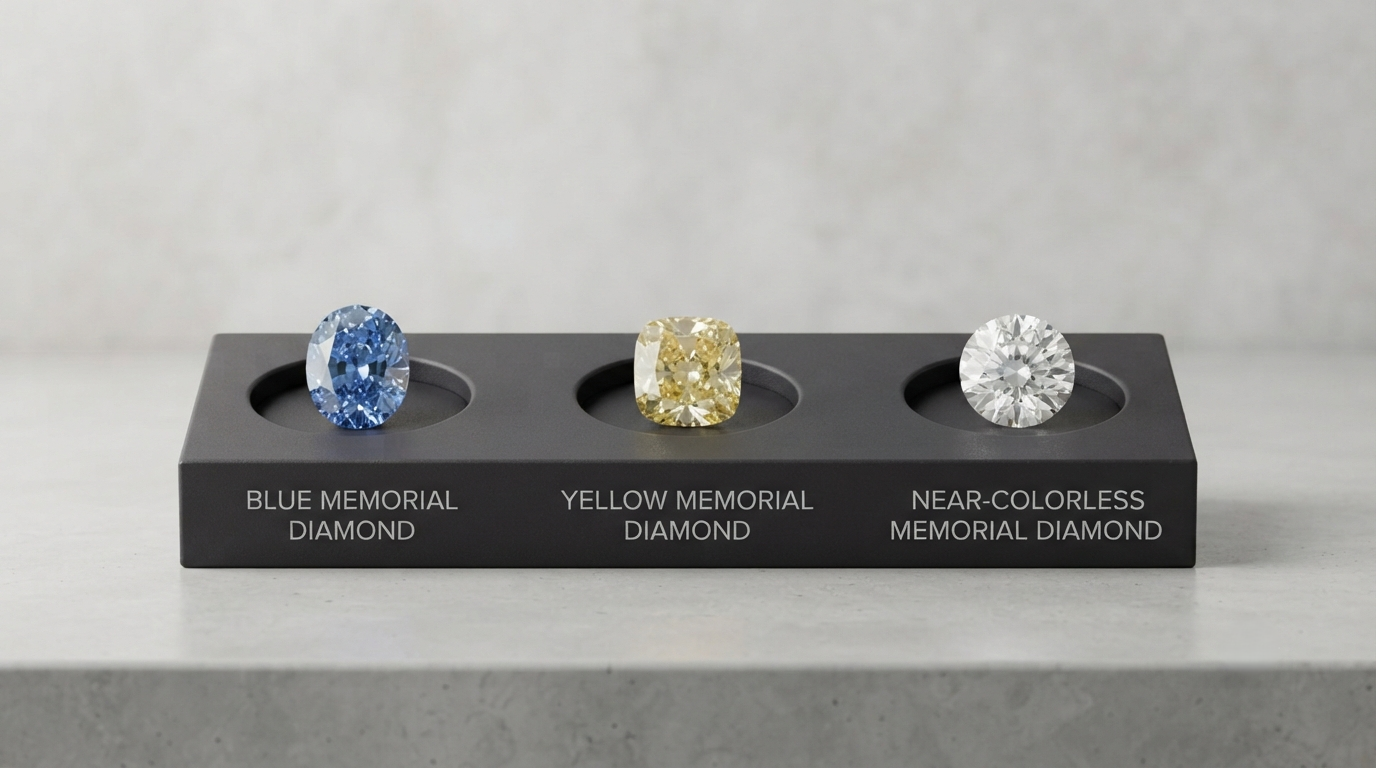
What can go wrong: Expecting precise control over color. Trace elements present during growth decide much of it: nitrogen leans a crystal yellow, boron leans it blue, and a colorless result needs almost none of either, which is why colorless usually costs more. A carefully purified starting material still does not make the final shade predictable. Optional post growth irradiation, offered by some providers, can turn a stone red, pink, green or black; you can take it or leave it.

Choose from what she liked, or from what you like, rather than from any assumption about daughters. Among all the daughter ashes diamond steps, this is the one most personal to her, and it deserves her own tastes. What color a diamond made from her ashes is likely to be covers the chemistry in full.

Step 6: Sign the Order and Receive the Kit

What to do: Return the provider’s authorization form signed by the person identified at step two, along with whatever supporting documents it asks for, usually a death or cremation certificate and the signer’s ID. Most companies then post a collection kit: a sealable container, a scoop, labels and custody forms.

How long: A few days if the signer is you; longer if the form must travel to another household first.

What can go wrong: A signature that sits unsent. Of all the daughter ashes diamond steps, this is the quietest place for a month to disappear. Agree a date with the signer when you send the form, and check the kit on arrival: make sure the labels carry the correct name and the order reference matches your paperwork before anything goes inside it.
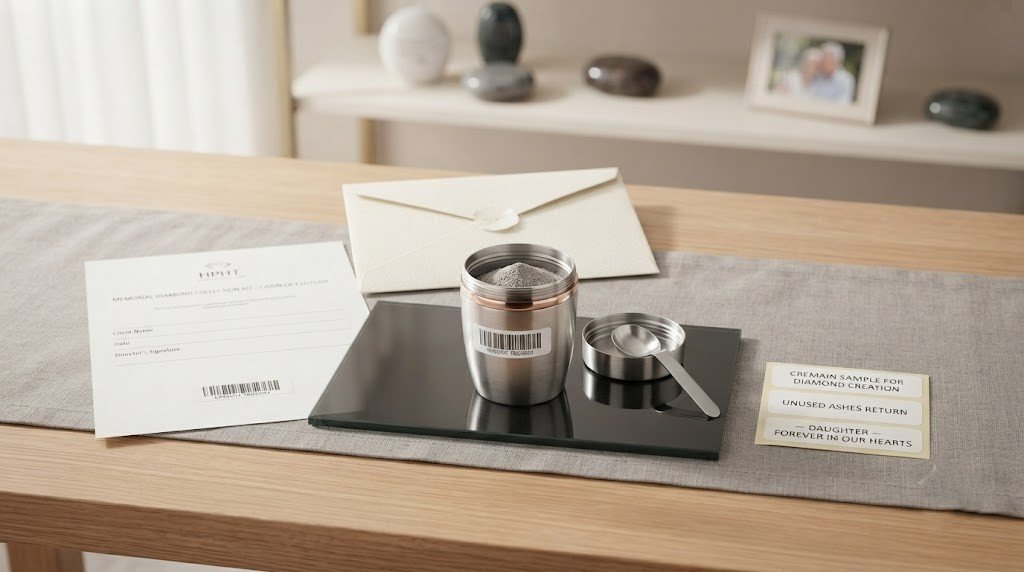
An open collection kit with a sealable container, scoop, custody forms and printed labels

Step 7: Portion and Seal a Small Share of Her Ashes

What to do: Transfer the quantity the provider confirmed in writing. Industry wide that usually falls between a few tablespoons and about 4 oz, roughly 100 grams, which is a small part of a full cremation. The rest of her ashes remain for the urn, a burial, scattering or dividing among family as already planned.

How long: Under an hour. Allow a quiet afternoon anyway.

What can go wrong: Forcing a sealed urn open at home, or spilling while pouring. If the urn is sealed, a funeral home can open it, measure the portion and reseal it, and some will do the whole transfer for you. If you do it yourself, work on a tray in good light; cremated remains are mostly bone mineral and feel more like coarse sand than powder.

No part of the daughter ashes diamond steps says this must be your own hands. Asking a sibling, a friend or the funeral director is sensible, not a failure. The quantities families are usually asked for are set out in more detail separately.

Step 8: Send the Parcel and Confirm It Was Logged

What to do: Pack the sealed container with the custody forms inside the box, not in a separate envelope. Use the tracked, insured shipping method the provider recommends, often a prepaid courier label. Photograph the sealed container and the labeled box before handing it over.

How long: Two to five days in transit, typically, making this the shortest of the daughter ashes diamond steps.

What can go wrong: Silence at the far end. Ask the provider when you ship to confirm receipt in writing, and chase it if two working days pass after delivery without one. That confirmation is the handover point in the daughter ashes diamond steps: before it, the material is in your care; after it, the laboratory’s records take over. Keep the tracking number and the confirmation email together.

Step 9: Stay Informed Through the Growth Months

What to do: Very little, which makes this the hardest of the daughter ashes diamond steps for many families. Ask how often the provider sends updates and whether you can call between them.

How long: This is where the calendar goes: usually six to ten months industry wide, occasionally twelve for large or specialty color stones.

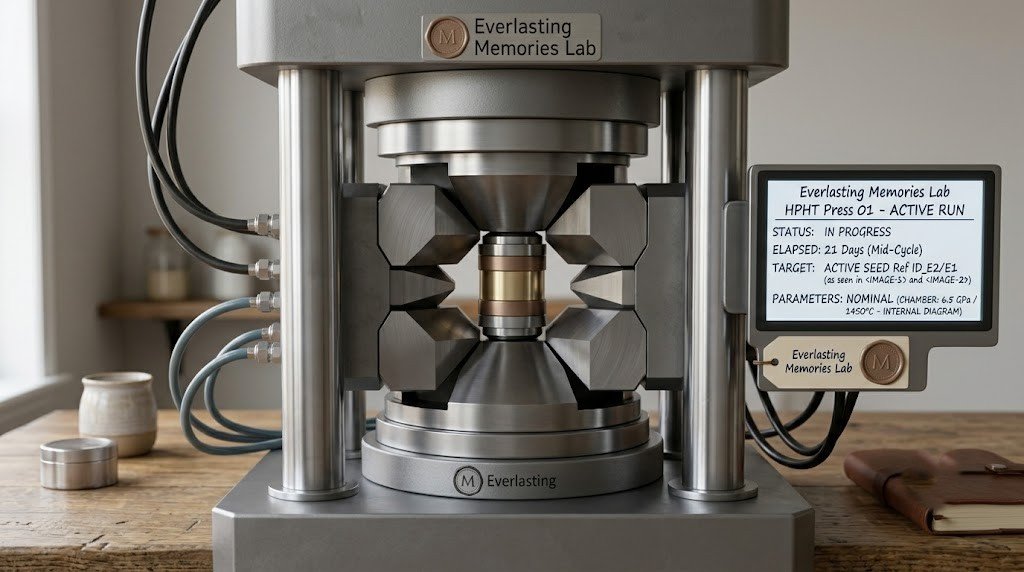
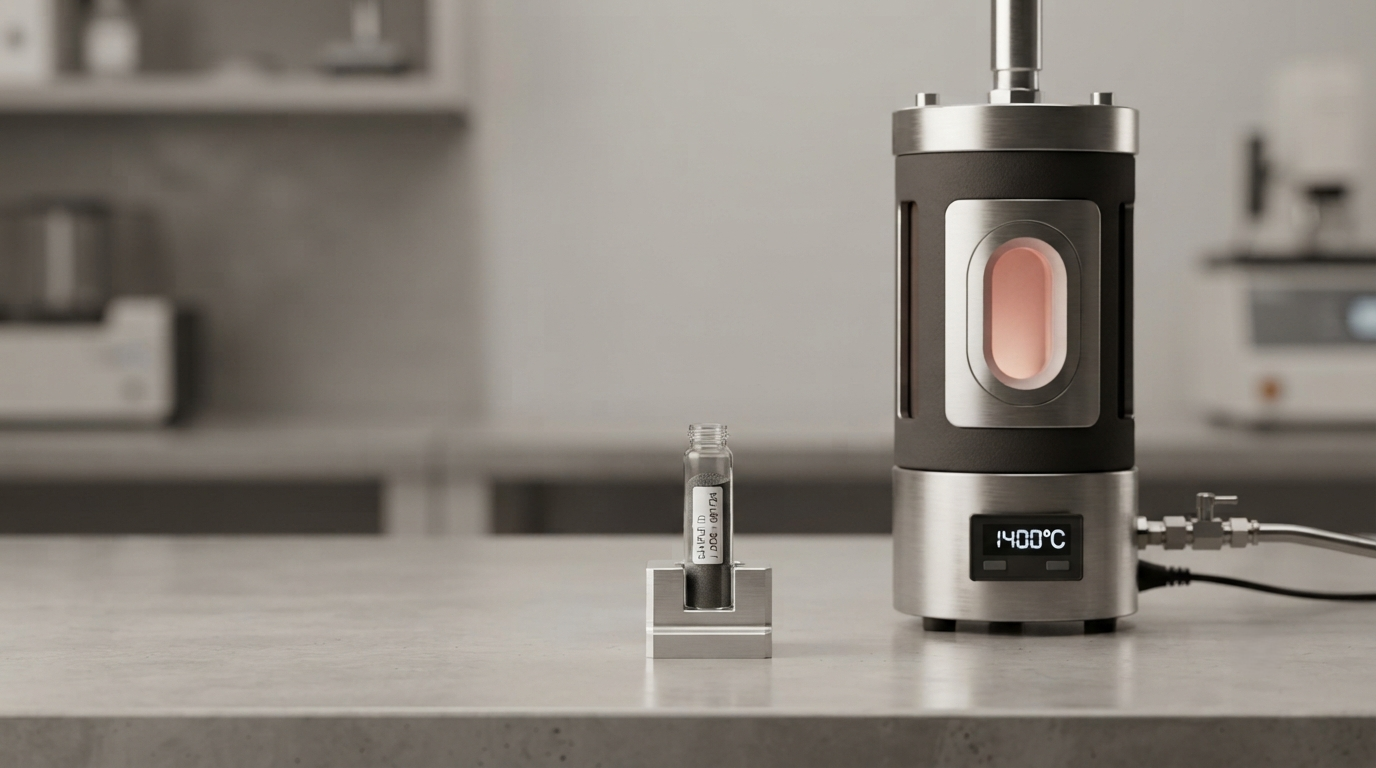
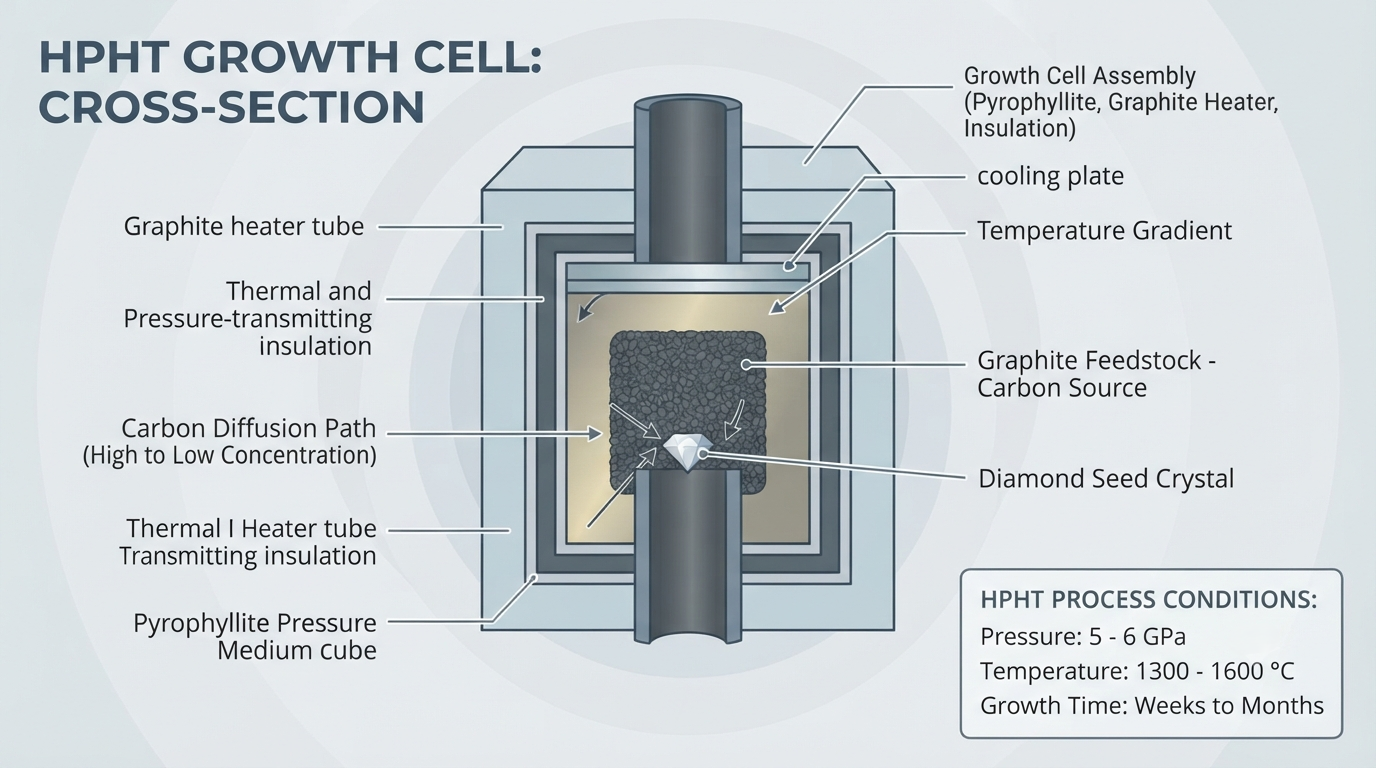
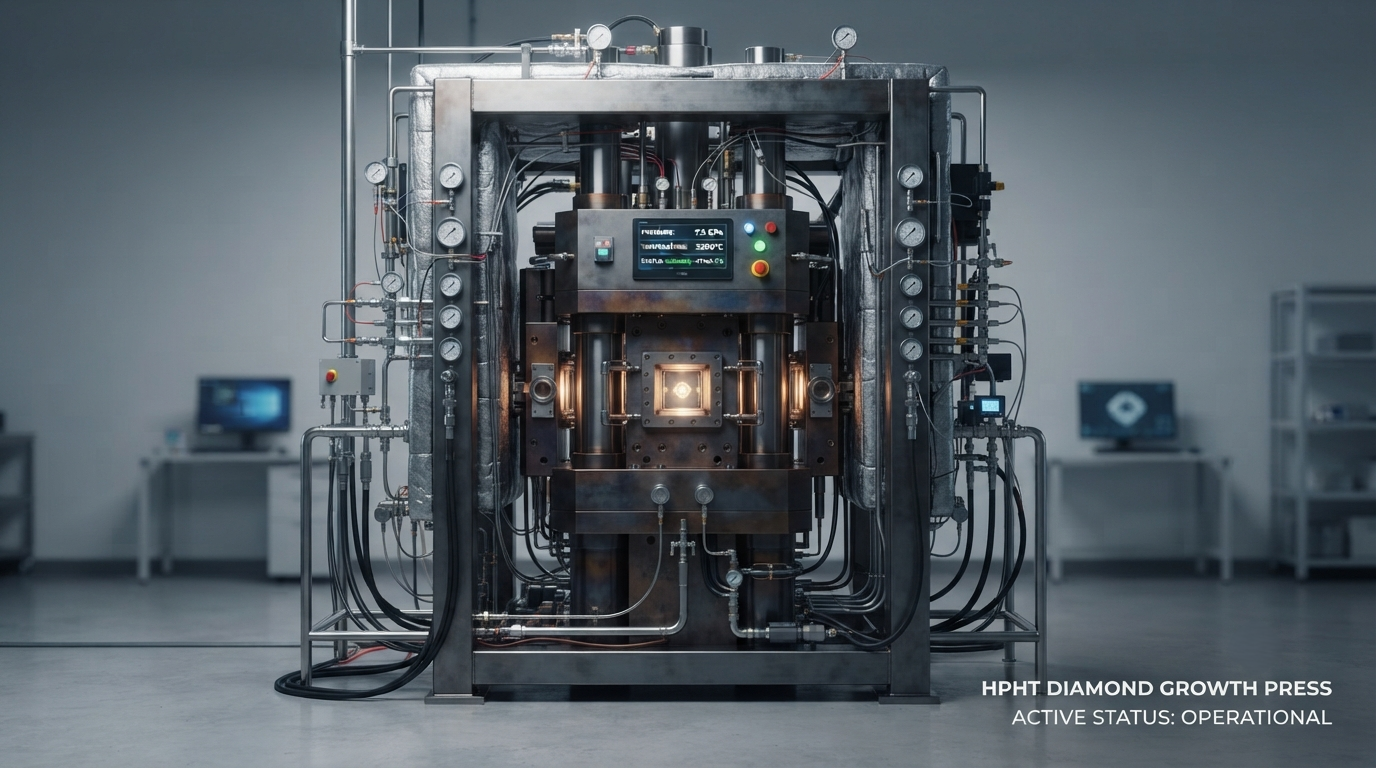
What happens in the lab: Her ashes are heated in an oxygen free, multi stage process that removes calcium phosphate and other minerals, leaving carbon purified to around 99.9% or better. Only about 0.5% to 4% of ash by weight is usable carbon, so the yield is small. That carbon is heated again, to roughly 2,500 to 2,700°C, and converted into graphite. The graphite, brought up to a workable volume with supplemental lab carbon, goes into a growth press beside a tiny seed crystal at roughly 6 to 8 GPa and 1,400 to 2,500°C. Most providers use this high pressure, high temperature method; a minority use chemical vapor deposition instead.

What can go wrong: Mostly the waiting itself. Delays do happen, and a good provider explains them promptly. For the lab side of the daughter ashes diamond steps in depth, the laboratory’s side of the process follows each stage of the chemistry.

Step 10: Approve the Finishing and Bring the Stone Home

What to do: Respond to up to three final questions once the rough crystal exists. First, confirm the cut, since the rough sometimes suits a different shape better. Second, confirm or decline any optional irradiation. Third, decide whether to have the finished stone independently graded against the recognized cut, color, clarity and carat standards. Grading is optional, and it is a separate document from the origin certificate that ties the stone to her submission.

How long: A few weeks for cutting and polishing, then shipping.

What can go wrong: Being surprised by a clarity grade or shade. Memorial stones commonly land between SI2 and VVS clarity, and color follows the chemistry described at step five. Also confirm, if you have not already, what will happen to any leftover ash.

The stone usually arrives loose, with its origin certificate and any grading report. There is no deadline for a setting. The last of the daughter ashes diamond steps can take as long as you need.
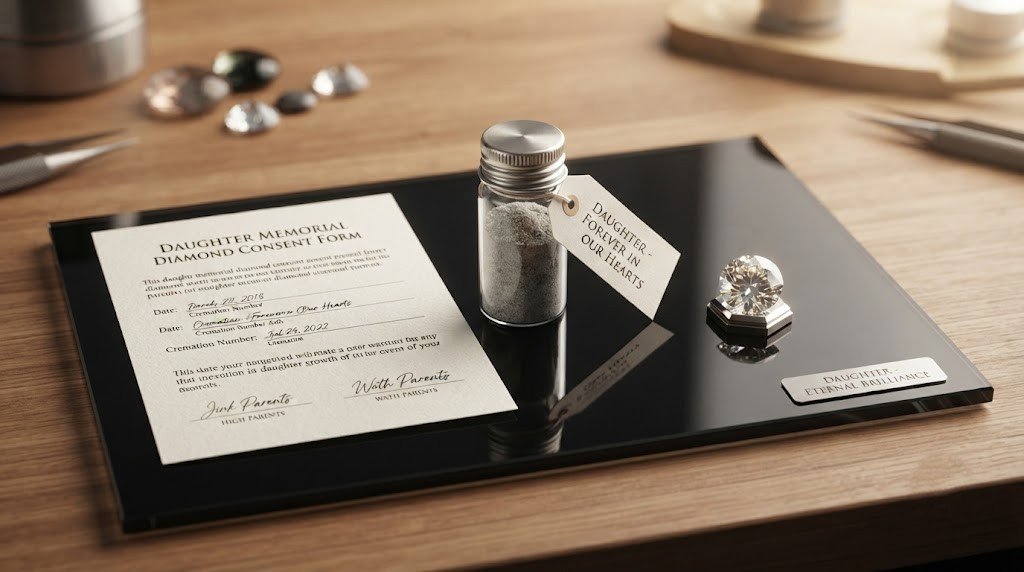
A loose memorial diamond beside its origin certificate and an optional grading report

How Long Do the Daughter Ashes Diamond Steps Take, End to End?

Plan on seven to eleven months for the daughter ashes diamond steps, from first phone call to holding the stone, most of it spent at step nine. The table below splits the daughter ashes diamond steps into your time and the laboratory’s.

StepStageTypical durationWhose time it is
1Agree the purposeDays to two weeksYours
2Confirm consentDays to a few weeksYours, plus the signer
3Compare providers1 to 2 weeksYours
4 to 5Size, budget, color, shapeDays to a monthYours
6Order and kitA few days to two weeksYours, plus the signer
7Portion and sealOne afternoonYours or a funeral home’s
8Ship and confirm receipt2 to 5 daysCourier’s
9Extraction and growthUsually 6 to 10 months, up to 12The laboratory’s
10Cutting, finishing, deliveryA few weeksThe laboratory’s

Two things lengthen the daughter ashes diamond steps more than anything else: an unresolved signature at step two and a larger or specialty color stone at step four.

What Do the Daughter Ashes Diamond Steps Cost?

The daughter ashes diamond steps are priced almost entirely by the size and color chosen at steps four and five. Typical 2026 ranges across the industry, not any single company’s price list, look like this:

  • About 0.10 to 0.25 carat: roughly $1,500 to $3,500
  • About 0.5 to 1 carat: roughly $5,000 to $15,000, with colorless costing noticeably more than yellow, blue or champagne tones at the same weight
  • Two to five carats and beyond: roughly $20,000 to $75,000 or more
  • Extras quoted separately: an optional grading report, engraving, fancy cuts and a ring, pendant or other setting

None of the daughter ashes diamond steps adds much cost on its own beyond these line items. Ask for a single itemized quote at step three so nothing new appears at step ten. For the wider picture of what this choice involves, our full guide for families considering her ashes as a diamond brings the pieces together.

Frequently Asked Questions

Which of the daughter ashes diamond steps can someone else handle?

Most of them. A sibling or friend can compare providers, a funeral home can open the urn and portion the ashes, and a courier handles shipping. The steps that need you, or the legally authorized person, are the consent signature and the final choices about size, color and finishing. Delegating the practical tasks is a reasonable choice, not a lesser one.

Can the daughter ashes diamond steps be paused if the family is not ready?

Before the ashes are shipped, yes, entirely at your own pace; nothing expires. Once growth has begun, pausing or canceling depends on the provider’s contract, and terms vary widely across the industry. Ask about cancellation and refund terms in writing at the comparison stage, before any part of her remains leaves your care.

What happens to the ashes the laboratory does not use?

Policies differ between providers. Some return unused material, some retain it for a set period, and some dispose of it respectfully by default. Because only a portion is ever needed, this is a genuine question for every family. Ask for the answer in writing before shipping, and state clearly what you would like done with anything left over.

How much of the finished diamond actually comes from her?

On the ash route, her own carbon typically makes up around 10% to 15% of the finished stone, and a few providers publish figures as low as 3 percent. The remainder is supplemental lab carbon needed to grow a stone of workable size. Her carbon is genuinely present in the crystal, but the diamond is not made from her carbon alone.

Can each of her siblings receive a stone through the same process?

Often, yes. Only a small portion of the ashes is used for each diamond, so several stones can usually come from one cremation. Each stone goes through its own growth stage within the daughter ashes diamond steps, with its own timeline and price. Ask whether one submission can cover several orders, or whether each needs its own portion and paperwork.

Does it matter how long ago her cremation took place?

Rarely. Ashes are chemically stable bone mineral, and a gap of months or many years seldom rules them out. Tell the provider how and where they have been stored, since the container and storage conditions matter more than the time elapsed. Families sometimes begin the daughter ashes diamond steps a decade or more after a cremation.

Final Thoughts on Turning Her Ashes Into a Diamond

Set out on a page, the daughter ashes diamond steps can look like a long list. In practice the parts that need your attention cluster at the start: agreeing what the stone is for, confirming who signs, and getting a provider’s answers in writing.

Everything in the daughter ashes diamond steps after the parcel is logged belongs to the laboratory and to time. If you take one thing from this page, let it be the order: purpose, consent, written terms, then everything else.

What eventually arrives is a real diamond carrying a documented share of her carbon. Take the daughter ashes diamond steps at whatever pace your family needs.

Learn More About Daughter Memorial Diamonds

Talk With Memorial Diamond

If you would find it easier to talk the sequence through with someone, Memorial Diamond is available at memorialdiamond.us. Bring whichever of the daughter ashes diamond steps you are on, and whatever questions come with it. Asking commits you to nothing.
son-memorial-diamond-vs-urn

Son Memorial Diamond vs. Traditional Urn: What to Know

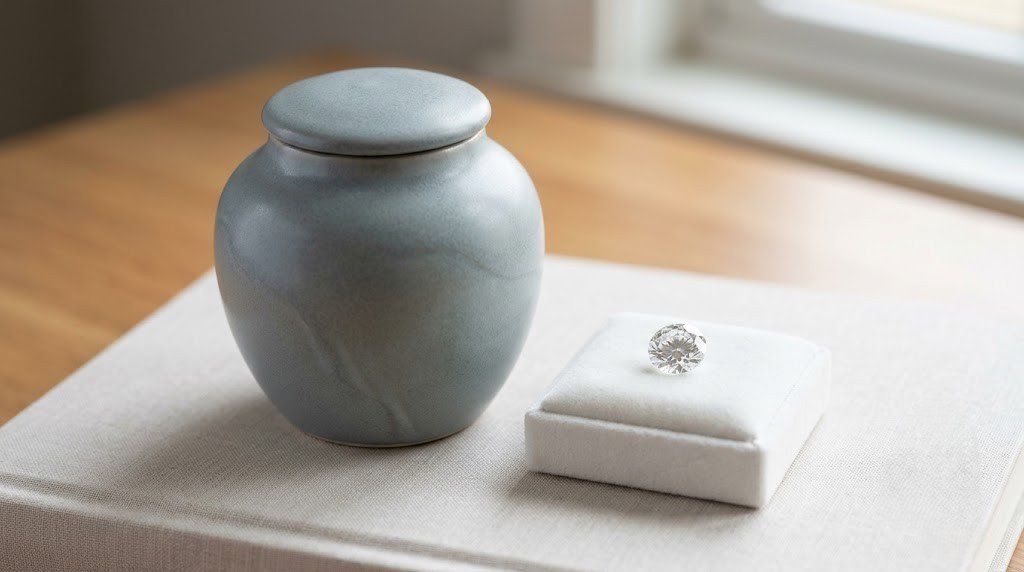
Most parents come to this question already holding an urn, which is why it feels like a decision about replacing something. It is not. Son memorial diamond vs urn is rarely an either/or, because a stone typically uses only a few tablespoons up to roughly 4 oz of ashes, and everything else stays exactly where you meant it to stay. An urn keeps all of him in one place for a fraction of the cost and no waiting; a diamond makes a small part of him wearable after months of work. Both are complete answers.

A disclosure, since this page compares formats rather than companies: Memorial Diamond grows stones, so we have a stake in one side of this. Every figure below is an industry wide band rather than our own published pricing.

Son memorial diamond vs urn shown side by side: a closed ceramic urn beside a single polished memorial diamond on a pale surface

What Each One Actually Is

An urn is a container. It holds the whole of what a cremation produces, several pounds of it, in one place you choose, whether that is a shelf at home, a niche in a columbarium, or a grave. It needs no laboratory, no chain of custody, no processing, and nothing is altered. That simplicity is a genuine strength, and in any son memorial diamond vs urn comparison it is why an urn remains the most common thing families do.

A memorial diamond is a real, chemically genuine lab grown diamond that includes carbon recovered from a portion of those same ashes. The portion is heated in an oxygen free process until only carbon remains, purified to roughly 99.9%, converted to graphite, and grown under pressure and heat comparable to the deep mantle, on the order of 6–8 GPa at 1,400–2,500°C, into a crystal that is then cut and polished.

So the son memorial diamond vs urn comparison is not really two versions of the same thing. One preserves everything, untouched. The other transforms a fraction of it, permanently, into an object you can wear. Setting them beside each other is useful precisely because they are not alternatives in the ordinary sense.

Son Memorial Diamond vs Urn: The Seven Dimensions

Seven things separate them in practice. Everything else in the son memorial diamond vs urn decision tends to follow from one of these.

DimensionTraditional urnMemorial diamond
What happens to his remainsAll of them stay together, unchanged, in one containerA portion is consumed; the rest stays with you
CostTypically tens to a few hundred dollars for the urn itselfIndustry typical $1,500–$3,500 entry tier; $5,000–$15,000 at 0.5–1 ct
Time to receiveImmediate, usually the same week as the cremationIndustry typical 6–10 months, up to 12 for larger or specialty color stones
WearabilityNot worn; kept, displayed, or interredWorn daily if you want; diamond is 10 on the Mohs scale
Permanence and reversibilityFully reversible: ashes can later be buried, scattered, or dividedIrreversible once the portion is processed
Divisibility among familyRequires dividing the ashes themselvesSeveral stones can be grown from one urn, each bought separately
What it asks of the familyAlmost nothing beyond choosing and placing itAuthorization, paperwork, shipping material, a long wait, a real cost

Read the son memorial diamond vs urn table without a thumb on the scale. Nothing in the son memorial diamond vs urn comparison makes an urn a lesser choice. It wins outright on cost, on speed, on simplicity, and on keeping him whole.

What Happens to His Remains in Each Case?

This is the part most parents actually care about in son memorial diamond vs urn, and the numbers are reassuring in both directions.

An urn holds everything a cremation produces, which for an adult is typically several pounds. Nothing is removed, nothing is altered, and the decision stays open indefinitely. Ashes are chemically stable and keep for as long as you need them to.

A memorial diamond needs, industry wide, somewhere between a few tablespoons and roughly 4 oz, about 100 g. Against several pounds, that is a small fraction, which is the single most misunderstood point in the whole son memorial diamond vs urn conversation. How much ash a stone actually takes sets out the weights.

Be clear about what that portion becomes, though, since it is where son memorial diamond vs urn differs in kind rather than in degree. Cremated remains are mostly calcium phosphate, and usable carbon is only about 0.5% to 4% of ash by weight. That recovered carbon is blended with supplemental lab carbon to reach a workable volume, and on the ash route the personal carbon typically accounts for around 10–15% of the finished stone’s mass, with some providers publishing figures as low as 3%. For hair grown stones no equivalent published figure exists at all, so ask any provider for theirs in writing rather than assuming the ash number carries across.

What Does Each One Cost?

Here the son memorial diamond vs urn gap is wide, and pretending otherwise would be dishonest.

On the son memorial diamond vs urn ledger, an urn is ordinarily the least expensive part of a funeral. Simple containers cost very little; handsome wood, ceramic or metal urns run into the low hundreds. Many families spend nothing extra at all, keeping the ashes in the container the crematory provided.

A memorial diamond is priced like fine jewelry, because that is what it becomes. Industry typical bands run roughly $1,500–$3,500 for an entry tier stone of about 0.10–0.25 ct, $5,000–$15,000 in the 0.5–1 ct range, and $20,000–$75,000 or more for stones of 2–5+ ct. Colorless stones cost meaningfully more than yellow, blue or champagne tones at the same size, and settings, engraving and an independent grading report, which is optional rather than a standard stage, are usually quoted separately. What drives the price of a single stone works through each variable.

Two honest notes on the money side of son memorial diamond vs urn:

  • A diamond is an addition, not a substitute. You will still have an urn, because most of the ashes remain in it.
  • Carat is bought from growth time, not from ash. A larger stone costs more because it sat in the press longer, not because more of him was used.
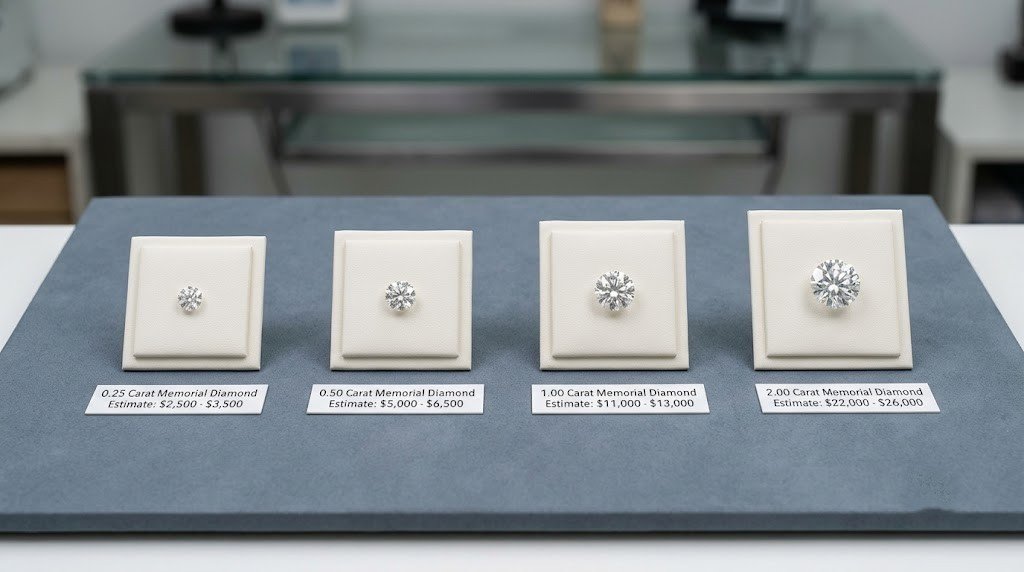
 Four loose memorial diamonds of increasing carat weight arranged in a row to illustrate how price scales with size

How Long Before You Have It?

An urn is immediate, and on this dimension son memorial diamond vs urn is not close. It is usually handed over within days of the cremation.

A memorial diamond takes, industry wide, 6 to 10 months from the laboratory receiving material to a finished stone, stretching toward 12 months for larger carats or specialty colors. That span covers extraction, purification, graphitization, growth, cutting and grading, and none of those stages can be usefully hurried. How the months break down stage by stage covers what happens when.

For some parents that wait is the deciding factor in son memorial diamond vs urn, and it is a fair one. The first year after losing a son is not a year most people want to spend tracking an order.

For others the wait is the opposite of a problem. A package arriving in the eighth or ninth month, long after the casseroles and the phone calls have stopped, lands in a quieter stretch of grief than anything else does. Neither reaction is the correct one, and neither settles son memorial diamond vs urn by itself.

Which One Can You Carry?

This is the dimension that sends most families looking at son memorial diamond vs urn in the first place, and it is where the two genuinely diverge.

An urn stays put. That is its purpose, a fixed place, deliberately chosen, that you visit rather than carry. Keepsake urns and small pendants holding a pinch of ash exist for families who want something portable without a laboratory involved, and they cost a fraction of a diamond.

In son memorial diamond vs urn, a diamond is built for daily wear in a way almost nothing else in this category is. Diamond sits at 10 on the Mohs scale, making it the hardest known natural mineral. It does not scratch, dull or wear away with handling. What needs occasional attention is the setting around it, not the stone. Rings, pendants and other pieces a stone can become covers the options, including keeping it unset.

Worth saying plainly: wearing something is not a truer form of remembrance than visiting a shelf. Some parents want him with them at work; some want a place to go and sit. The son memorial diamond vs urn answer often turns on which of those describes you.

Which Choice Can Be Undone?

One of them can, and that asymmetry deserves more weight in son memorial diamond vs urn than it usually gets.

Ashes in an urn keep every option open. They can be buried later, scattered later, divided later, moved from the house to a columbarium, or left alone for twenty years while nobody feels ready. Nothing degrades, and no decision made this year forecloses a different one.

A memorial diamond is final in a specific sense: once a portion has been processed, that portion does not come back as ashes. The stone itself can be reset, resized in its mounting, passed on or sold, but the material change is permanent. That is the strongest argument in son memorial diamond vs urn for waiting rather than deciding in the first raw months.

There is no deadline on son memorial diamond vs urn. Ashes do not expire, and a parent who is not ready to decide anything this year is not losing an option by waiting. Where to begin when the time does feel right sets out the order the decisions come in.

Can Several People Each Have Something?

Both sides of son memorial diamond vs urn handle this, differently.

Dividing ashes between an urn and several keepsake containers is straightforward, immediate and costs almost nothing. Many families do exactly that, a main urn plus small portions for siblings, grandparents, or a partner.

Growing several stones is also possible, since each needs only its small portion, but each one is an independent growth run with its own price and its own finish date. Three stones is three purchases, not one split three ways, and they will not match each other, because color in any diamond comes from trace elements present as the crystal forms, nitrogen toward yellow, boron toward blue, and neither present at all for colorless. Whether several relatives can each have a stone goes through the practicalities.

So on divisibility, son memorial diamond vs urn is less a contest than a question of budget and patience.

Does Son Memorial Diamond vs Urn Have to Be a Choice?

No, and that is the most useful sentence on this page about son memorial diamond vs urn.

Because a stone consumes only a small portion, the common arrangement is both: a portion goes to the laboratory, and the remainder stays in the urn on the shelf, or goes into the ground beside a grandparent, or is scattered at the lake exactly as planned. Nothing about commissioning a diamond obliges a family to abandon what it already decided.

Ways families actually combine them:

  • Urn kept whole, small portion drawn. The urn stays as it is; the diamond is grown from what would never have been noticed missing.
  • Burial or scattering proceeds as planned, with a portion set aside beforehand.
  • A lock of hair instead of ash. Hair is roughly 50% carbon by weight, so a stone can be grown without touching the urn at all, useful if he was buried rather than cremated, or if the ashes were already scattered.
  • Nothing now, a decision later. Ashes keep. So does a lock of hair kept in an envelope.

Framed that way, son memorial diamond vs urn stops being a fork in the road and becomes a question of whether you want one more thing in addition to what you already have.

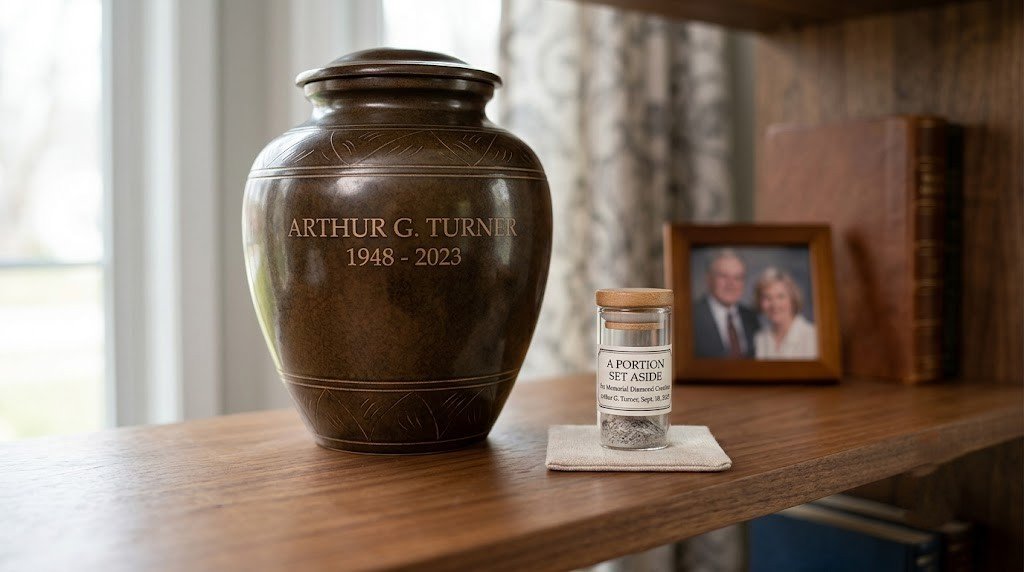
An urn returned to its shelf with a small labeled container beside it, illustrating a portion set aside while the rest stays in place

Who Has the Say Over His Ashes?

Worth settling before anything else in son memorial diamond vs urn, because families sometimes plan for months around a decision that was never theirs.

Whoever is recognized as having control of a person’s remains is set by state law, and parents are not automatically first in line for an adult son. If he was married, his spouse commonly holds that right; if he had adult children of his own, they may rank ahead of you too. Anything he put in writing, a will, a form signed at the funeral home, a disposition directive, can rearrange the default. A funeral director in the state where he died will usually tell you the order at no charge, and an attorney licensed there can confirm it.

An urn rarely brings this to a head, since it changes nothing. Commissioning a diamond does, because a portion is removed and altered. That difference is the quiet reason the son memorial diamond vs urn decision can turn into a family conversation when the urn alone never did.

What Most Families Actually Do

Context helps when son memorial diamond vs urn starts to feel like a decision that must be extraordinary.

Cremation is now the majority choice in the United States. The National Funeral Directors Association’s 2025 cremation and burial report puts the projected cremation rate at 63.4% against 31.6% for burial. Of those families, the overwhelming majority keep, inter or scatter the ashes, and do nothing else at all.

That is the honest backdrop to son memorial diamond vs urn: a memorial diamond is an uncommon choice, not a superior one, and choosing the ordinary thing is not a smaller act of love. The complete route for a son ashes diamond exists for families who want it, not as a standard anyone is failing to meet.

If you are somewhere in the middle, drawn to the idea but unwilling to alter anything yet, set aside a portion, keep it sealed and labeled, and decide nothing. That single step preserves both options for as long as you want them preserved.

Frequently Asked Questions

Can we have both a diamond and an urn?

Yes, and most families who commission a stone do exactly that. A diamond typically uses a few tablespoons up to roughly 4 oz, so the urn stays on the shelf with nearly all of its contents, or is buried or scattered as originally planned.

Will the urn look emptier afterward?

Almost never. Against the several pounds an adult cremation produces, the portion drawn for a stone is small enough that most families cannot tell by looking. If that matters to you, weigh or photograph the contents beforehand.

Is an urn cheaper than a memorial diamond?

Considerably. Urns commonly run from very little to a few hundred dollars, while industry typical diamond pricing starts around $1,500–$3,500 for an entry tier stone and climbs steeply with carat. Cost is the clearest difference in son memorial diamond vs urn.

Can a diamond be turned back into ashes?

No. Once a portion has been processed into carbon and grown into a crystal, that change is permanent. The finished stone can be reset, passed on or sold, but the material cannot be returned to its previous form.

He was buried, not cremated. Is this off the table?

Not necessarily. A lock of hair kept from a haircut, a hairbrush or the funeral home is a workable carbon source and requires no cremation, so a stone remains possible long after burial. Ask a provider what quantity they need.

Who decides if the family disagrees?

The person state law recognizes as controlling his remains, subject to anything he left in writing. For an adult son that is often a spouse or his own adult children rather than his parents. A funeral director can usually confirm the order locally.

Final Thoughts on Son Memorial Diamond vs Urn

If there is one thing to carry away from son memorial diamond vs urn, it is that the comparison is mostly a false frame. You are not choosing between honoring him well and honoring him badly. You are choosing whether to add one object to an arrangement that is already complete.

An urn asks nothing of you, and it answers son memorial diamond vs urn on its own. It costs little, arrives immediately, keeps all of him together in one place, and leaves every future decision open. For most families that is enough, and there is nothing thin about it.

A diamond asks for authorization, a portion, several thousand dollars and most of a year, and gives back something you can wear to work, to a wedding, to the ordinary Tuesdays that turn out to be the hard ones. Whether he was six or sixty, neither choice measures anything about him or about you.

Take the time. Nothing about ashes runs out, and the version of this decision you make in month eighteen will almost certainly sit better than the one made in week three.

Learn More About Son Memorial Diamonds

Talk With Memorial Diamond

If you are weighing son memorial diamond vs urn and want a straight answer about what a portion of what you hold could actually become, reach out to Memorial Diamond at memorialdiamond.us. Asking costs nothing and commits you to nothing, and keeping the urn exactly as it is remains a perfectly good ending to the conversation.

son-hair-diamond-steps

Step by Step: Turning Your Son’s Hair Into a Diamond

It usually starts with an envelope you already own, a curl from a first haircut, a lock cut in a hospital room, something kept without a plan for it. The son hair diamond steps come to seven: look at the sample, settle whose decision it is, pick a provider, choose the stone, post the lock, wait out the growth, then receive and set it. Six to ten months is the usual industry span.

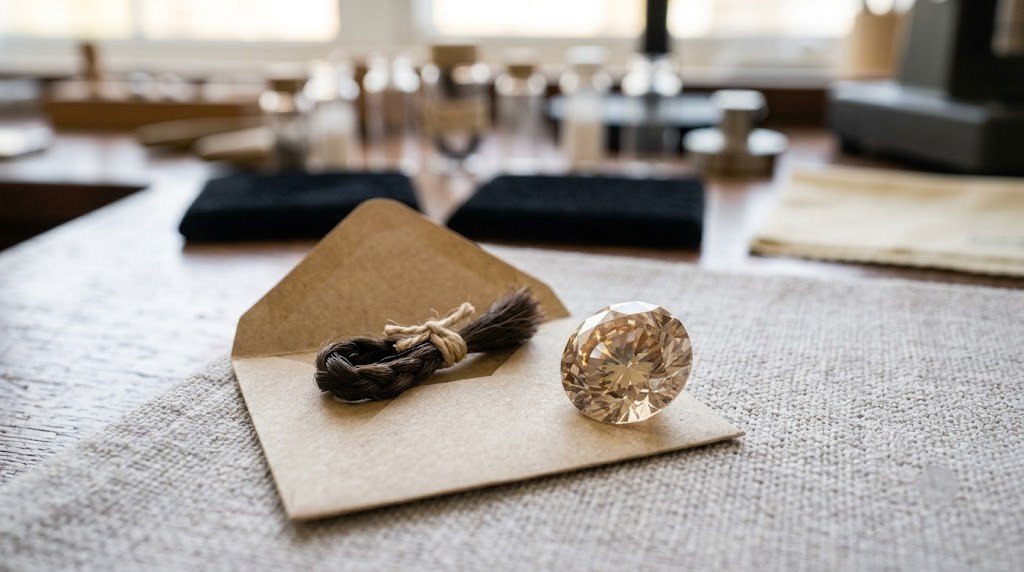
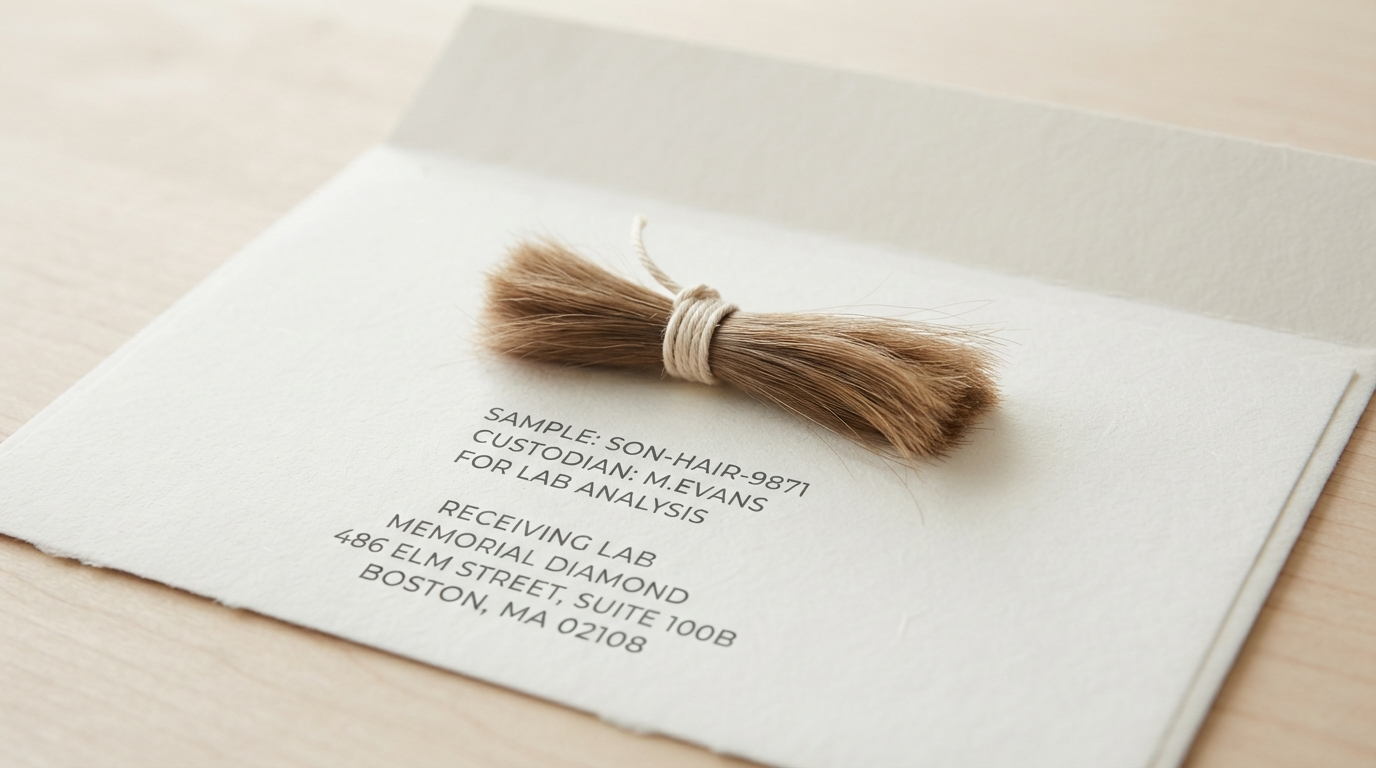
 The son hair diamond steps beginning with a tied lock of hair in a paper envelope beside a finished memorial stone

How Do the Son Hair Diamond Steps Differ From the Ashes Route?

In three ways that matter, and they change the shape of the whole thing rather than just the wording.

The first is that no cremation is involved at any point. A son who was buried, or who died decades ago, or whose remains were never yours to direct, can still be represented in a stone if a lock of his hair exists somewhere. That single fact is why the son hair diamond steps exist as a separate route at all.

The second is quantity. Hair is roughly 50% carbon by weight as a starting material, against the small carbon fraction recoverable from cremated remains, which is why the request is measured in grams rather than ounces.

The third is that the material is usually already in your possession, which means the son hair diamond steps can begin on the afternoon you decide to begin them. Nobody has to open an urn.

Hair routeAshes route
Cremation requiredNoYes
Typical amount requestedA small lock, a few gramsA few tablespoons to roughly 4 oz
Where the sample usually sitsA keepsake box, a locket, a baby bookAn urn or a funeral home’s keeping
Published finished stone carbon shareNone publishedRoughly 10 to 15%, some providers as low as 3%
Typical wait6 to 10 months6 to 10 months

The complete guide to a son hair diamond covers the background that sits behind these seven stages.

Step 1: What Do You Actually Have in That Envelope?

Open it, in your own time, and look properly. The son hair diamond steps begin with an honest assessment of the sample, because everything afterwards is sized against it.

Note three things. Roughly how much is there, a pinch, a lock, a full braid? Is it loose strands or a tied bundle, since a tied lock is easier to weigh and handle? And is there anything on it: dye, bleach, styling product, or the residue of a mounting adhesive if it came out of a locket or a memory frame?

Age is rarely the problem parents fear it is, and it delays none of the son hair diamond steps. Hair is chemically stable and keeps for decades in a drawer, which is exactly why baby curls kept in the 1970s are still workable material today.

Loose strands from a brush are a genuine question mark rather than an automatic no. They tend to be fewer and lighter than a cut lock, and whether they meet a given laboratory’s threshold is a question for that laboratory. How much hair is actually needed sets out the quantities in detail.

Step 2: Whose Decision Is It?

Worth thinking through before you commit to any of the son hair diamond steps, even where the answer turns out to be straightforward.

The rules most states write on this subject are aimed at a person’s remains, a statutory order of priority naming who may direct them, with a surviving spouse or registered partner usually high on that list, adult children of his own able to outrank his parents, and everything subject to whatever he set down in writing and to which state you are in. Because that machinery is pointed at the remains themselves, a lock already sitting in your own keeping is usually the more straightforward question in practice.

Usually is doing real work in that sentence. A decedent’s belongings can form part of an estate, how that plays out differs by state, and if the sample is in someone else’s house, a former partner, a grandparent, whoever packed up his apartment, then the first of the son hair diamond steps is a conversation rather than a decision.

Parents also do not always agree about the son hair diamond steps, and one parent arranging this alone is common rather than unusual. Where anything feels unclear, a short call to a local attorney costs less than a family rift.

Step 3: How Do You Pick a Provider and Confirm What It Needs?

By making a company write things down. The son hair diamond steps are only as dependable as the specification behind them, and warmth on a phone call is not a specification.

Four things to get in an email before you begin the later son hair diamond steps: the minimum weight or length of hair required, whether treated or dyed hair is accepted, what documentation will link the finished stone to your sample, and whether any unused hair is returned.

That second one catches people out. Dye, bleach and heavy styling product are worth disclosing rather than hoping nobody notices, and a laboratory’s answer will tell you whether it needs a larger sample to compensate.

Paperwork is lighter here than on the ashes route, since no cremation certificate exists to supply. Expect a signed authorization form, identification for whoever signs it, and the provider’s own intake sheet. Ask what it wants before you assemble anything, because requirements differ and a wasted trip to a notary helps nobody.

It is also fair to ask where growth physically happens, since some companies run their own presses while others work through a partner facility. Neither is automatically better, but you are entitled to know. Questions worth asking before you commit works through a fuller list.

Step 4: How Do You Choose the Stone Itself?

Before anything is posted, because these decisions set both the price and the length of the wait. In the son hair diamond steps this stage comes early for a practical reason: a provider cannot quote you properly until it knows what you want.

Carat first. Sizes on offer typically run from about a tenth of a carat to five carats or more, and size is a function of how long the crystal is grown rather than how much hair you sent. A bigger stone means more months, not a bigger envelope.

Color next, and it is partly chosen and partly inherited from the material. Nitrogen present during growth pushes a crystal toward yellow, boron toward blue, and a colorless result depends on the near absence of both. Because the carbon here comes from something organic and personal rather than a sterile feedstock, warm tones turn up often. What color a diamond grown from his hair will be covers that honestly, including what nobody can promise.

Cut last. Round, cushion, princess, emerald, the same shapes offered for any diamond, and the one decision in the son hair diamond steps that can sensibly wait until the rough crystal exists.

Step 5: How Do You Send a Lock of Hair Safely?

More simply than families imagine, which is one of the quiet advantages the son hair diamond steps hold over the alternative. There is no urn to open and nothing heavy to package.

Most providers send a small kit: a paper envelope or sachet, a label and a form. Paper is preferred over plastic for anything that might hold moisture. If the lock is loose, tie it at one end with thread before it goes in, so it arrives as a bundle rather than a scatter.

  1. Tie the lock at one end if it is not already bound.
  2. Seal it in the paper envelope provided and label it clearly.
  3. Include the signed authorization form in the same parcel.
  4. Photograph the sealed envelope before you close the package.
  5. Send it tracked, and keep the tracking number somewhere findable.

Do not send your only sample into the son hair diamond steps if you can avoid it. Where there is enough hair to divide, keeping a portion back is sensible insurance, and it costs nothing. An acknowledgement of receipt is the formal handover point in the son hair diamond steps, everything before it is yours to manage, everything after belongs to the laboratory.

A provider's collection kit with a paper sachet, label and authorization form laid out on a table

Step 6: What Is Happening While You Wait?

A sequence of four processes, none of which needs anything from you. This is the longest of the son hair diamond steps by a wide margin and the one families find hardest, because there is genuinely nothing to do.

Purification comes first. The hair is heated in a controlled, oxygen free environment that drives off everything in the keratin that is not carbon, leaving purified carbon at roughly 99.9% or better.

Graphitization follows, and it is the hottest part of the son hair diamond steps: that carbon is taken to somewhere around 2,500 to 2,700°C and converted into graphite, the form a growth press can actually use.

Then growth. That purified graphite, topped up with lab sourced carbon until the charge is large enough, sits in a press with a tiny diamond seed under conditions equivalent to the deep mantle, roughly 6 to 8 GPa at somewhere between 1,400 and 2,500°C. Weeks to months later, a rough crystal exists, and it is as hard as any diamond on earth. How his hair becomes a diamond follows that chemistry in more depth.

Step 7: What Arrives, and What Do You Do With It?

The stone, loose, unless you ordered a setting alongside it, plus an origin document, and a grading report if you asked for one. Independent grading against the four quality factors used for any diamond is offered as an extra across this category rather than included by default.

Two finishing decisions come back to you near the end of the son hair diamond steps, usually shortly before delivery. One is the cut, confirmed against what the rough crystal can actually yield. The other is irradiation, an optional post growth treatment some providers offer to shift or deepen color; plenty of families decline it precisely because the stone’s own color came from him.

Expect the arrival to be a strange hour. Parents respond to it very differently, some want the house empty, some want everyone there, some leave the box closed for a week. There is no correct version of this.

Setting can wait indefinitely. A loose stone does not deteriorate, and the last of the son hair diamond steps has no deadline attached to it. Ideas for rings, pendants and keepsakes is worth reading without any obligation to decide.

 A loose memorial diamond in an open presentation box next to its origin document

What Should You Not Assume About Hair?

One thing above all: that the widely quoted personal carbon percentage applies here. It does not, and this is where the son hair diamond steps are most often misdescribed online.

That figure, personal carbon making up roughly 10 to 15% of a finished stone’s mass, is published for carbon recovered from cremated ashes, and it has no documented bearing on the son hair diamond steps. It is an ash figure. No equivalent published percentage exists for a diamond grown from hair, and nobody should be quoting you one as though it were settled.

Hair being roughly 50% carbon by weight is a separate fact entirely. It describes what enters the son hair diamond steps rather than what leaves them, the raw material before processing, not the composition of the finished crystal, and treating it as a share of the stone is simply wrong.

So if that proportion matters to you, and for many parents it does, ask your provider directly for its own figure for hair grown stones, and ask for the answer in writing. A company that works with this material routinely should be able to tell you. Whether the diamond is genuinely made from his hair examines how that link is documented and verified.

What Do the Son Hair Diamond Steps Cost and How Long Do They Take?

Between six and ten months, typically, is how long the son hair diamond steps run once the laboratory logs your envelope in, stretching toward twelve for larger stones or unusual colors. Nearly all of that is growth time, since the stages you personally handle are measured in hours.

On price, given as general 2026 industry ranges rather than any single company’s published rate:

SizeTypical industry range
Around a tenth to a quarter of a carat$1,500 to $3,500
Half a carat up to one carat$5,000 to $15,000
From two carats upward$20,000 to $75,000 plus

Colorless costs more than a warm or blue tone at matching weight. Settings, engraving, unusual shapes and optional grading are each quoted apart from the stone.

Nothing in that list changes because you sent a longer lock. Across the son hair diamond steps, the carat you chose at stage four drives both figures. What a son memorial diamond costs breaks the tiers apart in more detail.

Where Do the Son Hair Diamond Steps Go Wrong?

Rarely in the laboratory, and fairly often in the two weeks before anything is sent.

The commonest issue is an undersized sample. A parent sends what they have, it falls below the threshold, and there is no second lock to fall back on. Weighing the sample against a written requirement first removes that risk almost entirely.

The second is undisclosed treatment, which can stall the son hair diamond steps at intake. Dye and bleach are not automatically disqualifying, but a laboratory that learns about them after the fact is in a worse position than one told up front.

The third is a mismatch of expectation rather than process, assuming a colorless stone, or assuming more hair produces more carats. Neither is how the son hair diamond steps behave, and the time to hear it is now rather than in month eight.

Frequently Asked Questions

What share of the finished stone is genuinely his hair?

No published figure exists for hair grown stones, the commonly quoted 10 to 15% applies to carbon recovered from cremated ashes. Ask your provider for its own figure for hair specifically, in writing, rather than accepting a number borrowed from the ash route.

Does it matter that he was buried rather than cremated?

Not at all. The son hair diamond steps require no cremation at any point, which is exactly why this route exists for families who buried their son, or who made that decision long before a diamond was ever considered.

Can hair from a hairbrush be used?

Possibly, though it depends on how much there is and on the individual laboratory’s threshold. Brush strands are usually fewer and lighter than a cut lock. Weigh what you have and ask before sending, rather than posting it hopefully.

Is dyed or bleached hair a problem?

It is not automatically disqualifying, but disclose it at the outset. A laboratory may want a larger sample to compensate, and finding out afterwards is worse for everyone. Mention styling product and adhesive residue from lockets in the same conversation.

Can more than one stone come from one lock?

Sometimes, depending on the weight available and each provider’s threshold. Each stone needs a growth run of its own within the son hair diamond steps, so expect two waits and two invoices. Ask before committing to the first.

Who needs to agree before I send his hair?

Rules on directing remains are aimed at the remains themselves, so a lock you already keep is usually the simpler question in practice. Belongings can fall to an estate and that varies by state, so confirm locally.

Final Thoughts on the Steps of Turning His Hair Into a Diamond

Seven stages, and five of the son hair diamond steps are things you could finish in an afternoon. What makes this feel large is not the process; it is opening the envelope.

The route has one real advantage worth naming plainly. Because no cremation sits anywhere in it, the decision is open to families it would otherwise be closed to, a son who was buried, a son who died long before this was possible, a son whose remains someone else directs.

Get the sample weighed, get the requirement in writing, and the remaining son hair diamond steps are mostly patience. What comes back at the end is a real object with a documented line running straight back to something of his that you kept without quite knowing why.

Learn More About Son Memorial Diamonds

Talk With Memorial Diamond

If you are holding an envelope and would rather ask a person than read another page, that is a fair instinct. Memorial Diamond can be reached at memorialdiamond.us to talk through the son hair diamond steps, what a sample needs to weigh, and what happens at each stage. Asking commits you to nothing.
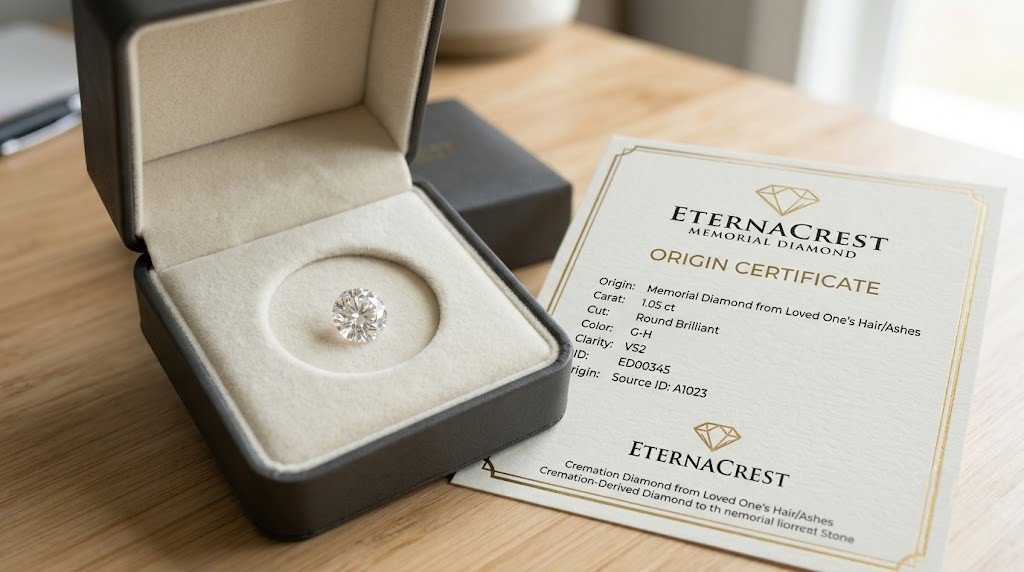
son-hair-diamond-questions

Questions to Ask Before Turning Your Son’s Hair Into a Diamond

Whatever you have of his hair is probably small, and there is probably no more of it. The son hair diamond questions that genuinely protect a family are about that fragility: how a sample that size is tracked, what a laboratory does if it is too little or too degraded to work with, what the provider will actually put a number on, and what the paperwork proves at the end. Ask them in writing, before anything is posted.

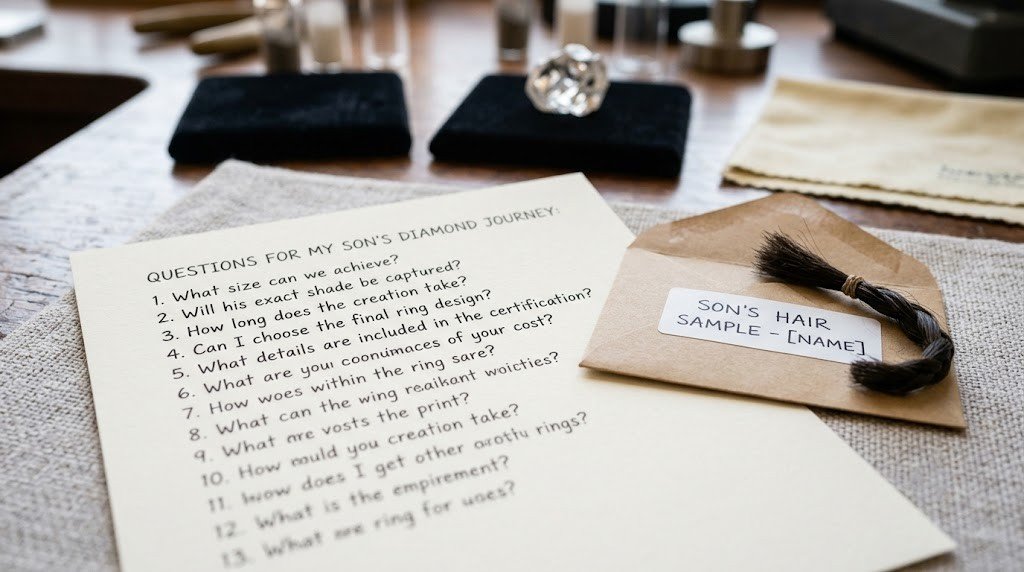
Son hair diamond questions listed on paper beside a small labeled envelope holding a lock of hair

Why Are the Son Hair Diamond Questions Different?

No cremation stands behind this one. That removes a whole category of worry and introduces a different one, which is why the son hair diamond questions do not simply copy the ashes version with a word swapped.

The son hair diamond questions start from one physical fact: the sample is usually tiny, frequently old, and almost always the only one in existence. It may have come from a first haircut, a lock taken in a hospital room, or a brush nobody could bring themselves to clean out. None of those arrive with documentation.

That changes what the son hair diamond questions need to establish. Quantity becomes a live issue rather than a formality. Condition matters, hair that has been dyed, bleached, or stored loose in a drawer for twenty years is not the same starting material as a lock cut yesterday.

Provenance becomes a question you may quietly be asking yourself. The son hair diamond questions here are built around those three pressure points, and each is easier to raise before a padded envelope leaves your hands.

Which Son Hair Diamond Questions Belong on Your List?

Eleven, covering the sample, its handling, what comes back, and the commercial terms. Send the son hair diamond questions below as a numbered email and ask for numbered replies.

#AreaThe question to put in writing
1SampleHow much hair do you need, by weight or by visible length, and what is your minimum?
2SampleDoes age, dye, bleach or heat damage affect whether you can use it?
3SampleDo you need roots attached, or are cut ends sufficient?
4SampleIf what I send is too little, do you stop and ask me before proceeding?
5HandlingWhat identifier is assigned on arrival, and is any of it returned unused?
6HandlingIs his hair ever processed alongside another family’s material?
7ContentWhat percentage of the finished stone will be carbon from his hair?
8DocumentsWhich certificate records where this carbon came from, and who issues it?
9DocumentsIs independent grading included, offered at extra cost, or unavailable?
10TermsWhat is billed separately from the stone itself?
11TermsIf the growth cycle fails and no hair remains, what happens then?

Of the son hair diamond questions above, number eleven is the one families skip, and it matters most when a sample cannot be replaced.

What Should You Ask About the Sample Itself?

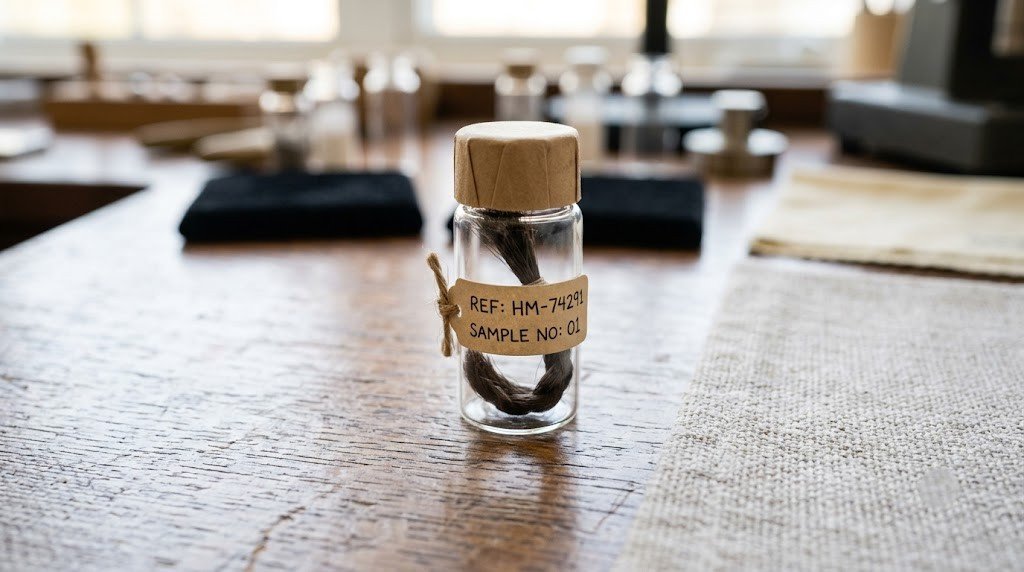
A small sealed glass vial holding a hair sample with a numbered reference label attached

Start the son hair diamond questions with quantity, because it is the only one with a hard floor. Industry wide a hair based stone typically needs a small lock or a few grams, palm sized, or a few wisps, far less than ash based work requires. What a laboratory actually asks for varies by provider, so get their figure rather than a general one.

Condition is the next of the son hair diamond questions. Hair is roughly 50% carbon by weight as a starting material, which is why so little of it is needed. But permanent dye, bleach, relaxers and years of heat styling all alter what is there, and providers differ on what they will accept.

Ask about age directly. A lock cut in 1994 and one cut last month are chemically closer than most people expect, but storage matters, damp, mold or adhesives all cause problems.

And ask what happens if you send less than they need. The son hair diamond questions that prevent the worst outcomes are the ones about stopping: does the laboratory pause and telephone you, or proceed with what arrived?

What If You Are Not Certain the Hair Is His?

Of the son hair diamond questions, this is the one almost nobody says out loud, and it deserves a plain answer rather than an embarrassed one.

Hair kept for years sometimes loses its label. An envelope in a memory box may carry a date and no name. A brush may have held more than one person’s hair. Something collected in a hospital or funeral home means trusting a chain you were not present for.

So put two of the son hair diamond questions to the provider. What do you ask me to declare about the origin of this sample, and in what form? And is there any verification step on your side, or does the certificate rest entirely on what I tell you?

Take the written answer at face value and do not assume either way, nothing standard across this industry settles whether verification of that kind happens at all. Of all the son hair diamond questions here, this is the one most worth asking in your own words rather than borrowing theirs.

How Is Something This Small Kept Track Of?

A few grams of hair is easy to misplace in a way that a sealed ash container is not, so the son hair diamond questions about custody are worth pressing harder than politeness suggests.

Begin the son hair diamond questions about handling with arrival. Is the sample transferred to a labeled, sealed vessel, weighed, photographed? Is there a reference number you can be told, and is it attached to the container or only to a database record?

Ask how many handovers occur between arrival and the growth cell. Purification, graphitization and growth are distinct stages with distinct staff, and what happens at each one is worth understanding first.

Ask whether his hair ever shares a batch or a growth cell with another family’s carbon. Some laboratories are built for batch work and some are not. Neither arrangement is automatically wrong, but you should know which you are buying before the envelope is sealed.

How Much of the Finished Stone Will Be Him?

Ask for a figure. Of all the son hair diamond questions, this is the one where an honest answer is provider specific rather than an industry constant.

Here is what can be said cleanly. Hair is roughly 50% carbon by weight, a fact about the starting material, about what enters the purification stage, not a statement about the finished diamond. Purified carbon from any personal source is blended with supplemental lab carbon to reach the volume a growth cell needs.

What cannot be said cleanly is the finished stone percentage. No equivalent published figure exists for hair the way one does for the ash route, and any number you are quoted is that company’s own. So put it among your son hair diamond questions in writing: what proportion of the finished stone’s mass will be carbon recovered from his hair, and where does the rest come from?

If you are told the stone is 100% your son, that is not how the chemistry works, and it is a reason to look elsewhere. A real, traceable portion of his own carbon inside the crystal is the accurate claim, and it is not a lesser one.

Who Should Be Asked Before the Lock Is Sent?

Begin the son hair diamond questions about consent by asking what declaration the provider requires, then think about your own household before you answer.

The rules families run into around authority are aimed at remains themselves, burial, cremation, what happens to ashes. A lock of hair already sitting in your keeping is usually the simpler question in practice. That is not the same as saying nobody else has an interest in it.

A decedent’s belongings can fall to an estate, and this varies by state. If your son was married or had adult children of his own, they may hold authority over decisions about him that a parent does not, and anything he set down in writing while living can shape that further. If the hair is held by someone else, his widow, a sibling, an aunt who kept a curl, that is a conversation to have rather than a decision to make alone.

Say plainly where the sample came from and who holds it when you first make contact. The son hair diamond questions about consent are much easier asked at the beginning than unpicked at month seven. Whether more than one stone can come from one family’s material often belongs in the same conversation.

What Documents Come Back With the Diamond?

Two separate documents exist and they answer two different questions, so the son hair diamond questions here begin with which one you are actually being offered.

An origin or authenticity certificate is usually issued in house and records provenance: that this stone was grown from the material your family submitted. It is a custody document. It does not assess quality, and it does not come from an outside body.

A grading report from an independent gemological laboratory describes the stone itself against the standard measures of cut, color, clarity and carat. It is optional across this industry, usually costs extra, and says nothing about where the carbon came from. Finished memorial stones are chemically genuine diamonds, the hardest known natural mineral, graded on the same scales as any other.

Ask which is included, who issues it, and whether you can see a specimen with another family’s details removed. Ask too whether the certificate names him and whether you approve the wording before it is printed. The son hair diamond questions about paperwork should never need chasing.

Which Son Hair Diamond Questions Cover Time and Money?

The son hair diamond questions here are two: what the schedule is measured from, and what the quote excludes. Those two questions catch most unpleasant surprises.

On timing, six to ten months from receipt of material to finished stone is the industry norm, with larger stones and specialty colors running toward twelve. Ask for the provider’s own range, whether it begins at payment or arrival, and what contact you will have during the long middle stretch when nothing photographable is happening. Where those months actually go is worth having explained before you commit.

On price, industry figures run roughly $1,500 to $3,500 for entry tier stones around 0.10 to 0.25 carats, roughly $5,000 to $15,000 between half a carat and one carat, and from about $20,000 upward past $75,000 for two carats and above. Colorless costs more than yellow or champagne at equal weight. What actually moves that number is worth understanding too.

Then work through the son hair diamond questions about extras, what is quoted separately: grading, engraving, fancy cuts, settings, insured return shipping. And ask for the payment schedule and what happens to money already paid if you stop.

What Can and Cannot Be Said About Color?

Ask what range is realistic for hair derived carbon, and treat a confident single shade promise as a warning rather than a reassurance.

The mechanism is not mysterious. Trace elements present while the crystal grows set its tone: nitrogen lends yellow, boron lends blue, and a colorless result requires the near absence of both. Carbon drawn from a person carries trace elements a synthetic feedstock would not, so memorial stones lean toward yellow, blue and champagne. What shade to realistically expect is its own subject.

So ask three things. Is colorless available, what extra processing does it require, and what does that add? Is irradiation offered for red, pink, green or black stones, and is it recorded on the paperwork? And what is the provider’s position if the finished tone differs from the sample you were shown?

Among the son hair diamond questions, this is where guarantees should make you cautious. Nobody controls trace chemistry closely enough to promise an exact shade from organic material.

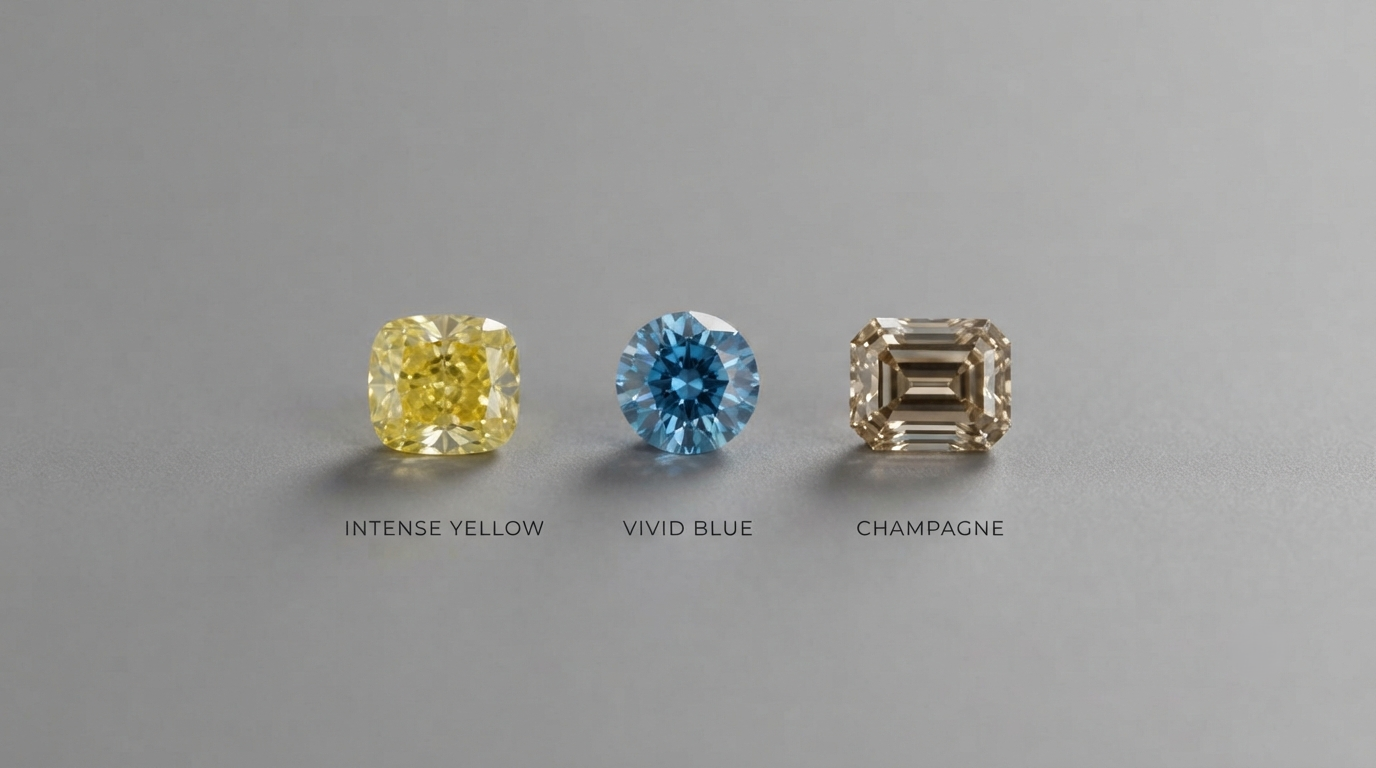
Three memorial diamonds in yellow, blue and champagne tones arranged on a pale gray surface

What Happens If the Growth Fails and the Hair Is Gone?

Ask this one of the son hair diamond questions before anything is posted, because it is the scenario a hair based project cannot recover from and the one families almost never raise.

Growth cycles occasionally fail. Crystals fracture in the cutting room. A parcel can be delayed or, rarely, lost. With ashes there is often more in an urn. With a single childhood lock there may be nothing left at all.

So ask directly: if the cycle fails, do you rerun from remaining material, and at whose cost? If none remains, what is your obligation, refund, partial refund, nothing? What insurance covers the parcel each way, and for what value? Is any portion of the sample held back against this possibility, and can I request it?

That last one is worth asking even if the answer is no. The son hair diamond questions about failure are the least comfortable to write and the most useful to have answered. The sequence from first call to finished stone will tell you where each risk sits.

How Do You Read the Answers You Get Back?

Compare replies to the son hair diamond questions, not impressions. Two companies can both sound kind; only one of them may be telling you anything you could hold them to.

What you askedA useful replyA reply that dodges
How much hair do you need?“A lock of about this weight, here is our stated minimum.”“Just send what you have.”
Does dye or bleach matter?“Yes, here is what we can and cannot work with.”“We handle all kinds of hair.”
What percentage of the stone is his?“Ours is X%, no industry figure is published for hair.”“It’s entirely made from him.”
Is there any verification of origin?“Here is exactly what we check and what we rely on you for.”“We treat every sample with respect.”
If the growth fails and nothing remains?“Clause four, I’ll paste it below.”“We’ve never had that happen.”

Notice the shape of a dodge rather than its tone. An adjective standing in for a number. A reassurance standing in for a clause. A question about process answered with a sentence about feeling. None of those is proof of anything, and all of them mean the son hair diamond questions need asking again.

Frequently Asked Questions

Can a diamond be made from hair kept for twenty years?

Usually yes. Hair is stable and does not decay the way soft tissue does, so age alone is rarely the obstacle. Tell the provider how it has been stored, since damp, mold or adhesive residue matter considerably more than the number of years.

Does hair from a hairbrush work?

Ask the provider, because practice varies. Brush hair raises two separate issues worth naming: whether there is enough of it by weight, and whether it is certainly all his. Both are better raised in your first email than later.

How much of the diamond will actually be his hair?

Ask for that company’s own figure in writing. Hair is around 50% carbon as a starting material, but no published industry figure exists for what proportion of a finished hair grown stone is personal carbon, so any percentage you are given is theirs.

Is anyone’s permission needed to use his hair?

Ask the provider what declaration they require. Rules about authority are aimed at remains themselves, so a lock you already hold is usually simpler in practice, but belongings can fall to an estate, this varies by state, and a sample someone else keeps is a conversation first.

Can I get some of the hair back?

Ask before sending. Some providers return unused material, some do not, and with samples this small there may be nothing left to return. Ask whether any portion can be deliberately reserved and sent back to you.

Should I ask two companies the same questions?

Yes, and send both the identical son hair diamond questions. Comparing replies side by side reveals differences in specificity that no amount of reading marketing pages will. The company that answers in numbers and clauses is telling you how it operates.

Final Thoughts on Asking Before You Send His Hair

A lock of hair is a strange kind of valuable. It cost nothing, it cannot be bought again, and for months it will be somewhere you are not. That is the whole reason to ask carefully rather than politely.

If you get through only four of the son hair diamond questions on this page, make them these: how much do you need and what happens if I send less, what percentage of the stone will be his carbon, who is authorized to make this decision in my family, and what happens if the growth fails with nothing left. Between them they cover nearly all of the real exposure.

Then stop researching and decide. Careful is good; endlessly careful becomes its own weight. The wider picture is here whenever you want it.

Learn More About Son Memorial Diamonds

Talk With Memorial Diamond

If putting the son hair diamond questions to a person suits you better than another page of reading, that is a fair way to start. Memorial Diamond can be reached at memorialdiamond.us to talk through samples, handling, documentation and what a realistic schedule looks like. No obligation attaches to a first conversation.

Wife memorial diamond vs traditional urn showing a memorial diamond and urn with key differences in portability, sharing, cost, and remembrance

Wife Memorial Diamond vs. Traditional Urn: What to Know

The traditional urn was chosen quickly, in a week you would struggle to reconstruct, and it has been in the same place ever since.

A wife memorial diamond vs traditional urn is not really a contest between two versions of the same object. A traditional urn is a place she is kept. A diamond is something she is kept in that travels with a person. They answer different questions, and because a diamond uses only a fraction of the ashes, choosing one almost never means giving up the other.

A disclosure belongs at the top of a memorial diamond vs traditional urn comparison rather than buried at the end of it. Memorial Diamond grows memorial diamonds and sells no urns, so one of the two columns below is the one this company is paid for. The traditional urn column is written to be accurate, not to lose, but read it knowing who wrote it.

 Wife memorial diamond vs traditional urn: a ceramic cremation urn on a home shelf beside a small open ring box holding a pale champagne stone

Two Different Questions About Where She Is Kept

A memorial diamond vs traditional urn comparison begins with something the phrasing hides: the two objects are not answering the same question, so neither can really beat the other at it.

A traditional urn answers a question about location. It holds the whole of what a cremation produces, complete and undivided, and it sits somewhere specific, a shelf at home, a plot, a niche in a columbarium wall. Its entire nature is that it stays put and can be returned to.

A wife memorial diamond answers a question about company. It is a chemically genuine lab grown diamond containing a purified portion of her carbon, and its nature is that it goes where a person goes. It has no address. It has a keeper.

Neither question is the better question, and a wife memorial diamond does not answer the first one better than an urn does. A family that wants somewhere to go on her birthday is asking the location question. Someone who wants her at a graduation two states away is asking the second. Most families, given a little time, find they are asking both, which is why the wife memorial diamond vs traditional urn framing dissolves so often on contact.

Worth being precise about what a wife memorial diamond is, since a memorial diamond vs traditional urn comparison only works if both sides are described honestly. What a cremation leaves is largely calcium phosphate, bone mineral, which puts the usable carbon at between 0.5% and 4% of the ash by weight. That carbon is extracted, purified to around 99.9%, and grown into a crystal, but the quantity recovered is nowhere near what a growth run consumes, so it is combined with lab grown carbon to reach a workable volume. The stone contains a real, traceable part of her. It is not made only of her, and no honest comparison should imply otherwise.

Is a Wife Memorial Diamond vs Traditional Urn Really a Choice?

Usually not, and this is the single most useful thing to know before reading any further.

A wife memorial diamond order uses somewhere between a few tablespoons and roughly four ounces of cremated remains, industry wide, about 100 grams. A full adult cremation produces several pounds. So the arithmetic of a wife memorial diamond vs traditional urn is not subtraction of one from the other. It is a small withdrawal from something that stays substantially intact.

What a wife memorial diamond takes, it takes once, and the rest is untouched. The remainder can be interred as planned. It can be scattered where she asked. It can stay in the traditional urn on the shelf, in the same room, doing exactly what it has been doing. How much ash a single stone actually uses sets out the quantities and what remains afterward.

There is one situation where the memorial diamond vs traditional urn choice is real, and it is about timing rather than principle. A scattering or an interment that goes ahead without a portion being set aside closes the diamond route permanently. If you are unsure, separating and labeling a portion costs almost nothing and commits you to nothing. How to divide her ashes yourself covers how.
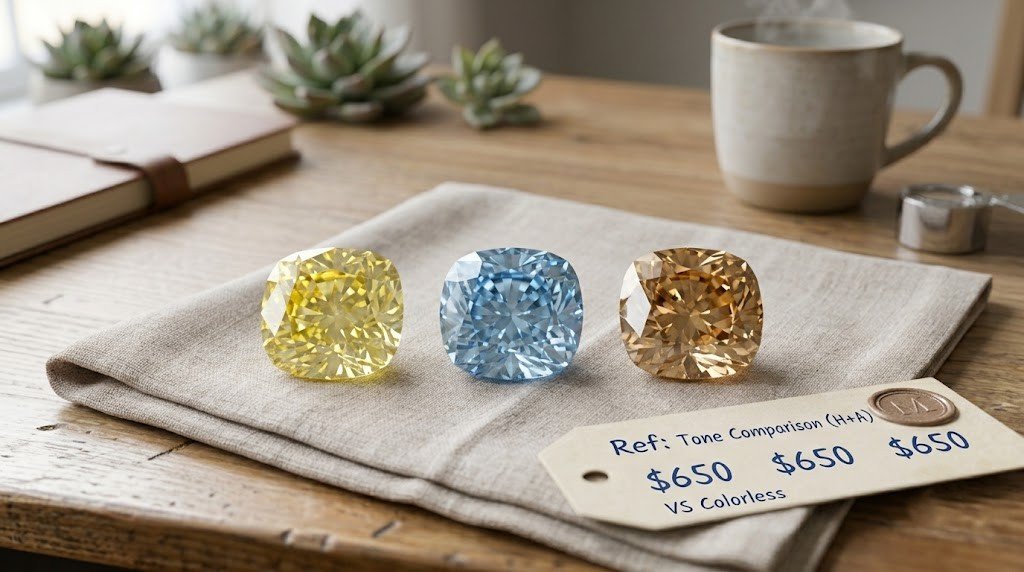
And keeping a traditional urn, whole and undivided, is a complete answer. It needs no upgrade and no justification. Any memorial diamond vs traditional urn comparison that treats the urn as a holding position for people who have not yet heard of something better is writing about a decision it does not understand.

Does She Stay in a Place, or Travel With a Person?

This is the axis the two objects genuinely differ on, and it is the one place where a memorial diamond vs traditional urn comparison produces a clean answer rather than a hedge. It is worth sitting with before looking at any table.

A traditional urn is fixed and public within the family. Anyone who can reach the room, the grave or the niche can be with her without asking anyone’s permission. Her mother can visit. Her oldest friend can visit. Nobody has to arrange it through you.

A wife memorial diamond is mobile and private. It goes to work, to the beach, to a hospital waiting room. It is also in a specific person’s keeping, which means being near it involves being near them. A stone on your hand is not somewhere anyone can drop in on.

Both properties are real and neither is a defect. A wife memorial diamond vs traditional urn decision often comes down to which of those two you need more of this year, and the answer can change. Someone who wanted her fixed in one place in the first year sometimes wants her portable in the fifth, and the urn does not prevent that.

There is a durability point under the portability one, and in a memorial diamond vs traditional urn comparison it favors both objects rather than one. Diamond is a 10 on the Mohs scale of mineral hardness, the hardest known natural mineral, so a wife memorial diamond worn daily is in no danger from ordinary life. The setting around it and the metal holding it are softer and do wear. A traditional urn, kept still, wears at effectively nothing at all.

Wife Memorial Diamond vs Traditional Urn: Five Dimensions Side by Side

A columbarium niche wall photographed at a respectful distance with no names or dates legible

Five dimensions do the real work in a memorial diamond vs traditional urn decision, and a wife memorial diamond leads on some of them while a traditional urn leads on others. Neither column below is the winning column. They are different objects, and the rows show what each one is naturally good at.

Table: memorial diamond vs traditional urn, across the five dimensions that actually decide it.

DimensionA traditional urnA wife memorial diamond
PermanenceVery high. Ceramic, metal or stone, kept still, in a fixed location. Interred or in a niche, it is designed to outlast everyone who arranged itVery high, by a different mechanism. A 10 on the Mohs scale, unaffected by daily wear. The stone outlasts the setting it sits in, which may need replacing over decades
PortabilityLow by design, and that is the point. It can be moved, but moving it is an event, and an interred urn or niche is not moved at all without the cemetery’s permissionHigh. It goes where a person goes, without arrangement, notice or anyone else’s involvement
Who can share itAnyone who can reach the place it stands. Access runs through a location, and often through a cemetery’s own visiting rules rather than through a family memberWhoever is with the person holding it. Access runs through a person. Several stones can often be grown from the same remains, so sharing is possible but is a separate order each time
Cost shapePaid once, early, usually as part of arranging the cremation, and then effectively nothing afterward beyond interment or niche feesA separate purchase made later, from the low thousands upward by carat, with a grading report, engraving and any setting typically priced on top
ReversibilityFully reversible while it remains in the traditional urn. Ashes can be moved, divided, interred or scattered at any pointNot reversible. The portion used becomes carbon inside a crystal and cannot be returned to ash

Read the permanence row and the reversibility row together and the memorial diamond vs traditional urn comparison is there in miniature: both objects last, but only one of them keeps your options open.

Who Else Can Have Part of Her?

This dimension gets less attention than permanence and matters more in practice, because it is where a memorial diamond vs traditional urn decision stops being yours alone and starts involving other people.

A traditional urn is shared by proximity. It sits somewhere, and the people who can get to that somewhere are the people who can be with her. Nobody has to ask, and nobody can be excluded except by distance. That includes people you might not choose and excludes people who live far away, neither of which is anyone’s decision, exactly. It is just how a place works.

A wife memorial diamond is shared by multiplication instead. Because a single stone uses only a portion of the remains, more than one can often be grown from the same source, so several people can each have their own. That is a genuinely different model of sharing, and it has its own complications: each stone is a separate order at a separate price, and two stones grown from one source are not guaranteed to resemble each other. What to settle before more than one person orders is worth reading before the subject is raised at a family gathering.

The two models combine well rather than competing. A family can keep the traditional urn exactly where it is, so nothing anyone has been doing has to stop, and grow one or two stones from a portion for the people who need her portable. Nobody has to give anything up for that to work, which is the practical reason the wife memorial diamond vs traditional urn question resolves as “both” more often than as “either”.

Memorial Diamond vs Traditional Urn: What Does Each Cost, and When?

The money question in a memorial diamond vs traditional urn comparison is not really about which is dearer. It is about when the cost lands and what it is attached to.

A traditional urn is bought under time pressure, usually within days of a death, as one line on a funeral invoice among many things being decided at once. The decision is made fast because it has to be, and the price is settled before anyone has had a chance to think about what they want long term.

A wife memorial diamond is bought later, with no deadline attached, and the cost scales steeply with carat because carat is bought as growth time in the press. Across the industry as a whole the steps run roughly like this: $1,500 to $3,500 for a stone in the 0.10 to 0.25 carat entry tier, $5,000 to $15,000 once you reach half a carat to a full carat, and a climb from there for anything larger. Colorless costs meaningfully more than yellow, blue or champagne tones at the same size. What a wife memorial diamond costs breaks the tiers down properly, including what is usually priced separately.

So the cost side of a memorial diamond vs traditional urn comparison is a little unfair in both directions. The traditional urn was cheaper and was chosen under pressure. The diamond is dearer and can be chosen slowly, deferred for years, or never bought at all without anything being lost. Those are different kinds of spending, not different amounts of the same kind.

What Can Be Undone, and What Cannot?

Reversibility is the row most people skip, and it is the one most worth understanding before anything is sent anywhere. It is also the one row in a memorial diamond vs traditional urn comparison where the diamond is genuinely at a disadvantage, and there is no point pretending otherwise.

Ashes in a traditional urn are stable mineral matter. They do not degrade, they do not expire, they do not become less suitable for a wife memorial diamond with age, and every option remains open for as long as they sit there. A stone in five years is exactly as possible as a stone next month. That optionality is a real, underrated property of simply doing nothing for a while, and it is why a memorial diamond vs traditional urn decision almost never has to be made this month.

Three things close, and only three:

  • A scattering or interment that goes ahead with nothing held back. Complete by design, which is much of what it is for. After it, ashes are no longer a route.
  • The portion committed to a growth run. Once purified and graphitized, it is carbon heading into a crystal and cannot become ash again.
  • Hair that was never collected, if the ashes route is closed and hair would have been the alternative.

Everything else waits. Choosing a company, choosing a carat, choosing a color, settling the memorial diamond vs traditional urn question one way or the other, none of that decays while you think about it. If you want the full route before taking a step, the complete guide to a wife ashes diamond runs from material to finished stone.

Three lab-grown memorial diamonds in yellow, blue and champagne tones arranged on neutral cloth

Frequently Asked Questions

Do I have to choose between an urn and a memorial diamond for my wife?

Usually not. A diamond uses only a portion of the ashes, industry wide, a few tablespoons up to about four ounces, so the urn keeps the rest and stays exactly where it is. Both can exist at once.

Which lasts longer, a wife memorial diamond vs traditional urn?

Both last indefinitely, by different mechanisms. A quality urn kept still is effectively permanent. A diamond is a 10 on the Mohs scale and unaffected by daily wear, though the setting holding it is softer and may need replacing over decades.

Is it disrespectful to take ashes out of the urn for a diamond?

There is no universal answer. Views on dividing or repurposing ashes vary by faith, denomination and individual clergy, and no tradition has an official position on memorial diamonds specifically, only on cremation and ash handling generally. Ask your own faith leader.

Can her family still visit her ashes if I have a diamond made?

Yes, if the urn stays where it has been. A diamond does not empty an urn or move it. What changes is only that the stone itself is not a place anyone can visit. Access to it runs through whoever keeps it.

Is a memorial diamond more expensive than an urn?

Almost always, and the two costs are not really comparable. An urn is bought fast, early, as part of a funeral invoice. A diamond is a separate later purchase priced by carat, from the low thousands upward, with settings and grading usually charged separately.

Can I still make a diamond if her ashes were already interred?

Sometimes. It depends on whether a portion was held back at the time, and on whether that cemetery permits an interred urn to be reopened. Rules vary considerably by location and are a question for that specific place rather than a general one.

Final Thoughts on a Wife Memorial Diamond vs Traditional Urn

A memorial diamond vs traditional urn comparison is gentler than the title suggests. The traditional urn on the shelf was a real decision made in a hard week, and nothing on this page asks you to revisit it or to feel that it fell short. A wife memorial diamond is an addition to consider, not a correction to make.

What a wife memorial diamond vs traditional urn comparison is actually for is noticing that the two objects are good at different things, one holds a place, one keeps company, and that a small portion of what a traditional urn holds can become the second without the first changing at all. If that is not something you want, the memorial diamond vs traditional urn question needs no answer from you at all: the traditional urn is already a complete answer, and it does not need this page’s permission to be one.

Learn More About Wife Memorial Diamonds

Talk With Memorial Diamond

If what a memorial diamond vs traditional urn comparison leaves you with is a practical question, how much a portion would actually be, what would remain in the urn afterward, what a wife memorial diamond of the size you have in mind would involve, that is a conversation with a company rather than something to settle by reading.

Memorial Diamond is one of the companies you can put a wife memorial diamond vs traditional urn question to, at memorialdiamond.us. Asking changes nothing about the urn, and it commits you to nothing. If the answer you reach is that the traditional urn stays as it is and whole, that is a good answer, and it was always available.
wife memorial diamond timeline

How Long Does It Take to Make a Wife Memorial Diamond?

Most people asking this want a number, then find the number is not the hard part.

Across the industry, production typically runs 6 to 10 months from the moment a laboratory receives the material, stretching toward 12 for larger or specialty color stones. But the wife memorial diamond timeline is not one long wait. It is three waits of completely different character: a short, busy stage you can act on, a long, silent stage you cannot, and a finishing stage that quietly asks you to make decisions again.

One note of self interest: Memorial Diamond is one of the companies that would be holding the material during the silent stage, so read what follows as a description of how the category works rather than a service promise from us.

| Wife memorial diamond timeline planning: an open notebook and a sealed, labeled envelope on a kitchen table in morning light

What Does the Wife Memorial Diamond Timeline Actually Look Like?

One figure in this category is genuinely sourced, and it is worth separating from everything else you will read: production typically takes 6 to 10 months from receipt of material, and up to about 12 months for larger stones or specialty colors. That window starts when a laboratory logs the material in and ends when a finished stone exists. It does not include anything that happens before receipt, and it is not a delivery date. Nobody publishes one of those, and no company can promise one.

What that number hides is that the months are not alike. Split the wife memorial diamond timeline by the kind of waiting each stage asks of you, and three distinct stages appear.

StageRoughly how longWhat is physically happeningWhat you can influence
Wait one: logisticsNot part of the published window at all. Days to weeks, set by you, a funeral home and the postHer material is located, portioned, labeled, packaged and sent; an order is specified; carat and color are chosenAlmost all of it. This is the only stage where your own speed is the variable
Wait two: preparation and growthThe bulk of the 6 to 10 month industry windowCarbon is extracted and purified to around 99.9%, converted to graphite at roughly 2,500 to 2,700°C, then grown around a seed in an HPHT cell at roughly 6 to 8 GPa and 1,400 to 2,500°CNothing, once it has begun. Carat and color were chosen in wait one, and they are what set this stage’s length
Wait three: finishingNot separately published; sits inside or after the quoted window depending on the companyThe rough crystal is cut and polished, color work is done if it was ordered, the stone is graded, paperwork is issued, a setting is madeThe decisions, not the duration: cut, whether a report is commissioned, whether a setting is ordered now or later

Read the third column as the honest part and the second as the careful part. Only the 6 to 10 month figure is an industry published number; the internal split between stages is not something the category publishes, so this table describes what each stage consists of rather than assigning it months it cannot support. How long a memorial diamond takes across the whole category covers the figure itself in more detail.

Wait One of the Wife Memorial Diamond Timeline: The Stage You Can Act On

This is the stage nobody counts and everybody feels. It is the only part of the wife memorial diamond timeline where things are happening to you rather than to the material.

Her ashes have to be located, which sometimes means a conversation with a funeral home rather than a trip to a shelf. A portion has to be separated and labeled. If hair is going in, it has to be found, cut or gathered, sealed and dated. An order has to be specified, which means choosing carat and color before anything is sent, not after. Then it has to travel, which is a shipping policy question worth confirming with whoever is receiving it rather than guessing at.

Wait one is the noisy part of the wife memorial diamond timeline, and it is also the compressible part. Every other stage runs at its own pace regardless of how motivated you are. This one runs at yours.

Two things are worth knowing while you are in it. First, there is no clock on starting: cremated remains are calcium phosphate dominant mineral matter and do not deteriorate, and a dry, sealed, labeled lock of hair does not expire. Second, there is one genuine exception, hair that has not been collected yet is the only part of this that can stop being available. How to turn her hair into a diamond covers where it is usually found and what condition it needs to be in.

The step by step route for turning her ashes into a diamond sets out wait one as a sequence of tasks rather than as a stage.

Sealed HPHT growth cell in a press mid-run, with no visible indication of progress

Wait Two: What Happens in the Silent Middle of the Wife Memorial Diamond Timeline?

This is the long middle of the wife memorial diamond timeline, and the part people are least prepared for, because from outside it looks like nothing at all. Months pass with no updates worth reading. It is worth knowing what they contain.

Extraction and purification. Her material is heated in a controlled, oxygen free, multi stage process that strips out everything that is not carbon, the calcium phosphate and other minerals in ash, the non carbon components of keratin in hair, until what remains is around 99.9% carbon or better. Ash is a thin source: usable carbon is commonly put at roughly 0.5% to 4% of ash by weight. Hair is far richer, at roughly 50% carbon.

The blend. Whatever is recovered is not enough on its own. A growth cell needs a certain volume of feedstock, and no realistic portion of ashes or lock of hair supplies it, so purified lab grown carbon is added alongside hers to make up the charge. This is true of every memorial diamond, and it is worth knowing during wait two specifically, because it explains why nobody can tell you how much of “her” is in the press at any given moment, it is a proportion set at loading, not something that develops.

Graphitization. The purified carbon is taken to roughly 2,500 to 2,700°C and converted into graphite, which is the form a growth press can actually use as feedstock.

Growth. The graphite, plus a tiny diamond seed, goes into a growth cell and is held at roughly 6 to 8 GPa and 1,400 to 2,500°C, the high pressure, high temperature method used across the lab grown diamond industry, for weeks to months. The crystal grows outward from the seed, and the length of this hold is what sets the finished carat.

The reason wait two is silent is that there is very little to report. A run in progress has no meaningful midpoint. It is either holding its conditions or it is not, and the way you find out is at the end.

That is also why this stage is the one to ask about before it begins rather than during it. A run can end with a crystal that is smaller than intended, flawed in a way that will not cut, or unusable. What happens then, whether a run is repeated, what becomes of material that was consumed, how the wife memorial diamond timeline is restated, is company policy and varies. Ask for it in writing while you still have leverage over the order.

Wait Three of the Wife Memorial Diamond Timeline: Finishing Has Decisions in It

The third wait catches people out because they expect an arrival and get a queue with choices in it. It is the least predictable part of the wife memorial diamond timeline, and the only part with steering in it.

A rough crystal is not a finished stone. It has to be cut and polished by a gemologist, and the cut is a decision, round is the reference shape, and fancy shapes are generally priced and scheduled differently. If color work was ordered, post growth irradiation to shift or intensify color happens here. If a grading report was commissioned, the stone goes to an independent laboratory, which works to its own standards for cut, color, clarity and carat and its own schedule, not the growth laboratory’s. If a setting was ordered, a bench has to make it.

None of those are long individually. Stacked, and separated by shipping, they are the reason a stone that “exists” in month eight can arrive in your hand considerably later.

The useful question is not how long wait three takes. It is where the quoted window ends. A company quoting 6 to 10 months to a finished loose stone and a company quoting 6 to 10 months to a mounted, graded, engraved piece are describing different things with the same sentence. Ask which. And ask whether an independent grading report sits inside or outside that window, because a third party laboratory is not a stage a growth laboratory controls.

Two of these decisions can also be deferred without cost. A finished stone sits in its case indefinitely, so a setting does not have to be chosen while you are choosing carat, settings and jewelry ideas for a wife can wait until there is something in your hand to hold a design up against.

 Rough lab-grown diamond crystal held in tweezers on a gemologist's bench before cutting and polishing

What Can You Reasonably Ask For at Each Stage of the Wife Memorial Diamond Timeline?

Each stage of the wife memorial diamond timeline carries a different reasonable expectation. Asking for a weekly update during wait two is asking for a report on a sealed press. Asking for nothing during wait three means missing decisions that were yours.

A reasonable rhythm looks roughly like this:

  • At order, in writing: what the quoted window is measured from and where it ends, what happens if a run fails, and what documentation is issued at which stage.
  • At receipt of material: confirmation that it arrived, was logged, and matches what you described. This is the single most reasonable thing to ask for, and the easiest for a company to provide.
  • At the start of growth: confirmation that the run has begun, and the carat and color it was loaded for.
  • Silence during growth: expected, and not a warning sign. If you want a check in anyway, agree its frequency at order rather than asking for it midway.
  • At the end of growth: the result, including whether the finished carat matched the target.
  • Through finishing: notice when the stone is cut, when it goes for grading if it is going, and when a setting is under way.

Two things are not reasonable to expect from anyone, and asking for them mostly produces false comfort. A delivery date is one: the wife memorial diamond timeline has too many hands in it, a funeral home, a growth run, an independent laboratory, a bench, for any single party to guarantee an arrival. A midpoint prediction of size or color is the other; neither is known until the cell is opened. What color to expect from a memorial diamond for a wife explains why a forecast is not available even at the end.

If a date is given to you, treat it as an estimate and ask how often it is re confirmed. That question tells you more about the coming months than the first date does.

Why Does Carat Stretch the Wife Memorial Diamond Timeline?

Because carat is made of time. A diamond’s size comes from how long the crystal is held in the growth cell, not from how much material you sent, so the size chosen in wait one is also the wife memorial diamond timeline you are choosing.

That has a blunt consequence worth stating plainly: sending more of her ashes does not make the stone bigger, better, or faster. It changes nothing about the wife memorial diamond timeline at all. A stone at the smaller end of the range finishes nearer the six month edge of the industry window; a larger one, or a specialty color that needs extra processing, moves toward twelve.

Which is why size and schedule are one decision rather than two, and why they are also the same decision as budget, what a wife memorial diamond costs works through the price steps that sit alongside these months.

Does Hair Shorten the Wife Memorial Diamond Timeline?

Not in the press. It can shorten the first stage of the wife memorial diamond timeline considerably.

Growth time is set by the target carat, not by the source material, so nothing about hair speeds up the middle of the process. What hair changes is the front end. It needs no cremation at all, which means it can often be collected and sent while ashes are still with a funeral home, still subject to a family decision, or still waiting on a scattering that has been scheduled.

For a combined order, the first stage of the wife memorial diamond timeline gets more complicated rather than longer: two materials have to be located, labeled and sent, and they may not become available at the same moment. Whether a laboratory will hold the first while the second is found is a policy question worth asking before you send anything, the questions to ask before turning her ashes and hair into a diamond puts it alongside the rest of the combined order list.

Frequently Asked Questions

How long does the wife memorial diamond timeline take from start to finish?

Production typically runs 6 to 10 months from receipt of material, and up to about 12 for larger or specialty color stones. Locating and sending the material beforehand, and grading or setting afterward, all sit outside that published window.

What happens during the silent months of the wife memorial diamond timeline?

Extraction and purification to around 99.9% carbon, conversion to graphite at roughly 2,500 to 2,700°C, then growth around a seed at roughly 6 to 8 GPa and 1,400 to 2,500°C. A run in progress has no meaningful midpoint, which is why there is little to report.

Why does a bigger stone add months rather than weeks?

Because carat is a function of how long the crystal is held in the growth cell. A larger target simply means a longer hold under closely controlled conditions, which is also why sending more of her ashes changes neither the size nor the wait.

Can anyone give me a delivery date?

No, and a company that offers one is describing an estimate. Too many independent hands are involved, a funeral home, a growth run, an independent grading laboratory, a setting bench. Ask when any date you are given is next re confirmed.

Is a hair diamond faster than an ashes diamond?

Not in the press, where growth time is set by target carat. Hair can shorten the stage before that, because it needs no cremation and can often be collected and sent while ashes are still being released or decided about.

What happens to the wife memorial diamond timeline if a growth run fails?

That varies by company and is worth asking in writing before ordering. Ask whether a run is repeated, what becomes of material consumed in it, whether an under target carat changes the order, and how the schedule is restated.

Final Thoughts on the Wife Memorial Diamond Timeline

If the number is what you came for, it is six to ten months of production, occasionally twelve. But the reason the wife memorial diamond timeline is hard is not its length. It is that the middle of it asks you to do nothing, for months, with something of hers in someone else’s building, and no amount of asking makes that stage shorter or louder.

What helps is knowing which wait you are in. In wait one you can act, so act. In wait two there is nothing to do and nothing to read into the quiet. In wait three there are decisions again, and they are yours.

Learn More About Wife Memorial Diamonds

Talk With Memorial Diamond

If you want the wife memorial diamond timeline mapped against your own situation rather than against an industry range, Memorial Diamond is one of the companies to ask, memorialdiamond.us. The most useful thing to ask first is where a quoted window starts and where it ends.

And if you are not ready to start wait one, nothing is lost by waiting. Her ashes are stable, a sealed lock of hair keeps, and the wife memorial diamond timeline only begins when you decide it does.

Memorial diamond made from son hair: a small blue-toned lab-grown stone beside a bound lock of hair

How a Memorial Diamond Is Made From Your Son’s Hair

Almost every parent asks the same thing first, and it is not a question about chemistry: what will I actually be told, and when? A memorial diamond made from son hair is produced by extracting carbon from a small lock of his hair, purifying it, converting it to graphite and growing it into a real diamond over roughly six to ten months, and across that span there are about six moments when a laboratory genuinely communicates with you. This page is organized around those six moments rather than around the machinery.

What Do You Send, and How Should You Prepare It?

The first point of contact is the one you control entirely. A diamond made from son hair typically begins with a small lock, often described across the industry as a few grams, or a palm sized amount, rather than anything approaching a full head of hair.

Most providers ask for hair in a clean, sealed paper envelope rather than plastic, since paper lets residual moisture escape. Bind it with thread so it does not scatter in transit. Write nothing on the hair itself. Labels belong on the envelope, and a stone made from son hair should never be delayed because a marker pen was used on the sample.

Lock of hair bound with thread, resting on an open paper envelope ready for posting

Where the hair came from matters far less than parents expect. A childhood lock kept in a book, an envelope from a barber, hair from a brush nobody emptied, a sample taken at a hospital or by a funeral director, any of these can become a diamond made from son hair, whether your son was six or sixty when he died.

Two things do matter, and both are worth mentioning at intake: whether the hair was bleached, dyed or chemically treated, and whether it is very fine or very short. Neither rules out a stone made from son hair, but both can change how much a laboratory asks you to send. How much hair a lab needs goes into the quantities properly.

Who Should You Speak To Before You Post His Hair?

This is the conversation parents most often skip, and the one most likely to matter later.

The rules governing what may be done with a person’s remains are written about the remains themselves. A lock of hair you have kept at home for years is therefore usually the simpler question in practice, but it is not a question with no answer at all. A decedent’s personal belongings can form part of his estate, the treatment varies from state to state, and where the sample sits in somebody else’s keeping, asking for it is a conversation rather than something you settle alone.

The people with standing are worth naming plainly. If your son was married, his surviving spouse may hold authority over his remains ahead of you, and in many states so may his own adult children. Anything he set down in writing can change that ordering. If any of his ashes are also involved, that authority question applies squarely and should be settled first.

None of this is a reason not to proceed. Parents commission a diamond made from son hair every week without difficulty, and a single parent arranging it alone, separated, widowed, or simply the one who can face the logistics, is entirely ordinary. How to turn his hair into a diamond walks through the same decision from the family’s side. Raise it early with whoever else loved him, and where the sample is not yours to begin with, ask rather than assume.

What Do You Hear Back in the First Fortnight?

The second point of contact comes shortly after the package arrives. You should expect confirmation of receipt, an identifier assigned to the sample, and whatever intake paperwork that provider uses.

That identifier is the thread you can actually pull on later. Everything made from son hair in a given batch should be traceable against it from receipt to return, and you are entitled to ask to see that record at any stage rather than only at the end.

This is also when a laboratory will tell you if the sample is insufficient. It usually resolves with a second envelope. Hair from a brush, from an older keepsake, or from more than one collection point can generally be combined, and a diamond made from son hair grown from two envelopes is no different from one grown from a single lock.

Ask three things while you have someone’s attention: what the identifier is, what happens to hair not consumed, and whether the estimate quoted for a diamond made from son hair has changed now the material is weighed.

What Are You Told While a Diamond Made From Son Hair Grows?

Honestly: not very much, and that is the hardest part of the whole arrangement.

Between intake and cutting, a diamond made from son hair passes through stages that produce no photographs and no milestones a family can meaningfully witness. The hair is heated in a controlled, oxygen free, multi stage process that strips away everything that is not carbon, reaching roughly 99.9% plus purity. That purified carbon is then heated to somewhere around 2,500 to 2,700°C and converted into graphite. The graphite, combined with supplemental lab sourced carbon to reach a workable volume, goes into a growth cell around a tiny diamond seed.

Then a press holds that cell at pressures in the region of 6 to 8 gigapascals and temperatures between 1,400 and 2,500°C for weeks to months. A minority of providers grow by CVD instead, depositing carbon from gas onto a seed plate in a vacuum. Either way, the chemistry is the same as any other laboratory grown diamond, the origin of the carbon is what differs.

Here is what you should realistically expect to receive, and when:

Point of contactWhat you getTypical timing
1. You send the sampleShipping instructions and an intake formWeek 0
2. Receipt confirmedIdentifier, chain of custody record, any request for more hairWeeks 1 to 2
3. Extraction completeConfirmation that carbon was successfully recoveredWeeks 3 to 10, varies widely
4. Growth underwayUsually a start date and an estimated completion windowVaries
5. Cutting and optional gradingCut confirmation, a grading report if you ordered oneNear the end
6. DeliveryThe finished stone, its documentation, any returned hairMonth 6 to 10 typically
Laboratory technician logging a sealed hair sample against an intake identifier

Ask at the outset which of these six you will actually be contacted at, because providers differ enormously, and a diamond made from son hair grown in near silence for eight months is a very different experience from one with a check in at every stage.

What Should You Ask at Each of the Six Points?

These are the questions parents most often wish they had asked earlier. Put them in an email, so the answers survive a change of staff.

  1. Before you send: how much hair do you need for the size I want, and does treated or fine hair change that figure?
  2. Before you send: what is your contingency if the sample turns out to be insufficient once weighed?
  3. At intake: what identifier have you assigned, and may I see the custody record for anything made from son hair in this batch?
  4. After extraction: did the recovery go as expected, and has anything about my quote changed?
  5. Before growth: what proportion of this diamond made from son hair do you estimate will be carbon recovered from him, and on what basis?
  6. Before growth: what color range are you expecting, and what happens if the stone falls outside it?
  7. Before delivery: is the grading report independent or in house, and is it inside my quoted price?
  8. Before delivery: what unused hair comes back, and in what packaging?

A provider who answers all eight plainly is telling you something useful about how a stone made from son hair will be handled for the next eight months. Questions to ask first expands each of these.

What Happens If Something Goes Wrong Midway?

Growth runs fail sometimes, and so do extractions. A provider who never mentions that possibility is not being straight with you.

The likeliest early problem is yield: not enough usable carbon recovered from the sample supplied. That is normally solved with a second envelope, which is one reason many parents keep some hair back rather than sending everything they have.

Later, a crystal can grow heavily included, grow off axis or fracture. A diamond made from son hair is no more prone to that than any other laboratory grown stone, but it hurts more, because the starting material is not replaceable in the ordinary sense.

Ask, before you commit, what a second attempt involves: whether it is included, whether it requires more hair, and how long it adds. Ask too what happens to material already consumed if you decide to stop. This is ordinary diligence, and a laboratory that grows stones made from son hair regularly will have answered it many times. The step by step version sets the sequence out in order.

How Much of a Diamond Made From Son Hair Is Actually His?

Here is where you should be told the truth rather than a percentage that sounds reassuring.

Hair is rich in carbon to begin with, keratin, the protein it is built from, puts hair at roughly 50% carbon by weight. That is a fact about what goes in, the reason hair based stones need so little material and no cremation at all. It is not a statement about what comes out.

There is no published, industry wide figure for what proportion of a finished stone made from son hair is personal carbon. Percentages you may have read elsewhere, the 10 to 15% band, for instance, are published for the ash route and do not transfer to hair. Anyone quoting you a confident figure for a diamond made from son hair should be asked exactly where that number came from, and from which route.

So ask your provider directly, and ask for the answer in writing: what proportion of this specific stone do you estimate will be carbon recovered from his hair, and how did you calculate it? A laboratory that grows stones made from son hair routinely can answer that. One that cannot, or will not, has told you something useful in itself.

What is true regardless is that supplemental lab sourced carbon is always part of the charge, because the recovered material alone is not enough volume to grow a gem of meaningful size. No diamond made from son hair is 100% him, and none needs to be for a real, verifiable part of him to be inside the crystal. Whether the stone is genuinely his examines that claim in detail.

What Will You Be Told About Color?

Usually a range, and rightly so, no responsible laboratory will commit to a precise shade in advance.

Trace nitrogen present during growth tints a crystal yellow. Trace boron tints it blue. A white stone requires that effectively neither element got in, which is difficult when the carbon originated in a living body rather than an industrial feedstock. That is why a diamond made from son hair tends toward yellow, blue, champagne or brown tones rather than colorless.

Three memorial diamonds shown side by side in blue, yellow and near-colorless tones

Colorless is achievable with additional processing and generally costs more. Some providers also offer post growth irradiation to produce red, pink, green or black, and if you order it, a grading report should disclose it.

What a good provider will tell you is which range is likely for a diamond made from son hair and why, and what they will do if the result falls outside it. What no provider can honestly tell you is the exact color of a stone made from son hair before it has been grown. What color to expect covers the likely range in more depth.

What Arrives at the End, and What Should Be in the Box?

The sixth point of contact is the one parents rehearse in their heads for months. It is worth knowing in advance what should arrive with a diamond made from son hair.

  • The stone itself, loose or already set, depending on what you ordered.
  • An origin or authenticity document, issued by the provider, recording that this diamond was grown from your family’s submitted material. This is a chain of custody record, not a quality assessment.
  • A grading report, if you asked for one, ideally from an independent third party laboratory, documenting the cut, color, clarity and carat weight. Independent grading is optional across this industry, not standard.
  • Any unused hair, if the provider returns it and you asked them to.
  • Care and setting information, if the stone is loose.

Every one of those items should be checked against the identifier you were given at intake before the box is closed and shelved. If a diamond made from son hair arrives with paperwork that does not reference the original record, ask about it before you put the box away.

A finished stone made from son hair is a genuine diamond in every testable respect, the same hardness, the same optical behavior, the same grading criteria. It can be set in a ring and worn daily without special handling.

What Does the Waiting Cost, in Time and Money?

The industry band runs from roughly six months to roughly ten, measured from receipt of material rather than from the day you first inquire. Larger stones, beyond about two carats, and specialty colors such as black can extend that toward twelve.

Size is a function of growth time, not of how much hair you sent, and this surprises almost everyone. A diamond made from son hair grown to two carats simply spent longer in the press than one grown to half a carat. Posting a larger lock does not shorten the wait or enlarge the stone, and a diamond made from son hair is quoted by finished carat rather than by input weight.

General industry pricing for 2026, not any single company’s published rates:

Finished sizeTypical rangeWhat moves the number
0.10 to 0.25 ctAbout $1,500 to $3,500The usual starting tier
0.5 to 1.0 ctAbout $5,000 to $15,000Colorless costs notably more than yellow or champagne
2 to 5+ ctAbout $20,000 to $75,000+Growth time rises steeply

Settings, engraving, unusual cuts and independent grading reports are normally priced separately. Ask which sit inside your quote, that single question resolves most of the reported sticker shock. How long the process takes sets out the calendar in more detail.

Frequently Asked Questions

If he was buried rather than cremated, is a diamond made from son hair still an option?

Yes, and this is one of the clearest advantages of the hair route. No cremation is required at any point, so a lock kept from before his burial, from a childhood haircut, or from a hairbrush works exactly the same way chemically as any other sample.

Does hair from a hairbrush work as well as a cut lock?

It generally does. Brush hair is often mixed with other people’s and carries product residue, so a laboratory may ask for more of it, but the keratin itself is identical. Say at intake where the sample came from so the quantity can be judged properly.

Does gray, bleached or dyed hair change anything?

Possibly the quantity requested, rather than the outcome. Bleaching and dyeing alter hair’s surface chemistry and can reduce usable yield, so some laboratories ask for a larger sample. Mention any treatment at intake rather than after the material has already been processed.

How long can hair be kept before it is used?

Indefinitely, if it stays dry. Keratin is stable and does not decay in the way soft tissue does, so hair kept in an envelope or a locket for decades remains perfectly usable. Store it somewhere dry and dark until you are ready.

Can more than one stone come from a single lock?

Sometimes, depending on the weight you send and the sizes chosen. Because a portion may remain after extraction, several family members can occasionally each receive a stone from one collection. Confirm feasibility and per stone pricing before ordering rather than afterwards.

Will the finished diamond look different from a mined one?

Not to the eye. It has the same hardness, brilliance and grading criteria as any other diamond, and its color sits in the same range as other fancy colored stones. Gemological testing identifies it as laboratory grown, which is accurate and expected.

Final Thoughts on a Diamond Made From Your Son’s Hair

The part nobody prepares you for is the middle. The envelope goes, the confirmation arrives, and then there are months in which nothing visible happens at all, and for a parent, months of nothing can be considerably harder than months of activity.

Knowing in advance which six moments will actually involve you makes that stretch easier to sit with, and it is the main practical reason to read about how a diamond made from son hair is produced before commissioning one rather than after. So does knowing what you will be told at each one, and what you are entitled to ask for rather than wait to be offered.

A diamond made from son hair is a small, concrete thing: carbon that was part of him, in a form you can wear. It does not finish anything or replace anything, and it sits perfectly well alongside a grave, an urn, a scattering, or a shelf you have not touched. Nothing about commissioning a stone made from son hair rules out a single one of those.

Learn More About Son Memorial Diamonds

Talk With Memorial Diamond

If you want to understand what you would actually be told and when, rather than read another process diagram, reach out to Memorial Diamond at memorialdiamond.us and ask about the hair you have. There is no form to complete first, and no timeline you are behind on.

Word count: 3,042 words
Reading time: about 15 minutes

Memorial diamond made from son ashes: a pale yellow lab-grown stone held in a gloved hand

How a Memorial Diamond Is Made From Your Son’s Ashes

Most parents want to know where the ash physically goes, not just what the brochure says. A memorial diamond made from son ashes is produced by extracting the carbon out of a small portion of his cremated remains, purifying that carbon past 99.9%, turning it into graphite, and growing it into a real diamond under enormous pressure and heat, a journey of roughly six to ten months. This page follows the material itself, container by container, from the day it leaves your house to the day a cut stone comes back.

What Actually Leaves Your House?

Far less than most parents assume. The starting portion for a stone made from son ashes is typically somewhere between a few tablespoons and around 4 oz, roughly 100 grams, of cremated remains, which is a small fraction of what a full cremation produces.

Everything else stays exactly where you had planned to keep it. Burial, interment in a family plot, scattering somewhere he liked, or simply leaving the urn on the shelf all remain completely open to you afterwards. Nothing about commissioning a gem made from son ashes requires giving up any of those.

The portion that travels is sealed, labeled, and logged against an identifier at intake. From that moment it is tracked through every vessel and every process step. That documentation trail is the thing to ask about first, because it is the only part of the whole chain you can genuinely audit as a customer. A laboratory handling material made from son ashes should be able to show you that log on request.

One practical note: ask what happens to any surplus. Some providers return unused remains with the finished piece, while others hold them for a future stone. How much ash a lab needs goes further into the quantities.

Who Has to Authorize the Ash Before It Travels?

Before a single gram moves, it is worth establishing who is legally entitled to say yes. Parents very often assume that right is theirs by default, and depending on your son’s circumstances it may not be.

State statutes generally set a priority order for who may direct the disposition of a decedent’s remains. A surviving spouse commonly sits at or near the top of that order, and a son’s own adult children can sit above his parents as well. Anything he left in writing, a will, an advance funeral directive, a named agent, can reorder that list, and the specifics differ meaningfully from one state to the next.

None of this prevents a diamond made from son ashes being commissioned. It determines who is entitled to sign for it. That makes this a question for the funeral director who handled the cremation, or a local attorney, rather than something to resolve by reading. It is a short conversation, and it removes the commonest cause of a family dispute surfacing months later, halfway through a growth run. How to turn his ashes into a diamond covers the decision side of the same ground.

Parents also do not always agree with each other. One parent arranging a diamond made from son ashes alone, after a separation, or simply because one of you can manage the logistics and the other cannot, is ordinary, and no provider will find it unusual. The legal question is about authority, not about unanimity.

What Strips Away Everything That Is Not Carbon?

Cremated remains are overwhelmingly calcium phosphate, the mineral structure of bone. Carbon is a minority component, and the first real laboratory stage of anything made from son ashes is separating the two.

The sample is heated in a controlled, oxygen free, multi stage process. Without oxygen present, the carbon cannot simply burn away. Instead, the non carbon fractions are driven off or chemically removed across successive stages until what remains reaches roughly 99.9%+ carbon purity.

Sealed sample of cremated remains beside a high-temperature carbon extraction furnace

This is the step that determines whether the run is viable at all. Industry figures put usable carbon at somewhere around 0.5% to 4% of ash by weight, so a generous looking jar reduces to a startlingly small quantity of recovered material. That yield, rather than the volume of the jar, is what every later stage of a diamond made from son ashes has to work with.

It is also the step most worth questioning, because it is invisible to you. Ask how purity is verified, whether it is measured or assumed, and what happens if a sample yields less than expected. A laboratory producing stones made from son ashes routinely should be able to answer all three without hesitation.

Why Is the Carbon Turned Into Graphite First?

Because a growth press cannot use loose purified carbon. It needs a specific crystalline form as feedstock, and that form is graphite.

So the purified carbon is heated much further, to somewhere in the region of 2,500 to 2,700°C, and converted into graphite. Chemically nothing is added and nothing personal is lost at this stage: graphite and diamond are both pure carbon, arranged differently. Anything made from son ashes passes through this conversion before it can be grown, and the graphitization step itself is identical whether the feedstock came from a person or from an industrial source. Only the origin differs.

Picture the sequence as one substance changing address rather than identity: bone mineral and carbon go in, carbon comes out, carbon becomes graphite, graphite becomes diamond. The same atoms carry through, which is the point the complete guide to a son ashes diamond returns to repeatedly.

That is also the honest core of why a gem made from son ashes is not a symbol or a representation. It is not that the diamond stands for him. It is that a measurable quantity of carbon that was structurally part of him is inside the crystal.

What Happens Inside the Growth Cell?

The graphite, blended with supplemental lab sourced carbon to reach a workable volume, is loaded into a growth cell around a tiny diamond seed. Then the press closes.

In the HPHT method most of this industry uses, that cell is taken to something in the range of 6 to 8 gigapascals while being held at 1,400 to 2,500°C, conditions built to mimic the deep mantle. A minority of providers use CVD instead, converting the carbon to a gas and depositing it layer by layer onto a seed plate inside a vacuum chamber. Either route produces a chemically genuine diamond.

Here is the full journey in one view:

StageWhat the ash is at this pointTypical duration
1. Intake and loggingSealed, identified cremated remainsDays
2. Carbon extractionAsh being separated from its carbonDays to weeks
3. PurificationCarbon at 99.9%+ purityDays to weeks
4. GraphitizationGraphite feedstockDays
5. Cell loadingGraphite plus supplemental carbon and a seedHours
6. GrowthA rough diamond crystalWeeks to months
7. Cutting and polishingA finished gemWeeks
8. Optional grading and returnA documented stone in your handWeeks
Cutaway view of an HPHT growth cell showing graphite feedstock packed around a diamond seed

Every diamond made from son ashes travels those eight stages in the same order, though the durations vary widely between providers and between stone sizes.

Growth time, not the amount of ash supplied, is what sets carat size. Sending more remains does not produce a bigger diamond made from son ashes, and no honest provider will tell you otherwise.

Where Does the Process Most Often Go Wrong?

Nothing in this sequence is guaranteed, and a provider who presents it as guaranteed is worth a second look.

The commonest problem is yield. If the recoverable carbon from a submitted sample lands at the low end of that 0.5% to 4% range, the laboratory may come back asking for more remains before a diamond made from son ashes can be grown at the size you selected. That request is arithmetic rather than a sales tactic.

The second is growth failure. Crystals can come out heavily included, grow off axis, or fracture during the run. A batch made from son ashes is no more prone to this than any other laboratory grown diamond, but it is considerably more painful when it happens, because the starting material cannot be replaced.

The third is cutting loss: rough weight and polished weight are different figures, so ask which number your quote actually refers to.

The fourth is expectation. Families sometimes picture something colorless and receive a champagne stone. Nothing has gone wrong in that case. It is simply what the material produced.

Ask any provider what their contingency is for each of these four before you send anything. A laboratory that has grown many stones made from son ashes will answer all four without hesitating, because it has met all four.

How Much of a Diamond Made From Son Ashes Is Really His?

This is the question that decides whether a family trusts the category at all, so here is the published answer rather than a comfortable one.

The personal carbon recovered from cremated remains usually makes up somewhere around 10% to 15% of the finished stone’s mass. Some providers cite figures as low as 3%, others higher, depending on the size of stone requested and how much ash was submitted. The remainder is supplemental lab sourced carbon, which is what makes the volume sufficient to grow a gem of meaningful size at all. Treat any claim well above that published band for a stone made from son ashes as something to question rather than something to celebrate.

No diamond made from son ashes is 100% his carbon, from any provider, at any price. That is physics rather than corner cutting. The recoverable carbon in ash is simply not enough on its own. Anyone claiming total purity is describing something that does not happen.

What remains true, and is not a consolation prize, is that a real and verifiable proportion of his own carbon is locked into the crystal lattice. Ask your provider for their own percentage estimate in writing, and ask how they arrived at it. If you want this examined at greater length, whether the stone is genuinely his takes the question apart in detail.

Why Is a Diamond Made From Son Ashes Rarely Colorless?

Because his carbon came from a body rather than a purpose built industrial feedstock, and bodies carry trace elements.

Two elements do most of the work. Nitrogen present during growth produces yellow tones. Boron produces blue ones. Colorless requires both to be effectively absent, which an organic source rarely delivers without extra processing. That is precisely why stones made from son ashes trend toward yellow, blue, champagne and brown rather than white.

Three memorial diamonds in yellow, blue and champagne tones arranged on a gray surface

Colorless is achievable. It takes additional purification steps and typically costs more. Post growth irradiation is also offered by some providers to produce red, pink, green or black, and an independent grading report will normally disclose that a treatment was applied. None of this makes a diamond made from son ashes any less genuine. Color is a grading attribute, not a measure of authenticity.

Most parents, once the mechanism is explained, stop treating the color as a decision to control and start treating it as information. The shade of a diamond made from son ashes is a readout of the material, not a flaw in it. What color to expect covers the range in more depth.

What Happens to the Rough Crystal Afterwards?

What emerges from the press is a rough crystal, not a gem. A cutter then does exactly what a cutter does with any other diamond rough: plans the cut, saws or lasers it, shapes it, and polishes the facets.

Cutters do not handle a rough crystal made from son ashes any differently from other rough. The skill and the risks are identical. Round brilliant, princess, cushion, emerald, pear, the available cuts are the standard ones, and the choice is yours.

Two further steps are optional rather than automatic, and both are worth asking about before you commit. The first is post growth irradiation for color. The second is independent third party grading, which documents the stone’s own quality against the usual cut, color, clarity and carat standards.

That grading report is a different document from an authenticity or origin certificate. The origin certificate records that this stone was grown from your family’s submitted material; the grading report describes the gem’s quality. A diamond made from son ashes ideally arrives with both, but only the first is something a provider issues about itself, so ask which one you are actually being promised.

What Should You Ask Before the Ash Leaves Your House?

There is one window in which asking questions is easy, and it closes the moment a courier collects the package.

  • What identifier is assigned to his remains, and can I see the custody log at any point?
  • What share of the finished gem do you expect to be his own carbon, and how was that worked out?
  • What comes back to me, unused remains, the original container, both, neither?
  • If the first run fails, what happens next, and at whose cost?
  • Is the grading report you are quoting independent, or issued in house?
  • Will any part of this stone made from son ashes be irradiated, and will the paperwork say so?
  • Can a second diamond made from son ashes be grown later from material you still hold?

Get the answers in writing rather than over the phone. Staff change across a project this long, and a written answer outlives a change of account manager.

If a provider will not put a percentage estimate for a diamond made from son ashes in writing at all, that is itself the answer to a rather more important question. Questions worth asking first expands this list considerably.

What Comes Home, and What Does It Cost?

What comes home is a finished diamond made from son ashes, its documentation, and whatever unused remains the provider returns. It is a genuine diamond in every measurable respect, including the hardness that puts it at the top of the mineral hardness scale, so it can be set and worn daily without special handling.

Across the industry the whole sequence typically runs six to ten months from receipt of material, stretching toward twelve for larger stones or specialty colors such as black. Pricing, using general 2026 industry ranges rather than any single company’s published rates:

  • 0.10 to 0.25 ct: approximately $1,500 to $3,500
  • 0.5 to 1.0 ct: approximately $5,000 to $15,000, with colorless costing appreciably more than yellow, blue or champagne at the same weight
  • 2 to 5+ ct: approximately $20,000 to $75,000 and upward
  • Commonly separate: settings, engraving, fancy cuts and independent grading reports

Because only a portion of the remains is consumed, more than one stone made from son ashes can often be produced from the same submission, relevant if siblings or a surviving spouse also want one. Sharing a stone between family members covers how that is usually arranged.

Frequently Asked Questions

Can a diamond be made from son ashes years after the cremation?

Yes. Cremated remains are chemically stable and do not degrade in storage, so the carbon recoverable from ashes kept for five or twenty five years is no different from ashes received last month. Many parents come to a diamond made from son ashes long after the funeral.

Does the crematorium need to be involved again?

Usually not, if the remains are already in your possession. The provider works from what you send. The crematorium or funeral home is worth contacting only for paperwork questions, such as confirming who holds authority over the remains in your state.

Will the finished stone test as a real diamond?

Yes. It is chemically and physically a genuine diamond, with the same hardness, refractive behavior and grading criteria as any other. Standard gemological testing identifies it as laboratory grown rather than mined, which is accurate, but it is not a simulant.

What if the first growth run fails?

Growth runs can fail, and a reputable provider will tell you that plainly. Ask before you commit what happens next: whether a second attempt is included, whether additional material would be required, and whether any part of the fee is refunded.

Can we keep the rest of his ashes at home?

Yes, and most families do. Only a small portion is used, so an urn, a burial plot, a scattering, or a division among relatives all remain possible afterwards. Choosing a diamond does not replace or invalidate any other way you have chosen to honor him.

Does an independent grading report cost extra?

Usually, yes. Independent third party grading is typically an optional add on rather than something included by default, and pricing varies by provider and by stone size. Ask explicitly whether the report quoted is independent or issued in house before you agree to it.

Final Thoughts on a Diamond Made From Your Son’s Ashes

There is no right interval before doing this, and nobody should tell you that you have waited too long or acted too soon. Some parents begin within weeks of the cremation. Others open the question a decade later, when the urn has stopped being a temporary arrangement and started being a permanent one nobody chose.

The offer of a diamond made from son ashes is narrow and concrete: a portion of the carbon that was his, brought into a form you can wear rather than store. It does not stand in for anything, and it is not a step in any process anyone should be prescribing for you.

If you do go ahead with a diamond made from son ashes, go slowly, get the percentage estimate and the chain of custody answers in writing, and settle the authority question with whoever else has standing before anything ships.

Learn More About Son Memorial Diamonds

Talk With Memorial Diamond

If you would like to walk through any stage of this in more detail, especially the chain of custody and percentage questions, reach out to Memorial Diamond at memorialdiamond.us to talk about the ashes you have. Asking costs nothing and commits you to nothing.

Word count: 3,052 words · Reading time: about 15 minutes

Turn son ashes into a diamond: a sealed keepsake container, a notebook with a numbered list, and a phone on a kitchen table

How to Turn Your Son’s Ashes Into a Diamond

Parents who contact us about this rarely open with a question about diamonds. They ask what the first phone call is, and whether making it commits them to anything.

Families who turn son ashes into a diamond work through the same seven steps: confirm who holds legal control of the remains, settle the stone you want, separate a portion, industry typically a few tablespoons up to roughly 4 oz, and send it to a laboratory that returns a real lab grown diamond in about six to ten months. Of those seven steps, three cannot be undone.

Memorial Diamond grows memorial stones, so read our account of how to turn son ashes into a diamond knowing we have a commercial interest in it.

What Does It Take to Turn Son Ashes Into a Diamond?

Seven steps, of which three commit you, and they are arranged so that everything reversible comes before the first of those three. None is technically demanding; the difficulty is entirely in the sequencing.

StepWhat is actually happeningReversible?
1Establishing who legally controls the remainsYes, finding out commits nothing
2Telling the people this affectsPartly; it cannot be unsaid
3Fixing the object, carat and color rangeYes, until material moves
4Separating a portion and authorizing the work to turn son ashes into a diamondNo
5Purification and graphitizationNo
6The growth run under pressureNo
7Cutting, optional independent grading, settingYes, late choices
A death certificate, a crematory release form and a handwritten note laid out side by side

Read the last column first. Steps 4, 5 and 6 each consume material and shut a door behind you. Steps 1 to 3 exist so that everything needed to turn son ashes into a diamond is settled before step 4 begins.

If you have not settled whether to turn son ashes into a diamond at all, the guide that weighs it against the alternatives handles that decision.

Step 1: Who Actually Controls His Ashes Right Now?

This is the step that most often surprises parents. No single national rule decides who holds authority over a person’s remains. Each state sets its own order of priority, and a document your son left, a will, a disposition directive, a form naming an agent, can override it. Statutes broadly share one thing: a surviving spouse sits near the top and adult children often rank above parents. Whether your son was twenty two or fifty two, if he had a wife, a husband, a registered partner or children of his own, the standing needed to turn son ashes into a diamond may sit with them, not with you.

Establish it before money is spent. Three things to find out:

  • Where the ashes are, and who signed for them. The crematory records who authorized the cremation and who collected the remains; one call settles it.
  • Whether he left anything in writing. A directive, will clause or pre need form can change the answer entirely.
  • What your state’s priority order says. It varies, and assuming is how families discover mid process that someone was never asked.

If you and his other parent are no longer together, or are not of one mind, that does not stop anything by itself. It changes who has to be asked, and often means one of you does the legwork alone. A parent arranging this alone is common, and not a failure of anything.

If you do not hold authority and will not be given it, that is an answer rather than the end of it. A lock of hair already in your own house needs no cremation, and because the rules in this area attach to remains rather than to a keepsake in a drawer, it is usually the more straightforward question in practice, a lock of his hair instead is the route that often stays open when you cannot turn son ashes into a diamond.

Step 2: The Conversation That Comes Before Anything Is Opened

Other people have a stake in the ashes even where they hold no authority: his siblings, his partner, grandparents. Telling them comes before step 4, because the order decides how both go.

Raised in advance, a plan to turn son ashes into a diamond is a proposal, and a proposal can be answered. Raised afterwards, it is a disclosure about something already done, the only part of the sequence genuinely hard to repair.

Worth having ready:

  • How much you are proposing to use. Most families are surprised it is a portion, not all of it, and the objection often dissolves there.
  • What happens to the rest. Saying plainly that the urn stays, or the scattering goes ahead, removes the fear that this replaces an agreed plan.
  • Whether more than one stone is possible. If his sister or his partner would want one, that is easier to arrange now. Whether several family members can each have a diamond from the same ashes covers it.
  • That nothing is booked. At step 2, a decision to turn son ashes into a diamond is still only a conversation.

Some of these conversations end without agreement. Better to learn that now than with a container already open.

Step 3: Settle the Stone Before You Price Anything

Three things get fixed here: the object you want to hold, the carat it implies, and the color range you will accept. All three are free to change your mind about, which is why they precede the portion.

Start with the object. A ring worn daily, a pendant under a collar, a loose stone in a box, and a setting shared between two parents point at different sizes. Carat is bought, not determined by the ashes: size follows growth time in the press, so a larger portion does not produce a larger stone.

Color is narrowed, not chosen. Nitrogen in the growth cell pulls the crystal toward yellow and boron toward blue; a colorless stone is one where neither element was present in any quantity, which is why colorless has to be engineered and costs more. Ash is an organic source carrying trace elements of its own, so warm tones are ordinary rather than a fault. Ask what range a provider will put in writing before you turn son ashes into a diamond, what to expect from memorial diamond color sets out how wide it honestly runs.

Settle the provider here too. Six things to ask before you turn son ashes into a diamond: the exact minimum, and whether it is weight or volume; what container the material travels in; what documentation comes back at intake; what happens to material not consumed; what follows a failed growth run; and whether a later order can use material separated today.

Step 4: Separating the Portion, and Authorizing Its Use

Here is the first door that shuts in any plan to turn son ashes into a diamond. A portion separated, sealed and sent is committed, and material that enters a growth run is consumed by it.

So the question is not only whether the quantity is enough, but what it leaves you holding.

If you want to keep openThen set asideConfirm first
A second stone later, for a sibling or the other parentTwo provider minimums, stored separatelyWhether a later order can use material separated today
The scattering or interment already plannedThe minimum only, remainder sealed as it isThe stated minimum, so you take no more than needed
A share for his spouse, partner or childrenTheir portion separated before yoursWhat each person expects, before anything is opened
Simply not deciding yetA little over the minimum, labeledThat material separated in advance is still accepted when you turn son ashes into a diamond later
A small labeled container sealed beside a larger urn that has not been opened

Then the fact that makes restraint easy: ash is mostly the calcium phosphate of bone, with usable carbon at roughly 0.5% to 4% by weight. What is recovered is purified past 99.9% and made up with lab sourced carbon, because no household quantity of ash fills a growth cell alone. Industry figures for the ash route put his own carbon at around 10% to 15% of the finished stone’s mass, and some providers cite figures as low as 3%. Ask which end of that range a company works to. Parents who turn son ashes into a diamond and keep the remainder lose nothing: a doubled portion does not raise that share, enlarge the stone or shorten the wait.

Write down what you did, the date, the quantity, who was present, where the remainder sits. Nobody else records this step.

Step 5: Packing, Posting, and What to Confirm That Morning

Shipping cremated remains is governed by whoever carries the parcel, and those policies vary by company and service class, and get revised without notice. So the calls belong on the morning of posting, not on the day you decided to turn son ashes into a diamond.

Four things settled before the parcel is addressed:

  • The container the laboratory expects, and whether one is supplied to you.
  • The carrier’s present rules on how the parcel is wrapped, marked and declared.
  • Whether handing the material to a funeral director instead alters any of that.
  • The tracking you hold, and what confirmation reaches you on arrival.

Sealing that container is the last physical act here that belongs to you rather than to a laboratory. Breaking the seal again, because a question went unasked, is the one avoidable mistake here.

Step 6: What Happens Inside the Laboratory

Once the portion is logged in, the work to turn son ashes into a diamond runs in three stages, and the second and third are the remaining points of no return.

Purification. The material is heated in a controlled, oxygen free chamber that strips away everything which is not carbon, leaving carbon at roughly 99.9% purity and above. Up to here it is still, physically, ash that has been refined.

Graphitization. Heated further, to around 2,500 to 2,700°C, that carbon becomes graphite, the feedstock a diamond press can use. This is the second door: after graphitization there is no ash to send back, because it is no longer ash in any recoverable sense.

A high-pressure high-temperature press of the type used to grow lab diamonds, sealed and running

Growth. The graphite, blended with supplemental lab carbon to fill the cell, goes into a press with a tiny diamond seed. Roughly 6 to 8 GPa and temperatures of about 1,400 to 2,500°C reproduce mantle conditions, and the crystal grows over weeks to months. The same HPHT method serves the wider lab grown diamond industry.

Expect silence. A crystal growing in a sealed cell produces nothing to report for long stretches, which is not the same as nothing happening. Agree in advance what you will be told and when, because most of the months needed to turn son ashes into a diamond pass with nothing visible. How long the whole process takes breaks the months down.

Step 7: Cutting, Grading, and What Comes Back

The rough crystal is cut and polished into the shape you chose, and that shape can be revisited until cutting starts. Clarity typically lands between SI2 and VVS, and the result is a diamond in every measurable sense: 10 on the Mohs scale, with the optical behavior and grading criteria of any other.

Keep two documents distinct. Independent grading is optional rather than a standard stage, and it happens only if you order it. A grading report, ideally from an independent laboratory working to recognized 4Cs standards, describes the stone’s quality. A certificate of origin, usually issued in house, records that it was grown from your family’s carbon. A provider offering the second is not offering the first.

Setting comes last, long after the decisions that commit you to turn son ashes into a diamond are behind you, and it is reversible. A stone can be reset any number of times, so the ring chosen now is not a decision anyone is stuck with.

What Can You Still Change After Each Stage?

The sequence reads most usefully backwards: what is fixed at each point, and what is still yours to move.

Once this has happenedFixed from then onStill yours to change
Authority over the remains is confirmedNothingEverything, including whether to turn son ashes into a diamond at all
The family conversation has happenedThat they knowSize, color, provider, timing, whether you proceed
The portion is sealed and postedThat much material is committedCarat, color range, cut, setting, the order until growth begins
Graphitization is completeThe ash no longer exists as ashCut, shape, whether to order grading, engraving, setting
The growth run has finishedCarat and color are what they areCut, whether to order an independent grading report, setting, who eventually wears it

Most parents who turn son ashes into a diamond never need the last two rows. They matter because knowing where the doors are lets the earlier steps be taken slowly.

What Does It Cost to Turn Son Ashes Into a Diamond?

Price follows carat, and carat follows growth time. Industry wide in 2026, the smallest stones at roughly 0.10 to 0.25 ct are quoted around $1,500 to $3,500. The half carat to one carat band, where many orders land, runs between about $5,000 and $15,000. Past 2 ct and toward 5 ct or more, figures begin near $20,000 and extend beyond $75,000. Those are category wide ranges, not Memorial Diamond’s prices, which are not published.

Colorless costs meaningfully more than yellow, blue or champagne at the same size, and is one of the specification choices that moves what it costs to turn son ashes into a diamond. Grading reports, engraving, fancy cuts and the setting are quoted separately from the loose stone, so establish what a figure includes before comparing two. A fuller cost breakdown covers what moves the number. Get a written quote before you agree to turn son ashes into a diamond at any particular size.

Frequently Asked Questions About Turning a Son’s Ashes Into a Diamond

Do I need the death certificate or the cremation paperwork to start?

Providers generally require documentation identifying the remains and the person authorizing their use before they will turn son ashes into a diamond, usually a death certificate and the crematory’s paperwork. Ask what a company needs before separating anything.

His wife has the ashes. What do I ask her first?

Ask whether she would be open to a portion being used, before raising sizes or providers. If she holds authority, the decision to turn son ashes into a diamond is hers, and it lands better as a question than a formed plan.

My son’s father and I disagree about this. Can one of us proceed alone?

That depends on who holds authority under your state’s order of priority, and on anything your son left in writing, not on which parent feels more strongly. Establish the legal answer first, then decide whether to act on it.

Is there a point after which the laboratory can no longer send the ashes back?

Yes. Once purification and graphitization are complete, the material is no longer ash in any recoverable form, so a request to stop has to arrive before that stage. Ask where that line falls for any provider you ask to turn son ashes into a diamond.

Can his sister have a stone from the same portion?

If two of you want to turn son ashes into a diamond, the cleaner arrangement is two portions rather than one, each sized to the provider’s minimum and stored separately. Raise it before anything is separated, because splitting a portion already sent is rarely possible.

Does it matter that he was cremated years ago?

No. Cremated remains do not degrade in any way that affects carbon recovery, so you can turn son ashes into a diamond a decade after the cremation exactly as you could a month after it.

What if I do not want to divide his ashes at all?

Then keep them whole. Hair is roughly 50% carbon by weight, needs no cremation, and is usually a simpler question in practice than authority over remains, and it produces the same kind of stone, which is why parents unwilling to open the urn take that route.

Final Thoughts on What It Takes to Turn Son Ashes Into a Diamond

The plan to turn son ashes into a diamond contains three irreversible acts and four steps built to make sure you reach them already decided. Nothing else in it is fragile, and nothing else is urgent.

Take steps 1 through 3 as slowly as you need. Finding out who holds authority, telling the people it affects, and settling what you want to hold cost nothing and commit nothing. By the time a container is opened, the decision to turn son ashes into a diamond should already be behind you.
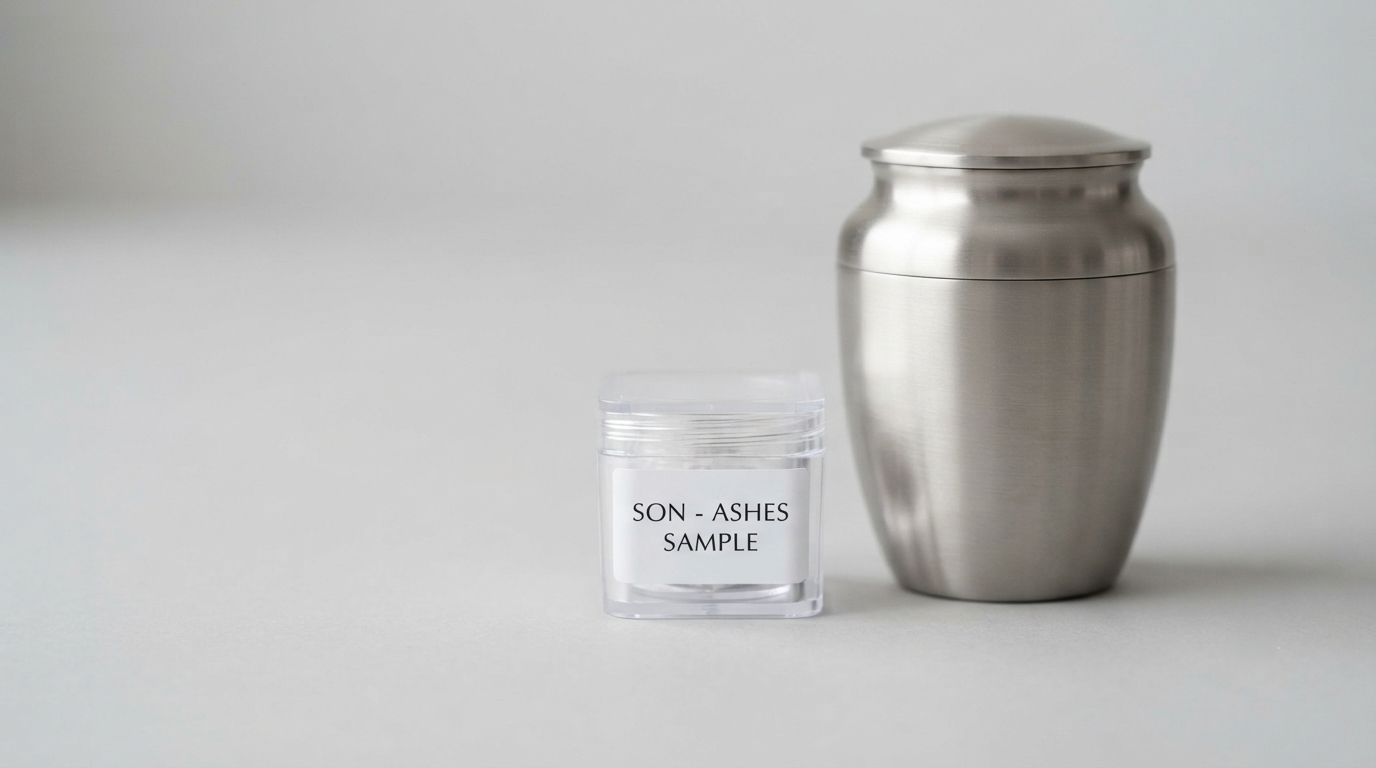
Learn More About Son Memorial Diamonds

Talk With Memorial Diamond

The best moment to ask us anything is while you are still inside the first three steps, before a container is opened, a portion measured or a parcel addressed.

Bring whatever you have, including very little. memorialdiamond.us is where to begin, and the six questions listed in step 3 make a reasonable agenda for a first conversation about how to turn son ashes into a diamond.

Partner memorial diamond timeline planning shown as a labeled parcel and an open notebook on a kitchen table in morning light

How Long Does It Take to Make a Partner Memorial Diamond?

You have probably already worked out that this will not be quick. What is harder to find out is where the months actually go.

Industry wide, production runs 6 to 10 months from the point a laboratory receives the material, stretching toward 12 for large stones or specialty colors. The single fact that explains a partner memorial diamond timeline is this: carat size is a function of growth time, not of how much you send. A full urn does not make the stone bigger, faster or cheaper. And the published window covers only the middle of the process. Assessment before growth and finishing after it sit outside it.

Memorial Diamond is one of the companies that would be holding your partner’s material through those months, so this page has a commercial interest behind it. Treat the stage descriptions as how the category works rather than as a schedule anyone can promise.

What Does a Partner Memorial Diamond Timeline Actually Contain?

A partner memorial diamond timeline has seven stages, and only some sit inside the figure anyone quotes you. The last column is the fastest way to understand why a stone described as “six to ten months” can be a year from your hand.

NumberStageWhat happensWhat sets its paceInside the quoted 6 to 10 months?
1Gathering and sendingMaterial is located, portioned, labeled, packed and posted; the order is specifiedYou, a funeral provider, and the postNo
2Intake and assessmentThe parcel is logged, checked against what was described, and evaluated before work startsThe laboratory’s queue and what assessment findsUsually yes, at the front
3Extraction and purificationEverything that is not carbon is stripped away, to roughly 99.9%+ carbonThe source material and the process, not your orderYes
4GraphitizationThe purified carbon is taken to roughly 2,500 to 2,700°C and converted to graphite, the form a press can useFixed by the processYes
5GrowthA seed and the graphite sit under roughly 6 to 8 GPa, at temperatures of 1,400 to 2,500°C, across weeks or monthsYour target carat, and nothing else in the partner memorial diamond timelineYes, most of the window
6Cutting, polishing and optional gradingA gemologist cuts the rough crystal; independent grading happens only if you order it, and any report is issued by a separate laboratoryThe cutter’s bench, then a third party’s queueSometimes. Ask
7SettingA ring, pendant or other mount is made, or an existing piece is reworkedA jeweler’s bench, and whether you have decidedAlmost never
Laboratory technician logging a labeled intake parcel against an order document at a receiving bench

Two of those seven are genuinely yours to move. Stage 1 runs at your speed, and stage 7 at whatever speed you choose, including not yet. Everything between runs at its own pace however motivated you are, and that is the real shape of a partner memorial diamond timeline.

How the material is actually processed from a portion of ashes follows stages 3 to 5 in detail, and the step by step route for a combined submission sets out stage 1 as a list of tasks.

Why Does a Full Urn Not Make It Faster or Bigger?

Because carat comes out of the press, not out of the parcel. It is the single most useful correction on any partner memorial diamond timeline page, and almost nobody arrives knowing it.

A diamond grows outward from a tiny seed inside a cell held at extreme pressure and heat, and the longer it is held there the larger the crystal becomes. That is the whole mechanism. The high pressure, high temperature route used across the lab grown industry and the volume you posted is not one of its variables. It is not a partner memorial diamond timeline variable either.

What the material determines is whether there is enough carbon to work with at all. Cremated remains are mostly the calcium phosphate of bone, and usable carbon runs at roughly 0.5% to 4% of ash by weight; hair is far richer, at roughly 50%. Either way, what a realistic sample yields falls short of what a growth cell consumes, so lab grown carbon is added to fill the charge. Sending more simply means more goes unused.

Explanatory graphic comparing the fixed volume of a growth cell charge with the much larger volume of a full urn of ashes

Three consequences follow, and they are worth holding onto:

  • A larger stone lengthens the partner memorial diamond timeline. Carat and months are the same decision. A small stone finishes nearer six months; a large one or a specialty color moves toward twelve.
  • Most of the ashes stay with you. Typical requirements run from a few tablespoons to around four ounces, so whatever was planned, interment, scattering, an urn on a shelf, can still happen.
  • A hair only stone is not faster in the press. Growth time is set by target carat, whether the carbon came from ashes or from hair. How much hair a stone actually needs is a small lock, and its advantage is at stage 1 rather than stage 5.

That last point matters more in this cluster than most. A lock already sitting in a drawer waits on no cremation, no release and nobody else’s decision, so stage 1 of the partner memorial diamond timeline can begin this week.

Carat also sets the price, which makes size, money and months one decision rather than three. What a partner memorial diamond costs works through the same lever from the other side.

What Happens Before Growth Begins?

Two stages of a partner memorial diamond timeline, and families routinely budget for neither.

Getting the material there. Locating a portion, separating and labeling it, finding a lock of hair if one is going in, specifying the order, and posting it. None of that is long in itself, and all of it can stall on something outside your control, a funeral provider’s schedule, a conversation with their family, a decision that has not been made. In this cluster, stage 1 is frequently the longest stage of the whole partner memorial diamond timeline, and it is the one nobody counts.

Assessment. Once a parcel is logged it is checked before work starts: that it matches what was described, that there is enough to proceed, that it is what the process can use. This is neither a formality nor instant, and it is the point in a partner memorial diamond timeline at which a problem is cheapest to discover.

Rough lab-grown diamond crystal held in tweezers on a gemologist's bench before cutting and polishing

The useful thing to ask is what happens if assessment turns up a shortfall. Can you send more? Is the order held while you find it? Is a smaller carat offered instead? None of those has a category wide answer, and having one in writing before you post anything is worth more than any date you are given.

Two further things worth settling at the same moment, because both quietly add weeks later:

  • Whether the laboratory will hold one material while a second is found, if you are sending both ashes and hair and they are not available together.
  • What confirmation you receive at intake. A logged receipt tying the parcel to your order is the most reasonable thing to ask for in this entire process, and the easiest for a company to provide.

None of this is unusual to ask, and all of it sits before the growth run, which makes it the part of a partner memorial diamond timeline you can still influence.

What Happens After the Stone Exists?

A rough crystal is not a finished object, and the gap between the two is where most of the unexpected waiting in a partner memorial diamond timeline lives.

Cutting and polishing comes first: a gemologist shapes the rough into the finished stone, and the shape is a decision rather than a default. If a grading report was commissioned, the stone then travels to a third party laboratory working to its own standards for cut, color, clarity and carat and, more to the point, its own queue, one no growth laboratory controls. A setting adds a jeweler’s bench as a third independent schedule inside the same partner memorial diamond timeline.

Individually none is long. Stacked, and separated by shipping each time, they are why a stone that exists in month eight reaches you considerably later.

So the question worth asking is not how long finishing takes. It is where the quoted window ends. A company quoting six to ten months to a finished loose stone and a company quoting six to ten months to an optionally graded, mounted, engraved piece have said the same sentence about two different partner memorial diamond timeline lengths. Ask which, in writing.

One relief: stage 7 of a partner memorial diamond timeline can wait. A finished diamond sits in its case indefinitely, so a setting need not be decided while you are choosing carat, and many people find it easier to design a piece with the stone in front of them. Settings and jewelry ideas for a partner is a decision that keeps.

Nor can anyone say what the stone will look like before stage 6. Color is not forecastable at any earlier point in a partner memorial diamond timeline, whatever family you specified. What color to expect explains why.

What If the Timeline Runs Past an Anniversary?

It probably will. Deciding in advance how you want to meet that is better than being surprised by it.

Six to ten months from a starting point somewhere after a death lands almost any partner memorial diamond timeline beyond at least one date that matters: a birthday, the first anniversary of the death, or the anniversary of the relationship itself, which may be a date nobody else in either family marks or even knows.

The temptation is to order backwards from a date, and it is worth resisting, not because planning is bad, but because a partner memorial diamond timeline has at least four independent parties in it: a funeral provider, a growth laboratory, possibly a grading laboratory, a setting bench. None can be held to a delivery date on behalf of the others. A date you have privately attached to a stone becomes a second loss when the stone is late, and stones are late.

What works better is uncoupling the two:

  • Anchor to a season rather than a day. “Some time next autumn” survives a slipped run; “in time for March the ninth” does not.
  • Mark the date with something already in your hands. The ashes you kept, a photograph, the lock you did not send. None of it is a substitute for the stone, and none of it has to be.
  • Ask, at order, when any date you are given is next re confirmed. That answer tells you far more about the coming months than the first estimate does.
  • Let the arrival be its own occasion. A stone arriving in an unremarkable week gets to mean what it means, rather than carrying a date as well.

If you would rather have something on the anniversary itself, say so early and ask what a partner memorial diamond timeline makes realistic, not for a promise, but for an honest read on whether it is plausible from where you stand.

What Do You Say When Relatives Ask Why It Is Taking So Long?

This arrives in almost every partner memorial diamond timeline, and in this cluster it sometimes arrives with an edge on it.

The people asking may be their family rather than yours, and may not have been fully behind the decision. Where the ashes were released to someone other than you, they may have a real stake and a real anxiety about where the material is. Or it may be plain curiosity from someone who assumes a stone takes a fortnight.

Four plain answers cover almost every version of it, and none of them commits you to a partner memorial diamond timeline you cannot control:

  • “The crystal itself grows for months. That part cannot be rushed.” True, specific, and it ends the technical version of the question.
  • “Six to ten months is the industry range, and a bigger stone takes longer.” Gives them a number without you having promised one.
  • “The middle of it is silent by design. There is nothing to report while a run is holding.” This is the one that defuses the suspicion that something has gone wrong.
  • “I will tell you when it is cut.” A stage is a fair thing to commit to. A date is not.

Where someone else released the ashes, a logged intake receipt is fair to share and fair to have asked for at stage 2. It answers the real question, is it safe and where is it, without turning the partner memorial diamond timeline into a group project.

And plainly: you do not owe anyone a running commentary. Where the relationship was not recognized, or not known, the pressure to justify the wait can be heavier than the wait. How to talk to family about a partner memorial diamond covers the wider conversation, and the questions families ask most often is worth handing to someone who wants to understand rather than object.

Frequently Asked Questions

How long is a partner memorial diamond timeline from start to finish?

Production typically runs 6 to 10 months from receipt of material, and up to about 12 for large or specialty color stones. Gathering and sending beforehand, and grading or setting afterward, sit outside that published window.

Does sending a full urn make the stone bigger or shorten a partner memorial diamond timeline?

Neither. Carat is a function of growth time in the press, so a larger portion changes nothing about size or schedule. Typical requirements run from a few tablespoons to around four ounces, and the rest stays with you.

Why does a larger stone add months rather than weeks?

Because the crystal grows outward from a seed for as long as it is held under pressure and heat. A larger target simply means a longer hold, which is why carat and the partner memorial diamond timeline are one decision.

Can anyone give me a delivery date?

No. Four independent parties can be involved, a funeral provider, a growth laboratory, a grading laboratory and a setting bench, and none can commit on behalf of the others. Ask instead when a given estimate is next re confirmed.

Is a hair diamond faster than one grown from ashes?

Not in the press, where growth time is set by target carat. Hair can start a partner memorial diamond timeline sooner: no cremation is involved, nothing has to be released by anyone, and a lock already in a drawer can be posted this week.

What happens to the partner memorial diamond timeline if a growth run fails?

Ask before ordering, because it varies by company. Ask whether a run is repeated, what becomes of material consumed in it, whether an under target carat changes the order, and how the schedule is restated afterward.

Final Thoughts on the Partner Memorial Diamond Timeline

Six to ten months is the number, but the number is not the hard part. The hard part is that the middle of a partner memorial diamond timeline asks nothing of you at all, for months, while something of your partner’s sits in someone else’s building.

Knowing the seven stages of a partner memorial diamond timeline helps, because it tells you which kind of waiting you are in. Stages 1 and 2 respond to effort. Stages 3 to 5 do not, and silence there is the process working rather than failing. Stages 6 and 7 hand the decisions back.

And nothing here is on a clock. Cremated remains are stable mineral matter, and a dry, sealed, labeled lock of hair keeps indefinitely. The partner memorial diamond timeline starts when you decide it does, not when anyone else thinks it should.

Learn More About Partner Memorial Diamonds

Talk With Memorial Diamond

If you want a partner memorial diamond timeline mapped against your own circumstances rather than against an industry range, Memorial Diamond is one of the companies to ask. memorialdiamond.us. The most useful first question is where a quoted window starts and where it ends.

And if you are not ready to begin stage 1, nothing is lost by waiting. The material keeps, and so does the decision.