How a Memorial Diamond Is Made From Your Grandmother

How a Memorial Diamond Is Made From Your Grandmother’s Hair

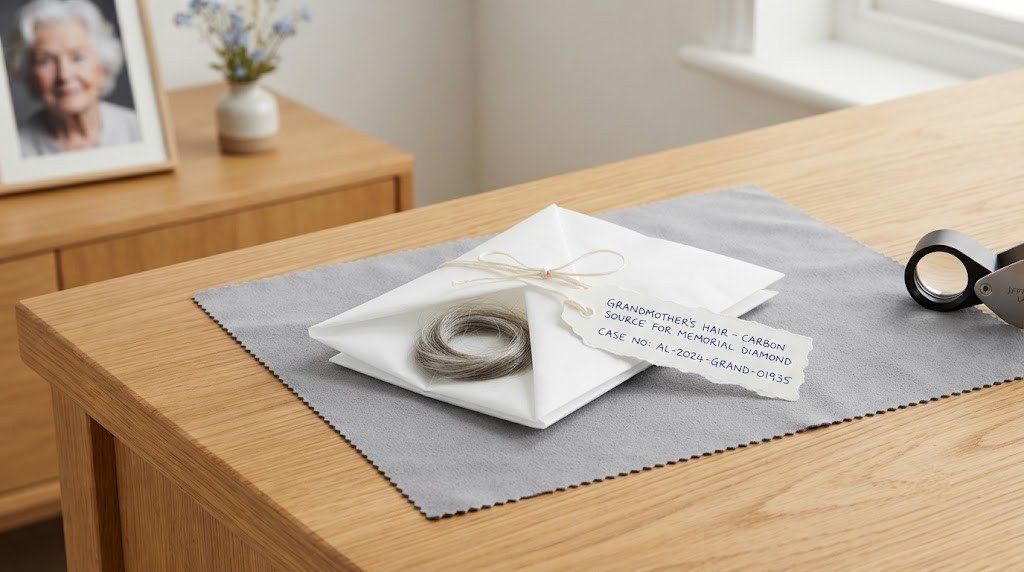
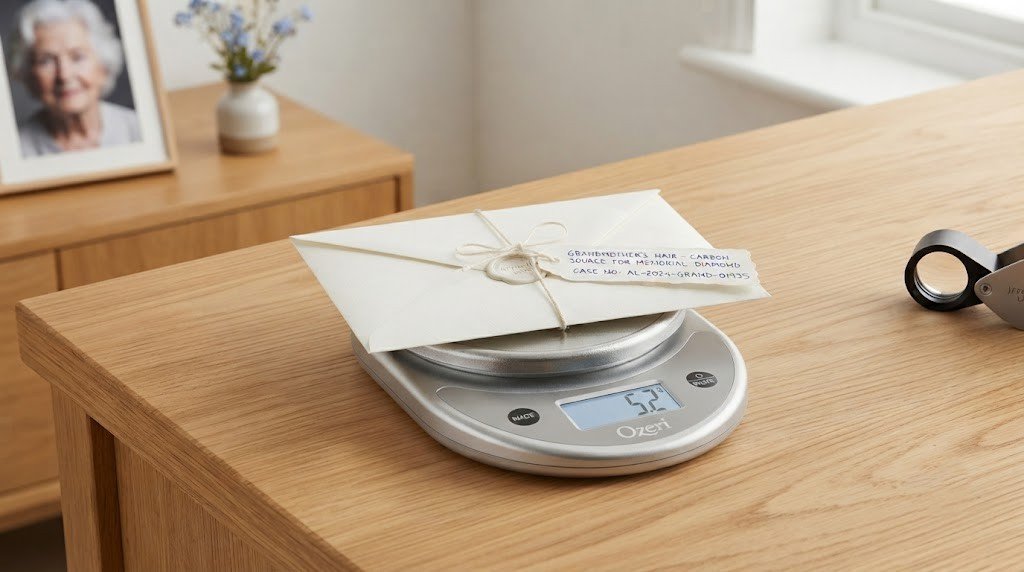
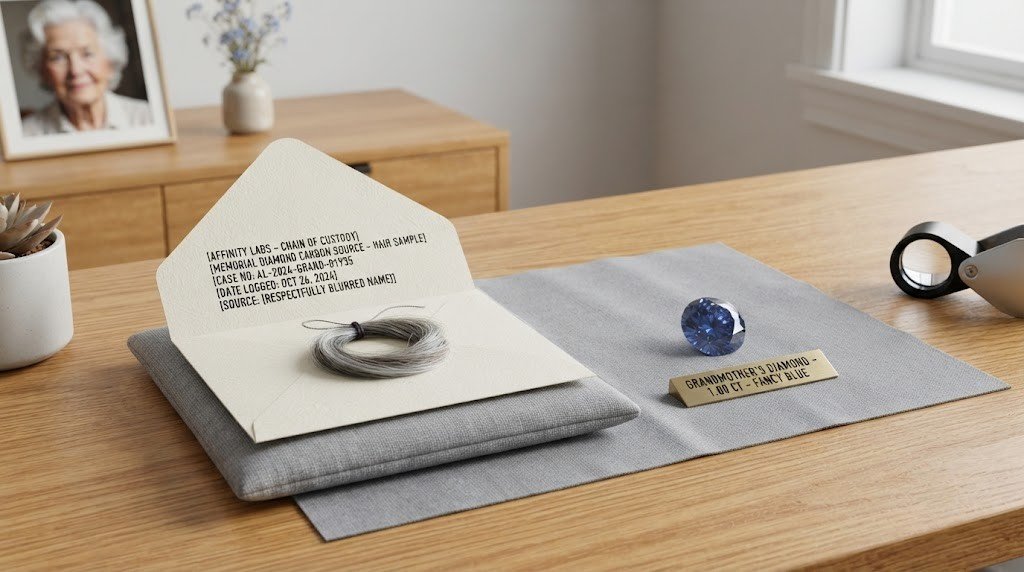
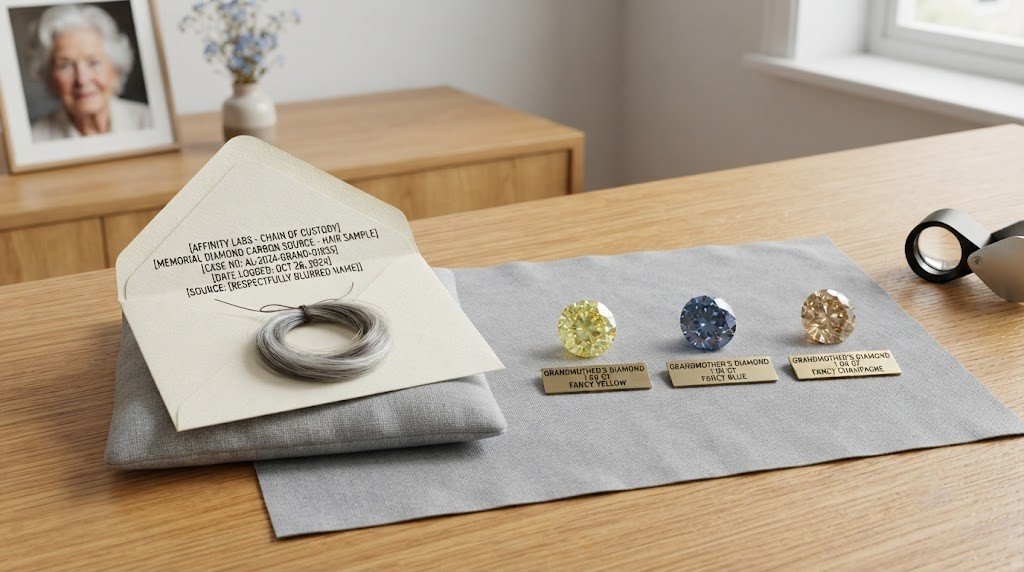
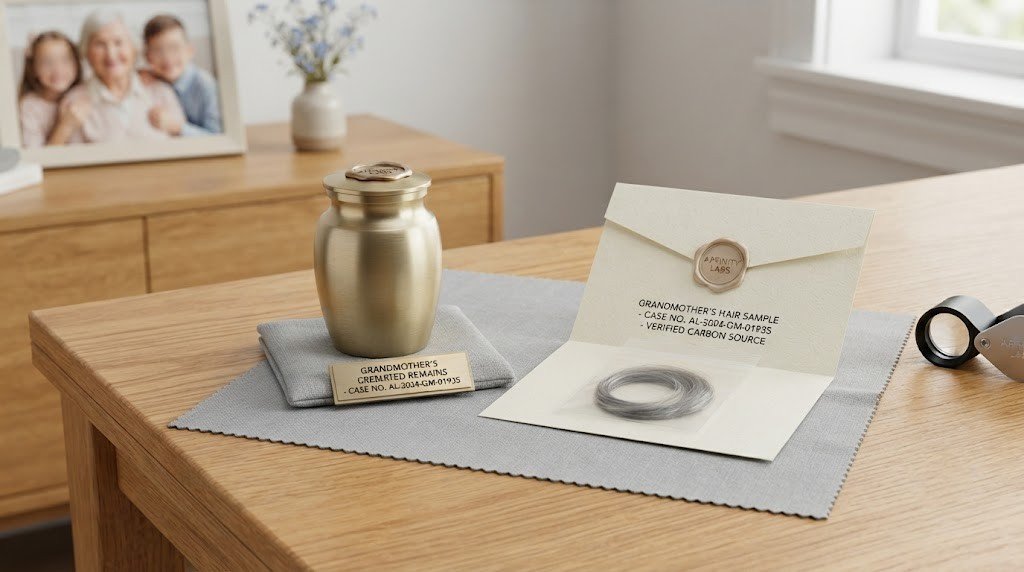
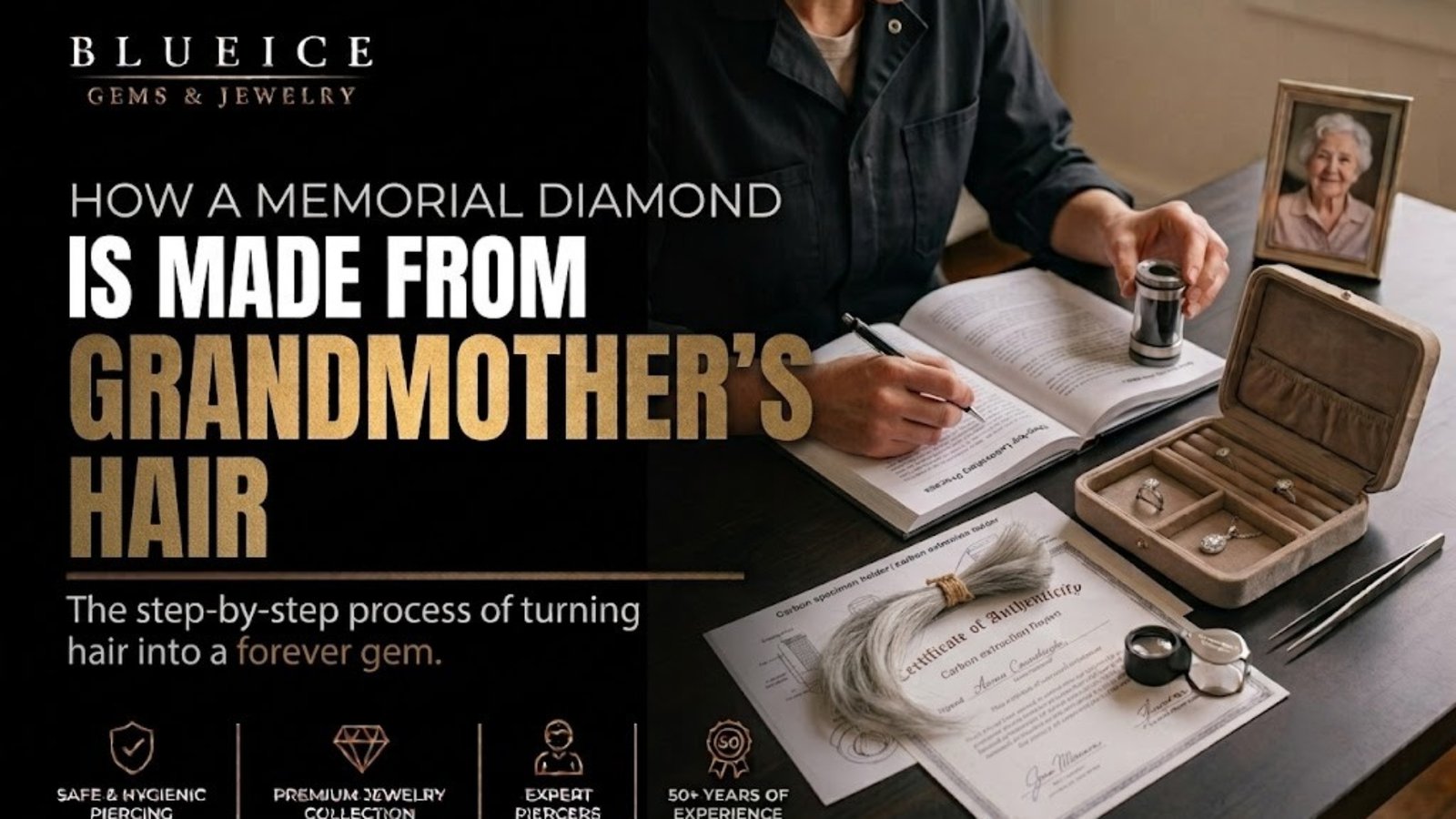
A folded envelope with a lock of her hair, a strand caught in a brush she used every morning: small things like these can carry a surprising amount of her. A diamond made from grandmother hair begins when a lab heats a small sample without oxygen to recover the carbon in its keratin, purifies that carbon, converts it to graphite and grows it into a real diamond under extreme pressure and heat, after which the crystal is cut, polished and graded.

What follows explains every stage of a gem made from grandmother hair for someone without a chemistry background, and points out where the answer depends on the provider rather than on science.
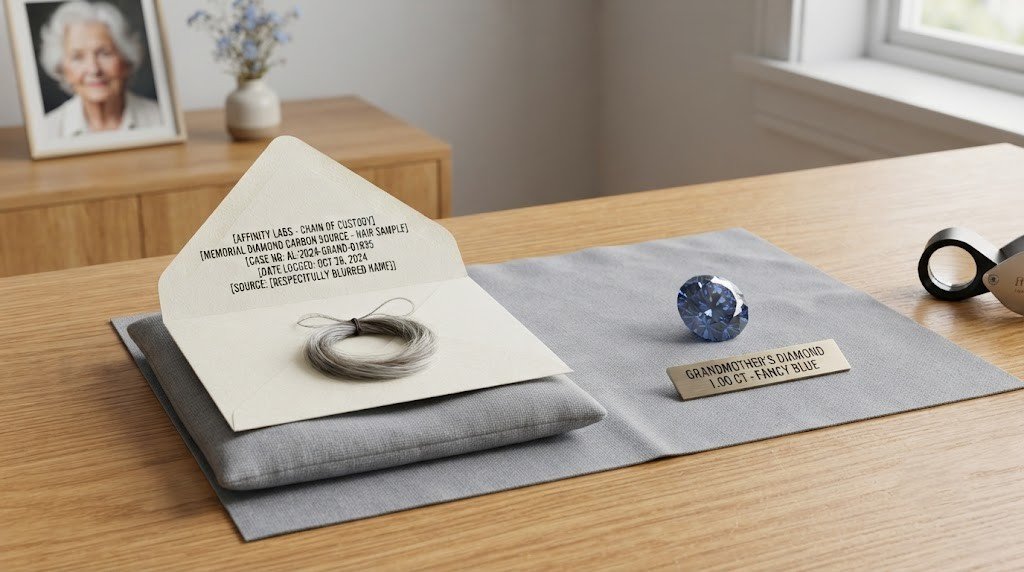
made from grandmother hair

Why Can Hair Become a Diamond at All?

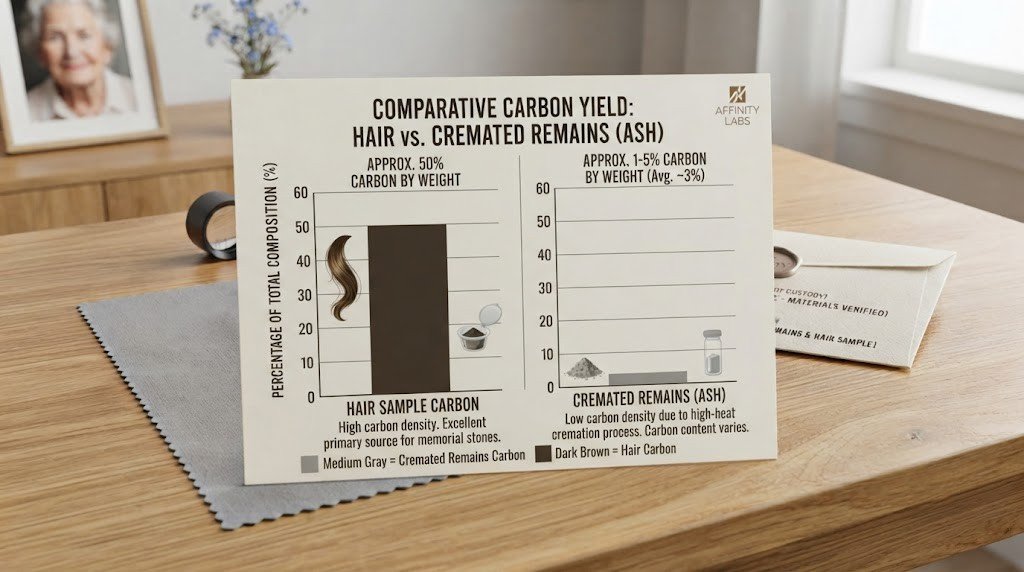
Hair is built mostly from keratin, a tough protein, and keratin is rich in carbon. By weight, hair is roughly 50% carbon. Diamond is nothing but carbon atoms locked in a crystal, so any material with a usable share of carbon can, in principle, become the starting point for one, and that is the basic chemistry behind every stone made from grandmother hair.

That single figure explains much of what makes a diamond made from grandmother hair different from one grown from ashes. Cremated remains are mostly bone mineral, with only a small percentage of usable carbon. Her hair, by contrast, is about half carbon to begin with.

There is a second difference. Hair needs no cremation. If she was buried, or if cremation is not something your family’s faith permits, a lock of hair saved at the time of her death, from a salon visit or tucked in a keepsake box can still be the source of a stone made from grandmother hair.

Why Does a Lab Need So Little of Her Hair?

Because each strand holds so much carbon, providers typically ask for only a small lock or a few grams to grow jewelry made from grandmother hair. Some describe the amount as palm-sized or a few wisps. Exact requirements vary from lab to lab, and no single minimum applies across the industry.

Sending more hair will not make a ring or pendant made from grandmother hair any larger. Carat size is decided by how long the crystal grows, not by how much carbon arrives at the lab. A single envelope is often enough for a diamond made from grandmother hair, and sometimes enough for more than one stone, which matters when several grandchildren hope for a piece. The guide to how much hair a grandmother memorial diamond needs covers collection and packing in more practical detail.

Can you collect hair from a brush?

Loose strands gathered from a brush or a garment are a different matter from a cut lock, and providers set their own rules about what they accept. Describe exactly what you have, ask whether it is workable, and wait for a written reply before you mail anything irreplaceable.

Which Stages Turn a Lock of Hair Into a Diamond?

Seven stages separate an envelope of hair from a finished gem made from grandmother hair. No provider publishes a fixed duration for each one, and the overall timeline depends mainly on the carat size chosen, so this summary focuses on purpose rather than time.

StageLab activityMeaning for her hair
IntakeHer sample is logged under your order and labeledThe lock is tracked as hers from arrival onward
ExtractionOxygen-free, multi-stage heating removes everything that is not carbonThe other parts of keratin are driven off
PurificationThe recovered carbon is refined furtherHer carbon reaches roughly 99.9% purity or better
GraphitizationHeating to about 2,500–2,700°C converts carbon to graphiteHer carbon becomes press-ready feedstock
GrowthAn HPHT press, or for a minority of providers a CVD chamber, grows the crystalHer carbon, with any supplemental carbon, forms diamond
Cutting and polishingA gemologist shapes and facets the rough crystalThe stone gains its shape and brilliance
Grading and documentationQuality is graded, ideally by an independent lab, and origin is recordedYou receive evidence of quality and of her origin

Some providers add an optional color-treatment step after growth; it is described in the color section. Every lab orders and names these stages slightly differently, so ask yours to describe the sequence it follows for anything made from grandmother hair.

What Does the Lab Strip Away From Her Hair?

Keratin contains carbon alongside other elements, including hydrogen, oxygen, nitrogen and sulfur. Extraction is the stage of producing a stone made from grandmother hair that separates the carbon from all of those. The lab heats the hair in a controlled, oxygen-free environment, usually over several steps, so the non-carbon components are driven off while the carbon stays behind.

Removing oxygen from the chamber is essential. Heated in ordinary air, carbon would bond with oxygen and leave as a gas, taking her contribution with it. In a sealed, oxygen-free setting it remains as a solid residue that can be collected.

Purification follows until that residue is roughly 99.9% carbon or higher. Clean feedstock matters because stray elements in the growth cell can affect the finished gem. At this point, what is actually made from grandmother hair no longer resembles hair in any way; it is a small amount of nearly pure carbon.

What becomes of any hair the lab does not use?

The envelope you mail may hold more than a diamond made from grandmother hair actually consumes. Whether leftover hair is returned, stored or disposed of is a provider policy, and families feel strongly about it, so ask in advance and keep the reply.

Is Lab Carbon Added to a Stone Made From Grandmother Hair?

Often, yes. Across the industry, recovered personal carbon is typically blended with supplemental lab-sourced carbon so the growth cell has enough feedstock, and a provider may well do the same for gems made from grandmother hair. Because hair is so carbon-rich, the reasons and proportions may differ from an ash-based stone, but providers set this individually.

Here is the honest gap: no industry-wide figure is published for how much of a finished stone made from grandmother hair is her own carbon. The percentages people quote online describe ash-based stones and should not be carried over to hair. Before you order, request a written statement from every provider you are considering: roughly how much of the polished gem will be her own carbon, and does that change with carat size?

None of this makes a diamond made from grandmother hair less hers. Whatever the proportion, carbon recovered from her hair becomes part of the diamond’s crystal lattice. It is not a symbol placed beside her memory; it is a gem physically built, in part, from her. Sales claims of a stone that is entirely hair, with nothing added, describe something the chemistry does not support.

How Does Graphite Become a Diamond Crystal?

Graphite and diamond share the same element and differ only in structure. In graphite, carbon atoms form flat layers that slide over each other, which is why pencil lead is soft. In diamond, every atom is bonded tightly in three dimensions.

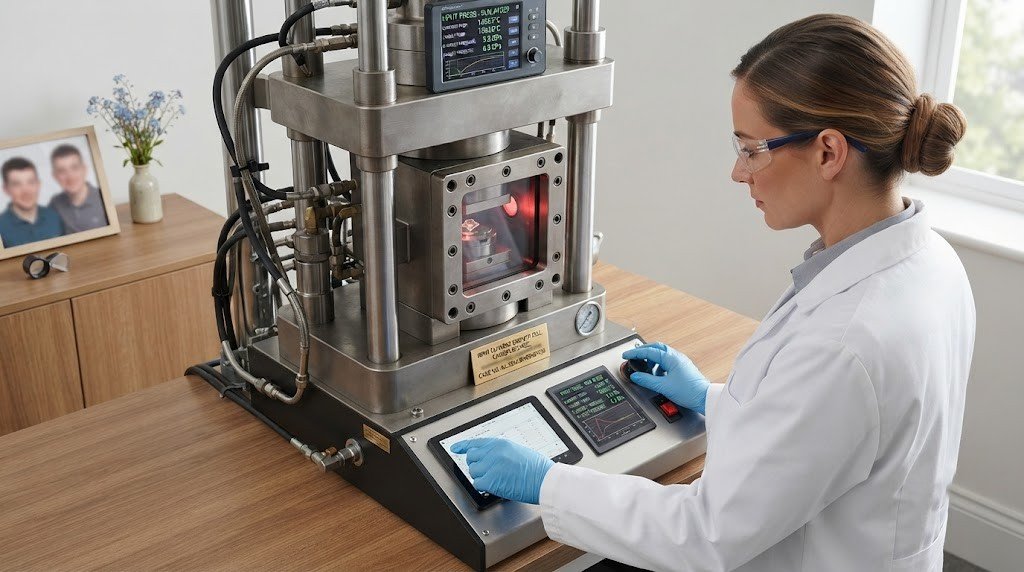
Most providers use HPHT growth to force that change in a stone made from grandmother hair. The graphite feedstock goes into a growth cell with a tiny diamond seed, and a press, a BARS or cubic design for example, applies roughly 6–8 GPa of pressure at around 1,400–2,500°C. Those are conditions similar to the Earth’s mantle, where natural diamonds form, and in them carbon builds outward from the seed as diamond crystal over weeks to months.

A smaller group of providers grows memorial stones by CVD instead, converting the carbon to methane and depositing it layer by layer onto a seed plate in a vacuum chamber. For a fuller account of both techniques, see the background on how lab-grown diamonds are produced. Asking which method grows a diamond made from grandmother hair at a given lab is a perfectly reasonable question.

Why growth time sets the carat

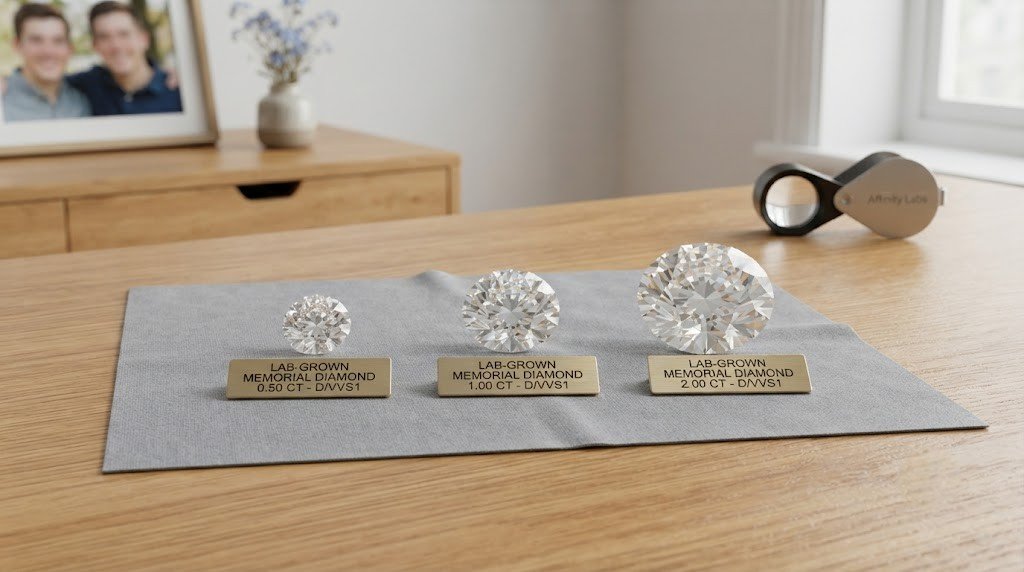
The longer a crystal made from grandmother hair stays in the press, the larger it grows. That is why carat size, which usually runs from about 0.10 to 5 carats or more, shapes both timeline and cost. The amount of hair you send does not.

What Happens After the Crystal Leaves the Press?
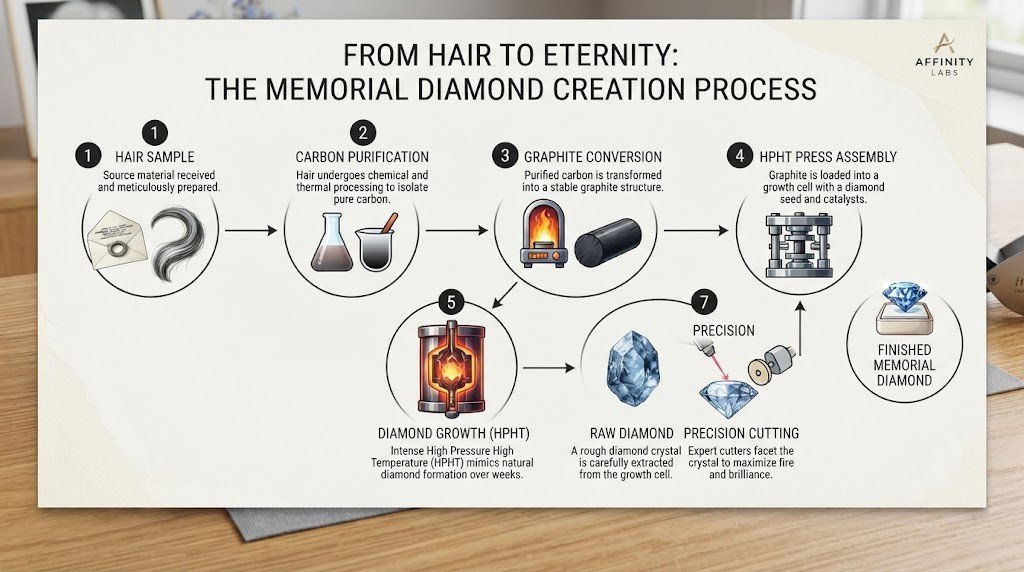
Fresh from the press, a crystal made from grandmother hair looks nothing like a finished gem. A gemologist studies it, decides on a shape such as round, cushion, oval or princess, and cuts and polishes the facets that will catch light. Ask whether a quoted carat weight describes the rough crystal or the polished result, because cutting removes material.

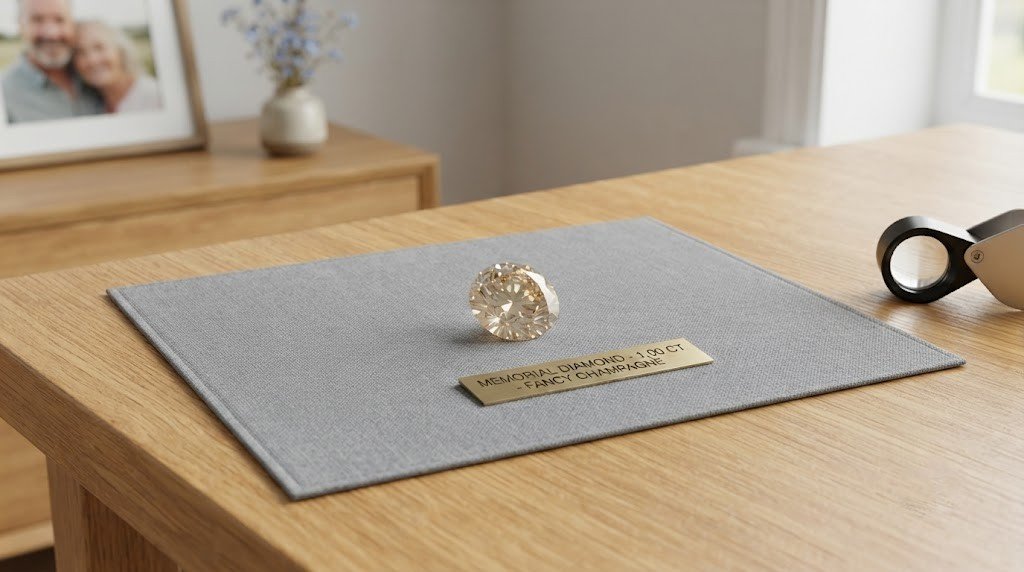
What comes out of the cutting room is a genuine diamond. It rates 10 on the Mohs hardness scale and has the same optical behavior as any other diamond, mined or lab-grown. Clarity for memorial diamonds typically falls between SI2 and VVS. Hardness is not the same as being unbreakable, though: a sharp blow at the wrong angle can chip any diamond, so a protective setting is worth discussing for a ring worn daily.

What Color Can a Diamond From Her Hair Be?

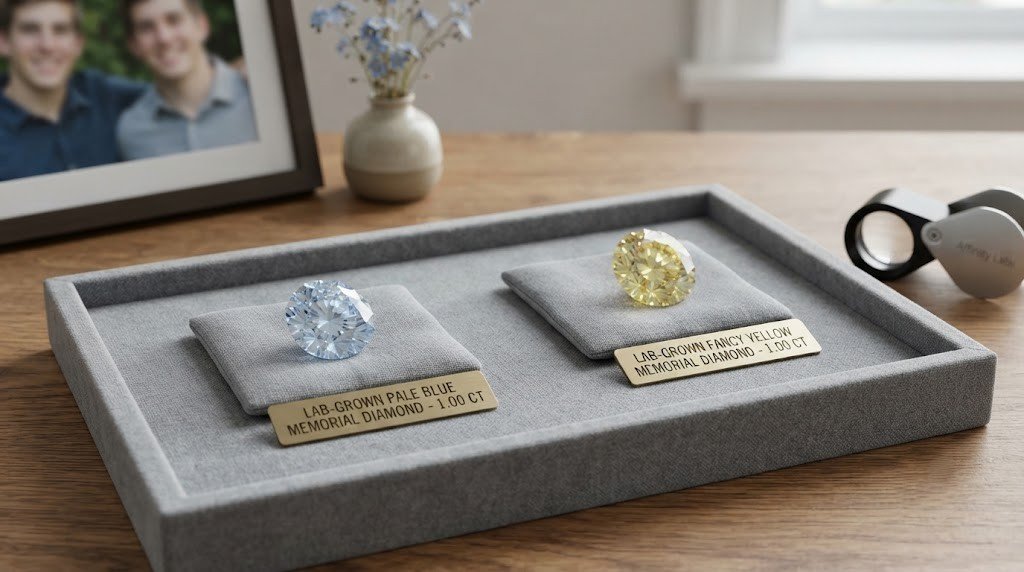
The color of a diamond made from grandmother hair forms during growth and depends on trace elements in the crystal. Boron gives blue tones. Nitrogen gives yellow. A colorless diamond requires both to be kept out, which needs extra processing and usually raises the price.

Organic, personal carbon sources tend to carry traces of these elements, so memorial diamonds generally lean toward yellow, blue, and champagne or brown shades. A stone made from grandmother hair is no exception, and its color is not a measure of her or of the hair’s quality. No provider can promise to reproduce a particular shade, and families cannot select an exact tone in advance; what you can choose is from the range of colors a provider offers.

Some providers also offer irradiation after growth to produce red, pink, green or black stones. For more on the options and their limits, read about the color range a diamond from her hair can take.

Does Gray, Dyed or Treated Hair Change Anything?

It is a natural thing to wonder, and the answer sits with the provider rather than with general science. There is no established basis for saying that gray, white, colored, permed or thinning hair produces a different gem made from grandmother hair, a different color or a less suitable sample.

What does vary is policy. Some labs may ask about dyes, treatments or products in the hair; others may not. Tell the provider plainly what you have, including any treatments you know about, and ask whether they accept it for a diamond made from grandmother hair. Get their answer in writing so there is no confusion later.

What Paperwork Proves Where the Stone Came From?

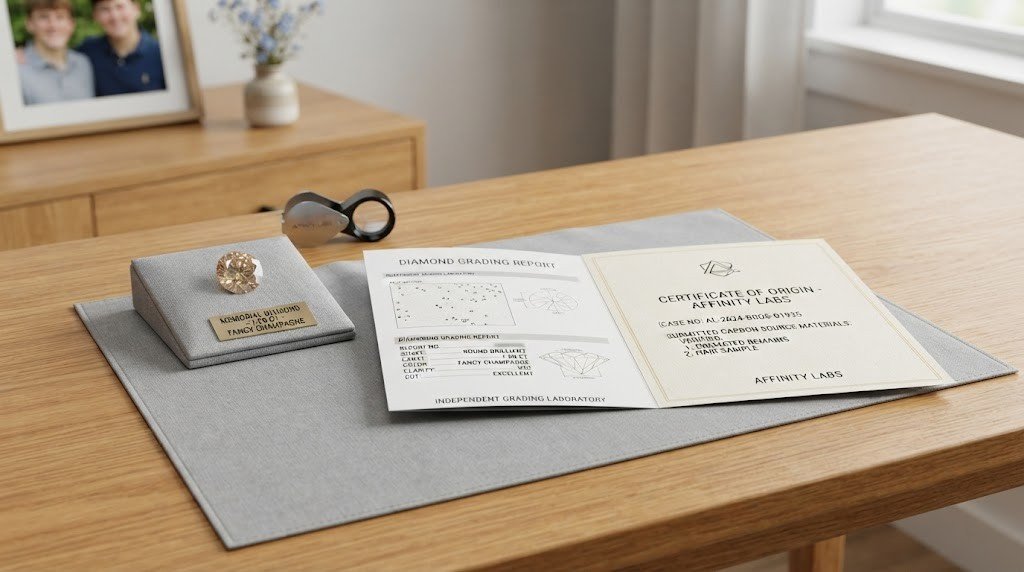
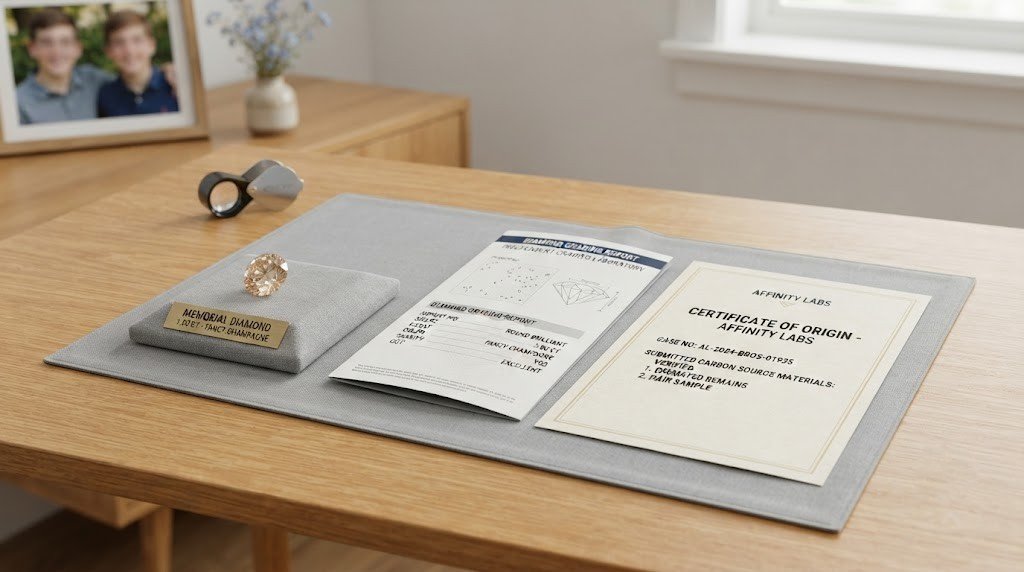
Two different documents can accompany a finished diamond made from grandmother hair, and it helps to know which is which.

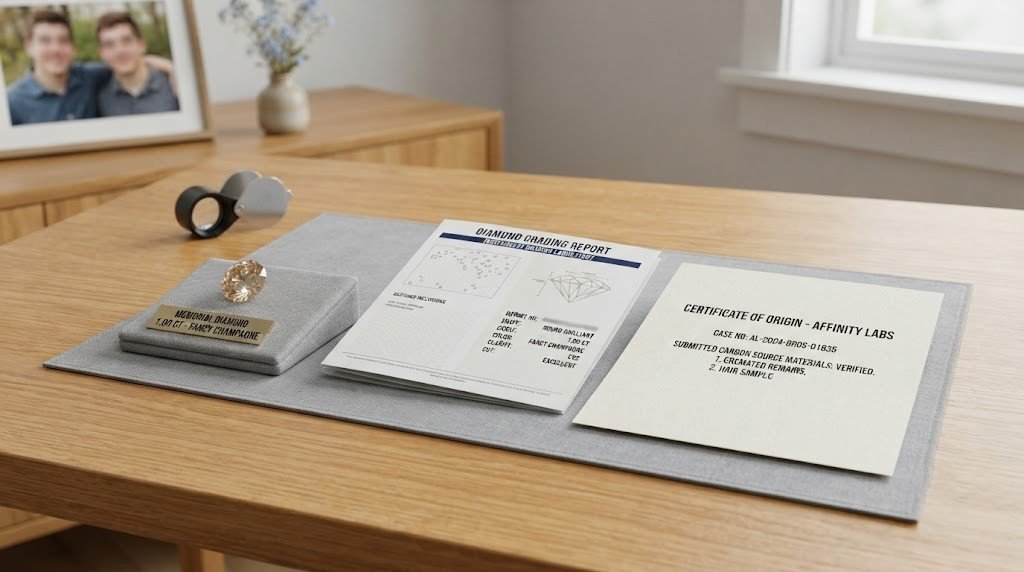
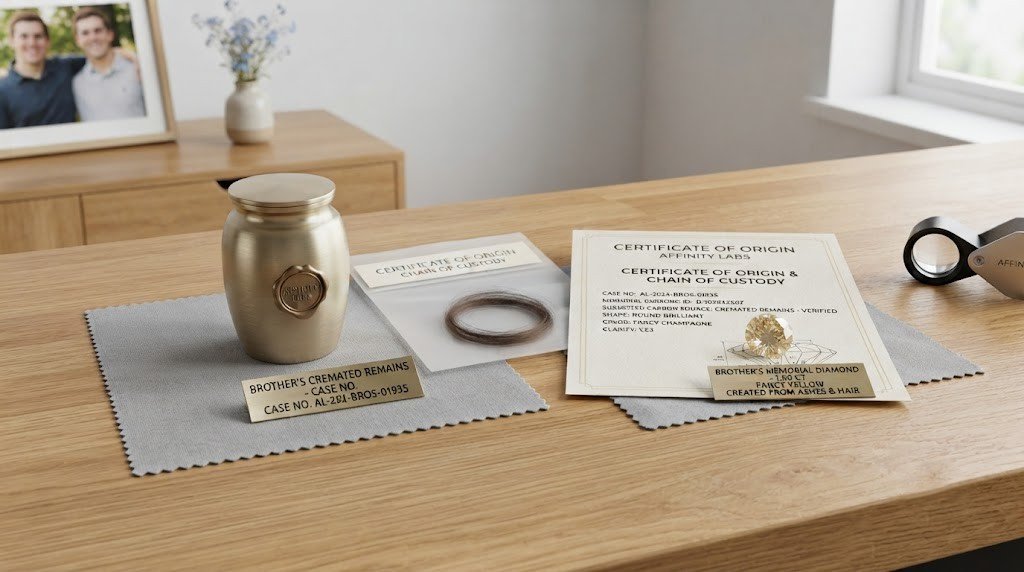
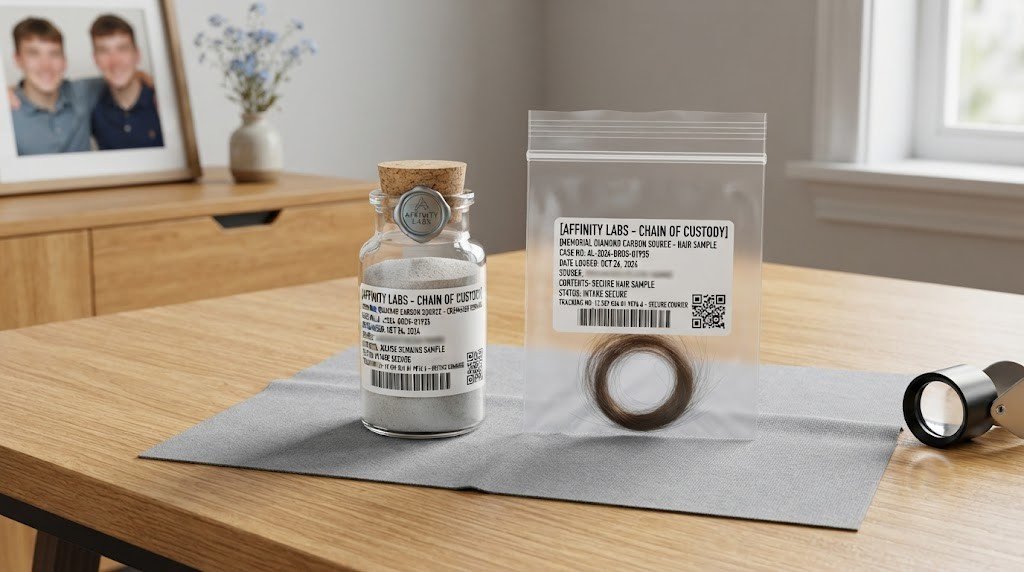
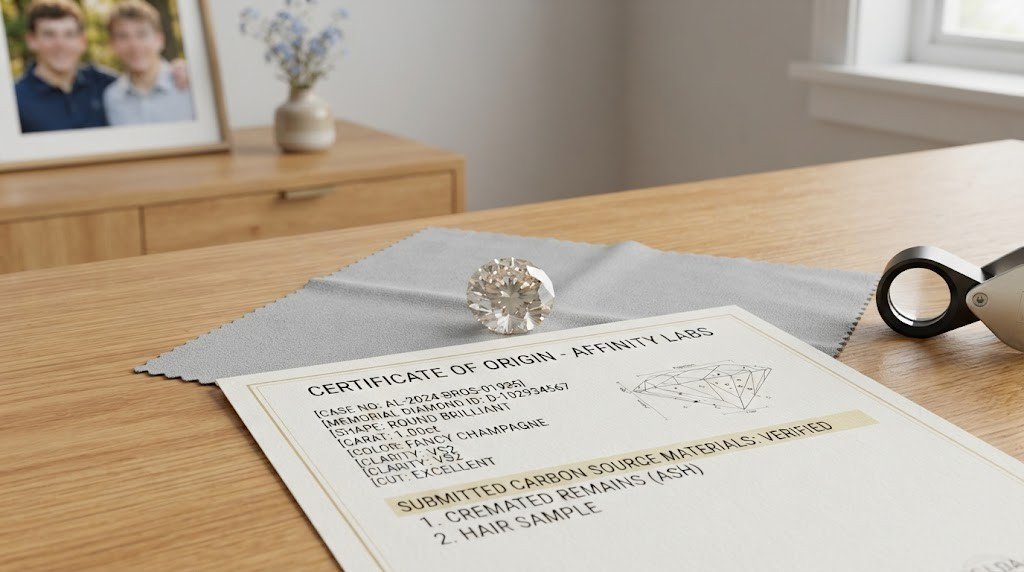
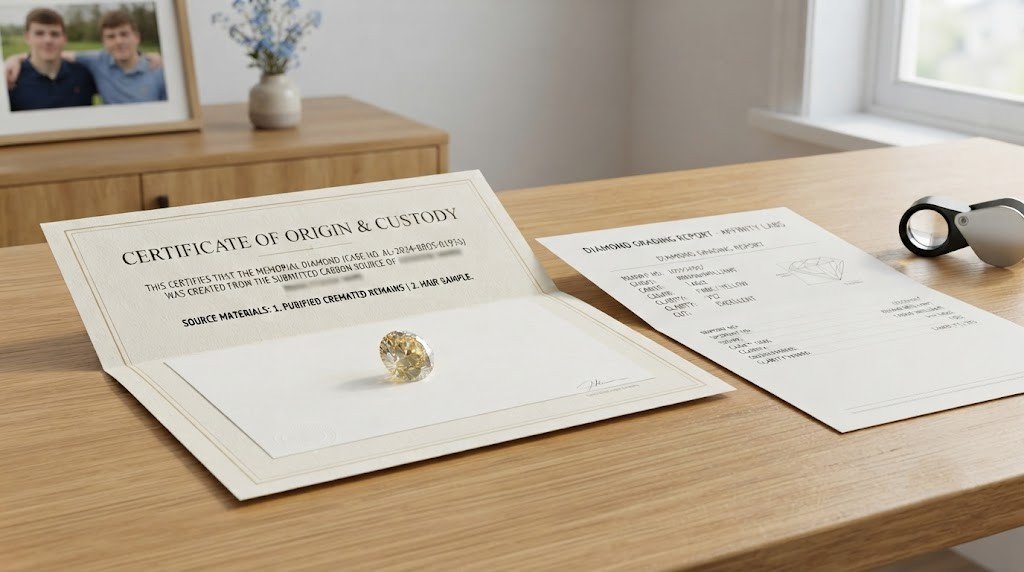
A certificate of authenticity, usually issued in-house by the provider, states that the stone was grown from the carbon your family submitted. It functions as a chain-of-custody record. A grading report describes the diamond’s quality on the 4Cs: cut, color, clarity and carat. Ideally it comes from an independent gemological lab, commonly working to GIA standards and sometimes from IGI, and it is usually an optional add-on with its own fee rather than a standard inclusion.

GIA’s explanation of diamond quality factors is a helpful guide to reading a grading report.

Questions that reveal how chain of custody works

Practices differ, so a short list of direct questions tells you more than any brochure:

  • What label or code follows her hair through every stage, from intake to the finished stone made from grandmother hair?
  • Is anything handled at an outside facility, and how is her sample tracked there?
  • Can you see progress updates or photos at any point?
  • What is recorded on the authenticity certificate, and what is not?
  • If a growth run does not succeed, what happens next, and would more hair be needed?

Readers who want to test whether a stone is really made from grandmother hair can find that skepticism addressed in the piece on whether the diamond truly contains her hair.

Whose Agreement Matters Before You Send Her Hair?
Hair kept at home is usually a simpler matter than ashes when you are planning a stone made from grandmother hair, but it is not always straightforward. A person’s belongings can form part of their estate, and the rules differ by state. If her estate is still being settled, a conversation with the executor, or whoever is handling it, is a sensible first step.

Family feeling matters too. You may be a grandchild by birth, adoption, marriage or choice, and an aunt, uncle, parent or cousin may also hold strands of her hair or have hopes of their own. Because so little is needed, a single lock can sometimes supply more than one stone made from grandmother hair, which can make it easier for relatives to share.

Faith can shape the choice. No religious tradition has an official position on memorial diamonds as such; teaching addresses cremation and the handling of ashes. Across major schools of Islamic thought, cremation is considered impermissible, and a hair-based stone involves no cremation, which some families find relevant. Your own imam, rabbi, priest, pastor or community elder is the right person to consult.

If her ashes are also available, the companion explainer on the ash-based lab process describes how that route differs, and some families combine both, as covered in growing one stone from her ashes and hair together.

How Long Does a Diamond Made From Grandmother Hair Take, and How Much Does It Cost?

Industry-wide, a diamond made from grandmother hair takes about 6 to 10 months from the time a lab receives the material, with stones above roughly 2 carats or in specialty colors sometimes taking up to 12 months. Plan around the overall estimate a provider gives you, since individual stages are not published with set times.

As a general picture of 2026 pricing across the category, entry stones of about 0.10–0.25 ct run roughly $1,500 to $3,500. Stones of 0.5 to 1 ct fall roughly between $5,000 and $15,000, and colorless costs meaningfully more at the same size. Large stones from 2 to 5+ ct reach roughly $20,000 to $75,000 or beyond. An independent grading report, engraving, a fancy cut and a ring or pendant setting are typically charged on top.

For a walk-through of choosing a provider and preparing the sample, see the practical route to turning her hair into a diamond, and for every decision gathered in one place, the grandmother hair diamond guide is the fuller reference.

Frequently Asked Questions

How much of a diamond made from grandmother hair is actually her carbon?

No industry-wide percentage is published for hair-based stones, and figures quoted for ash do not apply. Supplemental lab carbon is often blended in. Put the question to each lab in writing and ask how much of a stone at your chosen carat would be her carbon.

Can hair from her hairbrush be used?

It depends on the provider. Loose strands from a brush differ from a cut lock, and labs set their own acceptance rules. Describe exactly what you have, ask whether it is workable, and wait for a written answer before posting anything irreplaceable.

Does her hair need to have been cut recently?

Providers decide what age and condition of hair they accept, so there is no universal rule. Hair saved years ago in an envelope or locket may be workable. Explain how the hair has been kept and ask the lab directly before sending it.

Will gray or dyed hair affect the color of the diamond?

There is no established basis for saying hair color or dye changes the stone. Diamond color comes from trace elements such as nitrogen and boron present during growth. Whether a provider accepts dyed or chemically treated hair is a question to ask them directly.

Can a diamond be made from grandmother hair if she was buried?

Yes, if a lock of her hair was kept. Hair-based stones need no cremation, so burial does not rule them out. The hair needs to be available and acceptable to the provider, and it is wise to check first with whoever is settling her estate.

Can one lock of her hair make stones for several grandchildren?

Sometimes. Because hair is about half carbon, a small amount goes a long way, and several stones may come from one sample. The provider can confirm what is feasible, and the family should agree on how the hair is shared first.

Final Thoughts on Her Hair Becoming a Diamond

Understanding what happens in the lab turns the idea of a diamond made from grandmother hair into a series of concrete steps you can question. You now know why her hair holds so much carbon, what the lab removes, why supplemental carbon is often part of the process, and which answers only a provider can give.

There is no deadline on this. A lock of hair kept safely in an envelope will wait while your family talks it through, and a diamond can sit alongside every other way you remember her.

Learn More About Hair-Based Grandmother Diamonds and the Lab Process

Talk With Memorial Diamond

Questions about her hair, how much you have or whether it is suitable are exactly the kind of thing worth asking early. Memorial Diamond is glad to hear from you at memorialdiamond.us, whether you are ready to begin or simply gathering information.

You set the pace, and a conversation commits you to nothing.
How Much Hair Do You Need for a Grandmother Memorial Diamond

How Much Hair Do You Need for a Grandmother Memorial Diamond?

Perhaps it is a soft curl folded into tissue paper, or a lock someone thought to save before the funeral. If you are wondering whether you have enough hair for a grandmother memorial diamond, the answer is usually reassuring: providers typically ask for a small lock or a few grams. Hair is about 50% carbon, so far less material is needed than with ashes, though each provider sets its own exact requirement.

The harder questions tend to sit around that small amount: where the hair came from, whether a provider will work with it, and who else in the family should be part of the decision. Each of those questions about hair for a grandmother memorial diamond has a practical answer, and none of them requires rushing.

hair for a grandmother memorial diamond

What Amount of Hair Do Providers Typically Ask For?

Across the industry, the usual request for hair for a grandmother memorial diamond is a small lock or a few grams. Providers sometimes describe it as palm-sized, or as a few wisps gathered together. That is a modest amount compared with what many people picture, and it may be less than your family already has tucked away.

The reason is chemistry. Hair is built mostly from keratin, a protein that is roughly 50% carbon by weight, so a little of it holds a meaningful amount of the element every diamond is made from. Cremated ashes, by contrast, are mostly calcium phosphate and yield only about 0.5% to 4% usable carbon, which is why ash requests are measured in tablespoons or ounces while hair for a grandmother memorial diamond is measured in grams.

Treat any figure you read as a general guide rather than a rule. Each provider sets its own minimum for hair for a grandmother memorial diamond, and some may ask for extra so they have a margin if a step needs repeating. Get the requirement in writing before you send anything, and ask whether it changes with the carat size you choose.

What you’re wonderingTypical industry answerWho actually decides
How much hair is usually needed?A small lock or a few gramsEach provider
Does more hair mean a bigger stone?No; growth time sets carat sizeThe carat size you order
Will saved or keepsake hair work?Varies; describe it to the provider firstEach provider
Is dyed, permed or chemically treated hair accepted?Not settled across the industryEach provider
Is her carbon blended with lab carbon?Typically, yesEach provider (ask for its process)
Is a personal-carbon share published for hair?NoAsk each provider in writing

Why Doesn’t Sending More Hair Make a Bigger Diamond?

It feels logical that a thicker lock of hair for a grandmother memorial diamond would produce a larger stone, but carat size is set by how long the diamond grows, not by how much hair arrives. Most memorial diamonds are grown with HPHT (high pressure, high temperature), which recreates roughly 6 to 8 GPa of pressure and temperatures of about 1,400 to 2,500°C around a tiny diamond seed. A larger stone simply stays in that environment longer.

Before growth, the carbon recovered from her hair is purified to roughly 99.9% carbon or higher, converted to graphite at around 2,500 to 2,700°C, and then, in the usual case, mixed with lab-sourced carbon until the press has what it needs for your chosen carat weight. Mailing a second envelope does not shorten that process or change the carat weight on the order.

What extra hair can do is give a provider room to work. If some of it ends up held in reserve, ask what happens to it once your stone is finished: whether it comes back to you, stays in storage, or is disposed of, and on what terms. Policies on leftover hair for a grandmother memorial diamond vary, so that answer belongs in writing too.

Where Can Hair for a Grandmother Memorial Diamond Come From?

Families find hair for a grandmother memorial diamond in all sorts of places, and the source matters mostly because it can affect whether a provider will take it. Every source in this section is something to raise with the provider rather than something to assume.

Locks saved on purpose

A lock cut and kept deliberately is often the simplest source of hair for a grandmother memorial diamond. That might be one a funeral director trimmed at the family’s request, one saved from a haircut years ago, or one she set aside herself. Write down what you know about when and how it was cut, since a provider may ask.

Hair inside keepsakes

Lockets, memory boxes, old envelopes and scrapbooks sometimes hold a few strands. If the hair has been glued, laminated or mixed with other materials, ask whether it can be used and whether you should remove it yourself or send the keepsake whole. Leave anything fragile intact until you have that answer.

Hair collected before burial or cremation

If her funeral is still being arranged, ask the funeral home whether staff can set aside a small lock of hair for a grandmother memorial diamond before burial or cremation. Because no cremation is involved in a hair-based stone, this route stays open if she was buried, and also if her ashes were scattered or divided long ago. Ask the funeral home how the lock will be labeled and who it can be released to.

Brushes, combs and clothing

Loose strands on a hairbrush or a favorite coat feel deeply personal, and it is natural to wonder about them. Whether a provider accepts brush strands as hair for a grandmother memorial diamond at all, and how much it would need, is a question to ask directly. Keep those items untouched until you hear back, so nothing is lost while you wait.

Does Short, Thinning, Gray, Dyed or Permed Hair Matter?

Her hair might have been cropped very short, colored for decades, permed, thinned, or gone gray. None of that automatically rules out hair for a grandmother memorial diamond, and none of it means the hair will be accepted, either. These are provider questions, and the answers are not uniform across the industry.

Useful questions to put to any provider:

  • Do you accept hair for a grandmother memorial diamond that has been dyed, bleached or permed, and does it need any preparation first?
  • Is there a minimum length, or can very short hair be gathered and weighed instead?
  • If her hair was fine or thin, what total weight would you need?
  • Does the condition or treatment of the hair change anything about your process or price?

Set expectations about color separately. A memorial diamond’s color comes from trace elements present during growth: boron tints a stone blue and nitrogen tints it yellow. Getting a colorless result means excluding both elements, an extra processing effort that usually raises the price. Memorial stones tend toward yellow, blue and champagne tones, and a family cannot choose or match an exact natural shade. The guide to what color a diamond grown from her hair may be covers those options in more depth.

What If Only a Little Hair for a Grandmother Memorial Diamond Survives?

Sometimes all that is left is a few strands in a locket, or a lock divided among relatives long ago. Before deciding you have too little hair for a grandmother memorial diamond, describe exactly what you have to a provider: approximate length, roughly how much it weighs if you have a small kitchen scale, and whether it was treated or stored alongside anything else. A provider can tell you whether that amount is workable for them.

If it falls short on its own, ask what else is possible. Relatives who each kept a little may be able to pool what they have into enough hair for a grandmother memorial diamond. Where her ashes are available and the family is comfortable, a stone using both materials is another path, and it brings its own planning questions, which the post on how much ash and hair for a grandmother memorial diamond you may need works through.

Choosing not to send a tiny lock is also a sound decision. A few strands kept in a frame or a locket are a memorial in their own right, and a diamond is one option among several, not a replacement for what you already treasure.

Who Should You Talk With Before Using Hair Kept at Home?

Hair saved in a drawer or a jewelry box is usually a simpler matter than ashes, since no cremation paperwork is involved. Even so, the things a person leaves behind can be part of their estate, and how that is handled differs from one state to another. If someone is serving as executor or otherwise settling her affairs, a short conversation with them before you mail any hair for a grandmother memorial diamond can prevent misunderstandings later.

The people worth including early often go beyond the paperwork:

  • The executor, or whoever is settling her estate
  • Her surviving spouse or partner, if she had one
  • Her adult children, including your own parent if they are living
  • Cousins, siblings or step-relatives who might also want a stone

If a funeral home collected the lock, ask staff there who they are able to release it to, because each funeral home sets its own practice on that. And if anyone in the family objects or the question becomes contested, a local estate attorney can explain how your state treats personal belongings. Saving hair for a grandmother memorial diamond works best when nobody learns about it after the fact.

Can One Lock Be Shared Among Several Grandchildren?

Often, yes. Because each stone needs only a small amount, a single generous lock of hair for a grandmother memorial diamond may stretch to more than one stone, and several family members can sometimes each receive a stone from the same shared material. Whether your lock goes that far depends on how much there is and on each provider’s requirement per stone.

A simple way to organize it:

  1. Agree on one person to hold the hair until it is sent.
  2. Ask the provider how much hair for a grandmother memorial diamond is needed per stone and whether several stones can be grown from one submission.
  3. Decide whether each grandchild orders separately or one person coordinates for everyone.
  4. Ask how each stone is tracked, so every recipient gets documentation tied to their own diamond.
  5. Settle what should happen to any leftover hair before the package goes out.

A stone grown from her hair can also be passed down, perhaps to a child or grandchild of your own. Its worth as an heirloom lies in the story it carries; questions about appraisal or insurance value are best taken to a qualified appraiser rather than assumed. The broader guide to a grandmother hair diamond covers settings and sharing ideas in more detail.

How Do You Store and Send Hair for a Grandmother Memorial Diamond?

Until you are ready to send it, keep hair for a grandmother memorial diamond dry and clean, in a paper envelope or folded tissue, away from heat, damp and direct sunlight. Avoid sealing it in plastic while it might hold any moisture. Label the envelope with her name and a note about where the lock came from, and do not wash, trim or treat the hair unless a provider asks you to.

When it is time to send hair for a grandmother memorial diamond, follow the provider’s intake instructions rather than improvising. Ask whether it supplies a kit, how the package should be labeled, which shipping method it recommends, and whether you should insure the parcel. Before sealing anything, photograph the lock and note its weight if you can.

Chain of custody deserves its own questions. Ask how the hair is logged when it arrives, how it is tracked through extraction, purification and growth, and what records you receive at the end. Whether hair kept for many years is still workable is another point for the provider; there is usually no reason to hurry the decision itself. The step-by-step account of how to turn her hair into a diamond explains what happens once the package arrives.

How Much of the Finished Stone Comes From Her Hair?

This is the question to ask every provider directly. A figure exists only for ash-based stones: personal carbon is often put at roughly 10 to 15% of what the finished diamond weighs, though individual providers quote numbers ranging down to 3% and up past 15%. No equivalent finished-stone figure is published for hair, so the ash numbers should not be carried over.

What is known is this: hair is about 50% carbon, the recovered carbon is purified to roughly 99.9% or higher, and it is typically blended with supplemental lab carbon before growth. The result is a real lab-grown diamond, graded on the same 4Cs of diamond quality as any other and rated 10 on the Mohs hardness scale. If a provider describes a stone as made entirely of a loved one’s hair, ask how that fits with the blending the industry describes.

When you send hair for a grandmother memorial diamond, ask each provider in writing what share of the finished stone it accounts for and how that is documented. Also ask what paperwork comes with the stone. An authenticity or origin certificate, usually issued in-house, records chain of custody; a grading report, ideally from an independent lab referencing GIA standards and sometimes IGI, records the 4Cs and is typically an optional, separately priced add-on. The explainer on whether a stone is really made from her hair goes further into that honesty point, and the account of how a diamond is made from her hair walks through each stage.

What Does a Hair-Based Stone Cost, and How Long Does It Take?

Price follows carat, color, cut and add-ons, not the amount of hair for a grandmother memorial diamond you send. These are general 2026 industry ranges, not Memorial Diamond’s prices, which are not yet published:

Stone sizeTypical 2026 industry range
About 0.10 to 0.25 ctRoughly $1,500 to $3,500
0.5 to 1 ctRoughly $5,000 to $15,000 (colorless meaningfully more)
2 to 5+ ctRoughly $20,000 to $75,000+

Grading reports, engraving, fancy cuts and jewelry settings are usually priced separately. Memorial diamonds are generally offered from about 0.10 ct up to 5 ct and beyond, with typical clarity between SI2 and VVS.

On timing, the industry norm is about 6 to 10 months from the day a provider receives hair for a grandmother memorial diamond, and stones over roughly 2 ct or in specialty colors can take up to around 12 months. Ask each provider for its own estimate and what could change it.

Frequently Asked Questions

Is a lock from her locket enough hair for a grandmother memorial diamond?

It might be. Providers typically ask for a small lock or a few grams, so even locket hair can sometimes be enough. Describe its length and approximate weight to the provider, and ask for its minimum in writing before you open or disturb the locket.

Can strands from her hairbrush be used?

That depends entirely on the provider. Some may accept brush strands as hair for a grandmother memorial diamond and others may not, and the amount needed can differ. Ask directly before relying on it, and keep the brush untouched in the meantime so nothing is lost.

Does it matter that her hair was dyed or permed for years?

Acceptance of dyed, bleached or permed hair is a provider decision, not an industry standard. Ask each provider whether treated hair is accepted and whether it needs preparation. Do not expect her hair’s shade to determine the diamond’s color, which comes from growth conditions.

Can my cousins and I each get a stone from the same lock?

Often several stones can come from one shared source, because each needs only a small amount. Whether your lock stretches that far depends on how much there is and the provider’s per-stone requirement. Agree beforehand who holds the hair and who places each order.

Should I check with anyone before using hair she left at home?

Yes, it is wise to. What she left behind may count toward her estate, and states treat that differently. Talk with the executor or whoever is settling her affairs, and include her surviving spouse or partner and her adult children where that applies.

Will sending extra hair make the diamond larger or faster?

No. Carat size depends on how long the diamond grows, and the timeline follows the size and color you choose. Extra hair for a grandmother memorial diamond may simply be held in reserve, so ask what happens to any unused hair afterward.

Final Thoughts on Saving Her Hair for a Diamond

The amount of hair for a grandmother memorial diamond is small, and that often surprises people. The more meaningful work lies in knowing where her hair came from, asking each provider plainly what it accepts, and bringing the right relatives into the conversation before anything is mailed.

If you are still deciding, there is no pressure to choose now. A lock kept safely in a labeled envelope will wait while you gather answers, talk with family, and decide whether a diamond feels right for you.

Learn More About Hair-Based Diamonds for a Grandmother

Talk With Memorial Diamond

If you have saved hair for a grandmother memorial diamond and are not sure what to do next, we would be glad to talk it through with you. Bring your questions about amounts, sources and family logistics, and we will answer them plainly.

You can reach us any time through memorialdiamond.us. There is no deadline, and taking time to decide is completely fine.

The Complete Guide

Grandmother Hair Diamond: The Complete Guide

Somewhere in a drawer there may be an envelope with a few strands of her hair, saved after a haircut and never thrown away. A grandmother hair diamond is a lab-grown diamond grown partly from carbon extracted from a small lock of her hair, and because hair is roughly half carbon, it needs very little material and no cremation at all. That makes it an option whether she was buried or cremated, provided the hair can be sourced and the right people agree.

Below you will find what a grandmother hair diamond can and cannot do, where her hair might come from, who to speak with first, and what to expect on color, price, timing and sharing among grandchildren.

grandmother hair diamond

Why can a grandmother hair diamond be made without cremation?

Roughly half of every strand, by weight, is carbon, because hair is made largely of the protein keratin. Cremated ash, by contrast, is mostly mineral and holds only a few percent carbon. That difference is why a grandmother hair diamond can start from a small lock rather than a measured portion of remains, and why nothing about it depends on how her body was laid to rest.

If she was buried

Burial remains common across the United States. The NFDA’s 2025 cremation and burial report put the projected 2025 US burial rate at 31.6%, with cremation at 63.4%, which means a large share of families have no ashes to draw on at all. For those families, a grandmother hair diamond is often the only memorial-diamond route available, and it does not touch her grave in any way.

If faith shaped how she was laid to rest

No religious tradition has issued a position on memorial diamonds as such; teachings address cremation and the handling of ashes. Because a grandmother hair diamond involves no cremation, it sits outside objections that are specifically about cremation. Cremation is considered impermissible across the major schools of Islamic thought, and Orthodox and Conservative Judaism generally prohibit it, so for families in those traditions hair may be the route worth exploring. Whether keeping or using a lock of hair raises any other concern in your community is a question for her clergy, or yours.

Point of comparisonHairAshes
Carbon content of the sourceAbout 50%Roughly 0.5–4%
Needs cremationNoYes
Typical amount sentA small lock or a few gramsA few tablespoons up to about 4 oz
Published personal-carbon share in the finished stoneNone publishedAround 10–15% for ash-based stones

If her ashes are also available, the complete guide to a grandmother ashes diamond covers that route in full.


Where might her hair come from?

Families planning a grandmother hair diamond sometimes find hair in more places than they expect. Some common possibilities are:

  • A lock saved at a haircut. Some people keep a curl from a final salon visit, or a clipping a relative trimmed at home.
  • A keepsake. Hair kept in a locket, a card, a baby book from her own childhood or an envelope tucked into a drawer.
  • Hair collected by the funeral home. Some funeral homes can take a small lock before burial or cremation if the family asks while arrangements are still underway.
  • Other belongings. Families sometimes ask about a hairbrush or comb.

Each of these sources carries its own question marks, and whether it can be used for a grandmother hair diamond is entirely up to the provider. Do not assume that hair from a brush, a very old keepsake or a mixed bundle will be accepted. Describe exactly what you have, how it has been stored and how sure you are that it is hers, then ask the provider in writing whether they can work with it.

If the funeral has not yet taken place and a grandmother hair diamond is on your mind, it is worth asking the funeral director early whether a lock can be set aside. Policies differ between funeral homes, so frame it as a request rather than an expectation.


How much hair does a grandmother hair diamond need?

A grandmother hair diamond typically starts from a small lock or a few grams, sometimes described by providers as palm-sized or a few wisps. Because hair carries so much more carbon than ash, a modest amount usually goes a long way. The exact minimum differs between companies, so ask each provider for their figure before you cut anything or send anything.

More hair does not mean a bigger stone. A grandmother hair diamond reaches its carat size through time in the growth press, so sending a larger bundle neither speeds the work nor enlarges the result. Our article on how much hair a grandmother memorial diamond needs goes through quantities in more depth.

Before you send her hair

Keep a small portion back if you can, and photograph what you are sending. Ask the provider:

  1. What is the minimum amount you need for the size we want?
  2. Will any hair you do not use be returned, and how?
  3. How is the hair labeled and tracked once it arrives?
  4. What happens if the material turns out to be insufficient, or a growth run fails?

Does gray, white, dyed or permed hair matter?

Grandchildren often wonder whether her hair, whatever its color or condition, suits a grandmother hair diamond, and the honest answer is that it is a question for the provider. There is no basis for saying that hair color, treatments or thinning will change how a grandmother hair diamond looks, and no basis for saying any particular hair will or will not be accepted.

Hair dyes, perms and other chemical treatments are where providers’ policies can differ.

What to tell the provider about her hair

Some may want to know about recent coloring; some may have their own rules about treated hair. Tell them plainly what you know: whether she colored her hair, whether she had it permed, roughly when, and whether the lock you have was cut before or after. Mention how it has been stored, too, whether in a sealed envelope, a locket or loose in a box. Then let them say what they can do, and ask for the answer in writing so the whole family can see it.

Whatever her hair looked like, it was hers, and that is the part that carries meaning for the family.


Who should you speak with if her hair is kept at home?

Hair already in your keeping is usually a simpler starting point for a grandmother hair diamond than ashes held by someone else, but it is not always entirely yours to decide. Her belongings may form part of her estate, and how estates are handled differs from state to state. If a lock is among her things, or a relative is clearing her home, the person settling her affairs is the right first conversation.

That might be an executor named in her will, a surviving spouse or partner, one of her adult children, or a family member acting informally. You could explain that you would like to use a small lock of her hair for a grandmother hair diamond, and ask whether anyone else in the family has feelings about it. Often the question turns out to be one of courtesy rather than ownership, and raising it early helps keep it that way.

If you hope the funeral home will save a lock, ask the funeral director who needs to approve the request, since that can depend on who is making the arrangements and on the home’s own policy. If anything about her estate is in dispute, an estate attorney in her state can explain where you stand.

When the family cannot agree

Sometimes one relative wants to keep every strand of her hair exactly as it is, while another hopes to see it become a stone. Neither wish is wrong. A practical middle path is to divide the lock, so that part stays as a keepsake and part goes to the provider, but only if the people involved are comfortable with that. If not, there is no harm in waiting before anyone decides; ask a provider how they would like the hair stored in the meantime.


How much of a grandmother hair diamond is her own carbon?

Her hair is purified to carbon of roughly 99.9% or higher, and that carbon is typically blended with supplemental lab carbon before growth. What no one has published is a standard figure for how much of a finished hair-based stone is personal carbon.

You may see a figure of around 10–15% quoted online, but that number describes ash-based stones and should not be applied to hair. Hair’s higher carbon content does not, by itself, tell you what share of a particular grandmother hair diamond comes from her, because that depends on each provider’s process and the stone size.

The practical step is simple: ask every provider you are considering to tell you, in writing, what share of the finished stone they expect to be her carbon for the size you want, and how they document it. For a closer look at verification, see whether a memorial diamond is really made from your grandmother’s hair.


What happens to her hair during the process?

The stages for a grandmother hair diamond mirror those for ashes, with the difference that far less source material is involved. In brief:

  • Her hair arrives and is logged with chain-of-custody records.
  • Heat in an oxygen-free, staged process removes everything that is not carbon.
  • The purified carbon is converted to graphite at roughly 2,500–2,700°C.
  • Most providers grow the crystal by HPHT, around 6–8 GPa and 1,400–2,500°C, over weeks to months; a minority use CVD.
  • The rough crystal is cut and polished, color-treated if the family chose that option, and graded.

Each of those stages is explained more fully in our walkthrough of how a memorial diamond is made from your grandmother’s hair. If you would rather see it from the family’s side, from finding the hair to receiving the stone, the guide on how to turn your grandmother’s hair into a diamond is the place to start.


Which colors are possible for a grandmother hair diamond?

Trace elements during growth set a diamond’s color. Nitrogen pushes it toward yellow, boron toward blue, and colorless requires shutting both out, which takes additional processing and usually raises the price. Memorial diamonds in general, a grandmother hair diamond included, lean toward yellow, blue and champagne or brown tones.

Some providers offer post-growth irradiation for red, pink, green or black stones. There is no evidence that a grandmother hair diamond comes out lighter, cleaner or more predictable in color than one made from ashes, and no provider can promise to reproduce the shade of her hair. Think of color as a choice from a menu rather than an echo of how she looked.

For the options in detail, read about what color a diamond made from your grandmother’s hair will be.


What does a grandmother hair diamond typically cost?

Size drives most of the price of a grandmother hair diamond, followed by color, cut and whether you add an independent grading report. These are broad 2026 industry ranges, not Memorial Diamond’s prices, which are not yet published.

Carat rangeGeneral price rangeWorth knowing
About 0.10–0.25 ctroughly 1,500–3,500A size often chosen for earrings, a slim band or a small pendant
0.5–1 ctroughly 5,000–15,000Colorless sits meaningfully above blue, yellow or champagne
2–5+ ctroughly 20,000–75,000+Expect the longest wait in the range

Settings, engraving, fancy cuts and third-party grading are usually separate charges. An in-house authenticity certificate records that the stone was grown from your family’s material; a grading report from an independent lab, ideally referencing GIA’s standards for diamond quality, describes the stone itself. Memorial stones commonly grade between SI2 and VVS clarity. Ask which of those papers are included.


How long will you wait for the finished stone?

Industry-wide, a grandmother hair diamond usually takes 6 to 10 months from the day the provider receives her hair. Stones above about 2 carats, and specialty colors, can stretch toward 12 months.

Because a grandmother hair diamond grows at the pace the press allows, the amount of hair you send will not shorten the wait. If a family occasion matters, such as a wedding where you would like to wear it, tell the provider at the outset and ask whether the timing is achievable.


Can several grandchildren share one lock of her hair?

Often they can. Since each stone needs only a small amount, a single saved lock may be enough for more than one grandmother hair diamond, and cousins in different cities can each have their own. Whether a provider grows several stones from one submission, and how they track each one, is something to confirm before you send anything.

The family side usually takes more care than the science. A few things help:

  • Decide together who will hold the hair and handle the paperwork.
  • Let each grandchild choose a size and setting they can afford, rather than matching everyone.
  • Include her children in the conversation, since a parent, aunt or uncle may want a stone too.
  • Respect a cousin who would rather the lock stay as it is.

If there is not enough hair for every grandmother hair diamond the family hopes for, her ashes may be another source for some relatives, with the agreement of whoever holds authority over them. The complete guide to an ashes and hair diamond for a grandmother explains how families combine the two.


How might you wear or keep her diamond?

Choosing a setting for a grandmother hair diamond starts with the person who will wear it and with who she really was, not with a generic idea of what a grandmother’s jewelry should look like. If she wore one bold ring for years, you might echo it. If she never wore jewelry at all, a loose stone in a small case, or a simple pendant worn under a collar, may feel truer to her.

A grandmother hair diamond rates 10 on the Mohs hardness scale, so it holds up well to daily wear, though a sharp knock can chip any diamond. Protective settings such as a bezel reduce that risk.

Keeping it for the next generation

Some grandchildren plan from the start to hand a grandmother hair diamond down to their own children. If that is your intention, keep the authenticity certificate, any grading report and a written note explaining whose hair it came from and when it was made. Without that note, the meaning can fade within a generation. Treat the stone as a family keepsake; its value lies in what it represents, and no assumption should be made about what it might fetch.


Frequently Asked Questions

Can a grandmother hair diamond be made if she was buried years ago?

Yes, if hair from her was saved before burial, such as a lock from a haircut or a keepsake. Hair cannot be retrieved from a grave without exhumation, so the question is whether family members kept any. Ask relatives what might be tucked away.

Will a provider accept hair from her hairbrush?

That is entirely the provider’s decision. Brush hair may be mixed with other people’s hair or lack enough material. Describe exactly what you have and ask in writing whether they can use it, rather than assuming any source will be accepted.

Does her hair color affect the color of the diamond?

There is no basis for claiming that her hair color shapes the stone’s color. Diamond color depends on trace elements during growth and on the options a provider offers. Ask the provider which color choices they can actually produce.

Do I need permission to use a lock of her hair I already have?

Possibly. Hair kept for a grandmother hair diamond can count among her belongings, which may form part of her estate, and rules differ by state. Speaking with the executor or whoever is settling her affairs is a courteous step, and it helps avoid misunderstandings with other relatives later.

How many grandchildren can share one lock of her hair?

It depends on how much hair there is and on the provider’s requirements. A small lock is often enough for more than one stone. Ask the provider how many stones your amount can support and how each one is tracked.

Is a hair diamond less meaningful than one from her ashes?

Not inherently. A grandmother hair diamond and an ashes diamond both contain a real share of her carbon, and hair involves no cremation. The right choice depends on what is available, her wishes and your family’s beliefs.

Final Thoughts on Her Hair as a Diamond

A lock of hair is small enough to lose in a drawer and still carries a surprising amount of her. Turning it into a grandmother hair diamond depends on three things: finding hair that is truly hers, agreeing as a family on how to use it, and choosing a provider who answers your questions clearly and in writing.

None of that needs to happen quickly. The conversations with cousins, parents and whoever is settling her estate are worth having without pressure.

Learn More About Hair-Based Diamonds for a Grandmother

Talk With Memorial Diamond

Whether you have a lock of her hair in hand for a grandmother hair diamond or are still asking relatives what was saved, you are welcome to bring your questions to us. We will explain what is possible and what to check, at whatever pace suits you.

You can reach us through memorialdiamond.us.

What Color Will a Diamond Made From Your Grandmothe

What Color Will a Diamond Made From Your Grandmother’s Hair Be?

Maybe it is a lock tucked into an envelope, or strands someone thought to save from her brush, and now you are wondering what it could become. The grandmother hair diamond color you are most likely to see is a yellow, blue, or champagne-to-brown tone, and the exact shade is not known until the stone is grown. Hair is rich in carbon, but trace elements still steer the hue, so hair does not give a lighter or more predictable stone than ashes. Colorless and treated shades are available from some providers.

Nothing here requires a decision today. The sections that follow each answer one part of the grandmother hair diamond color question, from chemistry to cost to who should be consulted about using her hair.

grandmother hair diamond color

Does hair make grandmother hair diamond color lighter or more predictable?

No. Hair is built mostly from keratin, a protein that is about 50% carbon by weight, which is why only a small lock or a few grams is usually needed and why no cremation is involved. That high carbon share is a practical advantage; it gives grandmother hair diamond color no head start.

Grandmother hair diamond color still depends on which trace elements end up inside the crystal as it grows. Nitrogen gives yellow tones and boron gives blue tones; a stone free of both shows no body color. Recovered carbon is purified to roughly 99.9% or higher, yet a personal, organic source still tends to produce tinted stones, so yellow, blue, and champagne results are typical.

How much of the finished stone is her carbon?

For hair, no industry-wide figure for the share of personal carbon in the finished stone has been published. Providers typically blend recovered carbon with supplemental lab carbon to grow a stone of useful size, and the blend varies. Ask each provider to state in writing roughly what share of your stone will come from her hair and how they arrive at that figure. The post on whether a memorial diamond is really made from her hair looks at that question closely.

The explanation of how a memorial diamond is made from her hair covers extraction, graphitization, and growth in more detail, which helps show where grandmother hair diamond color is actually set.

What if her hair was gray, dyed, permed, or chemically treated?

Hair that had gone gray or turned white, hair she colored for years, or hair that was permed or relaxed: families ask about all of it. No claim can fairly be made here that any of these changes grandmother hair diamond color, and you should be wary of anyone who says otherwise without explaining why.

Whether dyed or chemically treated hair is accepted at all is a separate question from grandmother hair diamond color, and each provider answers it for itself. Some may have preferences about how recent the hair is or how it was stored. Ask before you send anything.

A practical approach if you have several samples

If the family kept more than one lock, perhaps one from years back and one more recent, describe both to the provider and ask which they would prefer to work with and why. Ask, too, whether they expect the choice to affect grandmother hair diamond color in any way, and listen for a reasoned answer rather than a promise. Their answer will tell you a fair amount about how carefully they handle the material.

Which shades does grandmother hair diamond color usually fall into?

Five broad outcomes cover nearly every grandmother hair diamond color you will see quoted. Three of them are natural results of growth, one comes from controlled processing, and one comes from treatment after the crystal is finished.

ShadeSource of the tintNatural or treatedQuestion to put to the provider
YellowNitrogen in the crystal latticeNaturalHow often do your hair-grown stones come out yellow?
BlueBoron in the crystal latticeNaturalCan you show finished blue examples grown from hair?
Champagne to brownA warm tone common with organic sourcesNaturalHow do you describe this tone on paperwork?
ColorlessNitrogen and boron excluded during growthNatural, extra processingWhat does colorless add to price and time?
Red, pink, green, or blackPost-growth irradiationTreatedWhich treated shades do you offer, and how are they disclosed?

Whichever of the three natural shades appears, that grandmother hair diamond color is an ordinary result, not a defect. None of them can be selected in advance with certainty, since the source material is organic and every growth run is separate.

How will a report describe grandmother hair diamond color?

A stone grown from her hair may come with two kinds of paperwork, and only one of them records grandmother hair diamond color. An authenticity or origin certificate, usually issued by the provider itself, records chain of custody and ties the finished stone to the hair your family sent. A grading report is different: it assesses cut, color, clarity, and carat, the same four Cs used for any diamond.

The most trusted grading reports come from an independent third-party lab, typically one working to GIA standards, with IGI used by some. Independent grading is usually an optional purchase rather than part of the base price. For a primer on what each grade means, the GIA guide to how diamond quality is judged is a reliable place to start.

Reading the color entry

As a general gemology convention, white and near-white stones receive a letter grade, while tinted stones are described by hue and depth with terms along the lines of “fancy yellow” or “fancy light blue.” A treated grandmother hair diamond color is usually flagged as treated by independent labs. Ask the provider for a sample report so the wording does not surprise you later.

Clarity for memorial diamonds usually falls somewhere between SI2 and VVS, and it appears on the same document as grandmother hair diamond color. If independent grading matters to your family, raise it when you request a quote, not after the stone is finished.

Does grandmother hair diamond color change what you pay?

It does, though carat weight moves the price far more than grandmother hair diamond color does. The figures below are broad 2026 ranges seen across the industry; they are not Memorial Diamond’s prices, which have not been published.

  • About 0.10 to 0.25 carat: roughly $1,500 to $3,500, with natural tones generally toward the lower side.
  • 0.5 to 1 carat: roughly $5,000 to $15,000; at this size a colorless stone costs meaningfully more than a yellow, blue, or champagne one.
  • 2 to 5 carats and above: roughly $20,000 to $75,000 or more, with longer growth and further cost for colorless or treated shades.

Several items tend to sit outside those numbers: a separate grading report, engraving, a fancy cut, and the ring, pendant, or earrings that hold the stone. When grandmother hair diamond color is tied to your budget, request one quote for a natural tone and one for colorless at the same carat weight and compare them line by line.

What does a colorless stone from her hair involve?

Colorless is an achievable grandmother hair diamond color. The provider has to keep both nitrogen and boron out of the lattice during growth, which calls for added processing and tighter control. That extra effort is the main reason colorless typically costs more at the same size.

People settle on colorless as the grandmother hair diamond color they want for many reasons. It might sit beside a wedding band already worn every day, or the wearer may simply like a bright white stone. Others prefer to let the natural tint stand. Both are reasonable, and neither honors her more than the other.

Before committing to colorless, ask whether the provider offers it for hair-grown stones, how they handle a run that ends up with a visible tint, and whether that outcome changes the price. Those answers are set by each company, so get them in writing.

Which irradiated colors do some providers offer?

Irradiation is a treatment some providers apply after growth to shift or intensify grandmother hair diamond color. Red, pink, green, and black are the usual results. The stone remains a real diamond, with the same hardness of 10 on the Mohs scale of mineral hardness, because the treatment changes how the crystal absorbs light rather than covering it.

Availability varies widely. One provider may offer all four treated shades, another only one or two, and some none at all. A specialty grandmother hair diamond color, such as black, can also stretch the timeline toward the upper end of the range.

If a treated shade appeals, ask how it is described on any grading report, what it adds to the cost, and whether the provider considers the color stable in everyday wear.

How should the wearer’s taste shape grandmother hair diamond color?

The stone will be worn by someone in particular: you, a parent, an aunt, a sibling, a cousin. Their everyday style matters as much as anything about her. A person who wears mostly silver might lean toward colorless or blue; someone who favors warm gold might like how champagne looks against it.

Meaning can come from her side as well, as long as it comes from who she really was. If she spent her working life outdoors, a natural tone might feel right. If she had a favorite color she wore without fail, that may tip a family toward a particular treated shade. These links belong to your memories, not to any idea of what grandmothers are supposed to like.

Some families decide to accept whatever grandmother hair diamond color the growth produces and find the meaning afterward. Others choose a controlled option from the start. A stone handed down a generation later carries its story either way, and that story does not depend on the shade.

Do carat weight and shape change how the tint looks?

Generally, yes, although carat and shape change how grandmother hair diamond color looks rather than what it is. In a larger stone, light travels farther through the crystal, so a tint of the same chemistry can appear more saturated. Memorial diamonds are commonly offered from about 0.10 carat up past 5 carats, a span wide enough that the same tone can look quite different at each end.

Shape matters too. Round brilliants and other brilliant-style cuts break light into sparkle that can mute a faint tint, while step cuts such as emerald or asscher can display body color more openly. The metal around the stone adds its own cast, cooler with platinum or white gold and warmer with yellow or rose gold.

When grandmother hair diamond color is a priority, ask the provider for photos of finished stones in a few shapes and metals. Seeing the options side by side is easier than imagining them.

How long does it take, and how much of her hair is needed?

Industry-wide, the full process usually runs about 6 to 10 months after the provider receives the hair. Stones larger than about 2 carats, and specialty-color stones, can take up to roughly 12 months. Carat size is set mainly by growth time in the press rather than by how much material is supplied.

Because hair is so carbon-rich, the usual request is a small lock or a few grams. Sending more will not deepen or lighten grandmother hair diamond color, and it will not make the stone larger or faster. It can sometimes allow more than one stone, which matters when several relatives each hope for one; confirm that with the provider.

The guide to how much hair a grandmother memorial diamond needs goes further into quantities, storage, and what to do if only a small amount survives. What happens to any hair that is not used is a provider decision, so ask how it is tracked and whether it is returned.

Who should be asked before her hair is used?

Hair kept at home is usually a simpler practical matter than ashes, since nothing has to be released by a crematory. Still, personal possessions may count toward what she left behind, and each state handles estates its own way. If someone is acting as executor or settling her affairs, a short conversation with them first is sensible.

Family feelings matter as much as the grandmother hair diamond color itself. An aunt or uncle may have kept her hairbrush, a cousin may already have a lock, and her surviving spouse or partner, if there is one, may have views of their own. Talking openly before choosing a grandmother hair diamond color keeps the stone from becoming a point of friction later.

When faith is part of the picture

No religious tradition has issued a position on memorial diamonds as such; teaching addresses cremation and the handling of remains. A hair-grown stone involves no cremation, which matters where the concern is cremation itself: major schools of Islamic thought consider cremation impermissible, for instance, and a stone from hair never touches that question. Her clergy or community is still the right place to ask.

For the full family and practical picture, the complete guide to a grandmother hair diamond brings these threads together.

What should you ask a provider about grandmother hair diamond color?

A short written list makes conversations about grandmother hair diamond color easier to compare across providers. These questions cover the points that are decided company by company:

  1. Which natural tones do your hair-grown stones most often come out in?
  2. Do you accept dyed, permed, or chemically treated hair, and does that affect your process?
  3. Do you offer colorless for stones grown from hair, and at what price difference?
  4. Which irradiated shades do you offer, and how are they disclosed?
  5. Roughly what share of the finished stone will be carbon from her hair?
  6. Is independent grading included, or is it a separate add-on?
  7. What happens if the result differs from the color we hoped for?

Keep every answer in writing alongside the quote. If you want to see how the whole journey unfolds, the overview of how to turn your grandmother’s hair into a diamond sets the questions in order. Families weighing the other route can compare with what color a stone from her ashes tends to be, which follows the same chemistry.

Frequently Asked Questions

Will her gray hair produce a white diamond?

Not necessarily. No published evidence links the color of someone’s hair to the color of the diamond grown from it. Grandmother hair diamond color depends on trace elements such as nitrogen and boron and on the provider’s process. A white stone requires the colorless option.

Can a lock of her hair from decades ago still be used?

That depends on the company and on how the hair was kept. Describe its age and storage honestly, ask in writing whether it is suitable, and ask whether its age could affect yield, timing, or the finished stone.

Would hair from her and hair from a grandchild give different colors?

There is no basis for predicting that. Each stone’s color comes from what enters the lattice during its own growth run and from processing choices. Two stones from the same person’s hair can differ too, so treat any prediction like that cautiously.

Is it possible to have two stones in different colors from one lock?

Sometimes. If the lock holds enough carbon for two stones, a provider may grow one as a natural tone and one colorless, or treat one after growth. Whether that is offered, and at what cost, varies, so ask directly.

If grandmother hair diamond color comes out blue, is the stone lower quality?

No. Blue comes from boron in the lattice, and a blue stone is graded on cut, color, clarity, and carat like any other diamond. Color is a description of the stone, not a measure of its worth or of how it was made.

Can grandmother hair diamond color be changed after the stone arrives?

Some providers offer post-growth irradiation, which shifts color, but whether a finished stone can be sent back for treatment is a provider decision. Ask about it before ordering, since changing course afterward may add cost and time.

Final Thoughts on the Color of Her Hair Diamond

Grandmother hair diamond color will most likely be a soft yellow, blue, or champagne tone, and the exact hue will be a discovery rather than a choice. Hair makes the process practical with very little material, but it does not make the color any more certain.

What you can control is the conversation: what to ask, what to put in writing, and who to include. The color can be left to the crystal.

Learn More About Color and Her Hair

Talk With Memorial Diamond

Whenever you are ready to talk about her hair, the colors that might come from it, or how to raise the idea with family, Memorial Diamond is here to listen and answer what we can. Take your time; there is nothing to decide in one conversation.

Reach out through memorialdiamond.us at whatever pace suits you.

Choosing a Memorial Diamond for Your Brother Where to Start

Choosing a Memorial Diamond for Your Brother: Where to Start

When the idea first comes up, it can arrive all at once: a stone, a ring, his ashes, a dozen decisions you never expected to face. Choosing a memorial diamond for your brother gets much easier when you take those decisions one at a time, in a sensible order: timing, who has the say, ashes or hair, budget and size, color, who will wear it, which provider, and how long it takes.

None of these steps has to happen this week. Each one below gives you the short answer, the one or two questions worth asking yourself, and a pointer to a fuller guide when you are ready to go deeper.

memorial diamond for your brother

Where Do You Start With a Memorial Diamond for Your Brother?

Start with the decisions that can’t easily be undone, and leave the fun-sounding ones (shape, setting, engraving) for later. A memorial diamond for your brother is a lab-grown diamond made in part with carbon recovered from his ashes or hair, and most of the hard choices sit upstream of the jewelry.

Here is the order this guide follows, and the reason behind it:

  1. Timing. There is no deadline, so decide whether you want to begin now or simply learn.
  2. Family say. Confirm who holds authority over his remains and whether everyone is aligned.
  3. Ashes, hair or both. The source shapes what you need to collect and who you need to ask.
  4. Budget and size. Carat drives price and timeline more than anything else.
  5. Color. Expectations set early prevent disappointment later.
  6. Wearer and form. Who will wear it decides the setting, or whether it stays loose.
  7. Provider. Compare documentation, tracking and policies in writing.
  8. Timeline. Plan around the typical months of growth and finishing.

You can move back and forth between steps, and some families settle two or three in a single conversation. The order simply keeps the irreversible questions ahead of the cosmetic ones.

It also helps to write down what you learn as you go. A single page listing who holds his ashes, what the family has agreed, and what each provider said in reply becomes the reference point for every later decision about a memorial diamond for your brother, and it saves repeating painful conversations.

Is Now the Right Time for a Memorial Diamond for Your Brother?

There is no clock running. Cremated remains kept in a sealed container do not need to be turned into anything by a certain date, and waiting months or even years before deciding is entirely ordinary. If the funeral was recent, reading about options without committing to any of them is a perfectly reasonable place to be.

A few signs suggest you may be ready to move forward: the people closest to him have had time to say what they want, the family has a plan for the rest of his ashes, and the idea still feels right after some weeks have passed. If any of that is unsettled, waiting costs you nothing. The growth process for a memorial diamond for your brother is the same whether you begin next month or several years from now, provided the stored material is still workable.

If you are still deciding between a stone and an urn

Some families first need to settle whether a diamond fits at all. A stone typically uses only a small share of the ashes, so it can sit alongside an urn, a burial plot or a scattering rather than replacing them. For a full side-by-side, see how a diamond compares with keeping his ashes in an urn.

One practical caution: if you plan to wait a long time, ask providers whether ashes stored for years remain workable and how they would like them kept in the meantime. That answer differs between companies.

Who Has the Final Say on a Memorial Diamond for Your Brother?

Which relative has the final word over your brother’s remains depends on the state where he died and on any written directions he left. No single order applies across the country. Depending on those rules, his spouse or partner, his adult children or his parents may stand ahead of a sibling, so it helps to find out before you make plans.

The funeral home or crematory that cared for him can generally confirm whose name appears on the cremation authorization. That person, or whoever he named in writing, is generally the one to approach about setting aside a portion of his ashes.

A respectful route when you are not the decision-maker

If you are his sibling and someone else holds his ashes, you can still ask. A simple request for a small portion toward a memorial diamond for your brother, made after the family has had some time, tends to land more gently than a plan presented as settled. It can help to explain that one relative’s stone and an urn kept by someone else can coexist.

Hair is another possibility when ashes are not yours to divide. A lock kept from a haircut or saved by the funeral home may be easier to obtain, though it can still count as part of what his estate covers, and states handle that differently. A short conversation with his executor first avoids surprises.

When relatives disagree

Disagreement is common and not a sign that anyone loved him less. Parents may hold different views from each other, may be estranged, or may no longer be living, and brothers and sisters may each picture something different. Suggestions for opening that conversation gently are in a guide to talking with family about a brother’s diamond. If the disagreement turns into a genuine dispute over his remains, a local attorney can explain how your state resolves it.

Should a Memorial Diamond for Your Brother Use Ashes, Hair or Both?

The source you choose decides what has to be collected and whose agreement you need. Each path leads to the same kind of finished object: a real diamond, rated 10 on the Mohs scale and graded on the usual 4Cs.

SourceWhat is typically neededWhat it implies
AshesA few tablespoons up to roughly 4 oz (about 100 g), varying by providerRequires cremation; the portion sent is used up; whoever holds the ashes must agree
HairA small lock or a few gramsNo cremation needed; works if he was buried; estate rules may apply to kept hair
Ashes and hair togetherA portion of each, as the provider specifiesNot offered by every provider; draws on both sources, which can help when relatives hold different keepsakes

What the ash route means

Before you request a memorial diamond for your brother made from ashes, make sure whoever holds them has agreed to set a portion aside, because that portion is used up in the process and cannot be returned as ash.

Carbon is only a small part of cremated remains, which are mostly calcium phosphate; usable carbon is roughly 0.5% to 4% of the ash by weight. After extraction and purification, that carbon is typically blended with supplemental lab carbon. For an ash-based stone, the industry figure for his share of the finished diamond is typically 10% to 15% by mass; certain providers cite numbers nearer 3%, and others go higher.

What the hair route means

Hair is roughly 50% carbon, so much less material is needed and no cremation is involved, which also makes it a possible route for families who chose burial. For hair-based and combined stones, no comparable finished-stone percentage has been published, so ask every provider to put their figure in writing.

For the combined route in particular, the complete guide to a stone made from a brother’s ashes and hair explains how the two sources are handled. Whether dyed or chemically treated hair is accepted is a provider-by-provider question.

What Budget and Size Make Sense for a Memorial Diamond for Your Brother?

Carat size drives both price and timeline more than any other choice. Across the industry, 2026 prices for a memorial diamond for your brother tend to fall into three broad bands. These are category-wide ranges, not any one company’s price list.

  • Entry stones, 0.10–0.25 ct: often 1,500–3,500
  • Mid-size stones, 0.5–1 ct: often 5,000–15,000, and colorless at that size costs meaningfully more than blue, yellow or champagne
  • Large stones, 2–5+ ct: often 20,000–75,000 or above

Grading reports, engraving, fancy cuts and jewelry settings are usually priced on top. When you request quotes, ask each provider to show those items separately so you can compare like with like.

If two or three relatives each want a memorial diamond for your brother from the same source, ask whether every stone is priced on its own and whether any costs, such as carbon extraction, are shared. That answer can change how large each person’s stone ends up being.

Why sending more material won’t make a bigger stone

Growth time in the press, not the volume of ash or hair you send, determines carat size. A full container offers no advantage over the amount a provider asks for. If several relatives want stones, though, one shared source can often supply more than one, which may shape the size each person chooses.

A detailed look at what drives the price of a brother’s memorial diamond can help you settle a range before the first call.

What Color Can You Expect From a Memorial Diamond for Your Brother?

A diamond’s color is set by trace elements caught in the lattice as it forms. Boron tints a stone blue and nitrogen tints it yellow; keeping both out to reach colorless needs added processing, so it usually carries a higher price. With carbon drawn from a personal, organic source, memorial diamonds tend toward yellow, blue and champagne or brown shades.

Some providers also offer post-growth irradiation to produce red, pink, green or black stones. What no provider can promise is an exact shade that matches his eyes, a favorite shirt or a particular photo, so treat any color as a likely range rather than a promise.

It is also worth knowing that ash and hair are not known to differ reliably in the color they produce. If a provider shows you sample photos while you are planning a memorial diamond for your brother, ask whether those stones came from the same growth method and color option you are considering. For a fuller picture of how families think about this choice, see what to expect from memorial diamond colors for a brother.

Who Will Wear a Memorial Diamond for Your Brother, and How?

Settle the wearer before the setting. A memorial diamond for your brother might be worn by a sibling, a parent, or a partner or adult child if he had them, and each person’s daily life points toward a different form. Some families order two smaller stones from one shared source so more than one person has something to keep.

Forms people commonly consider include:

  • A pendant on a chain, easy to wear under a collar or over it
  • A ring, solitaire or set into an existing band
  • Cufflinks, a tie pin or a brooch for someone who rarely wears rings
  • Stud earrings, sometimes as a pair split between two people
  • A loose stone kept in a small box until the family decides

Keeping the stone loose for now

There is no rule that a memorial diamond for your brother has to be set right away. A loose stone in a small box can wait until the family decides who should wear it, or until a milestone that feels right, and a jeweler can set it later.

Matching the piece to the wearer

Choose by who he was and who will wear it, not by any rule about what suits men or women. Durability is good, since diamond resists scratching, but a sharp knock can still chip any diamond, so a protective setting such as a bezel is worth asking a jeweler about for daily wear. Ideas by style are collected in settings and jewelry ideas for a brother’s diamond.

How Do You Compare Providers of a Memorial Diamond for Your Brother?

This is the step where careful questions protect you most. Because your brother’s remains are involved, compare providers on documentation and policy first, and on price second.

Two different documents

The first is a certificate of authenticity or origin, which the provider typically issues itself to document that this stone came from the ashes or hair your family supplied. A grading report describes the diamond’s own quality (cut, color, clarity and carat), ideally from an independent lab that references GIA’s diamond quality standards. Independent grading is typically an optional add-on with its own fee, so ask whether it is included.

Questions to put in writing

  • How is the material tracked from the moment it arrives until the stone ships?
  • What happens to any ash or hair that is not used, and can it be returned?
  • If a growth run fails, what happens next, and does it cost anything?
  • What share of the finished stone is his carbon, and how is that figure stated?
  • Is an independent grading report included or extra?
  • Can you send updates or photos as the stone moves through each stage?

Answers to these vary widely, and none should be assumed. When you speak with any company about a memorial diamond for your brother, ask for the answers by email so you have them in writing and can compare them side by side later. A longer checklist lives in questions to ask a provider before sending your brother’s ashes.

How Long Does a Memorial Diamond for Your Brother Take?

Expect months rather than weeks. The usual industry span is 6 to 10 months, counted from when his material arrives at the lab, and a stone bigger than roughly 2 ct or one in a specialty color may need close to a full year.

The process itself moves through recognizable stages: collection with chain-of-custody tracking, carbon extraction and purification, graphitization, growth in the press, cutting and polishing, optional color treatment by some providers, and grading. Providers set their own schedules for each stage, so ask for their estimate rather than assuming one.

If a particular date matters, such as his birthday or a family gathering, raise it before ordering a memorial diamond for your brother so the provider can say honestly whether that date is achievable. A closer look at what fills those months is in the timeline for a brother’s memorial diamond.

Frequently Asked Questions

What is the very first step in choosing a memorial diamond for your brother?

Find out who holds authority over his remains and talk with the family. That conversation shapes everything else, including whether ashes or hair are available, and it costs nothing. Shapes, settings and providers can all wait until it has happened.

Is there a deadline for a memorial diamond for your brother?

No. There is no deadline, and taking months or years is common. If you plan to wait, ask providers whether long-stored ashes remain workable and how they suggest keeping them. Reading and comparing now commits you to nothing.
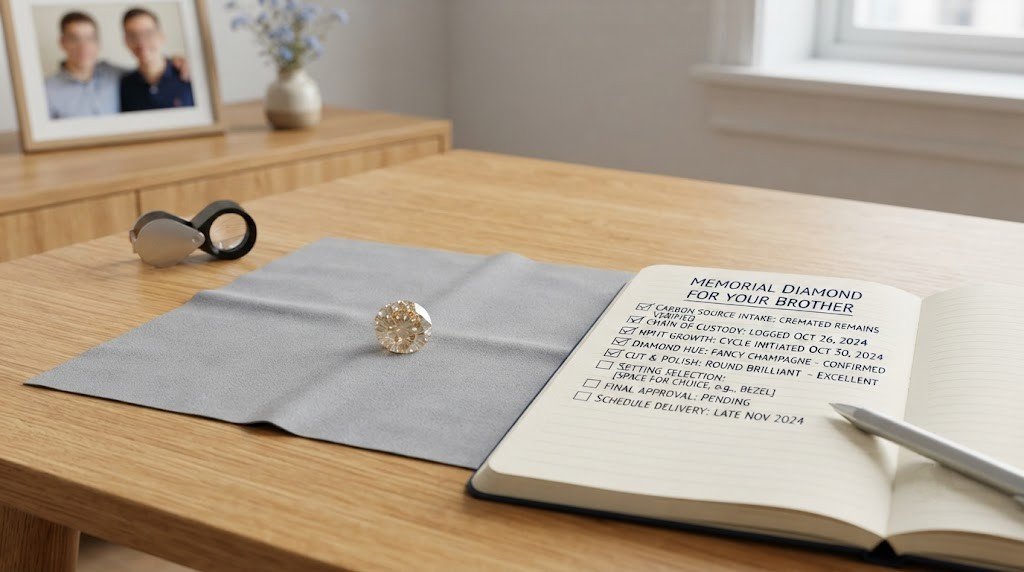
Can a sibling start this process without the rest of the family?

A sibling can research and ask questions alone, but releasing his ashes is usually someone else’s call. Depending on state law and his written wishes, a spouse, partner, adult children or parents may decide first. Asking respectfully for a small portion is a reasonable route.

Is hair a good option if my brother was not cremated?

Yes, often. Since hair is around half carbon, only a little is typically required, and cremation never enters into it. Each provider decides whether a specific sample is usable, and kept hair may belong to his estate, so check with the executor.

How much does a memorial diamond for your brother typically cost?

Industry-wide, smaller stones of about 0.10 to 0.25 ct run roughly $1,500 to $3,500, and 0.5 to 1 ct roughly $5,000 to $15,000. Grading, engraving and settings are usually extra, so ask for itemized quotes.

Can you choose the exact color of a memorial diamond for your brother?

Not exactly. Memorial diamonds tend toward yellow, blue and champagne tones because of trace elements, and colorless costs more. Some providers offer treated colors such as pink or black, but no one can match a precise natural shade.

Final Thoughts on Starting a Memorial Diamond for Your Brother

Most of the work here is not about jewelry at all. It is about timing that feels right, a family that has been heard, and a provider whose answers you understand. Once those are in place, the stone itself tends to follow.

Take the steps at whatever pace suits the people involved. Learning now and deciding next year is a completely sound way to approach it.

Learn More About Planning a Memorial Diamond for Your Brother

Talk With Memorial Diamond

If you would like help thinking through any of these steps, Memorial Diamond is glad to listen and explain how the process works for ashes, hair or both. There is no need to have decided anything before you get in touch.

Whenever you are ready, you can reach us through memorialdiamond.us.

Word count: 3,045 words · Reading time: about 15 minutes

How Much Ash and Hair Do You Need for a Grandmother Memorial Diamond

How Much Ash and Hair Do You Need for a Grandmother Memorial Diamond?

Maybe an aunt keeps part of her ashes, and you have a lock of her hair in a drawer. To gather ash and hair for a grandmother memorial diamond, you typically need only a little of each: a few tablespoons up to roughly 4 oz (about 100 g) of ashes, plus a small lock or a few grams of hair. Every figure is provider-dependent, and the first thing to confirm is whether a provider combines the two at all.

A combined stone brings two materials, often two households, and sometimes two sets of decision-makers into one plan. Knowing what collecting ash and hair for a grandmother memorial diamond involves makes the conversations with family and providers far easier.

ash and hair for a grandmother memorial diamond

Will a Provider Combine Her Ashes and Hair in One Diamond?

Not necessarily. A provider may offer to recover carbon from ash and hair for a grandmother memorial diamond and grow a single stone from the combined result. Others may prefer to work with one material per stone, or may offer to grow two separate diamonds: one from her ashes and one from her hair. The only reliable answer comes from the provider you are considering.

Asking this before anyone portions out ash and hair for a grandmother memorial diamond saves a great deal of effort. If a provider will not blend, there is no point coordinating ash and hair for a grandmother memorial diamond into one shipment. You might instead choose a single material, or plan two smaller stones that sit together in one setting or go to different relatives.

When a provider does offer a combined stone, ask how it handles ash and hair for a grandmother memorial diamond during extraction. Are they processed together or separately and then joined before growth? How is each one logged? The answers shape what documentation you receive at the end, and they tell you how carefully the provider thinks about chain of custody.

How Much Ash and Hair for a Grandmother Memorial Diamond Is Usually Requested?

The industry gives broad ranges for ash and hair for a grandmother memorial diamond rather than a single number, and the two figures differ sharply. Ashes are mostly calcium phosphate, the mineral of bone, with usable carbon at only around 0.5% to 4% by weight. Hair is built from keratin, which is about 50% carbon. That gap explains why a request for ash and hair for a grandmother memorial diamond may be tablespoons of one and only grams of the other.

MaterialTypical request across the industryApproximate carbon contentCremation involved?
Cremated ashesA few tablespoons up to roughly 4 oz (about 100 g)Roughly 0.5% to 4% usable carbonYes
HairA small lock or a few gramsAbout 50% carbonNo
Both togetherProvider sets the amount of eachNot published for a blended stoneOnly for the ash portion

These are guides, not minimums. A provider asking for ash and hair for a grandmother memorial diamond may want a different amount of each than it would for a single-material stone, or a margin in case a step needs repeating. Ask for both quantities in writing, and ask whether they change with the carat size you choose.

When families set aside ash and hair for a grandmother memorial diamond, the ash portion is usually a small fraction of what the crematory returned. That leaves most of her ashes free for the urn, burial plot, niche or scattering place the family already chose, and it means a diamond can sit beside those plans rather than replacing any of them.

Does Sending Extra Ash or Hair Change the Carat Size?

No. A diamond grows larger the longer it stays in the growth press, so carat size is a choice you make when ordering rather than a result of how much material you send. Doubling the ash and hair for a grandmother memorial diamond, whether a full urn or a thick envelope of hair, will not produce a bigger or quicker stone than the provider’s standard amounts.

Most memorial stones are grown by HPHT, which subjects a small diamond seed to roughly 6 to 8 GPa of pressure and about 1,400 to 2,500°C. A minority of providers use CVD instead, depositing carbon from a gas onto a seed plate. Before either method, carbon recovered from the ash and hair for a grandmother memorial diamond is refined to about 99.9% purity or better and turned into graphite at roughly 2,500 to 2,700°C. Lab-sourced carbon is then typically added to make up the volume a given carat weight requires.

Because extra material does not translate into extra carats, limiting the ash and hair for a grandmother memorial diamond to what is requested is usually the gentler path. It leaves more of her ashes where the family intended and more of her hair in the keepsakes relatives already treasure. If a provider keeps some material in reserve, ask whether the unused portion of each is returned, stored or disposed of, and what that costs.

Who Has the Say Over Her Ashes, and Who Over Her Hair?

The ash and hair for a grandmother memorial diamond can sit under different kinds of decision. With ashes, the right to decide flows from state law and from anything she put in writing, and each state ranks family members in its own way. Grandchildren frequently come after a surviving spouse or partner and then her adult children, but not in every case. A practical first step is to ask the crematory or funeral home whose signature is on the cremation paperwork.

Hair is often more straightforward, since no cremation paperwork is involved. Still, the belongings someone leaves behind may be treated as part of the estate, and states handle that differently. Before sending ash and hair for a grandmother memorial diamond, have a brief word with whoever is acting as executor or otherwise settling her affairs about the hair as well as the ashes.

If you are a grandchild without that authority, there is still a respectful way to request ash and hair for a grandmother memorial diamond. Approach whoever holds it, whether that turns out to be your mother, your father, an aunt or an uncle, and ask if they would be open to setting aside a modest share of the ashes for a stone. Where an estate question becomes contested, a local estate attorney is the right person to explain how your state treats it.

How Can Relatives Holding Different Materials Work Together?

Pulling together ash and hair for a grandmother memorial diamond often means that one relative holds the ashes and another holds the hair. Cousins, siblings, step-relatives and her children may all have a stake, and some may want a stone of their own. A little structure keeps the process kind.

Points worth settling together:

  • Who will speak with the provider and place the order, or whether each person orders separately
  • How much ash and hair for a grandmother memorial diamond each household is willing to contribute
  • Whether everyone wants a combined stone, or whether some would rather have ash-only or hair-only diamonds
  • How costs will be divided, if they are shared
  • What should happen to any material the provider does not use

Several stones can often be grown from one shared source, because each requires only a portion. That makes it possible for more than one grandchild to receive a diamond, provided the material stretches and the provider agrees. Ask how it tracks each stone separately so every recipient gets paperwork tied to their own diamond.

If relatives disagree about sharing ash and hair for a grandmother memorial diamond, there is no need to push the decision through. A pause while everyone thinks it over costs nothing, and the decision can wait until the family is ready.

What Is Published About the Carbon in a Blended Stone?

The only published estimate of personal carbon applies to ash-only diamonds, where it commonly sits near 10 to 15% of the finished weight; certain providers quote lower numbers, some as low as 3%, while others quote more. Nothing equivalent exists for hair-only stones, and nothing exists for a diamond grown from a blend of ash and hair.

So the honest position is this: a stone grown from ash and hair for a grandmother memorial diamond contains carbon recovered from her, purified and typically mixed with supplemental lab carbon, but the share of the finished diamond that came from her is something each provider must answer for itself. Ask in writing how much of the finished stone comes from the ash and hair for a grandmother memorial diamond you send, and how that is measured and recorded. Be cautious of any description of the stone as entirely her, since that does not match how the industry says these diamonds are grown.

The finished piece is a genuine lab-grown diamond: it scores 10 for hardness on the Mohs scale and is assessed for cut, color, clarity and carat exactly like a mined one; the general background on memorial diamonds covers the category’s history. The explainer on whether a stone is really made from her ashes and hair goes deeper into that honesty question, and the walk-through of how a diamond is grown from both materials explains each stage.

Paperwork matters here too. An authenticity or origin certificate, typically issued in-house, documents chain of custody. A grading report, ideally from an independent lab working to GIA standards and sometimes IGI, describes cut, color, clarity and carat, and is usually an optional add-on with its own price.

What If Her Ashes Were Scattered, Buried or Already Divided?

Families arrive at this question at very different points. She may have died years ago, her ashes may have been scattered somewhere meaningful, or they may already sit in several homes. Cremation is now the more common choice in the United States: the NFDA’s 2025 report projects a 63.4% cremation rate against 31.6% for burial, which means many families have ashes somewhere in the picture, though not always within reach.

If combining ash and hair for a grandmother memorial diamond is off the table because none of her ashes can be gathered, a hair-only stone needs no cremation at all, so it stays possible whether she was buried or her ashes were scattered or interred, provided a lock of her hair was kept. The companion piece on how much hair alone a provider may need explains that route. If ashes are available but hair is not, an ash-only stone is the other option, and the post on how much of her ashes a provider may ask for covers the amounts.

When faith is part of the decision

Religious teaching speaks to cremation and what happens to ashes afterward; none of the major traditions has ruled on memorial diamonds themselves. Catholic guidance accepts cremation yet asks for the ashes to be kept whole in a consecrated resting place, with only a tightly limited allowance for a minimal portion, a point that matters whenever ashes would be split. Islamic schools of thought broadly consider cremation impermissible, so a stone using ashes would not arise, while a hair-only stone involves no cremation. Orthodox and Conservative Judaism generally prohibit cremation, and Reform practice is more open. If faith matters to your family, talk with your own clergy or faith community before setting aside ash and hair for a grandmother memorial diamond.

Which Questions Should You Put to a Provider Before Sending Both?

Writing your questions down before calling makes it easier to compare how providers treat ash and hair for a grandmother memorial diamond. The list below focuses on what changes when two materials travel in one order rather than one.

About the materials themselves

  1. Do you grow a single stone from both materials, or separate stones from each?
  2. How much ash and hair for a grandmother memorial diamond do you need for the carat size we want?
  3. Do you accept hair that has been dyed, permed or otherwise treated, and very short hair?
  4. Are ashes that have been stored for many years still workable for you?

About tracking, outcomes and paperwork

  1. What share of the finished stone comes from the material we send, and how is that documented?
  2. How do you track each material from arrival through growth?
  3. What happens to unused ashes and hair afterward?
  4. If a growth run fails, what happens next, and who bears the cost?
  5. Is an independent grading report included, or is it an extra?

Keep the answers about ash and hair for a grandmother memorial diamond in writing. They make comparison simpler, and they give the whole family a shared record of what was agreed. The complete guide to a grandmother ashes and hair diamond covers settings, color and family planning beyond these questions.

What Will a Combined Stone Cost, and When Will It Be Ready?

Cost is driven by carat, color, cut and extras, not by how much ash and hair for a grandmother memorial diamond you supply. Memorial Diamond has not yet published its own prices, so the figures below are general industry ranges for 2026:

Size tierApproximate caratTypical industry price range
Entry0.10 to 0.25 ctAbout $1,500 to $3,500
Mid0.5 to 1 ctAbout $5,000 to $15,000, with colorless costing meaningfully more
Large2 to 5+ ctAbout $20,000 to $75,000 or more

Independent grading, engraving, fancy cuts and jewelry settings are usually charged on top. Color has its own logic: boron produces blue, nitrogen produces yellow, and colorless stones require keeping both out, which adds processing and cost. Memorial stones commonly land in yellow, blue and champagne tones, with some providers offering post-growth irradiation for other colors. The guide to the color a stone from her ashes and hair may take goes into the options.

For timing, the industry typically quotes 6 to 10 months from the date the provider receives the material, rising to around 12 months for stones above roughly 2 ct or in specialty colors. A stone grown from ash and hair for a grandmother memorial diamond follows the same general window, but ask each provider whether handling two materials changes its estimate.

Frequently Asked Questions

Can a provider make one diamond from both her ashes and her hair?

Some providers do, and others prefer one material per stone or offer two separate diamonds. Ask directly before gathering ash and hair for a grandmother memorial diamond, since the answer decides whether the materials need to be coordinated and shipped together at all.

How much of each material is typically needed?

Industry guidance on ash and hair for a grandmother memorial diamond is usually a few tablespoons up to roughly 4 oz of ashes, plus a small lock or a few grams of hair. Providers set their own amounts, so get both in writing.

Will combining her ashes and hair make the stone larger?

No. Carat size depends on how long the diamond grows in the press, not on how much ash and hair for a grandmother memorial diamond arrives. Adding hair to ashes, or sending extra of either, does not increase the size or shorten the timeline of the finished stone.

What share of a combined stone comes from her?

No industry figure is published for stones blending ash and hair. The 10 to 15% range often quoted applies to ash-only stones. Ask each provider in writing what share of the finished diamond comes from her material and how that is documented.

My aunt holds her ashes and I have her hair. Who decides?

Authority over ashes depends on state law and any written wishes, and a surviving spouse or her adult children often come first. Hair kept at home is usually simpler, but talk with whoever is settling the estate and agree a plan together.

Can several grandchildren each receive a combined stone?

Often several stones can come from shared material, since each uses only a portion. Whether there is enough for combined stones for everyone depends on how much of each material exists and the provider’s per-stone requirements, so ask before promising anyone a diamond.

What if her ashes were scattered years ago?

A hair-only stone involves no cremation, so it remains possible if a saved lock of her hair exists. Ask a provider whether the amount you have, and the way it has been stored, is workable before deciding which route to take.

Final Thoughts on Combining Her Ashes and Hair

The quantities of ash and hair for a grandmother memorial diamond are rarely what holds families back. More often it is the coordination: who keeps what, who has the say, and whether a provider will blend the two at all. Settling those questions in writing, and in conversation with the relatives involved, tends to make everything after it simpler.

A combined stone is one choice among several. A hair-only or ash-only diamond, a portion kept in an urn, or no diamond at all are all reasonable outcomes, and the right one is whatever fits your family and who she was.

Learn More About Diamonds Grown From a Grandmother’s Ashes and Hair

Talk With Memorial Diamond

If your family is setting aside ash and hair for a grandmother memorial diamond, Memorial Diamond is happy to help you think through amounts, family arrangements and the questions above. We will give you straight answers, including the ones that are still provider-dependent.

Whenever you are ready, you can reach us at memorialdiamond.us. There is no timeline to keep, and you are welcome to take as long as you need.

Word count: 3,120 words · Reading time: about 16 minutes

How to Turn Your Brother Ashes and Hair Into a Diamond

How to Turn Your Brother’s Ashes and Hair Into a Diamond

Sometimes one relative keeps the urn while another has a lock of his hair, and a single stone holding both feels right to everyone. To turn brother ashes and hair into a diamond, you confirm who can release each material, agree on a small portion of ashes and a lock of hair, choose a provider that accepts blends, send both under tracked chain of custody, choose size and color, and typically wait 6–10 months for one real lab-grown diamond.

turn brother ashes and hair

What Does It Mean to Turn Brother Ashes and Hair Into One Diamond?

A blended memorial diamond is grown from carbon recovered from two of his materials, a small portion of his cremated remains and a lock of his hair, rather than from one alone. The result is still a single, real lab-grown diamond, the same as any other memorial stone in hardness and chemistry. The broader history of the category is summarized in this overview of memorial diamonds.

Families who choose to turn brother ashes and hair into a diamond are not getting a different kind of gem. They are choosing a different starting point: carbon from his remains after cremation, joined with carbon from hair that may have been saved during his life or trimmed before the funeral.

For a full overview of this combined option, the brother ashes and hair diamond complete guide covers the background. This page is about doing it: the conversations, the paperwork, and the handoffs that take you from an idea to a stone you can hold.

Why Would Siblings Combine His Ashes and Hair?

The reasons are usually personal rather than technical. Here are several that tend to come up when siblings decide to turn brother ashes and hair into a single stone:

  • Two parts of his story. The hair may come from a particular time in his life, a haircut someone remembers, a curl from childhood, while the ashes come from after. Some people want both moments in one piece.
  • Different relatives hold different things. One person may have the urn and another a saved lock. A blend lets each contribute, so nobody feels left out of the decision.
  • A wish to draw on more than one part of him. Hair is far richer in carbon than ash, and some siblings like the idea of using both sources, even though no published figure shows that a blend holds more of his carbon than a single-material stone.
  • Making a shared choice feel balanced. Whether adding hair changes the amount of ash a provider requests is a question for the provider, but contributing both can make dividing the urn feel more even-handed to the person who keeps it.

None of these reasons makes a blend better than an ash-only or hair-only stone. If you are weighing the single-material routes, compare the guides on how to turn brother ashes into a diamond and how to turn brother hair into a diamond. Choose to turn brother ashes and hair into a diamond only if both materials genuinely matter to the people involved.

What Are the Steps to Turn Brother Ashes and Hair Into a Diamond?

Combining two materials adds a little extra coordination, mostly around permission and labeling. Here is a practical order to work through when you turn brother ashes and hair into one diamond.

StepWhat happensNotes
1. Talk it throughAgree among close relatives that a blended stone is wantedDecide who will coordinate
2. Confirm authority over the ashesIdentify who can approve releasing a portionOften not a sibling; varies by state
3. Confirm the hair’s sourceEstablish where the hair came from and who can release itHair at home may be part of his estate
4. Agree on portionsSettle how much ash and hair will be sentProvider minimums vary
5. Choose a providerConfirm it accepts blends and documents both materialsAsk how each material is tracked
6. Send both materialsLabel each separately and ship with trackingFollow the provider’s kit
7. Make your selectionsChoose carat, color, cut, and settingChoices shape timing and cost
8. Receive and checkMatch the stone to its paperworkOrigin record should cover both

When you turn brother ashes and hair into a diamond, steps two and three can run side by side, since the people involved may differ. Nothing in the later stages depends on rushing the early ones, and taking time to get agreement right is part of doing this well.

Who Needs to Agree Before You Turn Brother Ashes and Hair Into a Diamond?

With a blend, you may need two kinds of agreement, one for the ashes and one for the hair, and they do not always come from the same person.

For the ashes, the decision usually rests with whoever holds authority over his remains. Being his sibling does not automatically give you that role. State rules commonly rank a spouse or registered partner first, adult children next, and parents after them, with siblings frequently later in line, but each state sets its own order. His written wishes, such as a named agent, a pre-need arrangement, or a will, can override the usual sequence.

For the hair, it depends on its source. A lock trimmed by the funeral home is generally released through whoever holds authority over his remains. A lock saved in a drawer, a keepsake box, or anywhere among his possessions could count as property of his estate, and states differ on how that works, so speak with the person settling his affairs before adding it to the blend.

If you want to turn brother ashes and hair into a diamond and you hold neither role, start by asking. Explain that only a small portion of ashes and a modest lock are needed, offer copies of the paperwork, and consider inviting others to share in the stone. The funeral home, or a local estate attorney, can clarify whose consent applies if the picture is unclear.

How Much of Each Material Does a Provider Need?

If you plan to turn brother ashes and hair into a diamond, expect providers across the industry to ask for a few tablespoons to about 4 ounces (roughly 100 grams) of ashes. For hair, the usual request is a small lock or a few grams. Each provider sets its own minimums, and a blend may come with its own requirements, so ask before dividing anything.

More material does not make a larger diamond. Carat size is set by growth time in the press, so sending extra ash or hair will not change the size of the stone. When you turn brother ashes and hair into a diamond, ask whether the provider needs the full single-material amount of each, or a reduced amount when both are supplied.

The detailed guide to how much ash and hair a brother memorial diamond needs covers quantities in more depth, including what to ask when several stones are planned.

Will Every Provider Help You Turn Brother Ashes and Hair Into a Diamond?

Not necessarily. Some providers work with both materials together; others handle only one per stone. Before you turn brother ashes and hair into a diamond with a particular company, confirm in writing that it offers blends and explain what you plan to send.

Useful questions to put to each provider:

  1. Do you accept ashes and hair together for a single diamond?
  2. Are the two materials processed separately and then combined, or together from the start?
  3. How do you track each material from arrival to finished stone?
  4. Will the origin certificate name both ashes and hair as sources?
  5. Do you offer an independent grading report as well as your own certificate?
  6. What happens if a growth attempt does not succeed, and will unused material be returned?

A provider that answers these clearly, and states openly that supplemental lab carbon is typically added, is showing you how it handles honest questions. That matters more with a blend, since two materials mean two chains of custody to keep straight.

How Do You Ship Both Materials to Turn Brother Ashes and Hair Into a Diamond?

Unless the provider’s kit directs otherwise, keep the ashes and the hair in separate, sealed containers, each labeled with his full name and the type of material. Even if the provider will eventually combine them, separate packaging keeps the chain of custody clear and lets the provider confirm each sample on arrival.

Ask whether both containers should travel in one package or in two. Carriers may have their own requirements for cremated remains, so ask the provider which shipping service and packaging it expects, and use its kit if one is offered. Choose tracking and signature confirmation, photograph each sealed container, and keep every receipt.

If organizing this feels like too much, the funeral home that handled the cremation may be able to prepare the ashes for shipping. You can still turn brother ashes and hair into a diamond while letting someone experienced manage the packing, as long as both materials end up labeled and documented.

What Does a Blend Mean for the Carbon in the Stone?

This is the question to understand clearly before you turn brother ashes and hair into a diamond, because blends are where overstated claims creep in most easily.

Start with the two materials separately. Cremated ashes are mostly calcium phosphate and contain only about 0.5% to 4% carbon by weight. For an ash-only stone, industry figures put the ash-derived carbon at roughly 10–15% of the finished diamond’s mass, with some providers citing figures closer to 3%; that range describes ash alone. Hair, built from keratin, is roughly 50% carbon by weight.

For a blend, there is no published industry figure for what share of the finished stone comes from his ashes and hair combined, and no published figure for hair-only stones either. Supplemental lab carbon is typically still added to reach the volume a diamond needs. So a blended diamond is not made of him alone, and a company that promises a precise personal percentage for a blend is offering a number the industry does not publish.

What you can ask is how the provider proportions the materials and what it documents. When you turn brother ashes and hair into a diamond, the truthful promise is this: real carbon from both of his materials is extracted, purified, and grown into the stone’s crystal lattice. The question of whether a memorial diamond is really made from your brother’s ashes and hair is answered in more depth on its own page.

What Happens in the Lab When Two Materials Are Used?

Each material is first heated in stages, without oxygen and under careful control, until the minerals in ash and the non-carbon parts of keratin in hair are gone and the remaining carbon reaches roughly 99.9% or higher. Whether a provider purifies the two separately or together is worth asking before you turn brother ashes and hair into a diamond with it.

Next, a much hotter stage, somewhere around 2,500–2,700°C, turns that purified carbon into graphite, the form a growth press can use. Typically blended with supplemental lab carbon, it goes into a growth cell around a small diamond seed. Most memorial providers use HPHT, at roughly 6–8 GPa and 1,400–2,500°C, while a minority use CVD. Growth runs for weeks to months depending on the carat you chose, followed by cutting, polishing, optional irradiation for color, and grading.

The step-by-step account of how a memorial diamond is made from brother ashes and hair goes into each stage. Knowing the stages helps when you turn brother ashes and hair into a diamond, because each update from the provider will have a clear place in the sequence.

What Choices, Timing, and Costs Should You Expect?

Size. Memorial diamonds generally range from about 0.10 carats to 5 carats or more. Siblings who turn brother ashes and hair into a diamond choose the carat just as anyone else does; the blend does not set the size.

Color. Nitrogen during growth produces yellow, boron produces blue, and colorless stones need both excluded, which takes extra processing and typically costs more. Memorial diamonds often settle into yellow, blue, or champagne tones, and post-growth irradiation can give red, pink, green, or black. The final shade cannot be predicted from either material, and combining them does not make color more predictable. The page on what color a diamond from your brother’s ashes and hair might be explains the chemistry.

Setting. A pendant, ring, earrings, a bracelet, cufflinks, a tie bar, or a loose stone kept in a box are all reasonable choices. Pick what suits how you will wear or keep it.

Timing. Across the industry, expect roughly 6 to 10 months from receipt, and up to about 12 months for stones above roughly 2 carats or specialty colors. The brother memorial diamond timeline describes the waiting period.

Cost. General 2026 industry ranges for the loose stone run roughly 1,500–3,500 for about 0.10–0.25 carat, 5,000–15,000 for 0.5–1 carat (colorless toward the top), and 20,000–75,000 or more for 2–5+ carats. Grading, engraving, fancy cuts, and settings are usually extra. Ask whether choosing to turn brother ashes and hair into a diamond changes the price, since policies differ.

How Do You Check a Blended Diamond When It Arrives?

When the stone arrives, open it in your own time. Then compare it with two documents. The origin or authenticity certificate, usually issued by the provider, is a chain-of-custody record; for a blend, check that it names both his ashes and his hair. The grading report, ideally from an independent lab, describes the stone using the 4Cs, following standards such as the GIA’s diamond quality factors.

Confirm that carat, color, and shape match across both documents and your order. Expect clarity somewhere in the SI2 to VVS range that memorial stones typically reach; a few tiny inclusions visible under a loupe are normal for this range. A diamond rates 10 for hardness but can still chip from a hard knock at the wrong angle, so ask about care and insurance before daily wear.

Keep both documents and every shipping receipt together. When you turn brother ashes and hair into a diamond, that paper trail is what confirms, years later, exactly where the stone came from.

Frequently Asked Questions

Can you turn brother ashes and hair into a single diamond?

Yes, where the provider offers blends. Carbon is recovered from a small portion of his ashes and a lock of his hair, purified, and typically combined with supplemental lab carbon to grow one real lab-grown diamond. Confirm blend availability before sending anything.

Is a blended diamond more personal than an ash-only diamond?

When you turn brother ashes and hair into a diamond, no published figure shows how much of the stone comes from him, so a firm comparison is not possible. Hair is far richer in carbon than ash, but the personal share depends on how each provider proportions materials.

Do I need permission for both the ashes and the hair?

Usually, yes, before you turn brother ashes and hair into a diamond. The ashes are generally released by whoever holds authority over his remains. Hair from the funeral home goes through that person too, while hair kept at home may form part of his estate, with rules varying by state.

Does adding hair reduce the amount of ash needed?

It depends on the provider you ask to turn brother ashes and hair into a diamond. Some may ask for the full single-material amount of each, while others may adjust when both are supplied. Ask directly, and confirm exact quantities of ash and hair before anything is divided or shipped.

Will combining ashes and hair change the diamond’s color?

No one can say in advance. Nitrogen tends to bring yellow and boron blue during growth, but neither material, alone or blended, lets a provider forecast the exact shade. Colorless stones require extra processing and typically cost more.

Should the ashes and hair be shipped in the same package?

Follow the provider’s instructions. Siblings who turn brother ashes and hair into a diamond should keep each material in its own sealed container labeled with his full name and the material type, so both chains of custody stay clear from the moment the provider receives them.

Final Thoughts on Turning Your Brother’s Ashes and Hair Into a Diamond

A blended stone often grows out of a family conversation as much as a decision: one person’s urn, another’s saved lock, and a shared wish to hold something of him together. If you choose to turn brother ashes and hair into a diamond, let that conversation set the pace, ask every provider the hard carbon questions, and keep the paperwork for both materials safe.

Learn More About Combining His Ashes and Hair

Talk With Memorial Diamond

If your family hopes to turn brother ashes and hair into a diamond, Memorial Diamond is happy to talk through what is possible, what each material involves, and which questions to settle first. There is no rush and no obligation. Reach out whenever the time feels right at memorialdiamond.us.

Word count: 3,067 words · Reading time: about 15 minutes

How Much Does a Brother Memorial Diamond Cost

How Much Does a Brother Memorial Diamond Cost?

Somewhere between the arrangements and the quieter weeks that follow, the practical question of price tends to surface, often before you feel ready to say it out loud. Across the 2026 industry, a brother memorial diamond cost typically falls around 1,500–3,500 for a small stone of about 0.10–0.25 carat, 5,000–15,000 for a half-carat to one-carat stone, and 20,000–75,000 or more for stones of two carats and up.

Those are market-wide ranges rather than a fixed quote. The figure you actually see depends on size, color, cut, grading, and the setting you choose, and it applies in the same way whether you are working with his ashes, a lock of his hair, or both together. What follows explains each of those levers, the extras worth asking about, how siblings sometimes divide the expense, and how to plan at a pace that suits you.

brother memorial diamond cost

What Does a Brother Memorial Diamond Cost in 2026?

Memorial diamond prices are usually grouped by carat weight, because size is the biggest single lever on what you pay. The table below sets out the general 2026 industry ranges. Read it as a map of the wider market, not as Memorial Diamond’s own price list, which has not been published yet.

TierTypical carat weightTypical 2026 brother memorial diamond costWhat tends to push a stone toward the top
EntryAbout 0.10–0.25 ctAbout 1,500–3,500The larger end of the tier, an added grading report
MidAbout 0.5–1 ctAbout 5,000–15,000Colorless stones, which cost meaningfully more than blue, yellow, or champagne at the same size
Large and rareAbout 2–5+ ctAbout 20,000–75,000+The biggest sizes and specialty colors

These figures normally describe a loose stone. An independent grading report, engraving, a fancy cut, and a ring, pendant, or earring setting are typically priced separately, so the full brother memorial diamond cost you budget for can sit noticeably above the base tier.

Memorial diamonds come in sizes from roughly a tenth of a carat to five carats or more, which is why two relatives asking the same question can come away with very different numbers.

What Are You Paying For When a Memorial Diamond Is Made?

A large part of any brother memorial diamond cost reflects time, equipment, and careful handling rather than the gem alone. The finished stone is a real lab-grown diamond, chemically identical to any other diamond, and creating it from personal carbon involves a long chain of specialist work.

In broad strokes, the industry process runs like this:

  1. Receiving his material under chain-of-custody tracking, so the carbon stays tied to your brother throughout.
  2. Extracting and purifying the carbon in an oxygen-free, multi-stage process until it reaches roughly 99.9% carbon or higher.
  3. Graphitizing that carbon at around 2,500–2,700°C to create the feedstock a growth press uses.
  4. Growing the crystal, usually by HPHT at roughly 6–8 GPa and 1,400–2,500°C, with CVD used by a minority of providers. Growth runs over weeks to months.
  5. Cutting and polishing the rough crystal into its finished shape.
  6. Optional irradiation to shift color, which some providers offer.
  7. Grading, ideally by an independent laboratory.

If you want the science behind step four, this overview of how HPHT and CVD synthetic diamonds are grown is a clear place to start.

The point that matters most for price is simple: the weight of the finished diamond follows the length of its growth run, while the quantity of ashes or hair you provide plays no part in it. A larger stone means more press time and tighter process control, which is why the brother memorial diamond cost climbs steeply as carat weight goes up.

Which Factors Raise or Lower a Brother Memorial Diamond Cost?

Six choices do most of the work in shaping a quote. Knowing them ahead of time lets you decide where to spend and where a simpler option feels just as meaningful.

  • Carat weight. The largest driver. Each step up in size adds growth time, and the tiers above show how quickly that compounds.
  • Color. Colorless stones need extra processing to keep trace elements out, so they usually cost more than blue, yellow, or champagne stones of the same weight.
  • Cut. A classic round is a common starting point. Fancy shapes such as cushion, princess, oval, or emerald are often priced as an add-on.
  • Grading report. An independent report describing cut, color, clarity, and carat is usually its own line item.
  • Setting. A ring, pendant, earrings, a bracelet, or a simple keepsake mount each carry their own metal and labor costs, which the loose-stone price rarely includes.
  • Engraving. Some providers offer an inscription, such as his initials or a meaningful date, typically for an added fee. Ask what length and characters are possible.

When you compare quotes, line these six items up side by side. A brother memorial diamond cost that looks low may leave out the grading report or the setting, while a higher figure may already include both. An itemized estimate is the clearest way to see what you are comparing. For inspiration on how a stone might be worn or displayed, browse these brother memorial diamond ideas for rings, pendants, and keepsakes.

Clarity for memorial stones typically lands between SI2 and VVS, and it is recorded on the grading report; ask each provider whether a clarity preference changes the quote. To understand how gemologists describe those grades, the GIA’s explanation of diamond quality factors lays out the 4Cs in plain language.

How Does Color Affect a Brother Memorial Diamond Cost?

A diamond’s color comes from trace elements present while the crystal grows. Nitrogen tends to produce yellow, boron tends to produce blue, and a colorless stone requires both to be kept out. Because personal carbon comes from an organic source, those elements are common, which is why memorial diamonds naturally lean toward yellow, blue, and champagne tones.

Steering a stone toward colorless takes additional processing, and that work shows up on the invoice. In the mid tier especially, picking colorless over a warm or cool tone of the same size can move a brother memorial diamond cost toward the upper end of the 5,000–15,000 band. Some providers also offer post-growth irradiation for red, pink, green, or black stones, and specialty colors can carry their own pricing and a longer wait.

One honest caveat: the exact shade cannot be predicted from the source. Neither his ashes nor his hair reliably produces a lighter or more predictable color than the other, so ask any provider how color requests are handled and what happens if the finished tone differs from what you pictured. The post on what color a diamond made from his ashes might be goes deeper into the chemistry.

When shaping a brother memorial diamond cost, decide early whether colorless truly matters to you. If a champagne or blue stone feels just as right, that single choice can free up room for a setting, a grading report, or a second stone for someone else in the family.

Do Ashes, Hair, or Both Change a Brother Memorial Diamond Cost?

Published industry ranges are organized by carat, color, and add-ons rather than by source material, so the tiers above are quoted the same way whether you begin with his ashes, his hair, or a combination. Whether a particular provider charges differently for one material, or adds a fee for processing two materials together, varies from company to company. Rather than assuming either way, ask directly: does my choice of material change the brother memorial diamond cost you are quoting?

What genuinely differs is the material itself:

SourceCarbon contentTypical amount requestedWhat is known about the finished stone
AshesRoughly 0.5–4% carbon by weightA few tablespoons up to about 4 oz (about 100 g)Ash-derived carbon typically makes up around 10–15% of the stone’s mass (some cite figures near 3%), blended with supplemental lab carbon
HairRoughly 50% carbon by weightA small lock, often a few gramsNo finished-stone percentage is published for hair; supplemental carbon is typically blended in
Ashes and hair togetherDepends on the mixEach provider sets its own requestNo finished-stone percentage is published for blends; ask how the two are combined

Because only a portion of either material is usually needed, the rest of his ashes can still be kept, scattered, or interred as planned. Several stones can often be grown from one source, which matters if more than one person hopes to wear something of him.

The finished diamond is never made entirely of him. A real, traceable portion of his carbon is grown into the crystal alongside lab carbon, and that holds at every price point, so a higher budget generally buys size, color, and finish rather than a larger share of your brother. For a fuller walk-through by material, see the complete guide to a brother ashes diamond, the brother hair diamond guide, or the guide to combining his ashes and hair.

What Hidden Extras Can Add to a Brother Memorial Diamond Cost?

Beyond the stone and its setting, smaller charges can quietly raise a brother memorial diamond cost later on. None are unusual, but they are easier to plan for when you know to ask. Before signing anything, consider working through questions like these with each provider:

  • Is shipping his ashes or hair to the lab included, and what packaging or carrier rules apply?
  • Is the independent grading report included, or is it an extra line?
  • Is the origin or authenticity certificate, the chain-of-custody document, included?
  • Are engraving, a fancy cut, or color treatment priced separately?
  • What happens, and what is charged, if a growth attempt does not succeed?
  • Will unused ashes or hair be returned, and is there a fee for that?
  • Is return shipping of the finished diamond insured, and who pays for it?
  • If you later want a second stone from the same material, how is it priced, and is the material stored in the meantime?

Writing the answers in one place lets you compare an all-in brother memorial diamond cost rather than a headline number.

The two documents deserve a brief note. The origin certificate is normally produced by the provider itself and traces the stone back to your brother’s carbon. An independent grading report describes the diamond’s quality in standard 4Cs language. They answer different questions, and a quote that includes one does not necessarily include the other.

How Can Siblings Share a Brother Memorial Diamond Cost?

When more than one person loved him, it is natural to wonder whether the expense can be shared. No single arrangement is right; it depends on your family, your finances, and what each person hopes to keep.

A few possible arrangements:

  • One shared stone. Several relatives contribute toward a single diamond that one person wears or that the family keeps together.
  • Several smaller stones. Because one source can often yield more than one diamond, each person can choose an entry-tier stone in their own setting. Ask whether additional stones from the same material are priced differently.
  • Uneven contributions. Some relatives may want to put in more, others less or nothing at all. Saying plainly that any amount is welcome, including none, keeps the gesture from turning into an obligation.
  • One person pays, others help choose. One relative might cover the brother memorial diamond cost while others weigh in on color or setting.

Whatever you decide, putting the arrangement in writing (who pays what, who receives which stone, and who keeps the paperwork) is a kind thing to do for one another. It keeps attention on him rather than on the money.

If you are considering stones for several relatives, this explainer on splitting his ashes so several relatives each receive a diamond shows how dividing material usually works.

Who Should Agree Before Any Money Is Spent?

Before a deposit changes hands, it helps to know who holds authority to release his ashes or hair. A sibling often is not first in that line. Depending on the state, his spouse or partner, if he had one, his adult children, if any, or his parents may have the stronger claim, and choices he recorded himself before his death can change who decides. For the rules in the state involved, a local funeral director or attorney is the person to ask.

If someone else holds that authority, a respectful route is to ask them for a small portion of ashes, explain what you hope to create, and offer them a stone of their own if they would like one. Hair can be another path. A funeral home that trimmed a lock will usually hand it to the person with authority. A lock saved in a drawer or among his possessions may count as part of his estate, and states treat that differently, so confirm before you send anything to a lab.

Settling this first also protects the brother memorial diamond cost you have planned around. A deposit paid before everyone agrees can be awkward to unwind.

How Can You Plan for a Brother Memorial Diamond Cost Without Pressure?

There is no deadline on remembering someone, and a reputable provider should never make you feel otherwise. Taking time to decide, changing your mind about size, or starting smaller than you first imagined are all reasonable.

A gentle way to build a budget:

  1. Start from a number that feels comfortable, not from the stone you think you are supposed to want. An entry-tier diamond is a complete, real memorial on its own.
  2. Choose your priority. If size matters most, a champagne or blue stone may stretch further. If colorless matters most, a smaller carat may keep the total steady.
  3. Request two or three itemized quotes for the same size, color, cut, grading, and setting, so each estimate of the brother memorial diamond cost is truly comparable.
  4. Add a cushion for shipping, insurance on the finished piece, and any setting changes.
  5. Pause before paying. Sleep on it, talk it through with the people involved, and move forward only when it feels settled.

Be wary of pressure tactics, such as grief-timed discounts or language suggesting a bigger stone means more love. Neither reflects how much he mattered. The right brother memorial diamond cost is the one you can carry without strain.

Timing shapes planning, too. The process typically takes 6 to 10 months, and up to about 12 for stones over roughly 2 carats or specialty colors, so ask each provider whether payment is due upfront, in stages, or on completion. The post on the brother memorial diamond timeline explains what shapes that wait.

Can Financing or Insurance Help With a Brother Memorial Diamond Cost?

Some jewelry sellers offer payment plans, and some families look at personal loans or credit options to spread a brother memorial diamond cost over time. Terms, interest, and eligibility vary widely and depend on your own financial picture, so a financial advisor or your bank, not a jewelry company, is the right person to help you weigh whether borrowing makes sense.

Once the diamond exists, you may want to add it to a homeowners or renters policy, or to a dedicated jewelry policy, particularly if it will be worn every day. Coverage, appraisal requirements, and premiums differ by insurer and by state, and an insurance agent can tell you what applies. A diamond rates 10 on the Mohs scale, yet a hard knock can still chip it, which is one reason owners may choose to insure a stone whose meaning cannot be replaced.

Questions about tax treatment, such as whether any part of a memorial purchase could be deducted, belong with an accountant. Personal purchases like this generally are not deductible, but the specifics depend on your circumstances and where you live.

Frequently Asked Questions

Is a brother memorial diamond cost the same for ashes and hair?

Industry price ranges are organized by carat, color, and add-ons rather than by source, so the same tiers generally apply. Some providers may price ashes, hair, or a combined submission differently, so ask each one whether your material choice changes the quote.

What is the most affordable way to make a memorial diamond for my brother?

An entry-tier stone of about 0.10 to 0.25 carat in a natural yellow, blue, or champagne tone, with a classic round cut, typically sits at the lowest end of the market, roughly $1,500 to $3,500 before any setting or grading report.

Why are colorless memorial diamonds more expensive?

Colorless stones need extra processing to keep nitrogen and boron out during growth, since those trace elements cause yellow and blue tones. That added work is why colorless usually costs more than other colors at the same carat weight.

Can several siblings split the brother memorial diamond cost?

Yes. Families arrange this in different ways, from pooling money for one stone to each person choosing a smaller diamond grown from the same material. Writing down who pays what and who receives which stone helps everyone feel clear and respected.

Does sending more ashes or hair make a bigger diamond?

No. A stone’s carat weight reflects the time it spends growing under pressure, and the volume of material supplied does not change that. Sending extra ashes or hair will not by itself enlarge the stone or lower the brother memorial diamond cost.

Should I insure my brother’s memorial diamond?

It is worth considering, especially for a stone worn daily. A diamond rates 10 on the Mohs scale but can still chip with a hard knock. An insurance agent can explain coverage, appraisal needs, and premiums where you live.

Final Thoughts on What a Brother Memorial Diamond Costs

Money is an uncomfortable subject while you are missing someone, and no figure measures what your brother meant. What these ranges can do is help you choose with open eyes: knowing what drives a brother memorial diamond cost, which questions to raise, and how to share the decision with the people who loved him too. A small stone chosen calmly can mean every bit as much as a large one.

Learn More About Planning the Budget

Talk With Memorial Diamond

If you would like to talk through sizes, colors, and what a sensible budget might look like for your brother, reach out to Memorial Diamond at memorialdiamond.us. There is no rush, and asking questions does not commit you to anything.

Word count: 3,261 words · Reading time: about 16 minutes

How a Memorial Diamond Is Made From Your Brother Ashes and Hair

How a Memorial Diamond Is Made From Your Brother’s Ashes and Hair

You may find yourself holding two pieces of him: a portion of ashes from the urn and a lock of hair saved along the way. A memorial diamond made from brother ashes and hair passes through seven lab stages, with each material logged as its own item and, depending on the lab, refined separately before the carbon is combined for growth. The industry-typical span is 6 to 10 months, and no published figure says how much of a blended stone comes from each source.

made from brother ashes and hair

What Are the Seven Stages for a Diamond Made From Brother Ashes and Hair?

The stages themselves are the same seven that any memorial stone goes through. What changes with two materials is the early part of the journey, when ashes and hair are handled as distinct items before their carbon meets. The table follows a diamond made from brother ashes and hair through each stage, column by column, so you can see where each material sits.

StageHis ashesHis hair
1. Intake and chain of custodyA few tablespoons to roughly 4 oz (about 100 g), logged under his orderA small lock or a few grams, logged under the same order as a separate item
2. Extraction and purificationOxygen-free heating separates a little carbon from mostly calcium phosphateOxygen-free heating drives off the non-carbon parts of keratin
3. GraphitizationCarbon from both sources, now refined past roughly 99.9%, goes into a furnace at around 2,5002,700°C to form graphiteThe same step, possibly on carbon already combined, depending on the lab
4. Diamond growthCombined carbon, typically with supplemental lab carbon, grows on a seed in an HPHT press (CVD at a minority of labs)Same crystal; the two sources are no longer separate
5. Cutting and polishingOne rough crystal is faceted into your chosen shapeSame stone
6. Optional irradiationOffered on request to shift or deepen colorSame stone
7. Grading and certificatesOrigin certificate and, ideally, an independent grading reportSame paperwork

Notice where the columns stop mattering. Once both materials have been refined to carbon, they are chemically the same element, and from the moment the lab combines them, a stone made from brother ashes and hair is handled as a single piece of work. That moment varies by provider, so it is worth asking. For a broader overview, our complete guide to a brother ashes and hair diamond covers cost, color, and family planning.

Why Would a Family Use Both Ashes and Hair?

Some people simply have both. A funeral home may have saved a lock before cremation, or a family member may have kept hair from an earlier haircut, and a stone made from brother ashes and hair can feel like it includes more of who he was. Others are drawn to the idea that the stone holds something of him from two different moments: the hair he grew while living and the ashes that came after.

There is no technical need to combine them. A single source is enough for a diamond, and each material can be grown into its own stone if you prefer. A diamond made from brother ashes and hair is a personal choice, not an upgrade, and no option here is more correct than another.

If you are still deciding, our separate guides on how a diamond is made from his ashes alone and how one is made from his hair alone show what each single-material path involves.

Who Needs to Agree When Two Materials Are Involved?

A diamond made from brother ashes and hair can involve two different people whose agreement matters. His ashes are usually under the control of whoever holds authority over his remains, and siblings frequently sit behind others in that order. A spouse or registered partner, adult children, and parents commonly have priority, though the sequence is decided state by state, and documents he left behind, like a will, a pre-need arrangement, or a designated agent form, can reorder it.

The hair in a stone made from brother ashes and hair follows its own path. When the funeral home did the trimming, the lock usually comes back through whichever relative or agent controls his remains. Hair that turns up in his home or among his possessions is a different matter: depending on the state, it may belong to his estate, which can bring the executor or estate representative into the decision.

If someone else holds authority, a respectful request for a small portion of ashes and a small lock of hair for a stone made from brother ashes and hair is usually the kindest starting point. If ashes are not available to you, hair alone remains a complete path. Faith can enter the conversation as well: no tradition has an official position on memorial diamonds specifically, practices vary, and a family’s own faith leader is the person to consult.

How Does the Lab Keep Two Materials Straight at Intake?

Intake is where the chain of custody for a diamond made from brother ashes and hair begins, and with two materials it carries a little extra detail. A reputable lab should open the package, check the paperwork, and log the ashes and the hair as separate items tied to one order reference, with each weighed, recorded, and stored sealed, apart from every other family’s material. Ask your provider to describe its own intake routine.

Logging them separately matters for two reasons. The materials need different extraction treatment, so the lab has to know which is which. And if any of either material is left over, you will want to know exactly what is returned or held. For a diamond made from brother ashes and hair, the intake record should make clear that both items arrived and were tracked from the first moment.

Ask how the lab labels an order for a stone made from brother ashes and hair and whether its paperwork will show both. That record is what lets the final origin certificate state with confidence what went into his stone.

Why Is Carbon Extracted Differently From Ashes and From Hair?

The two materials in a stone made from brother ashes and hair could hardly be more different in makeup. Cremated ashes are mostly calcium phosphate, the mineral that gives bone its structure, and industry figures put their carbon at roughly 0.5% to 4% by weight. Hair is built from keratin, a carbon-rich protein, and is roughly 50% carbon.

That difference shapes the work. With ashes, the lab is coaxing a small amount of carbon out of a large mineral mass, which is why a few tablespoons or more are typically requested. With hair, about half the weight is already carbon, so the task is driving off the rest of the protein, and a small lock is usually enough. For a diamond made from brother ashes and hair, each material is heated in a controlled, oxygen-free, multi-stage process suited to its makeup, so the carbon does not burn away while everything else is removed.

Both paths toward a diamond made from brother ashes and hair end at the same place: carbon refined to roughly 99.9% purity or higher. At that point, the carbon from his ashes and the carbon from his hair look and behave identically. Our post on how much ash and hair a brother memorial diamond needs goes further into quantities.

When Are the Two Carbon Sources Brought Together?

For a stone made from brother ashes and hair, the refined carbon from each source is typically combined before growth, along with supplemental lab carbon that brings the total up to the volume a crystal of your chosen size requires. Some providers may combine before graphitization, which heats the carbon to around 2,5002,700°C and turns it into graphite; others may combine the graphite just before it is loaded into a growth cell. The step is handled by the lab, and the exact point is worth confirming with your provider.

What matters for you is that, once combined in a diamond made from brother ashes and hair, the two sources cannot be pulled apart again. Carbon is carbon. There is no marker that keeps ash-derived atoms in one corner of the crystal and hair-derived atoms in another.

That is also why the decision to use both needs to be made before extraction is complete. If you later wanted a stone made from brother ashes and hair to become two separate stones instead, the carbon would already be mixed. Settling the plan at intake keeps every option open until you are sure.

What Does a Blend Mean in a Stone Made From Brother Ashes and Hair?

A blend means the finished crystal holds carbon from both of his materials, bonded together in one lattice with supplemental lab carbon. It is a single diamond made from brother ashes and hair, not two layers or two halves, and no one can point to a facet and say which part came from hair.

It also means there is no published percentage for how much of a diamond made from brother ashes and hair comes from each source, or from him in total. The ash figure you may come across, roughly 1015% of a finished stone’s mass, with some providers citing as little as about 3%, applies only to stones grown from ashes alone. It does not transfer to hair or to blends, and a provider should not suggest it does.

The honest summary is that in a diamond made from brother ashes and hair, a real share of his carbon, from both his ashes and his hair, becomes part of the crystal, and the size of that share depends on the provider and the stone. Ask the lab what it expects for your carat and how it records the inputs. Our post on whether a memorial diamond is really made from your brother’s ashes and hair takes that question on directly.

What Happens in the Press, and Does Using Two Sources Change It?

Most memorial providers grow a diamond made from brother ashes and hair with HPHT, high pressure and high temperature. The combined graphite is packed around a tiny diamond seed in a growth cell, and a press holds it at roughly 68 GPa and 1,4002,500°C. Carbon gradually crystallizes onto the seed, building a rough diamond over weeks to months. A minority of labs use CVD, where carbon becomes a carbon-bearing gas deposited onto a seed plate in a vacuum chamber; Wikipedia’s overview of lab-grown synthetic diamonds explains both methods.

Using two materials does not change how growth works, and it does not make the stone larger. Carat size comes from how long the crystal grows, not from how much material you send, so a stone made from brother ashes and hair is not automatically bigger than one from a single source. Memorial stones are generally offered from about 0.10 carats to 5 carats or more.

Color forms during growth too. Nitrogen tends to give yellow, boron gives blue, and colorless requires both kept out, which adds processing and typically cost. Memorial stones commonly lean yellow, blue, or champagne, and combining sources in a stone made from brother ashes and hair does not make the exact shade predictable. Our post on the color of a brother ashes and hair diamond explains the chemistry in more detail.

How Is the Finished Stone Cut, Colored, and Documented?

A rough crystal made from brother ashes and hair comes out of the press with a frosted surface and a shape set by growth. A cutter plans the facets and then cuts and polishes it into the shape you chose, from round or oval to cushion, princess, or another cut the provider offers. Fancy cuts commonly cost extra.

Irradiation is the optional extra some labs offer once cutting is done; treating the stone after growth can push its color toward red, pink, green, or black. You can decline it and keep the color that formed naturally. Either way, the finished diamond made from brother ashes and hair rates 10 on the Mohs scale, though a hard knock can still chip it.

Two documents typically come back with the stone. An in-house origin or authenticity certificate records that it was grown from your family’s submitted material, and for a stone made from brother ashes and hair it is worth asking whether it names both the ashes and the hair. A grading report, ideally from an independent lab working to GIA or IGI standards, describes the cut, color, clarity, and carat; clarity for memorial stones typically falls between SI2 and VVS.

How Long Does It Take, and What Does It Cost?

Plan on roughly 6 to 10 months as the industry-typical span for a memorial diamond made from brother ashes and hair, counted from the day the lab has both materials in hand, with stones of about 2 carats or more, or specialty colors, taking up to around 12 months. No fixed duration applies to any single stage, and whether a second material adds time is a question only your lab can answer, so ask it directly.

Cost depends mainly on carat, color, and cut. General 2026 industry ranges, which are not this brand’s published prices, run roughly 1,5003,500 for about 0.100.25 ct, 5,00015,000 for 0.51 ct with colorless near the top, and 20,00075,000 or more for 25+ ct. Independent grading, engraving, fancy cuts, and settings are typically priced on top. Ask whether a two-material order carries any added handling fee.

Because carat comes from growth time, the size you choose shapes both the timeline and the price of a stone made from brother ashes and hair far more than the decision to include both materials.

What Should You Ask a Lab About a Two-Material Stone?

A few questions are specific to combining sources. Before sending anything for a diamond made from brother ashes and hair, consider asking:

  1. Will the ashes and hair be logged as separate items under one order, and will the paperwork show both?
  2. At what point do you combine the two carbon sources?
  3. Can you tell me roughly what share of the stone you expect to come from his material?
  4. What happens to any ashes or hair left over: returned, held, or reserved for another stone?
  5. How should each material be packaged and shipped, and which carriers do you accept?
  6. If a growth run fails to yield a usable crystal, what happens next?
  7. Will the origin certificate name both materials, and is independent grading included?

If other relatives also want stones from the same ashes or hair, our post on sharing a brother memorial diamond explains how several stones can often come from one source. A good provider will answer each question plainly and without pressure.

Frequently Asked Questions

Does a diamond made from brother ashes and hair become one stone or two?

One stone. After extraction, carbon from his ashes and his hair is typically combined, with supplemental lab carbon, and grown as a single crystal. If you would rather keep the materials distinct, ask about growing a separate stone from each instead.

Does using both ashes and hair make the diamond bigger?

No. The finished size comes from the length of the growth run you choose, so a heavier parcel of material changes nothing. Pairing hair with ashes neither enlarges the stone nor shortens the wait; your carat selection is what sets the timeline.
What percentage of a blended stone comes from him?

No published percentage exists for blended stones. The often quoted 10 to 15 percent figure describes stones grown from ashes alone. Ask your provider what share they expect for your chosen carat and how they record the inputs.

Why would a lab extract carbon from ashes and hair separately?

The two materials are very different. Ashes are mostly calcium phosphate with only about 0.5% to 4% carbon, while hair is roughly half carbon. Each needs extraction suited to its makeup before the refined carbon can be combined.

Can the hair come from a different place than the ashes?

Yes. The hair might come from a funeral home trim, an earlier haircut, or his belongings, while the ashes come from the urn. A funeral home trim generally goes through whoever holds authority; hair saved among his things may be part of his estate, depending on the state.

Will combining ashes and hair change the diamond’s color?

Not in a predictable way. Shade depends on trace elements, mainly nitrogen and boron, present while the crystal grows, and neither source lets anyone forecast the result. Yellow, blue, and champagne tones are common, while colorless takes extra processing.
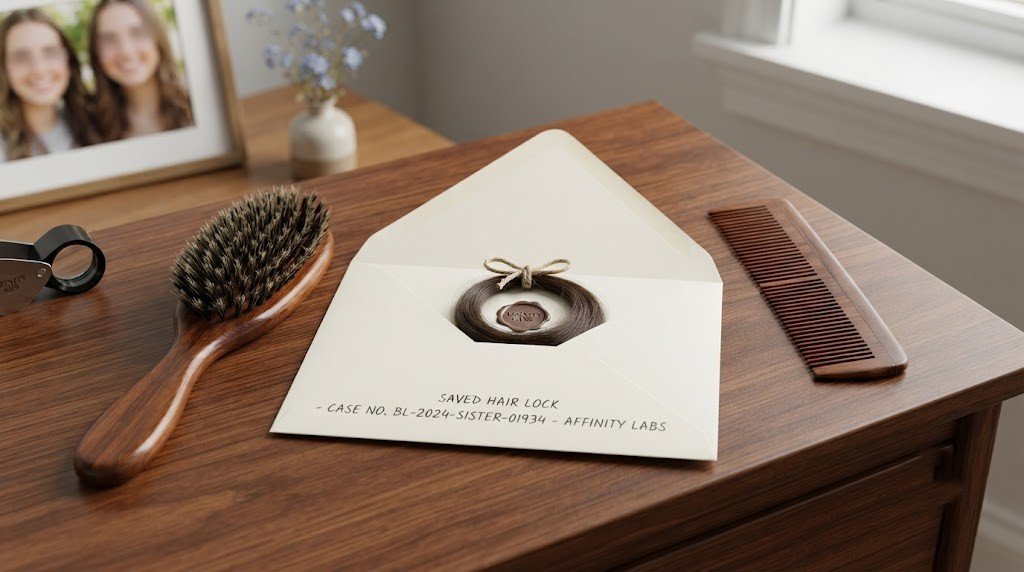
Final Thoughts on a Diamond From Both His Ashes and Hair

Choosing both materials is a way of saying that more than one part of his story belongs in the stone, and the lab process honors that by tracking each one carefully until the moment they meet. A memorial diamond made from brother ashes and hair ends as a single crystal you can understand, not a mystery. If one material feels like enough, or none feels right yet, that is just as valid; the point is that whatever you choose, you choose it knowing what happens along the way.

Learn More About Blended Memorial Stones

Talk With Memorial Diamond

If you have both his ashes and a lock of his hair and are wondering how they might come together, Memorial Diamond would be glad to talk through a diamond made from brother ashes and hair with you, including how each material would be handled. Reach out at memorialdiamond.us whenever you feel ready.

Word count: 3,152 words · Reading time: about 16 minutes

How Much Hair Do You Need for a Brother Memorial Diamond

 How Much Hair Do You Need for a Brother Memorial Diamond

Maybe it is a curl saved in a baby book, or a lock tucked into an envelope after a haircut years ago. Whatever you have kept, the industrytypical amount of hair for a brother memorial diamond is modest: a small lock or a few grams, often described as palmsized or a few wisps. Hair is roughly half carbon by weight, which is why so little goes so far, and the stone’s size depends on growth time rather than on how much hair you send.

hair for a brother memorial diamond

How Much Hair for a Brother Memorial Diamond Do Providers Usually Request?

Providers across the industry generally ask for a small lock or a few grams of hair for a brother memorial diamond. Some describe the amount as roughly palmsized; others talk about a few wisps. Those descriptions are approximate on purpose, because each lab sets its own requirement, and the figure can shift with the stone you have in mind.

Memorial Diamond does not present any of these industry figures as its own fixed policy. The useful habit is to ask any provider for its current requirement in writing, along with how it prefers the amount measured, whether by weight, by length, or simply by a description of the lock.

It can come as a surprise how little that really is. A single envelope of hair for a brother memorial diamond can hold more than enough carbon, which means a keepsake lock does not have to be used up entirely. You may be able to send part of it and keep the rest exactly as it is.

For the bigger picture of how hairbased stones are planned and made, the complete guide to a brother hair diamond walks through every stage.

Why Is a Small Lock of Hair for a Brother Memorial Diamond Enough?

Hair is built mostly from keratin, a protein rich in carbon. By weight it is roughly 50% carbon, which is dramatically more than cremated remains, where usable carbon runs at only about 0.5% to 4%. That difference is the whole reason hair needs so little starting material.

It also means hair does not require cremation at all. A lock can come from a brother who was buried rather than cremated, or simply from something your family saved long ago. For some families, that makes hair for a brother memorial diamond the more practical, or the only, option available.

One honest caveat belongs here. Labs typically blend the purified carbon from hair with supplemental labsourced carbon to reach a workable volume, and unlike ashes, there is no published industry figure for what share of a finished hairbased stone comes from the hair itself. A provider who claims the diamond is pure hair, with nothing else in it, is overstating what the process involves.

Even so, real carbon that was once part of your brother becomes part of the crystal. The explainer on whether a memorial diamond is really made from brother hair looks closely at what that means and what to ask a provider to show you.

Will Extra Hair for a Brother Memorial Diamond Make the Stone Larger?

No. The size of the finished diamond is set by growth time, not by the quantity of hair. Once his carbon has been extracted in an oxygenfree process and purified to roughly 99.9% or above, it is converted into graphite at around 2,5002,700°C and placed in a growth cell with a tiny diamond seed.

Inside a highpressure, hightemperature press, conditions sit at roughly 68 GPa and 1,4002,500°C, and the crystal grows over weeks to months. A minority of providers use chemical vapor deposition instead. In either method, longer growth produces a larger stone; a bigger bundle of hair for a brother memorial diamond does not.

That gives you freedom. Carat sizes typically range from about 0.10 to 5 carats or more, and the size you pick shapes the growth time, the cost, and the overall wait. You never have to send more of his hair than the provider needs in order to have the stone you want.

After growth, a gemologist cuts and polishes the rough crystal, some providers offer optional irradiation to shift color, and the stone is graded. Independent grading follows the diamond quality factors GIA uses for cut, color, clarity, and carat, the same standards applied to any diamond.

Where Can Hair for a Brother Memorial Diamond Come From?

The source matters less than you might think, though every provider has its own preferences. Common places to find hair for a brother memorial diamond include:

  • a keepsake lock saved after a haircut or kept in a baby book
  • a hairbrush or comb he used
  • hair trimmed by the funeral home before burial or cremation
  • an electric razor or clippers, if he kept his hair short

Each of these raises its own questions. Ask the provider whether hair from a brush or razor is acceptable, whether the lock needs to be clean and dry, and whether strands that have been dyed or treated cause any difficulty. Their answers, not general advice, should decide what you send.

Where the hair comes from also affects who should be consulted. Hair kept at home or among his belongings may form part of his estate, and the rules vary by state. Hair trimmed by a funeral home is generally released through whoever holds authority over his remains. Either way, hair for a brother memorial diamond is best gathered with the knowledge of the people handling his affairs.

Whose Agreement Do You Need Before Sending Hair for a Brother Memorial Diamond?

A sibling is not always the person with authority over a brother’s remains. Each state writes its own ranking, and in many of them a husband, wife, or registered partner is asked first, followed by any grown children and then his parents, with brothers and sisters further down. If he signed papers naming someone to decide, or made his own funeral arrangements in advance, those instructions can put a different person in charge.

If someone else holds that role, the kindest approach is usually a simple, honest conversation. Explain that the amount of hair for a brother memorial diamond is tiny, that much of a keepsake lock can stay untouched, and that you are glad to handle the provider, the forms, and the shipping. Offering to share updates, or a stone of their own, can turn a request into a shared plan.
Hair from his belongings deserves the same care. Because it may form part of his estate and practices differ by state, check with whoever is administering his affairs before taking a brush or a saved lock. That small step protects relationships at a time when they matter a great deal.

If faith shapes your family’s choices, no tradition has an official position on memorial diamonds specifically, and practices vary. Your own faith leader is the best person to ask.

How Should Hair for a Brother Memorial Diamond Be Collected and Sent?

Start by asking the provider for its collection kit or written instructions. A kit, if offered, usually spells out the container and paperwork, and its guidance should come before anything you read elsewhere. The questions below cover the details that make the biggest difference.

TopicWhat to ask the providerWhy it matters
AmountHow much hair for a brother memorial diamond do you need for our chosen size?Confirms you are sending enough without using more than necessary
MeasuringShould we weigh the hair, measure its length, or describe the lock?Different labs use different methods
ConditionDoes the hair need to be clean, dry, or free of dye or product?Avoids delays once it arrives
PackagingDo you send a kit, and how should the hair be sealed and labeled?Keeps identification clear from the first step
ShippingWhich carriers and services do you accept, and is tracking included?Lets you follow the package until it arrives
ReceiptHow will you confirm arrival and record chain of custody?Starts the paper trail behind the origin certificate

Preparing hair for a brother memorial diamond can catch you off guard. A brush or an envelope may carry more feeling than you expected, so give yourself time, and consider asking another relative to sit with you while you prepare it.

Keep a photo of the sealed package and copies of every form. Those records, alongside the provider’s origin certificate, document that the finished stone came from your family’s submission. An origin certificate is usually issued inhouse, while an independent grading report records the diamond’s own quality.

What If You Have Only a Few Strands of Hair for a Brother Memorial Diamond?

Sometimes all that remains is a handful of strands caught in a brush or a small curl in a locket. Before deciding it is not enough, describe exactly what you have to the provider, ideally with a photo, and ask whether that quantity of hair for a brother memorial diamond is workable for them.

Because carat size comes from growth time, a small amount of hair does not automatically mean a small stone. The real question is whether the lab can recover enough carbon to begin. If it cannot, a few gentle alternatives remain open:

  1. Look for other saved hair, such as a second brush, an old keepsake, or something another relative kept.
  2. Ask whether the funeral home trimmed any hair, and whether the authority holder can request it.
  3. Ask whether the provider can combine a small amount of hair with a portion of his ashes.
  4. Keep the strands as they are and choose another way to remember him.

None of these choices is lesser. If a little hair and a little ash together feel right, the companion piece on how much ash and hair a combined brother memorial diamond needs explains what to ask a provider.

Can One Lock of Hair for a Brother Memorial Diamond Supply Several Stones?

Frequently, yes. Because each stone needs only a portion, a single lock can sometimes supply several diamonds for different relatives or friends who were close to him. Whether that works depends on how much hair you have and on the provider’s own requirements.

Ask early whether each stone needs its own measured amount of hair for a brother memorial diamond, or whether one submission can be divided across several orders. Ask, too, whether stones grown from the same lock can be different sizes, colors, and settings, and whether each comes with its own origin certificate.

Planning together can ease the practical side for everyone. The guide to sharing a brother memorial diamond among family members covers coordinating orders, dividing material fairly, and keeping each relative informed along the way.

How Does Hair Compare With Ashes as a Source?

Both can carry your brother’s carbon into a diamond, but they behave differently in the lab. The comparison below sets the two side by side using industrytypical figures.

FactorHairCremated ashes
Typical amount requestedA small lock or a few gramsA few tablespoons to about 4 oz (about 100 g)
Carbon content by weightRoughly 50%Roughly 0.5% to 4%
Cremation neededNoYes
Published share of finished stoneNone publishedAbout 1015% of stone mass for ashderived carbon, some cite about 3%
Supplemental lab carbonTypically blended inTypically blended in
What sets carat sizeGrowth timeGrowth time

The practical takeaway is that hair for a brother memorial diamond is often the lighter request: less material, no cremation, and something that may already be in a drawer at home, though hair among his belongings may be part of his estate depending on the state. Ashes, meanwhile, connect the stone to his cremated remains, which may matter deeply to your family.

If ashes are part of your plans, the parallel guide on ash for a brother memorial diamond explains how much is usually needed and what happens to the rest. Neither source is better; they simply suit different situations.

Does the Amount of Hair for a Brother Memorial Diamond Affect Cost, Timeline, or Color?

Cost depends on the finished diamond, not on the weight of hair you provide. Industry ranges for 2026 put stones of about 0.100.25 carats at roughly 1,5003,500, stones of 0.51 carat at about 5,00015,000 with colorless toward the higher end, and stones of 2 to 5 carats or more at around 20,00075,000 and up. Grading reports, engraving, fancy cuts, and settings typically cost extra. The guide to brother memorial diamond cost explains each tier.

Timing is similar. From receipt of material to finished stone, the process typically takes 6 to 10 months, with stones over about 2 carats or specialty colors sometimes taking up to around 12 months. Sending extra hair for a brother memorial diamond does not shorten that.

Color cannot be predicted from his hair. Trace nitrogen tends to produce yellow, trace boron tends to produce blue, and colorless stones need both excluded, which takes extra processing and generally costs more. Memorial diamonds commonly trend toward yellow, blue, and champagne, with irradiation offering red, pink, green, or black. The post on brother hair diamond color covers the choices in detail.

Clarity typically falls between SI2 and VVS, and the finished stone rates 10 on the Mohs scale of mineral hardness, though a sharp blow can still chip any diamond. For a fuller list of points to raise, the checklist of brother hair diamond questions is a helpful companion.

Frequently Asked Questions

Is hair from his hairbrush enough for a memorial diamond?

It can be. Requests for hair for a brother memorial diamond are usually a small lock or a few grams, and whether brush hair qualifies is the provider’s call, so send a photo first. A brush among his belongings may form part of his estate, depending on state rules.

Does the hair need to include the root?

Ask the provider, since requirements differ. Carbon comes from the whole strand, which is roughly half carbon by weight, but each lab sets its own guidance on cut hair, brushed hair, and any preparation it prefers before the material arrives.

Can hair from a brother who was buried be used?

Yes, if hair was kept or trimmed beforehand. Hair needs no cremation, so a saved lock or funeral home trimming may be usable, with agreement from whoever holds authority and attention to estate rules, which vary by state.

Will a longer lock of hair make a bigger diamond?

No. Carat size depends on how long the crystal grows in the press, not on the amount of hair supplied. A longer or thicker lock will not enlarge the stone, so you can keep whatever the provider does not need.

Can dyed or gray hair be used for a memorial diamond?

Possibly, though providers differ on treated hair. Gray hair is still keratin and still roughly half carbon. Mention any dye, bleach, or styling product when you ask, and follow the provider’s preparation instructions exactly.

Is unused hair returned after the diamond is made?

That depends on the provider’s policy. Hair processed for carbon is consumed during extraction, but any extra may or may not come back. Ask before shipping, and if the lock is precious, send only the amount they actually request.

Final Thoughts on Hair for a Brother Memorial Diamond

A few strands can feel like almost nothing until you realize what they might become. Whether you send a brush, a saved curl, or a lock from the funeral home, the amount of hair for a brother memorial diamond is small, and much of what you have kept can stay right where it is. Take the time you need, ask the questions that matter to you, and let the decision belong to your family.

Learn More About Gathering and Sending His Hair

Talk With Memorial Diamond

If you are holding a lock of your brother’s hair and wondering whether it is enough hair for a brother memorial diamond, reach out to Memorial Diamond whenever you are ready. Visit memorialdiamond.us to talk through what is possible with his hair, without pressure and at your own pace.

Word count: 2,898 words · Reading time: about 14 minutes