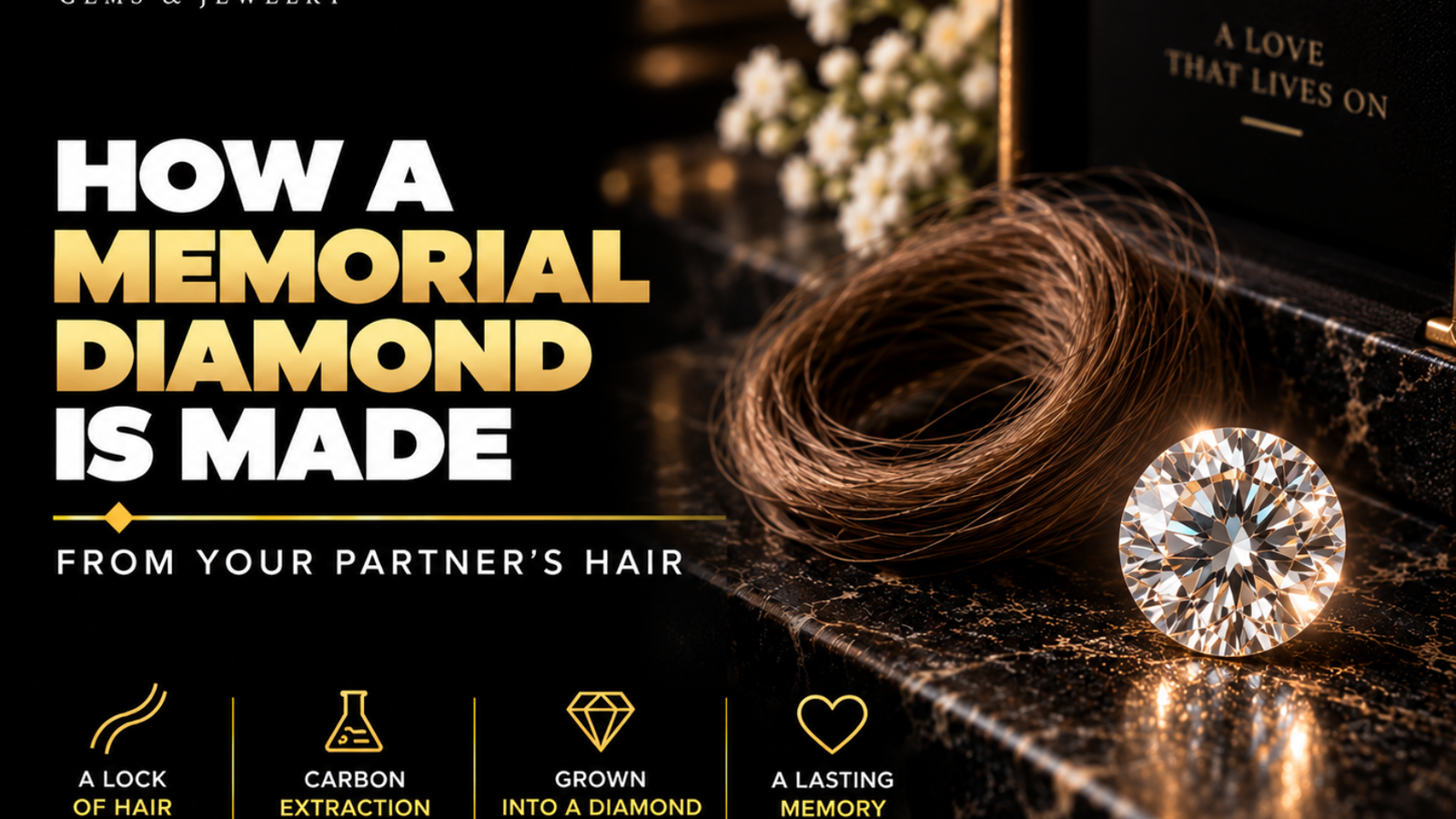
: Memorial diamond made from a partner’s hair, shown with a lock of hair and a sparkling diamond on a luxury black jewelry setting.

How a Memorial Diamond Is Made From Your Partner’s Hair

A lock of hair is usually the thing nobody thought to plan for and somebody kept anyway.

A memorial diamond made from partner hair is grown from keratin, which is roughly 50% carbon by weight. A small lock is purified to around 99.9% carbon, converted to graphite at about 2,500 to 2,700°C, and grown into a real diamond crystal at roughly 6 to 8 GPa and 1,400 to 2,500°C. No cremation is involved at any point. Six stages, typically six to ten months.

Because hair carries so much carbon, the difficult question in a memorial diamond made from partner hair is not whether there is enough of it. It is whether anyone can show that this particular lock was your partner’s, and that question has to be answered before the furnace, never after.
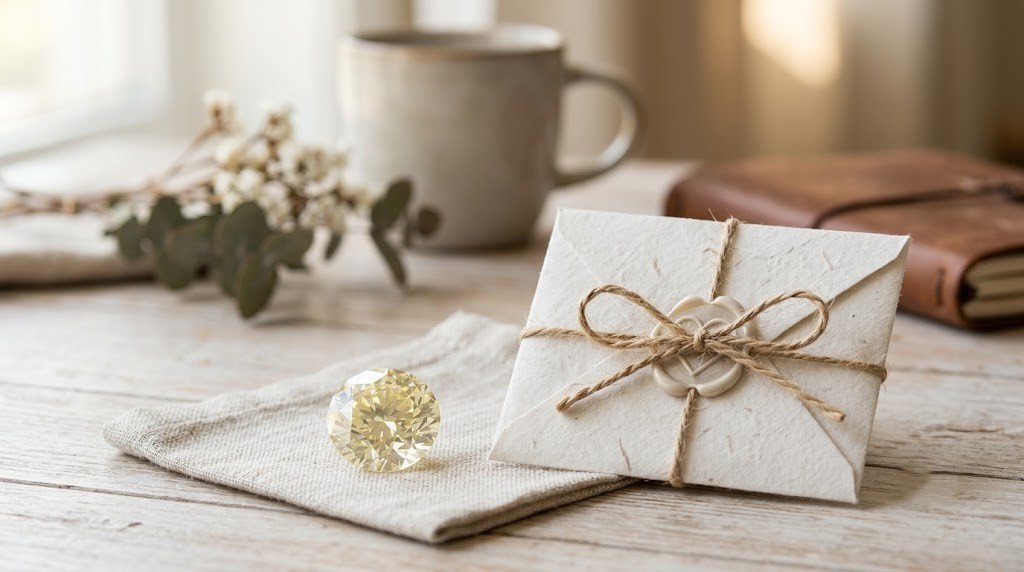
Pale yellow lab-grown memorial diamond made from partner hair resting beside a small sealed envelope

Why Hair Solves One Problem and Creates a Different One

Hair is built from keratin, a protein that is roughly 50% carbon by weight. Cremated remains, by comparison, are mostly calcium phosphate and yield usable carbon at somewhere around 0.5% to 4% of ash by weight. The gap between those two numbers is more than an order of magnitude.

Three consequences follow. A diamond made from partner hair needs only a small lock rather than a measured portion of remains. Extraction is shorter and less lossy, because far less of the starting material is discarded as non carbon mineral. And no cremation is required at any point, so this route stays open whether your partner was cremated, buried, or is still living.

That last point is why hair matters so much in a partner’s situation specifically. No federal rule governs control of a person’s remains; each state writes its own, and whatever your partner set down in writing can redraw the picture over the top of it.

So a partner is not guaranteed to be the one with standing, and the gap opens most often where the relationship was never legally recognized, or was not something everyone involved knew about. A lock of hair in an envelope, or caught in a brush at the back of a drawer, is often the material you actually have. For plenty of people in that position, a diamond made from partner hair is less the preferred option than the available one.

But the same chemistry that removes the yield problem introduces a sharper one. Hair from any two people is chemically indistinguishable once it has been reduced to purified carbon. Nothing about a finished stone reveals whose hair went into it. So the entire question of whether a memorial diamond made from partner hair is genuinely theirs moves upstream, to handling and records, and away from the laboratory bench.

The Six Stages of a Memorial Diamond Made From Partner Hair

1. Intake, weighing, and identification. The lock arrives and is logged. Ask for a unique identifier assigned at this moment, a recorded weight, and a photograph of the material as received. Everything that can ever be said about whose hair this is gets fixed here, which makes intake the most consequential stage in a diamond made from partner hair.

2. Cleaning and preparation. Hair arrives with whatever was on it: product residue, dust, dye, oils from a brush. That is removed before extraction so it does not carry into the crystal.

3. Carbon extraction and purification. The hair is heated in a controlled, oxygen free environment that strips away the non carbon components of keratin, nitrogen, oxygen, sulfur, and hydrogen, until what remains is roughly 99.9% or higher carbon. Because the starting material is already about half carbon, a diamond made from partner hair loses far less of its submitted mass here than an ash based stone does.

4. Graphitization. The purified carbon is heated further, to roughly 2,500 to 2,700°C, and converted into graphite, the crystalline form a diamond press can use as feedstock.

5. Growth. The graphite, combined with supplemental lab grown carbon, goes into an HPHT growth cell around a tiny diamond seed at roughly 6 to 8 GPa and 1,400 to 2,500°C, for weeks to months. Carat size is a function of how long that cell runs.

6. Cutting, polishing, and grading. The rough crystal is cut and polished, then assessed against the same cut, color, clarity, and carat standards applied to any diamond, ideally by an independent third party laboratory. A diamond made from partner hair is graded on exactly the same scale as any other stone, with no separate standard. Some providers also offer post growth irradiation to shift color; ask whether it is being used and whether it will appear on the paperwork.
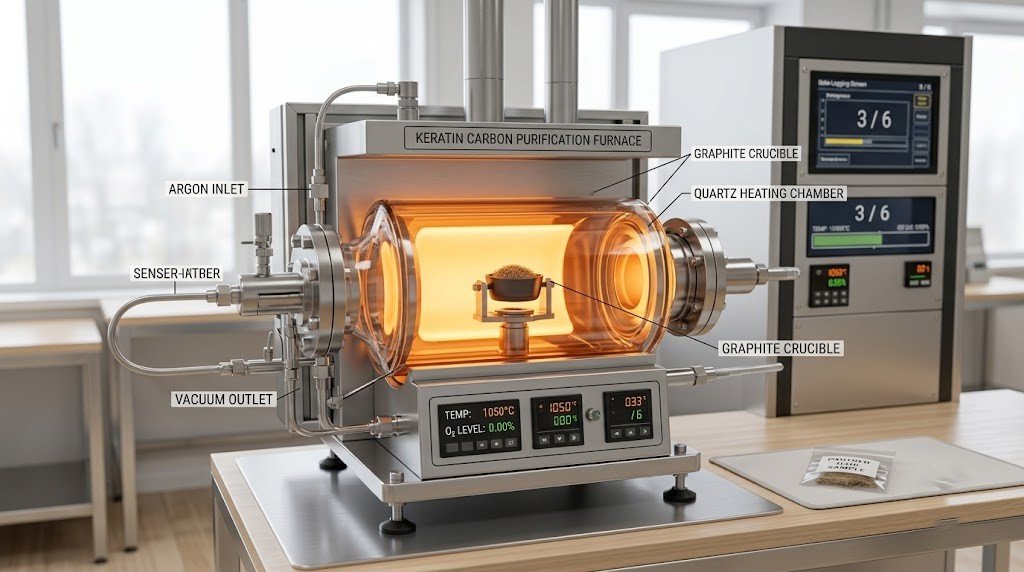
Oxygen-free furnace used to strip the non-carbon components of keratin from a hair sample made from partner hair

If Yield Is Not the Question, What Is?

For an ash based stone, the anxious question is quantity: is there really enough carbon in there to matter? For a diamond made from partner hair, that question essentially answers itself. Keratin is carbon rich, a small lock is enough, and nobody in the industry disputes it.

What replaces it, for a diamond made from partner hair, is a question about identity, and that one is harder.

Here is the part that is rarely said plainly. The purification stage destroys everything that is not carbon. That includes DNA, which is an organic molecule that cannot survive being heated toward graphitization temperatures. Once a lock of hair has been purified, there is no genetic material left in it, and therefore no test that can be run on the resulting carbon, or on the finished diamond, to confirm whose hair it was.

This is not a gap in one company’s process. It is a property of the physics. A memorial diamond made from partner hair cannot be retroactively verified by analysis, because the thing that would carry the evidence is precisely what purification removes.

What that means in practice is simple, and it is the single most useful thing to understand before starting. Identity is established by custody and documentation, in a window that opens when you cut or collect the lock and closes when the extraction furnace is sealed. Everything after that is a record, not a measurement. The question worth asking a provider is therefore not “can you prove it afterward”, nobody can, but “what exactly do you record, and when.”

How Do You Prove a Lock of Hair Was Your Partner’s?

The provenance of a diamond made from partner hair is established the way any chain of custody is established: by making each handover leave a trace, so no point in the chain rests on trust alone. The table below sets out where the handovers in a diamond made from partner hair are, and what is worth having written down at each.

Handover pointWho holds the materialWhat should be recordedWhat a weak answer sounds like
CollectionYou, or whoever cut or gathered the lockWho collected it, when, and from where, a note in your own handwriting is enough“It doesn’t really matter, just send it in”
Packaging and shippingYou, then the carrierSealed and labeled container, tracked shipping, a photograph before sealing“Ordinary mail is fine”
Intake at the facilityThe providerUnique identifier, recorded weight, dated photograph of the lock as received“We’ll let you know when it arrives”
Cleaning and preparationThe providerConfirmation the identifier travels with the material, not with the paperwork alone“It’s all tracked in our system” with no detail
Extraction and purificationThe providerBatch record tying the identifier to a specific run“Everything is processed together”
Growth, cutting, gradingThe provider, then the grading labIdentifier carried through to the finished stone and its certificate of originA grading report with no origin document alongside it

Two clarifying questions are worth asking directly, without apology. First: is material from more than one client ever combined in a single growth run, and if so, what separates them? Second: what is returned to you at the end besides the stone? An origin or authenticity document is a different thing from a grading report, and a diamond made from partner hair should come with both.

These are ordinary logistics questions about a diamond made from partner hair, not accusations. A provider that answers them plainly is telling you something real. A provider that treats the questions as rude is telling you something too.

What Condition Does the Hair Need to Be In?

Hair is durable in a way that surprises people. It does not decompose on a shelf, and a lock kept in an envelope since 2009 is, chemically, very close to the hair that was cut that day. Age alone rarely disqualifies material for a memorial diamond made from partner hair.

What matters more is quantity and cleanliness:

  • Amount. Industry guidance generally describes a small lock, a few grams, or a “palm sized” wisp, far less than most people expect a diamond made from partner hair to require. Confirm the actual requirement before cutting, so you are not left having taken more than was needed.
  • Loose hair from a brush. Frequently usable, but it is also the material most likely to be mixed with someone else’s. If the brush was shared, say so at intake rather than hoping it does not matter.
  • Storage. Dry, sealed, and out of direct light is ideal. Hair stored somewhere damp can grow mold, which is a contamination question rather than a carbon question.
  • Root or no root. No root is needed. A diamond made from partner hair is built from the carbon in the shaft, and cut hair works exactly as well as pulled hair.
  • Very short hair. Short does not mean unusable; total weight matters more than length. Clippings from a final haircut, or from a shave during illness, are workable material.
  • Hair collected from someone still living. The same process applies with no change. The only real difference is that you can ask the person which lock they would want used.

If all you have is a single strand, say so at intake rather than sending it and hoping. Better to be told it is not enough than to find out in month five.

Does Dyed or Gray Hair Change a Diamond Made From Partner Hair?
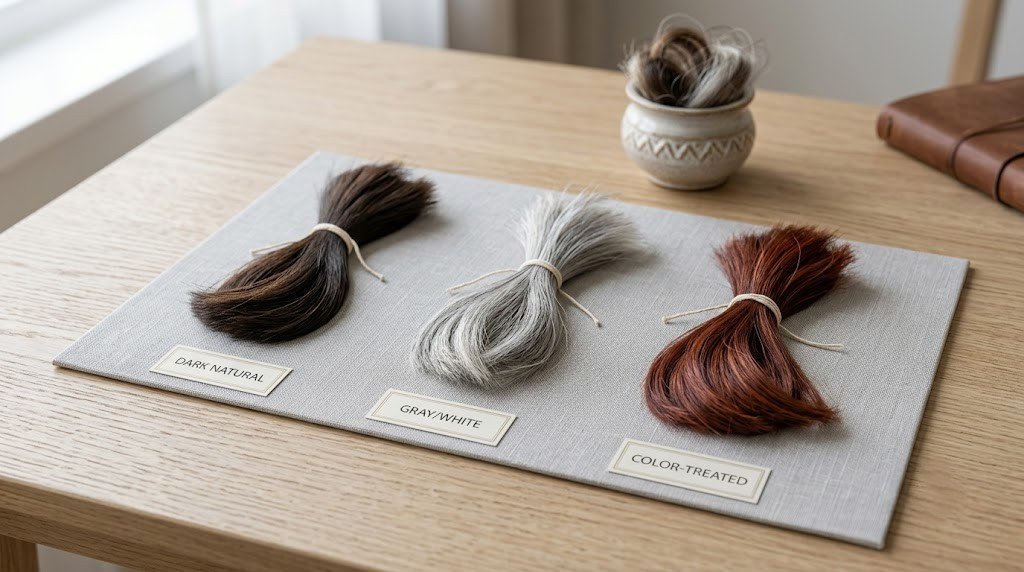
Three hair samples side by side — dark, gray, and color-treated — on a neutral surface

Dye, bleach, and permanent color are surface and cortex treatments applied to keratin. They do not change the fact that the shaft is carbon rich, and purification to 99.9% plus carbon removes them along with everything else that is not carbon. Treated hair generally works for a diamond made from partner hair, but mention it at intake, it is the kind of detail that belongs in the record.

Gray and white hair is the same material minus melanin, a pigment, not a structural difference. A stone grown from silver hair is not automatically paler than one grown from dark hair, and nobody can promise the reverse either.

The honest position on color is that it cannot be forecast precisely from any starting material. Nitrogen produces yellow tones, boron produces blue, and colorless requires the absence of both, and organic carbon sources bring trace elements with them. A memorial diamond made from partner hair will usually land somewhere in the yellow, blue, or champagne range, with colorless achievable but requiring additional process control and typically costing more. Choose a range you would be happy with rather than a shade you are expecting.

What Documentation Should Come Back With the Stone?

Two different documents can arrive at the end of a memorial diamond made from partner hair, and they answer two different questions. Confusing them is the most common way people end up feeling less certain than they should.

A grading report describes the diamond: cut, color, clarity, carat. Issued by an independent laboratory, it is a strong, verifiable statement about quality, and it says nothing whatsoever about origin. A grading lab assesses the stone in front of it, not the history behind it.

An origin or authenticity document describes the history: the identifier assigned at intake, the recorded weight, the batch the material was processed in, and a statement tying the finished stone to the lock you sent. This is the document that actually addresses whether a diamond made from partner hair is your partner’s, and it is usually issued in house rather than by a third party.

Ask for both, and ask what the origin document specifically asserts. A line that says “grown from submitted material” is weaker than one that names your identifier, the intake date, and the weight received. Neither document can prove identity after the fact, nothing can, once purification has run, but a specific, dated record made at the time is the strongest evidence a diamond made from partner hair can carry.
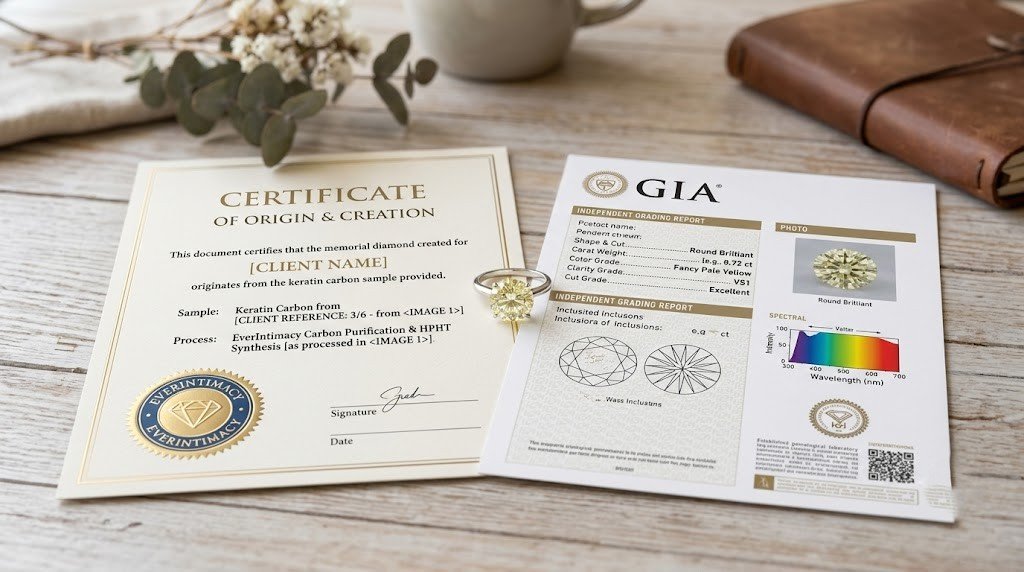
 Certificate of origin laid beside an independent grading report and a polished memorial diamond

What a Diamond Made From Partner Hair Shares With Every Other Memorial Diamond

Three things are true of a diamond made from partner hair exactly as they are true of an ash grown one, and it is worth saying them plainly rather than letting hair sound like a shortcut.

It is not grown from your partner’s carbon alone. Hair gives up far more carbon than ash does, but a small lock still does not give up enough to fill a growth cell. The purified keratin carbon is combined with lab grown carbon until the charge reaches the volume a crystal of your chosen size requires. The personal carbon is real, verifiable, and genuinely part of the diamond’s lattice, it is not the whole of it, and any description that says otherwise is describing something that does not exist.

Size is bought as time, not as material. Sending a bigger lock does not produce a bigger stone. Carat is determined by how long the growth run lasts, which is why a larger diamond made from partner hair costs more and takes longer rather than simply consuming more hair.

The wait is the same. Industry wide, the full sequence typically runs six to ten months, sometimes twelve for larger stones. Hair’s easier extraction saves time at the front, not in the press, and the press is where almost all the months are.

Frequently Asked Questions About a Memorial Diamond Made From Partner Hair

How much hair is actually needed?

Typically a small lock or a few grams, often described as palm sized or a few wisps. Because hair is roughly 50% carbon by weight, far less material is required than for an ash based stone. Confirm the exact requirement before cutting anything.

Can a diamond be made from hair if my partner was buried?

Yes. A diamond made from partner hair involves no cremation at any stage, so a lock kept before or after the funeral works regardless of how your partner was laid to rest. This is often the only route available when the remains were interred.

Can anyone test the finished stone to confirm whose hair it was?

No. Purification destroys DNA along with everything else that is not carbon, so no post growth test can identify the source. Identity rests entirely on chain of custody documentation created before extraction begins.

Does hair that was dyed or permed still work?

Generally yes. Color treatments sit on and within the keratin shaft and are removed during purification along with other non carbon material. Mention the treatment at intake so it is recorded rather than discovered later.

Is hair from a brush usable?

Often, though it carries a higher chance of being mixed with someone else’s hair. Say so at intake if the brush was shared. A deliberately cut lock is cleaner evidence and a simpler custody record.

Will a hair grown stone look different from an ash grown one?

Not in any way a grader could identify. A diamond made from partner hair and an ash grown stone are chemically genuine diamonds assessed on the same 4Cs, and neither material produces a reliably lighter or better color. Color depends on trace elements, not on which material you started from.

Final Thoughts on a Memorial Diamond Made From Partner Hair

The chemistry behind a memorial diamond made from partner hair is generous. Hair is roughly half carbon, a small lock is enough, and nothing about the process requires a cremation to have happened. That is a genuinely lower barrier than most people assume when they first look into this.

What the chemistry cannot do is answer the question that actually keeps people up: is this really them. That answer lives in a paper trail created in the days before anything is heated, who cut it, when, what was written down, what was photographed, what identifier followed it through the building. Ask for those things while asking is still possible. After the furnace, there is nothing left to ask.

Learn More About Partner Memorial Diamonds

Talk With Memorial Diamond

If you have a lock of your partner’s hair and want to know what a memorial diamond made from partner hair would involve, reach out to Memorial Diamond at memorialdiamond.us and ask what gets recorded at intake before sending anything. Those questions are easiest to ask early.
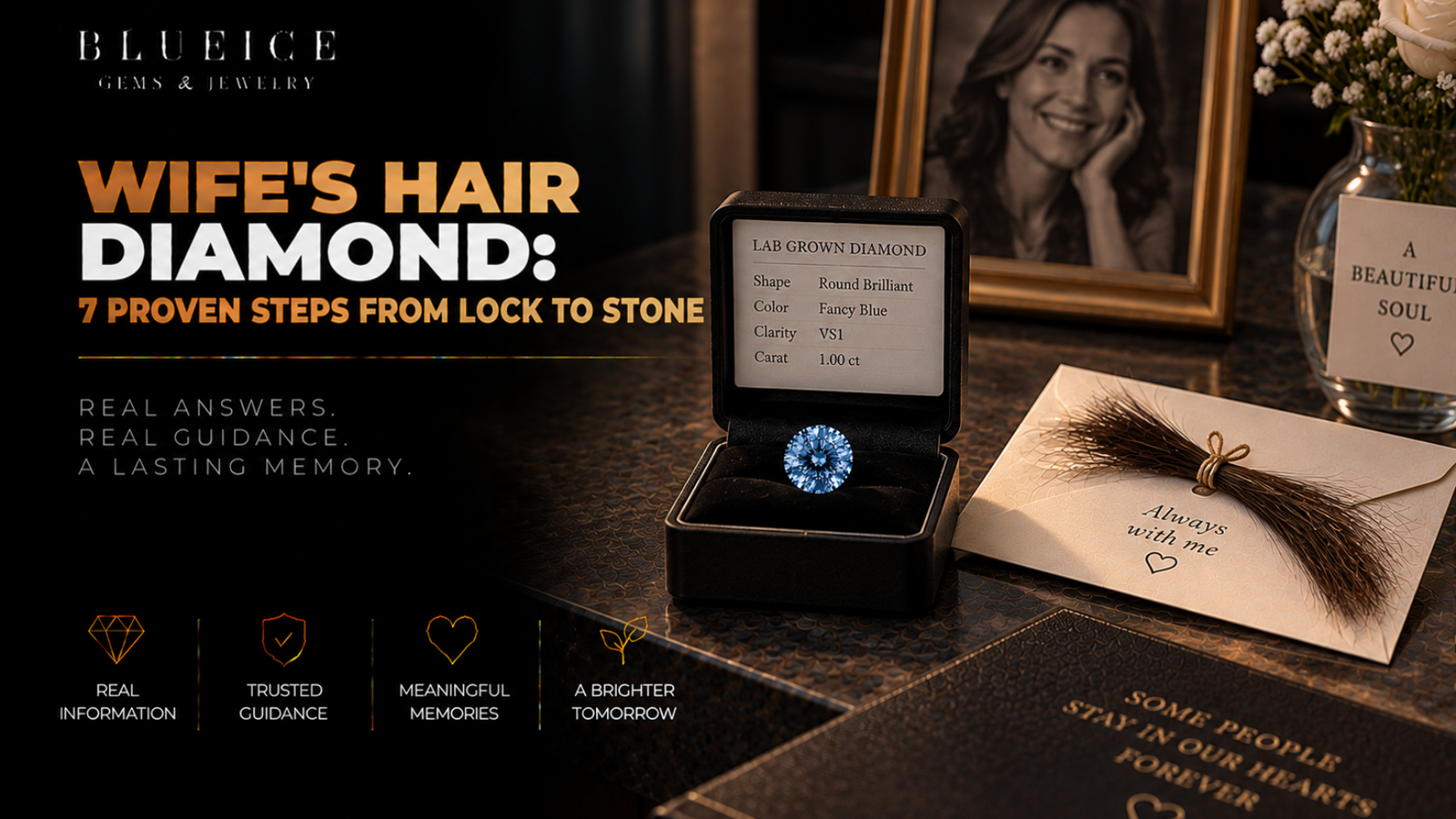
Wife's hair diamond: a small blue lab-grown diamond in its grading box beside a tied lock of hair on a paper envelope

How to Turn Your Wife’s Hair Into a Diamond

The hair is probably somewhere already: a brush that was never emptied, an envelope from a haircut before treatment, a braid saved from years ago, a few strands caught in a hat. A wife’s hair diamond is made in seven steps: find and check the hair, divide the lock so part of it stays with you, choose a provider and a carat, send the portion with a documented chain of custody, wait roughly 6 to 10 months while the carbon is extracted and grown into a real lab grown diamond, receive the graded stone, and decide what it becomes.

No cremation is involved at any stage, a few grams is typically enough, and the hair’s age and color do not matter. This is the practical, in order version: what you do and what to keep, with the science left to the guides linked along the way.

Before Step One: Why Hair Works, and What the Stone Contains

Hair is built from keratin, a carbon rich protein, and is roughly 50% carbon by weight. Cremated ashes, by contrast, are almost entirely calcium phosphate with only about 0.5% to 4% usable carbon. That is why a wife’s hair diamond needs so little material, why it needs no cremation, and why it is available to families who chose burial or who scattered every ash but kept a lock.

The finished wife’s hair diamond is a real lab grown diamond: same crystal structure, same optics, hardness 10 on the Mohs scale. It is not “100% her”: the carbon extracted from her hair is purified and blended with supplemental lab carbon to reach the volume a diamond needs. What is true is that a real, verifiable portion of the carbon that was in her body sits inside the crystal lattice. Because hair yields so much more carbon than ash, some providers reach a higher personal carbon share from hair at small carats: ask yours what they achieve rather than assuming.

That is enough science for a wife’s hair diamond to begin. Wife Hair Diamond: The Complete Guide has the rest.

Step 1: Find the Hair and Check Its Condition

Gather what exists before deciding anything about a wife’s hair diamond, because how much you have shapes every later step.

SourceUsable for a wife’s hair diamond?What to do
A cut lock, tied or in an envelopeYes, almost alwaysThe ideal case: keep it as it is
A braid or ponytail from a haircut or a donation that never wentYes, with plenty to spareEnough for several stones
Hair from a brush or combUsuallyDo not empty it; a provider may want more volume than a cut lock to allow for cleaning
Strands from a pillowcase, hat, or coat collarSometimesPool them in one envelope and ask
Hair kept from decades agoYesKeratin is stable; age is not a barrier if it has stayed dry
Dyed, bleached, permed, or gray hairYesTreatments change the surface, not the carbon; the diamond’s color is unrelated to the hair’s
Synthetic extensionsNoNo keratin, no carbon
Hair that has visibly rottedNoProlonged damp is the one thing that ruins it, and it is obvious when it has
A hairbrush, a labeled paper envelope, and a saved braid laid side by side on a table

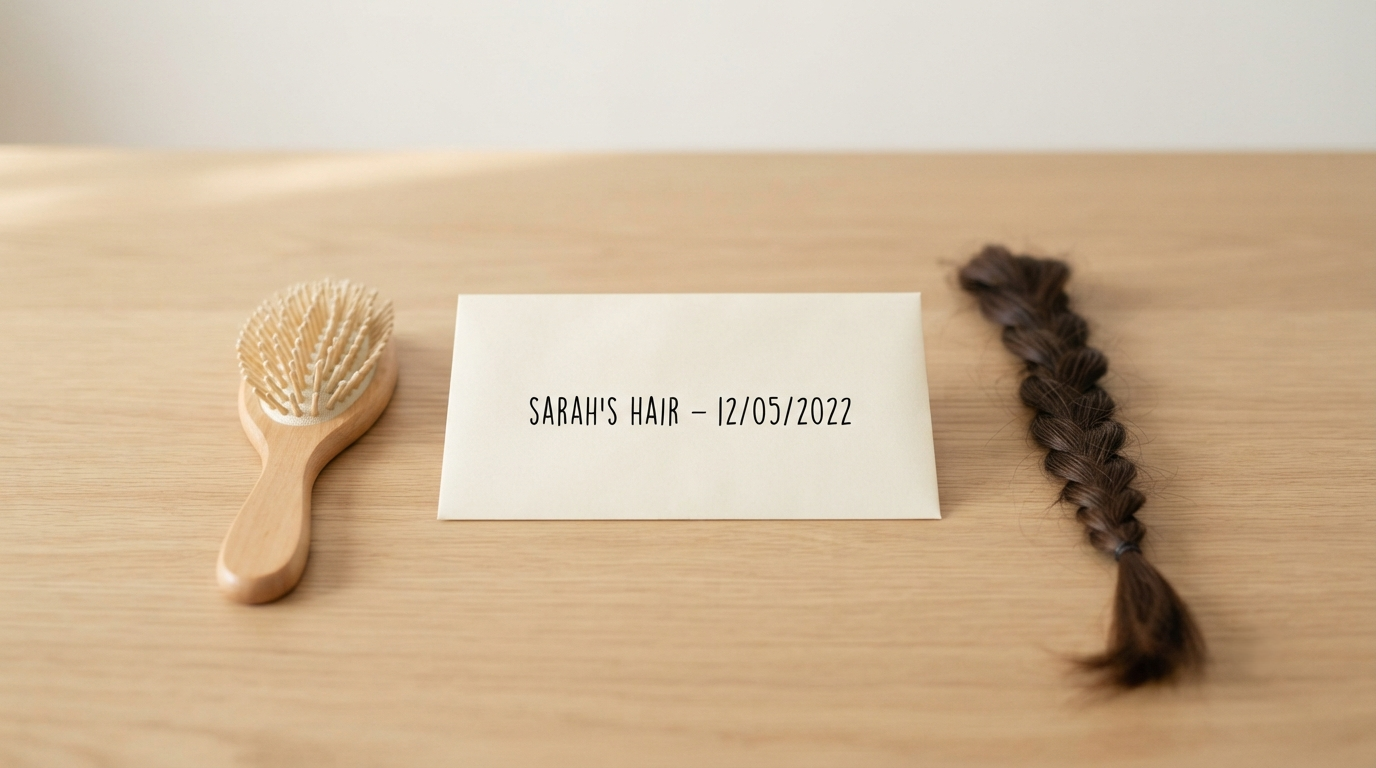
Check the hair for a wife’s hair diamond is dry, keep it in a paper envelope rather than plastic (paper breathes), label the envelope with her name and the date you gathered it, and photograph it. If you are unsure whether what you have is enough, that is a question for step 3: do not throw anything away while deciding.

Step 2: Divide the Lock and Keep Some

This step exists only for a wife’s hair diamond, and it matters more than any other on this page.

A portion of ashes can sometimes be topped up from the urn. A lock of hair, once sent, is gone. Across the industry a wife’s hair diamond typically needs a small lock or a few grams: often described as “palm sized,” “a few wisps,” or “pencil thick”: so if you hold a full braid, you will send a fraction of it. If you hold a single small lock, decide now whether to divide it.

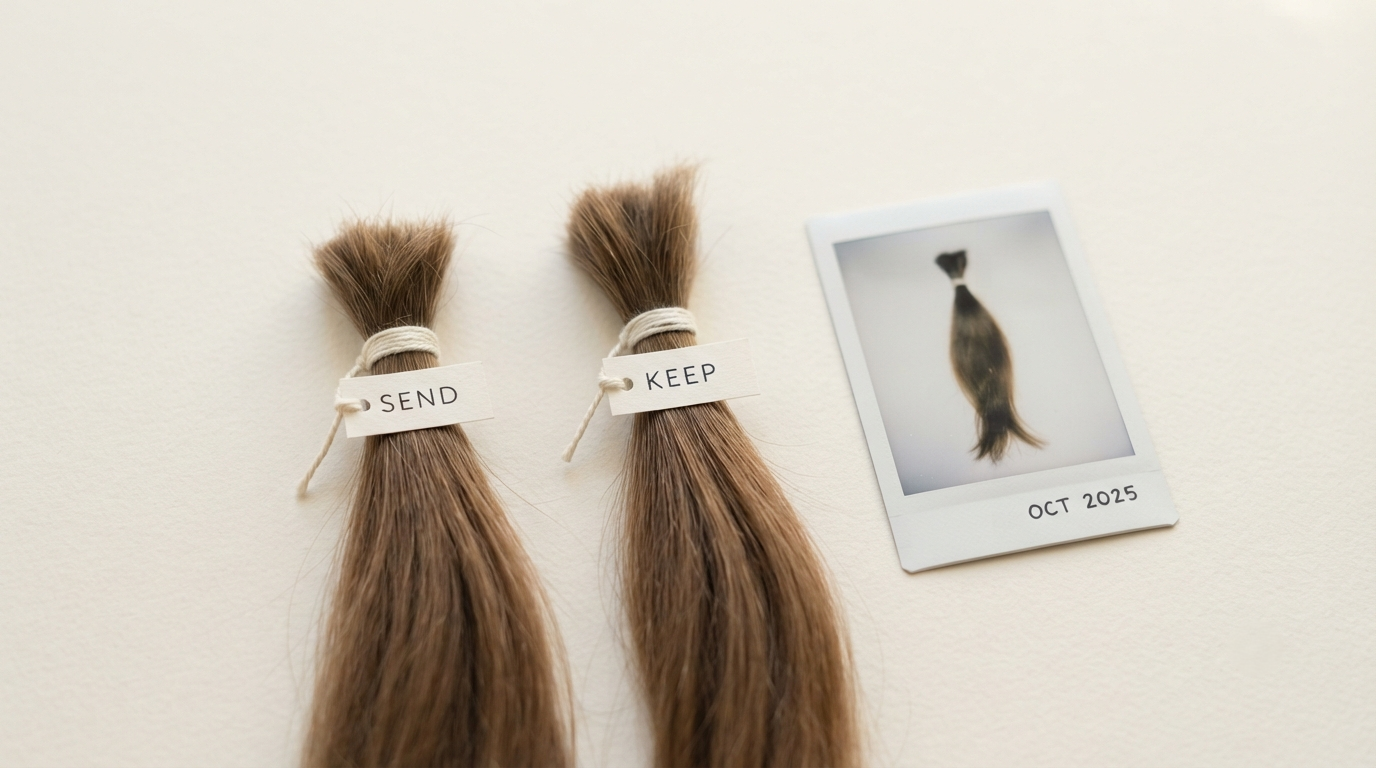
Two tied portions of one lock of hair one labeled "send," one labeled "keep" beside a dated photograph
  • If the lock is the only one you have, divide it. Send what the provider needs and keep the remainder intact, in its own labeled envelope, with the photograph you took in step 1.
  • Sending more does not help. The carat of a wife’s hair diamond is set by growth time in the press, not by material volume. A provider who suggests sending the whole braid “to be safe” is a provider to question.
  • If several people want a stone, the same lock can usually support more than one wife’s hair diamond, and each is grown and priced separately. Decide whether to send enough for all of them now, or keep the remainder for later. How much hair you need for a wife memorial diamond covers the quantities and the edge cases.

Tie the portion to be sent with thread, label it, photograph it beside the portion you are keeping, and only then move to the next step.

Step 3: Choose a Provider and a Carat

For a wife’s hair diamond the two decisions arrive together because carat sets both price and timeline, and the provider tells you what your amount of hair can support.

The provider. Put the same questions to each candidate:

  1. Is what I have enough: and can I send a photograph before I ship anything?
  2. Do you return unused hair?
  3. What chain of custody documentation do you provide, and can I see where her hair is at each stage?
  4. What share of the finished stone’s carbon typically comes from the submitted hair, at the carat I want?
  5. Is grading independent or in house? An origin certificate documents that the stone was grown from her hair; a grading report, ideally from an independent lab using GIA’s cut, color, clarity, and carat standards, documents quality. You want both.
  6. What is the realistic timeline for this carat, in writing, and what is the loose stone price separate from the setting?

The carat. A wife’s hair diamond is typically offered from about 0.10 ct to 5+ ct. General 2026 industry ranges, not Memorial Diamond’s published pricing:

TierCaratTypical rangeTypical timeline
Entry0.10 to 0.25 ctRoughly $1,500 to $3,5006 to 8 months
Mid0.5 to 1 ctRoughly $5,000 to $15,0008 to 10 months
Large / rare2 to 5+ ctRoughly $20,000 to $75,000+Up to 12 months

Colorless costs meaningfully more than yellow, blue, or champagne at the same carat. Hair does not shorten the timeline: growth time is growth time. How much a wife memorial diamond costs works through a full quote.

The color. A wife’s hair diamond will not be the color of her hair. Nitrogen carried in with organic carbon tints a diamond yellow or champagne; boron tints it blue; and a stone from red, brown, or gray hair is no more likely to be any of those than one from ashes. Colorless takes extra processing and extra cost. If you want the natural result, say so; if you want a specified color, the provider will give you a date by which to decide, because nothing can be changed once growth begins.

Step 4: Send It With a Paper Trail

Because the hair you are sending for a wife’s hair diamond cannot be replaced, this is the step to slow down on.

Fill in the provider’s submission form and copy it: a scan on your phone is enough: before it goes in the package. Put the tied, labeled portion in whatever envelope or container the provider asked for, with the form. Ship it by a tracked, insured service that can tell you where the package is at any hour, and write the tracking number on your copy of the form.

Then wait for the acknowledgement. A reputable provider confirms the hair arrived and gives you a reference number; if the window they promised passes in silence, ask rather than assume. Before any of this, ask what the chain of custody record will let you see, and when: some providers show each stage, others only the finished stone.

One folder, kept together: the form, the tracking record, the photograph from step 2 of the sent portion beside the kept portion, and the acknowledgement. If anyone ever asks how you know the wife’s hair diamond came from her, that folder is the answer.

Step 5: What Happens During the 6 to 10 Months

Nothing is asked of you for most of a year. Knowing what the laboratory is doing to a wife’s hair diamond in that time makes the silence easier.

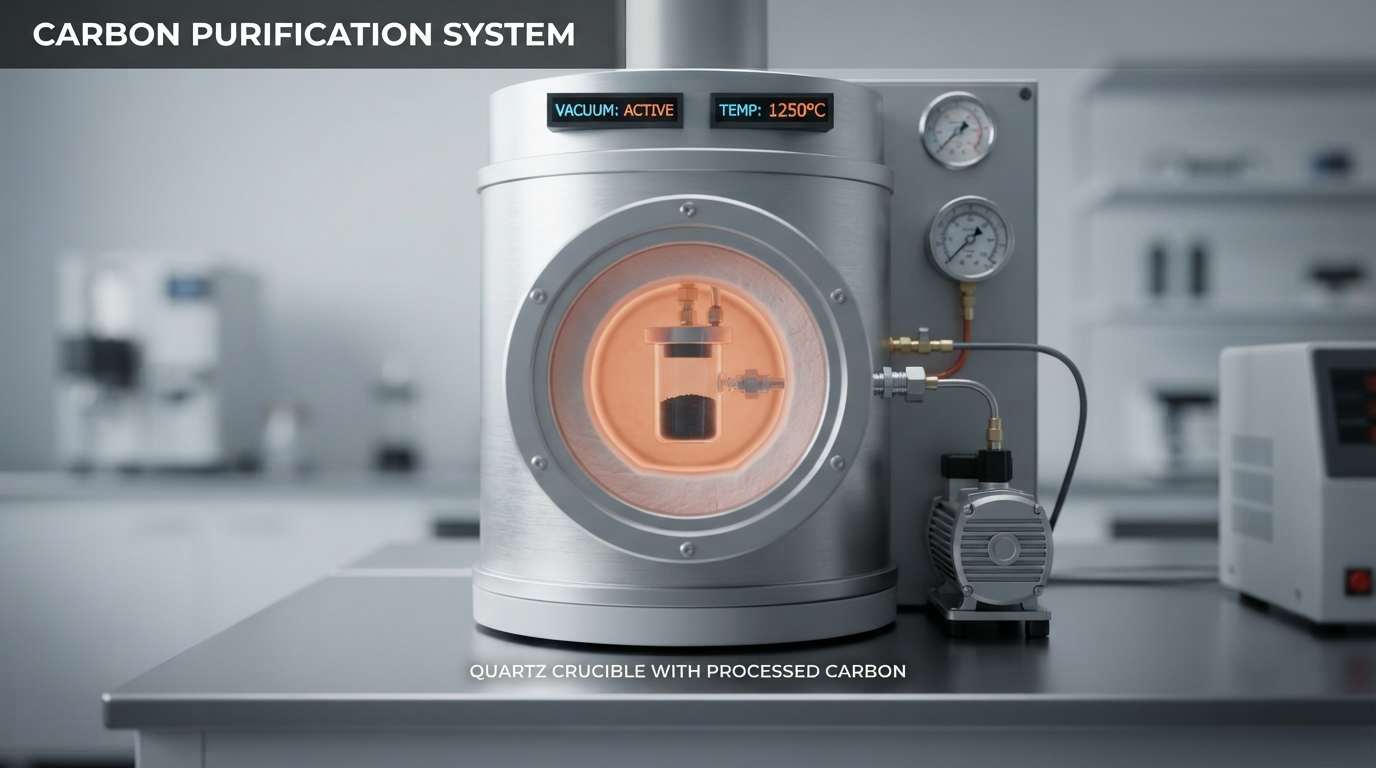
The hair goes first into purification: a controlled, oxygen free heating process, run in stages, that burns off everything in keratin that is not carbon and leaves carbon at 99.9%+ purity. Because hair starts at roughly half carbon, this stage recovers far more from a few grams of hair than the equivalent stage recovers from ashes. The purified carbon is then heated toward 2,500 to 2,700°C until it becomes graphite, the form of carbon a diamond press can work with.

Laboratory furnace with a sealed crucible during carbon purification

Growth is the long part. The graphite, blended with supplemental lab carbon to make up the volume, sits with a tiny diamond seed inside an HPHT press at roughly 6 to 8 GPa and 1,400 to 2,500°C: or, with a minority of providers, is turned into gas and deposited layer by layer in a CVD chamber. Weeks to months pass here, and the length of this stage is what decides the carat. The synthetic diamond article describes both methods in more depth than any provider brochure will.

After growth: cutting and polishing by a gemologist, irradiation only if you asked for red, pink, green, or black, and finally grading and the origin certificate. Ask before sending whether the provider sends progress updates: a photograph of the rough crystal, a note at cutting: so that months of nothing are expected rather than worrying. How a memorial diamond is made from your wife’s hair and how long a wife memorial diamond takes go further on both.

Step 6: Receive and Check the Wife’s Hair Diamond

Open the box with the folder from step 4 beside you, and check four things before anyone else sees it:

CheckWhat you are looking for
The origin certificateHer name or your reference, “hair” as the material, and the provider’s attestation that this stone grew from it
The grading reportCarat, color and clarity grades, cut: and the name of the lab, so you know whether it is independent or in house
The stone against the reportCarat within normal cutting variance; color inside the range you were told to expect
Returned hair, if the provider returns itThat it came back, and roughly matches what you expected

Expect a color you did not picture. Yellow, champagne, and blue are the natural outcomes for any memorial diamond, and two stones from one lock can differ. If you specified a color and the stone falls outside the promised range, this is the moment to say so, with the report in hand: not after it has been set.

Then the origin certificate, the grading report, the submission folder, and the kept portion of her hair go together in one place. The person who holds this wife’s hair diamond after you should be able to prove what it is.

Step 7: Decide What It Becomes

There is no clock on this step, and a loose wife’s hair diamond in its grading box loses nothing by sitting there for a year.

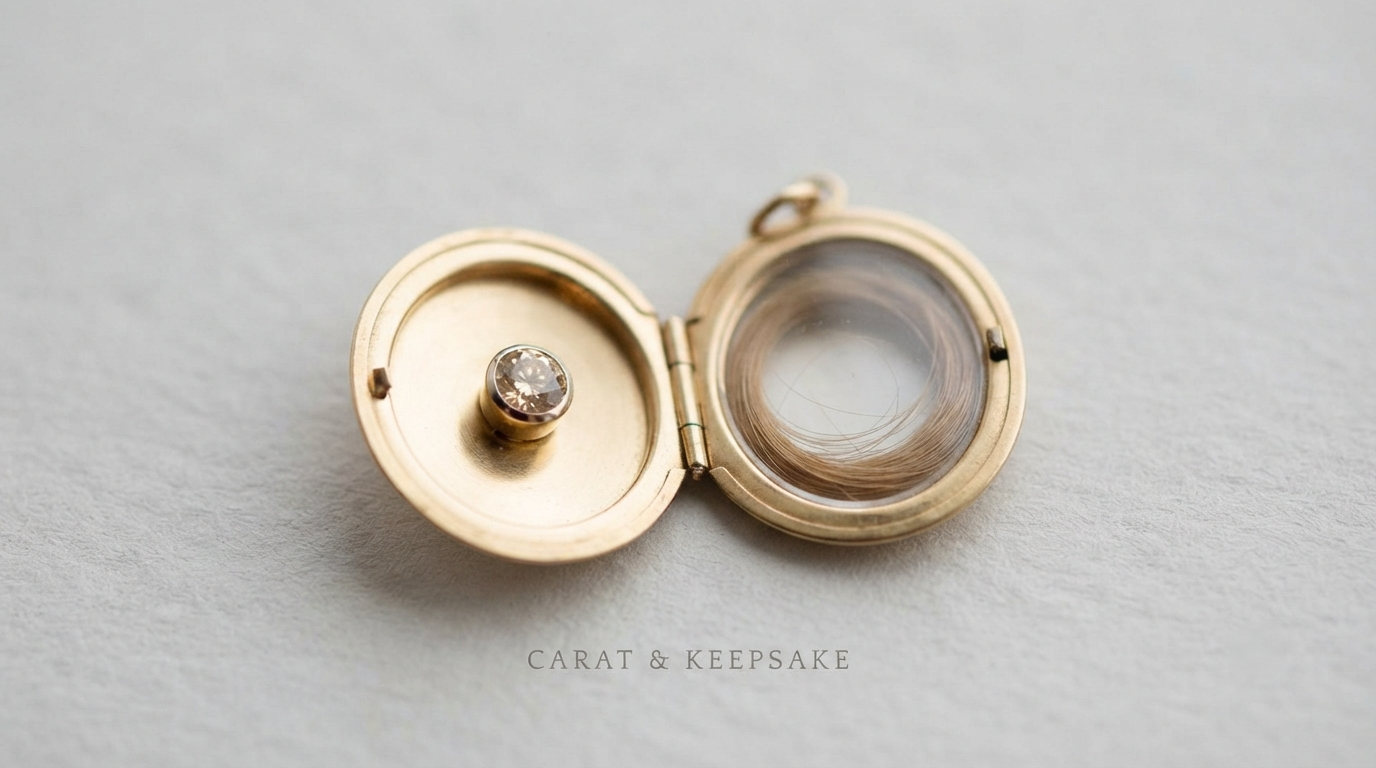
 An open gold locket holding a small champagne diamond on one side and a coiled lock of hair on the other

Two ideas are specific to hair. The first is a locket: one side holds the diamond, the other holds the coiled remainder of the lock you kept in step 2, so the stone and its source travel together. The second is a small bezel pendant on the chain she wore: hair based stones are often ordered at the entry carat, and a 0.15 to 0.25 ct diamond that would vanish in a prong ring looks deliberate in a bezel.

Beyond those: a ring for daily wear, her own band reset if the metal can be worked, a piece for a son or daughter. Match metal to the color the stone came back: warm metals for yellow and champagne, white metals for blue: and expect the setting to be priced separately. Wife memorial diamond ideas: rings, pendants, and keepsakes has the fuller list.

Frequently Asked Questions

How much of my wife’s hair do I need?

Typically a small lock or a few grams: often described as palm sized or pencil thick: though minimums vary by provider. Send a photograph and ask before shipping. Sending more does not produce a larger diamond, because carat is set by growth time. Keep part of the lock.

Does hair from her brush work?

Usually. Loose strands from a brush or comb are typically usable, though a provider may ask for more volume than a cut lock because loose hair is cleaned before extraction and some is lost. Do not empty the brush while deciding, and ask the provider before you send.

Does it matter that her hair was dyed, gray, or very old?

No. Dye and chemical treatments change the hair’s surface, not its carbon; extraction strips everything that is not carbon. Keratin is stable, so hair kept dry for decades still works. The diamond’s color is set by trace elements during growth and has nothing to do with the hair’s color.

Can I make a wife’s hair diamond if she was buried?

Yes. Hair contains its own carbon: roughly 50% by weight: so no cremation is involved at any stage. A wife’s hair diamond is the route to a memorial diamond for families who chose burial, or who scattered or interred all the ashes but kept a lock.

How long does it take?

A wife’s hair diamond typically takes 6 to 10 months from the day the provider receives the hair, with large stones and black stones sometimes running to 12. Hair does not shorten this: the press sets the timeline by carat, not by what went in: so plan against a date with margin.

What should I keep?

Part of the lock, intact, in its own labeled envelope. Your submission form, the tracking record, a dated photograph of the sent portion beside the kept portion, and the provider’s acknowledgement. When the stone arrives, add the origin certificate and the grading report. Together, that is the proof.

Final Thoughts on Making a Wife’s Hair Diamond

Of the seven steps, the one that matters most is the second: the one where you divide the lock and keep some. Everything else is a provider’s job or a matter of patience. A wife’s hair diamond asks very little of you and very little of her: a few grams, a tied thread, a photograph, and most of a year. If you are not ready for a wife’s hair diamond, the envelope keeps. If you are, the process is simpler than the weight of the decision suggests.

Learn More About Wife Memorial Diamonds

Talk With Memorial Diamond

If you have found the hair and want to know whether it is enough, whether its condition matters, or how to divide it so you keep some, reach out to Memorial Diamond with a photograph before sending anything. The first question is usually answerable without shipping a single strand.

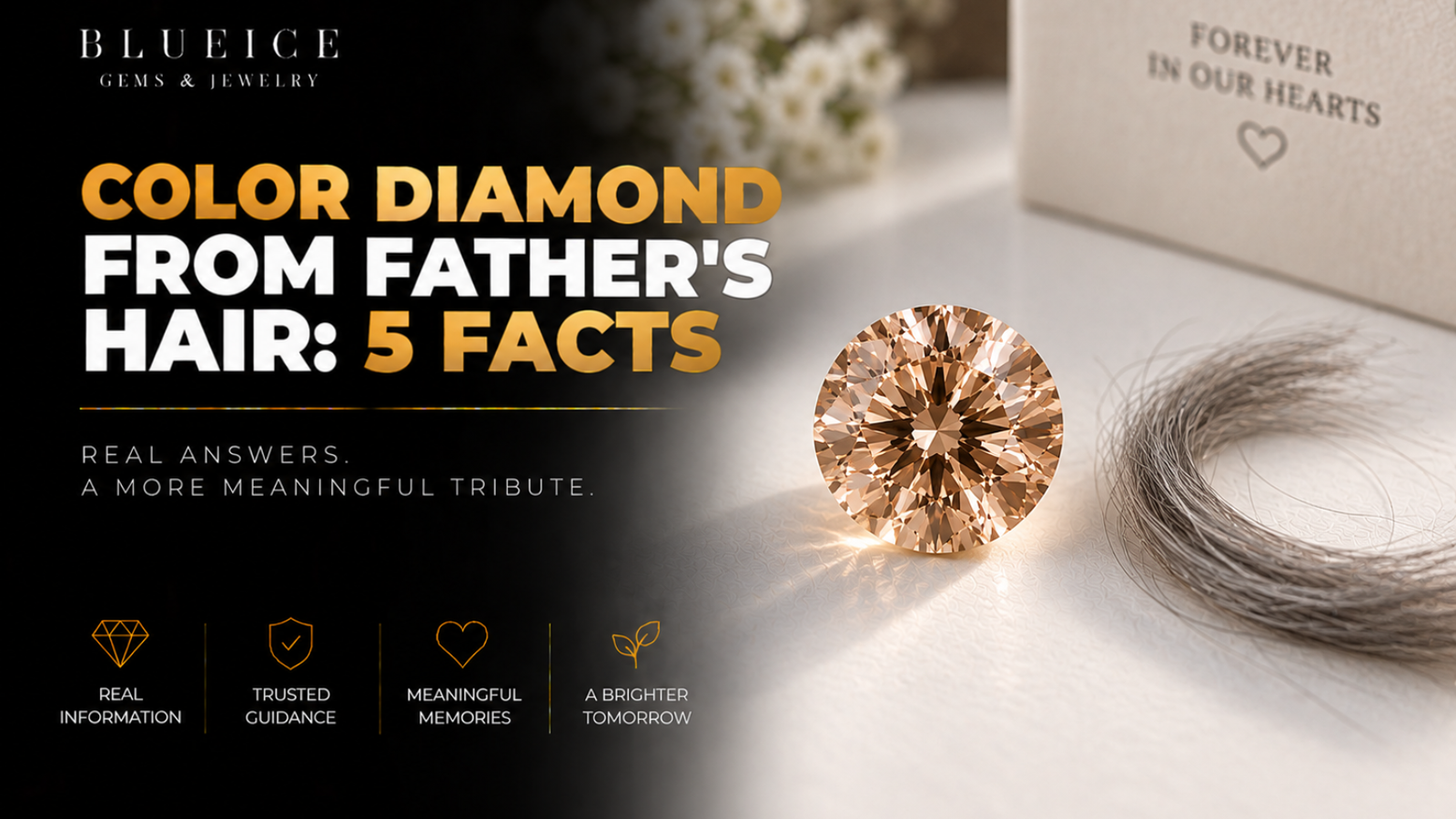
Color diamond in a warm champagne tone beside a small lock of gray hair on a white surface

What Color Will a Diamond Made From Your Father’s Hair Be?

The lock you kept is probably not the color it was when you were small. That is usually where this question starts. The answer is that the color diamond his hair becomes is decided in the growth cell, not by the hair: a diamond made from your father’s hair will most often be yellow, champagne or blue, colorless is possible at a higher cost, and gray, white, black or thinning hair changes none of that.

Which means color is the one thing the lock cannot decide for you. You decide which color diamond to grow, on the order form, before anything is grown.

Does Your Father’s Hair Color Change the Color Diamond You Get?

No. White hair does not make a white diamond, black hair does not make a dark one, and a beard sample behaves exactly like a sample from his head.

Hair color is melanin, a pigment. Before any growth begins, the hair is heated in an oxygen free process that strips away everything that is not carbon, and the purified carbon is then converted to graphite at roughly 2,500 to 2,700°C. No pigment molecule survives that, which is why hair color never reaches the color diamond. What reaches the press is elemental carbon, and elemental carbon from white hair is indistinguishable from elemental carbon from anyone else’s.

Hair is roughly 50% carbon by weight, which is why a small lock is enough and why no cremation is involved. How a memorial diamond is made from your father’s hair walks through each stage.

What Actually Sets the Color of a Hair Diamond?

Trace elements present while the crystal grows. Boron in the growth cell produces blue. Nitrogen produces yellow. A colorless stone requires the near total absence of both, which is easy for a manufactured feedstock and harder for a personal, organic one.

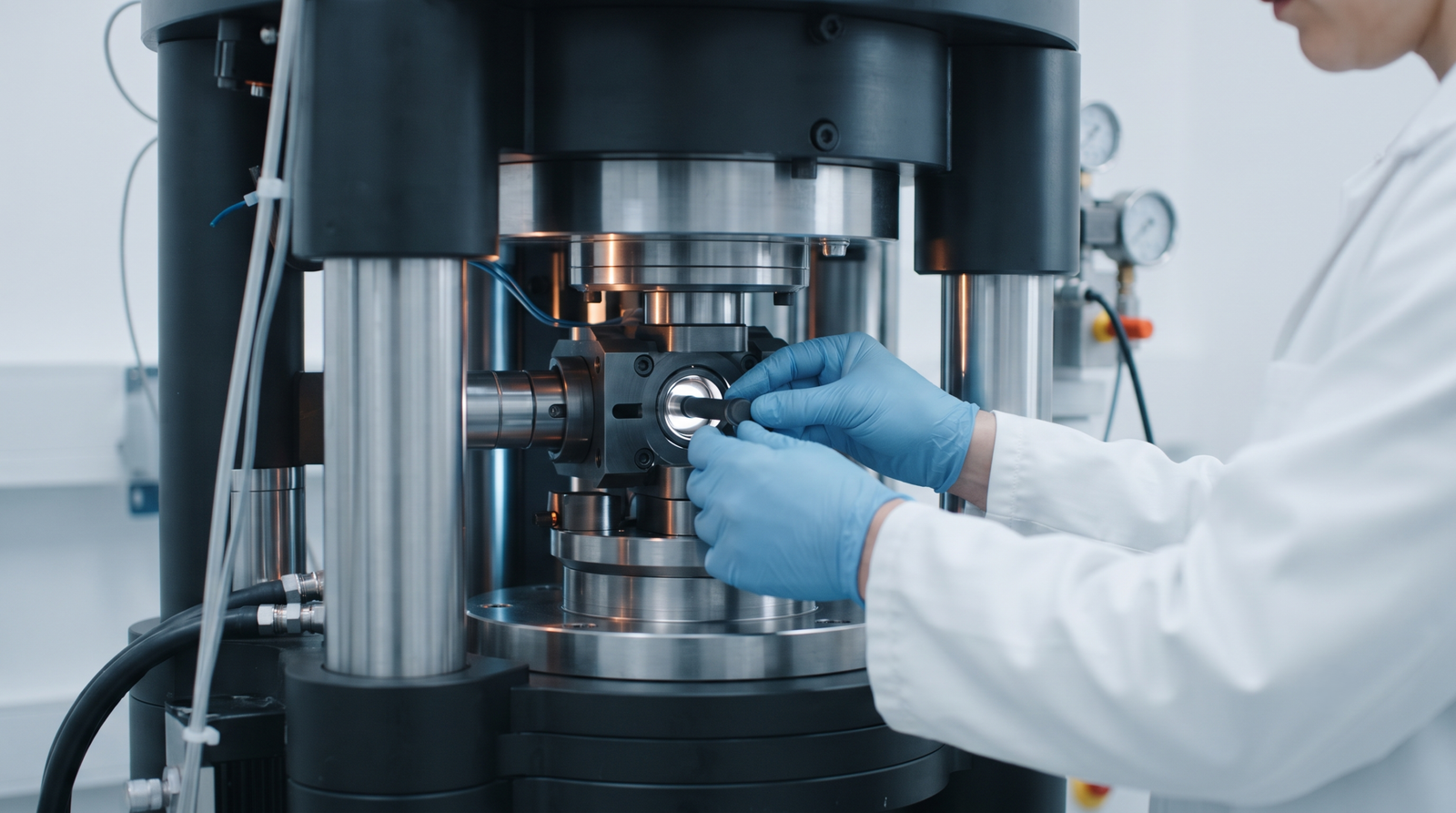
Technician placing a graphite capsule into an HPHT diamond-growth press

His purified carbon is blended with supplemental lab sourced carbon to reach a workable volume, so the finished stone is not entirely one person, but the trace elements riding along with the personal carbon still steer the color of the whole crystal. That is why a color diamond in the yellow to blue range is the natural outcome of a hair source, and why colorless takes additional processing and additional cost.

The growth itself uses either an HPHT press or CVD deposition. Both lab growth methods are described here. The process takes weeks to months depending on the carat you order.

Which Color Diamond Can a Father’s Hair Become?

Industry typical outcomes, not a promise about any one stone. The five rows below are the honest color diamond menu for a hair source.

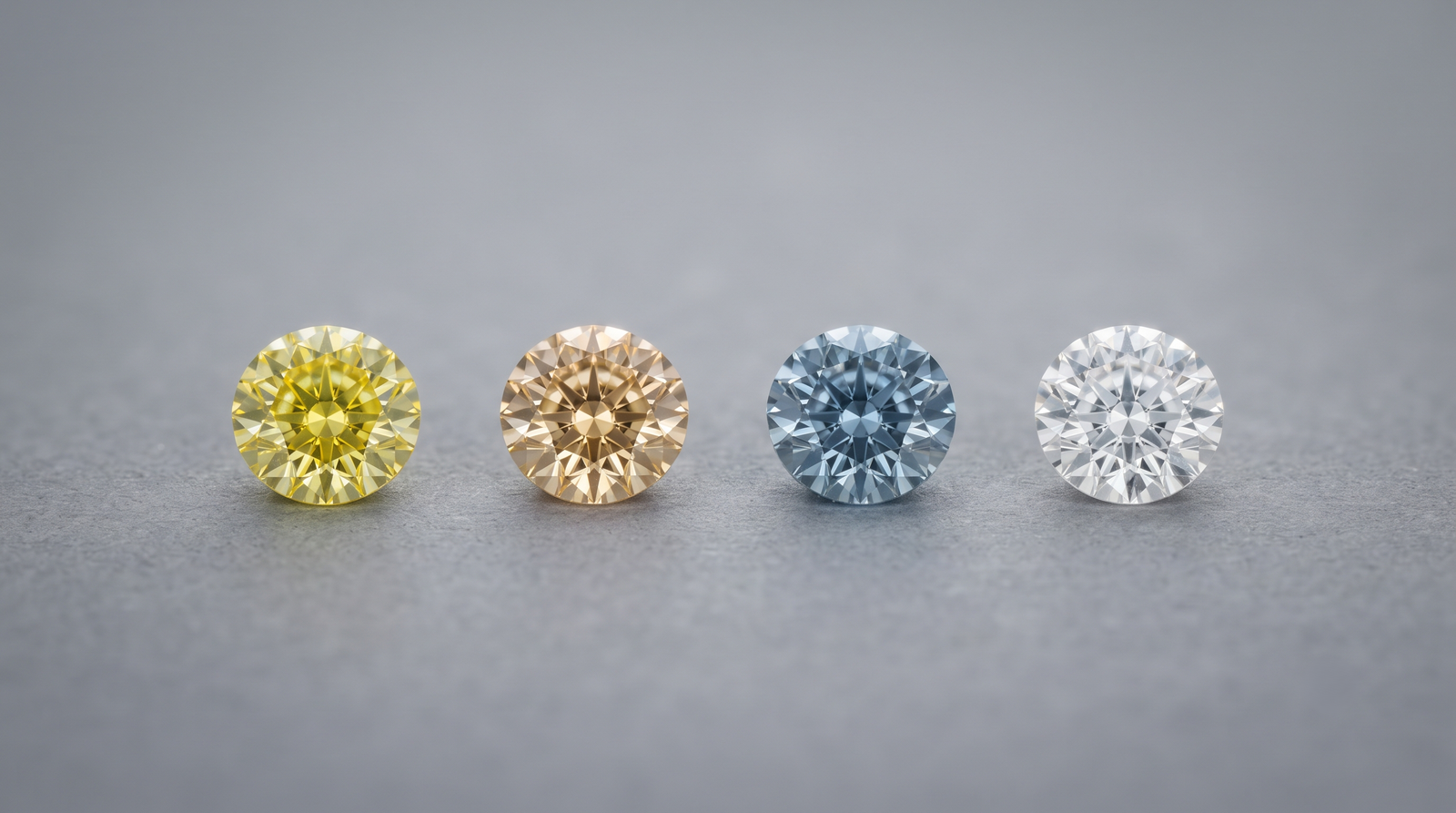
ColorWhere it comes fromWhat it means for youCost position (industry typical)
YellowNitrogen present during growthThe most common natural outcome of a hair sourceBottom of the band at a given carat
Champagne / brownSeveral trace elements acting togetherReads as a warm neutral; not caused by brown hairLevel with yellow at matching carat
BlueBoron present during growthA target the lab steers toward, not something the lock suppliesBanded with yellow and champagne, under colorless
Colorless / whiteNear total absence of boron and nitrogenAchievable; requires extra processingThe clear step up at the same carat
Red, pink, green, blackPost growth irradiation, after the crystal existsUnrelated to the hair; availability varies by providerQuoted as an add on; black or 2 ct+ can push toward 12 months

Once the stone is finished, a color diamond is graded on the same scale as any other diamond. How gemologists grade a diamond’s color, cut and clarity applies to a memorial stone too. The broader memorial diamond colors for a father post covers how each tone reads in different metals.

Four loose lab-grown diamonds in a row  yellow, champagne, blue and colorless on gray card

Does a Small or Old Hair Sample Limit the Color Diamond You Can Order?

No. A few grams, a palm sized lock, or what a barber swept up, is the industry typical amount, and the amount has no bearing on color. Neither does age: a lock his own mother kept from his first haircut and a sample cut last month yield the same carbon and the same color diamond options. How much hair you need for a father memorial diamond covers the quantity side.

Three things do matter, so write them down before you send anything:

  • The color you want. Name it explicitly on the order: yellow, champagne, blue or colorless, rather than leaving it to a default.
  • The carat. Growth time, not hair quantity, sets size, and size moves cost far more than color does.
  • Whether you want a grading report. Independent grading is the only way to confirm the finished color against what you ordered.

If you are choosing between sending hair, ashes, or both, a color diamond from your father’s ashes lands in the same range, and sending both does not widen it.

If Several of You Want a Stone, Will They Match?

Not automatically. Because so little hair is needed, one lock can often supply more than one diamond, but each is grown in its own run, and no two runs are identical.

If matching matters to you and your siblings, order the same color diamond explicitly on every stone, expect small shade differences within that color, and ask for independent grading so each stone’s color is documented. A slight difference is normal; it is not a sign that one stone got more of him. Whether more than one family member can have a diamond from the same father covers the sharing question in full.

Frequently Asked Questions

Will a Diamond From My Father’s Gray Hair Be Gray?

No. Gray and white hair have lost their pigment, and pigment is destroyed long before growth anyway. A color diamond made from gray hair comes out in the same yellow, champagne, blue or colorless range as one made from any other hair.

Can I Get a Colorless Diamond From His Hair?

Yes. Colorless requires excluding the boron and nitrogen that give hair diamonds their natural tint, which means extra processing and a higher price at the same carat. It is a choice you specify when ordering, not something the hair decides.

Does Dyed or Treated Hair Affect the Color?

Not the diamond’s color. Dye is pigment, and pigment does not survive purification. Whether a provider accepts chemically treated hair is a separate policy question, so ask before sending a sample.

Is Beard Hair Different From Head Hair for a Color Diamond?

No. Both are keratin at roughly 50% carbon, both are purified to elemental carbon, and both produce the same range of colors. If beard hair is what you have, it works.

Which Color Diamond Is the Most Common From Hair?

Yellow and champagne tones, because nitrogen and combined trace elements are the usual companions of organic carbon. Blue is steered toward deliberately, and colorless is the exception that costs more.

Can the Color Be Changed After the Diamond Is Grown?

Only by post growth irradiation, which some providers offer to turn a color diamond red, pink, green or black. It is quoted as an add on and cannot turn a tinted stone colorless. Colorless has to be grown that way.

Does the Color Say Anything About Who My Father Was?

No. Nothing molecular survives graphitization, so the color carries no information about him. Choose it as a color you want to look at, not as a message from the stone.

Final Thoughts on the Color of a Father’s Hair Diamond

The lock you kept will not tell you what color diamond it becomes, and that turns out to be a kindness. It hands the decision back to you. Whether his hair was dark or white, thick or almost gone, the carbon is the same, the color diamond menu is the same, and the choice is yours to make deliberately rather than something to wait for.

Learn More About Father Memorial Diamonds

Talk With Memorial Diamond

If you have a lock of his hair and a color in mind, or no idea yet which color diamond you want, reach out to Memorial Diamond to talk through what is possible from the sample you have. There is no obligation, and no wrong first question.