
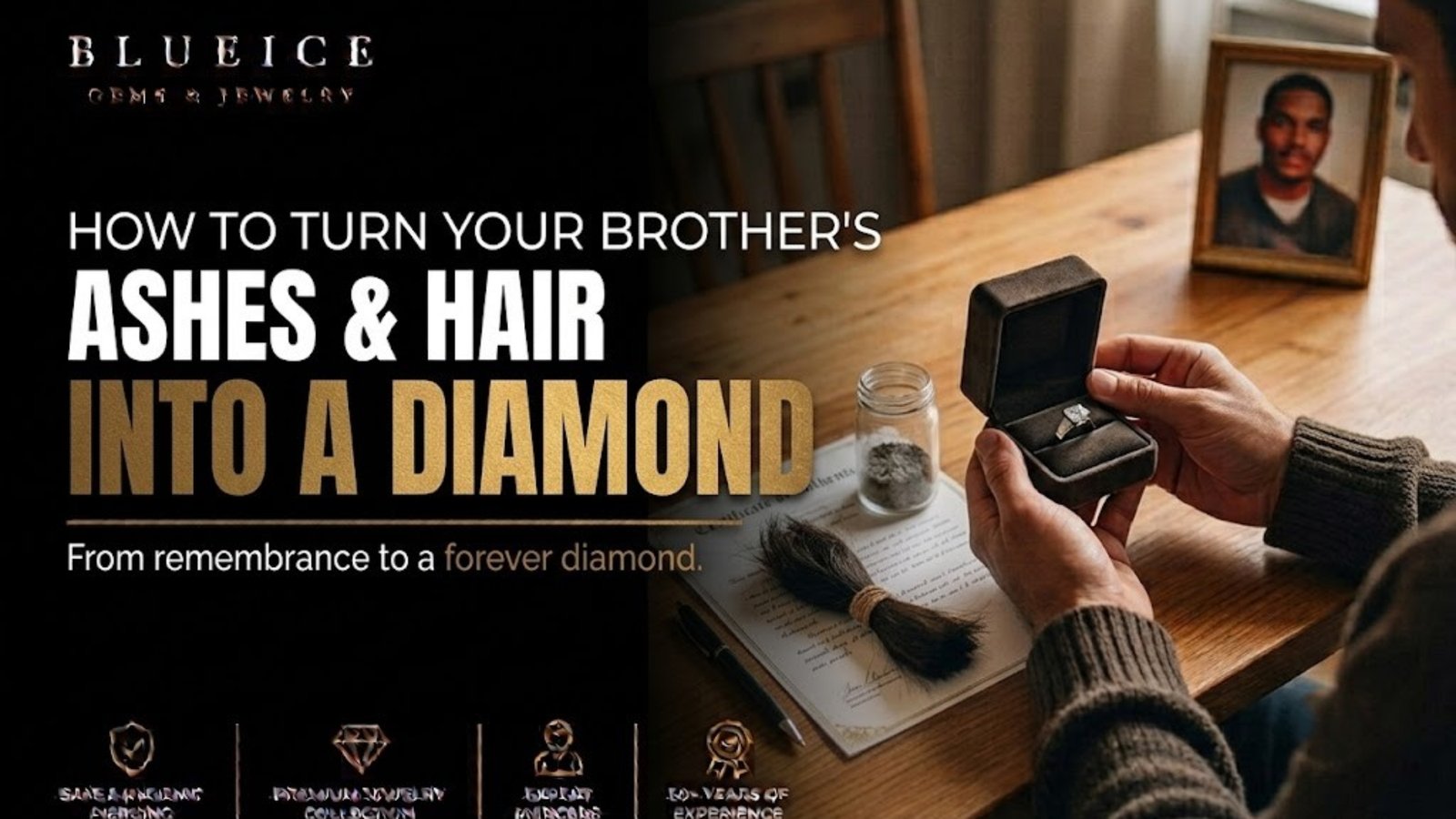
Sometimes one relative keeps the urn while another has a lock of his hair, and a single stone holding both feels right to everyone. To turn brother ashes and hair into a diamond, you confirm who can release each material, agree on a small portion of ashes and a lock of hair, choose a provider that accepts blends, send both under tracked chain of custody, choose size and color, and typically wait 6–10 months for one real lab-grown diamond.
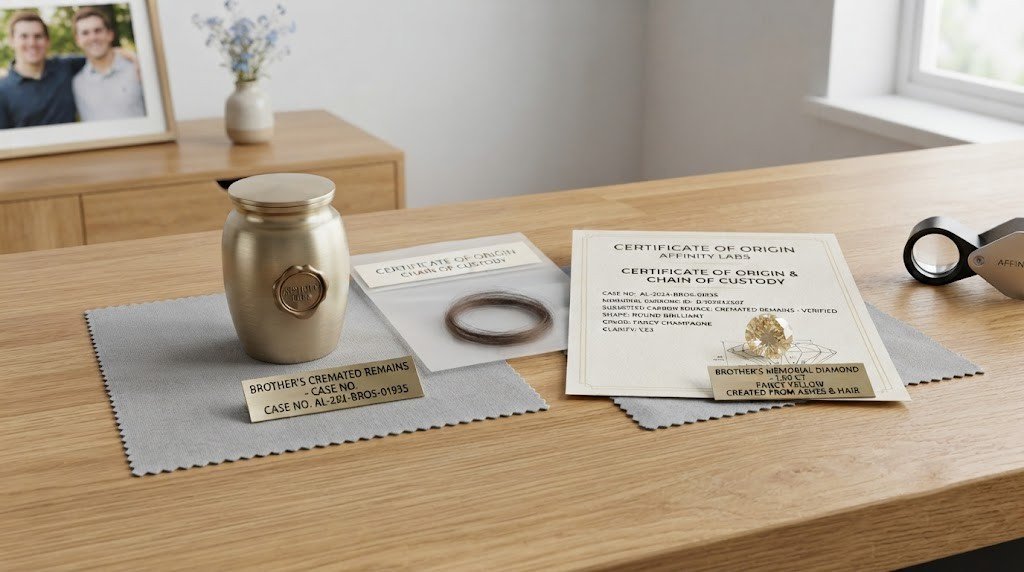
Table of Contents
What Does It Mean to Turn Brother Ashes and Hair Into One Diamond?
A blended memorial diamond is grown from carbon recovered from two of his materials, a small portion of his cremated remains and a lock of his hair, rather than from one alone. The result is still a single, real lab-grown diamond, the same as any other memorial stone in hardness and chemistry. The broader history of the category is summarized in this overview of memorial diamonds.
Families who choose to turn brother ashes and hair into a diamond are not getting a different kind of gem. They are choosing a different starting point: carbon from his remains after cremation, joined with carbon from hair that may have been saved during his life or trimmed before the funeral.
For a full overview of this combined option, the brother ashes and hair diamond complete guide covers the background. This page is about doing it: the conversations, the paperwork, and the handoffs that take you from an idea to a stone you can hold.
Why Would Siblings Combine His Ashes and Hair?
The reasons are usually personal rather than technical. Here are several that tend to come up when siblings decide to turn brother ashes and hair into a single stone:
- Two parts of his story. The hair may come from a particular time in his life, a haircut someone remembers, a curl from childhood, while the ashes come from after. Some people want both moments in one piece.
- Different relatives hold different things. One person may have the urn and another a saved lock. A blend lets each contribute, so nobody feels left out of the decision.
- A wish to draw on more than one part of him. Hair is far richer in carbon than ash, and some siblings like the idea of using both sources, even though no published figure shows that a blend holds more of his carbon than a single-material stone.
- Making a shared choice feel balanced. Whether adding hair changes the amount of ash a provider requests is a question for the provider, but contributing both can make dividing the urn feel more even-handed to the person who keeps it.
None of these reasons makes a blend better than an ash-only or hair-only stone. If you are weighing the single-material routes, compare the guides on how to turn brother ashes into a diamond and how to turn brother hair into a diamond. Choose to turn brother ashes and hair into a diamond only if both materials genuinely matter to the people involved.
What Are the Steps to Turn Brother Ashes and Hair Into a Diamond?
Combining two materials adds a little extra coordination, mostly around permission and labeling. Here is a practical order to work through when you turn brother ashes and hair into one diamond.
| Step | What happens | Notes |
|---|---|---|
| 1. Talk it through | Agree among close relatives that a blended stone is wanted | Decide who will coordinate |
| 2. Confirm authority over the ashes | Identify who can approve releasing a portion | Often not a sibling; varies by state |
| 3. Confirm the hair’s source | Establish where the hair came from and who can release it | Hair at home may be part of his estate |
| 4. Agree on portions | Settle how much ash and hair will be sent | Provider minimums vary |
| 5. Choose a provider | Confirm it accepts blends and documents both materials | Ask how each material is tracked |
| 6. Send both materials | Label each separately and ship with tracking | Follow the provider’s kit |
| 7. Make your selections | Choose carat, color, cut, and setting | Choices shape timing and cost |
| 8. Receive and check | Match the stone to its paperwork | Origin record should cover both |
When you turn brother ashes and hair into a diamond, steps two and three can run side by side, since the people involved may differ. Nothing in the later stages depends on rushing the early ones, and taking time to get agreement right is part of doing this well.
Who Needs to Agree Before You Turn Brother Ashes and Hair Into a Diamond?
With a blend, you may need two kinds of agreement, one for the ashes and one for the hair, and they do not always come from the same person.
For the ashes, the decision usually rests with whoever holds authority over his remains. Being his sibling does not automatically give you that role. State rules commonly rank a spouse or registered partner first, adult children next, and parents after them, with siblings frequently later in line, but each state sets its own order. His written wishes, such as a named agent, a pre-need arrangement, or a will, can override the usual sequence.
For the hair, it depends on its source. A lock trimmed by the funeral home is generally released through whoever holds authority over his remains. A lock saved in a drawer, a keepsake box, or anywhere among his possessions could count as property of his estate, and states differ on how that works, so speak with the person settling his affairs before adding it to the blend.
If you want to turn brother ashes and hair into a diamond and you hold neither role, start by asking. Explain that only a small portion of ashes and a modest lock are needed, offer copies of the paperwork, and consider inviting others to share in the stone. The funeral home, or a local estate attorney, can clarify whose consent applies if the picture is unclear.
How Much of Each Material Does a Provider Need?
If you plan to turn brother ashes and hair into a diamond, expect providers across the industry to ask for a few tablespoons to about 4 ounces (roughly 100 grams) of ashes. For hair, the usual request is a small lock or a few grams. Each provider sets its own minimums, and a blend may come with its own requirements, so ask before dividing anything.
More material does not make a larger diamond. Carat size is set by growth time in the press, so sending extra ash or hair will not change the size of the stone. When you turn brother ashes and hair into a diamond, ask whether the provider needs the full single-material amount of each, or a reduced amount when both are supplied.
The detailed guide to how much ash and hair a brother memorial diamond needs covers quantities in more depth, including what to ask when several stones are planned.
Will Every Provider Help You Turn Brother Ashes and Hair Into a Diamond?
Not necessarily. Some providers work with both materials together; others handle only one per stone. Before you turn brother ashes and hair into a diamond with a particular company, confirm in writing that it offers blends and explain what you plan to send.
Useful questions to put to each provider:
- Do you accept ashes and hair together for a single diamond?
- Are the two materials processed separately and then combined, or together from the start?
- How do you track each material from arrival to finished stone?
- Will the origin certificate name both ashes and hair as sources?
- Do you offer an independent grading report as well as your own certificate?
- What happens if a growth attempt does not succeed, and will unused material be returned?
A provider that answers these clearly, and states openly that supplemental lab carbon is typically added, is showing you how it handles honest questions. That matters more with a blend, since two materials mean two chains of custody to keep straight.
How Do You Ship Both Materials to Turn Brother Ashes and Hair Into a Diamond?
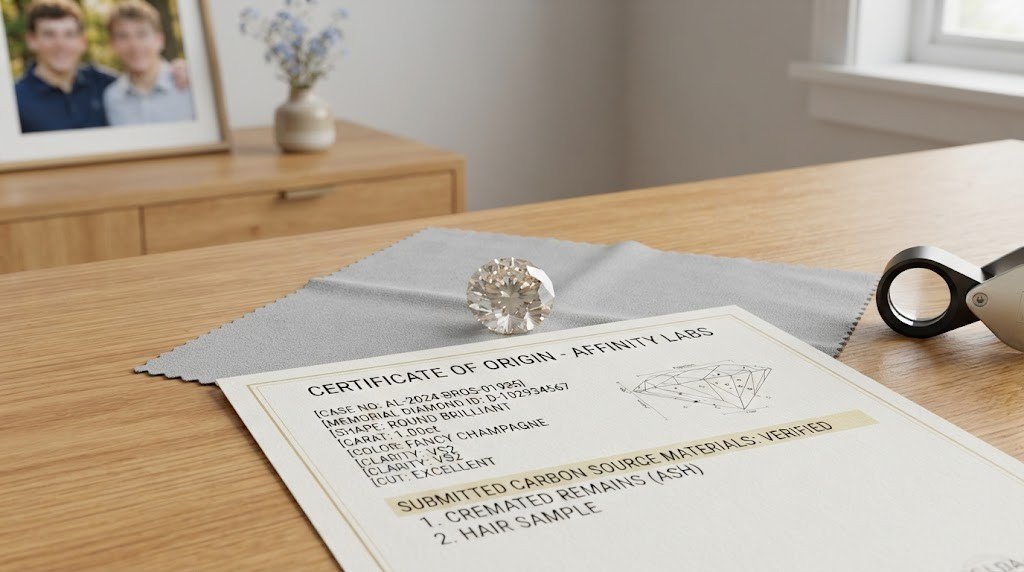
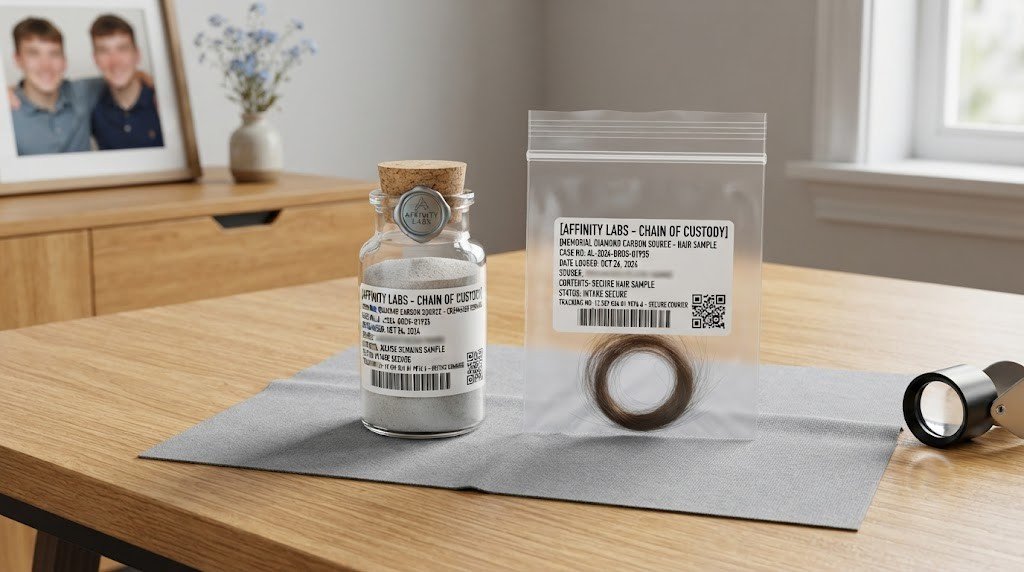
Unless the provider’s kit directs otherwise, keep the ashes and the hair in separate, sealed containers, each labeled with his full name and the type of material. Even if the provider will eventually combine them, separate packaging keeps the chain of custody clear and lets the provider confirm each sample on arrival.
Ask whether both containers should travel in one package or in two. Carriers may have their own requirements for cremated remains, so ask the provider which shipping service and packaging it expects, and use its kit if one is offered. Choose tracking and signature confirmation, photograph each sealed container, and keep every receipt.
If organizing this feels like too much, the funeral home that handled the cremation may be able to prepare the ashes for shipping. You can still turn brother ashes and hair into a diamond while letting someone experienced manage the packing, as long as both materials end up labeled and documented.
What Does a Blend Mean for the Carbon in the Stone?
This is the question to understand clearly before you turn brother ashes and hair into a diamond, because blends are where overstated claims creep in most easily.
Start with the two materials separately. Cremated ashes are mostly calcium phosphate and contain only about 0.5% to 4% carbon by weight. For an ash-only stone, industry figures put the ash-derived carbon at roughly 10–15% of the finished diamond’s mass, with some providers citing figures closer to 3%; that range describes ash alone. Hair, built from keratin, is roughly 50% carbon by weight.
For a blend, there is no published industry figure for what share of the finished stone comes from his ashes and hair combined, and no published figure for hair-only stones either. Supplemental lab carbon is typically still added to reach the volume a diamond needs. So a blended diamond is not made of him alone, and a company that promises a precise personal percentage for a blend is offering a number the industry does not publish.
What you can ask is how the provider proportions the materials and what it documents. When you turn brother ashes and hair into a diamond, the truthful promise is this: real carbon from both of his materials is extracted, purified, and grown into the stone’s crystal lattice. The question of whether a memorial diamond is really made from your brother’s ashes and hair is answered in more depth on its own page.
What Happens in the Lab When Two Materials Are Used?
Each material is first heated in stages, without oxygen and under careful control, until the minerals in ash and the non-carbon parts of keratin in hair are gone and the remaining carbon reaches roughly 99.9% or higher. Whether a provider purifies the two separately or together is worth asking before you turn brother ashes and hair into a diamond with it.
Next, a much hotter stage, somewhere around 2,500–2,700°C, turns that purified carbon into graphite, the form a growth press can use. Typically blended with supplemental lab carbon, it goes into a growth cell around a small diamond seed. Most memorial providers use HPHT, at roughly 6–8 GPa and 1,400–2,500°C, while a minority use CVD. Growth runs for weeks to months depending on the carat you chose, followed by cutting, polishing, optional irradiation for color, and grading.
The step-by-step account of how a memorial diamond is made from brother ashes and hair goes into each stage. Knowing the stages helps when you turn brother ashes and hair into a diamond, because each update from the provider will have a clear place in the sequence.
What Choices, Timing, and Costs Should You Expect?
Size. Memorial diamonds generally range from about 0.10 carats to 5 carats or more. Siblings who turn brother ashes and hair into a diamond choose the carat just as anyone else does; the blend does not set the size.
Color. Nitrogen during growth produces yellow, boron produces blue, and colorless stones need both excluded, which takes extra processing and typically costs more. Memorial diamonds often settle into yellow, blue, or champagne tones, and post-growth irradiation can give red, pink, green, or black. The final shade cannot be predicted from either material, and combining them does not make color more predictable. The page on what color a diamond from your brother’s ashes and hair might be explains the chemistry.
Setting. A pendant, ring, earrings, a bracelet, cufflinks, a tie bar, or a loose stone kept in a box are all reasonable choices. Pick what suits how you will wear or keep it.
Timing. Across the industry, expect roughly 6 to 10 months from receipt, and up to about 12 months for stones above roughly 2 carats or specialty colors. The brother memorial diamond timeline describes the waiting period.
Cost. General 2026 industry ranges for the loose stone run roughly 1,500–3,500 for about 0.10–0.25 carat, 5,000–15,000 for 0.5–1 carat (colorless toward the top), and 20,000–75,000 or more for 2–5+ carats. Grading, engraving, fancy cuts, and settings are usually extra. Ask whether choosing to turn brother ashes and hair into a diamond changes the price, since policies differ.
How Do You Check a Blended Diamond When It Arrives?
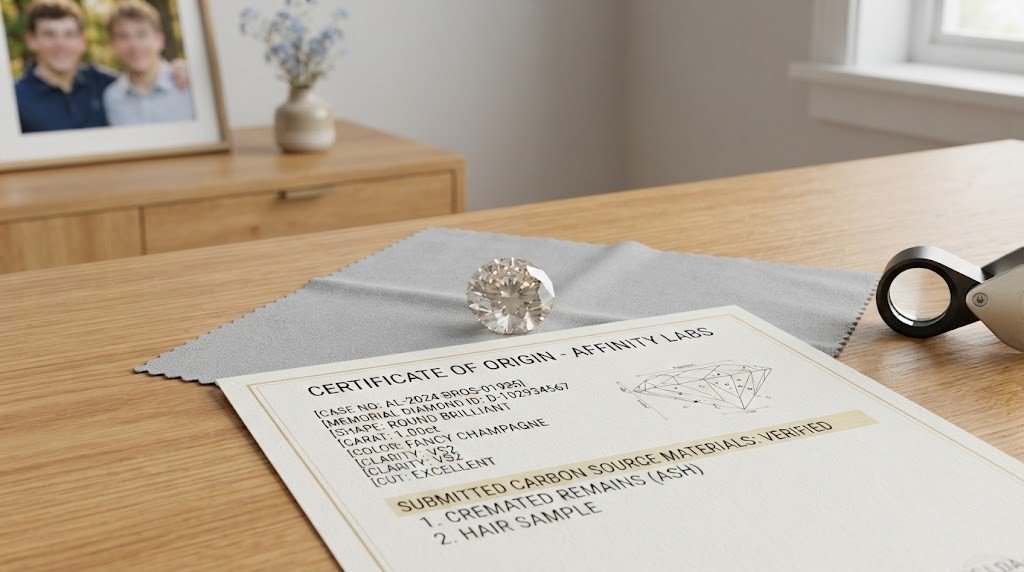
When the stone arrives, open it in your own time. Then compare it with two documents. The origin or authenticity certificate, usually issued by the provider, is a chain-of-custody record; for a blend, check that it names both his ashes and his hair. The grading report, ideally from an independent lab, describes the stone using the 4Cs, following standards such as the GIA’s diamond quality factors.
Confirm that carat, color, and shape match across both documents and your order. Expect clarity somewhere in the SI2 to VVS range that memorial stones typically reach; a few tiny inclusions visible under a loupe are normal for this range. A diamond rates 10 for hardness but can still chip from a hard knock at the wrong angle, so ask about care and insurance before daily wear.
Keep both documents and every shipping receipt together. When you turn brother ashes and hair into a diamond, that paper trail is what confirms, years later, exactly where the stone came from.
Frequently Asked Questions
Can you turn brother ashes and hair into a single diamond?
Yes, where the provider offers blends. Carbon is recovered from a small portion of his ashes and a lock of his hair, purified, and typically combined with supplemental lab carbon to grow one real lab-grown diamond. Confirm blend availability before sending anything.
Is a blended diamond more personal than an ash-only diamond?
When you turn brother ashes and hair into a diamond, no published figure shows how much of the stone comes from him, so a firm comparison is not possible. Hair is far richer in carbon than ash, but the personal share depends on how each provider proportions materials.
Do I need permission for both the ashes and the hair?
Usually, yes, before you turn brother ashes and hair into a diamond. The ashes are generally released by whoever holds authority over his remains. Hair from the funeral home goes through that person too, while hair kept at home may form part of his estate, with rules varying by state.
Does adding hair reduce the amount of ash needed?
It depends on the provider you ask to turn brother ashes and hair into a diamond. Some may ask for the full single-material amount of each, while others may adjust when both are supplied. Ask directly, and confirm exact quantities of ash and hair before anything is divided or shipped.
Will combining ashes and hair change the diamond’s color?
No one can say in advance. Nitrogen tends to bring yellow and boron blue during growth, but neither material, alone or blended, lets a provider forecast the exact shade. Colorless stones require extra processing and typically cost more.
Should the ashes and hair be shipped in the same package?
Follow the provider’s instructions. Siblings who turn brother ashes and hair into a diamond should keep each material in its own sealed container labeled with his full name and the material type, so both chains of custody stay clear from the moment the provider receives them.
Final Thoughts on Turning Your Brother’s Ashes and Hair Into a Diamond
A blended stone often grows out of a family conversation as much as a decision: one person’s urn, another’s saved lock, and a shared wish to hold something of him together. If you choose to turn brother ashes and hair into a diamond, let that conversation set the pace, ask every provider the hard carbon questions, and keep the paperwork for both materials safe.
Learn More About Combining His Ashes and Hair
- Brother ashes and hair diamond: the complete guide the full overview of combined stones
- A stage-by-stage walkthrough for a combined brother memorial diamond practical detail for every handoff
- What to ask a provider about a blended brother diamond screening questions before you commit
- Sharing a brother memorial diamond when several relatives want a stone
Talk With Memorial Diamond
If your family hopes to turn brother ashes and hair into a diamond, Memorial Diamond is happy to talk through what is possible, what each material involves, and which questions to settle first. There is no rush and no obligation. Reach out whenever the time feels right at memorialdiamond.us.
Word count: 3,067 words · Reading time: about 15 minutes
Leave A Comment