
Somewhere in a drawer there may be an envelope with a few strands of her hair, saved after a haircut and never thrown away. A grandmother hair diamond is a lab-grown diamond grown partly from carbon extracted from a small lock of her hair, and because hair is roughly half carbon, it needs very little material and no cremation at all. That makes it an option whether she was buried or cremated, provided the hair can be sourced and the right people agree.
Below you will find what a grandmother hair diamond can and cannot do, where her hair might come from, who to speak with first, and what to expect on color, price, timing and sharing among grandchildren.
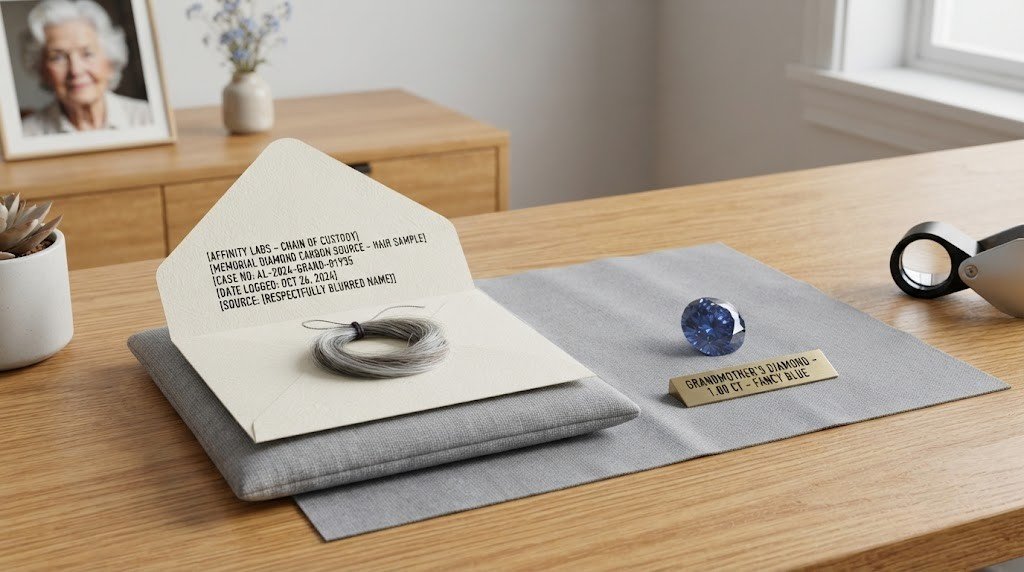
Table of Contents
Why can a grandmother hair diamond be made without cremation?
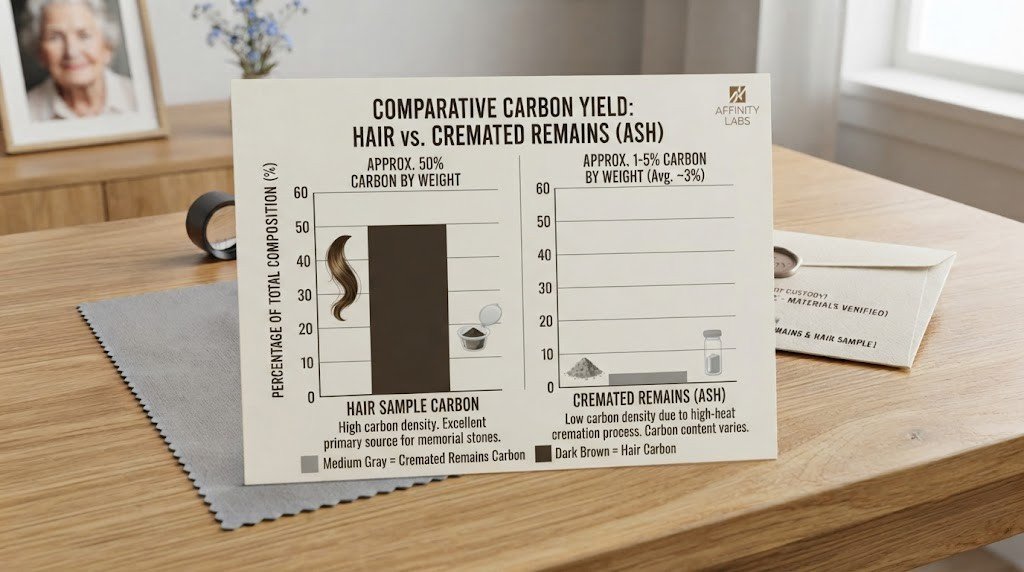
Roughly half of every strand, by weight, is carbon, because hair is made largely of the protein keratin. Cremated ash, by contrast, is mostly mineral and holds only a few percent carbon. That difference is why a grandmother hair diamond can start from a small lock rather than a measured portion of remains, and why nothing about it depends on how her body was laid to rest.
If she was buried
Burial remains common across the United States. The NFDA’s 2025 cremation and burial report put the projected 2025 US burial rate at 31.6%, with cremation at 63.4%, which means a large share of families have no ashes to draw on at all. For those families, a grandmother hair diamond is often the only memorial-diamond route available, and it does not touch her grave in any way.
If faith shaped how she was laid to rest
No religious tradition has issued a position on memorial diamonds as such; teachings address cremation and the handling of ashes. Because a grandmother hair diamond involves no cremation, it sits outside objections that are specifically about cremation. Cremation is considered impermissible across the major schools of Islamic thought, and Orthodox and Conservative Judaism generally prohibit it, so for families in those traditions hair may be the route worth exploring. Whether keeping or using a lock of hair raises any other concern in your community is a question for her clergy, or yours.
| Point of comparison | Hair | Ashes |
|---|---|---|
| Carbon content of the source | About 50% | Roughly 0.5–4% |
| Needs cremation | No | Yes |
| Typical amount sent | A small lock or a few grams | A few tablespoons up to about 4 oz |
| Published personal-carbon share in the finished stone | None published | Around 10–15% for ash-based stones |
If her ashes are also available, the complete guide to a grandmother ashes diamond covers that route in full.
Where might her hair come from?
Families planning a grandmother hair diamond sometimes find hair in more places than they expect. Some common possibilities are:
- A lock saved at a haircut. Some people keep a curl from a final salon visit, or a clipping a relative trimmed at home.
- A keepsake. Hair kept in a locket, a card, a baby book from her own childhood or an envelope tucked into a drawer.
- Hair collected by the funeral home. Some funeral homes can take a small lock before burial or cremation if the family asks while arrangements are still underway.
- Other belongings. Families sometimes ask about a hairbrush or comb.
Each of these sources carries its own question marks, and whether it can be used for a grandmother hair diamond is entirely up to the provider. Do not assume that hair from a brush, a very old keepsake or a mixed bundle will be accepted. Describe exactly what you have, how it has been stored and how sure you are that it is hers, then ask the provider in writing whether they can work with it.
If the funeral has not yet taken place and a grandmother hair diamond is on your mind, it is worth asking the funeral director early whether a lock can be set aside. Policies differ between funeral homes, so frame it as a request rather than an expectation.
How much hair does a grandmother hair diamond need?
A grandmother hair diamond typically starts from a small lock or a few grams, sometimes described by providers as palm-sized or a few wisps. Because hair carries so much more carbon than ash, a modest amount usually goes a long way. The exact minimum differs between companies, so ask each provider for their figure before you cut anything or send anything.
More hair does not mean a bigger stone. A grandmother hair diamond reaches its carat size through time in the growth press, so sending a larger bundle neither speeds the work nor enlarges the result. Our article on how much hair a grandmother memorial diamond needs goes through quantities in more depth.
Before you send her hair
Keep a small portion back if you can, and photograph what you are sending. Ask the provider:
- What is the minimum amount you need for the size we want?
- Will any hair you do not use be returned, and how?
- How is the hair labeled and tracked once it arrives?
- What happens if the material turns out to be insufficient, or a growth run fails?
Does gray, white, dyed or permed hair matter?
Grandchildren often wonder whether her hair, whatever its color or condition, suits a grandmother hair diamond, and the honest answer is that it is a question for the provider. There is no basis for saying that hair color, treatments or thinning will change how a grandmother hair diamond looks, and no basis for saying any particular hair will or will not be accepted.
Hair dyes, perms and other chemical treatments are where providers’ policies can differ.
What to tell the provider about her hair
Some may want to know about recent coloring; some may have their own rules about treated hair. Tell them plainly what you know: whether she colored her hair, whether she had it permed, roughly when, and whether the lock you have was cut before or after. Mention how it has been stored, too, whether in a sealed envelope, a locket or loose in a box. Then let them say what they can do, and ask for the answer in writing so the whole family can see it.
Whatever her hair looked like, it was hers, and that is the part that carries meaning for the family.
Who should you speak with if her hair is kept at home?
Hair already in your keeping is usually a simpler starting point for a grandmother hair diamond than ashes held by someone else, but it is not always entirely yours to decide. Her belongings may form part of her estate, and how estates are handled differs from state to state. If a lock is among her things, or a relative is clearing her home, the person settling her affairs is the right first conversation.
That might be an executor named in her will, a surviving spouse or partner, one of her adult children, or a family member acting informally. You could explain that you would like to use a small lock of her hair for a grandmother hair diamond, and ask whether anyone else in the family has feelings about it. Often the question turns out to be one of courtesy rather than ownership, and raising it early helps keep it that way.
If you hope the funeral home will save a lock, ask the funeral director who needs to approve the request, since that can depend on who is making the arrangements and on the home’s own policy. If anything about her estate is in dispute, an estate attorney in her state can explain where you stand.
When the family cannot agree
Sometimes one relative wants to keep every strand of her hair exactly as it is, while another hopes to see it become a stone. Neither wish is wrong. A practical middle path is to divide the lock, so that part stays as a keepsake and part goes to the provider, but only if the people involved are comfortable with that. If not, there is no harm in waiting before anyone decides; ask a provider how they would like the hair stored in the meantime.
How much of a grandmother hair diamond is her own carbon?
Her hair is purified to carbon of roughly 99.9% or higher, and that carbon is typically blended with supplemental lab carbon before growth. What no one has published is a standard figure for how much of a finished hair-based stone is personal carbon.
You may see a figure of around 10–15% quoted online, but that number describes ash-based stones and should not be applied to hair. Hair’s higher carbon content does not, by itself, tell you what share of a particular grandmother hair diamond comes from her, because that depends on each provider’s process and the stone size.
The practical step is simple: ask every provider you are considering to tell you, in writing, what share of the finished stone they expect to be her carbon for the size you want, and how they document it. For a closer look at verification, see whether a memorial diamond is really made from your grandmother’s hair.
What happens to her hair during the process?
The stages for a grandmother hair diamond mirror those for ashes, with the difference that far less source material is involved. In brief:
- Her hair arrives and is logged with chain-of-custody records.
- Heat in an oxygen-free, staged process removes everything that is not carbon.
- The purified carbon is converted to graphite at roughly 2,500–2,700°C.
- Most providers grow the crystal by HPHT, around 6–8 GPa and 1,400–2,500°C, over weeks to months; a minority use CVD.
- The rough crystal is cut and polished, color-treated if the family chose that option, and graded.
Each of those stages is explained more fully in our walkthrough of how a memorial diamond is made from your grandmother’s hair. If you would rather see it from the family’s side, from finding the hair to receiving the stone, the guide on how to turn your grandmother’s hair into a diamond is the place to start.
Which colors are possible for a grandmother hair diamond?
Trace elements during growth set a diamond’s color. Nitrogen pushes it toward yellow, boron toward blue, and colorless requires shutting both out, which takes additional processing and usually raises the price. Memorial diamonds in general, a grandmother hair diamond included, lean toward yellow, blue and champagne or brown tones.
Some providers offer post-growth irradiation for red, pink, green or black stones. There is no evidence that a grandmother hair diamond comes out lighter, cleaner or more predictable in color than one made from ashes, and no provider can promise to reproduce the shade of her hair. Think of color as a choice from a menu rather than an echo of how she looked.
For the options in detail, read about what color a diamond made from your grandmother’s hair will be.
What does a grandmother hair diamond typically cost?
Size drives most of the price of a grandmother hair diamond, followed by color, cut and whether you add an independent grading report. These are broad 2026 industry ranges, not Memorial Diamond’s prices, which are not yet published.
| Carat range | General price range | Worth knowing |
|---|---|---|
| About 0.10–0.25 ct | roughly 1,500–3,500 | A size often chosen for earrings, a slim band or a small pendant |
| 0.5–1 ct | roughly 5,000–15,000 | Colorless sits meaningfully above blue, yellow or champagne |
| 2–5+ ct | roughly 20,000–75,000+ | Expect the longest wait in the range |
Settings, engraving, fancy cuts and third-party grading are usually separate charges. An in-house authenticity certificate records that the stone was grown from your family’s material; a grading report from an independent lab, ideally referencing GIA’s standards for diamond quality, describes the stone itself. Memorial stones commonly grade between SI2 and VVS clarity. Ask which of those papers are included.
How long will you wait for the finished stone?
Industry-wide, a grandmother hair diamond usually takes 6 to 10 months from the day the provider receives her hair. Stones above about 2 carats, and specialty colors, can stretch toward 12 months.
Because a grandmother hair diamond grows at the pace the press allows, the amount of hair you send will not shorten the wait. If a family occasion matters, such as a wedding where you would like to wear it, tell the provider at the outset and ask whether the timing is achievable.
Can several grandchildren share one lock of her hair?
Often they can. Since each stone needs only a small amount, a single saved lock may be enough for more than one grandmother hair diamond, and cousins in different cities can each have their own. Whether a provider grows several stones from one submission, and how they track each one, is something to confirm before you send anything.
The family side usually takes more care than the science. A few things help:
- Decide together who will hold the hair and handle the paperwork.
- Let each grandchild choose a size and setting they can afford, rather than matching everyone.
- Include her children in the conversation, since a parent, aunt or uncle may want a stone too.
- Respect a cousin who would rather the lock stay as it is.
If there is not enough hair for every grandmother hair diamond the family hopes for, her ashes may be another source for some relatives, with the agreement of whoever holds authority over them. The complete guide to an ashes and hair diamond for a grandmother explains how families combine the two.
How might you wear or keep her diamond?
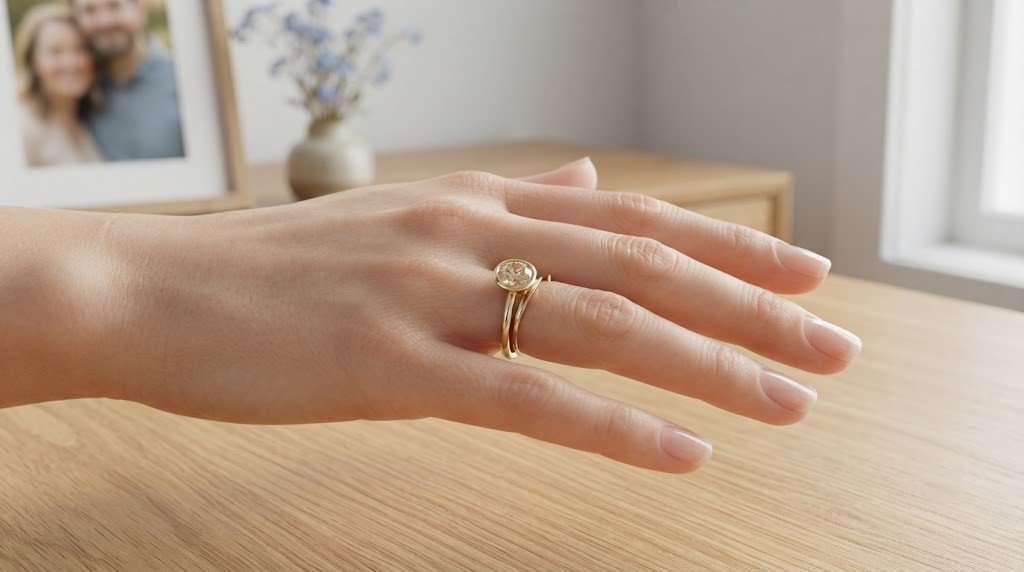
Choosing a setting for a grandmother hair diamond starts with the person who will wear it and with who she really was, not with a generic idea of what a grandmother’s jewelry should look like. If she wore one bold ring for years, you might echo it. If she never wore jewelry at all, a loose stone in a small case, or a simple pendant worn under a collar, may feel truer to her.
A grandmother hair diamond rates 10 on the Mohs hardness scale, so it holds up well to daily wear, though a sharp knock can chip any diamond. Protective settings such as a bezel reduce that risk.
Keeping it for the next generation
Some grandchildren plan from the start to hand a grandmother hair diamond down to their own children. If that is your intention, keep the authenticity certificate, any grading report and a written note explaining whose hair it came from and when it was made. Without that note, the meaning can fade within a generation. Treat the stone as a family keepsake; its value lies in what it represents, and no assumption should be made about what it might fetch.
Frequently Asked Questions
Can a grandmother hair diamond be made if she was buried years ago?
Yes, if hair from her was saved before burial, such as a lock from a haircut or a keepsake. Hair cannot be retrieved from a grave without exhumation, so the question is whether family members kept any. Ask relatives what might be tucked away.
Will a provider accept hair from her hairbrush?
That is entirely the provider’s decision. Brush hair may be mixed with other people’s hair or lack enough material. Describe exactly what you have and ask in writing whether they can use it, rather than assuming any source will be accepted.
Does her hair color affect the color of the diamond?
There is no basis for claiming that her hair color shapes the stone’s color. Diamond color depends on trace elements during growth and on the options a provider offers. Ask the provider which color choices they can actually produce.
Do I need permission to use a lock of her hair I already have?
Possibly. Hair kept for a grandmother hair diamond can count among her belongings, which may form part of her estate, and rules differ by state. Speaking with the executor or whoever is settling her affairs is a courteous step, and it helps avoid misunderstandings with other relatives later.
How many grandchildren can share one lock of her hair?
It depends on how much hair there is and on the provider’s requirements. A small lock is often enough for more than one stone. Ask the provider how many stones your amount can support and how each one is tracked.
Is a hair diamond less meaningful than one from her ashes?
Not inherently. A grandmother hair diamond and an ashes diamond both contain a real share of her carbon, and hair involves no cremation. The right choice depends on what is available, her wishes and your family’s beliefs.
Final Thoughts on Her Hair as a Diamond
A lock of hair is small enough to lose in a drawer and still carries a surprising amount of her. Turning it into a grandmother hair diamond depends on three things: finding hair that is truly hers, agreeing as a family on how to use it, and choosing a provider who answers your questions clearly and in writing.
None of that needs to happen quickly. The conversations with cousins, parents and whoever is settling her estate are worth having without pressure.
Learn More About Hair-Based Diamonds for a Grandmother
- How Much Hair Do You Need for a Grandmother Memorial Diamond? amounts, sources and what providers ask for
- How to Turn Your Grandmother’s Hair Into a Diamond a family-side plan from start to finish
- Grandmother Ashes Diamond: The Complete Guide the cremation-based route explained
- What Color Will a Diamond Made From Your Grandmother’s Hair Be? tones, treatments and costs
Talk With Memorial Diamond
Whether you have a lock of her hair in hand for a grandmother hair diamond or are still asking relatives what was saved, you are welcome to bring your questions to us. We will explain what is possible and what to check, at whatever pace suits you.
You can reach us through memorialdiamond.us.
Leave A Comment