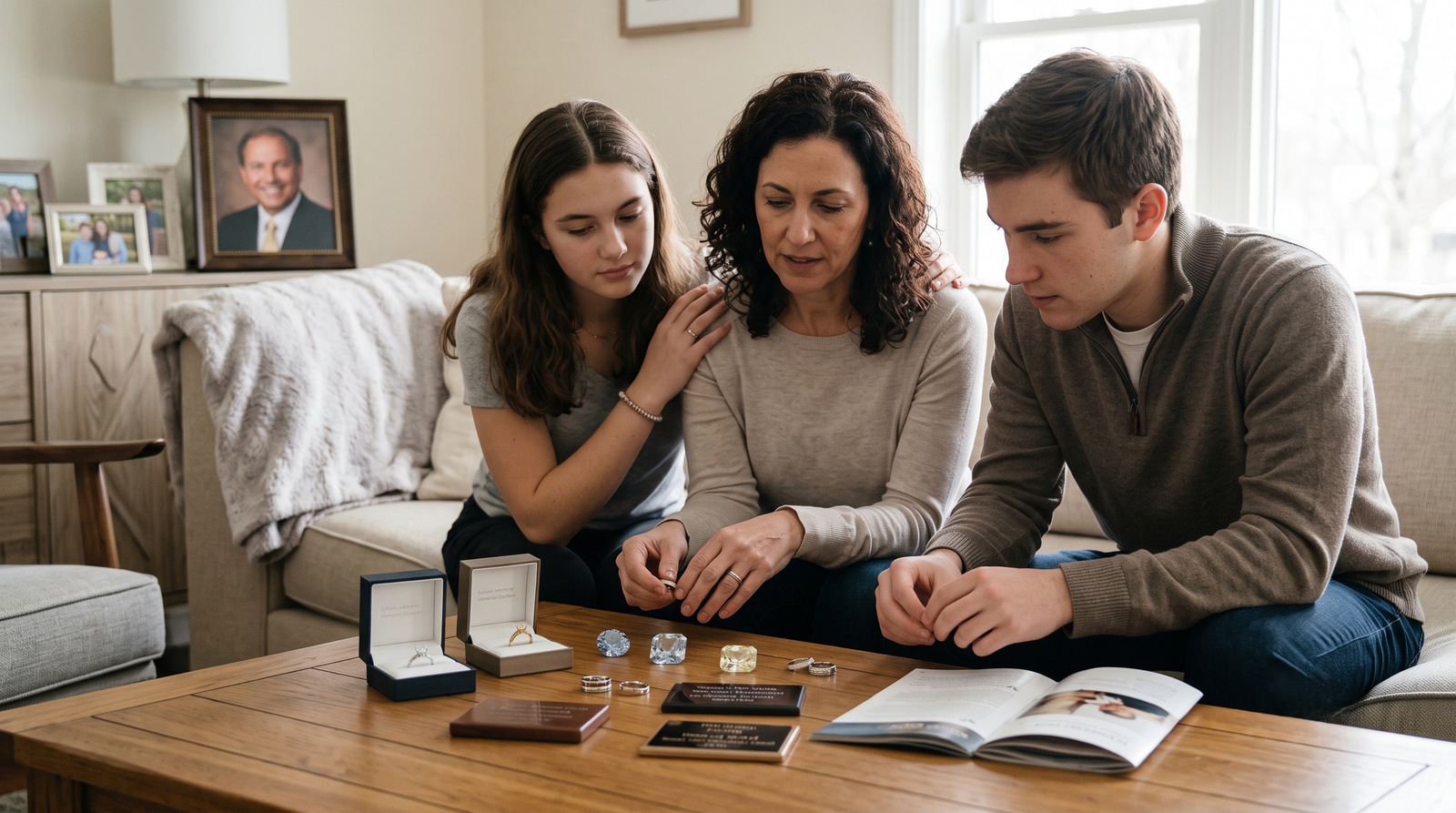
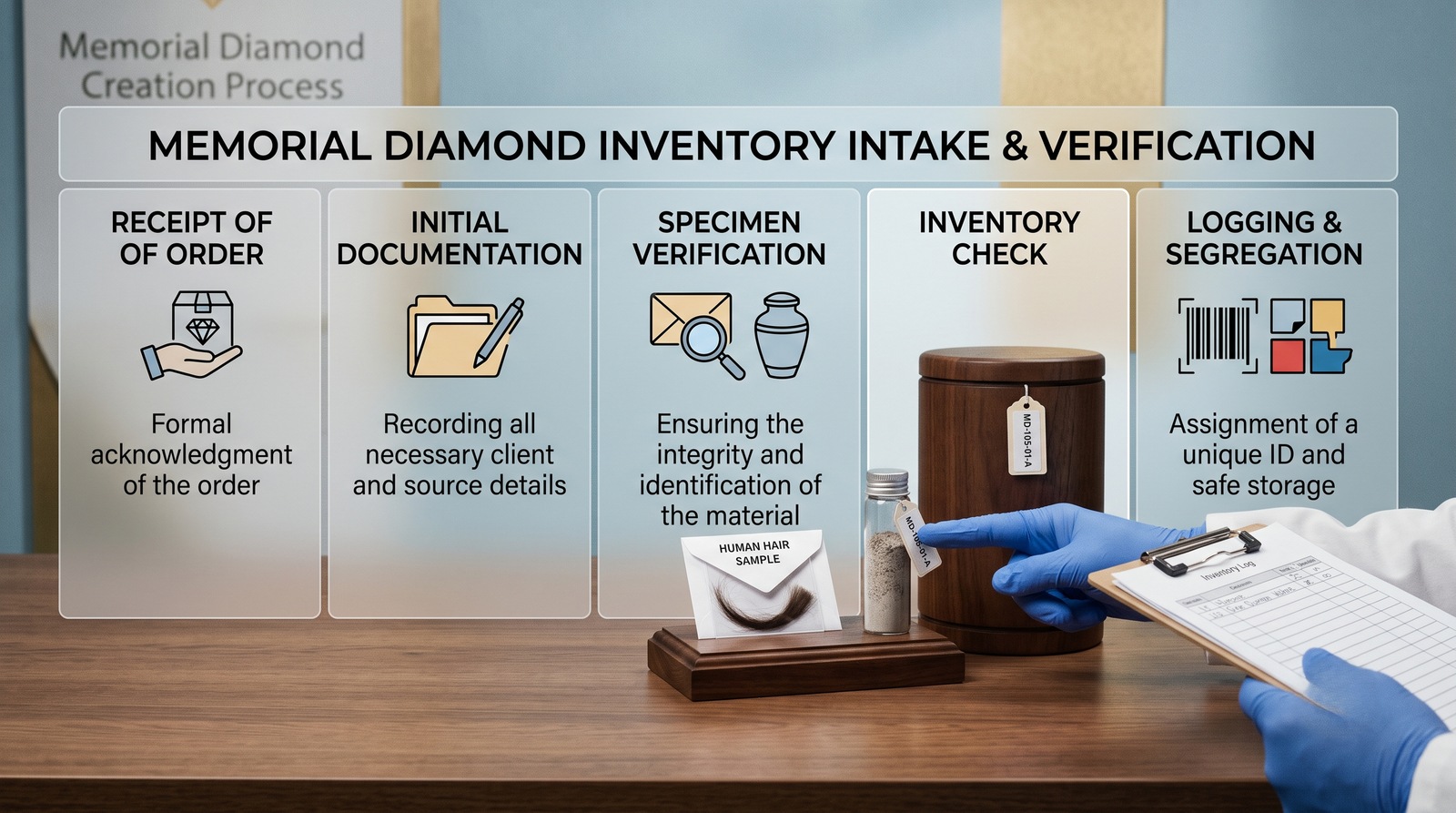
Choosing a memorial diamond for your husband starts with an inventory, not a preference. Before carat, color, or setting mean anything, you need to know what physically exists, ashes, hair, both, or neither yet, because that single fact determines which of the questions on this page even apply to you.
If you’re feeling stuck on where to start, that’s normal. Most families aren’t stuck on the emotional decision; they’re stuck on not knowing which practical question to answer first.
Start With an Inventory, Not a Preference
It’s tempting to begin by imagining the finished stone, its color, its setting, who will wear it. But choosing a memorial diamond for your husband actually starts somewhere much more concrete: what do you physically have access to right now?
This matters because the material you have available is what’s settled first, and everything else, timeline, cost, setting, follows from it. Skipping ahead to preferences before confirming what exists is the most common way families end up circling back to the beginning.
The Five States of the World, and What Each One Means
What you have
What this means for you
Ashes only, urn at home
You can proceed whenever you’re ready; a small portion can be set aside without disturbing the rest
Hair only, no cremation involved
You can proceed without any timeline pressure from the ashes; hair keeps indefinitely once collected
Both ashes and hair
You have the option of a combined stone, or two separate single material stones
Ashes already scattered or interred
Whether any portion can still be recovered depends entirely on the specific arrangement, ask before assuming either way
Nothing yet, still deciding whether to keep anything
You have time; hair especially can be collected retroactively from a keepsake if any exists, and this is worth confirming before assuming nothing survives
Choosing a memorial diamond for your husband, at this stage, isn’t about deciding on a stone, it’s about naming honestly which row of this table you’re actually in.
Once You Know What You Have
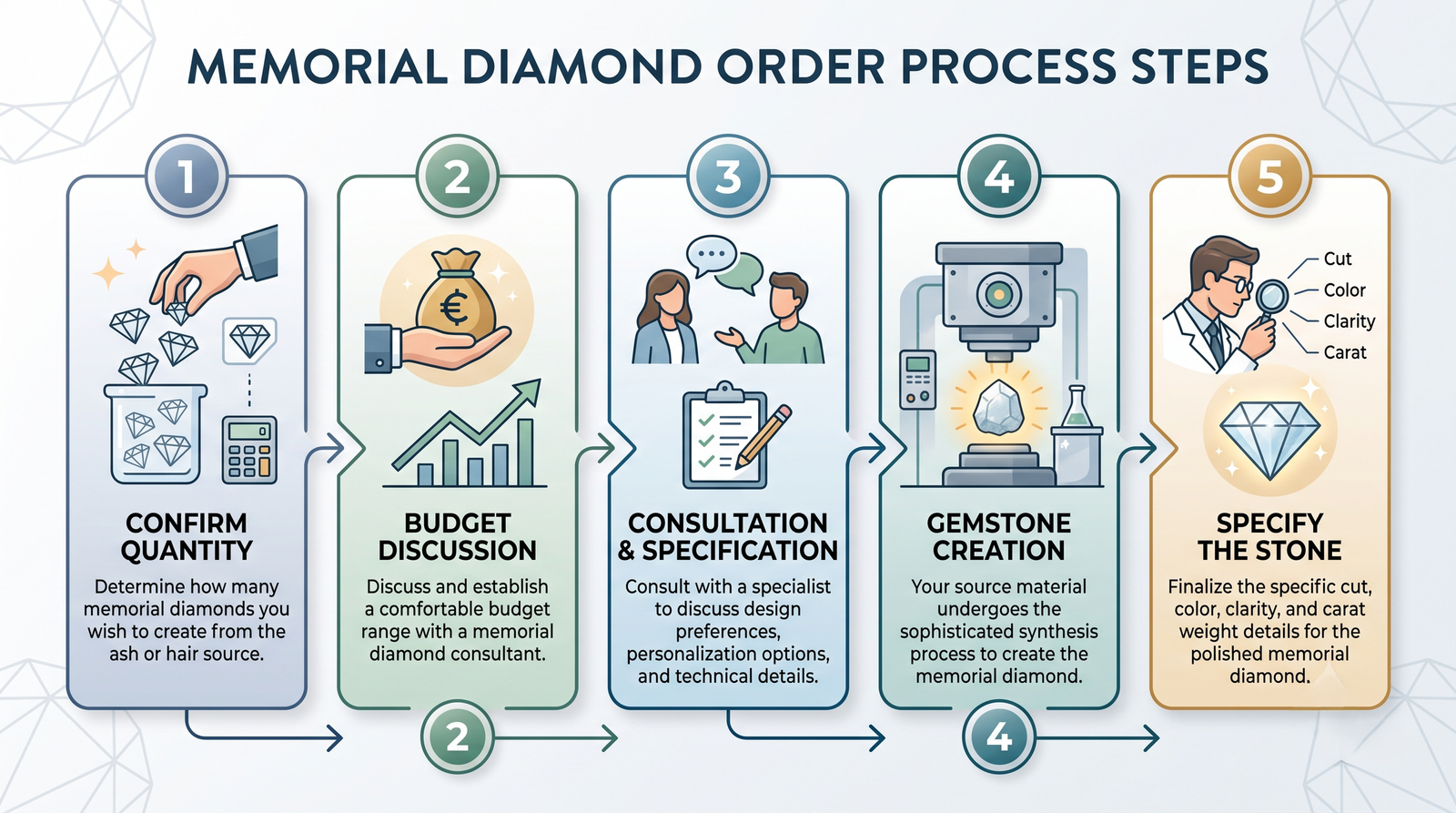
With your starting material identified, the practical order that tends to work best is:
Confirm quantity: ask a provider what their minimum requirement actually is for your material, in a unit you can measure.
Decide budget range: even a rough sense of entry, mid, or large tier narrows the carat conversation considerably.
Ask your questions: before sending anything, get answers about tracking, documentation, and what happens to unused material.
Place the order and specify the stone: carat, color, and cut are chosen at this step, not before.
Decide on setting later: ring, pendant, or otherwise; this doesn’t need to be settled until the stone itself is finished.
Notice that “what will it look like” and “how will I wear it” are deliberately steps four and five, not steps one and two, choosing a memorial diamond for your husband works better in this order than starting from the finished image and working backward.
What Can Wait, and What Genuinely Can’t
Not every decision here is equally time sensitive.
Can wait indefinitely: the setting, the exact carat within a budget range, whether to involve extended family in the decision, whether to also keep an urn.
Worth deciding sooner: whether ashes already interred or scattered can still be recovered (facility dependent, and sometimes time limited), and whether a hair sample you’re relying on is stable and accessible now rather than assumed to still exist later.
Naming which category a given decision falls into often relieves more pressure than the decision itself.
Frequently Asked Questions
Do I need to decide on a setting before placing an order? No. Carat, color, and cut are specified at order time; the setting is typically chosen once the finished stone is in hand.
What if I’m not sure whether I have enough hair or ashes? Ask a provider directly, most can tell you from a rough description or photograph whether what you have is likely sufficient before you commit anything.
Is there a wrong order to do all of this in? The one sequence worth avoiding is deciding on carat, color, and setting before confirming your material actually meets a provider’s requirement, that risks planning around a stone you can’t yet order.
Can I start this process without telling extended family yet? Yes, there’s no requirement to involve anyone beyond whoever holds the ashes or hair and is making the decision.
What if I want to wait a year before deciding anything? That’s a complete, valid choice. Setting a small portion of ashes or hair aside preserves the option indefinitely without committing to anything yet.
Is there a “starter” version of this decision I can make now without committing to the full process? Yes, simply confirming what material you have, and roughly how much, is a low commitment first step that doesn’t obligate you to anything further.
Final Thoughts on Choosing a Memorial Diamond for Your Husband
Choosing a memorial diamond for your husband rarely stalls on the big emotional question, it stalls on not knowing which small practical question to answer first. Start with what you actually have, in your actual house, today. Everything else follows from there, on your own timeline.
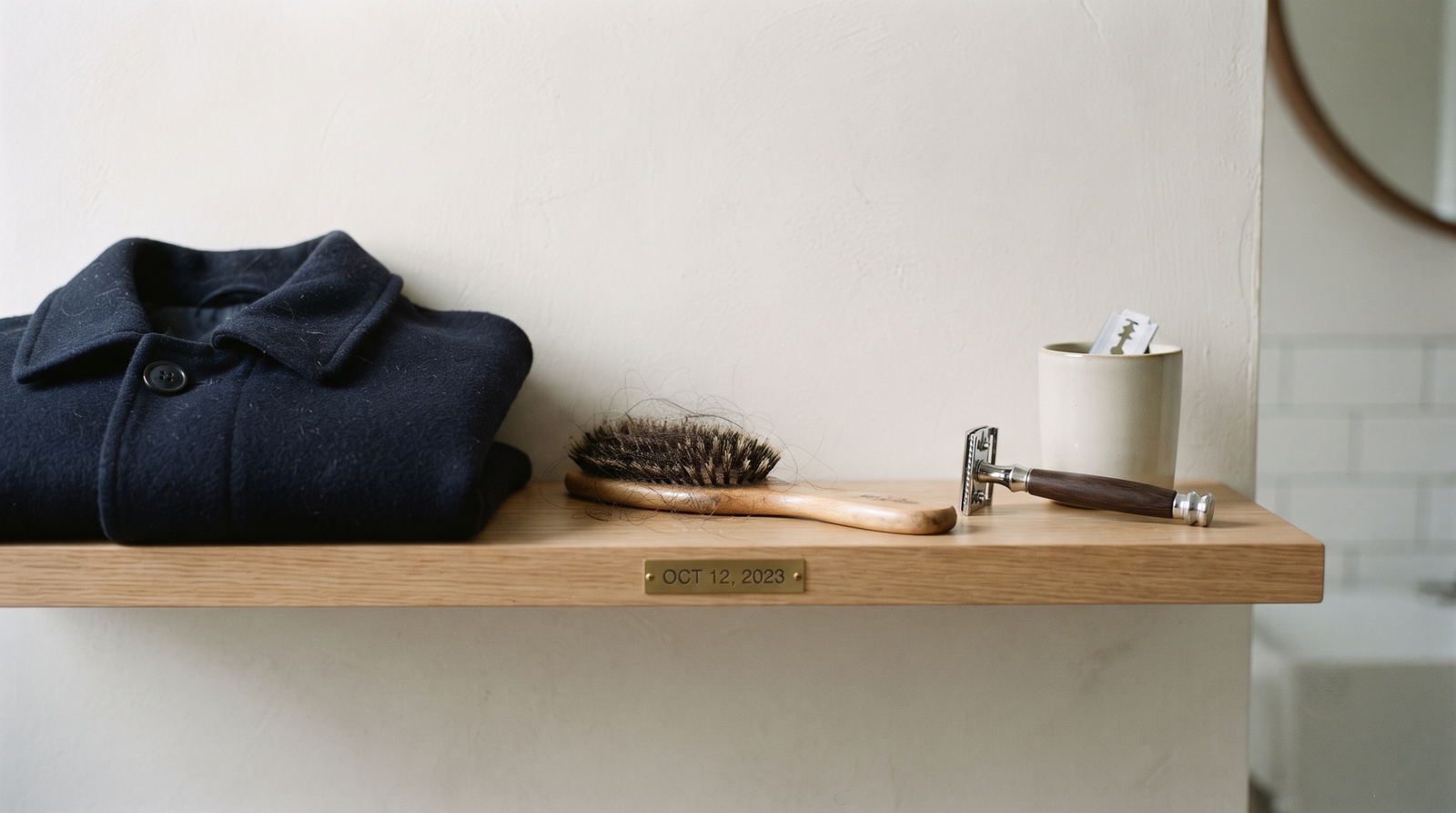
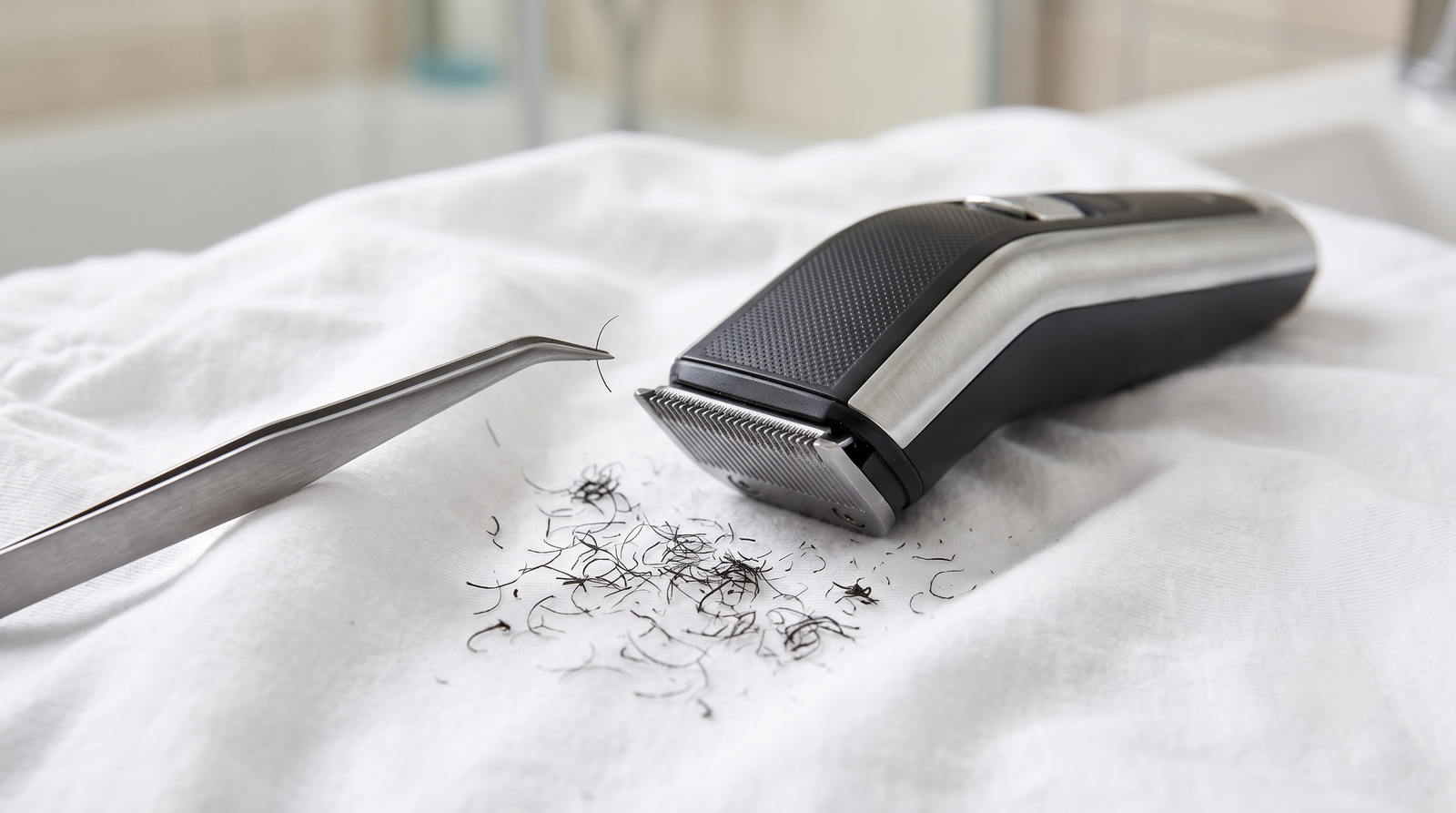
The hair is still in the house, for now. To turn your husband’s hair into a diamond you need only a small lock, a few grams, and no cremation at all; hair is roughly 50% carbon, so a husband’s hair diamond can be grown from far less material than an ashes stone, in the same six to ten months. What makes this version urgent is not the laboratory. It is that the places his hair still exists, the razor, the pillowcase, the collar of the coat by the door, each disappear at an ordinary moment, and those moments usually arrive as someone being kind.
Table of Contents
Why Is Hair Enough on Its Own?
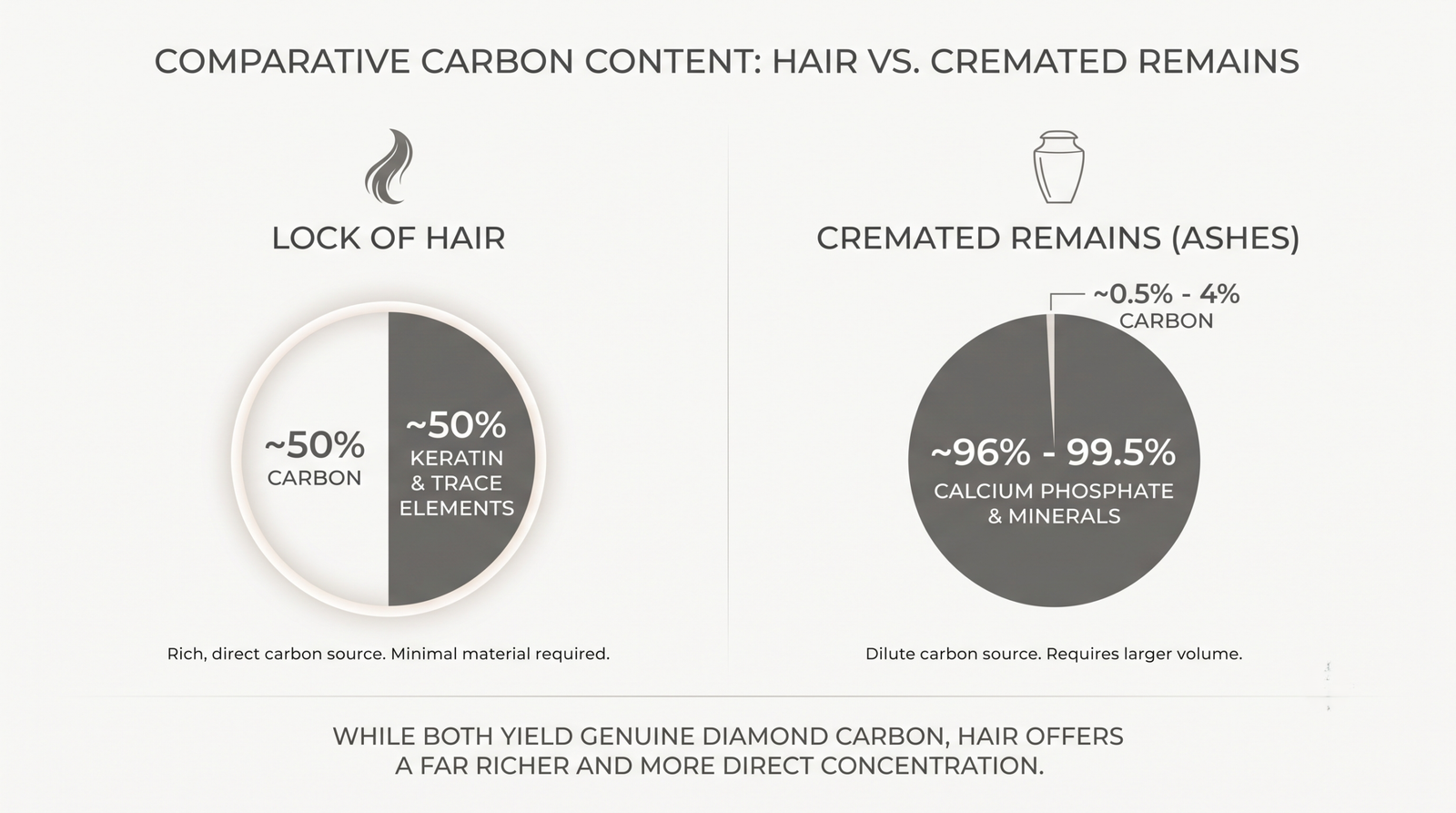
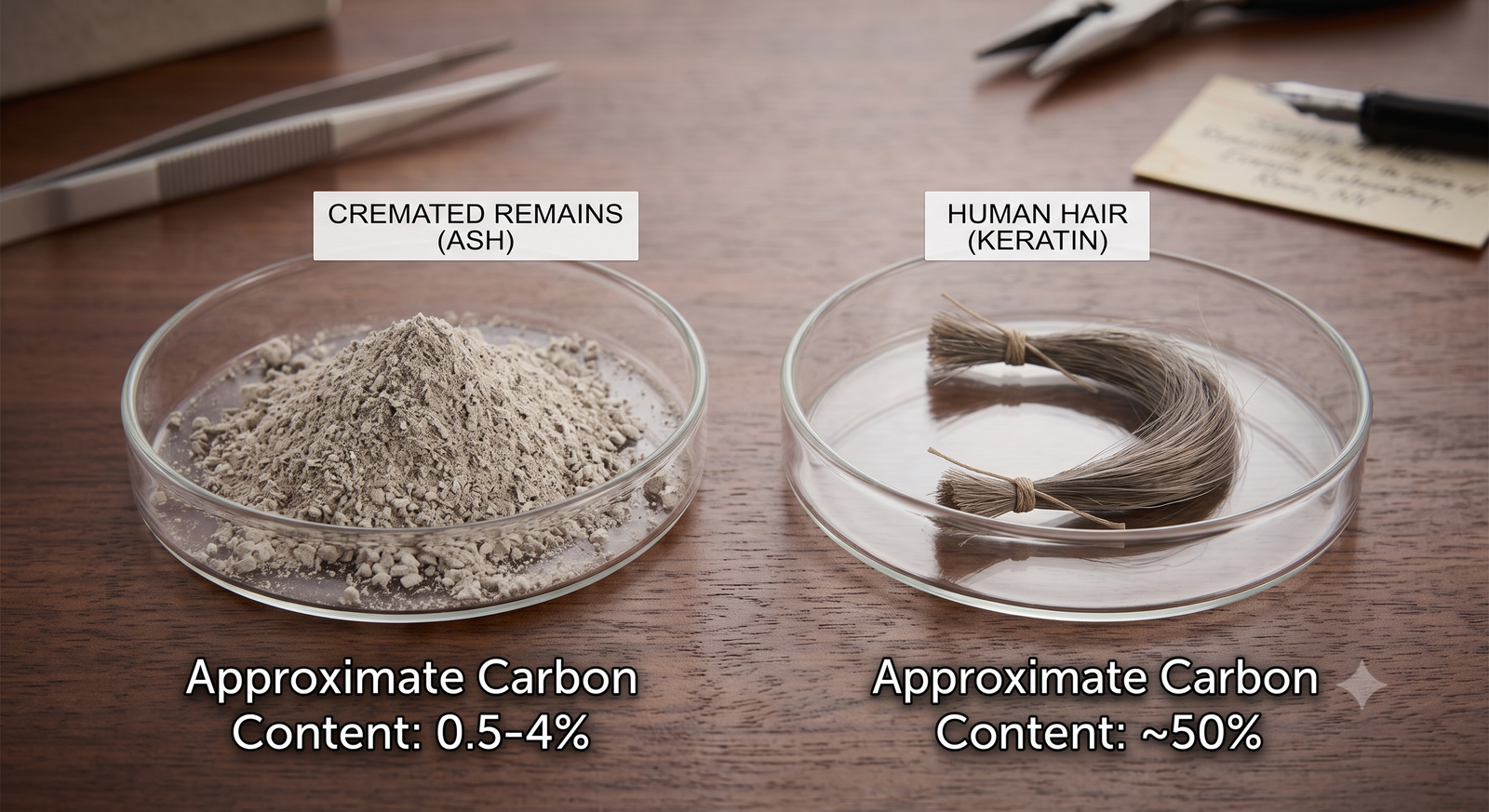
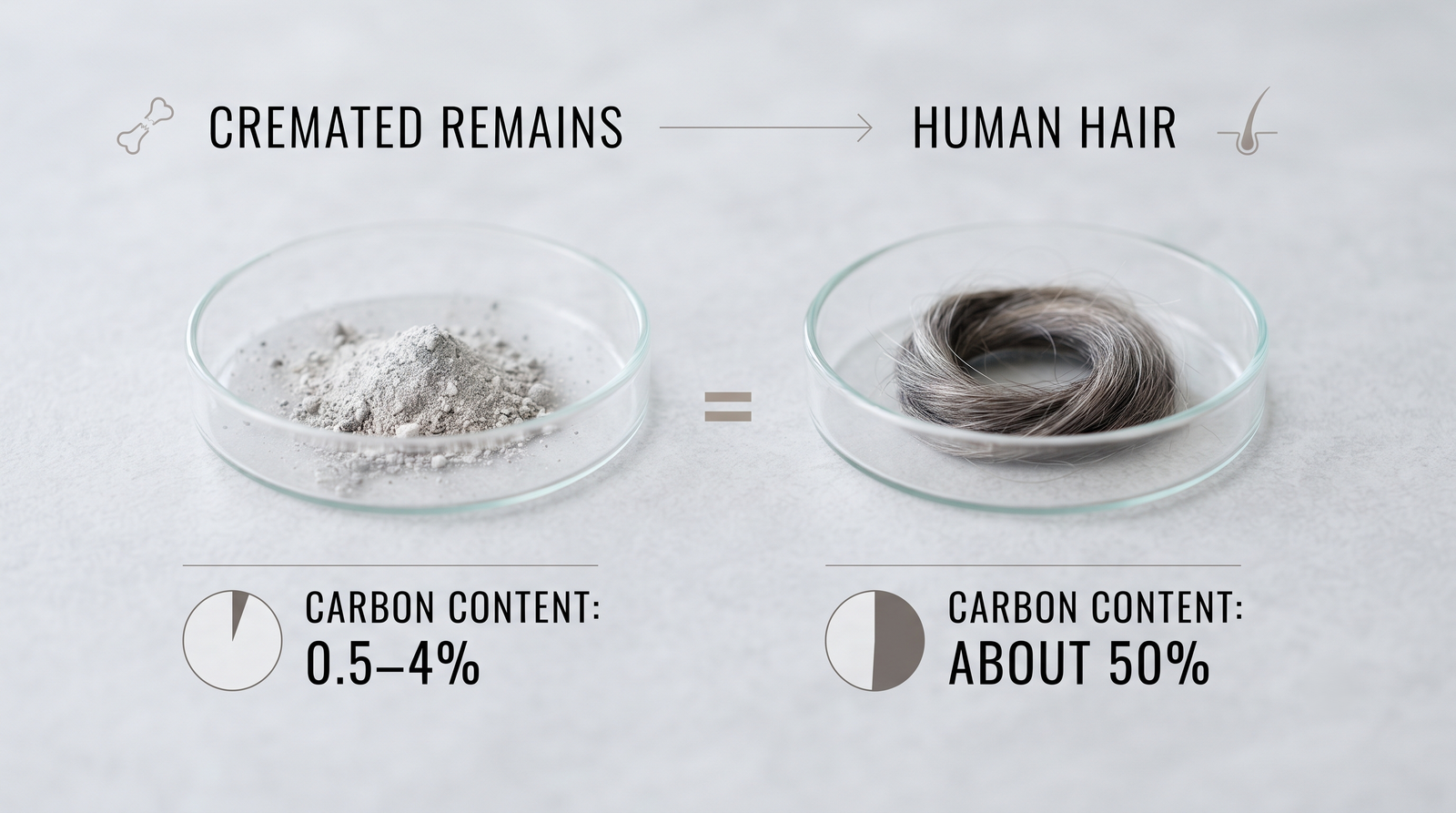
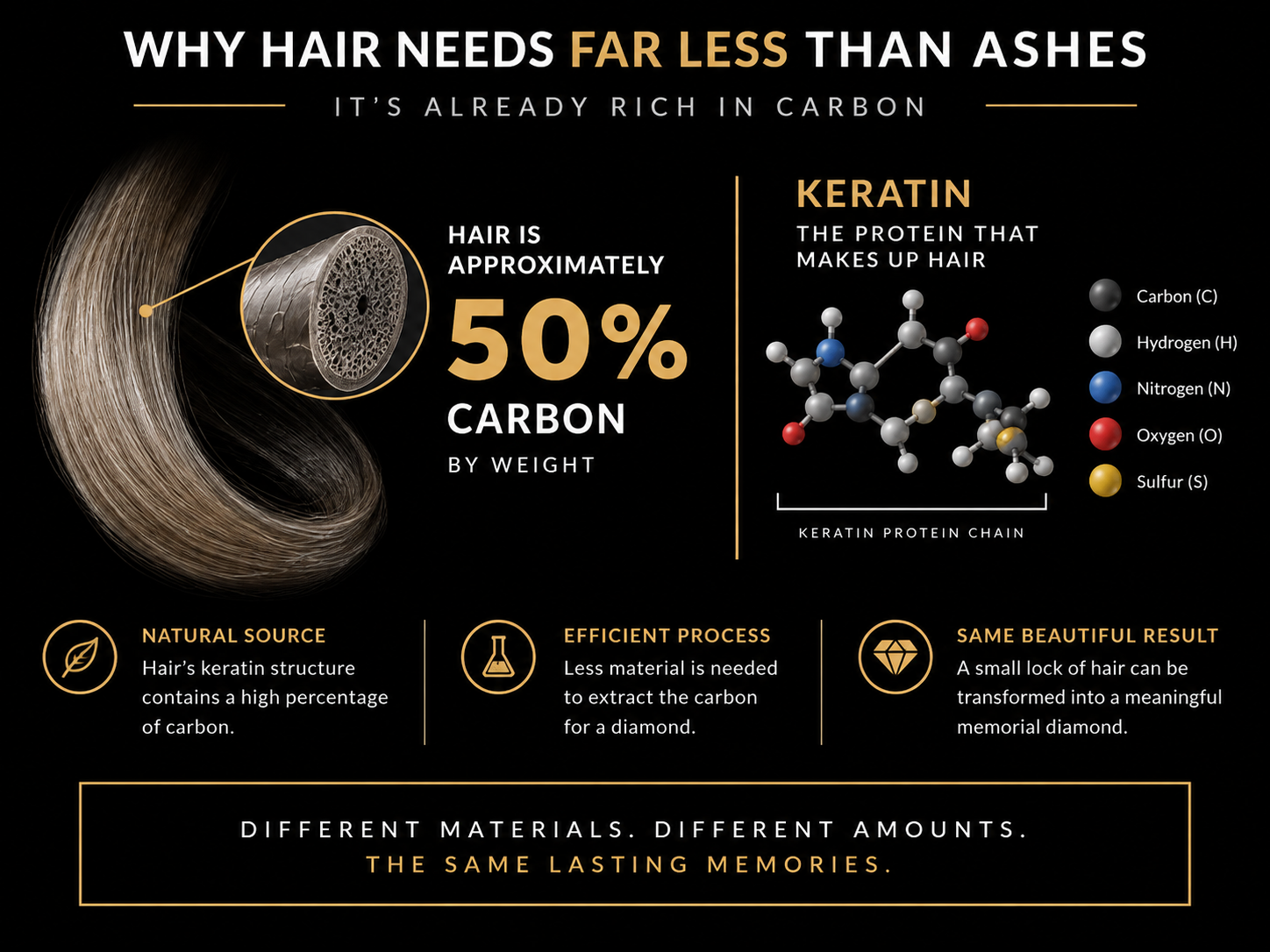
Hair is keratin, a carbon rich protein, and roughly half of its weight is carbon. Cremated remains, by contrast, are mostly calcium phosphate with only about 0.5% to 4% carbon. That is why a husband’s hair diamond needs a lock rather than ounces, and why it is available to families who chose burial, or who scattered his ashes before anyone mentioned this option.
The finished stone is the same object either way: a lab grown diamond, scoring 10 on the Mohs scale as the hardest known natural mineral, graded on the standard 4Cs. Hair only is not the consolation version. For many families it is the only version, and the same diamond.
Step 1: Find Where His Hair Still Is
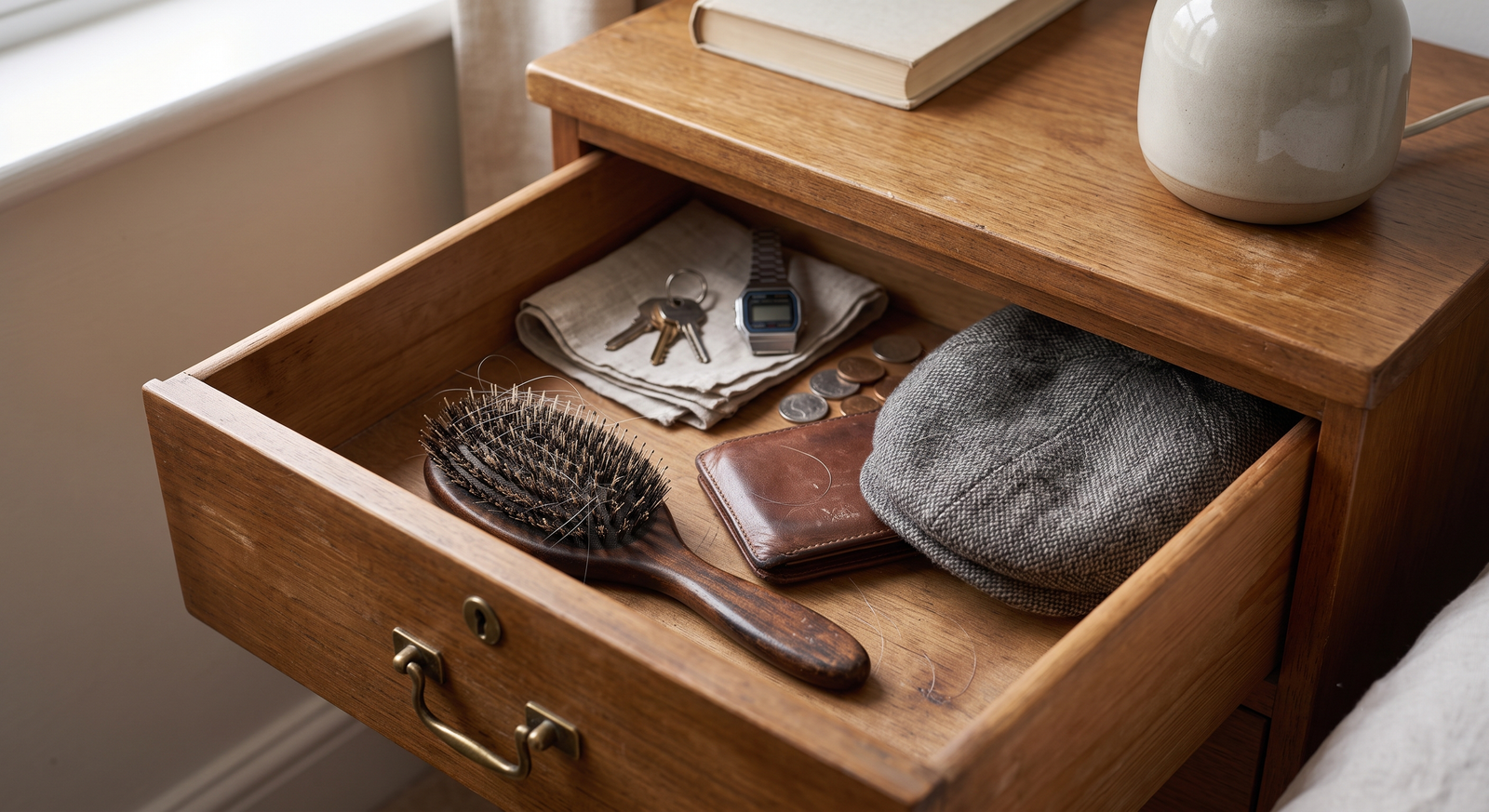
Nobody plans a husband’s hair diamond in advance, and nobody keeps a lock of hair on purpose. It exists by accident, and it is worth listing the places before any of them are tidied.
Where his hair may still be
What usually ends it
How confident you can be it is his
His razor, trimmer, or comb
Being thrown away in a clean out
High, if he was the only one who used it
His pillowcase, if unwashed
The next load of laundry
High if he had his own side; lower on shared bedding
The collar or hood of a coat he wore
The coat being donated or dry cleaned
Moderate; check for other wearers
The car headrest
The car being sold or valeted
Moderate to high
A hat, a helmet, a cap
Storage or donation
High
A hairbrush he used
Being cleaned or discarded
High if it was his alone
A lock cut at the hospital or by the funeral home
Nothing; it is already safe
Certain, if labelled
If more than one person in the house had similar hair, confidence matters more than quantity. The husband hair diamond guide covers the mixed source problem in depth.
Step 2: Collect and Label It Before the House Changes
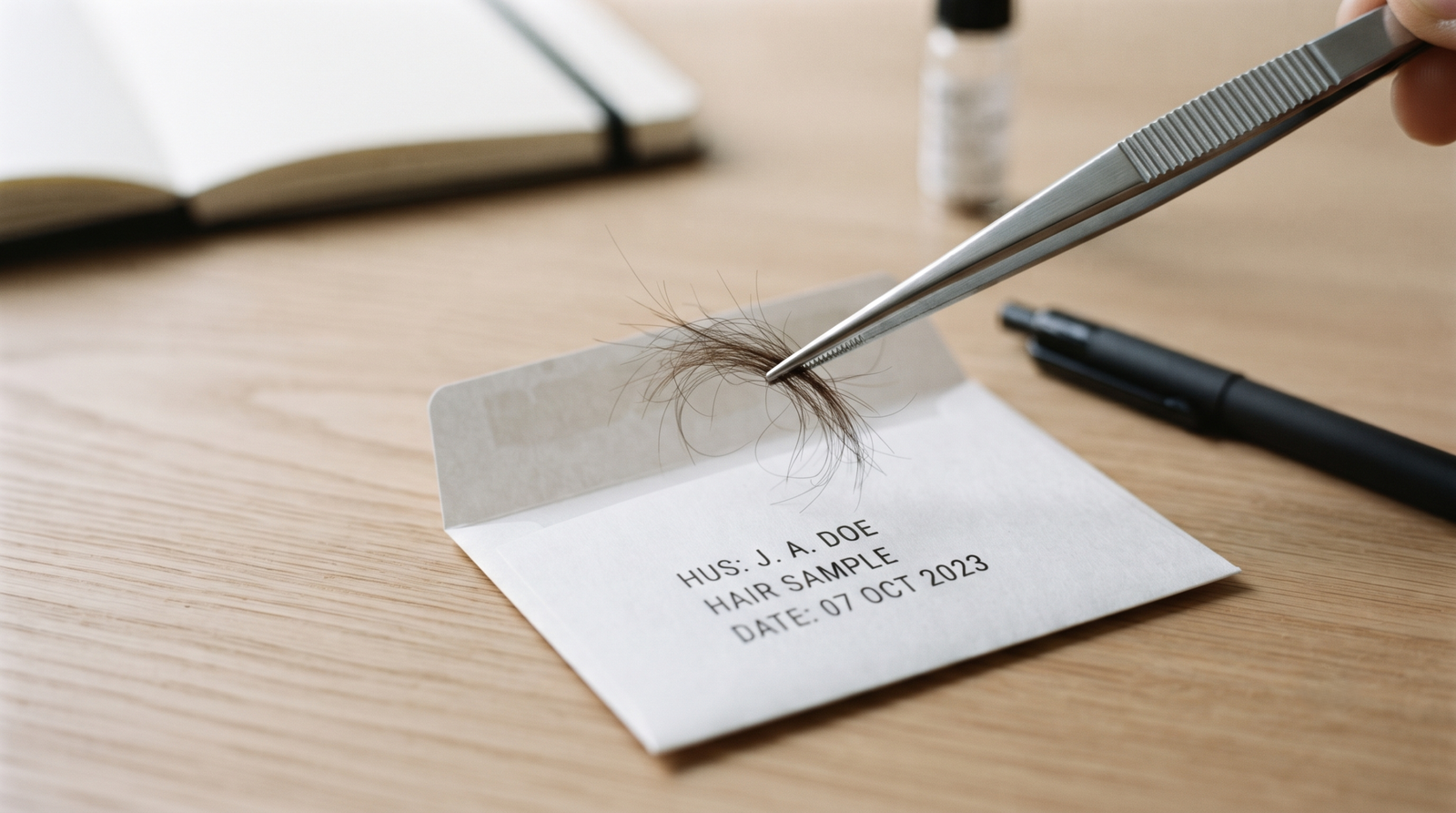
Every husband’s hair diamond begins here. Do this before anyone helps you clean, and before the coat goes to a charity shop. The sequence is short:
Wash and dry your hands; do not wash the hair.
Lift the strands with clean tweezers or fingers, avoiding lint and pet hair where you can.
Place them in a clean paper envelope or a small zip bag. Dry is what matters; hair keeps indefinitely once dry.
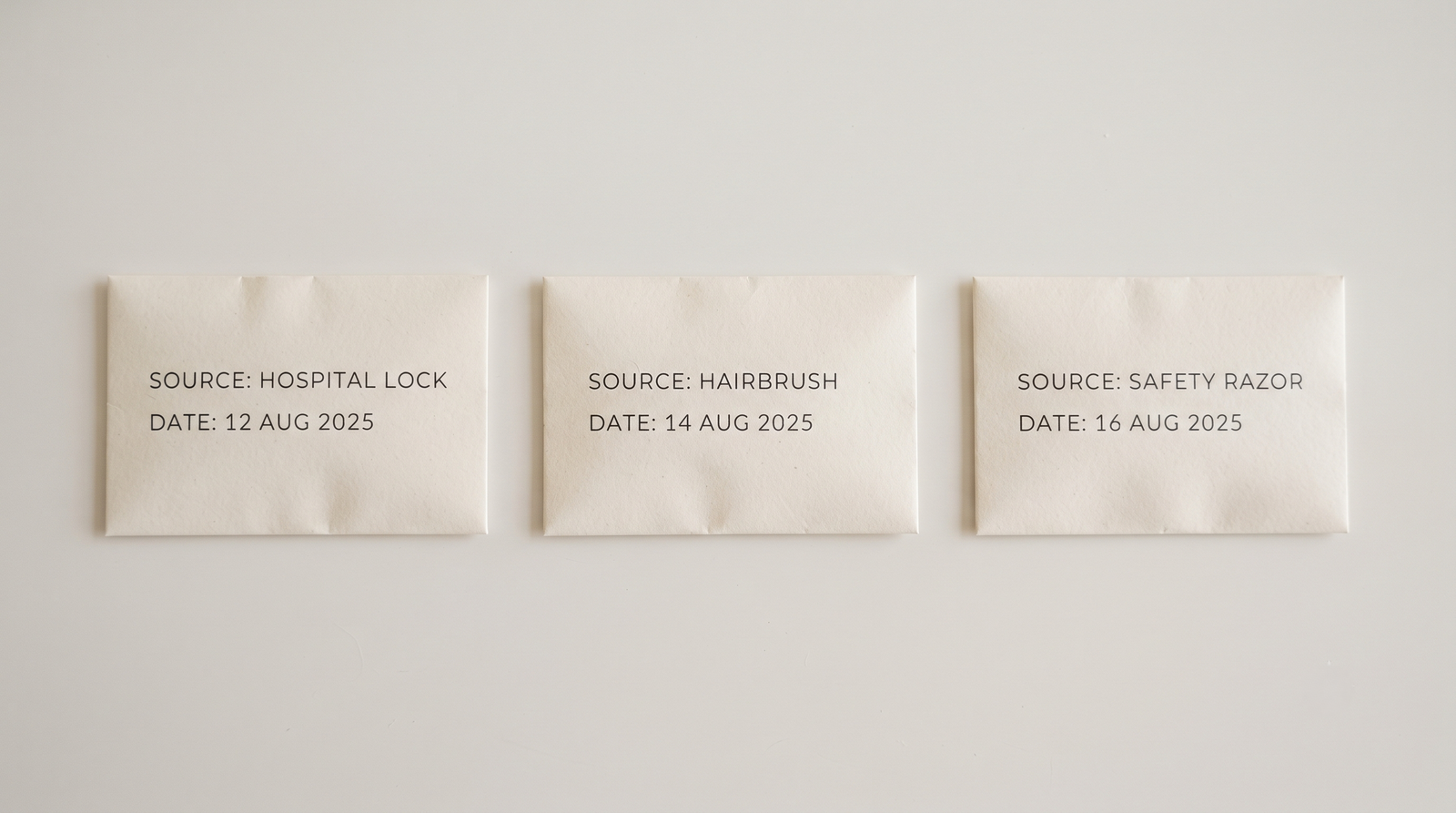
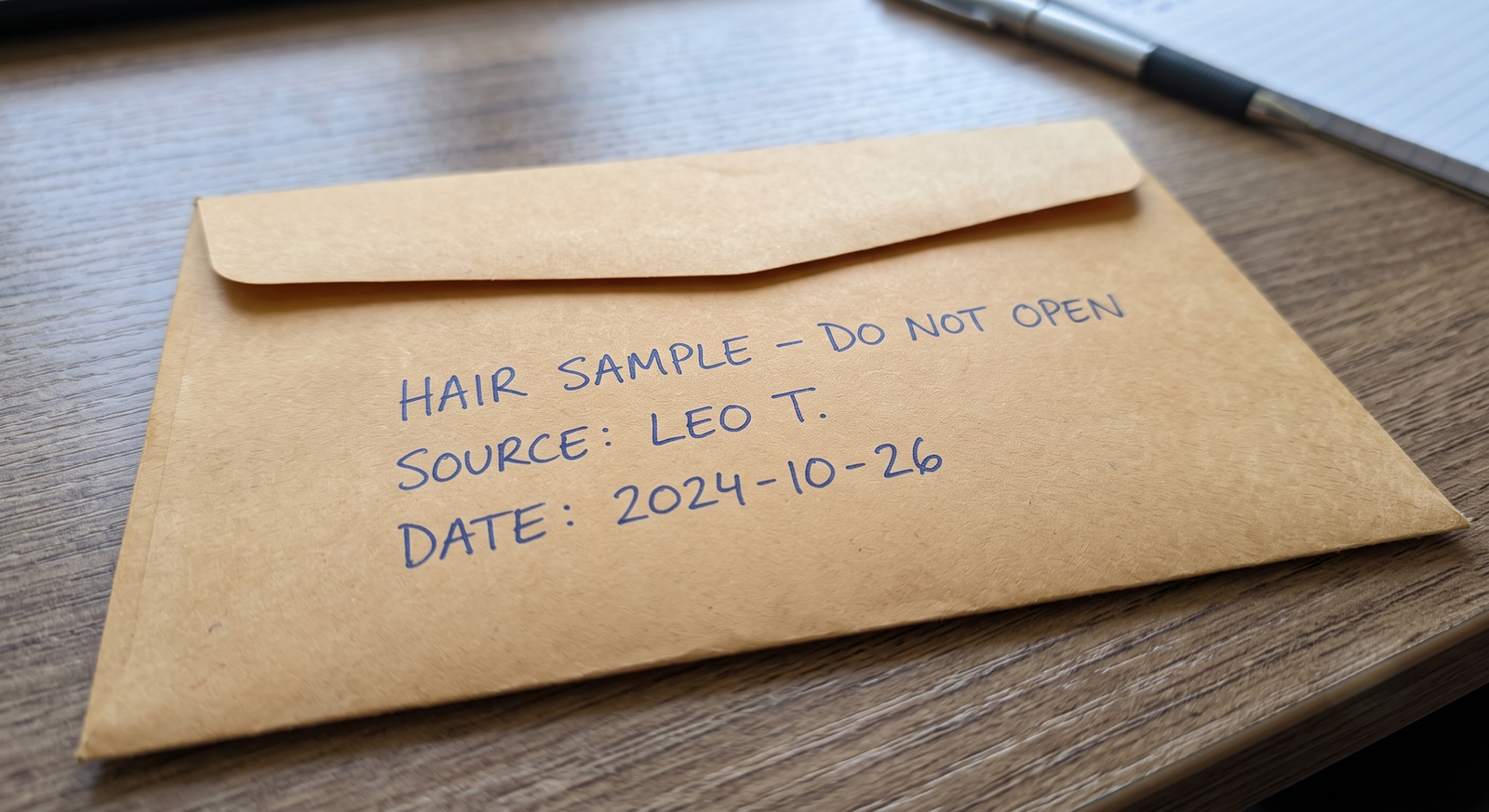
Label it with his name, the date collected, and where it came from.
If you find hair in more than one place, keep each in its own labelled envelope rather than pooling them.
Separate envelopes matter because a husband’s hair diamond provider may ask where the sample came from, and because a strand from a shared brush is a different confidence level from a strand off his own razor. Keeping them apart preserves that.
Step 3: Ask a Provider Whether the Sample Is Enough
Industry typical minimums for a husband’s hair diamond are described as a small lock, palm sized, or a few grams. What you have may be a few strands. Before committing, ask the provider whether they will assess a photograph and a weight, whether hair from several locations can be pooled, and whether your sample is enough to be meaningfully present in the stone or only recorded.
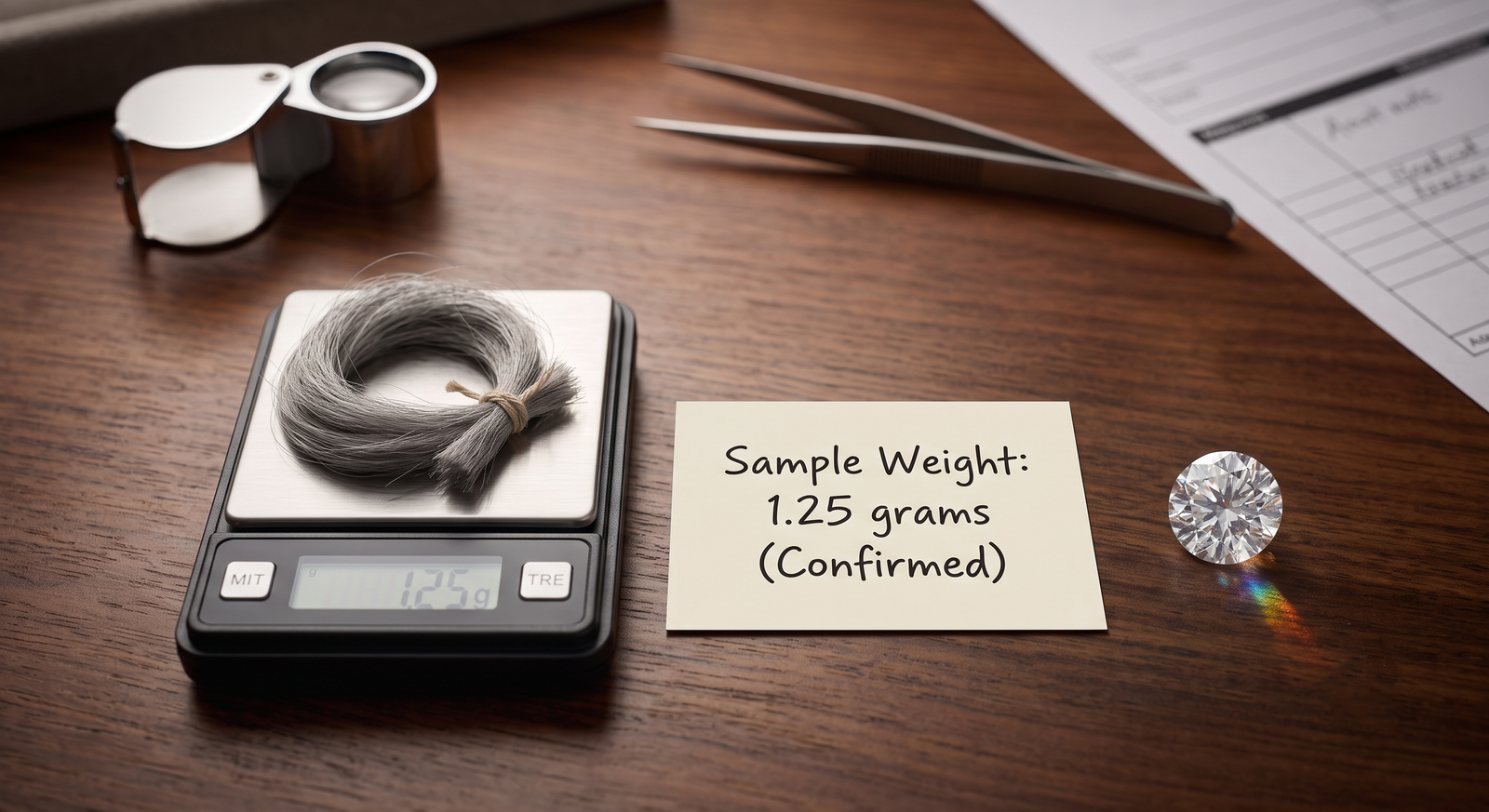
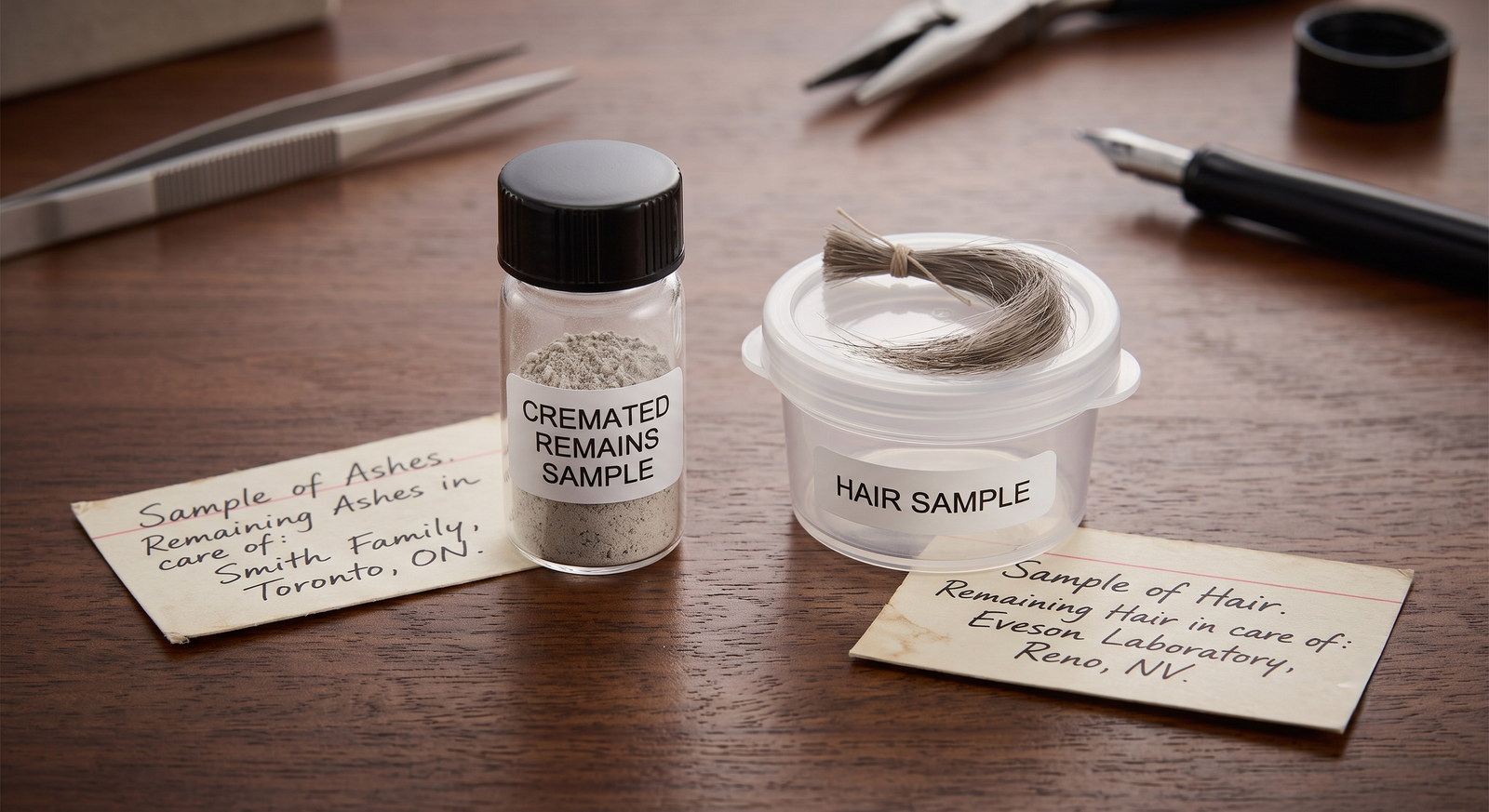
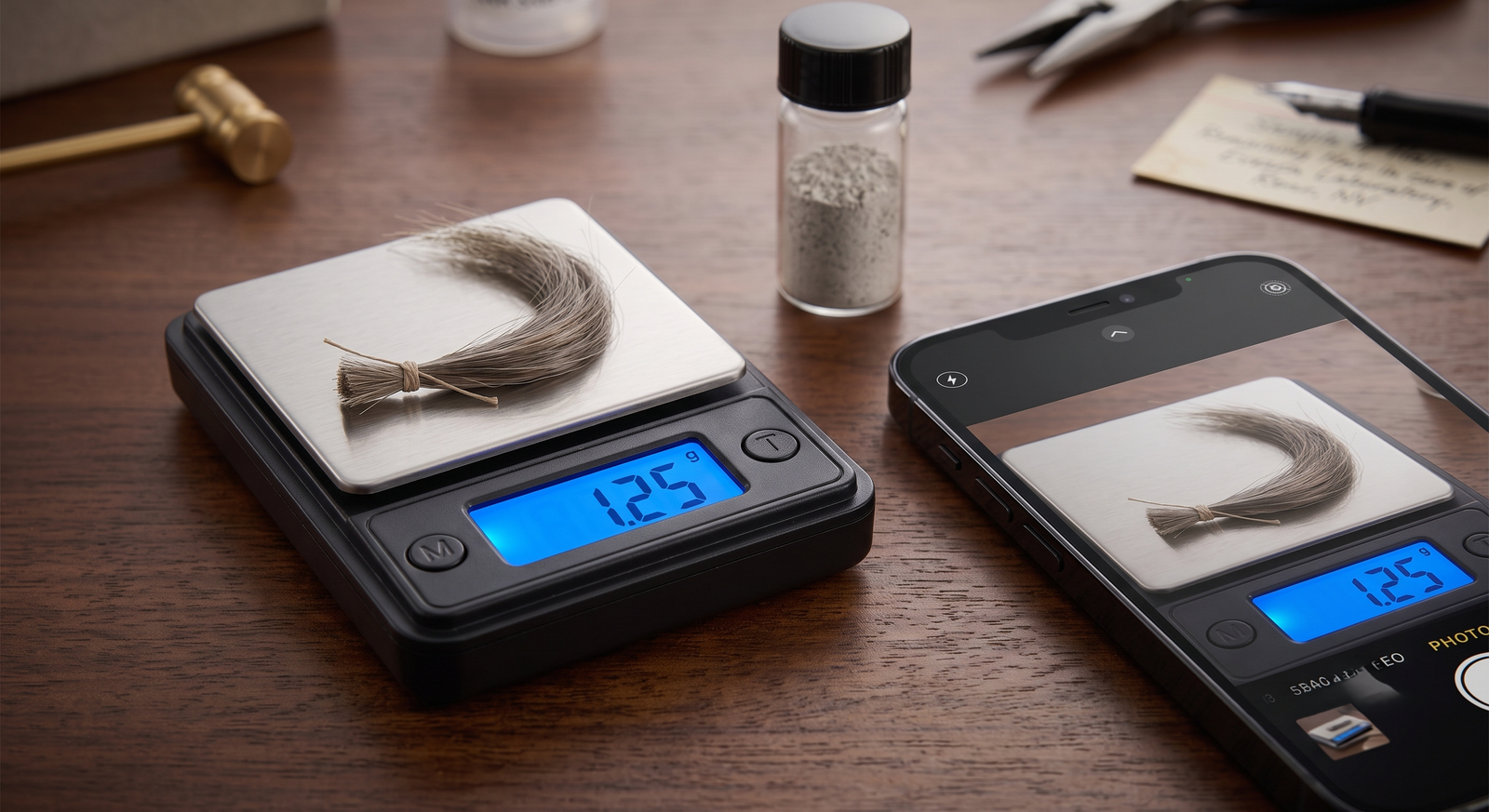
Hair for a husband’s hair diamond is not a regulated shipment the way cremated remains are, so the safeguards are yours to build. Photograph the labelled envelope before it goes. Note the weight if you have a scale that reads to a tenth of a gram. Ask the provider to confirm receipt and the weight they recorded. Keep those three things together with the order confirmation; they are the start of the origin record a husband’s hair diamond will carry for the rest of its life.
Ask, too, what happens to hair not consumed by extraction. Some providers return it; others do not. If you sent the only lock you had, the answer matters.
Step 5: What the Lab Does Over the Next Six to Ten Months
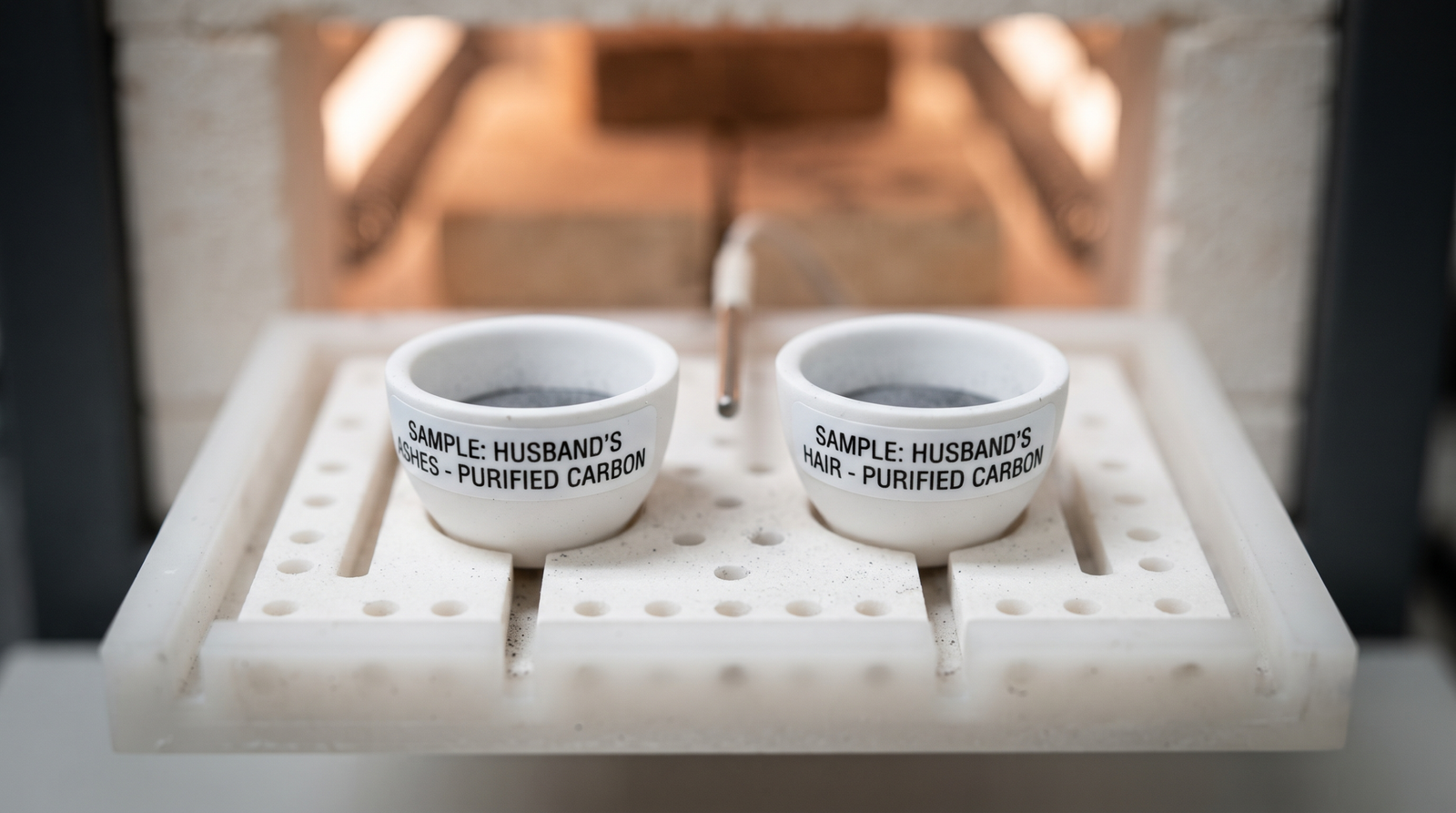
For a husband’s hair diamond, the hair is heated in a controlled, oxygen free, multi stage process that strips away the non carbon components of keratin, leaving carbon at roughly 99.9% purity. That carbon is converted to graphite at around 2,500 to 2,700°C, blended with laboratory carbon to reach a growable volume, and grown around a diamond seed by HPHT or CVD diamond growth over weeks to months. A gemologist cuts and polishes the rough crystal, and reputable providers have it graded independently.
Because hair yields so much carbon, the personal share of a husband’s hair diamond is limited by stone size rather than by your sample. Industry wide, personal carbon typically makes up around 10% to 15% of the finished stone. The stage by stage version is in how a memorial diamond is made from your husband’s hair.
What Will a Husband’s Hair Diamond Look Like?
Not like his hair, and not a lesser stone than one from ashes; the ashes route is in how to turn your husband’s ashes into a diamond. Color is set by trace elements during growth, not by whether he was gray or dark: nitrogen tends toward yellow, boron toward blue, and excluding both for a colorless stone costs more.
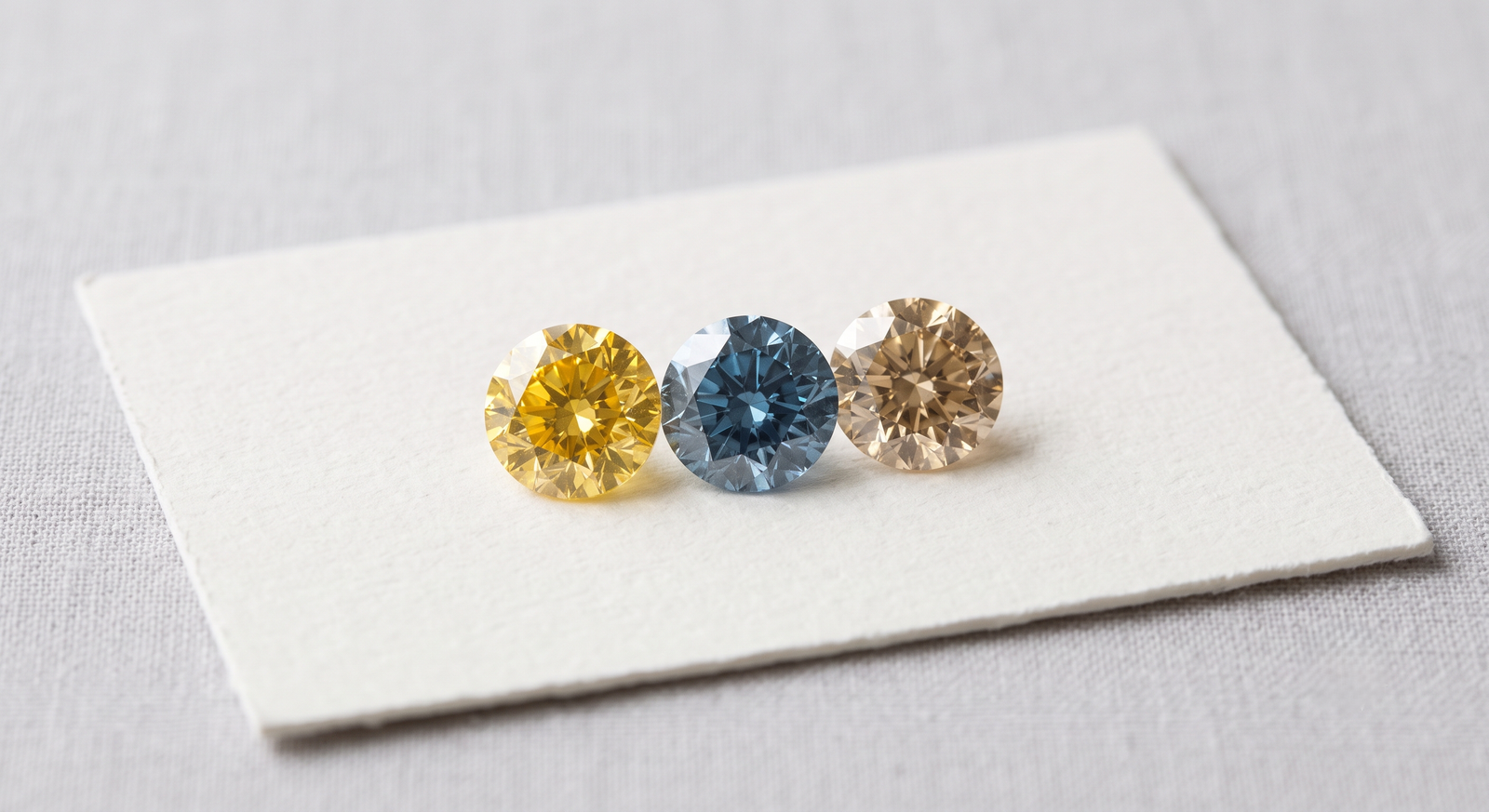
Most memorial diamonds land in yellow, champagne, or blue. The size of a husband’s hair diamond is your choice, from about 0.10 carats upward, and it sets both the price and how long the stone spends in the press. Industry pricing for a husband’s hair diamond runs from roughly $1,500 to $3,500 at entry size to $5,000 to $15,000 for half a carat to a carat, before settings and grading.
Frequently Asked Questions
How much hair do I need for a husband’s hair diamond?
Industry typical minimums are a small lock, often described as palm sized or a few grams. Because hair is roughly 50% carbon, far less is needed than for ashes. If you have only strands, ask the provider to assess a photograph and weight before you order.
Can I use hair from his brush or razor?
Often, yes, if you are confident it is his. Providers usually accept strands from combs, razors, hats, or pillowcases. Keep each source in its own labelled envelope, and ask whether the provider will pool hair from several locations into one sample.
Does the hair have to be fresh, or with the root?
No. Hair stored dry keeps its carbon indefinitely, so a lock from years ago works. Roots are not required; the process extracts carbon from the whole strand, not from DNA. Dry, clean, and labelled is what matters.
Do I need to have cremated him for a hair diamond?
No. A husband’s hair diamond needs no cremation at all, which makes it available to families who chose burial or who scattered his ashes. Hair only is the same lab grown diamond as an ashes stone, not a lesser version.
Will a husband’s hair diamond be the color of his hair?
No. Diamond color comes from trace elements such as nitrogen or boron during growth, not from the hair’s pigment. Most memorial diamonds trend yellow, champagne, or blue; colorless is possible with extra processing at higher cost.
Can more than one diamond be made from one lock of hair?
Sometimes. Because only a portion of the carbon is needed per husband’s hair diamond, a generous lock can support more than one diamond. If you hold very little, one stone is the realistic outcome; ask the provider before assuming a second is possible.
Final Thoughts on Turning Your Husband’s Hair Into a Diamond
Every other step in a husband’s hair diamond can be taken slowly. The first one cannot. Before the laundry, before the car is sold, before someone who loves you tidies the bathroom, put what you find in a labelled envelope. Then take all the time you need.
If what you have is a few strands from a brush and you are not sure it is enough, reach out to Memorial Diamond to talk through what a husband’s hair diamond is possible with what you found.
The question under this question is usually whether hair counts. So: yes, a memorial diamond really made from your husband’s hair is a genuine lab grown diamond grown from carbon extracted from the lock itself, and it is not the consolation version of an ashes stone. Hair is roughly 50% carbon by weight; cremated remains are roughly 0.5% to 4%. A diamond really made from a few grams of his hair is the same object, made by the same process, as one made from four ounces of ashes, and for a family who chose burial it is the only version.
Table of Contents
Is a Diamond Really Made From Hair the Same as One From Ashes?
From his hair
From his ashes
Carbon in the source
Roughly 50%
Roughly 0.5% to 4%
Material needed
A small lock, a few grams
A few tablespoons to ~4 oz
Cremation required
No
Yes
Growth method
HPHT or CVD, identical
HPHT or CVD, identical
Personal carbon in the stone
Typically around 10% to 15%
Typically around 10% to 15%
Finished object
A lab grown diamond, graded on the 4Cs
A lab grown diamond, graded on the 4Cs
For a diamond really made from hair, the extraction is, if anything, the less doubtful part. Keratin is carbon rich, so a laboratory can purify a small lock to about 99.9% carbon, convert it to graphite, and grow a crystal by standard HPHT or CVD diamond growth. The full sequence, stage by stage, is in how a memorial diamond is made from your husband’s hair.
Where the Doubt Actually Sits: Provenance, Not Extraction
With a diamond really made from ashes, the doubt is about quantity and dilution. With hair, it is about identity: was this lock actually his? Hair from a shared brush, a shared pillow, or a coat two people wore carries less certainty than a lock cut at the hospital or taken from a razor only he used. A diamond really made from his hair is only as certain as the sample you sent.
Before sending a lock, ask the provider about the minimum amount required. Ask whether the provider wants a specific type of hair. Ask how the provider labels the material when it arrives. Ask whether the provider photographs or weighs the sample during intake.
You can also ask how the provider documents the source material during processing. Ask what records you receive during the process and what documentation accompanies the finished diamond. These questions can help you understand the chain of custody from the original envelope to the completed stone.
What the Lock Has to Be, and What It Does Not
Has to be: his, dry, and enough for the provider’s minimum, which is typically a small lock or a few grams.
Does not have to be: fresh, with roots, a particular color, or from a particular part of the body. Hair stored dry keeps its carbon indefinitely, and pigment does not affect the stone’s color.
Will not survive into the stone: DNA, texture, or hair color. Purification removes everything but carbon; the diamond’s color comes from trace elements during growth, and most memorial stones trend yellow, champagne, or blue.
What Makes a Hair Based Memorial Diamond Different?
The most important difference is that hair does not require cremation. This makes a hair based memorial diamond relevant to families whose loved one was buried. It also helps families who no longer have access to ashes but preserved a lock of hair.
Another difference is carbon concentration. Hair is roughly 50% carbon by weight, while cremated remains contain roughly 0.5% to 4% carbon. This explains why the amount of source material can differ significantly between hair and ashes.
That difference does not mean that a hair based diamond is a lesser diamond. The finished object is still a lab grown diamond. The growth method remains HPHT or CVD, and the finished stone can receive the same type of diamond grading based on its physical characteristics.
The personal meaning can also differ. Some families want a stone associated specifically with hair because the hair was preserved during life. Others may have ashes available and choose those as the source. Some families may choose a combination. There is no single source that carries the same meaning for every family.
Can hair from a shared brush be used?
It may be possible to process the material, but the personal certainty becomes more complicated because the brush may contain hair from more than one person. If identity matters to you, tell the provider exactly where the hair came from and keep different sources separated.
Frequently Asked Questions
Is a diamond really made from hair a real diamond?
Yes. Carbon extracted from the hair is purified, converted to graphite, and grown into a diamond crystal by HPHT or CVD, the same methods used across the lab grown industry. It has the same hardness and structure as any diamond and is graded on the same 4Cs.
How can a few grams of hair be enough when ashes need ounces?
Because hair is roughly 50% carbon by weight and cremated remains are only about 0.5% to 4%. A small lock yields far more usable carbon than the same weight of ashes, so industry typical minimums for hair are a palm sized lock or a few grams.
Does the diamond contain his DNA?
No. Purification removes every element except carbon, and DNA does not survive the process. What connects the stone to him is his carbon in the crystal and the chain of custody record from your labelled envelope to the origin document.
What if I am not sure the hair is his?
Then a diamond really made from that hair is only as certain as that doubt allows, not by the chemistry. Hair from a razor, hat, or brush only he used is high confidence; shared bedding or a shared brush is lower. Keep sources in separate labelled envelopes and tell the provider where each came from.
Does he need to have been cremated?
No. A memorial diamond from hair involves no cremation at any stage, which is why it is the route for families who chose burial or scattered his ashes before hearing of this option. It is the same finished diamond, not a substitute.
Final Thoughts on Whether a Memorial Diamond Is Really Made From Your Husband’s Hair
Hair only is not the lesser route. A diamond really made from his hair is grown by the same process, to the same standard, from a source that is far richer in carbon than ashes. What you are being asked to trust is not the chemistry but the envelope, and that part is in your hands.
If what you have is a lock from a hairbrush and you are unsure it is enough, or enough his, reach out to Memorial Diamond to talk through what’s possible with what you kept.
One of these materials has already been through fire. The other has never been warmer than his own body. An ashes hair diamond made from your husband’s cremated remains and a lock of his hair is a single lab grown diamond, grown over roughly six to ten months from carbon purified separately out of each material, then combined at the graphite stage and grown around a seed crystal. Nearly every practical difference between the two halves of the process follows from that thermal history, and the point of no return sits exactly where you might not expect.
Table of Contents
Two Thermal Histories, One Ashes Hair Crystal
Cremation has already burned away nearly all the carbon in his remains. What is left is mostly calcium phosphate, the mineral of bone, with usable carbon at roughly 0.5% to 4% by weight. His hair, by contrast, has never been heated: it is intact keratin, roughly 50% carbon, with the sulfur, nitrogen, and oxygen his body bonded around that carbon still in place.
So the ashes arrive carbon poor and mineral rich; the hair arrives carbon rich and organic. That is the ashes hair difference in one line. An ashes hair diamond has to treat them differently right up to the moment the two purified carbons are identical, and that moment comes later than most families assume.
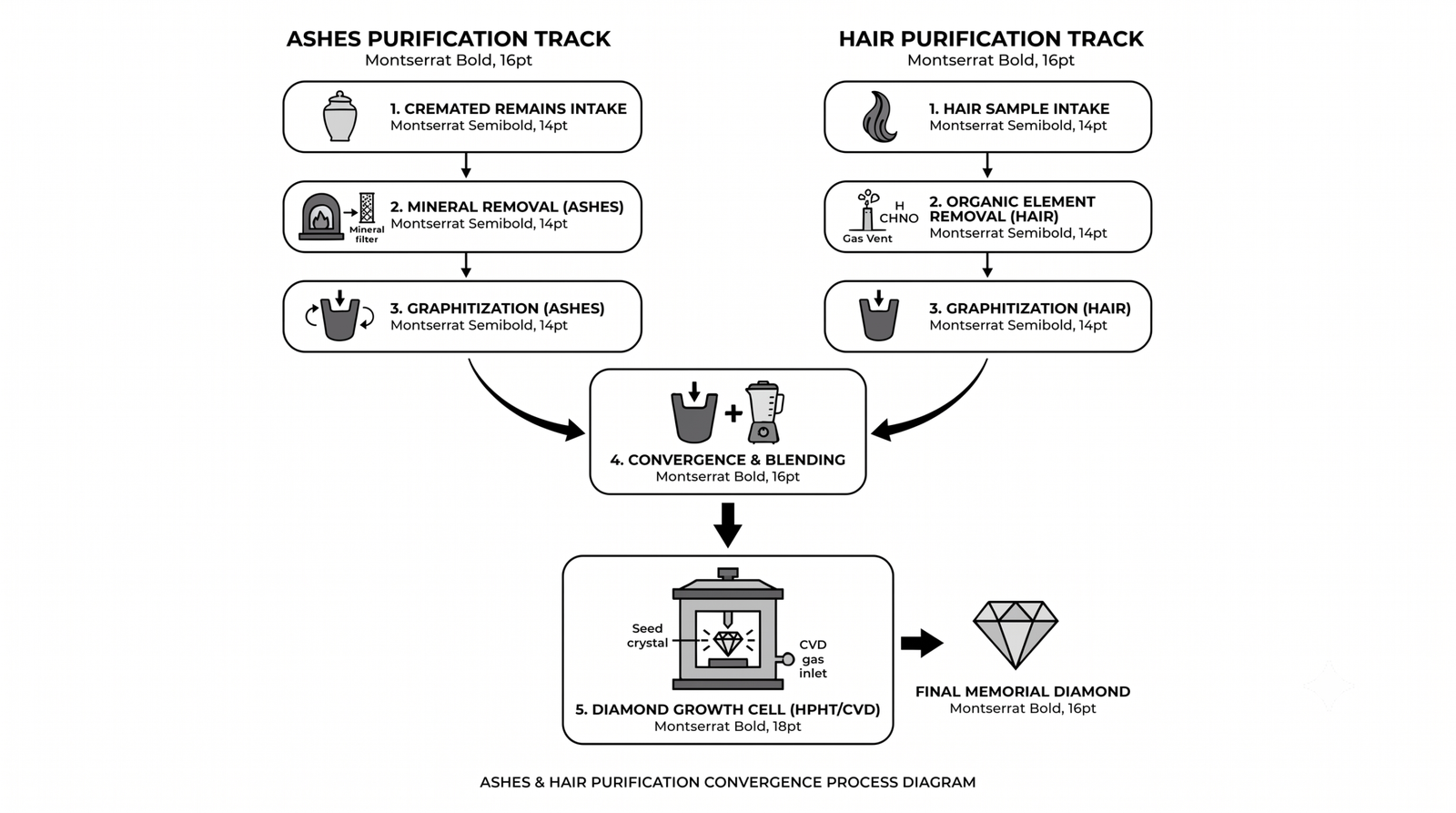
The Two Track Process, Stage by Stage
Number
Stage
Ashes track
Hair track
Same or separate?
1
Division and collection
A few tablespoons to approximately 4 oz set aside
A small lock, a few grams, kept dry
Separate; two records
2
Shipment and intake
Handled as cremated remains
Handled as an ordinary sample
Separate; two intake weights
3
Carbon purification
Minerals removed in an oxygen free furnace
Keratin’s non carbon elements driven off
Separate tracks, separate yields
4
Graphitization
Purified carbon converted to graphite
Purified carbon converted to graphite
Still separate; now indistinguishable
5
Blending and growth
Combined with hair carbon and laboratory carbon
Combined with ash carbon and laboratory carbon
One growth cell, one crystal
6
Cutting and grading
One stone
One stone
One grading report, one origin document naming both
Stages 1 and 2: Intake, and Why Two Records Matter
Because the ashes hair pairing arrives with two different histories, they should arrive with different paperwork. Ask whether the provider keeps two intake records for a combined order, each with its own recorded weight, and whether the origin document at the end names both sources. If the answer to either is no, the hair you chose with such care is present in the stone but absent from its record.
The two halves of an ashes hair order travel differently: cremated remains are typically shipped under carrier rules that hair is not, so confirm the provider’s current instructions for each on the day rather than assuming one package covers both. Whichever travels first, send the hair with the greater care; it cannot be re cut.
Stage 3: Two Purification Tracks
Both halves of an ashes hair diamond go through a controlled, oxygen free, multi stage heating process, but the process is removing different things from each. From the ashes it strips calcium phosphate and other minerals. From the hair it drives off the nitrogen, oxygen, sulfur, and hydrogen of keratin. Both tracks end at carbon of roughly 99.9% purity.
Ask, before ordering, whether you will be told at this point or whether the shortfall is quietly covered by laboratory carbon in the next stage. What happens to the mineral residue from the ashes, and to any hair not consumed, are separate questions and worth asking separately.
Stage 4: Graphitization, the Real Point of No Return
Most guides to an ashes hair diamond place the point of no return at blending. It sits one stage earlier. Each purified carbon is heated to roughly 2,500 to 2,700°C, hotter than the growth run itself, and converted to graphite, the layered crystalline form a diamond press uses as feedstock. After this stage, the carbon from his ashes and the carbon from his hair are physically identical: two portions of graphite, distinguishable only by the label on each crucible.
Blending in Stage 5 merely combines two things that are already the same. Graphitization is where they became the same. If a family wants the option of two separate stones instead of one ashes hair diamond, the decision has to be made before Stage 4, not before Stage 5. The alternatives are set out in the husband ashes and hair diamond guide.
Stage 5: Blending and Growth
The two graphites of an ashes hair diamond are combined, supplemented with laboratory carbon to reach the volume a viable crystal needs, and placed with a tiny diamond seed in a growth cell. Most memorial providers grow by HPHT, a press recreating roughly 6 to 8 GPa and 1,400 to 2,500°C; a minority convert the carbon to gas for CVD. Both are the standard HPHT and CVD diamond growth methods. Growth takes weeks to months, and growth time, not the quantity of either ashes hair material, sets the carat.
The proportion is the same for an ashes hair diamond as for any memorial stone: personal carbon typically makes up around 10 to 15% of the finished crystal, with the balance laboratory carbon. What the combined route changes is not the share that is him, but the record of which parts of him it came from.
Stage 6: Cutting, Grading, and One Document Naming Both
A gemologist cuts and polishes the rough crystal. Reputable providers then have it graded by an independent laboratory on the same cut, color, clarity, and carat scale as any diamond; memorial stones typically fall between SI2 and VVS for clarity. Color is set by trace elements during growth, not by which material the carbon came from, so an ashes hair diamond trends toward yellow, champagne, or blue like any other, and combining materials does not blend two colors. The options are covered in what color diamond can be made from your husband’s ashes and hair.
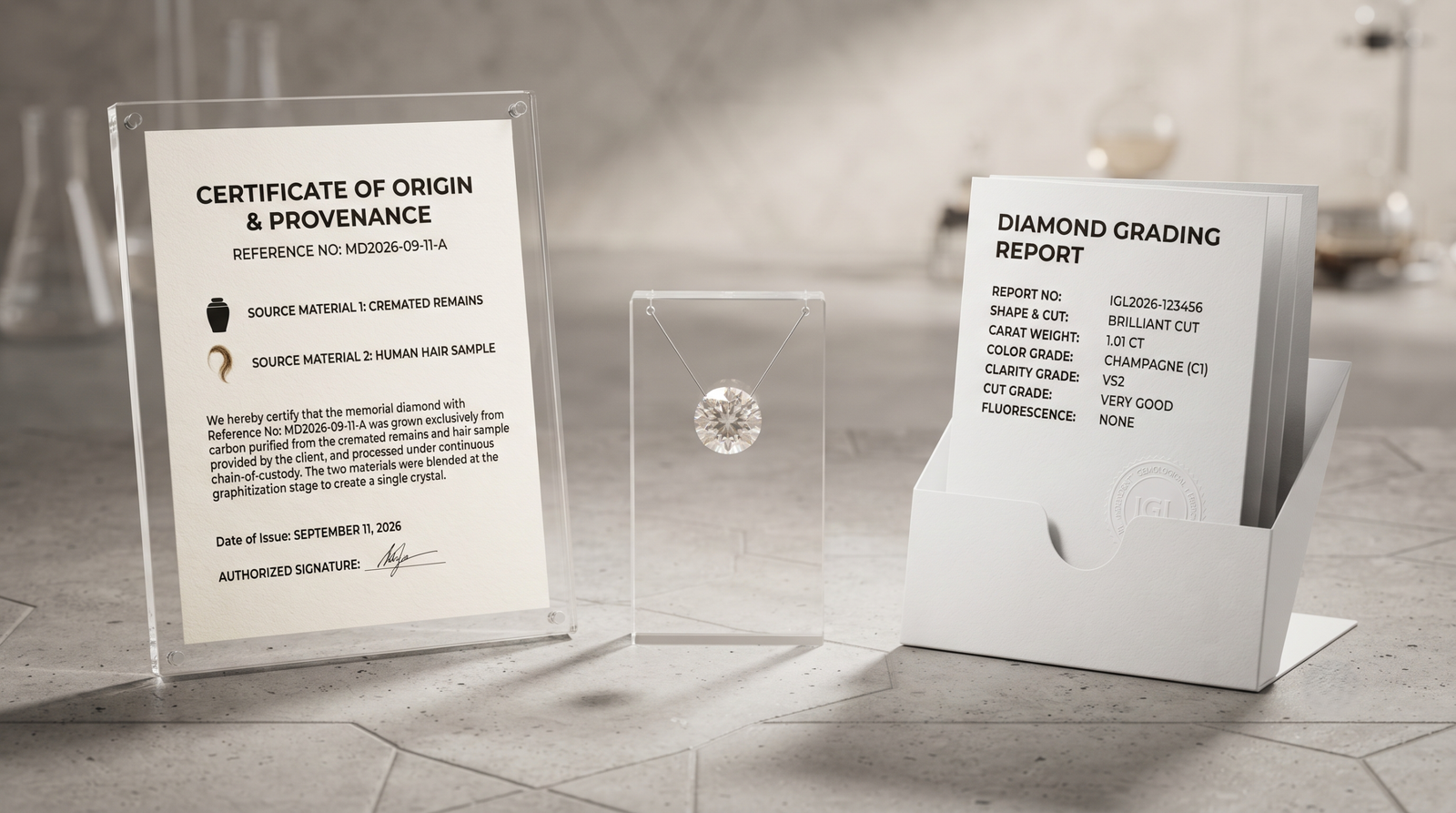
Two documents should return with an ashes hair diamond: the grading report, and an origin document that names both the ashes and the hair as sources and traces back to the two intake records. That single document is the reason to have asked the two record question at the start, and the reason the doubt a combined stone attracts is answered in is a memorial diamond really made from your husband’s ashes and hair.
Frequently Asked Questions
Are the ashes and hair processed together or separately?
Separately, until the graphite stage of an ashes hair diamond. Each material is purified on its own track because the ashes need minerals removed and the hair needs keratin’s other elements driven off. The two purified carbons are converted to graphite, then combined and grown as one crystal.
Where is the point of no return for an ashes hair diamond?
At graphitization, not at blending. Once each carbon is converted to graphite, the two are physically identical and cannot be separated by any test. If you want two separate stones instead of one, that decision has to be made before this stage.
Will the diamond show which carbon came from ashes and which from hair?
No. In an ashes hair diamond, both are reduced to pure carbon and become one crystal lattice. The only thing that distinguishes them afterward is the paperwork: two intake records and an origin document naming both materials. Ask that those exist before you order.
Does adding hair change how much of the diamond is him?
Not the proportion. Personal carbon typically makes up around 10 to 15% of any memorial diamond, with laboratory carbon supplying the rest. What hair changes is the source mix within that share, and, with some providers, how much ash is required.
What if one material yields less carbon than expected?
The provider learns this at the purification stage. Whether they tell you before blending, or cover the shortfall with laboratory carbon without saying so, varies. Ask this question in writing before sending anything; it is the most important one for a combined order.
Does an ashes hair diamond take longer to make?
Not meaningfully. The two ashes hair purification tracks run in parallel, and most of the six to ten months is spent in the growth press, where the crystal grows exactly as a single material stone would. Larger or specialty color stones can extend that to twelve months.
Final Thoughts on How a Memorial Diamond Is Made From Your Husband’s Ashes and Hair
The ashes have already been through their fire; the hair goes through its first here. By the end of Stage 4 the two are the same graphite, and by the end of Stage 5 they are one crystal. What an ashes hair diamond preserves that a single material stone cannot is not a chemical trace of each, but a written record that both were there. Choose a provider who will write that record.
If you are holding both materials and want to know what would be recorded at each stage before you send either, reach out to Memorial Diamond to talk through what’s possible with your husband’s ashes and hair.
You are not short of his hair. Years of a shared bathroom leave it on a shirt collar, on his side of the pillow, in the trap under the sink. A husband hair diamond is a real lab grown diamond, grown in part from carbon extracted from his hair, roughly 50% carbon by weight, against 0.5% to 4% for cremated ashes, so a small lock is enough, no cremation is involved, and production runs 6 to 10 months.
The problem is the opposite of scarcity. Nearly everything on that list has been shared with you, and no lab can tell one person’s hair from another’s once it is purified. So this guide is organized around provenance: knowing what you send is only his, improving a doubtful sample, and deciding honestly when you cannot.
This guide comes from Memorial Diamond, which grows memorial diamonds: there is a commercial interest behind it. The useful thing a page like this can do is make you harder to sell to, including by us.
Table of Contents
Why Provenance Is the One Thing You Cannot Fix Later
Almost every mistake with a husband hair diamond is recoverable: a light sample topped up, a color discussed before growth begins, a setting changed later.
Provenance is the exception for a husband hair diamond. Purification strips hair to roughly 99.9% carbon, and everything that would distinguish his from yours, length, color, cuticle, DNA, is gone at that stage. No grading report addresses it, because a report describes the diamond rather than the submission.
The first question is therefore not how much hair you have but how sure you are that it is only his, answered before anything is sealed into an envelope.
How Sure Can You Be That a Sample Is Only His?
In a house you shared, where the hair for a husband hair diamond came from matters less than what kind of evidence it is. Four classes cover nearly anything you will find, and the middle column does the work.
Kind of source
Why confidence is high or low
How to improve it
Cut from him in front of a witness
Highest: someone watched the hair leave his head
Have whoever cut it seal, date and sign the envelope at the time
A device or garment only he used
High, and it rests entirely on “only”: one borrowed jacket or guest razor collapses it
Establish sole use before collecting: check for a second trimmer head, or a coat that was lent
Anything from a shared surface
Low: a shared surface mixes the household by design, and nothing unmixes it later
Not improvable afterwards. Use it only if the hair is unmistakably his, and say so on submission
A sample someone else kept and labeled
Depends on the label rather than on anyone’s memory of it
Ask what the label says, and write down their account while they can give it
One rule falls out of that: a source you can describe precisely beats one you can only describe hopefully, because the description travels with the submission and is the only provenance record a husband hair diamond will ever have.
How to Take a Clean Sample Now
If the funeral has not happened, this is the one time sensitive step toward a husband hair diamond. A funeral director or hospice nurse can be asked to take a lock; afterwards that chance is gone.
Collecting from objects instead, three habits matter more than equipment:
Work under a bright light with tweezers, hair by hair, rather than tipping a container out, selecting, not gathering.
Set anything ambiguous aside. A smaller certain sample beats a larger doubtful one, because weight can be topped up and certainty cannot.
Collect one source at a time, into separate envelopes. Pooling is a decision you can still make; unpooling is not.
Write it down now. In six months you will not remember whether that envelope came from his trimmer or the brush on the shelf, and that difference is the whole point of a husband hair diamond.
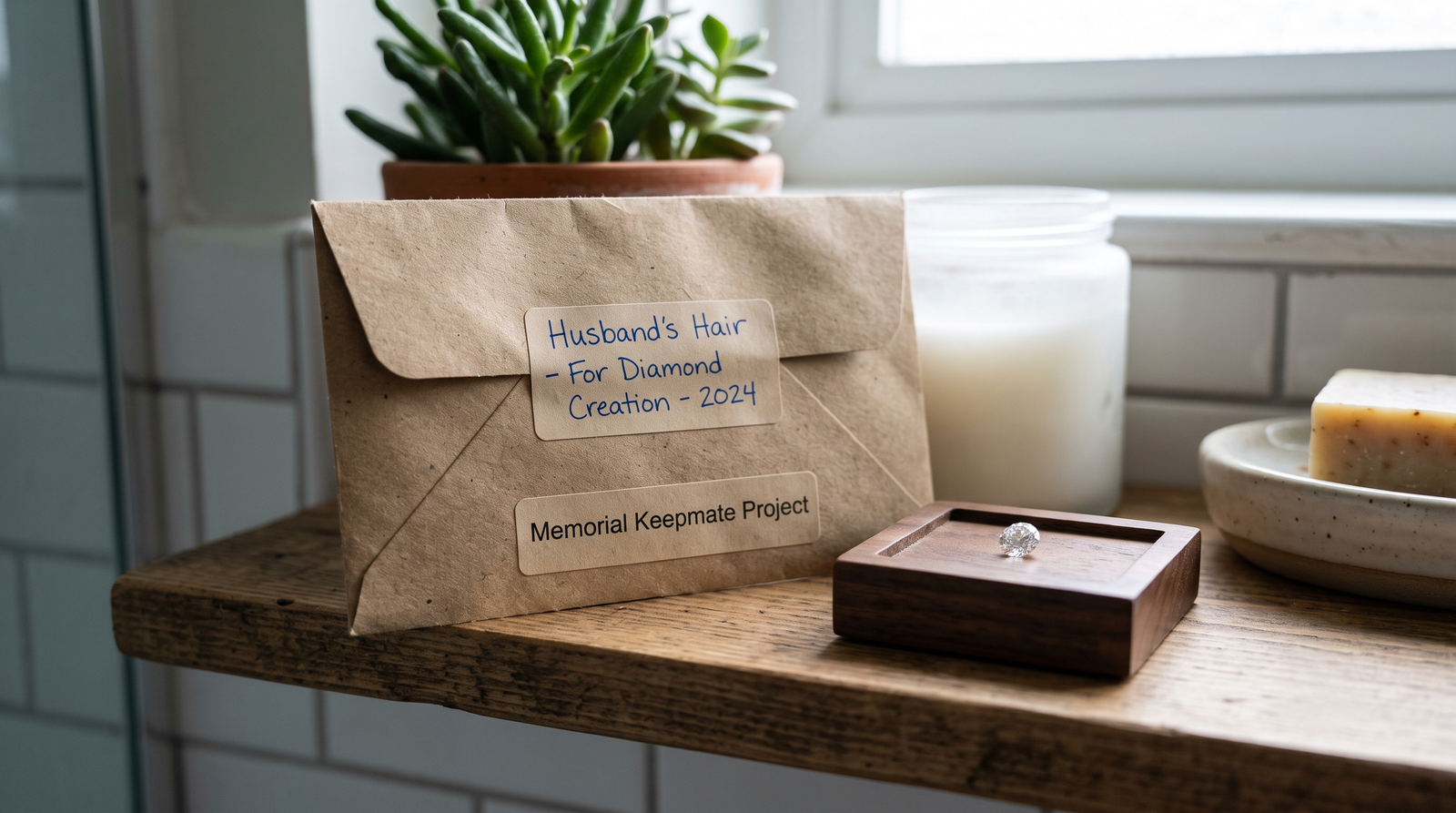
On the envelope itself, not a sticky note, write his full name, the collection date and the exact source: beard trimmer, his only, collected 4 March. Seal it and photograph the label.
Hair for a husband hair diamond keeps: dry and sealed, keratin is the same feedstock in ten years as today. The record of where it came from is what decays, fast.
How Much Hair Does a Husband Hair Diamond Actually Take?
Industry typical requirements are a small lock or a few grams, far less than an ashes submission, because hair is roughly 50% carbon by weight against ash’s 0.5% to 4%. Requirements are set by weight rather than length, so short clippings work: weigh what you have rather than measuring it. And growth time in the press, not the weight you send, sets the carat. How much hair you need for a husband memorial diamond covers quantities.
How Much of a Husband Hair Diamond Is Genuinely Him?
Hair is a far richer feedstock for a husband hair diamond than ash is for an ashes stone, but richer is not sufficient. After purification to about 99.9% carbon, a lock still falls short of the volume a growth run needs, so supplemental lab sourced carbon makes up the difference.
The published personal share figure of around 10% to 15% of the finished stone’s mass was arrived at for ash based stones. No hair based equivalent exists publicly, so treat it as indicative rather than a measurement of your submission.
What matters is the shape of the claim: part of a husband hair diamond is him and the rest is not. Ask a provider to put the working fraction in writing before you send.
The Process, and What an Uncertain Sample Means at Each Stage
A husband hair diamond passes through five stages. The third column matters if the source is in any doubt.
Stage
What happens with hair
What it means for an uncertain sample
Collection and intake
Logged under a chain of custody reference; the source recorded as you describe it
The last point at which the record can be corrected. Describe it exactly, doubts included
Purification
Non carbon parts of the keratin stripped in an oxygen free furnace to roughly 99.9% carbon
Everything distinguishing one person’s hair from another’s is gone, permanently
Graphitization
Converted to graphite at roughly 2,500 to 2,700°C
No test from here can tell you whose carbon it is
Diamond growth
Blended with supplemental lab carbon and grown around a seed, in an HPHT press running at roughly 6 to 8 GPa and 1,400 to 2,500°C
Growth time sets carat, so a doubtful sample yields the same stone with a doubt attached
A grading report describes the diamond; an in house origin certificate documents your submission. Neither verifies whose hair it was
Three questions the chemistry cannot answer, because each provider answers them differently. Put them in writing:
Which growth method, HPHT or CVD? HPHT is the industry standard for memorial stones; ask which your quote assumes and what it implies for color.
Grown in the provider’s own facility, or subcontracted? If subcontracted, ask how the custody record covers each handover.
If a growth run fails, what then? Ask whether a second run consumes more of your sample, and who bears the added time and cost.
What If You Cannot Establish Provenance?
Sometimes the honest answer about a husband hair diamond is that you cannot.
A husband hair diamond you privately doubt is a worse outcome than no stone. It is expensive and permanent, and a doubt of that kind is not one the object can settle for you later. If the only hair in the house came from a brush you both used, and that will bother you, it is a reason to stop.
Two routes out are not compromises. One is a source with a cleaner history than the one you have. The other is the ashes route, where identity is not in question. Deciding against all of it is a complete answer too, a burial, an urn, a scattering are whole ways of honoring someone, and a diamond sits alongside them, not above.
If Your Husband Is Still Living, Ask Him
Some readers are not bereaved: a diagnosis, a long separation ahead, or simply wanting the thing to exist while he is here.
The practical part of a husband hair diamond is easy, a small lock, cut at home, no cremation involved. What matters is the asking. Taking hair from his brush without telling him gives you the weakest provenance in a house you share; asking gives you a clean, dated sample he knows about. The living memorial version of this guide covers the conversation in full.
What Does a Husband Hair Diamond Cost, and What Color Will It Be?
Drop one intuition first: whether he was dark, fair or grey has no bearing on a husband hair diamond, because nothing carrying his hair color survives purification. Color comes instead from trace elements in the growth cell, nitrogen yellow, boron blue, and only the near absence of both leaves a stone colorless, which is why colorless costs meaningfully more per carat. Organic feedstock rarely arrives that clean, so yellow, blue and champagne are this category’s usual tones. What color a diamond made from your husband’s hair will be covers prediction.
Drop a second on timing. Extraction from a lock is a short front end step inside a schedule crystal growth dominates: 6 to 10 months of production once a laboratory has the material, nearer twelve for a stone of roughly 2 ct or a specialty color. Shortening the front end barely moves the finish date. Put collection, transit and setting around that window and the whole runs eight to fourteen months, arithmetic of ours, an editorial estimate rather than an industry figure. No cremation is involved, so a husband hair diamond stays open where cremation never was: hair based options for a loved one who was not cremated covers that.
For a husband hair diamond, price follows carat, and carat follows growth time.
The only hair I have is from a brush we both used. Should I order a husband hair diamond anyway?
Only you can judge. No lab can separate two people’s hair after purification, so the doubt would be permanent. If that would sit badly with you in ten years, look for a cleaner source.
Can a laboratory test whether the hair is my husband’s?
Not as part of this process. Providers work from what you tell them, and purification destroys everything that would distinguish one person’s hair from another’s. Identity testing would have to be arranged separately, beforehand.
How should I label a husband hair diamond sample so it still means something in a year?
Write his full name, the collection date and the exact source, “beard trimmer, his only, collected 4 March”, on the envelope itself, not a note that can fall off. Seal it, then photograph the label.
I found hair on the headrest of his car. Does that count?
It can, if the car was his and passengers were rare. Pick the hairs individually rather than emptying a vacuum canister, note what you did, and describe that source honestly when you submit.
Does a husband hair diamond arrive sooner than one made from ashes?
No. Extraction is a small part of a timeline dominated by crystal growth, which runs 6 to 10 months industry wide from receipt of material regardless of which material the carbon was recovered from.
If I collect a clean sample now, how long can I leave it before deciding?
Indefinitely, as far as the chemistry goes. Keratin kept dry in a sealed envelope is the same feedstock in ten years as today. Collecting carefully now and deciding later is a legitimate order to work in.
My husband is still living. Is it strange to ask him for a lock of hair?
It is a straightforward request, and asking is better than taking. It gives you a clean, dated sample he knows about, and makes a husband hair diamond something you agreed on rather than kept quiet.
Final Thoughts on a Husband Hair Diamond
If you take one thing from this page, take a pen. Label what you have with his name, the date and the source, in words still useful a year from now. Then talk it through before you cut, divide or post anything. A husband hair diamond is one of the few decisions in this year with no deadline attached, the sample keeps, and so does the choice.
Reach out to Memorial Diamond at memorialdiamond.us for a conversation rather than a purchase, bring a weight, a photograph of the label, and an honest account of the source. That is everything a provider needs to tell you whether a husband hair diamond is workable from what you have.
The first step here has no laboratory in it, no cost and no deadline. It is a search, and for a father it often decides whether there is going to be a stone at all. Turning your father’s hair into a diamond, a father’s hair diamond, in the shorthand this page uses, runs to roughly twelve steps: a search, five belonging to your family, then six laboratory and finishing stages. Production typically takes 6 to 10 months from intake, and because hair requires no cremation, this route stays open for a father who was buried.
This sequence begins one step earlier than a process description usually does, before there is a lock in hand at all, because for a father that is frequently where a family is standing.
Memorial Diamond is a provider in this category, so treat what follows as a description of how the route works generally and as questions to ask any company, this one included.
Table of Contents
Where Does a Hair Diamond Sequence Actually Begin?
With a search, and it counts as a step because it has an output: a candidate sample and a number on a scale.
Treating it as a step rather than as a precondition changes how it gets done. A precondition is something you either have or don’t, so a family that assumes it doesn’t can stop looking within an afternoon. A step is something you work through, and it has a defined end.
The complete guide to father hair diamonds covers where a father’s hair tends to turn up, the places are not the obvious ones, and short clippings count. What that guide does not cover is when to stop looking.
How Do You Know When the Search Is Finished?
The search is finished when one of three things is true. Not before, and there is no value in continuing after.
You have a sample and a weight. Weigh it in its container, subtract the container, and photograph it beside the scale reading. A number ends the search whether or not the number turns out to be enough, how much hair is needed covers what to do with the figure once you have it.
Everyone who might have kept something has been asked. A widow, a sibling, an adult child, a barber of twenty years, whoever cleared the house. This is the condition most easily skipped, and it is often where a sample turns up.
The places have been checked and there is nothing. A wallet, a bedside drawer, a shaving cabinet, a hat, a hairbrush, a car headrest, a workshop bench. If those come up empty, they come up empty, and that is a finished search rather than a failed one.
If the search ends at condition three, his ashes remain a route, and the sequence in step by step: turning your father’s ashes into a diamond picks up from there. Nothing about ending a hair diamond search this way is a lesser outcome.
What Does the Whole Sequence Look Like?
Step
Whose hands
Typical duration
What it produces
1. Search for a sample
Your family
An afternoon to a few weeks
A candidate sample
2. Weigh and photograph it, without dividing it
Your family
Ten minutes
A weight, in grams
3. Ask a provider whether that sample is acceptable
Your family and the provider
Days
An answer, ideally in writing
4. Choose a provider; specify carat, color and cut
Your family
1 to 4 weeks
An order reference
5. Cut or separate only what is being sent, and document it
Your family
An hour
The submission, and a record of it
6. Package and ship
Your family, then a carrier
1 to 3 days in transit
A tracking number
7. Intake, weighing, logging, chain of custody reference
Laboratory
Days, the clock starts here
A reference number you can quote
8. Pre cleaning: product, oils, dust and debris removed
Laboratory
Days
Clean keratin, at a lower weight
9. Carbon extraction and purification to roughly 99.9%
Laboratory
Weeks
Purified carbon
10. Graphitization at roughly 2,500 to 2,700°C
Laboratory
Days to weeks
Graphite feedstock
11. Growth in an HPHT cell, blended with supplemental lab carbon
Laboratory
Weeks to months
A rough crystal
12. Cutting, polishing, optional color treatment, grading, setting
Laboratory, then setter
Weeks
The finished hair diamond
The durations in the table are estimates, there to make the shape visible; the only sourced figure is 6 to 10 months of production from step 7, which is why step 6 is worth doing promptly and steps 1 to 5 are not worth rushing.
Steps 1 to 6: From a Drawer to a Mailbox
Only three of these six involve touching anything. The rest are questions, and the order they are asked in is what separates a comfortable hair diamond process from an anxious one.
Step 3 comes before step 5. Ask whether the sample is acceptable before anything is cut, separated or divided. A lock is finite, and the answer costs nothing but a few days. Send the weight and the photograph rather than a description: “6.1 grams of beard clippings, collected in two sittings” is a question a provider can answer; “a bit of his beard” is not.
Step 5 is the only irreversible act in the family’s half of the sequence. Everything before it, the search, the weighing, the inquiry, the order, can be undone, paused or abandoned. Cutting cannot.
Step 6 has fewer constraints than the ashes route does. Hair is not cremated remains and does not carry the shipping restrictions that go with them. Package it dry, sealed, cushioned and labeled with the order reference, and keep a photograph of the sealed package. How to turn your father’s hair into a diamond covers the documentation your family creates around that parcel, which for a hair diamond has no institutional substitute.
Steps 7 to 12: What Does the Laboratory Do With a Few Grams?
Step 7, intake, starts the clock. The sample is logged, weighed and given a chain of custody reference. Ask for both the reference and the intake weight in writing.
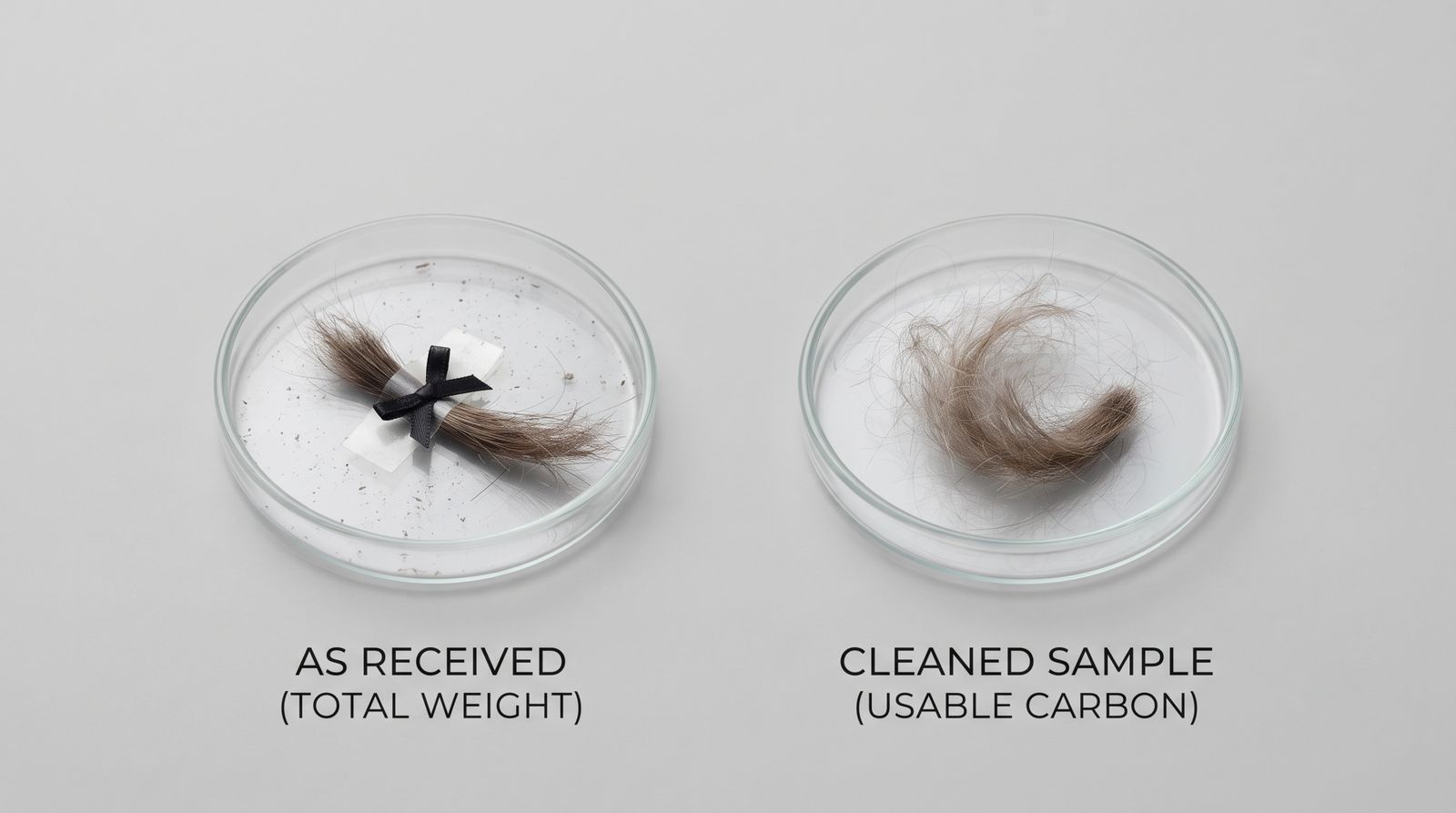
Step 8 has no equivalent on the ash side. Providers commonly describe a preparation stage in which product, oils, dust and anything that is not hair are removed before extraction begins, so the weight entering step 9 is lower than the weight that arrived. Ask what theirs removes.
Steps 9 to 12 are the laboratory’s and are fixed. Extraction and purification to roughly 99.9% carbon, hair is roughly 50% carbon by weight, against ash’s 0.5% to 4%, then graphitization at roughly 2,500 to 2,700°C, then a growth run of weeks to months in an HPHT cell, then cutting, optional color treatment, grading on the standard 4Cs and setting. Before any of it can be grown, the recovered carbon is topped up with lab grown carbon to reach a usable volume, so a finished hair diamond holds a provable share of him rather than the whole of him. Any provider claiming otherwise is describing something the process does not do.
What emerges from graphitization is carbon rather than hair, so a hair diamond’s color comes from trace elements present during growth rather than from the color his hair was, what color a diamond made from your father’s hair will be covers that.
Why Does a Hair Diamond Have No Cremation in It, and No Deadline Either?
This is the structural difference between the two routes, and it is worth being precise about this.
The ashes route has a door that closes: once a father’s remains are interred or scattered, that option is generally closed, and the retention request has to be made before release. The hair diamond route has no equivalent. Hair is stable in storage, which is why a lock kept in 1998 is generally still usable and a sample found next year works as well as one found this week, worth confirming with a provider rather than assuming, but it is not the ash route’s kind of deadline.
That does not make the hair diamond sequence entirely reversible. Step 5, the cut, is permanent, and a sample sent is a sample out of your hands. But the pressure that sits over an ashes decision does not sit over this one, and a family under time pressure elsewhere in their lives should know that.
Frequently Asked Questions
Where in the sequence should a provider first be contacted?
At step 3, before anything is cut. An acceptance answer based on a stated weight and a photograph costs a few days and protects a sample you cannot replace. Choosing a company for the hair diamond can wait until after that answer.
Can the search be done by someone else in the family?
Yes, and there is a case for it. The person clearing a house may see things the person grieving hardest does not. Give them the weight target and ask them to photograph rather than collect anything they find.
How long does the family half of the sequence usually take?
Anywhere from a week to a few months, and none of it is on a clock. Steps 1 to 5 have no external deadline at all, only step 6 onward runs against the production timeline of a hair diamond.
If a provider says the sample is acceptable, how long is that answer good for?
Ask, because it varies. An acceptance based on a photograph and a stated weight is a provisional answer; a definitive one normally follows intake. Get the provisional answer in writing anyway, so the definitive one can be compared against it.
Can the pre cleaning step reject a sample outright?
Ask what their preparation stage removes and what happens if it takes a marginal sample below a usable weight. It is the reason to send a hair diamond sample with margin rather than exactly at a stated minimum.
Does anything here need to happen before a funeral or memorial service?
No. Unlike the ashes route, nothing in a hair diamond sequence is closed by a burial, cremation or interment. Collecting hair is simpler before a service than after, but nothing is lost if that moment has passed.
Final Thoughts on the Hair Diamond Sequence
Step 1 costs nothing, involves nobody outside your family, and has no deadline attached to it. It is also the only step that can turn a hypothetical into a decision, which is why it is worth doing before anything else on this page, and why it is worth finishing properly, with one of the three end conditions actually met, rather than letting it trail off. A hair diamond that never happens because the search stopped early is a different thing from one that never happens because there was nothing to find.
Once there is a weight and a photograph, Memorial Diamond can say whether that sample works for a hair diamond and what happens to it at each stage. If the search has not started yet, it can start this afternoon. Reach out at memorialdiamond.us.
Of the two materials, there is usually one you have plenty of and one you are counting, and most people can say which before they finish reading the question. So how much ash and hair does a father memorial diamond need? Industry wide, plan on each material meeting its own figure in full: a few tablespoons up to roughly 4 oz (about 100 g) of cremated remains, and a few grams of hair, a palm sized lock. Ask before assuming that sending both lowers either number.
What matters far more than the figures is which side you are short of, because a shortfall in ashes and a shortfall in hair are not the same kind of problem. One is often recoverable. The other frequently is not.
Memorial Diamond is one of the companies that grows these stones; the questions below are meant for any of them, us included.
Table of Contents
How Much Ash and Hair Does Each Material Have to Meet on Its Own?
The two figures for how much ash and how much hair are quoted in different units because the two materials are chemically nothing alike.
Cremated remains are dominated by calcium phosphate, the mineral structure of bone, with usable carbon at roughly 0.5% to 4% of ash by weight. That low yield is why how much ash you need is stated in tablespoons and ounces, and why a family submitting a portion still keeps most of what they have.
Hair is roughly 50% carbon by weight, built from keratin. That is why the hair requirement is stated in grams, and why hair works at all for a father who was buried rather than cremated.
Whichever material it came from, the recovered carbon is topped up with lab grown carbon before an HPHT growth run can use it. What each of the two contributes is a provable share of him rather than the whole stone, the honest framing, and the reason a claim of total purity should be treated as a warning sign.
Neither figure is standardized across the industry, and the individual numbers belong to the posts that own them: how much ash is needed and how much hair is needed each go into the specifics. This page is about what happens when you are holding both.
Should You Expect Combining to Lower Either Threshold?
Plan on no, and ask, how much ash and hair you need is set per material.
The reason to expect independence is that the two materials do not meet until late. Providers commonly describe preparing each separately, cleaning, extraction, purification to roughly 99.9% carbon, graphitization, with the two coming together only at the growth cell. On that description each material carries its own minimum, so how much ash and hair you need is two questions rather than one. The complete guide to father ashes and hair diamonds sets out where those lanes converge and why.
The consequence for planning is worth stating flatly: plan for both figures in full, and treat any flexibility a provider offers as a concession rather than an assumption. A family that plans on halves and discovers otherwise has often already divided something irreversible.
Why Are the Two Shortfalls Different Problems?
This is the distinction that actually decides what you do next, more than how much ash or hair sits in either container.
If you are short of
Can more usually be found?
What finding out costs
Effect on the other material’s requirement
His ashes, still in the family’s keeping
Usually yes, a submission is typically a small fraction of a full cremation
A phone call to whoever holds the urn
None
His ashes, already interred or scattered
Usually no, and disinterment is a legal and family matter rather than a practical one
A conversation with the cemetery or the executor
None, but this is often the point at which hair becomes the primary route
His hair, one sample only
Often no. A lock is finite and does not replenish
A scale and ten minutes
None
His hair, several possible sources
Sometimes, a comb, a razor, a hat, a barber’s clippings
A search, plus a provider’s acceptance policy
None
Read the table twice for the same reason it is laid out this way, however much ash and hair you are holding: the ash rows describe a problem with a phone number attached, and the hair rows describe a problem with an ending. That asymmetry should decide the order you do things in.
Before anything is divided, opened or cut, establish these four things:
Who currently holds his ashes, and how much ash is actually there. This is often not the person who assumes they know.
What the hair sample weighs, on a scale that reads to a tenth of a gram, weighed in its container and subtracted.
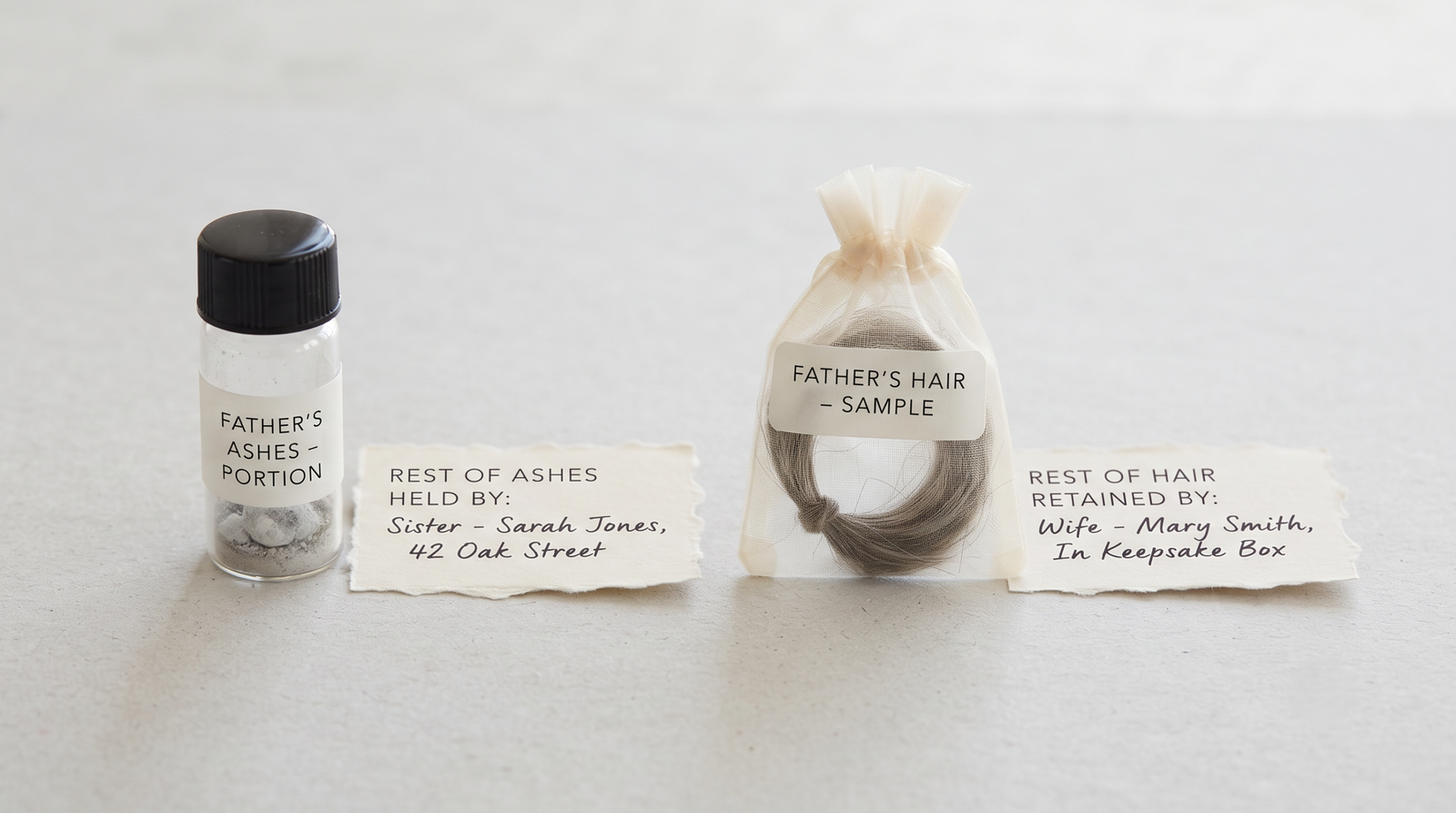
Whether any plan already exists for the remainder, a scattering, an interment, a shared plot, and whether it has a date.
Whether the provider you are considering accepts combined submissions at all. It is not a given, and it is the question that makes the other three matter.
What Can Be Done if the Hair Falls Short?
Several things, in roughly this order of preference, and none of them depends on how much ash you have.
Look further before you conclude. Short clippings are not disqualified by being short, weight rather than length is what the process consumes, and the complete guide to father hair diamonds sets out where they tend to be found. Whether a given company accepts very short or mixed source clippings is a policy question that varies, so ask with a weight and a photograph rather than a description.
Ask whether a below minimum sample can be included as a supplementary contribution rather than as a lane of its own. Some providers may treat it that way; whether any given one does is not something the chemistry decides.
And if the answer is genuinely no, an ash only stone is not a lesser outcome. It is the longer established of the two routes, memorial diamonds were grown from cremated remains long before hair was offered, and the hair can stay exactly where it is. Keeping a lock is not a failed plan.
What Can Be Done if the Ashes Fall Short?
Often more than expected. How much ash a memorial diamond submission needs is a fraction of what a cremation produces, so a shortfall is more often a question of access than of how much ash exists, a sibling holding the urn, a portion already divided among family, a funeral home that still has a retained portion on file.
Where the remains have already been interred or scattered, the ash route may genuinely be closed, and that is the situation hair based options for loved ones who were not cremated exists to answer. A hair sample that seemed like an addition becomes the whole basis of the stone, and it works.
One thing that does not help either way: sending far more than the minimum. Carat size follows growth time in the press, not how much ash or hair arrived, so a fuller parcel buys nothing.
Which One Gets Assessed First?
Hair, in most cases, it is the material that can fail assessment, and assessing it is quick. How much ash you have rarely decides anything at this stage.
A hair sample can often be evaluated from a stated weight and a clear photograph before anything is posted, though whether a particular provider will pre assess on that basis is worth confirming rather than assuming. Ashes are more often assessed on arrival, by volume and weight at intake.
The practical order that follows: settle the hair question first, in writing, then decide how much ash to send, then choose the carat. Questions to ask before a combined order covers what else belongs in that first email, and the step by step sequence covers where each material goes afterwards.
Frequently Asked Questions
Which Material Should Be Assessed First?
Hair, generally, it is finite, it is the one that can be judged inadequate, and a weight and a photograph can often settle it before anything is posted. Ashes are more often assessed at intake, by weight and volume.
Do the Two Figures Change if We Want a Larger Stone?
Generally not. Carat is bought in growth time rather than in how much ash and hair you submit, so a larger stone usually means more months and more money rather than more material. Confirm it, since minimums vary between companies.
Should We Weigh His Ashes, or Is a Volume Measure Enough?
Ask which the provider works in. How much ash is required is quoted both ways across the industry, in tablespoons and in ounces, and a family measuring by volume against a figure stated by weight can send materially more or less than intended.
Who Weighs and Measures Each Material, Us or the Laboratory?
Both, at different points. Weighing the hair at home tells you whether to proceed; the laboratory records its own intake figures for chain of custody purposes. Ask for those intake figures to be reported back to you in writing.
Is There Any Point Sending Much Ash or Hair Beyond What the Figure Asks For?
Not for size or speed, those follow the growth run. A little margin above a stated minimum can be sensible where a sample is marginal, but sending everything you have puts material out of your hands for no gain.
Is There Any Advantage to Sending Both if Either One Alone Would Be Enough?
Not in size, speed or cost, those follow the carat and the growth run. The reason families combine is that both materials came from him and both were kept, which is a reason about meaning rather than about the process.
Final Thoughts on How Much Ash and Hair a Father Memorial Diamond Needs
Everything on this page turns on one piece of information that costs nothing to obtain: whether the constraint in your family is the ashes or the hair. Ten minutes with a scale and one phone call to whoever holds the urn will tell you how much ash and how much hair you are actually working with, and neither commits you to anything. The figures themselves are the easy part; knowing which side is short is what decides the order everything else happens in.
Memorial Diamond can give you both figures for your father, how much ash and how much hair a combined stone would need, and say what happens if one of the two falls short. Nothing has to be opened, cut or posted to ask. Start at memorialdiamond.us.
A kitchen scale is a blunt instrument for this. Put an envelope holding your father’s hair on one and it can read zero. So how much hair do you need for a father memorial diamond? Industry wide, a small lock or a few grams, an amount usually described as palm sized. That figure is a weight rather than a length, and it is set per stone rather than per family.
Everything below is about what that number means once the sample is in front of you, and why the reading on a home scale and the figure a laboratory works from are not the same number.
A disclosure first: Memorial Diamond sells memorial diamonds, so read the checks below as ones to put to any provider, including this one.
Table of Contents
How Much Hair Is Actually Needed?
Across the industry, providers ask for something in the region of a few grams, a small lock, a palm sized amount, a few wisps. Exact minimums vary from company to company, and no single published figure covers the category, so the number that governs your decision is the one your chosen provider states.
Two things about how much hair that figure describes are worth holding onto.
The first is that it is a weight. Length is the proxy people reach for because it is easy to see, and it is a poor one: fine hair and coarse hair of the same length weigh very different amounts. The complete guide to father hair diamonds covers where a father’s hair tends to be found in the first place; this page is about how much hair counts once it is in your hand.
The second is that it is per stone. A submission that comfortably clears one provider’s minimum has not thereby cleared it twice.
Why Is the Weight You Send Not the Weight the Process Uses?
Between the envelope on your kitchen table and the graphite that goes into a growth cell, the mass of the sample only falls. Providers commonly describe a preparation stage before extraction begins, and where a stated minimum sits relative to that stage is worth asking rather than assuming. The table below is a set of questions about how much hair survives each stage, as much as a description.
Stage
What happens to the weight
Does a stated minimum usually account for it?
What you hold back at home
You keep part of the lock; only the rest travels
No, a minimum applies to what actually arrives
Preparation before extraction
Providers commonly describe removing product, oils, dust and non hair debris first. Ask what theirs removes
Ask directly: is the stated figure a received weight or a usable one?
Carbon extraction
Hair is roughly 50% carbon by weight; the non carbon remainder is driven off in a controlled, oxygen free process
Ask which weight the figure refers to. Do not assume it is stated after this loss
Not a deduction, but the reason no stone is made only of the submitted material
The preparation row is the one that decides whether a marginal sample passes. A lock that has been handled, sprayed, gelled or stored loose in a drawer has more to lose at that stage than one cut clean and sealed the same day. How a memorial diamond is made from your father’s hair sets out what that stage involves.
The practical consequence is simple. If what you have is anywhere near a stated minimum, send a little more than the minimum rather than exactly it, and ask which weight the figure refers to before you decide how much hair to keep back.
What Should You Weigh It On?
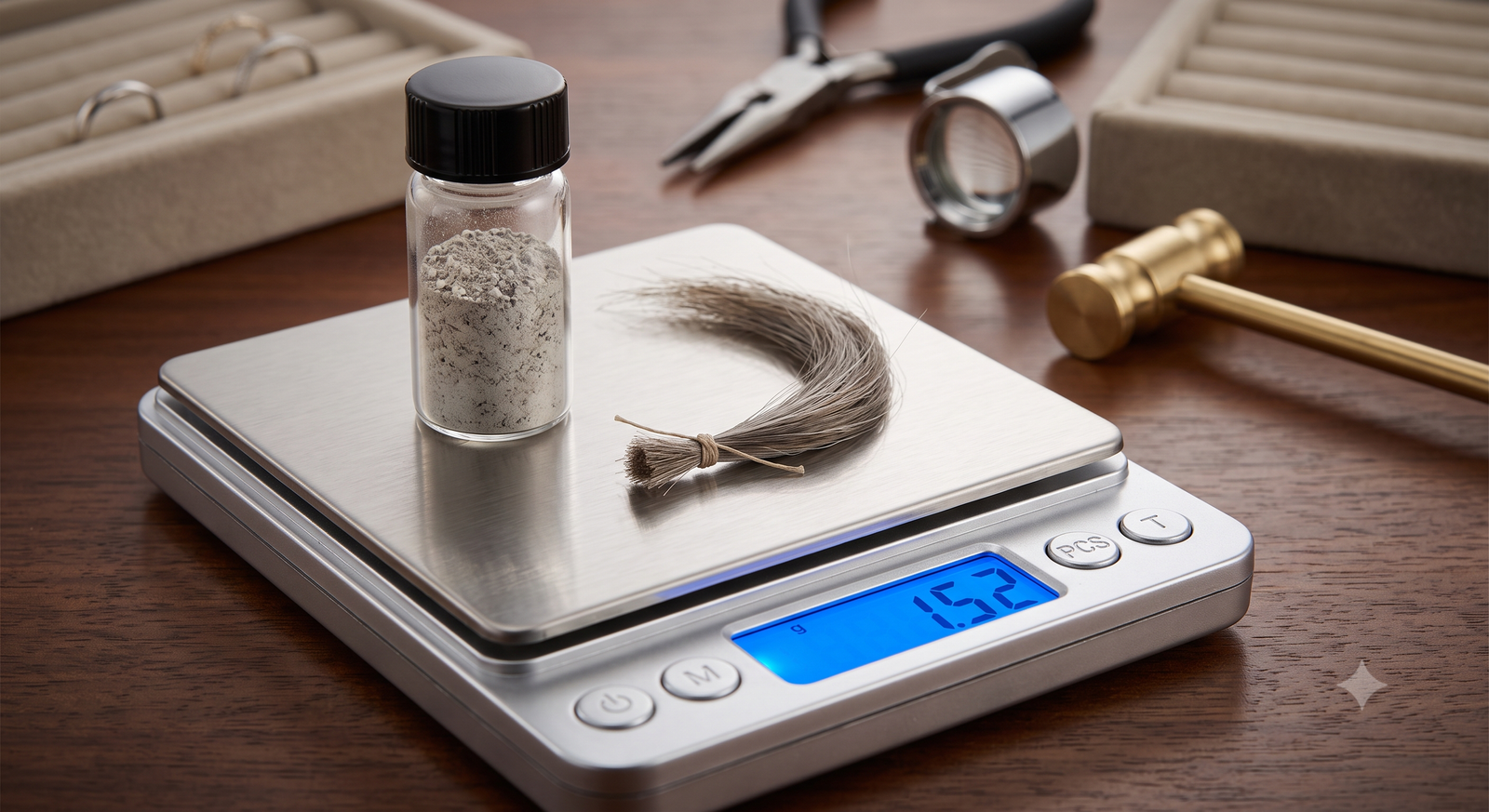
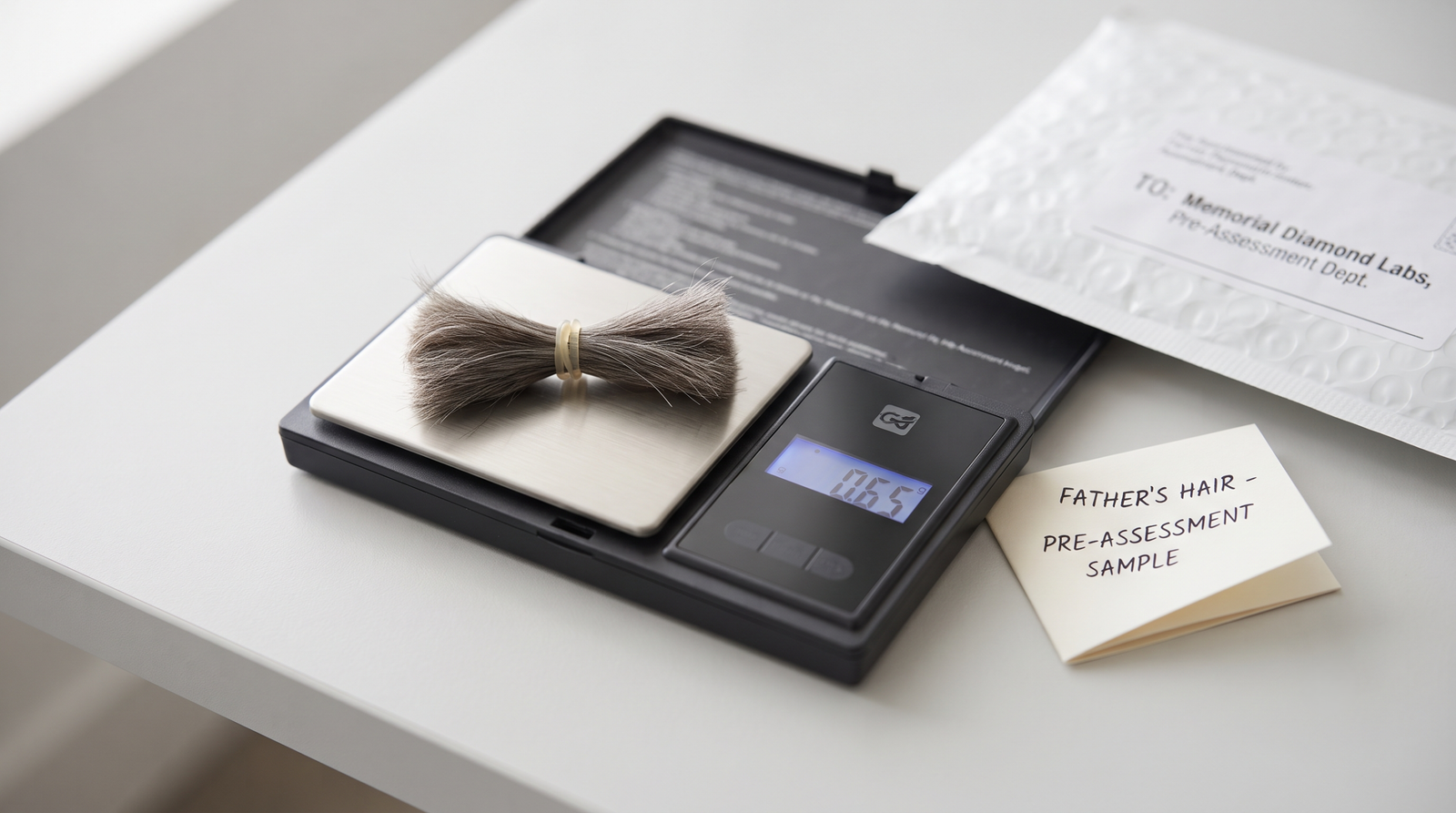
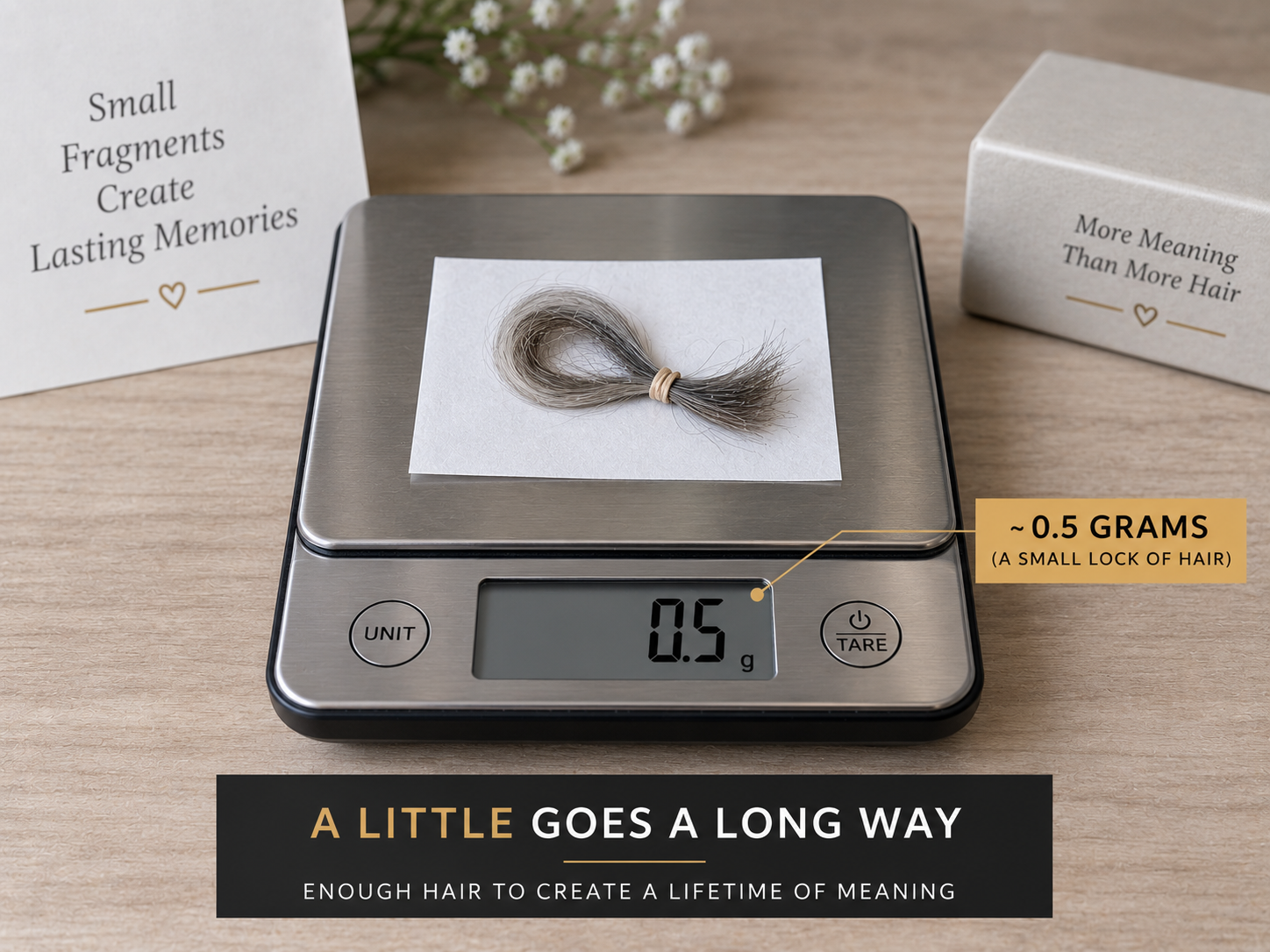
Not a kitchen scale, unless it reads to a tenth of a gram. A small jeweler’s or coffee scale with 0.1 g resolution costs very little and turns a guess about how much hair you have into a fact.
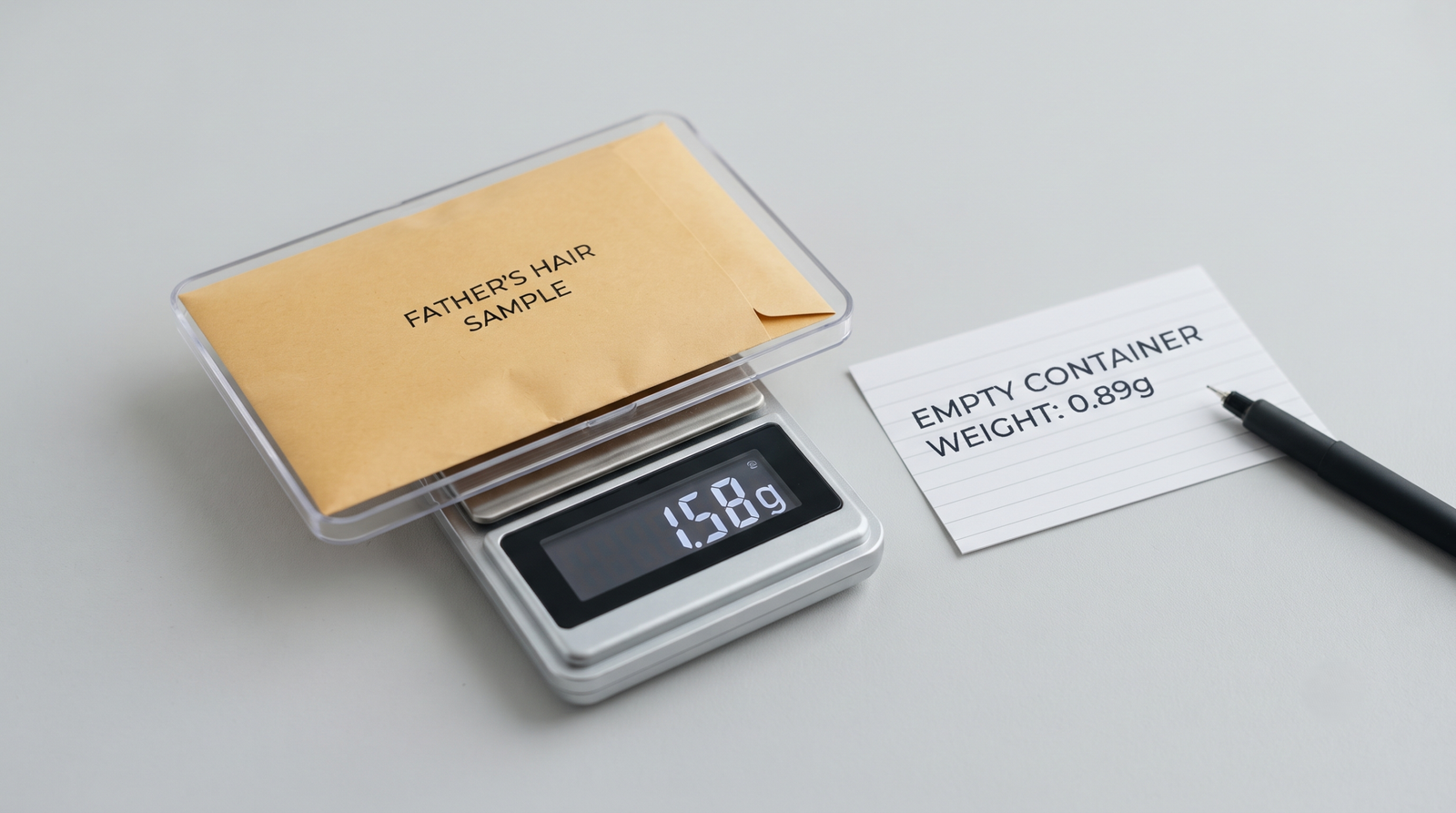
Weigh the container empty first, then weigh it with the hair inside and subtract. Tipping a lock onto a scale pan risks losing strands you cannot replace.
Take the ribbon, tape, tissue and elastic out of the calculation. They can weigh more than the hair does.
Photograph the sample beside the scale display in the same frame. That single image answers the first questions a provider is likely to ask.
Do not divide anything to find out. A whole sample can always be split later; a split one cannot be rejoined.
If the scale reads a figure you were not expecting, that is information about how much hair you have rather than a verdict. It is the number to quote in an inquiry.
Does Hair’s Higher Carbon Content Mean You Need Less?
Yes, dramatically less than ashes, though not in the ratio the chemistry alone would suggest.
Hair is roughly 50% carbon by weight. Cremated remains are dominated by calcium phosphate, with usable carbon at roughly 0.5% to 4% of ash by weight. That is why the ash requirement is quoted in tablespoons and ounces while how much hair you need is quoted in grams.
But the published minimums for how much hair and how much ash are needed do not sit a hundred to one apart, and the gap is worth asking about. One likely reason is that a very small sample is harder to handle, clean and weigh reliably whatever its carbon content, which would make a hair minimum closer to a practical floor than a calculation from chemistry. Ask a provider how their figure was arrived at; it is a fair question and the answer is informative.
It is also worth saying plainly what the last row of that table implies. The carbon recovered from his hair is purified and then blended with supplemental lab grown carbon to reach the volume a growth run needs. What comes out is a real, documented portion of him inside a stone that is not made only of him, the honest framing, and the one memorial diamonds as a category have always rested on.
One more thing the arithmetic explains: sending several times as much hair as the minimum does not produce a larger stone. Carat size is a function of growth time in the press, which is chosen and paid for, rather than of how much material arrived. Choosing a carat size is a separate decision from this one.
Is a Sample Near the Floor a Verdict?
No, it is a question, and one worth asking with a number attached.
A short clipping is keratin just as a long lock is, and length on its own rules nothing out. Whether a given provider will accept them is a different matter, and it is a policy question rather than a scientific one. Acceptance rules for very short clippings and for mixed provenance samples are not standardized across the industry, which means the only reliable answer is the one you get in writing from the company you are considering.
Ask it as a question about how much hair you have, with a weight and a photograph attached, rather than as a description. “4.2 grams, collected over two trims from a beard” is answerable. “A bit of his beard” is not. Nobody can tell from that how much hair is actually there.
If the answer comes back as not enough, that is one company’s policy rather than a fact about the sample. Ask another before concluding anything, and remember that the ashes route may still be open alongside it.
How Much Hair Is Enough for More Than One Stone?
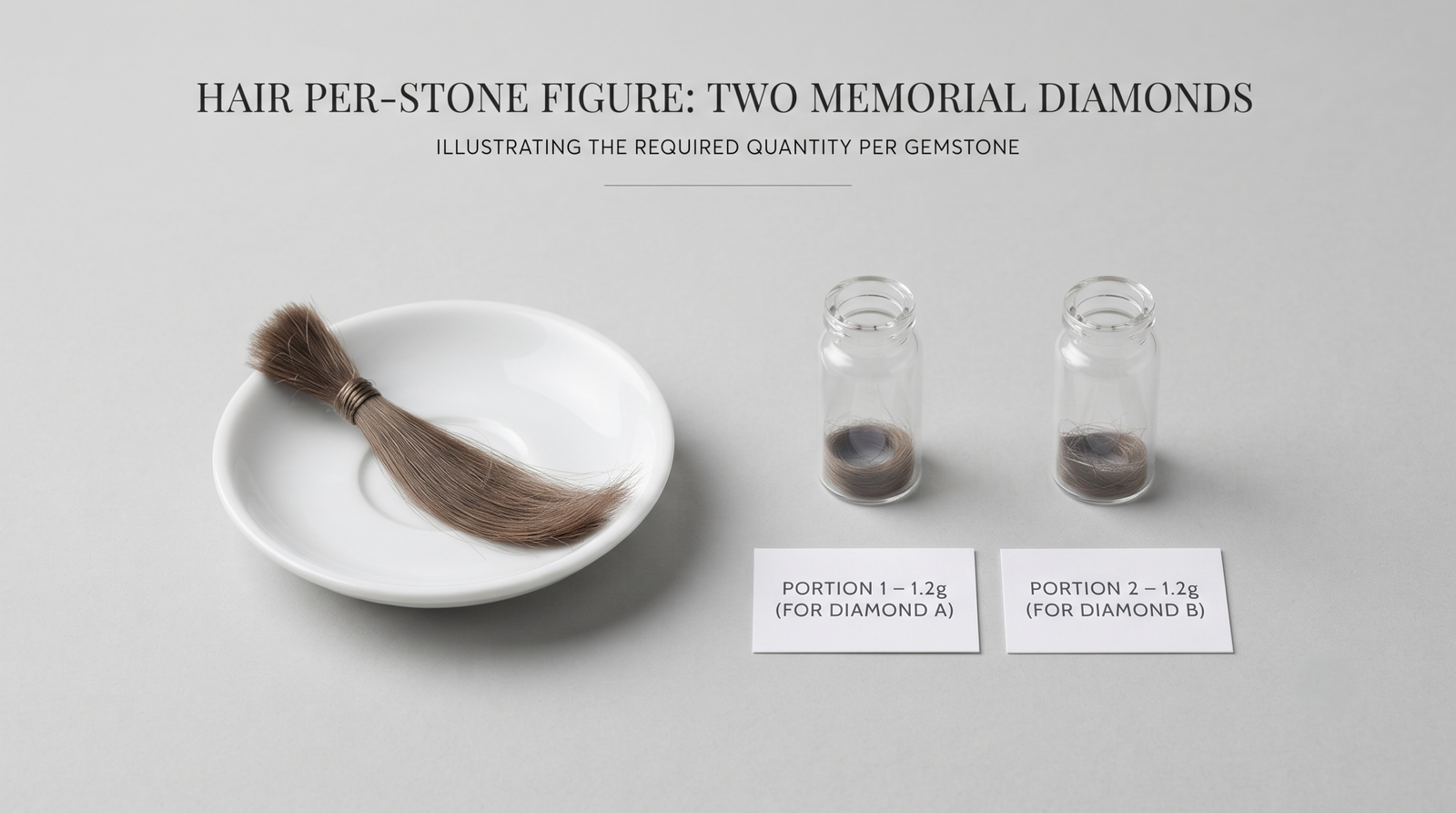
Where a submission holds twice as much hair as the per stone figure, several family members can each receive a stone from the same starting material, which is why the figure to ask for is grams per stone rather than grams outright.
Ask for it as a per stone figure in grams, how much hair per stone, not how much hair in total, and ask before you plan on two.
Frequently Asked Questions
Does the hair need to be in one piece, or will loose strands do?
Loose strands are usable. The process consumes weight, not structure. A bound lock is easier to handle, photograph and document, so if the hair is already tied, leave it tied and send it exactly as it is.
Do I weigh the hair with the ribbon and envelope it came with?
No. Weigh the packaging empty, then weigh it full, and use the difference. Ribbon, tape and tissue can easily outweigh a small lock, which is how a marginal sample gets mistaken for a comfortable one.
Is there a maximum, or can the whole lock be sent?
A stated maximum is unusual, however much hair you have, but sending everything is worth pausing over. Once a sample is in transit it is out of your hands, and keeping a portion at home costs nothing and preserves an option for later.
Will the laboratory weigh it again, and will they tell me how much hair arrived?
An intake weight is normally recorded as part of chain of custody documentation. Whether that figure is shared with the family varies, so ask for it to be reported to you at intake rather than assuming it will be.
Does damp or freshly washed hair weigh more than the process can use?
Moisture adds weight the process cannot use, so a damp sample weighs more than it is worth. Let it dry fully at room temperature before weighing, and ask the provider how they want it packaged rather than sealing a damp sample into anything.
Does how much hair you need change with the carat size chosen?
Not in the way people expect. Because size is driven by growth time rather than input volume, a larger stone usually costs more months and more money rather than more hair. Confirm it with the provider, since minimums vary between companies.
Final Thoughts on How Much Hair a Father Memorial Diamond Needs
The whole of this page reduces to one action that takes ten minutes and commits you to nothing: put the sample on an accurate scale, photograph it, write the figure down, and put the sample back exactly where it was. With that number in hand, an inquiry stops being a conversation about whether you have enough and becomes a conversation about what happens next. How much hair you have is a fact you can establish this afternoon; what it is enough for is the provider’s to answer.
Send Memorial Diamond the weight and a photograph, and ask the only question that matters at this stage: is this much hair enough, and for how many stones. Nothing needs to be cut, divided or posted to ask. Start at memorialdiamond.us.
Of the two materials, there is usually one you have plenty of and one you are counting, and most people can say which before they finish reading the question. So how much ash and hair does a father memorial diamond need? Industry wide, plan on each material meeting its own figure in full: a few tablespoons up to roughly 4 oz (about 100 g) of cremated remains, and a few grams of hair, a palm sized lock. Ask before assuming that sending both lowers either number.
What matters far more than the figures is which side you are short of, because a shortfall in ashes and a shortfall in hair are not the same kind of problem. One is often recoverable. The other frequently is not.
Memorial Diamond is one of the companies that grows these stones; the questions below are meant for any of them, us included.
Table of Contents
How Much Ash and Hair Does Each Material Have to Meet on Its Own?
The two figures for how much ash and how much hair are quoted in different units because the two materials are chemically nothing alike.
Cremated remains are dominated by calcium phosphate, the mineral structure of bone, with usable carbon at roughly 0.5% to 4% of ash by weight. That low yield is why how much ash you need is stated in tablespoons and ounces, and why a family submitting a portion still keeps most of what they have.
Hair is roughly 50% carbon by weight, built from keratin. That is why the hair requirement is stated in grams, and why hair works at all for a father who was buried rather than cremated.
Whichever material it came from, the recovered carbon is topped up with lab grown carbon before an HPHT growth run can use it. What each of the two contributes is a provable share of him rather than the whole stone, the honest framing, and the reason a claim of total purity should be treated as a warning sign.
Neither figure is standardized across the industry, and the individual numbers belong to the posts that own them: how much ash is needed and how much hair is needed each go into the specifics. This page is about what happens when you are holding both.
Should You Expect Combining to Lower Either Threshold?
Plan on no, and ask, how much ash and hair you need is set per material.
The reason to expect independence is that the two materials do not meet until late. Providers commonly describe preparing each separately, cleaning, extraction, purification to roughly 99.9% carbon, graphitization, with the two coming together only at the growth cell. On that description each material carries its own minimum, so how much ash and hair you need is two questions rather than one. The complete guide to father ashes and hair diamonds sets out where those lanes converge and why.
The consequence for planning is worth stating flatly: plan for both figures in full, and treat any flexibility a provider offers as a concession rather than an assumption. A family that plans on halves and discovers otherwise has often already divided something irreversible.
Why Are the Two Shortfalls Different Problems?
This is the distinction that actually decides what you do next, more than how much ash or hair sits in either container.
If you are short of
Can more usually be found?
What finding out costs
Effect on the other material’s requirement
His ashes, still in the family’s keeping
Usually yes, a submission is typically a small fraction of a full cremation
A phone call to whoever holds the urn
None
His ashes, already interred or scattered
Usually no, and disinterment is a legal and family matter rather than a practical one
A conversation with the cemetery or the executor
None, but this is often the point at which hair becomes the primary route
His hair, one sample only
Often no. A lock is finite and does not replenish
A scale and ten minutes
None
His hair, several possible sources
Sometimes, a comb, a razor, a hat, a barber’s clippings
A search, plus a provider’s acceptance policy
None
Read the table twice for the same reason it is laid out this way, however much ash and hair you are holding: the ash rows describe a problem with a phone number attached, and the hair rows describe a problem with an ending. That asymmetry should decide the order you do things in.
Before anything is divided, opened or cut, establish these four things:
Who currently holds his ashes, and how much ash is actually there. This is often not the person who assumes they know.
What the hair sample weighs, on a scale that reads to a tenth of a gram, weighed in its container and subtracted.
Whether any plan already exists for the remainder, a scattering, an interment, a shared plot, and whether it has a date.
Whether the provider you are considering accepts combined submissions at all. It is not a given, and it is the question that makes the other three matter.
What Can Be Done if the Hair Falls Short?
Several things, in roughly this order of preference, and none of them depends on how much ash you have.
Look further before you conclude. Short clippings are not disqualified by being short, weight rather than length is what the process consumes, and the complete guide to father hair diamonds sets out where they tend to be found. Whether a given company accepts very short or mixed source clippings is a policy question that varies, so ask with a weight and a photograph rather than a description.
Ask whether a below minimum sample can be included as a supplementary contribution rather than as a lane of its own. Some providers may treat it that way; whether any given one does is not something the chemistry decides.
And if the answer is genuinely no, an ash only stone is not a lesser outcome. It is the longer established of the two routes, memorial diamonds were grown from cremated remains long before hair was offered, and the hair can stay exactly where it is. Keeping a lock is not a failed plan.
What Can Be Done if the Ashes Fall Short?
Often more than expected. How much ash a memorial diamond submission needs is a fraction of what a cremation produces, so a shortfall is more often a question of access than of how much ash exists, a sibling holding the urn, a portion already divided among family, a funeral home that still has a retained portion on file.
Where the remains have already been interred or scattered, the ash route may genuinely be closed, and that is the situation hair based options for loved ones who were not cremated exists to answer. A hair sample that seemed like an addition becomes the whole basis of the stone, and it works.
One thing that does not help either way: sending far more than the minimum. Carat size follows growth time in the press, not how much ash or hair arrived, so a fuller parcel buys nothing.
Which One Gets Assessed First?
Hair, in most cases, it is the material that can fail assessment, and assessing it is quick. How much ash you have rarely decides anything at this stage.
A hair sample can often be evaluated from a stated weight and a clear photograph before anything is posted, though whether a particular provider will pre assess on that basis is worth confirming rather than assuming. Ashes are more often assessed on arrival, by volume and weight at intake.
The practical order that follows: settle the hair question first, in writing, then decide how much ash to send, then choose the carat. Questions to ask before a combined order covers what else belongs in that first email, and the step by step sequence covers where each material goes afterwards.
Frequently Asked Questions
Which Material Should Be Assessed First?
Hair, generally, it is finite, it is the one that can be judged inadequate, and a weight and a photograph can often settle it before anything is posted. Ashes are more often assessed at intake, by weight and volume.
Do the Two Figures Change if We Want a Larger Stone?
Generally not. Carat is bought in growth time rather than in how much ash and hair you submit, so a larger stone usually means more months and more money rather than more material. Confirm it, since minimums vary between companies.
Should We Weigh His Ashes, or Is a Volume Measure Enough?
Ask which the provider works in. How much ash is required is quoted both ways across the industry, in tablespoons and in ounces, and a family measuring by volume against a figure stated by weight can send materially more or less than intended.
Who Weighs and Measures Each Material, Us or the Laboratory?
Both, at different points. Weighing the hair at home tells you whether to proceed; the laboratory records its own intake figures for chain of custody purposes. Ask for those intake figures to be reported back to you in writing.
Is There Any Point Sending Much Ash or Hair Beyond What the Figure Asks For?
Not for size or speed, those follow the growth run. A little margin above a stated minimum can be sensible where a sample is marginal, but sending everything you have puts material out of your hands for no gain.
Is There Any Advantage to Sending Both if Either One Alone Would Be Enough?
Not in size, speed or cost, those follow the carat and the growth run. The reason families combine is that both materials came from him and both were kept, which is a reason about meaning rather than about the process.
Final Thoughts on How Much Ash and Hair a Father Memorial Diamond Needs
Everything on this page turns on one piece of information that costs nothing to obtain: whether the constraint in your family is the ashes or the hair. Ten minutes with a scale and one phone call to whoever holds the urn will tell you how much ash and how much hair you are actually working with, and neither commits you to anything. The figures themselves are the easy part; knowing which side is short is what decides the order everything else happens in.
Memorial Diamond can give you both figures for your father, how much ash and how much hair a combined stone would need, and say what happens if one of the two falls short. Nothing has to be opened, cut or posted to ask. Start at memorialdiamond.us.
Most people reading this are holding something finite. An envelope from a bedside drawer. A braid tied with ribbon since 1974. A few strands a hospice nurse thought to save. There is no more of it, so the number matters in a way it doesn’t for a family with an urn.
Industry-wide, a memorial diamond grown from hair takes a small lock or a few grams often described as palm-sized, or a few wisps.
That is genuinely all. Hair is roughly 50% carbon by weight, and no cremation is involved at any point, which is why the requirement is measured in grams.
A small lock. A few grams. Something you could close your hand around without effort.
Requirements vary between providers inside that band, so the figure that governs your decision is the one your provider gives you for your specific lock. But the band is small enough that most people who arrive here worried are, in fact, holding enough.
What’s Being Measured
Industry-Typical Figure
What It Means for the Lock in Your Hand
Hair a provider asks for
A small lock or a few grams, often described as palm-sized
Grams, not ounces — no urn required, and none exists in most of these cases
Carbon content of hair
~50% by weight
Keratin is a carbon-rich protein, which is why so little goes so far
Cremation required
None
Works for a mother who was buried, and for someone still living
Purity after extraction
~99.9%+ carbon
The non-carbon components of keratin are stripped away
Carat sizes generally offered
~0.10 ct to 5+ ct
Chosen when you order, not limited by the size of your lock
Growth time to reach that size
~6–10 months, up to ~12 for large or specialty stones
The only real lever on carat
One row deserves saying plainly rather than leaving in a table: more hair does not produce a larger diamond. Carat size is a function of weeks spent growing under pressure, and once the cell has enough feedstock to run, additional material changes nothing. A braid does not outrank a lock.
Her carbon is also blended with lab-sourced carbon to reach the volume a growth cell requires. No memorial diamond is 100% the person. If you are considering this process, it is worth understanding whether a memorial diamond is really made from your mother’s hair before you commit to any provider.
Why Does Hair Need Far Less Than Ashes?
Because of what hair is made of. Hair is built from keratin, a carbon-rich protein, and comes out at roughly 50% carbon by weight. Cremated remains are a small fraction of that, which is why hair is measured in grams and ash in ounces.
It also means hair is the route that stays open when cremation never happened. A mother who was buried, a mother whose ashes were scattered years ago in a place nobody wrote down, or a mother whose remains a family is unwilling to divide for religious reasons — all may still have a hair-based option if a lock exists.
You ask, and you ask before you do anything to it. Judging a few grams by eye is unreliable in both directions.
Weigh it if you can. A digital kitchen scale reading to the gram costs very little and turns an anxious guess into a number a provider can answer against. Put the hair on a square of paper, tare the scale, and you have something concrete to put in an email.
Then photograph it beside something ordinary for scale a coin, a pen, or your own hand. A provider looking at a photograph can tell you far more than one reading the phrase “a small amount.”
And then the part that matters most:
Send it intact. Don’t divide it yourself. Cut the lock into what you think is the right portion and you may end up with two amounts that are each individually short. Let the provider take what they need from the whole.
Don’t trim, wash or tidy it. Hair needs no preparation, and handling it only risks losing strands.
Ask before you cut anything new. If more is genuinely needed and a source exists — a hairbrush, a second keepsake, or a hat you want to know before you go looking, not after.
Ask what happens to hair they don’t use. Confirm the provider’s policy on returning unused material before sending the lock.
Ask about treated hair specifically. Dyed, bleached, permed, or chemically straightened hair should be discussed with the provider rather than assumed to be accepted or rejected.
If the answer is that you don’t have enough, that is something you can act on and it arrives while the lock is still whole.
Does the Length of the Lock Matter, or the Weight?
Weight is what the process consumes. Length is what you can see, which is why a short lock causes far more worry than it should.
A dense lock of thick hair can weigh more than a long, fine wisp. Someone holding a short piece cut during chemotherapy, or a soft curl from a mother whose hair had thinned in her last year, can easily focus on the wrong dimension. Weighing the material, or simply asking the provider, beats estimating every time.
Carat size has nothing to do with either measurement. Choosing a carat size is a decision about budget, setting, and how you plan to wear it — a 0.25 ct stone and a 2 ct stone can start from the same small lock and differ primarily in how long they grow.
What About Hair That’s Been in a Drawer for Decades?
It is usually fine, and that surprises people.
Hair is stable, structural material. Kept dry and out of direct light, a lock from a childhood haircut in the 1960s, a strand saved from a wedding day, or hair collected during a final illness can remain as a keepsake for many years.
For an old keepsake, preserve its provenance carefully. Keep any ribbon, tag, or note that came with it, because that history may be more meaningful to your family than anything else surrounding the material. If the lock has been glued into a memory book or set into mourning jewelry, tell the provider rather than freeing it yourself.
Is one small lock really enough for a full-carat diamond?
Usually. A provider’s requirement is a threshold rather than a ration once the growth process has what it needs, additional growth time is what allows a larger stone to develop. A 0.25 ct and a 2 ct order can start from the same envelope.
Is there enough usable hair on a hairbrush?
Sometimes, but weigh it before you rely on it. A brush can be a possible source when no cut lock exists, although the amount recoverable varies significantly and providers differ on whether they accept it. Send a photograph and a weight when asking.
Will dyed, bleached or permed hair be accepted?
Ask the provider specifically rather than assuming. Hair treatments can affect how a provider handles submitted material, so getting the provider’s position in writing beforehand is better than discovering the answer at intake.
My mother was buried, not cremated. Can hair still work?
Yes. One of the advantages of a hair-based memorial diamond is that the process does not depend on cremated remains. A lock kept before or after a burial can provide starting material without requiring a family to disturb or exhume remains.
Should I split the lock and keep half?
Send it whole and ask the provider what material they require and what happens to anything unused. Dividing it yourself can create unnecessary uncertainty about whether either portion meets the provider’s requirement.
Does more hair make a bigger or faster diamond?
Neither. Sending a whole braid where a lock would do does not automatically create a larger or faster-grown diamond. Once sufficient material is available for the process, stone size is primarily associated with the selected growth schedule rather than simply sending more hair.
Before You Cut or Divide Anything
The lock in the envelope may be enough, and finding out costs nothing while it is still whole.
Before sending it, weigh the hair if possible, photograph it beside an ordinary object for scale, and ask the provider what quantity is required, what happens to unused material, whether treated hair is accepted, and what documentation or handling process applies.