
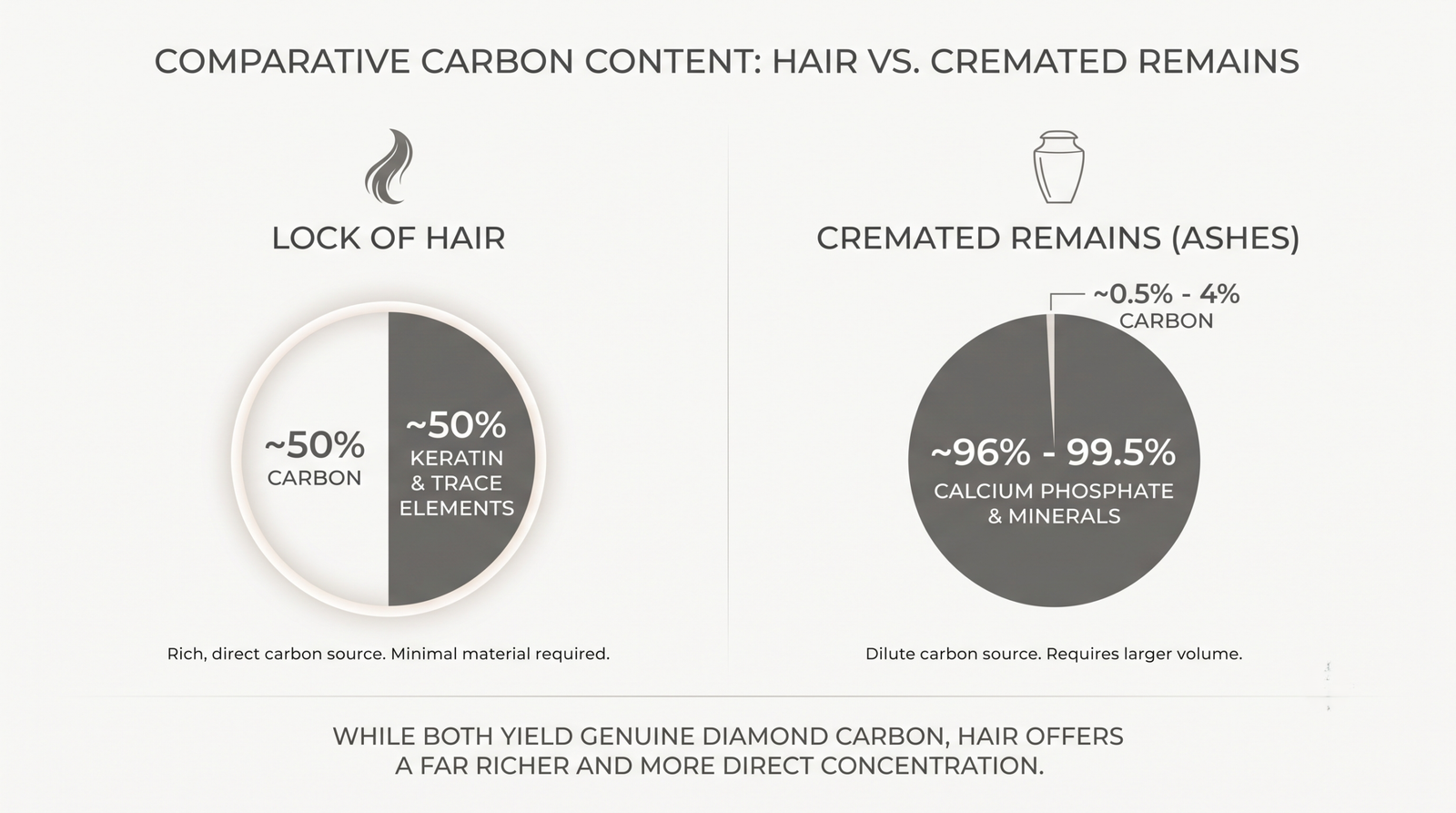
The question under this question is usually whether hair counts. So: yes, a memorial diamond really made from your husband’s hair is a genuine lab grown diamond grown from carbon extracted from the lock itself, and it is not the consolation version of an ashes stone. Hair is roughly 50% carbon by weight; cremated remains are roughly 0.5% to 4%. A diamond really made from a few grams of his hair is the same object, made by the same process, as one made from four ounces of ashes, and for a family who chose burial it is the only version.
Table of Contents
Is a Diamond Really Made From Hair the Same as One From Ashes?
| From his hair | From his ashes | |
|---|---|---|
| Carbon in the source | Roughly 50% | Roughly 0.5% to 4% |
| Material needed | A small lock, a few grams | A few tablespoons to ~4 oz |
| Cremation required | No | Yes |
| Growth method | HPHT or CVD, identical | HPHT or CVD, identical |
| Personal carbon in the stone | Typically around 10% to 15% | Typically around 10% to 15% |
| Finished object | A lab grown diamond, graded on the 4Cs | A lab grown diamond, graded on the 4Cs |
For a diamond really made from hair, the extraction is, if anything, the less doubtful part. Keratin is carbon rich, so a laboratory can purify a small lock to about 99.9% carbon, convert it to graphite, and grow a crystal by standard HPHT or CVD diamond growth. The full sequence, stage by stage, is in how a memorial diamond is made from your husband’s hair.
Where the Doubt Actually Sits: Provenance, Not Extraction
With a diamond really made from ashes, the doubt is about quantity and dilution. With hair, it is about identity: was this lock actually his? Hair from a shared brush, a shared pillow, or a coat two people wore carries less certainty than a lock cut at the hospital or taken from a razor only he used. A diamond really made from his hair is only as certain as the sample you sent.
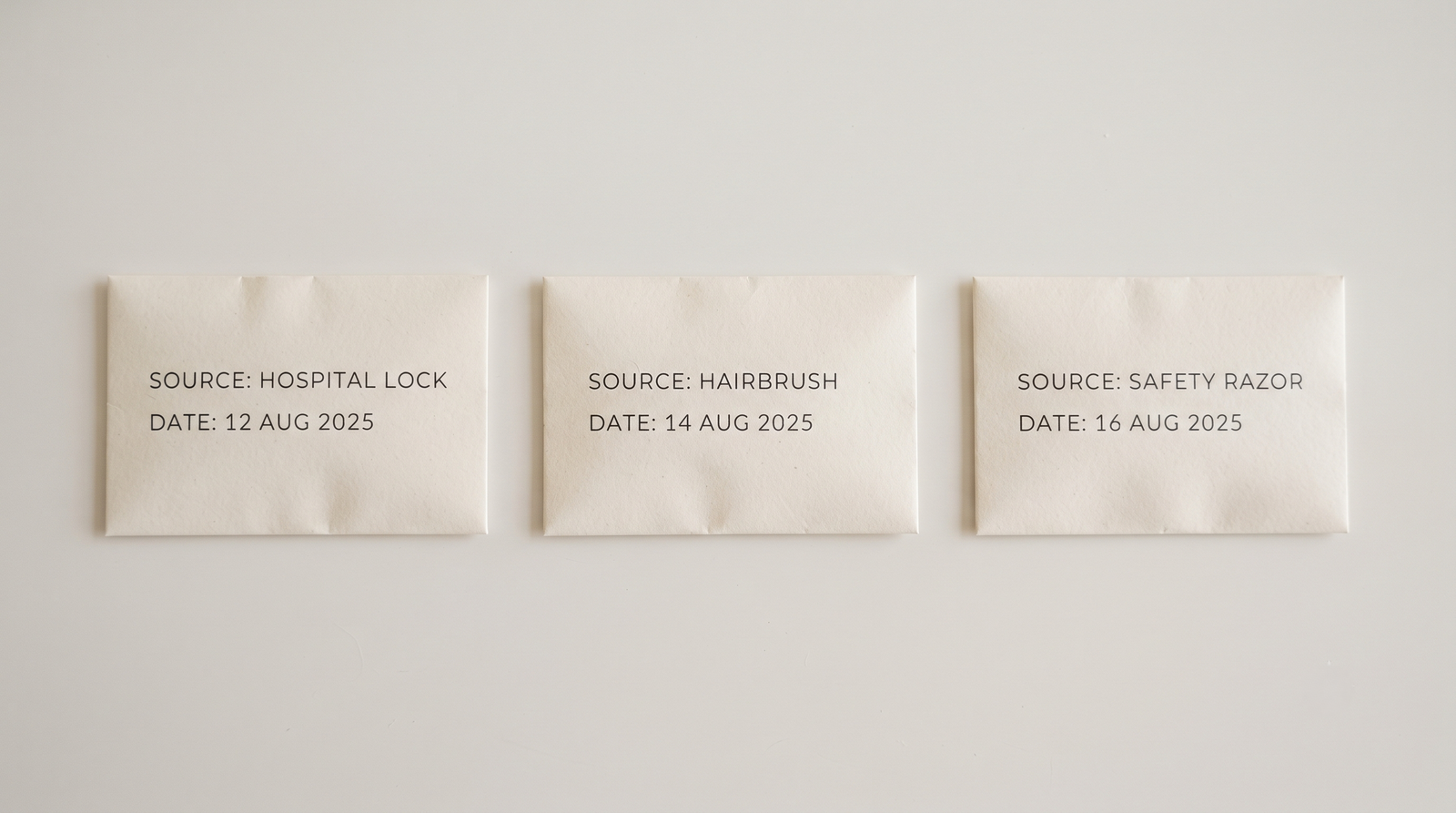
That makes the honest safeguards yours to build before the lock leaves you. Label the envelope with the source and date. Photograph it. Ask the provider what they record at intake and whether they will assess a photograph and weight first. Keep hair from different places in different envelopes rather than pooling them. The ashes version of this question is answered in is a memorial diamond really made from your husband’s ashes, and the combined version in is a memorial diamond really made from your husband’s ashes and hair. Confidence classes by source are laid out in the husband hair diamond guide.
Questions to Ask Before Sending the Hair
Before sending a lock, ask the provider about the minimum amount required. Ask whether the provider wants a specific type of hair. Ask how the provider labels the material when it arrives. Ask whether the provider photographs or weighs the sample during intake.
You can also ask how the provider documents the source material during processing. Ask what records you receive during the process and what documentation accompanies the finished diamond. These questions can help you understand the chain of custody from the original envelope to the completed stone.
What the Lock Has to Be, and What It Does Not
- Has to be: his, dry, and enough for the provider’s minimum, which is typically a small lock or a few grams.
- Does not have to be: fresh, with roots, a particular color, or from a particular part of the body. Hair stored dry keeps its carbon indefinitely, and pigment does not affect the stone’s color.
- Will not survive into the stone: DNA, texture, or hair color. Purification removes everything but carbon; the diamond’s color comes from trace elements during growth, and most memorial stones trend yellow, champagne, or blue.
If the sample is too small for a diamond really made from it, a provider should say so before you order rather than after. Quantity is covered in how much hair you need for a husband memorial diamond.
What Makes a Hair Based Memorial Diamond Different?
The most important difference is that hair does not require cremation. This makes a hair based memorial diamond relevant to families whose loved one was buried. It also helps families who no longer have access to ashes but preserved a lock of hair.
Another difference is carbon concentration. Hair is roughly 50% carbon by weight, while cremated remains contain roughly 0.5% to 4% carbon. This explains why the amount of source material can differ significantly between hair and ashes.
That difference does not mean that a hair based diamond is a lesser diamond. The finished object is still a lab grown diamond. The growth method remains HPHT or CVD, and the finished stone can receive the same type of diamond grading based on its physical characteristics.
The personal meaning can also differ. Some families want a stone associated specifically with hair because the hair was preserved during life. Others may have ashes available and choose those as the source. Some families may choose a combination. There is no single source that carries the same meaning for every family.
Can hair from a shared brush be used?
It may be possible to process the material, but the personal certainty becomes more complicated because the brush may contain hair from more than one person. If identity matters to you, tell the provider exactly where the hair came from and keep different sources separated.
Frequently Asked Questions
Is a diamond really made from hair a real diamond?
Yes. Carbon extracted from the hair is purified, converted to graphite, and grown into a diamond crystal by HPHT or CVD, the same methods used across the lab grown industry. It has the same hardness and structure as any diamond and is graded on the same 4Cs.
How can a few grams of hair be enough when ashes need ounces?
Because hair is roughly 50% carbon by weight and cremated remains are only about 0.5% to 4%. A small lock yields far more usable carbon than the same weight of ashes, so industry typical minimums for hair are a palm sized lock or a few grams.
Does the diamond contain his DNA?
No. Purification removes every element except carbon, and DNA does not survive the process. What connects the stone to him is his carbon in the crystal and the chain of custody record from your labelled envelope to the origin document.
What if I am not sure the hair is his?
Then a diamond really made from that hair is only as certain as that doubt allows, not by the chemistry. Hair from a razor, hat, or brush only he used is high confidence; shared bedding or a shared brush is lower. Keep sources in separate labelled envelopes and tell the provider where each came from.
Does he need to have been cremated?
No. A memorial diamond from hair involves no cremation at any stage, which is why it is the route for families who chose burial or scattered his ashes before hearing of this option. It is the same finished diamond, not a substitute.
Final Thoughts on Whether a Memorial Diamond Is Really Made From Your Husband’s Hair
Hair only is not the lesser route. A diamond really made from his hair is grown by the same process, to the same standard, from a source that is far richer in carbon than ashes. What you are being asked to trust is not the chemistry but the envelope, and that part is in your hands.
Learn More About Husband Memorial Diamonds
- How a Memorial Diamond Is Made From Your Husband’s Hair
- Is a Memorial Diamond Really Made From Your Husband’s Ashes?
- Is a Memorial Diamond Really Made From Your Husband’s Ashes and Hair?
- Husband Hair Diamond: The Complete Guide
- How Much Hair Do You Need for a Husband Memorial Diamond?
Talk With Memorial Diamond
If what you have is a lock from a hairbrush and you are unsure it is enough, or enough his, reach out to Memorial Diamond to talk through what’s possible with what you kept.
Leave A Comment