
Some grandchildren find themselves wanting something of him they can hold, not only remember. A grandfather ashes diamond is a real lab-grown diamond made in part from carbon drawn out of a portion of his cremated remains, typically blended with supplemental lab carbon and finished in about 6 to 10 months. Only some of his ashes are used, so the rest can stay where your family intends, and for a grandchild the first step is a conversation with whoever holds authority over them.
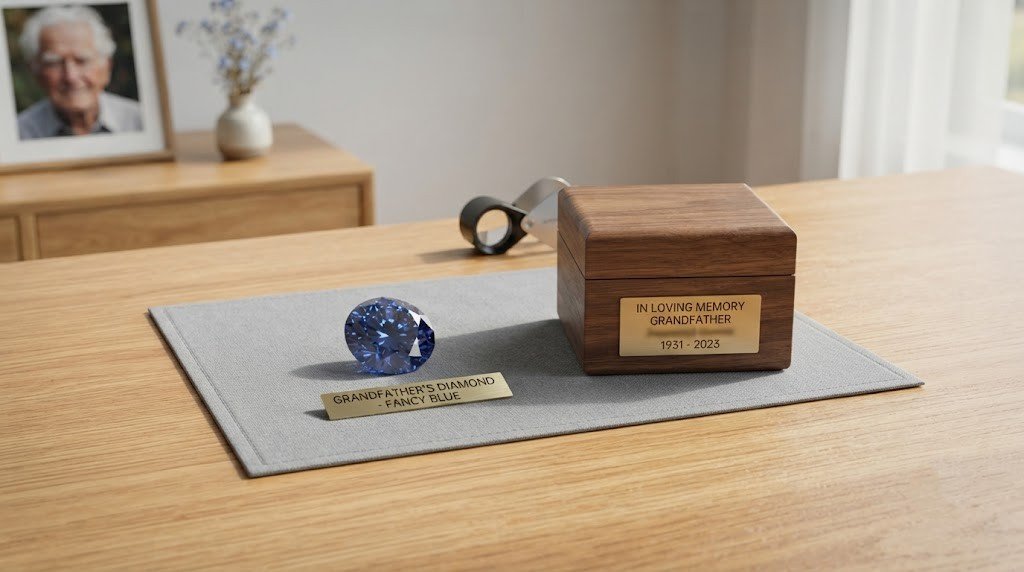
Table of Contents
What is a grandfather ashes diamond, and what is it not?
A grandfather ashes diamond is a genuine diamond, grown in a lab, whose crystal contains carbon recovered from part of his cremated remains. Chemically and physically it is diamond through and through, so a gemologist would grade it for cut, color, clarity and carat exactly as they would a mined stone.
It is not glass, resin or a look-alike gem with ash sealed inside. Nor is it made entirely from him. Ash holds very little usable carbon, so providers typically combine his purified carbon with supplemental lab carbon in order to grow a stone of a size people can wear.
None of that makes a grandfather ashes diamond any less his. A real, documented portion of his own carbon is locked into its lattice. The companion piece asking whether a memorial diamond is really made from your grandfather’s ashes looks closely at what the science supports and where honest limits lie.
A grandfather ashes diamond is also only one way to honor him among many. Burial, scattering, an urn on a shelf, a columbarium niche or a memorial tree are all meaningful, and a stone can sit alongside any of them because it draws on just a small portion of what remains.
How much of a grandfather ashes diamond is really his carbon?
The honest answer is a minority share. Industry figures suggest that carbon recovered from ash makes up roughly 10–15% of a finished memorial stone by mass, though for ash some providers quote figures nearer 3% and others quote more.
Why so small a share? The reason lies in what ash is, and it applies to every grandfather ashes diamond. Cremated remains consist mainly of calcium phosphate, the mineral of bone, and usable carbon is only around 0.5% to 4% of ash by weight. After extraction and purification, that carbon is not usually enough on its own to grow the size a family has in mind, so supplemental lab carbon is typically added.
Before you commit to a grandfather ashes diamond, ask each provider in writing what share of the finished stone they expect his ash to contribute and how they document it. A clear written answer lets you compare providers on the same terms, and it makes the stone far easier to explain truthfully to relatives.
How is a diamond made from his ashes?
His carbon is extracted, purified, converted to graphite and then grown around a tiny diamond seed under intense heat and pressure. HPHT (high pressure, high temperature) is the industry standard for memorial stones, and a minority of providers use CVD (chemical vapor deposition) instead.
Making a grandfather ashes diamond generally follows seven stages:
- Receipt and logging. The portion of ashes meant for a grandfather ashes diamond arrives and is recorded so it stays tied to your family’s order from the first day.
- Extraction and purification. Heating without oxygen, in several controlled steps, strips out the bone mineral until what is left is carbon of about 99.9% purity or higher.
- Graphitization. Further heating, to about 2,500–2,700°C, turns that carbon into graphite, the feedstock a growth press needs.
- Growth. In HPHT, the graphite, typically blended with supplemental lab carbon, surrounds a seed at about 6–8 GPa and 1,400–2,500°C. Growth runs for weeks to months, and the length of growth, not the quantity of ash, sets the carat weight.
- Cutting and polishing. The rough crystal is shaped into a round, oval, cushion, princess or another cut.
- Optional color treatment. Some providers offer irradiation after growth to create pink, red, green or black stones.
- Grading and paperwork. Some providers offer independent grading, and providers typically issue their own record linking the stone to your family’s material.
For background on both growth methods, the synthetic diamond overview is a solid general reference. For a closer account of each stage as it applies to him, read how a memorial diamond is made from your grandfather’s ashes.
How much ash is needed, and what happens to the rest?
Industry-typical requests run from a few tablespoons up to roughly 4 oz (about 100 g) of cremated remains. Against a full set of cremated remains, that is a small amount, which leaves most of his ashes free for whatever your family has planned.
Minimums for a grandfather ashes diamond differ by provider, so get the figure in writing before anything is shipped. Ask too what becomes of any ash that is not used: whether it comes back, how it is packed and how it is tracked. Policies differ, and it is better to ask than to assume.
A grandfather ashes diamond does not have to displace an urn, a plot or a scattering. One family might keep the urn at home, set aside a small portion for a stone and inter the remainder later. The hands-on guide to how to turn your grandfather’s ashes into a diamond explains how to separate and send a portion carefully.
Who can request a diamond when you are his grandchild?
Who controls cremated remains is set state by state rather than nationally. Commonly, his surviving spouse or partner and his adult children rank ahead of grandchildren, and written instructions he left, such as a will or a prearranged funeral plan, may alter that order.
So the considerate path is to approach the person with that authority and ask for a small portion of his ashes for a grandfather ashes diamond. That person might be your parent, if they are living, an aunt or uncle, a surviving spouse or partner, or someone he named in writing. If nobody is sure, the funeral home that handled the cremation may be willing to tell you who signed the authorization; treat that as a practical starting point rather than a final answer on who decides now.
Asking about a grandfather ashes diamond lands more gently when you explain what the stone is, how little ash it uses and that supplemental carbon is typically part of it. Give the person time to think, and accept their answer. If they decline, his hair may offer another way forward, since hair needs no cremation at all; the grandfather hair diamond complete guide covers that route. Whether short, gray, sparse or beard hair is accepted, and how much is needed, are questions only a provider can answer.
Resist any shortcut around the person with authority. Requesting ashes from a funeral home or a relative behind someone’s back tends to damage trust in ways that outlast the stone.
What color will a grandfather ashes diamond be?
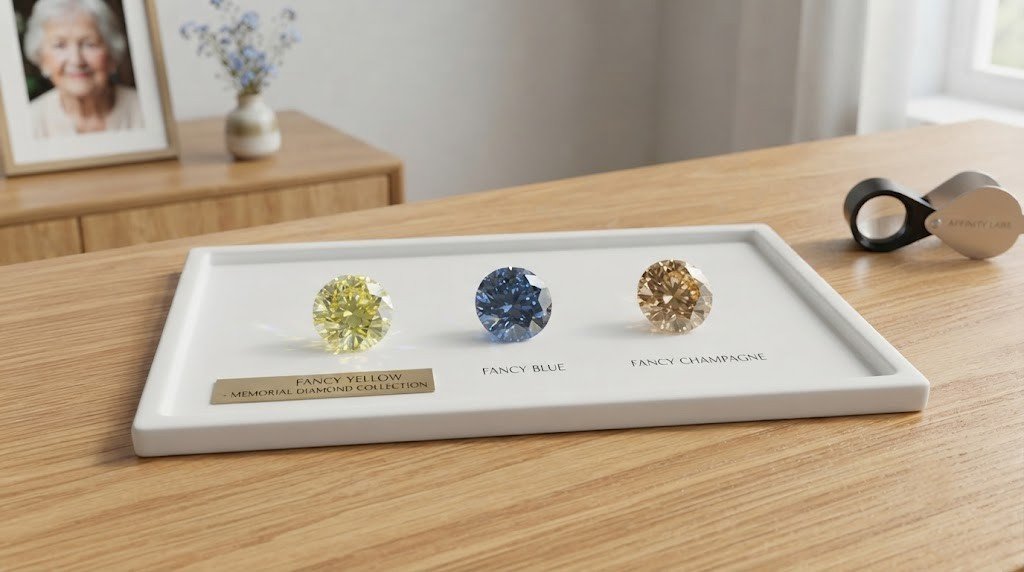
Nobody can promise the color of a grandfather ashes diamond ahead of time. Trace elements present while the crystal grows decide it: nitrogen pushes a stone toward yellow, boron toward blue, and colorless requires keeping both out, which usually raises the price.
Memorial stones, including a grandfather ashes diamond, commonly land in yellow, blue, or champagne and brown tones. Some providers let you aim for a target color such as blue or colorless, and some offer irradiation after growth for pink, red, green or black. Ask which colors a provider offers, how each is achieved and what each adds to the cost.
No reliable source shows that anything about him, his ashes or his life makes the stone lighter or darker. It is kinder, and more accurate, to see the color as part of this one stone’s character rather than a message. The GIA explanation of the 4Cs shows how color is graded if you want the detail.
How much does a grandfather ashes diamond cost?
The price of a grandfather ashes diamond depends first on carat and color, then on cut, setting and whether you add independent grading. The 2026 industry ranges below are general guides, not any one provider’s price list.
| Size tier | Typical carat range | Industry price range (2026) | What usually moves the price |
|---|---|---|---|
| Small | about 0.10–0.25 ct | about 1,500–3,500 | Color choice, cut |
| Medium | about 0.5–1 ct | about 5,000–15,000 | Colorless costs more than blue, yellow or champagne |
| Large | about 2–5+ ct | about 20,000–75,000+ | Longer growth, color, cut |
Settings, engraving, fancy cuts and grading reports are normally charged on top of the loose stone. Ask each provider for an itemized written quote listing those separately, along with the payment schedule and what happens if plans change partway through.
A small grandfather ashes diamond means just as much as a large one. If relatives are sharing the cost, agree in writing who contributes what before an order goes in.
How long does the process take?
Industry-wide, a grandfather ashes diamond typically takes 6 to 10 months from the day the provider receives the ashes to the day the stone is finished. Larger stones, around 2 carats and up, and specialty colors can stretch to about 12 months.
The growth phase itself lasts weeks to months, and longer growth yields a larger stone. Sending more ash does not speed a grandfather ashes diamond along or make it any bigger. If a date matters, such as the anniversary of his death or a family gathering, mention it early and ask in writing what timing the provider can realistically offer and how you will hear about progress.
Families considering a blend of materials can read the step-by-step guide to turning your grandfather’s ashes and hair into a diamond, which explains how timing and process change when both are used.
Can several grandchildren or cousins each have a stone?
In many cases, yes. Each grandfather ashes diamond draws on only part of the ashes, so several grandchildren, cousins or other relatives can sometimes have stones from one shared source.
How many stones are possible, and how much ash each requires, depends on the provider. Ask whether one submission can supply several stones, whether each stone needs its own portion, how documentation is kept separate for each person, and whether each stone is priced on its own.
Relatives sharing his ashes this way do well to settle a few points together: who deals with the provider, how costs are split, and whether every grandfather ashes diamond should match in color and cut or reflect each person’s taste. One cousin may want a stone, another a different keepsake, another nothing, and each of those answers deserves respect.
What if he died years ago, or his ashes were interred, divided or scattered?
It may still be possible, but that depends on where his ashes are now, who holds them and what a provider says about ashes that have been stored for a long time. Ask that last point directly rather than assuming either way.
Each situation brings its own questions about a grandfather ashes diamond:
- Kept at home for years. Ask the provider in writing whether the time since cremation or the way the ashes were stored affects their process.
- In a columbarium niche or cemetery plot. Retrieval involves the cemetery and whoever holds authority, and rules differ. Ask the cemetery first what the process involves.
- Already divided among relatives. A small amount from one relative’s share may be sufficient, if that relative agrees. Ask the provider for their minimum.
- Fully scattered. An ash-based stone may no longer be possible, though a kept lock of his hair could open another route.
The grandfather ashes and hair diamond complete guide explains how a small amount of ash and a lock of hair can be combined when neither alone feels like enough.
How do faith traditions view it?
Religious teaching covers cremation and the treatment of ashes, not memorial diamonds as such, so no tradition has issued a ruling on a grandfather ashes diamond itself. Opinion varies within each tradition, which makes your own clergy or faith leader the right person to consult.
A short orientation:
- Catholic teaching accepts cremation but expects the ashes to rest together in a consecrated place, with limited exceptions, so separating a portion is something to discuss with a priest.
- Jewish positions depend on the movement; Orthodox and Conservative communities generally object to cremation itself, and Reform rabbis tend to leave the matter to families.
- Islamic scholarship across the major schools treats cremation as impermissible under ordinary circumstances.
- Hindu practice centers on cremation and immersion of ashes, and holding back a little is handled differently from family to family.
- Buddhist and Protestant perspectives differ by teacher and congregation.
Since a stone grown from hair involves no cremation, it falls outside an objection aimed at cremation, which can matter for Muslim households and for Orthodox or Conservative Jewish households. Raise that possibility with clergy if faith is part of the decision.
How can the diamond be worn, kept or passed down?
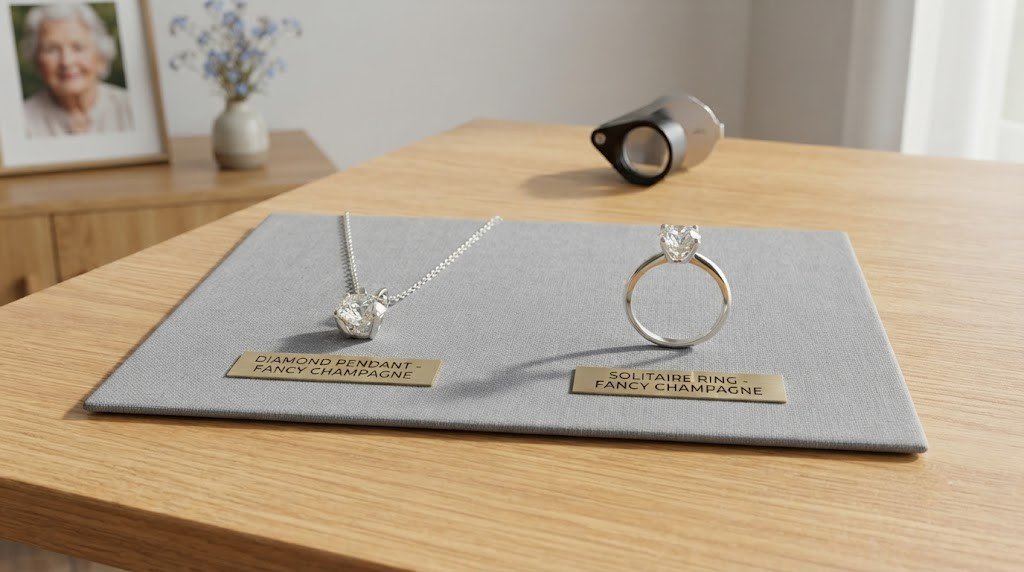
A grandfather ashes diamond can go into any setting that suits the person who will wear or keep it. Nothing says a stone from a man’s ashes has to become a traditionally masculine piece; the wearer, not him, should guide the design.
Some possibilities for setting a grandfather ashes diamond:
- A pendant on a fine or sturdy chain
- A ring, from a plain band setting to a solitaire or a cluster
- A pair of earrings, if two small stones are grown
- A bracelet, brooch or tie bar
- A loose stone kept in a small case until the family decides
Like any diamond, a grandfather ashes diamond rates 10 on the Mohs hardness scale, the highest of any natural mineral, so it copes well with daily wear. A sharp knock at the wrong angle can still chip it, though, so ask a jeweler about protective settings such as a bezel.
Some families hope a grandfather ashes diamond will become an heirloom. If that is your plan, keep the provider’s paperwork with the stone, write a short note recording whose carbon it holds, and talk about who will look after it next. Whether and how to insure it is a question for an insurance agent.
What should you ask a provider before you begin?
Ask every provider to answer these in writing before you send anything:
- How much ash is required, and what happens to any you do not use?
- What share of the finished stone do you expect to come from his ash?
- How is the material tracked from arrival to the finished stone?
- Do you grow by HPHT or CVD?
- Which colors and cuts are available, and how does each affect cost and timing?
- Is independent grading offered, and is it included in the quote?
- What documentation of origin will we receive?
- What are the payment terms, and what happens if our plans change?
- How and how often will you update us?
Written answers make providers easier to compare and make a grandfather ashes diamond easier to explain to relatives who were not part of the first conversations.
Frequently Asked Questions
Is a stone made from his ashes a real diamond?
Yes. A grandfather ashes diamond is lab-grown diamond with the same crystal structure and hardness as a mined one. It is grown partly from carbon extracted from his ashes, typically blended with supplemental lab carbon, and can be graded on the 4Cs.
Can I arrange one without telling relatives?
That is best avoided. Authority over cremated remains varies by state, and his surviving spouse or partner and adult children commonly come before grandchildren. Asking the person who holds authority for a small portion of his ashes keeps the family’s trust intact.
Will sending more ash make the diamond larger?
No. Carat weight depends mainly on how long the crystal grows, not on the amount of ash. Providers typically need a few tablespoons up to about 4 oz, which leaves most of his ashes with your family for other plans.
Does his age or health change the diamond?
No reliable evidence links his age, health or life to the stone’s color or quality. Color comes from trace elements during growth and cannot be predicted exactly, though some providers let you aim for a particular color. Ask what they can target.
Is a grandfather ashes diamond possible if his ashes are in a niche?
Possibly. Removing ashes from a columbarium niche or cemetery plot involves the cemetery and whoever holds authority, and rules differ. Ask the cemetery about the process, then ask a provider how much ash they would need.
Can a granddaughter wear a stone made from his ashes?
Of course. The stone itself has no gender, and the setting should reflect whoever wears it. Pendants, rings, earrings, bracelets and loose keepsakes are all suitable, chosen for the wearer rather than for an idea of what a man’s piece should be.
Final Thoughts on Honoring Your Grandfather
There is no single right way to remember him, and a diamond is just one of many. If your family chooses one, let the conversations take the time they need, ask for every answer in writing, and pick a setting that fits the person who will carry it. The right choice is whichever feels true to him and workable for the people deciding together.
Learn More About Grandfather Memorial Diamonds
- Grandfather hair diamond: the complete guide when a lock of hair is what you have
- Grandfather ashes and hair diamond: the complete guide combining both materials in one stone
- How to turn your grandfather’s ashes into a diamond practical steps from first call to finished stone
- Is a memorial diamond really made from your grandfather’s ashes? what the carbon-share figures do and do not mean
Talk With Memorial Diamond
If you are considering a stone for him and would like straightforward answers, we are here whenever you are ready. Visit memorialdiamond.us to reach us, with no obligation and no rush.
Leave A Comment