Ashes and Hair

How a Memorial Diamond Is Made From Your Grandfather’s Ashes and Hair

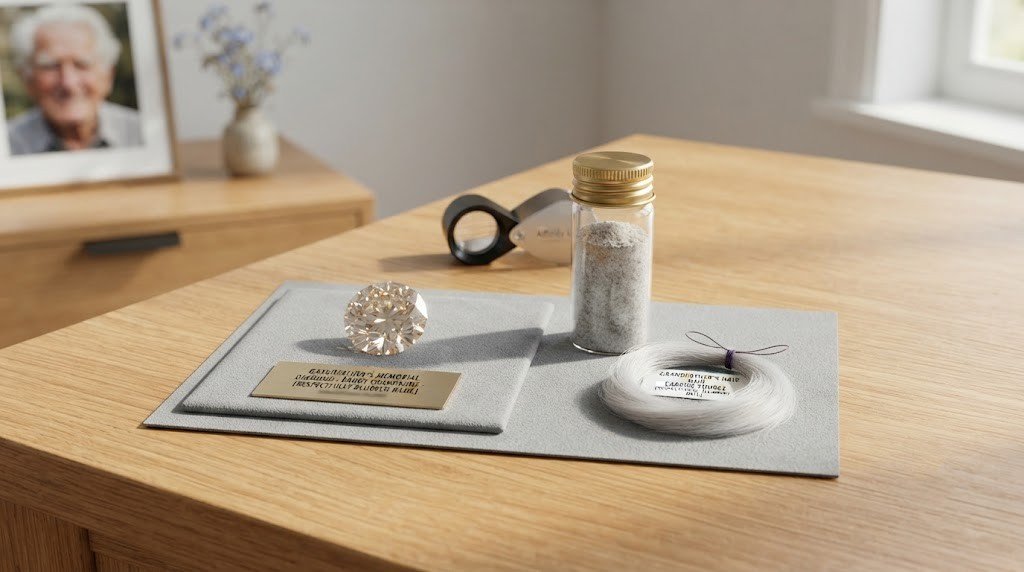
Some families hold two things of his: a portion of his ashes and a lock of his hair. A memorial diamond made from grandfather ashes and hair starts from both, and the lab treats them as separate raw materials, recovering carbon from each, purifying it, converting it to graphite and growing a real diamond, typically with supplemental lab carbon added. Whether and how the two are combined depends on the provider, so that is something to confirm in writing.
made from grandfather ashes and hair

How Do Ash Carbon and Hair Carbon Differ?

They begin at opposite ends of the carbon scale. Ashes are mostly calcium phosphate, with usable carbon at roughly 0.5–4% by weight, whereas hair is built from keratin and is roughly 50% carbon. A stone made from grandfather ashes and hair would therefore draw on one lean source and one rich one.

The gap between the two sources behind a diamond made from grandfather ashes and hair comes from what each material is. Cremation burns away most organic matter and leaves the mineral framework of bone, so carbon survives only in small traces. Hair is protein, and that protein keeps its carbon until a lab deliberately extracts it.

Cremated ashesHair
Main substanceCalcium phosphate (bone mineral)Keratin (protein)
Carbon by weightRoughly 0.5–4%Roughly 50%
Typical amount requestedFrom a few tablespoons to ~100 g (about 4 oz)A few grams, often one small lock
What extraction must removeCalcium phosphate and other mineralsHydrogen, oxygen, nitrogen, sulfur and residues
Needs cremation?YesNo
Published finished-stone carbon shareFor ash, usually ~10–15% of the finished stone’s mass (some providers cite ~3%, others more)None published
Who typically holds itWhoever received the cremated remainsWhoever saved the lock

Seen side by side, the two materials ask different things of a lab. Ash demands careful recovery of a small carbon fraction from a large mineral mass; hair demands the removal of several non-carbon elements from a carbon-rich protein. A diamond made from grandfather ashes and hair has to satisfy both sets of demands before the carbon ever reaches a press.

Does a Provider Actually Combine the Two Materials?

That depends entirely on the provider, and no single method is standard or publicly documented across the industry. Some labs may offer a single stone made from grandfather ashes and hair; others may only work with one, or may suggest two separate stones.

Even among labs that accept an order for a diamond made from grandfather ashes and hair, the details are theirs to explain. Whether ash carbon and hair carbon are pooled, at what stage, in what proportion, and whether you have any say in that proportion are all process decisions this guide cannot describe as fact. Ask, and keep the answers.

Eight questions are worth putting to any lab before you agree to a diamond made from grandfather ashes and hair:

  1. Do you grow one stone from both materials, or do you recommend separate stones?
  2. If both are used, at what point in your process are the two carbons brought together?
  3. Can you tell me the proportion of ash carbon to hair carbon, or is that not tracked?
  4. How much of each material do you need for the carat size I am considering?
  5. How is supplemental lab carbon handled, and can you state its share for my order?
  6. Will my documents name both ashes and hair as source materials?
  7. How do you keep each material identified and separate before it is combined?
  8. What happens to any ashes or hair you do not use, and can they be returned?

There are no wrong answers here, only unclear ones. A lab that explains its approach plainly, in writing, gives you something you can compare; a vague reply is a reason to ask again, not a reason to assume.

What Does the Lab Do to the Ashes?

For a stone made from grandfather ashes and hair, the ash portion goes through a controlled, oxygen-free heating process designed to separate a small amount of carbon from a large quantity of mineral. Calcium phosphate and other minerals are stripped away, and what carbon survives is collected.

Because carbon makes up such a small share of cremated remains, ash is the more demanding of the two sources for any diamond made from grandfather ashes and hair. The yield from one cremation can vary with the person and with how the cremation was carried out, which is part of why providers ask for more ash than hair.

The recovered carbon is then refined in further stages until it reaches roughly 99.9% purity or higher. At that point the ash carbon intended for a stone made from grandfather ashes and hair is chemically just carbon, ready to be converted to graphite.

The step-by-step account of a memorial diamond made from your grandfather’s ashes follows the ash route on its own in more depth.

What Does the Lab Do to the Hair?

The hair destined for a diamond made from grandfather ashes and hair is also heated without oxygen, but here the task is reversed: carbon is plentiful, and the lab is driving off the hydrogen, oxygen, nitrogen and sulfur bound up in keratin, along with any natural oils or product residue the strands carried.

After extraction, the hair carbon is purified to the same roughly 99.9% standard as the ash carbon. By the end of purification, hair carbon and ash carbon intended for a stone made from grandfather ashes and hair have both been refined to the same high-purity standard.

Gray, white, short, sparse, beard or treated hair may be what was saved. Nothing published shows these behave differently in extraction, and nothing shows they are a problem either, so whether a lab accepts each type, and in what amount, belongs on your list of written questions. The full process for a memorial diamond made from your grandfather’s hair explains the hair-only route in detail.
How Much of Each Is Usually Requested?

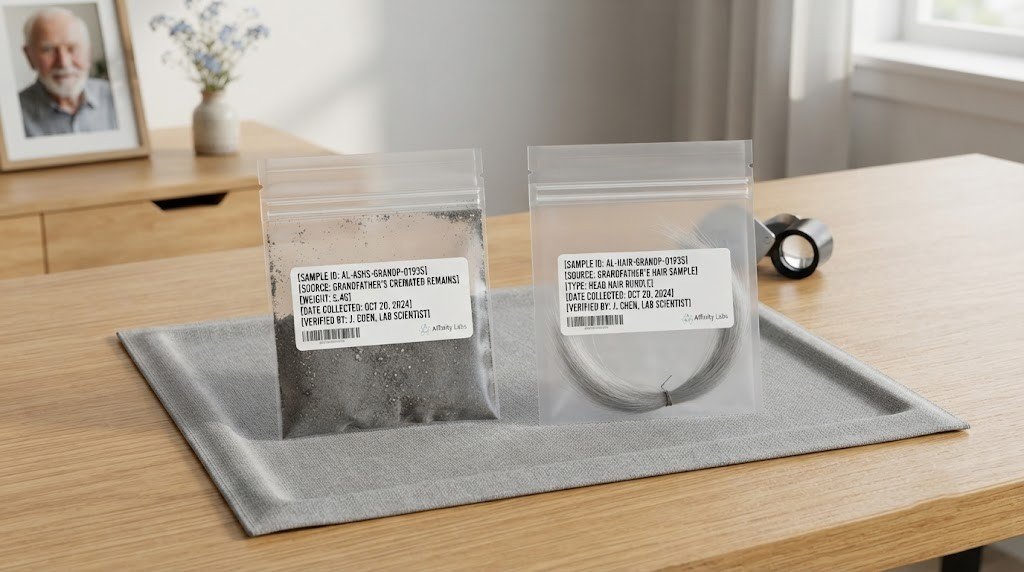
For ashes, industry-typical requests range between a few tablespoons and around 100 g (roughly 4 oz); for hair, a few grams, often one small lock, is the usual ask. A stone made from grandfather ashes and hair may need a different amount of each than a single-material order, so the exact figures come from the provider, not from general guidance.

Material quantity does not set the carat of a stone made from grandfather ashes and hair. Size depends on growth time in the press, so sending extra ashes or a larger lock will not by itself produce a bigger stone, and a small contribution does not limit the size you can choose.

Only part of each material is typically used in a diamond made from grandfather ashes and hair. That can leave most of his ashes for an urn, a burial or a scattering already planned, and some of his hair to keep. Several stones can often be grown from the same source, which matters if more than one relative would like a piece.

How Is a Diamond Made From Grandfather Ashes and Hair Grown and Cut?

Once purified, the carbon is graphitized at roughly 2,500–2,700°C and then grown into diamond, usually by HPHT, the industry-standard method. From that point, a diamond made from grandfather ashes and hair grows and is cut under the same physics as any lab-grown diamond.

In an HPHT press, graphite, typically blended with supplemental lab carbon, is pressed to roughly 6–8 GPa and heated to about 1,400–2,500°C, with a tiny diamond seed at its center. Carbon atoms gradually build onto the seed as a diamond crystal. A minority of providers use CVD, converting the carbon to a gas and depositing it onto a seed plate in a vacuum chamber; the Wikipedia article on synthetic diamond covers both techniques.

Growth runs for weeks to months, and the length of the run decides how many carats a rough crystal made from grandfather ashes and hair reaches. Memorial stones are generally available from about 0.10 to 5+ carats. Afterward, a cutter shapes and polishes the rough into a round, oval, cushion or other cut.

The whole journey for a memorial diamond made from grandfather ashes and hair typically takes 6–10 months, and as long as about 12 for stones of roughly 2 carats and up or for specialty colors. Providers do not publish reliable timings for individual stages, so ask yours how it reports progress.

How Much of a Stone Made From Grandfather Ashes and Hair Is His Own Carbon?

No personal-carbon figure is published for a two-material stone. The only widely cited figure is for ash alone, and it cannot simply be carried over to a diamond made from grandfather ashes and hair.

For ash-only stones, personal carbon from the ashes is usually put at around 10–15% of the finished stone’s mass, with some providers citing as little as ~3% and others more. That range reflects ash’s low carbon yield and nothing else. Hair has no published finished-stone share, and a blend has none either.

So what can honestly be said? Supplemental lab carbon is typically part of the growth mix, so a stone made from grandfather ashes and hair should not be described as nothing but him. A real, documented portion of his own carbon, from one or both materials, becomes part of the crystal lattice. For the percentage that applies to your stone, ask the provider to state it in writing, and if they cannot, ask why.

For a closer look at that question for ash, see whether a memorial diamond is really made from your grandfather’s ashes.

What Decides the Color of a Diamond Made From Grandfather Ashes and Hair?

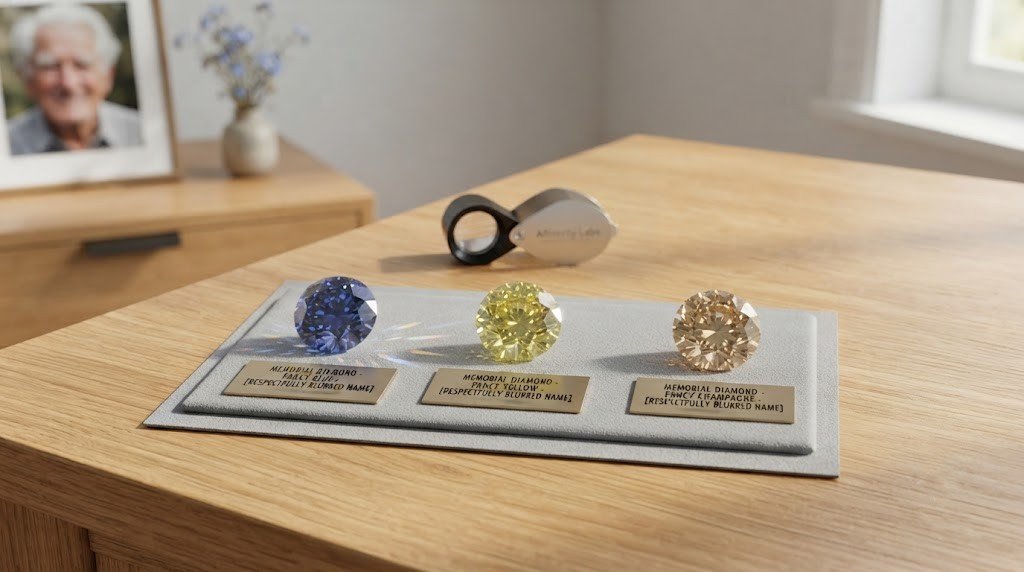
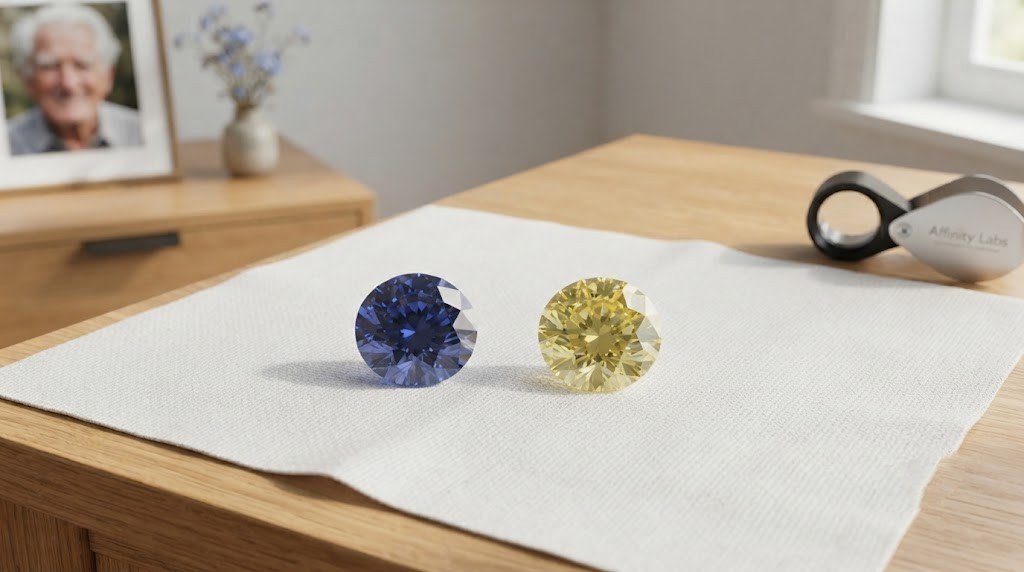
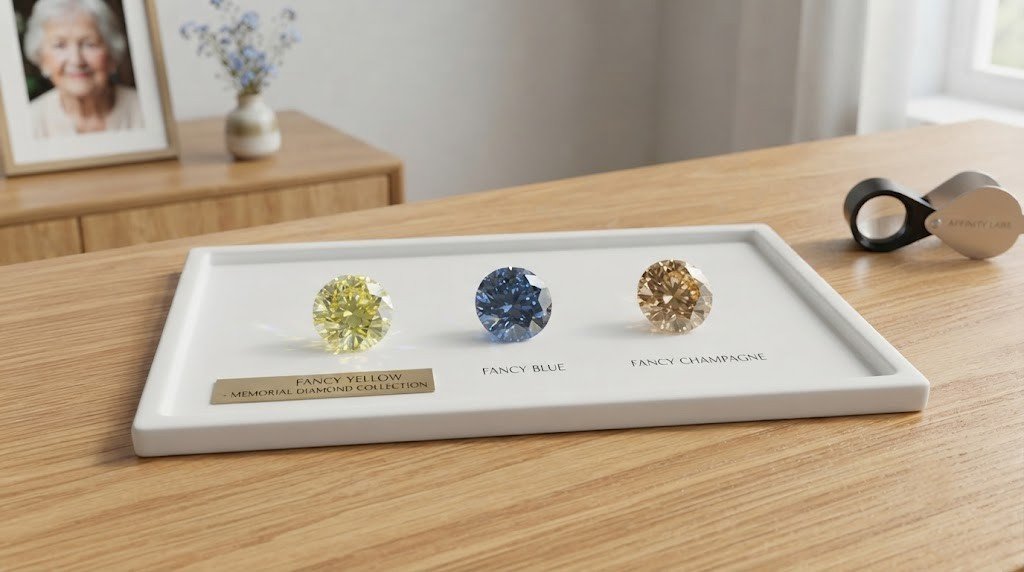
Trace elements present while the crystal grows decide it. Nitrogen gives yellow, boron gives blue, and colorless requires the near-absence of both; memorial stones commonly lean yellow, blue or champagne to brown, partly because personal carbon sources tend to carry trace elements, and colorless typically costs more.

Some providers add an optional post-growth irradiation step to reach red, pink, green or black. That is a choice made after the stone is grown, not a result of anything in the ashes or hair.

No published source lets anyone predict how a diamond made from grandfather ashes and hair will look from its materials. Neither ashes nor hair, nor gray or dyed hair, has been shown to make a stone lighter or darker. Treat the color of a stone made from grandfather ashes and hair as a decision you discuss with the lab.

What Should the Paperwork Say When Two Materials Are Sent?

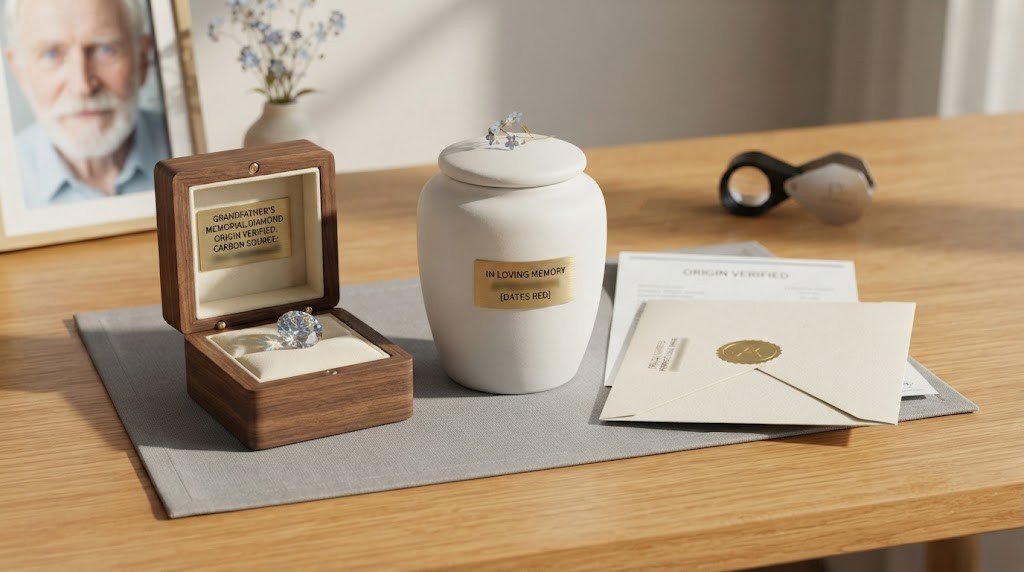
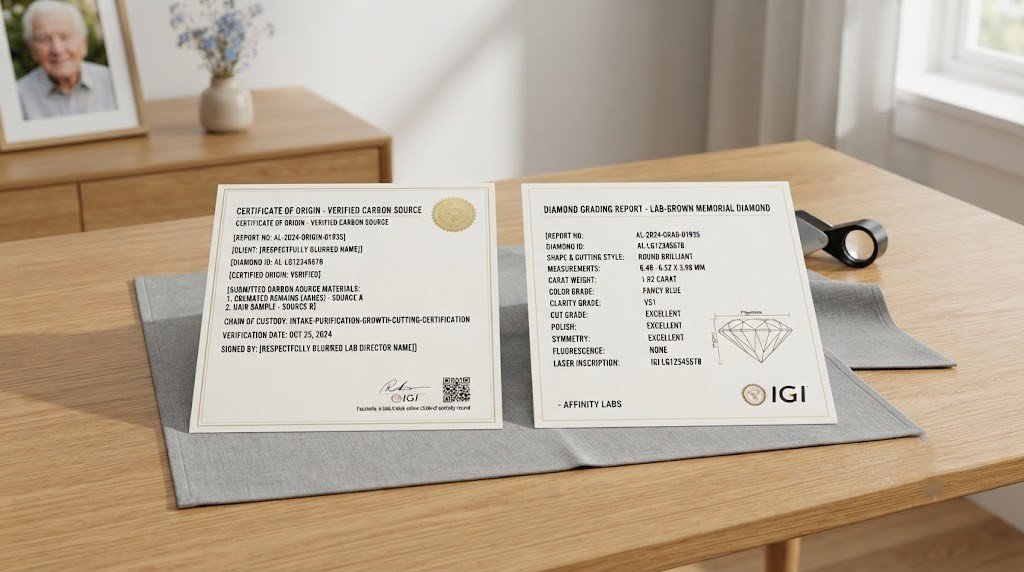
Ideally, two kinds of document arrive with the stone: an authenticity or origin certificate that names both ashes and hair as source materials, and, if you choose one, a grading report describing the diamond’s quality.

The authenticity certificate is usually issued in-house. For a stone made from grandfather ashes and hair, it should reference the identifiers both materials were given at receipt, so the record of origin accounts for every material that went into it.

A grading report for a diamond made from grandfather ashes and hair is a separate, optional document. It assesses cut, color, clarity and carat using standards such as the GIA 4Cs, sometimes through IGI, and memorial stones typically grade between SI2 and VVS. It describes the diamond, not where its carbon came from, so it does not replace the origin certificate.

How Is Chain of Custody Kept for Two Separate Materials?

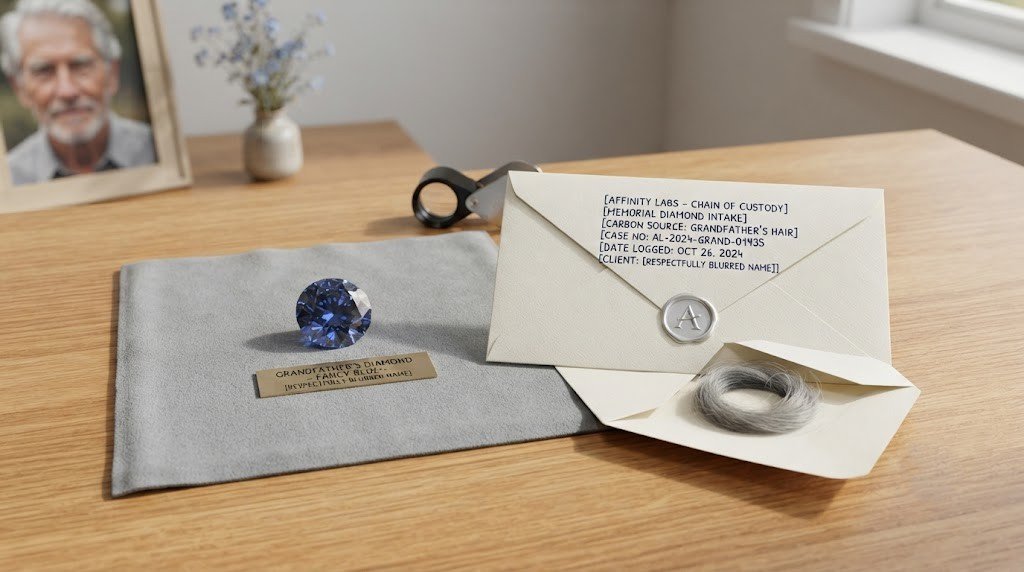
Through a documented trail for each material, from the moment it arrives until its carbon is grown, and then a trail for the finished stone. Grading reports cover quality, not origin, so these records are what you rely on; ask the provider whether anything beyond them can confirm where the carbon came from.

Two materials mean twice the handoffs. When you ask about a diamond made from grandfather ashes and hair, check:

  • whether each material gets its own identifier at receipt
  • whether the two are logged separately until any combining step
  • who signs off when they are brought together, if they are
  • whether you can see the log or receive progress updates, and how often
  • whether unused ashes and hair are recorded, and whether they can come back to you

Answers to these will differ between providers, so get them in writing. A lab that can clearly describe how it tracks a stone made from grandfather ashes and hair from both starting points is giving you a reason to trust it.
Who Should Be Part of the Decision?

Anyone who holds his ashes, and usually anyone who kept his hair, has a stake in a diamond made from grandfather ashes and hair. Authority over cremated remains varies by state, with no single national rule; a surviving spouse or partner and his adult children commonly rank ahead of grandchildren, and written wishes can change that order.

If you are a grandchild and the ashes are with someone else, a respectful request for a small portion is often the place to start. Hair offers another route, since a lock kept by you or a relative may be easier to use. Rules on remains focus on the remains themselves, so hair in your keeping is usually simpler, though belongings can form part of an estate and rules vary by state. Hair held by someone else is a conversation, not a decision.

Faith may matter too. No tradition has an official position on memorial diamonds; teachings concern cremation and the handling of ashes.

A Catholic family may want to ask about guidance on dividing ashes, and for Muslim families or Orthodox and Conservative Jewish families, where cremation itself is the concern, a hair-only stone avoids cremation entirely. Your own clergy can advise.

When you are ready to plan the order, how to turn your grandfather’s ashes and hair into a diamond lays out the practical steps, and the grandfather ashes and hair diamond complete guide covers cost and settings.

Frequently Asked Questions

Can I ask for two stones, one from ashes and one from hair?

Some providers can grow separate stones from separate materials, though offerings differ. Ask whether each stone is priced individually, how much of each material a separate order needs, and whether the documents for each stone name only its own source.

Is a two-material stone harder to grow than a single-material one?

Once carbon has been purified and graphitized, growth follows the same physics as any memorial diamond. Any added work would sit in handling and tracking two materials first, so if a provider offers a combined order, ask whether it changes the timeline, price or documentation.

Does adding hair mean less ash is needed?

Not necessarily. Hair is carbon-rich, but how a lab balances the two depends on its process and on the size you choose. Ask how much ash and how much hair your specific order needs, and get the figures in writing before sending.

Will the stone look different because two materials were used?

No published evidence shows that using two materials changes a stone’s appearance. Color comes from trace elements present during growth and any optional irradiation, and no source makes it predictable. A stone from two sources shares the structure, hardness and grading terms of any diamond.

Can the ashes be ones that were already divided among relatives?

A portion already given to a relative can be a starting point, provided whoever holds it agrees. Authority over remains varies by state and family situation, so talk with the relatives involved first and ask the provider how much of that portion it would need.

What if only a very small amount of each material was kept?

That may still be workable, but the minimum is a provider question. Describe exactly what you have, including weight if possible and the type of hair, and ask whether one stone, two stones, or a single-material stone suits it best.

Final Thoughts on a Diamond Made From Grandfather Ashes and Hair

Bringing two parts of him into one decision can feel weighty, and it is fine to take the time you need. The science is settled enough to describe; the provider-specific parts are not, and asking about them plainly is how you protect what you hold. Whatever you choose, you can take the questions one at a time.

Learn More About Memorial Diamonds for a Grandfather

Talk With Memorial Diamond

Whenever you are ready, we can talk through what you have kept and what a diamond made from grandfather ashes and hair would need from each material. Visit memorialdiamond.us to ask a question; there is no pressure to decide anything.
Grandfather Hair Diamond The Complete Guide

Grandfather Hair Diamond: The Complete Guide

Sometimes the thing you end up holding is small: an envelope, a folded tissue, a few strands someone thought to keep. A grandfather hair diamond is a real lab-grown diamond grown in part from carbon taken from his hair, and it does not depend on cremation, so it remains possible if he was buried. A small lock is typically enough, and this guide covers sourcing, permission, color, cost, timing and sharing.

grandfather hair diamond

What is a grandfather hair diamond?

A grandfather hair diamond is a genuine diamond, grown in a lab, that contains carbon extracted from a sample of your grandfather’s hair. It is not glass, resin or a simulant. It has the same crystal structure, hardness and optical behavior as any other diamond.

A grandfather hair diamond is grown the way other lab-grown diamonds are. Most providers use HPHT: a tiny diamond seed sits inside a press while the cell is held near 6–8 GPa and somewhere between 1,400 and 2,500°C. A minority use CVD, where carbon is deposited from a gas. The synthetic diamond overview on Wikipedia explains both methods if you want the technical background.

What makes a grandfather hair diamond a memorial piece is the source. Before growth, carbon is drawn out of his hair, purified to roughly 99.9% or higher, and converted to graphite. That graphite typically joins supplemental lab carbon in the growth cell. The result is a grandfather hair diamond that is not entirely made of him, but that physically holds a real portion of carbon that came from him.

You might be his grandson or granddaughter, a step-grandchild, a grandchild by adoption, or someone he treated as family without any paperwork. You might also be his son or daughter planning something for the grandchildren. A grandfather hair diamond can fit any of those relationships, because nothing about the process depends on who is asking.

Why does hair work even if he was buried?

Hair works for a grandfather hair diamond because it is rich in carbon and needs no cremation. Hair is built mostly from keratin, a protein, and is roughly 50% carbon by weight. That is a starting-material fact about hair, and it is the reason only a small amount is needed.

Ash is a very different material: it is mainly calcium phosphate from bone, with usable carbon of only about 0.5–4% by weight. Hair skips the cremation question entirely. If your grandfather was buried, if the family is still deciding, or if cremation is not part of your tradition, a grandfather hair diamond may still be open to you.

Faith can matter here, and it deserves an honest word. Religious teaching addresses cremation and the handling of ashes; none of the major traditions has issued an official view on memorial diamonds as such. In Islam, cremation itself is considered impermissible across the major schools in ordinary circumstances, and Orthodox and Conservative Judaism generally prohibit cremation as well. A grandfather hair diamond involves no cremation, so it sits outside that cremation-specific objection.

That does not settle every question for every family. Some people will still want guidance on keeping or transforming any part of a person who has died, and a grandfather hair diamond is no exception. Your own imam, rabbi, priest, pastor or teacher is the right person to ask, and their answer for your family matters more than any general summary.

If your family did choose cremation, the grandfather ashes diamond complete guide walks through that material on its own terms.

How much hair does a grandfather hair diamond typically need?

Industry-wide, a small lock or a few grams of hair is the typical amount for a grandfather hair diamond. Because hair carries so much carbon compared with ash, the starting sample can be modest. Some providers describe it as roughly palm-sized, others as a few wisps bundled together.

Your grandfather’s hair may not match the tidy picture in a brochure. It may be gray or white, cut very short, thinning, or saved only in small pieces. Whether short, sparse, gray or white hair is accepted, and how much of it a specific provider needs, are questions for that provider. Nobody can honestly promise you an answer either way without seeing what you have.

A few practical points help before you ask:

  • Leave the hair in whatever it is stored in now, and ask the provider how they want it packed.
  • Do not wash, trim or sort it until a provider tells you what they want.
  • Write down where it came from and when, if you know.
  • Photograph it next to a ruler so a provider can judge the amount from a picture.
  • Ask whether only part of the sample will be used, so you can plan for what remains.

Only a portion of the hair is typically used for one grandfather hair diamond, which means some may be left over. What happens to unused hair, whether it is returned and how, differs by provider, so get that answer in writing before you send anything.

Where could his hair come from now?

Hair for a grandfather hair diamond might come from a lock someone saved, an old keepsake, a small cutting a funeral home might take if asked before burial or cremation, or facial hair if that is what was kept. Each route has its own practical questions, and acceptance of any source is something to confirm with a provider rather than assume.

Possible sourceWhat to knowWhat to ask
A lock saved by familyOften the simplest starting point if someone kept oneIs this amount enough, and does its age matter?
A keepsake (a locket, an old envelope, a baby book entry)May be decades old and very smallCan older or very small samples be assessed first?
A cutting by the funeral homeOnly possible if someone asks before burial or cremationAsk the funeral home whether staff can cut and package a small lock
Hair from a brush or combMay be mixed with other people’s hairAsk whether brush hair is accepted at all
Facial hair (beard or mustache)Sometimes the only hair savedAsk whether beard hair is accepted and how much is needed

If the funeral has not yet happened, timing matters. A funeral home can only cut hair while they still have his body in their care, so ask early. The funeral home will want to know who is arranging the service, and that may not be you. Ask the funeral home how they handle such a request, and consider making it gently through the person who is arranging things.

If you are reading this after the burial or cremation and no hair was saved, look again before ruling out a grandfather hair diamond. A sibling, parent, aunt or cousin may have something tucked away that you never knew about. Asking around can feel awkward, but it is also a way of bringing the family into the idea early.

Who should you talk to before using hair kept at home?

If the hair is already in your keeping, the practical path to a grandfather hair diamond is usually simpler than it is for ashes, but it is still worth a conversation. Rules about who controls a person’s remains are aimed mainly at the remains themselves, which is part of why hair you already hold tends to raise fewer questions.

That is not the end of it, though. A person’s belongings can form part of their estate, and a keepsake holding his hair could be one of those belongings. Rules vary by state, and there is no single national answer. If someone is settling his affairs, whether as an executor or a personal representative, telling them you are considering a grandfather hair diamond is a respectful step, and it avoids surprises later.

When the hair is held by someone else, treat it as a conversation, not a decision. An aunt or uncle may have the only lock; his spouse or partner, if living, may have kept something; a cousin may have inherited a keepsake box. Asking them whether they would share a small amount is very different from asking them to hand it over.

If you want to explore the ashes route instead, keep in mind that authority over cremated remains also varies by state. A surviving spouse or partner and his adult children commonly come before grandchildren, and written wishes can change that order. The respectful route for a grandchild is to ask whoever holds that authority for a small portion.

Choosing a grandfather hair diamond may sidestep that request for a grandchild, though the estate point above still applies, and the guide on how to turn your grandfather’s hair into a diamond covers what happens once the family agrees.

How much of a grandfather hair diamond actually comes from his hair?

No finished-stone percentage is published for hair. The honest answer is that a grandfather hair diamond holds a real portion of carbon from his hair, alongside supplemental lab carbon that is typically added so the stone can grow to a usable size.

You may see a figure of around 10–15% quoted elsewhere, but that range describes the personal carbon share in stones grown from ash, not from hair. Some providers cite figures for ash as low as about 3% and others higher. None of those numbers transfer to a grandfather hair diamond, and a provider who uses them for hair should be asked where they came from.

The fact that hair is about 50% carbon tells you about the starting sample, not about the finished stone. How much of his carbon ends up in the crystal depends on the provider’s process and the carat you choose. Ask the provider to state their own figure for hair, in writing.

For the science of each stage, from extraction to growth, see how a memorial diamond is made from your grandfather’s hair, which keeps to the process itself.

What color might the diamond be?

The color of a grandfather hair diamond comes from trace elements present during growth, not from the color of his hair. Where nitrogen is present the crystal leans yellow, where boron is present it leans blue, and only when both are kept out does a colorless stone result. Memorial diamonds commonly trend toward yellow, blue and champagne or brown tones.

Colorless is possible, but it requires extra control during growth and usually costs more. Some providers also offer post-growth treatment, typically irradiation, that can shift a stone toward red, pink, green or black. No source makes the final color fully predictable, and there is no basis for claiming that gray, white or dyed hair leads to a lighter or darker stone.

Choosing a color for a grandfather hair diamond can be less about chemistry and more about what feels right. Some grandchildren pick a shade that reminds them of something he loved; others let the stone settle into its natural tone. Either choice is reasonable, and a provider can describe which colors they offer and at what price.

What does a grandfather hair diamond cost, and how long does it take?

Across the industry in 2026, a small grandfather hair diamond typically starts around $1,500, and larger stones can run well past $20,000. Price depends mostly on carat, color and cut, with settings, engraving, fancy shapes and independent grading usually extra.

Size rangeTypical 2026 industry priceNotes
About 0.10–0.25 ct1,500–3,500A common starting point for pendants and small rings
About 0.5–1 ct5,000–15,000Colorless usually costs more than blue, yellow or champagne
About 2–5+ ct20,000–75,000+Longer growth and more process control

The carat of a grandfather hair diamond is set by how long the stone grows, not by how much hair you send. A larger sample does not automatically mean a larger diamond. Sizes across the industry run from roughly a tenth of a carat up past 5 carats.

Making a grandfather hair diamond typically takes 6–10 months from the time a provider receives the hair. A stone near 2 carats or above, or one in a specialty color, can stretch that toward a year. Growth itself takes weeks to months within that span. A provider should be able to tell you their expected timeline before you commit.

Can several grandchildren each have a stone?

Often, yes, because only part of a hair sample is typically used for each grandfather hair diamond. Several grandchildren, or a grandchild and a parent, may each be able to receive a stone from the same lock, depending on how much hair exists and what the provider requires per stone.

Sharing works best when it is talked through early. A few points worth agreeing on as a family:

  1. Who is coordinating with the provider, and who holds the hair until it is sent.
  2. Whether each stone will be the same size and color, or chosen individually.
  3. How costs will be divided, and whether anyone would rather contribute without receiving a stone.
  4. What should happen to any hair that is not used.

Different stones can carry different meanings within one family. One cousin may want a small pendant, another a stone set in a ring, and a parent may prefer to keep a loose diamond in a box. Nothing about a grandfather hair diamond requires everyone to choose the same thing.

If some relatives would rather work from ashes, or want both materials combined, the grandfather ashes and hair diamond complete guide covers that combined route and the questions it raises.

How might you wear or keep the diamond?

You can set a grandfather hair diamond in any piece you would actually wear, or keep it loose. No natural mineral outranks diamond on the Mohs scale of mineral hardness, where it rates a 10. That makes it well suited to daily wear, although a hard knock can still chip it.

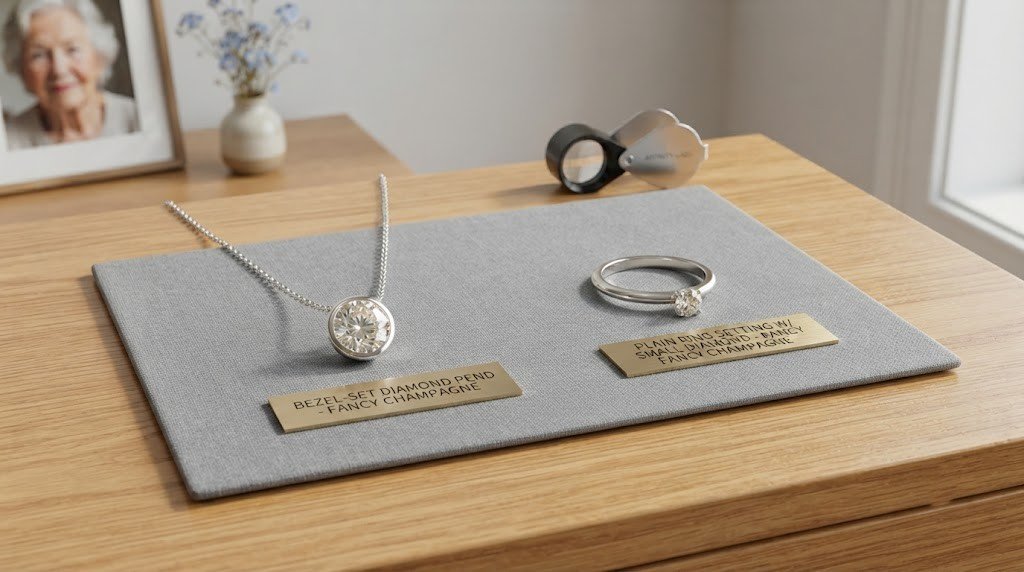
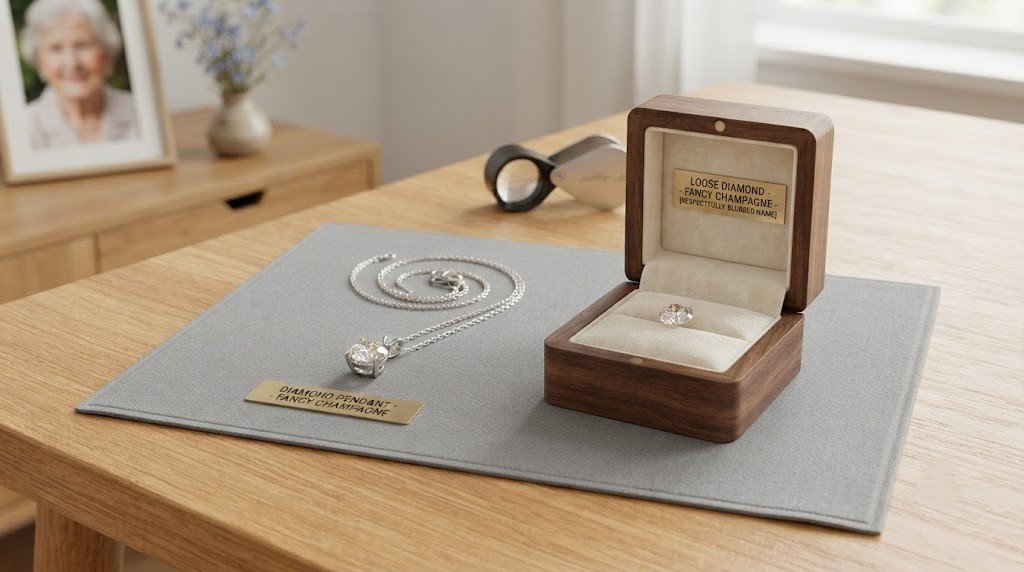
There is no single right piece for a grandfather hair diamond. A pendant, a ring of any style, earrings, a bracelet, a tie pin or a stone kept in a small case at home are all reasonable choices. What matters is what you will reach for, not what someone else expects a man’s memorial to look like.

If you plan to set the stone, a few considerations help:

  • Protective settings, such as a bezel, can reduce the risk of chips for everyday wear.
  • Engraving on the band or the back of a pendant is usually priced separately.
  • An independent grading report, often referencing the GIA 4Cs, describes cut, color, clarity and carat; typical memorial clarity falls in the SI2 to VVS range.
  • An in-house certificate of authenticity is different from a grading report; it documents chain of custody, meaning the stone came from his submitted hair.

Insurance for a set stone is a question for an insurance agent, not a jeweler. Ask about it before you start wearing the piece every day.

What should you ask a provider in writing?

Before ordering a grandfather hair diamond, ask about anything that differs by provider, and get the answers in writing. These eight questions cover the points most likely to vary:

  1. Will you accept his hair as it is, including short, sparse, gray, white or beard hair, and how much do you need?
  2. Can you assess a photo or a small sample before I send everything?
  3. What share of the finished stone’s carbon comes from the hair, by your own process?
  4. How is the hair tracked from arrival to finished stone, and what documentation do I receive?
  5. What happens to hair you do not use, and will it be returned?
  6. Which colors and carats do you offer, and what does each cost, including settings and grading?
  7. What is your expected timeline, and how will I hear about progress?
  8. What are your terms if plans change partway through?

A clear, unhurried provider should be comfortable answering all eight. If you are comparing the hair route with ashes, the plain explanation of whether a memorial diamond is really made from grandfather ashes shows how the same honesty questions apply to that material.

Frequently Asked Questions

Is hair from a hairbrush good enough for a memorial stone?

It depends on the provider. Brush hair can be mixed with other people’s hair and may be harder to trace, so some providers may decline it while others assess it case by case. Describe the source honestly and ask for a written answer before you send anything.

Can a stone be grown from hair that was saved decades ago?

Possibly, but that is for each provider to say. Whether they accept a sample saved long ago, and how much they need, varies. Leave it untouched, photograph it beside a ruler, and ask for an assessment before shipping the only sample you have.

Do I need anyone’s agreement to use hair I already have?

There is no single answer. Hair already in your keeping usually raises fewer questions than ashes, but it may form part of his estate, and state rules vary. If a relative or executor is settling his affairs, talking with them first is the respectful route.

Will his gray or white hair make the diamond lighter?

No source supports that idea. Diamond color comes from trace elements such as nitrogen and boron during growth, not from the shade of the hair. Ask a provider which colors they offer and whether a colorless stone is possible, since colorless usually costs more.

Is a grandfather hair diamond smaller than one grown from ashes?

Not necessarily. Carat is set by how long the stone grows, not by the material or the amount sent. Stones grown from hair or ash can typically be offered across a similar range, from about 0.10 carats up to several carats.

Can his beard trimmings be used instead of the hair on his head?

Possibly, but it is a provider question. Facial hair is keratin like other hair, yet acceptance and the amount needed vary. If beard trimmings are what the family saved, describe them clearly and ask whether that sample will be accepted before you send it.

Final Thoughts on a Grandfather Hair Diamond

A lock of hair is a modest thing to hold onto, and turning it into a grandfather hair diamond is a choice some families find meaningful while others prefer to leave it exactly as it is. Both are fine. If you do go ahead, take your time, ask your questions in writing, and bring in the other people who loved him, so the decision is shared rather than carried alone.

Learn More About Grandfather Memorial Diamonds

Talk With Memorial Diamond

If you have a lock of your grandfather’s hair and are not sure what comes next, we are glad to talk it through, including whether a grandfather hair diamond is the right fit at all. You can reach us at memorialdiamond.us whenever you are ready, with no pressure to decide anything today.

Word count: 3,334 words · Reading time: about 17 minutes

Grandfather Ashes and Hair Diamond The Complete Guide

Grandfather Ashes and Hair Diamond: The Complete Guide

His ashes may rest with one relative while a lock of his hair sits in a drawer somewhere else. A grandfather ashes hair diamond is a lab-grown diamond that draws carbon from both materials, but whether a provider will combine them at all varies, so ask first. If combining is not offered, two separate stones are a real alternative. Either way, a portion of his carbon is typically joined by supplemental lab carbon.

grandfather ashes hair diamond

Why would a family want both his ashes and his hair?

Some families want both because each material feels like a different part of him. Ashes are what remained after cremation; hair may have been saved years earlier, or set aside before a burial or cremation. Bringing them together can feel like gathering two separate keepsakes into one.

There are practical reasons too. A grandfather ashes hair diamond can bring together material held by two branches of a family, so neither side feels left out. If the only lock of hair is very small, some families also wonder whether pairing it with ashes would help; that is a question to put to a provider, not something to assume.

The reasons are personal, and none of them is required. One grandchild might want both because the ashes came from a parent and the hair came from an old envelope found while clearing a room. Another might simply like the idea of the stone holding more than one trace of him. A grandfather ashes hair diamond is one way to honor that wish; an urn, a burial plot or a scattering place are equally valid ways to remember him, and many choices can sit side by side.

It also helps to know what a grandfather ashes hair diamond is not. It is not a way around cremation-related religious concerns, because it still uses ashes. If cremation was not chosen, or your faith objects to it, the grandfather hair diamond complete guide covers a route that uses hair alone.

Will a provider make a grandfather ashes hair diamond at all?

Whether you can order a grandfather ashes hair diamond depends entirely on the provider. A company might offer a combined option, work with only one material per stone, or look at requests case by case, and only that company can tell you which applies.

When you ask about a grandfather ashes hair diamond, be specific. Ask whether they will combine ashes and hair from the same person in a single stone, how they handle the two materials before they are blended, and whether the price or timeline changes. An answer by email or letter is easier to refer back to than a phone call.

If a provider says no, that is not a dead end. You can ask another company whether it would make a grandfather ashes hair diamond, or you can grow one stone from his ashes and a second stone from his hair. Each route has trade-offs, and the comparison further down this guide lays them out.

If you want to see what the steps look like once a provider agrees, the practical walkthrough on how to turn your grandfather’s ashes and hair into a diamond goes through them in order.

What is known about the carbon in a blended stone?

Less is known about the carbon in a grandfather ashes hair diamond than you might expect. Published industry figures describe each material on its own, and no figure has been published for how much personal carbon ends up in a stone grown from a blend. The honest position is to ask the provider for their own number.

MaterialCarbon in the starting materialPersonal carbon in the finished stone
AshesRoughly 0.5–4% by weight; ash is mostly calcium phosphateFor ash, typically around 10–15% of the stone’s mass, with some providers citing ~3% and others higher
HairRoughly 50% by weight; hair is mostly keratinNo published figure for hair; ask the provider
Ashes and hair blendedDepends on how much of each is usedNo published figure for a blend; ask the provider

The 10–15% range in that table applies to ash alone. It cannot be stretched to cover hair or a mixture, and anyone quoting it for a grandfather ashes hair diamond should be asked where the figure came from.

Making a grandfather ashes hair diamond uses the same process steps for both materials. Carbon is extracted in an oxygen-free, multi-stage heating process, purified to about 99.9% or higher, and converted to graphite at roughly 2,500–2,700°C. That graphite is typically combined with supplemental lab carbon before it goes into an HPHT press or, less often, a CVD chamber. The Wikipedia article on memorial diamonds gives broader background on the category.

To follow the material from intake to polished stone in more depth, read how a combined memorial diamond is made from his ashes and hair.

Would two separate stones work better?

Two separate stones can work better when a provider will not combine materials, when relatives feel differently about each material, or when you want to know exactly which stone came from which source. A grandfather ashes hair diamond can work better when you want one piece that holds both.

Here is how the two paths compare in practical terms:

  • One combined stone: a single piece to set or keep; one order, one timeline; carbon from both sources in one crystal; no published figure for how the personal carbon divides between them.
  • Two separate stones: each stone traceable to a single material; a larger total cost, since you are paying for two; flexibility to give one stone to each branch of the family; an ash stone can be described with the published ash figure, while the hair stone still needs a provider’s own number.

Neither path is more meaningful than the other. A grandfather ashes hair diamond gathers everything into one place, which some people prefer. Two stones let a grandson wear one while his cousin keeps the other, which suits families who would rather share than consolidate.

If you lean toward a stone from ashes alone, the grandfather ashes diamond complete guide covers that single-material route in full.

How much ash and hair does a grandfather ashes hair diamond typically need?

Across the industry, a stone grown from ashes typically calls for somewhere between a few tablespoons and roughly 4 ounces, about 100 grams. A stone grown from hair typically calls for a small lock or a few grams. For a grandfather ashes hair diamond, the amount of each is set by the provider.

Because only a portion of each material is used for a grandfather ashes hair diamond, the rest of the ashes can still be kept, scattered or interred as the family planned, and some hair may remain as well. What happens to unused material, including whether and how it is returned, varies by provider, so get that answer in writing.

His hair may be gray, white, short or sparse, or the only hair saved may be from a beard or mustache. Whether a provider accepts that hair for a grandfather ashes hair diamond, and how much they need alongside the ashes, are questions for them to answer after seeing it. A photo next to a ruler helps.

The amount you send does not decide the carat of a grandfather ashes hair diamond. Carat is set mostly by how long the stone grows in the press, so a larger sample of either material does not automatically produce a larger stone.

How should you keep his ashes and hair while the family decides?

Leave each material where it is now, labeled and kept apart, until a provider explains how it wants them packaged. Ashes can stay in the container returned by the crematory or funeral home, or in the urn the family chose. How hair should be stored or packed before shipping is a question for the provider.

A few habits prevent confusion later:

  • Label each container with what it holds and who is looking after it.
  • Leave the main container of ashes closed until the person with authority agrees and a provider says how much it needs.
  • Leave the hair unwashed and untrimmed.
  • Write down where the hair came from, such as a saved lock or a funeral home cutting, since a provider may ask.

Taking time to agree as a family is reasonable. Ask any provider you are considering whether the time since cremation, or how long the hair has been kept, matters to its process. Keeping both safely in the meantime leaves every option open, including leaving the urn exactly as it is.

Who should agree before his ashes and hair are used?

Using his ashes starts with the person who holds authority over his cremated remains, and who that is differs from state to state with no nationwide standard. Commonly, a surviving spouse or partner and then his adult children rank ahead of grandchildren, though written instructions he left can reorder that.

As a grandchild, the gentle way forward is a request: ask the person with that authority whether they would set aside a small portion for a grandfather ashes hair diamond. Explaining that only part of the ashes is typically used, and that the rest can stay where the family intended, may make the request easier to consider. If they say no, his hair may still be another route.

The hair half of a grandfather ashes hair diamond raises a different conversation. Laws about remains focus on the body and the ashes, which is why a lock you already hold is usually more straightforward in practice. Still, his belongings can form part of his estate, rules vary by state, and whoever is settling his affairs deserves to know what you are planning. If the hair is held by someone else, asking them is a conversation, not a decision you can make for them.

A grandfather ashes hair diamond therefore often involves two sets of people, one for each material. Talking with both early avoids a situation where one part of the plan is agreed and the other is not.

What color could the finished diamond be?

The color of a grandfather ashes hair diamond comes from trace elements during growth, not from how the ashes or hair look. Boron in the crystal tends to give blue; nitrogen tends to give yellow; colorless requires both to be excluded and usually costs more. Memorial stones commonly lean blue, yellow, or champagne to brown.

There is no evidence that adding hair to ashes, or using gray hair, makes a grandfather ashes hair diamond lighter or darker. No source makes the final shade fully predictable, so ask each provider which colors it can aim for and how close it expects to get.

Post-growth irradiation is offered by some providers to move a stone toward red, pink, green or black. Whether that option exists for a grandfather ashes hair diamond, and at what cost, is another provider question.

What does a grandfather ashes hair diamond cost, and how long does it take?

General 2026 industry ranges apply to a grandfather ashes hair diamond the same way they apply to single-material stones. Any extra charge for handling two materials is set by each provider, so ask for a written quote.

Approximate sizeTypical 2026 industry rangeWhat usually costs extra
0.10–0.25 ct1,500–3,500Setting, engraving
0.5–1 ct5,000–15,000Colorless tone, independent grading
2–5+ ct20,000–75,000+Fancy cuts, setting, grading

If you choose two separate stones instead, expect two sets of these costs. Clarity in memorial diamonds typically lands between SI2 and VVS, and an independent grading report, commonly referencing the GIA 4Cs, is optional and distinct from the in-house certificate that records chain of custody.

On timing, a grandfather ashes hair diamond typically takes 6–10 months from the day the provider receives both materials. Larger stones of about 2 carats or more, or specialty colors, can approach 12 months. Growth itself takes weeks to months inside that window, and a provider should explain whether a combined stone changes their schedule.

How can grandchildren and cousins share what he left?

More than one grandfather ashes hair diamond can often come from the same materials, because only part of the ashes and part of the hair are typically used. That means several grandchildren or cousins may each receive a stone.

Coordination matters more than chemistry here. Before anything is sent, it helps to agree on a few things:

  1. Who will be the single point of contact with the provider.
  2. Whether every stone will be a grandfather ashes hair diamond, or whether some relatives would rather have ash-only or hair-only stones.
  3. How costs will be split, and whether anyone prefers to contribute without receiving a stone.
  4. Who holds the materials before shipping, and what happens to anything not used.

Cousins who live far apart may each want a stone they can wear, while a parent may prefer a loose diamond kept in a small case. A grandfather ashes hair diamond for one person and a hair-only stone for another can coexist within the same family.

If cousins want to start with ashes alone, the walkthrough on turning your grandfather’s ashes into a diamond shows that route step by step.

How might the finished stone be worn or kept?

A grandfather ashes hair diamond can be set in whatever piece you will actually use, or kept loose. Because diamond sits at 10, the top mark on the Mohs scale of mineral hardness, it handles daily wear well; a sharp knock can still chip it.

Nothing about remembering a grandfather calls for a particular style. A pendant, a ring of any design, a pair of earrings, a lapel pin or a loose stone in a small box are all equally fitting. If two stones are chosen instead, they can be set to match or styled completely differently for different people.

Settings, engraving and independent grading are usually priced separately from the stone. Insurance for a set diamond is a question for an insurance agent rather than a jeweler, so ask before the piece goes into everyday wear. Some people engrave a short line that mentions both his ashes and his hair; others keep that detail private.

Which questions should you put to a provider in writing?

Before you commit to a grandfather ashes hair diamond, put every provider-dependent point in writing. These questions are written for a combined stone:

  1. Do you combine ashes and hair from the same person in one diamond?
  2. How much ash and how much hair do you need for that?
  3. Will you accept his hair as it is, including gray, white, short, sparse or beard hair?
  4. What share of the finished stone’s carbon comes from his materials, by your own process, for a blend?
  5. How do you track each material from arrival to finished stone, and what documents do I receive?
  6. What happens to ashes and hair you do not use?
  7. Does combining materials change the price or the timeline?
  8. Which colors, carats and settings are available, and what does each cost?
  9. What are your terms if our family’s plans change partway through?

For background on question 4, read the plain answer to whether a memorial diamond is really made from your grandfather’s ashes, which applies the same scrutiny you would bring to a grandfather ashes hair diamond.

Frequently Asked Questions

Can a combined stone be made if the ashes are already divided among relatives?

Possibly. Only a portion of ashes is typically needed, so a relative holding part of them could share a small amount. Whoever holds authority over his remains should agree, and the provider can tell you how much ash it needs alongside the hair.

Does a grandfather ashes hair diamond hold more of him than an ash-only stone?

No one can say that honestly yet. Hair starts with far more carbon than ash, but no figure is published for the personal carbon in a finished blended stone. Ask the provider for its own number, in writing, before deciding.

Is a combined stone acceptable if our faith objects to cremation?

A grandfather ashes hair diamond still uses ashes, so it does not avoid a cremation-specific objection. A stone from hair alone involves no cremation. No tradition has an official position on memorial diamonds specifically, so your own clergy is the right person to ask.

Can the hair and the ashes come from different people?

This guide is about his own ashes and hair. Combining material from two different people is a separate request, and whether any provider offers it is entirely their policy. Ask directly, and get the answer in writing before sending anything.

What if only facial hair was saved?

Beard or mustache hair is keratin like other hair, but acceptance and the amount needed are provider questions. Describe the sample honestly, include a photo beside a ruler, and ask whether it can be combined with his ashes or used on its own.

Will the certificate show both materials?

That depends on the provider. An in-house authenticity certificate records chain of custody, and some may list each material submitted. Ask what the certificate will state for a grandfather ashes hair diamond, and whether an independent grading report is offered separately.

Final Thoughts on a Grandfather Ashes and Hair Diamond

Bringing his ashes and his hair together is one option, and it is just as reasonable to keep them apart, or to leave them exactly where they are. Whatever you decide, take the family conversations slowly and get each provider’s answers in writing before anything is sent.

Learn More About Grandfather Memorial Diamonds

Talk With Memorial Diamond

If you are weighing one combined stone against two, or still working out who in the family holds what, we are happy to talk it through at your pace. Visit memorialdiamond.us to start a conversation whenever it feels right.

Choosing a Memorial Diamond for Your Grandmother Where to Start

Grandfather Ashes Diamond: The Complete Guide

Some grandchildren find themselves wanting something of him they can hold, not only remember. A grandfather ashes diamond is a real lab-grown diamond made in part from carbon drawn out of a portion of his cremated remains, typically blended with supplemental lab carbon and finished in about 6 to 10 months. Only some of his ashes are used, so the rest can stay where your family intends, and for a grandchild the first step is a conversation with whoever holds authority over them.

grandfather ashes diamond

What is a grandfather ashes diamond, and what is it not?

A grandfather ashes diamond is a genuine diamond, grown in a lab, whose crystal contains carbon recovered from part of his cremated remains. Chemically and physically it is diamond through and through, so a gemologist would grade it for cut, color, clarity and carat exactly as they would a mined stone.

It is not glass, resin or a look-alike gem with ash sealed inside. Nor is it made entirely from him. Ash holds very little usable carbon, so providers typically combine his purified carbon with supplemental lab carbon in order to grow a stone of a size people can wear.

None of that makes a grandfather ashes diamond any less his. A real, documented portion of his own carbon is locked into its lattice. The companion piece asking whether a memorial diamond is really made from your grandfather’s ashes looks closely at what the science supports and where honest limits lie.

A grandfather ashes diamond is also only one way to honor him among many. Burial, scattering, an urn on a shelf, a columbarium niche or a memorial tree are all meaningful, and a stone can sit alongside any of them because it draws on just a small portion of what remains.

How much of a grandfather ashes diamond is really his carbon?

The honest answer is a minority share. Industry figures suggest that carbon recovered from ash makes up roughly 10–15% of a finished memorial stone by mass, though for ash some providers quote figures nearer 3% and others quote more.

Why so small a share? The reason lies in what ash is, and it applies to every grandfather ashes diamond. Cremated remains consist mainly of calcium phosphate, the mineral of bone, and usable carbon is only around 0.5% to 4% of ash by weight. After extraction and purification, that carbon is not usually enough on its own to grow the size a family has in mind, so supplemental lab carbon is typically added.

Before you commit to a grandfather ashes diamond, ask each provider in writing what share of the finished stone they expect his ash to contribute and how they document it. A clear written answer lets you compare providers on the same terms, and it makes the stone far easier to explain truthfully to relatives.

How is a diamond made from his ashes?

His carbon is extracted, purified, converted to graphite and then grown around a tiny diamond seed under intense heat and pressure. HPHT (high pressure, high temperature) is the industry standard for memorial stones, and a minority of providers use CVD (chemical vapor deposition) instead.

Making a grandfather ashes diamond generally follows seven stages:

  1. Receipt and logging. The portion of ashes meant for a grandfather ashes diamond arrives and is recorded so it stays tied to your family’s order from the first day.
  2. Extraction and purification. Heating without oxygen, in several controlled steps, strips out the bone mineral until what is left is carbon of about 99.9% purity or higher.
  3. Graphitization. Further heating, to about 2,500–2,700°C, turns that carbon into graphite, the feedstock a growth press needs.
  4. Growth. In HPHT, the graphite, typically blended with supplemental lab carbon, surrounds a seed at about 6–8 GPa and 1,400–2,500°C. Growth runs for weeks to months, and the length of growth, not the quantity of ash, sets the carat weight.
  5. Cutting and polishing. The rough crystal is shaped into a round, oval, cushion, princess or another cut.
  6. Optional color treatment. Some providers offer irradiation after growth to create pink, red, green or black stones.
  7. Grading and paperwork. Some providers offer independent grading, and providers typically issue their own record linking the stone to your family’s material.

For background on both growth methods, the synthetic diamond overview is a solid general reference. For a closer account of each stage as it applies to him, read how a memorial diamond is made from your grandfather’s ashes.

How much ash is needed, and what happens to the rest?

Industry-typical requests run from a few tablespoons up to roughly 4 oz (about 100 g) of cremated remains. Against a full set of cremated remains, that is a small amount, which leaves most of his ashes free for whatever your family has planned.

Minimums for a grandfather ashes diamond differ by provider, so get the figure in writing before anything is shipped. Ask too what becomes of any ash that is not used: whether it comes back, how it is packed and how it is tracked. Policies differ, and it is better to ask than to assume.

A grandfather ashes diamond does not have to displace an urn, a plot or a scattering. One family might keep the urn at home, set aside a small portion for a stone and inter the remainder later. The hands-on guide to how to turn your grandfather’s ashes into a diamond explains how to separate and send a portion carefully.

Who can request a diamond when you are his grandchild?

Who controls cremated remains is set state by state rather than nationally. Commonly, his surviving spouse or partner and his adult children rank ahead of grandchildren, and written instructions he left, such as a will or a prearranged funeral plan, may alter that order.

So the considerate path is to approach the person with that authority and ask for a small portion of his ashes for a grandfather ashes diamond. That person might be your parent, if they are living, an aunt or uncle, a surviving spouse or partner, or someone he named in writing. If nobody is sure, the funeral home that handled the cremation may be willing to tell you who signed the authorization; treat that as a practical starting point rather than a final answer on who decides now.

Asking about a grandfather ashes diamond lands more gently when you explain what the stone is, how little ash it uses and that supplemental carbon is typically part of it. Give the person time to think, and accept their answer. If they decline, his hair may offer another way forward, since hair needs no cremation at all; the grandfather hair diamond complete guide covers that route. Whether short, gray, sparse or beard hair is accepted, and how much is needed, are questions only a provider can answer.

Resist any shortcut around the person with authority. Requesting ashes from a funeral home or a relative behind someone’s back tends to damage trust in ways that outlast the stone.

What color will a grandfather ashes diamond be?

Nobody can promise the color of a grandfather ashes diamond ahead of time. Trace elements present while the crystal grows decide it: nitrogen pushes a stone toward yellow, boron toward blue, and colorless requires keeping both out, which usually raises the price.

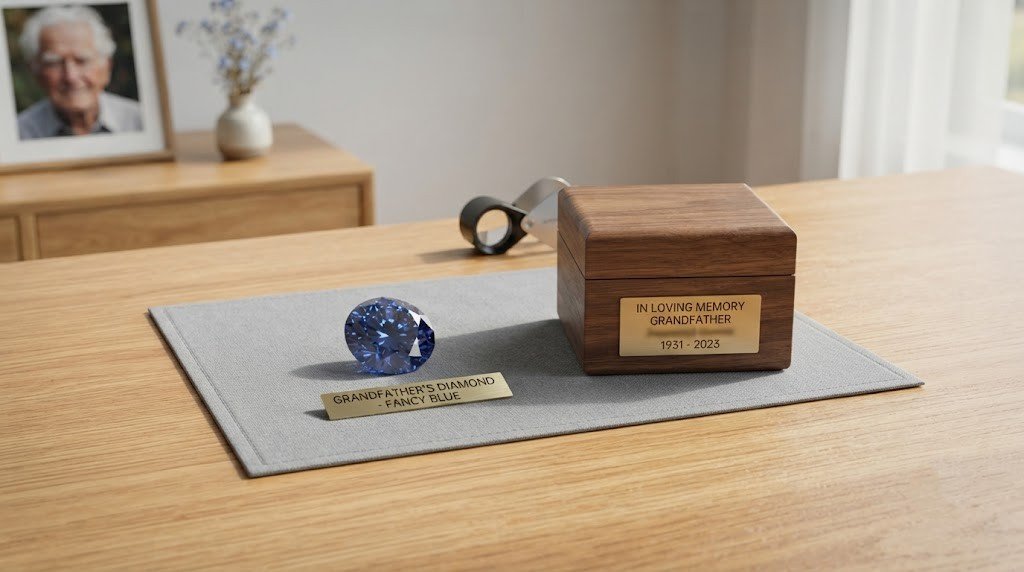
Memorial stones, including a grandfather ashes diamond, commonly land in yellow, blue, or champagne and brown tones. Some providers let you aim for a target color such as blue or colorless, and some offer irradiation after growth for pink, red, green or black. Ask which colors a provider offers, how each is achieved and what each adds to the cost.

No reliable source shows that anything about him, his ashes or his life makes the stone lighter or darker. It is kinder, and more accurate, to see the color as part of this one stone’s character rather than a message. The GIA explanation of the 4Cs shows how color is graded if you want the detail.

How much does a grandfather ashes diamond cost?

The price of a grandfather ashes diamond depends first on carat and color, then on cut, setting and whether you add independent grading. The 2026 industry ranges below are general guides, not any one provider’s price list.

Size tierTypical carat rangeIndustry price range (2026)What usually moves the price
Smallabout 0.10–0.25 ctabout 1,500–3,500Color choice, cut
Mediumabout 0.5–1 ctabout 5,000–15,000Colorless costs more than blue, yellow or champagne
Largeabout 2–5+ ctabout 20,000–75,000+Longer growth, color, cut

Settings, engraving, fancy cuts and grading reports are normally charged on top of the loose stone. Ask each provider for an itemized written quote listing those separately, along with the payment schedule and what happens if plans change partway through.

A small grandfather ashes diamond means just as much as a large one. If relatives are sharing the cost, agree in writing who contributes what before an order goes in.

How long does the process take?

Industry-wide, a grandfather ashes diamond typically takes 6 to 10 months from the day the provider receives the ashes to the day the stone is finished. Larger stones, around 2 carats and up, and specialty colors can stretch to about 12 months.

The growth phase itself lasts weeks to months, and longer growth yields a larger stone. Sending more ash does not speed a grandfather ashes diamond along or make it any bigger. If a date matters, such as the anniversary of his death or a family gathering, mention it early and ask in writing what timing the provider can realistically offer and how you will hear about progress.

Families considering a blend of materials can read the step-by-step guide to turning your grandfather’s ashes and hair into a diamond, which explains how timing and process change when both are used.

Can several grandchildren or cousins each have a stone?

In many cases, yes. Each grandfather ashes diamond draws on only part of the ashes, so several grandchildren, cousins or other relatives can sometimes have stones from one shared source.

How many stones are possible, and how much ash each requires, depends on the provider. Ask whether one submission can supply several stones, whether each stone needs its own portion, how documentation is kept separate for each person, and whether each stone is priced on its own.

Relatives sharing his ashes this way do well to settle a few points together: who deals with the provider, how costs are split, and whether every grandfather ashes diamond should match in color and cut or reflect each person’s taste. One cousin may want a stone, another a different keepsake, another nothing, and each of those answers deserves respect.

What if he died years ago, or his ashes were interred, divided or scattered?

It may still be possible, but that depends on where his ashes are now, who holds them and what a provider says about ashes that have been stored for a long time. Ask that last point directly rather than assuming either way.

Each situation brings its own questions about a grandfather ashes diamond:

  • Kept at home for years. Ask the provider in writing whether the time since cremation or the way the ashes were stored affects their process.
  • In a columbarium niche or cemetery plot. Retrieval involves the cemetery and whoever holds authority, and rules differ. Ask the cemetery first what the process involves.
  • Already divided among relatives. A small amount from one relative’s share may be sufficient, if that relative agrees. Ask the provider for their minimum.
  • Fully scattered. An ash-based stone may no longer be possible, though a kept lock of his hair could open another route.

The grandfather ashes and hair diamond complete guide explains how a small amount of ash and a lock of hair can be combined when neither alone feels like enough.

How do faith traditions view it?

Religious teaching covers cremation and the treatment of ashes, not memorial diamonds as such, so no tradition has issued a ruling on a grandfather ashes diamond itself. Opinion varies within each tradition, which makes your own clergy or faith leader the right person to consult.

A short orientation:

  • Catholic teaching accepts cremation but expects the ashes to rest together in a consecrated place, with limited exceptions, so separating a portion is something to discuss with a priest.
  • Jewish positions depend on the movement; Orthodox and Conservative communities generally object to cremation itself, and Reform rabbis tend to leave the matter to families.
  • Islamic scholarship across the major schools treats cremation as impermissible under ordinary circumstances.
  • Hindu practice centers on cremation and immersion of ashes, and holding back a little is handled differently from family to family.
  • Buddhist and Protestant perspectives differ by teacher and congregation.

Since a stone grown from hair involves no cremation, it falls outside an objection aimed at cremation, which can matter for Muslim households and for Orthodox or Conservative Jewish households. Raise that possibility with clergy if faith is part of the decision.

How can the diamond be worn, kept or passed down?

A grandfather ashes diamond can go into any setting that suits the person who will wear or keep it. Nothing says a stone from a man’s ashes has to become a traditionally masculine piece; the wearer, not him, should guide the design.

Some possibilities for setting a grandfather ashes diamond:

  • A pendant on a fine or sturdy chain
  • A ring, from a plain band setting to a solitaire or a cluster
  • A pair of earrings, if two small stones are grown
  • A bracelet, brooch or tie bar
  • A loose stone kept in a small case until the family decides

Like any diamond, a grandfather ashes diamond rates 10 on the Mohs hardness scale, the highest of any natural mineral, so it copes well with daily wear. A sharp knock at the wrong angle can still chip it, though, so ask a jeweler about protective settings such as a bezel.

Some families hope a grandfather ashes diamond will become an heirloom. If that is your plan, keep the provider’s paperwork with the stone, write a short note recording whose carbon it holds, and talk about who will look after it next. Whether and how to insure it is a question for an insurance agent.

What should you ask a provider before you begin?

Ask every provider to answer these in writing before you send anything:

  1. How much ash is required, and what happens to any you do not use?
  2. What share of the finished stone do you expect to come from his ash?
  3. How is the material tracked from arrival to the finished stone?
  4. Do you grow by HPHT or CVD?
  5. Which colors and cuts are available, and how does each affect cost and timing?
  6. Is independent grading offered, and is it included in the quote?
  7. What documentation of origin will we receive?
  8. What are the payment terms, and what happens if our plans change?
  9. How and how often will you update us?

Written answers make providers easier to compare and make a grandfather ashes diamond easier to explain to relatives who were not part of the first conversations.

Frequently Asked Questions

Is a stone made from his ashes a real diamond?

Yes. A grandfather ashes diamond is lab-grown diamond with the same crystal structure and hardness as a mined one. It is grown partly from carbon extracted from his ashes, typically blended with supplemental lab carbon, and can be graded on the 4Cs.

Can I arrange one without telling relatives?

That is best avoided. Authority over cremated remains varies by state, and his surviving spouse or partner and adult children commonly come before grandchildren. Asking the person who holds authority for a small portion of his ashes keeps the family’s trust intact.

Will sending more ash make the diamond larger?

No. Carat weight depends mainly on how long the crystal grows, not on the amount of ash. Providers typically need a few tablespoons up to about 4 oz, which leaves most of his ashes with your family for other plans.

Does his age or health change the diamond?

No reliable evidence links his age, health or life to the stone’s color or quality. Color comes from trace elements during growth and cannot be predicted exactly, though some providers let you aim for a particular color. Ask what they can target.

Is a grandfather ashes diamond possible if his ashes are in a niche?

Possibly. Removing ashes from a columbarium niche or cemetery plot involves the cemetery and whoever holds authority, and rules differ. Ask the cemetery about the process, then ask a provider how much ash they would need.

Can a granddaughter wear a stone made from his ashes?

Of course. The stone itself has no gender, and the setting should reflect whoever wears it. Pendants, rings, earrings, bracelets and loose keepsakes are all suitable, chosen for the wearer rather than for an idea of what a man’s piece should be.

Final Thoughts on Honoring Your Grandfather

There is no single right way to remember him, and a diamond is just one of many. If your family chooses one, let the conversations take the time they need, ask for every answer in writing, and pick a setting that fits the person who will carry it. The right choice is whichever feels true to him and workable for the people deciding together.

Learn More About Grandfather Memorial Diamonds

Talk With Memorial Diamond

If you are considering a stone for him and would like straightforward answers, we are here whenever you are ready. Visit memorialdiamond.us to reach us, with no obligation and no rush.