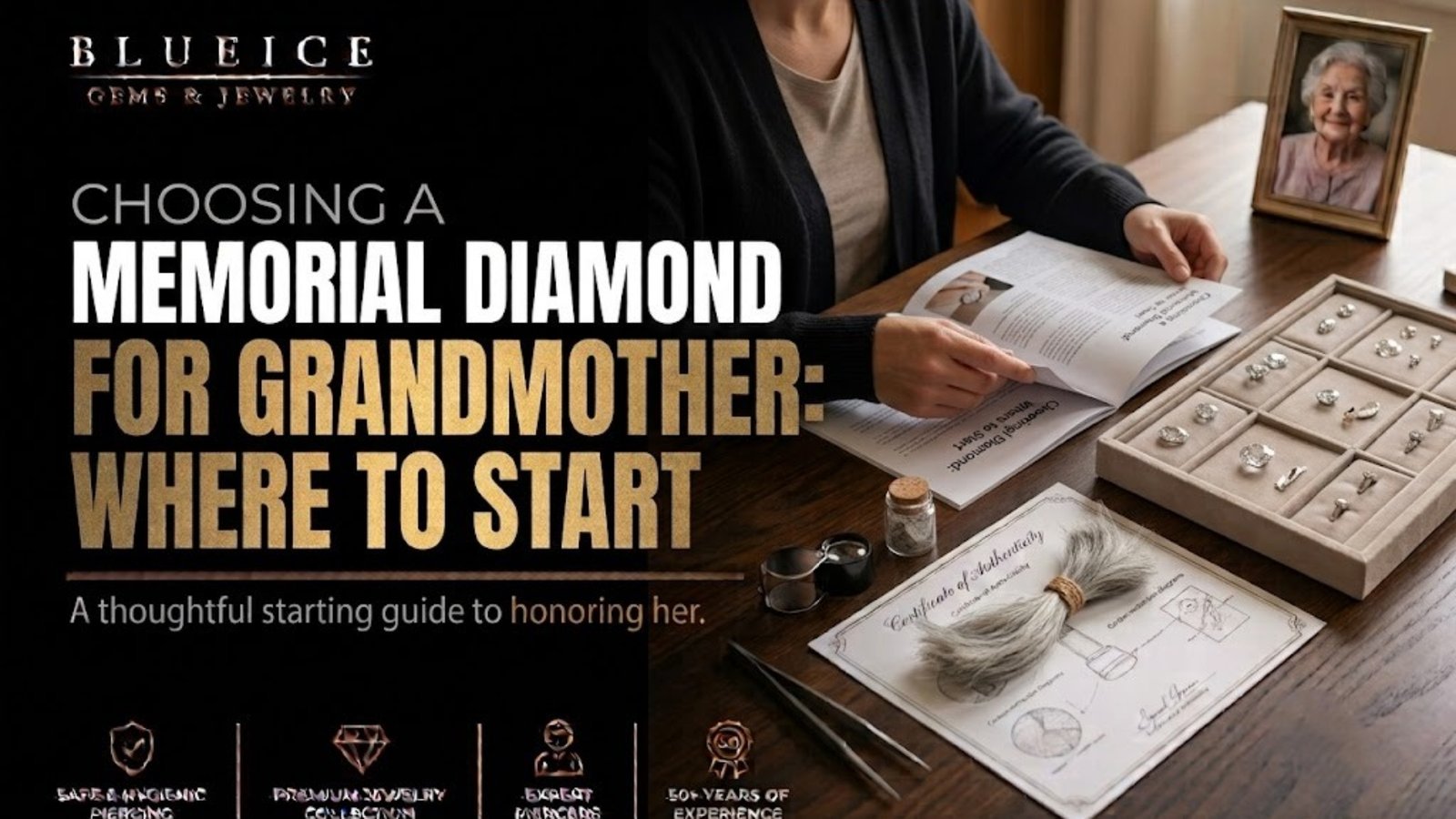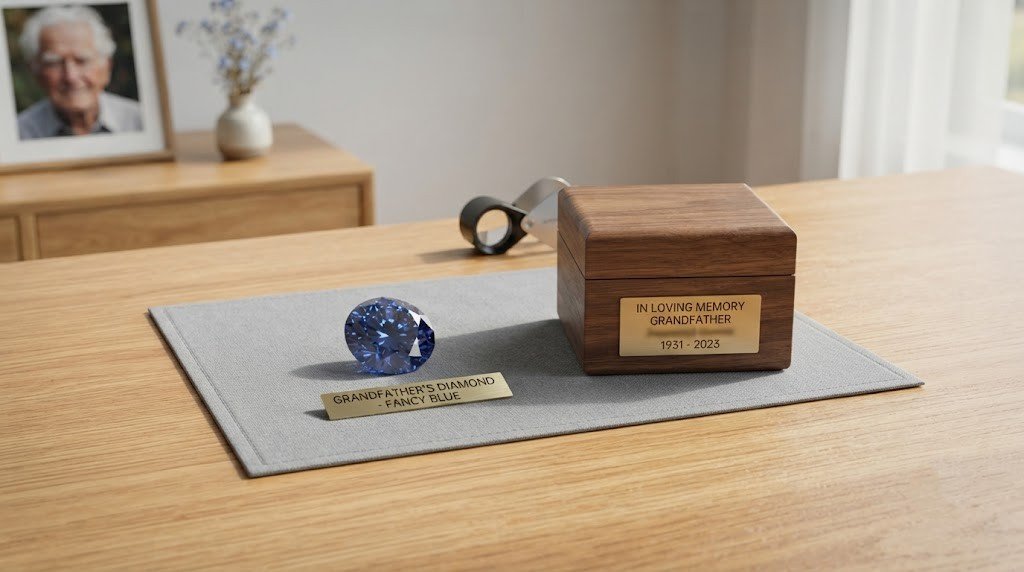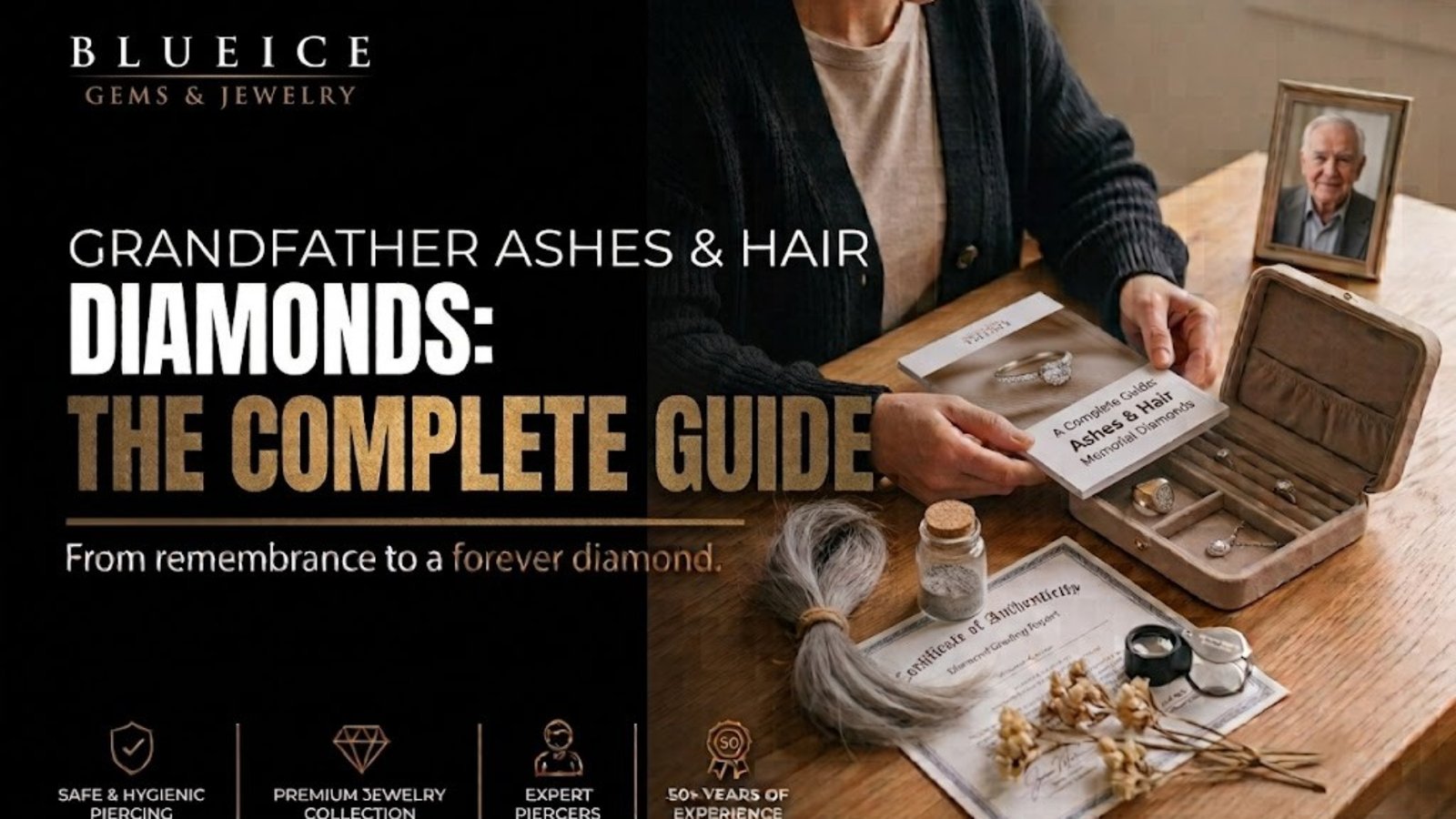
Sometimes the thing you end up holding is small: an envelope, a folded tissue, a few strands someone thought to keep. A grandfather hair diamond is a real lab-grown diamond grown in part from carbon taken from his hair, and it does not depend on cremation, so it remains possible if he was buried. A small lock is typically enough, and this guide covers sourcing, permission, color, cost, timing and sharing.
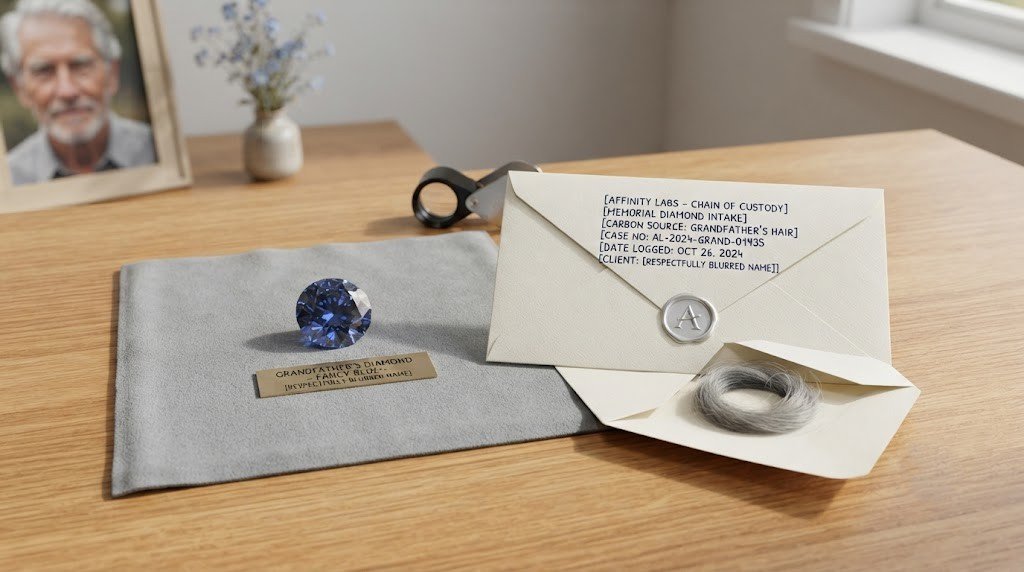
Table of Contents
What is a grandfather hair diamond?
A grandfather hair diamond is a genuine diamond, grown in a lab, that contains carbon extracted from a sample of your grandfather’s hair. It is not glass, resin or a simulant. It has the same crystal structure, hardness and optical behavior as any other diamond.
A grandfather hair diamond is grown the way other lab-grown diamonds are. Most providers use HPHT: a tiny diamond seed sits inside a press while the cell is held near 6–8 GPa and somewhere between 1,400 and 2,500°C. A minority use CVD, where carbon is deposited from a gas. The synthetic diamond overview on Wikipedia explains both methods if you want the technical background.
What makes a grandfather hair diamond a memorial piece is the source. Before growth, carbon is drawn out of his hair, purified to roughly 99.9% or higher, and converted to graphite. That graphite typically joins supplemental lab carbon in the growth cell. The result is a grandfather hair diamond that is not entirely made of him, but that physically holds a real portion of carbon that came from him.
You might be his grandson or granddaughter, a step-grandchild, a grandchild by adoption, or someone he treated as family without any paperwork. You might also be his son or daughter planning something for the grandchildren. A grandfather hair diamond can fit any of those relationships, because nothing about the process depends on who is asking.
Why does hair work even if he was buried?
Hair works for a grandfather hair diamond because it is rich in carbon and needs no cremation. Hair is built mostly from keratin, a protein, and is roughly 50% carbon by weight. That is a starting-material fact about hair, and it is the reason only a small amount is needed.
Ash is a very different material: it is mainly calcium phosphate from bone, with usable carbon of only about 0.5–4% by weight. Hair skips the cremation question entirely. If your grandfather was buried, if the family is still deciding, or if cremation is not part of your tradition, a grandfather hair diamond may still be open to you.
Faith can matter here, and it deserves an honest word. Religious teaching addresses cremation and the handling of ashes; none of the major traditions has issued an official view on memorial diamonds as such. In Islam, cremation itself is considered impermissible across the major schools in ordinary circumstances, and Orthodox and Conservative Judaism generally prohibit cremation as well. A grandfather hair diamond involves no cremation, so it sits outside that cremation-specific objection.
That does not settle every question for every family. Some people will still want guidance on keeping or transforming any part of a person who has died, and a grandfather hair diamond is no exception. Your own imam, rabbi, priest, pastor or teacher is the right person to ask, and their answer for your family matters more than any general summary.
If your family did choose cremation, the grandfather ashes diamond complete guide walks through that material on its own terms.
How much hair does a grandfather hair diamond typically need?
Industry-wide, a small lock or a few grams of hair is the typical amount for a grandfather hair diamond. Because hair carries so much carbon compared with ash, the starting sample can be modest. Some providers describe it as roughly palm-sized, others as a few wisps bundled together.
Your grandfather’s hair may not match the tidy picture in a brochure. It may be gray or white, cut very short, thinning, or saved only in small pieces. Whether short, sparse, gray or white hair is accepted, and how much of it a specific provider needs, are questions for that provider. Nobody can honestly promise you an answer either way without seeing what you have.
A few practical points help before you ask:
- Leave the hair in whatever it is stored in now, and ask the provider how they want it packed.
- Do not wash, trim or sort it until a provider tells you what they want.
- Write down where it came from and when, if you know.
- Photograph it next to a ruler so a provider can judge the amount from a picture.
- Ask whether only part of the sample will be used, so you can plan for what remains.
Only a portion of the hair is typically used for one grandfather hair diamond, which means some may be left over. What happens to unused hair, whether it is returned and how, differs by provider, so get that answer in writing before you send anything.
Where could his hair come from now?
Hair for a grandfather hair diamond might come from a lock someone saved, an old keepsake, a small cutting a funeral home might take if asked before burial or cremation, or facial hair if that is what was kept. Each route has its own practical questions, and acceptance of any source is something to confirm with a provider rather than assume.
| Possible source | What to know | What to ask |
|---|---|---|
| A lock saved by family | Often the simplest starting point if someone kept one | Is this amount enough, and does its age matter? |
| A keepsake (a locket, an old envelope, a baby book entry) | May be decades old and very small | Can older or very small samples be assessed first? |
| A cutting by the funeral home | Only possible if someone asks before burial or cremation | Ask the funeral home whether staff can cut and package a small lock |
| Hair from a brush or comb | May be mixed with other people’s hair | Ask whether brush hair is accepted at all |
| Facial hair (beard or mustache) | Sometimes the only hair saved | Ask whether beard hair is accepted and how much is needed |
If the funeral has not yet happened, timing matters. A funeral home can only cut hair while they still have his body in their care, so ask early. The funeral home will want to know who is arranging the service, and that may not be you. Ask the funeral home how they handle such a request, and consider making it gently through the person who is arranging things.
If you are reading this after the burial or cremation and no hair was saved, look again before ruling out a grandfather hair diamond. A sibling, parent, aunt or cousin may have something tucked away that you never knew about. Asking around can feel awkward, but it is also a way of bringing the family into the idea early.
Who should you talk to before using hair kept at home?
If the hair is already in your keeping, the practical path to a grandfather hair diamond is usually simpler than it is for ashes, but it is still worth a conversation. Rules about who controls a person’s remains are aimed mainly at the remains themselves, which is part of why hair you already hold tends to raise fewer questions.
That is not the end of it, though. A person’s belongings can form part of their estate, and a keepsake holding his hair could be one of those belongings. Rules vary by state, and there is no single national answer. If someone is settling his affairs, whether as an executor or a personal representative, telling them you are considering a grandfather hair diamond is a respectful step, and it avoids surprises later.
When the hair is held by someone else, treat it as a conversation, not a decision. An aunt or uncle may have the only lock; his spouse or partner, if living, may have kept something; a cousin may have inherited a keepsake box. Asking them whether they would share a small amount is very different from asking them to hand it over.
If you want to explore the ashes route instead, keep in mind that authority over cremated remains also varies by state. A surviving spouse or partner and his adult children commonly come before grandchildren, and written wishes can change that order. The respectful route for a grandchild is to ask whoever holds that authority for a small portion.
Choosing a grandfather hair diamond may sidestep that request for a grandchild, though the estate point above still applies, and the guide on how to turn your grandfather’s hair into a diamond covers what happens once the family agrees.
How much of a grandfather hair diamond actually comes from his hair?
No finished-stone percentage is published for hair. The honest answer is that a grandfather hair diamond holds a real portion of carbon from his hair, alongside supplemental lab carbon that is typically added so the stone can grow to a usable size.
You may see a figure of around 10–15% quoted elsewhere, but that range describes the personal carbon share in stones grown from ash, not from hair. Some providers cite figures for ash as low as about 3% and others higher. None of those numbers transfer to a grandfather hair diamond, and a provider who uses them for hair should be asked where they came from.
The fact that hair is about 50% carbon tells you about the starting sample, not about the finished stone. How much of his carbon ends up in the crystal depends on the provider’s process and the carat you choose. Ask the provider to state their own figure for hair, in writing.
For the science of each stage, from extraction to growth, see how a memorial diamond is made from your grandfather’s hair, which keeps to the process itself.
What color might the diamond be?
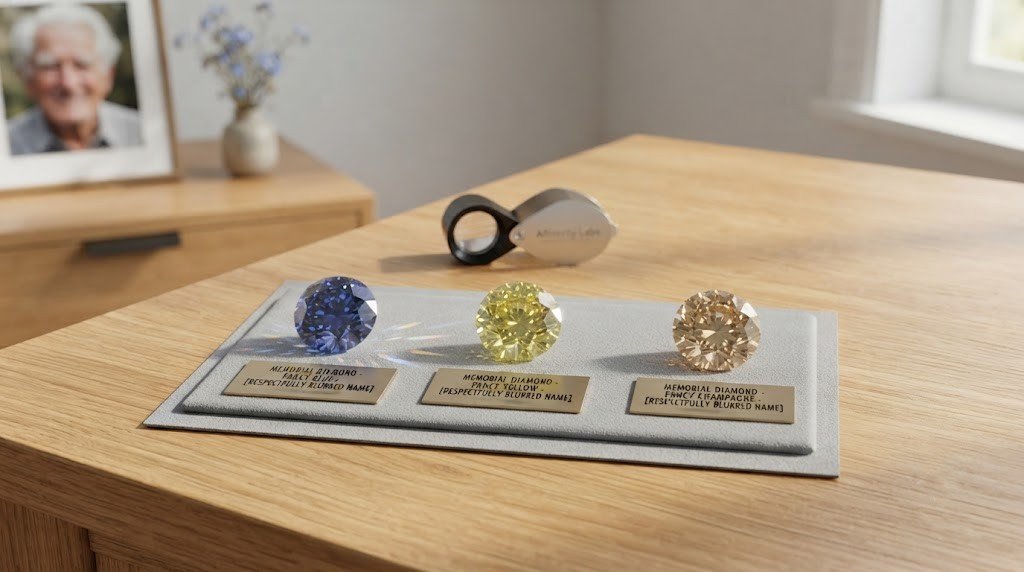
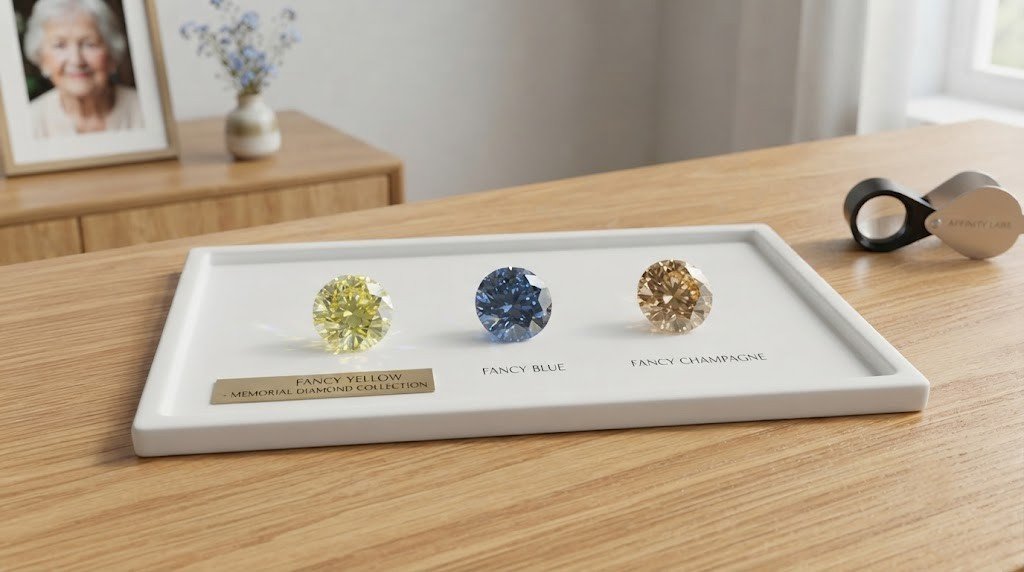
The color of a grandfather hair diamond comes from trace elements present during growth, not from the color of his hair. Where nitrogen is present the crystal leans yellow, where boron is present it leans blue, and only when both are kept out does a colorless stone result. Memorial diamonds commonly trend toward yellow, blue and champagne or brown tones.
Colorless is possible, but it requires extra control during growth and usually costs more. Some providers also offer post-growth treatment, typically irradiation, that can shift a stone toward red, pink, green or black. No source makes the final color fully predictable, and there is no basis for claiming that gray, white or dyed hair leads to a lighter or darker stone.
Choosing a color for a grandfather hair diamond can be less about chemistry and more about what feels right. Some grandchildren pick a shade that reminds them of something he loved; others let the stone settle into its natural tone. Either choice is reasonable, and a provider can describe which colors they offer and at what price.
What does a grandfather hair diamond cost, and how long does it take?
Across the industry in 2026, a small grandfather hair diamond typically starts around $1,500, and larger stones can run well past $20,000. Price depends mostly on carat, color and cut, with settings, engraving, fancy shapes and independent grading usually extra.
| Size range | Typical 2026 industry price | Notes |
|---|---|---|
| About 0.10–0.25 ct | 1,500–3,500 | A common starting point for pendants and small rings |
| About 0.5–1 ct | 5,000–15,000 | Colorless usually costs more than blue, yellow or champagne |
| About 2–5+ ct | 20,000–75,000+ | Longer growth and more process control |
The carat of a grandfather hair diamond is set by how long the stone grows, not by how much hair you send. A larger sample does not automatically mean a larger diamond. Sizes across the industry run from roughly a tenth of a carat up past 5 carats.
Making a grandfather hair diamond typically takes 6–10 months from the time a provider receives the hair. A stone near 2 carats or above, or one in a specialty color, can stretch that toward a year. Growth itself takes weeks to months within that span. A provider should be able to tell you their expected timeline before you commit.
Can several grandchildren each have a stone?
Often, yes, because only part of a hair sample is typically used for each grandfather hair diamond. Several grandchildren, or a grandchild and a parent, may each be able to receive a stone from the same lock, depending on how much hair exists and what the provider requires per stone.
Sharing works best when it is talked through early. A few points worth agreeing on as a family:
- Who is coordinating with the provider, and who holds the hair until it is sent.
- Whether each stone will be the same size and color, or chosen individually.
- How costs will be divided, and whether anyone would rather contribute without receiving a stone.
- What should happen to any hair that is not used.
Different stones can carry different meanings within one family. One cousin may want a small pendant, another a stone set in a ring, and a parent may prefer to keep a loose diamond in a box. Nothing about a grandfather hair diamond requires everyone to choose the same thing.
If some relatives would rather work from ashes, or want both materials combined, the grandfather ashes and hair diamond complete guide covers that combined route and the questions it raises.
How might you wear or keep the diamond?
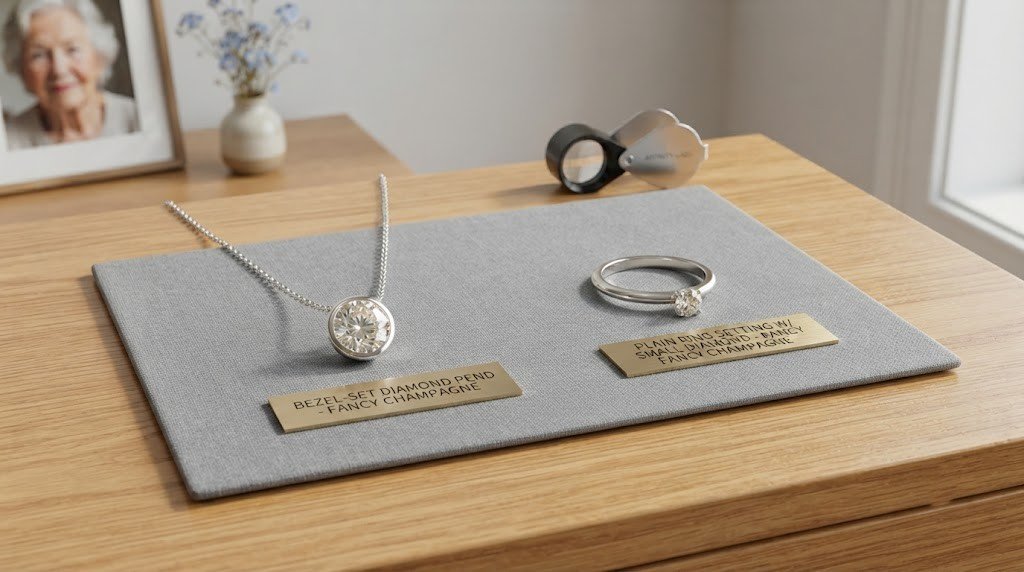
You can set a grandfather hair diamond in any piece you would actually wear, or keep it loose. No natural mineral outranks diamond on the Mohs scale of mineral hardness, where it rates a 10. That makes it well suited to daily wear, although a hard knock can still chip it.
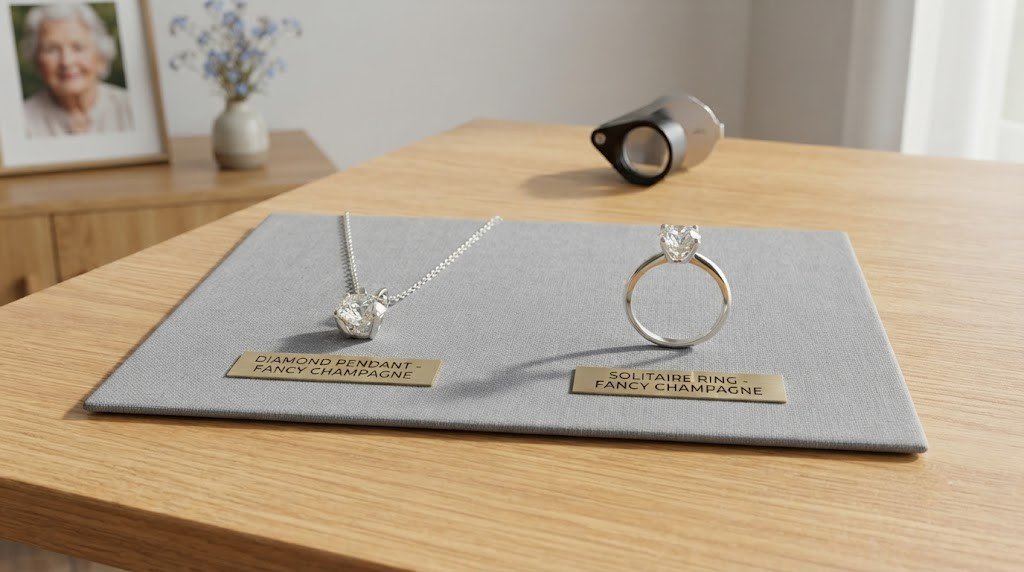
There is no single right piece for a grandfather hair diamond. A pendant, a ring of any style, earrings, a bracelet, a tie pin or a stone kept in a small case at home are all reasonable choices. What matters is what you will reach for, not what someone else expects a man’s memorial to look like.
If you plan to set the stone, a few considerations help:
- Protective settings, such as a bezel, can reduce the risk of chips for everyday wear.
- Engraving on the band or the back of a pendant is usually priced separately.
- An independent grading report, often referencing the GIA 4Cs, describes cut, color, clarity and carat; typical memorial clarity falls in the SI2 to VVS range.
- An in-house certificate of authenticity is different from a grading report; it documents chain of custody, meaning the stone came from his submitted hair.
Insurance for a set stone is a question for an insurance agent, not a jeweler. Ask about it before you start wearing the piece every day.
What should you ask a provider in writing?
Before ordering a grandfather hair diamond, ask about anything that differs by provider, and get the answers in writing. These eight questions cover the points most likely to vary:
- Will you accept his hair as it is, including short, sparse, gray, white or beard hair, and how much do you need?
- Can you assess a photo or a small sample before I send everything?
- What share of the finished stone’s carbon comes from the hair, by your own process?
- How is the hair tracked from arrival to finished stone, and what documentation do I receive?
- What happens to hair you do not use, and will it be returned?
- Which colors and carats do you offer, and what does each cost, including settings and grading?
- What is your expected timeline, and how will I hear about progress?
- What are your terms if plans change partway through?
A clear, unhurried provider should be comfortable answering all eight. If you are comparing the hair route with ashes, the plain explanation of whether a memorial diamond is really made from grandfather ashes shows how the same honesty questions apply to that material.
Frequently Asked Questions
Is hair from a hairbrush good enough for a memorial stone?
It depends on the provider. Brush hair can be mixed with other people’s hair and may be harder to trace, so some providers may decline it while others assess it case by case. Describe the source honestly and ask for a written answer before you send anything.
Can a stone be grown from hair that was saved decades ago?
Possibly, but that is for each provider to say. Whether they accept a sample saved long ago, and how much they need, varies. Leave it untouched, photograph it beside a ruler, and ask for an assessment before shipping the only sample you have.
Do I need anyone’s agreement to use hair I already have?
There is no single answer. Hair already in your keeping usually raises fewer questions than ashes, but it may form part of his estate, and state rules vary. If a relative or executor is settling his affairs, talking with them first is the respectful route.
Will his gray or white hair make the diamond lighter?
No source supports that idea. Diamond color comes from trace elements such as nitrogen and boron during growth, not from the shade of the hair. Ask a provider which colors they offer and whether a colorless stone is possible, since colorless usually costs more.
Is a grandfather hair diamond smaller than one grown from ashes?
Not necessarily. Carat is set by how long the stone grows, not by the material or the amount sent. Stones grown from hair or ash can typically be offered across a similar range, from about 0.10 carats up to several carats.
Can his beard trimmings be used instead of the hair on his head?
Possibly, but it is a provider question. Facial hair is keratin like other hair, yet acceptance and the amount needed vary. If beard trimmings are what the family saved, describe them clearly and ask whether that sample will be accepted before you send it.
Final Thoughts on a Grandfather Hair Diamond
A lock of hair is a modest thing to hold onto, and turning it into a grandfather hair diamond is a choice some families find meaningful while others prefer to leave it exactly as it is. Both are fine. If you do go ahead, take your time, ask your questions in writing, and bring in the other people who loved him, so the decision is shared rather than carried alone.
Learn More About Grandfather Memorial Diamonds
- Grandfather Ashes Diamond: The Complete Guide if cremation was part of the plan, start here
- How to Turn Your Grandfather’s Hair Into a Diamond practical steps from saved lock to finished stone
- How a Memorial Diamond Is Made From Your Grandfather’s Hair the science of each stage
- How to Turn Your Grandfather’s Ashes and Hair Into a Diamond steps for using both materials
Talk With Memorial Diamond
If you have a lock of your grandfather’s hair and are not sure what comes next, we are glad to talk it through, including whether a grandfather hair diamond is the right fit at all. You can reach us at memorialdiamond.us whenever you are ready, with no pressure to decide anything today.
Word count: 3,334 words · Reading time: about 17 minutes