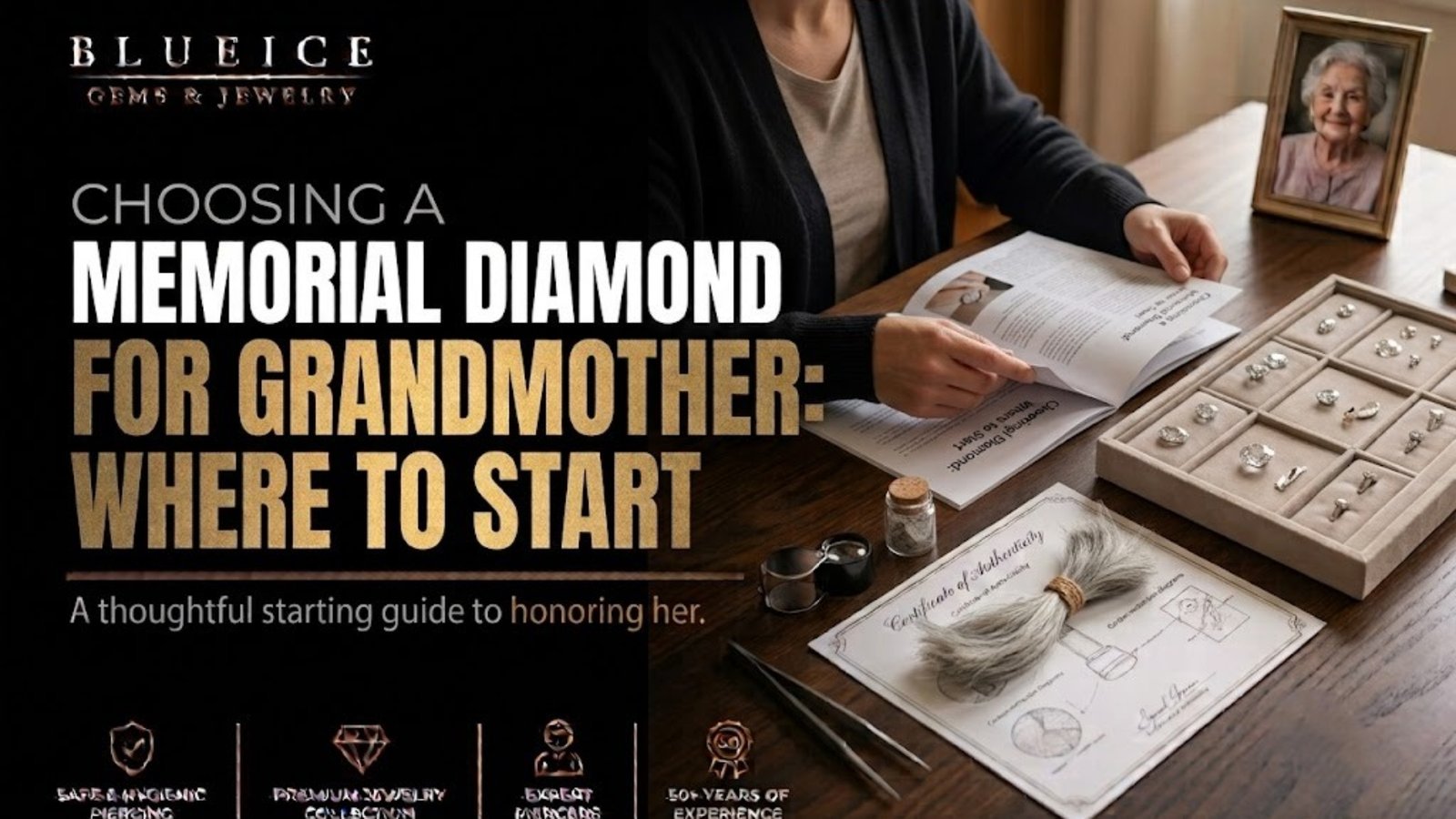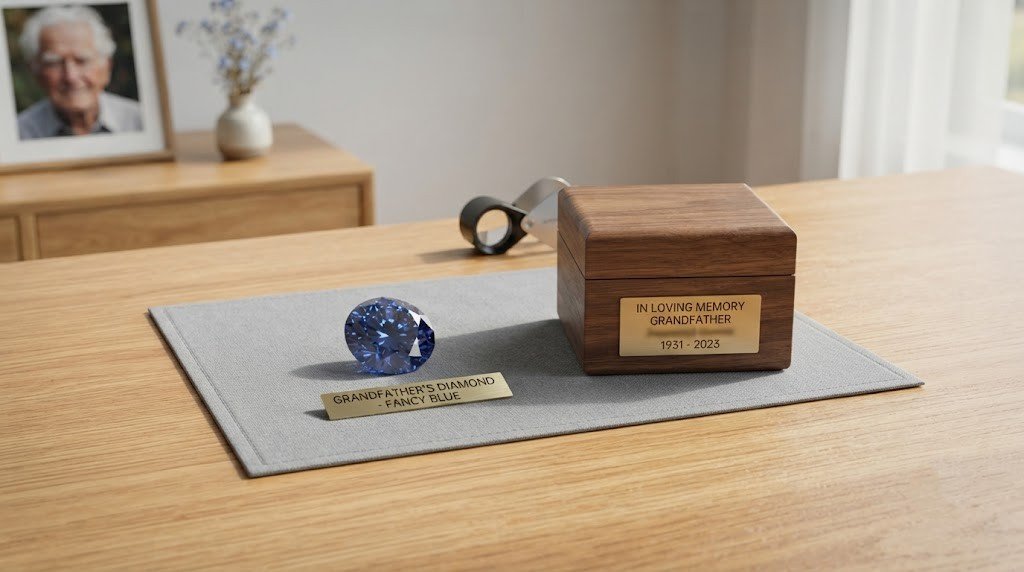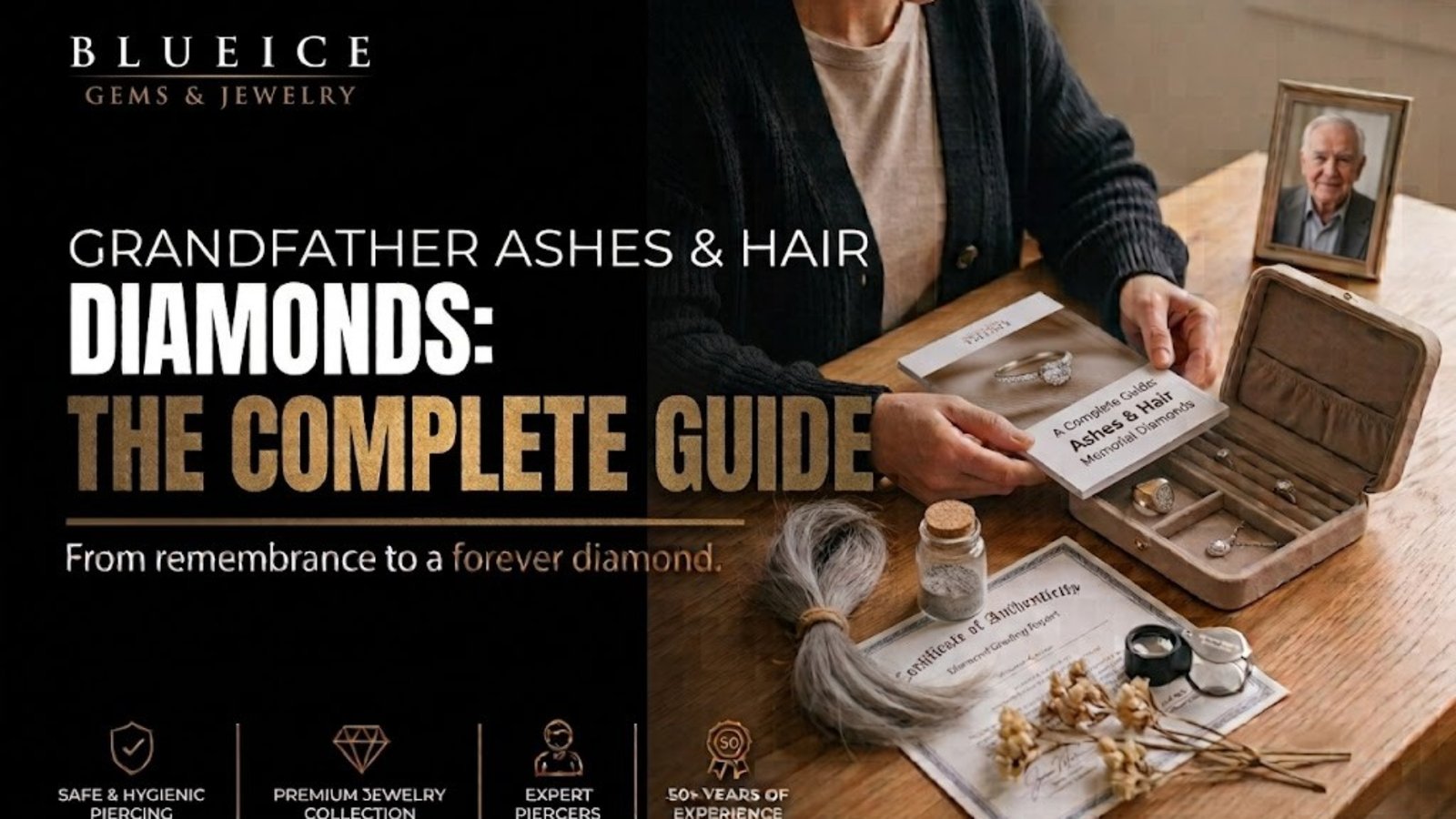
His ashes may rest with one relative while a lock of his hair sits in a drawer somewhere else. A grandfather ashes hair diamond is a lab-grown diamond that draws carbon from both materials, but whether a provider will combine them at all varies, so ask first. If combining is not offered, two separate stones are a real alternative. Either way, a portion of his carbon is typically joined by supplemental lab carbon.
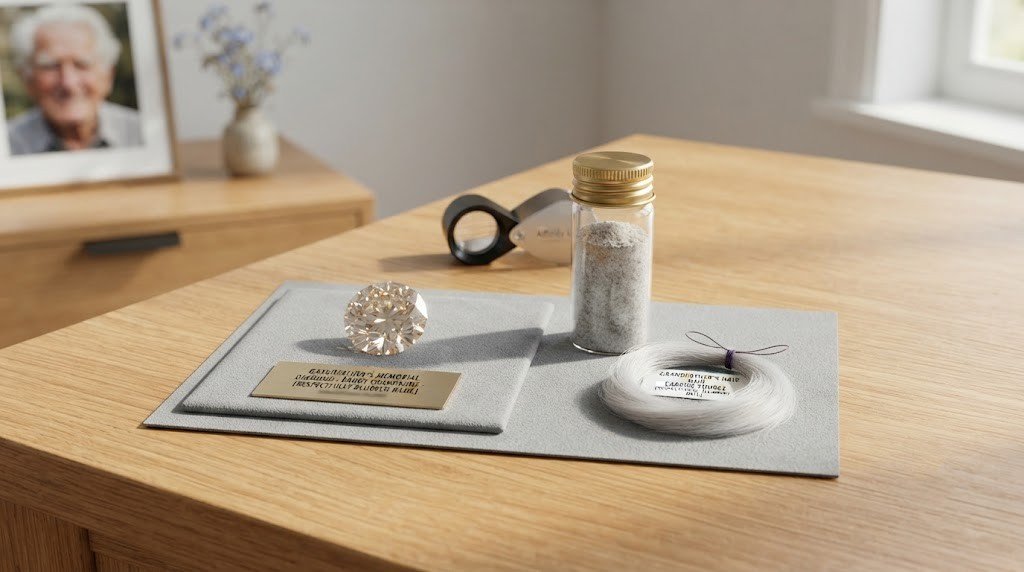
Table of Contents
Why would a family want both his ashes and his hair?
Some families want both because each material feels like a different part of him. Ashes are what remained after cremation; hair may have been saved years earlier, or set aside before a burial or cremation. Bringing them together can feel like gathering two separate keepsakes into one.
There are practical reasons too. A grandfather ashes hair diamond can bring together material held by two branches of a family, so neither side feels left out. If the only lock of hair is very small, some families also wonder whether pairing it with ashes would help; that is a question to put to a provider, not something to assume.
The reasons are personal, and none of them is required. One grandchild might want both because the ashes came from a parent and the hair came from an old envelope found while clearing a room. Another might simply like the idea of the stone holding more than one trace of him. A grandfather ashes hair diamond is one way to honor that wish; an urn, a burial plot or a scattering place are equally valid ways to remember him, and many choices can sit side by side.
It also helps to know what a grandfather ashes hair diamond is not. It is not a way around cremation-related religious concerns, because it still uses ashes. If cremation was not chosen, or your faith objects to it, the grandfather hair diamond complete guide covers a route that uses hair alone.
Will a provider make a grandfather ashes hair diamond at all?
Whether you can order a grandfather ashes hair diamond depends entirely on the provider. A company might offer a combined option, work with only one material per stone, or look at requests case by case, and only that company can tell you which applies.
When you ask about a grandfather ashes hair diamond, be specific. Ask whether they will combine ashes and hair from the same person in a single stone, how they handle the two materials before they are blended, and whether the price or timeline changes. An answer by email or letter is easier to refer back to than a phone call.
If a provider says no, that is not a dead end. You can ask another company whether it would make a grandfather ashes hair diamond, or you can grow one stone from his ashes and a second stone from his hair. Each route has trade-offs, and the comparison further down this guide lays them out.
If you want to see what the steps look like once a provider agrees, the practical walkthrough on how to turn your grandfather’s ashes and hair into a diamond goes through them in order.
What is known about the carbon in a blended stone?
Less is known about the carbon in a grandfather ashes hair diamond than you might expect. Published industry figures describe each material on its own, and no figure has been published for how much personal carbon ends up in a stone grown from a blend. The honest position is to ask the provider for their own number.
| Material | Carbon in the starting material | Personal carbon in the finished stone |
|---|---|---|
| Ashes | Roughly 0.5–4% by weight; ash is mostly calcium phosphate | For ash, typically around 10–15% of the stone’s mass, with some providers citing ~3% and others higher |
| Hair | Roughly 50% by weight; hair is mostly keratin | No published figure for hair; ask the provider |
| Ashes and hair blended | Depends on how much of each is used | No published figure for a blend; ask the provider |
The 10–15% range in that table applies to ash alone. It cannot be stretched to cover hair or a mixture, and anyone quoting it for a grandfather ashes hair diamond should be asked where the figure came from.
Making a grandfather ashes hair diamond uses the same process steps for both materials. Carbon is extracted in an oxygen-free, multi-stage heating process, purified to about 99.9% or higher, and converted to graphite at roughly 2,500–2,700°C. That graphite is typically combined with supplemental lab carbon before it goes into an HPHT press or, less often, a CVD chamber. The Wikipedia article on memorial diamonds gives broader background on the category.
To follow the material from intake to polished stone in more depth, read how a combined memorial diamond is made from his ashes and hair.
Would two separate stones work better?
Two separate stones can work better when a provider will not combine materials, when relatives feel differently about each material, or when you want to know exactly which stone came from which source. A grandfather ashes hair diamond can work better when you want one piece that holds both.
Here is how the two paths compare in practical terms:
- One combined stone: a single piece to set or keep; one order, one timeline; carbon from both sources in one crystal; no published figure for how the personal carbon divides between them.
- Two separate stones: each stone traceable to a single material; a larger total cost, since you are paying for two; flexibility to give one stone to each branch of the family; an ash stone can be described with the published ash figure, while the hair stone still needs a provider’s own number.
Neither path is more meaningful than the other. A grandfather ashes hair diamond gathers everything into one place, which some people prefer. Two stones let a grandson wear one while his cousin keeps the other, which suits families who would rather share than consolidate.
If you lean toward a stone from ashes alone, the grandfather ashes diamond complete guide covers that single-material route in full.
How much ash and hair does a grandfather ashes hair diamond typically need?
Across the industry, a stone grown from ashes typically calls for somewhere between a few tablespoons and roughly 4 ounces, about 100 grams. A stone grown from hair typically calls for a small lock or a few grams. For a grandfather ashes hair diamond, the amount of each is set by the provider.
Because only a portion of each material is used for a grandfather ashes hair diamond, the rest of the ashes can still be kept, scattered or interred as the family planned, and some hair may remain as well. What happens to unused material, including whether and how it is returned, varies by provider, so get that answer in writing.
His hair may be gray, white, short or sparse, or the only hair saved may be from a beard or mustache. Whether a provider accepts that hair for a grandfather ashes hair diamond, and how much they need alongside the ashes, are questions for them to answer after seeing it. A photo next to a ruler helps.
The amount you send does not decide the carat of a grandfather ashes hair diamond. Carat is set mostly by how long the stone grows in the press, so a larger sample of either material does not automatically produce a larger stone.
How should you keep his ashes and hair while the family decides?
Leave each material where it is now, labeled and kept apart, until a provider explains how it wants them packaged. Ashes can stay in the container returned by the crematory or funeral home, or in the urn the family chose. How hair should be stored or packed before shipping is a question for the provider.
A few habits prevent confusion later:
- Label each container with what it holds and who is looking after it.
- Leave the main container of ashes closed until the person with authority agrees and a provider says how much it needs.
- Leave the hair unwashed and untrimmed.
- Write down where the hair came from, such as a saved lock or a funeral home cutting, since a provider may ask.
Taking time to agree as a family is reasonable. Ask any provider you are considering whether the time since cremation, or how long the hair has been kept, matters to its process. Keeping both safely in the meantime leaves every option open, including leaving the urn exactly as it is.
Who should agree before his ashes and hair are used?
Using his ashes starts with the person who holds authority over his cremated remains, and who that is differs from state to state with no nationwide standard. Commonly, a surviving spouse or partner and then his adult children rank ahead of grandchildren, though written instructions he left can reorder that.
As a grandchild, the gentle way forward is a request: ask the person with that authority whether they would set aside a small portion for a grandfather ashes hair diamond. Explaining that only part of the ashes is typically used, and that the rest can stay where the family intended, may make the request easier to consider. If they say no, his hair may still be another route.
The hair half of a grandfather ashes hair diamond raises a different conversation. Laws about remains focus on the body and the ashes, which is why a lock you already hold is usually more straightforward in practice. Still, his belongings can form part of his estate, rules vary by state, and whoever is settling his affairs deserves to know what you are planning. If the hair is held by someone else, asking them is a conversation, not a decision you can make for them.
A grandfather ashes hair diamond therefore often involves two sets of people, one for each material. Talking with both early avoids a situation where one part of the plan is agreed and the other is not.
What color could the finished diamond be?
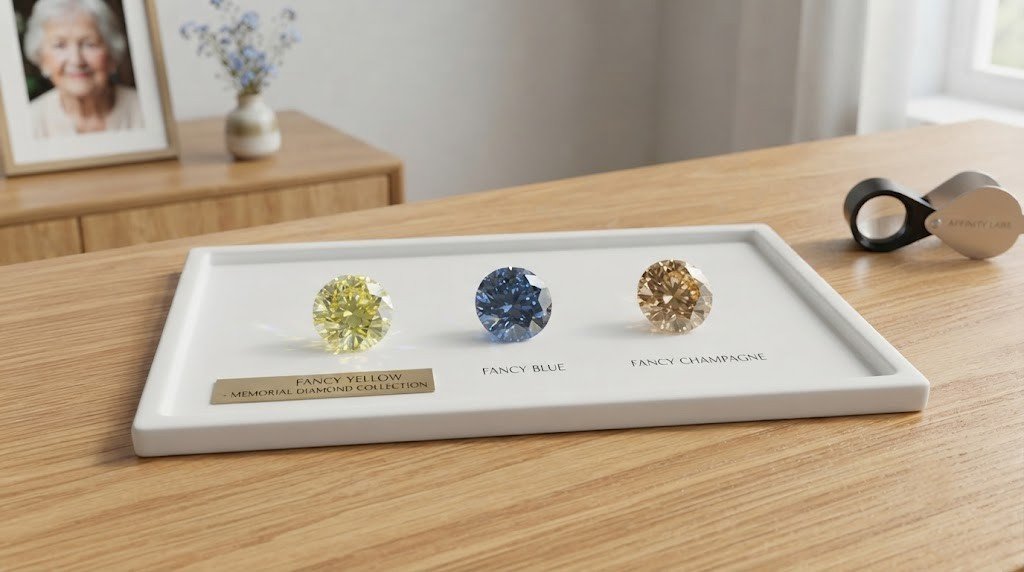
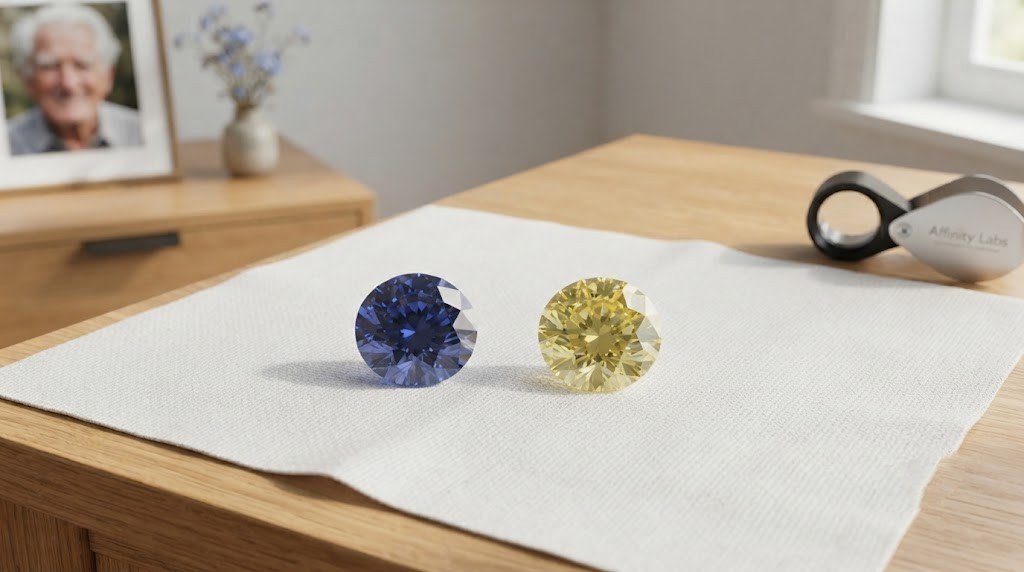
The color of a grandfather ashes hair diamond comes from trace elements during growth, not from how the ashes or hair look. Boron in the crystal tends to give blue; nitrogen tends to give yellow; colorless requires both to be excluded and usually costs more. Memorial stones commonly lean blue, yellow, or champagne to brown.
There is no evidence that adding hair to ashes, or using gray hair, makes a grandfather ashes hair diamond lighter or darker. No source makes the final shade fully predictable, so ask each provider which colors it can aim for and how close it expects to get.
Post-growth irradiation is offered by some providers to move a stone toward red, pink, green or black. Whether that option exists for a grandfather ashes hair diamond, and at what cost, is another provider question.
What does a grandfather ashes hair diamond cost, and how long does it take?
General 2026 industry ranges apply to a grandfather ashes hair diamond the same way they apply to single-material stones. Any extra charge for handling two materials is set by each provider, so ask for a written quote.
| Approximate size | Typical 2026 industry range | What usually costs extra |
|---|---|---|
| 0.10–0.25 ct | 1,500–3,500 | Setting, engraving |
| 0.5–1 ct | 5,000–15,000 | Colorless tone, independent grading |
| 2–5+ ct | 20,000–75,000+ | Fancy cuts, setting, grading |
If you choose two separate stones instead, expect two sets of these costs. Clarity in memorial diamonds typically lands between SI2 and VVS, and an independent grading report, commonly referencing the GIA 4Cs, is optional and distinct from the in-house certificate that records chain of custody.
On timing, a grandfather ashes hair diamond typically takes 6–10 months from the day the provider receives both materials. Larger stones of about 2 carats or more, or specialty colors, can approach 12 months. Growth itself takes weeks to months inside that window, and a provider should explain whether a combined stone changes their schedule.
How can grandchildren and cousins share what he left?
More than one grandfather ashes hair diamond can often come from the same materials, because only part of the ashes and part of the hair are typically used. That means several grandchildren or cousins may each receive a stone.
Coordination matters more than chemistry here. Before anything is sent, it helps to agree on a few things:
- Who will be the single point of contact with the provider.
- Whether every stone will be a grandfather ashes hair diamond, or whether some relatives would rather have ash-only or hair-only stones.
- How costs will be split, and whether anyone prefers to contribute without receiving a stone.
- Who holds the materials before shipping, and what happens to anything not used.
Cousins who live far apart may each want a stone they can wear, while a parent may prefer a loose diamond kept in a small case. A grandfather ashes hair diamond for one person and a hair-only stone for another can coexist within the same family.
If cousins want to start with ashes alone, the walkthrough on turning your grandfather’s ashes into a diamond shows that route step by step.
How might the finished stone be worn or kept?
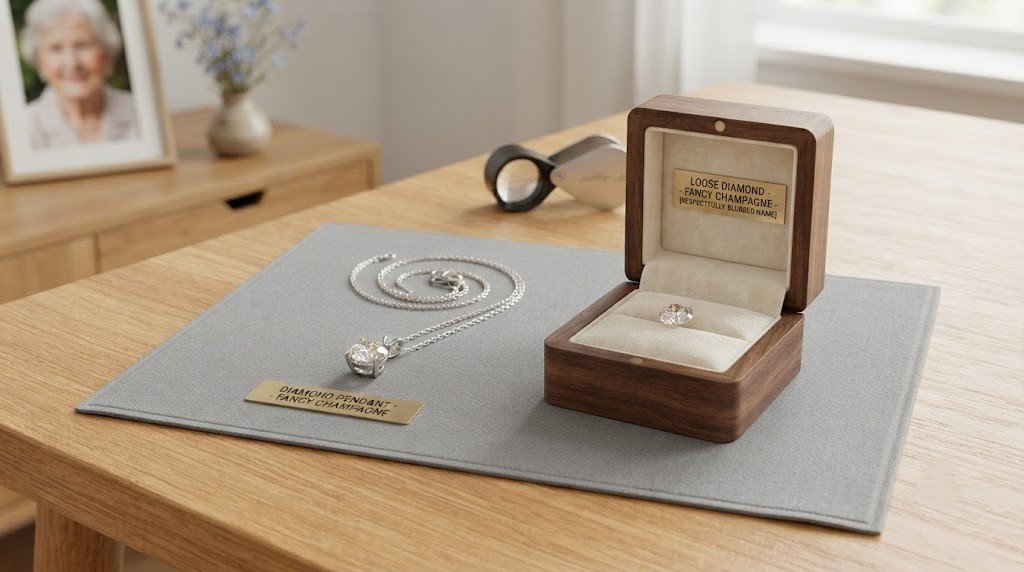
A grandfather ashes hair diamond can be set in whatever piece you will actually use, or kept loose. Because diamond sits at 10, the top mark on the Mohs scale of mineral hardness, it handles daily wear well; a sharp knock can still chip it.
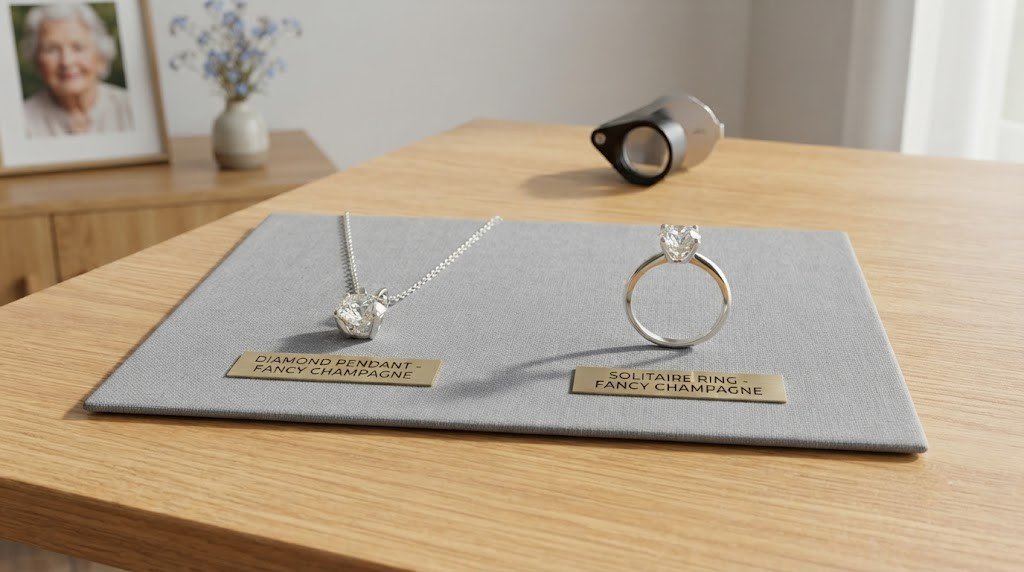
Nothing about remembering a grandfather calls for a particular style. A pendant, a ring of any design, a pair of earrings, a lapel pin or a loose stone in a small box are all equally fitting. If two stones are chosen instead, they can be set to match or styled completely differently for different people.
Settings, engraving and independent grading are usually priced separately from the stone. Insurance for a set diamond is a question for an insurance agent rather than a jeweler, so ask before the piece goes into everyday wear. Some people engrave a short line that mentions both his ashes and his hair; others keep that detail private.
Which questions should you put to a provider in writing?
Before you commit to a grandfather ashes hair diamond, put every provider-dependent point in writing. These questions are written for a combined stone:
- Do you combine ashes and hair from the same person in one diamond?
- How much ash and how much hair do you need for that?
- Will you accept his hair as it is, including gray, white, short, sparse or beard hair?
- What share of the finished stone’s carbon comes from his materials, by your own process, for a blend?
- How do you track each material from arrival to finished stone, and what documents do I receive?
- What happens to ashes and hair you do not use?
- Does combining materials change the price or the timeline?
- Which colors, carats and settings are available, and what does each cost?
- What are your terms if our family’s plans change partway through?
For background on question 4, read the plain answer to whether a memorial diamond is really made from your grandfather’s ashes, which applies the same scrutiny you would bring to a grandfather ashes hair diamond.
Frequently Asked Questions
Can a combined stone be made if the ashes are already divided among relatives?
Possibly. Only a portion of ashes is typically needed, so a relative holding part of them could share a small amount. Whoever holds authority over his remains should agree, and the provider can tell you how much ash it needs alongside the hair.
Does a grandfather ashes hair diamond hold more of him than an ash-only stone?
No one can say that honestly yet. Hair starts with far more carbon than ash, but no figure is published for the personal carbon in a finished blended stone. Ask the provider for its own number, in writing, before deciding.
Is a combined stone acceptable if our faith objects to cremation?
A grandfather ashes hair diamond still uses ashes, so it does not avoid a cremation-specific objection. A stone from hair alone involves no cremation. No tradition has an official position on memorial diamonds specifically, so your own clergy is the right person to ask.
Can the hair and the ashes come from different people?
This guide is about his own ashes and hair. Combining material from two different people is a separate request, and whether any provider offers it is entirely their policy. Ask directly, and get the answer in writing before sending anything.
What if only facial hair was saved?
Beard or mustache hair is keratin like other hair, but acceptance and the amount needed are provider questions. Describe the sample honestly, include a photo beside a ruler, and ask whether it can be combined with his ashes or used on its own.
Will the certificate show both materials?
That depends on the provider. An in-house authenticity certificate records chain of custody, and some may list each material submitted. Ask what the certificate will state for a grandfather ashes hair diamond, and whether an independent grading report is offered separately.
Final Thoughts on a Grandfather Ashes and Hair Diamond
Bringing his ashes and his hair together is one option, and it is just as reasonable to keep them apart, or to leave them exactly where they are. Whatever you decide, take the family conversations slowly and get each provider’s answers in writing before anything is sent.
Learn More About Grandfather Memorial Diamonds
- Grandfather Hair Diamond: The Complete Guide the hair-only route, including burial and faith questions
- Grandfather Ashes Diamond: The Complete Guide everything about a stone from his ashes alone
- How a Memorial Diamond Is Made From Your Grandfather’s Ashes and Hair the process for a combined stone
- How to Turn Your Grandfather’s Hair Into a Diamond practical steps when hair is what you have
Talk With Memorial Diamond
If you are weighing one combined stone against two, or still working out who in the family holds what, we are happy to talk it through at your pace. Visit memorialdiamond.us to start a conversation whenever it feels right.