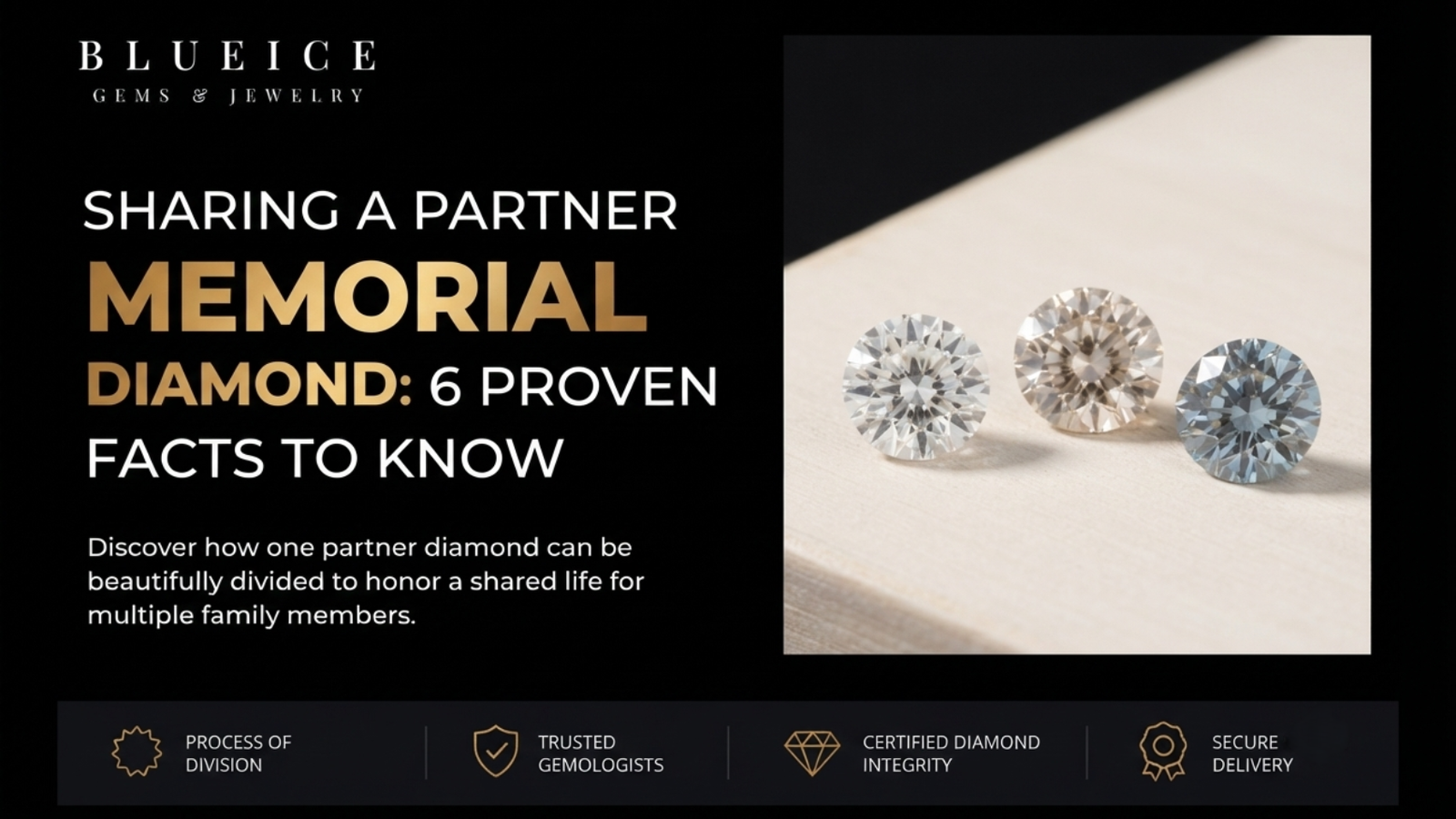
Three finished memorial diamonds of slightly different tones on a pale surface, showing what sharing a partner memorial diamond between several people produces

Can More Than One Family Member Get a Diamond From the Same Partner’s Ashes?

It usually surfaces sideways, in a kitchen, after someone has already said yes to the idea. A sibling asks whether they could have one too. Sharing a partner memorial diamond across several people is usually possible, because only a small portion of what a family holds is ever used, but the material was never the hard part. The hard part is who has the standing to authorize it, and what everyone has agreed before anything is posted.

One disclosure up front: Memorial Diamond grows these stones, so treat this as a company describing its own category rather than a neutral referee. Every figure below is an industry wide band, not a published policy of ours.

Why One Portion Can Supply Several Stones

Start with the physical facts, because they are the reassuring end of this subject. Materially, sharing a partner memorial diamond is the easy part.

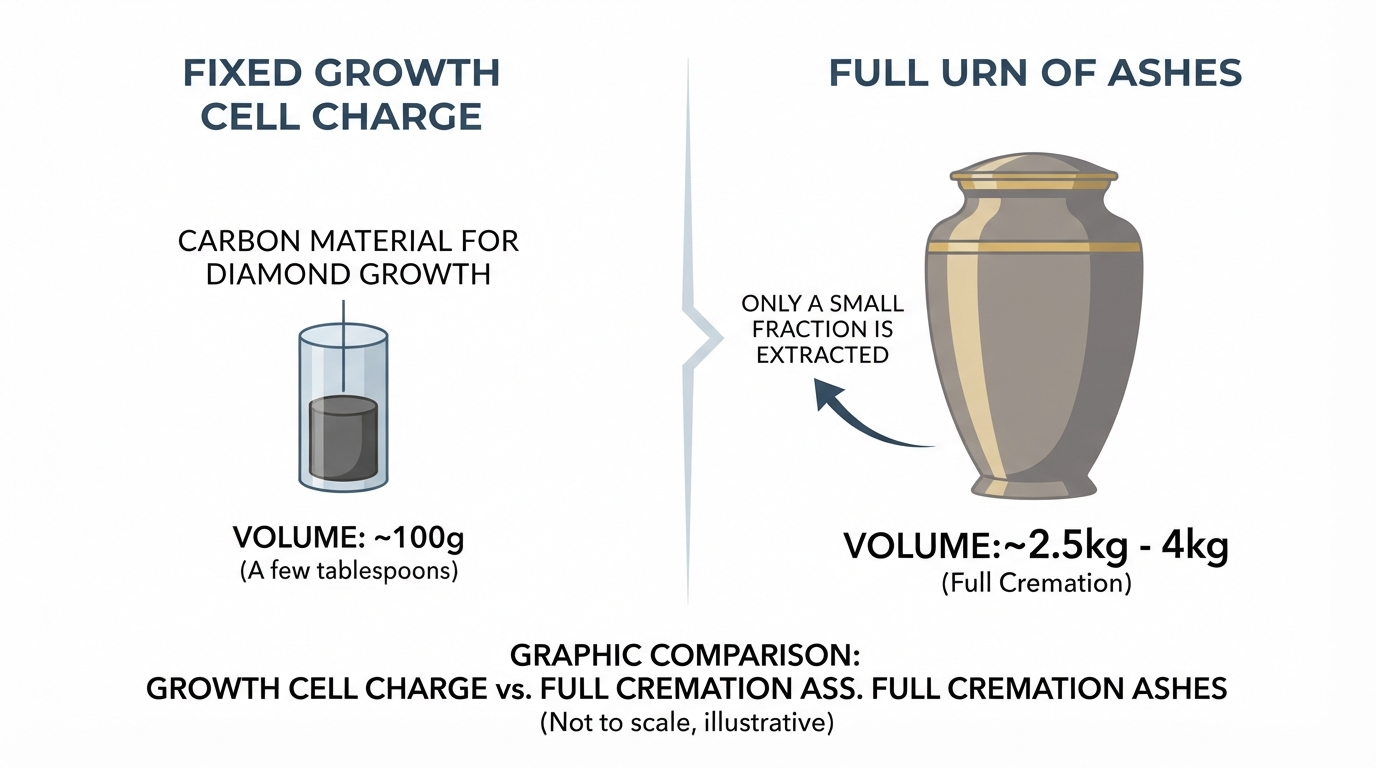
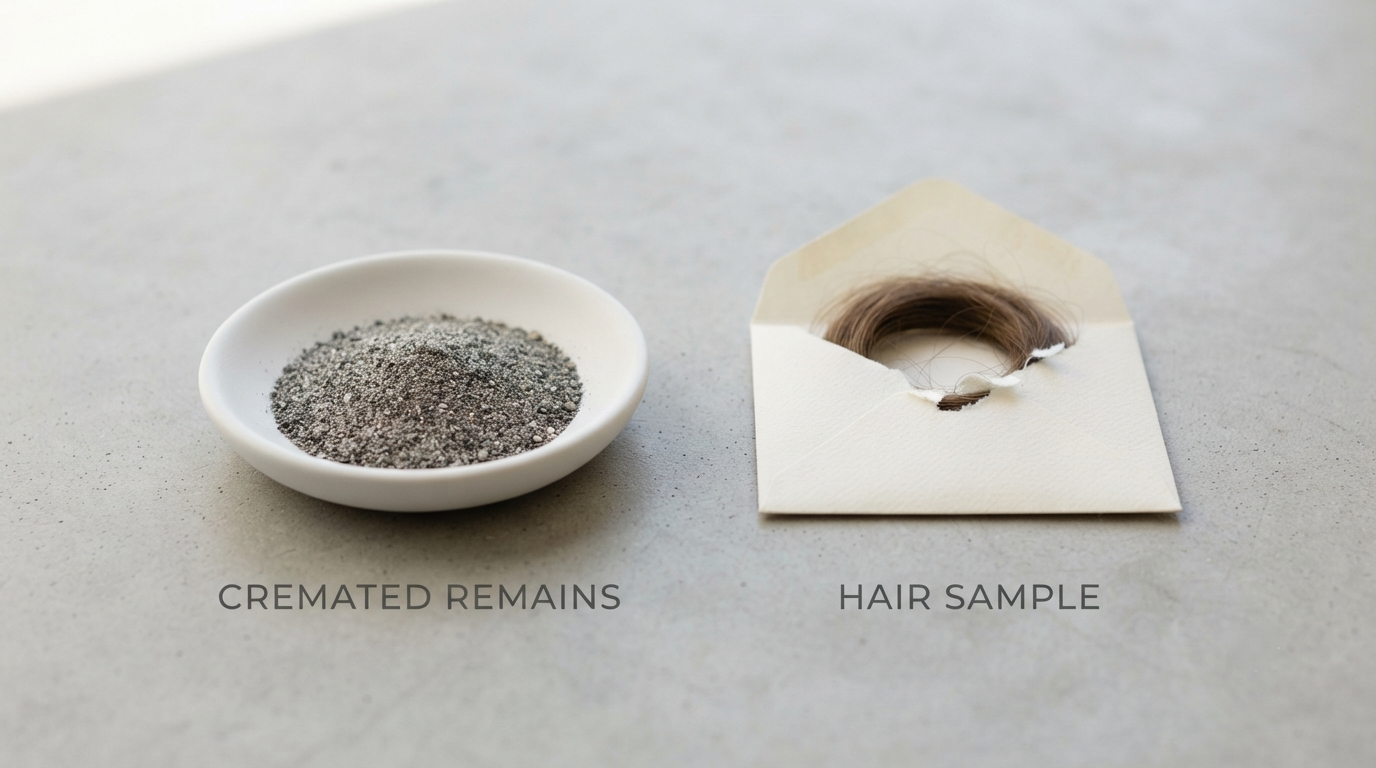
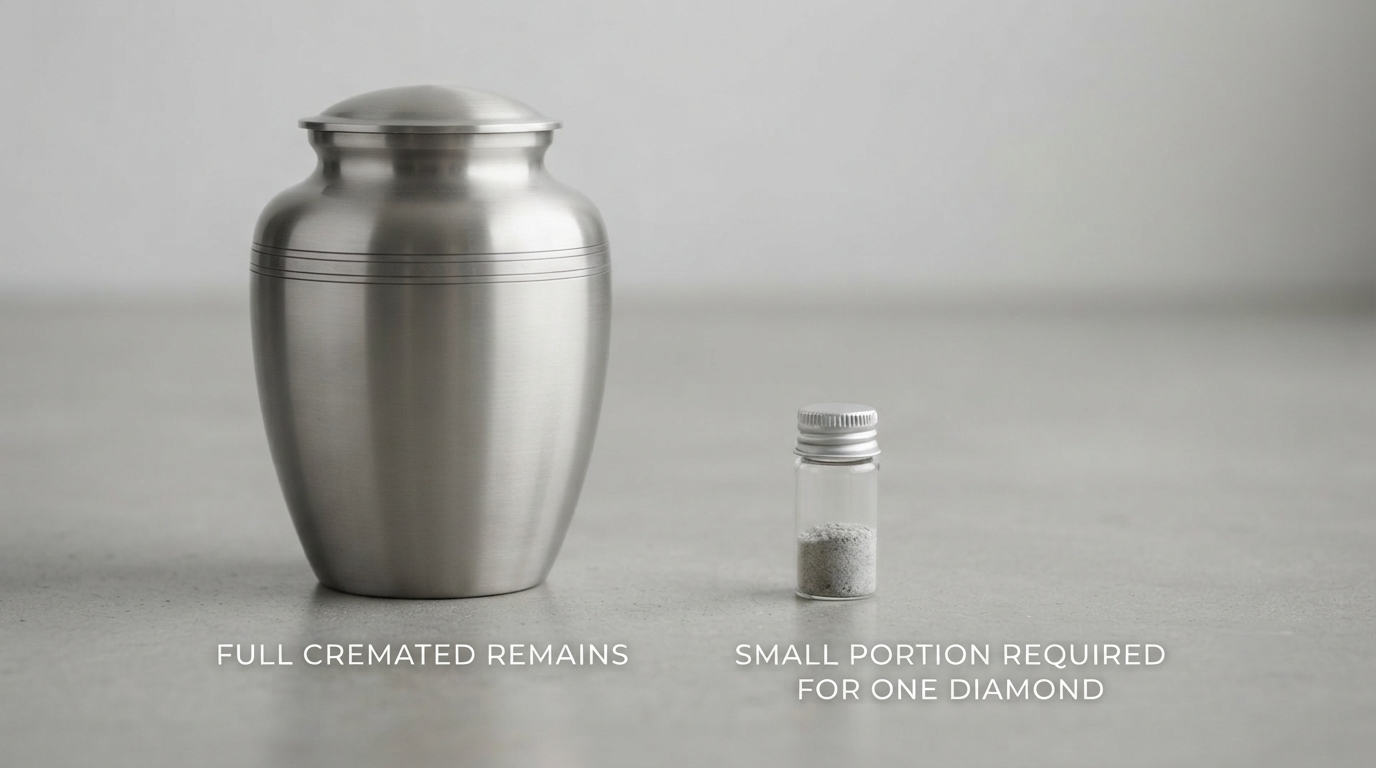
A cremation produces remains measured in pounds. What a laboratory asks for is measured in tablespoons, industry wide, somewhere between a few tablespoons and roughly 4 oz, about 100 g. That gap is what makes sharing a partner memorial diamond feasible at all. Several separate portions can be drawn from one urn and nothing visible changes in it. How much ash a single stone actually takes sets out the arithmetic behind that figure in full.

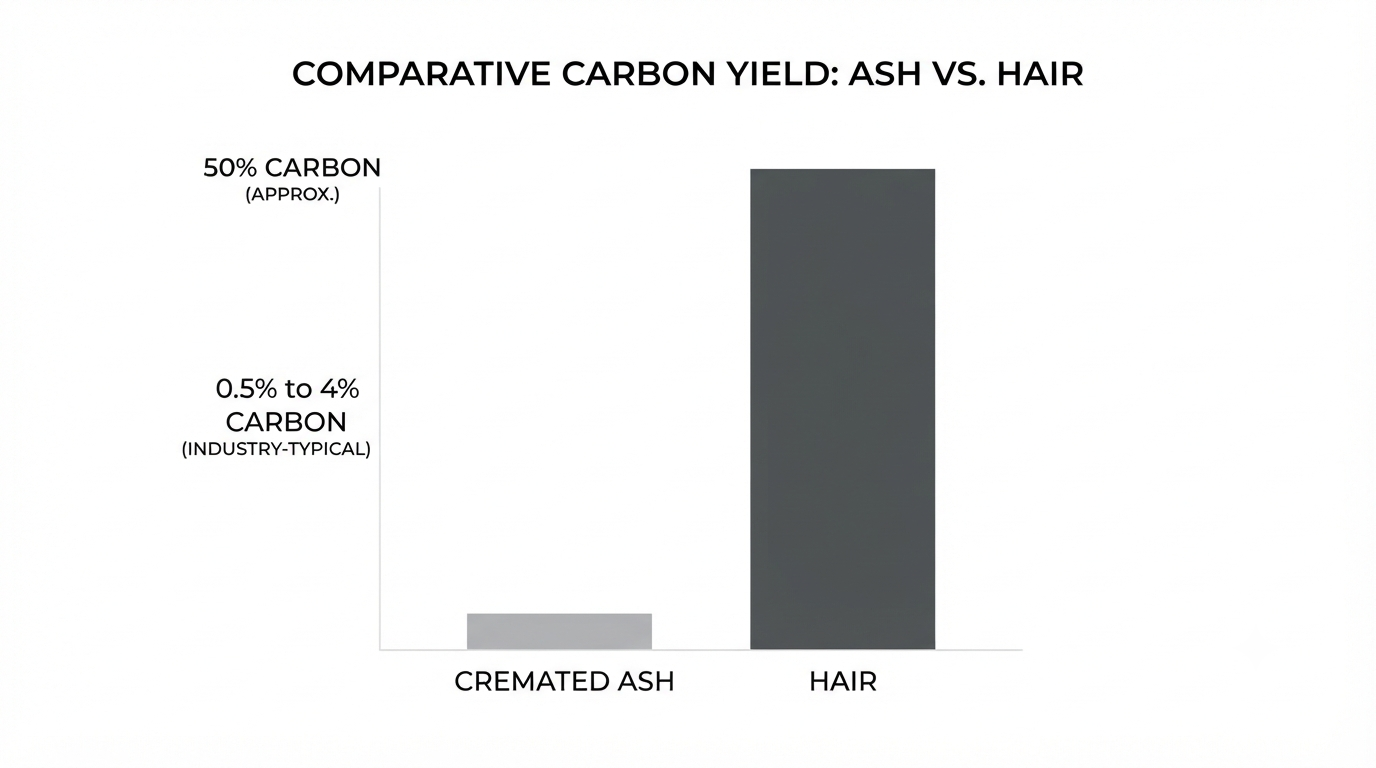
The reason the request is so small is that cremated remains are not a carbon source in any generous sense. They are overwhelmingly calcium phosphate, the mineral scaffolding of bone. By weight, only about 0.5% to 4% of ash is usable carbon. So each portion set aside for sharing a partner memorial diamond is a mineral sample from which a thin recovery of carbon will be pulled, purified to around 99.9%, and then blended with supplemental lab carbon to reach the volume a growth cell needs.
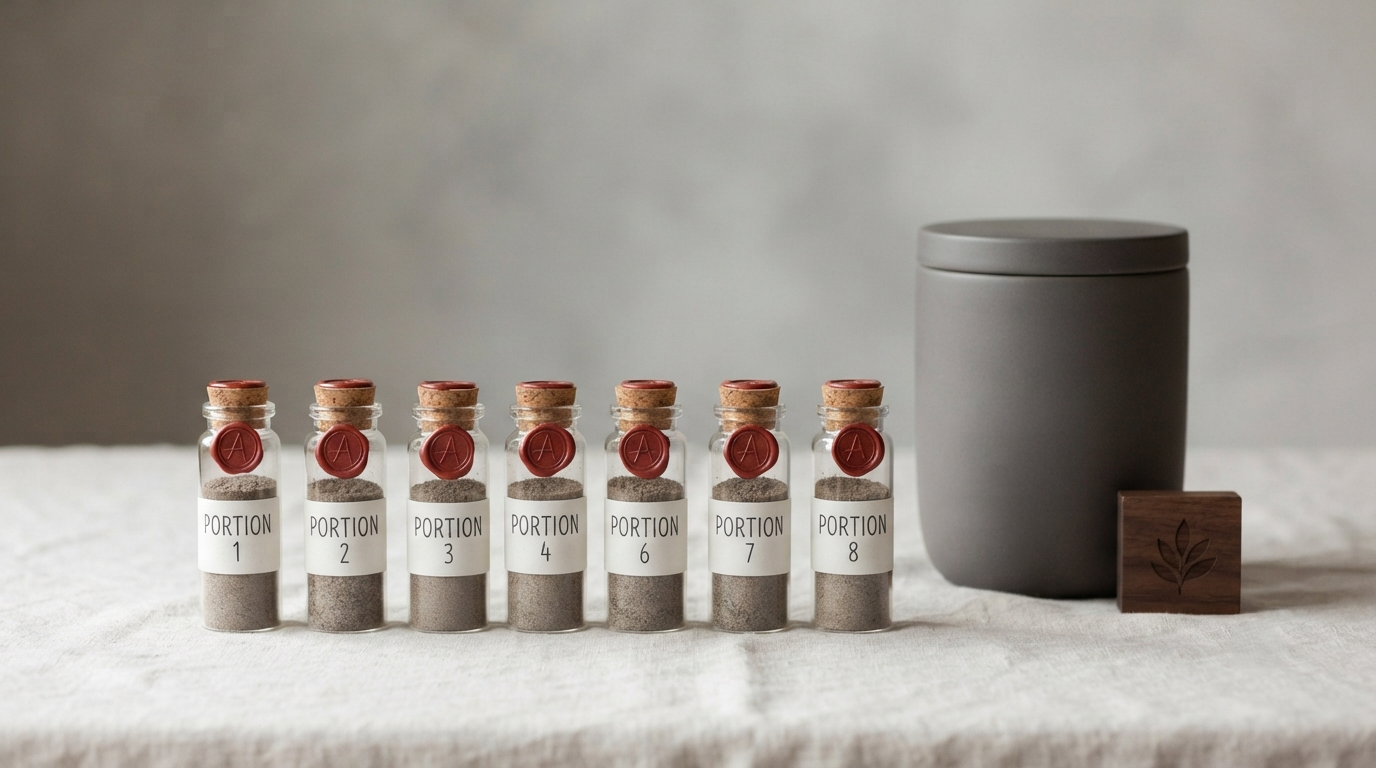
Several small sealed vials of cremated remains lined up beside a closed urn, each holding one portion

That blend is worth stating plainly rather than skipping. For the ash route, the industry figure for personal carbon is somewhere around 10% to 15% of a finished stone’s mass, and some providers cite as little as 3%. No comparable figure is published for hair. Nobody receives a diamond that is entirely the person, that is not how the chemistry works. What each person receives is a real diamond containing a real, traceable share of their carbon, which is a more defensible claim and, once you sit with it, not a smaller one.

Hair changes the arithmetic considerably. Hair is roughly 50% carbon by weight, and no cremation is involved at all, so a household that kept a lock has a second route into sharing a partner memorial diamond even where the ashes are out of reach. What a hair based submission requires covers the quantities, which are far smaller than most people assume.

Practical limits that do apply when sharing a partner memorial diamond:

  • Each stone needs its own portion. Portions are not subdivided after arrival, so sharing a partner memorial diamond means sending one portion per stone.
  • The number of stones is limited by what you hold, not by any rule about how many people may take part.
  • A partial share can still work. A keepsake urn’s worth is often enough for one stone, sometimes two.
  • Hair and ash are assessed separately, not pooled into a single total, if a family is drawing on both.

Who Actually Has Standing to Say Yes?

This is where sharing a partner memorial diamond stops being a logistics question, and it deserves a direct answer rather than a comforting one.

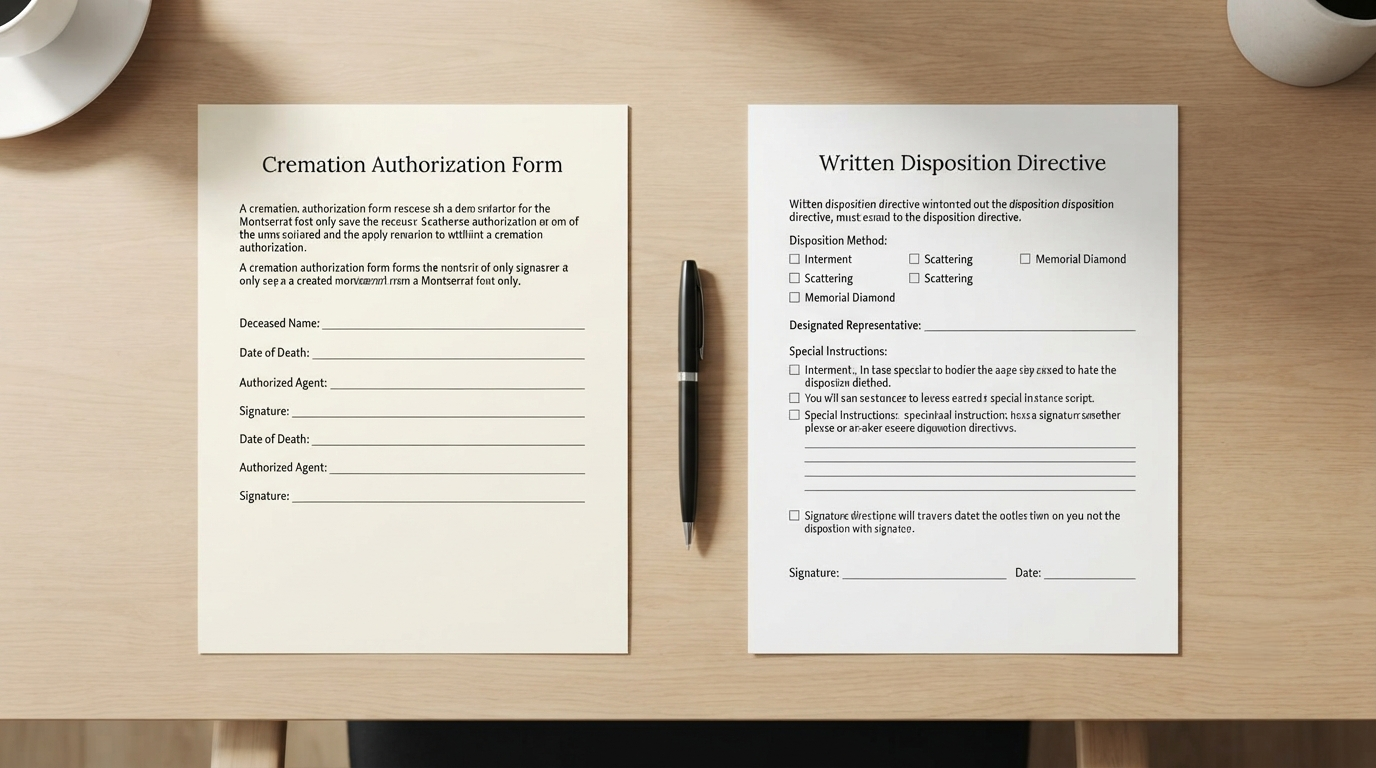
No nationwide rule decides who may authorize a division. State law does, and a written direction from your partner, a will, a disposition directive, a form signed at the funeral home, can displace whatever the default would otherwise have been. Legal recognition of the relationship usually keeps this simple. Without it, the entitled decision maker may turn out to be a former spouse, a sibling, an adult child, or a parent, whatever the living arrangements looked like, which is why sharing a partner memorial diamond so often turns on a document nobody has actually read.

Three people talking across a table with paperwork between them, discussing authority over a partner's remains

That matters more here than in almost any other question in this cluster. Sharing a partner memorial diamond means dividing remains between people, and the person who authorizes a division may not be you. It may be someone who never used the word “partner” about your relationship at all.

None of that makes it impossible. It changes the order of operations for sharing a partner memorial diamond:

  1. Establish who the law treats as the decision maker in the state where the cremation happened, a funeral director will usually say, at no charge.
  2. Find out what was left in writing, and whether anyone has actually read the document rather than recalled it.
  3. Ask the person with authority, which is a separate question from whether they are entitled, and frequently a warmer conversation than people brace for.
  4. Get the agreement on sharing a partner memorial diamond recorded, even as an email thread, before money moves or material is packed.

There is a quiet advantage in this particular request. A family reluctant to acknowledge a relationship is often far more willing to grant one small portion than to change anything about the main arrangement, and sharing a partner memorial diamond, framed as one each, can be easier for them to say yes to than a request made by you alone. It reads as inclusion rather than as a claim. How to open that conversation without it becoming a confrontation goes through the wording in detail.

Say the awkward part out loud too: this is irreversible. Once a portion has been set aside and processed, it does not come back. That is exactly why sharing a partner memorial diamond is worth slowing down over, even when everyone in the room is currently agreeing.

What to Settle Before Any Material Is Sent

Most of the regret in this subject comes from decisions that were assumed rather than agreed. Sharing a partner memorial diamond involves several people, several invoices, and a wait long enough for circumstances to change.

Settle these before sharing a partner memorial diamond goes any further, in writing, however informal:

  • How many stones, and for whom. Names, not “the family.” If someone is undecided, note that too.
  • Who pays for what. Each stone is bought separately, so a shared decision does not create a shared bill unless someone chooses to split one.
  • Who the provider’s point of contact is. One person, or the correspondence about sharing a partner memorial diamond fragments across a group and nobody knows what was approved.
  • What happens if someone withdraws after the portion has been sent but before the growth run begins.
  • What happens to material the process does not consume, and whether it returns by default. This is company policy rather than chemistry, so it varies and must be asked.
  • Whether anyone expects the stones to match, which is the single most common misunderstanding in sharing a partner memorial diamond and is addressed directly below.
  • Who physically receives the finished stones, and whether they are shipped separately or together.

One scheduling note that saves arguments: stones commissioned at different carats finish at different times. Industry typical timelines run 6 to 10 months from receipt, stretching toward 12 months for larger or specialty color stones. If three people order and one chooses a much larger stone, that person waits longest, which feels like unfairness if nobody said so in advance. How the timeline actually breaks down stage by stage is worth circulating to everyone involved before orders are placed.

Will the Stones Match Each Other?

No, and this is the expectation most worth correcting early when sharing a partner memorial diamond. Stones from one shared source are siblings, not twins.

Each diamond is grown in its own run. Color in any diamond comes from trace elements present during crystal growth, nitrogen pushes toward yellow, boron toward blue, and the absence of both is what produces a colorless stone. Because personal carbon is an organic, uncontrolled feedstock, those traces vary between batches, which is precisely why memorial stones trend toward yellow, champagne and blue rather than colorless. The general reference on how these crystals are grown explains the mechanism; what color to expect from a partner’s carbon covers what that means in practice.

Clarity varies too, and it is the second surprise in sharing a partner memorial diamond. Memorial stones typically land somewhere in the SI2 to VVS range, graded against the same 4Cs as any other diamond. Two stones from one urn can differ in tone, in saturation, and in where their inclusions sit.
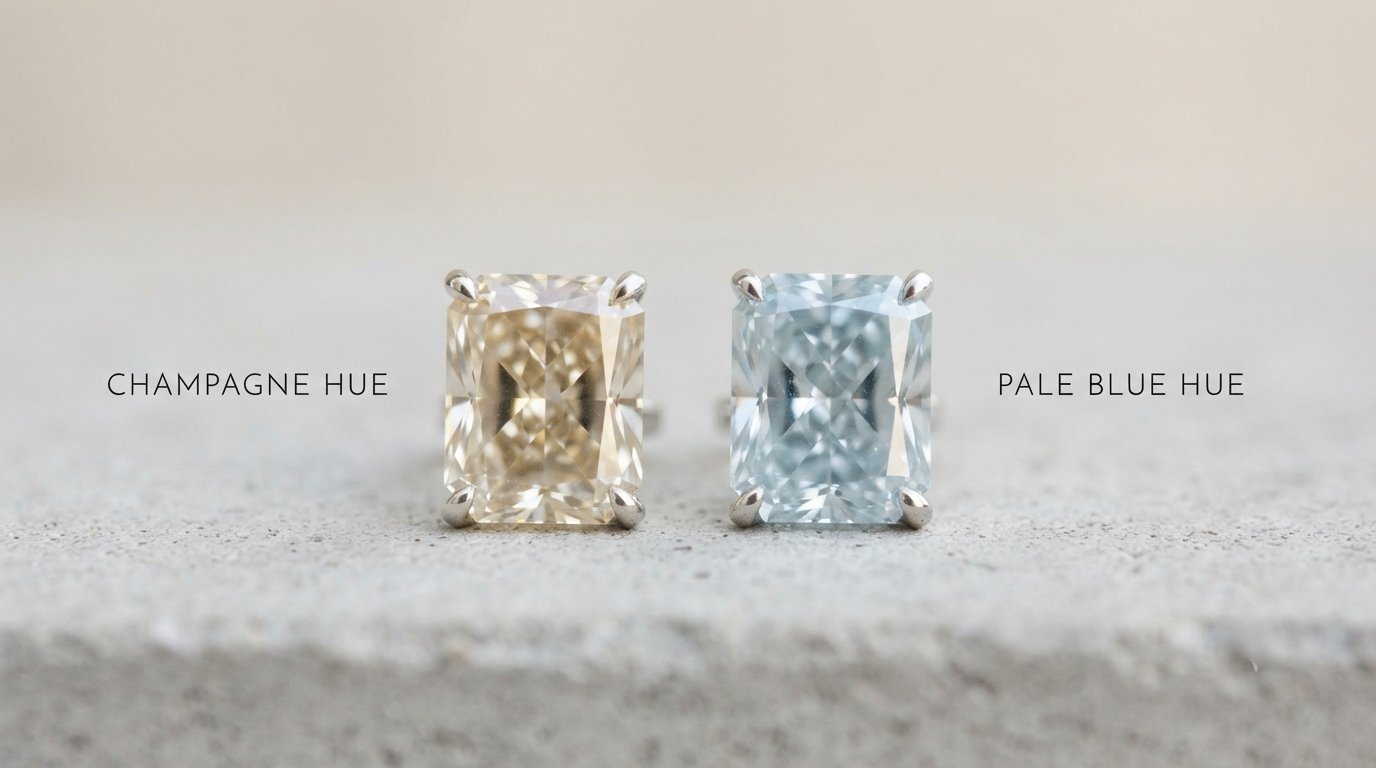
Two memorial diamonds side by side under daylight, one champagne and one faintly blue, showing that stones from one source do not match

Three ways families handle it when sharing a partner memorial diamond:

  • Accept the variation. Many people prefer it. Each stone is visibly its own thing rather than a set of copies.
  • Order the same carat and cut. Matching the specifications you can control narrows the visible difference even when color does not match.
  • Ask about color treatment. Post growth irradiation is sometimes used to shift a stone’s color, which can bring stones closer together. Ask whether it is offered at all, and what it costs, before assuming.

What no provider can honestly promise is a matched set produced on demand from one person’s carbon. If someone in your group is expecting that, better to find out now than at the unboxing.

How Much Does Sharing a Partner Memorial Diamond Cost?

Here is the part that changes plans. Sharing a partner memorial diamond does not divide a cost, it multiplies one. Each stone is an independent growth run, occupying its own press time, and is priced as its own purchase.

The bands below are industry typical figures for the category as a whole, not Memorial Diamond’s published pricing, and final cost turns on carat, color, cut, and whether you order an independent grading report:

Stones from one shared sourceIndustry typical entry tier, 0.10 to 0.25 ct eachIndustry typical mid tier, 0.5 to 1 ct each
One stoneroughly $1,500 to $3,500roughly $5,000 to $15,000
Two stonesroughly $3,000 to $7,000 combinedroughly $10,000 to $30,000 combined
Three stonesroughly $4,500 to $10,500 combinedroughly $15,000 to $45,000 combined
Larger or rare stones, any numberpriced individually; 2 to 5+ ct runs roughly $20,000 to $75,000+ eachNot applicable

Read that table as a caution rather than a quote. The useful takeaway for anyone sharing a partner memorial diamond is that a group of three at a modest carat frequently spends less, in total, than one person at a large carat, so the honest opening question for a group is not how many of us but what size each. Settings, engraving and any grading report are usually quoted separately from the stone, worth confirming. What drives the price of a single stone breaks down each variable.

Two cost realities catch groups out when sharing a partner memorial diamond:

  • Do not assume a discount for ordering together. Each stone is its own growth run, so ask whether any provider prices several differently, and do not build a budget on the answer being yes.
  • A smaller stone is not a lesser stone. An entry tier diamond carries the same proportion of personal carbon as a larger one; carat is bought from growth time, not from the amount of ash submitted.

When the Answer Is No, or Not Yet

Sometimes the person who decides about sharing a partner memorial diamond simply declines. Sometimes the ashes were scattered years ago. Sometimes the group cannot agree, and pressing it would cost more than the stones are worth.

Options that remain open when sharing a partner memorial diamond is off the table for now:

  • One stone, shared in a different way. A single diamond can be held by one person and worn at family occasions, or set in a piece designed to be passed on. Settings that can be changed or converted later matter more than usual when a stone is meant to move between people.
  • The hair route. If anyone kept a lock, no cremated remains are needed and the authority question over the urn does not arise in the same form.
  • Waiting. Cremated remains are stable and keep indefinitely. A family that says no this year is not saying no permanently, and nothing degrades while you wait.
  • Reading the full route first. The complete guide to a partner ashes diamond lays out every stage, which is often what an undecided relative actually needs before agreeing to anything.

Frequently Asked Questions

How many diamonds can realistically come from one person’s ashes?

It depends on how much you hold rather than on any fixed limit. With a full cremation’s remains, several stones are usually feasible, since each takes only a few tablespoons up to roughly 4 oz. With a keepsake portion, often one or two.

Can each person choose a different size and color?

Yes. Each stone is a separate order with its own carat, cut and color specification, its own invoice, and its own finish date. Sharing a partner memorial diamond does not mean sharing one set of choices.

Do all the stones have to be ordered at the same time?

No. A second stone can be commissioned later from the same held ashes, provided material remains. The catch is timing: prices and offerings shift, and a later stone will differ visibly from the first regardless.

My partner’s family controls the ashes and barely acknowledged me. What now?

Ask anyway, and ask for one small portion rather than a change to the main arrangement. Authority varies by state and by anything left in writing. A framing of one stone each is often easier for a reluctant family to accept.

Can a portion be taken from ashes that are already interred?

That becomes a cemetery permissions question, not a material one. Columbaria and cemeteries set their own rules for removing interred remains, and local law may add more. Ask the cemetery in writing before planning anything around it.

If we split the cost of one stone, who owns it?

Nothing about the process settles that, so settle it yourselves in writing before ordering. Joint purchases of a single irreplaceable object cause the most friction later. Agree now who holds it, who insures it, and what happens eventually.

Final Thoughts on Sharing a Partner Memorial Diamond

The material answer to sharing a partner memorial diamond is the easy one: yes, in almost every case, because the portion each stone needs is small enough that one urn can serve several people without visibly changing.

Six things sharing a partner memorial diamond comes down to, in the order they decide it:

  1. The material is rarely the constraint. A stone takes a few tablespoons up to roughly 4 oz; a cremation is measured in pounds.
  2. Each stone needs its own portion. Portions are not subdivided after they arrive.
  3. Standing decides it, not arithmetic. Authority varies by state and by anything left in writing.
  4. The stones will not match. Separate growth runs, separate results.
  5. Sharing multiplies the cost. Three stones is three prices, not one split three ways.
  6. It cannot be undone. Waiting costs nothing; remains are stable and keep indefinitely.

The rest of it is a conversation, and it is a conversation worth having slowly. Who has the standing to authorize a division. What everyone expects the finished stones to look like. Who is paying for what, and what happens if someone changes their mind in month seven. Handled in that order, sharing a partner memorial diamond usually turns out to be one of the less contested decisions a family makes in a difficult year, and occasionally the one that brings people who disagreed about everything else into one room.

Learn More About Partner Memorial Diamonds

Talk With Memorial Diamond

If your family is weighing sharing a partner memorial diamond and you want a straight answer about what is possible with the material you actually hold, reach out to Memorial Diamond at memorialdiamond.us. Bring the numbers, how much you have, how many people, what carat each has in mind.
A closed ceramic urn and a small finished diamond on the same shelf, framing partner memorial diamond vs urn as two things that coexist rather than compete

Partner Memorial Diamond vs. Traditional Urn: What to Know

The urn is usually already in the house by the time anyone reads a page like this, sitting somewhere you have not decided about. Read partner memorial diamond vs. urn as a fork in the road and you will get the decision wrong, because only a small portion of cremated remains is ever used for a stone. Most families do both. The rest is kept, interred, or scattered exactly as planned, which is why partner memorial diamond vs. urn is so often a false choice.

Now the disclosure this page cannot do without: Memorial Diamond grows memorial diamonds. We sell one of the two things being compared here, so this is not a neutral referee, and you should read every line below knowing that. What we can do is keep the comparison factual, keep the industry figures labeled as such, and not pretend an urn is a lesser choice. It is not. For many families it is the whole answer.

Why This Is Rarely a Straight Either/Or

The arithmetic dissolves most of the conflict in partner memorial diamond vs. urn before the values question even starts.

A cremation produces remains measured in pounds. What a laboratory asks for is a few tablespoons up to roughly 4 oz, about 100 g, industry wide. Set them side by side and the framing collapses: a stone takes a jar’s worth, and the urn stays on the shelf, or goes into the ground, or goes out over the water in spring. The full arithmetic on how much ash a stone actually needs sets out why the figure is as small as it is.

A single small sealed vial of cremated remains beside a full urn, showing the proportion a stone actually requires

So the practical shape of partner memorial diamond vs. urn, for families who take both paths, looks like this:

  • A portion leaves a small, measurable amount, set aside and documented.
  • The remainder stays in whatever vessel or place was already chosen.
  • Both plans proceed. An interment date does not move; a scattering is not canceled.
  • More than one person can be served several stones usually come from one shared source, one per person, as this post on sharing one set of ashes explains.

There is a version of partner memorial diamond vs. urn that genuinely is either or: where the family holds only a keepsake portion, or where the person with authority over the remains will permit one thing and not the other. That is a permissions problem rather than a material one, addressed further down.

Cremation is now the majority path in the US. The NFDA’s 2025 cremation and burial report puts the projected 2025 rate at 63.4% against 31.6% for burial. That is why this comparison arises now and did not two generations ago.

What Each Option Actually Is

Set both things out plainly first, since partner memorial diamond vs. urn is often argued without either side being defined. Half the confusion in partner memorial diamond vs. urn comes from comparing a vessel to a process.

A traditional urn, the first half of partner memorial diamond vs. urn, is a container. Ceramic, metal, wood, biodegradable, or a niche in a columbarium. It holds the remains whole, it can be opened, its contents can later be divided, scattered, interred, or moved. It costs what the vessel costs, exists the day the remains are released, and asks nothing afterwards except a place to be.

A memorial diamond, the other half of partner memorial diamond vs. urn, is a real lab grown diamond containing carbon recovered from a portion of those remains. The carbon is extracted and purified to around 99.9%, converted to graphite at roughly 2,500 to 2,700°C, then grown into a crystal under about 6 to 8 GPa at 1,400 to 2,500°C. Because cremated remains are overwhelmingly calcium phosphate rather than carbon, usable carbon sits at roughly 0.5% to 4% of ash by weight, the recovered material is blended with supplemental lab carbon to reach a workable volume.

That figure matters in a partner memorial diamond vs. urn comparison and gets glossed over constantly. An urn holds all of what was returned to you. A diamond holds a real, traceable, verifiable fraction. A stone described as entirely the person is describing something the chemistry does not do. The honest claim, a genuine share of their carbon, permanently inside a crystal lattice, is remarkable enough.

Partner Memorial Diamond vs Urn: The Side by Side

The seven dimensions below are the ones that actually decide partner memorial diamond vs. urn. Cost is only one of them, and it is rarely the one that settles it.

DimensionMemorial diamondTraditional urnWhat tends to decide it
PortabilityWearable or pocketable; travels through airports and house movesFixed by weight and by where it sits; a niche cannot move at allWhether your address or your access may change
DivisibilitySeveral stones can be grown from one shared source, one per personDivisible, but dividing an urn is a visible, sometimes contested actHow many people feel they have a claim
ReversibilityNone once carbon is extracted and grownHigh. Ashes can be moved, divided, interred or scattered laterHow settled the family is right now
CostIndustry typical $1,500 to $3,500 at 0.10 to 0.25 ct; $5,000 to $15,000 at 0.5 to 1 ct; $20,000 to $75,000+ at 2 to 5+ ctTypically the least costly option; a columbarium niche adds one off or ongoing feesBudget, but also whether a niche carries recurring costs
Time to receiveIndustry typical 6 to 10 months, up to 12 for large or specialty color stonesImmediate, at release from the crematoryWhether a date, an anniversary, a service, is driving this
What happens to the remainderUnaffected; the remainder stays with whatever plan existsIs the remainder, by definitionAlmost nothing, which is the point of this row
What it asks of the next generationNo upkeep, but it needs an explanation and a named recipientA place, a decision, sometimes a renewal fee, often deferred to whoever survives youWhether anyone will be there to decide, and whether you want them to have to
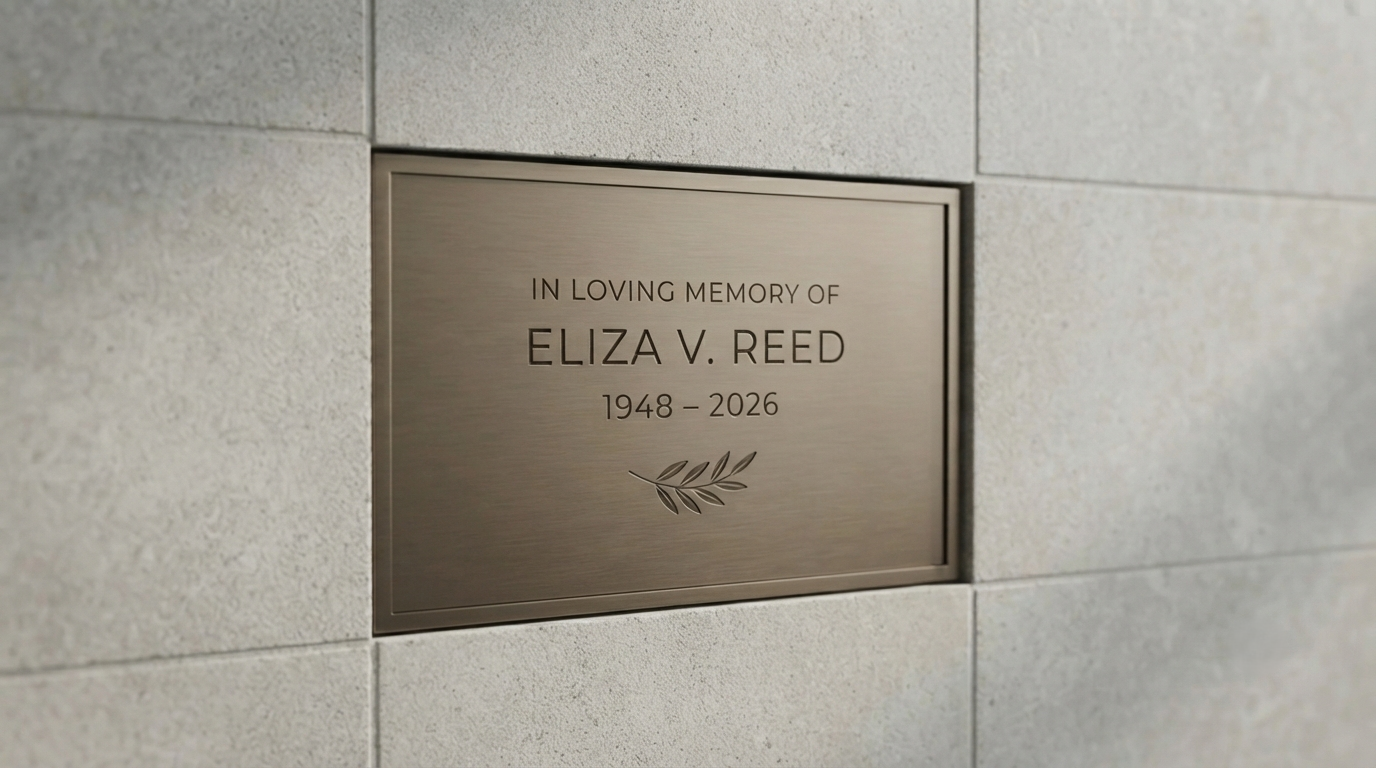
A columbarium niche with an engraved name plate, one of the traditional options compared on this page

Two rows in that grid do more work than the rest. Reversibility is the one people underestimate. Partner memorial diamond vs. urn is not a symmetrical choice, because an urn keeps every option open and a growth run closes one permanently. And the last row is the one nobody raises at the funeral home, though it is often what the decision is really about.

Which One Travels, and Which One Stays?

This is where partner memorial diamond vs. urn stops being general and becomes specific to your situation, because partners are more likely than most to face a question about where an urn is allowed to live.

You may not own the home the urn sits in, or be the person the crematory released the remains to. If a relationship was not legally recognized, or not recognized by one or both families, the urn may be in a house you no longer have standing to enter. None of that is unusual, and all of it is worth facing before money is spent, because it can settle partner memorial diamond vs. urn on your behalf.

Who controls cremated remains has no nationwide answer. It is a matter of state law, modified by whatever your partner left in writing, a will, a disposition directive, a form signed at the funeral home. With legal recognition, the person who has the urn is generally also the person who may decide about it. Without it, that right can sit with an adult child, a parent, a sibling, or a former spouse.

This belongs in a partner memorial diamond vs. urn comparison rather than a legal footnote because it changes which option is even available to you:

  • If the urn is yours, partner memorial diamond vs. urn is open in both directions, and doing both costs you nothing but a portion.
  • If the urn is not yours, a portion set aside for a stone may be the only part of this you can hold, a far smaller ask than requesting the urn itself.
  • If the urn will be interred or scattered, timing matters: once remains are in a niche or on the water, retrieval becomes a permissions question answered differently everywhere.
  • If nobody has decided yet, that is the easiest position.

How to raise this with a family that may not see the relationship as you do covers the wording, which matters more in this conversation than in almost any other.

Can the Decision Be Undone?

One can, one cannot, and this asymmetry is the strongest practical argument in any honest partner memorial diamond vs. urn discussion.

An urn is the reversible side of partner memorial diamond vs. urn, in almost every direction. Remains can be moved, divided years later, interred, scattered, or split between people who did not speak at the funeral and do now. Nothing about keeping an urn forecloses anything, including a diamond later, and cremated remains are stable while a family works out what it wants.

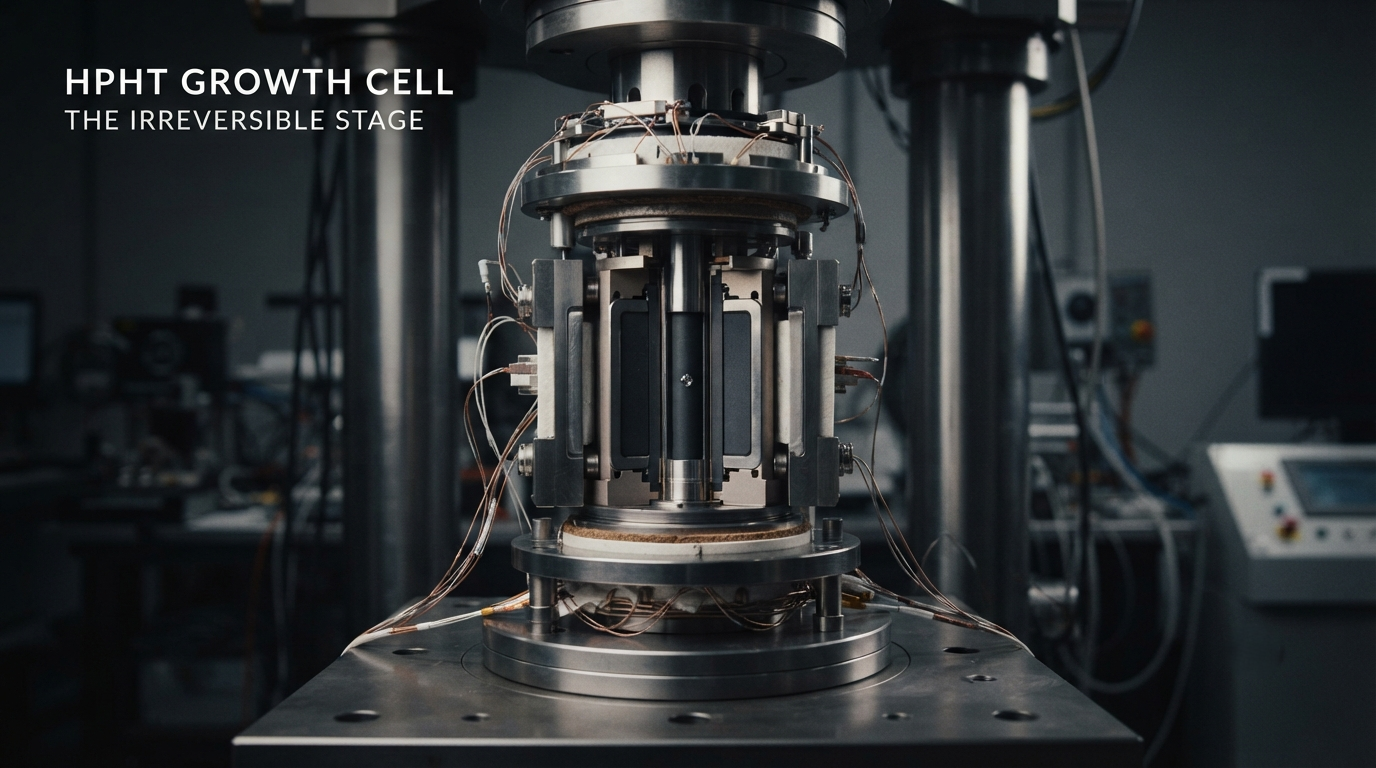
The interior of an HPHT growth cell, the irreversible stage of the memorial diamond process

A memorial diamond, the other side of partner memorial diamond vs. urn, is not reversible. Extraction is chemical: once a portion has been purified and graphitized, it no longer exists as remains. That is the fact that should slow anyone deciding inside the first weeks after a death.

So the sequencing advice that falls out of partner memorial diamond vs. urn, stated plainly:

  1. Keep the remains intact while anything is unresolved. There is no deadline.
  2. Decide who has authority before you decide what to do, not after.
  3. Take the reversible step first if you are unsure. That is the urn, and it costs nothing in options.
  4. Commission the stone when the answer has stopped moving for many families, past the first year.

The one genuine counter pressure in partner memorial diamond vs. urn is timing rather than urgency: the industry typical wait is 6 to 10 months, up to 12 for larger or specialty color stones, so a family aiming at a particular anniversary works backwards from it. How the timeline breaks down stage by stage is the place to check that before promising anyone a date.

What Does Each One Ask of the Next Generation?

Most partner memorial diamond vs. urn comparisons stop at cost. This row is the one families wish they had thought about, and it cuts both ways.

An urn asks for a place. Someone has to house it, pay for the niche, or decide what happens when the person who chose the shelf is no longer there. In practice that often lands on someone who never knew your partner. Not a criticism of urns, simply what a physical object in a home becomes.

A diamond asks something different, and this is the least discussed row in partner memorial diamond vs. urn. It needs no upkeep: nothing scores above diamond on the Mohs scale of mineral hardness, where it sits at 10, and the stone outlasts every setting it is ever mounted in. But a small, unlabeled stone means nothing to anyone who does not know what it is. Three things make the difference:

  • Name a recipient, in writing. A stone with no named destination ends up in an estate sale.
  • Keep the paperwork with the piece. An origin or authenticity document, plus any grading report, is what turns a gem into a record.
  • Tell at least one other person what it is. The object does not carry its own story.

Those three habits are the difference between an heirloom and a puzzle, and they cost nothing, which is why this row of partner memorial diamond vs. urn rarely turns on money. What to have the stone set in, and which settings can be changed later matters here, since a piece meant to be handed on is designed differently from one worn daily.

Where Memorial Diamond Fits, and Why We Are Not a Neutral Voice

Stated once more, plainly, because it belongs in the body of a comparison and not in small print: Memorial Diamond grows memorial diamonds. This page runs partner memorial diamond vs. urn as a comparison between our own product and an alternative we do not sell. That is a structural conflict of interest, and the appropriate response is to weigh the factual claims and discount the framing.

What can be said without conflict:

  • An urn is a complete and honorable answer, and nothing in partner memorial diamond vs. urn changes that. So is burial. So is scattering. None of them is a lesser choice, and no reader should take anything on this page as an argument otherwise.
  • The figures above are industry wide bands, not Memorial Diamond’s own price list. What drives the price of a single stone breaks the variables down.
  • The honest case for a diamond in partner memorial diamond vs. urn is narrow and specific: it is portable, it is divisible among several people, it requires no maintenance, and it takes only a portion. That case does not require an urn to be worse.
  • The honest case against is equally specific: it costs more, takes most of a year, and cannot be undone.

For the full route rather than the comparison, the complete guide to a partner ashes diamond covers every stage; where to start if the decision is still open is the better first read in the early weeks.

Frequently Asked Questions

Do I have to choose between an urn and a diamond at all?

Usually not. A stone takes a few tablespoons up to roughly 4 oz, so the urn, the interment or the scattering all still go ahead. Partner memorial diamond vs. urn is an either or only when you hold a keepsake portion.

Is a diamond more permanent than an urn?

On permanence, partner memorial diamond vs. urn is not really a hardness question. The stone is harder, at 10 on the Mohs scale, but permanence here is social. A ceramic urn in a stable family outlasts a diamond nobody can identify. Naming a recipient matters more.

Which costs less overall?

An urn, almost always, and often by a wide margin. A columbarium niche can carry recurring or renewal fees worth asking about, but nothing in the diamond tiers competes with a vessel on price.

Can we start with the urn and decide about a diamond later?

Yes, and in partner memorial diamond vs. urn it is the safer order. Cremated remains are stable and keep indefinitely, so nothing is lost by waiting a year. The reverse is not true, since extraction cannot be reversed once a portion has been processed.

My partner’s family holds the urn. Does that end it?

Not necessarily. Authority over remains varies by state and by anything left in writing, and a request for one small portion is a much smaller ask than a request for the urn. Find out who holds authority before anything is spent.

What happens to the part of the portion that is not turned into carbon?

That is company policy rather than chemistry, and providers differ. Before sending anything, get it in writing: is the remainder returned as a matter of course, in what form, and at what point in the process?

Final Thoughts on Partner Memorial Diamond vs Urn

The one thing to take from this page: partner memorial diamond vs. urn is a smaller question than it feels. A portion, not the whole. A jar’s worth out of something measured in pounds. Whatever was already planned for the rest still happens, on the same date, in the same place.

What remains is genuinely a choice, and not one a diamond company should make for you. An urn on a shelf, a niche with a name on it, a stretch of water in spring, each is a full answer, and partner memorial diamond vs. urn is a live question only because a portion can be set aside without disturbing any of them. Decide who has authority, decide what is reversible, then take your time.

Learn More About Partner Memorial Diamonds

Talk With Memorial Diamond

If you are working through partner memorial diamond vs. urn and want a straight account of what a portion would and would not affect, reach out to Memorial Diamond at memorialdiamond.us. Ask what we cannot do as readily as what we can, a fair test of any company here, including this one.

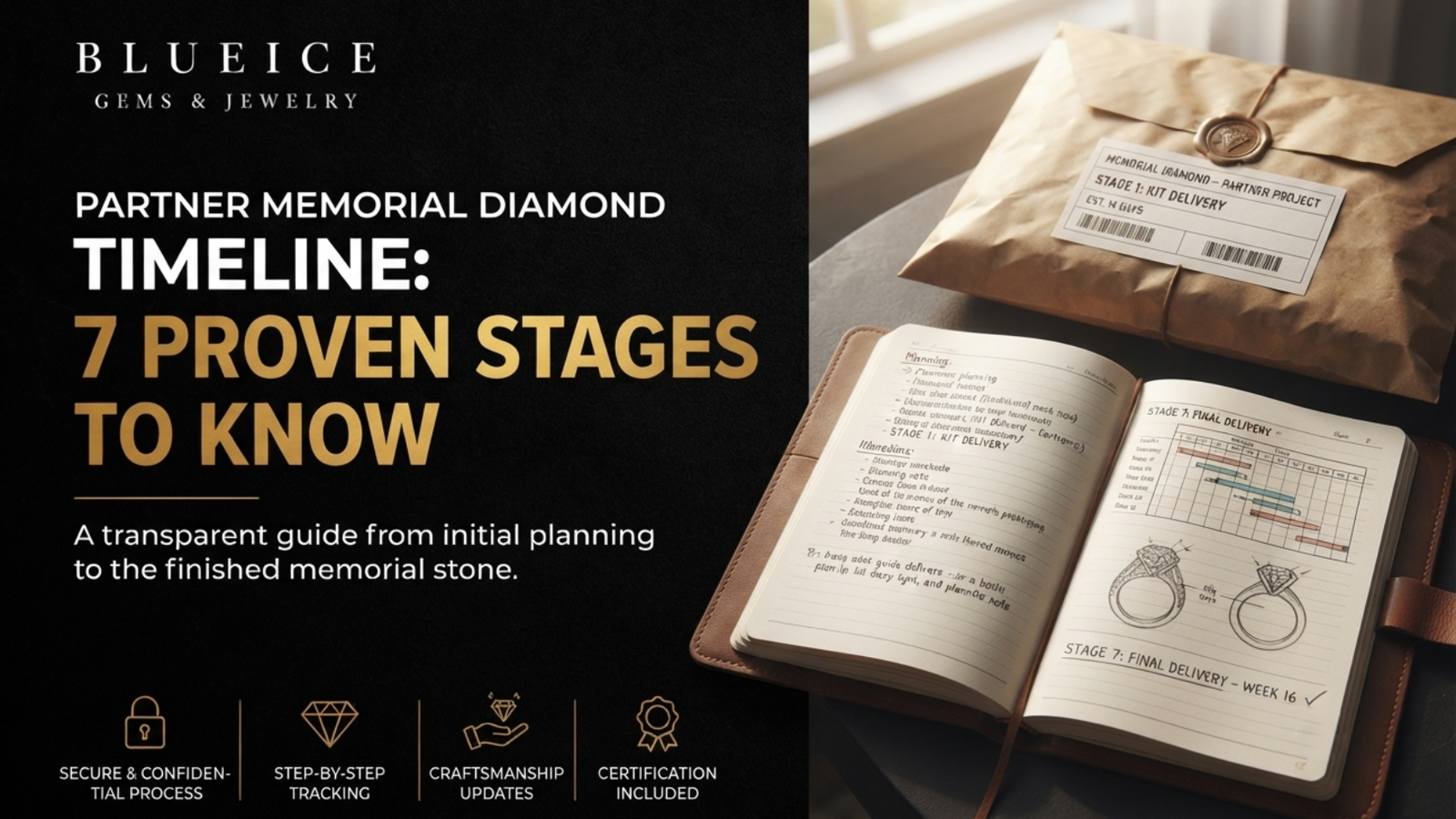
Partner memorial diamond timeline planning shown as a labeled parcel and an open notebook on a kitchen table in morning light

How Long Does It Take to Make a Partner Memorial Diamond?

You have probably already worked out that this will not be quick. What is harder to find out is where the months actually go.

Industry wide, production runs 6 to 10 months from the point a laboratory receives the material, stretching toward 12 for large stones or specialty colors. The single fact that explains a partner memorial diamond timeline is this: carat size is a function of growth time, not of how much you send. A full urn does not make the stone bigger, faster or cheaper. And the published window covers only the middle of the process. Assessment before growth and finishing after it sit outside it.

Memorial Diamond is one of the companies that would be holding your partner’s material through those months, so this page has a commercial interest behind it. Treat the stage descriptions as how the category works rather than as a schedule anyone can promise.

What Does a Partner Memorial Diamond Timeline Actually Contain?

A partner memorial diamond timeline has seven stages, and only some sit inside the figure anyone quotes you. The last column is the fastest way to understand why a stone described as “six to ten months” can be a year from your hand.

NumberStageWhat happensWhat sets its paceInside the quoted 6 to 10 months?
1Gathering and sendingMaterial is located, portioned, labeled, packed and posted; the order is specifiedYou, a funeral provider, and the postNo
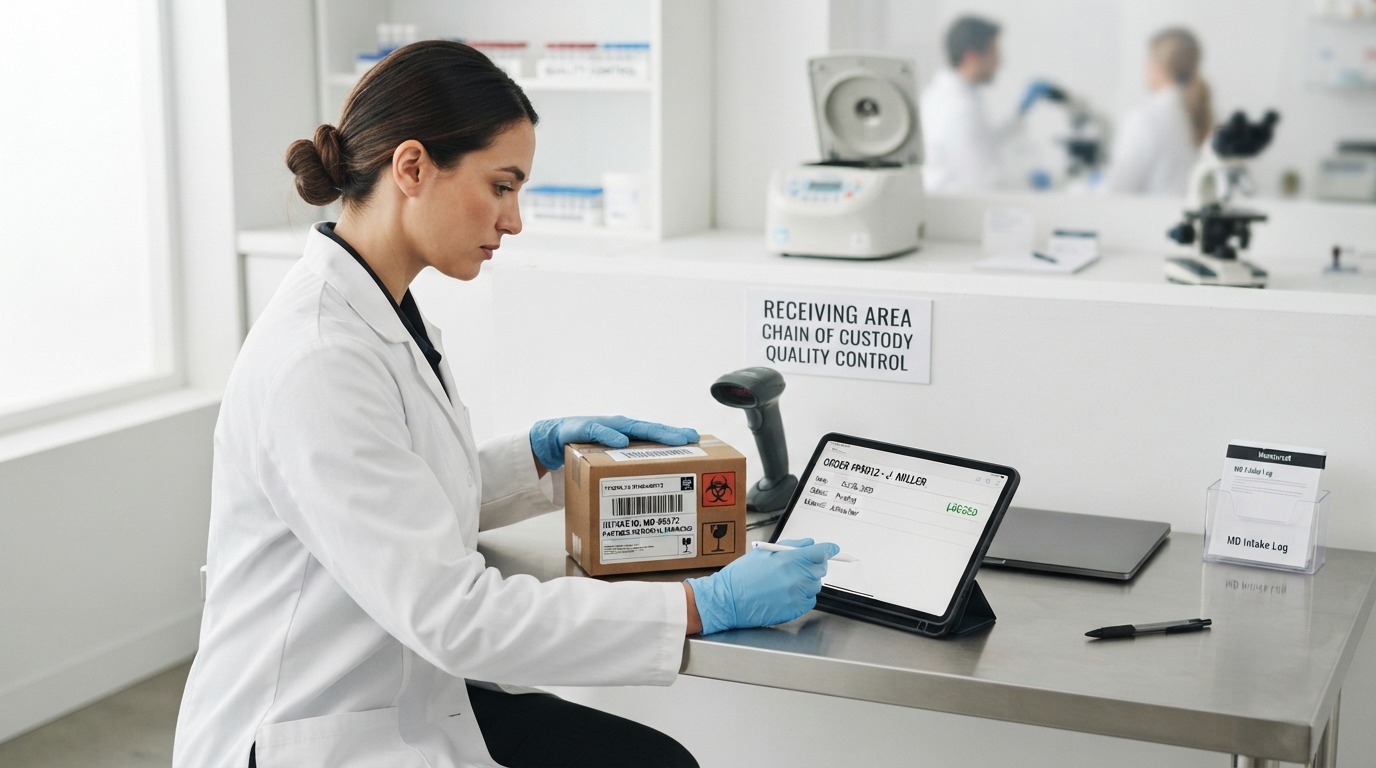
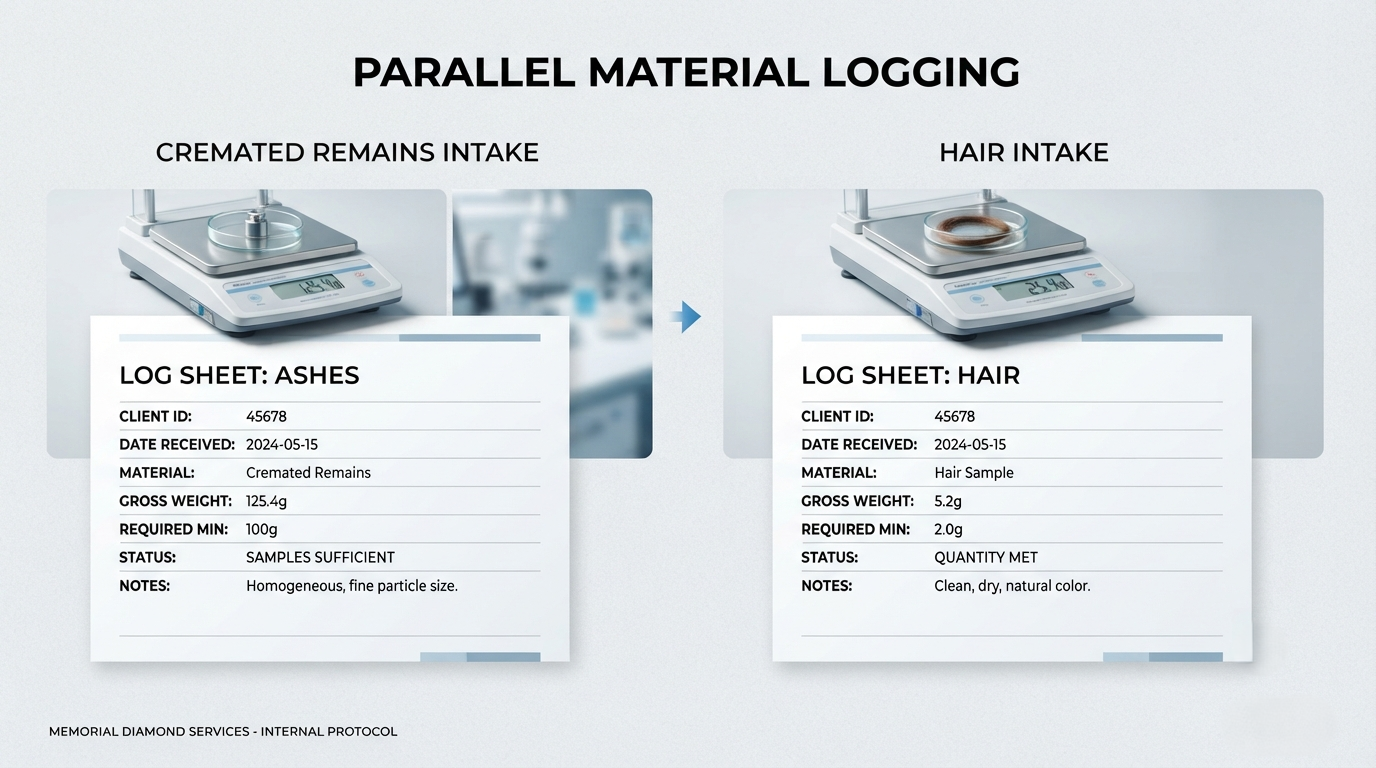
2Intake and assessmentThe parcel is logged, checked against what was described, and evaluated before work startsThe laboratory’s queue and what assessment findsUsually yes, at the front
3Extraction and purificationEverything that is not carbon is stripped away, to roughly 99.9%+ carbonThe source material and the process, not your orderYes
4GraphitizationThe purified carbon is taken to roughly 2,500 to 2,700°C and converted to graphite, the form a press can useFixed by the processYes
5GrowthA seed and the graphite sit under roughly 6 to 8 GPa, at temperatures of 1,400 to 2,500°C, across weeks or monthsYour target carat, and nothing else in the partner memorial diamond timelineYes, most of the window
6Cutting, polishing and optional gradingA gemologist cuts the rough crystal; independent grading happens only if you order it, and any report is issued by a separate laboratoryThe cutter’s bench, then a third party’s queueSometimes. Ask
7SettingA ring, pendant or other mount is made, or an existing piece is reworkedA jeweler’s bench, and whether you have decidedAlmost never
Laboratory technician logging a labeled intake parcel against an order document at a receiving bench

Two of those seven are genuinely yours to move. Stage 1 runs at your speed, and stage 7 at whatever speed you choose, including not yet. Everything between runs at its own pace however motivated you are, and that is the real shape of a partner memorial diamond timeline.

How the material is actually processed from a portion of ashes follows stages 3 to 5 in detail, and the step by step route for a combined submission sets out stage 1 as a list of tasks.

Why Does a Full Urn Not Make It Faster or Bigger?

Because carat comes out of the press, not out of the parcel. It is the single most useful correction on any partner memorial diamond timeline page, and almost nobody arrives knowing it.

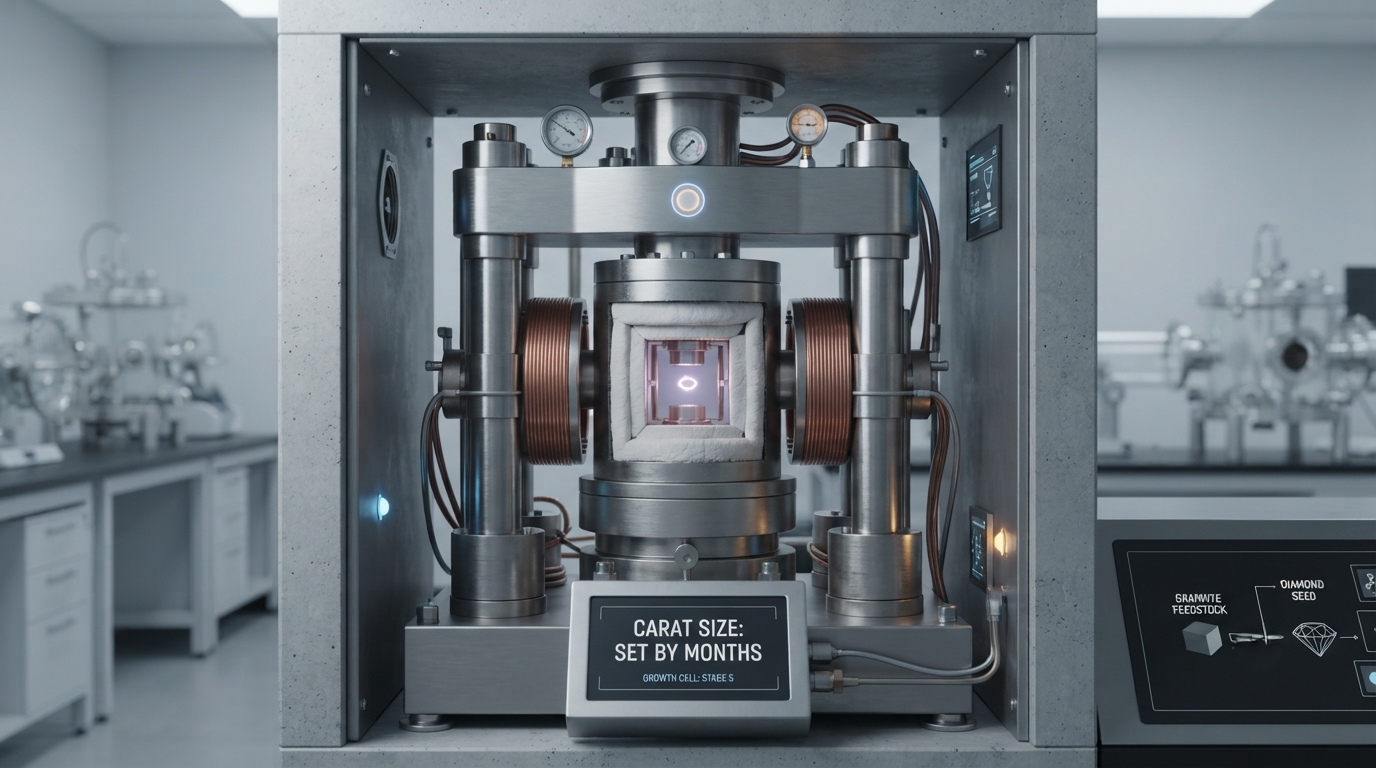
A diamond grows outward from a tiny seed inside a cell held at extreme pressure and heat, and the longer it is held there the larger the crystal becomes. That is the whole mechanism. The high pressure, high temperature route used across the lab grown industry and the volume you posted is not one of its variables. It is not a partner memorial diamond timeline variable either.

What the material determines is whether there is enough carbon to work with at all. Cremated remains are mostly the calcium phosphate of bone, and usable carbon runs at roughly 0.5% to 4% of ash by weight; hair is far richer, at roughly 50%. Either way, what a realistic sample yields falls short of what a growth cell consumes, so lab grown carbon is added to fill the charge. Sending more simply means more goes unused.

Explanatory graphic comparing the fixed volume of a growth cell charge with the much larger volume of a full urn of ashes

Three consequences follow, and they are worth holding onto:

  • A larger stone lengthens the partner memorial diamond timeline. Carat and months are the same decision. A small stone finishes nearer six months; a large one or a specialty color moves toward twelve.
  • Most of the ashes stay with you. Typical requirements run from a few tablespoons to around four ounces, so whatever was planned, interment, scattering, an urn on a shelf, can still happen.
  • A hair only stone is not faster in the press. Growth time is set by target carat, whether the carbon came from ashes or from hair. How much hair a stone actually needs is a small lock, and its advantage is at stage 1 rather than stage 5.

That last point matters more in this cluster than most. A lock already sitting in a drawer waits on no cremation, no release and nobody else’s decision, so stage 1 of the partner memorial diamond timeline can begin this week.

Carat also sets the price, which makes size, money and months one decision rather than three. What a partner memorial diamond costs works through the same lever from the other side.

What Happens Before Growth Begins?

Two stages of a partner memorial diamond timeline, and families routinely budget for neither.

Getting the material there. Locating a portion, separating and labeling it, finding a lock of hair if one is going in, specifying the order, and posting it. None of that is long in itself, and all of it can stall on something outside your control, a funeral provider’s schedule, a conversation with their family, a decision that has not been made. In this cluster, stage 1 is frequently the longest stage of the whole partner memorial diamond timeline, and it is the one nobody counts.

Assessment. Once a parcel is logged it is checked before work starts: that it matches what was described, that there is enough to proceed, that it is what the process can use. This is neither a formality nor instant, and it is the point in a partner memorial diamond timeline at which a problem is cheapest to discover.

Rough lab-grown diamond crystal held in tweezers on a gemologist's bench before cutting and polishing

The useful thing to ask is what happens if assessment turns up a shortfall. Can you send more? Is the order held while you find it? Is a smaller carat offered instead? None of those has a category wide answer, and having one in writing before you post anything is worth more than any date you are given.

Two further things worth settling at the same moment, because both quietly add weeks later:

  • Whether the laboratory will hold one material while a second is found, if you are sending both ashes and hair and they are not available together.
  • What confirmation you receive at intake. A logged receipt tying the parcel to your order is the most reasonable thing to ask for in this entire process, and the easiest for a company to provide.

None of this is unusual to ask, and all of it sits before the growth run, which makes it the part of a partner memorial diamond timeline you can still influence.

What Happens After the Stone Exists?

A rough crystal is not a finished object, and the gap between the two is where most of the unexpected waiting in a partner memorial diamond timeline lives.

Cutting and polishing comes first: a gemologist shapes the rough into the finished stone, and the shape is a decision rather than a default. If a grading report was commissioned, the stone then travels to a third party laboratory working to its own standards for cut, color, clarity and carat and, more to the point, its own queue, one no growth laboratory controls. A setting adds a jeweler’s bench as a third independent schedule inside the same partner memorial diamond timeline.

Individually none is long. Stacked, and separated by shipping each time, they are why a stone that exists in month eight reaches you considerably later.

So the question worth asking is not how long finishing takes. It is where the quoted window ends. A company quoting six to ten months to a finished loose stone and a company quoting six to ten months to an optionally graded, mounted, engraved piece have said the same sentence about two different partner memorial diamond timeline lengths. Ask which, in writing.

One relief: stage 7 of a partner memorial diamond timeline can wait. A finished diamond sits in its case indefinitely, so a setting need not be decided while you are choosing carat, and many people find it easier to design a piece with the stone in front of them. Settings and jewelry ideas for a partner is a decision that keeps.

Nor can anyone say what the stone will look like before stage 6. Color is not forecastable at any earlier point in a partner memorial diamond timeline, whatever family you specified. What color to expect explains why.

What If the Timeline Runs Past an Anniversary?

It probably will. Deciding in advance how you want to meet that is better than being surprised by it.

Six to ten months from a starting point somewhere after a death lands almost any partner memorial diamond timeline beyond at least one date that matters: a birthday, the first anniversary of the death, or the anniversary of the relationship itself, which may be a date nobody else in either family marks or even knows.

The temptation is to order backwards from a date, and it is worth resisting, not because planning is bad, but because a partner memorial diamond timeline has at least four independent parties in it: a funeral provider, a growth laboratory, possibly a grading laboratory, a setting bench. None can be held to a delivery date on behalf of the others. A date you have privately attached to a stone becomes a second loss when the stone is late, and stones are late.

What works better is uncoupling the two:

  • Anchor to a season rather than a day. “Some time next autumn” survives a slipped run; “in time for March the ninth” does not.
  • Mark the date with something already in your hands. The ashes you kept, a photograph, the lock you did not send. None of it is a substitute for the stone, and none of it has to be.
  • Ask, at order, when any date you are given is next re confirmed. That answer tells you far more about the coming months than the first estimate does.
  • Let the arrival be its own occasion. A stone arriving in an unremarkable week gets to mean what it means, rather than carrying a date as well.

If you would rather have something on the anniversary itself, say so early and ask what a partner memorial diamond timeline makes realistic, not for a promise, but for an honest read on whether it is plausible from where you stand.

What Do You Say When Relatives Ask Why It Is Taking So Long?

This arrives in almost every partner memorial diamond timeline, and in this cluster it sometimes arrives with an edge on it.

The people asking may be their family rather than yours, and may not have been fully behind the decision. Where the ashes were released to someone other than you, they may have a real stake and a real anxiety about where the material is. Or it may be plain curiosity from someone who assumes a stone takes a fortnight.

Four plain answers cover almost every version of it, and none of them commits you to a partner memorial diamond timeline you cannot control:

  • “The crystal itself grows for months. That part cannot be rushed.” True, specific, and it ends the technical version of the question.
  • “Six to ten months is the industry range, and a bigger stone takes longer.” Gives them a number without you having promised one.
  • “The middle of it is silent by design. There is nothing to report while a run is holding.” This is the one that defuses the suspicion that something has gone wrong.
  • “I will tell you when it is cut.” A stage is a fair thing to commit to. A date is not.

Where someone else released the ashes, a logged intake receipt is fair to share and fair to have asked for at stage 2. It answers the real question, is it safe and where is it, without turning the partner memorial diamond timeline into a group project.

And plainly: you do not owe anyone a running commentary. Where the relationship was not recognized, or not known, the pressure to justify the wait can be heavier than the wait. How to talk to family about a partner memorial diamond covers the wider conversation, and the questions families ask most often is worth handing to someone who wants to understand rather than object.

Frequently Asked Questions

How long is a partner memorial diamond timeline from start to finish?

Production typically runs 6 to 10 months from receipt of material, and up to about 12 for large or specialty color stones. Gathering and sending beforehand, and grading or setting afterward, sit outside that published window.

Does sending a full urn make the stone bigger or shorten a partner memorial diamond timeline?

Neither. Carat is a function of growth time in the press, so a larger portion changes nothing about size or schedule. Typical requirements run from a few tablespoons to around four ounces, and the rest stays with you.

Why does a larger stone add months rather than weeks?

Because the crystal grows outward from a seed for as long as it is held under pressure and heat. A larger target simply means a longer hold, which is why carat and the partner memorial diamond timeline are one decision.

Can anyone give me a delivery date?

No. Four independent parties can be involved, a funeral provider, a growth laboratory, a grading laboratory and a setting bench, and none can commit on behalf of the others. Ask instead when a given estimate is next re confirmed.

Is a hair diamond faster than one grown from ashes?

Not in the press, where growth time is set by target carat. Hair can start a partner memorial diamond timeline sooner: no cremation is involved, nothing has to be released by anyone, and a lock already in a drawer can be posted this week.

What happens to the partner memorial diamond timeline if a growth run fails?

Ask before ordering, because it varies by company. Ask whether a run is repeated, what becomes of material consumed in it, whether an under target carat changes the order, and how the schedule is restated afterward.

Final Thoughts on the Partner Memorial Diamond Timeline

Six to ten months is the number, but the number is not the hard part. The hard part is that the middle of a partner memorial diamond timeline asks nothing of you at all, for months, while something of your partner’s sits in someone else’s building.

Knowing the seven stages of a partner memorial diamond timeline helps, because it tells you which kind of waiting you are in. Stages 1 and 2 respond to effort. Stages 3 to 5 do not, and silence there is the process working rather than failing. Stages 6 and 7 hand the decisions back.

And nothing here is on a clock. Cremated remains are stable mineral matter, and a dry, sealed, labeled lock of hair keeps indefinitely. The partner memorial diamond timeline starts when you decide it does, not when anyone else thinks it should.

Learn More About Partner Memorial Diamonds

Talk With Memorial Diamond

If you want a partner memorial diamond timeline mapped against your own circumstances rather than against an industry range, Memorial Diamond is one of the companies to ask. memorialdiamond.us. The most useful first question is where a quoted window starts and where it ends.

And if you are not ready to begin stage 1, nothing is lost by waiting. The material keeps, and so does the decision.

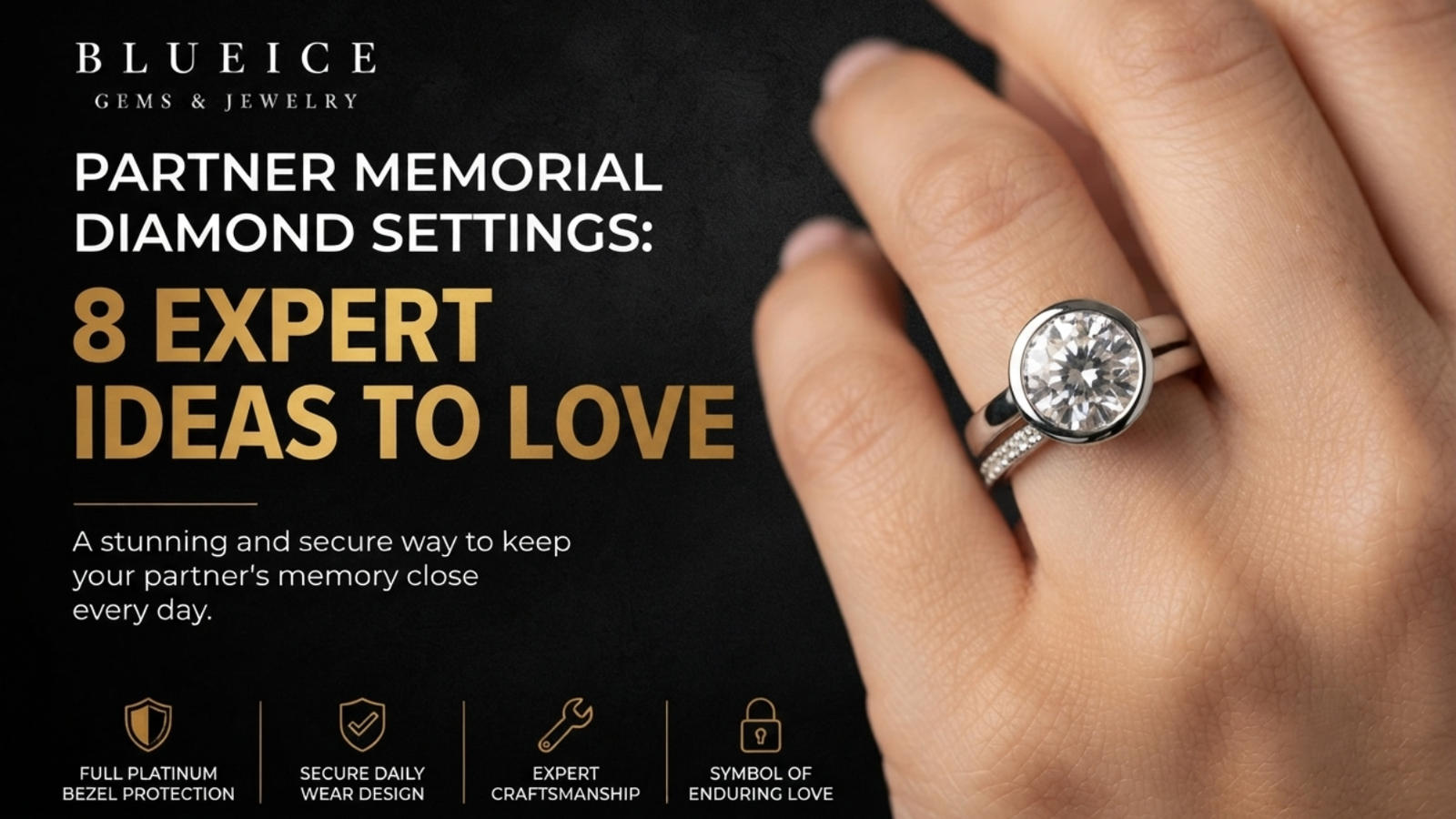
A memorial diamond in a full platinum bezel on a hand, the most protective of the partner memorial diamond settings for daily wear

Memorial Diamond Settings and Jewelry Ideas for a Partner

You already know you want to wear it. What nobody tells you then is that the stone is the durable half of the object and the setting is the half that fails. Partner memorial diamond settings should be chosen the way you would choose a mount for something that cannot be replaced: metal that deforms rather than wears away, a setting style that covers as much of the girdle as you can accept, and a jeweler who is told in writing what they are holding. The diamond is Mohs 10. Nothing around it is.

Memorial Diamond grows these stones, so this page is not disinterested. It assumes you have already decided on jewelry. The concept level tour of rings, pendants and keepsakes lives in partner memorial diamond ideas. What follows is the engineering underneath those ideas, which is where partner memorial diamond settings are actually decided.

The One Fact That Governs Everything Else

Diamond sits at 10 on the Mohs scale of mineral hardness, and that is why a memorial stone outlives everyone reading this. Hardness only describes resistance to scratching, though. It says nothing about toughness, and diamond has cleavage planes. A sharp strike at the wrong angle can chip a girdle that a lifetime of abrasion never would.

So there are two failure modes worth designing partner memorial diamond settings against, and only one of them involves the stone at all:

  • The stone leaves. A worn prong, a bent claw, a loosened bezel. Much the likelier of the two, and a property of the metal and the workmanship in partner memorial diamond settings rather than of the diamond.
  • The stone chips. Rare, but possible on an exposed girdle or a sharp corner in a princess or marquise cut, and not repairable without recutting to a smaller weight.

The reason to think hard about partner memorial diamond settings is not that the diamond is fragile. It is that the diamond is the only part of the assembly that cannot be remade, and every part holding it is consumable.

Which Metal Should Hold a Stone You Will Never Replace?

Metal is the decision most people make last and should make first. It sets how partner memorial diamond settings age, whether they can be altered, and how often a bench jeweler has to handle the stone.

MetalHow it wearsAging and upkeepCan it be resized or re tipped?What it does to a tinted stone
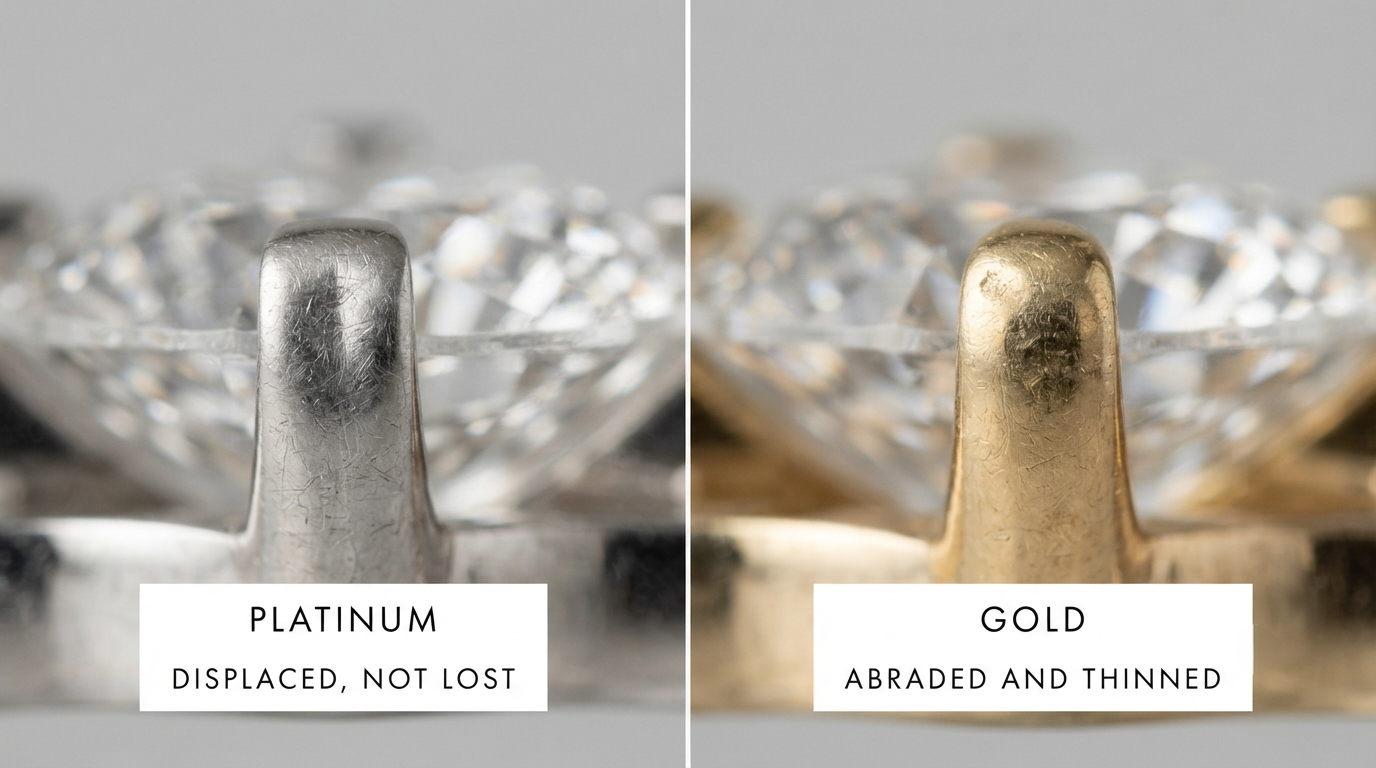
PlatinumDisplaces rather than abrades. A worn prong moves metal aside instead of losing itDevelops a matte patina; polishing restores shineYes, readily. The usual recommendation for prongs in partner memorial diamond settingsNeutral and cool; shows a tint honestly
18k yellow goldSofter than 14k; prongs thin faster in daily wearStable color, no plating to renewYes, by any competent benchWarms the stone; can make a light yellow read almost colorless
14k yellow goldHarder alloy, longer prong life than 18kStable color, minimal upkeepYesWarms, less than 18k
White goldWears as gold does, under a rhodium platePlating dulls and yellows; replating every one to three years is normalYes, though replating follows any bench workBright and cool while plated, warmer as the plate goes
Rose goldCopper content makes it hard wearingStable; deepens slightly over decadesYesFlatters warm stones; argues with blue
Sterling silverSoft; prongs deform under ordinary knocksTarnishes; needs frequent cleaningYes, but the softness does not changeCool toned, and the wrong choice regardless
Titanium, tungsten, ceramicExtremely hard, effectively wear proofAlmost no upkeepNo. Cannot be sized, and setting options are limitedNot a realistic carrier for an irreplaceable stone
Close macro of a worn platinum prong beside a worn gold prong, showing displacement against material loss

One label before you use that table: none of it is a published figure. It is general jewelry bench practice, how these metals behave at the bench, and how a tinted stone reads against them in ordinary light, and a bench jeweler may put it differently. Read the fourth column before the fifth. Among partner memorial diamond settings, the metals that cannot be resized or re tipped are the ones to rule out first, because this object has to follow hands that change over forty years.

Two notes decide most of these choices:

  • Platinum and 14k are the workhorse answers for partner memorial diamond settings. Platinum for prongs, because worn metal stays on the ring; 14k because it resists thinning better than 18k.
  • White gold is a subscription. Replating is cheap, but it is a recurring appointment for the life of the piece, and every appointment is another handling of the stone.

If the stone’s color is not settled, decide the two together. What to expect from memorial diamond colors for a partner explains why yellow gold tends to hide a warm tint and white metal to expose it. Again, this is general practice, not a measured figure.

Which Partner Memorial Diamond Settings Protect the Stone Best?

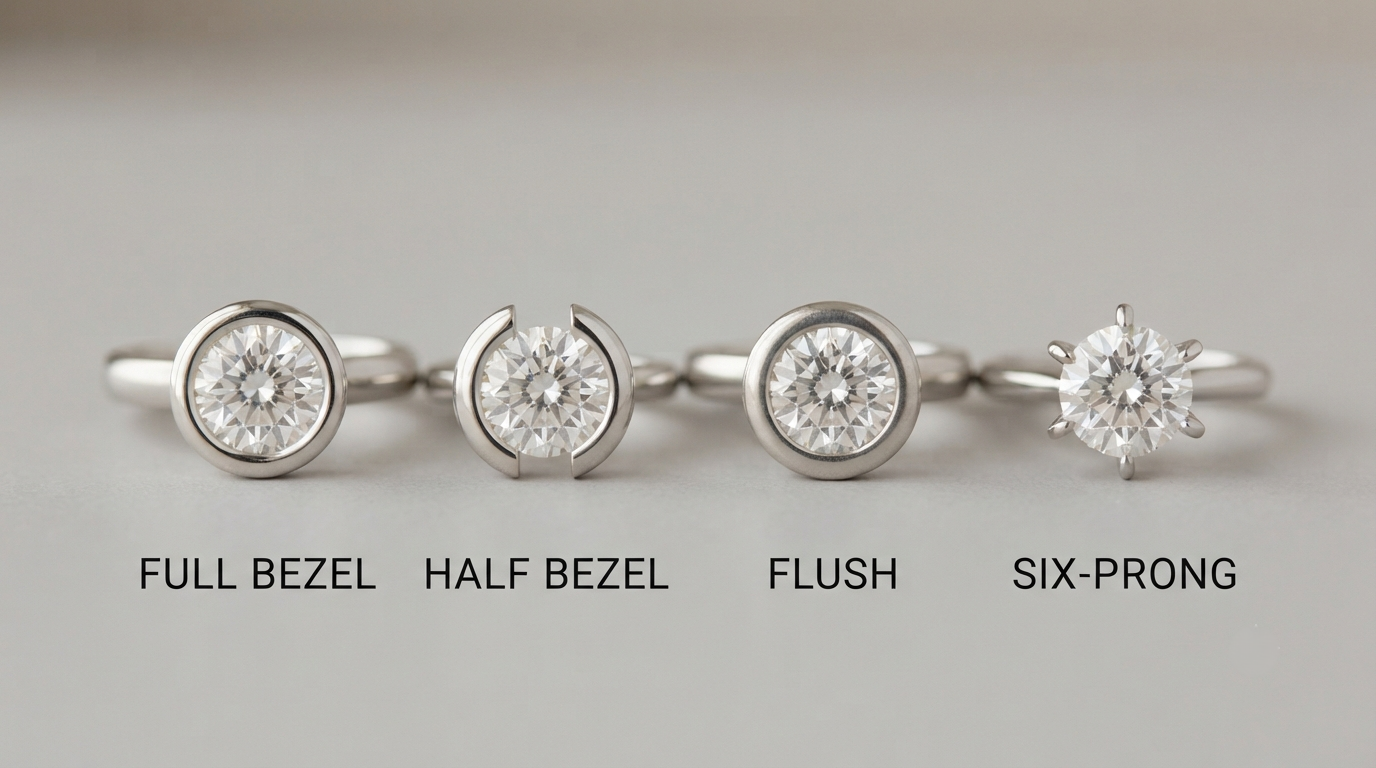
One trade off governs this whole list: every millimeter of metal protecting the girdle is a millimeter of stone you cannot see. The table runs from most protective to most exposed, an editorial ranking from general bench practice rather than a measured scale.

SettingHow much of the stone it coversProtection in daily wearWhat it costs youBest suited to
Full bezelA continuous rim around the whole girdleThe highest available; eliminates snaggingSide light; the stone can look smallerHands on work, healthcare, anyone who cannot remove a ring
Half bezelTwo opposing arcs of the girdleNearly bezel grade where covered, open elsewhereLess than a full bezel, and a cleaner lineThe compromise most people settle on
Flush or gypsySunk into the metal, table level with the surfaceVery high; nothing protrudesOnly the table shows; no side sparkleBroad bands, anything worn under gloves
Halo with a bezel centerThe girdle plus a ring of accent stonesHigh for the center; the accents need watchingComplexity, and more bench work near your stoneMaking a small stone read larger
Six prongSix narrow points on the girdleGood; losing one of six is survivableProngs snag on fabric and thin over timeRound brilliants
Four prongFour points on the girdleAdequate, but losing one of four is not survivableThe same snagging, less redundancyMaximum light and visibility
Tension or floatingAlmost nothing; held by pressure or a minimal cageThe lowest of the partner memorial diamond settings here, and rarely resizableHigh visual impactStones not worn daily
Four ring settings photographed side by side — full bezel, half bezel, flush and six-prong — ordered by how much of the girdle each covers

Rank your own life before you rank the list. Among partner memorial diamond settings, the bezel family keeps turning out to be the right answer for people who never take the piece off; prong settings are the ones that photograph best the week they arrive.

A pendant changes the arithmetic. A stone on a chain takes far less impact than one on a hand, so more exposed partner memorial diamond settings become defensible. The failure mode moves to the bail and the clasp. Specify a soldered jump ring and a clasp rated above the weight it carries, and have the chain checked as often as you would check prongs.

Can It Be Resized or Reset Later?

Usually. Whether partner memorial diamond settings can be altered later depends almost entirely on decisions taken at the start.

Rings get resized. Fingers change with age, weight, pregnancy, arthritis and heat. If a ring has to follow yours, partner memorial diamond settings need a plain, unset section at the bottom of the shank. A band set all the way round cannot be cut and rejoined without dismantling part of it.

Resetting is a different job. A stone set in a ring at forty may become a pendant at seventy, or may move into a new mount when the first one wears out. That is normal, and what makes it safe is procedural:

  • Get the stone’s measurements, and any grading report, at handover, and keep them apart from the piece. That is how you confirm the stone coming back is the stone that went in.
  • Photograph it in good light, top and side, before any bench work.
  • Ask for the stone to be unset before any torch work, not protected in place. Heat near a set diamond is the risk worth avoiding, and removal takes minutes.
  • Ask whether the work is done on site. Pieces sent to a trade workshop travel, and travel separates paperwork from stones.
  • Keep the original mount. It is part of the object’s history and costs nothing to store.

Rebuilding partner memorial diamond settings takes ordinary jewelry timelines, measured in weeks. That bears no relation to the 6 to 10 months the stone itself typically takes to grow, up to 12 for larger or specialty color stones, which how long a partner memorial diamond takes sets out in full.

What Does a Jeweler Need to Know Before Touching It?

That it is irreplaceable, and that they should say so back to you before they take it.

Be direct, because a jeweler handles hundreds of interchangeable stones and cannot know yours is not one of them. Partner memorial diamond settings are ordinary bench work; the stone in them is not, and the gap between those two facts is where accidents live.

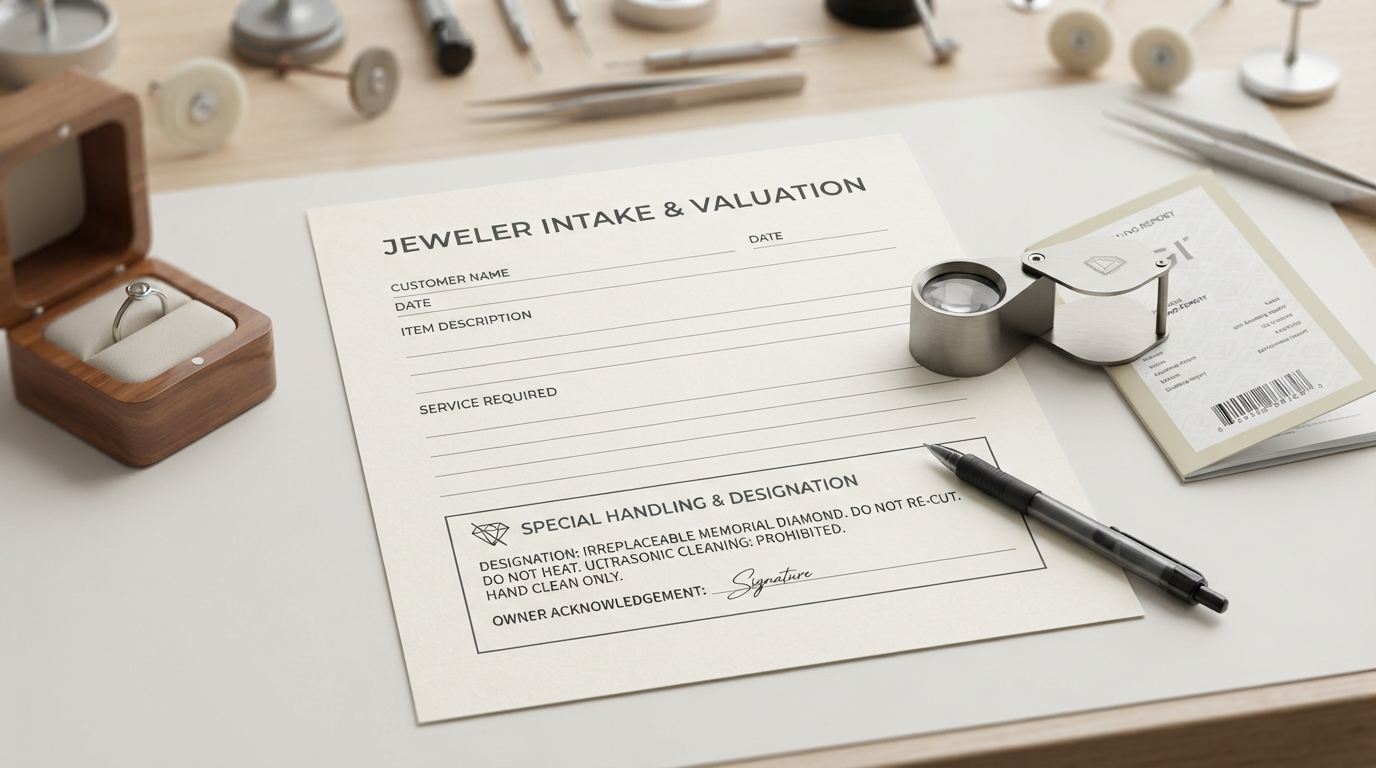
A jeweler's intake form on a bench with a loupe and a grading report, illustrating recording a stone as irreplaceable

Put the following in the intake paperwork, not in conversation:

  1. A written description of the stone, carat, cut, color, clarity, measurements, any report number.
  2. A statement that the stone is a memorial diamond and cannot be replaced. Ask for it on the job ticket, not merely acknowledged.
  3. No recutting, repolishing or laser inscription without written approval, which guards against a well meant “we tidied up the girdle for you”.
  4. Your instruction on ultrasonic and steam cleaning. Clarity across memorial stones typically runs SI2 to VVS, and stones with feathers or reaching inclusions are not automatically safe in either. Ask for hand cleaning if you would rather not find out.
  5. Who to call if something is found wrong before work starts rather than after.

Any bench that finds this fussy is telling you something useful for free, and any bench that writes it down is the one to hand your partner memorial diamond settings to.

How Do You Insure Something With No Replacement?

Carefully, and with a professional who is not a jewelry company. Insuring partner memorial diamond settings is straightforward; insuring what sits in them is not.

Insurance here runs into one honest problem: standard jewelry cover is written around replacement, and this stone cannot be replaced. A policy may pay a sum matching the appraised value of a comparable diamond, and that money buys a diamond not made from your partner. Know which of those you are buying before you pay a premium.

That is the limit of what a jeweler can usefully say. Agreed value policies, scheduled personal property riders, deductibles and how a claim settles are questions for a licensed insurance agent or broker, and the answers vary by insurer and by state.

What you can usefully prepare in advance:

  • An independent grading report, if you order one. Grading is optional, and insurers generally want a report because it puts the 4Cs on a recognized scale. The GIA’s explanation of the 4Cs covers the vocabulary any appraisal uses.
  • An appraisal for the piece as set, since the mount is valued separately, and partner memorial diamond settings in platinum are a line item of their own.
  • Photographs and the original invoice, stored off the premises rather than in the drawer with the box.
  • A note of what the piece is, because an adjuster reading “memorial diamond” needs context to handle a claim sensibly.

A word on cost, since it shapes what you insure: entry stones of roughly 0.10 to 0.25 ct run about $1,500 to $3,500 industry wide, 0.5 to 1 ct typically $5,000 to $15,000, and 2 ct and above from roughly $20,000 to $75,000 and beyond, before partner memorial diamond settings are added on top. Those are category wide figures rather than Memorial Diamond’s published prices, and what a partner memorial diamond costs breaks down what moves them.

Who Holds It After You?

This lands differently for partners than for anyone else, and it is worth answering early.

A piece of jewelry is personal property. It passes under a will, or under your state’s intestacy rules if there is none, and those rules are written around marriage and blood relationships. If your relationship was not legally recognized, the person you would want to have this may have no automatic claim. Partner memorial diamond settings holding a stone grown from someone’s remains are exactly the object families argue over later.

Three things close that gap, none of them expensive:

  • Name the piece specifically in a will, by description rather than category. “My platinum bezel ring set with the memorial diamond” leaves no room for interpretation.
  • Write down what it is and where the paperwork lives, so whoever opens the drawer understands the object.
  • Say it out loud to the people concerned, before it is relevant. How to talk to family about a partner memorial diamond covers that conversation, which is easier held once than litigated later.

The same reasoning runs the other way if more than one person wants a stone from the same source. Several mounts from one shared origin is a common arrangement, and whether more than one family member can have a diamond is worth settling before the first run rather than after the first ring.

Frequently Asked Questions

How often should the setting be checked?

Every six to twelve months for a ring worn daily, yearly for a pendant. A jeweler checks prong tension, wear at the claw tips and bezel security. Stones lost from partner memorial diamond settings are almost always lost to a prong nobody inspected.

Is a bezel really safer, or does it just look safer?

Genuinely safer. A bezel covers the girdle, removes protruding claws and cannot snag. It is the most protective of the common partner memorial diamond settings, and the trade is side light and a slightly smaller looking stone.

Can the stone go into an existing ring of my partner’s?

Often yes, and it is a meaningful thing to do. Have the old mount assessed first for metal fatigue and a thin shank, because existing partner memorial diamond settings may need rebuilding before carrying a stone you cannot replace.

Does the stone need special cleaning?

Warm water, mild soap and a soft brush handle almost everything. Ask before an ultrasonic or steam clean, since some inclusions respond badly to both. The metal in partner memorial diamond settings needs the attention, not the diamond.

Can I have it engraved?

The mount, yes. A date, a name, a few words inside a shank, on most partner memorial diamond settings. Laser inscription on the girdle of the stone itself is a separate question, raised with the grower before the stone is finished rather than after.

What if I want a completely different piece in twenty years?

Normal, and entirely possible. Stones move between mounts throughout their lives. Keep any report and the measurements, use a jeweler who unsets before applying heat, and partner memorial diamond settings can be rebuilt around the same stone as often as you like.

Final Thoughts on Partner Memorial Diamond Settings

The stone will be fine. It is harder than anything it will meet in an ordinary life. What needs attention is everything around it. Partner memorial diamond settings come down to four things: a metal that can be worked on, a setting that covers the girdle, a jeweler told in writing what they are holding, and a six monthly appointment that takes ten minutes.

Get those four right and partner memorial diamond settings stop being a risk and become what they should be: a design decision you can change your mind about in thirty years, with the same stone still in the middle of it.

Learn More About Partner Memorial Diamonds

Talk With Memorial Diamond

Setting decisions are reversible. That is the most reassuring sentence here, worth holding onto if you are choosing among partner memorial diamond settings while nothing else feels settled.

Three questions are worth asking any provider first. Ask whether the stone can be supplied loose. Ask what documentation comes with it, measurements, report, invoice, and whether it arrives with the stone. Ask which partner memorial diamond settings they will and will not build in house. memorialdiamond.us will answer those plainly, and so should anyone else.

Take as long as you need over the ring. The stone is not going anywhere.

Three finished settings laid side by side on linen — a bezel pendant, a plain band and a single stud — showing the range of partner memorial diamond ideas

Partner Memorial Diamond Ideas: Rings, Pendants, and Keepsakes

Somewhere between ordering the stone and holding it, a question arrives that nobody warned you about: where does it go, and who gets to see it. That is where partner memorial diamond ideas stop being a catalog and start being a decision about your own life. Most partner memorial diamond ideas come down to a decision that has very little to do with jewelry, how loudly do you want the piece to speak, and to whom. A ring on a particular finger answers questions in the grocery store line. A bezel set pendant under a collar answers none.

Said plainly before anything else: Memorial Diamond grows these stones, so this is a company writing about its own category. What follows is a working list of partner memorial diamond ideas with the trade offs attached to each, not a ladder of upsells.

Why a Ring Is the Loudest Idea on the List

A ring is the first thing almost everyone pictures when partner memorial diamond ideas come up, and it is the one setting on this page that makes a public statement whether or not you meant to make one.

The fourth finger of the left hand is read, in most of the United States, as a declaration of marriage, and the reading is automatic. It happens at work, at the pharmacy, at a family gathering where the relationship was never discussed out loud. Among partner memorial diamond ideas, the solitaire ring is the only one that other people will interpret on your behalf.

For some readers that is precisely the appeal. The relationship was real, it was not always treated as real, and a ring settles the matter every morning without argument, a legitimate reason to choose one, and one most lists of partner memorial diamond ideas skip.

For other readers the same fact is the problem. You may not want that conversation with a manager, or with a family that never acknowledged your partner. Or the relationship was simply private, and you would like it to stay that way.

None of that makes a ring the wrong answer. It means that among partner memorial diamond ideas, a ring is the one option where the setting decision and the disclosure decision are the same decision. Every other idea below separates them.

What Do You Want the Piece to Announce?

Before comparing metals and profiles, it helps to answer three questions honestly. They sort partner memorial diamond ideas faster than any price list will.

  • Who sees it daily, and do you owe them an explanation? Colleagues, your partner’s adult children, a congregation. If one person’s reaction would be hard, that is not squeamishness, it is a design constraint.
  • Do you want to be asked about it? Some find the question a gift: a chance to say a name out loud. Others find being asked at 9 a.m. on a Tuesday unbearable. Both are normal, and they point to opposite ends of the partner memorial diamond ideas below.
  • Do you need to take it off without that looking like a statement? A pendant slides under a shirt. A ring leaves a mark and an absence people notice.

There is a fourth question that partner memorial diamond ideas raise only in this cluster, and it is the one worth sitting with. If your partner’s family holds a different view of the relationship than you do, a piece you wear in front of them is a conversation you will have repeatedly. How to raise the subject with family before it becomes a confrontation covers that ground directly, and it is easier handled before the stone exists.

Eight Partner Memorial Diamond Ideas, Sorted by Visibility

The table below runs eight partner memorial diamond ideas from the most public to the most private. Nothing is ranked by quality, a loose stone in a drawer is not a lesser choice than a ring, just a different answer to the announcement question.

#SettingWhat a stranger reads into itChangeable laterPractical note
1Solitaire ring, left fourth fingerMarriage, immediatelyYes, the stone can be resetTakes the most physical abuse of any option
2Ring worn on the right handJewelry, not statusYesSame piece, almost none of the public reading
3Band with the stone flush set or set on the inner faceNothing at all, the stone sits against the skinYes, though flush settings are fiddly to undoThe most private way to wear something daily
4Bezel set pendant on a chainA necklaceYes, easilyThe most protective everyday mount for the stone
5Locket or hinged pendant that closes over the stoneA locketYesLets you open it deliberately rather than display it
6Ring worn on a chain around the neckA necklace, unless someone looks closelyYesA common compromise for readers who want both readings available
7Single stud earring, or one of a pairAlmost nothingYesThe easiest piece to lose; back quality matters more than the stone
8Cufflink, lapel pin, tie tack, or an unset stone kept in a boxOccasion only, or nothingYesFor readers who do not wear jewelry and were never going to start
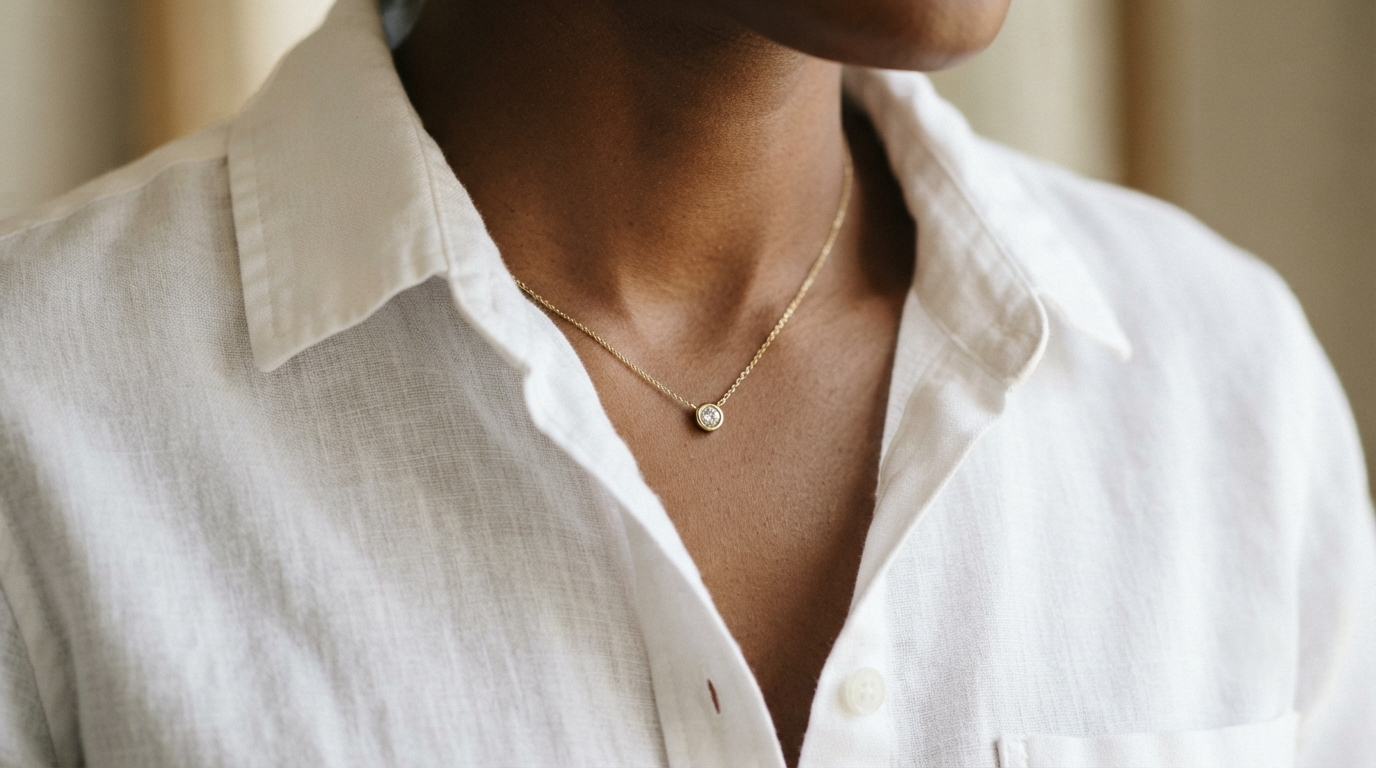
A bezel-set diamond pendant resting beneath an open shirt collar, worn out of sight

Two patterns fall out of that table. Only rows 1 and 6 carry a public meaning; the rest are simply jewelry to anyone who is not you. And every row is reversible, because the setting is separable from the stone, the fact that takes most of the pressure out of partner memorial diamond ideas.

If the carat and color of the stone are still open, they interact with partner memorial diamond ideas more than you would expect. Smaller stones bezel beautifully and disappear under a collar; larger stones want space around them. What a stone in this range typically costs and what color to expect from the carbon itself are both worth reading before a setting is commissioned, since a yellow or champagne stone sits very differently in white metal than in warm gold.

Rings That Are Not Engagement Rings

If a ring is what you want but the fourth finger is not, there are more partner memorial diamond ideas available than a showroom case tends to display. Ask for them by name.

  • The right hand. The same ring, the same stone, almost none of the assumption, in much of the US the right hand reads as a personal piece rather than a marital one.
  • The index finger or thumb. Both sit far outside the marriage script.
  • A stacking band. A narrow band with a small flush or bezel stone, worn alongside rings you already own. Among partner memorial diamond ideas this is the quietest way to wear something every day, because it reads as part of a stack rather than as an event.
  • A signet or seal ring with the stone flush in the face, historically a mourning form, and it still reads as heritage rather than announcement.
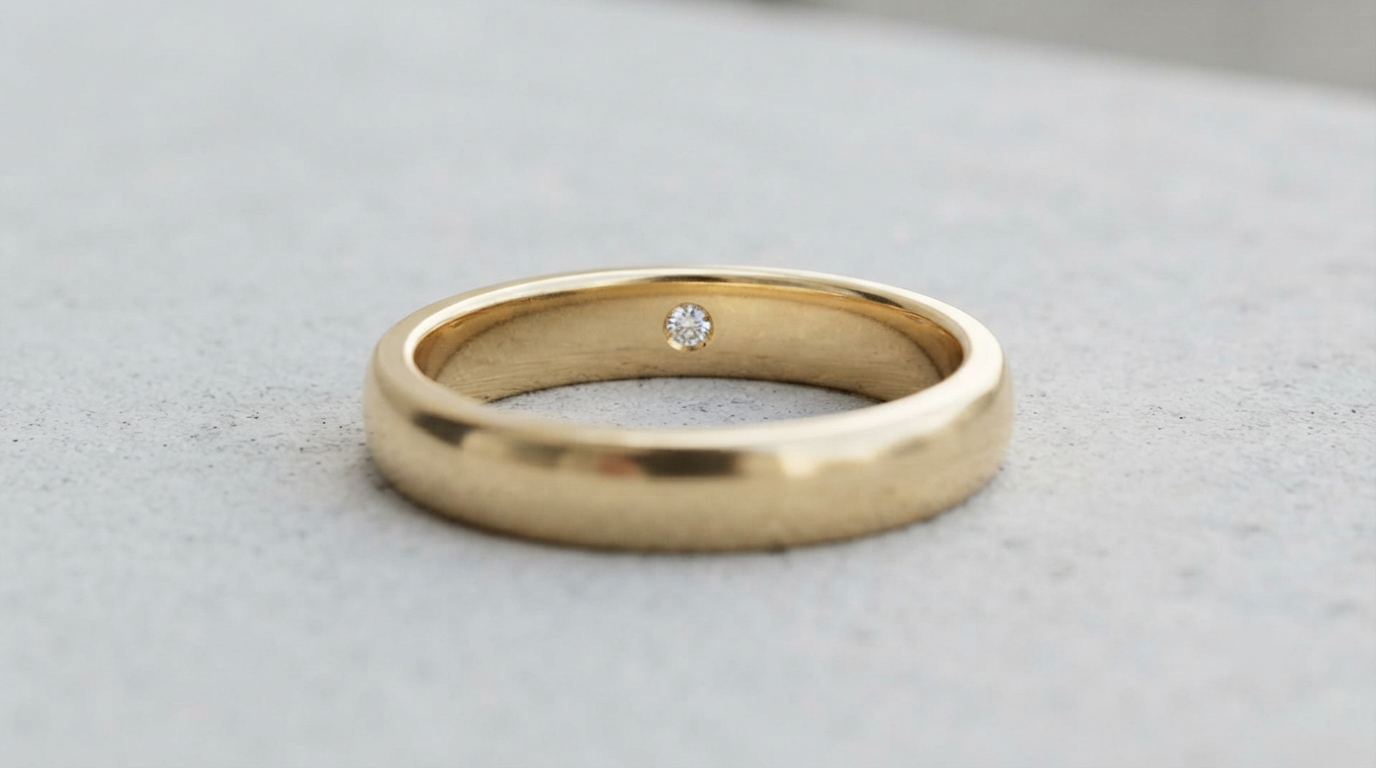
  • An inner face setting, where the stone is mounted on the inside of a plain band so it rests against the skin. Nobody sees it; you feel it all day. For many people that is the point.
A plain gold band turned to show a small diamond flush-set on its inner face

What a ring gives you that nothing else does is contact, it is on your hand while you type, cook, drive. If that is the appeal and the public reading is the obstacle, one of the five partner memorial diamond ideas above usually solves it.

Pendants, Lockets, and Anything That Sits Under a Collar

Pendants are the most chosen of all partner memorial diamond ideas, and the reason is not aesthetic. A pendant is the only common setting with a volume control.

Under a shirt it is invisible. Over a shirt it is a necklace. At a family funeral where the relationship is contested, it can be worn the whole day without a single person registering it. You decide, garment by garment, how much the piece says.

Three specifics separate a pendant that lasts from one that does not, and they apply to any of the partner memorial diamond ideas built on a chain:

  • Bezel over prongs for daily wear. A bezel wraps the girdle of the stone in a rim of metal. It is less sparkly than a four prong setting and much harder to snag on a seatbelt or a sweater.
  • Chain gauge, not chain length, is what fails. A fine cable chain wears through at the clasp. Ask for a heavier gauge than the pendant seems to need.
  • Length decides visibility. A shorter chain sits above most collars; a longer one disappears under almost everything and can be tucked against the sternum.

A locket adds a layer: the stone is enclosed until you open it. That suits readers who want the piece with them constantly but not in view constantly, a distinction that comes up whenever partner memorial diamond ideas are discussed and almost never gets named.

Earrings sit slightly apart from the other partner memorial diamond ideas, for one structural reason. A single memorial stone makes one earring, not two, and two stones grown in separate runs will differ in color and clarity. If a pair is the goal, that has to be planned at the growth stage, and whether more than one stone can come from the same shared source is the place to start.

A single stud worn alone is a real and long standing option. Insist on a screw back or locking back: an earring is among the easiest pieces to lose, and this is not a stone you can replace.

For readers who do not wear jewelry, the honest list of partner memorial diamond ideas is shorter but not empty:

  • Cufflinks or a tie tack, worn at weddings, funerals, and job interviews, occasion pieces rather than daily ones.
  • A lapel pin, the discreet end of that same idea.
  • An unset stone in a box. Genuinely a choice, not a failure to choose. Plenty of families keep the stone loose for a year or two before deciding anything.

What Actually Wears Out on a Memorial Piece?

Here is the distinction that gets blurred in almost every article about partner memorial diamond ideas: the stone is not the fragile part. The setting is.

A memorial diamond sits at 10 on the Mohs scale of mineral hardness, the hardest known natural mineral, and is graded against the same 4Cs used across the diamond trade. It outlasts the metal around it by a wide margin. What fails, in order of how often:

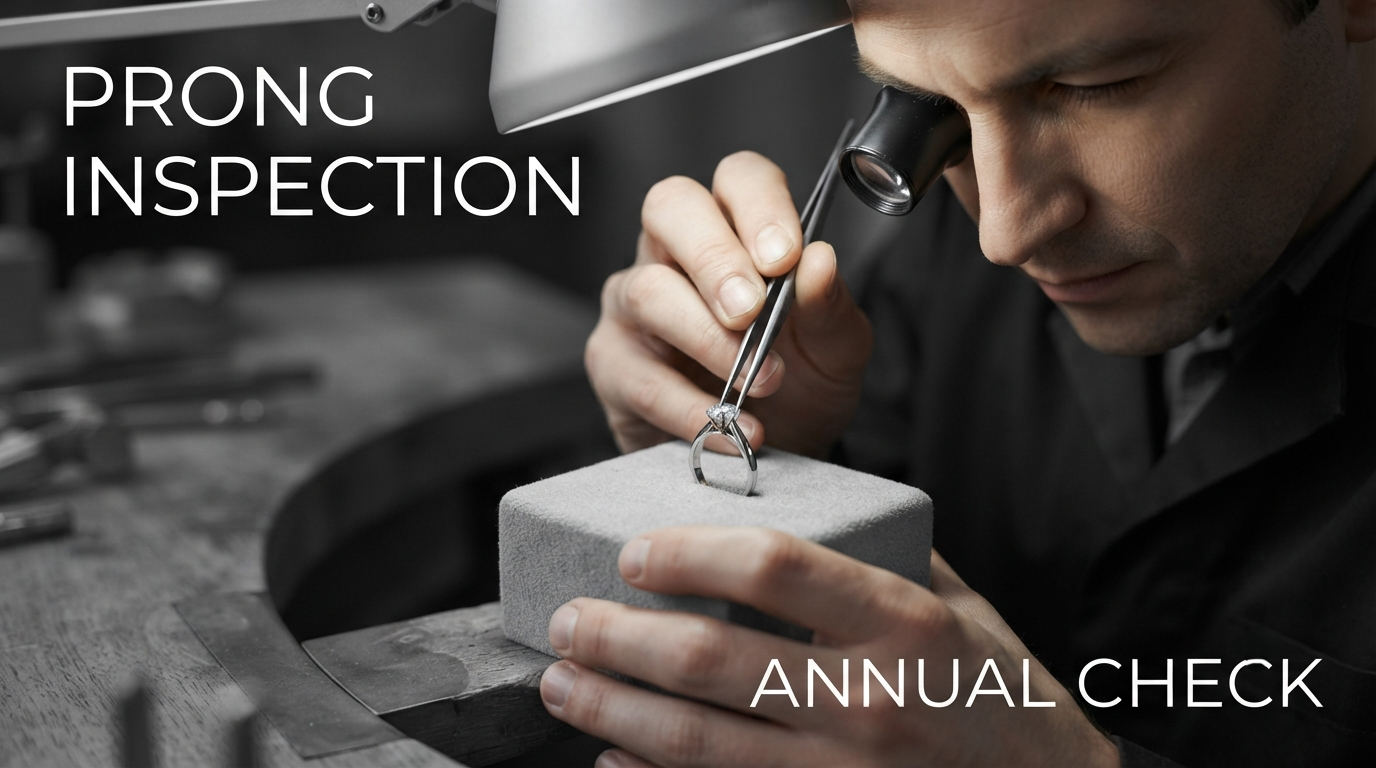
  • Prongs. They thin with wear, especially on a ring worn daily by someone who uses their hands. An annual prong check is the highest value maintenance habit for any of these pieces.
  • Rhodium plating. White gold is plated, and the plating wears off the high points within a few years, leaving a warmer tone underneath. Platinum dulls instead, which most people prefer.
  • Clasps and jump rings. A failed spring ring loses more pendants than anything happening to the stone.
  • Ring shanks. A thin shank on a hand that grips tools goes out of round and eventually thins through at the base.
  • Bezel edges, which can lift if the piece takes a hard knock, far less often than a prong lets go.
A jeweler examining the prongs of a diamond ring through a loupe during an annual check

None of this is an argument for wearing the piece less. It is an argument for judging partner memorial diamond ideas against your actual life rather than against a photograph, and for booking the annual check the same week every year.

Can You Change Your Mind About the Setting Later?

Yes, and this is the most reassuring fact in the whole subject. The stone is permanent. The setting is jewelry work, and jewelry work is undoable.

That means the decision you are making today is smaller than it feels. A pendant now can become a ring in five years. A ring worn on the left hand during the first year can move to the right hand, or onto a chain, when the shape of your life changes. Several partner memorial diamond ideas on this page are best understood as a first setting rather than a final one, and treating them that way is normal.

Four things to insist on if you do move between partner memorial diamond ideas and have a stone reset:

  1. Use a bench jeweler who knows what the stone is. Not because it behaves differently under the torch, but because someone who understands what they are holding takes different care with custody.
  2. Ask for the stone to be signed in and out. A written record at drop off and collection costs nothing and settles a worry you should not have to carry.
  3. Keep the paperwork together. Any origin or authenticity document from the provider, plus an independent grading report if you ordered one, should live with the piece.
  4. Have the piece re appraised for insurance after each reset, since valuation follows the setting as well as the stone.

If you have not commissioned the stone yet, the practical order for partner memorial diamond ideas is the reverse of what most people assume: decide the carat first, because it sets the timeline, and leave the setting until the growth run is underway. How long a partner memorial diamond takes end to end explains why there is usually more thinking time than families expect, and where to start if the whole decision is still open walks through the sequence from the beginning.

Frequently Asked Questions

Is it strange to wear a memorial stone on my wedding finger if we were never married?

No. That finger carries a public meaning, not a legal one, and plenty of people wear a memorial piece there deliberately. The only question worth weighing is whether you want strangers to read it as marriage, since most will.

What if my partner’s family would be upset to see me wearing it?

Then a setting with a volume control is the practical answer, a pendant, a ring on a chain, or an inner face band. Among partner memorial diamond ideas these let you wear the stone every day and still choose what a particular room sees.

Can the stone be set into a piece of jewelry I already own?

Usually, yes. A bench jeweler can assess whether an existing mount will take the stone’s dimensions safely. Resizing an heirloom setting is common work, though very old or thin mounts sometimes need rebuilding first.

Which setting holds up best for something worn every single day?

Of the partner memorial diamond ideas here, a bezel setting in platinum on a pendant takes the least abuse. If it must be a ring, a low profile bezel or flush setting beats raised prongs for anyone who works with their hands.

Can I have the stone set in something that does not look like jewelry?

Yes. Cufflinks, a lapel pin, a watch case back, a flush set band, or simply keeping the stone unset in a box are all real options, and the last of those is chosen more often than the catalogs suggest.

Do I have to choose the setting before the diamond is grown?

No, and it is usually better not to. Carat and color are decided up front because they drive the growth run; the setting can wait until you have seen the stone in daylight, and most partner memorial diamond ideas look different in the hand than on a screen.

Final Thoughts on Partner Memorial Diamond Ideas

Most of the anxiety in this decision is not about metal. It is about how much of a relationship you are ready to have visible, in front of people who may never have acknowledged it, and no jeweler can answer that for you.

What the jewelry can do is give you room to change your mind, because partner memorial diamond ideas are reversible in a way the stone itself is not. A pendant this year, a ring in a decade, or a loose stone that stays in its box until you know, all three are complete answers, and none rules out the others. The settings and metals comparison for a partner piece goes deeper on construction than this page does.

Learn More About Partner Memorial Diamonds

Talk With Memorial Diamond

If you are weighing partner memorial diamond ideas and want to talk it through with someone who will not push you toward the most expensive mount in the case, reach out to Memorial Diamond at memorialdiamond.us. Bring the awkward questions, who will see it, what you want it to say, whether you can change it later.

A polished memorial diamond held in fingertips beside a closed keepsake urn, the finished result of a partner memorial diamond

Partner Memorial Diamond FAQ: Everything Families Ask

People rarely arrive at this page with one tidy question. They arrive with twelve, half of them unspoken, and a suspicion that some of them sound foolish. A partner memorial diamond is a real lab grown diamond containing carbon recovered from your partner’s cremated ashes or from their hair, blended with supplemental lab carbon so the crystal reaches a viable size. For the ash route, industry figures put the personal share at roughly 10% to 15% of the finished stone, and some providers cite figures as low as 3%; for hair, no equivalent percentage is published at all. Nothing below assumes you already know any of this.

Memorial Diamond grows these stones, which makes this an interested source rather than a neutral one. So the figures here are industry wide bands rather than our published policy, and the awkward answers are given as plainly as the easy ones.

What a Partner Memorial Diamond Actually Is

Start with the physical object, because most of the confusion downstream comes from a fuzzy idea of what is being made.

It is a diamond. Not a simulant, not resin with ash suspended in it, not a “diamond look” stone. It is grown by the same two methods the wider lab grown industry uses, HPHT, which reproduces mantle conditions at roughly 6 to 8 GPa and 1,400 to 2,500°C, and CVD, which builds a crystal layer by layer from carbon bearing gas. Most providers use HPHT. Either way a partner memorial diamond comes out at 10 on the Mohs scale and is graded on the same four Cs as any other diamond.

A partner memorial diamond differs from an ordinary lab grown stone in exactly one respect: where part of its carbon came from. Carbon is recovered from cremated remains or from hair, purified to roughly 99.9%, converted to graphite, and used as feedstock in the growth cell alongside supplemental lab sourced carbon.

A small dish of cremated ashes beside a lock of hair in an envelope, the two source materials compared

The size of that personal share is the number worth sitting with, and it needs stating carefully rather than loosely. Industry figures for the ash route put it at roughly 10% to 15% of the finished mass, and some providers cite figures as low as 3%. For hair there is no equivalent published percentage, only the fact that hair is around 50% carbon by weight, so far less starting material is needed. Anyone quoting a single number that covers both routes is quoting something nobody publishes.

What that rules out is simple. A partner memorial diamond sold as made entirely of a person is advertising something the chemistry does not permit. What is true is stranger and better: atoms that were physically part of your partner are locked inside a crystal lattice, permanently, and the stone exists because they did. Ask any provider what share your own submission is expected to contribute, and ask for that answer in writing. Whether a partner memorial diamond is really made from your partner’s ashes takes that question apart properly, and the general category background is worth five minutes if this is entirely new to you.

Two routes exist, and they are genuinely different:

  • Ashes. Cremated remains are mostly calcium phosphate, so usable carbon is only about 0.5% to 4% by weight. That thin yield is why providers ask for a portion measured in spoonfuls, typically a few tablespoons up to roughly 4 oz, about 100 g.
  • Hair. Keratin is roughly 50% carbon, so a small lock of a few grams does the work of a much larger portion of ash. Crucially, hair needs no cremation at all, which keeps the option open for a partner who was buried.

The two routes combine. A submission of ashes and hair together is assessed against each material’s own figures rather than pooled into one total, which matters if you hold a little of each rather than enough of either. The hair route on its own terms is worth reading if cremation never happened.

Who Is Allowed to Authorize a Partner Memorial Diamond?

This is the question the rest of the internet answers badly for partners, so it gets its own section rather than a line in the FAQ.

There is no single national rule here. Each state writes its own, and paperwork your partner signed while alive can reorder the result on top of that: a will, a disposition directive, a pre need contract with a funeral home, or the authorization someone gave to release the body for cremation. If the relationship was recognized in law, the holder of that authority is normally obvious. If it was not, no marriage, no civil partnership, perhaps a family that never quite said the word out loud, the legal decision may belong to your partner’s mother, to an adult child, to a brother, or to a spouse from a marriage long dissolved.

Say it plainly: you may not be the person who can release the material for a partner memorial diamond, and finding that out before money moves is very much cheaper than finding out afterwards.

A cremation authorization form and a written disposition directive on a desk, the documents that decide who controls remains

The practical sequence is short:

  • Ask the funeral director who signed the cremation authorization. It is a two minute call, it costs nothing, and that name is very often the person holding control.
  • Find out what was left in writing, and whether anyone has read the document rather than remembered its gist.
  • Ask the holder for a portion, not for the arrangements. A request for a few tablespoons, leaving every existing plan untouched, is a far smaller ask than it feels like, and it is granted more often than people expect.

How to open that conversation covers what to say and what not to lead with. If you are at the very start of all this, where to begin sets out which decisions are urgent and which are not.

What If the Answer Is No, or Not Yet?

Refusal happens often enough that leaving it out would be dishonest, and it is rarely as final on paper as it sounds on the day.

If the person holding authority refuses a partner memorial diamond, three things usually remain true. Hair, if any was kept, is ordinarily the less obstructed route: what the law regulates here is cremated remains, and a lock that has sat in your own house was never inside that frame. Read that as how things tend to work, not as a settled legal position, belongings can be drawn into an estate, states differ, and hair in another person’s keeping is something to ask about.

Confirm it wherever the answer matters. A refusal given in the first month is a different object from a refusal given in the ninth, because the person refusing is also exhausted and also grieving. And a narrower ask frequently succeeds where a broad one failed: not “I would like to have a diamond made,” but “may I have a few tablespoons set aside.”

If the answer stays no, the ashes route closes and the idea of a partner memorial diamond does not. Hair requires no cremation and no portion of anything anyone else is holding, and where the sample is already in your own keeping it is usually the simpler path, worth checking rather than assuming, but rarely the obstacle the ash question is. It is also worth raising the possibility that more than one person receives a stone, several diamonds from one shared source turns a request into something a family benefits from collectively, which is often what restarts a stalled conversation.

How Does the Process Run, Stage by Stage?

Seven stages, most of which happen without you. The wait is long and mostly silent, which is worth knowing in advance so the silence does not read as a problem.

StageWhat happensRoughly how long
1. CollectionAshes or hair are received and logged against chain of custody documentationDays
2. Carbon extractionEverything that is not carbon is stripped away in a controlled, oxygen free processWeeks
3. PurificationThe recovered carbon is refined to roughly 99.9%+ purityWeeks
4. GraphitizationPurified carbon is heated to about 2,500 to 2,700°C and converted into graphiteWeeks
5. GrowthGraphite plus supplemental lab carbon is grown around a seed in an HPHT cellWeeks to months, this is where carat is decided
6. Cutting and polishingA gemologist shapes the rough into the finished stoneWeeks
7. Grading and returnOptional independent grading, then the stone comes homeWeeks
An HPHT growth cell in a laboratory, the stage where carat size is set by months of growth time

Nothing in stages two through five asks anything of you, and most providers go quiet through them. The silence is normal rather than a warning sign, though it is entirely reasonable to ask at the outset how often you will be updated and by whom.

End to end, the industry typical span for a partner memorial diamond is 6 to 10 months, reaching around 12 months for larger or specialty color stones. The reason is stage 5: carat is a function of time in the press, not of how much ash or hair you sent. A full urn does not buy a bigger stone or a faster one. The timeline in detail shows where each month goes, and the full ashes route walks the same seven stages at greater length.

What Does a Partner Memorial Diamond Cost?

Industry wide bands, not our published pricing, and they move with carat, color, cut and whether an independent grading report is included.

Think of it in three tiers. The smallest stones, a tenth to a quarter of a carat, sit in an industry band of about $1,500 to $3,500. A half carat through a full carat typically means $5,000 to $15,000, and a colorless stone at that weight costs noticeably more than a yellow, blue or champagne one. Above two carats the band runs from around $20,000 to $75,000 and higher. Settings, engraving, fancy cuts and grading reports are normally separate line items from the loose stone.

Two things worth knowing before you request a single quote. First, decide a carat you can actually afford, everything else prices off it, and a quote with no carat attached cannot be compared to anything. Second, budget for the back half: grading, cutting choices and a setting arrive months after the deposit, when the money often feels already spent. The full cost breakdown for a partner memorial diamond goes through each driver individually.

What Color Will It Be, and Can You Choose?

Partly, and less than the marketing photographs suggest.

Color in any diamond comes from trace elements present during growth. Nitrogen reads yellow. Boron reads blue. A colorless stone requires the near total absence of both. Because the feedstock for a partner memorial diamond comes from an organic, individual source rather than a sterile synthetic one, trace elements are ordinary, which is exactly why memorial stones trend toward yellow, blue and champagne rather than white, and why colorless versions require extra processing and cost more.

Some providers also offer post growth irradiation for red, pink, green or black. Clarity across the category typically lands in the SI2 to VVS range, and the finished stone is graded against the standard GIA 4Cs like any other. What color to expect gives the likelihoods honestly rather than as a menu.

What Does the Stone End Up Living In?

Later than people expect, and nothing forces the decision at the point of ordering.

A finished partner memorial diamond can sit loose in a box for years without coming to any harm, and plenty do, the idea that a partner memorial diamond has to become a ring is a jewelry industry assumption rather than a requirement. When you do want it set, rings, pendants and keepsake ideas for a partner memorial diamond covers the trade offs between a piece worn daily, a piece worn deliberately, and a stone that is never worn at all.

If you are weighing this against keeping an urn rather than against another piece of jewelry, the two options side by side treats both as complete answers, because they are.

Frequently Asked Questions

What exactly is a partner memorial diamond?

A real lab grown diamond grown partly from carbon recovered out of your partner’s cremated ashes or hair. It is chemically and optically a diamond, 10 on the Mohs scale. Industry figures put the personal carbon at roughly 10% to 15% on the ash route; no equivalent figure is published for hair.

Is it really made from my partner, or is that just marketing?

A partner memorial diamond is genuinely made in part from them. Carbon is extracted from the material you send, purified to roughly 99.9%, and grown into the crystal lattice itself. It is not the whole stone, and anyone claiming otherwise is overstating it. Both halves of that sentence are true.

How much ash or hair does it take?

Industry typical is a few tablespoons up to roughly 4 oz of ashes, or a small lock of hair weighing a few grams. Ash is only 0.5% to 4% carbon, hair around 50%, which is why the two quantities differ so sharply. Most of what you hold stays with you.

What color will the finished stone be?

Most likely yellow, blue or champagne. Nitrogen in the source carbon produces yellow tones, boron produces blue, and colorless requires the absence of both, harder and costlier with organic feedstock. Treat a partner memorial diamond’s color as a strong likelihood rather than a selection from a chart.

How long does a partner memorial diamond take?

Typically 6 to 10 months from receipt of material, stretching toward 12 months for larger or specialty color stones. The long stage is growth, because carat is bought with time in the press rather than with the amount of ash or hair submitted.

What does one cost?

A partner memorial diamond runs, industry wide, roughly $1,500 to $3,500 at 0.10 to 0.25 ct, around $5,000 to $15,000 at 0.5 to 1 ct, and $20,000 to $75,000 or more at 2 to 5+ ct. Colorless costs more than yellow or blue at equal size, and settings and grading reports are priced separately.

Who actually has the authority to approve this?

Legal control of the remains sits with one person, and who that is turns on state law and on anything your partner put in writing. If the relationship was not legally recognized, that person may be a parent, an adult child, or a former spouse rather than you. Establish it before spending anything.

Can several people each have a stone from the same ashes?

Usually yes, since only a small portion is used. Families commonly split one submission into several stones, or make separate submissions from a shared source. It is far easier to arrange before the portion is drawn than after.

What happens to the material that is not used?

That is company policy rather than chemistry, and it varies. Extraction leaves most of what arrives behind. Ask in writing whether the remainder returns by default, in what container, and how long after the stone is finished, before anything is posted.
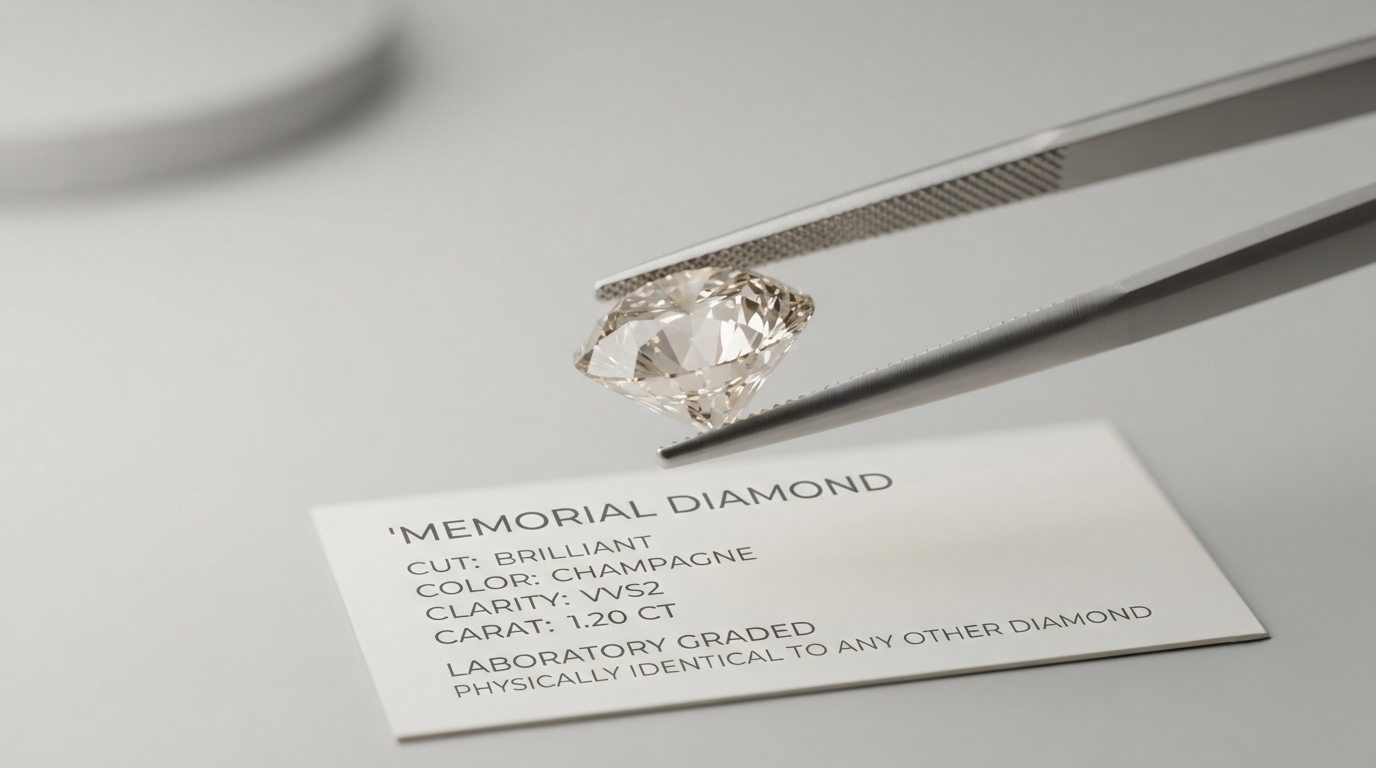
My partner was buried. Is there any option?

Yes, if hair was kept or can still be obtained. Hair is around 50% carbon, requires no cremation, and a few grams is enough. A hairbrush, an envelope kept by a family member, or a lock taken at the hospital are all workable starting points.

Do I have to give up the urn to do this?

No. The portion required is a small fraction of a cremation, so an urn at home, an interment, a scattering and a stone can all come from the same remains. Nothing here requires you to cancel a plan that already exists.

What should I ask a provider before committing?

Ask whether their stated minimum is a received or a usable weight, what chain of custody documentation you receive, what happens to unused material, whether independent grading is included, and what the timeline is at your specific carat. Unhurried, specific answers matter more than photographs.

Final Thoughts on the Partner Memorial Diamond

Most of what people want to know about a partner memorial diamond turns out to be answerable in a sentence: it is a real diamond, a genuine portion of it came from your partner, it takes months rather than weeks, and it consumes far less material than anyone fears.

The question that does not resolve in a sentence is the one about standing, and it is the reason this page gives authority its own section rather than burying it. For partners whose relationship sat outside the legal categories, that question can decide everything, and it is answerable, usually with one phone call, long before any money is at stake.

Nothing on this page is an argument that a stone is better than an urn, a plot, or a scattering at a place that mattered. Those are complete answers on their own. This one simply happens to be an answer you can wear.

Learn More About Partner Memorial Diamonds

Talk With Memorial Diamond

There is no stage of this where asking a question obliges you to anything. If you have read this far and still have a question that is not above, it is almost certainly a reasonable one and almost certainly asked often.

The four worth putting to any provider, including us: what material is required and whether that figure is received or usable weight; what documentation proves the carbon came from your partner; what happens to material the process does not consume; and what a stone at your chosen carat takes in months. memorialdiamond.us will answer those in writing, and so should anyone else you are weighing up.

An unlabeled lock of hair in a paper envelope on a bedroom drawer, the household starting point of the partner hair diamond steps

Step by Step: Turning Your Partner’s Hair Into a Diamond

The first stage of this does not happen in a laboratory. It happens in a bedroom, a bathroom drawer, or a box a funeral director handed over in a paper bag. The partner hair diamond steps begin with a search and a verification, not a shipment, you have to locate a sample, establish it is genuinely your partner’s, and confirm it is in usable condition before a single laboratory stage becomes relevant. After that the technical route is shorter than most people expect, because hair is roughly 50% carbon by weight.

Memorial Diamond grows these stones, so this page has an interest in your reading it. Every number below is an industry wide band, not a requirement we publish.

The Household Half of the Partner Hair Diamond Steps

Almost every published account of the partner hair diamond steps opens where an envelope arrives at a facility. That is stage four of a real set of partner hair diamond steps.

Stages one through three of the partner hair diamond steps happen in a house, usually alone, usually on a weekday evening, and they are where things go wrong, not because they are difficult, but because nobody prepared you for them. A lock of hair is almost never collected with a label, a date, or a witness. It is cut quickly, by someone not thinking about provenance.

Which means the partner hair diamond steps open with three domestic questions: does a sample exist, is it definitely your partner’s, and has it survived in a condition a laboratory can work with. No provider’s brochure answers those.

The household half matters for a second reason. Hair requires no cremation, so this route stays open to partners whose partner was buried, or whose ashes someone else holds. That widens who can do this, and puts the burden of the early partner hair diamond steps on your ability to find and vouch for a sample.

Where an Unlabeled Sample Usually Turns Up

Before you conclude that nothing exists, work through the places hair survives without anyone intending it to, because the partner hair diamond steps cannot begin without one. The table below is a starting order, not a ranking of sentiment.

Where it turns upTypical conditionWhat to check firstRealistic usability
A cut lock in an envelope or keepsake boxDry, intact, usually one person’sWhether anything on the envelope records a date or who cut itHigh, this is the ideal case and the one the early partner hair diamond steps assume
A hairbrush or combLoose, tangled, shed rather than cutWhether anyone else used the brush; shed hair has no root sheathModerate, quantity is often adequate, provenance often is not
A hat, a pillow, a coat collarVery small quantity, loose fibersWhether you can gather enough in one place to weighLow to moderate, usually a supplement, not a sample
A hospital or hospice keepsake packCut, bagged, sometimes labeled with a name and dateThe label, immediately, this is the only common source that documents itselfHigh, and often overlooked because the bag was never opened
A locket, ring or mourning pieceSealed, possibly decades old, possibly not your partner’sWhether a jeweler can open it without destroying the settingVariable, worth a conversation first
A funeral director’s fileCut at the time of care, retained by policy in some placesWhether they still hold anything, most families never askWorth one call before you give up
A hairbrush, a keepsake box and a hospital keepsake pack laid out together on a table

Two notes on that table. A small lock of a few grams is the industry typical requirement, so quantity fails less often than provenance. And the last row is the one people skip: funeral homes sometimes retain a sample, and one call can end the search.

If the sample is in someone else’s house, that is a request rather than an obstacle. Asking for a few strands out of a keepsake box is a smaller ask than asking for a portion of ashes, and it is often granted by people who would refuse the larger one. How to raise this with a family who may not have acknowledged the relationship covers that conversation.

How Do You Verify Hair Nobody Labeled at the Time?

This is the stage the partner hair diamond steps are usually missing, and it is the one that keeps people awake.

Start with what is honest. You usually cannot prove a sample’s identity in a laboratory sense, and it is fair to ask any company directly whether they claim they can. What you can build is a defensible chain of reasoning before you commit anything, which is what verification means here.

  • Reconstruct the collection. Who cut it, where, and roughly when. A date you can place within a month beats a certainty you cannot explain.
  • Check for anyone else in the household with similar hair. This is the single most common source of doubt and the easiest one to rule in or out.
  • Look at the physical evidence. Cut ends suggest deliberate collection; irregular lengths suggest a brush.
  • Ask whoever else was present. A sibling, an adult child, a hospice nurse, somebody often remembers it better than you do.
  • Write down what you conclude, and why, before it is posted. If doubt surfaces in eight months, that note is what you will want.
A written note and a dated envelope beside a lock of hair, illustrating how provenance is documented at home

Providers can assess condition, quantity and suitability. Identity is a different question, and DNA verification is not generally offered on this route, so ask rather than assume: can you confirm whose hair this is, and if not, what does your documentation record instead? Until that answer exists in writing, verification is your own job inside the partner hair diamond steps, done before transfer, and documented the way you would document anything you get one chance at.

What Are the Partner Hair Diamond Steps Once a Sample Is Confirmed?

Seven partner hair diamond steps, and the last four are the same physics every memorial stone goes through.

  1. Locating a sample. The household search above, often the longest stage by elapsed time, and the only one with no fixed duration.
  2. Verifying provenance. Establishing, to your own satisfaction and in writing, that the sample is your partner’s.
  3. Assessing condition and quantity. Industry typically a small lock, a few grams, is enough; condition matters more than mass.
  4. Documented transfer. The sample is sealed, labeled with an identifier, logged on arrival and weighed. Chain of custody paperwork begins here.
  5. Cleaning and purification. Product residue, dust and non carbon components of keratin are removed in a controlled, oxygen free process reaching roughly 99.9%+ carbon purity.
  6. Graphitization and growth. The purified carbon is taken to roughly 2,500 to 2,700°C to become graphite, blended with supplemental lab carbon, and held under roughly 6 to 8 GPa of pressure at 1,400 to 2,500°C inside an HPHT cell for weeks or months while a crystal accumulates.
  7. Cutting and polishing, then optional independent grading. The rough is shaped and assessed, typically landing in the SI2 to VVS clarity range, at Mohs 10 like any other diamond. Grading is ordered, not automatic.

One honesty point belongs inside that list rather than after it. The carbon recovered from a lock of hair does not fill a growth cell by itself; laboratory carbon makes up the balance. The roughly 10 to 15% figure you will see quoted for the personal share is an ash figure, industry sources put that band on carbon recovered from cremated remains, and no equivalent number is published for hair. What holds on either route is that the personal carbon is real, traceable through the chain of custody record, and a minority of the finished mass.

Ask what share your own sample is expected to contribute, in writing. What the partner hair diamond steps produce is a diamond a verifiable part of which is your partner, not a diamond that is only your partner. The longer account of how a stone is grown from a partner’s hair goes further into the chemistry.

A note on color, since the partner hair diamond steps settle it rather than let you choose it. Trace elements riding along with organic carbon set the tone: nitrogen leans yellow, boron leans blue, and only the absence of both produces something colorless. What color a stone grown from your partner’s hair tends to be treats that as a likelihood. The general physics behind HPHT and CVD growth sits under synthetic diamond.

What If the Sample Turns Out to Be Mixed?

Mixed samples are common and rarely fatal. They are also the reason stage three of the partner hair diamond steps exists as a separate stage.

A brush is the usual culprit: two people share a bathroom for years, one hairbrush lives on the shelf, and what you are holding is a blend. A keepsake envelope can be mixed too.

Two visibly different hair textures being separated with tweezers under a lamp

What the partner hair diamond steps do next depends on how mixed it is:

  • Visibly different hair, color, texture or length, can sometimes be separated by hand under good light, with patience and tweezers. Tedious, but it works.
  • Indistinguishable hair cannot be separated, and no laboratory process sorts it. The carbon is processed as one mass.
  • A mixed sample you send anyway is a decision, not an accident, and should be recorded as one. Some families are at peace with a stone grown partly from their own hair alongside their partner’s; others are not. Both are reasonable.
  • A small certain sample beats a larger uncertain one every time, given how little mass the partner hair diamond steps actually require.

Tell the provider what you know. A described mixed sample is a normal intake; an undisclosed one becomes a doubt you carry privately for years. This is also the point where the combined route using ashes as well as hair becomes worth reading, since it changes what the intake record has to account for.

When a Sample Is Too Degraded to Use

Degradation is less common than people fear, because hair is durable, but it happens, and it is better understood before a sample is posted than after.

What actually stalls the partner hair diamond steps: prolonged damp, visible mold, oily or chemical contamination, and years of caked product residue. What generally does not: age, dye, bleach, perming, or a lock that has sat in a drawer since 2009. Keratin is stable, and a dry dark drawer is close to ideal storage.

If a provider assesses a sample as unusable, the partner hair diamond steps have not ended. Three routes remain open:

  • A second sample from elsewhere, the triage table above exists precisely because most households hold more than one possible source.
  • A larger quantity of a marginal sample, if the issue is thin recovery rather than contamination.
  • The ashes route instead, if cremation took place and you have standing to ask for a portion.

That last option is worth a plain sentence about permissions, because it is not symmetrical with hair. Statutes in this area address cremated remains; they were not written about a lock in a drawer. In practice that makes hair you already keep the less obstructed of the two routes, without making it a closed question, belongings can pass into an estate, states take different positions, and hair kept in another household is something you raise with the person who keeps it.

Control over cremated remains varies by state too, and by whatever your partner set down in writing; where a relationship carried no legal recognition, a parent, an adult child or a former spouse may hold it. Where it matters, check rather than assume. That asymmetry is why the step by step for the ashes route starts with authority rather than with a search.

Why the Laboratory Half Is the Shorter Half

Here is the payoff for all that domestic work. Once a verified sample reaches a facility, the technical portion of the partner hair diamond steps is simpler than the ashes equivalent.

Keratin is a carbon rich protein, putting hair at roughly 50% carbon by weight. Ash is dominated by calcium phosphate instead, yielding only about 0.5% to 4%. So a few grams of hair carries what a few ounces of ash carries, and extraction has far less to strip away.

What it changes inside the partner hair diamond steps:

  • Less material moves. An envelope rather than a sealed jar, simplifying transfer and identification.
  • Purification is more direct. No mineral matrix dominates the mass; the process removes the non carbon fraction of a protein.
  • Nothing has to be divided. No urn is opened, and no arrangement anyone else made is touched.

What it does not change: the calendar. Growth time sets carat, not carbon supply, so the industry typical span of 6 to 10 months, up to around 12 for larger or specialty color stones, applies exactly as it does to ash. Sending more hair buys nothing on that clock. The finished stone is graded against the ordinary 4Cs any diamond is assessed on, and the full guide to a partner hair diamond sets the whole route out end to end.

Frequently Asked Questions

How can I be sure the lock in that envelope is my partner’s?

Usually you cannot prove it; the early partner hair diamond steps ask you to reason it out. Reconstruct who cut it and when, rule out anyone else in the household with similar hair, check whether the ends are cut or shed, and write your conclusion down.

Can a laboratory confirm whose hair it is before growing anything?

Ask rather than assume, because DNA verification is not generally offered on this route. Facilities assess condition, quantity and suitability for processing. In the partner hair diamond steps, identity rests on your own record and on chain of custody from intake onward, not on a test.

Two people’s hair ended up in the same envelope. Is that a problem?

Not necessarily, and mixed samples are routine in the partner hair diamond steps. Visibly different hair can often be separated by hand; indistinguishable hair cannot, and would be processed as one mass. Tell the provider either way, and have it recorded at intake.

What does “too degraded” actually mean for a hair sample?

Prolonged damp, mold, oily or chemical contamination, or heavy product residue will stall the partner hair diamond steps. Age alone is not degradation, and neither is dye, bleach or perming. A dry drawer preserves keratin extremely well, which is why decades old locks routinely pass assessment.

Who checks the sample first, me, or the provider?

Both, in that order, and the partner hair diamond steps assume it. You establish provenance, because only you can. The provider then assesses whether there is enough usable material and whether its condition suits processing. Ask whether that can happen from a photograph and a weight first.

If no sample survives verification, what comes next?

Search the other household sources before you abandon the partner hair diamond steps, including a call to the funeral home. If nothing usable exists, the ashes route remains open where cremation took place and you have standing to ask, a different sequence with a different first stage.

Final Thoughts on the Partner Hair Diamond Steps

The technical partner hair diamond steps are well understood and largely out of your hands. Purification, graphitization, growth, cutting: these happen on a schedule, competently, without you.

The stages that need you are the first three, and they happen at home with no instructions. Find a sample. Satisfy yourself about where it came from. Describe it honestly to whoever will process it. Those are the partner hair diamond steps that determine whether the rest is worth beginning, and they cost nothing but attention.

A last, practical point. Because the partner hair diamond steps need no cremation and very little mass, this route stays available long after other options have closed, after a burial, after a scattering, after a family took the urn.

Learn More About Partner Memorial Diamonds

Talk With Memorial Diamond

You can complete the hardest part of the partner hair diamond steps this weekend, without spending anything and without telling anyone: open the drawers, call the funeral home, and see what exists.

If something does, three written questions will tell you where you stand. Ask whether a sample can be pre assessed from a photograph and a weight before it is posted. Ask what happens to material the process does not consume. Ask how it is identified from intake to finished stone. memorialdiamond.us answers all three, and so should anyone else you approach.

Nothing in the partner hair diamond steps has to be decided quickly. A lock of hair in a dry drawer is in no hurry at all.

A small lock of hair beside an open paper envelope on a table, the irreplaceable sample behind most partner hair diamond questions

Questions to Ask Before Turning Your Partner’s Hair Into a Diamond

There is one envelope. Whatever is inside it, a lock cut at a hospital, a curl saved years ago, the strands still caught in a brush nobody could bring themselves to clean, there will never be a second one. The partner hair diamond questions that matter most are about provenance and irreplaceability: how a laboratory handles a sample nobody can independently identify, whether the condition of yours still works, and what “enough” means when running short is not survivable.

Memorial Diamond grows diamonds from hair, so treat this page as interested rather than neutral. Every figure here is an industry wide range, not a published requirement of ours. And the most important of the partner hair diamond questions has an answer you may not expect.

The Sample That Cannot Be Replaced

Hair is a far better carbon source than ash. Roughly half of a strand’s weight is carbon, built into keratin, against the 0.5% to 4% that cremated remains yield. That is why this route needs a small lock rather than a scoop, and why it works for someone who was buried.

But chemistry is not the constraint behind the partner hair diamond questions here. Scarcity is. Ashes exist in quantity and can usually be re portioned if a first attempt goes badly. A lock of hair is a fixed object with a fixed weight, sitting in a drawer, and once it is gone it is gone. That single asymmetry is what should reshape every conversation you have with a provider.

A lock of hair on a small digital scale reading in grams, showing how a sample is weighed before it is sent

It changes which partner hair diamond questions matter, and when you ask them. With hair, the assessment conversation has to happen before anything is posted, because a sample declared marginal after arrival is a sample already out of your hands. That is the practical spine of the partner hair diamond questions below: front load everything that could disqualify your sample, and accept no answer that begins with “send it and we’ll see.”

  • Weigh it first. A kitchen scale that reads to 0.1 g costs very little and tells you where you stand before anyone else knows.
  • Photograph it in the container it has lived in, including any tape, card, ribbon or plastic attached to it.
  • Write down what you know, roughly when it was cut, by whom, and how it has been stored since.
  • Ask for the provider’s minimum in grams, not in adjectives like “a small lock.”

How Would a Laboratory Know Whose Hair This Is?

This is the first of the partner hair diamond questions, and the honest answer surprises most people.

1. Can a provider verify that this sample is my partner’s?

Ask, and expect the answer to be no. Hair carries DNA in its root bulbs, but genetic testing is not something providers generally offer on this route, there would be nothing to test it against unless a reference sample exists, and the growth process itself, graphitization at roughly 2,500 to 2,700°C, then a press at 6 to 8 GPa, destroys every trace of biological material long before a crystal forms. A finished diamond cannot be tested afterwards to name anyone. Put it to the company in those words and see what comes back.

What a serious provider documents instead is a chain of custody beginning at receipt: this sample, logged under this reference, entered purification, and this carbon came out. That is a real and verifiable record. It simply starts at their door, not at your drawer.

So the truthful framing of one of the central partner hair diamond questions is this: the identity of the sample rests on your word, and the provider’s job is to make sure that whatever you sent is what they grew. A company that claims more than that is claiming something the physics does not allow.

2. What happens if the lock turns out to be mixed, or not theirs?

Expect nothing to flag it. Keratin from two people is chemically indistinguishable once purified to the 99.9% plus carbon the process requires, and separating or identifying sources is not what a purification and growth sequence is built to do, worth confirming with your provider rather than taking on trust. A brush sample that also holds a few of your own strands, or a child’s, will simply be carbon.

Whether that matters is one of the partner hair diamond questions only you can answer, and plenty of families conclude it does not, a brush two people shared is arguably a truer object than a clinical cut. But decide it now rather than discovering the ambiguity afterwards. If it does matter, a single clean lock with a known history beats a larger, vaguer sample.

This is also the point at which the partner hair diamond questions stop being technical. If nobody else can confirm what this is, your own record becomes the provenance. A dated note and a photograph taken today, kept with the paperwork, is worth more in twenty years than a memory.

Which Partner Hair Diamond Questions Are About the Sample’s Condition?

Two of the nine, and they are the partner hair diamond questions most often answered wrongly by well meaning guesswork.

3. The hair is old. Is it still usable?

Almost certainly, and this sits among the partner hair diamond questions where instinct misleads. Keratin is remarkably stable, hair survives for centuries in archaeological contexts, and a lock kept in a drawer for fifteen years has not lost its carbon. Age alone is not a disqualifier.

Storage is the real variable. Damp gives mold a foothold; adhesive tape, laminated cards and glued memorial books bond the hair to something that now has to be removed; loose strands may have picked up fibers. None of these is automatically fatal, and purification strips non carbon material anyway, but all are worth disclosing rather than hoping nobody notices.

4. Does dye, bleach or a treatment change anything?

Less than people fear, which makes this one of the partner hair diamond questions worth asking rather than assuming. Bleaching and permanent color alter the keratin cuticle, but they do not remove the carbon, and extraction strips out everything that is not carbon regardless. Heavily processed hair is generally still workable.

Hair thinned by illness or chemotherapy raises a volume issue rather than a viability one, fine, sparse strands weigh very little, so a visually generous lock may come in well under the gram figure a provider needs. Weigh it. The same goes for very short hair, where what looks like plenty on a card can be under a gram.

What you haveEffect on carbonEffect on viabilityDisclose when you ask
Lock kept loose in an envelope for yearsNone, keratin is stableGenerally fineHow long, and where it was stored
Hair taped to a card or laminatedNone to the hair itselfAdhesive must be removed firstThat tape or lamination is involved
Dyed, bleached or permedNone, purification removes the restGenerally fineThe treatment, so nothing is a surprise
Fine or chemotherapy thinnedNone per gramVolume is the risk, not chemistryThe actual weight in grams
Strands from a shared hairbrushNoneWorks, but sources cannot be separatedThat the sample may be mixed
Hair showing mold or damp damageReduced usable massAssessment needed before commitmentImmediately, with a photograph
A lock of hair taped to a keepsake memorial card, the kind of mounting that has to be removed before processing

The pattern across that table answers several of the partner hair diamond questions at once: chemistry is rarely the obstacle, and mass almost always is. If your sample fails, it will fail on a scale, not in a beaker. To see how the numbers work out, how much hair a partner memorial diamond actually needs sets out the typical bands.

What Does “Enough” Mean With No Second Sample?

A provider quoting “a small lock” is describing a comfortable case, not a threshold. Weight sits at the dead center of the partner hair diamond questions. For an irreplaceable sample, comfortable is not the number you need.

5. What is your minimum, in grams, and what is your preferred amount?

Ask for both, because they are not the same and the gap between them is where your risk lives. Industry wide, hair submissions typically run to a few grams, which sounds trivial until you weigh a thin lock of fine hair and find it at 0.6 g.

If you sit between the minimum and the preferred amount, you are not disqualified, you are in the band where the provider’s honesty matters most. Among the partner hair diamond questions this is the one to ask in writing, so the answer exists as text rather than as an encouraging phone call.

One lock of hair divided into two portions on a sheet of paper, illustrating sending part and keeping part

6. Will you assess the sample before I commit, and will you tell me plainly if it is marginal?

The answer you want is yes to both, with specifics. Some providers will look at a photograph and a stated weight and give a view. Some accept a few strands as a test portion. Some assess only on arrival, which for an irreplaceable sample is a materially worse offer.

Then ask the follow up that separates careful companies from confident ones: if it is marginal, will you say so and pause, or proceed and hope? Of all the partner hair diamond questions, this one most reliably reveals how a company behaves when things are not going well. The rest of the sequence from posting a lock to receiving a finished stone is comparatively predictable.

What Survives If the Run Fails?

Growth runs fail occasionally, and the partner hair diamond questions here are the least pleasant to ask. Crystals fracture, cells misbehave, and a stone can be lost in cutting. With ashes there is usually more material. With hair there is usually not.

7. If the sample is consumed and the run fails, what exists afterwards?

Ask this in the bluntest form you can manage, because the answer defines your actual exposure. Is the purified carbon recovered and re grown, or is it lost with the crystal? Is a second attempt made without further material? Is money returned when material cannot be?

There is no industry standard answer to these partner hair diamond questions, and different policies are all legitimate. What is not acceptable is vagueness. Of the nine partner hair diamond questions on this page, this is the one most often left unanswered: if a provider cannot describe what happens in the bad case, you are being asked to carry a risk nobody has quantified for you.

8. Can the sample be split, so that part of it stays with me?

Often, and it is the single most effective protection available to you. Sending half a lock and keeping half means a failure costs you a stone rather than the object itself. It also leaves a second family member able to commission their own stone later from the same source.

Ask whether the provider will work from a reduced portion and whether doing so changes the likely outcome. If your sample is large enough to split, splitting it converts the worst case from irreversible to merely disappointing, which is why it belongs among the partner hair diamond questions asked before the envelope is sealed, not after. Where more than one person wants a stone, the practicalities of sharing a single source are worth reading first.

The Partner Hair Diamond Questions About What a Certificate Asserts

Documents outlast the people who commissioned them, which is why the partner hair diamond questions end here. Read yours before it exists.

9. What, exactly, does the certificate claim about origin?

There are two documents and they do different work. A grading report, ideally from an independent laboratory, describes the finished stone, cut, color, clarity, carat, the same category of assessment any diamond receives. An origin or authenticity certificate describes the submission: that this diamond was grown from carbon extracted from material received under this reference on this date.

Notice what the second document can and cannot say, because this is one of the partner hair diamond questions a certificate answers on your behalf for the rest of its life. It can say material was received and tracked. It cannot say whose hair it was, because nobody at the laboratory was in your house when the lock was cut. Good wording reflects that honestly. Wording that implies genetic verification is overreaching, and it is fair to ask for a sample certificate before you commit.

Ask too about the proportion, and be careful with the number you have probably already read. The often quoted 10 to 15% band describes carbon recovered from cremated ashes; no equivalent share is published for hair, so no honest document can put a hair figure on it. What is true on either route is that laboratory carbon makes up the bulk of the charge so the crystal reaches a viable size, and that the personal carbon is a real, verifiable, permanent minority of the lattice rather than the whole of it.

So make it one of your partner hair diamond questions: what share is my sample expected to contribute, and how is that recorded? Any document or salesperson claiming the stone is wholly your partner is overstating what a grown diamond actually is, and a company comfortable overstating that will be comfortable overstating other things. That honesty test sits underneath all nine partner hair diamond questions on this page.

Frequently Asked Questions

Can a finished diamond be tested to prove whose hair it came from?

No. The growth process runs far above the temperature at which biological material survives, so nothing identifiable remains in the crystal. Treat any claim that a finished stone can be genetically matched to a person as a reason to ask a great many more questions.

Is hair from a hairbrush usable?

Physically, yes, brush strands are the same keratin as a cut lock. The caveat is that a shared brush may hold more than one person’s hair, and nothing in the process distinguishes them. Decide in advance whether that ambiguity sits comfortably with you.

Does the hair need roots attached?

No. The carbon is in the shaft, and roots add almost nothing to the mass. Root bulbs would matter for DNA testing, which providers do not generally offer on this route, so cut ends are perfectly workable.

My partner’s hair was gray. Does that change the stone?

No. Pigment is present in trace quantities and is removed during purification like everything else that is not carbon. A diamond’s color comes from trace elements at growth, nitrogen tending yellow, boron tending blue, neither present giving colorless.

Can I send more hair later if the first sample falls short?

Ask, because it depends entirely on where the run has reached. Once material is purified and committed to a growth cell, adding to it is usually not possible. Before that stage, some providers will accept a top up. Get the deadline in writing.

My partner was buried rather than cremated. Does hair still work?

Yes, and that is the point of this route. Hair needs no cremation at all, which is why it also suits families whose faith or wishes ruled cremation out, and why a lock saved during life is enough on its own.

Final Thoughts on Partner Hair Diamond Questions

Everything on this page comes back to one sentence: there is no second envelope. The chemistry is forgiving, the timeline is ordinary at six to ten months, and the finished stone is a real diamond by every measure. The only unrecoverable thing is the sample you start with, and that is what shapes the partner hair diamond questions.

Which is why the partner hair diamond questions worth asking are the ones that happen before postage, weight, condition, assessment, splitting, and what a provider does on a bad day. Asked in that order, they cost you an afternoon. Asked afterwards, some of them have no useful answer at all.

If a company answers all nine partner hair diamond questions plainly, you have learned something. If one of them produces a shrug, you have learned something more useful still, and you have learned it while the envelope is still in your drawer.

Learn More About Partner Hair Diamonds

Talk With Memorial Diamond

If you want the partner hair diamond questions above answered against your actual sample rather than in general, reach out to Memorial Diamond at memorialdiamond.us. Bring a weight in grams, a photograph of the lock as it currently sits, and an honest description of how it has been stored, including the parts you would rather not mention.

Nothing about the partner hair diamond questions needs deciding in a first conversation, and nothing should be posted before one. Ask what your sample would need to weigh, whether it can be split, and what happens on the day a run goes wrong.

A sealed ash container and a labeled hair envelope side by side on a table, the two parallel inputs to the partner ashes hair diamond steps

Step by Step: Turning Your Partner’s Ashes and Hair Into a Diamond

Two materials means two of almost everything, two assessments, two sets of permissions, two lines on an intake record, right up until the moment they stop being two things at all. The partner ashes hair diamond steps are best understood as two tracks running at different speeds that converge once, late, at the growth cell; before that point the ash and the hair are handled, judged and documented separately. Where they converge, and what happens if one track fails, is the whole of the decision making here.

Memorial Diamond grows these stones, so read this as an interested account. Figures given below are industry wide bands rather than requirements we publish.

The Partner Ashes Hair Diamond Steps Run on Two Tracks

The temptation with a dual source order is to picture one parcel going out and one stone coming back. That is not how the partner ashes hair diamond steps behave, and the model matters because it changes what you decide and when.

Ash and hair are chemically different problems. Cremated remains are dominated by calcium phosphate, with usable carbon at roughly 0.5% to 4% by weight. Hair is roughly 50% carbon, keratin being a carbon rich protein. A facility extracting carbon from each runs two recoveries with two yields and two failure modes.

So the partner ashes hair diamond steps carry a duplicate structure through their early stages: separate assessment, separate permission questions, separate identifiers, separate purification. Only after both have become purified carbon does a single decision, one growth charge, make them one object.

That convergence point is the useful thing to know. Everything before it can be staged, delayed or abandoned one track at a time. Everything after it is joint and final.

It also explains a question families ask late and should ask early: which contribution is larger in the finished stone. There is no answer, because once two purified carbons are weighed into one charge alongside lab grown carbon, no analysis distinguishes them. The only decision that controls the proportions is how much of each material you send, and the partner ashes hair diamond steps place it before intake rather than after.

Are the Two Sources Assessed Separately or Pooled?

Separately, and this is the most common misunderstanding about the partner ashes hair diamond steps.

Material requirements are normally stated per material rather than as a combined total, and the partner ashes hair diamond steps honor that separation throughout, though it is worth asking any provider to confirm it in those terms. The industry typical ash figure is a few tablespoons up to roughly 4 oz, about 100 g. The industry typical hair figure is a small lock, a few grams. Those are not two halves of one total. Sending half the ash figure and half the hair figure does not add up to a viable submission; each is assessed against its own threshold on its own terms.

StageWhat the ash track is doingWhat the hair track is doingAre they joined yet?
AssessmentWeighed against the ash requirement; storage condition reviewedWeighed against the hair requirement; provenance and condition reviewedNo, two separate judgments
PermissionRequires authority over the remains, which may rest with someone elseUsually a simpler question in practice where the sample is already in your own homeNo, two different questions entirely
IntakeLogged, weighed on arrival, given an identifierLogged, weighed on arrival, given its own identifierNo, ideally two records
PurificationMineral matrix stripped away; thin yield, large inputNon carbon fraction of keratin removed; rich yield, small inputNo, different recoveries
GraphitizationPurified carbon taken to roughly 2,500 to 2,700°CPurified carbon taken to the same temperature rangeUsually not, ask
Growth chargeCombined with the hair carbon and supplemental lab carbonCombined with the ash carbon and supplemental lab carbonYes, this is the convergence
Cutting, then optional independent gradingOne rough, one stone, one report if you order itOne rough, one stone, one report if you order itYes, permanently
Two intake sheets and two scales, each logging a different material against its own requirement

Read the right hand column as a cancellation map. Up to the growth charge, the partner ashes hair diamond steps are two projects that happen to share an order number. After it, they are one crystal and nothing distinguishes the contributions.

One qualification belongs inside the partner ashes hair diamond steps and applies to both tracks equally. Neither material supplies enough carbon to fill a growth cell on its own, so lab grown carbon makes up the bulk of the charge. The figure usually quoted for the personal share, roughly 10 to 15% of the finished stone, with some providers citing figures as low as 3%, is an ash route figure.

No published industry figure covers a blended ash and hair charge, and the partner ashes hair diamond steps do not create one. What two sources definitely do not do is double the personal share. If the proportion matters, ask what your particular submission is expected to contribute and ask for it in writing. Whether a dual source stone contains more of your partner is worth reading if that is the question underneath your question.

In What Order Do the Partner Ashes Hair Diamond Steps Run?

Seven partner ashes hair diamond steps, with the duplication concentrated in the first four.

  1. Separate assessment. Each material is judged against its own industry typical figure, quantity and condition for the ash, quantity, condition and provenance for the hair. Nothing is committed.
  2. Permissions, resolved per material. The hair is usually straightforward. The ash frequently is not, and that asymmetry is dealt with in its own section below.
  3. Staged commitment. You decide which material is released first, and whether the second is held back pending the first’s assessment result.
  4. Documented intake, twice. Each material arrives sealed and labeled, is weighed on receipt, and is logged against its own identifier.
  5. Purification, run separately. Each is heated in a controlled, oxygen free process to roughly 99.9%+ carbon purity, with very different amounts of material removed on each track.
  6. Graphitization and the growth charge. Purified carbon becomes graphite at roughly 2,500 to 2,700°C, the two contributions are weighed into one charge alongside supplemental lab carbon, and that charge sits under roughly 6 to 8 GPa at between 1,400 and 2,500°C in an HPHT cell until the crystal reaches size.
  7. Cutting and polishing, then optional independent grading. One rough is shaped and assessed, typically landing between SI2 and VVS clarity, at Mohs 10 like any diamond. Independent grading is ordered, not automatic.

Nothing in the partner ashes hair diamond steps speeds that up. Industry wide it runs 6 to 10 months once material is received, and nearer 12 where a stone is large or its color is a specialty, because carat is bought in growth time rather than carbon supply. Nor do two sources let you specify a color: trace elements decide it, with nitrogen leaning yellow and boron leaning blue, and a colorless stone requiring the absence of both. What color to expect from a combined submission treats that honestly. General background on the growth methods themselves sits under synthetic diamond.

Which Source Should Go First in the Partner Ashes Hair Diamond Steps?

Stage three is the only genuinely new decision the partner ashes hair diamond steps create, and it has a defensible default: release the hair first.

The reasoning is about exposure, not sentiment. The regulation here was drafted with cremated remains in mind, not with a keepsake envelope, and that is why hair you already hold usually meets fewer obstacles. Usually, not always: a person’s belongings can be drawn into an estate, the position differs state to state, and hair in someone else’s keeping is theirs to be consulted about.

Ash is a harder question again: it requires authority over cremated remains, and that authority is not automatic for a partner. Which state the cremation took place in decides the default, and it can be displaced by a will, by a disposition directive, or by an instruction signed at the funeral home. Where a relationship was never legally recognized, the person entitled to divide the remains may be a parent, an adult child, or a former spouse, and possession of the urn is not the same as entitlement to open it.

So the sequencing question is really a risk question:

  • Hair first tests the provider, the paperwork and the assessment process on the material that is usually easier to authorize, though where it matters, check rather than assume.
  • Ash first makes sense only where you hold clear authority and where the hair sample is doubtful, since it commits the material that cannot be recollected.
  • Both together is the fastest route and the least recoverable one, and it is a reasonable choice when both assessments have already come back positive.
  • Neither, yet is a real option. An assessment from a photograph, a weight and a description costs nothing and commits nothing.
A hair envelope being sealed for posting while a closed urn stays on the shelf behind it

Whichever order you choose, put the interval in writing. A provider expecting both materials within two weeks runs a different process from one content to hold a first submission for three months, and that difference only surfaces when you ask.

If the ash is held by someone who has not agreed, settle that before anything else in the partner ashes hair diamond steps moves. Asking for one measured portion out of a quantity counted in pounds is a smaller request than it feels like from your side of it, and it is granted more often than partners expect. How to open that conversation is a post in itself.

If One Source Fails Assessment, What Happens to the Other?

In the partner ashes hair diamond steps this is the scenario that makes staged commitment worth an extra week, and it is not rare.

A hair sample can fail on provenance, mixed with someone else’s, impossible to place, or on condition, if it has been damp or contaminated. Ash can fail on quantity, if what you hold is a keepsake share rather than a cremation’s worth, or on permission.

What the partner ashes hair diamond steps do next depends on when the failure surfaces:

  • Before either material ships. Nothing is lost. The order becomes a single source order, and the partner ashes hair diamond steps collapse into the ashes only or hair only sequence with no material consumed.
  • After the first material has shipped but before the growth charge. The surviving track continues. Ask, in writing and in advance, whether the provider will proceed single source at the same carat rather than canceling.
  • After the growth charge. There is nothing to separate. Both contributions are in one crystal.
An origin certificate and an independent grading report laid side by side, showing which document records the source materials

The practical instruction is short: do not release the second material until the first has cleared assessment, unless you are content to proceed on one source alone. That single sentence is most of the value of understanding the partner ashes hair diamond steps as two tracks.

There is also an outcome worth naming because families arrive at it and are glad they did. Where both materials clear but you want them kept distinct, some providers will grow two stones rather than one, one from each source, rather than merging the charge. Whether more than one stone can come from a shared starting material covers that ground.

What the Intake Record Should Say About Both Materials

Paperwork is where the partner ashes hair diamond steps quietly go wrong, because most documentation is designed around one material.

Ask what the record will say before you send anything. A record built for a single submission names a weight and a date, and a second material arriving later can end up as a note in a margin rather than a logged item. Years afterwards, that margin note is the difference between a documented dual source stone and a stone you remember being dual source.

What the partner ashes hair diamond steps should produce on paper:

  • Two intake entries, each with its own identifier, received date, and weight on arrival.
  • Each material named explicitly, “cremated remains” and “hair”, rather than a single line reading “personal carbon” or “client material”.
  • A record of which material was released when, which is what staged commitment is for.
  • A statement of what happens to unused material on each track, since the residues are different and the policies may be too.
  • A line on the authenticity or origin certificate naming both sources, which is the document that will outlive the paperwork around it.

That last one deserves a sentence of plain warning. An origin certificate is generally issued in house and documents chain of custody; a grading report is ideally independent and documents the stone’s own 4Cs, assessed on the same quality factors any diamond is graded against. They are different documents doing different jobs, and only one of them can record that two materials went in. Ask to see a sample of both before you commit. The complete guide to a combined partner diamond sets out the rest of the route around these stages.

Frequently Asked Questions

Are the two materials assessed as one submission or as two?

As two, and the partner ashes hair diamond steps keep them apart from the start. Each is measured against its own industry typical figure, a few tablespoons to roughly 4 oz of ash, a small lock of hair, and passing one does not offset falling short on the other.

Do the ashes and the hair have to arrive together?

No, and there is usually a good reason not to send them together. Staging the partner ashes hair diamond steps lets you see one assessment result before committing the second material, which is the only real protection a dual source order offers.

If one material is rejected at intake, what happens to the order?

Normally the surviving material continues alone, so the partner ashes hair diamond steps collapse to one track, but that is provider policy, not a rule. Confirm in writing, before shipping, whether they proceed on one source at the same carat or cancel.

At what stage do the two carbon sources actually meet?

At the growth charge, after both have been purified and graphitized. Before that point the partner ashes hair diamond steps run as two separate recoveries. After it, the contributions are indistinguishable and nothing can be separated out again.

Should the certificate record both materials by name?

Ask for it explicitly, because the partner ashes hair diamond steps do not guarantee it. An in house origin certificate is the document that can name cremated remains and hair as two logged inputs; an independent grading report covers the stone’s own quality and will not mention the source at all.

Can a second material be added once the first is in process?

Sometimes, if it arrives before the growth charge is assembled. After that the cell is loaded and the schedule is fixed. Ask for the cut off date in writing at the start rather than assuming a window exists later.

Final Thoughts on the Partner Ashes Hair Diamond Steps

A combined order is not a bigger order. It is two smaller ones, run in parallel, with a single irreversible junction late in the sequence.

Understood that way, the partner ashes hair diamond steps become much easier to manage. You stage the commitments rather than making one. You resolve the permission question on the ash while the hair is already being assessed. You keep two paper trails instead of trusting one. And you know precisely when the option to change course disappears, which is the growth charge and not a day before it.

What the partner ashes hair diamond steps will not do is make the stone more of your partner, arrive faster, or come out a chosen color. Those were never functions of how many materials went in. What two sources genuinely give you is a second route to the same stone when one route is closed, which, for a partner who may not control the ashes, is not a small thing.

Learn More About Combined Partner Memorial Diamonds

Talk With Memorial Diamond

Most of the partner ashes hair diamond steps can be settled in writing before any material leaves your house, and that is the order worth insisting on.

Three questions do the heavy lifting. Ask whether each material is assessed against its own figure, and whether both can be pre assessed from photographs and weights. Ask what happens to the order if one material fails and the other passes. Ask whether the origin certificate will name both sources by name. memorialdiamond.us will answer all three in writing, and so should any provider you are weighing up.

Until those answers exist, nothing needs to move. The urn stays where it is, the envelope stays in the drawer, and the partner ashes hair diamond steps wait as long as you need them to.

partner ashes hair diamond questions

Questions to Ask Before Turning Your Partner’s Ashes and Hair Into a Diamond

You have two things, and they are not the same kind of thing. One sits in a container that still holds far more than any laboratory will ask for. The other is a single lock in an envelope, and there is no more of it anywhere in the world. The partner ashes hair diamond questions that actually decide how this goes are questions of reconciliation: whether each source is assessed on its own, which one is committed first, what happens when one fails and the other does not, and what the certificate ends up naming.

Memorial Diamond grows these stones, so read this page as an interested source rather than a neutral one. Figures below are industry wide bands, not our published requirements. And one of the partner ashes hair diamond questions has a reassuring answer: combining two sources does not change the diamond itself at all.

Two Sources, Two Different Risks

Start with why the partner ashes hair diamond questions are not two sets of single source questions stapled together. Cremated remains are mostly calcium phosphate, which is why the carbon a laboratory can recover from them sits somewhere between 0.5% and 4% of their weight. Hair runs at roughly 50% carbon, because keratin is a carbon rich protein. A few grams of hair can therefore carry more usable carbon than a generous scoop of ash.

That difference produces two entirely separate failure modes, which is the practical root of most partner ashes hair diamond questions. Ash fails quietly, at the yield stage, when a portion that looked ample gives up less carbon than expected. Hair fails at the scale, before anything else happens, when a lock that looked generous weighs under a gram.

A simple bar comparison showing roughly 0.5 to 4 percent carbon in cremated ash against roughly 50 percent in hair

They also differ in replaceability, and this is the asymmetry that should drive your planning:

  • Ash is usually re portionable. If a first portion underperforms, another can often be taken from the same container, assuming the person who authorized the first will authorize a second.
  • Hair is not. A lock is a fixed object with a fixed weight, and there will be no second one.
  • Ash may not be yours to divide. Authority over cremated remains is set state by state and by anything your partner left in writing, and for an unregistered relationship it can rest with a parent, an adult child or a former spouse.
  • Hair is usually the simpler question. What the law regulates here is cremated remains, not mementos, which is why hair you already keep is ordinarily the less obstructed route. It is not a free pass. An estate can take in a person’s belongings, states do not agree, and hair in another household is something to raise rather than assume. Verify it if the answer would change your plan.

Hold those four facts in mind and most of the partner ashes hair diamond questions below answer themselves in a particular direction.

Are Both Sources Assessed Before You Commit to Either?

This is where a combined submission either becomes safer than a single source one or considerably riskier, depending entirely on how the provider works. Among the partner ashes hair diamond questions, this one is the fork.

1. Will each source be weighed and evaluated separately?

Ask for two assessments, not one verdict: the first of the partner ashes hair diamond questions to put in writing. The chemistry, the risks and the thresholds are different for each material, so a single yes covering both tells you almost nothing about which of the two is actually carrying the submission.

What you want to hear is a stated weight for the ash, a stated weight for the hair, and a view on each against the provider’s own figures. Of all the partner ashes hair diamond questions, this is the one that most often gets a vague reply, and vagueness here means you will not learn which source was marginal until after both have gone. For the underlying numbers, how much ash and hair a partner memorial diamond actually needs sets out the typical bands for each.

2. Do you need both, or is one of them already sufficient?

This is one of the partner ashes hair diamond questions that saves people material they did not have to send. If the hair alone meets the threshold, sending ash as well is a choice about meaning rather than a technical necessity, and plenty of families make that choice deliberately, wanting both represented.

But it should be a decision, not a default. Ask plainly whether either source would suffice on its own. If the answer is that the hair carries the submission and the ash is supplementary, you may decide to keep the ash portion where it is.

Which Partner Ashes Hair Diamond Questions Are About Sequence?

Order matters more than most people expect, and these partner ashes hair diamond questions exist because the two materials are not equally recoverable.

3. Which source is committed first, and can one be held back?

In most processes each material is purified to roughly 99.9% carbon, converted to graphite at around 2,500 to 2,700°C, and only then loaded into a growth cell. That means there is a window during which the two carbon streams exist separately, and what a provider does in that window is worth knowing.

The protective arrangement, where a provider will allow it, is to commit the replaceable source first and hold the irreplaceable one until the first stage has gone well. Ash, which can usually be re portioned, is the natural candidate to go first. Hair, which cannot be replaced at all, is the natural candidate to hold. Whether a provider can work that way is among the partner ashes hair diamond questions most worth asking early, because it costs nothing to arrange in advance and cannot be arranged at all afterwards.

4. What happens if one source fails and the other is fine?

Get this answered before either leaves your house. Few partner ashes hair diamond questions age as badly. The table below sets out the four outcome combinations, plus two rows that turn on when the sources are blended, and the decision each one forces, so you can decide now rather than under pressure later.

Ash outcomeHair outcomeWhat you are left withSettle in advance
SufficientSufficientA normal combined submissionNothing further
SufficientUnder weightAsh carries the stone; hair may be returned or added anywayDo you still want the hair included, or kept intact?
Short yieldSufficientHair carries the stone; more ash may be requestedCan a second ash portion be authorized, and by whom?
Short yieldUnder weightNeither source is sufficient aloneIs combining them enough, and who decides?
EitherEither, after blendingBoth consumed in one failed runIs a re grow attempted from recovered carbon?
EitherEither, before blendingOnly the committed source is lostCan the uncommitted source be returned?
partner ashes hair diamond questions

The bottom two rows are the ones people skip, and they are the reason the sequencing question matters. Once two carbon streams are blended and loaded, a failed run takes both. Kept separate until the last moment, a failure takes only what was committed. What actually happens to each material inside the laboratory makes the timing of that decision much easier to picture.

The follow up: are the two carbon streams blended, or kept as separate batches?

Related but distinct, and it sits beneath several of the partner ashes hair diamond questions above. Some providers purify both materials and combine the carbon before growth. Some may be able to grow from one and hold the other. The answer determines everything in that table, and it is a straightforward operational fact any provider should be able to state.

Ask it as a process question rather than a preference, and ask when the point of no return falls. These are the partner ashes hair diamond questions with the shortest useful shelf life: after blending, none of them can be acted on.

Does Combining Two Sources Change the Finished Stone?

Here is the reassuring part of the partner ashes hair diamond questions, and it deserves stating flatly.

5. Is a two source diamond different from a single source one?

No. Once carbon is purified to 99.9% plus, its origin is no longer chemically legible. Carbon from keratin and carbon from cremated remains are the same element, entering the same lattice. The finished stone is a real diamond by every measure: 10 on the Mohs scale like any other, graded on the same four Cs GIA applies to every diamond, with clarity for memorial stones typically landing between SI2 and VVS.

A polished memorial diamond held in gemmological tweezers, a stone graded on the same four Cs as any other diamond

Color is worth a word, because it drives more partner ashes hair diamond questions than anything else and people assume blending must muddy it. It does not work that way. A diamond’s color comes from trace elements present during growth: nitrogen producing yellow tones, boron producing blue, the absence of both being what makes a stone colorless. Those traces come from whatever survives purification, so a combined submission can shift the odds slightly, but there is no blending effect that makes a two source stone look different in kind. What color to expect from a combined submission goes further into the mechanism.

One honest caveat belongs here, and it is the same one that applies to every memorial diamond. Sending two sources does not raise the proportion of your partner that ends up in the stone. The figure usually cited, something around 10 to 15% of a finished stone’s mass, with some providers citing as low as 3%, describes the ash route, and no published figure covers a blended ash and hair charge.

Laboratory carbon makes up the balance either way, so the crystal can reach a viable size. Ask what share your provider expects your own samples to contribute. A real and permanent part of your partner is in that lattice either way. Two sources means both are represented, not that the fraction doubles, and among the partner ashes hair diamond questions this is the one most often answered dishonestly by people selling something.

6. Will the certificate name both sources?

Ask to see the wording before you commit. Of the partner ashes hair diamond questions this is the quietest, and the certificate is the only place the combination is ever recorded. A stone made from two sources looks identical to one made from either, so the document is the entire distinction.

Good wording names both materials and the date each was received. Weaker wording refers only to “personal carbon” and leaves the specifics out, which is not dishonest but does erase exactly the thing you went to the trouble of doing. For a relationship that may not be documented elsewhere, that certificate may become the formal record that names you both, which is a reason to care about a sentence nobody else will ever read closely.

One Stone From Both, or Two Stones From One Each?

A fork in the road that is easy to miss, which is why it belongs among the partner ashes hair diamond questions: a quote will usually answer only the option you asked about.

7. Should this be one diamond or two?

One stone from both sources is a single object in which the two materials are permanently indistinguishable. That is the point, for many people. It is also, practically, one thing, which matters if more than one person may eventually want to inherit it, since a diamond cannot be divided.

Two stones, each from a single source, keeps the materials separate and gives you two objects. They will be smaller at the same total cost, because price scales steeply with carat, and each carries its own growth time. Neither answer is better. But deciding deliberately is far better than discovering at the certificate stage that you chose without noticing. If inheritance is part of your thinking, whether several people can have stones from the same source is the next thing to read.

8. If the ashes are contested, can the hair go ahead alone?

Yes, and of all the partner ashes hair diamond questions this one has the most useful answer. The hair route needs no cremation and no crematorium’s authorization file, so in practice a lock already in your own home does not usually raise the same custody question as a container of ashes. Check rather than assume, since personal effects can fall to an estate and that varies by state.

If authority over the remains rests with someone who has not agreed, or has not yet been asked, a hair only submission proceeds while that conversation continues, and ash can often be added to a later stone. Treat it as a live fallback, not a consolation. The ashes specific custody questions and the hair specific provenance questions cover each route in its own right.

The Partner Ashes Hair Diamond Questions About Cost and Time

The last of the partner ashes hair diamond questions, and the one with the most counterintuitive answer.

9. Does a two source submission cost more or take longer?

Growth time is set by the carat you choose, not by how many materials you sent. A stone takes what it takes: six to ten months across the industry, occasionally up to twelve for larger or specialty color stones, whether the carbon came from one source or two. Two intake and purification runs may add handling at the front end, so ask whether that is priced separately.

Ask the question in that shape: what does the second source add to the invoice, and what does it add to the calendar? A clear answer to both is easy for an organized provider to give. Money and months are the partner ashes hair diamond questions people ask first and should ask last. If you want the sequence laid out end to end before you ask, the step by step for a combined submission covers it.

Frequently Asked Questions

Do the two materials have to be sent at the same time?

Not necessarily, and sending them separately can be an advantage. Ask whether the provider will receive, log and assess one while the other stays with you. That is the arrangement that protects the irreplaceable source until the first stage has gone well.

Can we tell afterwards which carbon came from where?

No. After purification and growth the carbon is chemically the same element regardless of which sample it started in, and providers do not generally offer any test that separates it by origin, worth asking about directly rather than assuming either way. What records the combination is the paperwork, which is why the certificate wording is worth checking in advance.

Does adding hair make the stone more likely to be colorless?

Not reliably. Color depends on trace elements surviving purification, and while hair and ash carry different trace profiles, neither guarantees an outcome. Ask instead whether the provider offers a color choice and what that involves.

If we send both, can we still keep some of each?

Usually, and it is worth stating up front. Only a portion of the ashes is needed, and a lock can often be divided so part remains with you. Ask for both to be confirmed in writing before anything is posted.

Is a combined stone harder to insure or value?

It is valued like any other diamond, on cut, color, clarity and carat. An independent grading report, if you order one, is what an insurer will want, and the origin certificate is a separate document that speaks to provenance rather than market value.

Could a second diamond be made later from what is left?

Often, if material remains. Ash portions are frequently large enough to support more than one stone, and a divided lock leaves the option open. Ask before the first submission, because the answer may change what you send.

Final Thoughts on Partner Ashes Hair Diamond Questions

None of the partner ashes hair diamond questions here is about whether a combined diamond is worth having. It is about the fact that you are handing over two objects with different risks, different legal footing and, crucially, different chances of ever being replaced.

Asked in advance, the partner ashes hair diamond questions here mostly resolve into one instruction: protect the hair. Assess both separately, commit the ash first if a provider will allow it, keep the sources apart for as long as the process permits, and get the certificate wording before rather than after.

The stone itself will be a diamond like any other, identical in hardness, graded on the same scale, indistinguishable from a single source stone by any instrument. What the partner ashes hair diamond questions protect is not the stone. It is the envelope in the drawer that has to survive the process intact if anything goes wrong.

Learn More About Combined Partner Memorial Diamonds

Talk With Memorial Diamond

If you want the partner ashes hair diamond questions above answered for your two specific sources rather than in general, reach out to Memorial Diamond at memorialdiamond.us. Bring the weight of the ash portion you hold, the weight of the lock in grams, and any uncertainty about who controls the remains.

Ask for two assessments rather than one, ask whether the hair can be held back, and ask what the certificate would say. The partner ashes hair diamond questions cost nothing to put in an email. Nothing has to be decided in a first conversation, and nothing should be posted before one.