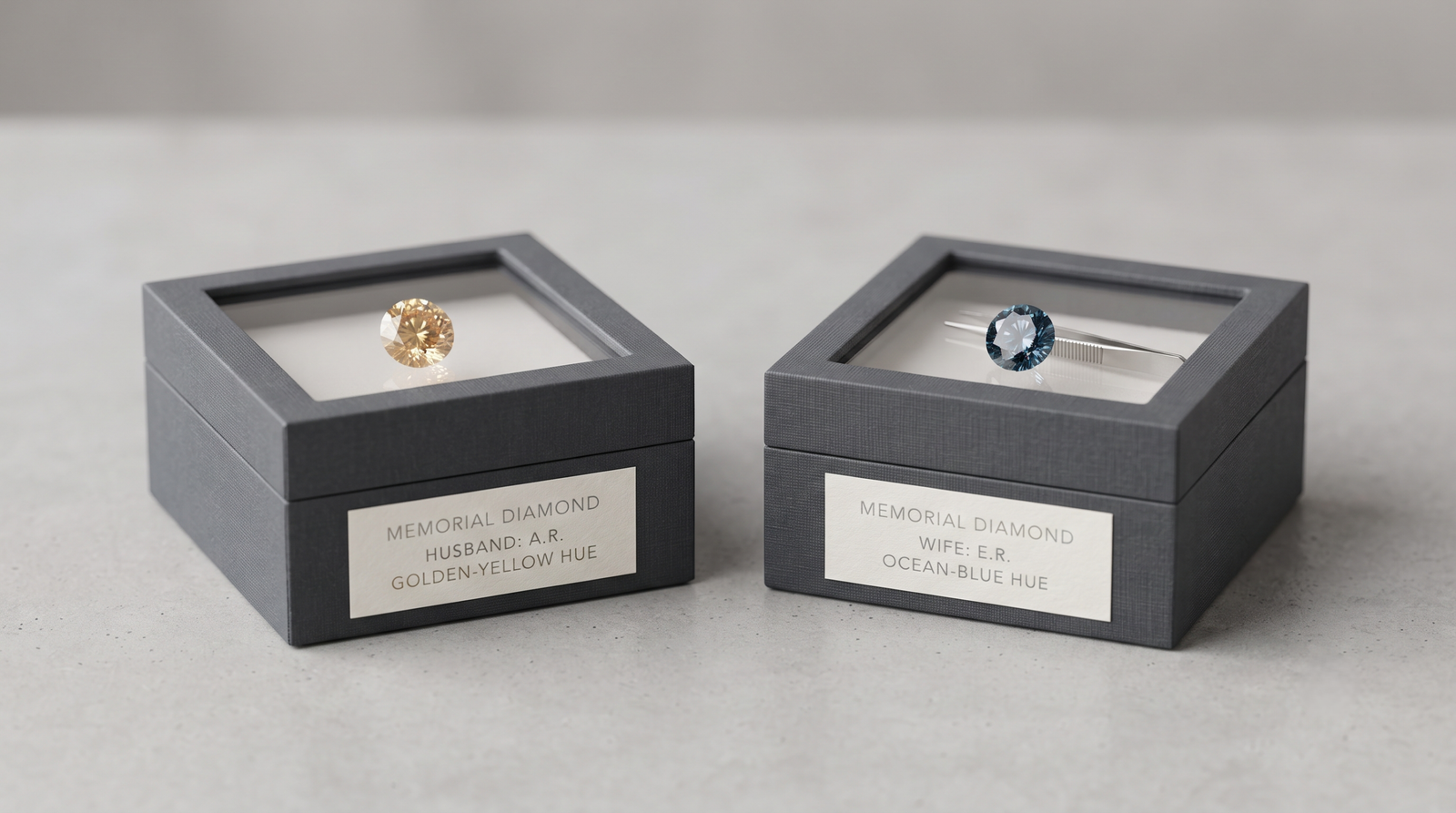
Husband's ashes diamond: a small yellow-toned lab-grown memorial diamond beside a sealed, labelled portion of cremated remains

How to Turn Your Husband’s Ashes Into a Diamond

Every guide to this begins by telling you to ask whoever holds his remains to set a portion aside. If you were married to him, that person is usually you, and the container is usually in your house. To turn your husband’s ashes into a diamond, you set aside a small portion yourself, typically a few tablespoons up to about four ounces, send it to a laboratory, and receive a real lab grown husband’s ashes diamond back in roughly six to ten months. The step nobody prepares you for is the first one, because there is no funeral director standing between you and the urn.

Where Are His Ashes Right Now?

Everything below assumes his ashes are already in your home, which is where most requests for a husband’s ashes diamond begin. If they are not, your first step changes.

Where his ashes areYour actual first stepWho to ask
In your homeSet a portion aside yourselfNobody. This one is yours
Still with the funeral homeAsk them to hold a portion back before releaseThe funeral director. Whether they will separate, label, and hold it
Interred or in a nicheAsk what removal involves and whose consent it needsThe cemetery. Rules vary by state and by cemetery
Scattered, in whole or partAsk what remains, or consider a hair sample insteadWhoever scattered them. See the hair route

If a funeral home still holds them, ask about the deadline. Many release remains on a schedule, and a portion held back has to be requested before that date, not after.

Step 1: Decide How Much to Set Aside

Cremated remains are mostly calcium phosphate; usable carbon is roughly 0.5% to 4% by weight. That low yield is why providers of a husband’s ashes diamond ask for a measurable portion rather than a pinch, and why it is still a small fraction of a full cremation. Industry typical requests run from a few tablespoons to around four ounces, or about 100 grams.

Ask your chosen provider for their exact figure before you open the urn, and ask whether a second husband’s ashes diamond would need a second portion. If his children may want stones of their own, setting aside enough for all of them now saves reopening the container later. The quantity question is answered in detail in how much ash you need for a husband memorial diamond.

Step 2: Divide the Portion at Your Own Table

This is the job the guides to a husband’s ashes diamond skip. There is no ritual for it and no one to hand it to, so make it deliberate:

  1. Choose a time when you will not be interrupted, and decide whether you want someone with you.
  2. Lay out a clean surface, a kitchen scale, a new sealable bag or container, and a permanent marker.
  3. Open the urn and transfer the portion with a clean spoon. Do not sift or select; the remains are uniform.
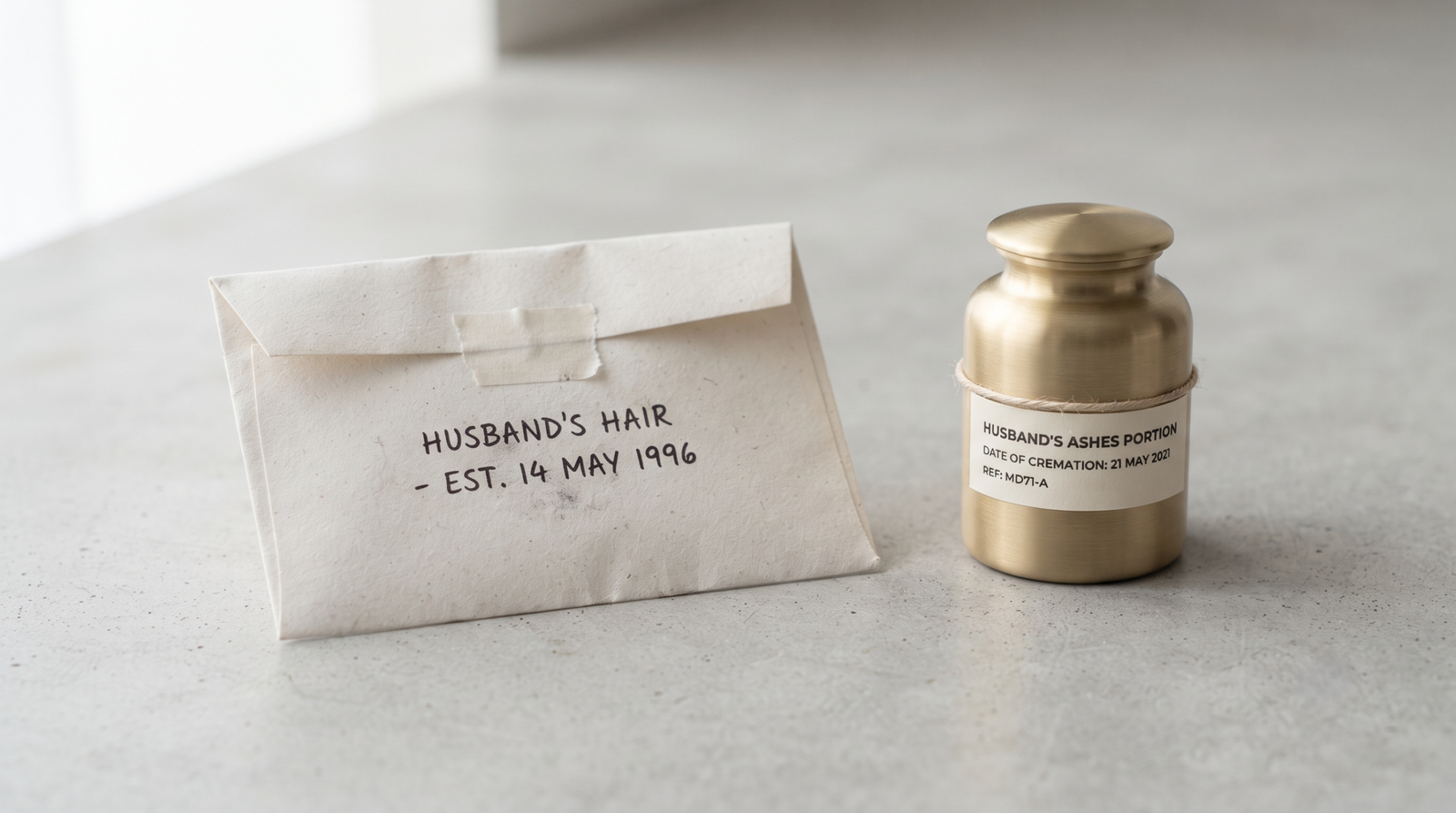
  4. Weigh the portion, seal it, and label it with his name, the date, and the weight.
  5. Close the urn, and put the labelled portion somewhere it cannot be mistaken for anything else.
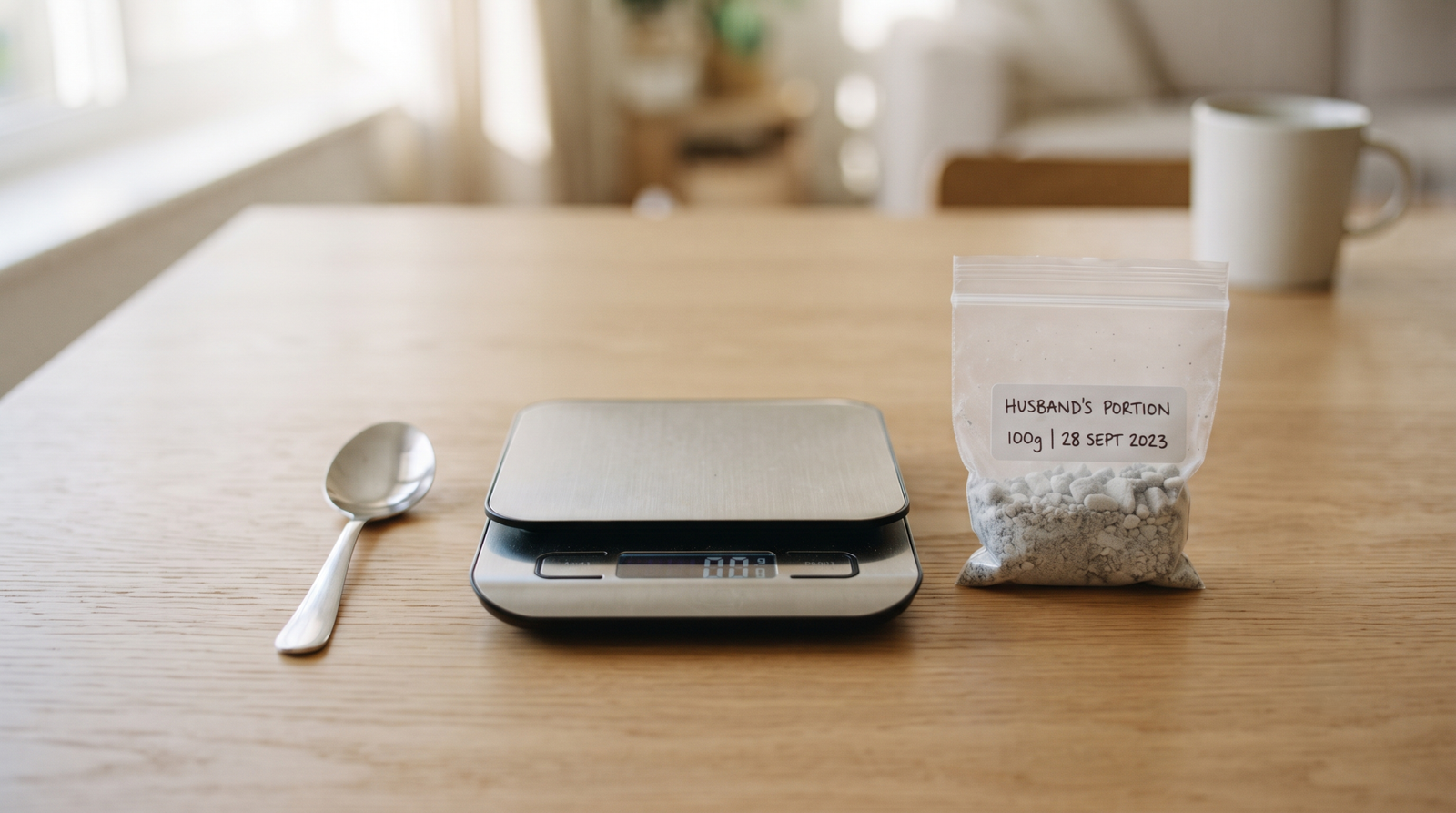
A kitchen scale, a clean spoon, and a sealed labelled bag laid out on a table before dividing cremated remains

Some people find this unbearable and ask a funeral home to do it for a fee. That is a reasonable choice. Some find it the first thing since the funeral that felt like theirs to do. Neither reaction is wrong.

Step 3: Write Down What You Did

Once the portion leaves the urn, you are the only record that it existed. No funeral home logged it; no one else watched. Write down the date, the weight, and where the rest of his ashes are, and keep that note with the paperwork that comes back from the provider. A husband’s ashes diamond will eventually carry an origin document; your own note is the first entry in that chain.
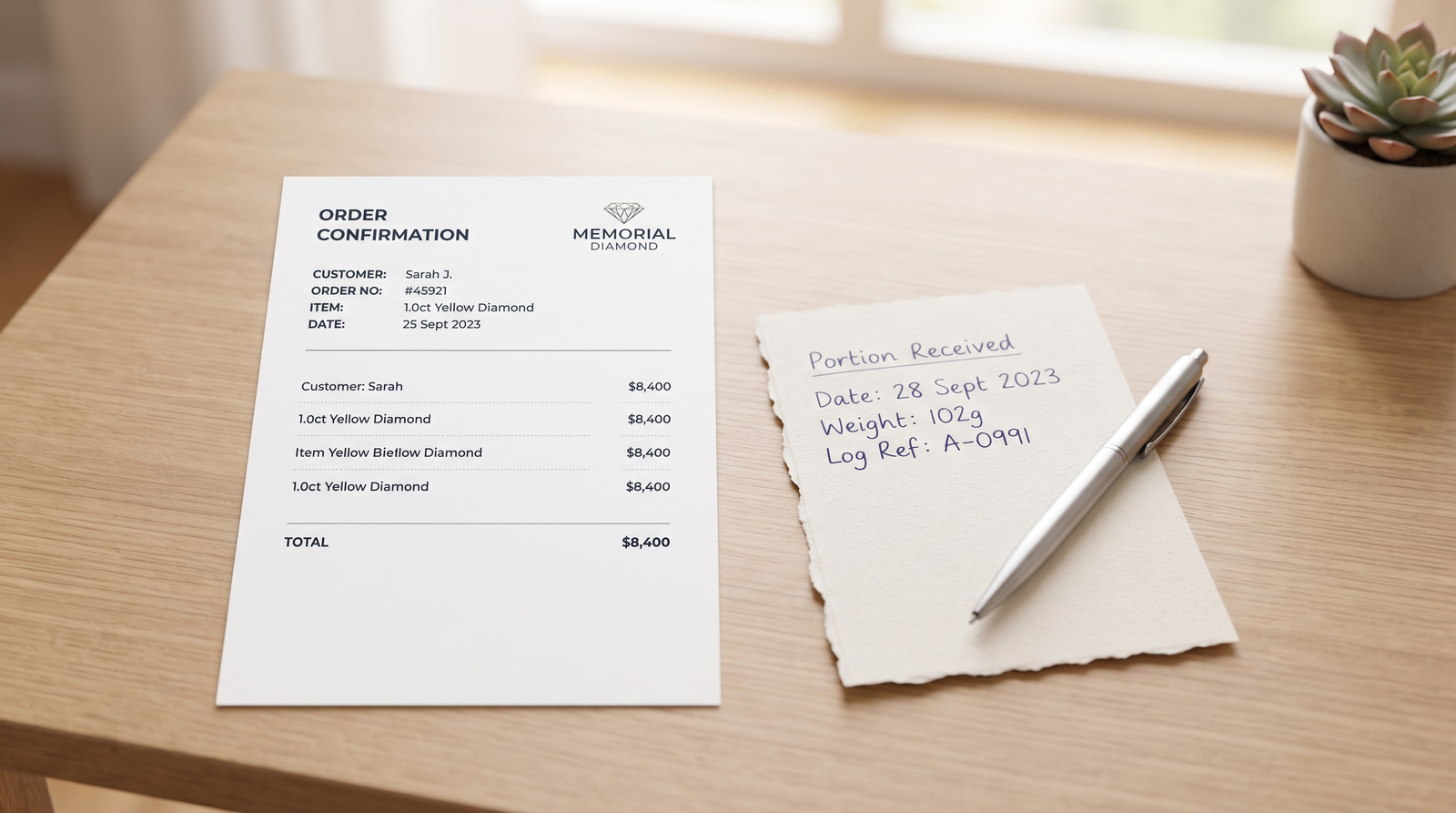
handwritten-record-ashes-portion-date-weight

Step 4: Choose and Brief a Provider

Providers of a husband’s ashes diamond differ on method, minimums, and what they return to you. Before you send anything, settle these in writing:

  • Which growth method they use, and how HPHT and CVD diamond growth affects timeline and color.
  • What they record at intake: a weight, a photograph, an order reference.
  • What happens to any material not consumed by carbon extraction.
  • Whether the finished stone is graded by an independent laboratory, and by whom.
  • The carat size and color you are choosing, and the price for each, including any grading report or setting.

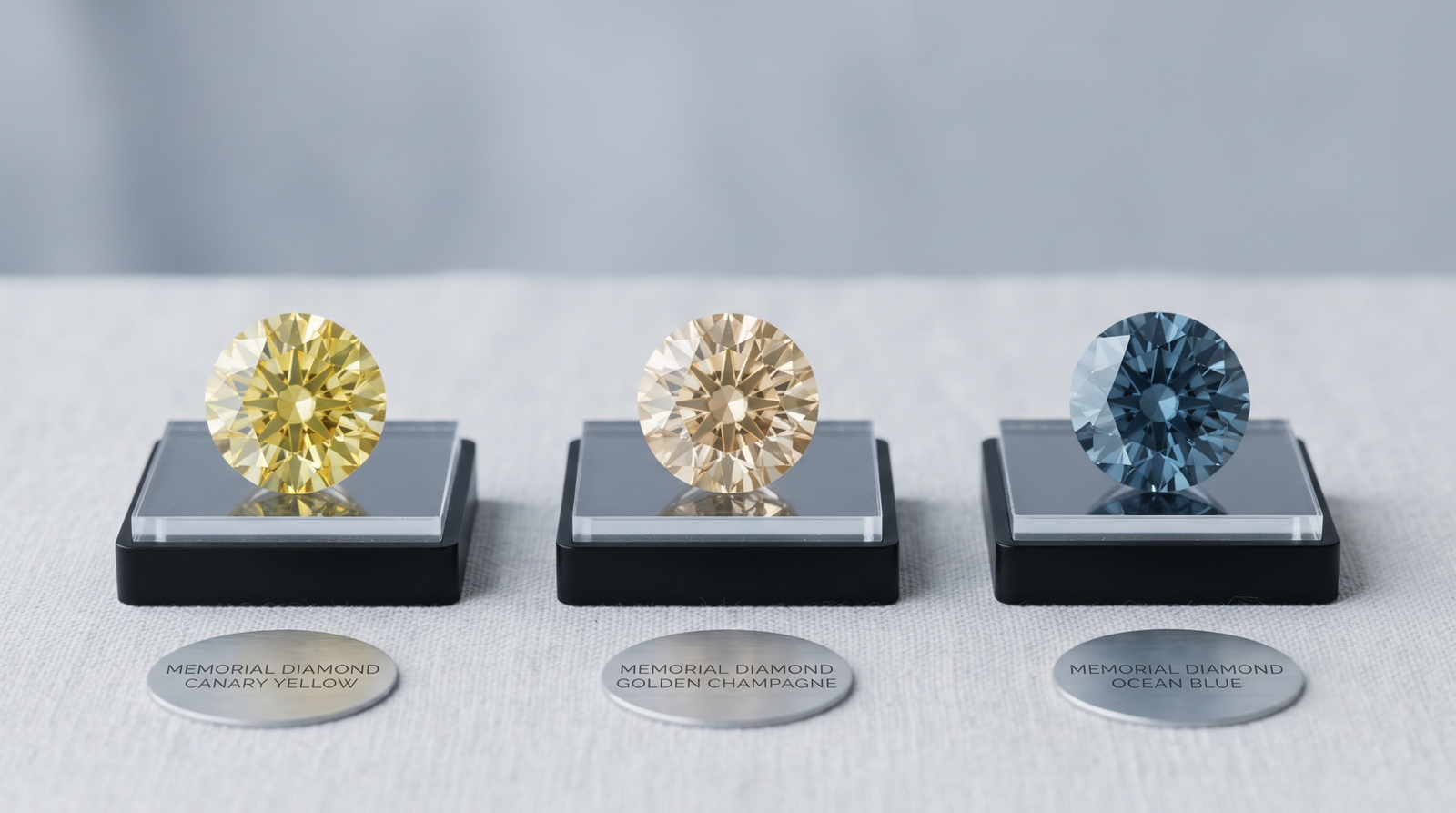
Color is worth understanding before you decide. Trace nitrogen produces yellow tones and boron produces blue; a colorless husband’s ashes diamond requires those elements to be excluded and typically costs more. Most memorial stones trend toward yellow, champagne, or blue. The full list of questions is in questions to ask before turning your husband’s ashes into a diamond.

Step 5: Send the Portion

Shipping rules for cremated remains vary by carrier and by country, so confirm the provider’s current instructions on the day rather than following a general rule. Most husband’s ashes diamond providers send a labelled collection kit. Photograph the sealed portion before it goes, keep the tracking number with your note from Step 3, and ask the provider to confirm receipt and the recorded weight.

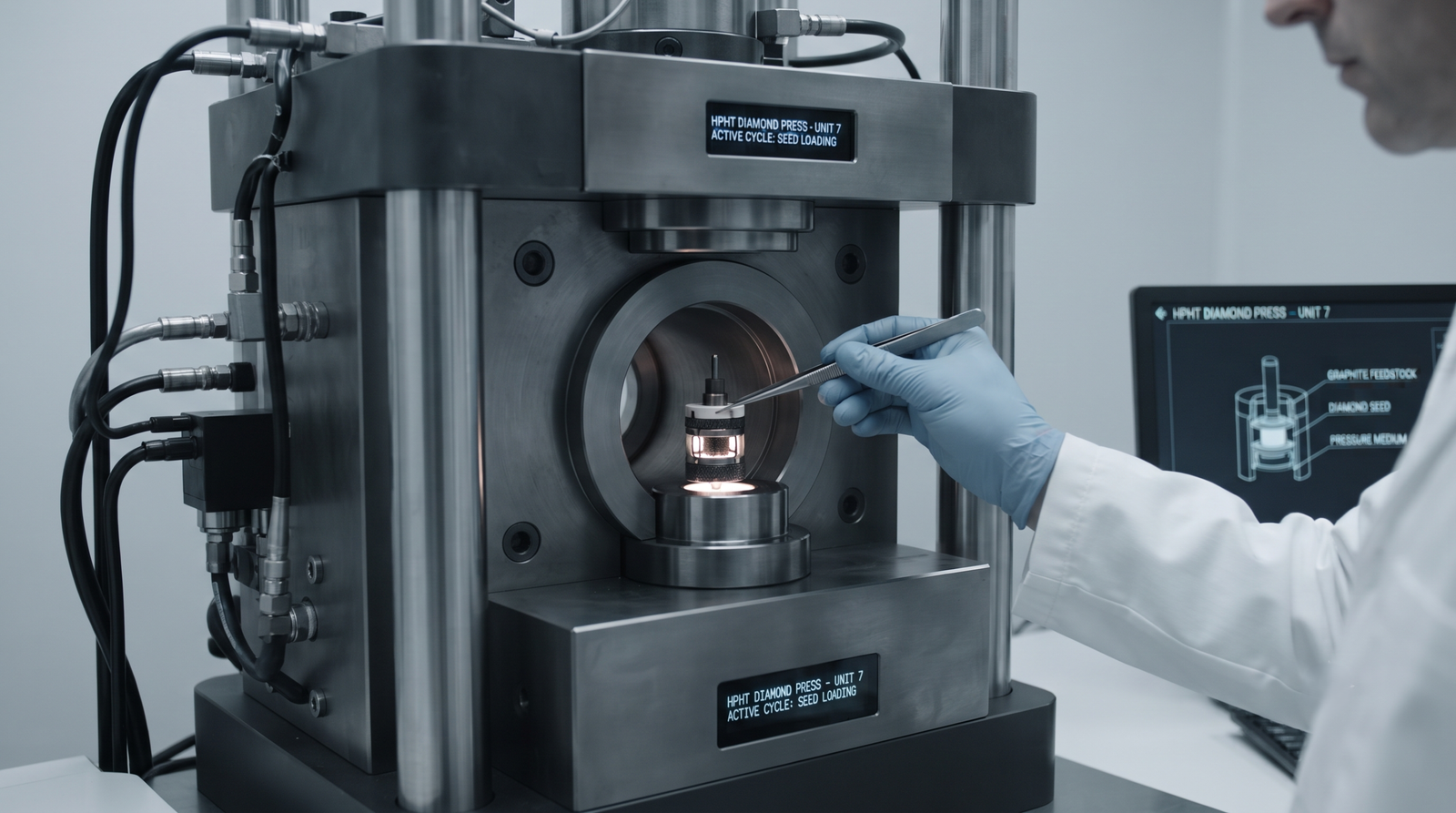
An HPHT diamond growth press in a laboratory

Step 6: What Happens Once It Leaves You

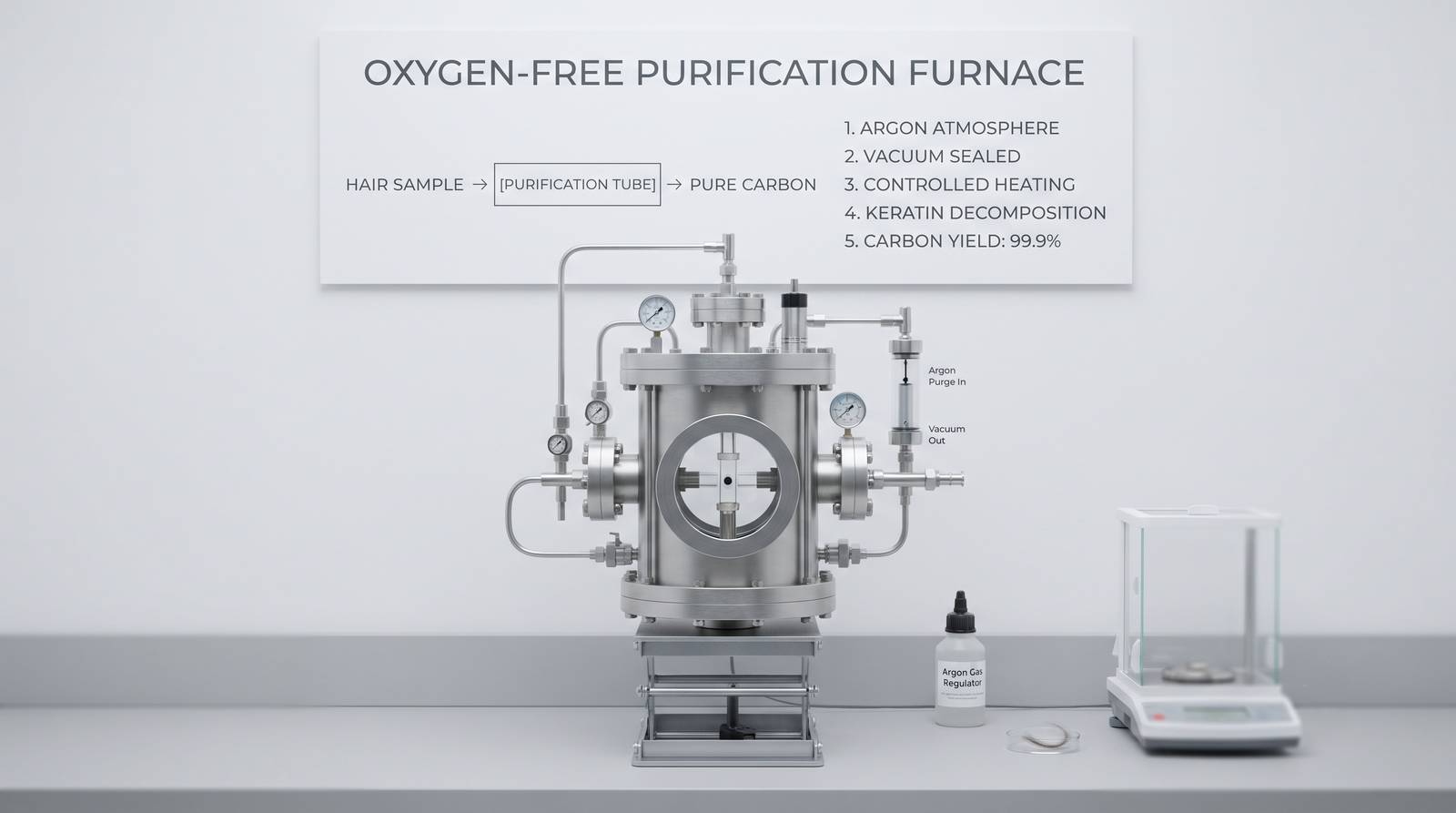
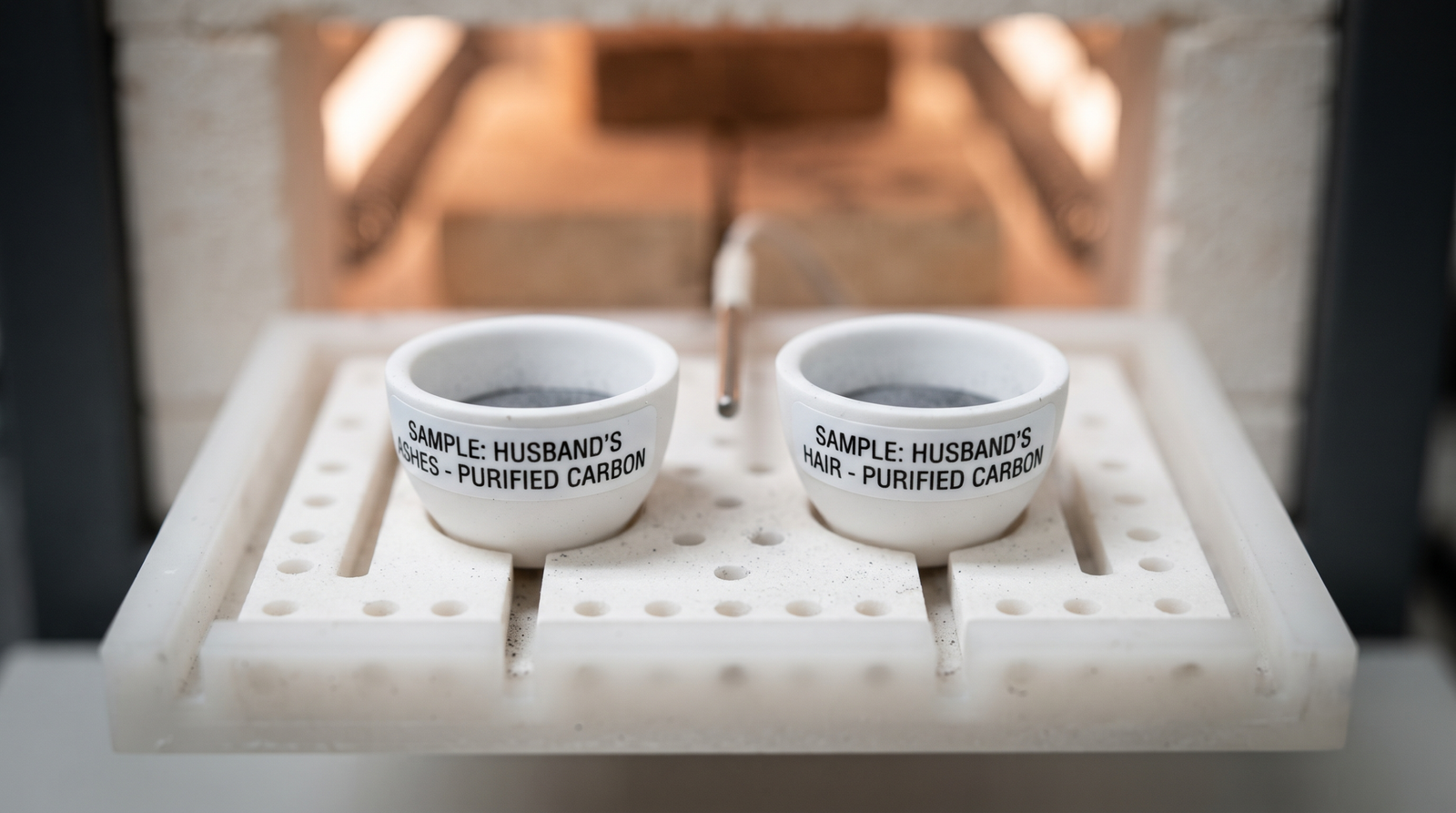
From here the husband’s ashes diamond is the laboratory’s work. The portion is heated in a controlled, oxygen free process that removes the calcium phosphate and leaves carbon at roughly 99.9% purity. That carbon is converted to graphite at around 2,500 to 2,700°C, blended with laboratory carbon to reach the volume a viable crystal needs, and grown around a diamond seed for weeks to months. A gemologist then cuts and polishes the rough stone, and it is graded on the same cut, color, clarity, and carat scale as any diamond.

Growth time in the press, not the amount of ash you sent, determines carat size; the whole picture, including settings and family decisions, is in the husband ashes diamond guide. Industry wide, a husband’s ashes diamond takes six to ten months, sometimes twelve for larger or specialty color stones. The stage by stage version, including who holds the material at each point, is in how a memorial diamond is made from your husband’s ashes.

How Much of a Husband’s Ashes Diamond Is Actually Him?

Less than you might hope, and more than a symbol. The carbon recovered from his ashes typically makes up around 10% to 15% of the finished stone’s mass, with the rest being laboratory carbon needed to grow a crystal of usable size. Some providers cite lower figures for larger stones. A husband’s ashes diamond is physically made in part from him, and the origin document should say exactly that. Any provider claiming the stone is entirely his ashes is overstating the physics.

Frequently Asked Questions

Can I divide my husband’s ashes myself, or does a funeral home have to do it?

You can do it yourself. Once cremated remains are released to you, dividing them is a private decision, though customs and cemetery rules may apply if they are interred. Many funeral homes will separate and label a portion for a fee if you would rather not.

How much of his ashes do I need for a husband’s ashes diamond?

Industry typical requests run from a few tablespoons to about four ounces, roughly 100 grams. That is a small fraction of a full cremation, so the remainder can be interred, scattered, or kept as planned. Confirm the exact figure with your provider before opening the urn.

Is the diamond really made from his ashes?

Yes, in part. Carbon is extracted from the ashes, purified, and grown into the crystal; that personal carbon typically makes up around 10% to 15% of the stone, with laboratory carbon supplying the rest. The stone is physically made from him, not a keepsake with ashes sealed inside.

How long does it take to turn my husband’s ashes into a diamond?

Six to ten months from receipt of the ashes to a finished husband’s ashes diamond is typical industry wide, with larger or specialty color stones sometimes taking up to twelve months. The time is spent mainly in the growth press, and carat size is set by that growth time.

What color will a husband’s ashes diamond be?

Most memorial diamonds trend toward yellow, champagne, or blue because trace elements from an organic carbon source remain during growth. Colorless is achievable with additional processing at a higher cost. Some providers also offer post growth irradiation for red, pink, green, or black.

Can his children get diamonds from the same ashes?

Usually, yes. Because only a portion is used per husband’s ashes diamond, several diamonds can be grown from one shared source if enough remains. Decide early how many portions to set aside so the urn is opened once rather than repeatedly.

Final Thoughts on Turning Your Husband’s Ashes Into a Diamond

The laboratory part of a husband’s ashes diamond is slow, documented, and out of your hands. The part that is yours is the first afternoon: the scale, the spoon, the label, and the note only you can write. Do that part carefully, and everything that follows has a record to stand on.

Learn More About Husband Memorial Diamonds

Talk With Memorial Diamond

If his ashes are in your home and you are unsure whether a husband’s ashes diamond is right, or how much to set aside or how to send it, reach out to Memorial Diamond to talk through the first step before you open the urn.
Husband's hair to memorial diamond: a small lock of gray hair in a labelled envelope beside a blue-toned lab-grown diamond

How a Memorial Diamond Is Made From Your Husband’s Hair

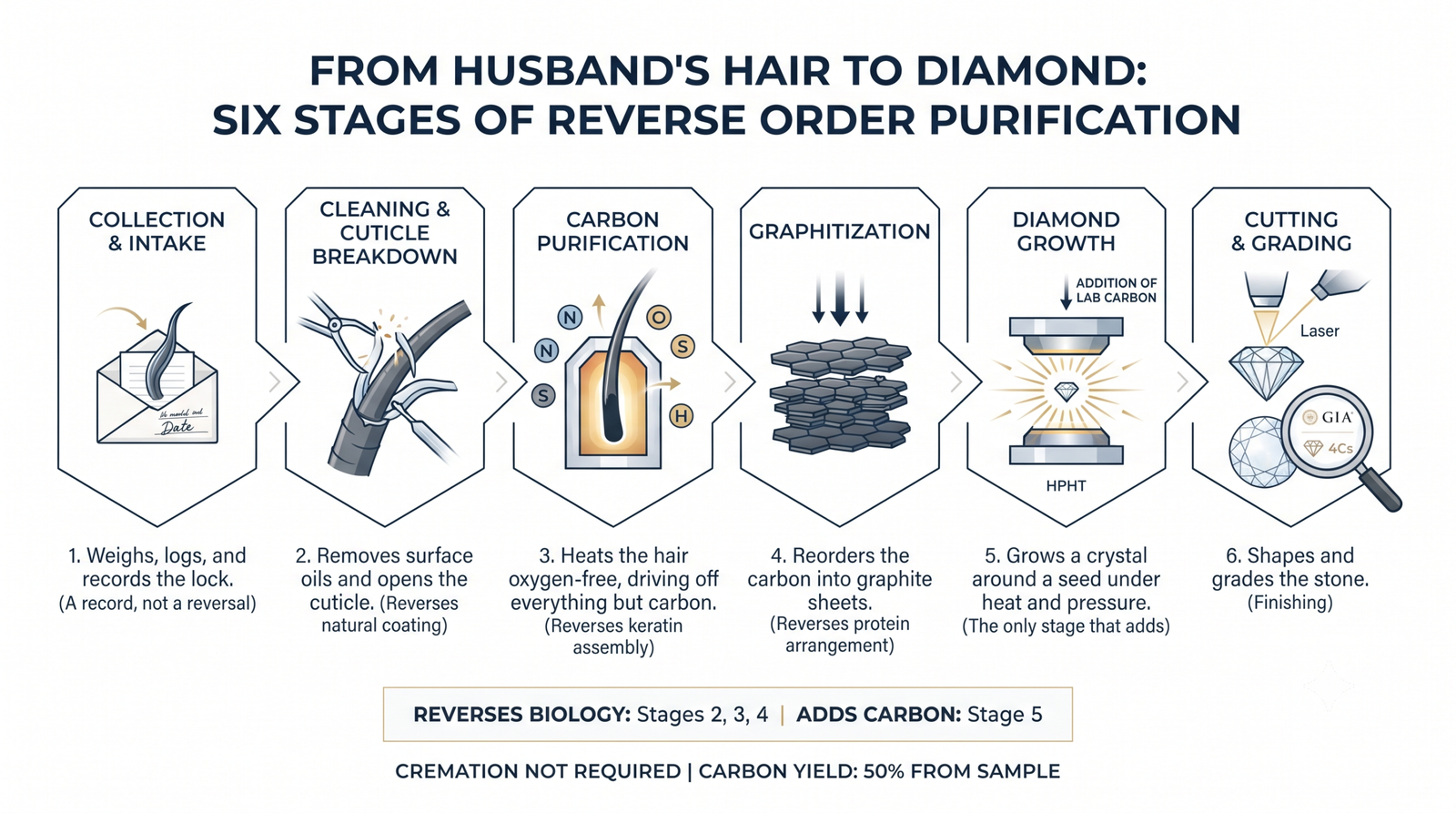
His body spent years building each strand, and the laboratory spends weeks taking that work apart. A memorial diamond made from your husband’s hair starts with a small lock, a few grams, which is purified to carbon, converted to graphite, blended with laboratory carbon, and grown into a real diamond over roughly six to ten months. Almost every stage of that process reverses something his biology did to make the fiber, in the opposite order it was made. Exactly one stage is not a reversal. That is where the diamond comes from.

What His Body Built, and What the Lab Undoes

Your husband’s hair is keratin, a protein his follicles assembled from amino acids, cross linked with sulfur bonds, wrapped in a protective cuticle, and coated with oils. Roughly half of its weight is carbon. To reach that carbon, the laboratory strips away each of those layers, last added first.

#StageWhat his body didWhat the lab doesReversal?
1Collection and intakeGrew your husband’s hair over monthsWeighs, logs, and records the lockNo; a record, not a reversal
2Cleaning and cuticle breakdownCoated the fiber in oils and a scale like cuticleRemoves surface oils and opens the cuticleYes
3Carbon purificationAssembled keratin from carbon, nitrogen, oxygen, sulfur, hydrogenHeats the hair oxygen free, driving off everything but carbonYes
4GraphitizationArranged carbon inside a proteinReorders the carbon into graphite sheetsYes
5Diamond growthNothing; his body never made diamondGrows a crystal around a seed under heat and pressureNo; this is the one addition
6Cutting and gradingNothingShapes and grades the stoneNo; finishing
A six-stage diagram showing a hair strand's layers being removed in reverse order, ending in a diamond crystal

Stage 1: The Lock Leaves Your Hands

Your husband’s hair is not a regulated shipment the way cremated remains are, so the safeguards are the ones you build. Label the envelope with his name, the date collected, and the source. Photograph it. Ask the provider what they record at intake, whether a photograph, a weight, or both, and ask them to confirm receipt with the weight they logged. The collection method itself is in how to turn your husband’s hair into a diamond. If the lock is small, ask before sending whether they will assess a photograph and a weight first, so you are not committing the only hair you have to an order that cannot proceed.

Stage 2: Removing What Keratin Added Last

The outermost layer of your husband’s hair is the last thing his body finished: the cuticle, a scale like sheath, and the oils that coated it. The laboratory removes those first, cleaning surface contamination and opening the cuticle so the process can reach the fiber’s core. This is a small stage, but it is the first of the reversals, and it is why hair from a hat or a coat collar, with lint and dust attached, is still usable: contamination sits on the outside, and the outside is what goes first.

Stage 3: Purification to Carbon

The keratin in your husband’s hair is made of carbon, nitrogen, oxygen, sulfur, and hydrogen, bonded together. In a controlled, oxygen free, multi stage heating process, the laboratory drives off every element except carbon, leaving it at roughly 99.9% purity. Everything his follicles assembled around the carbon, the sulfur cross links that gave his hair its texture, the nitrogen in the amino acids, is removed.

A sealed oxygen-free purification furnace in a laboratory

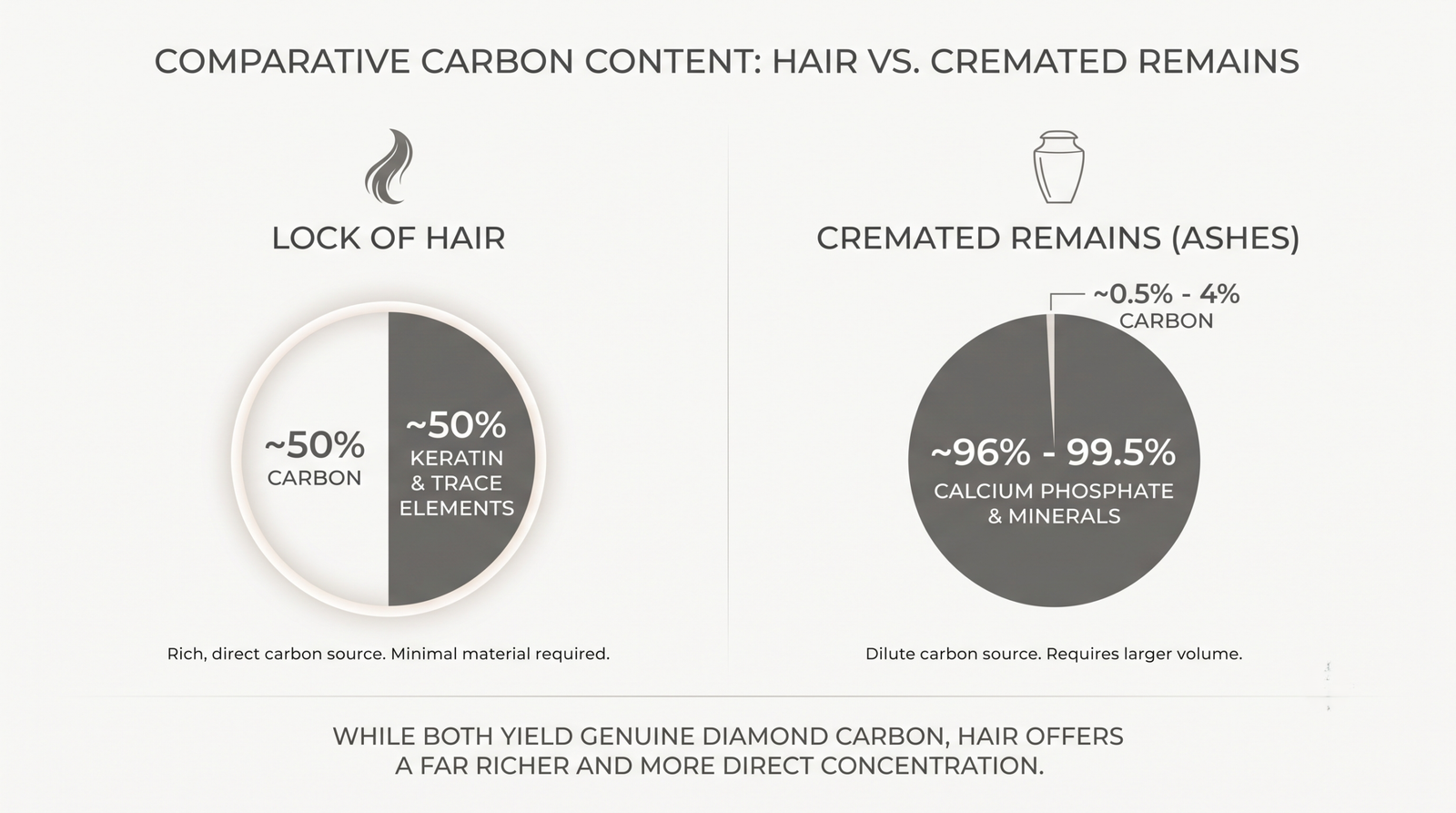
Because your husband’s hair is roughly 50% carbon, this stage yields a great deal from a very small lock. Cremated remains, by comparison, are roughly 0.5% to 4% carbon. That difference is why a hair based stone needs grams rather than ounces, and why it is available to families who chose burial. Ask what happens to any hair not consumed by extraction; some providers return it, and if you sent the only lock you had, that matters.

Stage 4: Graphitization

The carbon purified from your husband’s hair is heated further, to roughly 2,500 to 2,700°C, and its atoms reorganize into graphite, the layered crystalline form that diamond presses use as feedstock. His body arranged those same carbon atoms inside a protein; the lab now arranges them into sheets. After this stage the material is graphite, physically indistinguishable from any other graphite except by the record that says whose it is.

That record, from your envelope label to the intake weight to this stage, is what the origin document will eventually certify, and it is the answer to the question in is a memorial diamond really made from your husband’s hair. The ashes equivalent of this map is in how a memorial diamond is made from your husband’s ashes.

Stage 5: Growth, the One Step That Adds

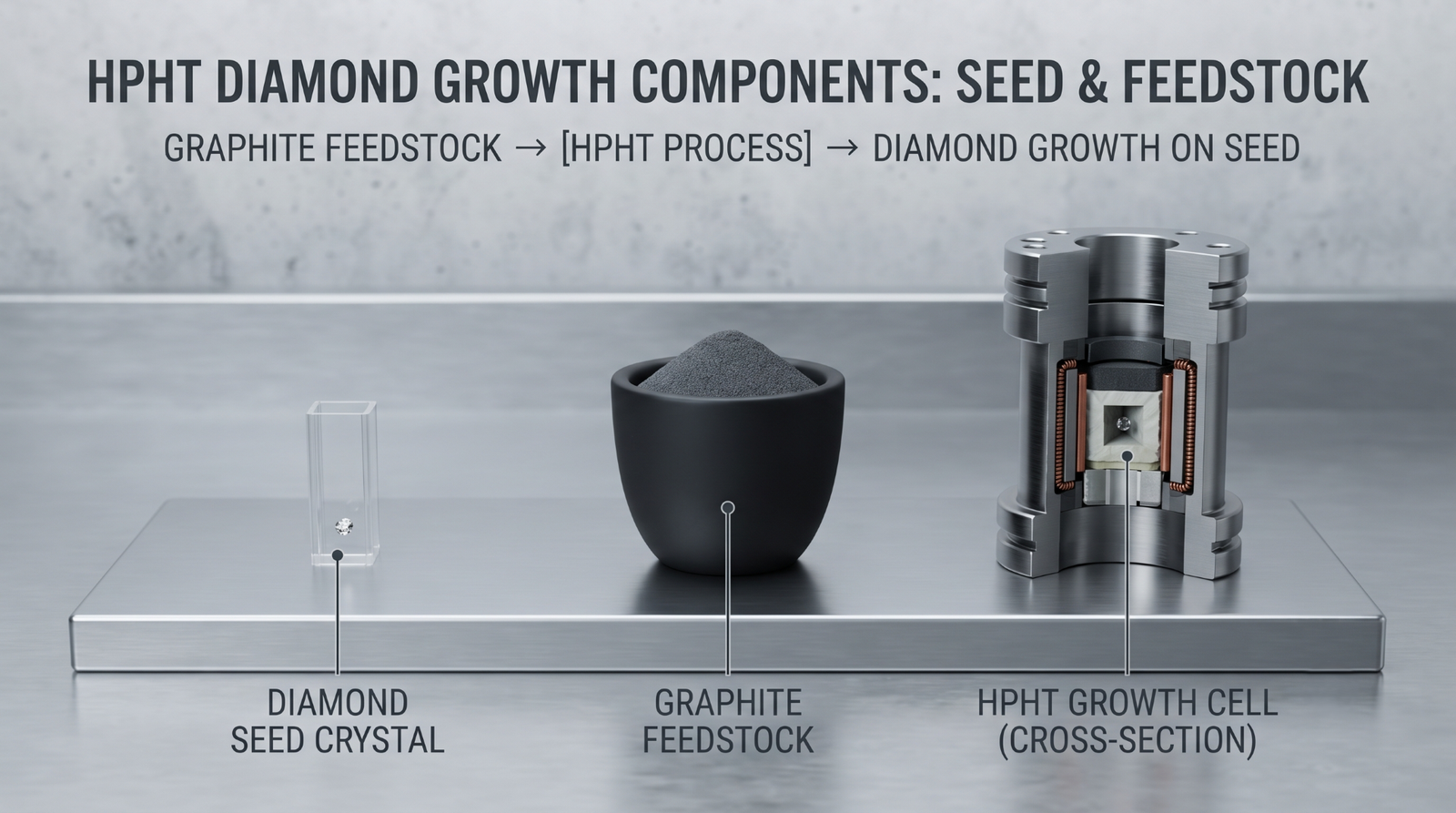
This is the only stage that does something his body never did. The graphite is blended with additional laboratory carbon, placed with a tiny diamond seed in a growth cell, and grown by HPHT or CVD diamond growth. Most memorial providers use HPHT, a press recreating roughly 6 to 8 GPa and 1,400 to 2,500°C; a minority convert the carbon to gas for CVD. Growth takes weeks to months, and growth time, not the size of the lock, sets the carat.

A diamond seed crystal and graphite feedstock beside an HPHT growth cell

The honest proportion belongs here too. Personal carbon typically makes up around 10 to 15% of a finished memorial diamond; the rest is laboratory carbon needed to grow a crystal of usable size. With hair, the limit on the personal share is the stone’s size, not your sample. The finished crystal is diamond in every physical sense, scoring 10 on the Mohs scale as the hardest known natural mineral.

Stage 6: Cutting, Grading, and the Record

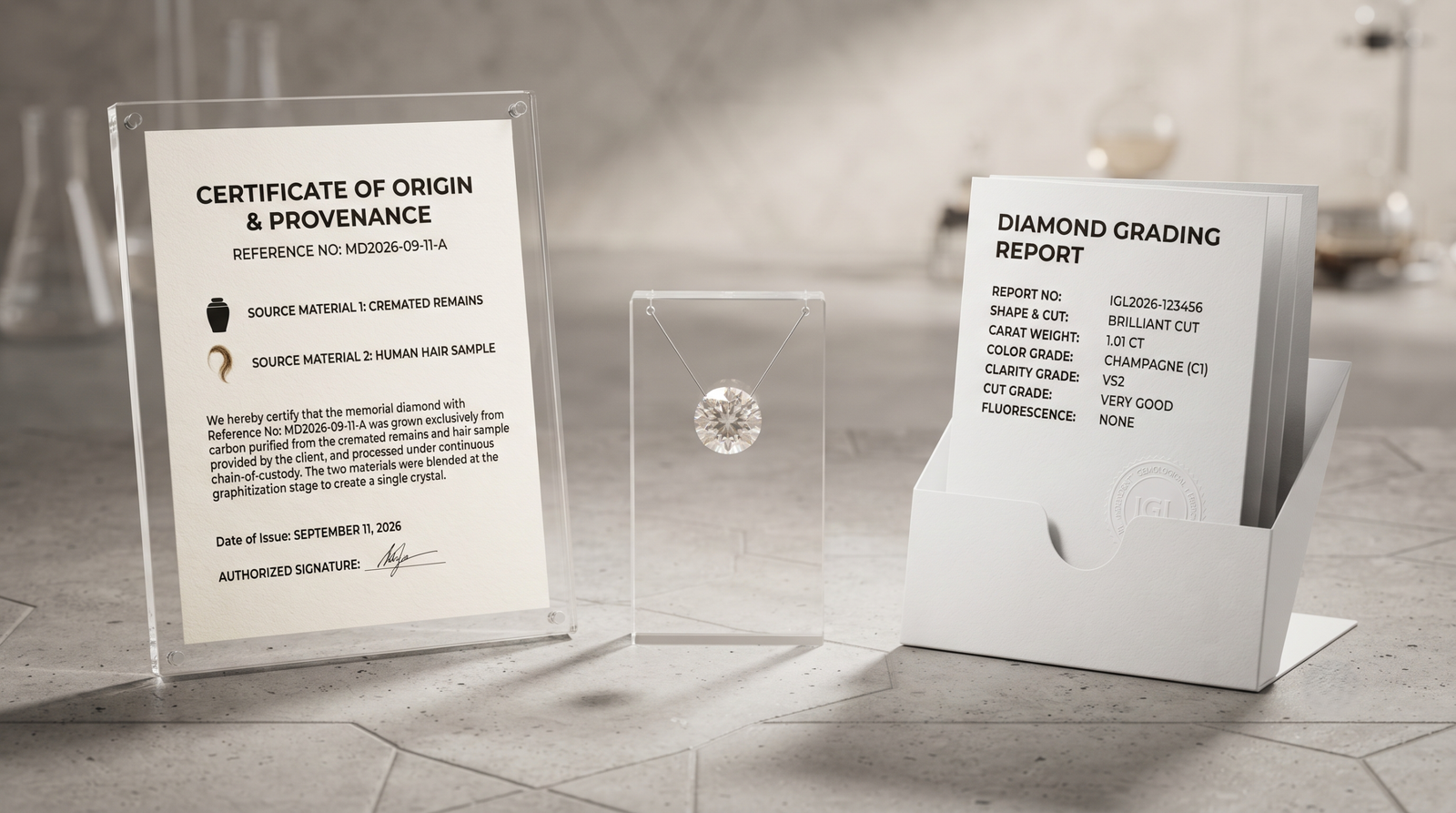
A gemologist cuts and polishes the rough crystal grown from your husband’s hair into the shape you chose. Reputable providers then send it to an independent laboratory for grading on cut, color, clarity, and carat. Two documents should return with the stone: a grading report describing the diamond’s quality, and an origin document tracing it back through every stage to the lock you sent. Color will not match his hair; it is set by trace elements during growth, with most memorial stones landing in yellow, champagne, or blue. The options are in what color diamond can be made from your husband’s hair.

Why Your Husband’s Hair Needs So Little Material

  • A palm sized lock, a few grams, is the industry typical minimum, against a few tablespoons to four ounces of ashes.
  • Your husband’s hair keeps indefinitely once dry, so a lock from decades ago works as well as one cut last month.
  • One generous lock can sometimes support more than one stone; a few strands usually support one. Ask before assuming either.
  • Because hair yields carbon so efficiently, it can be combined with a small ash portion when a family holds both; that route is described in how a memorial diamond is made from your husband’s ashes and hair.

Quantity on its own is covered in how much hair you need for a husband memorial diamond.

Frequently Asked Questions

How much of my husband’s hair is needed?

Industry typical minimums are a small lock, a few grams, often described as palm sized. Because hair is roughly 50% carbon, far less is needed than for ashes. If you have only strands, ask the provider to assess a photograph and a weight before you commit the sample.

Does his hair need to be cremated first?

No. A memorial diamond from your husband’s hair involves no cremation at any stage. Carbon is extracted directly from the keratin in the strand, which is why this option is available to families who chose burial or who scattered his ashes.

Does the diamond contain his DNA?

No. Purification removes every element except carbon, and DNA is a large molecule made of several elements. What remains is his carbon, physically grown into the crystal, traced by the origin document rather than by any biological marker.

How much of the diamond is actually him?

Typically around 10 to 15% of the finished stone’s mass is carbon from his hair; the remainder is laboratory carbon needed to reach a growable volume. With hair, that share is limited by the stone’s size, not by how small your lock was.

Will the diamond be the color of his hair?

No. Color is set by trace elements such as nitrogen or boron during growth, not by the pigment of your husband’s hair, and gray hair yields the same carbon as dark hair. Most memorial diamonds land in yellow, champagne, or blue; colorless is possible with extra processing at higher cost.

Can a failed growth run be attempted again?

Sometimes, if purified carbon from your husband’s hair remains after the first attempt. Whether a provider re runs from remaining carbon, what it costs, and who bears that cost varies. Ask before ordering, especially if you sent the only lock you had.

Final Thoughts on How a Memorial Diamond Is Made From Your Husband’s Hair

Five of these six stages take apart your husband’s hair, what he grew without noticing, one layer at a time and in reverse. The sixth builds something he never had. If that ordering means something to you, it is worth choosing a provider who can show you the record of each stage, from the envelope you labelled to the document that comes back with the stone.

Learn More About Husband Memorial Diamonds

Talk With Memorial Diamond

If you are holding a lock of your husband’s hair and want to understand what each stage would record before you send it, reach out to Memorial Diamond to talk through what’s possible.

Diamond really made from a husband's hair: a loose blue-toned lab-grown diamond beside a labelled envelope holding a small lock of hair

Is a Memorial Diamond Really Made From Your Husband’s Hair? 5 Doubts Finally Answered

The question under this question is usually whether hair counts. So: yes, a memorial diamond really made from your husband’s hair is a genuine lab grown diamond grown from carbon extracted from the lock itself, and it is not the consolation version of an ashes stone. Hair is roughly 50% carbon by weight; cremated remains are roughly 0.5% to 4%. A diamond really made from a few grams of his hair is the same object, made by the same process, as one made from four ounces of ashes, and for a family who chose burial it is the only version.

Is a Diamond Really Made From Hair the Same as One From Ashes?

From his hairFrom his ashes
Carbon in the sourceRoughly 50%Roughly 0.5% to 4%
Material neededA small lock, a few gramsA few tablespoons to ~4 oz
Cremation requiredNoYes
Growth methodHPHT or CVD, identicalHPHT or CVD, identical
Personal carbon in the stoneTypically around 10% to 15%Typically around 10% to 15%
Finished objectA lab grown diamond, graded on the 4CsA lab grown diamond, graded on the 4Cs
A simple side-by-side graphic comparing carbon content in hair and in cremated remains

For a diamond really made from hair, the extraction is, if anything, the less doubtful part. Keratin is carbon rich, so a laboratory can purify a small lock to about 99.9% carbon, convert it to graphite, and grow a crystal by standard HPHT or CVD diamond growth. The full sequence, stage by stage, is in how a memorial diamond is made from your husband’s hair.

Where the Doubt Actually Sits: Provenance, Not Extraction

With a diamond really made from ashes, the doubt is about quantity and dilution. With hair, it is about identity: was this lock actually his? Hair from a shared brush, a shared pillow, or a coat two people wore carries less certainty than a lock cut at the hospital or taken from a razor only he used. A diamond really made from his hair is only as certain as the sample you sent.

That makes the honest safeguards yours to build before the lock leaves you. Label the envelope with the source and date. Photograph it. Ask the provider what they record at intake and whether they will assess a photograph and weight first. Keep hair from different places in different envelopes rather than pooling them. The ashes version of this question is answered in is a memorial diamond really made from your husband’s ashes, and the combined version in is a memorial diamond really made from your husband’s ashes and hair. Confidence classes by source are laid out in the husband hair diamond guide.

Questions to Ask Before Sending the Hair

Before sending a lock, ask the provider about the minimum amount required. Ask whether the provider wants a specific type of hair. Ask how the provider labels the material when it arrives. Ask whether the provider photographs or weighs the sample during intake.

You can also ask how the provider documents the source material during processing. Ask what records you receive during the process and what documentation accompanies the finished diamond. These questions can help you understand the chain of custody from the original envelope to the completed stone.

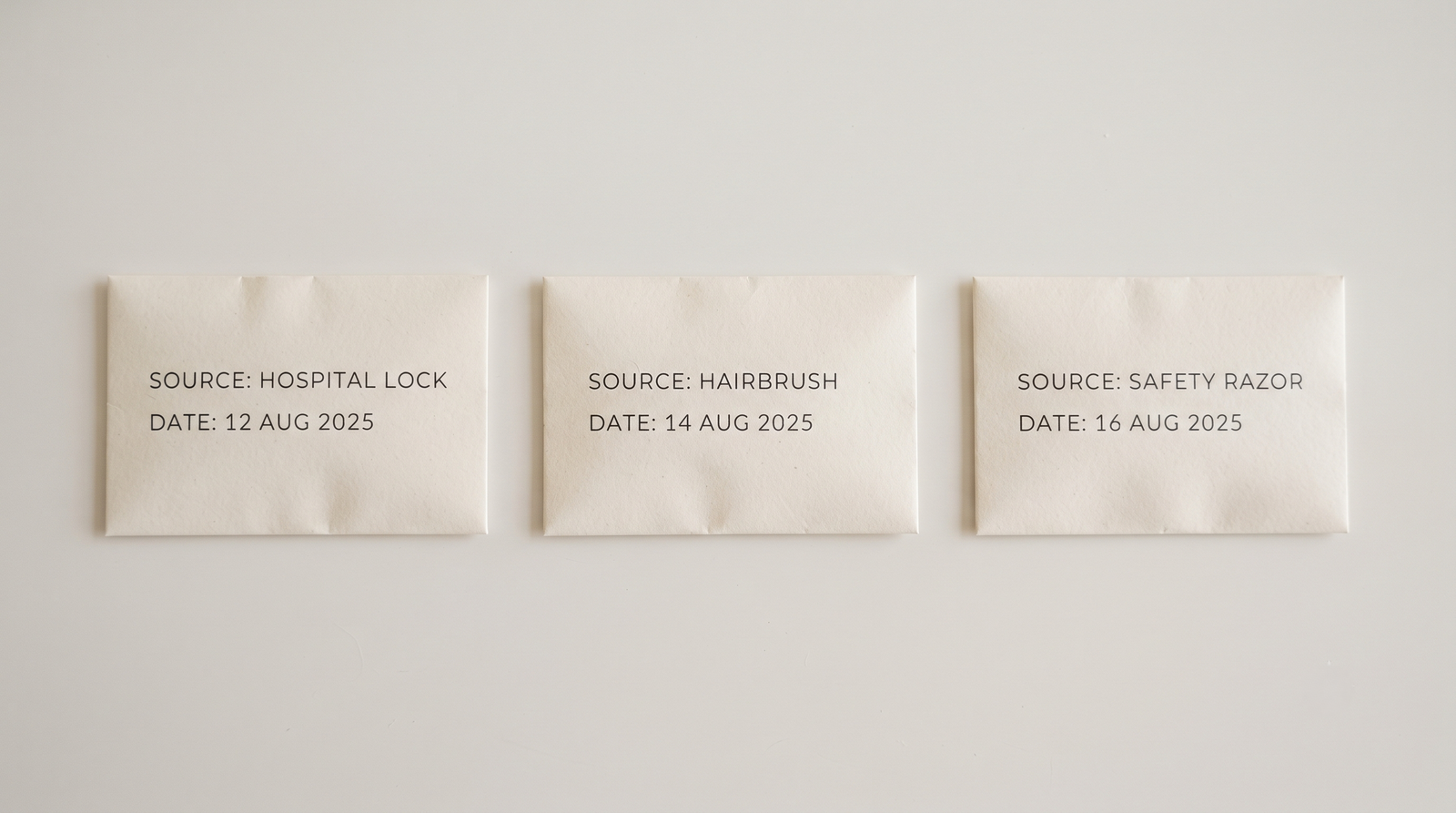
Three labelled paper envelopes, each marked with a different source and date

What the Lock Has to Be, and What It Does Not

  • Has to be: his, dry, and enough for the provider’s minimum, which is typically a small lock or a few grams.
  • Does not have to be: fresh, with roots, a particular color, or from a particular part of the body. Hair stored dry keeps its carbon indefinitely, and pigment does not affect the stone’s color.
  • Will not survive into the stone: DNA, texture, or hair color. Purification removes everything but carbon; the diamond’s color comes from trace elements during growth, and most memorial stones trend yellow, champagne, or blue.

If the sample is too small for a diamond really made from it, a provider should say so before you order rather than after. Quantity is covered in how much hair you need for a husband memorial diamond.

What Makes a Hair Based Memorial Diamond Different?

The most important difference is that hair does not require cremation. This makes a hair based memorial diamond relevant to families whose loved one was buried. It also helps families who no longer have access to ashes but preserved a lock of hair.

Another difference is carbon concentration. Hair is roughly 50% carbon by weight, while cremated remains contain roughly 0.5% to 4% carbon. This explains why the amount of source material can differ significantly between hair and ashes.

That difference does not mean that a hair based diamond is a lesser diamond. The finished object is still a lab grown diamond. The growth method remains HPHT or CVD, and the finished stone can receive the same type of diamond grading based on its physical characteristics.

The personal meaning can also differ. Some families want a stone associated specifically with hair because the hair was preserved during life. Others may have ashes available and choose those as the source. Some families may choose a combination. There is no single source that carries the same meaning for every family.

Can hair from a shared brush be used?

It may be possible to process the material, but the personal certainty becomes more complicated because the brush may contain hair from more than one person. If identity matters to you, tell the provider exactly where the hair came from and keep different sources separated.

Frequently Asked Questions

Is a diamond really made from hair a real diamond?

Yes. Carbon extracted from the hair is purified, converted to graphite, and grown into a diamond crystal by HPHT or CVD, the same methods used across the lab grown industry. It has the same hardness and structure as any diamond and is graded on the same 4Cs.

How can a few grams of hair be enough when ashes need ounces?

Because hair is roughly 50% carbon by weight and cremated remains are only about 0.5% to 4%. A small lock yields far more usable carbon than the same weight of ashes, so industry typical minimums for hair are a palm sized lock or a few grams.

Does the diamond contain his DNA?

No. Purification removes every element except carbon, and DNA does not survive the process. What connects the stone to him is his carbon in the crystal and the chain of custody record from your labelled envelope to the origin document.

What if I am not sure the hair is his?

Then a diamond really made from that hair is only as certain as that doubt allows, not by the chemistry. Hair from a razor, hat, or brush only he used is high confidence; shared bedding or a shared brush is lower. Keep sources in separate labelled envelopes and tell the provider where each came from.

Does he need to have been cremated?

No. A memorial diamond from hair involves no cremation at any stage, which is why it is the route for families who chose burial or scattered his ashes before hearing of this option. It is the same finished diamond, not a substitute.

Final Thoughts on Whether a Memorial Diamond Is Really Made From Your Husband’s Hair

Hair only is not the lesser route. A diamond really made from his hair is grown by the same process, to the same standard, from a source that is far richer in carbon than ashes. What you are being asked to trust is not the chemistry but the envelope, and that part is in your hands.

Learn More About Husband Memorial Diamonds

Talk With Memorial Diamond

If what you have is a lock from a hairbrush and you are unsure it is enough, or enough his, reach out to Memorial Diamond to talk through what’s possible with what you kept.

husband's ashes to memorial diamond: a small sealed container of cremated remains beside a yellow-toned lab-grown diamond on a lab bench

How a Memorial Diamond Is Made From Your Husband’s Ashes

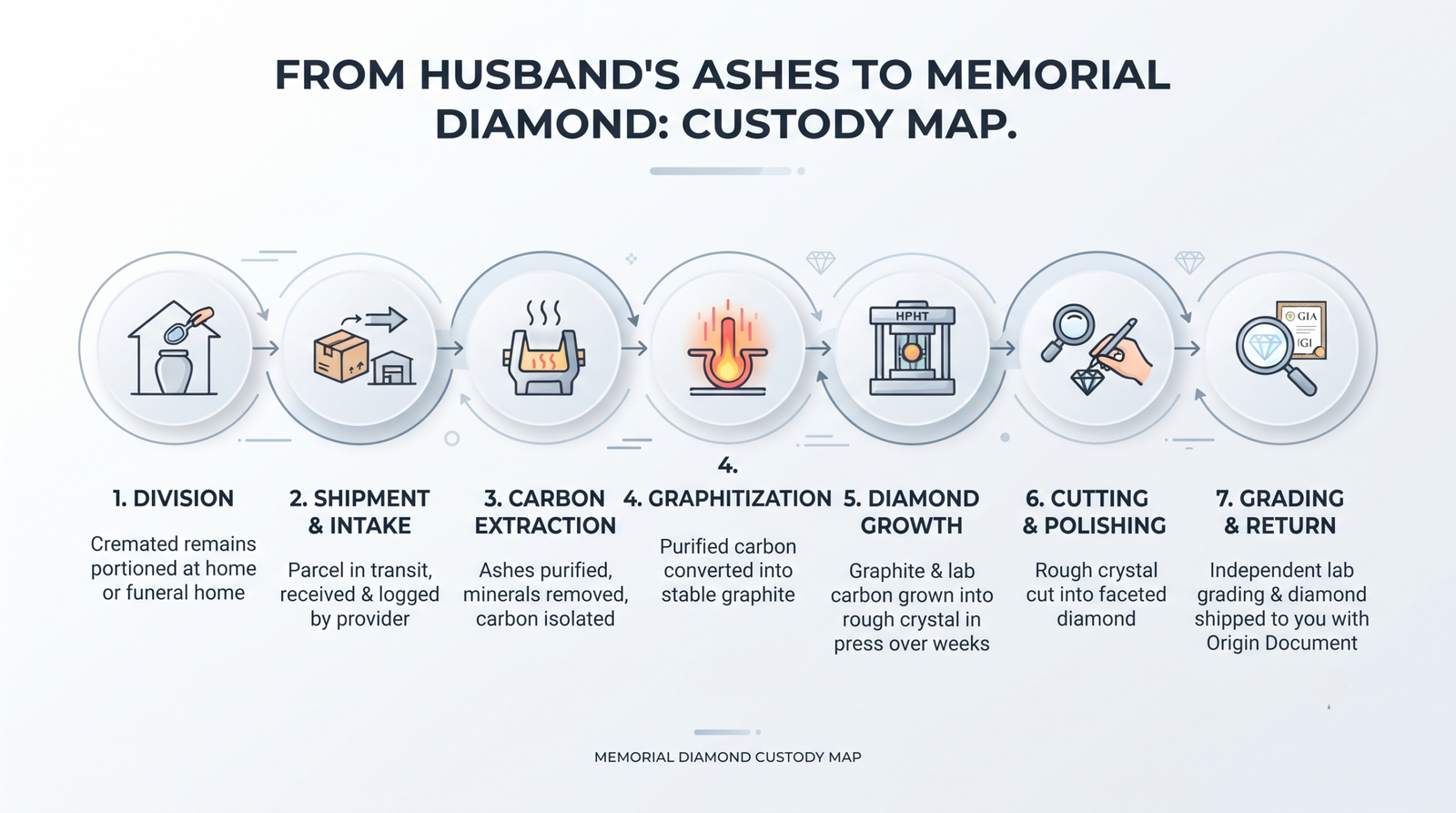
For most of the six to ten months this takes, you will not be in the room. A memorial diamond made from your husband’s ashes begins with a small portion of his cremated remains, typically a few tablespoons to about four ounces, which is purified to carbon, converted to graphite, blended with laboratory carbon, and grown into a real diamond around a seed crystal under extreme heat and pressure. What follows is that process laid out as a custody map: where his ashes are at each stage, who is holding them, and what can honestly be shown to you.

The Custody Map, Stage by Stage

#StageWhere his ashes physically areWho holds themWhat can be shown to you
1DivisionYour husband’s ashes are in your home, or at the funeral homeYou, or the funeral directorYour own note and photograph
2Shipment and intakeIn transit, then the provider’s intake roomCarrier, then the providerTracking, receipt confirmation, recorded weight
3Carbon extractionA purification furnaceThe laboratoryA recorded carbon yield, if the provider reports one
4GraphitizationA high temperature furnaceThe laboratoryNothing visible; the material is now graphite
5GrowthInside a sealed growth cell in a pressThe laboratoryNothing visible for weeks to months
6Cutting and polishingA gemologist’s benchThe cutterThe rough crystal, sometimes photographed
7Grading and returnAn independent laboratory, then in transit to youThe grading lab, then the carrierThe grading report and the origin document
A seven-stage diagram showing cremated remains moving from home to intake, furnace, press, cutter, and grading lab

Stages 1 to 2: Your Husband’s Ashes Leave Your Hands

Stage 1 is the only one you control, and it is described in full in how to turn your husband’s ashes into a diamond. If your husband’s ashes are in your home, you divide the portion yourself, weigh it, seal it, and label it; if a funeral home still holds his remains, you ask them to hold back a labelled portion before release. Either way, write down the date and the weight. From this point on, that note is the only record you personally made.

Stage 2 is the intake. The provider receives the portion, logs it under an order reference, and records a weight. Ask, before you send anything, exactly what is recorded at intake and what comes back to you: a photograph, a weight, a reference number. This is the last point at which your husband’s ashes are recognizably ashes, and the last point at which a family could ask for them back unchanged.

Stage 3: Carbon Extraction, and the Number Nobody Likes

Cremated remains are almost entirely calcium phosphate, the mineral structure of bone. Carbon is a small fraction, roughly 0.5% to 4% by weight, depending on the person and the cremation. The laboratory heats the portion of your husband’s ashes in a controlled, oxygen free, multi stage process that removes the minerals and leaves carbon at roughly 99.9% purity.

A labelled crucible being placed into an oxygen-free purification furnace

From four ounces of your husband’s ashes, then, the usable carbon is measured in grams, not ounces. That is not a shortcoming of this provider or that one; it is the chemistry of cremation. What happens to the mineral residue not consumed by extraction varies by provider, and it is a fair question to ask before ordering. The reason the low yield still produces a full diamond is explained in how much ash you need for a husband memorial diamond.

Stage 4: Graphitization, the Point of No Return

The carbon purified from your husband’s ashes is heated further, to roughly 2,500 to 2,700°C, and converted into graphite, the crystalline form of carbon that diamond presses use as feedstock. This is where the material stops being anything a person could recognize. Before graphitization it is carbon recovered from your husband’s ashes; after it, it is graphite, physically indistinguishable from any other graphite except by the paperwork that says whose it is.

That paperwork is the whole point. The origin document a reputable provider issues at the end is a chain of custody record stretching back through this stage to your note from Stage 1. Ask whether the provider can show you that chain, not just the finished certificate.

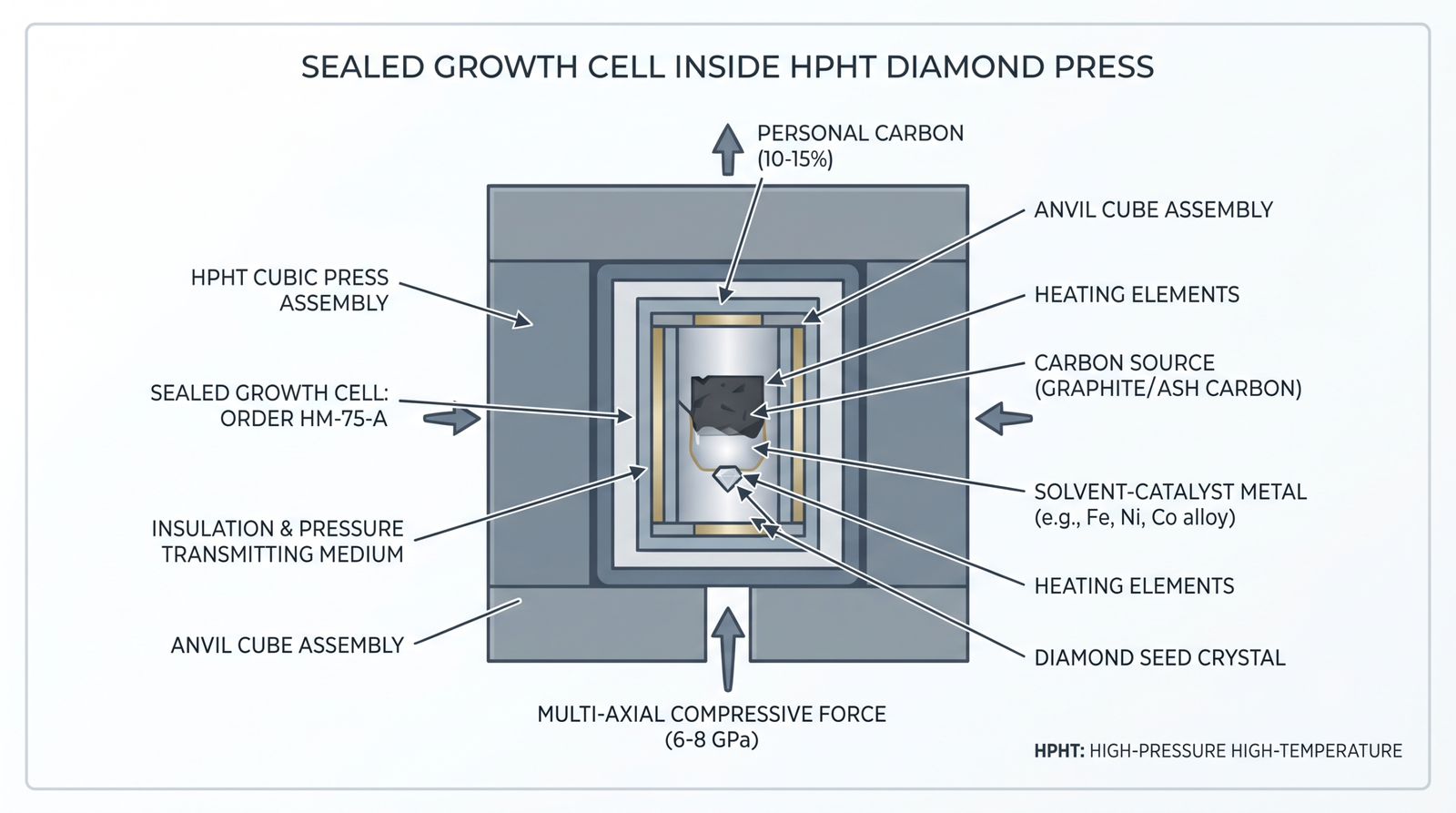
Stage 5: Growth, Where the Months Go

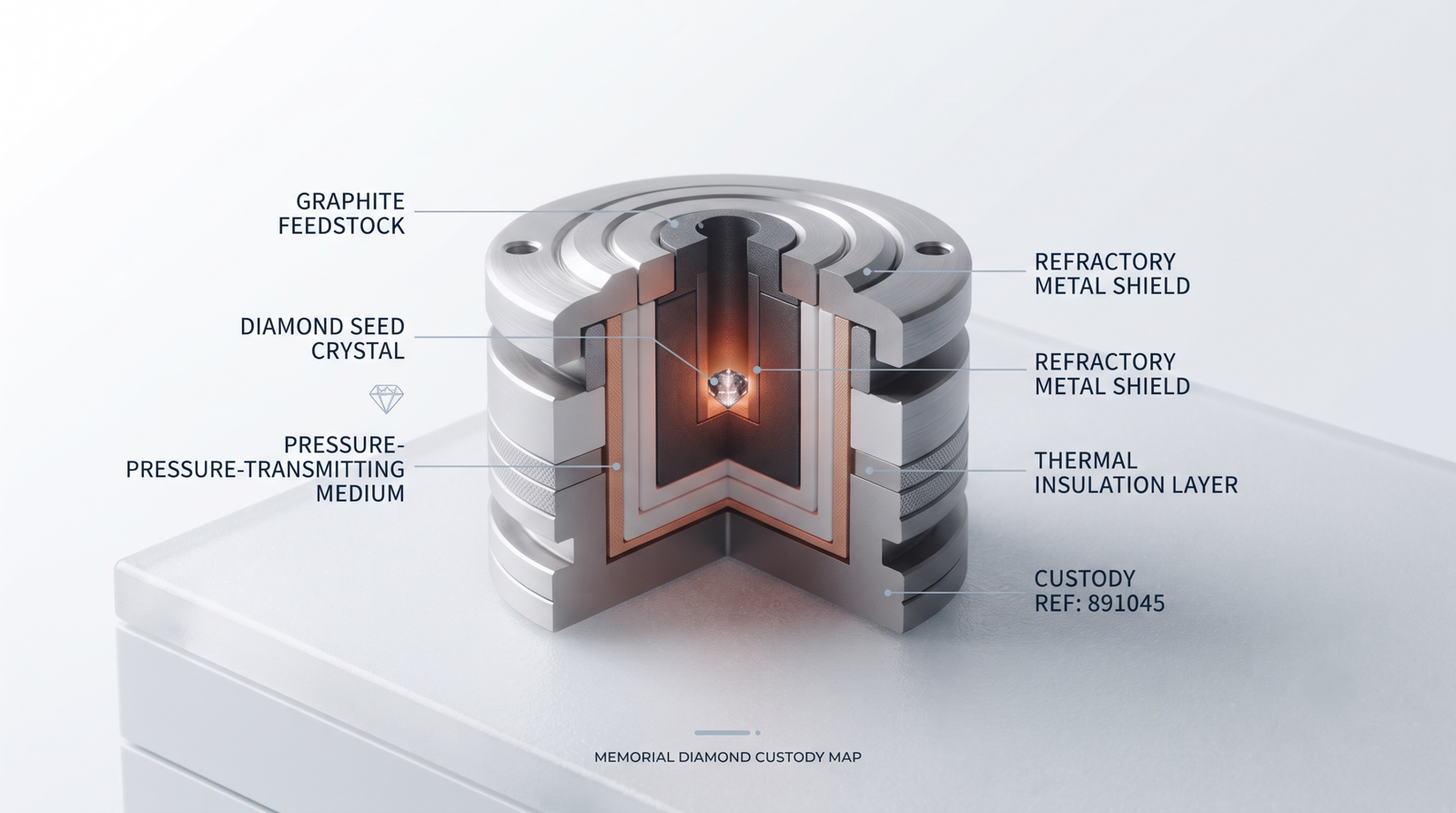
The graphite is blended with additional laboratory carbon to reach the volume a viable crystal needs, then placed with a tiny diamond seed in a growth cell. Most memorial providers use HPHT, a press that recreates the roughly 6 to 8 GPa and 1,400 to 2,500°C of the Earth’s mantle; a minority convert the carbon to gas for CVD growth. Both are the same HPHT and CVD diamond growth methods used across the lab grown industry.

A sealed growth cell inside an HPHT diamond press

Growth takes weeks to months, and it is time in the press, not how much of your husband’s ashes you sent, that determines carat size. A family who sends a full urn does not get a larger or faster stone; they get the size they ordered, on the timeline that size requires. This is also why nothing can be shown to you during Stage 5: the cell is sealed, and opening it ends the run.

The honest proportion belongs here. Personal carbon typically makes up around 10 to 15% of a finished memorial diamond’s mass; the balance is laboratory carbon. The stone is physically, verifiably made in part from him. It is not entirely him, and no provider should say it is.

Stages 6 to 7: Cutting, Grading, and the Stone’s Paperwork

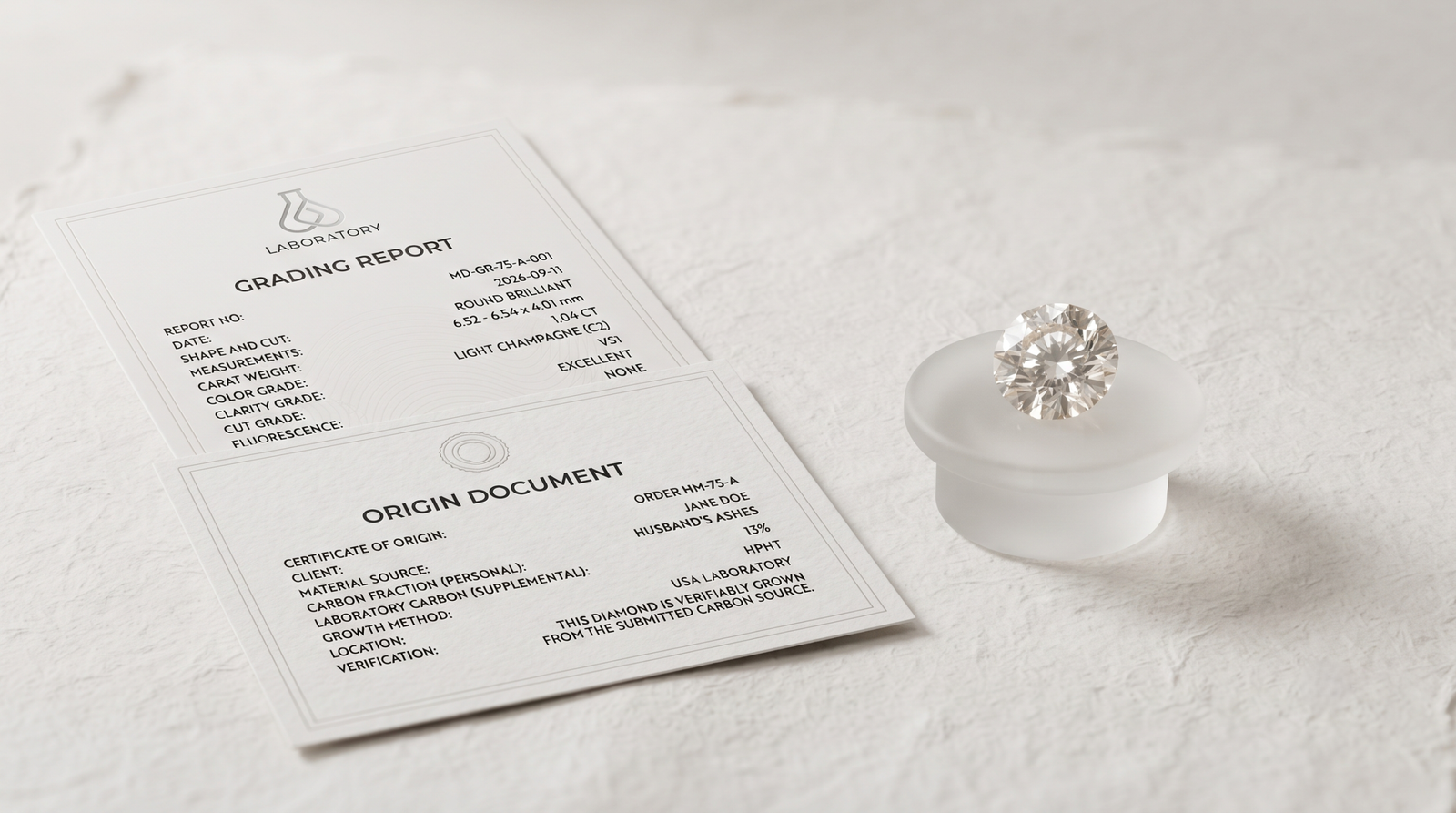
The rough crystal grown from your husband’s ashes is cut and polished by a gemologist into the shape you chose. It then goes, with reputable providers, to an independent laboratory to be graded on cut, color, clarity, and carat like any other diamond. Memorial stones typically grade between SI2 and VVS for clarity, and trend toward yellow, champagne, or blue because trace elements from an organic carbon source remain during growth.

A grading report and an origin document laid beside a loose memorial diamond. husband's ashes

The hair version of this same map is in how a memorial diamond is made from your husband’s hair. Two documents should come back with the stone. The grading report describes the diamond’s own quality. The origin document, usually issued by the provider, records that this diamond was grown from this order’s carbon, traced back through every stage on the map. Some providers also laser inscribe an order reference on the girdle; ask whether yours does. Color is covered in what color diamond can be made from your husband’s ashes.

What Can Be Shown to You, and What Cannot

  • Can be shown: your own note and photograph of your husband’s ashes at division; intake confirmation and recorded weight; a carbon yield figure, if the provider reports one; a photograph of the rough crystal, if they take one; the grading report; the origin document.
  • Cannot be shown by anyone: the material during purification, graphitization, or growth. Each of those stages happens inside sealed equipment, and there is no honest way to watch your husband’s ashes become carbon or carbon become diamond.
  • Worth asking about: whether facility visits are offered at intake, and whether a failed growth run can be re attempted from remaining purified carbon, who bears that cost, and how you would be told.

If a relative doubts the stone at all, the short answer is in is a memorial diamond really made from your husband’s ashes. If a provider promises to show you every stage, ask what they mean. The stages that matter most are exactly the ones nobody can photograph.

Frequently Asked Questions

How much of my husband’s ashes are used to make the diamond?

Industry typical requests run from a few tablespoons to about four ounces, roughly 100 grams. That is a small fraction of a full cremation, and usable carbon within it is only about 0.5% to 4% by weight, so the rest of his ashes can be kept, scattered, or interred as planned.

How much of the finished diamond is actually him?

Typically around 10 to 15% of the stone’s mass is carbon recovered from his ashes; the remainder is laboratory carbon needed to grow a crystal of usable size. Some providers cite lower figures for larger stones. The stone is physically made in part from him, not a keepsake with ashes sealed inside.

Can I watch the process or visit the lab?

Some providers offer visits at intake; this varies across the category. No provider can show you purification, graphitization, or growth in progress, because each happens inside sealed equipment. Ask what is recorded and photographed at the stages that can be documented.

Why does it take six to ten months?

Most of the time is spent in the growth press, not in handling your husband’s ashes. Carat size is set by growth time, not by how much ash was submitted, so a larger stone means a longer run. Purification and graphitization take days to weeks; cutting and grading add a few more.

What happens to the part of his ashes that is not carbon?

The mineral residue, mostly calcium phosphate, is left behind during extraction. What providers do with it varies: some return it, some do not. Ask this directly before ordering, since it is not always stated on a website.

How do I know the diamond came from my husband’s ashes and not someone else’s?

Through the chain of custody record: your own note at division, the intake weight and order reference, and the origin document issued with the finished stone. Ask whether the provider can show you that chain, not just the final certificate.

Is the diamond graded like a normal diamond?

Yes. Reputable providers have the finished stone graded by an independent laboratory on cut, color, clarity, and carat, the same 4Cs as any diamond. Memorial stones typically fall between SI2 and VVS for clarity.

Final Thoughts on How a Memorial Diamond Is Made From Your Husband’s Ashes

You hold the material at one end of this map and the stone at the other, and for everything in between you are trusting a record. Choose a provider whose record of your husband’s ashes you can actually read, from your note at Stage 1 to the origin document at Stage 7, and the months you were not in the room become months you can account for.

Learn More About Husband Memorial Diamonds

Talk With Memorial Diamond

If you would like to walk through what is recorded at each stage before deciding, reach out to Memorial Diamond to talk through what’s possible with your husband’s ashes.

Ashes hair diamond: a small container of cremated remains and a labelled envelope of hair on either side of a champagne-toned lab-grown diamond

How a Memorial Diamond Is Made From Your Husband’s Ashes and Hair

One of these materials has already been through fire. The other has never been warmer than his own body. An ashes hair diamond made from your husband’s cremated remains and a lock of his hair is a single lab grown diamond, grown over roughly six to ten months from carbon purified separately out of each material, then combined at the graphite stage and grown around a seed crystal. Nearly every practical difference between the two halves of the process follows from that thermal history, and the point of no return sits exactly where you might not expect.

Two Thermal Histories, One Ashes Hair Crystal

Cremation has already burned away nearly all the carbon in his remains. What is left is mostly calcium phosphate, the mineral of bone, with usable carbon at roughly 0.5% to 4% by weight. His hair, by contrast, has never been heated: it is intact keratin, roughly 50% carbon, with the sulfur, nitrogen, and oxygen his body bonded around that carbon still in place.

So the ashes arrive carbon poor and mineral rich; the hair arrives carbon rich and organic. That is the ashes hair difference in one line. An ashes hair diamond has to treat them differently right up to the moment the two purified carbons are identical, and that moment comes later than most families assume.

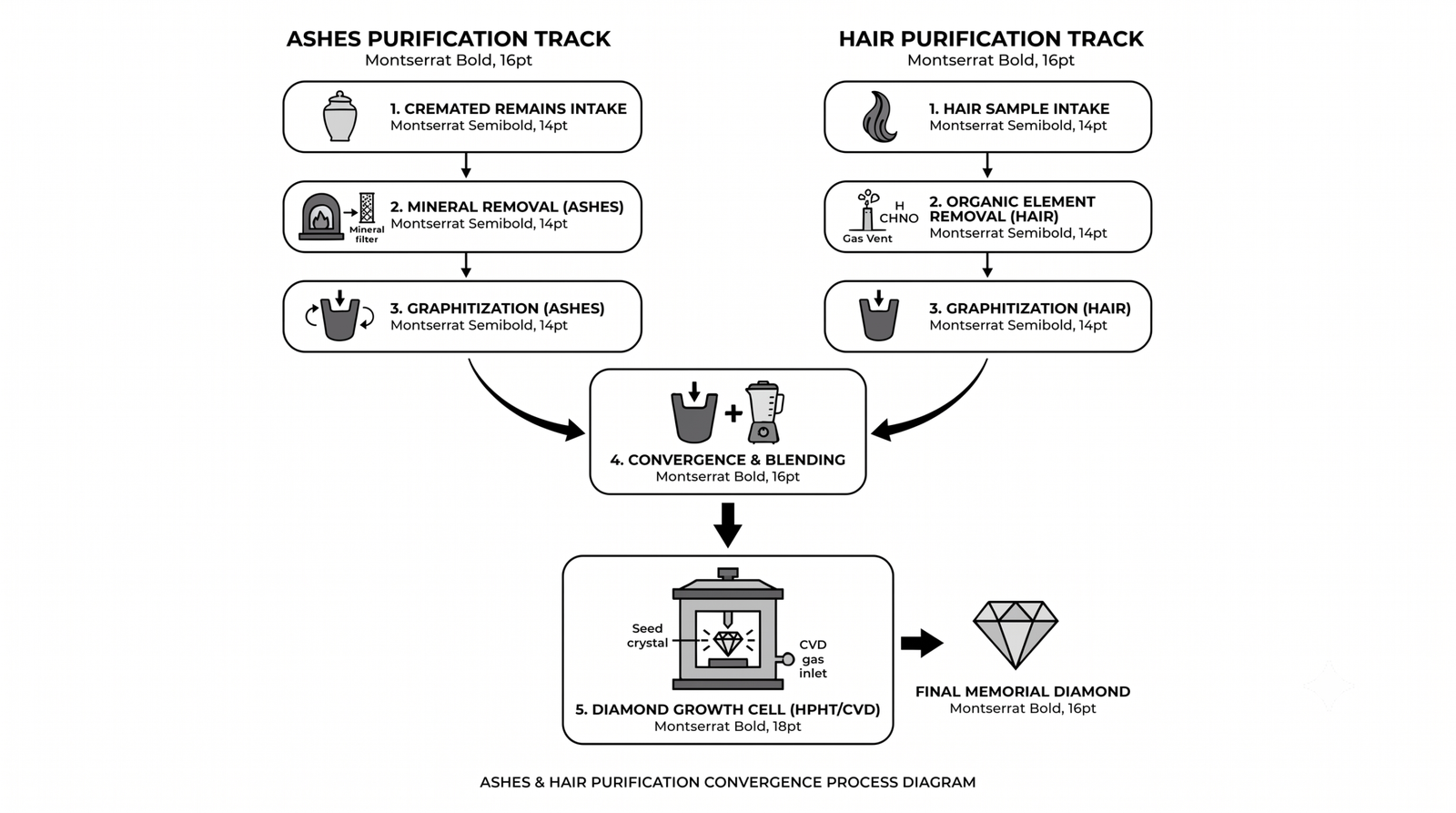
The Two Track Process, Stage by Stage

NumberStageAshes trackHair trackSame or separate?
1Division and collectionA few tablespoons to approximately 4 oz set asideA small lock, a few grams, kept drySeparate; two records
2Shipment and intakeHandled as cremated remainsHandled as an ordinary sampleSeparate; two intake weights
3Carbon purificationMinerals removed in an oxygen free furnaceKeratin’s non carbon elements driven offSeparate tracks, separate yields
4GraphitizationPurified carbon converted to graphitePurified carbon converted to graphiteStill separate; now indistinguishable
5Blending and growthCombined with hair carbon and laboratory carbonCombined with ash carbon and laboratory carbonOne growth cell, one crystal
6Cutting and gradingOne stoneOne stoneOne grading report, one origin document naming both
A diagram showing two separate purification tracks converging at the graphite stage into one growth cell

Stages 1 and 2: Intake, and Why Two Records Matter

Because the ashes hair pairing arrives with two different histories, they should arrive with different paperwork. Ask whether the provider keeps two intake records for a combined order, each with its own recorded weight, and whether the origin document at the end names both sources. If the answer to either is no, the hair you chose with such care is present in the stone but absent from its record.

The two halves of an ashes hair order travel differently: cremated remains are typically shipped under carrier rules that hair is not, so confirm the provider’s current instructions for each on the day rather than assuming one package covers both. Whichever travels first, send the hair with the greater care; it cannot be re cut.

Stage 3: Two Purification Tracks

Both halves of an ashes hair diamond go through a controlled, oxygen free, multi stage heating process, but the process is removing different things from each. From the ashes it strips calcium phosphate and other minerals. From the hair it drives off the nitrogen, oxygen, sulfur, and hydrogen of keratin. Both tracks end at carbon of roughly 99.9% purity.

Each track on its own is described in how a memorial diamond is made from your husband’s ashes and how a memorial diamond is made from your husband’s hair. The yields are very different. Four ounces of ashes produce a few grams of carbon; a few grams of hair produce a meaningful fraction of their own weight. In an ashes hair diamond, this is the stage where a provider learns whether one material has under yielded.

Two labelled crucibles side by side in a laboratory furnace tray

Ask, before ordering, whether you will be told at this point or whether the shortfall is quietly covered by laboratory carbon in the next stage. What happens to the mineral residue from the ashes, and to any hair not consumed, are separate questions and worth asking separately.

Stage 4: Graphitization, the Real Point of No Return

Most guides to an ashes hair diamond place the point of no return at blending. It sits one stage earlier. Each purified carbon is heated to roughly 2,500 to 2,700°C, hotter than the growth run itself, and converted to graphite, the layered crystalline form a diamond press uses as feedstock. After this stage, the carbon from his ashes and the carbon from his hair are physically identical: two portions of graphite, distinguishable only by the label on each crucible.

Blending in Stage 5 merely combines two things that are already the same. Graphitization is where they became the same. If a family wants the option of two separate stones instead of one ashes hair diamond, the decision has to be made before Stage 4, not before Stage 5. The alternatives are set out in the husband ashes and hair diamond guide.

Stage 5: Blending and Growth

The two graphites of an ashes hair diamond are combined, supplemented with laboratory carbon to reach the volume a viable crystal needs, and placed with a tiny diamond seed in a growth cell. Most memorial providers grow by HPHT, a press recreating roughly 6 to 8 GPa and 1,400 to 2,500°C; a minority convert the carbon to gas for CVD. Both are the standard HPHT and CVD diamond growth methods. Growth takes weeks to months, and growth time, not the quantity of either ashes hair material, sets the carat.

The proportion is the same for an ashes hair diamond as for any memorial stone: personal carbon typically makes up around 10 to 15% of the finished crystal, with the balance laboratory carbon. What the combined route changes is not the share that is him, but the record of which parts of him it came from.

Stage 6: Cutting, Grading, and One Document Naming Both

A gemologist cuts and polishes the rough crystal. Reputable providers then have it graded by an independent laboratory on the same cut, color, clarity, and carat scale as any diamond; memorial stones typically fall between SI2 and VVS for clarity. Color is set by trace elements during growth, not by which material the carbon came from, so an ashes hair diamond trends toward yellow, champagne, or blue like any other, and combining materials does not blend two colors. The options are covered in what color diamond can be made from your husband’s ashes and hair.

An origin document listing two source materials beside a loose memorial diamond and a grading report

Two documents should return with an ashes hair diamond: the grading report, and an origin document that names both the ashes and the hair as sources and traces back to the two intake records. That single document is the reason to have asked the two record question at the start, and the reason the doubt a combined stone attracts is answered in is a memorial diamond really made from your husband’s ashes and hair.

Frequently Asked Questions

Are the ashes and hair processed together or separately?

Separately, until the graphite stage of an ashes hair diamond. Each material is purified on its own track because the ashes need minerals removed and the hair needs keratin’s other elements driven off. The two purified carbons are converted to graphite, then combined and grown as one crystal.

Where is the point of no return for an ashes hair diamond?

At graphitization, not at blending. Once each carbon is converted to graphite, the two are physically identical and cannot be separated by any test. If you want two separate stones instead of one, that decision has to be made before this stage.

Will the diamond show which carbon came from ashes and which from hair?

No. In an ashes hair diamond, both are reduced to pure carbon and become one crystal lattice. The only thing that distinguishes them afterward is the paperwork: two intake records and an origin document naming both materials. Ask that those exist before you order.

Does adding hair change how much of the diamond is him?

Not the proportion. Personal carbon typically makes up around 10 to 15% of any memorial diamond, with laboratory carbon supplying the rest. What hair changes is the source mix within that share, and, with some providers, how much ash is required.

What if one material yields less carbon than expected?

The provider learns this at the purification stage. Whether they tell you before blending, or cover the shortfall with laboratory carbon without saying so, varies. Ask this question in writing before sending anything; it is the most important one for a combined order.

Does an ashes hair diamond take longer to make?

Not meaningfully. The two ashes hair purification tracks run in parallel, and most of the six to ten months is spent in the growth press, where the crystal grows exactly as a single material stone would. Larger or specialty color stones can extend that to twelve months.

Final Thoughts on How a Memorial Diamond Is Made From Your Husband’s Ashes and Hair

The ashes have already been through their fire; the hair goes through its first here. By the end of Stage 4 the two are the same graphite, and by the end of Stage 5 they are one crystal. What an ashes hair diamond preserves that a single material stone cannot is not a chemical trace of each, but a written record that both were there. Choose a provider who will write that record.

Learn More About Husband Memorial Diamonds

Talk With Memorial Diamond

If you are holding both materials and want to know what would be recorded at each stage before you send either, reach out to Memorial Diamond to talk through what’s possible with your husband’s ashes and hair.

Really made from both: a champagne-toned lab-grown memorial diamond between a small sealed portion of cremated remains and a labelled lock of hair

Is a Memorial Diamond Really Made From Your Husband’s Ashes and Hair?

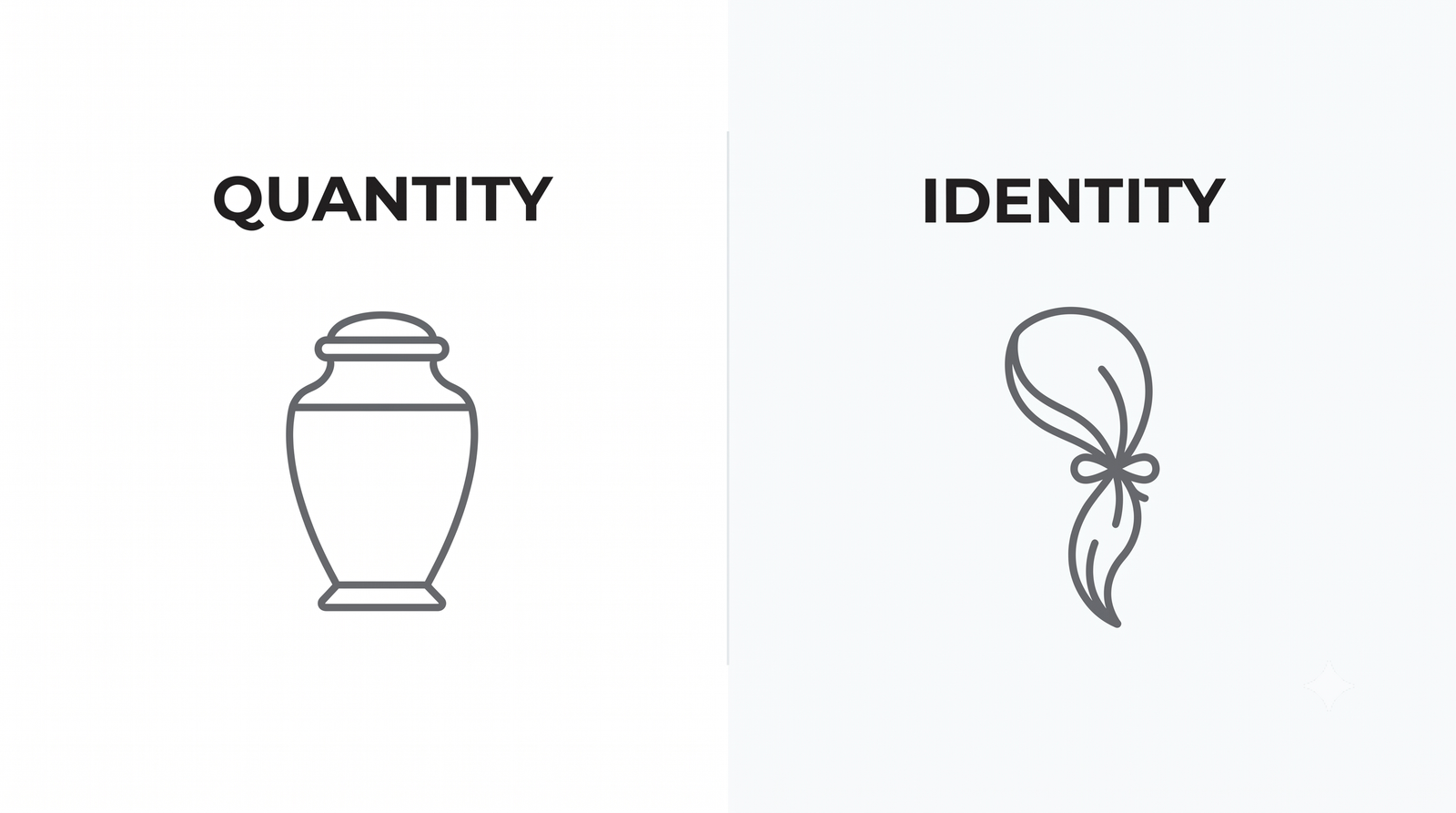
A stone grown from both materials inherits two doubts, and they point in opposite directions. Is a memorial diamond really made from your husband’s ashes and hair? Yes: carbon is extracted from each, purified separately, combined at the graphite stage, and grown into one genuine lab grown diamond. But the ashes half is doubted on quantity, because cremated remains are only about 0.5% to 4% carbon, and the hair half is doubted on identity, because a lock has to be provably his. Answering one doubt does nothing for the other, so this page answers both.

The Two Doubts a Combined Stone Inherits

The ashes halfThe hair half
The doubt“Is there enough of him in it?”“Is that lock really his?”
Why it arisesAshes yield only grams of carbon from ouncesHair from shared brushes or bedding carries uncertainty
What settles itThe honest 10% to 15% personal carbon figure, stated plainlySource labelled envelopes and the provider’s intake record
What does not settle itSending more ashes; size is set by growth timeAny chemical test; DNA does not survive purification
A simple two-column graphic labelled quantity and identity, one over an urn icon and one over a hair-lock icon

A stone really made from both is only as trustworthy as the weaker of the two answers. Close the quantity question with the honest number, and close the identity question with the envelope. The full list of what to ask is in questions to ask before turning your husband’s ashes and hair into a diamond, and the wider picture in the husband ashes and hair diamond guide.

Is It Really Made From Both, or Mostly One?

Physically, both carbons are in the crystal. The laboratory purifies the ashes and the hair on separate tracks, converts each to graphite, then combines them with laboratory carbon and grows a single diamond by HPHT or CVD diamond growth. Personal carbon typically makes up around 10% to 15% of the finished stone, the same as any memorial diamond; what differs is that the share comes from two sources instead of one.

Whether the hair or the ashes contributed more of that share depends on how much of each you sent and how each yielded. That ratio cannot be read from the stone afterward. The two track process, and where the point of no return really sits, is in how a memorial diamond is made from your husband’s ashes and hair.

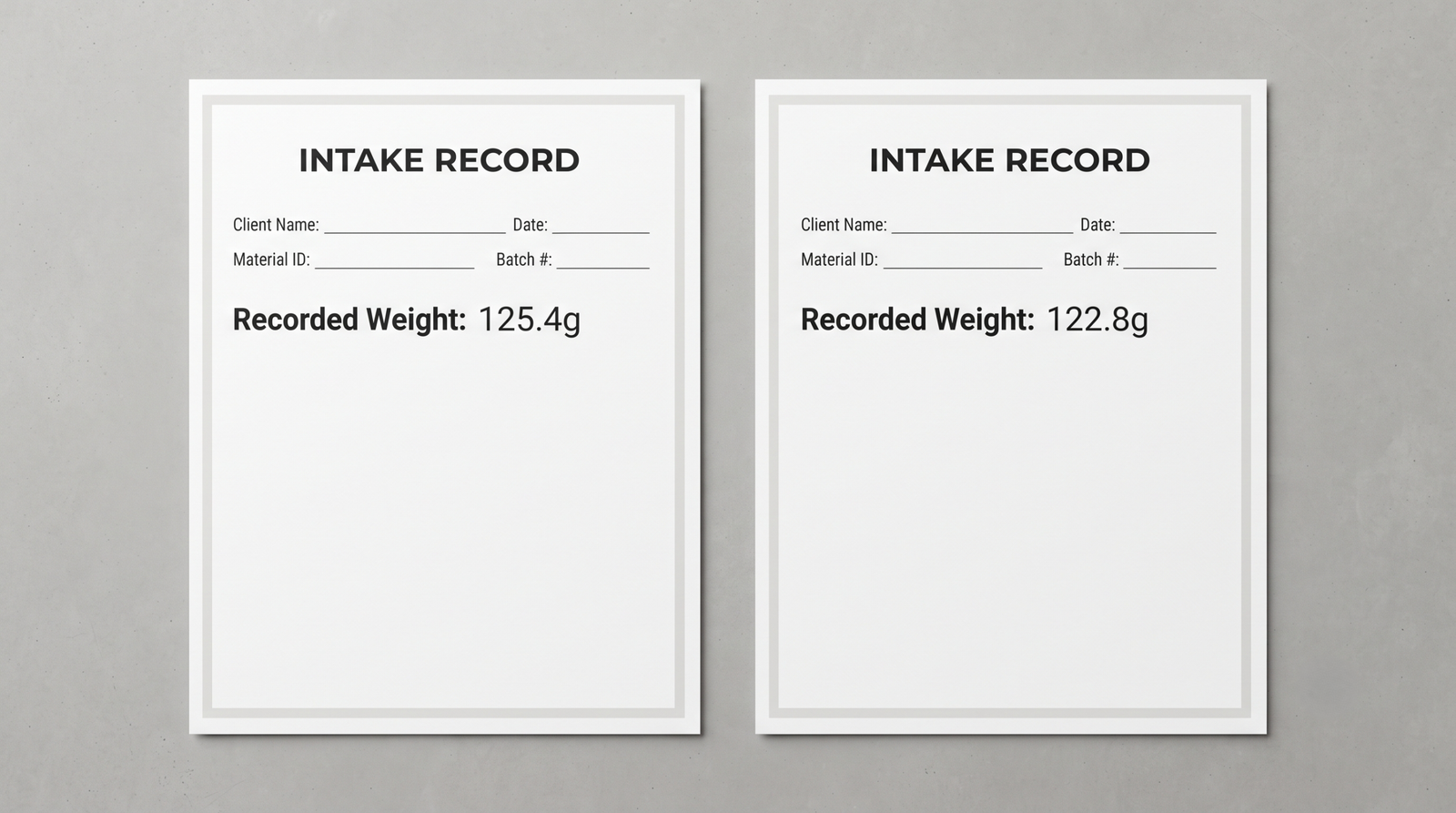
Two intake record forms side by side, each with a recorded weight

The Window Before Blending, and What to Ask

“Did they use both?” is unanswerable once the two carbons are graphite; they are physically identical from that point on. So the question has to be moved earlier, to the window between purification and blending. Before you order, ask:

  • Are two separate intake records kept, one per material, each with a recorded weight?
  • Will I be told if either material under yields before the two are blended?
  • Does the origin document name both the ashes and the hair as sources?
  • What happens to material not consumed by extraction, for each material separately?

If the answers are yes, yes, yes, and something specific, a stone really made from both has a record you can stand behind. If any answer is vague, the stone may still be really made from both, but you will never be able to show it. The single material versions of this question are in is a memorial diamond really made from your husband’s ashes and is a memorial diamond really made from your husband’s hair.

Frequently Asked Questions

Is a combined diamond really made from both his ashes and his hair?

Yes. Carbon is extracted from each material separately, converted to graphite, and combined before growth, so both are physically in the crystal. Personal carbon typically makes up around 10% to 15% of the stone; with a combined order that share comes from two sources.

Can the finished stone show how much came from ashes versus hair?

No. Once both carbons are graphite they are physically identical, and the crystal cannot distinguish sources. The only record of the ratio is the provider’s two intake weights and yield figures, which is why asking for two intake records matters.

Is the hair half more reliable than the ashes half?

It is more reliable on quantity, because hair is roughly 50% carbon, and less reliable on identity, because a lock from a shared brush or pillow may not be entirely his. The ashes half is the reverse. A combined stone carries both doubts, so both need answering.

What if one material yields less than expected?

The provider learns this at purification. Whether they tell you before blending or cover the shortfall with laboratory carbon without saying so varies. Ask in writing before ordering; it is the most important question for a stone really made from two sources.

Does combining ashes and hair make the diamond more him?

Not in proportion. Personal carbon is typically around 10% to 15% of any memorial diamond, whether from one source or two. What a combined order adds is a record that both were there, provided the origin document names both materials.

Final Thoughts on Whether a Memorial Diamond Is Really Made From Your Husband’s Ashes and Hair

Two materials, two doubts, and one stone that cannot testify on its own behalf. The chemistry is settled; the record is what you are choosing. Ask the four questions above before the envelope and the portion leave you, and the answer to “is it really made from both of him” becomes a document instead of a hope.

Learn More About Husband Memorial Diamonds

Talk With Memorial Diamond

If you hold both materials and want to know exactly what would be recorded for each before you send them, reach out to Memorial Diamond to talk through what’s possible.

Memorial diamond really made from a husband's ashes: a loose yellow-toned lab-grown diamond beside an origin document and grading report

Is a Memorial Diamond Really Made From Your Husband’s Ashes?

The doubt rarely arrives in your own voice. It comes from his brother, or your daughter, or a friend who read something, and you have to answer it out loud. So here is the answer: yes, a memorial diamond really made from your husband’s ashes is a genuine lab grown diamond containing carbon extracted from his cremated remains, purified, and grown into the crystal itself. It is not ashes sealed in glass. It is also not 100% him, and the honest figure is part of the answer.

What a Memorial Diamond Really Made From His Ashes Means

Cremated remains are mostly calcium phosphate, with carbon at roughly 0.5% to 4% by weight. A laboratory extracts that carbon in an oxygen free process, purifies it to about 99.9%, converts it to graphite, and grows a diamond around a seed under the same HPHT or CVD diamond growth conditions used across the lab grown industry. The carbon atoms in the lattice came, in part, from him. That is the sense in which a memorial diamond really made from his ashes is made from him: physically, not symbolically.

How Much of the Stone Is Him?

The claimAccurate?The honest version
“It’s 100% his ashes”NoHis ashes yield only grams of carbon; laboratory carbon supplies the rest of the volume
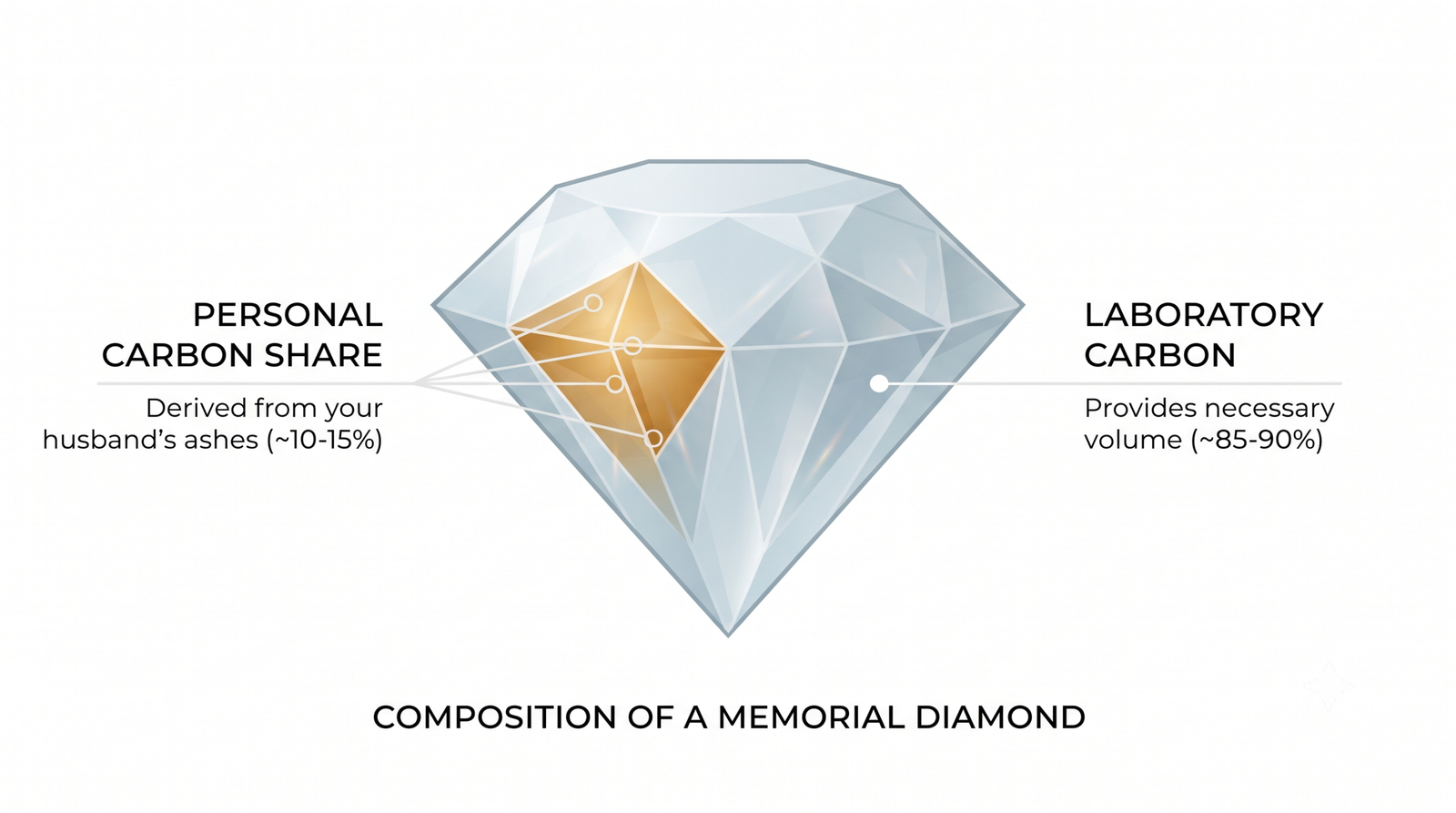
“It’s made from him”YesPersonal carbon typically makes up around 10% to 15% of the stone’s mass, grown into the crystal
“It’s just ashes in resin”NoNothing is sealed inside; the diamond is diamond all the way through
“It’s a real diamond”YesSame hardness, structure, and grading as any lab grown diamond
An illustration of a diamond crystal with a highlighted portion representing the personal carbon share | Original illustration to be produced

Some providers cite lower figures for larger stones. Anyone claiming the stone is entirely his ashes is overstating the physics; the full process, stage by stage, is in how a memorial diamond is made from your husband’s ashes.

What You Can Put in Front of a Doubter

Sorted by who is usually asking whether the memorial diamond really made from his ashes is what you say it is:

  • A relative who thinks it is a scam: the origin document that says this memorial diamond really made from his ashes came from your order, a reputable provider issues, tracing the stone to your order’s recorded intake weight, and the independent grading report on cut, color, clarity, and carat.
  • A friend who thinks it is ashes in glass: the carbon chemistry above; a diamond cannot contain sealed material and still be diamond.
  • Someone who thinks it is all him: the 10% to 15% figure, stated plainly; a memorial diamond really made from him is still mostly laboratory carbon. Overclaiming is what a skeptic is waiting for; the wider context is in the husband ashes diamond guide.
  • Yourself, at 2 a.m.: your own note of the date and weight you set aside, and the provider’s confirmation that they received it. Ask for both before you order.
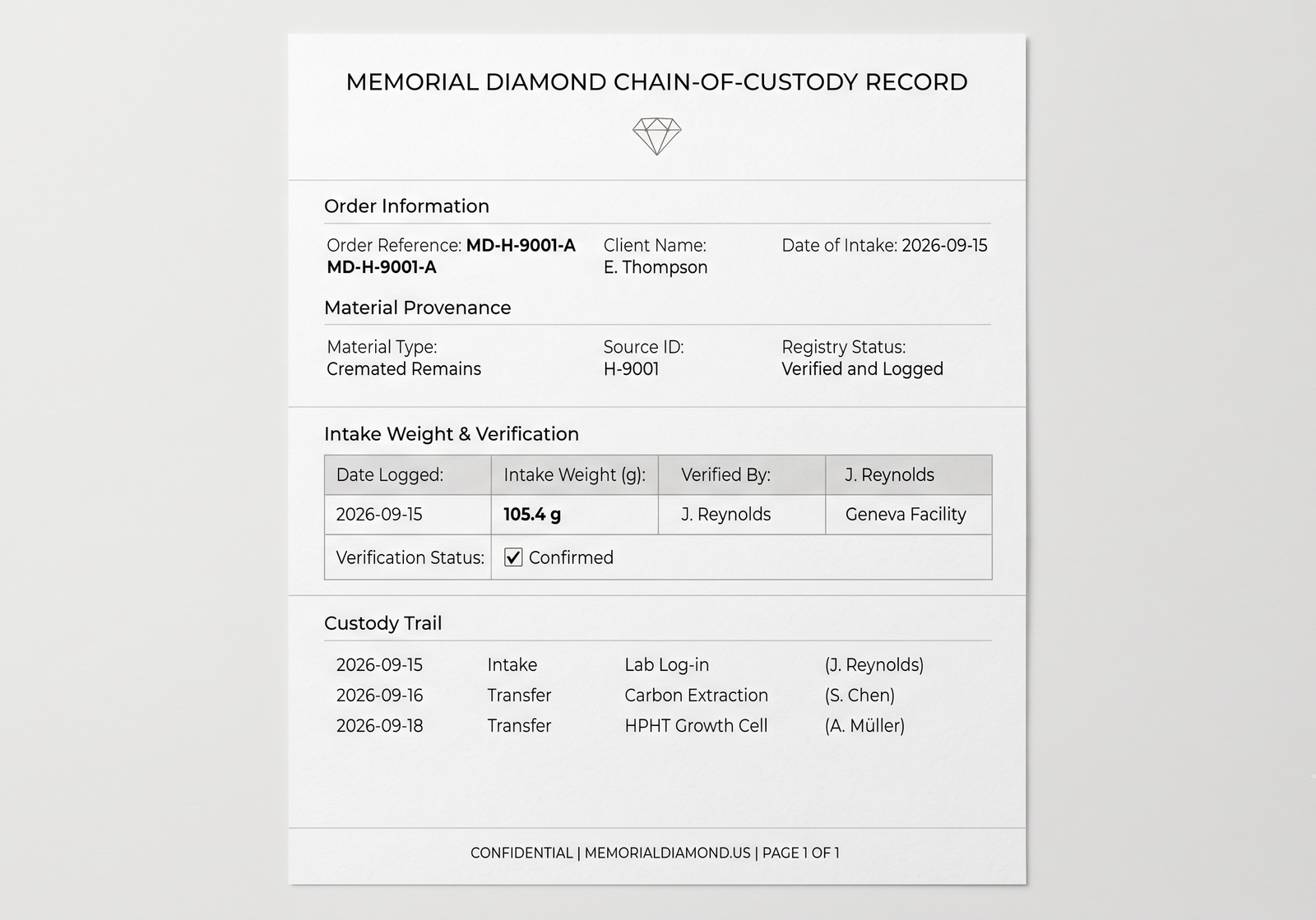
A printed chain-of-custody record with intake weight and order reference

If his hair was kept instead of, or as well as, his ashes, the same question is answered for that route in is a memorial diamond really made from your husband’s hair. The record is the evidence; purification and growth happen inside sealed equipment and cannot be shown. The wider set of questions is in questions to ask before turning your husband’s ashes into a diamond.

Frequently Asked Questions

Is a memorial diamond really made from my husband’s ashes, or is it symbolic?

It is physically made from them. In a memorial diamond really made from ashes, carbon is extracted from his cremated remains, purified to about 99.9%, and grown into the diamond’s crystal lattice. The stone exists because of his carbon; it is not a symbolic keepsake with ashes attached.

How much of the diamond is actually his ashes?

Typically around 10% to 15% of the stone’s mass is carbon recovered from his ashes, with laboratory carbon supplying the rest. That is because cremated remains are only about 0.5% to 4% carbon. Some providers cite lower figures for larger stones.

Can a lab test prove the diamond came from him?

No chemical test can identify a person from purified carbon; DNA does not survive the process. Proof comes from the chain of custody: your recorded portion, the provider’s intake weight and order reference, and the origin document issued with the stone.

Is it a real diamond or a simulant?

A real diamond. A memorial diamond really made from ashes has the same crystal structure and hardness as any lab grown diamond and is graded on the same cut, color, clarity, and carat scale. Reputable providers have it graded by an independent laboratory.

Why isn’t the diamond made only from his ashes?

Because a diamond of usable size needs more carbon than ashes can supply. Four ounces of cremated remains yield only grams of carbon, so laboratory carbon is blended in to reach a growable volume. Growth time, not ash quantity, sets the size.

Final Thoughts on Whether a Memorial Diamond Is Really Made From Your Husband’s Ashes

The plainest answer to whether a memorial diamond really made from his ashes is real is also the strongest one: part of the carbon in that crystal was part of him, and the paperwork can prove which order it came from. The combined material version of this doubt is in is a memorial diamond really made from your husband’s ashes and hair. Say the honest number before someone else says a dishonest one, and the doubt usually has nowhere left to go.

Learn More About Husband Memorial Diamonds

Talk With Memorial Diamond

If you would like to see what documentation would come back with the stone before deciding, reach out to Memorial Diamond to talk through what’s possible with your husband’s ashes.

Husband ashes hair diamond: a champagne-toned lab-grown memorial diamond resting beside a small lock of gray hair on white linen

Husband Ashes and Hair Diamond: The Complete Guide

You may be the only person alive who holds his hair from more than one point in his life. A husband ashes hair diamond is a real, lab grown diamond made from carbon extracted from both his cremated remains and a lock of his hair, blended with laboratory carbon and grown over roughly six to ten months. The two materials do different jobs. His ashes carry no date; his hair always does. That difference is the reason to read the rest of this guide before deciding anything.

1. What Is a Husband Ashes Hair Diamond?

A husband ashes hair diamond is a single diamond grown from two sources of his carbon at once: a small portion of his cremated remains and a small amount of his hair. Both are purified to carbon, combined, and grown into one crystal using the same HPHT and CVD diamond growth methods the wider lab grown industry uses.

The finished stone is chemically a diamond. It scores 10 on the Mohs scale, the hardest known natural mineral, and it is graded on the same cut, color, clarity, and carat scale as any other diamond. It is not resin, and it is not a simulant with something sealed inside.

Most guides to this product treat the hair as a top up for families whose ashes ran short. For a spouse, the hair is rarely about quantity. It is about when.

2. Why Does Hair Carry a Date and Ashes Do Not?

Cremated remains are the same material whether he died at 52 or 84; the fire leaves calcium phosphate with a small fraction of carbon, and nothing about it points to a year. Hair is different. Every lock was cut on a specific day, and if you kept it, you usually remember which one.

That gives a husband ashes hair diamond something no ashes only stone has: a second material chosen from a particular moment in his life. The clipping from the day you met. The gray you saved from the last haircut you gave him at home. A lock from his twenties that his mother passed on to you.

A lock of hair in a paper envelope with a handwritten date, next to a small labelled urn portion

One honest limit needs saying early. Choosing hair from 1994 does not put 1994 in the stone. Purification strips hair down to carbon and nothing else; the date survives in your records and your memory, not in the crystal. What the hair adds is a decision you made with intent, documented in the paperwork, not a chemical signature the diamond can carry.

MaterialCarbon content by weightCarries a “when”?Typical amount used
Cremated ashesRoughly 0.5 to 4%No, cremation erases itA few tablespoons up to about 4 oz, approximately 100 g
HairRoughly 50%Yes, cut on a known dateA small lock, a few grams
Both togetherBlended after separate purificationYes, through the hairBoth of the above; ask whether the hair reduces the ashes needed

3. How Much of Each Material Is Needed?

A husband ashes hair diamond draws on two very different quantities. Ashes are carbon poor. Industry figures put usable carbon at roughly 0.5% to 4% of cremated remains by weight, which is why providers typically ask for somewhere between a few tablespoons and about four ounces. That is a small fraction of a full cremation, so the rest can still be interred, scattered, or kept as you planned.

Hair is roughly 50% carbon by weight. A small lock, often described as palm sized or a few grams, is typically enough on its own. Combined orders vary by provider: some treat the hair as supplementary and still ask for the standard ash quantity; others reduce the ash requirement when hair is included. Ask directly, because the answer decides how much of his ashes you set aside.

If you hold only a few strands, say so before ordering. A husband ashes hair diamond can be grown with hair as a minor contribution, and a provider should tell you plainly whether your sample is enough to matter or whether it would be recorded but not meaningfully present.

4. How Is a Husband Ashes Hair Diamond Actually Made?

The two materials are processed separately before they meet. Here is the sequence, step by step:

  1. Intake and recording. Both samples for a husband ashes hair diamond are logged under one order reference, ideally as two separate intake records with a weight for each.
  2. Carbon extraction, ashes. The remains are heated in a controlled, oxygen free, multi stage process that removes the calcium phosphate and other minerals, leaving carbon at roughly 99.9% purity.
  3. Carbon extraction, hair. Keratin’s non carbon components are removed the same way. Because hair starts carbon rich, this stage yields far more from far less.
  4. Graphitization. The purified carbon from both sources is heated to roughly 2,500 to 2,700°C and converted into graphite, the feedstock a diamond press uses.
  5. Blending and growth. The graphite is combined, supplemented with lab carbon to reach the volume a viable stone needs, and placed in a growth cell with a diamond seed. Growth takes weeks to months. Time in the press, not the amount of material, determines carat size.
  6. Cutting, polishing, and grading. A gemologist cuts the rough crystal; reputable providers then have it graded by an independent laboratory.
Technician placing a graphite-and-seed growth cell into an HPHT diamond press

The honesty point that matters most: the personal carbon in a finished memorial diamond typically makes up around 10 to 15% of the stone’s mass, with the balance being laboratory carbon needed to grow a crystal of usable size. A husband ashes hair diamond is physically, verifiably made in part from him; it is not 100% him, and no provider should tell you otherwise. The full production sequence is covered in how a memorial diamond is made from your husband’s ashes and hair.

5. What Color and Size Can You Expect?

Color comes from trace elements present during growth. Nitrogen produces yellow tones; boron produces blue; a colorless stone requires both to be excluded, which takes additional processing and costs more. Because the carbon in a husband ashes hair diamond comes from an organic, imperfect, personal source rather than a controlled feedstock, trace elements are common, and memorial diamonds naturally trend toward yellow, champagne, and blue rather than colorless.

Neither material predicts the exact shade, and combining them does not produce a blend of two colors. The color options and what drives them are set out in what color diamond can be made from your husband’s ashes and hair.

Three lab-grown memorial diamonds side by side in yellow, champagne, and blue tones

Size is a choice, not an outcome. A husband ashes hair diamond is generally offered from about 0.10 carats to 5 carats and above. A larger stone takes longer in the press, which is why larger or specialty color orders can run to 12 months instead of the typical six to ten.

6. What Does a Husband Ashes Hair Diamond Cost?

Industry wide, a husband ashes hair diamond falls into the same pricing tiers as any memorial diamond. Final price depends on carat, color, cut, and whether an independent grading report is included.

TierApproximate sizeTypical industry range
EntryApproximately 0.10 to 0.25 ct$1,500 to $3,500
Mid0.5 to 1 ct$5,000 to $15,000; colorless costs meaningfully more
Large / rare2 to 5+ ct$20,000 to $75,000+

Settings, engraving, fancy cuts, and grading reports are typically priced separately from the loose stone. Whether a husband ashes hair diamond is priced differently from a single material one varies by provider; ask before you assume it is the same. A fuller breakdown is in how much a husband memorial diamond costs.

7. One Blended Stone, or Two?

This is the decision the two material option quietly forces. A husband ashes hair diamond blends both sources into one crystal. The alternative is two separate stones, one from each material, which some families choose so that a child can have the ashes stone and the spouse the hair stone, or so the hair from a specific year stands on its own.

  • One blended husband ashes hair diamond suits you if the point is one object that holds everything you have of him, worn by one person.
  • Two separate stones suit you if two people are waiting, or if the dated hair is the part you most want kept distinct.
  • A blended stone plus a hair only stone later is possible when you hold more hair than one order needs, because hair keeps indefinitely when stored dry.
Two small loose memorial diamonds in separate labelled presentation boxes

If the ashes half of a combined order under yields, ask whether you will be told before blending or whether the shortfall is quietly covered by more laboratory carbon. That question is worth asking of any provider, and the answer belongs in writing. How a single material stone compares is covered in the husband ashes diamond guide and the husband hair diamond guide.

8. What Should You Ask a Provider Before Ordering?

Before ordering a husband ashes hair diamond, ask:

  • Are two separate intake records kept for a combined order, and does the origin document name both materials?
  • Does including hair reduce the ash quantity you ask for?
  • Will I be told if either material under yields before the two are blended?
  • What happens to any material not consumed by extraction, for each material separately?
  • Which method do you use, HPHT or CVD, and who grades the finished stone?
  • How is the hair dated in your records, if I supply a date?

A longer list is in questions to ask before turning your husband’s ashes and hair into a diamond.

9. Frequently Asked Questions

Is a husband ashes hair diamond a real diamond?

Yes. It is a lab grown diamond with the same crystal structure, hardness, and grading scale as any other diamond. Carbon from his ashes and hair is purified, blended with laboratory carbon, and grown into a single crystal; the result is chemically diamond, not resin or a simulant.

Does adding hair to his ashes change the color of the diamond?

No. Color is set by trace elements such as nitrogen or boron present during growth, not by which material the carbon came from. Combining ashes and hair does not blend two colors; a husband ashes hair diamond trends toward yellow, champagne, or blue like any memorial diamond.

Can I use hair from years before he died?

Yes. Hair stored dry keeps its carbon indefinitely, so a lock from decades ago works as well as recent hair. The date does not survive purification into the stone itself, but it is recorded in your paperwork and is often the reason a spouse chooses that particular lock.

How much of his ashes does a combined order use?

Typically a few tablespoons to about four ounces, the same as an ashes only stone. Some providers reduce that amount when hair is included, because hair is roughly 50% carbon; others do not. Ask directly, since the answer determines how much you set aside.

Do the ashes and hair get mixed as soon as they arrive?

No. For a husband ashes hair diamond, reputable providers purify each material separately and combine the carbon only at the graphite stage, before growth. Ask whether two intake records are kept and whether you will be told if one material under yields before the two are blended.

How long does a husband ashes hair diamond take to make?

Industry wide, six to ten months from receipt of material to a finished stone, with larger or specialty color stones sometimes taking up to twelve. Growth time in the press, not how much ash or hair you send, determines the final carat size.

Can two people each get a diamond from the same ashes and hair?

Often, yes. Only a portion of each material is used, so several stones can be grown from one shared source if enough remains. Some families choose one blended stone and one hair only stone so the dated hair stands on its own.

Final Thoughts on a Husband Ashes Hair Diamond

Most of the decisions about a husband ashes hair diamond can wait. The hair cannot be re cut, and if his ashes are still with a funeral home, the request to hold a portion back has a deadline you may not have been told. Settle those two things, write down what you set aside and when the hair was cut, and let the rest of the choices take the months they deserve.

Learn More About Husband Memorial Diamonds

Talk With Memorial Diamond

If you are holding both his ashes and a lock of his hair and are not sure whether a husband ashes hair diamond or two separate stones is right, reach out to Memorial Diamond to talk through what’s possible with what you have.

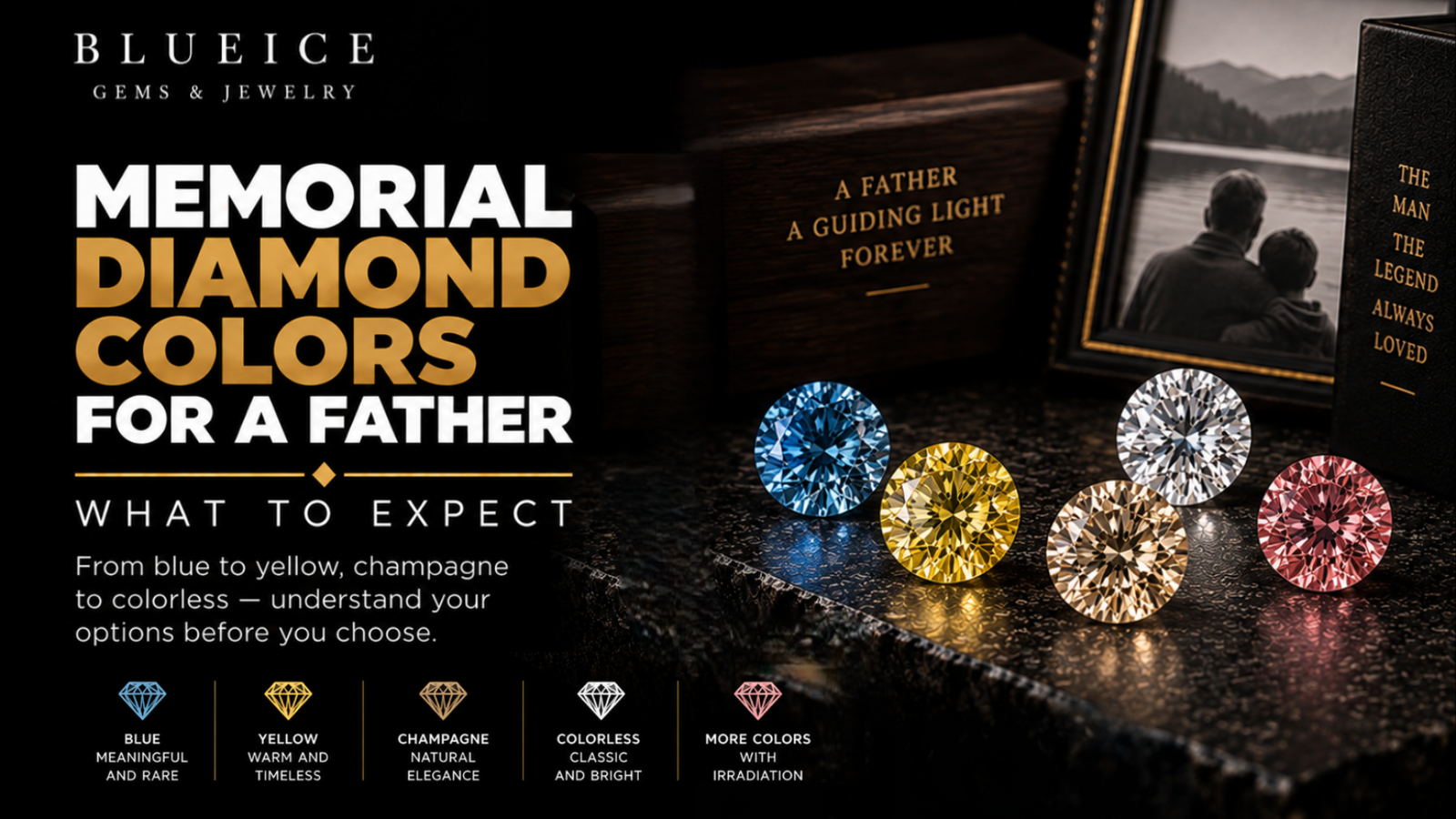
Memorial diamond colors for a father featuring blue, yellow, champagne, colorless, and pink diamonds with a father's keepsake box

Memorial Diamond Colors for a Father: What to Expect

The order form asks for a color months before there is anything to look at. So here is what memorial diamond colors for a father come down to: you can specify a color family, blue, yellow, champagne, colorless, or a color applied after growth, with an agreed range around it. What you cannot specify is a shade. Write the family and the range into the order, and settle who decides whether the finished stone sits inside it.

One disclosure first: Memorial Diamond grows and sells memorial diamonds, which makes us one of the providers this page tells you to pin down. Read the recourse section as something to put to us in writing as readily as to anyone else.

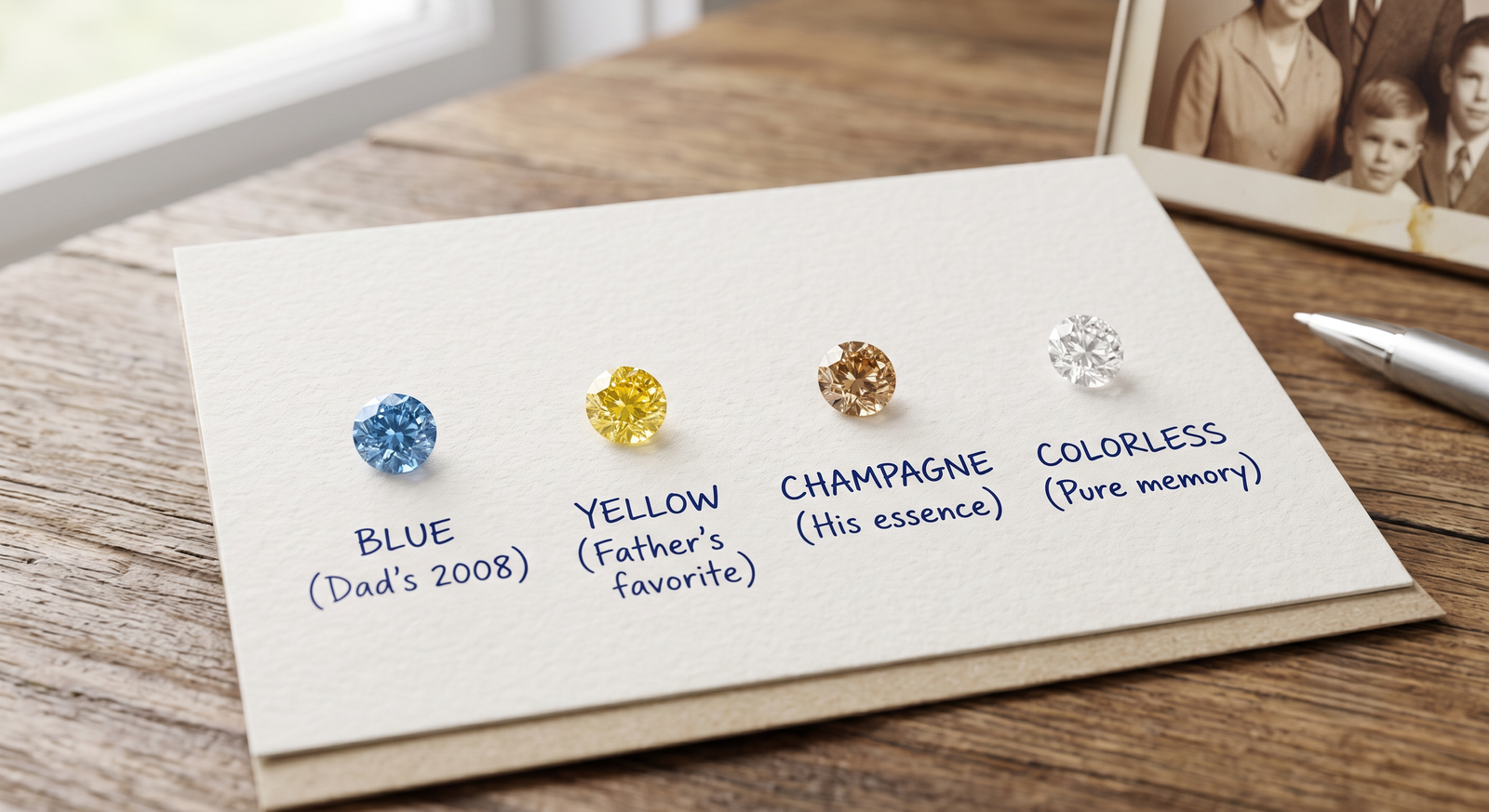
Memorial diamond colors: four small lab-grown stones in blue, yellow, champagne and colorless laid in a row on white card, each above a handwritten label

What Can You Actually Specify About Memorial Diamond Colors?

Memorial diamond colors are agreed in words, held for months, then checked once at the end against an object nobody has yet seen.

What you can specifyWhat you cannotWhat to put in writing
A color family, blue, yellow, champagne or colorlessWhich shade inside it arrivesThe family, plus the range you will accept
Whether the color is grown in or applied by irradiation afterwardsWhether an organic source cooperates first timeThat these are different products, and which you are buying
That the stone reads warm or coolThe exact depth of tone at the carat chosenThe carat and the color on one line, since a tint reads differently at different sizes
That a color grade appears on a grading reportWhat your eye will make of that gradeWhich laboratory grades it, on which scale, and that the report travels with the stone
That two stones ordered together carry one specificationThat two separately grown stones will matchThat you want a shared specification, not a matched pair
Who signs the finished color offThat everyone agrees at first sightThe named person who accepts or declines, and what follows
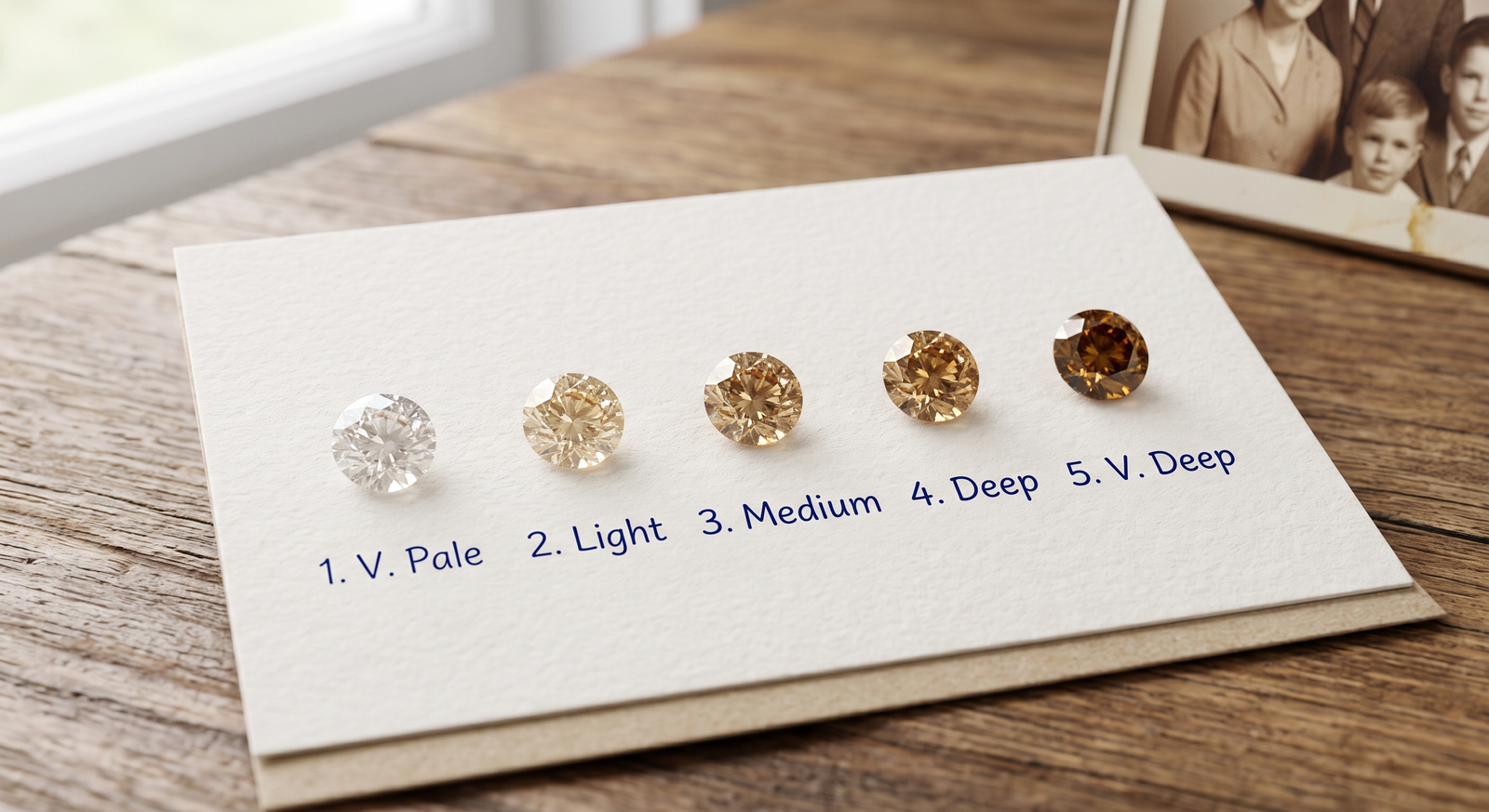
Five champagne-toned diamonds arranged from palest to deepest to show one color family's range

Which Memorial Diamond Colors Exist, and What Puts Them There

Color comes from trace elements present while the crystal grows. Boron produces blue. Nitrogen produces yellow. A colorless stone requires the near total absence of both which an industrial feedstock is manufactured to deliver, and which an organic source can reach only with additional processing to exclude those trace elements, at meaningfully higher cost. Some providers also offer post growth irradiation, applied to a finished crystal, for red, pink, green or black.

The memorial diamond colors you agree apply to a crystal only partly his. Carbon recovered from ash or hair is purified to around 99.9%, then combined with lab sourced carbon to reach the volume a growth run needs, the published figure for ash derived stones puts his share at roughly 10–15% of the finished mass, with no equivalent figure published for hair.

What a particular submission tends to produce is a separate question: the ashes version, the hair version, which also covers why the color his hair went has no bearing, and the combined version. Why memorial diamonds are rarely colorless has the chemistry.

A Color Word Is Not a Color Specification

“Champagne” is a family, not a shade, and so are “blue” and “yellow.” Each spans a range of grades, and stones at either end of that range are recognizably different objects under one word. Memorial diamond colors are described in family names because that is the honest level of precision before growth.

That matters because of when memorial diamond colors get named. You say it in month one, to someone who works with that color family routinely and has a working average in mind. Neither of you has said what would count as too pale or too dark. The missing half is the tolerance, the range nobody has written down, and the thing there is no agreed answer to point at when a box is opened eight months later.

Three things narrow it before the order is placed:

  • Ask what vocabulary the provider works in. A named grading scale, in house color names, sample stones, photographs, these are not equivalent, and the order should record which one it is judged against.
  • Ask to see the extremes rather than the middle. One representative image shows the average; the pale end and the deep end show what you are agreeing to.
  • Ask what carat those references were. A tint barely visible in a small stone is unmistakable in a larger one, so a reference at the wrong size is not a reference.

How Do You Write a Color Down So Two People Mean the Same Thing?

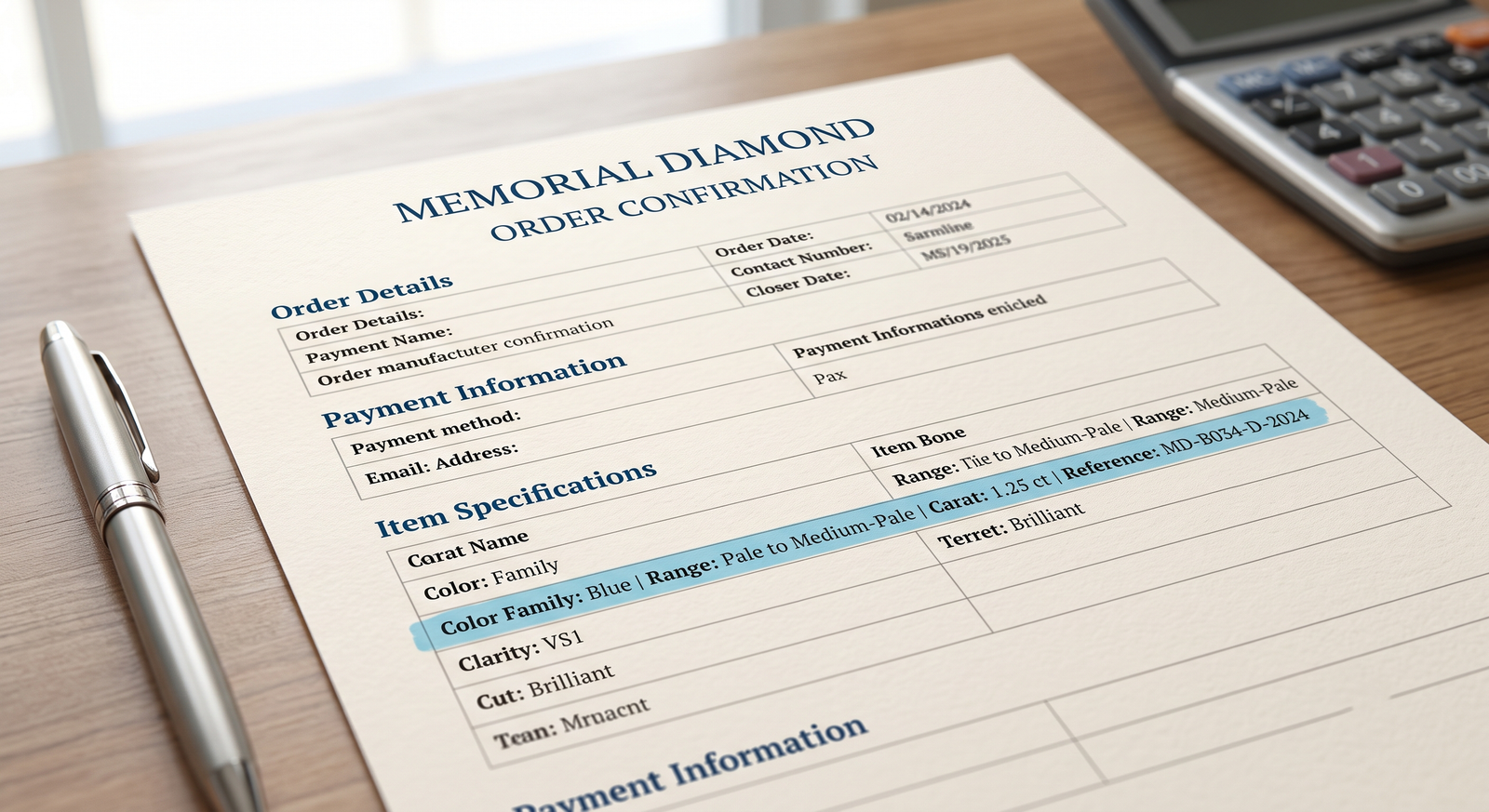
 An order confirmation with a single highlighted line naming color family, range, carat and reference

A line describing memorial diamond colors should survive being read by someone who was not in the conversation. Six things put memorial diamond colors in that state:

  1. The color family, in the provider’s vocabulary as well as your own words.
  2. The acceptable range, expressed the way that provider grades color.
  3. Whether the color is grown in or applied after growth, different products, priced differently.
  4. The reference being used, a named scale, a sample stone, a photograph, and who holds it.
  5. The carat it applies to, on the same line, because the two move together.
  6. The date, and the person on each side who agreed it.

Ask for that line to appear in the order confirmation itself, not only in the email thread that produced it.

What memorial diamond colors do to the price sits in what a father memorial diamond costs; what a setting metal does to the color you see sits in memorial diamond settings and jewelry ideas for a father.

What a Grading Report Says About Color, and What It Does Not

A grading report is the diamond’s own quality document: cut, color, clarity and carat, against a stated scale, ideally from an independent third party laboratory. It is not the in house origin certificate, which records whose carbon the stone was grown from and says nothing about how it looks. How memorial diamonds are graded and certified sets out what each establishes.

Three limits are worth knowing about how a report handles memorial diamond colors. It is issued after the stone exists, so it verifies rather than commissions. A grade is a band rather than a point, so two stones can share a grade and not look alike. And it is assessed under controlled conditions, not on a hand at a kitchen window, so a report and an eye can honestly disagree.

That makes the report a check on the memorial diamond colors you specified rather than a substitute for the specification. Ask early whether the stone is graded independently or in house, and on which scale.

 Close-up of a diamond grading report with the color grade line in focus

What Should You Ask About Recourse?

Nothing published about this category establishes a standard procedure for a stone that arrives outside an agreed color range, no norm, no default remedy, no assumed sequence. Which is why it is worth asking before ordering, and treating the answer as a term of the order. Six questions for an email about memorial diamond colors:

  • Who judges whether the stone is inside the agreed range, you, the provider, or the report?
  • What happens if those three disagree, and who breaks the tie?
  • Is color reviewed before the rough is cut, and does the family see it?
  • Is any outcome available other than accepting the stone, and what is it?
  • If an outcome involves growing again, what does that mean for his material, is more needed, and where does the timeline restart?
  • How long do we have to raise it after the stone arrives?

Write the answers down beside the specification and the reference. No procedure is described here because none is settled, only that the answer is cheaper to obtain in month one than to look for in month ten. The wider question list for a father memorial diamond sorts the rest by who can answer them.

 Rough diamond crystal on a bench mat before cutting, showing its tint

Frequently Asked Questions

Is “champagne” a specification for memorial diamond colors?

Not on its own. It names a family of warm tones spanning several grades, so two people can use the word and picture different stones. It becomes a specification once the acceptable range and the reference are written beside it.

Should memorial diamond colors be agreed before the carat is settled?

Agree them together. The same tint reads differently at a quarter carat and at a carat and a half, so a color line that does not name its carat is only half written. Settle both on one line.

Who decides whether a finished stone is inside the agreed color range?

Ask before ordering, because nothing published about this category settles it. Establish whether the judgment rests with you, with the provider, or with an independent grading report, and what happens if the three disagree.

Can I ask to see a comparison stone before the color is signed off?

Ask. Whether a provider can show a comparable finished stone, a sample set or photographs varies by company, and it is worth knowing which your order is judged against. Record the reference agreed.

Does a grading report settle a disagreement about memorial diamond colors?

Only partly. A report records a color grade under controlled conditions on a stated scale, not how the stone reads in daylight in your hand. Agree in advance whether the grade or the eye governs.

Can two of us specify matching memorial diamond colors on separate orders?

You can specify the same family and range for both. Separate growth runs are separate events, so expect a family resemblance rather than a match. Say at the order that a shared specification is what you want.

Final Thoughts on Memorial Diamond Colors for a Father

With memorial diamond colors, the word is the easy part. The range, the reference, the carat it applies to, who signs it off and what happens if it lands outside, those take one email, and they are the difference between a specification and a hope. Write them down before the deposit. It costs nothing, delays nothing, and it is the leverage you have on a decision you cannot inspect until it is finished.

Learn More About Father Memorial Diamonds

Talk With Memorial Diamond

Reach out to Memorial Diamond at memorialdiamond.us to talk through which memorial diamond colors are realistic for his material, what a written specification looks like, and what to ask us, in writing, about what happens if the stone does not match it. The same questions are worth putting, in the same words, to anyone else you are weighing up.

Word count: 1,852 · Reading time: about 9 minutes

Memorial diamond settings for a father: a man's watch, a signet ring and a pair of cufflinks resting in a small dish on a chest of drawers

Memorial Diamond Settings and Jewelry Ideas for a Father

His watch came off every night and went in the same place, a dish on the chest of drawers everyone in the house knew about. That habit is the whole subject of memorial diamond settings for a father. A memorial diamond will outlast whatever holds it. The realistic way one disappears is removal: a piece taken off during the day and set down out of place. So the settings question has two halves: what holds the stone, and whether the piece comes off at all.

Declared interest: Memorial Diamond is itself a memorial diamond company, so weigh every mounting recommendation below against the fact that we sell the stone it holds.

What Actually Happens to a Memorial Diamond That Goes Missing?

Two things can go wrong with a set stone, and only one is recoverable.

Damage is the recoverable one. At 10 on the Mohs scale nothing in ordinary life will scratch the stone, though a sharp knock at the wrong angle can chip a diamond at the girdle, and you still have the stone afterwards, in your hand, with options.

Separation is not. A stone that works loose from a claw on a Tuesday and is gone by Thursday, or a piece left in a hotel room, does not come back. Memorial diamond settings should be designed against that, not against breakage.

Worth being plain about what the mount is holding. A memorial diamond is not ash in a capsule: carbon taken from him is cleaned to roughly 99.9% purity and grown into the crystal alongside supplemental lab carbon, which leaves his own contribution at something like 10% to 15% of the stone’s finished mass industry wide. That fraction is why this page is about retention rather than repair.

Which piece to make, and who for, is answered in father memorial diamond ideas. This page is the mechanics of memorial diamond settings.

Pieces That Come Off, and What to Do About Them

The memorial diamond settings men actually wear are the ones that leave the body. A father’s stone can easily end up in something that leaves the body during the day: cufflinks, a tie bar, a watch, or a ring pulled off for gloves or at a sink. That is not an argument against those pieces, but for deciding, before the piece is made, where it goes when it is not being worn.
Close-up of a small diamond held in a collet on a cufflink face, back swivel visible
  • Give it one named place, where the piece actually comes off rather than where it ought to. A dish by the sink beats a box in an unused bedroom.
  • Never a pocket. Pockets are turned out, sat on, and emptied into washing machines.
  • On the move, it goes in the case, not the room. Changing rooms and hotel rooms are where small pieces get left behind.
  • Treat a daily removal as a design input. If you cannot say where the piece lives overnight, that is the decision still to make, not the metal.

How Memorial Diamond Settings Hold the Stone, Piece by Piece

PieceHow the stone is heldHow this piece actually gets lostWhat to ask the jeweler
CufflinksCollet or bezel in the face; the back swivels or chainsLeft in a shirt at the dry cleaner, or in a changing roomIs the swivel riveted rather than glued, and replaceable?
Tie bar or pinStone in the bar face; the bar clips to the tieThe clip loses tension and the bar drops off unnoticedHow tight is the clip, and will it be re tensioned?
WatchStone in the case back, dial or crown, in a fitted colletThe watch is sold on without anyone knowing what is in itDoes mounting breach the seal, and will it still service?
Signet or seal ringStone sunk into the shoulder or shank, sitting flushComes off a working hand and never goes back onHow proud does the stone sit, and can the seat be checked in place?
PendantClaws or a bezel in a fitting hung from a bailLifted off over a shirt collar and left on a hotel dresserIs the jump ring soldered, and the clasp rated for the weight?
An object he usedCollet in a drilled seat, or set into the materialThe object gets used: knocked, dropped, lent outWill the seat weaken it, and does the object still work?

Bezel and claw both appear in the second column deliberately. A rim captures the girdle, claws grip it at points, but across all memorial diamond settings, the third column decides more than the second.

Two rings side by side, one with a flush bezel-set stone and one with a raised claw-set stone

Can a Stone Go Into Something That Was Never Made to Hold One?

Sometimes, and for these memorial diamond settings it is a bench assessment rather than a design preference. A jeweler mounting a stone into a watch, a pen, a knife handle or a box lid is working out four things.

  1. Material. Can it be cut cold, or does it need heat? Some plastics and resins craze, hardened steel resists cutting, and thin plated metal tears rather than holds.
  2. Depth. Is there material behind the face to seat a stone without going through it? A seat that breaks the far side is not a setting.
  3. Function. Does the object still have to work? A watch has to stay sealed, a knife has to flex without a stress riser, a pen has to screw together.
  4. Fixing. A collet fitted into a drilled seat, or the stone cut straight into the object’s own material? A collet keeps the cutting away from the structure, and it is the removable answer.

Things that cannot safely take memorial diamond settings: thin pressed metal with nothing behind it, anything that flexes or springs under load, anything sealed that would leak once drilled, and anything structural.

Two points before work starts on memorial diamond settings in an object. This is not always one trade. A watchmaker opens the watch, a jeweler makes the collet, so ask who does which part. And cutting into something he owned cannot be undone. If the object matters to somebody else, that conversation comes first. Setting the stone into a band he already wore has its own constraints, covered in the father ashes diamond complete guide.

Jeweler at a bench drilling a seat into a watch case back with a collet beside it | **Priority for original photography

Metal and Wear on a Hand That Works

On a hand that lifts, grips and scrapes, height matters more than metal in memorial diamond settings.

  • How proud the stone sits decides how much it catches. A flush or sunk stone clears door frames, toolboxes and gloves. A raised claw head finds them.
  • Claw tips wear from the outside in. Gloves, tool handles and a steering wheel all press the same few points, and a claw thinned that way lets go without ever catching on anything.
  • Plated finishes wear through first at the contact points, the underside of the band above all.
  • A ring is not the only answer. If his hands worked and yours do too, a pendant under a shirt takes none of that punishment.

The metal shifts how a stone’s color reads, warmer inside a yellow mount, cooler inside a white one, so choose the mount against the finished stone rather than a description (memorial diamond colors for a father). Cleaning a set piece belongs to memorial diamond aftercare, and words on the metal to engraving and personalizing the setting.

What Size Should a Piece Be If It May Pass Between Two People?

Ask how many sizes a design can move before choosing it, because some memorial diamond settings cannot move at all. A piece that must be remade to change hands will not change hands.

  • Sidestep sizing where you can. A pendant, cufflinks, a tie bar or a watch fit anybody.
  • If it has to be a ring, ask the bench its sizing range with the stone in place.
  • Size it to whoever wears it now, not to a compromise. A ring that fits neither is the one that comes off in a glove.

Frequently Asked Questions

Mechanically, yes. A collet in the face holds a stone as securely as a ring does. The risk is the routine, not the mount: cufflinks come off in hotel and changing rooms, so decide where the pair lives first.

What does a jeweler check before memorial diamond settings go into something he owned?

Whether the material can be cut without cracking, whether there is depth behind the face to seat a stone, whether the object still has to function, and whether heat is needed nearby. Any one can rule it out.

Which memorial diamond settings suit a hand that works?

For retention on a working hand, a stone sunk into the metal sits lower and catches less than raised claws. The trade is that a sunk stone shows less light, so ask to see both profiles against your hand.

What should happen to a piece each time it comes off during the day?

It should go to one named place, not the nearest flat surface. Put a dish where the piece is actually removed rather than where you think it should be, and never on a basin rim or in a pocket.

If memorial diamond settings may pass from me to my brother, how should the piece be sized?

Ask how many sizes the design can move before choosing it, because some cannot move at all. If it has to change hands, a pendant, cufflinks or a tie bar sidesteps sizing and needs no bench work.

Are there memorial diamond settings a stone genuinely cannot go into?

Yes. Thin pressed metal with nothing behind it, anything that flexes or springs under load, anything sealed that would leak once drilled, and anything structural. A jeweler ruling an object out is stating a mechanical limit.

Final Thoughts on Memorial Diamond Settings for a Father

Decide where the finished piece lives when it is not being worn, and let that answer choose among memorial diamond settings. Put the jeweler’s questions to a bench before anything is cut. Production runs 6 to 10 months from receipt of material, longer for larger or specialty stones, time enough to decide this before the stone exists. Settings are quoted separately from the stone (what a father memorial diamond costs), so the mount is a decision you can take at your own pace.

Learn More About Memorial Diamond Settings

Talk With Memorial Diamond

If you have an object of his in mind and want to know whether it can take a stone, that is a question for a bench, and a conversation Memorial Diamond can help you frame. Reach out at memorialdiamond.us to talk through memorial diamond settings, from a plain pendant to the watch he wore.

Word count: 1,889. Reading time: about 9 minutes.