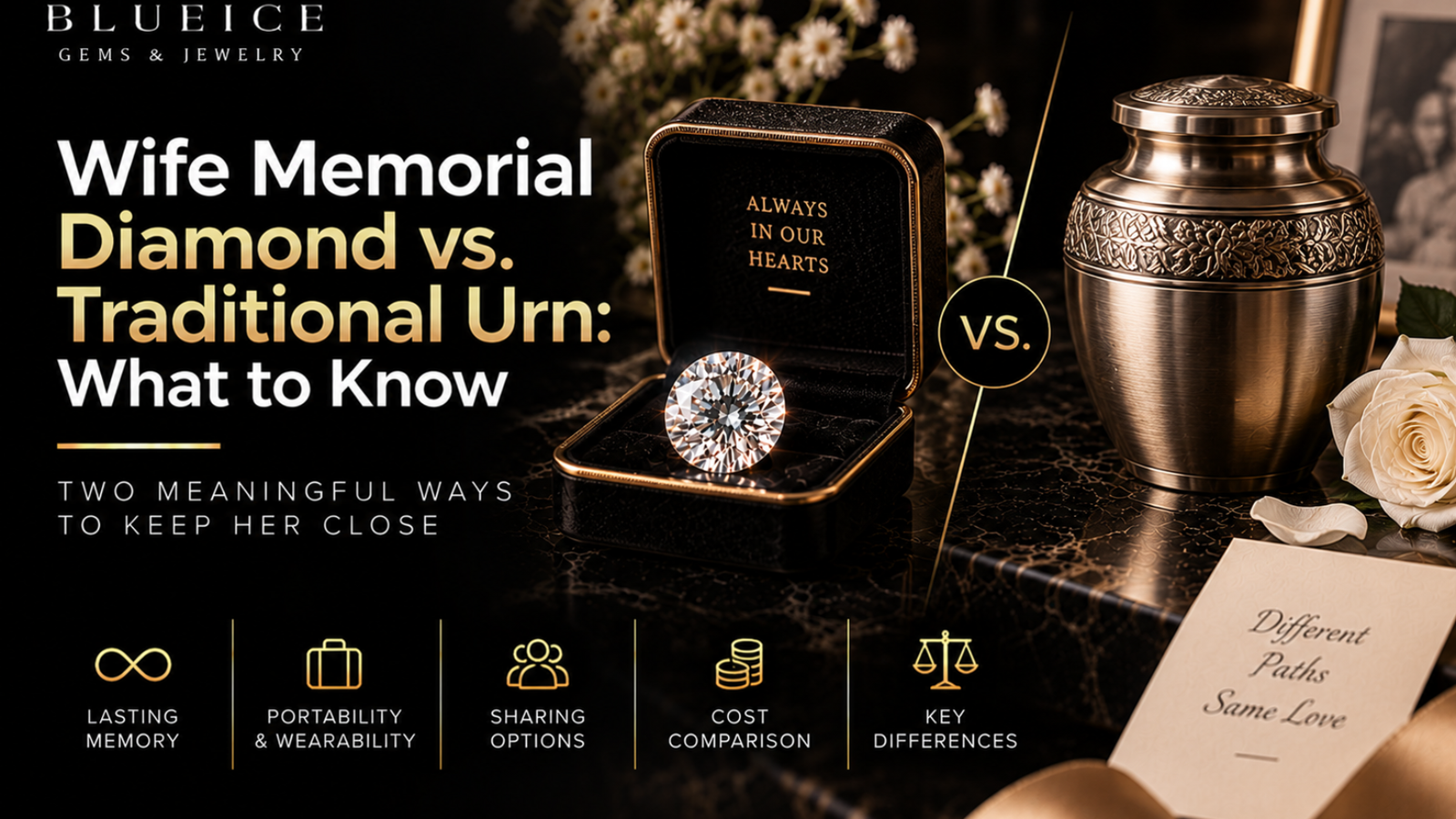
The traditional urn was chosen quickly, in a week you would struggle to reconstruct, and it has been in the same place ever since.
A wife memorial diamond vs traditional urn is not really a contest between two versions of the same object. A traditional urn is a place she is kept. A diamond is something she is kept in that travels with a person. They answer different questions, and because a diamond uses only a fraction of the ashes, choosing one almost never means giving up the other.
A disclosure belongs at the top of a memorial diamond vs traditional urn comparison rather than buried at the end of it. Memorial Diamond grows memorial diamonds and sells no urns, so one of the two columns below is the one this company is paid for. The traditional urn column is written to be accurate, not to lose, but read it knowing who wrote it.
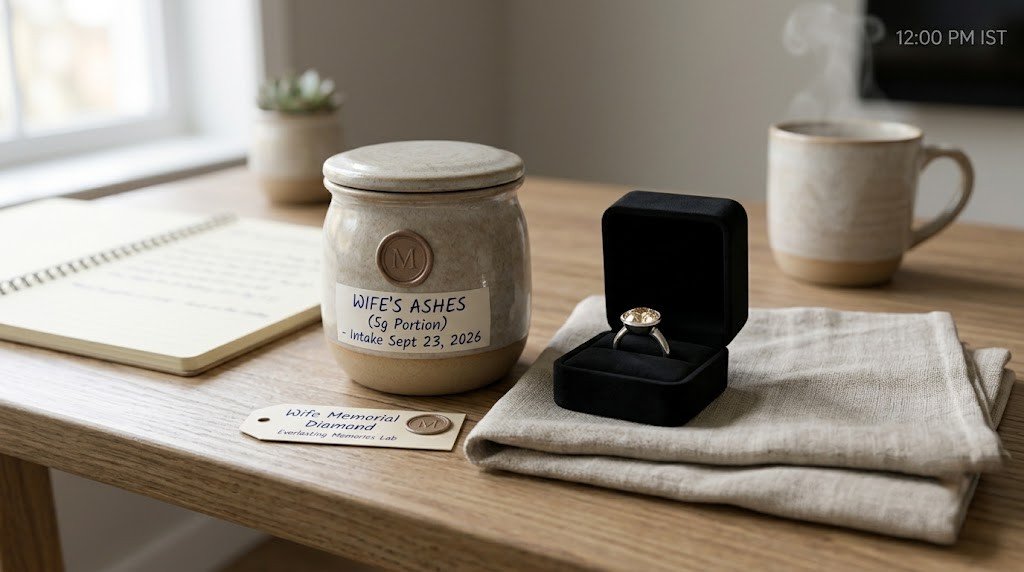
Table of Contents
Two Different Questions About Where She Is Kept
A memorial diamond vs traditional urn comparison begins with something the phrasing hides: the two objects are not answering the same question, so neither can really beat the other at it.
A traditional urn answers a question about location. It holds the whole of what a cremation produces, complete and undivided, and it sits somewhere specific, a shelf at home, a plot, a niche in a columbarium wall. Its entire nature is that it stays put and can be returned to.
A wife memorial diamond answers a question about company. It is a chemically genuine lab grown diamond containing a purified portion of her carbon, and its nature is that it goes where a person goes. It has no address. It has a keeper.
Neither question is the better question, and a wife memorial diamond does not answer the first one better than an urn does. A family that wants somewhere to go on her birthday is asking the location question. Someone who wants her at a graduation two states away is asking the second. Most families, given a little time, find they are asking both, which is why the wife memorial diamond vs traditional urn framing dissolves so often on contact.
Worth being precise about what a wife memorial diamond is, since a memorial diamond vs traditional urn comparison only works if both sides are described honestly. What a cremation leaves is largely calcium phosphate, bone mineral, which puts the usable carbon at between 0.5% and 4% of the ash by weight. That carbon is extracted, purified to around 99.9%, and grown into a crystal, but the quantity recovered is nowhere near what a growth run consumes, so it is combined with lab grown carbon to reach a workable volume. The stone contains a real, traceable part of her. It is not made only of her, and no honest comparison should imply otherwise.
Is a Wife Memorial Diamond vs Traditional Urn Really a Choice?
Usually not, and this is the single most useful thing to know before reading any further.
A wife memorial diamond order uses somewhere between a few tablespoons and roughly four ounces of cremated remains, industry wide, about 100 grams. A full adult cremation produces several pounds. So the arithmetic of a wife memorial diamond vs traditional urn is not subtraction of one from the other. It is a small withdrawal from something that stays substantially intact.
What a wife memorial diamond takes, it takes once, and the rest is untouched. The remainder can be interred as planned. It can be scattered where she asked. It can stay in the traditional urn on the shelf, in the same room, doing exactly what it has been doing. How much ash a single stone actually uses sets out the quantities and what remains afterward.
There is one situation where the memorial diamond vs traditional urn choice is real, and it is about timing rather than principle. A scattering or an interment that goes ahead without a portion being set aside closes the diamond route permanently. If you are unsure, separating and labeling a portion costs almost nothing and commits you to nothing. How to divide her ashes yourself covers how.
And keeping a traditional urn, whole and undivided, is a complete answer. It needs no upgrade and no justification. Any memorial diamond vs traditional urn comparison that treats the urn as a holding position for people who have not yet heard of something better is writing about a decision it does not understand.
Does She Stay in a Place, or Travel With a Person?
This is the axis the two objects genuinely differ on, and it is the one place where a memorial diamond vs traditional urn comparison produces a clean answer rather than a hedge. It is worth sitting with before looking at any table.
A traditional urn is fixed and public within the family. Anyone who can reach the room, the grave or the niche can be with her without asking anyone’s permission. Her mother can visit. Her oldest friend can visit. Nobody has to arrange it through you.
A wife memorial diamond is mobile and private. It goes to work, to the beach, to a hospital waiting room. It is also in a specific person’s keeping, which means being near it involves being near them. A stone on your hand is not somewhere anyone can drop in on.
Both properties are real and neither is a defect. A wife memorial diamond vs traditional urn decision often comes down to which of those two you need more of this year, and the answer can change. Someone who wanted her fixed in one place in the first year sometimes wants her portable in the fifth, and the urn does not prevent that.
There is a durability point under the portability one, and in a memorial diamond vs traditional urn comparison it favors both objects rather than one. Diamond is a 10 on the Mohs scale of mineral hardness, the hardest known natural mineral, so a wife memorial diamond worn daily is in no danger from ordinary life. The setting around it and the metal holding it are softer and do wear. A traditional urn, kept still, wears at effectively nothing at all.
Wife Memorial Diamond vs Traditional Urn: Five Dimensions Side by Side
Five dimensions do the real work in a memorial diamond vs traditional urn decision, and a wife memorial diamond leads on some of them while a traditional urn leads on others. Neither column below is the winning column. They are different objects, and the rows show what each one is naturally good at.
Table: memorial diamond vs traditional urn, across the five dimensions that actually decide it.
| Dimension | A traditional urn | A wife memorial diamond |
|---|---|---|
| Permanence | Very high. Ceramic, metal or stone, kept still, in a fixed location. Interred or in a niche, it is designed to outlast everyone who arranged it | Very high, by a different mechanism. A 10 on the Mohs scale, unaffected by daily wear. The stone outlasts the setting it sits in, which may need replacing over decades |
| Portability | Low by design, and that is the point. It can be moved, but moving it is an event, and an interred urn or niche is not moved at all without the cemetery’s permission | High. It goes where a person goes, without arrangement, notice or anyone else’s involvement |
| Who can share it | Anyone who can reach the place it stands. Access runs through a location, and often through a cemetery’s own visiting rules rather than through a family member | Whoever is with the person holding it. Access runs through a person. Several stones can often be grown from the same remains, so sharing is possible but is a separate order each time |
| Cost shape | Paid once, early, usually as part of arranging the cremation, and then effectively nothing afterward beyond interment or niche fees | A separate purchase made later, from the low thousands upward by carat, with a grading report, engraving and any setting typically priced on top |
| Reversibility | Fully reversible while it remains in the traditional urn. Ashes can be moved, divided, interred or scattered at any point | Not reversible. The portion used becomes carbon inside a crystal and cannot be returned to ash |
Read the permanence row and the reversibility row together and the memorial diamond vs traditional urn comparison is there in miniature: both objects last, but only one of them keeps your options open.
Who Else Can Have Part of Her?
This dimension gets less attention than permanence and matters more in practice, because it is where a memorial diamond vs traditional urn decision stops being yours alone and starts involving other people.
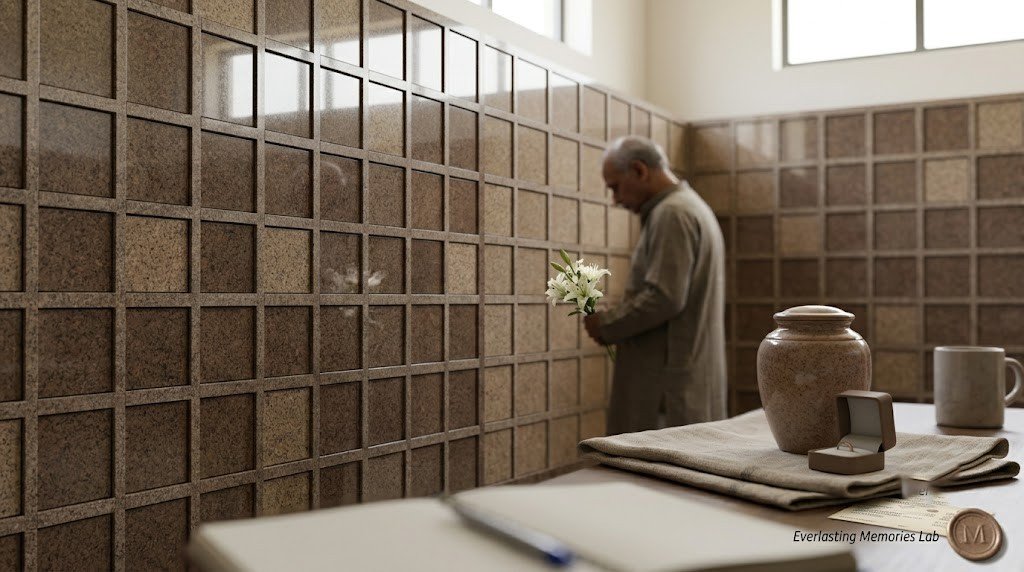
A traditional urn is shared by proximity. It sits somewhere, and the people who can get to that somewhere are the people who can be with her. Nobody has to ask, and nobody can be excluded except by distance. That includes people you might not choose and excludes people who live far away, neither of which is anyone’s decision, exactly. It is just how a place works.
A wife memorial diamond is shared by multiplication instead. Because a single stone uses only a portion of the remains, more than one can often be grown from the same source, so several people can each have their own. That is a genuinely different model of sharing, and it has its own complications: each stone is a separate order at a separate price, and two stones grown from one source are not guaranteed to resemble each other. What to settle before more than one person orders is worth reading before the subject is raised at a family gathering.
The two models combine well rather than competing. A family can keep the traditional urn exactly where it is, so nothing anyone has been doing has to stop, and grow one or two stones from a portion for the people who need her portable. Nobody has to give anything up for that to work, which is the practical reason the wife memorial diamond vs traditional urn question resolves as “both” more often than as “either”.
Memorial Diamond vs Traditional Urn: What Does Each Cost, and When?
The money question in a memorial diamond vs traditional urn comparison is not really about which is dearer. It is about when the cost lands and what it is attached to.
A traditional urn is bought under time pressure, usually within days of a death, as one line on a funeral invoice among many things being decided at once. The decision is made fast because it has to be, and the price is settled before anyone has had a chance to think about what they want long term.
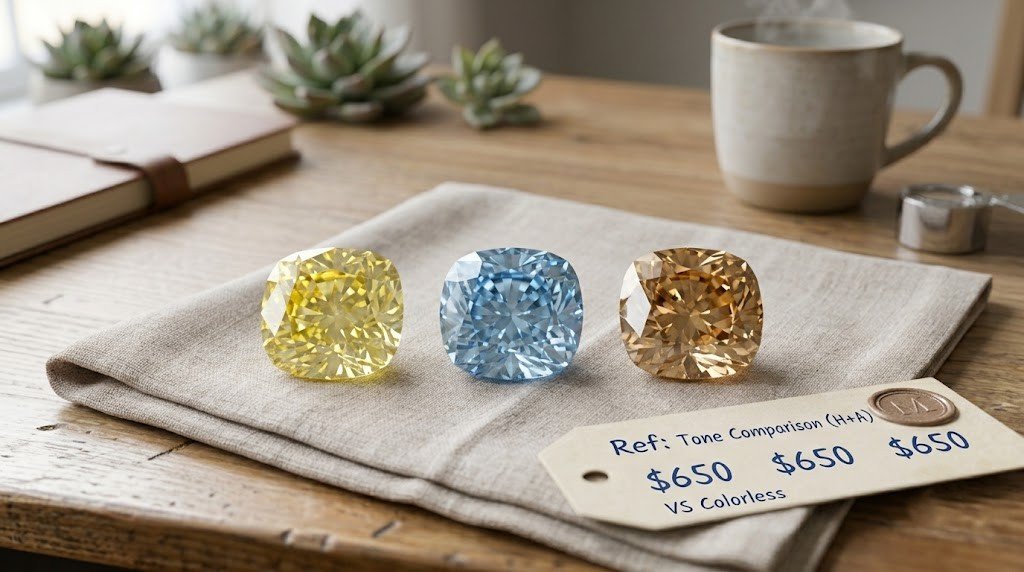
A wife memorial diamond is bought later, with no deadline attached, and the cost scales steeply with carat because carat is bought as growth time in the press. Across the industry as a whole the steps run roughly like this: $1,500 to $3,500 for a stone in the 0.10 to 0.25 carat entry tier, $5,000 to $15,000 once you reach half a carat to a full carat, and a climb from there for anything larger. Colorless costs meaningfully more than yellow, blue or champagne tones at the same size. What a wife memorial diamond costs breaks the tiers down properly, including what is usually priced separately.
So the cost side of a memorial diamond vs traditional urn comparison is a little unfair in both directions. The traditional urn was cheaper and was chosen under pressure. The diamond is dearer and can be chosen slowly, deferred for years, or never bought at all without anything being lost. Those are different kinds of spending, not different amounts of the same kind.
What Can Be Undone, and What Cannot?
Reversibility is the row most people skip, and it is the one most worth understanding before anything is sent anywhere. It is also the one row in a memorial diamond vs traditional urn comparison where the diamond is genuinely at a disadvantage, and there is no point pretending otherwise.
Ashes in a traditional urn are stable mineral matter. They do not degrade, they do not expire, they do not become less suitable for a wife memorial diamond with age, and every option remains open for as long as they sit there. A stone in five years is exactly as possible as a stone next month. That optionality is a real, underrated property of simply doing nothing for a while, and it is why a memorial diamond vs traditional urn decision almost never has to be made this month.
Three things close, and only three:
- A scattering or interment that goes ahead with nothing held back. Complete by design, which is much of what it is for. After it, ashes are no longer a route.
- The portion committed to a growth run. Once purified and graphitized, it is carbon heading into a crystal and cannot become ash again.
- Hair that was never collected, if the ashes route is closed and hair would have been the alternative.
Everything else waits. Choosing a company, choosing a carat, choosing a color, settling the memorial diamond vs traditional urn question one way or the other, none of that decays while you think about it. If you want the full route before taking a step, the complete guide to a wife ashes diamond runs from material to finished stone.
Frequently Asked Questions
Do I have to choose between an urn and a memorial diamond for my wife?
Usually not. A diamond uses only a portion of the ashes, industry wide, a few tablespoons up to about four ounces, so the urn keeps the rest and stays exactly where it is. Both can exist at once.
Which lasts longer, a wife memorial diamond vs traditional urn?
Both last indefinitely, by different mechanisms. A quality urn kept still is effectively permanent. A diamond is a 10 on the Mohs scale and unaffected by daily wear, though the setting holding it is softer and may need replacing over decades.
Is it disrespectful to take ashes out of the urn for a diamond?
There is no universal answer. Views on dividing or repurposing ashes vary by faith, denomination and individual clergy, and no tradition has an official position on memorial diamonds specifically, only on cremation and ash handling generally. Ask your own faith leader.
Can her family still visit her ashes if I have a diamond made?
Yes, if the urn stays where it has been. A diamond does not empty an urn or move it. What changes is only that the stone itself is not a place anyone can visit. Access to it runs through whoever keeps it.
Is a memorial diamond more expensive than an urn?
Almost always, and the two costs are not really comparable. An urn is bought fast, early, as part of a funeral invoice. A diamond is a separate later purchase priced by carat, from the low thousands upward, with settings and grading usually charged separately.
Can I still make a diamond if her ashes were already interred?
Sometimes. It depends on whether a portion was held back at the time, and on whether that cemetery permits an interred urn to be reopened. Rules vary considerably by location and are a question for that specific place rather than a general one.
Final Thoughts on a Wife Memorial Diamond vs Traditional Urn
A memorial diamond vs traditional urn comparison is gentler than the title suggests. The traditional urn on the shelf was a real decision made in a hard week, and nothing on this page asks you to revisit it or to feel that it fell short. A wife memorial diamond is an addition to consider, not a correction to make.
What a wife memorial diamond vs traditional urn comparison is actually for is noticing that the two objects are good at different things, one holds a place, one keeps company, and that a small portion of what a traditional urn holds can become the second without the first changing at all. If that is not something you want, the memorial diamond vs traditional urn question needs no answer from you at all: the traditional urn is already a complete answer, and it does not need this page’s permission to be one.
Learn More About Wife Memorial Diamonds
- How much ash a single stone actually uses
- What to settle before more than one person orders
- What a wife memorial diamond costs
- The complete guide to a wife ashes diamond
- Every question families ask about a wife memorial diamond
Talk With Memorial Diamond
If what a memorial diamond vs traditional urn comparison leaves you with is a practical question, how much a portion would actually be, what would remain in the urn afterward, what a wife memorial diamond of the size you have in mind would involve, that is a conversation with a company rather than something to settle by reading.
Memorial Diamond is one of the companies you can put a wife memorial diamond vs traditional urn question to, at memorialdiamond.us. Asking changes nothing about the urn, and it commits you to nothing. If the answer you reach is that the traditional urn stays as it is and whole, that is a good answer, and it was always available.