
Some siblings end up holding two kinds of keepsake at once: a small share of her ashes and a lock of hair saved before the funeral. To turn sister ashes and hair into one diamond, you secure agreement for each material, confirm a provider genuinely combines both, ask in writing what each contributes, ship them as instructed, agree on size and color, and allow roughly six to ten months while a laboratory grows the stone.
Table of Contents
Why Turn Sister Ashes and Hair Into One Diamond?
For some siblings the reason is simple: both materials are there, and choosing one over the other feels wrong. Her ashes carry the finality of the farewell; a braid or curl carries something of her ordinary days. Deciding to turn sister ashes and hair into one stone lets both sit in the same crystal.
There is a practical side too. By weight, hair is around 50% carbon; ash manages only about 0.5% to 4%. Adding hair therefore contributes carbon rich material to the order. What it does not do is make the diamond bigger: carat size is set by how long the crystal grows, not by how much material arrives.
It is also fine to decide not to turn sister ashes and hair into a single stone. Some siblings prefer two separate stones, or one route only, and the single material guides, the ashes route and the hair route, cover those paths step by step. A blended stone is one choice among several good ones, not the complete version of the others.
Can Every Provider Turn Sister Ashes and Hair Into a Single Stone?
Not necessarily. Providers differ: some may accept only ashes, some only hair, and some may take both yet grow them into separate stones unless asked otherwise. Before anything else, ask plainly whether the provider will turn sister ashes and hair into a single diamond, meaning carbon from both sources goes into the same growth run.
Then ask how it would turn sister ashes and hair into one crystal. A provider might extract carbon from each material separately and combine the purified carbon before growth, or it might process them together from the start. Either can be legitimate; what matters is that you know which, and that the paperwork records both sources.
Watch for wording that blurs the distinction. “We can include hair” might mean blended into one crystal, or it might mean a lock enclosed in a keepsake box alongside the diamond. If you plan to turn sister ashes and hair into a combined stone, a one line written confirmation removes any doubt.
What Are the Ten Steps, From First Conversation to Finished Stone?
Several steps differ by material when you turn sister ashes and hair into a diamond, so this table sets them side by side.
| Step | Ashes side | Hair side |
|---|---|---|
| 1. Agreement | Whoever holds authority over her remains | Whoever is handling her estate or belongings |
| 2. Request | Ask for a small portion, explaining how little is needed | Ask about using the lock, even if it is already in your keeping |
| 3. Gathering | Typically tablespoons, up to roughly 100 g or about 4 oz | Typically a few grams, meaning one small lock |
| 4. Other relatives | Can more portions be released? | Is there enough hair to share? |
| 5. Provider choice | Confirms it blends both into one stone | Confirms it accepts the hair you have |
| 6. Paperwork | Origin record lists ashes | Origin record lists hair |
| 7. Packing | Ashes specific mailing rules apply | Ordinary tracked mail usually works |
| 8. Design | Size, color, cut and setting chosen once | Same decisions, one stone |
| 9. Laboratory | Carbon extracted from mineral heavy ash | Carbon extracted from keratin |
| 10. Arrival | Check every document | Check every document |
Typical figures above are industry wide and provider variable. Nothing here runs to a deadline; ashes and hair both keep well if stored dry and sealed, so families can turn sister ashes and hair into a diamond whenever they feel ready.
Steps 1 to 2: Whose Agreement Do You Need for Each Material?
This is where a blended order is genuinely different, because the two materials can sit under different people’s say so.
Her ashes. Authority over remains is set by state law and by anything she put in writing. In many states it rests first with a spouse or registered partner, then adult children, then parents, with siblings further along. If you are not that person, the route is a respectful request for a small portion. The funeral home can usually tell you who signed for the cremation, and the sister ashes diamond guide covers authority in more detail.
Her hair. A lock kept among her belongings may count as part of her estate, and rules vary by state, so the executor or whoever is handling her affairs is the person to speak with, even if the hair is already in your keeping. Hair the funeral home trimmed at the request of the authority holder is theirs to release.
Sometimes one person controls both; sometimes it is two different people. Either way, the request to turn sister ashes and hair into a diamond is easier to hear when you explain how little is needed and that the rest stays exactly where the family intends. If a probate question looks complicated, a short consultation with a local attorney is worth the cost.
Step 3: How Much Do You Need to Turn Sister Ashes and Hair Into a Diamond?
Less than you might picture, though every provider sets its own minimums. As a general guide, ashes orders typically call for somewhere between a few tablespoons and roughly 4 ounces or about 100 grams, and hair orders a small lock or a few grams. For a blend, ask whether the provider wants the full amount of each or a reduced amount of both.
A few habits help:
- Get the provider’s requirement for each material in writing before anyone measures anything.
- Keep part of the hair back, so a lock of her remains as it is. The sister hair diamond guide has more on storing it.
- Let the authority holder measure out the ashes portion if they would rather.
- Label each material separately from the very start.
Sending more will not produce a larger stone, so there is no reason to part with more of either than the order needs. When you turn sister ashes and hair into a diamond, agreeing on amounts can be the easiest part of the conversation.
Step 4: Does Anyone Else Want to Turn Sister Ashes and Hair Into a Stone?
Ask now, while you are already talking to the people who hold her ashes and belongings. Because each order uses only a portion, two or three relatives may be able to have their own stones, and a single coordinated request is gentler on everyone than a series of them.
Sibling relationships come in every shape. You may share one parent with her or both; you may be twins, or have met as adults through a parent’s remarriage. Each of those bonds is real, and each sibling’s wish is legitimate.
Talk through whether everyone wants a blend or whether some would rather have an ashes only or hair only stone. A useful question is whether there is enough hair: a lock that comfortably covers one order may not stretch to three. If several of you plan to turn sister ashes and hair into stones of your own, ask the provider how it keeps multiple orders from one family distinct.
Steps 5 to 6: What Should a Provider Confirm Before It Can Turn Sister Ashes and Hair Into a Diamond?
Send the same email to two or three companies. A blended order raises questions a single material checklist misses:
- Will you turn sister ashes and hair into one diamond in a single growth run, or into separate stones?
- Is carbon from each material extracted separately, and when are the two combined?
- What share of the finished stone’s mass will be her carbon, and can you say how much comes from ashes and how much from hair?
- Is supplemental lab carbon added, and from what source?
- Is her material ever processed alongside another family’s?
- Will the origin certificate list both ashes and hair as sources?
- Is an independent grading report included or extra?
- What is the full price, including grading, setting, engraving and insured return shipping?
- What happens if a growth run fails, and what are the cancellation terms?
- Will any unused ashes or hair be returned to you?
Step 6 is simply this: do not pay until those answers are in writing and you have read the terms. A company willing to turn sister ashes and hair into a diamond for you should find none of these difficult. The sister ashes and hair diamond guide adds broader context if you want it before deciding.
Step 7: How Do You Pack Two Materials Without Mixing Them Up?
When you turn sister ashes and hair into one stone, the provider’s kit should say whether the two materials travel in one parcel or two. Follow that kit exactly. Either way, each material should sit in its own sealed, labeled container carrying the order reference, never loose together in one bag.
Ashes are subject to their own carrier rules. In the United States the Postal Service has specific packaging and labeling requirements for cremated remains, which providers generally build their kits around. Hair is not cremated remains, so those rules generally do not apply to it, but it still deserves a tracked, insured service.
Before sealing, photograph each labeled container and the signed forms. Keep the tracking numbers together, and ask the provider to confirm by email that both materials arrived and were logged under your order. For anyone who decides to turn sister ashes and hair into one stone, that double confirmation is worth requesting by name.
Step 8: What Will You Decide About Size, Color, Cut and Setting?
Because you turn sister ashes and hair into one stone, there is one set of choices, usually made at ordering.
Size. Memorial stones generally run from about 0.10 carats to more than 5. General 2026 industry pricing, not any one company’s, looks roughly like this:
- About 0.10 to 0.25 carats: $1,500 to $3,500
- About 0.5 to 1 carat: $5,000 to $15,000, with colorless at the higher end
- About 2 carats and above: $20,000 to $75,000 or more
Grading, engraving, fancy cuts and settings are typically extra.
Color. Shade is decided during growth by trace elements. Nitrogen leans yellow and boron leans blue, while a colorless result means keeping both out, at extra cost. Yellow, blue or champagne are the likely outcomes. Where offered, post growth irradiation can produce red, green or black. Combining ashes and hair does not let you choose, match or predict the shade, and hair does not steer the result lighter.
Cut and setting. Round, oval, cushion and other cuts are commonly available. A ring, pendant, cufflinks or a stone kept loose in a case are all sensible. Pick whatever you will actually live with.
Step 9: What Happens When Labs Turn Sister Ashes and Hair Into a Diamond?
Once both materials are logged, carbon is recovered from each. Ash is mostly calcium phosphate, the mineral of bone, so its carbon yield is small; hair yields far more. The recovered carbon is purified to roughly 99.9% or better, converted to graphite at around 2,500 to 2,700°C, typically joined by supplemental lab carbon, and set around a tiny diamond seed inside a growth cell. The usual route is high pressure, high temperature growth near 6 to 8 GPa, though a smaller number of providers grow by chemical vapor deposition.
After growth the rough crystal is cut, polished and graded. Across the industry, expect six to ten months overall, up to about twelve for stones above roughly 2 carats or specialty colors. Each stage of the blended process is explained in more depth separately.
Ask how often you will hear from the provider while it works to turn sister ashes and hair into a finished diamond, and who to contact if a few weeks go by in silence.
Step 10: How Do You Check the Stone When It Arrives?
Set aside a quiet hour. Then confirm that:
- The order reference matches your intake forms.
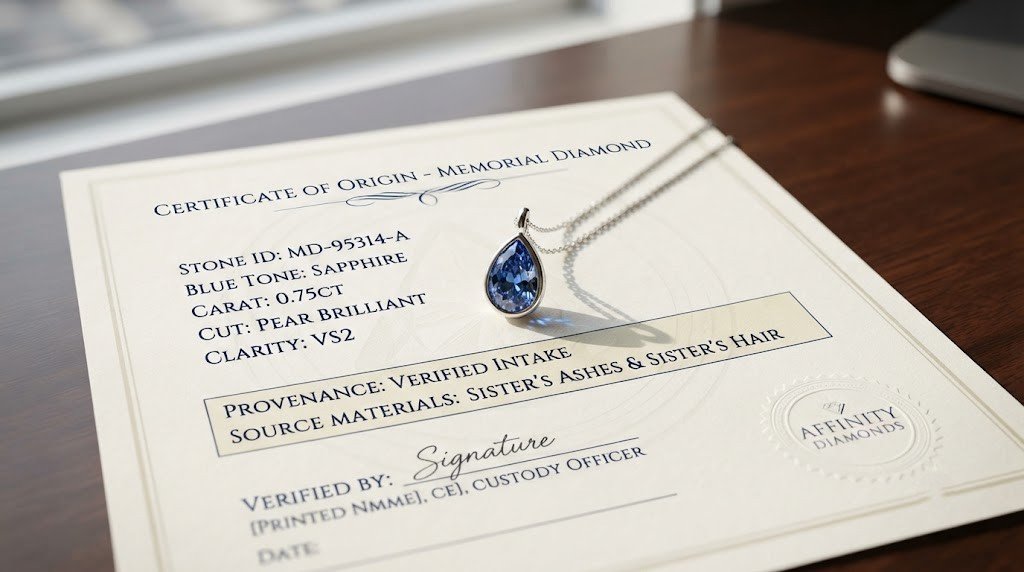
- The origin certificate names her and lists both ashes and hair.
- Any grading report you paid for matches the stone in hand.
- The setting is secure and any engraving reads as approved.
- Unused ashes and hair were returned, retained or disposed of as agreed.
Diamond rates 10 on the Mohs scale of mineral hardness, and memorial stones typically fall between SI2 and VVS in clarity, so everyday wear is entirely reasonable. Settings still loosen over time, so have the piece checked now and then and add it to your insurance. Anyone who chose to turn sister ashes and hair into a diamond should raise any mismatch in writing promptly.
How Much of the Diamond Comes From Each Material?
Anyone planning to turn sister ashes and hair into a diamond deserves a straight answer here. Carbon from her ashes and hair is genuinely recovered and does become part of the crystal, but supplemental lab carbon is typically blended in, so the stone is not made solely from her.
For ashes alone, carbon recovered from ash typically makes up about 10 to 15% of a finished stone’s mass across the industry, with some providers citing as low as 3%. That figure applies to ashes only. No published industry figure exists for hair, or for a blend of ashes and hair, so do not assume the ash percentage carries over or that adding hair raises it by a known amount.
The only reliable number is the one your provider commits to in writing before you turn sister ashes and hair into a stone. Whether the stone is really made from both looks at this question in detail.
Frequently Asked Questions
Can I turn sister ashes and hair into a diamond if I only hold the hair?
Yes, if whoever holds authority over her ashes agrees to release a small portion. Without that, a hair only stone is still possible. Check with whoever is handling her estate before using hair kept among her belongings.
Does adding hair make the diamond bigger?
No. A bigger stone comes from a longer growth run, and the volume of ashes or hair you send has no bearing on that. Adding hair contributes carbon rich material, but a larger stone still means a longer growth time and a higher price.
Will combining ashes and hair change the color?
Not in any predictable way. Shade comes from whatever nitrogen or boron is present while the crystal forms, so neither material lets you pick or match it. Memorial stones tend toward yellow, blue or champagne, with colorless costing more.
How long does it take to turn sister ashes and hair into a diamond?
Industry wide, plan on six to ten months once both materials are logged at the laboratory, and up to about twelve for stones above roughly 2 carats or specialty colors. Growth time, set by the carat size you choose, drives most of that.
What share of a blended stone is her carbon?
No published industry figure exists for blends. The commonly cited 10 to 15% applies to ashes alone, so ask your provider to state its own figure for ashes and hair combined, in writing, before you order anything.
Can I turn sister ashes and hair into separate stones instead?
Yes. Some siblings prefer one ashes stone and one hair stone, or give one to another relative. Ask the provider to quote both options, since two stones mean two growth runs and generally two full prices.
Final Thoughts on Turning Her Ashes and Hair Into a Diamond
Bringing both materials together takes a little more coordination than either alone: two conversations about permission, two labeled containers, one extra line on every form. If you choose to turn sister ashes and hair into a diamond, let that extra care be part of it rather than a burden. Ask for everything in writing, keep some of her hair just as it is, and give yourself room to wait. What returns will be a real diamond holding carbon from both, and its meaning will be yours.
Learn More About Blended Memorial Diamonds for a Sister
- Sister Ashes and Hair Diamond: The Complete Guide the blended route from every angle
- How a Memorial Diamond Is Made From Her Ashes and Hair two materials, one growth run
- Is It Really Made From Her Ashes and Hair? what a blended stone contains
- Sister Ashes Diamond: The Complete Guide when ashes are the only material
- Sister Hair Diamond: The Complete Guide when hair is the only material
Talk With Memorial Diamond
If you are weighing whether to turn sister ashes and hair into a single stone, Memorial Diamond can be reached at memorialdiamond.us to talk it through. Questions about permissions, packing or timing are welcome whenever you are ready to ask them.