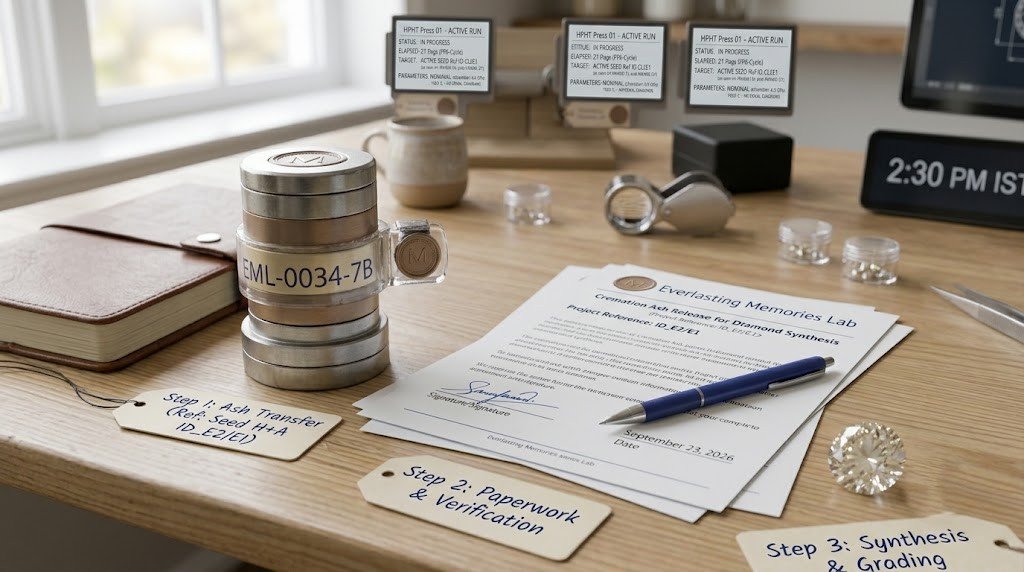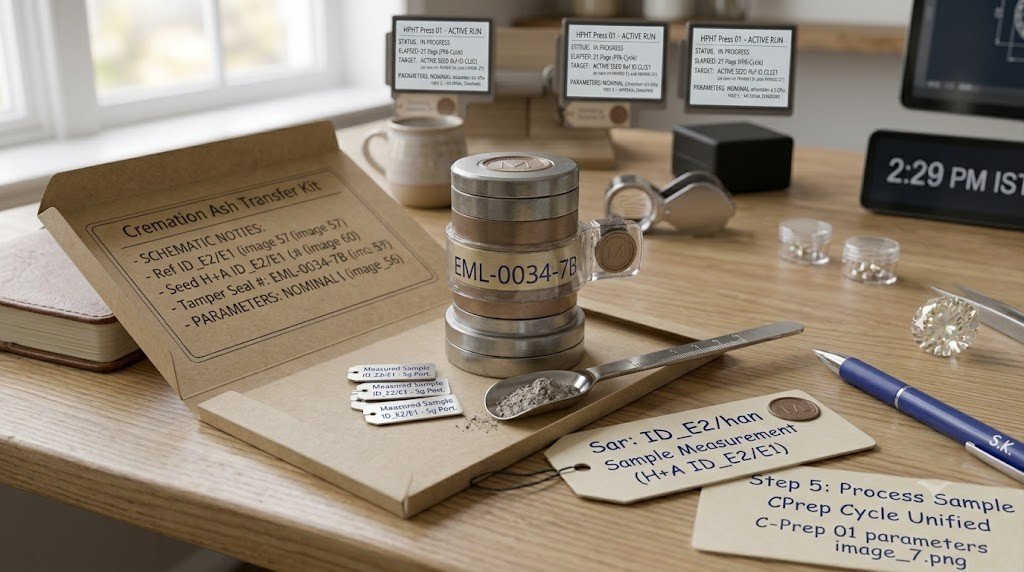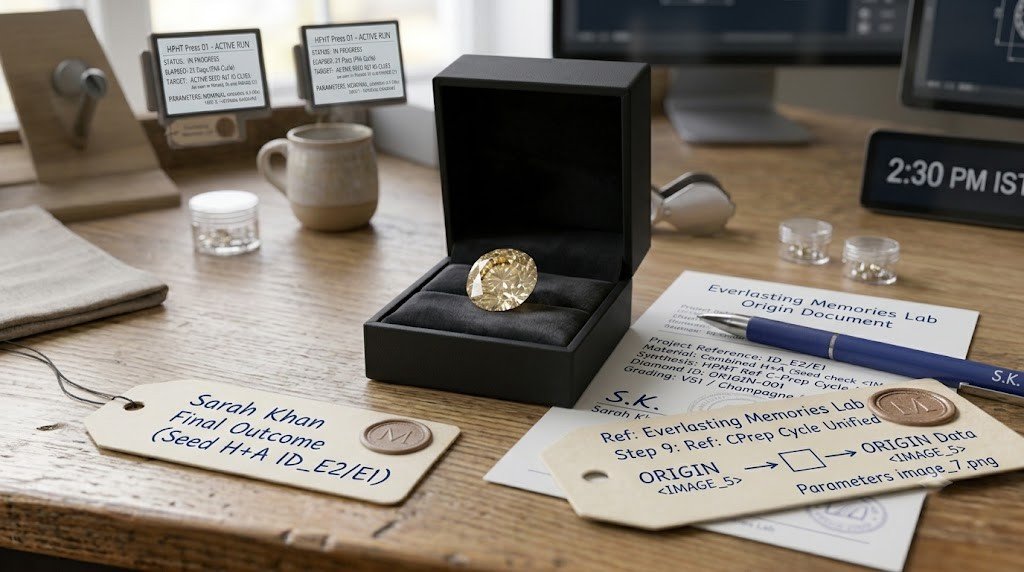
Turning Your Grandmothers Ashes Into a Diamond

Step-by-Step: Turning Your Grandmother’s Ashes Into a Diamond

Holding a small portion of her ashes and wondering what could become of it is a quiet, serious moment. The grandmother ashes diamond steps run in a clear order: agree as a family, choose a provider, send a portion with tracking, then let a lab extract and purify her carbon, grow it into a real diamond, cut, grade and set it. Across the industry, the whole journey typically takes 6 to 10 months.

Nothing about the grandmother ashes diamond steps has to be rushed, and much of the work happens out of your hands once her ashes leave home. Knowing what each stage involves, who carries it out and where your family makes a choice can make the wait feel less uncertain.
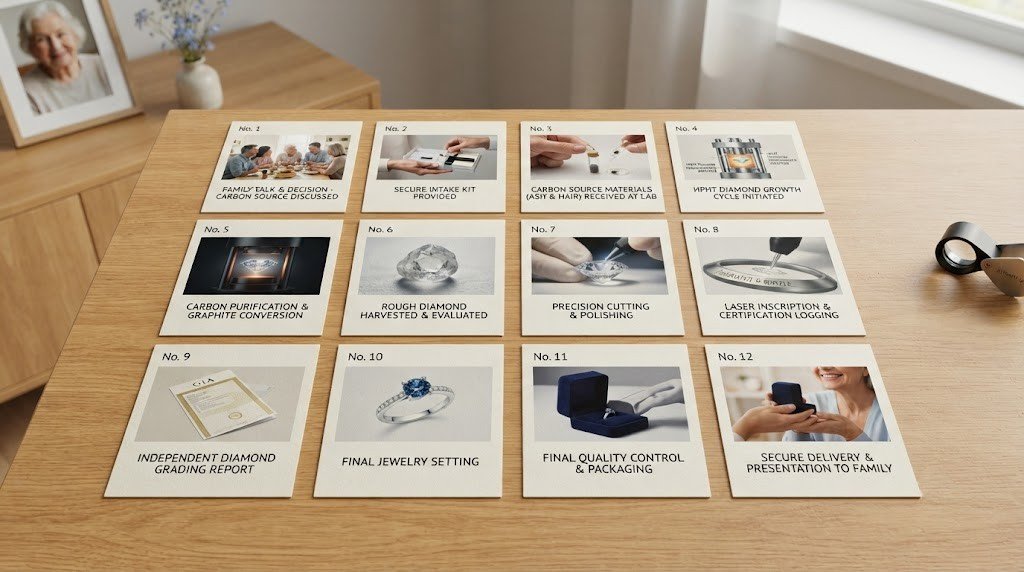
grandmother ashes diamond steps

Table of Contents

What Are the Grandmother Ashes Diamond Steps, in Order?

Twelve stages take her ashes from an urn to a finished stone: the first five belong mostly to your family, the next five happen in a lab, and the last two bring the diamond home.

  1. Talk with whoever holds authority, and with relatives.
  2. Choose a provider; ask questions in writing.
  3. Decide carat, color option, cut and grading.
  4. Receive a collection kit and portion her ashes.
  5. Ship the portion with tracking.
  6. Extraction and purification of her carbon.
  7. Graphitization.
  8. Diamond growth.
  9. Cutting and polishing.
  10. Optional irradiation for color.
  11. Grading and an authenticity certificate.
  12. Setting and delivery.

The table summarizes the grandmother ashes diamond steps: what happens, who handles it and what your family decides.

StepWhat happensWho does itWhat the family decides
1. Family conversationAgreement on whether to proceed and how much of her ashes to useYour family, led by whoever holds authorityWhether to go ahead; who receives a stone
2. Choose a providerComparing companies and getting answers in writingYour familyWhich provider to trust
3. Stone detailsSize, color option, cut and grading are selectedYour family, guided by the providerCarat, color, shape, independent grading
4. Collection kitA container and instructions arrive; a portion is measured outYour family, sometimes with a funeral home’s helpHow much to send, within provider guidance
5. ShippingThe portion travels to the lab with trackingYour family and the carrierShipping method the provider recommends
6. Extraction and purificationCarbon is separated from minerals and purifiedThe provider’s labNone
7. GraphitizationPurified carbon is heated into graphiteThe provider’s labNone
8. GrowthGraphite is grown into a diamond crystalThe provider’s labAlready set by carat choice
9. Cutting and polishingThe rough crystal is shapedA cutter or gemologistShape, chosen earlier
10. Optional irradiationColor is altered after growthSome providers onlyWhether to use it at all
11. Grading and certificateQuality is assessed; origin is documentedLab or independent graderWhether to pay for independent grading
12. Setting and deliveryStone is mounted and sent homeJeweler and providerRing, pendant, loose stone or other

For a broader look at the whole subject beyond the sequence itself, the complete guide to a diamond from your grandmother’s ashes covers color, cost and family questions in one place.

Who Should You Talk With Before Anything Is Sent?

Step 1: Talk with whoever holds authority, and with relatives

Before any of the other grandmother ashes diamond steps, the people who have a say need to agree. Who decides about her remains depends on state law and on any wishes she put in writing, and the ranking varies from state to state. Commonly a surviving spouse or partner comes first, followed by her adult children, which can mean your parent, aunt or uncle has the deciding voice rather than you. If nobody is sure, the funeral home or crematory involved can often say whose name is on the cremation paperwork.

You can still begin the conversation as a grandchild. A respectful approach is to ask whoever holds authority whether a small portion might be set aside, and to explain that most of her ashes can stay where the family intended. Her ashes may already be divided between households, scattered in part, or kept by one relative; any of these simply shapes what is available to work with.

Cousins and other relatives may want a voice in the grandmother ashes diamond steps, or a stone of their own. Raising the idea openly, rather than arranging it quietly, tends to protect relationships. If several people are interested, more than one stone can often come from shared material, though each provider sets its own terms, so ask about that early.

If faith shapes your family’s choices

No religious tradition has issued a ruling on memorial diamonds themselves; teachings address cremation and what is done with ashes. Catholic guidance, for example, asks that ashes be kept together in a sacred place, with only limited room for a small portion, which bears directly on dividing them. Practice differs widely among other faiths and communities, so anyone with a concern about the grandmother ashes diamond steps should talk it through with their own clergy or community leader.

If ashes are not an option for your family, a stone grown from hair is a separate route with no cremation involved; the guide to a diamond grown from your grandmother’s hair explains it. Her belongings, a saved lock of hair included, can count as part of her estate under rules that change between states, so speak first with the executor or whoever is handling her affairs.

How Do You Choose a Provider, and What Should You Ask?

Step 2: Compare providers and get answers in writing

The second of the grandmother ashes diamond steps is choosing who will make the stone. Companies vary in the growth method they use (HPHT for most, CVD for a minority), in how they document chain of custody, and in what they put in writing. Asking the same questions of each one makes a fair comparison possible.

Questions worth sending to every provider before the grandmother ashes diamond steps begin:

  • How do you track her ashes from the moment they arrive until the stone ships back?
  • What share of the finished stone is her carbon, and is it blended with supplemental lab carbon?
  • What happens to any portion of her ashes you do not use, and can it be returned?
  • What happens if a growth run does not succeed?
  • Is independent grading available, and what does it cost?
  • What are your refund and cancellation terms?
  • Do you share photos or updates during the process?

On the carbon question, honest answers matter. Ash is mostly calcium phosphate, with usable carbon typically around 0.5–4% by weight. That carbon is purified and usually combined with lab carbon, so her personal carbon commonly makes up about 10–15% of the finished stone, though some providers cite figures as low as 3% and others higher. Any claim that a stone holds nothing but her carbon deserves a follow-up question, and an honest look at whether the stone is really made from her ashes walks through why.

Step 3: Decide on size, color, cut and grading

Carat is the choice in the grandmother ashes diamond steps that is easiest to get wrong without the right facts. Size depends on time in the growth press, so a full urn yields neither a larger nor a quicker stone. Memorial diamonds are generally offered from about 0.10 ct to more than 5 ct, and larger sizes take longer and cost more.

Trace elements decide color. Boron tints a stone blue and nitrogen tints it yellow; colorless means excluding both, an extra layer of processing that generally raises the price. Memorial diamonds often lean toward yellow, blue or champagne tones. A provider will list the color options it offers, but nobody can promise to match an exact shade, and what color a stone from her ashes may turn out is worth reading before you choose.

Shape and grading are settled here too; independent grading is usually an optional add-on.

How Are Her Ashes Collected, Portioned and Shipped?

Step 4: Receive the collection kit and portion her ashes

The fourth of the grandmother ashes diamond steps usually begins with a collection kit, if the provider supplies one; ask what it contains, since kits differ, and follow its instructions exactly, because each provider sets its own requirements for how much to send and how to package it.

The amount requested commonly ranges from a few tablespoons to roughly 4 oz (about 100 g), usually a small fraction of the whole. The guide to how much ash a grandmother memorial diamond needs covers this in more depth. If measuring out her ashes yourself feels like too much, ask whether the funeral home that handled the cremation can help with that part of the grandmother ashes diamond steps.

Step 5: Ship the portion with tracking

Shipping is the point in the grandmother ashes diamond steps where her ashes leave your care. Use the method the provider recommends, and keep the tracking number somewhere safe. Rules for sending cremated remains depend on the carrier and route, so confirm them with the provider and the carrier directly rather than assuming. Ask the provider to confirm in writing when the package arrives, and how its own chain-of-custody records will follow her ashes through the lab.

What Happens to Her Ashes Inside the Lab?
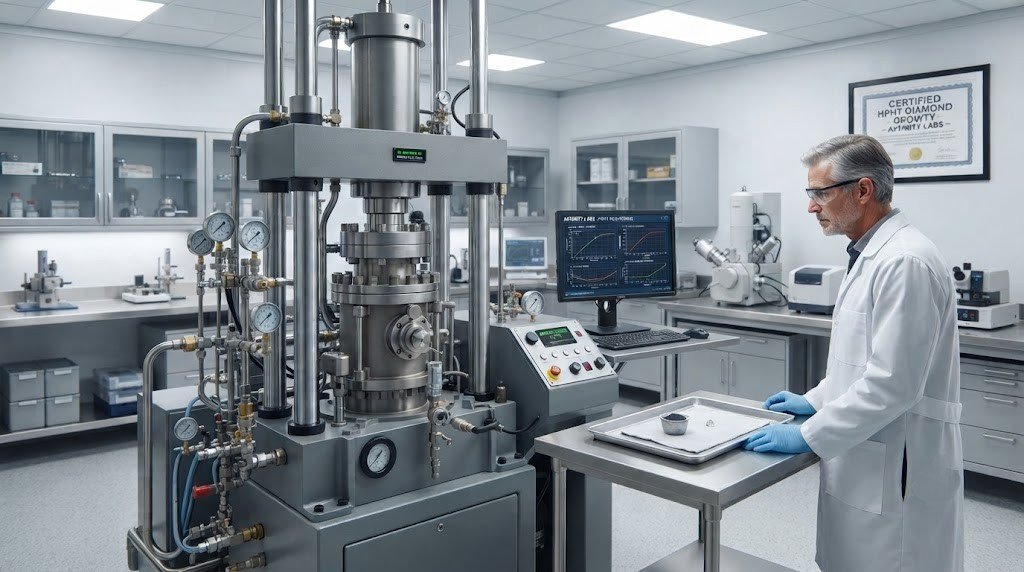
The middle stretch of the grandmother ashes diamond steps happens entirely in the provider’s facility.

Step 6: Carbon extraction and purification

Extraction opens the lab portion of the grandmother ashes diamond steps. Her ashes are heated in a controlled, oxygen-free, multi-stage process that strips away the calcium phosphate and other minerals. What remains is carbon, refined to roughly 99.9% purity or higher.

Step 7: Graphitization

Within the grandmother ashes diamond steps, graphitization is the bridge between purified carbon and growth. The carbon is heated further, to roughly 2,500–2,700°C, which converts it into graphite. Graphite is the crystalline form of carbon that growth presses use as their feedstock, so this step prepares her carbon to become part of a diamond.

Step 8: Diamond growth

Growth is where the grandmother ashes diamond steps turn carbon into crystal. Most providers grow memorial diamonds by HPHT, recreating pressures of roughly 6–8 GPa and temperatures of about 1,400–2,500°C around a tiny diamond seed. A minority use CVD instead, depositing carbon from a gas onto a seed plate. Either way, the result is a real lab-grown diamond with the same hardness and optical properties as any other. If you want a deeper explanation of this stage, how a memorial diamond is made from her ashes goes further into the science.

How Is the Rough Diamond Finished, Graded and Certified?
Step 9: Cutting and polishing

Cutting is the first of the grandmother ashes diamond steps where the stone starts to resemble jewelry, since a rough diamond leaves the press looking nothing like a finished gem. A cutter or gemologist shapes it into the cut your family chose, then polishes the facets so it catches light.

Step 10: Optional irradiation

Irradiation is an optional extra among the grandmother ashes diamond steps. Some providers use it after growth to shift a stone toward red, pink, green or black; it is a choice, not every company offers it, and specialty colors can lengthen the overall timeline.

Step 11: Grading and the authenticity certificate

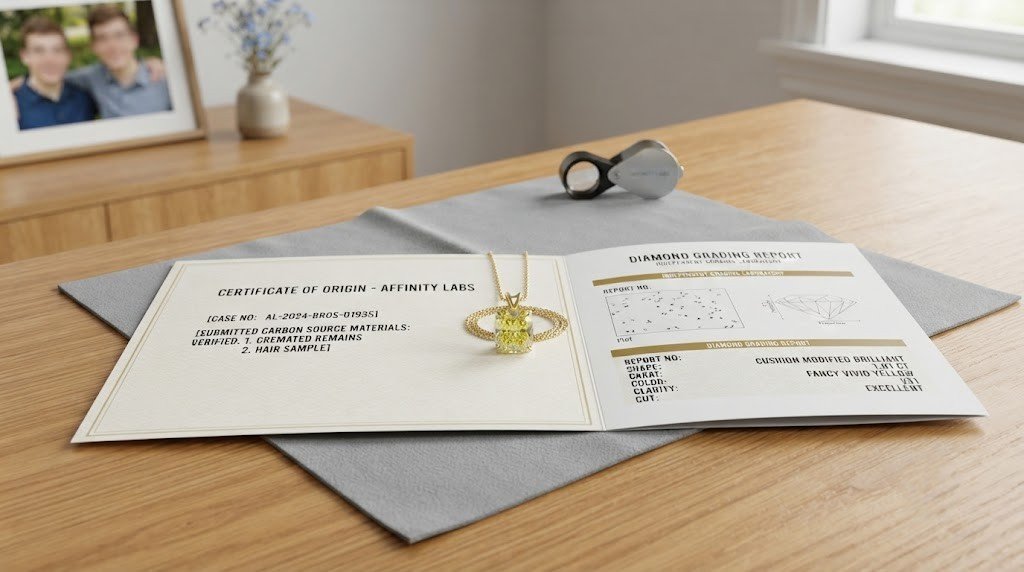
Two documents can come with the stone, and they do different jobs. An authenticity or origin certificate, usually issued by the provider, records that the diamond was grown from your family’s submitted material; in effect it is a chain-of-custody record. The other document, a grading report, assesses the 4Cs and is best issued by a third-party laboratory referencing standards such as GIA’s diamond quality factors.

Independent grading is typically a separately priced option. Clarity for memorial diamonds usually falls between SI2 and VVS. Among the grandmother ashes diamond steps, this is the one that gives you documents you can keep and show a jeweler or insurer.

How Does the Finished Stone Reach Your Family?

Step 12: Setting and delivery

The final stage of the grandmother ashes diamond steps is getting the stone into your hands. Some families take the diamond loose and choose a setting later; others have it set before it ships. Settings, engraving and fancy cuts are usually priced separately from the stone. Choose a design that suits whoever will wear it and reflects who she actually was, whether that is a simple pendant, a ring or a stone kept in a small box for a future generation.

When the stone arrives, check it against whatever paperwork came with it, keep those documents together, and ask the provider how delivery is insured and tracked. A diamond rates 10 on the Mohs hardness scale, yet a hard knock can still chip one, so a protective setting is worth discussing if it will be worn daily.

How Long Do the Grandmother Ashes Diamond Steps Take Altogether?

Across the industry, the grandmother ashes diamond steps typically take 6 to 10 months from the day a provider receives her ashes to a finished stone. Larger diamonds, roughly over 2 ct, and specialty colors can take up to about 12 months.

Because growth time decides carat size, a bigger stone simply needs more time in the press. Sending more ash does not shorten the wait. The family conversation and provider research that come first have no set length at all, and taking your time with them is entirely reasonable.

If you hope to have the stone by a particular date, tell the provider before you order and ask whether it is achievable. Providers set their own schedules, so ask each one for its current estimate of the grandmother ashes diamond steps as a whole rather than assuming any single stage will move at a particular pace.

What Do the Grandmother Ashes Diamond Steps Typically Cost?

What a family pays to complete the grandmother ashes diamond steps in 2026 generally follows size and color. The figures below are industry-wide ranges, not Memorial Diamond’s prices, which are not yet published.

SizeTypical industry range
Small: 0.10 to 0.25 caratAround $1,500 to $3,500
Medium: half a carat to 1 caratAround $5,000 to $15,000; colorless costs noticeably more
Large: 2 carats to over 5Around $20,000 to $75,000 and up

Independent grading, engraving, fancy cuts and settings usually add to the total. When several relatives want stones, ask whether separate orders from the same portion change the price, and agree in writing who pays for what. Cost can also shape how the grandmother ashes diamond steps unfold, since choosing a smaller size or a non-colorless tone can bring the total down.

What Happens to the Rest of Her Ashes?

Only a portion of her ashes passes through the grandmother ashes diamond steps, so the rest can remain in an urn, be interred, be scattered, or stay with whichever relative has been keeping them. A diamond can sit alongside any of those choices rather than replacing them.

What a provider does with any ash it receives but does not use is a policy each company sets for itself. Before shipping, ask:

  • Will unused ash be returned, and how?
  • Is any material stored, and for how long?
  • Can material be kept for a second stone later?
  • Will you confirm in writing what happened to every part of what we sent?

Getting those answers in writing before the grandmother ashes diamond steps begin gives your family a clear record of where each part went.

Frequently Asked Questions

Can a grandchild start the grandmother ashes diamond steps without the family’s agreement?

It depends on who holds authority, which state law and her written wishes decide. Often a surviving spouse or partner, then her adult children, come ahead of grandchildren. Asking that person for a small portion is the respectful way to begin.

Do the grandmother ashes diamond steps use all of her ashes?

No. Providers typically ask for between a few tablespoons and roughly 4 oz, usually a small fraction of the total. The rest can stay in an urn, be interred or be scattered as the family already planned, alongside the stone.

Can several cousins each get a stone from the same portion?

Often, yes, because only part of the ashes is used for each stone. Whoever holds authority needs to agree to how the material is shared, and each provider sets its own requirements, so ask about multiple stones before you ship anything.

Which of the grandmother ashes diamond steps can the family control?

Your family controls the early decisions: whether to proceed, which provider, carat, color option, cut, independent grading and setting. Extraction, graphitization, growth and cutting happen in the lab, where your influence comes through the questions you ask beforehand.

Can her ashes still be used if she died many years ago?

Whether ashes kept for a long time are still workable is a question to ask each provider directly. Explain how and where they have been stored, and request a written answer before ordering, since policies and processes differ between companies.

Is the authenticity certificate the same as a grading report?

No. An authenticity certificate, usually issued in-house, documents that the stone came from your family’s submitted ashes. A grading report describes cut, color, clarity and carat, ideally from an independent lab, and is typically an optional, separately priced add-on.

Final Thoughts on the Grandmother Ashes Diamond Steps

Most of this journey asks patience rather than effort. Your family’s part comes at the start, in careful conversations, and at the end, when the stone arrives.

Taking each of the grandmother ashes diamond steps in order, with answers in writing, gives your family a clearer picture of where her ashes are and what is being done with them at each stage.

Talk With Memorial Diamond

If you are weighing the grandmother ashes diamond steps for your family and want a clear answer to any of them, Memorial Diamond is happy to talk it through at whatever pace suits you.

You can reach us through memorialdiamond.us whenever you are ready.

Word count: 3,189 words · Reading time: about 16 minutes
son-ashes-diamond-steps

Step by Step: Turning Your Son’s Ashes Into a Diamond

Nobody hands you an instruction sheet for this, and the not knowing is often the heaviest part. The son ashes diamond steps break into nine: confirm who can authorize the release, choose a provider, gather documents, choose the stone, measure the ashes, ship them, wait out the growth, make the finishing decisions, and receive it. Roughly six to ten months, industry wide, most of which you spend doing nothing at all.

The son ashes diamond steps laid out: a sealed transfer container, release paperwork and a finished memorial stone

What Are the Son Ashes Diamond Steps, Start to Finish?

Nine, if you count them the way a family experiences them rather than the way a laboratory logs them. Most published process descriptions are written from the lab’s side, extraction, graphitization, growth. That is useful, but it is not a list of anything you actually do.

Laid out from your side of it, the son ashes diamond steps look like this:

#What you doRoughly how long
1Establish who can authorize releasing his ashesDays to weeks
2Choose a provider and get its terms in writingA week or two
3Gather the paperwork it asks forDays
4Choose carat, color and cutYour own pace
5Measure and seal the ash portionAn afternoon
6Ship it, tracked, with the chain of custody formsDays
7Wait while the stone is grownMonths, typically 6 to 10
8Confirm cutting, any irradiation, any gradingA few weeks
9Receive the stone and decide on a settingYour own pace

The first six son ashes diamond steps are the active part, and together they often take only a few weeks. Step seven is where almost the whole calendar sits. The complete guide to a son ashes diamond fills in the background behind each one.

Step 1: Who Is Authorized to Release His Ashes?

Settle this before anything else, because every later stage depends on it and it is the point at which the son ashes diamond steps most often surprise a parent.

Each state writes its own order of priority for who controls a person’s remains. A surviving spouse or registered partner frequently comes first. Where a son had children of his own who are adults, they may rank above his parents. Anything he left in writing, a directive, a will provision, a prepaid arrangement, can override the default sequence entirely.

So the person who signs the release is not automatically the person doing the arranging. A parent may organize every detail of the son ashes diamond steps and still need someone else’s signature on the form, and it is far kinder to discover that now than after an urn has been opened.

Two more realities worth naming before the later son ashes diamond steps begin. Parents do not always agree about this, and one parent handling it alone is ordinary rather than exceptional. Where the position is murky, the funeral director who carried out the cremation usually knows how the rule works locally, and an attorney can confirm it for the cost of a short call.

Step 2: How Do You Choose a Provider?

By what a company will put in writing, rather than by how its website feels. Of all the son ashes diamond steps, this is the one where a slow, skeptical hour pays for itself, because the difference between providers shows up in specifics rather than in atmosphere.

Ask for four things before you commit to any of the son ashes diamond steps that follow: the exact quantity of ash required, what documentation you will receive linking the finished stone to your submission, whether unused material comes back, and what happens if something goes wrong during growth.

A company that answers all four plainly, by email, is telling you something useful about how it operates. Vagueness at this stage tends not to improve later.

It is also fair to ask where the growth actually happens, since some providers grow stones in house while others work through a partner laboratory. Neither arrangement is inherently better, but you are entitled to know which one applies. Questions worth asking before you commit sets out a fuller list to work from.

Step 3: What Paperwork Has to Be Gathered?

Less than families brace for, though it varies. Most providers want a copy of the death certificate or the cremation certificate, identification for the person signing the release, and a signed authorization form of their own.

Where the son ashes diamond steps involve someone other than you signing, a spouse, a partner, his adult child, build in time for that document to travel. A form waiting for a signature in another household is the commonest cause of a stalled first month.

Keep everything in one folder, physical or digital, including the provider’s written quote and its confirmed quantity requirement. Months from now, when you are checking a detail, you will not want to be searching an inbox for it.

Chain of custody paperwork sits alongside all of this. It is the document trail that lets a laboratory evidence afterwards that the stone grew from what you specifically sent, which is the whole basis on which the son ashes diamond steps can be trusted at all.

Step 4: How Do You Decide Carat, Color and Cut?

Earlier than you might expect. These three choices sit near the front of the son ashes diamond steps because they set both the price and the length of the wait before anything is sent.

Carat is the big lever. The sizes on offer generally begin near a tenth of a carat and extend past five, and size is governed by time in the press rather than by how much ash you provide. A larger stone is a longer commitment, not a larger parcel.

Color is partly a choice and partly chemistry. Trace elements present during growth shape the outcome, nitrogen pulls a stone toward yellow, boron toward blue, and a colorless result requires the near total absence of both. Because the carbon here comes from an organic, personal source rather than a clean synthetic feedstock, warm and blue tones are common. What color a diamond grown from his ashes will be goes into that properly.

Cut comes last of the three and feels the most reversible, though in practice the son ashes diamond steps fix it permanently once polishing begins. Round, princess, cushion, emerald, the same shapes available for any diamond.

Step 5: How Do You Measure Out the Ashes?

Carefully, in good light, and ideally not alone. Across the industry a laboratory typically wants between a few tablespoons and about 4 oz, which is roughly 100 grams and a small fraction of what a full adult cremation produces.

Most providers send a kit containing a sealed container, a scoop and labels, which makes this far less daunting than improvising with kitchen equipment. It is the point in the son ashes diamond steps where a good provider’s preparation shows most plainly. If the urn is sealed, do not work at the lid yourself; a funeral home will open, portion and reseal it as a routine service, and many will do the measuring for you.

Work over a tray so nothing is lost. Cremated remains are largely bone mineral and closer to coarse sand than to soot, so they behave more predictably than most parents expect.

There is no rule saying this particular one of the son ashes diamond steps has to be done by you. Asking a sibling, a friend or the funeral director to handle it is entirely reasonable. How much ash is actually needed covers the quantities in detail.

 A collection kit open on a table with a sealed container, scoop and labels beside a portion of cremated remains

Step 6: How Do You Ship a Portion of His Remains?

Tracked, labeled, and with the paperwork inside the parcel rather than following separately. This is the shortest of the son ashes diamond steps and the one with least room for improvisation.

Photograph the sealed container before it goes. Write the tracking number somewhere you will find it without searching. If the provider offers a prepaid, insured courier label, take it. This is not the moment to economize on postage.

Cremation has become the majority choice in the United States, with the national rate now above sixty percent, so funeral homes and couriers handle this sort of shipment far more routinely than you would guess. Ask the provider directly what it recommends for your country and carrier rather than deciding alone.

Expect an acknowledgement when the parcel is logged in. That receipt is the formal handover point in the son ashes diamond steps: everything before it is yours to manage, and everything after it belongs to the laboratory until the stone comes back.

Step 7: What Happens in the Months You Are Waiting?

Four things, none of which need anything from you. This is the longest stretch of the son ashes diamond steps and the one families find hardest, precisely because there is nothing to do.

First, extraction. The ash is heated in a controlled, oxygen free process that strips away calcium phosphate and everything else that is not carbon, leaving purified carbon at roughly 99.9% or better. Usable carbon in cremated remains is only about 0.5% to 4% of ash by weight, so a good deal of material yields a small amount of what the son ashes diamond steps actually need.

Second, graphitization: a further heat stage at roughly 2,500 to 2,700°C restructures that carbon into graphite, the form a growth press takes as feedstock.

Third, growth. That graphite, made up to a workable volume with supplemental lab carbon, enters a press alongside a tiny diamond seed and is held at roughly 6 to 8 GPa and between 1,400 and 2,500°C. A minority of providers use chemical vapor deposition instead. Fourth, the rough crystal is assessed before cutting begins. How his ashes actually become a diamond follows that chemistry further.

Step 8: What Decisions Come Back to You Near the End?

Usually three, and they arrive together once the rough crystal exists, the only point in the son ashes diamond steps that asks anything of you mid process.

The first is the cut. A gemologist shapes and polishes the rough into a finished stone, and the shape you chose earlier is confirmed against what the crystal can actually yield. Occasionally the rough suggests a different shape would work better, and a good provider will say so rather than proceeding silently.

The second is irradiation. Some providers offer post growth treatment to shift or deepen color, reds, pinks, greens and blacks are produced this way. It is optional, it costs extra, and plenty of families decline it because the stone’s own color came from him.

The third is independent grading. Having the finished diamond assessed by a third party gemological laboratory against the standard cut, color, clarity and carat measures is optional across this industry rather than automatic. It is a separate document from the certificate of origin that traces the son ashes diamond steps back to your submission, and the two do different jobs.

Step 9: What Happens When the Diamond Arrives?

It comes loose, in most cases, unless you commissioned a setting at the same time. Expect the stone itself, an origin or authenticity document, and a grading report if you asked for one.

Give yourself permission for the last of the son ashes diamond steps to be a strange afternoon. Parents describe the arrival very differently from one another. Some want to open it alone, some want family present, some leave the package unopened for days. None of those is the wrong response.

Setting can wait as long as you like. A loose stone keeps indefinitely, and there is no deadline attached to deciding between a ring, a pendant, a pair of earrings or something that simply stays in its box. Ideas for rings, pendants and keepsakes is worth browsing without committing.

One practical note to close the son ashes diamond steps out: ask what happens to any unused material once extraction is finished. Policies genuinely differ, and knowing beforehand is better than wondering afterwards.

A loose memorial diamond resting in an open presentation box beside its origin document

How Long Do the Son Ashes Diamond Steps Take, and What Do They Cost?

Six to ten months is the usual industry span from the day material is received, with larger stones or specialty colors sometimes running to twelve. Almost all of it is growth time; the son ashes diamond steps you personally handle rarely add up to more than a few weeks.

On cost, as general 2026 industry ranges rather than any one company’s published price:

  • Entry tier, about a tenth to a quarter of a carat: $1,500 to $3,500
  • Mid tier, half a carat through a full one: $5,000 to $15,000
  • Two carats and larger: $20,000 upward, sometimes well beyond $75,000
  • Add ons: settings, engraving, fancy cuts and an optional grading report are each quoted apart from the stone
  • Color: colorless generally costs more than a warm or blue tone at matching weight

Neither the price nor the schedule moves because you sent more ash. Across the son ashes diamond steps, both follow from the stone you chose at step four and nothing else. How long a son memorial diamond takes and what one costs break each of those down further.

Where Do the Son Ashes Diamond Steps Most Often Stall?

Almost always at the paperwork, almost never at the science. Knowing the pinch points in advance is the cheapest insurance available.

The signature is the classic one, and it halts the son ashes diamond steps more often than anything else does. A release form sitting unsigned in another household can add weeks, and the fix is to identify the right signatory at step one rather than at step six.

The second is a quantity mismatch. A parcel arrives holding less than the laboratory needs, and everything pauses while a second portion is arranged. Confirming the figure in writing beforehand removes that risk entirely.

The third is expectation rather than logistics. Families sometimes assume a stone will be colorless, or will arrive sooner because more ash was sent. Neither is how the son ashes diamond steps work, and hearing it early is far better than discovering it at month eight.

Frequently Asked Questions

How much of the finished stone is genuinely his carbon?

On the ash route, roughly 10% to 15% of a finished stone’s mass is usually described as personal carbon, and a few providers publish figures as low as 3%. The remainder is supplemental lab carbon added to reach a workable growth volume.

Can I start the process years after the cremation?

Yes. Cremated remains are mineral and chemically stable, so a long gap is not an obstacle in itself. Mention how and where the ashes have been stored when you first make contact, since storage conditions can matter more than elapsed time.

Do I have to send all of his ashes?

No. The requested portion is typically a few tablespoons up to roughly 4 oz, a small fraction of a full cremation. Everything else stays available for burial, scattering, an urn at home, or dividing between family exactly as planned.

Can two diamonds be grown from one submission?

Often, yes, since only a portion of the remains is used. Each stone repeats the growth stage of the son ashes diamond steps on its own schedule, so two means two timelines and two prices. Ask whether one submission covers both.

Will I be able to see the stone before it is cut?

Some providers share photographs of the rough crystal; others do not. Ask at step two rather than assuming, and ask what updates you will receive during the growth months, since communication habits vary considerably across this industry.

What if I change my mind partway through?

Ask about this before you send anything. Cancellation terms differ sharply between providers, particularly once the son ashes diamond steps have reached growth, and this is exactly the sort of clause worth having in writing rather than discovering under pressure.

Final Thoughts on the Steps of Turning His Ashes Into a Diamond

Written out, the son ashes diamond steps look like a great deal. Lived through, most of it is waiting, and the parts that genuinely ask something of you are concentrated into a handful of weeks near the beginning.

Of the nine son ashes diamond steps, the one worth real attention is the first. Get the authorization question settled, get the quantity and the terms in writing, and the remaining eight stages tend to proceed without drama.

After that it becomes a matter of patience, which is not a skill anyone wants to be practicing for this reason. But the months do pass, and what arrives at the end of them is a real object with a real, documented line back to him.

Learn More About Son Memorial Diamonds

Talk With Memorial Diamond

If you would rather ask a person than read another page, that is a reasonable instinct. Memorial Diamond can be reached at memorialdiamond.us to walk through the son ashes diamond steps, the documents involved and what happens at each stage. No obligation comes with asking.

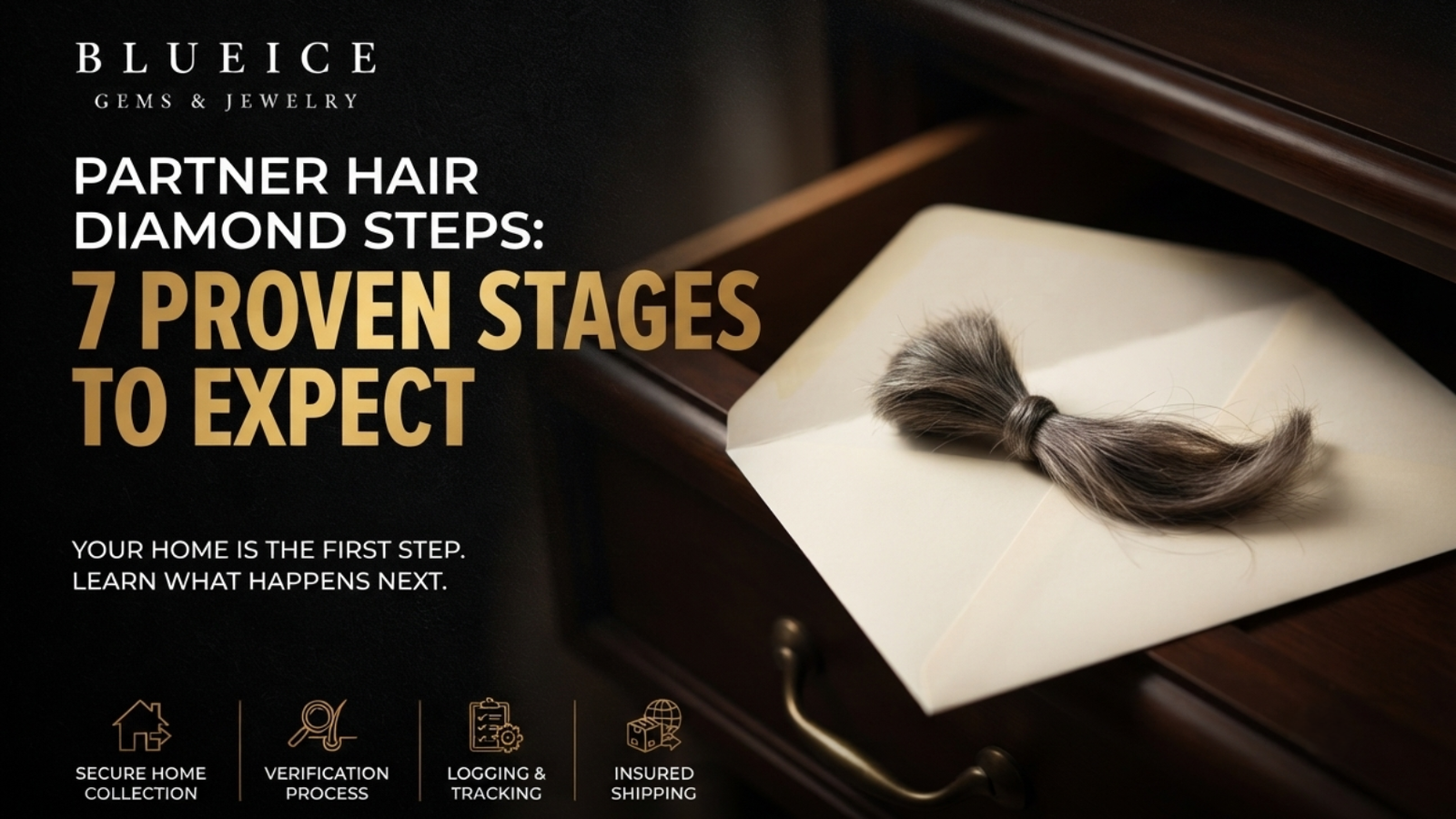
An unlabeled lock of hair in a paper envelope on a bedroom drawer, the household starting point of the partner hair diamond steps

Step by Step: Turning Your Partner’s Hair Into a Diamond

The first stage of this does not happen in a laboratory. It happens in a bedroom, a bathroom drawer, or a box a funeral director handed over in a paper bag. The partner hair diamond steps begin with a search and a verification, not a shipment, you have to locate a sample, establish it is genuinely your partner’s, and confirm it is in usable condition before a single laboratory stage becomes relevant. After that the technical route is shorter than most people expect, because hair is roughly 50% carbon by weight.

Memorial Diamond grows these stones, so this page has an interest in your reading it. Every number below is an industry wide band, not a requirement we publish.

The Household Half of the Partner Hair Diamond Steps

Almost every published account of the partner hair diamond steps opens where an envelope arrives at a facility. That is stage four of a real set of partner hair diamond steps.

Stages one through three of the partner hair diamond steps happen in a house, usually alone, usually on a weekday evening, and they are where things go wrong, not because they are difficult, but because nobody prepared you for them. A lock of hair is almost never collected with a label, a date, or a witness. It is cut quickly, by someone not thinking about provenance.

Which means the partner hair diamond steps open with three domestic questions: does a sample exist, is it definitely your partner’s, and has it survived in a condition a laboratory can work with. No provider’s brochure answers those.

The household half matters for a second reason. Hair requires no cremation, so this route stays open to partners whose partner was buried, or whose ashes someone else holds. That widens who can do this, and puts the burden of the early partner hair diamond steps on your ability to find and vouch for a sample.

Where an Unlabeled Sample Usually Turns Up

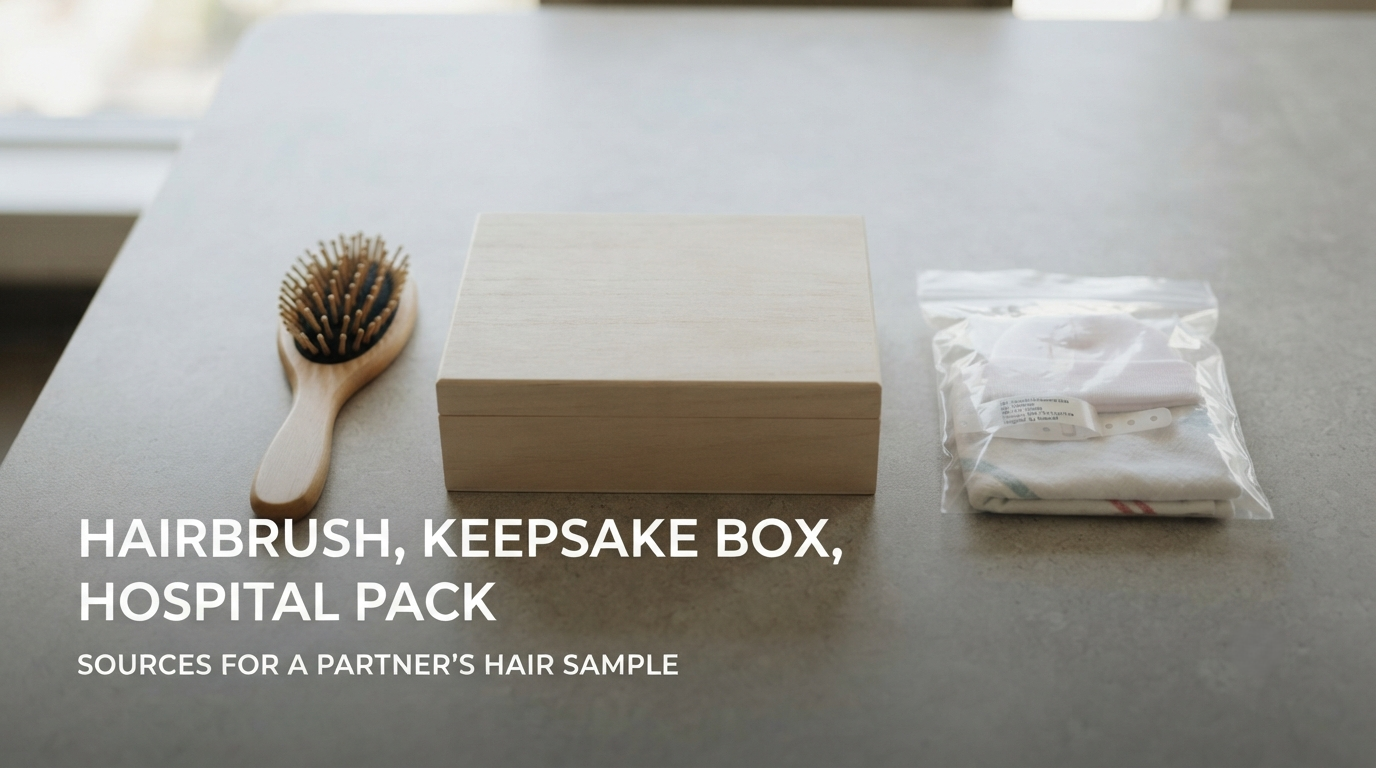
Before you conclude that nothing exists, work through the places hair survives without anyone intending it to, because the partner hair diamond steps cannot begin without one. The table below is a starting order, not a ranking of sentiment.

Where it turns upTypical conditionWhat to check firstRealistic usability
A cut lock in an envelope or keepsake boxDry, intact, usually one person’sWhether anything on the envelope records a date or who cut itHigh, this is the ideal case and the one the early partner hair diamond steps assume
A hairbrush or combLoose, tangled, shed rather than cutWhether anyone else used the brush; shed hair has no root sheathModerate, quantity is often adequate, provenance often is not
A hat, a pillow, a coat collarVery small quantity, loose fibersWhether you can gather enough in one place to weighLow to moderate, usually a supplement, not a sample
A hospital or hospice keepsake packCut, bagged, sometimes labeled with a name and dateThe label, immediately, this is the only common source that documents itselfHigh, and often overlooked because the bag was never opened
A locket, ring or mourning pieceSealed, possibly decades old, possibly not your partner’sWhether a jeweler can open it without destroying the settingVariable, worth a conversation first
A funeral director’s fileCut at the time of care, retained by policy in some placesWhether they still hold anything, most families never askWorth one call before you give up
A hairbrush, a keepsake box and a hospital keepsake pack laid out together on a table

Two notes on that table. A small lock of a few grams is the industry typical requirement, so quantity fails less often than provenance. And the last row is the one people skip: funeral homes sometimes retain a sample, and one call can end the search.

If the sample is in someone else’s house, that is a request rather than an obstacle. Asking for a few strands out of a keepsake box is a smaller ask than asking for a portion of ashes, and it is often granted by people who would refuse the larger one. How to raise this with a family who may not have acknowledged the relationship covers that conversation.

How Do You Verify Hair Nobody Labeled at the Time?

This is the stage the partner hair diamond steps are usually missing, and it is the one that keeps people awake.

Start with what is honest. You usually cannot prove a sample’s identity in a laboratory sense, and it is fair to ask any company directly whether they claim they can. What you can build is a defensible chain of reasoning before you commit anything, which is what verification means here.

  • Reconstruct the collection. Who cut it, where, and roughly when. A date you can place within a month beats a certainty you cannot explain.
  • Check for anyone else in the household with similar hair. This is the single most common source of doubt and the easiest one to rule in or out.
  • Look at the physical evidence. Cut ends suggest deliberate collection; irregular lengths suggest a brush.
  • Ask whoever else was present. A sibling, an adult child, a hospice nurse, somebody often remembers it better than you do.
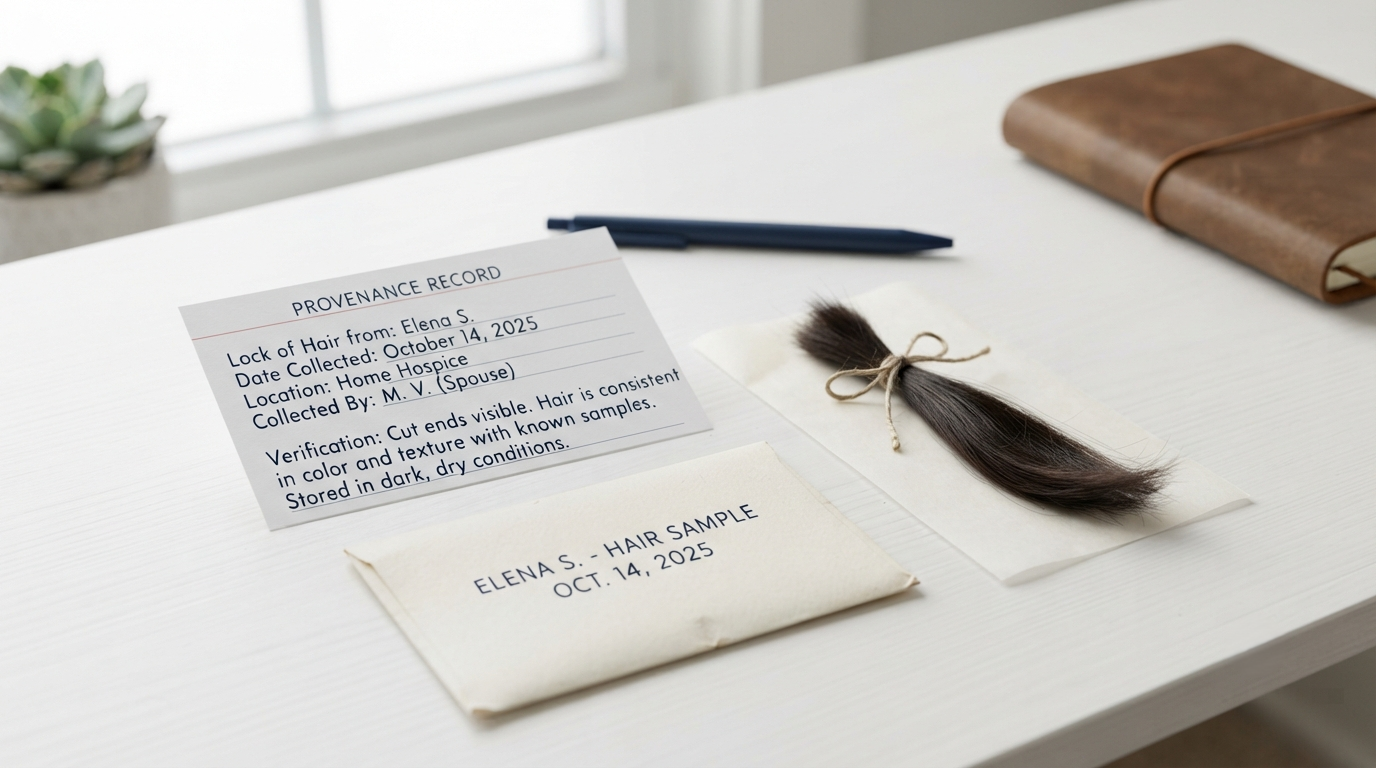
  • Write down what you conclude, and why, before it is posted. If doubt surfaces in eight months, that note is what you will want.
A written note and a dated envelope beside a lock of hair, illustrating how provenance is documented at home

Providers can assess condition, quantity and suitability. Identity is a different question, and DNA verification is not generally offered on this route, so ask rather than assume: can you confirm whose hair this is, and if not, what does your documentation record instead? Until that answer exists in writing, verification is your own job inside the partner hair diamond steps, done before transfer, and documented the way you would document anything you get one chance at.

What Are the Partner Hair Diamond Steps Once a Sample Is Confirmed?

Seven partner hair diamond steps, and the last four are the same physics every memorial stone goes through.

  1. Locating a sample. The household search above, often the longest stage by elapsed time, and the only one with no fixed duration.
  2. Verifying provenance. Establishing, to your own satisfaction and in writing, that the sample is your partner’s.
  3. Assessing condition and quantity. Industry typically a small lock, a few grams, is enough; condition matters more than mass.
  4. Documented transfer. The sample is sealed, labeled with an identifier, logged on arrival and weighed. Chain of custody paperwork begins here.
  5. Cleaning and purification. Product residue, dust and non carbon components of keratin are removed in a controlled, oxygen free process reaching roughly 99.9%+ carbon purity.
  6. Graphitization and growth. The purified carbon is taken to roughly 2,500 to 2,700°C to become graphite, blended with supplemental lab carbon, and held under roughly 6 to 8 GPa of pressure at 1,400 to 2,500°C inside an HPHT cell for weeks or months while a crystal accumulates.
  7. Cutting and polishing, then optional independent grading. The rough is shaped and assessed, typically landing in the SI2 to VVS clarity range, at Mohs 10 like any other diamond. Grading is ordered, not automatic.

One honesty point belongs inside that list rather than after it. The carbon recovered from a lock of hair does not fill a growth cell by itself; laboratory carbon makes up the balance. The roughly 10 to 15% figure you will see quoted for the personal share is an ash figure, industry sources put that band on carbon recovered from cremated remains, and no equivalent number is published for hair. What holds on either route is that the personal carbon is real, traceable through the chain of custody record, and a minority of the finished mass.

Ask what share your own sample is expected to contribute, in writing. What the partner hair diamond steps produce is a diamond a verifiable part of which is your partner, not a diamond that is only your partner. The longer account of how a stone is grown from a partner’s hair goes further into the chemistry.

A note on color, since the partner hair diamond steps settle it rather than let you choose it. Trace elements riding along with organic carbon set the tone: nitrogen leans yellow, boron leans blue, and only the absence of both produces something colorless. What color a stone grown from your partner’s hair tends to be treats that as a likelihood. The general physics behind HPHT and CVD growth sits under synthetic diamond.

What If the Sample Turns Out to Be Mixed?

Mixed samples are common and rarely fatal. They are also the reason stage three of the partner hair diamond steps exists as a separate stage.

A brush is the usual culprit: two people share a bathroom for years, one hairbrush lives on the shelf, and what you are holding is a blend. A keepsake envelope can be mixed too.

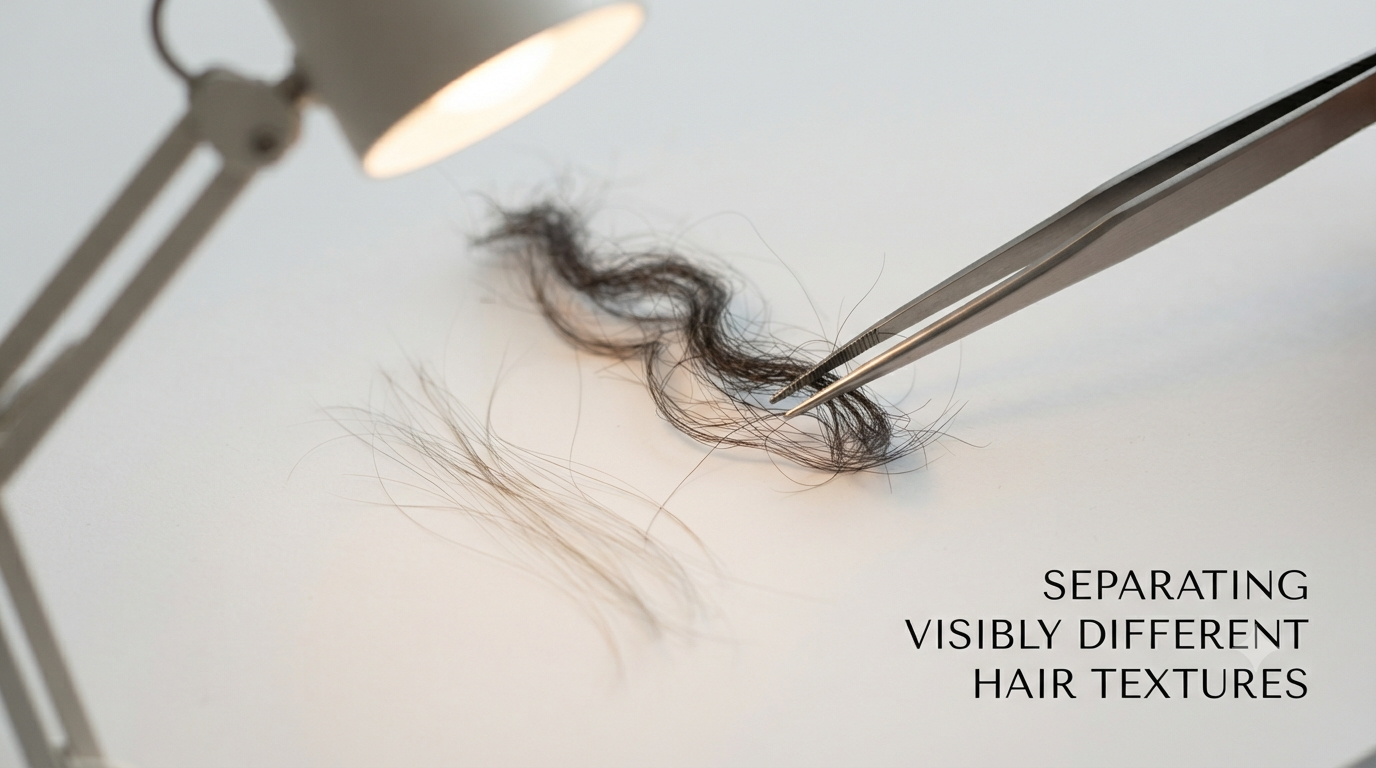
Two visibly different hair textures being separated with tweezers under a lamp

What the partner hair diamond steps do next depends on how mixed it is:

  • Visibly different hair, color, texture or length, can sometimes be separated by hand under good light, with patience and tweezers. Tedious, but it works.
  • Indistinguishable hair cannot be separated, and no laboratory process sorts it. The carbon is processed as one mass.
  • A mixed sample you send anyway is a decision, not an accident, and should be recorded as one. Some families are at peace with a stone grown partly from their own hair alongside their partner’s; others are not. Both are reasonable.
  • A small certain sample beats a larger uncertain one every time, given how little mass the partner hair diamond steps actually require.

Tell the provider what you know. A described mixed sample is a normal intake; an undisclosed one becomes a doubt you carry privately for years. This is also the point where the combined route using ashes as well as hair becomes worth reading, since it changes what the intake record has to account for.

When a Sample Is Too Degraded to Use

Degradation is less common than people fear, because hair is durable, but it happens, and it is better understood before a sample is posted than after.

What actually stalls the partner hair diamond steps: prolonged damp, visible mold, oily or chemical contamination, and years of caked product residue. What generally does not: age, dye, bleach, perming, or a lock that has sat in a drawer since 2009. Keratin is stable, and a dry dark drawer is close to ideal storage.

If a provider assesses a sample as unusable, the partner hair diamond steps have not ended. Three routes remain open:

  • A second sample from elsewhere, the triage table above exists precisely because most households hold more than one possible source.
  • A larger quantity of a marginal sample, if the issue is thin recovery rather than contamination.
  • The ashes route instead, if cremation took place and you have standing to ask for a portion.

That last option is worth a plain sentence about permissions, because it is not symmetrical with hair. Statutes in this area address cremated remains; they were not written about a lock in a drawer. In practice that makes hair you already keep the less obstructed of the two routes, without making it a closed question, belongings can pass into an estate, states take different positions, and hair kept in another household is something you raise with the person who keeps it.

Control over cremated remains varies by state too, and by whatever your partner set down in writing; where a relationship carried no legal recognition, a parent, an adult child or a former spouse may hold it. Where it matters, check rather than assume. That asymmetry is why the step by step for the ashes route starts with authority rather than with a search.

Why the Laboratory Half Is the Shorter Half

Here is the payoff for all that domestic work. Once a verified sample reaches a facility, the technical portion of the partner hair diamond steps is simpler than the ashes equivalent.

Keratin is a carbon rich protein, putting hair at roughly 50% carbon by weight. Ash is dominated by calcium phosphate instead, yielding only about 0.5% to 4%. So a few grams of hair carries what a few ounces of ash carries, and extraction has far less to strip away.

What it changes inside the partner hair diamond steps:

  • Less material moves. An envelope rather than a sealed jar, simplifying transfer and identification.
  • Purification is more direct. No mineral matrix dominates the mass; the process removes the non carbon fraction of a protein.
  • Nothing has to be divided. No urn is opened, and no arrangement anyone else made is touched.

What it does not change: the calendar. Growth time sets carat, not carbon supply, so the industry typical span of 6 to 10 months, up to around 12 for larger or specialty color stones, applies exactly as it does to ash. Sending more hair buys nothing on that clock. The finished stone is graded against the ordinary 4Cs any diamond is assessed on, and the full guide to a partner hair diamond sets the whole route out end to end.

Frequently Asked Questions

How can I be sure the lock in that envelope is my partner’s?

Usually you cannot prove it; the early partner hair diamond steps ask you to reason it out. Reconstruct who cut it and when, rule out anyone else in the household with similar hair, check whether the ends are cut or shed, and write your conclusion down.

Can a laboratory confirm whose hair it is before growing anything?

Ask rather than assume, because DNA verification is not generally offered on this route. Facilities assess condition, quantity and suitability for processing. In the partner hair diamond steps, identity rests on your own record and on chain of custody from intake onward, not on a test.

Two people’s hair ended up in the same envelope. Is that a problem?

Not necessarily, and mixed samples are routine in the partner hair diamond steps. Visibly different hair can often be separated by hand; indistinguishable hair cannot, and would be processed as one mass. Tell the provider either way, and have it recorded at intake.

What does “too degraded” actually mean for a hair sample?

Prolonged damp, mold, oily or chemical contamination, or heavy product residue will stall the partner hair diamond steps. Age alone is not degradation, and neither is dye, bleach or perming. A dry drawer preserves keratin extremely well, which is why decades old locks routinely pass assessment.

Who checks the sample first, me, or the provider?

Both, in that order, and the partner hair diamond steps assume it. You establish provenance, because only you can. The provider then assesses whether there is enough usable material and whether its condition suits processing. Ask whether that can happen from a photograph and a weight first.

If no sample survives verification, what comes next?

Search the other household sources before you abandon the partner hair diamond steps, including a call to the funeral home. If nothing usable exists, the ashes route remains open where cremation took place and you have standing to ask, a different sequence with a different first stage.

Final Thoughts on the Partner Hair Diamond Steps

The technical partner hair diamond steps are well understood and largely out of your hands. Purification, graphitization, growth, cutting: these happen on a schedule, competently, without you.

The stages that need you are the first three, and they happen at home with no instructions. Find a sample. Satisfy yourself about where it came from. Describe it honestly to whoever will process it. Those are the partner hair diamond steps that determine whether the rest is worth beginning, and they cost nothing but attention.

A last, practical point. Because the partner hair diamond steps need no cremation and very little mass, this route stays available long after other options have closed, after a burial, after a scattering, after a family took the urn.

Learn More About Partner Memorial Diamonds

Talk With Memorial Diamond

You can complete the hardest part of the partner hair diamond steps this weekend, without spending anything and without telling anyone: open the drawers, call the funeral home, and see what exists.

If something does, three written questions will tell you where you stand. Ask whether a sample can be pre assessed from a photograph and a weight before it is posted. Ask what happens to material the process does not consume. Ask how it is identified from intake to finished stone. memorialdiamond.us answers all three, and so should anyone else you approach.

Nothing in the partner hair diamond steps has to be decided quickly. A lock of hair in a dry drawer is in no hurry at all.