
You have probably already worked out that this will not be quick. What is harder to find out is where the months actually go.
Industry wide, production runs 6 to 10 months from the point a laboratory receives the material, stretching toward 12 for large stones or specialty colors. The single fact that explains a partner memorial diamond timeline is this: carat size is a function of growth time, not of how much you send. A full urn does not make the stone bigger, faster or cheaper. And the published window covers only the middle of the process. Assessment before growth and finishing after it sit outside it.
Memorial Diamond is one of the companies that would be holding your partner’s material through those months, so this page has a commercial interest behind it. Treat the stage descriptions as how the category works rather than as a schedule anyone can promise.
Table of Contents
What Does a Partner Memorial Diamond Timeline Actually Contain?
A partner memorial diamond timeline has seven stages, and only some sit inside the figure anyone quotes you. The last column is the fastest way to understand why a stone described as “six to ten months” can be a year from your hand.
| Number | Stage | What happens | What sets its pace | Inside the quoted 6 to 10 months? |
|---|---|---|---|---|
| 1 | Gathering and sending | Material is located, portioned, labeled, packed and posted; the order is specified | You, a funeral provider, and the post | No |
| 2 | Intake and assessment | The parcel is logged, checked against what was described, and evaluated before work starts | The laboratory’s queue and what assessment finds | Usually yes, at the front |
| 3 | Extraction and purification | Everything that is not carbon is stripped away, to roughly 99.9%+ carbon | The source material and the process, not your order | Yes |
| 4 | Graphitization | The purified carbon is taken to roughly 2,500 to 2,700°C and converted to graphite, the form a press can use | Fixed by the process | Yes |
| 5 | Growth | A seed and the graphite sit under roughly 6 to 8 GPa, at temperatures of 1,400 to 2,500°C, across weeks or months | Your target carat, and nothing else in the partner memorial diamond timeline | Yes, most of the window |
| 6 | Cutting, polishing and optional grading | A gemologist cuts the rough crystal; independent grading happens only if you order it, and any report is issued by a separate laboratory | The cutter’s bench, then a third party’s queue | Sometimes. Ask |
| 7 | Setting | A ring, pendant or other mount is made, or an existing piece is reworked | A jeweler’s bench, and whether you have decided | Almost never |
Two of those seven are genuinely yours to move. Stage 1 runs at your speed, and stage 7 at whatever speed you choose, including not yet. Everything between runs at its own pace however motivated you are, and that is the real shape of a partner memorial diamond timeline.
How the material is actually processed from a portion of ashes follows stages 3 to 5 in detail, and the step by step route for a combined submission sets out stage 1 as a list of tasks.
Why Does a Full Urn Not Make It Faster or Bigger?
Because carat comes out of the press, not out of the parcel. It is the single most useful correction on any partner memorial diamond timeline page, and almost nobody arrives knowing it.
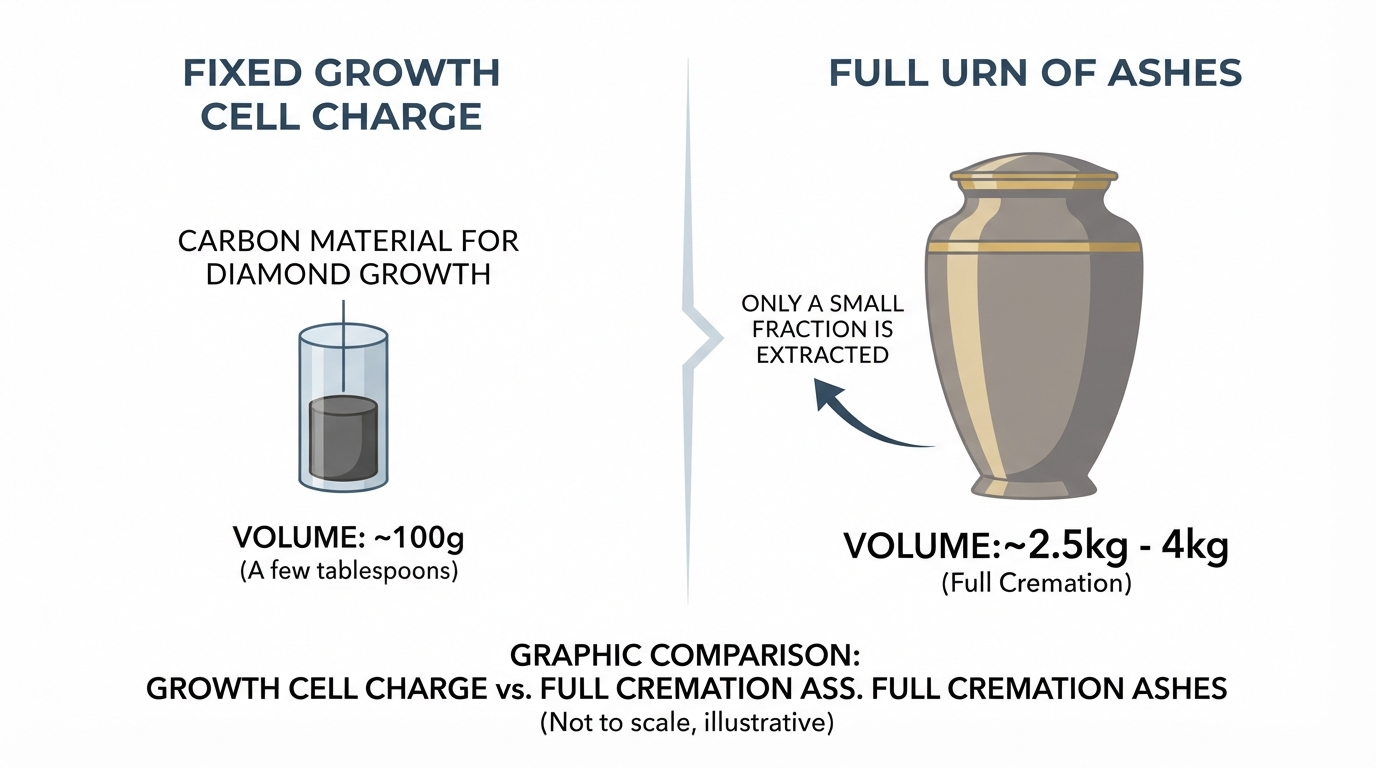
A diamond grows outward from a tiny seed inside a cell held at extreme pressure and heat, and the longer it is held there the larger the crystal becomes. That is the whole mechanism. The high pressure, high temperature route used across the lab grown industry and the volume you posted is not one of its variables. It is not a partner memorial diamond timeline variable either.
What the material determines is whether there is enough carbon to work with at all. Cremated remains are mostly the calcium phosphate of bone, and usable carbon runs at roughly 0.5% to 4% of ash by weight; hair is far richer, at roughly 50%. Either way, what a realistic sample yields falls short of what a growth cell consumes, so lab grown carbon is added to fill the charge. Sending more simply means more goes unused.
Three consequences follow, and they are worth holding onto:
- A larger stone lengthens the partner memorial diamond timeline. Carat and months are the same decision. A small stone finishes nearer six months; a large one or a specialty color moves toward twelve.
- Most of the ashes stay with you. Typical requirements run from a few tablespoons to around four ounces, so whatever was planned, interment, scattering, an urn on a shelf, can still happen.
- A hair only stone is not faster in the press. Growth time is set by target carat, whether the carbon came from ashes or from hair. How much hair a stone actually needs is a small lock, and its advantage is at stage 1 rather than stage 5.
That last point matters more in this cluster than most. A lock already sitting in a drawer waits on no cremation, no release and nobody else’s decision, so stage 1 of the partner memorial diamond timeline can begin this week.
Carat also sets the price, which makes size, money and months one decision rather than three. What a partner memorial diamond costs works through the same lever from the other side.
What Happens Before Growth Begins?
Two stages of a partner memorial diamond timeline, and families routinely budget for neither.
Getting the material there. Locating a portion, separating and labeling it, finding a lock of hair if one is going in, specifying the order, and posting it. None of that is long in itself, and all of it can stall on something outside your control, a funeral provider’s schedule, a conversation with their family, a decision that has not been made. In this cluster, stage 1 is frequently the longest stage of the whole partner memorial diamond timeline, and it is the one nobody counts.
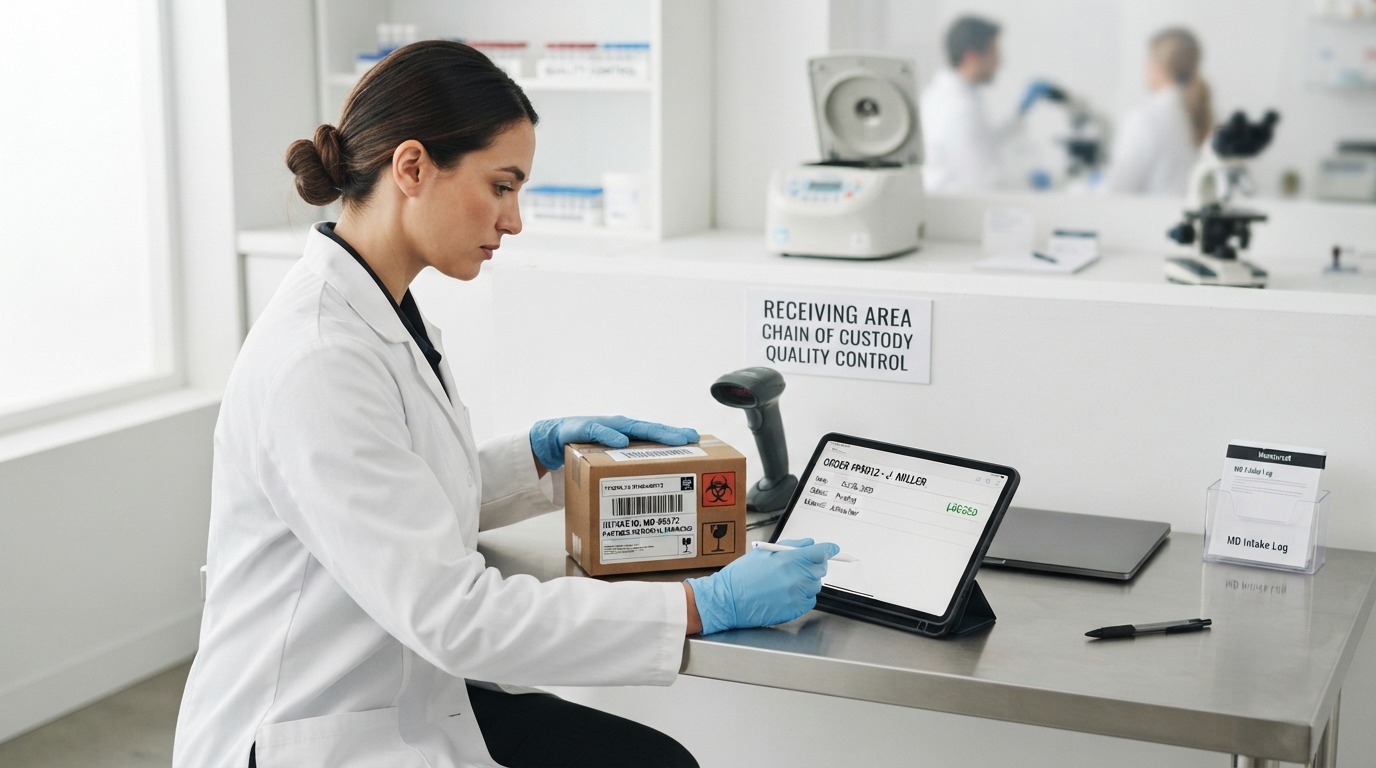
Assessment. Once a parcel is logged it is checked before work starts: that it matches what was described, that there is enough to proceed, that it is what the process can use. This is neither a formality nor instant, and it is the point in a partner memorial diamond timeline at which a problem is cheapest to discover.

The useful thing to ask is what happens if assessment turns up a shortfall. Can you send more? Is the order held while you find it? Is a smaller carat offered instead? None of those has a category wide answer, and having one in writing before you post anything is worth more than any date you are given.
Two further things worth settling at the same moment, because both quietly add weeks later:
- Whether the laboratory will hold one material while a second is found, if you are sending both ashes and hair and they are not available together.
- What confirmation you receive at intake. A logged receipt tying the parcel to your order is the most reasonable thing to ask for in this entire process, and the easiest for a company to provide.
None of this is unusual to ask, and all of it sits before the growth run, which makes it the part of a partner memorial diamond timeline you can still influence.
What Happens After the Stone Exists?
A rough crystal is not a finished object, and the gap between the two is where most of the unexpected waiting in a partner memorial diamond timeline lives.
Cutting and polishing comes first: a gemologist shapes the rough into the finished stone, and the shape is a decision rather than a default. If a grading report was commissioned, the stone then travels to a third party laboratory working to its own standards for cut, color, clarity and carat and, more to the point, its own queue, one no growth laboratory controls. A setting adds a jeweler’s bench as a third independent schedule inside the same partner memorial diamond timeline.
Individually none is long. Stacked, and separated by shipping each time, they are why a stone that exists in month eight reaches you considerably later.
So the question worth asking is not how long finishing takes. It is where the quoted window ends. A company quoting six to ten months to a finished loose stone and a company quoting six to ten months to an optionally graded, mounted, engraved piece have said the same sentence about two different partner memorial diamond timeline lengths. Ask which, in writing.
One relief: stage 7 of a partner memorial diamond timeline can wait. A finished diamond sits in its case indefinitely, so a setting need not be decided while you are choosing carat, and many people find it easier to design a piece with the stone in front of them. Settings and jewelry ideas for a partner is a decision that keeps.
Nor can anyone say what the stone will look like before stage 6. Color is not forecastable at any earlier point in a partner memorial diamond timeline, whatever family you specified. What color to expect explains why.
What If the Timeline Runs Past an Anniversary?
It probably will. Deciding in advance how you want to meet that is better than being surprised by it.
Six to ten months from a starting point somewhere after a death lands almost any partner memorial diamond timeline beyond at least one date that matters: a birthday, the first anniversary of the death, or the anniversary of the relationship itself, which may be a date nobody else in either family marks or even knows.
The temptation is to order backwards from a date, and it is worth resisting, not because planning is bad, but because a partner memorial diamond timeline has at least four independent parties in it: a funeral provider, a growth laboratory, possibly a grading laboratory, a setting bench. None can be held to a delivery date on behalf of the others. A date you have privately attached to a stone becomes a second loss when the stone is late, and stones are late.
What works better is uncoupling the two:
- Anchor to a season rather than a day. “Some time next autumn” survives a slipped run; “in time for March the ninth” does not.
- Mark the date with something already in your hands. The ashes you kept, a photograph, the lock you did not send. None of it is a substitute for the stone, and none of it has to be.
- Ask, at order, when any date you are given is next re confirmed. That answer tells you far more about the coming months than the first estimate does.
- Let the arrival be its own occasion. A stone arriving in an unremarkable week gets to mean what it means, rather than carrying a date as well.
If you would rather have something on the anniversary itself, say so early and ask what a partner memorial diamond timeline makes realistic, not for a promise, but for an honest read on whether it is plausible from where you stand.
What Do You Say When Relatives Ask Why It Is Taking So Long?
This arrives in almost every partner memorial diamond timeline, and in this cluster it sometimes arrives with an edge on it.
The people asking may be their family rather than yours, and may not have been fully behind the decision. Where the ashes were released to someone other than you, they may have a real stake and a real anxiety about where the material is. Or it may be plain curiosity from someone who assumes a stone takes a fortnight.
Four plain answers cover almost every version of it, and none of them commits you to a partner memorial diamond timeline you cannot control:
- “The crystal itself grows for months. That part cannot be rushed.” True, specific, and it ends the technical version of the question.
- “Six to ten months is the industry range, and a bigger stone takes longer.” Gives them a number without you having promised one.
- “The middle of it is silent by design. There is nothing to report while a run is holding.” This is the one that defuses the suspicion that something has gone wrong.
- “I will tell you when it is cut.” A stage is a fair thing to commit to. A date is not.
Where someone else released the ashes, a logged intake receipt is fair to share and fair to have asked for at stage 2. It answers the real question, is it safe and where is it, without turning the partner memorial diamond timeline into a group project.
And plainly: you do not owe anyone a running commentary. Where the relationship was not recognized, or not known, the pressure to justify the wait can be heavier than the wait. How to talk to family about a partner memorial diamond covers the wider conversation, and the questions families ask most often is worth handing to someone who wants to understand rather than object.
Frequently Asked Questions
How long is a partner memorial diamond timeline from start to finish?
Production typically runs 6 to 10 months from receipt of material, and up to about 12 for large or specialty color stones. Gathering and sending beforehand, and grading or setting afterward, sit outside that published window.
Does sending a full urn make the stone bigger or shorten a partner memorial diamond timeline?
Neither. Carat is a function of growth time in the press, so a larger portion changes nothing about size or schedule. Typical requirements run from a few tablespoons to around four ounces, and the rest stays with you.
Why does a larger stone add months rather than weeks?
Because the crystal grows outward from a seed for as long as it is held under pressure and heat. A larger target simply means a longer hold, which is why carat and the partner memorial diamond timeline are one decision.
Can anyone give me a delivery date?
No. Four independent parties can be involved, a funeral provider, a growth laboratory, a grading laboratory and a setting bench, and none can commit on behalf of the others. Ask instead when a given estimate is next re confirmed.
Is a hair diamond faster than one grown from ashes?
Not in the press, where growth time is set by target carat. Hair can start a partner memorial diamond timeline sooner: no cremation is involved, nothing has to be released by anyone, and a lock already in a drawer can be posted this week.
What happens to the partner memorial diamond timeline if a growth run fails?
Ask before ordering, because it varies by company. Ask whether a run is repeated, what becomes of material consumed in it, whether an under target carat changes the order, and how the schedule is restated afterward.
Final Thoughts on the Partner Memorial Diamond Timeline
Six to ten months is the number, but the number is not the hard part. The hard part is that the middle of a partner memorial diamond timeline asks nothing of you at all, for months, while something of your partner’s sits in someone else’s building.
Knowing the seven stages of a partner memorial diamond timeline helps, because it tells you which kind of waiting you are in. Stages 1 and 2 respond to effort. Stages 3 to 5 do not, and silence there is the process working rather than failing. Stages 6 and 7 hand the decisions back.
And nothing here is on a clock. Cremated remains are stable mineral matter, and a dry, sealed, labeled lock of hair keeps indefinitely. The partner memorial diamond timeline starts when you decide it does, not when anyone else thinks it should.
Learn More About Partner Memorial Diamonds
- How Much Does a Partner Memorial Diamond Cost?
- Step by Step: Turning Your Partner’s Ashes and Hair Into a Diamond
- Memorial Diamond Colors for a Partner: What to Expect
- Memorial Diamond Settings and Jewelry Ideas for a Partner
- Partner Memorial Diamond FAQ: Everything Families Ask
Talk With Memorial Diamond
If you want a partner memorial diamond timeline mapped against your own circumstances rather than against an industry range, Memorial Diamond is one of the companies to ask. memorialdiamond.us. The most useful first question is where a quoted window starts and where it ends.
And if you are not ready to begin stage 1, nothing is lost by waiting. The material keeps, and so does the decision.