A finished stone arrives small enough to lose in a coat pocket, and suddenly there is a jeweler’s question sitting on top of everything else. Son memorial diamond settings are best chosen around the person who will actually wear the piece, whether that is a parent, a brother or sister, his wife or partner, or his child. The choice should reflect how that person lives rather than any idea of what suits a man or a woman.
After that, five practical decisions remain: format, metal, prong or bezel, stone size, and engraving.
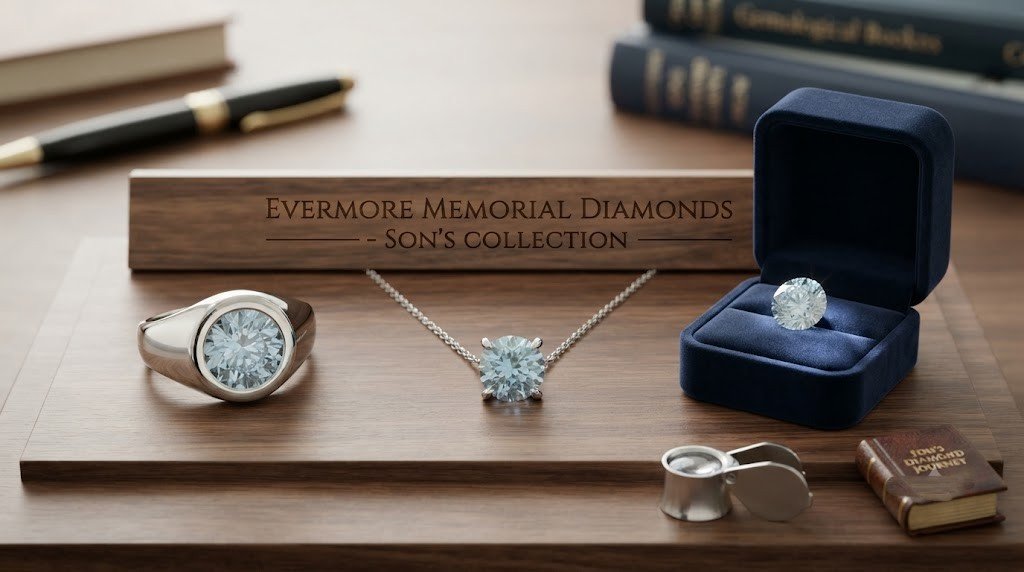
Table of Contents
Who Should Son Memorial Diamond Settings Be Designed Around?
The wearer, not him. It sounds obvious written down, yet it is the step families skip most often, because the instinct is to picture what he would have liked rather than what someone else will put on every morning.
Whether he was a young boy or a man with a household of his own, he is not the one who will live with the clasp or the ring size. His mother might, or his father, a sibling, a spouse, a partner, or a child of his. Good son memorial diamond settings start with that person’s hands, habits, and wardrobe.
This clears away a trap, too. Nothing says a father needs cufflinks or a mother needs a pendant, and nothing says a stone connected to a son should sit in something heavy or angular. Son memorial diamond settings follow taste and daily routine, never a gender script.
A few questions narrow things quickly:
- Does the wearer already wear jewelry every day, or rarely?
- Do they work with their hands, such as nursing, trades, gardening, childcare, or gym work?
- Should the piece be noticed, or sit unseen under a collar?
- Will it stay with one person, or be handed down later?
Answer those honestly and the list of sensible son memorial diamond settings usually shrinks to two or three. For the wider range of formats, our round up of rings, pendants and keepsakes for a son is the place to browse. This page covers the mechanics of choosing.
How Do the Main Son Memorial Diamond Settings Compare?
Seven son memorial diamond settings cover nearly every finished piece, and they differ mainly in how much everyday impact the stone absorbs.
| # | Setting Type | Everyday Exposure | Stone Sizes That Sit Well | Mount Usually Suggested | One Thing to Check |
|---|---|---|---|---|---|
| 1 | Ring | Highest because hands hit everything | About 0.10 ct up to 1 ct and above | Bezel, flush, or low prongs | Ring size and whether the metal can be resized |
| 2 | Pendant | Low because it hangs clear of most knocks | Any size | Prongs or bezel | Chain strength and clasp type |
| 3 | Earrings | Low to moderate | Small stones, usually a pair | Prong or bezel studs | Two stones may differ in shade |
| 4 | Cufflinks, tie bar, or lapel pin | Low because they are worn occasionally | Small to mid size | Bezel or flush | How often they will really be worn |
| 5 | Bracelet or charm | Moderate because wrists catch edges | Small stones | Bezel | Link and jump ring security |
| 6 | Keepsake box with loose stone | None | Any size | No mount | A proper case kept with the paperwork |
| 7 | An existing family piece | Depends on the piece | Must fit the existing seat | Whatever the piece allows | Whether it can be safely reworked |
Read down the exposure column and the pattern is plain. Son memorial diamond settings that live on the hands need the most protective mounts, while those at the neck, ear, or cuff can afford more open designs.
Some families would rather add his stone to something that already exists, such as a wedding band, a watch, or a grandparent’s ring, than commission anything new. A good jeweler can often do it after inspecting the piece.
Prong or Bezel: Which Son Memorial Diamond Settings Protect Best?
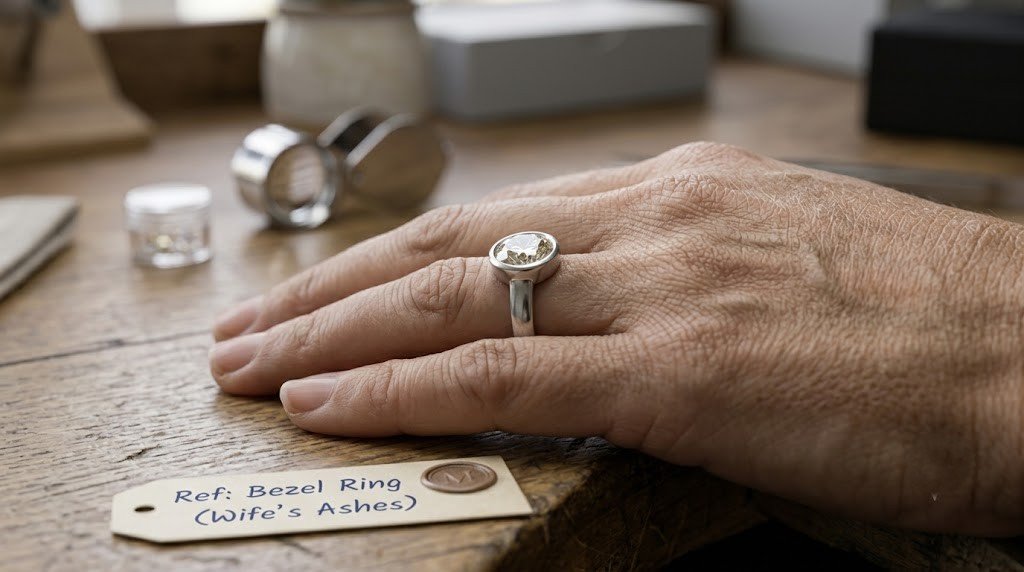
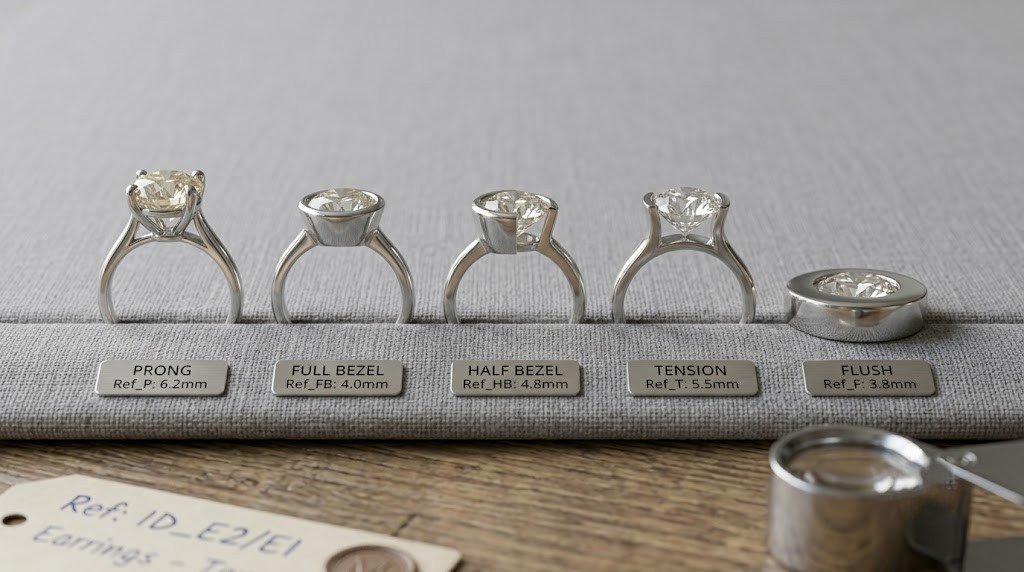
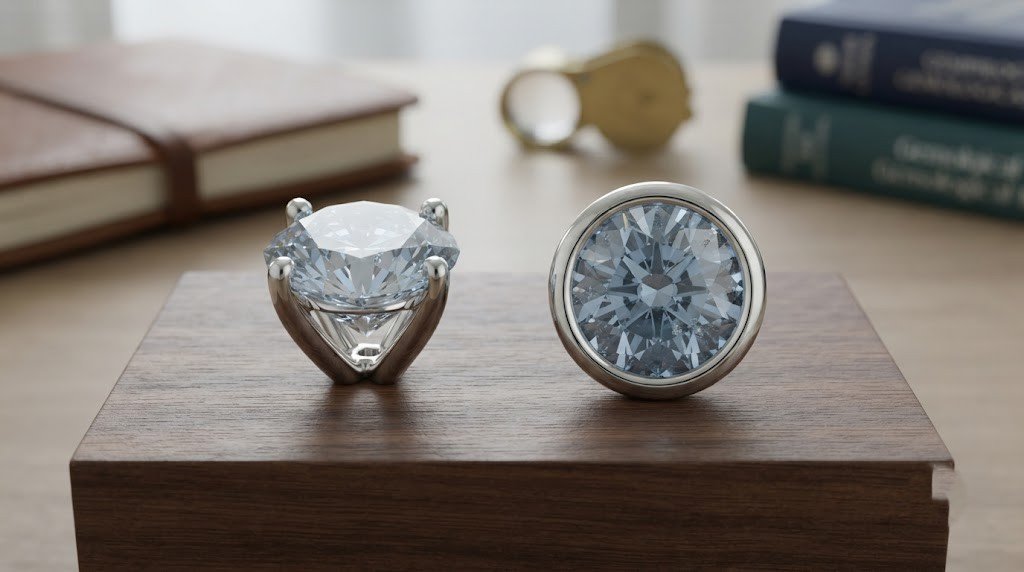
A bezel is generally the more protective option for daily wear. Prongs hold the stone with small metal claws and let more light in from the sides. A bezel wraps a thin rim of metal around the girdle and shields the edge.
That edge matters. Diamond scores 10, the top of the Mohs scale of mineral hardness, so ordinary surfaces will not scratch it. Hardness is not toughness, though. A sharp blow at the wrong angle, such as a ring meeting a granite counter or a car door, can chip a diamond at the girdle or a pointed corner, and a memorial stone cannot simply be replaced.
The practical guidance for son memorial diamond settings runs like this:
- Bezel or half bezel: A highly protective choice for rings and bracelets.
- Flush setting: The stone sits level with the metal, making it discreet and secure for small stones in a band.
- Low four or six prong: Provides more sparkle while offering reasonable protection if the head sits close.
- High prongs or a tall solitaire head: Attractive but more exposed, making this style better suited to pendants and earrings.
Cut shape matters as well. Princess, marquise, and pear cuts have points that are more vulnerable than a round or cushion outline, so jewelers usually guard them with V prongs or a bezel.
Whatever the mount, have son memorial diamond settings checked by a jeweler periodically, since prongs can loosen with wear.
Which Metal Works Best for Son Memorial Diamond Settings?
Any standard precious metal can hold the stone. The real choice turns on the wearer’s skin, the budget, and the diamond’s own color.
Platinum is dense, naturally white, and grips prongs well, which suits rings that see heavy use, though it costs more. White gold is lighter and cheaper but is often rhodium plated and may need replating, and some alloys contain nickel.
Yellow and rose gold feel warmer against skin that finds white metals cold. Silver is softer, so it suits pendants better than daily prong set rings. Titanium and tungsten look striking, but many such bands cannot be resized easily, which is worth considering if a ring may pass to someone else.
Color is the deciding factor more often than people expect. Nitrogen during growth pushes a stone toward yellow and boron toward blue, and the shade cannot be predicted in advance, even from very clean starting material.
That is a strong reason to choose metal for son memorial diamond settings only after the stone exists. Yellow gold tends to warm a champagne stone, while white metal makes blue appear cooler and crisper.
What color to expect from a son memorial diamond explains the color considerations in greater detail.
How Does Stone Size Shape Son Memorial Diamond Settings?
Size narrows the menu more than almost any other factor. Industry wide, memorial stones are generally offered from about a tenth of a carat to beyond five carats, and the setting has to suit whatever weight emerges.
Very small stones shine in flush bands, bezel studs, cufflinks, and slender pendants, but can look lost in a tall solitaire head.
Stones around half a carat to a carat open up almost every style. Larger stones sit higher and heavier, so daily wear son memorial diamond settings usually need more metal around them.
Two points catch families out. Finished size is set by time in the press, not by how much ash or hair was sent, so extra material does not buy a bigger diamond.
Exact carat weight is only certain after cutting, so son memorial diamond settings should be designed around the finished stone rather than an estimate.
If the wearer is torn between sizes, ask a jeweler to show similar weights already mounted.
Can the Metal or the Stone Carry an Engraving?
Most son memorial diamond settings can include engraving, and there are two quite different kinds.
Engraving on metal, such as inside a band, on a pendant back, or across a cufflink face, is routine jewelry work.
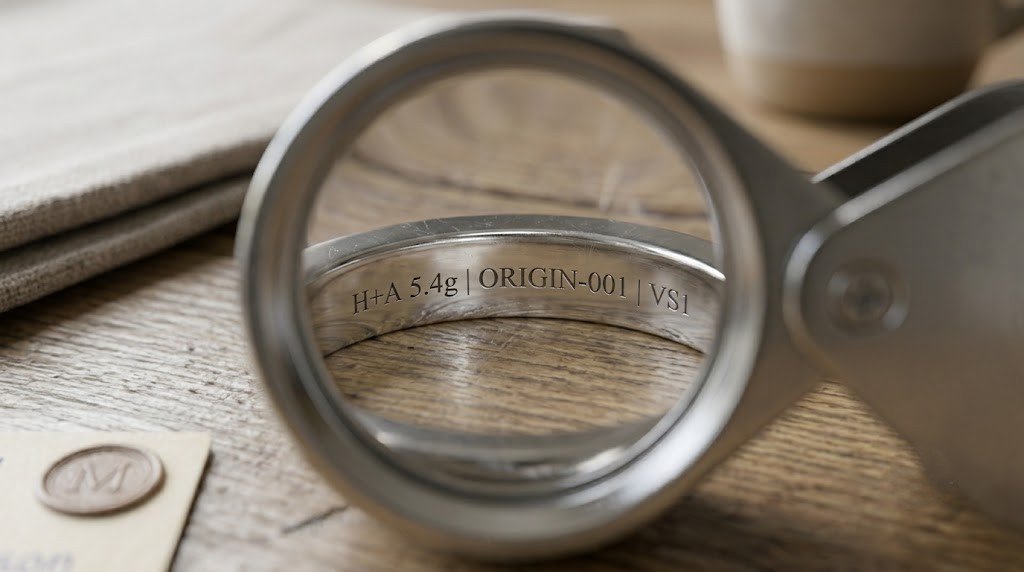
A laser inscription on the diamond’s girdle is microscopic, readable only under magnification, and offered by some providers but not all.
Metal is where most personal detail goes on son memorial diamond settings. This might include his name or initials, a date, the coordinates of a place he loved, or a word only the family understands.
Space is tight, so shorter wording generally works better, and block letters can wear more slowly than script inside a ring.
A girdle inscription can also carry a reference number tying the stone to its origin paperwork, which may be useful if it is ever reset or passed down.
Either way, settle the wording before production and take time with the decision because engraving is permanent.
How Can Several Small Stones Be Shared Across the Family?
Often more easily than expected, because only a portion of the ashes or hair is used. Across the industry, an ash request typically runs from a few tablespoons to roughly 4 ounces, about 100 grams, while hair is usually a small lock of a few grams.
That means several stones can often be grown from what one family holds.
Instead of one piece everyone must agree on, each person can choose their own. A sister might choose stud earrings, a father might choose a flush band, a partner might choose a pendant, and a younger child might keep a loose stone until they are ready to decide.
A few realities come with it. Each stone is a separate growth run with its own price and timeline.
Separately grown stones can differ in shade, so a matched pair of earrings or cufflinks must be requested rather than assumed. Even a requested match is a goal rather than a guarantee.
Before anything is sent, ask what happens to unused ash or hair after extraction because policies vary between providers.
Whether more than one family member can each have a stone covers shared submissions.
How to talk with family about a son memorial diamond may also help where relatives see the idea differently.
Does the Stone Need a Setting Straight Away?
No. A loose diamond keeps indefinitely, and nothing about it degrades while it waits in its case. Many providers deliver the stone unset unless jewelry was ordered alongside it.
It is therefore entirely reasonable to postpone son memorial diamond settings for months or years.
Some parents cannot face choosing a ring in the first year. Some partners wait until a child of his is old enough to have an opinion.
Setting work can only start once the finished stone exists anyway. Growth takes up most of the typical six to ten month industry span, while larger or specialty color stones can run to twelve months.
How long a son memorial diamond takes explains that timeline in more detail.
Nothing is final, either. A stone can be unset and remounted later, such as a pendant now and a ring later. Son memorial diamond settings are a choice for the present, not a permanent commitment.
What Do Son Memorial Diamond Settings Add to the Cost?
Across the industry, settings are typically quoted separately from the loose stone, so the diamond’s price rarely includes the mount.
The source notes that Memorial Diamond has not published its own pricing. The following are general 2026 industry ranges for the stone alone:
| Stone Size | Typical Industry Range |
|---|---|
| About 0.10 to 0.25 ct | $1,500 to $3,500 |
| About 0.5 to 1 ct | $5,000 to $15,000, with colorless usually costing more |
| 2 ct and above | $20,000 to $75,000 and above |
The finished piece then moves with several choices:
- Metal: Platinum usually costs more than gold, and gold more than silver.
- Metal weight: A heavy signet uses far more material than a fine pendant bail.
- Design and labor: A custom bezel generally costs more than a standard mount.
- Engraving: Usually an add on, while a girdle inscription may be priced separately.
- Grading: An independent grading report is optional and quoted separately.
Ask for the stone and mount to be itemized on every quote. This makes son memorial diamond settings from different makers easier to compare.
What a son memorial diamond costs breaks down the stone side further.
Who Should Make the Piece, the Provider or a Local Jeweler?
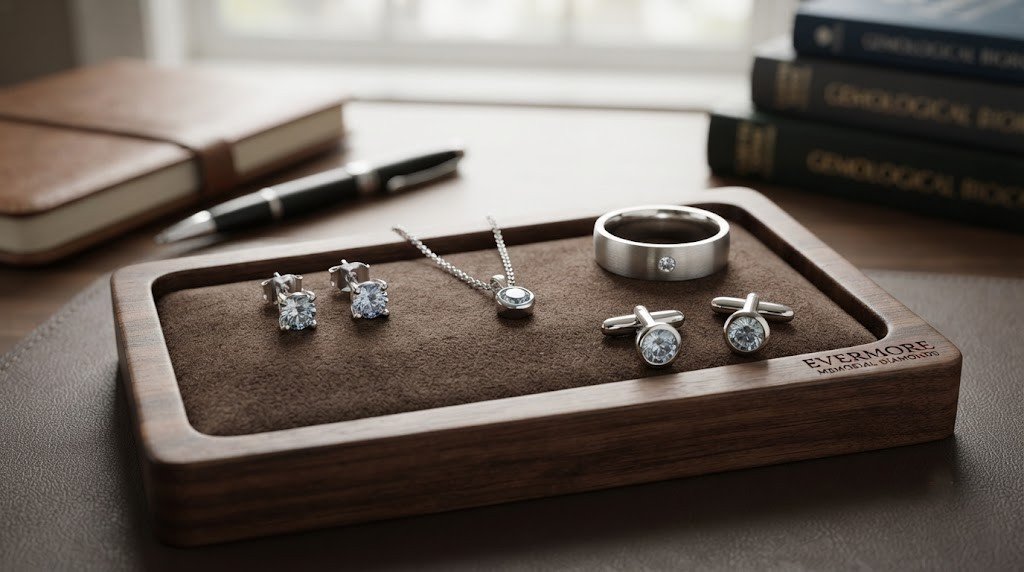
Either can work. Some providers make son memorial diamond settings in house. Many families instead take the loose stone to a jeweler they already trust, which can make sizing and repairs simpler later.
If a local jeweler does the work, take extra care with an irreplaceable stone:
- Ask whether their insurance covers the stone while it is on their premises, and check your own policy.
- Photograph the stone and keep its paperwork with you.
- Ask the bench jeweler about experience with that size and cut.
- Get a written receipt describing the stone by weight and shape.
On paperwork, most providers issue an in house certificate of origin tracing the diamond to your submission.
That differs from an independent grading report assessing the diamond against GIA’s cut, color, clarity, and carat standards, which is optional.
Ask your insurer which documentation they want.
Still choosing a provider? Questions to ask before his ashes become a diamond and where to start when choosing for your son cover the earlier decisions.
Whose Permission Comes Before Any Setting Is Chosen?
Whoever holds legal authority over his remains, not automatically a parent. Before son memorial diamond settings are on the table, someone must authorize releasing his ashes, and each state sets its own order of priority. There is no single national rule.
A spouse or registered partner often ranks first, and his adult children may come ahead of his parents. Anything he left in writing, such as a directive, will provision, or prearranged plan, can override the default.
The funeral director usually knows the local rule, and an attorney can confirm it.
Hair deserves the same care. Belongings can form part of an estate, rules vary by state, and it is sensible to check whose agreement is appropriate before a lock is sent.
Settling authority first lets the later conversations about son memorial diamond settings happen without an open question underneath.
Frequently Asked Questions
Can two relatives choose completely different settings from the same source?
Yes, provided more than one stone is grown. Because only part of the ashes or hair is typically used, each relative can often have a separate diamond set however they like, such as a bezel band for one person and a pendant for another.
Each stone is priced and timed on its own, and shades may differ.
Does a bezel setting make the diamond look smaller or less bright?
Slightly, sometimes. The metal rim covers the girdle and blocks a little side light, so a bezel set stone can appear marginally smaller than the same stone in prongs.
Many wearers accept that trade for the protection, particularly on a ring worn every day at work or around the house.
Can his diamond be moved from a pendant into a ring later?
Usually. A competent jeweler can unset a stone from one mount and reset it in another, much like family diamonds are reworked across generations.
Keep the origin certificate with the stone, ask about insurance while it is being handled, and have the new mount checked for fit before regular wear.
Should cufflinks hold one stone each or a single stone between them?
That depends on how many stones exist and how the wearer dresses.
A pair with a stone in each needs two diamonds, and a close shade match must be requested in advance. Even then, a perfect match cannot be promised.
One stone in a single cufflink, paired with a plain partner, is another option.
Will the metal I choose change how his diamond’s color looks?
Yes, noticeably. Yellow or rose gold tends to deepen champagne and yellow tones, while platinum or white gold makes a blue stone look cooler and crisper.
Since shade cannot be predicted before growth, view the finished stone against several metals before committing to son memorial diamond settings made in any one of them.
Is a very small stone practical for a ring worn every day?
Very much so. A tenth or quarter carat stone set flush or in a bezel sits low, stays protected, and snags less than a larger raised stone.
Small stones are also among the most discreet options for son memorial diamond settings.
Ask a jeweler to show a comparable weight already mounted so you can judge it in person.
Is it safe to wear a memorial diamond ring while working with my hands?
Mostly, if the mount is protective. Diamond resists scratching, but a hard knock can still chip it, and prongs can snag or loosen.
A bezel or flush mount reduces both risks. Many wearers take the ring off for heavy lifting, gym work, or harsh chemicals, and have it checked periodically.
Final Thoughts on Choosing Settings for His Diamond
The stone carries its connection to him whatever it is set in, or whether it is set at all. What the mount decides is more ordinary: whether the person wearing it can live with it comfortably on a Tuesday afternoon, at work, at the sink, or in the car.
That is why choosing son memorial diamond settings can be a practical part of the process. Start with the wearer, protect the stone if it will live on a hand, choose metal after seeing the color, and keep the paperwork with the piece.
If nobody is ready yet, the diamond can stay loose in its case for as long as the family needs.
Learn More About Son Memorial Diamonds
- Son memorial diamond ideas: rings, pendants, and keepsakes for a wider look at formats families choose.
- What a son memorial diamond costs for stone pricing by size, color, and add ons.
- Sharing one son’s diamond source across the family for several stones from one submission.
- Answers to the questions families ask most for the full son memorial diamond FAQ.
- The complete guide to a son ashes diamond for the process from start to finish.
Talk With Memorial Diamond
If you would like to think aloud about a ring, a pendant, or simply a good case for a loose stone, you are welcome to get in touch. Memorial Diamond can be reached at memorialdiamond.us to talk through son memorial diamond settings that might suit the person who will wear it.
Asking carries no obligation.