
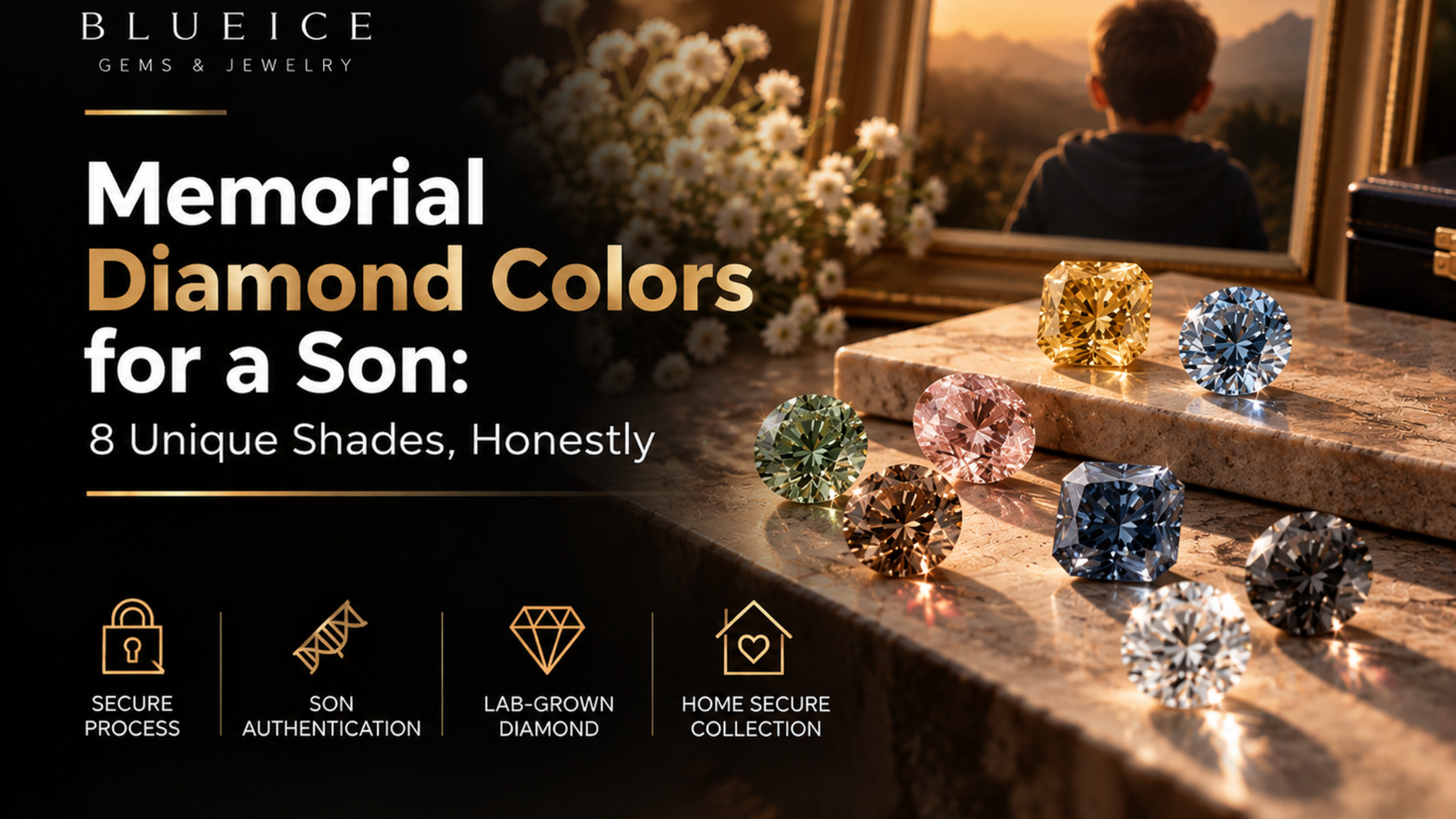
Most memorial diamond colors for a son fall somewhere among warm yellow, soft champagne and blue, because traces of nitrogen and boron present during growth decide the shade far more than any preference a family brings. A colorless stone is achievable, but it is a deliberate outcome that typically costs more, and a further handful of colors come only from optional treatment once growth is finished.
Below is the full range of memorial diamond colors for a son, the reason behind each tone, how color touches price and the calendar, and how families settle on one, whether he was a young boy or a grown man with a household of his own.
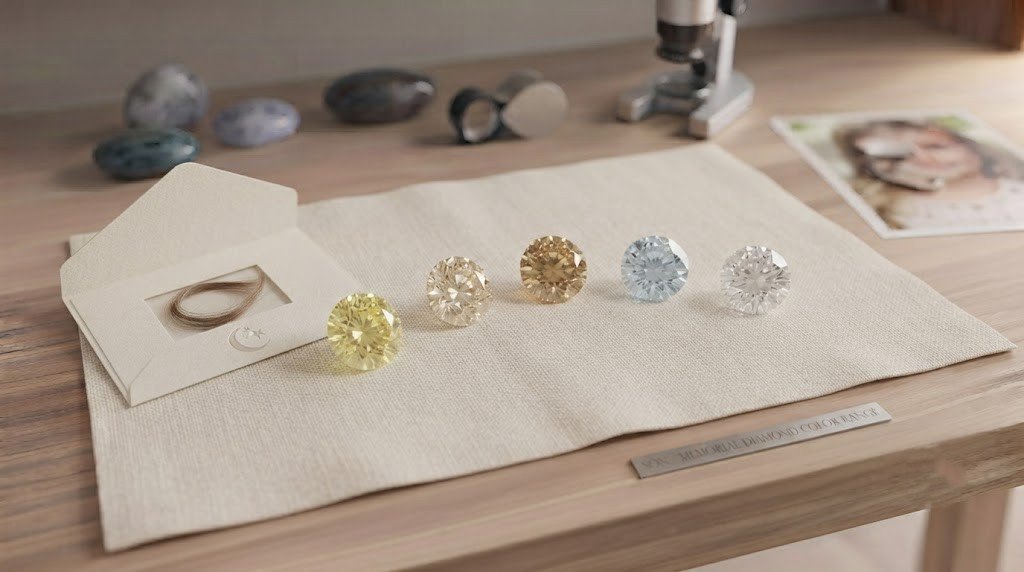
Table of Contents
What Are the Memorial Diamond Colors for a Son, at a Glance?
Eight tones cover nearly all the memorial diamond colors for a son that a family will be offered. Four of them are formed during growth itself; the other four are produced afterward, and only if you ask for them.
| Tone | What produces it | Typical effect on cost |
|---|---|---|
| Yellow, pale to rich | Nitrogen held in the crystal | Baseline |
| Champagne or brown | Trace elements from an organic source | Baseline |
| Blue, pale to deep | Boron held in the crystal | Baseline |
| Colorless or near colorless | Near total absence of nitrogen and boron | Usually higher |
| Red | Post growth irradiation | Priced as an extra |
| Pink | Post growth irradiation | Priced as an extra |
| Green | Post growth irradiation | Priced as an extra |
| Black | Post growth irradiation | Priced as an extra and can lengthen the wait |
Treat the table as a map rather than a menu with fixed results. The first three rows show where chemistry leads on its own, the fourth a result a laboratory works harder to reach, and the last four a treatment layered on top of whatever the press produced.
The way memorial diamond colors for a son get discussed online can make it sound as if you simply pick one from a swatch card. In practice you choose a direction, and the individual crystal has its own say in the precise shade. Two stones grown toward one target from the same material can still differ slightly, and that variation is part of what makes each of them his.
Why Do Memorial Diamond Colors for a Son Lean Toward Yellow, Champagne and Blue?
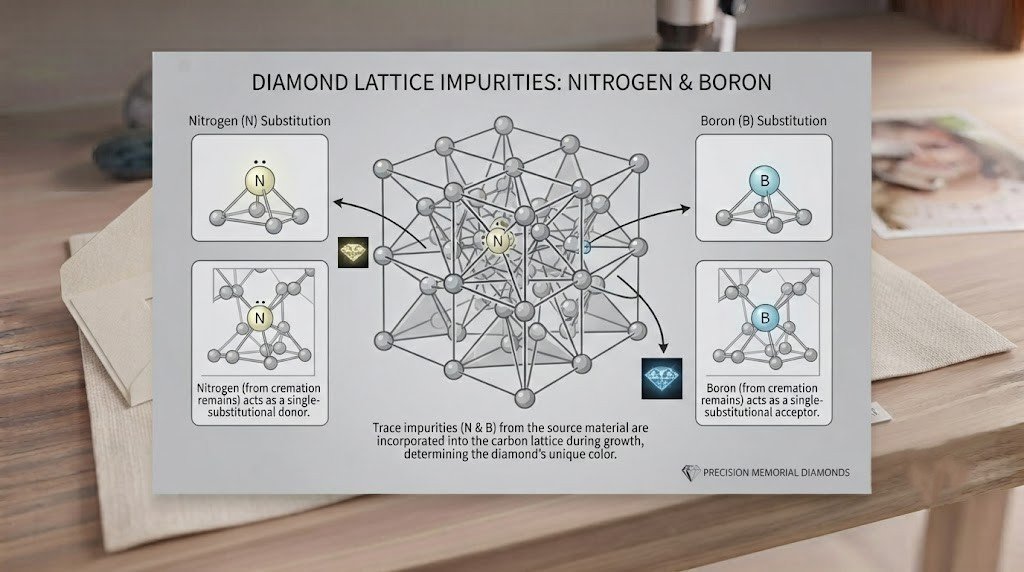
Because the carbon comes from a person rather than a sterile industrial feedstock, and a person’s carbon arrives with a little company. While a crystal grows, a few stray atoms of other elements can slip into places where carbon would sit, and even a tiny number changes how the stone handles light. That single fact explains most memorial diamond colors for a son.
Nitrogen is the most frequent visitor. When it settles into the structure, the diamond absorbs part of the blue end of the spectrum and reads as yellow to the eye; more nitrogen generally means a deeper yellow. Boron pulls in the opposite direction and leaves the stone looking blue. The champagne and brown tones sit alongside yellow as part of the same broad family of outcomes you would expect from an organic, imperfectly clean source.
None of this is a defect. Mined diamonds owe their color to these same elements, described within the cut, color, clarity and carat framework used to assess any stone. It helps to see memorial diamond colors for a son in that light: the shade records how the crystal formed, not that anything went wrong. A yellow diamond is not a failed colorless one.
Purification matters, but only up to a point. The extracted carbon is refined to roughly 99.9% purity or better before it goes anywhere near a press, yet what remains, together with conditions during growth, is still enough to tint the result. That holds whichever of the two lab growth methods, HPHT or CVD a provider uses, though most memorial stones are grown under high pressure.
Is a Colorless Stone Possible, and Why Does It Cost More?
Yes, and it costs more because it takes more work. Of all the memorial diamond colors for a son, colorless is the only one that needs the near total absence of both nitrogen and boron, which means additional processing to keep them out and closer control over growth.
Across the industry, colorless stones are typically priced meaningfully above yellow, blue or champagne stones of equal weight, and the gap is most visible in the half carat to one carat band. That premium pays for laboratory effort. It is not a verdict that colorless is the more fitting or more respectful choice.
Families sometimes assume colorless is the default and every other shade a compromise. Among memorial diamond colors for a son, it is actually the one you must request specifically, and a provider should explain in writing what range it can realistically commit to and what happens if a faint tint remains.
Colorless and near colorless are not the same description, and a stone can emerge lightly tinted despite every effort. Ask who will describe the delivered color: the provider itself, or an optional independent grading laboratory. Those are two separate documents. An in house origin certificate traces the stone back to your submission, while a third party grading report assesses its quality, color included, exactly as it would for any diamond.
What Are Irradiated Colors, and Are They Optional?
Entirely optional. Irradiation extends memorial diamond colors for a son beyond what growth produces: some providers offer it afterward, exposing the finished stone to controlled radiation that shifts or deepens its color. Red, pink, green and black are the shades most often produced this way.
Families who choose it usually have a reason rooted in him: the green of a field he played on, the black he wore daily, the red of his team. Others simply prefer a bold stone. Plenty decline, and that is equally sound; for some parents and partners, leaving the color untreated feels truer to who he was.
Two practical points to weigh first:
- Cost. Treatment is quoted separately from the stone, so ask for the figure in writing.
- Time. Black and other specialty colors can push the industry typical six to ten month schedule toward twelve months.
A stone treated to reach one of the irradiated memorial diamond colors for a son is still a real diamond, with the same structure and hardness; the treatment changes color, not what the stone is.
How Do Ashes, Hair or Both Relate to Memorial Diamond Colors for a Son?
Less than many families expect. The route affects how much carbon is available and what can be documented, but it does not make memorial diamond colors for a son predictable, and a stone grown from hair is not automatically lighter than one grown from ashes.
The usual reasoning is that hair is cleaner, so the stone should come out clearer. It sounds sensible and is not how the process behaves. Whatever the starting material, the carbon is purified to much the same standard before growth, and the shade is then set by trace elements and conditions inside the growth cell.
How each route relates to color:
- Ashes. Cremated remains are mostly bone mineral, and usable carbon is only about 0.5% to 4% of the ash by weight. Once it is extracted and blended with supplemental lab carbon, his personal share of the finished stone is usually described as around 10% to 15% of its mass, and some providers cite figures as low as 3%. The whole palette is open. What color a diamond made from his ashes will be covers this route in depth.
- Hair. As a starting material, hair is roughly half carbon by weight, so a small lock or a few grams is often enough. No equivalent figure is published for how much of a finished hair grown stone is his own carbon, so ask the provider to state it in writing. What color a diamond made from his hair will be goes further.
- Ashes and hair together. Some providers blend both. No finished stone percentage is published for a combined charge either, so request one in writing. What color a diamond made from his ashes and hair will be looks at that combination.
So choose the route on other grounds: what you have, what feels right, what can be documented. Memorial diamond colors for a son follow the growth, not the material.
How Do Memorial Diamond Colors for a Son Affect Price and the Wait?
The choice among memorial diamond colors for a son is one of four things that move the price, alongside carat, cut and whether an independent grading report is added. Carat is the largest lever by far.
As general 2026 industry ranges rather than any single company’s prices:
- About a tenth to a quarter of a carat: roughly $1,500 to $3,500
- Half a carat to one carat: roughly $5,000 to $15,000, where a colorless request adds a noticeable premium over a warm or blue tone of matching size
- Two carats up to five and beyond: roughly $20,000 to $75,000 or more
- Optional irradiation: a separate charge on top of the stone
- Optional grading, settings and engraving: each quoted on its own line
Some memorial diamond colors for a son also touch the calendar. Industry wide, the process typically runs six to ten months from the day material is received, and larger or specialty color stones, black in particular, can stretch toward twelve. Carat size depends on how long the crystal stays in the press rather than on how much ash or hair you send, so neither a larger parcel nor a natural tone will speed anything up.
When you compare quotes, remember that memorial diamond colors for a son are only one line on each; check that every quote names the same carat, color target and extras. What a son memorial diamond costs and how long one takes to make break both down further.
How Do Families Choose Among Memorial Diamond Colors for a Son?
Usually by thinking about him, not about what a son is supposed to like. None of the memorial diamond colors for a son is gendered. Blue is not a boy’s color, and choosing it for that reason alone tends to give you a stone that says more about a convention than about the person it came from.
Families who end up settled with their choice tend to begin somewhere specific:
- Something he loved or lived with. A color tied to a place, a team, a car, the ocean, a uniform or a favorite jacket.
- Who will wear it, and how. A pale stone and a deep one look quite different on a hand that wears yellow gold every day.
- Letting the crystal decide. Some families request no tone at all and accept whatever natural shade the growth produces, precisely because nobody chose it.
Parents may disagree, a partner or his adult children may see him differently, and one parent may be arranging all of it alone. None of that is unusual. If several people each want a stone, the stones do not have to match; separate diamonds from one submission can each be grown toward a different color.
Where a decision is shared, it can help for each person to name one color and one sentence about why before anyone debates it. Where to start when choosing a diamond for your son covers the wider decisions that sit beside this one.
What Should You Ask About Memorial Diamond Colors for a Son Before Sending Anything?
Enough to know exactly what you are agreeing to. Memorial diamond colors for a son are the detail most likely to surprise a family, and a few written answers nearly always prevent that:
- What color range do you realistically expect from this material?
- If I request colorless, what happens if a faint tint appears, and do I still pay the premium?
- Is irradiation offered, what does it cost, and how much time does it add?
- Who describes the final color: your own assessment, or an optional independent grading report?
- What personal carbon share do you document for my route, in writing?
- What happens to any ash or hair left unused?
- If the color is not what we expected, what options exist afterward?
One question sits in front of all of these: who has the authority to release his remains. That depends on the state, and there is no single national rule. A spouse or registered partner, or his own adult children, may rank ahead of his parents, and anything he left in writing, such as a directive, a will provision or a prearrangement, can override the usual order.
Hair kept at home is worth checking too, since belongings can form part of an estate and rules vary by state. Settle it first, because no decision about memorial diamond colors for a son can move forward without the right signature. Questions to ask before turning his ashes into a diamond has a fuller checklist.
How Does Color Look Once the Stone Is Set?
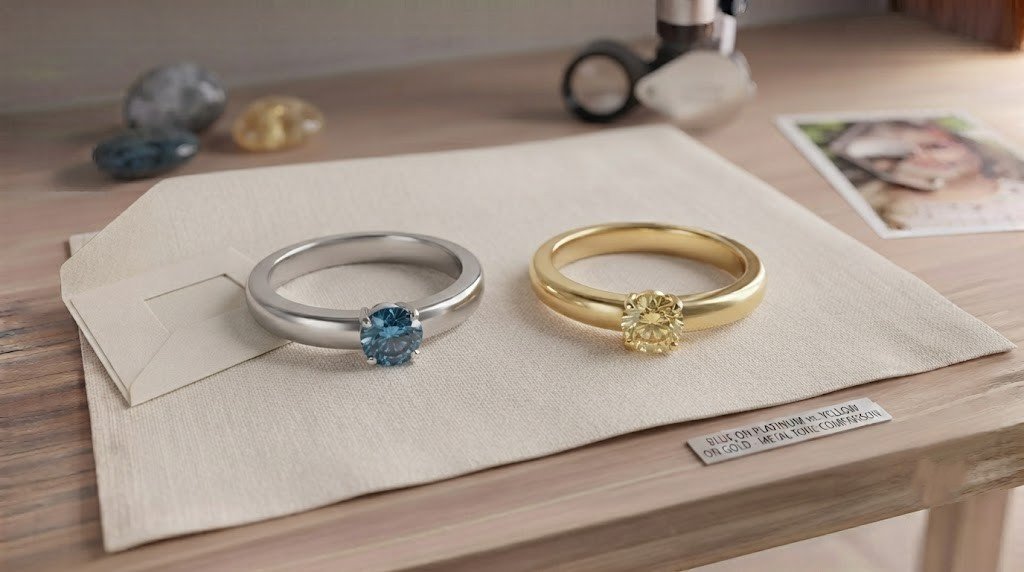
Differently from how it looks loose on a white card. The metal around a diamond reflects into it, so any of the memorial diamond colors for a son can read warmer or cooler depending on the metal holding the stone.
Yellow and rose gold tend to deepen warm tones and can make a pale yellow or champagne stone look richer. White gold and platinum tend to keep a blue or colorless stone looking crisp and cool.
Size matters as well: a small stone shows less color than a larger one of the same shade. A tint barely there at a tenth of a carat may be plain at a full carat.
Lighting changes things too, so a provider’s photograph is a guide rather than a promise. Setting also has no deadline; a loose diamond keeps indefinitely. Ideas for rings, pendants and keepsakes is a gentle place to look around first.
Frequently Asked Questions
Can we request an exact shade of blue or yellow for his diamond?
You can request a direction and often a depth, such as a pale or a deeper blue, but no provider can promise an exact shade, because trace elements present during growth settle the final tone. Ask what range it considers realistic for your material, and whether it can show photographs of comparable finished stones before you commit to anything.
Will the color of his diamond fade or change over time?
Natural yellow, blue and champagne tones come from atoms held inside the crystal lattice itself, so ordinary daily wear does not wash them out. For an irradiated color, ask the provider in writing how it describes the stability of its treatment and whether it gives any care guidance, since that answer depends on its own process rather than on diamond in general.
Is a colorless memorial diamond more genuine than a colored one?
No. Every tone in the palette is a real diamond grown partly from his carbon, and colorless simply reflects extra processing to exclude nitrogen and boron during growth. Many families actively prefer a natural yellow, blue or champagne stone, precisely because the shade arose from the material rather than being engineered out of it. Color says nothing about authenticity.
Does a diamond made from his hair come out lighter than one made from ashes?
Not automatically. Hair is richer in carbon as a starting material, but carbon from either source is purified to a similar standard before growth, and color is then decided by trace elements and conditions inside the growth cell. A hair grown stone can be yellow, blue, champagne or colorless, just like one grown from ashes, so a lighter result should never be assumed.
Can different family members choose different colors from the same submission?
Often, yes. Because only a portion of the ashes or hair is used for each stone, one submission can frequently support several diamonds, and each can be grown toward its own color. Every stone carries its own timeline and price, so ask the provider how it handles multiple requests and confirm the arrangement in writing before anything is sent.
What if the finished color is not what we pictured?
It can happen, because memorial diamond colors for a son are shaped partly by the crystal itself. Depending on the provider’s written terms, options may include irradiation to shift the tone, a regrowth with another full wait and cost, or nothing beyond the stone as grown. Find out which applies before you send any material, and keep that answer with your paperwork.
Final Thoughts on Memorial Diamond Colors for a Son
With memorial diamond colors for a son, you choose a direction and the crystal chooses the details. Yellow, champagne and blue are what organic carbon tends to produce, colorless is a deliberate and costlier request, and red, pink, green and black arrive only if you ask for treatment.
None of those outcomes is more fitting for a son than another. Families most at ease with their choice usually started from something true about him, and asked their questions in writing before anything was sent.
Whatever tone the stone takes, it will have a documented line back to him, and its shade is part of that record.
Learn More About Son Memorial Diamonds
- Everything about a son ashes diamond, in one place the full ash route, start to finish
- The complete picture on a son hair diamond the route that needs no cremation
- Combining his ashes and hair in one stone how a blended submission works
- More than one diamond from the same ashes sharing a submission among family
- Whether the stone is really made from his ashes the honest carbon picture
Talk With Memorial Diamond
If you would rather talk through memorial diamond colors for a son with a person, Memorial Diamond can be reached at memorialdiamond.us. Ask about the shades that are realistic, what a colorless request involves, and how treatment works. There is no obligation in asking.
Leave A Comment