When you send two different parts of her, it is natural to wonder whether they simply go into the press together. They do not: a stone made from daughter ashes and hair usually comes from two separate purification runs, one per material, whose cleaned carbon is joined before graphitization and growth, as providers that offer blending typically describe it. Bone mineral and keratin are different enough that each needs its own treatment first.
What follows is the laboratory’s side, stage by stage, for the adults making the decision, at whatever age she died.
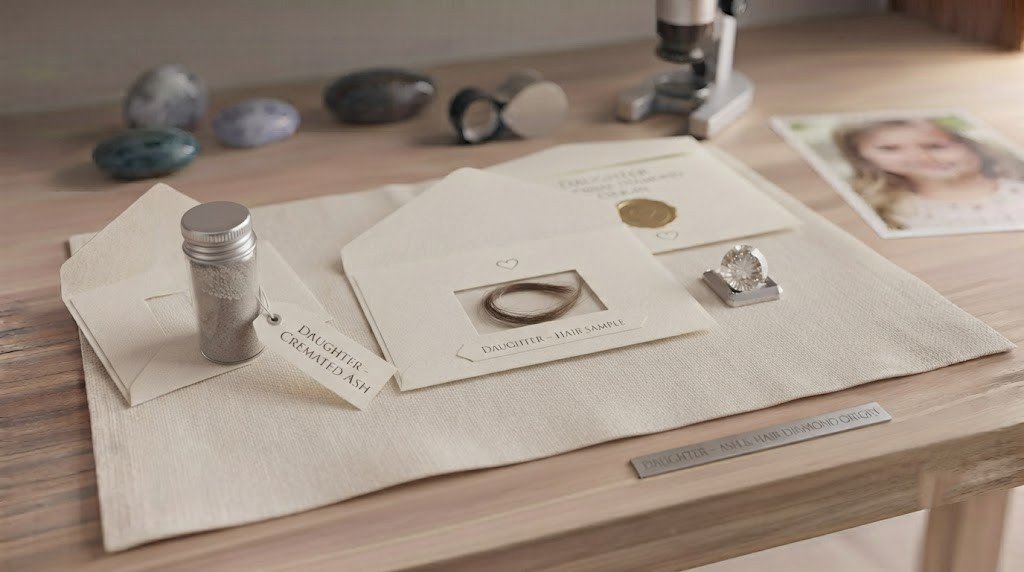
Table of Contents
What Happens to a Stone Made From Daughter Ashes and Hair, Stage by Stage?
Eight stages, most invisible to the family. The first half of a stone made from daughter ashes and hair is chemistry done twice; the second half is ordinary growth and finishing.
| # | Stage | What the lab is doing | What it means for you |
|---|---|---|---|
| 1 | Intake | Logging two separately labeled containers against one order | Your paperwork has to name both materials |
| 2 | Ash purification | Stripping calcium phosphate and minerals away from the small carbon fraction | Only a few tablespoons to about 4 oz is typically asked for |
| 3 | Hair purification | Breaking keratin down and removing everything that is not carbon | A small lock, a few grams, is the usual request |
| 4 | Combining | Joining the two purified carbons, then adding supplemental lab carbon | Ask what proportion the lab will document |
| 5 | Graphitization | Heating the combined carbon to roughly 2,500 to 2,700°C | No action needed |
| 6 | Growth | Pressing that feedstock around a seed crystal for weeks to months | Carat size sets how long this stage runs |
| 7 | Cutting and polishing | Shaping the rough crystal into the cut you chose | Occasionally the rough suggests a better shape |
| 8 | Optional finishing | Irradiation for color, independent grading for quality | Both are choices, not requirements |
Seen this way, a diamond made from daughter ashes and hair differs from a single material stone at only three points: intake, the doubled purification, and the moment the two carbons meet. After stage four, a gem made from daughter ashes and hair follows the usual path. For the family side sequence rather than the lab side one, the step by step guide to her ashes and hair lays out what you actually do at each point.
Why Do Her Ashes and Her Hair Start Out on Separate Benches?
Because they are chemically almost opposite starting points, and a process tuned for one would waste the other. Every stone made from daughter ashes and hair begins with that mismatch.
Cremated remains are overwhelmingly calcium phosphate, the mineral that gave her bones their structure. Industry figures place usable carbon at somewhere around 0.5% to 4% of the ash by weight, so the job is to find a sliver inside a great deal of mineral.
Hair is the reverse problem. Keratin is a protein in which carbon accounts for roughly half the weight, but that carbon is bound up with nitrogen, sulfur, hydrogen and oxygen, which have to be driven off cleanly.
So a lab preparing a stone made from daughter ashes and hair runs two differently tuned extractions. Keeping them apart also lets each material be weighed and logged on its own before anything is merged, which is part of what keeps a diamond made from daughter ashes and hair traceable. Ask a provider to confirm this happens rather than assuming it.
How Is Carbon Recovered From Her Ashes?
Through heat in a sealed, oxygen free chamber, carried out in several passes. Burning in air would turn the carbon into gas and lose it.
Across those passes the calcium phosphate and other minerals are separated out, and what remains is refined to roughly 99.9% carbon or better. Because the carbon fraction of ash is so small, a fair volume of ash yields only a modest amount of purified carbon for a stone made from daughter ashes and hair.
That is why the ash portion is still measured in tablespoons to ounces rather than a pinch, even when hair is also sent. Industry typical requests run from a few tablespoons up to about 4 oz, around 100 grams, a small fraction of what a full cremation returns. The rest of her ashes can stay in the urn, be buried or scattered, or be shared as your family intends.
Ask what happens to any ash that is not consumed; some providers return it, some dispose of it respectfully. The ash only route is covered in how a memorial diamond is made from her ashes. How much ash and hair a daughter memorial diamond needs goes through quantities for a combined order in more detail.
How Is Carbon Recovered From Her Hair?
Along a similar oxygen free route, tuned for protein rather than mineral. The keratin breaks down under controlled heat, the non carbon elements are driven off, and what is left is refined to the same high purity.
Because hair is so carbon rich, the amount asked for is small: typically a lock or a few grams. Hair from a brush, a braid kept after a haircut, or a lock taken before cremation can all be suitable, though a provider should confirm whether dye or the age of the sample matters.
Keep one misconception in view. Hair’s higher carbon content describes the starting material, not the finished crystal. It does not mean a stone made from daughter ashes and hair is mostly hair, and it does not make a gem made from daughter ashes and hair lighter in color. Those outcomes depend on growth conditions and trace elements. The hair only process goes deeper on keratin.
Permission for hair is usually a quieter matter than for cremated remains, yet it is not a free for all. A lock kept in a drawer may still count among her belongings for estate purposes, and how that works differs from state to state, so confirm whose consent makes sense before posting it.
At What Point Are the Two Carbons Joined, and What Else Goes In?
After both purifications are finished and before graphitization. Providers that offer blending typically describe merging the two purified carbons at this point, so one uniform feedstock goes into the furnace for a diamond made from daughter ashes and hair. Not every provider offers blending, and methods are not standardized, so ask for a written description of where the merge happens.
Then comes supplemental carbon. A diamond of meaningful size needs more carbon than a personal sample reliably yields, so labs add high purity lab carbon. That is typical of memorial diamonds generally, including one made from daughter ashes and hair.
How much of the crystal is her? On the ash route alone, personal carbon is usually described as around 10% to 15% of the stone’s mass, with some providers publishing figures as low as 3%. For a blended charge there is no equivalent published figure. Nobody publishes an industry wide share for a stone made from daughter ashes and hair, so ask the provider to state its own figure in writing and explain how it arrives at it.
None of this makes the diamond less real. Her carbon is physically part of the lattice; it is simply not the only carbon there, and any stone made from daughter ashes and hair presented as purely her should be questioned. The wider guide to a blended stone for her puts this in context.
How Is Chain of Custody Kept Across Two Materials?
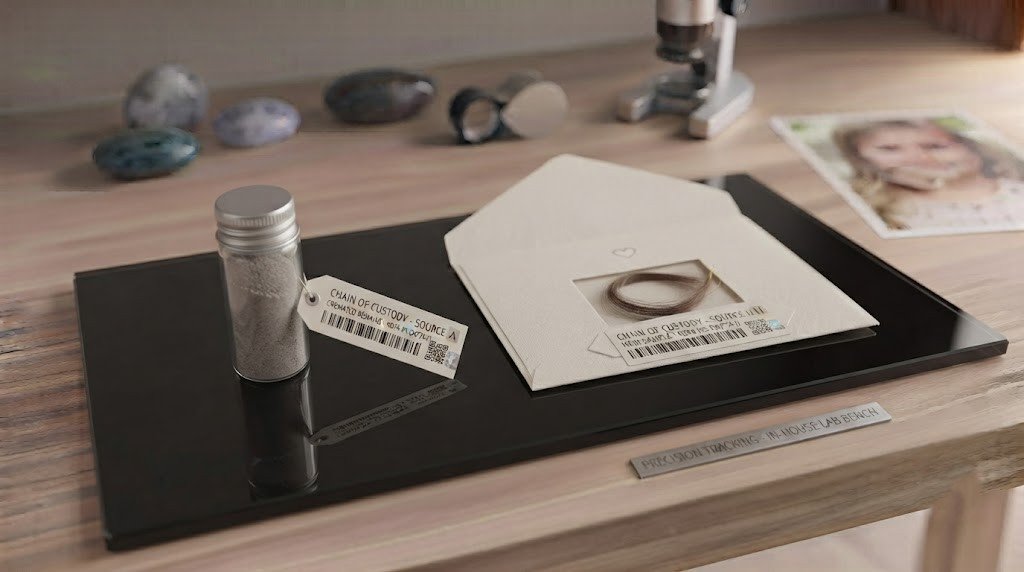
With two sets of records that converge into one. Chain of custody is the paper trail proving the stone grew from what you sent, and a gem made from daughter ashes and hair doubles the places where that trail needs care.
A sound process for a stone made from daughter ashes and hair usually includes:
- Separate labeling at intake — each container logged with its own identifier under one order
- Individual weights recorded — how much of each material arrived
- Documented purification runs — one record per material
- A recorded merge point — the date and batch reference where the carbons were combined
- Isolation during growth — her feedstock in its own growth cell
- A certificate of origin — an in house document tracing the stone back to your submission
Ask which of those records you will receive for a diamond made from daughter ashes and hair and which are available on request.
Before any of this begins comes the question of who can authorize releasing her ashes. It varies by state, with no single national rule. A spouse or registered partner often comes first, and her own adult children may rank ahead of her parents. Her own written wishes, whether in a will, an advance directive or a prepaid funeral plan, can displace that sequence altogether. Parents are sometimes divided, and one parent arranging alone is common. The funeral home that handled the cremation usually knows the local rule.
What Happens Inside the Graphitization Furnace and the Growth Press?
Two very hot stages turn loose carbon into a crystal. First, graphitization: the merged feedstock is heated to roughly 2,500 to 2,700°C and reorganizes into graphite, the layered form of carbon a growth press can use.
Then growth. Most memorial diamonds are grown by the high pressure, high temperature method, known as HPHT, one of the two established ways of growing a lab diamond. The graphite for a stone made from daughter ashes and hair goes into a growth cell with a tiny diamond seed, held at roughly 6 to 8 GPa and about 1,400 to 2,500°C, and carbon slowly builds onto the seed. A minority of providers use chemical vapor deposition instead.
Size is governed by time in the press, not by how much ash or hair you sent; more material does not mean a bigger or quicker stone. Sizes on offer generally run from about a tenth of a carat to beyond five.
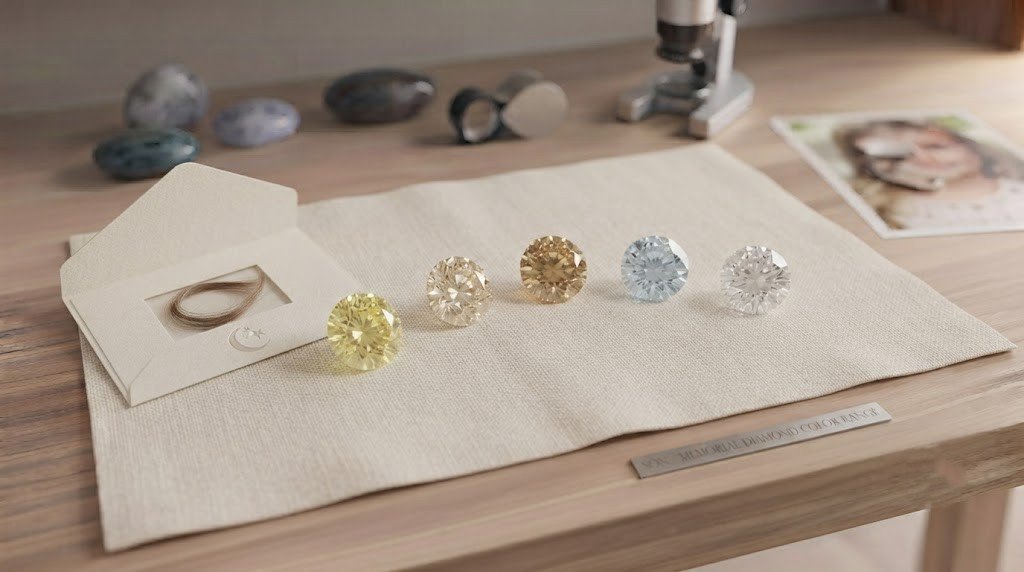
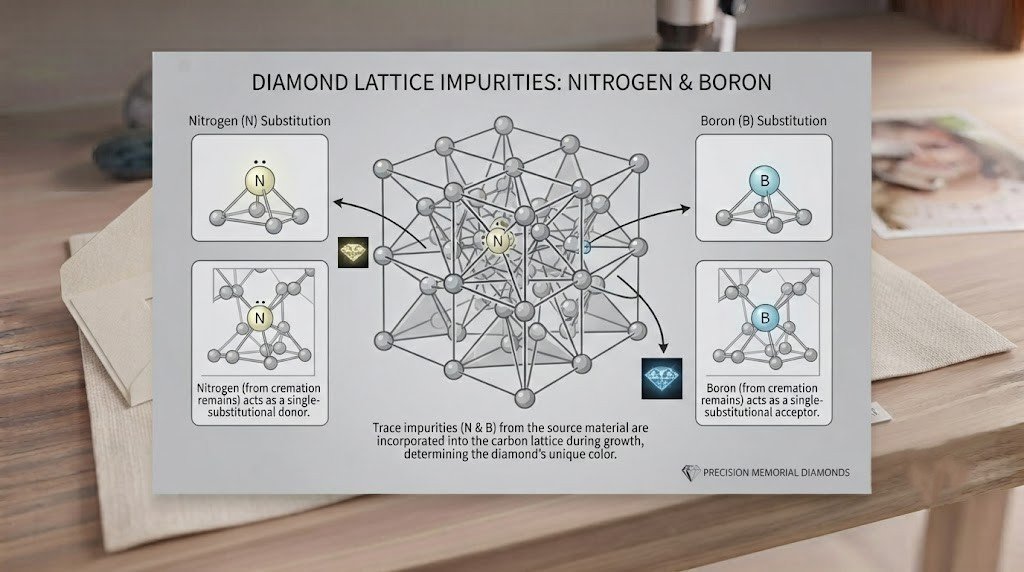
Color is also decided here. Nitrogen present during growth pulls a crystal toward yellow; boron pulls it toward blue; colorless requires the near total absence of both and usually costs more. Two purified materials do not make the color of a diamond made from daughter ashes and hair more predictable. What color a diamond from her ashes and hair will be explores the range, and the choice should rest on what feels right to you rather than on any assumption about what suits a daughter.
How Is the Crystal Cut, and Are Irradiation and Grading Required?
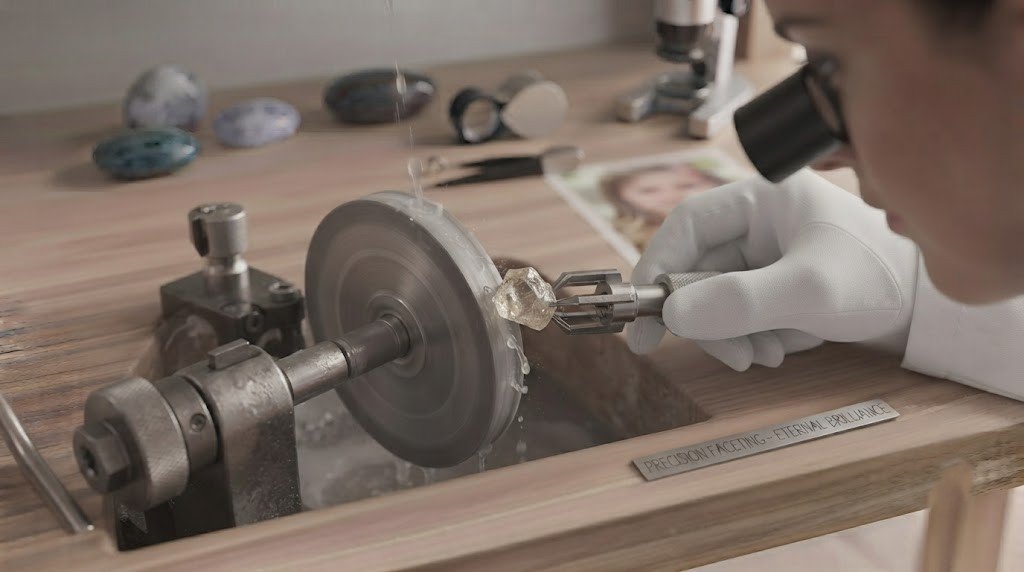
A cutter shapes and polishes the rough crystal into the style you chose: round, oval, cushion, princess, emerald or others. A careful provider will say if the rough would suit a different shape better.
Two optional steps can follow. Irradiation is a post growth treatment some providers offer to shift color toward red, pink, green or black. It costs extra, and many families keep the color a stone made from daughter ashes and hair grew with.
Independent grading is the other option. A third party gemological laboratory can assess the finished stone for cut, color, clarity and carat, like any diamond; memorial stones commonly grade between SI2 and VVS. That report is separate from the in house certificate of origin: one describes quality, the other documents where the carbon came from.
However it is finished, a stone made from daughter ashes and hair is a genuine diamond, sitting at 10 on the Mohs scale of mineral hardness, so it suits everyday wear.
How Long Does a Diamond Made From Daughter Ashes and Hair Take, and What Does It Cost?
Industry wide, expect roughly six to ten months from the day both materials arrive, with large or specialty color stones sometimes stretching to twelve. A stone made from daughter ashes and hair adds a second purification run, so ask whether that changes the estimate; growth still takes most of the calendar.
On price, these are general 2026 industry ranges, not any single company’s published rates:
| Tier | Carat band | Usual spread |
|---|---|---|
| Small | Roughly a tenth to a quarter carat | $1,500 to $3,500 |
| Middle | Half a carat up to one | $5,000 to $15,000 |
| Large | Two carats and beyond | From $20,000, past $75,000 at the top |
Colorless tends to cost more than blue, yellow or champagne at the same weight. Settings, engraving, fancy cuts and a grading report are usually priced separately. Ask whether a gem made from daughter ashes and hair carries a supplement for handling two materials.
The final figure for a diamond made from daughter ashes and hair depends on carat, color, cut and extras, not on how much of either material you send. How to turn your daughter’s ashes and hair into a diamond walks through those decisions in the order most families make them.
What Should the Lab Confirm in Writing Before You Send Both?
The details that are easy to assume and hard to check afterward. For a stone made from daughter ashes and hair, written answers matter more than usual, because two materials create more room for misunderstanding.
Useful questions to put by email:
- Do you blend ashes and hair, and at what stage are the carbons combined?
- What share of the finished stone will be personal carbon, and how is that measured?
- How much ash and hair do you need, and in what containers?
- What happens to unused ash and hair?
- Which custody records will I receive for each material?
- Is growth done in house or at a partner laboratory?
- Does a second material change the timeline or price?
- What happens if a growth run fails?
A provider that answers those clearly is showing you how it will handle a stone made from daughter ashes and hair; vague answers are a reason to keep looking. For a skeptic’s view of the whole question, whether a memorial diamond is really made from her ashes and hair goes through the verification side in depth.
Frequently Asked Questions
Are her ashes and hair mixed together before processing?
Not usually. Providers that offer a stone made from daughter ashes and hair typically purify the ash and the hair in separate runs, because bone mineral and keratin need different treatment. The two cleaned carbons are then merged before graphitization. Methods vary, so ask for a written description of where the merge happens.
Does adding hair increase how much of the diamond is her?
No published figure answers that. Hair holds far more carbon than ash, but that describes the starting material, not the finished crystal. Supplemental lab carbon is still added, and no industry wide percentage exists for a gem made from daughter ashes and hair, so ask your provider to state its own figure in writing.
Will combining two materials make the color easier to predict?
No. Color is decided during growth by trace elements, chiefly nitrogen toward yellow and boron toward blue. Two purified materials do not make the result more predictable, and hair does not automatically produce a lighter stone. Colorless is possible but requires excluding both elements and usually costs more.
Can I send hair that was saved years ago?
Often, yes. Hair kept dry, clean and away from heat usually stays usable for a long time. Mention how it was stored and whether it was ever dyed or chemically treated, since some providers want to know first. A small lock or a few grams is the typical request.
Is a stone made from daughter ashes and hair larger than one from ashes alone?
Not because of the extra material. Carat size is set by how long the crystal grows in the press, which follows the size you choose at the start. Sending hair as well as ash changes the record keeping and possibly the price, but it does not make the diamond bigger.
Can more than one family member receive a stone from the same ashes and hair?
Frequently, because only a portion of each material is used. Each additional diamond needs its own growth run, with its own timeline and cost. Ask whether one submission can support several stones and how the provider documents which stone came from which batch.
What happens if I only have enough of one material?
Many providers can work from ashes alone or hair alone, and a single material stone is still made from her. If you have only a little hair to go with her ashes, ask whether a diamond made from daughter ashes and hair is still feasible before sending anything.
Final Thoughts on How Her Ashes and Hair Become a Diamond
Two materials make the laboratory’s work a little more involved, but the core is the same for every memorial diamond: purify, graphitize, grow, cut. What changes with a stone made from daughter ashes and hair is the record keeping, and that is where your attention is best spent.
Get the blending method, the personal carbon figure and the unused material policy in writing, and confirm who can release her ashes. After that, the months of growth ask nothing more of you.
What returns is a real diamond with a documented line back to both materials you entrusted to the lab, whatever age she was and however you choose to keep it.
Learn More About Daughter Memorial Diamonds
- Everything about a blended ashes and hair stone for her — the wide angle overview
- How to turn your daughter’s ashes and hair into a diamond — the decisions in order
- The family’s checklist for a blended stone — your tasks, one at a time
- Is it really made from her ashes and hair? — the verification questions
- How much ash and hair you need — quantities for a combined order
Talk With Memorial Diamond
If it would be easier to talk this through with a person, Memorial Diamond is available at memorialdiamond.us to explain how a stone made from daughter ashes and hair is handled and what documents are involved. Asking commits you to nothing.