
People rarely arrive at this page with one tidy question. They arrive with twelve, half of them unspoken, and a suspicion that some of them sound foolish. A partner memorial diamond is a real lab grown diamond containing carbon recovered from your partner’s cremated ashes or from their hair, blended with supplemental lab carbon so the crystal reaches a viable size. For the ash route, industry figures put the personal share at roughly 10% to 15% of the finished stone, and some providers cite figures as low as 3%; for hair, no equivalent percentage is published at all. Nothing below assumes you already know any of this.
Memorial Diamond grows these stones, which makes this an interested source rather than a neutral one. So the figures here are industry wide bands rather than our published policy, and the awkward answers are given as plainly as the easy ones.
Table of Contents
What a Partner Memorial Diamond Actually Is
Start with the physical object, because most of the confusion downstream comes from a fuzzy idea of what is being made.
It is a diamond. Not a simulant, not resin with ash suspended in it, not a “diamond look” stone. It is grown by the same two methods the wider lab grown industry uses, HPHT, which reproduces mantle conditions at roughly 6 to 8 GPa and 1,400 to 2,500°C, and CVD, which builds a crystal layer by layer from carbon bearing gas. Most providers use HPHT. Either way a partner memorial diamond comes out at 10 on the Mohs scale and is graded on the same four Cs as any other diamond.
A partner memorial diamond differs from an ordinary lab grown stone in exactly one respect: where part of its carbon came from. Carbon is recovered from cremated remains or from hair, purified to roughly 99.9%, converted to graphite, and used as feedstock in the growth cell alongside supplemental lab sourced carbon.
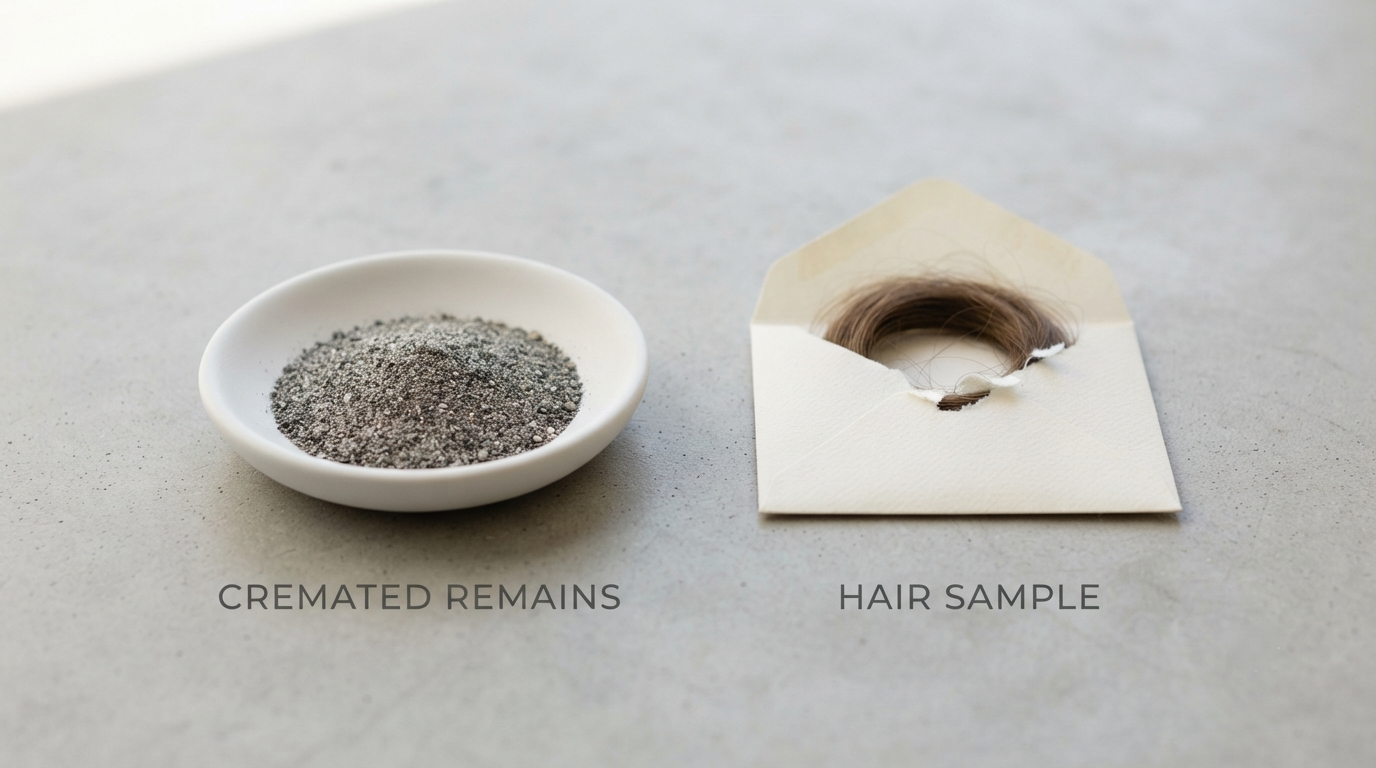
The size of that personal share is the number worth sitting with, and it needs stating carefully rather than loosely. Industry figures for the ash route put it at roughly 10% to 15% of the finished mass, and some providers cite figures as low as 3%. For hair there is no equivalent published percentage, only the fact that hair is around 50% carbon by weight, so far less starting material is needed. Anyone quoting a single number that covers both routes is quoting something nobody publishes.
What that rules out is simple. A partner memorial diamond sold as made entirely of a person is advertising something the chemistry does not permit. What is true is stranger and better: atoms that were physically part of your partner are locked inside a crystal lattice, permanently, and the stone exists because they did. Ask any provider what share your own submission is expected to contribute, and ask for that answer in writing. Whether a partner memorial diamond is really made from your partner’s ashes takes that question apart properly, and the general category background is worth five minutes if this is entirely new to you.
Two routes exist, and they are genuinely different:
- Ashes. Cremated remains are mostly calcium phosphate, so usable carbon is only about 0.5% to 4% by weight. That thin yield is why providers ask for a portion measured in spoonfuls, typically a few tablespoons up to roughly 4 oz, about 100 g.
- Hair. Keratin is roughly 50% carbon, so a small lock of a few grams does the work of a much larger portion of ash. Crucially, hair needs no cremation at all, which keeps the option open for a partner who was buried.
The two routes combine. A submission of ashes and hair together is assessed against each material’s own figures rather than pooled into one total, which matters if you hold a little of each rather than enough of either. The hair route on its own terms is worth reading if cremation never happened.
Who Is Allowed to Authorize a Partner Memorial Diamond?
This is the question the rest of the internet answers badly for partners, so it gets its own section rather than a line in the FAQ.
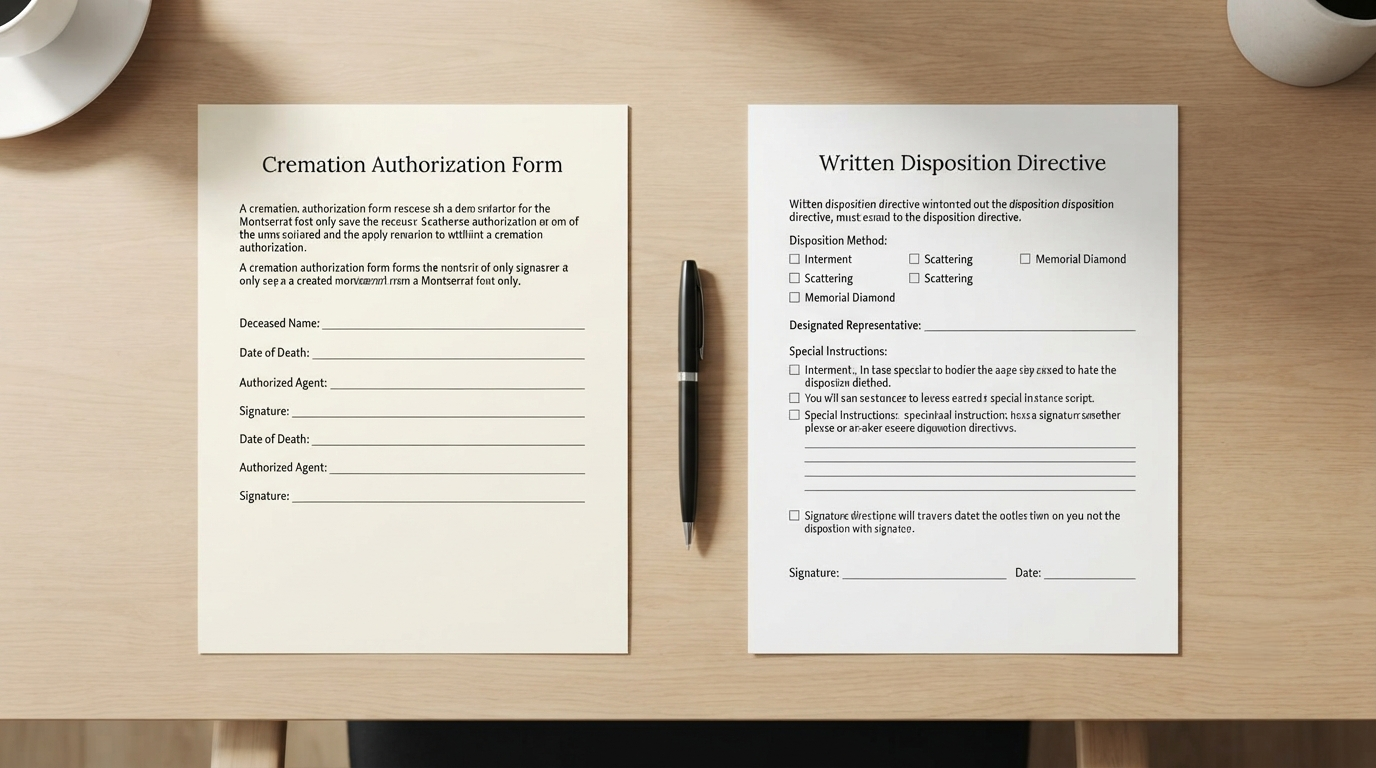
There is no single national rule here. Each state writes its own, and paperwork your partner signed while alive can reorder the result on top of that: a will, a disposition directive, a pre need contract with a funeral home, or the authorization someone gave to release the body for cremation. If the relationship was recognized in law, the holder of that authority is normally obvious. If it was not, no marriage, no civil partnership, perhaps a family that never quite said the word out loud, the legal decision may belong to your partner’s mother, to an adult child, to a brother, or to a spouse from a marriage long dissolved.
Say it plainly: you may not be the person who can release the material for a partner memorial diamond, and finding that out before money moves is very much cheaper than finding out afterwards.
The practical sequence is short:
- Ask the funeral director who signed the cremation authorization. It is a two minute call, it costs nothing, and that name is very often the person holding control.
- Find out what was left in writing, and whether anyone has read the document rather than remembered its gist.
- Ask the holder for a portion, not for the arrangements. A request for a few tablespoons, leaving every existing plan untouched, is a far smaller ask than it feels like, and it is granted more often than people expect.
How to open that conversation covers what to say and what not to lead with. If you are at the very start of all this, where to begin sets out which decisions are urgent and which are not.
What If the Answer Is No, or Not Yet?
Refusal happens often enough that leaving it out would be dishonest, and it is rarely as final on paper as it sounds on the day.
If the person holding authority refuses a partner memorial diamond, three things usually remain true. Hair, if any was kept, is ordinarily the less obstructed route: what the law regulates here is cremated remains, and a lock that has sat in your own house was never inside that frame. Read that as how things tend to work, not as a settled legal position, belongings can be drawn into an estate, states differ, and hair in another person’s keeping is something to ask about.
Confirm it wherever the answer matters. A refusal given in the first month is a different object from a refusal given in the ninth, because the person refusing is also exhausted and also grieving. And a narrower ask frequently succeeds where a broad one failed: not “I would like to have a diamond made,” but “may I have a few tablespoons set aside.”
If the answer stays no, the ashes route closes and the idea of a partner memorial diamond does not. Hair requires no cremation and no portion of anything anyone else is holding, and where the sample is already in your own keeping it is usually the simpler path, worth checking rather than assuming, but rarely the obstacle the ash question is. It is also worth raising the possibility that more than one person receives a stone, several diamonds from one shared source turns a request into something a family benefits from collectively, which is often what restarts a stalled conversation.
How Does the Process Run, Stage by Stage?
Seven stages, most of which happen without you. The wait is long and mostly silent, which is worth knowing in advance so the silence does not read as a problem.
| Stage | What happens | Roughly how long |
|---|---|---|
| 1. Collection | Ashes or hair are received and logged against chain of custody documentation | Days |
| 2. Carbon extraction | Everything that is not carbon is stripped away in a controlled, oxygen free process | Weeks |
| 3. Purification | The recovered carbon is refined to roughly 99.9%+ purity | Weeks |
| 4. Graphitization | Purified carbon is heated to about 2,500 to 2,700°C and converted into graphite | Weeks |
| 5. Growth | Graphite plus supplemental lab carbon is grown around a seed in an HPHT cell | Weeks to months, this is where carat is decided |
| 6. Cutting and polishing | A gemologist shapes the rough into the finished stone | Weeks |
| 7. Grading and return | Optional independent grading, then the stone comes home | Weeks |
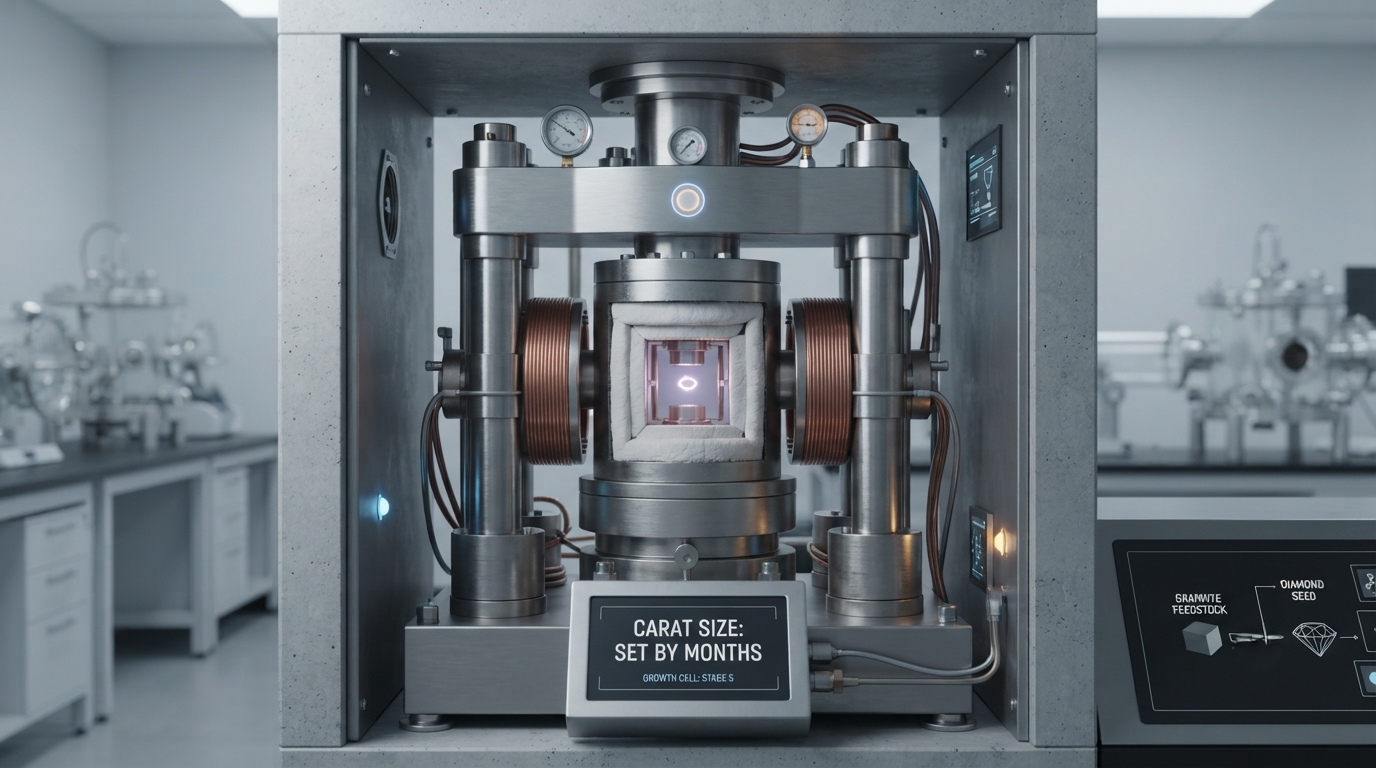
Nothing in stages two through five asks anything of you, and most providers go quiet through them. The silence is normal rather than a warning sign, though it is entirely reasonable to ask at the outset how often you will be updated and by whom.
End to end, the industry typical span for a partner memorial diamond is 6 to 10 months, reaching around 12 months for larger or specialty color stones. The reason is stage 5: carat is a function of time in the press, not of how much ash or hair you sent. A full urn does not buy a bigger stone or a faster one. The timeline in detail shows where each month goes, and the full ashes route walks the same seven stages at greater length.
What Does a Partner Memorial Diamond Cost?
Industry wide bands, not our published pricing, and they move with carat, color, cut and whether an independent grading report is included.
Think of it in three tiers. The smallest stones, a tenth to a quarter of a carat, sit in an industry band of about $1,500 to $3,500. A half carat through a full carat typically means $5,000 to $15,000, and a colorless stone at that weight costs noticeably more than a yellow, blue or champagne one. Above two carats the band runs from around $20,000 to $75,000 and higher. Settings, engraving, fancy cuts and grading reports are normally separate line items from the loose stone.
Two things worth knowing before you request a single quote. First, decide a carat you can actually afford, everything else prices off it, and a quote with no carat attached cannot be compared to anything. Second, budget for the back half: grading, cutting choices and a setting arrive months after the deposit, when the money often feels already spent. The full cost breakdown for a partner memorial diamond goes through each driver individually.
What Color Will It Be, and Can You Choose?
Partly, and less than the marketing photographs suggest.
Color in any diamond comes from trace elements present during growth. Nitrogen reads yellow. Boron reads blue. A colorless stone requires the near total absence of both. Because the feedstock for a partner memorial diamond comes from an organic, individual source rather than a sterile synthetic one, trace elements are ordinary, which is exactly why memorial stones trend toward yellow, blue and champagne rather than white, and why colorless versions require extra processing and cost more.
Some providers also offer post growth irradiation for red, pink, green or black. Clarity across the category typically lands in the SI2 to VVS range, and the finished stone is graded against the standard GIA 4Cs like any other. What color to expect gives the likelihoods honestly rather than as a menu.
What Does the Stone End Up Living In?
Later than people expect, and nothing forces the decision at the point of ordering.
A finished partner memorial diamond can sit loose in a box for years without coming to any harm, and plenty do, the idea that a partner memorial diamond has to become a ring is a jewelry industry assumption rather than a requirement. When you do want it set, rings, pendants and keepsake ideas for a partner memorial diamond covers the trade offs between a piece worn daily, a piece worn deliberately, and a stone that is never worn at all.
If you are weighing this against keeping an urn rather than against another piece of jewelry, the two options side by side treats both as complete answers, because they are.
Frequently Asked Questions
What exactly is a partner memorial diamond?
A real lab grown diamond grown partly from carbon recovered out of your partner’s cremated ashes or hair. It is chemically and optically a diamond, 10 on the Mohs scale. Industry figures put the personal carbon at roughly 10% to 15% on the ash route; no equivalent figure is published for hair.
Is it really made from my partner, or is that just marketing?
A partner memorial diamond is genuinely made in part from them. Carbon is extracted from the material you send, purified to roughly 99.9%, and grown into the crystal lattice itself. It is not the whole stone, and anyone claiming otherwise is overstating it. Both halves of that sentence are true.
How much ash or hair does it take?
Industry typical is a few tablespoons up to roughly 4 oz of ashes, or a small lock of hair weighing a few grams. Ash is only 0.5% to 4% carbon, hair around 50%, which is why the two quantities differ so sharply. Most of what you hold stays with you.
What color will the finished stone be?
Most likely yellow, blue or champagne. Nitrogen in the source carbon produces yellow tones, boron produces blue, and colorless requires the absence of both, harder and costlier with organic feedstock. Treat a partner memorial diamond’s color as a strong likelihood rather than a selection from a chart.
How long does a partner memorial diamond take?
Typically 6 to 10 months from receipt of material, stretching toward 12 months for larger or specialty color stones. The long stage is growth, because carat is bought with time in the press rather than with the amount of ash or hair submitted.
What does one cost?
A partner memorial diamond runs, industry wide, roughly $1,500 to $3,500 at 0.10 to 0.25 ct, around $5,000 to $15,000 at 0.5 to 1 ct, and $20,000 to $75,000 or more at 2 to 5+ ct. Colorless costs more than yellow or blue at equal size, and settings and grading reports are priced separately.
Who actually has the authority to approve this?
Legal control of the remains sits with one person, and who that is turns on state law and on anything your partner put in writing. If the relationship was not legally recognized, that person may be a parent, an adult child, or a former spouse rather than you. Establish it before spending anything.
Can several people each have a stone from the same ashes?
Usually yes, since only a small portion is used. Families commonly split one submission into several stones, or make separate submissions from a shared source. It is far easier to arrange before the portion is drawn than after.
What happens to the material that is not used?
That is company policy rather than chemistry, and it varies. Extraction leaves most of what arrives behind. Ask in writing whether the remainder returns by default, in what container, and how long after the stone is finished, before anything is posted.
My partner was buried. Is there any option?
Yes, if hair was kept or can still be obtained. Hair is around 50% carbon, requires no cremation, and a few grams is enough. A hairbrush, an envelope kept by a family member, or a lock taken at the hospital are all workable starting points.
Do I have to give up the urn to do this?
No. The portion required is a small fraction of a cremation, so an urn at home, an interment, a scattering and a stone can all come from the same remains. Nothing here requires you to cancel a plan that already exists.
What should I ask a provider before committing?
Ask whether their stated minimum is a received or a usable weight, what chain of custody documentation you receive, what happens to unused material, whether independent grading is included, and what the timeline is at your specific carat. Unhurried, specific answers matter more than photographs.
Final Thoughts on the Partner Memorial Diamond
Most of what people want to know about a partner memorial diamond turns out to be answerable in a sentence: it is a real diamond, a genuine portion of it came from your partner, it takes months rather than weeks, and it consumes far less material than anyone fears.
The question that does not resolve in a sentence is the one about standing, and it is the reason this page gives authority its own section rather than burying it. For partners whose relationship sat outside the legal categories, that question can decide everything, and it is answerable, usually with one phone call, long before any money is at stake.
Nothing on this page is an argument that a stone is better than an urn, a plot, or a scattering at a place that mattered. Those are complete answers on their own. This one simply happens to be an answer you can wear.
Learn More About Partner Memorial Diamonds
- Choosing a Memorial Diamond for Your Partner: Where to Start
- Partner Ashes Diamond: The Complete Guide
- Partner Hair Diamond: The Complete Guide
- Is a Memorial Diamond Really Made From Your Partner’s Ashes?
- Memorial Diamond Colors for a Partner: What to Expect
Talk With Memorial Diamond
There is no stage of this where asking a question obliges you to anything. If you have read this far and still have a question that is not above, it is almost certainly a reasonable one and almost certainly asked often.
The four worth putting to any provider, including us: what material is required and whether that figure is received or usable weight; what documentation proves the carbon came from your partner; what happens to material the process does not consume; and what a stone at your chosen carat takes in months. memorialdiamond.us will answer those in writing, and so should anyone else you are weighing up.