Is a Memorial Diamond Really Made From Your Grandmother Hair

Is a Memorial Diamond Really Made From Your Grandmother’s Hair?

Maybe a lock of her hair has been sitting in an envelope for a while, and the question you keep circling is not price but truth. Yes, a memorial diamond can be really made from grandmother hair: hair is about 50% carbon, and that carbon can be purified and grown into a genuine lab-grown diamond. What no honest provider can promise is a stone made of her carbon alone, so the useful work is knowing what to ask and what to get in writing.

This page is for whoever holds that question, whether you are her grandchild, her son or daughter handling things for the family, or someone she chose as family. It sets out what can be checked when a stone is described as really made from grandmother hair, what cannot, and which answers only a provider can give you. If hair as a source is still an open question, start with the complete guide to a grandmother hair diamond.
really made from grandmother hair

What Does It Mean for a Stone to Be Really Made From Grandmother Hair?

When a provider says a diamond is really made from grandmother hair, the truthful meaning is narrower than the sales version and still remarkable. Carbon recovered from the hair she grew is extracted, purified to roughly 99.9% or better, converted to graphite and placed in a growth cell, where it becomes part of a diamond’s crystal lattice; the stage-by-stage process for her hair walks through each step. The stone is not a symbol standing in for her. Part of it physically came from her.

What “made from” does not mean is that every atom in the finished gem was once part of her. Providers typically top up her recovered carbon with lab-sourced carbon, and how much they add, and why, is theirs to explain. That blending is ordinary across the industry, and it is the single detail to understand before deciding whether a gem is really made from grandmother hair in the sense you need.

The short version

  • Her hair supplies real carbon that ends up inside the crystal.
  • That carbon is purified and grown into a genuine diamond, graded on the same 4Cs as any other.
  • Supplemental lab carbon is typically added to reach a workable volume.
  • The share that came from her is a figure to request from each provider, in writing.

Put plainly, a family can describe a finished piece as really made from grandmother hair without stretching the truth, provided they also understand that “made from” means “made in part from.” That sentence holds up when a curious relative asks how it works.

Why Is Hair a Genuine Carbon Source for a Diamond?

Hair is built mostly from keratin, a protein rich in carbon, and it works out to about 50% carbon by weight. Cremated ashes, by comparison, are mostly calcium phosphate, with usable carbon at roughly 0.5% to 4% of their weight. That gap explains why a stone really made from grandmother hair typically needs only a small lock or a few grams.

It also means no cremation is involved. If she was buried, if her ashes were scattered long ago, or if an aunt or uncle keeps the urn and would rather it stay whole, her hair can still be the source. Where some of her ashes are also available, a stone combining her ashes and hair raises honesty questions of its own.

Where faith comes into it

Some families weigh this against religious practice. Cremation is considered impermissible across major schools of Islamic thought, so for Muslim families an ash-based stone does not arise, while a hair-based one involves no cremation at all. No tradition has issued a position on memorial diamonds as such, and your own imam, priest, rabbi, teacher or community remains the right voice on anything touching her belongings.

How Much of a Stone Really Made From Grandmother Hair Is Her Own Carbon?

This is where families expect a number and often find none. For stones grown from cremated ashes, the industry commonly cites personal carbon at around 10–15% of the finished mass, but that ash figure comes from ash chemistry and cannot be carried over to hair. The reasoning behind the ash number is explained in the companion piece on stones grown from her ashes. For hair-based stones, no equivalent finished-stone percentage is published.

That gap is not a reason for suspicion on its own. It means the figure is something you request directly before agreeing that a stone is really made from grandmother hair to the degree you were imagining. Each provider’s blend is its own, and only that provider can describe it.

What to ask, word for word

Send these by email so the answers sit on record before you pay for anything sold as really made from grandmother hair:

  1. Is supplemental lab carbon added to the carbon recovered from her hair, and roughly how much?
  2. What proportion of the finished stone, by mass, do you estimate came from her hair?
  3. Does that proportion change with the carat size I choose?
  4. Is any of her hair left over, and what happens to it afterward?
  5. Will you put your answers to these questions into the order paperwork?

A plain answer, even a rough estimate, gives you something to weigh. A change of subject tells you something too.

Why Is a “100% Her Hair” Claim a Red Flag?
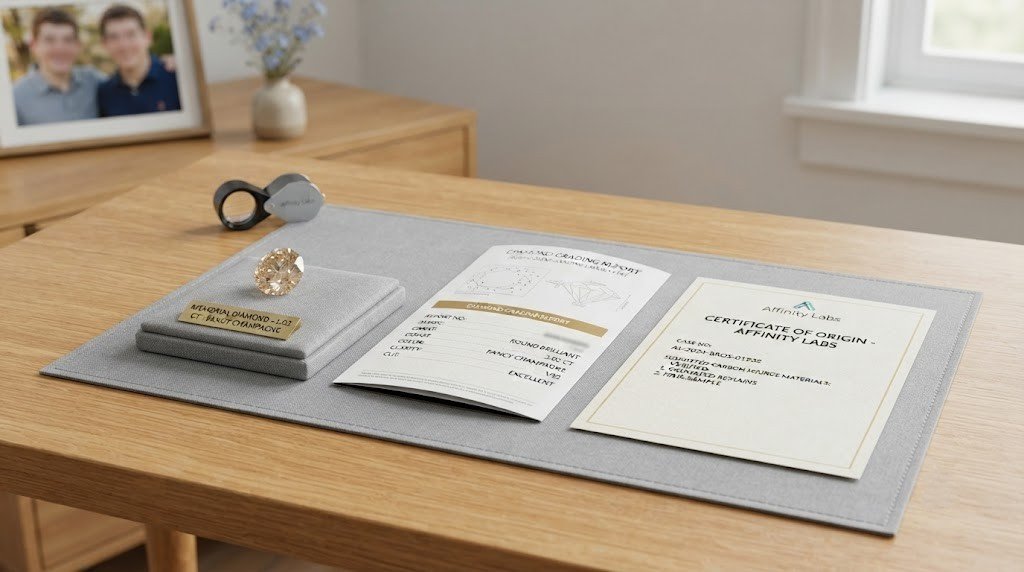
Some sales language promises a gem made purely of a loved one, with nothing else in it. A stone can be really made from grandmother hair without being made only from it. Treat any claim that a stone is 100% her hair as a reason to slow down. Growing a diamond of meaningful size typically involves supplemental carbon, so a provider who denies that entirely is either running an unusual process they should be able to document in detail or overstating what they do.

The accurate framing is quieter and still meaningful: a verifiable portion of her carbon became part of a real diamond. Your family is better served by that sentence than by an impressive one that collapses at the first follow-up question. A stone really made from grandmother hair does not need exaggeration to matter.

Other phrases worth questioning

  • “Nothing else is added.” Supplemental carbon is typical; ask what the process actually involves.
  • “The color will match her hair.” Diamond color comes from trace elements during growth, and no family can choose or match an exact natural shade.
  • “Her DNA lives on in the stone.” Purification strips out everything that is not carbon, so ask the provider exactly what they mean by this.
  • Silence about who grows the stone. It is fair to ask whether growth happens in-house or at a partner lab, and where.

None of these phrases proves dishonesty by itself. Each one is a prompt to ask a follow-up, and any provider offering a piece really made from grandmother hair should be comfortable answering on paper.

How Do You Check That a Gem Is Really Made From Grandmother Hair?

No single document settles the question, and no test run on the finished gem can single out her carbon. Confidence comes from three things working together: a clean chain of custody, the right paperwork, and a believable account of how her sample stays apart from everyone else’s. Families who want to know a stone is really made from grandmother hair are, in practice, judging a provider’s records and process.

Chain of custody from envelope to finished stone

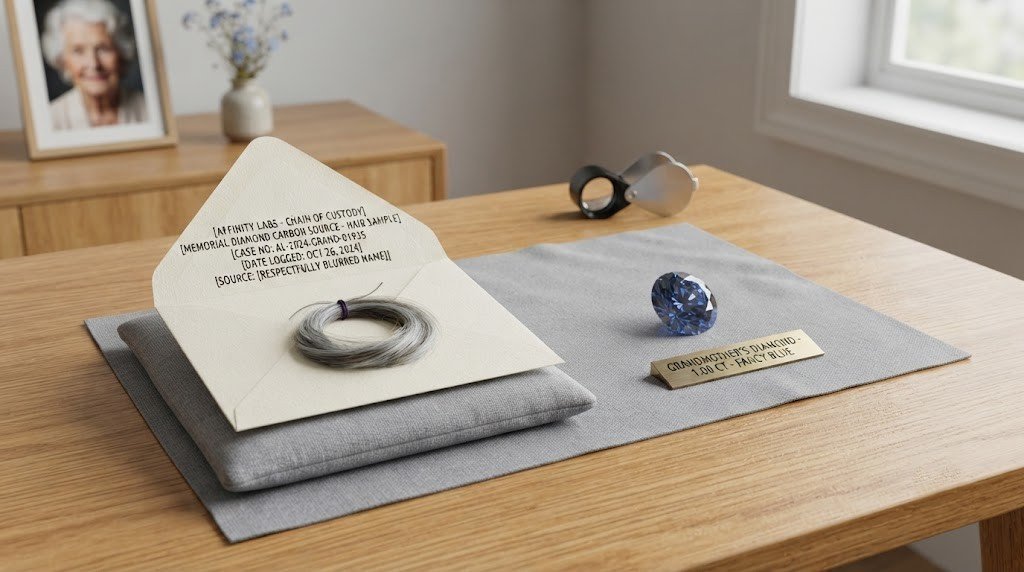
Chain of custody is the paper trail behind any claim that a stone was really made from grandmother hair, following the sample from the moment it leaves your hands. The practical steps for sending her hair cover packing and paperwork at your end. Ask how the sample is labeled on arrival, whether you receive written confirmation of receipt, who signs for it at each handoff, and whether you can request a record of each stage. Whether photos or progress updates are offered varies, so ask.

Authenticity certificate versus grading report

These two documents answer different questions. An authenticity or origin certificate is the paper that speaks to whether a stone was really made from grandmother hair; usually issued in-house, it records that the stone was grown from your family’s submitted material and works as a chain-of-custody document. A grading report, by contrast, rates the stone itself on the 4Cs; the most useful ones come from an outside lab that works to GIA’s diamond quality factors, and some come from IGI.

Independent grading is typically an optional add-on priced separately. It cannot confirm whose carbon is inside, but it does confirm you are holding a real diamond of the stated quality, which is half of what “really” means.

Keeping her sample separate

Ask each provider how one family’s material is kept apart from another’s. Useful questions: is each sample processed in its own batch, how is equipment cleaned between runs, how are containers labeled, and what happens if a growth run fails. Clear, specific answers here say more about whether a stone is really made from grandmother hair than any certificate design.

What Can and Cannot Be Proven About a Stone Really Made From Grandmother Hair?

Use this table as a checklist when you compare providers for a stone really made from grandmother hair.

ClaimCan it be checked?How you check it
The stone is a real diamondYesIndependent grading report, standard gemological testing
The stone is lab-grownYesGrading reports state lab-grown origin
Her hair was received and loggedYes, on paperWritten receipt, chain-of-custody records
Her carbon went into this specific stoneNot by testing the finished gemChain-of-custody records and a documented process
The share of the stone that came from herOnly as the provider’s estimateAsk in writing; no industry figure exists for hair
Her sample was never mixed with another family’sOnly through process and recordsAsk how batches are separated and labeled
Her hair will shape the stone’s colorNoColor comes from trace elements during growth

The rows marked “only” are where trust lives, so get those answers in writing before ordering.

Is a Small or Old Lock of Her Hair Enough?
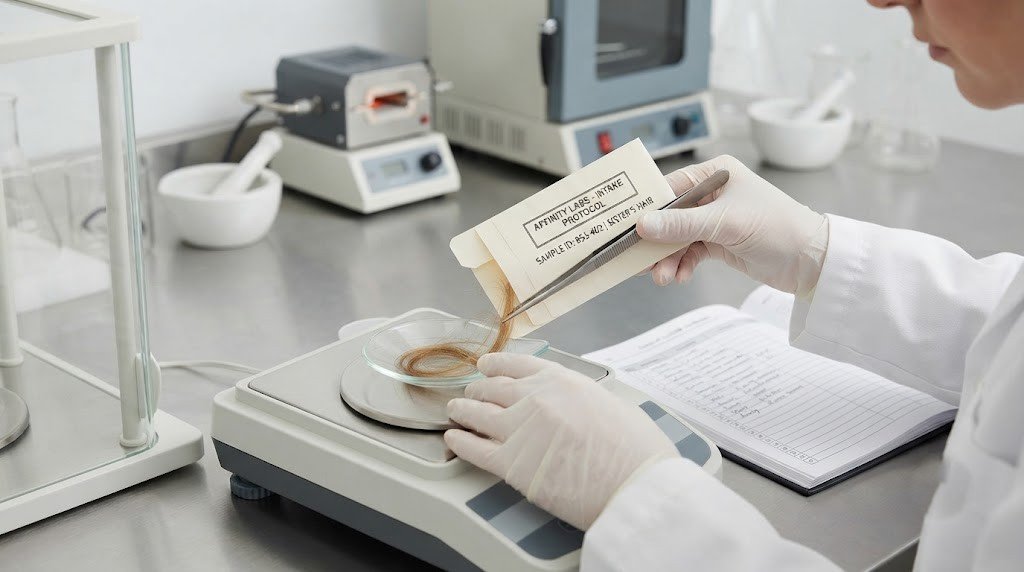
Industry-wide, hair-based stones typically need a small lock or a few grams, and providers set their own requirements. Whether the particular hair you have can yield a stone really made from grandmother hair is a question for each provider: a braid saved for decades, strands from a brush, a single curl from a locket. A closer look at how much hair a grandmother memorial diamond usually takes can help you prepare. Ask whether they can assess it before you commit.

Ask what happens if the amount is too little. Do they contact you before starting, can you send more, and are any fees refundable at that point? Keep in mind that a bigger lock will not buy a bigger gem: the stone’s weight comes down to how long it stays in the press.

Whose hair is it to send?

Hair kept at home is usually a simpler practical matter than ashes. Still, keepsakes she owned may count among the things her estate has to account for, and each state handles that its own way. If an executor or another relative is settling her affairs, speak with them before sending anything. If the hair is with a parent, aunt, uncle or cousin, asking them to share a small portion is a respectful route, and several relatives can often each receive a stone from shared material, depending on the provider and how much there is.

Does Gray, Dyed or Treated Hair Change Anything?

Whether a provider accepts hair that was dyed, permed, bleached or chemically treated is that provider’s decision, so ask before you send it. Nothing published shows that her hair’s natural color, or the fact that it had gone gray or white, makes the stone lighter, darker or more predictable. Be wary of anyone who promises a color for a stone really made from grandmother hair based on how her hair looked.

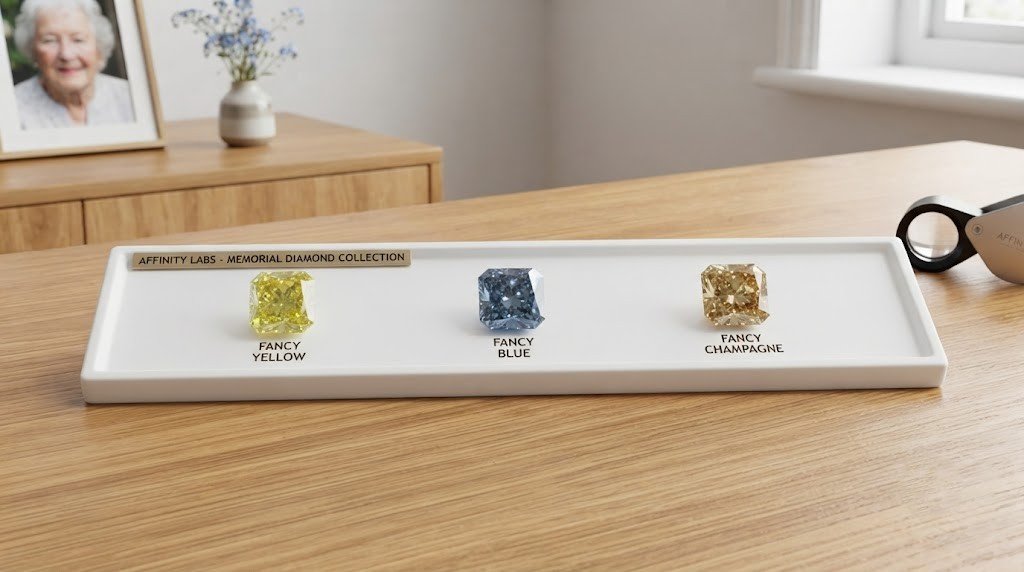
Diamond color comes from trace elements present during growth. Traces of boron push a stone toward blue, and nitrogen pushes it toward yellow. Trace elements of this kind are common in a personal, organic carbon source, so memorial stones tend toward yellow, blue or champagne-to-brown shades. Keeping both out to reach a colorless result means added processing and usually a higher price. A few providers can also irradiate a finished stone to turn it red, pink, green or black.

For a gem that is really made from grandmother hair, color is something to talk through with the provider, not a portrait of her hair. Ask which colors they offer, which cost more, and whether the color you pick affects the timeline. For more on that, see the colors a stone from her hair can take.

What Do People Get Wrong About Stones Really Made From Grandmother Hair?

A few beliefs come up again and again when families first ask whether a stone can be really made from grandmother hair. Each one is worth correcting before you compare quotes.

  • “More hair makes a bigger stone.” Growth time sets carat size. Sending extra hair does not change the size or speed of the result.
  • “Hair is a weaker source than ashes.” Hair carries far more carbon by weight than ash. It is a genuine source in its own right, not a fallback.
  • “Hair makes the process faster.” The timeline is typically 6 to 10 months from receipt, and larger or specialty-color stones can take up to about 12 months, whatever the source.
  • “A certificate of authenticity is a grading report.” One tracks origin; the other measures quality. A careful buyer asks for both.
  • “A memorial diamond is unbreakable.” It ranks 10 on the Mohs hardness scale, yet a hard knock at the wrong angle can still chip any diamond.

Set these aside and the question of whether a stone is really made from grandmother hair comes down to records, process and plain answers.

What Does Verification Add to Cost and Timeline?

Across the industry in 2026, small stones of roughly 0.10 to 0.25 carat generally run about $1,500 to $3,500. Stones from 0.5 to 1 carat usually fall between about $5,000 and $15,000, with colorless costing noticeably more, and stones of 2 to 5 carats or larger can reach $20,000 to $75,000 or beyond. These are industry-wide ranges, not one company’s prices.

Verification has its own line items. An independent grading report, engraving, a fancy cut and a setting are typically priced separately from the loose stone. If confidence that the piece is really made from grandmother hair matters most to you, budget for independent grading and ask whether the origin certificate comes included.

Time is the other cost. Expect roughly 6 to 10 months from the day the provider receives her hair before a stone really made from grandmother hair is ready, and longer for large or specialty-color stones. A provider who quotes far faster should be able to explain why.

Frequently Asked Questions

Can a diamond be made from my grandmother’s hair if she was buried?

Yes. Hair needs no cremation, so a lock kept by family from her lifetime or her final days can be the source. Whether the specific hair you have is workable, and how much a provider needs, is something to confirm with each provider before you send anything.

Will a grading report say the diamond came from her hair?

No. A grading report describes cut, color, clarity and carat, and it can confirm the stone is a lab-grown diamond. Evidence that it is really made from grandmother hair comes separately, through the provider’s origin certificate and custody records.

Is a stone still really made from grandmother hair if lab carbon is added?

Yes, in the honest sense. Carbon purified from her hair becomes part of the crystal, typically blended with supplemental lab carbon. Ask each provider how much is added, and get their estimate of her share in writing.

Can a lab test prove a diamond is really made from grandmother hair?

Not in any standard way. Once carbon is purified and grown into a crystal, origin is established through records rather than testing. That is why chain of custody, labeling and the provider’s written process matter so much.

Can cousins each get a stone from the same lock of hair?

Often, yes, because only a portion of the hair is usually needed for each stone. How many stones a given lock can support depends on the provider and the amount, so ask before dividing it among relatives.

What happens to any hair the provider does not use?

That is set by each provider. Some may return it, others may store or dispose of it. Ask before ordering, request the policy in writing, and say plainly if you want every unused strand sent back to you.

Final Thoughts on Whether a Stone Is Really Made From Grandmother Hair

Asking whether a stone is really made from grandmother hair is not cynicism. It is care, the same instinct that made you keep the lock in the first place.

The honest answer has two halves. Her carbon genuinely becomes part of the diamond, and the stone is typically grown with added lab carbon as well. A provider worth trusting will say both halves out loud, put the details in writing, and let you see how her hair is tracked from the day it arrives.

Learn More About Proving a Diamond Came From Her Hair

Talk With Memorial Diamond

If you are still working out whether her hair is the right starting point, that is a fine place to begin a conversation. Memorial Diamond can walk you through what to send, what records to expect and which questions are worth putting in writing, with no obligation attached.

You can reach us at memorialdiamond.us whenever the timing feels right for you and your family.
hair for a sister memorial diamond

How Much Hair Do You Need for a Sister Memorial Diamond?

It might be a braid tucked in a drawer, a curl saved from a haircut years ago, or simply a brush she used. The amount of hair for a sister memorial diamond is usually small: providers typically ask for a single lock or a few grams, often described as palm-sized or a few wisps. Each provider sets its own figure and its own rules on which kinds of hair it accepts, so ask before you cut, collect, or send anything.

hair for a sister memorial diamond

What Does “a Small Lock” of Her Hair Actually Mean?

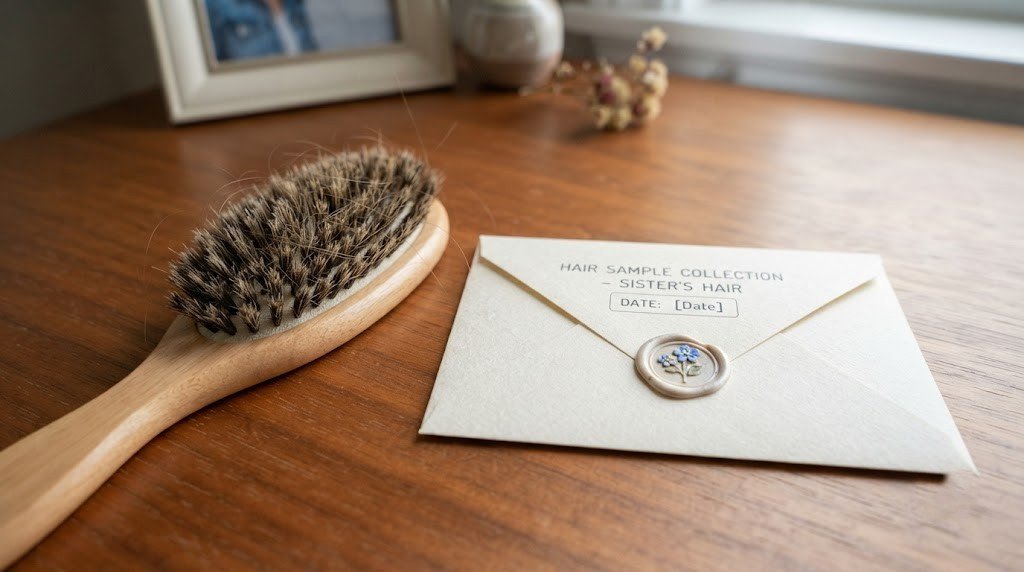
Providers describe the usual amount in loose, everyday terms: a small lock, a few grams, or something that would sit in the palm of your hand. In practice, that is far less than a ponytail. A modest curl tied with thread, or a short bundle gathered from a brush, is the general scale providers tend to have in mind when they talk about hair for a sister memorial diamond.

The exact amount of hair for a sister memorial diamond still depends on the provider. Some state their requirements by weight, some use a rough description, and some will look at what you have and tell you whether it is enough. Getting that answer in writing before you cut anything matters, because a lock that has been cut cannot be put back.

A few details are worth knowing before you gather anything:

  • Length may matter less than you fear. A provider is looking for enough material, so ask whether a shorter lock or several short pieces together would work.
  • Ask about roots rather than assume. Hair contains carbon throughout its strands, but a provider may still have preferences about how the hair was cut or collected.
  • Keep it dry and free of debris. Hair kept in an envelope or a small box for years may still be usable. Ask the provider, especially if it was stored somewhere damp.
  • Hold some back. If you have more hair for a sister memorial diamond than the provider asks for, keep the remainder at home rather than sending everything.

If you are not sure whether you have enough hair for a sister memorial diamond, a photo next to a coin or ruler, sent with your first question, may help the provider give you a clearer answer.

Will a Provider Accept Hair for a Sister Memorial Diamond From Her Hairbrush?

Some providers may accept brush-collected hair, while others may prefer a cut lock. This is one of the first questions to ask about hair for a sister memorial diamond. Hair gathered from a brush or comb may be all you have, and it can be a meaningful source. The main concern is that it is hers alone: a brush that someone else also used may contain their hair too.

Where her hair comes fromWhat to keep in mindWhat to ask the provider
A lock cut and saved during her lifeIt is easy to describe and may be clearly identifiable as hers. Note when and why it was kept.Is this lock enough on its own, or should anything be added?
Her hairbrush or combUse a brush she alone used, if possible. Gather the hair gently and store it dry.Do you accept brush-collected hair, and how much is required?
A braid, ponytail, or keepsake curlIt may be more than needed. You can send part and keep the rest.How much of this should we send?
A lock taken by the funeral home before her serviceThis may be possible if requested in time and the funeral home agrees.Can you work with a lock collected by the funeral home?
Hair that was dyed, bleached, or chemically treatedTreatments vary, and acceptance policies may differ.Does the hair’s treatment affect what you accept?
Only a few strandsEvery strand may matter, so do not discard anything yet.Can you assess whether this small amount is workable?

None of these sources is necessarily better for the meaning of the stone. The deciding factors are practical: whether the provider can work with the sample and whether the hair is clearly hers. A short note describing where each sample of hair for a sister memorial diamond came from can also help maintain a record of its origin.

Who Has Her Hair Now, and Whose Agreement Matters?

Hair is different from ashes in one important way: it often remains among a person’s belongings rather than with a funeral home. A lock that could become hair for a sister memorial diamond might be in her home, with a partner if she had one, with a parent who saved it from childhood, or with you.

Belongings can form part of a person’s estate, and the rules about who may make decisions concerning them vary by location. It is worth speaking with the executor or whoever is handling her affairs before using hair found among her belongings.

Some useful ways to approach the conversation include:

  1. Explain what you need and how little. A small lock or a few grams of hair for a sister memorial diamond is easier to discuss when the request is specific.
  2. Ask who already has keepsakes. A parent, partner, or close friend may have a lock that was saved long ago.
  3. Offer to share. If the hair could provide material for more than one stone, or someone else would also like a keepsake, discuss that early.
  4. Check before taking anything from her home. Even a hairbrush is worth asking about if her belongings are still being sorted.
  5. Seek local advice if ownership is unclear. A local attorney can explain how your state or jurisdiction treats personal belongings within an estate.

If the funeral home is asked to set aside hair for a sister memorial diamond before her service, it will likely want the request to come from the person with authority over her remains. The funeral home can explain who signed the arrangements and who may authorize such a request.

In many places, the order of authority commonly gives priority to a spouse or registered partner, then adult children, then parents, and then siblings, but this varies. Written wishes and local laws can also affect the decision. A sibling may or may not have authority, and that has nothing to do with how close you were.

Can You Still Get Her Hair If She Was Buried?

Yes, provided some of her hair was kept. Hair does not require cremation, so a memorial diamond may remain an option when a family chooses burial, whether for personal reasons or because of their faith.

If the burial has not happened yet, the funeral home may be able to collect a small lock beforehand if the person with authority requests it. Policies differ, so ask as early as possible.

Once a burial has taken place, retrieving hair would involve disinterment, a serious step subject to laws, cemetery requirements, and other considerations. Leaving her at rest is a completely valid choice. In that situation, a hairbrush, a saved keepsake, or a lock kept by a relative may be a source of hair for a sister memorial diamond instead.

If no hair was kept but her ashes are available, read the companion guide on how much ash a sister’s diamond needs. If both are available, the article on using both her ash and hair together explains how providers may approach the two sources.

Why Does Such a Small Amount of Hair Go So Far?

Hair is made primarily of keratin, a carbon-rich protein, and is roughly 50% carbon by weight. That is a much higher carbon share than cremated remains, which consist largely of bone mineral. This helps explain why providers may ask for only a small lock or a few grams of hair for a sister memorial diamond.

At the laboratory, the hair typically goes through an oxygen-free, multi-stage purification process to remove material that is not carbon. The remaining carbon may reach a purity of about 99.9% or higher, depending on the process. It is then heated to very high temperatures to form graphite, which can serve as feedstock for diamond growth.

The crystal is commonly grown using high-pressure, high-temperature (HPHT) methods. These processes involve extremely high pressure and heat. Some providers use chemical vapor deposition (CVD) instead. Laboratories may also blend recovered carbon with supplemental laboratory carbon to achieve the quantity required for a growth cell.

One important point is easy to miss: there is no universally published percentage describing how much of a finished memorial diamond comes specifically from hair. Figures sometimes quoted for ash-based diamonds should not automatically be applied to hair-based stones. If the precise origin of the carbon matters to you, ask the provider how it describes the process and what records it maintains.

The broader story of memorial diamonds as a category includes diamonds made using different types of memorial material. For a closer look at the process, the complete guide to a sister hair diamond walks through the journey from the initial sample to the finished stone.

What Won’t the Amount of Hair Change?

It is tempting to think that sending more of her hair means receiving a larger stone, getting it sooner, or obtaining a particular color. The quantity of hair for a sister memorial diamond does not, by itself, determine those outcomes.

  • Size: Memorial diamonds may be offered in sizes ranging from around 0.10 carat to 5 carats or more. The final size depends on the provider’s options and the growth process, not simply on the weight of hair you send.
  • Timeline: Production may take approximately six to ten months after the laboratory receives the material, although larger stones or specialty colors may take longer. The timeline for a sister memorial diamond explains the factors that can affect the wait.
  • Color: Trace elements and the growth process can influence a diamond’s color. Nitrogen can contribute to yellow tones, while boron can contribute to blue tones. Producing a colorless stone may require additional processing. Color cannot reliably be predicted from the appearance of her hair, and it says nothing about who she was. Read more about what color a diamond from your sister’s hair may be.
  • Clarity: Memorial diamonds can vary in clarity depending on growth and cutting. Ask which clarity characteristics are typical for the provider’s process and whether an independent grading report is available.
  • Price: Cost depends on factors such as carat size, color, cutting, setting, and any optional services. Industry estimates can vary widely, so request a current written quote rather than treating a general range as a guaranteed price. The full cost breakdown explains the factors to consider.

Some providers may offer treatments that change a diamond’s color, including colors such as pink, red, green, or black. Ask whether a treatment is used and whether it will be disclosed in the documentation. This is a decision to discuss with the provider, not something the amount of hair for a sister memorial diamond determines.

What If You Only Have a Few Strands?

A handful of strands may still be worth asking about, so do not assume that you have too little hair for a sister memorial diamond. Because hair contains a substantial amount of carbon, some providers may be able to work with a smaller sample, while others may require more.

The only reliable way to know is to describe what you have and let the provider assess it before you send anything.

Until you know whether you have enough hair for a sister memorial diamond, keep every strand in a clean, dry envelope or container. Avoid trimming or discarding the sample while you are waiting for guidance.

If the provider says the amount is insufficient, there may still be other options. Another relative might have a saved lock, or her ashes may be available. You can also choose to keep the few strands in a locket, a frame, or another keepsake instead.

A small amount of hair for a sister memorial diamond is never a measure of how much she was loved. The right remembrance is the one that feels meaningful to you.

Does a Second Stone Mean Finding More of Her Hair?

Possibly. Some providers can grow more than one stone from a single sample, while others require a set amount of material for each stone. If a parent, another sibling, her partner, her children, or a close friend would also like a memorial diamond, ask how much hair for a sister memorial diamond each additional stone would require before anyone cuts or sends more.

It is helpful to discuss expectations before placing an order. Some family members may want a stone of their own, while others may prefer to keep a different kind of keepsake. Both choices deserve respect.

When several people share one sample of hair for a sister memorial diamond, agree in writing who will own each stone and who will own any shared stone before the process begins. The article on how families arrange more than one stone explores these considerations in greater detail.

How Should Hair for a Sister Memorial Diamond Be Packed and Sent?

The provider should give you written collection and shipping instructions. Always follow those instructions, because requirements can differ between laboratories.

In general, careful preparation may include:

  1. Keeping the hair dry in a paper envelope or another container approved by the provider.
  2. Labeling the package with the requested name and reference number.
  3. Adding a short note describing where the hair came from, if requested.
  4. Taking a photograph of the sample before sealing the package.
  5. Using a tracked shipping service recommended by the provider.
  6. Keeping the tracking number and any submission paperwork somewhere safe.
  7. Asking the provider to confirm in writing when the sample arrives.

For a hair for a sister memorial diamond order, the record of the sample matters alongside the physical material. Ask how the provider identifies the sample when it arrives and tracks it through the laboratory process.

A provider may issue its own certificate of origin or another document describing the sample and the resulting stone. This is different from an independent grading report, which describes the diamond’s characteristics, such as cut, color, clarity, and carat weight. The Gemological Institute of America’s overview of diamond quality factors explains the common characteristics used to assess diamonds.

Before sending anything, ask two additional questions:

  • What happens to any unused hair for a sister memorial diamond? Will it be returned, stored, or disposed of?
  • What happens if a growth cycle fails or the rough stone fractures during cutting? Will the provider retry using retained material, or could more material be required?

Make sure the answers are included in the provider’s terms or confirmed in writing. The guide to questions to ask before turning your sister’s hair into a diamond can help you prepare for that conversation.

Frequently Asked Questions

Does her hair need to be cut close to the scalp?

Not necessarily. Hair contains carbon along its length, so the quantity may matter more than where it was cut. However, each provider sets its own requirements. Ask before anyone trims hair for a sister memorial diamond.

Can I use hair for a sister memorial diamond that was saved from her childhood?

It may be possible. A childhood lock kept in a baby book or keepsake box can be a meaningful source if it belongs to her and meets the provider’s requirements. Check with whoever kept it, since a parent or relative may feel strongly about that particular keepsake.

Is it disrespectful to collect hair from her brush?

Some people find it a gentle way to preserve a personal connection. If her belongings are still being sorted, ask the executor or the person handling her affairs first. Use only a brush you are confident she used herself, and ask the provider whether brush-collected hair is acceptable.

How long can hair be stored before it is too old to use?

There is no single published limit that applies to every provider. Hair kept dry in an envelope or box may remain usable for years, but the provider must confirm whether it can accept your sample. Explain how and where the hair has been stored before sending it.

Can hair for a sister memorial diamond be sent from outside the United States?

Some providers accept international shipments, while others work only within certain countries. Customs requirements and shipping rules also differ. Ask the provider which documents are required, which carrier to use, and how receipt will be confirmed before shipping across a border.

Will the funeral home cut a lock if we ask?

A funeral home may be able to collect a small lock before burial or cremation if the person with authority over her remains requests it. Policies vary, so ask as early as possible. Once burial or cremation has taken place, that opportunity may no longer be available.

Final Thoughts on Hair for a Sister Memorial Diamond

The amount of hair for a sister memorial diamond is rarely the only consideration. A small lock or a few grams may be enough, but the provider must confirm its specific requirements. The harder parts can be quieter: finding where her hair is, asking family members with care, and deciding whether a diamond is the right remembrance for you.

Take your time. Ask questions, compare providers, and make sure you understand the process before sending a keepsake that cannot easily be replaced.

Whatever you decide, keep any hair for a sister memorial diamond safe and dry while you think it over. There is no need to rush a decision about a keepsake that is already in your hands. A lock in an envelope can wait until you feel ready.

Learn More About Sister Memorial Diamonds

If you are still exploring the options, these related guides may help:

Talk With Memorial Diamond

If you would like help working out whether your sample is enough hair for a sister memorial diamond, or how to ask about a lock someone else is keeping, visit MemorialDiamond.us.

There is no rush. Start by asking your questions, understanding the requirements, and choosing the path that feels right for you and your family.
A small tied lock of hair on a paper envelope beside a closed drawer, showing how little hair for a partner memorial diamond is required

How Much Hair Do You Need for a Partner Memorial Diamond?

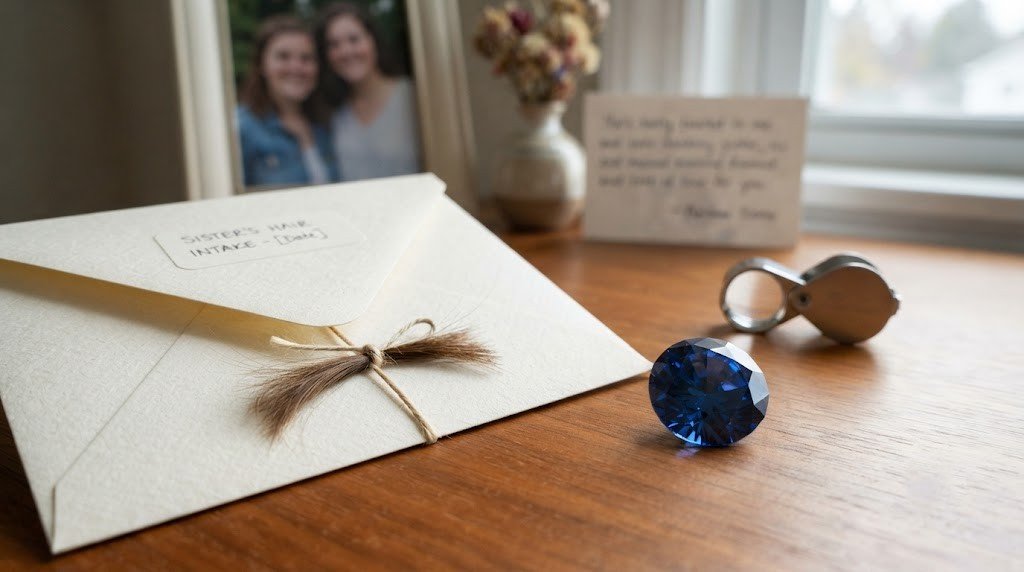
Almost nobody cuts a lock of hair on purpose. It happens at a hospital bedside, or a funeral director quietly offers, or it never happens at all and one afternoon you open a drawer and find a hairbrush nobody cleaned out. The amount is the smallest problem here: hair for a partner memorial diamond is typically a small lock, a few grams, something you could close one hand around.

Why is hair for a partner memorial diamond measured in grams when ash is measured in ounces? Chemistry. Hair is roughly 50% carbon by weight, keratin is a carbon rich protein, against the 0.5% to 4% ash yields. A few grams carries what a few ounces of ash carries.

Which inverts the question. For most people the constraint on hair for a partner memorial diamond is not volume but collection: whether any exists, where it ended up, and who holds it now. Memorial Diamond grows these stones and so has an interest in your reading this. Every figure below is an industry wide range, not our requirement.

The Amount Is Almost Never What Stops People

Set the numbers side by side and the problem changes shape.

Ash arrives by the ounce because it has to. Hair for a partner memorial diamond arrives by the gram because it can. Something that would fit in a sandwich bag with room left over, and most people who find any hair at all are holding more than a few grams.

So the conversations that stall are almost never about quantity. They stall on one of these instead:

  • Nobody thought to cut any hair for a partner memorial diamond, and the funeral was months ago.
  • Some exists but it is in someone else’s house, a parent’s keepsake box, a sibling’s envelope.
  • What exists is loose in a brush rather than a tidy cut lock.
  • It was collected long ago, for an unrelated reason.
  • The relationship was not recognized, so nobody offered you any.

Each of those has an answer, and none is arithmetic. That is the useful thing to know before you go looking: the search for hair for a partner memorial diamond is a search, not a measurement.

How Much Hair for a Partner Memorial Diamond Is Actually Required?

Industry wide, the requirement for hair for a partner memorial diamond is described as a small lock or a few grams, sometimes “palm sized,” sometimes “a few wisps.” Ask whichever provider you approach for their own figure inside that range, in writing, before anything is posted.

A few grams is less than it sounds. Individual strands of hair for a partner memorial diamond weigh almost nothing, so a few grams is a visually substantial pinch, thicker than a pencil lead, thinner than a finger. A lock tied with thread in a keepsake envelope is almost certainly enough.

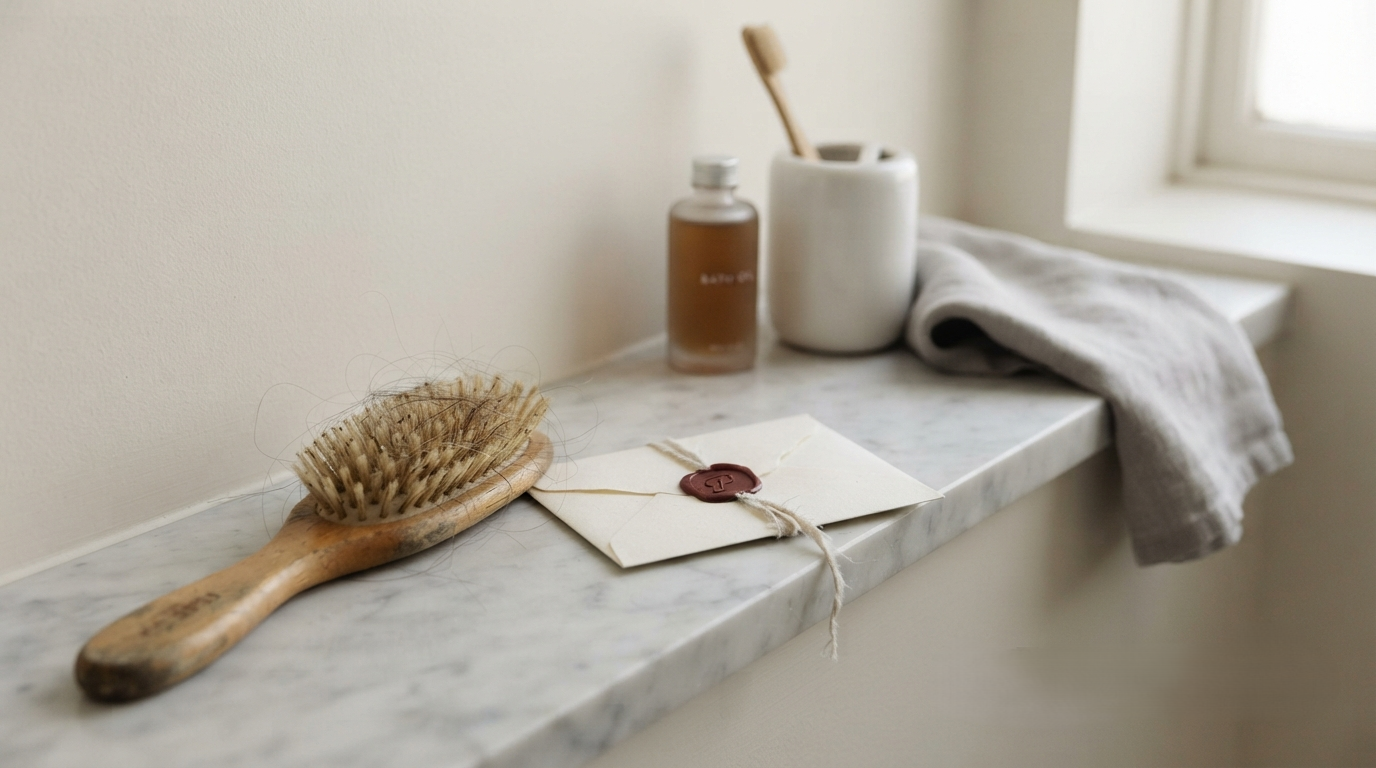
A hairbrush and a sealed keepsake envelope on a bathroom shelf, the two places a lock is most often found

Two measurement questions about hair for a partner memorial diamond change what you are actually being asked for:

  1. Is the figure a weight or a length? Ask whether it is expressed by mass or as a visual description, since fine and coarse hair do not weigh the same at the same volume.
  2. Is it a received weight or a usable weight? Processing removes whatever in the hair for a partner memorial diamond is not carbon, and two companies can answer this differently without either being wrong.

What the amount of hair for a partner memorial diamond does not control is worth stating plainly, since it saves people from over collecting. Carat is a function of growth time in an HPHT press, roughly 6 to 8 GPa at 1,400 to 2,500°C, run for weeks to months, not of how much arrived. Stones run from about 0.10 ct to 5+ ct, and the difference is press time and cost, not a fuller envelope.

One honesty point sits underneath all of this. The carbon recovered from hair for a partner memorial diamond is purified to roughly 99.9%+ and then combined with supplemental lab grown carbon to reach the volume a growth cell requires, so the finished stone is always a blend. You will see 10 to 15% of the finished stone’s mass quoted for the personal portion; that figure describes the ash route, and no equivalent industry figure is published for hair.

What holds in both cases is that the personal carbon is genuine, documented and a minority of the stone, so ask your provider what share your own sample will contribute rather than carrying over a number from another material. Anyone describing the result as nothing but your partner is describing a process that does not exist. What is true is better anyway: a verifiable part of them sits inside the crystal lattice of a genuine diamond, hardness 10 on the Mohs scale, the hardest material in the drawer it will live in.

Where Is the Hair Likely to Already Be?

Most people looking for hair for a partner memorial diamond assume they have none, then find some. Before deciding the route is closed, work through where it actually turns up.

Where the hair may beRoughly what tends to be thereWhat to establish before you touch it
A hairbrush or comb still in the bathroom, holding shed hair for a partner memorial diamondOften several grams, accumulated over weeksWhether your provider accepts shed hair as readily as cut, and whether mixed hair from a shared household is a problem
A keepsake lock cut at the hospital or by a funeral homeUsually generous, tied and envelopedWho was given it. The person named as next of kin may hold it without knowing you want it
An envelope kept from years earlierWhatever was cut at the time, often smallWhether it has stayed dry and sealed, and whether anything was added to it
A pillow, a hat, a jacket collarA handful of strands at mostWhether that quantity clears the figure your provider asks for, before you build a plan on it
A locket, a bracelet, a piece of memorial jewelryVery little, and already a keepsakeWhether you are willing to convert one memorial into another, a decision, not a logistics question
A recent haircut swept up at a barber or salonPotentially a great deal, if it was keptWhether anyone can confirm whose it is, which matters for chain of custody

The right hand column is the point of that table: every row turns on a question you ask someone else rather than a quantity you measure. That is the practical difference between the hair route and the ash route. The full walkthrough of turning a lock into a stone covers what happens after the envelope is found.

Does This Still Work If Your Partner Was Buried?

Yes, the fact about hair for a partner memorial diamond that changes the most lives on this page.

Hair requires no cremation. Nothing about hair for a partner memorial diamond depends on what happened to the body, so burial, green burial, donation to a medical school, or a body never recovered do not close this route. If a lock was cut at any point, before death, at the hospital, by a funeral home, the material exists independently of everything that followed.

A quiet cemetery path, illustrating that a hair-based memorial diamond requires no cremation

That matters where cremation was never an option, because hair for a partner memorial diamond sidesteps the question. Religious objection, a family’s settled preference, a plot bought decades ago, a decision someone else made while you had no standing: none of it touches the hair. You need not reopen any of those conversations to ask whether a diamond is possible.

It also means none of the time pressure that surrounds cremated remains. A scattering is irreversible; an envelope in a drawer is not. How a memorial diamond is made from a partner’s hair sets out the sequence, and whether the stone is genuinely made from that hair answers the skepticism that arrives next.

Does Hair Collected Years Ago Still Count?

In most cases, yes. The keratin in hair for a partner memorial diamond is durable. Kept dry, dark and undisturbed, it can sit in a drawer for years and still be a workable carbon source, which is why hair for a partner memorial diamond so often comes from something collected for an entirely different reason.

What actually degrades a sample is not age but handling:

  • Damp. A sealed envelope in a dry drawer is ideal. A bathroom cabinet is not.
  • Mixing. Hair from more than one person in one envelope is a chain of custody problem rather than a chemistry one, and worth flagging rather than hoping.
  • Repeated opening. Every time a keepsake is handled a little of the hair for a partner memorial diamond is lost, and after twenty years of showing it the lock may be smaller than you remember.
  • Products and treatment. Dye, bleach and styling products are generally not disqualifying, but disclose them so the laboratory knows what it is purifying.
An aged paper envelope containing a lock of hair, kept dry in a drawer for many years

Say plainly how old your hair for a partner memorial diamond is and how it has been stored when you first make contact. A provider would far rather assess hair for a partner memorial diamond described as eleven years old and dusty than discover it later. If the lock turns out too small, that is not the end of it, how much ash a partner memorial diamond takes covers the other route, and a submission using both materials covers what happens when neither is quite enough alone.

Who Has a Say When There Was No Cremation?

This looks different for hair for a partner memorial diamond than it does for ashes, and the difference is worth naming.

Cremated remains sit under a chain of authority. Who controls them varies by state and can be redirected by anything your partner left in writing, and a partner who was not the legal next of kin may find the urn is not theirs to open. That chain was built around the remains, not around a keepsake, which is why hair you already keep usually meets far less resistance. Take that as how it tends to go rather than as a legal position: a person’s belongings can be drawn into an estate, states differ on it, and it is worth confirming wherever the answer would change what you do.

“Usually” is doing real work in that sentence, so be careful with three situations:

  • The hair is in someone else’s possession. A keepsake lock given to a parent or an adult child is theirs to share or not. Ask; do not assume, and do not take.
  • A funeral home holds it. Funeral homes release hair for a partner memorial diamond and other keepsakes to whoever is on record as authorized, which may not be you. A direct, specific request works better than an explanation of the relationship.
  • Something was left in writing. A will or disposition directive can name who receives personal effects, and hair kept in a locket may count. If that is a live question, ask rather than assume.

Where a relationship was unrecognized by one or both families, the advice is the same as it is for money: settle who holds what before you spend anything. Asking for a small portion of hair for a partner memorial diamond is a narrow request, and narrow requests are far easier to grant. The complete guide to a partner hair diamond covers the rest of the sequence.

Frequently Asked Questions

The only hair I have is loose in their brush. Is that usable?

Often yes. Shed hair for a partner memorial diamond is the same keratin as a cut lock, and a well used brush frequently holds more. Ask your provider directly whether they accept brush hair, and mention if anyone else used the same brush.

My partner was buried rather than cremated. Does that rule this out?

No. Hair for a partner memorial diamond is the one route that never required cremation, so burial changes nothing. If a lock was cut at any point, in hospital, at home, by the funeral home, the material exists and the route stays open.

The lock has been in a drawer for eleven years. Is it too old?

Almost certainly not. Keratin is stable, and dry, dark, undisturbed storage preserves it. Age matters far less than damp or repeated handling. Describe how long it has been kept and where, and ask for an assessment before committing.

Does dyed or chemically treated hair change anything?

Generally it is not disqualifying, since purification strips everything that is not carbon regardless. It is still worth disclosing, so the laboratory knows what it is working with rather than finding out. Ask whether treated hair alters their required quantity.

Do I need the root ends, or is cut hair fine?

Cut hair for a partner memorial diamond is standard, and roots are not typically required, the carbon is in the shaft. Confirm with your provider anyway, since requirements vary, and do not go looking for roots on the assumption they are necessary.

Their family holds the keepsake box. What exactly do I ask for?

Ask for a specific, small, named thing: a few strands from the lock, not the lock itself. Narrow requests are easier to grant, and leaving the keepsake intact removes the main reason a family would say no.

Final Thoughts on Hair for a Partner Memorial Diamond

If you came here to find out whether you have enough, the likely answer is yes, and it took a short paragraph to say so.

Five facts carry most of the weight on this page:

  1. A small lock, a few grams, is the industry typical quantity, because hair runs roughly 50% carbon by weight against 0.5 to 4% in ash.
  2. The amount does not set the carat. Size is bought from press time.
  3. Burial closes nothing here. Hair never required a cremation, so this route stays open when the ashes route never was.
  4. Age is rarely the problem. Dry, dark, undisturbed storage keeps keratin workable for years; damp and handling are what cost you.
  5. The finished stone is a blend, and the question to put to a provider is what share your own sample will contribute.

The part worth your afternoon is the other part: finding it, and asking for it. Check the brush before assuming there is nothing. Ask the funeral home whether anything was cut and who received it. Ask the person holding the envelope for a few strands rather than the whole keepsake. Hair for a partner memorial diamond is usually somewhere in the house or one conversation away, and unlike almost every decision that follows a death, this one is not on a clock.

Learn More About Partner Memorial Diamonds

Talk With Memorial Diamond

You do not need to have found anything to ask a question. If you want to know whether the hair for a partner memorial diamond you might have is enough, describe what you think you have and ask for an assessment before you go rummaging.

Three things get you a useful answer: the required quantity and whether it is a received or a usable weight, whether shed brush hair is accepted alongside a cut lock, and how many months a stone at your chosen carat takes. memorialdiamond.us will answer those without asking you to commit, and any provider worth considering will too. For background on the category, the general reference on the memorial diamond is a neutral starting point.