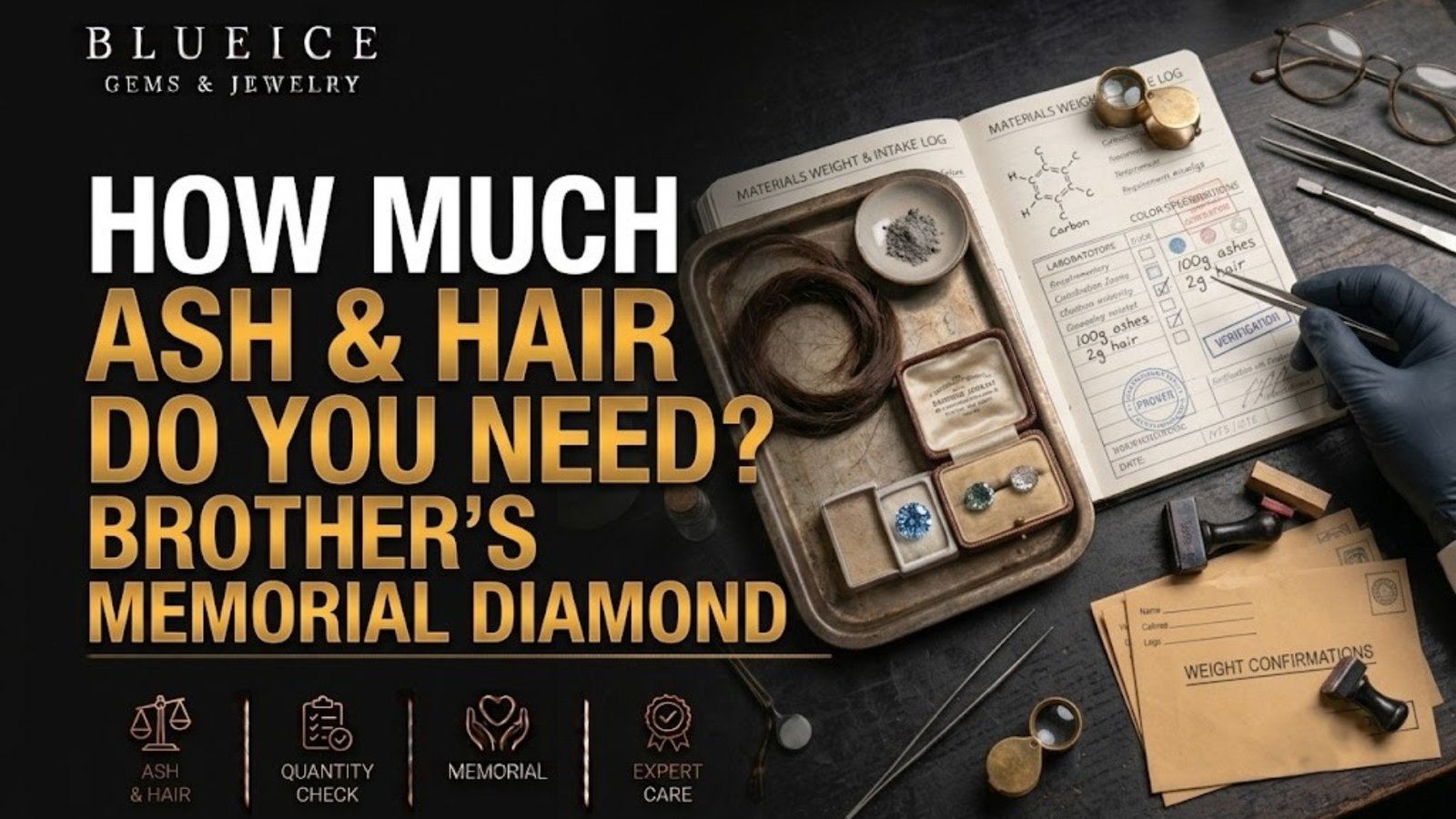
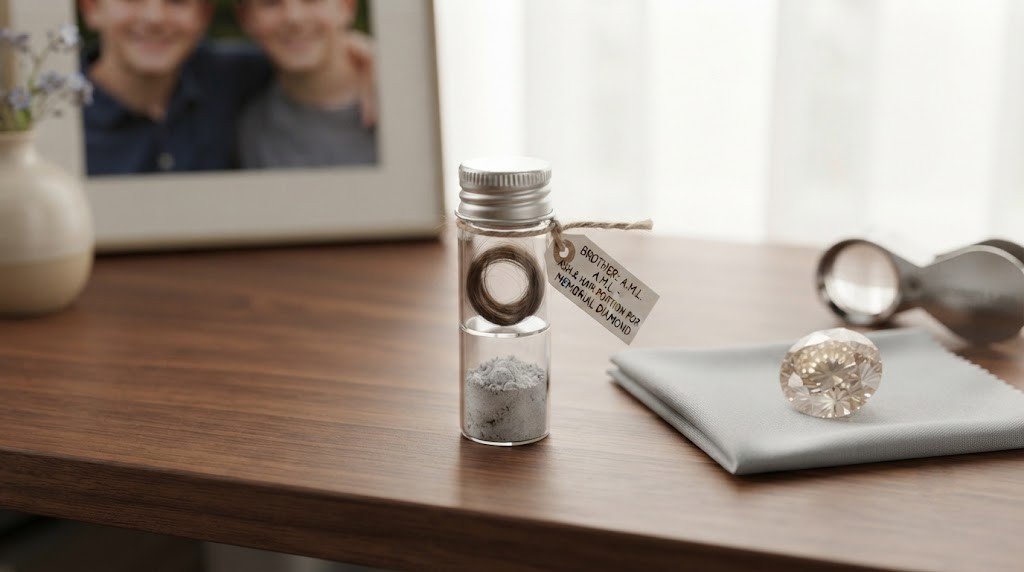
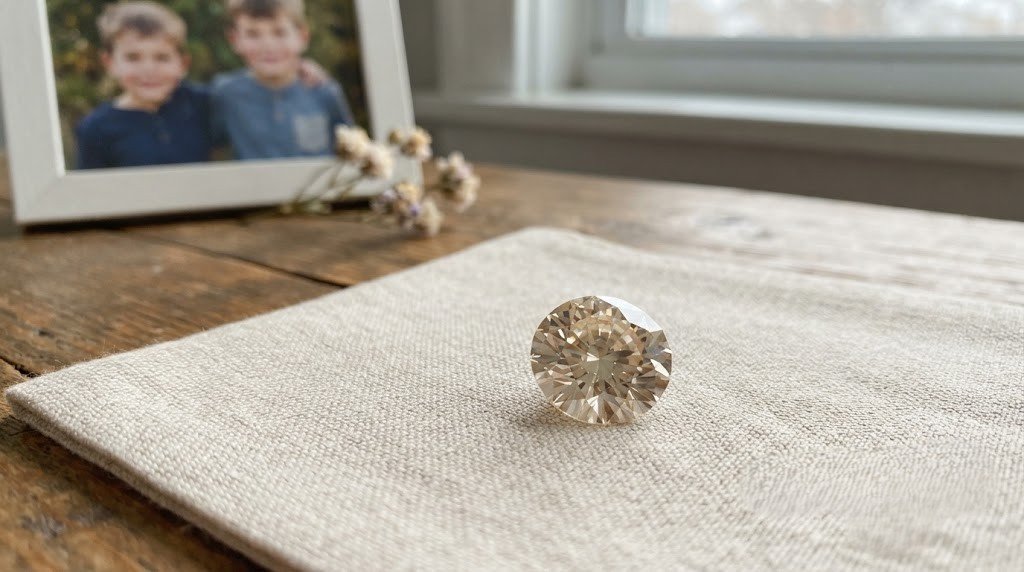
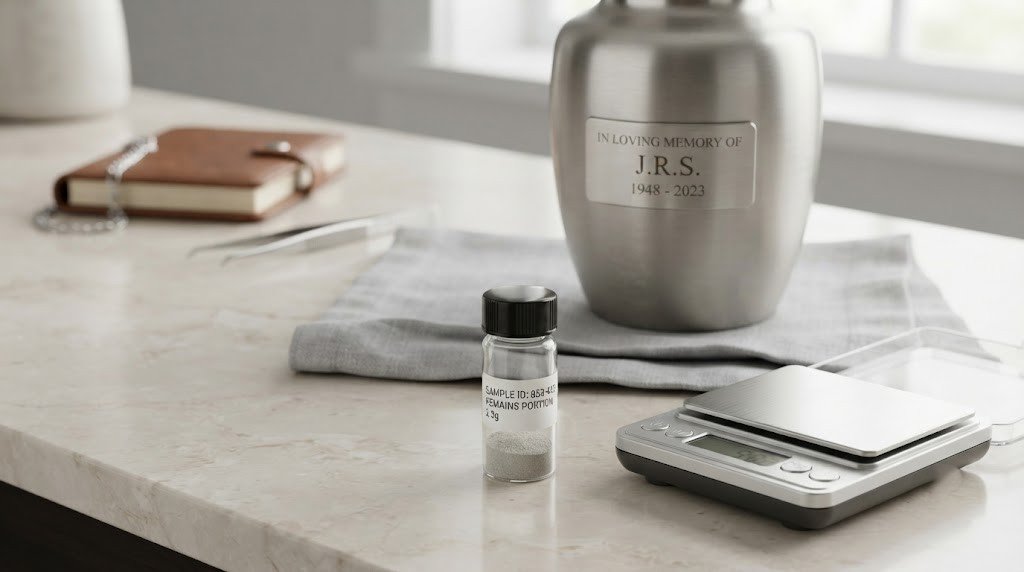
Sitting beside the container that holds your brother’s cremated remains, it is natural to worry that a diamond would mean giving most of him away. It would not. The industry typical amount of ash for a brother memorial diamond is small: somewhere between a few tablespoons and roughly 4 oz (about 100 g), usually a modest fraction of the full remains. And that amount does not decide how large the stone becomes; time in the growth press does.
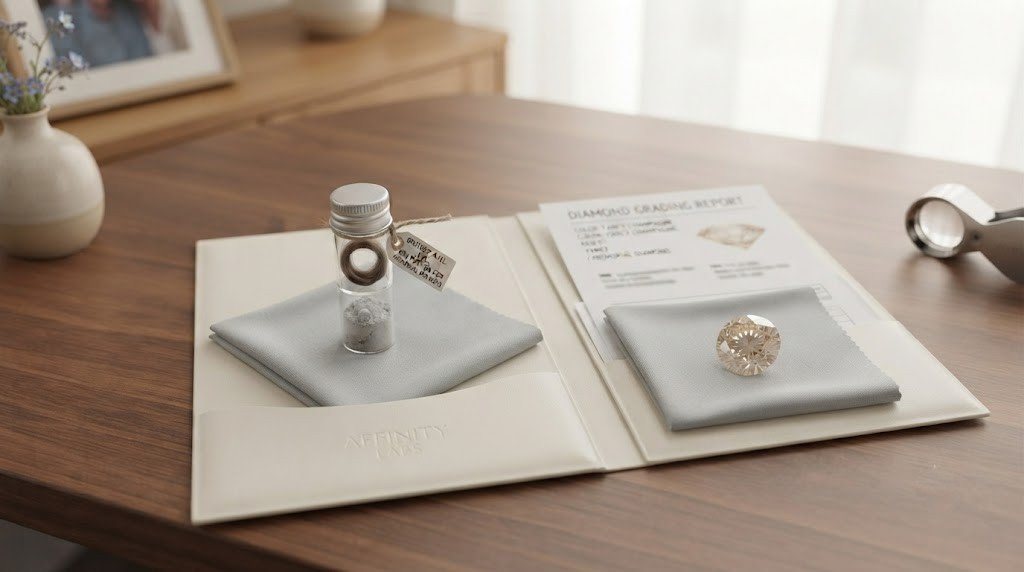
Table of Contents
How Much Ash for a Brother Memorial Diamond Is Typical?
Across the industry, providers commonly request between a few tablespoons and about 4 oz (roughly 100 g) of cremated remains. The exact figure belongs to each provider, and it can move with the carat size you have in mind and the way a given lab handles carbon recovery. Memorial Diamond does not present any industry number as its own fixed minimum, and no single figure applies everywhere.
That range is usually only a small fraction of a full cremation’s remains. Setting aside ash for a brother memorial diamond therefore tends to leave the great majority of him exactly where your family intends: in an urn, in a columbarium niche, scattered somewhere he loved, or kept close at home.
It helps to think of the request in two parts. One part is what the lab needs to recover carbon reliably. The other is any backup quantity a provider might ask you to hold in case a step has to be repeated. Ask whether their stated figure includes a backup, because the answer tells you how much of the ash for a brother memorial diamond is truly consumed and how much may never leave your home.
If you are still at the very start and want the wider picture first, the complete guide to a brother ashes diamond covers the whole journey, from first questions to the finished stone.
Does More Ash for a Brother Memorial Diamond Mean a Bigger Stone?
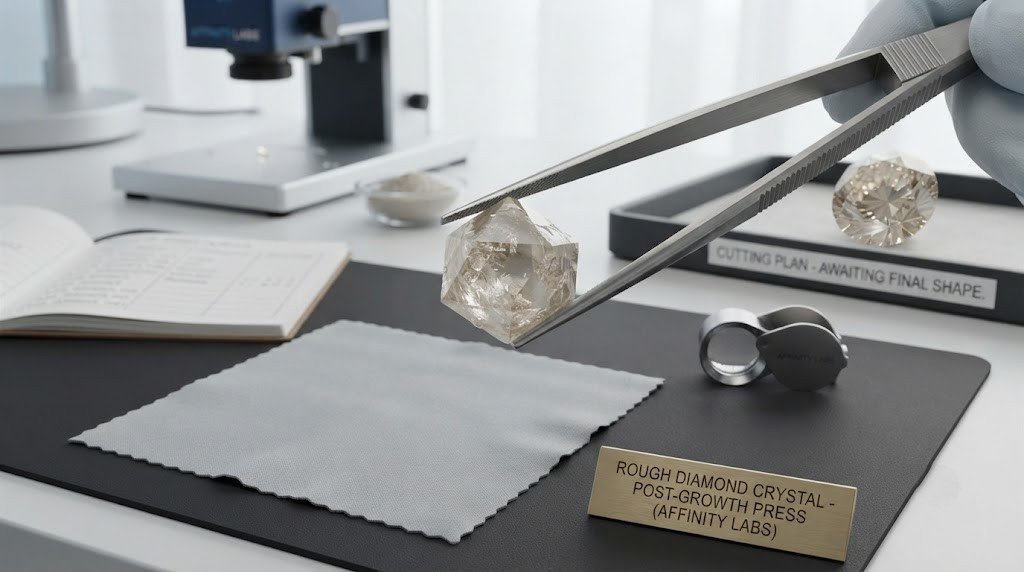
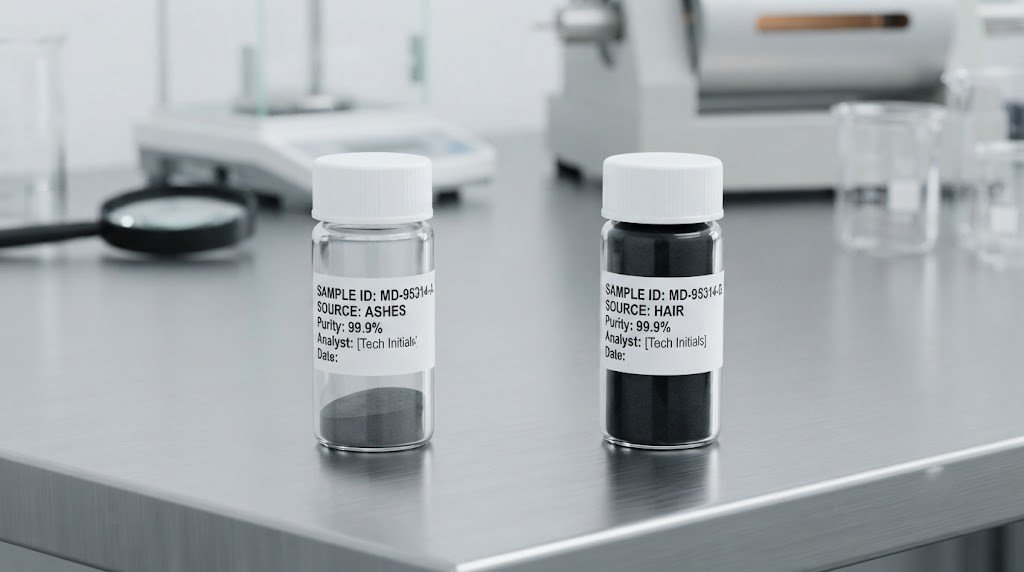
It feels intuitive that a bigger scoop would produce a bigger stone, but diamond growth does not work like that. After his carbon is extracted and purified to roughly 99.9% or higher, it is converted into graphite at around 2,500 to 2,700°C. That graphite then goes into a growth cell with a tiny diamond seed, where a press holds roughly 6 to 8 GPa of pressure at 1,400 to 2,500°C.
Carat weight is decided by how long the crystal stays in that environment, measured in weeks to months. It is not decided by how much ash for a brother memorial diamond went into the starting container. Sending a whole urn would not make the process faster, and it would not make the stone automatically larger.
With the ash for a brother memorial diamond already set aside, you choose the carat size, typically anywhere from about 0.10 carats to 5 carats or more, and that choice shapes the growth time and the overall timeline. The ashes supply his carbon; the weeks under pressure supply the size.
There is quiet relief in this for siblings who worry about fairness or about using too much of him. A modest portion does not condemn the stone to being small, and asking for extra ash will not buy a bigger diamond. The size decision can rest on its own terms: budget, how the piece will be worn, and what simply feels right.
How Much of the Finished Stone Comes From His Ashes?
What comes back after cremation is largely bone mineral, a calcium phosphate compound, and very little of it is carbon. Industry figures place the recoverable carbon at roughly 0.5% to 4% of the ash by weight. The exact yield varies with the individual and with the cremation itself.
Because the recovered carbon is limited, labs typically blend his purified carbon with supplemental lab sourced carbon to reach a workable volume. Industry sources generally put the ash derived share at around 10 to 15% of the finished stone’s mass, though some providers cite figures nearer 3% and others higher, depending on stone size and how much ash was submitted. A company that calls the result pure ashes, with nothing added, is claiming more than the chemistry allows.
None of that makes the diamond less his. A real, traceable portion of your brother’s own carbon becomes part of the crystal lattice, so the stone is not a symbol standing in for him; it exists because of carbon that was once part of him. The explainer on whether a memorial diamond is really made from brother ashes takes each claim apart in more depth.
For general background on how lab grown stones form, the overview of high-pressure, high-temperature diamond synthesis explains the HPHT method and the less common CVD method.
What Happens After You Set Aside Ash for a Brother Memorial Diamond?
Once the ash for a brother memorial diamond has been set aside, everything else stays with whoever holds the remains, to be honored however your family already planned. Some people keep an urn at home, some inter it, some scatter the ashes in a place tied to his life, and some divide small amounts among relatives. A memorial diamond can sit alongside any of these choices; it does not replace them or rank above them.
The portion that travels to the lab follows a different path. During extraction, everything that is not carbon, including the calcium phosphate and other minerals, is stripped away. That means the specific ash for a brother memorial diamond that actually gets processed does not come back to you as ash.
What a provider does with any material it does not need is a policy question, not a fixed industry rule. Ask these before anything ships:
- Is unused ash returned, and if so, how is it packaged and sent back?
- If it is not returned, how is it handled, and can your family request a particular approach?
- Can you send only the working amount and keep any backup portion at home until it is needed?
- Will you receive written confirmation of what was received, what was used, and what remains?
Getting those answers in writing protects everyone, especially when more than one relative has a stake in what happens to him.
Who Should You Ask Before Taking Ash for a Brother Memorial Diamond?
As a sibling, you may or may not be the person with authority over your brother’s remains. Each state sets its own ranking of who decides, and a sibling frequently comes after a spouse or registered partner, grown children, and parents on that list. Paperwork he completed himself, such as a document naming the person he trusted with these choices, funeral arrangements made in advance, or terms in his estate plan, can rewrite the ranking entirely.
If someone else holds that authority, the respectful route is a direct, gentle conversation. Explain that the ash for a brother memorial diamond is typically only a small portion, share the general range, and offer to take on the paperwork and shipping yourself. Framing it as a memorial that could include the whole family, rather than something taken away from anyone, can make the request easier to hear.
When a funeral home or crematory still holds the remains, it will generally release any portion only through the person with authority. It is worth asking them how they handle dividing remains and whether they can prepare a small, clearly labeled container for this purpose.
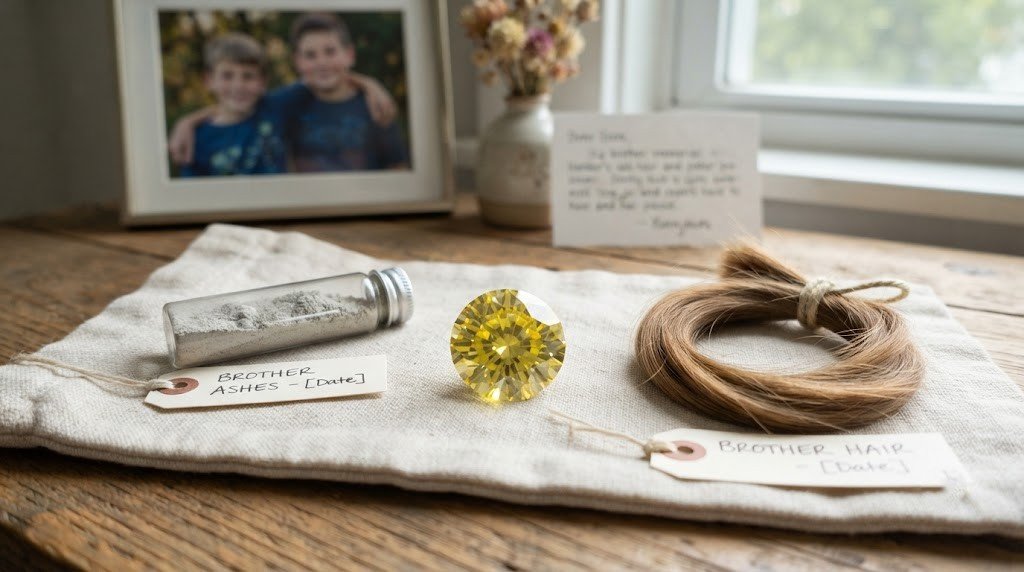
If ashes are not available to you, hair can be another path. Be aware that any of his hair still in the house or with his possessions could be treated as part of his estate, with rules that change from one state to the next, so raise it with whoever is managing his affairs before you take anything. Hair trimmed by a funeral home is generally released through the authority holder too. The companion piece on hair for a brother memorial diamond explains how little is usually needed.
If faith matters to your family, no religious tradition has an official position on memorial diamonds specifically. Views on dividing ashes vary widely, so it is worth confirming with your own faith leader.
Can You Split Ash for a Brother Memorial Diamond Among Several Stones?
Often, yes. Because each stone draws on only a portion, one set of remains can frequently supply more than one diamond: perhaps one for a parent, one for you, one for another sibling, or one for anyone else close to him. Whether it works in your case depends on how much ash is available and on each provider’s own requirements.
A little planning goes a long way here. If two or three people each want a stone, ask whether the provider needs a separate measured portion of ash for a brother memorial diamond for each order, or whether one combined submission can supply carbon for all of them. Ask, too, whether stones from the same submission can differ in size, color, cut, and setting, and whether each one comes with its own origin certificate.
That certificate matters. An origin certificate, usually issued in house, documents the chain of custody showing the stone came from your family’s submitted material. It is different from an independent grading report, which records the diamond’s cut, color, clarity, and carat to recognized standards.
For a fuller look at how relatives coordinate, the guide to sharing a brother memorial diamond among relatives covers splitting portions, timing orders, and keeping everyone informed.
How Do You Measure, Seal, and Send Ash for a Brother Memorial Diamond?
Before you open the urn, ask the provider for its collection instructions or kit. Their instructions, rather than general advice found online, should decide the container, the labeling, and how the package travels. The table below lays out the usual sequence, with the question that settles each step.
| Step | What it involves | Question to ask the provider |
|---|---|---|
| Confirm the amount | Agreeing how much ash for a brother memorial diamond your order needs | Does the figure change with carat size or the number of stones? |
| Request the kit | Receiving any container, labels, and forms the provider supplies | Do you send a collection kit, and what does it include? |
| Measure the portion | Transferring the agreed amount into the provided container | Should the portion be measured by volume or by weight? |
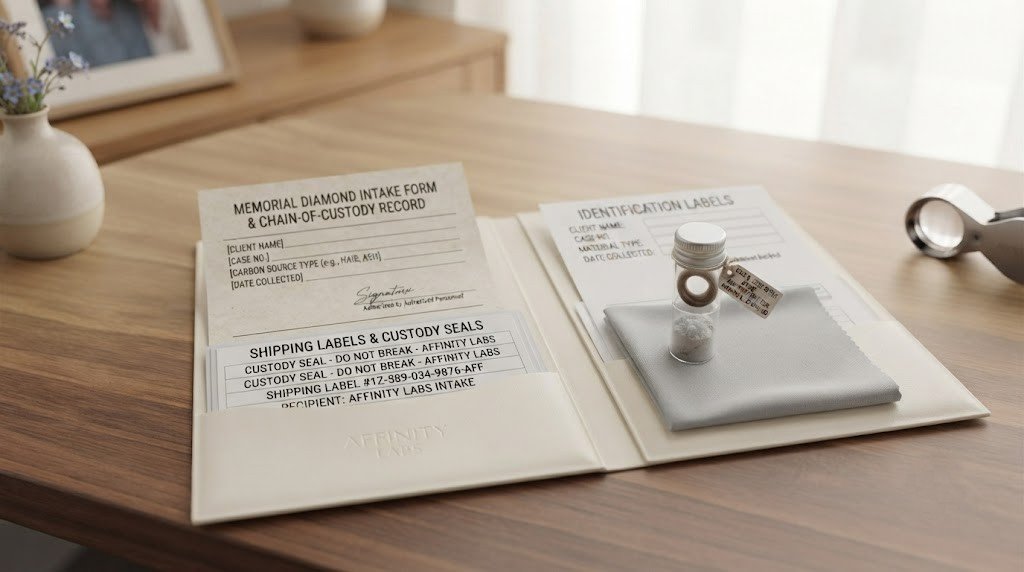
| Seal and label | Closing the container of ash for a brother memorial diamond securely and recording identifying details | How should it be sealed, and what must appear on the label? |
| Ship | Sending the sealed ash for a brother memorial diamond by an accepted method | Which carriers and services do you accept for cremated remains, and is tracking included? |
| Confirm receipt | Getting written acknowledgment that it arrived intact | How will you confirm arrival and begin chain of custody records? |
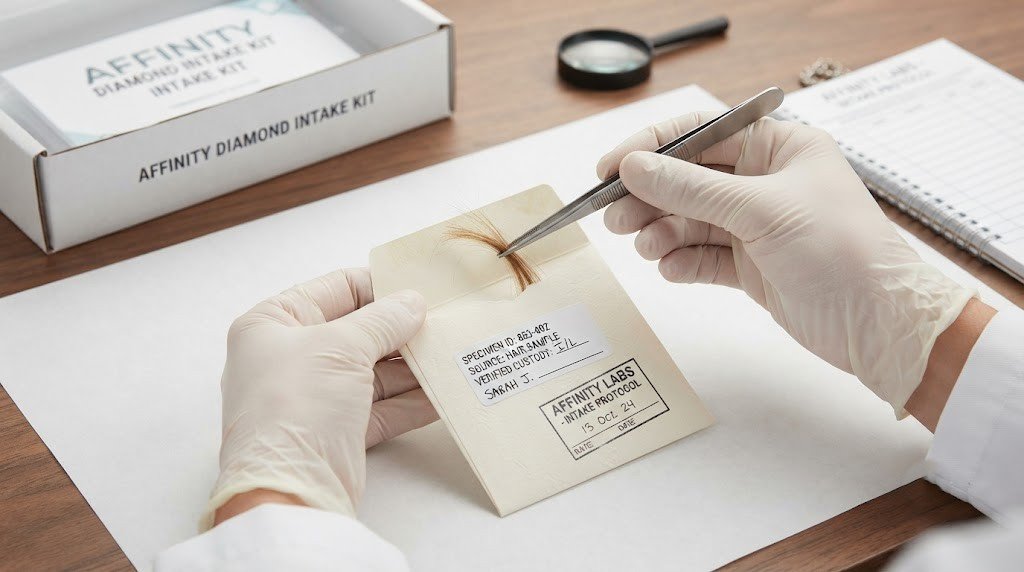
Measuring cremated remains can feel heavier than any step on paper suggests. Some people do it with another relative present, working slowly over a tray with a clean spoon, and set aside time afterward to sit with it. There is no right pace.
If you would rather not handle his remains at all, ask whether the funeral home or crematory can measure and seal the portion for you. Keep a photo of the sealed, labeled container and a copy of every form, so you have your own record alongside the provider’s.
What If Too Little Ash for a Brother Memorial Diamond Remains?
Running short of ash for a brother memorial diamond can happen for ordinary reasons. Sometimes the remains were scattered, divided years ago, or kept by someone else, and what you have is a small keepsake amount. Do not assume it is too little. Send the provider an honest description of what you have, including a weight if a kitchen scale is handy, and ask plainly whether that quantity is workable.
Because carat size comes from growth time, a small amount does not automatically limit the stone’s size. What matters is whether the lab can recover enough carbon to work with. If the answer is no, there are still gentle options:
- Ask whoever holds a larger portion whether they could spare a little more.
- Consider using his hair instead, if any was kept and the authority holder agrees.
- Ask whether the provider can combine a small amount of ashes with hair in one stone.
- Keep the keepsake portion as it is and choose a different kind of memorial.
The third option has its own considerations, which the post on how much ash and hair a combined stone needs walks through. None of these paths is lesser than another; the right one is whichever fits your family and what remains of him.
Does the Amount of Ash for a Brother Memorial Diamond Change Cost, Timing, or Color?
Price follows the finished stone, not the volume of ash for a brother memorial diamond you send. Across the industry in 2026, entry stones of about 0.10 to 0.25 carats run roughly 1,500 to 3,500. Stones between 0.5 and 1 carat typically fall between $5,000 and $15,000, with colorless toward the top of that range. Large stones of 2 to 5 carats or more run roughly 20,000 to 75,000 or higher, and grading reports, engraving, fancy cuts, and settings are usually priced separately. The breakdown of what a brother memorial diamond costs goes tier by tier.
Timing works the same way. The whole process typically takes 6 to 10 months from receipt of material to finished stone, and stones over about 2 carats or in specialty colors can take up to around 12 months. A larger portion of ash for a brother memorial diamond will not shorten that wait. The overview of the brother memorial diamond timeline explains what happens across those months.
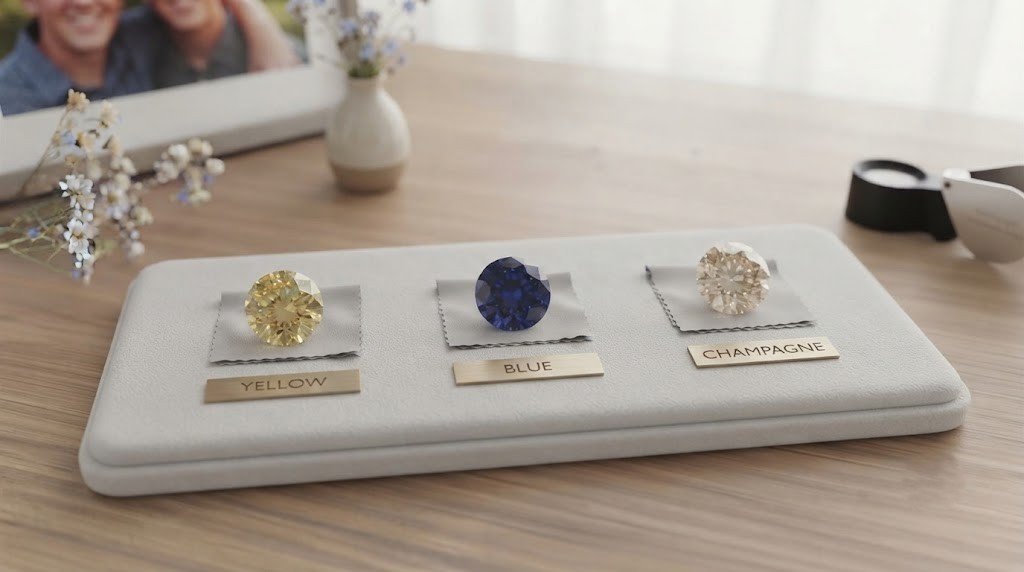
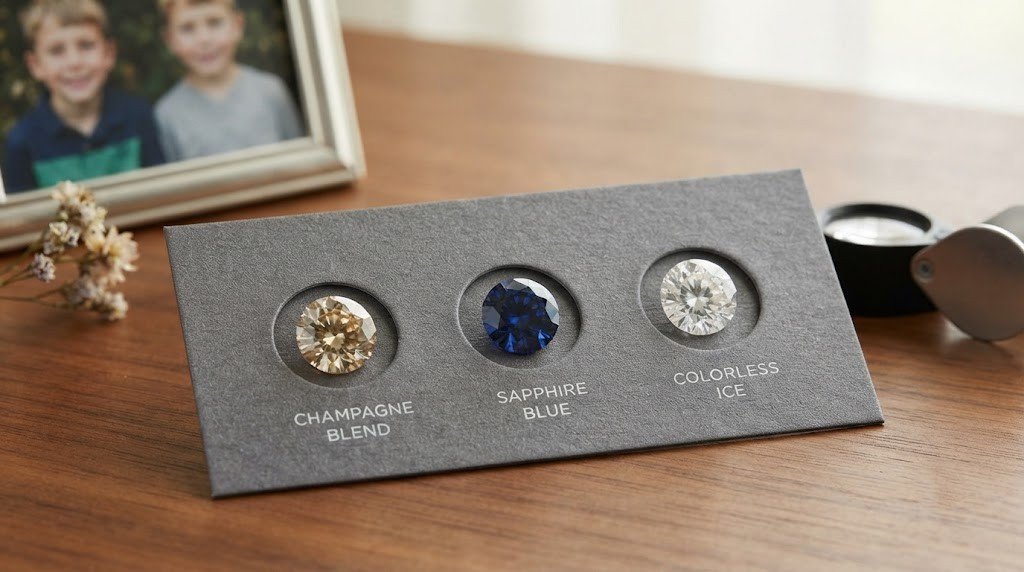
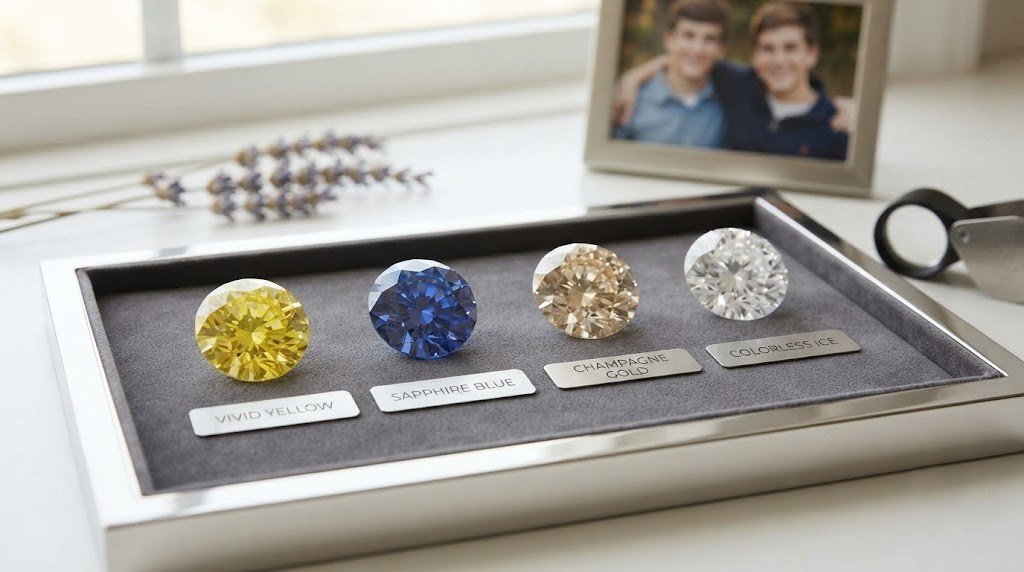
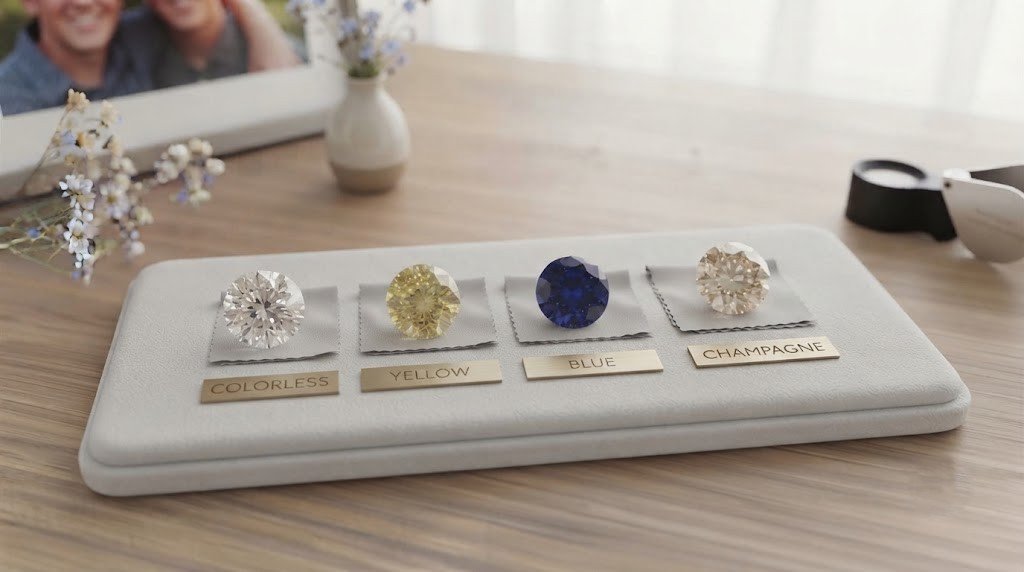
Color is not steered by quantity either. Trace nitrogen tends to produce yellow, trace boron tends to produce blue, and a colorless stone requires the absence of both, which takes extra processing and usually costs more. Memorial stones tend toward yellow, blue, and champagne tones, and some providers offer irradiation for red, pink, green, or black. The exact shade cannot be predicted from his ashes, as the guide to brother ashes diamond color explains.
Clarity typically lands between SI2 and VVS. The finished stone rates 10 on the Mohs hardness scale, though a hard knock can still chip any diamond.
What Should You Ask a Provider About Ash for a Brother Memorial Diamond?
A short list of written questions keeps the conversation clear and gives you answers you can share with the rest of the family. Before agreeing to anything, ask:
- What is your current requirement for ash for a brother memorial diamond at the carat size we want?
- Does that figure include a backup portion, and can we hold the backup at home?
- Can one submission supply several stones, and how much is needed for each?
- Do you send a collection kit, and how should the portion be measured, sealed, and labeled?
- Which shipping methods do you accept for cremated remains?
- What happens to any ash you do not use?
- If growth does not succeed, what is your policy, and is more material needed?
- Will the stone come with an origin certificate, an independent grading report, or both?
Write the answers down and keep them with his paperwork, so every decision about ash for a brother memorial diamond is documented. Having them in one place makes it easier to compare providers and to explain the plan to anyone else who cares about him.
Frequently Asked Questions
Is a tablespoon of ash enough for a memorial diamond?
It may be, depending on the provider. Industry requests for ash for a brother memorial diamond range from a few tablespoons up to about 4 oz, so a single tablespoon falls below that typical range. Describe what you have and ask whether the lab can recover enough carbon from it.
Will sending more ash make my brother’s diamond bigger?
No. A stone gains weight only through more weeks of growth, and the quantity of ash in the package plays no part in that. Sending extra remains does not enlarge the stone or speed the process, so you can keep the rest of his ashes for other plans.
Can I still get a diamond if most of his ashes were scattered?
Possibly. A small keepsake portion may still be workable, so ask the provider directly. If it falls short, a relative holding more could spare a little, or his hair could be used instead, with the agreement of whoever holds authority.
Do I need permission to use some of my brother’s ashes?
Yes, from the relative who has the final say over his remains. A spouse or partner, adult children, or parents often rank ahead of siblings, but each state orders this differently, and instructions he left in writing can change it.
Can two siblings each get a diamond from his ashes?
Often, yes. Because each stone uses only a portion of ash for a brother memorial diamond, one set of remains can frequently supply several diamonds. Ask the provider whether each order needs its own measured portion and whether every stone receives its own origin certificate.
Is any of the ash returned after the diamond is made?
That depends on the provider. The portion processed for carbon does not come back as ash, and policies on unused material differ. Ask before shipping whether leftover ash is returned, how it would be sent back, and whether you can keep a backup portion at home.
Should the ashes be sifted or changed before sending?
Ask the provider before doing anything beyond its own instructions. Use its kit or container, measure the agreed portion, and seal and label it as directed. If anything about the remains concerns you, describe it to the provider rather than altering them yourself.
Final Thoughts on Ash for a Brother Memorial Diamond
The question of how much is really a question about how much of him you would be letting go. The honest answer is that ash for a brother memorial diamond is very little, and none of it is used in a way that limits what the stone can become. Whatever you decide, the rest of your brother can stay exactly where your family wants him, and the diamond, if you choose one, simply joins the ways you already remember him.
Learn More About Preparing a Portion of His Ashes
- Brother Ashes Diamond: The Complete Guide the full picture, from first questions to the finished stone
- How Much Hair Do You Need for a Brother Memorial Diamond? when hair is the easier or only option
- How Much Ash and Hair Do You Need for a Brother Memorial Diamond? planning a stone that uses both
- Questions to Ask Before Turning Your Brother’s Ashes Into a Diamond a fuller checklist for comparing providers
Talk With Memorial Diamond
If you are weighing how much ash for a brother memorial diamond to set aside, or whether what you have is enough, you are welcome to reach out to Memorial Diamond and talk it through at your own pace. Visit memorialdiamond.us to start the conversation about what is possible with his ashes.
Word count: 3,330 words · Reading time: about 17 minutes