
Not every brother is cremated, and sometimes the only physical trace left within your reach is a comb, a cap, or a lock someone saved years ago. A brother hair diamond is a genuine lab-grown diamond created partly from carbon recovered from his hair, so cremation is not required. Providers may ask for a small lock or a few grams, and the process often takes 6–10 months. Before sending anything, it is also important to understand who may need to agree to the use of the hair.
A memorial diamond can turn an ordinary keepsake into something lasting. This guide explains where to look for your brother’s hair, how to handle it carefully, what happens during diamond growth, and which questions to ask before choosing a provider.
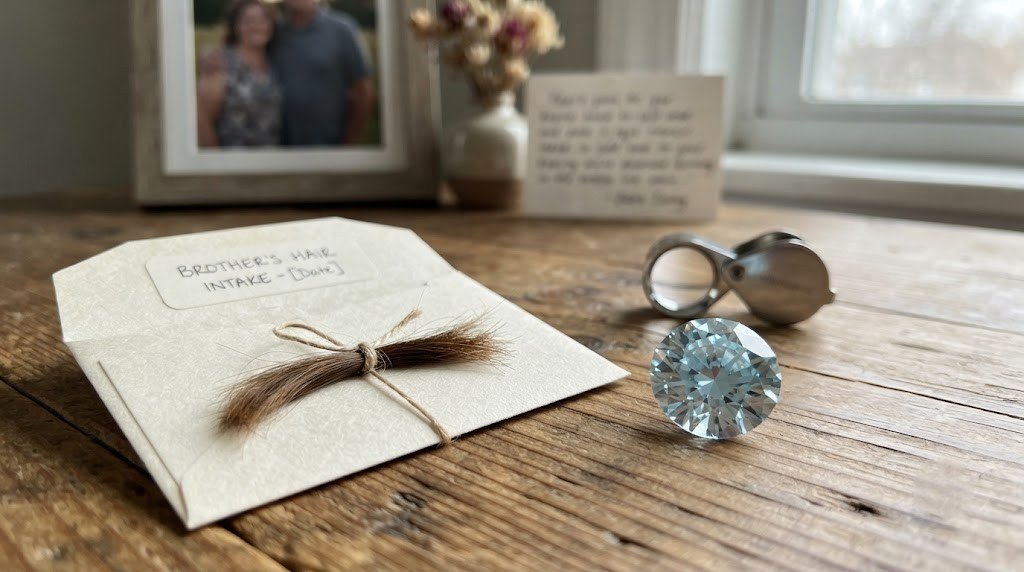
Table of Contents
Why Does a Brother Hair Diamond Not Require Cremation?
Hair contains keratin, a protein that is rich in carbon. Hair is approximately 50% carbon by weight, although the amount a laboratory can recover depends on its process. This is why a brother hair diamond can be made without cremation.
For families whose brother was buried, this distinction can be especially meaningful. You may not have access to ashes, but a lock of hair might have been saved by a family member, collected before burial, or preserved in a childhood keepsake.
A brother hair diamond may also be an option for families brother hair diamond who prefer not to use cremated remains. Religious and cultural practices vary, so anyone with concerns about whether a memorial diamond fits their beliefs should speak with their own faith leader.
The finished stone is a lab-grown diamond. It can be cut and polished into different shapes and set in a ring, pendant, or other piece of memorial jewelry.
However, not every company accepts hair or offers the same process. Before making a decision, confirm that the provider can create a diamond using your brother’s hair and explain how the material will be documented.
Where Might Your Brother’s Hair Still Be Found?
If you think a memorial diamond is out of reach because your brother hair diamond was not cremated, it may be worth checking whether someone saved a small amount of his hair.
Possible places to look include:
- A hairbrush or comb: A brush he used by himself may contain loose strands. Ask the provider whether it accepts this type of sample.
- A trimmer or clipper: Short hair may collect inside the device. Confirm whether the laboratory accepts short clippings.
- A hat, cap, or beanie: Hair may remain in the lining or band of something he wore regularly.
- A lock collected before burial: A funeral director may be able to explain whether a lock was collected or whether one could have been preserved.
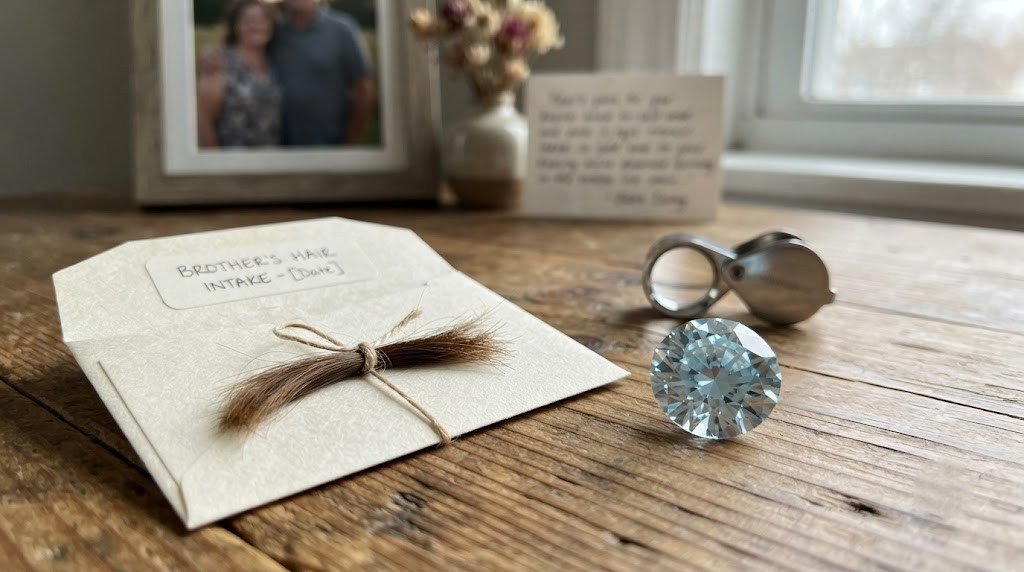
- A childhood keepsake: A family member may have saved hair from an early haircut in a baby book or envelope.
- Personal belongings: A pillowcase or favorite chair may contain strands, but these can be mixed with hair from other people.
A clean, clearly identified sample is preferable. If you find hair on a shared brush or household item,brother hair diamond explain the source to the provider instead of assuming every strand belongs to your brother.
Remember that an old keepsake may be deeply meaningful to another relative. Ask before brother hair diamond removing hair from a locket, frame, baby book, or other personal item.
Who Has a Say Over Hair He Left Behind?
Permission is an important part of planning a brother hair diamond. Hair may be brother hair diamond treated differently depending on where it was found, who owns the item, and the rules that apply where your brother lived.
Hair on a brush or inside a cap may be associated with his personal belongings or estate. A lock collected by a brother hair diamond funeral home may be treated differently because it was taken from his body.
A respectful first step is to speak with the executor or the person handling his affairs. If a brother hair diamond relative has kept the hair for years, ask that person directly whether they are willing to contribute it.
| Where the hair is found | Who to contact first | Why it matters |
|---|---|---|
| Brush, comb, or cap in his home | Executor or estate representative | Personal belongings may form part of his estate |
| Lock collected by a funeral home | Funeral home and the person authorized to make decisions about his remains | Different rules may apply to hair collected from the body |
| Childhood lock kept by a relative | The relative who has preserved it | The keepsake may have significant personal meaning |
| Hair already given to you | The person who gave it to you, and the executor if ownership is unclear | The circumstances of the transfer may matter |
Rules differ by state, and a person’s written wishes may also be relevant. If ownership or permission is unclear, consult a local attorney who handles estate matters.
Do not assume that simply possessing the hair automatically gives you the right to send it to a laboratory. Taking the time to ask first can help prevent family disagreements.
How Much Hair Does a Lab Need, and Does Length Matter?
A brother hair diamond may require only a small lock or a brother hair brother hair diamond diamond few grams of hair, but there is no universal quantity that applies to every provider.
Some companies describe their requirements as a small bundle or a few wisps. Others specify a brother hair diamond minimum weight or provide their own collection kit.
Length may matter less than the total quantity, but the provider’s requirements should guide your decision.brother hair diamond If you have only short clippings from a trimmer, ask whether the laboratory accepts them before sending anything.
Sending more hair does not necessarily produce a larger diamond brother hair diamond or shorten the growth process. Carat size depends on the order and the laboratory’s growth process, not simply on the amount of hair supplied.
Before placing your order, ask the company:
- What is the minimum amount of hair required?
- Are loose strands or short clippings acceptable?
- Does the company provide a collection kit?
- How should the sample be packaged?
- What happens to any unused hair?
- Can the sample be retained if another growth attempt is needed?
Send only the amount requested. Keeping any remaining hair with the family preserves the option of using it for another purpose later.
Can Siblings Share One Lock of His Hair?
Sometimes one saved lock can provide enough material for more than one memorial diamond. Whether this is possible depends on the quantity available and the provider’s requirements.
If several siblings want a brother hair diamond, discuss the options before sending the sample. You may be able to request separate stones, or you may prefer one shared keepsake.
Every sibling may have a different preference. Full siblings, half-siblings, step-siblings, and adopted siblings might want a diamond, a different kind of memorial, or no keepsake at all. None of those choices measures how much someone cared about your brother.
If several people plan to order separate stones, ask the provider whether the same sample can be divided between orders and whether each order needs its own intake record.
Discuss costs and ownership before the process begins. If one diamond will be shared or passed between households, agree in writing who will own it and how it will be cared for.
How Should You Collect and Pack His Hair?
Handling the sample carefully can make the ordering process easier. Follow the instructions provided by your chosen laboratory, because its collection kit and requirements take priority over general advice.
If the provider has not given you different instructions, these steps can help you prepare:
- Wash your hands. Work on a clean, dry surface and use clean fingers or tweezers to handle the hair.
- Keep the source clear. Avoid mixing your brother’s hair with strands from other people or unrelated materials.
- Allow moisture to dry. If the sample is damp, ask the provider how it should be prepared before packaging.
- Use the recommended container. A paper envelope may be suitable for some providers, while others supply their own packaging.
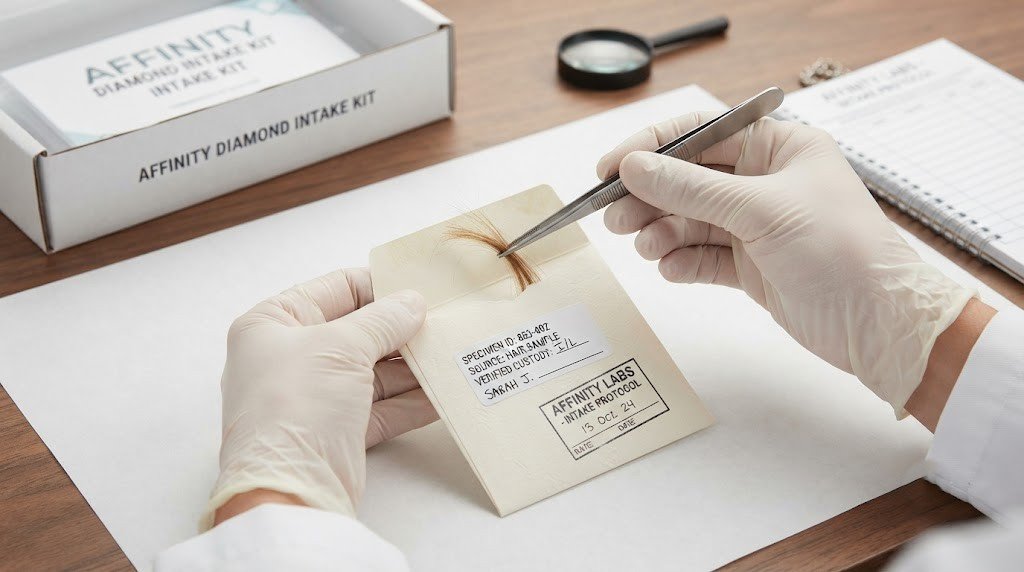
- Label the sample. Record the source, collection date, and any identification requested by the company.
- Keep a record. Photograph the sample before shipping and retain your order confirmation and tracking number.
- Follow shipping instructions. Do not send the hair until you understand the company’s procedure.
Five Mistakes to Avoid
Mistake 1: Using hair from a shared source without checking.
Hair on a shared pillow, brush, or headrest may belong to multiple people. Choose a source used only by your brother whenever possible, and explain any uncertainty to the provider.
Mistake 2: Sealing damp hair without guidance.
Moisture can cause storage problems. Follow the laboratory’s instructions for drying and packaging rather than assuming any container is suitable.
Mistake 3: Taking hair from a keepsake without asking.
A lock saved by another relative may be irreplaceable. Get permission before using it.
Mistake 4: Sending all the hair you have.
A larger sample does not automatically improve the diamond. Send the quantity requested and preserve the remainder.
Mistake 5: Forgetting the paperwork.
Keep photographs, consent records, shipping receipts, and the laboratory’s intake identification. These records can help clarify what was sent and when.
These simple precautions can help you prepare a brother hair diamond sample with care and respect for everyone involved.
What Happens to His Hair Inside the Lab?
The precise process varies between providers, so ask the company to describe its own method. A typical process may include several stages.
1. Sample Registration
When the hair arrives, the provider records the sample and assigns an identification number. Ask how the laboratory keeps your brother’s material separate from other customers’ samples.
2. Carbon Recovery and Purification
Hair contains keratin and other components. Controlled processing removes non-carbon material and prepares the carbon for further treatment.
Some providers describe their target purity as approximately 99.9% or higher, but the actual process and specifications should be confirmed directly with the laboratory.
3. Graphite Preparation
For HPHT growth, the recovered carbon is generally prepared as graphite. Additional laboratory carbon may be used if the recovered quantity is insufficient for the intended diamond size.
Ask whether the provider adds supplemental carbon and whether it can estimate how much of the finished stone is expected to come from your brother’s hair.
4. Diamond Growth
High-pressure, high-temperature (HPHT) technology is commonly used to grow laboratory diamonds. Chemical vapor deposition (CVD) is another diamond-growth method, although availability depends on the provider.
The company should explain which method it uses and what it can document about your specific order.
5. Cutting and Polishing
After the crystal grows, it may be cut and polished into the selected shape. The final size, clarity, and appearance depend on the resulting crystal and the cutting process.
6. Color and Documentation
Some providers offer color treatments after growth. Ask whether any treatment will be applied and whether it will be disclosed in the paperwork.
The finished diamond may come with an in-house origin certificate. An independent grading report may be available separately.
For background on laboratory-grown diamond technology, see synthetic diamond growth methods.
You should also ask what happens if growth fails or the crystal is damaged during cutting. Confirm whether the provider keeps any material in reserve and whether another attempt is covered by the original price.
How Much of a Brother Hair Diamond Is Actually His?
This question deserves a clear and honest answer.
Hair is roughly 50% carbon by weight, but that does not mean half of the finished diamond necessarily comes from your brother. The quantity of carbon recovered, the growth process, and the use of supplemental laboratory carbon all affect the final contribution.
There is no single, widely established finished-stone percentage that can accurately describe every brother hair diamond.
You may see estimates of approximately 10–15% personal carbon mentioned for certain ash-based diamonds. Those figures relate to ash-based processes and should not automatically be applied to diamonds made from hair.
The most accurate explanation is that carbon recovered from your brother’s hair is used during diamond growth, often alongside supplemental carbon. The finished stone should not automatically be described as consisting entirely of his original material.
Before ordering, request a written estimate from the provider for your chosen carat size. Ask how the estimate is calculated and whether the company can document the use of the submitted sample.
You can learn more about this distinction in the guide to whether a memorial diamond is really made from your brother’s hair.
Color, Cost, and Timing at a Glance
What Color Can You Expect?
A brother hair diamond can have different colors depending on the conditions under which it grows and the elements present in the crystal.
Memorial diamonds may be available in yellow, blue, champagne, or brown shades. Some providers also offer other colors or post-growth treatments.
No one can reliably predict the final color simply by looking at the original hair. Using hair rather than ashes does not guarantee a lighter or more predictable result.
Ask the provider which colors are available, whether a treatment is involved, and whether that treatment will be documented.
You can read more in the guide to brother hair diamond color.
What Does a Brother Hair Diamond Cost?
The following figures are broad illustrative industry estimates for 2026, not a confirmed price list from Memorial Diamond.
| Approximate size | Illustrative price range |
|---|---|
| 0.10–0.25 carat | $1,500–$3,500 |
| 0.5–1 carat | $5,000–$15,000 |
| 2–5+ carats | $20,000–$75,000+ |
Prices vary by provider, carat size, color, cut, grading, and setting. Colorless options may cost more, and specialty colors or additional services may increase the total.
Request an itemized quotation before paying. Check whether the price includes cutting, polishing, an origin certificate, independent grading, shipping, and any jewelry setting.
If you choose independent grading, GIA’s diamond quality factors explain the familiar categories of cut, color, clarity, and carat.
How Long Does the Process Take?
A brother hair diamond may take approximately 6–10 months from receipt of the required material, although timelines vary.
Larger stones or specialty colors may take longer, potentially around 12 months or more depending on the provider.
Ask when the clock starts, how often you will receive updates, and what happens if the process is delayed. Get the estimated timeline in writing rather than relying on a general industry estimate.
How Should You Care for the Finished Stone?
Diamonds are extremely hard, but they can still chip or fracture after a hard impact. If you plan to wear your brother hair diamond every day, consider a protective setting.
Keep the certificate and purchase documentation in a safe place. If you intend to insure the piece, ask your insurer what valuation or grading documents it requires.
What If His Hair Is Not Available or Not Yours to Send?
Not every family has access to a suitable lock of hair. Sometimes nothing was saved, or the person who holds the keepsake does not wish to share it.
Other options may still be meaningful.
- An ash-based memorial diamond: If your brother was cremated, explore the complete guide to a brother ashes diamond.
- A combined ash-and-hair diamond: If both materials are available and the relevant people agree, read the guide to a brother ashes and hair diamond.
- Waiting: A keepsake does not need to be used immediately. Take time to discuss the idea with your family.
- Another memorial: A locket, an engraved piece of jewelry, a photograph, a handwritten message, or a tree planted in his memory may feel more appropriate.
A brother hair diamond is one possible tribute, not the only way to remember someone. You can choose an option that fits your family’s beliefs, wishes, and circumstances.
Which Questions Should You Ask Before Ordering?
Before sending a sample, ask the provider for written answers to these questions:
- What is your minimum required amount of hair?
- Do you accept short clippings or loose strands from a brush?
- How should I collect, label, and package the sample?
- Do you provide a collection kit?
- How do you identify and track my brother’s sample?
- Do you use supplemental laboratory carbon during growth?
- Can you estimate the proportion of carbon expected to come from his hair?
- Which diamond-growth method do you use?
- What colors and cuts are available?
- Is any post-growth color treatment used?
- What documentation accompanies the finished diamond?
- Is independent grading available?
- What happens if growth fails or the diamond is damaged during cutting?
- What happens to unused hair?
- What is the complete price, including optional services and shipping?
- How long should the process take, and how will I receive updates?
These questions help you compare providers on more than price alone.
When you are ready to begin, the practical guide to turning your brother’s hair into a diamond explains the ordering and shipping process.
Frequently Asked Questions
Is a brother hair diamond possible if he was buried rather than cremated?
Yes, if suitable hair was saved and the provider accepts it. A brother hair diamond does not require cremated remains. Ask the funeral home or the person who preserved the hair about its source, and obtain any necessary permission before sending it.
Do I need the executor’s agreement to use hair from his hairbrush?
It is sensible to consult the executor or the person managing your brother’s affairs before using hair from his belongings. Personal effects may form part of his estate, and the applicable rules vary. Asking first can prevent misunderstandings.
Can a lock saved from his childhood be used?
Possibly. A childhood lock preserved in a baby book or envelope may be suitable if it meets the provider’s requirements. Ask the person who has kept it before taking any material.
Will hair produce a lighter color than ashes?
There is no reliable basis for promising that. The final shade depends on the diamond-growth conditions, trace elements, and any treatment used by the provider.
How long can saved hair be kept before it is used?
There is no universal deadline. Dry, well-preserved hair may remain usable for years, but the provider should confirm whether its age and storage conditions meet the company’s intake requirements.
What if the only hair left is on a pillow other people also used?
The sample may contain hair from several people. Look for a source your brother used alone if possible. If no alternative exists, describe the source honestly and ask the provider whether it can accept the material.
Can several siblings use the same lock?
Possibly. Whether one lock can support multiple orders depends on the amount available and the provider’s minimum requirements. Ask before dividing the sample, and agree on costs and ownership in advance.
Final Thoughts on a Brother Hair Diamond
A brother hair diamond may begin with a small discovery: a comb in a drawer, a cap on a hook, or a lock of hair a relative saved years ago.
For a family whose brother was buried, or whose circumstances make using ashes unsuitable, that discovery may offer another way to create a lasting keepsake.
Take the time to ask permission, prepare the sample carefully, and get the provider’s answers in writing. Be especially clear about the expected timeline, complete cost, documentation, and how much of the finished stone can be attributed to his original carbon.
A memorial should bring comfort without creating unnecessary family conflict or unrealistic expectations. Whether you choose a diamond or another tribute, the important thing is to choose with care and respect for your brother’s memory.
Learn More About Brother Memorial Diamonds
- Brother Ashes Diamond: The Complete Guide Learn about the ash-based option.
- Brother Ashes and Hair Diamond: The Complete Guide Explore a diamond made using both materials.
- How to Turn Your Brother’s Hair Into a Diamond Review the practical steps.
- What Color Will a Diamond Made From Your Brother’s Hair Be? Understand the factors that affect color.
Talk With Memorial Diamond
If you have found a lock of your brother’s hair or are still wondering whether a suitable sample exists, you can explore your options before making a decision.
Visit Memorial Diamond to learn more about memorial diamond options and ask questions about creating a brother hair diamond.
Take your time, gather the information you need, and choose the tribute that feels right for you and your family.
Leave A Comment