
You may already know you want something of hers you can wear, and still have no real picture of what happens between handing over her ashes and holding a finished stone. A diamond made from sister ashes is grown in a laboratory from a small, tracked portion of her cremated remains. The carbon is extracted, purified to about 99.9%, converted to graphite, typically blended with lab carbon, grown under intense heat and pressure, then cut, polished and graded, usually over six to ten months.
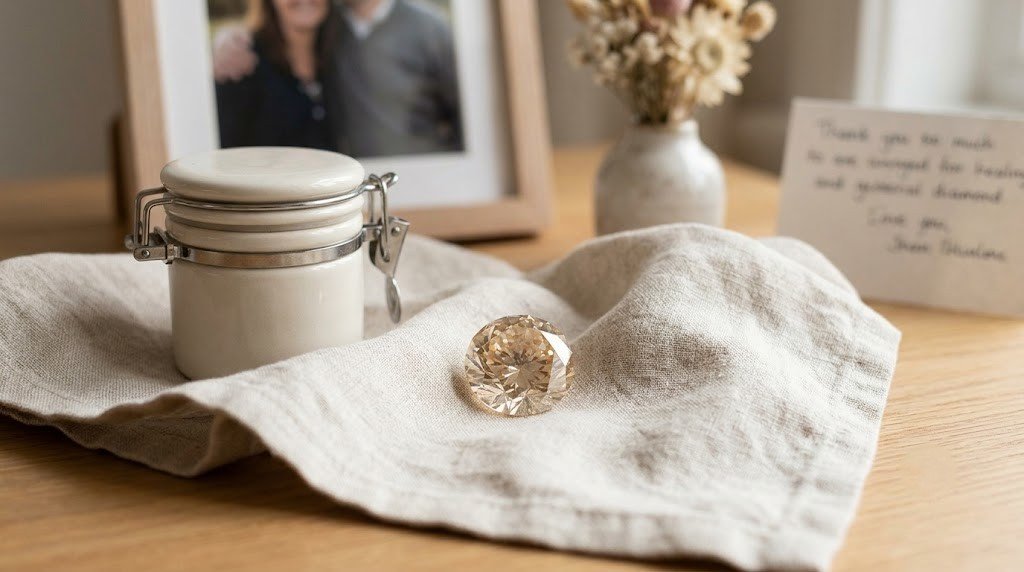
Table of Contents
What Happens When a Diamond Is Made From Sister Ashes?
Seven stages, in a fixed order, and only one of them is optional.
Every stone made from sister ashes passes through collection, extraction and purification, graphitization, growth and cutting. A color treatment may follow if you ask for one. Grading and documentation close the sequence.
Durations below are rough industry wide ranges, not one laboratory’s schedule.
| Stage | What happens | Roughly how long | What you see |
|---|---|---|---|
| 1. Collection and intake | A measured portion of her ashes is sealed, mailed or hand delivered, logged and given a reference number | Days to a couple of weeks, mostly shipping | A collection kit, then an arrival confirmation |
| 2. Extraction and purification | Staged heating without oxygen strips away bone minerals until carbon of about 99.9% purity remains | Commonly a few weeks | Usually nothing, or a brief status note |
| 3. Graphitization | Very high heat, around 2,500 to 2,700°C, rearranges the cleaned carbon into graphite | Short compared with growth | Usually nothing |
| 4. Growth | Graphite, typically blended with lab carbon, crystallizes around a diamond seed under HPHT, or less often CVD | Weeks to months, the longest stage | A long quiet stretch; some providers share a photo of the rough crystal |
| 5. Cutting and polishing | A cutter shapes the rough crystal into the cut you selected | Often a few weeks | Possibly photos or video of the finished stone |
| 6. Color treatment, optional | Some providers offer post growth irradiation for shades such as red, green or black | Adds time only if requested | Nothing, unless you asked for it |
| 7. Grading and documentation | Paperwork recording that the stone was made from sister ashes is prepared; an independent grading report may be added | A few weeks if an outside lab is involved | The stone and its papers, delivered together |
Across the whole sequence, six to ten months is typical, and stones above roughly two carats or in specialty colors can approach twelve months.
The stage that stretches is almost always growth, because growth time, not the amount of ash, sets the carat weight of a diamond made from sister ashes.
Why Does Ash Hold So Little Carbon?
Because cremation has already released most of it.
What a crematory returns is chiefly bone mineral, calcium phosphate, in a pale gray, coarse to fine texture. The soft tissue that held most of the body’s carbon burns away as gas during cremation, which is precisely what makes the next stages so painstaking.
Published industry estimates place the recoverable carbon in cremated remains somewhere between about 0.5% and 4% by weight.
The spread depends on the individual and the cremation itself, and no one can tell by looking where a container falls in that range.
That low yield shapes how much a laboratory requests. Requirements differ by provider, but they generally fall between a few tablespoons and about 4 ounces, around 100 grams.
For a stone made from sister ashes, that is typically a small fraction of what the crematory returned. The remainder can stay wherever your family has decided it belongs: an urn, a burial plot, a scattering place, or several at once.
A trace that small cannot fill a growth cell alone, so a diamond made from sister ashes typically combines her carbon with supplemental lab carbon.
How Is Her Carbon Pulled Out of the Ash?
Through heat, applied in stages, with oxygen kept out.
Oxygen matters because carbon bonds with it and escapes as gas. In a sealed, oxygen free environment the carbon stays behind while calcium, phosphorus and other minerals are driven off or separated.
The target is carbon at about 99.9% purity or better, because anything left over would interfere with crystal growth.
Most of what arrived will not survive this stage, by design. A few tablespoons of ash become a far smaller pinch of dark carbon.
A carefully run laboratory keeps that residue under the reference number assigned at intake, so carbon meant for a diamond made from sister ashes can be traced back to the container you sent.
Ask how that link is maintained, and whether a person signs at each handover or only a database entry changes.
Two further questions fit here:
- Is unused ash returned, retained or disposed of?
- Is the carbon destined for a stone made from sister ashes ever purified in a shared batch alongside another family’s?
A confident provider answers both without hesitation.
Hair enters this stage with far more carbon to work with, roughly half its weight. The hair only version of this process explains why.
Why Must the Carbon Become Graphite First?
Graphite is the form of carbon a growth press is designed to work with.
Purified carbon from ash is chemically clean but loosely structured. Heating it to roughly 2,500 to 2,700°C rearranges its atoms into graphite’s stacked, layered sheets.
Before this step her carbon is a powder. Afterward it is feedstock prepared for a single purpose.
Around this point, or as the growth cell is loaded, lab sourced carbon is typically added to hers.
Providers blend in supplemental carbon to reach the volume growth requires, and exactly when and how that happens varies.
Ask for a written description, including where the supplemental carbon is sourced.
For a sibling following along, graphitization is close to invisible and rarely produces an update. Still, a stone made from sister ashes depends on it as much as on the press.
What Happens Inside the Growth Press?
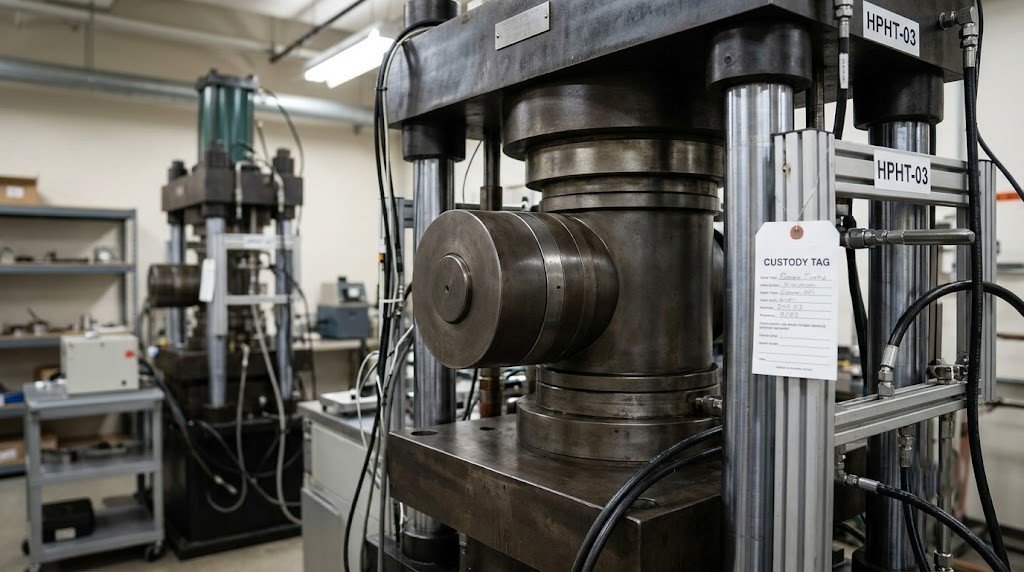
Most memorial diamonds are grown by HPHT, high pressure high temperature.
A press squeezes a small growth cell to roughly 6 to 8 gigapascals at about 1,400 to 2,500°C, conditions like those deep in the Earth’s mantle, and carbon recrystallizes onto a tiny diamond seed.
A smaller number of providers use CVD, chemical vapor deposition.
There the carbon is converted into a carbon bearing gas such as methane, and diamond builds up in thin layers on a seed plate inside a vacuum chamber.
Either route produces a genuine lab grown diamond with the same crystal structure as a mined one.
Growth is the longest stage, measured in weeks to months, and it is where carat size is decided.
Sending more ash does not make a crystal made from sister ashes bigger or quicker. The size your family chooses sets the schedule.
Growth does not always go to plan. A crystal can develop flaws, and a run occasionally has to be repeated.
Before anything is sent, ask what happens if a cycle fails and whether enough of her carbon is held in reserve for a second attempt.
For any diamond made from sister ashes, that answer is worth more than a website’s photography.
How Much of a Stone Made From Sister Ashes Is Actually Her?
A real share, though not the majority.
Industry wide, the personal carbon recovered from ashes typically makes up around 10% to 15% of a finished stone’s mass. Some providers cite figures as low as 3%, and some higher, depending on stone size and how much ash was supplied.
The rest is lab sourced carbon, added because the trace recovered from ash is too small to grow a stone of meaningful size alone.
Once both sit inside the crystal lattice, they are the same element in the same structure. Nobody can point to her atoms under a loupe, and an honest provider will not pretend to.
That is why any claim that the whole stone is her carbon deserves suspicion.
A diamond made from sister ashes is physically, measurably built in part from her own carbon. That is true as it stands and does not need exaggerating to matter.
Ask for the percentage of any stone made from sister ashes in writing, specific to the carat weight you want.
Then set it beside what the evidence for her carbon actually looks like.
Some siblings find the plain figure settles a doubt. Others consider adding a lock of hair, which raises its own unanswered percentage question, covered in the version of this process that combines ashes with hair.
What Do Cutting, Color Treatment and Grading Add?
Cutting turns a rough crystal into the shape you picked: round, oval, cushion, emerald, or another cut the provider offers.
A rough crystal made from sister ashes can look cloudy or oddly shaped beforehand, which is normal.
Some weight is lost as facets are ground, true of every diamond, and polishing then brings out the brilliance.
The result rates 10 on the Mohs hardness scale, so it suits everyday wear.
Color treatment of a stone made from sister ashes happens only if you request it.
Some providers offer post growth irradiation to move a stone toward shades such as red, green or black. It is never a required stage, and if used it should be disclosed on the paperwork.
Grading comes last.
Reputable providers can have a finished stone assessed by an independent gemological laboratory against the cut, color, clarity and carat standards applied to every other diamond.
Across this industry that report is usually optional and billed separately, and memorial stones typically land in the SI2 to VVS clarity range.
Keep one distinction firmly in view: a grading report describes quality and says nothing about whether a stone was made from sister ashes.
Origin is recorded on separate paperwork, usually issued in house by the provider.
What Will You Actually See While You Wait?
Very little in the middle, and that is expected.
For a sibling, the process tends to be visible at its edges and quiet at its center.
- Before anything leaves your hands: a kit, packing instructions, an authorization form and a reference number you can write down.
- On arrival at the lab: confirmation that the sealed container arrived intact, ideally quoting that same reference number.
- During extraction and graphitization: usually nothing, or a short status note.
- During growth: the longest silence. Some providers share a photo of the rough crystal when growth ends; others say nothing until cutting is complete.
- After cutting: photographs or video of the finished stone, sometimes with a chance to approve it before grading or setting.
- At delivery: the stone made from sister ashes, its origin paperwork, and an independent grading report if one was ordered.
Ask each provider which updates it actually sends for a diamond made from sister ashes, and how you reach a person if weeks pass without word.
Because growth is slow, a long gap is not by itself a warning sign.
Which Documents Prove a Stone Was Made From Sister Ashes?
Custody is proven by a paper trail, not by reassurance.
These are the documents worth requesting. Not every provider issues all of them, and names differ.
| Document | Who usually issues it | What it shows | What it cannot show |
|---|---|---|---|
| Signed authorization and order form | You, plus anyone whose consent is required | Who released the ashes and what was ordered | Anything about laboratory handling |
| Intake receipt with reference number | The provider, on arrival | The sealed container arrived and was logged | What happened afterward |
| Stage or custody log | The provider, at each handover | Her material was tracked from stage to stage | The stone’s quality |
| Origin or authenticity certificate | The provider, in house | This stone was grown from the carbon your family submitted | Cut, color, clarity or carat |
| Independent grading report, optional | An outside gemological lab | The stone’s 4Cs, measured independently | Where the carbon came from |
The first three describe the journey. The last two describe the destination.
A sample custody log, with another family’s details removed, is something concrete to ask for.
Ask also whether anything physically links the finished stone to its papers, such as an identifying number.
The origin certificate may be the page a family keeps closest, but it only shows a gem was made from sister ashes when the custody records behind it exist.
Can a Sibling Start the Process for a Diamond Made From Sister Ashes?
Sometimes, though often not alone.
In many states the legal right to direct what happens to remains passes first to a spouse or partner, then adult children, then parents, with siblings further along.
The order differs from state to state, and anything your sister put in writing can change it.
None of that measures who loved her.
So the first practical question is who holds that authority now.
If it is not you, the respectful route is usually a direct, unhurried request to that person: a small portion, measured in tablespoons, for a stone made from sister ashes, with everything else staying where they have decided.
Providers typically require a signed authorization, and some want it from the person with legal authority rather than whoever places the order.
Several siblings may each want something.
Because each diamond made from sister ashes uses only a modest quantity, a family can often order more than one from the same remains. Confirm that with the provider and whoever holds authority.
Half siblings, step siblings and twins may all be part of that conversation, and it need not be settled in one call.
If asking for ashes is not workable, a lock of her hair is another route. Everything about using her hair instead starts with who kept it.
Some families use both, as the complete guide to combining ashes and hair explains.
The calls, forms and packing are set out in order in the practical walk through for turning her ashes into a diamond.
What Decides the Color, Size and Price?
Color comes from trace elements present during growth.
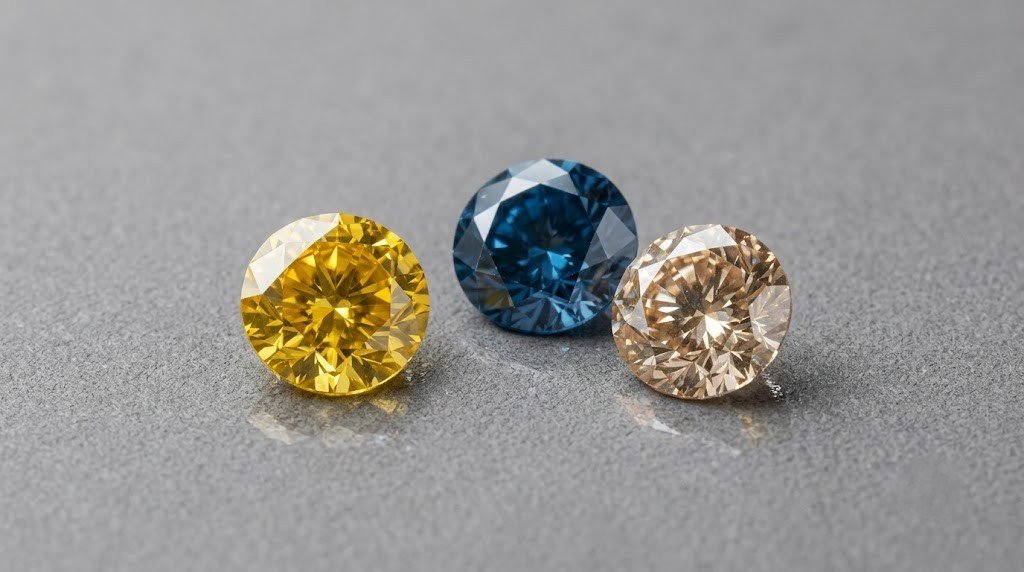
Nitrogen pushes a crystal toward yellow, boron toward blue, and colorless needs both kept out, which takes extra processing and usually costs more.
Because organic carbon carries traces, memorial stones tend toward yellow, blue and champagne.
Nobody can choose, match or predict the final shade of a gem made from sister ashes from the ash itself.
A provider offers a color option and a process, not an exact tone.
Size runs from about 0.10 carats to 5 carats or more, set by time in the press.
Price follows size and color.
These are general 2026 industry ranges, not any one company’s prices:
| Size tier | Approximate carat weight | General price range |
|---|---|---|
| Smaller stones | A tenth to a quarter of a carat | Roughly $1,500 to $3,500 |
| Mid size stones | Half a carat up to a full carat | Roughly $5,000 to $15,000; colorless sits at the upper end |
| Large stones | Two carats to five or more | Roughly $20,000 to $75,000, sometimes beyond |
Independent grading, engraving, fancy cuts and settings are usually priced separately.
When comparing quotes for a diamond made from sister ashes, ask for the full total, including insured return shipping.
Frequently Asked Questions
How long does each stage take when a diamond is made from sister ashes?
Collection, purification, graphitization, cutting and grading each tend to take days or weeks. Growth is the long stage, running weeks to months. Altogether, six to ten months is typical industry wide, and larger or specialty color stones can take up to twelve.
Is her carbon mixed with anyone else’s during the process?
It is typically blended with lab sourced carbon, which is how a usable growth volume is reached.
Whether carbon for a stone made from sister ashes ever shares a batch or growth cell with another family’s varies by provider, so ask directly and get the answer in writing.
Does the laboratory need all of her ashes?
No.
Requirements vary, but providers generally ask for somewhere between a few tablespoons and about 4 ounces, roughly 100 grams.
That is usually a small fraction of the total, leaving the rest for an urn, burial or scattering.
Can I see the diamond before it is finished?
Some providers share a photo of the rough crystal after growth, or images of the cut stone before grading or setting.
Others send nothing until delivery.
Ask which updates a provider sends before you commit, so the quiet months feel less uncertain.
What proves this diamond was made from sister ashes and not another source?
A custody trail: your signed authorization, an intake receipt with a reference number, stage logs, and an in house origin certificate.
An optional independent grading report measures the stone’s quality but does not record where its carbon came from.
Can more than one sibling get a stone made from sister ashes?
Often, yes, because each stone needs only a modest portion.
Confirm it with the provider, and with whoever holds legal authority over her remains, which in many states is a spouse, partner, adult child or parent ahead of a sibling.
Final Thoughts on How Her Ashes Become a Diamond
Knowing the stages does not make any of this ordinary, but it can make the waiting less opaque.
The carbon behind each crystal made from sister ashes is drawn out of the ash, purified, rearranged into graphite, grown slowly, usually beside lab carbon, then cut and checked, mostly out of sight.
What you can hold onto is the paperwork, the questions you asked in writing, and a clear sense of what the finished stone is and is not.
A diamond made from sister ashes is a real diamond carrying a real, honest share of her.
For the wider picture, from cost to settings, the complete guide to a diamond from her ashes gathers it in one place.
Learn More About Sister Memorial Diamonds
- Sister Ashes Diamond: The Complete Guide explains the whole subject in one place.
- How to turn your sister’s ashes into a diamond explains the practical order of calls, forms and shipping.
- Is the stone really made from her ashes? explains the evidence and its limits.
- How a memorial diamond is made from her hair explains the same science starting from a lock of hair.
- How a memorial diamond is made from her ashes and hair explains when both materials are used together.
Talk With Memorial Diamond
If you would like to walk through these stages with a person, including what paperwork you would receive and who needs to sign, Memorial Diamond is available at memorialdiamond.us.
A conversation is simply a way to get questions answered about a stone made from sister ashes. It commits you to nothing.
Leave A Comment