
Questions about a grandmother memorial diamond can arrive all at once and in no particular order. A grandmother memorial diamond is a real lab-grown diamond made partly from carbon recovered from her cremated ashes or her saved hair, and the answers below cover what it is, how much of it is her, what it costs and takes, who decides, what faiths teach and how it compares with an urn.
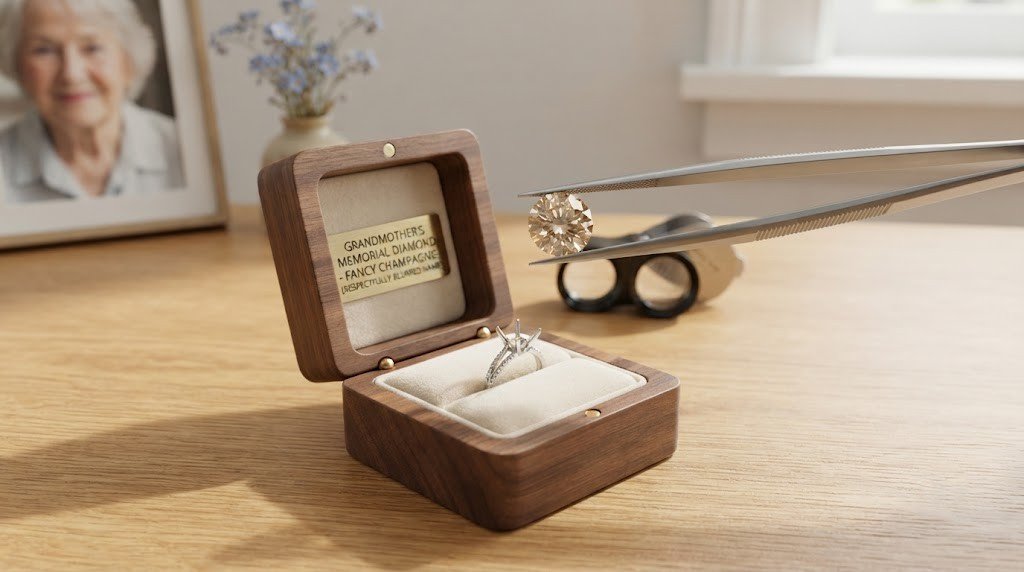
Table of Contents
What is a grandmother memorial diamond, and is it a real diamond?
Yes, it is a real diamond. A grandmother memorial diamond is a lab-grown stone with the same crystal structure, hardness and optical behavior as a mined diamond, grown partly from carbon that once belonged to her. It is not glass, resin or a simulant, and it is graded against the same 4Cs as any other diamond.
Two growth methods can produce a grandmother memorial diamond. High-pressure, high-temperature growth, the standard for memorial stones, places carbon around a small diamond seed at roughly 6–8 GPa and 1,400–2,500°C. Chemical vapor deposition, used by a minority of providers, builds the crystal layer by layer from a carbon-rich gas. The general science behind both is set out in this overview of how synthetic diamonds are grown.
What makes it a memorial rather than any other lab-grown stone is where some of the carbon came from, and the paperwork that traces it. A provider typically issues an origin or authenticity certificate documenting that her material went into this specific stone. That document is about chain of custody, not quality.
How much of the finished stone is actually her?
A real, measurable portion, but not all of it. Supplemental lab carbon is typically added so a stone of useful size can grow, and how large her share is depends on whether ashes or hair were used.
For ashes, the industry figures are fairly well known. Cremated remains are mostly calcium phosphate, the mineral part of bone, and only about 0.5–4% of ash by weight is usable carbon. Once purified, carbon drawn from her ash typically accounts for something like 10–15% of what the finished stone weighs; a few providers quote nearer 3%, and others quote more.
For hair, the picture is different. Hair is about 50% carbon by weight because it is made of keratin, which is why so little is needed. What nobody publishes is the share of the final stone that her hair carbon represents, and the same gap applies to stones blending hair with ash. Request that number, for your specific material, in writing from each provider you contact.
Any claim that a grandmother memorial diamond is made purely and entirely from her should be treated with caution. The honest version is still remarkable: some of the carbon in that crystal was hers. The guide to whether a stone is really made from your grandmother’s ashes examines that question closely.
How is a grandmother memorial diamond made?
It is made in a sequence of laboratory stages that turn her carbon into graphite and then into diamond. Each provider runs these differently, but the industry-typical outline is consistent.
- Her ashes or hair arrive and are logged so they can be tracked throughout.
- Carbon is separated from everything else in an oxygen-free, multi-stage heating process and purified to roughly 99.9% or higher.
- The purified carbon is heated further, to around 2,500–2,700°C, and converted into graphite.
- That graphite, typically blended with supplemental lab carbon, goes into a growth cell with a diamond seed and grows over a period of weeks to months.
- A cutter shapes and polishes the rough crystal.
- Some providers offer optional post-growth color treatment.
- The stone is graded, ideally by an independent lab, and an origin certificate is typically issued.
The overall timeline is covered in its own section below; individual stages vary by provider and are worth asking about directly. For a fuller walk-through, the explanation of how a memorial diamond is made from her ashes and hair goes stage by stage.
How much ash or hair does a provider need?
Typically a small amount of either. For ashes, requests across the industry run from a few tablespoons up to about 4 oz, or roughly 100 grams. For hair, a small lock or a few grams is usually enough, because hair holds far more carbon per gram than ash.
Since only a portion is used, the rest of her ashes can remain in the urn, be scattered or be interred as planned. More material does not make a bigger stone; growth time sets the carat. Several stones can often come from one source, which matters when more than one grandchild hopes for a grandmother memorial diamond.
Whether gray, white, dyed, permed or thinning hair suits a given process, and the exact minimum needed, are provider questions with provider-specific answers. Ask what happens to any material not used, and whether it can be returned, before sending anything.
What color will a grandmother memorial diamond be?
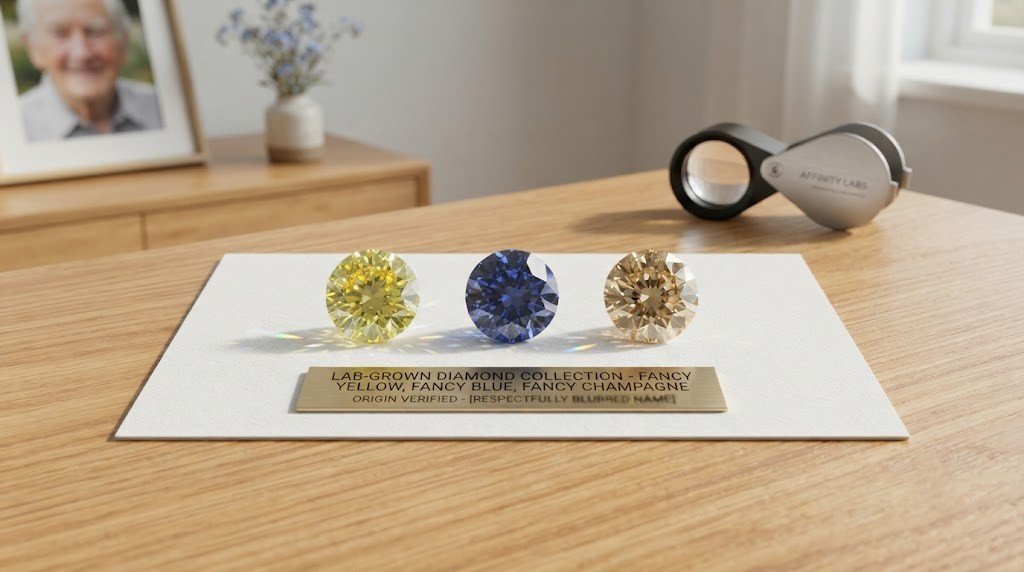
A grandmother memorial diamond commonly trends toward yellow, blue or champagne, though no one can predict the exact shade from her ashes or hair. Color in any diamond comes from trace elements present while the crystal grows.
Nitrogen produces yellow, boron produces blue, and a colorless stone requires neither, so colorless generally costs more. Some providers also offer optional treatment after growth that can produce red, pink, green or black stones.
There is no reliable link between the material and the result: gray hair does not promise a paler stone, and ash does not promise a darker one. Treat color as a choice to discuss with the provider, not a trait inherited from her. The guide to memorial diamond colors for a grandmother explains the options and what drives price.
How much does a grandmother memorial diamond cost?
Industry prices in 2026 run from about $1,500 for the smallest stones to $75,000 or more for the largest. Size, color and cut drive most of the difference, and colorless costs more than blue, yellow or champagne at the same size.
| Tier | Typical size | Typical 2026 price range |
|---|---|---|
| Entry | About 0.10–0.25 ct | About 1,500–3,500 |
| Mid | 0.5–1 ct | About 5,000–15,000, higher for colorless |
| Large | 2–5+ ct | About 20,000–75,000 or more |
These are industry ranges, not quotes. A setting, engraving, a fancy cut and an independent grading report are usually priced separately, so ask what a quote includes and what it leaves out. When siblings or cousins share the cost of a grandmother memorial diamond, agree in writing who pays for what. The breakdown of what a grandmother memorial diamond costs goes tier by tier.
How long does the process take from start to finish?
Typically 6–10 months from the time the provider receives her material to a finished stone. Larger stones of around 2 carats and up, and specialty colors, can take up to roughly 12 months.
Size is the main reason. A bigger crystal needs longer in the growth cell, and carat is decided by growth time rather than by how much ash or hair was sent. Growth itself takes weeks to months within that overall span.
If you are hoping to have a grandmother memorial diamond ready for an anniversary or a family gathering, tell the provider early and ask what they can realistically say about timing. The guide to how long a grandmother memorial diamond takes covers what shapes the schedule.
Who decides what happens to her ashes?
That answer changes from state to state, and any written wishes she left can shift it further; no one national rule applies. In a common pattern, a surviving spouse or partner, where there is one, ranks first, then her adult children, then grandchildren, though a named agent or a written instruction can rearrange that.
If you are a grandchild hoping for a grandmother memorial diamond, the considerate step is to ask the person holding that authority whether a small portion could be set aside. Because providers typically request somewhere between a few tablespoons and about 4 oz, the request concerns a portion rather than the whole urn. If the answer is no, or the ashes are not available, hair may be another route.
If you are her son or daughter, you may be the person who holds that authority, alone or with siblings, and a grandchild’s request may come to you. Step-, adopted and chosen grandchildren are in the same position as any other grandchild here: ask openly. A funeral director or estate attorney can explain how the order works where she died.
Can several grandchildren each have a stone?
Often, yes. Each stone uses only part of the material, so one urn of ashes or one lock of hair can frequently supply more than one grandmother memorial diamond.
A few practical points help when several people are involved:
- Choose one person to be the provider’s single contact.
- Ask how many stones the material can support before promising anyone a stone.
- Agree how costs are split, and whether each stone is ordered separately.
- Let each person choose size and color for their own stone.
- Make room for relatives who would rather not take part.
Stones grown from the same source will not necessarily match in color, even if ordered together. The guide to sharing a grandmother memorial diamond among family covers coordination in more depth.
What if she was buried, or only her hair was kept?
Hair is the route to a grandmother memorial diamond when there are no ashes. Hair needs no cremation, so a grandmother memorial diamond can still be considered when a lock was saved before a burial or tucked into a card or locket.
Hair kept at home is usually simpler in practice, because the rules about remains are aimed at the remains themselves. Still, personal belongings may count as part of her estate, state rules differ, and if an aunt, a parent or anyone else is keeping the hair, the next step is talking with them, not acting on your own.
Ask the provider whether the hair you have is suitable, including hair gathered from a brush or kept for many years, how much they need and how they document its origin. The grandmother hair diamond complete guide follows this route from beginning to end.
Can you decide on a stone years after she died?
Yes. Nothing on the family’s side sets a deadline for choosing a grandmother memorial diamond. Whether ashes or hair kept for many years still suit a provider’s process, and how the material should be stored in the meantime, are questions to put to that provider in writing.
Some people come to the idea at a later milestone, such as a wedding, a birth or the moment an urn passes from one relative to another. Waiting also gives everyone time to talk it through. If the material has been stored somewhere unusual, or has been handled or mixed with anything, mention that to the provider and ask whether it affects their process.
What do different faiths say about a grandmother memorial diamond?
No religious tradition has an official position on memorial diamonds specifically. What exists is teaching on cremation and on how ashes are kept, and those teachings differ by tradition, by movement and by clergy. Your own faith leader is the right person to ask.
- Catholic: Current guidance from the Vatican’s Dicastery for the Doctrine of the Faith allows cremation, but its instruction is that cremated remains stay undivided in a consecrated, Church-approved resting place instead of being split among relatives or kept in a private home; it makes a narrow exception for a minimal part in specific circumstances. That allowance is directly relevant to setting aside ash, so speak with your parish.
- Jewish: Views divide by movement. Orthodox and Conservative Judaism generally prohibit cremation, and cremated remains are typically not accepted for burial in Orthodox cemeteries; Reform Judaism has no explicit prohibition and leaves the choice to rabbis and families. Because the objection concerns cremation, a stone grown from hair sits outside it.
- Islam: Cremation itself is considered impermissible across the major schools of Islamic thought in ordinary circumstances. A stone grown from her hair involves no cremation, so it sits outside that objection; a local imam can advise on anything further.
- Hindu: Cremation is the traditional rite, usually followed by immersing the ashes in a sacred river. Keeping a small portion for a keepsake or a stone is described as increasingly common, but practice varies by family, region and community.
- Buddhist: Cremation is predominant in most Buddhist traditions, and there is a long relic tradition of keeping teachers’ remains. Teachers differ on whether a memorial stone reads as mindful remembrance or as attachment, so it remains an open question for your community.
- Protestant and evangelical: Scripture mandates no method of disposition, and mainline clergy generally raise no objection. Some conservative congregations have concerns about dividing or scattering ashes in light of belief in bodily resurrection, so ask your pastor.
- Secular: With no mandated practice, a grandmother memorial diamond is simply a personal or family choice, guided by what she wanted and what feels right to those who loved her.
What jewelry can hold a grandmother memorial diamond?
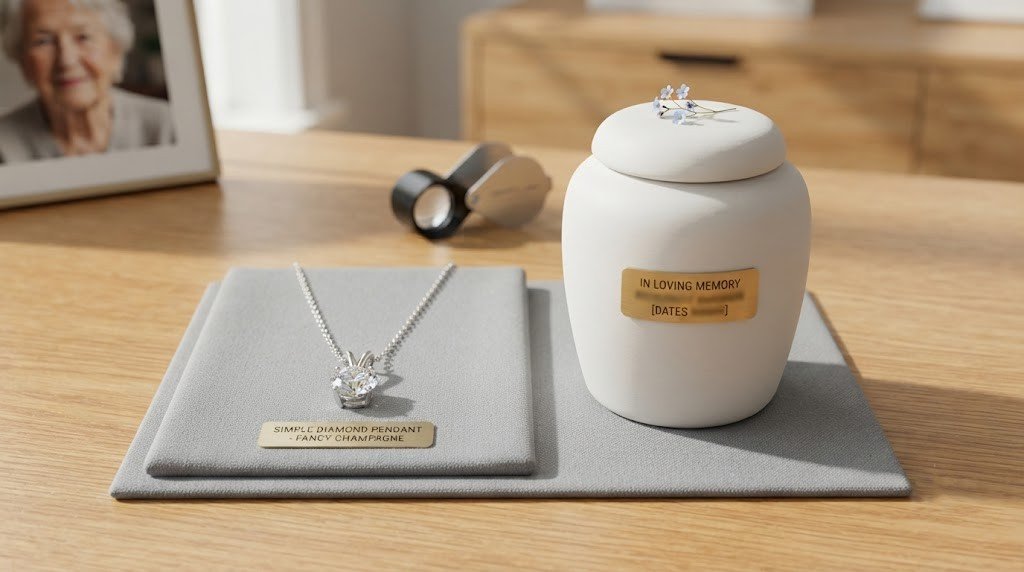
Almost any setting that holds a lab-grown diamond can hold a grandmother memorial diamond. Pendants, rings, earrings, bracelets, brooches and cufflinks are all possible, and some people keep the stone loose in a small case.
Let the wearer, not convention, shape the piece. A grandson might choose a ring, a granddaughter a tie pin, a son a pendant, and every one of those is fitting. Diamond tops the Mohs scale of mineral hardness at 10, ahead of every other natural mineral, but a hard blow at the wrong angle can still chip one, so a bezel or other guarded setting suits a stone worn daily.
Clarity in memorial stones typically falls between SI2 and VVS. An independent grading report, commonly following GIA’s diamond quality factors and sometimes issued by IGI, describes cut, color, clarity and carat, and is separate from the origin certificate. Engraving and settings are usually priced on top of the stone.
How does a grandmother memorial diamond compare with an urn?
They do different things, and some families keep both. An urn holds all of her ashes in one place; a grandmother memorial diamond holds a small portion of her carbon in something that can be worn or carried.
| Question | Urn | Memorial diamond |
|---|---|---|
| How much of her ashes it holds | All, or whatever the family keeps | Only a small portion is used |
| Can several people each have one? | Possible with keepsake urns | Several stones can often come from one source |
| Works without cremation? | No | Yes, if hair was kept |
| Typical cost | Varies widely | About $1,500 to $75,000 or more |
Neither is better. An urn on a shelf, a grave, a scattering place and a stone in a ring are each a full way to remember her. The comparison of a grandmother memorial diamond and a traditional urn looks at the choice in more detail, including how some people keep both side by side.
Frequently Asked Questions
Can her name or a date be engraved on the stone or setting?
Engraving is a common add-on and is usually priced separately from the stone. What can be engraved, where, and in how many characters depends on the provider and the setting, so ask for examples and confirm the wording in writing before work begins.
Does the stone come with proof of where it came from?
Providers typically issue an origin or authenticity certificate documenting that her material was used in that stone. Ask how her ashes or hair are tracked from arrival to finished diamond, and whether an independent grading report is included or costs extra.
Is it strange to wear a stone made partly from her ashes?
It is a personal question with no right answer. Some people find comfort in carrying something tangible, while others prefer a grave or an urn. If it feels right to you and the family is comfortable, it is a respectful way to remember her.
Can I insure a memorial diamond?
That is a question for an insurance agent, who can explain what a policy covers and what documents it needs. Keeping the origin certificate, any grading report and the purchase receipt together will make that conversation easier.
What if I am not sure she would have wanted one?
Think about what she said and how she lived, and ask relatives who knew her wishes. If no one can say, a smaller stone, a hair-based stone or simply waiting are all reasonable. Uncertainty is a fair reason to pause.
Can the stone be passed down to future generations?
Yes. A diamond is durable enough to be handed down, and the origin certificate can travel with it so later generations know it was grown partly from her carbon. Writing a short note about her to keep with the certificate can add meaning for whoever inherits it.
Final Thoughts on Grandmother Memorial Diamonds
Questions are a sign of care, not hesitation. You may find that some of these answers settle things quickly and others open a longer family conversation, and both are fine. Whatever you decide, whether a stone, an urn, a grave or something else, the point is that she is remembered in a way that fits her and the people who loved her.
Learn More About Grandmother Memorial Diamonds
- Choosing a memorial diamond for your grandmother the first decisions, in order
- How much ash a grandmother memorial diamond needs quantities in more detail
- How to talk to family about a grandmother memorial diamond wording for hard conversations
- Settings and jewelry ideas for a grandmother rings, pendants and more
- Grandmother ashes and hair diamond complete guide using both materials together
Talk With Memorial Diamond
If a question here is still open for you, the team at Memorial Diamond is happy to talk it through, whether you are early in the decision or simply curious. Ask anything, take whatever time you need, and decide only when it feels right.
Leave A Comment