Grandmother Memorial Diamond vs. Traditional Urn What to Know

Grandmother Memorial Diamond vs. Traditional Urn: What to Know

Deciding where her ashes rest can feel like a weight you did not expect to carry. Weighing a grandmother memorial diamond vs urn is not really a contest: an urn keeps every bit of her ashes together, whereas a memorial diamond grows a gem using carbon drawn from a little of them. Neither is the better choice, and a family can choose both, since most of her ashes can stay in the urn.
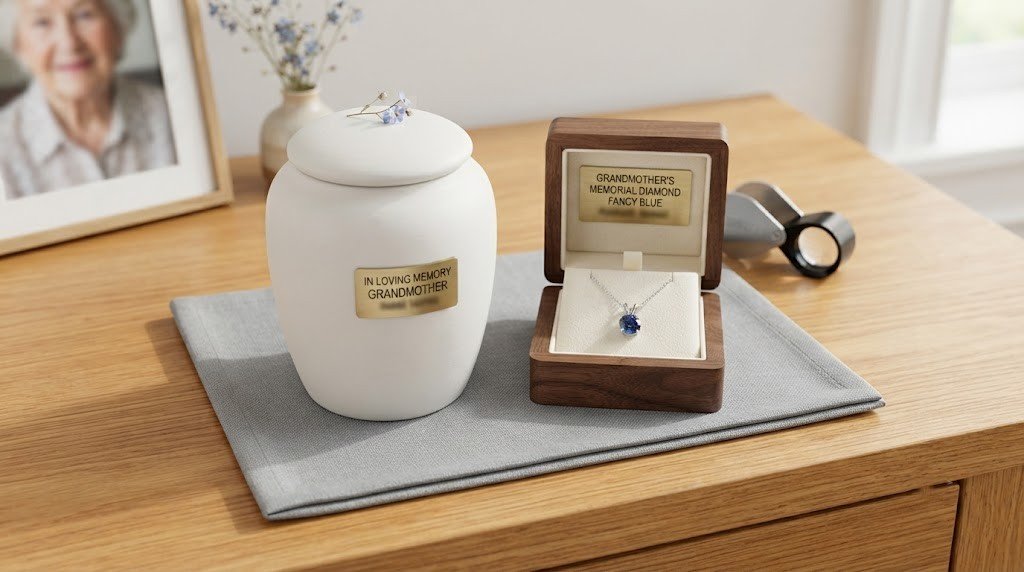
grandmother memorial diamond vs urn

What Is the Difference Between a Memorial Diamond and an Urn?

An urn is a container that holds cremated remains as they are, and a memorial diamond is a gemstone grown in a lab using carbon taken from a portion of those remains. Both are ways of keeping her close. They simply do it in very different forms.

A traditional urn can be made of metal, wood, stone, ceramic or a biodegradable material, and it may sit at home, in a columbarium niche or in a cemetery plot. It keeps her ashes together and unchanged. Nothing is extracted, and nothing is added.

A memorial diamond is a real diamond, grown under heat and pressure around a small seed. Carbon is extracted from a portion of her ashes, purified and typically blended with supplemental lab carbon. Where the source is ash, the share of the finished stone that is her carbon is usually in the region of 10–15% by mass, though some providers quote figures nearer 3% and others quote more. If you are comparing a grandmother memorial diamond vs urn for the first time, that matters: the stone is made in part from her, not entirely.

So the grandmother memorial diamond vs urn choice is less about which honors her more and more about form: a vessel that keeps everything together, or a small, wearable stone that keeps part of her carbon in a different shape. The grandmother ashes diamond complete guide explains each stage of how that stone is made.

How Do a Memorial Diamond and an Urn Compare Side by Side?

They differ on almost every practical point, which is why a table helps. Each row below is a factor to weigh, not a score, and the grandmother memorial diamond vs urn comparison shifts depending on which rows matter most to your family.

FactorTraditional urnMemorial diamond
What it holdsHer cremated remains, unchangedA lab-grown diamond made with carbon from a portion of her ashes, typically blended with lab carbon
How much of the ashesAll of them, or whatever portion the family places in itTypically a few tablespoons up to roughly 4 oz per order
WearabilityNot worn; a keepsake urn or pendant urn is the closest equivalentCan be set in a ring, pendant or other piece and worn
PortabilityStays in one place; travel with remains has its own rulesSmall enough to carry anywhere you go
CostWide range, set by material and craftsmanshipFrom about $1,500 for a small stone to $75,000+ for a large one; setting extra
TimelineCan usually be chosen and filled soon after cremationTypically 6–10 months, up to about 12 for larger or specialty stones
Who can have oneUsually one primary urn; keepsake urns let several relatives keep a littleSeveral stones can often come from one source, so several relatives may each have one
Over generationsMay stay at home, move to a niche or be buriedCan be passed down as jewelry, ideally with its paperwork

Seen together, the grandmother memorial diamond vs urn comparison is not about one replacing the other. An urn keeps her ashes intact, and a stone carries a small part of her carbon into everyday life.

How Much of Her Ashes Does Each Option Use?

An urn can hold all of her ashes, and a memorial diamond typically uses only a small portion. That difference is what turns a grandmother memorial diamond vs urn question from an either-or into something more flexible.

Ash is mainly bone mineral (calcium phosphate), and only about 0.5–4% of its weight is carbon that can be recovered. Even so, providers typically ask for somewhere from a few tablespoons up to around 4 oz, about 100 g, for an order. The rest can stay in her urn exactly as it was.

Carat size comes from how long the stone grows, not from how much ash is sent, so sending more ash does not make a bigger diamond. Exact amounts differ by provider, and our guide to how much ash a grandmother memorial diamond needs explains the typical ranges and what to ask.

How Do the Costs Compare?

An urn’s price depends on its material and maker and varies widely, while a memorial diamond’s price depends mainly on carat and color. On cost alone, how a grandmother memorial diamond vs urn comparison comes out depends on the particular urn, but even the smallest stones typically start at around $1,500.

For the diamond side of a grandmother memorial diamond vs urn budget, typical 2026 industry ranges are:

  • Around 0.10–0.25 carats: about 1,500–3,500
  • Around 0.5–1 carat: about 5,000–15,000, with colorless stones costing more
  • Around 2–5 carats and above: about 20,000–75,000 or more
  • Settings, engraving, fancy cuts and independent grading: usually priced separately

For an urn, a funeral home or an independent urn maker can show you options across a range of materials and prices. A family might pair a modest urn with a small stone, or choose only one of the two. The grandmother memorial diamond cost breakdown goes tier by tier if you are working out a budget.

How Long Does Each Option Take?
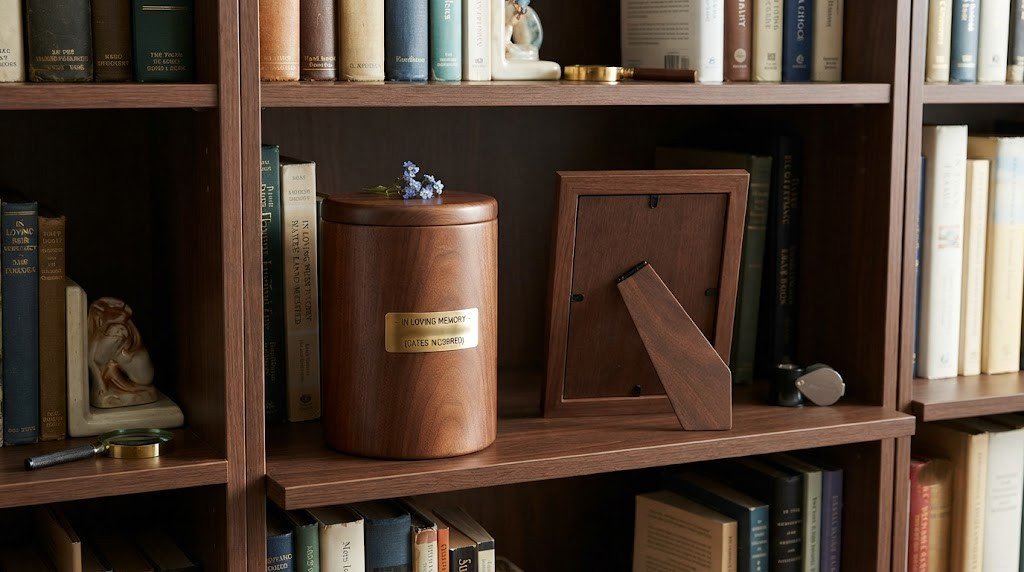
An urn can usually be chosen and filled soon after cremation. A memorial diamond is slower: when a family is weighing a grandmother memorial diamond vs urn with a date in mind, it helps to know a stone typically takes 6–10 months from the provider receiving the ashes to a finished stone. Larger stones of roughly 2 carats or more, and specialty colors, can take up to about 12 months.

In a grandmother memorial diamond vs urn comparison, that gap matters most if a service is coming up. Her ashes can rest in an urn for the service and for as long as the family wants, and a small portion can be set aside for a stone whenever the family is ready. There is no deadline for deciding on a diamond.

Growth itself takes weeks to months, and extraction, purification, cutting and polishing add to that. Our post on how long a grandmother memorial diamond takes explains why the timeline varies.

Which Is Easier to Wear, Carry or Keep at Home?

A memorial diamond is the easier one to wear and carry, and an urn is the one that keeps her ashes in a single place. Which of those matters more is personal, and the grandmother memorial diamond vs urn question often turns on it.

A diamond rates 10 on the Mohs scale of mineral hardness, the hardest natural mineral, so it stands up well to daily wear. A hard knock can still chip it, so a protective setting helps for a stone worn every day. It can go to work, travel with you and sit on a hand or at the collarbone.

An urn stays where you place it, whether that is a shelf, a niche or a grave. For some people that steadiness is exactly the point: a place to visit and a place she rests. In a grandmother memorial diamond vs urn comparison, neither kind of closeness outranks the other. If the family wants something wearable but is still unsure about a grandmother memorial diamond vs urn, a small pendant urn that holds a pinch of ashes sits somewhere between the two. For wearable ideas, see grandmother memorial diamond ideas for rings, pendants and keepsakes.

What Happens to Each Over the Generations?

Both can be handed down, though in different ways, so it is worth thinking about the next generation while weighing a grandmother memorial diamond vs urn. An urn may stay in a relative’s home for years, later move to a columbarium or be buried, and its future usually depends on who takes care of it next.

A memorial diamond can pass from one relative to another as a piece of jewelry. Keeping its in-house authenticity certificate, which records where the carbon came from, and any optional independent grading report together with the stone helps later generations know what it is. A short written note about her can travel with it as well.

Over time, one practical difference in a grandmother memorial diamond vs urn choice is who looks after each one. A family can decide early who will care for the urn and who will keep a stone, so neither is left without a plan. Questions about insuring a stone are best taken to an insurance agent.

Can Your Family Choose Both?

Yes. Because a diamond typically uses only a portion of her ashes, most of them can stay in the urn, be interred or be scattered, as the family planned.

Choosing both can ease the grandmother memorial diamond vs urn decision for relatives who want different things. One person may want a place to visit, and another may want something to wear. In that case, the urn keeps her ashes together in one place while a small portion becomes one stone, or several.

Before a portion is removed, check with whoever holds authority over her remains. Who that is differs from state to state; no one national rule applies.

Where she left a spouse or partner, that person and her adult children commonly rank ahead of grandchildren, unless written wishes she left say otherwise. As a grandchild, the gentle route is simply to ask that person whether a little could be set aside. If several relatives would each like a stone, our guide on whether more than one family member can get a diamond from her ashes covers how that works.

How Does Faith Shape a Grandmother Memorial Diamond vs Urn Decision?

No tradition has an official position on memorial diamonds specifically; religious guidance speaks to cremation and how ashes are kept. That makes faith an important part of the grandmother memorial diamond vs urn decision for families where it matters, and your own clergy is the right person to ask.

  • Catholic: The Church allows cremation, but its 2016 instruction from the Dicastery for the Doctrine of the Faith, clarified in 2023, asks that ashes stay together in a sacred place approved by the Church instead of being split up or kept in a home; a minimal part may be set aside only under narrow conditions. For Catholic families weighing a grandmother memorial diamond vs urn, an urn in a consecrated place fits that guidance most directly, and a priest can speak to the rest.
  • Islam: Cremation itself is considered impermissible across the major schools in ordinary circumstances. A hair-based stone involves no cremation, so it sits outside that objection.
  • Judaism: Orthodox and Conservative Judaism generally prohibit cremation, while Reform Judaism is more permissive and leaves the decision to rabbis and families. A hair-based stone again sits outside a cremation-specific concern.
  • Hindu: Cremation is the traditional rite, with ashes customarily immersed in a sacred river; setting aside a small amount to keep is reported to be more common now, but practice differs between families, regions and communities.
  • Buddhist: Cremation is predominant, and views on a keepsake differ by teacher and community.
  • Protestant: Generally treated as a personal choice, though some congregations have views on dividing ashes.

If faith or a burial rules her ashes out, the grandmother memorial diamond vs urn question may shift toward saved hair instead. Hair is roughly 50% carbon and needs no cremation; whether gray, white or thinning hair is accepted is a question for the provider.

If the hair is in your own keeping, that route tends to be simpler in practice than one involving ashes; still, her belongings may count toward her estate, state rules differ, and hair kept by another relative calls for a conversation with them first. The grandmother hair diamond complete guide explains that route.

What Other Options Sit Alongside These Two?

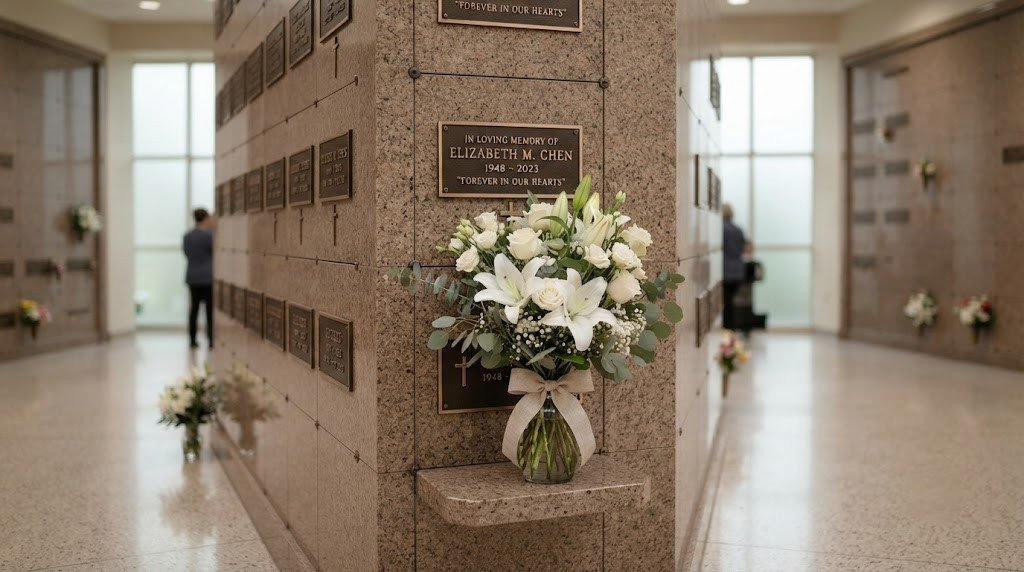
A diamond and an urn are two of several ways to care for her ashes, and each of the others is just as valid. Looking beyond the grandmother memorial diamond vs urn choice can open up combinations the family had not considered. According to the NFDA’s 2025 cremation and burial report, the projected US cremation rate is 63.4%, against 31.6% for burial, so questions about where ashes go come up for a large share of families.

Other choices include:

  1. Scattering in a place that mattered to her, following local rules
  2. Burial of an urn in a cemetery plot or family grave
  3. A columbarium niche, often in a cemetery or place of worship
  4. Keepsake urns, small vessels that let several relatives each keep a little
  5. Pendant urns, jewelry with a sealed chamber for a pinch of ashes

These can be combined with each other and with a diamond, and scattering or burying part of her ashes does not prevent a family from also keeping an urn or a stone. The grandmother memorial diamond vs urn decision rarely has to exclude everything else.
Which Questions Help You Decide on a Grandmother Memorial Diamond vs Urn?

Start with what the family wants to do with her memory day to day, then work outward to practical limits. These questions can make a grandmother memorial diamond vs urn conversation clearer:

  1. Do we want one place to visit, something to wear, or both?
  2. Who holds authority over her ashes, and what did she want, if she said?
  3. Does anyone’s faith shape how her ashes should be kept?
  4. What budget is realistic, and who would contribute?
  5. Would more than one relative want a stone?
  6. How much of her ashes are we willing to set aside, if any?
  7. Is there saved hair, if ashes are not an option?

Whichever way the grandmother memorial diamond vs urn decision leans, ask any provider in writing how much ash they need, what happens to ashes they do not use, and what paperwork comes with the stone.

Frequently Asked Questions

Is a diamond made from her ashes more respectful than keeping them in an urn?

In a grandmother memorial diamond vs urn decision, neither is more respectful. An urn keeps her ashes intact in one place, and a diamond turns a small portion into a wearable stone. Both are sincere ways to remember her, and the right one depends on your family’s wishes and beliefs.

Will there still be ashes left for an urn after a diamond is made?

Usually, yes. Whatever a family decides about a grandmother memorial diamond vs urn, a provider typically asks for a few tablespoons up to around 4 oz of ashes, which is a small part of the total. The remaining ashes can stay in her urn, be interred or be scattered.

Can ashes already placed in an urn or niche be used later?

Possibly, if they can be reached and whoever holds authority over her remains agrees. Opening a sealed urn or niche can involve the cemetery or funeral home, so ask them first, then ask the provider how much ash they need.

Does a memorial diamond replace the need for a final resting place?

Not necessarily. Because a stone uses only part of her ashes, a grandmother memorial diamond vs urn choice is rarely all-or-nothing, and the rest of her ashes still need a home, whether that is an urn, a niche, burial or scattering. A resting place also gives relatives somewhere to visit.

What if part of the family prefers an urn and part prefers a diamond?

When relatives disagree about a grandmother memorial diamond vs urn, choosing both is often possible, since the diamond uses only a portion. Whoever holds authority over her remains under state rules generally decides about the ashes, and hearing each relative’s reasons can help.

Is a keepsake urn a lower-cost way to share her ashes?

It can be. Keepsake urns are small vessels that let several relatives each hold a little of her ashes. Their prices vary by material and maker, so compare them with a funeral home or urn maker against the typical $1,500 starting point for a small stone.

Final Thoughts on Choosing Between a Diamond and an Urn

There is no wrong answer to a grandmother memorial diamond vs urn decision, only the one that fits the people who loved her. An urn can give the family a place to return to, a stone can give someone a way to carry her into ordinary days, and there is room for both. Take the time you need, and let the conversation include everyone who wants a say.

Learn More About Grandmother Memorial Diamonds

Talk With Memorial Diamond

If you are still weighing a grandmother memorial diamond vs urn, or wondering about both, you are welcome to ask us anything, with no expectation that you will order. You can reach us through memorialdiamond.us whenever your family is ready to talk it through.
How Long Does It Take to Make a Grandmother Memorial Diamond

How Long Does It Take to Make a Grandmother Memorial Diamond?

Once you have settled on turning part of your grandmother’s ashes or hair into a diamond, the waiting becomes its own question. A grandmother memorial diamond timeline typically runs 6 to 10 months from the day a provider receives her material, and larger stones of roughly 2 carats and up, or specialty colors, can stretch toward 12 months. The size you choose, far more than how much material you send, is what shapes that wait.

How Long Does a Grandmother Memorial Diamond Timeline Usually Run?

Across the industry, a grandmother memorial diamond timeline usually falls between 6 and 10 months, counted from when the provider has her ashes or hair in hand. Stones of about 2 carats or more, and specialty colors, can take up to around 12 months.

That range is an industry-typical figure, not a promise from any one company. Every provider sets its own schedule, so the grandmother memorial diamond timeline that matters for your family is the one a specific provider is willing to put in writing for the exact stone you want.

It also helps to know what the clock does and does not include. The time you spend talking with relatives, deciding who holds authority over her remains, and comparing providers comes before any grandmother memorial diamond timeline begins. Work done after the stone is finished, such as mounting it in a ring or pendant, may or may not be counted inside a quoted schedule, which is why it is worth asking.

Why Does Growth Time, Not the Amount of Ash or Hair, Set the Wait?

The short answer is that a diamond’s size comes from how long it grows, not from how much starting material arrives. A larger carat means a longer stretch in the growth press, and that single choice moves the overall grandmother memorial diamond timeline more than anything else.

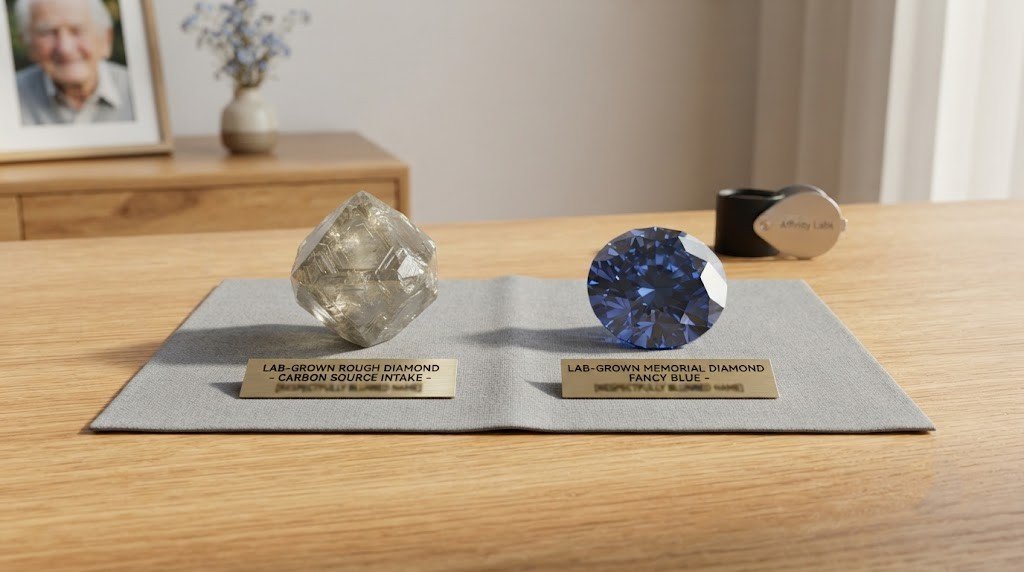
This surprises people, because it feels intuitive that a full urn would shorten the grandmother memorial diamond timeline or yield a bigger stone. It does not work that way. Ashes are mostly calcium phosphate, the mineral of bone, and usable carbon in ash is only around 0.5% to 4% by weight. Hair is roughly 50% carbon, because it is built from keratin. In both cases the personal carbon is purified, and supplemental lab carbon is typically blended in so there is enough to grow a stone of meaningful size.

For ashes, the personal carbon usually makes up around 10–15% of the finished stone’s mass, though some providers cite figures as low as about 3% and others cite more. No comparable published figure exists for hair or for a blend of ash and hair, so that is a question to ask a provider in writing. What stays true either way is that a real, traceable portion of her own carbon becomes part of the crystal.

Most memorial stones are grown with HPHT, the industry-standard method, which recreates roughly 6–8 GPa of pressure and temperatures of about 1,400–2,500°C around a small diamond seed. A minority of providers use CVD instead. The overview of how synthetic diamonds are grown explains both methods if you want the science behind the press.

Because carats are typically offered from about 0.10 up to 5 or more, the size you pick is really a decision about time as much as about appearance. If a small stone feels right, your grandmother memorial diamond timeline may sit nearer the shorter end of the range. If you want something larger, you are choosing a longer grandmother memorial diamond timeline along with it, and it is fair to ask a provider how much longer in writing.

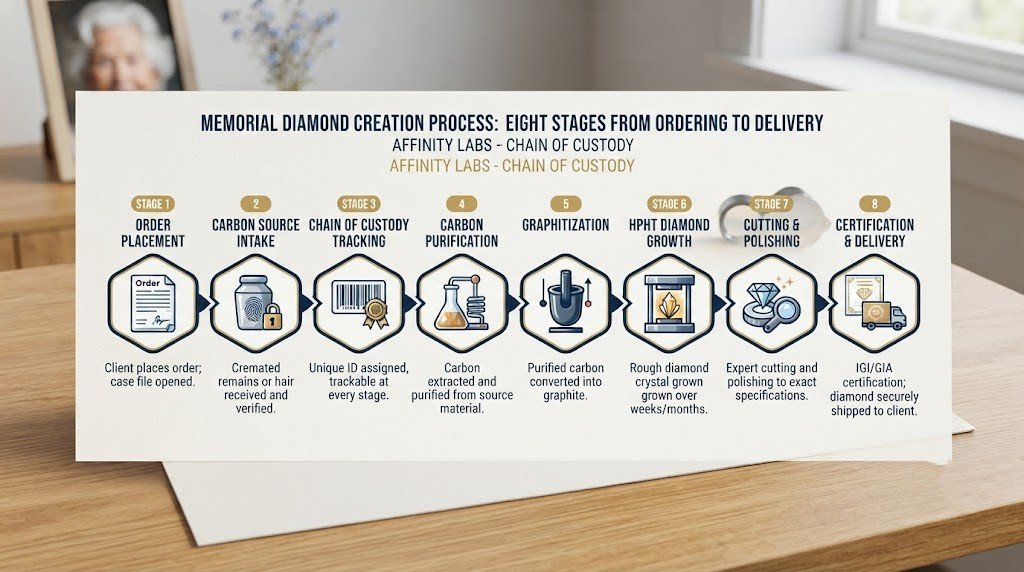
What Are the 8 Stages of a Grandmother Memorial Diamond Timeline?

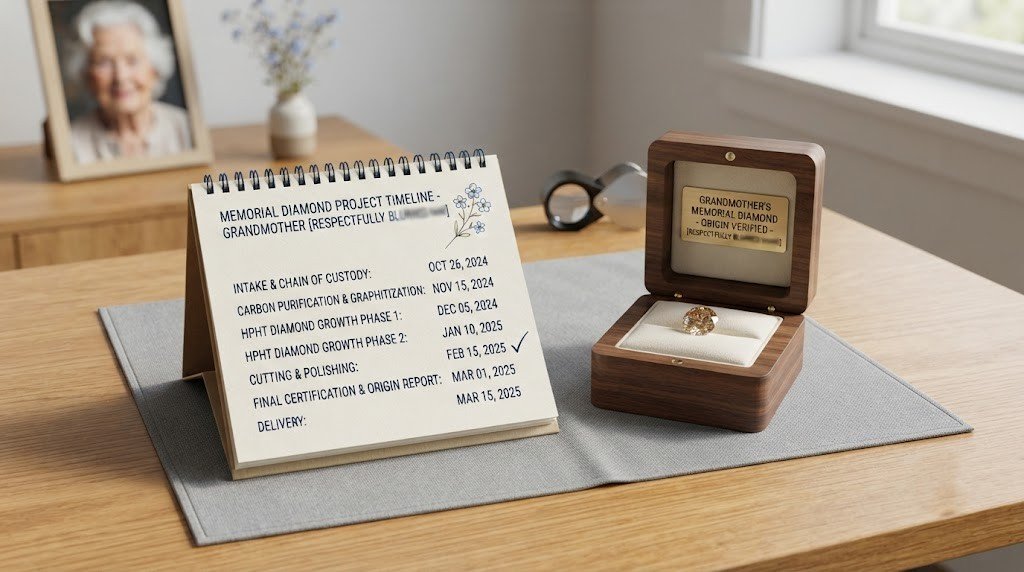
A grandmother memorial diamond timeline moves through eight broad stages, from your first decisions to the finished piece in your hands. Providers describe and group these differently, and none of the stages below comes with a fixed duration, apart from growth, which typically takes weeks to months.

StageWhat happensWhat you decide
1. Order and choicesYou choose a provider and confirm the stone’s specificationsCarat, color goal, cut, and whether you want grading or a setting
2. Sending and loggingHer ashes or hair travel to the provider and are recorded on arrivalHow the material is packed and sent, using the provider’s instructions
3. Extraction and purificationCarbon is separated from everything else and purified to roughly 99.9% or higherUsually nothing; ask what records you will receive
4. GraphitizationPurified carbon is heated to about 2,500–2,700°C and turned into graphiteUsually nothing at this point
5. GrowthGraphite carbon, typically blended with lab carbon, grows into a rough diamond around a seedSize was set at the order; growth takes weeks to months
6. Cutting and polishingA cutter shapes the rough crystal into the chosen cutCut shape, if not already fixed
7. Optional finishingIrradiation for some colors, where a provider offers it; optional independent gradingWhether to add either
8. Setting and deliveryThe stone is mounted, if you asked for it, and sent with its paperworkMetal, setting style, engraving

Two documents can come out of the final stages, and they are different things. An authenticity or origin certificate, usually issued in-house, records the chain of custody that ties the stone to her material. A grading report, ideally from an independent lab working to standards such as the GIA’s 4Cs of diamond quality, describes the stone’s own cut, color, clarity and carat. Memorial stones typically grade somewhere between SI2 and VVS for clarity.

If you are curious about what each stage involves in more detail, the walkthrough of how a memorial diamond is made from your grandmother’s ashes follows the material through the lab step by step.

grandmother memorial diamond timeline

What Can You Do Before Sending Her Ashes or Hair?

Before a single gram of ash or a lock of hair leaves your home, there is room to move at your own pace. None of this is on the provider’s clock: the grandmother memorial diamond timeline only starts once her material arrives, so the weeks or months you spend preparing do not need to be rushed.

A few things are worth doing in this quieter stretch:

  • Talk with the people who loved her. A parent, aunt, uncle, cousin or sibling may feel strongly about her remains. Starting those conversations early gives everyone room to respond, and the guide on talking with relatives about a grandmother memorial diamond offers ways to open them gently.
  • Work out who holds authority over her ashes. The answer depends on the state, with no one rule nationwide. Where there is a surviving spouse or partner, they and her adult children commonly rank ahead of grandchildren, though any written wishes she left can change that order.
  • Look at hair as another route. If her ashes are held by someone else, or she was buried, hair needs no cremation at all. Hair you already keep at home tends to be simpler in practice, because the rules about cremated remains target the remains, yet personal belongings may still count toward her estate, and state rules differ. Hair held by a relative is a conversation, not a decision you make alone.
  • Compare providers side by side. Ask each one for its quoted grandmother memorial diamond timeline in writing, what that schedule covers, and how it handles your grandmother’s material from arrival onward.
  • Think about the stone itself. Size, color and cut each shape the final grandmother memorial diamond timeline, so settling them before ordering avoids changes later.

If you are a grandchild and someone else holds authority over her ashes, a respectful route is to ask that person for a small portion. Only part of the ashes is typically used, so the rest can still be kept, scattered or interred as already planned. The complete guide to a grandmother ashes diamond covers that ground in more depth, and the complete guide to a grandmother hair diamond covers the hair route.

Can You Start Years After She Died?

Yes, in general you can begin at any point. The grandmother memorial diamond timeline is counted from when a provider receives her material, not from the date of her death, so a gap of one year or twenty does not add months to the wait.

What matters more is what is available now. Providers typically ask for a few tablespoons up to roughly 4 oz (about 100 g) of ashes, so a share kept by one branch of the family may be enough. Whether ashes or hair that have been stored for a long time, or divided among relatives, are still suitable is a question to put to the provider before ordering, along with whether the amount you have fits the size you want.

If her ashes were interred or scattered, a hair-based stone may be a path to consider instead, provided hair was saved. Hair typically needs only a small lock or a few grams. Whether hair kept for many years, or hair that is gray, white, dyed, permed or fine, is suitable is a question for the provider, not something anyone can promise in advance.

If the idea was not on the table at the time of the funeral, that is no reason to rule it out now. A stone begun long after her death is no less hers for the gap.

Can You Plan Around an Anniversary, a Wedding or a Birthday?

You can plan with a date in mind, but nobody can honestly promise the stone will arrive by it, because every grandmother memorial diamond timeline depends on the provider and the stone chosen. The safest approach is to tell a provider the date early, ask in writing whether they think it is realistic for the stone you want, and leave yourself a margin.

Some people hope to have a piece ready for the anniversary of her death, a cousin’s wedding, or what would have been her birthday. If you are working back from a date like that, it helps to count the grandmother memorial diamond timeline from when the provider will actually receive the material, not from when you first get in touch. Shipping, paperwork and the provider’s own intake all happen before the main stages begin.

A few honest ways to plan around a meaningful date:

  1. Share the date with each provider you compare, and ask whether their written schedule leaves room for it.
  2. Ask whether a smaller stone, which usually means less growth time, would shorten the grandmother memorial diamond timeline enough to make the date realistic.
  3. Decide in advance what you will do if the stone is not ready, such as marking the day another way and presenting the piece later.
  4. If several relatives need to agree before anything is sent, count that time too, since it comes before the provider’s schedule begins.

If the piece is meant for a wedding, it can also be worth asking about setting work separately, since a ring or pendant may need its own design and fitting stage that a quoted grandmother memorial diamond timeline does not always include.

What Can Make a Grandmother Memorial Diamond Timeline Longer?

The main factors that can lengthen a grandmother memorial diamond timeline are a larger carat, a specialty color, optional irradiation, and setting or engraving work after the stone is cut. Each is a choice you make rather than a delay that happens to you.

  • A larger carat. Bigger stones need longer in the growth press, which is why stones of roughly 2 carats and up are the ones most associated with a wait of up to around 12 months.
  • A specialty color. Nitrogen tends to give yellow and boron tends to give blue, while colorless stones need neither and usually cost more. Colors such as red, pink, green or black typically come from post-growth irradiation, which some providers offer and which adds a stage. No provider can make color fully predictable.
  • Optional independent grading. Sending a stone to an outside lab for a grading report is an extra step that may add time to the grandmother memorial diamond timeline.
  • Setting and engraving. Mounting the stone in a ring, pendant or earrings, or engraving the metal, is jewelry work that comes after the diamond itself is finished.
  • Changes after ordering. Changing size, color or cut once the stone is underway may affect the schedule; ask how a provider handles that before you commit.

For a sense of how color choices play out, the guide to memorial diamond colors for a grandmother walks through what to realistically expect. And because size and color drive both the grandmother memorial diamond timeline and the price, the breakdown of what a grandmother memorial diamond costs is worth reading alongside this one.

Which Timing Questions Should You Put to a Provider in Writing?

The most useful thing you can do about timing is to get a provider’s answers in writing before any material is sent. A written answer gives you something specific to come back to, rather than a figure you remember from a phone call.

Questions worth asking about a grandmother memorial diamond timeline include:

  • When does your schedule start: when I order, or when you receive her material?
  • What is your written estimate for the exact carat, color and cut I want?
  • Does that estimate include grading, setting and engraving, or are they separate?
  • How and how often will you let me know where my order is?
  • What happens if the stone is not ready by a date I have shared with you?
  • If I change my mind about size or color after ordering, how does that affect the schedule?
  • What happens to any of her material that is not used?
  • Can more than one stone be made from the same material, and would they be made at the same time?

That last question matters if several grandchildren or cousins each want a piece. Several stones can often come from one source, and the guide on sharing a grandmother memorial diamond among family members covers how families approach it. For a fuller checklist beyond timing, see the questions to ask before turning your grandmother’s ashes into a diamond.

Frequently Asked Questions

Does sending more of her ashes make the diamond arrive sooner?

No. Carat size comes mainly from growth time, not from the amount of ash or hair supplied. Sending more material does not shorten the grandmother memorial diamond timeline or automatically produce a bigger stone. Ask the provider how much they need for the size you want.

Is a stone made from her hair faster than one made from her ashes?

The industry range of roughly 6 to 10 months is quoted for both, and no published figure shows hair alone shortening a grandmother memorial diamond timeline. Size and color choices drive timing more than material type. Ask each provider whether material changes their written schedule.

Will I hear anything while her diamond is being made?

That depends entirely on the provider. Some may share updates at certain points in the grandmother memorial diamond timeline and others may not, so ask before ordering how they will keep you informed, how often, and whom to contact with questions while the stone is in progress.

Can I cancel or change the order once her material has been sent?

Terms for cancellations and changes differ from one provider to the next, and they can depend on how far the stone has progressed. Ask for those terms in writing before you send anything, including what happens to her material.

Does choosing a colorless stone change how long it takes?

Colorless stones need neither nitrogen nor boron during growth and usually cost more. Whether it also lengthens the grandmother memorial diamond timeline varies by provider, so ask directly. Specialty colors and optional irradiation are the color choices most associated with a longer wait.

What is a sensible amount of margin before a family date?

There is no single right margin, because every grandmother memorial diamond timeline depends on the provider and the stone. Share your date early, ask for a written estimate, and plan a gentle alternative for the day in case the finished piece arrives a little later.

Final Thoughts on Waiting for Her Diamond

Months can feel long when you are holding someone’s memory carefully. Some people find the waiting becomes part of the remembering: time to talk with family, to choose a setting, to decide who will wear it first. However long the grandmother memorial diamond timeline turns out to be, the stone that arrives will carry a real portion of her, and that does not depend on how quickly it came.

Learn More About Grandmother Memorial Diamonds

Talk With Memorial Diamond

Timing questions are easier with a real person on the other end. If you have a date in mind for your grandmother’s stone, or you simply want to understand what a grandmother memorial diamond timeline could look like before deciding anything, you can write to Memorial Diamond and ask. Half-formed plans are welcome; you can take each reply slowly.

Memorial Diamond Settings and Jewelry Ideas for a Grandmother

Memorial Diamond Settings and Jewelry Ideas for a Grandmother

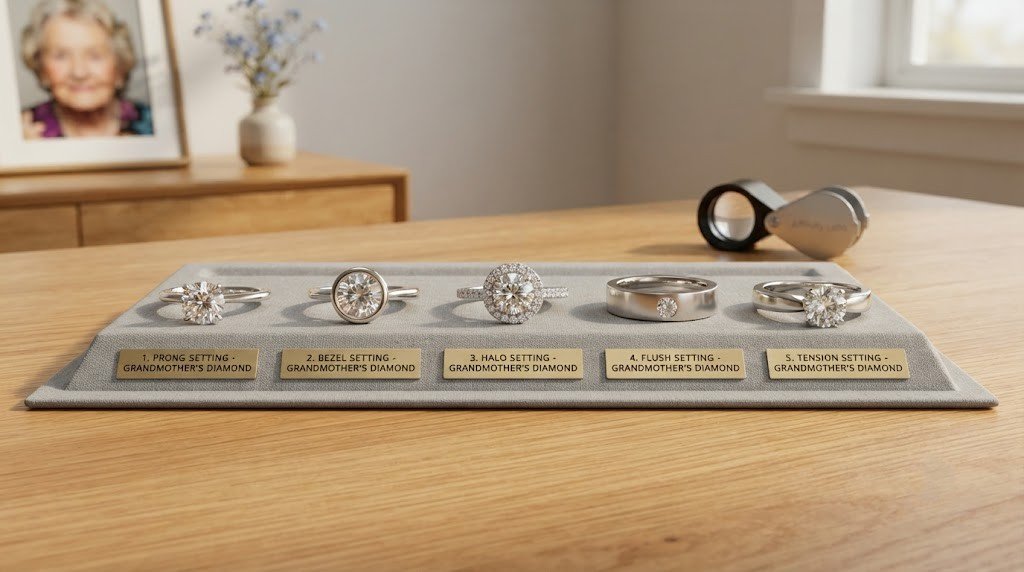
A small diamond grown in part from her carbon still has to live somewhere, on a hand, a chain or in a drawer. Grandmother memorial diamond settings decide how that stone is held, how well it copes with daily wear, and how it looks. Five setting types cover most choices: prong, bezel, halo, flush and tension. Bezel and flush settings tend to protect the stone best, while prongs show the most light.

grandmother memorial diamond settings

Why Do Grandmother Memorial Diamond Settings Matter So Much?

In grandmother memorial diamond settings, the metal is the part of the piece that protects the diamond, and it shapes how often the stone can be worn without worry. A memorial diamond is a real lab-grown diamond that is not easily replaced, so the metal around it does real work.

On the Mohs scale of mineral hardness, diamond sits at 10, harder than any other natural mineral. Hardness resists scratching, though, not every kind of impact. A sharp knock at the wrong angle can still chip a diamond, especially at a thin edge or a pointed corner. Good grandmother memorial diamond settings reduce that risk by covering the most exposed parts of the stone.

The setting also decides how the piece feels to wear. A high setting can catch on sweaters and gloves. A low one sits close to the skin and is easier to forget you are wearing. When you compare grandmother memorial diamond settings, think about the wearer’s real day: work with their hands, children, travel, sports or none of these.

It is worth knowing what the stone itself is before choosing grandmother memorial diamond settings around it. Her carbon is extracted, purified and typically blended with supplemental lab carbon before growth.

In a stone made from ashes, her share of the finished mass is usually around 10–15% for ash, with some providers quoting lower or higher. For hair, or a stone grown from ashes and hair together, no finished-stone share is published, so ask the provider for their figure in writing. The complete guide to a grandmother ashes diamond explains the full process from start to finish.

Which Setting Types Hold Up Best for Everyday Wear?

Among grandmother memorial diamond settings, bezel and flush designs usually hold up best for daily wear, because metal surrounds or recesses the stone. Prong, halo and tension settings can all be worn every day too, but they leave more of the stone exposed and benefit from more frequent checks.

The table below compares the five common grandmother memorial diamond settings on protection, light and maintenance. These are general jewelry patterns, so ask a jeweler to confirm how a specific design performs.

Setting typeHow it holds the stoneProtection for daily wearLight and lookMaintenance note
ProngSmall metal claws grip the edgeModerate; prongs can bend or catchMost light reaches the stoneAsk the jeweler how often to check prongs
BezelA thin metal rim wraps the edgeHigh; the girdle is shieldedSlightly less sparkle, clean modern lineLow; the rim can dent but rarely snags
HaloA ring of smaller stones surrounds the centerModerate; many small stones to monitorMakes a small center look largerCheck the small stones as well as the center
Flush (gypsy)Stone sits recessed into the metal surfaceVery high; almost nothing exposedSubtle, low-profile lookLow; mostly cleaning
TensionPressure from the band holds the stone in a gapVaries with design and metalStone appears to floatAsk whether resizing is possible later

A short way to think about these five grandmother memorial diamond settings:

  • Prong suits someone who wants maximum sparkle and is happy to have the piece checked from time to time.
  • Bezel suits an active wearer who wants the stone protected without losing presence.
  • Halo suits a small stone that should read larger, if the wearer accepts more parts to care for.
  • Flush or gypsy suits a ring or band worn every day where snag-free comfort matters most.
  • Tension suits a striking, modern look, with careful questions to the jeweler about durability and resizing.

These styles are not limited to rings. A bezel works well on a pendant or a pair of stud earrings, where it keeps a small stone from catching on hair or scarves. Prongs suit a solitaire pendant that hangs freely and rarely takes a knock.

A flush setting can sit in a cuff, a bar necklace or a signet-style ring worn by anyone. Halos can frame a stone on a brooch or a lapel pin, and tension designs appear in rings and some pendants. Bracelets take more knocks than necklaces, so protective styles tend to suit them better.

The piece itself should follow the wearer, not a rule about who wears what. A pendant may suit someone who works with their hands. A ring may suit someone who wants to see the stone often. Earrings can split two smaller stones between ears or between two relatives.

None of these grandmother memorial diamond settings is the correct one for a grandmother. The right choice depends on who wears it, how and how often. Two cousins could choose completely different grandmother memorial diamond settings for stones grown from the same source, and both would be right.

Which Metals Work for a Memorial Setting?

Most fine-jewelry metals work for grandmother memorial diamond settings, and the choice usually comes down to color, durability and budget. Yellow gold, white gold, rose gold and platinum are the common options, and each can hold any of the grandmother memorial diamond settings described here.

At a general level, platinum is dense and wears slowly, which some people like for prongs. Gold is mixed with other metals to make it durable, and its karat affects softness and color. White gold is often plated, and plating can wear over time. Rose gold has a warm tone that some people find flattering with champagne stones. Ask your jeweler to explain these tradeoffs for your exact design rather than relying on general rules, since the same metal can behave differently across grandmother memorial diamond settings of different shapes.

Allergies and skin sensitivity matter too. If the wearer reacts to certain metals, say so before anything is made. A jeweler can suggest alloys or finishes, and that conversation belongs at the start, before any grandmother memorial diamond settings are made, rather than after the piece arrives.

How Should the Setting Match the Stone’s Size and Color?

Good grandmother memorial diamond settings match the scale of the stone and use a metal that flatters its tone. Finished memorial stones usually fall somewhere from roughly a tenth of a carat (0.10 ct) up past 5 ct, and a setting built for one end of that range can look awkward at the other.

Small stones, around 0.10–0.25 carats, can disappear in heavy grandmother memorial diamond settings. A halo, a slim bezel or a delicate pendant bail can give them presence. Larger stones have more surface exposed, so protective grandmother memorial diamond settings such as a bezel may be worth the slight loss of light.

Color matters as much as size. Memorial stones commonly come out yellow, blue or champagne, with colorless available at higher cost and red, pink, green or black possible through optional post-growth treatment. Warmer tones often look rich in yellow or rose gold, and blue or colorless stones can look crisp in white metals, though personal taste should lead. The page on memorial diamond colors for a grandmother explains where each tone comes from and why none can be promised in advance.

A useful habit is to choose grandmother memorial diamond settings after you see the finished stone, or at least to keep the design flexible until then. The same mounting can look very different with a pale yellow stone and a deep blue one.

Can Her Own Ring or Piece Be Reset With the New Stone?

Sometimes, and it is a question for a jeweler who can examine the piece in person. Reworking a ring, pendant or brooch she owned into one of the grandmother memorial diamond settings in this guide can be a meaningful way to bring her jewelry and her memorial stone together, but what is possible varies a great deal.

A jeweler will usually look at the condition of the metal, whether the existing mounting fits the new stone’s size and shape, and whether the change would damage original details. Some older pieces adapt easily to a new stone. Others need a new head or bezel soldered in, and some are too fragile to alter without risk.

If you are considering this route, bring these questions to the jeweler:

  1. Can this mounting hold a stone of my intended size and shape safely?
  2. Will the work change or remove any original detail, marks or engraving?
  3. Can the original stone, if there is one, be kept or set elsewhere?
  4. What does the work cost, and how long will the piece be with you?
  5. If the piece cannot be adapted, can a new setting echo its design?

Also think about who holds her jewelry now. A ring that passed to someone else is a family conversation first. If her belongings are still being settled as part of an estate, it can help to wait until that is clear. The guide on talking to family about a grandmother memorial diamond has gentle ways to raise it.

How Can Several Relatives Have Matching or Different Settings?

Several stones can often be grown from one source of her ashes or hair, because only a portion is used for each. That opens the door to grandmother memorial diamond settings chosen for several people at once, either as a matched set or as individual pieces.

Matching grandmother memorial diamond settings can create a quiet connection between cousins, siblings or a parent and child who live far apart. Different settings let each person choose what suits their own life, whether that is a ring, a pendant, a pair of studs or a stone kept in a box. Both approaches honor her equally.

A few practical points help when several relatives are involved:

  • Agree on carat size and budget before anyone commits, since larger stones cost more and can take longer.
  • Decide whether matching means the same setting, the same metal, or simply the same engraving.
  • Ask the provider how multiple stones are tracked and documented, in writing.
  • Accept that untreated stones from one source can still differ in tone.

Before anyone chooses grandmother memorial diamond settings, the question of who decides about her remains comes first. Who holds that say depends on the state, since no one nationwide rule settles it. A surviving spouse or partner, if she had one, and her grown children are commonly ahead of grandchildren in that order, and any written wishes she left can shift it.

A grandchild who would like a stone can ask whoever holds that authority for a small portion, or consider hair as another route. A lock you already hold is usually the simpler case, because laws about remains are written with the remains in mind. Even so, her belongings may be counted in her estate, each state sets its own rules, and hair a relative is holding calls for a conversation with them first. The article on sharing a grandmother memorial diamond among family covers this in more depth.

What Can Be Engraved on the Setting?

Most grandmother memorial diamond settings in metal can carry a short engraving, usually inside a ring band or on the back of a pendant. Engraving is typically priced separately, and space limits what fits.

Options might include her name or initials, a date that matters to the family, a short phrase she used, or coordinates of a place connected to her. Some people engrave the same words across grandmother memorial diamond settings made for several relatives, so the pieces are linked even if their designs differ.

Before engraving grandmother memorial diamond settings, ask the jeweler how many characters will fit, which fonts are possible, and whether hand or machine engraving is used. Ask too whether engraving affects resizing later, since cutting a band can interrupt the text. Inscribing the diamond’s own girdle is a separate service from engraving the metal, so ask the provider whether they offer it at all.

How Do You Care for and Inspect a Memorial Setting?

Gentle cleaning at home and periodic checks by a jeweler keep grandmother memorial diamond settings secure. The stone is hard, but the metal holding it wears, and a loose prong or thin bezel is easier to fix before the stone is lost.

At home, warm water, a drop of mild dish soap and a soft brush usually clean grandmother memorial diamond settings well. Avoid harsh chemicals, chlorine and abrasive cleaners, which can affect some metals and finishes. Take rings off for heavy lifting, gardening, cleaning or anything that might strike the stone.

For inspection, ask your jeweler how often they recommend checking the specific grandmother memorial diamond settings you choose. A prong or tension design may warrant more frequent checks than a flush band. Signs to watch between visits include a stone that moves, a prong that catches on fabric, or a change in how the piece sits.

Insurance is a question for an insurance agent, not for a jeweler or provider. Ask an agent whether and how grandmother memorial diamond settings and the stone in them can be covered, what documentation they need, and whether an appraisal or grading report would help. Independent grading, commonly to GIA’s 4Cs standards, describes the stone’s cut, color, clarity and carat, and is different from the in-house origin certificate that records the stone’s link to her material.

Is It Fine to Keep the Stone Loose for Now?

Yes. A loose diamond can usually be set later, even years on, and there is no obligation to choose any of the grandmother memorial diamond settings right away. Keeping the stone loose gives you time to decide what feels right, or to wait for someone who will wear it.

Until you settle on grandmother memorial diamond settings, store the loose stone in a small padded box or pouch on its own, away from other jewelry that could scratch or be scratched. Keep its certificate and any grading report with it, and note where it is kept so others in the family know. A loose stone is small and easy to misplace, so a safe, consistent place matters.

Some people decide they do not need grandmother memorial diamond settings at all and that the loose stone is the memorial in itself, held in the hand rather than worn. Others set it later for a milestone in the family’s life. The ideas collection on grandmother memorial diamond rings, pendants and keepsakes shows wider possibilities, and the questions to ask before turning her hair into a diamond help with the provider side.

Frequently Asked Questions

What is the most protective way to set a memorial diamond in a ring?

A flush or bezel design usually offers the most protection, because metal covers the stone’s edge. Prongs show more light but leave more exposed. Ask a jeweler which design suits the wearer’s daily routine, then follow their advice on inspection.

Can a memorial diamond chip even though it is so hard?

Yes. Diamond rates 10 on the Mohs scale and resists scratching well, but a hard knock at the wrong angle can still chip it. A protective setting and removing the piece for heavy tasks lower that risk.

Does a memorial stone need a special kind of setting?

No. A memorial diamond is a real lab-grown diamond, so any setting designed for diamonds can hold it. Choose based on size, color, wear and taste, and tell the jeweler what the stone means so they handle it with care.

Can I wear a memorial diamond pendant every day?

Often, yes, as pendants take fewer knocks than rings. Check the chain and clasp as well as the setting, and remove it for swimming, sleeping or rough activity if the jeweler advises. Periodic inspection is still worth asking about.

Should every grandchild’s piece use the same metal?

Not necessarily. Some relatives choose one metal to link the pieces, while others pick what suits their own skin tone or wardrobe. An engraving or matching style can connect the set even when metals differ. Agree on the approach before ordering.

Are grandmother memorial diamond settings included in the price of the stone?

Usually not. Across the industry, settings, engraving, fancy cuts and independent grading are typically priced separately from the loose stone. Ask each provider or jeweler for an itemized written quote so you can compare the full cost.

Final Thoughts on Grandmother Memorial Diamond Settings

Grandmother memorial diamond settings are a practical decision that carries a lot of feeling. It is fine to take your time, to try designs on, to keep the stone loose until something feels right, or to change your mind. What matters is that the person who wears it, or keeps it, feels at ease with how her stone is held.

Learn More About Grandmother Memorial Diamonds

Talk With Memorial Diamond

If you are weighing grandmother memorial diamond settings, metals or whether to keep a stone loose for now, the team at Memorial Diamond is happy to talk it through with you. Ask as many questions as you need; there is no deadline for deciding.

Rings, Pendants, and Keepsakes

Grandmother Memorial Diamond Ideas: Rings, Pendants, and Keepsakes

A stone grown partly from her ashes or hair is small enough to hold in your palm, and deciding what it becomes can feel like a second, quieter choice. Good grandmother memorial diamond ideas start with the person who will wear or keep it. A pendant, a ring, earrings, a bracelet, a brooch, cufflinks, a charm, a loose stone in a box, or a set of pieces for several grandchildren can all work. The right one fits the wearer’s daily life, not anyone’s age or gender.

grandmother memorial diamond ideas

How Do You Choose the Right Piece for Her Stone?

The most reliable way to choose between grandmother memorial diamond ideas is to picture the wearer’s ordinary week. Think about whether they work with their hands, wear gloves, play sports, travel often, or prefer jewelry they never have to take off. The piece that suits that week is usually the one that gets worn.

When you weigh grandmother memorial diamond ideas, it helps to set aside assumptions about who wears what. A grandson may want a pendant; a granddaughter may want cufflinks; a cousin who wears no jewelry at all may prefer a loose stone kept in a box. None of those choices needs explaining, and none says anything about how much someone loved her.

A few questions can shorten the list quickly:

  • Will this be worn every day, on special occasions, or mostly kept safe?
  • Does the wearer’s work or hobbies involve impact, water, chemicals or heavy gloves?
  • Is there already a piece of hers, such as a ring or chain, that could carry the stone?
  • Will one person keep it, or do several grandchildren or cousins each want something?
  • Would the wearer like something visible to others, or something quietly private?

Size and color shape grandmother memorial diamond ideas too, affecting both the look and the practical side. Carats are typically offered from about 0.10 up to 5 or more, and memorial stones commonly trend yellow, blue or champagne-brown, with colorless usually costing more. The guide to memorial diamond colors for a grandmother explains why color cannot be fully predicted in advance.

Which 10 Grandmother Memorial Diamond Ideas Are Worth Considering?

Ten grandmother memorial diamond ideas span a wide range, from pieces worn daily to stones kept out of sight. Each can be scaled up or down in size, and none depends on whether the stone was grown from her ashes or from her hair.

1. A pendant on a chain. A pendant sits close to the heart and away from the knocks hands take, which makes it one of the more forgiving grandmother memorial diamond ideas for daily wear. Chain length, thickness and clasp style can all be matched to the wearer, and a pendant can be moved to a new chain later without touching the stone.

2. A new ring. Of all grandmother memorial diamond ideas, a ring keeps the stone most in view, which some people value, but it also faces more contact than any other piece. A lower setting with metal protecting the edge of the stone tends to suit someone who uses their hands a lot. A solitaire, a band with the stone set flush, or a stone flanked by smaller accents are all common directions.

3. Her own ring, with the memorial stone added. Setting the new diamond into a ring she wore joins two pieces of her in one object. Whether her ring can safely take a new stone depends on its metal, its age and its condition, so this is a question for a jeweler who can examine it in person.

4. Earrings. Studs are among the quieter grandmother memorial diamond ideas. Because memorial color cannot be predicted, ask a provider whether a pair would use two memorial stones or one memorial stone beside a plain lab stone, and how closely the two are likely to match. Some people wear a single stud, and others split a pair between two cousins.

5. A bracelet. Bracelets are grandmother memorial diamond ideas for someone who already wears something on the wrist: a bezel-set stone on a fine chain, or a bangle with the diamond set into the metal, can be worn daily. Wrists bump into things, so a protective setting matters more here than it does for a pendant.

6. A brooch or lapel pin. A pin can be worn on a coat, a jacket, a bag strap or a scarf, and moved between them. For someone who does not like rings or necklaces, this is one of the more flexible grandmother memorial diamond ideas, and it suits formal occasions as well as everyday clothes.

7. Cufflinks or a tie bar. Cufflinks and tie bars are grandmother memorial diamond ideas for anyone, of any gender, who dresses that way for work or events. The memorial diamond can sit in just one of the pair, or you can ask a provider whether two stones from her material are possible.

8. A charm. A charm is one of the smallest grandmother memorial diamond ideas: a little piece with the stone bezel-set that can be added to a bracelet, a chain or another piece someone already wears. This lets the memorial stone join jewelry that already carries other meaning.

9. A loose stone kept in a box. Not every one of these grandmother memorial diamond ideas has to be worn, and not everyone wants to wear jewelry at all. A loose stone in a small box or case can be held, looked at, and set later if the wearer ever changes their mind. Keep a grading report or origin certificate with it so its history stays clear.

10. Pieces for several grandchildren or cousins. Because only part of her ashes or hair is typically used, several stones can often come from one source. Each person might pick from different grandmother memorial diamond ideas, or the family might agree on one shared design made in several forms. For the practical side of dividing material, read about sharing a grandmother memorial diamond among family members before anyone orders.

Which Pieces Suit Everyday Wear Best?

Pendants, studs and brooches are generally the gentlest grandmother memorial diamond ideas for daily wear, while rings and bracelets need more protective settings. The table below compares all ten at a general level; a jeweler can advise on your exact design.

IdeaBest forEveryday wearNotes
PendantSomeone who wants it close but out of the wayWell suitedChain and clasp can be replaced without touching the stone
New ringSomeone who wants the stone in viewPossible with a protective settingFaces the most contact of any piece
Her ring with stone addedJoining her own piece with the new stoneDepends on the ringA jeweler must assess the ring first
EarringsQuiet, regular wearWell suitedCan be split between two people
BraceletSomeone who already wears wrist jewelryPossible with a bezel or flush settingWrists take frequent knocks
Brooch or lapel pinSomeone who prefers to wear it on clothingOccasional to regularEasy to move between garments
Cufflinks or tie barWork or formal dressOccasionalStone can sit in one link or both
CharmAdding to jewelry already wornDepends on the base pieceJoins existing meaningful pieces
Loose stone in a boxSomeone who prefers not to wear jewelryNot wornCan be set later if wanted
Pieces for several relativesGrandchildren or cousins who each want oneVaries by pieceSeveral stones can often come from one source

Some readers are still deciding between grandmother memorial diamond ideas and other ways of keeping her close. An honest look at a grandmother memorial diamond and a traditional urn explains what each offers, and notes that some people choose both.

Can a Stone Be Added to a Ring She Wore?

It may be possible, but only a jeweler who examines the ring can say for sure. Among grandmother memorial diamond ideas, this one carries a particular kind of meaning, because it brings something she wore together with a stone grown in part from her.

Before any work on her own jewelry goes ahead, a jeweler will typically look at the metal and how worn it is, whether the existing setting can be adapted, and whether the band can take the work without weakening. They can also tell you whether the change can be undone later, which matters if other relatives have feelings about the ring as it is.

It is worth talking with family before altering anything she owned. A ring can form part of an estate, and someone else may have expected to receive it unchanged. If the ring itself cannot take the stone, a new ring designed to sit beside hers, or a pendant hung with her ring on the same chain, may be gentler options.

For a broader look at design choices, the guide to memorial diamond settings and jewelry ideas for a grandmother goes deeper into setting styles and how they wear.

What Can You Engrave on a Memorial Piece?

Many pieces can carry a short engraving on the metal, such as her name, her initials, a date, or a few words. Whether a particular design is possible depends on the piece, the space available and the jeweler, so treat every engraving plan as a question to ask before ordering.

Engraving can personalize nearly all grandmother memorial diamond ideas. Options people consider include:

  • Her first name, a nickname the family used, or her initials
  • A date that mattered, such as a birthday or the date she died
  • Coordinates of a place connected to her
  • A short phrase she often said
  • A sample of her handwriting, copied from a card or letter

Handwriting engraving is one of the more personal grandmother memorial diamond ideas, but it depends on the quality of the sample and the jeweler’s equipment. Ask whether they can work from a scan or photo, how small the writing can go and still read clearly, and whether engraving is priced separately. Settings, engraving, fancy cuts and grading are usually extras on top of the stone itself.

Engraving the diamond itself is a different matter from engraving the metal around it. Whether any mark or inscription can be placed on the stone is a specialist question to raise directly with a provider before ordering.

How Durable Is a Memorial Diamond in Daily Life?

Every stone behind these grandmother memorial diamond ideas is a real lab-grown diamond, and diamond rates a 10, the highest value, on the Mohs scale of mineral hardness used for natural minerals. It resists scratching very well, but hardness is not the same as toughness, and a hard knock at the wrong angle can still chip a diamond.

That is why the setting matters as much as the stone. Durability is one of the most practical filters for grandmother memorial diamond ideas, especially for pieces worn on the hands or wrists.

Whichever of these grandmother memorial diamond ideas you choose, a few habits help protect the finished piece:

  1. Take rings and bracelets off for heavy work, gym sessions or contact sports.
  2. Store each piece separately so diamonds do not scratch other jewelry.
  3. Ask a jeweler to check prongs and clasps periodically, since metal wears even when the diamond does not.
  4. Clean gently with mild soap and a soft brush unless a jeweler advises otherwise.
  5. Talk with an insurance agent if you want to know whether and how a piece can be covered.

Memorial stones typically grade between SI2 and VVS for clarity. If you want an independent description of the stone’s cut, color, clarity and carat, a grading report based on standards such as the GIA’s 4Cs is optional and separate from the in-house origin certificate that records its chain of custody.

Which Metals and Settings Work Best?

Most common jewelry metals work with grandmother memorial diamond ideas, and the choice usually comes down to how the wearer lives, what color looks right with the stone, and budget. A jeweler can talk through specific alloys and how they wear over time.

At a general level, metal choice tends to follow a few considerations:

  • Color pairing. Warmer metals can sit well beside yellow or champagne stones, while white metals can make blue or colorless stones look crisper. This is a matter of taste, not a rule.
  • Wear. Some metals are harder and better suited to rings worn daily; softer ones may show wear sooner. Ask a jeweler how each option suits your design.
  • Matching her jewelry. If the piece will sit beside something she wore, matching her metal can make the two feel like a set.
  • Skin sensitivity. If the wearer reacts to certain metals, mention it early.

Settings fall into a few broad families. Prong settings show more of the stone and let more light in. Bezel settings wrap metal around the edge and protect it from knocks. Flush settings sink the stone into the metal for a smooth surface. For an active wearer, the more protective setting is usually the better choice.

Because setting, metal and size all affect price, the breakdown of what a grandmother memorial diamond costs is useful alongside these grandmother memorial diamond ideas. As a general industry range, stones of about 0.10–0.25 ct run roughly 1,500–3,500, with settings usually extra.

Which Grandmother Memorial Diamond Ideas Work Well as Heirlooms?

Almost any of these grandmother memorial diamond ideas can be passed down like other family jewelry, and some families plan for that from the start. It helps to keep the paperwork with the piece and to write down, in plain words, whose memorial it is and how it came to be.

A few simple habits keep the story with the piece:

  • Store the origin certificate, and any grading report, with the piece or in a known place.
  • Write a short note about her, who first wore the piece, and why that design was chosen.
  • Mention the piece, and who should receive it next, in your own will or written wishes.
  • If the setting no longer suits a future wearer, ask a jeweler whether the stone can be moved to a new design.

The meaning of an heirloom like this lies in the story it carries rather than any market figure. Whether a piece is passed to a child, a niece, a nephew or a friend, the note that goes with it may matter as much as the stone.

For the process behind the stone itself, the complete guide to a grandmother ashes and hair diamond explains the ashes and hair routes, including what to ask a provider about combining them, and the grandmother memorial diamond timeline sets out why making a stone typically takes somewhere between 6 and 10 months, sometimes nearer 12 when the stone is large or a specialty color. For broader questions, the grandmother memorial diamond FAQ gathers them in one place.

Frequently Asked Questions

Which piece is safest for someone who works with their hands?

Of the grandmother memorial diamond ideas covered here, a pendant or a brooch usually takes fewer knocks than a ring or bracelet. If a ring is the wish, ask a jeweler about a bezel or flush setting that protects the stone, and plan to remove it for heavy work.

Can one stone be reset into a different piece later?

In general, a skilled jeweler can move a diamond into a new setting, but each piece is different. Ask the jeweler, or your provider if they offer resetting, about the condition of the setting and any risk to the stone before work begins.

Is it all right if a grandson and a granddaughter choose very different pieces?

Yes. Choosing grandmother memorial diamond ideas by how each person lives, rather than by gender, is a sound approach. One might wear a pendant and another cufflinks, and both pieces honor her equally. A shared detail, such as an engraved date, can link them.

Can her handwriting be engraved inside a ring band?

A jeweler may be able to engrave a short handwriting sample inside a band, depending on its width, the quality of the sample and their equipment. Bring a clear scan of the writing and ask to see a proof before any engraving begins.

Do memorial diamonds need different care from other diamonds?

No. A memorial diamond is a real lab-grown diamond with the same hardness and care needs as any other. Gentle cleaning, separate storage and periodic checks of prongs and clasps by a jeweler are sensible for any diamond piece.

How many stones can come from her ashes or hair?

Only part of the material is typically used, so several stones can often be grown from one source. How many depends on how much material is available and the sizes chosen, so ask a provider in writing before ordering.

Final Thoughts on Choosing a Piece for Her

There is no single right shape for remembering her. A stone on a chain, a pin on a coat, a ring that once was hers, or a diamond resting in a small box can each hold the same meaning. Let grandmother memorial diamond ideas follow the person who will carry the piece, and leave room for that choice to change over the years.

Learn More About Grandmother Memorial Diamonds

Talk With Memorial Diamond

If one of these grandmother memorial diamond ideas has caught your attention, or you are trying to plan pieces for several people at once, you are welcome to ask Memorial Diamond about designs, settings and what is possible with your grandmother’s stone. Bring rough sketches, photos of her jewelry, or just a question.

Grandmother Memorial Diamond FAQ Everything Families Ask

Grandmother Memorial Diamond FAQ: Everything Families Ask

Questions about a grandmother memorial diamond can arrive all at once and in no particular order. A grandmother memorial diamond is a real lab-grown diamond made partly from carbon recovered from her cremated ashes or her saved hair, and the answers below cover what it is, how much of it is her, what it costs and takes, who decides, what faiths teach and how it compares with an urn.

grandmother memorial diamond

What is a grandmother memorial diamond, and is it a real diamond?

Yes, it is a real diamond. A grandmother memorial diamond is a lab-grown stone with the same crystal structure, hardness and optical behavior as a mined diamond, grown partly from carbon that once belonged to her. It is not glass, resin or a simulant, and it is graded against the same 4Cs as any other diamond.

Two growth methods can produce a grandmother memorial diamond. High-pressure, high-temperature growth, the standard for memorial stones, places carbon around a small diamond seed at roughly 6–8 GPa and 1,400–2,500°C. Chemical vapor deposition, used by a minority of providers, builds the crystal layer by layer from a carbon-rich gas. The general science behind both is set out in this overview of how synthetic diamonds are grown.

What makes it a memorial rather than any other lab-grown stone is where some of the carbon came from, and the paperwork that traces it. A provider typically issues an origin or authenticity certificate documenting that her material went into this specific stone. That document is about chain of custody, not quality.

How much of the finished stone is actually her?

A real, measurable portion, but not all of it. Supplemental lab carbon is typically added so a stone of useful size can grow, and how large her share is depends on whether ashes or hair were used.

For ashes, the industry figures are fairly well known. Cremated remains are mostly calcium phosphate, the mineral part of bone, and only about 0.5–4% of ash by weight is usable carbon. Once purified, carbon drawn from her ash typically accounts for something like 10–15% of what the finished stone weighs; a few providers quote nearer 3%, and others quote more.

For hair, the picture is different. Hair is about 50% carbon by weight because it is made of keratin, which is why so little is needed. What nobody publishes is the share of the final stone that her hair carbon represents, and the same gap applies to stones blending hair with ash. Request that number, for your specific material, in writing from each provider you contact.

Any claim that a grandmother memorial diamond is made purely and entirely from her should be treated with caution. The honest version is still remarkable: some of the carbon in that crystal was hers. The guide to whether a stone is really made from your grandmother’s ashes examines that question closely.

How is a grandmother memorial diamond made?

It is made in a sequence of laboratory stages that turn her carbon into graphite and then into diamond. Each provider runs these differently, but the industry-typical outline is consistent.

  1. Her ashes or hair arrive and are logged so they can be tracked throughout.
  2. Carbon is separated from everything else in an oxygen-free, multi-stage heating process and purified to roughly 99.9% or higher.
  3. The purified carbon is heated further, to around 2,500–2,700°C, and converted into graphite.
  4. That graphite, typically blended with supplemental lab carbon, goes into a growth cell with a diamond seed and grows over a period of weeks to months.
  5. A cutter shapes and polishes the rough crystal.
  6. Some providers offer optional post-growth color treatment.
  7. The stone is graded, ideally by an independent lab, and an origin certificate is typically issued.

The overall timeline is covered in its own section below; individual stages vary by provider and are worth asking about directly. For a fuller walk-through, the explanation of how a memorial diamond is made from her ashes and hair goes stage by stage.

How much ash or hair does a provider need?

Typically a small amount of either. For ashes, requests across the industry run from a few tablespoons up to about 4 oz, or roughly 100 grams. For hair, a small lock or a few grams is usually enough, because hair holds far more carbon per gram than ash.

Since only a portion is used, the rest of her ashes can remain in the urn, be scattered or be interred as planned. More material does not make a bigger stone; growth time sets the carat. Several stones can often come from one source, which matters when more than one grandchild hopes for a grandmother memorial diamond.

Whether gray, white, dyed, permed or thinning hair suits a given process, and the exact minimum needed, are provider questions with provider-specific answers. Ask what happens to any material not used, and whether it can be returned, before sending anything.

What color will a grandmother memorial diamond be?

A grandmother memorial diamond commonly trends toward yellow, blue or champagne, though no one can predict the exact shade from her ashes or hair. Color in any diamond comes from trace elements present while the crystal grows.

Nitrogen produces yellow, boron produces blue, and a colorless stone requires neither, so colorless generally costs more. Some providers also offer optional treatment after growth that can produce red, pink, green or black stones.

There is no reliable link between the material and the result: gray hair does not promise a paler stone, and ash does not promise a darker one. Treat color as a choice to discuss with the provider, not a trait inherited from her. The guide to memorial diamond colors for a grandmother explains the options and what drives price.

How much does a grandmother memorial diamond cost?

Industry prices in 2026 run from about $1,500 for the smallest stones to $75,000 or more for the largest. Size, color and cut drive most of the difference, and colorless costs more than blue, yellow or champagne at the same size.

TierTypical sizeTypical 2026 price range
EntryAbout 0.10–0.25 ctAbout 1,500–3,500
Mid0.5–1 ctAbout 5,000–15,000, higher for colorless
Large2–5+ ctAbout 20,000–75,000 or more

These are industry ranges, not quotes. A setting, engraving, a fancy cut and an independent grading report are usually priced separately, so ask what a quote includes and what it leaves out. When siblings or cousins share the cost of a grandmother memorial diamond, agree in writing who pays for what. The breakdown of what a grandmother memorial diamond costs goes tier by tier.

How long does the process take from start to finish?

Typically 6–10 months from the time the provider receives her material to a finished stone. Larger stones of around 2 carats and up, and specialty colors, can take up to roughly 12 months.

Size is the main reason. A bigger crystal needs longer in the growth cell, and carat is decided by growth time rather than by how much ash or hair was sent. Growth itself takes weeks to months within that overall span.

If you are hoping to have a grandmother memorial diamond ready for an anniversary or a family gathering, tell the provider early and ask what they can realistically say about timing. The guide to how long a grandmother memorial diamond takes covers what shapes the schedule.

Who decides what happens to her ashes?

That answer changes from state to state, and any written wishes she left can shift it further; no one national rule applies. In a common pattern, a surviving spouse or partner, where there is one, ranks first, then her adult children, then grandchildren, though a named agent or a written instruction can rearrange that.

If you are a grandchild hoping for a grandmother memorial diamond, the considerate step is to ask the person holding that authority whether a small portion could be set aside. Because providers typically request somewhere between a few tablespoons and about 4 oz, the request concerns a portion rather than the whole urn. If the answer is no, or the ashes are not available, hair may be another route.

If you are her son or daughter, you may be the person who holds that authority, alone or with siblings, and a grandchild’s request may come to you. Step-, adopted and chosen grandchildren are in the same position as any other grandchild here: ask openly. A funeral director or estate attorney can explain how the order works where she died.

Can several grandchildren each have a stone?

Often, yes. Each stone uses only part of the material, so one urn of ashes or one lock of hair can frequently supply more than one grandmother memorial diamond.

A few practical points help when several people are involved:

  • Choose one person to be the provider’s single contact.
  • Ask how many stones the material can support before promising anyone a stone.
  • Agree how costs are split, and whether each stone is ordered separately.
  • Let each person choose size and color for their own stone.
  • Make room for relatives who would rather not take part.

Stones grown from the same source will not necessarily match in color, even if ordered together. The guide to sharing a grandmother memorial diamond among family covers coordination in more depth.

What if she was buried, or only her hair was kept?

Hair is the route to a grandmother memorial diamond when there are no ashes. Hair needs no cremation, so a grandmother memorial diamond can still be considered when a lock was saved before a burial or tucked into a card or locket.

Hair kept at home is usually simpler in practice, because the rules about remains are aimed at the remains themselves. Still, personal belongings may count as part of her estate, state rules differ, and if an aunt, a parent or anyone else is keeping the hair, the next step is talking with them, not acting on your own.

Ask the provider whether the hair you have is suitable, including hair gathered from a brush or kept for many years, how much they need and how they document its origin. The grandmother hair diamond complete guide follows this route from beginning to end.

Can you decide on a stone years after she died?

Yes. Nothing on the family’s side sets a deadline for choosing a grandmother memorial diamond. Whether ashes or hair kept for many years still suit a provider’s process, and how the material should be stored in the meantime, are questions to put to that provider in writing.

Some people come to the idea at a later milestone, such as a wedding, a birth or the moment an urn passes from one relative to another. Waiting also gives everyone time to talk it through. If the material has been stored somewhere unusual, or has been handled or mixed with anything, mention that to the provider and ask whether it affects their process.

What do different faiths say about a grandmother memorial diamond?

No religious tradition has an official position on memorial diamonds specifically. What exists is teaching on cremation and on how ashes are kept, and those teachings differ by tradition, by movement and by clergy. Your own faith leader is the right person to ask.

  • Catholic: Current guidance from the Vatican’s Dicastery for the Doctrine of the Faith allows cremation, but its instruction is that cremated remains stay undivided in a consecrated, Church-approved resting place instead of being split among relatives or kept in a private home; it makes a narrow exception for a minimal part in specific circumstances. That allowance is directly relevant to setting aside ash, so speak with your parish.
  • Jewish: Views divide by movement. Orthodox and Conservative Judaism generally prohibit cremation, and cremated remains are typically not accepted for burial in Orthodox cemeteries; Reform Judaism has no explicit prohibition and leaves the choice to rabbis and families. Because the objection concerns cremation, a stone grown from hair sits outside it.
  • Islam: Cremation itself is considered impermissible across the major schools of Islamic thought in ordinary circumstances. A stone grown from her hair involves no cremation, so it sits outside that objection; a local imam can advise on anything further.
  • Hindu: Cremation is the traditional rite, usually followed by immersing the ashes in a sacred river. Keeping a small portion for a keepsake or a stone is described as increasingly common, but practice varies by family, region and community.
  • Buddhist: Cremation is predominant in most Buddhist traditions, and there is a long relic tradition of keeping teachers’ remains. Teachers differ on whether a memorial stone reads as mindful remembrance or as attachment, so it remains an open question for your community.
  • Protestant and evangelical: Scripture mandates no method of disposition, and mainline clergy generally raise no objection. Some conservative congregations have concerns about dividing or scattering ashes in light of belief in bodily resurrection, so ask your pastor.
  • Secular: With no mandated practice, a grandmother memorial diamond is simply a personal or family choice, guided by what she wanted and what feels right to those who loved her.

What jewelry can hold a grandmother memorial diamond?

Almost any setting that holds a lab-grown diamond can hold a grandmother memorial diamond. Pendants, rings, earrings, bracelets, brooches and cufflinks are all possible, and some people keep the stone loose in a small case.

Let the wearer, not convention, shape the piece. A grandson might choose a ring, a granddaughter a tie pin, a son a pendant, and every one of those is fitting. Diamond tops the Mohs scale of mineral hardness at 10, ahead of every other natural mineral, but a hard blow at the wrong angle can still chip one, so a bezel or other guarded setting suits a stone worn daily.

Clarity in memorial stones typically falls between SI2 and VVS. An independent grading report, commonly following GIA’s diamond quality factors and sometimes issued by IGI, describes cut, color, clarity and carat, and is separate from the origin certificate. Engraving and settings are usually priced on top of the stone.

How does a grandmother memorial diamond compare with an urn?

They do different things, and some families keep both. An urn holds all of her ashes in one place; a grandmother memorial diamond holds a small portion of her carbon in something that can be worn or carried.

QuestionUrnMemorial diamond
How much of her ashes it holdsAll, or whatever the family keepsOnly a small portion is used
Can several people each have one?Possible with keepsake urnsSeveral stones can often come from one source
Works without cremation?NoYes, if hair was kept
Typical costVaries widelyAbout $1,500 to $75,000 or more

Neither is better. An urn on a shelf, a grave, a scattering place and a stone in a ring are each a full way to remember her. The comparison of a grandmother memorial diamond and a traditional urn looks at the choice in more detail, including how some people keep both side by side.

Frequently Asked Questions

Can her name or a date be engraved on the stone or setting?

Engraving is a common add-on and is usually priced separately from the stone. What can be engraved, where, and in how many characters depends on the provider and the setting, so ask for examples and confirm the wording in writing before work begins.

Does the stone come with proof of where it came from?

Providers typically issue an origin or authenticity certificate documenting that her material was used in that stone. Ask how her ashes or hair are tracked from arrival to finished diamond, and whether an independent grading report is included or costs extra.

Is it strange to wear a stone made partly from her ashes?

It is a personal question with no right answer. Some people find comfort in carrying something tangible, while others prefer a grave or an urn. If it feels right to you and the family is comfortable, it is a respectful way to remember her.

Can I insure a memorial diamond?

That is a question for an insurance agent, who can explain what a policy covers and what documents it needs. Keeping the origin certificate, any grading report and the purchase receipt together will make that conversation easier.

What if I am not sure she would have wanted one?

Think about what she said and how she lived, and ask relatives who knew her wishes. If no one can say, a smaller stone, a hair-based stone or simply waiting are all reasonable. Uncertainty is a fair reason to pause.

Can the stone be passed down to future generations?

Yes. A diamond is durable enough to be handed down, and the origin certificate can travel with it so later generations know it was grown partly from her carbon. Writing a short note about her to keep with the certificate can add meaning for whoever inherits it.

Final Thoughts on Grandmother Memorial Diamonds

Questions are a sign of care, not hesitation. You may find that some of these answers settle things quickly and others open a longer family conversation, and both are fine. Whatever you decide, whether a stone, an urn, a grave or something else, the point is that she is remembered in a way that fits her and the people who loved her.

Learn More About Grandmother Memorial Diamonds

Talk With Memorial Diamond

If a question here is still open for you, the team at Memorial Diamond is happy to talk it through, whether you are early in the decision or simply curious. Ask anything, take whatever time you need, and decide only when it feels right.