
Before any of her ashes leave the urn, it helps to slow down and say a few plain things out loud. The grandmother ashes diamond questions in this post are the ones that protect you, your family and her remains: who has a say over her ashes, what a provider will commit to in writing, and what a jeweler needs to know. There are 17, in three groups, gathered into a one-page checklist.
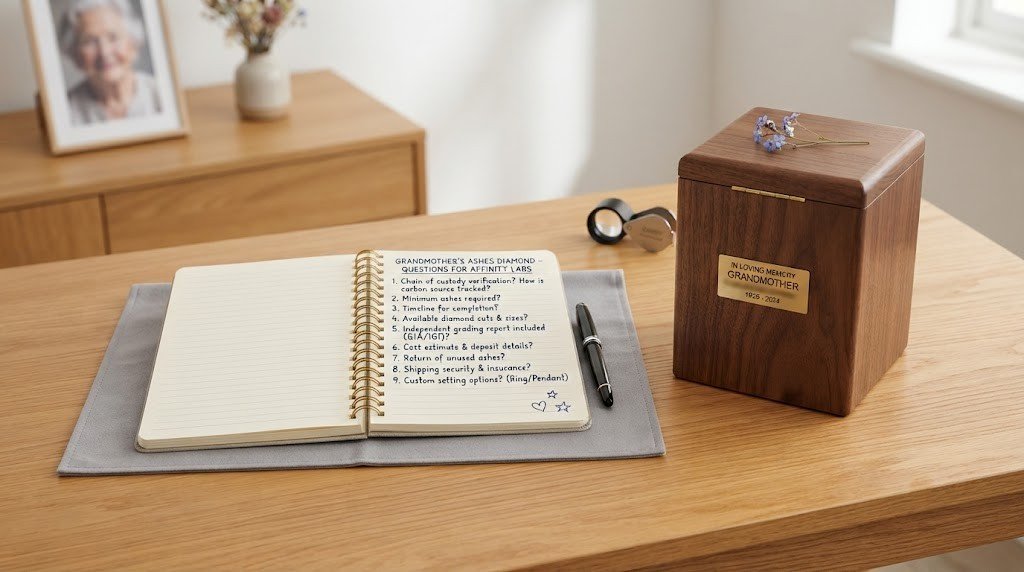
Table of Contents
Why Do Grandmother Ashes Diamond Questions Matter Before You Choose?
Grandmother ashes diamond questions matter because a memorial diamond is a one-way process for the ash that goes into it. Ash that has been purified and grown into a stone cannot go back to the urn, so doubts belong before anything is shipped.
The stone is a real lab-grown diamond, usually made by HPHT, the high-pressure method in this overview of synthetic diamond growth. Carbon from her ash is purified, turned into graphite and grown around a seed, and that chain is where most grandmother ashes diamond questions find their answers.
Asking grandmother ashes diamond questions early also keeps the family conversation honest. For the process itself, see our complete guide to a grandmother ashes diamond; this post is its due-diligence companion.
What Should You Ask Yourself and Your Family First?
Start at home, before you contact any provider. The first five grandmother ashes diamond questions are about permission, agreement and her own wishes, and no provider can answer them for you.
1. Who holds authority over her ashes, and have you spoken with them?
Of all the grandmother ashes diamond questions, this one comes first. Who decides about cremated remains differs from one state to the next, with no nationwide rule. Authority commonly rests first with a surviving spouse or partner and then with her adult children, ahead of grandchildren, and written instructions she left can change that order entirely.
If you are her grandchild, the respectful route is to ask whoever holds that authority for a small portion, explaining what you hope to make. If that is not possible right now, a saved lock of her hair is another route, and our post on questions to ask before turning her hair into a diamond walks through that path. The funeral home or an estate attorney where she lived can explain how authority works there.
2. Do the relatives who care about her agree, or at least understand?
Agreement is not the same as authority, but it is one of the grandmother ashes diamond questions that is painful to skip. A relative who learns of the diamond after the ash is sent may feel shut out of a decision about someone they also loved.
You do not need everyone to want a stone, only for the people closest to the decision to know the plan and have a chance to speak. Our guide on how to talk to family about a grandmother memorial diamond offers ways to open that conversation gently.
3. What did she put in writing, if anything?
Her own words can settle grandmother ashes diamond questions that relatives might otherwise disagree over. Look for a will, a prepaid funeral arrangement, a letter, or notes left with whoever handled her affairs; a written wish about burial, scattering or keeping her ashes together can shape what feels right.
4. What will happen to the rest of her ashes?
Only a small share of her ashes is typically needed. The remainder can stay in an urn, be scattered, be buried, or be divided among relatives as the family chooses.
None of those choices is lesser than a diamond. Settling grandmother ashes diamond questions about the remainder together keeps the diamond as one part of a wider plan rather than the only plan.
5. Does her faith, or your family’s, raise a concern to take to clergy?
Faith traditions address cremation and how ashes are kept, but none has issued an official view on memorial diamonds as such. Catholic guidance, for example, directs that ashes be kept intact in a sacred place, with only narrow allowance for a minimal part, which bears directly on dividing them.
Orthodox and Conservative Judaism generally object to cremation itself, and Islam considers cremation impermissible in ordinary circumstances; for families in those traditions, a hair-based stone sits outside a cremation-specific objection. Hindu, Buddhist and Protestant views vary by community and congregation. Whatever her faith, take faith-related grandmother ashes diamond questions to your own clergy or faith leader rather than relying on a general answer.
What Should a Provider Answer in Writing?
Anything touching her remains, your money or your timeline should come back in writing, not just on a call. The nine grandmother ashes diamond questions in this group differ most between companies, so they are worth comparing side by side.
6. What share of the finished stone is carbon from her ash, and how is that documented?
Cremated remains are mostly calcium phosphate, and usable carbon is roughly 0.5% to 4% of ash by weight. Industry-wide, the carbon drawn from ash typically accounts for about 10–15% of a finished stone by mass, though some providers put the ash share as low as 3% and others above that range.
Ask what share applies to your chosen size and how it is recorded; of all the grandmother ashes diamond questions, this one tests a provider’s candor most directly. Our post asking whether a memorial diamond is really made from her ashes explains why supplemental lab carbon is typically blended in, and why that does not make the stone any less hers.
7. Do you grow the diamond in-house, or does a partner lab grow it?
The answer tells you how many hands her ashes pass through. If a partner lab is involved, ask where it is, who carries the ash between sites, and whose name is on the paperwork. Raising grandmother ashes diamond questions about this before you order prevents surprises about a hand-off.
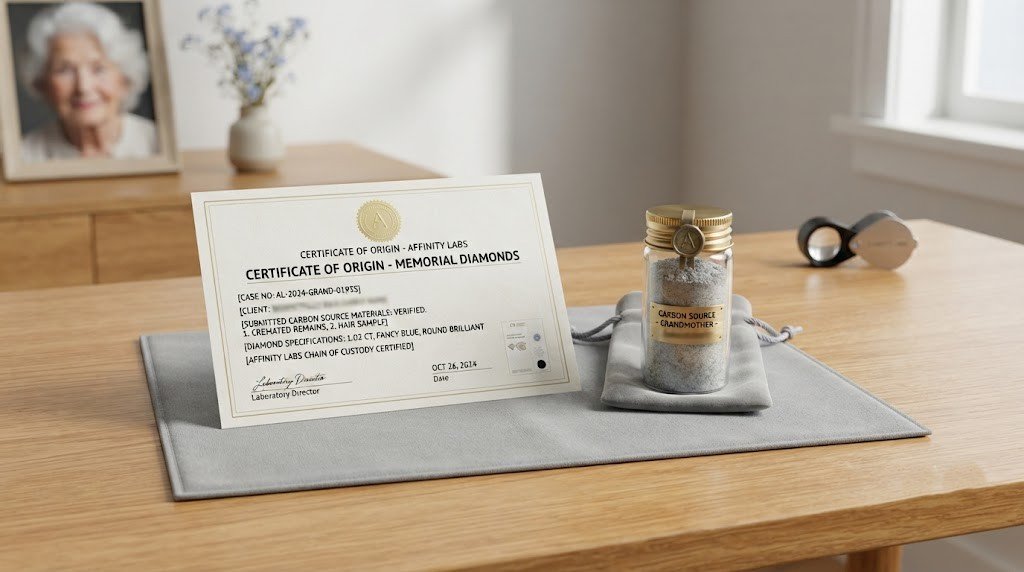
8. How is chain of custody tracked, and what does the origin certificate record?
Chain of custody is the record that your stone’s carbon came from the ash you sent; an origin certificate, usually issued in-house, summarizes it.
Put grandmother ashes diamond questions about custody to the provider before you order: ask to see a sample certificate and what it records about intake, processing and growth.
9. Is independent grading available, and is it included?
Independent grading is optional and separate from the origin certificate; a grading report describes the stone’s own quality using the 4Cs set out by GIA, commonly to GIA standards and sometimes through IGI.
Memorial stones typically grade somewhere between SI2 and VVS for clarity. Your grandmother ashes diamond questions here are simple: whether a report is offered, which lab issues it, and whether its cost is in the quote or added later.
10. How much ash do you need, and does more ash make a larger stone?
The typical industry range is a few tablespoons up to roughly 4 oz (about 100 g), but each provider sets its own amount, so ask for the exact figure in writing. Our post on how much ash a grandmother memorial diamond needs explains the range in more depth.
More ash does not mean a bigger stone, which surprises some people asking grandmother ashes diamond questions for the first time. Carat is set by growth time in the press, so you need not send more of her remains than the provider asks for.
11. What happens to any ash you do not use?
Only part of the ash sent is typically used, so ask plainly whether the rest is returned, how it is packaged and shipped, and when. Get that answer in writing before you send anything; among grandmother ashes diamond questions, it matters deeply, because the unused portion is still her.
12. What happens if we cancel, or if a growth run does not succeed?
Ask what you can change or cancel at each stage, at what cost, and what is refunded. Ask, too, what happens if a growth run does not produce a usable stone: is it regrown, is more ash needed, and who decides?
Terms differ between providers, which is exactly why these grandmother ashes diamond questions belong in a written agreement rather than a conversation.
13. What color should we realistically expect, and is irradiation involved?
Nitrogen during growth tends toward yellow and boron toward blue; colorless needs neither and usually costs more. Memorial stones commonly land in yellow, blue or champagne-brown tones, and our post on what color a diamond from her ashes may be covers the range.
Some providers offer optional post-growth irradiation for red, pink, green or black. Ask whether a color is a request or a commitment, whether irradiation is used, and what happens if the result differs. No source makes the color of a stone grown from ash predictable, so treat color within your grandmother ashes diamond questions as a matter of likelihood.
14. What is the total price, with every extra listed?
For 2026, typical industry pricing sits near 1,500–3,500 at the small end (about 0.10–0.25 ct), climbs to 5,000–15,000 between half a carat and one carat, with colorless higher, and reaches 20,000–75,000 or more for stones of 2 ct and up. Settings, engraving, fancy cuts and independent grading are usually priced separately.
Among grandmother ashes diamond questions about money, the key request is an itemized quote that names each extra and the payment schedule. Our post on what a grandmother memorial diamond costs shows how those pieces add up.
What Should You Ask the Jeweler Who Sets Her Stone?
Ask about fit, wear and documentation. These last three grandmother ashes diamond questions apply whether the provider sets the stone or a jeweler you already trust does.
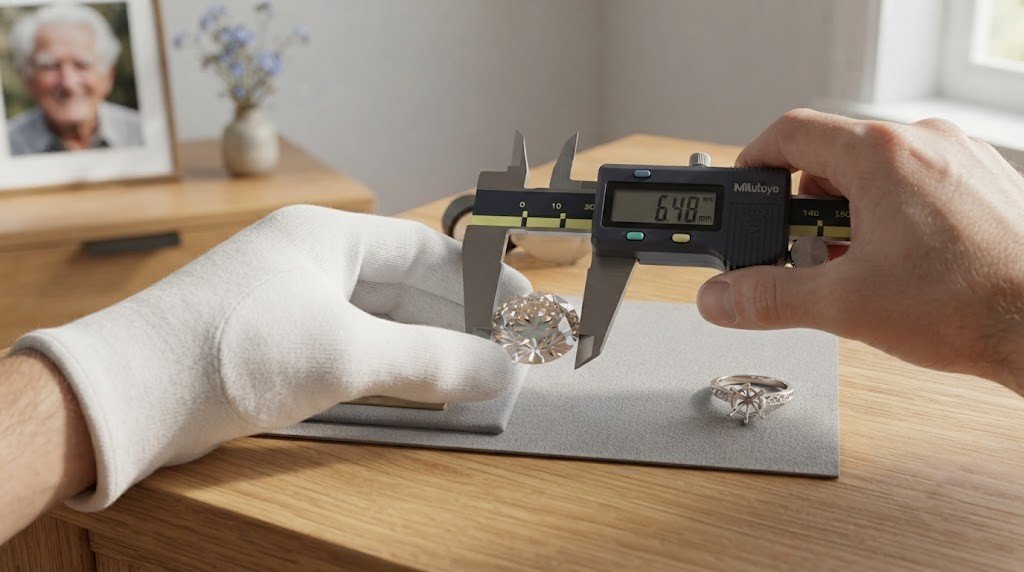
15. Can you set a memorial stone you did not sell, and will you work from its exact measurements?
Some jewelers welcome outside stones and some prefer not to, so raise grandmother ashes diamond questions with a jeweler before the stone exists. A setting should be built around the finished stone’s actual measurements, not an estimate.
16. Which setting suits the way this piece will be worn?
Diamond sits at 10 on the Mohs scale of mineral hardness, the hardest natural mineral, but a hard knock can still chip it. A daily-wear ring takes more knocks than a pendant, and a protective setting can shield the edges.
When you bring grandmother ashes diamond questions to a jeweler, be honest about how the piece will be worn, and by whom. Our ideas for memorial diamond settings for a grandmother cover rings, pendants and keepsakes without assuming who will wear them.
17. Who holds the stone while it is being set, and what paperwork goes with it?
Custody does not end when the stone is grown. Ask who receives it, how it is stored at the jeweler, and whether the origin certificate and any grading report travel with it. If you plan to insure the piece, ask your insurance agent what documents they need; keeping answers to grandmother ashes diamond questions in one folder helps.
Which Provider Answers Should Make You Pause?
Pause when an answer is vague, spoken only, or too neat. Asking grandmother ashes diamond questions in writing makes these patterns easier to spot:
- “The diamond is 100% her.” Not accurate. Ash is mostly calcium phosphate, carbon is a small fraction of it, and supplemental lab carbon is typically added. The stone is genuinely made in part from her carbon, never entirely.
- “We’ll sort out the leftover ash later.” What happens to unused ash should be settled before you ship.
- “Your stone will be exactly this color.” No provider can promise a precise shade from ash.
- A single price with no line items. Settings, grading and engraving are usually extra, and you should see them listed.
- Pressure to decide quickly. An offer that expires soon has no place in a decision about her remains.
One worrying reply to your grandmother ashes diamond questions is a reason to ask a follow-up, not necessarily to walk away. Several together are a reason to keep looking.
How Do All 17 Questions Fit on One Page?
The table gathers every one of these grandmother ashes diamond questions with who to ask and why. Print it, or paste these grandmother ashes diamond questions into an email to each provider so the answers come back in the same order.
| # | Question | Who you ask | Why it matters |
|---|---|---|---|
| 1 | Who holds authority over her ashes? | Family; funeral home or estate attorney | Authority varies by state and commonly sits with a spouse, partner or adult children before grandchildren. |
| 2 | Do close relatives agree or understand? | Family | A decision made quietly can hurt people who also loved her. |
| 3 | What did she put in writing? | Family; whoever handled her affairs | Her written wishes can change who decides and what feels right. |
| 4 | What happens to the rest of her ashes? | Family | Only a portion is used, so the remainder needs its own plan. |
| 5 | Does faith raise a concern? | Your own clergy | Traditions speak to cremation and ashes, not to diamonds specifically. |
| 6 | What share of the stone is carbon from her ash? | Provider, in writing | The honest share from ash is usually a minority of the stone’s mass. |
| 7 | In-house or partner lab? | Provider, in writing | It tells you how many hands her ashes pass through. |
| 8 | How is chain of custody tracked? | Provider, in writing | The origin certificate is your record that the carbon came from her ash. |
| 9 | Is independent grading available and included? | Provider, in writing | Grading describes quality; it is separate from the origin certificate. |
| 10 | How much ash is needed? | Provider, in writing | The amount varies, and more ash does not mean a larger stone. |
| 11 | What happens to unused ash? | Provider, in writing | The unused portion is still her, so its return should be settled first. |
| 12 | Cancellation and failed growth? | Provider, in writing | Terms differ and should not depend on a phone call. |
| 13 | Realistic color and irradiation? | Provider, in writing | Color from ash is not predictable, and irradiation changes it after growth. |
| 14 | Total price with extras? | Provider, in writing | Settings, grading and engraving are usually extra. |
| 15 | Will you set an outside stone to its exact size? | Jeweler | Not every jeweler works with stones they did not sell. |
| 16 | Which setting suits daily wear? | Jeweler | Diamond is very hard, but a hard knock can still chip it. |
| 17 | Who holds the stone during setting? | Jeweler | Custody and paperwork should stay clear until the piece is home. |
How Do You Ask These Questions Without Rushing Anyone?
Take grandmother ashes diamond questions one group at a time, and let the family ones settle before you contact providers. Nothing needs to be shipped until everyone with a say is comfortable.
When you are ready, send the same grandmother ashes diamond questions in writing to two or three providers.
The overall process typically takes 6 to 10 months once a provider receives the ash, and up to about 12 for stones of around 2 ct or more or specialty colors. With a wait that long, extra time spent on grandmother ashes diamond questions at the start costs little.
It is also fine to stop. Deciding that an urn, a scattering or a burial is the right way to honor her is a complete answer.
Frequently Asked Questions
Is there a time limit on making a diamond from her ashes?
Nothing in this guide sets a deadline, so there is no need to hurry on that account. Whether a provider accepts ashes kept for many years, and whether how they were stored matters, are questions to confirm with that provider in writing before you order.
Can I ask a provider these questions before telling my family?
Yes. Gathering written answers to your grandmother ashes diamond questions first can make a family conversation calmer, since you can share facts instead of guesses. Just avoid sending ash or signing an order until whoever holds authority and the closest relatives have been included.
How many providers should I compare?
Two or three is usually enough. Send each the same grandmother ashes diamond questions in writing so replies line up, and treat any company that will not answer in writing with caution, since its spoken answers are hard to check later.
Does the origin certificate prove the stone came from her ashes?
It documents the provider’s chain of custody, from intake through growth, and it is usually issued in-house. Ask to see a sample in advance and what records support it, so you know exactly what the certificate does and does not show.
Can a grandchild place the order?
That depends on the provider, so ask what written consent it asks for and from whom. Authority over her ashes varies by state, and the agreement of whoever holds it matters before a portion is released; a funeral home or estate attorney can explain the rules there.
What if a provider will not answer one of these?
Send that item from your grandmother ashes diamond questions again, in writing, and explain why it matters. If no answer comes, take that as information: a provider handling her remains should explain how it treats them, what it costs and what you receive.
Final Thoughts on Asking Before You Decide
Asking careful grandmother ashes diamond questions is not a sign of distrust. It is a way of taking her remains as seriously as she deserves, and of making sure the people around you feel included rather than surprised.
The answers to grandmother ashes diamond questions will not all be simple, and some may point your family elsewhere. Whatever you choose, you will know why you chose it.
Learn More About Grandmother Memorial Diamonds
- Grandmother ashes diamond: the complete guide the full process in one place
- Sharing a grandmother memorial diamond when more than one relative wants a stone
- How long a grandmother memorial diamond takes the stages and the wait
- Grandmother memorial diamond vs. a traditional urn weighing two respectful options
Talk With Memorial Diamond
If you would like to talk through any of your grandmother ashes diamond questions with someone who will answer them plainly, the team at Memorial Diamond is glad to listen. Bring your list, ask anything, and take all the time your family needs.
Leave A Comment