
Perhaps an aunt keeps the urn on a bookshelf while a cousin still has the lock of hair saved at the funeral home, and you have been wondering whether the two could become one stone. To turn grandmother ashes and hair into a diamond, first confirm that a provider will combine both materials at all, then gather each one with the agreement of the right people, send the amounts requested, and allow roughly 6 to 10 months for the lab work once everything arrives.
Not every provider blends materials, and some suggest a separate stone from each instead. Working that out before anything is packed saves a great deal of back and forth between relatives.
Table of Contents
Will a provider turn grandmother ashes and hair into one stone?
Whether anyone will turn grandmother ashes and hair into one stone is the first question to settle, because the answer shapes everything after it. Some providers may grow a single stone from more than one source material, while others may prefer to keep each source separate. Before anyone in the family opens an urn or cuts a lock, ask each provider you are considering whether it will turn grandmother ashes and hair into a single diamond, and how it handles the two materials once they arrive.
Three workable paths
| Option | What it means | When families tend to consider it |
|---|---|---|
| One combined stone | Carbon from her ashes and her hair is grown into a single diamond | When the meaning lies in bringing both together |
| Two separate stones | One diamond from the ashes, one from the hair, often for different relatives | When the urn and the hair sit with different branches of the family |
| One material only | A stone from hair alone, or from ashes alone | When one material is unavailable or the family prefers to keep it intact |
None of these is better than the others, and families who set out to turn grandmother ashes and hair into a keepsake sometimes change course once they hear what providers offer. A combined stone suits a family that wants one heirloom; two stones may suit relatives who live far apart or who each hold one of the materials.
Questions to put in writing
- Do you grow combined stones from ashes and hair together?
- If so, how are the two materials processed, and are they tracked separately?
- If not, can you grow separate stones from each, and can they be ordered together?
- What happens to any ashes or hair you do not use?
Get the replies by email. When you plan to turn grandmother ashes and hair into a diamond, written answers protect everyone, especially when several relatives are contributing.
For a broader overview of how combined stones differ from single-source ones, the complete guide to grandmother ashes and hair diamonds is a good starting point.
Who needs to agree before you turn grandmother ashes and hair into a diamond?
When you plan to turn grandmother ashes and hair into a single keepsake, the two materials come with different questions about who decides. Ashes are remains, and the people with authority over them are set by state law and by any written wishes she left. Hair kept at home is usually more straightforward, but it can still count as part of her estate.
Authority over her ashes
The order of who decides differs from state to state. A surviving spouse or partner, and after that her adult children, commonly hold that authority ahead of grandchildren, though her own written instructions may change the picture. If you are not sure who signed the cremation authorization, the funeral home or crematory that handled her care can usually tell you.
As a grandchild, the respectful route runs through that person: explain the idea and ask if they would be willing to release a modest amount for a stone. It can help to mention that a stone typically draws on only a small fraction of the ashes, so the rest can still be kept, scattered or interred as planned, and that you hope to turn grandmother ashes and hair into something the whole family can see.
The estate question for her hair
A lock of hair in a drawer can feel too small to matter, yet personal belongings may pass through an estate, and state rules differ. Before you turn grandmother ashes and hair over to a lab, a quick word with the executor, or whoever is handling her affairs, keeps the hair side of the plan on solid footing.
Faith and family tradition
If faith shaped how she lived or how her family mourns, it is worth a conversation with clergy before you divide the ashes. Religious bodies have not ruled on memorial diamonds specifically; what they address is cremation itself and what happens to ashes afterward. Catholic teaching permits cremation but asks that the ashes remain intact in a sacred place, allowing only a narrow exception for a small part, so dividing them may need pastoral advice. Views elsewhere vary by tradition, community and family, and a local faith leader is the right person to ask.
Where dividing the ashes is not acceptable to the family, a hair-only stone involves no cremation at all. The guide on using her hair on its own covers that route in full.
How do you gather what you need to turn grandmother ashes and hair into a stone?
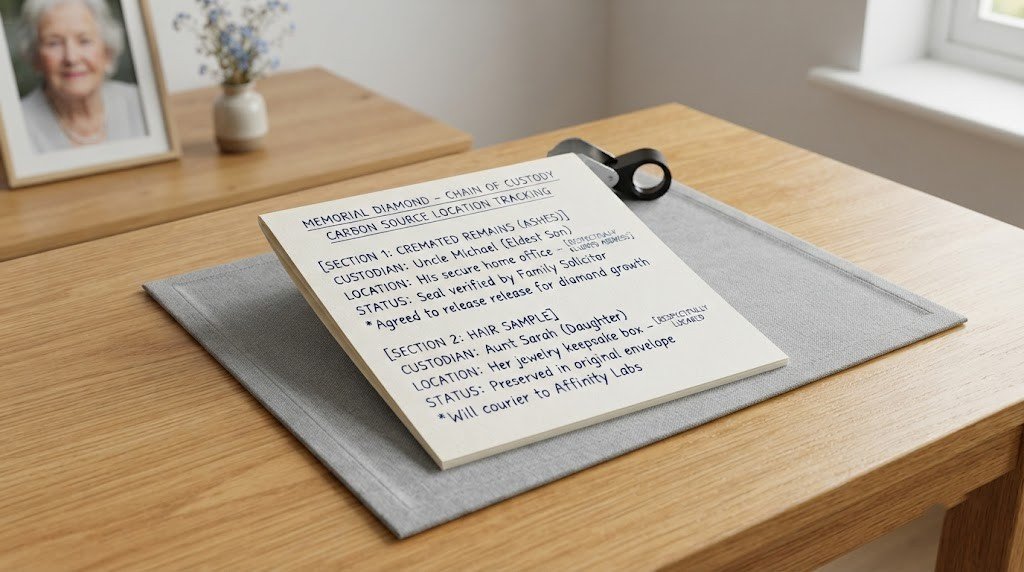
Coordination is the heart of any plan to turn grandmother ashes and hair into a diamond. Her ashes may already have been divided, scattered in part, or placed with an aunt, uncle or parent, and the hair may be with someone else entirely. If she died years ago, both materials may have changed hands more than once.
Map who holds what
Start with a simple list, shared with everyone involved:
- Who holds her ashes now, and whether any were already divided or scattered.
- Who holds any of her hair, and whether it is labeled as hers.
- Who has authority over the ashes, and who is settling her estate.
- Which grandchildren, children or other relatives would like a stone.
- Who will be the single point of contact with the provider.
Choosing one contact person matters more than it sounds. When a family sets out to turn grandmother ashes and hair into a diamond, a single coordinator keeps the paperwork, tracking numbers and decisions in one place and makes sure nobody ships materials twice.
Respecting what has already been done
If part of her ashes was scattered at a place she loved, or interred in a family plot, that choice stands on its own. A memorial diamond can sit alongside an urn, a burial or a scattering, and nobody needs to revisit decisions already made. Work with whatever portion the person holding it is comfortable sharing; you can still turn grandmother ashes and hair into a stone using only a small part.
When one relative says no
Sometimes the person holding the urn would prefer to keep it untouched. That is their decision to make. You may still be able to turn grandmother ashes and hair into stones on different timelines, starting with the hair alone now and leaving the door open to a later conversation about the ashes.
How much should you send to turn grandmother ashes and hair into a diamond?
Each provider sets its own requirements for what it needs to turn grandmother ashes and hair into a diamond, so the figures below are general industry ranges rather than fixed rules. Ask for the exact amounts in writing, especially for a combined stone, since a provider may want a different quantity of each material when both are used.
| Material | Typical amount requested | Carbon content |
|---|---|---|
| Cremated ashes | A few tablespoons up to roughly 4 oz (about 100 g) | Usable carbon is roughly 0.5 to 4% of ash by weight |
| Hair | A small lock or a few grams | About 50% carbon by weight |
The ashes requested are usually a small fraction of what the family holds, which is why most of them can stay where they are. Hair carries far more carbon by weight, so only a little is needed.
Sending more of either material does not produce a bigger or faster stone, because carat size depends on growth time. For measuring and dividing each one, see how much ash and hair a grandmother memorial diamond typically needs, which goes into more detail.
Packing two materials
Before you turn grandmother ashes and hair over to a courier, use the provider’s kit or instructions for both, and label each container with her full name, the material and who supplied it. Ask how a provider that agrees to turn grandmother ashes and hair into one stone tracks two materials from the same person, whether you receive confirmation when each arrives, and what happens to anything not used.
How much of a blended stone is actually her carbon?
Anyone hoping to turn grandmother ashes and hair into a stone deserves a straight answer here, and that answer has limits. No memorial diamond is grown purely from a person’s remains; recovered carbon is purified to roughly 99.9% or higher and typically blended with supplemental lab carbon so the crystal can grow to a usable size.
For stones made from ashes alone, industry sources usually put the person’s own carbon at roughly 10 to 15% of the finished stone by mass, though individual providers report figures ranging from about 3% upward. That figure applies to ash-based stones only. For a stone that combines ashes and hair, no comparable finished-stone percentage has been published, so ask each provider to state its own figure in writing and explain how it was measured.
What the lab does with both
Once materials are logged, carbon is extracted and purified, converted to graphite at about 2,500 to 2,700°C, and then grown, usually by HPHT, where a press holds the cell near 6–8 GPa and 1,400–2,500°C while the crystal forms over a period of weeks or months. The stone is then cut, polished and graded. Some providers offer irradiation afterward to shift color. The general background on memorial diamonds as a category explains how this sits within lab-grown diamond production.
Whether a provider extracts carbon from the ashes and the hair separately before blending is a process question only that provider can answer. A closer look at whether a stone is truly grown from both her ashes and her hair lists the follow-up questions worth asking, and a step-by-step account of how a lab grows a combined stone covers the science more fully.
What do you choose when you order the stone?
Placing the order is when a plan to turn grandmother ashes and hair into a diamond settles into concrete details. Settle these points before anyone signs anything, and keep the decisions written down with everyone who is contributing.
Size and cost
Memorial diamonds generally run from about 0.10 carats to 5 carats or more. Across the industry in 2026, a stone of roughly 0.10 to 0.25 ct typically costs about $1,500 to $3,500; 0.5 to 1 ct runs about $5,000 to $15,000, with colorless costing meaningfully more; and 2 to 5+ ct ranges from roughly $20,000 to $75,000 or more. These are general market figures, not Memorial Diamond’s pricing. Grading reports, engraving, fancy cuts and settings are usually charged separately, and a combined stone may be priced differently from a single-source one, so ask.
Color
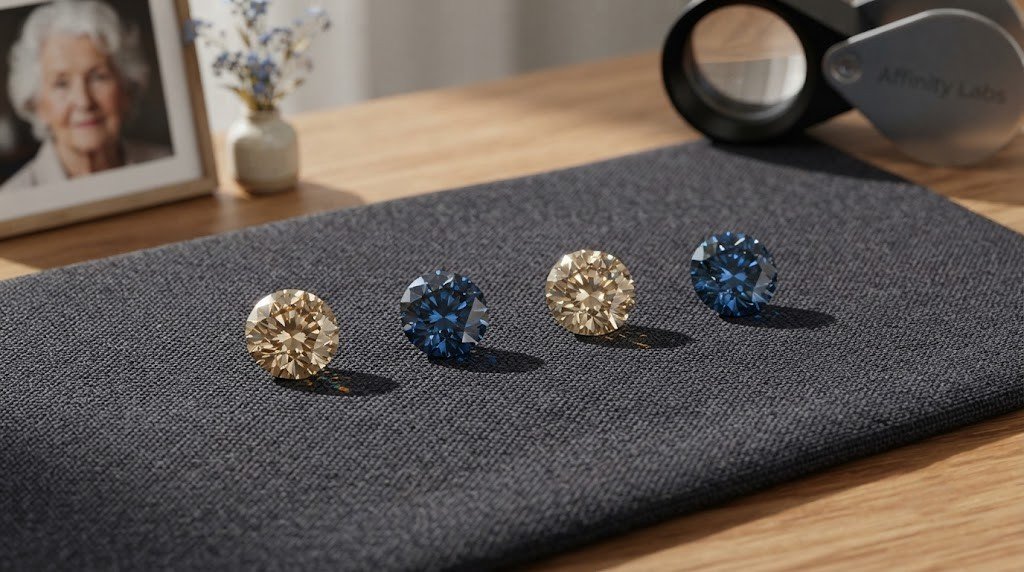
Trace elements decide color: boron gives blue, nitrogen gives yellow, and a colorless stone needs both excluded through extra processing, which typically costs more. Memorial diamonds often come out yellow, blue or champagne-brown, and some providers offer irradiation for red, pink, green or black. Choosing to turn grandmother ashes and hair into one stone does not let a family pick a precise natural shade. The guide to color in a grandmother ashes and hair diamond explains what to expect.
Grading and certificates
Two different documents may come with the stone. An authenticity or origin certificate, usually issued by the provider, records chain of custody. A grading report assesses the 4Cs of the stone itself; one from an independent lab carries the most weight, and most providers charge for it on top of the stone. Memorial diamonds usually grade between SI2 and VVS for clarity.
Setting
Choose a setting for the person who will wear it and for who she was, not for a generic idea of a grandmother. A ring for someone who wears rings daily, a pendant or cufflink for someone who does not, or a loose stone kept with its papers for a future generation to set are all reasonable. Diamond rates 10 on the Mohs hardness scale, though a sharp knock can still chip one, so a protective setting helps for everyday wear.
How long does it take to turn grandmother ashes and hair into a diamond?
Once a provider has the materials in hand, industry timelines usually run 6 to 10 months. A larger stone, above roughly 2 carats, or a specialty shade like black may need closer to a year.
The time before shipping is entirely yours. Gathering two materials from different relatives, waiting for an estate to settle, or giving someone room to decide about the ashes can take weeks or months, and there is no deadline on any of it. Starting a decade after her death is no obstacle: the lab work is identical whenever you turn grandmother ashes and hair into a stone.
If you turn grandmother ashes and hair into several stones in one order, ask whether they are grown at the same time or one after another, and get an estimated delivery for each in writing.
Can grandchildren and cousins each have a stone?
Often, yes. It is reasonable to ask a provider whether it can turn grandmother ashes and hair into more than one stone, and because each stone typically uses only a portion of the material, several relatives can often receive their own diamond from the same shared ashes and hair, depending on the provider. Some families choose matching small stones for each grandchild; others choose one larger stone for an aunt or a parent and smaller ones for the next generation.
Keeping it fair and calm
- Agree early on how costs will be split, or whether each person pays for their own stone.
- Decide whether every stone will be combined, or whether some will be hair-only or ash-only.
- Let each person choose their own setting, even if the stones match.
- Share provider updates with everyone, through the single coordinator.
When cousins set out to turn grandmother ashes and hair into several stones, the conversations are usually more important than the logistics. Anyone who would rather not take part can simply step back, with no pressure either way.
If the ashes route alone is the more practical choice for some branches of the family, the walkthrough on turning a grandmother’s ashes into a diamond explains that process.
Frequently Asked Questions
Do all providers combine ashes and hair in one diamond?
No. Some providers offer combined stones and others prefer separate stones from each material. Ask each provider directly whether it blends ashes and hair, how both are tracked, and whether separate stones can be ordered together, and get the answer in writing.
Who decides whether I can turn grandmother ashes and hair into a diamond?
State law and her written wishes set who holds authority, and the order varies between states. Her spouse or partner, and next her adult children, typically rank before grandchildren. Whoever handled the cremation can usually tell you whose signature is on the authorization form.
Is a combined stone made entirely from her ashes and hair?
No. Recovered carbon is purified and typically blended with supplemental lab carbon. Ash-only stones are commonly cited at around 10 to 15% personal carbon, but no figure has been published for combined stones, so ask each provider for theirs in writing.
What if her ashes were already scattered or divided?
You can work with whatever portion remains and whoever holds it agrees to share. If no ashes can be shared, a stone grown from her hair alone needs none. A provider can confirm the minimum amount of each material it requires before you plan around it.
Can I turn grandmother ashes and hair into stones for several cousins?
Often, yes, depending on the provider. Each stone typically uses only a portion of the material, so several relatives can frequently receive their own. Agree on costs, settings and a single family coordinator before anything is sent to the provider.
Does using two materials change the color of the diamond?
No published evidence shows that combining materials lets a family choose or predict a shade. Color comes from trace elements during growth, with boron producing blue and nitrogen yellow. Colorless stones need extra processing and typically cost more than yellow, blue or champagne.
How long does a combined grandmother memorial diamond take?
Across the industry, the lab stage typically takes 6 to 10 months after the provider receives the material, and up to about 12 months for stones over 2 carats or specialty colors. Gathering materials beforehand happens at your family’s own pace.
Final Thoughts on Turning Her Ashes and Hair Into One Diamond
Choosing to turn grandmother ashes and hair into a diamond is as much a family project as a technical one. The lab work follows a well-worn path; the care lies in asking the right people, respecting what has already been decided, and getting clear written answers from a provider before anything leaves home.
Some families find it meaningful to hold a stone that draws on both, while others settle on two stones or one material. Each of those choices honors her.
Learn More About Combining Your Grandmother’s Ashes and Hair
- Grandmother Ashes and Hair Diamond: The Complete Guide background on stones that use both materials
- Amounts of ash and hair a grandmother’s stone typically needs measuring and dividing each material
- Is a Memorial Diamond Really Made From Your Grandmother’s Ashes and Hair? what providers can and cannot show
- How to Turn Your Grandmother’s Hair Into a Diamond the hair-only route, with no cremation involved
Talk With Memorial Diamond
Whether your family is still mapping out who holds her ashes and hair or is ready to compare providers, Memorial Diamond is glad to talk it through. Visit memorialdiamond.us to ask how to turn grandmother ashes and hair into a stone, or anything else on your mind, at whatever pace suits everyone involved.