
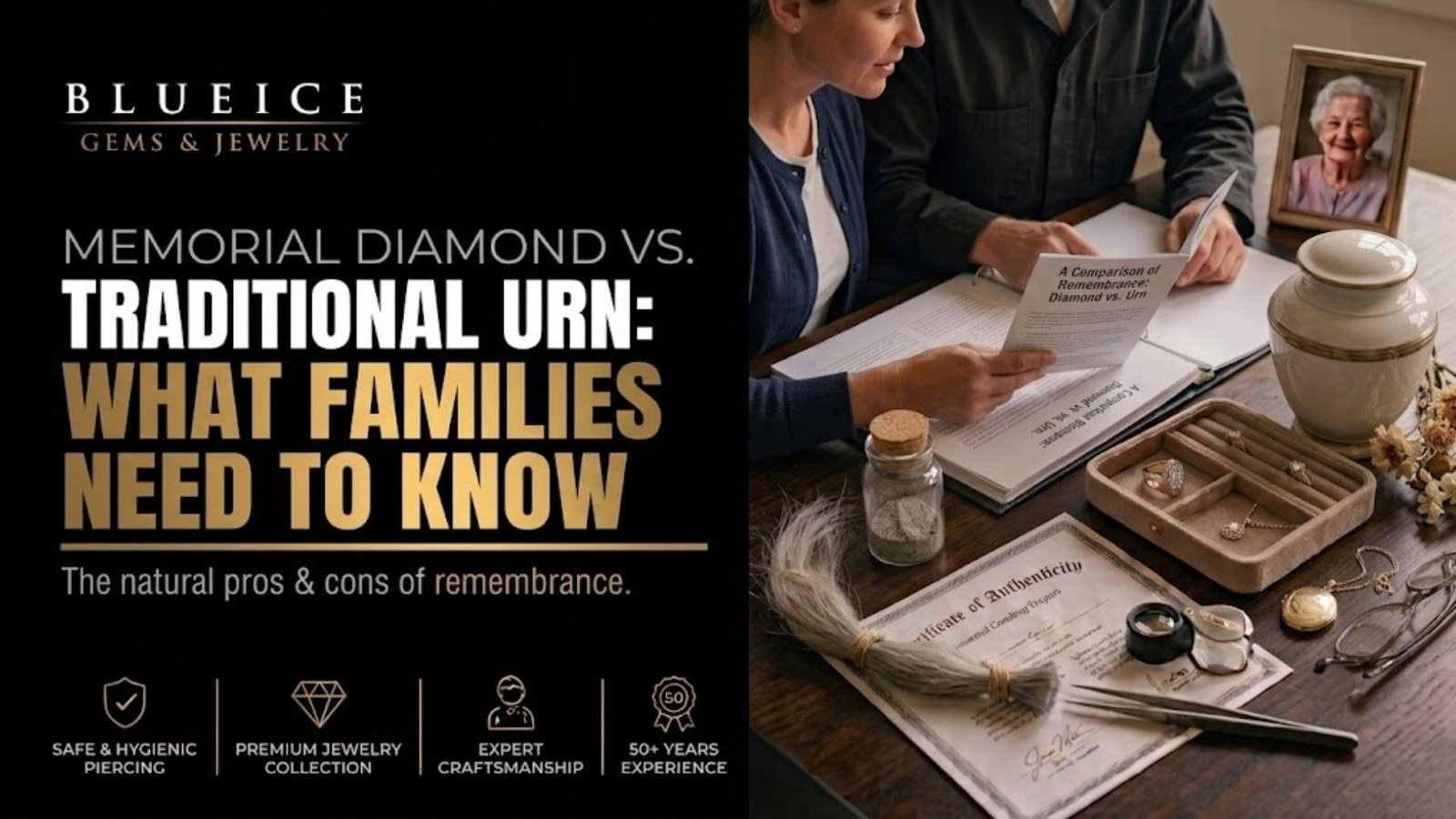
Deciding where her ashes rest can feel like a weight you did not expect to carry. Weighing a grandmother memorial diamond vs urn is not really a contest: an urn keeps every bit of her ashes together, whereas a memorial diamond grows a gem using carbon drawn from a little of them. Neither is the better choice, and a family can choose both, since most of her ashes can stay in the urn.
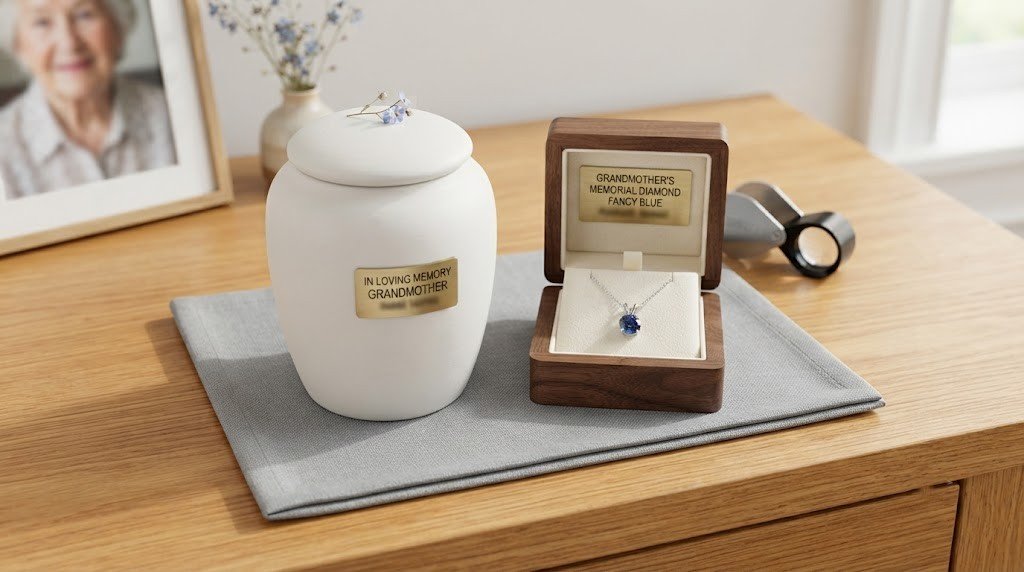
Table of Contents
What Is the Difference Between a Memorial Diamond and an Urn?
An urn is a container that holds cremated remains as they are, and a memorial diamond is a gemstone grown in a lab using carbon taken from a portion of those remains. Both are ways of keeping her close. They simply do it in very different forms.
A traditional urn can be made of metal, wood, stone, ceramic or a biodegradable material, and it may sit at home, in a columbarium niche or in a cemetery plot. It keeps her ashes together and unchanged. Nothing is extracted, and nothing is added.
A memorial diamond is a real diamond, grown under heat and pressure around a small seed. Carbon is extracted from a portion of her ashes, purified and typically blended with supplemental lab carbon. Where the source is ash, the share of the finished stone that is her carbon is usually in the region of 10–15% by mass, though some providers quote figures nearer 3% and others quote more. If you are comparing a grandmother memorial diamond vs urn for the first time, that matters: the stone is made in part from her, not entirely.
So the grandmother memorial diamond vs urn choice is less about which honors her more and more about form: a vessel that keeps everything together, or a small, wearable stone that keeps part of her carbon in a different shape. The grandmother ashes diamond complete guide explains each stage of how that stone is made.
How Do a Memorial Diamond and an Urn Compare Side by Side?
They differ on almost every practical point, which is why a table helps. Each row below is a factor to weigh, not a score, and the grandmother memorial diamond vs urn comparison shifts depending on which rows matter most to your family.
| Factor | Traditional urn | Memorial diamond |
|---|---|---|
| What it holds | Her cremated remains, unchanged | A lab-grown diamond made with carbon from a portion of her ashes, typically blended with lab carbon |
| How much of the ashes | All of them, or whatever portion the family places in it | Typically a few tablespoons up to roughly 4 oz per order |
| Wearability | Not worn; a keepsake urn or pendant urn is the closest equivalent | Can be set in a ring, pendant or other piece and worn |
| Portability | Stays in one place; travel with remains has its own rules | Small enough to carry anywhere you go |
| Cost | Wide range, set by material and craftsmanship | From about $1,500 for a small stone to $75,000+ for a large one; setting extra |
| Timeline | Can usually be chosen and filled soon after cremation | Typically 6–10 months, up to about 12 for larger or specialty stones |
| Who can have one | Usually one primary urn; keepsake urns let several relatives keep a little | Several stones can often come from one source, so several relatives may each have one |
| Over generations | May stay at home, move to a niche or be buried | Can be passed down as jewelry, ideally with its paperwork |
Seen together, the grandmother memorial diamond vs urn comparison is not about one replacing the other. An urn keeps her ashes intact, and a stone carries a small part of her carbon into everyday life.
How Much of Her Ashes Does Each Option Use?
An urn can hold all of her ashes, and a memorial diamond typically uses only a small portion. That difference is what turns a grandmother memorial diamond vs urn question from an either-or into something more flexible.
Ash is mainly bone mineral (calcium phosphate), and only about 0.5–4% of its weight is carbon that can be recovered. Even so, providers typically ask for somewhere from a few tablespoons up to around 4 oz, about 100 g, for an order. The rest can stay in her urn exactly as it was.
Carat size comes from how long the stone grows, not from how much ash is sent, so sending more ash does not make a bigger diamond. Exact amounts differ by provider, and our guide to how much ash a grandmother memorial diamond needs explains the typical ranges and what to ask.
How Do the Costs Compare?
An urn’s price depends on its material and maker and varies widely, while a memorial diamond’s price depends mainly on carat and color. On cost alone, how a grandmother memorial diamond vs urn comparison comes out depends on the particular urn, but even the smallest stones typically start at around $1,500.
For the diamond side of a grandmother memorial diamond vs urn budget, typical 2026 industry ranges are:
- Around 0.10–0.25 carats: about 1,500–3,500
- Around 0.5–1 carat: about 5,000–15,000, with colorless stones costing more
- Around 2–5 carats and above: about 20,000–75,000 or more
- Settings, engraving, fancy cuts and independent grading: usually priced separately
For an urn, a funeral home or an independent urn maker can show you options across a range of materials and prices. A family might pair a modest urn with a small stone, or choose only one of the two. The grandmother memorial diamond cost breakdown goes tier by tier if you are working out a budget.
How Long Does Each Option Take?
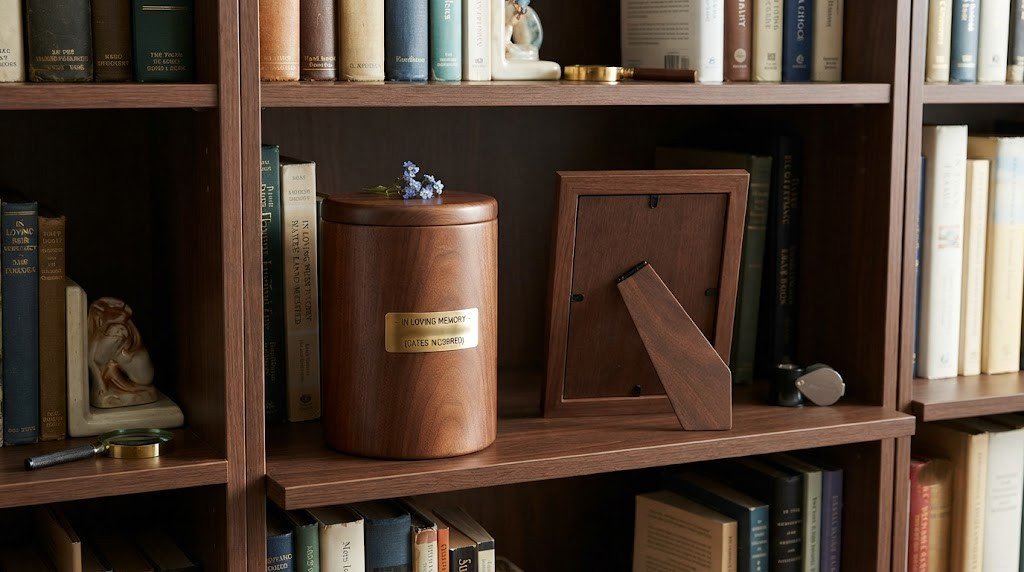
An urn can usually be chosen and filled soon after cremation. A memorial diamond is slower: when a family is weighing a grandmother memorial diamond vs urn with a date in mind, it helps to know a stone typically takes 6–10 months from the provider receiving the ashes to a finished stone. Larger stones of roughly 2 carats or more, and specialty colors, can take up to about 12 months.
In a grandmother memorial diamond vs urn comparison, that gap matters most if a service is coming up. Her ashes can rest in an urn for the service and for as long as the family wants, and a small portion can be set aside for a stone whenever the family is ready. There is no deadline for deciding on a diamond.
Growth itself takes weeks to months, and extraction, purification, cutting and polishing add to that. Our post on how long a grandmother memorial diamond takes explains why the timeline varies.
Which Is Easier to Wear, Carry or Keep at Home?
A memorial diamond is the easier one to wear and carry, and an urn is the one that keeps her ashes in a single place. Which of those matters more is personal, and the grandmother memorial diamond vs urn question often turns on it.
A diamond rates 10 on the Mohs scale of mineral hardness, the hardest natural mineral, so it stands up well to daily wear. A hard knock can still chip it, so a protective setting helps for a stone worn every day. It can go to work, travel with you and sit on a hand or at the collarbone.
An urn stays where you place it, whether that is a shelf, a niche or a grave. For some people that steadiness is exactly the point: a place to visit and a place she rests. In a grandmother memorial diamond vs urn comparison, neither kind of closeness outranks the other. If the family wants something wearable but is still unsure about a grandmother memorial diamond vs urn, a small pendant urn that holds a pinch of ashes sits somewhere between the two. For wearable ideas, see grandmother memorial diamond ideas for rings, pendants and keepsakes.
What Happens to Each Over the Generations?
Both can be handed down, though in different ways, so it is worth thinking about the next generation while weighing a grandmother memorial diamond vs urn. An urn may stay in a relative’s home for years, later move to a columbarium or be buried, and its future usually depends on who takes care of it next.
A memorial diamond can pass from one relative to another as a piece of jewelry. Keeping its in-house authenticity certificate, which records where the carbon came from, and any optional independent grading report together with the stone helps later generations know what it is. A short written note about her can travel with it as well.
Over time, one practical difference in a grandmother memorial diamond vs urn choice is who looks after each one. A family can decide early who will care for the urn and who will keep a stone, so neither is left without a plan. Questions about insuring a stone are best taken to an insurance agent.
Can Your Family Choose Both?
Yes. Because a diamond typically uses only a portion of her ashes, most of them can stay in the urn, be interred or be scattered, as the family planned.
Choosing both can ease the grandmother memorial diamond vs urn decision for relatives who want different things. One person may want a place to visit, and another may want something to wear. In that case, the urn keeps her ashes together in one place while a small portion becomes one stone, or several.
Before a portion is removed, check with whoever holds authority over her remains. Who that is differs from state to state; no one national rule applies.
Where she left a spouse or partner, that person and her adult children commonly rank ahead of grandchildren, unless written wishes she left say otherwise. As a grandchild, the gentle route is simply to ask that person whether a little could be set aside. If several relatives would each like a stone, our guide on whether more than one family member can get a diamond from her ashes covers how that works.
How Does Faith Shape a Grandmother Memorial Diamond vs Urn Decision?
No tradition has an official position on memorial diamonds specifically; religious guidance speaks to cremation and how ashes are kept. That makes faith an important part of the grandmother memorial diamond vs urn decision for families where it matters, and your own clergy is the right person to ask.
- Catholic: The Church allows cremation, but its 2016 instruction from the Dicastery for the Doctrine of the Faith, clarified in 2023, asks that ashes stay together in a sacred place approved by the Church instead of being split up or kept in a home; a minimal part may be set aside only under narrow conditions. For Catholic families weighing a grandmother memorial diamond vs urn, an urn in a consecrated place fits that guidance most directly, and a priest can speak to the rest.
- Islam: Cremation itself is considered impermissible across the major schools in ordinary circumstances. A hair-based stone involves no cremation, so it sits outside that objection.
- Judaism: Orthodox and Conservative Judaism generally prohibit cremation, while Reform Judaism is more permissive and leaves the decision to rabbis and families. A hair-based stone again sits outside a cremation-specific concern.
- Hindu: Cremation is the traditional rite, with ashes customarily immersed in a sacred river; setting aside a small amount to keep is reported to be more common now, but practice differs between families, regions and communities.
- Buddhist: Cremation is predominant, and views on a keepsake differ by teacher and community.
- Protestant: Generally treated as a personal choice, though some congregations have views on dividing ashes.
If faith or a burial rules her ashes out, the grandmother memorial diamond vs urn question may shift toward saved hair instead. Hair is roughly 50% carbon and needs no cremation; whether gray, white or thinning hair is accepted is a question for the provider.
If the hair is in your own keeping, that route tends to be simpler in practice than one involving ashes; still, her belongings may count toward her estate, state rules differ, and hair kept by another relative calls for a conversation with them first. The grandmother hair diamond complete guide explains that route.
What Other Options Sit Alongside These Two?
A diamond and an urn are two of several ways to care for her ashes, and each of the others is just as valid. Looking beyond the grandmother memorial diamond vs urn choice can open up combinations the family had not considered. According to the NFDA’s 2025 cremation and burial report, the projected US cremation rate is 63.4%, against 31.6% for burial, so questions about where ashes go come up for a large share of families.
Other choices include:
- Scattering in a place that mattered to her, following local rules
- Burial of an urn in a cemetery plot or family grave
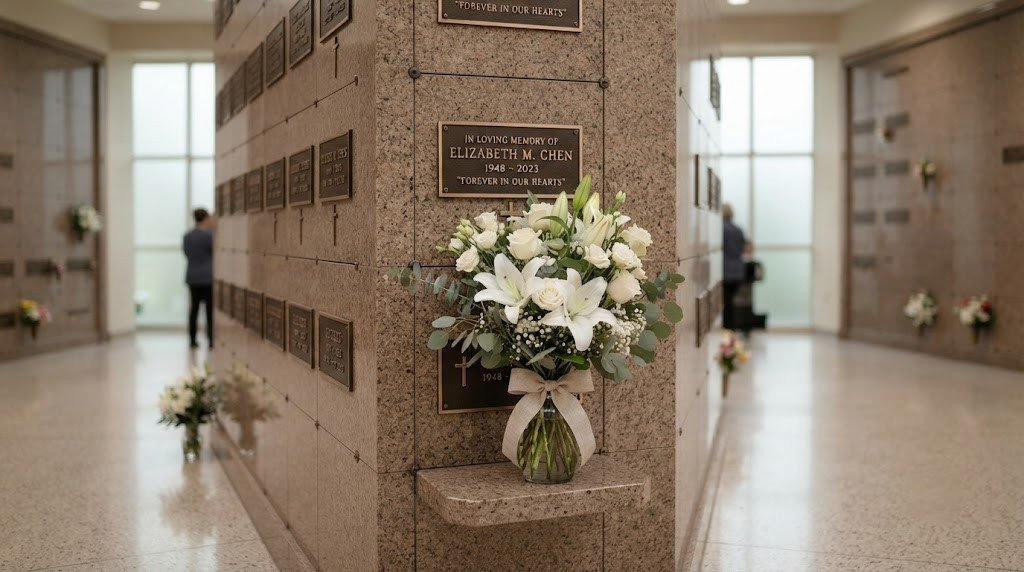
- A columbarium niche, often in a cemetery or place of worship
- Keepsake urns, small vessels that let several relatives each keep a little
- Pendant urns, jewelry with a sealed chamber for a pinch of ashes
These can be combined with each other and with a diamond, and scattering or burying part of her ashes does not prevent a family from also keeping an urn or a stone. The grandmother memorial diamond vs urn decision rarely has to exclude everything else.
Which Questions Help You Decide on a Grandmother Memorial Diamond vs Urn?
Start with what the family wants to do with her memory day to day, then work outward to practical limits. These questions can make a grandmother memorial diamond vs urn conversation clearer:
- Do we want one place to visit, something to wear, or both?
- Who holds authority over her ashes, and what did she want, if she said?
- Does anyone’s faith shape how her ashes should be kept?
- What budget is realistic, and who would contribute?
- Would more than one relative want a stone?
- How much of her ashes are we willing to set aside, if any?
- Is there saved hair, if ashes are not an option?
Whichever way the grandmother memorial diamond vs urn decision leans, ask any provider in writing how much ash they need, what happens to ashes they do not use, and what paperwork comes with the stone.
Frequently Asked Questions
Is a diamond made from her ashes more respectful than keeping them in an urn?
In a grandmother memorial diamond vs urn decision, neither is more respectful. An urn keeps her ashes intact in one place, and a diamond turns a small portion into a wearable stone. Both are sincere ways to remember her, and the right one depends on your family’s wishes and beliefs.
Will there still be ashes left for an urn after a diamond is made?
Usually, yes. Whatever a family decides about a grandmother memorial diamond vs urn, a provider typically asks for a few tablespoons up to around 4 oz of ashes, which is a small part of the total. The remaining ashes can stay in her urn, be interred or be scattered.
Can ashes already placed in an urn or niche be used later?
Possibly, if they can be reached and whoever holds authority over her remains agrees. Opening a sealed urn or niche can involve the cemetery or funeral home, so ask them first, then ask the provider how much ash they need.
Does a memorial diamond replace the need for a final resting place?
Not necessarily. Because a stone uses only part of her ashes, a grandmother memorial diamond vs urn choice is rarely all-or-nothing, and the rest of her ashes still need a home, whether that is an urn, a niche, burial or scattering. A resting place also gives relatives somewhere to visit.
What if part of the family prefers an urn and part prefers a diamond?
When relatives disagree about a grandmother memorial diamond vs urn, choosing both is often possible, since the diamond uses only a portion. Whoever holds authority over her remains under state rules generally decides about the ashes, and hearing each relative’s reasons can help.
Is a keepsake urn a lower-cost way to share her ashes?
It can be. Keepsake urns are small vessels that let several relatives each hold a little of her ashes. Their prices vary by material and maker, so compare them with a funeral home or urn maker against the typical $1,500 starting point for a small stone.
Final Thoughts on Choosing Between a Diamond and an Urn
There is no wrong answer to a grandmother memorial diamond vs urn decision, only the one that fits the people who loved her. An urn can give the family a place to return to, a stone can give someone a way to carry her into ordinary days, and there is room for both. Take the time you need, and let the conversation include everyone who wants a say.
Learn More About Grandmother Memorial Diamonds
- Grandmother Memorial Diamond FAQ: Everything Families Ask short answers that can help with a grandmother memorial diamond vs urn decision
- Choosing a Memorial Diamond for Your Grandmother: Where to Start first decisions on carat, color and setting
- Is a Memorial Diamond Really Made From Your Grandmother’s Ashes? what share of the stone is her carbon
- How to Talk to Family About a Grandmother Memorial Diamond ways to start the conversation gently
Talk With Memorial Diamond
If you are still weighing a grandmother memorial diamond vs urn, or wondering about both, you are welcome to ask us anything, with no expectation that you will order. You can reach us through memorialdiamond.us whenever your family is ready to talk it through.
Leave A Comment