
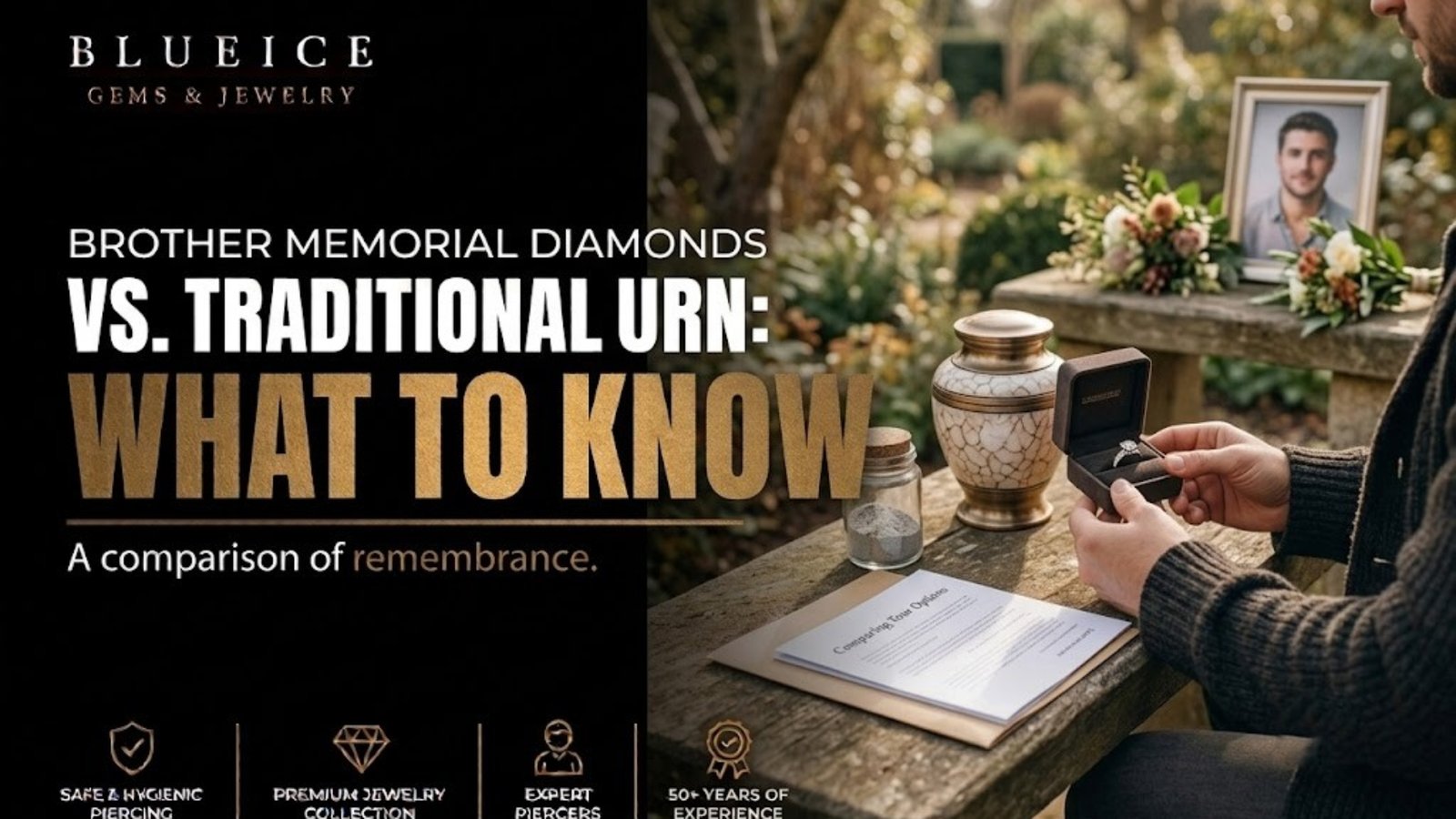
Maybe the crematory has handed you a plain temporary container, or a sibling has sent a photo of an urn and asked what you think. The brother memorial diamond vs urn question comes down to two different jobs: an urn keeps your brother’s ashes together exactly as they are, while a memorial diamond is a lab-grown stone made with carbon recovered from a small portion of them. Neither is the more loving choice, and the two can sit side by side.
Whether you are his sibling, his spouse or partner, one of his adult children or a parent, the brother memorial diamond vs urn choice is a family question as much as a practical one.
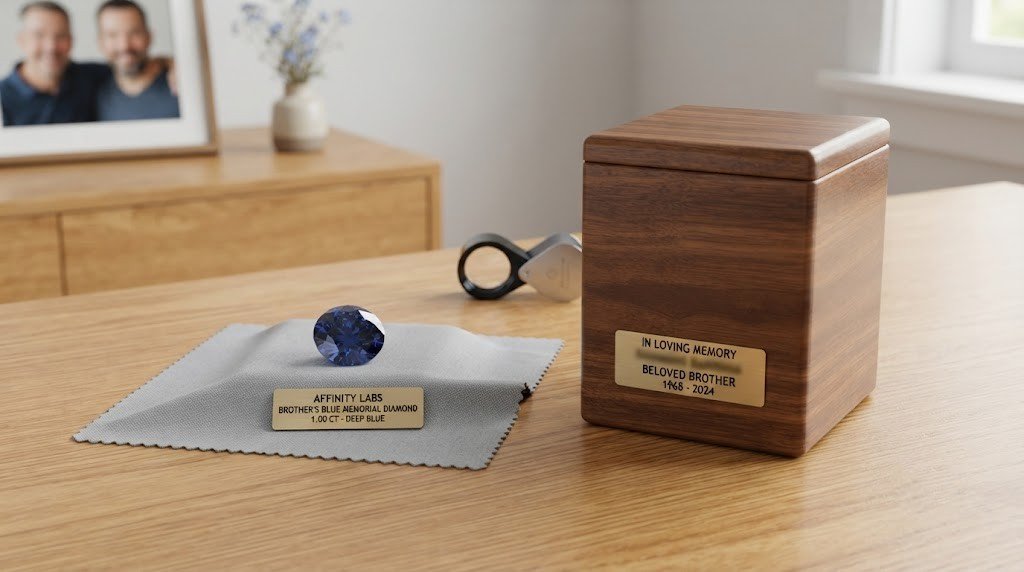
Table of Contents
Brother Memorial Diamond vs Urn: What Is Each One, Really?
An urn is a vessel. Brushed metal, turned wood, glazed ceramic or a biodegradable shell, its purpose is the same: to hold your brother’s cremated remains intact, whether it rests on a shelf at home, in a columbarium niche, or in a cemetery plot. Nothing about his ashes changes when they go inside, and the family can still move, divide, scatter or bury them later.
A memorial diamond is a real diamond, not glass, resin or a look-alike. A provider takes a measured portion of the ashes (or a lock of hair), extracts the carbon, purifies it to roughly 99.9% or better, converts it to graphite, and grows a crystal around a tiny diamond seed. Most providers use the HPHT method, pressing the carbon at around 6 to 8 GPa and 1,400 to 2,500°C, the same family of techniques behind any lab-grown diamond.
The finished stone is cut, polished and graded on the same 4Cs as a mined diamond. Seen that way, the brother memorial diamond vs urn comparison is really between keeping all of his remains whole and turning a small share of them into something new that someone can wear.
Brother Memorial Diamond vs Urn: How Do They Compare Side by Side?
The table lines the two options up on the points families tend to ask about first. Ranges for the diamond are general industry figures, not any one provider’s terms.
| What you’re weighing | Traditional urn | Memorial diamond |
|---|---|---|
| What it is | A container for his cremated remains | A lab-grown diamond made partly with carbon from his ashes or hair |
| What happens to the ashes | Kept as they are, all together | A portion is used up in carbon extraction; the rest stays with the family |
| How much ash is involved | All of it, or whatever share the family places inside | Typically a few tablespoons up to roughly 4 oz (about 100 g) |
| Can it be reversed later? | Yes; ashes can still be divided, scattered or buried | No; the portion sent cannot be returned as ash |
| Where it lives | One fixed place: a home, niche or grave | Wherever the wearer goes, or a box at home as a loose stone |
| Typical cost | Varies widely; ask a funeral home or retailer | Roughly $1,500 to $75,000+ industry-wide, driven by carat and color |
| Time to have it | Usually days | Typically 6 to 10 months, up to about 12 for large or specialty stones |
| Possible if he was buried | Not applicable | Often, through saved hair, if the provider accepts the sample |
| How many people it serves | One shared place | Several family members can often each have a stone |
Read the table as tradeoffs, not a scorecard. When you set out the brother memorial diamond vs urn question this way, the rows your family cares about most (a place to gather, something to hold, what his faith asks) may settle it sooner than price does.
Is the Brother Memorial Diamond vs Urn Decision Really Either-Or?
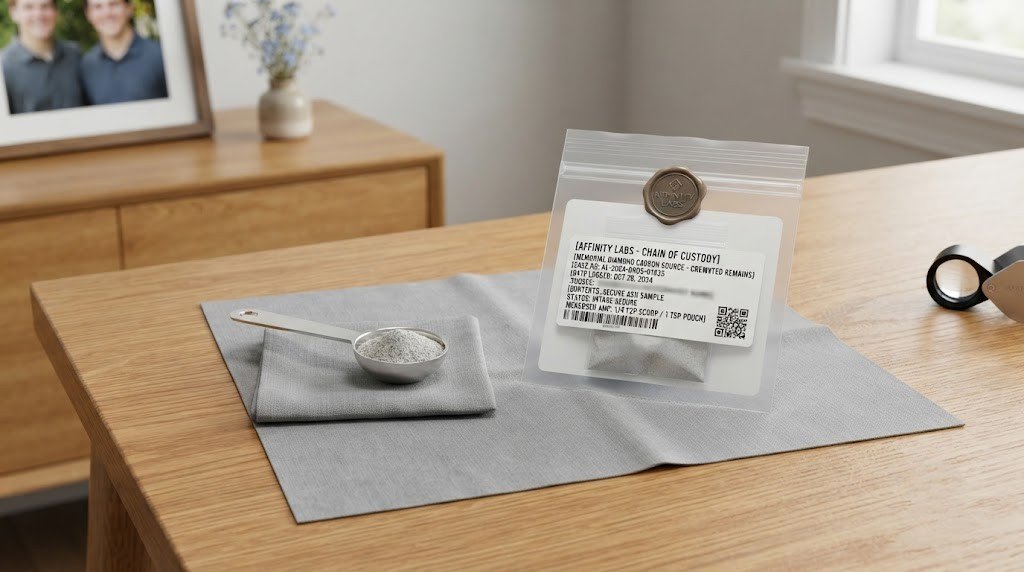
Usually not. Providers across the industry typically ask for somewhere between a few tablespoons and about 4 oz of ash, which is normally a small fraction of what a crematory returns. The rest can go into an urn, be buried in a family plot, or be scattered somewhere he loved, just as you had planned.
That is why the brother memorial diamond vs urn framing can mislead a little. Often the real question is which portion goes where, and who keeps what. A parent might want the urn at home while a partner, if he had one, wears a pendant, or two siblings might each want a small stone of their own.
Shared material makes that possible. Because only part of the ash is used for each stone, several people can often each receive a diamond from the same remains, and the planning around that is laid out in how siblings and other relatives can share one brother’s ashes.
Order is flexible too. An urn can come first, with a diamond considered months or years later, so the brother memorial diamond vs urn decision does not have to be made all at once. Whether ashes stored for a long time are still workable, and how they should be kept in the meantime, is something to confirm with each provider before you assume anything.
Brother Memorial Diamond vs Urn: What Does Each Ask of His Ashes?
When you set the brother memorial diamond vs urn question against what happens to his ashes, the urn closes nothing off. Every gram of your brother’s remains stays as it is, leaving a later burial, a scattering, a division among relatives, or a diamond all open.
A memorial diamond asks for something permanent. The portion you send is processed to pull out its carbon, and that carbon becomes part of the crystal. It cannot be turned back into ash. What happens to any material left over after extraction, and whether any of it can be returned, varies from one company to the next, so ask each provider to explain it in writing.
How much of the stone is actually him?
Cremated remains are mostly calcium phosphate, the mineral of bone, and usable carbon is roughly 0.5% to 4% of ash by weight. For an ash-based stone, his own carbon typically makes up around 10% to 15% of the finished diamond’s mass, with some providers citing figures as low as 3% and others higher. The balance is typically supplemental lab carbon, added so the crystal can grow to a meaningful size.
Sending more ash does not make a bigger or faster stone, because carat size comes from time in the growth press. If you are weighing how large a share to part with, how much ash a brother’s stone typically needs goes deeper on quantities and why they vary. That modest quantity is a big part of why the brother memorial diamond vs urn decision so often ends with the family keeping both.
Would You Rather Visit a Place or Carry Something With You?
This is often the heart of the brother memorial diamond vs urn decision, and it has nothing to do with price. An urn gives his memory an address. A niche, a grave or a spot on a mantel becomes somewhere to go on his birthday, where cousins can stand together, and where people who loved him in different ways all have equal access.
A diamond goes where you go: on a hand at a wedding he would have attended, or on a chain on the first day of a new job. Some people simply want something of him within reach when the day is ordinary and the missing is not.
What wearing it looks like day to day
Diamond rates 10 on the Mohs scale, so it resists scratching better than almost anything else you could wear. A hard knock against a counter or doorframe can still chip any diamond, though, so a protective setting is worth discussing with a jeweler.
Style follows the person who will wear it and who your brother was, not any idea of what suits a man. A loose stone in a small box is a perfectly good choice, and so is a pendant, a ring or cufflinks.
When one place matters more
For some families the brother memorial diamond vs urn answer leans firmly toward the urn, and that is a sound outcome, especially when scattered relatives want one spot to return to together.
Brother Memorial Diamond vs Urn: How Do Cost and Time Compare?
Money is one place the brother memorial diamond vs urn decision shows a clear gap. Urn prices span modest containers to costly handcrafted pieces, and a columbarium niche or cemetery plot usually carries separate fees. A funeral home or urn retailer can give actual figures for your area.
Memorial diamonds cost more, and the price depends mostly on carat and color. General 2026 industry ranges look like this:
- Small (0.10–0.25 ct): in the region of 1,500–3,500
- Middle (0.5–1 ct): in the region of 5,000–15,000; a colorless stone of the same size costs meaningfully more
- Large (2–5+ ct): in the region of 20,000–75,000 and beyond
- Usually priced separately: an independent grading report, engraving, fancy cuts and a jewelry setting
These are category-wide figures rather than any single company’s prices. A fuller breakdown of what shapes the price of a brother’s memorial diamond can help you set a budget before you request quotes.
Time differs just as sharply. An urn is usually available within days. A diamond is a longer wait: industry-wide, expect roughly 6 to 10 months once his ashes or hair reach the provider, stretching toward a year for stones above about 2 ct or for specialty colors. If you are planning around the brother memorial diamond vs urn timing, an urn can come first and give his ashes somewhere to rest during that wait.
How Does Faith Shape the Brother Memorial Diamond vs Urn Choice?
No religious tradition has an official teaching on memorial diamonds as such. What traditions do address is cremation itself and how ashes are handled, and those positions shape the brother memorial diamond vs urn decision far more than the jewelry does.
- Catholic: The Church allows cremation, yet current Vatican guidance wants the remains kept whole in a consecrated resting place, permitting only a minimal portion under narrow conditions.
- Muslim: Every major school of Islamic law treats cremation as impermissible, which rules out an ash-based stone; hair, which requires no cremation, sits outside that objection.
- Jewish: Orthodox and Conservative Judaism generally prohibit cremation; Reform Judaism is more permissive.
Other traditions leave more room for family and community judgment:
- Hindu: Ashes are traditionally immersed in a sacred river; keeping a small portion is described as increasingly common, though it varies.
- Buddhist: Views on keeping remains depend on the teacher and community.
- Protestant: Most clergy have no objection, though some congregations raise concerns about dividing ashes.
- Secular: The choice rests on what feels meaningful to the family.
If faith mattered to your brother, or matters to the people deciding now, his own clergy or community leaders are the right people to ask. Their guidance deserves real weight, and for a family whose faith points that way, an urn on its own is a complete and respectful answer.
Who Makes the Brother Memorial Diamond vs Urn Decision?
Authority over a person’s remains is set by state law and by anything he put in writing, and the order of who decides is not the same everywhere. Depending on the state and his circumstances, a spouse or partner, adult children and parents may each rank ahead of a sibling. If he left written instructions or named someone to handle his arrangements, that can change the picture entirely.
If nobody is sure, ask the funeral home or crematory whose signature is on the cremation paperwork; they can usually say. That person is often the one to talk with, whether the brother memorial diamond vs urn question is still open or the family is deciding how to divide the ashes between them.
If you are his sibling and not the one deciding
A gentle route is to ask whoever holds authority whether a small portion of the ashes could be set aside for a stone, while the rest stays in the urn. If ashes are not available, hair he left behind may be another path; because his belongings can form part of his estate under rules that vary by state, speak with whoever is settling his affairs first.
Relatives do not always land in the same place on the brother memorial diamond vs urn decision. His parents may see things differently, may be estranged, or may have died, and siblings may disagree. A calm conversation often helps, and ways to raise a memorial diamond with the rest of the family can make that first talk easier. If a real dispute develops, a local attorney is the right person to explain how your state handles it.
What If Your Brother Was Buried Rather Than Cremated?
Cremation has overtaken burial in national projections, with the National Funeral Directors Association projecting a 2025 cremation rate of 63.4% against 31.6% for burial. Still, many families bury, and if yours did, the brother memorial diamond vs urn comparison simply falls away.
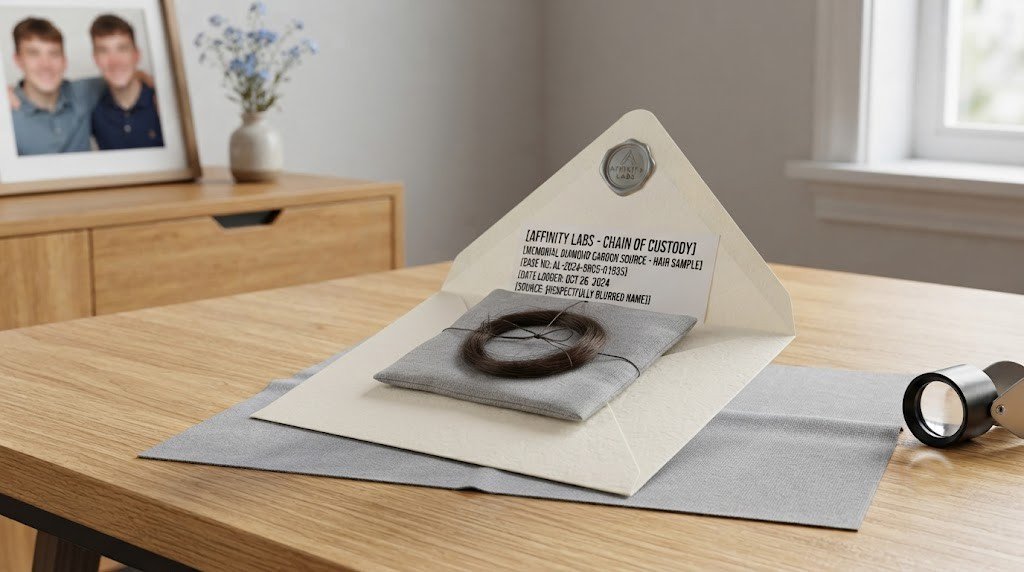
A diamond may still be possible through hair. Hair is roughly 50% carbon by weight, which is why providers typically ask for only a small lock or a few grams, with no cremation involved at all. The hair might be a lock the funeral home saved before burial, a keepsake from a haircut, or something kept in a family album. Whether a particular sample is workable, including hair that was dyed or chemically treated, is a question for each provider.
Hair kept at home is usually simpler, but it can still count among his belongings, and rules differ by state, so check with the executor before sending anything. Unlike the ash route, no finished-stone percentage for personal carbon has been published for hair-based stones, so ask each provider to state theirs in writing. For the full picture of the hair route, see what a hair-based stone for a brother involves.
Which Questions Settle the Brother Memorial Diamond vs Urn Decision?
There is no wrong answer here, only the one that fits your brother and the people who miss him. These questions tend to bring the conversation into focus:
- Did he ever say what he wanted, out loud or in writing?
- Does the family want one place to visit, something to carry, or both?
- Who holds authority over his remains, and have they been asked?
- Does anyone’s faith shape how his ashes should be handled?
- Would anyone be uneasy if part of the ashes could never be returned as ash?
- How many people would want a keepsake, and could one shared source serve them all?
- What budget feels right once grading and a setting are included?
If the answers point toward a diamond, a step-by-step way to start choosing one for your brother walks through the decisions in order. For the science and process in depth, the complete guide to a diamond made from a brother’s ashes covers everything from extraction to grading.
If the answers point toward an urn, that is an equally complete outcome, and nothing about it rules out revisiting the brother memorial diamond vs urn question years from now.
Frequently Asked Questions
Can we keep an urn and still make a memorial diamond later?
Yes. A stone typically uses a few tablespoons up to roughly 4 oz of ash, so the remainder can stay in an urn. Ask each provider whether ashes stored for a long time are still workable and how they recommend keeping them until then.
How much of my brother’s ashes does a memorial diamond use?
Industry-wide, a stone typically uses between a few tablespoons and about 4 oz (around 100 g) of ash, usually a small fraction of the total. Exact requirements vary by provider, so confirm the amount before setting any portion aside.
Which is more permanent in a brother memorial diamond vs urn comparison?
The diamond, in one sense. Ash used for a stone cannot be returned as ash, while ashes in an urn can still be moved, divided or buried later. Both last physically, but only the urn leaves every future choice open.
Does the brother memorial diamond vs urn choice have a deadline?
No. An urn can hold his ashes for as long as the family needs, and a diamond can be considered months or years later. Ask providers whether ashes stored long-term remain workable before you decide to wait.
Can a sibling ask for a diamond if someone else holds his ashes?
Yes, a sibling can ask. Who decides depends on state law and his written wishes, and a spouse, partner, adult children or parents may rank first. Requesting a small portion respectfully, while the rest stays in the urn, is a reasonable approach.
How do prices differ in a brother memorial diamond vs urn decision?
Urn prices vary widely by material and seller, while memorial diamonds run roughly $1,500 to $3,500 at the smallest sizes and $20,000 or more above 2 ct, industry-wide. Grading reports, engraving and settings are typically extra.
Can a diamond be made if my brother was buried, not cremated?
Often, through hair. Because hair is roughly half carbon, a modest lock can be sufficient, and burial does not rule it out. Each provider decides whether a given sample works, and his belongings may form part of his estate.
Final Thoughts on the Brother Memorial Diamond vs Urn Choice
An urn and a diamond answer different needs. One keeps your brother’s remains whole in a place people can return to; the other lets a small share of him travel with someone who loved him. Choosing both is entirely possible, and there is no reason to rush while everyone is still finding their footing.
Whatever you choose, the measure is whether it fits who he was and the people who will live with it.
Learn More About the Brother Memorial Diamond vs Urn Decision
- How long a brother’s memorial diamond takes what fills the 6 to 10 months
- Answers to the questions families ask about brother memorial diamonds a broad FAQ hub
- Settings and jewelry ideas for a brother’s diamond rings, pendants and loose-stone options
- Questions to put to a provider before sending his ashes a checklist for comparing companies
Talk With Memorial Diamond
If you are still deciding between an urn, a diamond or both, you are welcome to reach out and talk it through. We can explain how the process works and what a small portion of his ashes or hair could become, with no expectation that you decide anything soon.
You can find us at memorialdiamond.us whenever the time feels right.