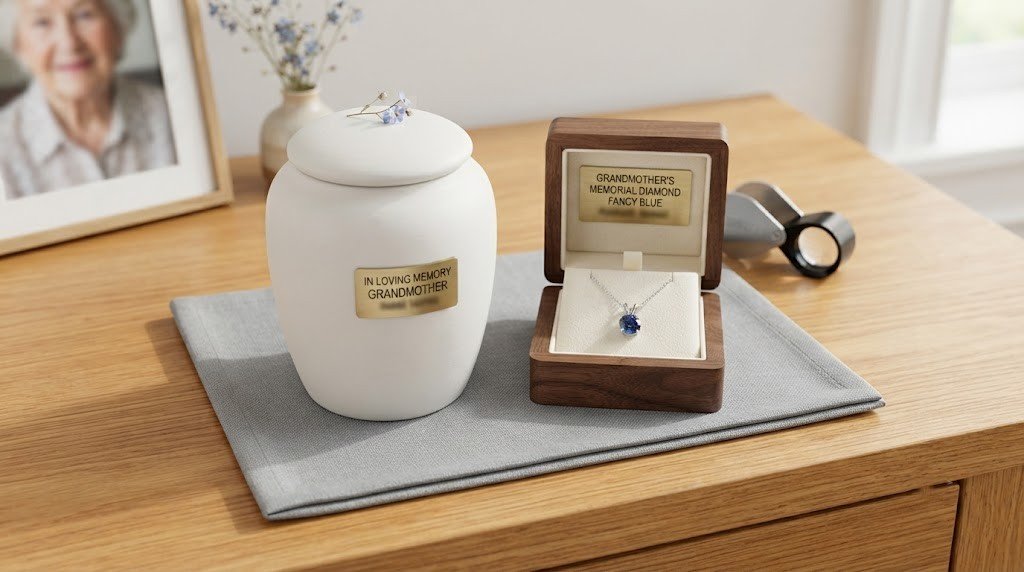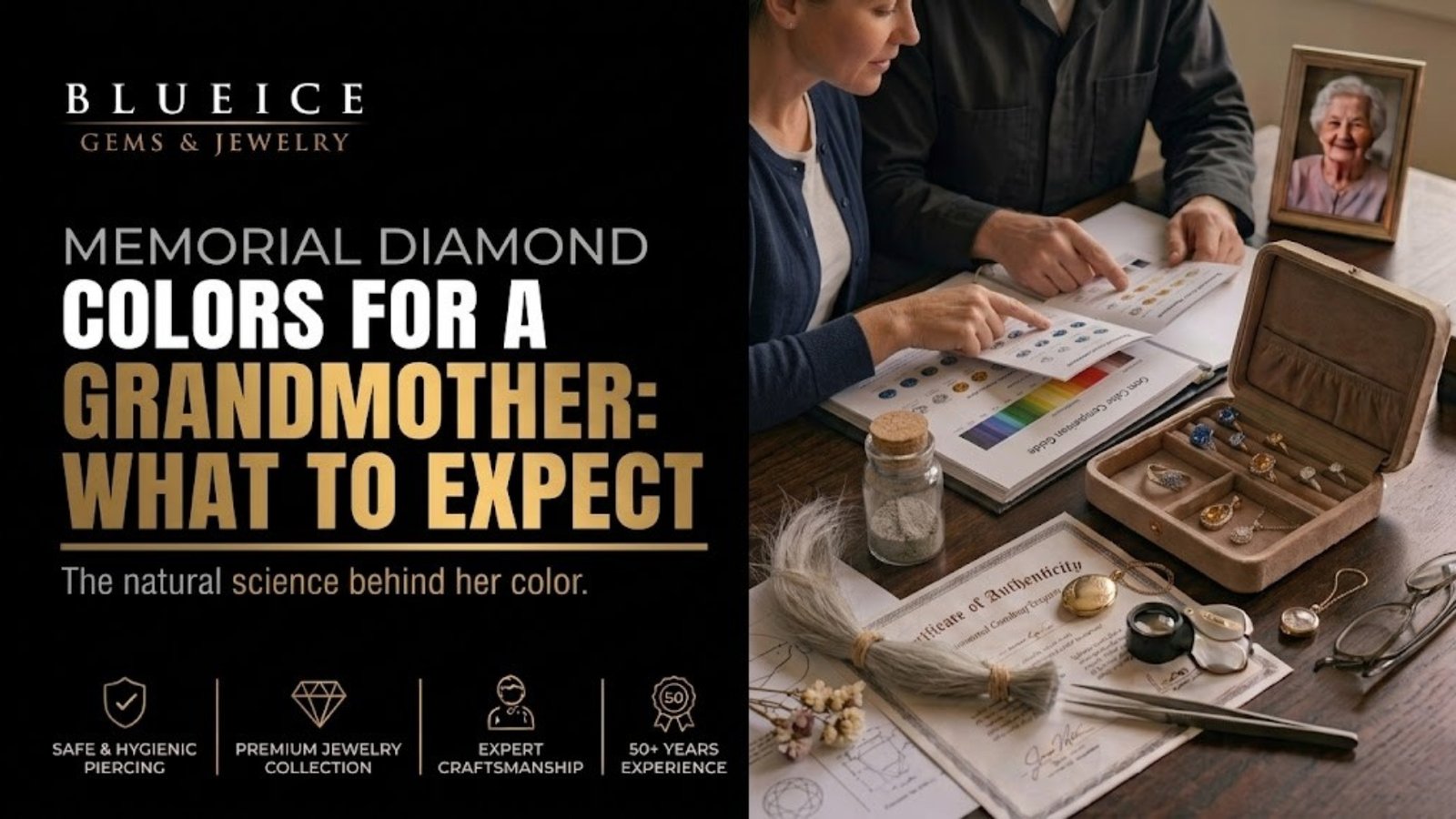
Picturing the finished stone can be where the decision starts to feel real, and color is a natural place to begin. If you are reading about memorial diamond colors for a grandmother, here is the plain answer: color comes from trace elements during growth, not from anything about her as a person. Yellow, blue and champagne tones are commonly seen, colorless is possible at a higher cost, and no provider can promise an exact shade in advance.
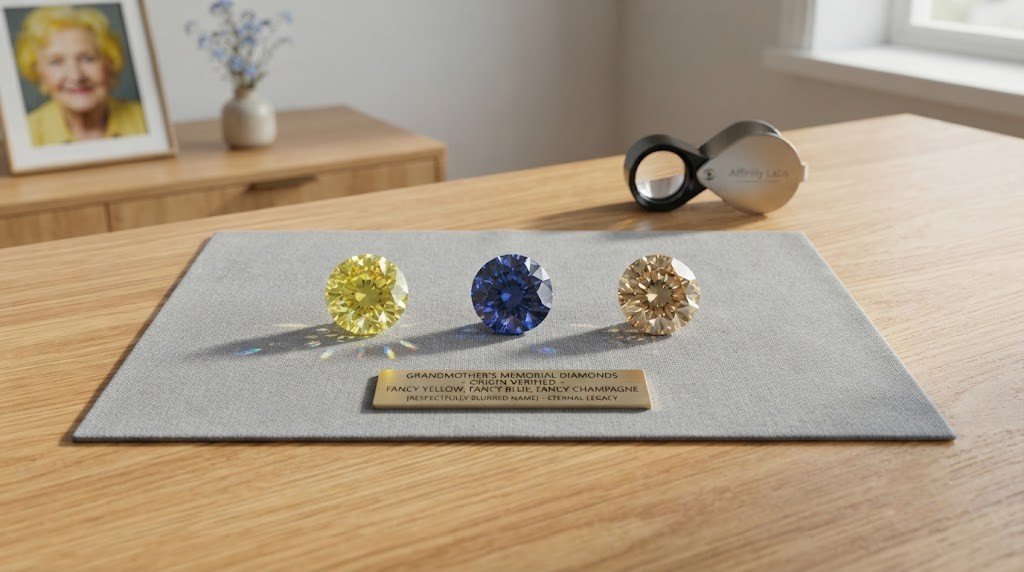
Table of Contents
What Decides Memorial Diamond Colors for a Grandmother?
Chemistry decides memorial diamond colors for a grandmother, not personality, age or the material you send. A memorial diamond is a real lab-grown diamond, usually grown by HPHT, where a press holds a small seed at about 6–8 GPa and somewhere between 1,400 and 2,500°C, and the tone it takes depends on which trace elements end up inside the crystal as it grows.
Two elements shape most memorial diamond colors for a grandmother. Nitrogen trapped in the crystal lattice tends to produce yellow. Boron tends to produce blue. A colorless stone needs the near-absence of both, which is harder to achieve and is why colorless usually costs more. The synthetic diamond overview on Wikipedia explains both growth methods if you want the deeper science.
Understanding memorial diamond colors for a grandmother starts with one reassuring idea: the color is not a verdict on her life, her health or the quality of what you kept. It is a physical result of growth conditions and trace chemistry. A yellow stone is no less hers than a blue one.
It also helps to know what happens before growth. Her carbon, whether from ashes or hair, is extracted and purified to roughly 99.9% or higher, then turned into graphite at around 2,500–2,700°C. That preparation readies her carbon for the growth cell. Extra steps to keep nitrogen and boron out, which colorless requires, are the main way a provider can influence memorial diamond colors for a grandmother before growth.
The purified carbon is typically blended with supplemental lab carbon before growth. In an ash-based stone, industry figures put her share of the finished diamond’s mass near 10–15%, though a few providers quote about 3% for ash and some quote more. For hair or a blend of ashes and hair, no finished-stone percentage is published, so ask the provider to put their figure in writing.
Which Tones Are Commonly Seen, and What Causes Each One?
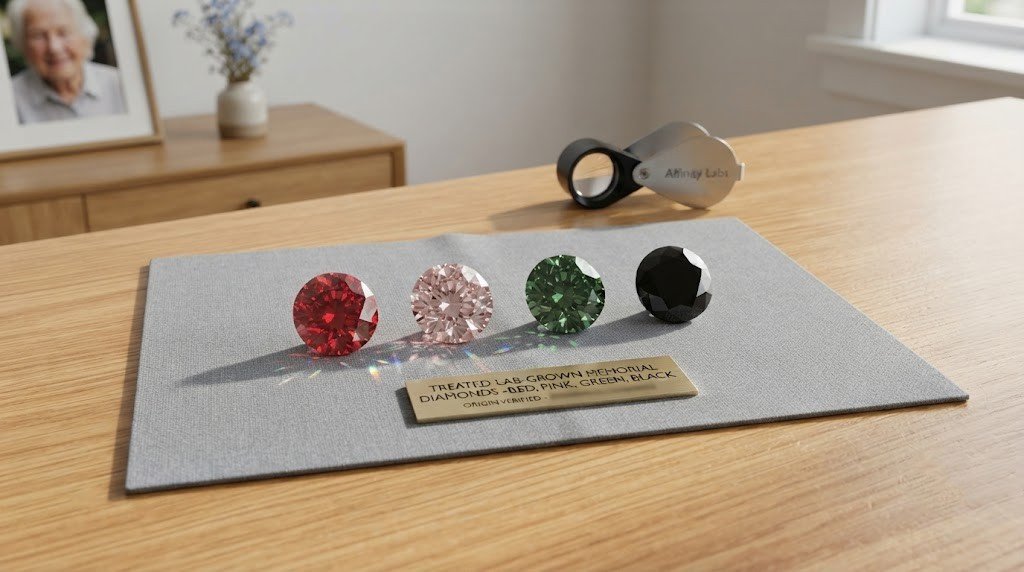
When people look at memorial diamond colors for a grandmother side by side, the stones commonly trend toward yellow, blue and champagne or brown, with colorless available as a more costly choice. Red, pink, green and black are possible too, but those come from an optional treatment after growth rather than from growth itself.
The table below sets out the full range of memorial diamond colors for a grandmother, what typically causes each tone, and how cost tends to compare. Treat the cost notes as general industry patterns, not any one provider’s price list.
| Tone | Typical cause | As grown or treated | Cost note |
|---|---|---|---|
| Yellow | Nitrogen in the crystal during growth | As grown | Typically below colorless at the same carat size |
| Blue | Boron in the crystal during growth | As grown | Typically below colorless at the same carat size; ask whether blue can be requested |
| Champagne or brown | Trace elements during growth (ask the provider to explain their own stones) | As grown | Typically below colorless at the same carat size |
| Colorless | Near-absence of nitrogen and boron | As grown, with extra processing | Usually the more expensive choice at a given size |
| Red | Optional post-growth irradiation | Treated | Ask for the treatment price in writing |
| Pink | Optional post-growth irradiation | Treated | Ask for the treatment price in writing |
| Green | Optional post-growth irradiation | Treated | Ask for the treatment price in writing |
| Black | Optional post-growth irradiation | Treated | Ask for the price; specialty colors can lengthen the timeline |
Within each tone there is a spread, so memorial diamond colors for a grandmother are better thought of as families of shades than as fixed points. One yellow stone may read pale and buttery, another deeper and more golden. Blue can range from a faint steel cast to something richer. Champagne can sit anywhere from a light warm wash to a cognac-brown. Ask any provider to show you real examples of each tone at the carat size you are considering, because photos of a large stone can mislead you about a small one.
If you want to read the same science narrowed to one material, there are separate guides to what color a diamond from your grandmother’s ashes might be and to how hair-based stones for a grandmother tend to take color.
What Does Optional Irradiation Change?
Irradiation is a treatment some providers offer after the diamond has finished growing, used to shift or intensify color into red, pink, green or black. It is a choice, not a requirement, and a stone left exactly as it grew is every bit as genuine. For anyone comparing memorial diamond colors for a grandmother, treatment widens the options but brings its own questions.
Some people like the idea of a treated color because it lets them pick a tone with a personal meaning. Others prefer to leave the stone untouched, so it reflects only what happened in the growth cell. Neither view is more respectful. When relatives weigh memorial diamond colors for a grandmother, treatment raises a real values question: do you want to choose the color, or do you want to let it arrive?
If you lean toward treatment, ask specific questions before you agree to it:
- Which treated colors does the provider offer, and from which starting tones?
- Can they show photos of treated stones at your intended size?
- Does treatment change the price, and by how much, in writing?
- Does it add time to the overall timeline?
- Will the certificate or any grading report record the treatment?
Because treatment practices differ between providers, none of those answers should be assumed, and the options one provider offers when you ask about memorial diamond colors for a grandmother may not match another’s at all. A clear written reply protects everyone, especially when several relatives are sharing the cost or the decision.
Can Anyone Predict the Color From Her Ashes or Hair?
No. Nobody can promise a particular color from a particular source, and an honest provider will say so. Discussions of memorial diamond colors for a grandmother sometimes drift into guesses about her hair or her ashes, but no source material makes the outcome predictable.
That includes hair that was gray, white, dyed, permed or thinning. There is no reliable basis for saying gray hair makes a lighter stone or that dyed hair makes a darker one. The same goes for ashes: there is no evidence that anything about her cremated remains pushes the stone toward a paler or deeper tone.
Whether a particular type of hair is suitable at all, and how much is needed, are questions for the provider rather than assumptions to make at home.
What can honestly be said about memorial diamond colors for a grandmother is narrower and more useful. Trace elements present during growth shape the tone, and processing steps can reduce some of them, which is why colorless is possible but costs more. Beyond that, the outcome is a range, not a forecast.
If you plan to combine ashes and hair in one stone, the same honesty applies. A blend does not average out into a predictable middle shade. The guide on color when her ashes and hair are combined walks through that scenario in more detail.
Some people find it freeing to accept this uncertainty. The stone becomes something that grew from her carbon in its own way, rather than a product built to a swatch. Others find it unsettling, and that is a fair reaction too. If memorial diamond colors for a grandmother matter a lot to you and your relatives, say so early, ask what the provider can and cannot control, and get their answer in writing.
How Does Color Affect Price and Timeline?
Memorial diamond colors for a grandmother affect both, though carat size usually affects them more. Colorless typically costs more than yellow, blue or champagne at the same size, and specialty colors can push the timeline toward its longer end.
The table shows 2026 industry ranges by size, with a note on where memorial diamond colors for a grandmother tend to shift the price. These are typical figures across the category, not a quote from any single provider:
| Carat range | Typical industry price | Color note |
|---|---|---|
| About 0.10–0.25 ct | Roughly 1,500–3,500 | Tone choice can shift price within the range |
| 0.5–1 ct | Roughly 5,000–15,000 | Colorless sits meaningfully higher than other tones |
| 2–5+ ct | Roughly 20,000–75,000+ | Larger stones and specialty colors can take longer |
Settings, engraving, fancy cuts and independent grading are usually priced separately. If you are weighing memorial diamond colors for a grandmother on a shared family budget, it helps to compare the same carat size in two or three tones side by side, so the cost of color is visible on its own. The breakdown of how much a grandmother memorial diamond costs covers the wider price picture.
On timing, the overall process typically runs 6 to 10 months, and can stretch to roughly 12 months for specialty colors or for larger stones of around 2 carats and up. The growth stage on its own spans weeks to months. Growth time, not the amount of material you send, sets the carat size.
If you have a date in mind, such as an anniversary or a family gathering, tell the provider up front and ask whether your chosen color changes their estimate. If you are weighing memorial diamond colors for a grandmother against a fixed date, note that black and other treated shades are specialty choices that can lengthen the wait. The page on how long a grandmother memorial diamond takes explains the stages in order.
How Can You Choose Memorial Diamond Colors for a Grandmother Without Stereotypes?
Start from who she actually was and who will wear the stone, not from ideas about what a grandmother “should” like. There is no correct palette for a grandmother, and no tone is more fitting because of her age or role in the family. Good decisions about memorial diamond colors for a grandmother begin with her as a person, not with a category.
These eight tips can help when you are thinking through memorial diamond colors for a grandmother with the people involved:
- Begin with a color she chose herself. A shade she wore often, painted a room, or simply said she loved carries more meaning than any guess about what suits a grandmother.
- Consider a birthstone-style nod. A blue stone for a September birthday echoes sapphire, and green for May echoes emerald. It is a gentle reference, not a rule, and a memorial diamond is not a birthstone.
- Think about the wearer as much as about her. If you or a cousin will wear it daily, your own taste matters. A stone that feels right to wear may honor her better than one bought to match an idea.
- Allow the stone to be what it grows as. Choosing no color preference is a real choice, and some people find meaning in accepting whatever tone emerges from her carbon.
- Agree on a plan if several stones are coming from one source. Matching tones can feel unified; different tones can reflect different relationships with her. Decide together before anything is ordered.
- Consider the metal and setting. Yellow tones often look warmer in yellow gold, and blue or colorless can look crisper in white metals. That is a design observation, not a requirement.
- Be honest about budget. Colorless costs more at the same size. A smaller colorless stone and a larger champagne stone may cost similar amounts, so decide what matters more to you.
- Leave room in your timeline. Specialty colors can take longer, so avoid tying a treated color to a fixed date unless the provider confirms it in writing.
None of these tips assumes anything about her taste. If she loved deep, saturated colors, a black or green stone may feel exactly right. If she never wore jewelry at all, an untreated stone kept loose in a small box may suit her memory best. The right memorial diamond colors for a grandmother are simply the ones that make sense to the people remembering her.
What Should You Ask a Provider About Color?
Ask questions that turn every provider-dependent detail about memorial diamond colors for a grandmother into a written answer. Policies on color and treatment differ, so the safest approach is to ask the same questions of each provider you are considering.
- What range of tones do your untreated stones typically show, and can I see real examples at my carat size?
- Can I request a color, or only state a preference?
- What extra processing does colorless require, and what does it add to the price?
- Which treated colors do you offer, and what does treatment add to cost and time?
- What happens if the finished tone is not what we hoped for? Please describe your policy in writing.
- Will the in-house certificate and any independent grading report record the color and any treatment?
- For hair or a blend of ashes and hair, what share of the finished stone is her carbon, in writing?
- Does gray, white or dyed hair change whether you can accept it, or how much you need?
Write down the answers next to each other. When you lay out memorial diamond colors for a grandmother across two or three providers this way, differences in wording and policy become much easier to spot than they are in a phone call. The questions to ask before turning her ashes into a diamond go beyond color into custody, documentation and timing.
How Do Color, Setting and Grading Fit Together?
Color is graded alongside cut, clarity and carat, and the memorial diamond colors for a grandmother you are considering will also shape which settings and metals look best. Thinking about all three together keeps you from choosing a tone that later clashes with the piece you want.
Independent grading, commonly to GIA’s diamond quality factors, describes the stone’s own color, clarity, cut and carat. It is optional and separate from the in-house authenticity or origin certificate, which documents the chain of custody linking the stone to her material. Clarity for memorial diamonds typically falls between SI2 and VVS. Ask which grading, if any, is included. A report also gives relatives in different places a shared, standard vocabulary for comparing memorial diamond colors for a grandmother.
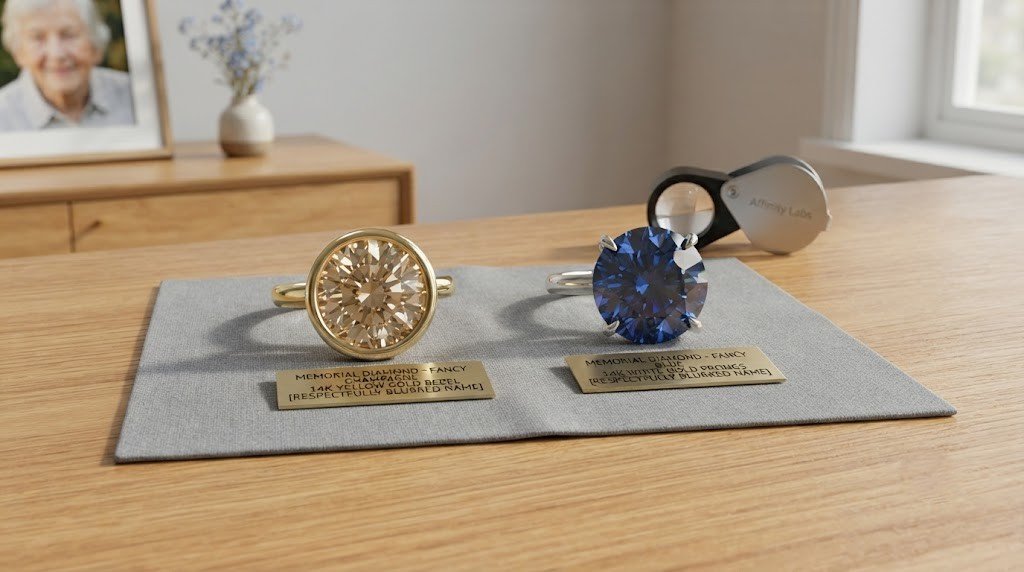
Settings change how color reads. A bezel can deepen the look of a pale tone, while open prongs let more light through. When you think about memorial diamond colors for a grandmother next to a particular ring or pendant, ask to see the stone in or near the metal you prefer. The guide to setting ideas for a grandmother memorial diamond covers setting types and wear in more depth, and the complete guide to a grandmother ashes diamond puts color in the context of the whole process.
Frequently Asked Questions
Is a yellow memorial diamond lower quality than a colorless one?
No. Yellow comes from nitrogen in the crystal and is a natural result of growth. Colorless costs more because it requires removing more trace elements, not because it is a better memorial. Clarity, cut and carat are graded separately from color.
Will gray or white hair make her stone lighter?
There is no reliable basis for that claim. Hair color, including gray, white or dyed hair, is not known to make a stone lighter or darker. Ask the provider whether her hair is suitable and how much they need, and get the answer in writing.
Can siblings or cousins choose different colors from her ashes?
Often, yes, because only a portion of her ashes is used for each stone, and several stones can come from one source. Each stone grows separately, so cousins comparing memorial diamond colors for a grandmother may find their stones differ even untreated. Confirm the provider’s options first.
Does a treated color mean the stone is not really a diamond?
No. Irradiation shifts or intensifies the color of a stone that has already grown as a real lab-grown diamond. It remains carbon in a diamond crystal. Ask the provider whether the treatment is recorded on the certificate or on any independent grading report.
Can I change the color after the diamond is finished?
That depends on the provider and the starting tone. Some offer post-growth treatment, but options vary, and whether a tinted stone could ever be made colorless is theirs to explain. Ask before ordering what changes, if any, are possible later and at what cost.
How do I explain memorial diamond colors for a grandmother to relatives who expect a clear stone?
Share the simple science: nitrogen gives yellow, boron gives blue, and colorless needs neither, which costs more. Explain that no provider can promise a tone. Setting expectations early helps everyone feel part of the decision rather than surprised by the result.
Final Thoughts on Memorial Diamond Colors for a Grandmother
Memorial diamond colors for a grandmother are one of the few parts of this process where uncertainty is built in. You can choose colorless, pick a treated tone, or simply let her carbon grow into whatever it becomes. Each of those is a thoughtful way to remember her. The most useful step is to decide together what matters most, then ask every question in writing before anything begins.
Learn More About Grandmother Memorial Diamonds
- Grandmother memorial diamond FAQ the wider set of questions relatives ask
- Choosing a memorial diamond for your grandmother where to begin with the whole decision
- Grandmother hair diamond: the complete guide the full hair-based process
- Talking to family about a grandmother memorial diamond ways to start the conversation
Talk With Memorial Diamond
Whenever you feel ready to compare memorial diamond colors for a grandmother, or to ask about cost and timing for a stone grown in her memory, the team at Memorial Diamond is glad to answer questions at whatever pace suits you. There is no rush, and asking questions does not commit you to anything.