
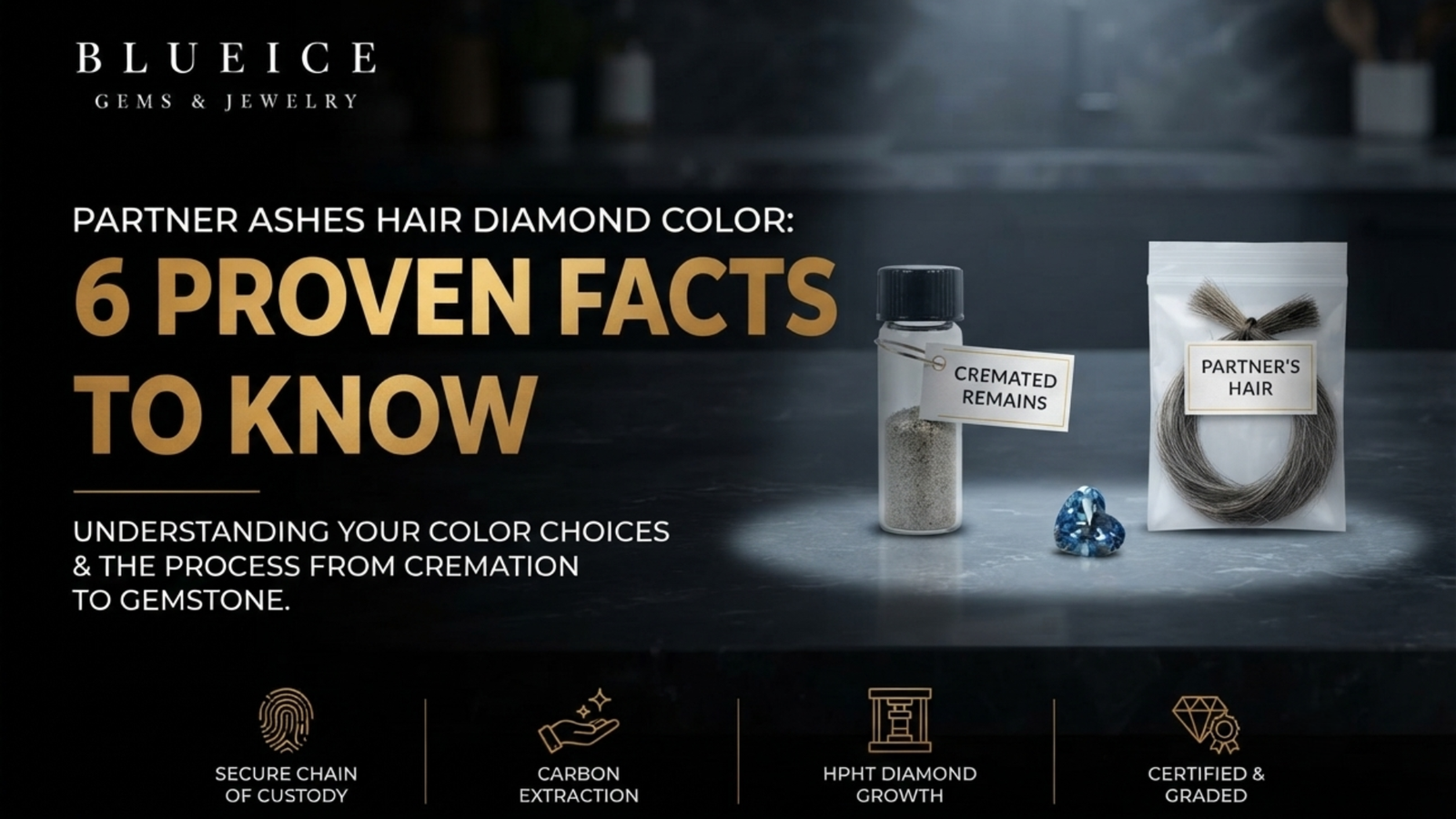
Two parcels sitting on the same table raise a question that never comes up when there is only one: does sending both of them change what comes out?
It changes less than most people assume. A partner ashes hair diamond color still lands in yellow, champagne or blue far more often than in colorless, and combining two materials does not average them into a middle shade, does not hand the tone to whichever source is richer in carbon, and does not make the result any easier to forecast. Combining widens the list of things that could be in the growth cell. It does not narrow it.
Memorial Diamond grows stones from combined submissions and charges for them, so a commercial interest sits behind this page. Where the truthful answer is that nobody can know in advance, it says so.
Table of Contents
Does a Partner Ashes Hair Diamond Color Average the Two Sources?
No. Averaging is a mixing metaphor borrowed from paint, and it does not describe how a partner ashes hair diamond color is arrived at.
Mix two tins of paint and you get a shade between them, because the pigment in each tin is the color. Nothing in a partner ashes hair diamond color works that way. Neither parcel arrives carrying a color. Both are reduced to elemental carbon at roughly 99.9% purity before growth begins, and whatever you sealed into each envelope, pale gray grit, dark hair, white hair, loses its appearance along with everything else that was not carbon.
What survives is invisible and unweighable by you: trace quantities of elements that came through purification with the carbon. Those traces do not blend toward a midpoint. They are simply present together in one cell, and a partner ashes hair diamond color is decided by what the crystal incorporates as it forms around the seed.
So combining is co presence, not blending. No arithmetic turns “what ash would have given” and “what hair would have given” into a predictable third thing, and anyone offering you that arithmetic is describing paint.
Does One Source Dominate the Partner Ashes Hair Diamond Color?
One source usually dominates the recovered carbon. That is a fact about yield, and yield is a different property from a partner ashes hair diamond color.
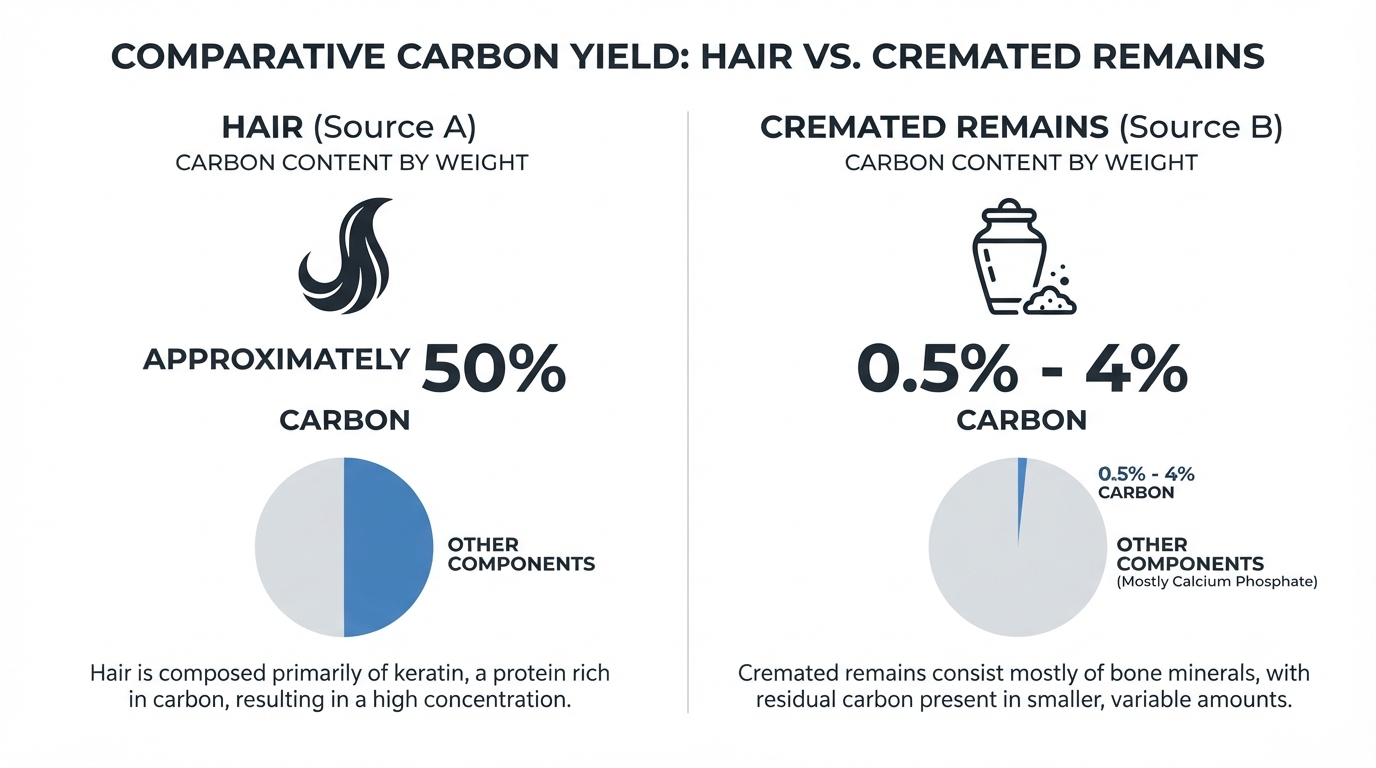
The gap between the two materials is large and well documented. Hair runs at roughly 50% carbon by weight, keratin being a carbon rich protein. Cremated remains are mostly the calcium phosphate of bone, and usable carbon there accounts for somewhere around 0.5% to 4% of the weight. Weigh out equivalent samples and the hair hands a laboratory far more workable carbon than the ash does. None of that gap is a partner ashes hair diamond color gap.
It is tempting to read that as a steering wheel, more carbon from one source, therefore more influence over a partner ashes hair diamond color. The step does not hold. Trace element content is not proportional to carbon yield, and nothing published lets anyone predict which parcel arrives with more residual nitrogen.
There is a second reason dominance is the wrong frame. Whatever both parcels yield together still falls short of what a growth run consumes, so lab grown carbon is added to bring the charge up to working volume. Your partner’s own carbon is the minority component of the finished crystal either way.
The share usually quoted, roughly 10 to 15% of the finished mass, with some providers citing figures as low as 3%, describes the ash route specifically, and no published figure covers a blended ash and hair charge, so ask what share your provider expects yours to contribute. Two personal sources do not change the majority. They change which minority you are looking at, and they leave a partner ashes hair diamond color exactly where it stood.
How a combined submission is actually processed follows the two materials through separate preparation tracks to the point where they meet, which is the clearest way to see why neither one gets to be in charge.
Six Things Combining Does and Does Not Do to Color
These six cover almost every version of the question people arrive with. The middle column is the one worth reading slowly.
| What people expect combining to do | Does it? | What actually happens | What that means for your order |
|---|---|---|---|
| Average the two sources into a middle shade | No | Neither material carries a color into the cell; purification reduces both to elemental carbon before anything grows | Stop hunting for a midpoint partner ashes hair diamond color: there is no midpoint |
| Let hair take the lead because it is carbon rich | Only for yield | Hair supplies more usable carbon than ash by a wide margin, but trace element content does not scale with carbon yield | Choose your materials on meaning and availability, never on an expected partner ashes hair diamond color |
| Narrow the range of likely outcomes | No, if anything the reverse | A second source adds a second set of residual traces to the same cell rather than canceling the first | Plan for the partner ashes hair diamond color range a single source stone already has |
| Make the finished shade forecastable | No | Combining changes nothing about the fact that no measurement at order time can name a shade | Agree a color family, not a shade |
| Show a visible seam, swirl or two tone effect | No | A diamond is one continuous crystal lattice; it has no compartments for two feedstocks to occupy separately | A partner ashes hair diamond color reads as one color, like any other stone |
| Change which color families you can specify | No | Yellow, champagne, blue and engineered colorless are available from a combined submission exactly as from a single one | Specify the family in the order document either way |
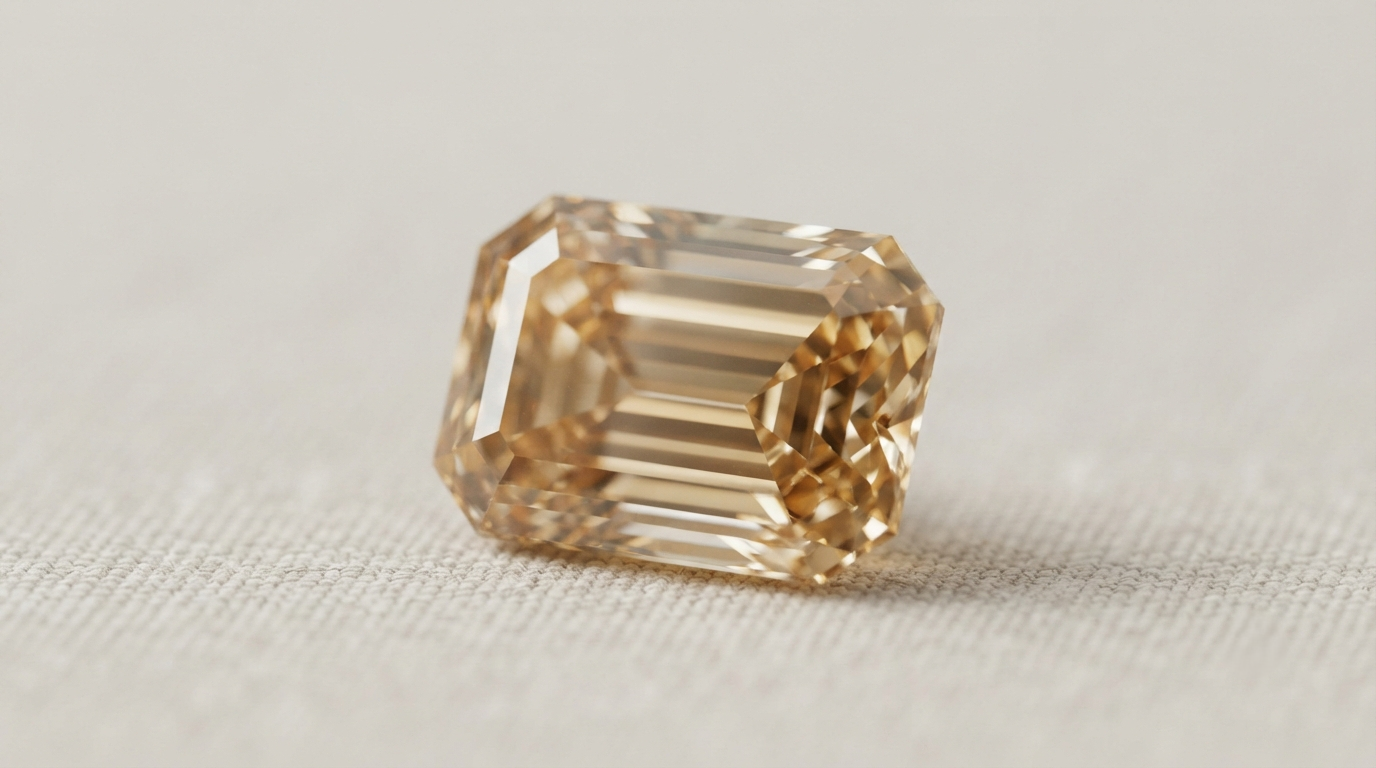
Read down the second column and a pattern appears. Almost nothing about color changes when you send two materials instead of one. What changes is the preparation work, the paperwork, and sometimes the price, none of which is a partner ashes hair diamond color.
Does Combining Narrow the Range of Possible Outcomes?
No, and this is worth saying flatly because the opposite belief is intuitive and costs people real disappointment.
The intuition runs like this: two samples from one person ought to agree, agreement ought to mean consistency, and consistency ought to mean a tighter, safer partner ashes hair diamond color. The first link is where that chain parts company with the chemistry.
Color is not a property the two samples hold in common and then confirm. It is decided by what sits in the growth cell in parts per million while the crystal forms. A second organic source adds a second stream of residual material there, and whether it pushes warm, blue, or nowhere is not determined in advance. Two streams give a partner ashes hair diamond color no more certainty than one.
- Nitrogen present while the crystal forms reads as yellow.
- Boron present while the crystal forms reads as blue.
- Both suppressed to nearly nothing is what colorless requires, which is why colorless is engineered rather than hoped for and sits above the tinted families on price at the same carat.
Nothing on that list has a “combined submission” clause. The finished object is a genuine lab grown diamond graded on the same terms as any other, and a partner ashes hair diamond color is described in the same vocabulary a jeweler would use for a stone with no personal history at all.
So the one thing to take from this section is the sentence most pages will not write down: combining does not make color more predictable. If a provider implies that two materials produce a more reliable result, ask what measurement supports it. There is not one in the public record.
What an ash source alone contributes to this question and what a lock of hair alone contributes each take the single source version on its own terms, and neither of them promises a forecast either.
Can You Ask for the Two Sources to Be Grown Separately Instead?
Yes, and it is worth knowing before you commit to one combined stone, because it is the only decision here that genuinely changes what you end up holding.
Two runs from two materials produce two stones, each with its own recovered carbon and its own growth conditions, which means two partner ashes hair diamond color results rather than one. You are no closer to predicting either, and you have doubled the number of shades you will meet.
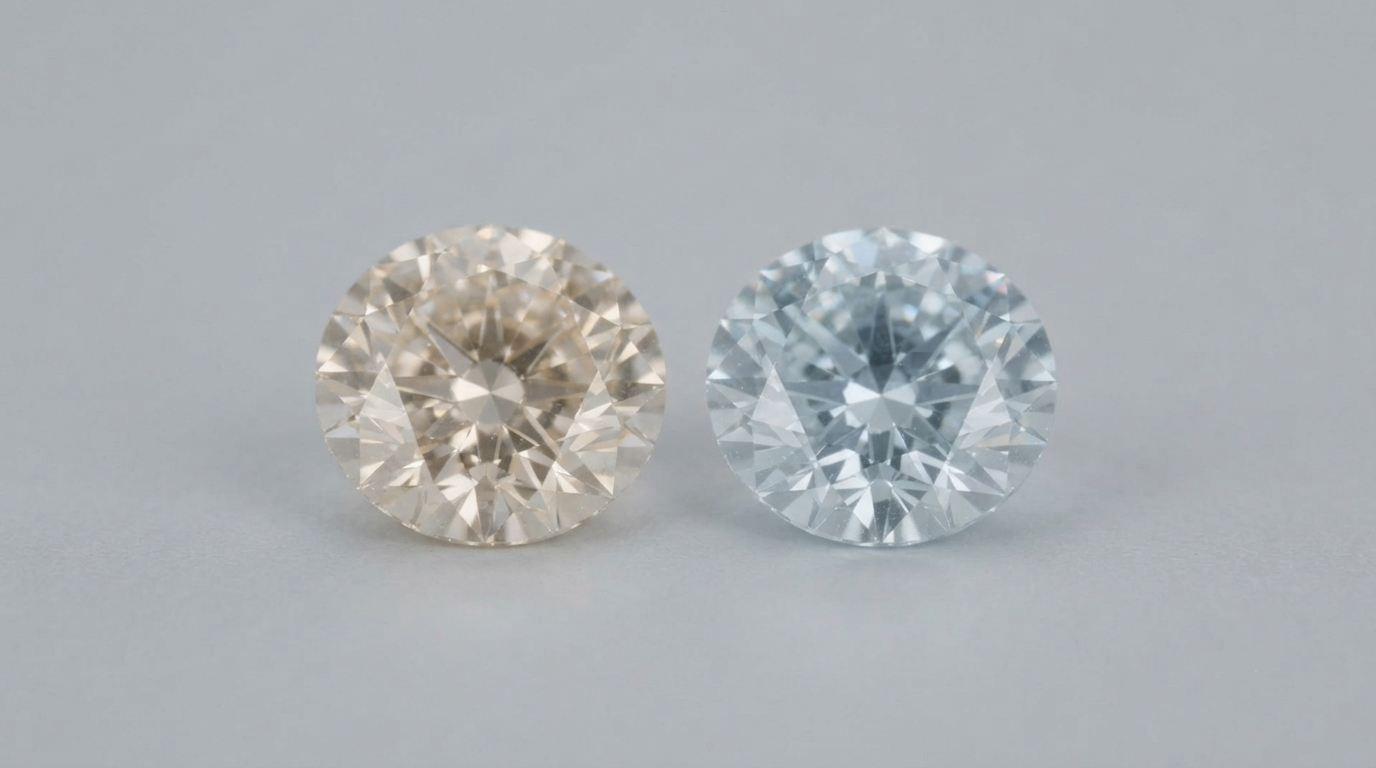
Expect the two partner ashes hair diamond color outcomes not to match. Separate runs are separate events, and reading a visible difference as a fault in one stone is the most common way this choice goes wrong. Do not assume any laboratory will undertake to match two stones across separate runs: ask before you order two.
Why families ask for it anyway comes down to a handful of practical reasons rather than color:
- Two people, two stones. A combined stone cannot be divided later, and separate runs let two people each hold something.
- Two different objects. A ring from one and a pendant from the other is a decision you can only make if there are two.
- Different timing. The materials may not become available at the same moment, which matters a great deal in this cluster.
- Keeping the sources distinct on paper. Some people want documentation that says this one is from the lock, that one is from the ashes.
The costs are real: two runs mean two prices, and a second stone is a second full growth period rather than an add on. Whether separate growth is offered at all is company policy rather than a fact about the category, ask directly. Whether more than one diamond can come from the same source covers the logistics side of that in full.
What Can You Put in Writing for a Combined Order?
Five things about a partner ashes hair diamond color, none of which requires you to know a shade, and all of which are cheaper to settle now than at delivery.
- Which partner ashes hair diamond color family is being grown toward, yellow, champagne, blue, or engineered colorless, written on the order rather than remembered from a call.
- How wide that family is allowed to be. The word “champagne” has to describe the same span of stones to the laboratory as it does to you, and the only way to find out is to make someone define it out loud.
- What happens if the finished stone sits outside that span. A re grow, a price adjustment, a conversation, or explicitly nothing. All four are workable positions. Silence is not.
- Whether both materials are confirmed as used, and in what document, this matters more on a combined order, because two parcels produce one stone.
- Whether an independent grading report is included, and which scale it applies, the language for a tinted stone and the language for a colorless one are not the same set of words.
That fourth item has a trap in it. A report describing the cut, color, clarity and carat of the finished stone says nothing about what went into it, so it is not the document confirming both parcels were used. That is a separate piece of paper, and asking which one you are being offered is the most useful question on this list. The wider list worth putting to a provider before either parcel leaves your house goes well past color, and the complete guide to a combined submission sets out how the two tracks run side by side.
What If the Ashes and the Hair Are Held by Different People?
This is the situation a combined order runs into more often than any other, and it is not really a color question, but it decides whether there is a partner ashes hair diamond color to discuss at all.
A lock of hair is usually the material a partner already has, kept for years in a drawer or taken at the end. Ashes are different: they go to whoever the law and the paperwork point to, and where a relationship was not legally recognized, not acknowledged by their family, or not fully known, that person may not be you. No single national rule applies. The statute where you are governs, together with anything your partner put in writing, and the two can point different ways.
So a combined order can quietly require a second person’s agreement, where a hair only order often does not. Law in this area was built around cremated remains, not around a keepsake in a drawer, so in day to day practice hair you already hold tends to raise fewer obstacles. Treat that as a pattern rather than a rule: belongings can pass into an estate, states differ, and hair kept by another person is theirs to be asked about. That is worth knowing before a partner ashes hair diamond color family is chosen, before a quote is accepted, and certainly before money changes hands.
If the ashes sit with someone who would say yes but has not been asked, ask before you order, how to raise this with family covers the conversation itself. If the answer is no, or silence, a hair only stone is a complete object rather than a consolation prize, and it lands in the same partner ashes hair diamond color territory.
You do not need anyone’s permission to ask a provider what is realistic from what you actually hold. That conversation commits you to nothing at all.
Frequently Asked Questions
Will a combined stone be a blend of what each material would have produced alone?
No. Neither material carries a color into the growth cell, so there is nothing to blend. Both are reduced to elemental carbon, and a partner ashes hair diamond color is set by trace elements measured in parts per million.
Does sending both make a partner ashes hair diamond color more certain?
No. Combining does not make color more predictable, and a second organic source adds a second set of residual traces rather than canceling the first. Plan for the same broad range a single source stone has.
Will a partner ashes hair diamond color show where the hair ends and the ashes begin?
Not at all. A diamond is one continuous crystal lattice with no internal compartments, so a combined stone has no seam, no swirl and no two tone effect. It reads as a single color.
Can a combined submission still produce a colorless stone?
Yes. Colorless requires nitrogen and boron alike to be suppressed to nearly nothing, which takes additional laboratory processing and costs meaningfully more at the same carat. Two source materials neither help nor hinder that.
If we grow two separate stones, will they match?
Treat matching as unlikely. Separate runs have their own conditions and their own recovered carbon, so a visible difference between the two is the expected result rather than a defect in either stone.
Does the ratio between ashes and hair affect the partner ashes hair diamond color?
Ask the provider what ratios they work with, but do not expect the ratio to be a color lever. Trace element content does not scale with carbon yield, and no published figure supports predicting tone from proportions.
Final Thoughts on Partner Ashes Hair Diamond Color
Sending both materials is a decision about what the stone is made from, not about what it will look like. The two get confused constantly because they arrive in the same conversation.
Hold them apart and a partner ashes hair diamond color becomes manageable: the same known edges, the same three mechanisms and the same unforecastable middle as any other memorial stone. What a combined order genuinely adds to the partner ashes hair diamond color question is a second preparation track, a second thing to confirm on paper, and sometimes a second person who needs asking.
And if two stones would serve you better than one, that option exists and is worth raising early, provided you go into it expecting two different partner ashes hair diamond color results rather than a matched pair.
Learn More About Partner Memorial Diamonds
- Questions to Ask Before Turning Your Partner’s Ashes and Hair Into a Diamond
- What Color Will a Diamond Made From Your Partner’s Ashes Be?
- How a Memorial Diamond Is Made From Your Partner’s Ashes and Hair
- What Color Will a Diamond Made From Your Partner’s Hair Be?
- Partner Ashes and Hair Diamond: The Complete Guide
Talk With Memorial Diamond
Two parcels on a table deserve better than a guess. Which families are open to you, what engineered colorless would involve, and how a partner ashes hair diamond color gets written onto an order are all answerable, and the answers belong on paper before either parcel is posted. Reach out to memorialdiamond.us and ask, no material needs to leave your house for that.
Leave A Comment