
The container has been on the same shelf for months and you have already decided what you want. What stops people at this point is rarely the price. It is the quieter realization that you may not be the person legally permitted to open it. The partner ashes diamond questions that actually decide whether this happens are about custody and quantity: who may authorize a portion leaving the house, how much leaves, what is written down as it goes, and what comes back if the growth run yields nothing.
Memorial Diamond grows stones from cremated remains, so this page is written by a company with an interest in your answer. Read it that way. Every figure below is an industry wide band, not a published requirement of ours, and the hardest of the partner ashes diamond questions is one no provider can answer for you.
Table of Contents
Why Standing Comes Before Everything Else
Between the shelf and the laboratory there is a decision, and in the United States it belongs to whoever the law of your state says it belongs to, modified by anything your partner set down in writing. There is no national rule: there is a stack of state statutes that do not agree with each other.
For a married couple this is usually uncomplicated. For a partner it may not be. If the relationship was never registered, if the families never quite acknowledged it, or if a divorce was never finalized, the ashes may be legally controlled by a parent, an adult child, or a former spouse. That is not a comment on the relationship. It is a comment on what a crematorium’s file says.
So the order matters. Settle standing first, then material, then money. A deposit paid before you know who controls the remains is a deposit paid on a maybe. Every useful list of partner ashes diamond questions starts here rather than with carat or setting.
Four places usually hold the answer, and working through them settles the first of the partner ashes diamond questions before a cent is spent:
- The cremation authorization form. Whoever signed it is the person the crematorium recognized as having the right to direct disposition. Ask the funeral home for a copy; they generally keep one.
- Anything your partner wrote down. A will, a designated agent form, a pre need contract, or in some states a simple signed disposition directive naming you specifically.
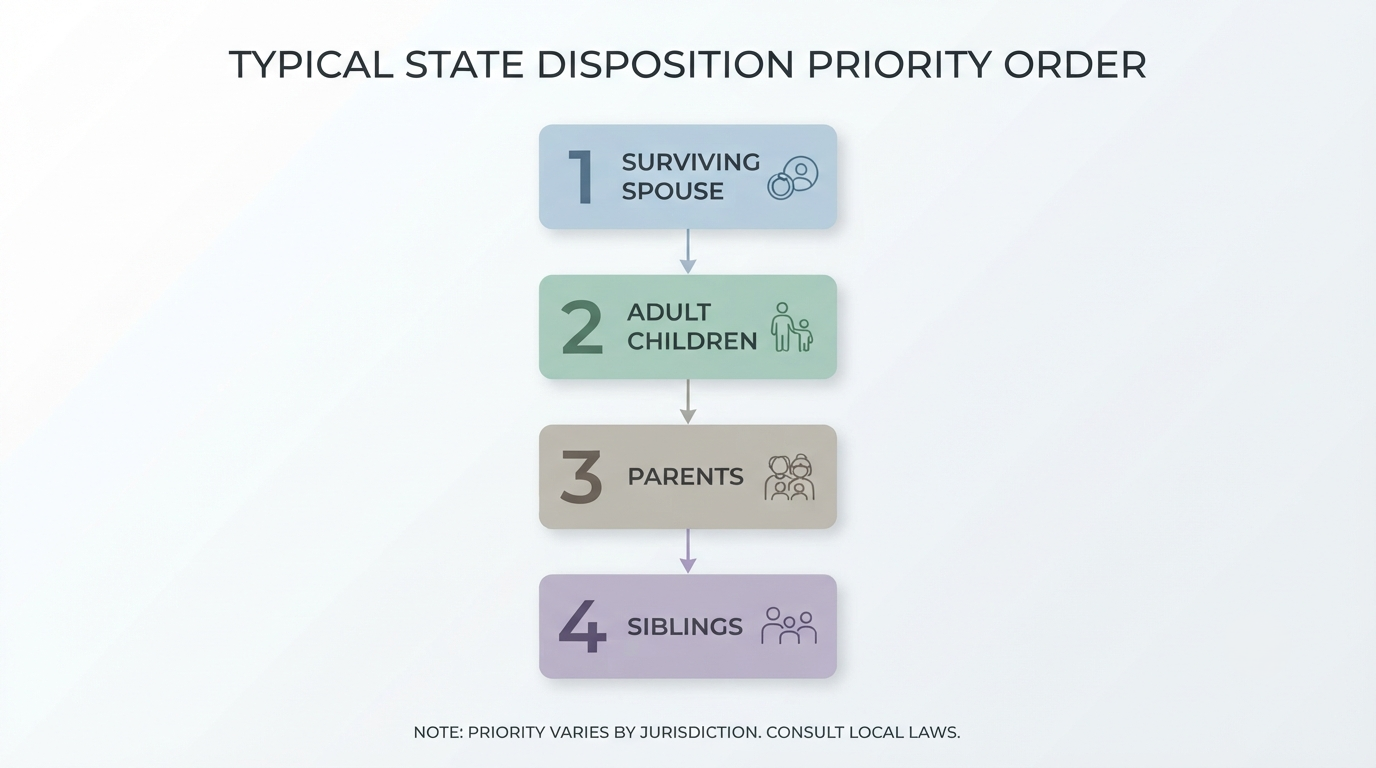
- Your state’s disposition statute. Most set an explicit priority order: spouse, then adult children, then parents, then siblings: and most were written before the range of relationships they now govern.
- The funeral home’s own file. Staff there have had this conversation many times and can usually tell you in five minutes where you stand.
Which Partner Ashes Diamond Questions Are About Who Decides?
Three of the nine belong here. They are the partner ashes diamond questions to settle before you contact any provider, because no laboratory can resolve one of them for you.
1. Who signed the cremation authorization, and does that person agree?
This is the single fact that most often changes the shape of everything after it. The signature on that form is the crematorium’s record of who held authority at the time, and a provider that takes chain of custody seriously will eventually want to know that the person sending material had the right to send it.
If the name on the form is yours, the rest of this page is logistics. If it is someone else’s, your next conversation is with that person and not with a laboratory. Among the partner ashes diamond questions families put off longest, this is the one that costs the most to delay, because every other arrangement is built on top of it. Treat it as the root of the partner ashes diamond questions and the rest become ordinary planning.
2. If the ashes are not yours to divide, what exactly are you asking for?
There is a large practical difference between asking a family to hand over the remains and asking them to permit one small portion. The first sounds like a claim. The second sounds like what it is: a request that leaves their plans entirely intact.
Say the number out loud when you ask. Industry wide the requirement runs from a few tablespoons up to roughly 4 oz, around 100 g, which is a small fraction of a full cremation. The interment still happens. The scattering still happens. The urn a sibling wants on a mantel still sits on that mantel. Framed that way, a refusal becomes much less likely, and if it comes anyway you have learned something before spending anything. Stating the quantity turns one of the harder partner ashes diamond questions into a small, specific request.
3. Does anyone else expect a portion of the same ashes?
Ashes get divided more often than people assume, and rarely with a written record of who took what. If a sibling already has a keepsake urn and a parent is planning a scattering, what remains on the shelf may be less than the container suggests.
Ask before you weigh anything: quantity is one of the partner ashes diamond questions that cannot be answered in the abstract. If more than one person wants a stone, say so early: the same submitted material can often support several diamonds, and whether a second family member could have a stone from the same source is a question far better settled at the start than after a run has begun. Shared plans are among the partner ashes diamond questions that get expensive when they surface late.
How Much Leaves the House, and What Stays?
Quantity is where the abstract becomes physical. You will, at some point, be holding a scoop. The partner ashes diamond questions in this group are all versions of one worry: how little can go, and how much stays.
4. Is the published minimum a received weight or a usable weight?
This distinction is rarely spelled out and it matters more than any other number on a provider’s page. Cremated remains are mostly calcium phosphate, the mineral structure of bone. Of the weight sitting in that container, only something between 0.5% and 4% is carbon a laboratory can actually use. A figure quoted as “what we need” might mean the weight arriving at the door, or it might mean the carbon that survives purification.
Ask which. The answer tells you whether a marginal portion is likely to be assessed as sufficient, and it is one of the partner ashes diamond questions that a straightforward provider will answer in a sentence.
5. What happens to the ash the process does not consume?
Extraction leaves most of what arrives behind. That residue is not nothing to you, and what becomes of it is policy rather than chemistry, which means it varies from company to company and is worth having in writing.
Three sub questions cover it: does the unconsumed material return by default or only on request, in what container, and within what period after the stone is finished? Providers that have thought about this will have a stated practice. Providers that have not will tell you they will look into it, which is its own answer. Remainder policy is one of the partner ashes diamond questions worth holding as text rather than reassurance.
6. Can you send less than the published figure if less is all you hold?
Sometimes the portion you control is smaller than the band. A keepsake urn holds what it holds, and no amount of asking will make it larger if the rest was scattered two years ago.
A provider should be willing to assess a partial share on its actual weight rather than turning you away at a published minimum. Ask whether they will look at a photograph, a weight, and a description of how the ashes have been stored before you commit to anything. If the answer is yes, how much ash a partner memorial diamond actually uses becomes an arithmetic problem rather than a wall. A provider who refuses to look has answered one of the partner ashes diamond questions by declining to.
What Should Be Written Down Before the Portion Goes?
Chain of custody is not bureaucracy for its own sake. It is the only thing that later distinguishes a stone made from your partner’s carbon from a stone somebody assures you was. Documentation is quietly the most durable of the partner ashes diamond questions, because paperwork outlasts memory.
7. What record exists at the moment the portion leaves your hands?
The honest answer is that identity here rests on custody rather than on testing. Providers do not generally offer DNA verification of cremated remains, so ask outright what a company does and does not verify, and what it relies on instead. What a serious provider documents is an unbroken record of handling: that this container, sealed on this date, sent by this person, was the container that entered the process and the one whose carbon came out. Of the partner ashes diamond questions here, this is the one whose answer you build yourself rather than receive.
That record only works if it starts in your house. The table below is the ledger to keep. Fill in the right hand column with the answers you get, and ask for any blank one in writing before shipping. Six moments, six documents, and six of the partner ashes diamond questions answered on paper rather than by promise.
| Moment | Who is holding the ashes | Document that should exist | What to ask for |
|---|---|---|---|
| Before anything moves | You, or the authorizing family member | Copy of the cremation authorization form | Written agreement from the authorizing person, even a dated email |
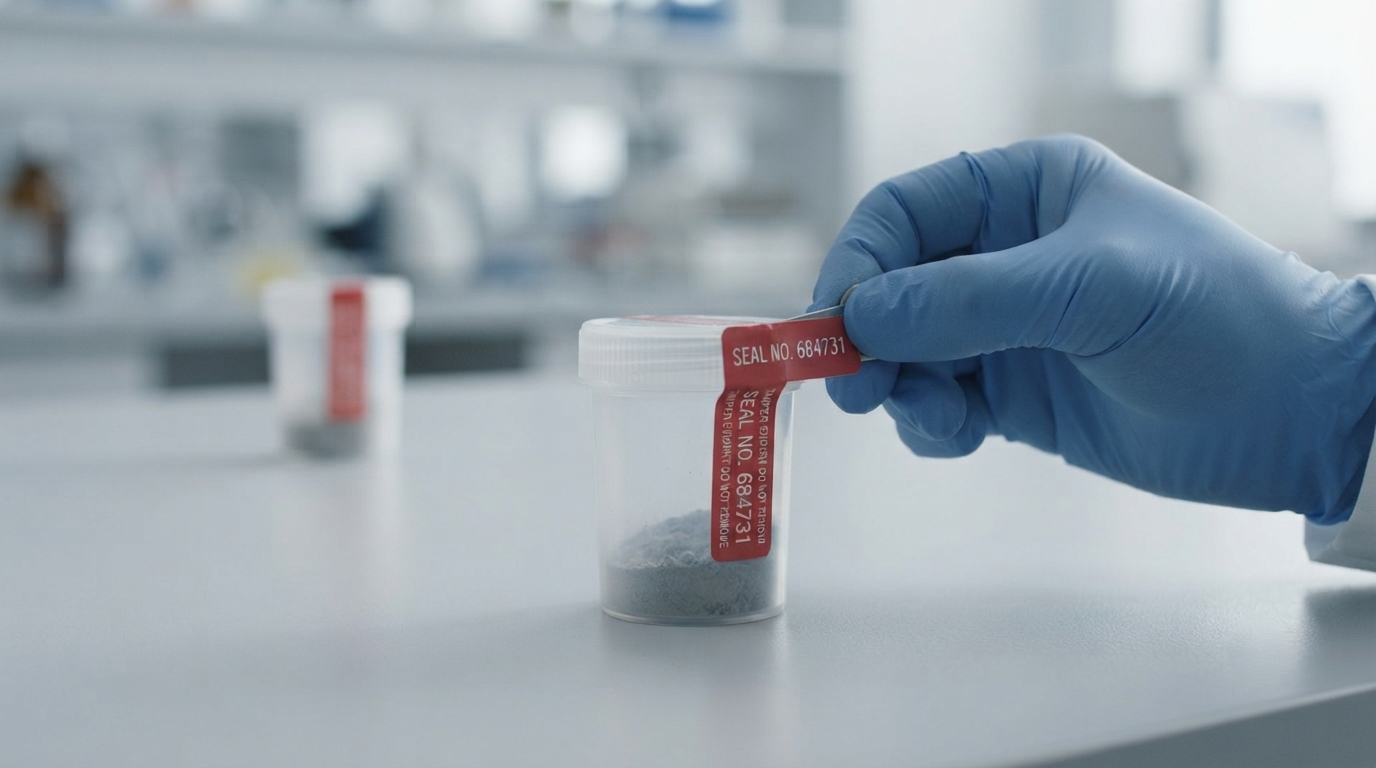
| Portion separated | You | Your own note: date, weight, who was present | A provider issued intake kit with a pre numbered seal |
| In transit | The carrier | Tracking record and signature on delivery | Confirmation the shipment must be signed for, not left |
| Arrival and weighing | The laboratory | Dated receipt naming weight received | A stated weight, not a confirmation that “it arrived” |
| Purification onward | The laboratory | Internal batch or reference number | The number itself, given to you, usable in later emails |
| Finished stone | You | Origin certificate tied to that batch number | The certificate wording, shown before you commit |
8. What comes back if the growth run produces nothing?
Growth runs can fail. Carbon yield from ash is low and variable, presses are unforgiving at 6 to 8 GPa and temperatures between 1,400 and 2,500°C, and a crystal can fracture during growth or cutting. No published figure puts a rate on it, and a provider who tells you it never happens is telling you something they cannot know. Failure is the least comfortable of the partner ashes diamond questions and the most revealing.
So ask the awkward version: if the run fails, does the process restart from material you have already sent, is more material requested, or is money returned? The answers differ across the industry and none of them is wrong: but you want to know which one you have bought. Of all the partner ashes diamond questions, this is the one most likely to be met with a pause, and the pause itself is informative. The mechanics of what actually happens to the ashes inside the laboratory will make the answer easier to follow.
The Partner Ashes Diamond Questions About Names and Certificates
Paperwork outlives grief admin, and certificate wording is where the partner ashes diamond questions finally land on one page. What a certificate says in 2026 is what it will still say in 2050, when whoever inherits the stone has to explain it to somebody.
9. Whose name goes on the certificate, and who may request a copy later?
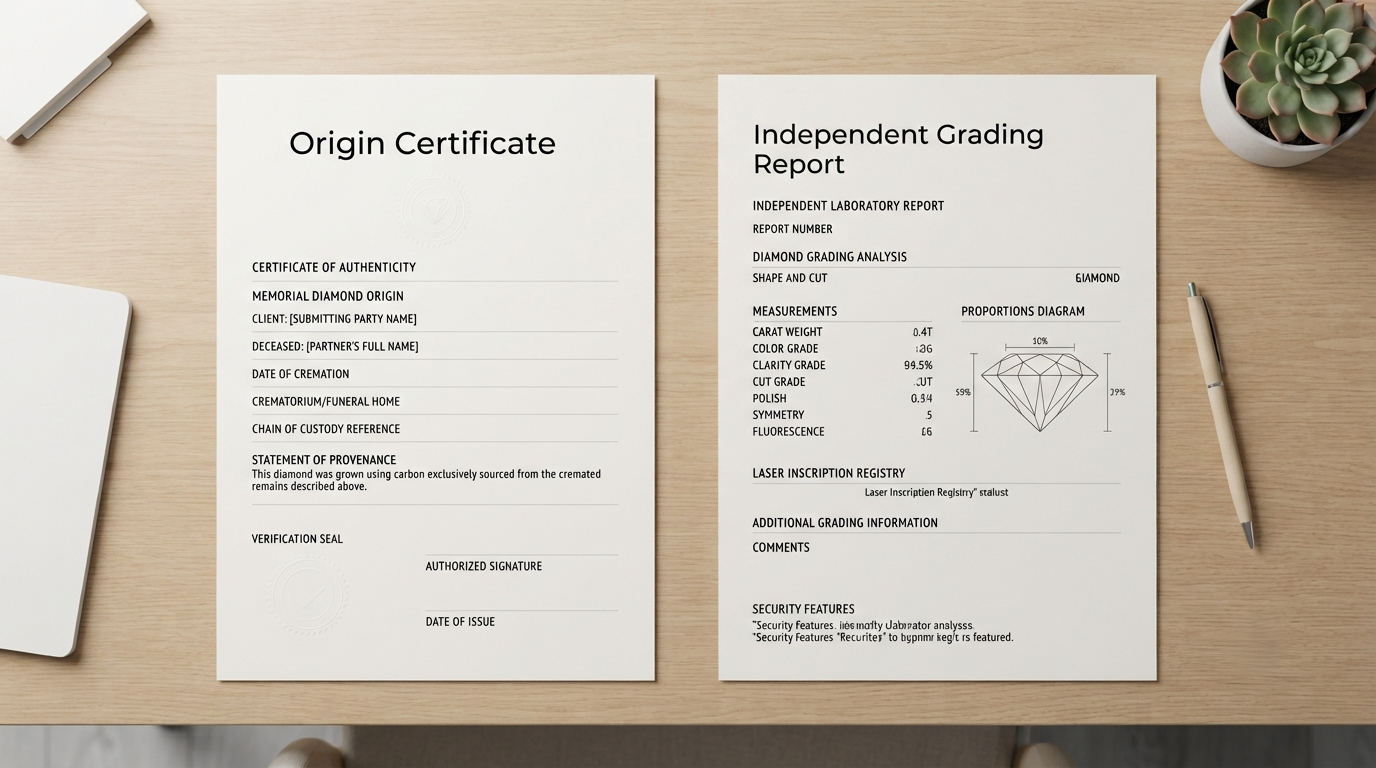
Two documents can exist, doing different jobs. An origin certificate, usually issued in house, records that this diamond was grown from this family’s submitted carbon. An optional grading report, ideally independent, documents the stone’s own cut, color, clarity and carat against the same standards GIA applies to any diamond.
The origin certificate is where names appear, so see the wording before you commit. Does it name your partner? Does it name you as the submitting party, and would that be a problem if a family member disputes the arrangement later? Can a second copy be issued years afterwards, and who may ask? For a relationship documented nowhere else, that certificate may be the only formal record naming you both. Before you finalize anything, it is worth reading the full sequence of steps from collection to finished stone so the certificate arrives as the last item on a list you recognize.
One thing no certificate should claim is total purity. For carbon drawn from ash, the share of the finished stone’s mass usually quoted is 10 to 15%, with published figures running down to 3% at some companies; laboratory sourced carbon makes up the balance so the crystal reaches a viable size.
Ask your own provider what share they expect your portion to contribute; it is one of the partner ashes diamond questions with a company specific answer. A real portion of your partner is in the lattice, permanently and verifiably. It is not the whole lattice, and any document saying otherwise is overstating the physics. Proportional honesty belongs on any list of partner ashes diamond questions, since a provider willing to overstate that will overstate other things.
Frequently Asked Questions
Can I ask these questions without committing to anything?
Yes, and a provider’s willingness to answer before payment is itself a useful signal. Standing, quantity, remainder policy and failure policy are all answerable in an email thread. Nothing on this page requires a deposit, a phone call, or a decision about carat.
What if the person with authority refuses?
Then the ashes route is closed for now, and that is worth knowing early. Hair is the alternative, since it needs no cremation and no release from a crematorium’s file. What is regulated here is cremated remains rather than mementos, so hair you already keep ordinarily meets fewer obstacles: though belongings can be drawn into an estate, so confirm rather than presume.
Does asking about failure make me sound distrustful?
It makes you sound like someone who has read a contract before. Every laboratory process has a failure rate, and companies accustomed to serious buyers expect the question. A provider who treats it as an insult has told you how the harder conversations will go.
How long do I have to decide?
Cremated remains are chemically stable and do not degrade on a shelf, so there is no deadline pressing on you. Storage matters more than time: a container kept somewhere damp or opened repeatedly is worth mentioning when you ask for an assessment.
Should the whole conversation happen in writing?
Where it concerns permission, yes. A dated email from the authorizing family member costs nothing and settles arguments that would otherwise surface much later. Provider policies on remainder and failure are also better held as text than as a remembered phone call.
Is any of this different if the ashes were already interred?
It becomes a permissions question rather than a custody one. Each cemetery and columbarium sets its own policy on taking remains back out, with state or local rules sitting on top. Put the request in writing and wait for their answer rather than predicting it.
Final Thoughts on Partner Ashes Diamond Questions
None of the nine questions on this page is about diamonds. They are about a container, a signature, a weight, a receipt, and a piece of paper that will outlive everyone currently arguing about it. The stone is the easy part: it takes six to ten months, occasionally up to twelve, and the laboratory handles all of it. Nobody expects the partner ashes diamond questions to be about filing.
What the partner ashes diamond questions really do is move the difficult conversations to the front, where they cost less. A family that says no in March is easier to absorb than a family that says no in September with a run already underway.
If the answers come back well, you will know it. If they come back vague, you will know that too, and you will have learned it for the price of an email. That is the whole purpose of putting the partner ashes diamond questions before the paperwork rather than after it.
Learn More About Partner Memorial Diamonds
- Partner Ashes Diamond: The Complete Guide
- Questions to Ask Before Turning Your Partner’s Hair Into a Diamond
- Questions to Ask Before Turning Your Partner’s Ashes and Hair Into a Diamond
- How to Talk to Family About a Partner Memorial Diamond
- Step by Step: Turning Your Partner’s Ashes Into a Diamond
Talk With Memorial Diamond
If you have worked through the partner ashes diamond questions above and want the answers for a real submission rather than a general one, reach out to Memorial Diamond at memorialdiamond.us and ask them in order. Bring the weight you hold, the storage conditions, and any uncertainty about who controls the remains: that last one especially, because it is better raised now than discovered later.
No decision is required in a first conversation. Ask what a portion would need to weigh, what returns to you, and what the certificate would say. Then take as long as you need. The partner ashes diamond questions are yours to ask in any order; this is simply the order that wastes the least.
Leave A Comment