
Cutting a lock of someone’s hair is a small, strange, physical act, and almost nobody has done it before.
To turn partner hair into a diamond you take a small lock, industry typically a few grams, seal it dry, send it to a laboratory, and receive a real lab grown diamond back in roughly six to ten months. Hair is about 50% carbon by weight, so no cremation is involved at any point. Unlike ashes, which are portioned out of something you already hold, the material has to be collected, and that collection is an act somebody performs with scissors in their hand.
This page is about that act, the collection half of how you turn partner hair into a diamond. Memorial Diamond grows memorial stones, which is worth knowing while you read a page telling you how to prepare a sample for one.
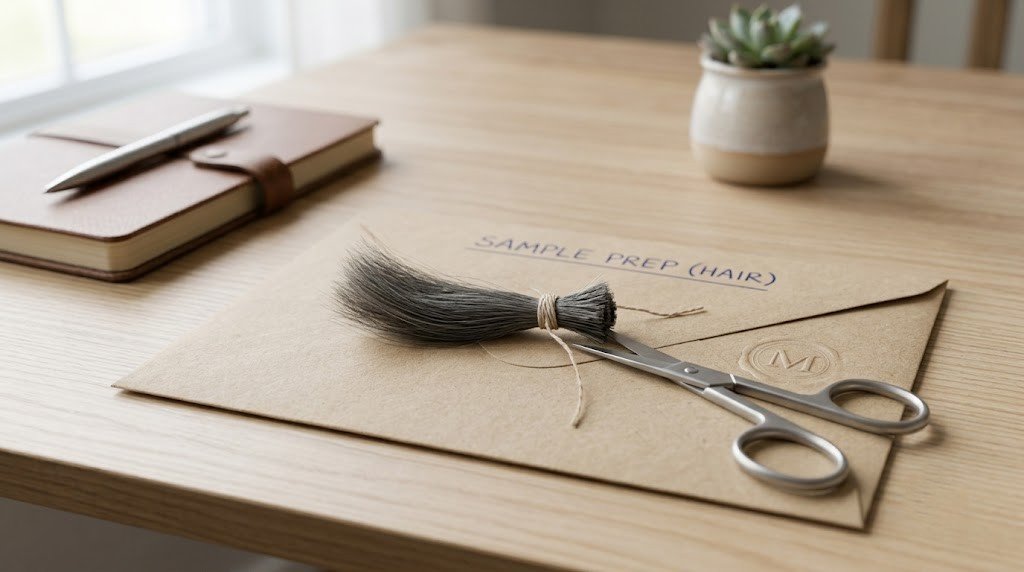
Table of Contents
What Does It Take to Turn Partner Hair Into a Diamond?
Seven steps turn partner hair into a diamond, and only three of them involve touching the hair.
- Decide where the sample will come from, a fresh cut, or hair that already exists in a brush, a box, or a sealed envelope.
- Collect it, tied before it is cut, or lifted strand by strand with tweezers.
- Weigh it, because providers work in grams rather than inches.
- Seal and label it, dry, with the date and the source written on the container.
- Confirm the minimum with a provider before you divide anything.
- Settle carat and color, which set the price and the schedule.
- Post it, and wait roughly six to ten months.
Steps 4 through 7 are the same for everyone, whatever route you took to turn partner hair into a diamond. Steps 1 through 3 are where people get stuck, because nothing in ordinary life prepares you to cut a lock of hair properly, and because a sample that looks generous can weigh almost nothing.
If you are still deciding whether to turn partner hair into a diamond at all, rather than how, the complete guide to a partner hair diamond covers the decision instead of the technique. If you are earlier still and not yet sure what a memorial diamond actually is, start there and come back to this page with scissors later.
Where on the Head Should You Cut From?
From underneath, and from more than one place. That is the short answer for anyone about to turn partner hair into a diamond and holding scissors for the first time.
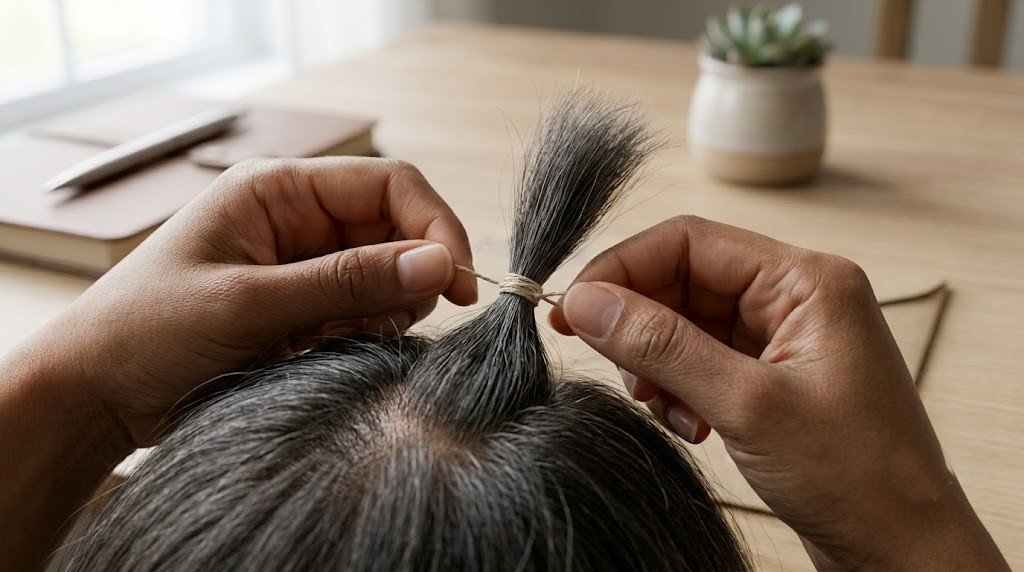
The layer at the nape of the neck, and the layer directly beneath the crown, are covered by the hair above them. A lock taken from either is invisible within minutes, which matters a great deal if your partner is still here and will see themselves in a mirror tomorrow, and matters more than people expect afterward too, when someone else may see them again.
Three practical points about placement:
- Take small amounts from two or three spots rather than one large section from a single spot. Spreading the cut is what keeps it invisible; a single deep cut shows.
- Cut close to the scalp rather than mid length. You are paid in weight when you turn partner hair into a diamond, and the length left behind is weight you did not take.
- Avoid the front hairline, the part, and the temples entirely. Those are the places a cut is noticed, and there is never a reason to use them.
For hair that is very short, a close cropped head, a shaved head, a beard, the same logic applies with a trimmer instead of scissors, and the clippings are collected onto a sheet of paper rather than held. Short hair is not a barrier to any plan to turn partner hair into a diamond, because nothing about the process cares how long the strands are.
How Much Hair Should You Take, and How Do You Measure It?
By weight, always. Every quantity question about how to turn partner hair into a diamond is a weight question, and length is a poor proxy, and it is the single most common reason someone decides they do not have enough.
Across the industry the requirement to turn partner hair into a diamond is usually described as a small lock or a few grams, sometimes as a pinch between finger and thumb, sometimes as a palmful of clippings. Fine hair and coarse hair of identical length weigh very differently, so a lock that looks substantial can be light, and a small handful of trimmer clippings can be plenty.
Three rules that cover almost every situation:
- Weigh before you cut if you are taking from something longer, using a kitchen scale that reads in grams.
- Take more than the stated minimum, because a shortfall discovered after collection is often uncorrectable, while a surplus costs nothing.
- Do not split a small sample into “some to send, some to keep” before a provider has confirmed the minimum. That is how a workable submission stops being one.
And the fact that makes all of this less fraught: collecting more does not give you more of them in the stone. Even hair, at roughly 50% carbon against 0.5% to 4% for cremated ashes, does not fill a growth cell. After purification to around 99.9% carbon, the recovered material is topped up with lab sourced carbon to reach the volume a run consumes, which is why the personal share of a finished memorial diamond lands industry wide at roughly 10% to 15% of its mass.
A larger lock does not raise that share, does not grow a larger stone, and does not shorten the wait, however much hair you collect to turn partner hair into a diamond. How much hair a partner memorial diamond needs covers the quantities properly.
How to Cut and Bundle a Lock So It Stays a Lock
The difference between a sample and a handful of loose hair is one piece of thread, tied before the scissors touch anything. Most of how you turn partner hair into a diamond is forgiving; this part is not.
| Step | What to do | Why it matters |
|---|---|---|
| 1 | Work on dry, unwashed hair | Damp hair goes into storage damp, and damp is the one condition that genuinely causes problems |
| 2 | Separate the section you are taking and lift the hair above it out of the way | Keeps the cut confined to the layer you chose |
| 3 | Tie the section tightly with thread or a small band, close to the scalp, before cutting | This is the whole technique. An untied section becomes loose strands the moment it is cut, and loose strands are the fiddliest way to turn partner hair into a diamond |
| 4 | Cut below the tie, with small sharp scissors, in one pass | Sawing at it scatters the section and loses weight |
| 5 | Keep the tied end as the root end, and note which end that is | Some providers ask; it costs nothing to preserve and cannot be recovered later |
| 6 | Lay the bundle flat into a paper envelope or a small sealed bag, without folding it | Folding breaks strands and makes weighing awkward |
If someone else is doing the cutting, a funeral director, a hospice nurse, a family member, a barber, hand them the thread and ask for it tied first. It is a small request and it is the one that determines whether what comes back is a lock or a scatter. A scatter will still turn partner hair into a diamond, but it is harder to weigh and easier to lose.
Retrieving Hair You Did Not Cut: Brushes, Boxes, and Old Envelopes
Plenty of people trying to turn partner hair into a diamond never get to hold scissors, because the only hair that exists was shed rather than cut. That works. You can turn partner hair into a diamond from shed strands exactly as you can from a cut lock; it is simply a different job, done with tweezers rather than a blade.
From a brush or comb. Do not empty it into a bag. Work under a bright light, lifting strands out individually with tweezers onto a sheet of white paper, and keep only what you are confident belongs to your partner. Selecting takes longer than emptying and produces a sample you can describe honestly, which is worth more than volume.
From a box or drawer of loose hair kept years ago. Age is no obstacle, you can still turn partner hair into a diamond from a lock that has been kept dry for decades. Check first that it is dry and has not sat anywhere damp. Then gather it onto paper, remove anything that is obviously dust or fiber, and weigh it before assuming it is too little, loose hair compacts badly and looks like less than it is.
From an envelope somebody sealed long ago. Leave it sealed if you can. Weigh the envelope, weigh an identical empty one, and take the difference, then write on the outside whatever you know about where it came from before that knowledge goes.
From a garment, a pillowcase, or a hat. Bag the whole object rather than picking at it in the moment. It can be worked through later, on a table, with better light and no time pressure.
One rule across all four routes to turn partner hair into a diamond: keep different sources in different bags. Pooling them is a decision you can still make afterward; separating them again is not.
Collecting From Someone Living Versus After a Death
Collecting to turn partner hair into a diamond is not the same act in these two situations, and the difference is not squeamishness, it is who is involved and what the constraints are.
| If your partner is still living | If your partner has died | |
|---|---|---|
| Who takes the sample | Usually them, or you together | You, a family member, or a professional you ask |
| The main constraint | The conversation, not the cutting | Timing, and who has access |
| What to ask for | Their agreement, plainly, rather than taking from a brush without telling them | Whether a funeral director or hospice nurse is willing to take a lock, and when that has to happen |
| What can go wrong | Asking badly, or making it feel like a diagnosis conversation when it is not | Assuming there will be another chance after the service |
| What is easy | Everything physical. It takes five minutes and can be repeated | The chemistry, which is identical either way |
If your partner is living, the honest framing is that this is not a memorial. It is an object made while both of you are here, and it belongs to a conversation rather than a surprise, the living memorial version of this covers how people approach that.
If your partner has died and you are reading this before a funeral, the one time sensitive line on this page is that the lock you need to turn partner hair into a diamond is straightforward to take beforehand and considerably harder afterward. Ask; do not assume. Whether a funeral home or hospice will do it, and on what notice, is a question for them rather than something any article can answer.
And if there was no opportunity at all, hair already around the house is complete starting material and enough on its own to turn partner hair into a diamond, which is also the ground covered by hair based options when there was no cremation. Nothing about a shed strand is inferior to a cut one.
Storing and Labeling a Sample Until You Decide
Keratin kept dry is stable for decades, so once a sample is safely put away there is no rush to turn partner hair into a diamond at all. What degrades is not the hair; it is your memory of where it came from.
- Dry and sealed. A zip bag inside a rigid envelope beats a soft envelope, which can split.
- Do not wash it. Washing removes nothing a laboratory cannot remove, and fine hairs go down drains.
- Label the container itself, not a note tucked in beside it. Write your partner’s full name, the date, and the precise source, cut from the nape, 4 March or lifted from their brush, 11 June.
- Photograph the label once it is written, so the record survives the envelope.
- Weigh it and write the weight down, so you can answer the first question anyone asks when you go to turn partner hair into a diamond without opening anything.
That label is the only provenance the sample will ever carry. Purification reduces hair to almost pure carbon, and nothing afterward can tell one person’s from another’s, so what you write is what will be known.
Sending It, and What It Costs to Turn Partner Hair Into a Diamond
Hair travels as ordinary mail. Nothing you do to turn partner hair into a diamond needs special handling, permission over anyone’s remains, or a cremation anywhere in the story, which is why this route stays open when turning a partner’s ashes into a diamond is not available to you.
Before you post anything, confirm with whoever will turn partner hair into a diamond for you: the exact minimum weight, what container they want it in, whether they will assess a photograph and a weight first, what documentation comes back when the sample is logged in, what happens to hair not consumed, and whether separately collected samples may be pooled into one submission.
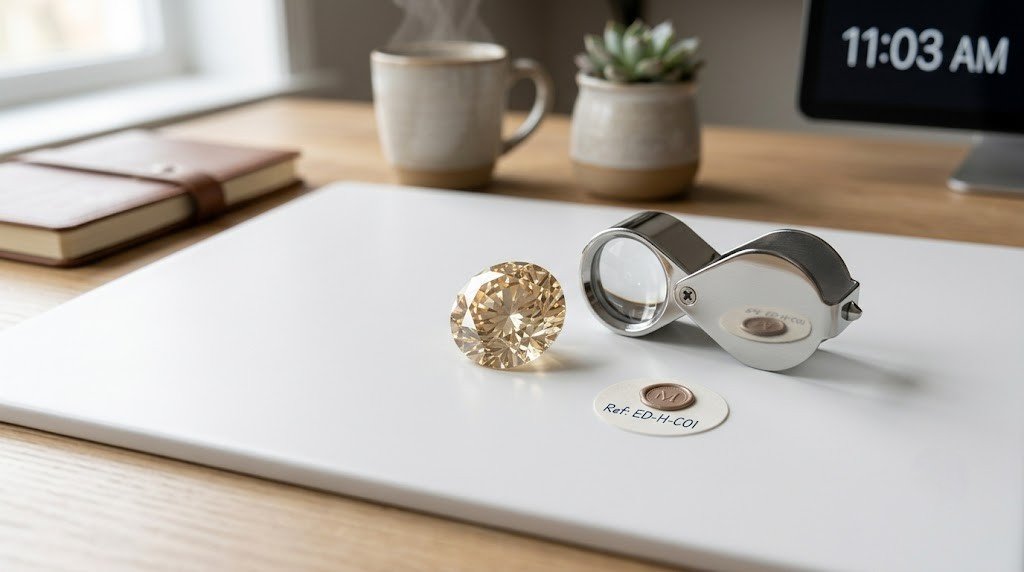
Then price. The cost to turn partner hair into a diamond follows carat, and carat follows growth time in the press. A stone in the 0.10 to 0.25 ct range is quoted at roughly $1,500 to $3,500 across the industry in 2026; step up to somewhere between half a carat and a full carat and the band runs about $5,000 to $15,000; anything from 2 ct on up toward 5 ct and beyond commonly starts near $20,000 and climbs past $75,000. None of those are Memorial Diamond prices, which are not published, they are simply where the category sits.
An independent grading report, engraving, a fancy cut, and the setting are usually quoted separately. Worth knowing while you choose a setting: diamond is 10 on the Mohs scale, the hardest known natural mineral, so the metal around it will wear long before the stone does. What a partner memorial diamond costs breaks a quote apart.
Frequently Asked Questions
Where is the best place to cut from if I want to turn partner hair into a diamond?
From the layer at the nape of the neck or directly beneath the crown, in small amounts from two or three spots. Both layers are covered by the hair above them, so the cut is invisible within minutes.
How do I know whether I have enough hair to turn partner hair into a diamond?
Weigh it in grams rather than judging by length, then check that weight against the provider’s stated minimum before dividing anything. Fine and coarse hair of the same length weigh very differently, so appearance is unreliable.
Can I turn partner hair into a diamond using hair from a brush?
Yes. Lift strands out individually with tweezers under a bright light rather than emptying the brush, keep only what you are confident is theirs, and note on the container exactly where it came from.
Does the hair need to be cut, or does shed hair work?
Shed hair works identically. There is no chemical difference between a cut lock and hair from a brush or a pillow, and shed hair will turn a partner’s hair into a diamond the same way. A provider may still have a view on quantity, so confirm the minimum first.
Does dyed, gray, or thinning hair still work?
Yes to all three. Dye and product are removed during pre cleaning, gray hair is the same feedstock as any other, and thinning hair changes only how much you need to gather rather than whether it can be used.
My partner is still living. How do I raise this?
Directly, and as something you would like rather than something you have decided. Taking hair from their brush without telling them is possible and is a worse start than a straightforward conversation about an object you would both know exists.
How long can a sample sit before I decide?
Indefinitely. Keratin kept dry and sealed is the same starting material in ten years as today, so collecting carefully now and deciding to turn a partner’s hair into a diamond much later is a perfectly ordinary order to work in.
Final Thoughts on What It Takes to Turn Partner Hair Into a Diamond
The technical part of what it takes to turn partner hair into a diamond is genuinely small: tie it, cut it, weigh it, seal it, write on it. Twenty minutes, most of which is finding thread and a scale.
What makes it feel larger is that somebody has to do it, in a room, with their hands. That is worth taking slowly and doing once, carefully, and then everything after it can wait as long as you need.
Learn More About Partner Memorial Diamonds
- Partner Hair Diamond: The Complete Guide
- How to Turn Your Partner’s Ashes Into a Diamond
- How Much Hair Do You Need for a Partner Memorial Diamond?
- Memorial Diamonds for Non Cremated Loved Ones: Hair Based Options
- What Is a Memorial Diamond? The Complete Guide
Talk With Memorial Diamond
If you are unsure whether what you have is enough to turn partner hair into a diamond, a weight and a photograph usually settle it in one conversation.
Reach out to memorialdiamond.us before you cut, divide, or post anything. Finding out that a sample is enough, or that it is not, costs nothing and changes what you do next.