
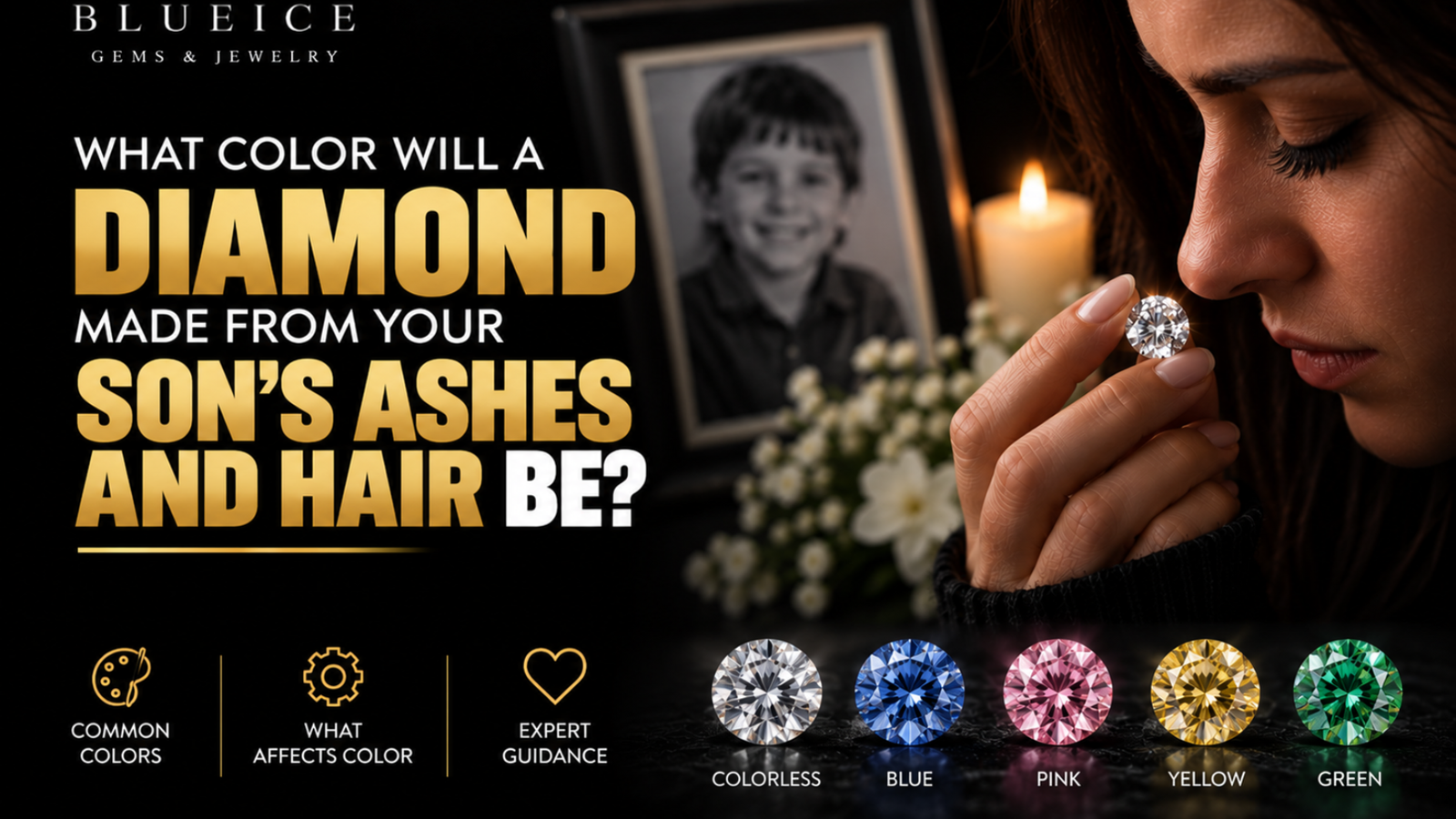
Families who send both usually hope the combination gives them some say in how the stone turns out. It does not, and the honest answer is this: son ashes hair diamond color most often settles into the yellow, blue or champagne to brown families, because impurities trapped in the lattice during growth decide the shade and both of your materials came from a person rather than a supplier. White is possible with extra work and extra money, and no laboratory can name your son ashes hair diamond color in advance.
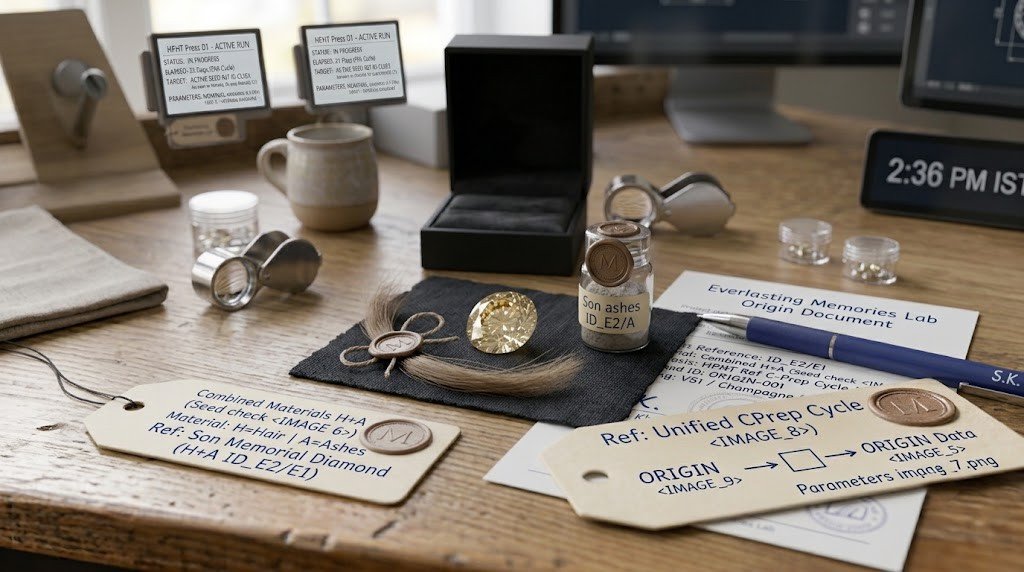
Table of Contents
How Does a Diamond End Up Tinted at All?
Son ashes hair diamond color, like the color of any diamond, is an impurity story. The crystal is carbon arranged in a rigid repeating pattern, and any atom that is not carbon which finds a place in that pattern as it grows alters how light leaves the finished stone.
Where nitrogen occupies some of those positions, the eye reads the result as yellow. Where boron occupies them instead, the eye reads blue. Only a lattice that took up neither comes out water white, which is why colorlessness is best described as what was kept out rather than what was put in.
That is the entire basis of son ashes hair diamond color, and it is worth internalizing before any sales conversation. The shade is structural. It is not a polish, a plating or a finish, and it cannot be undone later by recutting.
It also means son ashes hair diamond color is settled inside a sealed press over a period of months, with nobody watching. How a memorial diamond is made from his ashes and hair walks through that stage in order.
Does Blending Ashes and Hair Shift the Result?
Not in any direction you could plan around. This is the specific hope that brings most parents to the combined route, so it deserves a blunt answer rather than a hedge.
The thinking usually runs that ash is the messy material and hair the clean one, so mixing in hair ought to pull son ashes hair diamond color toward something lighter or at least more predictable. Neither half of that holds. Both materials are reduced to purified carbon, roughly 99.9% or better, before anything is grown, and the trace elements that set son ashes hair diamond color live in whatever survives that purification on both sides, plus in the growth conditions themselves.
So a blend does not average two outcomes together, and it does not dilute anything. It produces one crystal, whose son ashes hair diamond color falls wherever the chemistry of that particular run puts it.
That is the same position this library takes about the ashes only question and about the hair only question. No route is the controllable one.
Which Son Ashes Hair Diamond Color Outcomes Are Most Common?
Five families of son ashes hair diamond color cover almost everything that actually reaches a parent’s hands, in a category with a longer history than most families realize. Treat this as a description of the landscape rather than an order form:
| Shade family | Origin | Frequency across the category | Price impact |
|---|---|---|---|
| Yellow to golden amber | Nitrogen in the lattice | The most frequent outcome | No premium |
| Blue | Boron in the lattice | Frequent | None to modest |
| Champagne through brown | Mixed trace elements and run conditions | Frequent | No premium |
| Near colorless and colorless | Nitrogen and boron both held out | Uncommon | Substantial premium |
| Irradiated red, pink, green, black | Treatment applied after growth, where offered | Depends entirely on the provider | Premium; black runs longest |
The frequency column reflects tendency across the industry, not a probability anyone can calculate for your submission. No test looks at a portion of ash and a lock of hair and forecasts which row your son ashes hair diamond color will land in.
The practical value of a table like this is calibration. A parent who already understands that warm tones dominate is far less likely to be blindsided by the son ashes hair diamond color that eventually arrives.
Does One Material Overrule the Other?
There is no published basis for saying that whichever material you send more of will dominate son ashes hair diamond color, and it is worth being suspicious of anyone who implies otherwise.
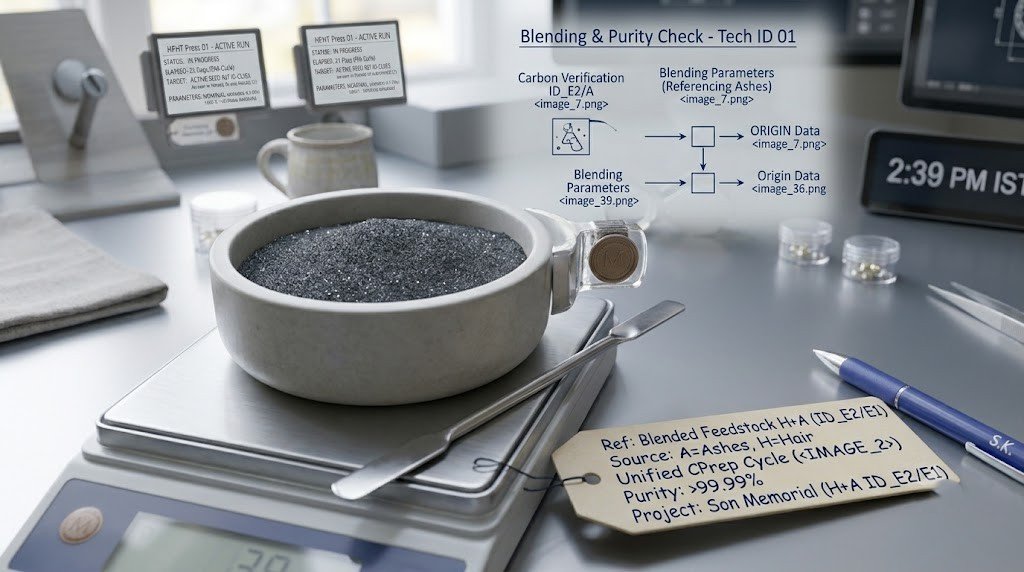
Part of the reason is that the two materials are not weighed against each other in any meaningful sense by the time growth begins. Each is stripped to carbon, and that carbon is combined with supplemental lab sourced carbon to reach a workable volume. What reaches the growth cell is one feedstock, not two competing ones.
So sending a heavier portion of ash will not push son ashes hair diamond color toward amber, and adding an extra lock will not pull it toward white. If a provider tells you the ratio is a lever you can pull, ask them to explain the mechanism and to put the claim in writing.
The genuinely useful question to ask instead is procedural: does this laboratory process both materials in a single run, or handle them separately and combine later? That affects chain of custody and paperwork rather than son ashes hair diamond color, but it is worth knowing. Whether the finished stone is genuinely his covers the verification side of that.
Can a Blended Submission Come Out Colorless?
Yes, and it is worth knowing what that actually asks of a laboratory before you request it, because a colorless son ashes hair diamond color is not a preference you simply state.
Achieving white means keeping nitrogen and boron almost entirely out of the growth environment. That takes tighter control and additional processing steps than a run where trace elements are simply allowed to do what they do, and across the category a colorless stone typically costs considerably more than a warm or blue stone of the same carat weight.
The part that gets undersold is that additional processing buys better odds on son ashes hair diamond color, not certainty. A laboratory working toward white is still working toward it, and a blended submission does not improve those odds.
Raise it at the first conversation if white matters to you, not after a deposit. Ask how often that target is met in their hands, what happens when a stone arrives tinted anyway, and whether the extra charge stands regardless. The complete guide to a son ashes and hair diamond sets out the rest of the questions in sequence.
Where Do Red, Pink, Green and Black Stones Come From?
From a separate step that happens after the crystal already exists. Some providers offer post growth irradiation, which can move a finished stone into red, pink, green or black territory.
Two caveats matter. Availability differs sharply between companies, so a treated son ashes hair diamond color you have in mind may not be on the menu at the provider whose process you otherwise prefer. That is a question for the first call, not the last.
The other caveat is about meaning rather than logistics. Treatment changes how the stone reads; it does not change where the carbon came from. A treated son ashes hair diamond color is still a stone grown from his ashes and his hair.
Timing is the practical trade off with any treated son ashes hair diamond color. Black stones and larger carat weights are the two things most likely to stretch a commission toward the long end of the normal schedule. How long a son memorial diamond takes covers the waiting properly.
How Much of a Blended Stone Is Actually His?
This is where families are most often given a number that does not apply to them, so it is worth separating carefully.
The percentages quoted around this industry describing how much of a finished stone came from the personal source are ash figures. On the ash route, personal carbon recovered from cremated remains is usually said to account for something in the region of 10 to 15% of a finished stone’s mass. Lower numbers circulate too, 3% appears in some published material, and the figure moves with stone size and with the quantity a family sent. There is no equivalent published figure for hair, and none at all for a blended charge of ash and hair together.
So nobody can tell you what share of a combined stone is his without their own data. Ask your provider for their figure for a blended submission specifically, and ask for it in writing rather than over the phone.
What is safe to say is the shape of the thing. His carbon is purified and then combined with supplemental lab sourced carbon to reach growth volume, so the stone is part him and part supplementary feedstock, never wholly one or the other. That has no bearing on son ashes hair diamond color, but it is the claim most worth pinning down before money moves.
What Can Anyone Promise You About Son Ashes Hair Diamond Color?
A target and a described process. Nothing beyond that, and how a company responds when you press on this is one of the better tests of its honesty.
A provider can reasonably say which shade family they will aim for and explain which variables they control. What no provider can honestly write onto a contract is a guaranteed son ashes hair diamond color, in the way they can guarantee a carat weight or a cut shape.
Get these five answered before you sign anything:
- Which shade family are you aiming for with a blended submission, and why that one?
- How often does that aim land, in your own recent experience?
- What happens if the finished stone comes out well away from it?
- Is any fee refunded, reduced, or a second run offered in that case?
- Will the finished son ashes hair diamond color be documented independently?
That last question carries more weight than it looks like it does. An independent grading report assesses the stone on the same four quality factors used for any diamond, which makes it the only third party record of what you actually received. It is usually an optional extra rather than standard, so ask whether it is included.
Is There a Reason to Send Both Rather Than One?
Yes, but the reasons are practical and emotional rather than chromatic. Sending both will not steer son ashes hair diamond color anywhere.
Some parents have only a modest portion of ash left because the rest was scattered or interred, and a lock of hair makes up the shortfall. Others want the hair included simply because it was cut while he was alive. Both are good reasons.
There is also a redundancy argument. If one material proves unusable, having submitted both means the commission does not stall while a family decides what else to send. Ask the provider how they would proceed in that situation.
What should not sway you is a suggestion that combining materials improves the stone. It does not improve clarity, it does not improve son ashes hair diamond color, and it does not shorten the wait. How much of each material a laboratory needs sets out the quantities involved.
Who Has to Agree Before Both Materials Are Used?
The two materials sit in slightly different positions, and it helps to separate them before you fill in a form.
His cremated remains are governed by a statutory order of priority that most states set out. A surviving spouse or partner commonly sits at or near the top of it, and adult children of his own can rank above parents. Written instructions he left behind can reorder that, and the detail varies state by state. In practice the person holding that authority is the one a provider will want signing for the ash, and that same signature usually sets the son ashes hair diamond color being aimed for.
A lock of hair you have kept is generally the more straightforward half in practice, because those statutory rules are written about remains rather than about a keepsake in a drawer. It is not a question with no dimensions at all, though: a person’s belongings can form part of an estate, treatment differs between states, and hair that somebody else has been keeping is a conversation to have rather than a decision to take on your own.
It is also entirely normal for two parents to want different things here, or for one parent to be arranging all of it alone. Where authority is genuinely unclear, the funeral director who handled the cremation or a local attorney will settle it quickly.
How Do Shade, Price and Waiting Time Connect?
Son ashes hair diamond color nudges the price; carat weight sets it. Working from category wide 2026 figures rather than any one company’s list, a stone between 0.10 and 0.25 carats typically falls between $1,500 and $3,500, half a carat to a full carat runs roughly $5,000 to $15,000, and two carats and up starts near $20,000 and can pass $75,000.
Within a tier, a colorless result carries a real premium over a warm or blue stone of the same weight, for the process control reasons above. Irradiated shades usually carry their own premium, and grading reports, engraving, fancy cuts and settings are quoted separately from the stone.
On timing, the industry norm runs roughly six to ten months from the day material is received. A specialty son ashes hair diamond color, black in particular, or a larger stone can push that toward a full twelve. What a son memorial diamond costs breaks the tiers down in detail.
What Should You Expect on the Day It Arrives?
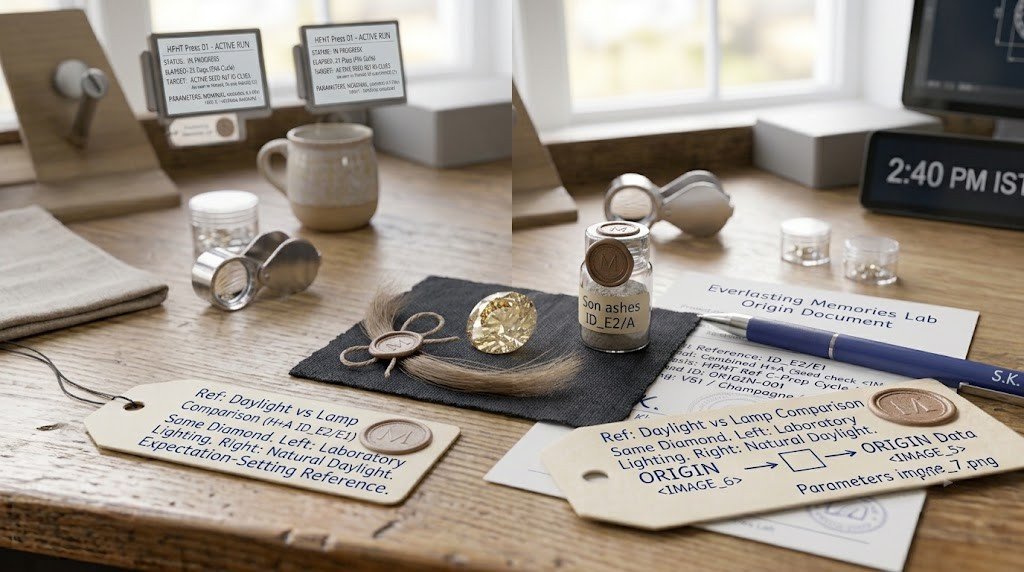
Something that looks different from the photographs, almost always. Laboratory lighting is unforgiving and flattening in equal measure, and a son ashes hair diamond color that looked one way on a screen frequently reads warmer or cooler in daylight at a kitchen window.
Setting changes it again. Yellow gold absorbs a faint warm tint into its surroundings, while platinum throws the same tint into relief. A blue stone usually looks strongest against white metal, and champagne tones settle beautifully into rose gold.
Give yourself permission not to have an instant reaction. Some parents love the stone the moment the box opens; others need weeks, and some find it only makes sense once it is worn rather than examined.
Neither response says anything about you. It is an unusual object to receive, and there is no correct way to feel about a son ashes hair diamond color the first time you see it.
Frequently Asked Questions
Does sending more hair than ash make the stone lighter?
No, and there is no published basis for the idea that the ratio steers the shade. Both materials become purified carbon before growth begins, and trace elements plus press conditions decide the son ashes hair diamond color. Ask any provider claiming otherwise to explain the mechanism.
Can I ask for the ash and the hair to be grown separately?
Some providers can grow more than one stone from a submission, which is a different question from blending. Ask directly whether separate runs are possible, what each would cost, and whether the paperwork documents which material went into which stone.
Will a blended stone look different from an ashes only one?
Not in any way a family could predict or a grader could attribute to the blend. Both routes produce shades clustered in the same yellow, blue and champagne families, and neither can be forecast before the growth run has finished.
Does the shade fade over the years?
No. The tint comes from elements built into the crystal structure while it formed, not from any coating or treatment applied to the surface. Normal wear, cleaning, sunlight and decades of handling leave it unchanged.
Is a warm toned stone lower quality than a white one?
No. A colorless result costs more because holding trace elements out demands more process control, not because a tinted diamond is inferior. Cut, clarity and carat are assessed separately from shade on any grading report.
What if I dislike the color when it arrives?
Tell the provider and ask what their policy permits, but allow yourself some time first. Many parents describe an initial reaction that changed once the stone had been set, worn and seen in ordinary daylight rather than under a lamp.
Final Thoughts on the Shade of a Blended Memorial Stone
Sending both his ashes and a lock of his hair is often about wanting to include everything that remains of him, and that instinct deserves better than a sales answer about shade.
The truthful version is that the combination will not give you more control over son ashes hair diamond color than either material alone would. What it gives you is a stone grown from two different traces of one person, one taken while he was alive, one after, and a shade that arrived out of that specific chemistry rather than out of a catalogue.
Ask for the intended son ashes hair diamond color in writing, ask what recourse exists if the run misses it, and then let the months pass. Whatever son ashes hair diamond color comes back, it came back from him.
Learn More About Son Memorial Diamonds
- How a memorial diamond is made from his ashes and hair the stage where shade is decided
- The complete guide to a son ashes and hair diamond everything that surrounds this question
- Whether the finished stone is genuinely his carbon, blending and documentation
- How much of each material a laboratory needs quantities for a combined submission
- What a son memorial diamond costs including the premium a colorless result carries
Talk With Memorial Diamond
If you are holding both his ashes and a lock of his hair and trying to work out what is realistic, that is a reasonable place to start from. Memorial Diamond can be reached at memorialdiamond.us for a straight account of what a blended submission can and cannot do. Nothing is committed by asking.
Word count: 3,009 words · Reading time: about 15 minutes